INSPIRE The official magazine of the College of Education, Health and Aviation
OPENING DOORS REMEMBERING THE LEGACY OF NANCY RANDOLPH DAVIS
2019
AVIATION • DESIGN, HOUSING & MERCHANDISING • EDUCATION • HEALTH • HUMAN SCIENCES
EXPLORE OUR ACADEMIC PROGRAMS & STUDENT EXPERIENCES education.okstate.edu/center-for-student-success
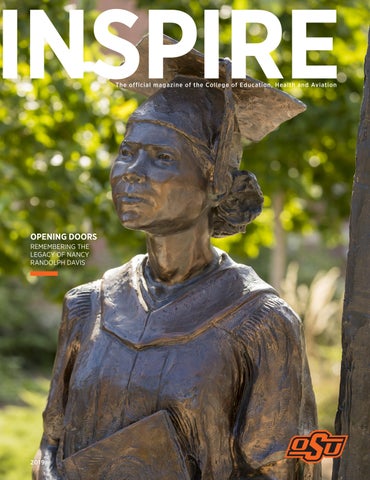
INSPIRE 04 Nancy Randolph Davis On the cover: As the first African American student at Oklahoma A&M College, Nancy Randolph Davis opened the doors for many. OSU is honoring her legacy with a life-size statue recently dedicated on campus. (Cover photo by Phil Shockley)
08
United We Can Tulsa students are getting help to succeed — and dream big — with the Unidos Se Puede (United We Can) program from OSU.
Interim Dean, College of Education, Health and Aviation Stephan M. Wilson EHA Communications Rachel Potts Editor Dorothy L. Pugh Art Director Dave Malec
12
Learning for Life
Graphic Designer Codee Classen
The Osher Lifelong Learning Institute at Oklahoma State University offers participants classes, travel and social activities.
Photographers Phil Shockley Gary Lawson Mitch Harrison Diana Haslett
19
INSPIRE Magazine
Speaking Out Two OSU colleagues are working to help children who have disabilities find their voices with the help of assistive technology.
Plus… 32
Top 10 Seniors
34
Faculty News
40
News and Notes
Oklahoma State University College of Education, Health and Aviation 106 Human Sciences | Stillwater, OK 74078-4033 ehamagazine@okstate.edu Inspire magazine is a publication of the O klahoma State University College of Education, Health and Aviation. Its purpose is to connect this college with its many stakeholders, providing information on both campus news and pertinent issues in the field of education. © Oklahoma State University 2018 When you join the OSU Alumni Association, a portion of your membership comes back to the college to fund programs such as homecoming and other alumni events. Contact the college for more information: 106 Human Sciences, Stillwater, OK 74078-4033 (405) 744-9805 education.okstate.edu
Oklahoma State University, in compliance with Title VI and VII of the Civil Rights Act of 1964, Executive Order 11246 as amended, and Title IX of the Education Amendments of 1972 (Higher Education Act), the Americans with Disabilities Act of 1990, and other federal and state laws and regulations, does not discriminate on the basis of race, color, national origin, genetic information, sex, age, sexual orientation, gender identity, religion, disability, or status as a veteran, in any of its policies, practices or procedures. This provision includes, but is not limited to admissions, employment, financial aid, and educational services. The Director of Equal Opportunity, 408 Whitehurst, OSU, Stillwater, OK 74078-1035; Phone 405-744-5371; email: eeo@okstate.edu has been designated to handle inquiries regarding non-discrimination policies. Any person (student, faculty, or staff) who believes that discriminatory practices have been engaged in based on gender may discuss his or her concerns and file informal or formal complaints of possible violations of Title IX with OSU’s Title IX Coordinator 405-744-9154. This publication, issued by Oklahoma State University as authorized by (originating authority), was printed by Modern Litho at a cost of $4,947.86/4M 09/19 8015.
<f!muzed~ LI FE ORANCECON N ECTION .org/joi n
From the Dean Greetings from the College of Education, Health and Aviation! Welcome to the 2019 issue of Inspire magazine! I have been privileged to serve as dean of the College of Human Sciences since 2008, and in January 2019, I was appointed interim dean of the College of Education, Health and Aviation. We are in midst of a historic first at Oklahoma State University. The College of Education, Health and Aviation and the College of Human Sciences are in the process of coming together to create a new, combined academic college. Both colleges have long and rich traditions at OSU, and the decision to bring them together is truly a growth initiative that will significantly impact our students, the state of Oklahoma and our many stakeholders. As we build on existing strengths, we will be able to provide more comprehensive services and an enhanced curriculum for our students. We will also heighten the visibility of our instruction, research and extension across the state and region. We are confident that this new college will be well-positioned for the future as a leader in education, health, the human sciences and more. The well-being and development of people is at the center of everything we do in both colleges, which you will see illustrated throughout this magazine. We have intentionally included articles that highlight collaborations, programming and projects that already exist between the two colleges. As you read, I hope you are filled with excitement and optimism about our two colleges joining forces.
While a specific launch date has not been set, I expect to share an update on the new college timeline soon. We have already begun operating under a shared administrative structure, but we will remain as two separate colleges for now, and students will graduate from their respective colleges this school year. It is absolutely an exciting time to be a part of the College of Education, Health and Aviation and the College of Human Sciences as we build new partnerships and create new opportunities together. I appreciate your patience, support and positive energy during this process. Thank you for investing in our joint success as we look toward the future. Stay tuned for great things to come!
Sincerely,
Stephan M. Wilson
Interim Dean, College of Education, Health and Aviation Dean, College of Human Sciences Regents Professor of Human Development and Family Science
CO L L EG E O F E D U C AT I O N , H E A LT H A N D AV I AT I O N 3
4 2019
STORY C H R I S T Y L A N G | PHOTO DIANA HASLETT
A LEGACY OF QUALITY EDUCATION Nancy Randolph Davis' statue stands tall for her life and accomplishments
COMMITMENT. COURAGE. CHARACTER. Nancy Randolph Davis embodied all of these qualities throughout her life. CO L L EG E O F E D U C AT I O N , H E A LT H A N D AV I AT I O N 5
Nancy Randolph Davis in 2009.
Calvin Davis gazes on the statue of his mother, Nancy Randolph Davis, after its dedication in January.
Davis was the first African American student to enroll at Oklahoma State University (then Oklahoma A&M College) in 1949. Over the last two decades, the university and the College of Human Sciences have recognized and celebrated Davis’ life and accomplishments.
the OSU campus; the first is of Henry G. Bennett, who served as university president from 1928-51. Calvin Davis expressed his family’s gratitude to the university and encouraged everyone at the dedication to follow his mother’s legacy of belief in her own success and acceptance of others. “My mother would not want (the statue) to be about her,” he said. “She would want it to be a beacon of hope, perseverance, determination and encouragement."
HER STORY In 2019, her legacy was honored in a beautiful, eternal way when a statue of her likeness was unveiled in the courtyard of the Human Sciences Building, facing Monroe Street, on the Stillwater campus. The bronze sculpture, created by artist Jane DeDecker, depicts Davis as a young graduate in master’s academic regalia, celebrating her accomplishments as a student graduating from OSU. A doorway symbolizes her crossing the threshold of opportunity and looking ahead to a bright future. At the base of the doorway, a bronze ring is inscribed with a quote from Davis herself: “I was never trying to make history. I was just a regular woman and teacher wanting to further my education so that I could improve my community and the lives of my students.”
6 2019
Nearly 200 people gathered for the sculpture dedication on Jan. 31, ushering in 2019’s Black History month at OSU. The attendees included Davis’ children, son Calvin Davis and daughter Nancy Lynn Davis, and her granddaughter Teklyn Jackson-Davis, who has followed in her grandmother’s footsteps as a current OSU graduate student. Many of Davis’ former students also attended the historic event. “This sculpture represents an incredibly powerful and profound moment for this institution, for every one of us that know it, that love it, that care about it,” Dr. Jason F. Kirksey, vice president for institutional diversity and OSU’s chief diversity officer, said during the dedication. “This is a commitment to inclusion that is unwavering.” The statue is only the second lifesize sculpture of a human being on
In June 1949, Nancy Randolph Davis became a civil rights pioneer, crossing racial barriers at OSU. She was not trying to make history; she simply wanted to earn a master’s degree in her home state. Her conviction to pursue higher education changed Oklahoma State University. Davis was required to sit separately from her white classmates, in the back of two classes and in the hallway for the third, looking through a window and listening through a door. “I was segregated for about a week and a half,” she shared in a 1997 interview. “After our first test (I made the second-highest score in the class), my classmates said that the laws were unfair, and they wanted me to sit in the class with them. When they invited me to sit with them, they made me feel important instead of different.”
PHOTOS GARY LAWSON AND DIANA HASLETT
“My mother would not want (the statue) to be about her. She would want it to be a beacon of hope, perseverance, determination and encouragement.” CALVIN DAVIS
Davis continued her teaching career and took classes for the next three summers. She completed her master’s degree in home economics (now Human Sciences) in 1952. Davis said she did not know she was a trailblazer, but she became an iconic figure in the university’s history. “(Davis’ enrollment at OSU) was an important event in terms of legal changes and cultural history and in who we became as an institution,” said Stephan Wilson, dean of the College of Human Sciences and interim dean of the College of Education, Health and Aviation.
A PASSION FOR EDUCATION
Davis, who earned her bachelor’s degree in home economics from Langston University in 1948, dedicated her life to public education. She spent 43 years as a teacher, 20 years at Dunjee High School and 23 years at Star Spencer High School, before retiring in 1991. Davis’ passion and care for people and her desire to educate were evident to all who knew her. “She was a major advocate for both the human sciences and public education. Throughout her life, she stood up for what she believed, and she earned the respect of all around her for that,” Wilson said. Davis influenced thousands of students and their families and inspired others to fight through adversity to pursue their dreams. She also did
not shy away from supporting social changes in Oklahoma. Throughout her life, she was active in the civil rights movement in the state including working as an adviser to the Oklahoma City National Association for the Advancement of Colored People Youth Council. Davis transformed the legacy of OSU, what it stands for and what it aspires to be. “You could not have better values than Nancy Randolph Davis,” OSU President Burns Hargis said. “She believed in education and spent her life in education and in civil rights. We all have benefited from her.”
DAVIS’ LIST OF HONORS
In 1999, she was honored with the OSU Distinguished Alumni Award, and OSU’s residential Davis Hall was named in her honor in 2001. Each February, the university celebrates “Nancy Randolph Davis Day.” In 2009, she received the OSU College of Human Sciences’
Enhancing Human Lives Award. She was inducted into OSU’s Greek Hall of Fame in 2012. Davis has also been honored multiple times by the state of Oklahoma. In 1991, Gov. David Walters designated May 31 as “Nancy Randolph Davis Day.” She received the Oklahoma Human Rights Commission’s Lifetime Achievement Award in 2008. Following her death at the age of 88 in 2015, she was posthumously inducted to the Oklahoma African American Educators Hall of Fame (2015) and the Oklahoma State University Hall of Fame (2018). She was also recognized by the state with a three-mile stretch of Interstate 35 west of Stillwater named the Nancy Randolph Davis Memorial Highway in 2018. “We should make sure that every time we pass (the sculpture), we reflect on who she is and what she stands for and what that sculpture represents about Oklahoma State University,” Kirksey said. ■
LEARN MORE Watch the dedication of Nancy Randolph Davis’ statue at OSU at okla.st/davis. From left: Dean Stephan Wilson, OSU President Burns Hargis, and Davis family members son Calvin Davis, granddaughter Teklyn Jackson-Davis and daughter Nancy Lynn Davis.
CO L L EG E O F E D U C AT I O N , H E A LT H A N D AV I AT I O N 7
UNIDOS SE PUEDE
OSU’s United We Can program helps Tulsa students succeed — and see more options
Jonathan Avendano (from left), Gabriella Lopez and Daisy Gallegos pass water between them while playing a game at Camp Okiwanee.
8 2019
STORY DAV I D B I T T O N | PHOTOS AMAIRANI PEREZ AND DIANA HASLETT
CO L L EG E O F E D U C AT I O N , H E A LT H A N D AV I AT I O N 9
L
ike many teens, Alejandra Avina doesn’t yet know what she wants to do for a career. But thanks to Oklahoma State University’s Unidos Se Puede (United We Can) program, she knows she’s got a lot of options. Over the last two school years, she has received academic assistance from the program, which serves roughly 180 Tulsa youth in the Latino and African American communities annually. “I think it is a pretty cool program because it brings people together and lets people know what is going on in the community,” Avina said. “It also teaches us that we can go into a career and not quit after high school.” Now in its sixth year, the Unidos program works with seventh- and eighth-graders from eight Tulsa Public Schools to encourage high school graduation and to promote higher education. The program began with Dr. Ron Cox and his colleagues from OSU’s department of Human Development and Family Science doing a needs assessment of Oklahoma’s Latino communities in Oklahoma City, Tulsa, Lawton, Altus, Guymon, Stillwater and Clinton. “We learned a lot about parents’ fears and their desire to help their children do better academically and to stay away from high-risk behaviors like substance abuse or teen pregnancy,” Cox said. Latino youth make up roughly onethird of the 40,000 students within Tulsa Public Schools and African American students account for roughly another quarter. About half the Latino students are English language learners, coming from homes where most parents speak only Spanish. African American students joined the Unidos program this year, thanks to a grant and partnership between OSU and Langston University, a historically black college south of Stillwater. “Partnering with Langston to increase its involvement in this program is key to reaching this population,” said Cox, who is also a cooperative extension specialist. The program is built on three pillars: family engagement, positive peer
10 2 0 1 9
affiliations and child personal agency. For a young person to acquire “agency” means they are learning how to act on their own behalf rather than allowing adults to be their only advocates. It’s a critical point in moving from childhood dependency to adulthood independence. Parents learn about the U.S. school system, including such nuances as what a school counselor does, the importance of parent-teacher conferences and why being on time to school is vital. They also learn research-based strategies to help their child succeed academically. “These children come in with disadvantage both from poverty and maybe some traumatic experiences they have gone through,” Cox said. “We try to be close enough to the kids to figure out what’s going on and help them find either the resources they need to succeed or to coach them in a different way to view life. You hear so many people say ‘I’m not good at math or science.’ That’s really a false statement. The way to look at that is ‘I’m really not good at that yet.’ And just by adding that one little word, it changes their whole perspective. It frees the child to explore new pathways toward success. We do a lot of coaching around that.” A child’s friends can have a lasting impact on their lives. “You can’t tell a child who your friends are going to be,” Cox said. “But you can create a space where children
"I think it is a pretty cool program because it brings people together and lets people know what is going on in the community." ALEJANDRA AVINA
who are like-minded can have fun together, which then helps them to develop those bonds and relationships that help create positive peer groups. If the youth in our program start to think about academic success — that is, who I’m going to be 10 years from now and how I’m going to get there — having them think this way in peer groups is mutually reinforcing. Kids start feeling like, ‘Hey, I belong here.’” The Unidos program pairs students with a paid success coach. The coach — typically a college student or a young professional — works with students and guardians to make important changes over the two years before high school.
Hector Ramirez (left) and Fernanda Velaquez build a catapult contraption during a Career Exploration Day event for participants of the Unidos Se Puedo program.
From left: Stephanie Lopez, Alexabeth Trujillo, Theresa Torres, Ashlyn Murillo and Melissa Romo learn about law enforcement from a Tulsa County Sheriff’s Office deputy during a Career Exploration Day event for participants of the Unidos Se Puedo program.
“I can definitely tell the program is serving a huge need in the community,” said Elber Arroyo-Rivera, Unidos program coordinator. “The parents and students are really close with the coaches.” Coaches have access to student grades and attendance records and know right away if someone fails a test. The coach helps the student identify problem behaviors, learn to come up with viable solutions and put those solutions into practice. This might involve finding a tutor if one is needed. Guardians are coached to help encourage the student by making small changes in the home that reinforce the student’s goals to be successful. “Education is not just the teachers teaching but it is also the parents nurturing,” Cox said. “If your child is going to be successful in school and in life, education has to begin at home. The parents have to be involved in a way that motivates and encourages. We help them do that.” Francisca Avina wants the best for her three children, including Alejandra. “My goal is for them to finish high school and then move on to whatever they want to do,” the mother said. “I would like them to learn a profession that they love.” Students who participated in an eight-week program this summer were
tutored in math, science or English by Tulsa teachers, in addition to learning about potential careers. Members of the Tulsa Sheriff’s Office met and talked with students about their jobs. “We are hoping that not only are we exposing kids to possible careers in law enforcement, but we are also reducing some of the tension between law enforcement and these traditionally underserved populations,” Cox said. “After the meeting, one young lady was even more passionate about going into law enforcement.” Over the summer, students also participated in teambuilding activities at Camp Okiwanee and a variety of Career Exploration Day events. “The kids walk away from our program thinking college is within reach,” Cox said. ■
FOR MORE INFORMATION Visit okla.st/unidos or contact: Dr. Ron Cox • r.cox@okstate.edu • 405-744-9938
COX WINS NATIONAL DIVERSITY AWARD Dr. Ronald Cox Jr., an Oklahoma State University associate research professor and cooperative extension specialist, was the 2018 winner of the National Extension Diversity Award. Recognizing visionary leadership and diversity in educational programming, the U.S. Department of Agriculture’s National Institute of Food and Agriculture, Cooperative Extension and the Association of Public and Land-Grant Universities recently announced the honor. The National Extension Diversity Award recognizes significant contributions and accomplishments in achieving and sustaining diversity and pluralism. “We are extremely proud of Dr. Cox’s achievements and the national recognition of his communityengaged scholarship in the context of diversity,” said Jorge Atiles, associate dean for extension and engagement in the College of Human Sciences. “He has managed to blend extension, research, and community partnerships to affect outcomes that will have long-lasting, positive impacts for Latino youth, their families, schools and communities.”
Unidos program coordinator Elber Arroyo-Rivera • elber.arroyo-rivera@okstate.edu • 323-236-2134.
CO L L EG E O F E D U C AT I O N , H E A LT H A N D AV I AT I O N 11
12 2 0 1 9
STORY DAV I D B I T T O N | PHOTOS COURTESY OF OLLI@OSU
LEARNING FOR LIFE
Osher Lifelong Learning Institute at Oklahoma State University keeps seniors active and social
A student hard at work during an OLLI@OSU charcoal drawing class in Stillwater.
CO L L EG E O F E D U C AT I O N , H E A LT H A N D AV I AT I O N 13
A
t 94 years old, Mary Frye prides herself on being a lifelong learner. The high-spirited Stillwater resident with an infectious smile is one of thousands of people age 50 or better who have taken courses through Osher Lifelong Learning Institute at Oklahoma State University. “There are an awful lot of people who want to continue to explore, to learn, to be in contact with other folks and this program fulfills it all,” Frye said. OLLI@OSU gives participants the opportunity to expand their knowledge through classes, travel and social activities while enriching the quality of their lives. “One of the great things about OLLI is the comradery and the fellowship that comes with being with like-minded people,” said Robbin Davis, who took over as the program’s director in June. “Certainly there is the learning, which keeps your brain engaged, but the social engagement is equally important.”
2007 BEGINNING
OSU’s program began in 2007 with 35 members and now holds classes in Stillwater, Tulsa, Bartlesville and Oklahoma City. Non-credit courses this semester — ranging from acrylic painting to the Vietnam War — are taught by qualified instructors who volunteer on subjects they are passionate about. OLLI@OSU founding director RuthAnn Sirbaugh, now the manager of continuing professional education for the College of Human Sciences, said it is amazing to see how genuinely interested the students are in learning. Sirbaugh wrote the first grant proposal to the Osher Lifelong Learning Institute with help from retired sociology professor Dr. Ed Arquett after the OSU Emeriti Association approached then-College of Education Dean Pamela Fry — now the OSU-Tulsa president — about offering lifelong learning courses. The program now numbers more than 1,000 members.
Mary Frye
Students share a laugh during an OLLI@OSU event in Bartlesville.
14 2 0 1 9
Robyn Burns (left) and Terry Fenner dissect owl pellets during an OLLI@OSU science class in Tulsa.
QUALIT Y COURSE
Sirbaugh loves that OLLI@OSU provides high-quality courses. About 12 years ago, a course about the Tulsa Race Riots had the last remaining survivors of the 1921 massacre speak. “There are so many impactful things that we learn about,” Sirbaugh said. “I have a deep love of the educational process and a serious respect for how we craft our courses. We let people learn what they wanted to learn about.” Most courses are two hours, once a week, for six weeks. There are no tests or grades. Though the program is for those 50 and better, all are welcome. Sirbaugh joked, “You’ve got to have coffee and by God, you’ve got to have Fig Newtons.” She estimates that roughly 85 percent of the Stillwater OLLI@OSU participants are retired OSU faculty, staff or public-school teachers. “They appreciate the research going on at OSU and have been willing participants for several professors,” Sirbaugh said.
RESEARCH TIE-INS
Dr. Alex Bishop, Human Development and Family Science associate professor and coordinator of the gerontology program at OSU, studies the vitality of old age. “I look at very specific things like healthy longevity, subjective well-being, life satisfaction and quality of life,” Bishop said. The Department of Human Development and Family Science is offering a new minor specific to aging. “We hope students would take an interest in it because it is a growing population,” Bishop said. “By 2030, there will be more persons turning 65 than there will be babies being born, every day. This is a growing market, and there is opportunity for students to take advantage of it.” He sees in-demand jobs in health care — think geriatrics — recreational/ hospitality and housing. Dr. Emily Roberts, an assistant professor in Design, Housing and Merchandising, focuses on gerontology and architecture.
Chef Jeff Marlow, director of culinary services at the Community Food Bank of Eastern Oklahoma, does a cooking class at OLLI@OSU students.
“I’m looking at how the physical environment impacts older adults, whether it’s at home, a long-term care facility or dementia care,” Roberts said. “Long-term learning is a big piece of avoiding cognitive decline. The four factors of remaining active and being able to remain in your home are longevity, independence, fitness and engagement. The fitness and engagement pieces fit well with OLLI.” One research project she and her students are working on involves the idea of repurposing closed malls into indoor-outdoor mixed-use communities where programs and services with multiple levels of care and providers would be offered to people with early stage cognitive decline. Residents would have the freedom go to the supermarket, visit a community garden or go out to dinner — all within the confines of the center. “We all know that people want to stay in their homes,” Roberts said. “OLLI is a great opportunity for older adults to continue to have purpose by going to class, staying social and avoiding isolation.” ■
OLLI@OSU director Robbin Davis.
LEARN MORE Visit education.okstate.edu/olli or contact Robbin Davis at 405-744-5868 or olli@okstate.edu
CO L L EG E O F E D U C AT I O N , H E A LT H A N D AV I AT I O N 15
-
Stronger Together
Young faculty members team up to increase their impact
A
unique collaboration between two early career faculty at Oklahoma State University is paying dividends. Not long after Sam Emerson began his faculty position in nutritional sciences, he met Nate Jenkins, an assistant professor in health and human performance. The pair discovered they had similar research interests and training across the two disciplines of nutrition and exercise. During that initial meeting, Jenkins mentioned a funding opportunity from the American Heart Association. Funding from the American Heart Association is often difficult to secure, but they decided to give it a shot together. “For a lot of grants, you put in the first proposal and hope to hear something positive. You don’t fully expect to receive funding the first time,” Emerson said. The proposal sought to study specific ways for older women to combat heart disease. The American Heart Association funded it on the pair’s first submission for $153,933 over two years. Cardiovascular disease and heart attacks are often thought to be a more prevalent problem for men. According to the Centers for Disease Control, heart disease is the leading cause of death for women in the United States, and more women than men are living with cardiovascular disease. Jenkins and Emerson’s study focuses on postmenopausal women. Hormone replacement therapy appears to increase the risk of cardiovascular disease, and both the American Heart Association and the American Medical Association advise against estrogen replacement. Interventions and alternatives to control or decrease cardiovascular disease in postmenopausal women are needed. “From an exercise standpoint, we would typically prescribe aerobic exercise, such as going for a walk, for heart health,” Jenkins said. “But
16 2 0 1 9
there is also emerging evidence that suggests resistance training may have either similar or additional benefits for cardiovascular health.” That’s the premise of this study — to determine if resistance training can lessen cardiovascular risk in postmenopausal women. Emerson and Jenkins are running a series of groups in 16-week training periods. The women go through a series of tests over a three-day period. Lab assistants look at body composition on a DEXA scan, metabolic outcomes, aerobic capacity, muscle function and more. “Through the process of recruiting subjects, we’ve heard that women are really excited about the resistance training component,” Emerson said. “Resistance training makes muscles stronger but can also improve your aerobic fitness and ultimately lower your risk. Even if we find that resistance versus aerobic training are not that different in terms of interventions or outcomes, that alone is meaningful, because you may have an (exercise) preference.” Nutritional sciences department head Stephen Clarke says the support from the American Heart Association is a good reflection of the translational research Emerson and Jenkins are conducting to help improve the quality of life. “Nate and Sam are providing a stimulating research environment where students can apply what they are learning in the classroom,” Clarke said. Health and human performance professor Doug Smith is impressed with the duo’s investment in students. “They are great mentors for undergraduate and graduate students.” Smith said. “Their Ph.D. graduates are seeing great success. They are competitive and receive quality job offers in academia.”
STORY C H R I S T Y L A N G | PHOTOS PHIL SHOCKLEY
“It has huge benefits. There is a cross pollination of ideas among students in different programs that wouldn’t normally occur. It’s a benefit for students in different programs to have the opportunity to work together.” STEPHEN CLARKE, NUTRITIONAL SCIENCES DEPARTMENT HEAD
Sam Emerson (left) and Nate Jenkins are early in their academic careers at OSU, but they’re already gaining attention for their work.
CO L L EG E O F E D U C AT I O N , H E A LT H A N D AV I AT I O N 17
Jenkins and Emerson are both 29 years old and early in their academic careers. Still, they are already receiving considerable recognition. In 2018, Jenkins was named the Terry J. Housh Young Investigator of the Year by the National Strength and Conditioning Association. He is also part of the American Heart Association’s Research Leaders Academy. Emerson, entering his third year as a faculty member, has mentored two Freshman Research Scholars and two Wentz Scholars at OSU. He also received the College of Human Sciences’ Outstanding Graduate Student Mentor Award in 2019. Jenkins and Emerson now hold joint appointments across both the College of Education, Health and Aviation and the College of Human Sciences, which is unique at OSU.
The joint appointments facilitate collaboration on research projects and shared lab access. Jenkins and Emerson are also working to develop a joint course for undergraduate students across campus that is meant to be an overview of how nutrition and exercise science impact overall health. Department head Clarke believes the joint appointment and collaboration are an asset to students. “It has huge benefits. There is a cross pollination of ideas among students in different programs that wouldn’t normally occur. It’s a benefit for students in different programs to have the opportunity to work together,” Clarke said. “It makes a ton of sense. Together, we are stronger than we are apart,” Jenkins said. ■
Sam Emerson (left) and Nate Jenkins look over some information gleaned from their study on women and cardiac disease that’s being funded by the American Heart Association.
18 2 0 1 9
-
Giving Voice to the Quietest
Faculty duo promote student independence using assistive technology
Dr. Gretchen Cole-Lade and Dr. Claudia Otto
B
est friends and Oklahoma State University colleagues Dr. Gretchen Cole-Lade and Dr. Claudia Otto have spent the last three years supporting and empowering children who have complex communication needs and varying degrees of disabilities using assistive technology. “She is a quantitative researcher, and I’m a qualitative researcher,” Cole-Lade said. “It was a natural fit and balance.” Cole-Lade, an assistant professor of human development and family science in the College of Human Sciences,
and Otto, an assistant professor of special education in the College of Education, Health and Aviation, met while completing their doctorates at OSU. Both had a passion for helping students with special needs, and both recognized an opportunity to leverage their resources and expertise. “As a special education teacher, you cannot accomplish your goals and help students unless you have partnerships and collaboration,” Otto said. “It’s a pivotal part of our work. Disabilities stem from so many strengths, weaknesses, personalities and
characteristics. It’s not possible for one person to see and address all of those.” In 2016, Cole-Lade and Otto formed an interdisciplinary research team to study how technological communication support can help increase the independence of young children living with disabilities. Eight children, ages 2 to 7 with cerebral palsy, Down syndrome, developmental delays, sensory impairments and other intellectual disabilities, were introduced to low- and high-tech devices and software in their classrooms. They learned how to use the devices
STORY R AC H E L P O T T S | PHOTOS GARY LAWSON AND COLLEGE OF EDUCATION, HEALTH AND AVIATION
19
and software to assist them with communicating and performing daily tasks. The project, funded by the Bartlett Family Grant, included team members from Oklahoma ABLE Tech, the OSU Child Development Laboratory and the OSU College of Arts and Sciences. “The most challenging part was creating buy-in,” said Cole-Lade. “Of course, our team had already bought in, and we were all excited. Getting all of the educational professionals and parents on board was the hard part. We had to get them to buy in to the power of the device, always remembering that these are parents with hopes and to respect and support that.” Initially, Cole-Lade and Otto conducted interviews and met individually with teachers and parents. From there, they observed students in their classrooms in the OSU Child Development Lab and Stillwater Public Schools, and examined how following steps identified by the Quality Indicators for Assistive Technology (QIAT) impacted the children’s successful use of assistive technology to communicate. The study used speech generating devices and iPads equipped with programs such as Language Acquisition through Motor Planning (LAMP) and Snap Scene, an instant scene-based communication and learning application. “We had one little one who started with us when he was 3,” ColeLade said. “He was diagnosed with a developmental delay and had a lot of sensory issues, including some
20 2 0 1 9
characteristics of autism, but not diagnosed. He was completely nonverbal when we started working with him, and he was pretty frustrated with not being able to communicate his needs. We started him on the Accent 800, a high-tech communication device. Within two years, he was speaking and spelling. He was our rock star.” The study found that students with disabilities do initiate purposeful communication, and they react more to environmental circumstances when using assistive technology devices.
These students have something to say, and they want to say it. “Yes, we are trying to provide assistive technology and training for these students so they can have a voice, but it’s also about discovering what that voice means to them,” Otto stressed. “There was a little girl who wasn’t able to feed herself. Once she discovered her voice, we realized she wasn’t eating how she preferred. She had a certain order she wanted to eat her food — she liked to eat all her veggies first and then the meat and then the fruit. If you think
about it, we all have a set way we like to enjoy our meal, and she was eating the way someone else had decided. Being able to finally communicate her preferences — that’s true membership, true independence. That’s her enjoying her life now, not just surviving it.” The project far exceeded expectations, and both Cole-Lade and Otto light up when discussing the impact of the study. “My cheeks hurt from smiling when I talk about it,” Cole-Lade beamed. It’s been a heartfelt journey for all those involved, especially for the parents who have watched their children thrive with the help of assistive technology. “I feel that it has given him a sense of independence when communicating with friends and teachers at school, and it has alleviated some frustration of not being able to do so,” said Gretchen Howell, whose son, Graham, participated in the study all three years. “I was apprehensive at first about his use of a communication device; I felt that it may become a crutch or an excuse to not speak for himself. It has done the opposite — it has given him the motivation and confidence to initiate speech more than he ever has before.”
BJ, a participant with developmental delays and complex communication needs who joined the study in the last year, now lights up when given the opportunity to tell someone his name and age. “We are looking forward to the new school year and expect to see even more improvement with increased opportunities to use the iPad,” said Eillo Pannell, BJ’s mother. “We believe this will greatly increase his independence and decrease his anxiety.” Formal data collection and grant funding for the study ended this year, but Cole-Lade and Otto are not done yet. They plan to stay involved with the project and periodically touch base with those using the devices, including Graham and BJ. “We are looking for other funding because we can still continue and grow this,” Otto said. “I’m looking at connections with other community research projects. I don’t want to stop. There’s more work to be done.” Regardless of what the future holds, this faculty duo remains committed to helping others navigate and overcome life’s obstacles. “All of our struggles, disability or not, make us the beautiful people we are,” Otto said. ■
“All of our struggles, disability or not, make us the beautiful people we are.” DR. CLAUDIA OTTO
CO L L EG E O F E D U C AT I O N , H E A LT H A N D AV I AT I O N 21
-
Reviving the Science Fair
Move to OSU gives new life to the Oklahoma State Science and Engineering Fair
High school students present their research and findings during the Oklahoma State Science and Engineering Fair at Oklahoma State University in Stillwater.
OSSEF Categories • Behavioral and Social Sciences • Biochemistry • Botany • Earth and Space Sciences • Engineering • Environmental Science • Mathematics and Computer Science • Medicine and Health Science • Microbiology • Physical Sciences • Zoology
22 2 0 1 9
O
klahoma State University is doing its best to inspire and develop the next generation of scientists and engineers by revitalizing the Oklahoma State Science and Engineering Fair. The fair has a long history in the state. For more than 40 years, OSSEF was held at East Central University in Ada. In 2019, the event moved to the OSU-Stillwater campus and grew from a one-day event to three days. This spring, attendance surged with more than 250 STEM interested seventh- through 12th-grade students, plus over 100 teachers and parents, coming to OSU.
“Students and adults were so appreciative of having the OSSEF held here at OSU,” said Dr. Julie Angle, an associate professor in the School of Teaching, Learning and Educational Sciences and coordinator of the OSSEF program. “I received comments like, ‘This is the best science fair I’ve ever been to,’ and ‘Everybody is so helpful and friendly at OSU.’” Student participants qualify to compete at the state fair by placing in the top three in their category at one of seven highly competitive regional fairs. Categories include biochemistry; medicine and health science; physical
STORY DAV I D B I T T O N | PHOTOS PHIL SHOCKLEY AND COLLEGE OF EDUCATION, HEALTH AND AVIATION
Dr. Julie Angle received the Jack Renner Distinguished Service award from the Oklahoma Science Teachers Association in part because of her service with the Oklahoma State Science and Engineering Fair.
Michael Hwang, a senior at Jenks (Oklahoma) High School, presented data on the impact matcha tea has on breast cancer cells during the Intel International Science and Engineering Fair in Phoenix.
sciences; earth and space sciences; behavioral and social sciences; engineering; mathematics and computer science; environmental science; zoology; botany; and microbiology. Angle called the OSSEF event a tremendous success and great opportunity for Oklahoma middle school and high school STEM students. “It also benefits our university,” she said. “The last several years OSU has supported efforts to strengthen its undergraduate research program. What better way to boost the program than to recruit students who are already conducting research? They obviously have the skills and the passion for it.” “The state of Oklahoma benefits from the OSSEF program because it develops students’ skills that are essential in the preparation of undergraduate and graduate degrees, including academic writing, verbal and written communications, and problem-solving skills,” she added. “We are preparing kids to ask questions beyond a typical classroom. These kids identify research projects, design experiments, collect and analyze data, and then communicate their results to STEM professionals — all things that are expected of not just a researcher but of a person who is going to be successful regardless of their career choice.” Michael Ken-Iong Hwang, a senior at Jenks High School, loves science and has been testing natural products on cancerous and normal cells since 10th grade. “I like science research because you can see the direct result of the experiments,” he said. It took Hwang nearly five months to collect the data for his science fair project, which looked at the impact matcha tea has on breast cancer cells. “I discovered a differentiating effect on cancer cells compared to non-cancer cells,” Hwang said. “You can exploit that difference by isolating a compound in matcha green tea that will only kill the cancerous cells by stopping the metabolism of cancerous cells
while your normal cells will be able to continue to metabolize and stay healthy.” Hwang enjoyed presenting the findings on his research poster during the OSU competition. He was one of 17 Oklahoma students that qualified to compete at the Intel International Science and Engineering Fair last May in Phoenix. After serving as the major international fair sponsor, Intel is stepping down, and regional fair directors nationwide have been notified that regional and state affiliation and registration fees will increase by about 50 percent. “It may cause some of the regional fairs to shut down or increase the cost for students to participate,” Angle said. Michael’s mother, Wen Ching Hwang, does not want to see any Oklahoma regional fairs close their doors because she has seen the benefits firsthand on students who conduct research. “The best part of the science fair is the level of intricacy that Michael works on his project and his poster,” she said. “I love to see him happy and enjoying presenting his research.” Michael Hwang was glad to learn that Tulsa will host a regional science fair this school year — bringing the statewide total to eight regional science and engineering fairs — meaning he won’t need to travel to Northeastern Oklahoma A&M College in Miami, Oklahoma, like in years past. Angle is planning to use money from her endowed professorship (Bill and Billie Buckles Innovation in Teaching) to host three teacher workshops in Tulsa and one in Oklahoma City to better prepare teachers to mentor students in STEM research and coach them in science fair competitions. Angle attributes the fair’s firstyear success at OSU to universitywide support from OSU administrators, college deans, faculty, staff and students. In fact, nearly two dozen Honors College students earned college credit for helping to prepare for and serve as volunteers. Additionally, over 50 faculty,
CO L L EG E O F E D U C AT I O N , H E A LT H A N D AV I AT I O N 23
post-doctoral and graduate students served as judges. To augment the competition, OSU also hosted a Science and Engineering Circuit during the state fair, allowing colleges the chance to showcase their programs. Faculty and graduate students used the circuit to get students
excited about the research they are conducting. “Faculty are always looking for broader impacts for their National Science Foundation grants,” Angle said. “By hosting the state science and engineering fair on the OSU campus, we have the opportunity to bring some really bright students to campus — students who could potentially be our future students. Our STEM faculty are also benefiting from the event. Two faculty have already written NSF proposals incorporating
OSSEF judge Amy Olson (left) talks with Dove Science Academy middle school students Areebah Khan (center) and Lina Thai during the Oklahoma State Science and Engineering Fair at Oklahoma State University in Stillwater.
Oklahoma participants and one student observer at the Intel International Science and Engineering Fair in Phoenix.
24 2 0 1 9
aspects of the science and engineering fair program into their broader impacts. This is a win-win.” While there are obvious benefits to students who participate in science and engineering fairs, there are hurdles in securing enough funding for these competitions. Angle estimates that a little more than $100,000 is needed each year to ensure that the program is successful without placing a lot of the expenses on student participants. “We want to ensure that all students who qualify to advance to the regional and/ or state levels of competition are not hindered by expensive registration fees,” Angle said. She is hopeful that a major donor or donors will step up to fund the program for the next five years. If funding is available, the 2020 state science fair is scheduled for March 26-28, 2020. ■
-
Teachers Teaching Teachers
The Oklahoma State University Writing Project supports educators across the state
T
o learn is to do. And that’s exactly the approach the Oklahoma State University Writing Project is taking. For the past 28 years, the organization has supported and empowered educators through professional development opportunities that connect teaching with practice. “The best teachers of writing are those who understand writing intimately as writers themselves,” said Dr. Shelbie Witte, director of the writing project and professor of adolescent literacy and English education in the OSU College of Education, Health and Aviation. This notion helped launch the National Writing Project in 1971 when a group of teachers in Berkeley, California, wanted to improve how writing was taught in schools. The group began hosting an annual summer institute for teachers to come together to learn from one another and utilize resources to become better writers. By taking what they learned back to their classrooms, they became better teachers of writers. The concept bloomed into the largest professional development organization in the country, with more than 200 writing project sites, including OSU’s program, which was established in 1991. “We are the epitome of the OSU land-grant mission,” Witte emphasized.
State Unfvers/ty
,
OSU’s Writing Project serves educators by providing resources to improve the teaching and learning of writing in Oklahoma classrooms. The approach is strategic, grounded in inquiry and research-based practices related to establishing a long-term professional development community. “Our core belief is that the best, most effective professional development is sustained over time,” Witte said. “We don’t practice a one-anddone philosophy. We exist to develop and sustain partnerships with school districts so we can offer continued professional development on the various aspects of the teaching of writing.”
CO L L EG E O F E D U C AT I O N , H E A LT H A N D AV I AT I O N 25
Much of the organization’s work revolves around the Invitational Summer Institute, a professional development program where teachers of all subjects and grade levels explore best practices, write and respond to others’ writing, and read and discuss current research. Participants return to their classrooms with a wealth of ideas generated by sharing, strategies and activities for instruction and assessment with other dedicated educators, a renewed energy for teaching, a sense of confidence in their own writing abilities and a connection to a larger collegial group. “Essentially, we are teachers teaching teachers,” said Dr. Shanedra Nowell, co-director of the OSU Writing Project and associate professor of social studies education in the College of Education, Health and Aviation. “Every voice in the room is valued, regardless of years of experience. We empower teachers to share their knowledge and tell their story.” In addition to the summer institute, the program hosts youth and teen writing camps every summer. Past camp themes ranged from songwriting to graphic novels to escape rooms and much more. Participants hone their writing skills through interactive, creative and supportive programming. Social justice work is another important facet of the project, including work with military families. This past year, teacher consultants provided and developed educational resources for militaryconnected families by purchasing and donating a large collection of children’s and young adult books to the Mary L. Williams Education and Teaching Library in the OSU College of Education, Health
Dr. Shanedra Nowell, OSU Writing Project co-director, associate professor of social studies education
Dr. Shelbie Witte, OSU Writing Project director Teaching, Learning and Educational Sciences school head
and Aviation. The library works closely with campus and community partners to offer research assistance and serve as a statewide educational resource for teachers and administrators. The team also developed a list of web-based resources for teachers who want to help their students understand more about military life and become better resources for military-connected children. Witte, a military wife herself, has a special connection to this work. “As a middle school English teacher at Fort Riley (Kansas) Middle School, our school experienced firsthand how deployments during war times impact the lives of families,” said Witte. “Many of our middle school students were experiencing their third or fourth deployments of their mom and dad and sometimes both, making life at home more challenging and, in turn, making school and their success in it even more challenging.” Additional social justice work includes educating the community on the 1921 Tulsa Race Massacre, arguably one of the darkest times in the city’s history. Over the summer, the program hosted area teachers for a three-day workshop at OSU-Tulsa to give them much-needed information and resources to assist in teaching their students about the event. The organization relies heavily on grant funding to support its work. In May, the program was selected as a LRNG Innovators award recipient for its project, “Writing the Past, Changing the Future: A Century of Learning the 1921 Race Massacre.” The award, supported by John Legend’s
26 2 0 1 9
STORY R AC H E L L P O T T S | PHOTOS COLLEGE OF EDUCATION, HEALTH AND AVIATION
Oklahoma teachers attend a professional development program on youth-driven inquiry projects at Oklahoma State University in Stillwater over the summer.
Show Me Campaign and the National Writing Project, will help fund efforts to connect youth to larger networks, mentors and forums where they can share their work and amplify their message. The OSU program’s presence is mostly felt in classrooms and communities across Oklahoma, since the majority of the team’s time is spent offcampus, supporting teachers through co-teaching initiatives, mentoring programs and professional development activities. “The hard work of teaching and teacher preparation is often not visible because it happens in the field,” said Witte. However, those field experiences have very practical implications, especially for Oklahoma State education students who dream of becoming teachers. Faculty members like Dr. Witte and Dr. Nowell take what they learn through the program and continually apply it in their own classrooms, remaining steadfast in their commitment to shape and prepare the next generation of educators. ■ LRNG grant participants engage in Tulsa Race Massacre professional development activity in Tulsa.
CO L L EG E O F E D U C AT I O N , H E A LT H A N D AV I AT I O N 27
-
Top Honors
Three OSU-Tulsa graduates win Teacher of the Year accolades
(
“All three of these women are brilliant, committed professional educators who care deeply about their students.”
)
DR. ROBIN FUXA
Ali Ryder (from left), Sarah Coonce and Andrea Sanders all graduated from OSU-Tulsa’s elementary education program, and all have been named Teacher of the Year at their schools.
28 2 0 1 9
STORY K I M A R C H E R | PHOTO RYAN JENSEN
T
hree Tulsa-area teachers are convinced OSU-Tulsa’s undergraduate elementary education program has some kind of “special sauce.” Not long after graduating, each of the former college classmates was named Teacher of the Year at her respective school. “OSU-Tulsa’s special sauce is being yourself. They taught us to love kids first, teach second and worry about the test last,” said Sarah Coonce, who teaches at Garfield STEAM Academy in Sand Springs. She was Teacher of the Year at her previous school in 2015. She and her fellow classmates were urged not to limit themselves to the school’s curriculum but to draw from other resources and inspiration in designing lesson plans tailored to the learning needs of each child. “Our professors were real with us, so we learned to be real with our kids,” Coonce said. Coonce, Ali Ryder and Andrea Sanders are enthusiastic about their teaching careers and credit much of their know-how to their professors and the program’s sharp focus on individualized learning. “We were taught every child does not learn the same, so why would we teach in one style, the same way, every day?” said Ryder, who teaches first grade at Herald Elementary School in Collinsville. She was named Teacher of the Year in 2017. After learning her OSU-Tulsa classmates had also been selected as their school’s Teacher of the Year, Ryder knew their university experience was the reason.
LEADING WITH PASSION
OSU faculty members have an innate ability to light a spark and passion about teaching in their students, Ryder said. “Our professors ignited within us the desire to make learning engaging, deep and meaningful to each and every
one of our students,” she said. “We had purposeful discussions during almost every class.” While pursuing their degrees, the teachers engaged in real-world experiences through internships at a variety of schools and grade levels. They brought their questions, stories and ideas back to their OSU-Tulsa classrooms for discussion and guidance. “We didn’t just get through our classes and then get thrown into careers,” Ryder said. “We were prepared.” Sanders said faculty members inspired her so much during her pursuit of a bachelor’s degree in elementary education that she continued on to complete a master’s degree in teaching, learning and leadership with an option in reading and literacy in 2017. Now a teacher at Tulsa Public Schools’ Disney Elementary, she was named Teacher of the Year the same year she received her master’s degree. “When your professors care and it shows, how can you not care?” she said. “Every single one of them pushed me beyond the limits I set for myself. They helped me see a person I didn’t know existed, and because of that, I’m truly thankful and grateful for them.”
TURNING POINTS
The trio was drawn to the profession at different times in their lives. Ryder began college right out of high school; her goal was to become a teacher since she was 7. Sanders was a single mom working full-time filing medical claims in the insurance business when she realized she had a passion for teaching as a volunteer with Junior Achievement, a global nonprofit group fostering entrepreneurship and financial literacy among children from kindergarten to 12th grade. After a visit with a third-grade class for the organization, the school’s principal told Sanders she should be teaching.
“She told me I had natural talent and the district could use more people like me,” she said. Coonce had a family and planned to pursue a career as a sign language interpreter. Like Sanders, a visit to an elementary school — in her case, to teach a deaf education class — pulled her in. “Teaching chose me. I definitely didn’t choose it,” she said. “I absolutely loved interacting with the kids and getting to know them."
LEARN WHERE YOU LIVE
OSU-Tulsa was a natural choice for all three teachers. Each was able to stay in the Tulsa area and work during the day while attending classes in the evenings. They earned the same OSU degree as elementary education students do in Stillwater. Because of the university’s reputation for producing quality teachers, OSU elementary education graduates are highly sought after by school districts in Oklahoma and elsewhere. “OSU-Tulsa works hard to be accessible for career changers — many of whom have families — as well as serving more traditional undergraduate students,” said Dr. Robin Fuxa, director of OSU’s Professional Education Unit who was cited one of the three classmates’ favorite professors. “These women collectively embody the results of long-standing efforts on our Tulsa campus to serve those in the community.” OSU-Tulsa’s elementary education graduates typically stay and teach in the Tulsa area, providing much-needed relief for schools facing critical teaching shortages. “All three of these women are brilliant, committed professional educators who care deeply about their students,” Fuxa said. “These teachers make a positive difference for their students and communities every single day, and I couldn’t be more proud.” ■
CO L L EG E O F E D U C AT I O N , H E A LT H A N D AV I AT I O N 29
-
Making a Difference
Oklahoma teachers reflect on life in their profession Over the past year, the College of Education, Health and Aviation has spotlighted outstanding Oklahoma State alumni who are changing lives and making a difference through education. We’ve selected a few of these Oklahoma educators to share their thoughts about the teaching profession. Read more about them and their colleagues at okla.st/teachers.
Jennie Lowther 9 years experience Bachelor’s, secondary English education, ’10; master’s, teaching, learning and leadership with option in curriculum and leadership studies, ’19 Eighth-grade English language arts teacher, Will Rogers College Junior High, Tulsa
Heather Anderson
Shawna Hight
Melynee Naegle
Master’s, teaching, learning and leadership with option in curriculum and leadership studies, ’18
Bachelor’s, computer science, ’00; master’s, teaching, learning and leadership with option in reading and literacy, ’17
Bachelor’s, special education, ’87; master’s, teaching, learning and leadership with option in K-8 mathematics, ’15
8 years experience
Ninth-grade pre-AP English language arts teacher, Stillwater Junior High
7 years experience
Fifth-grade language arts and social studies teacher, Wayman Tisdale Fine Arts Academy, Tulsa
16 years experience
Sixth- through eighth-grade special education mathematics teacher, Will Rogers Junior High, Claremore, Oklahoma
Lacey Haynie
Jessica Jernegan 10 years experience
7 years experience
Bachelor’s, elementary education, ’13; master’s, teaching, learning and leadership, option in reading and literacy, ’17
Bachelor’s, elementary education, ’09
Bachelor’s, elementary education, ’12; master’s, teaching, learning and leadership with option in reading and literacy, ’17
6 years experience
Reading specialist, Jenks East Intermediate in Tulsa
30 2 0 1 9
Fifth-grade teacher, Bixby (Oklahoma) North Intermediate
Andrea Sanders
Fifth-grade teacher, Disney Elementary, Tulsa
What do you love most about being a teacher? Haynie: Helping students grow. Amidst all the tough work, the exhaustion and the frustration, I often go home and know that in some small way, I’ve made a difference in the life of one child. Jernegan: I feel incredibly lucky to make an impact on a new group of students each year. You may not always see immediate results of your efforts, but when you do, it’s an instant reminder of why you went into the teaching profession. Those moments also remind me why I stay. Sanders: Knowing I get to see my students and teach them something new brings me joy. Words of encouragement and thanks from my students reassure me that teaching is my passion and my calling. I do this for them – and for me. How did your time at OSU prepare you for success? Anderson: Because of my experience in the curriculum studies program at OSU, I know that no classroom obstacle is too difficult to overcome, given a bit of teacher research and collaboration. This program has provided me with an invaluable network of like-minded, pioneering fellow educators who have given me confidence as a curriculum writer, advocate, researcher and leader. Lowther: I teach with more confidence. I don’t second-guess myself as much, and I can see the positive effect that is having on my students.
Hight: The knowledge I gained at OSU has helped me effectively reach a wide variety of cultures by providing culturally sensitive instruction and literature. I’m more comfortable advocating for the needs of my students because I use proven strategies and methods in the classroom. Naegle: The knowledge I gained at OSU equipped me with best practices in establishing a positive classroom climate where all students feel safe, valued, heard and considered to be a vital part of the learning community. Jernegan: Professors and advisers at OSU instilled in me the importance of giving my best each and every day. That idea has stuck with me throughout my career and reminds me that educators deserve respect. It also empowers me to set high expectations for my students. Sanders: I learned that if you don’t believe in yourself, who will? My professors all believed in me, and even on the days when I wanted to quit, they motivated me to keep going. They saw something in me, and for that, I’m extremely grateful. What advice would you give someone who is considering becoming a teacher? Naegle: It’s imperative for educators to connect with, support and challenge one another to continue learning and developing as teachers. Earning a college degree is only the beginning of the learning process, and the greatest teachers know that excellence is a journey on which one never truly arrives.
Jernegan: It’s about making a difference, and you will make a difference! While this career may not be the most financially lucrative and it is certainly filled with challenges, you will make an impact that far surpasses your lifetime. It’s hard to be a teacher — do it anyway! Sanders: Practice makes possible. You can’t go into the classroom for the first time and expect everything to be as lovely or as great as you’ve seen during student teaching or observation visits. Keep an open mind, and don’t be so hard on yourself. Be yourself, but more importantly, be the teacher you are meant to be. What do you want others to know about education in the state of Oklahoma? Lowther: Human learning cannot be reduced to numbers and statistics. My students’ growth and achievement is not quantifiable. Hight: I believe we need increased funding in marginalized and lowincome areas so students and families receive assistance with child care, tutoring and family counseling. I advocate for culturally sensitive standards and curriculum. We need resources to help every child be successful. Naegle: Education in Oklahoma needs to be adequately funded so our children have a viable future in a STEM-driven world. I want more for our children, and I hope that others do, too. Jernegan: It’s all about respect. Respect us as professionals. Respect our students by adequately funding their classrooms. Teachers are profoundly invested in the health of our public schools and the future of the students we serve.
CO L L EG E O F E D U C AT I O N , H E A LT H A N D AV I AT I O N 31
TOP 10 SENIORS
COLLEGE NAMES
TOP 10 SENIORS FOR 2019
Paige Burgess
Sydnie Fleming
Claremore, Oklahoma Recreation Management and Recreational Therapy option in Recreational Therapy
Stillwater Applied Exercise Science option in Strength and Conditioning
Paige Burgess of Claremore, Oklahoma, graduates in December 2019 with a degree in recreation management and recreational therapy, option in recreational therapy. She has served in a variety of leadership roles, including vice president of finance and academic mentor for the Therapeutic Recreation Majors Club, brand ambassador and fundraising committee member for Down Syndrome Rocks, recruitment chair and education chair for Pi Beta Phi Fraternity for Women and philanthropy committee member for the Native American Student Association. Burgess has also volunteered for OSU’s Warm Water Therapy Lab and the Oklahoma WONDERtorium.
The OSU College of
Sydnie Fleming of Stillwater graduated in May with a degree in applied exercise science, option in strength and conditioning. She was a senior intern in the OSU Applied Neuromuscular Physiology Lab, assisting and supporting faculty research projects. Fleming served as the communications director for the Student Government Association and was a Homecoming Steering Committee member. She was heavily involved in Cowboython, OSU’s largest on-campus philanthropic organization that works year-round to raise funds and awareness for the Oklahoma Children’s Hospital Foundation. As the college’s orange robe recipient, Fleming led her fellow Education, Health and Aviation students into the spring commencement ceremony.
Education, Health and Aviation recognized 10
Sarah Miller
Abigail Peterson
graduating seniors who have
Boulder, Colorado Applied Exercise Science
Choctaw, Oklahoma Recreation Management and Recreational Therapy option in Recreational Therapy, Minor in Psychology
demonstrated exceptional qualities of leadership, academic excellence and community service. The 2019 honorees include:
32 2 0 1 9
Sarah Miller of Boulder, Colorado, graduated in May with a degree in applied exercise science. She completed a summer internship with Impact Sports Performance in Colorado, where she developed and conducted strength and conditioning sessions. Miller was a member of the OSU women’s equestrian team and served as team captain. Her team recognized her leadership two years in a row, both as outstanding sophomore and outstanding junior. Miller also worked with Coaches vs. Cancer, Special Olympics and Our Daily Bread Food and Resource Center.
Abigail Peterson of Choctaw, Oklahoma, will graduate in December 2019 with a degree in recreation management and recreational therapy, option in recreational therapy and minor in psychology. She works as a clinical psychology teaching assistant and assists the OSU Family Resource Center as a programming assistant. Peterson completed a summer internship with Cunningham Children’s Home in Illinois, planning and implementing special therapies and interventions. She is an active member of the Recreational Therapy Majors Club; Pre-Occupational Therapy Student Association; College of Education, Health and Aviation Student Ambassadors; Education, Health and Aviation Student Council; and the American Therapeutic Recreation Association.
Shelbi Gambrell Meeker, Oklahoma Elementary Education
Shelbi Gambrell of Meeker, Oklahoma, graduated in May with a degree in elementary education and began teaching at Westwood Elementary School this fall. She served on the Education, Health and Aviation Student Council, as vice president and president. She spent two summers co-teaching as part of the OSU Choctaw Nation Summer Internship program in Durant, Oklahoma, and implemented the Letters of Gratitude campaign, using personal testimonies and words of thanks to empower teachers across Oklahoma and beyond. Additionally, she was named a Senior of Significance by the OSU Alumni Association.
Lauren Gray
David Koch
Alva, Oklahoma Elementary Education
Houston Aerospace Administration and Operations option in Professional Pilot
Lauren Gray of Alva, Oklahoma, graduated in May with a degree in elementary education. She dedicated much of her time to community service, volunteering with the Stillwater Humane Society, the Oklahoma Blood Institute, the Regional Food Bank of Oklahoma and Habitat for Humanity. Gray served as an ambassador for the college and spent four years serving on the Education, Health and Aviation Student Council. She was a member of Phi Kappa Phi Honor Society, Omega Phi Alpha and Blue Key Honors Society. Prior to student teaching, Gray participated in the Excellence in Collaborative and Experiential Learning (ExCEL) program as an intern at Will Rogers Elementary School in Stillwater.
Rachel Quesenbury
Paige Richardson
Tulsa Elementary Education
Winfield, Kansas Career and Technical Education
Rachel Quesenbury of Tulsa graduated in May with a degree in elementary education. She completed her student teaching internship at Highland Park Elementary School in Stillwater. Quesenbury tutored students, including American Sign Language and language arts for adult English language learners in the OSU LASSO Center. In 2017, she traveled to Paris to study abroad. Quesenbury was a member of Alpha Xi Delta Women’s Fraternity, the American Sign Language Club and OSU’s Student Mobilization organization. She was involved with Autism Speaks, serving as philanthropy chair and executing fundraisers and other events for the organization.
Paige Richardson of Winfield, Kansas, graduated in May with a degree in career and technical education. She was actively involved with the Sigma Phi Lambda Christian sorority and served a variety of leadership roles. She was a proud and spirited member of OSU’s Paddle People. Richardson spent multiple summers as a counselor at Camp Horizon in Kansas and was on the operations staff at OSU’s Colvin Recreation Center. Her volunteer commitments include the Coffee House, Our Daily Bread Food and Resource Center, the Oklahoma WONDERtorium, Habitat for Humanity and World Vision International. Richardson was also a member of Phi Kappa Phi honors society.
David Koch of Houston will graduate in December 2019 with a degree in aerospace administration and operations, option in professional pilot. He has accumulated over 400 hours of total flight time and holds licenses as a commercial pilot and certified flight instructor. Koch was president of the OSU Flying Aggies and captain of the flight team. Additionally, he serves as the student representative on the OSU Aviation Safety Committee and is a member of OSU’s student chapter of the American Association of Airport Executives. He was instrumental in helping the aviation program apply for and be selected as a participant in the 2019 Top Hawk program, a partnership between Textron Aviation and top university aviation schools that provides students access to the Cessna Skyhawk.
Alexandra Speer Tulsa Health Education and Promotion option in Exercise and Health
Alexandra Speer of Tulsa graduated in May with a degree in health education and promotion, option in exercise and health. Speer interned at Stillwater High School as a nurse assistant. She spent significant time job shadowing in preparation for a career in occupational therapy, including observing at Stillwater Medical Center, Total Health Rehab, Tulsa Bone and Joint Physical Therapy, Tulsa Pediatric and OSU Health Services. For two semesters, Speer worked with OSU’s Share the W.E.A.L.T.H., a peer health education program that promotes positive health behaviors among students. Additionally, she was a member of the Education, Health and Aviation Student Council, Pre-Occupational Therapy Club, Health Promotions Club, Pre-Health Professionals Club and Chi Omega Fraternity.
CO L L EG E O F E D U C AT I O N , H E A LT H A N D AV I AT I O N 33
FACULT Y NEWS
Four faculty members honored for excellence Four College of Education, Health and Aviation faculty members were honored for excellence in research, international education, leadership and service, graduate student involvement and teaching at the college’s annual Excellence Awards reception. “Each of these faculty have made significant contributions to the college through research, service, mentorship and teaching,” said Dr. Adrienne Sanogo, senior associate dean for academic affairs in the College of Education, Health and Aviation. “They continually strive for excellence, while also maintaining a student-first focus in all that they do.”
Dr. Stephanie Hathcock, assistant professor in science education, received the Teaching Excellence Award for her devotion to highquality instruction and commitment to enhancing the student learning experience. Hathcock joined the OSU faculty in 2014, and her research interests include teacher change, preservice and beginning teacher instruction, creativity in teaching and learning and affective issues in science teacher education.
Dr. Donna Lindenmeier, associate professor in recreation management and recreational therapy, received the Leadership and Service Excellence Award. She has been a member of the OSU faculty for nearly 15 years, and she was chosen for this award because of her significant achievements in leadership and service within the college and university and nationally within her academic field.
Dr. Terry Stinnett, professor in school psychology, received the Graduate Faculty Excellence Award, recognizing his outstanding achievements in leadership, scholarship, professional involvement and service, especially with graduate students. He has been a member of the OSU faculty since 1995.
Dr. Lydia Wang, professor in literacy education, received the International Education Excellence Award in recognition of her collaborative international work through courses, conferences, workshops, research and awards. She has been on faculty at OSU since 2005.
New faculty members join college The College of Education, Health and Aviation has added several new faculty members for the 2019-2020 school year. New faces, listed by their schools, include: TE ACHING , LE ARNING AND EDUCATIONAL SCIENCE S
Dr. Sarah Donovan, assistant professor, English education Dr. Ryan Farmer, assistant professor, school psychology Dr. Karen Zwanch, assistant professor, mathematics education Natalie Edwards, teaching instructor, literacy and elementary education
34 2 0 1 9
KINE SIOLOGY, APPLIED HE ALTH AND RECRE ATION
Dr. Jay Dawes, assistant professor, health and human performance Kelley McCubbin, clinical instructor, recreational therapy COMMUNIT Y HE ALTH SERVICE S , COUNSELING AND COUNSELING PSYCHOLOGY
Dr. Sarah Johnson, clinical assistant professor, counseling and counseling psychology Dr. Jyotsana Sharma, assistant professor, counseling and counseling psychology
Dr. Marshan Oliver-Marick, teaching assistant professor, health education and promotion Dr. Xuewei Chen, assistant professor, health education and promotion EDUCATIONAL FOUNDATIONS , LE ADERSHIP AND AVIATION
Dr. Jentre Olsen, assistant professor, educational leadership Dr. Chia-Chen Yang, assistant professor, educational psychology Dr. Katherine Gardner-Vandy, assistant professor, aviation and space
Three faculty members named to distinguished positions Three faculty members were recently selected for endowed chairs or professorships in the College of Education, Health and Aviation. “Thanks to the many generous donors, we have 23 of these distinguished positions in our college, which are incredibly valuable and help us attract and retain outstanding educators while also creating additional opportunities for student learning and success,” said Dr. Stephan Wilson, interim dean of the College of Education, Health and Aviation. Dr. Mallory Casebolt, the Hardesty Chair in Aviation and Science. Casebolt is an assistant professor of aviation and space who has been on faculty at OSU since 2015. Her research interests include aviation marketing, legislation effects involving collegiate flight students and the advancement and implementation of aviation technology involving collegiate flight students. She DR. MALLORY CASEBOLT is also a strong advocate for advancing the role of women in aviation. Dr. Amber Manning-Ouellette, the Anderson, Farris and Halligan College Student Development Professorship. Manning-Ouellette is an assistant professor of higher education and student affairs and completing her first year at OSU. Her research focus includes socially just leadership education, student learning outcomes, student cognitive development and firstyear student transition. Dr. Joe Terantino, the Stella V. Anderson Endowed Professorship. DR. AMBER Terantino is an assistant professor of MANNING-OUELLETTE foreign language. His expertise includes teaching methodology, second language acquisition, distance learning and computer-assisted language learning. He is a passionate user of instructional technology, distance learning and social media who enjoys tinkering with new technologies. For more information on setting up an endowed position or other giving opportunities in the College of Education, Health and Aviation, contact senior director of development and team lead Denise Melot at 405-385-5663 or dmelot@osugiving.com. DR. JOE TERANTINO
VASINDA WINS FELLOWS AWARD FOR PROJECT Dr. Sheri Vasinda, associate professor of literacy education, was one of three Oklahoma State University professors named 2019 President’s Fellows Faculty Research Award recipients. Vasinda will receive $20,000 for her proposal to help struggling second- through fifth-graders learn to read better by transcribing their personal stories in digital books using speech recognition apps. “This award will allow me to study the most personalized reading approach, the Language Experience Approach, and make it a viable option for busy teachers through speech-to-text software and digital publishing apps,” Vasinda said. She proposed training 12 reading specialists from six area schools in this approach and equipping them with iPads, microphone headsets and a digital publishing app to use with students. Pairing this approach with speech recognition software offers the potential for struggling students to develop digital libraries of their stories, giving them a meaningful context to develop additional reading skills such as phonics and fluency. “OSU faculty experts are conducting cutting-edge research in many areas, and the results can improve people's lives in tangible ways,” said Dr. Kenneth Sewell, OSU vice president for research. “We are fortunate to have the support of the President's Fellows to propel these important projects forward."
CO L L EG E O F E D U C AT I O N , H E A LT H A N D AV I AT I O N 35
FACULT Y NEWS
Two faculty to lead national science and math group Two Oklahoma State University College of Education, Health and Aviation faculty members were recently appointed co-executive directors for the School Science and Mathematics Association (SSMA). Dr. Toni Ivey, associate professor of science education, and Dr. Stephanie Hathcock, assistant professor of science education, began their five-year term on July 1. Ivey has been a member of the OSU faculty for 10 years. She earned her doctorate and master’s degree from Texas A&M University. She is the graduate coordinator for the Ph.D. in education, option in science education, as well as for the master’s in teaching, learning and leadership, option in
mathematics and science education. Ivey is also the associate director of the Center for Research on STEM Teaching and Learning. Hathcock joined the OSU faculty in 2014. Prior to earning her doctorate from Old Dominion University, she taught science and gifted education in Arkansas and Virginia. She serves as a manuscript reviewer for SSMA and associate editor for the Journal of Geosciences Education. In 2018, she received the SSMA Outstanding Early Career Scholar Award. Throughout the duration of the joint appointment, the central SSMA office will reside in the OSU College of Education, Health and Aviation. Ivey and Hathcock will be the first point
of contact for current and potential members and publicly represent the organization. This marks the second time in the last 10 years that OSU has housed the central office. “We are excited to bring the SSMA central office to Oklahoma State,” Ivey said. “This will help to bring more national visibility to OSU, among other science, mathematics and STEM education researchers.” Founded in 1901, SSMA brings together researchers and teachers to promote research, scholarship and practice to improve and integrate science and mathematics in schools. The organization also publishes the School Science and Mathematics Journal.
Drought science project earns $1M research grant Assistant research professor Dr. Nicole Colston recently received a $1.1 million grant from the National Science Foundation for her research project, “Spotty Rain Campaign: Enhancing the Capacity for Rural Libraries to Engage the Public in Drought Monitoring.” Co-principal investigator on the project is Dr. Tutaleni Asino, an assistant professor in educational technology. Colston and Asino are partnering with the National Drought Mitigation Center and the Community Collaborative for Rain, Hail and Snow to help librarians in drought-prone areas of Oklahoma, Nebraska and Colorado engage their communities in the practices and processes of citizen science. Residents can volunteer to be drought monitors who track precipitation and share condition reports that are used for farm
36 2 0 1 9
management, community planning and drought prediction. Drought monitors can record their observations and create their own reports through a website. Grant funds will strengthen educational programming related to drought monitoring, reporting and adaptation so that librarians can more effectively involve their communities in the process. Initiatives include hosting professional development workshops, creating educational materials for libraries and further developing the website. “This project developed from the need for a more equal distribution of formal and informal STEM education opportunities in rural places,” Colston said. “We believe rural and small libraries are natural partners for citizen science initiatives. The focus of this project is on improving access to, trust in and use of science-based knowledge
and resources for drought planning and adaptation.” Colston has spent the past three years investigating the impact of droughts on Oklahoma’s panhandle with the help of a post-doctoral fellowship funded by the NSF’s Science, Education and Engineering for Sustainability program. “Dr. Colston is an excellent example of what we are striving for in the College of Education, Health and Aviation,” said Bert Jacobson, Regents Professor of Health and Human Performance. “Our goal is to increase external funding for faculty and continue to emphasize a research culture within the college. We are proud of Dr. Colston and Dr. Asino’s work, and we know it will have a significant impact on rural communities.”
Regents approves changes in several faculty titles The OSU/A&M Board of Regents
Nathaniel Jenkins
Timothy Passmore
Jam Khojasteh
Kelley Rhoads
Reappointed as assistant professor Kinesiology, Applied Health and Recreation
Promoted from associate professor to professor Kinesiology, Applied Health and Recreation
approved new appointments and reappointments for several members of the College of Education, Health and Aviation faculty at its June meeting.
Promoted from assistant professor to associate professor, in actions conferring tenure Educational Foundations, Leadership and Aviation
Reappointed as assistant professor Community Health Services, Counseling and Counseling Psychology
Mallory Casebolt
Julie Koch
Promoted from associate professor to professor Community Health Services, Counseling and Counseling Psychology
Promoted from associate professor to professor Teaching, Learning and Educational Sciences
Jennifer Cribbs
Jill Metzger
Susan Stansberry
Reappointed as assistant professor Educational Foundations, Leadership and Aviation
Promoted from assistant professor to associate professor, in actions conferring tenure Teaching, Learning and Educational Sciences
Reappointed as clinical instructor Teaching, Learning and Educational Sciences
Donita Shaw
Promoted from associate professor to professor Educational Foundations, Leadership and Aviation
Jason DeFreitas
Shanedra Nowell
Jane Vogler
Erin Dyke
Amy Olson
John Weaver
Gayla Foster
Claudia Otto
Michael Yough
Promoted from assistant professor to associate professor, in actions conferring tenure Kinesiology, Applied Health and Recreation
Reappointed as assistant professor Teaching, Learning and Educational Sciences
Reappointed as clinical associate professor Teaching, Learning and Educational Sciences
Promoted from assistant professor to associate professor, in actions conferring tenure Teaching, Learning and Educational Sciences
Reappointed as clinical instructor Teaching, Learning and Educational Sciences
Reappointed as clinical assistant professor Teaching, Learning and Educational Sciences
Promoted from assistant professor to associate professor, in actions conferring tenure Educational Foundations, Leadership and Aviation
Reappointed as clinical instructor Teaching, Learning and Educational Sciences
Promoted from assistant professor to associate professor, in actions conferring tenure Educational Foundations, Leadership and Aviation
CO L L EG E O F E D U C AT I O N , H E A LT H A N D AV I AT I O N 37
r-----
'II I I I I I
0
NOE
F
URE
At OSU, we dream as big as the sky, and we want our students to stretch their horizons in meaningful ways.
CREATING A JOURNEY TO STUDENT SUCCESS
Higher education is more than merely enrolling in classes at OSU — it’s a journey. The $375 million Brighter Orange, Brighter Future campaign ensures no student at Oklahoma State University is alone in their pursuit of higher education by raising funds for need-based and meritbased scholarships, internship and study abroad opportunities, and programs that focus on overall student support.
'-9-- The -------------- --------------' Cowboy family is Before a student steps foot on campus, your generosity illuminates the way with the brightest of orange!
•
always there to help students stay on track, get back on course or navigate a new path to success.
No matter where you decide to make an impact, your gift ensures every student can feel the power — and hope — of having the Cowboy family behind them.
Visit brighter-orange.com to learn more about how you can make a difference.
HALL OF FAME
COLLEGE
HALL OF FAME INDUCTS TWO ALUMNAE
Dr. Ann Caine and Pat Graff have been inducted to the Oklahoma State University College of Education, Health and Aviation Hall of Fame, the college’s highest award. The honor recognizes outstanding professional achievements and service. “We were thrilled to celebrate the lifetime achievements, leadership and service of our honorees,” said Dr. Stephan Wilson, interim dean of the College of Education, Health and Aviation. “Ann and Pat are both exemplary representatives of OSU and the College of Education, Health and Aviation. They have dedicated their lives to empowering others through education and both are cherished additions to the Hall of Fame.”
Dr. Ann Caine
Pat Graff
Caine received her doctorate in education from OSU in 1998. Over the past 40 years, she has taught, mentored, coached and supported students, teachers and administrators under the mantra of “kids first.” In 2008, Caine became the first female superintendent for Stillwater Public Schools, serving for seven years and being named Oklahoma Superintendent of the Year in 2014. In 2015, Caine was appointed to the Governor’s Education Advisory Committee. She continues to make a significant impact on education as the director of education leadership for the Oklahoma State School Boards Association.
Graff, a 1976 alumna of the OSU College of Education, served Albuquerque Public Schools for 37 years as a teacher, department chair, test coordinator and grant co-coordinator. In 1993, she was New Mexico’s Teacher of the Year and won the prestigious Milken Educator Award. Graff was named the National Journalism Teacher of the Year (1995) and Disney National English Teacher of the Year (1998) and received the National Distinguished Service Award by the National Council of Teachers of English (2001). In 2006, she was inducted to the National Teacher Hall of Fame. Although retired, Graff continues to support and mentor future educators across New Mexico.
Dr. Glenna Stumblingbear-Riddle Stumblingbear-Riddle received the 2019 Rising Star Award, given to individuals who have received a degree within the last 10 years who demonstrate the promise of future leadership and bring distinction to the college. Stumblingbear-Riddle earned her doctorate in counseling psychology from OSU in 2010. She is a licensed health service psychologist dedicated to reducing behavioral health disparities and promoting overall mental health wellness in Indian country.
CO L L EG E O F E D U C AT I O N , H E A LT H A N D AV I AT I O N 39
NEWS & NOTES
OSU Hall of Fame inducts AJ and Susan Jacques AJ and Susan Jacques of Stillwater are two of five Oklahoma State University graduates inducted into the OSU Hall of Fame this year by the OSU Alumni Association. Induction into the OSU Hall of Fame is the highest honor bestowed by Oklahoma State University. It recognizes alumni and former students with outstanding lifetime achievements in society and professional life. The Jacqueses both graduated from OSU in 1975 — Susan with a degree in recreation and AJ in agricultural economics. While at OSU, AJ was a member of Alpha Gamma Rho, and Susan was a member of Pi Beta Phi.
AJ would go on to have a successful career as an oil and gas producer and contractor for more than 35 years, including serving as the president of Atlas Drilling LLC in Woodward, Oklahoma. In addition to starting Atlas, AJ also started Cheyenne Drilling Co. and built it into a multi-state drilling operation with 17 rigs. Susan worked as a middle school teacher and received her middle school science degree from St. Mary of the Plains in 1987. The couple, who have two daughters and three grandchildren, live in Stillwater.
American Psychological Association honors Wilcox Mel Wilcox, assistant professor in counseling and counseling psychology, received three national awards at the American Psychological Association’s annual convention. These prestigious awards recognize Wilcox for her achievements within psychology and counseling psychology: • The APA Society of Counseling Psychology (Division 17) Early Career Award for Distinguished Professional Contributions to Counseling Psychology. • The APA Society of Counseling Psychology Section on Supervision and Training Outstanding Early Career Professional Supervisor/ Trainer Award. • The APA Board of Educational Affairs Cynthia D. Belar Education Advocacy Distinguished Service Award. “Dr. Wilcox is passionate about her work in counseling psychology and has a significant history of leadership in the Society of Counseling Psychology
40 2 0 1 9
and APA, beginning as a doctoral student,” said Julie Koch, head of the School of Community Health Sciences, Counseling and Counseling Psychology. “Her identities as a scientistpractitioner, advocate and mentor drive her to continue her involvement at the national level. These awards bring national recognition not only to Dr. Wilcox, but also to the counseling psychology program at Oklahoma State.” Wilcox joined the OSU College of Education, Health and Aviation faculty in 2018, and she is currently the director of training for the counseling psychology doctoral program. Prior to coming to OSU, Wilcox was an assistant professor and director of the Psychological Services Clinic at Louisiana Tech University. She earned her doctorate in counseling psychology from the State University of New York at Albany in 2015. Wilcox’s research interests include multicultural psychotherapy (multicultural orientation and multicultural competencies);
multicultural training and education; antiracism and critical whiteness studies; social class; and professional issues in psychology education and training, such as student loan debt. She is on the APA Board of Educational Affairs and was recently selected to serve as the early career mentor for the Society of Counseling Psychology’s Leadership Collaborative. Beginning in January 2020, Wilcox will be a member of the editorial board for The Counseling Psychologist, a peerreviewed academic journal.
EHA alumna named top Oklahoma superintendent Oklahoma State University alumna Stacey Butterfield has been named the 2019 Oklahoma Superintendent of the Year by the Oklahoma Association of School Administrators (OASA). “I am extremely humbled to receive this award, and I am incredibly grateful to CCOSA and OASA for all they do to support school administrators,” said Butterfield, the superintendent of Jenks Public Schools since 2013. “It is an honor to represent my colleagues from around the state who work tirelessly to advocate for public education here in Oklahoma.” Butterfield earned her bachelor’s degree in elementary education and master’s in curriculum and instruction from OSU. She received her doctorate in educational leadership and policy studies from the University of Oklahoma.
Education alumna recognized for literacy advocacy efforts Mollie Tully-Detamore received the Oklahoma Higher Education Reading Council Beginning Teacher Award, given to a teacher in the first three years of teaching who is dedicated to literacy development and literacy integration. Tully-Detamore teaches first grade at Shedeck Elementary in Yukon, Oklahoma. She earned her degree in elementary education from OSU in 2016 and holds certifications in early childhood and elementary education. This marks her third year of teaching.
BRYAN CLOSE TEACHING FUND COVERS GRADUATE’S LOANS Recent Oklahoma State University graduate Justin Ratcliff knows firsthand the significant impact teachers can have on their students. It’s why he went into teaching. “I had a number of influential teachers and coaches in my life who made me understand that I was important and that I could do anything, even at times when I did not necessarily feel that way about myself,” Ratcliff said. “I want to be that person for someone else. I want to inspire, challenge and empower the students I come across.” That type of influence is the same reason that, for the second consecutive year, OSU alumnus Bryan Close set out to lift the burden of student loans for one OSU graduate majoring in education. “No college degree can be considered unimportant, but in my opinion, a teaching degree is the most critical,” Close said. “Teachers are the key to educating, regardless of the field of interest of the individual students.” Ratcliff, who graduated with a degree in secondary education, said the award paid off his student loans — an incredible blessing that left him speechless. “It still doesn’t even feel real to me yet,” he said. “It was one of the most surreal moments of my life."
CO L L EG E O F E D U C AT I O N , H E A LT H A N D AV I AT I O N 41
NEWS & NOTES
Teaching about the Tulsa Race Massacre Local teachers got some muchneeded information and resources to help them teach their students about the 1921 Tulsa Race Massacre, perhaps the darkest time in the city’s history. Nearly 20 teachers from Bartlesville, Glenpool, Tulsa, Broken Arrow, Union and other northeast Oklahoma school districts took part in “Writing and Remembrance: Strategies for Teaching the 1921 Tulsa Race Massacre” at Oklahoma State University-Tulsa in June. The three-day interactive workshop, led by Dr. Shanedra Nowell, OSU associate professor of secondary social studies, and Shelley Martin-Young, Ph.D. candidate in literacy education, was filled with survivor narratives, historical information and resources to give teachers ideas for discussing the subject with their students. “A lot of teachers don’t teach about the Tulsa Race Massacre because they
42 2 0 1 9
don’t know a lot about it,” Nowell says. “There are a lot of lessons that can come from learning about this event because it has relevance today. Local history also really piques students’ interest.” Anna Myers, author of Tulsa Burning, and Jennifer Latham, author of Dreamland Burning, were guest speakers. Teachers also participated in role-playing exercises and took tours of Black Wall Street, John Hope Franklin Reconciliation Park, the Greenwood Cultural Center and the Mabel B. Little Heritage House led by staff from the John Hope Franklin Center for Reconciliation. Between May 31 and June 1, 1921, about 35 blocks of homes, businesses, churches and schools were burned to the ground by white rioters. When it was over, more than 1,000 people suffered injuries, 10,000 were left homeless and historians today estimate more than 300 African Americans died.
OSU RN to BSN receives top online program ranking The Oklahoma State University College of Education, Health and Aviation has been recognized as having one of the best RN to BSN online degree programs on TheBestSchools. org for 2019. Fifty programs BEST ONLINE PROGRAMS were selected based on quality of education, type of classes provided, faculty strength, nursing school awards and rankings and reputation. The online program, which launched in the fall of 2017 and is accredited by the Commission on Collegiate Nursing Education, provides students with a convenient and flexible option to complete their bachelor’s degree in as little as one year. The RN to BSN program prepares nurses to practice professional nursing that meets the dynamic health care needs of individuals, families, groups, communities and global populations. The program is now accepting applications. Interested students can review admission and pre-requisite requirements and apply online at nursing.okstate.edu.
OSU aviation soars with new aircraft Oklahoma State University is adding the technologically advanced Cirrus Aircraft SR20 to its existing aviation program fleet. This is the first partnership between Cirrus and OSU, resulting in five new aircraft for the university’s wellestablished aviation program. Those won’t be the only new planes in Stillwater. OSU received a custom-branded Cessna Skyhawk last spring, thanks to the 2019 Top Hawk program, a partnership between Textron Aviation and top university aviation schools that provides students with access to the Cessna Skyhawk. “We are excited to partner with Cirrus and add to our fleet,” said Lance Fortney, program manager for the OSU Flight Center. “As our program continues to grow, it’s important for us to upgrade our fleet and equipment so that we can continue to deliver the highest quality learning experience for our students. Having brand-new airplanes that are considered the safest training aircraft on the market is a key selling point for our program and will help us attract the best and the brightest to OSU.” OSU’s aviation program dates back to its origins in the Civilian Pilot Training program of 1935. Today, it enrolls more than 300 students annually, offering undergraduate degrees in aerospace logistics, aerospace security, aviation management, professional pilot and technical service management. It is also one of only 18 universities in the nation offering graduate-level aviation degrees. Within the last five years, overall enrollment in the program has increased nearly 40 percent, with the professional pilot option experiencing almost 50 percent enrollment growth. CO L L EG E O F E D U C AT I O N , H E A LT H A N D AV I AT I O N 43
NEWS & NOTES
OSU faculty help high school students story map their city Oklahoma State University faculty recently led high school students through a technology-driven story mapping project in their communities. More than 90 high school students from the Academy of Science, Technology and Engineering Charter (ASTEC) School in Oklahoma City participated in the two-week project. Dr. Erin Dyke, assistant professor of curriculum studies in the OSU College of Education, Health and Aviation, and Kevin Dyke, assistant professor of maps and spatial data in the Edmon Low Library, teamed up with ASTEC technology teacher David Stringer to create the project curriculum. Students generated story themes through a series of reflective paper mapping activities. They collaborated to learn about the intersections of their connections to place and develop co-authored stories. Smartphone cameras recorded location data as students took photos in their neighborhoods and city. Developing their web-based cartographic skills, students utilized Esri’s Story Maps software to produce stories about places where they feel at home; places that illuminate the cultural, culinary and linguistic diversity of the city; and places that illuminate the community vibrancy of the Latinx southside, where many of the students call home. Dyke plans to share students’ work in a professional development workshop with ASTEC teachers to support their efforts to develop culturally engaged and relevant curriculum across subject areas.
44 2 0 1 9
College launches doctoral program in Belize The Oklahoma State University College of Education, Health and Aviation launched a new doctoral program in Belize last month, with 20 Belizean students pursuing a Doctor of Education from OSU. The degree option, which focuses on language, literacy and culture, is designed to train those who currently work within the country’s education system to be experts in literacy education. “This initiative came out of conversations about what could truly improve literacy education in Belize,” said Dr. Jenn Sanders, associate professor of literacy education. “There is a lack of literacy education experts in the country who can teach others how to teach reading and writing well. By training these professionals through an advanced degree program, we can help improve literacy education throughout the country.” The program was made possible through a partnership with the Belize Ministry of Education, Youth, Sports and Culture and its chief education officer, Dr. Carol Babb. As one of the highest-ranking members of the organization, Babb supports national literacy programs to increase literacy rates and implements school
improvement plans to increase the quality of education. Babb’s connection to OSU began in 2007, when she joined the College of Education, Health and Aviation’s first Belizean doctoral cohort. The Ministry of Education has further demonstrated its support and commitment by providing a $5,000 scholarship to each student in the cohort. Dr. Sanders explained that Belize is a perfect fit for the language, literacy and culture degree option. “Almost everyone speaks multiple languages, and it’s a multicultural society,” Sanders said. “That makes it
a really rich linguistic landscape. This cohort will study the connections of language, literacy and culture and the ways to support K-12 student learners in those areas. The understandings and expertise these graduates will bring to instruction and to shaping curriculum is so meaningful and impactful.” Dr. Sanders and Dr. Ben Bindewald, assistant professor of social foundations, traveled to Belize in August to teach the introductory course. The four-year program of study uses a hybrid format of face-to-face and online instruction. Additionally, participants will travel to OSU for one summer month during two consecutive summers. Oklahoma State faculty will also lead courses in Belize one month during the summer. “Many of the participants are already in leadership positions, and they will continue to move into top leadership roles and have a much greater capacity to improve literacy education in Belize,” Sanders said. “Within five years, we could really see a shift start to happen, and within 10 years, this could have a tremendous impact on the country’s literacy achievement.”
First OSU participant named for Choctaw Teach to Reach Kaitlyn Wood, an elementary education senior from Paris, Texas, was recently selected as Oklahoma State University’s first participant in the Choctaw Nation of Oklahoma’s Teach to Reach program, which aims to provide support and professional development to Native American students seeking education degrees and planning to teach in schools with predominantly Native students. Wood will receive funding for tuition, books and fees as well as a monthly living stipend. Additional benefits include support during the
first two years of teaching from a mentor teacher, access to professional development and cultural experiences, assistance with job placement and funding for classroom school supplies. OSU is one of five universities partnering with Teach to Reach to help support Native American students entering the teaching profession. Additional partners include the University of Oklahoma, East Central University, Northeastern Oklahoma State University and University of Central Oklahoma.
CO L L EG E O F E D U C AT I O N , H E A LT H A N D AV I AT I O N 45
Non-Profit U.S. Postage
College of Education, Health and Aviation
PAID
Stillwater, OK Permit #191
106 Human Sciences Stillwater, OK 74078-4033
F IND E H A STAY CONNECTED education.okstate.edu
@OSUEHA