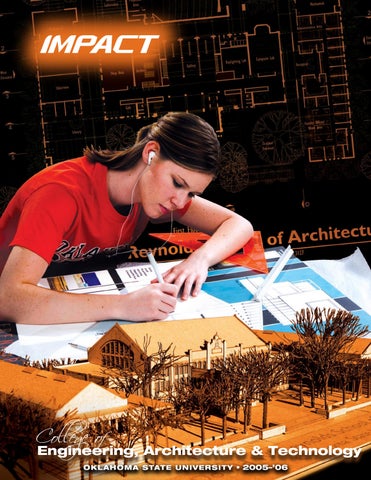
IMPACT
8daaZ\Z d[
Engineering, Architecture & Technology oklahoma stat e u n i v e r s i t y • 2005–’06
A Big year for CEAT Each time I introduce the latest issue of Impact, I find myself saying the College of Engineering, Architecture and Technology has had its best year ever. It’s not hyperbole. Each successive year does bring greater achievements for CEAT, and the last is certainly no exception. In every sense, it has been a very big year.
Erika Contreras
Karl Reid, left, dean of the College of Engineering, Architecture and Technology stands with Fred W. Smith, chair of the Donald W. Reynolds Foundation during the presentation of the $14.8 million gift from the Donald W. Reynolds Foundation. The gift — the largest private foundation gift in OSU history — will renovate and expand the School of Architecture, doubling the space for instructional excellence.
Featured in Impact is the $14.8 million gift from the Donald W. Reynolds Foundation and its transformative effect on the School of Architecture. Not only is it the largest private foundation gift OSU has ever received, this record funding to construct a new architecture building and renovate the current facility will reshape CEAT. The expansion will allow an award-winning architecture program to flourish while providing much needed additional space for the college. The Donald W. Reynolds Foundation gift includes the stipulation that CEAT raise $3 million to maintain the new facility. This issue of Impact includes a story introducing alumnus Cal Vogt, long-term supporter of CEAT who stepped forward with the lead gift in the maintenance-fund campaign — one of many he has given the college. The strong support CEAT receives from alumni speaks to the success of our graduates as well as their loyalty and commitment to the college programs. The quality of CEAT graduates is readily apparent in stories about alumni in the military, at preeminent universities and at the top of their professions, such as the CEAT 2005 honorees. Inventor
Behrokh “Berok” Khoshnevis, Melvin R. Lohmann Medal recipient, and Hall of Fame inductees James Cummins and Gordon E. Eubanks Jr., appearing inside this issue, demonstrate that CEAT alumni truly are competitive with the best. Convincing wins in national competitions indicate our current students will follow the lead of the extraordinary engineers, architects and technologists who have preceded them. OSU aerospace engineering teams set new records again in 2006, placing first and second for the third consecutive year at the American Institute of Aeronautics and Astronautics international competition. For the second year in a row, OSU’s chemical engineering design team and Cowboy Motorsports claimed first place in national competition, and in a tribute to the stature of its program, OSU was chosen to host the 2006 National Concrete Canoe Competition. These victories are engendered by a knowledgeable, skilled and highly motivated faculty dedicated to students they mentor as well as innovative research and program development. Many members of the faculty received professional honors during the past year. One professor, Rao Yarlagadda in the School of Electrical and Computer Engineering, was honored by his students, who say he profoundly influenced their careers during his 40-years of committed service to OSU. Another, Jim Smay, assistant professor of chemical engineering, received the U.S. government’s highest recognition given to the nation’s most promising young scientists and engineers. Faculty members drive many successful CEAT programs, some of which impact the state’s economy, forge partnerships with industry and touch the lives of soldiers on the front lines. The New Product Development Center, the master’s of science in engineering and technology management program and mechanical engineering technology programs are examined in this issue of Impact. Even as we celebrate accomplishments of the past year, CEAT is already striving to reach new heights of greatness that will make the next year the biggest one ever. p
Karl Reid, Dean College of Engineering, Architecture and Technology background rendering Alejandro Olea, arch ‘06
impact 2006
about the cover: Thanks to a $14.8 million gift from the Donald W. Reynolds Foundation, OSU’s award-winning architecture program will have space to expand into new and renovated facilities in spring 2009. Many students will benefit from the improvements, including architectural engineering sophomore Rachael Tucker shown in the cover photograph by Phil Shockley. Also pictured is a rendering of the Donald W. Reynolds Architecture Building. Cover design is by Paul Fleming. The related story is on page 14.
IMpACT Eileen Mustain, editor Paul V. Fleming, art director Janet Varnum, associate editor Adam Huffer, CEAT Communication Specialist Kyle Wray, University Marketing Letters are welcome and should be addressed to:
Oklahoma State University Editor, IMPACT Magazine 201 ATRC, Stillwater, OK 74078-5013
14
7
Vip INVITATION
11
What’s Inside: 5 Three consecutive first- and
second-place wins in international competition leave no doubt as to the strength of OSU’s aerospace engineering program. p 7 The successes of recent graduates testify to the caliber of CEAT students and the education they’ve received at OSU. p 11 CEAT alumni are part of the next generation of nuclear engineers. p 14 A generous gift from the Donald W. Reynolds Foundation expands OSU’s School of Architecture. p 18 CEAT partnerships with industry prove indispensable in preparing students for success in the real world. p 24 Former students of electrical and computer engineering professor Rao Yarlagadda pay homage to his extraordinary career.
Research, Noteworthy 7Alumni Success 14Teaching, 24 Outreach
The CEAT wants you to have access to up-to-date information on everything from the continuing development of the Advanced Technology Research Center to the establishment of new academic programs on the Stillwater campus and in Tulsa. We invite you to be our guest for a VIP visit to campus and the CEAT. Contact Dean Karl Reid by phone at 405-744-5140, by FAX at 405-744-7545, or by e-mail at karl.reid@okstate.edu. If a trip to campus is not possible, visit us on the CEAT homepage at http://www.ceat.okstate.edu. The office of publication for IMPACT is 121 Cordell North, Stillwater, OK 74078-8031. Copyright © 2007, IMPACT. All rights reserved.
18
Departments
2Student Digest
IMPACT is a publication of the Oklahoma State University College of Engineering, Architecture and Technology and is designed to provide information on college activities and accomplishments while fostering communication among the CEAT family and friends.
24 5
Oklahoma State University in compliance with Title VI and VII of the Civil Rights Act of 1964, Executive Order 11246 as amended, Title IX of the Education Amendments of 1972, Americans with Disabilities Act of 1990, and other federal laws and regulations, does not discriminate on the basis of race, color, national origin, sex, age, religion, disability, or status as a veteran in any of its policies, practices or procedures. This includes but is not limited to admissions, employment, financial aid, and educational services. Title IX of the Education Amendments and Oklahoma State University policy prohibit discrimination in the provision of services of benefits offered by the University based on gender. Any person (student, faculty or staff) who believes that discriminatory practices have been engaged in based upon gender may discuss their concerns and file informal or formal complaints of possible violations of Title IX with the OSU Title IX Coordinator, Dr. Carolyn Hernandez, Director of Affirmative Action, 408 Whitehurst, Oklahoma State University, Stillwater, OK 74078, 405-744-5371 or 405-744-5576 (fax). This publication, issued by Oklahoma State University as authorized by the College of Engineering, Architecture and Technology, was printed by University Marketing, Mercury Press, Inc. at a cost of $8,634.90 16M/Apr. 2007/job #1344.
Student Digest
courtesy Scott Rutledge and Ryan McKaskle
(Sources: “Concrete Design Guide,” Scott Rutledge and Ryan McKaskle at http://members.cox.net/concretecanoe/introduction.htm; and “A Brief History of Concrete Canoeing,” John A. Gilbert, Concrete Canoe Magazine, Spring 2006)
Civil Engineers Launch More Than Canoe Although they’ve come close — four times finishing in the top three — OSU’s concrete canoe team has never won the national championship.
“As teams vie for a spot in the 19th OSU team. Qualification for national Throughout the late 1970s and NCCC, it seems fitting to also recogcompetition is now the team goal 1980s, OSU civil engineering each year. students participated in the Midnize and commend Oklahoma State Continent Conference Concrete University, the host of the 2006 Civil engineering students devote Canoe Competition held at Kansas NCCC, for their successes and dedia huge chunk of personal time State University. In 1988, ASCE cation to the sport. Oklahoma was Yet, the team’s record is outstand- to design, build and race their added a national competition where one of the first states to promote ing, says Karl Reid, dean of the concrete canoes. regional winners could compete for concrete canoe racing, and the 1st College of Engineering, Architecture the title, and an industry-leading Great Plains Concrete Canoe Race For these students, members of and Technology. “They started it admixture supplier, Master Builders took place there in 1972, more than all. They were the first CEAT team the OSU student chapter of the Inc., now BASF Admixtures Inc., 30 years ago.” p to compete nationally, and they’ve American Society of Civil Engineers became the founding sponsor. Eileen Mustain done exceptionally well. They have (ASCE), the project is a labor of been a model for other teams in the love. “They don’t receive credit for Records indicate a Cowboy victory College over the past several years.” their work. They are simply highly at the 1988 regional, and OSU was motivated,” says John Veenstra, among the 18 teams competing at OSU civil engineering students interim head of the School of Civil the first national at Lake Lansing, began building and racing concrete and Environmental Engineering. Mich. canoes circa 1970. The group’s first concrete canoe competition “Building a successful concrete As for its record, OSU’s Concrete was on the “Duck Pond” in Norman canoe requires students to draw Canoe Team has represented the against the University of Oklahoma on design, testing and construction Mid-Continent Region 13 times at techniques they’ve learned in — a contest OSU won. A trophy in the national level and was selected the civil engineering department’s various civil engineering courses, to host the ASCE National Concrete display case reveals a victory over and requires them to work as a Canoe Competition in 2006. team to produce the best product. OU in 1971. They must document their results, Recognizing the team’s achieveThe days of local races on the explain project details and sell their ments, John A. Gilbert writes in Duck Pond are gone. Regional design to judges,” he says. “The the spring issue of Concrete Canoe competitions are now the norm, experience approximates an actual Magazine: but no longer the end game for the work situation.”
s OSU IMPACT
Todd Johnson
Gracious Hosts For three days, first- and secondplace winners of more than 200 regional competitors nationwide, participated in the 2006 National Concrete Canoe Competition held June 15 – 17 in Stillwater and hosted by OSU. Although not the national champs, OSU’s concrete canoe team earned a respectable 11th place in a field of 23, coming in behind such powerhouses as California Polytechnic State University, Clemson University, the University of California, Berkeley and the University of Wisconsin-Madison, which earned the first-place title for a fourth straight year.
Repeat Performance
OSU’s 2006 concrete canoe team members are Rebecca Ward, Kristi Schroeder, Lan Pham, Melinda Hale, Amanda Benson, Erek Stone, Ross Ward, Jeremy Van Oostrum, Jason Maly, Brooke Shondelmyer, Corey Shondelmyer, Alan Harder and Abby Kinnamon. They stained their canoe to resemble a basketball and named it The Scowl in tribute to former OSU basketball coach Eddie Sutton. p Erika Contreras
For the second year in a row, The 2005 Cowboy Motorsports Cowboy Motorsports claimed team, competing against 24 teams the national championship title from around the country, performed in the 2005 American Society well in design, fabrication, tractor of Agricultural Engineers 1/4- performance and safety as well Scale Tractor Student Design as written and oral design reports. Competition. The OSU team John Solie, biosystems and competed against such teams as agricultural engineering professor Kansas State University, the Univer- and the team’s faculty adviser, says sity of Kentucky, Purdue University the competition seeks to advance and Penn State University, the four the technical and personal skills other top teams. engineers and technology students need for success in the workplace. The annual ASABE competition requires students to build a small, “The categories are based on the cost-effective tractor to pull a 5,500- same standards industry faces,” he pound sled. Briggs and Stratton says. “Students get a sense of what provides each competing team an engineers in the industry do from engine, and Firestone provides the developing the concept to manutires. The students — a volunteer facturing, testing and redesigning group of approximately 20 — orga- the product to raising money for nize, manage and build the tractor operating funds.” and acquire all other resources, including the time to complete the The 2005 Cowboy Motorsports team includes Joe Biggerstaff, yearlong extracurricular activity. Cheyenne Courtney, David Crossley, Brian Dillard, Kyle Dollins, Andrew Fiegener, Colby Funk, Adam Gossen, Ryan Haar, Jacob Hamburger, Dustin Holden, Curtis Johnson, Levi Johnson, Buck Melton, Taylor Miller, Jonathan Nunnally, G.L. Slaughter, Kristin Stephens, Justin Street, Frank Thomason and Kristi Thompson. p 2005–’06 s
Three in a Row
Erika Contreras
OSU’s School of Mechanical and Aerospace Engineering set a record at the 2005 American Institute of Aeronautics and Astronautics Student Design/Build/Fly Competition when its teams captured consecutive first- and second-place wins. In 2006, OSU teams broke their own record placing first and second for the third consecutive year at the AIAA’s annual international competition held this spring in Wichita, Kan. The event, sponsored by the AIAA, the Office of Naval Research and Cessna, featured 48 university teams from North America and Europe. “Simultaneously taking first and second in this contest is an accomplishment no other university can claim, and OSU has now done it three years in a row,” says Andy Arena, Maciula Professor of engineering and the teams’ faculty adviser. “I am so proud of our In addition to entering the lightest planes in “In addition to those headed to graduate students, especially considering the level of the competition and recording the fastest school, students from this year’s class are competition. This year it only got harder.” cargo loading and unloading times, OSU going to work all over the country for compateams received the top technical report nies such as American Airlines, Nordam, L3, The nation’s top programs such as MIT, scores. Both planes carried payloads almost Lockheed Martin, Baker Hughes, the Central Embry-Riddle, Cal-Poly, USC, Purdue, Renstwice their weight, a structural efficiency feat Intelligence Agency, Raytheon and Mitsubishi selaer Polytechnic, the U.S. Military Academy at any level of design. Heavy Industries, to name a few,” he says. and Notre Dame participate in the competition, and some, like OSU, send multiple OSU students completed their entries as “I think OSU engineering graduates have teams, Arena says. semester-long projects in the aerospace always been well regarded by employers, but engineering capstone design course with our students’ performance in the competition The contest requires students to design and the 20-member teams logging upwards of reinforces that and provides some added fabricate an unmanned, electric-powered, 12,000 hours. visibility for them. radio-controlled aircraft to accomplish specified flight mission objectives. The challenges Most students secured employment prior to “On more than one occasion I have witnessed change each year, but the goal remains a the contest, but their winning streak only company recruiters seek out our students at design that achieves high performance and enhances the reputation of OSU’s aerospace the contest, and a few companies have also quality handling and may be manufactured program, Arena says. become OSU team sponsors.” p practically and affordably.
OSU’s Black and Orange Aerospace Engineering Capstone Design Teams take first and second at the 2005 International AIAA/ONR Design, Build, Fly Competition.
Adam Huffer
Erika Contreras
OSU’s Black and Orange Aerospace Engineering Capstone Design Teams take first and second at the 2006 International AIAA/ONR Design, Build, Fly Competition. OSU Black earned 301 total points, and OSU Orange earned 298 points while the third place winner scored approximately 250 points.
s OSU IMPACT
photos Russ Rhinehart
Records Fall as Dragonfly Takes Flight A second world aviation record has fallen following the latest flight of the Dragonfly, an experimental aircraft designed and built by OSU mechanical and aerospace engineering students.
on from the beginning, and it’s a really significant achievement.”
says, noting that FAI sanctions all aviation records, from Boeing’s new record for long-range passenger airWeather conditions and topography planes to the five kilogram category. were ideal for the mission, Arena says. Similar conditions enabled Gamble and Hays designed and built Gamble and Hays to set Dragonfly’s the Dragonfly as part of their underOn June 23 undergraduates Dustin first world record June 2 with a graduate Space Grant Fellowships Gamble and Thomas Hays set a distance of 144.42 kilometers to with Oklahoma’s NASA Space Grant new world flight endurance record break the existing record of 80.43 Consortium and received sponsorof 12 hours, 21 minutes and 40 kilometers. ship from the College of Engineering, seconds. Observed by an official Architecture and Technology. with the Fédération Aéronautique The Dragonfly, built from composite Internationale, the world air sports material, fiberglass, balsa wood and The non-credit, enrichment exercise federation that maintains all world carbon fiber, weighs 11 pounds with will prepare them for any sector of aviation records, the flight will be batteries and just 3.7 pounds without. the aerospace industry, but their It has a 14-foot wingspan and a entry into the record books will Aerospace engineering undergraduates Thomas Hays, left, and Dustin Gamble have set two aviation world records with the Dragonfly, an experimental aircraft they designed. Andy Arena is their faculty adviser.
sanctioned pending OSU’s submission of a detailed dossier. Gamble and Hays set the new record in the FAI’s F5S category for electric-powered aircraft weighing less than five kilograms. A group in Switzerland set the previous record of 10 hours, 38 minutes and 3 seconds in 1998.
fuselage measuring 8 feet, both engi- attract attention from its hottest, neered to reduce weight and drag. Arena says.
Although it has an autopilot, the “The unmanned air vehicle industry plane is piloted remotely during in the U.S. is becoming a multibilrecord flight attempts to conserve lion dollar industry with many battery power. companies involved in developing and manufacturing drones,” he The Dragonfly should not be confused says. “It’s going to look pretty good with a model, kit or toy airplane, on their résumés for them to come Arena says, and hobbists typically out of college with world aviation “There are several record flights don’t pursue FAI world records. records after successfully designing we plan to go after, but this is the a UAV.” p one the plane was designed and “The physics are all the same for Adam Huffer this plane or the design of a 737 optimized for,” says Andy Arena, — to accomplish a certain mission. Maciula professor of engineering and the students’ faculty adviser. The governing equations, the things For more information see http:// aerodesign.okstate.edu/projects/ “It’s the one the team has focused you have to worry about, are all the same, just scaled down,” Arena Dragonfly%20Page/Dragonfly.htm.
Good Chemistry OSU’s chemical engineering seniors placed first overall in team competition for the fourth time in the 11-year history of the National Student Design Team Competition sponsored by the American Institute of Chemical Engineers (AIChE). The 2005 team members are Justin Guinn, Tim Plowman and Robert Taylor. Their design challenge, authored and judged by engineers in industry and academe, was to design a process to remove a million metric tons of carbon dioxide, CO2, from the atmosphere. Senior design teams from 160 undergraduate engineering programs in the U.S. are eligible to enter the AIChE design competition, which is an application exercise that characterizes the practice of chemical engineering. The team’s success indicates the OSU students were able to integrate the industrial practice issues and properly apply the fundamentals. The students credit chemical design course professors Rob Whiteley and Jan Wagner for their dedication to student growth as well as the entire chemical engineering curriculum for reinforcing excellence in fundamentals, application and team effectiveness. p
OSU’s chemical design team, from left, Robert Taylor, Justin Guinn and Tim Plowman, won first place in the 2005 National Student Design Team Competition sponsored by the American Institute of Chemical Engineers. 2005–’06 s
Phil Shockley
A Cool (and Rewarding) Idea OSU students Joseph Pruitt and Blake Ferrell won the $20,000 top prize at the statewide Governor’s Cup competition for a concept and business plan that could change the way cold drinks are bottled. The Governor’s Cup competition, funded by the Donald W. Reynolds Foundation, a national philanthropic organization, and managed by the private nonprofit i2E Inc., is designed to teach students that innovations leading to new businesses are valued and lucrative.
Melinda Hale, a mechanical and aerospace engineering senior and W.W. Allen Scholar, is OSU’s newest Goldwater Scholar, a national honor awarded outstanding undergraduates in mathematics, the natural sciences or engineering and based on academic potential and research acumen.
Although recruited by a number of prestigious institutions, Hale opted to maintain a family tradition. Her parents Michael and Patricia Hale, originally from Jenks, Okla., are both OSU alumni.
“My dad studied mechanical engineering here and went on to get his master’s and doctorate from MIT, and my mom Hale’s application centered on her 2005 got her bachelor’s in management inforsummer internship at IBM’s Hudson mation systems at OSU and her master’s Valley Research Center in Hopewell from Boston University,” Hale says. Junction, N.Y. where her research to determine the cause of malfunctioning “I had been looking at colleges in the Northeast, but when I came to visit, computer chips was used to solve a Dr. [Larry] Hoberock, the head of the manufacturing problem. mechanical engineering department, Hale is OSU’s 13th Goldwater Scholar, gave me a personal tour and showed me and at age 18, she is also the around the labs and research facilities,” university’s youngest. Home-schooled she says. “Even though OSU is a large until she completed high school at age state school, they still take the time to 13, Hale attended Duchess Community show individual attention to students, College in Poughkeepsie, N.Y., near her and I appreciated that.” parents’ home, before enrolling at OSU She attributes being selected for the at age 16. Goldwater Scholarship largely to the “The main reason I waited those three quality of education she is receiving years was that I had to have a driver’s at OSU. license before coming to Stillwater,” she says. But the time also gave her the “The fact OSU has had so many Goldwaopportunity to take prerequisite math ter winners shows that it competes on the national level with other engineering and science courses as well as arts schools,” she says. “The faculty and humanities classes that typically cannot be squeezed into an engineering members here are very dedicated to what they do, and that dedication degree track. produces an education that I think rivals more respected, big-name engineering schools.” p Adam Huffer
s OSU IMPACT
Pruitt conceived the Cold Bottle when researching another of his concepts, a personal purification system for outdoor enthusiasts that uses ultraviolet light to sterilize water from available sources. SSI filed a provisional patent application on the technology in November 2005 and a Patent Cooperative Treaty application in February 2006.
Pruitt and Ferrell, Stillwater natives, placed first in the undergraduate divi- Pruitt enlisted his one-time roommate sion with a proposal for an insulated, Ferrell, an accounting major, to help environmentally-friendly, disposable write the business plan for the Governor’s Cup competition. Tom Brown, bottle that keeps beverages cold much longer than existing containers. professor of business administration The “Cold Bottle Designs” technology and marketing in the Spears School of Business served as adviser. also allows manufacturers to add thermal insulation to their disposable “The feedback has been very positive,” beverage bottles with no additional Ferrell says. “The Governor’s Cup has equipment or production costs. been a great experience that could possibly help lead to bigger and better “The bottle of Coke you buy at the things for Cold Bottle Designs in the convenience store will have extra very near future.” insulation already built in that will keep your beverage cold for up to Pruitt has postponed attending gradutwo times longer,” Pruitt says. “The ate school for a year to stay on at SSI beautiful thing about the bottle is that and assist the search for marketing you don’t have to pay any extra for it possibilities for Cold Bottle Designs. because no new equipment is needed in making the improved product.” “We are pursuing licensing agreements and working with i2E to look at potenPruitt, a 2006 mechanical and aero- tial contacts and our options,” he says. space engineering graduate, came up “Something we’ve considered is maybe with the concept while working as starting a bottled water brand, but an intern for the Stillwater research we’re keeping our options open. Erika Contreras
OSU’s Newest Goldwater Scholar
and development firm Strategic Solutions International, LLC. Founded and headed by OSU civil engineering alumnus Steven Trost and affiliated with the Meridian Technology Center for Business Development.
“Graduate school is on the horizon for me, but this is my number one priority going forward, and the Governor’s Cup will definitely help us with financing for business development.” p Jim Mitchell and Adam Huffer
For more information about the Governor’s Cup competition, go to www.okgovernorscup.org. Joseph Pruitt, left, and Blake Ferrell won $20,000 in a statewide competition with a business plan for the manufacture of environmentally friendly bottles that keep beverages cool up to two times longer.
Hildebrand Named Gates Cambridge Scholar
Bonnie Hildebrand
W.W. Allen Engineering Scholar career goal is to bridge the gap “When I talked to her as a freshman, While the subjects of economics it was obvious she was focused, Ashleigh N. Hildebrand added and law were new to Hildebrand, between chemical engineering and another prestigious honor to her goal driven, ambitious and orgashe says the study was so interest- the environment through teaching résumé before graduating in May nized,” he says. “I asked her what ing it didn’t feel much like work. and research at a university. her life goal was, and I recall her “I worked incredibly hard at OSU, so 2005 with an Honors College “I hope to introduce more degree in chemical engineering, the answer as, ‘Please don’t take this I was really well prepared.” environmental education into environmental option, and minors wrong, but I want your job.’ Then it The diverse international environchemical engineering, and this seems she added, ‘On the way up.’ in philosophy and chemistry. The ment also provided learning degree from Cambridge gives me 2004 Goldwater Scholar became I was excited by her honesty, ambiopportunities. “By getting to know both the knowledge to do it and one of only 35 American students tion, directness and politeness.” people from all over the world, I got the credentials to be allowed to do to be named a 2005 Gates CamIn addition to being a student in the a completely different perspective it. The idea is to make industries bridge Scholar. Honors program and a W.W. Allen on lifestyles, politics, the influence more environmentally-friendly from A Bill and Melinda Gates Foundation Scholar, Hildebrand participated and power of American culture and the inside-out by giving the young endowment created the Cambridge in research with faculty members government and the problems that engineers more knowledge and really matter in the world,” she says. awareness of their ability to impact Trust to award scholarships that throughout her undergraduate would enable the world’s brightest career. the environment,” she says. “By combining these new peryoung scholar-leaders such as spectives with the mechanisms “Increased familiarity with the realiHildebrand to take graduate work at Although accepted by both MIT ties of how environmental policy, the United Kingdom’s top university. and Berkeley, Hildebrand chose to of change I’ve learned in my law and regulation work will allow The highly competitive scholarship study international perspectives in courses, I am seeing more environmental issues and began clearly my role in contributing me to tailor my research to what is is a full-cost merit award worth most useful for society. I also love working in the fall on her master’s to society.” approximately $32,000 a year. in environmental policy at Trinity the idea of advising or consulting Hildebrand graduated with a mas- for environmental policymakers, It’s not surprising Hildebrand, a College, Cambridge. She studied ter’s in environmental policy in July such as Congress or the EPA.” p native of Wichita, Kan., rose to the environmental economics, interna2006, earning a high dissertation top from a field of 600 national tional environmental law, issues in Janet Varnum score, and has begun her doctorate scholars competing for the Gates public policy and economics. and Adam Huffer in chemical engineering at MIT. Her Cambridge scholarship, says Russ Rhinehart, head of chemical engineering. 2005–’06 s
A Difference Maker
courtesy
The Great Adventure
s OSU IMPACT
Cassie Mitchell works in the lab of Robert Lee, Laboratory for Neuroengineering, Georgia Institute of Technology and Emory University School of Medicine. courtesy
During his senior year at OSU, He is thankful for the experience Bryan McLaughlin, a he gained in OSU professor Alan 2003 electrical and computer engi- Cheville’s optical electronics course. neering graduate, won a Marshall “The requirements in that course Scholarship to pursue a master’s were high, and many of us did not degree in optical electronics at see at the time the value of writing Cambridge University. pseudo proposals to the instructor. But the long hours spent doing it There, he became the principal has paid off.” researcher on a collaborative project between the engineering McLaughlin, who graduated with department and nearby Addenhis doctorate in July, is considering brooke Hospital to create a liver taking post-doctoral studies or worktransplant device to save lives. ing for a startup biomedical device company. One day he would like to McLaughlin, who was also a open his own research and developGoldwater Scholar and a first team ment company and eventually teach USA Today Academic All-American, at the college level. authored a proposal and submitted it to the British Medical Research The total immersion in a different Council, resulting in an award of culture for two years is the greatest benefit of studying abroad and an more than $100,000 to continue his work on this medical device at experience he recommends for everythe esteemed university. one. “It can be thrilling, challenging and sometimes frightening,” he says, “This funding opened the door for “but every great adventure is.” p me to stay for a Ph.D. and pursue Janet Varnum the project further,” says McLaughlin, who focuses on biomedical devices, particularly optical and microwave sensing techniques. “I really wanted to bring this work to fruition before leaving Cambridge.”
Cassie Mitchell, a “I knew my degree in great company with great 2004 chemical engineer- chemical engineering people. They flew me ing graduate, continues from OSU would lay the back in October to give the scholarship excellence foundation necessary for a presentation, and they she achieved at OSU as a career in which I can offered me an internship a Goldwater Scholar in make a difference. I’m for the summer. I had to 2003 and a member of doing well,” she says. turn down the offer to the first team All-USA Students take 21 hours work on my proposal.” College Academic Team a semester through the her senior year. The USA second year and then take Mitchell is a computer Today designation placed qualifying examinations, modeler. “I use my engineering skills to her among the top 20 a requirement before students in the nation. submitting research thesis mathematically model bioproposals. Mitchell passed logical systems, namely Mitchell, a National Sci- her qualifying exams and in the spine and brain, to ence Foundation Graduate thesis proposal in spring help aid in the design and Research Fellow and development of drugs and 2006. also a National Science other neuro-implanted Foundation Integrative “Although I don’t have the equipment,” she says. Graduate Education and specifics of my research “My biggest motivation Research Traineeship Fel- proposal nailed down is that I want to make a low, is currently a doctoral yet, I’m excited,” she difference in the lives of student in biomedical says, “and I do have two others. Despite a common engineering at the Georgia first-author papers I’ll be stereotype, physical Institute of Technology submitting for publication disability does not equate and Emory University in the spring.” to academic or intellectual School of Medicine. Last summer an internship inability,” Mitchell says. The GT/Emory biomedical at Medtronic Neurological “My career goal as a engineering program is in Minneapolis, Minn., currently ranked third by helped Mitchell determine biomedical engineer is the U.S. News & World her direction, which has to work in the medical Report’s “America’s Best helped her better plan her industry to design new Graduate Schools 2007.” course, she says. “I would and innovative treatments The program consistently love to work at Medtronic for patients suffering from various neurological injuranks in the top three. after I graduate; it’s a ries and/or disorders.” p
Realizing His Goals
courtesy
Ask Tom Jenkins about his office, “but it didn’t make sense every published document on “Government has a fundamental dream job, and he’ll say, “I have it!” to leave a job I love and the state federal disaster management states obligation to provide for the protecwhere I live.” that federal government is there to tion and security of its citizens and Working as deputy fire chief in support local government and can’t should invest time, effort, energy Sand Springs, Okla., is only one of Because the graduate program is be anticipated until at least 2-3 and treasure toward reducing those the goals this 2004 graduate of the designed around the schedules of days into an event, but the public potential disasters that have the School of Fire Protection and Safety working adults, Jenkins will not thinks FEMA should have been on highest impact,” he says. Technology set for himself, and he’s have to give up his dream job and site within minutes like normal on track to achieve the others. the education he’s receiving from it. police and firefighters.” Jenkins, who already knows where he would invest resources, thinks “As the number two guy, I’m A volunteer firefighter at 16, Disasters are a local problem and about these issues on a daily basis. Jenkins can’t remember if he played responsible for training and day-to- must be dealt with on a local level, His goal is to learn everything posfireman as a child, but he does day operations. Sand Springs is an which makes the coordination — or sible about emergency management remember those toy fire trucks old town with a rich history; and and then run for public office. lack thereof — between federal every boy seems to have. “I’m one of the few who never grew out of it,” he says. “The desire to pursue that line of work led me to OSU. “I had a lot of questions, but I walked out with a lot of answers thanks to OSU faculty and staff. I came out knowing I could do what I want to do and how to get my goals and priorities in line to do this,” he says. He was particularly influenced by Pat Brock, instructor in the fire protection program who taught him attention to detail, and Bob Graalman, director of scholarship development, whose efforts helped Jenkins shape his dreams. “Bringing Dreams to Life was a campaign, but it wasn’t a cliché for me. I wasn’t sure what my dreams were when I arrived,” he says. By graduation Jenkins’ dreams had crystallized, and as a 2003 Truman Scholar he had the means as well as the determination to meet those that brings challenges. I have a big and state and local levels a critical “If I had it my way, I’d be a interest in other aspects as well factor, Jenkins says. firefighter the rest of my life goals. Awarded to those who — planning, budget and economic because firefighters have the seek careers in public service, the “Federal funding to the fire and $30,000 scholarship, which funds development. It’s different from day emergency response community is ability to really help people,” he to day and is always challenging says, “But it’s not just about me. the final year of undergraduate another major issue because FEMA At some point I have a duty to try and always interesting,” he says. study and two years of graduate has no rescue teams of its own. Its to make the world a better place. I study, will help Jenkins earn a teams are local metropolitan fire “I’ve been able to see the differdon’t think being a house or senate master’s in public administration. ences in how local, state and departments hired by FEMA for He began the program at the Uni- federal funding is used to address disasters,” he says. “By comparison, member would be more fun than firefighting, but hopefully I can versity of Oklahoma in August 2006. public problems. I have seen the would it be acceptable for the law influence things for the better at problems and what works well,” enforcement community if the FBI the state or federal level.” “I always wanted to pursue a were composed of cross-trained graduate level degree, but I wasn’t he says. “I can’t learn that in a cops from Saint Louis, Chicago, etc., As for his timetable, Jenkins says, sure where I wanted to go. I looked classroom.” who were just ‘borrowed’ during “About a decade. There’s something all around, including Ivy League He says the lessons of Katrina offer big events? to be said for life experience.” p schools,” says Jenkins, who plans a large scale illustration. “Nearly Eileen Mustain to eventually seek elected public
2005–’06 s
Seawolf Engineering Officer Recognized as “New Face of Engineering” Submarine engineers are usually so When the Naval Nuclear Propulsion While many of Alvillar’s classmates “It was nerve-racking and exciting at busy with their shipboard respon- Program (NNPP) sent out a mesat OSU had the daunting task of the same time. Everyone applying sibilities, most do not have time sage last year looking for nominees looking for employment while for the program has two one-hour finishing up their degrees, Alvillar interviews to pass. The first is to read newspapers regularly. For for the National Engineering Lt. J.G. Gabriel Alvillar Week Foundations’ “New Faces of made up his mind about working general science, and the second is of USS Seawolf, it was worth the Engineering” recognition program, for the Navy during a trip to Norfolk, more based on what your major is,” effort last month to make an excep- Alvillar wasn’t exactly confident Va., his sophomore year of college. said Alvillar. “At the very end of the tion. “My XO [executive officer] said about being picked. In fact, it took process was my interview with the to me that I might want to buy a some prodding from his command At OSU, Alvillar was in the College NNPP Director [Adm. Frank L. “Skip” of Engineering, Architecture and copy of [the Feb. 21 edition of] USA to submit a package. Bowman]. At the end, he stood up Technology Scholars Program. Part and said, ‘Welcome to my Navy.’” Today,” Alvillar said. “I asked him of that program includes a tour why and he said, ‘because you’re “[Being selected] was a humbling experience,” said Alvillar. “It was of various East Coast engineering Alvillar spent the last two years in it.’” firms during the sophomore year one of those things where you working on Seawolf as the The Lawton, Okla., apply for it, but like playing the and an international tour to Japan chemical and radiological controls native’s photo lottery, you’re not too sure of what during the junior year. assistant and damage control and biography your real chances are.” assistant. Currently, he is enrolled “Part of the 1999 tour to the East were featured at Prospective Nuclear Engineering Although being honored for his Coast was a day and a half at Naval Officer School. While he has much on the pages of the national skills as an engineer is a welcome Station Norfolk,” said Alvillar. to gain, and much to give, Alvillar publication with 13 achievement, such recognition was “We got to tour a submarine and car- has his sights on much larger prizes. other young engineers not his goal. For Alvillar, engineer- rier while we were there. At the end “In May, I’m going back to NNPP as the National Engineering Week ing is a labor of love that began of the tour, the officer recruiter from to get my final qualification as when he graduated from Douglas Foundation’s “2005 New Faces of Oklahoma talked about the NNPP an engineering officer,” he said. MacArthur Senior High School in Engineering.” and told us what submarine or Lawton, Okla., and enrolled at Okla“Then I’d like to return to sea as an carrier life would be like. Six weeks engineering department head. Of “New Faces of Engineering” highhoma State University. He received later, I was at NNPP interviewing course, I’d like to command my own lights the interesting and unique a bachelor’s degree in electrical for their program.” work of young engineers who have engineering from OSU in 2001. submarine, but that’s many years been in this field between two Alvillar knew his biggest challenge down the line and a lot of work “I enjoy creating new things. and five years and the resulting would be convincing the NNPP to between here and there.” p impact on society, according to the Engineers aren’t necessarily trying invite him into its officer candidate JO3 Steven Feller to reinvent the wheel; we’re trying Engineers Week website, www. Public Affairs Office program. to improve things and make them Commander, eweek.org. Submarine Force, better. That’s what drew me into U.S. Atlantic Fleet engineering.” March 31, 2005
United States Navy
10 s OSU IMPACT
The Life (and Love) Aquatic Enthralled with nuclear energy, the military and each other, Cory Schneberger and Meredith Rose made the only logical decision. They got married and joined the Navy. “The military application of nuclear power is what drew me to the industry,” says Cory, a mechanical engineering graduate. “I was already considering military service after spending time in the Army ROTC at OSU, and this seemed a natural fit.”
supervisor. After that he attended submarine school in Groton, Conn., for a final three months of training before reporting aboard his first submarine, the USS Scranton, a fast-attack submarine home ported out of Norfolk, Va.
Cory will spend several months at sea aboard the Scranton during the next three years. The couple’s opportunities to see each other depend on their command schedules, but generally the frequency of their visits ranges from every other week to every three or four months, Meredith says. “We talk on the phone several times a day when we’re both in port. Otherwise, there are lots and lots of emails. It’s best to take one day at a time,” she says, acknowledging that separation is not easy.
Thirteen weeks after he graduated summa cum laude in December 2003, he was a commissioned naval officer headed for the U.S. Navy Nuclear Power School in Charleston, S.C. The military also attracted Meredith, who graduated with her bachelor’s in mechanical engineering in May 2004. “Thermodynamics was probably my favorite class in college. As I learned more and more details about the opportunities available through the nuclear Navy, I decided it was something I could not pass up,” she says.
aircraft carriers, nuclear energy also operates the steam-powered catapults that launch aircraft from their flight decks.
In the meantime, Meredith entered the pipeline.
The native Oklahomans plan to evaluate the needs of their family and their Navy careers when their tours are finished, Meredith says. “Though we feel privileged to have the opportunity to serve our country, we both look forward to returning to the Midwest.”
photos courtesy
The Schnebergers are confident their training Onboard the Cleveland, Meredith worked as a division officer in the combat systems in the nuclear Navy assures military and department and trained to qualify for various civilian career opportunities. Married one week after she graduated and watch stations. The USS Cleveland deployed “We’ll be responsible for overseeing the two months before she reported to officer for seven months in July 2005 to participate operations in a very complex, technically candidate school, Meredith was commisin delivering marines to Iraq and humanitar- demanding environment. From administrative sioned in October 2004 and ordered to the ian relief to Pakistan. to operational, our responsibilities will vary,” USS Cleveland, an amphibious warship stationed in San Diego, Calif. By the time she returned, Meredith had quali- Meredith says. “This can translate to a wide fied as a surface warfare officer and received variety of different civilian job fields from techAlthough theirs is not the traditional newnical nuclear power plants to more general orders to begin Nuclear Power School in lywed lifestyle, the Schnebergers have no management positions that do not necessarily Charleston in March 2006. regrets. They say the Navy is a career-builder have to be in any energy industry.” p for nuclear engineers. She hopes to complete the shore component Eileen Mustain in April 2007. Following her qualification as “It’s the only branch of the military that uses a nuclear reactor plant supervisor, Meredith nuclear power for propulsion. Although other says she’ll report for a two-year sea tour on branches have tried different applications, an aircraft carrier for the remainder of her the Navy’s use in sea-going vessels has been commitment to the Navy. the most long-lived,” Cory says, noting the majority of operational submarines and nine Since reporting aboard the Scranton, Cory of the currently active aircraft carriers are has been working on qualifications to stand nuclear powered. duty as engineering officer of the watch and engineering duty officer. In that position, he’ll “The Navy’s nuclear training pipeline is coordinate maintenance and operations in one-of-a-kind,” Meredith says. “The training the engine room and reactor plant to provide is very intense and can be considered fairly propulsion for the vessel. specialized. Future nuclear officers as well as government-contracted civilians must “The reactor and core are used as a heat source, complete the program before being qualified and the energy produced is used to create to operate the Navy’s reactor plants.” steam for the generation of electricity and propulsion,” Cory says. “The self-contained system Cory graduated from power school in allows submarines to spend long periods November 2004, trained another six months submerged without having to bring in oxygen on a nuclear prototype and graduated in May to supply a combustion process. In addition 2005 as a qualified nuclear reactor plant to providing the same essential services to
2005–’06 s 11
Alumni Success
Hall of Fame Inducts Entrepreneurial Icons courtesy
The CEAT Hall of Fame recognizes OSU graduates as well as individuals who have
Cummins and Eubanks, inducted in October 2005, bring to 76 the number of distinguished professionals CEAT has recognized since establishing its Hall of Fame in 1954.
enhanced the reputation of the college through their careers in education, industry and the public sector. “All are legends in their
James Cummins
fields and share a common set of qualities courtesy
including modesty and integrity, dignity and quiet leadership,
perseverance and sound judgment and vision,” says Karl Reid, dean of the college.
Gordon E. Eubanks Jr.
Cummins completed a bachelor’s degree in arts and sciences at OSU in 1943 before joining the U.S. Marine Corps. He returned to Stillwater and completed his bachelor’s degree in architectural engineering in 1947. Gordon E. Eubanks Jr.
Eubanks authored C-Basic, one of the first successful languages for personal computers, after completing his master’s degree in computer science at the Naval The CEAT Hall of Fame recognizes distinPostgraduate School in Monterey, Calif. guished OSU graduates and individuals who His graduate adviser was Gary Kildall, a have enhanced the reputation of the college founding father of desktop computing and through association. Inductees are legends author of the first mainstream desktop in engineering, architecture and technology operating system. education, industry and policy formation. According to Karl Reid, dean of the college, Eubanks founded his first company, Compiler they share a common set of qualities, includ- Systems, in 1976 to market C-Basic while still an officer in the U.S. Navy. His mother ing modesty, integrity, dignity, leadership, ran the company out of her home in Sierra aspiration, perseverance, sound judgment Madre, Calif. and vision. Later, as president and CEO of Symantec Corporation, Eubanks oversaw the development of the popular productivity H.E. Cummins and Sons Construction Co., originally a commercial, industrial and public packages Timeline and Q & A Write. He also building firm in Enid, became a reputable initiated an aggressive policy of mergers and acquisitions as a strategic engine for heavy contractor during the post-war era. growth, making Symantec the first software Their monumental projects include Tulsa’s company to do so. Keystone expressway, the Robert S. Kerr Lock and Dam on the Arkansas River, The company acquired Norton in 1990 the overhead I-40 expressway and the Arrowhead Dam southeast of Wichita Falls, to gain a foothold in security and utility software and is now recognized as a leader Texas, the largest, earth-filled dam in the in the business. During Eubanks’ tenure Southwest when built in 1965-66. from 1984 to 1999, the company grew from fewer than 20 employees to more than With James Cummins, the oldest of the 5,000 with net revenues in excess of $500 brothers, as its president, H.E. Cummins million. Today, it employs 14,000 people in and Sons developed subsidiary concrete 40 countries. and asphalt plant operations throughout Oklahoma and a steel fabrication facility He joined Oblix Inc. as president and CEO in on the Arkansas River near Muskogee to 1999. Upside named the electronic identity support its projects. management and secure web access software provider among the “Hot 100 The Muskogee terminal became the site for a family investment in the storage and Companies of 2000” and PC Week included marketing of residual oil, an involvement it among the “21st Century Infrastructure that led to Cummins’ ongoing interests in Companies for 2000.” Oracle acquired Oblix the manufacture and marketing of residual in 2005. oil-based products. Eubanks completed a bachelor’s degree Cummins has been owner, president and in electrical engineering at OSU in 1968, founding or controlling shareholder in 15 dif- completed one year of graduate school at ferent companies. At 83, he currently heads OSU and spent six months working for IBM’s branch office in Tulsa before his draft inducNorthern Equipment Co., Keystone Equipment Co., Cummins Investment Corporation tion into the Navy. p and CIC Frontier Corporation. Adam Huffer James Cummins
aspiration and
12 s OSU IMPACT
The College of Engineering, Architecture and Technology Hall of Fame welcomes a pair of entrepreneurial icons, Oklahoma construction magnate James Cummins and Silicon Valley pioneer and software industry guru Gordon E. Eubanks Jr.
Khoshnevis Receives CEAT’s Highest Honor The College of Engineering, Architecture and Technology’s 2005 Melvin R. Lohmann Medal recipient is Behrokh “Berok” Khoshnevis, an inventor whose autonomous, robotic process for building structures may enable the world to house its poor and NASA to build on the moon and Mars. Khoshnevis, a professor of industrial and systems engineering at the University of Southern California, completed a master’s and doctoral degree at OSU in 1974 and 1979. He dispels any misconception that industrial engineers only optimize and improve systems and processes others design, says CEAT Dean Karl Reid. CEAT established the Lohmann Medal presentation in 1991 in honor of Melvin R. “Pete” Lohmann, who served at OSU for 36 years. While dean from 1955 until 1977, he led the college to national prominence while providing national leadership in the movement to adopt the professional school concept in engineering education. Largely as a result of his service as national president of the Engineers Council for Professional Development and the American Society for Engineering Education, Lohmann became a national advocate for the Professional School Model for engineering education, a model with many characteristics of law and medical schools. The engineering programs at OSU today include many of the elements of the model espoused by Lohmann.
Behrokh Khoshnevis is pictured with a gantry used in contour crafting, a robotic extrusion process he invented for the fabrication of parts and structures.
“Berok has invented numerous medical devices and pioneered developments in robotics, automation and computer controlled manufacturing,” Reid says. “He has made contributions in the fields of construction, manufacturing, electrical, biomedical, mechanical, industrial and environmental engineering.”
Contour crafting’s robotic gantry supports the rapid fabrication of large-scale parts. Conceivably, a builder will be able in one day to upload a set of blueprints and construct an entire house complete with conduits for electrical and building systems. NASA has invested in the technology’s development with hopes to use it to erect dwellings on the moon or on Mars for space pioneers. The process could also be used to rebuild homes quickly and inexpensively for disaster victims. Khoshnevis and contour crafting have been spotlighted on the NBC Nightly News and in The New York Times, Los Angeles Times, Popular Science, Building Magazine, Business Week, Discover Magazine and London’s Daily Telegraph among other international publications. Selective Inhibition Sintering, another process Khoshnevis invented that USC has licensed to a German company, is expected to cause a quantum leap in solid free-form fabrication.
Khoshnevis’ development of new supervision, sensing, control The automated fabrication process Khoshnevis invented, and intelligence systems enables robots to carry out low “contour crafting,” works like a multi-dimensional printer that precision manufacturing assemblies, including the Space Reconextrudes material layer by layer to make ceramic parts, Piezo figurable Robotics Assembly System that uses cable-connected electric actuators, polymer parts and, potentially, entire houses. robotic modules to assemble solar panels in space. At least 10 patents are pending or have been awarded based on its components and applications. His inventions in the medical field include a waste collection device for people confined to wheelchairs, which he donated to courtesy a company that has marketed it worldwide since 1987. He also created the Omnigrasp, a computer-controlled machine and process to improve the custom construction of dental restorations, and a haptics breast examination system for use in training medical practitioners. Khoshnevis also invented a digital binocular for Stereovision Inc.; a CAD/CAM system Mattel uses to make toys; a machine to transfer digital camera images onto plexiglass; and the FS-450 computer numerical control system manufactured by Expertech. Reid says Khoshnevis is unique among great inventors in that he enjoys taking the time to share his knowledge of the inventing process. In addition to mentoring countless students, he speaks frequently to professional and student groups, including the CEAT Student Council. His work to advance entrepreneurial education and innovation at USC includes the development of a manufacturing systems laboratory and a rapid prototyping laboratory used in engineering courses. However, the multidisciplinary nature of his work unites USC faculty in computer science, material science, mechanical and electrical engineering, architecture, real estate planning, fine arts, medicine and dentistry. Born in Iran, Khoshnevis initially studied at Sharif University of Technology in Tehran. While completing his bachelor’s in industrial engineering, he read books written by professors in OSU’s School of Industrial Engineering and Management. Faculty members such as Joe Mize, who remains one of 13 Oklahoma engineers in the National Academy of Engineers, and OSU’s international reputation were the reasons he applied. p Adam Huffer 2005–’06 s 13
Shown from left are Josh Ray, fifth-year architecture student; Jeff Williams, architecture professor; Scott Goodner, fourthyear student; Brad Bailey, fourth-year student; Randy Seitsinger, head of the architecture school; and Jason Coates, fifth-year student.
The OSU School of Architecture, founded in 1909, offers fully accredited academic programs in both architecture and architectural engineering. No other architecture program in the nation offers degree programs in both of these related fields where the programs are as strongly interrelated as at OSU.
Erika Contreras
“We are pleased to be able to reward the excellence of the architecture and architectural engineering programs at OSU. These awardwinning students will have a facility that matches their academic programs.” — Donald W. Reynolds Foundation Chairman, Fred W. Smith
A
Home to Match the Reputation 14 s OSU IMPACT
A $14.8 million gift from the The new building, to be named Architecture professor Jeff Williams Donald W. Reynolds Foundation the Donald W. Reynolds School of believes the school will significantly will have more effect on the college Architecture Building, will provide impact both faculty and students. than any other single event in its new campus amenities including history, says Karl Reid, dean of the a 300-seat auditorium, multimedia “This additional space will allow us to grow both the faculty and the College of Engineering, Architecture classrooms, a visualization/comgraduate student population. In and Technology. puter lab, gallery space and an expanded architectural library. Other addition to providing additional “This historic gift will impact the col- new and renovated spaces include research opportunities and lege and the campus at many levels design studio space, a model shop opportunities for recognition for the — not the least of which is to give and expanded administrative areas university, this will also provide the our nationally known architecture to accommodate current and new school with a larger group of mentors that will further stimulate the program the facilities to equal its faculty. reputation,” he says. activities of the undergraduate “The facility will provide new oppor- program,” Williams says. “The success of our students tunities for collaboration between in national and international CEAT and other colleges on campus. The Process competition demonstrates our The state-of-the-art auditorium and The seeds for CEAT’s proposal were program is already one of the connecting gallery will also serve planted more than 10 years ago, nation’s best. This renovation the broad needs of the campus and but the development really gained and expansion will allow OSU to many other academic units,” says step up recruitment and enlarge its Reid, who believes the new build- momentum over the last several years, Reid says. reputation as a premier teaching ing will stand as a symbol of OSU’s and research architecture school.” educational excellence. “Thanks to the efforts of numerous people at the university and the The gift is transformational, says The Plan OSU Foundation, President David The Reynolds Foundation gift, the Randy Seitsinger, professor and Schmidly, Regent Burns Hargis largest OSU has ever received from head of the School of Architecture. and Randy Seitsinger were able to a private foundation, will renovate “The new building will provide present a comprehensive proposal faculty and student spaces that the current architecture building, outlining the project and its place in will facilitate innovative study formerly the Gymnasium and the academic fabric of the campus.” and exploration and will allow the continues⁄ Armory built in 1918 and remodeled school to develop new graduate for the architecture school in 1976. programs in architecture and In addition to the 37,000 square architectural engineering.” feet of renovated space, the expansion will create 45,000 square feet of new space. Donald W. Reynolds School of Architecture
Award-winning program ‚The School of Architecture has a
longstanding award-winning heritage. Recently, OSU architecture students have received 3 firsts, 1 second, 1 third, and 7 honorable mentions in international design competitions and 8 firsts, 2 seconds, 5 thirds, and 15 honorable mentions in national design competitions. ‚Over the past 15 years, 116
architecture students have placed in national and international design competitions. ‚The school received the 2004
NCARB Prize for the best professionally-oriented architecture course in the nation, and one of the school’s faculty members (Moh Bilbeisi) was named the 2004 American Institute of Architectural Students (AIAS) Educator Honor Award winner as the outstanding architectural educator in the nation. ‚In 2002, students in the school’s
Neal Evers
AIAS organization received the national chapter honor award as the outstanding student organization in the nation. ‚In 2001 they received national
recognition for a program they developed to provide architectural education to fifth-grade students in the Stillwater school system.
layout inspired by Neal Evers 2005–’06 s 15
The Donald W. Reynolds Foundation, a national philanthropic organization headquartered in Las Vegas, Nev., is one of the largest private foundations in the U.S. and a leader in supporting education.
“We really evaluated how this project could ultimately impact everything around us while still maintaining the integrity of our campus,” Seitsinger says. “For example, teams addressed ways to make the building more energyReid attributes the foundation’s efficient and more accessible to funding approval to OSU’s strong the public and ways to provide a architecture program and the mutually beneficial facility for both integration of the project as a com- university and community.” ponent of the university’s strategic plan and campus master plan. The Donald W. Reynolds Architecture Building will be one of 11 “I believe the decision made by academic facility projects to begin the Donald W. Reynolds Founda- on OSU’s main campus within the tion to support our project was next five years. a response to a clear vision of something much greater than a simple expansion of infrastruc- Erika Contreras ture,” Reid says.
An outstanding team has been assembled to participate in the design and construction of the facility. Seitsinger and Williams are working with Studio Architecture in Oklahoma City on the design of the facility. Wallace Engineering in Tulsa is providing structural and civil consultation and Phillips and Bacon from Tulsa is helping with MEP issues. Boldt construction from Tulsa is serving as the construction manager. The facility is slated for completion in spring 2009 — just in time for the OSU School of Architecture’s centennial anniversary. p
From left are Karl Reid, dean of the College of Engineering, Architecture and Technology; Randy Seitsinger, professor and head of the School of Architecture; Fred W. Smith, chair of the Donald W. Reynolds Foundation; Steve Anderson, president of the Donald W. Reynolds Foundation; Bob Slater, Oklahoma representative for the Donald W. Reynolds Foundation; David Schmidly, OSU System CEO and president; and Burns Hargis, chair of the OSU/A&M Board of Regents.
Adam Huffer
OSU received the gift in November 2005, but the design process for the future building began in April 2004 with a comprehensive four-day design charrette, derived from the French term meaning “a last push toward completing a longdesigned project.” The event brought together architecture faculty, students and alumni from across the country to kick-off the design process with a combined effort of more than 1,000 work hours. Participants explored a variety of creative ideas that led to the initial concept for the new and renovated building.
16 s OSU IMPACT
“The new building will provide faculty and student spaces that will facilitate innovative study and exploration and will allow the school to develop new graduate programs in architecture and architectural engineering.” — Randy Seitsinger, school head Aaron Jones
During the forum’s initial phase, participants explored an assortment of factors to determine the most efficient, well-designed approach that would address the needs of the School of Architecture, the OSU campus and the Stillwater community.
development toward complex problem-solving tied to real-world problems.” Engineering Students for the 21st Century involves faculty in engineering, physical science, education, and library science as well as ECEN faculty and students. The undergraduate students will help guide project development and engage in education research projects to improve the courses they have taken. Graduate students will take part by apprenticing under faculty, developing course material from their research and teaching.
Bunting
Graduating Engineers for the 21st Century
“For some time now, dedicated ECEN faculty members have been systematically examining the causes and possible solutions to how universities can accomplish reform that is cost-effective and sustainable,” Cheville says.
Research, Teaching, Outreach
Erika Contreras
During the next three years, the reform project will restructure 10 courses in the ECEN program using a new developmental model that integrates scholarship into teaching. Cheville says the ECEN faculty will Cheville base the curriculum changes on established educational techniques focuses on learning a set of concepts, to a development-based one, that are proven to attract and retain which focuses on teaching students students, including under-reprehow to solve engineering problems. sented groups and women.
“The odds a female or minority stu“One inherent assumption in a knowledge-based program, such as dent will complete an engineering “One of the critical challenges ours, is that by learning a certain degree is one in three. Nationally, for the United States is creating only 13 percent of engineering Their efforts paid off this year set of concepts students will be enough engineers to support students are women, and less than when ECEN won a prestigious and able to function as engineers. But our economy, infrastructure and 16 percent are African American, experience indicates otherwise,” national defense, all of which rely competitive National Science Hispanic or Native American,” Foundation award to redefine the Cheville says. Another assumpheavily on technology,” says Alan Cheville says. process by which students become tion, made questionable by the Cheville, associate professor of Internet, is that this specialized electrical and computer engineering engineers. This $1 million grant, The overall goal is that this reform which supports the reform program knowledge can be learned only at (ECEN). effort will contribute to and guide Engineering Students for the the university. the sweeping realignment of Several factors make meeting the 21st Century, will enable ECEN engineering programs in U.S. unichallenge a daunting task, he says, to begin redesigning curriculum to In development-based learning, versities called for by the National students at all levels will be taught pointing to some startling statistics. prepare tomorrow’s engineers. Academy of Engineering, the how engineers tackle design The number of students obtaining a National Science Foundation and problems, how to monitor their bachelor’s degree in electrical and Project leaders Cheville and the National Research Council. own development and how to find, Charles Bunting, associate computer engineering dropped 40 percent from 1987 to 1998, and the professor of electrical and computer evaluate and communicate informa- “Two decades of investment in fraction of engineering degrees as a engineering, are working with other tion. The program will develop the engineering education has yielded fraction of all college degrees fell 12 ECEN faculty members, the College skills students need to understand a little change, and OSU is both conof Education and the OSU Library problem in depth through research percent from 1998 to 2001. servative and tradition-bound,” he and design projects. as well as collaborators from says. “We will need help from our Michigan State University, the UniAnd there’s more. Only about alumni to support change as well This approach redefines the role versity of Washington and the State half of the students who start as to forge long-term partnerships of both faculty and the university University of New York at Buffalo to off in engineering will graduate, with industry that will support the and represents a fundamental reform the ECEN curriculum. and nationally, 56 percent of all facilities and equipment needed by shift in the focus of an engineering graduate engineering degrees are our students.” p degree, he says. “The role of faculty to foreign citizens. Since 1982 the They plan to move from a changes from lecturers to mentors Eileen Mustain cost of a college degree has risen predominately knowledge-based undergraduate curriculum, which and scholars, guiding academic 220 percent more than inflation. 2005–’06 s 17
Seagate Donation Expands Application Opportunities
industrial precision machining make a part,” he says. “We want “In today’s global economy, and fabrication lab gives OSU’s them to know the fundamentals, industries can go anywhere in the mechanical engineering technology so they can effectively collaborate world to find part suppliers,” he Warren Lewis’ dream and industrial engineering and with machinists and engineers says. “The creative way machines of giving students real projects to manufacture efficiently in an management students hands-on are used makes all the difference with real companies has come training in an environment comindustrial setting.” in being a viable competitor and true, largely due to a $750,000 parable to the industries that will having a stake in the line of supply. “Our students need to understand We have to teach our students how equipment donation from Seagate employ them. what it takes to be competitive,” Technologies’ manufacturing facilthey can provide value and produce Lewis, assistant professor of says William Kolarik, professor and better than someone somewhere ity in Oklahoma City. mechanical engineering technology, head of industrial engineering and else in the world.” The donated equipment, which says training machinists isn’t the management. includes computer numericalgoal for MET students who apply Training students on the modern controlled (CNC) mills, lathes and technical and engineering knowl- “We can’t be competitive the old world-class computer-operated way. Industry has replaced skills other up-to-date machinery and edge in activities ranging from equipment from Seagate is replacement parts, forms the core design to manufacturing to sales. with machines that can do more essential to giving our students and than a skilled machinist. All move- the U.S. economy a competitive of CEAT’s new Manufacturing ment can be programmed in the Development Laboratory, formerly “We want our students to step advantage, Kolarik says. “Having machines, and they can do what the petroleum laboratory on OSU into a job knowing all aspects of well-trained, innovative technolothe manufacturing process from a person does in 10 percent of the gists will help keep and create new Stillwater’s north campus. concept to production. They will time. Now machines compete with manufacturing jobs in this country.” Newly refurbished with a controlled be better designers if they know other machines. environment, the 3,000-square-foot the time, the steps and the cost to
Warren Lewis, assistant professor of mechanical engineering technology, center, and students, Justin Estus and Aaron Bookout, stand in CEAT’s pristine new Manufacturing Development Lab. “A clean facility is Warren’s trademark signature,” says William Kolarik, professor and head of industrial engineering and management. “If you’re not a clean shop, no one will talk to you about applied research.”
18 s OSU IMPACT
Phil Shockley
A ‘Sunny’ Start Completed this spring, the CEAT’s new Manufacturing Development Lab did not wait long for its first major production project, one that exemplifies the program’s goal of multidisciplinary interaction.
“Our motto is ‘Bringing RealWorld Engineering to Students and Technology Resources to Oklahoma,’” Lewis says. “While we want our graduates to be a top choice for companies world- “Industrial companies submit project or providing cost analysis and requests that we review and assign purchasing options for a small wide, many of our students are to students. Although the students manufacturing company that wants Oklahomans who plan to work in work under faculty supervision, to know if buying a new machine Oklahoma companies. One of our they work closely with the would be cost effective. goals is to provide direct training companies to complete the projects. and assistance to the state’s Industry partnerships are crucial for The companies benefit, and our industry.” students benefit from the training the hands-on MET training program. and the networking opportunities,” While some support comes from The MET program can help he says. “Both increase their career OSU and lab fees, donations from Oklahoma companies modernize industrial groups such as Seagate, through the development and use opportunities.” Charles Machine Works and Edgeof technology. Efficiency assessSample projects might include helpcam covered most of the original ments, design, materials testing ing an inventor make a product; costs. Lewis says continued and selection, equipment analysis providing a seminar to introduce support for operations will come and prototype production are just an organization’s a new product from industrial sponsorships and a few of the new lab’s services, to industries; making a company’s donations. p Lewis says. part for research and development; Eileen Mustain
Mechanical engineering technology collaborated with aerospace engineering, the College of Education NASA’s Aerospace Education Services Program, the OSU Teaching from Space Office at Johnson Space Center, and the Lockheed Martin Corporation to design and manufacture solar panels for the NASA Explorer Schools.
Phil Shockley
They also produced the solar panel astronaut Chris Ferguson carried aboard the Atlantis on NASA mission STS-115, which added solar panels that doubled the International Space Station’s power capacity. These solar panels allowed students throughout the nation to perform experiments alongside Ferguson when he used his solar panel to broadcast demonstrations back to earth for NASA Explorer Schools. MET students, who began the project in May under the supervision of Lewis, manufactured more than 200 solar panels for the NASA education program. Aaron Bookout, mechanical engineering technology student, designed and manufactured Ferguson’s solar panel, assembled by aviation and space education graduate Dan Hern. To produce the panels, the students used parametric molding software to model, program and set up production on a CNC mill donated by Seagate. p Mechanical engineering junior Aaron Bookout visits the launch pad where solar cells he helped develop for NASA traveled with the Atlantis space shuttle to the International Space Station. courtesy 2005–’06 s 19
Taking Care of Business
Meeting the Needs of Small Manufacturers
revenues of at least $1 million and create at research reports as part of business plans least 20 new jobs are eligible. for companies,” says Dan Tilley, professor of agricultural economics. Since opening in “Every NPDC project is an investment in the future of Oklahoma,” says Larry “Our goal is to teach students how to 2002, OSU’s New “Every NPDC Hoberock, NPDC co-director and profes- help small manufacturers better orgaProduct Developproject is an sor and head of OSU’s School of Mechanical nize, finance, manage and market their ment Center has and Aerospace Engineering. “The NPDC companies in the competitive global investment has the potential to bring thousands of marketplace.” already garnered new jobs and billions of dollars to our in the future two prestigious Graduate student Erich Wehrenberg was state as small manufacturers look to the of Oklahoma.” awards for its part of a team last spring that created a center’s resources to solve problems and business marketing plan for Stillwater-based create new opportunities.” success with Terraverde Technologies. The students’ In 2005, the University small- and However, no matter how innovative its 40-page business plan referenced company Economic Development medium-sized product development, a business must be documents and interviews with the owners. Association presented The business analysis equally innovative in financing and marketmanufacturers in the NPDC with its and marketing com“This was a superior course,” Wehrenberg ing, says Bill Barfield, NPDC co-director and Award for Excelmunications components Oklahoma. says. “Sitting across the table from our lence in Technology emeritus professor of OSU’s Department of clients and realizing their livelihood could of OSU’s New Product Biosystems and Agricultural Engineering. Development Center, benCommercialization depend on our effort and ingenuity leaves no efit Oklahoma businesses. for developing the Gon-topper prototype for To assist in these areas, the NPDC launched doubt about our responsibility to them.” Below, at left, are Pepper Klutts. the Business Analysis Program and the Jo’s Farms owners JoVita After the business plans are presented, and Randy Black, senior Marketing Communications Program. The Sponsored by the College of Engineering, students in the Marketing Communications Jennifer Nance and Dan programs combine OSU resources in Architecture and Technology, the Division of Program directed by Cindy Blackwell, Tilley. At right are senior Agricultural Sciences and Natural Resources communications, marketing, finance and Sally Bauer, Tilley, Craig assistant professor of agricultural comand the OSU Center for Innovation and Eco- management to help propel participating Zuege of Texoma Tack, munications, create marketing tools such as nomic Development, the NPDC brings faculty companies to the next level. websites, logos, brochures, advertisements, Cindy Blackwell and Larry Hoberock. and students from various engineering and Through the Business and Market Analysis stationery and in-store and trade show agricultural departments together with displays. Program, agricultural economics students Oklahoma manufacturers prepare in-depth reviews of the current XAS to provide prototyping business environment and develop busi- “A lot of times, small companies have lots of E assistance. Only existness plans for participating companies. marketing starts and stops,” Blackwell says. ing companies with a “Even when they have a plan, they often have new product concept to implement it in a piecemeal fashion as “In the class that Rodney Holand the potential funding becomes available.” comb and I teach, our students to generate annual produce financial impact and market
T
In 2006, the Oklahoma Journal Record presented the New Product Development Center (NPDC) with the Innovator of the Year Award for work with Klutts Equipment Co. of Muskogee on the Gon-topper, a machine to help load and unload railroad gondola cars.
L Erika Contreras
20 s OSU IMPACT
EAT
courtesy
E
R
Working with clients, students develop a con- NPDC would have cost his company thousistent communications package reflective sands of dollars if done by a professional of the company’s image while also offering firm. “I would value this service at $25,000 low-cost, high-quality marketing materials to $75,000,” Zuege says. and products in a print-ready format. Similarly, the financial reports and strategies Besides interacting with clients, sturesulting from agricultural economics class dents get to add samples and awards projects are invaluable to small business to their portfolios. One student group from owners. “You would not believe how helpful the fall 2005 campaigns class recently won they are,” Zuege adds. “I’m working on a first place in a national student communica- federal grant and loan application using the tions competition for its marketing campaign business plan developed by the students.” for Tonkawa Foundry. When Encompass Tool & Machine of Ponca Since 2005, when former NPDC staff City, Okla., closed, Kansas business owner members Cristen Leimer and Autumn Hood Paul Maples and Galaxy Tool Corporation started the marketing communications bought the company and rehired the component, some 100 students from several employees. Oklahoma universities have completed 24 “I wanted a new look for the company,” says projects. Maples, president. “But if it hadn’t been for “Working on a communications campaign for this program I wouldn’t have new brochures or a real-life client was one of the most valua new website because I’ve been so busy with able experiences I had at OSU,” says Dustin sales and getting the business up and running. Mielke, a 2006 agricultural communications This gave us the time we needed to grow and graduate. “Our team learned to work together focus on various areas of the business.” while assembling materials and communicating with our client. The class really allowed Janet Herren, a 2006 agricultural communius to integrate the skills we learn as agricul- cations graduate, says working with clients through the class project was an eye-opening tural communications students.” experience. Craig Zuege, vice president of S Texoma Tack Co. Inc. of Durant, “It made me want to work harder because I knew that my work was affecting more than Okla., says the website, ads just my GPA. The campaigns class is truly a and other products created by hands-on experience that extends beyond the senior Sally Bauer during her classroom and gives students the opportusummer internship with the nity to make a real impact.” p
TH
Janet Varnum
For more information, visit npdc.okstate.edu
OSU Named Nation’s Top Fire Service Organization The Congressional Fire Services Institute ((CFSI), a non-profit, non-partisan policy think tank that advises Congress on fire and life safety issues, named the International Fire Service Training Association (IFSTA)/OSU Fire Protection Publications the 2005 Fire Service Organization of the Year. IFSTA began in 1934 as a regional association of fire-training directors in Oklahoma, Kansas, Missouri and Arkansas to develop and validate high-quality training materials for the fire service. Since then it has expanded to include fire-service professionals from throughout Europe, including the former Soviet bloc nations, Israel and a number of countries on the Arabian Peninsula. From its inception, the association has partnered with OSU to produce and distribute fire protection materials. OSU FPP is the world’s leading publisher of fire and emergency services training materials and the headquarters for its publishing partner IFSTA. Its materials have been translated in 13 different languages. The first publication, the IFSTA manuals, written by firefighters for firefighters, was released in 1937. The IFSTA manuals include The Essentials of Fire Fighting, considered the bible of firefighting textbooks. All OSU-FPP operations, including the development of new products, capital improvements and research, are funded solely by revenues generated through the sales of its materials. Its customers include Department of Defense agencies and the fire academies throughout the U.S. and 35 other countries. “For fire service organizations, the CFSI award is our Heisman,” says Chris Neal, executive director of IFSTA and director of OSUFPP. “What an honor for the thousands who have played active roles in IFSTA over so many years, and equally a tribute to both the incredible staff at FPP and the unwavering support of OSU leadership.” p Adam Huffer 2005–’06 s 21
courtesy
they also can go on the Internet and access lectures before their CD arrives.” With so many students enrolled in 50 to 60 classes each semester, Gann says it takes an experienced team of technicians, clerical staff and student employees to record all the material and organize, label and ship it as quickly as possible. Special encoding computers in Cordell Hall and Engineering North record lectures that are transferred to CD along with any slides, handouts or other material presented by the instructor.
Maj. Danielle Willis completed a master’s degree in engineering and technology management last year despite frequent moves with the Air Force throughout the U.S., Asia, Europe and the Middle East.
Lt. Anton Raneses, right, enjoys R&R in Qatar in between serving as a supply corps officer with the Navy Reserve at Camp Arifjan, Kuwait, and participating in OSU’s MSETM distance education program.
22 s OSU IMPACT
A Far-Reaching Program
In the past, CEAT distance-learning classes used a network connection to provide videoconferences to onsite classrooms at Oklahoma companies such as Halliburton, ConocoPhillips and even Tinker Air Force Base.
programs required residencies and Designed specifically for fast-track “Today it doesn’t matter where a student is located,” Gann says. “All were more expensive. engineers and scientists, the they need is Internet access to take program teaches managers how to Willis and Raneses are among these OSU classes.” integrate rapidly changing technolapproximately 200 students who ogy and cost-effective product enroll each semester in OSU’s and process design, says Paul master’s of science in engineering Rossler, director and associate and technology management professor of industrial engineering Phil Shockley program or certificate program in and management. engineering management. Similarly, Lt. Anton Rane“The program exists for technical ses of Alexandria, Va., hasn’t professionals whose career paths courtesy missed a single class since he’s and responsibilities include been stationed at Camp Arifjan, project management, selection Kuwait, as a supply corps officer and supervision of people, and with the Navy Reserve. executive and strategic leadership,” Rossler says. It is a program “OSU’s MSETM program allows within CEAT with participation me to build core competencies by the Spears School of Business in IT, management, supply and the College of Arts and chain, quality and reliability Sciences. engineering analysis, and, more importantly, cost-benefit Students from Alaska to Afghanianalysis that are all transparent stan receive weekly packages in both my Reserve and civilian of CDs with OSU class lectures jobs,” says Raneses, a contracting and use the Internet to contact officer for the Department of instructors, participate in online Defense in Washington, D.C., when discussions and check grades. he’s not on active duty. “We always try to get CDs to our Like 25 percent of the MSETM students before the weekend,” participants, Raneses discovered says Laura Gann, manager OSU’s program while surfing of CEAT distance education. the Web. He says he chose OSU “Our students really like CDs, but because other top engineering In between Air Force missions over Iraq and Afghanistan, Maj. Danielle Willis found time to complete a master’s degree in engineering and technology management from OSU’s master’s of science in engineering and technology management program (MSETM) at OSU.
OSU’s distance education program is attractive to working professionals who don’t have time to commute and don’t want to uproot their families to return to school.
campus,” Johnson says. “If they have a problem, we take care of it. They don’t have the luxury of dropping everything to go take care of paperwork. They rely on us.”
‘Lead the Way’ Preps Future Engineering Students The country is short of engineers, and Oklahoma is not graduating its share.
PLTW is a national program challenging engineering curdesigned to increase the riculum in the university,” says numbers of young people Thompson. Eric Silverman of Boston, Even though most students don’t choosing to study engineering Mass., says the program enables visit campus except for graduation, “Oklahoma is and engineering technology. “The Career Tech centers have him to preserve family time the MSETM staff gets to graduating fewer The PLTW curriculum involves hired outstanding teachers while increasing his management know many of them and can engineers on a a sequence of courses, which to teach the math and skills as a senior control systems recognize them by voice. per capita basis combined with college science courses as well as engineer for CDM, an international than the coun- preparatory mathematics and the pre-engineering hands-on consulting, engineering, construc- “Each spring we host a try as a whole,” science courses, introduces courses. In most states, PLTW reception for the graduates, tion and operations firm. says David is done in the high school. Our high school students to the and it’s really fun to see them Thompson, disciplines of engineering and high schools don’t have the “There simply aren’t enough hours and their families,” Johnson says. associate dean of resources for the required technology prior to entering in the day for me to travel to a cam- “That’s usually the first time we’ve Instruction and Outreach. laboratories, but the Career college. PLTW in Oklahoma pus, so without a learning option I met them in person.” “And, nationally, we’re Tech centers already have the is a partnership between probably would not be pursuing a not producing enough needed laboratories in place.” Oklahoma high schools, the degree right now,” Silverman says. Students overwhelmingly express engineers and engineering nd it to others. Oklahoma Department of OSU’s role focuses on training technologists to meet Assistant director Brenda Career and Technology Educa- teachers to teach the pre“Our students are more mature,” the needs of employers Johnson and her assistant tion, and OSU. engineering courses. “OSU is Johnson says. “They’re here for seeking to be competitive Amanda Lowe ensure in the global market,” says At a recent OSU engineering delighted that the College of students enroll in the right classes the knowledge and the personal Engineering, Architecture and enrichment. The degree is just a Thompson. and engineering technology and adhere to their degree plan. Technology and the College bonus.” p career fair, there were 145 “We try to make them comfortable Last October, Karl Reid, dean employers hunting for future of Education are partnering enough to pick up the phone and Janet Varnum of the College of Engineering, Bachelor of Science graduates to ensure that teachers are call us anytime,” Johnson says. Architecture and Technology, in these disciplines. “Some of well-prepared, and that the For more info, visit announced that OSU had preparation occurs in OklaThey also smooth out any problem them were looking for more www.msetm.com agreed to be the university homa,” Reid says. that might arise. “We have to be than 100 new engineers for affiliate in Oklahoma for Projthese students’ legs and voices on their company,” says Thompect Lead the Way (PLTW). son. “The demand far exceeds “We expect that the Oklahoma pre-engineering the number of students we are academies will greatly going to graduate this year.” increase the numbers and From left are diversity of qualified stuProject Lead the Way helps Amanda Lowe, dents entering engineering address the problem by Laura Gann, and engineering technology getting students interested in Paul Rossler and programs in Oklahoma,” Brenda Johnson. engineering at the high school says Reid. level and then preparing them for success in college and The pre-engineering academies the workforce. More than are located at Central Tech, 660 Oklahoma high school Drumright; Francis Tuttle and students from more than 60 Metro Technology Centers, different high schools are Oklahoma City; Gordon Cooper, enrolled in the programs Shawnee; Great Plains, Law(termed “pre-engineering acad- ton; Moore Norman; and Tulsa emies”) at seven technology Technology Center. centers across the state. They spend half day in the technol- Nationally, Project Lead ogy center and half day in their the Way serves more than high school. 175,000 students in more than 13,000 schools across “A great many students are in 45 states and the District of high schools that don’t offer Columbia. p enough advanced level math Cory Cheney and science coursework to prepare them for entry into a
2005–’06 s 23
Noteworthy
Phil Shockley
that enjoyed the support of a 12-member consortium of the world’s leading oil and well service companies for more than a decade. Work to improve the integrity of digital image processing involved Sandia National Laboratories. Yarlagadda’s collaboration with John Hershey, who completed his Ph.D. in 1981 and subsequently received the Melvin R. Lohmann Medal from OSU, resulted in the development at OSU of the encoding technique, Naturalness Preserving Transform, or NPT. Yarlagadda’s legacy at OSU is exemplified by the School of Electrical and Computer Engineering’s assistance to the National Security Agency in the development of techniques for speech coding and recognition, and data transmission and compression. Campbell, who did his undergraduate and master’s work at the Rensselaer Polytechnic Institute and John Hopkins University, respectively, won a fellowship to pursue a doctoral degree at any school he wanted. And because of Yarlagadda’s professional reputation, he chose OSU.
Dr. Yarlagadda Has His Day
“A lot of people asked, ‘Why are you not going to MIT? What are you doing?’” Campbell remembers. “I mentioned to one of the guys headed to MIT that I was going to Oklahoma State, and he said, ‘Where is that?’ and I said, ‘Well, it’s with Dr. Yarlagadda.’ And even he had heard of Dr. Yarlagadda.
When Rao Yarlagadda’s former students heard about “Not only does the fellowship recognize Dr. Yarlagadda “It’s really all about what an amazing person he is and his impending retirement from the School of Electrical in a way that will continue in perpetuity,” Burge says, why he’s attracted so many really top people to OSU,” Campbell says. and Computer Engineering, they surprised their “it also gives encouragement and provides financial beloved professor with a lasting tribute in his honor. assistance to graduate students in the area of signal Yarlagadda’s students describe him as a teacher, processing.” mentor and friend as willing to compile award nominaTwenty-one of his 30 doctoral advisees attended the tion materials for them as to help secure housing or celebration and announced the establishment of a A native of India, Yarlagadda and his wife, Marceil, unpack U-hauls. fellowship in his name to support graduate study in came to OSU in 1966 soon after his friend Charles signal processing at OSU.
Bacon accepted a job at OSU. The two had become “One of the things I did was recruit older graduate acquainted as doctoral students at Michigan State Former student Joseph Campbell, now senior member University. “Charlie later became department head at students,” Yarlagadda says, “and many of them I had of the technical staff at MIT’s Lincoln Laboratory who OSU and was very helpful in building the consortium known for years. They were professionals and had degrees from top schools all over the country. completed his Ph.D. in 1992, provided the inspiration of oil companies so instrumental in my work.” for the surprise event. “They wanted to come to OSU because we had the Yarlagadda’s impact on signal processing includes kind of Ph.D. program that allowed them to work on And Sherry Teague, whose husband Keith Teague co-founding Digital Signal Processing Journal and projects related to their jobs and the kind of people at is an associate professor and head of electrical and chairing one of the initial international conferences the university who accepted them,” says Yarlagadda, computer engineering and another of Yarlagadda’s on acoustics, speech and signal processing to be professor emeritus who continues working from his doctoral students, spearheaded the scholarship effort held outside of the East Coast. He also united faculty campus office. and the reception planning. from electrical engineering, physics and geology with Yarlagadda says his students are extremely committed Legand Burge Jr., dean of the College of Engineering, Bacon’s support, and helped improve underground to their work. “I think almost all of my students are exploration of oil and gas by developing techniques Architecture and Physical Sciences at Tuskegee brighter than me, and I think they are very serious for the modeling of acoustic and other responses in University, was one of the first to offer assistance. people. In lectures, I name individuals and point out down-hole tools. what my students have done. All of them have done “I thought it was a great idea,” says Burge, who in This endeavor led to the establishment of laboratory remarkably well and are very proud of OSU.” p 1979 was one of the first few African-Americans to facilities and a productive research program at OSU complete a Ph.D. in engineering at OSU. Adam Huffer 24 s OSU IMPACT
Rao Yarlagadda’s Ph.D. students Eddie Fowler (’69) – professor emeritus, electrical and computer engineering, Kansas State University Lewis Minor (’69) – engineer, Lockheed Martin Fun Ye (’72) – professor and dean emeritus, electrical engineering, Tamkang University, Taiwan Kal Massad (’75) – Devry, Houston, Texas B. Suresh Babu (’78) – Mitre Corporation, Boston, Mass.
Phil Shockley
Lee Burge (’79) –Retired U.S. Air Force colonel; dean, College of Engineering, Architecture and Physical Sciences at Tuskegee University James Ledbetter (’79) –Retired U.S. Air Force colonel, Albuquerque, N.M. John Hershey (’81) – technical staff, General Electric Global Research, Schenectady, N.Y. Meemong Lee (’81) – senior engineer, Jet Propulsion Laboratory, California Institutes of Technology, Pasadena, Calif. Ahmad Milyani (’81) – K.A. University, Jedda, Saudi Arabia Rob Preuss (’83) – BBN Technologies, Boston, Mass. Keith Teague (’84) – associate professor and head, electrical and computer engineering, OSU Steve Patton (’85) – engineer, Lockheed Martin, Littleton, Colo. Jim Shroeder (’85) – professor, electrical engineering, University of Adelaide, DSpace, Australia Jack Cartinhour (’87) – professor, electrical engineering technology, OSU Dwight Day (’87) – associate professor, electrical and computer engineering, Kansas State University Chuck Kriel (’88) – consultant, Boeing, Wichita, Kan. Jim Lansford (’88) – chief technology officer, Alereon, Austin, Texas Robert Hayes (’89) – Retired, dean, Electronics, Devry University; currently, visiting professor, engineering technology, University of North Texas Antone Kusmanoff (’89) – L-3 Communications, Dallas, Texas Rich Dean (’90) – Retired, Executive Service, National Security Agency; currently, lecturer, Morgan State University, electrical and computer engineering John Endsley (’90) – Sandia National Laboratory, Albuquerque, N.M. Scott King (’91) – Freescale, Austin, Texas Larry Paden (’91) – Electrical Engineering, Engineering & Transmission Headquarters, Grand River Dam Authority, Broken Arrow, Okla. Matt Perry (’91) – former president and CEO, Transmeta Corp., San Jose, Calif.
Shaking hands with President George W. Bush, Karalyn Eyster, CEAT’s 2006 Outstanding Student in Engineering, is among the top students in each college selected to greet President Bush as he arrives to give the 2006 commencement address.
A Memorable Day Karalyn Eyster, the College of Engineering, Architecture and Technology’s 2006 Outstanding Student in Engineering, achieved an impressive list of accomplishments during her undergraduate years. The aerospace engineering graduate was a CEAT scholar, a CEAT Ambassador and chief engineer of the OSU-Orange team that took second place in the annual American Institute of Aeronautics and Astronautics International Student Design/Build/Fly Competition. But one day is particularly memorable for Eyster, who now works as an aerospace weapons analyst for the federal government. She says she will never forget who spoke at her commencement and her conversation with President George W. Bush as they walked from his helicopter to Gallagher-Iba Arena, where President Bush addressed the 2006 graduates and their families and friends. p
Joe Campbell (’92) – senior staff, MIT Lincoln Laboratory Alan Higgins (’96) – Voice Vault, San Diego, Calif. Nikki Bruner Ibarra (’98) – Seagate, Longmont, Colo. Charlotte Fore (’99) – Sciperio, Stillwater, Okla. Tina Kohler (’00) – National Security Agency, Md.
2005–’06 s 25
Smay Receives Presidential Award Phil Shockley
Jim Smay, assistant professor of chemical engineering, is one of only 20 nominated by the National Science Fundation to receive the Presidential Early Career Award for Scientists and Engineers (PECASE). This award is the U.S. government’s highest recognition of the nation’s most promising young scientists and engineers. Awardees are chosen from the 350 to 400 assistant professors who have received grants from the National Science Foundation’s Faculty Early Career Program (CAREER).
Stone Receives Highest Distinction Marvin Stone, Regents professor in biosystems and agricultural engineering, was awarded OSU’s 2005 Eminent Faculty Award, the highest distinction a faculty member can receive from the university. The award, a commemorative plaque and a $10,000 cash prize, is given to one faculty member per year to recognize excellence in scholarly-creative activities, teaching and service. OSU System CEO and President David Schmidly presented the award to Stone at the 2005 Fall Convocation. Stone, who joined the OSU faculty as an assistant professor in 1982, teaches courses in automatic controls and sensor systems and conducts research in the area of sensor systems, electronic communication systems and control systems. The GreenSeeker, an optical sensor and controller system, is one of Stone’s most prominent research accomplishments. p
26 s OSU IMPACT
The colloidal inks have a paste-like consistency and are formulated by suspending materials such as polymers, ceramics and metals in water with some processing aids. Next, the inks are extruded through fine tips resembling a hypodermic needle to draw lines in a layer pattern. Multiple layers are printed atop one another to build up three-dimensional structures used for things like dental crowns, electro-ceramics, and photonic materials. Some of the ceramic and polymer structures are even being investigated for use as artificial tissue scaffolds
“We are working to implement a video Smay, one of six engineers among the camera system for web casting the process PECASE winners, received a five-year, to Sequoyah High School physics, chemistry $400,000 NSF-CAREER grant in 2005. He or math classrooms,” Smay says. “By the is using it to fund the development of an end of this year, students there will be able innovative technology as well as an outreach to design something in their classroom, hit program for Native American high school ‘print’ and see it print out in Stillwater on a students in Tahlequah, Okla. three-dimensional printer.” The technology, a solid freeform fabrication Through the process, Smay hopes to inspire process, may best be described as threestudents to learn about applied science, dimensional printing. mathematics, fluid and sold mechanics and “This technology allows us to build things you robotics that enabled his lab to develop the printer. “It’s cutting-edge research that’s a can’t make with traditional machining and little above the high school level,” he says, molding processes,” Smay says. “We also “but I hope working with a fun tool such as call it rapid prototyping because it allows this will encourage them to work hard in high you to design something on a computer and school and eventually pursue science and simply hit ‘print’ rather than send it off to a engineering careers.” p machinist.” Adam Huffer
courtesy
Rhinehart Inducted into Hall of Fame Russ Rhinehart, Bartlett professor and head of the chemical engineering school, was one of three inducted into the Automation Hall of Fame in 2005 by CONTROL magazine (www.controlmagazine.com). CONTROL inducts only a few people into the elite group each year through a rigorous nomination and selection process primarily comprised of practicing engineers within the process control community. Phil Shockley
Rhinehart was cited for bringing practical experience into education and research and theoretical contributions to the practice. He is well-versed in both realms. Before returning to complete his doctorate, Rhinehart worked as a process engineer for Celanese in Charlotte, N.C., for 13 years. He returned to academe to coach new engineers and to investigate automation possibilities full time. “And, partly,” he says, “I returned with a mission to bridge the gap in both instruction and knowledge discovery. “Academic curiosity and industrial practicality often go in independent directions. To maximize benefit from technology discovery and use and to shape education to prepare engineers, academe and industry must find better ways to interact.” After 20 years in academe, Rhinehart continues working to bridge the gap. His teaching and research retain the industrial values of practicality, and he has remained active in the control community, maintaining leadership roles in professional organizations and technical advisory roles to both private and federal organizations. p
Excellence Rewarded
‘Awarding’ Experiences
Ken Case, Regents professor emeritus in the School of Industrial Engineering and Management, capped his 35-year career with the 2005 Medal of Excellence in College/University Teaching from the Oklahoma Foundation for Excellence.
Satish Bukkapatnam received the 2005 Robert A. Dougherty Outstanding Young Manufacturing Engineer Award from the Society of Manufacturing Engineers, the world’s leading professional society supporting manufacturing education. SME honored Bukkapatnam, associate professor in the School of Industrial Engineering and Management and director of the Sensor Networks and Complex Systems Monitoring Research Lab, for his significant achievement and leadership in manufacturing engineering.
The foundation is a nonprofit, charitable organization created in 1985 to recognize and encourage academic excellence in Oklahoma’s public schools. It awards six medals each year, one for an educator at each level from elementary school through university as well as a school administrator, an alternative education program and an education foundation. Case is the first engineer to receive the Medal of Excellence in College/ University Teaching since its inception 18 years ago. Karl Reid, dean of the CEAT, and Camille DeYong, associate professor of industrial engineering and management, nominated Case for the award. Case is founding director of OSU’s Master of Science in Engineering and Technology Management and is one of 13 Oklahomans elected to the National Academy of Engineering. He is also the only person to serve as president of the Institute of Industrial Engineers and the American Society for Quality. p
Ranga Komanduri, Regents professor and A.H. Nelson Jr. endowed chair in the School of Mechanical and Aerospace Engineering, received the 2005 Albert M. Sargent Progress Award from the Society of Manufacturing Engineers. Komanduri was selected to receive this prestigious award, one of seven major international honor awards the society presents annually, for significant accomplishments in the field of manufacturing processes, methods or systems. Don A. Lucca, Regents professor and Tom J. Cunningham chair in the School of Mechanical and Aerospace Engineering, has been elected Fellow in the American Society of Mechanical Engineers. In addition to being named Fellow by the ASME, Lucca is a Fellow in the Society of Manufacturing Engineers and the International Academy for Production Engineering. p
2005–’06 s 27
Erika Contreras
Meet George Wendt George Wendt, whose career in development spans almost 30 years, joined the OSU Foundation in December 2005 as the associate vice president for development at the College of Engineering, Architecture and Technology (CEAT).
alumni, friends, corporations and private foundations. He will visit with alumni and friends to increase support for faculty chairs and professorships, student fellowships and scholarships, and educational programs.
“I am delighted to join an organization with Wendt is a graduate of Northern Michigan the stature of the OSU Foundation and supUniversity in speech pathology and audiology port the educational initiatives of OSU and with a minor in psychology. He entered CEAT,” Wendt says. the development field raising funds for public radio at his alma mater and has held “Dean Karl Reid has developed a strong and development positions at Rockford College, committed alumni base that has already provided significant support to enrich the Northwestern University, the University of educational experiences at the college. It is a Michigan and the University of Nebraska. privilege to work with Dean Reid, the associate In his position with CEAT, Wendt is deans, department heads, faculty and alumni responsible for increasing financial support of one of the premier engineering, architecture for the college goals and initiatives from and technology schools in the country.” p
Japan Study Abroad Reaches 12th Anniversary The College of Engineering, Architecture and Technology offers CEAT and W.W. Allen Scholars a unique opportunity to learn firsthand about engineering in Japan, and has done so for 12 years through a unique academic course.
Karl Reid, dean and the course instructor, He also hopes the experience will give The students who enroll in the course says that the goals are to give students students a perspective on Japan’s curwill be competitive with the best engian appreciation for the role these rent engineering practice and emerging neering graduates in the U.S., he says, aspects have played in shaping Japan’s technologies and an understanding of and some will go on to graduate school educational system and for the unique the factors that contribute to the success at the country’s best universities. contributions Japan has made to the of the country’s engineering profession“There is no greater joy for a professor global economy. Emphasis is on contrast als and economy. The course, “Technology and Society: with the United States. “In that way, we than to see the maturing that takes Japan Study and Tour,” begins with get below the surface in understanding,” “The trip is not intended to be simply a place in young people from the time a semester-long preparatory course and Reid says. tourist tour,” Reid says. “It is an interna- they enter the study of engineering to culminates in May with a two-week trip tional study abroad experience for 15-20 the time they graduate and return after four or five years of industry experito Japan. Highlights of the trip are VIP visits to 8 of our very best engineering scholars. major industrial firms (e.g., Mitsubishi, Many of these students are likely to be ence,” Reid says. During the preparation course, the schol- Sony, Toyota) and a world leading top managers in major international firms ars meet Japanese students at OSU and university, a cultural day in Kyoto, an “If we can have an impact on their intelone day.” are introduced to aspects of Japan’s lectual and leadership development and historical day at Peace Memorial Park history, culture, politics and economy as in Hiroshima, and a dinner with OSU their global awareness, we will have well as the characteristics of Japanese alumni living in Japan. had an important impact.” p industry. Eileen Mustain courtesy
On the second day of their visit to Japan, the 2006 CEAT and W.W. Allen Scholars visit Nippon Steel, the largest steel company in the world, where they observed steel making and hot rolling of steel into sheets. 28 s OSU IMPACT
CEAT Presents Halliburton Faculty Honors Thank You, Halliburton The College of Engineering, Architecture and Technology recognized the professional achievements of four professors with the presentation of the 2005 Halliburton Faculty Awards. The Halliburton annual faculty recognition program for OSU began in 1960 and is the only such program in the nation supported by Halliburton.
Chung, the Outstanding Young Faculty Member Award recipient, is an associate professor in the School of Electrical and Computer Engineering as well as OSU’s 2005 recipient of the Regents Distinguished Research Award. In addition to creating new courses to bolster the school’s wireless communications curriculum, he founded its Advanced Communications System Engineering Laboratory and the Oklahoma Communication Laboratory for Networking and Bioengineering. Since Chung joined the faculty in 1999, he has helped secure more than $2.5 million in research funding, including competitive contracts to develop with collaborators at Nomadics Inc. a wireless communications badge for U.S. Navy sailors. Chung recently left Oklahoma State University to be with his family in Korea. He currently serves as an associate professor in the School of Electrical and Electronic Engineering at Yonsei University in Seoul, Republic of Korea. In less than three years at OSU, Madihally has taught six different courses including chemical reactor design, unit operations and introduction to biomedical engineering. The Excellent Young Teacher Award winner also serves as faculty adviser to two different student organizations, including OSU’s Indian Student Association — for which he has been named a 2005 President’s Leadership Award winner — and the university’s American Institute of Chemical Engineers student chapter, which perennially ranks among the 10 best in the nation. In April 2005, OSU chemical engineering students placed first, second and third among teams vying to represent AIChE’s Mid-American Regional Competition in the National Chem-E Car Competition. Since only the top three Mid-American teams are sent to the national finals, OSU’s unprecedented success under Madihally has compelled contest organizers to reevaluate national qualifying. Two OSU teams were able to go to the National Competition where they placed second and sixth in the 2005 National Competition. In the laboratory, the assistant professor in the School of Chemical Engineering is developing new bioengineering techniques to grow heart valves, blood vessels and other tissues from umbilical stem cells.
Pruitt, an associate professor in the Department of Construction Management Technology, received the Outstanding Faculty Award. Students acknowledge not only the rigor of the courses he instructs but also his use of the latest technologies to teach about contract documents, computer-aided drafting, computer estimating, construction law and timber and form design. Since he joined the faculty in 1992, Pruitt has coached construction management scholars to numerous regional titles in design/build competitions against their peers from other schools. Pruitt has also overseen students who have been building the CMT department’s laboratory in the entrepreneurial engineering park northwest of campus.
Jong-Moon Chung
Pruitt holds advanced degrees in both architecture and construction management and enjoys high demand in the private sector as a professional consultant. DeYong, who received the Excellent Teacher Award, instructs five different courses in quality management and engineering ergonomics, continuing the quality tradition established in the oldest industrial engineering and management program west of the Mississippi River. The associate professor’s honors for teaching include the Advancia Excellence in Distance Learning Award and repeated Outstanding Instructor ratings by National Technological University students.
Sundar Madihally
Outside the classroom, DeYong helped spearhead the reinstatement at OSU of the Reaching Engineering and Architecture Career Heights (REACH) program, a summer academy in which young women are introduced to careers in high-tech fields. The 2003 President’s Service Award recipient has been faculty adviser for OSU’s student chapter of the Institute of Industrial Engineers and received the outstanding IIE adviser award for Region 5 in 2004.
Mark Pruitt
DeYong holds the rank of senior examiner for the Malcolm Baldrige National Quality Awards, the standard in organizational and business honors for customer satisfaction and performance excellence. She also served two years as faculty coordinator of the Aging Systems Sustainment and Enabling Technologies (ASSET) program, the government-academic-business partnership initiated at OSU to address Department of Defense procurement problems. p
photos Adam Huffer
The Excellent Teacher and Excellent Young Teacher are selected by a group of student and faculty representatives. A committee comprised entirely of faculty determines the Outstanding Faculty Member and Outstanding Young Faculty Member for distinction beyond the classroom. Honorees in both categories, however, typically excel in all facets of instruction, research, mentoring and professional and volunteer service, according to David Thompson, CEAT associate dean for instruction.
Jong-Moon Chung, Sundar Madihally, Mark Pruitt and Camille DeYong are the 2005 recipients of the awards that acknowledge extraordinary contributions in instruction, outreach and research.
Camille DeYong
2006 s 29
‘Hats Off’ to a Savvy Engineer Cal Vogt couldn’t wait to leave Oklahoma when he graduated from OSU with his bachelor’s in electrical engineering. He joined the prestigious Bell Telephone Laboratories in New York City. Three years later the young man who grew up in small Oklahoma towns couldn’t wait to return. “We didn’t want to raise our family on the East Coast,” he says. Once back “home” he earned his master’s from OSU, worked up to engineering and sales manager at Century Electronics in Tulsa and with entrepreneurial savoir-faire turned one company into several. “My wife, Marilyn, and I fell in love with Tulsa,” Vogt says. So naturally when he left Century after 14 years, he decided to stay in Tulsa by purchasing a small manufacturing company, Southern Specialties Corp. At Southern he developed a parking fee collection box for unattended off street lots that dominated the market — an electronic multispace parking meter is one of Vogt’s patents.
Phil Shockley
Cal Vogt’s connections to OSU are deep and wide. His wife, Marilyn, three sons and four grandchildren, two currently enrolled, have attended OSU.
He also purchased the international Geophysical Research Corp, which designs and manufacturers oil well measurement and recording instruments; and Indel-Davis Inc., another international company that sells and services imaging supplies to the geoseismic industry. He founded another company with his four sons called C BASS Products, a manufacturer of sailboat products. His businesses frequently took him abroad, 25 or more times to China alone where he entered into a joint venture. But his heart belongs to Oklahoma, and his investments in the College of Engineering, Architecture and Technology reflect his commitment. “Cal and his wife, Marilyn, made the lead gift in our campaign to raise $3 million to maintain the new Donald W. Reynolds School of Architecture,” says Karl Reid, dean of CEAT. The maintenance fund is a stipulation of the Reynolds Foundation’s $14.8 million gift to build the new facility. “It’s not their first,” Reid says. “They have contributed several significant gifts over the years to meet critical needs, and Cal also serves as a leader in CEAT Associates. His knowledge, experience, dedication, leadership and support are valuable assets for the college.” “I’ve tried to work with Karl and the school of engineering,” Vogt says. “If it helps OSU out, I’m all for it.” For Vogt, it’s just what engineers do. “An engineer sees a need and comes up with a way to meet it.” Also a shrewd businessman, Vogt understands an investment in CEAT is an investment in the state’s economy. “Oklahoma needs to retain industry and people. Part of CEAT’s entrepreneurial program is to get people to look at Oklahoma. Tulsa’s new Advanced Technology Research Center is an outgrowth of that effort,” he says. “We must invest in the College of Engineering, Architecture and Technology if we are to achieve the visibility and national prominence we’d like. Really, it’s an investment in the future.” p
“Cal and his wife, Marilyn, made the lead gift in our campaign to raise $3 million to maintain the new Donald W. Reynolds School of Architecture. … It’s not their first.”