the
SKY’S NO LIMIT the COLLEGE of
engineering, architecture & technology 2004 oklahoma state university
Putting 2004 in Perspective Over the years, it has been my great privilege as dean to witness the College of Engineering,Architecture and Technology compile an impressive list of accomplishments to truly become competitive with the best.
the industry’s leading employers. (Already, as we wrap up production of this 2004 retrospect, the 2005 aerospace teams have placed first and second with no close contenders in the competition.)
designated the School of Architecture’s capstone studio class the top course offering in the nation, and the national student organization named Mohammed Bilbeisi America’s best architecture teacher.
Impact 2004 features OSU’s contributions to the aerospace industry. The college has produced numerous alumni, such as Don VanLandingham, Ray Booker and Bernard Karen, to name but a few, whose contributions have advanced aerospace exploration and development, and the CEAT continues today to supply the industry with top engineers whose preparation is second to none.
Several CEAT teams won top national and international honors in 2004. The year brought first-place wins for the biosystems and agricultural engineering student design team and Cowboy Motorsports as well as a first-place win in national design team competition for OSU chemical engineering students. Many individual students received scholarships and other honors, such as Candice Johnson who was named the 2004 Student Engineer of the Year by the American Society of Agricultural Engineers.
The Engineering Society for Advancing Mobility in Land, Sea, Air and Space identified Daniel Fisher as one of eight top young engineering educators in the nation. Mike Wieder was awarded Instructor of the Year by the International Society of Fire Service Instructors, and Guoliang Fan and Rafael Fierro received the National Science Foundation’s prestigious CAREER awards. These stories and many others are included in this issue of Impact.
Erika Contreras
Competing with engineering giants like MIT and Cal Tech, our aerospace engineering capstone classes, like the class of 2004, consistently win the highest honors in the international aircraft design competition. And our graduates continue to be among the most highly sought by
Standing in front of the wind tunnel he helped design and build, Andy Arena, Maciula professor in the School of Mechanical and Aerospace Engineering, left, and Karl Reid, dean of the College of Engineering, Architecture and Technology, display OSU’s 2004 winning entries in the American Institute of Aeronautics and Astronautics International Design/Build/Fly Competition.
Our student successes signal the caliber of the CEAT faculty and the programs they’ve helped create. For instance, the National Council of Architectural Registration Boards
The professionalism, talent and dedication of our faculty as well as the high quality of our programs are readily visible in the EAC/ABET accreditation earned in 2004. Our faculty undertook a demanding, and on-going, fiveyear self-study that required putting forth tremendous effort and time beyond their teaching and research hours. I am both proud and grateful for their effort. In this issue of Impact, we pay tribute to the achievements of the 2004 Hall of Fame alumni J.D.“Denny” Carreker, Steven D. Hofener and David Kyle and the 2004 Lohmann Medal recipients Edward M. Jones and Neal E. Jones. Faculty and alumni excellence are powerful forces establishing the CEAT’s reputation, just as the support of alumni and friends underpins the CEAT’s commitment to greatness.
Karl Reid, Dean College of Engineering, Architecture and Technology
impact 2004
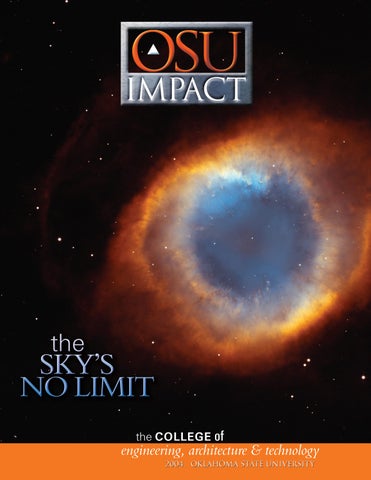
about the cover: Images from NASA’s Hubble Space Telescope, like the one on the cover, take us deep into the universe to see such celestial phenomena as supernovas and the birth and death of galaxies. The Hubble’s immense contributions to astronomy, and science in general, would not have been possible without a team of engineers led by OSU alumnus Don W. Vanlandingham. Their development of COSTAR, a corrective optics device, gave us the Hubble images. The related story is on page 13. original photo: NASA
IMpACT Eileen Mustain, editor Paul V. Fleming, art director Janet Varnum, associate editor Adam Huffer, CEAT Communication Specialist Kyle Wray, University Marketing Letters are welcome and should be addressed to:
Oklahoma State University Editor, IMPACT Magazine 201 ATRC, Stillwater, OK 74078-5013
2
11
Vip INVITATION
13 What’s Inside: 2 CEAT student chapters and student
teams compete with, and often surpass, the best in their fields. 11 OSU’s partnership with aerospace engineering began early in the history of aeronau13 The creations of CEAT alumni such as tics. Don Van Landingham have changed our world, 14 Aeroeven our perceptions of the universe. space engineering’s design/build/fly teams take the nation’s top honors. 20 Many faculty members in the College of Engineering, Architecture and Technology are nationally and internationally acclaimed experts in their fields. 22 Faculty in the School of Electrical and Computer Engineering received the National Science Foundation’s most prestigious and competitive award.
Research, Noteworthy 8Alumni Success 11Teaching, 20 Outreach
The CEAT wants you to have access to up-to-date information on everything from the continuing development of the Advanced Technology Research Center to the establishment of new academic programs on the Stillwater campus and in Tulsa. We invite you to be our guest for a VIP visit to campus and the CEAT. Contact Dean Karl Reid by phone at 405-744-5140, by FAX at 405-744-7545, or by e-mail at kreid@okstate.edu. If a trip to campus is not possible, visit us on the CEAT homepage at http://www.ceat.okstate.edu. The office of publication for IMPACT is 121 Cordell North, Stillwater, OK 74078-8031. Copyright © 2005, IMPACT. All rights reserved.
14
Departments
2Student Digest
IMPACT is a publication of the Oklahoma State University College of Engineering, Architecture and Technology and is designed to provide information on college activities and accomplishments while fostering communication among the CEAT family and friends.
20 22
Oklahoma State University in compliance with Title VI and VII of the Civil Rights Act of 1964, Executive Order 11246 as amended, Title IX of the Education Amendments of 1972, Americans with Disabilities Act of 1990, and other federal laws and regulations, does not discriminate on the basis of race, color, national origin, sex, age, religion, disability, or status as a veteran in any of its policies, practices or procedures. This includes but is not limited to admissions, employment, financial aid, and educational services. Title IX of the Education Amendments and Oklahoma State University policy prohibit discrimination in the provision of services of benefits offered by the University based on gender. Any person (student, faculty or staff) who believes that discriminatory practices have been engaged in based upon gender may discuss their concerns and file informal or formal complaints of possible violations of Title IX with the OSU Title IX Coordinator, Dr. Carolyn Hernandez, Director of Affirmative Action, 408 Whitehurst, Oklahoma State University, Stillwater, OK 74078, 405-744-5371 or 405-744-5576 (fax). This publication, issued by Oklahoma State University as authorized by the College of Engineering, Architecture and Technology, was printed by Creative Services, OU Printing Services at a cost of $10,100.00 16M/Nov. 2005/job# 8964.
Student Digest
Members of the 2004 AGCO competition’s winning design team are, from left, Monica Johnston, Kent Evatt , Candice Johnson and Kody Featherston.
Ready for the Real World
Frontline Recruiters
courtesy of BAE
An OSU biosystems and agricultural The 2004 winning project, sponsored by engineering student design team dem- Ditch Witch in Perry, Okla., challenged onstrated they are ready for the design the team to design an effective means challenges of the real world with a first for a silt fence installation. Weckler says place win in the 2004 American Society the students’ outstanding work has led of Agricultural Engineers National to discussions with Ditch Witch about Student Design Competition. the possibility and feasibility of patenting the students’ design. The AGCO contest requires students to employ the design process just as “Winning the AGCO competition shows project teams would in an industrial the state’s taxpayers we are doing firm. Students in BAE’s two-semester things that are really applicable to the capstone design course select a project real world,” he says. from a list of potential projects and Courtney England sponsors compiled by Paul Weckler, professor and team adviser.
s OSU IMPACT
By candidly sharing their student experiences and taking a personal interest in each prospective student, CEAT ambassadors such as mechanical and aerospace engineering student Karalyn Eyster, left, are successful recruiters for the college. Erika Contreras
“It’s a real-world problem, and there are small companies in rural Oklahoma that don’t have a full-time engineering staff available to help them,” Weckler says. “Many times the companies really benefit from the students’ work.”
Although the student ambassador “Many freshmen don’t know simple program in the College of Engineer- things, such as it’s all right to go ing, Architecture and Technology talk to a professor,” Eyster says. began only a few short years ago “We help students succeed after in 2002, the program has already they get here.” become indispensable, says Dean Eyster has no doubt the program Karl Reid. is successful. “Numerous students “Student ambassadors are our say, ‘I haven’t gotten this anyfrontline recruiters,” he says. where else’ and ‘this makes the difference in deciding where I’m Students have a generational going,’” she says. advantage, according to Karalyn Eyster, mechanical and aerospace Students undergo an application engineering student and former and interview process to become president of the ambassador group. ambassadors. Although being an “Generally, students think that ambassador can offer a profesadults, such as their parents, don’t sional networking opportunity, that understand them, so they are more is not the reason CEAT students responsive to peers.” become ambassadors, according to Eyster. CEAT student services works closely with OSU admissions to schedule “Students love this college and student-guided tours for prospective want to share this with others. I students and their parents. The CEAT did. Being in engineering has made ambassadors, currently 15 engineer- all the difference for me. We are a ing students with various majors, close-knit group. Because we follow are each available to conduct at a set progression of classes in our least one weekly tour ranging in size majors, we see more of each other from three to 10 people. than roommates. We learn to count on each other,” she says. The ambassadors tailor the tours to the students’ interests. They “Engineering has given me a conanswer their questions honestly; nection.” end the tour with thank you cards and information for further contact It’s that connection she hopes to give back to the college. and then follow-up student visits with email. They even continue Eileen Mustain the relationships after prospective students enroll.
A Great Year for AIChE Sometimes good news just gets better, or so it was in 2004 for the OSU student chapter of the American Institute of Chemical Engineers (AIChE).
design competition are, left to right, Megan Burns, Shelby Hutchens and Ashley Price. Price graduated in May 2004 and is now a development engineer at ConocoPhillips; Hutchens is pursuing a graduate degree in bioengineering at Cal Tech; and Burns, who graduated in December 2004, is an environmental engineer with Valero Energy Corp, Ardmore, Okla.
Students in the OSU chapter of the American Society of Civil Engineers placed sixth out of 43 teams in the 2004 finals of the ASCE/American Institute of Steel Construction National Student Steel Bridge Competition. Civil and environmental engineering students, David Erickson, Brian Sartain, Matt Youngblood, Julie Russell and Brian Cales, earned the bid after winning the ASCE Mid-Continent Conference title in April. The contest evaluated the number of students and time required to assemble the bridge, the weight of the bridge and the structure’s deflection under loading. OSU’s bridge consisted of 42 pieces and 68 bolts and nuts, weighed 196 pounds and was 26 feet long, 4 feet wide and 2 feet tall. “Our students won the regional championship with an assembly time of 11 minutes and 58 seconds, but with some modifications and a lot of practice, they got their time down to just over eight minutes in the finals,” says Charles Bowen, assistant professor of civil engineering and the team’s adviser. The students conceived their bridge design in August 2003 and developed it as an extracurricular project outside of the classroom. In addition to conducting all computer simulations and testing to optimize the strength of the structure and amount of steel used, OSU’s team also fabricated its bridge. “A stipulation of this contest, unlike many others, is that students at schools that don’t have the laboratory capability can hire someone else to actually construct their design,” Bowen says. “Our students did all the work themselves downstairs in the lab. Their bridge was 100 percent homegrown here at OSU.” Adam Huffer
OSU civil and environmental engineering students, from left, Brian Cales, Brian Sartain, David Erickson, Matt Youngblood and Julie Russell, placed sixth in the 2004 National Student Steel Bridge Competition. Adam Huffer
All 150 AIChE chapters in the U.S. may submit design solutions to the competition as long as students complete the challenge within 30 days and without faculty assistance. Engineers in industry and academe For the sixth year in a row, AIChE received the jointly author the challenge given to students, outstanding student chapter award, one of Wagner says. 15 in the nation, and Tim Plowman, chemical engineering senior, became one of only 10 The challenge for Burns, Hutchens and recipients nationwide to receive the Donald F. Price was to design an economically viable and Mildred Topp Othmer National Scholarship process for the extraction of biohazardous for the 2004-2005 academic year. waste from storage and its conversion into a useful or disposable product. One of OSU’s ChemE Car teams, powered by hydrogen peroxide reacting with pureed “The design problem was based on an actual beef liver, placed first in regional competition. site in Louisiana where ethylchloroacetate Although the car didn’t win the national was deposited in salt dome caverns 20 championship, it did win several awards at years ago. The task involved developing a the AIChE national conference, including process to remediate the biohazardous waste second place poster, most unique drive extracted from the caverns and leave the mechanism and the Golden Tire Award, the storage site in a stable condition,” Wagner “best car” designation given by all participat- says. ing students. “The team competition, a relatively new addiThen, for the third time since the contest tion to the long-standing AIChE individual began 10 years ago, OSU chemical engineer- design competitions, emphasizes cooperation ing seniors placed first in the AIChE national and integration and requires students to design team competition. work on a more comprehensive challenge,” says Russell Rhinehart, Bartlett Chair and Megan Burns, Shelby Hutchens and Ashley head of the school. Price completed the 2004 winning entry as a 30-day project assigned last spring in “The panel of judges includes experienced the school’s senior design course taught by chemical engineers from both industry and Jan Wagner, professor, and Robert Whiteley, academe. They ultimately judge the submisassociate professor, in the School of Chemi- sions on technical excellence and written cal Engineering. communication skills, but the technical, scheduling and economic aspects all must be National champions in AIChE team brought together,” he says.
A Strong Finish for Steel Bridge Team
“Our students’ success in the competition indicates they are able to integrate all of the industrial practice issues as well as properly apply the fundamentals.” Adam Huffer
Adam Huffer
2004 s
Adam Huffer
OSU chemical engineering alumna Cassie Mitchell, named to the first team of the 2004 All-USA College Academic Team, is the second OSU student selected by USA TODAY as one of the top 20 graduating seniors in America. CEAT alumnus Bryan McLaughlin was among USA TODAY’s top 20 in 2003.
Mitchell, One of the Nation’s Best Cassie Mitchell, a gifted another avenue into advanced popper she built with her faculty high school athlete, taught herself healthcare through the study of mentor, Randy Lewis, professor of ambidexterity in order to maintain engineering. She graduated in May chemical engineering. The school’s a competitive edge. As a student in 2004 with a degree in chemical ChemKidz program uses the OSU’s College of Engineering, Archi- engineering, specializing in the innovative device to demonstrate tecture and Technology, she applied biomedical option, and left behind fundamental chemical engineering the same focused determination to a stunning scholastic record. principles to children. become one of the nation’s bright“Our chemical engineering program She also received a 2003 Barry est undergraduates. M. Goldwater Scholarship, another typically requires five years, but USA TODAY named Mitchell to the Cassie graduated in four years national award with a heavy emphawith the biomedical option, which sis on undergraduate research first team of the All-USA College experience. Her research included Academic Team in February 2004, a requires even more hours,” says an internship with the Tulsa-based designation placing her among the Russell Rhinehart, Bartlett Chair and head of OSU’s School of Chemi- firm Syntroleum where she helped 20 top students graduating from American colleges and universities cal Engineering. engineers write a FORTRAN in 2004. program as part of a computer-mod“She completed 150 hours with just eling project for transient operations one non-A while participating in our of chemical reactors. The company The Warner, Okla., native was weighing track and field scholarship ChemKidz outreach program and is using the program in its effort offers from a number of Division I serving as president of our chemi- to develop gas to liquid refineries schools where she hoped to study cal engineering pre-professional for the production of ultra-pure, to become a doctor, but her plans society, AIChE, the student chapter synthetic and inexpensive diesel. changed when she was diagnosed of the American Institute of Chemiwith progressive multiple sclerosis cal Engineers,” Rhinehart says. Mitchell is currently working on a master’s degree in biomedical engiand confined to a wheelchair at the Mitchell was a recipient of an OSU neering at Georgia Tech University. end of her senior year. Wentz Research Project award, Adam Huffer Instead of giving up her dreams of which she applied toward the design of a fluidized-bed popcorn a medical career, Mitchell found
Johnson Named Number One Newlin
Candice Johnson, biosystems and agricultural engineering senior, received the 2004 Student Engineer of the Year Scholarship from the American Society of Agricultural Engineers. ASAE gives the award annually to the outstanding agricultural/biological engineering undergraduate in the U.S. or Canada based on scholarship, character, personal development, student membership in ASAE and leadership. Johnson, who graduated in December 2004, gained practical experience working with John Solie, OSU research engineer and professor, on projects ranging from electronic control systems and sensors to mechanical transmissions and engines. While working with Deere and Company during the summers, she also gained exposure to marketing, quality, production and design engineering in the agricultural equipment industry.
Adam Huffer
-~~lei -~~,i...M:J
Candice Johnson
As a senior Johnson flexed her leadership muscles as the 2003-2004 president of the ASAE Preprofessionals Council, representing student branches at universities throughout the U.S. and Canada. As a professional Johnson hopes to contribute to the development of new machinery technology to advance farming practices. She is currently employed by Deere and Company in Ankeny, Iowa. Courtney England
s OSU IMPACT
White Admitted to Prestigious Program
Student Digest Briefs
graduate Christopher White also won the grand prize at the EPSCoR Research Day Summer Undergraduate Research Competition at the Oklahoma state capitol in 2004.
"'"""'""1!¢01 .. ~~<I:!~
""' -=• elayJitter Properties ~_dQu:-¥')CU'f;
fo.U•l-1~
~ •
" - ..,..,. , ·1·~;
11 _,,-..,.,.,,,,~ i;,•.---r,,r,.=.u,,,
~~:~f.«l;«).e>."" a I" /1•5
With Teague’s encouragement, White submitted the results of a study on network performance and analysis to the 37th Asilomar Conference on Signals, Systems and Computers in California in November 2003. He placed fourth out of seven national finalists, the only student not yet working on a Ph.D. to enter a winning paper. “I’ve really appreciated the diversity here at OSU, and if I were going into lasers or control systems, I’d stay here,” White says. “Being chosen and beating out people from Harvard, MIT and Cambridge is testament to the work that’s being done in our lab, the talented programmers I’ve worked with here and Dr. Teague’s ability to direct research and support people who want to do research.” Adam Huffer
The NAHB competition, a pre-designed 150-plus home development in Blair, Minn., required students to prepare an estimate, a schedule, value engineering proposals, management plan, construction site plan, marketing plan and cash flow analysis. Dana Hobson, head of CMT and the team’s coach, says he considers the placement outstanding, noting this is only the second competition for the OSU Home Builders team that will return four of its six members in 2005. CMT students also won first place in the construction management team competition and the design/build team competition at the Associated Schools of Construction/Associated General Contractors Region V Student Competition. Team members won five of nine individual presentation honors, including two firsts. courtesy of CMT
When OSU electrical engineering electrical engineering, computer science and cognitive science programs. alumnus Christopher White interviewed for admittance to the Johns Hopkins Center for Language and Speech “One of the major selling points for Johns Processing’s Ph.D. program for fall 2004, Hopkins is its phenomenal biomedical program and collaboration with the worldhis nametag read “Oklahoma.” renowned hospital there,” White says. “They either didn’t know there are two schools in the state or they didn’t know White earned the scholarship by the difference,” White says, admitting demonstrating repeatedly as an OSU he felt intimidated in the midst of such undergraduate the ability to work alongside and compete with the nation’s elite prestigious tags as MIT, Cambridge, graduate researchers. As a CEAT freshHarvard and Princeton. man research scholar, he joined OSU’s Speech and Audio Communications He need not have. The 30 faculty and Laboratory where Keith Teague, profesadministrators at Johns Hopkins who interviewed White soon learned about the sor and head of the School of Electrical quality of undergraduate education at OSU. and Computer Engineering and the lab’s director, hired him as a research Among the seven students they admit- assistant after just six months. ted to the program, White was one of “Chris has been a full partner working three who received a full scholarship providing year-round living, tuition, fee with us, and his name is on a number of technical papers that we’ve had and book support, summer internship and job placement and funded travel to published in journals and presented at international and national conferences conferences,” Teague says. Activities through the 2010-2011 academic year. in OSU’s laboratory focus on a massive, Department of Defense-funded project Johns Hopkins offers White the opportu- to develop secure communications technity to apply his undergraduate education nologies for the Internet. White used the in a federally funded center that unites lab’s focus on secure multi-media over internet or internet protocol as the basis In addition to earning a full scholarship for two undergraduate research projects to the Johns Hopkins Center for Lanhe completed in OSU’s Wentz research guage and Speech Processing’s Ph.D. project program. program, 2004 electrical engineering
The Construction Management Technology Department’s Home Builders team placed 10th out of 24 teams in the 2004 National Association of Home Builders competition.
Left to right, James Sexton, Cory Muir, Angela Suarez, Jennifer Midkiff, Will Cates and Eric Mariconda are members of the 2004 Home Builders team.
The CEAT Student Council performed well in the National Association of Engineering Student Councils (NAESC) regional competition, winning Best Activity, Best Philanthropy and, most significantly, the regional Council of the Year Award. Matthew Engleman, president of the CEAT Student Council, says placing first in a six- state region that includes Kansas, Texas, Arkansas, Missouri and Oklahoma engineering chapters is a significant win. Encouraged, the CEAT group is putting together a strong bid for the National Council of the Year Award in 2005, he says.
Chemical engineering graduate student Samuel O. Owusu received a 2004 Instrumentation, Systems and Automation Society (ISA) Educational Foundation Scholarship. ISA awarded the $2,500 scholarship to Owusu, a Ph.D. candidate, because he shows outstanding potential for contributions to the field. His research involves investigating and analyzing techniques for autonomous computer monitoring of process controllers.
Tim Plowman, chemical engineering senior, received the Donald F. and Mildred Topp Othmer National Scholarship for the 2004-05 academic year. The Mary Elizabeth Womack, biosystems and agricultural engineering scholarship is the American Institute of Chemical Engineers’ (AIChE’s) senior, received the Reuben Trane annual recognition of the top 10 Scholarship, the top award from the American Society of Heating, Refrigerat- chemical engineering scholars in ing and Air-Conditioning Engineers for the country. the 2004-05 academic year. Womack Plowman, the current president of is one of only three in the nation to OSU’s student AIChE chapter is the sixth receive the two-year $5,000-per-year student from the School of Chemical scholarship. Engineering to receive the $1,000 award in the past seven years.
photos/courtesy chemical engineering 2004 s
Student Outreach Program Nets NEA Funding Fifth-grade students in Stillwater’s six public elementary schools don’t necessarily realize they’re learning the fundamental concepts of architectural design when OSU architecture students visit their classes one hour a week. They’re too busy exploring texture, materials and shapes and constructing cardboard models of buildings that will make up the miniature city they design at the end of the nine-week course. Members of the OSU chapter of the American Institute of Architecture conceived the community outreach program, Architecture Students Teaching Elementary Kids (ASTEK), in 1999 to help prepare area fifth-graders for art questions on standardized tests. They work from a 60-page workbook written and published by OSU students. A hit with fifth-graders, ASTEK also earned a “thumbs up” in 2004 with a one-time $5,000 grant from the National Endowment for the Arts. The NEA grant is a boon to the program, which has relied almost entirely on student support, says Suzanne Bilbeisi, associate professor of architecture and the program’s faculty adviser. “The students not only publish the workbooks, but they also secure the model building materials and volunteer at least two hours a week to be with the fifth-graders,” Bilbeisi says. “The NEA grant will fund a number of enhancements to ASTEK.”
Fifth-grader Vincent Sorrentino describes his class’s city model to his mother, Missy Sorrentino. Taught by OSU architecture students, Stillwater’s fifth grade students learn art and fundamental design in the Architecture Students Teaching Elementary Kids program, one of only five Oklahoma initiatives to receive a grant from the National Endowment for the Arts in 2004.
s OSU IMPACT
Adam Huffer
She says the group plans to construct durable, transportable and reusable base models for the cityscapes, create high-quality visual aids illustrating well-known architectural works and bring Oklahoma architects to visit the Stillwater classrooms. Adam Huffer
courtesy Cowboy Motorsports
courtesy
A FIRST Engineering Experience When high school biology teacher Tonya (Lewis) Scott organized a robotics team for students at Ponca City High School in 1999, the team’s mentors included two NASA scientists as well as engineers from nearby ConocoPhillips. That year the team won the national Rookie All-Star Award, and each successive year the Ponca City high school team has brought home regional and national awards, no doubt because of the team’s outstanding mentors and the students’ youthful enthusiasm.
Ponca City senior Denisse Sandoval says three OSU students, Brock Crews, Joe Hershberger and Chris White, who mentored the team in 2004, were helpful and fun. “They were great guys who brought in great energy,” Sandoval says. “They acted like older brothers who were always fun to joke with and learn something new from, such as how to program our robot.” Crews, a graduate student in mechanical engineering, says the high school students’ level of knowledge impressed him, and their enthusiasm reminded him of how fun science can be.
But Scott says one crucial element of the team’s repeated success has been the involvement of OSU engineering student mentors who inspire the high Each team spends a couple of months brainstorming school students to discover their own potential and OSU engineering students Joe Herschberger, left, realize that a career in engineering is within their reach. about the robot design, and when the kit finally arrives and Chris White prepare Ponca City students’ robot from US FIRST with the motor, electric gyros, sensor for competition in the FIRST 2004 regional in Hous“High school students look up to the college students, chips and other assorted parts, the build stage begins. ton, Texas. who may be only four or five years older and are already doing incredible things, and they realize, ‘I can The teams have six weeks to design, build and program “The robot is the tool, but the real product is the kids’ do this, too,’” says Scott, a 1995 OSU graduate in sec- their robot before mailing it to the competition site by experience. They constantly build, drive, break and fix ondary education with an emphasis in science who is a mid-February deadline. The robot is locked in storage the robot. Most kids really get into it. You can’t keep pursuing a master’s degree in educational leadership. until the teams converge in late March/early April to them away from the lab.” compete against each other in randomly-paired teams. FIRST (For Inspiration and Recognition of Science and The scoring is very complex and the rules change Scott says there’s a place for everyone on the team, from year to year, Scott says, and the winning teams whether a student is interested in engineering or Technology) was founded by inventor Dean Kamen to inspire an appreciation of science and technology progress to national finals competition in late April. any other role such as publicity, organizing meetings, in young people. Based in Manchester, N.H., the raising travel money, serving as historian or generating non-profit organization designs accessible, innovative Robots are never recycled or reused in competition, so enthusiasm and spirit. programs such as the FIRST Robotics Competition to each year the team has to start from scratch. build self-confidence, knowledge and life skills while “Kids always ask me how what they’re learning in the “There’s something for everyone to do, and usually they all pick up a little bit of engineering knowledge along motivating young people to pursue opportunities in classroom is relevant to their life and future,” she says. the way,” Scott says. science, technology and engineering. “But they never ask that question while they’re working Janet Varnum on the robotics team. For more info, visit USFirst.org
Students Pull Victory in Design Competition Placing first out of 29 colleges and universities in the U.S. and Canada, the OSU School of Biosystems and Agricultural Engineering’s Cowboy Motorsports team won the 2004 ¼-Scale Tractor Student Design Competition sponsored by the Society for Engineering in Agricultural, Food and Biological Systems (ASAE).
For the 2004 four-wheel drive tractor, Cowboy Motor- Success in design competition lends to the university’s sports improved on an infinitely variable transmission prestige, but the individual benefits for participants are design conceived in 2001 by former team members much more tangible, according to Solie. and biosystems and agricultural engineering alumni “Indirectly, the win enhances the reputation of the Stuart Reid and Jake Holloway. department and the university, but a competition like “Alumni contributions have been vital to the team’s this gives our students hands-on, practical experience The competition involves building a small, cost-effective steady improvement from an 11th-place finish in 2001 they can’t necessarily get in the classroom,” he says. tractor to pull a 5,500-pound sled. All teams must use to first in 2004,” says John Solie, biosystems and agriidentical 16-horsepower Briggs and Stratton engines, cultural engineering professor and Cowboy Motorsports “Contest sponsors like Caterpillar, John Deere, Kubota, New Holland North America and other companies hire supplied by the company, so the design challenge essen- faculty adviser. our students as interns with hopes of employing them tially centers on optimizing drive train performance. “This is the seventh year our students have competed, after graduation, in large part due to what they learn and they pass down knowledge to the next class,” Solie building these tractors.” The Cowboy Motorsports team won the international says. “Cowboy Motorsports teams have gotten better Adam Huffer and Trish Gedon ASAE ¼-Scale Tractor Student Design Competition. every year, and what our alumni started has turned OSU students also placed first in a junior varsity pairinto a national championship. A lot of people can take ing dubbed the X-team Competition that featured 11 squads of freshmen and sophomores competing with ownership in this sport.” modified tractors from the 2003 contest. 2004 s
Alumni Success
A Golden Year for Hall of Fame J.D. (Denny) Carreker Jr. The CEAT Hall of Fame recognizes OSU graduates as well as individuals who have enhanced the reputation of the college through their careers in education, industry and the public sector. Previous inductees include one-time American Gas Association President George Lawrence, former Kerr-McGee Chairman Frank McPherson and Eason H. Leonard, founding partner of I.M. Pei & Partners. “All are legends in their fields and share a common set of qualities including modesty and integrity, dignity and quiet leadership, aspiration and perseverance and sound judgment and vision,” says Karl Reid, dean of the college. In 2004 the CEAT paid tribute to the achievements of alumni J.D. “Denny” Carreker, Steven D. Hofener and David Kyle.
A new congressional law went into effect in October 2004 that forever changed banking globally. Combined with new, innovative image exchange technologies developed by the Dallas-based Carreker Corporation, the legislation called “Check 21,” allows for the electronic processing of digitized checks between financial institutions in near real-time. This giant step toward the complete automation and safeguarding of transactions is one reason the College of Engineering, Architecture and Technology inducted J.D. (Denny) Carreker Jr., into the CEAT Hall of Fame. Carreker, founder, chairman and chief executive officer of Carreker Corporation, obtained both a bachelor’s and a master’s degree in industrial engineering and management at OSU and parlayed that engineering education into a successful career as entrepreneur and businessman. Carreker Corporation, founded in 1978, is the world’s largest technology provider in check operations. Headquartered in Dallas with offices in London and Sydney, it offers new technologies and consulting services to financial institutions, including 75 of the 100 largest banks in the U.S., and has more than 250 clients on five continents. The Oklahoma City native started his company with a secretary and one junior consultant and now employs approximately 560 people worldwide and generates $129 million in annual revenue. The Carreker Corporation became publicly traded in 1998, the same year it reached $56 million in annual revenue, and used proceeds from a second public offering in 2000 to acquire an image archiving company. It made Fortune magazine’s list of the “Top 100 Fastest Growing Companies” and ranked 50th on Forbes’ “Best Small Companies” and 75th on Business Week’s “Hot Growth Companies.” Ernst and Young named Carreker 2001 E-Commerce Entrepreneur of the Year and American Banker included him among the “Top 25 Technology
s OSU IMPACT
Consultants.” Recognized for his influence on modern banking and his company’s status as a global thought leader in payments technology, Carreker frequently serves as an expert witness before Congress and consultant to the Federal Reserve. Influential industry organizations he founded, such as the Electronic Check ClearingHouse Organization, have helped shape the payment system and the role of banks. Steven D. Hofener
Steven D. Hofener never had any doubts he would become a transportation engineer. His role model was his father, Harold. However, unlike his dad whose 40 years in traffic engineering were spent with the city of Tulsa and the Oklahoma Department of Transportation, the younger Hofener had designs on a career that would include diverse experiences from time spent in university research, the public sector and consulting. His education at OSU set the stage for that to happen. In the School of Civil and Environmental Engineering, Hofener’s work for the ODOT design squad instilled a love of seeing projects through from design to construction to working operation. Faculty members such as Allen Kelley, Rich DeVries, Phil Manke and Bill Dawkins also made a lasting impression on him. A brief tenure at the Texas Transportation Institute followed by employment as traffic engineer and chief traffic engineer for Oklahoma City taught Hofener the importance of completing projects on time and within budget without sacrificing quality. These became hallmarks of Traffic Engineering Consultants Inc., the firm he started when he entered the private sector. TEC exemplifies the ideals of its founder by acquiring the skill and knowledge required to solve complex transportation planning and design issues. Once a one-man operation, the firm now has offices in Oklahoma City and Tulsa and has made an indelible imprint on transportation throughout the Midwest
business.”
TEC involvement in Oklahoma projects includes the Oklahoma City MAPS project; construction of the Creek, Cherokee, Kilpatrick and Chickasaw turnpikes; the widening of the Broken Arrow Expressway in Tulsa; and the widening of the Broadway Extension and replacement of the elevated I-40 cross-town expressway in Oklahoma City, to name just a few. Nationally, TEC is one of three traffic engineering firms Wal-Mart uses for special projects.
Ultimately, with Brummett serving as chairman of the board and Kyle as president and chief operating officer, they set about transforming ONEOK, a small, regional utility, into a fully diversified energy company.
In a field where projects are typically only noticed if they fail to improve the movement of people and goods from place to place, Hofener’s career works are lasting, vibrant reminders that engineers shape the world and touch lives. David Kyle
Friends and colleagues describe David Kyle as a man respected and appreciated for his business acumen and personal integrity.
Starting initially as entry-level engineers with ONEOK subsidiary, Oklahoma Natural Gas, Kyle and Larry Brummett progressed up through the ranks because of a friendship that allowed them to bring fresh ideas and approaches to their work. “People who aspire to be successful,” Kyle says, “should find associates with common goals and cooperatively, not competitively, pour their talents into the
Huffer
marks the 50th anniversary of the CEAT Hall of Fame. J.D. (Denny) Carreker Jr.
tradition is a
Net income for ONEOK in 2004 exceeded $225 million, more than six times its income just 10 years ago. In 1994, ONEOK employed 2,000 people, and today its labor force includes more than 4,000 employees. Added to ONG, the acquisitions of Texas Gas Service and Kansas Gas Service under Kyle’s leadership made ONEOK the nation’s fifth-largest natural gas distributor with almost two million customers. ONG president and fellow CEAT alumnus Sam Combs writes that during Kyle’s tenure as its leader, ONEOK has not only expanded dramatically and redefined its focus, the company has also demonstrated commitment to community and customer service, earning the Southern Gas Association’s 2004 Community Service Award. Its marketing company, ONEOK Energy Services, ranked highest in customer service in the most recent national Gas Marketing Satisfaction Survey.
testament both to CEAT’s exceptional graduates and the programs and faculty that cultivated them. A trendsetter as well, the “Division of Engineering Hall of Fame” was the first instituted on
Steven D. Hofener
the OSU campus, and when the Alumni Association initiated the Alumni Hall of Fame two years
Kyle, son of a general engineering CEAT alumnus, says part of his overall approach to business stems from principles he learned in the School of Industrial Engineering and Management at OSU. He says the industrial engineering program combined the engineering approach to problem solving with business management principles. Kyle says he is also appreciative of the opportunity he received 30 years ago to join a company where he continues to enjoy the people, the work and the business.
This rich 50-year
courtesy
The president, chairman and CEO of ONEOK Inc. says that he makes decisions in the best interest of ONEOK, its stakeholders and employees. If you ask him, he’s “just an ordinary Joe who makes the most of what the good Lord provided.”
by Adam Thestories 2004 induction
courtesy
So revered is Hofener for his leadership abilities and service to his profession the Institute of Transportation Engineers elected him president to represent more than 16,000 traffic and transportation professionals in 90 countries around the world. Hofener also actively supports education of future engineers through interaction with ITE student chapters at nine different universities.
Although Brummett lost his battle with cancer in 2000, Kyle has continued to guide ONEOK with an aggressive philosophy of diversification and acquisition that has led to its exponential growth. It is currently one of just five New York Stock Exchange-listed companies headquartered in Oklahoma.
courtesy
and the world.
later in 1956, three of the first five alumni honored were engineering graduates.
David Kyle
2004 s
Edward and Neal Jones Receive CEAT’s Highest Honor
Brothers Edward M. Jones and Neal E. Jones of Jones Studio Inc. each exemplify the type person for whom the Melvin R. Lohmann Medal was intended. Both are distinguished graduates who have made contributions to their professions that merit the highest recognition. Individually, the Jones brothers would certainly have been good architects, but theirs is a partnership marked by greatness. Their careers intertwine so indispensably that the College of Engineering, Architecture and Technology honored both with the 2004 Melvin R. Lohmann Medal.
The works of Edward M. Jones, a 1973 featured in publications such as National As president of Jones Studio Inc., Neal has graduate of the OSU School of Architecture, Geographic and won 14 architectural awards, demonstrated that an architecture firm can represent some of the most positive including the National Eco Grand Prize in be uncompromising in its adherence to and influential directions in American 1996 for North America’s No. 1 sustainable ambitious design principles and still be an architecture today. As founder and principal design project. immensely successful business. During the architect of Jones Studio Inc., he is half a recession of the late 1980s, he obtained Eddie oversees all functional and aesthetic work for Jones Studio by getting on vendor team that one day may be cited for doing design elements of every project by Jones more to advance environmental conscilists for local and state government projects. Studio, which has won 120 major design entiousness and sustainability in building While the firm’s captivating designs for strucawards. A registered professional architect in tures such as the visitor center at Homolovi design and construction than any other Arizona, California, Nevada and Washington, Ruins State Park and the Arizona Veterans practitioners of this era. he has held numerous adjunct professorships Memorial Coliseum looked expensive, Neal Eddie says he began to incorporate recyand is frequently invited to appear as a kept costs down by devising alternative clable and renewable building materials in competition jurist, lecturer or presenter at construction methods and materials. his designs because Jones Studio’s early cli- universities and professional design sympoents could afford little else. Since he started siums and conferences. The high-quality, low-cost combination the firm in his Phoenix home in 1979, his appealed to both public and private clients. projects have functionally and aesthetically As a young boy, Neal E. Jones, a 1977 Neal successfully negotiated much largercelebrated the tradition, culture, climate and graduate of the OSU School of Architecture, scale endeavors such as the corporate demonstrated a precocious interest in archi- headquarters and training facility for the topography of the Sonoran Desert. tecture and an exceptional ability to draw. Arizona Cardinals. Jones Studio’s continued His projects communicate a clear message He decided to study architecture, and just as exploration of the use of sustainable and about energy efficiency and environmental their father had advised his brother, Edward, alternative construction methods and materisensitivity through an abundant use of to go to OSU, Neal says there was no other als has only enhanced the firm’s reputation. glass, thoughtful site positioning to exploit choice for him. day-lighting and structural innovations that In addition to overseeing all of Jones Studio’s His adviser and professor, George Chamfacilitate passive heating and cooling. administrative, financial and marketing berlain, subsequently urged Neal to pursue affairs, Neal is responsible for directing its Jones Studio emerged at the national fore- dual master’s degrees in architecture and project team in the overall design and manfront of “eco” or “green” architecture in 1994 business administration at the University of agement and working with clients on project with the opening of the Arizona Public Ser- Illinois, a decision he says changed his life. objectives and delivery of services. vice Environmental Showcase Home in North Phoenix, a project Eddie and his brother Neal In 1986, Neal joined his brother, Eddie, in the Now, more than two decades after George spent more than a year researching before Phoenix architecture firm Jones Studio. Neal Chamberlain told him not to listen to naysaybrought to Jones Studio his own formidable ers who said combining degrees in business they designed it. architectural skills as well as incomparable and architecture was a waste of time, Neal Intended as a showcase to inspire area marketing savvy, forming what he and his is a frequent guest lecturer at colleges and builders and home buyers to consider brother characterize as “a dynamic tension universities on professional architecture environmentally sensitive designs and unified in an enthusiasm for architecture.” practice and business management. construction technologies, the APS home Although Jones Studio now employs 11 Adam Huffer attracted visitor for more than six years, was professional staff, the firm is still defined by this polarity. Adam Huffer
CEAT Dean Karl Reid, left, and Randy Seitsinger, head of the School of Architecture, right, celebrate the careers of architects Neal Jones and Edward Jones, center, at the Lohmann Medal Award ceremony in 2004.
10 s OSU IMPACT
Research, Teaching, Outreach
There from the Beginning Even before Oklahoman Wiley Post flew solo around the world in 1933, the OSU curriculum included an aerospace program. The mechanical engineering department began offering a degree option in aeronautical engineering in 1929, making the program the state’s oldest and ushering in a vibrant relationship between OSU and the aerospace industry. Aviation developments in Oklahoma impacted the program from its inception. The growth in the Spartan School of Aeronautics in Tulsa and the establishment of Tinker Air Force base in Oklahoma City led to a rapid growth of the new aeronautical engineering program during its early years.
standalone curriculum. In 1968, the college officially changed the name to aerospace engineering to reflect the broadening of the field and the growing importance of space-related engineering in the state. Today, OSU’s aerospace engineering program is growing in enrollment, retention rate and popularity, according to Andy Arena, professor in the School of Mechanical and Aerospace Engineering. He attributes the increased interest to the aerospace industry’s importance to the state’s economy. Aerospace is now the largest industry in Oklahoma with approximately 500 companies that employ some 143,000. The industry generates a payroll of almost $5 billion and an industry output of nearly $13 billion.
Later, in 1960, as Oklahomans began playing a significant role in the growth of space exploration and the development of space technology, OSU’s aeronautical engineering “Oklahoma has a long aerospace history and we want to support that,” Arena says. degree option was fully accredited as a
photos/Edmon Low Archive 2004 s 11
Growing a Reputation In 1939, OSU’s aerospace engineering initiated a civilian flight-training program, which later led to the development of a flight school. The pilots graduating from the civilian flight-training program became military pilots during World War II.
In fact, more pilots from OSU nurtures design and a curriculum “I think the greatest contribution entered into military service committed to hands-on, practical OSU provides the industry are the than from any other U.S. school, engineering and design experience self-sufficient, very talented and the Civil Aeronautics Authority that eases transition from school to very well-tested engineers they reported in 1942. The CAA also work,” Arena says. continue to crank out into the noted that prior to the time of aerospace community. They provide “Most of our students have multiple great resources,” says alumnus the report, none of these pilots “washed out” of the Army Air Corp employment opportunities and Nick Scocos, flight test engineer for are recruited from coast to coast. Cessna Aircraft Company. pilot training program. Companies specifically seek OSU Like these pilots trained by OSU’s students,” he says. “I’d rather have five OSU alumni aeronautical engineering program, than 15 engineers from any other today’s engineering graduates also OSU’s contribution to the aerospace school. There’s just no comparison.” enjoy a reputation for quality and industry is not limited to aerospace engineering graduates, Arena says. with good reason. The industry also hires many of “Aerospace engineering is the OSU’s electrical and mechanical beneficiary of a strong mechanical engineers. engineering department that 12 s OSU IMPACT
OSU Engineers: A Sampling Alumni from the OSU College of Engineering, Architecture and Technology have influenced and continue to influence the aerospace industry, contributing everything from rockets to optics to unmanned vehicles to space tourism. Here are just a few of those alumni. Donald W. Vanlandingham
Following its deployment in 1990, the Hubble Space Telescope delivered opaque images that might have scuttled its mission had not alumnus Don Vanlandingham and a team of Ball Aerospace and Technology Corporation engineers under his direction developed COSTAR, a corrective optics device.
Ray Booker
Ray Booker, engineer, meteorologist and pilot, started a company in his garage in 1974 and turned his propensity for pioneering work in the field of airborne instruments and measurements into a multi-million dollar company, the Tulsabased Aeromet.
Robert N. Braswell
Robert Braswell’s exceptional 50-year career yields a prodigious list of accomplishments. He has excelled as an educator and engineer, earning some 213 honors and citations, many for space exploration facilities and air-to-air missile development.
In the mid-’80s, when the U.S. military He helped design and develop of an Astronauts replaced the defective sought an unmanned aircraft to operate unguided inter-continental ballistic part with a device developed by in hazardous areas, Booker developed missile, a second generation unguided Vanlandingham’s team in 1993. The the first auto-landing, remotely-piloted ballistic missile and an anti-missile successful repair allowed the Hubble vehicle ever built. system to intercept ballistic missiles. to make an enormous contribution The Autonomous Unmanned Reconnais- As the project designer for the to scientific knowledge and to the world’s view of the universe and made sance Aircraft, the AURA, could monitor Manned Lunar Landing Program locaits own health, make decisions in certain tion, he helped design and develop
Bernard Karen
Bernard Karen, while working at North American and later at Rocketdyne, interacted frequently with one of the world’s most important rocket developers and champions for space exploration, Wernher von Braun. Karen was in charge of testing and maintaining many of the rocket engines that propelled our country forward into space, including the Saturn rocket that was used as a launch vehicle for the Apollo missions. Some of Karen’s other projects included rocket engines for the Redstone, Atlas and Titan. Karen later worked for Lockheed, now Lockheed Martin, where he designed the company’s smallest rocket engine. Karen also wrote and published a famous article concerning rocketry and manned lunar flight. The article, titled “Propulsion Capabilities for Lunar Missions,” was published in Manned Lunar Flight, volume 10, of the Advances in Astronautical Sciences series. ... and More
And then there’s Jack Lee, owner of Jamco Aerospace Inc., a Long Island, N.Y. company that fabricates components such as bulkheads, longerans, tail rotor pitch controls, track assemblies and other critical parts for commercial and military aircraft. The high quality of Lee’s products has grown the company from 18 to 60 employees and a $5 million to a $14 million annual sales. Ball Aerospace the source for instruments used to outfit Hubble on the three return trips after 1993. During his tenure at Ball Aerospace, first as vice president of electro-optical subsystems and later as president and CEO, Vanlandingham participated in the development of some of the most notable engineering achievements in space exploration, Star Tracker, Space Shuttle programs and Celestial Navigation products.
And Randall Rule, who is a member of the John F. Kennedy Space Center and the board of directors and the largest inveslater received a NASA technical excel- tor in Space Adventures Ltd., a company lence award for his contributions as paving the way for space tourism. Space lead designer of the facilities, logistics Adventures, the only company in the world operating commercial orbital spaceflights, and support systems. arranged the flights of the first and second Aeromet also developed an extremely NASA also cited him for outstanding space tourists, American Dennis Tito in 2001 accurate and sensitive airborne tracking service in the systems approach and the and South African Mark Shuttleworth in system with extensive data processing systems engineering process. Braswell 2002, who each spent eight days in space and recording capabilities to track and was the lead designer for the first visiting the International Space Station. photograph both target and interceptor “Lunar Buggy” used for moon exploration. And then there’s 2003 graduate Cassie missiles, which is today a vital compoJohn Jackson, honored by a concurrent nent of the developing National Missile resolution of the Oklahoma legislature for Defense System. her achievements as an NASA intern and now as an employee working to develop fuel cell technology to enable a manned mission to Mars ... and many, many others. pre-programmed situations and take updated instructions during the mission. Before the military discontinued the program, Aeromet developed and tested three AURA aircraft.
Eileen Mustain 2004 s 13
It’s the Passion Ask Andy Arena But they don’t give up. why his aerospace You’ll see them at 4 a.m. senior design students working on their plane.” consistently compete well in AIAA competition, None have quit. Some and he’ll say he has good have even survived it. students with a strong “The four months I worked work ethic. on the capstone design
Robert Fischer
because they’ve been “Time costs money, and no control of the project, and conditioned to outperform manager is going to spend no matter what happens almost everybody. They’ve any more money than he has an infectiously posibeen forced to develop a is absolutely necessary. tive attitude. He works the strong work ethic through You say a program will late nights and early mornthe workload required take 21 months? Do it ings just like everyone else. of them and I mean that in 17. You say it will take It’s clear this is not his job. in a very good way, now you 18 months. You have It’s his passion, and this passion is quickly spread to everyone involved in the project.”
Students in the capstone course do put forth enormous effort, but the hard work and enthusiasm is motivated by Arena’s passion for the competition, for his students and for OSU, according to Stutzman. “Dr. Arena is a great proponent for every aspect of the university. He used to tell And they have to be team were by far the most that I’m out looking back 15. That’s life. And that’s us to leave the lab to go to basketball games, but good students to survive educational, challenging on it and realizing that business.” he’d tell us he wanted us taking an airplane from and character-building of I somehow survived it,” Ask Arena’s students why hoarse from yelling when concept to fully function- my life,” says Sam Preece, says Nick Scocos, flight they are strong competiwe came back.” ing in four months and who now works for Lock- test engineer at Cessna tors, and they’ll tell you then compete with heed Martin Aeronautics. Aircraft Company. being a good student is Arena’s hope for the the country’s brightest “The most difficult lessons future is to continue young engineers in were those dealing with “When you’re forced to do only half the story. graduating students who 30 hours worth of work in the American Institute leadership and interacting “Students in the course are contribute to society and 24 hours, you learn how to of Aeronautics and with individuals and manage your time, priori- outstanding, but Dr. Arena reflect well on OSU and Astronautics Internagroups on the team. the state of Oklahoma. tize, go without sleep and creates an environment tional Design/Build/Fly where students are given “Everyone we put out “The technical lessons help multi-task. That’s exactly Competition. the chance to be outstandthere is a reflection of me in my current work, what we do day in and ing,” Preece says. “He OSU,” he says. “It’s a high-pressure but the interpersonal les- day out in the engineering gives students complete environment,” Arena sons have affected every world,” he says. Eileen Mustain says. “We’re trying to part of my life,” he says. Robert Fischer get students ready for careers in the industry. It’s Matt Stutzman, design structured like a company. engineer at L-3 ComThey work in teams, have munications Integrated tight deadlines and report- Systems, says the class was the single best ing requirements. It’s course in his college competitive.” career. “The chance to He’s proud of how see a job through from hard students work in problem definition to the capstone course, conceptual design and acknowledging that it all the way to fabrication, would be easy to give testing and refinement is up. “They must overcome great preparation for a job adversity. They may crash in any industry.” their planes, some teams multiple times, and have “OSU graduates tend to be more successful than to go back and rebuild. other graduates simply 14 s OSU IMPACT
courtesy
Andy Arena
Erika Contreras
New Labs Create Opportunities
Winning Against the Best The winner of the 2004 AIAA International Design/Build/Fly Competition was not the Massachusetts Institute of Technology, the Georgia Institute of Technology or the University of Southern California. The top two teams in the competition sponsored by the American Institute of Aeronautics and Astronautics, Cessna and the Office of Naval Research were OSU-Black and OSU-Orange, teams from OSU’s School of Mechanical and Aerospace Engineering. The competition requires students to design, fabricate and demonstrate the flight capabilities of an unmanned, electric-powered, radiocontrolled aircraft that can perform the specified mission. The objective in 2004 was to design a “fire bomber” aircraft that could carry and dump more than a gallon of water over a specified course. With a flight time of 2 minutes and 56 seconds, the first-place OSU-Black team scored 170 total points, and the second-place OSU-Orange team scored 145 points. Comparatively, third-place finisher, the University of Illinois at Urbana-Champaign, scored 108 points. Students built OSU’s entries as semester-long, team design projects in MAE 4374, the aerospace systems design course instructed by Andy Arena, mechanical and aerospace engineering professor. Since 1997, the aerospace program has required all senior aerospace students to participate in the AIAA competition, and OSU students have performed well in the international contest, placing second in 1999; second and fifth in 2000; first and third in 2001; and fifth and sixth in 2003.
ECEN Welcomes New Head, New Funding Keith Teague has been hooked on OSU ever since he taught his first class as a doctoral student in 1983. Teague completed his bachelor’s and master’s degrees in electrical engineering at OSU and worked for the AMOCO Production Company Research Center as a research scientist in Tulsa before he received the teaching assignment that changed his life. “I loved it,” he says. After completing his doctorate, Teague became an assistant professor in 1984, interim head in 2002 and the head of the School of Electrical and Computer Engineering in June 2004. “Before becoming interim head, I saw no redeeming value in this job,” he says. “I thought I wouldn’t have time for what I really enjoy doing teaching and research but I have a much different opinion now.” The past 15 years, in addition to teaching, Teague has been under contract with the Department of Defense for his research in secure mobile communications. But like teaching, his job as department head has taken hold. “I enjoy working with people and helping faculty succeed. Helping a new faculty member land a first big contract or develop professionally is enormously fulfilling,” he says.
The 2004 competition featured 37 teams from four countries.
And, in terms of money generated, the school is doing very well. “Research funding has more than doubled in the past three years, from $1.5 million in 2002 to $3.2 million in 2004.”
Adam Huffer
Eileen Mustain
Over the past few years, OSU-Tulsa has added several new engineering labs, including a measurements and instrumentations lab in 2002, a materials science lab in 2003, a full-scale machine shop in 2004 and an experimental fluid dynamics lab in spring 2005.
have full-time jobs and have or are starting families. Earning an OSU degree in Tulsa is convenient for their work and family situations.”
From fall 2001 to fall 2002, when the measurements lab opened, OSUEnrollment growth in mechanical and electri- Tulsa experienced an approximate cal engineering spurred the new development, 125-percent increase in undergradubut OSU-Tulsa has gone beyond meeting ate engineering student enrollment current needs. Its staged expansion also (going from a total of 75 to 168 provides for future growth in OSU engineer- students). ing programs, an aspect that pleases Larry Hoberock, head of the School of Mechanical “Since fall 2002, we have continued to see an annual increase in underand Aerospace Engineering. graduate engineering enrollment “We can triple enrollment and still have ranging from 2.3 percent to 5.4 space,” Hoberock says, noting the new labs percent,” Knight says. make the programs more accessible. “Living “Mechanical engineering and electriexpenses are the biggest cost of higher education in Oklahoma. For many students, cal engineering continue to have our saving money by living at home is the only largest enrollment largely because students can complete their upper way they can afford to attend college.” level-degree requirements on the Mechanical and electrical engineering stuOSU-Tulsa campus.” dents can complete their upper-level degree requirements on the Tulsa campus, but that Growth in the programs presents was not always the case. “Until the measure- challenges for Hoberock and Keith Teague, head of the electrical ments and materials labs were in place, students took their lecture-based courses at engineering department. “We want OSU-Tulsa and their key lab-based courses in our students to have the same experiences on both the Tulsa and Stillwater,” he says. Stillwater campuses,” Teague says, “A substantial number of our students live “and that leaves us in a race to bring in the Tulsa metro area or northeastern Stillwater labs up to speed.” Oklahoma,” says Ron Knight, engineering adviser and coordinator at OSU-Tulsa. “They Adding sufficient faculty to accommodate the growth is another challenge for both departments. Currently, most faculty travel between Scott Miller the two campuses. Hoberock, who hopes to add the resources to hire seven new faculty members, says the lack of lab space for faculty research has hampered locating faculty in Tulsa a problem that will be remedied when the new Advanced Technology Research Center comes online in 2006. The center will provide facilities for graduate students and faculty research in materials used for the aerospace, biotechnology and telecommunications industries. “The new ATRC will be a catalyst that really starts the programs growing,” Teague says. Eileen Mustain
2004 s 15
Architecture Course Rated Top in Nation photos/Erika Contreras
For the past 15 years, OSU School of Architecture students have won or placed in more national and international design contests than those from any other U.S. college or university. While the record alone affirms the school’s quality curriculum, its prestige grew even stronger in 2004 when it received the architectural profession’s highest endorsement.
have included the Ponca City Airport, the Jazz Hall of Fame in Tulsa, the OSU Alumni Center and the OSU Foundation building and the office complex for the Gaillardia development in Oklahoma City. The projects include drawings, models and computer-graphic representations that progress through the stages of schematic conceptualization, design development and construction drawings.
The National Council of Architectural Registration Boards, architects who shape Throughout the semester, students interact the professional registration requirements for the U.S. and its territories, presented the with juries pooled from up to 50 practitioners, 2004 NCARB prize for the nation’s top course including architects, mechanical engineers, offering to OSU’s School of Architecture for structural engineers and code officials who creatively integrating practice and education visit campus periodically and evaluate the projects at the end of the course. in its capstone studio course. The comprehensive one-semester class unites “The jurors, who tend to be alumni and professionals who’ve hired our graduates, share in theories of design, technology and professional practice by integrating design studio the process,” Seitsinger says. “We can’t really with structural design, project management emulate or talk about professional practice without participation from and interaction and issues of environmental performance with people out there doing it.” and controls. Faculty members who worked on the submis“They’re really looking for creative ways in which schools combine practice and educa- sion for the NCARB prize included course tion in a professionally oriented setting,” says coordinator Suzanne Bilbeisi, Jeanne Homer, Randy Seitsinger, professor and head of the Tom Spector, John Phillips and Khaled Mansy. School of Architecture. “Although NCARB has Seitsinger also recognized the contributions presented the award annually for just three of emeritus professor Alan Brunken who, years, this course is something we’ve been until 2003, had coordinated the course for more than 20 years. doing for 50 years. “The NCARB prize is recognition that we offer As thrilling as the $25,000 prize, was the question posed to associate professor and the best course in the nation in terms of course coordinator, Suzanne Bilbeisi, at preparing graduates to be successful profesthe end of her acceptance speech. “When sionals,” he says. I finished talking about our senior design Students in the capstone course work on studio,” she says, “a former NCARB president individual projects, many in the developput up his hand and asked, ‘How do we hire mental stage, allowing them to interact with OSU graduates?’” real clients. Assignments in recent years Adam Huffer 16 s OSU IMPACT
photos/Erika Contreras
While teaching at OU, he won the university’s outstanding professor award and, as faculty sponsor of AIAS, saw its students earn the national organization’s recognition as the top chapter in the country. Back at his alma mater, Bilbeisi immediately became adviser to OSU’s AIAS chapter. “With surges of energy from Moh and newly elected officers, our chapter realized its team goals of working toward excellence and service,” says Randy Seitsinger, professor and head of the School of Architecture. “The chapter today has increased its membership 300 percent, publishes a newsletter and organizes many different events such as game-day cookouts, golf tournaments, sculpture competitions, gallery shows, workshops and design lectures, a public school art/architecture program and an annual job fair.”
Richard Glazier
FEMA Funds Fire Safety Initiatives The Federal Emergency Management Agency is funding OSU’s development of two new public fire safety programs for the most at-risk segments of the population. The $699,600 grant supports Fire Safety Solutions for People with Disabilities and Fire Safety Curriculums for Young Children 3 to 5 years old, separate initiatives created by OSU Fire Protection Publications. The grants, part of the Assistance to Firefighters Grant program, are given to fire departments and other national, state, local and community organizations recognized specifically for their fire prevention and safety outreach experience and expertise.
Architecture Professor Tabbed Nation’s Best
In 2000, OSU’s chapter won a national AIAS Special Accomplishment Honor for its creation and coordination of Architecture Students Teaching Elementary Kids (ASTEK), a community outreach program that teaches Stillwater’s fifth-graders the fundamental concepts of architectural design.
In addition to the nation’s top course offering, the OSU School of Architecture also boasts America’s best architecture teacher, according to a 6,000member national student organization.
And in 2002, competing with 130 chapters nationwide, OSU’s chapter received the national AIAS Chapter Honor Award to become the nation’s top chapter.
Mohammed Bilbeisi, associate professor of architecture, has been named the 2004 National Educator Honor Award winner by the American Institute of Architecture Students.
In addition to advising AIAS, Bilbeisi has mentored more than 30 OSU students to wins or placements in separate state, national and international design competitions. Bilbeisi’s effectiveness as an educator, according to Drew Parli, president of OSU’s AIAS chapter, is his insistence on treating students as equals and maintaining an open line of communication with students.
OSU Fire Protection Publications, headquarters for the International Fire Service Training Association, is the largest provider of firefighter training materials and curriculums to all 50 states, U.S. territories and the Department of Defense.
Bilbeisi, or “Moh,” as he is known throughout the School of Architecture, completed his bachelor’s and master’s degrees in architecture at OSU, worked in industry and taught two years at the University of Oklahoma before returning Bilbeisi says he is fortunate to work in a profession he loves and gives credit for the AIAS to OSU in 1998. National Educator Honor Award to his students. “It’s such an honor just to be nominated, but I also had to submit for judging consideration the works of my students, so the award is reflective of their achievements.” Adam Huffer
2004 s 17
OSU in Combat
Making the Grade
In a manner of speaking, U.S. soldiers don’t pick a round without OSU’s advice.
Faculty in the College of Engineering, Architecture and Technology formed committees in 1998 and rolled up their sleeves.
The College of Engineering, Architecture and Technology has helped the U.S. military choose its non-nuclear weaponry in combat situations for more than 30 years and will continue that support for the next five years.
They undertook a comprehensive self-study of all CEAT engineering programs using the educational criteria set forth by the Engineering Accreditation Commission of the Accreditation Board for Engineering and Technology.
In 2004, the U.S. Department of Defense renewed its contract with OSU, approximately $25 million, to continue the production of the Joint Munitions Effectiveness Manuals (JMEMs) used by all branches of the U.S. military. The five-year contract funds field offices at Eglin Air Force Base, Fla., and Aberdeen Proving Grounds, Md., where CEAT engineers research and analyze data for the effectiveness of surface-to-surface, air-to-air, ground-to-air and air-to-surface weapons. JMEMs, which require continual updating, provide information on mission planning, weapon characteristics, damage assessments, accuracy of delivery, weapon penetration and kill probability for various target types and environments as well as photographs, graphics, tables on U.S. and foreign systems, weapons and munitions effectiveness simulations. Among those relying on JMEMs are operation commanders, weapon system designers, logisticians, combat pilots, weaponeers and trainers who use the information to prepare soldiers for battle.
Their task required defining the educational objectives and outcomes for each program, specifying what educational experiences can help students achieve the objectives and determining how to assess graduates against those outcomes. The intensive five-year effort resulted in CEAT programs receiving a positive appraisal from EAC/ABET in 2004. Karl Reid, dean of the college, says he is pleased but not surprised CEAT received accreditation. “Through an enormous effort in terms of time and energy on the part of faculty, department heads and associate deans, we were superbly prepared,” he says. The process changed substantially with ABET’s adoption of Engineering Criteria 2000, Reid says, accounting for the lengthy preparation time. “There is a totally new set of criteria and a new philosophy.” EC2000 criteria includes an assessment process that measures and documents outcomes and the degree to which they are achieved. ABET describes EC2000 as a shift in focus from what is taught to what is learned. “Assessment is the major new component,” Reid says. “We did a lot of bean counting and filling in the boxes under the old scheme. We’ve never before been held accountable for defining program outcomes and the process to measure them. “In the past, we relied on tests to assess student performance. Now we have a well-designed, multi-dimensional assessment that evaluates students’ abilities relative to the educational outcomes as well as the abilities of graduates relative to the educational objectives,” he says.
“Our products were used in Desert Storm, Afghanistan and Iraq — in most all military operations for the past 30 years,” says Arthur Rosenbaum, program director.
“Defining and assessing programs can’t be done at the last minute. We had to do this over time in order to demonstrate how we have used the assessment process to improve,” Reid says, noting a continuous improvement process is embedded in the criteria. “We’ll continue to use assessment data to identify opportunities for improvement, including new assessment processes.
“The defense contract is the single largest in the history of the college, acknowledging the major role OSU plays in the nation’s defense and the safety of our troops,” says Karl Reid, dean of CEAT.
“EAC/ABET accreditation demonstrates the high quality of our programs,” he says. “Our constituents can be very pleased that our programs continue to move to a higher level each year and our graduates continue to be competitive with the best.”
Eileen Mustain
18 s OSU IMPACT
Eileen Mustain
Transportation Center Draws National Attention
Erika Contreras
OSU and the University of includes Langston Univer- the 2005 funding, $4 Oklahoma, with input from sity, has moved Oklahoma million is allocated for Oklahoma Department to the national forefront of transit study and $1.5 of Transportation admin- transportation research. is set aside for highway istrators and industry research. representatives, launched The center received “The funding for 2004 was the Oklahoma Transporta- $350,000 in federal transportation funding also split, $1.5 million for tion Center in 2000 to in 2003, another $3.5 highways and $2 million concentrate research million in 2004 and for transit,” says Gorman efforts and resources. The $5.8 million for 2005. Of Gilbert, co-director of the collaboration, which now
Glass Trucking Co. Inc. owner and operator Ike Glass, an OSU alumnus, serves as chairman of the Oklahoma Transportation Center’s policy board, a group of industry representatives that helped launch the center and shape its mission. Glass’s flour transports, such as the one pictured here, steadily supply food producers throughout Oklahoma and the region, from Texas to Indiana.
center and professor and want to build new rail “One of the highway projhead of OSU’s School of systems and others need ects involves establishing Civil and Environmental to expand, and there isn’t models for freight flows in Engineering. “We don’t enough money for all of and out of the state, planhave extensive transit in them,” Gilbert says. “The ning tools that will become this state, so to determine FTA is looking to us to very useful to our state how best to use the 2004 develop a process that it policy makers.” funding, we went to the can use to filter applicaFederal Transit Authority tions and decide where The Oklahoma Transportaand asked them to help us. it wants to invest these tion Center is vital to the state, according to Ike major startup monies.” “It’s kind of ironic because Glass, owner and operator most of us in the academic The center’s highway of Glass Trucking Co. Inc. world are used to going research remains focused in Newkirk and chairman to Washington with ideas in-state, particularly of the center’s policy looking for money, and we on the management of board that helped shape went with money looking infrastructure and its its mission. for ideas,” Gilbert says. construction. The center OSU, OU and Langston’s apportioned funding Federal Transit Authority collaboration is what among 14 separate officials outlined six differ- projects last year. people in the private ent transit projects for the sector want to see, Glass OTC to pursue over the next “We accept proposals from says. “Taxpayers don’t several years, including a researchers at each of the really care what school Tulsa-based study that will participating schools,” he or department is doing serve as a national model says. “The selection com- what so long as Oklahoma for improving coordination mittee, which includes receives the benefits. between federally-funded representatives from all van and shuttle services for three schools, selects the “The Oklahoma Transportation Center is a great the aged. ones to fund based on size, scope and relevance example of what higher The center will also to the needs of ODOT and education can do for the develop the FTA’s strate- the Oklahoma Transporta- state,” he says. “The gic plan and refine FTA federal government has tion Authority. selection criteria for cities monitored its progress, to receive rail startup “This is a really unique, recognized its significance funding. cooperative effort between and seen that it is a very the universities, and I think important thing not only “Rail startups are the state will begin to see to Oklahoma but the somewhat controversial more and more benefits entire nation.” because many cities from it,” Gilbert says. Adam Huffer
The 2005 funding for the Oklahoma Transportation Center includes $300,000 for the construction of OSU’s Structures Engineering Lab, which will allow OSU researchers to work on large projects such as the testing and development of new bridge beam construction technologies. 2004 s 19
Noteworthy
Erika Contreras
Heath Shelton
Case Recognized for Career Achievements The American Society for Quality awarded Kenneth Case the Eugene L. Grant Medal in 2004 for outstanding leadership in the development and presentation of meritorious educational programs in quality. The world’s leading authority on quality, ASQ is a 104,000-member professional association that advances learning, quality improvement and knowledge exchange to improve business results and to create better workplaces and communities worldwide.
Wagner Honored for Teaching Jan Wagner, professor in the School of Chemical Engineering, received OSU’s 2004 Regents Distinguished Teaching Award for the College of Engineering, Architecture, and Technology. The award, given to the top teachers in each college, recognizes sustained excellence, dedication and innovation in teaching.
The medal, named for industrial engineering pioneer Eugene L. Grant and given annually, is one of many honors bestowed on the Regents professor of industrial engineering and management and the current president of ASQ. Case has been recognized repeatedly as a foremost expert in his field by the world’s leading professional engineering organizations.
Top Honors for Komanduri Ranga Komanduri, Regents professor and the Albert H. Nelson Jr. Chair in the School of Mechanical and Aerospace Engineering, received OSU’s 2004 Eminent Faculty Award, the highest level of scholarly achievement. OSU honors one faculty member each year for outstanding accomplishments in scholarly-creative activity, teaching and service and bringing honor and recognition to the university. The intent is to honor OSU’s best faculty members. “Dr. Komanduri holds a distinguished record of past and continuing excellence and prominence at both national and international areas of expertise, which are manufacturing; high-speed machining; ultra-precision machining, grinding and finishing of ceramic surfaces,” OSU System CEO and President David Schmidly says.
Komanduri also received another honor in 2004. He was appointed distinguished honorary professor in mechanical engineering for a two-year period at the India Institute of Technology in Kanpur, India, one of the most prestigious universities in the world. This is an extremely rare recognition. Adam Huffer
20 s OSU IMPACT
He is a board member of the International Academy for Quality, an elite international think-tank composed of only 75 hand-selected academicians and quality experts worldwide that recognized Case with its President’s Award in 1999; he is also one of just 13 Oklahomans inducted into the National Academy of Engineering, the greatest professional distinction an engineer can achieve.
“Former students report that his high expectations for personal accountability and performance turned out to be one of their most valuable experiences at OSU,” says Rob Whiteley, associate professor of chemical engineering and colleague who has co-instructed the senior design course with Wagner since 1991.
In addition to once serving as president of the Institute of Industrial Engineers, he received the Frank and Lillian Gilbreth Industrial Engineering Award, IIE’s highest honor.
“Jan converts seniors from students at the beginning of the fall semester to engineers at the end of the spring term,” Whiteley says. Dottie Witter and Adam Huffer
The ASQ is a founding partner of the American Customer Satisfaction Index (ACSI) and also administers the U.S. Commerce Department’s Malcolm Baldrige National Quality Award, which is the highest level of national recognition for quality achievement that a U.S. firm, healthcare provider, educational institution or non-profit organization can receive.
Tyagi Named Outstandin Avdhesh Tyagi, director of Oklahoma Infrastructure Consortium and a faculty member in civil and environmental engineering, received the 2004 Outstanding Engineer Award from the Oklahoma Society of Professional Engineers.
Adam Huffer
courtesy
Other areas of research include molecular dynamics simulations of machining, thermal aspects of various manufacturing processes, diamond coatings and multiple nanocoatings for wear resistance of cutting tools and wear parts, and carbon nanotubes.
The honor came as no surprise to his students. Wagner, who co-teaches the school’s capstone course, has been honored by the chemical engineering honor society as the school’s outstanding teacher for four of the past five years.
During the organization’s annual meeting, Tyagi was also installed as president. In addition, he was presented with a Fellow Award of the National Society of Professional Engineers. Tyagi is a fellow of the American Society of Civil Engineers. He has taught at the Universities of Arizona and Kansas and is a registered professional engineer in Oklahoma and Arizona. He has more than 30 years experience in the water resources and environment areas.
Adam Huffer
Grischkowsky Honored for Research
Todd Johnson
Daniel R. Grischkowsky, Bellmon chair and Regents professor in the School of Electrical and Computer Engineering, received the 2004 Regents Distinguished Research Award in recognition of his outstanding research and continued research excellence in the field of ultrafast optoelectronics.
Kamath Honored for Advisement
National funding agencies have awarded Grischkowsky 26 research contracts, totaling more than $4.6 million, during his 10-year tenure at OSU. He has published more than 110 refereed journal articles in his career, including approximately 40 since joining OSU.
Manjunath Kamath, professor and director of the graduate program for the School of Industrial Engineering and Management, received the OSU 2004 Outstanding Adviser Award for the College of Engineering, Architecture and Technology. Kamath, who joined the OSU faculty in 1989, is also director of the Center for Computer Integrated Manufacturing Enterprises and associate director of the Center for Engineering Logistics and Distribution, a multi-university industry and university cooperative research center sponsored by the National Science Foundation.
He has also developed and taught two new graduate-level courses in manufacturing enterprise modeling and real-time control of manufacturing systems. Industrial engineering and management students have twice named him outstanding faculty member. Eileen Mustain
ng Engineer
Ronald T. Noyes, professor emeritus in biosystems and agricultural engineering, received the 2004 Kishida International Award given for outstanding contributions to education, research, development, consultation or technology transfer outside the U.S. Noyes, who retired in early 2004 as professor and extension agricultural engineer, received the Kishida Award for his work in the optimal storage and handling of grain and other agricultural products.
“Rensselaer would not be in a position to celebrate its achievements in THz research without Professor Grischkowsky’s ground-breaking and ongoing contributions,” Jackson says. Jana Smith and Dottie Witter Ken Helt Photography
Over the last decade NSF has funded five projects in which he has served as principal investigator or co-principal investigator. These include the development of a comprehensive object-oriented modeling environment for manufacturing systems, a queuing network solver package called RAQS (Rapid Analysis of Queuing Systems) and an integrated production management systems framework.
Noyes Honored for International Contributions
Grischkowsky’s accomplishments in terahertz research have provided the basis for much of the work on which the Rensselaer Center for THz Research is focused, according to Shirley Ann Jackson, president of Rensselaer Polytechnic Institute.
During his career Noyes received six U.S. patents, traveled to 15 countries to work on engineering aspects of grain storage and management and is considered an international authority on grain aeration and recirculation fumigation technology. He holds bachelor’s and master’s degrees in agricultural engineering from OSU and a doctorate in higher education from the University of Oklahoma. Before joining the OSU faculty in 1985, Noyes worked as an extension agricultural engineer at Purdue University and as chief engineer and vice president of engineering for Beard Industries. Erin Harris and Courtney England
avdhesh tyagi
2004 s 21
Fan, Fierro Receive CAREER Awards Guoliang Fan and Rafael Fierro in the School of Electrical and Computer Engineering received NSF Faculty Early Career Development (CAREER) Awards in 2004. The National Science Foundation’s most prestigious, competitive awards program for up-and-coming faculty members provides five years of sustained funding for research program and professional development and outreach.
Adam Huffer
photos/Erika Contreras
Fan’s research aims to develop a comprehensive structured video representation via advanced statistical modeling approaches. The goal is to enhance interpretability and manipulability of visual data, leading to effective visual communications and innovative multimedia applications. This research addresses fundamental issues in visual information processing with widespread applications in diverse areas, including multimedia, digital library, security surveillance, entertainment, biomedical imaging and human-computer interface, among others. The proposed research will also make significant contributions to industry multimedia standards (MPEG-7). His research program will be integrated into the educational plan to build a research-oriented multidisciplinary educational environment for both undergraduate and graduate students, especially minority and underrepresented students. Fierro’s research focuses on developing the algorithms to enable autonomous robots to carry out difficult and dangerous missions. The project aims to develop methods to facilitate the design of dynamic networks of interacting systems. There are many applications where a dynamic network may be more suitable than a single vehicle, especially where a distributed system of sensors is advantageous. Looking for explosives in Iraq is an example, Fierro says. “Suppose that instead of sending soldiers to a dangerous field, we could send small intelligent mobile robots equipped with sensors and communication capabilities. These robots could communicate with each other and cooperate in order to efficiently explore the area.” Other potential uses include search and rescue operations, disaster relief operations, multi-targeting/ multi-platform battlefield groups, unmanned air vehicle systems, intelligent highway/vehicle systems, wireless surveillance networks and space exploration. This research will be integrated into curriculum development designed to provide research opportunities for undergraduate students with emphasis on attracting and retaining underrepresented minorities. Eileen Mustain 22 s OSU IMPACT
Jim Bose, director of the CEAT Division of Technology, right, presents a lifetime achievement award to Marvin Smith, emeritus professor in engineering technology, registered professional engineer and patent holder. Smith, who retired in June 2004, served as department head for 20 years before spending another decade directing geothermal heat pump research at OSU. His projects include development of the Slinky heat exchanger, performance evaluation of vertical and horizontal borehole heat exchangers and horizontally trenched 2-pass, 4-pass and Slinky heat exchangers.
Adam Huffer
Ken Helt Photography
Spitler Named ASHRAE Fellow
Fisher Receives National Award
Jeffrey Spitler, the C.M. Leonard professor in the School of Mechanical and Aerospace Engineering, attained the grade of fellow in the American Society of Heating, Refrigeration and Air-Conditioning for his research contributions to the heating, refrigeration, air conditioning and ventilation sciences.
Daniel Fisher received the Engineering Society for Advancing Mobility in Land, Sea, Air and Space 2004 Ralph R. Teetor Educational Award identifying him as one of eight top young engineering educators in the nation. SAE gives the award annually to recognize outstanding faculty who have three to 10 years of experience.
Spitler’s research interests include building energy analysis and load calculations, thermal systems simulation and design, ground source heat pumps and heating, ventilating, and air conditioning analysis and design.
Fisher’s research interests are in the areas of energy conversion and thermal systems design. Since he joined OSU in 1999, the associate professor in the School of Mechanical and Aerospace Engineering and member of the school’s Building and Environmental Thermal Systems group has further established the university as the worldwide leader in the advancement of geothermal heat pump applications.
He is a member of the American Society of Mechanical Engineers, president of the International Building Performance Simulation Association, associate editor of the International Journal of Heating, Ventilating, Air-Conditioning and Refrigerating Research, a member of the International Advisory Board, Building Services Engineering Research and Technology, and a member of the editorial board for the journal Geothermics.
Working with collaborators from the University of Illinois, Lawrence Berkeley National Laboratory and four other research groups, Fisher represented OSU on the national research team that developed EnergyPlus, the Department of Energy’s new standard in simulation software that R&D Magazine cited among the most groundbreaking technological achievements of 2003.
He received an ASHRAE technical paper award in 2003 and the Napier-Shaw Bronze Medal from the Chartered Institution of Building Services Engineers for a paper in building services engineering research and technology in 2000. Spitler is a member of OSU’s Building and Thermal Systems Research Group and coordinator and manager for the Smart Bridge project, a multidisciplinary collaboration between OSU and the University of Oklahoma to develop a geothermal heating system to prevent icing on bridges.
Mechanical and aerospace engineering faculty Jeffrey Spitler, left, and Daniel Fisher, right, are in the world’s first laboratory model of a multi-story air-handling system that allows the researchers to study how contaminants, such as bioterrorism agents, move through ventilation systems.
Eileen Mustain
Also a dedicated teacher, Fisher is faculty adviser to the student branch of the American Society of Heating, Refrigerating and Air-Conditioning Engineers and OSU’s Formula SAE Racing Team, which designs and builds a scale-sized, openwheeled racecar powered by a motorcycle engine for the annual Formula SAE student competition in Pontiac, Mich. Eileen Mustain
Wieder Designated Top Instructor, National Chair For his accomplishments and achievements, Mike Wieder, assistant director and manager of OSU Fire Protection Publications, received in 2004 the International Society of Fire Service Instructors’ 2003 George D. Post Instructor of the Year Award.
organizational and procedural hierarchy, particularly if an event requires hundreds or thousands of them to answer the call. The committee Wieder chairs will outline the professional qualifications required of individuals in incident command leadership roles and develop standards for training and certification programs that will prepare personnel to lead incident command.
Wieder, a well-known speaker at fire service conferences and seminars, was also selected to chair the national committee that will develop professional standards for first responders working within the National Incident Management System adopted by the Wieder, a 20-year employee of OSU and graduate of the School of Fire Protection and Safety Technology, Department of Homeland Security. has researched and penned approximately 30 textNIMS, based on the protocols of incident command books and more than 100 technical articles. structures used by the fire service for 30 years, will Adam Huffer require all responders to work within a common 2004 s 23
Solie, Stone Are Men of Distinction
Todd Johnson
John Solie and Marvin Stone, professors in biosystems and agricultural engineering, were recognized as fellows in the American Society of Agricultural Engineers, one of the highest recognitions an ASAE member can achieve. ASAE fellow designation is awarded to no more than 2 percent of the total membership and granted only to “engineers of unusual professional distinction.” Stone and Solie were two of only 11 new fellows in 2004. Solie, who has taught at OSU for more than 22 years, teaches courses in biomachinery and precision agriculture. He conducts research on production and bioharvesting machines and systems with emphasis on intelligent machines for high-resolution precision application of agricultural materials. John Solie
Todd Johnson
Stone, a Regents professor, has been on OSU’s faculty since 1982 and teaches courses in automatic controls and sensor systems. His research focuses on development of sensors and controls for biological and agricultural systems. Both Solie and Stone worked on the research team that produced GreenSeeker, an award-winning crop sprayer that uses computerized sensor equipment to read what a crop needs and dispense the fertilizer only where it is needed. Courtney England
Smay Receives LaMer Award Marvin Stone
Adam Huffer
Jim Smay
Adam Huffer
Gary L. Foutch
Jim Smay, assistant professor of chemical engineering, received the 2004 Victor K. LaMer Award, given annually by the American Chemical Society to recognize the year’s outGary L. Foutch, Kerr-McGee Chair standing doctoral thesis in the area of and Regents professor, has been colloid and surface chemistry. appointed to the American Institute of Chemical Engineers committee for Smay’s thesis competed with doctoral national education and accreditation. theses from chemistry, materials science, chemical engineering, physics As part of the Accreditation Board for and biochemistry programs across the Engineering and Technology programs, U.S. and Canada. The society selects ABET, the education and accreditation the LaMer Award recipient based committee manages all chemical on the originality, significance and engineering accreditation activities quality of the work and the student’s in the U.S. The committee advises potential as a future investigator. schools on methods and standards of chemical engineering education and His research focuses on using colmanaging the process of inspecting loidal materials, microscopic particles and evaluates chemical engineering suspended in water, to fabricate programs to make recommendations three dimensional structures that are for accreditation. impossible to make by traditional machining. This new technology Foutch, who joined OSU in 1980, is has already been applied to sensors, widely recognized for his contributions advanced ceramic devices and artifi- to understanding the chemical procial bone scaffolds. cesses used for making the ultrapure water necessary for commercial Smay’s current efforts focus on apply- boilers, nuclear reactors and semiconing this technique to improve dental ductor manufacturing. crowns and engineer soft tissue Eileen Mustain scaffolds. Eileen Mustain
24 s OSU IMPACT
Foutch Appointed to Education, Accreditation Committee
1921–2003 Remembering Raymond Eugene Chapel Raymond Eugene ChapeL died Dec. 8, 2003, in Stillwater. Graduates from the late 1940s through the mid-1960s remember Chapel as an outstanding teacher with an excellent understanding of the practice of engineering. He is remembered on campus for his service on the Faculty Council, 1967–1970, and his service as faculty representative to the Big 8 Conference, 1970–1983. Others remember him as acting director of athletics in 1978 and as chair of the selection committee that gave Jimmy Johnson his first head football coaching position. But he is most remembered for his contributions to the College of Engineering, Architecture and Technology. Chapel received a bachelor’s degree in 1942 and a master’s degree in 1951, both in mechanical engineering, from OSU. He joined the faculty in 1947 and quickly became the lead person in structures, one of the two major thrust areas for the aeronautical option in mechanical engineering. In the 1950s, he obtained one of the first externally sponsored research contracts in the Division of Engineering at a time when the division was trying to develop a research program. From then until he was appointed assistant director of the Office of Engineering Research, he had a number of sponsored research contracts with industry and supervised the research of a number of graduate students. As assistant director, Chapel worked with faculty to develop successful research proposals and to facilitate contract management. In the late 1960s, he played a key role in helping faculty members Charles Bacon and Karl Reid prepare a successful proposal for grants totaling more than $1 million from the National Science Foundation and the State of Oklahoma to develop a Center for Systems Science. In 1973, Chapel was appointed associate director of research for the college, and in 1978 he became director of research, a position he held until he retired in 1983.
Thank You Thank You, Halliburton OSU’s College of Engineering, Architecture and Technology recognized the professional achievements of four of its professors with the presentation of the 2004 Halliburton Faculty Awards. The Halliburton awards program is a keystone of the longstanding relationship between the company and the college that dates to 1960 when, still headquartered in Duncan, Okla., it began to fund research and laboratory development on the OSU-Stillwater campus, says Karl Reid, dean of the CEAT. “OSU is the only university in the country at which Halliburton supports a faculty recognition program.” Halliburton’s Outstanding Faculty Awards, conferred annually, recognize the extraordinary instruction and research contributions of CEAT faculty.
CEAT Presents Halliburton Faculty Honors Gary Yen, Andy Arena, Nigel Jones and Guoliang Fan received the 2004 awards with a gift from the Halliburton Corporation to acknowledge extraordinary faculty contributions in instruction and research. The awards include the classroom achievement honors, Excellent Teacher and Excellent Young Teacher, selected by a committee of student and faculty representatives. A committee of peers selects the Outstanding Faculty Member and Outstanding Young Faculty Member awards, which emphasize research activity. Honorees in both categories, however, tend to excel in all facets of research, instruction, mentoring and professional and volunteer service, says David Thompson, CEAT associate dean for instruction. Yen, the Outstanding Faculty Member Award recipient, was also promoted to professor in the School of Electrical and Computer Engineering in 2004. He came to OSU in 1997 after working for more than four years in industry and government labs. His research has been supported by the Departments of Defense and Energy, the Environmental Protection Agency, NASA, the National Science Foundation and OCAST.
Gary Yen
Each year Yen has been on the faculty, he has averaged six new proposals, six published refereed journal articles and 12 refereed conference proceedings, at least one book chapter and $250,000 in grant awards. Yen, who has advised four doctoral students and 12 master’s degree students, received the Electrical Engineering Professor of the Year Award from OSU’s chapter of Eta Kappa Nu, the national electrical engineering honor society. Arena, who won the Outstanding Young Faculty Award, holds the Maciula Professorship in the School of Mechanical and Aerospace Engineering. As the primary force behind the aerospace engineering program, he has annually instructed its senior design course and advised students participating in the American Institute of Aeronautics and Astronautics International Design/Build/Fly Competition.
Andy Arena
Since 1997, OSU students have won the contest three times, placed second four times and third once. Also under his tutelage, approximately 28 students have earned their master’s degrees and three have completed doctoral degrees.
Nigel Jones photos/Adam Huffer
Arena has averaged four refereed publications and more than $180,000 in grant income per year since joining the OSU faculty in 1993. His professional honors include being one of six aerospace engineering professors worldwide presented the Ralph R. Teetor Educational Award in 1997 by SAE International, the engineering society for advancing mobility — land, sea, air and space. Jones, the Excellent Teacher Award winner, is an associate professor in the School of Architecture. A native of and registered professional architect in the United Kingdom, he adds to the faculty a combined 17 years of experience teaching and practicing in the U.K., Jordan, Arkansas and Oklahoma. Architecture students consistently rank him among the school’s most outstanding studio mentors as well as a notable teacher of architecture history and theory. Jones has been a contributing author on a series of books on English architecture and is currently writing another. The first CEAT faculty member to receive the OSU Excellence in Advising Award, he serves as adviser to all architecture students in professional school.
Guoliang Fan
Fan joined the School of Electrical and Computer Engineering faculty in 2001 upon completing his Ph.D. at the University of Delaware. The Excellent Young Teacher Award winner is an active participant in instructional improvement programs and in three years at OSU has created and taught two new courses and significantly revised three others. The National Science Foundation joined the rapidly growing list of organizations funding Fan’s research when it presented him a 2004 NSF Faculty Early Career Development Award. Adam Huffer
2004
25
ThanksTulsa! 0su TULSA
Tulsa. Tulsa, for in is y it s pport te Univer tinuing su ta n S o c a r m u o o h y Okla for of thank you onal needs to ti t a c n u a d w e e e W t th ulsa’s rts to mee d on OSU-T n u o r g e of our effo k o h Tulsa ecently br nter, whic r e C e W h c . r a a ls e Tu y Res ision Technolog ough the V r th le ib s Advanced s po s OSU’s ters made monstrate e d C County vo R T A le in tive. The dership ro ia a it le in r u 5 o 2 0 d 2 a an moting nt to Tuls s and pro m a r g o r commitme p oma. ducational tern Oklah e s a g e in th r id o v n o pr nt in developme economic
eid , Dr. Karl R ngineering E f o e g e ll Co gy Dean, OSU & Technolo e r tu c e it Arch
rennepohl Dr. Gary T President OSU-Tulsa
700 N. Greenwood Avenue • 918-594-8000 • www.osu-tulsa.okstate.edu