IMPACT COLLEGE OF ENGINEERING, ARCHITECTURE AND TECHNOLOGY
Building The Future OKLAHOMA STATE UNIVERSITY • 1994
FROMTHE DEAN
n the face of changes across the nation the benefits our graduates can offer society are increasingly evident. Our abilities and education allow us to speak on issues with wisdom and insight, and compel us to help society find solutions to the most pressing problems. At the College of Engineering, Architecture and Technology we are developing young men and women who are not afraid to face these challenges and use their skills for the bettennent of society.
J
The curriculum and programs throughout the college are designed to encourage leadership and broaden cultural perspectives. On the following pages you will read concrete examples of how these programs are affecting the engineers, architects and technologists of tomorrow. Today's engineers within the college are working in active partnership with communities, industries and companies to benefit the economy in Oklal1oma, and ultimately the nation. Our faculty are guiding businesses as well as this university through a gJ-eat deal of management changes and economic forces. These professors are also involved in teaching students across the country via satellite technology, reaching out to a new market of students who otherwise might not have been able to attend classes. And we've taken time to brag on some of our faculty and college achievements, not the least of which is the final stage of the state-of-the-art Advanced Technology Research Center. This publication is designed to update you on the college and its activities. It is only through your care and interest that we are able to educate young men and women to this degree of excellence. We hope that through this publication you will be able to share in our achievements.
Karl Reid, dean College of Engineering, Architecture and Technology
I
p
M
A
C
T
VOLUME 2. NUMBER 1
1994
BREAKINGNEW GROUND A dream becomes reality as the CEAT prepares to build one of the finest research facilities in the country.
8
GENERATIONOF CHANGE ATRC Update- page 8
Enrichment programs and a shift in focus are helping educate a new generation of engineers for a changing future.
Changing Perspectives- page 10
10
TOUR DE FRANCE Ah, Paris. Culinary delicacies, cathedrals, art ... and architecture students.
16
THE LIGHTFANTASTIC Cooperative research has led to a patent for a quality control technique using laser technology. Bon Voyage- page 16
The Right Lighting - page 2
2 D E p A R T M E N T CUTTING
EDGE
NOTEWORTHY
2
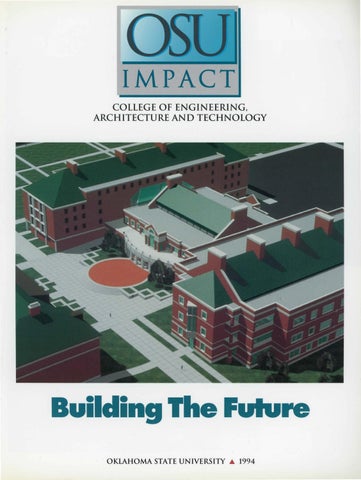
Cover:TheNew AdvancedTechnology ResearchCenteras envisionedby the architecture firm of FrankfurtShort Bruza.
s
6
MPACT JenneferTolbert,Editor ValerieKi.sling, Art Director JeanErickson,Designer Janet Varnum,DottieWitter,Contributing W1;ters All photos by Andy Maxeyunless otherwise noted. Nata/eaWatkins,Director of Communication Sen,ices Letters are welcome and should be addressed to: Oklahoma State University, Editor, Impactmagazine, 111 Engineering North, Stillwater, OK 74078
The office of publication for Impactis 121 Cordell North, Stillwater, OK 74078. Copyright© 1994, Impact.All rights reserved. Oklahoma State University in compliance with Title VJ and VII of the Civil Rights Act of 1964, Executive Order 112•16as amended, Title IX of the Education Amendments of 1972, American with DisabiJities Acl of 1990, and other federal laws and regulations, does nol discriminate on Lhe basis of race, color, national origin, sex, age, religion, disability, or sLaLusas a veLeran in any of its policies pracLices or procedures. This includes buL is not limiLed Loadmissions, employmenL, financial aid, and educaLional se,vices. This publication, issued by Oklahoma State University as authorized by I.he College of Engineering, Architecwre and Technology, was printed by 1..heAudio Visual Center, University Printing Seni-icesat a cost of 6,370. 7M/August/94/job#0240.
••thlCuttingEdge
JerzyKrasinski, el,ectrical and computer engineeringprofessor,and Tom Hayes, 3M product manager, checksomeof theplasticfilms producedin the company'sWeatherfordbranch. Their coll,aboration has l,edto a laserscanning systemto identify defectsand improvequality in thesefilms.
Laser-Guided Technology klahoma businesses know firsthand how beneficial research at Oklahoma State University can be. The Weatherford branch of 3M Corp., which manufactures plastic films used nationwide in industrial photographic equipment, needed a way to identify defects in the t:ransparer'lt sheets of plastic it produces.
0
That's where OSU stepped in. Using approximately $150,000 of a $5 million, five-year grant from the Oklahoma Center for the Advancement of Science and Technology (OCAST) to OSU's Laser Center, Dr.Jerzy Krasinski
2
A OSU IMPACT
uses laser technology to identify the defective web. The discovery was amazingly simple, says Krasinski, a professor of electrical and computer engineering who shares a patent with Dr. Ym Ming Wang and 3M. A combination oflasers and mirrors angled on the web improves the scanning process. "It tells you where the defect is located based on the angle of the laser beam," Krasinski says. 'This laser inspection system gives us the fundamental component of quality improvement," says Tom Hayes, 3M's Weatherford Printing and Publishing Systems product
manager. "So we can detect a processing change at the time it occurs and make a correction immediately." Krasinski praises OCAST's grant requirement that the research address an existing problem facing Oklahoma business. "This is one of the best approaches I've ever seen." .A. JANET VARNUM
BurningAmbition ne of the most unique partnerships between OSU and industry is OSU's Fire Service Training, also in the College of Engineering, Architecture and Technology.
0
"Fire Service Training is the only source of training for the more than 900 fire departments in this state, which have more than 13,500 firefighters," says Nancy Trench, assistant director for Fire Service Training. "We are a public service unit, and are committed to serving the volunteer and paid fire departments in Oklahoma." Since the program's inception in 1934, thousands of Oklahoma firefighters have participated in the specialized firefighter training and national firefighter certification course.
OSU'sFireServiceTraining programis the only sourceof trainingfor Oklahoma fire departments.In addition to battling.fires,the traineesl,eamabout ropesand trenchrescuesand airportfire fighting.
"Only three percent of our classes are held at OSU," Trench says. "Our eight instructors spend most of their time on the road." Besides state-of-the-art instruction in battling fires, firefighters also learn about trench rescues, ropes rescues, emergency medical ser,~ces, hazardous materials and airport fire fighting. All these aspects of firefighter u-aining relate to the cost of doing business in small towns. Doug Forsman, director of fire service training and fire protection publications, says,'The better the fire depart.men t, the better the fire protection in the community, the lower the insurance rates are, so it costs industry less to do business." •
RESEARCH FUNDING In 1993, nearly 20 percent of the $12 million expenditures for OSU' s engineering research and development activities came from private industry.
DOTTIE WITTER
1994 A
3
thlCuttingEdge NowPlayingat a ClassroomNearYou... or a growing segment of students who work part time or full time, leaving behind family and work responsibilities to update their college education isn't possible.
F
But through OSU's participation in the National Technological University (NTU), the classroom can come to them.
As one of the eight founding
members ofNTU, which started in 1984, OSU broadcasts six to eight courses per semester, live via satellite, to receiving sites across North America. OSU also re-markets programming that it receives from Tulsa or Stillwater organizations to business and engineering interests, and produces non-credit courses for NTU from the OSU
Colleges of Business Administration and Arts and Sciences. Busy engineers, scientists and technical managers are using this telecommunication experience to survive the knowledge explosion and remain current in their fields without leaving their communities. Bill Cooper, professor and director of engineering extension at OSU, believes distance learning is the wave of the future. "Literally millions outside of campus are clamoring for an opportunity to go to school, and it is incumbent on the major universities to serve students who can't go to campus," he says. OSU is one of the 45 leading engineering schools, organizations and institutions participating in NTU, and Dr. Karl Reid, dean of the college, chairs the NTU board of trustees. OSU's participation has not gone unnoticed. l.;ast year, three of the top 15 NTU instructors were OSU faculty, including Bill Echols and George Sheets, both electrical and computer engineering instructors. The third teacher is Ken Case, an industrial engineering and management instructor who has been in the 'Top 10" for four years. Case was also the outstanding instructor in 1992.
Ken Case,OSU industrial engineeringand managementinstructor,is an awardwinning teacherfor the National TechnologicalUniversity. 4
• OSU IMPACT
"Participating in NTU focuses attention on OSU faculty and research work," Cooper says. ''We share knowledge with the other 45 universities and that helps strengthen American industry and engineering in particular." _.. JANET VARNUM
BringingResearchto Industry SU's Oklahoma Center for Integrated Design and Manufacturing (OCIDM) is a leader in providing the critical link between academic research and its application to the manufacturing indusu-y, says Allen Kelly, professor of civil engineering and associate dean for research in the College of Engineering Architecture and Technology (CEAT).
0
Along with OSU's OCIDM, the troika of Oklahoma Centers of Excellence established by the Oklahoma Center for the Advancement of Science and Technology includes the Oklahoma Center for Laser Development and Application, and the University of Oklahoma Center for Molecular Medicine. 'The centers will provide the critical technical transfer of ideas necessary to promote the state's economic development into the next century," says Kelly. It's an expectation built on decades of cooperation. ''OSU has quite an unusual history of having strong relationships with p1ivate indusu-y," says Kelly, adding that nearly 20 percent of the $12 million expenditures for
OSU's engineering research and development activities in 1993 were from private indusu-y. Among the companies involved with OSU in cooperative research and technology development are Seagate Technologies, AT&T, Mobil Chemical, 3M, Charles Machine Works, Applied Polymer Technology, Fife Corp., Purolator Inc. and Gear Product.
FACULTY FINANCIERS The College of Engineering, Architecture and Technology ranks in the top 20 nationally in the amount of research funds per faculty member attracted from external sources.
These collaborative efforts will increase the likelihood that the center's research will focus on the strategic needs of Oklahoma manufacturing, Kelly says. A major element of OCIDM is OSU's Web Handling Research Center, one of the university's most prestigious consortia of national and international indusu-y.Dupont, Easunan Kodak, Kimberly Clark, Mead, ICI Americas, Hoechst-Diafoil, Valmet-Appleton, Sonoco Products and Polaroid are just a few players involved. The Web Handling Research Center is one of 52 National Science Foundation Indusu-y/University Cooperative Research Centers, and it is the only center of its type in the world . .A. JANET VARNUM
PAYDAY OSU engineering graduates have consistently garnered at or above the national averages for starting salary offers. Starting salaries nationally in 1993 averaged from $31,600 for aerospace engineers to $39,747 for chemical engineers.
1994 ..ti. 5
Notewarthy The CheckeredFlag
''I
nduction into the Hall of Fame is the highesthonor the Oklahoma State University Alumni Association can bestow. It is given in recognitionof outstanding professionaland personal achievementswhich have brought honor and distinction to Oklahoma State University." -
Jack Zink onceagain takes the checkeredflag as he is inducted into the OSU Alumni AssociationHall of Fame. He is pictured herewith his racing creations,including the 1956 Indianapolis 500 winner (middl.e).
FROM THE ALUMNI PRESENTATION BOOKLET
This year,Jack Zink, 1951 college of engineering graduate and active OSU alumnus, was inducted into the OSU Alumni Association Hall of Fame. He was co-owner of the John Zink Co. and most recently founded ZEECO Inc. He also created the John Zink Foundation, which operates a 30,000acre ranch with a permanent camp facility for Girl and Boy Scouts. In addition to his business and philanthropic success, Zink is renowned in the international racing circuit, having built cars that won tl1e Indianapolis 500 and Italy's Monza 500. He personally has won the Baja 500 and the NHRA Superstock Drag Racing Championship. Zink established the John Zink President's Distinguished Scholarship and is a member of the College of Engineering Hall of Fame. A member of the Oklahoma Hall of Fame, Zink also received the Henry G. Bennett Distinguished Service Citation in 1985. A
6
.a.OSU IMPACT
Ted Gaebler
RldnventingGovernment Author Featured atOSU ationally known speaker and author Ted Gaebler delivered a five-hour workshop in April on his best selling book, Rei,nventing Government, via satellite from Oklahoma State University.
N
OSU's Center for Local Government Techn?logy, in cooperation with the American Public Works Association, sponsored the live, interactive satellite training program. The satellite program, which included a select studio audience, was designed for public works and government officials throughout city, county, state and provincial government. Gaebler, former city manager of Visalia, Calif., and Vandalia, Ohio, is president of the Gaebler Group, a division of MRC, a public sector management consulting firm in San Rafael, Calif. A JANET VARNUM
CEATHallof Fame he College of Engineering, Architecture and Technology would like to congratulate its 1993 Hall of Fame inductees Keith E. Bailey and Kenneth J. Richards.
T
Keith Bailey, president of the Williams Companies Inc., received his bachelor's in mechanical engineering from the Missouri School of Mines and MetalKeithBail,ey lurgy in Rolla in 1964. Bailey completed the Harvard University School of Business Program for Management and Development in 1978. He currently serves on the board of directors for the Bank of Oklahoma, N.A. and the Interstate Natural Gas Association of America. Bailey is on tl1e board of trustees of the University of Tulsa and the Philbrook Museum of Art, and on tl1eboard of governors for the United Way of America.
Richards received his bachelor's in chemical engineering in 1956 and his doctorate in metallurgical engineering in 1962 from the University of Utah. A former president of the Metallurgical Society, Richards is a member of the American Chemical Society and the American Institute of Chemical Engineers. Kenneth] Ri,chards Among his many achievements was his recognition as a Distinguished Member of the Society for Mining, Metallurgy and Exploration in 1985. A member of the CEAT Associates, Richards is a founding member of the Oklahoma Center for the Advancement of Science and Technology (OCAST) and a member of the OSU Chemical Engineering Industrial Advisory Committee . .A.
A PremierProf onald R. Snethen, professor of civil and environmental engineering, received a Regents Distinguished Teaching Award for 1993. The author of numerous publications, Snethen is a member of the American Society of Civil Engineers, American Society for Testing and Materials, Association of Drilled Shaft Conu-actors, Chi Epsilon and Sigma Xi. Snethen says he finds teaching fun and rewarding. 'The challenge of encouraging and directing young people and seeing, sometimes sharing their successes is truly gratifying," he says. "Besides all this, I have a good time doing what I'm doing." .A.
D
He received the Outstanding Engineer in Management award from the Tulsa Chapter of the Oklahoma Society of Professional Engineers in 1988 and from the Oklahoma Society of Professional Engineers in 1989. A registered professional engineer and a member of the Oklahoma and National Societies of Professional Engineers, Bailey was inducted into the Athletic Hall of Fame at t11eUniversity of Missouri in 1991. Kennetl1 Richards is the corporate vice president and president of tl1e technology and engineering division at Kerr-McGee Corp., a position he has held since 1984.
ROCKIN' THE BOAT - Civil engineeringsti~dentspracticesteeringtheir canoe, Black Go/,dPremium, a sl,eek,11 opound vessel. The catch:it's made of concrete. After winning the regional ConcreteCanoe race, the team went to the national competition in New Orl,eans.Comp!,etionof the projectwas possibl,e,in part, becauseof Phillips Petrol,eum.
1994 ~
7
1
BUILDING OSUS FUTURE
A.
B.
T
he College of Engineering, Architecture and Technology plans to expand the relationships it has developed with business and industry in its Advanced Technology Research Center (ATRC). The project, now in its third and final phase of development, will begin construction in early 1995. The ATRC will provide world-class laboratory facilities for research, technology development and technology transfer in the areas of energy storage and conversion,
8
.6. OSU IMPACT
manufacturing, materials processing, hazardous and industrial waste management and mitigation, and laser applications in industry and medicine. Having a central location for the work now performed in six different buildings across campus will facilitate communication among faculty and serve as a catalyst for research in a number of critical areas, says Allen Kelly, associate dean for research in CEAT. • JANET VARNUM
D.
Sincecomp!,etion of thefirst engineeringbuil,ding(A) in 1902, the Coll,ege of Engineering,Architectureand Technowgyhas playedan integralrol,eon the OSU campus.Its constant earlygrowthnecessitatedan expansion to Gunderson(BJ in 1912. In 1938, the col1£ge acquiredEngineeringSouth (C), still occupiedby many engineeringprogrq,ms.The currenthomefor much of thecol1£ge, EngineeringNorth (D), openedin 1964. However,none of thesebuil,dingscomparesto the coll,ege's recentundertaking of the $30 million, state-ofthe-artAdvanced TechnowgyResearchCenter(ATRC). The new buil,ding(E) will architecturallycomp!,ete the easterncenterof the camjms and alww OSU to expand researchand technowgydevelopment.
1994 .a. 9
STORY BYJENNEFER TOLBERT
JO
OSU IMPACT
ILLUSTRATION BY TIM jESSELL
PHOTOGRAPHY BY ANDY MAxf.y
The Evolutionof the Engineer
Today,universities are turning out better, brighter engineers than ever before. Most are beyond mere computer literacy and well-versed in the technical aspects of their chosen discipline. But, industry professionals want more than just technical knowledge out of graduates. Industry needs Renaissance individuals with strong communication skills, partially because the gulf between the engineer and the general public has grown exponentially with the advent of new technologies and computer systems. It seems that while there is a great deal engineers can do for society, they have not succeeded in relating these abilities to the public. Today, industry is searching for young engineers to b1idge the gap, to instruct the public on matters about which engineers are most knowledgeable and to lead industry in directions in line with cultural values. In the future, industry must live in symbiosis with society, and only those with skills to assist this change will survive a career in engineering.
Larry Monteith, chancellor of North Carolina State University, discussed this chasm in his April Lohmann Lecture at OSU. "Engineers are problem-solvers who want to make life better for everyone through their efforts. However, we are not endowed with - and often only modestly educated in - the historical, philosophical, scientific and cultural perspectives that create the framework by which our accomplishments are valued." In this vein, the environment is an obvious topic for scrutiny. Historically, engineers have· not thought past the immediate applications of their work to the long-term implications. In the future, engineers must check their work not only against industry concerns but also against moral and ethical touchstones. Engineers today are recognizing tl1is imperative. Universities are providing environmental classes and encouraging the environmental aspects of enginee1ing work. Civil .engineers at OSU have recently outwardly expressed this shift in focus by changing tl1eir department name to civil and environmental engineering.
1994
11
The name change is a sign to those outside the field that engineers are considering the animate as well as the inanimate in their problemsolving equations. Surely more must be done to help create this new breed of engineer, however. Monteith supports a larger commitment from engineering education. 'There has never been a time when engineering education was more relevant to many of the concerns of our citizens. However, I do not hear or read of leadership that inspires us to act. ... The public expects that our efforts (the work of engineers) will create jobs, add value, provide quality, protect the environment, reverse the balance of trade, achieve world leadership in critical technologies and maintain security for the nation."
KEVIN KOERNER sensedhe woul,dneed more than classesto have a prosperouscareerin engi,neering.Asidefrom outstanding grades, this basketballfanatic is devewping the interpersonal skills and varied backgroundthat will make him invaluable to any company.
12
OSU IMPACT
But how can engineering educators create these kinds of leaders? Some are calling for engineering curriculum to change, to provide more fundamentals. Others want more electives, more classes in communication, economics and management. But is this possible in a degree which already takes five years for many to complete? The viewpoints within both academia and industry vary. While curriculum change is debated throughout higher education, there are alternatives, programs which help students develop these abilities by exposing them to
leaders and leadership opportunities. At OSU, one such vehicle is the Scholars Enrichment Program, where the top students entering the college attend seminars and meet industry leaders throughout their academic careers. Some students are finding that by combining the problem-solving abilities that engineering develops with these kinds ofleadership opportunities they can become powerful forces in the political arena. A case in point is former SGA President Bryan Begley, who parlayed a mechanical engineering major and his other activities into a Truman Scholarship and a $30,000 stipend for graduate school. A Scholars Enrichment Program participant, Begley will concentrate his graduate studies in public policy, focusing on the relationship between economies, technology and public policy. He also plans to study political economy and public finance. He is a sure bet to influence public policy in the future.
A
senior majoring in civil and environmental engineerfog and part of this new breed of engineer is Kevin Koerner. The 23-year-old has obtained a minor in political science and is preparing for a master's in engineering management with electives in environmental topics. Koerner's extracurricular activities, a list that would cover this page, were a conscious attempt to develop interpersonal and communication skills. He realized early that it would take more than just grades to obtain the career he wanted when jobs were becoming
increasingly scarce. Koerner wanted his activities to make him more valuable. ''When I first came in ( to OSU) you knew you were going to get a job when you graduated. By the time I was a sophomore, you needed a 3.0. Later, you needed more because there was more and more competition." In addition to being an avid basketball player, Koerner has amassed numerous honors including a Regents Distinguished Scholarship, Top Ten Senior Male, St. Pat's Award and selection as the Outstanding Engineering Graduate among others. He also volunteers and is involved in church activities. In addition to a regular summer internship for Mansur, Daubert and Strella Inc., last summer, Koerner worked for six weeks with former Sen. David Boren in Washington, D.C. Already active in the SGA Senate and the Student Advisory Council, a political future for Koerner would not stretch the imagination. This type of well-rounded individual is what industry is clamoring for, according to people like Dennis Frailey of Texas Instruments. In his April address to the ColJege of Engineering, Architecture and Technology Associates, he said that while knowledge of the discipline is a fundamental, they are looking for individuals who can be productive throughout a long career. He cited teamwork, ethics, communication and project skills as priorities. Monteith echoed these remarks, saying industry needs people with interpersonal and team-building
skills rather than solely individual accomplishments.
T
eam-building and interpersonal skills attracted the Navy to Irene Ligon when she was a sophomore in college. They soon recruited this industrial engineering and management student to be an instructor at the Navy's Nuclear Power School (NPS) in Orlando, Fla. Aside from her obvious talent and 3.94 G.P.A., this 21-year-old is part of another major change occurring in engineering - the increasing number of women entering the field. Nationally, 18 percent of the engineering freshman are women. Engineering programs for women are surfacing across the counU)' to encourage these individuals to develop their leadership skills in what was primarily a male-<lorninated field. And when a company spots an outstanding female engineer, they often don't hesitate to offer that student a job, even if she isn't graduating immediately. That was the case with Ligon, who has had a job and $1,350 a month from the Navy since before her junior year. According to William Lancaster, the Navy chief yeoman who recruited Ligon, less than one-half ofl percent of the typical university's student body could even qualify for the strict requirements of the NPS Instructor Program. But he says Ligon's personality and ability to think on her feet greatly impressed him. "Irene has been a tutor, has a great grade point average, and she's a people person. I was looking for an instructor who enjoyed working with people and
Tim Jesse/L'sartwork has appearedin Rolling Stone and Texas Monthly.
THE NEW FACE OFENGINEERING - Irene Ligon is one of the many tal,entedwomenenteringthe fiel,d. The 21-year-ol,d soon will begi,vingordersat the Navy's Nudear PowerSchool.
who could teach in a technical area and make it fun for the students." Ligon, who is a member and scholarship chairman for Delta Delta Delta sorority, says what helped her get the job were her problem-solving skills and her attitude. Through her curriculum, activities such as the Scholars Enrichment Program and work on the CEAT Student Advisory Committee, she has also learned to work with others. She relates a conversation she had with Lancaster where he discussed the advantages of being from OSU. "He loves OSU because they teach us how to work in groups, and they teach us how to communicate with other people, where different schools around the nation emphasize individual achievements and accomplishments." She says working together teaches them how "my skills and your skills work together as a team to do this better than I can do it by myself." So while there is talk of curriculum change, and the debate continues about what is to be included and how long to keep students for a degree, one thing is clear: it is the engineer of the future who will have to change, to expand beyond the classroom and what is taught there. Tomorrow's engineer will need to lean1 communication, teamwork and a perspectiye on cultural values. In so doing their personal education will not only prepare them for that first job, but for a prosperous career in engineering . .A. JENNEFER TOLBERT
l4
OSU IMPACT
W:
1en it comes down to it, an academic program is only as good as the individuals it produces. In other words, how much value does that education add to the individual? Recruiting the best and enriching their personal and professional lives are the goals of every worthwhile college. And OSU's College of Engineering, Architecture and Technology is no exception.
One of the best tools for recruiting outstanding students, and a way to help them develop as individuals, is the CEAT Scholars Enrichment Program. Begun in 1988, the program has dramatically increased the college's recognition and reputation for top students across the state. Bob Hollrah, coordinator of honors and scholarships, says now high school counselors and principals contact the college to talk about their top math and science students instead of waiting for the college to contact them. The purpose of the Scholars Enrichment Program is to accelerate the intellectual and leadership development of these students, to broaden their global awareness and cultural perspectives, and to sharpen their interpersonal skills. Only a few can be chosen each year for the program, however, and of the 250 applicants only 26 were chosen for the 1994 entering class. Minimum requirements include a math and composite ACT score of 30 or above, upper 10 percent of the high school graduating class and demonstrated leadership potential.
Karen High, assistantprofessorof chemicalengineering,and junior Kate Schoenhalsare involved in the Societyfor WomenEngineers,an organization workingtoprovide rolemodels The program develops leadership for young women consideringan engi- . potential by providing students with personal contact with top neeringcareer. management in Oklahoma and regional firms. They also take a
fully paid, 10--daytour on the East Coast to visit leading American engineering facilities and a two-week trip to Europe. 'The international tour is for students to visit state-of-the-art engineering facilities outside of the United States to gain a more international perspective of their chosen profession and to show them current engineering practice and emerging technology," says Larry Zirkle, student services director. "It's important for today's engineers to develop an appreciation for other cultures and cultural differences that affect international cooperation." ''We're trying to get more engineers into community activities, government positions, positions where engineers can influence and be a part of the future leaders of the country," Hollrah says. "Society is more technology-oriented now, so it's very important that engineers be leaders in those areas." Increasing the number of ethnic minorities in the college is an ongoing part of the Multicultural Engineering Program, administered by Zirkle and David Thompson, associate dean of instruction and extension. When competing with other universities for minorities, CEAT cites its retention and graduation rates, well above those at other schools. According to Hollrah, the college maintains its standards for admittance, which means that the students who enter finish their degrees. The number of women entering engineering also is increasing: Today, women constitute almost one-fow"th ofCEAT's entering class, compared to only 17 percent of entering freshman engineering students nationwide. The Women in Engineering program, coordinated by Karen High, assistant professor of chemical engineering, and Pam Waterman, program counselor, has initiated events designed to reach more high school women and provide role models for engineering careers. According to High, women entering and remaining in engineering at OSU are highly intelligent and motivated individuals. "Industry has realized the quality of the women students in CEAT at OSU. They are a highly recruited group of individuals," she says. Together these endeavors are helping CEAT recrnit the best st:l1dents and give them an outstanding education. These programs also enrich stu<;lents' lives, providing unique leadership and growth opportunities. According to Thompson, the college is reaching a new generation of talented young scholars who are using their abilities to serve others. "I'm astonished at the caliber of students we attract who are active not only academically, but in college, university and off-campus programs," he says. 'The srudents today are very public service-oriented and more conscious of their world and their responsibility in society."
One of the many staps along the 1994 ScholarsEnrichment Programtour through GermanJwas HeidelbergCast/,e.
SCORINGBIG Over the last 10 years, the average ACT score in the College of Engineering, Architecture and Technology has increased from 23.4 in the fall of 1983 to
26.2 in 1993.
DOTTIE WITITR
1994
15
AMERICANS IN PARIS PHOTO/RANDY
SU architecture students enjoyed royal u-eatment last year~ they studied in the stables of the Chateau of Versailles and toured some of the most famous architectural sites in Paris.
O
Paris was only the first half of the trip, however. The second month, students chose an aspect of European architecture to examine. Seitsinger and Hanser then helped them decide what was important to see in that realm of study. After an organized, weeklong trip to Venice, the students took off for destinations such as Barcelona, Prague, Italy, Amsterdam and Germany.
For two months, 18 architecture students and two professors left no stone unturned in examining the architecture and design of Parisian and other European buildings. In this optional summer program, third- through fifth-year students lived with French families at night and immersed themselves in the culture during the day.
Karin Wohlert, a fifth-year student at that time, chose to travel for a week and return to Paris to study Haussmann's city planning from about 1850-70. She moonlighted as the group's translator and says the experience was wonderful.
According to Randy Seitsinger, assistant professor of architecture and one of those involved in the program, the trip involves students beyond the superficial understanding of the city's architecture. The students keep daily journals and sketches of the places they visit, tour famous buildings and analyze structures. OSU's program, which has been in existence for the past 14 years, uses the University of Illinois' facilities at the stables across the street from the Chateau of Versailles for its classrooms.
Seitsinger says although studying slides of European buildings is a good way to learn architecture, nothing can compare to the experience of seeing it in person. "You can look at slides ... but until you actually go and experience it you don't really understand."
The ChartresCathedralwas one of the many sites architecturestudents visited as part of theirsummer studies in Paris and Europe.
The program also shows students that the classes in their curriculum have practical applications, Seitsinger says. Suddenly, the rustory, design and structure courses all come together in one building. 'They come away with some wonderful insights." .._
Although the trip is fun, Seitsinger says it is a lot of work. 'We try to tell the students before they go it really is not a vacation. They work very hard during the summer." The students studied some areas under reconstruction at Mont Saint Michel and were allowed to climb all over the Pantheon after a short lecture on its history by a French professor. Thanks to David Hanser, associate professor and
SEITSINGER
organizer of the program, the stud en ts even received a special dinner prepared by the residents of a village in the Loire Valley.
~-~~ ,
.. _-/~-.,,~y~~~,.-1:::.~\:~}
.i j
ft I
.--~~','·-: ILLUSTRATION/DAVID
16
A OSU IMPACT
DAVIS
the
LOH
T
he College of Engineer-ME ing, Architecture and Technology created the medal that bears the name of Melvin R. "Pete" Lohmann, dean of the college from 1955-1977, to honor alwnni for contributions to the profession or to the education of engineers, architects or technologists.
DAL
Lohmann's legacy to the college and the university continues to •grow because it was his vision that led the college from relative obscurity to national prominence. Through his persuasive powers, he obtained private funds for scholarships, faculty development and research. The Halliburton Chair in Engineering is just one result of his work, and because he was a proponent of technology in the classroom, the college is now a national leader in distance learning. In 1966, Lohmann became the national president of the American Society for Engineering Education. He later served two years as president of what is now the Accreditation Board for Engineering and Technology. He promoted the professional school concept with the master's degree as the first professional degree, an idea that was 20 years al1ead of its time. In 1982, the National Society of Professional Engineers recognized OSU with the first Professional Development Award in Engineering Education. To date, four distinguished graduates have received Lohmann Meda.ls in honor of their achievements. They are J. Tinsley Oden, 1991; Wolter]. Fabrycky, 1992; Jack Holman, 1993; and Kerry S. Havner, 1994.
KERRYS. HAVNER The first person to receive a doctorate from what is now OSU's School of Civil and Environmental Engineering and the latest recipient of the Lohmann Medal is Kerry S. Havner. A professor of solid mechanics in the department of civil engineering at North Carolina State University, Havner earned his bachelor's in civil engineering in 1955, his master's in structural engineering in 1956 and his doctorate in applied rp.echanics in 1959. All degrees were from OSU.
KerryS. Havner, recipientof the 1994 Lohmann Medal.
After working at OSU from 195762, he was a faculty member at the University of Southern California for three years before moving to North Carolina State University in 1968. Havner is a fellow of the American Society of Civil Engineers and a founding member and fellow of the American Academy of Mechanics. The Aluminum Comp~ny of America (Alcoa) Foundation awarded him the Engineering Research Achievement Award in 1979 and the Distinguished Engineering Award in 1982. •
1994 A
17
•ISG
• n
As a former SGA president
,,
and PDS scholar, I am often asked about OSU. I tell people OSU is about
academics, learning and education. We're about student governments,student councils and community service. And yes,
we're about football, baseball, basketball and wrestling.
But most importantly, OSU is about caring,
selfless people - faculty, staff, administrators and donors - who spend innumerable hours helping students like me.
I realize that I have had opportunities at OSU that I never imagined. And one of the primary reasons I had these ~opportunities was because there were people at OSU willing to spend countless hours helping me prepare. \: /• ~
That same selfless attitude is displayed by our donors every time they endow a scholarship and sponsor another
student's incredible journey through Oklahoma State University.
- Bryan Begley, Truman Scholar and 3.62 G.P.A mechanical engineering senior.
[9~\IJ OLLEGE ill NGINEER.lNG, ARCHITECTURE & TECHNOLOGY
For information on how to support the College of Engineering, Architecture
and Technology contact Karl Reid at 405-744-5140.