FromtheDean Dear Friends, Welcome to the premier issue of Impact magazine. We are pleased to have this opportunity to showcase some of our programs of excellence and to profile some of the outstanding students and faculty in the college. In the following pages, you will recognize familiar faces and meet new ones. They are but a few of the many faculty and students who make the CEAT what it is today. We are particularly proud of Dr. Ken Case and Dr. Joe Mize, two of only 11 Oklahomans ever to have been elected to the National Academy of Engineering; our involvement with two of the three Oklahoma Centers of Excellence: the Oklahoma Center for Laser Development and Applications and the Oklahoma Center for Integrated Design and Manufacturing; and of two of many distinguished CEAT graduates, Wayne Allen and Bob Lawrence, the most recent inductees into our Hall of Fame.
OSU CEAT DEAN KARL REm
In 1902 Oklahoma A & M College opened the first engineering building. Today, we are preparing to fully fund and construct a state-ofthe-art 165,000 square foot Advanced Technology Research Center. The center will address overarching priorities identified by OSU students, faculty and staff as important to the mission of our university. It is our hope that you can be a part of seeing this important enterprise come to fruition. In initiating this publication, we wanted to contact our special alumni and friends in a way that is both entertaining and informative. We hope you will take the time to read about some exciting CEAT programs and people who are making a difference. Through people and programs, we are making an IMPACT! Dean Karl Reid College of Engineering, Architecture and Technology
I
p
M
A
C
T
VOLUME 1. NUMBER 1
SUMMER 1993
IN THEWORKS A once-in-a-lifetime opportunity to build a world-class facility.
5
CRYSTAL CLEAR You think glass is smooth? Machining postage stampsized crystal swfaces down to the atomic level.
8 Crystalclear- page8
Brightfutures - page12
BYDESIGN Aesthetics, creativity and ingenuity combine with practicality to create authentic experiences for CEAT students.
10
THEASSOCIATES A college's best friends.
17 OCIDMfirsts - page16
Videodegrees- page11
D E p A R T M E N T CUTTING
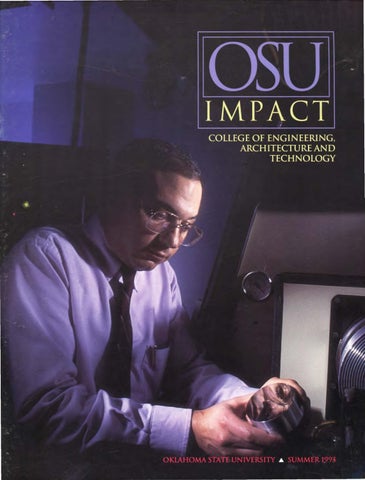
2 Cover:Dr. Don Lucca,Mechanicaland AerospaceEngineering,reflectsthe preciseness of a diamond-turned metallicswface. Coverphoto©JimArgo
EDGE
NOTEWORTHY
PROFILES
6
12
s
MPACT GailMonnot,Editor ValerieKisling,Art Director Jean Erickson,Designer NestorGonzales,StephenHill, EmilySleeth,Co1ia-ibuting Writers All photos by Andy Maxeyunless othern~se noted. Nata/eaWatkins,Director of Communication Services Letters are welcome and should be addressed to: Oklahoma State Univer ity, Editor, fmf1actmagazine, 111 Engineering North, Stillwater, OK 74078
The office of publication for Impact is 121 Cordell North, Stillwater, OK 74078. Copyright© 1993, Impart.All rights reseived. Oklahoma State University in compliance with Tille VI and Vil of the Civil RighLSActof 1964, ExecUli\'e Order 11246 as amended, Title IX of the Education AmendmeOLs of 1972, American with Disabililies Act of 1990, and other federal laws and regulations, does not discriminate on the basis of race, color, nalional origin, sex, age, religion, disabilit}',or status as a Yeteran in any of its policies praCLicesor procedures. This includes but is not limited to admissions, employment, financial aid, and educational services.
This publication, issued by Oklahoma State University as authorized by the College of Engineering, Architecrnre and Technology, was printed by the Audio Visual Center, Univer• sity Printing Services at a cost of $11,812. 7.25M/Augtm/93/6213.
•
ttin Build a better air filter ... Drs. Frank Chambers and Ron Dougherty, mechanical and aerospace engineering, took a challenge from Purolator Products Company of Tulsa, acquired funding from the Oklahoma Center for the Advancement of Science and Technology as well as Purolator and began to ask the searching questions: how to test an automotive air filter and what will the most efficient design be?
Using a laser doppler velocimeter, Chambers and Dougherty are able to test the speed and pattern of various particles attracted to the filters. The LDV can measure small amounts of particles typically found under
actual car performance tions.
condi-
A second research question deals with the how and why of filter performance design. Purolator is interested in results say the researchers and they want to know what works and doesn't work in their system.•
Thelight fantastic The "optical waveguide spectrophotometer," only one inch square, is being developed for public health purposes by Dr. Raymond Zanoni, electrical and computer engineering. It will be used to monitor toxic gases and chemicals, for process control in the chemical industry, and for monitoring biological fluids and anesthesiology gases in a medical setting. Zanoni says of the Oklahoma Center for Laser Development and Applications laboratory project: 'We are guiding light by total internal reflection in the film applied to a glass slide." The sensor is made by adding a one micron-thick film to a glass slide. A metal mask is applied to the glass (photolithography) leaving a design that looks like the bar codes used for pricing scanners.
Chambers,D(YU,gherty
2
•OSUIMPACT
Smith, Stewart The slide is dipped in molten potassium nitrate which exchanges with sodium in the glass, thus raising the refractive index (ability to process light) of the sensor. The metal mask prevents the potassium from exchanging in areas where the researcher doesn't want a channel. Light is then guided through the prescribed channels like light through fibers. Recently funded by the Oklahoma Center for the Advancement of Science and Technology, Zanoni says the long-range goal of his project is to first demonstrate the sensor's construction, then show its sensitivity to che_micalsand compare its sensitivity to other devices. •
Salt water blues It's common practice to inject salt water under pressure into declining wells in order to force from them the last drops of oil. The result is an invasion by the salt water into fresh water reserves. Dr. Marvin Smith, mechanical power technology, along with Dr. Gary Stewart, geology, are investigating if the practice of
restoring the salt water to the earth is environmentally sound and if plugging wells with mud will prevent salt water migration into surrounding water supplies. ''The entire experiment is designed to test for drilling mud performance," Stewart says, "and pressure, temperature and light levels. From a geological standpoint, the mud is short-lived, only decades. We want to know what happens to that mud when salt water comes in contact with it." ''The question is," says Smith, "how high a pressure will this well withstand before there is a potential for migration into the fresh water reservoir?" Funded by the Environmental Protection Agency, the $537,000 project may make a friendlier environment for aquatic life. The men and their technicians have constructed an apparatus to measure the salt water flow rate in drops, not gallons, and a simulated reservoir to test the well plug or mud cake. A
Fleas,Rs/,Rgl,t louledRuid Funded through a $50,000 contract from the Oklahoma Center for the Advancement of
Wagner,Burks Science and Technology, Dr. Jan Wagner, chemical engineering, in collaboration with Dr. Sterling Burks, zoology, are in their final year confronting the waste problems Oklahoma refineries face.
remove benzene from waste water," says Wagner. "Even air quality standards have a big effect on waste water treatment. In refineries, some of the sludge and solid wastes are by definition hazardous materials."
'The Oean Air Act has essentially forced industry to try to
Using the old "canary in the mine" trick to test water toxicity,
continuedpage 4 SUMMER 1993 .a
3
Transok, Inc. he could clean up their newly-acquired property with a "prepared bed" method of bioremediation. Clarkson and graduate student, Weiping Xiao of Beijing, China.
Burks uses fathead minnows and daphnia fleas because they're the first organisms to respond to the poisons in water. Wagner has been working on critical fluid extraction, a technique to remove organic contaminants, which, if removed in the right way, can be reused, saving refineries both money and headaches. A
Efficient & expert Dr. Charles Bacon, electrical and computer engineering, in partnership with Purolator Products Co. and Facet International, is improving employee productivity by increasing speed and eliminating errors in tasks where experience or knowledge can be applied.
Bacon's computer-based expert systems will enable employees
4
.6. OSU IMPACT
to design complex gas or liquid filtration systems required for commercial aviation and private automobiles, provide necessary configuration for filters used in industrial processes and aid in the design of complex switching required for precision fluid by-pass valves. In conjunction with the OSUbased Oklahoma Center for Integrated Design and Manufactming and Purolator, additional areas Bacon has focused on include: differential pressure indicator design and air filter manufacturing scheduling. A
Clean dirt Using a combination of dirt, garden fertilizer, a little straw and water, Dr. William Clarkson, civil and environmental engineering, told Tulsabased pipeline company,
Clarkson was awarded a $12,000 contract to advise and assist witl1 the cleanup of soil surrounding several Transok gas compressors in Crescent, Okla. Clarkson says, 'The problem is with the old equipment they have in place at a compressing and pumping station. Over the years lubricating oils and other petroleum products used in running the engines leaked under concrete pads and into the surrounding soil." The soil is scooped from around the concrete pads, taken to a nearby vacant building and dumped in piles. Chopped straw is added, some fertilizer-to add needed nitrogen and phosphorous-then sprinkled with water from overhead hoses. 'We want to meet a standard of 50 parts per million total petroleum hydrocarbon so the soil will not need disposing of in any particular way. It could be used as any other soil without questions being asked." A
EDMON LOW LIBRARY
he last building added to the College of Engineering, Architecture and Technology central campus complex was Engineering North, nearly 30 years ago. Currently in the planning stages is a $30 million, 165,000 square foot facility to house advanced technology research.
ENGINEERING SOUTH
T
'The goals of the Advanced Technology Research Center," saysDean Karl Reid, "are to promote interdisciplinary research focused on specific advanced technologies, promote research and technology development associated with creating new products, processes and services, and to promote knowledge and information exchange with industry. "In 1962 Oklahoma State Universitywas mostly an undergraduate institution, with less
ter tll@we than $500,000 for sponsored research." says Reid. 'Thirty years later the college emphasizes botl1 graduate and undergraduate study, fundamental research and technology development partnerships with industry. Annual funding for research is greater than $12 million." According to the US. News and WorldReport, OSU is nationally
recognized for the quality of its undergraduate engineering programs. In addition, the CEAT also has received national recognition for its graduate research progran1s. OSU CEAT ranks in ilie top 20 nationally in total· dollars of research funds per faculty member. OSU and CEAT will consolidate activities now carried out in six buildings spread over three campus locations. Funding for ilie Center comes from a $7.3 million federal appropriation and $12.5 million resulting from an Oklahoma bond issue. To round out the funding pool, CEAT will ask fue·federal government for an additional $5 million and will seek a like amount from private sources. The dream will become a reality in 1997! .A
SUMMER 1993 •
5
warthy T
he popularity of the master of science degree in environmental engineering has prompted a name change in CEAT. Recently the OSU Dean's Council approved changing the name of the school of civil engineering to the school of civil and environmental engineering. According to Dr. Robert Hughes, Head of the school, many undergraduate students have shown an interest in a degree option in environmental engineering, reflecting the current emphasis on environmental issues. _..
Academician in the International Academy for Quality, a worldwide membership which includes only 75 leading experts in the quality field. _..
Veenstra Ayers
Ramakumar
Regents Professor, Dr. Kenneth Case, industrial engineering and management, was recently inducted into the ational Academy of Engineering and is one of only 11 Oklahomans ever to be so honored. Dr.Joe Mize, Indusn·ial Engineering and Management, is also a member. In additi01:i, Case received tl1e IBM Corporation's Outstanding Satellite Insn·uctor Award from a field of 330 eligible insn·uctors nationwide. For tl1e third consecutive year Case was named by National Technological University as one of 11 instructors nationwide to receive the NTU Outstanding Insn·uctor Award. He is also an
6
.t. OSU IMPACT
Teacher Award. He is a faculty member in civil and environmental engineering. His award recognizes excellence in teaching within the Division of Engineering Technology. _..
Halliburton recognized three professors for outstanding contributions: Dr. Michael Ayers, civil and environmental engineering, was selected as the Halliburton Excellent Young Faculty Member for 1992. His area of expertise is transportation, particularly pavement and highway construction. He is adviser to the student chapter of tl1e American Society of Civil Engineers. Dr. Ramachandra Ramakumar, electrical and computer engineering, received tl1e Halliburton Outstanding Faculty Member Award for his exceptional contributions to tl1e college. He is currently the head of• tl1e Engineering Energy Laboratory. Dr. John Veenstra, earned the Halliburton Excellent
In the mid-1960s, CEAT established a program for the Master of Science in Environmental Engineering to meet tl1e critical and anticipated needs of federal agencies, local professional firms and industries. The program became one of tl1e most successful offered and with tl1e establishment of the University Center at Tulsa, tl1e program continues to be one ofUCT's most popular graduate programs. Currently, more than 75 graduate students are working toward the degree atUCT. _..
Coal, according to Dr. Khaled Gasem, chemical engineering, is an energy resource of great availability in this country. The trouble is, it simply isn't convenient to use. Gasem is designing reactors to liquify the coal in order to enhance and better use it as an energy source.
'We need to know the thermodynamics and phase behavior of coal," says Gasem. "It isn't as simple as melting ice into water. We want to know all about taking coal from a solid form to a liquid." Funding for Gasem is from the U.S. Department of Energy, Amoco Production, the Oklahoma Center for the Advancement of Science and Technology Applied Research Program and the University Center for Energy Research . .&.
John Joseph Stoltze of Tulsa, an architecture graduate student, was one of only two students worldwide named to receive the 1992 William Van Alen Fellowship for international design. This year's competition involved a design for Antonio Gaudi's Church of the Sagrada Familia in Barcelona, Spain. Stoltze spent the fall semester .touring the world's architecnirally significant monuments and returned to OSU in the spring to receive his master's degree in architecture (see back cover) . .&.
David Howland and Thomas Christopher Seat won national architecture awards. Sponsored
by the Society of American Registered Architects, Howland, a fifth year student from Tulsa, earned second place for his design of a Baltimore sports complex. Seat, a fourth year student from Tahlequah, earned honorable mention for a project involving a Columbus, Ohio, municipal conference center . .A.
Dr. Allen C. Schuermann, industrial engineering and management, has been elected to a second two-year term as national president of Alpha Pi Mu, the national honorary society for industrial engineering sn1dents who are in the top fourth of the junior class or top third of the senior class . .A.
Dr. Jim Bose, mechanical power technology, has attracted $1.8 million in research funding for the ground source heat pump program. Heat pump systems are recognized as the most efficient and environmentally responsible way of heating and cooling. The Oklahoma State capital is currently using the system.
and Technology, U.S. Department of Energy, Electric Power Research Institute and the National Rural Electric Cooperative Association. OSU has become a world leader in ground source heat pump technology. Program industrial partnerships include McElroy Manufacturing of Tulsa, Charles Machine Works of Perry, KOAX of Oklahoma City and Phillips Driscopipe of Bartlesville. Earth Energy of Tulsa and Marietta are distributors of the heat pump "slinky" developed at OSU . .A.
CEA.T'sentering freshmen the last five years have increased their ACT scores from 23.5 to 28 out of a possible 36. The percent of females entering the college has increased from ! 0 percent to 25 percent of the freshmen class during the same time period . .A.
CEAT reports more than $12 million in grants and contracts were spent on research during FY 1993, a significant achievement in the currently depressed economy . .A.
Bose's program has been sponsored by the Oklahoma Center for the Advancement of Science
SUMMER 1993 •
7
ltra-precision machining makes possible the ultimate in pristine, glass-like surfaces. It is a way to smooth a material's veneer to atomic-scale range, hundreds of thousands of times finer than a human hair. Dr. Don Lucca, mechanical and aerospace engineering, is working closely with EaglePicher Laboratory to understand how to machine crystals and other materials to minimize subsurface damage. Cadmium telluride crystals the size of a postage stamp, worth as much as $2,000 each, are being furnished by EaglePicher, manufacturers of II-VI semiconductor materials and used fo1~among other things, infrared sensors.
Handle with Care 'The crystals are very soft, yet brittle," says Lucca. "Even touching the surface easily propagates atom dislocations in tl1em. These cadmium telluride crystals act as a substrate material for growing an epitaxial film of mercury cadmium telluride." It is the film then, says Lucca, that is used as a detector for infrared radiation. In order for the film to grow on the substrate properly, all tl1e atoms have to be in their proper lattice location, maintaining the surface crystalline structure. Under carefully controlled conditions in the Mechanical and Aerospace Engineering Research Laboratory, Lucca and his graduate students
machine the crystals using a gem-quality diamond. The specially-prepared diamond acts as a cutting tool to shave off thin layers from the crystals to prepare the substrate surface for growing a mercury cadmium telluride film. The University of North Carolina at Charlotte and Los Alamos National Laboratory are collaborators on this project.
Here on the OSU campus, in a simple concrete building, a small piece of crystalline carbon is leading Lucca to a better understanding of ultra-precision machining and its potential industrial uses-a far more noble use for the diamond than its decorative cousins . .&.
Improving Oklahoma'sJob Market
Funded by the Oklahoma Center for the Advancement of Science and Technology with matching funds from the Department of Energy and Eagle-Picher, as well as an additional grant from the National Science Foundation, the project has brought in an excess of $1.1 million to the College of Engineering, Architecture and Technology. "Eagle-Picher is interested in this project because improved finishing methods would allow them to turn out more competitive materials, possibly increasing their market share and creating jobs for Oklahomans," says Lucca. "As part of their commitment to us, Eagle-Picher is supplying us with many thousands of dollars worth of crystals. NSF is interested in the basic knowledge we'll gain on how materials are removed at the atomic scale." Since Eagle-Picher does not have the capability to do diamond tw-ning, OSU is seeking to understand the process to such a degree that the Miami, Okla.-based company can decide the feasibility of investing in the equipment needed for the process. The aosest Shave
OSU's single-point diamond turning and grinding machine is one of only a handful at U.S. universities. The process is used for the production of computer disks, metal mirrors, heads for VCRs and infrared optics. With DOE money Lucca was able to purchase a device, a laser interferometric microscope, used to look at the substrate to determine the amount of damage, if any, done to the crystal subsurface though it may look mirror smooth to the naked eye .. Another processing problem Lucca is addressing is one that results from growing the film by liquid phase epitaxy. Tellurium droplets, which form on the surface, render the film useless until they are removed. Again, ultra-precision machining comes to the rescue. Using diamond turning, the droplets are shaved off. Here, too, Lucca is looking for possible residual damage to the crystal surface.
A crystalsurfaceis examinedusing the /,aser interferometric microswpewhich allows atomicexamination and characterization, at the angstrom/,eve!,to determinethe amount of surfacedamagefollowing machining.
he Leonardo Da Vinci spirit is alive at OSU. Educating new Renaissance men and women is the goal-to understand the synergistic relationship of design, the arts, industry and human need.
T
Engineeringstudentsprepare theirvehicl.e for the obstacl.e coursein theAnnual AwesomeDesign Competition.
FOCUSoN DESIGN
Starting as freshmen, students in CEAT must exercise design muscles by solving real world problems. First as individuals, then as knowledge and experience progress through the curriculum, students team up to hone communication skills and academic prowess. John Nazemetz, industrial engineering, and John Solie, agricultural engineering, teach a freshman design class. Says Nazemetz: 'The goal of the freshman design experience is to provide students a combination of computer and practical experiences." Dean Karl Reid says quality of the design experience is one of CEAT's strengths and includes all disciplines. The annual School of Architecture-sponsored Design Week, for example, spans many specialties including art, interior design, landscape architecture and architecture. CEAT sponsors the annual Awesome Design Competition in which multi-disciplinary teams of engineers and high school students interact. "Objectives during the competition," says Carl Latino, chair of the faculty design committee, "are to mix creativity, logic, teamwork and competition to underscore the joy of design,_ provide for creative thinking and serve as a recruiting tool for exceptional high school students." Each CEAT discipline requires a senior capstone course such as the one Latino teaches. He says it provides an acid test for the seniors. CEAT focuses on design, crossing all boundaries of the college, "turning ideas into reality."•
Architects,engineers,interiordesigners,l,andscape architectsand artistscombinecreativeideasinto install,ationsduring Design Week. 10
.6. OSU IMPACT
Professor Mike Millett commutes 1,500 miles a week to teach flight vehicle design to OSU students. Since 1979, he's been driving from Wichita, Kansas. Since 1988 he's flown from Scottsdale, Ariz., to Tulsa, driving to Stillwater to teach a Saturday class. His aerospace industry experience makes him invaluable as a professor, giving recent real-life industrial problems to students. He's also an invaluable friend.•
I
t seemed fitting the electrical engineers were able to further their knowledge with the help of compressed video, fiber optic cables, televisions and telephones. Seven Halliburton Services engineers from Duncan are the first to graduate from an OSU program that uses all of the above technologies to join the campus with the business world. They were able to receive master's degrees in electrical engineering yet never attend a class on the OSU campus.
BYNESTOR GONZALES
Dean Karl Reid says digital video, fiber optics, fax machines, audio bridges and the telephone mean company employees anywhere in Oklahoma can earn graduate degrees without leaving the workplace. A similar program was begun recently at Phillips Petroleum in Bartlesville and at Conoco in Ponca City with the addition of programs in business administration. Reid says the Halliburton program, completing its third year, goes a step further than "old-fashioned" televised courses because students at remote sites have complete two-way video and audio communication with the professors and "sit in" on the same classes with OSU students where academic requirements are the same. 'The price is right, and you can't beat the convenience," says graduate Glenn Weightmann, a Halliburton research and development group supervisor. "Overall, I'd give the program an A-plus, and I'd recommend it to other companies." Other Halliburton grads include Richard Bratcher, Ronald Dant, Kevin Fink, Danial Gualtieri, Thuong Le and Timothy Rice. Le, who received his bachelor's degree in engineering from OSU in 1989, says the courses are a ''win-win" deal for both employee and company. Despite all the technology, one thing hasn't changed. Engineering courses are just as rough as ever. 'We didn't get any special considerations," says Le. "Mylast semester was one on the toughest semesters of my life." A
ILLUSTRATION: Sru XAlYARATT
SUMMER 1993 .o1. 11
Patricia Dighton Sometimes someone influences our lives and we never forget them. So BY EMJLY SLEETH it was for Patty Dighton, and her relationship with her adviser, Dr. Ruth Erbar, who passed away in April, 1992. "I didn't always know I wanted to go to medical school. My adviser was a really good mentor. When she got sick with cancer, she knew I was thinking about going to medical school and encouraged me. Because of her guidance, I decided to go to medical school," says Dighton, a recent chemical engineering graduate. Dighton is spending a year in Europe, as a recipient of the Rotary International Foundation Scholarship, at the University of Kent in Canterbury, England, before attending medical school. The Ardmore native's preparation for medical school and the European experience were smoothed, she says, because of the Scholars Enrichment Program. For college freshmen or high school seniors interested in engineering, the program has increased the number of students coming to OSU, says Dighton. It allows students greater access to the faculty and the opportunity to meet such professionals as the vicepresident of Conoco and the president of Kerr McGee. After Dighton's sophomore year, CEAT.took the program participants to Washington D.C., Philadelphia and Baltimore, where they toured the Johns Hopkins biomedical and engineering departments and several national laboratories. Says Dighton, "Ifl had to sum up the program, I would say it focuses on two ideas: It teaches you how to become a leader and teaches you more about the world. CEAT tries to broaden our horizons. They try and teach us about the other things in the world that are available." In addition to the program, Dighton's extracurricular accomplishments are many. She was president of the CEAT Student Council, member of Mortar 12
.I. OSU IMPACT
PatririaDighton was named the top CEAT graduatefor 1993 as wellas honoredby the OSU Alumni Assoriationas one of the top ten graduating seniorscamjYuswide. Board an<:1president of the international premedical honor society, Alpha Epsilon Delta. With the influence ofDighton's adviser and all of her accomplishments at OSU, she says she feels ready to meet the challenges presented by medicine today. A
JoeMize, National Academyof Engineeringmember.
Joe Mize Dr.Joe Mize, Regents professor of BvNESTOR GONZALESindustiial engineering and management, says a great teacher must have a passion for the profession coupled with real world knowledge that comes from doing, and not just teaching. Mize stays on the leading edge of technological developments by consulting with companies such as AT&T and Apple Computer. While working in the real world he takes slides, conducts interviews and obtains "props" for his students. In classes, Mize emphasizes what he calls "breakthrough thinking." He says an engineer must keep on top of technological advancements and recognize when there is a convergence of developments in computers, artificial intelligence, lasers and other technologies that will lead to a giant leap in productivity. • "I want to instill a thought process in my students that makes them constantly ask if there is a better way to do something," he says. When a graduate student at Purdue University, Mize was visiting with Dr. Lillian Gilbreth, one of the university's benefactors. She asked Mize what he intended to do with his advanced degrees. The 83-year-old Gilbreth became very upset when his answers alluded only to making a lot of money, having a lot of power and becoming famous.
"But Mr. Mize," she said, "all the things you've said pertain to what you will take. I want to know what you will 'give' to your profession." Since then, he has given much, becoming the first OSU professor to attain membership in the prestigious National Academy of Engineering, considered among the highest professional distinctions accorded an engineer. Mize reflected on the conversation with Gilbreth recently when he ~eceived the Frank and Lillian Gilbreth Award, the highest given by the Institute oflndustiial Engineers. "Her questions made me look deep inside myself and also outside myself," Mize told the audience after accepting the award. "For many years, I regretted not having a better answer. Tonight represents my second chance. Dr. Gilbreth, I hope that you are pleased. I have tiied to give, and I have tried to make a difference.".&.
SUMMER 1993 .l
J3
Ranga Komanduri At age 13, Dr. Ranga Komanduri wanted to be a medical doctor. But BY GAIL MON OT because of his mathematics course choices, he was unknowingly led down the path toward engineering, not medicine. In college, the same thing happened. Komanduri says he has no regrets. The professor of mechanical and aerospace engineering describes himself as self-motivated, hard working, always striving for excellence. He says he wants to make an impact in what he does. "I like to do some unique things," says the holder of 18 patents. "I feel with my background, I can do things that others may not be able to do and I like to do things that nobody else can compete in." World renowned for his grinding and machining processes research, Komanduri netted a two-year $1 million research grant for ceramic bearing technology sponsored by the Defense Advanced Research Projects Agency, Department of Defense. The 51-year-old native oflndia wants to make sure the world knows about OSU and its state-of-the-art programs, some carried out in the Oklahoma Center for Integrated Design and Manufacturing where he maintains his laboratory. Because of the DARPA project, NSF projects and a few others like it, the world is noticing, he says.
Ranga Komanduri, hol,derof the MOST Chairfor IntelligentManufacturing.
Conferences, too, are a way to bring the world to campus. Komanduri is organizing two which will bring pioneers in manufacturing processes as well as international scientists in the field. "Many young people attending this conference immediately after that will never get a chance to meet these elderly statesman of manufacturing all at one place. I wanted to do it here so OSU would get better known. "I came here to establish this laboratory and was given considerable latitude to develop what I consider important to the nation. The MAE research lab was literally empty when I came. Today we have very little room left. The dean has been extremely supportive of everything we are doing. I thought in this place I can make an impact.".&
14
& OSU IMPACT
Bryan Begley BvSTEPHEN HILL
There is a fine line between politics and leadership. Bryan Begley tries not to cross it.
When Begley, 21, ran for OSU Student Government Association president last year, it was to initiate change, not to establish a base for a political career. During his year in office, the mechanical engineering junior from Muskogee certainly made changes on campus. "I think we got a lot of significant, good legislation passed last year," says Begley.
As OSU's First Student as well as a top-rate engineering student, Begley's organization and academic abilities were taxed to the limit. His public speaking skills, already developed beyond his years, were honed to a fine edge. He adroitly pushed through legislation that brought services to students and pulled a 3.6 grade point average from a full engineering course load.
Bryan Beg!,ey,1992-'93 Student Governmentpresident.
The services Begley delivered include a commuter lounge in the Student Union, a Student Union-based computer lab, a new process for equitably apportioning the thousands of student fee dollars for campus groups, and a convincing argument against a proposed tuition increase. "Myultimate dream is to start my own company," says Begley. "I admire entrepreneurs and the opportunity to go out and build something really inspires me. As far as politics, I think people who think they can graduate from college and right away run for office are a little out of tune." That doesn't mean Begley won't run for office in the future. If the timing is right and he's accomplished his goals in the private sector, Begley might consider a race. In the meantime, he's looking forward to a senior year devoted to upping his GPA and possibly preparing for admission to a top graduate school. 'The engineering program is so difficult," says Begley, "I think tl1at's why you don't see a lot of engineering majors becoming SGA presidents." 'When you sit in this office, everyday you have the possibility of handling very explosive situations. Everything I do has the potential of getting blown out of proportion. I think it's a job everyone should have the opportunity to experience." A
SUMMER 1993 .t.
15
OCIDMatOSU The Oklahoma Center for Integrated Design and Manufacturing was established in 1989 with funding from the Oklahoma Center for the Advancement of Science and Technology. "We want to develop new technologies," Dean Karl Reid, says, "which make it possible for manufacturers to be more competitive, to operate more efficiently and to produce better quality products at lower cost while responding more quickly and effectively to changing customer demands."
Machinevisionfor manufaduring automation (upperphoto)and web handling (wwerphoto)are just two of the many collaborative projects underwayat the Oklahoma Centerfor IntegratedDesign and Manufaduring.
One of three Oklahoma Centers of Excellence, OCIDM is currently involved in more than 40 collaborative research projects involving nearly 50 faculty members and more than 70 graduate students from OSU, the University of Oklahoma, the University of Tulsa and the University of North Carolina at Charlotte. Strategic alliances and partnerships with more than 40 industrial firms and several national laboratories serve to focus research, technology development and technology transfer activities on state and national needs.
Research efforts are focused in the following areas: computeraided design and engineering, manufactu1ing processes and materials, web handling, computer-integrated manufacturing and intelligent systems. Principal investigators are Drs. Charles Bacon, Larry Hoberock, Ranga Komanduri, Joe Mize and Karl Reid. Some of the collaborative projects underway include prototype development of a machine to produce long tapered steel tubes for utility and illumination use; expert systems for the design of industrial and automotive filters; new forming and processing techniques for natural-gas based plastics and composite materials; diamond coating processes for machine tools and dies; industrial diamond growth technology; machine vision for manufacturing avtomation; and a wide variety of projects related to winding, wrinkling and transport of continuous strips of paper, plastic, metal or film materials known as "webs." Co-sponsors of the Center are the National Science Foundation, the U.S. Department of Energy, the Noble Foundation and the Kerr Foundation. •
he president of the Massachusetts Institute of Technology, Charles M. Vest, delivered th€ prestigious Melvin R. Lohmann Lecture this spring. He noted that universities are facing stress and opportunity while the demographic profile of students is changing. His talk, 'Toward a Post-Modern Engineering Education," is available in printed form from the Office of the Dean, 111 Engineering North. •
T
16
4 OSU IMPACT
MOVERS, SHAKERS
& IEADERS W. WayneAllen The College of Engineering, Architecture and Technology Associates, formed in 1989, was designed to encourage professional partnerships with CEAT students and faculty. "Academic excellence comes through the determined effort and unswerving commitment of many people, including alumni and friends," says Dean Karl Reid. The CEAT Associates serve as advocates of the college and provide counsel and advice on strategic plans for college development. In addition, the group identifies contacts, internships, faculty professional experiences and shares technological ideas as well as participates directly in CEAT students' educational expenences. "A new era has begun in which the alumni and friends of the col-
lege will be called upon to play an increasing role in assisting to meet the strategic goals for excellence," says Reid. Membership in CEAT Associates is open to organization managers, professionals and friends who demonstrate commitment to the college. Invitations to join are extended by the president of OSU or by the CEAT dean. Membership terms are for one year and can be maintained through annual CEAT commitment. The Associates executive committee members include: Donald R. Lehman, Sally A. Thomas, Raymond A. Porter, Sam Regier, Jack L. Sellers, Gary A. Fleming, L. Duane Wilson, Alvin M. Strecker,Jim E. Shamas, Edward G. Woods, Russal B. Brawley, Robert W. Schuetz, W. P. "Bill" Schmoe, Kenneth Richards and W. Wayne Allen, chairman . .&.
RnbertMartin Lawrence The College of Engineering, Architecture and Technology inducted two alumni into the 1992 Hall of Fame. The honorees are W. Wayne Allen of Bartlesville, president and chief operating officer of Phillips Petroleum Company, and Robert Martin Lawrence of Oklahoma City, owner of Robert M. Lawrence and Associates, an architectural firm. Honorees are chosen for their outstanding contributions to the profession and fidelity to the nation and state. .&.
,I
/
Oklahoma State University College of Engineering, Architecture and Technology 111 Engineering North Stillwater, OK 74078
john JosephStoltze,recent masterof architecturegraduate, earnedinternational recognitionfor his comp!,etion design of Antonio Gaudi's Churchof the Sagrada Familia, Barcelona,Spain.
NONPROFIT ORGANIZATION
us
POSTAGE PAID STILLWATER,OK 74078 PERMIT#191