Solving Human Probtems • • • Springtime is always the season of bittersweet transition on a college campus. We celebrate fabulous first jobs and commiserate with graduates crushed that their time on campus went by so fast. This year, after 18 challenging, joyous and gratifying years as dean, I'm graduating too. I leave with a very large orange wardrobe and a heart that now pumps orange blood.
I stand on the threshold like so many of our students, remembering yesterday- that first CHESMagazine in 1994 announcing a new name, curricular changes and new departments. Was it really 13 years ago that we were so proud to unveil our first Computer AssistedDesign labs and Point of Sale Systemsfor the School of Hotel and Restaurant Administration and prouder still that private funds and industry partnerships made it possible?
the department to 100 undergraduates and 60 graduate students. Today, there are 419 undergraduates, and a third are pre-medicalsciencesmajors. For the past five years, NSCI students have had a 100-percentmedical school acceptancerate. I think you'll be equally impressedwith the coverageof fascinating research by four nutritional sciences faculty members in the pages of this magazine.The impact on hun1anhealth and healthcare costs is far-reaching.
Today the threshold revealstriple the Dana Hilbert, the smilingstudent number of computer labs and computers mom featured on our first cover,is now throughout our facilitiesincluclingan assistant director of the SpecialServices internet cafe. Studentshave CAD in their Center for Lawton Public Schools, own laptops, and we are into the third responsiblefor district Early Childgeneration of point-of-salesoftware. hood SpecialEducation programs for In 1994, that first magazine featured 12 elementaryschools. She received her B.S.in CHES in 1994, an M.S. in new research equipment in nutritional communication sciencesand disorders sciencesand heralded the growth of
at the OU Health SciencesCenter,and has completed all her coursework for her Ed.D. in educational administration, curriculun1and supervision. Everywhere I look are memories that frame accomplishments we've achieved together. CHES graduates
are highly sought after for positions in hospitality,education, design, merchandising and health. Many continue in graduate or professional schools where they will contribute to research, medicineand education. Extramural funding gained by faculty in support of research brings millions of dollars in additional revenue. Discoveriesfrom research and design result in technology transfer and patents that contribute economically to the state and nation. We truly reinvented ourselves through the 1990s and have emerged as a leader on campus and among our academic peers nationally. Every threshold also leads to the future, and ours holds a major challenge. We must expand our facilities!We are shoe-horned into a building designed for lessthan half the current student body, faculty and staff, and our exciting research expansion has further burdened the space. We need more room to maintain the prominence we now enjoy and to continue moving forward. With that challenge, I'll step into my future with a parting "Thank you" to all the students I have been privileged to know, to the faculty and staff whose work propelled so many accomplishments and to the alumni and friends of the college who have supported and encouraged me through this extraordinary period of my life. Even as my days as dean are ending, count me "Loyal and True."
~~~ Patricia Knaub, Dean
PREPARING FOR THE FUTURE Exceptional internship opportunities and on-campus presentations give CHES students valuable insight into their future professions and the acumen ro move seamlessly into industry positions.
FAMILY TREE College is a time of learning and growing, and for many, starring lifelong friendships. Today's CHES Living Learning Community gives freshmen, sophomoresand first-year transfer studentsa housing option ideal for building friendships and reaching academicsuccesswhile adapting to college life.
NEAR AND FAR CHES faculty, students and alumni improve the quality of life for people as close as Oklahoma and as far away as Africa by sharing information on issuesranging from proper nutrition to child development.
When you join the OSU Alumni Association, a portion of your membership comes back ro the college to fund programs such as homecoming and other alumni events. Contact us for more information
CHES MAGAZINE• VOLUME 14, 2007 Dean, College of Human Environmental Sciences Patricia Knaub CHES Publications Manager Julie Barnard Editor Eileen Mustain . Art Director Paul V. Fleming Photographer
Phil Shockley
Photographer
Gary Lawson
Associate Editor Janet Varnum Assistant Photographer Erika Contreras Director, University Marketing Kyle Wray CHES Magazine
is a publication of the Oklahoma State University College
of Human Environmental Sciences. Its purpose is to connect this college with its many stakeholders, providing information on both campus news and pertinent issues in the field of human environmental sciences.
© Oklahoma State University 2007
ABOUT THE COVER
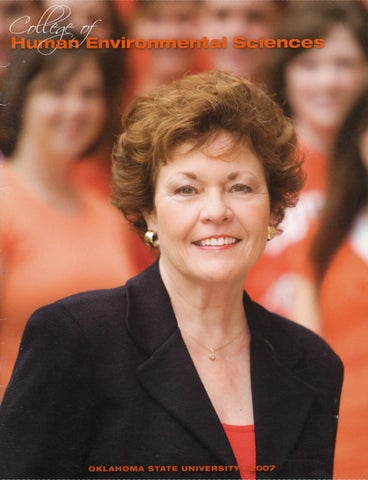
As Patricia Knaub announces her plans to step down as dean of the College of Human Environmental Sciences, she leaves a legacy of outstanding leadership. Her accomplishments over the past 18 years include rallying alumni support, increasing enrollment and upgrading labs and facilities. Because of her guidance, CHES is successfully positioned for a dynamic future. {photo, Phil Shockley; related story, page 16).
ches.okstate.edu 101 Human Environmental Sciences Stillwater, OK 74078-6116 (405) 744-5053 telephone (405) 744-7113 fax
Oklahomil State Umversny inrom~ia11C!!wl1h TnlaVI and VIIoftheQvilR1ghtsActol 1964, ~eumveOrder 11246as Bmended, Tille IXal1he EducationArnendmentsol 1972,AmencanswnhDisabiliuesAcl o!1990, and otoo'lederal liJW!.i11dlf!{J.Jla1JOOS.lllesootdiscnrmfliltem1he~af 1ace.mb,nanonallJl!ltn.sex.i1Je,relig100.d1 ClSlill~ asave1oom inanyofitsiK)flC!eS, IJllCIICes II JJOCf{ltres. ThlS n:looe.s 00!IS001 limiled !DOOmisslms. employment linancral aid,andOOIICatmrial seM:eS. TilleIXof1he Eruca100 Amefldm0111s andOklahoo1a Sia\B Urnversuy pnliL'Y proh1h11 d1somuna11on 111 th!!pnMS1on o!services ofbenefits offered bytlieUnrversiry based on gendet.Mypersoo[stu:lem. foculrymiafijwllollel1evao;ihatdisaimna1oryrwacureshavebeene ll'Jl1 gendermayd,sruss lharrm:emsand 1;,•lr,mao l0011al OJTJiJ,•sol l']SSirle•olatror,ulTnle ~ wr1h thellllJTitl, ~Coordmato. ll'CanJyrr HemaYle,, Direc1ool Alf,rnat "Actroo. 4081\linehust IJki;lronaStaw Un.,..~.StilfNat•.OK 74078.1405/744-5371 •14051744-55/~laxf Th•publ<lltm.lSSlled by(l,Jalona&ate UmversnyasaUlhrnzed byrhe r.ollegeol Human Env1romnenralScmoces, was primed hyOSU Markenng, Unrversrry Pm1mgServices.11lflll 1DSl to the!ilxpayeffillf Oklahoma 14,550/June/07. #1806
CHES Magazine
Hebert Joins Design, Housing and Merchandising
PauletteHebert,the new design, housing and merchandising department head and Christine Salmon Professor, says she has always been interested in OSU. Knowing a lot about OSU's College of Human Environmental Sciences, Hebert knew, when it was time, she would like to be a part of it. Focused, friendly people within CHES were compelling to Hebert. "I liked the faculty's work ethic," she says. "They seemed to be focused on getting things done."
Hebert comes to OSU from the University of Louisiana at Lafayette. At ULL, she served as professor of interior design in the School of Architecture and director of the Facility Design and Management Studio. She was also the assistant dean for recruiting and research in the College of Arts. Prior to her time at ULL, Hebert was a faculty member of Louisiana State University for nine years. Hebert has visited OSU many times over the years for conferences or as a guest lecturer. In the fall of 2005, she taught an accelerated graduate-level lighting course as a visiting professor. Lighting design is her major area of research and expertise. From 1988 to 1998, she was owner and lighting designer of Paulette Hebert Lighting Consultants Inc., and since 1998, she has been a design specialist for Marrero Couvillon and Associates Construction Engineering. As department head, Hebert looks forward to building on the department's good attributes. "We are actively seeking research opportunities and working to partner with industry," she says.
Hebert also hopes to increase graduate student enrollment and exposure of the department on campus . . "We want to continue to explain to people who we are and what we are about." Hebert received her bachelor's degree in interior design and her master's and Ph.D. in human ecology (merchandising), all from Louisiana State University. 2 College of Human Environmental Sciences 2007
CHES Magazine
School of Hotel and Restaurant Administration Names Director RichardGhiselli,the new director of the Schoolof Hotel and Restaurant Administrationand CharlesLanphereProfessor, sayshe saw a great opportunity at the Collegeof Human EnvironmentalSciences.A top-notchprogram with excellent facilitiesand great industry support attractedhim. Ghisellicomesto OSUfrom Purdue Universitywherehe servedas associate professorand interimassociatehead of the Departmentof Hospitalityand TourismManagement.He has served as assistantor associateprofessorat Purdue since1994. Beforehis time at Purdue, Ghiselliwas an assistantprofessorfrom 1993-1994 in the Departmentof Human and Family Resourcesat Northern IllinoisUniversity.
Food serviceand financial information are Ghiselli'smain areas of focus. In addition to his experiencein education, he has served as a club manager, food service director and general manager at several facilities. As school director, Ghisellihopes to keep the program strong while improving its visibility. "There is a wonderful program in place," he says. "I would like to keep it as strong if not stronger."
Ghisellialso looks forward to developing creative approaches to education using the school's current facilities. "This is a very hands-on discipline,"he says. "This type of program lends itself very well to applied education. The more
we can do in that regard the better prepared our students will be." For Ghiselli,preparing students for their careers is key. "I hope to prepare students to be able to step into industry positions seamlessly," he says.
Ghiselli,a certifiedculinary educator through the American Culinary Federation, receivedhis associate'sdegree in culinary arts from the Culinary Institute of America. He receivedhis bachelor's degree in philosophy from the University of Illinois at Champaign-Urbana,and his master's and doctorate in restaurant, hotel, institutional and tourism management from Purdue University. STORIES BY MARIE KADAVY
Oklahoma Srare University 3
CHES Magazine Matching Policy to Reality Tammy Henderson, director of the Gerontology Institute, says the new post is a good fit for her and the department. "I want to grow the gerontology program, and I have a top-notch crew of colleagues and scholars - brilliant faculty - to work with," she says. Gary Lawson
Instructional approaches to teaching family and policy is one of the research interests of this new associate professor in human development and family science.
"Around 73 percent of Hurricane Katrinarelated deaths in the New Orleans area were among persons age 60 and over, although they comprised only 15 percent of the city's population," Henderson says.
Her expertise is in the areas of family policy, law and diversity. Henderson says she is "intrigued by the whole notion that law
Studies show some 13 million people over the age of 50 need help evacuating during an emergency.
"This position allows me to work in the policy arena yet still teach."
"The findings suggest the pre-existing familial and social networks must also be included in the emergency planning and
training process." - Tammy Henderson
4 College of Human Environmenral Sciences 2007
does not mimic what's going on in families." It's a disconnect she hopes to remedy with policy recommendations grounded in the research of issues that challenge families.
Researchers have concluded that emergency planning and communication programs must be improved and must involve aging adults in the development process.
One of her research projects involves family functioning and decisionmaking of aging adults during a natural disaster. Before joining OSU in the fall of 2006, Henderson, along with fellow Virginia Polytechnic Institute colleague Karen Roberto and Yoshinori Kamo of Louisiana State University, researched Hurricane Katrina's effects on the aging adults of New Orleans and Baton Rouge.
Henderson, Roberto and Kamo's study, "Aging Families in the Aftermath of Hurricane Katrina: Family Functioning and Decision-making," found that family decision-making processes used before Katrina remained rather steady during the disaster and functioned well in the aftermath.
"The findings suggest the pre-existing familial and social networks must also be included in the emergency planning and training process," Henderson says. "Family members may be able to get an aging adult to evacuate or take on other safety procedures because a trusting relationship already exists. Family members may also be the first responders because they do not have to wait W1til clear lines of communication are established between the different levels of government." The Katrina study, which is funded by a National Science Foundation grant, is an ongoing project likely to produce several reports. "In one study we're working with students to compare how researchers and mass media talk about Katrina. We gathered a lot of different data," she says. "We hope soon to complete our analysis and give recommendations to emergency-management organizations. We also hope to hold a Katrina research symposium on campus." Grandparent/grandchild issues generate challenges for Oklahoma's seniors, and Henderson and HDFS assistant professor Whitney Brosi are working on them.
CHES Magazine Awards of Distinction Many grandparents Oklahoma began are full-timeparentsof to address the issue of their grandchildren.In grandparent visitation Oklahoma,nearly58,000 rights this legislative children(6.5percentof sessionby passing Oklathe rate'schildren)live homa House Bill 1682. , in grandparent-headed Grandparents who have households."Weneed establishedrelationships to makecertainour with their grandchildren policiesadequatelyrep- prior to filingfor visitaresent thesefamilies,and tion are more likelyto be resourcesare in placeto successful. help," Hendersonsays. "It's a step in the "Sixtypercentof right direction," grandparentsparentHenderson says. ing grandchildrenare "But we need to impoverished,"she says. make sure all our "Althoughmiddleclass policiesreflectthe grandparentsmay have reality of families moreresources,manyof today, and our them, baby boomersin faculty members particular,are grappling are working to make with the challengeof tak- that happen. Research is ing care of parentsand one way to incorporate grandchildrenwhiletry- change; faculty members ing to find a way to retire. need to be involved in "Somegrandparents a multitude of research areas." are involvedin their grandchildren'slivesbut To this end, she says, don't haveaccessto them. Brosi's other research Althoughit's curiousto areas includeelderly me, there are parentswho recipientsof familycare, don't want to sustain relationshipsof choice generationalties.They in late life and transgensay they don't want their erational familytherapy. parents' interference. HDFSassistantprofes"Still,at the end of the sor AlexanderBishop day, somegrandparents is researchingthe issues want to be part of their . of subjectivewell-being, religiosityand spirituality, grandchildren'slives, and researchhas shown beingsinglein later-and grandchild/grandparent very-latelife, the oldrelationshipsto be benefi- est-oldand stress and cial to children,"Hender- adaptation. son ays. EILEENMUSTAIN
Bill Ryan,associate professor
LauraHubbs-Tait,human
and interim director in the
development and family science
School of Hotel and Restaurant
professor and John and Sue Taylor
Administration, received the 2006
Professor, received the 2006 Regents
RegentsDistinguishedTeaching
DistinguishedResearchAwardat
Awardat OSU's Fall Convocation in
OSU's Fall Convocation in October.
October.
Hubbs-Tait has taken the lead with other researchersfrom Harvard Medical School,Texas A&M and the University of Colorado Health SciencesCenter to publish a monograph on how mercury, lead, cadmium and manganeseexposure affectschildren'scognition and behavior.
This isn't the first award Ryan has received for outstanding teaching. He also receivedthe 2001 Regents DistinguishedTeachingAward and was named the Outstanding Undergraduate Adviserfor the Collegeof Human Environmental Sciencesin 2005. Ryan uses a variety of presentation styles includingtechnologyand the internet to keep students interested, focused and up-to-date with the latest developmentsin hospitality education. Students benefitfrom Ryan's wide range of professionalexperiencesin universityhousing and dining, purchasing and facilitymanagement. Students say discussionsof case studies from his industry background bring the profession to life for them. They also appreciate the high expectations Ryan has for their classroom efforts and his open door policy of accessibility.
She has conducted much of her research with familieslivingat the margins of societydue to low income or other risk factors in hopes that her findingslead to improvements in their lives. Currently funded projects include research on interactions among nutrients and neurotoxicants in Oklahoma preschool children, the revitalization of the Pawnee languagefor preschool children, and a recentlyfunded NIH project in Ethiopia.
Oklahoma Srnre Universiry 5
CHES_Magazin_e~--
------~L~iv~i.....,,,n~eJ1rning The College of Human EnvironmentalSciences LivingLearningCommunity,housed in the new Villagesuites, was established in the fall of 2006 to allow collegefreshmen, sophomores and first-year transfer students to build relationships outside the classroom.
To_g._e_ther Builds___C_onne_c_tions ________ "We want to build a culture in the college that helps our students from the moment they get here," says Shiretta Ownbey, associate dean for academic programs and services.
"We want them to see this collegeas special and very supportive," she says. "The living learning comThe community is one of CHES'sfirst-year-expe- munity is one of the things that will help us make that rience initiativesdesigned happen." to help new students transition to life in the college. Livinglearning comThe goal of the new commw1itieshave been proven niunity is to create an asso- effectiveon other camciation unique to CHES. puses as well as in other areas of study at OSU. The communityprovides an environment to support academicsuccess. Studentscan form study groups and get involved in clubs or organizations together.
6 College of Human Environmenral Sciences 2007
Students in the community can also participate in activitiesorganized by community mentors. In addition to planning events, community mentors offer academic advice and assistanceand serve resident assistant roles. Each floor in the CHES House is also supported by a collegefaculty associate. "The communitymentors have reported a great deal of satisfaction," Ownbey says. "Students are excited about the concept of CHES majors livingtogether." Faculty members are also pleased with the idea of supporting students in the communicy.
_
"Students are becoming academicallyengaged earlier by our efforts to help them be successful,"Ownbey says. "If students are feeling connected with the college, they will be more connected with the courses they are taking and more serious about their academic program."
During the 2006 summer enrollment, advisers encouraged incoming freshmen to participate in the CHES LivingLearning Community.In its first year,more than 60 students lived in the learning community.With increasedawarenessand positivestudent feedback, the communjtyhopes to serve 120 students in
2007-2008. MARIE KADAVY
--~CHES_M_a_g_azine~
Four hotel and restaurant administration students are boosting their careeropportunitieswith internships at the IntercontinentalHotel Shenzhenin China. In January,Amy Banister,Amy Byrd,Jonathan Kennedyand Todd Woodyardbegan six-month assignmentsworking at the hotel's front desk and in the food and beverage department.Hailin Qu, Regents professorand the WilliamE. Davis DistinguishedChair in Hotel and RestaurantAdministration,helped securethe positions. Qu initiatedthe internshipprogram two years ago after learning of the opportunityfrom an OSU hotel and restaurant administrationgraduate workingin Asia for the IntercontinentalHotel groups. The College of Human EnvironmentalSciences requiresinternshipsof undergraduates for experienceand school credit.
"The language and cultural barriers are the biggestchallengesthe students face," says Qu. "Some people in China speak English but not all and not fluently.Students have to work, learn the language and learn and adjust to the Eastern culture." But the benefitsfar ourweigh these difficulties,he says. "The program is beneficial for students working and training at U.S. brand chain hotels and in a different cultural environment. Almost all major U.S. hospitality companies have hotels there, creating a need for strong leadership in China's hotel industry. Maybe these students willbe able to help fillthat need." The general manager of the Intercontinental Hotel Shenzhen,Brian Cofl11elly, '79, HRAD, has already expressedinterest in the students working full time after their internship program, Qu says.
"There are more and more American companies opening hotels in China, and they need people who have experience in this field and with both Western and Chinese culture. The program willreally benefit the students' careers in hotel and restaurant management in any hotel market but especially if they want to go into the Asian market," he says. "It's good experience for our students to have multicultural and multi-customertraining. When our students come back, the Asian internship will definitelyhelp them work in the U.S. hotel industry." LORI WILSON
Students Amy Banister, Amy Byrd, Todd Woodyard and Jonathan Kennedy, left to right, experienced the Chinese hospitality industry firsthand through internships established by Regents Professor Hailin Ou, right.
CHES Magazine Selling Good Health StephanyParker'sresearch interests concern what she refers to as the "obesity paradox," the fact that obesity and its related health problems are most prevalent among those at or below the poverty level. Intent on improving the health of limited-income populations,
"I was not working in the Jamaica that tourists see but the other one," she says. "People really don't understand the poverty that exists there." The experience proved life-altering for Parker who returned "with a greater appreciation for what we have
and subcontracted by the Chickasaw Nation, involves several team members including OSU sociologist Jean Van Delinder and Chiquita Briley, Stephany Parker is developing a social marketing program aimed at helping limited-income populations make healthy food choices.
Parker and the research team are asking community focus groups what the message should be and how and where it should be promoted. They also are analyzing focus group data, which will be further explored in a survey Van DeLinder is composing. Briley and Parker are collecting additional data with Photo Voice, a method that asks food stamp and commodity recipients to name and photograph the barriers that prevent them from eating more fruit and vegetables and being more physically active. Parker says the team will begin to test tentative messages this summer and evaluate responses in the fall. Outcome evaluation to assess messages and changes in the program is built in at each step of this ongoing process.
Parker draws on her background in anthropology to study social and cultural perceptions that influence health choices. After earning an anthropology degree from the University of Georgia, Parker chose to work on her master's degree in nutritional sciences through OSU's master's internationalist program - at the time, only one of three in the country where she could combine her nutritional studies with work in the Peace Corps. Two years as a Peace Corps volunteer in Jamaica working with children suffering from sickle cell disease gave Parker material for her thesis and sharpened her career focus.
8 College of Human Environmental Sciences 2007
in this country and what it means to be a minority here."
nutritional science professor at Mississippi State University.
She developed curriculum for Oklahoma's Community Nutrition Education Programs for six years prior to joining OSU as an assistant professor in 2005.
"Our goal is to develop a social marketing program that will influence healthy food choices. It's not just advertising," Parker says.
For one of her most recent projects, the assessment and evaluation of the Get Fresh program for Native Americans living in the Chickasaw Nation boundaries, Parker and her team aim to determine what limits the group's fruit and vegetable intake and physical activity. The project, funded by the U.S. Department of Agriculture, Fo·od and Nutrition Service, Food Stamp Program
"We will form long-term targeted messages and targeted program recommendations that take into account people's life circumstances and their cultural and economic differences." Unlike commercial marketing, social marketing encourages social behavior t]1at will benefit the target audience. Because helping the audience is the purpose, the research is participatory and not topdown, Parker says.
"And, no, I don't have the answer to the obesity paradox. I would love to, but I don't," Parker says. "The research projects are all stairsteps. We can't see the end-all yet. We started working with individuals, then families and then environments. Ultimately, we'll look at how policy change could make it easier for people to improve li£estyle," she says. "The long-term goal is to improve health in our communities." EILEEN MUSTAIN
CHES Magazine 'Wrestling'with Nutritional Extremes Lenka Humenikova,assistantprofessor in the Departmentof Nutritional Sciences,landedon the OSUcampus in 1997 with a tennis scholarshipand little knowledgeof what would becomeher new home.A nativeof the CzechRepublic, she saysshe fell in love with the university,the communityand CHES,where she earned a master'sand doctorate in nutritionalsciences.
rate (the number of calories the body uses The participating schools have asked for basicphysiologicalfunction). They are Humenikova to follow the wrestlers also screeningfor signsof eating disorders. through their high school years. The longterm study will be another first in this This is the first study to research the area of research. wrestlers' metabolism,which is impor-
Hwnenikova,whose researchinterests includechild nutrition and obesityand sports nutrition, has initiated a pilot study examiningthe effectsof extreme weight-cuttingpracticeson high school wrestlers.The only study of its kind, the researchwill help designprograms to minimizeunhealthydietary behaviors and has far-reachingimplicationsfor all athleteswho engagein rapid weight loss.
ers who frequently switch between their regular dietary habits and
Shechosewrestlersbecauseof the weight-restrictednature of their sport. "Male wrestlersdefinitelyhave some of the highestprevalenceof unhealthy dietarybehaviorsamong athletes," Humenikovasays. "Previousresearch showsthat wrestlersengagein dieting, mealskippingand starvation, use sweat suits,saunas and excessiveexerciseto burn calories,and get dehydratedin order to lower their body weight."
tant, Humenikova says, becausestarvation and other unhealthy dietary practices may affect metabolic rate. "It's the same principle we may see at work in so called 'yo-yo' diet-
extreme dieting. While their caloric intake may be decreased at times, so is their metabolism. This is a very serious problem for athletes, especially for adolescents, that can negatively influence their health and athletic performance." Lenka Humenikova measured high school wrestlers before, during and after the wrestling season to study the effects of rapid weight loss on the body.
Parents are also concerned about their sons' health, Humenikova says. Fortunately, the National Wrestling Coaches Associationhas taken actions to minimize the prevalenceof unhealthy weight control practices and now requires high school wrestlers to start the season with a minimum of 7 percent body fat. "It isn't just wrestlers who engage in rapid weight loss," she says. "There is a great need to educate all athletes regarding unhealthy,even dangerous, dietary practices." Humenikova, who collaborates closely with Nancy Betts, nutritional sciences department head, hopes to extend their
Somestudiesalso suggestan association betweenthese behaviorsand the developmentof eatingdisorders. "I want to learn how dietary intake and unhealthy weight loss practices influence athletic performance," she says. "Many wrestlers lose 5 to 10 percent of their body weight in a short period of time. This may affect muscular strength, ability to recover and risk of injuries."
Using24 wrestlersfrom two high schools,Humenikovaand her research team are evaluatingbody composition (leanbodymass,bodyfat and bone mineral density),dietaryintakeand metabolic
Phil Shockley
Humenikova is concerned to see how little food the wrestlers, who range in age from 14 to 18, reported on their food records. "It's alarming to have 14-yearolds starving during their growth period," she says.
studies to OSU athletes. "Each sport has very specificnutritional requirements depending on the duration and intensity of training sessionsand competitions," she says, "so we would like to individualize our approach." EILEEN MUSTAIN
Oklahoma Stare Universiry 9
CHES Magazine
Green Tea for Good
Hea1tb
Everyoneknows naturally occurring antioxidants in green tea contribute to good health. Advertisershave touted green tea and their supplementsas a cure for everythingfrom headaches to depression.
All participants are consuming a green tea commonly found in grocery stores, Basu says. "We require everyone to drink their tea or water at the clinic in Oklahoma City, and each cup is prepared by our staff to ensure consistency."
New OSU researcher ArpitaBasu,an assistant professor of nutritional science, is studying the effectsof green tea compared to green tea supplementson metabolic syndrome, a medical condition that leads to diabetes and cardiovasculardisease.
Basu says this research is part of her dietetic internship at OSU and will be especially valuable later when she becomesa registereddietician. "I've always been interested in the health benefitsof natural foods and plant-based nutrients rich in antioxidants," she says. "Right now, I'm interested to see how previous research results from cell and animal studies translate to human subjects."
"We want to determine whether green tea produces different results than supplements, or if they are similarly beneficial," says Basu, who joined OSU's nutritional sciences last fall following post-doctoral work at the University of California Davis Medical Center.
Becausemetabolic syndrome is a precursor to Type 2 diabetes and subsequent coronary artery disease, blood samplesalso will be taken to measure participants' levels of insulin and cholesterol, inflammationand oxidative stress, which contribute to the diseaseprocess.
Gary Lawson
10 College of Human Environmental Sciences 2007
Basu and colleagueTimothy Lyons,a physicianat the Universityof Oklahoma Health SciencesCenter,will study 60 people with metabolic syndrome in this trial. One group is given four cups of green tea daily; another group takes equal amounts of green tea supplements;and a control group drinks four cups of water daily.
Researchalready underway on micronutrients and phytochemicalsattracted Basu to OSU's Department of Nutritional Sciences."Our department has very good core research in phytochemicals and plant-derived compounds," she says. Basu says she'll emphasize lifestylechanges as well as proper nutrition to her clients. "Diet is just one element of good health, but research into plant-based nutrients is increasingly important in preventing diseases. These findings could go a long way in improving people's health."
CHES Magazlne
-
Gary Lawson
--- -
A Mushroom a Day? SoloKuvibidila, a nutritional scientistin the Departmentof Pediatricsat Louisiana StateUniversityHealth SciencesCenter in New Orleans,lost her laboratory chemicals and biologicalspecimenin the power outagesfollowingHurricane Katrina.
"In other words, a tumor weighing 100 grams will weigh 10 grams or less after treatment with the extract.
Althoughtemporarilyinterrupted, her studiesof how micronutrients(such as iron and zinc)and functionalfoods (such as mushrooms)affectimmunefunction are far from stalled.
Few scientistshave studied white button mushrooms even though they are the most widely consumed by Americans. Kuvibidila'sresearch looks at these mushrooms along with maitake, shiitake and portabella.
Also, when given to infectedmice, the extracts prevent the growth of microbes and increasesurvival.
Last summerKuvibidilajoined OSU's nutritionalsciencesdepartmentwhere she Kuvibidila'swork is being conducted is researchinghow mushroomsinfluence in cellsgrowing in special tubes or dishes the cellsthat protect humans and animals - no mice or humans are currently from infection,cancerand other diseases. involved.Kuvibidilaprepares extracts Her findingsthus far suggestpotential from the four mushrooms and then adds health benefitsfor the preventionof infec- different amounts of the extracts to two tion and the growth of cancercells. differentcell types growing in special Chinesemedicinetraditionallyhas dishes. Both cell types are powerful in usedsomemushroomsfor the treatment killing microbes and are the first line of and preventionof infection,cancer,heart defenseagainst infection. One of the cell diseaseand rheumatoidarthritis. types will also kill cancer cells. "According to previous studies, extracts from maitake and shiitake mushrooms, when given to mice bearing tumors, increase the survival rate and prevent tumor growth by 90 percent," Kuvibidilasays.
Both cell types produce a type of protein, called defensin,which is essential for killing bacteria or microbes.In her research, Kuvibidilaset out to determine if mushrooms increase the production of this protein and if they promote or block the growth of the cancer cells.
Kuvibidila'spreliminary results suggest that mushroom extracts increasethe production of defensins.If these results are confirmedin humans, they suggest that individualseating mushrooms are better able to fight bacterial infection than people who do not eat them. "Contrary to what I thought, the extracts don't increasethe proliferation of cancer cells.Instead, they prevent tl1e multiplication," she says. "This implies that iliese extracts may prevent the growth of certain types of tumors." "White mushrooms may help the body fight infections more efficiently due to the increased production of defensin and may prevent cancer cell proliferation," she says.
"Next I want to find out if the button mushrooms can prevent cancer and tumors in mice. I won't induce cancer," Kuvibidilasays, "but mice get cancer just like humans." Her goal is to begin the clinicaltrials next year. "In the future, I would like to study the extract in people who are being treated for various types of cancer," she says. EILEEN MUSTAIN
Oklahoma State University 11
CHES Magazine
Opportunities Arise at CHES The College of Human Environmental Sciences will soon provide a focused program for students majoring in early childhood education and child development at the Rise Schoolof Stillwater.The school, set to open in October at the Stillwater Head Start building, will serve children ages 18 months to 6 years with a wide range of disabilities while providing the college's students with valuable experience working with special-needs children. The college continues to work with the Mya Gonzales Foundation to launch the school, which will become the seventh Rise School in the U.S. The original Rise program began at the University of Alabama, Tuscaloosa, in 1974. The Mya Gonzales Foundation, created by Jimmy Gonzales, OSU director of football operations, and his wife, Mary, in March 2006, is named after their 2-year-old daughter, who was born with Down syndrome. After visiting the Tuscaloosa school, the couple decided to bring the Rise model to Cowboy country.
12 College of Human Environmental Sciences 2007
"We thought of what a great benefit this would be for Stillwater and the surrounding areas because it would greatly aid children with special needs and their families for years to come," Jimmy Gonzales says. The Rise School will integrate children with disabilities among their nondisabled peers. "Based on information from other Rise Schools, children who participate in a Rise School program make the transition to the public school system with skills and abilities that exceed children with similar disabilities who have not participated in such a program," says ChristineJohnson, associate dean of research and graduate studies.
"In addition, non-disabled children from Rise School programs have a better understanding of disabled children and accept them as peers, realizing their potential." Last November, OSU alumnus BoonePickensawarded the Rise School a $425,000 gift, and other donors have been generous as well.
Like its Rise counterparts, the Rise School of Stillwater will provide a number of services to children on-site, including physical, occupational, speech and music therapies; however, the Stillwater school will be unique from other Rise Schools because of its strong research component. "CHES faculty members will conduct longitudinal studies to determine which methods and practices are most conducive for enhancing the developmental outcomes of disabled and typically-developing children," Johnson says. Each classroom will be staffed with a teacher who has a master's degree in special education and prior experience teaching children with disabilities. Classrooms also will have two full-time teacher assistants, creating a 3-1 childteacher ratio. Therapeutic activities will be integrated into the daily classroom routine, and therapists will monitor the activities regularly. Using this approach, therapy can be delivered efficiently during a child's school day, Johnson says.
Gene Stallings, left, former head coach of the University of Alabama, is a spokesperson for Rise Schools, and Martha J. Cook, second from right, is executive director of all Rise Schools. OSU's director of football operations, Jimmy Gonzales, right, and his wife, Mary (holding their 2year-old daughter, Mya) and the College of Human Environmental Sciences are establishing a Rise School in Stillwater.
The Rise School also will provide important hands-on internship and observation opportunities for CHES students, which will better train and prepare them to teach in Oklahoma classrooms. Students who participate in the teacher-training program will learn to match children's needs with appropriate instructional methods according to each child's developmental and physical abilities. The college also plans to offer in-service training workshops to current teachers so they can become better equipped to teach special-needs children. MORGAN PRATT
'I /
--g-/ I '....._ The Rise School of Stillwater
Where Special Kids Shine
For more information about the Rise School of Stillwater, visit www.ches.okstate.edu/rise
CHES Magazine Professor Receives Homeland Security Honor ProfessorDonnaBransonlists the soldiers and their families who are making sacrificesas the reason she is most proud of receivingthe 2006 HomelandSecurityAward.
"We achieved that short timeline because many individuals from OSU and our partner agencies worked long hours and dedicated their time and expertise to offer our soldiers a higher degree of protection."
Since2004 when Branson and her Bransonacceptedthe award in Washington,D.C., from the Christopher colleaguesbegan the body armor project, their mission has been to help bring ColumbusFellowshipFoundationand soldiers home alive with QuadGard®. AgustaWestland NorthAmericafor her collaborativeresearchand development "We're certainly not alone in our desire work on QuadGard®, a lightweight,flex- to protect the soldiers. I receiveemails all ible limb body armor for the troops, as wellas an earlier project, a personal portable coolingsystemfor first responders. The body armor is specificallydesigned to protect a soldier'sarms, legs and back from shrapnelthrown by explosivesas well as small arms fire. The HomelandSecurityAward honors individualsor companieswho have made "measurableand constructivecontributions" to homeland securitythrough cutting-edgeinnovation.Branson,who heads the new Institute for Protective ApparelResearchand Technologyat OSU,has led an OSUteam working to developnew body armor to protect soldiersagainstthe loss of limbs from roadsideexplosivesand small arms. The OSUteam worked in collaboration with industrialproduction partner FSTechnology, LLC,as well as ballistics and human factorspartners at the Army ResearchLaboratoryand Naval Research Laboratorywho assessedcombat casualty trends,protectionstrategiesand warfighterrequirements.Fundjng was providedby the Officeof Naval Research and the Marine Corps SystemsCommand.
"It was a natural transition since we had been conducting various protective clothing research projects for some time," she says. "However, the time-sensitive nature of the body armor research and the comprehensivenessof the project illustrated the need for a way to facilitate such projects. Professor Donna Branson, second from right, credits colleagues and students with helping develop protective apparel. From left, Diane Ricord, Semra Peksoz, Huantian Cao, Branson and Cheryl Farr.
Phil Shockley
the time from concerned family members who want to know if the body armor will be available soon for their loved one in the military," she says. QuadGard®has been in operational use for one year and has provided protection from blasts in actual combat situations. Such reports are gratifying to the team who has recently expanded the body armor design efforts to create addjtional Quad Gard®variations and a load-bearing ballisticvest.
Branson's work on QuadGard®has already been career-altering. When she started the project, she was head of "Closecollaborationbetweenmilitary, OSU's design, housing and merchanbusinessand academicpartners resulted in dising department in the College of development,testing,redesignand retestHuman Environmental Sciences.Now, ing of the innovativebody armor with as director of the Institute for Protective technologytransferto CovercraftIndusApparel Research and Technology,her triesin lessthan two years," Bransonsays. work will focus on the design, performance testing and technology transfer of protective clothing.
"I couldn't have begun to get this job done without a group of dedicated, talented OSU colleaguesincluding Semra Peksoz,DianeRicordand CherylFarr as well as graduate and undergraduate students. We've worked side by side, and together we will chart a future for the institute, which already includes a growing number of faculty and students." That vision includes placing an emphasis on product developmentwith testing and redesign as components in the integrative design process and taking the institute into additional areas of "functional" apparel for people outside the military such as police and SWATteams. "We expect continued development of high-tech materials that should make it possible to live more com"fortable lives while offering all of us a higher degree of personal protection."
Oklahoma State Universiry 13
CHES Maga~zi~n~e ___
_
Phil Shockley
Center Upgrade Made Possible by Donors
OSU's nationally recognized program to prepare early childhood teachers received a boost this year with an expansive renovation project in the Centerfor
EarlyChildhoodTeachingand Learning (CECTL). Two facilities in the center are being upgraded with the help of donors who have a passion for early childhood teaching. The ChildDevelopmentLab (CDL) within the Center for Early Childhood Teaching and Learning was renovated last summer for the first time since 1986. Accredited by the National Association for the Education of Young Children, the CDL was started in 1924 and is one of the first teacher preparation laboratOries in the country.
14 College of Human Environmental Sciences 2007
"We continue that history by modeling the best practice of early childhood education for students and teachers to observe and study," says Pam Wilder, director of the COL.
"Students learn about children's development by observing and working with them in their learning environment. Our students come to understand the developmental norms and differences and the appropriate teaching strategies for working with this age group," she says. Each semester more than 200 students observe certified teachers teaching children who range from 2½ years of age through kindergarten.
CHES Magazine
The CDL has two classroomswith an observationroom overlookingboth classroomsthrough a two-waymirror. Microphoneshangingfrom the ceilings allow observersto hear the conversations in the cla room. A donation from the CleoL. Craig Foundationin November2005 made the lab renovation possible.HelenCraigand her daughter,AprilCraigStobbe,and daughter-in-law,Kennette,all graduated from the Collegeof Human Environmental Sciences. "Their tie to early childhoodeducation and the importanceof providinga quality learning environmentfor youngchildren and potential early childhoodeducators is very near and dear to their hearts," says Alane Zannotti, senior development director for CHES.
"In the model-teaching classroom we will be studying the preparation of teachers and learning what makes a quality early childhood teacher," Wilder says.
"We believeentry-levelstudents need to be pulled into the early childhood education family and be supported as they test their ideas," Wilder says.
There will eventuallybe an observation booth in the model-teachingclassroom, Zannotti says. "The Pauls strongly believea model teaching classroom providesanother important layer to our early childhood teacher preparation program."
"We also want to be able to bring our graduates and other teachers back into the fold to help with their needs. One of our goals is to reduce the turnover rate.
"As soon as funding becomesavailable, we hope to remodel the resource room to provide a curriculum and materials library for early childhood education students, cooperating teachers and alumni," Zannotti says.
Statisticsshow that more than 50 percent of teachers quit after their first fiveyears of teaching. The resource room would provide a place where teachers and In addition to the renovatedlab, the students could find the support they need, CECTL has added a modelteachingclass- she says. room thanks to a donation from Ramona and HomerPaulin the springof 2006. Ramona, a graduate in early childhood education and a memberof the CHES Hall of Fame, is the assistantstate superintendent for the OklahomaDepartment of Education.
"Through the Center for Early Childhood Teaching and Learning, we will prepare and support Oklahoma's early childhood teachers," she says. "Teacher success translates into child success, and that is ultimately the goal." LORI WILSON
The Cleo L. Craig Foundation funded recent renovations to the Child Development Lab. From left, April Craig Stobbe, Kennette Craig (kneeling with children) and Helen Craig. Daughter, daughter-in-law and mother all hold degrees from the College of Human Environmental Sciences.
"Her enthusiasmand her drivefor early childhood educationis evidentin what she does on a day-to-daybasis," Zannotti says. The model-teachingclassroom,used to teach methodologyclasses,accom., modates adults and students3 to 6 years of age. Earlychildhoodeducationfaculty bring in childrenand presentlessonsin front of other teachersor studentswho observe and then critique,discussand give feedbackafter the childrenhave left the room.
Oklahoma State University 15
CHES Magazine
Legacy of I,eaaership Pat Knaub, dean of the Collegeof Human EnvironmentalSciences for the past 18 years,recently announcedher plans to step down from the position in June, leaving behindher a long list of accomplishmentsand a legacyof outstanding leadership.
In 1992, Knaub oversaw the name change from the Collegeof Home Economicsto the College of Human Environmental Sciences selectedby faculty to reflectrevised programs and curriculum, an emphasis in research and a new organizational structure.
"The list of her achievements goes on and on and on," says Marlene Strathe, provost and interim OSU president and system CEO. "She has brought a lot of national attention not only to the College of Human Environmental Sciences but also to OSU."
"I've seen her move the college from a traditional, home economics concept to a very contemporary and dynamic college that prepares people for today's professions," says Kay Stewart, former OSU associate professor and current member of the CHES Associates, a group Knaub created shortly after coming to OSU.
Under Knaub's direction, the Collegeof ~uman Environmental Sciencesexperienceda 98-percent increase in undergraduate enrollment and a SO-percentincrease in graduate student enrollment over the past 12 years. She establishedmentoring programs and comprehensivecareer servicesfor the college'sstudents, who have some of the highest retention and graduation rates among OSU's colleges.
"Because the college is well positioned for the future, this seems like a good time for me to focus on new opportunities," says Knaub, who has overseen sweeping changes at the college.
Prior to comingto OSU in October 1989, Knaub servedas associate dean for graduate studiesand profesor of human developmentand the familyat the Universityof Nebraska. A nationally-recognized leader in her profession,Knaub has servedas presidentof the National Council on FamilyRelationsand has been a memberof severalother national boardsduring her deanshipat OSU.
The CHES Associates,a diverse network of the college'sadvocates, servesas an advisory board while linking the collegeto industry and professionalgroups. Knaub has challengedthe CHES Associates to activelyparticipate in decision making, sharing the opportunity for leadership as well as recognition for the college'smany accomplishments, Stewart says.
Scholarlyproductivity during Knaub's deanship has shown a dramatic increase,with 74 percent of faculty receivingextramural funding. Knaub also led efforts to raise funds for new and upgraded teaching laboratories and renovation of the OSU continues
Oklahoma ScareUniversity17
CHES Magazine
"She's been a strong role model to me," says Ownbey, who began working under Knaub in 1991 as an assistant professor in the Department of Design, Housing and Merchandising. "When I have proposed instructional or student services initiatives, she has been very supportive in helping me to have the tools and resources needed to make those initiatives a reality."
Atherton Hotel. Today, the Hotel and Restaurant Administration and Interior Design graduate programs rank among the top 5 in the nation. "Dr. Knaub has been an extremely gifted leader and ambassador for Oklahoma State University and CHES," says David Schmidly, former OSU president and system CEO. "We appreciate all she has done to elevate her college, making CHES a national leader." In addition to overseeing many college improvements, Knaub has been a valuable mentor to many CHES students and faculty members, including Shiretta Ownbey, associate dean for academic programs and services.
Over the past 18 years, Knaub has encouraged all faculty and staff to help her develop ways to expand the college's student services, instruction and research. As a result of Knaub's support, the Becky Steen McCaskill Center for Student Success was developed in 2004 and now facilitates integrated academic advising, leadership development and an outstanding first-year student experience. It also provides current students with career development information and serves prospective students and their families. Despite her decision to step down, Knaub will continue making contributions to the university and will work closely with the OSU Foundation, continuing her development efforts for a new College of Human Environmental Sciences building. Knaub, who was identified in 1988 as one of the most prolific authors of family research articles, also plans to do some writing related to leadership.
Knaub will be missed at the College of Human Environmental Sciences, yet her legacy has left an indelible mark on the college and its programs. Many at the college look forward to the growth that is expected to continue as a result of her dedicated direction.
"Dean Knaub's leadership has positioned CHES well in relation to instruction, research and outreach," Ownbey says. "Because people want to invest in success, our reputation for excellence causes others to join us, partner with us and support us." MORGAN PRATT
18 College of Human Environmental Sciences 2007
CHES Magazine A_Gift Born of Memories and Admiration "We are extremely grateWhen MarilynnBenbrook ful for this wonderful gift," Thoma saw the sweeping Knaub says. "Endowed changesoccurringin the Collegeof Human Environmental chairs are impressive and vital for success in the acaScience, she wanted to contribute to the momentumben- demic world. The Marilynn Thoma Chair will be a cataefiting tudentsand faculty.
"When we reconnected with OSUin 2000, we noticed the sea of changethat Dean Knaubhad initiated,"says the 1970CHESalumna whose hu band, Carl, is a 1970 businessalumnusof OSU. "Under Dean Knaub's leadership, the academic program has evolved to focus on well-defined areas of concern to humans," Carl says. "And OSU's resourceful faculty has adapted the curriculum and undertaken research to squarely address the needs of families and industry today."
Together,the coupleestablishedthe Marilynn Thoma Chairto supporta keyfaculty po ition in CHES.Their $500,000gift willprovide perpetualfundsto enhance the professor'ssalary,support researchand fund related expen es through future interest earning . Giftsto endow facultychairsare matchedby the state of Oklahoma.
our gift will enable the college to pursue academic initiatives and draft faculty of the caliber that will bolster the college's role as a leader among the programs of its type in this country."
lyst in bringing distinction to the college by attracting and keeping highly regarded professors.
After graduating from OSU, Marilynn and Carl both earned MBA'sfrom Stanford's Graduate School of "Through private support Business.Her career focused we are able to offer more and on brand management for larger scholarshipsto outQuaker Oats and later marstandingstudents, thus becom- keting and developing the celing a player in the competition lular telephone industry with for the best and brightest at Cellular Network and Proxy OSU," Knaub adds. "This Cornmunications. kind of support also attracts Carl began his career in outstandingstudents by venture capital investment, providingopportunities for founding a private equity experientialeducation such as firm now known as Thoma study abroad and internships." CresseyEquity Partners with Through the CarlandMarilynnThomaFoundation,the couplealso provided the lead gift to establishthe Ranchers Club at the Atherton Hotel at OSUand funds to create the Oklahoma Wine Forum at OSU. "The Ranchers Club and the Wine Forum are examples of initiativesthat enrich the learningexperiencefor students and raise the academic profileof the college," Carl says. "OSU is an important institutionfor not only us, but also for many members of both our families.We hope
officesin Chicago, San Francisco and Boston. His furn has invested more than $2 billion m growmg compames over the past 25 years, and he has been acknowledgedin Fortune,The WallStreet journal and Business Week for his investment leadership. Today,Marilynn overseesmarketing activitiesfor Van Duzer Vineyards, the winery the family owns in Oregon's Willamette Valley.
The Kenilworth, Ill., residents are the parents of Margo and Mark, also Stanford graduates, and are activelyinvolvedin civic philanthropy in the Chicago area. Marilynn chaired the capital campaign to build the Chicago ShakespeareTheater on Navy Pier,and she serves as the vice-chairand treasurer of the Chicago Humanities Festivaland is the presidentelect of the Women'sBoard of the Rehabilitation Institute of Chicago. Carl has served on boards of directors of Evanston-Northwestern Healthcare and Copia, the American Center for Wine, Food and the Arts in Napa, Calif.
CHES Magazine
A Presence in Every County Cooperative Extension is a large part of what makes OSU "the state's university." OSU's land-grant mission includes extending services to the entire state in addition to traditional research and instruction. Through the Oklahoma Cooperative Extension Service, CHES takes its knowledge and expertise to Oklahoma's 77 counties. "We have the pleasure of taking the knowledge developed on campus to the community," says Glenn Muske, interim associate dean of Cooperative Extension.
'We, the People' One service the college offers through . Cooperative Extension is the Oklahoma Partnership for Public Deliberation. OPPDwas developed in 2000 to give a voice to citizens who felt they had little power to influence public issues. Deliberative forums provide a non-partisan venue for citizens to discuss their opinions as well as take an active role in the community. Since human development and family science faculty Renee Daugherty,associateprofessor,and Sue Williams,professor, founded the program, more than 230 public forums have been conducted. "As a land-grant university, we are working to help Oklahoma deal with community and state issues more effectively," says Daugherty. "One way to do that is by involving people in decision-making on public problems."
A variety of organizations from the Oklahoma Conference of Churches to the Oklahoma Supreme Court have participated in the forums. Problems discussed affect families a'nd communities and may be national or local in scope. Issues range from Social Security to immigration and from obesity to education. "The deliberative forum provides an opportunity for individuals to express their needs in a larger context," says Williams.
20 College of Human Environmental Sciences 2007
To prepare extension professionals and other members of the community for leadership roles in the forums, the OPPD has conducted seven Oklahoma Moderators and Recorders Academies. The academies equip individuals to convene, moderate, record and report on deliberative forums. To date, the academies have trained more than 200 community leaders. Participants in the forums try to find common ground. Instead of focusing on
disagreements, the forums look for agreement. For example, participants can agree the issue needs to be addressed. Using the forums, information on a controversial issue is shared that can be used to encourage the public to take ownership of the problem. They stress that individuals must take action or accept the cost related to a policy decision. "It's important to recognize the consequences of our decisions," says Williams. Deliberative forums last about two hours and center on one issue and three approaches to the problem. Near the end of the forum, participants try to determine common ground. "We work with issues that have more than one answer to the problem and more than one perspective on how to address the problem," Williams says. "Everyone sees the issue a little differently." A report is prepared for each forum. Interest forums on national issues are also conducted across the U.S. Reports on two or three of the issues are compiled and presented to Congress. There is also an annual program on PBS that reports what people have said in deliberative forums. In the past, Oklahoma has been featured on the program.
CHES Magazine
Althoughvoicingopinionson public issuesis important,the program has also found the forums in1proveleadership and increa e communityinvolvement. Leadersreport becomingbetter listeners, improvingconfidenceand increasing open-mindednessdue to participationin publicdeliberation. In addition,participantsnetwork with otherson the issuesdiscussedand contact officeholders. "It's a form of public policy, but it's public decision-making that brings people into the process of making decisions that impact their lives," says Williams.
Budgeting for Health CHES's tatewideextensionalso works to improvenutritionfor all ages. One ervice,the CommunityNutrition EducationPrograms,strivesto increase fruit and vegetableconsumptionamong it participant. Generally,those enrolled in the voluntaryprogramdo the majority of meal planningand groceryshopping for their families.Potentialparticipants are identifiedthroughfederalfood assistance programs. One divisionof CNEPworks with limited-incomefamilieswith children.In 2006,nutritioneducationassistantsprovidedone-on-onecoachingto improve the dietaryqualityof 5,318 Oklahoma familie. In addition,more than 16,000 childrenal o receivednutrition education on food afety,food preparation and healthyeatinghabitsthrough schoolcurriculumand after-schoolprograms. The OklahomaNutrition Education program,another divisionof CNEP, erve thoseeligiblefor food stamps includingthe elderly. In 2006,morethan 91 percent of adult program participantsshowedprogre s toward a healthydiet, and 43 percent werelesslikelyto run out of food by the end of the month.
Cooperative Extension programs in the College of Human Environmental Sciences share knowledge and expertise with people across Oklahoma.
"It's very rewarding to see people change their behavior and improve their quality of life," says Debra Greene-Garrard,CNEP coordinator. The $3.5 millionprogram provides more than 100 jobs in 42 counties. Researchshows that for every$1 spent on this program, the state saves$1.36 in futUiehealth care costs.The program decreasesnutrition-relatedillnesses,thereby reducingmedicalcosts and sick days.
Growing Healthy Habits Children, Youth and Familiesat Risk is another Cooperative Extensionprogram that focuseson nutrition. Funded by a USDAgrant, the program works to improve the eating habits of youth. "Childhood obesity is a significant issuein this country and in this state," Muske says.
Hermann has worked with teachers and extension educators to create lessons and build the program. One method used to teach the students about healthy eating habits and the importance of fruits and vegetableswas growing a community garden. "The youth actually got to see fruits and vegetablesgrow, which makes the idea of eating them different," Hermann says. "They got excited about it because the garden was theirs. They got to grow the vegetablesthemselves." The garden has been such a success ' the community plans to expand the garden and make it an area-wide effort.
Grade-schoolstudents participate in the program voluntarily.Parents are The program hopes to instill an also involved and must approve of their appreciation of proper nutrition in youth child's particip_ation. by helping them make behavioral changes. "Janice (Hermann) makes it fun," Nutritional sciencesprofessor Janice HerMuske says. "Once students got a mann is evaluatingthe program now in glimpseof the program, I think they were its fifth year. hooked." "Early indicationsshow youth are more aware of what proper nutrition is, and they are changing their habits," Hermann says.
In addition to public policy and nutrition education, CHES Cooperative Extension also offers servicesin areas such as personal finance, entrepreneurship, safe food preparation, parenting and family issues. "Our colleagues do great things," Muske says. "We get the opportunity and challenge of taking that expertise to the community to enhance the lives of individuals and families throughout the state." MARIE KADAVY
Oklahoma State University 2"1
CHES Magazine
IJSDA International Science and Education Grant The Department of Design, Housing and Merchandising receiveda $100,000 USDA International Scienceand Education Grant to help students prepare for businesswith international markets such as India. The grant will be used to develop educational modules that will be implemented in DHM courses. ByounghoJin,associate
professor of merchandising and coordinator of the DHM graduate program, will be visitingIndia in June and collectinginformation to help students understand the culture and retail businessof India. She will take pictures and film her trip, so students can get a look at the market. Although the department has a general international course, Jin wants to prepare students for a specificmarket.
The department has The modules include backalready increasedinternaground on the country and tional education by developing culture as well as in-depth a module on China when it information on businessin receiveda similar grant from the country, such as how to the U.S. Department of Edunegotiate and how to develop cation. The China module the market. They are <levelwas implementedlast fall and oped from intensiveliterature will continue to be used for a review,the multimediapresencouple of years. The modules ration and a customer survey, are integrated into four or which measuresconsumers' fivecourses. For example, attitudes toward foreign apparel and their actual purstudents studying customer behavior will spend a week or chase behavior. two learning about customer Jin's grant proposal was behavior in China or India. one of approximately 120 "The reason I chose submitted for peer review. China and India is that the About 10 percent of the protwo countries are the two posals receivedfunding. largest producers of consumer goods," Jin says. "The two countries are very important for our economy, and we need to prepare our students toward those markets."
22 College of Human Environmenrnl Sciences 2007
"The purpose of the project is to benefitstudents and increasetheir understanding of emerginginternationalmarkets," Jin says.
Associate professor Byoungho Jin, left, and doctoral candidate Ji Hye Kang are developing educational modules to help students prepare for business in international markets.
Very few students have had overseasexperiences,and those who have typicallyonly spent a few days in other countries. "We have a severe trade deficit in apparel," Jin says. "If we know the markets, we can sell more American-branded goods overseas and can trade off a little bit more."
In the future, Jin plans to continue focusing on the two markets. She also hopes to bring more international internship and study abroad opportun.ities to students.
CHES Magazine Nutritional Sciences Find Generosity in Founders and Associates A $50,000grant providedby Tulsa based
In another study, findingsindjcate EthiFounder and Associateshas assistedthe opian children are sufferingfrom reduced Collegeof HumanEnvironmentalSciences' cogrutivedevelopmentdue to a lack of purchaseof a pieceof valuableequipment nutrients in their own bodies and the bodro advancemineralresearchessentialfor ies of their mothers during pregnancy. humanand healthwell-being. But there is hope.
"OSU's nutrition department has one of the top mineral nutrition research programs in the nation," Betts says. "This is in large part due to the support we've received from Founders and Associates." OSU Foundation
Nutritional sciences professor , center, along and demonstrate the Inductively Coupled Plasma Mass Spectrometer, purchased with the help of a grant from the nonprofit organization Founders and Associates. The machine is a
OSU' latestresearchtool, the InductivelyCoupledPlasmaMass Spectrometer(ICP-MS),housedin the Trace Mineral Lab, is a powerfultool for trace and ultra-traceelementalanalysis.It's prizedfor its accurateand precisemeasurementsof mineralspresent in a sample. "The ICP-MS has allowed us to develop a state-of-the-art Trace Mineral Laboratory," says Nancy Betts, nutritional sciences department head. "Our Trace Mineral Laboratory will provide much needed information on the amounts of minerals required to maintain good ~ealth and how food and water influence trace mineral status in our bodies."
For example,by identifyingand tracing mineral in mjnuteblood samplesof Head Startchildren,studentsare tracbng the relationshipbetweenmmeraldeficiencyand cognitivedevelopment.
These effectscan be reversedthrough proper nutrition. Researchersare working to create weaning foods that can be made from local ingredientsand are palatable to the children. Once developed, the goal is to help Ethiopian women market the foods and generate much needed mcome. As the collegecontinues to pursue research opportunities that seek to in1provethe quality of life, it is imperative to acquire the necessaryequipment to remain competitive. The United States Department of Agricultureprovided half of the $100,000funding needed to purchase the ICP-MSwith the condition the college could secure the rest. For the remainmg $50,000,the department sought assistance from Founders and Associates,a foundation established by a group of retired physiciansin Tulsa to benefit medically-relatededucation, health care and research.
In addition to funds for the purchase of the ICP-MSmachine, Founders has also provided the collegewith several pieces of eqwpment that measure bone microarchitecture, bone loss and body composition, as well as funds to build several laboratories. "We're definitely proud of the research department we have," she says. "It wouldn't be possible without Founders, and we look forward to further collaboration." Sinceits establishment, the foundation has given OSU more than $1.6 nullion with over half a million directly benefitingCHES.
Oklahoma Srme Universiry 23
CHES Magazine
Most college-educated people tend to move away from rural areas to cities to seek higher-paying jobs, and many who go outside Africa for a collegeeducation do not return home, creatinga "brain drain" of the population's top students. "We hope this program will help improve Africa'senormous malnutrition problem by attracting graduate students to Hawassa University who are interested in making a difference," Stoeckersays. "Yewelsew saw a need and decided to act on it," Gates says. "Improving nutrition is a huge challenge facing Ethiopia right now, and it is wonderful to see her fostering educational programs to bring about change."
Even though Africa is a world away from OSU, it's close to the heart of many studerits and faculty in the College of Human Environmental Sciences. More students are pursuing internships there, and collaborative research between faculty at OSU and in Africa has farreaching potential.
After receivingher doctorate in nutritional sciencesat OSU, YewelsewAbebe returned to her home in Ethiopia, where she now serves as dean of agriculture at Hawassa University. Realizingthe population's desperate need for nutritional education, Yewelsewasked former mentors Gail Gates and
24 College of Human Environmental Sciences 2007
Barbara Stoecker,professors in the Department of Nutritional Sciences,for assistancein developinga curriculumfor a master's degreein nutrition for the university. Stoecker and Gates worked with Yewelsew to develop the curricu!um, select appropriate courses and address faculty needs for Hawassa
University,located about four hours from the Ethiopian capital. "This is an important graduate program at Hawassa University,and it is the first master's program for nutrition," says Gates, who is now associatevicepresident of undergraduate education at OSU.
CHES Magazine Experience Africa Human Developmentand Family Scienceinternship coordinator Kelly Robertsassists students in finding internships, which are a requirement for all majors.
In a relatedventure, Recently,Stoecker roeckeri workingwith and two graduate Yewele, to address studentstraveledto Ethiopia' problemof Africato furthertheir malnutrition,particularly researchon nutritional the lack of zmcand it problems.Stoeckerand effecton cognirion. the studentsconducted studies examiningintake The Narional of vitamins A and D and In titute of Health their relationshipto other ha fondedmuchof nutritionalproblems. roecker' re earchon the link betweenlowzinc As collaborativework intakeand poor learning on malnutritionin Ethiokill . Workingwith col- pia continues,Stoecker laboraror MichaelHam- is optimistictheseefforts bridgeand NancyKreb willmakea differencefor from the Univericyof the future of the African olorado HealthSciences,country. DavidThomasfromthe "We hope the edup ychologydepartment cational structure we at O U and HESfaculty built with the university Tay Kenned)'and Laura will have an influence Hubb -Tait, toecker on the citizens of Ethiohope ro findway food pia," Stoecker says. can be pro e ed in the "Hawassa University's rural area thar would enthusiastic support for enhanceor maintainits the program will ensure nutritionalvalue,particu- its sustainability." larly micronutrients,ro benefitcognitivedevel- CHES alumna Yewelsew Abebe gathers research opment in infant and data from African young hildren. mothers to help alleviate malnutrition in Ethiopia.
HDFS junior Melissa Fore's internship in Nairobi, Kenya, was a life changing experience. Working in an orphanage operated by the Rafiki Foundation, she taught life skills classes in the orphanage and assisted with medical care for the community.
Recentlythree human development and family sciencemajors have chosen to do their internshipsin Africa. "Students have the flexibilityto travel almost anywhere and to intern with all types of compan,ies,agenciesand government programs as long as the internship applies to their major," Roberts says. Roberts teachesan online internship course in which students chronicletheir weeklyactivities,participate in online discussionsand, at the end of the internship, write a paper about their experience. "Sometimesthis is difficultfor students overseasif they have to travel many miles for internet access," Roberts says. "I believethis says something about the diligenceof today's students who are experiencingpart of their col•lege education around the world. Clearly these students will be prepared to meet challengesof their own careers." LORI WILSON
Oklahoma Srare University 25
CHESMagazine FiSHingfor Health Undergraduate and master's students as well as Ph.D. candidates in nutritional sciences and in human development and family science are gaining valuable experience in research methods while educating firstgrade students and their parents on the importance of healthy lifestyles, thanks to a $1 million grant from the U.S. Department of Agriculture.
for Health, known as the FiSH project. The second year of the project has just been completed. The purpose of the project is to prevent obesity by teaching first-grade children and their parents about good physical and mental health decisions.
Half of the program's 1,200 children have an 85-percent-orabove body mass index,
and management in addition to analyzing outcomes. After conducting interviews with participating children, project workers then measure the children's body mass index. Some CHES students then present weekly 20-minute nutrition and exercise workshops for first-graders during the school day and weekly 90-minute evening workshops for families. The students
ih~,&
CHES faculty
Melanie Page, associate professor of psycho!ogy, are using the grant money to create, irnplement and evaluate Families and Schools
Nutritional science senior Kacy Choate is participating in FiSH for the second year. "The program has been beneficial to me because I have learned time management in my studies, work and responsibilities. Also a couple of my classes deal with lessons that apply to the program, so I get to see that firsthand," she says.
klaho
AmandaHarrist,Laura Hubbs-Tait,Tay Kennedyand Glade Tophamalong with
"The overall goal is to improve the health of children," says Michelle McConnell, one of 22 graduate students involved in the project. McConnell chose to come to OSU for graduate work in marriage and family therapy because she was offered the opportunity to work on the FiSH project.
which puts them at risk for obesity, says Harrist, associate professor in human development and family science and principal investigator of FiSH. CHES students working on the project learn research skills of data collection
26 College of Human Environmental Sciences 2007
provide the child and parent groups health tips about foods and teach about reactions to foods and how to live a healthy life. The children are assessed again at the end of the semester to see if these interventions have been effective.
"We feel that the project teaches the col~ lege students to work with each other, learn about other expertise and deal with confidentiality," says Kennedy, nutritional science professor and FiSH coinvestigator. CHES students are also excited about the FiSH project's impact on first-graders. "1 l:lelieve the program has had a positive impact on the kids we have worked with," Choate says.
"We started a new session in January, and three weeks into it we could already see a difference in the kids."
McConnell also has observed parents become more accepting of the proposed lifestyle changes. "Parents thought that the changes they would need to make would be impossible and their kids would resist it too much, but after we started discussing easier, more creative and slower ways to make change, they started to appreciate it and see more of a benefit," she says. "I feel as if we have had huge success," McConnell says. "It's been exciting to see the changes parents make. They are always telling me how much this has changed their lifestyle, their health and their children's health." Harrist hopes to follow the children until they reach the age of 18 to test the program's lasting effects. "Because of the magnitude of the sample, FiSH is going to be nationally known and is going to improve the reputation of OSU," says Harrist. LORI WILSON
CHESMagazine HDES~Ado_ptiY~_EarentRe~_re_ats"------------------The Departmentof Human Developmentand FamilyScienceadoptiveparentretreats focu on helpingcouples buildon their trengthsand learnhow to communicate moreeffectively. The hope 1 that coupleswillbeginto valuetheir relationshipsa litrlebit more. ouple whoparticipate in the retreat are listedwith the OklahomaDepartment of HumanServicesas couples who haveadoptedchildrensix month to threeyearsearlier. omeare on their firstadoption but othershaveadopted morethan 30 childrenover the years.In mostcases, the coupleswererecruited becausetheyhaveadopted pecial-needchildrenfrom the tate. Manyof the childrenhave emotionaland physicalscars. Parentstake on the responibilitie for helpingthese adoptedchildrenget better and feellikea part of the family.Thereis evidenceit is a ere ful transition.
The two-day retreat is not a mini-vacation,however.Elements of the structured retreat includea program designed to build communicationskills and an inventoryto identify the strengthsand weakness of the couples. "It's important to remind couples that they have a lot more going for them than they think," Fournier says.
"We let them know what their results suggestedwere the strong points in their marriage. A lot of couples said they had totally forgotten they had those strengths, and they have just been so overwhelmedwith the challenges they've lost track of the things that reallyare important."
After assisting adoptive couples for three years with eight retreats, HDFS received a grant extension for the program. For the next five years, the program hopes to advance the servicesoffered and improve follow-up and evaluation. HDFS has also been awarded a grant to expand the program to other couples with challenges.The retreat format will be used to help other parenting couples who have specialneeds such as foster parents and parents of children with disabilities.
HDFS plans to host between six and eight retreats per year for the next fiveyears. "Couples who adopt are special people," says Fournier. "There are special challenges that they face, and the retreats have made a difference in many of those people's lives, helping them refocus on how important their actions are for children and the state.
"They don't see it as a service. They see it as a loving act and somethingthey get a great deal of joy from."
The couplesenjoy meeting each other, and many of them have created networks and contactedone another since their retreat. From planning the retreats to deliveringand evaluating the services,HDFS is involved. The department has the only nationallyaccreditedmarriage and familytherapy master's program in Oklahoma.
A typicalcouplewho attendsvaluestheirchildren, takesparentingveryseriously, Interns, students and and for the mo t part, works graduates of the program rogetherto take care of the participatein all phases of re pon ibilitiesat home. the servicedelivery.Students "Over time,their commuassistwith sessionsand act as nicationhasnot beenas good enrichmentcounselors,proa it could be," saysDavid vidingcoupleswith feedback. Fournier,professorof human Fournier and ChristineJohndevelopmentand familyscison, associateprofessor of ence. "Theirday tendsto be HDFS, are part of the research filledwith work and responand evaluationteam. ibilities,not allowingthem a much leisuretime as they previouslyexperienced."
Oklahoma State University 27
CHES Magazine
More than 100 students majoring in interior design, apparel merchandising and apparel design and production displayed portfolios during the third annual student showcase in May. Hosted by the Department of Design, Housing and Merchandising, the exhibit highlighted the rich representation of student talent and showcased four years of their creative work. Trtled "Impact," the portfolio event was held in the ConocoPhillips OSU Alumni Center. 'O
::r
~00 {D
a 0
ii
!ffi
28 College of Human Environmental Sciences2007
CHES Magazine
Outstanding Student
2007-2008 The Collegeof Human Environmental Scienceshas namedMargaret (Margee) Edwardsas its 2007-2008Outstanding Student.The nutritionalsciencesjunior with an option in dieteticshails from Texarkana,Ark., and is activein CHES StudentCouncil,CHESAmbassadors, utritionalSciencesClub and CHES ScholarLeaders.She is also a leader in the President'sPOSSE,StudentUnion ActivitiesBoardand the OSUAlumniAssociation StudentAlumniBoard.As the 2006 Mi OSU,Edwardsusesthe platform to presentprogramsto childrenon character developmentusingcharacterpuppeteers. Her programhas been presentedto more than 4,000 childrenin schools,Girl Scouttroops, day care facilities,homeless sheltersand churches.Edwardsplans to establishthe characterpuppeteersin Stillwater.Sheis the daughterof Richard and JeanieEdwards.
Enka Contreras
Top 10 Freshmen Three of OSU's Top Ten Freshmen Women for 20062007 are students in the College of Human Environmental Sciences. From left, Lindsay Rother, nutritional sciences major with a pre-med option ---,---....a
from Lawton, Okla.; Jennica Kinney, a hotel and restaurarit administration major from Mooreland, Okla; and Jimikaye Beck, nutritional sciences with a pre-med option and Spanish major from Broken Arrow, Okla.
Oklahoma Stare Universiry 29
CHES Magazine
Niblack Scholar Seniors of Significance The OSU Alumni Association presented Seniors of Significance awards to apparel design senior Destanie Sykes, left to right, and nutritional sciences seniors Lauren Ghosey and Fatima Pina for achieving excellence in scholarship, leadership and seNice to campus and community.
Nutritional sciences junior Deborah Lanfair, a recipient of a Niblack Research Scholar Award, used her $8,000 scholarship to study the antioxidant properties of cherry supplementation on bone health. OSU alum John Niblack, retired vice-chair of Pfizer Inc., established the scholars program to give students an early opportunity to conduct research that typically occurs at the graduate level.
"It was a good experience that allowed me to participate in research to see if it is the area I would like to pursue," says Lanfair, who worked under the guidance of Barbara Stoecker, Regents professor in the Department of Nutritional Sciences. Lanfair says she particularly enjoyed meeting Niblack last fall when he came to campus to meet the scholarship recipients. "He visited with each of us about our research and projects," Lanfair says. "He was really interested in our work."
Seniors of Excellence The College of Human Environmental Sciences recognized nine students as Seniors of Excellence for their achievements in academics and leadership. From left, Amanda Williams, human development and family science; Kalyn McAlister, human development and family science; Melissa Burden, nutritional sciences; Kristin McDougal, human development and family science; Tessa Boehs, hotel and restaurant administration; Nicole Moore, human development and family science; Jessica Thomison, design, housing and merchandising; and Lindsey Schaefer, nutritional sciences.
Ruth Coady, design, housing and merchandis-
CHES Magazine The Collegeof Human Environmental Sciencesrecognizedoutstanding alumni and namedan honorary member to its alumniranks at its annual homecoming celebrationOct. 20, 2006.
Distinguished Alumnihonored include retiredArmyCol.JessieBrewer,Laura
Brittand JohnCornyn.Kimberly SasserBandelier,LisaBrownand KerryWilliamsreceivedthe RisingStar Award.CHESnamed Dr.MarkSnellan honoraryalumnus.
Distinguished Alumni Retired Army Col. JessieBrewer earned her master's degree in foods, nutrition and institutional management in 1966. Before receiving her degree, she served as staff dietitian at military hospitals. After graduation, she directed the food service divisions for U.S. Army medical facilities. While working in the Office of the Surgeon General, Brewer acted as career manager for dietitians and physical and occupational therapists before being
photos Genesse Photo Systems
John Cornyn, Laura Britt and Jessie Brewer, left to right, are recognized by Dean Patricia Knaub, right, as Distinguished Alumni during homecoming 2006.
named chief dietitian. She then directed policy on nutrition and therapists in the Army as chief of the Army medical specialists in the Office of the Surgeon General. Brewer has received the Meritorious Service Award, the Bronze Star Award and the Legion of Merit Award.
LauraBritt,a 1992 interior design graduate, began her career managing multimilliondollar interior design and architecture projects for the U.S. Air Force. After earning a master's of architecture with a sustainable design focus from the University of Texas in 2000, she started her own design firm, laura britt design, in 2001. Her award-winning Austin, Texas, firm provides residential and commercial interior design and architecture. Britt's company has received awards from the American Society of Interior Designers and was chosen as the design firm for Cooking Light magazine's annual FitHouse in 2005.
John Cornyn,a 1968 hotel and restaurant administration graduate, began his career managing dining and entertainment facilities at military installations in Georgia and Vietnam as a lieutenant in the U.S. Army. Since then, he has managed a large Chicago-area restaurant and served as administrator of 15 Zenith Radio Corp. cafeterias. After working as a consultant with Pannell, Kerr, Forster and Co. in Chicago, Cornyn founded his own food service management consulting firm, the Cornyn Fasano Group, in Portland, Ore., in 1975. He co-wrote Noncommercial Foodservice:an Administrator's Handbook and serves on the board of trustees of the Foodservice Consultant Society International as well as the OSU School of Hotel and Restaurant Administration's board of advisers.
Oklahoma Scare University 31
CHES Magazine
photos Genesse Photo Systems
Honorary
Alumnus Dr.MarkSnellgraduated The College of Human Environmental Sciencesand
from OSU in 1973 with a bachelor's degree in economics. In 1977, he earned his doctor of osteopathy degree from OSU. Currently, Snell is a practicing osteopathic family physician in Clinton, Miss.
Dean Patricia
Dean Patricia Knaub honors Lisa Brown, Kerry Branson Williams and Kim Sasser Bandelier, left to right, with the college's Rising Stars awards.
Fond memories of childhood stays in the then-Student Knaub recognized Union Hotel inspired Snell Dr. Mark Snell to contribute to the recent as an honorary renovations to the Atherton alumnus during Hotel and the Ranchers Club restaurant.
homecoming
Rising Stars KimberlySasserBandeliergradu-
2006.
ated with honors in 2001 with a degree in dietetics. After earning a master's in public health from the University of Texas, she began managing medical nutrition for patients as a clinical dietitian at Memorial Hermann Hospital.
Currently she is the designer for JC Penney's Arizona Girl line of apparel for young girls. A resident of Frisco, Texas, she is also the co-owner of Wet Dog Designs, which specializes in graphic, textile and apparel design.
Currently, she serves as manager for the statewide Childhood Obesity Surveillance program as well as for the Texas Department of State Health Services Nutrition, Physical Activity and Obesity Prevention program. In 2005, she recei_vedthe American dietetic certification in adult weight management.
a 1996 apparel merchandising graduate, has been praised as one of the best in her field. Today, she is a store manager for Bath and Body Works in Glendale, Ariz. She was named the 2005 Store Manager of the Year among all 1,600 Bath and Body Works stores.
LisaBrowngraduated with honors in 1999, earning a degree in apparel design and production. Before graduation, Brown researched the clothing interests of adolescent girls at the University of Nebraska, Omaha.
32 College of Human Environmenral Sciences 2007
KerryBransonWilliams,
Williams has also received the Reflection Award for sales and leadership skills and the National Le Couvent de Minimes for top sales of a new product.
"It's a great place for students to learn what firstclass luxury hotels and fine dining experiences are like," Snell says, "and what it takes to work in those types of establishments."
Education has always been at the top of Phyllis Hudecki's priority list. The Morris, Okla., native remembers her father's advice that an education is the only thing that cannot be taken from you. Not only did she get an education, but today she advises legislators, government agencies and businesses on education policy as executive director for the Oklahoma Business and Education Coalition.
Phil Shockley
P_byllis Hudecki The College
of Human
Environmental
Sciences
shines the spotlight on an outstanding leader whose dedication to the college merits induction
into the
CHES Hall of Fame.
standards, implementingthe Sincegraduating from the Collegeof Human EnviOklahoma Scholarsprogram ronmental Sciencesin 1971, to encouragerigorouscourse Hudecki has been involved taking in high school,parin the education profession ticipationin the American across the country. During DiplomaProjectto align her first position as a teacher K-16 standards and expectain the Norwich Free Academy tions, supportingstate policy in Norwich, Conn., she was changesin educationand recognizedas the Connecticut developingonline algebra tests Teacher of the Year in 1975. to assist studentsand teachers in improvingalgebra results. She has held positions as state supervisor of Vocational Hudeckihas beennameda Student Organizations for the 2006 recipientof theJournal Massachusetts State DepartRecord"50 Makinga Differment of Education; state ence" award givento Okladirector of Vocational Home homa "Womanof the Year" EconomicsEducation for finalists.Hudeckicurrently Missouri State Department of serveson the OSUFoundation Education; program special- Boardof Governors,Southist in the U.S Department of west EducationResearchLab Education; state director of GoverningBoard,Oklahoma Career,Technicaland VocaA+ SchoolsAdvisoryBoard tional Education for the Iowa and the GEAR-UPAdvisory State Department of EducaBoardof the OklahomaState tion; and associate director Regentsfor HigherEducation. of the National Center for Shealso is a memberof the Research in Vocational Edu- . AmericanDiplomaProjectcation at the Universityof OklahomaTeam;board memCalifornia-Berkeley. ber of PublicWorksInc., an Hudecki'squest for an educationled to a master's degreefrom the Universityof Connecticut,an educational specialistdegreefrom the Universityof Missouri,Kansas City,and then back to OSU for a doctorate of education. In her presentposition with OBEC,she continuesto be involvedin education as she directsthe :¥Orkof the business-lednon-profitorganizationto improvepublic educationin Oklahoma.
educationevaluationnonprofit agencyin Pasadena,Calif.;and has servedas chair of the Collegeof Human Environmental SciencesAssociatesexecutive committee. A graduate and current board memberof Leadership Oklahoma, she also is a memberof Rotary International Club 29 and serves on the boards of the United Methodist Children'sHome in Tahlequahand the Okmulgee County HomelessShelter.
OBECinitiativesinclude Hudeckiand her husband, benchmarkingOklahoma's Norman, residein Okmulgee curriculumstandards with the and her daughter,StaceyHerbest national and international riage, livesin Tulsa.
Oklahoma State Uni\ersity
I College ofHuman Environmental Sciences
PATRICIA-KNAUB
endowed chair During Dean Patricia Knaub's18 years with the College ofHuman Environmental Sciences, her tenure has been marked with a number of notable accomplishments which include doubling enrollment, guiding the development of nationally ranked programs and dramatically increasing the stature of the college nationwide. A Chair in Her Name
To Continue Her Vision
In an effort to honor Knaub's esteemed career and in the
An endowment established specifically for CHES ensures that what Knaub achieved as dean is not lost. Ultimately, the earnings from the endowment will be used to further the mission of CHES. Future deans of the college will have the flexibility to use the income for a variety of reasons student scholarships,academic resources, faculty development or new facilities and equipment.
interest of fulfilling her vision, the college is focused on securing $2 million to establish the Patricia Knaub Endowed Chair. The chair will ultimately be matched dollar-for-dollar by the Oklahoma State Regents for Higher Education, further extending its potential impact for future deans. 1hrough th.is endowment, Knaub will forever remain a part of the CHES family. Your donation ensures the college will receive an income from the earnings created by the endowment.
Beyond serving as a tribute to Knaub, this endowment is a resource that will enable the college's future leadership to extend Knaub's legacy. By contributing to the Patricia Knaub Endowed Chair, you are taking part in furthering the success of the College of Human Environmental Sciences and its students.
Knaub's success illustrates what ispossible when dedicated faculty and
staff are supported through exemplary leadership and the generosity ofdonors.
Contact Information College of Human Environmental Sciences Development Office Alane Zannotti, SeniorDirectorif Development 114 College of Human Environmental Sciences Stillwater, OK 74078-6116 ph: 405.744.9736 I fx: 405.744.6843
"It takes a noble man to plant a seed for a tree that will some day give shade to people he may never meet."~
David Trueblood