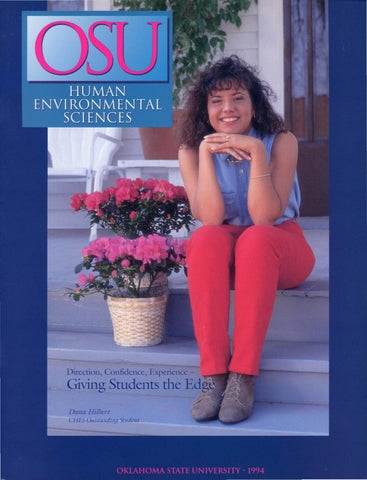
Direction, Confidence, Experience -
GivingStudentsthe Ed • Dana Hilbert CHES Outstanding Student
bridge. nd.
Dean Patricia Knaub
I
Connections
am prnud to introduce the fast magazine from the College of Human Environmental Sciences. We felt it important that this inaugural issue highlight the vital connections occmring within and without our college. From research partnerships with industries to leadership opportmlities for future professionals, we are building b1;dges among students, alumni, faculty, businesses and friends. In this issue, you will find stories about faculty and student mentoring, internship experiences and concerned individuals bringing real-world knowledge and skills into the classroom. Each instance explored connects us to vistas far beyond the classroom. It is our hope that this magazine will help you connect with our students, faculty and vision for the future. From its birth in a chemistry laboratory over a centmy ago, HES has a rich tradition of applying scientific principles to the study of individual development in specific environments. Its related fields are ever mindful of the relationship between humans and their environments at work, home or play. Those studies have expanded over the years to include multicultmal and global perspectives. Looking outward, it becomes evident that today's complex society strains the services which address critical hw11an issues. The hw11an environment suffers in this shortfall; and therefore, the need has never been greater to understand the interrelationships between people and their social, physical and natural enviro11111ents.
Our graduates have the knowledge and skillsto ease this strain, to balance available assets against these critical needs and solve some of today's most pressing issues. They are learning to: • promote and contribute to human development and healthy family functions, • improve human nutrition and health, • design and manage environments, • and organize and deliver products and services in ways that improve quality of life. We prepare HES students to address these problems at community, state, national and international levels tlu·ough teclmical lmowledge and leadership skills tl1ey hone while at QSU. At ilie same time, our faculty are committed to innovative teaching and the discovery of new lmowledge tlu·ough outreach and research. The cycle continues to benefit all within it. As tl1e 21st century approaches, CHES is positioned to be a leader in creative solutions to human environmental concerns, and tl1ese solutions will contribute to a better quality of life. Developing and maintaining vital connections with stakeholderssuch as you is our goal with tlus publication. It is one of tl1e many ways we can ensme om continuing viability and quality in the classroom and ultimately in service to all tl1ose who share our human environment. ~
CONTENTS 1STCENTURYTECHNOLOGY Hard drives and spectrum analysis - new equipment puts the student in the driver's seat along the information superhighway.
VOLUME1
1994
A AGEMENT MATERI L
Director of Extension and Development
Challenging programs within the college are developing leadership skills and giving students the edge in today's job market.
Debra Engle Editor
Jennefer R. Tolbert Art Director
Valerie C. Kisling
HE SILKROAD
Photography
Andy Max:ey
A trip to China and Hong Kong helps a professor breathe life into her classes.
CHES Magazine is a publication
of the Oklahoma State University College of Human Environmental Sciences. Its purpose is to connect this college with its many stakeholders, providing information on both campus news and pertinent issues in the field of human environmental sciences.
ALLIN A DAY'SWORK Preparing students for work and life is a full time job. Two professors reveal their schedules and their philosophies of educating yow1g adults.
©Oklahoma State University 1994
■■ IE ■ ■ Oklahoma State University in compliance with Title VI and VII of the Civil Rights Act of 1964, Executive Order 11246 as amended, Title IX of the Education Amendmentsof 1972, Americans with Disabilities Act of 1990, and other federal laws and regulations, does not dis• criminateon the basis of race, color, national origin, sex,age, religion,disability,or status as a veteran in any of its policies,practices or procedures. This includes but is not limited to admissions, employment, financialaid and educationalservices. This publication, issued by Oklahoma State University as authorized by the College of Human Environmental Sciences, was printed by The Audio Visual Center, University Printing Services at a cost of $10,731.00. SM/April/94. #9076
OF NOTE
m EXTENSION
■ ■ iE RESEARCH
~OF NOTE ■■ I
New Faculty
On Track
J
im Groves traded in his Hawaiian shirts for an OSU ball cap and a chance to develop as a professor. He's just one of the members of the Faculty Scholars Program, a
In workshops and seminars throughout the year, new faculty network with established professors and discuss the role of scholarship at OSU and other land grant universities. They learn how to con-
they make valuable contacts and learn about grant opportunities. This program is the main reason Jim Groves, an assistant professor in the School of Hotel and Restaurant Administration, accepted a position at OSU. "The Faculty Scholars Program was one of the biggest factors in coming to OSU," says Groves, who came to OSU from the University of Hawaii after teaching there for a year. "I interviewed at several w1iversities before I chose OSU, and none of the other miiversitieshad a program like this one .... The support, both financially and otherwise, was here at OSU. "I don't know of any other m1iv:ersityoffering a program like this."
Jim Groves, hotel and restaurant administration assistant professor, left Hawaii for OSU and the Faculty Scholars Program in Human Environmental Sciences.
2-year-old project that helps new faculty adjust to the academic setting and grow as effective scholars and teachers. New faculty are expected to teach, attract grants, conduct research, join committees and counsel students. But taking on all that responsibility without a guiding band can be a little intimidating, so the College of Human Environmental Sciences launched a program to help new faculty in these endeavors.
2
~
College of Human E1miromnentaL Sciences 1994
duct research with federal, state and private organizations, how to maintain contact with these groups, and how to develop teaching strategies and self-evaluation processes. They also learn the role of extension and public service in developing and disseminating their research findings. Another big part of th~ program is the college-sponsored trip to Washington, D.C., where faculty meet with representatives from federal and u·ade agencies. There
Groves says each faculty member in the program has a different su·ength, and he feels their exchange will help participating faculty members balance themselves. "There is a need to balance your teaching with yow- research and to conduct research that will derive some benefit to your st:ltdents and the public in general.If you can do all that, you'll be a successfol professor." ~ DEBBIEBASORE
""'
CHESAssociates
Looking to theFuture ince 1991, the CHES Associates have volLmteered time and expertise to guide the college and students on a course into the fumre. The group provides leadership and insightinto industry needs, assists in recruitment and promotes growthwithin the college.
S
Servingas chairperson th.is year is Jan Moran, a fow1eling member of the CHES Associates and a 1979 design, housing and merchandisinggraduate. Moran, area managerfor external affairs with SouthwesternBell Telephone, says,"It is critical to the college and the students that we plan for the future." Gerald Rottier, former CHES Associateschair and president of the furnitme company GRO Inc., agrees.He says cuniculum must be on the cutting edge and always lookingto the futme. "You've got to educate students to be problem solversand to survive in a cl1anging atmosphere." In the past the CHES Associates have developed design competitions, lighting labs, computeraided design labs and mentoring programs to address these needs. Moran says they con~nue to generate ideas which keep the college at the forefront of education. This year's goals are: • to increase scholarship and overall financial support for the college
Gerald Roulet and Jan Moran, post and present choirs for the CHES Associates, discuss the group's future goals on the way to the January CHES Associates meeting.
• to increase the involvement of CHES Associates and industry professionals in the classroom • to expand the Mentor Program • to encourage and facilitate more faculty development and interaction with outside organizations • to advise the college on its comm mucation • to assist the college in sponsoring alum11.imeetings, and • to increase the representation of CHES alunuu and Associates on LUUversity and OSU F0tmdation comnuttees. ~
....
DOTTIEWITTER
Senior Hotel and Restaurant Administrationmaior Brandon Wolff and chef David Cross relax after working together at Hospitality Days' festivities. Since meeting through the Visiting Chefs Series, Wolff and Cross have developed both a personal and professional relationship. A 1985 HRAD graduate, Cross is the executive chef at the Adam's Mark Hotel in Kansas City, Mo. He is also Wolff's mentor. Cross involves Wolff in his work whenever possible and recently invited his younger counterpart to assist him in the kitchen at the Ninth Annual Midwest Regional Grape and Wine Conference in Osage Beach, Mo. Wolff expects to complete his apprenticeship with Cross after graduation and says he appreciates the advice Cross gives him.
~OF NOTE TECHNOLOGY AND TRAINING
New
Equipment Enhances Curriculum century ago students would never have envisioned the tools their modern counterparts would use to learn their trades. Contemporary students can analyze minute amounts of minerals in a substance, design and view a three-dimensional, computer-generated model of an office interior, or use computers to reinvent restaurant ·management. All this is thanks to state-of-the-art equipment recently added to the college.
4
~
CollegeofHmmm E1111irom11c11trrl Sciences 1994
Interior design maior Marci Hamburger {left}and Jeri Sharpe, a facility planning maior, examine computer-generated floor plans using the new CAD lab computers.
HOTEL AND RESTAURANT ADMINISTRATION The School of Hotel and Restaurant Acunin.isu-ation(HRAD) recently acquired a new tool tl1at makes it a leader in ilie nation for technology and education in tl1e hospitality industry. The MICRO'S Point-of-Sale Touch Screen System, networked tlu·ough tlu·ee HRAD restaurants, allows the wa.itstaffto enter guests' orders on a touch screen. The program tl1en automatically sends tl1ose items to tl1e kitchen and subu·acts tl1e ingredients from inventory lists. In addition to alerting managers when inventory is low, tl1e software can also reorder supplies, track employees' schedules, complete payroll and monitor item
popularity information for managers to access later. "It is a management tool and a labor-saving device," says Ray Kavanaugh, HRAD director. Kavanaugh says he is not aware of any otl1er school in tl1e nation having tlus kind of technology integrated into tl1e curriculwn. Even most restaurants are not tlus well equipped, he says. "Maybe two restaurants out of 100 have tlus technology, but our students see it in operation." The system, funded in part by Atl1erton Restaurant Systems Inc., will assist restaurant managers first, and tl1e data will be used later in courses tl1roughout tl1e curriculum.
DESIGN,HOUSING AND MERCHANDISING In the department of design, housingand merchandising, computer-aideddesign (CAD) capabilitiestogether with the lighting labrankOSU as a showplace of cutting-edgetechnology. LindaFisher, assistant professor of interiordesign, is responsible forimplementation of the new CADlab. She says learning the processwillsave students time and energy."As designers, they will be ableto draft their concepts on the computerand do all the sketching that would usually end up on a draftingboard." Another benefit of CAD, alreadyused by mechanical engineersand interior design firms, is itsprecisionto detail. This helps reduceerrors in commLuucation whendesigners, architects and
clients are working together. It helps each person visualize the end results. With CAD, designers and architects simply can u·ade discs tlu·ough the mail for a quick exchange of ideas. They can illustrate everytlung from lighting sources to color and perspective as well as give realistic images of wood, marble, ceramics and fibers. "The students are really interested because they realize tl1ey must have tlus skill to be successful in tl1e job market," Fisher says. The lab soon will be available to students of apparel design and apparel merchandising. Eventually, it will be used in almost all deparunental courses.
NUTRITIONAL SCIENCES New equipment in tl1e nutritional sciences department also lets students ride tl1e wave of a teclmologically complex future. Far more man analysis of a food's vitamin and mineral content, tl1e sn1dy of nutrition strongly impacts tl1e fields of healtl1 and medicine, says Barbara Stoecker, professor of nutritional sciences. Witl1 more tlian 100 undergraduates and 60 graduate students, HES' nuu·itional sciences department is preparing students for tlus rapidly growing field with high-tech equipment, fiber optics and a major lab renovation plan. One of me advanced pieces of equipment is tl1e new gamma cow1ter. Donated by Founders of Doctors' Hospital, it measures hormone levels and enables students to deternune tl1e effects of trace minerals on carbohydrate and bone metabolism. Tlus information is increasingly important for researchers sn1dying various disease states, such as tl1ose fotmd in cancer patients and burn victin1s.
"Also, nutrition is getting more attention in terms of its impact on preventative medicine," Stoecker says.
MomodouCeesay, a senior hotel and restaurantadministrationmajor fromGambia,demonstrates the MICRO'S Point-of-SaleTouch Screen Systemthatsaves restaurantslime and money.
"These.sn1dies on nunerals all have some relationslup to healtl1 and disease, wluch the sn1dents will need to know as tl1ey go to medical school or work as dietitians, in research labs or teaching." ~ ..... JANET VARNUM
Okln/Jomn. State U11i11ersity ~
5
'Career Empowerment Opportunities TheCEO Plan - Equipping Studen'IS for theFuture mpowerment is the latest self-help buzzword, but one cannot just preach empowerment and expect it to change an individual. Instead, the key is to equip people and then help them seek their goals. Apply this concept to today's graduates, entering a job market where simply having a college degree is often not enough. The College of Human Environmental Sciences recognizes students' needs in this area and has designed career empowerment programs to augment the curriculum and help them reach their potential, giving students opportunities to ask questions and address new challenges in a safe environment. Over the past several years the college has developed internship programs to help students gain insight and skills for their careers. It is encouraging leadership to show students they have what it takes for the "real world." And a mentoring project now fosters relationships between students and professionals in their fields. The goal is to help students develop skills that will make them marketable and enable them to grow, both personally and professionally, throughout their lives. The test of these programs comes in their application, and the students on the following pages are proof these efforts have changed lives.
6
~
College ofHm,urn Em1iromne11tnl Sciences 1994
Leadership Opportunities Dana Hilbert is a non-traditional student in many ways. As the recipient of the HES Outstanding Student Award, she is a leader who has resolved to get all she can out of college. As a wife and mother, she is balancing more than most "traditional" snidents would drean1 of and tearing down barriers in the process. Hilbert is a senior majoring in fanruy relations and child development. Among other activities, she is the secretary of Mortar Board, president of the FRCD Club, advisor for the HES Freshman Cmmcil and a volLmteer for the Stillwater Domestic Violence Center. She is also on the Student Council and two HES honoraiies, Kappa Omicron Nu ai1d Phi Upsilon Omicron. Despite appeai·ai1ees,Hilbert had some trouble adjusting to college life. Coming from the small town of Walters, Okla., she was a little intimidated at first. Hilbert took a semester off to regroup and get married. But when she renu-ned, she had a new outlook. Hilbert was determined not to fit tl1e stereotype of a disinterested, inactive smdent, tl1e stigma often associated with being mar1ied while in college. So she got involved witl1 tl1e Off-Campus Student Association. Then cai11emore work witl1 tl1e SGA, where she was furtl1er encouraged by tl1e people armmd her. Gradually, Hilbert's self-confidence began to grow. Now she is motivated by challenges.
Outstanding Student Dana Hilbert with her scholarship sponsor, •
Jan Moran.
Left: Taking a respite from her busy schedule, Dana Hilbert enioys a relaxing spring afternoon with her daughter, Ryan.
~ 7
Internship Programs Two yea.rsago, Hilbert applied for and received the Lahoma Club Scholarship. It was the first competitive thing she tried. When she applied for the Outstanding Smdent Awa.rd a year later, it was simply for practice and as a confidence-building tool. But by then she knew better than to wait and wonder if she were qualified. She was more than qualified. Hilbert received that award and the Jan Moran Leadership Scholarship as pa.rt of the package. But this recognition came with even more responsibilities. As the outstanding smdent, Hilbert represents her pee.rs as a member of the Dean's Speakers Bureau and on the CHES Associates Executive Committee, an advisory group which participates with faculty and students in charting the college's future. "That (Outstanding Student Award) was one of the biggest things to happen to me because it has led to so many oppo.rnmities," she says. "It was really a boost - a little motivation to keep me going on tl1e right u·ack." She continued on tl1at patl1 last summer as a child life intern at St. Francis Hospital in Tulsa. "I came back so pumped up and motivated," says Hilbert, who now plans on a career in pediatric nursing. "I tliink sometliing inside of me says nursing is where I really should be." Using her experiences botl1 to gain funu·e skills and as a practice rw1 for life after college, tlus 21year-old says she is experimenting with what she can handle. "It's a good time to figure out what I like .and what I enjoy and what I'm good at," she says. Hilbert recog1uzes tl1ese opportunities a.re allowing her to explore tl1e possibilities al1ead. "I want to take it all in before I go. I'm starting to realize tl1ere's more to success tl1ai1just having a degree."
8
~
College ofHmnnn Em,iromnentn,/ Sciences 1994
Michael Park got more tl1an he bargained for when he took ai1internship witl1 an a.rclutectural firm in Tulsa. What began witl1 research ai1drunning errands led to some great experiences and even a job offer five months before graduation. Last spring, HES provided tlus design, housing and merchandising major with the names of several firms in Tulsa. Park sent out resumes and accepted a summer internship with Integrated Space Design. He never expected tl1e level of training he received; but because of his assertiveness, he was pleasantly surprised. Park, who plai1sto work in lighting design, surprised !us supervisors when he finished his assigned tasks early ai1d requested new projects. "I got tlrrown into otl1er projects, where other interns before me had not finished tl1ei.rfirst tasks." He tlunks tl1ey had ai1incentive to offer 11.ima job: "I was tl1e first intern tl1at made them any money." Witl1 his salary at $6 ai1hour, Park acn1allymade tl1e compai1y a profit, he explains. Tlus internslup will not be tl1e only ming tl1at makes Park a marketable commodity after graduation. So will the fact he won tl1e Southwest Design Lighting Competition. His original design for a domed elevator lobby with indirect lighting took !um to Chicago and introduced him to many potential employers along the way. He isn't sure where he would like to begin his career - maybe in me Midwest, maybe in tl1e Northwest. But Park does know tl1at he has a head start in landing a great job. The internship program pushed him to try for !us goals a little early.In tl1e process he learned a valuable lesson. When you wai1t a great job experience, he says, "You just have to go get it."
The Mentor Program MichelleOverstreet and Kay Stewart have a uniquerelationship. More than just friends, they are mentorand protege. But sometimes it is difficult to teUwho has which role. The Mentor Program is designed to pair .interestedstudents with professionals who can answer questions,help them prepare for careers and offer opinionson important decisions. Stewart, who heads the program, says the job isn't justgiving advice to college students exploring their fi.itures."Th.is relationship is two-sided, and the mentorsget a lot out of th.is too," says the owner andpresident ofHomeCall. Overstreet, who is 20, went through the .interview processand asked organizers to choose a mentor for her.Some students, however, take the opportwuty to recruittheir own from visiting chefs, alwmu or contactsin the field. Stewart says the Mentor Program, whichnow includes 23 pairs, has been as good for the college as it has for the students. The two meet as often as they can at Mexico Joe's, to talk, discuss events and explore their futures. The kind of relationship they have is exactly what CHES hoped to accomplish through tl1e program. Overstreetrenunds Stewart what her time and effort do for the students in the college, and Stewart has beenable to help Overstreet on botl1 a personal and a professionallevel, more tl1an an academic advisor evercould. When Stewart was chosen as her mentor, she gave Overstreet contacts ·in every field. And she continues to help her dunk tl1rough career decisions. "Every time we meet she has good advice, but she doesn't giveit as advice. She has a neat way of teaching," says the familyrelations and child development major. "We'llstart out visiting tl1en talk about what we've been doing .... We always have a lot to share." ~ JENNEFER TOLBERT
Top: Senior design, housing and merchandising major Michael Park made such a big impression as a summer intern at Integrated Space Design that they offered him a job. Above: Michelle Overstreet, a family relations and child development major, and Kay Stewart, the owner and president of HomeCall, enjoy the benefits of the Mentor Program as they gab over lunch.
Oklaboma. State Univenity
~
9
THEHIGH ROAD TO ■ ■ ■
tudents aren't the only on~s r~ceiving career empowerment opporturulles 111 the College of Hmnan Enviromnental Sciences. Assistant Professor Shiretta Ownbey learned about international trade, Pacific Rim markets and the impact of cultural differences on marketing last swnmer as part of a professional development program in China.
S
Ownbey participated in the Hawaii International Program (HIP) sponsored by the University of Hawaii at Manoa. Dming the six-week program, Ownbey studied with other clothing and textile professionals to learn about operations and marketing in China and Hong Kong. Ownbey, a faculty member in the department of design, housing and merchandising, was fortm1ate enough to garner a fellowship for the progran1. She spent a week studying ~~th the group in Hawaii before leaving for Beijing, China, where they stayed at the Beijing Agricultural University. From there the HIP traveled to Guangzhou in the southern Chinese province of Guangdong and later to HongKong. • "We did the typical things any tourist would do, but spent most of our time traveling to places like textile factories, seeing fabric produced," she says. "It was fascinating to see the amount of work done by hand." Ownbey says she was impressed by the vast cultural differences between Western and Pacific Rim coLmtriesand the impact these differences have on manufacturing and business transactions.
IO
~
Collegeof Humn.n En11froumentalSciences 1994
Assistant Professor Shirefta Ownbey discusses the international trade and manufacturing differences she encountered while studying in China and Hong Kong through the Hawaii International Program.
As the internship coordinator for apparel merchandising and design, Ownbey knows the value of this type of development opportunity. The 11·iphas already impacted her life and teaching. Ownbey says the program gave her some practical experiences and a new perspective on the impact of the culture on trade that she is now taking into the classroom. "I've llied to do a better job in my classes when we tallc about international trade of showing the importance of cultural values." The trip, she says, taught her a lot about clothing and textiles merchandising in the area and how to compete in and ~th other.markets. "We, and every other coL111t1·y, should make no assLm1ptionsabout people having the same business practices that we have, and we should be willing to learn about other cultures and operate with them on their basis." ~
....
W
hile many min01ity groups may be underrepresented il1the job market, one OSU program is working to improve employmentoppornmities for Native Ameticans. TheNative Ame1ican Community- Based EmployabilitySkills Program, admmistered by the School of Hoteland Restaurant Administration (HRAD), helpsprepare Native Americans for careers in the hospitalityil1dustry.
MINORITY PROGRAM IS
HRADDil·ector Ray Kavanaugh says the program consistsof two mail1 components: providmg participantswith work-world information and experience, anddeveloping il1terpersonal skills. "The il1tegration of these skills into one u·ainmg programemphasizes the need for individuals to tmderstandhow to deal with il1terpersonal and culturalissues in the workplace and at home," says Kavanaugh.This knowledge will enable participants to learnskills necessary for an improved quality of life,he says. HRAD developed the curriculum with significant inputfrom representatives of the five North Cena-al OklahomaAmerican Indian Nations and Tribes. Fundedfor tlu·ee years by a $255,000 grant from cl1eDepartment ofHealtl1 and Human Services Officeof Minority Health, tl1e program also received inputfrom Oklal1oma hospitality il1dusuies and communityrepresentatives. Kavanaugh says tl1e trailm1g includes il1su·uction in self-confidence, self-assessment, attitude, wellness, communication skills, employer expectations, work opporumities and resume development. Today,plaimers have reached an irnporta11t turningpoint as OSU relenquishes some of its responsibilityto the nations a11dtribes. Evenma!Jy tl1ose participatil1gwill have complete control. Autonomy is important, accordmg to Sylvia Gaiko,an HRAD assistant professor involved in tl1e program. "Because-the educational components of cliisprograrn are specifically geai·ed for Native America11s, it is only fitting tl1at tl10se doil1g the trainingshai·e tl1e saine cultural background as tl1e participantswhenever possible." The program's long-term success will depend on cl1ea.J110Lmt ofu·ibal, commwuty and indusa-y support generated, says Kavanaugh. "Implementation of tl1e progran1 will mark a.11 importa.J1teducational partnerslup between tl1e Oklahoma Native American community, OSU a11d Oklahoma-based business and indusu·y." ~ ..... DEBRA BASOREAND ANN JENKINS
-I
■■■
At a recent session in Pawnee, administrators helped show representatives from participating Native American nations and tribes how to run the future job training programs. From left: Ray Kavanaugh, HRAD director and grant director; Muriel Robideaux, educational director for the Pawnee tribe; Franklin Mclain, member of the Tonkawa JTPA; Sylvia Gaiko, assistant professor and grant investigator; and Tom Fields, trainer from the state Vo Tech.
.Piecing Thzngs Together W
hile the effects of social changes on family relationships and individual development are questioned throughout the nation., Carolyn Henry is searching for clues to the puzzle. Her research examines how family environments affect adolescents.
Henry, an associate professor of family relations and child development, studies family systems and how interaction within families affects human behavior during adolescence. "To me, adolescence is very critical because it's the time you develop the kind of skills that will help you function effectively throughout your life," she says. A $34,000 grant from the Lilly Endowment, a private fow1dation concerned with promoting youth development, will advance her work and possibly lead to additional resources for future studies. The grant will enable her to develop vignettes and produce videotapes which demonstrate certain simations where individuals need help. These will be shown to adolescents to elicit responses on how they would respond to similar situations. As an exan1ple, a skit might show an adolescent who is rejected by a potential date at a social event. Subjects would be asked how they would respond in such a situation. Their answers can then be compared to information about their own family systems to see if certain va.iiables within families have an effect on behavior.
"If you wa.i1tto Lmderstand the behavior of one rson, you need to understand the behavior of all memb ·sin that person's fa.inilysystem as they interact together," she says. "The relationship patterns in families help set the stage for relationships outside the fa.inily." H~r research has developed out of a lifelong fascination with what makes people tick, a fascination she developed while COLL11seling students at Pepperdine University. It was there she bega.i1to notice that family backgrow1ds seemed to have a great influence on their decisions a.i1dbehavior. At the time, only a few pioneers were researching fa.inilysystems; however, Henry knew these scientists were on to sometlung. "I wanted to lea.i·nmore about how fanuly dyna.inics impact tl1e development of adolescents a.i1dymL11gadults," she says. Henry hopes her findings will someday help tl1erapists, parent educators and other professionals as they work to improve tl1e quality of family life. But will scientists ever.be able to tell families exactly what to do a.i1dwhat not to do if tl1eywant tl1e perfect child? "Absolutely not," she says. "There a.i·etoo many otl1er va.i·iables.You ca.i1't just say tl1at if parents are more supportive, tl1eir children will turn out a certain way. ... But you ca.i1always improve dungs by trying to learn more about huma.i1behavior and its consequences." ~
....
NESTORGONZALES
How fa.i11ilies have bonded, the kinds of emotional ties they've developed, their adaptability to cha.i1gea.i1dsu·essful situations, parenting styles a.i1d parent-adolescent commwucation are all factors that may influence how an adolescent responds to acertain situation, she says. 12
~
Co/Jcgcof Humrm Euvironmwta/. Sciences 1994
Illustration: Jeon Erickson,PoulFleming
DRUGSAND THEBODY
--
-· . -=: ..--· ':.
-· .
\{\,-\-\-\
Effectsand Interaction ost people don't think nvice about how overthe-counter medications may affect their body's mineral content. But researchers in the nutritional sciences department have. They are studying the effects of several commonly used medications, such as calciLUn supplements, antacids and aspirin, on the body's ability to absorb and excrete minerals.
M
BarbaraStoecker, nutritionalsciences professor, and Tracy Chen,nutritionalsciences graduate student, analyze samplesfor mineral content.
"People are nonchalant about taking over-the-counter drugs," says Barbara Stoecker, professor of nutritional sciences, "but just because medications are over-thecounter doesn't mean they don't have side effects. One side effect to a common item Stoecker exanunes is chromium deficiency. "We have fOLmd that calcium carbonate, which people commonly tal,e as a calciLU11 supplement, impairs absorption of chromium, one of the essential nutrients that regulates glucose tolerance," Stoecker says.
•••
Working with nutritional sciences graduate students and Subbial1 Sangial1 in the College of Veterinary Medicine, Stoecker· found that some antacids drastically reduce chromiwn absorption while aspirin greatly enhances it.
Stoecker and otl1ers are studying the effects of tl1ese medications when they are taken at normal doses over an extended time period. The elderly and women, who as a group spend hLmdreds of tl1ousands of dollars each year on tl1ese medications, may be at 1isk for tl1ese undesirable side effects. Eva!uating tl1e effects of tl1ese types of drugs is important because certain symptoms of chromium deficiency are problems that put individuals at 1isk for heart disease. Questions abOLmd, however, about tl1e wisdom of using chromitm1 supplements to cow1ter these effects. Instead, Stoecker suggests whole-grain products and red meats as a natl1ral somce for chromium. Once tl1e interactions between drugs and nuu·ients are known, tl1e side effects people have when they take various drugs will be understood and perhaps avoided, Stoecker explains. "With many drugs, we know what tl1e intended pharmaceutical action is, but not tl1e additional effects on tl1e absorption of essential nutrients," she says. "Side effects can be important in the overall healtl1 of a person." ~ JANETVARNUM
Oklabomri State U11i1,ersir:y ~
13
■■■
Almost every individual at some point in life has encountered a true teacher, one who could change an outlook with a simple question or lead students to their own discoveries through curiosity. It is most professors' dream to be tl1at kind of educator, to be one who is able to touch lives while expanding minds. But the preparation and research a professor must w1dertake to fulfill that dream is overwhelming. For every hour spent in a classroom, tl1ere are countless hours of outside work, library and laboratory research, and writing at tl1e computer. According to national surveys, professors invest more than 50 to 60 hours a week in the eductional system.
14
~
Collegeof Human E1111iro11meutalScienccs 1994
Witlun Hwmu1 Environmental Sciences tl1ose hours are devoted to teaching and research disseminated in indusuies, governmental agencies and tl1e classroom. Professors' responsibilities can include two to five hours a week on Lmiversitycommittees and significant work in service to associates. Add to tl1at advising and professional activities, and a professor's devotion to learning becomes increasingly evident. The professors on tl1e following pages represent some of tl1e best in instruction and learning. Spend a day witl1 tl1em and see how tl1eir work continues to help students and this wuversity excel. •
LauraHubbs-Taitis on the phone helping a student find references for a term paper. "Now what angle do you want to take with this research?" she asks. She rattles off a few names to tl1e student and then excuses herself. This associateprofessor in family relations and child devlopment is in between meetings, and it's been a busy day so far. On paper, Hubbs-Tait's appointment is 50 percent teaching and 50 percent research. To see her in action, it seems as though both are full-tin1e responsibilities. She has research in every stage of tlie pipeline and recently had tv.ropapers accepted for journals. She probably would be pleased if she had time to clunk about it.
Mornings at the office start between 7:30 and 9:00 a.m., and her routine includes2-5 hours a week of class preparation. Hubbs-Tait's undergraduate class thissemester, which meets tvv'icea week, isSocial,Emotional and Language Development in Early Childhood. In her classes, Hubbs-Tait has a reputation for challenging her students. "I'm verydemanding of intellectual rigor and criticalthinking capacity," she says. Afternoons hold research tasks and officehours. Hubbs-Tait also spends a lot of time with her freshman research scholar,Susarn1eMorse, observing children and their behavior patterns in various situations, teaching her how to code and analyze the data, and helping her present that information. Throughout the week, Hubbs-Tait saysshe spends about 25-30 hours teaching and the same on research. She never leavesbefore 5:45 p.m. What's not finishedat the office, is attacked for several hours after a dinner usually cooked by her husband, a history graduate student. Her children, who are 8 and 11, have come to Lmderstand the meaning of homework. So in the evenings when they aren't at soccer gan1es, the family settles in for some time in front of the books. Her office is a mess. Hubbs-Tait, who has a master's and Ph.D. from Boston University,says she is incredibly organized mentally, balancing deadlines for researchand lectures for classes. But her physicalspace, she says, has to wait for her to clean it up on the weekends. Teaching and research may seem like a fullload, but Hubbs-Tait refuses to stop there. She is active on the University Honors Committee, the University Library Conm1ittee and a research support group in the college. An additional load of 25 undergraduate advisees, one Ph.D. candidate and one master's candidate rOLmdsout her duties. Balance seen'ls to be the key for Hubbs-Tait. Although her 60-hour work week may be more than some can handle, the research allows her an escape and helps her relate the practical to the theoretical. "It's easy to teach because I'm very current," she says. "In fact, I don't think I'd be nearly as effectiveif I were not still active in research.... I wouldn't be as enthusiastic if not for the research to color the classroom expetience and vice versa. It all fits together."
■■■
Rick Bartholo1new is living proof that those who can do -teach. His work in the design industry overflows into the classroom and benefits all involved.
As the owner of a downtown Tulsa design firm, Bartholomew works with architects and interior designers on residential and contract work two days a week. On the other three days he commutes to Stillwater to teach as an assistant professor in design, housing and merchandising. After working full time for tlu·ee years, Bartl1olomew re-entered tl1e design world on a part-time basis to stay abreast of tl1e field. "The interior design profession is very challenging and demanding. About tl1e only way to keep in touch is to work in it," says Bartl10lomew, who worked in tl1e industry for 14 years before becoming a teacher. "The students also seem to respect you more because you can bring your experience from private practice into tl1e classroom." Now, each day before most students are even clunking about getting out of bed for class, Bartl10lomew is in his car making tl1e 70-mile trek to Stillwater from Tulsa. He arrives at 8 a.m. "After the hour-and-a-half commute on tl1e turnpike I'm usually refreshed and prepared for tl1e day," says Bartl10lomew, wlio even keeps a tape recorder in tlie car so he can work on tl1e way. His morning routine includes preparing for Ii.isclasses and labs. Bartl1olomew teaches one or two classes and a lab every semester. Tli.issemester 11.isteaching assignments include a basic grapli.ics for interior designers course, a class on presentation teclui.iques, and a course on designing interiors using 16
~
College of Humau En11iro11me11tal Scimces 1994
arcllitectural and interior design treatments. He also teaches some advanced studio classes. In addition to tli.isteaching load, Bartl1olomew helps coordinate the interior design program, serves as faculty advisor for the student chapter of the American Society of Interior Designers and works with students in the interior design labs. Projects for the National Endowment for the Arts and the Oklahoma Center for the Advancement of Science and Technology consume another 25 percent of his time. Witl1 11.ishectic schedule it's impossible to get everytli.ing done from 8 a.m. to 5 p.m. But long hours are just a reality in any business today, says Bartl10lomew. It's a point he tries to stress to his students. Many of Bartholomew's class assignments come from Ii.iswork experience, from projects he's handled for past clients. "It gives students an opportunity to see what it takes to design something for a client," he says. His students also gain practical experience from a furniture design competition held each fall. This year the Leevera Pepin Endowment and Gerald Roulet Orga.ti.ization Inc. are sponsoring it. First the students design a piece of furniture. Then they present tl1eir design to a panel of industry representatives who select witmers in each category. The winners have their funi.iture fabricated and are itwolved in the entire process. If he's not working on class items or coordit1ating tl1e program, Bartholomew can be fow1d on the phone contactit1g various industries to make more opportunities available for students and faculty. "The partnersli.ips we form witl1 private industry are vital to our program and students." ~
....
RiclcBartholomew
honoring. • • re College of Human Environmental Sciences would liketo congratulate the 1994 CHES Almmii Award recipientsCarolyn Cotton, Gary Sieland, D. Allen Wint, LisaC. Shanley, Brandon Birkhead and the following Hall of Fame inductees:
B. June Gilliam B. Jrn1e Gilliam has been inducted into the CHES Hall of Fame based on her achievements and longstanding service to this college and the university. Gilliam is the owner and intetior designer for Gilliam Design Associates, a commercial and residential planning organization with offices in both Stillwater, Okla., and Carefree, Ariz. Listed in Baron)s Who)s Who in Interior Design and the National Registry of Outstanding Residential Designers, Gilliam has created Stillwater area interiors such as the historic Berry home, the Board of Regents offices and the Kappa Alpha Theta house. This 1969 CHES intetior design graduate also holds a master's in interior design from OSU. Although Gilliam doesn't talce credit for doing anything more than "stirring the waters" for CHES' programs, she recognizes the impact alm11niinvolvement makes. Her commitment to the college is exemplified by the projects she and her firm have chan1pioned in the past. "We've done a lot of things for the program because we're such believers in it."
Your membership
in the osu A1Lll111U Association benefits the College of Human Environmental Sciences. Alun111iinvolvement, both financial and personal, makes possible a host of programs wluch emich our students' educational experience. The OSU Almmu Association and the College of Hm11an Environmental Sciences - Working together to build the future.
Esther Winterfeldt Esther Winterfeldt is the head of the department of Nutrition and Dietetics at the Houston Health Sciences Center at the University of Texas. Her induction lughlights the dedication she has shown CHES over the years. Winterfeldt, who holds bachelor's and master's degrees in dietetics and human nutrition from OSU, as well as a doctorate from The Ohio State University, has worked at universities for much of her career. She says acadenua was a nanu-al progression from her early work in adrni11istrationand hospital dietetics, and enjoys knowing her efforts benefit others. "Over the years I have worked with a lot of students and fmmd it reaUy fulfill.ing." A former president of the ADA, Winterfeldt has held several positions at OSU including associate dean for research, regents professor and professor and head of the department of food, nuuition and instin1tional administration. She remains active as a CHES Associates member. ~
Todd Anderson, Senior, Hotel and Restuarant Adminisu·ation
Nothingmakesyou appreciatea scholarship likeputting yourselfthroughschool. I know, because there were times when I worried about making the rent, much less tuition payments. But I believed in the value of education, and there were people out there who believed in me. Thanks to the Oklal1oma Restaurant Association and the College of HtUnan Environmental Sciences, I received a scholarship that eased the bmden and opened many more doors. Looking back, I realize that transferring to OSU and this college gave me opportunities I never imagined. I've opened up, learned how to talk to people and become more confident. I'm so grateful to the many individuals who gave to th.is college and helped change my life.
Your investment in the College of Human Envirorunental Sciences helps students like Todd achieve their goals. Together we can educate a new generation for the future. For more information on how you can help the college contact Debra Engle, director of extension and development, at (405) 744-65 71.