The official magazine of the Robert M. Kerr Food & Agricultural Products Center, Oklahoma State University
fapc.biz
spring/summer 2013
fapc.biz
contents
spring/summer 2013 volume 8 | issue 1
Managing Editor/Designer Mandy Gross | mandy.gross@okstate.edu Editors Rebecca Bailey | rrbaile@ostatemail.okstate.edu Dorothy Pugh | dorothy.pugh@okstate.edu Michael Baker | michael.j.baker@okstate.edu Robert M. Kerr Food & Agricultural Products Center | Oklahoma State University 148 FAPC, Stillwater, OK 74078-6055 405-744-6071 | 405-744-6313 FAX www.fapc.biz | fapc@okstate.edu
12 meat processing
IP through IP
Photo/©Leigh Loftus, ThinkLeigh Photography 2012
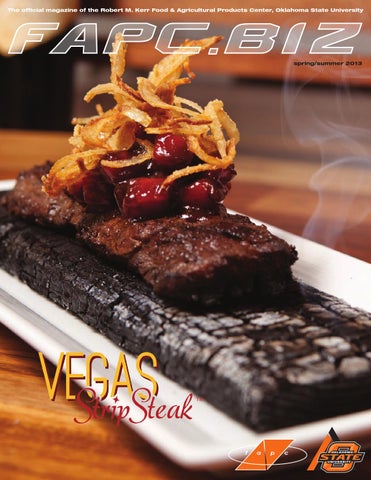
The discovery and announcement of a new single-muscle beef steak called the Vegas Strip Steak by Tony Mata and FAPC triggered an abundance of discussion, specifically in the area of intellectual properties. The process used to extract the new steak is protected by intellectual property rights and is patent pending.
3 director’s comments Tracking trends
14 oilseed processing Value-added opportunities
4 client success Same sauce. Different story.
16 food safety Got “raw” milk?
18 product development 6 foundation focus Barbecuing versus grilling New machine is all the “squeal” 8 industry perspective Customer satisfaction
20 food processing Write it down
9 business & marketing A new shopping experience Crumbs from the kitchen Think outside the box
22 quality management Verification, validation
Oklahoma State University, in compliance with Title VI and VII of the Civil Rights Act of 1964, Executive Order 11246 as amended, Title IX of the Education Amendments of 1972, Americans with Disabilities Act of 1990, and other federal laws and regulations, does not discriminate on the basis of race, color, national origin, gender, age, religion, disability, or status as a veteran in any of its policies, practices or procedures. This includes but is not limited to admissions, employment, financial aid, and educational services. Issued in furtherance of Cooperative Extension work, acts of May 8 and June 30, 1914, in cooperation with the U.S. Department of Agriculture, Oklahoma Cooperative Extension Service, Oklahoma State University, Stillwater, Oklahoma. This publication is printed and issued by Oklahoma State University as authorized by the Vice President, Dean, and Director of the Division of Agricultural Sciences and Natural Resources and has been prepared and distributed at a cost of $2021 for 700 copies. 0513
2
It is during this time of the year that articles in food industry magazines disclose expected consumer trends that will kick in during the year. These “new” trends are expected because of the convergence of many different weather, economic, agricultural, political and demographic pressures on what consumers are wanting or willing to eat and where they are wanting or willing to eat it. Recent trends include the intense interest in ethnic foods. A recent study showed 90 percent of consumers between the ages of 25 and 34 have a preference for ethnic foods and enjoy the home preparation of ethnic foods. According to another study, millennials are food adventurers, have a quest for knowledge and want to know about the food they eat, both at home and in restaurants. Still, more recent consumer studies have shown many people are choosing foods with their personal health and fitness in mind, things like leaner meats, chicken and foods that deliver fewer calories. Other foods associated with fitness, health and wellness are hot, too — items that can be described as hormonefree or reduced-sodium. Other studies point out consumers are under economic constraints and buy to maximize their available food dollar. Their preferences are focused on less expensive cuts of beef and pork, including roasts and other less expensive, slow-cook cuts. Other trends important to consumers include foods that contribute to sustainability, convenience, mobility, transparency (in labeling and traceability), general lifestyle choices or foods that reflect the nature and persona of the purchaser. The obvious item that isn’t in any of the above consumer trends is the search for and purchase of safe and wholesome foods. Consumers make the assumption the food they purchase is safe and wholesome. Certainly, it should be that way. To everyone in the
TrackingTrends
director’s comments
food processing industry, it is known that processors are in the business to deliver foods that consumers want, and all of the production focus is on the delivery of specific foods with orders complete and arriving on time. However, the amount of effort and resources associated with food safety is extensive, and it may now be the single largest cost component of the internal product cost other than those costs directly associated with actual food production. At the Robert M. Kerr Food & Agricultural Products Center, we place quite a focus on food safety and safe food processing. In the part of our mission that relates to the support and growth of the Oklahoma food industry, a significant effort is made in food safety. Technical assistance projects that in some way relate to food safety and workshops and training programs that relate to food safety make up at least half of the time and resources of FAPC. FAPC has developed a strong core competency in the knowledge and skills needed to produce safe food. Global Food Safety Initiative programs, Hazard Analysis and Critical Control Points regulatory programs, and other safe food topics are offered to train and support the Oklahoma food industry to compete in the North American and the global marketplace. If you need assistance in product development to capture a particular market trend or food safety information to comply with regulatory or third-party audit programs, please call FAPC at 405-744-6071. We will be pleased to assist you in all of your product development, food safety or manufacturing needs.
By Roy Escoubas, director roy.escoubas@okstate.edu
3
client success
From its start as a mere kitchen concoction in 1947, Head Country Food Products Inc. has flourished into a successful, internationally known company, thanks to a 66-year-old barbecue sauce recipe, hard work and some help from FAPC. Oklahoma’s No. 1 selling barbecue sauce has experienced a lot of success since its establishment, including receiving the 2013 Governor’s Award for Excellence in Exporting and the U.S. Department of Commerce Export Achievement Certificate. “We are very pleased to receive this award,” says Paul Schatte, Head Country co-owner. “We have worked
Head Country goes from topping Oklahoma taste buds to enhancing barbecue plates around the world.
4
diligently to grow our international business. It is a pleasure to provide a taste of Oklahoma on a global perspective.” The annual governor’s award recognizes successful Oklahoma firms for significant efforts to increase export sales, which means more jobs and enhanced economic development in the state. While the Oklahoma company has built a name for itself, it took time and hard work. Recipe creator Donovan “Bud” Head developed Head Country Original BarB-Q Sauce in Shidler in 1947. In 1977, Donovan sold his recipe to his nephew, Danny Head. Production moved to
client success
Photo/Mandy Gross
Ponca City in 1982, where 150 cases were sold in the first year. It took more than five years for Danny Head to make a profit, but he stuck with it. “The perseverance Danny Head had in the early years personally making deliveries and sales directly to many of their grocery accounts played a big factor in their success,” says FAPC business and marketing relations manager Chuck Willoughby. “I also believe that Paul Schatte demonstrates that same perseverance and dedication as Head Country’s founder, Danny Head. He is creative, forwardthinking and strategically minded.” Head Country’s facility is triple the size it was in 1994 as a result of four plant additions. FAPC began working with Head Country in 2001 to assist with its second expansion. Since then, FAPC has assisted with product development and equipment identification for its salsa line and provided assistance and feedback for its social media and marketing strategy. “I think a lot of their success can be attributed to the efforts they put into marketing their products,” Willoughby says. “They understand the value of marketing directly to consumers at events such as the Oklahoma and Texas state fairs.” One of FAPC’s biggest contributions to Head Country was its assistance in creating a food safety plan, Willoughby says.
“FAPC has played a considerable role in Head Country’s development of a food safety plan to include Hazard Analysis and Critical Control Points plan assistance, internal plant audits and customer-driven food safety programs,” Willoughby says. “During the second quarter of 2012, FAPC assisted Head Country in meeting British Retail Consortium criteria to meet Global Food Safety Initiative compliance requirements by one of its major customers.” Following these protocols has made it easier for Head Country to engage international customers. “Implementing and following BRC regulations have helped us maintain and gain retail and food service business,” Schatte says. “BRC standards are the regulations the international trade readily accepts. By having this level of certification, we are able to penetrate the international market without any hesitation from foreign customers.” Head Country first caught the attention of international customers through its participation in barbecue competitions. Consequently, word of the award-winning sauce spread far and wide, and in 1999 the company made its first export to Germany. In 2006, Head Country was approached by an interested Sweden-based company and began exporting in spring 2007. Today, Head Country exports 43,000 pounds of barbecue sauce to Stockholm per month.
“Americans are enjoying our ethnic foods from around the world,” Schatte says. “While outdoor cooking is the oldest style of cooking known to mankind, the U.S. has perfected the method. The rest of the world is eager to learn about what we can do.” Not only has FAPC helped Head Country, but Head Country has also been a significant supporter of FAPC. “Paul Schatte has served on FAPC’s Industry Advisory Committee since 2007 and is currently the chair,” Willoughby says. “In addition, foundation contributions from Head Country have totaled nearly $100,000. We are fortunate to work with Head Country and look forward to a continued relationship.” Much has changed since the start of the company, but the one thing that remains the same is the recipe. The beloved recipe is the same as it was 66 years ago, with one exception — Head Country now uses Worcestershire sauce without anchovies. “We have stayed true to the recipe with that one little tweak, and people love our sauce,” says Head Country co-owner Danny Head. By Rebecca Bailey, communications services graduate assistant rrbaile@ostatemail.okstate.edu
5
foundation focus
FAPC is living high on the hog after the recent donation of a state-of-the-art combination hog scalder and dehairer to its meat pilot plant. There are multiple steps involved in processing swine, and one involves the removal of hair. Jake Nelson, FAPC value-added meat processing specialist, says this piece of equipment is used for just that — to remove the hair from freshly harvested pork carcasses.
ONATION
Photo/Mandy Gross
6
“This step is important for a number of reasons, but primarily because pork carcass dehairing is the traditional and accepted method of dressing pork carcasses,” Nelson says. Gary Crane, owner of Ralph’s Packing Co., an Oklahoma meat company in Perkins, donated the machine, valued at approximately $27,900. Ralph’s Packing is no stranger to FAPC as they have been working together since the inception of the center in 1997.
In addition, Crane is a member of FAPC’s Industry Advisory Committee, which serves as an advisory board to the center. For more than 50 years, Ralph’s Packing has processed and sold fresh meat products, but now has turned its focus to creating high-quality, fully cooked products. “We processed beef and pork at our plant, but after thinking about it for a long time, I came to the decision to stop harvesting and focus on further processing,”
foundation focus
Crane says. “So, in July 2012, we ceased all harvest operations.” However, Crane, who had always received his pork from the Oklahoma State University swine farm, says there was still a customer demand for OSU-raised pork. “I was getting great pork from the OSU swine farm,” Crane says. “The swine farm has a good line of hogs, and I had customers who wanted OSU pork.” To meet his customers’ needs, Crane worked out a plan with Kyle Flynn, FAPC
Cutting-edge technology continues to assist FAPC’s mission of adding value to Oklahoma. meat pilot plant manager, that benefited both Ralph’s Packing and the center. “I reached an agreement with Kyle at FAPC,” Crane says. “He would harvest hogs for me each week, and we would transport them to our facility for further processing. However, it wasn’t long after when Kyle told me the plant’s equipment was old and wearing out and wasn’t sure how much longer we could keep this going.” It was then that Crane came up with the idea to donate a new machine to FAPC. “We came to the conclusion that if FAPC had a new machine, we could keep harvesting hogs,” Crane says. “So I ordered the machine, had it delivered to FAPC, and I am still getting my hogs. It all just came into place.” Nelson says the previous machine was purchased in the ’80s, and although it was a tough machine, it was time to update. “The old machine was really starting to show signs of its age and use, and it often required moderate to heavy maintenance in order for it to function properly for our needs,” Nelson says. Nelson says the new machine has control features that augment user comfort, including electronically timed controls that allow users to pre-program the water heating function. “Previously, employees were required to be present at very early hours of the morning to pre-heat the water,” Nelson says. “With the new machine, we can program the heating function to start automatically, without an immediate user interface.” The new machine brings with it added bonuses, especially in terms of safety. “Not only is this piece of equipment state-of-the-art, but it also offers many safety benefits,” Flynn says. There is a protective lid that is opened and closed using pneumatic power, as well as an automatic feature that conveys the dehaired carcass onto a scraping platform, Flynn says, compared with manually
operating the old machine with human physical force. “These extra safety features were not incorporated in our previous machine, so these new additions are great for preventing potential safety hazards during processing,” Flynn says. In addition to these benefits, Crane says this device will serve as a valuable educational tool for students. “It will be a great educational aid to FAPC,” Crane says. “FAPC teaches students the process of taking a product from the start, beginning with the live animal, all the way to the finished product. This piece of equipment will help FAPC and the OSU swine farm to continue conducting research and keep the line of education going for students interested in this area.” Chuck Willoughby, FAPC business and marketing relations manager, says the support of companies benefit the center in many ways. “Equipment donations can be very beneficial to FAPC,” Willoughby says. “These donations can help us better afford to carry out the mission of FAPC. The budget woes in recent years have caused us to learn how to do more with less. However, there is a point that you must have a certain level of resources in order to be effective. Donations, whether cash or in-kind, help provide us the resources so we can effectively deliver the mission of FAPC.” Willoughby says it can be challenging to purchase large or expensive equipment, so donations are always appreciated. “We are grateful for Gary Crane’s generosity,” Willoughby says. FAPC hopes to go whole hog with this new addition, and continue to stay on the forefront of cutting-edge value-added processing and technology.
By Rebecca Bailey, communications services graduate assistant rrbaile@ostatemail.okstate.edu
7
industry perspective
AWG is raising the bar on customer satisfaction using new technology. At Associated Wholesale Grocers in Oklahoma City, we believe that we’re made up of “Families, Serving Families, Serving Families.” AWG exists as a family of associates serving independent grocers across the country, which are often family businesses that serve the families within their communities. We strive to keep costs down for our members by constantly improving efficiencies within our operation. New technology is helping us improve our efficiencies. Recently, we installed a new transportation and routing software package called CamsPro. Our third-party carrier, Greatwide/Cardinal, also has installed the same package. By sharing the same software, AWG can better see where our trucks are at any given moment. We are all looking at and referencing the same information in real time. We’ve also added new GPS and onboard-computer technology so we know exactly when a truck arrives and departs from a location. After all, it’s critical that a retailer’s truck arrives on time; having employees wait around for a delivery is not productive. With the on-board computers, we can track this much more closely than in the past. Both Greatwide/Cardinal and AWG have centralized job functions, resulting in additional cost reductions. Having historical and up-to-the-minute data at our fingertips also allows us to track patterns with drivers, vendor locations and delivery times. Before the new software, investigating a store’s concern meant many phone calls, which usually took longer than
8
desired. Now, the information can be seen in an instant, meaning questions and concerns can be addressed more effectively. This technology improves our industry-leading warehouse management system, DigitalLogistix, which was implemented in 2009-10. DigitalLogistix has made numerous efficiencies in our operation. Stores have seen a large improvement in the accuracy of their deliveries. No system is foolproof, but the DigitalLogistix system makes the put-away, let-down and selection processes much
more accurate, giving more precise service to our retailers. Getting the stores what they order, when they order it and delivered in good condition allows them to focus on the families who shop in their stores, resulting in “Families, Serving Families, Serving Families.” By Nancy Addington, Associated Wholesale Grocers manager of transportation nlund@awginc.com
business & marketing
Grocery shopping has changed drastically in the last few years. While the stiff competition for shoppers is nothing new, today’s options offer more variety and choices than ever before. It wasn’t long ago that price was the main consideration for customers, but that’s not necessarily the case anymore. Today’s data indicate shoppers value selection, convenience and customer service over price when deciding where they will shop. The majority of today’s shoppers are much more educated about the food they purchase. Some grocers are helping their customers learn even more by providing registered dietitians to educate and advise shoppers in making healthier selections and offering diet plans. Most stores are spending a tremendous amount of time training their employees in effective customer service and the ability to answer questions about the manufacturers or products in the various departments. Offering a wide variety of food is also vital, many grocers are discovering. As more health-oriented stores such as Whole Foods Market and Sprouts Farmers Market enter the Oklahoma market, neighborhood stores are expanding their selections to remain competitive. A growing number of new grocery stores in Oklahoma are providing a completely new ambiance for their customers in their design and artistic features to make the shopping experience more pleasant. The new stores offer fresh seafood flown in daily, complete bakery and deli departments, expanded floral departments, meat departments that offer such specialties as dry aged beef and organic beef as well as special cuts at customers’ requests, salad bars, olive bars and even eateries with wide selections of entrées. Convenience is important for consumers when shopping. Some will choose the ability to find all their purchases at one or maybe two locations when deciding where to shop. Others,
Photo/Mandy Gross
however, have turned away from the so-called big box stores, saying they’re less welcoming with long checkout lines, distant parking, lack of selection and few knowledgeable employees, and are again shopping at their local grocery stores. Whether it is an independent store owner, a small group of stores or a chain, managers study shopping trends in order to determine what’s expected of them and their stores. The majority of successful retailers are savvy to new products that drive customers to their stores, including apps for their phones, instant in-store coupons and such social media outlets as Twitter and Facebook. There were 3.5 million employees working in supermarkets in 2012, according to the Food Marketing Institute. The U.S. average store size in 2012 was 46,000 square feet and carried almost 39,000 items. By Jim Brooks, business and marketing services manager jim.brooks@okstate.edu
9
KITCHEN
business & marketing
FAQs FAPC
Gluten-free food products are a big trend right now. Can I manufacture a gluten-free product in a facility that makes food products that contain gluten?
It is ideal to process gluten-free products in a certified gluten-free facility, but due to many factors, this is rarely an option for many companies. The Food and Drug Administration has yet to finalize regulations for gluten-free food items, so there are currently very few rules in the Code of Federal Regulations for gluten-free products. The Food Allergen Labeling and Consumer Protection Act of 2004 requires manufacturers to list the presence of eight major allergens, including wheat, on a product’s list of ingredients. It is not recommended to make gluten-free bread products at a place such as a flour company, but it does not violate any regulations to do so. Any facility or co-packer chosen to make the gluten-free product, must have a designated sanitation and Hazard Analysis and Critical Control Point plan, as well as a way to document verification throughout the process. This includes checking with all suppliers and obtaining a letter of guarantee that their ingredients are gluten-free. Separate areas and equipment are also a good idea, if possible. Having a good plan and documentation to support practices are a must to help ensure a gluten-free food product, no matter where it is produced. For more information about allergens, attend FAPC’s Food Allergen workshop on June 18, 2013. Register online at www.fapc.biz/workshops/foodallergen or contact Karen Smith at 405-744-6071. Registration for the workshop is recommended, as space is limited.
I have taken some beautiful pictures of my products and want to post them online, but I am afraid someone will copy them and use the photos without my permission or won’t give me credit for my ideas. How can I stop this?
When you post something on the Internet, just about anyone can see it, so the rule stands — if you don’t want the public to see it, don’t post it. However, you can put an electronically generated watermark on the photos to help alleviate the problem and give credit to your photos. You can place information such as your brand name, website or caption on the photo and then “lock it,” so if the photo is copied the watermark will remain until you take it off yourself. This is easy to do and can be done for free on many websites such as Pikmarkr (picmarkr.com), Watermarktool (watermarktool.com) and Alamoon (alamoon.com). These sites allow you to upload pictures and do basic watermarking. If you want a more advanced version with more features, you can upgrade for a small fee.
10
By Andrea Graves, business planning and marketing specialist andrea.graves@okstate.edu
business & marketing
Think outside the box Can’t judge a book by its cover? Perhaps, but packaging is a different story. A package is one of the most essential attributes of a product. Packaging has much to do with a product’s safe transport and use as well as attracting and informing customers. Let’s review a few attributes of packaging and why they are so important in the development of a product. Let’s start with the box in which it is shipped or stored. Containers that products are shipped in must meet certain requirements to ensure products are not damaged in shipping or during loading or storing of a pallet. The box is tested to determine at what point it will fail to ensure the product can arrive safely to the consumer. The exterior container also must be able
to handle the storage conditions. For example, if a product is stored in a cool or cold area, it must meet certain moisture resistance requirements to guarantee it will maintain its integrity. What about ensuring the product is safe? Whether the container is glass, plastic or cardboard, it must have some way to show the product has remained unopened since being produced. A lid may have unbroken shrink wrap or an unpopped safety button to prove it is still sealed. These reassure consumers that the products they are purchasing are safe. Packaging contains information that’s vital to a customer’s informed decision. As an example, let’s look at a jar of grape jelly. The packaging identifies the product, lists the ingredients and offers information on its serving size and nutritional values. Due to requirements by the Food and Drug Administration or the U.S. Department of Agriculture, a food label is consistent in location and content.
Marketing may be the most obvious part of the importance of packaging, as one of its primary objectives is to attract the customer. The average customer often chooses a product in mere seconds. With millions of choices available, how does the consumer find and choose your product off the store shelf? Packaging. Not only does it need to be attractive to the consumer demographic you are trying to reach, it also needs to be both memorable and easily recognizable. One example of packaging that fulfills all those attributes is the Coca-Cola bottle, one of the most recognizable packages in world. A consumer reaching for a bottle of Coca-Cola knows what it is just by the shape of the bottle.
By Erin Johnson, business and marketing client coordinator erin.joy.early@okstate.edu
11
IP
meat processing
IP
Briefly, intellectual property (IP) is any creative work or invention considered to be the property of its creator/inventor. The Internet Protocol (IP) is the primary protocol that establishes the Internet. Within the past year, there has been an abundance of discussion and perhaps at an increased rate about the first IP executed through the second IP, thanks in part to actions of FAPC and the Vegas Strip Steak. Tony Mata and FAPC announced the discovery of a new single-muscle beef steak called the Vegas Strip Steak™ to a national audience of meat processors and purveyors in April 2012. The announcement and marketing efforts were bold, yet appropriate and effective, a bright and lively announcement of something neat and fun. The announcement was accompanied by pictures of the illuminated Las Vegas skyline and a musical performance, communicating the feel of being in Las Vegas. And so, in a matter of about 15 minutes, the world began to meet the Vegas Strip Steak.
12
Scrutiny followed the short-lived fun of announcing a new beef steak. Humans have been dominating beef for eons. How could we only now find a new steak? The scrutiny magnified when it was announced the process used to extract the new steak was protected by IP rights (specifically, the process is patent pending). So while the venue for the announcement of the Vegas Strip Steak™ was ideal, the response to it was both overwhelming and surprising. Online articles, blogs, entries and debates addressed our intelligence, motives, intentions, reasoning and sanity, as related to protecting something as simple and essential as food. Let’s consider a sampling of article titles, the result of an Internet search about the topic (we added the emphasis): Oklahoma university wants to patent a new steak. Oklahoma State University tries to patent a steak.
meat processing
Can you patent a cut of meat? Can you patent a steak? The U.S. Patent and Trademark Office will decide on the patent application. My opinion is that most people would agree with the following sentiment: This IP (or any other IP) will never demonstrate value to the creator/inventor unless the creator/inventor can demonstrate value to the user. Does the industry need another beef steak? As economists like to say, that is for the market to determine. It is our opinion that the Vegas Strip Steak™ is very similar in appearance and eating experience to the well-known and well-established New York Strip steak. If a lot of people agree with our opinion (i.e., the market), then we could confidently believe the value of the Vegas Strip Steak™ to the consumer would be similar to the value of the New York Strip steak.
The following model might help us understand how the market sees the Vegas Strip Steak™. Utilizing prices reported by the Agricultural Marketing Service of the USDA, the muscle used to make Vegas Strip Steaks™ generally contributes about $13.50 to the total dollar value of a beef carcass. After considering fabrication yields, balance of the parts and labor/packaging costs, our analysis says the finished products could contribute $17 to the total dollar value of a beef carcass or $3.50 added value to each carcass simply by generating the Vegas Strip Steak™. One small hint to the nuts-and-bolts of this model is that the dollar value per pound of the finished Vegas Strip Steak™ is linked to the reported dollar value per pound of a 180 strip loin (i.e., beef strip loin). Those skilled in the art realize a significant yield loss is suffered when converting the strip loin into strip loin steaks. Accordingly, strip loin steaks are priced higher per pound than the subprimal from
which they came, and thus, tying the finished Vegas Strip Steak™ dollar value to the value of a 180 strip loin value (which needs to be further fabricated into steaks) is a very conservative approach. So who should reap the benefit of the added value? The answer is everybody along the supply chain. If additional profit cannot be demonstrated to and realized by the packer, the further processor, the distributor, the food service operator and the restaurant patron, then logically the IP cannot work because there is no value in it. It is up to the inventors to demonstrate this added value to the users of the IP. Maybe we can even demonstrate the value of the first IP using the second IP. If you happen to read an archived version of this article through our website, then I suppose we have partially accomplished that.
By Jake Nelson, value-added meat processing specialist jacob.nelson@okstate.edu
Photo/©Leigh Loftus, ThinkLeigh Photography 2012
The announcement of the Vegas Strip Steak triggered many discussions, specifically in the area of intellectual properties. The process used to extract the new steak is protected by intellectual property rights and is patent pending.
13
oilseed processing
VALUE-ADDED Diversification of the traditional wheat-fallow cropping system is vital for sustainability of the entire crop production system in Oklahoma. The traditional cropping system is subject to the problems of monoculture systems, including insect, pest, weed and disease infestations. Introducing alternative or rotation crops can alleviate these problems. The introduction of winter canola, which is grown in rotation with winter wheat, has been very successful. Canola production is growing rapidly in Oklahoma. According to the USDA National Agricultural Statistics Service, 140,000 acres of canola were planted in the state in 2012, up from 60,000 acres in 2010. Canola production not only benefited farmers, but also provided opportunities for processors in the state. Producers Cooperative Oil Mill in Oklahoma City is currently processing both cotton and canola seeds, utilizing the excess processing capacity that resulted from reduced cotton seed production in Oklahoma and the neighboring states. The recent announcement of the construction of a new canola crushing facility in Enid, Okla., will certainly encourage more farmers to consider oilseeds as not only rotation, but also as alternative crops for diversification and higher financial returns. The expansion of the local oilseed processing industry could lead to other value-added product development opportunities such as edible grade cottonseed and canola oil
14
production and formulation of oil blends for various food applications. Crops with very high oil content such as crambe (28 to 32 percent), yellow mustard (30 percent oil), Ethiopian mustard (38 percent), brown or oriental mustard (40 percent oil), camelina (44 to 46 percent oil), flax (45 percent oil) and jatropha (50 to 60 percent) are alternative oilseeds with good potential for bioproduct manufacturing, including in food, biofuels and other industrial bioproducts such as lubricants and plastics. For example, crambe contains a very high amount of erucic acid that is used to produce erucimide, a slip and antiblock agent for polyolefin films. Meal from oil extraction can be fed to cattle. Camelina is rich in polyunsaturated fatty acid such as linolenic acid, which is valuable as a renewable feedstock for the oleochemical industry. Establishment of a new crop production and processing system requires a multidisciplinary approach. Crops, varieties and agronomic practices suitable for Oklahoma and processing options for technical and economic feasibility need to be investigated for successful implementation. The Oklahoma Oilseed Commis-
sion could facilitate such an initiative and promote collaborations between OSU and FAPC staff with the technical expertise in the field, farmers and entrepreneurs in the state. Expansion of specialty crop production and processing also would stimulate value-added product development initiatives in the state. The Specialty Crop Competitiveness Act of 2004 and the Food, Conservation and Energy Act of 2008 have defined specialty crops as “fruits and vegetables, tree nuts, dried fruits, horticulture and nursery crops that are intensively cultivated and used by people for food, medicinal purposes and/or aesthetic gratification. Processed products shall constitute greater than 50 percent of the specialty crop by weight, exclusive of added water.” The limited scale of production in the country or a region also defines specialty crops. Hence, an unusual crop or exotic species or new or uncommon varieties of common species can be classified as specialty crops. Quality also could be used to categorize a product as a specialty item. Although it is difficult to define quality, in general terms, it usually refers to freshness, appearance, taste and chemical or nutritional composition. The products that are produced, handled, processed and formulated with special care and produced for specific consumer segments, a new or niche market offers a price premium over commodity products. Sometimes the specialty crop market entry may just depend on the producer’s ability to find a buyer
oilseed processing
willing to pay a higher price to guarantee a supply for a specific application. Soybean is a good example of a crop that is widely grown as a commodity product and can be grown and processed as a specialty product. Genetically modified or engineered soybeans were developed to simplify weed control. Initially, production of genetically modified crops reduced the use and adverse environmental and health effects of the herbicides. Unfortunately, just like antibiotic resistance developed in bacteria, herbicide-resistant weed populations flourished due to constant exposure to the same herbicide over time. As a result, some farmers stopped planting genetically modified soybean seeds, switched to traditional varieties and started using other weed management practices. Meanwhile, consumers who are wary of genetically modified ingredients have created a market for non-genetically modified foods. To meet the market demand, some farmers grow non-genetically modified soybean under contract with companies or distributors for production of specialty products such as edamame, tofu, soymilk, natto and others. Organically grown crops receive a price premium as well. Organic production is not a new practice. It has been practiced in the U.S. since the late 1940s. However, a rapid growth in the organic food market during the last decade has led to the establishment of an organic certification industry. Today, there are more than 40 private organizations and state agencies serving as certifiers. The certification standards and the claims and language allowed on product packages, labels, logos and seals may vary with the certifying agency. For example, some agencies may permit or prohibit different pesticides or fertilizers in growing organic foods. USDA’s Agricultural Marketing Service issued National Standards on Organic Agricultural
Production and Handling (NOP rule) on Dec. 21, 2000. The standards in the NOP rule are similar to most of the standards organic producers and distributors use and are intended to be flexible to accommodate the broad range of operations and products grown in the U.S. The Organic Foods Production Act and the NOP rule require agricultural products labeled as organic originate from farms or handling operations certified by a state or private agency that has been accredited by USDA. Neither the Organic Foods Production Act nor the NOP rule addresses food safety or nutrition. The NOP rule prohibits the use of genetic engineering, ionizing radiation and sewage sludge. According to the Oklahoma Department of Agriculture, Food and Forestry records, there are more than 120 certified organic producers, processors and distributors in the state. Vegetables, fruits, herbs, nuts, small grains, hay and livestock are the most common organically grown products. Although the current processing activity in the state encompasses mostly milling and repackaging of the organically grown products, there is ample capacity in Oklahoma for formulation and production of new and high-value products from organically grown crops for specialty products market. Small-scale production can be economically viable for the products designed for high-end niche markets because of the price premium these products receive. For example, organically grown nuts, sunflower and germ separated from organically grown wheat can be mechanically crushed to produce organic oil, which can then be
formulated as specialty and/or gourmet oils and salad dressings after light physical refining. Residual low-fat protein and/ or fiber concentrate after oil extraction can be utilized as ingredients in other food products such as protein bars. Organic herb growers could use easy to operate and inexpensive steam distillation systems to extract essential oils for higher financial return on their investment. The product and processing ideas mentioned in this article can be commercialized by individuals or producer cooperatives and do not require handling hazardous chemicals or a large capital investment. The Made in Oklahoma Coalition is an excellent example of the growing trend of “thinking, being and buying local.” I do believe that many other opportunities, i.e. recovery of health beneficial extracts from grape pomace, berries and wheat germ and bran and extraction of grape seed oil, exist to expand the value-added productmanufacturing sector in Oklahoma and strengthen the MIO Coalition. FAPC staff is here to help with your value-added product development and commercialization initiatives and provide technical support. Find out how we can help by visiting FAPC’s website at www. fapc.biz or calling 405-744-6071. By Dr. Nurhan Dunford, oil/oilseed specialist nurhan.dunford@okstate.edu www.ams.usda.gov/AMSv1.0/scbgpdefinitions www.oda.state.ok.us/forms/law/organic.htm www.oda.state.ok.us/food/ogl.pdf
Photo/Todd Johnson
15
food safety
go
The sale of raw milk is a contentious issue as it pits health regulators against private industry. In Oklahoma, a bill (HB 1541) is being considered that would expand raw milk sales to include delivery by farmers to consumers in addition to on-farm sales. I don’t think you need to guess where I stand as a food microbiologist. I am curious if those small farms that sell raw milk understand the legal jeopardy they place their operations
16
under by doing so. I can see the litigation challenge on the tails of a foodborne illness traced back to their operation: “Do you know there are health and safety concerns with raw milk? Do you know that pasteurization technology currently exists that can eliminate those health concerns? And in spite of that, you still choose to sell raw milk, endangering the health and well-being of your consumers who trust that you are providing a wholesome product?”
food safety
ot “raw” milk? Milk is one of the most natural foods, probably because it is one of the first foods that most newborns, whether human or animal, experience. Marketing efforts for milk play up its healthy and wholesome image — nature’s perfect food — whether it’s the winner of the Indianapolis 500 drinking from a bottle of milk or the “Got Milk?” mustache campaign. Almost all of the milk purchased by consumers today is pasteurized. Pasteurization was developed by Louis Pasteur in 1864 as a method to heat a sample below its boiling point in order to preserve substances longer by destroying the microorganisms that would spoil or degrade them, both liquid and solid. Although easier to apply to liquids, this process soon became widespread in Europe and the United States. Commercial pasteurization of milk started in the United States in the early 1900s; in 1908, it was mandated for milk sold in Chicago. In 1928, the U.S. Public Health Service developed the Standard Milk Ordinance (now the Grade A Pasteurized Milk Ordinance, PMO) for voluntary pasteurization of milk. The state of Michigan required all milk for sale be pasteurized in 1948. Milk pasteurization time and temperatures initially targeted Mycobacterium bovis, which causes tuberculosis, but those conditions did not adequately inactivate Coxiella burnetii, which causes Q fever. Current acceptable pasteurization conditions are 145 degrees Fahrenheit for 30 minutes or 161 degrees Fahrenheit for 15 seconds. Other more prevalent concerns for pasteurization would be the elimination of animal-associated foodborne pathogens such as Salmonella, Campylobacter, Listeria, Staphylococcus, E. coli O157:H7 and others.
Although milk sold through commercial stores and used in restaurants is required to be pasteurized, nonpasteurized milk may be purchased directly from the farm. Drinking nonpasteurized milk puts consumers at risk of illness from any of several animal-associated foodborne pathogens. In 2005, an Oklahoma farmer sold nonpasteurized milk from a dairy cow that was later found to be rabid. At least 45 consumers went through a regimen of rabies vaccinations to stave off the disease, according to the Tulsa World. Although those sales were legal, it stands to reason that a farmer who knowingly provided an at-risk nonpasteurized food could face legal ramifications if patrons got sick. An historical comparison by Adam Langer and others published in 2012 showed almost two to three times as many outbreaks with nonpasteurized milk consumption as with pasteurized milk, considering the disproportionate amount of product sold and consumed for each type. Also, from 1973-2009, the Centers for Disease Control reports that among dairy product-associated outbreaks in which product were identified as pasteurized or raw, 82 percent were due to raw milk or cheese. In 2011, the National Association of State Departments of Agriculture released its raw milk survey of all 50 states. Results include: • While 30 states allow the sale of raw milk including Oklahoma, 20 states prohibit the sale to consumers (Alabama, Alaska, Delaware, Florida, Georgia, Hawaii, Indiana, Iowa, Louisiana, Maryland, Michigan, Montana, New Jersey, North Carolina, North Dakota, Ohio, Tennessee, Virginia, West Virginia and Wyoming).
•
Of the 30 states that allow the sale of raw milk, 12 states permit retail sales at stores away from the farm (Arizona, California, Connecticut, Idaho, Maine, New Hampshire, New Mexico, Nevada, Pennsylvania, South Carolina, Utah and Washington). • The other 18 states including Oklahoma allow the sale of raw milk, but only directly from farms. In early 2012, dozens of people in four states became ill with Campylobacter gastrointestinal infection after drinking raw milk from a dairy in Pennsylvania. Visit tinyurl.com/cdc-rawmilk to read a research article by CDC-affiliated scientists and doctors compiling data for outbreaks related to nonpasteurized dairy products. By Dr. Peter Muriana, food microbiologist peter.muriana@okstate.edu
Adam J. Langer, Tracy Ayers, Julian Grass, Michael Lynch, Frederick J. Angulo, and Barbara E. Mahon. 2012. Nonpasteurized Dairy Products, Disease Outbreaks, and State Laws—United States, 1993–2006. Emerging Infectious Diseases, 18:385-391. www.rense.com/general69/rabdies.htm — Tulsa World article on the dairy cow with rabies.
17
product development
barbecuing grilling
18
product development
It may be an exaggeration to say that there are as many variations of barbecue as there are stars in the night sky, but tall tales (along with warm weather and beer) are an integral part of the U.S. tradition and institution known as barbecuing. Exaggerations aside, there actually are a heck of a lot of types, both within the U.S. and around the planet. People probably started roasting meat shortly after the discovery of fire; therefore, some would argue, people have been barbecuing for a very long time. However, others would argue that cooking the parts of a woolly mammoth that a saber-toothed cat left behind doesn’t necessarily equate to barbecuing, at least not in the modern sense. Low, indirect heat during a prolonged period of time defines and differentiates barbecuing from grilling, which is typically considered as high, direct heat for a short time. There is also a difference in the cuts of meat used between these two cooking methods. Barbecue’s best results are achieved with larger, fattier cuts of meat because the low and slow method allows tougher, cheaper cuts to become tender and flavorful as tendons and connective tissue are broken down, while fat and gelatin help to baste the meat. Grilling, on the other hand, benefits from thinner cuts that are tender because the meat sits closer to the higher temperature heat source, which causes it to sear and cook quickly. However, the low and slow definition of barbecue is not universal. For example, Korean barbecue would be considered as grilled by U.S. standards, as the food is cooked faster at a higher temperature. The “low and slow” mantra may be the only point of agreement among barbecue aficionados in the U.S. because much of everything else about the cuisine is deeply rooted in regional tastes and preferences. While it’s
worth keeping in mind that there is a bit of overlap, there are some distinct geographic differences. For example, eastern North Carolina-style barbecue uses finely chopped pork as the meat, hickory or oak as the fuel source and vinegar-based sauce. Piedmont, N.C.-style barbecue uses pork shoulder as the meat, hickory or oak as the fuel source and a vinegar-based sauce that contains tomatoes. South Carolina-style barbecue uses pork as the meat, hickory or oak as the fuel source and a mustard-based sauce. Georgia-style barbecue uses pork as the meat, oak or hickory as the fuel source and a ketchup and molasses sauce. Alabamastyle barbecue uses pork ribs or pork shoulder as the meat, hickory or pecan as the fuel source and either tomato-based or mayonnaise and vinegar-based sauces. Memphis-style barbecue uses pork ribs and pulled pork as the meat, hickory or oak as the fuel source and a tomato and molasses-based sauce. Kansas City-style barbecue uses beef, pork, chicken or turkey as the meat; hickory, oak or pecan as the fuel source; and a tomato-based sauce. East Texas-style barbecue uses pork shoulder and ribs as the meat, hickory or oak as the fuel source and a tomato-based sauce. West Texas-style barbecue uses beef brisket as the meat, mesquite as the fuel source and a dry spice rub as well as a thin tomato and vinegar-based sauce or none at all. So, it’s possible to use just about any type of meat, whether it walks, flies, swims or crawls, and call it barbecue. You can flavor it with a vinegar-based sauce, tomato-based sauce, mustard-based sauce, mayonnaise-based sauce or even a dry spice rub and call it barbecue. However, if you slap it over an open flame and fully cook it within the time it takes you to finish two cans of your favorite frosty beverage — remember, that’s not barbecued, that’s grilled. By Dr. Darren Scott, sensory specialist darren.scott@okstate.edu
A Barbecue Revival. www.foodproductdesign.com/articles/2012/08/a-barbecue-revival.aspx, Douglas J. Peckenpaugh. Aug. 23, 2012. Barbecue: From Pit to Production. www.foodproductdesign.com/articles/2009/07/barbecue-from-pit-to-production. aspx Kimberly Decker. July 21, 2009. Barbecue: The History of an American Institution. Robert F. Moss. 2010, The University of Alabama Press, Tuscaloosa, Ala. Capturing Korean Cuisine. www.foodproductdesign.com/articles/2010/12/capturing-korean-cuisine.aspx Jason R. Gronlund, Dec. 23, 2010. Right on “Q.” www.foodproductdesign.com/articles/2001/08/right-on-q.aspx Kimberly Decker. Aug. 1, 2001. Savage Barbecue: Race, Culture, and the Invention of America’s First Food. Andrew Warnes. 2008, The University of Georgia Press, Athens, Ga.
19
food processing
20
food processing
By David Moe, food process consultant david.moe@okstate.edu
21
Verification
quality management
Understanding the concepts of verification and validation within Hazard Analysis and Critical Control Points and the food safety management schemes for the Global Food Safety Initiative have been challenging for all processors regardless of their size or experience. “The most misunderstood and most difficult HACCP principle is the establishment of verification procedures,” says Kevin Keener of Purdue Extension in a fact sheet about verification programs. “Many very small processors establish a HACCP plan that simply does not effectively prevent contamination of the product. Why is the plan not effective? Their plan usually does not contain proper verification steps, thus they have no idea if it is working.” Verification is an umbrella term and is best understood when it is broken down into separate parts: HACCP verification, prerequisite program verification and validation. HACCP verification activities are to be included in the HACCP plan summary and define what the verification is, who will do the verification, and how often the verification is completed. At a minimum, verification is defined as: 1. The direct observation of monitoring. An example is one employee watching another employee take a temperature. The purpose is to
22
verify the employee taking the temperature is doing so based on the written procedures in the standard operating procedure. Is the employee using a calibrated thermometer, is the thermometer placed in the appropriate location of the product, such as the thickest part of a meat product, and does the employee correctly document the results on a record sheet? 2. Review of records. Once records are generated and completed, they need to be reviewed for accuracy and completeness. Management will review the records for errors, determine if the record control procedures were followed and, once again, identify if the critical limit was accurately met. 3. Calibration of equipment. This includes performing an accurate check of the measuring device such as a pH meter or a thermometer. The calibration process of the equipment is the verification, not watching the person calibrate the equipment. Watching the person calibrate the equipment is part of the prerequisite verification discussed next. Each of these HACCP verification activities requires a record to document date, time, result and initials of the employee doing the particular verification activity. This could be on a monitoring form.
[ ] Prerequisite Program
Allergen Policy and Procedure
Verification
Directly observe sanitation for allergens Review records of SSOP
Frequency
Glass and Plastics Policy and Procedure
Supplier Approval and Monitoring Policy and Procedure
Review glass and plastics audit records
Directly observe receiving procedures Observe COA checks
Review records
*An example based on risk
Frequency
Review allergen policy and procedure
Quarterly
Review employee allergen training
Annually
Review internal audit results for allergen program
Trends for nonconformances?
Directly observe glass and plastic audit
Validation: Was it Effective?
Perform allergen assay
Review glass and plastics policy and procedure
Quarterly
Review employee training for glass and plastics
Review internal audits for glass and plastic program
Annually
Review audit list and ensure all glass and plastics in the facility are listed
COA records results vs. the product specification
Quarterly
Review supplier approval and monitoring policy and procedure • All documents on file? Review employee training on receiving procedures
Review internal audits for supplier approval and monitoring procedures
Annually
quality management
The documentation and correct implementation of the HACCP verification activities help support the food safety plan.
[
Prerequisite program verification to meet GFSI standards The British Retail Consortium, Section 2.12, states, “The HACCP plan, including controls managed by prerequisites, shall be verified to ensure that it is effective. Verification requires objective evidence that the specified requirements are being met.” According to Safe Quality Foods, Section 2.5.1.2, “The frequency and methods used to validate and verify food safety fundamentals, critical limits, and other food safety controls identified in food safety plans shall be documented and implemented and meet their intended purpose.” Prerequisite program verification is not unlike the verification activities in the HACCP program. The primary difference is the intensity to which you react to an observed nonconformance. Within the HACCP system, when direct observation of monitoring, review of the records or calibration of equipment identifies non-conformance, the responsible designated employee is to take immediate action with regards to the last good check. The question needs to be asked and answered: Was product produced that deviated from the critical limit? If yes, where is the product now? Rarely with prerequisite program verification is the nonconformance related to a potential direct food safety hazard. Regardless, prerequisite programs are the foundation of the HACCP plan and verification is to be consistent enough to document program practices and procedures are being implemented as written. Prerequisite program verification activities should consist of direct observation of the monitoring personnel, record review and calibration of any monitoring equipment. See Table. Take the prerequisite pest control program as an example. The pest control service provider, whether internal or external, should be observed periodically. If the pest control service provider is on site weekly during the year, then direct observation should be at least two times per year. The frequency of direct
observation should be based on the historical conformance to the prerequisite program. Better performance equals less frequent observation. The pest control records should be verified with a record review of each service report, first to determine immediate corrective action if needed for identified pests, secondly to identify the accuracy and completeness of the records. Each prerequisite program needs to have a verification activity to determine if the activity is being performed as the food safety system has defined it or per the standard operating procedure.
]
Verification – Are we doing what we say in our written programs?
]
Validation – Is it the right thing to do? Do we support with science, regulation or authority? Is it effective?
Validation – Is our critical limit effective? “While verification and validation share some similarities, there is a key difference between the two practices: Validation is ensuring that what you say you do to reduce risk to an acceptable level is achieving the intended result, while verification confirms that you have done what you have said you will do and that you have achieved the desired result,” says John Petie, in a verification and validation article published in the October/November 2012 issue of Food Quality magazine. Validation is the collection of scientific, regulatory or authoritative documentation, and in-plant observations, measurements and evaluations that prove the procedures are effective. It is material that supports the action, critical limit or operational limit on an authoritative and historical basis. The validation or effectiveness of a prerequisite program documents the program is in control and the prerequisite program control limits are adequate. Verification and validation of HACCP and prerequisite programs are necessary to meet a GFSI standard. These criteria are not new to a food safety system, but the implementation and management of the criteria may be new. Still, it adds an important layer for documenting the adequacy of your food safety system. By Jason Young, quality management and GFSI specialist jason.young@okstate.edu
Validation
23
Oklahoma State University Robert M. Kerr Food & Agricultural Products Center 148 FAPC Stillwater, OK 74078-6055
NONPROFIT ORGANIZATION U.S. POSTAGE PAID STILLWATER, OK PERMIT NO. 191
Oklahoma State University’s Division of Agricultural Sciences and Natural Resources honored an Oklahoma food industry leader and member of FAPC’s Industry Advisory Committee with one of the organization’s highest honors, the DASNR Champion award. Dave McLaughlin was selected as a 2013 recipient for his contribution to the food processing industry and his outstanding leadership in his community. McLaughlin worked for the George A. Hormel Co. for more than a decade when he left to start his own business with fellow Hormel executive Paul Allen in 1973. Together, they launched Advance Food Co. out of Enid, with the business focusing on meeting food service client needs and the processing and delivery of centerof-the-plate protein foods for the Oklahoma City marketplace. Advance Foods expanded greatly over the years, achieving more than $750 million in sales annually with a national and international distribution. In recent years, Advance Foods combined with Pierre Foods, a partnership with sales revenues exceeding $1 billion and possessing an extensive international distribution network. McLaughlin was named to FAPC’s first advisory board and continues to provide valuable input and insights as a committee member. McLaughlin and Advance Food Co. funded the division’s Advance Food Company/S.E. Gilliland Professorship in Microbial Food Safety, in addition to a number of scholarships in the department of animal science. “Dave has been a visionary leader for us, always asking pointed questions and donating freely of his time and talents,” says Roy Escoubas, FAPC director. “He has greatly assisted FAPC in providing the best possible service for our clients and stakeholders across the state, with a particular emphasis on programs that provide food safety assistance to Oklahoma’s food industry.” Photo/Todd Johnson