CONNECT The official magazine of the College of Arts and Sciences
2026
FROM THE DEAN’S OFFICE Dear friends of the College of Arts and Sciences, As we enter the 2026-27 academic year, I am grateful for the people who make the College of Arts and Sciences the intellectual heart of Oklahoma State University. This past year, we set two strategic priorities: Investing in Our People and Academic and Research Innovation. Those priorities shaped everything we accomplished together. We strengthened support for our faculty through new leadership, mentoring and professional development initiatives while continuing to build a stronger foundation for the future. We also implemented our first faculty and staff raise program in three years. This fall, new learning communities will help firstyear students build meaningful connections, while additional academic advisors will expand student support. We also invested in innovative academic programs and research, celebrated faculty success advancing national priorities, completed a successful Higher Learning Commission review and continued to strengthen the college’s financial position. As OSU begins implementing its new strategic plan, CAS is preparing for an exciting chapter of its own. In the coming year, we will develop a college strategic plan that builds on our strengths and positions us to serve Oklahoma for generations to come. The arts and sciences are where students learn to think clearly, communicate powerfully and act with integrity — the foundation of the university’s landgrant promise. As OSU answers the call, this college will lead. Thank you for all that you do for CAS. I look forward to sharing the exciting opportunities ahead as we continue building the future of the College of Arts and Sciences together. Warm regards and Go Pokes!
DR. MELINDA A. CRO Dean, College of Arts and Sciences melinda.cro@okstate.edu
COLLEGE OF ARTS AND SCIENCES DEAN Dr. Melinda Cro DIRECTOR OF OUTREACH Dr. Caitlin Barnes ’08, ’12, ’16
ON THE FRONT
ASSOCIATE DIRECTOR OF MARKETING AND COMMUNICATIONS Jet Turner ’20
The World Comes to Stillwater
EDITOR Jordan Bishop ’16
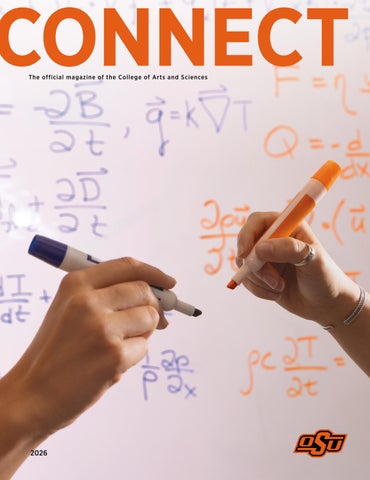
OSU welcomed 200 students from 17 countries for the first International Physicists Tournament ever held in North America, showcasing global collaboration, scientific excellence and Cowboy hospitality. Pages 18–21 (Cover photo: Eric Priddy)
02
Celebrating five years, OSU’s Center for the Humanities is fostering collaboration while supporting student and faculty research.
08 A Beautiful Mess
OSU psychology professor helps lead a national study uncovering how early experiences shape lifelong health, learning and development.
14 Not a Lost Art
OSU art professor turns passion into a profession, using art to inspire students and prove creativity can open unexpected doors.
22 Keepers of the Code
Meet three College of Arts and Sciences students whose unique paths reflect the Cowboy Code in action.
DESIGNER Cody Giles PHOTOGRAPHERS Ellie Piper Eric Priddy Jason Wallace ’03
FEATURES The Human League
ART DIRECTOR Dave Malec
32
A Joyful Noise OSU biology professor is advancing neuroscience research while creating meaningful opportunities for students to grow.
70 CAS Student Spotlights
These researchers are tackling real-world challenges while gaining the skills and experiences to shape the future.
76 Outstanding Alumni
The College of Arts and Sciences celebrates new classes of Rising Stars, Distinguished Alumni and Hall of Famers.
MULTIMEDIA PRODUCER Keith Mattix ’22 WRITERS Jordan Bishop Dr. Rachael Eaton Jeff Hopper ’08 Olivia Upton ’26 Annelise Vinson Summer Wilson ’26 OSU FOUNDATION Taylor Buxbaum ‘14 Nick Colburn Cara Eubanks ‘15, ‘17 Ryan Schlittler YEARS INDICATE OSU CAS GRADUATES CONNECT is a publication of the Oklahoma State University College
of Arts and Sciences and is designed to provide information on college activities and accomplishments while fostering communication among CAS family and friends. WWW.CAS.OKSTATE.EDU.
The office of publication for CONNECT is 307 Whitehurst, Stillwater, OK 74078-1024. ©2026, CONNECT. All rights reserved. Oklahoma State University, as an equal opportunity employer, complies with all applicable federal and state laws regarding nondiscrimination. Oklahoma State University is committed to a policy of equal opportunity for all individuals and does not discriminate based on race, religion, age, sex, color, national origin, marital status, disability, or veteran status with regard to employment, educational programs and activities, and/or admissions. For more information, the director of equal opportunity/Title IX coordinator is located at 201 General Academic Building and can be reached at 405-744-1156 or by visiting EEO.OKSTATE.EDU.
This publication, issued by Oklahoma State University as authorized by the College of Arts and Sciences, was printed by Modern Litho, at a cost of $4,732/3,500/Aug. 2026/#Connect2026.
O K L A H O M A S TAT E U N I V E R S I T Y
1
HUMANITIES
The
uman H eague
L
Center for the Humanities promotes collaboration across OSU
S TORY JORDAN BISHOP | PHOTOS ELLIE PIPER, JASON WALLACE AND PROVIDED
2
CONNECT | 2026
W
hat are the humanities? There is a textbook definition of it, but in short, the humanities are what make people human. Going to a movie, reading a novel, painting a landscape, listening to a song, perfecting a recipe, building a home, solving a math problem, making a scientific breakthrough, writing this article. All of those and more have been what humans have done for millennia, except for movies, those came later. Oklahoma State University, like most academic institutions, has had professors teaching these humanities in departments since the university’s founding in 1890. But until recently, these fields of study were somewhat invisible and underappreciated on campus. A professor would work alone on a research paper, missing an opportunity for collaboration that might expand their work. A student might get siloed in their degree program, never broadening their horizons and adding to a complete college experience. Now, they can, through the Center for the Humanities, which celebrates its fifth anniversary in 2027. Dr. Jennifer Borland, director of the center and professor of art history, said that OSU having this entity has helped student and faculty fellowship immensely. And, with the rise of artificial intelligence, it has never been more crucial to learn about the humanities. “It’s even more important to remind people that not only is the study of the humanities valuable, but the skills that you learn in humanities fields are really important for things like critical thinking, empathy, even just sustained engagement with something, whether it’s a film,
a book, an artwork or music,” Borland said. “All of these things are fundamental to what it means to be a human.” The idea for the center began when lifelong OSU supporter Dean Stringer gave the university a gift to establish an endowed chair in the humanities. Stringer knew it was a fundamental step for OSU to have a dedicated place for the humanities. “Having an understanding and some real study of our culture is critical to the completeness of a person’s degree,” said Stringer in a 2021 interview. “This represents a wonderful step forward for the university and will bring an emphasis on the humanities that will enrich the student experience.” Stringer’s donation sparked a movement, and the center receives funding each year, increasingly from private donations.
The idea for the center began when lifelong OSU supporter Dean Stringer gave the university a gift to establish an endowed chair in the humanities. Stringer knew it was a fundamental step for OSU to have a dedicated place for the humanities.
Whether it is through the PhilanthroPete program or a donation here or there, Borland said every dollar helps fund a student or professor’s work, especially in fields that might not get as much funding as others. A recent endowment is opening doors for OSU undergraduate scholars to travel to present their work or conduct research, gaining opportunities that previously were extremely difficult to attain. Former College of Arts and Sciences dean Smith Holt Jr. and his wife, Nancy, noticed a need and established an endowment for undergraduate research in the arts and humanities. “Nancy and I are delighted to help provide OSU arts and humanities undergraduates the opportunity to participate in a research experience,” Holt said. One such student who benefited from the promotion of their research was music education major Katelynn Biggs. Thanks to humanities funding, she attended the National Conference on Undergraduate Research in Virginia to discuss her work diversifying the representation of composers in French horn music. “For me, their support has shown how powerful it is when a university invests in student research and creativity, especially in fields like music education where culture, history and human experience matter just as much as performance,” said Biggs, a native of Joshua, Texas. “This helps build a campus where students feel encouraged to explore big ideas and grow into thoughtful leaders.” The Center for the Humanities also provides faculty members with a place to share ideas outside their departments and even to
O K L A H O M A S TAT E U N I V E R S I T Y
3
HUMANITIES
promote collaboration with other universities. Because OSU didn’t have a humanities center until recently, Borland said this absence was noticed by faculty members who came from universities with a strong humanities center. Now that OSU is on this track, recruiting faculty members in the humanities no longer has that obstacle. “We’re all still so decentralized at OSU, and it can be really hard to find out what’s going on in other places,” Borland said. “If we can help with that in any way by being sort of a conduit for sharing that information, then we’re really happy to be improving that sort of connection between people. I do think one of the benefits of having a center for the humanities is it’s a hub that helps people connect with other people and to feel part of an intellectual community.” The Center for the Humanities has brought together faculty members through its research fellowships, which involve professors from any degree program uniting to work on a humanitiesbased project. Madelyn Powers, a doctoral student in history, said she participated in a research fellowship last year alongside an English and American studies professor and another Ph.D. student in educational leadership and policy studies. “Not only did I get to meet individuals in my cohort with the same interests as me, but I also got to workshop ideas and future outside funding opportunities that I wouldn’t know how to do otherwise as a graduate student,” Powers said. A native of Hendersonville, Tennessee, Powers said the Center for the Humanities also helps students and faculty through its events and workshops throughout the year.
4
CONNECT | 2026
I think the “ center will get
those in the humanities at OSU to collaborate more with other disciplines, when most of us are so used to being in the archives or in books doing research on our own.” Madelyn Powers
Doctoral Student in History
“It not only gives a space for faculty, staff and students across campus to talk and collaborate about potential overlapping multidisciplinary projects, but also provides important workshops to get cohort members to think about methods and funding outside of their discipline,” Powers said. “I think the center will get those in the humanities at OSU to collaborate more with other disciplines, when most of us are so used to being in the archives or in books doing research on our own.” Borland hopes to build on the center’s momentum as she looks to host a Humanities Week for the first time this fall, inspired in part by the success of the universitywide Arts Week. Having a physical location at 114 Life Sciences East has also
opened the door to collaboration, giving people a space to come together. From its initial support to its impact on OSU in just five years, Borland said the Center for the Humanities at OSU has been a boon for the university, both intellectually and socially. She can’t wait to see how much more it will grow in the next five years. “One of the things that I think the humanities provide that a lot of other disciplines don’t is that they help us understand things that people are doing,” Borland said. “Even if you’re not a humanities scholar or humanities major, you might like to listen to music and go to shows, you might like to go to the theater, you might like to go to a film, you might enjoy a good horror novel.
Partaking in those kinds of activities, consuming that sort of humanities production, is something that brings a sort of richness and value to just being a person in the world. “We need to remind people that all of those things aren’t just frivolous, but that they’re actually fundamentally part of what makes us human.” SCAN HERE
Support the Center for the Humanities through OSU Foundation fund 22-91230 or contact Taylor Buxbaum at tbuxbaum@osugiving.com.
O K L A H O M A S TAT E U N I V E R S I T Y
5
HISTORY
PRECEDENT SET | Dr. John Kinder, a history professor, is the first OSU faculty member to receive an award from the Society for Military History.
Making history
Kinder named recipient of Society of Military History Distinguished Book Award STORY OLIVIA UPTON | PHOTOS JASON WALLACE
D
r. John Kinder, a history professor at Oklahoma State University, was awarded the Society for Military History Distinguished Book Award for his book, “World War Zoos: Humans and Other Animals in the Deadliest Conflict of the Modern Age,” published by the University of Chicago Press. The SMH Distinguished Book Award is highly prestigious and
6
CONNECT | 2026
recognizes the best Englishlanguage book-length publications on military history annually. This marks the first time in OSU’s history that a faculty member has won the award. “Dr. Kinder’s training as an interdisciplinary scholar of American studies and history, along with his ability to write powerful prose, make this book so compelling and unique,” said
Dr. Richard Boles, head of the Department of History. “We are fortunate to have him as a professor at OSU.” Kinder reflected on the journey that led to his success and what this accomplishment means for OSU. “‘World War Zoos’ was very difficult to write, and from the beginning, I was concerned about how it would be received,
“I hope this award suggests to others what I’ve long known — that OSU supports and values high-quality military history.”
“It never occurred to me that I was the first OSU faculty member to receive this award” Kinder said. “Oklahoma State University is lucky enough to have a whole department of pathbreaking, award-winning historians.
“I hope this award suggests to others what I’ve long known — that OSU supports and values highquality military history.”
DR. JOHN KINDER
OSU HISTORY PROFESSOR
especially by those who expect their World War II books to focus primarily on the battlefield,” Kinder said. “You can only imagine my surprise, then, upon learning that it had received the top book award from the nation’s largest organization of military history scholars.” Kinder’s book marks a new telling in military history, proving that all aspects of historical narratives are invaluable to society’s future. In his book, Kinder describes how zoos survived during World War II, highlighting parallels between human and animalistic survival. The book offers insight into how societies worldwide — from Japan to Canada to France to Russia, and more — faced the challenges of war from the prism of protecting (but also culling) their zoo animals. Not only does Kinder describe a new perspective on the history of zoos, but he also thoughtfully recounts military history beyond the battlefield.
PUBLISHED WORK | In his book, Kinder describes how zoos survived during World War II.
O K L A H O M A S TAT E U N I V E R S I T Y
7
P S YC H O L O GY
A BEAUTIFUL MESS PSYCHOLOGY PROFESSOR’S RESEARCH INTO CHILDREN’S DEVELOPMENT SHOWS THAT NOT ALL RESEARCH IS ROUTINE STORY JORDAN BISHOP AND ANNELISE VINSON | PHOTOS ERIC PRIDDY
8
CONNECT | 2026
R
esearch can be messy, but rewarding, just like parenthood. When you think of research, you most likely imagine lab coats, chalkboards, microscopes, and lots and lots of jargon. But not all research is alike. In fact, examining how those lab coats, chalkboards, microscopes and even the words you are reading right now were made can be quite messy. Because a person made all of those things, and the study of people isn’t always cut-and-dry. No matter how advanced a scientist or academic someone is, they all started out the same, as an infant. Oklahoma State University’s Dr. Lucia Ciciolla is part of a large, collaborative study to see how infants develop, from the prenatal stage all the way to their 10th birthday. Ciciolla, an associate professor of psychology, is beginning her 10th year at OSU. An expert on mothers’ and infants’ mental health, she has studied the invisible workload of female caregivers in the home, as well as the anxiety and stress of pregnancy, from planning all the way to the postpartum stage. Although the work can be challenging, Ciciolla said she gets a lot out of interacting with her participants, as do the students who assist her. “It prepares them to be independent scientists. There is a huge difference between learning about research methods in a classroom and actually sitting across from a participant and their baby, building rapport, collecting sensitive data and then grappling with what it means,” Ciciolla said. “Students come away with a much more nuanced understanding of the populations we study and the complexity
FOR THE KIDS | Dr. Lucia Ciciolla is an associate professor of psychology at OSU.
of real-world research, as well as unique and highly valuable research skills that will help to set them apart as they pursue their professional goals.” Ciciolla’s list of research projects includes the Epigenetics of Mother-Baby Reactivity and Childhood Experiences (EMBRACE), a National Institutes of Health-funded study through the Center for Integrative Research on Childhood Adversity (CIRCA). It studies the perinatal, intergenerational epigenetic pathways from maternal risk and protective factors to infant stress reactivity. Additionally, Ciciolla is engaged with several clinical extension projects, including being a Hub member of the Pediatric Behavioral and Emotional Health Project ECHO (Extension for Community Healthcare Outcomes) through
“I’ve always felt there is so much potential and hope in young children, and that by focusing on children, there is the chance to truly make a difference for the future.” Dr. Lucia Ciciolla
associate professor of psychology
O K L A H O M A S TAT E U N I V E R S I T Y
9
P S YC H O L O GY
OSU is one of 25 sites nationwide participating in the HBCD study, which combines traditional and observational research methods.
the OSU Center for Health Sciences and working with Mighty Mouth Kids, an annual intensive treatment program through the University of Oklahoma Child Study Center that provides lowcost, evidence-based services for children with selective mutism. Another undertaking she is involved in is the HEALthy Brain and Child Development (HBCD) Study, a national, interdisciplinary project that is funded by the NIH. The Oklahoma HBCD site is led by Drs. Julie Croff and Amanda Morris, and supported by a team of co-investigators, including Ciciolla. “One of Dr. Ciciolla’s greatest contributions to the HBCD study is her ability to translate
10
CONNECT | 2026
developmental science into practice,” Croff said. “Through her leadership, our team helps support the training and implementation of child development assessments across the national consortium, ensuring that data are collected with consistency and scientific rigor across sites. The HBCD study is following children in their first decade of life to see how their brains develop, as that is when people are the most impressionable. “I’ve always felt there is so much potential and hope in young children, and that by focusing on children, there is the chance to truly make a difference for the future,” Ciciolla said. “I am still amazed by the fact that 90%
of brain development occurs prenatally and during the first five years of life, establishing the foundation for all future health, learning and behavior.” OSU is one of 25 sites nationwide participating in the HBCD study, which combines traditional and observational research methods. The methods get very technical, involving biospecimens for toxicology and genomics, wearable biosensor data, neuroimaging data, and neurodevelopmental and language data, but this level of hands-on research is critical, Ciciolla said. As a professor in Oklahoma, Ciciolla said she understands the importance of studying a mother and child from an underrepresented population and how crucial their data will be to the study as well. “Rural families, Indigenous communities, families navigating poverty and limited resources — these are populations whose voices really need to be in the data if we’re ever going to develop interventions that actually work for everyone. That’s something our team is genuinely proud of about our site,” she said.
Croff agreed with the sentiment, saying the study needs input from all populations. We are particularly proud that Oklahoma families are contributing to this effort, helping ensure that our national understanding of child development ref lects the experiences of children growing up in rural and non-urban communities as well as those in major metropolitan areas,” Croff said. The students are getting experience, the academic researchers are gathering data, the children are being studied, but a very crucial piece of the project is the caregiver. When developing the study, both earning the mother’s trust to be part of the study as well as the actual logistics of their participation were taken into account, because otherwise, the study could not be completed. “Trust is huge. Especially for women and caregivers who’ve had difficult experiences with systems like healthcare and social services, there can be a real and understandable wariness about being studied,” Ciciolla said. “Time is another one; asking a pregnant woman or a new mom
to show up for assessments for the next 10 years is no small commitment. And then there are the practical aspects of being involved in the study, like coordinating transportation, childcare and work schedules. Our planning grant work helped us identify many of these barriers directly from participants, which shaped our approach to recruiting and retaining participants in the study. “With guidance from our recruitment expert, Dr. Lana Beasley, our study team has worked hard to create the ‘HBCD experience’ so that our participating families feel valued, connected and part of something important, which has really helped us to become a leader in the consortium for recruitment and retention.” All of the work is based on research and the data that comes
from the HBCD study, but it is not just numbers and data, Ciciolla said. Yes, the NIH hopes the study’s results will inform the development of better supports for children and families. But life doesn’t have a one-size-fits-all approach. This OSU professor just hopes that what she helps provide is a path to make being a parent or growing up just a little less messy, but still rewarding. “When a mom tells you that being part of the study made her feel like someone actually cared about her experience, not just her baby’s outcome, but her, that’s powerful,” Ciciolla said. “Research can feel abstract, but when you’re reminded that behind every data point is a person who showed up and trusted you with something vulnerable, it helps to recenter everything and give meaning to what we are doing.”
RESEARCH AND DEVELOPMENT | Ciciolla’s work with underrepresented populations helps to ensure the national studies she is a part of are accurate.
O K L A H O M A S TAT E U N I V E R S I T Y
11
MUSIC
STRIKE UP THE BAND | Country music artist Zach Bryan (center) rehearses with members of the King Cabbage Brass Band.
‘Music With My Friends’ OSU alumni join country musician Zach Bryan’s tour STORY ANNELISE VINSON | PHOTOS SUBMITTED
T
he brass blares of trombones and trumpets mix with the beat of drums and the twang of a steel guitar. Red dirt music fans: meet Isaac Washam and Ryan Hatcher. Two Oklahoma State University graduates are playing on the biggest stages in front of thousands as part of Zach Bryan’s “With Heaven on Tour.” What began in OSU practice rooms and performance halls has
12
CONNECT | 2026
grown into a nationwide touring experience for Washam, Hatcher and the King Cabbage Brass Band. “I still cannot believe that I get to perform music for a living with such a fantastic crew and team,” Hatcher said. The band has toured with Bryan on multiple stops, including shows at Cain’s Ballroom, which is a historic live music and concert venue in Tulsa, Oklahoma.
“I was a bit in disbelief when I found out,” Washam said. “It’s a blessing to get to perform music, and to get to do it on a stage as big as Zach Bryan’s is humbling.” Washam graduated in 2011 with his music performance degree and plays the trombone in King Cabbage, as well as teaching the instrument to students at the University of Tulsa. “Performing definitely puts all the hard work of practicing and
“Honestly, the feeling of making music with my friends surpasses any thrill a large crowd affords me.” RYAN HATCHER
OSU ALUMNUS
preparation into perspective,” Washam said. “To be great at anything takes what it takes, and knowing how hard it can be gives me ways to be empathetic with students and help them grow through struggles.” Hatcher plays the trumpet and graduated in 2014 with his music industry degree before joining the King Cabbage Brass Band and reuniting with his old friend, Isaac. “Honestly, the feeling of making music with my friends surpasses any thrill a large crowd affords me; knowing that I can add something to our musical endeavors and continue to learn and grow in my field is the greatest thrill I could ever imagine in a career,” Hatcher said. Both musicians credit their time at OSU for shaping the way they approach performance today. “To this day, I still get up and play a fundamentals routine similar to the one I learned back at OSU from Paul Compton,” Washam said. “Paul was able to exemplify a work ethic and love for trombones and music that still resonates with my playing and teaching today, and I think that is special to OSU.” Hatcher said he is confident that the discipline and fundamentals he learned at OSU directly guaranteed him a position with King Cabbage. “No professors pushed me harder than Dr. Joseph Missal and
HORNS OF PLENTY | From left: Ryan Hatcher and Isaac Washam enjoy getting to make music professionally.
Dr. Andrew Cheetham, who helped me think about trumpet differently than I was used to, to approach it from every angle and not just rest on my background of playing in jazz bands,” Hatcher said. Hatcher said he tries to stick to the fundamentals such as flexibility, breathing, intervals, improvisation and scales. “I try to challenge myself to new frontiers every day,” Hatcher said. “Trumpet can get pretty frustrating sometimes as you never know what kind of day you may have, but I have a fighting chance when I practice the same habits day-in and day-out.” The King Cabbage Brass Band was invited to play with Bryan, being asked to “bring our horns, and see if it all worked out,” Hatcher said. They were later invited to join the tour and perform in cities nationwide. The 2026 stadium tour includes more than 40 dates across North America and Europe, running from March 7 to Oct. 10. The tour supports Bryan’s sixth studio album, “With Heaven on Top,” featuring live debuts of new music alongside fan favorites.
“I think playing for the crowd at the record-breaking show in Michigan at the Big House in Ann Arbor has been the most memorable for me,” Hatcher said. “We knew going in that it was slated to be a record-breaking size crowd before, but it totally hits differently when you are on stage experiencing it … I will never forget that feeling.” As the tour continues across North America and Europe, Washam and Hatcher show no signs of slowing down. With each performance, they carry their OSU roots onto bigger stages, turning years of preparation into a career that continues to grow. “The person who loves to walk is going to get much farther than the person who wants to get somewhere,” Washam said Hatcher also gave encouragement to aspiring OSU musicians. “Work hard at what you do, even if it is not music, right after you leave college, but stay humble and keep pursuing opportunities,” Hatcher said.
O K L A H O M A S TAT E U N I V E R S I T Y
13
ART
14
CONNECT | 2026
AN OSU PROFESSOR’S UNEXPECTED PATH TO PURPOSE AND PROFESSION STORY JORDAN BISHOP | PHOTOS ELLIE PIPER
T
he studio art class students ask their professor a burning question that has been on their mind for a while. In fact, it’s been on every artist’s mind for as long as art has been around. Can an art degree get you a job? Ben Murphy proceeds to tell them about the death of a salesman. For 15 years, this salesman at Wolters Kluwer, a Dutch multinational corporation, worked to sell risk and compliance information solutions to commercial banking operations. A tedious job that the salesman was good at, but not passionate about. Selling risk and compliance information solutions to commercial banking operations is not art, which the salesman loved. In fact, it’s what his degree was in. But the art degree had not gotten him a career as an artist. However, his critical thinking and creative mind that he honed while earning his art degree did get him a job as a salesman. In the meantime, he still painted in the spare room or took on an occasional art show here and there, all while selling risk and
O K L A H O M A S TAT E U N I V E R S I T Y
15
ART
compliance information solutions to commercial banking operations. That is, until the day the salesman died and the artist was reborn. It was the day Murphy’s wife, Erin, earned her doctorate in music and took a position as a professor at Oklahoma State University. Erin’s new position meant Ben could go back to school and become an art professor, which he did. “I think that the experience of being a student again was, for me, refreshing and fun,” Ben Murphy said. “Coming back to it after so many years, it gave me a fresh way of looking at producing artworks and constructing images.” Twenty years after earning his bachelor’s degree from the University of Guelph in Canada, Murphy received his Master of Fine Arts from the University of Oklahoma. The world might have changed, with new 3D techniques and digital fabrication, but the idea of using art to convey an emotion that words can’t compete with? That aspect of art stayed the same. And it’s that aspect that Murphy is most intrigued with. “I think school expanded my idea of what a painting could be, what making art was about,” Murphy said. “It helped me think about it as research, as opposed to just responding from a purely emotional perspective.” Some of Murphy’s early projects included painting disappearing glaciers in the lobby of the National Weather Center in Norman. This work, commissioned by Dr. Berrien Moore III, depicted the effect of climate change on these arctic habitats. Dr. Cymene Howe, an anthropology professor at Rice University, saw Murphy’s work and invited him to a symposium about global glacier degradation in Reykjavik, Iceland.
16
CONNECT | 2026
“I THINK SCHOOL EXPANDED MY IDEA OF WHAT A PAINTING COULD BE, WHAT MAKING ART WAS ABOUT. IT HELPED ME THINK ABOUT IT AS RESEARCH, AS OPPOSED TO JUST RESPONDING FROM A PURELY EMOTIONAL PERSPECTIVE.” BEN MURPHY
OSU ASSISTANT PROFESSOR Although he is not a scientist, his art conveyed meaning and impact that showed what was happening to these glaciers in a way that the reports containing hundreds of thousands of words could not. “Writing is super important, because it gives you all the context, but the visual side, it can connect in more of a direct way, where you’re not having the time to read through a text. You have an immediate response to a visual image,” Murphy said. To support his work, OSU awarded Murphy a grant for a Humanities-, Arts-, and Designbased discipline (HAD), which helped him apply for and secure a residency in the Arctic Circle. In 2025, Murphy traveled to the Svalbard Archipelago, 650 miles south of the North Pole, to see the effects of climate change on the polar icecap firsthand. “To meet other scientists and collect information and understand some of the actual research that’s being conducted about those areas. I think that’s information that you can’t gather without going there and seeing it,” Murphy said.
When he is not working on his abstract art research, Murphy is teaching. From freshmanlevel to senior-level courses, he covers the gamut: design, drawing, foundations and painting, just to name a few. Because of this variety, Murphy sees students always learning something new, which is one of his favorite aspects of the job. “To watch them really connect with their own ideas and concepts and really hone those critical thinking skills,” Murphy said. “For me, that’s the exciting part, when that’s really working for them, and now they’re really excited about the work they’re producing.” And his students point to Murphy for giving them the freedom to discover their talent. “He always helps students push and succeed with their art and concepts,” said Jacob Phibbs, a junior from Jenks, Oklahoma. “His assignments help give my art more layers and depth.” Murphy also works outside the classroom, whether at workshops around the state or the Prairie Arts Center and the OSU Museum of Art in Stillwater. This gives him
time to work with artists of all ages, because he knows that though someone’s day job might not be in art, it doesn’t mean they aren’t an artist. This type of belief in a person’s skills has made him a popular and influential teacher. “He was a huge inspiration to me in my abstract work,” said Jacey Phillips, a senior from Enid, Oklahoma. “He is not afraid of bright colors and hard lines, which really pushed me to use it in my own work.” Murphy is passionate about the arts, working with OSU to promote them through events like bringing back scholastic competitions in arts and writing to the university, which gives high school students a chance to showcase their work on a college campus. “I think there’s always something to do in the arts to ensure that we’re contributing in a visual way to just reinforce the value of it to the community,” Murphy said. His work in class and in statewide outreach earned Murphy the Oklahoma Higher Education Art Educator of the Year award from the Oklahoma Art Education Association. Not bad for a guy who sold risk and compliance information solutions to commercial banking operations. Now, his art no longer sits in the spare room; instead, he has his own studio in his office on the second floor of the Bartlett Center for the Visual Arts. It just took him longer to get there than he thought. So, to answer his studio art students, Murphy tells them that an art degree will open doors in all sorts of fields. And even if the first job is not in art, it doesn’t mean art has to leave your life.
O K L A H O M A S TAT E U N I V E R S I T Y
17
PHYSICS
STILLWATER WELCOMES THE WORLD
R E A D Y
F O R
A
OSU HOSTS INTERNATIONAL PHYSICISTS TOURNAMENT FOR THE FIRST TIME STORY JEFF HOPPER PHOTOS ELLIE PIPER
E
MEETING OF THE MINDS | Students from 20 teams nationwide interacted with each other during the tournament.
18
CONNECT | 2026
arlier this year, Oklahoma State University hosted around 200 students, coaches and judges from around the world for the first International Physicists Tournament held on North American soil. The predominantly European tournament, hosted in Checiny, Poland; Zurich, Switzerland; and Paris, in recent years, has only been held outside of the continent a few times. This year, Stillwater, Oklahoma, was chosen as the event site. “Dr. Joseph Haley, a faculty member here, was very enthusiastic about hosting the tournament at OSU when we asked for site suggestions,” said Dr. Jeanne Bernard, president of the IPT Executive Committee. “Once we discovered that the university could accommodate all of our logistical needs, we were excited to choose Stillwater and OSU as the host site.” This year’s tournament challenged 20 teams to compete across five days to determine the winning country. Teams hailed from across the globe, from major European centers like France, Italy and Germany to smaller nations
such as Denmark, Sweden and Croatia, as well as multiple teams from North and South America and as far away as India.
OSU AND IPT
Prior to 2023, students and faculty at OSU, for the most part, had never heard of the IPT. In fact, very few teams from the United States had participated in the competition. However, Dr. Flera Rizatdinova, OSU physics professor and department head, heard about the competition and began doing her research. She quickly discovered that the IPT would be a perfect way for students at OSU to interact and network with some of the most talented physicists from around the world. “I have always been drawn to competitions because they bring out the best in people,” Rizatdinova said. “When I discovered the International Physicists Tournament, I was immediately captivated: an international, research-based competition that challenges undergraduates to tackle real, open-ended physics problems. “Physics thrives on openness and international collaboration, yet undergraduates rarely have opportunities to engage with peers from around the world who share their passion. IPT provides that experience. It allows students to connect with talented young physicists from around the world, reinforcing their sense of belonging in the scientific community and inspiring them to pursue ambitious goals. That is what motivated me to bring IPT to OSU — to give our students this unique opportunity and to showcase the talent, creativity and excellence of our department.”
DO THE MATH | Members of Team Brazil sit in the front row to solve a theoretical physics problem.
NOT YOUR AVERAGE TOURNAMENT
Most might envision a physics tournament as groups of students huddled around whiteboards trying to solve a complex physics equation faster than the other team. While the work done by the students is complex and intricate, the tournament’s structure is far from a “quiz bowl” atmosphere. Teams competed in physics “fights” throughout the competition. Each fight consisted of multiple battles, with each team acquiring points during each battle, which are added to the teams’ aggregate score. The competition started with a fight within a fight, pitting the captain of each team against the
200 20 17 5 STUDENTS
TEAMS
COUNTRIES
DAYS
O K L A H O M A S TAT E U N I V E R S I T Y
19
PHYSICS
other to solve a random physics problem. This captain’s fight determined who chose first to determine the team roles for each battle, rotating through presenter, opposition and moderator. After the roles were scheduled, the first battle began when the opposition’s captain challenged the presenting team to one of 17 open-ended physics challenges they had been given to solve last fall. The presenting captain can either accept or deny the challenge; however, each team is only given a limited number of denials, creating the need for a strategic approach during this process. Once the challenge was agreed upon, the presenting team gave a 10-minute presentation of their solution, followed by a 5-minute presentation from the opposition, and then a 5-minute period for the moderator to dig deeper into questions that may not have been clearly addressed during the prior 15 minutes. Judges then presented scores for each team, ending the first battle. The teams then rotated roles for the subsequent battles. “The tournament is really quite unique in its structure,” Haley said. “It’s nothing like most people would expect a physics tournament to look.” After the first two days of fights, the top nine teams advanced to the semifinals. Those teams included Switzerland, Team IPT, France, Italy, Germany, Hungary, Brazil, Poland and Croatia. The top three — France, Switzerland and Team IPT — then competed in the Grand Finale with France being crowned champion by a narrow, fraction-of-a-point margin. “The tournament turned out even better than I could have expected,” Haley said. “The feedback from participants was overwhelmingly
20
CONNECT | 2026
positive. People were especially struck by the beauty of the campus and the welcoming atmosphere. One person even told me that we ‘set a high bar for next year in Milan (Italy).’ “I want to give special credit to the organizing team and volunteers, whose dedication and attention to detail were essential to making this event as successful as it was. It was
truly a special moment for OSU and something I think participants will remember for a long time.”
BEYOND PHYSICS
While mainly focused on physics, the tournament also provided the pre-doctoral students a chance to interact with their fellow competitors and share cultures, ideas and learn more about the
RAISING THE BAR | A Swiss team member and an OSU student team member signal “Pistols Firing” at the tournament.
“THE TOURNAMENT IS REALLY QUITE UNIQUE IN ITS STRUCTURE. IT’S NOTHING LIKE MOST PEOPLE WOULD EXPECT A PHYSICS TOURNAMENT TO LOOK.” DR. JOSEPH HALEY
OSU PHYSICS PROFESSOR
students who may have very different life experiences than their own. The third day of the competition was devoted to excursions and cultural activities. While teams still in the competition honed their presentations for the following day’s semifinal fights, the other teams participated in a day of sightseeing and bonding. This year, teams went to Oklahoma City, Stillwater or Tulsa and visited museums, enjoyed local cuisine and learned more about Oklahoma. “That might be the most beneficial part of the whole tournament,” Haley said. “The physics competition is fun, but I love the fact that our students have the opportunity to learn about other cultures and create friendships with someone that may live a different kind of life, but — at the end of the day — is just a physics nerd like them.”
O K L A H O M A S TAT E U N I V E R S I T Y
21
THE CODE CALLS
KEEPERS OF THE CODE Honoring the Cowboy Code, answering the call OLIVIA EMERSON JORDAN TOLLESON CHLOE WATSON-FULLER
22
CONNECT | 2026
The Cowboy Code. Seven principles that have come to define what it means to be part of the OSU family. They aren’t just words. For thousands of OSU alumni, faculty, staff and students, they’re fundamental pillars of their character and identity. At the College of Arts and Sciences, you will find students living the code in all 23 departments, which are categorized under three pillars: arts and humanities; social sciences; and math and sciences. These stories highlight how CAS students across those pillars are making a difference in their own corners of the world.When The Code Calls, Cowboys answer.
STORIES JORDAN BISHOP AND JEFF HOPPER PHOTOS ERIC PRIDDY AND SUBMITTED
O K L A H O M A S TAT E U N I V E R S I T Y
23
THE CODE CALLS
OLIVIA EMERSON KEEPER OF THE CODE
24
CONNECT | 2026
“I’M EXTREMELY GRATEFUL I CHOSE TO ATTEND OSU. SO MANY UNIVERSITIES DON’T OFFER THESE KINDS OF OPPORTUNITIES AT THE UNDERGRADUATE LEVEL. IT WAS SOMETHING I KNEW I WANTED — SOMETHING I WAS READY TO PURSUE.”
WE FINISH WHAT WE START. When deciding where to further her education, Olivia Emerson was looking for a place that felt like home and a path that felt like purpose. At one point, that sense of home was literal. With all three of her siblings attending OSU alongside her, Stillwater became an extension of the life she had known in Jenks, Oklahoma. However, family wasn’t the only thing that drew Emerson to OSU. She was looking for something more, an opportunity to begin her journey in medicine right away. At OSU, she found it. From the moment she arrived on campus, Emerson stepped into the kind of hands-on research experience that many students have to wait years to find. For
her, research served as a way to explore her calling in real time. “I’m extremely grateful I chose to attend OSU,” Emerson said. “So many universities don’t offer these kinds of opportunities at the undergraduate level. It was something I knew I wanted — something I was ready to pursue.” Now a physiology and premed graduate, Emerson’s path was shaped by a lifelong curiosity about science and a deep desire to understand how it can serve others. In the lab, she found a place where questions lead to discovery, and where discovery has the potential to change lives. That purpose became even clearer through a deeply personal moment. When her grandmother passed away, Emerson saw firsthand
the impact compassionate care can have in life’s most difficult moments. The dedication of the health care professionals who supported her family left a lasting impression — one that shifted her perspective from interest to intention. “It was a turning point for me,” she said. “I felt so cared for, and I knew I wanted to be able to give that same level of support to others when they need it most.” Emerson is now preparing for the next step, gaining experience in the medical field before applying to medical school, pursuing a goal that has never been in doubt. For Emerson, it’s about serving others, seeking answers and showing up — with knowledge, compassion and care — when it matters most.
O K L A H O M A S TAT E U N I V E R S I T Y
25
THE CODE CALLS
JORDAN TOLLESON KEEPER OF THE CODE
26
CONNECT | 2026
WE DREAM AS BIG AS THE SKY. Jordan Tolleson’s journey to Oklahoma State University began with a single lesson that turned possibility into certainty. Growing up in Wichita Falls, Texas, Tolleson considered several schools, but everything changed during a visit to Stillwater. A trial lesson with trombone professor Paul Compton left a lasting impression. His mentorship, combined with the welcoming atmosphere of the Greenwood School of Music, quickly made OSU feel like home. The next day, she met current students, experienced game day in Stillwater and returned to Texas knowing exactly where she wanted to be. “The culture is wonderful, the campus is beautiful, and around every corner, there are new friends to be made,” Tolleson said. Now a senior studying music performance, Tolleson has
embraced every opportunity available to her as a Cowboy. What began as a dream of a career in classical music has become a clear professional goal, strengthened by the encouragement of faculty mentors and experiences that pushed her beyond her comfort zone. Working alongside Compton and fellow faculty member Elizabeth Toles helped replace uncertainty with confidence. Through the President’s Leadership Council, performances at The McKnight Center for the Performing Arts and competitions across the country, Tolleson discovered what was possible when talent is matched with preparation and support. A versatile bass trombonist, Tolleson has earned recognition in regional and national competitions, performed with orchestras and chamber ensembles and represented OSU nationwide. She hopes to continue that journey
through graduate school before pursuing a career as an orchestral or freelance musician, while also teaching future generations of musicians. For Tolleson, one line of the Cowboy Code has become a guiding principle: We dream as big as the sky. “To me, dreaming as big as the sky means allowing yourself to imagine, explore and pursue possibilities that may seem impossible at first,” Tolleson said. “... The Cowboy Code reminds us to pursue our boldest dreams. I believe that the dreams that seem the most impossible are often the ones most worth pursuing. When a dream truly matters, the hard work it demands becomes a privilege rather than a burden.”
“I BELIEVE THAT THE DREAMS THAT SEEM THE MOST IMPOSSIBLE ARE OFTEN THE ONES MOST WORTH PURSUING. WHEN A DREAM TRULY MATTERS, THE HARD WORK IT DEMANDS BECOMES A PRIVILEGE RATHER THAN A BURDEN.”
O K L A H O M A S TAT E U N I V E R S I T Y
27
THE CODE CALLS
CHLOE WATSON-FULLER KEEPER OF THE CODE
28
CONNECT | 2026
WE HAVE A PASSION TO DO WHAT’S RIGHT, EVEN WHEN IT’S HARD. For Chloe WatsonFuller, the path to Oklahoma State was a calling, shaped early and strengthened over time. Growing up just blocks from Oklahoma State UniversityTulsa’s downtown campus, she saw possibilities inside those buildings. Each glimpse of OSU’s Tulsa campuses and every outreach invitation felt like a door opening a little wider. A self-described “STEM kid,” Watson-Fuller didn’t wait for opportunity to come. Her first visit came in the sixth grade, when curiosity led her onto campus for a pre-med day at the Center for Health Sciences. There, she followed physicians through rotations, listened, learned and began to see herself in their shoes. Another program deepened that sense of belonging — spending four days alongside current students, imagining her future taking shape. Now a sociology and pre-med student, Watson-Fuller is driven by a purpose that extends beyond
medicine alone. She’s called to care, to connect and to ensure that those seeking health care are seen as people first. That calling led her to her uncommon major combination. “It’s not the traditional path, but understanding people — their experiences, their barriers — that’s the part of medicine that matters most to me,” Watson-Fuller said. Her goal is to become an OB-GYN, a decision shaped by compassion and need. Across Oklahoma, too many women face limited or no access to care, living in maternal health deserts. In these places, basic services are out of reach, and the gap between need and access continues to widen. “There are entire counties where women can’t find care,” WatsonFuller said. “Even in larger cities, it’s still not enough.” For Watson-Fuller, the journey is about more than earning a degree. It’s about answering a call — to serve, to advocate and to step forward where others are needed most.
“IT’S NOT THE TRADITIONAL PATH, BUT UNDERSTANDING PEOPLE — THEIR EXPERIENCES, THEIR BARRIERS — THAT’S THE PART OF MEDICINE THAT MATTERS MOST TO ME.”
O K L A H O M A S TAT E U N I V E R S I T Y
29
M I L I TA R Y
COWBOY IN COMMAND | Lt. Col. Chris “Rage” Stewart graduated from OSU 20 years ago before serving as an air battle manager in the Air Force.
Landing Back in Stillwater Stewart makes his way back to his alma mater to lead the ROTC program STORY JEFF HOPPER | PHOTOS ELLIE PIPER
N
early 20 years to the day, Lt. Col. Chris “Rage” Stewart commissioned his first cadet from the same Oklahoma State University Air Force ROTC program from which he received his commission. “It’s very surreal,” Stewart said. “I walk down these hallways every day and see all the former commanders, including the two that were here during my time as a cadet, and now I’m the one
30
CONNECT | 2026
commissioning 12 lieutenants into the Air Force and Space Force.” The Broken Arrow, Oklahoma, native came to Stillwater as a “typical 18-year-old freshman” in 2002, with a passion for aviation and a call to serve. The combination made the Air Force ROTC program an easy choice for Stewart. “Air Force ROTC would check both of those boxes for me,” he said. “I’ve always loved flying and understanding how these,
sometimes giant, aircraft that don’t look like they belong in the air manage to fly. Couple that with my desire to serve my country stemming from both my grandads serving, and it just made sense to join the Air Force ROTC program.” Stewart wanted to be a pilot and thus pursued a degree in aviation sciences with a professional pilot option. However, after he went through his bid process to determine the career track he
would follow in the Air Force, he was assigned to become an air battle manager. An air battle manager acts as the tactical command and control of air maneuvers in real time, from tactical intercepts to refueling to combat maneuvers. The air battle manager is usually stationed in the rear of an Airborne Warning and Control System aircraft, or AWACS, and acts as the central nervous system of any airborne situation, relaying crucial and strategic information to all assets to coordinating efforts toward a common goal. “It wasn’t being a pilot, but it was still centered on aviation, and I would still be in an aircraft, so I was excited,” Stewart said. After graduation and commissioning, Stewart was stationed at Tyndall Air Force Base in Florida, the site of the air battle manager training school. Stewart finished at the top of his class and was able to name the destination of his first station. He chose to come back home and serve at Tinker Air Force Base in Oklahoma City. “They had an opening at a station in Germany, which was really intriguing,” Stewart said. “But I chose to come back home because
“I like to think that my legacy will be one of doing what is asked of me or ‘blooming where you’re planted.’” LT. COL. CHRIS “RAGE” STEWART OSU AFROTC COMMANDER
my wife was two years behind me and still finishing her schooling at OSU.” That began a career that took Stewart and his family all over the world, including going back to Florida to be an instructor at the air battle manager school, to Georgia to work on the E-8C Joint Stars program, to Germany during COVID and deploying Stewart to places like Saudi Arabia and Crete. During his station in Germany, Stewart had traversed a career that reached a point where he could retire from the Air Force. However, the commander position at Air Force ROTC Det. 670 at OSU serendipitously became open due to the previous commander being promoted. “I always joked that it’d be great to come back to Stillwater and be a part of the cadre, or staff member, or commander as my last tour — a great sunset on my way
out,” Stewart said. “The person in the chair before me got promoted, and the position at OSU came open a year ahead of schedule. So, I talked it over with my wife, and we decided, ‘Why not?’” Stewart took over as commander of the OSU Air Force ROTC Detachment in 2025 and is eager to train the next leaders of the Air Force and Space Force. The fullcircle moment wasn’t necessarily part of a master plan for Stewart, but rather another opportunity that he’s chosen to take and make the most of. “I like to think that my legacy will be one of doing what is asked of me or ‘blooming where you’re planted,’” Stewart said. “Make the most of any opportunity you’re given and see where that takes you. I always said I would continue down the military path until it wasn’t fun anymore, and here I am over 20 years later, and it’s still fun.”
FIELD OF DUTY | Reserve Officer Training Corps cadets drill on Library Lawn.
O K L A H O M A S TAT E U N I V E R S I T Y
31
B I O L O GY
McCullagh elevates student experience through dynamic neuroscience lab
A
STORY SUMMER WILSON PHOTOS ERIC PRIDDY
32
CONNECT | 2026
t Oklahoma State University, groundbreaking research and student mentorship often go hand in hand. For Dr. Elizabeth McCullagh, an associate professor in the Department of Biology, that connection is at the heart of her work, and it’s now being recognized on a national level. McCullagh has been awarded a National Science Foundation CAREER Award, one of the most prestigious honors given to early career faculty. The award provides approximately $1 million in funding over five years, supporting both her research and educational initiatives. In addition, she recently secured a National Institutes of Health R01 grant of about $3 million for
a related project, bringing total funding to nearly $4 million. “Personally, it’s one of the most prestigious awards you can get as an academic,” McCullagh said. “It always feels really good to know that your colleagues think your work is valuable and want to support it financially.” Beyond the recognition, the award represents something even more meaningful: stability, growth and opportunity, for both her lab and the students within it.
Exploring Meaningful Sound McCullagh’s research centers on the auditory system, which is how the brain processes sound. As a neuroscientist, she is interested not just in how we hear, but how we interpret and prioritize certain sounds over others. Her CAREER project explores a compelling question: Why are humans more attuned to sounds made by people they care about? To explain, McCullagh offers a personal analogy. “I have two kids, and before I had them, I didn’t necessarily pay attention to or care about kid sounds,” she said. “Now, if I passed a playground and one of my kids fell and started crying, I would know immediately that it’s my child and where they are.” This heightened sensitivity, she explains, suggests that the brain may be “tuned” to prioritize socially meaningful sounds, like a child’s distress call or a loved one’s voice. Her research investigates whether the hormone oxytocin, known for its role in social bonding, plays a part in this process. Her lab is studying how oxytocin may inf luence
SOUND ADVICE | Alaina Gonzalez and Dr. Elizabeth McCullagh collaborate on a project..
how the brain processes sound location and social cues. “It opens up all these questions,” McCullagh said. “Even if it’s not doing exactly what we think, it’s got to be doing something. And no one is really looking at this right now, so it gives our lab a unique niche.” The five-year CAREER funding allows her team to explore these questions in depth; something shorter-term grants rarely permit. “That length really gives us enough time to address these questions on a more rigorous level,” she said.
“It also allows us to support students long-term, even potentially through an entire Ph.D. program.”
Expanding Research In parallel, McCullagh’s NIHfunded project focuses on Fragile X Syndrome, a genetic condition and leading cause of autism. This research examines how the brain processes the speed of sound, an important factor in understanding why individuals with Fragile X often struggle to hear in noisy environments.
O K L A H O M A S TAT E U N I V E R S I T Y
33
B I O L O GY
Undergraduate researcher Olivia Emerson has been directly involved in this work, studying how Fragile X affects responses to different sound frequencies using established research models. “It’s something that affects a lot of different people,” Emerson said. “Being able to see the crossover between a model and how it impacts humans we interact with every day has been really special.” The combined funding from NSF and NIH supports not only the science itself, but also the people behind it — graduate students, undergraduate researchers and, for the first time in McCullagh’s lab, a postdoctoral fellow.
Building a Lab Culture That postdoctoral fellow, a student named Juhee, describes joining McCullagh’s lab as both professionally and personally transformative. “Working with Dr. McCullagh is an absolute delight. She’s highly collaborative, deeply supportive and brimming with her powerhouse energy,” she said. “She has made everything so easy and uncomplicated for me right from the start.” Juhee emphasizes McCullagh’s balance between hands-on mentorship and independence.
34
CONNECT | 2026
“Working with Dr. McCullagh is an absolute delight. She’s highly collaborative, deeply supportive and brimming with her powerhouse energy. She has made everything so easy and uncomplicated for me right from the start.” JUHEE OSU POSTDOCTORAL FELLOW “She dives into the details of experimental design but encourages independence,” she said. “It’s supportive, with constructive feedback that builds confidence.” For Juhee, the CAREER Award is not just a milestone for the lab; it’s a catalyst for growth. “It directly supports our innovative neuroscience work with essential resources for cutting-edge tools and experiments,” she said. “For me, it means contributing to transformative research while accelerating my own growth as a postdoc.” Graduate students echo that sentiment, pointing to McCullagh’s mentorship as a defining aspect of their academic journeys. Casey Sergott, a fourth-year Ph.D. student, describes her as “communicative, inclusive
and supportive,” noting that McCullagh prioritizes students’ well-being alongside their work. “She’s willing to meet you where you’re at,” Sergott said. “If you have a lot on your plate, she’s not going to expect you to be in the lab eight hours a day. She wants what’s best for you, regardless of your role.” Genesis Alarcon, a secondyear Ph.D. student, highlights McCullagh’s accessibility and teaching style. “She has an open-door policy, so anytime I’m frustrated or concerned, I can just pop in,” Alarcon said. “She’s very good about leading you to the answer rather than giving it to you, which really helps you develop as a scientist.” For many students, the CAREER Award also serves as validation. “It was huge,” Alarcon said. “It showed that the science community believes in the work we’re doing.” The NSF’s CAREER award supports early-career faculty who have the potential to serve as academic role models in research and education and to lead advances in the mission of their department or organization.
project features interactive exhibits that demonstrate how sound works, bringing complex scientific concepts to life for audiences of all ages. The exhibit has already been showcased at science fairs, community events and even OSU tailgates. “It’s been a really fun way to engage people in what we’re doing and get them excited about science,” McCullagh said. Additionally, the NIH grant will support a regional autism conference, connecting individuals with autism and their families to scientists studying the condition.
RESONATED RESEARCH | From left: Juhee, Gonzalez, McCullagh and Genesis Alarcon work together on biology research involving sound and genetics.
A Commitment to Teaching The CAREER Award is unique in that it emphasizes not only research but also education and outreach, an aspect that aligns closely with McCullagh’s teaching philosophy. “I really want to create a community in any class that I teach,” she said. “If students feel comfortable asking questions and engaging, they’re more likely to get something meaningful out of the class.” Her approach involves interactive teaching methods, from whiteboarding exercises to open discussions, designed to encourage participation and deeper understanding. “She doesn’t just lecture,” Emerson said. “She really makes you feel valued, no matter what level you’re at.”
McCullagh is also using CAREER funding to develop new educational initiatives, including a hands-on neuroanatomy course that will give undergraduate students direct experience with brain research. “It’s a way for students to go from seeing the brain to actually conducting experiments and analyzing their own data,” she said. “We hope it will serve as a gateway into research.”
Connecting the Community Beyond campus, McCullagh’s work is reaching the broader community through outreach projects supported by the CAREER Award. One such initiative, “The Sound of Science,” is a collaboration with Stillwater speaker company Kicker. The
A Lasting Impact For McCullagh, the CAREER Award represents more than just funding; it’s an opportunity to deepen her research, expand educational programs and continue fostering a supportive lab environment. For her students, it’s something even more personal. “I have no doubt that my connection with Dr. McCullagh is going to get me where I need to be,” Sergott said. Emerson agrees, adding that McCullagh’s mentorship has shaped her own aspirations. “Seeing her balance a family and a career in science shows me that I can do both,” she said. “I’ve grown so much as a student and as a person in her lab.” As McCullagh’s research continues to push the boundaries of neuroscience, her impact is already clear, not only in the questions her lab is answering, but also in the scientists she is helping to shape along the way.
O K L A H O M A S TAT E U N I V E R S I T Y
35
RESEARCH
CAS STUDENT SPOTLIGHTS Students within the College of Arts and Sciences are continually breaking new ground as they pursue research under the mentorship of renowned Oklahoma State University faculty members. Here, we highlight the work of just a handful of our undergraduate and graduate students on their way to changing the world. COMPILATIONS DR. RACHAEL EATON | PHOTOS PROVIDED
KAYLEEN SUGIANTO M.S.: INTEGRATIVE BIOLOGY FIRST YEAR MENTOR: DR. FABIO MACHADO
HOW DID YOU BEGIN RESEARCHING?
I had asked my first-year orientation seminar professor what extra steps I would need to become a successful wildlife biologist; she pointed me to research here at OSU. So, I hopped right into frog research, continuing throughout my college years and as a first-year master’s graduate. I now study painted lady butterf lies and conservation.
HOW HAS RESEARCH IMPACTED YOU?
Studying the morphology and evolution of this particular butterf ly can help understand the ever-changing climate, therefore guiding conservation strategies. By using museum specimens, we can turn back time with the new technology advances we have to see what their world looked like and the changes. This also opens opportunities to discover more about other species to aid in their conservation.
36
CONNECT | 2026
WHAT HAVE YOU WORKED ON RECENTLY?
Besides studying painted lady butterf lies, I also finished submitting a paper on the research I had done for a few years during my undergraduate: crawfish frog photo recognition. These species of conservation concern are found in southeastern Oklahoma, and usually, harmful invasive methods are used to track down individuals year by year. We wanted to see if we could take photos of their beautiful giraffelike patterns on their backs and their tympanum to identify individuals as an alternative.
WHAT ARE YOUR FUTURE PLANS?
After I graduate, I want to go into SciComm and wildlife conservation. I hope to inform the public about all of the great work that is being done, inspiring others to love nature as much as I do. I also want to write more in a way that clears any misunderstanding, miscommunication and such, so the public can work together for the sake of wildlife. It takes all of us to save our wonderful living world.
SAM HOLGUIN TARRANT M.A.: ART HISTORY THIRD YEAR MENTORS: DR. SHAOQIAN ZHANG, DR. JENNIFER BORLAND, DR. EMILY GRAHAM AND DR. LINGJUN LI
HOW DID YOU BEGIN RESEARCHING?
My interest in early-to-late medieval art was inspired by my undergraduate courses. Before I ever knew you could study art history, I became interested in how people of the past interacted with one another. I was never particularly stuck in one geographic area of interest and became fascinated by the complex social networks established in these early cultures and civilizations. I wanted to know how art can serve as a symbol of exchange and a medium for cultural and religious exchanges that shaped the land. I found one example that stuck with me, the Todai-ji Temple in Nara, Japan, and was immediately smitten with the diversity of the objects stored here.
HOW HAS RESEARCH IMPACTED YOU?
Not only is my research trying to bridge historical “gaps” in how objects moved and were understood in places beyond their point of origin, but sheds light on how the people moved as well. As civilizations and cultures adapted to change, people moved across these borders and set up communities and workshops where their work was in demand. This eventually led to the
incorporation of distant cultures and images in new places where they had not previously appeared. By understanding where people came from and how we adapt to change, we can learn how this occurs in our present and future.
WHAT HAVE YOU WORKED ON RECENTLY?
Currently, I am working on my thesis, but have previously completed research for an exhibition on Native American art at the OSU Museum of Art. I also had the incredible opportunity to share my research at the Newberry in 2024 and 2025, as well as MAHS in March 2026.
WHAT ARE YOUR FUTURE PLANS?
My dream is to travel to Japan and study these objects in person, during the two weeks they are placed on exhibit each year. Ideally, I want to settle into a teaching role in higher ed that will allow me to further my research and focus on other topics, such as medieval medicine or holy women in and out of Europe. I see myself learning more every day and hope to learn as much as I can about people of the past and present.
O K L A H O M A S TAT E U N I V E R S I T Y
37
RESEARCH
FAIROZA FAIROOZ M.A.: ENGLISH SECOND YEAR MENTORS: DR. MICHAEL AMORY AND DR. FRANCES JUNNIER
HOW DID YOU BEGIN RESEARCHING?
I didn’t initially see myself as a researcher. During my undergraduate studies in Sri Lanka, I conducted my first research project, which was an ethnographic study. That experience introduced me to research as a way of understanding people, contexts and lived experiences. Being in the classroom raised many questions about my own teaching; what was working, what wasn’t and why. This curiosity pushed me to look beyond intuition and start engaging with research more seriously. I became particularly interested in areas such as teaching practices, assessment and emerging trends like technology-integrated learning. Over time, my approach to research became closely tied to my identity as a teacher.
HOW HAS RESEARCH IMPACTED YOU?
My research is grounded in real classroom contexts. One of its contributions is helping educators rethink their teaching practices, especially in relation to evolving student needs and learning environments. By drawing on my own teaching experiences and those of other educators, my research offers insights that are directly applicable in classrooms, particularly in contexts like
38
CONNECT | 2026
Sri Lanka, where there are differences in resources, institutional expectations and access to technology. My research also contributes to broader conversations in the field of TESOL and applied linguistics. It brings perspectives from the Global South, which are often underrepresented, and helps highlight how local contexts shape teaching and learning.
WHAT HAVE YOU WORKED ON RECENTLY?
My most recent research, conducted as part of my master’s program, explores lecturers’ perceptions of using social media in English language teaching at Sri Lankan universities. The findings of this study suggest that these platforms can improve student engagement, provide exposure to authentic language and support the development of critical thinking skills. At the same time, the study highlights important concerns related to
content quality and students’ digital literacy. In addition, I was part of a study that explored the role of AI in second language writing, particularly by comparing AI-assisted feedback with teacher feedback. This project looked at how emerging technologies are inf luencing assessment and feedback practices in ESL contexts.
WHAT ARE YOUR FUTURE PLANS?
As I begin my Ph.D. in Applied Linguistics in Fall 2026, my goal is to grow my research and continue working in the field by exploring practical, context-sensitive approaches to language education. At the same time, I want to remain actively involved in teaching, because I see my work as grounded in real classroom experiences. Ultimately, my long-term goal is to work in academia.
SANAA SMITH MAJORS: SOCIOLOGY (CRIMINOLOGY AND CRIMINAL JUSTICE) CLASS OF 2026 MENTOR: DR. KATIE CONSTANTIN
HOW DID YOU BEGIN RESEARCHING?
I first got started in research through my internship with CAS Research. I always thought research was only for STEM majors and believed I wouldn’t qualify as a sociology major. I quickly realized that any major can do research and began working with my mentor during my junior year, followed by conducting my own research experiment during my senior year.
HOW HAS RESEARCH IMPACTED YOU?
Research has had a major impact on my career goals. I didn’t exactly know what I wanted to do after college, but because of research, I am now leaving OSU with a direction. Within this, I have also had the privilege of being a McNair Scholar and gaining real-world experience through conferences, presentations and networking with peers.
WHAT HAVE YOU WORKED ON RECENTLY?
I recently presented my findings at NCUR and the OSU undergraduate research symposium. To add to that, I also submitted an honors thesis related to my research experiment.
WHAT ARE YOUR FUTURE PLANS?
After graduation, I am set to attend Portland State University within their Master of Criminology and Criminal Justice program. My long-term goal is to use the knowledge, skills and resources I have learned and am learning to help others as a crime analyst. I want to work within high-crime areas to help lower crime through research and effective policies.
O K L A H O M A S TAT E U N I V E R S I T Y
39
MEDIA
CHAMPIONING COMMUNITY | From left: Drs. Rosemary Avance and Andrew Abernathy are assistant professors in OSU’s School of Media and Strategic Communications.
Reviving Rural Reporting OSU faculty members honored for work with community news coverage STORY SUBMITTED | PHOTO PROVIDED
A
s the world has become more interconnected with social media, smaller communities are often left out of the conversation. More and more local newspapers are shuttering their doors nationwide, which has left a hole in many small towns that don’t get the same coverage as a larger city from the regional newspapers and TV stations.
40
CONNECT | 2026
Two Oklahoma State University assistant professors are looking into ways to bring news coverage back to these rural communities. Drs. Rosemary Avance and Andrew M. Abernathy — both in OSU’s School of Media and Strategic Communications — have been recognized as 2026 Faculty Champions by the Center for Community News at the University of Vermont.
Together with 150 journalism leaders from colleges and universities across the country, Avance and Abernathy are participating in a yearlong fellowship that provides research funding and networking opportunities for faculty committed to increasing student reporting in local communities. Avance and Abernathy were selected for their applied research
“Good information at the local level can be incredibly hard to come by. The work of these two champions will improve Oklahoma communities. It is exactly the kind of work we should be engaged in at a land-grant institution. DR. JARED JOHNSON
SMSC DIRECTOR
on local news access in rural Oklahoma and their community journalism programs that mobilize OSU students to strengthen community reporting. In addition, the two colleagues were recently announced as recipients of OSU’s Rural Renewal Initiative Seed Grant, which provides $90,000 in funding across two years to support research addressing challenges faced in Oklahoma’s small towns and build rural sustainability. They will develop and pilot a citizen journalism course for high school juniors and seniors in rural communities, ensuring these stories are shared through media partners across the state. Avance and Abernathy’s research explores how rural Oklahoma communities with few-to-no traditional news organizations, sometimes called “news deserts,” can enhance rural
sustainability by rethinking and elevating local reporting. Avance recently completed the state’s first-ever observational study of Oklahoma’s news media ecosystem, gathering data on access to local news in underserved communities. “Most rural communities in our state don’t have a local newsroom with the bandwidth to publish frequently, if they have one at all,” Avance said. “Residents of these areas share daily happenings via word of mouth, especially on social media. This can be a great way to get information quickly. Still, it’s not always ideal for in-depth, objective reporting to record and translate political, social, economic and other issues that directly affect residents. Putting media students to work researching and writing stories is one way OSU can support these communities and embody our landgrant mission, while helping our
students gain invaluable on-theground experience.” Avance and Abernathy are building a community journalism program that pairs OSU students with rural high school students to report and produce news. The resulting stories are shared with students’ home communities and amplified through statewide news partners, including KOSU and Crosswinds News. “Engaging rural youth as newsmakers is a fascinating prospect from both a media literacy and a rural sustainability perspective,” Abernathy said. “We’re seeing that youth, including those who have grown up in rural America as digital natives, have very different understandings of what news is and the role it can play in their everyday lives. Our work champions a strong media literacy curriculum and a respect for the role of good information in a democracy. We want to provide professional opportunities for young people as they become aware of the roles they can play in their own communities.” The program will also provide mentorship from OSU faculty and working journalists throughout Oklahoma. “Good information at the local level can be incredibly hard to come by,” said Dr. Jared Johnson, SMSC director. “The work of these two champions will improve Oklahoma communities. It is exactly the kind of work we should be engaged in at a land-grant institution. We appreciate the efforts of the Center for Community News to connect people with stories from their own communities.” Avance and Abernathy are eager to get to work, bringing the spirit of OSU’s land-grant mission to rural Oklahoma news.
O K L A H O M A S TAT E U N I V E R S I T Y
41
RECOGNITION
PHOTO JASON WALLACE
HONORING OUTSTANDING ALUMNI Each year, the College of Arts and Sciences at Oklahoma State University recognizes remarkable alumni whose accomplishments and service are tangible evidence of their distinction. CAS alumni honors are separated into three categories: Rising Stars, Distinguished Alumni and Hall of Fame. The annual celebration of these CAS graduates is held in September on the OSU-Stillwater campus. We invite you to visit okla.st/cas-hof to learn more about all CAS honorees over the years.
RISING STARS
Rising Star recipients are recent CAS graduates, who within the past 10 years, have already reached major career milestones while demonstrating exemplary community service and a commitment to volunteerism.
DISTINGUISHED ALUMNI
The College of Arts and Sciences’ Distinguished Alumni stand out among hundreds of graduates each year, chosen by departmental representatives for extraordinary achievements in their fields and distinguished records of service.
HALL OF FAME
Induction into the CAS Hall of Fame is the highest honor the college bestows on alumni. Honorees are nominated by their departments for exceptional professional success, outstanding community contributions, effective leadership and enduring loyalty to their alma mater — the very qualities that make OSU an extraordinary place to learn and grow.
Learn more about these special CAS recognitions or visit okla.st/cas-hof
42
CONNECT | 2026
COLLEGE OF ARTS AND SCIENCES DISTINGUISHED ALUMNI
JANET PHELPS
DEE ANN VAUGHN HARRIS
Art | 1981
English | 1988
HEDI HEIDEN REYNOLDS
BARBARA HORNER-MILLER
Journalism | 1962
Mathematics | 1967
D. ROBERT MCCAFFREE
WILLIAM MILLER
Psychology | 1965
Speech Communications | 1975
BRETTON HOWARD JAMESON * alphabetical order by major
Zoology | 1994
PHOTOS JASON WALLACE
O K L A H O M A S TAT E U N I V E R S I T Y
43
RECOGNITION
COLLEGE OF ARTS AND SCIENCES RISING STARS
ON THE RISE
CAS honors alumni who have made outstanding career and community contributions in their first 10 years since graduation
NICHOLAS NELSEN
BILL SCOTT SHEETS
AMANDA SANDOVAL
MATHEMATICS 2018
MUSIC EDUCATION 2015
POLITICAL SCIENCE 2018
Nelsen earned three bachelor’s degrees from OSU in 2018: one in mathematics, another in aerospace engineering and a third in mechanical engineering. He earned his master’s and Ph.D. from the California Institute of Technology, where he studied under Andrew Stuart with support from the Amazon AI4Science Fellows Program and an NSF Graduate Research Fellowship. His doctoral dissertation was awarded the W. P. Carey & Co. Prize in Applied Mathematics and the Centennial Prize for the Best Thesis in MCE. Nelsen is a Klarman Fellow in the Department of Mathematics at Cornell University and will become a tenure-track assistant professor at the University of Texas-Austin in the fall of 2026. He works in computational mathematics and machine learning.
Oklahoma-born and raised, Bill Scott Sheets is an actor-musician based in Chicago, where he pursues his passion for live performance on stage and in concert. A proud OSU alumnus, Sheets graduated in 2015 with a bachelor’s degree in music education. Although classically trained as an operatic baritone, country music has always been in his blood. He acts in musical theatres nationwide and performs as a singer and guitarist with various bands. Sheets thanks Greenwood School of Music professor Dr. April GolliverMohiuddin for giving him the skills to succeed. Sheets’ musical theatre credits include performing as Johnny Cash in Million Dollar Quartet, Million Dollar Quartet Christmas, and Ring of Fire. His concert credits include Million Dollar Reunion and December of ’63.
Sandoval began her educational journey at OSU-Oklahoma City, earning her associate degree before graduating from OSU-Stillwater in 2018 with a bachelor’s degree in political science. She earned her master’s degree from the University of Central Oklahoma in 2021, where her capstone focused on increasing Latino/a/x/e voter turnout in Oklahoma City. She also completed Leadership Oklahoma’s LOYAL Class 16, furthering her impact through civic leadership. In 2019, Sandoval made history as the youngest city councilor and the first person of color elected to the Bethany City Council. In early 2025, Sandoval was elected mayor of Bethany with 51.36% of the vote, becoming the first Latina elected mayor in Oklahoma. Her campaign helped increase voter turnout in the city by 6%.
44
CONNECT | 2026
COLLEGE OF ARTS AND SCIENCES HALL OF FAME
A LIFE OF SERVICE Drummond: clinical leader, community servant, OSU devotee
J
onathan E. Drummond, M.D., M.Div., is a 1988 graduate of the OSU College of Arts and Sciences with a degree in biology. While at OSU, Jonathan proudly served as drum major with the Cowboy Marching Band and was the Outstanding Graduate of the College of Arts and Sciences, as well as one of the Top Ten Seniors for OSU in 1988. Drummond then earned a medical doctorate from the University of Oklahoma and completed a residency in ophthalmology at the University of Missouri-Kansas City. He has practiced in Stillwater since 1998. Pursuing a second career, Drummond earned his Master of Divinity at the Iliff School of Theology in Denver. He is a commissioned elder within the
United Methodist Church, currently serving bi-vocationally as the Connectional Pastor for Mayfair Heights UMC in Oklahoma City. Drummond has served as president of the Oklahoma Academy of Ophthalmology and as a member of the Advisory Council of the American Academy of Ophthalmology. He has served on many state and national boards, including several years on the OSU Foundation Board of Governors and recently chaired the Advisory Council for the McKnight Center for the Performing Arts at OSU. His daughter, Allison, said she thought Drummond was quite deserving of the award. “I don’t think he lives in a way where he is chasing honors,” Allison Drummond said. “He lives
his life very authentically in the pursuit of bettering himself and bettering those around him. “I think he deserves this award because he has made a powerful impact on my family and our local community here in Stillwater. He is making OSU very proud.” Jonathan Drummond said he was amazed to be included as an honoree. “When we pause to commemorate our achievements, it also reflects well on our college and our university,” he said.
PHOTO JASON WALLACE
O K L A H O M A S TAT E U N I V E R S I T Y
45
RECOGNITION
COLLEGE OF ARTS AND SCIENCES HALL OF FAME
DEVOTED TO PUBLIC CARE
Physician, legislator and OSU advocate Cox has spent decades in service
A
fter graduating from Tulsa Edison High School in 1970, Dr. Douglas G. Cox enrolled in the OSU College of Arts and Sciences, majoring in microbiology/ pre-veterinary medicine. After working a summer job at a Tulsa Hospital, Cox switched from pre-vet to pre-med. After enjoying college life his freshman year, Cox settled down to make the Dean’s Honor Roll and then the President’s Honor Roll in his last three semesters at OSU. He graduated from OSU in 1974. Cox was accepted into the University of Oklahoma College of Medicine and graduated with his doctorate in 1978. Cox has remained a strong supporter of OSU while practicing
family and emergency medicine in Grove, Oklahoma. When he hosted the OSU High School Honors Banquets for Delaware and Ottawa Counties, Cox was passionate about recruiting quality students for OSU. An avid OSU athletic booster, Cox co-hosted many of the OSU coaches on Grand Lake retreats. Cox also volunteered as the stadium physician for the north side of Lewis Field during football games. Cox served the maximum 12 years in the Oklahoma House of Representatives. Passionate about adequate funding for all education, he was chairman of the House Appropriations Subcommittee on Healthcare. Whether on medical mission trips to Mexico or Honduras,
working in the ER in St. Thomas, USVI, delivering care in the emergency room at Integris Grove Hospital, or seeing patients as the medical director for the Wyandotte Tribal Nation and Hospice, Cox is known as the doctor who is always wearing some orange and showing his OSU pride. “It is very humbling because going through school here and ever since then, I have been aware of the news articles on the honorees, the distinguished alumni, and the hall of fame. I never thought I would be placed at the same level as they are,” Cox said.
PHOTO JASON WALLACE
46
CONNECT | 2026
COLLEGE OF ARTS AND SCIENCES HALL OF FAME
BREAKING BARRIERS Kuehn makes history through distinguished judicial leadership and mentorship
V
ice Chief Justice Dana L. Kuehn serves on the Oklahoma Supreme Court and is the first woman in Oklahoma history to serve on both of the state’s courts of last resort — the Supreme Court and the Court of Criminal Appeals. In 2025, she became the first person to hold leadership roles on both courts. She was also appointed to the Oklahoma Court on the Judiciary (Appellate Division), making her the first Oklahoman to serve in all four judicial roles: trial judge, appellate judge on both high courts and member of the Court on the Judiciary. A Tulsa native, Kuehn earned her bachelor’s degree in political science with a minor in economics from OSU, where she was a top 10
senior in the College of Arts and Sciences. She served as president of Kappa Alpha Theta, was an NCA All-American on the Pom Squad and held leadership roles in Blue Key, Order of Omega and the Arts & Sciences Student Council. She is a life member of the OSU Alumni Association, a member of Women for OSU, the OSU Parent Council and was inducted into the Department of Student Affairs Hall of Fame. She received her juris doctor from the University of Tulsa College of Law in 1996, where she was a member of the Tulsa Journal of Comparative & International Law, earned multiple CALI Awards and competed on national mock trial teams. She was inducted into the TU College of Law Hall of Fame in
2017 and received the Tom Coffman Award for Community Service. Two academic programs bear her name: the Justice Kuehn Colloquium on Civility & Ethics and the TU Symposium on Justice & Law. She has been an adjunct professor at the University of Tulsa College of Law for over 20 years, mentoring students through the Judicial Internship Program. She serves on the Board of Trustees for TU and is a past president of the TU Law Alumni Board. “I knew that I would be expected to work hard, excel and not shy away from conflict or complex issues in law school,” Kuehn said in a 2022 STATE magazine interview. “I knew my education at OSU would help me grow as a leader and prepare me for those experiences.”
PHOTO JASON WALLACE
O K L A H O M A S TAT E U N I V E R S I T Y
47
RECOGNITION
COLLEGE OF ARTS DEPARTMENT AND SCIENCES HIGHLIGHTS
BOONE PICKENS SCHOOL OF GEOLOGY | Dr. Andrew Katumwehe was awarded the prestigious Oak Ridge Associated Universities Ralph E. Powe Junior Faculty Enhancement Award. He is one of 36 awardees selected from 172 applications from 94 member institutions.
DEPARTMENT OF ART, GRAPHIC DESIGN AND ART HISTORY | Art history professor Dr. Jennifer Borland received a travel grant from the College Art Association to take students in her spring seminar to New York City. A highlight was the medieval art exhibition tour with the curator at the Met Cloisters.
48
CONNECT | 2026
DEPARTMENT OF PHILOSOPHY | The Department of Philosophy hosted the inaugural Heinzig-McMillan Student Conference on May 15. Advanced undergraduate and graduate students from across the country presented their research at OSU. The best paper prize was awarded to OSU’s Bella Farrow.
DEPARTMENT OF PSYCHOLOGY | The Department of Psychology announced all of the graduate students who applied for predoctoral clinical psychology internships have been successfully matched at excellent residency placements. This is an exciting milestone in their professional training.
DEPARTMENT OF PSYCHOLOGY | The Speech Communication Program within the Department of Psychology recently held its fourth annual Speech Night Competition. Cooper P. Brandy won best Informative Speech, and Cesily Covey won most Persuasive. Interim Department Head Amanda Baraldi said the department was grateful for the Dr. Jim Hughey endowment that makes the event possible.
DEPARTMENT OF THEATRE | The Department of Theatre hosted two student matinees that drew over 700 K-12 students from across Oklahoma. It also set new season records for both attendance and total ticket sales revenue, with “Cinderella” notably surpassing “Oklahoma” in all-time total ticket sales. The department’s BA program was also reaccredited by the National Association of Schools of Theatre (NAST). O K L A H O M A S TAT E U N I V E R S I T Y
49
Oklahoma State University College of Arts and Sciences 201 Life Sciences East Stillwater, Oklahoma 74078-3015
Connections for Life