Upcoming College Events
Subject to change
Nov.12
Nov.14
Nov.18
EconomicOutlookConference(Tulsa) SheratonHotel
FinancialReportingConference(Tulsa) Adam'sMarkHotel
OSUBriefing(Stillwater)
JimCollins,AuthorofGoodto Great PresidentDavidSchmidly,OSU WesWatkinsCenterStillwater
Nov.19
Nov.20
Jan.14
Jan.21
ExecutiveManagementBriefing (OklahomaCity)
limCollins.AuthorofGoodto Great
TulsaBusinessForum(Tulsa)
GaryHeil,AuthorandExpertonLeadership
StateoftheCity(OklahomaCity)
GreaterOklahomaCityChamberofCommerce
TulsaBusinessForum(Tulsa)
GeneralTommyFranks,(Ret.)
FormerCommanderinChief, U.S.CentralCommand
Jan.21 ExecutiveManagementBriefing (OklahomaCity)
GeneralTommyFranks,(Ret.)
FormerCommanderinChief, U.S.CentralCommand
Spring2004OklahomaInternationalCongressConference
March 3
Women"sLeadershipProgram(Tulsa)
April27 ExecutiveManagementBriefing (OklahomaCity)
ArchieDunham,ChairmanoftheBoard andCEO.ConocoPhillips
April28
TulsaBusinessForum(Tulsa)
ArchieDunham,ChairmanoftheBoard andCEO.ConocoPhillips
July25-30 ExecutiveEducationPartnershipProgram
"On the road to success" is a good description for the College of Business Administration's activities during the 2002-2003 academic year.
In the last 12 months we established a new Department of Management Science and Information Systems, which hit the ground running, and it is now home to the new Institute for Research in Information Systems (page 2) and the Center for Telecommunications and Network Security Management (page 8). Both entities are engrossed in research projects that will have an impact on people in all walks of life (pages 4-7). The quality of our MBA Program was noticed by U.S. News & World Report (page 10), and our own Dr. T. Sterling Wetzel took over as president of Beta Alpha Psi (page 11).
We are excited by the momentum; however, we are focused on the future as we continue to work to better provide a world-class education for our students. If you have questions or comments about any of the articles in this issue of the CBA Magazine, I would love to hear from you.
1/1/ 11'\ 1 ~
All College of Business Administration academic programs are accredited by the Association to Advance Collegiate Schools of Business International (AACSB International), which means they meet or exceed established standards for business schools
For more information, visit www.aacsb.edu.
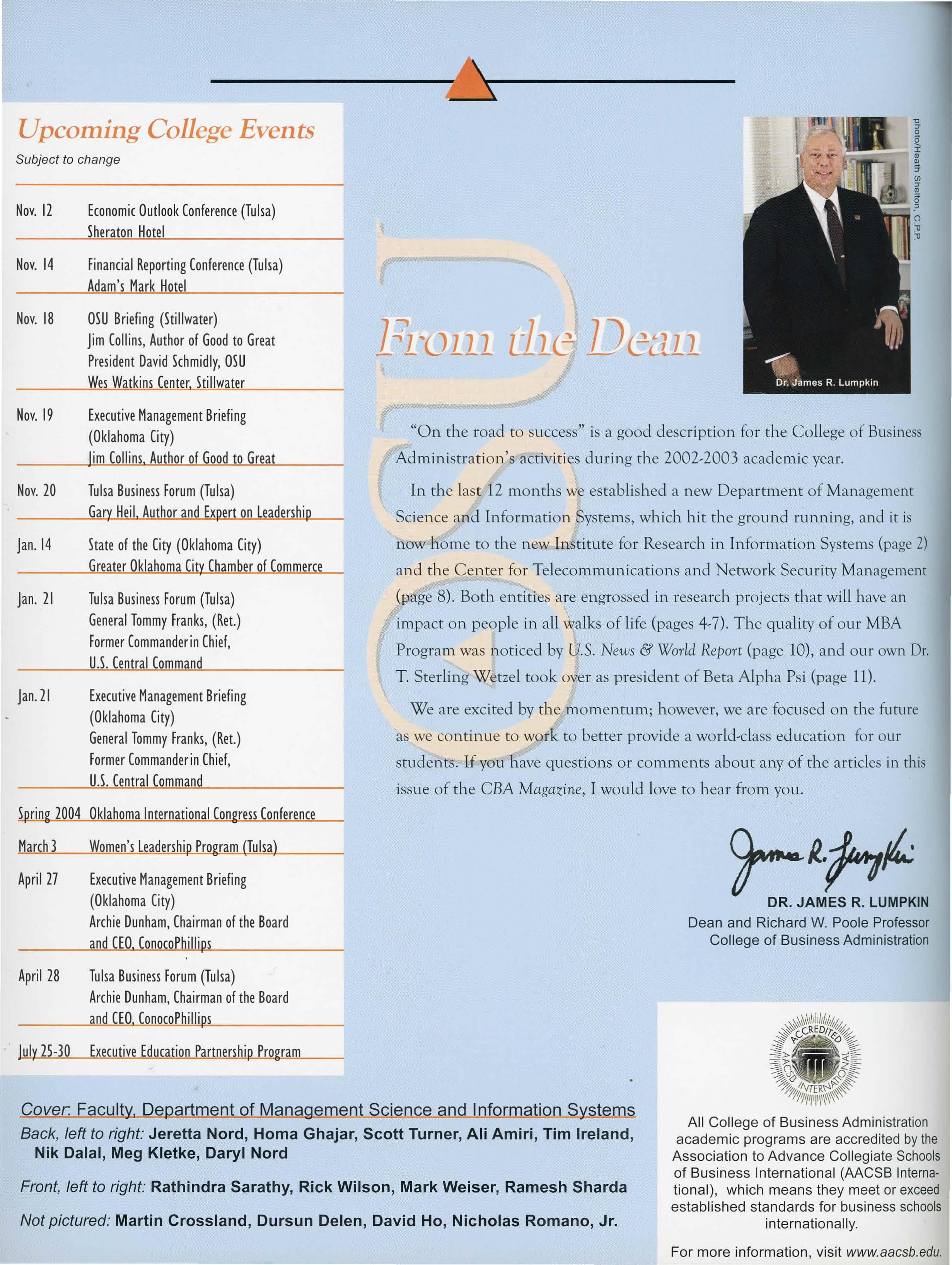
DR. JAMES R. LUMPKIN Dean and Richard W. Poole Professor College of Business Administration
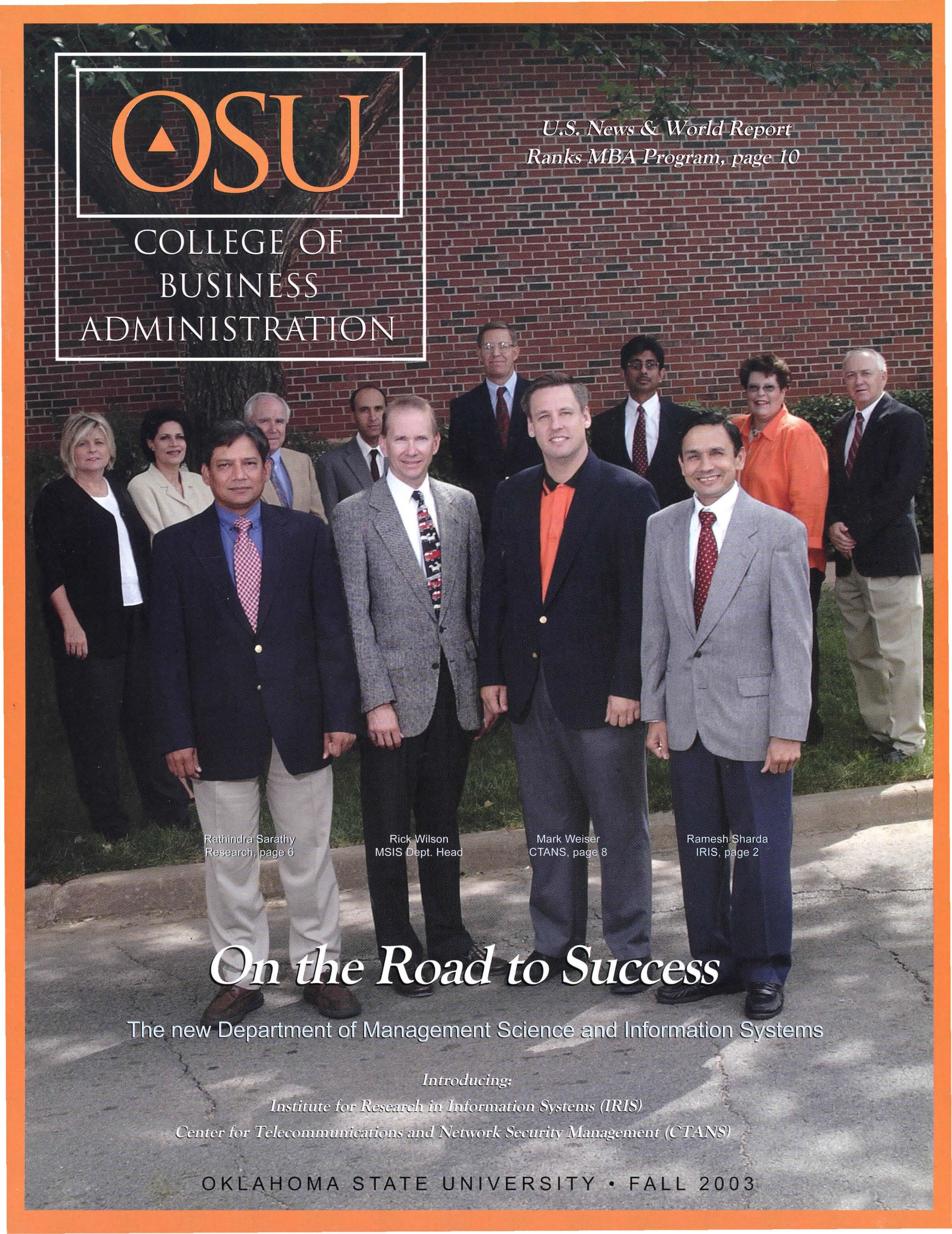
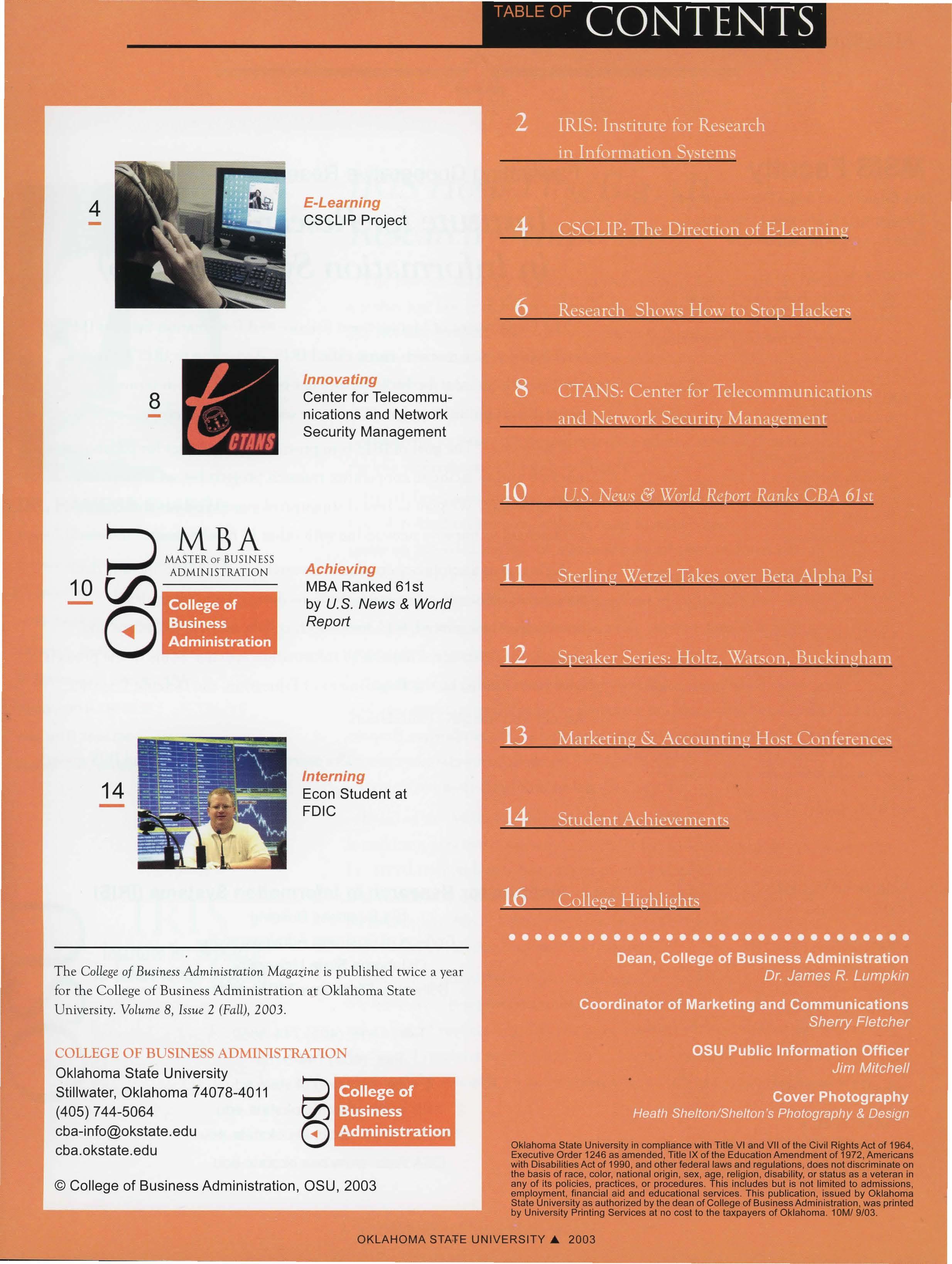
Cover. Facult De artment of Mana. ement Science and lnforma ion S stems Back, left to right: Jeretta Nord, Homa Ghajar, Scott Turner, Ali Amiri, Tim Ireland, Nik Dalal, Meg Kletke, Daryl Nord
Front, left to right: Rathindra Sarathy, Rick Wilson, Mark Weiser, Ramesh Sharda
Not pictured: Martin Crossland, Dursun Delen, David Ho, Nicholas Romano, Jr. internationally.
MSIS Faculty_
For faculty bios for the Department of Management Science and Information Systems, visit msis.okstate.edu
• RICK WILSON
W. Paul Miller Professor of Business Administration and Head of the Department of Management Science and Information Systems
• ALI AMIRI
Associate Professor
• MARTIN CROSSLAND
Associate Professor
• NIK DALAL
Associate Professor
• DURSUN DELEN
Assistant Professor
• DAVID HO, Professor
• TIM IRELAND, Professor
• MEG KLETKE
Professor and Director of the Master of Science in Management Information Systems/ Accounting Information Systems Program
• DARYL NORD, Professor
• JERETTA NORD, Professor
• NICHOLAS ROMANO
Assistant Professor
• RATHINDRA SARATHY
Associate Professor and Ph.D. Coordinator
• RAMESH SHARDA
Regents Professor and ConocoPhillips Chair in Management of Technology
• SCOTT TURNER, Professor
• MARK WEISER
Fleming Professor of Technology Management and the Director of the Master of Science in Telecommunications Management Program
Facilitatin erative Research
Institute for Research in Information Systems (IRIS)
The Department of Management Science and Information Systems (MSIS) established a new research entity called IRIS. According to IRIS's director, Dr. Ramesh Sharda, the MSIS faculty has been so prolific in terms of research and publishing that an institute was simply a necessity.
Sharda says, "The goal of IRIS is to provide opportunities for collaborative research and to facilitate cooperative research projects between corporations and academics. We plan to host distinguished guest speakers and organize conferences to improve networking with other IS faculty around the world."
With a cross-disciplinary emphasis, research areas for IRIS include data mining, e-commerce, telecommunications design, network security, knowledge management, high-bandwidth collaborative applications and strategic/ organizational impacts of information systems. Some of the projects have been funded by the Department of Education, the Defense Logistics Agency and the SBC Foundation.
(See pages 4-9for related MSISand IRIS stories.)
Institute for Research in Information S stems IRIS
104 Business Building College of Business Administration Oklahoma State University Stillwater, Oklahoma 74078-4011
Telephone: (405) 744-8850
Fax: (405) 744-5180
E-mail: osu-iris@okstate.edu
IRIS Web: www.iris.okstate.edu
CSCLIP Web: csclip.iris.okstate.edu
CBA Web: www.bus.okstate.edu
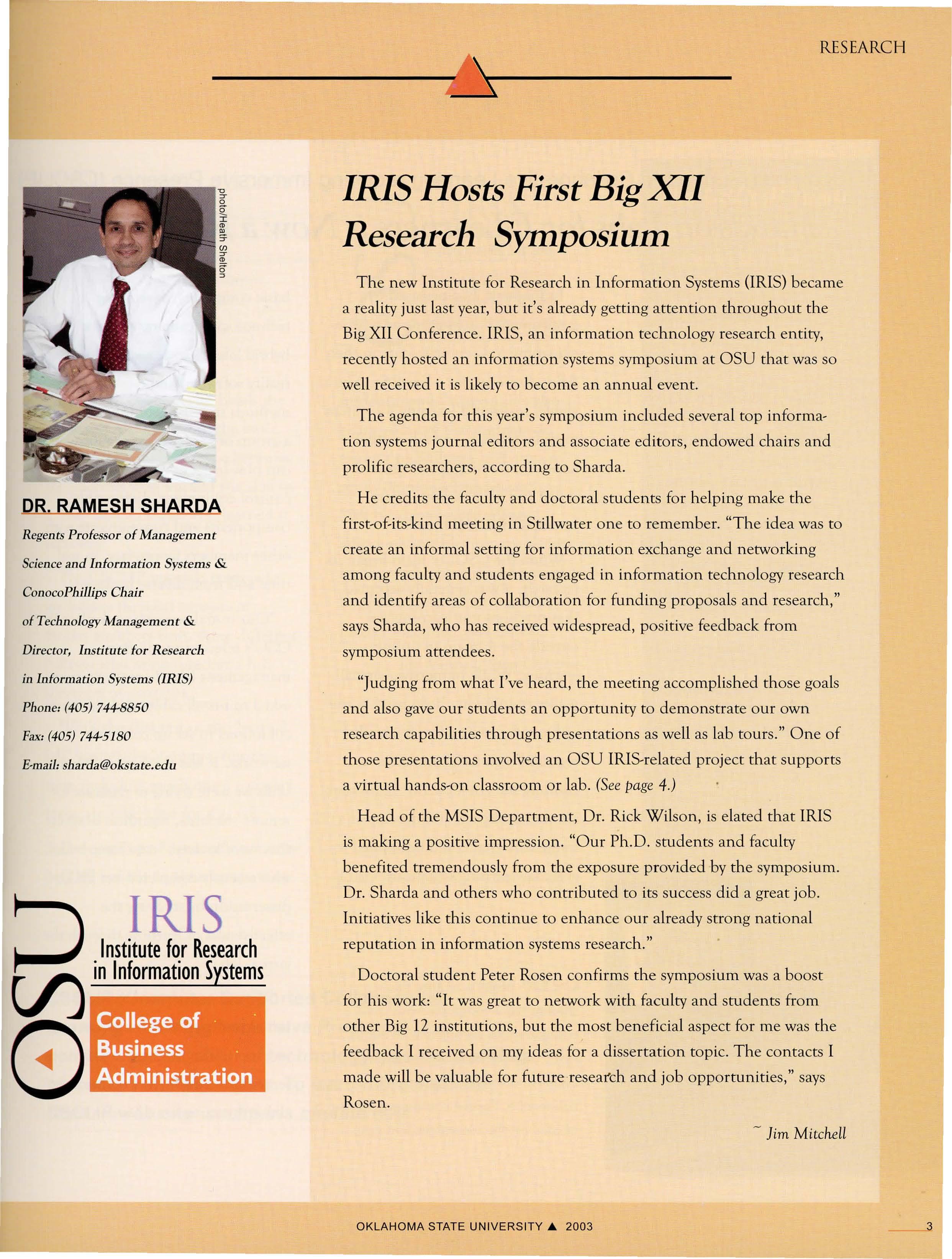
DR. RAM ARDA
Regents Professor of Management
Science and Information Systems & ConocoPhillips Chair of Technology Management & Director, Institute for Research in Information Systems (IRIS) Phone: (405) 744-8850
Fax: (405) 744-5180
E-mail:sharda@okstate.edu
College of · • Business . Administration
IRIS Hosts First Big XII Research Symposium
The new Institute for Research in Information Systems (IRIS) became a reality just last year, but it's already getting attention throughout the Big XII Conference. IRIS, an information technology research entity, recently hosted an information systems symposium at OSU that was so well received it is likely to become an annual event.
The agenda for this year's symposium included several top information systems journal editors and associate editors, endowed chairs and prolific researchers, according to Sharda.
He credits the faculty and doctoral students for helping make the first-of-its-kind meeting in Stillwater one to remember. "The idea was to create an informal setting for information exchange and networking among faculty and students engaged in information technology research and identify areas of collaboration for funding proposals and research," says Sharda, who has received widespread, positive feedback from symposium attendees.
"Judging from what I've heard, the meeting accomplished those goals and also gave our students an opportunity to demonstrate our own research capabilities through presentations as well as lab tours." One of those presentations involved an OSU IRIS-related project that supports a virtual hands-on classroom or lab. (See page 4.)
Head of the MSIS Department, Dr. Rick Wilson, is elated that IRIS is making a positive impression. "Our Ph.D. students and faculty benefited tremendously from the exposure provided by the symposium. Dr. Sharda and others who contributed to its success did a great job. Initiatives like this continue to enhance our already strong national reputation in information systems research."
Doctoral student Peter Rosen confirms the symposium was a boost for his work: "It was great to network with faculty and students from other Big 12 institutions, but the most beneficial aspect for me was the feedback I received on my ideas for a dissertation topic. The contacts I made will be valuable for future research and job opportunities," says Rosen.
- Jim Mitchell
Hands--on Labs for &Learners is Now a Reality
By using a CSCLIP learning environment, it is possible to train groups of people at the same time in different locations to operate complex machinery ... to master techniques for crisis management situations ... or to teach anything that requires psychomotor skills.
Individuals, businesses and governmental organizations rely on e-learning to keep up-to-date in their fields; however, for e-learning to be a viable, real-world learning tool, steps must be taken to include virtual hands-on training (psychomotor skills) and collaborative group interaction in real time.
When the CSCLIP team began its research, it was generally accepted that psychomotor learning was outside the domain of online learning. While immersive/virtual reality training has been used in the military for some time, it usually required high-tech simulators or equipment. The CSCLIP Team took another approach and developed a framework that could be applied to everyday learning situations. Using
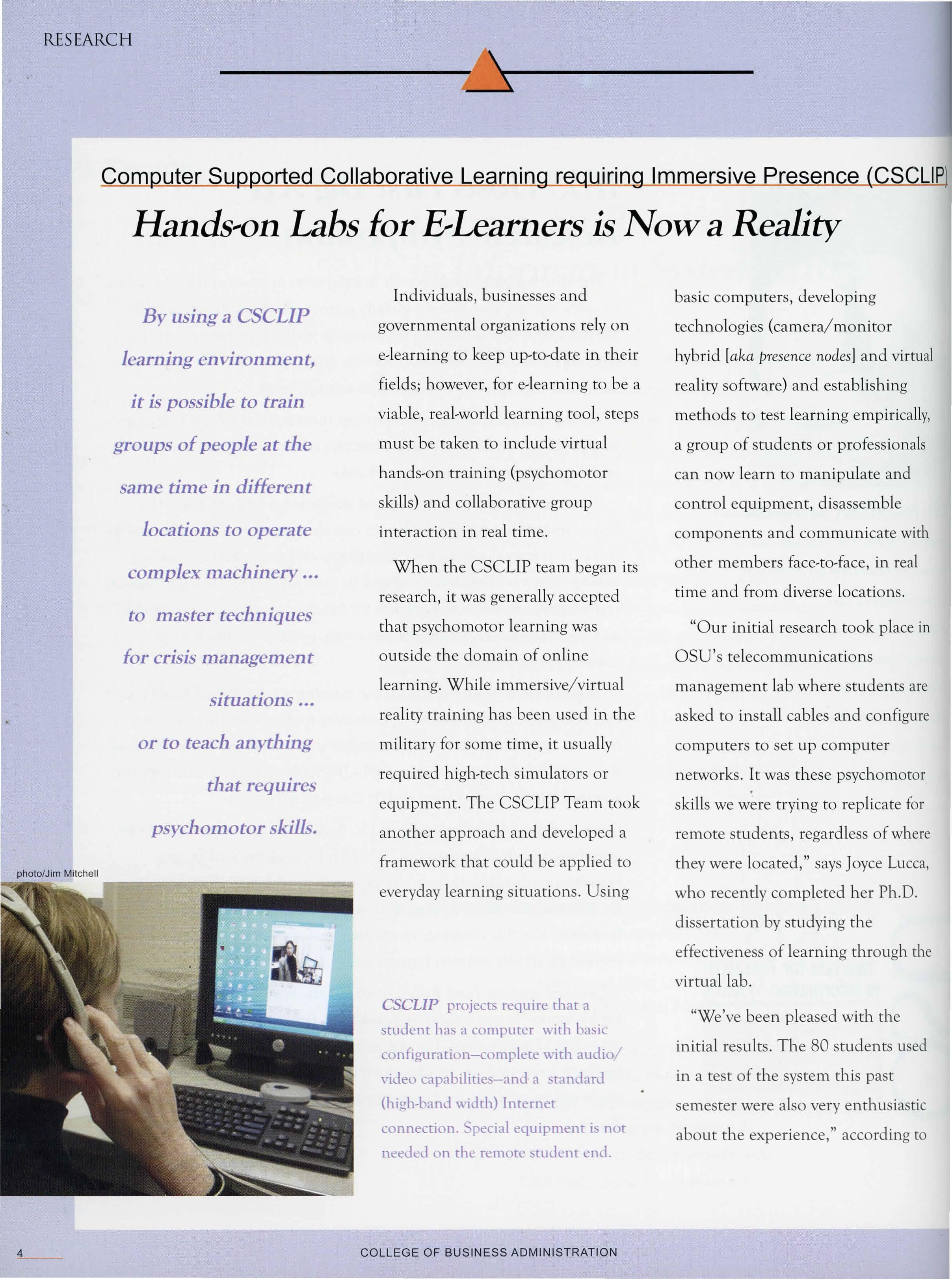
CSCLIP projects require that a student has a compmer with basic configuration-complete with audio/ video capabilitie -and a standard (high-band width) Internet connection. Special equipment is not needed on the remote student end.
basic computers, developing technologies (camera/ monitor hybrid [aka presencenodes] and virtual reality software) and establishing methods to test learning empirically, a group of students or professionals can now learn to manipulate and control equipment, disassemble components and communicate with other members face-to-face, in real time and from diverse locations.
"Our initial research took place in OSU's telecommunications management lab where students are asked to install cables and configure computers to set up computer networks. It was these psychomotor skills we were trying to replicate for remote students, regardless of where they were located," says Joyce Lucca, who recently completed her Ph.D. dissertation by studying the effectiveness of learning through the virtual lab.
"We've been pleased with the initial results. The 80 students used in a test of the system this past semester were also very enthusiastic about the experience," according to
photo/Jim Mitchell
CSCL/P is a researchproject 11nderIRIS, which has been /Jartiallyfunded by the SBC Foundation,U.S. Department of Education and Oklahoma State University.
Dr. Ramesh Sharda, who heads the project. "Our first test of the basic system found no difference between the students who learned the skill in a 'real' lab and those who learned it remotely."
The CSCLIP research team (who are listed to the right) c011.sistsof faculty members from three different colleges who bring together a full spectrum of expertise.
While the first test of the "virtual lab" was relatively simple, future tests, including much more complex tasks, are scheduled for this fall.
The ongoing research will not only be a big benefit to distance learning
V)
lnsttw.R~arch
inInformationSystems
College of Business Administration
students someday soon, it's also giving some of the students on campus in Stillwater a chance to get in on pioneering research. "We have some very talented telecommunications management students who have played a very important role in putting this project together," says Lucca.
- Jim Mitchell/Sherry Fletcher
Rathinda Sarath
Protecting Computer Data by Frustrating Hackers
photo/Jim Mitchell
•·., 0 u're Ckers Protected that , viruses and against about R . WorrnsB , , ose in 8 • Ut
,, ,, enetits?
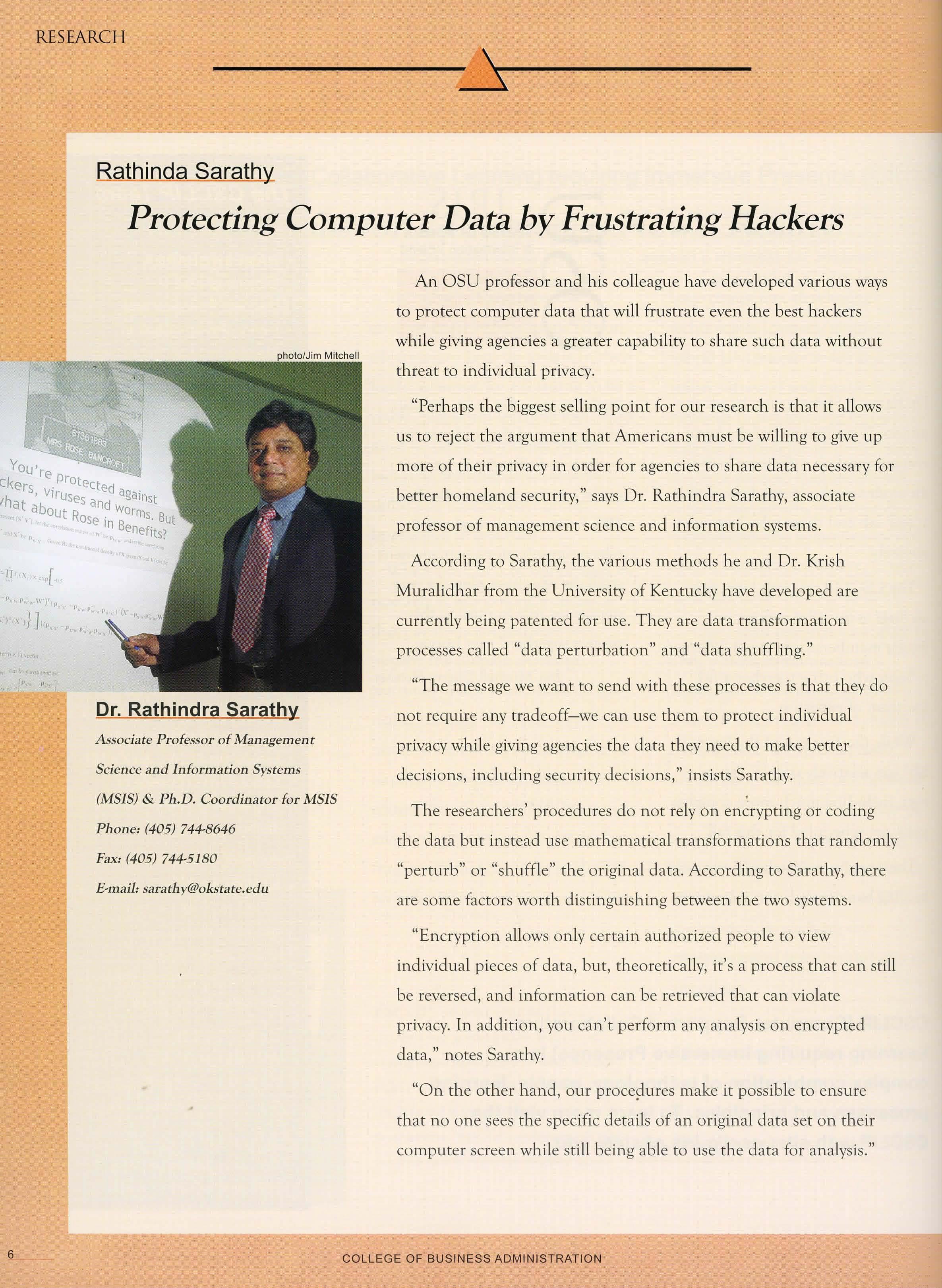
Dr. Rathindra Sarath
Associate Professor of Management Science and Information Systems
(MSIS) & Ph.D. Coordinator for MSIS
Phone: (405) 744-8646
Fax: (405) 744-5180
E-mail: sarathy@okstate.edu
An OSU professor and his colleague have developed various ways to protect computer data that will frustrate even the best hackers while giving agencies a greater capability to share such data without threat to individual privacy.
"Perhaps the biggest selling point for our research is that it allows us to reject the argument that Americans must be willing to give up more of their privacy in order for agencies to share data necessary for better homeland security," says Dr. Rathindra Sarathy, associate professor of management science and information systems.
According to Sarathy, the various methods he and Dr. Krish Muralidhar from the University of Kentucky have developed are currently being patented for use. They are data transformation processes called "data perturbation" and "data shuffling."
"The message we want to send with these processes is that they do not require any tradeoff-we can use them to protect individual privacy while giving agencies the data they need to make better decisions, including security decisions," insists Sarathy.
The researchers' procedures do not rely on encrypting or coding the data but instead use mathematical transformations that randomly "perturb" or "shuffle" the original data. According to Sarathy, there are some factors worth distinguishing between the two systems.
"Encryption allows only certain authorized people to view individual pieces of data, but, theoretically, it's a process that can still be reversed, and information can be retrieved that can violate privacy. In addition, you can't perform any analysis on encrypted data," notes Sarathy.
"On the other hand, our proce?ures make it possible to ensure that no one sees the specific details of an original data set on their computer screen while still being able to use the data for analysis."
This researchis another example of the world-classresearchunderway by the MSIS/IRISfaculty in the Collegeof BusinessAdministration.
Sarathy anticipates that these processes will be especially useful not only for security purposes but for social scientists, government agencies or business analysts who routinely perform data mining. The professor describes one of the procedures as similar to "shuffling cards in a deck."
"Let's say each card in the deck contains a certain number, and if you add them up, you get a certain sum. By shuffling the cards the numbers in a particular pile of cards don't change, they are just shuffled to the point that no one knows what their original order was. Even though the cards are now out of order, you can still add them up and get the same sum. That's the end result of the processdata you can still use."
College of Business Administration
"Perhaps the biggest selling point for our research is that it allows us to reject the argument that Americans must be willing to give
For instance, according to Sarathy, the program can ensure that no one can match names or salary figures of individuals in a particular data set while still being able to provide average income figures for the group as a whole. In this way, the data is still usable without up more of their privacy in order for these specifics.
As for a homeland security application, Sarathy says his program could allow law enforcement officers greater use of data sets that may have been off limits because they contained certain information that would cause privacy concerns. "These perturbation and shuffling processes allow those concerns to be addressed up front, before the information is ever handed over to security authorities."
- Jim Mitchell
~ Rathindra Sarathy
ether OSU's Technolo
Center for Telecommunications and Network Security Management (CTANS)
"Try to envision a room where you can look at a futuristic map of the world; and as you scan the map, you find that it is pinpointing the exact location of the release of computer bugs and viruses. Because we can get an immediate 'lock' on their location, we can block the entry of those bugs and viruses and protect the rest of the network."
That's one illustration Dr. Mark Weiser gives to describe the potential that exists for the new institute he directs called the Center for Telecommunications and Network Security Management, or "CTANS" for short.
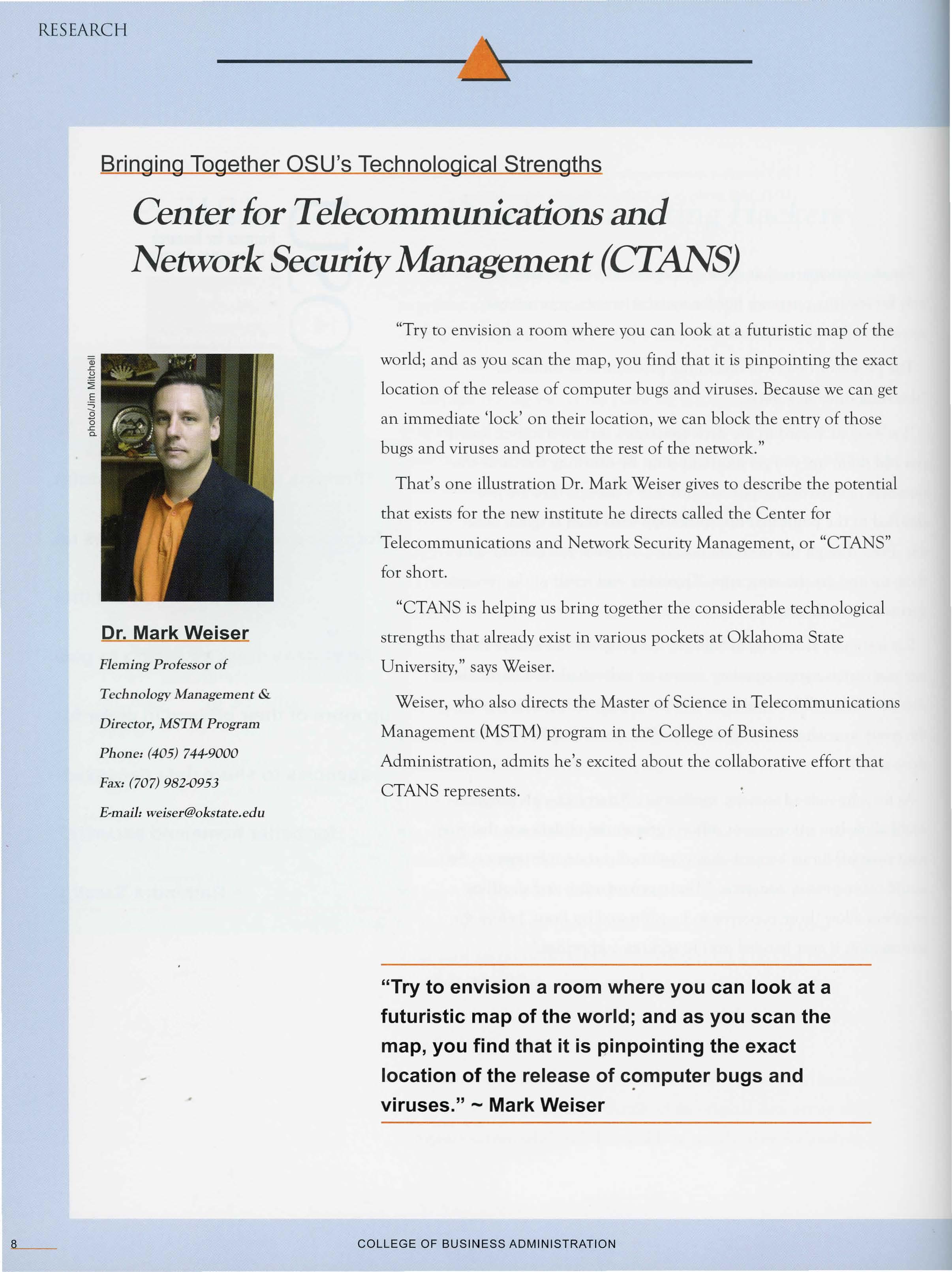
Dr. Mark Weiser
Fleming Professor of Technology Management & Director, MSTM Program
Phone: (405) 744-9000
Fax: (707) 982-0953
E-mail: weiser@okstate.edu
"CTANS is helping us bring together the considerable technological strengths that alrea<ly exist in various pockets at Oklahoma State University," says Weiser.
Weiser, who also directs the Master of Science in Telecommunications Management (MSTM)program in the College of Business Administration, admits he's excited about the collaborative effort that CTANS represents.
"Try to envision a room where you can look at a futuristic map of the world; and as you scan the map, you find that it is pinpointing the exact location of the release of C!)mputer bugs and viruses."~ Mark Weiser
"We use the word 'interdisciplinary' because it describes the group effort that we're employing here. I really believe the programs and colleges involved represent the perfect team to handle OSU's future in information technology," says Weiser.
According to Weiser, that 'team' includes the MSTM program; Electrical and Computer Engineering in the College of Engineering, Architecture and Technology; Computer Science from the College of Arts and Sciences; as well as traditional management and information systems courses from the College of Business Administration. CT ANS research projects are organized in coordination with the Institute for Research in Information Systems (IRIS). (See page 2-5 for related stories.)
Weiser says he also expects students to be an integral part of activities at CTANS including opportunities for extensive hands-on training both inside and outside of formal curriculums. "I know the MSTM program and our collaborators are firmly behind developing professionals who can actually do what they learn."
Though the Center is still in its infancy, it is aggressively working on new projects with graduate students. The first big hurdle for CTANS was to gain certification as a Center of Excellence in Information Assurance Education.
"This is a designation that is given by the National Security Agency that verifies that our curriculum meets and exceeds standards for information assurance professions. It allows us to provide students with certificates that indicate they have met rigorous federal evaluation guidelines."
Receiving the new designation amounts to a great start for CTANS according to Weiser, who also looks forward to the time that the center can start providing better,protection for OSU's own computer system. "I'd like to think we could start right here on campus and expand to the point that one day you may see us using a futuristic global map to play a key role in security for computer networks worldwide."
- Jim Mitchell
US. News & World Re. ort
MBA Ranked 61st Program in United States
U.S. News and World Report ranked the Master of Business Administration (MBA) program in the College of Business Administra-, tion 61st in the nation. While Dr. James R. Lumpkin, CBA dean and Richard W. Poole Professor, is pleased with the progress the ranking signifies, he wants the faculty to view it more as a "stepping stone" to an ultimate goal.
"We're committed to our vision of attaining top-SO status for both the undergraduate and graduate programs by 2010. This ranking is a sign that we're headed in the right direction," he says.
There are roughly 1,000 graduate business programs and 3,000 undergraduate business programs nationwide. That means the CBA's first-ever ranking by the magazinecoupled with an undergraduate ranking of 91st overall-puts both its graduate and undergraduate programs well within the top-ten percent in the U.S. However, Lumpkin notes the competition is fierce. "In our own peer group, the Big XII Conference, four schools were ranked above us, so we have plenty of motivation for continued improvement."
BENCHMARKING
According to Lumpkin, the high ranking from U.S. News and World Report is the direct result of "benchmarking against the best MBA programs nationwide and setting specific goals for improving our own program."
Dr. Ken Eastman, who was director of the MBA program and is now the head of the Department of Management, agrees that the benchmarking proved invaluable.
"We're committed to our vision of attaining top-50 status for both the undergraduate and graduate programs by 2010. This ranking is a sign that we're headed in the right direction."
~ James Lumpkin
"We knew we had a program in place that met or exceeded those offered by the top MBA schools, and it was largely a matter of setting higher achievement standards to reflect better the value of our program."
Eastman says once the new standards were in place, the improvements quickly followed. "Our job placement rates were already good, but now there are only six schools nationwide that have a higher rate than we do."
Continuing the progress began by Eastman is the new MBA director, Dr. Robert S. Dooley, who says, "We're currently researching exactly where our MBA grads are being placed and what we can do to ensure the quality as well as the rate of that placement."
QUALITY
The CBA has implemented an integrated marketing plan to tell various stakeholders about the quality of its programs-several of which regularly receive national acclaim-high-profile grants and honors that enhance the College's national reputation. "We have a solid core of outstanding faculty that excels in both the classroom and in research with an established track record for success," says Lumpkin, who mentions programs in telecommunications and information systems management as well as an innovative new degree in risk management.
The Dean's list of "enhancers" includes several recent additions such as the Institute for Research in Information Systems (IRIS), the CBA Trading Floor to support the risk management component and a cooperative effort between the CBA's Master of Science in Telecommunicati<;ms Management program and other OSU colleges to start the Center for Telecommunications and Network Security Management (CTANS).
COMMITMENT
Lumpkin makes it clear that the College of Business Administration is committed to moving up in the national rankings. "If we didn't think we had the potential to be ranked in the top-SO business schools, we wouldn't have accepted this vision for the College. We know the potential is here; if we stick to our vision and continue to improve our performance, we will reach that goal, and reach it early."
- Jim Mitchell
T. Sterlin Wetzel
Takes Over as President for Beta Al.pha Psi
Dr. T. Sterling Wetzel, associate professor of accounting, recently took over as president of the 200,000-member national professional business and financial information fraternity known as Beta Alpha Psi.
"I certainly look forward to carrying the good name of Oklahoma State University to several places throughout the U.S. as well as foreign countries. Of course, our local chapter has been in the national spotlight for many years thanks to its own accomplishments and a previous national president, Dr. Wilton T. Anderson," says Wetzel.
The new president will assume his duties with some very specific goals in mind.
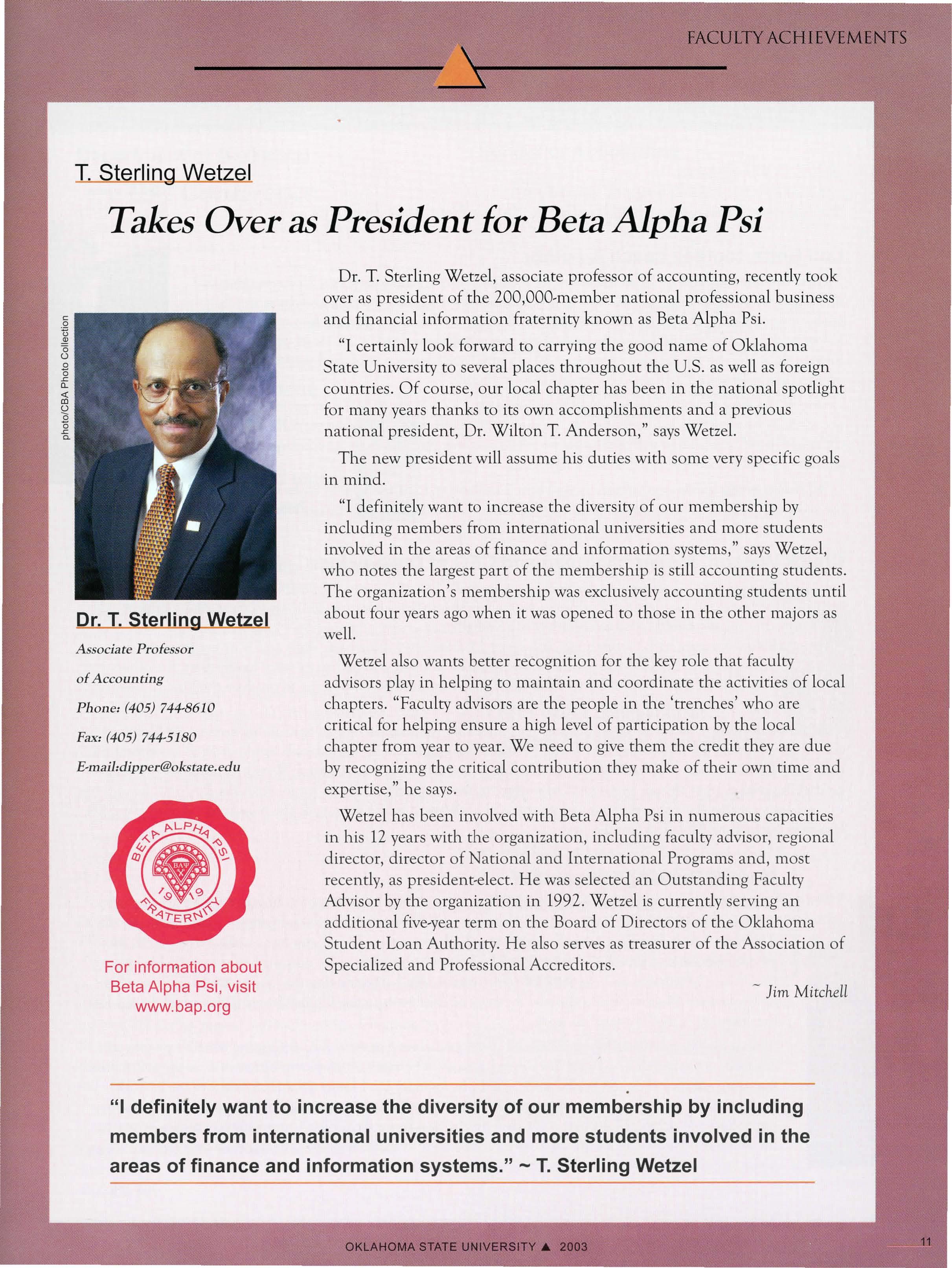
Dr. T. Sterling Wetzel
Associate Professor of Accounting
Phone: (405) 744-8610
Fax: (405) 744-5180
E-mail:dipper@okstate.edu
For information about Beta Alpha Psi, visit www.bap.org
"I definitely want to increase the diversity of our membership by including members from international universities and more students involved in the areas of finance and information systems," says Wetzel, who notes the largest part of the membership is still accounting students. The organization's membership was exclusively accounting students until about four years ago when it was opened to those in the other majors as well.
Wetzel also wants better recognition for the key role that faculty advisors play in helping to maintain and coordinate the activities of local chapters. "Faculty advisors are the people in the 'trenches' who are critical for helping ensure a high level of participation by the local chapter from year to year. We need to give them the credit they are due by recognizing the critical contribution they make of their own time and expertise," he says.
Wetzel has been involved with Beta Alpha Psi in numerous capacities in his 12 years with the organization, including faculty advisor, regional director, director of National and International Programs and, most recently, as president-elect. He was selected an Outstanding Faculty Advisor by the organization in 1992. Wetzel is currently serving an additional five-year term on the Board of Directors of the Oklahoma Student Loan Authority. He also serves as treasurer of the Association of Specialized and Professional Accreditors.
- ]im Mitchell
"I
definitely want to increase the diversity of our membership by including members from international universities and more students involved in the areas of finance and information systems."~ T. Sterling Wetzel
2002-2003 Season
Executive Management Briefings, Tulsa Business Forums
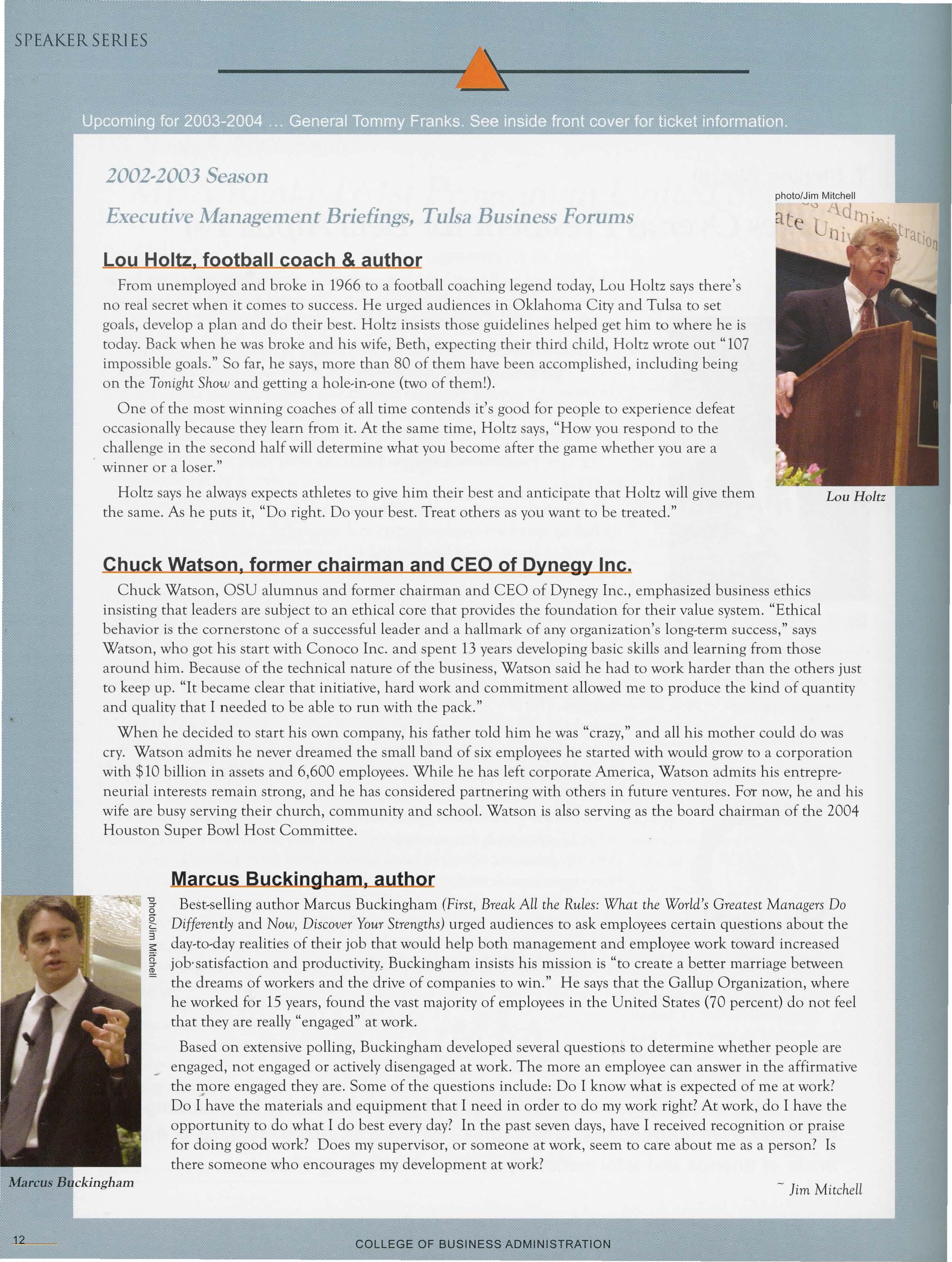
Lou Holtz,footballcoach& author
From unemployed and broke in 1966 to a football coaching legend today, Lou Holtz says there's no real secret when it comes to success. He urged audiences in Oklahoma City and Tulsa to set goals, develop a plan and do their best. Holtz insists those guidelines helped get him to where he is today. Back when he was broke and his wife, Beth, expecting their third child, Holtz wrote out "107 impossible goals." So far, he says, more than 80 of them have been accomplished, including being on the Tonight Show and getting a hole-in-one (two of them!).
One of the most winning coaches of all time contends it's good for people to experLence defeat occasionally because they learn from it. At the same time, Holtz says, "How you respond to the challenge in the second half will determine what you become after the game whether you are a winner or a loser."
Holtz says he always expects athletes to give him their best and anticipate that Holtz will give them the same. As he puts it, "Do right. Do your best. Treat others as you want to be treated."
ChuckWatson,formerchairmanand CEO of DynegyInc.
Chuck Watson, OSU alumnus and former chairman and CEO of Dynegy Inc., emphasized business ethics insisting that leaders are subject to an ethical core that provides the foundation for their value system. "Ethical behavior is the cornerstone of a successful leader and a hallmark of any organization's long-term success," says Watson, who got his start with Conoco Inc. and spent 13 years developing basic skills and learning from those around him. Because of the technical nature of the business, Watson said he had to work harder than the others just to keep up. "It became clear that initiative, hard work and commitment allowed me to produce the kind of quantity and quality that I needed to be able to run with the pack."
When he decided to start his own company, his father told him he was "crazy," and all his mother could do was cry. Watson admits he never dreamed the small band of six employees he started with would grow to a corporation with $10 billion in assets and 6,600 employees. While he has left corporate America, Watson admits his entrepreneurial interests remain strong, and he has considered partnering with others in future ventures. FOTnow, he and his wife are busy serving their church, community and school. Watson is also serving as the board chairman of the 2004 Houston Super Bowl Host Committee.
MarcusBuckingham,author
l Best-selling author Marcus Buckingham (First, Break All the Rules: What the World's Greatest Managers Do [ Differently and Now, Discover Your Strengths) urged audiences to ask employees certain questions about the 3 ;:: day-to-day realities of their job that would help both management and employee work toward increased f job-satisfaction and productivity, Buckingham insists his mission is "to create a better marriage between the dreams of workers and the drive of companies to win." He says that the Gallup Organization, where he worked for 15 years, found the vast majority of employees in the United States (70 percent) do not feel that they are really "engaged" at work.
Based on extensive polling, Buckingham developed several questiot;1.sto determine whether people are _ engaged, not engaged or actively disengaged at work. The more an employee can answer in the affirmative the qi.ore engaged they are. Some of the questions include: Do I know what is expected of me at work? Do I have the materials and equipment that I need in order to do my work right? At work, do I have the opportunity to do what I do best every day? In the past seven days, have I received recognition or praise for doing good work? Does my supervisor, or someone at work, seem to care about me as a person? Is there someone who encourages my development at work?
~ Jim Mitchell
Lou Holtz
De artment of Marketin CRM Conference
The Department of Marketing and Business Extension hosted a one-day conference in Tulsa last April to provide businesses with some helpful insights into an integrated system known as Customer Relationship Management, or CRM. The system promises increased profits by focusing on long-term relationships with customers.
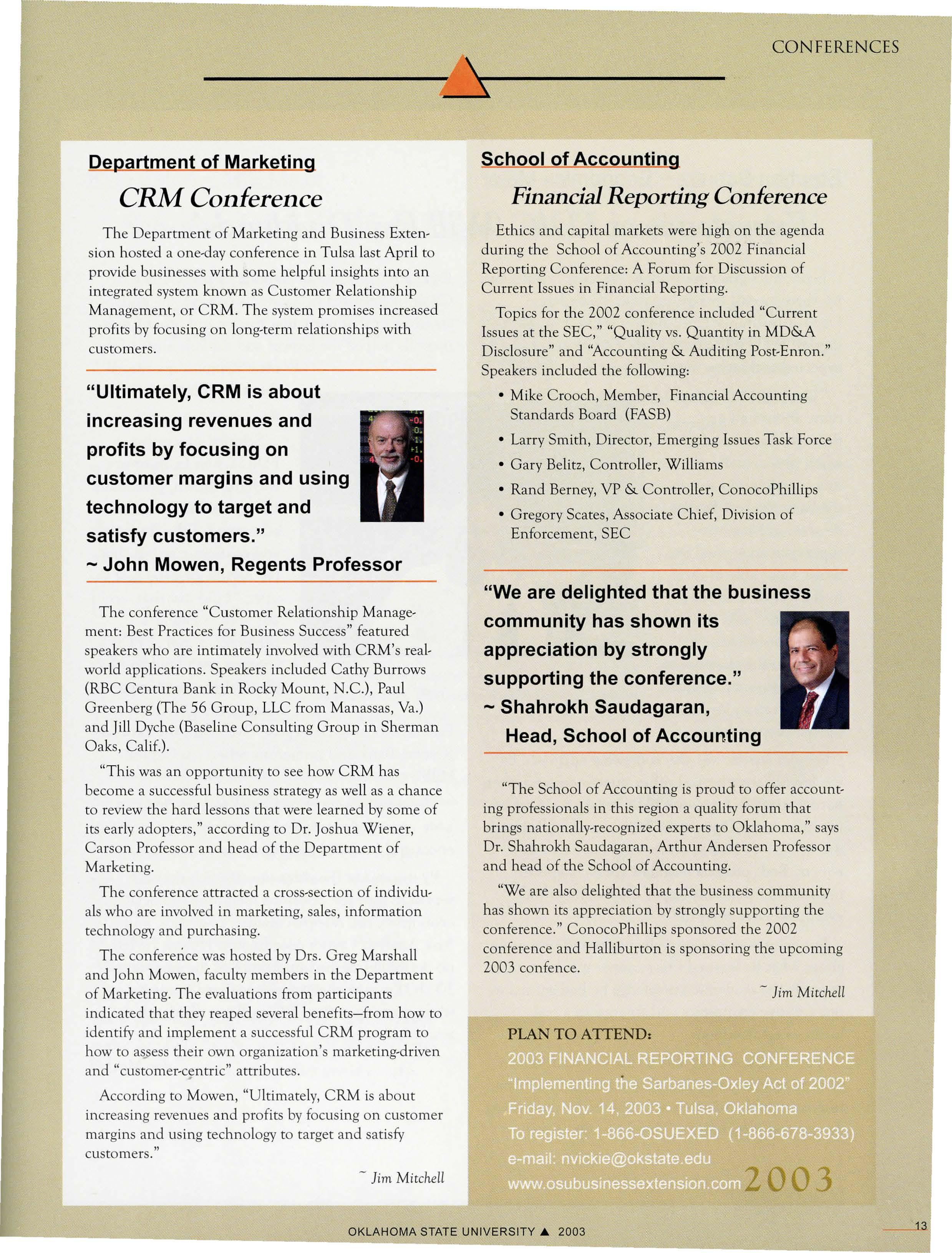
"Ultimately, CRM is about increasing revenues and profits by focusing on customer margins and using technology to target and satisfy customers."
~ John Mowen, Regents Professor
The conference "Customer Relationship Management: Best Practices for Business Success" featured speakers who are intimately involved with CRM's realworld applications. Speakers included Cathy Burrows (RBC Centura Bank in Rocky Mount, N.C.), Paul Greenberg (The 56 Group, LLC from Manassas, Va.) and Jill Dyche (Baseline Consulting Group in Sherman Oaks, Calif.).
"This was an opportunity to see how CRM has become a successful business strategy as well as a chance to review the hard lessons that were learned by some of its early adopters," according to Dr. Joshua Wiener, Carson Professor and head of the Department of Marketing.
The conference attracted a cross-section of individuals who are involved in marketing, sales, information technology and purchasing.
The conference was hosted by Drs. Greg Marshall and John Mowen, faculty members in the Department of Marketing. The evaluations from participants indicated that they reaped several benefits-from how to identify and implement a successful CRM program to how to as..sesstheir own organization's marketing-driven and "customer-c~ntric" attributes.
According to Mowen, "Ultimately, CRM is about increasing revenues and profits by focusing on customer margins and using technology to target and satisfy customers."
- Jim Mitchell
SchoolofAccountin
Financial Reporting Conference
Ethics and capital markets were high on the agenda during the School of Accounting's 2002 Financial Reporting Conference: A Forum for Discussion of Current Issues in Financial Reporting.
Topics for the 2002 conference included "Current Issues at the SEC," "Quality vs. Quantity in MD&A Disclosure" and "Accounting & Auditing Post-Enron." Speakers included the following:
• Mike Crooch, Member, Financial Accounting Standards Board (FASB)
• Larry Smith, Director, Emerging Issues Task Force
• Gary Belitz, Controller, Williams
• Rand Berney, VP & Controller, ConocoPhillips
• Gregory Scates, Associate Chief, Division of Enforcement, SEC
"We are delighted that the business community has shown its appreciation by strongly supporting the conference."
~ Shahrokh
Saudagaran,
Head, School of Accounting
"The School of Accounting is proud to offer accounting professionals in this region a quality forum that brings nationally-recognized experts to Oklahoma," says Dr. Shahrokh Saudagaran, Arthur Andersen Professor and head of the School of Accounting.
"We are also delighted that the business community has shown its appreciation by strongly supporting the conference." ConocoPhillips sponsored the 2002 conference and Halliburton is sponsoring the upcoming 2003 confence.
- Jim Mitchell
PLAN TO ATTEND:
StephenSchultz~ EconomicsMajor
Experience at FDIC 'Will Pay Dividends'
Economics graduate student Stephen Schultz says his three-month internship with the Federal Deposit Insurance Corporation (FDIC) in Washington, D.C., this summer was everything he expected and more.
"The biggest surprise came about half way through the internship when they actually put me in a coordination role in the Risk Analysis Branch. As soon as I knew my supervisor supported the move, I was able to excel in the duties of my new assignment," says Schultz, who credits what he's
learned in the classrooms at the College of Business Administration for his onthe-job preparedness.
Schultz says he was also somewhat surprised by the level of trust he and other interns enjoyed, even participating in high-level FDIC projects. "One of my roles in the Division of Insurance and Research was being a co-author on two in-house academic papers. Both projects required access to specific information that only upper level analysts and executives were privy to."
But Schultz says what really impressed him most about what he learned this summer was being able to apply the academic knowledge he had gained in quantitative economics and finance to a real business environment.
"For instance, I was able to use a certain theory of economic an.,alysisthat allowed me to track how interest rate fluctuations affected the banks trading on the major exchanges. Thanks to Dr. (Dan)
Rickman (professor of economics and OG&E Chair in Regional Economic Analysis), my understanding of that particular theory and other fundamentals helped me answer and explain some of the most complex questions that they (FDIC) threw at " me.
Schultz' supervisor, FDIC Chief Economist Richard Brown, personally encouraged him to take advantage of the financial and economic minds that the nation's capital had to offer. "I did just that, and I was able to establish personal, as well as FDIC, contacts with Freddie Mac (Federal Home Mortgage Corp.), the Office of
Federal Housing Enterprise Oversight, the Federal Reserve Bank and numerous others on Capital Hill."
The interns were also allowed to participate in a wide variety of events including economic conferences and financial presentations.
By the end of the three months Schultz had served in four job positions including financial economist, risk research analyst, co-author, and Risk Analysis Center coordinator. He says he has no doubt about the importance of the summer of 2003. "I'm sure the experience that I've gained while working at the FDIC will pay dividends for many years to come."
- Jim Mitchell
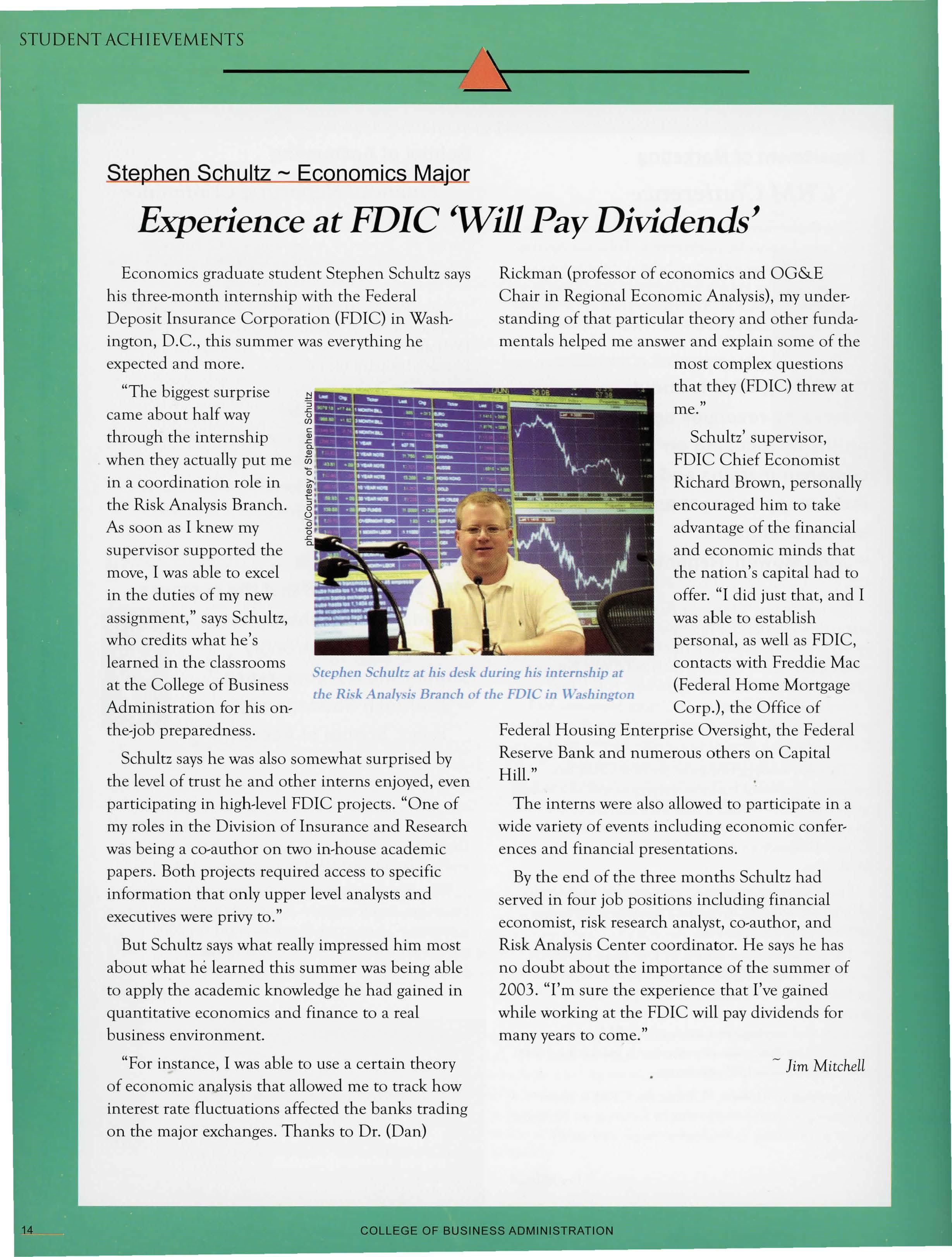
Stephen Schult= at his desk during his intermhip at
the Risk Analysis Branch of the FDIC in \-Vashington
K le Eaton ~ MIS Ma·or
Scholar,Athlete Wins Big & Heads to Big Apple
Where does OSU offensive tackle Kyle Eaton go after helping beat the Sooners for a second-straight year? Try the Waldorf-Astoria in New York City where he received national recognition for his academic prowess.
The 6-foot-8, 300-pound grad student received an $18,000 post-graduate scholarship as a National Scholar-Athlete.
According to the organization that sponsored the scholarship, Eaton is one of only 14 students nationwide chosen for the Scholar-Athlete honor. The National Football Foundation and College Hall of Fame annually select players who excel in the classroom as well as on the field. Eaton certainly qualifies, pulling a 4.0 average throughout his college career at OSU. He recently earned a degree in management information systems from the College of Business Administration.
Eaton, from Zabcikville, Texas, graduated with honors and is a ten-time President's Honor Roll member, an eight-time Conference Commissioner's Honor Roll member and a fourtime Academic Achievement Award recipient.
He also was one of two players in the Big 12 to be named a first team Verizon Academic AllAmerican. It'~ the second time he's earned that honor. He was also named to the Academic AllBig 12 squad for the fourth straight year. He and teammate Billy Bajema were two of seven athletes named to the squad with perfect grade point averages.
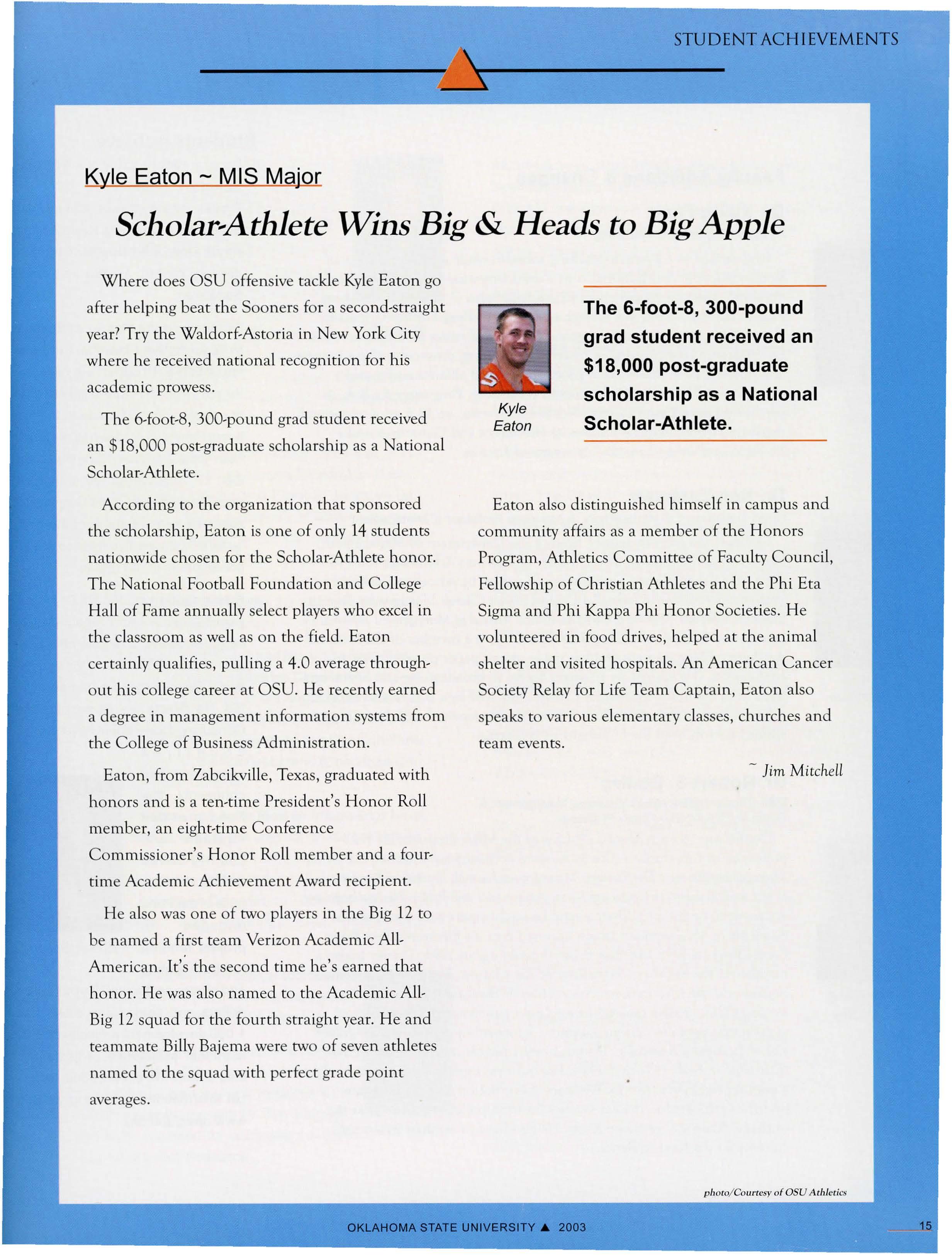
The 6-foot-8, 300-pound grad student received an $18,000 post-graduate scholarship as a National Scholar-Athlete.
Eaton also distinguished himself in campus and community affairs as a member of the Honors Program, Athletics Committee of Faculty Council, Fellowship of Christian Athletes and the Phi Eta Sigma and Phi Kappa Phi Honor Societies. He volunteered in food drives, helped at the animal shelter and visited hospitals. An American Cancer Society Relay for Life Team Captain, Eaton also speaks to various elementary classes, churches and team events.
- Jim Mitchell
Kyle Eaton
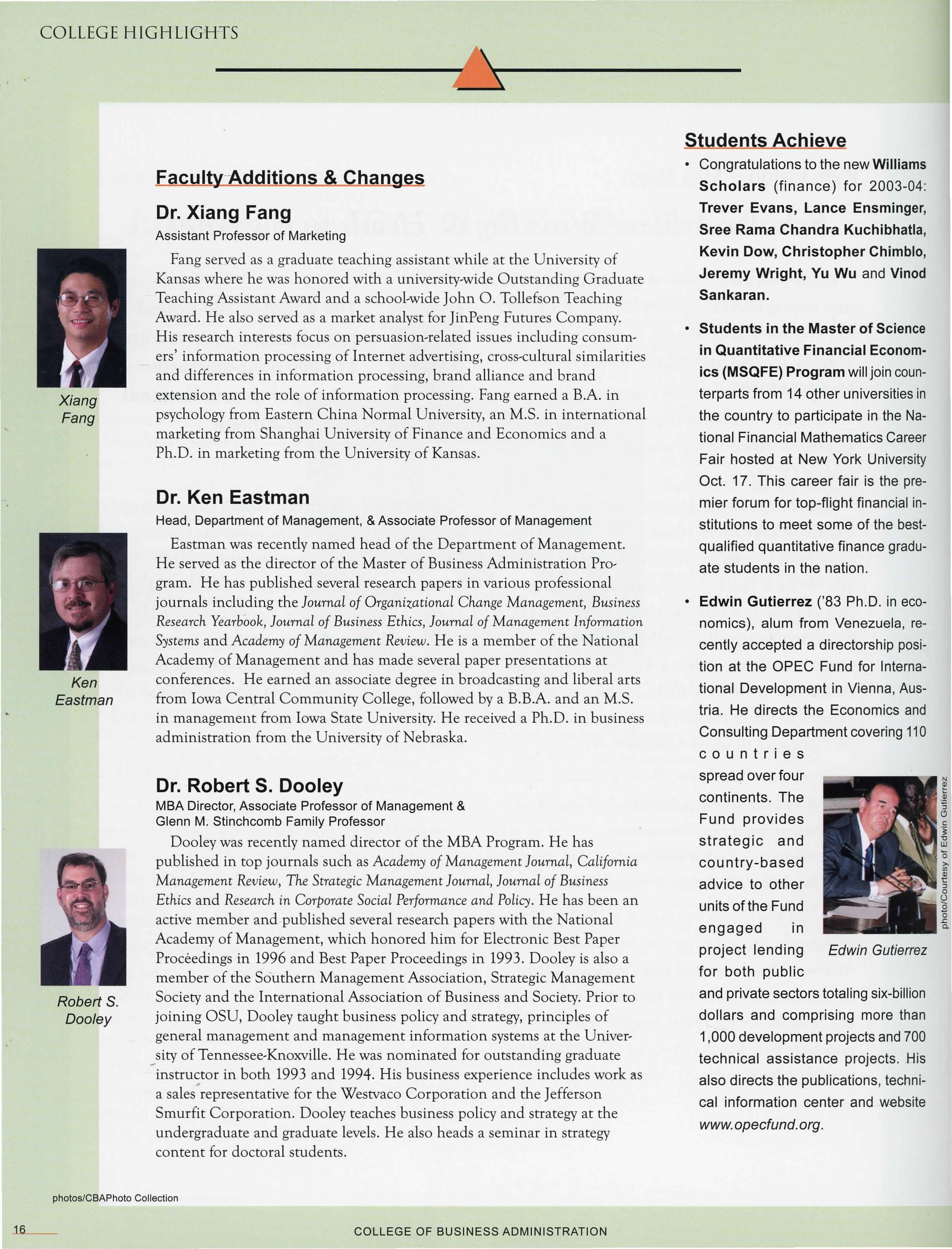
Dr. Xiang Fang
Assistant Professor of Marketing
Fang served as a graduate teaching assistant while at the University of Kansas where he was honored with a university-wide Outstanding Graduate Teaching Assistant Award and a school-wide John 0. Tollefson Teaching Award. He also served as a market analyst for JinPeng Futures Company. His research interests focus on persuasion-related issues including consumers' information processing of Internet advertising, cross-cultural similarities and differences in information processing, brand alliance and brand extension and the role of information processing. Fang earned a B.A. in psychology from Eastern China Normal University, an M.S. in international marketing from Shanghai University of Finance and Economics and a Ph.D. in marketing from the University of Kansas.
Dr. Ken Eastman
Head, Department of Management, & Associate Professor of Management
Eastman was recently named head of the Department of Management. He served as the director of the Master of Business Administration Program. He has published several research papers in various professional journals including the Journal of Organizational Change Management, Business ResearchYearbook,Journal of Business Ethics, Journal of Management Information Systems and Academy of Management Review. He is a member of the National Academy of Management and has made several paper presentations at conferences. He earned an associate degree in broadcasting and liberal arts from Iowa Central Community College, followed by a B.B.A. and an M.S. in management from Iowa State University. He received a Ph.D. in business administration from the University of Nebraska.
Dr. Robert S. Dooley
MBADirector,Associate Professor of Management & Glenn M. Stinchcomb Family Professor
Dooley was recently named director of the MBA Program. He has published in top journals such as Academy of Management Journal, California Management Review, The StrategicManagement Journal, Journal of Business Ethics and Researchin CorporateSocial Performanceand Policy.He has been an active member and published several research papers with the National Academy of Management, which honored him for Electronic Best Paper Proceedings in 1996 and Best Paper Proceedings in 1993. Dooley is also a member of the Southern Management Association, Strategic Management Society and the International Association of Business and Society. Prior to joining OSU, Dooley taught business policy and strategy, principles of general management and management information systems at the University of Tennessee-Knoxville. He was nominated for outstanding graduate -instructor in both 1993 and 1994. His business experience includes work as a sales'representative for the Westvaco Corporation and the Jefferson Smurfit Corporation. Dooley teaches business policy and strategy at the undergraduate and graduate levels. He also heads a seminar in strategy content for doctoral students.
Students Achi v
• Congratulations to the new Williams Scholars (finance) for 2003-04: Trever Evans, Lance Ensminger, Sree Rama Chandra Kuchibhatla, Kevin Dow, Christopher Chimblo, Jeremy Wright, Yu Wu and Vinod Sankaran.
• Students in the Master of Science in Quantitative Financial Economics (MSQFE) Program willjoin counterparts from 14 other universities in the country to participate in the National Financial Mathematics Career Fair hosted at New York University Oct. 17. This career fair is the premier forum for top-flight financial institutions to meet some of the bestqualified quantitative finance graduate students in the nation.
• Edwin Gutierrez ('83 Ph.D. in economics), alum from Venezuela, recently accepted a directorship position at the OPEC Fund for International Development in Vienna, Austria. He directs the Economics and Consulting Department covering 110 countries spread over four continents. The Fund provides strategic and country-based advice to other units of the Fund engaged in project lending for both public Edwin Gutierrez and private sectors totaling six-billion dollars and comprising more than 1,000 development projects and 700 technical assistance projects. His also directs the publications, technical information center and website www.opecfund.org.
Xiang Fang
Ken Eastman
Robert S. Dooley
Facult Activities
• Dr. Karen Flaherty (marketing) and Amy Sallee (marketing doctoral student) earned the Best Overall Paper award at the American Marketing Association Summer Educators Conference in Chicago. This is the largest conference of its type in the world, which gives you an idea of what it means to be named "the best." Their winning paper is entitled "Matching Sales Management Practice to
Business Strategy: A Social Exchange Perspective." Sallee is the recipient of an OSU Distinguished Graduate Fellowship.
• "Environmental Costs and Tax Policy: The Case of Future Dismantlement, Removal and Restoration Costs," by Ors. Charlotte Wright and Carol B. Johnson (accounting) and J. Shaw (University of Mississippi) was accepted for publication in the Oil, Gas and Energy Quarterly. Also, Wright's paper, "Corporate Control and Accounting Policy Choices: The Case of MBOs," with L. Guan (University of Hawaii), was accepted for publication in Managerial Finance.
• Dr. Kevin Voss (marketing) had his article titled "Measuring the Hedonic and Utilitarian Dimensions of Consumer Attitude" published in the August 2003 issue of the Journal of Marketing Research. The article's coauthors were Dr. Eric Spangenberg (Washington State University) and Dr. Bianca Grohmann (Concordia University, Montreal, Canada).
• Ors. Tom Brown and John Mowen (marketing) have a paper forthcoming in the Journal of Marketing with Dr. Todd Donavan (former Ph.D. student now at Kansas State). The paper is entitled "Internal Benefits of Service Worker Customer Orientation: Job Satisfaction, Commitment and Organizational Citizenship Behaviors."
Dr. Greg Marshall (marketing) took over as president of the American Marketing Association (AMA)Academic Division July 1.
• A paper by Dr. Jim Fain (economics/legal studies) entitled "The Current State of the Labor Queue: National and Regional Evidence" (co-authored with Dr. Tim Bisping) has been accepted for publication in the Journal of Labor Research.
• An article by Dr. Ajay Singh Sukhdial (marketing) has been selected as one of the top-50 articles for 2002 by Emerald Management Reviews (EMR), an abstracting database in the United Kingdom. Sukhdial's article "Are you Old School? A Scale for Measuring Fans' Old School Orientation" will become part of the company's Citation of Excellence Hall of Fame.
• Dr. Marlys Mason (marketing) was recently awarded a National Science Foundation Faculty Fellowship in Social Science Research Applied to Hazards. She presented a paper at the 2003 Marketing and Public Policy Conference in Washington, D.C. The paper was entitled "The Unintended Consequences of Mandated Disclosures: The Case of Dietary Supplements."
• Dr. Tim 0. Peterson (management) recently coauthored and published an article with Dr. Jon W. Beard for the Journal of Information Systems Education. The article is entitled "Coming to Grips with the Management of Information: A Classroom Exercise."
• Dr. Gautam Chakraborty (marketing), Prashant Tim o. Srivastava and David Warren's paper, "Drivers Peterson of Corporate B2B Web Sites' Effectiveness: A Comparison Between North American and European Perspective," was accepted at the Direct Marketing Educators Conference.
• Dr. David Carter (finance) taught a finance course for the Consortium Institute of Management and Business Analysis (CIMBA) in Asolo, Italy.
• At the same CIMBA conference mentioned above, Dr. Gautam Chakraborty (marketing) was honored with the "Professor of the Year Award." OSU is a member of CIMBA, which is a consortium of universities dedicated to international business education.
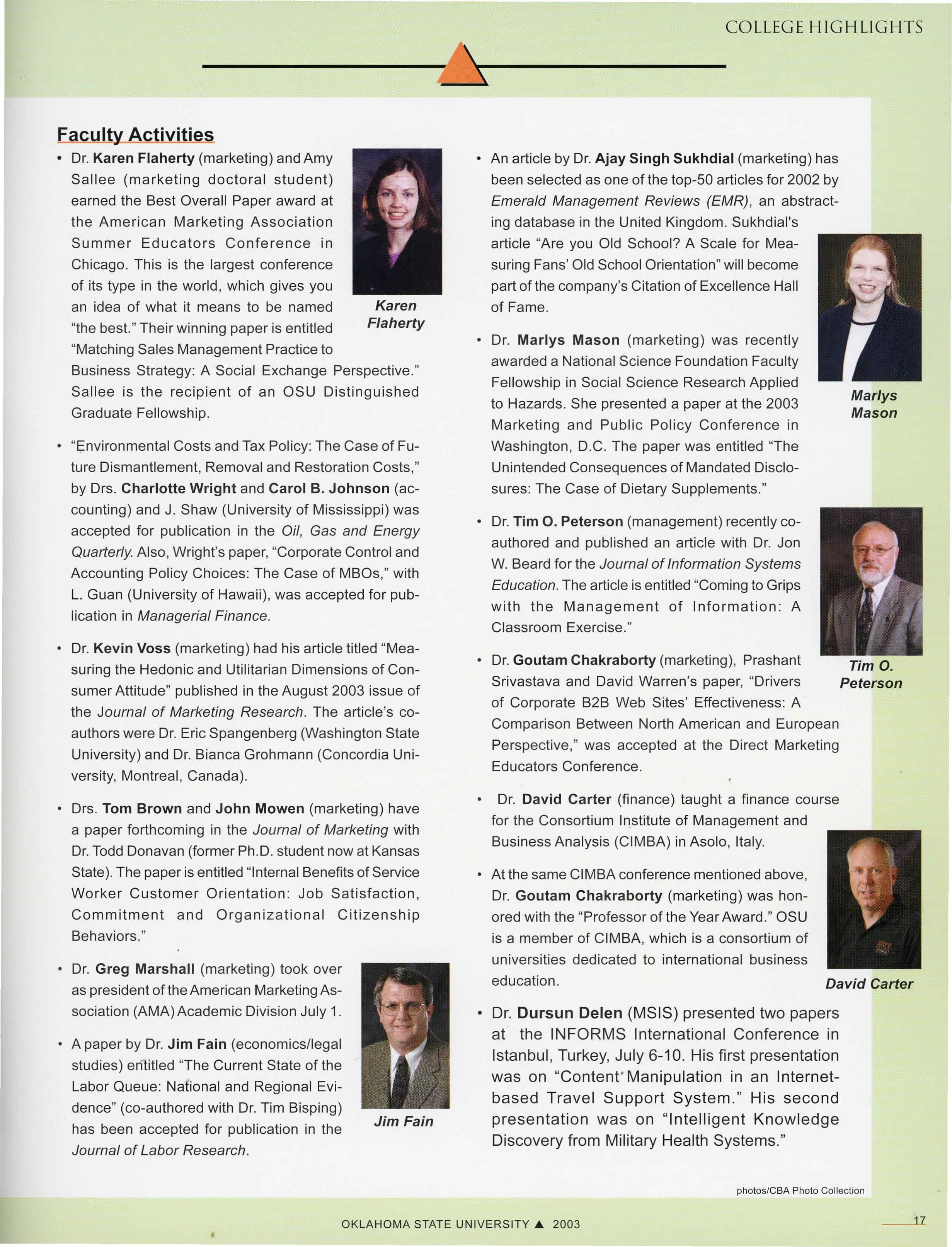
Jim Fain
David Carter
• Dr. Dursun Delen (MSIS) presented two papers at the INFORMS International Conference in Istanbul, Turkey, July 6-10. His first presentation was on "Content" Manipulation in an Internetbased Travel Support System." His second presentation was on "Intelligent Knowledge Discovery from Military Health Systems."
Karen Flaherty
Marlys Mason