Williams Institute for Quantitative Finance
Drs. Tim Krehbieland Janice}ad/ow
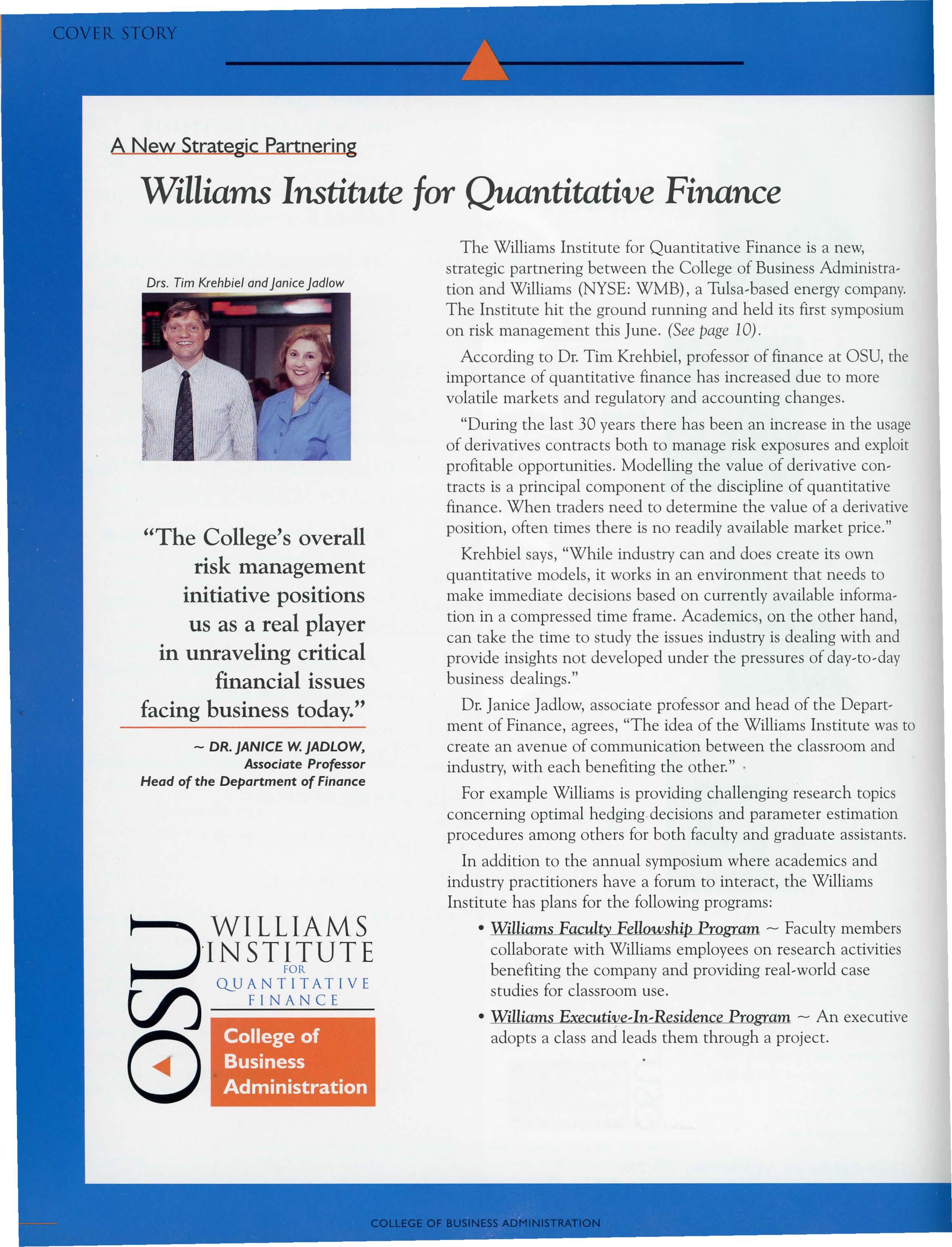
"The College's overall risk management initiative positions us as a real player in unraveling critical financial issues facing business today."
- DR. JANICE W. JADLOW, Associate Professor Head of the Department of Finance
The Williams Institute for Quantitative Finance is a new, strategic partnering between the College of Business Administration and Williams (NYSE: WMB), a Tulsa-based energy company. The Institute hit the ground running and held its first symposium on risk management this June. (See page 10).
According to Dr. Tim Krehbiel, professor of finance at OSU, the importance of quantitative finance has increased due to more volatile markets and regulatory and accounting changes.
"During the last 30 years there has been an increase in the usage of derivatives contracts both to manage risk exposures and exploit profitable opportunities. Modelling the value of derivative contracts is a principal component of the discipline of quantitative finance. When traders need to determine the value of a derivative position, often times there is no readily available market price."
Krehbiel says, "While industry can and does create its own quantitative models, it works in an environment that needs to make immediate decisions based on currently available information in a compressed time frame. Academics, on the other hand, can take the time to study the issues industry is dealing with and provide insights not developed under the pressures of day-to-day business dealings."
Dr. Janice Jadlow, associate professor and head of the Department of Finance, agrees, "The idea of the Williams Institute was to create an avenue of communication between the classroom and industry, with each benefiting the other." ·
For example Williams is providing challenging research topics concerning optimal hedging.decisions and parameter estimation procedures among others for both faculty and graduate assistants.
In addition to the annual symposium where academics and industry practitioners have a forum to interact, the Williams Institute has plans for the following programs:
• Williams FacultyFellowshipProgram - Faculty members collaborate with Williams employees on research activities benefiting the company and providing real-world case studies for classroom use.
• Williams Executive-In-ResidenceProgram - An executive adopts a class and leads them through a project.
Masterof Sciencein QuantitativeFinance
Unique Degree to Meet Industry's New Demands
Created in response to industry demands, the Master of Science in Quantitative Financial Economics (MSQFE) in the College of Business Administration is designed to produce graduates who have the advanced financial/analytical training needed for today's business environment.
Drawing on the diverse strengths of OSU's Departments of Finance, Economics, Agricultural Economics, Mathematics and Statistics, the MSQFE is one of only a few such programs available nationally.
According to Dr. Tim Krehbiel, MSQFE director and professor of finance, "The need for individuals with quantitative skills is at an all-time high. Advancements in technology and changes in the regulatory environment have greatly increased the analytical skills necessary to operate in the new market environment."
0MSQfE
MASTER.OF SCIENCE QJ)ANTITATIVE
FINANCIAL ECONOMICS
College of Business Administration
He says this trend is particularly evident in the energy business. Companies such as Bank of America, Goldman Sachs, Aquila, Intel, Microsoft, Williams and Dynegy use advanced quantitative finance techniques in their operations. The program was designed for students with strong backgrounds in mathematics and provides them with opportunities to apply their knowledge and skills to evaluate the uncertain outcomes found in financial applications.
The 33-hour program allows for real-world case studies and other relevant activities by making use of the latest industry software available in the stateof-the-art Dynegy Trading Floor and academic/industry partnerships with the Williams Institute for Quantitative Finance and the Center for Risk Management.
Head of the Department of Finance, Dr. Janice Jadlow, says, "The response has been tremendous; we have received applications from around the world. This is in part due to offering a unique, interdisciplinary degree, but also because of the progressive, cutting-edge nature of the risk-management initiative in the Department of Finance."
- Sherry Fletcher
For more information visit, _www.okstate.edu/msqfe.
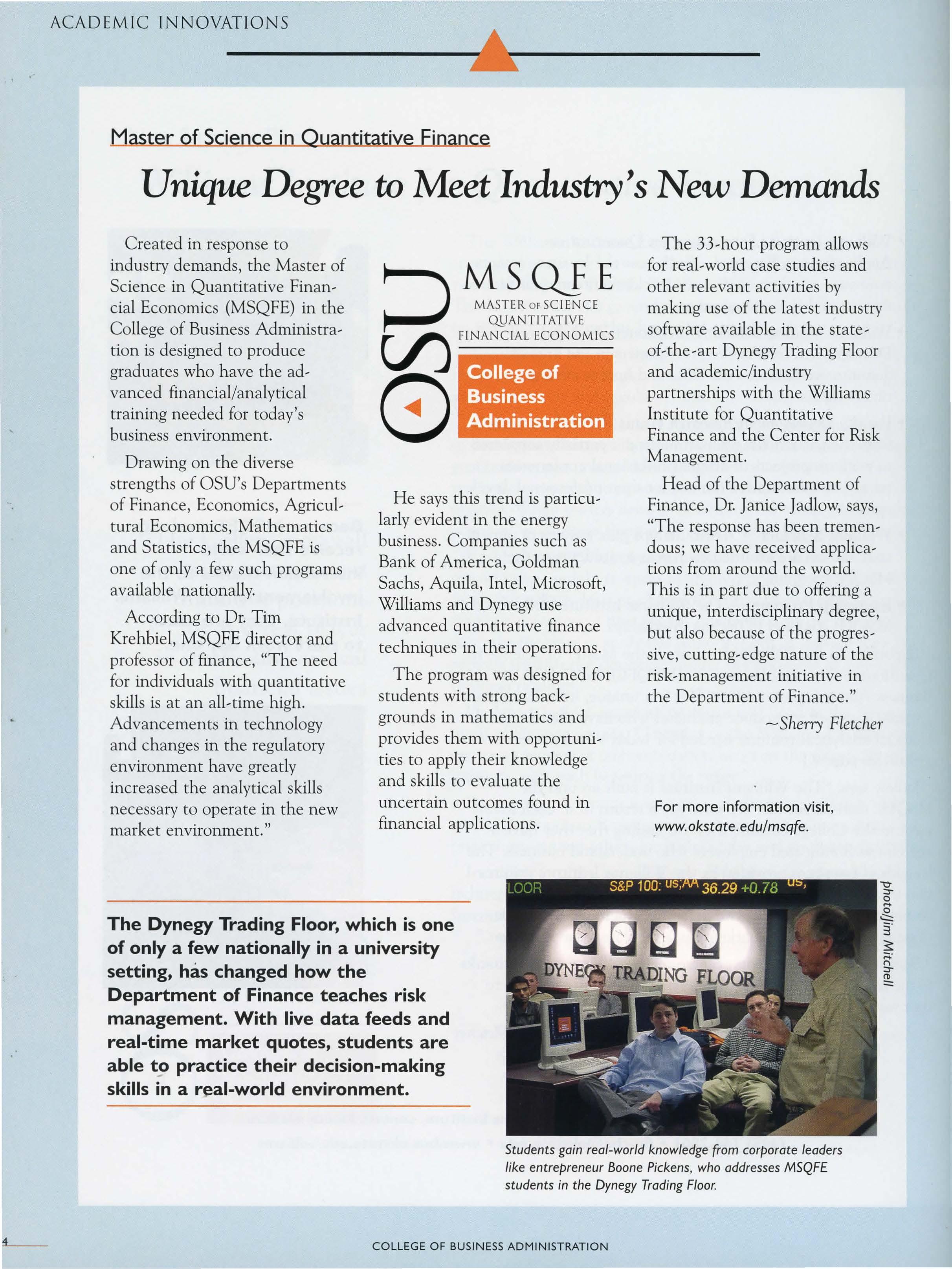
The Dynegy Trading Floor, which is one of only a few nationally in a university setting, has changed how the Department of Finance teaches risk management. With live data feeds and real-time market quotes, students are able tp practice their decision-making skills in a real-world environment.
Students gain real-world knowledge from corporate leaders like entrepreneur Boone Pickens, who addresses MSQFE students in the Dynegy Trading Floor.
More Than a TechnicalMBA...
The Accelerated MBA--MSTMDual Degree
Earn a Master of Science in Telecommunications Management (MSTM) and a Master of Business Administration (MBA) in just two and a half years?
Dr. Mark Weiser, MSTM Program director and the Fleming Professor in Management of Technology, and Dr. Ken Eastman, MBA Program director and associate professor of management, have worked out the details to make it possible for a full-time student to get both degrees in just four academic semesters and two summers. Students in the Accelerated MBA-MSTM Dual Degree option complete the core courses in both programs and still have sufficient elective hours to decide what they want to emphasize.
"This is an exciting opportunity because of the outstanding value it offers for those willing to make the commitment to stay in school a bit longer. The dual degree is more than a technical MBA. The MSTM Program is a unique, interdisciplinary degree that compliments our strong MBA Program," says Weiser.
Because of the faster pace, the admissions process will be very competitive with a minimum GPA of 3.2 and a minimum GMAT score of 580. Expected averages for those admitted are 3.5 GPA and 610 GMAT.
For more information, contact either the MBA or MSTM Programs.
About the MBA
The team-work oriented MBA offers superior academic challenges, real-world learning experiences and the opportunity to develop strong interpersonal skills necessary to be a leader in the business world. The curriculum is a blend of quantitative and behavioral classes, designed to reflect today's integrated and global marketplace. While basic tools, theories and concepts are a constant, modifications as a result of feedback from the MBA advisory committee, industry and alumni help keep the curriculum fresh, current and timely.
mba.obtate.edu (405) 744-2951
mba-osu@okstate.edu
About the MSTM
Working together the College of Business Administration, the College of Engineering, Architecture and Technology and the College of Arts and Sciences have built one of the nation's most unique, interdisciplinary telecommunications management programs. MSTM graduates develop broad knowledge in areas of business, technology and communications with options to specialize in areas tbat best fit their career aspirations.
www.mstm.okstate.edu (405) 744-9000 mstm-osu@okstate.edu
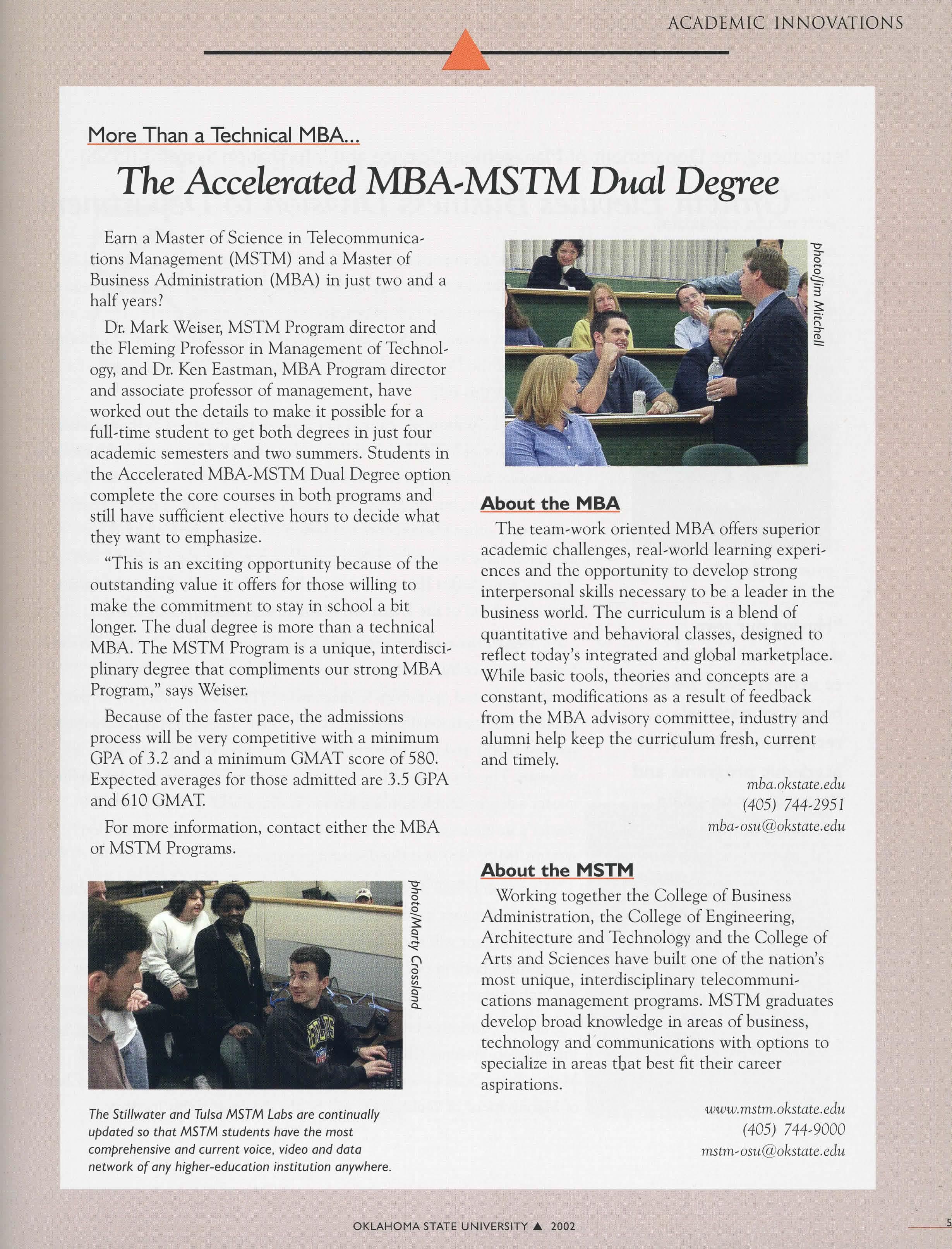
The Stillwater and Tulsa MSTM Labs are continually updated so that MSTM students have the most comprehensive and current voice, video and data network of any higher-education institution anywhere.
Introducingthe Departmentof ManagementScienceandInformationSystems(MSIS)
Growth Elevates Business Division to Department
The growing importance of information systems and the continued fast pace of technological change have created a demand to put the College of Business Administration's nationally recognized management science and information systems (MSIS) faculty in a department of its own. The former -g. 'division' of the Department of Management was officially elevated to a g, department this July. 3·
Dr. Rick L. Wilson, W Paul Miller Professor of Business Administration " [ and professor of MSIS, heads the new department. He describes the move as
an absolute necessity given enrollment increases in the MSIS area. "During the past decade, our programs have grown dramatically, and our classes serve many other constituents inside and outside of the College. Our graduates have been extremely successful upon entering industry," says Wilson, who credits this success to the leadership of Dr. Wayne Meinhart, who is the head of the Department of Management.
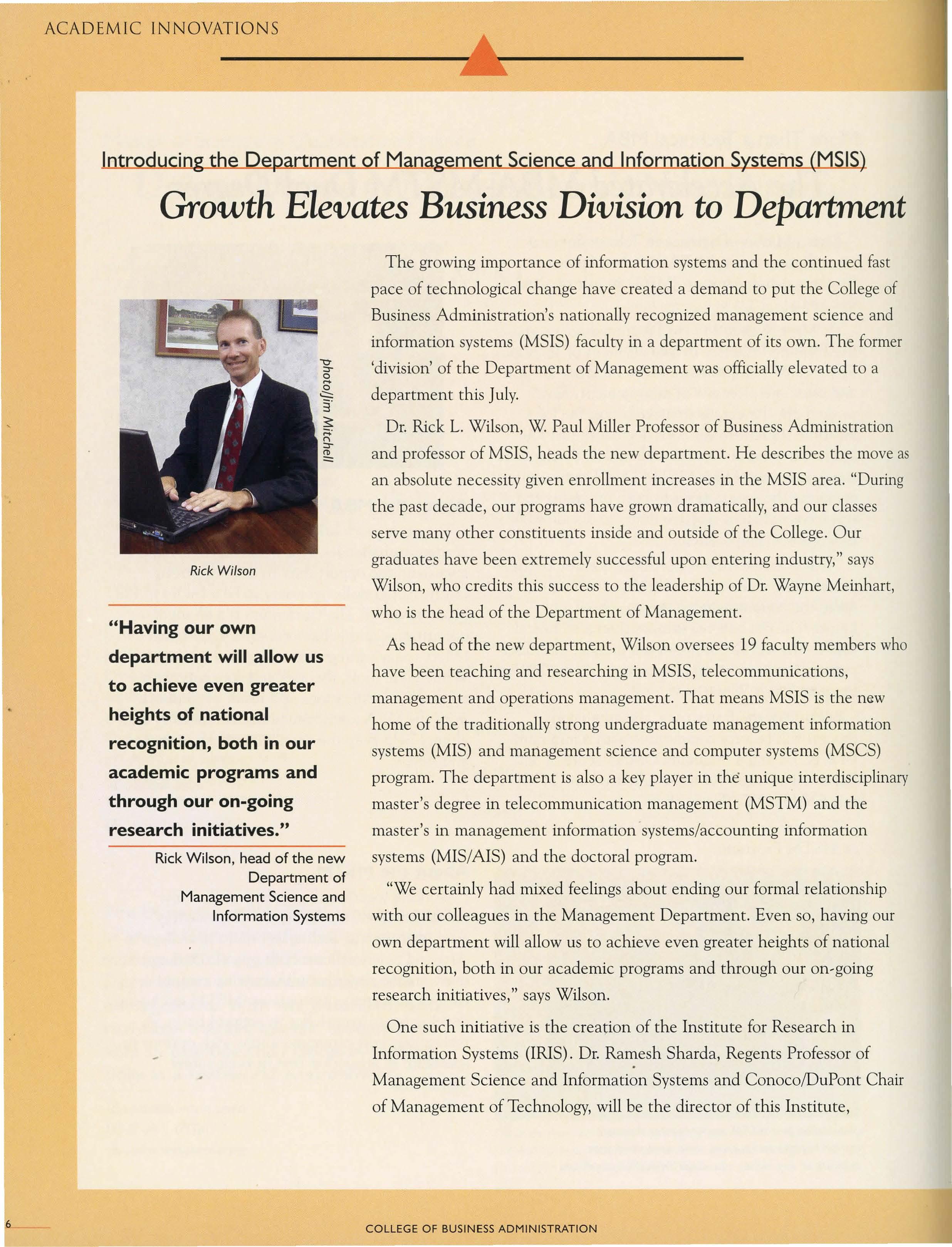
"Having our own department will allow us to achieve even greater heights of national recognition, both in our academic programs and through our on-going research initiatives."
Rick
Wilson, head of the new Department of Management Science and Information Systems
As head of the new department, Wilson oversees 19 faculty members who have been teaching and researching in MSIS, telecommunications, management and operations management. That means MSIS is the new home of the traditionally strong undergraduate management information systems (MIS) and management science and computer systems (MSCS) program. The department is also a key player in the unique interdisciplinary master's degree in telecommunication management (MSTM) and the master's in management information ·systems/accounting information systems (MIS/AIS) and the doctoral program.
"We certainly had mixed feelings about ending our formal relationship with our colleagues in the Management Department. Even so, having our own department will allow us to achieve even greater heights of national recognition, both in our academic programs and through our on-going research initiatives," says Wilson.
One such initiative is the creation of the Institute for Research in Information Systems (IRIS). Dr. Ramesh Sharda, Regents Professor of Management Science and Information Systems and Conoco/DuPont Chair of Management of Technology, will be the director of this Institute,
Rick Wilson
DEPARTMENT OF MANAGEMENT SClENCE AND lNFORMATION SYSTEMS
according to Wilson. "Dr. Sharda has led many research efforts in the past, along with other faculty in the MSIS area and has brought many external research dollars to the College. At present, we have several funded research projects that we hope will be the first of many new exciting and state-of-the-art projects that IRIS will help facilitate."
Wilson points to the fact that Sharda is one of several topnotch, nationally-recognized researchers in the new department as reason to believe that the years ahead will continue to be very fruitful. "We have an outstanding group of faculty in the MSIS Department. All are excellent instructors who are committed to keeping our curriculum fresh and relevant as technology continues to rapidly advance in the future," says Wilson, adding, ''As a group, we're excited about that future and the continued impact we will have in helping OSU's CBA achieve even greater degrees of national recognition."
Degree Programs offered in the new Department of Management Science and Information Systems (MSIS)
• B.S.in Manag;ment !nformationSystems
• B.S.in ManagementScienceand Computer Systems
• Ph.D. in MSIS
One of the first initiatives of the new MSIS Department was to create the Institute for Research in Information Systems (IRIS).
Dr. Ramesh Sharda, Regents Professor of Management Science and Information Systems and Conoco/DuPont Chair of Management of Technology, will be the director of the Institute.
Jim Mitchell
Dr. Ramesh Sharda
P,_zycutive :Jvlanagement
(J3riefings
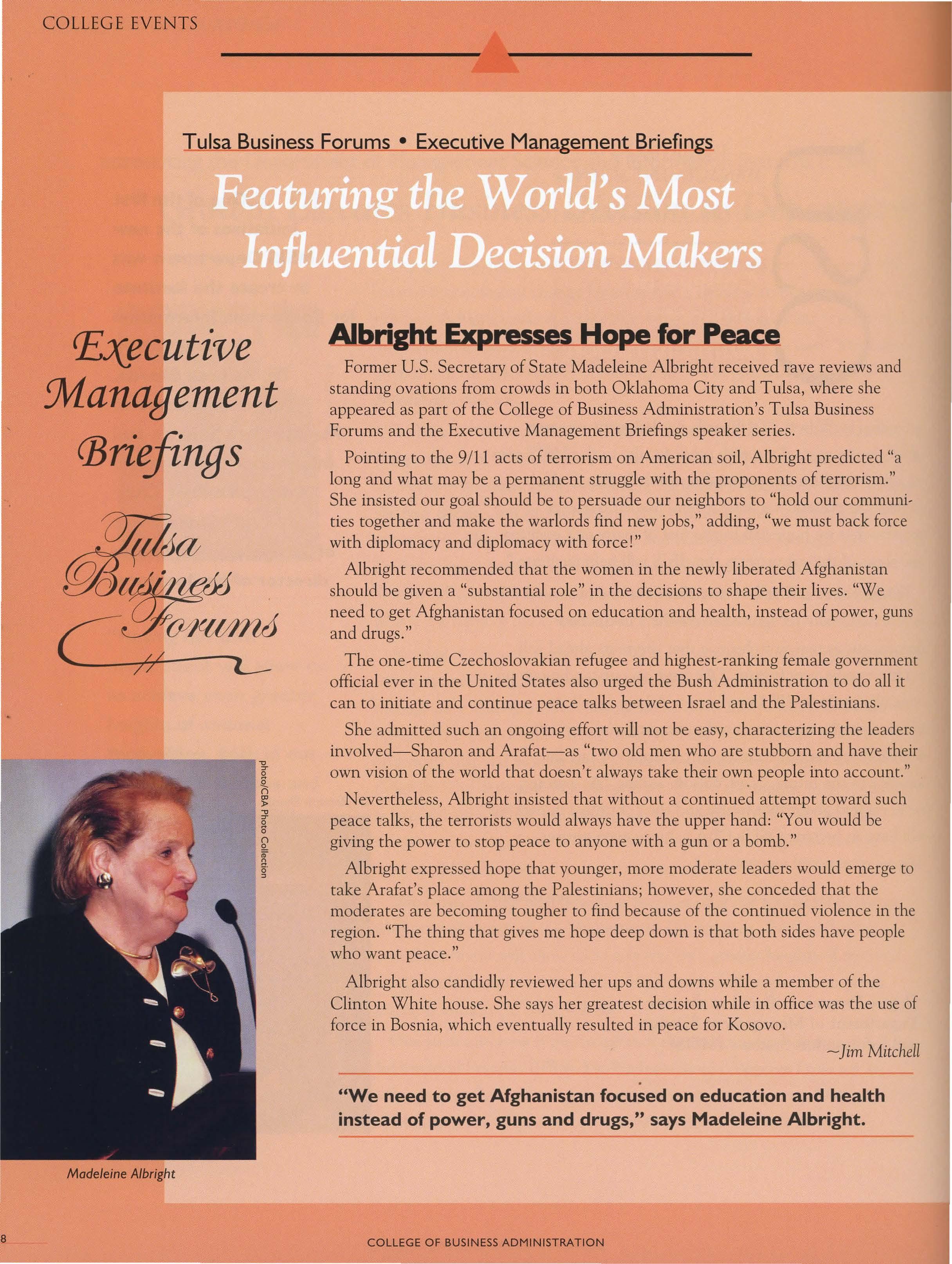
Albright _ExpressesHope for Peace
Former U.S. Secretary of State Madeleine Albright received rave reviews and standing ovations from crowds in both Oklahoma City and Tulsa, where she appeared as part of the College of Business Administration's Tulsa Business Forums and the Executive Management Briefings speaker series.
Pointing to the 9/11 acts of terrorism on American soil, Albright predicted "a long and what may be a permanent struggle with the proponents of terrorism." She insisted our goal should be to persuade our neighbors to "hold our communities together and make the warlords find new jobs," adding, "we must back force with diplomacy and diplomacy with force!"
Albright recommended that the women in the newly liberated Afghanistan should be given a "substantial role" in the decisions to shape their lives. "We need to get Afghanistan focused on education and health, instead of power, guns and drugs."
The one-time Czechoslovakian refugee and highest-ranking female government official ever in the United States also urged the Bush Administration to do all it can to initiate and continue peace talks between Israel and the Palestinians. She admitted such an ongoing effort will not be easy, characterizing the leaders involved-Sharon and Arafat-as "two old men who are stubborn and have their
s own vision of the world that doesn't always take their own people into account."
Nevertheless, Albright insisted that without a continued attempt toward such o peace talks, the terrorists would always have the upper hand: "You would be 8 giving the power to stop peace to anyone with a gun or a bomb."
[ g
Albright expressed hope that younger, more moderate leaders would emerge to take Arafat's place among the Palestinians; however, she conceded that the moderates are becoming tougher to find because of the continued violence in the region. "The thing that gives me hope deep down is that both sides have people who want peace."
Albright also candidly reviewed her ups and downs while a member of the Clinton White house. She says her greatest decision while in office was the use of force in Bosnia, which eventually resulted in peace for Kosovo.
- Jim Mitchell
"We need to get Afghanistan focused on education and health instead of power, guns and drugs," says Madeleine Albright.
Teerlink Em hasizes Leadershi and Good Em lo ees
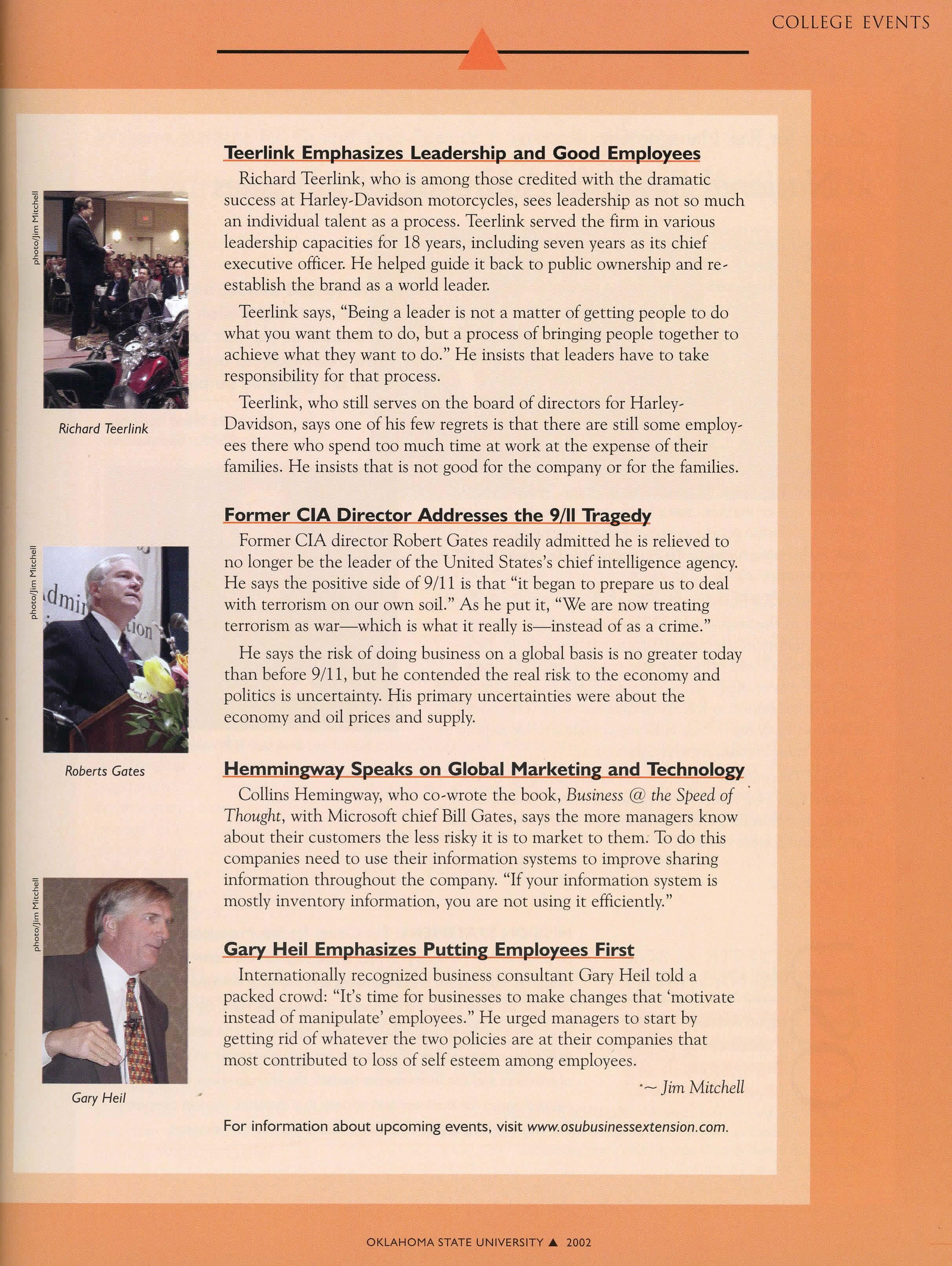
Richard Teerlink, who is among those credited with the dramatic success at Harley-Davidson motorcycles, sees leadership as not so much an individual talent as a process. Teerlink served the firm in various leadership capacities for 18 years, including seven years as its chief executive officer. He helped guide it back to public ownership and reestablish the brand as a world leader.
Teerlink says, "Being a leader is not a matter of getting people to do what you want them to do, but a process of bringing people together to achieve what they want to do." He insists that leaders have to take responsibility for that process.
Teerlink, who still serves on the board of directors for HarleyDavidson, says one of his few regrets is that there are still some employees there who spend too much time at work at the expense of their families. He insists that is not good for the company or for the families.
Former CIA Director Addresses the 9 II Tra ed
Former CIA director Robert Gates readily admitted he is relieved to no longer be the leader of the United States's chief intelligence agency. He says the positive side of 9/11 is that "it began to prepare us to deal with terrorism on our own soil." As he put it, "We are now treating terrorism as war-which is what it really is-instead of as a crime."
He says the risk of doing business on a global basis is no greater today than before 9/11, but he contended the real risk to the economy and politics is uncertainty. His primary uncertainties were about the economy and oil prices and supply.
Hemmin a S eaks on Global Marketin and Technolo
Collins Hemingway, who co-wrote the book, Business @ the Speed of Thought, with Microsoft chief Bill Gates, says the more managers know about their customers the less risky it is to market to them. To do this companies need to use their information systems to improve sharing information throughout the company. "If your information system is mostly inventory information, you are not using it efficiently."
Internationally recognized business consultant Gary Heil told a packed crowd: "It's time for businesses to make changes that 'motivate instead of manipulate' employees." He urged managers to start by getting rid of whatever the two policies are at their companies that most contributed to loss of self esteem among employees.
·- Jim Mitchell
For information about upcoming events, visit www.osubusinessextension.com.
RichardTeer/ink
Roberts Gates
Gary Heil
Center for Risk Mana~ement
National Summits Address Energy Issues
Power transmission is not something most people think about. We take the reliable availability of electricity for granted. We flip a switch; we expect the lights to come on.
The College of Business Administration's Center for Risk Management, along with Oklahoma Gas and Electric Services, the state's largest electric utility, presented the National Summit on PowerTransmissionApril 3. Policy makers and energy company executives discussed the complex physical and economic systems that bring us our power.
According to keynote speaker Federal Energy Regulatory Commissioner Nora Mead Brownell, even though the nation's power markets have been dealing with the fallout of the California power crisis and the collapse of Enron, now is the time to move forward and set the stage for retail competition.
New rules for buying and selling power are expected to be finalized in the summer of 2002 and should encourage improvements in the nation's transmission system. However, Brownell and others on the panel agreed that new rules are not enough. They stressed that investments in the nation's transmission infrastructure are vital. The question is who will pay for it. She believes consumers are willing to pay for value, reliability and innovation.
PowerTransmissionwas the second summit held by the Center. Last year's topic was national energy policy, in which deregulation, alternative energy sources and supply and demand were debated.
Sherry Fletcher
CENTER
MANAGEMENT
College of Business Administration
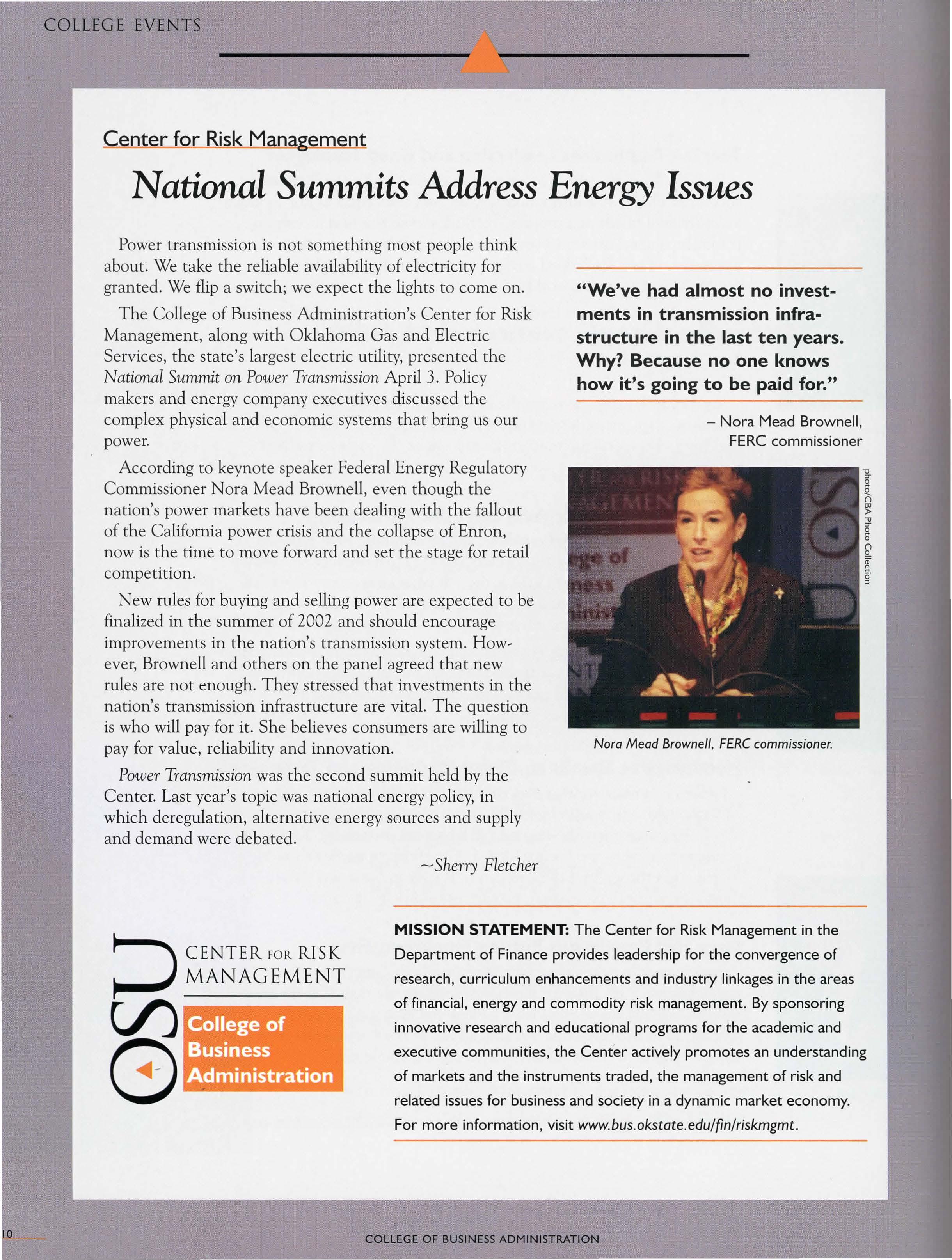
"We've had almost no investments in transmission infrastructure in the last ten years. Why? Because no one knows how it's going to be paid for."
- Nora Mead Brownell, FERC commissioner
MISSION STATEMENT: The Center for Risk Management in the Department of Finance provides leadership for the convergence of research, curriculum enhancements and industry linkages in the areas of financial, energy and commodity risk management. By sponsoring innovative research and educational programs for the academic and executive communities, the Center actively promotes an understanding of markets and the instruments traded, the management of risk and related issues for business and society in a dynamic market economy. For more information, visit www.bus.okstate.edu/fin/riskmgmt.
Naro Mead Brownell, FERCcommissioner.
Leaming the Importance of Quantifying Risk
Bringing together leading experts-both practitioners and academics-to discuss many facets of the risk management function was the goal of the first symposium held by the Williams Institute for Quantitative Finance.
As Bill Hobbs, president and CEO of Williams Energy & Risk Management, said at the opening of Recent Developments in Risk Management symposium, which was also sponsored by Tulsa's Williams (NYSE:WMB), "Wall Street is learning in a hurry the extreme importance of quantifying risk exposures."
The experts agreed and expanded that thought to include those beyond Wall Street. While companies and academics have traditionally been good at developing risk management techniques in response to the changing environment, a greater focus is needed on implementation and system development issues before advances in risk management techniques can produce maximum benefit. This includes developing software, information systems, implementation standards and better communication and compensation policies.
Everyone also agreed that reducing.iinancial debacles is a critical objectiv.e for the discipline. Mike Selman, senior vice president for portfolio management at Williams Energy
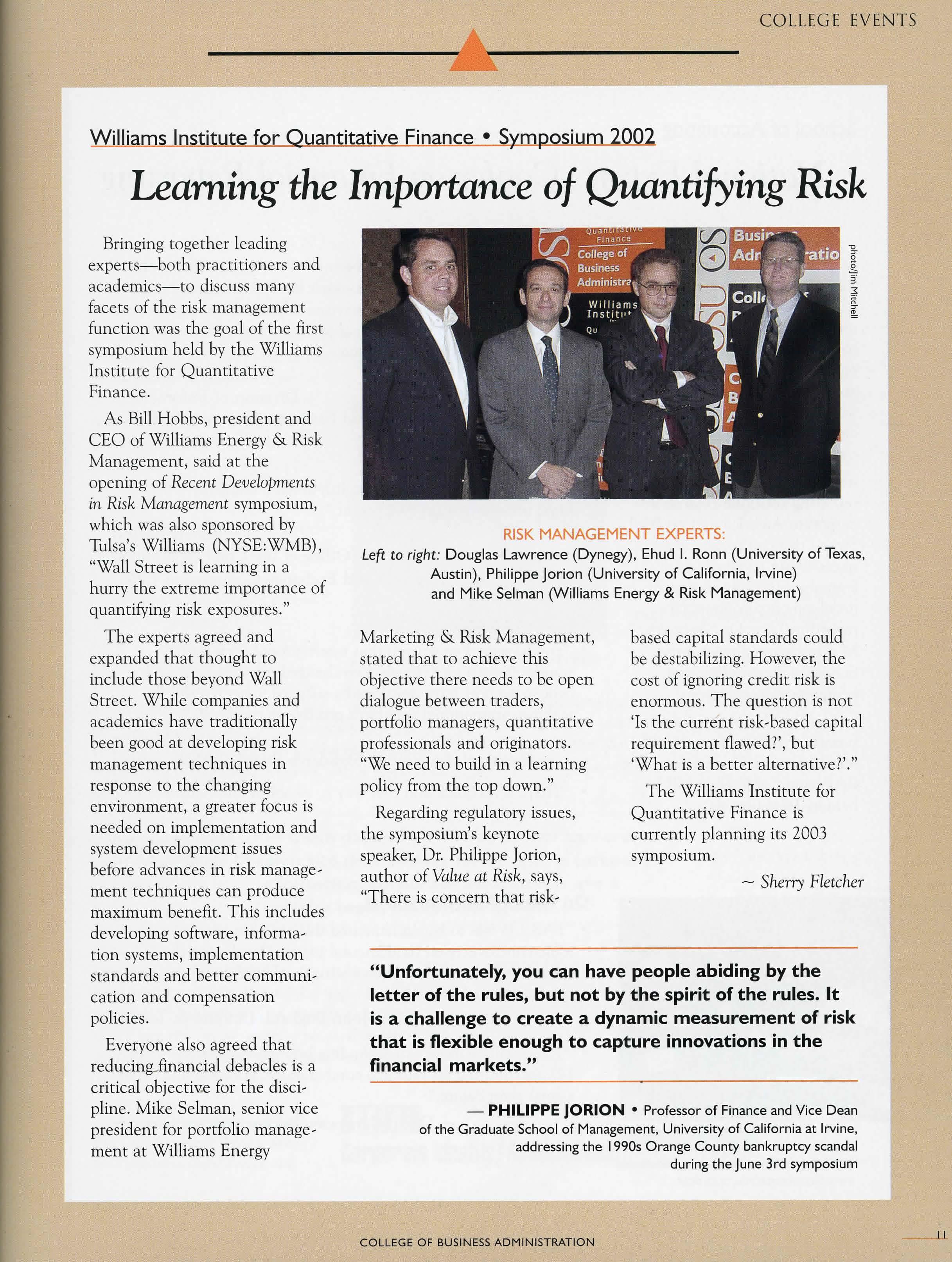
RISKMANAGEMENT EXPERTS:
Marketing & Risk Management, stated that to achieve this objective there needs to be open dialogue between traders, portfolio managers, quantitative professionals and originators.
"We need to build in a learning policy from the top down."
Regarding regulatory issues, the symposium's keynote speaker, Dr. Philippe }orion, author of Value at Risk, says, "There is concern that risk-
based capital standards could be destabilizing. However, the cost of ignoring credit risk is enormous. The question is not 'Is the current risk-based capital requirement flawed?', but 'What is a better alternative?'."
The Williams Institute for Quantitative Finance is currently planning its 2003 symposium.
- Sherry Fletcher
"Unfortunately, you can have people abiding by the letter of the rules, but not by the spirit of the rules. It is a challenge to create a dynamic measurement of risk that is flexible enough to capture innovations in the financial markets."
- PHILIPPE JORION • Professor of Finance and Vice Dean of the Graduate School of Management, University of California at Irvine, addressing the 1990s Orange County bankruptcy scandal during the June 3rd symposium
Left to right: Douglas Lawrence (Dynegy), Ehud I. Ronn (University of Texas, Austin), Philippe Jorion (University of California, Irvine) and Mike Selman (Williams Energy & Risk Management)
Schoolof Accounting
National Experts Confer on Financial Reporting
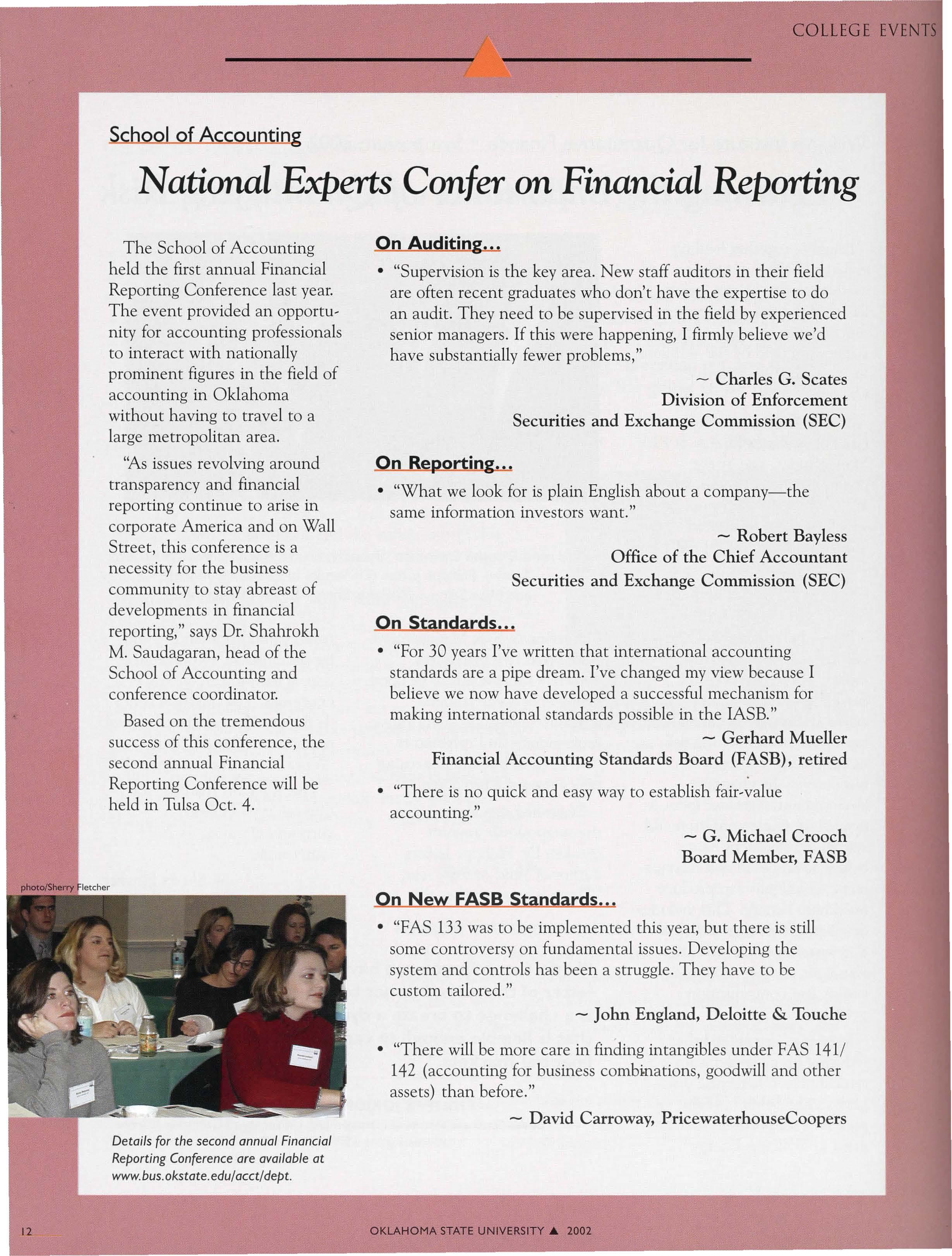
The School of Accounting held the first annual Financial Reporting Conference last year. The event provided an opportunity for accounting professionals to interact with nationally prominent figures in the field of accounting in Oklahoma without having to travel to a large metropolitan area.
''As issues revolving around transparency and financial reporting continue to arise in corporate America and on Wall Street, this conference is a necessity for the business community to stay abreast of developments in financial reporting," says Dr. Shahrokh M. Saudagaran, head of the School of Accounting and conference coordinator.
Based on the tremendous success of this conference, the second annual Financial Reporting Conference will be held in Tulsa Oct. 4.
On
• "Supervision is the key area. New staff auditors in their field are often recent graduates who don't have the expertise to do an audit. They need to be supervised in the field by experienced senior managers. If this were happening, I firmly believe we'd have substantially fewer problems,"
~ Charles G. Scates Division of Enforcement
Securities and Exchange Commission (SEC)
On Reporting ...
• "What we look for is plain English about a company-the same information investors want."
~ Robert Bayless Office of the Chief Accountant
Securities and Exchange Commission (SEC)
On St ndards ...
• "For 30 years I've written that international accounting standards are a pipe dream. I've changed my view because I believe we now have developed a successful mechanism for making international standards possible in the IASB."
~ Gerhard Mueller Financial Accounting Standards Board (FASB), retired
• "There is no quick and easy way to establish fair-value accounting."
~ G. Michael Crooch Board Member, FASB
On New FASB Standards ...
• "FAS 133 was to be implemented this year, but there is still some controversy on fundamental issues. Developing the system and controls has been a struggle. They have to be custom tailored."
~ John England, Deloitte & Touche
• "There will be more care in finding intangibles under FAS 141/ 142 (accounting for business comb~nations, goodwill and other assets) than before."
~ David Carroway, PricewaterhouseCoopers
Cor orate ldenti AssociationsResearch Grou
Conference Produces National Research Group
A two-day conference at OSU served as the launching pad for a coordinated, national effort among marketing researchers in academe that's causing some real excitement.
''After years of noticing that many of us are interested in a similar vein of research in the area of corporate associations, we've decided it is time to coordinate our efforts," says Dr. Tom J. Brown, associate professor of marketing at OSU. Brown cochaired the meeting in Stillwater with Dr. Peter Dacin, professor of marketing at Queen's University in Kingston, Ontario, Canada.
So what is this area of research known as "corporate associations"? "Corporate associations involve anything that an individual knows or believes is true
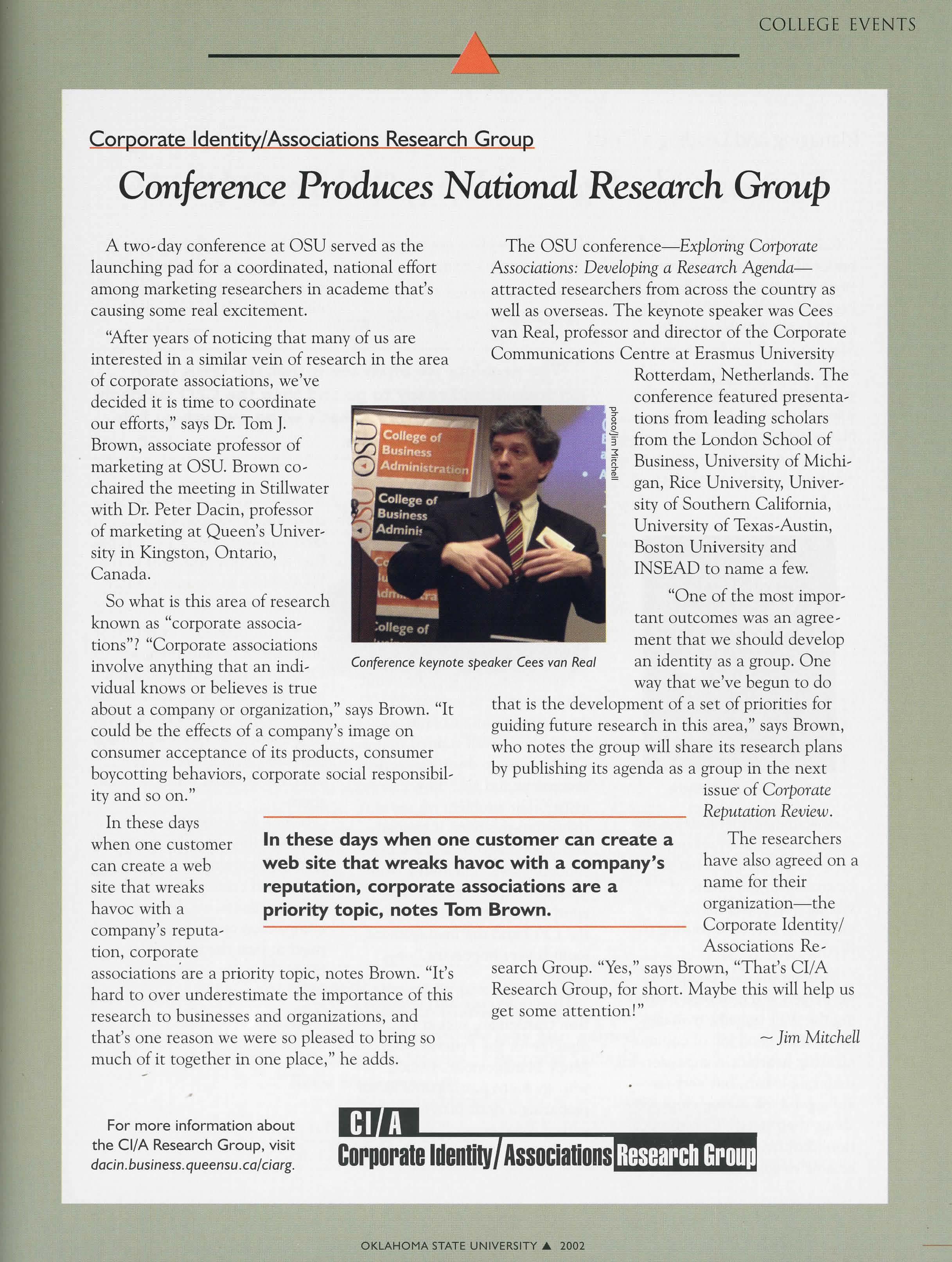
The OSU conference-Exploring Corporate Associations: Developing a Research Agendaattracted researchers from across the country as well as overseas. The keynote speaker was Cees van Real, professor and director of the Corporate Communications Centre at Erasmus University Rotterdam, Netherlands. The conference featured presenta-g. 1 tions from leading scholars ;t from the London School of Business, University of Michigan, Rice University, University of Southern California, University of Texas-Austin, Boston University and INSEAD to name a few.
"One of the most important outcomes was an agreement that we should develop an identity as a group. One way that we've begun to do about a company or organization," says Brown. "It could be the effects of a company's image on consumer acceptance of its products, consumer boycotting behaviors, corporate social responsibility and so on."
In these days when one customer can create a web site that wreaks havoc with a company's reputation, corpor~te
that is the development of a set of priorities for guiding future research in this area," says Brown, who notes the group will share its research plans by publishing its agenda as a group in the next issue· of Corporate Reputation Review.
In these days when one customer can create a web site that wreaks havoc with a company's reputation, corporate associations are a priority topic, notes Tom Brown.
Associations Research Group. "Yes," says Brown, "That's CI/A Research Group, for short. Maybe this will help us get some attention!"
- Jim Mitchell
The researchers have also agreed on a name for their organization-the Corporate Identity/ associations are a priority topic, notes Brown. "It's hard to over underestimate the importance of this research to businesses and organizations, and that's one reason we were so pleased to bring so much of it together in one place," he adds.
For more information about the Cl/A Research Group, visit dacin.business.queensu.ca/ciarg.
Conference keynote speaker Cees van Real
Mana in and Leadin a Crisis
Lessons to be Learned From 9/ll Tragedy
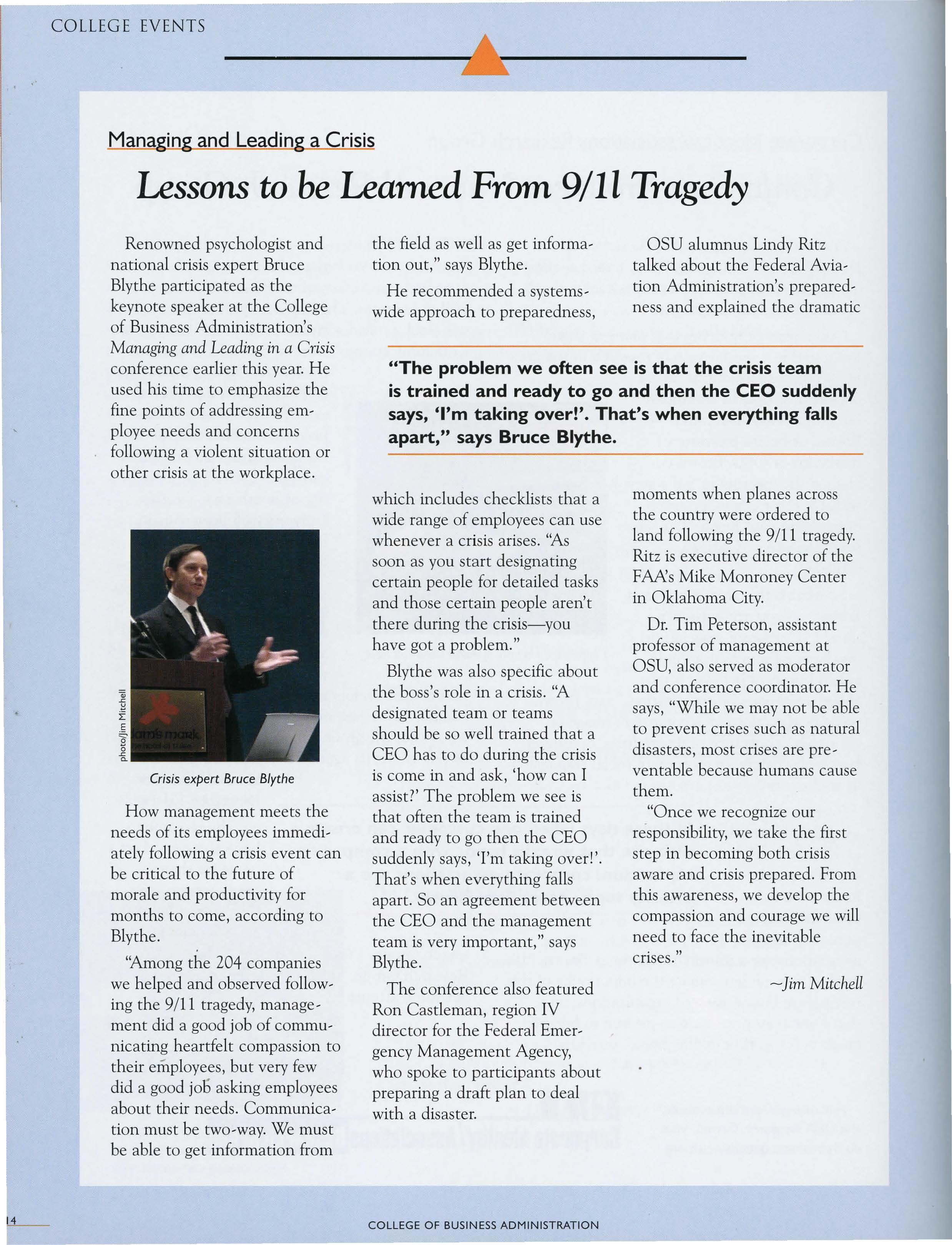
Renowned psychologist and national crisis expert Bruce Blythe participated as the keynote speaker at the College of Business Administration's Managingand Leadingin a Crisis conference earlier this year. He used his time to emphasize the fine points of addressing employee needs and concerns following a violent situation or other crisis at the workplace.
"fflif
Crisis expert Bruce Blythe
How management meets the needs of its employees immediately following a crisis event can be critical to the future of morale and productivity for months to come, according to Blythe.
''Among the 204 companies we helped and observed following the 9/11 tragedy, management did a good job of communicating heartfelt compassion to their employees, but very few did a good jo6 asking employees about their needs. Communication must be two-way. We must be able to get information from
the field as well as get information out," says Blythe.
He recommended a systemswide approach to preparedness,
OSU alumnus Lindy Ritz talked about the Federal Aviation Administration's preparedness and explained the dramatic
"The problem we often see is that the crisis team is trained and ready to go and then the CEO suddenly says, 'I'm taking over!'. That's when everything falls apart," says Bruce Blythe.
which includes checklists that a wide range of employees can use whenever a crisis arises. ''As soon as you start designating certain people for detailed tasks and those certain people aren't there during the crisis-you have got a problem."
Blythe was also specific about the boss's role in a crisis. "A designated team or teams should be so well trained that a CEO has to do during the crisis is come in and ask, 'how can I assist?' The problem we see is that often the team is trained and ready to go then the CEO suddenly says, 'I'm taking over!'. That's when everything falls apart. So an agreement between the CEO and the management team is very important," says Blythe.
The conference also featured Ron Castleman, region IV director for the Federal Emergency Management Agency, who spoke to participants about preparing a draft plan to deal with a disaster.
moments when planes across the country were ordered to land following the 9/11 tragedy. Ritz is executive director of the FAA's Mike Monroney Center in Oklahoma City.
Dr. Tim Peterson, assistant professor of management at OSU, also served as moderator and conference coordinator. He says, "While we may not be able to prevent crises such as natural disasters, most crises are preventable because humans cause them.
"Once we recognize our responsibility, we take the first step in becoming both crisis aware and crisis prepared. From this awareness, we develop the compassion and courage we will need to face the inevitable )) cnses.
-Jim Mitchell
Greg Marshall - Associate Professor Marketing
AMS' s Outstanding Marketing Teacher,2002
Although he's only been back at OSU for a year, Dr. Greg Marshall is an alumnus (Ph.D. '93) who's already attracting national attention for the Department of Marketing.
Marshall joined OSU last fall as an associate professor of marketing to teach at the College's program at OSUTulsa. He has generated lots • of good news for the CBA since then. He recently received the honor of Outstanding Marketing Teacher for 2002 from the Academy of Marketing Science (AMS), an international society of more than 1,300 marketing professors.
Combine that with Marshall's prolific and well-
published research in sales-force performance, his status as president-elect of the American Marketing Association Academic Division and news that he was recently named editor of a top journal in his specific field Uournal of Personal Selling & Sales Management), it's clear that the CBA can expect plenty of national attentionboth now and in the years to come.
None of this is being lost on CBA's dean, Dr. James R. Lumpkin, a past president of AMS. "I'm very proud of Greg Marshall. It is because of professors of his caliber that we
§ are building a college that is
being recognized for excellence."
How does Marshall view his own success? "There are a lot of great marketing professors out there, so I feel very fortunate. It really is a delight and honor to be recognized by my peers at AMS and to be called on to contribute to the marketing field in some high-profile endeavors," says Marshall, who has served on the faculty at the University of South Florida and Texas Christian University.
Prior to his academic career,
he worked for several private sector firms in sales management and product management positions. Marshall has also been actively involved in training and consulting for a number of major private sector organizations.
"It's great to be back at OSU," says Marshall. "We have an outstanding college. With the faculty, staff and leadership team we have in place, the future is very bright."
- Jim Mitchell
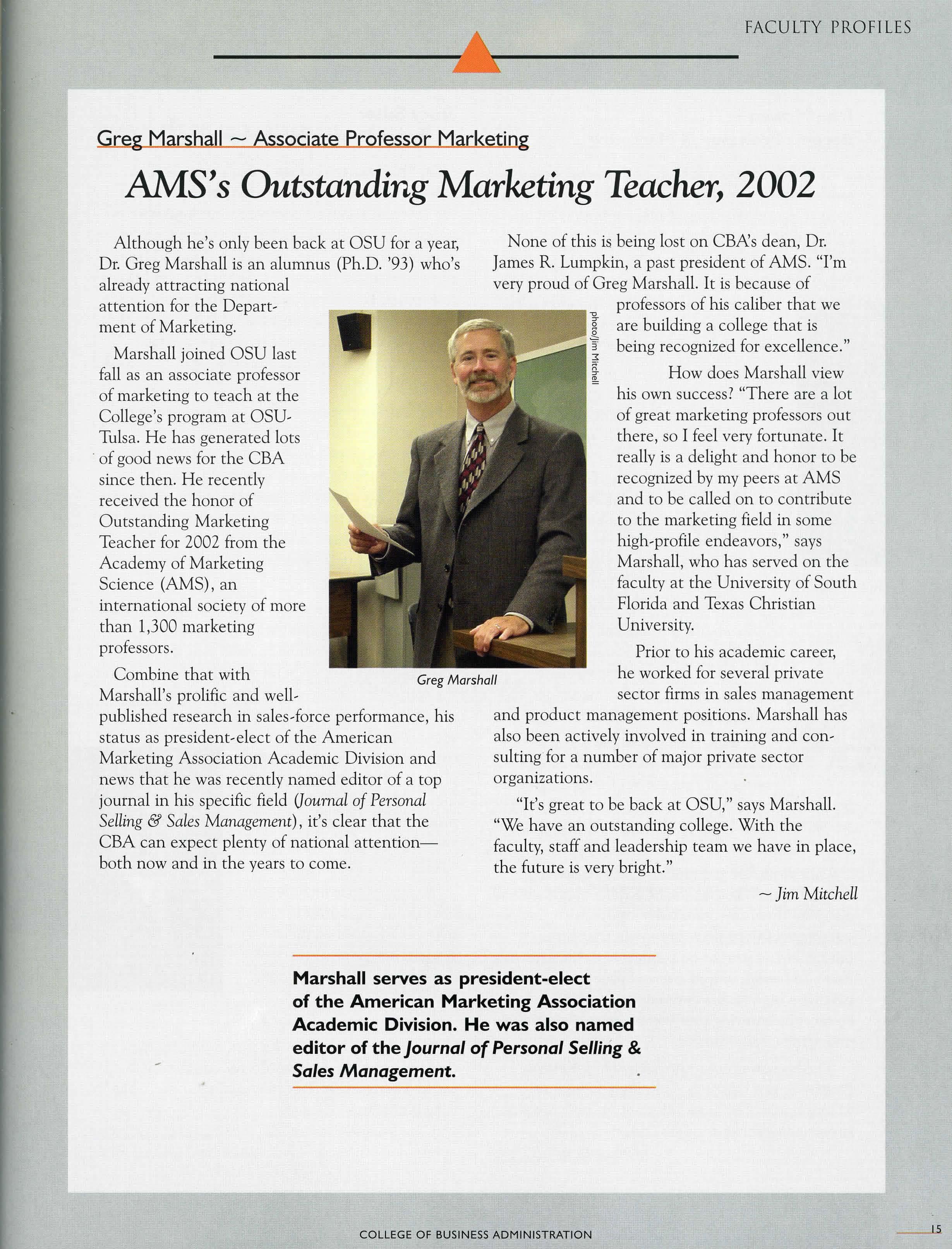
Marshall serves as president-elect of the American Marketing Association Academic Division. He was also named editor of the Journal of Personal Selling & Sales Management.
Greg Marshall
John Mowen~ Re ents Professor of Marketin
An OSU professor has co-authored a book published by John Wiley & Sons that provides the tools to reduce the fear of making important personal and professional decisions.
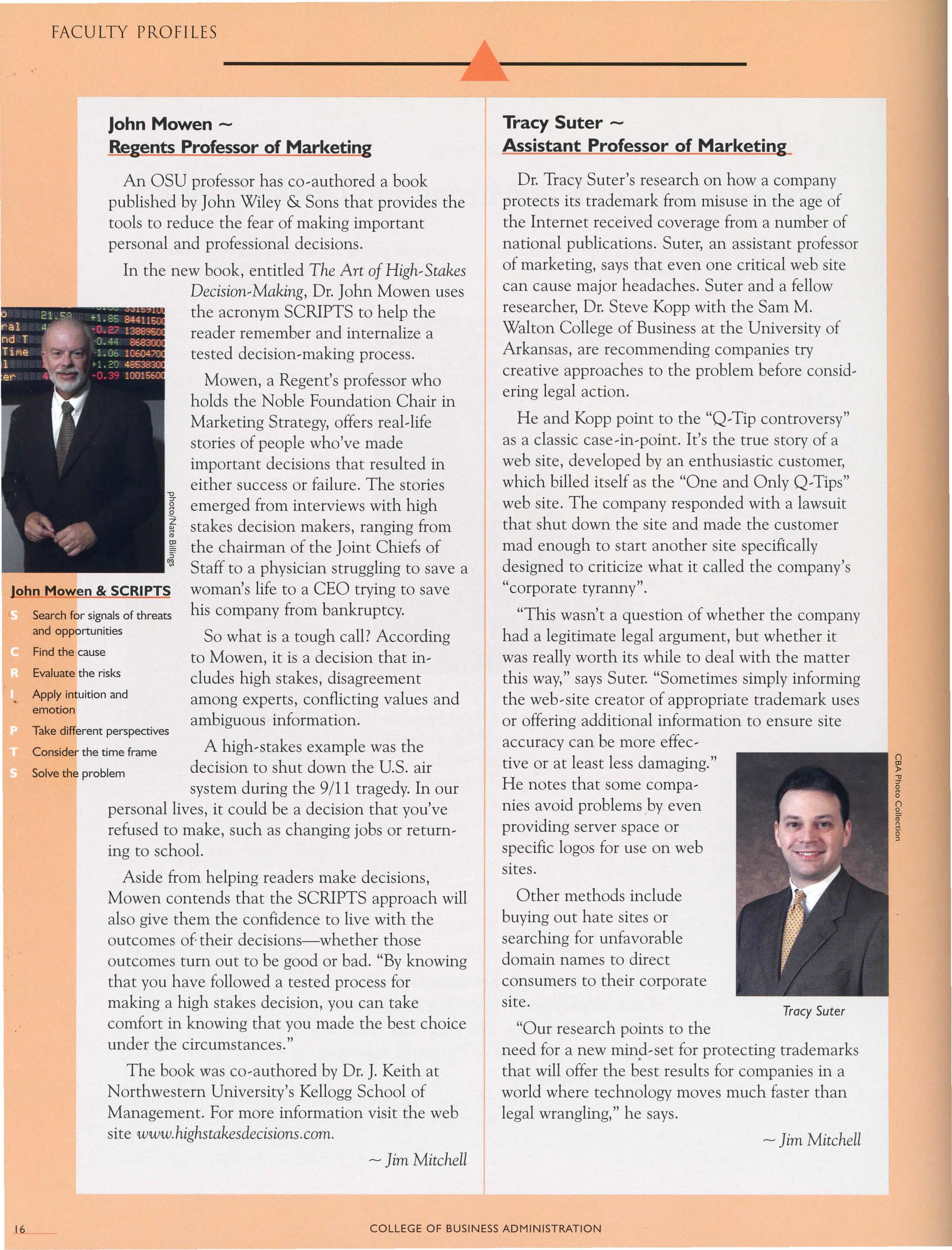
In the new book, entitled The Art of High-Stakes Decision-Making, Dr. John Mowen uses the acronym SCRIPTS to help the reader remember and internalize a tested decision-making process.
Mowen, a Regent's professor who holds the Noble Foundation Chair in Marketing Strategy, offers real-life stories of people who've made important decisions that resulted in either success or failure. The stories -g. l emerged from interviews with high f stakes decision makers, ranging from the chairman of the Joint Chiefs of ~· Staff to a physician struggling to save a
Search for signals of threats and opportunities woman's life to a CEO trying to save his company from bankruptcy.
Find the cause
Evaluate the risks
Apply intuition and emotion
Take different perspectives
Consider the time frame
So what is a tough call? According to Mowen, it is a decision that includes high stakes, disagreement among experts, conflicting values and ambiguous information.
A high-stakes example was the
Solve the problem decision to shut down the U.S. air system during the 9/11 tragedy. In our personal lives, it could be a decision that you've refused to make, such as changing jobs or returning to school.
Aside from helping readers make decisions, Mowen contends that the SCRIPTS approach will also give them the confidence to live with the outcomes of their decisions-whether those outcomes turn out to be good or bad. "By knowing that you have followed a tested process for making a high stakes decision, you can take comfort in knowing that you made the best choice under the circumstances."
The book was co-authored by Dr. J. Keith at Northwestern University's Kellogg School of Management. For more information visit the web site www.highstakesdecisions.com.
- Jim Mitchell
Tracy Suter ~ Assistant Professor of Marketin
Dr. Tracy Suter's research on how a company ' protects its trademark from misuse in the age of the Internet received coverage from a number of national publications. Suter, an assistant professor of marketing, says that even one critical web site can cause major headaches. Suter and a fellow researcher, Dr. Steve Kopp with the Sam M. Walton College of Business at the University of Arkansas, are recommending companies try creative approaches to the problem before considering legal action.
He and Kopp point to the "Q-Tip controversy" as a classic case-in-point. It's the true story of a web site, developed by an enthusiastic customer, which billed itself as the "One and Only Q-Tips" web site. The company responded with a lawsuit that shut down the site and made the customer mad enough to start another site specifically designed to criticize what it called the company's "corporate tyranny".
"This wasn't a question of whether the company had a legitimate legal argument, but whether it was really worth its while to deal with the matter this way," says Suter. "Sometimes simply informing the web-site creator of appropriate trademark uses or offering additional information to ensure site accuracy can be more effective or at least less damaging." He notes that some companies avoid problems _byeven providing server space or specific logos for use on web sites.
Other methods include buying out hate sites or searching for unfavorable domain names to direct consumers to their corporate site.
"Our research points to the TracySuter need for a new min9-set for protecting trademarks that will offer the best results for companies in a world where technology moves much faster than legal wrangling," he says.
- Jim Mitchell
Facultyon the Go
• Dr. David Carter has been appointed the new finance editor for the Journal of Applied BusinessResearch.
• A report co-authored by Dr. Tim Ireland generated widespread national attention. It shows that when a company hires key managers and professionals during an economic downturn the company performs stronger financially than those who didn't hire during the slump.
• Drs. John Mowen, Tom Brown and Todd Donovan teamed-up to win the "Best Paper Award" honors at the AMS's educator's conference in Washington, D.C. The paper is entitled: "The Consequences of Service Worker Customer Orientation: Job Satisfaction and Commitment".
• Dr. Betty Simkins has been named the executive editor of the Financial Management Association's new online electronic journal, FMA Online. She also presented two papers at the European Financial Management Association Annual Meeting in Copenhagen, Denmark.
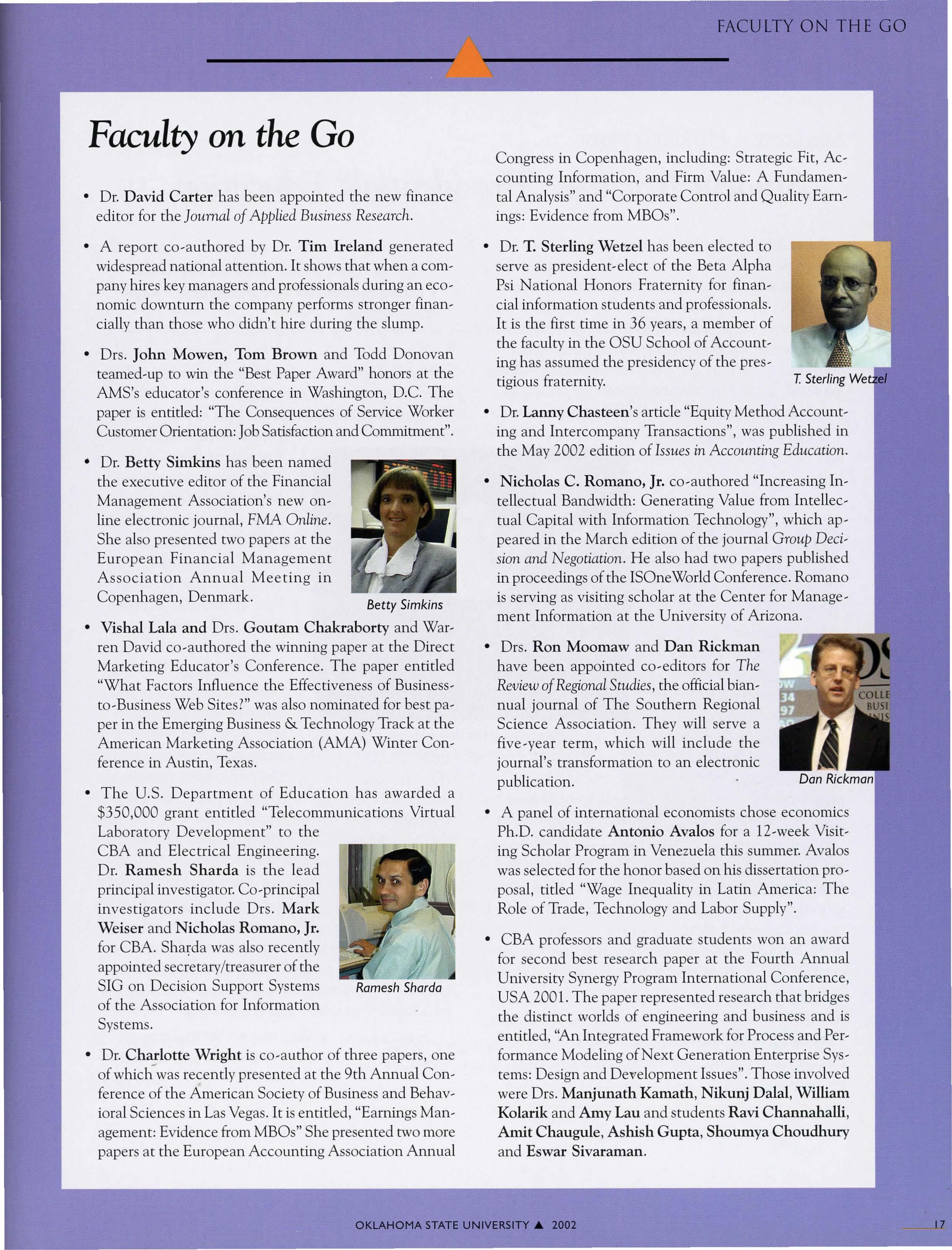
Simkins
• Vishal Lala and Drs. Goutam Chakraborty and Warren David co-authored the winning paper at the Direct Marketing Educator's Conference. The paper entitled "What Factors Influence the Effectiveness of Businessto-Business Web Sites?" was also nominated for best paper in the Emerging Business & Technology Track at the American Marketing Association (AMA) Winter Conference in Austin, Texas.
• The U.S. Department of Education has awarded a $350,000 grant entitled "Telecommunications Virtual Laboratory Development" to the CBA and Electrical Engineering. Dr. Ramesh Sharda is the lead principal investigator. Co-principal investigators include Drs. Mark Weiser and Nicholas Romano, Jr. for CBA. Sharda was also recently appointed secretary/treasurer of the SIG on Decision Support Systems of the Association for Information Systems.
Ramesh Sharda
• Dr. Charlotte Wright is co-author of three papers, one of whicl; was recently presented at the 9th Annual Conference of the American Society of Business and Behavioral Sciences in Las Vegas. It is entitled, "Earnings Management: Evidence from MBOs" She presented two more papers at the European Accounting Association Annual
Congress in Copenhagen, including: Strategic Fit, Accounting Information, and Firm Value: A Fundamental Analysis" and "Corporate Control and Quality Earnings: Evidence from MBOs".
• Dr. T. Sterling Wetzel has been elected to serve as president-elect of the Beta Alpha Psi National Honors Fraternity for financial information students and professionals. It is the first time in 36 years, a member of the faculty in the OSU School of Accounting has assumed the presidency of the prestigious fraternity.
T Sterling We
• Dr. Lanny Chasteen's article "Equity Method Accounting and Intercompany Transactions", was published in the May 2002 edition of Issuesin Accounting Education.
• Nicholas C. Romano, Jr. co-authored "Increasing Intellectual Bandwidth: Generating Value from Intellectual Capital with Information Technology", which appeared in the March edition of the journal Group Decision and Negotiation. He also had two papers published in proceedings of the ISOne World Conference. Romano is serving as visiting scholar at the Center for Management Information at the University of Arizona.
• Drs. Ron Moomaw and Dan Rickman have been appointed co-editors for The Reviewof RegionalStudies,the official biannual journal of The Southern Regional Science Association. They will serve a five-year term, which will include the journal's transformation to an electronic publication.
• A panel of international economists chose economics Ph.D. candidate Antonio Avalos for a 12-week Visiting Scholar Program in Venezuela this summer. Avalos was selected for the honor based on his dissertation proposal, titled "Wage Inequality in Latin America: The Role of Trade, Technology and Labor Supply".
• CBA professors and graduate students won an award for second best research paper at the Fourth Annual University Synergy Program International Conference, USA 2001. The paper represented research that bridges the distinct worlds of engineering and business and is entitled, "An Integrated Framework for Process and Performance Modeling of Next Generation Enterprise Systems: Design and Development Issues". Those involved were Drs. Manjunath Karnath, Nikunj Dalal, William Kolarik and Amy Lau and students Ravi Channahalli, Amit Chaugule, Ashish Gupta, Shoumya Choudhury and Eswar Sivaraman.
Betty
Dan Rickman
Yale Scott - Marketin Ma·or
Student Receives "Presidential" Education
According to OSU marketing major Yale Scott, "It was like a dream come true." He recently spent a full semester learning in a real-world classroom as close as possible to the nation's power basethe White House. The Edmond native interned in the Office of Public Liaison, which plans and coordinates various activities for President George W. Bush, including briefings, meetings and large events held at the president's official residence.
"I knew the president had a busy schedule, but I had no idea how many functions took place at the White House itself. It's still hard to believe the number of celebrities and sports stars I've had the chance to meet," says Scott.
A star-studded, gospelmusic concert was held at the White House, and Scott helped with some of the details; however, he was especially proud that a Bible verse he had recom-
mended became part of the program for the night. "It was neat to be able to say that I contributed to the program," says Scott.
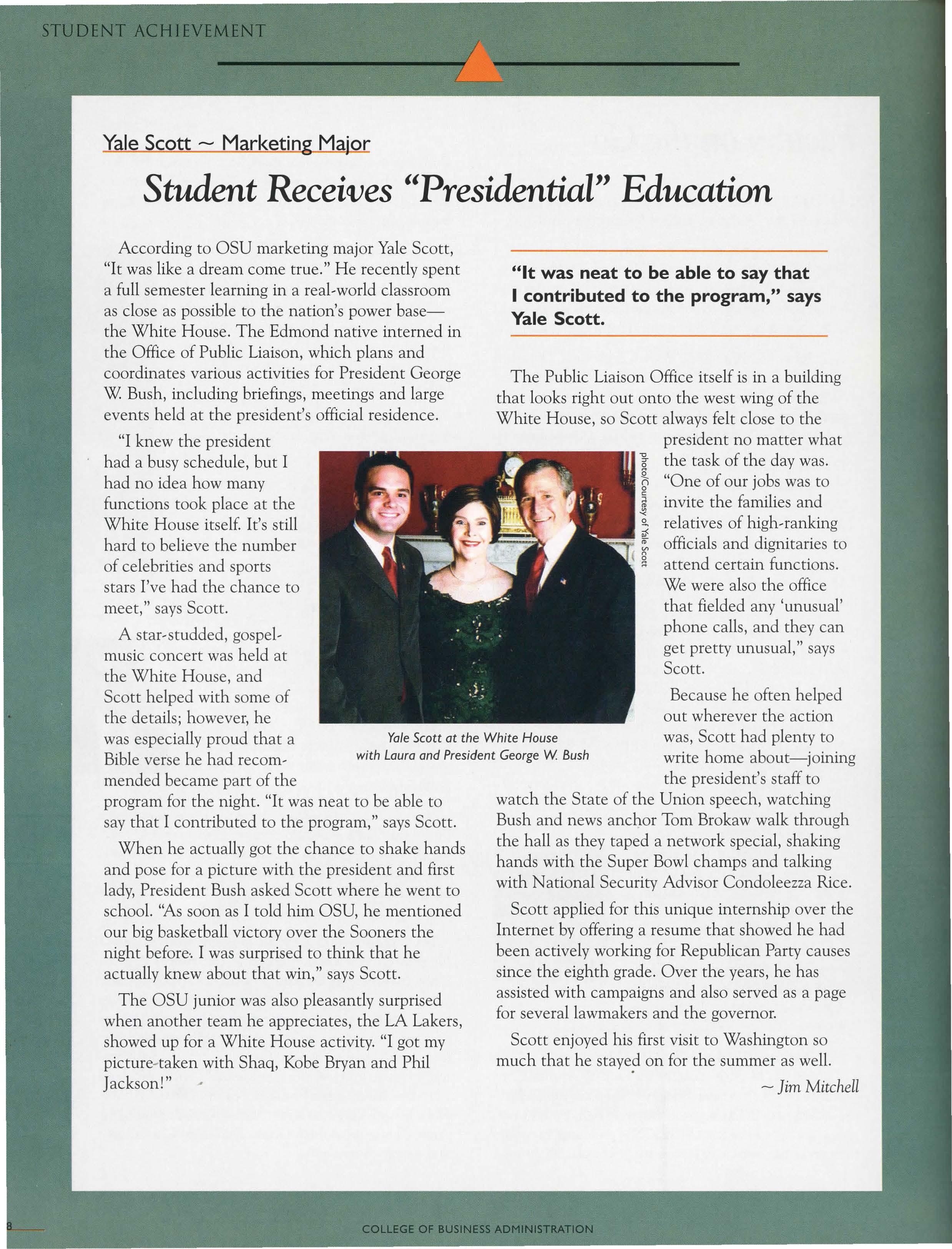
When he actually got the chance to shake hands and pose for a picture with the president and first lady, President Bush asked Scott where he went to school. "As soon as I told him OSU, he mentioned our big basketball victory over the Sooners the night before-. I was surprised to think that he actually knew about that win," says Scott.
The OSU junior was also pleasantly surprised when another team he appreciates, the LA Lakers, showed up for a White House activity. "I got my picture~taken with Shaq, Kobe Bryan and Phil Jackson!"
"It was neat to be able to say that I contributed to the program," says Yale Scott.
The Public Liaison Office itself is in a building that looks right out onto the west wing of the White House, so Scott always felt close to the president no matter what -g. the task of the day was. [ "One of our jobs was to j invite the families and g_ relatives of high-ranking of. " officials and dignitaries to attend certain functions. We were also the office that fielded any 'unusual' phone calls, and they can get pretty unusual," says Scott.
Because he often helped out wherever the action was, Scott had plenty to write home about-joining the president's staff to
watch the State of the Union speech, watching Bush and news anchor Tom Brokaw walk through the hall as they taped a network special, shaking hands with the Super Bowl champs and talking with National Security Advisor Condoleezza Rice.
Scott applied for this unique internship over the Internet by offering a resume that showed he had been actively working for Republican Party causes since the eighth grade. Over the years, he has assisted with campaigns and also served as a page for several lawmakers and the governor.
Scott enjoyed his first visit to Washington so much that he staye9 on for the summer as well.
- Jim Mitchell
Yale Scott at the White House
with Laura and President George W Bush
PaulDe LaCerda- MBA
Business Plan Wins Big at National Competition
Paul De La Cerda, a secondyear MBA student, took top national honors in the businessplan competition at the Emerging Business Leaders Summit held in Washington, D.C. De La Cerda's business plan was chosen first from among hundreds submitted for the national competition, which is sponsored • by the Minority Business Development Agency, a division of the U.S. Department of Commerce.
"It's been a lot of work, but I feel vety fortunate to win this award," says De La Cerda. He dedicated well over a year of "sweat equity" researching the market specifics and organizing the award-winning business plan, which he is already making use of outside the classroom.
"I'm currently partnered with a regional electronics firm, and this business plan is designed to help us spin off a marketing company focused around hightech products and services," says De La Cerda. The 26-year-old entrepreneur is looking for investors as well as individuals who share his passion for ideas, products or services that can be transformed into successful business ventures.
"My work toward an MBA has taught me that many successful companies begin with two or
three people with a strong vision, a well-defined operating strategy and the ability to recognize a business' strengths as well as its weaknesses." De La Cerda concedes that while there is no single determining factor for a successful business, he focuses on three areas-market size, the skills of the management team and the diversity of products and ideas.
He says, "Another important aspect of any business strategy is to learn from other people's mistakes, so that we don't repeat them. The best way to do that is to read nonstopjournals, books on entrepreneurship and whatever you can get your hands on."
De La Cerda graduated from OSU in 2000 with an engineering degree. The MBA is giving him the marketing background needed to strike a balance with his technical skills. ''A lot of engineers think they can market and a lot of marketers think they can engineer. The MBA program is helping me bridge that gap," he says.
De La Cerda is hoping to do more to pass along his enthusiasm for entrepreneurship. He's
already introduced the subject in a course called Business Policy and Strategy, which he teaches at OSU.
The first-place award in the business plan competition also included a sponsored trip to the University of Virginia's Darden School of Business where De La Cerda attended an executive education program.
-Jim Mitchell
'~ lot of engineers think they can market and a lot of marketers think they can engineer. The MBA program is helping me bridge that gap," Paul De La Cerda says.
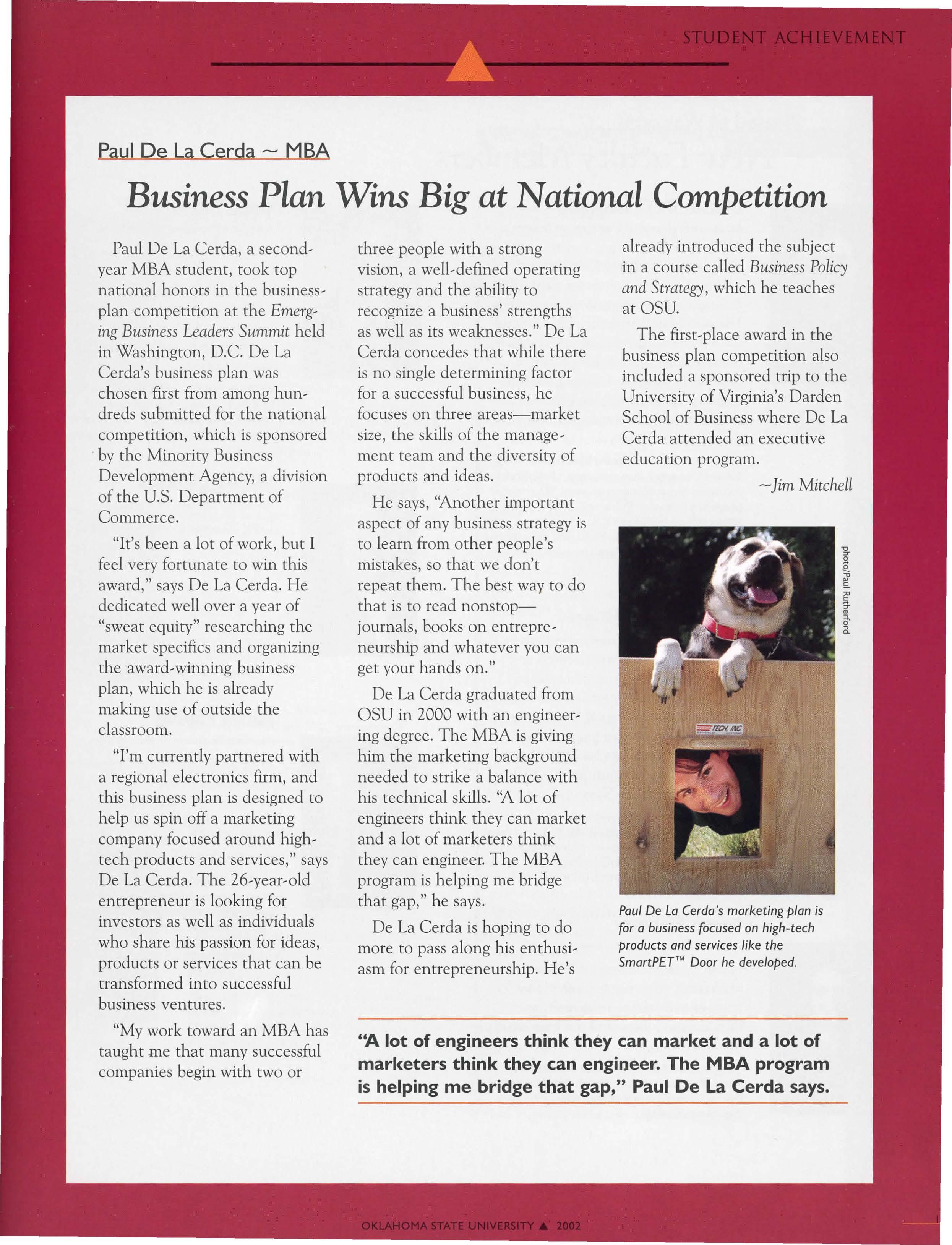
Paul De La Cerda's marketing plan is for a business focused on high-tech products and services like the SmartPET™ Door he developed.
Pleased to Welcome ... New FacultyMembers
Martin D. Crossland
Associate Professor of Management Science and Information Systems
Crossland served as director of Information Technology for the College of Business Administration at Southwest Missouri State University. His work at SMS included the design, development, management and teaching of an innovative distance-learning masters' degree program in CIS and the development and management of a group decision support lab.
Ph.D., management information systems, 1992, Indiana University (Bloomington); professional certificate in public management, 1992, Indiana University School of Public and Environmental Affairs (Bloomington); M.B.A., management, 1987, Oklahoma City University; B.S., arts and sciences (geology), 1975, Texas Tech University.
Dursun Delen
Assistant Professor of Management
Delen worked for Knowledge Based Systems, Inc., a private research and development company, as a research scientist. He participated in and led, as principal investigator and/or project manager, a number of research and development projects for NASA, Ballistic Missile Defense Organization, DARPA and the U.S. Army, Navy and Air Force.
Ph.D., industrial engineering and management, 1996, Oklahoma State University; M.S., industrial engineering, 1988, Yildiz University, Istanbul, Turkey; B.A., industrial engineering, 1986, Istanbul Technique University, Istanbul, Turkey.
Karen Flahe
Assistant Professor of Marketing
Flaherty tattght courses in business, marketing, advertising promotional strategy and sales management at Providence College and the University of Massachusetts.
Ph.D., marketing, 2000, University of 'Massachusetts; M.B.A., 1996, Suffolk University; B.S., business administration, 1994, Providence College.
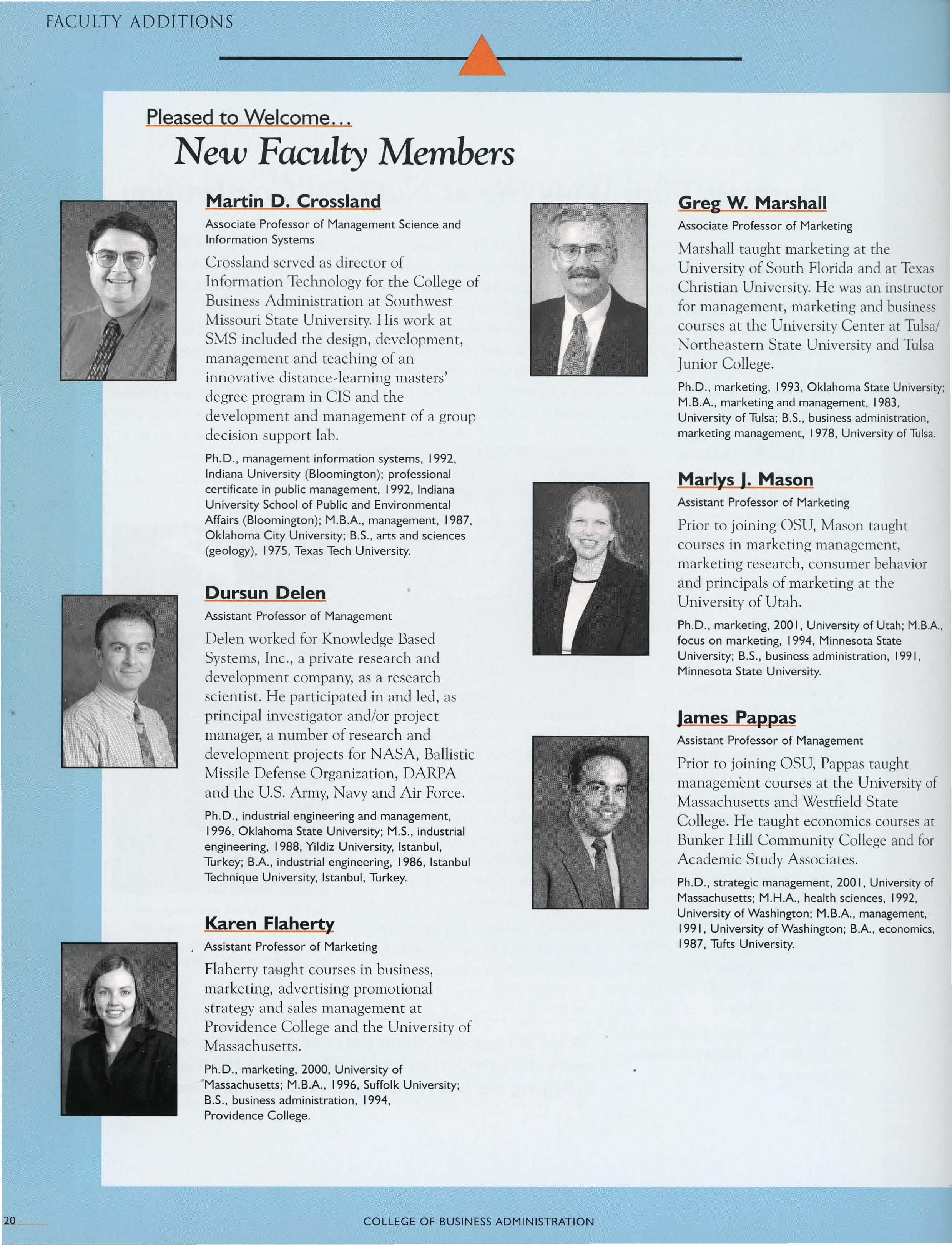
Gre W. Marshall
Associate Professor of Marketing
Marshall taught marketing at the University of South Florida and at Texas Christian University. He was an instructor for management, marketing and business courses at the University Center at Tulsa/ Northeastern State University and Tulsa Junior College.
Ph.D., marketing, 1993, Oklahoma State University; M.B.A., marketing and management, 1983, University of Tulsa; B.S., business administration, marketing management, 1978, University of Tulsa.
Assistant Professor of Marketing
Prior to joining OSU, Mason taught courses in marketing management, marketing research, consumer behavior and principals of marketing at the University of Utah.
Ph.D., marketing, 200 I, University of Utah; M.B.A., focus on marketing, 1994, Minnesota State University; B.S., business administration, 1991, Minnesota State University.
James Pappas
Assistant Professor of Management
Prior to joining OSU, Pappas taught management courses at the University of Massachusetts and Westfield State College. He taught economics courses at Bunker Hill Community College and for Academic Study Associates.
Ph.D., strategic management, 200 I, University of Massachusetts; M.H.A., health sciences, 1992, University of Washington; M.B.A., management, 1991, University of Washington; B.A., economics, 1987, Tufts University.
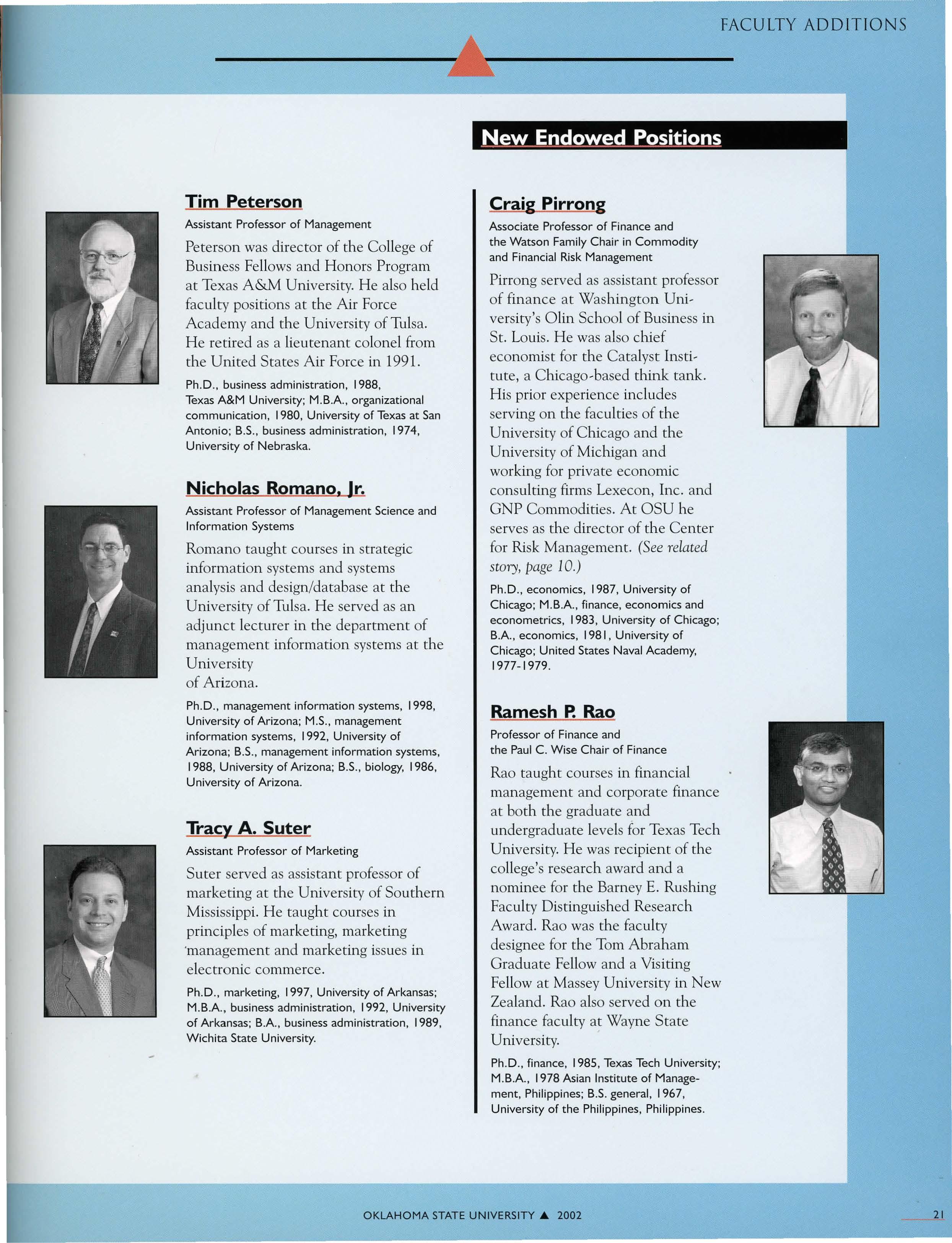
Tim Peterson
Assistant Professor of Management
Peterson was director of the College of Business Fellows and Honors Program at Texas A&M University. He also held faculty positions at the Air Force Academy and the University of Tulsa. He retired as a lieutenant colonel from the United States Air Force in 1991.
Ph.D., business administration, 1988, Texas A&M University; M.B.A., organizational communication, 1980, University of Texas at San Antonio; B.S., business administration, 1974, University of Nebraska.
Nicholas Romano r.
Assistant Professor of Management Science and Information Systems
Romano taught courses in strategic information systems and systems analysis and design/database at the University of Tulsa. He served as an adjunct lecturer in the department of management information systems at the University of Arizona.
Ph.D., management information systems, 1998, University of Arizona; M.S., management information systems, 1992, University of Arizona; B.S., management information systems, 1988, University of Arizona; B.S., biology, 1986, University of Arizona.
Trac A. Suter
Assistant Professor of Marketing
Suter served as assistant professor of marketing at the University of Southern Mississippi. He taught courses in princi.ples of marketing, marketing ·management and marketing issues in electronic commerce.
Ph.D., marketing, 1997, University of Arkansas; M.B.A., business administration, 1992, University of Arkansas; B.A., business administration, 1989, Wichita State University.
New Endowed Positions
Crai
Associate Professor of Finance and the Watson Family Chair in Commodity and Financial Risk Management
Pirrong served as assistant professor of finance at Washington University's Olin School of Business in St. Louis. He was also chief economist for the Catalyst Institute, a Chicago-based think tank. His prior experience includes serving on the faculties of the University of Chicago and the University of Michigan and working for private economic consulting finns Lexecon, Inc. and GNP Commodities. At OSU he serves as the director of the Center for Risk Management. (See related story, page 10.)
Ph.D., economics, 1987, University of Chicago; M.B.A., finance, economics and econometrics, 1983, University of Chicago; B.A., economics, 1981, University of Chicago; United States Naval Academy, 1977-1979.
Ramesh P. Rao
Professor of Finance and the Paul C. Wise Chair of Finance
Rao taught courses in financial management and corporate finance at both the graduate and undergraduate levels for Texas Tech University. He was recipient of the college's research award and a nominee for the Barney E. Rushing Faculty Distinguished Research Award. Rao was the faculty designee for the Tom Abraham Graduate Fellow and a Visiting Fellow at Massey University in New Zealand. Rao also served on the finance faculty at Wayne State University.
Ph.D., finance, 1985, Texas Tech University; M.B.A., 1978 Asian Institute of Management, Philippines; B.S. general, 1967, University of the Philippines, Philippines.