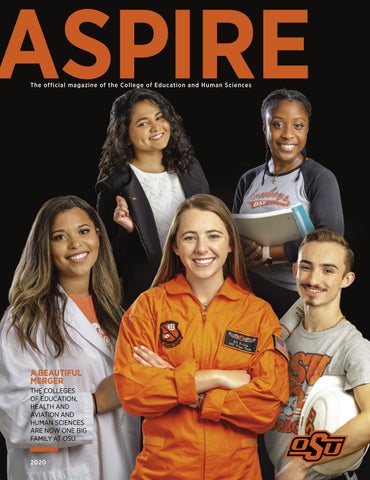
ASPIRE The official magazine of the College of Education and Human Sciences
A BEAUTIFUL MERGER THE COLLEGES OF EDUCATION, HEALTH AND AVIATION AND HUMAN SCIENCES ARE NOW ONE BIG FAMILY AT OSU. 2020
ASPIRE 14 Introducing Our New College ON THE COVER: The new College of Education and Human Sciences is the culmination of an 18-month process to unite academic programs in the former College of Education, Health and Aviation and the College of Human Sciences. (Cover photo by Gary Lawson) Clockwise from top left and their majors: Ceta Morden (aerospace administration and operations, option in aviation management), Tajma Hyland (elementary education), Taylor Campbell (design, housing and merchandising, option in interior design), KD McCloy (aerospace administration and operations, option in professional pilot) and Shante Seals (nutritional sciences, option in allied health).
03
Perseverance During a Pandemic From sewing thousands of face masks and providing resources for the public, to supporting teachers and schools and offering virtual counseling sessions, the College of Education and Human Sciences has responded in creative ways to the pandemic.
20
Work Begins On New Flight Center A new flight center helps OSU strengthen its position as the premier destination for aviation education and the home of the best-trained aviators in the country.
28
Answering Questions About Wheat When the healthfulness of modern wheat varieties was called into question, Oklahoma State University researchers went to work to study its impact on gut health.
Interim Dean, College of Education and Human Sciences Stephan M. Wilson EHS Marketing and Communications Christy Lang Rachel Eng Brittany Bowman Alyssa White Editor Dorothy L. Pugh Art Director Paul V. Fleming Photographers Phil Shockley Gary Lawson Mitch Harrison Diana Haslett
ASPIRE Magazine Oklahoma State University College of Education and Human Sciences 106 Human Sciences | Stillwater, OK 74078-4033 contact.ehs@okstate.edu ASPIRE magazine is a publication of the O klahoma State University College of Education and Human Sciences. Its purpose is to provide information on college activities and accomplishments while fostering communication among the colleges alumni, family and friends. © Oklahoma State University 2020 When you join the OSU Alumni Association, a portion of your membership comes back to the college to fund programs such as homecoming and other alumni events. Contact the college for more information: 106 Human Sciences, Stillwater, OK 74078-4033 (405) 744-9805 education.okstate.edu
Plus … 2
Dean’s letter
36
Student awards
40
College news and notes
Oklahoma State University, in compliance with Title VI and VII of the Civil Rights Act of 1964, Executive Order 11246 as amended, and Title IX of the Education Amendments of 1972 (Higher Education Act), the Americans with Disabilities Act of 1990, and other federal and state laws and regulations, does not discriminate on the basis of race, color, national origin, genetic information, sex, age, sexual orientation, gender identity, religion, disability, or status as a veteran, in any of its policies, practices or procedures. This provision includes, but is not limited to admissions, employment, financial aid, and educational services. The Director of Equal Opportunity, 408 Whitehurst, OSU, Stillwater, OK 74078-1035; Phone 405-744-5371; email: eeo@okstate.edu has been designated to handle inquiries regarding non-discrimination policies. Any person (student, faculty, or staff) who believes that discriminatory practices have been engaged in based on gender may discuss his or her concerns and file informal or formal complaints of possible violations of Title IX with OSU’s Title IX Coordinator 405-744-9154. This publication, issued by Oklahoma State University as authorized by (originating authority), was printed by Modern Litho at a cost of $5,278.39/5.5M 11/20 #8428.
Greetings from the College of Education and Human Sciences!
PHOTO GARY LAWSON
-
From the Dean
W
elcome to the first-ever issue of Aspire magazine! It has truly been a monumental year as we’ve proudly celebrated new beginnings with the official launch of the College of Education and Human Sciences on July 1, 2020. Our newly formed college brings together programs from the former College of Education, Health and Aviation and the College of Human Sciences. People are at the core of all we do to enhance and improve lives through innovative research, teaching and engagement. With nearly 4,000 students in 24 undergraduate and 62 graduate degree programs, we are committed to diversity and inclusion and empowering leaders who strengthen communities through education, health, human development and more. While we didn’t anticipate launching our college during a worldwide pandemic, I’m humbled by the hard work, persistence and perseverance of our faculty, staff, students and alumni during this unprecedented time. We’ve included a compilation of stories that illustrate our college’s remarkable response to COVID-19. I know you will be proud of how your college is caring for and serving those around us. Now more than ever, we are preparing and equipping future teachers for the digital classroom. Learn how our teacher education programs are adapting to the new virtual education culture and how Oklahoma State University has already positioned itself as a leader for integrating technology and digital platforms into curriculum. Additionally, our new college is positioning itself as a premier destination for future health professionals and home of impactful, life-changing health-related research and community collaborations. We are excited to share our efforts in promoting mental, physical and relational health for all people. As you may already know, the Ray and Linda Booker OSU Flight Center is set to open in fall 2021. Read about the generous donors and long-time Oklahoma State supporters who made it possible. With this new facility, we are solidifying our place among the top aviation education programs in the country. Groundbreaking research published last year is dispelling some claims that modern wheat consumption disrupts gastrointestinal health. Those with any interest in the glutenfree diet may find this study rather intriguing. I hope you enjoy this inspiring collection of stories that reflect our people, our passion and our purpose. With a focus on service and community, we invite you on the path forward. Sincerely,
Stephan M. Wilson, Ph.D., C.F.L.E.
Interim Dean, College of Education and Human Sciences Regents Professor of Human Development and Family Science
2 ASPIRE 2020
~ Leading Together
Pandemic Perseverance College remains steadfast in its response to COVID-19 Communities and individuals across the globe have felt the impact of the COVID-19 pandemic. Oklahoma State University and the College of Education and Human Sciences are no exception. The OSU family has faced new challenges and diligently worked to adjust and respond to an ever-changing situation. Since March, faculty, staff, students, alumni and friends have joined forces, looking for opportunities to help and serve. Because after all, that’s the Cowboy way. Many remarkable and inspirational collaborations have taken shape during this unprecedented time. From sewing thousands of face masks to providing resources for the public, from supporting teachers and schools to offering virtual counseling sessions for students and community members and more, the College of Education and Human Sciences has proudly engaged in creative and alternative ways to support one another. CO L L EG E O F E D U C AT I O N A N D H U M A N S C I E N C E S 3
-
Masking Up
Grassroots volunteers sew thousands of face coverings
Dr. Lynn Boorady
A
lthough socially distanced due to coronavirus, a collection of volunteers connected to Oklahoma State University united to sew more than 50,000 face masks for health care workers and others across the state of Oklahoma during the early stages of the pandemic. A Stillwater nurse’s Facebook plea for face masks inspired Oklahoma Home and Community Education (OHCE) volunteers, first in Payne County and then across the state, to organize a grassroots effort. That movement quickly crossed paths with the OSU Department of Design, Housing and Merchandising (DHM).
4 ASPIRE 2020
“The nurse included a link to a pattern,” said Dea Rash, Payne County Family and Consumer Sciences (FCS) Extension educator. “I included the request for masks in the monthly March FCS/ OHCE newsletter, and word quickly got out to other counties via social media. People started sewing, and nearly overnight, it turned into a statewide service project.” OHCE is an outreach arm of Cooperative Extension, where volunteers are members of local groups meeting monthly to further education and promote university outreach and community service.
STORY B R I T TA N Y B O W M A N | PHOTOS D I A N A H A S L E T T
Gwl,o,p Leading Together
(
“When there’s a crisis of this size, you really see what people have in their hearts.”
)
SUZETTE BARTA
Suzette Barta, coordinator for community engagement and extension for the College of Education and Human Sciences, said the efforts expanded even further when the DHM department head offered lab space to help prepare fabrics for volunteers to sew. “I was asked by Dr. Lynn Boorady if some of the OHCE groups could help sew the masks she had been cutting out,” Barta said. “Payne County was our first priority, obviously, because they are close. However, there have also been a few other counties that have jumped on board.” Barta said most of the face masks OHCE volunteers sewed with their own fabric were donated by OHCE volunteers to health care workers and first responders in their own communities. Masks sewn from material cut by OSU faculty and staff in DHM labs had a more unique delivery path. “The College of Engineering, Architecture and Technology at OSU has been 3D-printing face masks and face shields,” said Boorady, DHM department head. “Then, engineering is working with OSU Diagnostics Lab, which was doing COVID testing for the state. This lab has a team of
drivers who pick up samples, and when they pick up samples, they are also now dropping off the face shields and our face masks at testing sites.” Boorady also produced educational videos to dispel common myths surrounding face masks. Just as she relied on Cooperative Extension to recruit volunteers for sewing face masks, Extension educators spread her messages throughout Oklahoma. “We can do the research until we’re blue in the face,” Boorady said. “However, Extension educators are the conduit between university research and people in the community, the ones who disseminate the information.” Cooperative Extension also produced other COVID-related educational resources covering topics from proper hand washing to how to sanitize a home to family finances and healthy eating. As part of OSU’s land-grant mission, these topics are routinely studied and disseminated by OSU professors and Cooperative Extension educators but have become even more important throughout the pandemic. “When there’s a crisis of this size, you really see what people have in their hearts,” Barta said. ■
CO L L EG E O F E D U C AT I O N A N D H U M A N S C I E N C E S 5
-
Virtual Therapy
Counseling sessions go online to support OSU students and community
Counseling master’s student Austin Box facilitates a virtual counseling session.
W
hen in-person counseling became a potential health risk amid coronavirus concerns, mental health programs in the College of Education and Human Sciences quickly adapted to virtual therapy sessions to continue serving and supporting their clients. The Counseling and Counseling Psychology Clinic, part of the School of Community Health Sciences, Counseling and Counseling Psychology, and the Center for Family Services, part of the Department of Human Development and Family Science, transitioned all services to online when OSU’s campus closed to visitors in March. “As a clinic, our responsibility is to not abandon our clients and to do no harm,” said Dr. Amanda Szarzynski, clinical director for the Center for Family Services. “My initial concern when we learned campus would be
6 ASPIRE 2020
closing was that we not let any clients fall between the cracks.” The virtual transition affected clients as well as master’s and doctoral students who train within the facilities under faculty supervision. Students took advantage of the learning opportunity, becoming more familiar with telehealth processes and technology support. “They’re getting an opportunity they otherwise would not have had if not for us having to adapt for the COVID-19 pandemic,” Szarzynski said. While virtual therapy does present some limitations, it also provides an opportunity for purposeful creativity. “It’s difficult to set the structure of [virtual] therapy,” said Alexis Lamb, a second-year marriage and family therapy master’s student. “We have to be really intentional about using our words more than just body language because I can’t point to who I’d like to speak.”
Despite the change in delivery, clients have shown resilience. “Not all of our clients have technology, and not all of our clients have privacy at home,” said Dr. Tom Berry, Counseling and Counseling Psychology Clinic director. “Sometimes, they’re going out and sitting in their car as it’s the only [private] place they have.” For some, virtual therapy can actually be an opportunity for new clients to ease into building a relationship with their counselor while still in the comfort of their own home. “If people are needing services, I would encourage them to get ahold of our clinic and take advantage of the resources we have for the public,” Lamb said. ■
STORY B R I T TA N Y B O W M A N | PHOTO R YA N J E N S E N
-
Gwl,o,p Leading Together
Supporting Education Through Collaboration
Weekly conference calls help school leaders share resources and best practices
T
he TeleED program, a partnership between the OSU Center for Health Sciences’ Project ECHO and OSU-Tulsa, launched almost two years ago as a resource and support system for superintendents and school leaders. During the coronavirus, it became a lifeline for school leaders to share resources. Principals and other school administrators join weekly conference calls to discuss best practices and collaborate to help resolve complex issues and questions regarding Oklahoma schools and students. Initially established to support rural schools, the program has quickly grown. “We are really serving every educational community in every county of the state,” said Dr. Ed Harris, professor and Williams Chair of Educational Leadership. “Many other
states in the U.S. haven’t been able to serve a fraction of the districts we have, either because they weren’t as established before the pandemic or didn’t have the partnerships we did.” The Oklahoma State Department of Education and the Cooperative Council for Oklahoma School Administration partner with TeleED, while also holding separate programs for special education, (TeleSPED) and state policies (TeleEDGE). While between 10 and 30 attendees typically attended the weekly calls when the program launched, attendance skyrocketed to as many as 500 people per call as school leaders sought ideas for addressing coronavirus in their schools and communities. “I’ve been an educator for more than 30 years, and each call I learn something new,” said Dr. Don Raleigh, superintendent of Pryor Public Schools.
“It considers things that maybe in the heat of the situation you haven’t really had a chance to digest or think through.” Given the success of TeleED, there are plans to launch a fourth program, TeleNGAGE, this fall. The program will model the community, family and school partnerships in countries like Finland, Switzerland and Sweden. While one lesson amidst the pandemic is that no one can predict the future, Harris and team are optimistic for the programs’ future after seeing the resilience of Oklahoman school leaders. “No one had any preparation for this,” Harris said. “They don’t have a course on how to lead during a COVID19 pandemic. However, the collaboration and graciousness of each of the participants was really encouraging. We sort of band together in the worst times.” ■
As schools move to learning virtually in the pandemic, the TeleED program has supported teachers and administrators.
STORY B R I T TA N Y B O W M A N | PHOTO E H S
CO L L EG E O F E D U C AT I O N A N D H U M A N S C I E N C E S 7
-
Adapting to a ‘New Normal’
Student teachers and tutors adjust to distance learning
N
early 170 OSU student teachers were in classrooms across Oklahoma for the spring 2020 semester, in addition to 70 education majors tutoring individual students at the Randall and Carol White Reading and Mathematics Center on campus. When schools began closing their doors due to coronavirus concerns, these future teachers found themselves adapting to the “new normal” of distance learning. “They were a little more than halfway through the semester,” said Dr. Robin Fuxa, director of the OSU Professional Education Unit. “They were making good bonds, as any great teacher does. They’re mourning that, of course, but they’ve been incredibly professional and flexible.” Continuing to provide a positive and engaging experience for students learning from home was the top priority. From maintaining daily contact with mentor teachers to logging teaching hours while creating online assignments to attending
online seminars hosted by OSU, it was truly a collective effort. “Schools have done a really good job of thinking about how to continue to support children’s learning,” Fuxa said. “It’s been exciting to see how everyone’s been collaborating with our interns.” Reading and math tutors within the College of Education and Human Sciences found themselves exceptionally prepared for the transition to distance learning, having already been introduced to online learning management systems within their academic program. Now, education students are applying that knowledge in a real-world setting. “We’re still reaching the mission of the Reading and Math Center,” said Dr. Sheri Vasinda, associate professor of reading and literacy education. “We’re still doing outreach to the community, still helping our students learn how to teach — except in a new way.” ■
Education major provides in-person tutoring support for elementary student prior to COVID-19.
8 ASPIRE 2020
STORY B R I T TA N Y B O W M A N | PHOTO EHS
-
Gwl,o,p Leading Together
Supporting Teachers
Online development workshops cover series of topics
A
s online learning is implemented in schools across Oklahoma, OSU faculty have stepped in to help teachers prepare by hosting professional development workshops. The “Teach from Anywhere: Using Digital Tools to Support Seamless Learning” three-course series covers topics ranging from setting up, organizing and using Google Classroom to cultivating digital community. “Teachers wanted to learn more about technology integration that could benefit them and their students whether they are teaching in a distance or
face-to-face setting in the fall,” said Dr. Kalianne Neumann, assistant professor of educational technology and course facilitator. Of the program’s more than 300 enrollees, some are current P-12 teachers who transitioned online during the spring semester, while others are school administrators, substitute teachers and even retired teachers wanting to better support teachers and students online. “There are many things out of our control when students are learning online and at a distance,” Neumann said. “Learning how to leverage the
STORY B R I T TA N Y B O W M A N | PHOTO GARY LAWSON
advantages of online classrooms for those students is important.” The workshops are coordinated by the Center for Research on STEM Teaching and Learning (CRSTL), as part of its community engagement mission to support Oklahoma teachers. “Teachers want to continue to hone their skills and collaborate with other teachers across the state so they can do the very best for students in their classroom,” said Dr. Juliana Utley, CRSTL director. “And we are here to support them.” ■
CO L L EG E O F E D U C AT I O N A N D H U M A N S C I E N C E S 9
Family Resources
-
College faculty shares expertise with parents
W
ith some schools opting to forego in-person classes, many parents and students find themselves in a challenging situation. College of Education and Human Sciences faculty members are sharing their expertise on how to effectively navigate and balance the new normal of online learning due to COVID-19 by providing educational resources for families. “In difficult times, it’s important that we support one another in all the ways we can,” said Dr. Shelbie Witte, head of the School of Teaching,
Learning and Educational Sciences in the OSU College of Education and Human Sciences. Resources include everything from bestpractice tips for balancing working and educating from home, to subject-specific curriculum resources, podcasts for parents and inclusive book lists. It also includes tips on how to talk to children about COVID-19, social and emotional activities, and techniques and tips on harnessing technology tools. The resource hub is updated regularly and can be accessed online at okla.st/athome.
OSU alumna supports special education students PHOTO SHERYL HAZELBAKER
W Sheryl Hazelbaker
10 A S P I R E 2 0 2 0
hile education leaders across the U.S. made plans and was ensuring for virtual and in-person education for the fall, one OSU alumna is ensuring students in special education classes are not left out. Sheryl Hazelbaker, a 1986 OSU physical education alumna, co-founded Oklahoma Assistive Technology and Educational Consulting Associates (OATECA) with Tiffany Massie to provide curriculum uniquely tailored to special education students’ needs. What began with a printer and laminator in her garage has grown into a business helping parents support their children’s learning during a global pandemic. “So many parents send their students with significant disabilities to school, but they really don’t know what happens at school,” Hazelbaker said. “We wanted there to be something that would allow a special education teacher to share with the parents.” OATECA resources provide detailed measurements for special education teachers to monitor students’ progress, opening the door for parents to be more actively involved in helping
their children achieve learning goals. Because the resources are reusable, they can be used both at home and school until each skill is mastered. “A typical general education [student] would take a reading test, and it would show their specific needs,” Hazelbaker said. “Well, there wasn’t one for students with significant disabilities, and we wanted to be able to come to the table and share the exact progress being made by their students.” With parents more involved in and aware of their child’s growth through the OATECA curriculum, the foundation for distance learning was already laid. “We needed a way for parents to be able to work with their students with the help of a teacher, via Zoom,” Hazelbaker said. “What we came up with was basically disposable curriculum. We print it all in black and white, except for three different color activities, and we mail those to school districts.” “Districts were really scrambling for this population of students with significant disabilities. We’re providing a hands-on way for everyone to keep learning and for everyone — grandpa, grandma, brother, sister, parents — to get involved.” ■
-
Gwl,o,p Leading Together
Learning on the Front Lines
Student aims for bachelor’s in nursing while caring for COVID-19 patients
A
lready an experienced nurse, Verena Turner is furthering her career in public health by pursuing her bachelor’s degree in nursing through OSU’s online RN to BSN completion program in the College of Education and Human Sciences. Her passion for serving patients who need her most has been elevated amid the coronavirus pandemic. Turner, who is typically a nurse in a neurology intensive care unit, transitioned to caring solely for coronavirus patients over the last several months. The day-to-day patient care is an opportunity to apply her coursework. “I love being a nurse, although I wouldn’t say being a COVID nurse was my goal for this year,” Turner said.
“Seeing these patients recover, getting text messages and cards and emails from families of patients we’ve seen at the absolute worst and not knowing if we’re going to keep them alive makes it all worth it.” Due to isolation restrictions, Turner said she may be the only person her COVID patients see for 13 hours. She endures layers of uncomfortable personal protective equipment (PPE) to spend extra time with the patients. “Our patients a lot of the time are intubated and sedated, but they know there’s somebody there,” Turner said. “This has definitely opened my eyes that nurses have a really big impact.” Turner says many hospital staff have supported the COVID nursing team. From housekeepers to dietitians
and physical therapists, each person is important. Even the simplest task, such as retrieving a cup for a patient, can become challenging in isolation. “If you need something, you have to write on a window to avoid taking off all of your PPE,” Turner said. “There have been multiple times a housekeeper has been walking by and gone and gotten me what I needed … even our CEOs have come to the nurse’s station to check on us.” Despite the pandemic, the program’s 100-percent online format has allowed Turner to continue taking nursing classes, and she expects to graduate in May 2021. For this nurse — whether treating COVID patients or furthering her education — each task is a labor of love. ■
OSU nursing students.
PHOTO EHS
CO L L EG E O F E D U C AT I O N A N D H U M A N S C I E N C E S 11
-
Preparing Teachers for the Digital Classroom OSU remains at the top of the online instruction game
O
nce a novelty, online instruction has become ubiquitous in the age of COVID19. While some universities are playing catch-up with curriculum for aspiring K-12 teachers, Oklahoma State University remains ahead of the curve. When Kalianne Neumann, an assistant professor of educational technology now in her third year of teaching at OSU, first came to campus, she set her sights on overhauling the Applications of Educational Technologies course. Her goal: Empower student-teachers to leverage technology in ways that are effective and help students learn with technology rather than from it. During the fall 2020 semester, the projectbased class was taught entirely online and served as a platform for instructors to model effective technology integration. “As someone who lives in this field and has been teaching online since 2011, I want to make sure students have a good impression of [online teaching] so they understand what it could be,” Neumann said. “In that class, instructors can all see changes in the students. You can see them being really hesitant about teaching with technology until the end, and then they get pretty excited about it and you can see their thinking change.”
12 A S P I R E 2 0 2 0
Kaitlyn Robison, a recent secondary education graduate and Choctaw (Oklahoma) Middle School teacher, said OSU prepared her well for online teaching, well before COVID-19 was a concern. “It’s one thing to use technology as a student, but learning how to effectively implement it in your own classroom is a challenge,” she said. “In my social studies education courses, Dr. Shanedra Nowell, the professor of social studies education, did an excellent job demonstrating various technological tools available to use in the classroom, many of which I am planning to use this school year.” Robison was one of nearly 170 OSU studentteachers in the middle of her spring studentteaching internship when schools across the state began shutting their doors. With OSU, she knew she had a lifeline. “Professors in the College of Education and Human Sciences provided many resources and ideas to keep students engaged in learning as well as ways to check in and see how students were doing,” she said. “One of the biggest challenges of online teaching, in my opinion, is building relationships with students. I know from the many online classes I took during my college career just how difficult that is. However, I feel prepared, because of my time at OSU, to successfully build
STORY M AC K B U R K E | PHOTOS EHS
(
“Our candidates are exceptionally prepared to consider learners’ strengths and needs (social, emotional, academic) and build on those.”
)
DR. ROBIN FUXA
meaningful relationships with my students, even if it has to be done from afar.” Like Robison, first-year teacher Ryann Gerdes said she feels well prepared to lead a digital classroom. The biggest challenges, she said, aren’t the tools and tech, but keeping students engaged from a distance especially when anxiety and uncertainty seem to permeate everything. A secondary social studies education graduate, Gerdes said her OSU experience equipped her to do just that. Now teaching freshman Oklahoma history at Edmond North High School, Gerdes said she never thought she’d find herself in such a bizarre scenario. Still, she said there’s something exciting about teaching history while a significant chapter of it is unfolding. “When you are teaching history, you want in-person discussion of events and different viewpoints on situations in order for the students to understand how a particular event happened and most importantly, why the event happened,” she said. “Through online learning, I am able to find different sources of information to give students so they can have an exciting outlook on history.” Despite the challenges of juggling online and in-person teaching, Robison said there’s a silver lining to starting her career now.
“While it definitely seems overwhelming to be a first-year teacher during the 2020-2021 school year, I am almost thankful that this is occurring at the beginning of my career, rather than later down the line,” she said. “While I do have expectations of what I thought my first year would look like and what teaching would be like, I am starting from scratch.” Professional Education Unit Director Dr. Robin Fuxa feels OSU is particularly strong in preparing students to teach digitally. But teaching is about more than just lesson plans, facts and figures, especially during a pandemic. “We also have a very strong researchbased pedagogical focus across programs,” she said. “Our candidates are exceptionally prepared to consider learners’ strengths and needs (social, emotional, academic) and build on those. We are offering a trauma-informed pedagogy session to our interns starting this fall and did faculty-wide professional development on trauma-informed teaching last year as well. Last but certainly not least, we work very hard to prepare teacher candidates to advocate for equity in their professional lives, in their own teaching and beyond.” ■
From left: A faculty member demonstrates a Teach Live simulation, and students participate in STEM workshops.
CO L L EG E O F E D U C AT I O N A N D H U M A N S C I E N C E S 13
UNITY People. Passion. Purpose. Oklahoma State University’s newest academic college is poised to advance the university’s landgrant mission with its focus on enhancing education, health and the well-being of individuals, families and communities in Oklahoma and beyond.
14 A S P I R E 2 0 2 0
STORY C H R I S T Y L A N G | PHOTOS D I A N A H A S L E T T
O
INTRODUCING
COLLEGE OF
EDUCATIONAND HUMAN SCIENCES
n July 1, 2020, the new College of Education and Human Sciences was officially established at Oklahoma State, culminating an 18-month process that united the academic programs in the former College of Education, Health and Aviation and the College of Human Sciences. “The new College of Education and Human Sciences combines our passion, expertise and resources to better deliver on our land-grant mission and serve our students and the world,” OSU President Burns Hargis said. Gary Sandefur, OSU provost and senior vice president, points to other institutions that have seen enrollment growth and increased research funding after bringing together academic colleges in education and human sciences. “We are building on the strengths of these academic programs in preparing the next generation of leaders in education, health and more,” Sandefur said. The new College of Education and Human Sciences is home to nearly 4,000 students and 400 faculty and staff members. Through seven academic schools and departments, the college offers 24 undergraduate and 62 graduate degree programs across the core areas of education, health, family and community services, design and aviation. The college also offers a host of online degree and certificate programs.
CO L L EG E O F E D U C AT I O N A N D H U M A N S C I E N C E S 15
“The new College of Education and Human Sciences combines our passion, expertise and resources to better deliver on our land-grant mission and serve our students and the world.” BURNS HARGIS
16 A S P I R E 2 0 2 0
Stephan M. Wilson, the longtime dean of the College of Human Sciences, began serving as interim dean of the College of Education, Health and Aviation in 2019, and led faculty, staff and students through the transition to the new college. “For this college, in all that we do, people are at the center,” Wilson said. “That’s a unique opportunity and responsibility. People are both the means to the end and the end itself.” Wilson notes some broad themes for the new college — contributing to a healthier, better educated and more just society, adding that working toward these goals will happen in a more integrated and holistic way than ever before.
“Whether it’s about educating people in K-12 or pre-public school settings or through the Osher Lifelong Learning Institute at OSU, these programs are not really changing in an immediate sense. The impact does change as we begin to see them as integrated whole,” Wilson said. “Similarly, when it comes to working toward a healthier society: How do we prevent obesity, hypertension and diabetes? How do we prevent some cancers? We are focused on health beyond the obvious physical health — also thinking about people’s wellbeing, whether that’s financial, relational, occupational, in a family context or beyond.”
“People. Passion. Purpose.” is the new tagline for the College of Education and Human Sciences, reflecting both the way the college values people as well as a commitment to service and to improving human lives with a motivating purpose that is larger than any one individual. The college helps students discover their own passions and prepares them for their life’s purpose. The college’s new Academic Programs and Student Services unit encompasses student recruitment, advising, retention and personal and career development. “I am proud of the work our team in Academic Programs and Student Services has done to develop a support structure for our students,” said Dr. Adrienne Sanogo, associate dean for academic programs and student services. “The team works hard to ensure that our students receive the guidance and assistance they need to be successful and engaged during their time here at OSU and beyond. We help students to think deeply about their career goals and connect them to experiences that will help get them there.” The College of Education and Human Sciences has more than 30 student organizations to help students make professional connections, develop leadership skills and serve the community. Applied exercise science senior Cailey Padgett is president of the first College of Education and Human Sciences Student Council. Padgett said she is honored to lay the foundation for a legacy of excellence. “In my opinion, what sets our college apart from the rest on campus is our dedication and passion to serve people in any capacity,” said Padgett, who plans to go to physical therapy school. “We are a diverse college with many degrees, but all have a passion for serving a greater purpose. I am so excited that we are one, bigger college that has a stronger voice within the OSU campus community and beyond.” In addition to its academic mission, the college also has a robust research portfolio that includes human development across the lifespan, K-12 and STEM education, nutrition and disease prevention, learning and
technology, human environments and pilot and aerospace safety. During the 2019-2020 school year, college programs received $21 million in sponsored grants and contracts to support research activities. “Our college is home to multiple research labs and centers that not only create new knowledge, but also translate that knowledge to support people across the lifespan,” said Dr. Christine Johnson, associate dean for research and graduate studies. “Best of all, the College of Education and Human Sciences involves students in our research endeavors.” The College of Education and Human Sciences fully represents the university’s land-grant mission through its work in the areas of Extension, Engagement, and Continuing Education. The college is home to Family and Consumer Sciences Extension, which impacts quality of life for Oklahoma families, youth and individuals through resources and programming related to health, hunger, environment, finances, family resilience and much more. The college’s community engagement efforts represent a mutually beneficial exchange of knowledge between the university and stakeholders. “Service learning enhances teaching, provides learning opportunities for students, and assists stakeholders,” said Dr. Gina Peek, interim associate dean for Extension, engagement and continuing education. “We provide programming that really embodies people, passion, purpose. We use our knowledge to reach people where they are with research-based knowledge. The long-term goals of all of the Extension, engagement and continuing education areas is to make a positive impact in the lives of our participants and their families.” ■
DEAN SEARCH The College of Education and Human Sciences is currently searching for its inaugural dean. Learn more about the position and process at okla.st/deansearch.
CO L L EG E O F E D U C AT I O N A N D H U M A N S C I E N C E S 17
GET TO KNOW US
18 A S P I R E 2 0 2 0
COLLEGE OF
EDUCATIONAND HUMANSCIENCES
PEOPLE . PASSION . PURPOSE . People are at the core of all that we do in the College of Education and Human Sciences. With a commitment to diversity and inclusion, we empower lifelong learners and leaders who strengthen communities through education, health, human development and more. We enhance lives with our innovative research, teaching and engagement.
Student Numbers*
3,907
Total Enrollment
2,928
Undergraduate Enrollment
979
Graduate Enrollment
*from the 2020 academic year
Academic Units
0
School of
Community Health Sciences, Counseling and Counseling Psychology School of
Academic Programs Our seven academic units provide diverse degree offerings to both undergraduate and graduate students. Students can choose from over 100 degree programs that support personal and professional development.
Educational Foundations, Leadership and Aviation
24
Undergraduate Degree Programs
School of
62
Graduate Degree Programs
Department of
19
Certificate Programs
23
Online Degree Programs
School of
Kinesiology, Applied Health and Recreation
Teaching, Learning and Educational Sciences
Design, Housing and Merchandising
Department of
Human Development and Family Science
Department of
Nutritional Sciences
HIGHLIGHTS •
16
Accreditations, Certifications & Licensures Recognizing national prominence across academic disciplines and within professional fields.
Largest collection of health programs on the Stillwater campus with roughly onethird (34 percent) of students pursuing an academic degree related to mental, physical or relational health.
Research
Faculty & Staff
•
•
•
Nationally ranked programs in early childhood education, educational technology, fashion design and production and merchandising.
Robust research portfolio that includes human development across the lifespan, K-12 and STEM education, nutrition and disease prevention, learning and technology, human environments and pilots and aerospace safety.
Nationally respected aviation education program that meets growing industry demand by preparing professional pilots and is one of only 18 schools in the U.S. to offer graduate degree programs.
Home to the Professional Education Unit, which prepares and develops educators who facilitate life-long learning and enrich quality of life for people in public schools and other educational settings.
CONNECT WITH US!
195
Total Faculty
182
Full-Time Staff
~I Centers & Clinics
Externally Funded Projects Sponsored Grants & Contracts
Extension Serving
•
TI Ai.~
120 I $21 M I
126,000+
Oklahomans through Family & Consumer Sciences Extension annually
Student Scholarships
Discovering and applying new knowledge, while serving the community.
492
8
Research Centers & Initiatives
11
Research Labs
$83 K
$768 K
7
Clinical & Service Units
Awarded to incoming freshmen
Awarded to 421 students (2020-2021)
Total scholarships
@okstate_EHS | education.okstate.edu
Flying High New Ray and Linda Booker OSU Flight Center set to open in 2021 A couple’s generosity and passion has cleared the way for the next chapter in OSU Aviation to take flight. In March, President Burns Hargis led a groundbreaking ceremony for the Ray and Linda Booker OSU Flight Center, set to officially open by fall 2021.
20 A S P I R E 2 0 2 0
The 11,600-square-foot facility is named after the Bookers, two aviation enthusiasts and longtime Oklahoma State supporters who made a $1 million naming gift last year. “We owe a huge thank you to Ray and Linda Booker for their commitment and vision for our aviation program,” Hargis said. “With this new flight center, Oklahoma State will strengthen its position as the premier destination for aviation education and the home of the best-trained aviators in the country. This facility will have a major impact on the student experience and our work with the aviation industry.”
STORY R AC H E L E N G | PHOTOS PHIL SHOCKLEY AND EHS
The facility will include spaces for individual flight debriefings, encourage on-site group instruction and discussions and offer state-of-the-art simulator technology, dispatch space and student common areas. “For most of us, the flight center is our second home,” said Nate Anders, a professional pilot senior from Del City, Oklahoma. “When you aren’t at home or on campus, you are probably at the flight center. And on a nice day with a blue sky, it gets pretty crazy — lots of people, lots of talking and lots of traffic. The idea that we will have private debriefing rooms, where we can speak freely about performance and openly talk to our instructors is imperative and will drastically improve the flight training process.” The energy and student excitement found at the flight center clinched the Bookers’ investment in the project. “We came and met the students and could instantly see how enthused they
were and how much they all loved to fly,” Linda Booker said. “I think anyone who goes into aviation has a passion for it. It takes a lot of hard work, skill, time and energy to pursue it. We already knew the demand for pilots was there, and we could see the enthusiasm in these students, so it was a natural fit for both of us.” Together, Ray and Linda made their donation decision. However, before the paperwork was finalized, Ray suffered a life-ending stroke at 84 after a battle with Parkinson’s disease. Linda was determined to follow through with the gift so that his legacy would live on through OSU’s aspiring pilots. “I know he would be very happy, and it would be very special to him,” Linda said. “Even to the point where we were before he passed, he was so excited. He was excited about everything OSU.” Giving has always been about the importance and power of education for them, she said.
“We want students to further their education and work hard to be the best they can be, which is exactly what Ray did,” Linda said. “And his message to students would be: If you work hard and study hard, you can be whatever you want to be and do whatever you love to do.” OSU Aviation enrolls more than 300 students annually, offering undergraduate degrees in aerospace security, aviation management, technical service management and professional pilot. It is also one of only 18 universities in the nation to offer graduate aviation degrees. Enrollment has increased nearly 40 percent over the last five years, with the professional pilot option experiencing almost 50 percent enrollment growth. “We’ve been outgrowing our space for some time now,” said Lance Fortney, program manager for the OSU Flight Center. “Over the last several years, we’ve been continuously working on
Exterior rendering of the new flight center, courtesy of McFarland Architects.
CO L L EG E O F E D U C AT I O N A N D H U M A N S C I E N C E S 21
upgrades to our facilities, fleet and equipment so our students have a highquality learning experience. This new flight center plays a major role in ensuring Oklahoma State continues to attract and retain the highest caliber of students.” Oklahoma State is determined to capitalize on future opportunities while maintaining the time-honored traditions of its aviation program. The new flight center comes on the heels of a landmark year for OSU Aviation. Early in 2019, the program was selected for the Top Hawk program, a partnership with Textron Aviation that provides access to the Cessna Skyhawk. Over the last year, the aircraft has supported flight training and promoted OSU Aviation at air shows, aviation contests and recruiting events. “Being named a Top Hawk school is a tremendous honor that reflects OSU
Aviation’s rich tradition of excellence and strong national reputation,” Fortney said. OSU also added five new Cirrus Aircraft SR20s to its fleet. The technologically advanced Cirrus SR Series boasts an impressive list of features and capabilities found on today’s advanced airliners. All five aircraft are in use at OSU. “I really believe that with the new fleet, new flight center and influx of students, we are in a position to be one of the best aviation programs in the nation,” Anders said. Industry partners are taking notice of OSU Aviation’s programs, students and accomplishments. In late 2019, OSU established a professional development alliance with the Air Line Pilots Association (ALPA), one of only 12 universities in the organization’s outreach mentor program. The OSU Aviation program and the OSU Flying Aggies now hold the ALPA Aviation
Collegiate Education (ACE) Club distinction, the first and only Big 12 college to receive this honor. Alliances built between ALPA and leading aviation universities like OSU aim to promote the profession and support aspiring aviators’ career goals. “Our students now have direct access to major airline pilots through a formal mentorship program,” said Dr. Jon Loffi, associate professor of aviation and space and faculty advisor for the OSU Flying Aggies. “Representatives from ALPA will be on campus at least once a semester to provide support to our students and make themselves readily available for questions related to flight training, crew resource management, career paths, job expectations and much more. This puts us in a great position for future partnerships and recognitions within the industry.” ■
From left: OSU Flying Aggies Past President Jacob White, College of Education and Human Sciences Interim Dean Stephan Wilson, flight center donor Linda Booker, OSU President Burns Hargis and Pistol Pete.
22 A S P I R E 2 0 2 0
Ray and Linda Booker
In Loving Memory Ray Booker’s passion for flying began at age 9. He was pulling weeds in Antlers, Oklahoma, when a Piper J-3 Cub aircraft flew overhead, mesmerizing him. Throughout his life, Dr. Booker held many titles — pilot, engineer, meteorologist, entrepreneur, husband and father. Those who knew him described him as a modest family man who never bragged about anything. His wife, Linda, said he was always thinking, always reading and always wearing orange. After graduating from Antlers High School, he earned a mechanical engineering degree from Oklahoma A&M College, where he was in the Air Force Reserve Officer Training Corps and flew the Piper Super Cub as a pilot training cadet. He went on to become a second lieutenant in the Air Force, training and studying at Pennsylvania State University, earning master’s and doctoral degrees in meteorology. His cloud physics research allowed him to fly on a regular basis, combining his engineering skills with his love of aviation. Dr. Booker returned to Oklahoma to launch his first business, Weather Science Inc. and later joined KWTV (channel 9) in Oklahoma City as a meteorologist. Other business ventures included
Aeromet Inc., Aviation Technologies Inc. and Metrodata Systems Inc. Dr. Booker’s business ventures allowed him to build his flight time, add to his flight ratings and advance to flying larger aircraft. At one point, he owned and flew 11 aircraft. Mrs. Booker also holds a private pilot’s license. Through all of his successes, Dr. Booker never forgot where he came from and the role Oklahoma State played in his journey. The Bookers endowed two scholarship funds and a professorship at OSU, and, in 2005, Booker Residence Hall was named in his honor. In 2012, he was inducted into the OSU Hall of Fame. Dr. Booker was excited to see the new flight center come to fruition and knew the impact it would have on students who share his passion for flying. The couple wanted to ensure the longevity of the program and ultimately increase the number of OSU trained pilots around the world. “With this gift, we will finally have a facility that physically reflects the excellence, pride and tradition by which OSU Aviation is already known,” said Stephan M. Wilson, interim dean of the College of Education and Human Sciences. “And even more, Ray’s legacy will live on through OSU Aviation.” ■
TO DONATE Dream along with us as we strengthen the next era of aviation programs at OSU. To learn more, contact Denise Melot at the OSU Foundation at 405-385-5663 or dmelot@ osugiving.com.
CO L L EG E O F E D U C AT I O N A N D H U M A N S C I E N C E S 23
-
A Healthy Future College is preparing professionals who will enhance our wellbeing for years to come
I
OSU nursing students.
F
rom doctors to dentists, dietitians to physician assistants, counselors to physical therapists and more, the College of Education and Human Sciences is preparing professionals who will enhance quality of life through health and wellness for generations to come. An impressive one-third of College of Education and Human Sciences students pursue healthrelated degrees across seven academic units, making the college home to the largest collection of health programs on the Stillwater campus.
24 A S P I R E 2 0 2 0
Academic programs focus on development across the lifespan and emphasize physical, mental and relational health. “Fundamental to the College of Education and Human Sciences is our desire to improve the human condition, including preventing chronic disease, improving familial and other interpersonal relationships, identifying strategies for enhancing mental health and wellbeing, as well as improving financial wellbeing,” said Dr. Christine Johnson, associate dean of research and graduate studies.
STORY B R I T TA N Y B O W M A N AND R AC H E L E N G | PHOTOS D I A N A H A S L E T T AND M I T C H H A R R I S O N
STUDENT LEARNING With a holistic academic approach and a focus on hands-on learning and mentorship, the college is developing collaborative, confident and wellrespected professionals who enjoy successful careers in diverse health settings. “In the College of Education and Human Sciences, we focus on the human condition,” said Dr. Stephen Clarke, head of the Department of Nutritional Sciences. “We’re teaching our students concepts related to social sciences and human behavior, and this prepares them not only for the science of health care, but gives them an understanding of human needs.” This comprehensive perspective gives graduates an edge as they take the next step in following their dreams, whether that be applying for graduate or professional school or landing their first job. In recent years, an impressive 100 percent of OSU nutritional sciences pre-medical majors have been admitted to medical schools across the country. Opportunities to collaborate with expert faculty largely contribute to overall student success. Whether presenting at or attending national conferences, conducting research in state-of-the-art laboratories or completing clinical or internship hours, faculty members provide a distinctive learning experience that centers on a hands-on, mentorship approach. Ryan Colquhoun, who earned his Ph.D. in health and human performance in 2019, said this makes all the difference. “You’re surrounded by people who want to invest in you,” Colquhoun said. “The focus is on producing quality people and receiving a quality education. That makes me want to return the investment and give it my all. My experience has truly set me up for success.”
Many of the college’s health programs require internships or clinical rotations, which add up to hundreds of hours of field experience. “All of our programs require an experiential, field-based, placement experience to graduate,” said Dr. Julie Koch, head of the School of Community Health Sciences, Counseling and Counseling Psychology. “Our students are learning, and we’re providing a service. It’s a win-win scenario.” Mental health service units such as the Center for Family Services and the Counseling and Counseling Psychology Clinic provide highquality, low-cost mental health services to the public within a training environment for graduate students in the corresponding academic programs. Service-learning opportunities don’t end there. Undergraduate health education and promotion students complete 400 hours of practical experience in local fitness and rehabilitation facilities, physical therapy offices and retirement homes. Recreational therapy students gain their experience by completing professional internships and providing warm water therapy to local children with behavior, physical and psychiatric diagnoses and disabilities. “I left college with so much patient care experience and confidence in my ability to build rapport with a patient and interact with their families,” said Lilli Higgins, a 2017 recreational therapy graduate who recently launched her own nonprofit recreational therapy business. “I think that’s pretty rare for an undergrad program.” Danielle Christiansen, now a critical care dietitian in Dallas, completed 1,200 internship hours, including a rotation with the Cooper Clinic while pursuing her master’s in nutritional sciences. That experience, coupled with other hands-on opportunities such as working in a dialysis center,
From left: A student provides warmwater therapy to a local child, and dietetic interns work with the Oklahoma Beef Council.
CO L L EG E O F E D U C AT I O N A N D H U M A N S C I E N C E S 25
(
“Ultimately, our goal is to better serve the community and ensure they know of and have access to the services they need.”
)
DR. STEPHAN WILSON
volunteering with OSU Cooking for Kids programs, working at the Tulsa Health Department and completing clinical hours at the OSU Medical Center in Tulsa, prepared her for her current role providing nutritional support for individuals with restricted eating ability or other breathing challenges due to being on a ventilator. “My experiences were so well-rounded, and I think that sets OSU apart (from many other graduate nutrition programs),” Christiansen said. COMMUNITY OUTREACH In addition to service-learning, the college emphasizes community outreach to support relational, mental and physical health needs and raise overall health awareness across the state. College programs offered through Family and Consumer Sciences Extension help more than 126,000 Oklahomans annually by providing health resources, including those available through the Community Nutrition Education Program (CNEP). The program provides educational support to youth and adults for making healthy food choices through nutrition and meal planning.
26 A S P I R E 2 0 2 0
“We teach participants to plan their meals and how to be more conscientious about getting more for their money,” said Candy Gabel, OSU Extension associate specialist and state coordinator for CNEP. “This can have a positive impact on many issues such as food insecurity, diabetes, obesity and even physical inactivity.” Work within Family and Consumer Sciences Extension is complemented by other initiatives such as the Center for Family Resilience. By analyzing and translating scientific data about families, schools and organizations, the center can develop strategies to help build resilience in the community, which are implemented by human and social service agencies. The Center for Family Resilience hosts the Chautauqua Conference, an annual conference that brings experts from across the field of human development and family science to Tulsa to engage with faculty, students and community agencies. Past topics have included chronic illness, family caregiving, parenting and behavioral regulation and family risk and resilience, to name a few. The center also works with a Tulsa radio station to host
a weekly discussion on mental health topics and other issues related to health and well-being. Additionally, the OSU Osher Lifelong Learning Institute offers a unique opportunity for senior adults to stay active through educational classes, social activities and travel opportunities. Keeping this age group mentally, physically and socially engaged directly affects quality of life and life expectancy. Dr. Gina Peek, interim associate dean for extension, engagement and continuing education for the College of Education and Human Sciences, said these broad community outreach programs share a common thread. “I can’t think of a single one of us in Extension that doesn’t somehow have health in our programming,” Peek said. “I think about healthy housing, aging in place and even financial health.” LOOKING AHEAD Through academic program offerings, servicelearning opportunities, research endeavors and community outreach initiatives, the College of Education and Human Sciences has the foundation to significantly benefit health and wellness across Oklahoma and beyond. Part of that foundation includes the college’s focus on the interconnected relationship among physical, mental and relational health. “Health is directly related to wellbeing,” said Dr. Sissy Osteen, head of the Department of Human Development and Family Science. “The amount of stress you feel when relationships are challenging affects your health and has a direct link to your feeling of wellbeing and your ability to be resilient.”
Dr. Koch agreed, noting the importance of an integrated approach when it comes to health. “The more we learn about the body and about the mind, the more we know these things are connected,” Koch said. “For example, we know one of the best ways to manage anxiety and depression is through exercise, diet and self-care. This is one of the reasons we believe mental health should be integrated and considered part of the broader health field.” Over the past year, the college has begun to explore the possibility of launching a new center for healthy living. While conversations are still in the very early stages, the center would bring mental, physical and relational health services together under one roof, providing convenient accessibility for the community. “The concept brings together integrated, health-related services such as counseling, child and family services, marriage and family therapy, family financial planning, nutrition counseling and more in one convenient location,” said Dr. Stephan Wilson, interim dean of the College of Education and Human Sciences. “Ultimately, our goal is to better serve the community and ensure they know of and have access to the services they need. In theory, the center would allow us to do more and, ultimately, serve more people” ■ From left: An OLLI member participates in art class; applied exercise science students conduct research in a lab; a faculty member evaluates a health study participant; and counseling and counseling psychology students meet in a clinic.
CO L L EG E O F E D U C AT I O N A N D H U M A N S C I E N C E S 27
History Hasn’t Hurt Wheat OSU RESEARCHERS TACKLE CONCERNS ABOUT GLUTEN IN MODERN DIETS
28 A S P I R E 2 0 2 0
STORY B R I T TA N Y B O W M A N | PHOTOS GARY LAWSON, PHIL SHOCKLEY AND DIANA HASLETT
Wheat has been a staple of the human dietfor thousands of years, but when the healthfulness of modern wheat varieties was called into question, Oklahoma State University researchers went to work to study its impact on gut health. As many as 3 million Americans consume gluten-free diets annually, according to a 2017 Forbes article, but only a small proportion have a diagnosed medical condition, such as celiac disease, that actually requires such a diet. While reasons for going gluten-free vary, a common concern cited by many is the gluten protein found in modern wheat varieties. To test whether modern wheat causes an inflammatory response in the GI tract, Drs. Edralin Lucas, Brenda Smith and Brett Carver designed a study to compare the effects of heirloom wheat variety Turkey and modern wheat variety Gallagher while monitoring the immune response, body weight and changes in the integrity of the GI tract. “We were trying to answer the question, ‘How does the 90 to 95 percent of the population without a diagnosed gluten-sensitive condition respond to these different types of wheat?’” said Smith, an OSU Regents Professor of Nutritional Sciences and John and Sue Taylor Endowed Professor in the College of Education and Human Sciences. Carver, an OSU Regents Professor and leader of OSU’s Oklahoma Wheat Improvement Team in the Ferguson College of Agriculture, said the varieties selected are important in American agricultural history. German Mennonite migrants introduced the Eastern European Turkey variety to the U.S. Great Plains in the 1870s after varieties from the East Coast performed poorly. By the 1940s, Turkey was the most popular wheat variety in the region, and approximately 99.9 percent of modern
U.S. wheat varieties trace their origins to Turkey. Gallagher, popular for its pest resistance, is a descendant of Turkey and has replaced it as one of the most commonly grown wheat varieties in the Great Plains, Carver said. It is found in products ranging from pizza to cereal but contains 33-mer, an indigestible gluten peptide that some believe heightens gluten sensitivity. “When these concerns first came out, scientists as a whole were not talking,” Carver said. “This is the first study published like this. We’re not just confirming something that’s hypothesized or already published. No, this is groundbreaking.” GUT REACTION Could digestibility in the modern wheat variety Gallagher have changed from its heirloom ancestor Turkey? To test these concerns, laboratory mice were fed Turkey or Gallagher wheat as part of either an “optimal” mice diet or a Western (high fat, high sugar) diet. “From an inflammatory standpoint, there was really no difference between the two varieties,” Smith said. The mice fed the heirloom wheat showed slightly lower levels of LPSbinding protein, an indicator of inflammation. Meanwhile, mice on the modern wheat diet showed improved structure of villi, finger-like projections in the small intestine that absorb nutrients. “In terms of some of the structural components of the gut, the modern wheat actually provided a benefit and some improvements,” Smith said. While past research has considered topics related to gluten sensitivity, such as the impact on individuals with celiac disease consuming wheat, Smith said this is one of the first studies directly researching the gastrointestinal impact of wheat consumption in a mouse model that mimics a Western diet.
CO L L EG E O F E D U C AT I O N A N D H U M A N S C I E N C E S 29
“THAT’S THE BEAUTY OF A LAND-GRANT UNIVERSITY LIKE THIS. OUR WORK IS GOING FROM PRODUCERS AND GROWERS TO HEALTH OUTCOMES AND THEN TO THE PUBLIC.” DR. BRETT CARVER
30 A S P I R E 2 0 2 0
Individuals with celiac disease often exhibit what Smith calls a “leaky gut,” as the body detects wheat as an invader and attacks the lining of the digestive system, causing microorganisms or their nutrients to leak into the rest of the body and elicit an immune response. A lesser, but similar, similar situation can occur several hours after consuming a highfat Western meal. “We had to give a nod to the fact people don’t eat the perfect diet,” Smith said. “With half of the animals fed a Western diet, the question was, ‘Does wheat make the response to a high fat diet worse?’ From an inflammatory standpoint, there really was no difference at all.” In fact, mice fed a Western diet with either variety of wheat saw a reversal of one effect commonly observed in a Western diet. Short chain fatty acids, important for cell energy and immune response, are typically reduced in Western diets. However, coupling a Western diet with Turkey or Gallagher reversed this effect. Even in the “optimal” diet, with healthy sugar and fat levels and standard mice chow, mice health improved when either wheat variety was added. “There were some parameters, like gut barrier integrity, that actually improved by incorporating wheat into the diet, whether it was Gallagher or Turkey,” Smith added. To measure the strength of the gut lining, or what researchers call gut barrier integrity, Smith, Lucas and Carver observed the proteins providing scaffolding between cells. While most were similar between mice consuming Gallagher and Turkey, one was actually enhanced in mice consuming Gallagher, an indicator of improved gut barrier strength.
NEXT STEPS The team has presented the results to the American Society of Nutrition, and it was published in the Journal of Agricultural Food and Chemistry. Many agriculture industry leaders are showing interest in the research. “This should be a message to the general public, but it’s also a message to clinicians,” Smith said. “One study doesn’t turn the whole tide, but at least it should raise a question: ‘Is recommending gluten-free kinds of diets or avoiding wheat products to otherwise healthy individuals the best thing to do?’” Their research could have major impacts. Smith said some studies have suggested severe gluten restriction causes a harmful immune response. Even in less severe situations, wheat is an important source of nutrients such as iron, selenium and fiber that would need to be replaced if wheat was removed from the diet. Therefore, researchers are diligently sharing their findings with professional organizations including health professionals and organizations such as the Home Baking Association, the Oklahoma Academy of Nutrition and Dietetics and the Oklahoma Wheat Commission to educate the public. Smith says they especially hope to reach dietitians and personal trainers since these are the populations the public often turn to for dietary recommendations. “The best way to get that message out is not to just talk to the public en mass, but to talk to the ones who talk to the public,” Smith said. “They are highly influential on our diet.” While many without diagnosed medical conditions may claim to feel better after avoiding wheat and gluten, Smith said their research suggests the blame does not belong on modern wheat gluten.
“They may be feeling better by eating less processed food, and it just so happens a lot of your processed food was wheat-derived,” Smith said. Dr. Edralin Lucas, an OSU professor of nutritional sciences and the Jim and Lynne Williams Endowed Professor in the College of Education and Human Sciences, is already looking toward future studies, especially transitioning from a study in mice to human test subjects. “We were looking at the integrity of the gut, the integrity of immune cells and other health outcomes,” Lucas said. “But there are many opportunities for future research. For example, what is the effect of consuming these varieties of wheat in prediabetic and overweight individuals?” As researchers collaborate with professional organizations to carry the message of their findings, Smith also highlights the importance of their own collaboration.
Carver, recognized as “Mr. Wheat” by the Oklahoma Wheat Growers Association, built on decades of wheat research expertise to help Smith and Carver trace wheat lineages and even mill and process the Gallagher and Turkey wheat flour for these studies on campus. Meanwhile, Lucas and Smith provide the shared valuable nutritional science expertise to study its effect on gut health. “This highlights the strength of partnerships,” Smith said. “To have someone who is an expert on wheat grown in this region and couple it with our expertise on the health side is what makes this work.” The research is funded by the Oklahoma Wheat Commission. “That’s the beauty of a land-grant university like this,” Carver said. “Our work is going from producers and growers to health outcomes and then to the public.” ■
Dr. Brett Carver (from left), Dr. Brenda Smith, Dr. Edralin Lucas lead the wheat study.
CO L L EG E O F E D U C AT I O N A N D H U M A N S C I E N C E S 31
I
Racing Toward a Cancer Cure
Passion for running spurs research interest for nutritional sciences faculty member
D
r. McKale Montgomery researches cancer cells’ response to nutrients like iron, an interest she developed while training for the marathon trials for the U.S. Olympic team. Her iron intake was especially important for running due to its role in circulating oxygen. While monitoring her intake for training, she also conducted graduate research on cellular regulation of iron. “Iron is a really important nutrient for athletes, so that was my interest,” she said.
32 A S P I R E 2 0 2 0
After 12 years of training while earning her doctorate, getting married, having a baby and starting a new career as an OSU faculty member, Montgomery achieved her lifelong dream of qualifying for the 2020 U.S. Olympic marathon trials, where she ran a personal best time of 2 hours, 38 minutes and 20 seconds, placing 30th overall. Through it all, she continued her cancer research. “There’s not a lot of people looking at tumor cell metabolism who also have a background in nutrition,” Montgomery
said. “We found a gene that is mutated in more than half of tumors, and it doesn’t seem to detect when it has too much iron.” A cancer treatment could target the mutation, making the elevated iron levels toxic to cancer cells while leaving healthy cells unharmed with the amount of iron naturally found in the human diet, Montgomery said. Dr. Stephen Clarke, Montgomery’s graduate advisor and head of the OSU Department of Nutritional Sciences, said her success in both running and research is not surprising.
STORY B R I T TA N Y B O W M A N | PHOTOS GARY LAWSON AND DIANA HASLETT
(
“I think I’m one of the few people in the world that has an alarm go off and gets up because they want to get ready for work to see what happens next.”
)
DR. McKALE MONTGOMERY “She was incredibly disciplined, which I think came from being a Division I athlete,” Clark said. “She was willing to do whatever it took, so there were times she would be up in the middle of the night taking care of animals.” Montgomery, who won the 2013 Oklahoma City Memorial Marathon, ran on the OSU track team for one semester as a master’s student. “She provided leadership in the lab as a graduate student,” Clarke said. “Now as a professor, she has the ability to relate to students in a way that encourages them to work hard and learn the material.” Bryant Keirns, an OSU nutritional sciences doctoral student, routinely trains with Montgomery for halfmarathons. He has seen her encouragement firsthand, both in the lab and on the course. “Her lab is next to ours, and having someone with that much experience in there to ask questions is great,” Keirns said. “She asked me, ‘Do you want to go hard this summer?’ and I said, ‘Yes.’ Then, I thought maybe that was a mistake because I knew she was pretty serious.” Saturday morning trainings typically begin at the OSU Botanical Gardens and transition to softer dirt roads nearby, Keirns said. Keirns completes 13 miles, but Montgomery runs more than 20 miles. Cumulatively, Montgomery said she runs 80 to 90 miles per week.
“Weekdays, I go run at 5 in the morning by headlamp most of the time,” Montgomery said. “On Saturdays, I typically run at least 20 miles, spending a significant portion of that running under a six-minute mile pace.” Montgomery says she missed the U.S. Olympics marathon trials by one minute in 2012, then by only six seconds in 2016. She hopes to instill this message of resiliency in her students. “Mentoring is a big part of my work,” she said. “The first hurdle I have to overcome is letting them know we’re all going to make mistakes, but they need to get past that and move on.” Montgomery mentors two Freshmen Research Scholars through a program that partners new students with established faculty. “It’s an opportunity I wish I’d had before,” Montgomery said. “I never entered a lab until I started my master’s degree, and I had never held a pipette before, much less conducted an experiment with one.” Montgomery, familiar with overcoming barriers related to research, has helped her students do the same. As a testament to her work, her master’s student Laurie Thompson recently won the College of Human Sciences Three-Minute Thesis (3MT) contest and placed second at the universitywide event. Thompson summarized her research with Montgomery on the iron-regulating gene P53 in less than three minutes at a level a lay-person could understand.
“She is unique in the fact that she is so willing to sit and work with us as graduate students and help us any way in the lab,” Thompson said. Ultimately, Montgomery wants her students to find passion in their studies. “I think I’m one of the few people in the world that has an alarm go off and gets up because they want to get ready for work to see what happens next,” Montgomery said of both her research and running careers. “I’m really fortunate in that regard.” ■
McKale Montgomery competes in 2020 U.S. Olympic marathon team trials.
CO L L EG E O F E D U C AT I O N A N D H U M A N S C I E N C E S 33
-
Protecting First Responders
OSU researchers work to improve protective wear for firefighters
Dr. Lynn Boorady, left, head of the Department of Design, Housing and Merchandising and a student assess fire-resistant garments.
34 A S P I R E 2 0 2 0
STORY B R I T TA N Y B O W M A N | PHOTOS DIANA HASLETT
F
ar from the flames of burning fires, Oklahoma State University textile researchers are investigating how to make clothing and equipment safer for firefighters. Dr. Sumit Mandal, an assistant professor in the Department of Design, Housing and Merchandising, in collaboration with Dr. Rob Agnew, an assistant professor of fire protection and safety engineering technology, burns clothing to study the heat and chemicals produced by fabric materials. Mandal has published nearly 30 journal articles about fire and textile safety and joins a diverse team of fire safety researchers working to meet an important need. “Based on the previous reports from the National Fire Protection Association, between 64 and 70 firefighters die and 40,000 to 50,000 firefighting injuries happen in the U.S. every year,” Mandal said. “The purpose of this research is to give first responders the protection and safety they deserve.” While Mandal studies the material of firefighters’ clothing, Dr. Lynn Boorady, OSU professor and head of the Department of Design, Housing and Merchandising, has studied the clothing’s functionality. She considers whether clothing styles allow full movement and how clothing layers may trap heat. “The No. 1 cause of death for firefighters is heatstroke,” Boorady said. “When they come out of very high heat, they have to unzip in order to dissipate the heat as fast as possible.” Firefighting clothing protects from heat with three layers: a fireresistant outer layer maintains the integrity of the clothing in fire, a middle section serves as a moisture barrier and provides resistance to water and chemicals, and an inner layer acts as a thermal insulator. However, the effectiveness of these layers depends on whether the clothing fits properly. For example, if a jacket is too short, a firefighter’s waist could be exposed to flames when reaching up. If gloves do not bend easily, firefighters may remove them to do a job quickly and accurately, risking heat exposure to their hands. “While conventional firefighting equipment fits the larger population, it
doesn’t fit the smaller population, such as for women,” Boorady said. “We have firefighters wearing gear that is too big for them, which means it’s also heavier and bulkier than it needs to be.” Boorady uses a body scanner to measure firefighters’ body dimensions down to the millimeter. In only 20 seconds, four cameras take 250 measurements of the firefighter’s body, and a computer generates a digital avatar with exact dimensions. The data helps equipment manufacturers better meet client needs. “The measurements are so detailed, I could even body scan an entire football team and tell what role each person is in because they have different body types,” Boorady said. Even after exact measurements are taken, firefighters may still be uncomfortable if their clothing’s material is not properly transferring their metabolic heat and sweat vapor. Mandal uses a cone calorimeter capable of testing material up to 2000 degrees Fahrenheit to test the fabric itself in extreme situations. “We look at how quickly cloth loses mass and how much heat it produces,” Mandal said. “We also analyze the different toxic gases to determine if chemicals are emitted that could cause cancer.”
He then uses a Kawabata machine to digitally analyze fabric qualities. “Mandal looks at the drape, how well it survives heat, how comfortable it is,” Boorady said. “Can he add any sort of breathability, or any materials that will dissipate heat faster and distribute it more?” Outside of fire-resistant clothing, the technologies have broader applications for online fashion shopping. “One day, you could upload your avatar to a website, and the company could start to suggest things for you,” Boorady said. “We won’t make anything until you buy it, and then when we produce on demand it will help with sustainability — less clothing in the landfills, less inventory to get rid of.” Students also have access to the technology used by researchers in the Textiles and Apparel Science Lab. While Boorady and Mandal study fireresistant clothing, they also hope the technologies inspire students’ broader interests in functional fashion. “It’s not only about how you look, but rather how it feels and how it functions on your body,” Boorady said. ■
Body measurements are taken to ensure a proper fit.
CO L L EG E O F E D U C AT I O N A N D H U M A N S C I E N C E S 35
TOP 10 SENIORS
Taryn Blackstock Prosper, Texas Applied exercise science option in strength and conditioning
COLLEGE NAMES
TOP 10 SENIORS FOR 2020
Taryn Blackstock was a Cambridge Scholar, conducted research published in the Journal of Neurophysiology and studied the psychology of strength and anaerobic fatigue as a Wentz Research Scholar. She volunteered in programs ranging from Preston Trail Student Ministry to a retirement community health drive and a Rotary camp. She was vice president and president of the OSU Pre-Physical Therapy Club, held several Greek leadership positions and was a member of the National Society of Leadership and Success. Blackstock is pursuing a career as a physical therapist.
The OSU College of
Taylor Church Newalla, Oklahoma Recreation management and recreational therapy option in recreational therapy
Taylor Church worked as a student recruitment assistant in the college and a recreational therapy intern at two medical centers. She assisted with research on the benefits of tai chi on rheumatoid arthritis and studied pediatric sensory processing patterns. Church received the OSU Volunteer Center Service CORD Award, recognizing her involvement in projects ranging from Payne County Youth Shelter to Warm Water Therapy and Night to Shine. She was a panel member of the Academic Integrity Council, a college ambassador, vice president of finance for both the Pre-Occupational Therapy Club and Therapeutic Recreation Majors Club and an OSU Diamond Doll.
Education, Health and Aviation recognized 10 graduating seniors who have demonstrated exceptional qualities of leadership, academic excellence and community service.
36 A S P I R E 2 0 2 0
Braden Hackler Bixby, Oklahoma Applied exercise science option in strength and conditioning
Braden Hackler worked as a student athletic training medicine aide, dedicating 45-50 hours per week providing student athletes with injury treatment and assisting them at team activities. As vice president of the college ambassadors, he mentored freshmen students and organized activities. Hackler was involved with the OSU Pre-Physical Therapy Club and served as club treasurer. He has also worked at a lawn care business, was co-coordinator of the EHA Wellness Challenge and served as an intramural sports referee.
Kaitlyn Potter Owasso, Oklahoma Health education and promotion option in public health
Kaitlyn Potter advocates for public health as an Owasso Community Resources volunteer, member of the OSU Health Education and Promotion Club and the Student Wellness Council, and as an OSU Peer Health Educator. As a McNair Research Scholar, she studied college students’ experiences learning about sexual consent, presenting her research at four conferences. Potter is also a member of the Academic Integrity Panel, a certified Mental Health First Aider and recipient of the Pauline Winter Endowed Professional Scholarship.
Tinh Dang
Ellie Fate
Victoria Garcia
Moore, Oklahoma Elementary education minor in psychology
Tulsa Elementary education
Fort Worth, Texas Aerospace administration and operations option in professional pilot
Tinh Dang conducted research ranging from psychology to interior design. As a McNair Research Scholar, she studied the role of community support in protecting against the effects of poverty. She tutored college students in mathematics and assisted elementary students in mathematics and reading. She volunteered with SPURS, assisting adults with disabilities with reading, and worked as an OSU Student Academic Mentor. She was also involved in the Buddhist Youth Association and volunteered with OSU Into the Streets, the Humane Society of Stillwater and the Regional Food Bank. After graduation, Dang plans to go to graduate school to study the relationship between poverty and curriculum.
Ellie Fate demonstrated leadership through opportunities ranging from spending three summers as a camp counselor at New Life Ranch to teaching Sunday school and volunteering at an orphanage in Mexico. She was a Freshman Research Scholar, Spring Sing and Varsity Review cast member and Phi Kappa Phi Honor Society member. As the coordinator of Junior Greek Life, she led the Panhellenic recruitment process involving nearly 3,000 people and applied her experience as an education major to create leadership lesson plans.
Jack Robertson Claremore, Oklahoma Elementary education
Jack Robertson served as an OSU First Year Seminar teaching assistant, OSU orientation leader, English instructor in Upward Bound and president of the college student council. Already a published science fiction and fantasy author, he is certified to teach elementary education and middle-level English and social studies. Robertson was named Outstanding Member of the Year by the EHA Student Council and was a member of the Phi Eta Sigma National Honors Society.
Victoria Garcia is a flight instructor at the OSU Flight Center, where she has also worked as an aircraft dispatcher. She was a member of the award-winning OSU Flight Team in 2018, the Flying Aggies Banquet director and a college ambassador. Garcia is involved in Greek life and received the Jane Trammell Memorial Endowed Scholarship and the James H. McMaster Flying Aggies Endowed Scholarship. She has volunteered at Dixie Heights Baptist Church, Tiny Paws Kitten Rescue and the OSU Foundation.
Aimee Rogers
Jacob White
Stillwater Applied exercise science option in pre-professional
Haslet, Texas Aerospace administration and operations option in professional pilot
Aimee Rogers is a member of the OSU Air Force ROTC and has held leadership positions, including general military course advisor and vice cadet wing commander. She also received the American Legion Scholastic Excellence Award and the American Legion Military Excellence Award. Rogers shadowed medical professionals at four U.S. Air Force bases and Perry (Oklahoma) Memorial Hospital and participated in numerous Arnold Air Society Professional Service Organization volunteer events. She is a member of St. John’s Catholic Student Center and a research assistant for the Language Learning and Development Lab.
Jacob White was president of the OSU Flying Aggies and co-captain of the 2019 OSU Flight Team. He was also named the OSU Flight Team’s Most Valuable Team Member in 2017-18. He was selected as one of seven Delta Air Lines Flight Operations interns and served as a certified flight instructor and instrument flight instructor for the OSU Flight Center. White, an Eagle Scout, founded the Boy Scouts of America Aviation Merit Badge Day to provide aviation mentorship to local Boy and Girl Scouts and volunteered at an afterschool aviation program at the Oklahoma WONDERtorium. He also served as a college student council member and student ambassador.
CO L L EG E O F E D U C AT I O N A N D H U M A N S C I E N C E S 37
SENIORS OF DISTINCTION
Aelee Armstrong Nacogdoches, Texas Human development and family science option in child and family services
COLLEGE NAMES
TOP 6
SENIORS OF DISTINCTION FOR 2020
Aelee Armstrong is passionate about supporting individuals with intellectual and developmental disabilities and their families. While serving as vice president of philanthropy, her leadership in projects supporting Wings of Hope and the 1 is 2 Many campaign helped her Greek organization earn the Outstanding Community Service Award. Armstrong also volunteered as the book club co-facilitator in the REAL community club, an inclusive gathering for individuals with intellectual and developmental disabilities, and gained experience as a caregiver at an assisted living facility and as a camp counselor. She plans to become an occupational therapist and open a community care center for children with intellectual and developmental disabilities and their families.
Six students were recognized as 2020 College of Human Sciences Seniors of Distinction, the college’s highest honor
Kaitlyn Kirksey
for graduating seniors. Awards are based
Stillwater Human development and family science option in family and consumer sciences education
on academic achievement, balanced extracurricular activities and campus leadership, commitment to major degree program and potential for future success, global learning experiences and significant contributions to the Cowboy community.
38 A S P I R E 2 0 2 0
Kaitlyn Kirksey’s passion lies in Cooperative Extension and teaching. She was president of the Student Government Association, involved in Greek life and a campus tour guide. Kirksey continuously finds ways to give back to the OSU Cowboy community through Cooperative Extension activities ranging from hosting poverty simulations to filming professional dress videos. She also speaks at numerous events across campus and mentors freshmen students interested in family and consumer sciences education. As a certified FOCUS trainer, Kirksey also traveled across the U.S. delivering leadership workshops. Now, she is excited to begin teaching students of her own, “to prepare my students for life and to provide an environment in which they have the opportunity to thrive not only academically but personally as well.”
Bailey Bruner
Jill Cope
Elk City, Oklahoma Nutritional sciences option in allied health
Azle, Texas Design, housing and merchandising option in fashion design and production
Bailey Bruner worked at University Health Services, was a member of four honor societies and mentored freshmen as a Human Sciences ambassador. Her extensive community service ranged from elementary student tutoring to Christmas toy drives, stemming from her Greek and student council involvement. As a Freshman Research Scholar, Bruner’s research poster describing her study of dietary contributions to osteoporosis earned the Human Sciences Undergraduate Scholars Forum Faculty Choice Award. She was also involved in leadership committees, studied food culture abroad in Italy and was a committee member for both Harvest Carnival and Campus Life. Bailey said, “Serving the Cowboy Community has by far been my favorite thing to do while being at OSU. Serving is so much more than showing up and completing a task, but more about building relationships and leaving a lasting impact.”
From studying abroad at London’s Regents University to helping found the Stillwater lifestyle magazine ModMuze, Jill Cope believes her time at OSU was “about learning who I am and what my role in this world is.” Her experiences included serving as front of house producer for the fashion show Euphoria, visiting Target headquarters and interning with McCubbin Hosiery. The Biomimicry Land Institute named her Floral Coral clothing designs the Most Marketable Collection in the Sustainable Design contest, and she placed first in the OSU Department of Design, Housing and Merchandising “Minute to Win It” video contest. Cope was also involved in Greek life and participated in the YMA Fashion Scholarship Fund case study to design clothing for South African markets.
Kate Korneva
Keely Ratcliff
Tulsa Design, housing and merchandising option in interior design
Amber, Oklahoma Nutritional sciences option in allied health
Kate Korneva was a student council representative for American Society of Interior Designers and provided tours of the Department of Design, Housing and Merchandising Mixed Reality Lab. Her development of the adaptive kitchen cabinet with OSU engineering students won the CEAT Innovative Design Award, and she was named the People’s Choice Research Winner at the Coalition for Advancing Digital Research and Education for her research with an OSU professor using virtual reality to design retail store layout. Internships with three interior design firms, a study abroad trip studying sustainable Parisian designs and a class project working with Stillwater’s LIFE Center gave Korneva valuable real-world experience. She was also president of the International Facility Management Association student chapter and the student ambassador of the Hospitality Industry Network student chapter.
Keely Ratcliff’s passion grew as a student worker for OSU Sports Nutrition. Ratcliff was a President’s Leadership Council facilitator and worked with the OSU Student Foundation. She was a member of the Human Sciences Student Council, active in Greek leadership and maintained an organization she founded in high school, Costumes for Africa. Ratcliff was a collegiate 4-H member for three years and vice president of the Pre-Physician Assistant Club. She led community outreach ranging from sandwich sales to benefit the Africa Hope Center to mentoring elementary students and facilitating a high school Bible study. She was recognized by the OSU Alumni Association as an Outstanding Senior. She plans to continue in OSU’s physician assistant program.
CO L L EG E O F E D U C AT I O N A N D H U M A N S C I E N C E S 39
NEWS & NOTES
Professor promotes foreign language education
Dr. Barbara Brown (right) receives the Global Education Faculty Excellence Award.
Faculty receive OSU recognition for research and teaching Eighteen faculty, staff and administrators from the Colleges of Education, Health and Aviation and Human Sciences received universitywide recognition at the 2019 University Awards Convocation. Awards highlighted interdisciplinary research, teaching and global education. Recipients included: President’s Cup for Creative Interdisciplinary: Dr. Julie Angle, School of Teaching, Learning and Educational Sciences Regents Distinguished Research Award: Dr. Karina Shreffler, Department of Human Development and Family Science Regents Distinguished Teaching Award: Dr. Stephanie Hathcock, School of Teaching, Learning and Educational Sciences; and Dr. Edralin Lucas, Department of Nutritional Sciences Global Education Faculty Excellence Award: Dr. Barbara Brown, Department of Nutritional Sciences Award for Excellence in Academic Program Assessment: Dr. Mary Malaska, Dr. Alana Cluck, Mckinzey Porter, School of Community Health Sciences, Counseling and Counseling Psychology; and Dr. Gregory Clare, Department of Design, Housing and Merchandising
Advising Excellence Award: Mary Mach, Watson Student Success Center; and Dr. Edralin Lucas, Department of Nutritional Sciences Distinguished Early Career Faculty Award: Dr. Jason DeFreitas, School of Kinesiology, Applied Health and Recreation; and Dr. Dingo Daniel Lin, Department of Nutritional Sciences Inclusive Excellence Faculty Award: Dr. Jennifer Jones, Department of Human Development and Family Science Newly appointed chairs and professorships: Dr. Mallory Casebolt, Roger Hardesty Chair in Aviation Science
Dr. Joe Terantino, an assistant professor in the School of Teaching, Learning and Educational Sciences, is taking a proactive approach to addressing the foreign language teacher shortage — recruiting students himself. Terantino travels to high schools across Oklahoma to discuss the value of foreign language education with students. Terantino believes encouraging native speakers to become foreign language teachers, working with foundations to offer scholarships for future foreign language teachers and inspiring high school students to pursue upper-level foreign language courses are all part of the solution. “My research aims to determine if we can influence or change students’ perceptions concerning the value of learning a second language and that of teaching as a career through direct intervention,” Terantino said.
Dr. Amber Manning-Ouellette, Anderson, Farris and Halligan College Student Development Professor Dr. Joe Terantino, Stella V. Andersen Endowed Professor Dr. Amanda Harrist, Bryan B. Close Endowed Professor
Dr. Joe Terantino gives a presentation to high school students.
40 A S P I R E 2 0 2 0
Nutritional sciences professor receives state teaching award Dr. Edralin Lucas, a nutritional sciences professor and 30-year teaching veteran, received the Oklahoma Medal of Excellence in Teaching at a Research University. The Oklahoma Medal for Excellence awards are presented annually by the Oklahoma Foundation for Excellence to honor exceptional and innovative educators in Oklahoma’s public K-12 schools and universities. “Dr. Lucas is an amazing faculty member, researcher, and individual,” said Stephen Clarke, head of the Department of Nutritional Sciences. “Students routinely indicate their appreciation for her ability to bring research and life experiences into the classroom in a way that they are able to incorporate into their own lives. We are very blessed to have Dr. Lucas as a friend and colleague, and we celebrate this accomplishment.”
National hall of fame inducts OSU teaching professor OSU teaching professor Dr. Paula Tripp was inducted into the Family, Career and Community Leaders of America (FCCLA) Leadership Hall of Fame in July. Tripp coordinates the OSU Family and Consumer Sciences Education program, preparing students for careers as public school teachers and county Cooperative Extension Service educators. Additionally, Tripp received the 2020 FCCLA Alumni Achievement Award. This is the ninth national FCCLA award Tripp has received.
COLLEGES PRESENT GRADUATE EDUCATION AWARDS The Colleges of Education, Health and Aviation and Human Sciences recognized excellence among students and faculty at the annual Graduate Education Breakfast, held virtually in April. The honorees: STUDENTS Kathy Kavanaugh — Outstanding Graduate Research Assistant, School of Community Health Sciences, Counseling and Counseling Psychology Shelly Dawn Martin-Young — Outstanding Graduate Teaching Assistant, School of Teaching, Learning and Educational Sciences Jens Jespersen — Julie Branch Staton Outstanding Graduate Student, Department of Human Development and Family Science Christina Sciarrillo — Excellence in Mentoring Undergraduate Research, Department of Nutritional Sciences Nick Koemel — Outstanding Master’s Student, Department of Nutritional Sciences Luis Mejia Puig — Outstanding Ph.D. Student, Department of Design, Housing and Merchandising FACULTY Dr. Julie Angle — Outstanding Graduate Faculty, School of Teaching, Learning and Educational Sciences Dr. Jill Joyce — Outstanding Graduate Faculty Mentor, Department of Nutritional Sciences
CO L L EG E O F E D U C AT I O N A N D H U M A N S C I E N C E S 41
NEWS & NOTES
Alumna launches recreational therapy program to help foster youth When a program closure left many foster youth without access to vital counseling services, Lilli Higgins, a 2017 Oklahoma State University recreational therapy graduate, founded her own therapy nonprofit to help. Higgins stepped into action last October when the foster youth she worked with were set to be displaced by founding Together Just, the only private practice recreational therapy program in Oklahoma. She now provides individual and group therapy sessions, educates primary caregivers and has launched four school-based campaigns to build mental health awareness. “When the hospital closed, the kids I worked with were totally displaced,” Higgins said. “I started putting pen to paper of what it would look like to start a nonprofit and how I could develop some resources for our community that are accessible, low-cost or even free.”
Higgins describes recreational therapy as “play with purpose,” incorporating an individual’s interests, desires and goals into treatment. “Recreational therapists use a collaborative, person-centered technique,” Higgins said. “They incorporate all aspects and interests of the client’s life, making the therapy process more meaningful and relevant.” Higgins’ hands-on experiences in OSU’s recreational therapy program, including time spent in the OSU Warm Water Therapy Lab and the Cleo L. Craig Child Development Lab, helped confirm her decision to become a recreational therapist and prepared her for this current nonprofit venture. “I left college with so much patient care experience and confidence in my ability to build rapport with a patient and interact with their families,”
Higgins said. “I think that’s pretty rare for an undergrad program.” For the foster care youth and clients Higgins works with, that expertise can make all the difference.
OSU strengthens ties with Sweden’s Uppsala University In fall 2019, OSU welcomed two scholars from Sweden’s Uppsala University. Dr. Martin Karlberg, senior lecturer in the Department of Education and Education Studies, and Dr. Henrik Edgren, head of the Department of Education and senior lecturer, spent a week immersed in American culture, connecting with colleagues of similar disciplines and exploring opportunities for collaboration between Uppsala and Oklahoma State. “There is so much value in understanding global perspective as it relates to educational research and practice,” said Dr. Susie Popplewell, international programs coordinator for the College of Education and Human Sciences. “While the U.S. and Sweden have some notable differences in their approaches to education, there are also some remarkable similarities in what schools in Sweden and schools in the U.S. are experiencing. Child behaviors
42 A S P I R E 2 0 2 0
From left: Jorge Atiles, Henrik Edgren, Martin Karlberg, Bert Jacobson and Susie Popplewell
and adverse childhood experiences are great examples of this. These are topics education professionals across the globe are dealing with, and we can learn so much from one another.”
From left: Michael Rastovic, PSA Cadet Program graduate; Lance Fortney, OSU Flight Center manager,; Dr. Chad Depperschmidt, head of the School of Educational Foundations, Leadership and Aviation; and Christian Roper, PSA Cadet Program supervisor.
OSU selected by PSA Airlines as Cadet Program partner Students in the Oklahoma State University aviation and space program are now eligible for the PSA Airlines Cadet Program thanks to a special agreement between OSU and PSA. Through the PSA Cadet Program, professional pilot students ready to commit to two years of flying with PSA receive $5,000 in tuition reimbursements, $7,500 in flight training assistance, mentorship from airline industry experts and guaranteed flow-through to American Airlines in eight to 10 years.
“The importance of this partnership is to show current students here at OSU there is a pathway to all of the regional carriers as well as to the mainline carriers, in this case PSA Airlines and American Airlines,” said Christian Roper, PSA Cadet Program supervisor. “We want to be able to give students the opportunity to learn more about our company.” OSU is one of 23 universities across the nation partnering with PSA. Schools must meet PSA Airlines’ standards for curriculum rigor and university culture.
Google writing tool enhances student learning As classrooms increasingly rely on technology, Dr. Kalianne Neumann, OSU assistant professor of educational technology, is changing the way students use Google technologies. Neumann developed Parts of Speech, a free Google Docs add-on that allows users to color code parts of speech and tally the occurrences of each part of speech labeled by the user. The program, which Neumann personally coded, is now available worldwide. Parts of Speech has been embraced by English as a second language learners and elementary students. Neumann said her goal has always been accessibility, and she is seeking classroom teachers’ feedback to improve the tool and uncover additional uses of the technology. “I definitely wanted these tools to be free and available in a way teachers and students could actually use them,” Neumann said. “I also wanted these tools to serve a purpose for both teaching and learning.”
CO L L EG E O F E D U C AT I O N A N D H U M A N S C I E N C E S 43
NEWS & NOTES
Higher education seeks to support foster alumni Researchers and practitioners specializing in supporting foster alumni college students gathered in Washington, D.C., in February for the inaugural National Conference for Engaged Scholarship on Foster Alumni. Attendees identified challenges foster alumni face, then designed six research studies to be conducted ahead of next year’s conference. “This conference also deliberately seated practitioners on every research team,” said Dr. Kerri Kearney, OSU associate professor of higher education and student affairs and conference founder. “We feel a responsibility to these students, and we want to make changes that are good for students.” Foster alumni are less likely to graduate from college than those not in the foster system, according to national statistics. Often without family to call or a home to return to during school holidays, former foster students can feel isolated. Tasks like completing financial aid paperwork become challenging, considering that contact with family is often not possible. Over time, these ongoing challenges can take an emotional toll on foster alumni, as they may feel the higher education systems they are entering are often unaware and unequipped to address their unique situations. Adding to the challenge is the fact that foster alumni are often a hidden population within colleges or universities. “Because they often resist self-identifying, often due to fear of social judgements about the trauma they have endured, we can’t just build a center and expect them to come to us,” Kearney said. “We have to proactively build trusting relationships with them, and that’s a different way of thinking for higher education.”
Bryan Close surprises Sara Szumski on video conference call.
Surprise conference call changes future teacher’s life In May, Sara Szumski, an elementary education senior, received life-changing news during a surprise video conference call with Oklahoma State alumnus and longtime university supporter Bryan Close. Szumski is the third unsuspecting education senior to receive a scholarship allowing her to graduate debt free. Close, who returned to his family’s welding business CloseBend after working his way through college, launched the scholarship award in 2018 as a way to support future teachers. “I have a great appreciation for what teachers do,” Close said. “So many go into the profession and not for monetary gain.”
44 A S P I R E 2 0 2 0
Szumski, who recently began teaching fifth-grade math at Sanger Ridge Elementary School in Stillwater, logged onto a conference call expecting to discuss what she has learned through her time at OSU. Instead, she was awarded the scholarship. “This is unbelievable,” Szumski said receiving the news. “Thank you for giving me this opportunity. You have no idea how much this means.” Close wants to ensure other education students have a more accessible experience. By supporting a future teacher, he is reaching future classroom students, too. He is confident this teacher will rise to the challenge. “I know you’re going to do well, Sara, and I barely know you,” Close told her.
Student participates in Institute for Developmental Disabilities program, Let’s Take a Walk.
New institute supports those with intellectual disabilities Individuals with developmental disabilities and their families are receiving support for an improved quality of life through the newly formed Institute for Developmental Disabilities in the OSU Department of Human Development and Family Science. What began in 2013 as a contract with the Oklahoma Department of Human Services — Developmental Disabilities Services to collect the National Core Indicator data for Oklahoma quickly expanded to numerous research projects bringing in over $2 million in funding. Each subsequent project was united by a
common theme — fostering families and communities where individuals with intellectual and developmental disabilities experience true belonging and enhanced quality of life for all. “Collectively, the work of the institute is focused on creating an environment where everyone is not only physically present, but is seen, heard and valued as a full member within a community,” said Dr. Jennifer Jones, an associate professor of human development and family science and institute co-director. While research and community programs have been ongoing for many years, the Institute for Developmental
Disabilities streamlines current scholarly efforts, creating a central, organizing entity. In addition, the institute will provide better visibility and opportunities for collaboration across campus and around the nation and will offer a graduate certificate in Developmental Disabilities. “Our goal is to bring together all of the projects enhancing quality of life for individuals with intellectual and developmental disabilities and their families,” said Dr. Kami Gallus, associate professor of human development and family science and institute co-director.
CO L L EG E O F E D U C AT I O N A N D H U M A N S C I E N C E S 45
NEWS & NOTES
Dr. Gary Duhon mentors school psychology graduate students.
School psychology intervention programs support state students Oklahoma ranks 45th in the nation for youth mental illness and access to care, according to the Oklahoma State Department of Mental Health and Substance Abuse. Two programs led by OSU school psychology faculty are working to intervene. Project AWARE provides mental health screenings and interventions to nearly 7,000 students in underserved school districts in western Oklahoma, and the Oklahoma Tiered Intervention System of Support (OTISS) identifies and addresses academic and behavioral issues interfering with student success. Both programs are led by Dr. Gary Duhon, a professor in the School of Teaching, Learning and Educational Sciences, who believes the integrated nature of the school psychology program is a key factor in OSU’s selection for these grants. The programs are also directed by two additional school faculty, Dr. Brian Poncy, an associate professor, and Dr. Candace Lane, an assistant professor. “Kids these days have more exposure to factors that impact mental health,” Duhon said. “A school psychologist has training in mental health, but they also have a knowledge of school functioning and how the mental health issues can be addressed within the context of the complex environment of a school setting.” As part of the five-year Project AWARE program, OSU psychology graduate students conduct annual mental health
46 A S P I R E 2 0 2 0
screenings in Elk City, Weatherford and Woodward. Each district is assigned a licensed mental health professional and a community manager and receives support to host community outreach events and personalized teacher training. Once student needs are identified, teachers receive training to implement interventions for each student, and classroom recordings allow OSU school psychology students to provide personalized feedback to teachers. Project AWARE is fully funded by an $8.6 million, fiveyear grant awarded in 2018 by the U.S. Department of Health and Human Services — Substance Abuse and Mental Health Services Administration to the Oklahoma State Department of Education. OSU’s work with OTISS is funded through a $6 million grant awarded by the U.S. Department of Education to the Oklahoma State Department of Education, also in 2018. The university’s grant work with OTISS is now in the third iteration. In the future, the mental health interventions of Project AWARE may be combined with the academic and behavioral interventions of OTISS into one program, the Interconnected Systems Framework (ISF). Regardless of where the programs head next, Duhon is confident of one thing – OSU school psychology students have many hands-on opportunities to apply classroom knowledge to real-life needs. “Our students get the opportunity to work at a state level, implementing broad-based models,” Duhon said. “These experiences are very unique.”
Dr. Jay Dawes oversees ROTC fitness assessments.
Faculty collaboration supports first responders and military personnel A research collaboration between faculty in nutritional sciences and applied exercise science resulted in the formation of the OSU Tactical Fitness and Nutrition Lab, which supports first responders and military personnel in improving their health and fitness as they perform the physical demands of their jobs. “Often we expect first responders and military personnel to perform high-level feats of strength and fitness we would ask of someone who’s a
professional athlete,” said Dr. J. Jay Dawes, assistant professor of applied exercise science and lab co-founder. “For this reason, they could be at an increased risk of injury beyond the danger already associated with doing their jobs.” They hope to make OSU a primary resource for military and first responder outreach and research related to fitness and nutrition. Currently, the team of graduate students provides research support and services to several groups,
including the OSU Reserve Officer Training Course, Stillwater Police Department, Colorado State Patrol, Indiana State Patrol and the U.S. Special Operations Command. “Our goal is to serve the populations that are serving us,” said Dr. Jill Joyce, assistant professor of public health nutrition and lab co-founder, said. “At the same time, we want to add to the body of research and provide opportunities for our students.”
CO L L EG E O F E D U C AT I O N A N D H U M A N S C I E N C E S 47
NEWS & NOTES
A Design, Housing and Merchandising student has her measurements taken using 3-D body scanner.
Determining how to size clothing in the future Rather than standardizing numbered sizes, the Department of Design, Housing and Merchandising (DHM) is using a body scanner to collect more than 250 measurements of an individual’s body. Each measurement is converted into a digital avatar and then into customized, electronic clothing patterns. Electronic patterns based on personalized measurements save a time-consuming step: pattern making. Traditionally, designers used rough measurements to create paper patterns, then stitched sample clothing for a model to try on before repeating the process to fine-tune the fit. After the pattern was perfected, it could be mass produced for sale, but if it was going to be sold in different colors
or materials, separate demo pieces would still need to be made. To streamline this, Dr. Lynn Boorady and other OSU researchers are supplementing the body scanner with another new technology: the Kawabatta machine “We’ll take a look at the texture of the fabric, how it drapes, how thick it is, if it’s foldable,” Boorady said. “The computer will read this. It’s all data-driven.” In addition to increased efficiencies, the new technology helps with sustainability by reducing landfill waste from discarded inventory and customizes the consumer experience. “One day, you could upload your avatar to a website, and the company could start to suggest things for you,” Boorady said.
Nutritional sciences doctoral student wins prestigious fellowship Bryant Keirns, an Oklahoma State University nutritional sciences doctoral student, received the Mars Inc. Predoctoral Fellowship and a $5,000 award from the American Society for Nutrition Foundation. Keirns will use the funds for his research on cardiovascular disease. Keirns will test individuals’ blood triglyceride levels in two populations who may be at risk for cardiovascular disease but go undetected. Individuals with a high body mass index (BMI)
48 A S P I R E 2 0 2 0
who do not show symptoms of cardiovascular disease and individuals with a healthy BMI but increased midsection fat (a cardiovascular disease risk factor) will be fed a high-fat meal and have blood triglycerides monitored four hours after eating. “The rise in triglycerides in the blood after consuming a high-fat meal is an important cardiovascular disease risk factor,” Keirns said. “In some cases, it may be a more sensitive tool since it’s an acute challenge to the body.”
From left: Kerstin Reinschmidt, Marshan Marick, Aundria Goree, Joelynn Karben, Arthur Kaufman, Deana Hildebrand and Carter Kimble
Community health workers learn to help patients with issues Health professionals from across Oklahoma gathered for the Community Health Workers Forum on the OSU campus in March to discuss challenges and opportunities for supporting others in their field. Although medical treatment may occur within hospital walls, a person’s health journey extends far beyond a doctor’s office doors. Community health workers serve as a bridge between health care providers and community resources by helping people address issues adversely impacting their health. “Community health workers can help address patient issues such
as housing, healthy food, access to prescriptions or even violence and the opioid epidemic,” said Dr. Mark Woodring, assistant dean for the OSU Center for Rural Health, who spoke at the forum. “More people are beginning to realize health is impacted outside the walls of our hospitals and clinics versus inside.” The main focus of the forum was increasing understanding and awareness. “What we heard is that we need to continue talking to different stakeholders and sectors of the healthcare and public health system,”
said Dr. Deanna Hildebrand, nutritional sciences professor and forum organizer. As community health workers meet diverse needs, Hildebrand believes they will be supported by the diverse stakeholders who attended the Community Health Workers Forum. “We had physicians represented, we had policy makers represented,” Hildebrand said. “We had a person from the governor’s office there and career tech people there. For them to hear from community health workers what’s needed, I think helped build that bigger picture idea.”
Alumna podcast equips fellow new teachers When school days end, learning often continues in school hallways and classrooms. Teachers exchange ideas for better supporting students and encourage one another with stories from the day. One first-year teacher and OSU elementary education alumna, Shelbi Hladik, is bringing those conversations to the airwaves with a new podcast, “See You After Class!” It’s designed for veteran teachers to answer first-year teachers’ questions. “After school, I’ve often found myself sitting in my mentor teacher’s classroom and talking for what seemed like hours,” Hladik said. “We wanted this podcast to kind of reflect that setting — not a professional meeting or a college lecture setting where it may seem like you have to ask perfect questions.” Hladik hosts the podcast with her mother, Jennifer Gambrell, a national board-certified veteran teacher who is now assistant director of the state Office of Education Quality and Accountability. The mother-daughter duo podcast can be found online at www.ok.gov/oeqa.
CO L L EG E O F E D U C AT I O N A N D H U M A N S C I E N C E S 49
NEWS & NOTES
Student Opportunities in Airborne Research (SOAR) participants pose in front of the NASA WB-57 High-Altitude Aircraft used in the pilot design challenge.
OSU partnership with NASA aims to help build students’ interest in STEM A historic partnership between Oklahoma State University and NASA provides students with real-life applications for the science they learn in the classroom. The NSPACE program (NASA STEM Pathway Activities — Consortium for Education) includes 16 innovative activities for students from kindergarten to graduate school. Students videoconference with astronauts at the International Space Station, compete in design and engineering challenges and take courses online. In the first two years, NSPACE has reached more than 337,000 students and 82,000 educators in 51 states and territories. “Through NSPACE activities, students design experiments to be tested at a space center and actually
50 A S P I R E 2 0 2 0
flown into space,” said OSU educational technology professor Dr. Susan Stansberry. “This is truly authentic, problem-based learning, and they are supported by experts in our online courses as well as by their own professors.” Stansberry is the third OSU professor to lead the NASA cooperative agreement, following Drs. Steve Marks and Ken Wiggins. Currently, 62 OSU/ NSPACE employees work on OSU’s campus and at five space centers across the U.S. Each supports the NSPACE mission of creating unique opportunities for exploration and discovery, building a diverse STEM workforce and strengthening public understanding of NASA’s work. “The idea is to engage students throughout their studies along a
pathway of activities,” Stansberry said. “Most of our activities feature authentic problem-solving challenges issued directly from NASA astronauts and engineers.” For example, one of the astronauts’ favorite products designed and fabricated by high school students has been a multidirectional, collapsible table currently in use on the International Space Station (ISS) and viewable in the Google Earth space view. Other activities include career and technical education students inventing recipes for astronauts to consume aboard the ISS. However, learning opportunities are not limited to inventions. Children in an elementary classroom may participate in a videoconference with an astronaut, while high school and community college students
may become High School Aerospace Scholars and NASA Community College Aerospace Scholars, participating in online courses that culminate in a visit to one of 10 space centers. University students may engage in a competitive challenge with a multidisciplinary team or serve as an intern at a space center. “The idea is to engage students early in their studies, so they’ll have STEM experiences that will carry them into a career, whether it’s with NASA or not,” Stansberry said.
While the programs have changed over the 50-plus years OSU has been involved with NASA, the impact has not. OSU first began working with the NASA Johnson Space Center in Houston in 1969. Former mathematics and science teachers traveled to schools across the country in vehicles known as “Spacemobiles,” showcasing the space agency. Currently, OSU’s relationship with NASA centers on a five-year, $26 million NSPACE cooperative agreement.
OSU’s partners — Texas A&M, the Center for Sovereign Nations, Langston University, Northern Oklahoma College and Oklahoma 4-H — help recruit students into NSPACE activities, while OSU staff, NASA employees and professors at other universities collaborate to implement NSPACE activities. “Many of the students recruited are underserved minorities or people from low-income backgrounds,” said Alexandra Constantinou, NSPACE project coordinator. “We’re getting them involved in something they might not have ever imagined.”
“Through NSPACE activities, students design experiments to be tested at a space center and actually flown into space.” DR. SUSAN STANSBERRY
Students participate in NSPACE activities, including Micro-g NExT and MUREP.
CO L L EG E O F E D U C AT I O N A N D H U M A N S C I E N C E S 51
NEWS & NOTES
Eskimo Joe’s T-shirts honor health care workers and teachers Two new Eskimo Joe’s T-shirt designs honor health care workers and teachers, with a portion of sales going toward scholarship funds for OSU students in the College of Education and Human Sciences and the Center for Health Sciences. Since 2007, Eskimo Joe’s has annually released a T-shirt honoring teachers. Funds from past sales allowed the company to establish an endowed scholarship for OSU teacher education students.
“We have a passion for students and teaching and education,” said Laura Demaree, Eskimo Joe’s director of merchandising and business development. “We always do what we can to support our community, and OSU is obviously a major part of that.” The ongoing coronavirus pandemic inspired a new T-shirt honoring health care workers who are working on the front lines and behind the scenes.
“We’re always looking for how we might leverage Eskimo Joe’s big grin for the greater good,” said Stan Clark, Eskimo Joe’s owner and co-founder. “This just seemed like a cause affecting everyone right now, and we wanted to honor those people who have really been there for all of us.” T-shirts can be purchased online at shop.eskimojoes.com or in stores in Stillwater or Tulsa.
American Apparel and Footwear Association affiliation continues The Department of Design, Housing and Merchandising has once again received an affiliation recognition from the American Apparel and Footwear Association. OSU has been endorsed by AAFA for more than 20 years and is one of only 13 institutions to receive the affiliation status. “We are proud of our long-standing history of working alongside the professionals who make up the American Apparel and Footwear Association and plan on continuing to serve our students and the industry in the future,” said Dr. Lynn Boorady, head of the department.
52 A S P I R E 2 0 2 0
Scholarships prepare teachers in Oklahoma for success and allow our students to pursue their passion of educating others. You can invest in the next generation of America's Brightest Educators.
College of Education College of Education and Human Sciences and Human Sciences 106 Human Sciences 106 Human Sciences Stillwater, OK 74078-4033 Stillwater, OK 74078-4033
Non-Profit Non-Profit U.S. Postage U.S. Postage
PAID
PAID OK Stillwater, Stillwater, PermitOK #191 Permit #191