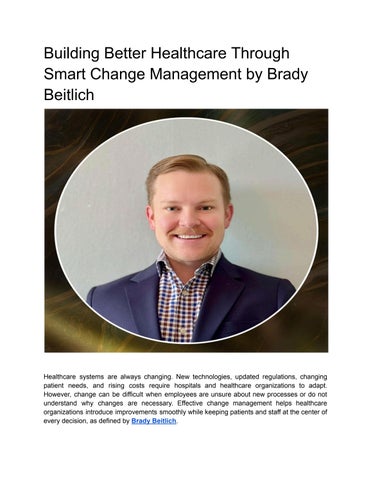
Building Better Healthcare Through Smart Change Management by Brady Beitlich
Healthcare systems are always changing. New technologies, updated regulations, changing patient needs, and rising costs require hospitals and healthcare organizations to adapt. However, change can be difficult when employees are unsure about new processes or do not understand why changes are necessary. Effective change management helps healthcare organizations introduce improvements smoothly while keeping patients and staff at the center of every decision, as defined by Brady Beitlich.
One important part of successful change management is clear communication. Healthcare leaders should explain what is changing, why it matters, and how it will affect employees and patients. Simple and honest communication can reduce confusion and build trust. Staff members should also have opportunities to ask questions and share their concerns. When employees feel heard, they are more likely to support new initiatives. Training is another key factor. Introducing new software, medical equipment, or procedures without proper training can create stress and increase the risk of mistakes. Healthcare organizations should provide practical training that matches employees' roles and experience levels. Ongoing support is also important because people may need time to become comfortable with new systems. Strong leadership can make the change process easier. Managers and senior healthcare leaders should lead by example and show confidence in the new direction. They should also recognize that different employees respond to change in different ways. Some may adapt quickly, while others may need additional guidance. Patience, encouragement, and regular feedback can help employees adjust. Healthcare organizations should also involve staff in the change process whenever possible. Doctors, nurses, technicians, administrators, and other employees understand daily challenges that leaders may not always see. Their ideas can help identify potential problems before a change is fully implemented. Involving employees can also create a stronger sense of ownership. Measuring progress is equally important. Leaders should track whether the change is improving patient care, reducing costs, saving time, or increasing employee satisfaction. If results are not meeting expectations, organizations should be willing to adjust their approach. Change management should be viewed as an ongoing process rather than a one-time project. Effective change management in healthcare requires communication, training, leadership, teamwork, and continuous improvement. When these elements work together, healthcare organizations can adapt without losing sight of their most important responsibility: providing safe, efficient, and compassionate care to patients. By managing change thoughtfully, healthcare systems can become stronger, more flexible, and better prepared for future challenges.