Stop-Fraud Newsletter by BPC | Issue #1
From experts to experts
RISK
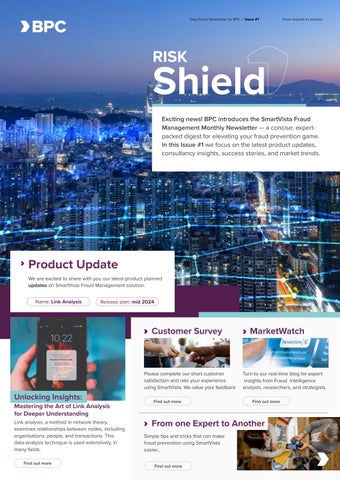
Shield Exciting news! BPC introduces the SmartVista Fraud Management Monthly Newsletter — a concise, expertpacked digest for elevating your fraud prevention game. In this Issue #1 we focus on the latest product updates, consultancy insights, success stories, and market trends.
Product Update We are excited to share with you our latest product planned updates on SmartVista Fraud Management solution. Name: Link Analysis
Release plan: mid 2024
Customer Survey
Please complete our short customer satisfaction and rate your experience using SmartVista. We value your feedback
Unlocking Insights:
Mastering the Art of Link Analysis for Deeper Understanding Link analysis, a method in network theory, examines relationships between nodes, including organisations, people, and transactions. This data-analysis technique is used extensively, in many fields. Find out more
Find out more
MarketWatch
Turn to our real-time blog for expert insights from Fraud Intelligence analysts, researchers, and strategists. Find out more
From one Expert to Another Simple tips and tricks that can make fraud prevention using SmartVista easier... Find out more
Stop-Fraud Newsletter by BPC | Issue #1
NEWS
From experts to experts
Planned updates to the SmartVista Fraud Management Solution We are excited to share with you the latest product planned updates on our SmartVista Fraud Management solution* Name: Link Analysis
Release plan: mid 2024
What is it? Link analysis, a method in network theory, examines relationships between nodes, including organisations, people, and transactions. This data-analysis technique, extensively used in various fields, aids in investigating criminal activity, enhancing computer security, optimising search engine results, conducting market and medical research, and analysing art. Stored in a graph database and presented through network visualisations, link analysis uncovers patterns within a network. Three core applications include entity analysis, link analysis, and discovery. Techniques involve clustering, pathway discovery, graph analytics, quantitative analysis, temporal analysis, and analytical layout algorithms. 1
Identifying known patterns that validate a hypothesis
2
The aim is to uncover patterns, dependencies, and associations within a network of entities - to gain an understanding of the underlying relationships.
Identifying patterns that disprove a hypothesis
*The feature will initially be available to licensed customers only.
2
3
Discovery of new patterns of interest for further investigation
RISKSHIELD
Stop-Fraud Newsletter by BPC | Issue #1
From experts to experts
What types of Link Analysis will be available?
Clustering
Pathway discovery
to establish more tightly bound areas within the network, including common entities that may exist between two or more clusters.
Creating a link visualization is the foundation for combining analytical methodologies, in one place, to obtain further insights into the data. Some common tools and techniques used to determine insights are:
across two or more entities of interest to identify non-obvious connections or entities. Visualizations can be enhanced by applying conditions to these pathways such as direction, timeframes of interest, or a commodity being transferred to help isolate certain patterns.
Quantitative analysis
Temporal analysis
features aggregate and group data points to establish commonality across similar characteristics. Subgrouping this information can often lead to non-obvious traits that may have formed the network, such as exploitation of vulnerabilities.
indicates the sequence of events that may have formed a network, periods of inactivity, or times of convergence and overlapping factors.
3
Graph analytics
such as Social Network Analysis (SNA) to highlight the importance in a network based upon centrality measures. These include potential gatekeepers of information, influencers, and hubs of authority. Weightings can be placed on specific link types and data points to tailor the results.
Analytical layout
algorithms can be used to alter the visual appearance based on multiple factors, such as organization or hierarchical dependencies
Stop-Fraud Newsletter by BPC | Issue #1
NEWS
From experts to experts
This could be an account opening, from an IP address, that has recently been linked to fraudulent transactions – or a change of address – to one that has shown previous suspicious activity.
Examples on how link analysis is used in Fraud Detection Fraudsters have acquired expertise in working around fraud prevention and detection systems, evolving and changing their approaches – into sophisticated, complex, multi-step – often global techniques. Link analysis offers a way of finding links, between entities and objects, even in large data sets, which may go unnoticed, by fraud systems. It may also be a street, which has several shops, previously linked to organised crime. You can also see individuals who may be at a high risk for fraud at a glance. Say for example that your bank is onboarding a new customer. Everything about her seems normal. But link analysis shows you that she’s connected to a known fraudster by an IP address. Traditional detection systems may have missed this red flag.
Studying the connections between individuals, the devices they use, their shipping addresses, the payment methods they use, and so forth can expose both small and largescale fraud rings. This means that businesses that use link analysis are better placed to detect fraudulent activity. With the correct strategy, they can even identify potential future fraud. Link analysis can be used, by companies, to uncover instances of fraud such as:
Account takeover attacks
Money laundering
Multiaccounting
Affiliate fraud
Fraud networks (or fraud rings), can be found globally. They often span international boundaries, due to individual members, being able to connect via the dark web. They can facilitate the sharing of stolen contact, account and payment card details, and connect fraudsters to one another in various other ways. One fraud network example involves the boom in synthetic identity fraud. Synthetic identity fraud is where criminals use elements taken from real people’s identities (addresses, social security numbers, and the like) and mix them up to create new, fictitious but convincing identities. Link analysis can help to spot this – and allow action, to be quickly taken
4
RISKSHIELD
Stop-Fraud Newsletter by BPC | Issue #1
From experts to experts
The Immediate Benefits for you Rapid Identification of patterns
Data relationship patterns
Speed of analysis and discovery
Scalable data analysis
Analysing data in a visual format, enables rapid identification of interesting patterns in both the positive and negative space, such as highdensity clusters of entities, a high volume of interconnectivity between pairs of entities, or even the absence of links where they may be expected.
The human brain can process visual information much faster than written or numerical information. By displaying your data as a visual network, link analysis enables you to find the exact information you need, often in seconds.
Traditional analytics are also not designed to analyse the relationships within the data. With graph data and link analysis, on the other hand, data from multiple sources is represented, together. This allows you to quickly understand how different data is connected, and the type of connections. These characteristics of link analysis make it a powerful tool for organisations that need to understand the relationships within their data.
Link analysis can display and analyse huge amounts of data from multiple sources. Even when the quantity of data is very large, querying data stored in a graph is fast, allowing scalability, in line with even the largest data sets.
Accessible and intuitive analytics
Displaying data, as a network, offers an easy and intuitive way for even non-technical staff, to understand and explore complex connections
5
Stop-Fraud Newsletter by BPC | Issue #1
NEWS
From one Expert to Another
From experts to experts
USEFUL TIPS
Customer Survey
#1: Classify your cases We’ve observed that some users (in our processing workflows) may not consistently categorise their incidents, especially when it comes to identifying positive fraud. It’s crucial to prioritise this task, even if you leverage alternative systems and protocols. Numerous functionalities of our fraud management tool hinge on accurate case classification.
Share with us your experience about SmartVista Fraud Management through the below 5 minutes survey.
Why its important? Without it, reports become unreliable, rule validation loses its impact, and machine learning efficiency diminishes. Suggestion: Ensure to categorise all incidents and furnish comprehensive details. This practice is essential for optimising the system’s efficacy and streamlining its processing capabilities.
Your feedback will help us improve the solution, while your suggestions will help us to enhance Fraud Management functionality and plan updates which are important for you and your business.
#2: Incorporate an entity presence check
Let’s defend against fraudsters together!
In constructing a rule group, ensure to incorporate an entity presence check into the filter for any entity you intend to generate a case for. For instance, if you execute a presence check on the “customer” entity (ensuring the field is present in the incoming message), you can subsequently create a case as a reaction for the “customer” entity.
Customer Survey
Why its important? Failing to perform this step will render it impossible to add a reaction for case creation at the rule group level. Suggestion: For detailed guidance, please consult Section 9.3.4, “Linking a rule group to an entity type,” in the SmartVista Fraud Management User Guide (October 2023, Version 6.59).
6
RISKSHIELD
Stop-Fraud Newsletter by BPC | Issue #1
From experts to experts
MarketWatch
Who are the fraudsters of 2024?
Security is still everything
The industry is now at a juncture, facing unprecedented forms of deception that have the potential to penetrate even the most fortified security systems. Learn the latest fraudulent trends and how they are reshaping the landscape of digital finance and payment systems.
A successful payment system relies heavily on trust. With the rapid digitization of financial services, incumbents are often seen as safe and secure, but they must also prioritise customer experience. In this post, we explore the challenges faced by payment providers and how they can maintain trust while delivering an exceptional customer experience.
Find out more
Find out more
7
Fraud Prevention in real-time payment systems Dive deep into our comprehensive white paper to gain vital knowledge and strategies to navigate the complex landscape of realtime payment fraud and how to protect against it
Find out more
RISK
Shield Contact the Fraud Experts
Maxim Kuzin
Product Manager kuzin@bpcbt.com
Eric Smith
Senior Product Consultant smith@bpcbt.com
Shadrack Ogechi, Product Consultant s.ogechi@bpcbt.com
www.bpcbt.com