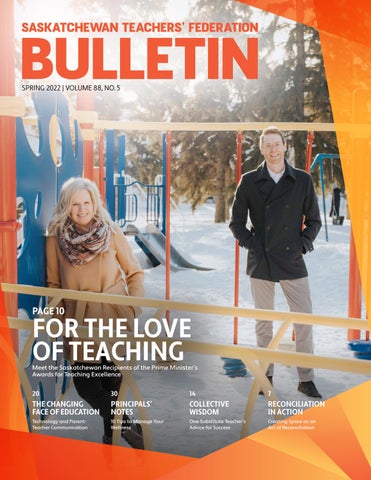
SPRING 2022 | VOLUME 88, NO. 5
PAGE 10
FOR THE LOVE OF TEACHING
Meet the Saskatchewan Recipients of the Prime Minister’s Awards for Teaching Excellence
20
30
14
7
THE CHANGING FACE OF EDUCATION
PRINCIPALS’ NOTES
COLLECTIVE WISDOM
RECONCILIATION IN ACTION
Technology and ParentTeacher Communication
10 Tips to Manage Your Wellness
One Substitute Teacher’s Advice for Success
Creating Space as an Act of Reconciliation
TABLE OF CONTENTS SPRING 2022 | VOLUME 88, NO. 5
President’s Update
4
Feature: Your Brand-New Bulletin 5 ISSN 2816-3885 (Print) ISSN 2816-3893 (Digital) The Saskatchewan Teachers’ Federation Bulletin is published four times during the school year and is distributed both electronically and in print. Have a story idea or a topic you would like us to include? We’d love to hear from you. Reach us at stfcommunications@stf.sk.ca. For our current advertising rate card or to book an advertisement, please contact stfcommunications@stf.sk.ca. Editor: Courtney Forseth, Managing Director of Communications and Public Relations www.stf.sk.ca @SaskTeachersFed
©2022. For permission to reprint, please contact the editorial office. Indexed in the Canadian Education Index ISSN 0036‑4886. Member of the Canadian Educational Press Association and the Educational Press Association of America.
Reconciliation in Action: Creating Space Teachers Inspire: For the Love of Teaching
7
10
Advocacy: Collaboration Results in SPTRB Changes
13
Collective Wisdom: Substitute Teachers
14
Upcoming Events
16
Traditional Indigenous Medicines: Pineapple Weed
18
The Changing Face of Education: Technology and Parent-Teacher Communication 20
Working for You: STF Continues Preparations for Provincial Collective Bargaining
25
In the Classroom: The Role of Personal Reflection in Anti-Racism
Meet Your Local Leaders
26
22
Teachers Inspire
28
Government of Saskatchewan’s 2022-23 Budget
24
For You and Your Family: Five Things You Didn’t Know the MFAP Could Do for You
29
Principals’ Notes: Simple Changes to Manage Your Own Wellness
30
PAGE 7
Reconciliation in Action: Creating Space “ The machine of western education is not an Indigenous machine, but [the room] is claiming a bit of space within a western institution.” - Julie Stiglitz, Principal
3
PRESIDENT’S RECONCILIATION IN ACTION UPDATE
IN
any year, spring often brings renewed energy and optimism. The last two years have been no exception as we hope for a reprieve from COVID-19 and all that comes with it. As of writing this article, Saskatchewan has lifted all public health measures and reduced public reporting of the spread of COVID-19 and its impact on our health-care system. No matter how tired we are of COVID-19, it is not going away soon and we must continue to adapt and learn to live with it. The Federation’s advocacy on COVID-19 matters has been, and continues to be, guided by science and the recommendations of the public health experts. Our approach on living with COVID-19 will also be guided by the advice of the medical community. At this time, those recommendations are to still wear a mask indoors, especially in settings like a classroom where you can’t properly distance. A mask protects both the person wearing it and others around them. Teachers and principals have been on the frontlines of this pandemic and have experienced some of the greatest impacts on their work life. Our profession wants COVID-19 to be over as much as everyone else and welcomes a time when we can safely remove layers of protection that have helped protect our health. While opinions on mandatory public health measures vary and the discourse has become political and divisive, it is abundantly clear we all want what is best for our loved ones and our communities. This desire not only unites us as a profession but also as a community. There is an opportunity to extend this common value beyond COVID-19 and to the future of public education by ensuring the system emerges from this crisis more capable than ever of preparing Saskatchewan students for what lies ahead. It is time for our provincial government to view education as an investment rather than a cost to be managed. Research shows unequivocally that each dollar invested in education has a positive impact on gross domestic product and saves future government expenditure on social assistance, health care and criminal justice; it simply makes sense. The Government of Saskatchewan must increase its investment into Saskatchewan’s public schools to ensure schools are community hubs where every student has access to the educational, cultural and specialized supports they need. Teachers can do the job; now is the time to ensure they have the necessary tools. Patrick Maze President Saskatchewan Teachers’ Federation
4
FEATURE
RECONCILIATION IN ACTION
Your Brand-New Bulletin! INSIDE OUR NEW LOOK — AND YOUR NEW MAGAZINE It’s here! Welcome to the next evolution of the Bulletin: Saskatchewan Teachers’ Federation Bulletin. Just in time for spring, we’re excited to introduce a fresh new look – and a fresh new approach – to doing what the Bulletin does best. For 87 years, the Bulletin has connected teachers. It has showcased the successes and priorities of our members. And it has become a trusted source of information for teachers and our education sector partners. Now it’s time for our next chapter. Building on the Bulletin’s proud tradition and reputation, we’re taking a big step forward to better serve our members. Our new magazine will feature more voices from the profession, more resources to support your work and more ways of engaging with you. Welcome to your brand-new Bulletin!
Take a Tour!
Inspired by Teachers Thanks to input from members, we received valuable feedback about what you want to see in your Bulletin. It’s no surprise that our readers appreciate quality content. And you told us that you look forward to meaningful, in-depth stories along with brief, quick reads.
HAVE AN IDEA FOR A STORY? Want to contribute to a future edition of the Bulletin? Let us know! We can’t wait to hear from you.
EMAIL US stfcommunications@stf.sk.ca
We heard from members that you want to see articles related to the programs and services offered through the Federation, including pension and benefits, well-being of teachers, students and our communities.
5
WHAT’S INSIDE? Features
Diving deeper into the issues that matter most to our members with longer-form feature articles.
Working for You
Keeping members up to date on matters related to collective bargaining.
Reconciliation in Action
Supporting meaningful action towards reconciliation inside schools, in our communities and in Federation initiatives.
Upcoming Events
Keeping members informed about upcoming events from conferences to webinars and cultural celebrations.
Teachers Inspire
Showcasing teachers in schools across Saskatchewan with member profiles.
Collective Wisdom
Sharing tips and ideas to support each other and bring us closer together.
In the Classroom
Increasing access to professional resources and the supports that teachers and staff need.
The Changing Face of Education
Delivering the latest research on how our dynamic profession is evolving and changing.
Advocacy
Updating our members on issues relating to advocacy, public policy and political action.
Principals’ Notes
Helpful tips and resources to support teacherprincipals in their dynamic roles.
You want to see stories that connect us and bring us closer together, and resources that help support your growth as education professionals. And we all want a Bulletin that shares the many voices of our profession, reflects the diversity of our schools, and supports our advocacy efforts to build more inclusive classrooms and communities.
True to You Our new look is vibrant and engaging – just like our members! We’ve strived to deliver a magazine that feels modern, fresh and friendly to our readers. It’s a bold and celebratory design. We know who we are – a dynamic profession of dedicated educators who are continually learning and growing together. And we know what we’re working to achieve. It’s about empowering education for all. That’s what the STF is all about. And that’s why our new design is inspired by our logo. Just as a prism refracts and reflects light, public education opens a world of possibilities for our students.
What’s New? It’s more than just a new look! Readers will notice lots of changes designed to build on the Bulletin’s success and deliver more of what you expect. Our new magazine will be published quarterly and the magazine format gives us more flexibility to showcase our members and your priorities with longer-form features. In a world of instantaneous news cycles, we want to deliver print content with a shelf life longer than a typical newsfeed. We hope that our readers will be able to pick up a copy of the Bulletin at any point and always find stories that are relevant, thoughtful and useful to them.
MORE! • Voices of Teachers
We’re excited to deliver a new Bulletin that features the diverse voices and perspectives of more of our members.
• Support for Teachers
We’re here to serve and support our members by connecting teachers, building our profession and protecting public education for all.
• Engagement With Teachers
Have a story idea? Want to contribute to a future edition of the Bulletin? Let us know! We can’t wait to hear from you.
6
Members told us that they also appreciate the Bulletin in both print and digital formats. That’s why we’re delivering a magazine that will continue to be distributed to members at their schools and division offices. We have also enhanced the digital experience by introducing Issuu, a magazine-style platform that allows for an interactive reading experience and makes sharing articles to your social media channels easier. Check out our website at www.stf.sk.ca/bulletin for more information and to subscribe.
RECONCILIATION IN ACTION
RECONCILIATION IN ACTION
Creating Space BY KERRY BENJOE
Bert Fox Community High School in Fort Qu’Appelle is proving there is room for Indigenous knowledge and practices within a western education system. Last year, the school opened the iyiniwikamik Takoja Hochoka which is a combination of Cree and Dakota words that together mean “Indigenous lodge where grandchildren are at the centre.” The first word iyiniwikamik is the Cree word for Indigenous lodge, and Tokoja Hochoka in the Dakota language means grandchildren and the centre.
“The machine of western education is not an Indigenous machine, but [the room] is claiming a bit of space within a western institution,” said principal Julie Stiglitz. It’s where students can smudge and where teachers can have classes on scraping animal hides and preparing traditional medicines. “It’s really good for
JULIE STIGLITZ
The iyiniwikamik Takoja Hochoka in Bert Fox Community High School.
7
RECONCILIATION IN ACTION
kids to learn those skills,” said Stiglitz. “It’s a place where we can do Indigenous things as part of the curriculum.” Now that it’s open to the public, she hopes the community will begin to use it for ceremony like it was originally intended. Vee Whitehorse, learning facilitator at Bert Fox, said the room is good for the students. “It empowers them because it’s theirs,” he said. “I see some kids every morning come in and go straight to that place to smudge.” As a First Nation’s person, Whitehorse said watching Indigenous students have the opportunity to practise their traditions at school makes him emotional at times.
iyiniwikamik Takoja Hochoka means “Indigenous lodge where grandchildren are at the centre.” “I never thought I would see that kind of space in my lifetime,” he said. “It’s here, and I really like that even for myself it’s healing because finally we see education moving in the right direction.” Stiglitz said Fort Qu’Appelle is unique because it is not only the place where Treaty 4 was signed but it’s also in close proximity to the former Indian Residential School in Lebret. Approximately 70 percent of the student body is Indigenous, so it’s important to recognize and honour the community’s history.
JULIE STIGLITZ
Students work on an animal hide in the new space.
8
The school works at creating positive relationships by listening. Last year, a group of students wrote a letter requesting a flag song and honour song be played after the national anthem. On the National Day of Awareness for Missing and Murdered Indigenous Women and Girls, also known as Red Dress Day, the students request was implemented. Now every day after O Canada, a recording of a flag song and honour song are played. Stiglitz said the Indigenization of the school has been made possible through a collaborative process among the students, community and the school. Whitehorse said the changes are real acts of reconciliation.
Take part in transforming education for generations to come. Welcome to the Jane and Ron Graham Centre for the Scholarship of Teaching and Learning—a research centre focused on improving education for all learners. This new centre supports the rigorous study and application of novel teaching and learning approaches that lead to action and improvements in student learning and educational quality.
to learn more.
education.usask.ca/grahamcentre
TEACHERS RECONCILIATION IN ACTION INSPIRE
Love of Teaching For the
BY KERRY BENJOE
A love for learning is not only taught, it is also nurtured, say two award-winning Saskatchewan educators. Shelley Smith is a kindergarten teacher at Holy Trinity School in Warman and Nat Banting is a mathematics teacher at Marion M. Graham Collegiate in Saskatoon. Both have received the Prime Minister's Award for Teaching Excellence and the Prime Minister's Award for Teaching Excellence in STEM, respectively. Smith was humbled to receive the Certificate of Achievement for PlayBased Learning. “This certificate is for every educator who puts in long hours and truly likes what they are doing,” she said. Smith was recognized for creating a classroom that fosters creativity, imagination and excitement for learners, even through a pandemic. “Every month the physical space may change in the classroom but what’s at each centre also changes,” said Smith. It can be a paleontology lab, a veterinary clinic, Mrs. Claus’ cookie
10
shop or anything else her students would enjoy. Constantly rearranging the classroom and changing the five discovery centres is time consuming, so Smith does it outside of regular school hours. Positively impacting a young child’s life by instilling a love of learning is her ultimate goal as an educator. The most useful advice she ever received was to build relationships with her students, which she has followed, and says it’s the same advice she would pass on to others. Smith said the best part about receiving the award has been all the congratulatory messages she’s received from former students. As a high school teacher, Banting is also big on relationship building. Like Smith, he was also humbled to receive the Certificate of Excellence for ReImagining Math Learning. What sets him apart is the unique approach he brings to math.
RECONCILIATION TEACHERS ININSPIRE ACTION
BRITTANY BELLAMY
11
TEACHERS INSPIRE
“My goal is to always have [students] be active,” said Banting. “If we look back on the history of mathematics education, it notoriously has our students sitting in passive environments where mathematics is this thing that is passed to them through this very efficient conduit from teacher and textbook to learner.” Because he sees mathematics as a verb, he encourages his students to take the lead and be active problem solvers. “Maybe it’s the structural or logical order of mathematics but it just feels like the perfect tool for thinking, and I really enjoy doing that with young people,” he said. Banting is grateful to everyone who has indulged his crazy ideas over the years. He's always been active in the mathematics community, both online and within the school system. So when the pandemic hit, he found a way to marry his two interests. Since activities like mathematics fairs were canceled, he came up with a new way to keep students engaged.
With the creator’s permission, Banting took an existing mathematics board game and digitized it in order to create a provincewide online competition which became known as SMIT 2020, or the Saskatchewan Mathematics Invitational Tournament. He facilitated games between more than 100 classrooms across the province. Banting said awards are great but at the end of the day, he just loves teaching mathematics and watching students learn and is what drives him to pursue his passion.
DID YOU KNOW? Fuel your passion by joining a Professional Growth Network. There are PGNs for math, early learning and more. Find a full list on our website at www.stf.sk.ca > Professional Resources > Professional Growth Networks.
BRITTANY BELLAMY
12
ADVOCACY
Collaboration Between STF and SPTRB Results in Significant Change for Teachers A concerted effort to build a collaborative relationship between the Saskatchewan Teachers’ Federation and the Saskatchewan Professional Teachers Regulatory Board has resulted in a significant change to the Consensual Complaint Resolution Agreement process. Redacting teacher’s personal information from publicly posted consent resolutions was identified as an area of mutual interest and benefit. These agreements are typically used for addressing what are considered minor infractions. Previously, a teacher’s personal information would remain documented in published agreements permanently. The STF and STRPB agreed this practice not only often stalled the consent resolution process, but also may not be fair or appropriate.
“It was recognized that keeping a teacher’s name published in a CCRA in perpetuity may have punitive consequences beyond the terms agreed to in a CCRA.” “The SPTRB’s Board of Directors supported these bylaw amendments because the Consensual Complaint Resolution Agreement process is intended to be remedial and restorative – remedial for the teacher and restorative of the public’s confidence in both the individual’s practice and that of the teaching profession in general,” said SPTRB Chief Operating Officer and Registrar Trevor Smith. “It was recognized that keeping a teacher’s name published in a CCRA in perpetuity may have punitive consequences beyond the terms agreed to in a CCRA.”
The STF and SPTRB worked collaboratively in developing proposed changes to The Education Act, 1995 and the SPTRB requested the changes be made. These changes are now in effect: • When an agreement does not include suspension or cancellation of a teacher’s certificate the registrar will redact all personal information two years after all terms of the agreement are satisfied. • When an agreement includes suspension of a teacher’s certificate the teacher may request the registrar redact all personal information five years after all terms of the agreement are satisfied. In the fall of 2020, leadership from both organizations confirmed a desire to meet regularly and consistently to enhance the working relationship between the organizations while seeking areas of mutual interest which support teacher discipline processes where the principles of natural justice, procedural fairness, efficiency and shared respect are demonstrated. The reform of the publication parameters of consensual consent resolution agreements is an outcome of this shared work. Senior Administrative Staff Al Boutin is one of the Federation staff members who worked on these changes. “We are very pleased to have made such quick progress on this important issue and look forward to continued collaboration. This is a very substantial and meaningful change for teachers who will be involved in these agreements.” The two organizations continue to meet and discuss areas for collaboration.
13
COLLECTIVE RECONCILIATION IN ACTION WISDOM
Substitute Teachers BY JEN COMSTOCK, REGINA PUBLIC TEACHERS’ ASSOCIATION
1
INVEST BEFORE YOU REQUEST When a student is off task or breaking a rule, I have learned to greet the student, check in with them and ask how their day is going first. Then, once I have their attention and they feel that they matter, I can remind them of the action they need to take. I have found this strategy to be especially useful when I encounter noisy “pockets” of the room.
2
ASK STUDENTS WHAT THEY WANT TO LEARN ABOUT If you have 10 or 15 minutes at the end of a period, ask the students what they want to talk about. You can guide the discussion and then invite students to ask questions. For example, “I noticed the snowflakes this morning were all really unique shapes. I wonder why that is?” This leads to great discussions and learning opportunities. The students are often very engaged as they often view it as led by them and their peers.
3
READ THE ROOM I do this by waiting, watching and being more “neutral” in my approach until I get a sense of the room – are they shy, sarcastic, boisterous, serious, fun loving? This helps ensure my approach doesn’t fall flat and get in the way of connecting. On the flipside, it ensures I don’t get a boisterous group going by leading with a joke.
14
HILARIOUS JOKES Speaking of jokes, I have the same handful of hilarious jokes in rotation. Because I am with different students all the time, I can recycle the same tried and tested jokes. Also, I laugh at the jokes students make – as long as they are school appropriate that is!
6
WAIT BY THE DOOR For elementary students, I wait outside the door to greet and introduce myself to each student on their way in. For high school students, I wait near the door as they are packing up and say goodbye to each of them as they leave.
7
BE PREPARED TO TROUBLESHOOT IT ISSUES Technical issues are almost always inevitable when working with systems you aren’t familiar with. Find out if the school has an in-house tech wizard and keep IT’s number at hand. If you run into trouble, you can quickly call IT or know what classroom to find a colleague who is the tech wizard.
KEEP A SMALL COLLECTION OF WORD SEARCHES AND CROSSWORD PUZZLES A stash of word searches and crossword puzzles in various levels of difficulty can be a lifesaver if you need to buy some time while you sort out IT issues.
4
5
8
L EAVE A NOTE FOR THE TEACHER YOU FILLED IN FOR When I fill in for a teacher for the first time, I like to share my contact information as well as what subjects I teach. This can be a good way to network and get future calls, especially if the students enjoyed having me.
Nukskahtowin at Athabasca University Graduate course offered every Spring. Indigenous Studies - INST 511: Indigenous Knowledge and Education Spring session: April 25 - July 22, 2022 This online grouped study course will prepare persons who work with Indigenous communities and students by examining ways of knowing within those communities and the interaction in the field of Education. There is a prerequisite; you must have an undergraduate degree. Please contact our office for registration deadlines and fees. Email: indigenous@athabascau.ca Website: indigenous.athabascau.ca Phone: 1-800-788-9041 ext. 5054 or 780-220-2162
15
UPCOMING EVENTS MARCH
30
TEACHER WELL-BEING WEBINAR SERIES: PHYSICAL WELLNESS Wednesday, March 30 7:00 – 8:00 p.m.
APRIL
07
In this webinar, Humanworks co-founder Wade Repta will discuss how general principles of physical wellness apply to the teaching profession, and how to utilize that knowledge in your daily practice.
APRIL
01
CONNECTING CURRICULUM TO PLAY-BASED PROJECTS IN KINDERGARTEN Friday, April 1 9:00 a.m. – 3:30 p.m. A day for early learning educators in prekindergarten and kindergarten to examine their role in developing play-based learning environment’s emergent curriculum, planning methods to connect children’s interests with curriculum, deepen their understanding of documentation through conversations and questions with children, and explore ways to honour home, family, culture and community knowledge to support projects.
APRIL
01
FOUNDATIONS OF TEACHING SERIES: MEANING MAKING ACROSS CURRICULA
APRIL
05
BUILDING RELATIONSHIPS ONLINE Tuesday, April 5 1:00 – 4:00 p.m. STF Professional Learning provincial facilitators Arlene Low and Jade Ballek will help you explore the benefits, challenges and ways to address challenges for each type of relationships and connect strategies for addressing challenges to the four pillars of trust: support, community, belief and voice.
16
Thursday, April 7 4:00 – 4:45 p.m. Join STFPL Associate Director Connie Molnar to learn more about the resources and learning opportunities to support teachers in their first five years and how you can communicate more effectively with students and families.
MAY
03
MAY
06
SSBL ADMINISTRATORS’ CHAT Tuesday, May 3 4:00 – 5:00 p.m. In collaboration with the Saskatchewan Teachers’ Federation, Saskatchewan School Based Leaders is hosting another SSBL Administrators’ Chat. Be a part of supporting administration across the province with conversations about what is impacting and changing the face of our work.
FACILITATOR SERIES: CREATING THE PROFESSIONAL LEARNING YOU’VE ALWAYS WANTED Friday, May 6 9:00 a.m. – 4:00 p.m. Explore the factors that contribute to the creation of purposeful, flexible and responsive adult learning experiences. Participants will learn to connect outcomes to purposeful process selection, processes for identifying learning outcomes with a focus on facilitation planning, and identifying criteria for highquality professional learning.
Friday, April 1 9:00 a.m. – 3:30 p.m. Join STF Professional Learning provincial facilitators Glenda Hadwen and Trish Karakochuk to develop your understanding of how to involve students in purposeful strategy selection, and learn how to connect meaning-making strategies to cross-curricular competencies as a way to explore their application across curricula.
WEBINARS FOR TEACHERS IN THEIR FIRST FIVE YEARS: STFPL HERE TO SUPPORT YOU
MAY
09
BEGINNING YOUR JOURNEY TO BECOMING AN ANTI-RACIST EDUCATOR Monday, May 9 and Tuesday, May 10 9:00 a.m. – 4:00 p.m. This two-day intensive will support you in understanding the disparities you witness within the education system, the frustrations and questions you may experience about the practices and approaches within schools, and the assumptions and ideologies that manifest ongoing inequities.
UPCOMING EVENTS
MAY
16
INDIGENOUS EDUCATION SYMPOSIUM 2022: INSPIRING SUCCESS CONTINUING THE JOURNEY Monday, May 16 and Tuesday, May 17 9:00 a.m. – 4:30 p.m. The Symposium will be an opportunity for education leaders to engage with a wide range of participants in dialogue focusing on the continued implementation of Saskatchewan’s Inspiring Success: First Nations and Métis PreK-12 Education Policy Framework and on building shared ownership of the vision for an equitable and inclusive system that benefits all learners.
FOR MORE INFORMATION For additional event listings and registration information, visit the Events Calendar at www.stf.sk.ca.
The Saskatchewan Teachers’ Federation is proud to partner with the Multicultural Council of Saskatchewan in providing information on religious and cultural celebrations.
APRIL 2 | RAMADAN BEGINS April 2 marks the first day of the Holy Month of Ramadan. Muslims who are able do not eat or drink from dawn until sunset in order to focus on self-examination and religious devotion. The Holy Month ends with Id-al-Fitr on May 2.
MAY | ASIAN HERITAGE MONTH Asian Heritage Month is an ideal occasion for all to celebrate the rich values, beliefs and cultural expressions of various Asian cultures and their contributions to Saskatchewan. Asian-Canadians have demonstrated resilience through many instances of discrimination, oppression, and exclusion based in stereotypes and racism. Learn more at www.mcos.ca/events/ asian-heritage.
MAY 16 | WESAK Wesak is the most important day of the year for Buddhists. It commemorates the birth, awakening and passing away of the historical Buddha, Siddhartha Gautama. It may be celebrated on different dates according to country and tradition.
JUNE | NATIONAL INDIGENOUS HISTORY MONTH National Indigenous History Month is an opportunity to honour the heritage, contributions and cultures of Indigenous Peoples in Canada. We learn about the impacts of colonialism on the lives of Indigenous and non-Indigenous people and commit to equity and respectful relationships. We recognize not only the historic contributions of Indigenous peoples to the development of Canada, but also the strength and diversity of present-day First Nation, Inuit and Métis communities and their promise for the future.
17
TRADITIONAL INDIGENOUS MEDICINES Pineapple Weed BY GENEVIEVE PREVOST, OSKAYAK HIGH SCHOOL, SASKATOON TEACHERS’ ASSOCIATION Travelling from place to place, we often fail to look at what is growing in the small cracks and crevices that pave our streets, sidewalks and driveways. Nature is constantly giving us what we need when we need it. Something that I see all the time is a plant that grows in the harshest conditions – pineapple weed. As a kid, I would pick the yellow cone-shaped flower and squish it between my fingers to smell the citrus scent. Now as an adult, I search for it in spaces that have not been sprayed with pesticides or insecticides. I collect as much as I can as it is a wild camomile. I leave the root to grow again, dry it and use it to make tea. This is one traditional medicine to help when things get a little crazy in our lives. In the times we live in, as our stressors increase, I have noticed many of my colleagues reaching out to ask what to do for stress and wellness. Coffee is a diuretic and has caffeine, which many of us have been existing on. It increases our heart rate and makes us feel nervous. Take a moment, go find some pineapple weed when it begins to grow and make a cup of tea. The walk to find it and the moment of solace as you drink your tea, will improve your well-being.
BRITTANY BELLAMY
18
McDowell Foundation • Female
Leaders and their Impact on School Culture in Saskatchewan – Amy Korver and Amy Orth
• Teaching
During the COVID-19 Pandemic: The Lived Experience of Saskatchewan Teachers – Dr. Madeline Press, Dr. Suzanne Zwarych, TJ Zwarych and Alex Olwilli
• K-12
Saskatchewan Distant Education: Digging Deeper into 21st Century Learning During a Pandemic – Kelsey Shields
This spring two research grant competitions will be awarded: • General
Call for Research including a Directed Call focused on Indigenous Ways of Knowing (June 2022). 001
The Foundation continues to fund teacher-led research that benefits teaching and learning. Select recent research publications include:
• S pecial
Directed Call for Research focused on Student and Teacher Well-Being (May 2022).
For more information on all our programming and events, or how you can support the Foundation visit www.mcdowellfoundation.ca.
CELEBRATING 30 YEARS
CERTIFICATE OF
EXTENDED STUDIES IN INCLUSIVE EDUCATION Add essential tools and techniques to your teaching style to foster the success of your students with diverse learning needs. The Saskatchewan Ministry of Education provides incentives to earn this certificate.
Learn more at uofrcce.ca. 19
THE CHANGING FACE OF EDUCATION
Technology and Parent-Teacher Communication BY SASKATCHEWAN TEACHERS’ FEDERATION RESEARCH AND RECORDS UNIT
Technology has changed and challenged assumptions about the way teachers and parents communicate. Add to this, over the past two years, many of us have read tales about parents overhearing teacher gaffes or struggling to answer questions. Similarly, teachers cite examples of parents interfering with instruction, helping students with tests or calling them away to do chores. The reality is that even before the pandemic, technology was changing the way teachers and parents and caregivers communicated. Teachers learned how to use tools such as text messaging, email or social media apps to ensure that parents and caregivers were well informed about their child’s educational progress. With the onslaught of COVID-19, the importance of communicating electronically between home and school went into high gear as teachers learned how to use school-based or divisionsponsored learning management systems and formalized expectations and procedures for ongoing communication with parents and caregivers and their students in an online learning environment. Looking back, it was a pretty steep learning curve on both sides. Over the past 24 months, it’s not surprising that issues about education and online learning have become a popular area of research. Thanks to the experiences of teachers, principals and vice-principals, parents, students and others from the wider educational community, our knowledge base of what works, including home and school communication, is growing. Research from the University of Alberta last year offers some interesting insights regarding the changing nature of home and school relations as a result of the pandemic. A survey of over 1,000 parents and approximately 600 teachers found that both parents and teachers reported increasing levels of empathy and patience for one another. The study found that 74 percent of teachers reported getting to know their families better while 45 percent of parents reported gaining an increased understanding of the demands on teachers. The study also found that parents gained a better understanding of classroom
20
realities and that teachers had an opportunity to witness some of the pandemic-related tensions and stresses families were experiencing.
Some parents noted connecting with teachers online resulted in more frequent and meaningful communication. This communication can only be seen as a benefit for students, teachers and parents. However, the study also showed that while communication during the pandemic strengthened some relationships, it strained others. Forty-three percent of parents reported that they were having fewer interactions with teachers than in previous face-to-face environments and only 18 percent reported seeing improvements in their relationship. Of interest is the study’s conclusion that, “While it may be true that parents know their kids best, they don’t necessarily know their children as learners.” In other words, parents, witnessing the dynamics of the teacher and student relationship, readily acknowledged the distinction between their role as parent and that of the teacher.
THE CHANGING FACE OF EDUCATION
In general, parents were reluctant to play the intermediary, such as arguing about assignments, and preferred to maintain harmony within the home. On the other hand, the study found that going virtual provided a new way for parents and teachers to connect about a student’s progress. Some parents noted connecting with teachers online resulted in more frequent and meaningful communication. This communication can only be seen as a benefit for students, teachers and parents. This finding is reiterated in an article published by The Washington Post. The authors cited recent research from the PEW Research Center in the United States reporting a heightened degree of parental concern regarding students’ progress in an online or hybrid learning environment as compared to a face-to-face one. Susan Sheridan, director of the Nebraska Center for Research on Children, Youth, Families and Schools at the University of Nebraska, reports that the parent-teacher
relationship a prime driver for student success in school and that a positive and collaborative relationship creates a sense of security and stability for children as learners. Sheridan notes that children are very observant and submits that parent-teacher interactions can serve as a model for students’ attitude. Children pick up on verbal and non-verbal cues about how both parent and teacher perceive one another and the roles each have in supporting the education process. Undoubtedly, technology is changing the nature of parent and teacher communication. Moving forward, teachers, parents and students will likely look back on their communication experiences supporting students with online education and recall elements that facilitated student learning and those that may have interfered. However, the research also tells us that the foundational premise of parents and teachers working together to support student success remains as essential as it has always been.
21
IN THE CLASSROOM
The Role of Personal Reflection in Anti-Racism Step into any school and you will likely be greeted by a vision, mission or values statement welcoming you. While these vary, there is a common theme of supporting students, inclusivity, equity and recognizing the student as a whole being. Saskatchewan Teachers’ Federation Professional Learning has developed a two-day intensive that aims to support teachers in this quest. “As educators, we all agree with these statements. But how do we actualize them in our everyday interactions?” asked Alisa Favel, an educator in Saskatoon and one of the co-facilitators of Beginning Your Journey to Becoming an Anti-Racist Educator. The two-day intensive guides participants to a deeper understanding of how assumptions and ideologies operate within the education system to manifest ongoing inequities for students. “It is about self-reflection and recognizing the unintentional bias we all bring to situations,” said STFPL Associate Director and co-facilitator Linda Aspen-Baxter. “That’s a powerful piece,” said Favel. “You truly believe in the aspirations and values you profess but there can still be an unknown and unintentional disconnect with your actions and reactions. So often in incidents that occur between teachers and students it is about more than just that present moment. Consider what may have led up to this moment.”
22
Favel and Aspen-Baxter point to student attendance as an example of where a mental step back and reflection can make an impact. The pair encourage teachers to not only consider the student’s perspective, but also what they may be unintentionally bringing to their interpretation.
CONTEMPLATE AND CONSIDER STUDENT’S EXPERIENCE • What is the student experiencing on arrival to school? On the way to class? • When they arrive, is the classroom truly a welcoming space? • Do they feel valued and respected?
YOUR REACTION • What assumptions are you making? • What biases might you be bringing to the situation? • What might your own body language, tone and responsiveness communicate to the student? • What barriers might exist? With this awareness, how might you respond?
IN THE CLASSROOM
RESOURCES AVAILABLE FROM THE EMMA STEWART RESOURCES CENTRE For these and other resources, contact the ESRC or visit the online catalogue at www.stf.sk.ca. Examine the conflicting perspectives held by settlers and Indigenous residents about land, culture, treaties and history, while gaining understanding of the interpersonal and systemic racism Indigenous peoples experience.
Learn how to use curriculum and pedagogical strategies to address racial incidents and systemic racism, while considering theoretical conceptions of race, justice and fairness.
This guide presents a framework and practical tools to have candid and authentic dialogue aimed at creating systemic change. In this third edition, the pandemic’s impact in revealing structural inequities in the education system are discussed.
Grow your understanding and awareness of microaggressions and equip yourself with strategies to challenge and disarm micro and macroaggressions.
Deepen your understanding of institutional racism and learn how to move beyond conversations and contribute to transformational change of systems to help achieve racial equity.
Using theory and research, enhance your ability to recognize and confront systemic racism and build racially equitable practices.
Through a series of essays, explore the relationship between Indigenous people and Canada and how it is impacted by concepts and social beliefs. The author explores terminology, culture and identity, state violence and more.
Explore the history of race relations in Canada, multiculturalism, post-colonialism and the inherent tensions that exist. The authors use lived experiences to examine racialized othering and how to move towards universal belonging.
23
Government of Saskatchewan’s 2022-23 Budget The Government of Saskatchewan’s 2022-23 budget will soon be released. While an overall increase in Education spending may appear to be a positive indicator, a larger budget for education doesn’t automatically mean more money for programs and services in schools. The impact of inflation on buying power, student enrolment, transportation costs and changing student needs are just a few things that make a significant difference on what the true impact of the funding is. The 2021-22 kindergarten to Grade 12 funding was $2.11 billion. This includes capital and operational funding such as salaries, student transportation, governance, administration and facility operations, and maintenance.
S ASKATCHEWAN BUDGET 2022-23: WHAT TO WATCH FOR • An increase for kindergarten to Grade 12 education of at least four percent, or a total of $2.19 billion, for status quo. This amount would simply keep pace with enrolment and cost-ofliving increases. • Inclusion of funding for the Federal-Provincial Childcare Agreement ($10-a-day daycare) may be reflected in the overall education budget. While it would show a substantial increase to the education budget, it would not have any impact on kindergarten to Grade 12 funding. • New and dedicated funds for student mental health, addressing learning gaps resulting from the pandemic and funding to address class composition. • Funding in other ministries, such as youth mental health supports in the Ministry of Health budget, that will positively impact students.
DOES THAT MEAN A FOUR PERCENT INCREASE IS A GOOD NEWS BUDGET? • A four percent increase over last year would maintain current funding levels. The Ministry of Education’s data shows that education spending has remained largely flat since 2013-14. After being adjusted for inflation, perstudent funding has decreased by 12 percent, while student enrolment has increased by more than nine percent over the same time period.
24
WORKING FOR YOU
RECONCILIATION IN ACTION
STF Continues Preparations for Provincial Collective Bargaining The Saskatchewan Teachers’ Federation began preparing for the next round of collective bargaining shortly after the current agreement was ratified. Federation staff are examining inflation on the cost of living and teacher salaries, impacts of the pandemic and supports for substitute teachers. It is anticipated class size and composition, a major focus of the last round of bargaining, will again be a priority issue. Creation of the provincial Education Class Size and Composition Committee was a valuable outcome of the last round of bargaining. The committee is meeting regularly and making progress in discussions, although it isn’t expected solutions will be implemented before May 2023, when the next round of bargaining is set to begin.
KEY MILESTONES • Bargaining resolutions to be debated at Annual Meeting of Council – April 2022 • Survey to members on bargaining priorities – October 2022 • Member focus groups – January 2023 • Teachers’ Bargaining Committee sends letters of intent to Government-Trustee Bargaining Committee – March 2023 • Negotiations begin – May 2023
The word “collective” is as key to this process as the word “bargaining.” Despite diverse views and experiences, members are united as a collective in their profession as educators and commitment to public education. As preparations for bargaining continue, Federation staff will set out to better understand those individual experiences; and for then translate those into collective Timeline Organization and Preparation 2020-23 interests which will The STF Executivethe and Federation staff willthe provideFederation’s numerous engagement opportunities for STF members before the form basis of bargaining objectives commencement of the next round of provincial collective bargaining. and proposals. This will include surveys, discussions A high-level plan for engagement is offered in the road map below. There is sufficient time to properly evaluate thewith round just concluded, refine the bargaining strategies based on the feedback, establish the priorities, needs and aspirations of members, and build the asking liaisons, package for the next round ofimplementation negotiations that will commence in May 2023. school staff local and negotiation STF member education and engagement opportunities include evaluation surveys, bargaining resolutions, Council debate committees, local association of resolutions, a priorities survey,and focus groups to refine survey responses andexecutives. eventual Council debate and adoption of
A complete summary of milestones and activities related to the next round of bargaining are available on the Federation’s website at www.stf.sk.ca > Teaching in Saskatchewan > Collective Bargaining > Timeline for Organization and Preparation 2020-23.
an asking package. We encourage members to engage when provided with the opportunity.
2020-23
June 2020
September 2020
Implementation phase begins
Evaluation phase begins Evaluation survey to STF Executive and STF staff
August 2022 Executive Planning Update on proposal development
September 2022 Followup focus groups
Focus groups to refine priorities
January 2023 STF Executive approves draft resolution to go to Annual Meeting of Council re: draft proposals
Priorities survey to inform proposal development
February 2023 Presidents’ Forum Update on the timeline for organization and preparation
October 2021 Education sessions on collective bargaining offered online for all members
March 2023 Two letters of intent to be sent by Teachers’ Bargaining Committee to Government-Trustee Bargaining Committee and Educational Relations Board re: preferred dispute resolution process and notice to open bargaining
April 2021 Annual Meeting of Council Debate of bargaining resolutions and evaluation report presented
Review survey responses with local association executives and school staff liaisons
January 2022
February/March 2022
Annual Meeting of Council Debate of bargaining resolutions
Councillor Conference Update on the timeline for organization and preparation
January/February/March 2021
Evaluation survey to local association executives and school staff liaisons
April 2022
October 2022
October/November 2020
May 2021 Organization and preparation phase begins Collect and collate bargaining resolutions
April 2023 Council debates and approves resolution at Annual Meeting of Council re: draft proposals
May 2023 Negotiation phase begins
Decision Making Member Education and Engagement
25
MEET YOUR LOCAL LEADERS L
ocal associations provide teachers with a collective voice at the local level and, through their executive and councillors, a central connection with the provincial organization. Elected local association presidents play an integral role in sharing member’s voices and representing their needs. Over the next several issues of the Bulletin, we will introduce you to the local association presidents.
DEBBIE BANMAN NORTHERN AREA TEACHERS’ ASSOCIATION
Debbie Banman was born in Winnipeg but grew up on a farm near her hometown of Elm Creek, Manitoba. She now teaches at Churchill Community High School in northern Saskatchewan. Banman remembers loving teaching from a young age. “I started teaching my dolls and stuffed animals from a young age. My high school social studies teacher inspired me to make social studies one of my teaching majors,” she said. One tip for a new teacher? Banman says: “ The only evaluation that counts in your career will come from your students. Some of those student evaluations take a couple of years.” Fun fact about Banman – she’s had many different occupations including in hospitality, day cares, photography and advertising.
DANIEL DION ASSOCIATION LOCALE DE ENSEIGNANTS ET DES ENSEIGNANTES FRANSASKOIS ET FRANSASKOISES
Daniel Dion was born in the small Frenchspeaking community of Zenon Park, Saskatchewan and has been teaching in the Francophone system since 2007. For Dion, learning and discovery has been at the centre of his life. It was only natural for him to gravitate towards education in the hope of sharing and inspiring others. When asked what piece of advice he would offer a new teacher today, Dion says: “ Be authentic and teach with empathy … good relationships go a long way in building the generation of tomorrow.” On the side, Dion is an avid electronics enthusiast and hobbyist. He’s a licensed radio amateur that enjoys the work of radio sport contesting. Daniel Dion est né dans la petite communauté francophone de Zénon Park, en Saskatchewan, et il enseigne dans le système francophone depuis 2007. Pour Dion, l’apprentissage et la découverte ont été au cœur de sa vie. Il était tout à fait naturel pour lui de s’orienter vers l’éducation dans l’espoir de partager et d’inspirer les autres. Lorsqu’on lui demande quel conseil il donnerait à un nouvel enseignant ou enseignante aujourd’hui, Dion répond : “ Soyez authentique et enseignez avec empathie... de bonnes relations contribuent grandement à la formation de la génération de demain.” En outre, Dion est un amateur passionné d’électronique. C’est un radioamateur autorisé qui aime travailler à la diffusion d’émissions radio de compétitions de sport.
26
MEET YOUR LOCAL LEADERS
NEAL BOUTIN
GERARD FRISON
CHINOOK TEACHERS’ ASSOCIATION
HORIZON TEACHERS’ ASSOCIATION
Gerard Frison is in his last year of teaching at William Derby School in Strasbourg, Saskatchewan – a place he’s called home since 1988.
Neal Boutin has filled a variety of roles at Gull Lake School for 23 years and counting. Boutin finds inspiration in his high school teacher George Mitten whose lectures were captivating stories full of humour and satire. Today, Boutin tries to make his lessons equally entertaining, relevant and fun. A piece of advice for a new teacher? Boutin says: “ Teach like you mean it, because even if you don’t want to admit it, you are a role model and your students deserve the best you have to offer each and every day – warts and all.”
SUZANNE VANCE
What gives Frison hope when he thinks about students today? He says: “These last two years have created many changes in teaching and produced many different and challenging obstacles that students had to overcome to achieve … I saw many students with the individual work ethic and interest in their education that is needed to think critically and solve problems.” As he reflects on his teaching career, Frison says his sense of humour is his claim to fame; it has served him well throughout his career in the classroom and beyond.
PRAIRIE SOUTH TEACHERS’ ASSOCIATION
Suzanne Vance teaches at Prince Arthur Community School in the city she grew up in – Moose Jaw, Saskatchewan. With an over 30-year teaching career, Vance has lots of advice for incoming teachers. “Things to remember: You are allowed to make mistakes – these make you human; it is okay to cry – this makes you relatable; don’t forget to laugh out loud – this helps you drop those shoulders and release tension; keep a journal – this will remind you how awesome you were in your first year!” When she’s not teaching, catch Vance dreaming about her next big Disney vacation, reading non-educational books by the pool or experimenting in the kitchen. Also ask about her coconut rum banana bread!
POST-DEGREE CERTIFICATE IN ENGLISH AS AN ADDITIONAL LANGUAGE (EAL) EDUCATION Develop skills to support English language learners
Boost your professional resume and career possibilities
Gain knowledge about language learning and academic success
grad.usask.ca/education/#certificateprograms
27
Teachers Inspire Telling Teachers’ Stories to Saskatchewan In communities all across Saskatchewan, teachers inspire kids to learn, to grow and to achieve their goals. This year, the Saskatchewan Teachers’ Federation is partnering with CTV to tell some of the stories about the work that teachers in our province do every day in a campaign entitled Teachers Inspire. After more than two years of the pandemic, we know that teachers, parents and students are all feeling stretched. At the same time, awareness of the importance of teachers and the role that you play in your students’ lives is stronger than ever before.
We can’t wait to tell you about all the amazing stories we have collected, on CTV, and here in the Bulletin! In February, the Federation and CTV began collecting stories about teachers making a difference in their students’ lives and in their communities.
28
From all of those amazing stories, we’ll be selecting three that will be featured on CTV News, on Pure Country FM in Regina and in 30-second feature videos demonstrating the impact of teachers’ work. We can’t wait to tell you about all the amazing stories we have collected, on CTV, and here in the Bulletin! Keep an eye on CTV in March and April to see these stories that demonstrate the impact teachers in Saskatchewan have on students and communities. The work of teaching is challenging and inspiring. We see that, and the students and families you interact with see it, too. So, to celebrate and profile the amazing work of Saskatchewan teachers, we’re also emphasizing the importance of investing in Saskatchewan’s schools with rink board advertising in arenas in smaller centres, digital advertising and billboards. The intention of all of these pieces is to demonstrate the connection between teachers and students. At a time when awareness of the daily challenges teachers face is so high, it’s time to make the case for increased investment in schools in this province.
FOR YOU AND YOUR FAMILY
RECONCILIATION IN ACTION
Five Things You Didn’t Know the MFAP Could Do for You Teachers often give all of themselves to their students and not enough to themselves. The Saskatchewan Teachers’ Federation Member and Family Assistance Plan helps make it easier for teachers and their families to manage their own well-being. Now, you might think of the MFAP as just a short-term counselling service, but it offers so much more. Here is a list of five things you may not know the MFAP can do for you:
1
BUILD YOU A WORKOUT REGIME The MFAP offers health and wellness services that include exercise and nutrition coaching, weight management and tobacco cessation.
2
FIX YOUR PLUMBING Call into the MFAP looking for almost any service, and the resource specialist on the other end will help you find it, including a plumber.
3
WRITE YOUR WILL The MFAP’s legal services team can help you with a broad range of topics including divorces, real estate, adoption and, yes, estate planning.
4
MAKE A BUDGET The MFAP’s financial experts offer one-on-one support and guidance to help you plan your finances, manage debt, solve credit problems and more.
5
HELP YOU GRIEVE THE LOSS OF A LOVED ONE OK, you might have known about this one – but the MFAP’s short-term counselling program is a really great way to help yourself get through a tough, emotional time.
All of these services are offered completely confidentially by a third-party provider, and are available any time of day, any day of the year. It’s just one more way the Federation supports teachers and their families.
CHECK IT OUT AT ww.stf.sk.ca > Pension & Benefits > w MFAP & Teacher Well-Being.
29
PRINCIPALS’ NOTES
Simple Changes to Manage Your Own Wellness BY WADE REPTA, AUTHOR THE WELL TEACHER
1
FOCUS ON WHAT YOU DO AND HOW YOU THINK
This is essentially what wellness essentially comes down to. When addressing wellness, it’s important to problem solve and have a plan for things you can do to move forward, while at the same time exploring your emotional wellness and considering how thinking may be affecting your perceptions, stress and coping.
2
REMEMBER THE COGNITIVE AND EMOTIONAL COMPONENT
Building on this point above, when working with administrators to develop wellness plans, we have found that they are excellent at the “doing” part of wellness because they are such good problem solvers and actionoriented leaders. But the cognitive and emotional part of wellness can sometimes be given less priority. It’s helpful to get assistance with this from outside resources, such as with a counselor, and remember that building emotional wellness and addressing cognitive distortions can take time.
3
BOOKEND YOUR DAY
Consider bookending your day with five minutes of quiet, mindful, breathing. Don’t just run in the door and jump right into stressful situations. Close your door, sit and try the 4-7-8 breathing technique to centre yourself so you start and finish your day with short periods of calm. This might not be possible every day, but it is absolutely possible some days.
30
4
COMPLETE ONE TASK AT A TIME
We realize this is harder than it seems, but when you aren’t feeling well it is both harder to manage multiple tasks and harder to stay focused. Answering emails and the phone rings? Finish the emails and then listen to the phone message. Book time in your calendar to complete specific administrative tasks and stick to the schedule if at all possible. Close your door from time to time so you are not as easily disturbed.
5
STAY CONNECTED TO YOUR ADMINISTRATOR COLLEAGUES
Working in isolation can add to mental health and stressrelated challenges and wears down resilience. The job is by nature isolating at times, and when we are unwell, we have a tendency to further isolate ourselves thinking that this will help us focus and get back on track. But that’s not how it works. It’s even more important to maintain connections when your stress is up, and you are starting to feel burned out.
6
YOU ARE IMPORTANT
But you are also the last person on your priority list, so when it comes to scheduling your week, you will work around your job and your family first. Which is the reality of things. But, without your own wellness activities you will be compromised, especially in the long term. You might not be able to work in things for yourself every day, but could you do something once or twice per week that adds to your wellness? This requires planning, and a specific schedule, but more importantly a commitment to you. Because without that commitment, the “you activity” will come and there will be 10 reasons why you can’t do it.
PRINCIPALS’ NOTES
7
COMBINE THINGS TO MAXIMIZE YOUR TIME
Could one of your less formal meetings be a “walk and talk” outside instead of sitting at your desk? Could you bring some running shoes and do a few laps around the outside of the soccer field during your daughter’s game? Could you use the school’s gym for 20 minutes after school before heading home? Could you organize to go to yoga and grab some tea with a friend once every two weeks, to make it more social, and also add accountability?
8
BE A WELL LEADER AND YOU WILL SEE A CULTURE OF WELLNESS
People won’t remember the hundreds of things you do for the school every week, but they will notice how you do them. If you are well and demonstrate the importance of self, while at the same time understanding and genuinely supporting those with mental/physical health and disability challenges, this will trickle down through the staff and become part of your school’s culture, because it’s being cultivated at the leadership level.
9
Wade Repta is the Vice-President and an Occupational Therapist with humanworks consulting group inc. Wade has spent the past 20 years working with teachers who are experiencing wellness and disabilityrelated challenges, helping them minimize barriers and remain in, or return to, the classroom.
MONITOR YOUR INTERNAL MESSAGES
If your internal voice is more negative than usual, you are more frustrated than normal, or if you find you are beating yourself up about small mistakes or things you can’t really control, it might be time to seek support.
10
ACCESS RESOURCES
Don’t wait until you are “crashing” or need time off work. There are wellness resources available through the Saskatchewan Teachers’ Federation, Member and Family Assistance Plan, and the community. There are also some free activities available through the humanworks press Well Teacher website (www. humanworkspress.com/collections/teacherwellness-resources) that will assist you to evaluate your wellness, such as the Burnout Inventory and Wellness Map.
31
Keep an eye out for the 2022-23 Professional Growth Opportunities catalogue. The catalogue features upcoming events and professional development for members and will be mailed to school staff liaisons via the monthly mailing in May 2022.
stf-001215a / 20220315
SASKATCHEWAN TEACHERS’ FEDERATION 2317 Arlington Avenue Saskatoon SK S7J 2H8 Tel: 306-373-1660/1-800-667-7762 Fax: 306-374-1122
RETURN UNDELIVERABLE CANADIAN ADDRESSES TO:
PUBLICATIONS MAIL AGREEMENT # 40064493