10 minute read
FACULTY FOCUS

from Boyd Law Magazine 2022-23
by boydlawunlv
When the U.S. Supreme Court acts, professors at the William S. Boyd School of Law at UNLV stand alert to update their legal scholarship in their area of expertise. Students, colleagues, and the news media often seek their insight. Among many high-profile decisions this year, SCOTUS considered how crimes on Indian land should be prosecuted, how pollution is regulated, school prayer, and abortion.
Advertisement
ADDIE ROLNICK ON NATIVE AMERICAN SOVEREIGNTY
A Question of Criminal Procedure
SCOTUS has opened the door for states to prosecute certain crimes on Indian land. Boyd Law professor Rolnick considers the potential consequences
BY MATT JACOB
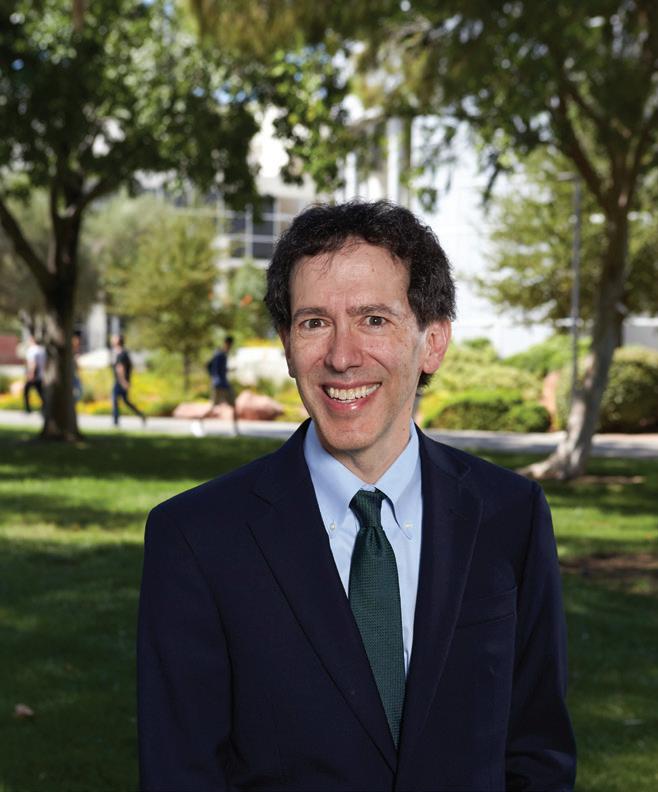
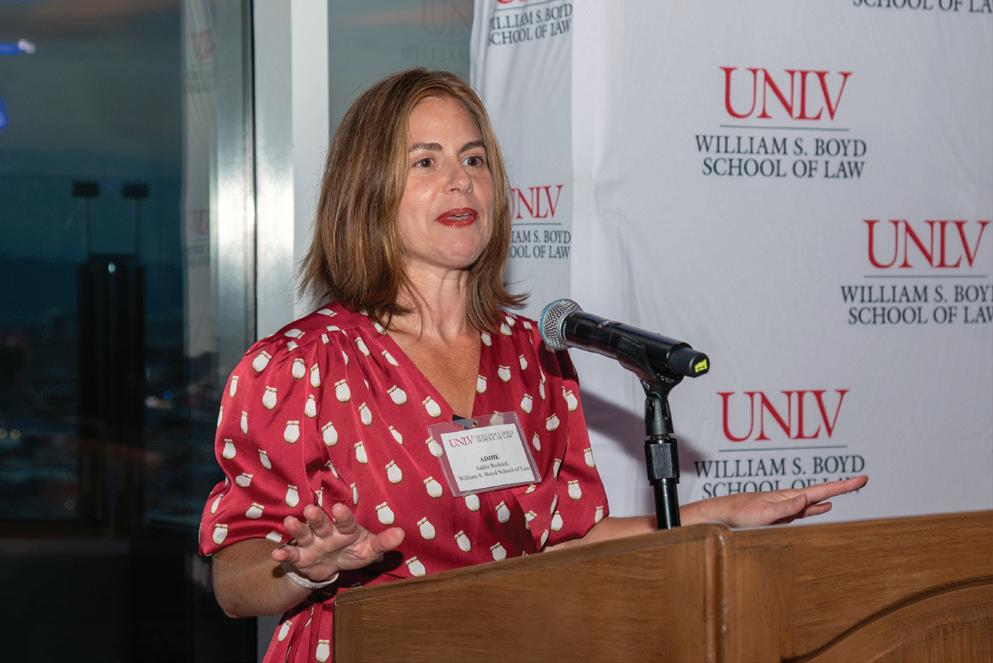
One U.S. Supreme Court case that mostly flew under the mainstream media’s radar was nonetheless significant to legal scholars whose work focuses on Native American sovereignty—scholars such as Addie Rolnick, the San Manuel Band of Mission Indians Professor of Law at the William S. Boyd School of Law at UNLV.
Having written and taught extensively about indigenous rights and justice systems, Rolnick kept a close eye on Oklahoma v. Castro-Huerta, the case that considered whether states had jurisdiction to prosecute nonIndians who commit crimes against Indian people on tribal lands.
The court in late June ruled 5-4 in favor of Oklahoma. With the decision, the court blurred an almost 200-yearold sovereignty line that had largely kept states from prosecuting crimes committed on reservations—crimes that have long been prosecuted primarily by tribal and federal officials.
“Criminal jurisdiction in Indian country has always been a compli-
cated maze,” says Rolnick, who also directs Boyd Law’s Indian Nations Gaming & Governance Program. “But one category of crime we all have long known to have no gray area is when a non-Indian person commits a crime on a reservation against a victim who is Indian—a so-called ‘interracial’ crime. That had always fallen under federal jurisdiction. This case changed that by saying states also can have jurisdiction over those [types of] crimes.”
Rolnick acknowledges that the scope of the decision is limited in that it only affects a small category of crimes. Tribal jurisdiction over crimes committed by non-Indians was already limited by a 1978 case, so the ruling in Oklahoma v. Castro-Huerta does not directly undercut tribal jurisdiction in most instances. States, for example, still can’t claim jurisdiction when a crime committed on a reservation involves an Indian defendant and an Indian victim. Nor can states get involved if an Indian person perpetrates a crime against a non-Indian on tribal land.
Still, she says the ruling’s implications could be significant, because it potentially adds another player to the criminal justice mix regarding jurisdiction on Native land. “Tribes can have their own regulations about a lot of things that might differ from state law—things like gaming or marijuana use,” Rolnick says. “Now, states can use this new criminal jurisdiction as a way to go after tribal regulatory authority. I don’t know that state prosecutors will do that. But it’s possible.”
Translation: It could take years before tribal councils and scholars such as Rolnick learn the true impact of this SCOTUS ruling.
“If it turns out that states limit the way they implement it—and the court doesn’t try to expand the scope beyond this decision—the practical effect could be minimal,” Rolnick says. “But there’s a potential for undermining the criminal justice priorities of both the federal government and tribal governments, because we’re letting states come in and do more inside reservations than they’ve ever been allowed to do.” “What they’re doing is taking interpretive authority away from [federal] agencies and reserving it to themselves as Supreme Court justices while requiring Congress to speak clearly about socalled major questions.” ▸
BRET BIRDSONG ON CLIMATE CHANGE
A blow to the EPA’s ability to fight climate change
Boyd Law professor Birdsong hopes Congress’ passage of the Inflation Reduction Act mitigates decision
BY PAT MCDONNELL
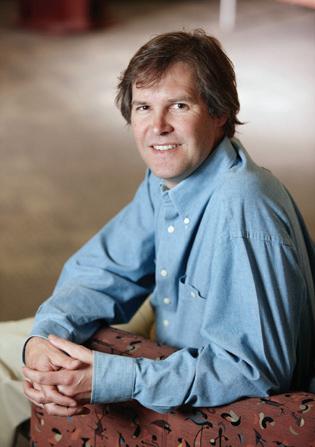
In the long battle to control how industrial air, water, and land pollution is regulated, the U.S. Supreme Court has clipped the wings of federal agencies such as the Environmental Protection Agency, William S. Boyd School of Law at UNLV professor Bret Birdsong believes. In June, SCOTUS ruled in West Virginia v. Environmental Protection Agency that the EPA could not broadly regulate greenhouse-gas emissions from coal- and natural-gas-fired power plants without specific congressional authority to address climate change. In a 6-3 opinion, the conservative majority said the agency had assumed too much authority in trying to enact a transformative market shift to renewable energy sources in its bid to contain climate change.
“What they’re doing is taking interpretive authority away from [federal] agencies and reserving it to themselves as Supreme Court justices while requiring Congress to speak clearly about so-called major questions,” Birdsong says
With control of both the executive and legislative branches of government, however, the Democratic administration may have mitigated the effects of the judicial decision by passing important climate legislation.
President Joe Biden signed the Inflation Reduction Act in August, unleashing about $370 billion in climate and clean energy funding. Birdsong says the legislation lessened the impact of the Supreme Court’s ruling for climate action.
“Since Congress has acted, that somewhat mitigates the concern about whether [the ruling] cripples our climate strategy,” he notes. “We still have a climate strategy; it might be effective, but the crisis requires an alltools, all-hands-on-deck approach.”
Birdsong, a Boyd Law professor since 2000, himself remembers how West Virginia’s beautifully rugged, yet sometimes dangerous landscape affected a canoe camping trip he once took on the Cacapon and upper Potomac Rivers.
“On one memorable occasion when I was about 10, the river suddenly rose one afternoon, and I was pulled by a neighbor from a rapid after my canoe totally swamped,” he says.
Water, and the West’s lack of it, is something Birdsong is watching closely. Birdsong emphasizes that law students benefit particularly from knowing water law.
“To me, it is the most acute example of the natural world intersecting with the urban world,” he says.
As Birdsong looks ahead to the next 15 to 20 years and considers how the country will tackle the twin crises of climate change and biodiversity loss, he says law students should help society balance industrial growth while it maintains healthy natural resources.
LESLIE GRIFFIN ON THE ESTABLISHMENT CLAUSE
This has been a trend. The older [Supreme] Court said, ‘No, we can’t support religion.’ The government is supposed to set up a system for everyone— even the atheists and the nonbelievers. The newer Court has weakened the Establishment Clause and put more religion in government.”
A ‘Hail, Mary’ Pass? A Postgame Prayer
Professor Griffin questions how much SCOTUS values the Establishment Clause in high school football prayer decision
BY PAT MCDONNELL
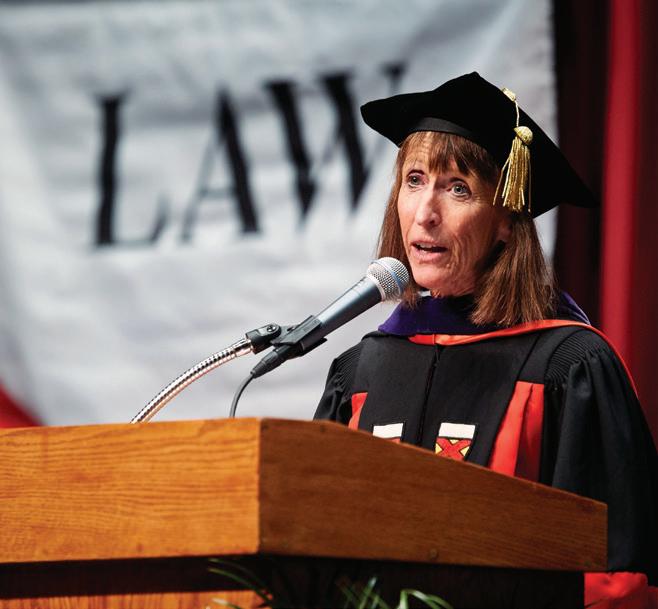
While it did not initially appear to have the intense gravity of the U.S. Supreme Court’s overturning Roe v. Wade on June 24, the ruling on Kennedy v. Bremerton School District three days later prompted William S. Boyd Professor of Law at UNLV Leslie Griffin to write as energetically as she ever has.
Griffin argues that the ruling in favor of public high school coach Joseph Kennedy’s right to pray with his football players after games in Washington state weakened the First Amendment’s Establishment Clause. Many law scholars have long weighed the clause and its instruction that Congress “shall make no law respecting an establishment of religion” as defining tenets in jurisprudence on the separation of church and state.
“This has been a trend,” says Griffin, who has taught at the Boyd Law for 10 years. “The older [Supreme] Court said, ‘No, we can’t support religion.’ The government is supposed to set up a system for everyone—even the atheists and the nonbelievers. The newer Court has weakened the Establishment Clause and put more religion in government.” They allowed a public school’s football coach to lead his players in public Christian prayer.
Connecticut native Griffin is teaching Constitutional Law II and Bioethics this semester as well as Law and Religion in Spring 2023. In August, Foundation Press published the fifth edition of her law and religion casebook, written with constitutional attorney Andrew Seidel.
“I have always studied ethics and became fascinated with the courts because it seemed to me they were saying a lot about our ethical questions,” Griffin says. “So I went to law school [in 1989] to find out why that was happening, and have stayed interested in how the courts treat ethical questions, especially religious ethical ones.”
The former theology professor at the University of Notre Dame and Saint Joseph’s University says the future of the Supreme Court and its rulings rest in the hands of voters. She feels that some who cast their vote don’t fully understand how the executive and legislative branches of government can induce seismic movement on the nation’s highest court.
“If you care about the courts, pay attention to your votes for president and Senate,” Griffin says.
When she has time away from academia and the law, Griffin enjoys following a New York team that is not famous for its navy blue and white pinstripes.
“I’m a huge baseball fan, and I love the Mets. I wore my Mets cap to class,” she says. “I have several students, too, who are Dodgers fans, and even one who worked for the Braves.”
DAVID ORENTLICHER ON ABORTION
Second Opinions
With both legal and medical degrees, professor Orentlicher shares his perspective on healthcare law
BY STACY WILLIS
When the U.S. Supreme Court overturned Roe v. Wade in June, professor David Orentlicher was uniquely qualified to analyze the controversial decision from the intersection of health care, ethics, public policy, and law.
Orentlicher, the Judge Jack and Lulu Lehman Professor of Law at the William S. Boyd School of Law at UNLV and director of the UNLV Health Law Program, has an M.D. from Harvard Medical School and a J.D. from Harvard Law School. He served in the Indiana House of Representatives from 2002 to 2008, and he was first elected to the Nevada Assembly in 2020.
“You’ve got very important interests on both sides,” Orentlicher says. “And as people balance those interests, they draw a line at different points during gestation.”
In 1973’s Roe, the Supreme Court ruled broadly that there is a constitutional right to privacy that includes the right to an abortion. Striking down Roe and writing the 6-3 majority opinion in Dobbs v. Jackson Women’s Health Organization, Associate Justice Samuel Alito called that reasoning “plainly incorrect.”
Orentlicher disagrees: “The idea that there is no constitutional basis [to the right to privacy] reflects a misunderstanding of legal principles. … The Roe Court properly recognized a fundamental interest in making reproductive choices that includes a right to abortion. …
“One way to think about abortion is to say the pregnant woman is sustaining the life of the fetus. In other contexts, we don’t impose obligations on one person to come to the aid of another—even another person—to sustain their life to that degree. … ”
For example, he says the law would never compel a parent to donate a kidney or stem cells to their child who needs a kidney transplant or bone marrow transplant. Most parents would gladly step up for their children, but they aren’t required, he says.
In his sixth year at Boyd Law, Orentlicher previously taught at Indiana University McKinney School of Law. He chose UNLV because he liked the law school’s faculty, smaller size, sense of community, and its Southwestern locale. Seeing the politically purple Nevada turning bluer, the Democrat also felt he could contribute more to social progress here than in the solidly red Indiana.
So what does this attorney, physician, professor, and lawmaker do for fun?
“I like to dance,” Orentlicher says. “I particularly like to Cajun dance. I clerked in Louisiana after law school, and I took Cajun dancing lessons. It’s harder to find Cajun bands here, but fortunately, Cajun dancing works well with other music.”