Is this your own issue? Subscribe online at www.asianceramics.com www.asianceramics.com
AC26-4
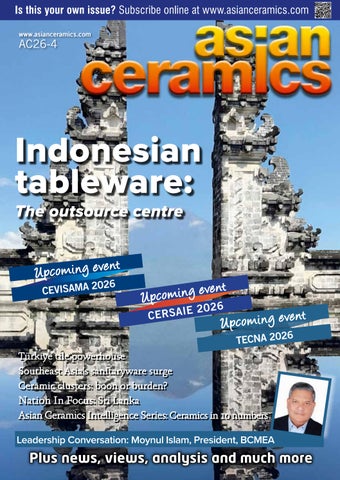
Indonesian tableware: The outsource centre t n e v e g n i m o c p U 2026 CEVISAMA
n e v e g n i m o U pc CERSAIE
t
2026
t n e v e g n i m o c Up 6 TECNA 202
Türkiye tile powerhouse Southeast Asia’s sanitaryware surge Ceramic clusters: boon or burden? Nation In Focus: Sri Lanka Asian Ceramics Intelligence Series: Ceramics in 10 numbers Leadership Conversation: Moynul Islam, President, BCMEA
Plus news, views, analysis and much more
Welcome
Is this your own issue? www.asianceramics.com
Subscribe online at www.a
sianceramics.com
AC26-4
I
n ceramics, being big has never guaranteed Indonesian being strong. Across Asia, some of the industry's largest tableware: manufacturing centres are finding that capacity, The outsource centr e investment and an established market position count for little if they cannot be turned into competitive Upcom ing event products, resilient operations and profitable growth. CEVISAMA 2026 Upc omi ng eve nt 6 Energy costs remain unpredictable, international trade CERSAIE 202 Upcom ing event patterns are shifting and manufacturers face pressure TECNA 2026 Türkiye tile powerhou se to invest in technology while responding to increasingly Southeast Asia’s sanita ryware surge Ceramic clusters: boon or burden? demanding domestic and export markets. Nation In Focus: Sri La nka Asian Ceramics Intellige nce Series: Ceramics in 10 The real measure of strength is what manufacturers numbers Leadership Conversation : Moynul Islam, President, do with the scale they have. BCMEA Plus news, views, anal ysis and much more Nowhere is that more apparent than in Indonesia, the focus of our cover story. Jahir Ahmed examines a tableware industry with substantial manufacturing capacity, domestic raw material resources and an established OEM base, but one that continues to contend with imports, energy costs and underused production capacity. Investment and export opportunities remain, but improving utilisation will be critical if producers are to make the most of that potential. Scale presents a different set of questions in Asia's ceramic clusters. From China's longestablished production centres to Morbi and the growing manufacturing hubs of Southeast Asia, clustering has long brought advantages through concentrated supply chains, specialist expertise and production efficiency. There is another side to the equation, however: dependence on shared energy, infrastructure and logistics networks can leave manufacturers more exposed when conditions turn against them, as Jahir explains. The picture is changing in sanitaryware too. In China and Southeast Asia, Jahir finds Chinese manufacturers increasingly looking towards fast-growing regional markets, while local producers expand and international buyers diversify their sourcing. The result is opportunity, certainly, but also a tougher regional market in which no position can be taken for granted. That point resonates strongly in Türkiye. One of the world's leading tile-producing countries is facing its own combination of high energy costs, difficult market conditions and intense international competition. Rohan Gunasekera considers how manufacturers are responding, including through investment in technology, efficiency and renewable energy, as they seek to protect the competitiveness that helped build Türkiye into a global ceramic powerhouse. Our Nation in Focus takes us to Sri Lanka, where Rohan explores an industry emerging from a period of severe economic disruption. The country's wider recovery is providing a more encouraging backdrop for ceramics, although manufacturers still face pressures from costs, imports and fragile demand. Sri Lanka's experience is a useful reminder that recovery can reopen doors without making the difficulties of recent years disappear overnight. We hear another industry perspective in our Leadership Conversation with Moynul Islam, President of the Bangladesh Ceramic Manufacturers & Exporters Association. He discusses the development of Bangladesh's ceramics sector, its ambitions for further investment and exports and the part that automation, sustainability and international partnerships can play in its next phase of growth. We also take a broader look at the industry through our Asian Ceramics Intelligence Series. Ceramics in 10 Numbers brings together key figures that help put some of the changes taking place across the sector into perspective. Alongside our regular news coverage and forthcoming industry events, it rounds out an issue spanning some of Asia's most important ceramic markets. Different countries, different products and very different circumstances – but the message running through them is remarkably consistent. Manufacturing strength still matters. So do investment, technology and scale. But none of them, on their own, guarantee success. The winners will be those that can turn what they have into what the market needs next.
CONTACT DETAILS EDITOR Editor Isaac Hamza Email: ihamza@asianceramics.com Direct line: + 44 (0) 7494 867 169
ADVERTISING AND DESIGN Advertising Sales Paul Russell Email: prussell@asianceramics.com Direct line: + 44 (0) 7494 866 793
AC COVERS.indd 2
07/09/2026 13:47
Valerie Adamson Email: vadamson@asianceramics.com Direct line: + 44 (0) 7494 866 883 Production and design Tim Mitchell www.corpsvector.co.uk
OVERSEAS OFFICES Bangladesh Jahir Ahmed jahir@asianglass.com India Yogender Singh Malik yogender@asianglass.com Sri Lanka Rohan Gunasekera rohan@asianglass.com
RESEARCH Research Manager Andy Skillen Email: andy@bowheadmedia.com
HEAD OFFICE 27 Old Gloucester Street, London WC1N 3AX, UK.
We hope you enjoy this issue.
Isaac Hamza Editor
Directors:
Valerie Adamson and Paul Russell. Asian Ceramics (ISSN: 1476-1467), is published by Bowhead Media Ltd, registered in the UK No. 06127651.
DISCLAIMER
News, Views, Analysis and much more! www.asianceramics.com
2
asian ceramics
AC 26-4
Asian Ceramics is committed to ensuring that all content in the magazine is original and accurate at the time of publication. It should be noted that the views and opinions expressed in the articles are those of the author(s) and do not necessarily reflect those of the publisher or editor. The material published in the magazine, including advertisements, editorials, and all other content, is published in good faith. Asian Ceramics does not guarantee or accept any responsibility for any loss or damage caused by this publication, or for the accuracy of claims made by the advertisers.
www.asianceramics.com
Discover our mineral solutions for Tiles & Large Slabs
VISIT US FOR EXCLUSIVE INSIGHTS! HALL B7 STAND 100
KAOLIN OPTIMAL WHITENESS
BALL CLAY UNMATCHED PLASTICITY
FELDSPAR CONTROLLED SHRINKAGE
News
Contents: AC 26-4 News
Features
6
Inside Asia
38 Türkiye's tile trials
8
Comment & Analysis
Uzbekistan plans a new sintered slab production line using Chinese technology.
Trade barriers are forcing Asian ceramic manufacturers to rethink their export markets.
10 Across The Continent
Openings, closures and key industry moves across Asia.
20 International News
Our eye on the global ceramics scene.
28 Material Matters
The latest news from the raw materials industry.
36 Leadership Conversation
Rising costs and difficult market conditions are testing Türkiye's tile industry. Rohan Gunasekera examines the response.
44 Indonesia's tableware opportunity
Indonesia's tableware industry balances substantial capacity and export potential against energy, import and utilisation pressures, reports Jahir Ahmed.
54 Southeast Asia's sanitaryware surge Jahir Ahmed looks at changing demand, sourcing and competition across China and Southeast Asia.
62 Cluster advantage or vulnerability?
Asia's ceramic clusters offer scale and efficiency, but concentration can also increase exposure to disruption. Jahir Ahmed examines the balance.
BCMEA President Moynul Islam discusses Bangladesh's ceramic industry and its ambitions for further growth.
54
China's porcelain sanutaryware major MOPO's production line in Chaozhou. Photocredit, MOPO
Analysis 44
PT Sango Ceramics Indonesia kiln. Photocredit, Sango
Your favourite magazine is now available at the App Store… download today to see your first sample issue! Asian Ceramics: now for mobiles, ipads and androids
4
asian ceramics
AC 26-4
66 Nation in Focus – Sri Lanka Sri Lanka's ceramics industry is navigating economic recovery amid continuing cost, import and demand pressures, reports Rohan Gunasekera.
70 Expert View Architects, developers and specifiers are gaining influence over ceramic products and commercial strategy, notes Isaac Hamza.
72 Asian Ceramics Intelligence Series Ceramics in 10 Numbers provides a snapshot of the forces shaping today's ceramics industry.
74 Insider View Smarter kilns and energy uncertainty could reshape competition between European and Asian sanitaryware producers, writes Andy Skillen.
www.asianceramics.com
www.mota-sc.com
MINERALS FOR LIFE MCS® is a Portuguese-based multi-mineral, ceramic raw material mining and processing company. However it offers more than ceramic raw materials and ceramic bodies, it is committed to sustainable mining principles and providing “Minerals For Life”. Our success is built on innovation, R&D and collaborative partnerships to overcome industry challenges.
MOTA CERAMIC SOLUTIONS®
VISIT US AT HALL B7 - STAND NO. 200
Zona Industrial de Oiã | Lote 34 | Apartado 90 | 3770-908 Oiã (OBR) | Portugal | T +351 234 729 190 | F +351 234 729 199 | info@mota-sc.com
Inside Asia Uzbekistan plans new sintered slab line Chinese ceramic machinery supplier HLT&DLT has signed an agreement with Pengsheng Wenren for a new sintered slab production line in Uzbekistan. The project will use HLT YP5809 and YP8890 automatic hydraulic presses, an EM Series high-efficiency six-layer dryer and a Nymph Series variable-width, layer-controlled double-deck roller kiln. HLT&DLT said the project will be the third overseas installation of its Nymph Series variable-width double-deck kiln technology. The Nymph Series uses upper and lower kiln levels of different widths, with independent layer control allowing the two levels to operate separately or manufacture different product categories simultaneously. HLT&DLT says the configuration is designed to provide greater production flexibility and make more effective use of kiln space.
Above - HLT&DLT ceramic thermal processing technology
Right - HLT's YP8890 hydraulic press
The hydraulic presses will handle the forming stage of the planned sintered slab line, with the multi-layer dryer and roller kiln providing the subsequent drying and firing stages. KEDA Industrial Group, whose ceramic machinery businesses include HLT&DLT, said Uzbekistan has significant local ceramic raw material resources but identified a gap in higher-end manufacturing. The company said the project is intended to support more local production of premium ceramic products. The agreement adds another overseas application for HLT&DLT's double-deck kiln technology as the machinery supplier expands its presence in Central Asia. The project remains at the agreement stage. Neither HLT&DLT nor KEDA has disclosed the planned production capacity, investment value or timetable for commissioning the new line.
News Analysis
News
The walls are going up Trade barriers are redrawing the map for Asian ceramics Asia has the capacity, technology and cost base to supply ceramic products across the world. Yet access to those markets can no longer be taken for granted. As trade barriers multiply, manufacturers face a more complicated question than how to compete – where will their products be able to compete next? writes Isaac Hamza, editor, Asian Ceramics. For decades, the international expansion of Asian ceramics followed a relatively straightforward logic. Build competitive manufacturing capacity, develop export markets and use scale to carry products further from their point of production. That model has not disappeared. What is changing is the environment into which those products are being sold. Across several important ceramic markets, trade policy is becoming a more visible part of the competitive landscape. Anti-dumping duties and trade-remedy investigations increasingly sit alongside energy, freight, raw materials and demand as factors determining where Asian manufacturers can sell. The examples are accumulating. The European Union maintains anti-dumping measures on ceramic tiles from India and Türkiye, while duties on Chinese ceramic tableware and kitchenware were increased to 79% in February. In the Gulf, anti-dumping measures also affect ceramic tile imports from China and India. The United States, meanwhile, has continued its anti-dumping and countervailing duty orders on Chinese ceramic tiles following fiveyear reviews. The US International Trade Commission found that lifting the measures would risk renewed harm to US producers. Britain provides the latest example. In July, the Trade Remedies Authority opened an interim review of measures covering Chinese ceramic tableware and kitchenware. Despite existing duties of 13.1–36.1%, the authority said Chinese import volumes increased 22% between 2023 and 2025. For manufacturers accustomed to thinking globally, these are no longer peripheral developments. Market access matters There are two sides to the argument. Domestic manufacturers contend that dumping can make meaningful
8
asian ceramics
AC 26-4
competition impossible when imported products are sold at unfairly low prices. Trade-remedy systems exist precisely to investigate such claims and respond where material injury is established. Exporters face a different reality. Duties can disrupt established customer relationships and rapidly change the economics of a market. A producer can remain efficient, technologically advanced and commercially competitive yet find that an additional tariff makes selling into a destination considerably harder. The issue is not simply China versus the West. India has become a formidable ceramic exporter in its own right and now faces trade defences in markets including the EU and Gulf. Success in international markets can bring scrutiny with it. Perhaps the bigger question is what happens to products that become less competitive in one destination. Factory capacity does not disappear when a tariff is imposed. Kilns still need to run and investments must generate returns. Producers naturally look elsewhere, potentially redirecting competitive pressure towards markets where barriers are lower or demand is growing. Southeast Asia, the Middle East, Africa and Latin America could consequently become more important not only because of their own growth prospects, but as destinations for capacity encountering resistance elsewhere. Trade barriers do not necessarily reduce competition. Sometimes they relocate it. A different export strategy For Asian manufacturers, geographic diversification is an obvious response, but it cannot be the only one. Moving towards differentiated products, specialist applications, stronger brands and closer customer relationships may become more important as competing predominantly on price becomes increasingly exposed to trade
TRADE BARRIERS DO NOT NECESSARILY REDUCE COMPETITION. SOMETIMES THEY RELOCATE IT. disputes. Larger groups may also reconsider localisation, distribution partnerships or overseas production where the economics justify it. None of this means global ceramic trade is retreating. Asia retains formidable advantages in manufacturing clusters, technical expertise, supplier networks and accumulated investment. But competitiveness now has another dimension. A manufacturer can have the right product, quality and price and still face a market-access problem largely beyond its control. For decades, one of the defining questions in Asian ceramics was how much the region could produce competitively. The question ahead may be rather different. Where will all that capability find its market? Sources: European Commission/EUR-Lex – Implementing Regulation (EU) 2026/274 and ceramic tile trade-remedy measures; GCC/Saudi General Authority of Foreign Trade – ceramic tile anti-dumping measures; UK Trade Remedies Authority – Chinese ceramic tableware and kitchenware interim review, July 2026; US International Trade Commission – Inv. Nos. 701-TA-621 and 731-TA-1447, Ceramic Tile from China.
www.asianceramics.com
SPEEDWRAP
TWO PACKAGING MODES, ONE HIGH�SPEED SOLUTION Speedwrap is System Ceramics’ high-speed packaging technology, offering two packaging options within a single solution: Wrap Around for visual control and Tray Mode for enhanced surface protection. A fast and efficient changeover between the two ensures maximum flexibility to meet evolving production needs. Designed to provide maximum product protection, Speedwrap offers tailored corner and surface coverage, according to specific requirements. Built to perform, Speedwrap quickly adapts to changing tile sizes and formats, keeping productivity consistently high.
Visit systemceramics.com to discover more!
NGK expands semiconductor ceramics capacity • Guangdong ceramic producers face rising gas costs • Keda fires foam targets glass-ceramic electrolytes • Geberit showcases water technologies • ISVEA raises TRY1.4B in Istanbul IPO Ky Keda India shifts service strategy • China–Bangladesh ceramics ties strengthen • NGK tests ceramic substrate in Jap JAPAN
NGK expands semiconductor ceramics capacity NGK Corporation plans to invest about ¥70 billion ($470 million) in a new Japanese plant producing ceramic components for semiconductor manufacturing equipment, increasing the group's capacity in the segment by about 20%. The plant will be built in Nomi City, Ishikawa Prefecture, with mass production scheduled to begin in October 2029. Production will be handled by NGK Ceramic Device Co Ltd, the group's manufacturing subsidiary. NGK has acquired about 104,000 sq m of land adjacent to an existing plant producing automotive-related products in Nomi City for the new facility. The Japanese ceramics manufacturer currently produces components for semiconductor manufacturing equipment at facilities including
its Chita site in Handa City and Komaki site in Komaki City, both in Aichi Prefecture. The new plant will manufacture ceramic susceptors, functional components used to support silicon wafers in semiconductor manufacturing equipment. NGK said the components are designed to maintain stable performance when exposed to high temperatures, corrosive gases and plasma during semiconductor production processes. The company said it was expanding capacity in response to increasing demand for semiconductor manufacturing equipment ceramics. Growth in generative artificial intelligence and data centres, alongside continuing demand from mobile devices, is expected to support expansion of the semiconductor market
over the medium to long term. Semiconductor manufacturers are also investing in more advanced and increasingly miniaturised production processes for logic and memory chips. NGK said these developments were expected to increase demand for ceramic components used in semiconductor production equipment. The Ishikawa investment will also broaden the geographical distribution of NGK's manufacturing capacity. Production of its ceramics for semiconductor manufacturing equipment is currently concentrated in Japan's Tokai region. NGK said establishing the new site in Ishikawa Prefecture would strengthen its supply network and business continuity arrangements by reducing the
Rendering of NGK Ceramic Device's planned Ishikawa plant
concentration of production in one region. The company has identified semic onduc tor- related products as a core growth area as it shifts its business portfolio towards markets associated with digital technologies and carbon neutrality. Construction of the Nomi facility forms part of NGK's continuing investment in semiconductorrelated manufacturing capacity, with the planned 20% increase due to become available following the start of mass production in 2029.
CHINA§
Guangdong ceramic producers face rising gas costs Ceramic manufacturers in Guangdong are facing increased production costs as natural gas prices rise above RMB5 per cubic metre, leaving producers paying more for energy than those in several other Chinese ceramic manufacturing regions. Natural gas prices in Guangdong have moved above RMB5/m³, compared with around RMB3.8/m³ in Fujian and RMB3.7–3.98/ m³ in Hebei and Shandong, according to Chinese ceramic industry reports. The latest increase follows several months of rising energy costs. In June, industry reports put pipeline natural gas prices in the Guangdong production areas
10
asian ceramics
AC 26-4
of Qingyuan, Zhaoqing and Enping at RMB4.65–4.8/m³, with prices reaching as high as RMB5.2/m³ in some areas. Foshan prices had risen to RMB4.2/m³. Higher costs are adding pressure to ceramic producers already operating in difficult market conditions. Industry reports published in June indicated that Guangdong's overall kiln operating rate was below 50% in the first half of 2026, with more than half of production lines reported to be idle or out of operation. Ceramic Information, a Chinese industry publication, attributed the reduced operating rates to a combination of excess capacity, high inventories,
weaker orders and volatile energy costs. The impact of higher gas prices can be significant for energy-intensive ceramic production. An unnamed manufacturer cited by Chinese industry media estimated that a RMB1/m³ increase in natural gas prices could add around RMB1.7 million to the monthly operating cost of a single kiln. Gas prices in Guangdong are currently around RMB1–2/ m³ higher than in some other Chinese ceramic production regions, according to industry reports, adding to the competitive pressure facing manufacturers in the province. The domestic increases come against a volatile international energy backdrop. Oil and
gas markets have remained sensitive to disruption around the Strait of Hormuz, a major route for global energy shipments. Reuters reported on August 28 that oil flows through the strait had increased from earlier lows, although traffic remained inconsistent. Brent crude was trading at $89.18 a barrel on Friday as increased flows helped ease some immediate concerns over supply. The combination of higher gas prices and reduced kiln utilisation is maintaining pressure on Guangdong's ceramic manufacturing sector as producers manage production levels against weaker market conditions.
www.asianceramics.com
med ceramics line • UK reviews Chinese ceramics duties • India-Japan team yocera develops ceramic AI substrate • Murata launches Y1 ceramic capacitors • pan DAC project... CHINA
Keda fires foamed ceramics line Keda has fired up a new foamed ceramics production line at Jianheng in Inner Mongolia, China, with capacity of 500 cubic metres per day. The company said its seventhgeneration Cel 4 Apex foamed ceramics tunnel kiln line was successfully fired on 23 August. The installation has annual production capacity of 180,000 cubic metres, according to Keda. The project incorporates a four-layer foamed ceramics tunnel kiln alongside four-layer automatic panel unloading and material feeding systems. Keda described the installation as the first four-layer foamed ceramics tunnel kiln and the first to use four-layer automatic panel unloading and material feeding systems. The company also said the project has the highest single-line production capacity in the industry.
The equipment covers several stages of the production process, extending from rawmaterial preparation and firing to material handling and downstream processing. Keda said the installation incorporates what it described as the highest-capacity rawmaterial preparation workshop used for foamed ceramics production. It also includes an intelligent rail-based storage and handling system which the company said has the largest capacity in the sector. Downstream operations are supported by a foamed ceramics cutting line. Keda described the system as having the highest capacity and fastest cutting performance in the industry. Energy consumption has also been a focus of the project. Keda said the new production line was expected to achieve
the lowest singleline energy consumption in the sector. The company did not provide comparative i n d u s t r y figures in its announcement to support its capacity, Keda’s new foamed ceramics tunnel kiln line at Jianheng in p e r f o r m a n c e Inner Mongolia, China and energycooperation across the foamed consumption claims. The Inner Mongolia project ceramics manufacturing marks the third collaboration process, encompassing between Keda and Jianheng. raw-material preparation, According to Keda, an earlier firing, automatic panel kiln upgrade undertaken unloading and feeding, as part of the companies’ storage and handling, and previous cooperation increased downstream cutting. production output by 30% while The commissioning adds reducing energy consumption 180,000 cubic metres of stated by 22%. annual production capacity at The latest project extends Jianheng through the new Cel the scope of the companies’ 4 Apex line.
CHINA/UNITED KINGDOM
UK reviews Chinese ceramics duties
The UK’s Trade Remedies Authority (TRA) has opened a review of anti-dumping measures on ceramic tableware and kitchenware imported from China after import volumes continued to rise despite existing duties. The interim review will examine whether the current anti-dumping duties are sufficient to offset dumping that the TRA says is causing injury to UK industry and whether the measures should be changed. Existing duties on the products range from 13.1% to 36.1%, depending on the exporter. The measures currently cover certain ceramic tableware and kitchenware originating in China and are due to remain in
www.asianceramics.com
force until July 2029. The TRA said imports from China increased by 22% between 2023 and 2025 despite the duties, while the unit value of Chinese imports fell by as much as 35% between 2022 and 2025. The authority said it would normally expect import volumes to decline in response to anti-dumping measures and cited the combination of rising volumes and falling prices as evidence warranting a review. "The TRA is initiating an interim review in response to evidence of continued dumping from China. The TRA's responsiveness to the change in market circumstances is just one example of how it is
meeting the Government's strategic steer for a more accessible, assertive and agile trade remedies system," TRA co-CEOs Jessica Blakely and Carmen Suarez said. The existing measure covers specified ceramic tableware and kitchenware but excludes products including ceramic condiment and spice mills, coffee mills, knife sharpeners, certain ceramic kitchen tools and cordierite ceramic pizza stones used for baking pizza or bread. The UK maintained the existing anti-dumping duties following an earlier transition review. That investigation concluded that dumping was likely to continue or recur if the
measures were removed and that injury to UK producers was also likely to recur. The government subsequently extended the measures until 16 July 2029. The latest review has been initiated by the TRA itself. Under UK rules, an interested party can normally request an interim review only after at least one year has passed since a measure was imposed or last altered. As the current measure was applied less than a year ago, the authority said self-initiation was the available route for examining the new evidence. The review could result in the existing anti-dumping duties being changed or retained.
AC 26-4
asian ceramics
11
News
INDIA/JAPAN
India-Japan team targets glass-ceramic electrolytes Researchers in India and Japan have launched a collaboration to study glassceramic materials for energy applications, with a focus on their potential use as solid electrolytes in next-generation sodium-ion batteries. The research brings together the Indian Institute of Technology (Indian School of Mines) Dhanbad and Kogakuin University in Japan, with researchers from the two institutions examining the structure and performance of sodium-ion conducting glass-ceramics. The collaboration will focus on Narpsio-V materials, a family of sodium-ion superionic conductors. According to the researchers, the materials combine high ionic conductivity with chemical stability, characteristics that could make them suitable for energy storage
and conversion technologies. The teams will investigate the structural and microstructural properties of the materials and examine the mechanisms governing ionic transport. The research will also explore ways of optimising their performance. Researchers plan to combine materials synthesis and characterisation techniques from both institutions to study relationships between material structure, ionic conductivity, phase evolution and functional performance. “Narpsio glass-ceramic materials offer tremendous potential for next-generation energy storage because of their exceptional sodium-ion conductivity and versatility,” said Kogakuin University professor Toshinori Okura. “Through this collaboration, we aim to deepen our understanding of these materials and
accelerate the development of advanced solid electrolytes that can contribute to safer, more sustainable sodium-ion battery technologies.” The project also adds to research links between Japan and India in advanced materials. Santosh Miryala of Kogakuin University said the partnership would combine expertise in glass-ceramics from the two institutions while strengthening scientific cooperation between the countries. “This academic collaboration represents more than a joint research project as it reflects the growing scientific partnership between Japan and India,” Miryala said. IIT (ISM) Dhanbad professor Kaushal Kumar said the collaboration would provide a platform for developing multifunctional glass materials by combining the capabilities of
INDIA
Geberit showcases water technologies Geberit India has presented its sanitary and water-management technologies to more than 200 industry professionals at an event in Bengaluru focused on the management and use of water in buildings. The company held its Mastering Water event at the JW Marriott Bengaluru on 7 August, bringing together architects and other industry professionals to discuss water management, sanitary systems and their role in building design. Geberit India managing director Gorika Shyam unveiled the company’s Mastering Water Live Experience alongside architects Dr Oscar Concessao and Dr Ponni M. Concessao. Shyam also presented the company’s Mastering Water concept and highlighted examples of its application. Geberit uses the concept to describe its approach to managing water through buildings, encompassing its supply, use and subsequent drainage. The Bengaluru programme also included a discussion
12
asian ceramics
AC 26-4
involving Oscar Concessao and Ponni Concessao on architecture, sustainability and water management in building design. Geberit develops sanitary systems covering behind-thewall infrastructure as well as bathroom applications. Its wider product portfolio includes installation and flushing systems, piping systems and bathroom ceramics. The company’s Mastering Water approach encompasses technologies used at different stages of a building’s sanitary system. Geberit says its expertise covers the movement and management of water within buildings, from drinkingwater supply through bathroom use to drainage. The company is active in both sanitary technology and bathroom ceramics. Its ceramic product portfolio includes toilets and washbasins, alongside other bathroom products, while its sanitary technology business includes installation, flushing, piping and drainage systems.
Pictured from left to right: Kaushal Kumar, Toshinori Okura and Santosh Miryala
the two research groups. Solid electrolytes are being investigated for battery technologies as researchers seek alternative materials and chemistries for energy storage. The Kogakuin–IIT project will concentrate on establishing a better understanding of the glass-ceramic systems rather than a specified commercial product. The institutions did not disclose a project budget, development timetable or target date for commercial application in the 25 July announcement.
News, views and analysis
Gorika Shyam, right, with architects Oscar and Ponni Concessao at Geberit’s Bengaluru event
Geberit, headquartered in Switzerland, operates 26 production facilities and employs around 11,000 people in more than 50 countries. The group reported net sales of CHF3.2 billion in 2025. The Bengaluru event forms part of Geberit’s wider Mastering Water initiative, through which the company presents its approach to sanitary and water-management systems to professionals involved in building design and construction.
www.asianceramics.com
www.asianceramics.com
News
News
TÜRKIYE
ISVEA raises TRY1.4B in Istanbul IPO Turkish ceramics and bathroom products manufacturer ISVEA has raised TRY1.4 billion in an initial public offering and begun trading on Borsa Istanbul. ISVEA Seramik ve Banyo Ürünleri Sanayi A.Ş. began trading under the ticker ‘ISVEA’ on July 10 following a three-day bookbuilding process earlier in the month. The offering comprised shares with a total nominal value of TRY67 million, including TRY60 million of new shares issued through an increase in the company's capital from TRY220 million to TRY280 million. A further TRY7 million of shares were sold by existing shareholders.
Shares were priced at TRY20.90, giving the offering a total value of TRY1.4003 billion. ISVEA said 930,256 applications were received and shares were allocated to 901,609 investors. Demand from domestic individual investors was 2.33 times the amount allocated, while demand from domestic institutional investors reached 5.86 times the offering. Korkmaz Ergun, general manager of Borsa Istanbul, said proceeds from the flotation would be used for investment and working capital. “By starting to trade on our stock exchange today, it will use the proceeds from the IPO to make investments, strengthen its working capital,
and thus continue its growth in a healthier manner,” Ergun said at the opening-bell ceremony. ISVEA chairman Erdem Çenesiz said approximately half of the company's revenue was generated from exports. “The fact that approximately half of our revenue comes from exports shows that ISVEA is a brand that is recognised not only in Türkiye but also in global markets and has high growth potential. We produce in Çorum and reach the world from Türkiye,” Çenesiz said. ISVEA traces its origins to Italy in 1962 and now operates under Türkiye's Ece Holding. Its product portfolio includes vitreous ceramic sanitaryware, washbasins, porcelain
kitchen sinks, shower trays, bathroom furniture, concealed cisterns and related bathroom products. The company operates five factories in Çorum, central Türkiye, and exports to more than 60 countries, according to the announcement. Ece Holding CFO İpek Okutan said the number of applications demonstrated broad investor interest in the offering. The IPO was managed by a consortium led by Halk Yatırım and Ahlatcı Yatırım.
JAPAN
Kyocera develops ceramic AI substrate Japan's Kyocera Corporation has developed a multilayer ceramic core substrate for advanced semiconductor packages, targeting applications including processors and switch application-specific integrated circuits (ASICs) used in artificial intelligence data centres. The Kyoto-based ceramics and electronics group presented the technology at the Electronic Components and Technology Conference (ECTC 2026), held in Orlando, Florida, from 26–29 May. The substrate uses Kyocera's fine ceramic materials and is designed to address warpage and increasingly demanding wiring requirements as semiconductor packages become larger and more complex. Kyocera said the greater rigidity of its ceramic core compared with organic core materials reduces deformation during semiconductor mounting processes. Reducing warpage is becoming increasingly important as larger package substrates are developed for high-performance computing applications. The company said the
14
asian ceramics
AC 26-4
increased rigidity could also allow the use of slimmer substrates while maintaining the dimensional stability required during mounting. The multilayer ceramic structure is also intended to enable finer, higher-density three-dimensional wiring. Conductive paths between the ceramic layers, known as vias, are formed while the ceramic material remains pliable before firing or sintering. According to Kyocera, this manufacturing process allows smaller via diameters and tighter pitches than the drilling processes commonly used to produce vias in organic core substrates. Demand for larger and denser semiconductor package substrates is increasing with the expansion of generative AI, large language models and associated data-centre infrastructure. Kyocera is targeting the technology at xPUs and switch ASICs, including devices using 2.5D packaging architectures. In 2.5D packaging, multiple semiconductor devices can be integrated within a single package, increasing
Kyocera's multilayer ceramic core substrate for advanced semiconductor packaging
the demands placed on the underlying substrate as device density and package dimensions rise. Kyocera said it can customise the ceramic core substrate according to customer design requirements. During development, the company can also provide thermal, electrical and substrate-warpage simulations based on required device performance and mounting processes. The new substrate draws on Kyocera's existing experience in laminated ceramic materials and semiconductor packaging technologies. The company said its ceramic approach is intended to address limitations
associated with the rigidity and wiring density of conventional organic core substrates as semiconductor packages increase in size and complexity. Kyocera is commercialising the technology for use in advanced semiconductor packages as demand for higher-performance computing infrastructure expands.
News, views and analysis www.asianceramics.com
www.asianceramics.com
News
JAPAN
Murata launches Y1 ceramic capacitors Japanese electronic components manufacturer Murata Manufacturing has launched a new series of leadtype disc ceramic capacitors for automotive applications, with mass production beginning in July 2026. The DE5 series has received X1/Y1 safety certification under IEC 60384-14, the international standard covering withstand voltage and flame-retardant performance for capacitors connected to commercial power sources. The capacitors are designed for automotive applications, including on-board chargers used in electric vehicles. Safetycertified capacitors are placed on power lines to suppress electrical noise.
Murata said Y2-class certification is typically required for electric vehicle on-board chargers, but applications requiring higher performance or an additional safety margin beyond the Y2-class impulse test voltage of 5 kV may require Y1 certification. The DE5 series supports a Y1-rated voltage of 500 Vac, compared with the 300 Vac Y2 rating of Murata's existing DE6 series. The impulse withstand test voltage has also increased from 5 kV for the DE6 range to 12 kV for the new series. Murata said the DE5 series underwent a design review to allow operation at higher voltages in response to market requirements. The new capacitors also have
an X1-rated voltage of 760 Vac and a rated direct-current voltage of 1,500 Vdc. The series offers capacitances ranging from 100 pF to 4,700 pF and is AEC-Q200 Rev. E compliant. The launch expands Murata's range of safetycertified ceramic capacitors for automotive applications as vehicle electrification increases the use of high-voltage electrical systems. The company's existing DE6 series is certified to X1/ Y2 standards, while the DE5 extends its lead-type disc ceramic capacitor range to the higher Y1 safety classification. Under IEC 60384-14, X1/Y1 is one of the subclasses defined according to insulation type. Murata said capacitors in the
X1/Y1 subclass are subject to the most stringent performance requirements under the standard. Kyoto-based Murata designs and manufactures ceramicbased passive electronic components and solutions, as well as communication and power supply modules. The company has manufacturing facilities worldwide. Mass production of the DE5 series began in July.
CHINA/INDIA
Keda India shifts service strategy Keda Industrial has repositioned its Indian operations towards integrated engineering and aftermarket services for ceramic manufacturers as it seeks to strengthen its presence in one of Asia's largest ceramics markets. The Chinese ceramic machinery supplier said Keda India was expanding its focus beyond individual equipment supply to include machinery repairs and upgrades, spare parts and consumables and engineering solutions for after-kiln operations. The shift is intended to respond to changing requirements among Indian ceramic producers, with customers increasingly focused on improving the performance and operating costs of existing machinery rather than solely investing in new equipment. Keda India is working with the Machinery Modification and Upgrade Department of Keda Ceramic Machinery's Spare Parts & Service Division to revise service processes and internal collaboration. The
www.asianceramics.com
KEDA personnel at the company's India production base
company said the changes were aimed at developing its local technical and service capabilities. The business has also reorganised parts of its operations in India during the first half of 2026, including changes to its organisational structure and management processes. It has introduced operational analysis mechanisms and continued implementation of its KIBMS management system. Keda said it was also expanding the use of SAP applications and other digital systems while strengthening monitoring of sales, deliveries, inventories, accounts receivable and
cash flow. The company reported improvements in cash collection and profitability during the first six months of the year, although it did not disclose figures. Keda is also seeking greater integration between its Chinese and Indian teams as it expands local capabilities. The company said this included developing local employees and transferring technical and operational expertise between the two groups. The changes come as competition in India's ceramic manufacturing industry intensifies and equipment suppliers seek to expand
their aftermarket businesses alongside sales of new production machinery. Keda said its strategy in India would continue to focus on developing local operations, technical services and integrated production solutions while working with ceramic manufacturers to improve existing production facilities. The company has described the restructuring as a move from being primarily a supplier of individual products towards providing broader system solutions, with aftermarket services and equipment optimisation forming a larger part of its Indian operations.
AC 26-4
asian ceramics
15
News
BANGLADESH
China–Bangladesh ceramics ties strengthen Ceramic manufacturers, technology suppliers and industry representatives from Bangladesh and China gathered in Dhaka in August as part of a three-day industry mission aimed at strengthening cooperation between the two countries' ceramics sectors. The China–Bangladesh Ceramics Annual Conference 2026, held on 8 August at the Lakeshore Hotel, was organised by Foshan Uniceramics Expo in collaboration with the Bangladesh Ceramic Manufacturers & Exporters Association (BCMEA). Held under the theme “Empowering Technology, Winning Together”, the conference brought together Chinese technology suppliers, Bangladeshi ceramic manufacturers and other industry stakeholders for discussions on
manufacturing technology, industry requirements and opportunities for greater cooperation. The conference formed the opening day of a Chinese industry delegation's visit to Bangladesh from 8–10 August, with two days of visits to ceramic manufacturing plants following the event. Representatives of Chinese technology and equipment suppliers Ding Diamond Tools, Jinma Leading, Karl, Perpetual and Vantron participated in visits to Akij Ceramics, Excellent Tiles and Hua Thai Ceramics Industry, according to Foshan Uniceramics. The visits provided suppliers with an opportunity to examine manufacturing requirements at Bangladeshi plants and discuss technology and equipment applications with local producers.
Foshan Uniceramics said energy efficiency emerged as a recurring issue during the factory visits, particularly in raw-material preparation, kiln operation and drying, as manufacturers contend with higher natural gas costs. The organisation also reported interest among Bangladeshi manufacturers in upgrading tableware machinery and production technology to pursue opportunities in export markets. The conference itself focused on developments in ceramic technology, industry solutions and business cooperation. It provided a platform for manufacturers and suppliers from the two countries to exchange information on production requirements and potential areas for collaboration. The programme also
Delegates at the China–Bangladesh Ceramics Annual Conference 2026
included a Presidential Dinner attended by Chinese delegates and representatives of Bangladesh's ceramic industry. Foshan Uniceramics invited Bangladeshi manufacturers to attend its next exhibition in Foshan, China, scheduled for 19–22 April 2027. The Dhaka mission concluded on 10 August following the factory visits, extending the conference discussions into meetings between Chinese equipment and technology suppliers and Bangladeshi ceramic manufacturers.
JAPAN/UNITED STATES
NGK tests ceramic substrate in Japan DAC project Japan's NGK Corporation and US direct air capture developer Aircapture have begun a demonstration project in Fukushima to evaluate ceramic substrate technology for capturing carbon dioxide directly from the atmosphere. Aircapture has designed, supplied and commissioned a direct air capture (DAC) system incorporating NGK's ceramic substrates at AIZAWA Concrete Corporation's Fukushima RDM Center. The project is Aircapture's first deployment in Japan and NGK's first DAC demonstration in a commercial operating environment. The companies will evaluate the system's performance, operating characteristics and durability under real-world conditions. The project will also examine potential uses for the captured CO₂, including its incorporation into concrete through mineralisation. NGK is applying ceramic technology originally developed for automotive emissions-control applications to honeycomb-
16
asian ceramics
AC 26-4
structured substrates designed for DAC systems. The structure is intended to promote uniform airflow and reduce pressure loss compared with pelletbased approaches, lowering the energy required by air-feeding fans. Its lightweight, thin-wall design also reduces thermal capacity, with the aim of cutting energy consumption during the process used to release captured CO₂ and regenerate the system. “Leveraging more than a century of ceramic technology expertise, NGK is developing advanced materials that improve DAC performance while contributing to lower system costs,” said Motoo Noritake, senior vice-president and group executive of NGK's Environment Business Group. “For DAC technologies to achieve broader adoption, it is essential not only to demonstrate technical performance but also to validate performance and durability under real operating conditions. Through this demonstration with Aircapture
and AIZAWA Concrete, we will accelerate efforts toward the practical deployment of DAC systems.” Aircapture develops modular DAC systems designed for installation at industrial and manufacturing sites, where NGK's honeycomb ceramic substrate for direct air c a p t u r e d capture applications atmospheric test its performance under real CO₂ can potentially be used conditions, not only in the lab.” on-site. At the Fukushima NGK said it is continuing facility, the partners will assess to develop lighter and more the potential for incorporating captured CO₂ into concrete energy-efficient ceramic manufacturing and storing it substrates for DAC while within building materials. preparing for possible future “Almost all of Japan's volume production using industrial CO₂ today comes manufacturing capabilities from fossil-based processes,” developed through its Aircapture founder and CEO automotive operations. Matt Atwood said. “In this The companies did not provide demonstration, we installed a timetable for completion of NGK's ceramic substrate in a the Fukushima demonstration working Aircapture system to in the announcement.
www.asianceramics.com
Craven Fawcett Limited
member of Group Rhodes
Tel: +44 (O) 1924 375444 • Fax: +44 (O) 1924 290 245 Email: sales@cravenfawcett.co.uk • www.cravenfawcett.com
ŕ ŜŜŜťϟϟϟ
s1Ê 1"Q ϟ ϟ ϟ ϙ Č ĺ ĺ î ϙ IJ ô ſ Ŝϙċ ĺ Ř ϙƅĺ Ū Ř ϙħĖī IJϟ @ ô ť ϙ Ė IJϙťĺ ŪèēϤ ſſſϟXôŘÍı ĖŜèē ôŘi>( b ϟîô www.asianceramics.com
I IJ ċ ĺЬX ô Ř ÍıĖ Ŝ è ēô Ř i > (b ϟî ô AC 26-4
asian ceramics
17
News
UNITED ARAB EMIRATES
RAK Ceramics wins sustainability award RAK Ceramics has received the Platinum Impact Seal from the UAE National CSR Fund, Majra, recognising the ceramic manufacturer’s environmental, social and governance practices. The Platinum Impact Seal, covering 2025–2027, is the highest tier of the UAE federal recognition programme for sustainable business impact. The award follows an assessment covering sustainability strategy, corporate governance, responsible business practices, social impact and contribution to the UAE’s sustainable development agenda. The award was presented by Abdulla bin Touq Al Marri, UAE Minister of Economy and Tourism and chairman of Majra’s Board of Trustees, during the Majra Impact Seal
Awards ceremony. RAK Ceramics said its sustainability programme covers decarbonisation, circularity, resource efficiency, innovation, responsible procurement, workforce development and community investment. The Ras Al Khaimah-headquartered group produces ceramic and porcelain tiles, sanitaryware and tableware, alongside faucets. Across its manufacturing operations, the company said it has introduced measures aimed at improving energy efficiency and water consumption, reducing waste and increasing recycling. Its closed-loop manufacturing systems allow treated wastewater to be reused and production waste to be recycled. The measures form part of the company’s Sustainability Strategy 2024–2030, which is
structured around reducing emissions, responsible consumption, supporting employees and communities, and protecting wildlife and natural habitats. “Receiving the Platinum Impact Seal is a proud milestone for RAK Ceramics and a recognition of the collective efforts of our people. Sustainability is not a standalone initiative— it is embedded in every aspect of our business, from responsible manufacturing and product innovation to investing in our people, supporting communities, and creating long-term value for all stakeholders. This award reflects our commitment to operating responsibly while contributing to the UAE's sustainable development ambitions,” Group CEO
Abdallah Massaad said. RAK Ceramics operates 23 plants across the UAE, India, Bangladesh and Europe. The company states annual production capacity of 118 million sq m of tiles, 5.7 million pieces of sanitaryware, 36 million pieces of porcelain tableware and 2.6 million faucets. The Majra awards ceremony also marked the launch of the UAE Companies for Good 2031 Strategy, a national initiative aimed at increasing private-sector participation in the country’s corporate responsibility and sustainability programmes.
TÜRKIYE
Anatolia secures zero waste certification Ceramic surfaces manufacturer Anatolia has secured Zero Waste Certification for its manufacturing facility in İzmir, recognising waste management and resourceefficiency measures implemented at the site. The certification was issued by Türkiye’s Ministry of Environment, Urbanization and Climate Change under the country’s Zero Waste Regulation. It covers an organisation’s management of waste reduction, separation, recovery and environmental monitoring processes. At the İzmir facility, Anatolia said waste reduction measures begin at the production stage through process planning and manufacturing optimisation. Paper, plastic, metal, glass and organic waste generated at the site are separated and directed towards recycling and recovery systems. The certification also covers resource management practices involving energy, water and raw materials. Anatolia said
18
asian ceramics
AC 26-4
environmental performance at the facility is monitored regularly, while employees receive ongoing training covering zero waste principles and production practices. The company said the certification reflected its approach of integrating environmental measures into manufacturing operations rather than treating them separately from the production process. “For Anatolia, the certification represents both an operational achievement and a continued commitment to improvement. Sustainability is an evolving process, and our teams remain focused on reviewing systems, refining processes, and investing in technologies that support more responsible manufacturing for the future,” the company said. Anatolia said its İzmir facility uses advanced production technologies and manufacturing systems to serve residential, commercial, hospitality and institutional markets. The certification comes
as ceramic manufacturers face growing pressure from customers, regulators and the wider construction industry to reduce waste and improve the use of resources throughout production and supply chains. Anatolia said it would continue reviewing its systems and production processes as part of its environmental programme as the company expands its international operations. The İzmir certification specifically recognises the waste management processes in place at the manufacturing facility, including measures to reduce
waste at source and increase the recovery of materials generated during operations.
News, views and analysis
www.asianceramics.com
www.asianceramics.com
News
International News
Villeroy & Boch Egypt selects SAMA-Lippert EcoDrier technology EGYPT
V
illeroy & Boch Egypt recently commissioned SAMA to supply a new EcoDrier, a Lippert brand dryer featuring an exclusive, patented solution that reduces average drying cycle times for sanitaryware plaster moulds by up to 75%. Of modular design, this dryer features Lippert's patented high-speed air circulation system, which can reach 10 m/s inside the drying chamber, with additional air insufflation and a special fan aiding the passage of the hot air vortex both outside and inside the mould. Featuring two to eight drying modules, depending on customer requirements, the EcoDrier reduces drying cycles to within 24 hours: that’s
quite an improvement as, with traditional technologies, these moulds can take several days to dry. The result is net energy savings, as a result of higher speeds as well as less space needed for both the dryer and plaster mould storage. At the customer's request, this particular EcoDrier was equipped with continuous electronic control of mould weight, which drops steadily during the drying cycle due to the transiting hot air and the resulting loss of moisture content. This means operators can maintain optimal performance levels by constantly monitoring all the key process parameters – weight, moisture content and temperature – directly on the
machine HMI. EcoDrier is one of many Lippert-brand technologies that have, since 2024, joined the comprehensive SAMASACMI product portfolio for the sanitaryware and tableware sectors. More specifically, the project with Azura Egypt once again showcases a technological solution, EcoDrier, that can make a major, immediately tangible contribution to lowering the
environmental and operating costs of managing sanitaryware plaster moulds. This latest investment is in keeping with Villeroy & Boch Egypt's production upgrade and expansion plan, itself part of a broader partnership between SACMI and the Villeroy & Boch Group, a leading German multinational in the Bathroom & Wellness and Dining & Lifestyle sectors.
Lucideon plans £500M ceramics centre UNITED KINGDOM
U
K technology company Lucideon has proposed a £500 million advanced ceramics research and manufacturing centre at Keele University, aimed at establishing domestic production capability for ceramic matrix composites (CMC). A site at Keele University Science and Innovation Park (KUSIP) in Staffordshire has been earmarked for the facility, which would manufacture CMC materials and components for sectors including aerospace, space and nuclear energy. The cost of developing the facility is estimated at more than £500 million over seven to 10 years, covering equipment, personnel, research and technology development, buildings, validation and certification. Lucideon said the proposal would require just over £200 million of government investment alongside private funding. CMCs combine ceramic fibres with a ceramic matrix and are designed to withstand high temperatures as well as thermal
20
asian ceramics
AC 26-4
and mechanical shock while maintaining relatively low weight. Lucideon said the proposed facility was intended to address limited UK manufacturing capability for the materials and reduce reliance on international supply chains. “CMC materials and the products manufactured from them are absolutely vital to our manufacturing capability, our security, and our future, but the UK currently faces a market failure that has left sectors including aerospace, space, and nuclear energy without a sovereign manufacturing capability to enable their delivery,” Lucideon CEO Tony Kinsella said. Lucideon plans to lead the project through a joint venture with industry partners and research and development organisations. The AMRICC Centre, the UK's Centre for Advanced Ceramics in Stone, Staffordshire, would play a central role. AMRICC is an open-access, pilot-scale advanced ceramics facility managed by Lucideon on behalf of the Midlands Industrial
Ceramics Group. Its development followed an £18.27 million grant awarded in 2021 through UK Research and Innovation's Strength in Places Fund. Lucideon said the proposed centre would build on that capability to manufacture both oxide and non-oxide ceramic matrix composites. “There’s a long journey ahead, but the important point is that the journey has now started to make the UK a leader in high-growth advanced material technologies,” Kinsella said. The proposal would also expand advanced ceramics manufacturing activity in Staffordshire, a longestablished centre of the UK's ceramics industry. “This advanced manufacturing centre represents a major investment in the future of the
UK ceramics industry,” Ceramics UK CEO Rob Flello said. No timetable for construction or start of production was disclosed beyond the planned seven-to10-year investment period.
News, views and analysis
www.asianceramics.com
www.asianceramics.com
News
Mohawk ceramic sales rise in second quarter UNITED STATES
M
ohawk Industries’ Global Ceramic Segment recorded higher sales in the second quarter of 2026, as the US flooring group reported improved volumes, price and product mix despite continued weakness in residential markets. Sales in the Global Ceramic Segment increased 7.9% yearon-year on a reported basis and 4.6% after adjusting for constant shipping days and exchange rates. The segment recorded an operating margin of 7.8%, rising to 8.2% on an adjusted basis, with productivity gains and improved price and product mix offset by higher input costs. Mohawk reported group second-quarter sales of $3.0
billion, up 6.8% from $2.8 billion a year earlier. Net earnings increased to $196 million from $147 million. Chairman and CEO Jeff Lorberbaum said the company’s second-quarter performance had exceeded expectations, although residential markets remained subdued. “Our results in the quarter significantly exceeded our expectations as we outperformed our markets. Our performance benefited from volume growth, pricing and product mix,” Lorberbaum said. The company said commercial markets continued to perform better than residential, while new home construction remained under pressure and existing home
sales were being constrained by affordability. Mohawk has implemented price increases across a number of products and markets in response to higher labour, overhead, material, energy and transportation costs. It expects those higher costs to move through inventories and affect margins during the second half of the year. The group is also undertaking measures including operational simplification, organisational realignment, warehouse consolidation and capacity optimisation. Mohawk expects these projects to reduce costs by about $60 million, with most scheduled for completion by the end of 2027.
For the first six months of 2026, Mohawk reported net sales of $5.7 billion, up 7.4% on a reported basis from $5.3 billion in the corresponding period last year. Net earnings rose to $313 million from $219 million. President and chief operating officer Paul De Cock, who is due to succeed Lorberbaum as CEO on 30 September, said flooring market conditions were expected to remain challenging in the third quarter. “Across the world, the home resale market remains near multi-decade lows, and new home construction remains soft,” De Cock said. “We delivered strong second-quarter results even though the market has not yet improved.”
Vandersanden cuts carbon emissions BELGIUM
B
elgian brick manufacturer Vandersanden has reported a 23% reduction in Scope 1 and 2 carbon dioxide emissions compared with 2020 as it works towards its target of climate-neutral production by 2050. The company said the reduction resulted from investments in production technology and efficiency improvements across its operations. Vandersanden, which has published its 2025 Sustainability Report, is focusing its programme on environmental performance, the workplace, the wider sector and local communities. “For us, sustainable business is the way we have been doing business for generations,” said CEO Johan Deburchgrave. “It is not a strategy; it is an ongoing responsibility.” Recent measures include the replacement of three older kilns at Vandersanden's Tolkamer plant in the Netherlands with a single tunnel kiln that the company said consumes 25% less energy. At its Beek factory, also in the Netherlands, Vandersanden
www.asianceramics.com
has introduced steam-drying technology that it said has delivered an additional 35% reduction in CO₂ emissions at the plant. The company has also increased its renewable energy production by 246% compared with 2020. Its operations have 41,010 solar panels, while Vandersanden operates its own wind turbine at Lanklaar in Belgium. “We are proud of the steps we have taken so far. They demonstrate that our investments are making an impact,” Deburchgrave said. “But the work is never done. We continue to work on making our processes, production and products more sustainable. For example, in Lanklaar we are testing whether we can directly reuse CO₂ from our chimney for the production of our CO₂negative facing brick Pirrouet®.” Vandersanden said decarbonising brick production remains challenging because firing requires temperatures above 1,000°C. The company said full electrification is currently insufficient for the process, while lower-carbon
alternatives such as hydrogen are not yet available at the industrial scale required. The manufacturer is continuing to invest in technologies intended to reduce energy consumption and emissions while assessing alternatives for its production processes. “The current climate makes investing in and innovating for greater sustainability particularly challenging,” Deburchgrave said. “But this report shows that it is indeed possible to continue pioneering.”
News, views and analysis
www.asianceramics.com
AC 26-4
asian ceramics
21
News
Lithoz material revenue rises 40% AUSTRIA
A
ustrian ceramic additive manufacturing company Lithoz has reported a 40% year-on-year increase in revenue from ceramic materials for Lithography-based Ceramic Manufacturing (LCM) printing at the end of the second quarter of 2026. The Vienna-based company said the increase had led it to revise its outlook upwards for the remainder of the year. Lithoz attributed the growth partly to contract manufacturers operating fleets of LCM printers and its expansion into the MedTech sector. More than half of the global CeraFab System machine base is operated by one fifth of Lithoz's customers, according to the company, reflecting the use of multiple systems in print farms serving serial-production applications. Lithoz offers more than 20 ceramic materials. Alumina and
zirconia account for the largest proportion of its material revenue, while aluminium nitride, calcium phosphates and silica-based ceramics recorded the strongest individual increases in demand. CEO Johannes Homa said customers were increasing production volumes using both existing and customised materials. “We are not only continuously improving and revalidating our materials. We’ve even developed a good number of customised materials for customers now persistently scaling their production to greater volumes,” Homa said. “Reaching ISO 13485 certification for our quality management in material production was a big milestone and proved to be a powerful door opener to many demanding industries; even the most tightly regulated industries that can profit off our technology.” Lithoz said aluminium nitride, with thermal conductivity of 211
W/m K, was seeing increased use in thermal-management applications including semiconductor manufacturing, propulsion systems and datacentre cooling. Demand for calcium phosphates was being driven primarily by applications involving patientspecific resorbable implants, according to the company. Lithoz said the availability of clinical evidence covering LCM-printed ceramic implants had contributed to wider interest in the technology. Silica-based ceramics used
for casting cores also recorded increased demand. Lithoz linked this to Safran Aircraft Engines' adoption of LCM technology for development work on the next generation of singlecrystal turbine blades for future aircraft engines. Lithoz was founded in 2011 and has around 100 employees across four sites. The company secured ISO 13485 certification in 2025 for its quality management system to meet medical-device industry standards.
Mantec secures major kiln order UNITED KINGDOM/FRANCE
M
antec Technical Ceramics has secured its second-largest order for its Ultralite refractory insulation products, with the materials destined for kilns operating in the heavy clay sector. The repeat order was placed by Ceritherm, the French industrial kiln specialist with experience in the clay brick and tile sectors. It comprises around 315 cubic metres of Ultralite products, which are being delivered to the customer in multiple consignments. Mantec said the volume of material covered by the order would be sufficient to insulate around 60 kiln cars. The contract includes Ultralite ULF-10 and ULF-12 loose-fill products as well as URC-12 castable. The materials are developed and manufactured by Mantec at its facility in Stoke-onTrent, UK. Ultralite is a lightweight, microporous refractory material used as insulation in tunnel kiln cars. It is designed to reduce the
22
asian ceramics
AC 26-4
thermal mass within kiln cars, limiting the amount of energy absorbed by the kiln car base during firing and retaining more energy within the kiln for the production process. Mantec developed the material as an alternative to kiln car insulation media including ceramic fibre, vermiculite and perlite. The company said its
classification temperatures of up to 1,250°C. According to Mantec, their small aggregate format allows the pellets to be poured into difficult-to-access spaces within kiln cars without physical packing, reducing the time required during kiln car construction. The Ceritherm order also includes a significant volume of
“The volume of material covered by the order would be sufficient to insulate around 60 kiln cars.” loose-fill Ultralite grades do not degrade during their operating life, allowing their insulation performance to remain consistent over time. The ULF grades are supplied in pellet form and cover
URC-12, which has a maximum service temperature of 1,200°C. The castable is manufactured by blending Ultralite material with high-grade refractory aggregates and cements. According to Mantec, URC-
12 can be used to produce lightweight cast shapes with heat-insulating properties as well as cement for refractory lining applications. Ultralite products combine high open porosity and low permeability with low thermal mass, thermal conductivity and bulk density. Mantec said the material is chemically inert and is designed to maintain its insulation performance throughout its service life. The company said high-volume brick and tile manufacturers using Ultralite had reported consistent long-term performance alongside energy and cost savings. The latest Ceritherm contract follows an earlier order from the French kiln specialist and represents Mantec's secondlargest order to date for its Ultralite range.
www.asianceramics.com
News
EU ETS changes offer ceramics relief BELGIUM
E
uropean ceramics manufacturers could benefit from changes to carbon allowance rules under proposals from the European Commission aimed at supporting industrial competitiveness and decarbonisation. The Commission has proposed a review of the EU Emissions Trading System (ETS), alongside an Electrification Action Plan, as European industry faces pressure from energy costs and international competition. Under the proposals, free allocation of emissions allowances to companies would continue beyond 2030 and become more closely linked to investment in decarbonisation in Europe. A separate proposal covering industrial benchmarks is intended to increase free allocation to industry by €6 billion during 2026–2030.
The measures have implications for energy-intensive ceramic manufacturing, where hightemperature firing accounts for a significant share of energy consumption and carbon emissions. Vienna-based Wienerberger, the world's largest brick producer and a leading European manufacturer of clay roof tiles, welcomed the proposals, saying the revised benchmark methodology could increase free allocation for clay blocks, clay pipes and ceramic tiles. The company said this would reduce ETS-related carbon costs for its clay building materials and ceramics operations while supporting investment in lowercarbon production. Wienerberger also highlighted proposals for sector-specific fallback fuel benchmarks from 2031, which it said would better reflect the production
characteristics of the ceramics industry than the current crosssectoral methodology. "The European Commission's proposals are an important step towards strengthening Europe's industrial competitiveness while advancing its climate ambitions. We are pleased to see that several long-standing recommendations put forward by wienerberger together with our industry associations have been reflected in the legislative package," Wienerberger CEO Heimo Scheuch said. The Commission's wider ETS review proposes a more gradual reduction in the availability of emissions allowances after 2030. It also provides for the use of a limited amount of high-quality international carbon credits between 2036 and 2040. Investment forms another part of the package. The Commission
plans a €100 billion Industrial Decarbonisation Bank, while an ETS Investment Booster would provide support ahead of 2030. Member states would also be required to spend 50% of national ETS revenues on investments to decarbonise sectors covered by the system. The Commission said the ETS has generated more than €270 billion in revenues since its introduction in 2005 and helped reduce emissions by 50% across the sectors it covers. Wienerberger said further clarification was needed over conditions linking future free allocation to companyspecific decarbonisation investment and aspects of the benchmark methodology. The proposals will now move through the EU legislative process involving the European Parliament and Council.
3D-printed ceramic waveguide advances laser research UNITED STATES
R
esearchers at Lawrence Livermore National Laboratory have developed an all-ceramic waveguide using additive manufacturing, an approach they say could eventually enable substantially higher-power laser systems than conventional glass-fibre technology. The US laboratory said the waveguide was produced using direct ink writing and is based on ytterbium-doped yttrium aluminium garnet, or Yb:YAG, contained within an undoped garnet ceramic matrix. The research has been published in Optics Letters. Waveguides are used to channel light through a core surrounded by a cladding material, relying on total internal reflection to keep the light confined. They are commonly manufactured from silica glass and form a central component of fibre laser systems. LLNL researchers are investigating crystalline ceramics as an alternative because of their potential to tolerate higher power levels, dissipate heat and suppress instabilities. “With further development,
www.asianceramics.com
this crystalline architecture could enable more than a tenfold increase in output power over glass fibres while retaining a compact footprint,” LLNL scientist and study author Ross Osborne said. The laboratory's manufacturing process begins with a nanoparticle paste that is extruded into a three-dimensional structure. The printed component is subsequently dried, sintered and hot isostatically pressed to produce a transparent ceramic. “We developed a direct ink writing additive-manufacturing technique for fabricating ceramics with highly tailored structures,” Osborne said. “The process begins with a nanoparticle paste that is extruded into a threedimensional shape. The printed structure is then dried, sintered and hot isostatically pressed to produce a transparent ceramic.” Researchers produced three waveguides within a single ceramic block and demonstrated what LLNL described as highefficiency laser performance. Fabricating the waveguide core and surrounding cladding
together as one structure is intended to reduce defects at the interface between the two regions. The channel waveguide lasers were tested in collaboration with the DEVCOM Army Research Laboratory in Maryland. Further development is planned, with researchers aiming to increase output from hundreds of milliwatts to kilowatts. The laboratory said the longer-term objective is to make both the waveguide and its manufacturing process commercially viable for high-
power applications, including laser machining. The research also has potential national defence applications, although the reported tenfold increase in power over glass fibres remains a projected capability rather than a performance level demonstrated in the current work. The underlying manufacturing capability received support from LLNL's Laboratory Directed Research and Development programme, while the US Army also provided funding.
AC 26-4
asian ceramics
23
News
CeramTec expands European substrate supply GERMANY
G
erman technical ceramics manufacturer CeramTec has expanded its European supply of ceramic substrates for power electronics, offering four standard substrate materials from European production. The company supplies aluminium oxide (Al₂O₃), zirconiatoughened alumina (ZTA), aluminium nitride (AlN) and silicon nitride (Si₃N₄) substrates for applications including electric vehicles, renewable energy systems and industrial electronics. CeramTec presented the portfolio at PCIM Expo 2026, held in Nuremberg, Germany, from 9–11 June, alongside a new aluminium oxide substrate developed for high-frequency and sensor applications. The company said the addition of European-produced silicon nitride
meant customers could source all four standard substrate materials from European manufacturing. CeramTec said such materials had previously been available exclusively from Asia. Silicon nitride substrates are used in high-voltage and automotive electronics, including applications involving silicon carbide and gallium nitride technologies, where mechanical and thermal performance are important. “Silicon nitride is no longer a niche material, but the standard for demanding applications such as those in e-mobility. Our customers benefit from the fact that they can now reliably source this material from Europe whilst drawing on our many years of expertise with all other substrate materials,” said Hans Ulrich Voller, senior product manager
substrates at CeramTec. Ceramic substrates provide electrical insulation and thermal management within power modules used in applications including electric vehicles, wind turbines and solar inverters. Different ceramic compositions provide varying combinations of thermal conductivity, mechanical strength and electrical properties. CeramTec also presented Rubalit 710 C, an aluminium oxide substrate containing 99.6% Al₂O₃. The material has a specified surface roughness of no more than 0.1 µm and is intended for high-frequency, sensor and microelectronics applications. “With Rubalit 710 C, we are bridging the gap between triedand-tested standard substrates and highly specialised solutions. Anyone requiring precise structures and stable electrical
CeramTec ceramic substrates for power electronics applications
properties will find this a reliable choice,” Voller said. Potential applications for the material include highfrequency components used in 5G technology, antennas and lambda sensors. CeramTec, headquartered in Plochingen near Stuttgart, manufactures advanced ceramic components for electronics, mobility, medical and other industrial applications. The company reported revenue of €685 million in 2025 and employs nearly 3,500 people worldwide.
Tecnofiliere expands production automation ITALY
H
eavy clay equipment manufacturer Tecnofiliere has expanded automation at its Italian production facility as part of a series of investments in manufacturing technology and plant upgrades. The company has introduced a new CNC machine incorporating a collaborative robot connected to its production network. Tecnofiliere said the investment, implemented in line with Industry 4.0 principles, is intended to improve operational flexibility, process control and finished product quality. Based in Novi di Modena, Tecnofiliere designs and manufactures extrusion equipment for the heavy clay and ceramics industries, tailoring its systems to customers’ production requirements. The company was founded in 1995 by Paolo Pedrielli and Oberdan Panzani, drawing on their previous experience in heavy clay extrusion. It has since developed an international customer base, with the information supplied for its 30th anniversary stating that more than 90% of its output is exported.
24
asian ceramics
AC 26-4
“The latest manufacturing investments form part of a broader focus on automation, energy efficiency and resource use.” Tecnofiliere has also completed a climate-control system for its production departments and refurbished the main factory roof with insulating panels as part of recent structural upgrades. Its technology portfolio includes Tecnocoating, a coating system for wear components used in extrusion dies. Introduced as an alternative to conventional chrome plating, the technology eliminates the use of hexavalent chromium associated with the traditional treatment. Tecnofiliere said the coating is designed to provide greater precision and extend the service life of die components. The company has continued to invest in research and development aimed at improving equipment performance and reducing maintenance requirements.
The latest manufacturing investments form part of a broader focus on automation, energy efficiency and resource use at the Modena facility.
Tecnofiliere marked its 30th anniversary at an event held at Teatro Duse in Bologna on 19 November 2025. The event was organised by Confindustria Emilia Area Centro to recognise milestones reached by member companies. The anniversary followed three decades in which Tecnofiliere has expanded its activities from its Italian base into international markets while maintaining its focus on extrusion equipment for heavy clay production.
www.asianceramics.com
News
TU Graz develops ceramic cooling wall AUSTRIA
R
esearchers at Graz University of Technology (TU Graz) have developed a cooling wall using 3D-printed porous ceramic components that use evaporation to reduce surrounding temperatures. The system consists of ceramic cubes measuring around 23 cm on each side, digitally designed and 3D-printed from a clay mixture. The components are fired at low temperatures to produce a highly porous structure capable of absorbing and distributing water. The technology uses evaporative cooling, in which water absorbs heat from its surroundings as it evaporates. TU Graz researchers have combined the principle with additive manufacturing to create complex ceramic geometries with a large
surface area for evaporation. “This has been working for centuries, both in clay jugs and in traditional wind towers,” said Milena Stavric of TU Graz’s Institute of Architecture and Media. “The key technological advance here lies in the use of 3D printing, which enables us to produce highly complex, porous and functionally optimised geometries from clay mixtures.” The cubes use a triply periodic minimal surface geometry designed to provide a large surface area while limiting the amount of material required. Water is drawn into the porous ceramic by capillary action and distributed through the structure before evaporating from its surface. A field test conducted in a hot attic at TU Graz recorded a temperature reduction of almost
7°C in the immediate vicinity of a water-filled cube. “The cooling effect was clearly noticeable throughout the room,” said Kristijan Ristoski, whose Master’s thesis examined the integration of the cubes and their water supply into the cooling wall. Researchers are also testing different ceramic formulations to increase porosity. One approach involves adding fungal cultures and sawdust to the clay. The mycelium and sawdust burn out during firing, leaving a network of micro- and macro-pores through which water can spread. The team is separately investigating the potential use of sediment dredged from Lake Neusiedl in 3D-printed construction materials. Much of the sediment is currently disposed of after dredging.
Milena Stavric from the Institute of Architecture and Media at TU Graz with a cooling cube. Image source: Lunghammer - TU Graz
A free-standing demonstration wall measuring two metres by two metres has been installed at TU Graz’s Campus Neue Technik in Graz, Austria. The technology is also being demonstrated at the city’s Museum of Perception. The project was carried out with TU Graz’s Institute of Building Physics, Services and Construction and funded by Austria Wirtschaftsservice under its proof-of-concept programme.
UK establishes CMC production capability UNITED KINGDOM
T
he UK has established its first pilot-scale endto-end manufacturing process for ceramic matrix composites (CMCs), creating a domestic production capability for advanced materials used in high-temperature applications. Cross Manufacturing Ltd established the pilot-scale production capability with investment from the Defence Science and Technology Laboratory (Dstl), as part of a programme funded by the Ministry of Defence's Chief Scientific Adviser. The manufacturing process is intended to move UK expertise in CMCs from laboratory research towards industrial production. Cross Manufacturing, which employs around 550 people at facilities in Bath and Wiltshire, also invested in developing the capability. CMCs combine relatively low weight with strength at high temperatures. The materials can withstand temperatures exceeding 1,000°C and have potential applications in space systems, hypersonic vehicles and advanced propulsion, where components are exposed to high levels of heat and
www.asianceramics.com
mechanical stress. The UK has previously relied heavily on overseas suppliers for the specialist materials, according to Dstl. Cross Manufacturing worked with Dstl, the University of Oxford, National Composites Centre and UK Atomic Energy Authority on the programme. Defence companies QinetiQ and MBDA
seals, with mechanical testing carried out at 1,000°C. "Through this programme we have successfully transformed UK expertise from research into pilot-scale manufacturing. The consortium now holds the capability to produce demonstrator components from oxide-based ceramic matrix composites – a first for the UK.
“The consortium now holds the capability to produce demonstrator components from oxide-based ceramic matrix composites – a first for the UK.” also participated. The resulting pilot facility can manufacture oxide-based CMC materials and demonstrator components. During development, the consortium produced nose cones, curved panels and high-temperature
This sets the foundation for a fully sovereign production capability," said Dr Talha J. Pirzada, Research & Technology Manager at Cross Manufacturing. Dstl said the pilot line had taken the technology from laboratory research to an industrially relevant
Ceramic matrix composite demonstrator components produced by the UK consortium
scale, with the facility designed to support a future transition to full industrial production. "This achievement demonstrates how defence investment in science and technology drives high value jobs, advanced manufacturing and regional economic growth," Dstl CEO Dr Paul Hollinshead said. "By moving rapidly from laboratory research to an industrially relevant pilot production line, the programme has accelerated the UK's ability to convert scientific excellence into deployable capability." The development is intended to increase domestic manufacturing capacity for CMCs and reduce reliance on overseas supply for high-temperature materials used in strategic applications.
AC 26-4
asian ceramics
25
News
UK brick deliveries decline UNITED KINGDOM
B
rick deliveries in Great Britain fell year on year in May as the market returned to a downward trend following an improvement during 2024, according to UK government data. Seasonally adjusted brick deliveries decreased by 4.4% in May 2026 compared with the same month a year earlier, the Department for Business and Trade said in its latest Building Materials and Components statistics. Deliveries nevertheless increased by 3% between April
and May. In April, deliveries had been 4.9% lower than a year earlier and 0.3% below their March level. The government uses brick deliveries as an indicator of housebuilding activity. The data show that deliveries grew between 2013 and 2022, apart from the disruption caused by the Covid-19 pandemic, before declining in 2022 and 2023. A recovery during 2024 has since given way to another downward trend. The latest figures also show a recovery in domestic brick
production during 2025 alongside increased imports. Production in Great Britain reached 1,557 million bricks in 2025, up from 1,331 million in 2024. Output nevertheless remained below the 1,626 million bricks produced in 2023 and the 1,959 million recorded in 2022. UK imports of clay bricks increased by 11.4% to 352 million units in 2025 from 316 million a year earlier. Exports rose by 13.3% to 17 million bricks from 15 million, resulting in a trade deficit of 335 million units, an increase of 11.3% from 2024.
Imports have accounted for just under 20% of the UK brick market in recent years and have supplemented domestic supply as production has declined from levels recorded before the 2008–09 recession, according to the government. The figures come against a mixed backdrop for the UK construction sector. Office for National Statistics data cited in the government report showed total construction output increased by 1.6% in the three months to April 2026, although new work grew by only 0.3%.
Plibrico acquires F.S. Sperry UNITED STATES
U
S refractory manufacturer Plibrico Company has acquired F.S. Sperry, expanding its refractory services and materials operations across the Mid-Southern United States. The acquisition, announced on 21 July, brings F.S. Sperry's regional contracting and technical operations into Plibrico following a long-standing relationship between the two companies. Financial terms of the transaction were not provided in the announcement. F.S. Sperry has supplied refractory contracting services to manufacturing facilities in the southeastern United States since 1946. Its activities include refractory installation and maintenance for industrial
operations involving hightemperature processes. The business will operate as F.S. Sperry, A Plibrico Company. Plibrico said day-to-day operations and existing customer relationships would continue under the F.S. Sperry team following the acquisition. Plibrico said the transaction would combine F.S. Sperry's regional operations with its own refractory manufacturing, engineering and technical resources. The companies will focus on supporting industrial operators with refractory installation and services aimed at maintaining equipment used under high-temperature conditions. “The acquisition of F.S. Sperry supports Plibrico’s growth
strategy and reflects our continued investment in regional strength and customer value,” Plibrico president and CEO John Paul Surdo said. “F.S. Sperry’s experienced team, trusted customer relationships, and reputation for dependable service make the company a strong fit with Plibrico and position us to support customers even more effectively.” Refractories are heat-resistant ceramic materials used to protect industrial equipment operating at elevated temperatures. Their applications include furnaces, kilns and other thermal-processing equipment across a range of manufacturing industries. Plibrico said the addition of F.S. Sperry would provide the acquired business with access to expanded
technical and organisational resources while maintaining its existing regional operations. The company said the combined capabilities would be used to address refractory performance and equipment reliability as well as reducing unplanned downtime in high-temperature industrial operations. F.S. Sperry has operated for more than 80 years and has developed its business around refractory contracting services in the southeastern United States. The acquisition adds to Plibrico's existing refractory manufacturing and engineering activities and extends its service capabilities in the region. The company did not announce changes to F.S. Sperry's workforce or operating locations as part of the transaction.
AMRICC launches ceramics map UNITED KINGDOM
T
he Applied Materials Research, Innovation and Commercialisation Company (AMRICC) has launched an online platform mapping organisations involved in the UK's advanced ceramics, advanced materials and manufacturing sectors. The Advanced Ceramics Ecosystem Map brings together companies, research organisations and other industry participants in a searchable database intended to provide an overview of UK capabilities across
26
asian ceramics
AC 26-4
the sector. The platform includes advanced ceramics specialists alongside organisations operating in supporting areas of the supply chain, including materials suppliers, tooling manufacturers, equipment providers and research organisations. Users can search participating organisations according to criteria including sector application, position within the supply chain, materials of interest, organisation size and location. Individual organisations
can appear under several categories to reflect their activities across different areas of manufacturing. AMRICC said the platform was developed to make organisations and technical capabilities easier to identify and to provide a central point of reference for companies and institutions seeking potential suppliers, customers, research partners or collaborators. The initiative also aims to provide a broader picture of the UK's capabilities in advanced ceramics and advanced materials
and their relationship with manufacturing supply chains. AMRICC said the map was intended to support efforts to align existing industry and research expertise with priorities identified under the UK's Industrial Strategy and related government frameworks. Advanced ceramics are used across a range of industrial applications where properties including resistance to high temperatures, wear, corrosion and electrical conditions are required.
www.asianceramics.com
AsianCeramics AC26-4_254x86_09_26_print.pdf
Control and Monitor Heat Work
Kerasys® LC
‘Bullers Rings™ are designed for use in any kiln or furnace and can be easily positioned anywhere on a kiln car due to their compact size. Five types are available, with overlapping operating ranges that allow ceramic manufacturers to monitor and control firing temperatures from 750°C (1382°F) to 1420°C (2588°F).’
Temperature Range
Repair Solutions for Sanitary Ceramics
Product Code o
o
o
o
TR89/05
o
o
o
o
TR55/84
o
o
o
o
TR27/84
o
o
o
o
Very Low Temperature
750 C-1000 C (1382 F - 1832 F)
Low Temperature
960 C-1100 C (1760 F - 2012 F)
Medium Temperature
960 C-1250 C (1760 F - 2282 F)
High Temperature
960 C-1320 C (1760 F - 2408 F)
Very High Temperature
1280 C-1420 C (2336 F - 2588 F)
o
o
o
o
TR75/84 TR73/84
Call us now on +44(0)1782 377550
C
info@mantectc.com
M
www.mantecrefractories.com
Y
CM
MY
Ultralite ad;86x124.indd 3
24/06/2026 12:40 CY
CMY
K
Kerasys® LC Ceramic Repair Kerasys® LC is a light curing repair system for sanitary ceramics and porcelain, developed by Kulzer, one of the leading global providers of high-performance, light curing composites.
Asian Ceramics is the industry’s preferred media partner for complete marketing and advertising solutions. Let us help you: • Build your brand awareness • Raise your company profile • Generate leads • Demonstrate thought leadership • Launch new products
Explore the benefits of Asian Ceramics
Meet us at: TECNA September 22–25, 2026 Rimini, Italy Hall D5 / Booth 503
Contact us now to find out more. Email: enquiries@asianceramics.com
www.asianceramics.com
fast·easy·cost-effective www.asianceramics.com
For more information: www.kerasys.de info@kulzer-technik.com
News
Raw Material News Euroarce acquires kaolin assets SPAIN Spanish ceramic raw materials producer Euroarce has acquired kaolin and silica sand mining and processing assets in Guadalajara as part of insolvency proceedings involving Caobar. The acquisition covers mining rights, two active mines and an industrial plant at Poveda de la Sierra, together with licences, authorisations, administrative concessions and permits associated with the operations. Euroarce, the ceramic raw materials business of Grupo SAMCA, said the transaction would increase its mineral reserves and expand its production capacity for kaolin and silica sand supplied to the ceramics industry. The company plans to restart production at the Poveda de la Sierra operations as soon as possible. It also intends to retain 14 direct jobs associated with the acquired assets. No financial details of the acquisition were disclosed. The acquired operations are located in Guadalajara province in central Spain. Euroarce said it intends to develop the assets as a
long-term industrial operation in cooperation with regional and local authorities. The transaction follows the approval in April of Euroarce's La Dehesa white clay mining project in Teruel province. That project extends across the municipalities of Crivillen, Gargallo and Estercuel. Euroarce produces and supplies ceramic raw materials through a group of businesses including Euroarce Mineria, Sica, Euroarce Caolines, Mineria Bajo Aragon, Euroarce Ceramics ColorEsmalt, Euroarce Italia and Euroarce Galicia. The Poveda de la Sierra acquisition gives the group direct control of additional mineral reserves as well as existing extraction and processing infrastructure. Euroarce did not disclose the volume of kaolin or silica sand reserves acquired, the production capacity of the industrial plant or a timetable for reaching full production. The company said it would seek to restart kaolin and silica sand production at the site as soon as possible following completion of the acquisition.
Jinyan plans mullite expansion CHINA Anhui Jinyan Kaolin New Materials plans to add 40,000 tonnes of annual refractory mullite production capacity as the Chinese raw materials producer expands processing of its coal-series kaolin resources. The company said in its interim results that the new production line was expected to enter operation following commissioning during the second half of 2026. The project will include a shaft-kiln calcination workshop equipped with four shaft kilns, a refractory mullite granule processing workshop, finished-product storage and supporting facilities. Jinyan said the expansion was intended to increase output while improving consistency and control over the particle-size specifications of refractory mullite granules. The company also plans to introduce intelligent and automatic colour-sorting equipment to improve raw-material classification. Upgrades to its shaft-kiln operations will include high-gradient magnetic separation equipment and additional automation intended to improve product purity and production consistency. Jinyan is also developing capacity to process fine material generated during kaolin ore screening. The planned facility will have annual designed capacity of 60,000 tonnes of kaolin
28
asian ceramics
AC 26-4
fine powder, with potential applications including electrical porcelain and glass fibre. The company owns the Shuoli Kaolin Mine in Huaibei City, Anhui province, which contains coal-series kaolin resources. At 30 June, Jinyan reported estimated mineral resources of approximately 18.25 million tonnes and ore reserves of about 5.73 million tonnes at the mine. At an annual production volume of 400,000 tonnes, the company estimates the mine has a remaining operating life of about 15 years. Jinyan produces precision-casting mullite, refractory mullite, raw coke and powder and ceramic fibre. Revenue from refractory mullite products fell 19.5% to RMB24.4 million in the first half of 2026 from RMB30.3 million a year earlier. The company attributed the decline partly to the expiry of an outsourcing contract and said its new production line remained in equipment testing, process adjustment and parameter optimisation during the period. Total first-half revenue fell 19.1% to RMB103.9 million, while profit declined to RMB8.0 million from RMB22.7 million amid weaker downstream demand and increased competition. The planned capacity expansion will be financed from the company's own funds.
www.asianceramics.com
News
White Swan kaolin tests show ceramics potential AUSTRALIA / CHINA Australian Silica Quartz Group Limited (ASQ) has reported preliminary test results from China indicating that kaolin from its White Swan project in Western Australia could be suitable for further evaluation in ceramic applications. The work used an approximately 800 kg bulk sample collected in May from the wholly owned White Swan Kaolin Project near Esperance and shipped to China for independent beneficiation tests and market assessment. Initial mineralogical analysis indicated that the raw material contained about 47% kaolinite and 50% quartz. A dry separation trial subsequently increased the kaolinite content to about 83% after a single processing stage using a combination cyclone mill and classifier. About 100 kg of White Swan kaolin was processed during the dry separation trial, producing approximately 50 kg of fine kaolin concentrate and 50 kg of quartz-rich sand. Preliminary ceramic firing tests in China produced test discs with a fired brightness of 85.3% after firing at 1,200°C. ASQ said the results supported further evaluation of White Swan kaolin for ceramic applications. “These results are highly encouraging and are expected to have appeal to potential international customers as the Company takes the next steps towards securing offtake agreements,” ASQ CEO Sam Middlemas said.
“ASQ is excited to pursue an entry into the strengthening kaolin market with a product that we are confident will be attractive to end users.” ASQ representatives also attended the Guangzhou International Ceramic Industry Exhibition, where discussions were held with ceramic manufacturers, kaolin processors, equipment suppliers and potential offtake partners. The company said feedback from its consultants indicated that Chinese domestic kaolin resources were becoming increasingly depleted and that the market was seeking long-term, stable, consistent and large-scale sources of supply. Samples have been provided to potential customers, processors and equipment suppliers for further evaluation. ASQ plans to continue customer and processor evaluation programmes in China alongside discussions over potential direct shipping ore offtake agreements and strategic partnerships. It also intends to undertake a feasibility study based on exporting direct shipping ore kaolin. The White Swan project is located about 35 km by road from the Port of Esperance in Western Australia and hosts an Inferred Mineral Resource of 47 million tonnes of kaolin, reported under the JORC Code at a 25% Al₂O₃ cut-off. ASQ cautioned that the China testwork relates to a single bulk sample and that the preliminary results may not be representative of the entire White Swan resource.
Feldspar lifts waste-based ceramic strength CHINA Researchers have increased the strength of ceramics produced with high-aluminium industrial solid waste by adjusting feldspar additions to control mullite and corundum formation during firing. The study investigated the use of high-aluminium solid waste in a basic ceramic formulation and examined how changing the quantity of feldspar affected phase formation, microstructure and mechanical performance. The research was published in the August 2026 edition of Ceramics International. High-aluminium solid waste is generated during aluminium production, processing and recycling. Researchers said its elevated aluminium content creates difficulties when it is incorporated into ceramic formulations despite its potential as a secondary raw material. The study used feldspar to influence the proportion and development of mullite and corundum phases within the fired ceramic material. Researchers found that an appropriate feldspar addition promoted liquid-phase formation during firing and encouraged the development of fine, needle-like mullite crystals. The resulting changes increased the flexural strength of the ceramic material from 71.9 MPa to 93.8 MPa under the conditions investigated. The researchers measured the diameter of the refined
www.asianceramics.com
needle-like mullite grains at 0.146 micrometres. They attributed the increase in mechanical strength partly to refinement of the mullite and the interlocking structure formed by the mullite phase. Feldspar is widely used as a flux in ceramic formulations because its behaviour during firing can promote liquid-phase formation and influence densification and phase development. In this study, its role was investigated specifically as a means of controlling the balance between mullite and corundum in a ceramic formulation containing high-aluminium waste. The work forms part of wider research into routes for incorporating solid wastes from industrial processes into ceramic materials rather than relying entirely on virgin mineral feedstocks. The researchers said large-scale utilisation of high-aluminium solid waste remains challenging and that its aluminium content can make ceramic preparation more difficult than when using other waste materials. They concluded that controlling feldspar content and the resulting mullite and corundum phases could provide a route towards improving the performance of ceramics containing the waste material. The reported results remain laboratory research rather than evidence of commercial-scale production.
AC 26-4
asian ceramics
29
News
MINPRO targets refractory recycling INDIA RHI Magnesita and Khemka Refractories have completed their refractory recycling joint venture in India and launched a new company, MINPRO, to recover and process spent refractory materials. The business, formally launched on 4 August, will be headquartered in Odisha, one of India's principal steelproducing regions, and will focus on producing secondary raw materials for refractory manufacturing and other industrial applications. MINPRO combines RHI Magnesita's refractory recycling technology and international operations with Khemka Refractories' manufacturing activities and customer and supplier network in India. The companies said the operation would recover, process and reuse spent refractories to create a domestic source of circular mineral raw materials. Jyotirmoy Bhattacharjee has been appointed CEO of MINPRO. He has spent more than 20 years with RHI Magnesita and was most recently head of sales steel India. The launch of MINPRO is an important milestone in our strategy to advance circularity in India and across the region,” said Pankaj Malhan, regional president India at RHI Magnesita. “By combining RHI Magnesita’s global recycling expertise with Khemka Refractories’ strong local presence, we are
creating a trusted platform that will deliver high-quality circular raw materials and strengthen supply security. MINPRO reflects our long-term commitment to investing in innovative circular solutions that create lasting value for our customers, our partners, and the wider industry.” Khemka Refractories director Alok Khemka said: “We are proud to collaborate with RHI Magnesita to establish MINPRO in the Indian market. Our companies bring highly complementary capabilities, and together we are well positioned to establish a leading recycling platform for the Indian refractory industry. By combining advanced recycling technology with deep local market knowledge, MINPRO will help transform refractory recycling in India while contributing to a more circular and resource-efficient industrial ecosystem.” Khemka Refractories operates four manufacturing plants and a research and development centre in Odisha. Its activities include refractory manufacturing, refractory raw-material trading and secondary raw-material processing. RHI Magnesita operates an international network of refractory raw-material sites, production facilities and recycling centres and supplies high-temperature industries including steel, cement, non-ferrous metals and glass. MINPRO did not disclose its planned processing capacity or investment in the Odisha operation.
Kenmare zircon shipments rise MOZAMBIQUE Kenmare Resources increased primary zircon shipments by 42% in the first half of 2026 as the mineral sands producer reported signs of recovery in zircon pricing from levels recorded during the second half of last year. The company shipped 20,900 tonnes of primary zircon during the six months to 30 June, compared with 14,700 tonnes in the corresponding period of 2025. Zircon revenue increased 18% to $23.0 million from $19.4 million a year earlier, driven by the higher shipment volume. The improvement in volumes was partly offset by lower year-on-year pricing. Kenmare's average zircon price received fell 17% to $1,100 per tonne from $1,319 per tonne in the first half of 2025. However, the company said zircon prices increased during the first half compared with the second half of 2025 as the market began to recover. Kenmare expects zircon prices to continue strengthening during the second half of the year. Zircon is used in ceramic applications including glazes, frits and bodies, where zircon-containing materials can provide properties including opacity and whiteness. Kenmare operates the Moma Titanium Minerals Mine in
30
asian ceramics
AC 26-4
northern Mozambique, producing ilmenite, primary zircon and rutile as well as mineral concentrates. Total mineral product shipments increased 14% to 555,600 tonnes during the first half from 488,900 tonnes a year earlier. The total included 428,000 tonnes of ilmenite, 20,900 tonnes of primary zircon, 2,900 tonnes of rutile and 103,900 tonnes of concentrates. Overall mineral product revenue nevertheless fell 16% to $134.5 million from $159.6 million, reflecting weaker titanium feedstock prices. Kenmare said finished-product inventories declined during the period as stockpiles were drawn down for shipment. Finished-product stocks stood at 233,500 tonnes at the end of June compared with 344,000 tonnes at the end of 2025. The company expects total shipments of at least 1.1 million tonnes in 2026, which would represent a 15% increase compared with 2025. Kenmare is preparing to move its largest mining plant, Wet Concentrator Plant A, to the Nataka ore zone during the second half of the year. Nataka contains around 70% of the mineral resources at Moma.
www.asianceramics.com
News
News
Sibelco, Saint-Gobain to split Jundu venture BRAZIL Industrial minerals groups Sibelco and Saint-Gobain have agreed to separate their Jundu joint venture in Brazil after more than 60 years of partnership, with eight production sites to be divided between the two companies. The proposed separation is expected to take place during 2026, subject to regulatory approvals and other customary conditions, Sibelco said. Under the agreement, Jundu's Analandia, Balneario Barra do Sul, Estancia and Santa Maria Eterna sites will become part of Sibelco. The Descalvado, Sao Joao Del Rey, Bom Sucesso do Itarare and Viamao operations will remain with Saint-Gobain. Jundu is an established Brazilian supplier of industrial minerals and has operated as a partnership between the two companies for more than six decades. Sibelco said a transition period would follow the separation, with project teams overseeing the process and focusing on operational continuity and safety. The companies did not disclose financial terms for the proposed separation or provide details of any changes to production capacity or employment resulting from the transaction. The restructuring will give Sibelco direct control of four of
the existing Jundu sites as the Belgian-headquartered group continues to focus its business on industrial mineral production and processing. Sibelco mines, processes and supplies industrial minerals including silica, clays and feldspathic materials. Its wider mineral portfolio serves a range of industries, including ceramics, glass, construction and coatings. The company's ceramics activities encompass raw materials used in sanitaryware, tiles, frits, glazes and engobes, ceramic bodies, bricks, pipes, roof tiles and tableware. Sibelco said the proposed Jundu separation was aligned with its Build 2030 strategy, under which the company is seeking to concentrate resources on selected areas of its business. The announcement does not specify how production or individual mineral product lines at the eight Jundu sites will be allocated following the separation beyond identifying which operations will pass to each company. Sibelco and Saint-Gobain said they would continue supporting customers, suppliers, employees and local communities during the transition. Completion of the separation remains dependent on the necessary approvals, with the companies expecting the process to take place before the end of 2026.
Imerys sees mixed ceramics demand FRANCE Paris-based industrial minerals group Imerys reported contrasting demand across its ceramics-related markets in the first half of 2026, with sales to traditional ceramics affected by high energy costs and weak construction activity while advanced ceramics recorded stronger growth, particularly in China. The French industrial minerals group reported first-half revenue of €1.74 billion, up 1.8% at constant exchange rates from a year earlier. Sales volumes increased 0.5%, while adjusted EBITDA rose 10% at constant exchange rates to €290 million. Performance Minerals generated revenue of €1.03 billion during the period. Revenue from Europe, the Middle East, Africa and Asia-Pacific was broadly unchanged at constant exchange rates at €659 million, but sales volumes declined 2.3%. Imerys said sales to ceramics in those markets were ‘severely impacted by high energy costs and soft construction demand’, although gains in polymers and filtration partly offset the decline. Prices increased 2.1%, partly reflecting the pass-through of higher energy costs. Conditions were stronger in the company's Solutions for Refractory, Abrasives & Construction business, where first-half revenue increased 1.6% at constant exchange rates to €571 million. Sales volumes rose 1.7%, supported by abrasives and advanced ceramics, particularly in China and, to a lesser extent,
32
asian ceramics
AC 26-4
the United States. The division's adjusted EBITDA increased 11.5% at constant exchange rates, supported by higher volumes and cost savings. Sales to refractory and construction markets remained flat against a backdrop of weak end markets. Imerys also expanded its refractory and abrasives rawmaterial portfolio during the period, completing its acquisition of US-based Great Lakes Minerals on 1 June. The acquired business processes and distributes minerals including calcined bauxite, mullite and fused alumina. Imerys expects the Great Lakes Minerals business to generate about $80 million in annual revenue following integration. The acquisition also adds industrial assets in Kentucky to the group's North American operations. Across Imerys as a whole, second-quarter revenue reached €906 million, up 2.9% at constant exchange rates, while adjusted EBITDA increased 14.5% to €172 million. CEO Alessandro Dazza said: “These results confirm the value of the investments we have made in recent years, both organically and through targeted acquisitions, in production capacity, innovation and productivity.” Imerys is targeting adjusted EBITDA of €550 million to €580 million for the full year, assuming there is no material deterioration in the economic environment.
www.asianceramics.com
News
Schmidt expands feldspar offering GERMANY German raw materials producer Stephan Schmidt Group will focus on its expanded range of feldspar materials at TECNA 2026 following its acquisition of Saarfeldspatwerke GmbH & Co. KG last year. The group acquired Saarfeldspatwerke in April 2025, adding feldspar to its existing portfolio of speciality clays and industrial minerals supplied to the ceramics industry. Stephan Schmidt Group said the acquisition brought together complementary raw-material operations and expanded the range of materials it can offer ceramic manufacturers. Feldspars are widely used alongside clays in ceramic bodies and glazes, where they influence characteristics including melting behaviour, strength and the appearance of the finished product. Saarfeldspatwerke is a long-established German feldspar producer based in Oberthal in the Saarland region. Its operations include feldspar extraction as well as grinding and processing. Stephan Schmidt Group plans to highlight the range of feldspar materials produced by Saarfeldspatwerke at TECNA, the international exhibition for technologies and supplies for surfaces, which takes place in Rimini, Italy, from 22–25 September.
“This is a logical and forward-looking step for our group,” said Stephan Schmidt, managing partner of Stephan Schmidt Group. “By expanding our product portfolio to include high-quality feldspar, we can now offer our customers an even broader range of key raw materials. We are thus positioning ourselves as a comprehensive system supplier that understands and can meet the complex requirements of modern ceramics production.” The acquisition adds feldspar to Stephan Schmidt Group's established activities in speciality clays and other industrial minerals. The company develops raw-material solutions for different ceramic production requirements. The group said customers would have access to an expanded range of products and services following the integration, alongside the companies' combined application technology and logistics capabilities. Saarfeldspatwerke's feldspar operations complement Stephan Schmidt Group's existing clay activities and broaden the range of ceramic raw materials available from the group. The company said the expanded feldspar portfolio would be a principal focus of its activities at TECNA as it presents the combined raw-material offering to ceramic manufacturers and other industry customers.
Dekiln advances recycled tile materials UNITED KINGDOM Materials technology company Dekiln is moving towards industrial-scale production of a ceramic alternative made largely from recycled mineral waste after signing a memorandum of understanding with Johnson Tiles. The agreement will focus on the scale-up, manufacture and commercialisation of Dekiln’s kiln-free, low-energy bio-based materials, which combine plant-derived binders with waste mineral powders including recycled gypsum plaster. Dekiln’s technology creates ceramic-like composite materials designed to have similar appearance and properties to conventional ceramics but without requiring high-temperature firing or glazing. Dekiln says its tiles contain more than 95% recycled content and have a carbon footprint 94% lower than conventional tiles. The figures were stated by the company in announcing the partnership. Under the proposed partnership, Johnson Tiles will provide manufacturing expertise and market access as Dekiln moves from laboratory development towards industrial production. Johnson Tiles will also support Dekiln in establishing a pilot or demonstration manufacturing plant in Stoke-on-Trent. “This partnership marks an important milestone for Dekiln as
www.asianceramics.com
we transition from the laboratory to industrial scale manufacturing. Johnson Tiles’ technical expertise, market reach and sustainability focus makes them an ideal partner to support our ambition to scale-up and commercialise our technology,” Dekiln CEO Aled Roberts said. Johnson Tiles procurement director Jason Bridges said: “Johnson Tiles are really excited to be forming this partnership with Dekiln and look forward to adding our technical expertise and market knowledge to ensure this unique concept reaches its potential in the marketplace. Aled’s fresh thinking on solving the recycling of waste alongside removing the sintering process to create a product with all the performance and aesthetic qualities of traditional tiles without the embodied carbon is a real gamechanger and a concept that aligns perfectly with Johnson Tiles’ sustainable thinking.” Roberts was awarded a Green Future Fellowship by the Royal Academy of Engineering in December 2025, which Frontier IP said came with £3 million of funding to benefit Dekiln. Frontier IP, which holds a 24.8% equity stake in Dekiln, said the partnership was intended to accelerate commercialisation of the company’s processes and materials in the UK and other markets.
AC 26-4
asian ceramics
33
News
Asbury completes Graphit Kropfmuhl acquisition UNITED STATES US-based Asbury Advanced Materials has completed its acquisition of Graphit Kropfmuhl GmbH from AMG, adding graphite mining, processing and technology operations in Europe and Asia to its global materials business. The transaction, completed on 29 July, brings Graphit Kropfmuhl (GK) into the Asbury Advanced Materials group. GK employs about 390 people worldwide and operates across European and Asian markets. The acquisition expands Asbury's graphite sourcing and processing capabilities as well as its technical and application development operations. Asbury supplies carbon, graphite, cokes and speciality materials for industrial applications including speciality ceramics. As part of the integration, Asbury's operations and commercial activities in the Netherlands will move under the GK brand and operate as GK Netherlands – A Division of Asbury Advanced Materials. The company said the change was intended to create a more integrated European operating structure while maintaining existing relationships with customers and suppliers. The acquisition follows Asbury's rebranding as Asbury Advanced Materials as the company expands beyond its traditional carbon and graphite activities into a broader range of engineered materials.
Graphit Kropfmühl brings mining operations alongside processing and technology capabilities to the combined group. Asbury said the two businesses have more than 250 years of combined experience in carbon materials and engineered solutions. The transaction also increases Asbury's international presence. Before the acquisition, the company operated eight manufacturing locations across the United States, Mexico, Canada and the Netherlands, supported by sales offices in North America, Europe and Asia, and employed more than 600 people. Founded in 1895 and based in Asbury, New Jersey, the company supplies more than 2,000 grades of carbon, graphite, cokes and speciality materials processed for customer applications. Its materials are used across sectors including speciality ceramics, polymers and rubber, paints and coatings, lubricants, friction products and insulation. The addition of GK gives Asbury a vertically integrated graphite business incorporating mining as well as downstream processing and technology operations. The company said the combined business would provide customers with expanded global supply capabilities and a broader materials portfolio for industrial and advanced applications.
Study assesses Portuguese ceramic minerals PORTUGAL Researchers in Portugal have assessed locally sourced feldspars, kaolins and clays as potential raw materials for ceramic production, with the study identifying characteristics that could support their use in industrial formulations. The research examined 12 Portuguese aluminosilicate raw materials comprising four feldspars, four kaolins and four clays sourced mainly from deposits close to ceramic manufacturing centres in central and northern Portugal. Researchers from the University of Aveiro and ceramic producer Grestel evaluated the materials' chemical and mineralogical composition alongside characteristics including particle size, specific surface area, density, thermal behaviour, plasticity, colour and fusibility. The study, published in the journal ChemEngineering in July, found greater compositional variation among the feldspar samples, particularly in their alkali content. Three of the four feldspars recorded higher sodium oxide contents than the remaining sample, indicating greater fluxing potential. Traces of lithium and fluorine detected in two samples were also associated with increased fusibility. The researchers identified albite, microcline and orthoclase in the feldspar samples, alongside quartz and smaller quantities of muscovite.
34
asian ceramics
AC 26-4
The four kaolins contained 53–56% silica and 30–31% alumina by weight and showed relatively similar compositions. Kaolins and clays were predominantly kaolinite-based and displayed thermal behaviour associated with dehydroxylation to metakaolin and subsequent mullite formation during firing. Iron oxide levels in the kaolins averaged about 1.4%, compared with approximately 0.3% in the feldspars. The researchers said iron content could influence fired colour, an important consideration for ceramic applications requiring high whiteness. The clays contained iron oxide levels of up to 1.9%, although the study found their iron content generally lower than comparable Spanish and Italian clays. Eleven of the 12 samples were sourced from the area between Aveiro and Caldas da Rainha, while a fourth feldspar was selected from Vila Real in northern Portugal. The researchers concluded that the Portuguese materials showed characteristics consistent with ceramic processing requirements and could potentially provide local alternatives to some imported raw materials. They cautioned, however, that further work is required on ceramic formulations and technological validation before industrial application.
www.asianceramics.com
News
www.asianceramics.com
AC 26-4
asian ceramics
35
>>> Leadership Conversation
Leadership Conversation
Moynul Islam
President, BCMEA Moynul Islam, President of the Bangladesh Ceramic Manufacturers & Exporters Association (BCMEA), discusses the sector’s growth prospects, investment and export ambitions, the drive towards greater automation and sustainability, and the role of international partnerships in strengthening Bangladesh’s ceramic industry. Q: How would you describe the current state of Bangladesh's ceramic industry, and what have been the most significant developments in the sector over the past few years? From BCMEA’s perspective, Bangladesh’s ceramic industry is entering an exciting phase of growth, with strong potential to become one of the country’s leading non-RMG export sectors. Significant investment, expanding production capacity, advanced technology and automation are enabling manufacturers to meet international standards. The industry is increasingly focused on export diversification, with Bangladeshi products reaching markets across Asia, Europe, the Middle East and beyond. However, energy availability, rising production costs, dependence on imported raw materials and global competition remain key challenges. Our focus at BCMEA is to strengthen international partnerships, attract advanced technologies, improve product quality and develop new export markets. We believe collaboration with Chinese and Italian companies can create a win-win ecosystem, combining Bangladesh’s manufacturing potential with global expertise in technology, design and innovation. Q: Where do you see the strongest opportunities for growth across Bangladesh's ceramic sectors, including tiles, sanitaryware and tableware? Bangladesh has strong growth opportunities across tiles, sanitaryware, tableware and bricks. Tiles and sanitaryware will benefit from continued urbanisation, construction and growing demand for quality products, while tableware offers particularly strong export potential based on our existing international market experience. We also see significant opportunities in technology transfer, automation, design and product innovation. Bangladesh offers a competitive manufacturing base and a large domestic and regional market, while international partners can bring advanced technology and global market access. Our vision is to move beyond volume-based growth toward higher-value, technologydriven and export-oriented production, positioning Bangladesh as a competitive ceramic manufacturing hub.
Our ambition is to position Bangladesh as a reliable global ceramic manufacturing and sourcing hub.
Q: Bangladesh has developed a substantial domestic ceramics manufacturing base. What are now the industry's main priorities for further investment and capacity development? The next phase of growth will be driven by new investment, technology partnerships and international collaboration. We see opportunities in expanding capacity, advanced automation, energy-efficient technologies, premium products and export-oriented manufacturing. Bangladesh offers a growing domestic market, an established manufacturing ecosystem and a skilled, trainable workforce. We welcome foreign investors and technology partners to explore joint ventures, technology transfer and strategic investment. In particular, Chinese expertise in advanced production technology and Italian strengths in design, engineering and innovation can complement Bangladesh’s capabilities. BCMEA is committed to creating an investment-friendly ecosystem that can help transform Bangladesh into a competitive regional hub for ceramic manufacturing and exports.
36
asian ceramics
AC 26-4
www.asianceramics.com
Leadership Conversation <<<
Q:Energy costs, raw material availability and production costs remain important considerations for ceramic manufacturers globally. What are the principal challenges currently facing manufacturers in Bangladesh? The industry has strong fundamentals, but manufacturers are operating in a challenging cost environment. Energy availability and pricing remain our most immediate concern, as stable gas supply is essential for efficient ceramic production. Another major challenge is dependence on imported raw materials, machinery and technology, which exposes manufacturers to global price fluctuations, exchange-rate pressures and supply-chain disruptions. Rising financing and production costs are also affecting competitiveness. At the same time, manufacturers are investing in automation, energy efficiency, waste reduction and modern production systems. BCMEA is working to encourage policy support, technology investment and international cooperation to help the industry overcome these challenges and strengthen its global competitiveness. Q: How important are technology, automation and digitalisation becoming to the competitiveness of Bangladesh's ceramic producers? Technology, automation and digitalisation are no longer optional; they are essential to the future competitiveness of Bangladesh’s ceramic industry. Manufacturers need to improve productivity, quality, consistency and energy efficiency while controlling costs. There is significant scope for automated production lines, robotic handling and glazing, digital printing, advanced kiln systems, AI-based quality control, process monitoring and energy management systems. We see tremendous potential for international collaboration in this area. Chinese strengths in advanced manufacturing and automation, combined with Italian leadership in ceramic technology, engineering and design, can accelerate the modernisation of Bangladesh’s industry. Q: What progress is Bangladesh's ceramic industry making in developing export markets, and which international markets offer the greatest potential? Bangladesh’s ceramic industry is steadily expanding its international presence, with products already reaching Europe, North America, the Middle East and Asia. Tableware remains a strong export segment, while tiles and sanitaryware offer significant potential. Our priority is to diversify export destinations and move toward higher-value, design-driven and internationally certified products. We see strong opportunities in the European, UK, North American, Middle Eastern and Asian markets. Stronger partnerships with Chinese and Italian companies in technology, design, investment and distribution can further accelerate our global expansion. Our ambition is to position Bangladesh as a reliable global ceramic manufacturing and sourcing hub. Q: What practical outcomes would BCMEA like to see from the growing China–Bangladesh relationship? The China–Bangladesh Annual Ceramics Conference has created an important platform for manufacturers, technology providers and industry leaders to connect. We now want to turn this dialogue into long-term business partnerships and measurable outcomes. Our priorities include technology transfer, joint investment, machinery partnerships, technical training, energy-efficient solutions and collaboration in research and product development. We also see strong potential for Chinese companies to establish manufacturing and technology partnerships in Bangladesh. Our goal is a win-win relationship, combining Chinese technology and expertise with Bangladesh’s growing manufacturing and market potential. Q: What role can closer cooperation with Chinese technology and equipment suppliers play? Closer cooperation with Chinese technology and equipment suppliers can play a transformative role in the next stage of Bangladesh’s ceramic industry. Chinese companies offer strong capabilities in advanced machinery, automation, energy efficiency and complete production solutions. The opportunity goes beyond equipment supply to include technology transfer,
www.asianceramics.com
technical training, after-sales support, joint ventures and long-term partnerships. Chinese suppliers can help modernise existing factories and develop more automated and energyefficient production lines. BCMEA sees this as an important opportunity to combine Chinese technological expertise with Bangladesh’s manufacturing capabilities and market potential. Q: How are Bangladeshi manufacturers responding to sustainability and more efficient use of energy and resources? Sustainability is becoming an increasingly important part of Bangladesh’s ceramic industry. Manufacturers are taking steps to increase the use of green energy, improve energy efficiency, reduce waste and increase recycling, optimise raw materials and modernise production processes. Investments are being made in energy-efficient kilns, heat-recovery systems, automation, water recycling and improved process controls. There is also growing interest in renewable energy and cleaner production technologies. However, this transition requires continued investment and access to advanced technology. We welcome greater cooperation with Chinese and Italian technology providers in energy efficiency, waste-heat recovery, automation and sustainable manufacturing. Q: Looking ahead over the next five years, what is your vision for Bangladesh's ceramic industry? Over the next five years, our vision at BCMEA is to position Bangladesh as a competitive regional hub for ceramic manufacturing and exports. To achieve this, we need greater long-term investment in advanced technology, automation, energy efficiency, skilled manpower, product innovation and export development, supported by reliable energy and a supportive policy environment. We particularly welcome foreign investment in joint ventures and technology partnerships, especially with Chinese and Italian companies. By combining international expertise with Bangladesh’s manufacturing strengths, we can build a more efficient, sustainable and globally competitive ceramic industry.
AC 26-4
asian ceramics
37
Analysis: Türkiye’s tile market pressures
Türkiye’s tile trials Manufacturers position themselves for recovery
Türkiye’s ceramic tile manufacturers have grown into a formidable industry but face difficulties given volatile gas prices, entry barriers and competition in key export markets, writes Rohan Gunasekera.
T
ürkiye’s tile industry has expanded and modernised if higher energy prices persist following the disruption of shipping in recent years to emerge as a formidable force in the through the Strait of Hormuz. It warns that rising gas prices could global ceramic tile market, making use of the country’s add billions of dollars to the country’s energy bill, underlining the position between Asia and Europe and access to continued importance of supply security and import diversification. raw materials and manufacturing prowess. However, Over the past year, Türkiye has moved to diversify supply by much tile manufacturing capacity remains idle, with a signing deals with petroleum multinationals for liquefied natural slowdown in domestic and export sales, while manufacturers face gas (LNG), leveraging its geographic advantage to supply gas to increasing energy and raw material prices. High reliance on gas European Union (EU) markets, according to S&P Global Energy. imports makes the country vulnerable to external shocks. Türkiye’s European gas traders say Türkiye is receiving fewer volumes from tile manufacturers themselves are not idle, instead pivoting to new Iran, after supply disruptions, and taking more Russian volumes. products and markets and seeking to rely more on value-added Türkiye is seeking alternative energy sources and moving to products to stave off intensifying competition, especially from other decarbonise the economy, as that is critical in retaining access to key Asian origins. markets like the EU for manufactured exports such as tiles. According Ceramic tile makers are heavily exposed to natural gas price to a study of Türkiye’s industrial and supply chain by the German volatility as they largely rely on natural gas to Institute for International and Security Affairs, fire their kilns. Their profit margins are being Türkiye is making targeted investments in clean squeezed by fluctuations in gas prices. Türkiye energy technologies. is heavily reliant on imports for its gas, mainly EU directives on green foreign direct investment from Russia and Iran through pipelines, and are contributing to the decarbonisation of the also from Azerbaijan. Turkish economy in two ways: by encouraging Demand for natural gas in the country has investment in renewable energy and by bringing increased rapidly in recent years, mainly to supply Türkiye into line with European green investment households and the industrial sector. According standards. Since more than 40% of Turkish to the International Energy Agency, rapid exports are bound for the EU, both the European economic and population growth in Türkiye over Green Deal (EGD) regulations and guidelines the past two decades have not only driven strong are expected to have a transformative effect growth in energy demand but also an associated on Türkiye’s industry. In addition to investing in increase in import dependency. clean energy, emission-intensive sectors such as With firing temperatures reaching 1200°C for construction will have to green their production porcelain tiles, the kilns of Turkish tile makers and logistical operations if they want to maintain account for up to 60–70% of their total production or expand their trade relations with EU countries. energy costs. This dependence can hurt tile The EGD aims to achieve net-zero emissions makers when Turkish spot gas prices rise above of greenhouse gases by 2050, making the Turkish ceramic tiles combine tradition with decarbonisation of energy-intensive industries European hubs. European Gas Hub, a market distinctive design. such as the manufacturing of ceramics essential intelligence platform, estimates that Turkish gas Image by Onur Can Elma via Unsplash to achieve this goal. imports could face significantly higher costs
38
asian ceramics
AC 26-4
www.asianceramics.com
Analysis: Türkiye’s tile market pressures
Kiln firing remains a major energy cost for tile manufacturers
Türkiye’s top tile makers are moving to decarbonise their operations, aware that the switch not only reduces costs but can ease access to lucrative developed markets with high standards for emissions reductions. Kale Group, the largest ceramic tile manufacturer in Türkiye and the fourth largest in Europe, aims to adopt an environmentally responsible approach in its production processes. “We consider it a strategic priority to reduce our carbon footprint, optimise the use of natural resources, and integrate circular economy principles into our business model,” says the company, which sells under the Kaleseramik brand and makes a range of products including floor tiles, wall tiles, slabs and porcelain countertops, and ceramic coating materials. In 2025, Kaleseramik produced 32.8 million square metres (sqm) of ceramic tiles, an 18.5% increase in ceramic tile production compared to the previous year. Its total ceramic tile production capacity is 56 million sqm a year. As part of Kale’s five-year plan, it aims to increase ceramic tile capacity from 56 million sqm in 2022 to 62.2 million sqm. Kale Group is joining EU projects with international funding to reduce emissions, such as the Hydrogen Valley project, which aims to promote the use of hydrogen gas in industrial and energy applications to help build a regional ‘hydrogen economy’. The project, known as HY South Marmara, is carried out under the EU Horizon programme. It is expected to make a meaningful contribution to Türkiye’s 2053 Net Zero targets. Kaleseramik aims to produce tiles using hydrogen and reduce its carbon emissions by 25%. The group’s new Kalesinterflex large slab production plant is promoted as one with a lower environmental impact, with reduced energy, raw material and water consumption, as well as lower carbon emissions. It makes tiles of up to 160 cm x 320 cm with thicknesses ranging from six millimetres to 20 mm, mostly for export. Kale Group’s strategic priorities include growing and developing in large-format coating materials, growing through localisation in international markets and expanding the coating materials portfolio
www.asianceramics.com
with different high-value-added products. It strengthened its global position in large-format porcelain slab production with its new line, which has an annual production capacity of 1.5 million sqm. With this investment, Kaleseramik says it introduced a significant innovation to the industry by developing two-millimetre-thick super-thin porcelain slab technology. In addition to architectural surface solutions, Kaleseramik entered the marine sector for the first time in 2025 by launching its twomillimetre super-thin porcelain slabs. This product group, offering a combination of lightness, flexibility and high performance, has been positioned as a strategic product development step toward new application areas. “With our 2 mm ultra-thin slabs, we go beyond conventional architectural surface solutions,” the company says. “In entering the marine sector for the first time – with solutions developed for environments where weight and structural load criteria are critical – we expanded the application areas of ceramics, bringing together technical requirements and aesthetics on the same platform.” In 2024, the company took a strategic step toward opening up fresh opportunities for expansion in the Middle East market by buying a stake in a tile manufacturer in Iraq. Anatolia Tile & Stone Inc. is another major manufacturer that expanded recently with new automated production lines that also reduce its carbon footprint. It commissioned a new tile plant in Izmir, Türkiye, in 2023, and expanded in 2024 with a second double-deck kiln, expanding to two kilns and three production lines. The facility, which now has 11 kilns, has solar panels covering the entire roof of over two million square feet, generating 21.5 MW and supplying a significant amount of the plant’s energy needs. Its 100% closed-loop water recycling system is housed within the facility, reducing contamination risk and evaporation, effectively mitigating water loss during the process. An automated dust collection system recycles dust particles back into production, reducing pollution and enhancing resource efficiency. The fully automated raw material receiving system, guided by barcodes and kiosks, includes a two-kilometre conveyor belt and fully enclosed and automated storage systems.
AC 26-4
asian ceramics
39
Analysis: Türkiye’s tile market pressures
Eczacıbaşı Group, which sells under the VitrA brand, is Türkiye’s leading ceramic sanitaryware exporter. Its VitrA Tiles unit has an annual capacity of 33 million square metres, with Türkiye, Germany and France being its top markets. It aims to strengthen the resilience of its supply chains through alternative materials and research and development investments and accelerate its decarbonisation programme. “We remain focused on developing manufacturing approaches that consume fewer resources and creating new, more resource-efficient products.,” the company says. “Considering the energy intensive nature of our core business areas, energy management continues to be a strategic priority throughout our operations.” Key actions include lowering total energy consumption, improving energy efficiency, and steadily expanding the share of renewable sources within the group’s energy mix. Since 2022, the entire electricity demand of group operations in Türkiye has been met either through energy providers holding Renewable Energy Certificates or through the group's own renewable energy facilities. “This not only accelerates our decarbonisation journey but also strengthens our energy security and reduces our vulnerability to energy market volatility,” the company says. “Looking ahead, we will continue to scale up our renewable energy investments, advance energy efficiency initiatives across our sites, and integrate clean energy technologies into our long-term operational and strategic planning.” Since 2024, Eczacıbaşı Group has been conducting regular qualitative assessments of climate-related risks and opportunities across its core business areas, evaluating their potential impacts on offices, factories, and warehouses as part of its risk management processes. In the medium term (2–6 years), the group aims to focus on strategic investment and transition planning, including renewable energy investments and alignment with the EU Green Deal’s 2030 target. In the long term (7–25 years), the focus will be on deep decarbonisation goals and alignment with the EU Green Deal’s 2050 climate neutrality target and Türkiye’s 2053 net-zero target. Periodic risk reviews have identified carbon regulation-related risks and water stress-related risks as high-priority risks at the Eczacıbaşı Group level. The group has assessed the potential financial impacts of competitive disadvantage risk regarding carbon compliance and water stress and operational disruption risk. By the end of 2030, the group’s target is to meet the electricity demand of its Türkiye-based operations through its own renewable energy plants, including 100% for VitrA Tiles. As of 2025, VitrA Tiles can meet more than 60% of the electricity consumed across its Türkiye operations from its own renewable energy sources. None of the Eczacıbaşı Group companies currently fall within the scope of the EU’s Carbon Border Adjustment Mechanism (CBAM), which does not cover ceramic tiles. It has nevertheless done a CBAM scenario analysis to evaluate possible financial implications should relevant products be included within the scope of CBAM in the future. The analysis can support more informed decision-making in areas such as decarbonisation investments, renewable energy, pricing strategies, operational planning, and regulatory preparedness. The CBAM is an EU tool to address carbon leakage by ensuring that the price of imports reflects their embedded carbon emissions. Some market assessments warn that CBAM’s eventual extension to other products might include ceramic tiles, giving rise to the need for preparations like auditing kiln emissions. Some tile makers are being prudent in assessing CBAM’s possible impact on their business. If that happens, exporters in Türkiye will either have
40
asian ceramics
AC 26-4
TÜRKIYE’S TOP TILE MAKERS ARE MOVING TO DECARBONISE THEIR OPERATIONS, AWARE THAT THE SWITCH NOT ONLY REDUCES COSTS BUT CAN EASE ACCESS TO LUCRATIVE DEVELOPED MARKETS WITH HIGH STANDARDS FOR EMISSIONS REDUCTIONS.
Solar power is helping manufacturers reduce energy costs. Image by China Yu via Pexels
to reduce their carbon intensity by investing in carbon reduction technologies to retain their long-term export competitiveness or accept a loss of market share in the EU. That market share is already at risk from the EU’s imposition of anti-dumping duties (ADD) on tiles from Türkiye and India in 2023 for a period of five years. The anti-dumping duties imposed range from 4.8% to 20.9% for ceramic tiles from Türkiye and from 6.7% to 8.7% for ceramic tiles from India. High duty levels can erode exporter profit margins or even make it uneconomical to export to the EU. Turkish manufacturers and exporters can access European markets tariff-free under the Customs Union between the EU and Türkiye. While it enables Türkiye to access the EU’s single market for industrial goods, it also means Türkiye must align its external trade policy with that of the EU. The EU move on ADD followed an investigation that showed that EU producers were harmed by dumped imports from India and Türkiye. The injury sustained by EU producers of ceramic tiles resulted in a loss of sales despite a growing EU market for ceramic
www.asianceramics.com
Analysis: Türkiye’s tile market pressures
tiles. The EU said the measures imposed will defend EU producers glaze and engobe applications. “Turkish ceramic tile manufacturers – mostly small and medium-sized enterprises – mainly in Spain, generally prepare their own glaze and engobe formulations and do Italy, Poland and Portugal. ADD had previously been imposed on not prefer ready-to-use compounds,” Kurt said. “That’s why they ceramic tile imports from China. are not too much dependent on global glaze producers. Because Another risk could come from the EU–India free trade agreement of big pressure on cost saving, availability and price are the most (FTA) which will phase down duties on over 90% of tariff lines over crucial points. Short delivery times and consistent supply are well5–10 years, including ceramics. Under this deal, Indian goods appreciated.” entering Europe can move onward into Türkiye duty-free, under the Kurt notes that Türkiye is one of the three largest ceramic tile EU–Türkiye Customs Union. The Global Trade Research Initiative producers in Europe together with Spain and Italy. It is also in the (GTRI) describes the development as India receiving a ‘small world’s top 10 with an installed production capacity of more than unintended bonus’ in Türkiye. Other analysts suggest a geopolitical 400 million sqm a year. “Recent geopolitical and supply chain motive, given strained India–Türkiye ties over Türkiye’s military problems create additional difficulties for the Turkish tile industry,” support for Pakistan. Kurt said. “The significant increase in diesel prices, especially after GTRI says that the EU–India FTA, in effect, gives Indian exports the Strait of Hormuz crisis, added to the cost of transporting of raw indirect access to the Turkish market via the EU–Türkiye Customs materials from local mines and ports. The Russia-Ukraine conflict Union. Turkish goods cannot use the India–EU FTA to enter India also negatively affected the use of Ukrainian ball clay which is duty-free even if they pass through EU ports. Under the FTA’s rules critical for porcelain tile and slab production.” of origin, only EU-origin goods qualify for preferential access, and Asked to what extent Turkish clays can substitute for special Türkiye is not a party to the agreement. clays imported from Ukraine, Bulgaria and Global Connect Corporation (GCC), which elsewhere, Kurt said: “Turkish ceramic tile advises on supplier verification, quality checks manufacturers had worked on substituting and logistics, says the FTA could reshape special clays imported from Ukraine. Clay European sourcing of building materials, as deposits in Istanbul, Afyon and Konya are the it gives EU importers enhanced access to main sources and tile producers increased Indian manufacturing capacity across industrial the portion of local clays in their body recipes goods, including a wide range of building even though they are not equivalent to materials. These importers face structural Ukrainian clays. It was not the ideal preference, challenges such as origin concentration risk, but an option taken because of geopolitical with heavy reliance on China, and freight problems.” volatility such as Red Sea disruptions and Türkiye’s deposits of raw materials such longer China voyages. as feldspar and boron are seen as one of the The freight reality favours India as it takes industry’s key advantages. The proximity of tile 20–25 days by ship to the EU versus at least makers to inputs such as feldspar and boron 35 days from China. Primary EU sourcing compounds such as borax and boric oxide, origins are China, Türkiye, Spain and Italy. essential for ceramic glazes, reduces costs, India has a strong position in mid‐range giving a pricing advantage over Spanish and vitrified/ceramic tiles and already ships Italian exporters. Türkiye has a long tradition of decorative tile significant volumes of ceramics to the EU, Boron is strategically important because of production. but duties neutralise India’s 10–24% ex‐ its use in numerous key industries, including Image by Louizi Ayoub via Pexels factory pricing edge, keeping China and defence, aerospace and rocket fuels, Türkiye dominant on landed cost, GCC specialised weapons as well as glass and says. India’s current volumes are set to accelerate as duties fall ceramics manufacturing, fertiliser, automotive engineering, energy under the FTA and risks rise elsewhere. Other market reports technology and metallurgy. Owing to its broad industrial use, boron say Türkiye’s exporters could gain an edge from elsewhere as is of considerable economic relevance, and security of supply is at ongoing US anti-dumping probes against Indian tiles could divert high risk when there are delivery bottlenecks. In terms of reserves, purchase orders toward Turkish lines. Türkiye is the global leader, with a share of around 73%, ahead of Mineral raw materials producers do not see strong growth Russia and the US. prospects in the near term in supplying Türkiye’s ceramic tile According to the German Institute for International and Security manufacturers because of the slowdown in the domestic and export Affairs study, Türkiye wants to bring production and sales into tile markets. line with EU standards and establish a green high-tech and According to Erdem Kurt, business development and technical services economy, although its decarbonisation measures remain manager of Kaolin Endustriyel Mineraller, part of Quarzwerke inadequate. Turkish stakeholders see disruptions to global supply Group, Turkish tile producers have been facing difficulties because chains as creating the opportunity to relocate European production of low demand in the domestic market and the depreciation of the chains to Türkiye. The study argues that Türkiye’s domestic political Turkish lira against the US dollar and euro in export markets in the environment makes it difficult to deepen cooperation with EU past three years. “Nowadays, only 40–50% of installed production members. But the Turkish government is focused on using industrial capacity is being used and most of the manufacturers have excess policy to compensate for such shortcomings. capacity,” Kurt told Asian Ceramics. “In short run, we do not see any This combination of raw material availability, manufacturing significant growth in the market.” capacity, efforts to decarbonise production through new technology, Kaolin Endustriyel Mineraller supplies refined kaolin to Türkiye’s diversified energy supply, novel products for new markets and a ceramic tile industry from Bulgarian and Ukrainian plants mainly for central location gives Türkiye an edge over other tile export origins.
www.asianceramics.com
AC 26-4
asian ceramics
41
ADVERTISER FEATURE
TECNA 2026 Where materials, vision and technology come together
'You’ll never work alone’. An immersive experience that merges innovation, services and industrial vision. Concurrently with the trade fair, from 21st to 30th September, customers will have a great opportunity to visit the new, fully renovated SACMI Tiles Lab in Imola. On show: everything from ultra-high-productivity forming to Deep Digital decoration, plus process control, robotics and intralogistics. SACMI is inviting customers from all over the world to TECNA 2026 to explore the ceramic factory of the future: an immersive journey through technologies, processes and surfaces, designed to illustrate the industry's evolving trends. During the event, live shows will bring visitors into contact with the key themes of the SACMI offering: this ‘preview’ at Rimini Fiera will be followed by a broader experience in Imola, at the fully renovated SACMI Tiles Lab, where visitors can get a close look at the state-ofthe-art ceramic process in a realistic industrial setting.
The new Tiles Lab, the SACMI pilot factory
Over fifty years of ceramic research, more than 45,000 raw
42
asian ceramics
AC 26-4
materials analyzed and 33,000 bodies characterized: out of this wealth of experience comes the new SACMI Tiles Lab – fully renovated in 2026 – to take customers into the future of the industry. A facility designed to explore new aesthetics, features and process management methods, all within an increasingly digitalized, interconnected, quality-oriented factory. From 21st to 30th September, two daily tours will guide visitors through the Lab’s pilot line and the ceramic process Control Room. The new Lab will offer customers a valuable opportunity to see materials, products and technologies in a real-world context, making each visit a moment of engagement, insight and shared development.
www.asianceramics.com
ADVERTISER FEATURE
THE NEW CERAMIC PROCESS CONTROL ROOM, WHICH SERVES THE IMOLA LAB PILOT LINE, ACTS AS THE PLANT'S Intelligent Vision Systems, the Ceramic Process ‘DIGITAL BRAIN’. Control Room Continua+ and Deep Digital: a whole new surface experience
At TECNA 2026, SACMI will present continuous forming as a vital tool for dealing with new market needs: flexibility, continuity of production, aesthetic quality and an ability to learn new ceramic product ‘languages’. In parallel, SACMI will also be showcasing the eagerly awaited Deep Digital Line: an integrated ecosystem of coordinated dry and wet digital applications, designed to unlock new surface design potential and create unprecedented aesthetic effects. Integrated control of the entire decorative sequence is a SACMI hallmark: combining process expertise, automation and digital control lets manufacturers create more distinctive, consistent, customizable surfaces.
At the SACMI Lab, a new generation of quality controls will accompany the product through the various process phases, from unfired slab to the post-kiln processing. SACMI-Italvision inspection systems form an integral part of this narrative, demonstrating how information can become a tool for reading, interpreting and managing the process with ever-increasing awareness. The new Ceramic Process Control Room, which serves the Imola Lab pilot line, acts as the plant's ‘digital brain’. Product-, production- and machine-related information converges here, giving visitors a practical overview of the new opportunities that stem from industrial digitalization. From the digital product ID to in-Cloud services, the tour shows how data can generate new assistance, monitoring and maintenance capabilities, opening up scenarios for greater operational continuity and collaboration between SACMI and its customers.
‘Robotic’ sorting and intralogistics
The innovation presented at the Tiles Lab extends to the entire production flow. End-of-line solutions will also be on display, with new solutions for packaging, robotic picking and integrated control of traditional sizes and slabs. Internal logistics will also be part of the experience: customers can visit SACMI Imola's new automated warehouse and learn more about customizable solutions for the ceramic industry.
From the new Imola showroom to complete finishing solutions (BMR)
The Open Week in Imola ends in the revamped SACMI showroom, which gives customers a preview of how the latest range of technologies can produce superb aesthetic and application outcomes: a showroom designed to drive the conversation on emerging industry trends and new market expectations. BMR finishing solutions complete the story: from traditional finishes, lapping and polishing to new completely dry surface finishes, integrated directly into the cutting and squaring process, creating the ultra-modern Total Dry line concept. This innovative production system merges squaring, cutting and surface finishing into a single continuous flow, eliminating the
www.asianceramics.com
use of water and significantly reducing consumption, floorspace requirements and operating costs. In parallel with the trade fair and Imola Open Week, there will also be dedicated visits to the BMR headquarters in Scandiano to explore developments in ceramic finishing with the BMR team and learn more about individual surface finishing technologies.
The complete sanitaryware range
The SACMI network of Sanitaryware companies – SACMI Imola, Riedhammer and Gaiotto – confirms its leading role with a comprehensive range of technologies and services designed to drive the industry’s development. From Tuesday 22nd September to Friday 25th September, SACMI will – concurrently with TECNA – be opening the doors of its Sanitaryware Lab in Imola: here, visitors will be able to see those technologies in action in real-world settings and learn more about the latest casting, glazing and finishing solutions, together with the relative automation. The visit will also cover the consolidated firing and product handling technologies that form part of an increasingly broad, comprehensive offering. An expanded range of solutions and configurations has led SACMI to enlarge the demonstration area: a winning formula that provides a valuable opportunity for customers to engage directly with the SACMI technical team and see how a passion for ceramic-making delivers a sound, innovative response to everyday production needs. The underlying theme of SACMI’s proposal is ‘You’ll never work alone’. It’s an invitation to discover plant engineering solutions and services that have been designed and built around today’s main market drivers: sustainability, automation, consistent and reliable quality, and intelligent management of operational flows.
We look forward to seeing you at the SACMI stand @ TECNA 2026, Rimini Fiera, 22-25 September 2026, Hall B1. To schedule your guided tour, contact your SACMI sales representative.
AC 26-4
asian ceramics
43
Analysis: Indonesian tableware
Indonesia’s tablew Investment potential meets energy and import pressures Indonesia's tableware industry combines established manufacturing capacity, domestic raw materials and a substantial OEM base with persistent pressure from imports, energy costs and underused production capacity. Jahir Ahmed examines the industry's prospects at home and in export markets.
T
he Indonesian ceramic tableware sector is navigating installed capacity of 250,000 tonnes, with utilisation of around a complex investment landscape marked by strong 52%. According to the Indonesian industry minister Agus structural growth potential, offset by severe energy and Gumiwang Kartasasmita this low figure is due to the onslaught of import challenges. imported ceramic and glass products on the domestic market. A strategic framework for the tableware industry “This low utilisation rate is still disturbing our domestic focuses on maximising underutilised production industry," Agus said at the opening of the Ceramic Tableware capacity, leveraging abundant domestic raw materials and attracting and Glassware Industry Exhibition in Jakarta last December. The foreign direct investment (FDI). Indonesia is seeking foreign minister, however, added that the domestic market share of the investment in automated technologies, including digital glazing ceramic tableware industry had reached 78%, which he described and high-capacity kilns, to expand production capabilities. It has as an impressive achievement. developed integrated clusters in Batang, Kendal and Semarang. To counter the surge of imported products, the Indonesian The tableware investment outlook presents a classic case government has taken a strategic policy of implementing of structural duality. Indonesian Ceramic Industry Association mandatory Indonesian National Standards (SNI) on ceramic (ASAKI) is driving a highly ambitious macroeconomic roadmap products to protect the national industry from a flood of imported to push Indonesia into the world's top four ceramic producers, products that do not meet quality standards. backed by necessary funding in capital expenditures. Currently, Indonesia maintains a robust defensive trade stance, including the tableware sector faces acute operational vulnerabilities steep anti-dumping duties ranging between 100% and 200% stemming from localised energy bottlenecks and fierce against cheap ceramic imports. This insulates local joint-venture international competition. factories from low-priced competition. The industry utilises highIndonesia ranks among the global leaders in overall ceramic quality domestic clay, feldspar and silica, offering investors a stable capacity, while its tableware sub-sector has historically suffered vertical supply chain sheltered from volatile currency fluctuations. from low factory utilisation. To remedy this, the Ministry of Industry However, Indonesia is an archipelagic nation. Inter-island and the Investment Coordinating Board (BKPM) have rolled out shipping and internal logistics costs can be prohibitively targeted export expansion and investment incentives. expensive, sometimes doubling raw material or finished product While macroeconomic volatility makes traditional export delivery rates outside the main island of Java. destinations, such as the US and other Western countries, less predictable, Indonesia’s major ceramic tableware manufacturers Steps against illegal imports like PT Doulton Indonesia and PT Indo Porcelain are capturing The industry minister Agus emphasised implementing steps to high-margin premium niches protect the ceramic industry from a wave domestically and across other countries of imported products that do not meet of the Association of South East Asian quality standards and crack down on illegal imports. Nations (ASEAN). The Ministry of Industry offers He is strongly opposed to the surge of imported ceramic tableware, arguing fiscal and non-fiscal incentives for that it threatens Indonesia’s domestic manufacturing investments, targeting ceramic tableware industries by specialised industrial zones equipped reducing factory utilisation, undermining with robust logistics and gas competitiveness, and enabling unfair infrastructure in Central Java. Kopin tableware production line. competition. His response combines Throughout 2024, the domestic Photocredit, KOPIN Indonesia protective regulations, cost‑reduction ceramic tableware industry had an
44
asian ceramics
AC 26-4
www.asianceramics.com
Analysis: Indonesian tableware
ware opportunity
PT Sango Ceramics Indonesia fulfillment centre. Photocredit, Sango
policies, quality assurance measures, and market‑expansion strategies to safeguard and grow the national industry, plus crack down on illegal imports. The government has explored imposing heavy anti-dumping tariffs of up to 200% on specific imported goods to shield local micro, small and medium enterprises (MSMEs). The ministry maintains the Specific Natural Gas Price (HGBT) programme at $7 per MMBTU to help lower operational costs for energy-intensive local manufacturers. Strict enforcement of the Indonesian National Standard (SNI) and upcoming mandatory halal certification are being deployed to strengthen local market competitiveness. To complement import restrictions, minister Agus has consistently reinforced domestic production through an HGBT programme. By capping industrial gas prices at $6.5 to $7 per MMBTU, the policy effectively reduces manufacturing costs, helping the domestic ceramic sector rebound and maintain its competitive edge against ongoing import pressures from countries like China, India and Vietnam. The tableware sector actively works with government groups like the Indonesian Trade Security Committee (KPPI) to address market challenges from a surge of cheap imported ceramics.
Stagnant export growth
Indonesia's export strategy for ceramic tableware focuses on scaling local production capacity, leveraging regional ASEAN markets, and attracting foreign investment through specific domestic gas incentives and quality standards.
www.asianceramics.com
THROUGHOUT 2024, THE DOMESTIC CERAMIC TABLEWARE INDUSTRY HAD AN INSTALLED CAPACITY OF 250,000 TONNES, WITH UTILISATION OF AROUND 52%. Indonesia's primary and most lucrative export destinations for its broader ceramic sector are concentrated within the USA, ASEAN nations like the Philippines, Thailand, and Malaysia, Western Europe and the Middle East, though ceramic tableware specifically also finds vital buyers in many other countries of Europe, North and South America, and East Asia. Industry growth is supported by a growing global demand for premium handicraft items, design innovation, and sustainable manufacturing practices. For the past several years, exports have remained stagnant within a range of about $80 million to a little over $100 million per year. Indonesia’s tableware export roadmap focuses on premium market positioning and capitalising on niche market demands. The government has introduced ‘halal’ certification for ceramic tableware. This serves as a unique selling proposition to penetrate lucrative hospitality and consumer markets across the Middle East and neighbouring Muslim-majority nations. By mandating strict adherence to SNI alongside international benchmarks like ISO 9001 and ISO 14001, Indonesia ensures its products satisfy strict health and safety rules, such as lead and cadmium leaching limits in primary Western export destinations like France and the United States. Exporters leverage the ASEAN Free Trade Area (AFTA) to secure zero-to-low tariff barriers, focusing heavy distribution efforts on fast-growing regional markets like the Philippines, Thailand and Malaysia.
AC 26-4
asian ceramics
45
Analysis: Indonesian tableware
Profiles of Indonesian tableware manufacturersexporters INDONESIA PT Sango Ceramics Indonesia, Semarang, Indonesia Products: Porcelain, stoneware, and bone china hotelwares and household tablewares Others: PT Sango’s porcelain, stoneware and bone china hotelwares are meeting domestic demands and exporting to many countries. Its bone china plant is producing, especially, white ranges, for the hotel and restaurant industries.
PT Sango Ceramics Indonesia tablewares. Photo credit, Sango
OEM manufacturing
Indonesia hosts several established local and foreign ceramic tableware manufacturers that operate extensively as original equipment manufacturers (OEM), producing premium chinaware, porcelain, bone china and stoneware for top global brands, luxury hotels and retail chains. These tableware producers supply major international brands and hospitality groups. The OEM manufacturers include Indo Porcelain (ZEN Tableware), Haeng Nam Sejahtera Indonesia (HNSI), Trisensa Ceramics, Lucky Indah Keramik and Jenggala. The leading OEM manufacturers in Indonesia, categorised by their distinct production specialties, include Sango Ceramics Indonesia, Indo Porcelain, and Kedaung Oriental Porcelain Industry (KOPIN). Sango Ceramics, producing fine china, porcelain and stoneware is a vertically integrated manufacturing powerhouse based in Central Java that handles one-stop wholesale buying. They offer customised decal printing, packaging, and FDA-compliant safety testing for North American and European markets. One of Asia's premier white porcelain producers, Indo Porcelain, manufactures on contract for major global retail brands and handles high-end international commissions. Its 50,000 square metre automated facility in Tangerang has a production capacity of 1.5 million pieces per month. KOPIN is a major mass-volume exporter supplying household porcelain collections. Haeng Nam Sejahtera Indonesia, Doulton Indonesia and Narumi Indonesia are major bone china operators, while Jenggala Keramik Bali, Kevala Ceramics and Trisensa Ceramics are stoneware operators. They have OEM capabilities.
Supply chain expands
The Indonesian ceramic tableware sector supply chain is a well-established network combining traditional craftsmanship with large-scale industrial automation. Positioned as a key player in Southeast Asia, the market is currently experiencing steady growth driven by a rising middle class, domestic expansion, and international trade.
46
asian ceramics
AC 26-4
PT Lucky Indah Keramik Indonesia, Jakarta, Indonesia Products: Porcelain and ceramic stoneware dinnerwares Others: Lucky Indah Keramik manufactures porcelain and ceramic stoneware dinnerware, deep plates, bowls, flat plates, cups and saucers. It also produces hand-painted items, white wares, decorative items and soup plates with embossed designs on brown bodies. Its annual production capacity of 260 million pieces is one of the largest in Asia. PT Doulton Indonesia (Wedgwood Royal Doulton), Tangerang, Banten, near Jakarta, Indonesia Products: Porcelain and bone china hotelware and household tableware under the Royal Doulton and Wedgwood brands Others: Nearly all output is exported worldwide. PT Hankook Ceramic Indonesia, Pasar Kemis, Tangerang, Indonesia Products: Porcelain and fine bone china hotelwares and household tablewares Others: PT Hankook Ceramic Indonesia is a leading quality manufacturer of tablewares with a production capacity of one million pieces per month. PT Haeng Nam Sejahtera Indonesia, Bogor, Indonesia Products: Porcelain, fine bone china and stoneware tablewares Others: PT Haeng Nam Sejahtera brand name is Haengnam. PT Narumi Indonesia, EJIP Ind Park, Cikarang Selatan, Bekasi, Indonesia Products: Porcelain bone china hotelwares and household tablewares Others: The hotelware produced in the Indonesian plant of the Japanese Narumi are supplied to hoteliers worldwide. PT Kedaung Oriental Porcelain Industry (KOPIN) (Also, IKAD Ceramics and KIG), Pasir Kamis, Tangerang, West Java, Indonesia and Kampung Poglar, Kedaung Kaliangke, Jakarta Barat, Indonesia Products: Porcelain and stoneware tableware. Others: KOPIN, IKAD and KIG, under KIG Group of several manufacturers, produce on-glazed quality and decorative porcelain and stoneware tablewares. Its high-end products are exported mainly to the European and North American retail superstores.
www.asianceramics.com
2ND EDITION
A Dedicated B2B Expo for
Flooring Industry
Where flooring brands meet serious buyers, architects & decision-makers under one roof.
Supported By:
Knowledge Partner:
Partner Event:
Media Partners:
For Any Queries
Contact:
Vinoth Sasidharan
P V Vasanth Reddy
Abdul Samad
sv@hitex.co.in
pvvr@hitex.co.in
sas@hitex.co.in
+91 91212 11159
+91 91212 11162
+91 91543 65906
Analysis: Indonesian tableware
PT Indo Porcelain (Inti Indokeramik Widya), Tangerang, Indonesia Products: Porcelain hotelwares and household tablewares Others: Decades-old Indo Porcelain is one of Indonesia’s major manufacturers of hotelwares and household tablewares. Its white porcelain products are on the market, offering a broad choice of shapes, glazes and decorations. PT Semesta Keramika Raya, North Jakarta, Indonesia Products: Ceramic tablewares Others: Brands - SKR, EATON PT Lucky Kurnia Impact, Kelapa Gading, North Jakarta, Indonesia Products: Ceramic tablewares Others: Brands - Mukura PT Jenggala Keramik Bali, Badung, Bali, Indonesia Products: Ceramic and stoneware tablewares Others: Brand - Jenggala
PT Sango Ceramics Indonesia tablewares. Photocredit, Sango Ceramics
The ceramic tableware supply chain relies on a blend of local raw material sourcing, heavy machinery imports from China, Japan, and European countries, and established manufacturing networks serving both domestic and international markets. Indonesia is rich in natural deposits of the core raw materials required to manufacture high-quality ceramic tableware, which supports both large-scale industrial production and a growing artisanal segment. Local manufacturers blend these abundant earth materials into specialised clay composites, often processed as ‘clay cakes’ designed to withstand heavy thermal shocks and chipping. The foundation of Indonesian ceramic bodies relies on a traditional ‘triaxial’ mixture of minerals found abundantly throughout the archipelago. The raw materials available locally include kaolin, feldspar, quartz and ball clay. Indonesia has a lot of unique features in tableware manufacturing. Driven by modern eco-conscious demands, prominent Indonesian manufacturers have integrated circular and recycled materials into their tableware production. Indonesian ceramic tableware brands have evolved from traditional rural earthenware and utility pottery into sophisticated, globally recognised design houses and industrial powerhouses. Major manufacturing hubs in Indonesia collect broken or rejected factory pieces, which are re-milled and reprocessed into new clay. This eliminates the need for fresh mining and cuts carbon emissions due to reduced kiln firing times. Leading design collaborations, such as those by Bali-based Kevala Ceramics, utilize waste materials collected from ceramic and other non-metal product factories. These elements make up up to 70% to 100% of specialised sustainable luxury tableware lines, according to Wendy Thomas, founder of Kevala Ceramics, who established it in Denpasar about three decades ago. She combines recycled materials with the best available raw materials to produce high-quality tableware for luxury hotels and restaurants.
48
asian ceramics
AC 26-4
PT Kuang Lin Ceramic Industry, Serang Banten, Indonesia Product: Ceramic tablewares Others: Brands - Nakato, Kuang Lin, White Line, Dynasty, Royal Alfred PT Sumbertaman Keramika Industri, Surabaya, Indonesia Products: Ceramic tablewares Others: Brands - Trisensa, Saint Yves/St. Yves PT Rosy Ceramindo, Pasar Kemis, Tangerang, Banten, Indonesia Products: Ceramic tablewares Others: Brands - Napoleon, Royal Crown, Vitalia & Meiliena Sri Intan Toki Industri, Kab. Bogor, Jawa Barat, Indonesia Products: Ceramic tablewares Others: Brands - TOYOKI, QUEEN MARY, QI YANG PT Jatakekeramindo Kharisma, Kota Tangerang, Banten, Indonesia Products: Ceramic tablewares Others: Brand – Dinar Kevala Ceramics, Denpasar, Bali, Indonesia Products: Ceramic tablewares Others: Brand - Kevala PT Dynamics Mark Indonesia, Tanjung Morawa, North Sumatra, Indonesia Products: Ceramic tablewares PT Sari Keramindo, Desa Cicadas, Bogor, Indonesia Products: Ceramic tablewares PT Mujur Kurnia Ampuh, Kelapa Gading, Jakarta Utara, Indonesia Products: Ceramic tablewares
www.asianceramics.com
Analysis: Indonesian tableware
PT Semesta Keramika Raya tableware production. Photocredit, Semesta
Gas price matters
The primary operational risk for a tableware manufacturer in Indonesia is natural gas availability and cost. Gas accounts for 30%-40% of ceramic production costs, according to the Indonesian Ceramic Industry Association (ASAKI). ASAKI is actively pressing the government for a Domestic Market Obligation (DMO) for gas to lock in reliable volume quotas. A DMO policy requires the state-owned natural gas suppliers to sell a pre-determined share of their output to the domestic market to ensure national supply. The implementation of this policy ensures that all output is not going to exports. ASAKI says that the DMO was necessary to make sure that ceramics could still contribute to the national economy.
Main importing markets for a product exported by Indonesia Product: 6911 Tableware, kitchenware, other household articles and toilet articles of porcelain or china (excl. baths, bidets, sinks and similar sanitary fixtures, statuettes and other ornamental articles, pots, jars, carboys and similar receptacles for the conveyance or packing of goods, and coffee grinders and spice mills with receptacles made of ceramics and working parts of metal) Unit: US Dollar thousand Importers
Exported value in 2021
Exported value in 2022
Exported value in 2023
Exported value in 2024
Exported value in 2025
World
78,857
83,805
57,282
56,787
63,163
United States of America
31,936
26,715
17,463
16,332
16,270
19
45
186
84
5,583
Finland
8,377
8,105
1,549
3,281
4,951
Denmark
966
3,952
1,136
3,185
4,583
Japan
5,964
5,745
4,736
4,431
3,980
United Kingdom
5,087
5,307
4,328
3,327
3,412
China
4,029
4,762
4,421
4,124
3,046
Philippines
Netherlands
439
1,117
561
531
2,772
Korea, Republic of
7,104
7,763
4,172
2,665
2,375
Qatar
1,416
2,790
1,748
1,568
2,220
Brazil
490
865
1,585
2,434
1,649
United Arab Emirates
1,188
2,087
1,999
2,410
1,236
Australia
2,353
1,870
1,255
1,380
1,081
India
921
1,789
1,940
1,324
986
Ireland
983
977
908
1,202
983
Source: ITC, Geneva.
PT. Lucky Indah Keramik Indonesia tableware production. Photocredit, Lucky Indah
ASAKI chairman Edy Suyanto said that the ceramic tableware sector is now facing multiple challenges, ranging from natural gas supply disruptions, energy price hikes, and increasing pressure from imported tableware. Before allocating capital to a tableware venture, it needs to verify whether the facility is situated within the government's newly designated strategic industrial zones, such as Batang, Kendal, or Semarang, which boast prioritised, direct connections to stable gas distribution networks. Confederation of Indonesian Trade Unions (KSPSI) warns of a looming wave of layoffs
www.asianceramics.com
Major supplying markets for a product imported by Indonesia Product: 6911 Tableware, kitchenware, other household articles and toilet articles of porcelain or china. Unit: US Dollar thousand Exporters
Imported value in 2021
Imported value in 2022
Imported value in 2023
Imported value in 2024
Imported value in 2025
World
15,979
14,275
11,765
16,420
14,286
China
11,816
11,039
10,643
15,245
13,026
Thailand
712
800
308
312
347
Hong Kong, China
3
5
11
21
230
Viet Nam
125
62
9
0
159
United Arab Emirates
99
172
114
169
128
Singapore
73
25
27
40
86
Malaysia
2,891
1,920
263
7
80
Source: ITC, Geneva.
AC 26-4
asian ceramics
49
Analysis: Indonesian tableware
Sango Ceramics Indonesia decal process. Photocredit, Sango
across the ceramic industry sector. KSPSI president Andi Gani surcharges. “We have calculated that at $7.5 without AGIT, the Nena Wea informs that several ceramic factories are under severe industry can remain competitive. It can become a global player,” pressure to close down in Bekasi and other ceramic clusters due to Edy suggests. a gas shortage. Indonesia's tableware industry therefore enters its next phase with According to ASAKI, two tableware factories in Tangerang had substantial manufacturing capacity, established export relationships laid off about 700 workers in 2025 after a gas shortage disrupted and opportunities to expand higher-value production. However, operations. ASAKI lobbies the government for a DMO on natural gas improving utilisation will depend not only on investment and market to stabilize volatile energy pricing and resolve supply shortages. access, but also on reliable energy supplies and the industry's Tableware and broader ceramic manufacturers face utilisation ability to compete with lower-priced imports. For manufacturers and rates dropping below targeted thresholds, around 70–72% investors, the opportunity remains closely tied to resolving those rather than the 80% goal, driven by stiff competition from heavily underlying cost and supply pressures. discounted imports. Indonesian tableware industry suffers from Main importing markets for a product exported by Indonesia higher prices of natural gas, supplied from the Product: 6912 Tableware, kitchenware, other household articles and toilet articles of ceramics other state-owned oil and gas organisation, which than porcelain or china (excluding baths, bidets, sinks and similar sanitary fixtures, statuettes and increased the regulated gas price HGBT to $7 other ornamental articles, pots, jars, carboys and similar receptacles for the conveyance or packing of goods, and coffee grinders and spice mills with receptacles made of ceramics and working parts of per MMBTU in February 2025, says ASAKI. metal) “Indonesian ceramic industry has Unit: US Dollar thousand experienced an increase in gas prices; on Exported Exported Exported Exported Exported the other hand, it has not been accompanied Importers value in 2021 value in 2022 value in 2023 value in 2024 value in 2025 by an increase in gas supply volumes,” World 17,927 18,096 12,543 13,558 12,684 says ASAKI chairman Edy. “Gas supply United States of 4,587 3,842 2,055 1,426 2,601 disruptions have become more frequent and America occur over shorter intervals across ceramic France 3,525 3,859 2,154 1,848 1,762 plants in West Java and East Java, where Germany 3,912 3,385 1,688 1,849 1,188 most of the ceramic factories are localised,” Netherlands 854 1,244 1,088 991 1,148 Edy points out. China 42 19 64 861 627 According to ASAKI, industrial gas United Kingdom 847 761 708 892 491 allocation under the Specific Industrial Gas Korea, Republic of 684 1,029 500 726 458 Allocation (AGIT) scheme has continued to 64 122 173 496 436 decline. In western Java, AGIT realisation fell Japan 15 31 11 26 430 from 79% in 2024 to 67% in 2025, and further Canada to 51% in the first quarter of 2026. In eastern Brazil 185 22 122 141 275 Java, AGIT declined from 74% to 54%. Source: ITC, Geneva. As a result, says ASAKI, ceramic producers Major supplying markets for a product imported by Indonesia have been forced to pay regasification Product: 6912 Tableware, kitchenware, other household articles and toilet articles of ceramics other surcharges for gas usage above their than porcelain or china. allocated quotas, amounting to $15.34 per Unit: US Dollar thousand MMBTU in 2025. With these surcharges, Exporters Imported Imported Imported Imported Imported some factories in western Java are now value in 2021 value in 2022 value in 2023 value in 2024 value in 2025 paying gas prices around 50% higher than World 1,103 1,285 1,304 1,973 3,224 the initial HGBT of $7, reaching $10.2–10.6 China 496 246 671 1,514 2,735 per MMBTU. Thailand 455 871 506 279 234 ASAKI considers that the ceramic industry Japan 17 17 22 39 92 could absorb gas prices of up to $7.5 per United States of America 23 44 15 35 38 MMBTU, provided there are no volume Source: ITC, Geneva. restrictions under AGIT or additional
50
asian ceramics
AC 26-4
www.asianceramics.com
ADVERTISER FEATURE
Full productivity and full flexibility: two approaches, one philosophy
System Ceramics builds technology that spans the full range from maximum productivity to maximum flexibility, adapting to different manufacturing models without giving up performance, reliability or automation. There is no single production line that works best for every ceramic manufacturer. Each plant follows its own model, shaped by output targets, product mix, available floor space and how the workforce is organised. For this reason, technology has to be designed around the customer's goals first: the relevant question is not which solution is the most advanced, but which one actually gets the manufacturer where it needs to go. This is the thinking behind System Ceramics' approach: solutions built consistently around the production process itself. Full Productivity and Full Flexibility sit at the two ends of this philosophy, and between them lies a broad range of configurations that can be tailored to each plant. Two different approaches, the same underlying philosophy: the
52
asian ceramics
AC 26-4
highest possible performance based on real production needs, with automation as a genuine competitive edge for every manufacturing model. Full Productivity: productivity as a competitive advantage Full Productivity is built for high-capacity plants, with kilns producing more than 20,000 m² a day and output that typically runs asynchronously: 24 hours a day up to the kiln, 12 to 16 hours through sorting and packaging. In this kind of environment, every stoppage, every manual step, every inefficiency shows up directly in overall output. What actually determines a line's efficiency is not the top speed of any one machine, but whether the whole system keeps running, automated and uninterrupted.
www.asianceramics.com
ADVERTISER FEATURE
System Ceramics' architecture reverses the conventional production sequence: tiles are stored first, then retrieved and sorted automatically. It's an approach that demands tight integration between software and automation, but the payoff is a meaningful gain in overall line efficiency. The configuration works as an integrated ecosystem, with each technology assigned a precise role: removing bottlenecks, cutting down manual intervention and keeping production flowing without interruption. At the kiln exit, Check Point catches structural defects immediately, so storage space is never wasted on tiles that won't make it to the end of the line. From there, Multistorage takes over, offering storage capacity that scales with available space and with the speed of the line, while Multibuffer keeps things moving even through slowdowns or changeovers. Quality inspection is handled by Qualitron, a vision system that checks up to 200 tiles a minute, picking up shade variation, graphic flaws and structural defects with precision. Multigecko then sorts automatically across up to 14 product selections, managing changeovers through software without stopping the line. At the end of the line, Speedwrap handles high-speed packaging with dynamic changeovers between wrap-around and tray formats, while Eagle closes the cycle with intelligent palletising that can handle several product lines at once.
WHAT ACTUALLY DETERMINES A LINE'S EFFICIENCY IS NOT THE TOP SPEED OF ANY ONE MACHINE, BUT WHETHER THE WHOLE SYSTEM KEEPS RUNNING, AUTOMATED AND UNINTERRUPTED.
What results is not a chain of individual machines, but a system engineered to hold a constant production rhythm while pushing automation, continuity and efficiency as far as they can go. Full Flexibility: the value of flexibility Competitiveness isn't only about volume. More and more manufacturers have to juggle broad product portfolios, small batches, multiple formats, large slabs and market demand that shifts quickly. In this context, what matters most isn't producing the same item as fast as possible but reconfiguring the line quickly without losing efficiency or quality. That's where Full Flexibility comes in. Where Full Productivity is built around keeping the flow constant, Full Flexibility is built around the ability to adapt. Its entire architecture is designed to handle multi-product runs, non-linear layouts and frequent changeovers without a drop in efficiency or quality. Automation here does a different job: instead of chasing productivity alone, it manages variability, turning the complexity of the process into an advantage. Just as in Full Productivity, every technology here works as part of one integrated system. Fastroll combines storage, loading, unloading and buffering into a single compact unit, while I-GVs – the autonomous guided vehicles System Ceramics develops in-house – move material across the whole production process, optimising routes and adapting to even the most complex layouts. In the CW Big Size version, they also handle large slabs safely and precisely. At the kiln exit, Multistore automatically manages both slabs and traditional tile formats, while Rotostore handles high-speed loading for conventional sizes. Qualitron remains in charge of quality inspection, and Multigecko manages automatic sorting for production runs with frequent changeovers and a large number of product selections.
www.asianceramics.com
The line ends with Multiflex, which delivers fully customised, just-in-time packaging through integrated printing, alongside the Falcon Slab and Griffon palletising systems, built respectively for large slabs and traditional tile formats. In this configuration, flexibility itself becomes a driver of efficiency. True innovation lies in customisation Industrial innovation tends to get equated with ever more complex technology. But complexity and value don't necessarily move together. A system built around a manufacturer's actual needs delivers more efficiency than an oversized one, and it puts investment where the return can actually be measured. That's the thinking behind every System Ceramics solution. Full Productivity and Full Flexibility mark the two ends of a design ecosystem that allows for tailor-made configurations, all built on the same technological foundation, the same reliability and the same level of support across every System Ceramics installation. Backed by customer service and technical assistance across the plant's entire lifecycle, each configuration keeps evolving over time, growing alongside the manufacturer and its future production needs. Because the best technology isn't the most complex one. It's the one that lets every manufacturer unlock the full potential of its own business model.
AC 26-4
asian ceramics
53
Analysis: China–Southeast Asia Sanitaryware
Southeast Asia’s san China’s manufacturers look to fast-growing regional markets
China’s sanitaryware manufacturers are looking increasingly to Southeast Asia as shifting trade patterns, rising regional demand and growing competition reshape the market. Jahir Ahmed examines the changing dynamics across China and ASEAN. The ceramic sanitaryware market in China and Southeast Asia European trade barriers, such as anti-dumping duties and carbon is surging, driven by rapid urbanisation, massive real estate border taxes, like the EU ETS and UK CBAM, Chinese manufacturers development, and rising hygiene standards. However, this have aggressively redirected their focus to emerging markets. expansion has triggered fierce cross-border price wars and Southeast Asia has become their primary target. structural competition as Chinese mega-manufacturers and leading Intense factory optimisation in Chinese manufacturing hubs, manufacturers in the Association of South East Asian Nations such as Guangdong and Fujian, has yielded double-digit export (ASEAN) and South Asian Association for Regional Cooperation volume increases. The increase in supply has triggered intense price (SAARC) vie for domestic and export dominance. competition, causing global unit export prices to fall and compress The ceramic sanitaryware market in Asia-Pacific is valued at over profit margins. $30 billion, driven by rapid urbanisation, construction booms, and Chinese enterprises have successfully advanced from low-end rising hygiene awareness, according to global market research white-label manufacturing to competitive mid-range and premium organisations such as Fortune Business Insights, Precedence original design manufacturing (ODM) branding, while global Research, Ken Research, and Intel Market Research. The region’s manufacturers such as TOTO, LIXIL and Kohler have historically biggest player, China, dominates global manufacturing and exports, dominated high-end commercial contracts both in China and its holding over 58% of worldwide volume, while Southeast Asian Asian neighbouring markets. ASEAN members like Indonesia, Vietnam, and Thailand, and the According to India-based market research organisation Mordor largest SAARC country, India, surge as vital regional production and Intelligence, the market is growing at over 18% year on year, consumption hubs. with Chinese and Japanese brands actively competing to supply The region’s ceramic sanitaryware affordable smart models to the market has experienced strong growing ASEAN middle class. growth, with the region accounting Manufacturers are re-engineering for over 43% of global revenues in products to meet ultra-low-flush 2026. Driven by rapid urbanisation, demands, under 4.5 litres per infrastructure expansion and a boom flush, to align with green building in both residential construction and standards. eco-conscious retrofitting, Southeast Hundreds of millions of new Asia and China have become the residential and commercial units primary battlegrounds and growth across China and South and engines for the industry. As a result, Southeast Asia are driving continued the market dynamics have shifted demand for sanitaryware, with from standard supply chains to an China and other large economies intense regional competitive race. of the region fueling it. Government China remains the largest sanitation initiatives, such as China's producer, consumer and exporter ‘toilet revolution’ and the Indian China's JOMOO sanitarywares. Photocredit, JOMOO government’s financial support for of sanitaryware. Faced with US and
54
asian ceramics
AC 26-4
www.asianceramics.com
Analysis: China–Southeast Asia Sanitaryware
nitaryware surge
China's Huida made sanitarywares. Photocredit, Huida Group
toilet installation, are accelerating the rollout of advanced water closets and smart toilets. Chinese manufacturers command massive economies of scale and advanced technological integration, such as smart and sensor-based toilets. The domestic real estate slowdown in China has also prompted Chinese manufacturers to relocate production facilities to ASEAN countries, particularly Vietnam, Thailand, and Malaysia, to bypass US tariffs and trade barriers. This has also intensified competition with ASEAN manufacturers in both domestic and export markets, sparking intense price competition. Most of the ASEAN sanitaryware plants depend significantly on China for raw ceramic materials, specialised electronic control boards, and precision, which reduces their competitiveness with China. Chinese large manufacturers, such as Arrow, JOMOO and Huida, face rising local competition in China and the ASEAN markets from regional heavyweights such as Thailand’s Siam Cement Group (SCG)-owned COTTO, and Japanese multinationals such as TOTO and LIXIL (and its INAX and American Standard brands), and the US multinational Kohler. In China, the multinational sanitaryware giants continue to squeeze mid-to-low tier local players by dominating the high-end luxury and hospitality segments.
www.asianceramics.com
Global buyers are increasingly diversifying their sourcing into Southeast Asian countries, such as Vietnam and Thailand, to mitigate over-reliance on single-country supply chains amidst shifting international trade policies. This has resulted in drastically lower exports of sanitaryware from China this decade, both in terms of value and quantity. In 2025, China’s exports of sanitarywares fell to $4.756 billion from $5.084 billion in 2024, according to the Genevabased International Trade Centre (ITC). Chinese sanitaryware manufacturers are now expanding into markets in Southeast Asia, South Asia and the Gulf countries. They regularly participate in various promotional events, including exhibitions across the region, and have showrooms in capital cities.
Market shifts
However, China continues to command over half of global sanitaryware export volumes, leveraging massive economies of scale in manufacturing hubs such as Chaozhou and Foshan in Guangdong province, and the hubs of Hebei province. Proximity to raw materials such as ball clay and feldspar allows high-density production ecosystems in Guangdong. These manufacturing clusters supply Asia Pacific markets as well as other export destinations worldwide.
AC 26-4
asian ceramics
55
Analysis: China–Southeast Asia Sanitaryware
China's Huida manufactured sanitarywares. Photocredit, Huida
On the other hand, many foreign buyers are now finding competitively priced sanitaryware in the Southeast Asian countries. As a result, exports of sanitaryware from Vietnam and Thailand are rising. In 2025, Vietnam’s exports of sanitarywares increased to $233.3 million from $185.23 million in 2024, while Thailand’s exports rose to $204.52 million in 2025 from $174.80 million in the previous year. The Asia Pacific region’s other leading players, such as Thailand's SCG/COTTO, hold significant market shares in South and Southeast Asia, using deep local distribution networks to fend off cheap imports from China. Local manufacturers within Southeast Asia are scaling up capacity to capture local real estate booms, competing directly with Chinese mid-range imports by cutting logistics friction and leveraging regional trade agreements, according to the Ceramic Industry Club of ASEAN.
Regulation for smart toilets
Rising consumer preference for ecofriendly, low-flow systems and smart toilets is transforming basic ceramic sanitaryware into high-value tech products in China. The country’s smart toilet industry is moving from low-barrier manufacturing toward compliance-driven industrial consolidation. From 1 July 2025, China officially implemented mandatory standard certification from the authority for electronic toilet products. Smart toilets without certification can no longer be legally manufactured or sold domestically. The regulation matters far beyond the Chinese retail market. It also signals a structural shift for foreign buyers. Factories with testing capability, certification infrastructure and stable engineering systems are gaining share. Smaller assembly workshops and noncompliant trading operations are being pushed out. The result is a stronger supply chain, one increasingly capable of serving global premium markets.
56
asian ceramics
AC 26-4
40 largest importing markets for sanitaryware exported by China, by value Unit: US Dollar thousand Importers World United States of America Vietnam Singapore Thailand Malaysia Saudi Arabia Philippines Korea, Republic of United Kingdom Canada Australia Spain United Arab Emirates Mexico Russian Federation Italy Brazil France Poland Germany India Chinese Taipei Indonesia Netherlands Chile Iraq Colombia Kazakhstan Kyrgyzstan Cambodia Peru Greece Sri Lanka Israel Kenya Dominican Republic Nigeria New Zealand Jordan Ghana
Exported Exported Exported Exported Exported value in 2021 value in 2022 value in 2023 value in 2024 value in 2025 9,852,016 9,307,791 5,966,936 5,084,927 4,756,288 1,349,509 1,262,705 793,702 841,552 737,501 691,347 215,089 370,491 340,793 354,777 463,086 463,642 201,536 240,219 333,841 415,086 213,588 289,055 57,028 125,761 59,772 96,124 128,533 100,424 376,365 118,167 57,107 151,966 112,031 84,025 83,795 6,069 525 33,882 146,681 81,225 86,086 81,179 23,052 56,348 378,019 67,997 16,550 63,278
807,585 290,973 366,028 363,848 483,963 542,038 374,698 160,196 193,747 306,509 260,096 238,653 169,977 56,459 110,968 52,323 65,796 90,834 85,323 378,091 143,449 62,614 107,017 66,144 151,248 35,483 11,882 7,045 36,642 68,783 53,294 43,741 69,617 34,595 46,834 401,077 48,459 26,334 38,598
466,404 162,098 280,146 259,525 278,926 313,836 222,250 123,199 108,207 182,029 174,814 133,678 116,555 79,474 88,862 45,659 57,158 67,775 47,985 164,405 84,102 59,763 68,129 45,507 97,966 24,265 21,158 23,029 23,065 32,336 53,254 23,134 47,542 38,339 33,272 170,495 30,816 31,260 34,151
380,721 192,154 230,050 259,208 234,500 202,592 207,020 129,321 117,814 149,810 152,180 106,318 102,583 78,677 75,087 54,367 59,494 70,509 47,294 87,847 66,681 57,061 58,000 41,703 45,664 32,050 26,572 24,613 33,848 33,962 38,191 23,668 23,017 24,633 21,378 30,137 24,742 13,393 20,828
362,977 299,238 217,209 211,006 200,050 177,686 165,190 135,122 121,307 119,627 111,487 95,698 90,943 82,597 75,963 67,216 65,427 64,693 59,608 58,451 56,192 54,227 53,897 43,765 40,769 36,668 34,597 33,641 33,471 31,937 29,885 22,790 22,780 22,711 22,039 21,421 20,895 20,674 20,398
Source: International Trade Centre (ITC), Geneva
www.asianceramics.com
Analysis: China–Southeast Asia Sanitaryware
LIXIL's INAX brand SARAS wallhung shower toilet. Photocredit, INAX
GLOBAL BUYERS ARE INCREASINGLY DIVERSIFYING THEIR SOURCING INTO SOUTHEAST ASIAN COUNTRIES, SUCH AS VIETNAM AND THAILAND, TO MITIGATE OVER-RELIANCE ON SINGLE-COUNTRY SUPPLY CHAINS AMIDST SHIFTING INTERNATIONAL TRADE POLICIES.
China smart toilet market continues to have scope for growth. The State Administration for Market Regulation closely follows the overall deployment of national efforts to promote domestic demand and expand consumption, better leverage the guiding role of standards, increase the supply of high-quality consumer products such as smart toilets, and improve the quality of life for the people. With the implementation of a series of national standards, the quality of smart toilet products has 20 largest supplying markets for sanitaryware imported by China, by value significantly improved in China. Power Unit: US Dollar thousand consumption per working cycle has Imported Imported Imported Imported Imported dropped from 0.12 kWh to 0.06 kWh, a 50% Exporters value in 2021 value in 2022 value in 2023 value in 2024 value in 2025 decrease. The product spot-check pass World 154,933 106,868 86,589 67,517 65,703 rate has increased from 90% to 93%, and 48,900 41,563 33,764 24,555 22,139 leading enterprises have achieved a 100% Thailand pass rate in spot checks. Vietnam 37,944 20,707 16,753 11,039 12,283 Due to the domestic slowdown and rising Japan 16,295 9,111 4,493 2,894 5,220 labour costs, China’s sanitaryware sector Germany 13,403 8,067 6,994 8,691 4,983 is investing in smart toilet manufacturing, Czech Republic 6,106 6,697 5,515 3,234 4,323 transforming factories through automation, Hungary 1,279 1,176 1,758 1,966 3,729 branding and sustainability. The Chinese Switzerland 3,839 1,388 1,001 1,687 2,680 sanitaryware sector is undergoing a India 2,867 3,120 3,394 3,351 2,071 massive structural shift as traditional growth Romania 711 715 702 1,009 1,731 drivers lose momentum. Faced with a Italy 4,323 1,633 2,094 1,057 1,004 cooling domestic real estate market and Estonia 1,674 1,253 1,456 1,064 930 escalating factory wages, manufacturers Austria 1,134 1,094 669 520 599 are pivoting from low-cost, high-volume production to high-tech, premium, and Latvia 203 408 18 97 515 eco-friendly manufacturing. To offset rising China 288 231 366 447 511 labour costs and a shrinking manufacturing Norway 478 575 256 853 504 workforce, leading Chinese brands are Indonesia 5,560 2,611 2,943 976 365 investing heavily in smart factories. Poland 233 621 772 501 350 Such smart factories replace manual clay Türkiye 4,336 2,605 1,338 720 295 moulding with automated high-pressure Spain 948 507 231 275 278 casting systems to increase speed and Chinese Taipei 182 147 182 124 221 uniformity. They use machine vision and ITC, Geneva automated scanning to detect microscopic
www.asianceramics.com
AC 26-4
asian ceramics
57
Analysis: China–Southeast Asia Sanitaryware 30 largest importing markets for sanitaryware exported by China, by quantity Importers
cracks and glazing flaws, and to reduce human error. Employing robotic arms to apply consistent glaze layers minimises raw material waste and improves surface durability. Some companies are investing in automatic electric bidet toilets. A major manufacturer, MOPO, provides a wide range of electric bidet toilets, which it markets in China and internationally. From wall-mounted and impulse toilets to others. The company says its integrated toilet design uses a combined water tankto-bedpan structure intended to simplify cleaning. MOPO also promotes watersaving flushing functions across the range.
China's JOMOO's innovative smart Dark Factory for sanitaryware manufacturing. Photocredit, JOMOO
Eco-friendly green factories
Chinese sanitaryware manufacturer Jomoo Kitchen & Bath Co Ltd. (JOMOO), unveiled a range of innovative bathroom solutions in 2025 and 2026 in the regional countries, showcasing the strength of its smart manufacturing capabilities to consumers, particularly in Indonesia, Malaysia, Laos, Philippines, Thailand, Bangladesh, Saudi Arabia and the United Arab Emirates. JOMOO is seeking to expand its retail presence and brand awareness while developing partnerships in the real estate and hospitality sectors. “Our products have brought a new era of modern, intelligent, and high-quality living,” says Morgan Xie, JOMOO’s Philippines manager. JOMOO is developing AI-powered products such as robotic health toilets, autonomous bathroom cleaning machines, and smart foot washers. The company claims that its adoption of the DeepSeek-R1 AI model has reduced R&D cycles by 20% and improved efficiency by 30% across marketing, product development and manufacturing.
58
asian ceramics
AC 26-4
World United States of America Korea, Republic of Vietnam Saudi Arabia Philippines Thailand Mexico United Kingdom Canada Russian Federation Malaysia Spain Australia Singapore Brazil Indonesia France Poland India United Arab Emirates Chile Peru Italy Chinese Taipei Kazakhstan Colombia Iraq Germany Netherlands Dominican Republic
2021 Exported quantity, Tonnes 1,968,233 502,349
2022 Exported quantity, Tonnes 1,918,030 524,312
2023 Exported quantity, Tonnes 1,814,676 414,932
2024 Exported quantity, Tonnes 2,171,312 515,153
2025 Exported quantity, Tonnes 2,253,166 430,359
152,644 74,297 48,529 67,145 53,835 55,188 58,680 74,833 18,311 37,940 54,033 52,649 20,157 11,971 22,473 28,832 21,987 61,802 23,671 24,632 25,425 16,824 21,574 2,843 13,918 9,277 15,757 16,373 13,589
138,043 82,101 65,193 75,156 52,165 43,940 50,632 59,621 28,369 40,202 41,144 51,720 25,677 11,931 26,445 23,060 18,150 63,646 26,563 18,794 13,816 16,594 26,237 7,199 10,344 16,171 13,065 12,006 12,455
95,954 71,203 66,597 67,382 59,506 61,926 54,663 49,859 48,480 41,673 46,951 45,083 23,180 18,696 25,739 25,691 23,424 41,694 26,823 20,433 15,794 21,122 22,892 11,530 8,655 17,947 11,320 11,727 13,474
121,311 91,709 81,025 68,982 72,588 74,628 62,851 60,929 52,967 59,062 58,858 51,588 36,626 28,684 31,215 32,186 31,740 32,078 28,948 26,808 27,025 25,118 25,546 17,206 15,384 16,588 13,779 15,460 14,142
114,307 102,248 86,671 80,888 71,254 68,457 67,348 66,729 62,333 61,201 59,339 47,864 47,171 41,482 37,469 36,629 35,430 32,653 32,065 30,470 28,076 27,885 25,040 23,174 21,543 21,397 16,988 15,883 15,476
Source: ITC, Geneva.
15 largest supplying markets for sanitaryware imported by China, by quantity Exporters
World Thailand Vietnam Hungary Czech Republic Germany Japan India Romania Switzerland China Indonesia Türkiye Estonia Poland Italy
2021 Imported quantity, Tonnes 40,870 14,190 15,222 248 1,261 1,624 1,453 1,081 157 205 100 2,069 1,464 104 77 526
2022 Imported quantity, Tonnes 28,292 13,363 7,439 348 1,078 1,264 624 973 186 146 70 860 865 91 266 161
2023 Imported quantity, Tonnes 22,703 10,727 5,541 465 976 1,043 337 1,026 160 105 137 914 359 106 179 195
2024 Imported quantity, Tonnes 17,206 7,720 3,929 436 704 1,230 335 1,076 214 177 110 317 247 68 123 66
2025 Imported quantity, Tonnes 16,329 6,798 4,565 785 774 670 660 582 393 266 159 99 92 75 74 62
Source: ITC, Geneva.
www.asianceramics.com
Analysis: China–Southeast Asia Sanitaryware
China's MOPO's sanitaryware production line. Photo credit, MOPOturing.
Established in 1990 in Jiumu Industrial Park, Nan'an Economic Development Zone of Quanzhou in Fujian Province, JOMOO has developed silent 38 decibel flushing innovation, replacing traditional noise-heavy mechanisms with a motordriven, nozzle-free design. Its platinum deodorisation system and upgraded fullpipeline sterilisation technology offer 98% deodorisation and 99%+ sterilisation efficiency. JOMOO has officially signed a strategic partnership with TOA, one of Thailand’s top building materials companies, to strengthen cross-border collaboration and aims to strengthen its position for the smart and eco-friendly bathroom industry across Southeast Asia. The company has capabilities in intelligent manufacturing, green production, and technological innovation. Its stateof-the-art ‘eco-friendly dark factory’ is designed for unmanned operation and high-efficiency output; the factory reflects JOMOO’s strong commitment to sustainability and its leadership in smart bathroom technology. JOMOO says digital transformation and international expansion are central to its smart bathroom strategy. “Partnering with TOA allows it to bring our high-quality, sustainable solutions to more consumers in Southeast Asia. Its production facilities feature advanced equipment sourced from Germany, Japan, Spain, and Italy,” says the manufacturer. JOMOO's launch of the world’s first eco-friendly dark factory in 2023, now a benchmark for global green intelligent factories, is a fully AI-powered automated production line for smart toilets. It ushers in a new era of sustainable and efficient manufacturing. The dark production line features Automated Guided Vehicles
www.asianceramics.com
10-member ASEAN countries’ exporters for sanitaryware under HS code 6910: Unit: US Dollar thousand Exporters
Exported value in 2021
Exported value in 2022
Exported value in 2023
Exported value in 2024
Exported value in 2025
14,339,251
13,588,134
10,053,174
9,090,705
9,002,974
Association of SouthEast Asian Nations (ASEAN) Aggregation
507,794
447,943
400,183
437,627
507,165
Vietnam
205,674
191,663
163,025
185,229
233,292
Thailand
255,192
203,230
178,752
174,806
204,525
Indonesia
29,244
30,435
38,406
50,111
45,826
Malaysia
15,984
18,666
13,168
22,526
20,795
Singapore
1,011
3,067
5,603
3,532
1,919
Philippines
687
865
1,227
1,415
779
1
NA
2
8
27
Cambodia
1
NA
NA
NA
2
Myanmar
NA
16
NA
NA
NA
Lao People's Demo Rep
NA
1
NA
NA
NA
World
Brunei Darussalam
Source: ITC, Geneva.
10-member ASEAN countries’ importers for sanitarywares under HS code 6910: Unit: US Dollar thousand Importers
World Association of SouthEast Asian Nations (ASEAN) Aggregation Vietnam Philippines Thailand Indonesia Malaysia Singapore Cambodia Myanmar Lao People's Demo Rep Brunei Darussalam
Imported Imported Imported Imported Imported value in 2021 value in 2022 value in 2023 value in 2024 value in 2025 7,830,873 7,988,230 6,928,375 7,289,873 7,791,705 303,032 362,009 359,660 367,240 701,488 52,093 66,755 63,131 28,920 29,216 33,190 17,144 7,629 3,606
1,348
63,923 76,261 63,559 34,045 35,785 45,231 22,273 12,204 7,594 1,134
61,966 72,106 68,087 28,152 32,808 46,002 35,533 9,700 4,274 1,032
64,433 66,304 69,624 35,384 39,898 47,846 25,959 9,523 7,141 1,128
367,777 82,685 67,049 43,038 42,379 38,060 30,820 20,444 8,309 927
Source: ITC, Geneva.
AC 26-4
asian ceramics
59
Analysis: China–Southeast Asia Sanitaryware
Smart toilet manufacturing at MOPO sanitaryware plant in China. Photocredit, MOPO
and imports of ceramic sanitaryware under HS code 6910, (AGVs) that navigate seamlessly, connected via a robust 5G network. based on International Trade Centre (ITC) data. Intelligent storage systems ensure materials flow smoothly, while methodical robots work tirelessly around Eight-member SAARC countries’ exporters for sanitaryware under HS code 6910: Unit: US the clock. Dollar thousand The dark factory manufactures approximately four million sets of smart Exporters Exported Exported Exported Exported Exported value in 2021 value in 2022 value in 2023 value in 2024 value in 2025 toilets per year. It runs 24 hours a day, 14,339,251 13,588,134 10,053,174 9,090,705 9,002,974 year-round with minimal human presence, World South Asian 177,660 167,262 167,312 162,749 181,382 relying instead on AGVs, machine vision Association for and AI systems. Regional Cooperation The plant uses 5G-enabled systems (SAARC) Aggregation as part of its shift towards automated India 175,032 164,204 165,189 159,727 179,095 production. JOMOO claims a 99.6% quality Pakistan 1,072 1,157 947 1,406 959 rate, a 25% reduction in order delivery Sri Lanka 1,052 1,235 628 856 655 times and a 35% increase in annual Bangladesh 496 666 547 731 623 production efficiency. Energy utilisation 1 NA NA 29 50 consistently drops by seven per cent each Afghanistan Nepal 7 NA 1 NA NA year, resulting in an eight per cent annual decrease in operating costs, a new era of Bhutan and Maldives NA NA NA NA NA manufacturing excellence. Source: ITC, Geneva. JOMOO also reports 130 million kWh of 8-member SAARC countries’ importers for sanitaryware under HS code 6910: electricity saved annually, a 90,000-tonne Unit: US Dollar thousand reduction in emissions, and a 25% Importers Imported Imported Imported Imported Imported reduction in energy consumption. “Its value in 2021 value in 2022 value in 2023 value in 2024 value in 2025 products, the smart toilets, conserve more water than Hangzhou’s West Lake - an ode World 7,830,873 7,988,230 6,928,375 7,289,873 7,791,705 to environmental sustainability and cutting- South Asian 217,406 221,637 142,721 133,385 138,254 edge technology,” claims JOMOO. Association for The shift is creating a more competitive Regional Cooperation (SAARC) Aggregation regional market: China retains its scale advantage, while Southeast Asian India 113,831 119,025 78,742 73,330 78,063 producers are expanding exports and Bangladesh 48,250 60,097 28,914 23,127 18,975 global buyers are diversifying sourcing. Nepal 24,111 17,431 18,038 17,012 15,847 Smart products, automation and lowerimpact manufacturing are likely to play an Sri Lanka 13,154 7,072 1,797 8,500 11,623 increasing role as manufacturers compete Pakistan 8,189 7,426 5,679 4,846 7,712 for growth across Asian markets. Maldives
Statistics
The statistical tables presented throughout this feature show China, ASEAN and SAARC countries’ exports
60
asian ceramics
AC 26-4
Bhutan Afghanistan
3,536
5,495
3,345
4,226
4,003
699
1,423
1,850
2,045
1,812
5,636
3,668
4,356
299
219
Source: ITC, Geneva.
www.asianceramics.com
JOIN INDUSTRY LEADERS AT THE 36TH EDITION OF SUSTAINED SUCCESS IN CONSTRUCTION AND INFRASTRUCTURE MARKET IN THE MIDDLE EAST...
Co-located with:
02-05 NOV 2026
RICEC, RIYADH, SAUDI ARABIA www.saudi-build.com BOOK YOUR SPACE
Analysis: China – Asian ceramic clusters
Cluster advantage o Scale and efficiency meet growing concentration risks From Foshan and Morbi to production hubs across Southeast Asia, ceramic clusters remain central to manufacturing and trade. Jahir Ahmed examines whether concentration is strengthening competitiveness or exposing producers to new risks. The ceramic industry clusters in Asia are increasingly becoming In a cluster, the close proximity of manufacturers, suppliers and indispensable to manufacturers and global buyers alike. They logistics providers can help production and logistics run smoothly, provide significant support for production efficiency and global reducing waiting times for orders and keeping costs competitive, competitiveness. However, many ceramic clusters are faced with according to researchers. environmental issues and constraints due to pressures from energy Generally, clusters are helpful to production and trade. use and consolidation. A single fuel shortage, price hike or failure However, they are not free of barriers or obstacles, and in some of power grids or natural gas pipelines can disrupt an entire cluster, circumstances operating outside a cluster may offer advantages. affecting manufacturing and exports. Foshan alone hosts over a thousand tile factories spanning budget Concentration to premium; the of raw material cluster name suppliers, glaze tells almost producers nothing about and kiln quality tier on manufacturers its own. The within a cluster cluster closest can drive down to the port is not production automatically costs, enabling the best choice. manufacturers Port proximity in the Asian reduces inland region to trucking time maintain highly and cost, but competitive the factory’s export pricing. specific product Supply chain line, test integration documentation, Production line of Tile Manufacturer Foshan, in China. Photocredit, Tile Manufacturer FoshanManufacturer Foshan brings and production suppliers and capacity for manufacturers closer together, allowing for easier collaboration. format still need to be verified independently Swift adoption of digital printing and automated handling Foshan city is famous for tiles, but Foshan tile is not a single quality systems spreads quickly across a cluster, accelerating regional tier because the city contains several thousand factories making very technological upgrades, say industrial researchers. The different products, from budget standard-format tiles to premium manufacturers in the cluster face aggressive price-cutting during large-format slabs. slowdowns in domestic consumption. Not all the main Chinese clusters, Foshan, Jinjiang and Zibo, Two leading Asian ceramic clusters, Foshan in China and manufacture the same range of formats. Large-format porcelain slab Morbi in India, dominate the global landscape in ceramic trade. capacity is concentrated more heavily in Foshan than in the other However, despite the concentration of supply chains and logistics two clusters, which matters if a project’s specification calls for slab and advanced industrial infrastructures in the clusters, demand sizes above 1200x2400mm. and supply factors, including efficiency in cost-effective production Choosing a manufacturer in Foshan can provide access to and adoption of technology to meet the changing market trends, advanced technology, skilled labour and a vast supply chain that can continue to play a vital role in manufacturing and trade. cater to projects of varying scale.
62
asian ceramics
AC 26-4
www.asianceramics.com
Analysis: China – Asian ceramic clusters
or vulnerability? Foshan is the world’s largest ceramic and porcelain tile manufacturing cluster. The cluster's products range from standardformat wall and floor tile lines to large-format porcelain slab producers. Fujian province’s ‘Jinjiang-Nan’an-Dehua’ triangle cluster (in the Quanzhou ceramic belt) is the world’s secondlargest cluster, alongside a long-established production base in Zibo in Shandong province. Traditional clusters Foshan and Morbi are producers of significant quantities of the world’s ceramic and porcelain tiles. They are located in two leading raw material producing regions, Guangdong province and Gujarat state, respectively. Their proximity to raw materials, machinery, and logistics and shipping networks drives down unit costs, say the industry sources. Clusters are rapidly adopting automation, AI-assisted operations, and robotic glazing to compensate for rising labour costs. A shared regional infrastructure lowers the financial barrier for individual factories to upgrade to energy-efficient smart kilns. Centralised sourcing simplifies logistics and provides economies of scale. However, oversaturation leaves clusters vulnerable to local property market downturns. Environmentally, clusters can accelerate the shared adoption of lower emission kiln technologies.
China
According to FBM Sourcing, the production of ceramic and porcelain tiles in China is concentrated in specific industrial clusters rather than being evenly distributed across the country. The specific cluster where a factory is located determines more than just its geographical position; it influences production specialisation, proximity to ports for shipping, and the ease of consolidating tiles with other construction materials sourced from the same region. Foshan is the largest of these clusters, but it is not the only one. Understanding these distinctions is crucial if a project's destination port or the specific characteristics of the product point toward a different cluster. Foshan hosts the widest range of factory scale and product tier, from budget standard-format tile to premium large-format porcelain slab lines and sits closer to the Guangzhou and Shenzhen ports commonly used for shipments to Australia, the Middle East and Southeast Asia. Jinjiang-Nan’an-Dehua is a similarly large cluster positioned near Xiamen port, often used for shipments routed through that gateway. Foshan, with its widest range of manufacturing scale and product tier covering almost all types of consumer segments and Consolidation budget standards, caters to Sourcing tiles, sanitaryware, the demands of the whole and other ceramic products world, most particularly in the from one or several factories Asia Pacific and West Asian of a cluster can make and North African countries, consolidation into the where the purchasing power same container shipment of the consumers is rapidly programme more efficient growing. It will take several than splitting an order across decades to reach around a two distant clusters purely on saturation point. a marginal price difference. Chinese sourcing agency, Traditional tile clusters FBM Sourcing, based in are highly exposed to Guangzhou, says Foshan macroeconomic swings. The hosts the widest range of prolonged Chinese real estate factory scale and product crisis has severely depressed tier, from budget standarddomestic tile consumption, ASEAN Vietnam Ceramic Valley ceramic plant in Van Thang Ind Cluster, format tile to premium forcing over-concentrated Vietnam. Photo courtesy, Etrillion Ceramics Co Ltd (investor) large-format porcelain slab clusters to face intense lines, and sits closer to the Guangzhou and Shenzhen ports consolidation or aggressive export competition. commonly used for shipments to Australia, the Middle East The world’s largest ceramic cluster, Foshan, houses several and Southeast Asia. Jinjiang-Nan’an-Dehua is a similarly large thousand factories that produce everything from glossy porcelain to cluster positioned near Xiamen port, often used for shipments rustic terracotta, all while maintaining strict quality controls. However, routed through that gateway. Foshan tile is a geographical indication, not a quality standard, and it Each cluster hosts thousands of factories ranging from budget encompasses a wide spectrum of manufacturers ranging from lowto premium, so the factory’s specific product line and test end producers to premium brands. documentation matter far more than which city it’s based in. “Choosing a manufacturer here ensures benefits from advanced The clusters affect logistics, including which port is nearest and technology, skilled labour, and a vast supply chain that can cater most efficient for one’s destination, production specialisation, to any project scale,” says Tile Manufacturer Foshan, a porcelain large-format slab versus standard-format tile capacity and how tile manufacturer based in Foshan. The company states that the easily products from a factory there can be consolidated with tile manufacturers in Foshan continue to evolve with sustainability other building material categories sourced from the same region at the forefront. Many factories are adopting eco-friendly practices, for the same project. such as recycling water and using solar energy, to reduce their The clusters that survive and thrive are those transforming into carbon footprint. Consequently, sourcing from Foshan also aligns smart, automated, green-energy hubs capable of feeding the with green building standards, which is a significant advantage for global demand for tech-grade materials. modern projects.
www.asianceramics.com
AC 26-4
asian ceramics
63
Analysis: China – Asian ceramic clusters
Jinjiang-Nan’an-Dehua ceramic cluster is a major tile and sanitaryware manufacturing centre and one of the world’s topranking pottery and art-ceramic production hubs, alongside a significant stone-processing and export base for granite and marble. The cluster’s factories are positioned near Xiamen port, which makes the cluster a practical choice for shipments routed through that gateway rather than through Guangzhou or Shenzhen. Jinjiang is the closest of the cluster’s three hubs, Jinjiang, Nan’an and Dehua, to Xiamen Port, making it highly integrated with Xiamen’s export logistics. The cluster’s furthest hub, Dehua, is within a little more than 100 kilometres of the port. Zibo is a longer-established ceramic manufacturing base in northern China, historically strong in standard-format ceramic tile production and positioned to serve northern Chinese ports and buyers looking for an alternative to the southern GuangdongFujian corridor.
CLUSTERS HELP IMPROVE FREIGHT ECONOMICS AND DISTRIBUTOR REACH. and closely packed dealer networks creates greater operating leverage, according to market researchers. To take advantage of the cluster in exports, a $200 million Chineseowned ceramic plant, ASEAN Vietnam Ceramic Valley, reportedly opened in 2026 in Thanh Hoa province, north-central Vietnam, with stated capacity to manufacture 170 million pieces of household, fineart, sanitaryware and technical ceramics.
ASEAN Vietnam Ceramic Valley ceramic houseware plant in Van Thang–Yen Tho cluster. Photo, courtesy of Vietnam.
Vietnam
Vietnam's ceramic clusters are undergoing a significant transformation that brings both advantages and challenges, according to the Vietnam Building Ceramic Association (VIBCA). The association says clusters can support the implementation of greener production practices. Vietnam operates established industrial hubs for tiles and sanitaryware in northern and central parts of the country. In the cluster areas, the widespread transition to energy-efficient gas kilns and digital production equipment, replacing coal, has been a major boost. Meanwhile leading producers such as Viglacera are merging their trading and production arms to streamline inventories and reduce freight and logistics costs. Some ceramic cluster tile factories have seen capacity utilisation rates drop below 60% due to domestic real estate corrections and stiff competition from Indian imports and consequent price-cutting. Clusters help improve freight economics and distributor reach. Proximity to raw materials, including domestic clay sources, simplifies midstream sourcing. It hinders too, as severe raw material scarcity and rising costs result from dozens of large factories competing for the exact same local clay and energy deposits. Vietnam’s clusters help drive exports, but they also create a hindrance as overcapacity at about 850 million square metres reduces capacity utilisation as slowdown in domestic markets reduces demand. However, the leading tile operators, such as Prime Group, Viglacera, Taicera, Dong Tam, and Tach Ban, enjoy benefits from clustering; when market demand recovers, having embedded kilns
64
asian ceramics
AC 26-4
China's Overland cerimic tile production plant in Foshan. Photocredit, Overland
Thailand
In Thailand, the current trends reshaping ceramic clusters, Lampang and Sukhothai, operate as both a help and a hindrance. Clustering upstream kaolin clay mining directly alongside body preparation and firing plants significantly lowers internal logistics and transaction costs. Proximity within clusters has enabled modern Thai firms to rapidly pivot into high-value categories, such as large-format porcelain slabs, specialised thin-body finishes, and matte textures. However, concentrated geographic clusters share a baseline dependence on highly volatile localised natural gas and electricity networks, compounding cost spikes across the entire regional supply chain simultaneously. Traditionally, Thai ceramic clusters, located in the northern region, have been a source of help. Lampang and Sukhothai ceramic clusters, in Lampang and Sukhothai provinces, are globally renowned for functional tableware, stoneware, and cultural art, while central Thailand’s Saraburi and Lopburi provinces function as the core upstream hubs for raw materials like kaolin. Thailand's major ceramic production clusters are historically and industrially centred in regions like Lampang, Sukhothai, and Si Satchanalai in Sukhothai province, blending ancient kiln traditions
www.asianceramics.com
Analysis: China – Asian ceramic clusters with modern manufacturing systems and technologies imported from Europe and East Asian countries. Macro trends have heavily impacted the ceramic industry clusters of Lampang and Sukhothai provinces, which are currently undergoing a severe period of economic transformation and structural disruption. Lampang is an established ceramic manufacturing hub in northern Thailand, famous for its rich deposits of high-quality kaolin clay and traditional hand-painted tablewares. According to the Ceramic Industry Club of Thailand (CICT), the most devastating trend for the cluster is the influx of low-cost Chinese ceramic goods via cross-border and online marketplaces. Following the tightening of trade restrictions on Chinese exports to the USA and the European Union, Chinese ceramic manufacturers have diverted their excess inventory into Thailand and other Association of South East Asian Nations (ASEAN) markets.
Indonesia
Indonesia's ceramic cluster trends act as a major advantage for the industry. The country has a large ceramic sector with unique logistics. However, it has operational hindrances too. Its dedicated industrial zones in Central Java, such as Batang, Kendal and Semarang, consolidate supply chains. These clusters
Foshan Sense Building Materials Co Ltd's tile production plant in Foshan. Photocredit, Foshan Sense
are purposefully built around ports and major transport routes to maximise efficiency. Cost-saving co-locating and space renting inside clusters has lowered the barrier for technology transfers in Indonesia. The manufacturers have rapidly adopted advanced digital printing, large-format porcelain slab technology, and smart, eco-friendly kilns, allowing local brands to capture premium markets previously dominated by imports. To the benefit of the clusters, centralised networks allow better distribution of state-backed natural gas policies to mitigate high operational costs. However, industrial gas prices fluctuate heavily by region, unevenly impacting cluster profitability. Clusters link factories directly to toll roads, ports, and adequate gas networks, lowering production friction. In Java, concentrating clusters leaves outlying areas dependent on fragile inter-island supply lines.
for scalable and technologically advanced manufacturing partners, digital industrial ecosystems have become central to global business expansion. The Morbi cluster enjoys the facilities of industrial intelligence, global connectivity, technological visibility, and business collaboration. Industry sources say Morbi acts as an important centre for localised manufacturing excellence, job creation, and global market share. Its heavy geographic concentration and reliance on volatile import channels have recently left it highly vulnerable to external disruptions. Regional industrial synergy has enabled India to become one of the world’s largest producers, consumers, and exporters of ceramic tiles. When a large proportion of a material originates from a single town, like Morbi providing the backbone of India's ceramic output, any localised event, such as fuel cost spikes or a regional strike, triggers global supply shortages. The energy crunch has reportedly forced over 500 manufacturing units in Morbi to temporarily halt or significantly reduce operations in early 2026. This triggered a serious domestic labour crisis, deeply impacting hundreds of thousands of migrant workers. Shipping costs also rose due to maritime rerouting, affecting the viability of some outbound shipments to Middle Eastern markets. As reported by BBC in March this year: "About 550 factories have halted production, while a few using piped natural gas remain operational, depending on availability," Mukesh Kundariya, an adviser and former president of the Morbi Ceramic Manufacturers Association, told BBC. The ceramic clusters provide collective economies of scale, allowing India to compete with Chinese producers on price. However, over-reliance on localised volume production makes the cluster highly sensitive to sudden anti-dumping duties or maritime disruption. Shared distribution channels and bulk local infrastructure reduce normal-day logistics costs. A lack of fuel diversification can also leave the cluster vulnerable to interruptions in gas supply. According to India-based market researchers, Mordor Intelligence, fuel accounts for up to 35% of variable costs in ceramic production in India. As the country imports roughly 60% of its LPG, mostly through the Strait of Hormuz, external shocks can destabilise local operations. Having the vast majority of production clustered in a single regional ecosystem of Morbi means localised power disruption, labour shortages or gas supply problems can have consequences across the wider industry. Across Asia, ceramic clusters remain powerful engines of scale and supply-chain efficiency. Their exposure to energy shocks, market downturns and logistics disruption, however, shows that concentration can be both an advantage and a vulnerability. The challenge for producers is to retain the efficiencies of clustering while building greater resilience into energy, infrastructure and supply chains.
India
India continues to reinforce its position as one of the world’s most influential ceramic manufacturing regions, particularly through industrial clusters such as Morbi. Morbi overwhelmingly dominates the country’s ceramic clusters, which represent both an economic advantage and a structurally vulnerable hindrance to India’s industrial framework. As a result of growing exports and the global buyers’ demand
www.asianceramics.com
Sunhearrt Ceramik tile production plant in Morbi, India. Photocredit, Sunhearrt Ceramik
AC 26-4
asian ceramics
65
Nation In Focus
Under pressure Sri Lanka's ceramic industry navigates a fragile recovery
Colombo’s skyline, where new high-rises have emerged in recent years
Battered by successive natural and man-made shocks, Sri Lanka’s ceramics industry is showing remarkable resilience and risk tolerance as it navigates an uncertain and volatile market, writes Rohan Gunasekera. Sri Lanka is still in the early stages of its slow recovery from the economic collapse of 2022, when it ran out of dollars to import essentials like food and fuel, and defaulted on external debt for the first time ever. For the ceramics industry, it is a tale of mixed fortunes. Tile and sanitaryware manufacturers, who mostly serve the domestic market, are experiencing slack demand, as consumer buying power is yet to recover to pre-crisis levels, and cheap imports provide stiff competition. The porcelain tableware manufacturers, who built up the island’s reputation as a quality export origin, are more upbeat, with strong order books from high-end customers, who are not so vulnerable to economic and geopolitical shocks battering everyone else. Sri Lanka has been battered by successive domestic and external shocks that became more frequent and intense in recent years, each one hitting before the island fully recovered from the previous one. Coming after three successive youth insurrections in the previous decades, the longest lasting over 25 years, these shocks made people and businesses more resilient. Terrorist attacks on churches and hotels, known as the Easter Sunday bombings, in April 2019 were followed by the Covid-19 pandemic, the Ukraine war in February 2022 and domestic economic collapse triggered by the sovereign default in April 2022. Cyclone Ditwah caused floods and landslides in most parts of the island in 2025, followed by the US-Israel war on Iran in the first quarter of 2026. The economy has stabilised under the watchful eye of the
66
asian ceramics
AC 26-4
International Monetary Fund (IMF) to which Sri Lanka turned for a bailout after running out of cash in 2022 to pay for essential imports and repay foreign bond holders. The economy grew by 5.1% in the first quarter of 2026, the highest first quarter growth since 2021. Future growth forecasts are lower and the country remains vulnerable, given high energy prices and shortages created by the US and Israeli war on Iran and looming foreign debt repayments. Ceramic product exports are important, given their domestic value addition, with many minerals available, as well as employment potential and export earnings. The top companies are Noritake Lanka Porcelain, Dankotuwa Porcelain, Royal Fernwood Porcelain, Royal Ceramic Lanka (RCL), Lanka Tiles, Lanka Walltiles, Midaya Ceramic Company, Art Decoration International and Samson Rajarata Tiles. According to Aravinda Perera, managing director of Royal Ceramics Lanka, and president of the Sri Lanka Ceramic & Glass Council, there is excess production capacity in the domestic market at present. “Some bathware factories are no longer operating, while others are running at 50% capacity,” he tells Asian Ceramics. “We ourselves at Royal Ceramics are running our sanitaryware production lines at 50–60% of capacity. In tiles, we stopped one production line. So even though there has been an improvement in our sales, it is not enough for us to recover the investment we made in new capacity. We are still making some profit in tiles, but in sanitaryware we are only breaking even.”
www.asianceramics.com
Nation In Focus
Sri Lanka’s recovery remains fragile.
Japan’s Noritake factory in Sri Lanka has not been much affected by the island’s economic troubles or by geopolitical developments as it focuses mainly on exports to the high-end market. The main impact has been in domestic sales. “In our domestic showroom sales, the main customers are Indian, Pakistani and Malaysian visitors,” explains TC Thennakoon, senior director, Noritake Lanka Porcelain. “From January to April 2026, we had very good local sales but because of the Gulf war there was a drop in visitors which international market: porcelain tableware; ornamental ware and affected local sales.” utility ware; tiles, including wall tiles and floor tiles; and sanitaryware. Dankotuwa Porcelain is expanding its showroom network on the The industry also makes earthenware and stoneware products, red island to give customers greater access to and opportunities to bricks, roofing tiles and terracotta products. Ceramic tableware, experience its premium product ranges. “Our products are already kitchenware, unglazed ceramic flags and paving and unglazed available across the island through our dealer network, and the ceramic mosaic cubes were the key ceramic export products over expansion of our showrooms will further strengthen the customer the past 10 years. The total workforce of the sector is over 20,000, experience and accessibility of the brand,” CEO Miyuru Rajapakshe with the tableware and ornamental ware sector employing 16,000– told Asian Ceramics in July 2026. “Although Sri Lanka’s economy 18,000, and the tile sector 2,000–4,000 people. has begun to recover, consumer spending remains somewhat Exporters supply a range of body shapes and decoration subdued, particularly in certain segments of the market. Porcelain techniques in tableware, in contemporary and traditional designs. tableware is often purchased as giftware, and we have seen some They are recognised for the in-glaze, on-glaze and under-glaze changes in demand across the local market. The reopening of decorations, heavy–metal–free decorations, ornate and difficult imports has also increased competition, particularly in the value gold decorations, and microwave-safe designs in gold or platinum. segment. The tableware and kitchenware exports amount to around 65% of “However, there are also very positive developments. Our the country’s total ceramic exports, according to the EDB’s ceramics showroom channel, which primarily serves premium customers, sector study. There are three key players and their main export continues to grow. We are seeing strong interest from expatriates markets are the US, Japan, India, the UAE and UK. Japan’s Noritake and tourists, particularly visitors from India. We are also seeing brought recognition to the island when it set up a factory in Matale, encouraging momentum in our order pipeline, particularly from our in the central hills, close to a feldspar mine in 1972. Dankotuwa export markets.” Porcelain, set up in 1984, controls Royal Fernwood Porcelain. Midaya Ceramic Company, a small, niche market player that In ornamental and utility ware, the range of products includes mainly exports, remains upbeat about market prospects. “We figurines, household decorations, music boxes, chandelier ceramic cater to high-end, niche markets that need small volumes but with accessories, kitchen accessories, bathroom accessories, and high value,” Anura Warnakulasooriya, managing director, Midaya studio pottery. There are four key players, and their main export Ceramic Company, told Asian Ceramics in July 2026. “Because markets are Denmark, Sweden, of that we have not seen a fall in USA, UK and China. The tiles orders – we are full for the next sector is dominated by the RCL three months. From the time of group, which a few years ago unrest in the Middle East, we have acquired its rivals Lanka Tiles not had any cancellation or drop and Lanka Walltiles, as well as in demand, because of the type Lanka Ceramic which mines raw of customer we cater to. We do materials including feldspar, ball not ship to the Middle East, but clay and kaolin. A new competitor some shipments go through the is Mack Tiles. Export markets region to Europe. Ships that went for tiles are the US, Australia, through the Suez Canal now go Maldives, Seychelles and Kuwait. around the Cape of Good Hope. Sanitaryware is made mainly for That makes shipping more costly the domestic market with some and delays shipments but since exports. The dominant player it is a worldwide phenomenon, is RCL group. Others are RSL everyone took it as something Ceramics and its Mulatiayana they had to face.” Ceramics and Nilwala Ceramics According to the Export subsidiaries, Otto Bathware, Hega Development Board (EDB), Sri Tile, Embilipitya Ceramics, Novel Lanka’s ceramic industry supplies Hand painting at Midaya Ceramic Company Ceramics and Dilax Chemical. four main types of products to the
www.asianceramics.com
AC 26-4
asian ceramics
67
Nation In Focus
The Sri Lanka Purchasing Managers’ Index for Construction increased to 60.0 in June 2026, indicating continued expansion in construction activities. Most survey respondents attributed this increase to the ongoing execution of construction projects awarded in preceding months. The Employment Index increased further in June as firms continued to ramp up staff recruitment. However, many survey respondents highlighted the persistent shortage of skilled construction workers. Ceramic industry companies also complain of labour shortages. “Training and retaining Generation Z and Generation Alpha are difficult,” says Warnakulasooriya of Midaya Ceramic Company, referring first to the modern generation who grew up with smartphones and social media, and secondly, to the first generation to experience artificial intelligence and smart devices from birth. “We don’t hire a lot of skilled labour because we know that the skills we need are not there. So we hire straight from high school and train them. Fewer people now want to work in factories. Even if we offer more money and incentives, it is still difficult to get factory labour. And our work is easier than in a garment factory. Our retention rates are much higher than in garments and other industries but getting labour is still a challenge.” According to Aravinda Perera of RCL, Sri Lankan labour costs are high and labour is not as efficient as Indian labour, which the company has tried out. “For example, in sanitaryware production, we brought in Indians as consultants and skilled labour,” he says. “There is a marked difference between Indian and Sri Lankan labour productivity, and they are also more careful in handling, resulting in less damage to product. After the Indians came, we saw very good improvement among Sri Lankan labour as well. We are looking at employing Indians in very specific production areas. We find that the cost of labour, raw materials and liquefied petroleum gas (LPG) is cheaper in India.” Perera explained that RCL was doing very well in the period before the Covid-19 pandemic, during which roughly half of Sri Lanka’s requirements for ceramic tiles and sanitaryware were imported. Then, with the economic crisis of 2022, all tile and sanitaryware imports were stopped by the government to preserve the limited foreign exchange the country had. “At that time, we had about one year’s worth of stock of tiles and sanitaryware, which was sold within a couple of months, as imports stopped,” Perera said. “For the first time in a long period, we had orders but no stocks to sell. So, the ceramic industry engaged with the government because we were coming under very severe pressure from the public for not being able to supply their requirements. The government then encouraged the industry to expand. “As a result, Royal Ceramics Lanka group, including Lanka Tiles and Lanka Walltiles, expanded production capacity. Mack Tiles, the other large tile manufacturer, also expanded. In sanitaryware too, everybody expanded production capacity, including us under the Rocell brand, and new sanitaryware factories were set up by other investors.” However, with the easing of the economic crisis, the government
68
asian ceramics
AC 26-4
Lanka Tiles roller kiln at Ranala factory
decided to relax import restrictions, first on sanitaryware and then tiles. But the construction sector did not recover to the same level as the pre-Covid-19 period. Although the government did resume construction projects, its priorities were mainly in roads and irrigation works, not so much in buildings, which is where tile and sanitaryware demand comes from. And although the private sector – large corporates and condominium builders – did resume construction projects, most started importing their requirements of tiles and sanitaryware, as it was cheaper. Now RCL has significant levels of stocks of tiles and sanitaryware. Although sales have improved over the last two years, it has not reached the level before the Covid-19 crisis. RCL has come up with different strategies to counter cheaper imports. “There is a lot of dumping happening,” says Perera. “Although there is some import tariff protection, this has not been updated for a long time. For the past 15 years tiles are being imported at the declared price of USD 3.50 per square metre. What’s the point of tariff protection if prices remain the same for 15 years? These same tiles are sold in other markets at much higher prices.” RCL’s strategy is to move away from traditional smaller tiles to larger formats, including tiles of up to one metre by one metre. “That gives us an edge over imports. Also, we have to keep on changing designs, especially by bringing in European designs that will also give us an edge over imports,” says Perera. “Cheap tile imports now come mainly from India and to some extent from China, whereas earlier they came mainly from China. This is because China has shifted towards cleaner production and imposed environmental controls. Also, Chinese labour costs are now higher. So their cost of production is probably higher than India’s. India has big stockpiles of tiles and sanitaryware.” Government plans for a phased removal of the Cess and the Port and Airport Levy on imports over three years are seen as likely to make conditions more difficult for the local ceramics industry. There will be a 50% reduction by January 2027, then 30% in one year and 20% in two years. In response, the tile manufacturers
www.asianceramics.com
Nation In Focus
are lobbying the government to impose anti-dumping duties on imported tiles. RCL does export tiles but only in small quantities, to markets like Australia and the Seychelles. In sanitaryware, about 20% of production goes to Hungary, Mexico and India. “These are special orders – we supply toilets for ships, a very specialised product, to Mexico and Hungary,” says Perera. “We also supply washbasins to the Indian market under a well-known brand. “Given the difficult situation the ceramic industry is in today, with excess capacity, it is unlikely anyone will make further investments in production capacity for now. The last investment cycle was in response to assurances from the then-government that imports would be limited. But we at Royal Ceramics are investing in other areas including energy-efficient production. In our factories we introduced heat recovery systems to take waste heat from the kilns and supply it to driers so that the energy needed by driers is greatly reduced. We also invested in rooftop solar panels. We have made investments to improve our yield and efficiency in tile production. We introduced robotic technology for loading and unloading in certain areas of the production process, where previously we had manual lifting of very heavy loads that led to breakages. Such investments will continue as they help to reduce damage and improve working conditions.” In RCL’s last expansion, at its Horana tile plant where it had three lines, the company removed the oldest line and replaced it with a brand new one with machinery from Italy and China. On its sanitaryware production lines, RCL is replacing an old kiln with a new kiln from China, and it also replaced some battery casting machines with high-pressure robotic casting. This was not strictly expansion but modernisation of production. RCL is discussing the continued introduction of automation in its production processes. “Our biggest cost item is LPG, so anything we can do to reduce the use of LPG in kilns and driers we will do,” says Perera. “That’s why we’ve already introduced energy-saving systems. Also, we are
Noritake tableware
www.asianceramics.com
looking at reducing raw material costs, some of which come from Europe. During the Iran war we’ve seen not only raw material costs going up but also freight and insurance costs going up, and delays in delivery. So, anything we can source from this side of the Strait of Hormuz we are looking at.” Sri Lanka has had a remarkably turbulent recent history, being probably the only economy, at least of its small size, to have endured three youth uprisings in one generation – first in April 1971 by left-wing Sinhalese youth of the Janatha Vimukthi Peramuna (JVP or People’s Liberation Front), then a separatist insurgency in the north and east by minority Tamil youth of the Tamil Tigers that intensified after anti-Tamil riots in 1983, and a second JVP rebellion in 1988, all of which were crushed by the state. Today, the JVP is in power. It was propelled to power in 2024 as the main constituent political party in the National People's Power (NPP) coalition which won a landslide at the November 2024 general election. Its victory was preceded by JVP leader Anura Kumara Dissanayake being elected president in September 2024. The 2022 economic crisis, which created shortages of food, fuel and medicine as the rupee devalued against the dollar and inflation peaked at 70%, fuelled widespread anger towards the ruling elite till then and whose corruption and incompetence was widely blamed for the collapse. Waves of anger and protests culminated in protestors entering the official residence of then-president Gotabhaya Rajapaksa, who was forced to flee the residence and later the country. The NPP’s commanding majority in the current parliament makes for stable economic policy – a long-standing desire of business, big and small. Political stability as also been supported by the government’s continued popularity and legal action against politicians of the previous administration accused of corruption. External debt restructuring and the IMF bailout and austerity programme that cut subsidies, which the previous government arranged and the NPP has meticulously followed, despite its leftwing credentials, have helped to restore investor confidence. IMF conditions meant higher taxes and prices of food and energy, which increased government revenues and foreign currency reserves, needed to repay foreign bondholders. They also pushed more people, already impoverished by the 2022 collapse, further into poverty. A quarter of the population is now below the official poverty line. Levels of child undernutrition and stunting also increased. One in five children under five years in Sri Lanka was undernourished and stunted before the 2022 collapse, the highest among lower-middleincome countries, and a result of decades of high food inflation. Sri Lanka’s recovery remains fragile. Economic growth is slowing, while inflation and interest rates are picking up. Reduced monsoon rains caused by a developing El Nino weather phenomenon could give way to heavy rain and flooding later in 2026, amid prospects of more external geopolitical shocks. But the remarkable resilience the island has shown in weathering natural and man-made shocks should ensure the ceramic industry recovers.
AC 26-4
asian ceramics
69
Expert View
The new balance of influence
How architects, developers and specifiers are changing the industry The success of ceramic manufacturers has long depended on what happens inside the factory. Today, however, architects, developers, distributors and buyers are exerting growing influence over product development, specification and commercial strategy, reshaping how manufacturers compete across Asia, writes Isaac Hamza, Editor, Asian Ceramics.
increasingly significant. Winning business in the ceramics industry increasingly begins before production starts. Long before the first tile enters a kiln or the first sanitaryware mould is prepared, architects, developers, distributors The specification economy and project consultants have already begun shaping the products Winning business today often starts months before the first tile that manufacturers will eventually supply. enters a kiln or the first sanitaryware mould is prepared. Technical For much of the ceramics industry's modern history, innovation specifications, design consultations, sustainability requirements and flowed in one direction. project planning all influence purchasing decisions before production Manufacturers invested in new production technologies, expanded schedules are even considered. By the time an order is placed, much capacity and introduced products they believed would meet future of the commercial groundwork has already been completed. demand. Markets responded to what factories were capable of This shift is quietly influencing investment decisions throughout producing, and competitive advantage was built on manufacturing the industry. expertise, production efficiency and continuous investment. Across Asia, manufacturers are expanding premium product That model helped establish Asia as the world's leading ceramics ranges, introducing larger-format porcelain surfaces, refining manufacturing region. Across the region, sustained investment in decorative finishes and strengthening technical support for manufacturing transformed its competitive position. China emerged architects, designers and developers. These initiatives are not as the world's largest producer, India strengthened its export simply responses to advances in manufacturing capability. presence, while manufacturers across Southeast Asia invested They reflect a growing recognition that understanding customer heavily in modern facilities capable of competing on quality, scale requirements has become as important as understanding and cost. production processes. Those foundations remain as important as ever. Leading manufacturers are adapting in different ways. Successful ceramic businesses are still built on technical excellence, Thailand's SCG Ceramics continues to combine product dependable production and the ability to manufacture consistently at innovation with design-led solutions for residential and commercial scale. None of that has changed. developments. Indonesia's Mulia Ceramics has reinforced its market What has changed is the balance of influence. position through consistent product quality and long-term relationships Today, many of the decisions that across domestic and export markets. shape tomorrow's products are In India, companies including Asian made long before production begins. Granito India, H & R Johnson India They emerge from conversations and Nitco have broadened their between architects and clients, from engagement with architects, designers developers seeking practical solutions and project consultants while continuing for progressively complex projects, to invest in product development and from distributors looking to reduce risk brand recognition. within their supply chains, and from Although each business follows buyers whose expectations continue its own strategy, they share a to evolve. common understanding. Manufacturers are no longer Manufacturing excellence may responding solely to market demand. secure a place in the conversation. It They are responding to the people is the quality of customer engagement Architects and designers are playing an increasingly influential that who create it. determines who secures role in ceramic product specification the project. That distinction is becoming
70
asian ceramics
AC 26-4
www.asianceramics.com
Expert View
Building stronger partnerships
The implications reach far beyond individual product launches. As competition intensifies across regional and export markets, manufacturers are more often recognising that technical capability alone is rarely enough to secure long-term growth. Quality remains the essential entry requirement, but it is no longer the only factor influencing purchasing decisions. Buyers expect suppliers to understand their business, anticipate project requirements and respond quickly when circumstances change. That expectation is reshaping the relationship between manufacturer and customer. Architects now seek earlier engagement during the specification process, often looking for technical guidance alongside product recommendations. Developers want confidence that suppliers can deliver consistent quality across multiple phases of a project, sometimes over several years. Distributors increasingly favour manufacturers that offer dependable logistics, marketing support and responsive after-sales service rather than simply competitive pricing. These are not entirely new expectations. The difference today is the degree to which they influence commercial success. A technically superior product may still lose out if specification support is slow, communication is inconsistent or project requirements are not fully understood. Conversely, manufacturers that build strong professional relationships often place themselves in a far stronger position when purchasing decisions are finally made. Digital communication has accelerated this shift. Architects and designers now have immediate access to products and suppliers from around the world. Specifications can be compared within minutes, while technical documentation, environmental credentials and installation guidance are expected to be readily available. Manufacturers therefore compete not only on product quality but also on the ease with which customers can obtain reliable information and make informed decisions. Sustainability has added another dimension. Whether driven by regulation, corporate commitments or customer expectations, environmental performance is becoming a routine part of product evaluation. Buyers now routinely ask questions about recycled content, energy consumption, emissions, responsible sourcing and product durability. In many cases, manufacturers are expected to provide evidence alongside their claims, making transparency as important as technical performance. The response across Asia has been measured but noticeable. Many manufacturers have expanded technical and specification teams, invested in digital catalogues and strengthened relationships with architects, designers and developers. Others have enhanced product testing, certification and environmental reporting to support more detailed customer enquiries. These investments may not attract the same attention as a new production line, but they can have an equally significant influence on future sales. None of this diminishes the importance of manufacturing excellence. Rather, it reinforces it. The most successful businesses are combining strong production capabilities with a deeper understanding of how projects are conceived, specified and delivered. They recognise that commercial advantage no longer depends solely on producing high-quality ceramics. It also depends on making it easier for customers to select, specify and trust those products throughout the life of a project. The manufacturers gaining ground are those that see themselves not simply as producers, but as partners in the construction and design process.
Shared influence
This does not mean manufacturers have surrendered control of their
www.asianceramics.com
Winning business today often starts months before the first tile enters a kiln or the first sanitaryware mould is prepared. own future. Innovation will continue to originate inside research laboratories, design studios and production facilities. Investment in automation, digitalisation, energy efficiency and advanced manufacturing technologies will remain essential if Asian producers are to stay competitive in an increasingly demanding global marketplace. Factories will always be at the heart of the industry. What is changing is the conversation that surrounds them. Product development is becoming more collaborative, with manufacturers listening more closely to architects, developers, distributors and project consultants before committing resources to new collections or production programmes. Rather than viewing these relationships simply as routes to market, many businesses now regard them as valuable sources of commercial and technical insight. That shift reflects the changing nature of competition itself. As manufacturing standards continue to improve across Asia, the differences between competing products often become less pronounced. Quality remains critical, but it is simply expected rather than exceptional. Competitive advantage is therefore more likely to be found in responsiveness, technical support, dependable partnerships and an ability to understand the practical challenges faced by customers throughout the construction and specification process. The same principle extends beyond major commercial developments. Residential buyers are also influencing product decisions through changing expectations around design, maintenance, sustainability and value. Social media, digital showrooms and online research have given consumers greater access to information than ever before, allowing trends to spread rapidly across markets and encouraging manufacturers to respond more quickly to changing preferences. This is creating a more connected industry. Information now moves far more quickly between manufacturers, distributors, designers and end users than it did even a decade ago. Market feedback that once took months to emerge can now influence product planning far more quickly, allowing businesses to respond with greater speed and confidence. For Asian manufacturers, this presents both opportunities and responsibilities. The region possesses many of the world's most advanced ceramic production facilities and some of its strongest manufacturing expertise. Maintaining that position will require continued investment in technology and operational excellence. Equally important, however, will be the ability to build trusted relationships, understand evolving customer expectations and translate those insights into commercially successful products. The future of Asian ceramics will not be determined solely by what happens inside the factory walls. Nor will it be shaped entirely by the market. It will emerge from the increasingly close relationship between those who make ceramic products and those who specify, distribute, recommend and ultimately use them. So, who decides what gets made? The answer is increasingly shared.
AC 26-4
asian ceramics
71
Intelligence Series
Ceramics in 10 numbers From billions of square metres of tiles to millions of sanitaryware pieces, tableware exports, technical ceramics and tonnes of recovered carbon, the scale of the ceramics industry is difficult to capture in a single measure. Ten numbers offer a wider view of where its markets, technologies and competitive pressures are moving.
Numbers have a useful habit of cutting through assumptions. Ceramics is often discussed as though it were a single market, yet the industry stretches from tiles and sanitaryware to tableware, technical components and increasingly sophisticated materials. Some sectors depend heavily on construction cycles; others are being pulled forward by electronics, industrial technology or changing consumer demand. Their fortunes do not necessarily move together. The following ten figures are therefore less a league table than a snapshot. Drawn principally from 2024 trade and production data, with a more recent corporate example, they reveal an industry in which Asia remains central – but where scale, value and technological sophistication are taking very different forms.
1. 72.8%
Asia's share of global ceramic tile production
Almost three-quarters of the world's ceramic tiles were manufactured in Asia in 2024. Regional output reached 10.9 billion sq m, representing 72.8% of global production, according to MECS/Acimac Research Centre data. The figure underlines the extraordinary concentration of manufacturing capacity in the region, but the underlying picture is changing. Asian output fell 6.5% from 11.6 billion sq m in 2023 as weaker demand affected several major producing countries. Scale therefore tells only part of the story. For manufacturers operating within such a large production base, competitiveness increasingly depends on utilisation, energy efficiency, product mix and access to viable markets. Asia may dominate global output, but the contest within Asia itself is becoming more demanding.
2. +27%
Vietnam's tile production rebound
Not every major Asian tile producer moved in the same direction. Vietnam produced approximately 504 million sq m of ceramic tiles in 2024, up 27% from 397 million sq m a year earlier. The increase stood in sharp contrast to the broader contraction in Asian and global production. That divergence is important. Regional averages can obscure substantial differences in construction demand, factory utilisation and individual national markets. Vietnam has developed a significant ceramic manufacturing base serving domestic and overseas
72
asian ceramics
AC 26-4
customers, and its 2024 performance illustrates why Asia should not be treated as a single homogeneous market. For suppliers of machinery, raw materials and technology, knowing where production is expanding can be as important as understanding where total regional output is heading.
3. US$4.98 billion
China's ceramic sanitaryware exports
Tiles are only one expression of Asia's manufacturing strength. China exported US$4.98 billion of porcelain or china ceramic sanitaryware in 2024, equivalent to approximately 107.7 million items, according to World Bank WITS/UN Comtrade data. Major destinations included the United States, Vietnam, Malaysia, Saudi Arabia and Thailand. The figure captures both China's enormous sanitaryware manufacturing base and the international reach of Asian bathroom products. It also reveals substantial intra-Asian trade: Vietnam, Malaysia, Thailand, the Philippines, South Korea and Singapore all featured prominently among China's destinations. Sanitaryware consequently tells a somewhat different story from tiles. Construction remains fundamental, but product design, water efficiency, bathroom specification, branding and distribution increasingly influence where value is captured.
4. US$6.44 billion China's porcelain tableware exports
At the other end of the ceramic spectrum sits a product encountered every day. China exported approximately US$6.44 billion of porcelain or china tableware and kitchenware in 2024, with shipments totalling about 2.18 billion kg, according to WITS/UN Comtrade. The scale is striking, but so is the difference between tableware and construction ceramics. Demand is shaped by hospitality, retail, household spending, design and changing dining habits rather than primarily by building activity. Asian manufacturing extends well beyond tiles and bathrooms, and tableware remains a substantial international business in its own right. For producers, the competitive equation includes design, decoration, durability, branding and the ability to manufacture consistently for large international customers – factors that cannot be measured simply in installed production capacity.
www.asianceramics.com
Intelligence Series
5. US$33.2 million
8. US$149.5 million
India's exports of non-porcelain ceramic tableware
Thailand's ceramic sanitaryware exports
India's ceramic tableware trade is modest beside China's – but its export spread is the more telling detail. Exports of non-porcelain ceramic tableware, kitchenware and other household articles reached approximately US$33.2 million in 2024, or 17.4 million kg. Brazil was the largest destination by value, ahead of the United States, the UAE, Canada and the UK – a spread of markets across three continents. India also exported about US$18.9 million of porcelain or china tableware and kitchenware during the year, pointing to an export presence in both product categories rather than dependence on one alone. The significance is less about India catching China and more about how a smaller exporter can establish a presence across several unrelated markets without relying on the enormous volumes associated with the region's dominant producers.
6. US$1.12 billion Japan's exports ceramic category
in
a
specialised
technical
Some of ceramics' highest-value applications are far removed from kitchens and bathrooms. Japan exported approximately US$1.12 billion in 2024 under HS 6909, a broad category covering ceramic wares for laboratory, chemical and other technical uses, as well as certain agricultural and other ceramic receptacles. China followed at about US$997 million, while South Korea recorded roughly US$249 million. The classification should not be mistaken for the entire advanced ceramics market; even so, the figures highlight Asia's strength in higher-value technical ceramic products. This is an important counterweight to the industry's volume story. As electronics, semiconductor manufacturing, energy systems and advanced industrial processes become more sophisticated, ceramics are increasingly valued for properties such as heat resistance, electrical insulation, hardness and chemical stability rather than appearance alone.
7. US$134.8 million India's ceramic sanitaryware exports
India's role in sanitaryware is also extending beyond domestic construction. Exports of porcelain or china ceramic sinks, washbasins and similar sanitary fixtures reached approximately US$134.8 million in 2024, representing about 2.17 million items. The United States was the largest destination, while Nepal, Saudi Arabia, Libya and Germany were also among the leading markets. The figure points to a different aspect of India's ceramic export development from the much larger tile industry centred on Morbi. Sanitaryware production requires manufacturers to compete on consistency, firing quality, design, water performance and increasingly on complete bathroom propositions. Export growth therefore depends not simply on price but on meeting differing technical standards and consumer expectations across markets.
Thailand provides another reminder that Asian ceramics cannot be reduced to its two largest manufacturing economies. The country exported approximately US$149.5 million of porcelain or china ceramic sanitaryware in 2024, equivalent to about 3.56 million items. On the same trade classification, Thailand's export value was higher than India's US$134.8 million. Thailand also appeared among the world's leading exporters of nonporcelain ceramic tableware and household articles, with exports worth about US$139.7 million. Those figures reveal a manufacturing base with strengths across more than one ceramic category. They also demonstrate why looking beyond headline production volumes matters: countries that appear relatively small in global tile statistics can occupy significant positions in sanitaryware, tableware or specialist segments.
9. 17,000 tonnes
CO₂ captured annually at RAK Ceramics
Not every important number is a sales or production figure. In 2025, UAE-based RAK Ceramics launched an industrial carbon recovery and reuse facility with Gulf Cryo designed to capture approximately 17,000 tonnes of CO₂ annually. The recovered gas is converted into food-grade CO₂ for reuse in other industries. The company also reported 95–98% recycling of key materials in its tile segment and 100% recycling of green rejects in sanitaryware, alongside energy savings of 569,000 kWh in that division. One company's performance cannot represent an entire industry, but the numbers mark a shift towards environmental investment becoming measurable at factory level. Carbon, energy, waste and raw-material efficiency are moving from broad corporate commitments towards operational indicators that can be tracked – and scrutinised.
10. 14.95 billion sq m
The scale – and vulnerability – of the global tile market
The final number returns to the industry's largest-volume product. World ceramic tile production totalled 14.95 billion sq m in 2024. That sounds enormous, yet it represented a 6.2% decline from 15.94 billion sq m a year earlier. Global consumption fell even faster, by 6.8%. The significance lies in the contrast between scale and security. An industry can manufacture billions of square metres and still face pressure from weaker construction, excess capacity, energy costs and shifting trade flows. The same lesson runs through the other nine numbers. China dominates sanitaryware and tableware exports; Japan demonstrates the value embedded in technical ceramics; India and Thailand show different routes into international markets; Vietnam can move against a regional downturn; and RAK Ceramics illustrates the growing importance of measurable resource efficiency. No single statistic defines ceramics. Together, however, the numbers reveal an Asian industry that is simultaneously enormous, diverse and increasingly difficult to judge by volume alone.
Sources: 1–2, MECS/Acimac Research Centre – 2024 ceramic tile production data; 3, World Bank WITS/UN Comtrade – China HS 691010 ceramic sanitaryware exports, 2024; 4, World Bank WITS/UN Comtrade – China porcelain/china tableware exports, 2024; 5, World Bank WITS/UN Comtrade – India ceramic tableware exports, 2024; 6, World Bank WITS/UN Comtrade – HS 6909 ceramic wares exports, 2024; 7, World Bank WITS/UN Comtrade – India ceramic sanitaryware exports, 2024; 8, World Bank WITS/UN Comtrade – Thailand ceramic sanitaryware and tableware exports, 2024; 9, RAK Ceramics/Gulf Cryo – carbon recovery and RAK Ceramics sustainability data, 2025; 10, MECS/Acimac Research Centre – world ceramic tile production and consumption, 2024.
www.asianceramics.com
AC 26-4
asian ceramics
73
Insider View
Smart kilns Redrawing the battle lines? As energy uncertainty, decarbonisation and smarter kiln technology reshape sanitaryware production, could the balance of manufacturing advantage between Europe and Asia also be shifting, considers Andy Skillen, special correspondent for Asian Ceramics. For Europe's sanitaryware manufacturers, the next five years may be less about replacing gas than about learning how to live with uncertainty. And that uncertainty is considerable. Natural gas prices, as ever, remain exposed to geopolitics and global LNG markets with the conflict involving Iran once again highlighting the vulnerability of energy supply routes. What is more, Europe's zealous drive towards Net Zero is forcing ceramic manufacturers to invest heavily in cleaner production. However, at the same time as the cost of fuel continues to shape immediate spreadsheets, a quieter technological revolution is taking place inside the factory: kilns are becoming smarter. Artificial intelligence, advanced process controls, heat recovery, automation and alternative fuels are increasingly turning what was once essentially a very sophisticated furnace into an intelligent manufacturing system. Not only could this be key to the viability of European manufacture, but it could also have profound consequences for the competitive relationship between the sanitaryware makers across the continent and those of its chief rival, Asia. The question is no longer simply who can make a toilet most cheaply. Instead, it is becoming: who can manufacture it most efficiently and reliably when the cost, availability and carbon intensity of energy are all moving targets?
The big turn-off
The obvious response to expensive gas is to use less of it. The less obvious problem is that sanitaryware kilns are not particularly good at responding to sudden changes in energy prices. Large tunnel kilns are designed for continuous operation at temperatures of more than 1,200°C and their substantial refractory mass has to be heated and maintained at tightly controlled temperatures for long periods. Turning one off is not like switching off a production line on Friday afternoon. Of course, there are some technological exceptions appearing with lightweight, fibre-lined roller kiln technology specifically designed for shorter firing cycles that can be shut down regularly at weekends. In addition, conventional tunnel kilns are being developed for greater partial-load flexibility. The challenge, however, is high-volume sanitaryware production, where continuous tunnel kilns remain fundamental. As such, the smarter solution is increasingly to make the kiln more efficient and more flexible while it is still running, removing the necessity for a binary approach to either being fully on or fully off.
Smart on the up
The modern kiln produces enormous quantities of data: temperature, pressure, oxygen levels, gas consumption, airflow, firing curves and product quality. So, understandably, the next step is to make that data work harder. AI and advanced process control can identify relationships between raw materials, firing conditions, energy consumption and defects, allowing the process to be adjusted continuously rather than relying entirely on fixed operating parameters. When you add predictive maintenance, machine vision and better heat
74
asian ceramics
AC 26-4
recovery, the potential becomes considerable. The objective is not simply to reduce the gas bill; it is to reduce the amount of energy required to produce one saleable piece. And that is a critical distinction. A 10% reduction in energy consumption is useful, but a 10% reduction combined with fewer rejects, better kiln utilisation and less downtime is much more valuable. The smart kiln idea, therefore, is not primarily an environmental project but instead should be seen as a productivity project that, by the way, happens to reduce emissions. It’s about perspective.
China’s changes
For decades, European kiln technology dominated sanitaryware manufacture, but in the last 20 years, China has of course emerged as a technical pioneer in its own right. We are all too aware now that Chinese equipment is not just ‘cheap but inferior’. The country’s enormous domestic ceramic industry has provided its equipment manufacturers with a vast market in which to develop, test and refine technology and as such, at the leading edge, Chinese kiln technology has become increasingly sophisticated. This is especially the case in automation, energy management and production scale. The relevant question is therefore no longer whether Chinese kilns are good enough because, in many applications, they clearly are. Their presence globally testifies to that. The more uncomfortable question is whether the performance advantage of European equipment is still large enough to justify its additional capital cost. That is a much harder question, but one that European manufacturers will increasingly have to answer as belts tighten even more.
Legacy issues?
It is not that European technology is falling behind of course. The continent’s engineers and leading suppliers continue to break new ground in sanitaryware manufacture and produce some of the most efficient, high-quality factories anywhere in the world. The problem for Europe is that its installed manufacturing base can be expensive to transform. For example, a European sanitaryware manufacturer may have an excellent factory, experienced employees and a well-established kiln, but that kiln may have been designed in an entirely different energy and regulatory environment. Consequently, decarbonisation then becomes a retrofit exercise: hydrogen compatibility has to be added; heat recovery has to be improved; automation has to be integrated; and carbon reporting has to be introduced. At a more fundamental level, existing buildings and production flows have to accommodate new technology. The flipside is that an Asia-based manufacturer building a new plant can potentially start from a different position, in that it can afford to ask itself, ‘What would a sanitaryware factory designed for 2035 look like?’ That could mean integrating automation, AI, energy management, heat recovery and environmental reporting from day one. The difference may be subtle, but it is key. European sanitaryware manufacture is undergoing factory
www.asianceramics.com
Insider View
Smarter kilns are reshaping ceramic manufacturing
transformation, whilst Asia has the chance to design the factory of the future from the ground up.
Flexible fuels
Hydrogen is attracting much of the attention, but the bigger story may be fuel flexibility. TOTO’s Kokura plant in Japan is a good example with a tunnel kiln blending 20% green hydrogen and 80% natural gas, with testing showing no adverse effect on product quality. What is more, the percentage of hydrogen can be increased. This is significant because it suggests that the factory of the future does not necessarily have to face a binary choice between gas and hydrogen but could use whichever combination of energy sources makes technical and economic sense. This means that natural gas is ideal when it is competitive, and hydrogen when it is available and justifiable on price grounds. Even electrification could fit in here when it makes technical sense. If you then add more extensive heat recovery, the development of artificial intelligence (AI) models to optimise the fuel mix and system becomes the next stage forward. This is not therefore just a route to decarbonisation, but a form of energy arbitrage – invaluable in a world whose fuel supply is exposed to continuing geopolitical shocks. As such, this is perhaps the most important point for Asian manufacturers seeking to expand their product footprint in Europe. It’s no longer enough simply to offer buyers a cheaper piece, as that is a commodity proposition that will eventually lead to a race to the bottom. Instead, Asia will be moving into a position of ‘predictability’. If a factory on the continent can demonstrate a combination of modern kiln technology, efficient energy consumption, automation, credible environmental data and reliable quality, it can offer something increasingly valuable to a European importer: confidence that costs will remain competitive even when energy markets become unpredictable. That changes the conversation from price to total cost and risk, and it also changes the perception of Chinese manufacturing technology. Sanitaryware makers in Asia will want to maximise their advantages and as such need to make sure that they invest at the appropriate level to ensure they have a factory fit for the future. That said, the European premium on technology still has to be
www.asianceramics.com
For a century, ceramics has been about controlling fire. The next chapter may be about teaching the fire to think.
earned through measurable advantages in energy efficiency, reliability, process control, service and lifecycle cost, while it is key that this fuel flexibility is front and centre in the thinking of Europe’s major technology players. It is the maintenance of this advantage that is key.
Where next?
Neither Europe nor Asia has an automatic advantage. Europe has the tech base, Asia has scale, investment capacity and the opportunity to build increasingly sophisticated factories around newer technology. Industries on both continents will have to decarbonise, but the key factor is the relative starting point. European factories must increasingly ask how they will decarbonise and modernise their existing industrial base without pricing themselves out of the market, whereas Asia can continue to build the next generation of factories at competitive cost while incorporating those requirements from the outset. At Asian Ceramics therefore and having watched these industries compete over the last 30 years, we can predict that the next five years will be enormously important. We are at a tipping point where the winners will not necessarily be those with the cheapest gas, the cheapest kiln or the cheapest labour. Instead, they will be the manufacturers that can produce consistently while using less energy, switch intelligently between energy sources, minimise waste, predict failures and prove their environmental credentials with credible data. The sanitaryware kiln is no longer ‘just’ a furnace. It is becoming an energy-management system, a production optimiser and, increasingly, a source of competitive advantage. For a century, ceramics has been about controlling fire. The next chapter may be about teaching the fire to think.
AC 26-4
asian ceramics
75
In the next issue... AC26-5 Features include
• Feeling the squeeze: Can Iran’s tiles survive? • Made in Bangladesh: Tiles for the region • COUNTRY PROFILE: UAE • TECH FOCUS: Sustainable manufacturing and green ceramics in Asia Is this your own issue? www.asianceramics.co
AC26-5
Is this your ow
n issue? Subs
www.asiance cribe online at
Subscribe online at www .asianceramics.com
m
ramics.com
Is this your ow
n issue? Subscri
www.asiancer
com
amics. www.asiancer
AC26-5
AC26-5
be online at ww
amics.com
w.asianceramics
.com
Pakistan’s tableware manufacturing: arqe w e l b a t s ’ T h n e a uiet contender Pakistan’s tab t Pakis leware : ing r u m t c a a n f u u f n a a c turing: m t contender enTthe
U pc om in g ev
The quie
quiet conten
der
Feeling the squeeze: Ca n Iran’s tiles survive? Made in Bangladesh: T iles for the region Country Profile: UAE Tech Focus: Sustainabl e manufacturing and g ive? reen cF ereaem an’s tiles surv in Asia linicgs the squee ueeze: Can Ir ze: Can Iran’s n o i Feeling the sq g e r e tiles survive? h rt o f M s e a l d i e in Banglades T : h s e lad g n a B h: Tiles for the n i e d a M region C o untry Profile: ile: UAE UAE reen ceramics Country Prof cturing and g a f u n a T e m c h e l F b o a c us: Sustainabl ustain Plus news, views, an e manufacturi Tech Focus: S alysis and much ng and green c in Amo sia re eramics in Asia
BIG 5 GLOBAL 2026
AC COVERS.indd 1
Plus news,
ysis and m views, anal
uch more 04/09/2026
04/09/2026 09:27
Plus news, vi
09:27
ews, analys
AC COVERS.ind
d 1
is and much
more
RS.indd 1
AC COVE
04/09/2026
CAN YOU AFFORD TO MISS OUT?
CONTACT US TO SUBSCRIBE TODAY, OR USE THE FORM IN THIS ISSUE: E: enquiries@asianceramics.com www.asianceramics.com
www.asianceramics.com
09:27
. Innovation
. Product Development
. Modelling
. Resin moulds
. Casting and handling
. Finishing
. Glazing
. Off-line Technology
. Firing
. Sorting
ENDLESS INNOVATION SINCE 1919
momic
[ ENVIRONMENT ]
[ RESEARCH ]
[ A U T O M AT I O N ]
We A R E Sanitaryware