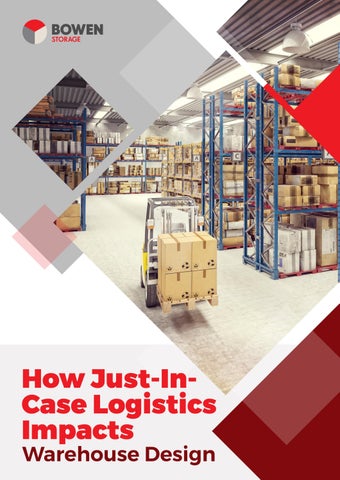
Just-in-case logistics (JIC) strategy for stock management ensures that companies have enough inventory to cover any unforeseen circumstances. With the increase in supply chain fluctuations through Covid, supply chains need to respond with different strategies to deliver orders. The just-in-case logistics strategy is the opposite of the just-intime (JIT) method, whereby products are manufactured as orders are received. The consideration for companies now becomes the question of whether it is better to reduce storage costs and risk not fulfilling some orders? Or should you ensure you fill all the orders in exchange for higher investment in warehousing? With the changing demand in the supply chain, this is a must consider for some companies. Let’s probe into the main differences of just-in-case logistics, from just-in-time, and how to implement it in a warehouse.
HOW DOES JUST-IN-CASE LOGISTICS WORK? The inventory strategy of just-in-case (JIC) is based on the principle of producing and/or storing raw materials alongside finished products ahead of time. It is about having enough goods to produce your products on hand at all times. The inventory is stored in the company’s warehouses, preventing possible out of stock scenarios in the event of unplanned disruptions to the supply chain. When faced with unexpected demand, the just-in-case approach allows companies to have available inventory in reserve stock to fulfil new orders. JIC is best described as a push production system where manufacturing costs are lower due to production being completed in advance and on a large scale. The pharmaceutical industry routinely employs just-in-case manufacturing. JIC inventory works well with small products that are easy to store and, it is a risk strategy where out of stock can lead to serious consequences for the health of the community.
For warehouses, this requires a revision of layout to ensure maximum efficiency supporting the JIC method. This JIC method is the inverse of the just-in-time (JIT) approach. The JIT method was designed to minimise stockholdings and warehouse space with the intent of producing a product based on reacting to customer demand. Thus, the company responds to consumer orders (pull system) and produces only the required stock. As a result, the company does not have the buffer of safety stock and relies on their suppliers to deliver timely to their production schedules. Although just-in-time production lowers storage costs by not having excess stock on hand, the businesses implementing JIT are often more vulnerable when challenged with unexpected rises in demand, logistics planning errors or supply chain disruptions. The crisis many companies face caused through the coronavirus has compelled businesses to adopt just-in-case strategies.
JUST-IN-CASE LOGISTICS PROS AND CONS The JIC method overproduces goods in exchange for guaranteed stock availability at any time. Therefore, it is often implemented in companies in which demand forecasting is complex due to the characteristics of the business sector or due to scenarios such as lack of operators, supply chain management issues, etc. The positives of the JIC stock management method allows you to: • Hold extensive safety stock: No customers will be disappointed as companies will be able to fill all orders. • Plan and manage expenses: JIC improves planning and management of expenses like transportation and product supply. • Manage peaks in demand efficiently: where there is a significant change in consumer trends, the company can be more responsive than its competition, which can strengthen its position in the market. The most notable Con or disadvantage to just-in-case methods is that it involves higher storage costs compared to just-in-time processes. This can present a serious problem for companies with variable unit loads, irregular-sized products, or perishable goods. The support for those scenarios would be supply chain analytics and management systems software making it possible to anticipate supply chain disruptions. Consideration also needs to be made for persons not employed by the business that may enter the building for any reason.
IMPLEMENTING A JUST-IN-CASE LOGISTICS STRATEGY
With the many benefits of the JIC strategy, the implementation requires your warehouse to be organised. Thus, everything is efficiently organised, particularly if you have a high volume of stock. Warehouses that operate the just-in-case inventory strategy require specific layouts that enable goods and raw materials to be stored so that they do not interfere in operator picking routes. The design requires a combination of different racking systems and well-planned efficiencies, enabling the existing space’s capacity to be increased. The design process involves modelling and careful analysis to ensure all barriers to productivity are removed.
The just-in-case method prevents vulnerability for the business when it comes to supply chain disruptions. This strategy makes it possible to have stock available to dispatch any order for customer satisfaction. However, it does increase storage costs which need to be weighed against customer satisfaction. Undoubtedly, just-in-time significantly reduces costs, but today, it can increase the risk that any logistics setback potentially can damage the relationship between the company and its customers. In conclusion, we could not say that one inventory management strategy is better than the other and that each company needs to consider their situation. Each companies’ logistics strategy will depend on its planning and the characteristics of its stock, lead times and what is the overall cost-effective strategy to implement. What type of product is produced and the consumer expectation first and foremost. Companies should evaluate which is best for them in the future. If you are interested in discussing warehouse layout and efficiencies to support JIT or JIC, please reach out to our team of experts.
Version 1 Version Version 1 1 MELBOURNE MELBOURNE (HEAD (HEAD OFFICE) OFFICE) MELBOURNE (HEAD OFFICE) 11 11 Ramage Ramage Street, Street, Bayswater Bayswater VIC VIC 3153 3153 11 Ramage Street, Bayswater VIC 3153 BRISBANE BRISBANE BRISBANE 4 Trade Trade Street, Street, Lytton Lytton QLD QLD 4178 4178 4 4 Trade Street, Lytton QLD 4178 P 1300 780 654 P 1300 780 654 P 1300 780 654 E solutions@bowenstorage.com.au E solutions@bowenstorage.com.au E solutions@bowenstorage.com.au
www.bowenstorage.com.au BOWEN STORAGE & BOWEN INTERIORS ARE DIVISIONS OF BOWEN GROUP – BOWENGROUP.COM.AU BOWEN STORAGE & BOWEN INTERIORS ARE DIVISIONS OF BOWEN GROUP – BOWENGROUP.COM.AU BOWEN STORAGE & BOWEN |INTERIORS DIVISIONS OF BOWEN GROUP – BOWENGROUP.COM.AU MELBOURNE | CANBERRA SYDNEY | ARE BRISBANE | ADELAIDE