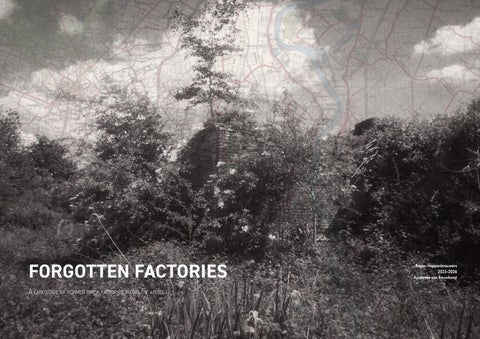
FORGOTTEN FACTORIES
Rogier Hoppenbrouwers 2025-2026 Academie van Bouwkunst
A landscape of former brick factories along the ijssel
Forgotten Factories
1.
Forgotten Factories
2.
Introduction Factory locations
Introduction Site analysis Objective Re-Design Design
Forgotten Factories
3.
Introduction Family ties to the factory In my years at the academy I’ve put my energy in different concepts and different types of projects. A recurring theme in many of my projects however, has been a willingness to let nature take it’s course and making place for animals. Part of this handling of this theme is my fascination with post-apocalyptic landscapes and buildings. Post-apocalyptic scenario’s where people have disappeared and nature has taken over. It was the interest in how the buildings we’ve build can be beneficial to the local ecology and create new habitats for animals. My fascination for this comes from a curiosity from a world after civilization. What will our cities look like and how will our structures become part of the landscape? I think it’s an interesting question, and some cities already have the answer. Cities like Chernobyl, devoid of people but filled with wildlife gives an interesting insight how nature adapts and overcomes. Because of this fascination I started a research on the ecology of abandoned buildings and was looking for test cases to start my research. I remembered however, that my grandfather had a few brick factories near the river the Ijssel. after further research I found out that one of those brick factories was now functioning as a bat sanctuary, shut off from visitors and under management by Staatsbosbeheer. I managed to visit the site, and go inside the former ovens, which were now a place for bats to sleep and rest. I saw the roof overgrown, the little slits where the bats would rest in and the overgrown structure full of life. I saw what old structures could do for nature and how we can learn from these modern ruins. It made me wonder about the old landscape that my grandfather helped create and how it has been lost.
Forgotten Factories
4.
Introduction Subject Researching the old brick factory of my grandfather made me wonder about the other brick factories in the area, which were once a common sight in the landscape. A physical reminder to what the predominant industry in the local cities and towns was. A reminder of tall chimneys all along the river as vertical landmarks contrasting with the wide, horizontal river. Here the brick factories would get their clay from the river, turn it into bricks and send it in boats along the same river they pull out the material for their bricks. These factories were responsible for a lot of work in the area and would have provided a lot of houses with the necessary bricks to be built.
But what else can be found? All these years that the factories have been producing in the river landscape could have affected the landscape in many years. The clay that has been dug up from the river banks and the river might have changed the landscape in interesting ways and it might have affected how the river runs through the area. Though most of the historical brick factories are not found on modern maps, they can be found on historical maps. Through field research and historical maps and photographs I should be able to find more information about the brick factories should be able to found.
With the further development of machines, the concentration of brick building has been focused in a few larger brick factories. Driving many other brick factories that couldn’t compete anymore out of business. Most of these brick factories have disappeared now, and those that remain are out of production. Few, like the brick factory of my grandfather are functioning as an ecological habitat, others functioning as a restaurant or some other service buildings with the remaining structure. The old, striking image of chimney’s along the river is long gone however. These factories are long hidden since many don’t show up on modern maps. They’re not on public ground and people generally do not know where they are or the prominent function they played in the Netherlands.
Forgotten Factories
5.
Introduction Purpose But why is it important for a landscape architect to concern himself with abandoned brick factories? And what role should the landscape architect play? Making the history of the area visible is the most important reason. After all, the brick factories have been a tremendous core of the Dutch industry in the 20th century and many historical buildings would have been made with the bricks from these factories. Yet most of these factories have been forgotten, not visible on most maps and currently providing very little purpose in the landscape. As a landscape architect I can not restore these factories to their former functions. However; As a landscape architect I can give the history a place in this landscape. And while the function as a brick producing machine is long gone, there are many other functions the old buildings can fulfil. As ecological hotbeds, as museums, as characteristic landmarks along the river. Considering that my initial fascination for this project was in overgrown buildings, where nature takes over I would like to research a way to integrate ecology into each of the old brick factories. But how much should be given to nature? And how to deal with the factories that are already taken over by nature? Can this be made to be experienced by people without harming the local ecology that already has taken root. It can be a testcase in how to deal with abandoned buildings whilst destroying what made these special in the first place.
These brick factories once again become a characteristic part of the landscape in a completely different shape and form. In this landscape people could experience how beautiful structures can become after nature has taken over and learn more about the history of the landscape. A different challenge would be where the brick factories have completely disappeared from the landscape and can only be seen in the historical maps. Should a new structure be build? Or is a simple reference in the landscape enough?
Forgotten Factories
6.
Forgotten Factories
7.
Introduction Factory locations
1. 2.
3.
4. 5.
6.
Forgotten Factories
8.
Introduction All factory names
1. Fortmond
2. Haasje
3. Hengforden
4. Scherpenhof
5. De Vooruitgang
6. Randerwaard
Forgotten Factories
9.
Introduction Photographs of the current factory
1. Fortmond
2. Haasje
3. Hengforden
4. Scherpenhof
5. De Vooruitgang
6. Randerwaard
Forgotten Factories
10.
Current factory status Simplified diagrams of factory status
FORTMOND
‘T HAASJE
HENGFORDEN
SCHERPENHOF
DE VOORUITGANG
RANDERWAARD
Forgotten Factories
11.
Historical Documents Old blueprint sections brick factory “Fortmond”
Historical Documents Old blueprint dry chambers brick factory “Fortmond”
Old blueprint of the ring oven
Old blueprint of the dry chambers
Forgotten Factories
Old blueprint of the chimney of the brick factory scherpenhof
12.
Historical Photographs Showing the brick making process
Boat for delivering fuel
Putting down the pressed clay
Putting down the pressed bricks
Forgotten Factories
Transporting the bricks with horses and carts
13.
Cultural history Historical development production started
production ceased
1828
production ceased
1976
production ceased
1851
1966
production started
production ceased
1843
1966
production started
production started
1898
1955
production started
1898
production started
1966
production started
1856
1900
production ceased
1943
Forgotten Factories
1976
1975
14.
Timeline A timeline of brick factories and ecology In the timeline of the 20th century many brick factories closed down. At the same time the ecological state of the country went down. By turning former brick factories into havens for ecology the industrial area’s can perform a beneficial effect to the local ecology
Forgotten Factories
15.
II. SITE ANALYSIS Landscape identity Cultural history State of the local ecology Climate proof
Forgotten Factories
16.
Landscape identity Collage A collage of characteristic elements of the river landscape. A combination of the local ecology, wide landscapes with flowing rivers and vertical elements. In the past this vertical element was dominated by the tall factory chimneys, though now most of these chimneys are lost.
Forgotten Factories
17.
Historical Photograph Aerial view of the brick factory Hengforden
Birdview photograph of brick factory Hengforden
Forgotten Factories
18.
Historical Photographs Elements of a brick factory
Ring oven
Dry chambers
Baked bricks
Clay mill
Factory chimney
Houses on the premise
Rails for transporting clay and bricks
Coal hopper
Forgotten Factories
19.
State of the local ecology Wildlife of the river landscape
BEAVER Ecology in the Netherlands is in a dire state. More and more animals are decreasing in number, and more animals are endangered. Some improvements have been made to policy and interventions. To see what ecological interventions can be made in the river area of the Ijssel, we first need to see what animals live in the river landscape. The 2013 report “Fauna in het rivierengebied” compiled a list of 120 species typical of the Dutch river ecosystem where they’ve focused on the Ijssel river in between Arnhem en Deventer and the Waal between Nijmegen and Tiel. For this report, I will
GARLIC TOAD
WOLF SPIDER
focus on the Ijssel, though lessons can be learned from the other river as well. For these 120 species they found a variety of ecological bottlenecks that were impacting these species negatively. The report found that the ecological bottlenecks could be separated into 3 main categories: Insufficient surface area of the habitat, insufficient quality of the habitat and the lack of specific habitat combinatons.
EURASIAN BITTERN
These categories have been specified further and 5 animal species have been identified as to use as example species. The theory behind this goes that if you improve the habitat for these 5 species, you will improve the habitat for all 120 species in the area. These species are as followed: 1. 2. 3. 4. 5.
Beaver Garlic toad Wolf spider Eurasian bittern Green snaketail
Forgotten Factories
GREEN SNAKETAIL However, in this landscape I will also focus on the former brick factory structures where I’d like to improve the ecology for different animals that like to live in abandoned structures. Some animals will be those that have already been nesting in the brick factories and see how the habitat can be improved.
20.
State of the local ecology Focus on possible wildlife of the brick factories
NATTERER’S BAT In the former industrial site different species can thrive. My fascination with this project began with the knowledge that the former ovens now function as a nesting place for the local bat population. Because of this original fascination I started researching other animals that could thrive in the ruins of old brick factories. Species like swallows that like to make their nests on beams, insects that live in cracks and crevices of brick walls. Martens that like to live in old buildings and falcon that nest on tall structures.
BARN SWALLOW
RED MASON BEE
STONE MARTEN
PEREGRINE FALCON
By focusing on improving the old factory remains for the local ecology the factories can gain a new function as an ecological haven in the river landscape. The species that I chose to represent for the former brick factories are as followed: 1. 2. 3. 4. 5.
Natterer’s Bat Barn Swallow Red Mason Bee Stone Marten Peregrine falcon
Forgotten Factories
21.
Food Chain What the different species hunt and feed on
Forgotten Factories
22.
Forgotten Factories
23.
Industry to ecology Translating elements of the brick factory to ecological elements for goal species
Ring oven
Drying chambers
Baked bricks
Houses on the premise
Factory chimney
Natterer’s bat
Barn swallow
Red Mason Bee
Stone Marten
peregrine falcon
Forgotten Factories
24.
Radius Territory and living area goal species
Bat - hunting area
Falcon territory
Forgotten Factories
Stone - Marten territory
25.
Climate proof Dealing with the rising water level
high chance of flooding
moderate chance of flooding
Forgotten Factories
small chance of flooding
26.
Climate proof Brick factories as islands safe from flooding
Forgotten Factories
27.
III. OBJECTIVE Landscape identity Cultural history State of the local ecology Climate proof
Forgotten Factories
28.
History A complete landscape Ecology, history, climate and landscape combined
Ecology
Climate proof
Landscape identity Forgotten Factories
30.
Abandoned factories As overgrown islands in the landscape
Make the elevation visible and bring in a river
Bring back the chimney as visual marker
Forgotten Factories
Use trees and other vertical green elements on factory islands
31.
Vision of ecology Making the brick factories a haven for local wildlife
Forgotten Factories
32.
Cues of Care Different elements that show care of a lack there off influences the experience of visiting a site substantially
Beneficial to ecology
Unattractive
Dead or Rotten
Abandoned
Neutral
Weedy
Habitat
Native vegetation
Pasture
Windscreen
Runoff
Detrimental to ecology
Attractive
Too formal
Too much concrete
Bare
Repetitive
Good care
Overgrazing
Messy
Bad water quality
All planted to monoculture
Mown
Forgotten Factories
Wildlife
Stripcropping
Trees
Apparant Yard Care
Clean and Neat
33.
IV. DESIGN Landscape interventions Cues of care Re-Design Main design Hengforden
Forgotten Factories
34.
Forgotten Factories
35.
New Landscape New interventions in the landscape
DYNAMIC WATER SYSTEM
SIGHT LINES FROM FACTORIES
Forgotten Factories
LANDSCAPE ROUTE
36.
Timeline River Landscape Digging a brick pattern to create a dynamic river landscape in the floodplains
Forgotten Factories
37.
Cues of care Creating interventions in and around the factories that show “cues of care” and make the factory more visible overgrown plant communities
hidden factory
closed off entrances
overgrown roof
natural plant communities with a border
visibility of structure
opening the factory
making the roof accesible
Forgotten Factories
38.
Current state of the factories The parts of the structures that remain
FORTMOND
‘T HAASJE
HENGFORDEN
SCHERPENHOF
DE VOORUITGANG
RANDERWAARD
Forgotten Factories
39.
Future state of the factories Creating interventions to improve habitats and make them visible
FORTMOND
‘T HAASJE
HENGFORDEN
SCHERPENHOF
DE VOORUITGANG
RANDERWAARD
Forgotten Factories
40.
Future Factories
FORTMOND
‘T HAASJE
HENGFORDEN
SCHERPENHOF
DE VOORUITGANG
RANDERWAARD
Forgotten Factories
41.
Site Analysis Hengforden Visiting the site of the former brick factory Hengforden to create a vision of the design By visiting the site of Hengforden. The location I’ve chosen for a design I wanted to make interventions that showcase the raw and natural look of the old factory whilst making the site attractive for visitors. By analyzing and sketching on top of photographs I created a vision of what I wanted the future of the factory to look like/
Forgotten Factories
42.
Forgotten Factories
43.
More Room For The River Open dynamic rivers, overgrown factory terrains
Forgotten Factories
44.
Contrast in the landscape Open dynamic rivers, overgrown factory terrains
river landscape
overgrown factory remains
Forgotten Factories
dyanamic expansion of the river
45.
Factory area Hengforden Top view
Forgotten Factories
46.
Maintenance Diversity in planting through differing maintenance Zero maintenance River landscape Low maintenance Shore Plants Cyclical maintenance Factory Roof Minimal maintenance High Thicket Strategic maintenance Low Thicket Low maintenance - Sept Wild grassland (Zone A) Low maintenance - June Wild grassland (Zone B) Intensive maintenance Mown Grass Intensive maintenance Perennial Borders
Forgotten Factories
47.
Effect of maintenance Types of plant communities based on maintenance
MOWED GRASS FIELDS
WILD GRASSLAND
LOW THICKET
HIGH THICKET
Forgotten Factories
48.
Effect of maintenance Examples of plants that can grow in these types Wild grassland
Low Thicket
High Thicket
Maintained in June and September with rotational mowing
Maintained every 3 years, cutting out pioneer species like Betula to keep the thicket below 1,5 meters
Maintained every 8 years, removing of dead wood
Zone A: Centaurea jacea (Brown Knapweed) Daucus carota (Wild Carrot) Leucanthemum vulgare (Oxeye Daisy) Lotus corniculatus (Bird’s-foot Trefoil) Succisa pratensis (Devil’s-bit Scabious) Zone B: Pilosella officinarum (Mouse-ear Hawkweed) Plantago lanceolata (Ribwort Plantain) Ranunculus acris (Meadow Buttercup) Trifolium pratense (Red Clover) Veronica chamaedrys (Germander Speedwell)
Rubus fruticosus (Wild Blackberry) Rosa canina (Dog Rose) Prunus spinosa (Blackthorn) Cytisus scoparius (Broom) Crataegus monogyna (Common Hawthorn) Ligustrum vulgare (Wild Privet) Euonymus europaeus (Spindle) Cornus sanguinea (Common Dogwood) Viburnum opulus (Guelder Rose) Rosa rubiginosa (Sweet Briar)
Forgotten Factories
Betula pendula (Silver Birch) Salix caprea (Goat Willow) Sambucus nigra (Elder) Sorbus aucuparia (Rowan / Mountain Ash) Corylus avellana (Common Hazel) Fraxinus excelsior (European Ash) Prunus padus (Bird Cherry) Acer campestre (Field Maple)
49.
Trees Planting trees to designate important routes and borders and to fill in the new elevated area Tillia europea Sorbus aucuparia Knotted Salix alba Betula pendula Amelanchier lamarckii Existing trees
Forgotten Factories
50.
Sight Lines Open dynamic rivers, overgrown factory terrains Large sight lines Limited sight lines Smaller sight lines
Forgotten Factories
51.
Barn Swallow
Tall Thicket Low Thicket
Edge of Wild Grassland
Mown Grass
Forgotten Factories
52.
Historical references Different references to old elements present in the old brick factory Paths that reference old rail tracks Plant borders on the footprint of old buildings Framework of old dry chambers New structure referencing the old chimney Brick stacks in different configurations Unbaked brick stacks
Forgotten Factories
53.
Infrastructure A combination of natural walking paths and straight walking paths based on the layout of the old factory Main road Main walking path Natural walking path Sub walking path To Former Clay Pits
Raised path above factory roof Parking
To Former Clay Pits
Forgotten Factories
54.
Ecological interventions Creating interventions to improve habitats and make them visible
bat habitat
Historical references
Weeds and bushes
trees as nesting spots
missing chimneys
improving the habitat
creating nesting oppurtunities for small mammals
Flowering plants and small openings for bees and other small animals
expand nesting locations by placing structures to facilitate sheltered nest building
returning chimneys as a roosting place for the falcon
Forgotten Factories
55.
Materials classic materials that reference the time period
BRICKS “IJSSELFORMAAT”
OAK WOOD
SEMI PAVING
WROUGHT IRON
MINECART RAIL
MINECART RAIL
Forgotten Factories
56.
Goal species A reminder on the goal species for the brick factory
NATTERER’S BAT
BARN SWALLOW
RED MASON BEE
STONE MARTEN
Forgotten Factories
PEREGRINE FALCON
57.
Natterer’s bat
Food, safety and reproduction demand
Food, safety and reproduction -The ovens already provide a safe habitat for the bats -By putting in extra walls inside the ovens there are differing temperatures, creating more habitable space for the bats -By creating habitats for small insects there will be more food available for the bats -The bats have a large hunting area, where if there are 2 habitats the hunting area will cover the entire project area
Forgotten Factories
58.
Top view Factory Bat nest locations
Forgotten Factories
59.
SECTION A walk through and above the former ovens
Above the factory
Outside the factory
Inside the factory
Forgotten Factories
60.
Forgotten Factories
61.
Barn swallow Nesting location
Food, safety and reproduction -The swallow is a small bird living in groups and preying on small insects and worms -They like to nest in structures, creating their nests on beams in barns. In the project the old dry chambers will be partly restored, creating a nesting area for the swallow -Creating a more biodiverse environment will attract small animals in the area which the swallow can hunt
Forgotten Factories
62.
Detail dry chamber Wooden frameworks of the old drychambers, giving shelter to birds and other small animals
Forgotten Factories
63.63.
Detail dry chamber Wooden frameworks of the old drychambers, giving shelter to birds and other small animals
Forgotten ForgottenFactories Factories
64.
Forgotten Factories
65.
Mason bees and other small insects By creating intervals in maintenance a large diversity in plant life can be created on a small scale Food, safety and reproduction -The mason bee is a wild bee that likes to nest in small openings in walls -Like other insects they want a large variety of flowering plants. By using a diversity of maintainance in the area a large plant variety can be achieved -More nesting for other special bees like ground breeding bees can be achieved by placing stacks of unbaked bricks for the ground breeding to nest in -Creating an area where many insects can live creates a food source for the other animals in the area
Diversity of planting by maintenance
Stack of bricks for nesting
Forgotten Factories
Stack of raw bricks for nesting for ground breeding bees
66.
Timeline for unbaked bricks
Forgotten Factories
67.
Forgotten Factories
68.
Brick stacks made from old bricks
New Shore Plants
Forgotten Factories
Brick Staircase
Wooden Dock
69.
Detail staircase A Brick staircase connecting the dock and upper level
Forgotten Factories
70.
Detail dock A wooden dock to connect the plan with the river
Forgotten Factories
71.
Vegetation on the roof Stage 1: Clearing vegetation and creating border between ovens
Forgotten Factories
72.
Vegetation on the roof Stage 2: Cyclical maintenance creates diversity in planting
Forgotten Factories
73.
Section factory Examples of plants that can grow on the roof with this maintenance Oven 1: Verbascum thapsus (Great Mullein) Oven 2: Echium vulgare (Viper’s Bugloss) Oven 3: Daucus carota (Wild Carrot) Oven 4: Pilosella officinarum (Mouse-ear Hawkweed) Oven 5: Leucanthemum vulgare (Oxeye Daisy) Oven 6: Achillea millefolium (Yarrow) Oven 7: Origanum vulgare (Wild Marjoram) Oven 8: Tanacetum vulgare (Tansy) Oven 9: Artemisia vulgaris (Mugwort) Oven 10: Dipsacus fullonum (Wild Teasel) Oven 11: Rubus fruticosus (Wild Blackberry) Oven 12: Teucrium scorodonia (Wood Sage) Oven 13: Geum urbanum (Wood Avens) Oven 14: Cytisus scoparius (Broom) Oven 15: Digitalis purpurea (Foxglove) Oven 16: Lonicera periclymenum (Honeysuckle) Oven 17: Dryopteris filix-mas (Male Fern) Oven 18: Cornus sanguinea (Dogwood) Oven 19: Sambucus nigra (Elder) Oven 20: Rhamnus frangula (Alder Buckthorn) Oven 21: Betula pendula (Silver Birch) Oven 22: Prunus spinosa (Blackthorn) Oven 23: Chamerion angustifolium (Rosebay Willowherb) Oven 24: Urtica dioica (Stinging Nettle)
Forgotten Factories
74.
Forgotten Factories
75.
Stone Marten Nesting location
Food, safety and reproduction -The marten is a small predator that can travel large distances between suitable habitats -They like to nest in small openings in trees, buildings or other structures. Creating these openings in structures in the area can help to create the nesting locations -Creating a more biodiverse environment will attract small animals in the area which the marten can hunt
Stack of bricks for nesting
Forgotten Factories
76.
Detail brick path and brick piles A path from bricks and a pile of bricks piled in a way that creates space for small insects to nest (Design can vary and is dependant on local materials)
Forgotten Factories
77.
Timeline of stacked bricks Building the stacked bricks in a way that openings exist create space for plants to grow and small wildlife to find shelter
Forgotten Factories
78.
Dark Iron Stairs Natterer’s Bat Wall Ferns Brick stacks with hiding places for small animals
Path that references old Rails
Wild Grassland
Mown Grass
Forgotten Factories
79.
Perregrine falcon
Food, safety and reproduction demand
Food, safety and reproduction -The peregrine falcon wants to roost on high places. Returning the height of the former chimneys creates perfect roosting places for the falcon. -The hunting area is quite large and can not overlap to much, which is why only certain factories will providing roosting places -Creating a suitable environment for a lot of smaller animals creates a food source for the falcon
Forgotten Factories
80.
Detail chimney Hengforden The new chimneys will differentiate themselves from existing ones by using a metal framework
Forgotten Factories
81.
Forgotten Factories
82.
Low Shrubs
Mown Grass Border Wild Grassland
Forgotten Factories
83.
Detail staircase and path A metal path going along the slope of the factory, giving a view from above
Forgotten Factories
84.
Detail staircase and path A metal path going along the slope of the factory, giving a view from above
Forgotten Factories
85.
Sun border Planting plan
PLANTING PLAN Sun border Scientific Name
Height
Veronicastrum virginicum
150
Sporobolus wrightii
120180
Monarda bradburiana
cm Aug-Sept Structural cm May-July Seasonal
Echinacea pallida
80-110 cm June-Aug Seasonal
Achillea millefolium ‘Wesersandstein’
100
Sanguisorba officinalis
60-70 cm July-Sept Seasonal
Allium atropurpureum
50-75 cm MayJune
Allium nigrum Verbena bonariensis
cm JuneSept
Seasonal
Filler
60-80 cm June-July Filler 100150
cm July-Sept Filler
10-20
cm Sept-Nov Ground Cover
Vinca minor
10-15
Carex pensylvanica
15-30
cm Mar-May Ground Cover
Packera aurea
30-50 cm MayJune
Aster ericoides ‘Snow Flurry’
Forgotten Factories
50
Bloom Layers Time cm July-Sept Structural
cm Apr-May
Ground Cover Ground Cover
86.
Shade border Planting plan
PLANTING PLAN Shade border Scientific Name
Height
Aruncus dioicus
150
Bloom Layers Time cm June-Aug Structural
Ligularia przewalskii
140
cm June-Aug Structural
Actaea simplex ‘White Pearl’
125150
cm Sept-Okt Structural
Aconitum napellus
100120
cm June-Aug Seasonal
Anemone × hybrida ‘Elegans’
75120
cm Aug-Sept Seasonal
60
cm Apr-June Seasonal
Athyrium filix-femina
80
cm NA
Filler
Dryopteris filix-mas
80100
cm NA
Filler
Alchemilla mollis
Dicentra spectabilis
30-40 cm May-July Seasonal
Iris sibirica ‘Silver Edge’ 80 Corydalis lutea Liriope muscari
Forgotten Factories
cm June-July Filler
20-30 cm MaySept
20-30 cm Aug-Okt
Asarum canadense
10-20
Epimedium grandiflorum ‘Bandit’
20
Filler Ground Cover
cm Mar-May Ground Cover cm Apr-May
Ground Cover
87.
Sun border Plant assortment STRUCTURAL PLANTS
SEASONAL THEMES
Veronicastrum virginicum
Achillea millefolium ‘Wesersandstein’
Monarda bradburiana
Sporobolus wrightii
Sanguisorba officinalis
Echinacea pallida
Forgotten Factories
88.
FILLER PLANTS
GROUND COVER PLANTS
Allium atropurpureum
Aster ericoides ‘Snow Flurry’
Vinca minor
Carex pensylvanica
Packera aurea
Allium nigrum
Verbena bonariensis
Forgotten Factories
89.
Shade border Plant assortment STRUCTURAL PLANTS
SEASONAL THEMES
Aruncus dioicus
Aconitum napellus
Alchemilla mollis
Anemone × hybrida ‘Elegans’
Dicentra spectabilis
Ligularia przewalskii
Actaea simplex ‘White Pearl’
Forgotten Factories
90.
FILLER PLANTS
GROUND COVER PLANTS
Iris sibirica ‘Silver Edge’
Dryopteris filix-mas
Liriope muscari
Corydalis lutea
Athyrium filix-femina
Asarum canadense
Forgotten Factories
Epimedium grandiflorum ‘Bandit’
91.
Forgotten Factories | Rogier Hoppenbrouwers