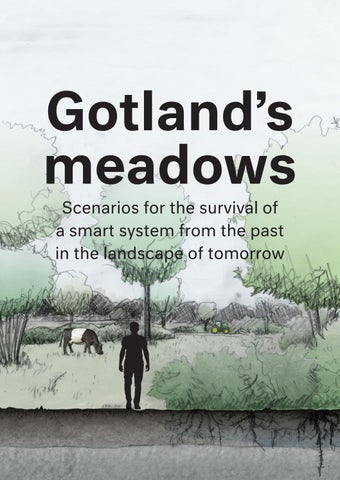
Gotland’s meadows Scenarios for the survival of a smart system from the past in the landscape of tomorrow
1
This booklet shows the graduation project as presented on August 27, 2026. Committee Mirjam Koevoet (mentor) Léa Soret Jean-François Gauthier Additional members final Exam Berdie Olthof Philippe Allignet Summary My project focuses on the tree- and shrub covered hay meadows of Gotland, Sweden. A smart, pre-fossil agricultural system set within a unique natural environment. These meadows possess significant cultural and natural value and rank among the most biodiverse sites in Sweden. However, they no longer serve a purpose in today’s land use, placing their existence at risk. I set myself the assignment to design different scenarios for the future use of the meadows.
2
Gotland’s meadows Scenarios for the survival of a smart system from the past in the landscape of tomorrow
Bregt Balk Master Landscapearchitecture Academy of Architecture Amsterdam
1
2
Introduction Summer 2024 I went for holidays with my two boys to Gotland. A swedish friend told me: You should go to Gotland. Gotland is special. And indeed the landscape was very special. We were cycling through a dry, wild and unaccessible landscape with pines and junipers. A landscape I hadn’t seen before. But after a while we came to a total opposite place. Very lush, with tall deciduous trees around a ruin of a church. This place was clearly taken care of. We entered, took a break, enjoyed the shade, we wandered among hazel trees. And I took a picture of the information board in Swedish. We cycled further, and saw there were more of these places. Back home I understood it was a traditional meadow (änge). What I didn’t immediately understand.
Gotland’s meadows
Introduction
I got fascinated by these places. Also because I felt related to their appearance and atmosphere. I grew up in an garden under big apple trees, and we even had hazels.
3
Origin of Gotland The landscape of Gotland has originated in a tropical sea that existed more than 400 million years ago. The limestone bedrock consists of the deposits of shells from the Sillurian reef. During the Weichsel Ice Age Gotland was covered by an ice mass several kilometres thick. Land ice caused depressions/valleys NortheastSouthwest. Through this complex process of melting and compression of the ice, substantial differences in soil type and soil depth emerged. The soil layers on Gotland are usually of small thickness. In areas with greater soil depth, the presence of groundwater in the soil layers is of great importance for the formation of groundwater in the bedrock. The stratification of bedrock and soil determined the landscape and landuse. For example where agriculture took place.
GRUNDVATTNETS FÖREKOMST PÅ GOTLAN
På Gotland förekommer grundvatten i jordlagren men framfö grunden. Grundvattnets förekomst och transport i de gotländ stor del av den heterogena geologin, men även av topografin ( riktning är beroende av skillnad i grundvattennivå och tryckgr belägna terrängavsnitt (inströmningsområden) mot lägre (utstr nivåns läge beror av lokaliseringen i terrängen, geologin samt I likhet med ytvattnet har grundvattnet på Gotland i regel en s men transporten i grundvattnet sker betydligt långsammare.
En stor del av det grundvatten som bildas på ön lämnar också ut i våtmarker, sjöar och vattendrag innan det till slut når have Reconstruction of a Silurain reef environment grundvattnets regionala nivå i landskapet visas en interpolerin nivå i berggrunden (fig. 8B).
Dataunderlaget som använts kommer från Brunnsarkivet och ett antal decennier och under olika årstider och ofta i anslutnin viktigt att komma ihåg att interpoleringen (fig. 8B) återspeglar Cross section of the huvudsakliga Baltic Sea Basin from Kalmarsund to grundvattnets strömningsriktning från högre niv Finska viken skall därför inte användas för att studera grundvattennivån i e kan förväntas större avvikelser är i anslutning till uttagspunkte elevation
Figur 8. A. Höjdmodell Gotland (Lantmäteriet), siffror i meter (m). B. Karta öve nivå (m. ö.h.). Data kommer från Brunnsarkivet och nivåerna är insamlade und under olika årstider men antas ändå spegla en ungefärlig grundvattennivå på r
4
bedrock
soil
peat, bleached and lime mud drifting sand sand, gravel and pebbles
Limestone Marlstone Sandstone Reef limestone
clay and silt glacial sediments moraine clay stone and stone with a thin deck of weathering soil
Introduction
De jordartsgeologiska förhållandena på Gotland är starkt knutna till Östersjön och dess utveckling efter den senaste istiden. När området i slutet av senaste istiden blev isfritt (cirka 14 000–13 000 år sedan, Påsse & Daniels 2015) låg ön under baltiska issjöns yta och har sedan successivt höjt sig upp ur Östersjön. Landskapet på ön har därmed formats av kustprocesser och vågornas påverkan som omlagrat, sorterat och omformat de primära jordavlagringarna. Jordarter bildade genom strandprocesser har därför en stor utbredning på Gotland, och svallade sandiga sediment har en framträdande roll i landskapet (sandavlagringar utgör ytlig geologi på cirka 26 % av Gotlands yta, fig. 5). Den enda större kvarvarande isälvsavlagringen på Gotland är Tingstädeåsen som återfinns norr om Tingstäde träsk. Avsaknaden av markanta isälvsavlagringar är en konsekvens av att det skett en omfattande omlagring av jordarterna. De isälvsavlagringar som tidigare har successivt bearbetats av vågor och omlagrats och påträffas nu som svallgrus, soilfunnits depth svallsand och sanddynsområde (fig. 5).
land use around 1700
Landuse around 1700
Landuse around 1700 crop fields crop fields äng wetlands äng
Figur 6. Jorddjupskarta över Gotland samt Gotska Sandön. Siffror på jorddjup i meter (m).
SGU-RAPPORT 2022:14
wetlands
15
Gotland’s meadows
5
Gotlands plant environments
Forests
Alvar and rocky ground pine forest
6
Pasture determined the landscape Gotlands plant environments are diverse. The alvar, rocky plains with sparse vegetation, are unique. The cultivation of Gotland began about 5,000 years ago. Pasture determined the landscape. All natural environments where grazed. When the climate became colder during the Iron Age (600 BC - 400 AD), winter fodder was needed for the animals. The most fertile, deeper soils were used for these pastures. These were covered with deciduous forest. Private lands that were fenced off from grazing animals. These are the meadows (änge) my project is about.
Introduction
Wetlands
Natural grass lands
Gotland’s meadows
7
A smart system for survival
Agricultural system (before fertilizers, and inputs as fossil fuel)
yard
crop field
meadow (änge)
soils of sand, gravel and pebbles or moraine clay
meat bread
wool cheese
8
coniferous pasture
the grazed outback
Introduction
bedrock of limestone/marlstone
hazel nuts
coppice
hay
apples
Gotland’s meadows
9
Principle of alternation (open and planted) The alternation between planted and open areas in the meadow – sun and shade – used to be a kind of insurance: in humid years most hay was harvested in the sun-open areas, and conversely in dry years.
Principle of disturbance Another smart thing in the änge was the nutrition cycle. Before fertilisers the meadow was the most important land for the old Gotland farmer. For his survival, he was therefore forced to tend the meadow so that it did not stop producing. Through various management techniques the meadow was kept in a state of fairly constant yield without exhausting it. Clearance
Spring raking
Aftermath grazing
winter
spring
autumn
summer
Hay making
Pollarding
10
Certain plant species adapted and thrived on the annual and constant leaf removal and hay cuttings. Today the Gotland meadows are one of the most species-rich environments in Sweden. Rufous-shouldered longhorn beetle Anaglyptus mysticus
Haymaking
low on after haymaking. Branches and foliage are cut from duous trees, e.g. ash and linden. Leaves are harvested, d as winter feed (tree hay). Pollarding is normally carried o seven year intervals.
Towards the end of the height of summer, when the herb Greater yellowrattle has gone to seed, it is time to harvest the hay. Grass and herbs are mown and left to dry in the more open and sunny glades of the meadow. In pre-industrial farming, the meadow grass was cut with a scythe. Today different types of mowing machines are often used.
Collared flycatcher Ficedula albicollis
Devil’s-bit Scabious Quaking-grass
Succisa pratensis
Briza media
begins in April-May, oom. On Gotland this wer since it signals that it’s en branches, twigs and pringtime stimulates the nt is the removal of fallen wing easier.
Jynx torquilla
Greater Yellow-rattle
Rhinanthus angustifolius
Gyalecta ulmi
Tawny Sedge
Crested Cow-wheat
Carex hostiana
A meadow is a remnant of former farming practice. Nowadays, winter feed for livestock is gathered from intensively managed grasslands, whereas in former livestock is gathered from intensively managed grasslands, whereas in former times hay was harvested from large unploughed grasslands, that were mowed times hay was harvested from large unploughed grasslands, that were mowed every year. This form of land use was called (wooded) hay meadows. every year. This form of land use was called (wooded) hay meadows.
When haymak Whentoh are allowed are allo stunts bush gr stuntscb grass, which grass, w the following y the graz foll aftermath afterma
This way of living off the land dates back to the Iron Age, that is the era around This way of living off the land dates back to the Iron Age, that is the era around the first century C.E. The expanse of meadowland probably reached its peak the first century C.E. The expanse of meadowland probably reached its peak sometime in the 18th century. Then, an ordinary farm on Gotland comprised sometime in the 18th century. Then, an ordinary farm on Gotland comprised up to ten times as much meadowland as arable land. All this meadowland up to ten times as much meadowland as arable land. All this meadowland together was a large part of the agricultural land on Gotland. In the 19th together was a large part of the agricultural land on Gotland. In the 19th and 20th centuries the whole system of agriculture was transformed. The and 20th centuries the whole system of agriculture was transformed. The meadows were ploughed up, converted into pastureland or abandoned and meadows were ploughed up, converted into pastureland or abandoned and left to develop into forests. Today, only small remnants remain. left to develop into forests. Today, only small remnants remain.
A Gotlandic Meadow Collared flycatcher
Shaggy bracket Shaggy bracket Inonotus hispidus Inonotus hispidus
Introduction
Ficedula albicollis
in autumn and winter. Smaller anches are removed, along with nsures firewood supply and improved acilitates haymaking. During some hen most land was exploited to the ance was seldom necessary.
Aftermath G Afterm
The The History of Meadow Management History of Meadow Management
Zygaena filipendulae
Maniola jurtina
Ulmus minor
Scorzonera humilis Gymnadenia conopsea A meadow is a remnant of former farming practice. Nowadays, winter feed for
Melampyrum cristatum
Six-spot burnet Meadow brown
Small-leaved Elm
WHAT IS AISMEADOW? WHAT A Orchid MEADOW? Viper’s-grass Fragrant
Tillverkningsår: 2019. Illustrationer: Nils Forshed.
AAGotlandic GotlandicMea Mea
Eurasian wryneck
nd in some g tools, y for meadow ude the scythe, e things there contributes to a
The The Values of the Meadow Values ofHay the Hay Meadow
A meadow today is in many cases a piece of land that has been used in the A meadow today is in many cases a piece of land that has been used in the same manner for a very long period. Because of this, the presence of much of same manner for a very long period. Because of this, the presence of much of local heritage and parish history can be identified. This also means that traces local heritage and parish history can be identified. This also means that traces of former settlements and farming boundaries are still in the same place. Spring Raking of former settlements and farming boundaries are still in the same place. Perhaps the most renowned are the “giants’ graves”, the house foundations The annual cycle of the meadow begins in April-May, Perhaps the most renowned are the “giants’ graves”, the house foundations from Iron Age farmyards. The tools, methods, concepts and customs of when the Wood anemone is in bloom. On Gotland this from Iron Age farmyards. The tools, methods, concepts and customs of herb is also called the raking flower since it signals that it’s meadow management are also parts of an important cultural heritage. meadow management alsofeed parts now time to collect and burn fallen branches, twigs and A meadow is a remnant of former farming practice. Nowadays, are winter forof an important cultural heritage. leaves. The removal of leaves in springtime stimulates the A livestock meadow is gathered a remnantfrom of former farming practice. Nowadays, winter feed forhas also enabled a diversity of intensively grasslands, whereas in former The managed long history of meadow management growth of grass. Equally important is the removal of fallen livestock is gathered from intensively The long history ofwhereas meadow management has also enabled a diversity of managed grasslands, in former times hay was harvested from large unploughed grasslands, that were mowed plants, animals and fungi to make the meadowlands their habitat. Many are branches and twigs, to make mowing easier. plants, animals andmeadows. fungiwere to make the meadowlands their habitat. Many are times was harvested from use large unploughed grasslands, that mowed everyhay year. This form of land was called (wooded) hay adversely impacted by drastic changes like ploughing and deforestation, and adversely impacted by drastic changes like ploughing and deforestation, and every year. This form of land use was called (wooded) hay meadows. have therefore become rare in today’s landscape. The small meadows still in have therefore become rare in today’s landscape. The small meadows still in The History of Meadow Management existence have become havens, hosting a richer throng of wildlife, which is existence have become havens, hosting a richer throng of wildlife, which is The of off Meadow Management difficult findIron elsewhere. ThisHistory way of living the land Eurasian dates back totothe Age, that is the era around wryneck difficult to find elsewhere. This living off land dates back to the Ironprobably Age, that reached is the eraitsaround theway first of century C.E.the The expanse meadowland peak Jynx of torquilla The meadows are also frequently-visited the first century C.E. The expanse of meadowland probably reachedcomprised its peak nature spots, held dear for their sometime in the 18th century. Then, an The ordinary farm are on Gotland meadows also frequently-visited nature spots, held dear for their Rufous-shouldered and their many values. sometime the 18th century. Then,beauty an ordinary farm on Gotland comprised Shaggy bracket up to ten in times as much meadowland asbeauty arable land. All this meadowland and their many values. longhorn beetle Shaggy up to ten times much meadowland as arable land. All this meadowland Inonotusbracket hispidus together was aaslarge part of the agricultural land on Gotland. In the 19th Anaglyptus mysticus Inonotus hispidus together was a large the partwhole of thesystem agricultural land on Gotland. In the 19th and 20th centuries of agriculture was transformed. The Welcome! Welcome! and 20th centuries the whole of meadow agriculture was worth transformed. meadows were ploughed up,system converted into pastureland or abandoned and Gyalecta ulmi The is well a visit inThe all seasons of the year. If you visit the Thepastureland meadow is well worth a visit in all seasons of the year. If you visit the meadows were ploughed up,Today, converted or abandoned left to develop into forests. onlyinto small remnants meadow between Mayremain. and July, priorand to haymaking, you will see the thriving meadow between May and July, prior to haymaking, you will see the thriving left to develop into forests. Today, only grasssmall and remnants herbs thatremain. are to be harvested. During this period, please take great grass and herbs that are to be harvested. During this period, please take great The Values of the Hay Meadow care not to trample on the vegetation. If there is a track, stick to it. The rest of care not to trample on the vegetation. If there is a track, stick to it. The rest of The Values of the Hay Meadow yearofyou may move more freely. A meadow today is in many cases the a piece land that hasmove been more used in the the year you may freely. A same meadow todayfor is ainvery many cases a piece of land usedof inmuch the of manner long period. Because ofthat this,has thebeen presence same a very long period. of this,This the also presence of that much of localmanner heritagefor and parish history canBecause be identified. means traces local heritage and parishand history canboundaries be identified. means traces of former settlements farming areThis stillalso in the samethat place. of former settlements and farming boundaries are still in the same place. Perhaps the most renowned are the “giants’ graves”, the house foundations Devil’s-bit Scabious Six-spot burnet Lurid bolete Perhaps theAge most renowned aretools, the “giants’ graves”, the house foundations from Iron farmyards. The methods, concepts and customs of Succisa pratensis Lurid bolete Zygaena filipendulae Suillellus luridus Quaking-grass Meadow brown from Iron Age farmyards.are Thealso tools, methods, concepts cultural and customs of meadow management parts of an important heritage. Suillellus luridus Briza media Maniola jurtina meadow management are also parts of an important cultural heritage. The long history of meadow management has also enabled a diversity of The long animals history of meadow has also enabled a diversity of are plants, and fungi tomanagement make the meadowlands their habitat. Many plants, animals and fungi to make the meadowlands their Many are adversely impacted by drastic changes like ploughing andhabitat. deforestation, and adversely impacted by drastic ploughing deforestation, andin have therefore become rare inchanges today’slike landscape. Theand small meadows still have therefore in today’s landscape. The small meadows still is in existence havebecome becomerare havens, hosting a richer throng of wildlife, which existence have havens, hosting a richer throng of wildlife, which is difficult to findbecome elsewhere. difficult to find elsewhere. The meadows are also frequently-visited nature spots, held dear for their The meadows are also frequently-visited nature spots, held dear for their beauty and their many values. Devil’s bolete beauty and their many values. Devil’s boletesatanas Rubroboletus
WHAT IS A MEADOW? WHAT IS A MEADOW?
Year Meadow
Aftermath Grazing LuridAftermath bolete Grazing When haymaking and pollarding are complete, livestock Lurid bolete
Suillellus luridus are allowed to graze the luscious regrowth of grass. Graz When haymaking and pollarding are complete, livestock Suillellus luridus stunts bush growth and prevents the accumulation of ol
are allowed to graze the luscious regrowth of grass. Grazin grass,bush which couldand otherwise impair fresh grass growth stunts growth prevents the accumulation of old the following year. In bygoneimpair days, fresh livestock fed grass, which could otherwise grassalways growth aftermath it is lesslivestock common.always fed on the followinggrazing. year. InToday bygone days, aftermath grazing. Today it is less common.
Devil’s bolete Devil’s bolete
Rubroboletus satanas Rubroboletus satanas
Waxcaps Waxcaps
Pollardi Po
Pollarding Pold different diff dried and drie out at thre out
Tillverkningsår: 2019. Illustrationer: Nils Forshed.
CULTURAL TRACES CULTURAL TRACES
Welcome! Welcome! The meadow is well worth a visit in all seasons of the year. If you visit the
Fragrant Orchid
Gymnadenia conopsea
The meadow is well May worth a visit all seasons of the year. you visit meadow between and July,inprior to haymaking, you If will see thethe thriving Small-leaved Elm meadow between Mayare andtoJuly, prior to haymaking, will see the thriving grass and herbs that be harvested. During thisyou period, please take great Ulmus minor grass that are to be harvested.If During period, please great careand not herbs to trample on the vegetation. there isthis a track, stick to it. take The rest of care trample on themore vegetation. thenot yeartoyou may move freely. If there is a track, stick to it. The rest of the year you may move more freely.
”Giants’ Graves” ”Giants’ Graves” A “giant’s grave” is actually a house foundation
Anaglyptus mysticus Towards the end of the height of summer, when the herb Greater yellowrattle has gone to seed, it is time to harvest the hay. Grass and herbs are mown and left to dry in the more open and sunny glades of the meadow. In pre-industrial farming, the meadow grass was cut with a scythe. Today different types of mowing machines are often used.
Stone WallWall Remains Stone Remains
Sheds and and ToolsTools Sheds
Old barriers, which became obsolete long ago, Post-and-plank built sheds are fo Waxcaps A “giant’s grave” is actually a house foundation Old barriers, which became obsolete long ago, Post-and-plank built sheds Pollarding from the Iron Age, although in bygone days, haveWaxcaps left their legacy by way of rows of stones. meadows. They are used for stor from the Iron Age, although in bygone days, have left their legacy by way of rowsPollarding ofPollarding stones.follow on after meadows. They are used haymaking. Branches andf people believed that they were giants’ graves. In bygone days, the animals were not enclosed benches and other things necess people believed that they were giants’ graves. In bygone days, the animals were not enclosed benches and other things different deciduous trees, e.g. ash and linden. Leave follow on after haymaking. Branches and fo Many of the settlements were probably in pens, but they needed to be kept out ofPollarding arable management. Important tools in dried used as winter feedash (tree Pollarding Many of the settlements were probably different deciduous trees, e.g. andhay). linden. Leavesti in pens, but they needed to be kept out of and arable management. Important abandoned around the 6th century. On Gotland land and meadows, hence the drystone walls. rake and pollarding For th outwalls. at three seven year intervals. dried and usedtoas winter feed (tree hay).knife. Pollarding abandoned around the 6th century. On Gotland land and meadows, hence the drystone rake and pollarding knife.is there are still about 1,600 “giants’ graves” These remains mainly date back to the same are specific local idioms. All of th out at three to seven year intervals. there are still about 1,600 “giants’ graves” These remains mainly date back to the same are specific local idioms. A dotted all across the landscape, although they period as the “giants’ graves”. vibrant meadow tradition. dotted all across the landscape, although they period as the “giants’ graves”. vibrant meadow tradition. are easiest to spot in the meadows. are easiest to spot in the meadows.
Rufous-shouldered longhorn beetle Haymaking
Rubroboletus satanas
CULTURAL TRACES CULTURAL TRACES
Gotland’s meadows Devil’s-bit Scabious
Quaking-grass Briza media
Succisa pratensis
11
Trees and plants of the meadow
Hazel Corylus avellana • grows on light, mineral, more or less moist, often calcareous or at least slightly acidic soil; • provides protective shade • leaves are not used as fodder, • important because of their minerals, which nourish the plants in the meadow. • tolerates frequent clearcutting • cross-pollination is necessary to fruit • tolerates shade • grows well under a not too dense canopy of common oaks • earliest flowering plant
Elm Ulmus minor Ulmus glabra • grows on clay soil; • thrives on nutrient-rich, calcareous soil; • good leaves for winter fodder; • semi-shade trees; • high regenerative capacity; • tolerates temporary flooding; • tolerates prolonged flooding; • semi-shade plants can grow underneath • rich mushroom flora and mosses
Oak, ash and elm-dominated meadows on clay-rich soil
12
Ash Fraxinus excelsior • grows on almost any soil; • appetizing leaves for winterfodder; • open, coarsely structured crown; • true light-loving tree; • tolerates a fair amount of shade in its youth; • high demands on its environment; • the groundwater should be in motion; • sensitive to drought; • if coppice, it is important that cut branches are not left lying in the forest
Birch and oak-dominated meadows
Oak Quercus robur
s on sandy soil
Pine Pinus sylvestris
• grows on moist and sandy areas; • not suitable for coppice cultivation • Betula pubescens occurs on moist, nutrient-poor soil; • Betula pendula occurs on dry, sandy soil; • typical pioneer trees; • grow fast and light demanding; • the crown is open and lets in a lot of light • grows on calcareous soils; • grows often in the forest edge
• not a common meadow tree, but there are pine-dominated meadows; • grows on poor soils; • light-demanding tree; • tolerates severe frost and intense heat; • survives prolonged drought
Introduction
• grows on all kinds of soil types, from the most permeable sandy soil to compact clay, and rarely on peat; • light-demanding tree; • negative impact on grass growth; • leaves are rich in tannins; • acorns form an important food source for animals; • a large number of lichens grow on them; • a large number of common fungi form mycorrhiza with oaks; • insect life on oaks is exceptionally abundant • a broad crown
Birch Betula pendula Betula pubescens
Pine-dominated meadows on poor soil
Gotland’s meadows
13
The system delivered high natural values
slåterbod
tree layer
shrub layer
herb layer
vertical structure
14
burn mark
stone wall
hazel fence
planted egde
stone strings
symbiosis of species
ant hill
Introduction
bredsrum
open place for the hay to dry
Gotland’s meadows
15
Problem statement Gotland’s meadows were a system of survival in a unique natural environment. The system delivered high natural values and preserved as cultural and natural heritage. Nevertheless the meadows and their biodiversity are under pressure due to their isolation, fragmentation, disconnection and aging caretakers. They no longer serve a purpose in today’s land use.
around 1700
crop field
16
änge
farmyard
forest
open fields
The landscape changed drastically with the arrival of modern inputs such as fossil fuel and artificial fertilisers. The farmers left their meadows, ploughed them up in fields. The challenges in today’s landscape are related to the disappearance of the semi-open landscape.
today
Problem statement
crop field
änge
farmyard
forest
Gotland’s meadows
17
Assignment for design The meadows no longer serve a purpose in today’s land use, placing their existence at risk. I set myself the assignment to design different scenarios for the future use of the meadows in the natural, agricultural and urban landscape.
1 – Bosarve lövskog nature reserve
2 – Kruse gård
VISBY
3
3 – Gråbo neighbourhood
1 2
18
HEMSE
Starting points for design Unique & vulnerable natural environment Gotland has a unique natural environment due to its limestone bedrock. However, bedrock characteristics and thin soil covers has limited storage capacity and brings challenges regarding access to good quality water. > design from the soil and water system > create awareness for the natural system
Care The biodiversity of the änge relies on the maintenance by volunteers from the parish. Parts of rural Gotland have an increasing proportion of older people. >think of the maintenance
Assignment for design
Nature or culture? If we look at these places as a cultural landscapes it might happen those places are treated as a museum piece. If we only look at them as nature, we forget the mutual dependency. Nature and culture are related. > design nature
Scale and our relationship with the landscape Modern inputs such as fossil fuels and fertiliser made it possible to scale up. Scale is an interesting aspect in our relationship with the landscape. Scaling up goes on beyond the force humans or animals can deliver or comprehend. > design structures from and for the human scale
Gotland’s meadows
19
Bosarve lö vskog
Bosar nature
20
Landscape lab For education and research on the semi-open deciduous landscape
The
< Vi
Got
land
sby
Trai l
Solsänget
(45 k
m)
1,2 km
vskog Bosarve lö
Solsänget
LAB
rve Lövskog e reserve
21
Solsänget september 2025 (aftergrazing)
Solsänget april 2026 (raking and clearing)
22
How to sustain the care (and knowledge) of the natural values of the meadows?
Vision Traditional maintenance is quite labour intensive and organised with help of neighbours and family. Monika and Per hope that in the near future the province takes the responsibility. But Solsänget won’t be ‘saved’ if maintained as nature. Its biodiversity relies on maintenance. A landscape lab is developed for education and research on the semi-open deciduous landscape. To learn from, experiment and work with different perspectives to educate the caretakers of tomorrow.
Traditional management
Scenarios for the survival of a smart system
Solsänget is part of Bosärve Lövskog nature reserve. The deciduous nature reserve is a remnant of the historic land use as tree- and shrubcovered hay meadows. Solsänget is traditionally maintained by its owners Monika and Per. Other parts are under responsibility of the province (Lanstyrelsen) and maintained as natural forest. This “free development” is based on the principle of succession. In succession different vegetation types follow one another. This leads to a multi-species community and complex mutual cooperation. A meadow is kept in the same state by permanent intervention. Nevertheless the spatial distribution has complexity and there is mutual cooperation between species.
Free development
Landscape lab
23
Principles for design
Groups of trees with open spaces in between, form bigger clumps
Maximum edge length in an irregularly sloping boundary results in greater edge length, but also more variation in microclimate.
24
Scenarios for the survival of a smart system
25
Landscape lab
Natural conditions defined the structure of the landscape lab
pine
pine
bir ch ed es in ge
+
elm
pine
vegetation, ditches and paths
sand, gravel and pebbles
moraine clay
stone and stone with a thin deck of weathering soil
Forest clumps consist of a core and edge
Edge
26
Core
Edge
path
planted area
Scenarios for the survival of a smart system
>
entrance
Definition of the edges by natural elements
stones
tree trunks
Landscape lab
ditch
27
Increase of gradients by new planting and diversification of the existing forested parts
Present
plant new groups of trees + regeneration
Future
28
plant new groups of trees
Landscape lab
Scenarios for the survival of a smart system
open up the existing production forest
29
Plan drawing
30
A – entrance
E ARV E BOS SCAP D LAN
C – observatory/residency
Scenarios for the survival of a smart system
B – outdoor classroom
All built facilities are constructed using local wood from the production forest.
Landscape lab
31
±2m
1
moraine clay and / or sand, gravel and pebbles
sandstone
32
sub-path
Landscape lab
main path
33
sea
(± 7
km)
Storkanalen
<
Kruse gård + shop
80 ha
34
Agroforestry farm that uses the benefits of trees and shrubs to grow crops
Kruse Grindänget
production forest
chicken barns
100 m 35
The meadow of Kruse gård
36
How can the meadows contribute to food production in a changing climate?
Vision The meadow was an early form of agroforestry! The meadows shouldn’t yield hay, but can be very beneficial for growing crops. Multiple forms of hedges and planted structures will be applied to create microclimates. Besides it’s systematic value, it will structurize the estate and makes it accessible for visitors of the farm shop and meadow.
Agroforestry farm
Scenarios for the survival of a smart system
Kruse gård lies in the agricultural landscape south of Hemse. Kruse gård is a mixed agricultural holding run by young farmers. The farmers are very aware of today’s challenges in agriculture, such as droughts. Landtransformations during the 19th century made the landscape very open. With poor soils and a low soil depth, it’s hard to retain water. The traditional meadow of Kruse gård is used for grazing. The traditional management requires too much work for the harvest it yields. Meadows in prefossil time, were producing winter fodder for the cattle.
37
Kruse Gård has in general poor soils and low soil depth
Moraean clay
3-5 m
38
Sedimentary rock
1-3 m
0m
Postglacial sand/Sediments of the floodplain, gravel
Principles for design Agroforestry
+
Benefits of hedges for crop production
wind shelter > reduces evaporation
better biodiversity and natural pest control
shelter for night frost
Scenarios for the survival of a smart system
Combination of trees and crops reduces evaporation and water loss
if pollarded > nutrition cycle
Agroforestry farm
39
Multiple forms of hedges create microclimates
A
B
A
A
Kruse g
hedge
double hedged structure creates ‘grazelanes’ (long meadow)
A
40
B
A
C
B
Scenarios for the survival of a smart system
C
grindänget
A
microclimated crop fields
B
A
scale 1:400
Agroforestry farm
41
Plan drawing
scale 1:10.000
D
42
Along the road towards the farm shop and the meadow, avenue planting will be applied. It will camouflage the chicken barns and create shadow along the main structures of the estate.
Present
Scenarios for the survival of a smart system
Future
The open landscape will be transformed to a semi-open landscape with a network of hedged structures and microclimated crop fields.
Agroforestry farm
43
±1m
B
moraine clay and /or sedimentary rock
marl
Yield hazelnuts
44
free range eggs
mulberry
Scenarios for the survival of a smart system
lime blossom
eldery flower
Agroforestry farm
sloe berry
45
Gråb
46
Community gardens where people can connect with their environment and with each other
bo
Medieval city walls water protected area
Swamp forest Alvar
remnants of meadows
47
Gråbo forest
48
How can we create awareness for our natural environment we depend on? The suburban neighbourhoods are built in the former agricultural landscape outside the city walls. The remaining meadows have a function as forested cycle network and lie at the back side of the neighbourhood. A disconnection with the forest can be seen at the edges. Most of the suburban areas lie in waterprotected area. Everyone knows there is a water problem, but most people have no idea how the natural environment puts pressure on water supplies. Scenarios for the survival of a smart system
Vision Those former meadows could be much more than a cycle network. These are important to create awareness for today’s issues as climate change and biodiversity loss. Besides their systemic value, the meadows are also beautiful places and spaces. Maintaining the meadows was hard work, but also considered and remembered as the best time of the year and created a certain relationship with your environment. Gråbo forest will be transformed from a forest into (bio)diverse community gardens where one can connect with their environment and each other.
Hay beer in the meadow (1945)
Community gardens
49
Principles for design From a rear cycle connection
P P
P
P P
P
P
>
Gråbo forest
P
400 m
P
P
P
P
back side
50
public green
housing
cycle road
P
parking
underground water flow
to (bio)diverse community gardens
P P
P
P
P
Gråbo forest
P
400 m
P
P
P
Scenarios for the survival of a smart system
P P
P
back side
public green
housing
cycle road
P
car parking
Community gardens
underground water flow
51
Substantial soil depth is present to retain water
Krooksa dungen
cit
yc
en tre
(10
m
in.
)
P
Furulunds ‘Skolbetene’
Gråbo forest
5-10m
cycle network
52
Postglacial sand/ Sediments of the floodplain, gravel
Moraean clay
Neighborhood forests
postglacial sand, gravel
moraine clay
limestone bedrock The most fertile, deeper soils were used for the hay meadows.
Community gardens
3-5 m
east
west
Scenarios for the survival of a smart system
Gråbo forest
53
Interior rooms*
open landscape
* source: “Woods go urban”, Roland Gustavsson
54
interior room under canopy
half open landscape
Sequence of different spaces and atmospheres
Scenarios for the survival of a smart system
Community gardens
55
Plan drawing
1
2
3
56
Scenarios for the survival of a smart system
4
5
57
Community gardens
Tour through the different rooms
3-5 m
1. entrance hazel corridor
postglacial sand, gravel
limestone The entrance is flanked by two elms; a hazel corridor leads into the orchard. The edges along the football field are open but feature a fence made of hazel poles and a few hazel trees.
58
Scenarios for the survival of a smart system
3-5 m
2. orchard
postglacial sand, gravel
limestone Passing through the dark hazel corridor, you arrive at a small orchard where you can pick apples and gooseberries.
Community gardens
59
3-5 m
3. open but intimate meadow
postglacial sand, gravel
limestone From the benches beneath the large oaks, you have a view of a small open meadow with patches of unmown grass.
60
Scenarios for the survival of a smart system
3-5 m
4. view from cycle path under canopy
moraine clay
limestone From the cycle path, there is a view through the light canopy of ash and elm trees towards the eastern orchard. You can pick mulberries here.
Community gardens
61
5. entrance through birch structure
3-5 m
underground waterflow moraine clay
limestone The underground watercourse – visible above ground as a humid area – is marked by a dense stand of birch trees interspersed with upright-growing vegetation. A boardwalk leads to the orchard.
Conditional to make the community gardens a succes, residents, but also the nearby school, well-being organisations etc. should be involved in the design, construction and maintenance of the gardens.
62
Scenarios for the survival of a smart system
63
Community gardens
LANDSCAPE LAB
AGROFORESTRY FARM
B
C Kuse Grindänget
COMMUNITY GARDENS
64
Reflection What kind of landscapes did my scenarios deliver? Landscape lab as interplay of open and planted structures. A patch in a mosaic landscape to extent the decidious nature reserve and to sustain its management. Agroforestry farm as connected structure that brings the landscape back to a human scale. So people can enter the landscape and see how their food is grown. Community gardens as a fine-meshed connection between neighbourhoods where residents can enjoy the seasons and meet each other.
Reflection
Personal note I came to study at the academy because I wanted to develop myself as designer. I wanted to contribute to my living environment in a changing climate. What a journey! How great it was to study this smart system from the past. I made two fieldtrips to Gotland and met people who inspired me to envision landscapes beyond my concerns. There is a significant challenge regarding the water supply on Gotland. Gotland faces what arrives here too. This summer was very alarming, but also interesting to see that groups of different planting survived best!
Bregt Balk August 2026
65
Sources Publications ARVIDSSON Johan, Trädvårdsplan – träd på regionägd mark i Visby – Allmän platsmark, Framtagen av teknikförvaltningen, 2022-03-30 BESLUT, Bildande av naturreservatet Bosarve lövskog, Levide och Sproge socknar, Gotlands kommun, Länsstyrelsen i Gotlands län, 14-52008, Dnr 511-4245-04 CRONEBORG Hjalmar, Handbök for Gotlandska ängshävdare (Gotländska Ängskommittén 2023) CRONEBORG Hjalmar, Gotlandska ängar. En katalog (2024) DAHLQVIST Peter, THORSBRINK Magdalena, HJERNE Carl-Erik, MAXE Lena, Beskrivning av grundvattnet på Gotland (SGU-rapport 2022:14) ELIASON Sara, Sunstones and Catskulls. Guide to the Fossils and Geology of Gotland (Russi V 2000) ELIASON Sara, Gotlands fossil. En geologisk historia (Gotlands museum 2012) FUCHS Lennart, LEEUWEN Sanne van, Agroforestry & landschapselementen voor de natuur-, water- en klimaatdoelen. Effecten van de inpassing van bomen en struiken in de landbouw en ontwerpkeuzes om hierop te sturen. (Factsheets Agroforestry WUR 2023) JOHANSSON Bo Göran, PETERSSON Jörgen (red.), Gotlands flora (Gotlands botaniska förening 2016) NIELSEN Andersen Busse, DIEDRICH Lisa, SANTO Catherine (Ed.), Woods go urban. Landscape Laboratories in Scandinavia (Blauwdrukpublishers and SLU 2025) OHLSSON Erik W., Det gotlänska änget (Ödins förlag AB 2006) REUVER P.J.H.M.,Tussen beplantingsplan en eindbeeld. Het beheer van bosplantsoen (IPC groene ruimte 2001) WEEDA E.J., Nederlandse oecologische Flora. Wilde planten en hun relaties (IVN 1985) WOUD Auke van der, Het landschap de mensen. Nederland 1850-1940 (Prometheus 2020) Websites with information and geodata – https://ext-geodatakatalog.lansstyrelsen.se/ GeodataKatalogen/srv/swe/catalog.search#/ home – https://ext-webbgis.lansstyrelsen.se/lsti_ gotlandskarta_extern/
66
– https://www.sgu.se/produkter-och-tjanster/ kartor/kartvisaren/ – https://geo.gotland.se/portal/apps/sites/#/ kartportal – https://www.hembygd.se/gotland/ gotlandska-angskommittan – https://www.gu.se/hantverkslaboratoriet/ angshavd-och-lieslatter – https://www.youtube.com/@ hantverkslaboratoriet > Kulturlandskap > Ängshävd på södre Gotland – https://www.naturvardsverket.se/ (description of habitat types) – https://minkarta.lantmateriet.se/viewer – https://geotorget.lantmateriet.se/dataportaal – kartbild.com (historical maps) – https://krusegard.se/ – https://storymaps.arcgis.com/ (Grönplan för Gotland) – https://www.richardperkins.co/ (Ridgedale permaculture) & https://www.youtube. com/watch?v=R8Xl8bGVTic (Pastured egg mobiles) – https://www.youtube.com/ watch?v=ChJzzfEtGBE (The Resilient Farm Roadshow: Stephen Briggs) – https://www.staatsbosbeheer.nl/wat-wedoen/werk-in-uitvoering/ Interviews and conversations (see also Fieldtripbook I & II) I would like to thank Hjalmar Croneborg for answering all my questions, providing feedback, and putting me in touch with various specialists regarding the Gotland meadows. Ulrika Ridback for recommending valuable literature on the geology and flora of Gotland. Maria Norderbrim for sending the meadow catalogue 2024 and for participating in the agroforestry course day. Henrik Ahlsten for his feedback on the agroforestry farm design proposal. Monika Hansson for explaining the traditonal meadow management. Karolina Sundblad for answering my questions about the management of the Bosarve lövskog nature reserve. Per Norrby for the conversations about Gotland, kaveldun (cattails), and the water buffalo safari. Frida Tollerz for the enthusiastic tours in her orchard.
67
Bregt Balk Master Landschapearchitecture Academy of Architecture Amsterdam August 2026