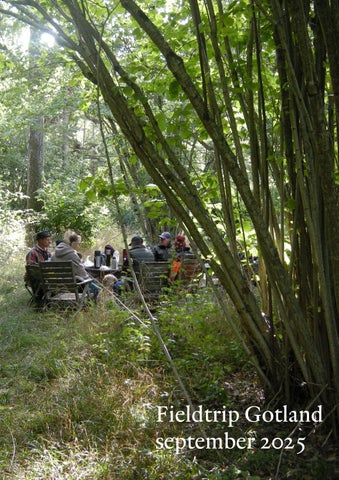
Fieldtrip Gotland september 2025
Soil
day 3 & 4
day 1 & 2
peat, bleached and lime mud drifting sand sand, gravel and pebbles clay and silt glacial sediments moraine clay stone and stone with a thin deck of weathering soil
2
About the fieldtrip In the summer of 2024 my first encounter with the meadow of Ellinghem was a strong experience. I was really curious how other meadows would look like. As there are around 200 meadows and Gotland a big island, I made a selection for the fieldtrip. Selection of meadows I made a selection on different aspects but also selected those that were ‘special ones’ according to publications. First of all there are differences in the vegetation; differences in (dominant) tree species: - decidious meadows (lövänge) - birch meadows (björkänge) - pine meadows (tallänge). I wondered if different trees or combinations of species create different atmospheres, think about light, composition, vertical layering. Beside the difference in vegetation I wanted to see meadows on different soils and bedrock. Probably the dominance of certain tree species are related to the soil and bedrock? And what about the drought problem on Gotland? Is it related to the soil and bedrock? Does it affect agriculture and the meadows? I had read that in the Northern part the limestone base is harder, the rock is tougher and less weathered, the soil layer thinner, resulting in gravelly soils. Here pine tends to form forests, though oak, ash, hornbeam, and hazel can also occur. Around Hemse in the south, the bedrock is softer with more clay. The soils here are deeper and more fertile.
Another aspect was difference in use and function. Some meadows are still used by a farmer. Others have a more public function. How are the meadows situated and connected (or not) to infrastructure and villages? I decide to visit the meadows by bike, to experience the landscape that surrounds the meadows. Programm/Interviews/talks The first day I attended a courseday on agroforestry hosted by The County Administrative Board (Lansstyrelsen) to inspire and increase knowledge about landscape management on Gotland. “We explore how meadow grasses, trees and shrubs can play an important role in an agriculture” The day started at Krusegård: a farmer who owned and managed two änge and also worked with hedges and trees structures in his farm. I had an interview with the owner and caretaker of Solsänget about the management and communities around the meadow. And an interview with a biologist and representative of the Gotlands museum in the meadow committee.
day 3 & 4
day 1 & 2
Bedrock 3
1 Hällänget Kauparve, Alva 2 Kruse Grindänget, Alva 3 Hallbåter Solsänge, Levide
September 30 2025 – Kursdag Agroforestry Left the prison hotel in Visby, found the busstation and arrived in Hemse, rented a bike in the local tool and machinery shop and off I went to Krusegård. I attend a courseday on agroforestry hosted by The County Administrative Board (Lansstyrelsen). “We explore how meadow grasses, trees and shrubs can play an important role in an agriculture” The day started at Krusegård with coffee and sandwiches in the garden of the farm, beside a big pear tree. 4
Day 1
3
2 1
5
Hällänge Not included in the catalogue of 2024
6
Hällänge, Alva
7
Hällänget
braidsraum
8
Hällänget, Alva
light in the braidsraum
Hällänget, Alva
9
The farmer Henrik and Emmy Ahlsten own and manage two änge and work with hedges and trees structures in their farm. (www. krusegard.se). Other participants are farmers, locals that own farms or properties with land, work in forestry or agriculture and ofcourse Hjalmar Croneborg, chair of the Gotlandska meadow committee. Meadow versus pasture In Henrik’s introduction he tells that his vision for the farm is to decrease inputs like fertiliser because of costs and to be regenerative. First we go to Hällänget: it’s managed as an änge before, but today used as pasture. Tall oak trees, not many shrubs, you can look through. Fence around, some remains of stonewalls. It belongs to the parents of Henrik (the farmer of Krusegard). For them it’s more their garden. Henrik uses it to pasture his cows. In 4 days his 100-150 cows mow the änge totally. Very clearly visible is the braidsraum (the open space for the hay to dry), when light comes in. Henrik tells the grass in this place is very good. Hjalmar tells about the historic system of landuse. He shows the map with a projection of the situation in 1700. Big parts were swamps and have been drained. There is a question about hazels/nuttrees. Henrik tells that in the 19th century there was a serious trade of hazelnuts. In one part apple trees were planted a long time ago. Good feed for pigs too. The use of hedges in agriculture The field beside is a crop field with a nice windshelter of trees around (The farmer visited farmers in England and got inspiration for its hedgerows). They shelter the field from wind, frost, keep insects and birds. He always covers his field with crops of straw to prevent [onnodige] evaporation. Autumn grains, Luzerne in between [groenbemesting] kept low, so he can harvest the grains. Henrik plans to plant trees on this field with a distance of 24 metres, so machine can still go in to increase yields and to help unnecessary evaporation. People talk about the preferred orientation. N-S, sun can come in.
10
hedge
Field of Kruse farm beside Hällänget, Alva
11
Kruse grindänget Areal 2,0 hektar Markägare Emmy och Henrik Ahlsten, Koparve, Alva Brukare Emmy och Henrik Ahlsten, Koparve, Alva
12
entrance with path
Slåterbod
Kruse grindänget, Alva
13
14
15
Kruse grindänget is very wild, not managed, beautiful! Nice little house of wood, some tables and chairs: perfect location for a bbq. Very tight hazel parts. We have lunch here. Everyone brought his matpakke, thermos! Henrik chopped already some trees and has plans to work on it. What should it become? How should the image look and for whom, what use? “We shouldn’t make this a museum, but incorporate it in the farm”, says Henrik. Could the cows help to make it more open first? The forestry guy suggest to grow mushrooms. The group discusses how to do that, what compost you need and so on. Beside the meadow, which has a beautiful varied ‘forest’ edge, the farmer plans to plant trees in rows as well. Water system with dams On the way to Levide Henrik tells about the water systems: we cross a big canal that was made in the 19th century to drain the swamps. The canal flows to the sea. Ditches with a regulated dam system, so they can let water flow away or keep it. He doesn’t agree with Hjalmar of bringing back the swamp-situation to refill the groundwater. It seems Henrik sees the drinking water problem apart from water for agriculture. We drive through a part that has peat soils, dark soils. He shows some hedge planting done by other farmers, only trees, no shrubs, no good winter shelter. We drive by an other meadow, recognisable by it’s hazels. So a lot of land was änge, and has historic remains, but isn’t used anymore. Apple orchard Levide In Levide we visit Frida’s place (https://tradgardsfrida.se), who planted around fifty apple trees as a hobby and how to manage the droughts. She put the hay under the trees, as nutrition and . . . Peep!! My head is full, somebody is telling us she has popcorn hjerne (= brains). Me too! I ask Frieda why she planted the trees in two rows. She answers it is meant as an entrance when she walks with the dog to the forest, which belongs to their place as well. What is she doing with the 1ha of forest, I forgot to ask. I also forgot my bag! Hjalmar brings me to Solsänget for the interview with Monika and will drive back to pick up my bag. 16
Kruse grindänget, Alva
Kruse grindänget, Alva
17
edge towards the fields
Outside edge
luzerne clover
18
Kruse grindänget, Alva
Hallbåter Solsänget Areal 2,0 hektar Markägare Monika och Lage Hansson, Hallbåter, Levide Brukare Monika och Lage Hansson, Hallbåter, Levide
änger steinstr
husgrunder
Bosarve lövskog nature reserve
Hallbåter Solsänget
19
Cows doing the efterbetning (aftergrazing)
20
21
remains of habitation
braidsraum
22
Hallbåter Solsänget
edge with traditional fence with hazel sticks
Hallbåter Solsänget
23
anthill
24
Hallbåter Solsänget
path
Hallbåter Solsänget
25
26
Hallbåter Solsänget
trees and grass on top of the house remains
entrance
Hallbåter Solsänget
27
Talk with owner and caretaker Monika sits on a squat because of leg injury. She asks me to open the gate, as three cows from a other farmer grazing in the Solsänget. Monika tells me cows are the best for grazing: they eat everything. Sheeps come on number two, horses are the worst: they are very picky. They bought the house where the Solsänget belonged to. A writer lived there. But they could’t buy the änge at first. Later they could buy it as they were already taking care and renting the land. They don’t have a farming background. They came to live on Gotland around 2000. In winter they prune trees, take away fallen ones. Lanstyrelsen told them to keep the dead wood for ecological reasons, so they made piles of it. In spring when the raking flowers (anemone) blossom, they blow away the leafs from the path (they do it like this, because raking is a lot of work!) And use a machine to clean the rest parts from the leafs and branches. Especially the oak leaves decay slow, so they need to be taken away. All they leafs are piled up and burned. Community around the meadow For the slåter her husband mows and turns the hay of the meadow in three of four days, people from a kind of naboarskap (there was a Swedish word) and family come to help out (30-40 people) to stack the hay into balls. (I forgot to ask what they do with the hay!). The two braidsraum are very clearly visible. If parts get to dark, they cut trees down, like the hazel. Before corona they had a bbq after the slåter, at 12 different places (at least one party of the other meadow). With corona it turned into a lunch and it stayed like that. Monika thinks it’s a pity. There are remains of very old houses (2000 years ago). These remains are kind of a group of small islands. The Solsänget is well known. The church keeps ceremonies here, people come for a picknick, it’s part of a walking path in the forest.
28
Hallbåter Solsänget
Future of the änge I ask Monika what the future of the änge will be. She tells me they don’t have children, so she hopes Lanstyrelsen takes the responsibility as it is close to Bosarve lövskog nature reserve. I cycle from Levide to Hablingo Vingården. No shop or restaurant around here, but Annika form the vandrarhem brought breakfast already, so I eat something of that and a lot of cookies.
Hallbåter Solsänget
29
Storkanalen
30
31
4 5 6 7 8 9
Stjupsänge, Hablingbo By rumhagen, Hablingbo Bölske storänge, Grötlingbo Prästänge, Fide Ockesänge, Öja Domerarve storänge; Domerarve sändänget, Roes storänget, Öja 10 Prästänge, Öja 11 Roes storänge, Öja
October 1 2025 – Towards the southern part of the island Early morning I heard a sound, gooses? When I come to Hablingbo Stjups änge I understand: cranes flie over!!!! (Kran på svenska) 32
Day 2
5 4
6
7
8 11
9 10
33
Stjupsänge, Hablingbo Areal 3,1 hektar Markägare Johan Boberg, Petes, Hablingbo Brukare Johan Boberg, Petes, Hablingbo
34
Stjupsänge, Hablingbo
Stjupsänge, Hablingbo
35
36
Stjupsänge, Hablingbo
Stjupsänge, Hablingbo
37
Stjups änge There are clearly different parts in the meadow. If you look at the old land map, I assume that the stone wall I saw half way, was the old division between the two. The first part is an open field with hedges around, then old oaks and elm trees, very close around the stone wall and then the forest with hazels, birch open up again with small braidsraum. Walking back on the path, I see an stone marking the path. I brought some of the leaves from the trees. Why does the meadow has such a strange form in the cataloque? I got stuck with my bike in the clay: it’s very fat clay here!
ensemble of Stjups: farm house surrounded by the yard with fruittrees, änge and forest
38
Stjupsänge, Hablingbo
braidsraum
braidsraum
Stjupsänge, Hablingbo
39
old stone at the entrance
40
Stjupsänge, Hablingbo
edge Stjupsänge towards the road
edge Stjupsänge towards the fields
Stjupsänge, Hablingbo
41
Ask Ash
Ek Oak
Kornell Cornel
Lundalm Elm
Hassel Hazel
By rumhagen, Hablingbo Areal 1,5 hektar Markägare Annelie och Urban Allmungs, Allmungs, Hablingbo Brukare Annelie och Urban Allmungs, Allmungs, Hablingbo
44
By rumhagen, Hablingbo
The farm of By The meadow By rumhagen lies along the main road in Hablingbo. An information sign of the meadow committee mark the meadow, but this one is closed of with a gate. Yesterday, at the courseday in Krusegård, I met Urban, who is the owner and caretaker of this meadow. He grew up in the meadow. It belonged to his father, grandfather and so on. They mow and take away the first grass, later on the sheep (Gotland and another English breed) graze (efterbete). The hay they take away is very poor (mager). The sheep are kept for their skin and wool. They have a sheep dog. They grow lentils and cereals (?) on their other land. The änge is kept mainly for grazing the sheep and as a family tradition. For the mowing (slåter) in July they ask friends and family to help out. The end of the day there is a barbecue party. First Urban worked as a carpenter, but later on he returned to the farm to be a farmer. He has two sons. So I ask him if they want to be the next generation. One is studying. The other is still young. It seems he has hope for one of them to continue the ecological farm.
By rumhagen, Hablingbo
45
ensemble of By (see page 44-45): farm house(s) surrounded by a yard with fruittrees, änge and forest
46
Towards Havdhem
Towards Havdhem
47
Church of Havdhem
Edge of Bölske änget
48
Towards Havdhem
Accessibility of the änge In Havdhem I didn’t see the änge. I thought it was in the village, or I mixed it up with Fardhem? You do see a lot of old meadows though, but they are just there. After Havdhem I go to Grötlingbo to Bölske storänge. Bölske änget is part of a farmyard. It feels like I am entering private ground although there is a path with a sign. There isn’t a clear entrance from the farmyard to the meadow. From the road it looks more like as a pasture. The best present is the couple of eagles (?) fly over. It does have a clear border: a field with hay balls follow. I decide to cycle further to Fide and leave the Grötlingbo prästänge. Further I pass by the beautiful medieval farm of Kattlund. In summer probably a busy spot. Today no one here.
Kattlunds Medieval farm setting
Towards Havdhem
49
Prästänge, Fide Areal 1,8 hektar Markägare Naturvårdsverket Brukare Föreningen Fidegården Sedan år 1998 är prästänget del av ett kyrkoreservat. 2014 blev det även del i ett naturreservat. Det är samtidigt del i Natura2000-området Fide prästänge, sedan år 2005.
50
Prästänge, Fide
Prästänge, Fide
51
52
Prästänge, Fide
Prästänge, Fide
53
Burned tree in Fide prästänge
54
Prästänge, Fide
protection for new trees to grow in Fide prästänge
Guestbook In Fide I visit the Lövanget. It clearly has a public function. It’s along the road and has a information sign. Clear entrance, picknickbenches. There is a slåterbod with a table inside to get together and a guestbook. Rakes are standing in the corner. I should have looked how the nature reserve (N2000) behind looked like! There is a stone wall between the änge and the nature reserve forest behind. It’s very difficult to find Fide Bredkvie as it isn’t connected to the road with a path. I recognise it, but it lies parallel to the road behind houses and private property. I have to climb a fence to come there. I decide to leave it! (Later I understood I mixed up two.)
Prästänge, Fide
55
Church of Öja
The änge of Öja Further to Öja! The church of Öja is a landmark in a landscape of rough fields with juniper trees/shrubs. Öckesänget lies along the road. I try to find Roes hemänget, as Hjalmar told me it is a birch dominated änge. It must be behind a field, but I really have to go trough forest. I leave it. The others east of the road lie behind high stonewalls, a group/ line with hazels alternated or border the open spaces with other trees, like birch and oak. South of the roads the ängar are very overgrown. I decide to go into Långvät to Unghanseskår (old fisherman houses with a big poplar tree!) at the coast. The stone walls border were the cultivated land ends! A big contrast between the deciduous trees of the meadows with the empty and coniferous poor landscape.
56
Öja
Öja Markägare private Brukare private
Ockesänget
Roes hemänge Domerarve sandänge Domerarve storänge skärvägsänget
Roes storänge
Prästänge
church Unghanse storänget Öja
57
Domerarve sändänget
In Domerarve storänget the hazels devide the different rooms (braidsraum)
58
Öja
Domerarve storänget in Öja
Birch and ash
Öja
59
Ockesänge in Öja
Roes storänget, in the back birchtrees
60
Öja
Pasture fields east of Öja. After the stonewall starts the ‘wild’
Öja
61
fishermen houses
62
Långvät
Church of Öja as a beacon to the cultivated world
pasture field outside the village
Långvät
63
Prästänge, Öja Areal 2,5 hektar Markägare kyrkan Brukare Öja kulturförening
64
Prästänge, Öja
Prästänge, Öja
65
66
Prästänge, Öja
Old birch embraced by hazel The day ends at the prästänge. Nice group of trees alter the open spaces. Very old trees of ash in line with the church tower. Enormous oaks. Further very dense hazel, uneven terrain. Hazels really flank the open parts. And also clearly visible here how trees grow together. A very old birch embraced by a hazel. To elms leaning on each other. A path goes trough the meadow and goes further in the forest! Great play with light. How many people are needed to rake and scythe here?! Maybe an interview with Öja kulturforenning? When I cycle back I see some beach-dominated forested areas on the coast side of the road (together with pine trees).
Prästänge, Öja
67
burning spot with hazelnuts
68
Prästänge, Öja
Prästänge, Öja
69
70
Prästänge, Öja
some ridges
path disappears into the forest, (It’s visible on old maps that there were also ängar)
Prästänge, Öja
71
Gotland sheep
Vinegården
72
Back to Hablingo
Wine yards In the evening i had a talk with the owner of Vingården. No problems with drought, some mildew, and no problems with the salt spray. (Later I read the see is more brakkish than salt) Good climate, calcareous soil, a lot of sun on Gotland. But difficult to make it profitable. Friends and family come over from Stockholm to help picking, but the ferry is expensive. Sixteen years now of red numbers, now on zero . . . Wine from Italy is cheaper. Some restaurants serve the wine, being an entrepreneur on an island has some challenges! www.gutevingard.se
Back to Hablingo
73
12 Hulte kruppar, Hemse 13 Haga änge, Visby 14 Kuse änge, Västerhejde
2 October 2025 Back to Visby Cycling back to Hemse with sunrise, another encounter with the cranes. They forage in a harvested mais field. 200? Peep, prrrr Wiep! 74
Day 3
12
13
14
75
Gotland sheep in the änge of Hemse Hulte kruppar I visit the Hemse Hulte kruppar. A sign on the road brings me to the meadow. Clearly fenced and entrance. A paper on the entrance tells that sheep from a farmer from Fardhem grazing in the meadow. There is a slåterbod. And it seems the meadow is recently mowed? Maybe because of the rain in July and August? It’s a large meadow with a nice hedge of shrubs. One sheep standing on his back paws is eating from the hedge. Behind there is a crop field. There is a small ditch outside the fence around the meadow, then comes a path tot the field and then a very nice overgrown (tunnel) walking path which seems to connect to the village of Hemse.
76
Hablingbo > Hemse
Hemse Hulte kruppar
77
Hulte kruppar Hemse Areal 4,2 hektar Markägare xx Brukare Hemse mark och miljö Om våren deltar ungdomar från Högbyskolan i fagningen, ibland så många som 140 elever.
Hemse
Alva 78
Hemse Hulte kruppar
The grazing animals belong to . . .
Hemse
path to Alva
Hemse Hulte kruppar
79
slåterbod
Gotland sheep
80
Hemse Hulte kruppar
burning spot (after raking leaves and twigs in spring)
Hulte kruppar Hemse
81
anthill
82
Hemse Hulte kruppar
braidsraum
Hemse Hulte kruppar
83
84
Hemse Hulte kruppar
vegetation under the hazels
Hemse Hulte kruppar
85
86
Hemse Hulte kruppar
87
Conversation with biologist Ulrika I meet Ulrika Ridback in the cafe of the Gotlandsk museum. She is a biologist, studied biology in Visby, but the deparment has now closed down. Being a student here meant you had a wonderful landscape to do fieldwork, and as bonus the experience of helping out in April raking in the meadows. She did her Phd in Norway. She lives in Alva, has her own little hay field and is a representative of the Gotlandsk Museum in the Meadow committee. The museum is responsible for one of the meadows/or helping out in the management. It’s the one of Kuse. She comes up with this one if I ask her what is her favourite meadow. Another favourite is the Snövide kistänget between Havdhem and Eke. I missed it! She tells me about it: there is a swing in the middle, and so many birds you hear and special plants who flower. It’s isolated and surrounded by open crop fields. I ask her if the plant societies in the meadow are only found in the meadow itself or if this exists also in other fields or forest. Yes, in parts were the soil is poor, and a little disturbance occur by animals grazing. And along roads. She mentions four aspects/conditions for the plants in the meadow: light, disturbance, the trees for moist and the seeding (because of mowing after the plants made seeds, with the hay lies down to be dried, seeds stay in the meadow. She told that sometimes they find old remains of farms in the forest and also some typical meadow plants! Or sometimes they find typical meadow plants, like the wild strawberry, that brings them to old remains. I ask if there are special species on the island, with the example of New Sealand or Madagaskar. She is not quite sure, but tells there are about 54 species of orchids in Sweden, 40 of them are to be found on Gotland. The lanstyrelsen is responsible for the administration of Natura 2000. Biologists are employed monitor and indicate the key species, but also external companies help out with the inventories needs. The Swedish state halved the budgets for nature conservation . . . . We talk about how the trees and plants work together in the meadow. She tinks trees that root very deep, bring up moist for 88
Conversation with Ulrika
others around. I told her I saw trees entangled with the hazels. She thinks the seeds that drop around the hazel find the right conditions to grow. Hazels have long roots that can come up in a circle around the tree and grow as a new tree, they form [heksenkring] like mushrooms. Hazels need to be pruned to give nuts (disturbance). All hazels are the same specie. She thinks more research could be done to understand how trees, shrubs, herbs, fauna like insects, but also micorhiza, work together. We talk about how knowledge from generations is passed on. She tells about the law of forest cleaning is fighted in court. Because it tells you have to chop all trees, save one that will seed. People who worked in the meadow or with forest for a long time, for generation, think you have to thin it out. Truffels are found in the meadows. She has a colleague with a dog who finds the truffles (he eats them!). They are sold to restaurants. Because of this summers ban on unnecessary use of drinking water, but the indifference of the farmer of Krusegard, I ask if there is a water problem on Gotland. In 2018, yes there was. This year not much rain in autumn, and on top of that very less snow in winter, the ban was precautionary. The summer of 2024 was really wet (like in the Netherlands). As they produce drinking water partly by desalination (expensive) and because large numbers of tourist, they are always cautious on Gotland. Land reform happened early here (1800-1850), but Ulrike thinks geology still forms the base, despite of transformation by reparcelling and drainage, and water to be found in deep layers. [I should check the report of the SGU and maybe search contact.] She explains me why there is sand in Öja: because its a quite young part, first it was another island. The sea brought the sand there. She advices on a book about geology and geomorphology. Finally she shows two quite recent publications (2016) about Gotland’s Flora form the botanical organisation. I tried to find it, but it looks it’s sold out. We say goodbye. I’ll pick up my bicycle and repack my stuff and head to the Haga änget. Conversation with Ulrika
89
Haga änget Areal 0,2 hektar Markägare region Gotland Brukare Haga hembygdsförening
90
Haga änget
This änge is not fenced of by a planted hedge, it looks more like a forest
Haga änget is a dissapointment: high grass and just a fire place as hang out. There isn’t taken care of this place.
Haga änget
91
Kuse änget Areal 2,5 hektar Markägare Gotlands fornvänner Brukare Västerhejde hembygdsförening
92
Kuse änget
Kuse änget
93
94
Kuse änget
burn spot with ash
burn spot
Kuse änget
95
96
Kuse änget
The most beautiful meadow of 2024 I continue to the Kuse änget south of Visby. I pass some nature reserves. The änge of Kuse is beautiful, so many hazeltrees squattered on the place. A diagonal path connects the two entrances. There is a lovely slåterbod. I write something in the guestbook. On the wall hangs a diploma of ‘the most beautiful meadow of 2024’. This meadow is managed by the community of Västerhejde. A big heap of ash, seems still to be warm. It looks like people have been working here quite recently. Very nice planted edges fenced of. There is elevation in the meadow. Oxel tree (Whitebeam Sorbus aria) on a open spot with the picknicktables; hazels form a half circle around it. I notice hazelnuts for the first time.
Kuse änget
97
98
Kuse änget
Kuse änget
99
tree hiding between hazels
100
Kuse änget
hawthorn and oak
Kuse änget
101
102
Kuse änget
Änge in the urban context In the evening I have call with Hjalmar, the chair of the Änge Kommittan. We talk about what I have seen. I tell him I visited Haga änge and was quite dissapointed. Hjalmar tells me there were people that had plans with it, so he put this one in the catalogue. Probably it doesn’t turn out well or it is hard to keep it in shape. It wasn’t fenced, so it looked like a small piece of random forest. And it was situated in between a busy road and a neighbourhood. It used to be an änge, but maybe that hasn’t have to be a requirement. As an änge is about land use and a way of managing, it could be made at other places as well. Organsation and representatives of the Änge Kommittan We talked about the organisation structure of the Änge Kommittan. Representatives from different organisations forms the committee, it has been like that since 1944! Maybe that’s way it works well and so many änge are preserved, thinks Hjalmar. People who maintain a meadow feel supported by the committee. There is a price every year for the nicest meadow, they receive an art-print if they are taken up in the catalogue. We talking again about the water and drought problem. Most people don’t see a problem. It seems it depends on the location, there are differences. Frida had really a hard time growing the apple trees. Hjalmar is convinced that people look away from it and it the future there will be a problem. So Henrik is a smart guy according Hjalmar. But they have different opinions on if drought will be a problem. Today we have technical solutions for drinking water. In the older days people had to come up with other plans, else they had a problem. Hjalmar isn’t from Gotland. And didn’t grew up at a farm, but got involved a long time ago when working on a farm here. He went back to the mainland to study and came back. What area to pick for further study, what direction to go with my project? Maybe the area around Visby? In between the farmland and the city? Kuse änget
103
15 Prästänge, Bro 16 Allekvia änge, Endre
Day 4! October 3 – Änge east of Visby There was a little rain this morning, I decided to wait for, and left at 10. Big road to Bro, a bit unpleasant by big trucks passing. The landscape is quite dry, coniferous, sometimes just stone surfaces. Grind quarries along the way. Definitely trees (mostly pine) died here, but stand still upright. 104
Day 4 15
16
105
Gamla vägen = The old road
106
Visby > Bro
Bro prästänge Areal 1,3 hektar Markägare kyrkan Brukare Bro hembygdsförening
Prästänge in Bro
107
108
Prästänge in Bro
Pine änge The änge at Bro is dominated with pine, very old ones. It lies along the road, directly besides the church. Its open to the road, fenced of towards a forest behind (clearly an old meadow as well). It’s an old church and has relics in the surrounding, like a well in the forest, mythical stones (2 of them are oxes that turned into stone when the farmer didn’t want to offer them for sake of the cure of his blind daughter). A signed path runs trough, it seems to be an ‘church’ path. The änge on the east side is bordered by a canal. A bridge crosses, there is a path that runs north along the canal. On the map I see the canal goes all up to Lummelunda. There are a lot of different mushrooms. How do they rake the needles of the pine? Do the animals like this hay?
Prästänge in Bro
109
anthill
Prästänge in Bro
Prästänge in Bro
112
Prästänge in Bro
High, rough and dry: stone quary
church of Endre
The road from Tibbles to Endre goes through a lower plain: Straight ditches, open fields.
Bro > Endre
113
Allkvie änge Areal 4,2 hektar Markägare staten Brukare Endre bygdegårdsförening Änget är sedan 1980 naturreservat. År 2005 kom det även med i EU’s nätverk av skyddade områden, Natura 2000.
114
Allkvie änge
Nature reserve with nature path The meadow of Allekvie is clearly signed form the road. A path brings you to a parking place. It’s a N2000 reserve with a nature trail + booklet with information through the meadow. This one is really large! There are some lower parts, they look like natural pools. Also very tall elms, tightly in groups. Some parts aren’t managed, so you see what happens then. Before or beside the meadow lies a pasture. Different atmosphere by the very tight hawthorns, no hazels, some large trees. This one is made into cultural and natural heritage and protected as ‘nature’. There are picknick benches, children made huts in the wild part. Some trees are signed with a cross: they probably will be felled this winter. In the antiquarian Drotten I find the Gotlands flora band 1 and 2! Heavy stuff, but I am very happy. In band 2 is a postcard with a typical Gotland plant. I write a message to Ulrika and leave the ‘stroopwafels’ and ‘drop’ for her at the Gotlands Museum.
Allkvie änge
115
Pasture field besides Allkvie änge, with clumps of impenetrable bushes
116
Allkvie änge
Allkvie änge
117
118
Allkvie änge
Allkvie änge
119
anthill
Succession happening when it isn’t managed
120
Allkvie änge
braidsraum
pruned ash tree
Allkvie änge
121
122
Allkvie änge
wild apples
Allkvie änge
123
Another world In the bus on Saturday October 4 from Oskarhamn to Kalmar I see the landscape of Skåne: big scale and very open. Back in Malmö Gotland seems another world. I have visited 16 meadows and haven’t met anyone there, besides on the Kursdag. I haven’t seen that many people at all. At Allkvie I saw a man with a dog at the main road. In Fide a women working in the garden. Men on tractors. I don’t remember where: a man on a bike, we waved.
Conclusions system
alternation of sun and shade > dynamics
planted edges as shelter for wind > microclimate + hiding, nesting, fourage place for fauna 124
Conclusions
circle of nutrition/moist + species symbiosis
disturbance by grazing
pollarded roots bring in nutrition
disturbance by mowing + fire
Manure of the cows/sheep/horses brings in nutrition
Conclusions
125
gradients
nutrition/moist, shelter (nightfrost) and birds and insects as natural pest control for fields
126
Conclusions
autumn – rain
winter – snow coverage
spring – snow melting
summer – sunny and dry
Conclusions
127