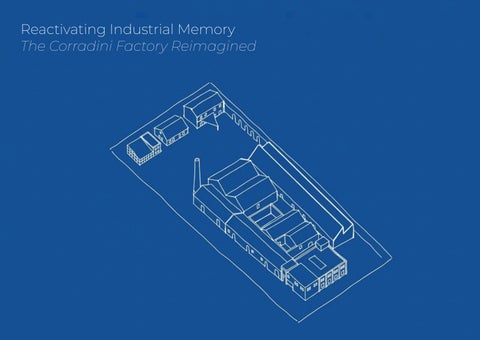
Reactivating Industrial Memory The Corradini Factory Reimagined
INDEX Foreword
pag. 4 - 5
Location
pag. 6 - 7
Personal connection to the site
pag. 8 - 9
Architectural Icons of the city
pag .10 - 11
The context of napoli
pag. 12 - 13
Historical background ( agricultural and industry)
pag. 14 - 17
Why Corradini?
pag. 19 - 29
Mobility
pag. 31 - 38
Community speaks
pag. 39 - 66
In Situ
pag. 67 - 99
The factory in use
pag. 101 - 117
Structural Inventory
pag. 119 - 146
References
pag. 147 - 152
Program
pag. 153 - 162
Materiality
pag. 163 - 183
Landscape
pag. 185 - 214
Design
pag. 215 - 255
Bibliography - afterword
pag. 257 - 259
Foreword Revitalizing Napoli’s east ex-industrial periphery through its industrial heritage
Urban peripheries are often described as degraded and static territories, overlooking their capacity for transformation. This project explores San Giovanni a Teduccio, a neighborhood on the eastern periphery of Naples shaped by a strong industrial past and a prolonged phase of decline. Through the investigation of its agricultural origins, industrial heritage, and contemporary residential condition, the project reads abandoned industrial spaces as latent resources rather than residual voids. Focusing on the former Corradini industrial complex, the design process proposes a progressive and inclusive approach to regeneration, where industrial heritage becomes a catalyst for social, spatial, and economic reactivation. The project frames transformation as a gradual process rooted in local identity, adaptability, and the everyday life of the neighborhood.
4
5
LOCATION NAPOLI The eastern industrial part of the city Napoli consists out of three regions: - Ponticelli - Barra - S. Giovanni
6
7
Personal connection to the site: During my childhood and into adolescence, I vividly recall each time driving to Napoli. The traffic increased as we approached, weaving through a network of highways crossing over each other like woven fabric. The roads would pass by enormous silhouettes of oil tanks. On my left I would see the skeleton of the Tobacco Factory and on my right, towards the seaside, the silhouettes of cranes and cargo ships loading significant amounts of colored containers, containers marked with logos that caught the attention of drivers, pedestrians, and residents passing through the San Giovanni neighborhoods, known as ‘the gateway to eastern Napoli’ The nocturnal sight of the abandoned tobacco factory always intrigued me, its vast halls occasionally lit by nearby university buildings. My father would tell me stories about the area’s industrial past a time when these factories provided livelihoods for entire neighborhoods. My grandmother had settled in San Giovanni because my grandfather opened up a leather factory that once thrived here, part of the dense
8
network of manufacturing that defined East Naples. Their life was tied to this industrial landscape until the 1980 earthquake forced them, like many families, into temporary housing. What was meant to be temporary became permanent for so many, as the emergency housing projects transformed into the concrete social housing that now dominates the skyline. I was always intrigued by the hectares of abandoned oil tanks, trying to imagine how they had been my father’s childhood playground, a landscape shaped by industry but still alive with the daily rhythms of the city. The industrial spaces have been neglected for centuries and are the backdrop of the city, these spaces have a quality that has not been discovered yet. As I grew older, I began to ask myself: why would anyone visit a place like East Naples today? What can the eastern neighborhoods of Naples, like San Giovanni a Teduccio, offer to a tourist or visitor? Not the imposing, concrete social housing buildings or the informal
settlements alongside Vesuvian villas repurposed for residential use. Perhaps only for the occasional crime news episode, or for the huge murals drawn by famous street artists that have become part of today’s popular culture, or for those interested in urban exploration of abandoned post-industrial buildings. But behind this façade of crime, imposing social housing, and neglected industrial ruins, one could rediscover the ancient natural landscape my family once knew. It could have been a beautiful encounter between coastal and marsh ecosystems, horticulture and tourist activities. Now it lies buried under layers of cement, smoke, steel, oil, and poisons that played the protagonist role in the nineteenth and twentieth-century history of East Naples and Italy.
The book remembering the swamps of Napoli the view from the house of my grandmother
visiting Napoli
the view from the house of my grandmother
My grandparents
The Tobacco factory
The harbour and oil tanks
9
Icons of Concrete The Vele di Scampia, the Taverne di Ferro in San Giovanni, and the ‘bicchieri’(glasses), complex are among the most recognisable expressions of postwar social housing in Naples. Built with the ambition of rehousing overcrowded communities and modernising the city’s neglected periphery, these brutalist structures were conceived at a scale that overwhelmed the neighbourhoods they were meant to serve. Delivered incomplete, stripped of adequate services and public infrastructure, they became associated over time with institutional abandonment and social marginalisation spaces where the absence of investment created the conditions for decay. And yet they remain icons. For the communities that grew up within them, these buildings are not simply failures they are part of an identity, a shared landscape of memory. The Vele in particular have acquired a global recognisability, referenced in film and architecture alike. The Casa Portuale of Naples, belongs to the same moment and carries the same ambivalence built with intention, left without the sustained care required.
10
The lesson they offer is a simple one: architecture alone does not transform a neighbourhood. Without social investment, without listening to the people already there, even the most ambitious building becomes a monument to missed opportunity.
Vele di scampia
Taverne di Ferro
I Bicchieri social degradation climate degradation
11
The context of Napoli as a city: Naples Neapolis, the “New City” is one of the world’s most contradictory places. A city that gets underestimated at times and overestimated at others, but rarely truly understood. Through images taken over time, I want to show its social context rather than its architecture: the reality of the people who live and inhabit it every day. Not an analysis of cultural context, but a witness to its authenticity to what it means to belong here. In Italian, belonging is *appartenere* to be legitimately part of something. Neapolitans possess this sense profoundly, embracing their city despite, or perhaps because of, its complexities. Naples is chaotic yet deeply traditional, ancient yet alive, built upon layers of time that mirror the layered identities of its people.
Walk through any neighborhood and life spills beyond four walls: balconies hung with laundry, plants, personal belongings a visual testament to how openly Neapolitans inhabit public space. Artisanal traditions run deep; sculptors and craftspeople continue their work as they have for generations. And everywhere, the sea and Vesuvius. Fishermen cast lines from piers even in the inner city, mending nets as part of the daily urban fabric a reminder that Naples remains, as it has always been, shaped by water and volcano, by making and surviving, by voices that refuse to be silenced.
The sacred
Importance of the sea and vulcano
The sacred
Social culture
Craftmanship
Social architecture
The city struggles with decay, organized crime, and the harsh realities of its peripheral neighborhoods. These are real. But reducing Naples to its clichés obscures what it truly is.
12
13
Historical context The potential of requalification lies in peeling back the different layers of the territory to recognize its original identity. Before 1904, archival maps show that the eastern part of Naples was defined by large agricultural fields and swampland. Most existing architecture dates from this period the Masseria, rural building complexes organized around a courtyard, built for farming. The area’s richness comes from its soil: layers of volcanic sediment from the eastern Neapolitan plain created a marshy ecosystem. Impermeable volcanic soils retained water descending from the surrounding hills, which, combined with coastal proximity and Mediterranean climate, produced exceptionally fertile ground for crops and fruitbearing trees. The first factories established in the east built on this agricultural foundation. Among them, the tomato factory Ciro became the largest of its kind in Italy and the South, exporting worldwide. But industrialization gradually erased the ecosystem that had made the area productive. The Sebeto the ancient river that had shaped the coastal alluvial plain
14
and fed the city with produce from Angevin times through the twentieth century was reduced to the subsoil by industrial extraction and destroyed by pollution. A tributary, the Lagno, survived longer in local memory: filmmakers documented it, and family stories recall children playing in the river among factory waste cardboard and other materials dumped along its banks. Those same stories describe a wide natural beach that once drew tourists to a coastline running uninterrupted toward Sorrento and the Amalfi Coast. That coastline is gone. Arriving today by metro at San Giovanni– Barra, the view is dominated by the massive profile of the exCorradini factory, its buildings entirely overtaken by weeds. Sitting on the border of the sea, the complex forms a wall between the neighborhood and the water a barrier that extends across the entire eastern industrial strip of Naples. Seen from outside, the gulf appears partially swallowed by industry being reclaimed by vegetation. The agricultural past and nature find a way to persist regardless.
NATURE ELEMENTS
15
!
!
1943 first English map Map of 1775
!
! !
!
! !
!
!
vola Strozzi - 1472-1473
2024 !
Map of 1775 ! !
!
!
!
! ! ! !
! !
! !
! ! !
Building location - areal photo
! ! !
!
!
! !
!
!
1472 Map of 1615
1775
1615
Map of 1775
1775
! !
1939
!
Map of 1793
1776
!
!
!
2020
! !
!
!
1780
1943
1793 !
2024
1930
!
!
!
! !
!
! !
!
!
! !
!
!
! !
! ! !
!
! ! !
!
!
!
! ! ! ! !
!
! !
!
!
177
!
! !
! !
Linee metropolitane urbane
! !
linea 2 Metropolitana
!
Linea 4
!
!
!
BRT Bus Rapid Transit Confine comunale
!
17
!
Zone30 bassa velocità,
Stralcio lotto 1 interven ! !
!
125
250
500 met
WHY CORRADINI?
Why the name Corradini? The factory bears the name Corradini not as a family name rooted in Italian soil, but as an act of assimilation. Its founder was born Giacomo Conradin in 1844 in Sent, a small village in the Swiss canton of Graubünden. When he arrived in Italy first in Livorno, then in Naples in 1872 he adapted his surname to the sounds and conventions of his adopted country, becoming Corradini. It was under this Italianised name that he built his business. In 1881, together with a group of associates, he founded the Società Metallurgica Giacomo Corradini S.p.A. in San Giovanni a Teduccio, and the name stuck to the company, to the factory, and eventually to the ruins that remain on the waterfront today. The renaming was not merely a bureaucratic detail. It reflects the broader story of a Swiss immigrant who embedded himself so thoroughly into Neapolitan industrial life that his foreign origins became almost invisible. The factory grew to employ 500 workers and became the leading metallurgical enterprise
in southern Italy all under a name that sounded entirely local. That slight linguistic shift, from Conradin to Corradini, is now the only trace of the founder’s origins that most people encounter. The site is known simply as the exCorradini a name that carries a Swiss past beneath an Italian surface. In the follwoing images you see the historical records of the Società Metallurgica Corradini (the Metal association Corradini) reveal the remarkable breadth of the factory’s output. From copper (rame) and brass (ottone) to cast iron (ghisa) and the foundry (fonderia) works, the factory covered nearly the full spectrum of metal production, a testament to the industrial ambition that made it the leading metallurgical enterprise in the south of Italy.
21
Factory Certificate: Naples, March 31, 1930, Metallurgical Company Giacomo Corradini.
13
Current state of the site:
14
somewhere along the waterfront
15
16
The future of the site: A recent local newspaper article on the partial collapse of the historic factory complex is a warning of what is at stake when buildings are left to deteriorate. Without intervention, complete collapse is inevitable and with it, the loss of an irreplaceable piece of history. Cultural memory. The factory complex represents a specific moment in industrial and social history: the economic forces that shaped the region, the labor that built the community. For local inhabitants, these structures carry personal significance where grandparents worked, where the local economy once thrived. Losing them breaks those threads of connection. Environmental responsibility Reusing existing buildings is among the most sustainable approaches available. The stone, brick, timber, and metal already embody the energy invested in their extraction and processing. Demolition wastes that energy and forces new construction to repeat the entire resourceintensive cycle. The existing fabric also offers passive performance thick tufo walls for thermal mass,
17
natural ventilation qualities to enhance rather than replace. Economic and community benefit. Regenerating these (abandoned) buildings evokes a neighborhood towards revitalization, attracting investments and (new) residents. Historic structures, thoughtfully repurposed, become distinctive community assets that draw visitors, support local businesses, and increase the surrounding property values. They create work for skilled craftspeople and offer an authenticity that generic new construction cannot replicate.
Urban context and material: The urban fabric of Naples is fundamentally constructed through tufo the golden volcanic tuff that forms the city’s thick loadbearing perimeter walls. These massive stone walls, often 5060cm at the base, define the characteristic courtyard blocks and determine the structural rhythm of the historic center. Buildings rise in vertical layers: ground floor vaults in tufo or the harder piperno stone, wooden floor beams spanning between walls, and terracotta-tiled roofs completing the material stratification.
around agricultural production, established an alternate spatial logic to the dense residential fabric of the inner city. The later industrial transformation, represented by factories like the exCorradini, introduced yet another material vocabulary, brick, iron, and concrete layering industrial modernity onto this agricultural foundation. The requalification challenge lies in bridging these distinct material and spatial histories.
The streets themselves are paved with basolato large blocks of grey volcanic basalt that have withstood centuries of urban traffic, their dark surface contrasting with the warm ochre of the tufo facades above. The Eastern Periphery: A Different Origin San Giovanni a Teduccio, in Naples’ eastern periphery, emerged from a different building tradition. This area’s history is rooted in masseria fortified agricultural complexes that dotted the coastal plain. These rural structures, with their thick defensive walls and internal courtyards organized
18
TUFO - TUFFSTONE, NATURAL VULCANIC STONE
TUFO - TUFFSTONE, NATURAL VULCANICTUFO STONE- TUFFSTONE, NATURAL VULCANIC STONE
19
20
MOBILITY
First train line of italy born in 1839 On the 3rd of October 1839, the Kingdom of the Two Sicilies inaugurated the first railway on the Italian peninsula the Naples– Portici line, running along the eastern coastline of the Gulf of Naples. It was a journey of just over seven kilometres, but its significance was far greater than its distance. Naples was, at that moment, one of the most populous and industrially ambitious cities in Europe, and the railway was the infrastructure that would bind its future together. The line ran eastward along the coast, through the working neighbourhoods of San Giovanni a Teduccio, past Pietrarsa where the royal locomotive workshops were soon established and onward to Portici. This coastal corridor became the spine of Naples’ industrial development throughout the nineteenth and twentieth centuries, attracting foundries, metalworks, and manufacturing complexes that drew workers from across the region. The railway did not simply connect places; it generated them. The Ex Corradini site sits directly within this historical infrastructure corridor. The same rail route that carried the Bayard
locomotive in 1839 still traces the edge of San Giovanni a Teduccio today, and the Corradini complex grew up in direct relationship with it dependent on the railway for the movement of raw materials, finished goods, and the workforce that sustained its production. The site is not incidental to Naples’ transport history; it is embedded within it. Today, this same corridor is served by the Circumvesuviana railway and the metropolitan network, connecting San Giovanni to the city centre and southward along the coast. The Ex Corradini therefore inherits an extraordinary infrastructural legacy a site already woven into the mobility fabric of the city, already accessible, already linked. Any future vision for the area need not invent its connections; it need only acknowledge and activate the ones that history has already laid down.
33
A1 highway to Roma
Connectivity and infrastructure in Napoli
er
sa
FS
Av
Alta v
A1 Roma
FS
eloc
PA o5 zz
6uoli
Cuma
ità
Cuma
A56
Nola
Liberata
A3
San Giovanni a Teduccio a Teduccio
A3
Sa
le
So
hi
gh
w
rn
FS
rr
o
in
to
so
in
Tra
Sa
rre
rn
o
nt
o
to
rn
le
Sa
o
rn
le
Sa
o
Highway Train line to Salerno (Corradini line) Main roads
to
to
le
tra
en
ay
Secondary roads Train lines Future tram and train lines Central station of Napoli 34
International airport Cruise ship Ex corradini factory
35
36
37
3.
4.
5.
9.
7.
6.
2.
8.
COMMUNITY SPEAKS
1.
Time to give the local community a voice....
6. Ex Corradini factory 3. Ex Cirio factory - Atelier for theatre San Carlo 1. Central station
2. Casa portuale - Port house Brutalist architecture landmark, sea and boat 38 view, port activities
Iconic building
4. Forte Vigliena - Ancient Fortification with restaurant and museum
5. Apple center university Campus
Hub for cultural activities, workshops, theatre, museum, library, restaurant/ cafe, beach and garden
8. Sport park - Former water treatment plant 7. Theatre NEST former abandoned highschool cultural activities, social centre
9. Pietrarsa Railway museum and park
Naples East: Beyond the Stigma, Towards a New Identity Naples East carries a reputation it has not earned. In the popular imagination, the eastern neighbourhoods conjure industrial decay, social hardship, and the brutalist housing blocks that defined the postwar years. San Giovanni a Teduccio, Barra, Ponticelli these names have been associated with neglect and marginality, as though the eastern arc of the city were simply something to pass through on the way to Vesuvius. But this perception has always been incomplete. Beneath the stigma lies space, history, a working waterfront, and an extraordinary density of cultural and educational potential that has been quietly accumulating for years. The transformation is already underway, though it arrives unevenly. The Apple Developer Academy and the Federico II campus have introduced educational energy into San Giovanni a sense that this part of the city can be a place of ambition. For that presence to mean anything, it must translate into opportunity for the people already living there: employment, access, skills, cultural exchange that
40
flows in both directions. Potential is not the same as impact. The other assets speak for themselves. The Pietrarsa Railway Museum anchors the coastline to a history of making that stretches back to 1839. Forte Vigliena stands quietly along the waterfront, bearing the memory of the Neapolitan Republic. The Nest Theatre brings civic culture to a neighbourhood that has rarely seen serious institutional investment. Graffiti, green space, and a growing informal creative community have reshaped the area’s visual identity and drawn younger audiences. The San Giovanni Barra station ties all of it together, placing the entire corridor within easy reach of the city centre.
Ex Corradini offers is the missing centre the hinge point of a hub that is already forming around it. Not a destination designed for outsiders, but a connective space that gives coherence and identity to everything that already exists.
At the centre of this constellation sits the Ex Corradini. Positioned at the intersection of education, heritage, performance, ecology, mobility, and the sea, the site does not need to invent a reason for its existence. Within walking distance are a theatre, a museum, a university campus, a fortification, a park, and a working waterfront. What the
41
42
43
44
28
45
Forte Vigllena - Old fortification museum and restaurant
Apple center - University Campus
Ex Corradini factory - culture & social hub
Sport park
NEST teatre - social and cultural impact
Pietrarsa railway museum
47
The involvement and plans of the municipality: San Giovanni has been on the municipality’s agenda for several years. The arrival of the Apple Developer Academy part of the local Federico II University campus has drawn a growing number of international students to the area, bringing with it a wave of gentrification. With airbnb’s and expensive housing. Many residents have welcomed this shift, seeing it as a sign of hope: a promise of stronger economic prospects, improved infrastructure, and better public and social spaces. Yet beneath this optimism lies a harder reality. The very community that called this neighbourhood home is quietly being pushed out displaced by rising rents, changing commercial offerings, and a public realm that increasingly caters to newcomers rather than long-term inhabitants. Municipal plans, while framed around renewal and progress, have often prioritised institutional programmes over the everyday needs of local residents. Infrastructure decisions such as dedicating valuable urban land to parking rather than
48
genuine public space reveal a planning logic that serves the car and the investor before the pedestrian and the neighbour. Nowhere is this tension more visible than in the architecture of the Academy itself. To make way for the new building, historical structures were demolished including tufo walls that had long been part of the neighbourhood’s fabric and memory. What replaced them is a modern, contemporary building that makes little attempt to engage with its surroundings: its materials, its scale, and its aesthetic language have no relation to the existing urban context, to the historical buildings nearby, or to the vivid, layered character that defines much of Naples. The result is a structure that reads as an implant rather than a continuation a generic object placed in the city rather than grown from it.
brings activity and visibility to San Giovanni, it does so on terms that exclude much of the existing population. The neighbourhood becomes a setting for an experience designed for others, and the local community finds itself increasingly peripheral to the very place it has always inhabited.
This disconnect is not only architectural. The Academy, by its very nature, serves a selective audience, students who can afford to enrol in a prestigious, internationally oriented programme. While it
49
WHEN INSTITUTIONAL PROGRAMS REPLACE LOCAL NEEDS, WHEN PARKING TAKES PRECEDENCE OVER PUBLIC SPACE, THE RESULT IS INEVITABLE: GENTRIFICATION, EXCLUSION, AND THE LOSS OF SAN GIOVANNI’S IDENTITY.
32
Napoli requires more health The road sign says it all, a black factory silhouette with a cartoon smoke cloud rising above it. More than a highway marker, it reads like a warning. Autostrade per Napoli, first exit east: San Giovanni a Teduccio. The sweeping downhill curve that leads into the neighbourhood winds between fuel tanks and the skeletal remains of old refineries, long since gone quiet. The familiar smell of petrol fills your nostrils, settles into your clothes, and stays with you for the rest of the journey. Welcome to East Naples: a 345-hectare petrochemical hub embedded in one of the most densely urbanised areas in Italy. A peripheral neighbourhood just three kilometres from the central station, stretching along the sea, historically celebrated as the place where Europe’s first railway was built two centuries ago. Today, roughly one hundred thousand people live among hydrocarbon deposits, combustible oils, and LPG facilities. Three hundred thousand in total reside in the area officially designated as being at risk of a major industrial accident.
33
Pollution levels here are so severe that Napoli Orientale has been classified as a SIN: a National Interest Site. Yet the designation rings hollow. Not one of the planned remediation projects has been launched. Their very design has been stalled for years, tangled in procedural red tape. Yet still, something is stirring in East Naples and it is coming from below. On Friday, January 29th 2026, the neighbourhood committees gathered in the municipal council chamber, they called together citizens of every background, free of political flags or divisions. At the centre of it all: one shared, fundamental rights: Health of the environment The inhabitants of this city have long been told that Naples is a dirty piece of paper, that no one cares, that nothing will change. They have decided to take that phrase and turn it on its head. This is not a surrender. It is a reclamation.
53
The people of San giovanni: To understand San Giovanni its character, its potential you have to listen to the people who live there. A series of interviews with local residents shaped the vision for the Corradini complex and the programme proposed for the site. The conversations revealed a community with diverse needs and a deep connection to the place. Younger residents spoke of the lack of opportunity the need for spaces supporting work, creativity, and cultural exchange, where local talent can find a platform. For this generation, San Giovanni should not be a place people leave in search of a better future. Older residents carried a different longing: the waterfront life that once defined the neighbourhood the beach, the leisure, the social rituals lost to infrastructure and neglect. Their hope is that some of that spirit can be recovered. Across all ages, practical needs came through clearly: spaces for sport, places simply to gather. Not luxuries, but everyday necessities the neighbourhood lacks. What connects all these voices is a desire to see San Giovanni celebrated rather than overlooked. The Corradini complex offers a rare opportunity to respond to all of these needs at once not as an imposed vision from outside, but as a place built around the people who already belong here.
54
Carla Borrelli (NEST theatre)
Padre Carmine (priest)
Giacomo (student)
Gennaro de Santis community center)
Zio Aldo, Zio Enzo (uncles)
Giovanni Balsamo ( senior community center)
Zio Enzo (uncle)
Franco
(senior
Luciano Presutto (shipwright manager and boatmaker)
55
omething linked to the sea - like an aquarium’
‘The sea defines us, symbolized by the Santo Patrono tradition of submerging and later retrieving the saint’s statue every June’’
“The Corradini factory presents an opportunity to grow. Its larger space within the neighborhood aligns with the vision to create a strong impact on local youth”
‘‘Younger generations need accessible work opportunities, reduced criminality, and a supportive culture that offers alternatives to university’’
75, born and raised citizen of San Giovanni e senior community center:
Gennaro de Santis, 74, citizen of San Giovanni and member of the senior community center:
Carla Borrelli - NEST theater organizer:
Franco, 38, lives in the building next to the Ex Corradini factory :
y know, the arrival of the university campus er has brought economic growth to the dents from around the world have come here, has been significantly improved. Trenitalia, as enhanced its services and established a en this area and the city center.
I believe it’s essential to establish a tourist port. A few years ago, we had a tourist port that created jobs for young people. Tourism and nautical activities brought economic opportunities. The shipyard in the past was a thriving hub for the neighborhood, employing around 150 people. There were 200,000 boats, and thousands of people worked there. Restoring these activities could revitalize the area economically.
NEST Teatro, founded in 2007 by artists inspired by *Gomorra*, transformed an abandoned school gym in San Giovanni a Teduccio into a 100-seat theater. The goal was to merge artistic excellence with civic engagement, creating a space for performances and community involvement, particularly for young people.
Franco: The biggest issue in this area is the lack of job opportunities for young people. Many end up on the wrong path because they have no prospects. The university campus is mostly for privileged kids from outside the neighborhood, leaving the younger generation here without access to practical skills, sports facilities, recreation, or cultural and educational programs. The tourist port and boat industry once provided a vital connection to the sea and a reliable source of income. From my window, I can see the beautiful coastline, such a wasted opportunity not to utilize the beach and open spaces, especially with the train station providing good connectivity. Despite everything, I remain hopeful for the future.
Corradini factory, I imagine creating something ove the sea and would enjoy something like an o the one in the city center or even the one in park on the sea side. Alternatively, something could work. We need to provide an alternative who too often end up in criminal activities. A r a swimming pool, where young people can elcomed, would keep them engaged in positive
56
Additionally, the roads and infrastructure need attention. While they bring people into the city, the experience upon arrival should be more welcoming. The connection to the sea is vital. It’s symbolic for us, as we have a tradition called Santo Patrono, where a golden statue of our saint is submerged under the water on a rock and later retrieved in June during a grand procession. This connection to the sea is an integral part of our identity and history.
The theater uses art to address themes like bullying and criminality, helping local youth channel their emotions and experiences into performances. This approach offers an alternative to street life, fostering self-expression and personal growth. However, the current space is now too small for NEST’s expanding programs and ambitions.
Gennaro de Santis ( senior community center)
The Corradini factory presents an ideal opportunity to grow. Its larger space within the neighborhood aligns with NEST’s vision, enabling more performances, deeper community engagement, and a stronger impact on local youth.
Franco (living in the building close to the ex corradini factory
If it were up to me, I would create direct access from the station, allowing people to walk freely and enjoy recreational activities and events. I’d bring back the boat-related activities and maybe establish a tourist office for visitors. Personally, I’d love to see a green park, as well as workspaces where young people can learn practical professions and build their education.
NEST aims to remain a point of reference for hope and creativity, helping young people find their voice while continuing to serve and uplift the San Giovanni community.
57
‘I imagine creating something linked to the sea or nature - like a garden or swimmingpool’
‘The Corradini once thrived with boatbuilding and a vibrant port, corruption stole that, to move forward, we must reconnect with the sea and offer opportunities for the future.”
Giovanni Balsamo 75, born and raised citizen of San Giovanni and member of the senior community center:
Luciano Presutto 54, Shipwright Manager: What San Giovanni truly needs is a place that fosters well-being. I used to work on ships and build boats in the port, a time when the area thrived with activity. Boats connected the islands around us, and many young people found work here. Unfortunately, corruption led to these activities being relocated elsewhere along the coast. Bringing them back would be a crucial step forward.
As you may already know, the arrival of the university campus at the Apple Center has brought economic growth to the neighborhood. Students from around the world have come here, and infrastructure has been significantly improved. Trenitalia, the state railway, has enhanced its services and established a connection between this area and the city center. When I think of the Corradini factory, I imagine creating something linked to the sea or the nature. I love the sea and would enjoy something like an aquarium, similar to the one in the city center or even the one in Genoa with a nice park on the sea side like a garden. Alternatively, something that attracts boats and tourists could work. We need to provide an alternative for young people, who too often end up in criminal activities. A place like a swimming pool, where young people can gather and feel welcomed, would keep them engaged in positive ways. I think the connection to nature is important, if we look at how the industry is was giving us work now it is just sitting there empty so going back to when I was young where San Giovanni used to have a lot of agriculture, I for one have my own vegetable garden!
58
Giovanni Balsamo (senior community center and owner of vegetable garden)
The younger generation needs guidance and opportunities. Not everyone has the chance to study at the university, which is why it’s important to provide alternatives like technical jobs. The sea, boatbuilding, and the fishing industry are symbols of San Giovanni’s identity. The factory and its surroundings need to open up toward the city and reconnect with the sea. This would not only honor our past but also provide hope for the future.
“The historic railway system can link tourism to the site, transforming it into a beehive of activities, like a hub for cultural and artistic opportunities.”
Priest, Padre Carmine: Interview on the roof of my uncle’s building over seeing the whole area. At the entrance to the area, I want to point out that just three kilometers from here lies the Pietrarsa Museum. Although the tall buildings block the view, you’ll find a stone promenade leading to the museum. The museum is a regional gem of historical significance, marking the birthplace of Italy’s railway system with the first railway inaugurated on October 3, 1839. From here, you can see the Gulf of Naples and the Sorrentino peninsula stretching out beyond it. This area has untapped potential for tourism. For example, instead of reaching Pietrarsa by road or rail, though there Presutto and boatmaker) is a railway stop there, visitorsLuciano could arrive by sea.(shipwright Small ferries ormanager tourist boats could provide scenic coastal tours and offer an entirely different perspective. There’s also the possibility of developing a tourist port, an idea proposed years ago. While I’m not sure how feasible this is, it would certainly draw visitors. The area is underutilized, likely because much of it is private property. Nevertheless, there’s room for diverse activities here. For instance, the space already hosts some initiatives related to the San Carlo Theater. These include set design laboratories, a small performance venue, and training programs. With proper planning, the area could expand to house music schools or cultural institutions, functioning like a beehive of activity and reconnecting San Giovanni to a larger urban network.
59
“The Corradini factory presents an opportunity to grow. Its larger space within the neighborhood aligns with the vision to create a strong impact on local youth”
‘‘Younger generations need accessible work opportunities, reduced criminality, and a supportive culture that offers alternatives to university’’
‘The Corradini once thrived with boatbuilding and a vibrant port, corruption stole that, to move forward, we must reconnect with the sea and offer opportunities for the future.”
Carla Borrelli - NEST theater organizer:
Franco, 38, lives in the building next to the Ex Corradini factory :
Luciano Presutto 54, Shipwright Manager:
NEST Teatro, founded in 2007 by artists inspired by *Gomorra*, transformed an abandoned school gym in San Giovanni a Teduccio into a 100-seat theater. The goal was to merge artistic excellence with civic engagement, creating a space for performances and community involvement, particularly for young people.
Franco: The biggest issue in this area is the lack of job opportunities for young people. Many end up on the wrong path because they have no prospects. The university campus is mostly for privileged kids from outside the neighborhood, leaving the younger generation here without access to practical skills, sports facilities, recreation, or cultural and educational programs. The tourist port and boat industry once provided a vital connection to the sea and a reliable source of income. From my window, I can see the beautiful coastline, such a wasted opportunity not to utilize the beach and open spaces, especially with the train station providing good connectivity. Despite everything, I remain hopeful for the future.
What San Giovanni truly needs is a place that fosters well-being. I used to work on ships and build boats in the port, a time when the area thrived with activity. Boats connected the islands around us, and many young people found work here. Unfortunately, corruption led to these activities being relocated elsewhere along the coast. Bringing them back would be a crucial step forward.
The theater uses art to address themes like bullying and criminality, helping local youth channel their emotions and experiences into performances. This approach offers an alternative to street life, fostering self-expression and personal growth. However, the current space is now too small for NEST’s expanding programs and ambitions. The Corradini factory presents an ideal opportunity to grow. Its larger space within the neighborhood aligns with NEST’s vision, enabling more performances, deeper community engagement, and a stronger impact on local youth. NEST aims to remain a point of reference for hope and creativity, helping young people find their voice while continuing to serve and uplift the San Giovanni community.
60
Carla Borrelli (NEST theatre)
If it were up to me, I would create direct access from the station, allowing people to walk freely and enjoy recreational activities and events. I’d bring back the boat-related activities and maybe establish a tourist office for visitors. Personally, I’d love to see a green park, as well as workspaces where young people can learn practical professions and build their education.
The younger generation needs guidance and opportunities. Not everyone has the chance to study at the university, which is why it’s important to provide alternatives like technical jobs. The sea, boatbuilding, and the fishing industry are symbols of San Giovanni’s identity. The factory and its surroundings need to open up toward the city and reconnect with the sea. This would not only honor our past but also provide hope for the future.
“The historic railway system can link tourism to the site, transforming it into a beehive of activities, like a hub for cultural and artistic opportunities.”
Priest, Padre Carmine: Interview on the roof of my uncle’s building over seeing the whole area. At the entrance to the area, I want to point out that just three kilometers from here lies the Pietrarsa Museum. Although the tall buildings block the view, you’ll find a stone promenade leading to the museum. The museum is a regional gem of historical significance, marking the birthplace of Italy’s railway system with the first railway inaugurated on October 3, 1839. From here, you can see the Gulf of Naples and the Sorrentino peninsula stretching out beyond it. This area has untapped potential for tourism. For example, instead of reaching Pietrarsa by road or rail, though there is a railway stop there, visitors could arrive by sea. Small ferries or tourist boats could provide scenic coastal tours and offer an entirely different perspective.
Padre Carmine (priest)
There’s also the possibility of developing a tourist port, an idea proposed years ago. While I’m not sure how feasible this is, it would certainly draw visitors. The area is underutilized, likely because much of it is private property. Nevertheless, there’s room for diverse activities here. For instance, the space already hosts some initiatives related to the San Carlo Theater. These include set design laboratories, a small performance venue, and training programs. With proper planning, the area could expand to house music schools or cultural institutions, functioning like a beehive of activity and reconnecting San Giovanni to a larger urban network.
61
“The Corradini should symbolize the strength of San Giovanni’s past and restore it to its modern relevance.”
“I wouldn’t mind working in a modern place and also be around people my age. It could be the new place to be for young people”
“The Corradini should symbolize the strength of San Giovanni’s past and restore it to its modern relevance.”
“I wouldn’t mind working in a modern place and also be around people my age. It could be the new place to be for young people”
Uncle Enzo 75, born and raised citizen of San Giovanni owner of local electrical engineering and welding company :
Giacomo 18, born and raised citizen of San Giovanni, student:
Uncle Enzo 75, born and raised citizen of San Giovanni owner of local electrical engineering and welding company :
Giacomo 18, born and raised citizen of San Giovanni, student:
Everything said about attracting tourism is true, but we also need spaces where people can simply relax, have a drink, and enjoy the area. It’s vital to create a museum to preserve our history and to ensure that services are controlled and run by local people, not just the municipality or university campus. Local ownership would boost the economy and give the community a sense of pride and inclusion.
What I’d love to see a place where we can go out or do sports. A boardwalk or a beach area would be cool, along with bars, Zio Enzo (uncle) modern facilities, and workplaces. I wouldn’t mind working in a modern new place and also be around people my age. It could be the new place to be for young people instead of taking the metro into the city all the time. I think I saw something on social media about spain or something where there are basketball fields on the beach or palm trees and cool bars.
By restoring the connection to the sea, we can create a space that welcomes everyone, young and old. The corradini should symbolize what the strenght was of San Giovanni back in the days and bring it back to modern times.
Everything said about attracting tourism is true, but we also need spaces where people can simply relax, have a drink, and enjoy the area. It’s vital to create a museum to preserve our history and to ensure that services are controlled and run by local people, not just the municipality or university campus. Local ownership would boost the economy and give the community a sense of pride and inclusion.
What I’d love to see a place where we can go out or do sports. A boardwalk or a beach area would be cool, along with bars, modern facilities, and workplaces. I wouldn’t mind working in a modern new place and also be around people my age. It could be the new place to be for young people instead of taking the metro into the city all the time. I think I saw something on social media about spain or something where there are basketball fields on the beach or palm trees and cool bars.
Giacomo (student)
By restoring the connection to the sea, we can create a space that welcomes everyone, young and old. The corradini should symbolize what the strenght was of San Giovanni back in the days and bring it back to modern times.
Zio Aldo, Zio Enzo (uncles)
62
63
From the harbour to the container yards, how the dream of the industrial working class quietly vanished. San Giovanni a Teduccio was once a place of production, pride, and promise. What remains today tells a different story.
The Corradini factory, now silent, has become a shelter for those who are in many ways the human legacy of its collapse. People who are able and willing, finding themselves with nowhere to go in a neighbourhood that no longer has work to offer. A place that was once built on labour now houses those left behind by its end. The project does not turn away from this reality. Any vision for the site must begin by acknowledging the people already living within it and part of the proposal is to consider how they can remain, finding a place within whatever comes next.
64
65
IN SITU Lina: One of the people I encountered to during my visit to the site. Lina lives in what remains of the harbour building constructed in the late 1990s and early 2000s for tourist boat operations, now quietly repurposed into her home, shared next door with a young man and his dog, and occasionally with migrants who find temporary shelter within its walls.
66
The context Seen from above, the condition of San Giovanni becomes immediately legible. The neighbourhood sits caught between two worlds, the dense urban fabric of the city on one side, and the sea on the other, yet the connection between them has long been divided. The railway tracks cut through the territory as a hard, unrelenting boundary, physically dividing the community from the coastline that was once central to its identity. What should be a natural relationship between city and water is instead interrupted by infrastructure, leaving the waterfront disconnected and the neighbourhood turned inward. The Corradini complex sits within this fractured landscape, occupying a significant piece of land on the urban side of this divide, a site whose position, scale, and history make it uniquely placed to begin to stitch these two conditions back together.
69
Building location - areal photo
!
!
!
!
! !
!
! !
! !
! !
!
Aerial view of the corradini complex
!
!
!
!
! !
70
71
72
73
Existing materials of the Ex Corradini complex:
Existing materials of the Ex Corradini complex:
stone pavement
stone pavement
vulcanic sand
vulcanic sand
vegetation walls terraces/ closed boundary coast line Existing functions of the Ex Corradini Leather factory of De Simone ca. 4660 Deposit ca. 339 m2
Deposit ca. 255 m2 Deposit ca. 205 m2 Rod drawing machine ca. 2168 m2 Small rolling mills ca. 540 m2 Bar press and brass warehouse ca. Casting foundry ca.1602 m2 High temperature furnace refining and brass warehouse Cupola furnace refining ca.1610 m2 Office and shipment storage ca.938 m2 Chimney Electric cabin ca. 156 m2 Rolling mill ca. 3123 m2 General deposit ca. 212 m2 Charcoal storage and carpentryca. 268 m2 Chemistry ca. 241 m2 Wire rolling mill ca. 1872 m2 Electrical accumulator room ca.1087 m2 Workshop ca. 799 m2 Facilities and changing rooms for the workforce Boilermakers’ workshop ca. 797 m2 Cast iron foundry ca. 724 m2 Villa Corradini, house of the owner ca. 193 m2 construction site ca.167 m2 Employee housing ca.306 m2 Gatehouse, front desk ca.110 m2
vegetation walls terraces/ closed boundary coast line Existing functions of the Ex Corradini Leather factory of De Simone ca. 4660 Deposit ca. 339 m2
Deposit ca. 255 m2 Deposit ca. 205 m2 Rod drawing machine ca. 2168 m2 Small rolling mills ca. 540 m2 Bar press and brass warehouse ca. Casting foundry ca.1602 m2 High temperature furnace refining and brass warehouse Cupola furnace refining ca.1610 m2 Office and shipment storage ca.938 m2 Chimney Electric cabin ca. 156 m2 Rolling mill ca. 3123 m2 General deposit ca. 212 m2 Charcoal storage and carpentryca. 268 m2 Chemistry ca. 241 m2 Wire rolling mill ca. 1872 m2 Electrical accumulator room ca.1087 m2 Workshop ca. 799 m2 Facilities and changing rooms for the workforce Boilermakers’ workshop ca. 797 m2 Cast iron foundry ca. 724 m2 Villa Corradini, house of the owner ca. 193 m2 construction site ca.167 m2 Employee housing ca.306 m2 Gatehouse, front desk ca.110 m2
74
75
76
77
78
79
80
81
82
83
84
85
86
87
88
89
90
91
92
93
94
95
96
97
98
99
THE FACTORY IN USE
A Shifting Shoreline, The Corradini Site and Its Changing Functions The Corradini site has historically served as a point of maritime access, functioning as a harbour for tourists and boat owners along this stretch of coastline. The seafront held longstanding importance for leisure and communal use. With the onset of the industrial revolution, however, the site’s relationship to the sea shifted fundamentally the waterfront became an economic asset rather than a recreational one, repurposed to support the movement of goods and the demands of industrial production.
103
104
105
History of the Corradini
1929
106
107
The building: History of the Corradini
1943
108
109
Image of when the factory was active
110
111
112
113
114
115
116
117
STRUCTURAL INVENTORY
Reading the Ruin, Mapping Decay, Retention, and Intervention Not every wall is equal. This chapter breaks down the ex-Corradini factory building by building, element by element assessing which structures retain enough integrity to be reused, which are too deteriorated to preserve, and which have already been lost to demolition. Approached through a heritage lens, the analysis moves beyond the site as a whole and treats each component on its own terms: its material condition, its spatial value, and its role in the new programme. The outcome defines the precise boundary between what is kept, what is cleared, and what is built new.
121
The status of the buildings
122
123
Deposit 339 m2
Deposit 255 m2
B
B
17m
9m
A
A-A
A 14m
scale 1:200
124
B-B
scale 1:200
125
9,5m
Bar press and brass warehouse part 1 600m2
8,8m
Small rolling mills 540 m2
B-B
35,8m B
B
29m B
A
A
C-C 1:200
scale 1:200
126
B
A
31
C
A
16m
16m
C
A-A
B-B
A-A
scale 1:200
scale 1:200
127
Bar press and brass warehouse part 2 600m2
B-B
29,8m B
C
B
C-C
30
16m
C
A
A
A-A
scale 1:200
scale 1:200 128
Casting foundry 1602 m2 129
Casting foundry 1602 m2
13,5m
A-A
A
B
B-B
C
17,9m
13,5m
C
B
A 27,6m
Casting foundry 1602 m2 130
C-C
scale 1:200scale 1:200 131
High temperature furnace refining and brass warehouse
A-A
B
A
C
C
11m
8,9m
B-B
B
A
19,7m C-C
132
scale 1:200scale 1:200
High temperature furnace refining and brass warehouse
133
High temperature furnace refining and brass warehouse
A-A
19,7m
B
A
B-B
11m
C
13m
C
B
134
A
C-C
19,9m
scale 1:200
High temperature furnace refining and brass warehouse
135
High temperature furnace refining and brass warehouse
11m
A-A
27m
13,5m B-B
13,5m
B
A
C
C
B
A
C-C
scale 1:200
High temperature furnace refining and brass warehouse
scale 1:200 136
137
High temperature furnace refining and brass warehouse
8,4m
A-A
13,9m
A
B-B
13,9m
B
C
C
A
B
C-C
26m
scale 1:200
scale 1:200 138
Cupola furnace refining ca.1610 m2
139
Cupola furnace refining ca.1610 m2
140
Cupola furnace refining ca.1610 m2
141
Cupola furnace refining ca.1610 m2
A
15,4 m
B B
A
56,7m
A-A
B-B
142
scale 1:200 scale 1:200
Cupola furnace refining part2
143
Cupola furnace refining part2
C
D
B
C
12m
A
B
D
17m
A
34m
C-C
A-A
D-D
B-B
144
scale 1:200
scale 1:200
Office and shipment storage ca.938 m2
145
REFERENCES
Office and shipment storage ca.938 m2 A
B
A
23,5m
B
A-A
6,4m
6m
37m
B-B
D-D
scale 1:200
scale 1:200 146
Inspiration The references address three distinct layers of the design strategy. SESC Pompéia informed the programmatic approach, how an industrial building absorbs a diverse, community-oriented programme without losing its spatial character. The Caritas building by Jo Taillieu informed the intervention strategy the contrast between retained structure and new green metal trusses makes the addition legible while keeping parts open and intact. The Interpretation Centre of Volcanic Landscape in the Azores informed the material strategy demonstrating how black volcanic stone can be used with precision and restraint, reinforcing the choice to work with tufo and basalt native to the site.
149
Jo Taillieu - Caritas buidling
150
Menos é Mais Arquitectos - Arquipélago Contemporary Arts Centre - Ribeira Grande, Açores
151
Lina Bo Bardi - Sesc Pompeia NoAarchitects and Sergison Bates - KANAL centre
152
PROGRAM
New programme
museum, art gallery, event space,
Sport center
local artists,
history of the place
Piazza Saint Patrono, local saint, statue in the sea - 23 july
Gatehouse Ticket office Tourist information
Theatre, cinema in collaboration with NEST workshops spaces, local businesses
Greenhouse or Urban Farming Initiative
Restaurant, local food
Boat workshop, wooden fisherman boats
Library offices Administration Classes - language courses
Raised Beds with Clean Soil Educational and Sensory Garden
scale 1:500
155
The community as stakeholders
The future of part 3 As shown in the diagram on pages 54–55, the Corradini site is divided into three parts. This project focuses on part 2, while maintaining a broader vision for the transformation of the entire area. Given the communities already present on and around the site, any intervention must
156
engage with these realities rather than displace them. Part 3 of the site historically served as worker housing, and this residential function offers a natural starting point: its existing typology could be adapted to provide housing for those who currently call the area home.
157
Concept scheme of entrance points to the area. The challenge is to open op the area to the city trespassing the railway.
part 2
part 3
158
159
Access points in the area
160
161
MATERIALITY
162
Material concept: Neapolitan Yellow Tuff (TGN) is a volcanic stone formed by explosive eruptions of the Phlegraean Fields and the Somma Vesuvius volcanic system. Over time, volcanic ash, pumice, and lapilli consolidated into a porous yet mechanically resistant stone, which became the primary construction material of Naples’ architectural heritage. Tuff is characterized by low density, high workability, good mechanical resistance, excellent thermal insulation, and high breathability, making it particularly suitable for load-bearing masonry, arches, vaults, and foundations. Its local availability directly beneath the city facilitated extraction and shaped both the urban fabric and the underground cavities of Naples.
resistance to marine corrosion, combined with volcanic ash, enhances structural performance and long-term stability, while maintaining material continuity with the volcanic identity of the site.
However, a critical limitation of tuff is its high vulnerability to seawater and saline environments, which accelerate chemical degradation, erosion, and loss of mechanical strength in coastal contexts. In response, the project integrates basalt and volcanic black ash within pozzolana-based concrete to reinforce existing masonry and reconstruct structural walls. Basalt’s mechanical strength and
118
Shell inside the shell
While the existing outer skin of the building keeps decaying, the inner skin will remain. The inner wooden structure acts like an indepedent space adapting to the existing outer shell.
Rebuilding with new materials
Existing tufo stone, weakened by seawater decay, reinforced with basalt stone to restore structural integrity.
The concept re-use
Repair the existing
The building has been decaying over the years, pieces of the building have been falling off. Rebuilding the building shapes in a new stronger material.
119
120
Tufo giallo Tufo giallo napoletano formed approximately 15,000 years ago during a massive eruption from the Campi Flegrei, the volcanic complex west of Naples. The event ejected at least 50 cubic kilometers of pyroclastic material across the region. Post-deposition heat triggered zeolitization, converting volcanic glass into zeolite minerals that naturally cemented the loose material into workable stone.
At San Giovanni a Teduccio’s waterfront, tufo faces severe degradation. Its hydrophilic character and high capillary porosity allow water to penetrate easily, carrying corrosive substances and dissolving soluble components. Salt spray introduces chlorides and sulfates that crystallize within the porous structure, causing granular disintegration, scaling, and crumbling on exposed surfaces.
Tufo’s high porosity and zeolite content give it extraordinary thermal insulation and humidity control. Lightweight and easily carved yet structurally sufficient, it was ideal for Naples’ dense urban construction, where its passive climate properties provided comfort in the Mediterranean heat.
The Corradini’s tufo elements exhibit advanced decay after decades of industrial pollution and coastal weathering: surface erosion, biological colonization, and loss of structural integrity. This degradation is largely irreversible, underscoring the need for alternative materials capable of withstanding Naples’ eastern waterfront environment.
Major extraction occurred in Quarto, peaking between the 1950s and 1970s in open-pit operations. The stone also forms the geological structure of Posillipo and Camaldoli Hills, and was quarried from subterranean caves beneath Naples’ historic center.
121
122
Basalt/Pietra Lavica The volcanic eruptions of Mount Vesuvius have profoundly shaped Naples’ landscape and architectural heritage. The volcanic activity has left its mark across the region, from the black volcanic sand that colors the beaches, formed from volcanic ash and minerals to the distinctive building stones that have been quarried and used in construction for centuries. One of these volcanic stones is basalt, known locally as pietra lavica (lava stone). This dense, dark stone is formed when lava cools rapidly, creating a material that is exceptionally hard and durable. Its characteristic dark grey to black color reflects its volcanic origins, echoing the ash and molten rock from which it was born. Compared to the region’s other predominant building material, tufo, a softer volcanic tuff formed from compressed volcanic ash, basalt demonstrates significantly greater resistance to weathering and atmospheric conditions, particularly in harsh coastal environments.
of coastal exposure, the tufo stone elements are visibly corroding as salt crystallizes within the porous stone, causing it to crumble. Meanwhile, the basalt components remain remarkably intact due to their dense, nonporous nature that resists salt penetration and water absorption. This contrast demonstrates both the superior durability of basalt in coastal environments.
The Corradini factory, situated on the edge of the sea, provides compelling evidence of these material differences. Over decades
123
171
Pozzolana a return to Volcanic Construction The ex-Corradini factory, constructed with reinforced concrete, now stands in a state of decay – its structure compromised by time, salt air, and the corrosive atmosphere of Naples’ industrial coastline. Rather than re-using the use of conventional concrete, a material both environmentally problematic and not well suited to this maritime context, the intervention proposes a return to an ancient Neapolitan building technology: pozzolana. Pozzolana is a volcanic ash found abundantly in the Campi Flegrei region surrounding Naples. The Romans discovered its remarkable properties over two millennia ago, when mixed with lime, it creates a hydraulic cement that actually strengthens underwater and resists salt water degradation. This is the material that has allowed Roman maritime structures, like the harbor at Pozzuoli, to endure for centuries while modern concrete crumbles within decades.
tures are chemically resistant to sulfates and chlorides present in sea spray and coastal atmospheres, precisely the conditions accelerating the Corradini factory’s deterioration. The material is locally sourced, requiring significantly less energy to produce than industrial cement, and its use reconnects the intervention with Naples’ volcanic geology and maritime construction traditions.
A Contemporary Application The proposal reinforces existing walls with a composite of volcanic ash, black volcanic sand, and pozzolana a dark grey-to-black concrete that speaks to both the site’s industrial heritage and the region’s volcanic substrate. The darker aggregates don’t merely pigment; they reflect the material reality of the Neapolitan landscape. This pozzolanic reinforcement offers structural consolidation while establishing continuity with Naples’ ancient building culture and the specific conditions of San Giovanni a Teduccio’s waterfront. It is simultaneously conservative honoring proven local materials and progressive, rejecting modern concrete’s failed promises in favor of long-term durability and environmental responsibility.
Unlike contemporary Portland cement, pozzolana-based mix-
125
173
174
roof truss Polonceau
roof truss Polonceau
straps
176
roof truss
177
178
179
roof truss Polonceau
180
130
181
Poseidonia Oceanica
Posidonia oceanica as Insulation Material Posidonia oceanica is a flowering marine plant endemic to the Mediterranean, not an algae whose dead leaf material, known as banquettes, washes ashore seasonally along the Gulf of Naples coastline. Dried, it has a thermal conductivity of approximately 0.038–0.056 W/ mK, comparable to mineral wool, and is naturally fire-resistant, saltpreserved, and mold-resistant with no chemical treatment required.
182
Coastal communities across the Mediterranean have historically used dried Posidonia as roof insulation and mattress stuffing. Contemporary research has produced compressed panels and loose-fill insulation tested to European standards. For this project of the Corradini, the material carries a specific geographic logic: harvested from the water bordering the site, processed without industrial infrastructure, applied as a lowembodied-energy insulation layer within the existing masonry structure.
183
LANDSCAPE In the center of a metropolitan city where a relationship with nature is hard to find. The site offers the rare chance to have an oasis of nature in the dense and chaotic center of an overpopulated city. Contact with nature is a recurring theme today. As people increasingly move to cities and metropolises grow, all large cities are expected to increase in size by 20% in the future. Because of this, people will always look for ways to bring nature into their daily lives and urban spaces.
184
The natural context Over the years of abandonment, nature has quietly reclaimed the Corradini complex. Vegetation has spread across the site with remarkable force, climbing walls, pushing through cracks in the floor, and softening the hard edges of the industrial structures. Far from being a sign of neglect alone, this overgrowth has become a layer in its own right, part of the identity of the place and a testament to the resilience of the natural world in the face of disuse. Any intervention on the site must acknowledge this layer rather than erase it, the nature that has taken hold at Corradini is not an obstacle to be cleared, but a presence to be worked with.
soil over time. Certain species, known for their capacity to extract heavy metals and toxins from contaminated ground, can be introduced strategically across the site, beginning the slow work of cleansing the earth from below. This approach transforms the act of remediation into something visible and meaningful, the landscape itself becomes an active participant in the healing of the site, and the process of recovery becomes part of the story of Corradini’s transformation.
The soil, however, tells a more complex story. Decades of industrial activity have left the ground heavily contaminated, carrying the industrial debris of the factory’s former life. Restoring the site to a condition fit for public use requires addressing this reality directly. Phytoremediation offers a considered and siteappropriate response a process by which carefully selected plants absorb, break down, and neutralise pollutants from the
187
Drawing of the existing vegetation
Agricultural past of the area; Pictures of the famous tomato factory Cirio. Now used as scenography building depot of teatro San Carlo.
188
189
Green areas in the city
190
191
Concept phase scheme
Green scheme curated green
green park wild vs curated green
wild green low wild vs curated green high and low
192
193
194
195
196
197
198
199
200
201
202
203
Acer Campestre
204
205
206
207
Atriplex hortensis
208
209
Carpobrotus chilensis a coastal plant, demonstrates phytoremediation potential through its capacity to absorb and accumulate heavy metals like lead, zinc, and copper in its succulent tissues, making it useful for rehabilitating contaminated soils.
210
211
Salicornia’s hollow
Asplenium marinum
jointed stems act as living salt reservoirs, sequestering sodium chloride directly into its tissues rather than excluding it, making it one of the few plants capable of phytoremediation in hypersaline coastal soils where conventional vegetation simply cannot survive.
roots directly into coastal rock fissures, tolerating salt spray and poor substrates that defeat most plants, its leathery fronds lock in moisture and its roots draw minerals from bare stone, making it a natural pioneer for degraded, saline soils in Mediterranean coastal conditions.
212
213
The poplar’s
unusually high transpiration rate, pumping hundreds of liters of groundwater upward daily through its vascular system, makes it a tireless biological pump, drawing contaminants like trichloroethylene and heavy metals directly into its root zone where they are either metabolized or locked into woody tissue, which is why it has become the workhorse of phytoremediation plantings along polluted riverbanks and industrial brownfields.
214
DESIGN
A space for meeting, sharing, and expression, transforming an inactive site into a place full of energy and creativity. An architecture that doesn’t impose itself, but grows from the dialogue between past and present. The project reuses the remains of the factory and its lateral structures, enhancing without erasing. An open and accessible complex, where people can express themselves freely, with a view onto a powerful natural landscape made of the sea, spontaneous vegetation, and the backdrop of the city. A return to origins, but with new energy. An architecture that regenerates, enhances, and brings life back to what once seemed forgotten.
Masterplan
Color Identity The blue that runs through this project is not arbitrary. It is marechiaro the clear, luminous blue of the Neapolitan sea, the same colour that has defined the city’s relationship with water for centuries. It is the blue of the iconic fishing boats that dot the coastline of Naples East, vessels as much a part of the urban landscape as the buildings themselves. In a project rooted in the memory of a site shaped by industry and the sea, this colour serves as a quiet thread connecting the existing water infrastructure, the maritime history of San Giovanni a Teduccio, and the natural presence of the bay. It recalls what was always there, long before the factories arrived, and what will remain long after.
161
2154 C
220
164
165
166
C
C
B
B
A
A
A-A
B-B
C-C 167
168
VECTORWORKS EDUCATIONAL VERSION VECTORWORKS EDUCATIONAL VERSION
169
VECTORWORKS EDUCATIONAL VERSION
VECTORWORKS EDUCATIONAL VERSION
VECTORWORKS EDUCATIONAL VERSION
VECTORWORKS EDUCATIONAL VERSION VECTORWORKS EDUCATIONAL VERSION
VECTORWORKS EDUCATIONAL VERSION
170
VECTORWORKS EDUCATIONAL VERSION
VECTORWORKS EDUCATIONAL VERSION
VECTORWORKS EDUCATIONAL VERSION VECTORWORKS EDUCATIONAL VERSION VECTORWORKS EDUCATIONAL VERSION
VECTORWORKS EDUCATIONAL VERSION
171
VECTORWORKS EDUCATIONAL VERSION
VECTORWORKS EDUCATIONAL VERSION
172
VECTORWORKS EDUCATIONAL VERSION
173
174
The square could become a new home for the Santo Patrono, the patron saint of the area, whose statue is kept submerged underwater throughout the year and brought to the surface each year on the 23rd of June for the traditional procession. The square could both host the procession itself and serve as a permanwent place of keeping for the statue.
175
176
234
235
236
178
238
239
240
180
242
243
244
182
246
247
185
184
250
186
252
253
254
255
Conclusion The regeneration of East
ing the memory and ma-
pozzolanic concrete con-
lies in revealing potential
Naples is not a single ges-
terial energy of the site to
tinues the geological iden-
within what is already there:
ture, but a gradual process
remain active. New architec-
tity of Naples, linking the
abandoned structures, con-
shaped by layered histories,
tural interventions are delib-
intervention to its coastal
taminated
fragile ecologies, and exist-
erately lightweight and re-
and volcanic context. At the
fragmented infrastructures.
ing communities. Within
versible, with contemporary
same time, spontaneous
Architecture becomes an
this wider transformation,
roof structures completing
vegetation
phytore-
act of careworking with
the Ex-Corradini complex
the ruins instead of erasing
mediation are integrated as
what remains, rather than
acts as a catalyst: a site
them. These roofs do not
active components of the
starting from zero
where industrial heritage,
imitate the past, but frame
design, turning ecological
landscape, and future ur-
it creating new public spac-
recovery into part of the ar-
ban life can be reconnected.
es while maintaining a clear
chitectural process.
and
ground,
and
dialogue between old and The project is grounded in
new.
reuse rather than replacement.
256
Existing
industrial
Ultimately, the project positions the architect not as
Material choices reinforce
an author imposing form,
structures are preserved
this approach. The use of
but as an interpreter of ex-
wherever is possible, allow-
volcanic stone, basalt, and
isting conditions. The role
257
Bibliography: Books: Re-use to reduce - Jan willem ter steege + Aaron betsky Mantijn van leeuwen Josse Popma Napoli Super modern Edited by Lan- Benit Jallo & Limberto Napolitano Space of production - Projects and essays on rationality atmosphere, and expression in the industrial buildings Edited by Jeanette Kuo Bauen im bestan wohnen Building in existing context Living - Editon Detail Aurelio Muttoni l’arte delle strutture Mendrisio Academy Press Kalk boek - het gebruik van kalk als bindmiddel voor metsel-en voegmortels in verleden en heden - TU Delft Reuse in Construction - A Compendium of Circular Architecture - nstitute of Constructive Design - PARK BOOKS Adaptive Reuse in Architecture - A Typological Index Liliane Wong - Birkhäuser Website: https://www.reuseitaly.com/books/ http://www.reduce-reuse-recycle.info/
258
259
Special Thanks I want to give a special thank you, dankjewel, grazie mille To my committee, Jessica Hammerlund, Silvia Naldini, and my mentor Marcel Lok, for their guidance throughout this process. To Rosa de Wolf, for the landscape. To Martijn, for the maquettes. To my friends from the academy, for getting through these years and this journey together and helping me with advice and setting up the presentation. To my father and my uncle Enzo, for the location research and the historical background of the site, this project would not exist without that foundation. And to the people of the community who welcomed me and shared their stories: Carla Borrelli, Padre Carmine, Giacomo, Gennaro de Santis, Giovanni Balsamo, Luciano Presutto, and Franco
260
261
262
263
Reactivating Industrial Memory The Corradini Factory Reimagined
Urban peripheries are often described as degraded and static territories, overlooking their capacity for transformation. This project explores San Giovanni a Teduccio, a neighborhood on the eastern periphery of Naples shaped by a strong industrial past and a prolonged phase of decline. Through the investigation of its agricultural origins, industrial heritage, and contemporary residential condition, the project reads abandoned industrial spaces as latent resources rather than residual voids. Focusing on the former Corradini industrial complex, the design process proposes a progressive and inclusive approach to regeneration, where industrial heritage becomes a catalyst for social, spatial, and economic reactivation. The project frames transformation as a gradual process rooted in local identity, adaptability, and the everyday life of the neighborhood.
T4 Graduation Presentation - 7 juli 2026 - 19.30 uur - Omloop rechts - Academie van Bouwkunst