Doctoral College Researcher Development Programme 2026 -27
www.bournemouth.ac.uk/doctoral-college
I would like to take the opportunity to thank all the staff who offer their expertise and time to deliver on the
programme.
Welcome
Welcome to the 2026-27 Researcher Development Programme (RDP) brochure for our postgraduate research community. This brochure outlines a range of researcher development opportunities and resources available to you, making up an integral element of our research degree programmes and research culture here at BU.
The RDP is complementary to your research degree and offers you the flexibility to develop your academic and research skills during your journey, irrespective of degree or study mode. You can pick and choose which workshops, resources and events to engage with throughout your research degree. You have a growing range of resources available to you which we hope you will find valuable.
We wish you an enjoyable year. Please feel free to contact your Researcher Development and Culture Team if you have any questions: researcherdevelopment@bournemouth.ac.uk
Enrica Conrotto Researcher Development Manager
About the programme
Researcher Development Framework (RDF)
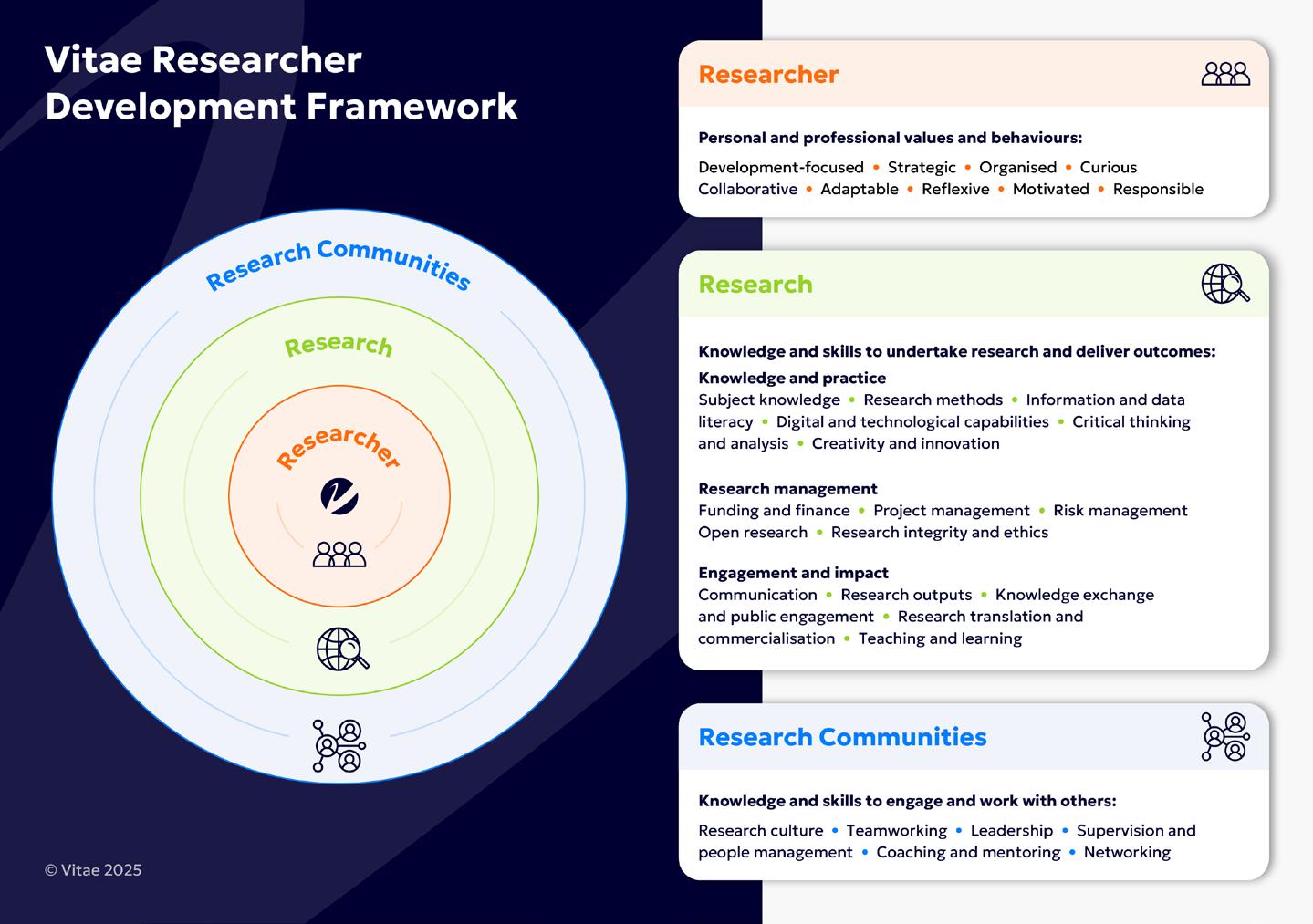
The Researcher Development Programme sessions are mapped in line with the new Vitae Researcher Development Framework (RDF), which is designed to articulate the values, skills and behaviours (“descriptors”) required to be an effective researcher.
The RDF is useful when building on your current strengths and considering the skills and experiences to enhance. It can be used to guide conversations with your supervisory team on your development journey, assist in setting goals and creating an action plan to becoming a well-rounded researcher. The RDF can help with articulating your skills and attributes in a language an employer will recognise on your CV, job applications and during interviews.
Researcher Development Programme (RDP) Development Needs Analysis (DNA)
The RDP consists of workshops, masterclass skill sessions, and online resources designed to support your independent learning and progress. Content is primarily produced and delivered by BU academic and professional services staff, as well as some external facilitators ( ) highly regarded in supporting postgraduate researchers. Different opportunities will be suitable for you at different stages, for your ease, workshops have been aligned with broad research degree stages (early, mid, final or all, p.14-15). These are only suggestions as you may be ready to engage with areas earlier or later than anticipated.
Early: Full-time: Year 1 | Part-time: Years 1-2.
Mid: Full-time: Year 2 | Part-time: Years 2-4.
Final: Full-time: Year 3 | Part-time: Years 4-5.
It is important to consider the skills you could need for the next stage of your research. Many sessions may only be delivered once per academic year, so planning ahead is required. For Masters students this is even more important as your time frame is much shorter.
Help shape your Researcher Development Programme
It is encouraged, in collaboration with your supervisory team, that you undertake an annual DNA to recognise your strengths and areas for development.
This can be used by yourself to monitor your development and uploaded as part of your Annual Review. Your DNA can be a personal record of progress, backed up by evidence.
Once you have identified some gaps in your skills, or an area where skills could be enhanced, identify which workshops, resources or event can best address your needs. To help with this, the RDP and DNA mirror the Vitae Researcher Development Framework as described on p.4
A DNA template can be found on the RDP Brightspace unit under the Welcome section: brightspace.bournemouth.ac.uk/d2l/home/25425
You can feedback on all aspects of the RDP via the anonymous online feedback form in the Brightspace RDP unit under ‘We’d Love Your Feedback’. You will also receive an email inviting you to feedback after any RDP session attended, this helps maintain the quality, nature and direction of the programme.
Wellbeing support
Health and Wellbeing: Whether you need help adjusting to university life, or just want to talk about how you are feeling, there’s always support available: www.bournemouth.ac.uk/students/health-wellbeing
Faith & reflection offer confidential and non-judgemental support, guidance, prayer and a listening ear, regardless of whether you have faith or not. www.bournemouth.ac.uk/faith-reflection
SportBU is great if you are looking to get active. They have a range of exercise classes for all levels, a well-equipped gym and professional guidance from their friendly staff: www.bournemouth.ac.uk/sportbu
The Wellbeing Thesis is an online resource for postgraduate researchers to support your wellbeing, learning and research: www.thewellbeingthesis.org.uk
University Front Room: If you are struggling to cope and feel yourself reaching crisis point, the University Front Room, based on Talbot Campus, provides a confidential, safe and welcoming space where you can speak to support workers, volunteers and peer specialists. www.bournemouth. ac.uk/students/health-wellbeing/university-front-room
Additional support
While the RDP is a bespoke programme for postgraduate researchers, please also consider the wider range of support and sources of information available to you throughout BU.
Additional Learning Support is available to all BU students, on or off campus. If you have a condition which is likely to affect your personal learning, please do not hesitate to get in touch with this supportive team: www.bournemouth.ac.uk/why-bu/student-wellbeing/additional-learning-support
Brightspace is our Virtual Learning Environment. On here you have access to a huge range of additional resources, information, communities and support. Log on using your student email and password and explore what’s available to you: brightspace.bournemouth.ac.uk
CareersBU can provide individual support for your career now and after graduation. Further information here: https://www.bournemouth.ac.uk/students/help-advice/looking-support/careersbu-support
Doctoral College Brightspace Community aims to make finding information and support relating to postgraduate research easier for you. With details on key contacts, policies, student support, events and much more, check it out: brightspace.bournemouth.ac.uk/d2l/home/25416
The IT Learning Resources offers a broad range of digital skills training and statistical support. They have a one-to-one support system and a drop-in service. Find out about their extensive service: brightspace.bournemouth.ac.uk/d2l/home/18313
Languages@BU is a free service offering the opportunity to independently learn a new language from scratch or brush up existing skills including English language: brightspace.bournemouth.ac.uk/d2l/home/141283
Early Career Researcher Network
The Early Career Researcher Network (ECRN) is for all researchers who are, or who feel they are, at the beginning or in the early stages of their research career.
The network was established to bring researchers together, to make connections, provide support, and to facilitate collaboration on research projects. The network aims to offer general advice and support, as well as tailored workshops for skills training and career development.
To join the network, email researcherdevelopment@bournemouth.ac.uk
Research Culture and Community Grant
Aimed at supporting PGR-led social and/or academic events.
This grant, offered by the Doctoral College, can be used to fund a social event, training activity, analysis workshop, digital skills session, writing session or other activity to enhance the PGR journey experience. In addition to community building, the purpose of the grant is to enable PGRs to gain transferable skills and experience in planning, organising, promoting and implementing such activities.
Further information on how to apply: www.brightspace. bournemouth.ac.uk/d2l/le/lessons/25416/lessons/1877833
Postgraduate Research Representation
PGR Reps volunteer their time and are elected by their peers to help make University life the best it can be, by collecting feedback from their PGR colleagues, representing these views with the University and SUBU, and sharing what’s happened as a result of giving this feedback.
If you would like to find out more about what’s involved in being a PGR Rep visit the SUBU website: www.subu.org.uk/represented
For details on your school PGR Reps, please visit Student Voice on the Doctoral College Brightspace community: brightspace. bournemouth.ac.uk/d2l/home/25416
BU Postgraduate Research Society
The BU Postgraduate Society is peer-led and offers a space for BU PGRs to develop, collaborate, have fun and learn from each other in a relaxed and social environment to build a community of word-class researchers.
For more details and how to join visit: www.subu.org.uk/organisation/pgrsoc/
Induction and re-orientations
The Doctoral College deliver a long induction schedule which spans the duration of your research degree to ensure you have appropriate and timely information at key transition points.
Getting started:
Induction
This induction for new PGRs is complementary to your faculty welcome for new PGRs and provides you with information to get started on your research degree with us. You’ll also find out about the support services and opportunities available to you during your time at BU.
This is an opportunity to meet and network with your PGR community.
If you have not attended an induction please contact researcherdevelopment@bournemouth. ac.uk and they can invite you to the next event.
Maintaining progress:
Re-orientation
This annual re-orientation is an opportunity for PGRs approaching their Major Review to hear about updates including those in the RDP and wider BU services.
You will be able to consider research ethics at this mid-point stage and there will be a bite-sized milestone preparation for the Major Review.
If you are unable to attend this re-orientation you may wish to look at the full milestone preparation: Major Review workshop (page 28).
Final stages:
Re-orientation
This annual re-orientation is an opportunity for PGRs approaching their Viva Voce examination to hear about updates including those in the RDP and wider BU services.
You will be able to consider research ethics and data management and what this means towards the end of your research degree. There will be a bitesized milestone preparation for the Viva Voce examination.
If you are unable to attend this re-orientation you may wish to look at the full milestone preparation: Viva Voce examination workshop (page 28).
Postgraduate Research Conference and other events
Annual Postgraduate Research Conference
An interdisciplinary event that offers the opportunity to disseminate and discuss your research via various platforms including oral and poster presentations.
While the conference is formal, it takes place in a relaxed and supportive environment providing the perfect opportunity to develop presentation, communication and networking skills. The call for abstracts is a competitive process, however we endeavour to display as many submissions as possible.
Postgraduate Research Showcase
This is a further opportunity to exhibit your posters within the wider BU community. A selection of the posters exhibited at the Annual Postgraduate Research Conference are displayed in the Atrium Gallery on Talbot Campus.
3C Events - PGR Culture, Community & Cake
All PGRs and Supervisors are invited to participate and contribute to these enriching and delicious gatherings. These social events are a catch-up opportunity to meet informally and make new connections over some cake.
3MT Competition
The Three Minute Thesis (3MT®) is an internationally recognized research communication competition that challenges doctoral researchers to condense their thesis into a compelling three-minute presentation, communicating its originality and significance to a non-specialist audience.
These events bring together your PGR community and support a positive research culture, whilst developing your research and transferable skills.
Event details are available under PGR Culture and Community in the Doctoral College Brightspace Community: brightspace.bournemouth.ac.uk/d2l/home/25416
If you are using any fantastic online resources for your researcher development please let us know so we can share them on Brightspace.
The Researcher Development Programme offers you workshops (online and in-person) and masterclasses throughout the year to support your academic, research and professional development.
Details on how to access the training sessions will be sent to you in your Eventbrite confirmation and reminder emails. Please take care entering your email address when registering as this is where the training sessions details will be sent.
On-demand Resources
We also provide a range of on-demand courses designed to help you further develop your skills and knowledge flexibly, at a time and pace that works for you. See On-demand Sessions brightspace. bournemouth.ac.uk/d2l/le/lessons/25425/units/2418828 and Other Online Resources brightspace.bournemouth.ac.uk/d2l/le/ lessons/25425/units/96079
University of East Anglia online training programme
BU subscribes to an online training series provided by the University of East Anglia (UEA) that offers research and professional skills training to all PGRs via a virtual classroom.
See page 41 for more information.
The scheduling arrangements may be particularly well suited to part-time PGRs.
Quick start guide
Booking Sessions
Step 1
Log on to Brightspace
Step 2
Find Doctoral College: Researcher Development Programme
Professional etiquette
It is important you take responsibility when booking and attending sessions. Please consider the following:
Arriving late: Unless pre-arranged, arriving late is not permitted and nonattendance will be recorded.
Reasonable adjustments
If you require any reasonable adjustments to enable you to fully participate in RDP sessions, please highlight these on the Eventbrite order booking form for our attention. Please note we will likely need to disclose this to the session facilitator to best support you.
Step 3
Click ‘workshops & masterclasses’ in quick links
Step 4
Find session using the ‘search topics’ function or by scrolling down
Non-attendance: If you have booked onto a session and can no longer attend or have changed your mind, please cancel your booking, providing at least 24-hours notice.
Cancelling bookings
Step 1: Log in to Eventbrite.
Step 2: Go to ‘manage order’ and select cancel.
Or email us and we can cancel for you: researcherdevelopment@bournemouth. ac.uk
Attendance
Attendance will be recorded and data shared with the Faculty upon request. In accordance with the Concordat to Support the Career Development of Researchers, Researchers must engage in a minimum of 10 days (70 hours) professional development pro rata per year. How this looks will be individual to your needs.
Certificates
We can provide a certificate of recognition if you have engaged in researcher development managed by the Doctoral College.
Step 5
Select the session, click on the date under ‘Register Here’ and follow the Eventbrite instructions.
18 Creating an academic poster
18 Critical appraisal of qualitative research papers
19 Demonstrating research impact
19 Developing a search strategy
20 EndNote desktop as a research tool
21 Entrepreneurship in research: An introduction
21 Ethics: Values, standards & BU process
22 Figures, images & visualising information
22 From PhD to Postdoc: Exploring fellowships and career opportunities
23 Generative AI & the researcher: the AIR framework
23 Innovation, collaboration & business insights
24 Integrating GenAI in your research: A practical guide
24 Intellectual property and your research
25 Introduction to education practice for PGRs
26 Job interview skills for researchers 27 LinkedIn & personal branding
27 Managing your research project 27 Methodology 1: What is methodology?
27 Methodology 2: Methods chapter
28 Milestone preparation: Probationary Review
28 Milestone preparation: Major Review
Workshops & Masterclasses
28 Milestone preparation: Viva Voce examination
29 Networking for researchers: Building professional relationships with confidence
29 NVivo: Day 1- Setting up your qualitative database
29 NVivo: Day 2- Analysing your data
30 Originality & plagiarism in research
30 Planning & writing your thesis
31 Planning & writing your integrated thesis
31 Presentation skills for researchers
32 Productive writing: Techniques, planning and finishing
32 Publishing your research: Mastering journal paper writing (SSH)
33 Publishing your research: Mastering journal paper writing (STEM)
34 Quantitative statistical analysis programme (with SPSS or JASP or R)
35 Research data management: An introduction
35 Research design: Mixed-methods research
36 Research methods: An Introduction to qualitative research methods
37 Research methods: An Introduction to quantitative research methods
37 Research Philosophy: An introduction
38 Scientific writing: structure, language & style
38 Thesis writing bootcamp
39 Time management: motivation & prioritising
39 Working with your supervisors
40 Writing an effective abstract (SSH)
40 Writing your literature review
41 UEA Online Training Series
Academic CV vs Industry CV Academic writing: Reduce anxiety
In academic writing, critical thinking plays a crucial role, and the workshop is specifically designed to cultivate this essential skill. By actively participating in the academic writing workshop through interactive discussions, participants will not only develop the confidence, clarity, and critical thinking skills necessary for successful academic writing but also gain a strong foundation in creating a well-structured and compelling discursive framework for a thesis chapter or paper.
Writer’s block is a common challenge. That’s why this session incorporates self-compassion strategies to address this issue. Cultivating a supportive and understanding mindset will help you navigate writer’s block with kindness and patience but also boosts your self-confidence.
Intended Learning Outcomes
Developing a discursive analysis
Overcoming writer’s block
Structuring, developing a writing style and editing
Intended Learning Outcomes
Understand the purpose of a CV in different sectors.
Recognise the key differences between industry and academic CVs.
Translate research skills into language that works for industry recruiters.
Practise drafting tailored CV content for two different career paths.
Clinical research: Sponsorship and governance
Commercialising your research
Intended Learning Outcomes
Understand different types of clinical research and organisation involved.
Understand what clinical research governance is, and its importance.
Understand the process and requirements for gaining compulsory external approvals.
Know about wider training on offer
Intended Learning Outcomes
From Idea to Impact - Introducing the concept of research commercialisation.
Protect and prepare - Protecting ideas, confirming ownership and testing commercial potential.
Choosing the Route - How to decide which route best fits your research outcomes.
From Agreement to Impact - Guiding researchers through what happens once the route to exploitation is chosen.
Creating an academic poster
Critical appraisal of quantitative and qualitative research papers
Intended Learning Outcomes
Understand the context and features of an academic poster.
Understand the design features and underlying concepts.
Understand the appropriate use of visual materials.
Understand techniques related to creating flow and impact for posters.
Unlock the secrets to writing a compelling abstract that will get your poster accepted.
Thinking about submitting a poster to the Annual PGR Conference?
Why not pop along to this session for some tips from a previous conference poster winner?
See page 11 for more details on the Annual PGR Conference.
These interactive sessions will equip you with practical skills to critically appraise research papers and make informed judgements about their quality and applicability.
Critical appraisal of quantitative research papers (brightspace.bournemouth.ac.uk/d2l/le/lessons/25425/ topics/1429411)
Critical appraisal of qualitative research papers (brightspace.bournemouth.ac.uk/d2l/le/lessons/25425/ topics/326947)
Intended Learning Outcomes
Understand principles of critically appraising qualitative research papers.
Appraise the quality of each section of a qualitative research paper in relation to the purpose of that section and evaluate the overall strengths and weaknesses of the paper.
Assess the relevance of research papers to your own research and literature reviews.
Demonstrating research impact
Intended Learning Outcomes
Understand what is meant by impact, why it is increasingly important and the pathways to achieving it.
Gain insights into the perspective of research funders on impact.
Identify the different types of impact, through a series of concrete examples.
Think about planning an impact strategy, in the context of your own research.
Need a little help searching for literature to critique?
Don’t worry, help is available.
Why not attend a ‘developing a search strategy’ session (page 19), check out the ‘finding information’ library guide (libguides. bournemouth.ac.uk/finding-information), or make a one-to-one appointment with your Faculty Librarian (page 20).
Developing a search strategy
Intended Learning Outcomes
Use and access BU Library resources.
Learn the fundamentals of database searching using advanced database searching.
Receive an overview of BU’s Library resources in your subject area.
Receive an introduction to citation tracking using Web of Science and Scopus databases.
Discover how to make interlibrary loan requests for papers BU doesn’t have access to.
Missed this session? Don’t worry.
You can explore the ‘finding information’ library guide: libguides. bournemouth.ac.uk/finding-information (website), and also make a one-to-one appointment with your Faculty Librarian (page 20) who is happy to help.
Faculty Librarian Teams
Your Faculty Library Team is always available to help you regarding library resources, finding information, clarification about thesis submission, copyright and other queries you may have.
Contact them using: FacultyLibraryTeam@bournemouth.ac.uk
Intended Learning Outcomes
Understand how to build a library of references.
Learn how to manage your search results using EndNote.
Learn how to create citations and build a reference as you write with Word.
Can’t attend this session or looking for follow up materials?
Check out the ‘EndNote’ library guide libguides.bournemouth.ac.uk/endnotedeskstop
Entrepreneurship in research: An introduction
Intended Learning Outcomes
Understand the entrepreneurial process, including how to evaluate business ideas
The skills and types of entrepreneurs
How to prepare a business plan and raise appropriate financial capital.
Ethics: Values, standards & BU process
For more information on research ethics, governance and integrity visit: www.bournemouth.ac.uk/research/researchenvironment/research-governance-integrity
Intended Learning Outcomes
Understand research ethics and ethical principles and conduct.
Understand the practical elements and procedures involved in good ethical practice in research.
Understand the process of gaining ethical approval at BU.
Figures, images & visualising information
Displaying information in a visual format is an excellent way for researchers to communicate their work. You can enhance your research papers, thesis, conference posters, presentations and public engagement activities with accurate and clear visual representations.
Intended Learning Outcomes
Introduction to the principles of good information visualisation.
Match data types and research goals to effective graphic forms.
Choose software tools for efficient, reproducible workflows
Please read the instructions carefully on Brightspace prior to clicking the registration/enrol link.
From PhD to Postdoc: Exploring fellowship & career opportunities
This session is designed to empower participants with a comprehensive understanding of postdoctoral fellowships and their role in shaping academic and research careers.
Intended Learning Outcomes
Understand postdoctoral fellowships and career opportunities
Learn practical skills for applying to postdoctoral positions
Understand expectations and responsibilities of a postdoctoral researcher
Generative
AI & the researcher: the AIR framework
NEW for 2026-27
Innovation, collaboration & business insights
Participants will be given access to AI & ME, Electv’s directory of AI tools mapped to specific research tasks, enabling researchers to identify and compare tools relevant to their own work. The workshop also emphasises responsible and documented AI use via the AIR Framework, a structured approach developed by Electv for recording how AI has been used at each stage of a research project.
Intended Learning Outcomes
Understand what AI tools are and recognise the different ways they can be used.
Explore a range of AI tools and learn how to incorporate them into different stages of the research process.
Critically discuss the ethical issues, challenges, and limitations associated with using AI in research.
Access a curated AI tools database comparing more than 40 tested tools, and learn how to select appropriate tools for research needs.
NEW for 2026-27
The modern research environment is increasingly calling for academics to engage beyond the university, with businesses, government and other external organisations.
What is innovation and how can it be applied to research projects? How do you identify and engage with relevant external organisations? What skills do you need to develop? Where do you find funding to support you?
Intended Learning Outcomes
Understand the key issues and challenges presented in a business case study through discussion and reflection.
Understand how researchers engage and collaborate with external organisations.
Have an overview of the commercialisation process and the pathways through which research can generate broader impact.
If you missed this workshop, on-demand modules will be available on Brightspace.
Integrating GenAI in your research: A practical guide
Intellectual property and your research
Intended Learning Outcomes
Understand the potential applications of GenAI in diverse research domains.
Identify suitable GenAI tools for your specific research projects.
Gain hands-on experience in implementing basic GenAI tools.
Develop a roadmap for incorporating GenAI into your research methodologies
For more information, resources and guidance on the use of Generative AI (GenAI) tools visit: www.brightspace. bournemouth.ac.uk/d2l/le/lessons/25416/units/2204626
Intended Learning Outcomes
Understand the key concepts within intellectual property law relating to academic research, being copyright, trade mark, patent and design rights.
Explain how intellectual property relates to academic research, considering your own intellectual property, and the intellectual property of others.
Apply this knowledge, in developing best practices to maximise your own intellectual property protection and any potential commercialisation.
Introduction to education practice for PGRs
Intended Learning Outcomes
Understand a variety of effective learning and teaching styles.
Appreciate the differences between teaching/engaging small cohorts and large cohorts.
Feel confident with regard to undertaking assessments and providing feedback.
Integrate learning technologies within your teaching.
Plan and execute your own teaching sessions.
Teaching at BU
Teaching and demonstrating is recognised as a valuable part of development as a PGR but teaching or demonstrating commitments should not be so onerous that they detract from the research. In line with Research Councils, PGRs should not exceed six hours teaching time in any week during semester time.
The provision of teaching or demonstrating is the responsibility of the faculties and is paid for at the normal BU rate. PGRs who wish to teach or demonstrate must first complete the BU Introduction to Education Practice for PGRs, which is delivered as part of the Researcher Development Programme.
Full details are given in Appendix 2: Guidelines for the Employment of PGRs for Teaching or Demonstrating. The same approach would normally apply to any research assistant activity.
Extract from the Code of Practice for Research Degrees 202627.
Job Interview skills for researchers LinkedIn & personal branding
NEW for 2026-27
Intended Learning Outcomes
Recognise the differences between interview formats used in academic and non-academic settings and prepare accordingly.
Structure clear, evidence-based responses to competency and behavioural questions using frameworks such as STAR.
Communicate their research experience, skills and achievements to a range of audiences and panels.
Apply strategies for managing interview nerves, handling difficult questions and making a strong overall impression.
Intended Learning Outcomes
NEW for 2026-27
Understand what personal branding means in a research context and begin to articulate their own professional identity.
Build or significantly improve a LinkedIn profile that reflects their research background and career aspirations.
Apply practical strategies to grow their professional network and increase visibility within relevant academic and industry communities.
Create and share content that positions them as a credible and engaged professional in their field.
Managing your research project
Intended Learning Outcomes
Understand why project management is important for PGRs.
Experience the use of relevant project management tools within a research context.
Explore how to identify and manage project risks.
Understand how to plan your research to improve your chances of completing on time.
Did you know the Association for Project Management offers free membership to all students?
Methodology 1: What is methodology?
Intended Learning Outcomes
Examine the overall view of methodology.
Decipher the differences between key research terms.
Start to develop a research framework.
Methodology 2: Methods chapter
Intended Learning Outcomes
Define the main constituent parts of a research chapter.
Explore possible research approaches for your study.
Gain an overview of research design.
Milestone preparation: Probationary Review
Milestone preparation: Major Review Milestone preparation: Viva Voce examination
Intended Learning Outcomes
Understand the purpose of the Probationary Review.
Have confidence preparing for your Probationary Review.
Understand the wider process in relation to your research.
Understand how to submit your Probationary Review.
Intended Learning Outcomes
Understand the purpose of the Major Review.
Have confidence preparing for your Major Review.
Have awareness of the role of the independent academics.
Have appreciation of the role of the supervisory team in the process.
Understand how to submit your Major Review.
Intended Learning Outcomes
Understand the purpose of a Viva Voce examination.
Understand the process for thesis submission, Viva Voce examination and completion.
Plan the steps you might take in preparing for your Viva Voce examination.
MRes students can benefit from a dedicated workshop addressing the unique aspects of the MRes viva.
Unable to attend a milestone preparation session?
There is another opportunity to receive this information, at our annual re-orientations. See page 10 for more information.
Networking for researchers: building professional relationships with confidence
NVivo: Setting up a database & analysing data
Intended Learning Outcomes
Explain the value of professional networking at different career stages and across sectors
Develop a networking strategy tailored to their career goals and communication style
Use practical techniques to initiate, maintain and develop professional relationships
Navigate common networking challenges, including conferences, cold outreach and informal academic events.
Intended Learning Outcomes
Understand advantages and limitations of using computer software for qualitative data analysis.
Set up a database, import and code data.
Understand the potential of NVivo tools for organising, questioning, interrogating and reporting on data.
Understand the capabilities of NVivo in the context of coding, retrieval, analysis and reporting on primary research data.
After attending both full days you will enjoy free and unlimited, online, one-to-one support for the life of your first project using NVivo.
Originality & plagiarism in research
Intended Learning Outcomes
Understand why plagiarism is more common in postgraduate research work.
Learn how to check the originality of your work and to reference consistently and well.
Learn about the importance of copyright and receiving 3rd party permissions so your work can be published.
Understand why Open Access is vital.
Planning & writing your thesis
Book an appointment with your Faculty Librarian for one-to-one support on copyrights and referencing. See page 20 for details.
Intended Learning Outcomes
Understand the generic ‘logical’ thesis structure and potential chapter contents.
Know how style of writing differs according to research types. Recognise the importance of organising communication and feedback from your supervisors.
Know what to consider when deciding whether your thesis is ready for submission and what examiners are evaluating.
Planning & writing your integrated thesis
Presentation skills for researchers
Intended Learning Outcomes
Understand how to create a coherent thesis using the integrated thesis format.
Understand the importance of copyrights and avoiding plagiarism.
Understand the multi-layered relationship with supervisors in the integrated thesis and how to manage this.
Know what to consider when deciding whether your integrated thesis is ready for submission and what examiners are evaluating.
Researchers are frequently required to communicate their information verbally, whether it is an oral presentation, in a meeting or an interaction at a conference. Public speaking and networking are key components to a successful career, both within academia and beyond.
Intended Learning Outcomes
Be introduced to a series of techniques to aid and structure your presentations.
Have an understanding of how to present and engage with various audiences.
Gain confidence with regard to delivering effective presentations.
Be introduced to a range of writing productivity techniques.
Plan out a manuscript from scratch.
Discuss various writing challenges with your peers.
Initiate a work plan and set deadlines for your writing.
Intended Learning Outcomes
Understand the process of selecting a journal for your manuscript
Be able to structure manuscripts to the satisfaction of journal editors and reviewers
Learn writing techniques to sell your paper and its contribution to knowledge to your reviewers
Understand effective ways to handle reviews and reviewers
Why not create a BRIAN profile to share your researcher profile and widen your community and network?
If you have any queries, please have a look at the BRIAN quick start guide or email BRIAN@bournemouth.ac.uk
Publishing your research: Mastering journal paper writing (STEM)
Intended Learning Outcomes
Understand different types of journal papers across a range of journals
Identify the most appropriate journal for your manuscript
Understand the basis for writing a strong manuscript
Identify the best writing process for producing a strong manuscript.
Quantitative statistical analysis programme (with SPSS or JASP or R)
Masterclass Series
Fundamental Statistical Analysis
Session 1: Introduction to statistical analysis.
Session 2: Managing and manipulating data.
Session 3: Introduction to null hypothesis significance testing.
Session 4: T-tests.
Session 5: ANOVA.
Session 6: Correlation and regression.
Session 7: Non-parametric testing A.
Session 8: Non-parametric testing B.
Advanced Statistical Analysis
Session 9: Principle component analysis and exploratory factor analysis.
Session 10: Discriminant function analysis.
For full session details visit the RDP on Brightspace and search ‘SPSS’: brightspace.bournemouth.ac.uk/d2l/ home/25425
Research data management: An introduction
Intended Learning Outcomes
Describe the benefits of good research data management.
Consider and select appropriate information to include in a Research Data Management Plan.
Use online tools including DMPonline and BORDaR to support good research data management practice.
Research design: Mixed-methods research
DMPonline helps you to create, review, and share data management plans that meet institutional and funder requirements.
Intended Learning Outcomes
Explore the philosophical debates surrounding the design and development of mixed-methods research.
Discover multiple rationales for conducting mixed-methods research.
Develop an understanding of the practical strategies for conducting mixed-methods research.
Discuss the methodological challenges associated with using mixed-methods and if a mixed-methods approach might be suitable for your research.
Research methods: An introduction to qualitative research
Intended Learning Outcomes
Identify the key assumptions underpinning qualitative research.
Identify different methodologies which can be used in qualitative research.
Recognise the role of the researcher in qualitative research.
Have an awareness of the criteria for rigour in qualitative research.
Have a look at the On-demand sessions for more resources on Research Methods. For some topics, bespoke or ad hoc sessions can also be arranged upon request. brightspace.bournemouth. ac.uk/d2l/le/lessons/25425/units/2418828
Research methods: An introduction to quantitative research
Research philosophy: An introduction
Intended Learning Outcomes
Formulate a research question and understand aims and objectives.
Identify the main types of quantitative research design and appropriateness to answer research questions.
Recognise appropriate methods to present types of data.
Understand the stages in statistical testing and which tests are appropriate to use.
Intended Learning Outcomes
Understand the meanings of selected key terms in research philosophy.
Position your own research in relation to these terms and the debates around them.
Modules 2 and 5 of the University of East Anglia (UEA) Online
Training Series offer other training sessions on qualitative and quantitative research skills
Scientific writing: structure, language & style
Thesis writing bootcamp
NEW for 2026-27
Intended Learning Outcomes
Understand the expectations of academic writing in relation to style, structure, clarity, and conciseness.
Have an overview of the key stages involved in planning, structuring, and writing an original research paper.
Understand the principles of effective scientific writing through the analysis and discussion of selected examples.
Intended Learning Outcomes
Understand the working structure of a thesis.
Develop a greater awareness of the different stages of the writing process.
Understand techniques for planning your writing and being productive.
Explore how to manage your thesis writing to make a better use of time, resources and technology.
Increase your understanding of the pitfalls of thesis writing.
Time Management: motivation & prioritising
Intended Learning Outcomes
Understand how to apply time management techniques to your own personal working style.
Understand your priorities and how to optimise your time.
Learn a time management strategy that can be adapted on a regular basis to suit your workload.
Working with your supervisors
If you missed this workshop, on-demand modules will be available on Brightspace.
Intended Learning Outcomes
Increase awareness of various student-supervisor relationship challenges.
Have better understanding of the rules of engagement.
Increase your understanding of what motivates your supervisor.
Be introduced to some ways of improving relationships with supervisors.
Writing an effective abstract (SSH)
Writing your literature review
Intended Learning Outcomes
Define the key functions and purposes of an academic abstract.
Identify the essential components of an effective abstract (problem statement, significance, methods, findings, contribution).
Apply good practices in structuring and refining abstracts for different types of research outputs.
Critically evaluate abstracts against common review criteria.
Develop strategies for crafting engaging, searchable, and persuasive titles and abstracts that maximise reach and impact.
Intended Learning Outcomes
Understand the rationale and expectation of a literature review.
Place the literature review in context as part of your research.
Understand how to write your literature review in terms of structure and style.
Use practical tips to assist you throughout the literature review process.
University of East Anglia (UEA) Online Training Series
Module 1: Academic Writing
What Should a Literature Review Do?
Writing Effectively
Academic Publishing
Writing & Structuring an Effective Thesis
Module 2: Qualitative Research
Skills
Comparison of Qualitative Methods
Qualitative Interviewing
Analysing Qualitative Data
Using NVivo for Qualitative Research
Module 3: Finishing your PhD
Preparing for your Viva
Securing a First Academic Post
Preparing Impactful Research Proposals & Grant Applications
Conference Presentations
Module 4: Teaching Skills
Preparing & Delivering Seminars
Preparing & Delivering Lectures
Assessment, Feedback & Module Design
Module 5: Quantitative Research Skills
Quantitative Research: A Basic Guide
An Introduction to Scale Development
An Introduction to Structural
Equation Modelling
See UEA section on Brightspace brightspace.bournemouth.ac.uk/ d2l/le/lessons/25425/units/2224645
Staying informed
Never miss a Researcher Development update with these ways of staying in touch.
PGR Newsletter - Monthly update for Researcher Development, Culture & Community
A regular e-newsletter delivered to your BU email account providing you with updates on all RDP sessions, researcher development activities and opportunities, and information of interest to postgraduate researchers.
Brightspace announcements
Control how you receive notifications about activity in your units.
Click on your name in the top right of your Brightspace homepage. Select ‘notifications’
Social media
Doctoral College Bournemouth University
Download the Pulse App to help you stay connected and on track with your Brightspace courses.
BU Research Blog
Don’t miss a post!
Subscribe to the BU Research Digest, delivered freshly every day, for the latest research and knowledge exchange news at BU.
Feel free to get in touch with us if you have any questions, thoughts or ideas.