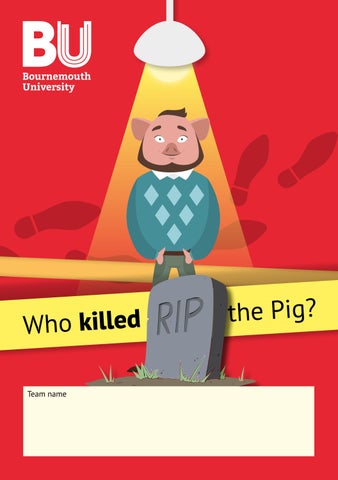
Who killed Team name
the Pig?
Welcome to our Forensic Science Workshop We are shocked to report that there has been a murder…and we’re going to need you to put your analytical and forensic skills to the test to identify the killer of Rip the Pig. Just like in a real-life crime scene, you will be able to incorporate the range of skills you would acquire in a number of our courses that should enable you to solve the crime. Our Forensic Investigation students (Crime Scene Investigators or CSIs) would learn about casing the crime scene, and apply their knowledge about preservation and contamination to find and recover the crime scene evidence. This evidence would then be processed and analysed by our Forensic Science students working in a lab. Our Forensic Science students would learn about analysing different forms of evidence based on their speciality e.g. document examiners, fingerprint analysts, forensic biologists and footprint/shoemark analysts. Scenarios that are different from the one you will be working on today may require different expertise, e.g. if a case involves remains that are much older or greatly damaged by the environment, a Forensic Archaeologist/Anthropologist would be required to assist in criminal and human identification cases. In today’s workshop, we will be playing the part of document examiners, footprint and shoe mark analysts, fingerprint analysts, forensic biologists and detectives. Who knew there were so many directions to take in just one subject area? So, let’s put these skills to the test – who did kill Rip the Pig?
Question time Which of these do you think a Forensic Odontologist looks at? A Finger and toenails B Teeth and bitemarks
C
Body hair D The role doesn’t exist.
Find out from our student ambassadors if your answer is correct.
Setting the scene Who killed Rip the Pig? Rip the Pig has been found dead in the house he shared with his wife, Sunny Bunny. Evidence shows that he died of an injury to the head at approximately 17:00hrs. Evidence • A ‘threatening’ note was found at the scene, which requires handwriting analysis to identify the author. • Shoeprints were found at the scene and were lifted for analysis. • Fingerprints were lifted from various items at the scene for comparative analysis. • Blood was found at the scene as well as a rolling pin which has suspected blood stains.
Did you know? Forensic scientists work with evidence and facts; they don’t accuse or investigate the actual crime. They use the evidence found at crime scenes to place people at the scene, which helps to understand how the crime was committed and provide extra information about the perpetrator(s).
Suspects Gallery The police have three suspects:
Blair Bear Rip the Pig’s friend Age: 28 Sex: Male Height: 180cm
Sunny Bunny Rip the Pig’s wife Age: 26 Sex: Female Height: 160cm
Funky Monkey Sunny Bunny’s colleague Age: 30 Sex: Male Height: 172cm
Handwriting analysis As a Forensic Document Examiner, your task is to conduct comparative analysis of the handwriting from the threatening letter found at the scene to handwriting samples from the three suspects to create a match. Forensic document examiners use their expertise to evaluate documents (written, typed or printed). Their evaluation doesn’t just involve authenticating signatures; they analyse all aspects of the document to understand it, as they may present evidence in court. They can be asked to determine the authenticity of legal documents (wills and contracts), compare handwriting to determine a match, as well as establishing if any alterations have been made to a document. They can also go into a speciality where they will describe the personalities of the individual who wrote the document through handwriting analysis. A number of our courses - such as Forensic Science, Forensic Investigation and Archaeological, Anthropological and Forensic Sciences – teach about the different aspects of the forensic document examiner’s role. Handwriting analysis – here’s a lowdown on some of the different features of handwriting you may come across: Slant
Right slant Usually associated with an eager to write quickly
Left slant Usually associated with an unwillingness to write, or desires to hide emotions
Upright Usually associated with an unwillingness to display emotion
Letter Shape/ Style
Garlands Cup shaped curves that are open at the top
Arcades Downward-facing curves (rounded at the top like a series of arches)
Angles: Sharpe points rather than curves
Size of Handwriting
Large Usually associated with putting on an act of confidence
Small Usually associated with reclusive behaviour and being withdrawn
Threatening letter
Sunny Bunny
Blair Bear Funky Monkey
Handwriting analysis: Who wrote the threat? Evidence
Slant
Size
Threatening note (author unknown)
Shopping list – Sunny Bunny
Birthday card – Blair Bear
Post-it note – Funky Monkey
Conclusion: Potential suspect(s):
Justification:
Letter shape
Spacing between words
Shoeprint Analysis As a Footprint and Shoe Mark Analyst, you will compare the evidence from the scene and the shoeprints that were obtained from the suspects to see if there is a pattern match. Footprint and shoe mark analysts come from a forensic science background with a special interest and knowledge of footwear marks found at a scene. Their role is to compare footwear marks, with control marks made by footwear taken from the suspect. Footwear impressions provide a useful source of evidence within various criminal investigations. They are categorised under ‘pattern evidence’ as they form a unique pattern specific to their brand, style and size. A potential suspect may leave foot or footwear impressions on their way to or when leaving a crime scene. This allows a sequence of events to be determined and can also link a suspect to a scene if their footwear is distinctive e.g. if it has clear markings as a consequence of damage or wear. The patterns can be even more unique with our individual characteristics, for example, people with high arches or whose feet ‘roll inwards’ will have a unique wearing pattern on the soles of their shoes. Forensic scientists who are specifically involved with shoeprint and footwear impression analysis would have been trained in it, based on their degree background.
Did you know? In the mid-1800s, a scientist called Topinard developed a mathematical formula for estimating a person’s height from a footprint (called the foot length : stature ratio). The ratio was determined to be 15%.
A number of our courses – such as Forensic Science, Forensic Biology, Forensic Investigation and Archaeological, Anthropological and Forensic Sciences – teach the different aspects of the footprint and shoe mark analyst’s role.
Evidence
Features of shoeprints (shape, patterns, wear, damage, size etc)
Shoeprint one found at crime scene Shoeprint two found at crime scene Shoeprint three found at crime scene Sunny Bunny’s shoes Blair Bear’s shoes
Funky Monkey’s shoes
Estimate shoe length of the suspects (in centimetres) based on their height – show your calculations here using a reverse of Topinard’s formula i.e. multiply their height by 0.15.
Conclusion – Potential suspect(s) and justification:
Fingerprint analysis As a Fingerprint Analyst you will use equipment and information provided to ascertain who the fingerprints found at the scene belong to. Fingerprint analysts come from a forensic science background and require important knowledge of the ridge patterns found on fingertips. Their role is to use their knowledge to compare fingermarks found at a scene to fingerprints that have been obtained from the suspects at the police station. Fingerprints of an individual are unique, unlike any other person and do not change over time. This makes them an ideal piece of evidence to examine during a criminal investigation. It’s key to know that prints found at a crime scene are called ‘fingermarks’. They differ to ‘fingerprints’ as whoever left them is unknown at first, they’re lifted/recorded at the scene and may not be in perfect condition. These require special recording and enhancing tools to obtain the fingermarks from the crime scene with as much precision as possible. The following are the three types of fingermarks left at a scene: Latent
Not visible to the naked eye, will require a specific powder (aluminium or black) or a fluorescing chemical to enhance it enough to be recorded
Patent
Visual to the human eye, can be made by blood, grease, ink or dirt.
Plastic
Visual to the human eye, are three-dimensional impressions that can be made by pressing fingers in fresh paint, wax, soap or tar.
Did you know? There is a genetic condition where someone is born without fingerprints. It’s known as Naegeli syndrome!
A number of our courses – such as Forensic Science, Forensic Biology, Forensic Investigation and Archaeological, Anthropological and Forensic Sciences – teach about the different aspects of the fingerprint analyst’s role.
What you need to know today as fingerprint analysts is that there are three basic types of ridge patterns that people may have:
Whorl Evidence
Arch
Features of fingerprint
Fingerprint on BU branded mug
Fingerprint on a kitchen rolling pin
Conclusion – Potential suspect(s) and justification:
Loop
Blood splatter analysis Your role today as a Forensic Biologist is to investigate the blood spatter patterns left at the scene and critically analyse what type of instrument was used and which hand wielded it. Forensic biologists as a whole examine far more than just blood; they can examine other bodily fluids, hair, bones, insects and plant and animal remains to assist in the identification of victims and supporting the criminal investigation. They test for DNA, drugs, any form of gunshot residue and far more. There are often forensic biologists that specialise in one area such as bloodstain patterns or DNA analysis. Looking at blood – how and where it lands, the consistency, the size and shape of the droplets – can all give clues about what happened at a crime scene. Investigators can determine the type and velocity of a weapon, the order of wounds inflicted, whether death was immediate and the position of the victim and the assailant in addition to lots of other factors.
Our courses in Forensic Biology, Forensic Investigation and Forensic Science teach about the different roles a forensic biologist can have in a criminal/forensic investigation.
Did you know? Bloodstain Pattern Analysis (BPA) is far older than people usually think. The first surviving modern study of BPA occurred in 1895 by Eduard Piotrowski from the University of Krakow!
The width and length of a elliptical bloodstain allows for the calculation of the angle of impact of the original blood drop.
width (mm) length (mm)
= ratio
2. Press ‘shift’ button 3. Press ‘sin’ button (you will get ‘sin-1’) 4. Type in the ratio
Length
1.
Direction of travel
The width is divided by the length to produce a ratio number.
A 3D origin of pattern can be determind using projected strings and a protractor to measure impact angles and determine height. Width 1. Determine the direction of travel 2. Calculate angles of drops of blood 3. Stick string to each drop and hold at the correct angle 4. Find the point of impact where the strings meet
Angle of impact
Conclusion – The blood splatter analysis indicates that:
Projected string
Towards point of convergence
Interrogation notes As a Detective you will be collecting information from the suspects and the results from the forensic scientists and analyse them to uncover the truth. Part of this requires interrogating the suspects to know more about them, their links with the victim and their whereabouts. This, in addition to the forensic evidence, allows you to make educated decisions about ‘the who, what, where and why’. Detectives deal with very serious and complex investigations; these investigations can be varied from serious assaults and domestic abuse to fraud, burglary and homicide (and much more!). Being a detective is all about uncovering the truth, which is not an easy task to do. Detectives are expected to compile and analyse the recorded evidence from a case, interview persons of interest (witnesses and suspects) and keep meticulous records during the investigation. They even testify in court and often arrest and charge the perpetrators of the crime. Although their role is key in an investigation, they are supported by the CSI and forensic roles in an investigation; so all are equally important.
Blair Bear Do you know of anybody close who might have wanted to harm Rip the Pig?
When did you last see them?
How do you know Rip?
When did you last see him?
Where were you at the time of Rip’s death?
Are you right or left handed?
Sunny Bunny Do you know of anybody close who might have wanted to harm Rip the Pig?
When did you last see them?
How do you know Rip?
When did you last see him?
Where were you at the time of Rip’s death?
Are you right or left handed?
Funky Monkey Do you know of anybody close who might have wanted to harm Rip the Pig?
When did you last see them?
How do you know Rip?
When did you last see him?
Where were you at the time of Rip’s death?
Are you right or left handed?
Notes:
Conclusion:
Bournemouth University course information BSc (Hons) Archaeological, Anthropological & Forensic Sciences BSc (Hons) Forensic Biology BSc (Hons) Forensic Computing & Security BSc (Hons) Forensic Investigation BSc (Hons) Forensic Science BSc (Hons) Psychology with Forensic Investigation BA (Hons) Sociology & Criminology
www.bournemouth.ac.uk
9592
Contact us: Tel: +44 (0)1202 961916 Email: futurestudents@bournemouth.ac.uk