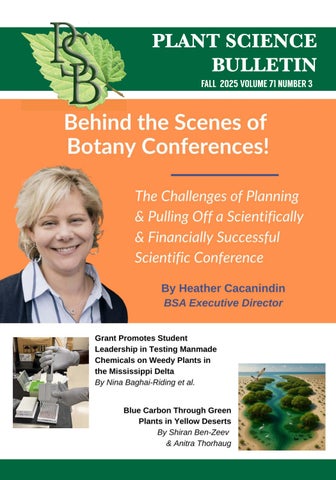
PLANT SCIENCE BULLETIN FALL 2025 VOLUME 71 NUMBER 3 A PUBLICATION OF THE BOTANICAL SOCIETY OF AMERICA
FROM the EDITOR
Greetings, botanists! You may notice we are a bit late with this Fall issue, it feels like a lot longer passed since I caught up with our membership at Botany 2025. If you attended the conference, I hope you had a good time and enjoyed this chance to meet new people, network, and get new ideas for your research. I also hope you enjoyed the beautiful desert and mountains around Palm Springs! Still riding on the Botany wave, we have a very special article in this issue by Heather Cacanindin, BSA’s Executive Director, about the work behind planning and running our conferences. We are also offering two articles: one on experimental work on a classroom setting in a small state university and another on the possibility of creating man-made mangroves as a carbon sink. As always, our book reviewers have been busy; we have 15 book reviews in this issue! I want to highlight Dorothea Bedigian’s extensive review on plant toxins, highlighting the effects of urushiol and the interesting ways species of Anacardiaceae cause cross-reactivity issues. I hope you enjoy reading this issue as much as I enjoyed it, and that the end of the year goes smoothly for all! See you soon!
Fall 2025 Volume 71 Number 2
PSB 71 (3) 2025
TABLE OF CONTENTS
SOCIETY NEWS
Botany 2025: Behind the Scenes ...............................................................................................................138 Botanical Society of America’s Award Winners (Part 2) ...............................................................143
SPECIAL FEATURES
Blue Carbon Through Green Plants in Yellow Deserts..................................................................149 INBRE Grant Promotes Student Leadership in Testing Manmade Chemicals on Weedy Plants in the Mississippi Delta............................................................................................156
MEMBERSHIP NEWS
Together We Did It! Thank You for Making the Second Annual “A Day for BSA” a Success! ................................................................................................................164 Celebrating 50 BSA Spotlights!...................................................................................................................164 Membership Dues Updates for 2026........................................................................................................165 Here are the latest Spotlights .......................................................................................................................165 Your BSA Benefits in Action!........................................................................................................................166 Support Graduate Students with Year-End Donations to the GSRA Fund – Donate today!............................................................................................................................168 Help Us Reach Our Goal of 100 Gift Memberships by December 31st!...............................168 3-Year Memberships Stay connected at a discount! ......................................................................168
SCIENCE EDUCATION
Nominations for 2025 Bessey Award.......................................................................................................170 Impacts of PlantingScience on Students’ Motivation to Study Plants ...................................170 PlantingScience Session Update - Fall 2025.......................................................................................171 ROOT&SHOOT Updates: New article in eLife ...................................................................................172
STUDENT SECTION
Botany 2025 Recap............................................................................................................................................174
ANNOUNCEMENTS
Plant Science Scholarships for 2026-2027 Announced by Cleveland’s Western Reserve Herb Society.............................................................................................................................176
BOOK REVIEWS........................................................................................................................................177
https://2026.botanyconference.org 137
SOCIETY NEWS
PSB 71 (3) 2025
Botany 2025: Behind the Scenes
The challenges of planning and pulling off a scientifically and financially successful scientific conference PULLING OFF BOTANY 2025 IN A YEAR OF CHANGES After 25 years as Botany Conference Manager, Johanne Stogran retired following Botany 2024. We knew that this transition would be an important one for the conference because Johanne had so much historical knowledge from years of meeting improvements and innovations. Johanne was devoted to the BSA and Botany conference and we knew she would be hard to replace. BSA conducted a search for a new meeting planner and ultimately contracted with Burk & Associates Inc. (an Association Management Company with strong references from other scientific societies), with Lori Strong serving as our new Director of Conferences. With over 25 years of experience handling meetings, Lori transitioned into the role in October 2024. Outsourcing to an experienced firm has the benefit of having a “team” behind the Director of Conferences and it also saves the conference on personnel expense. By Heather Cacanindin BSA Executive Director hcacanindin@botany.org
Orienting a new Conference Director to a meeting of six scientific societies with all their nuances is no quick or simple task. Add to that situation a last-minute change in venue for Botany 2025 that was necessitated by the renovation of our contracted conference property in Tucson, Arizona. Finding a new space for a conference of our size can be quite challenging due to the number of meeting rooms required for concurrent sessions in addition to enough space to hold exhibitor booths and posters. In addition, we strive to keep the meeting space accessible and all under “one roof ” if possible to aid those with mobility issues. (This is one of the reasons why meeting at a university campus has become less desirable.) Over the span of just a couple weeks in November 2024, a new venue was identified, favorable contracts with Tucson for 2026 were finalized, new contracts for 2025 were signed, and our membership was apprised of the changes (meeting to be in Palm Springs, California). Due to the above circumstances, normal meeting challenges were amplified for the planning committee, which consists of the program managers and presidents of all six scientific societies represented at Botany conferences. One of the most pressing challenges for 2025 was a fiscal one. The rising costs of audio-visual (AV), food and beverage, and hotel room rates have made
138
PSB 71 (3) 2025 focused “food-centric” messages went out in the weeks before the conference so attendees would know all their options. Options include cash-and-carry stations, on-site eateries, local eateries, and nearby grocers
it quite challenging to run a financially successful medium-sized meeting (800–1200 attendees). A report by Global DMC Partners released the results of a 2024 survey of 165 event professionals, the majority of whom are based in the US and Canada. “The majority of planners report that costs have increased by 10 to 30 percent on average across various categories compared to two years ago. Specifically, significant cost hikes were noted in hotels/venues, food and beverage, airfare and ground transportation” (Banerji, 2024). Our Botany conference has indeed seen major increases in expense areas like AV, food and beverage, and venue rental since the pandemic.
• Charging fees for all workshops to defray (but not completely cover) the costs associated with them (these costs, which include AV, room charges, and coffee breaks, have previously been subsidized entirely by the conference; by charging fees, we are making these costs visible to attendees and exercising fiscal responsibility to all partnering societies, which share in profits or losses from the conference)
After incurring financial losses from each of the past three Botany conferences, it was imperative that Botany 2025 break even or potentially make a slight profit. It was clear to the planning committee that difficult decisions would need to be made. A financially viable budget was developed in consultation with leadership from all participating societies; it included cutting out some expenses while pursuing additional revenue, all while centering BSA’s commitment to its mission and its strategic priorities. Some changes included: • New Exhibitor Sponsorship Guide
Prospectus
• Making the Closing Reception a ticketed item, while allowing donations from attendees to defer the cost for students to this event. • Implementing “Botany Eats” as a new program. During registration, students could indicate that they had concerns about food insecurity and would welcome support. Botany conference purchased $50 gift cards for the grocery store down the street from the conference and provided those cards to 53 students who requested the assistance
&
• Sponsored Academic Displays for Colleges/Universities/Department Programs • Eliminating continental breakfasts Monday through Wednesday and snacks with coffee breaks
• Bringing in our own AV company to save on meeting WiFi and AV charges Just to give some perspective, some of the largest expenses for our conference in 2025 included:
• Information about food and beverages at the Botany conference were included in registration materials, and
• Food & Beverage: $180,000 • AV/WiFi: $90,000 139
PSB 71 (3) 2025 • Exhibit Hall Expenses (poster boards, booth set up, clean up, electrical): $28,000
• Wheelchair seating area marked and blocked out in each session room; these were in the rear of the rooms to make it easier to maneuver (we were unable to get those in the front of the rooms this year)
• Room/Space Rental in Hotel and Convention Center: $24,000 In the end, we held a meeting with over 1050 attendees and proved that even in the postpandemic world we could hold a scientifically successful and financially responsible conference. Botany 2025 made a small profit that will be shared among the society partners, with half the profit remaining in the conference bank account to offset the years with financial losses. Meeting attendance over 1000 helped to boost conference revenue overall, as did exhibitor and sponsor participation where revenue was 44% more than budgeted. (If there are companies you would like to see in the Exhibit Hall at Botany 2026 and beyond, please send that information to Lori Strong at lstrong@burkinc.com.) There were some new and notable adjustments to the conference in 2025, especially with a mind toward accessibility and inclusion issues: • Availability of a PDF of the conference program • Poster number labels that are larger, with wider spacing between poster rows • Quiet room/low sensory input room • Maps with accessibility features highlighted (including gender-neutral toilets, quiet room, medical/nursing room, etc.), available on website, app, and wayfaring signage on-site • Fridge in the registration office for medicine (or milk or formula)
• Use of closed captioning in PowerPoint The Conference website (https://www. botanyconference.org/) was also reorganized and revised for a cleaner look, and the conference logo received a revamp.
SURVEY REVEALS INSIGHTS In August of 2025, 30% of attendees took the post-conference survey with 86% rating the meeting in Palm Springs as “Excellent” or “Good.” From the comments, it appears that there were many positives. Attendees noted the excellence of some of the organized sessions and the diversity within the botanical sciences that is present at this joint meeting as well as the general respectfulness and friendliness of attendees. In the post-conference survey, one attendee expressed, “It was amazing! The community of people at the Botany meeting are some of the most caring, dedicated, positive scientists I have ever interacted with. There is a reason I have been coming to Botany conferences for the last fifteen years!” Several respondents also mentioned a visible effort by organizers to prioritize accessibility with the use of microphones, live captioning (despite its accuracy issues), inclusive bathrooms, etc.
There were also many comments to encourage improvements in future years. For example, the advertising pop-ups in the app were a pain. We hear you! While sponsor funding is critical to the success of the conference, adjustments 140
PSB 71 (3) 2025 are being made to ensure sponsor advertising does not impede the usability and efficiency of the conference app. Also, no more jingly, noisy lanyards next year. Those were fun sometimes, but rather distracting. Based on feedback from the last few conferences, we are also planning to add a Speaker Ready Room back to the reserved space for Botany 2026. This will be a place to check the slides that you have uploaded to ensure everything looks as it should and/or consult with a technician for help, if needed.
VIRTUAL MEETINGS
Looking toward future meeting locations, we have probed our members about the possibility of a virtual conference as part of the meeting rotation. Our survey results show that most attendees prefer face-to-face meetings rather than a virtual conference. Our attendees noted the networking, social interactions, and informal conversations at meals and breaks are irreplaceable. They also noted engagement challenges with virtual meetings. Respondents reported difficulties staying focused in virtual meetings with INFO ON BOTANY 2026 “Zoom fatigue” and lower levels of interaction As we begin planning the details for our return and community-building possibilities. Many to Tucson in 2026, we want to share a few bits said they would likely not attend or would not of information. First, we signed a contract in find a virtual meeting “worth it.” 2019 to return to the Tucson property because A smaller group of respondents supported we had received overwhelmingly positive virtual meeting options, highlighting reduced feedback about the conference there and travel costs, broader inclusion (especially for because we were able to lock in very reasonable international and underfunded participants), hotel rates: $108/night for students and $138/ and environmental benefits. Clearly a virtual night for others. We are keenly aware of the conference would be highly accessible and concerns about hosting a conference at resort more affordable for attendees. Since there property that is a distance from the town did not appear to be enough enthusiasm center. To help alleviate this concern, we are for a virtual conference, some possible bringing back food trucks for lunches (while alternatives are being discussed. We are looking to negotiate more of them this time looking at hybrid models of meetings where to avoid long lines), exploring cash-and-carry some talks are livestreamed or certain virtual food carts, as well as negotiating a daily shuttle sessions are handled a few weeks prior to the to take attendees into town. We plan to make in-person conference. We could consider it easier to get off property and explore Tucson. holding more frequent, shorter, topicWe will also look carefully at the food and focused virtual symposia to complement the beverage we can offer as part of registration. main in-person conference. There is also If we can bring back continental breakfasts the option of recording talks and posting within the conference budget, we will do so. them for later access. While participants see some advantages to virtual conferences, the overwhelming feedback was that a fully virtual Botany meeting would be less engaging, less valuable, and less aligned with the conference’s 141
PSB 71 (3) 2025 core strengths. Hybrid or complementary virtual options were seen as more promising than replacing in-person meetings altogether. Supplementary virtual events look like something we should explore.
EXPLORING MEETING LOCATIONS BEYOND 2026 As we consider meeting locations for 2027 and beyond, we have engaged with cities on the East Coast and Midwest with an eye on the food and beverage costs, space rental, AV, and service charges. If coffee prices are $96 per gallon, that location is likely out of the running! Comparing food and beverage prices can be quite eye opening. This means looking at smaller cities and getting creative. Even some of the smaller venues have increased their rates and meeting room rental charges to levels that are not acceptable to us. Some cities under current consideration for the future are Buffalo, NY; Franklin, TN; Halifax, Nova Scotia; Hartford, CT; Madison, WI; St. Paul, MN; St. Louis, MO; and Cincinnati, OH. We are trying to avoid walking long distances between venues and rooms for increased accessibility as well as ensuring that food options will be plentiful, nearby, and economical.
2024 (Global Business Travel Association, 2025), we are planning meetings with tighter budgets. At the same time, we are determined to produce quality conferences that are valuable and affordable for our members. This is a challenging time for meeting planners and scientific societies as we continue to navigate the highs and lows of planning a successful conference. Tucson, here we come!
REFERENCES Banerji, G. 2024 (Sept 16). Budgets, Availability Among Top Challenges for Meeting Planners. Meeting Spotlight https://www.meetingspotlight. com/research/global-dmc-partners-releases-findings-meetings-events-survey-0. Global Business Travel Association. 2025 (July 21). Global Business Travel and Events Prices Set to Stabilize Through 2025 and 2026, Amid Looming Economic Uncertainty. Hotel News Resource https://www.hotelnewsresource.com/article137340.html.
Planning and running a conference is not for the faint of heart. Each year is a challenge, and every location brings its own nuances and idiosyncrasies. One year, our venue did not have enough poster boards, and we ended up paying extra to secure them after searching all over the state to find more! Sometimes there are unforeseen expenses for electricians, security personnel, or specific cancellation insurance needed. With average costs per attendee increasing approximately 4.5% in 142
PSB 71 (3) 2025
Botanical Society of America’s Award Winners (Part 2) BSA Emerging Leader Award
FAY-WEI LI
CORNELL UNIVERSITY
Dr. Fay-Wei Li is a trailblazing plant biologist Li as “brilliant, fearless, and highly original,” whose innovative research and collaborative praising his intellectual generosity and his spirit have quickly established him as a rising dedication to scientific community-building. star in the field. As an Assistant Professor at the Boyce Thompson Institute and adjunct Beyond his scientific excellence, Dr. Li faculty at Cornell University, Dr. Li has is a sought-after mentor, conference made remarkable contributions to our organizer, and speaker, known for uplifting understanding of fern biology, symbioses, students, postdocs, and collaborators and plant evolution, pushing the boundaries alike. His nominators noted that his lab of genomics and evolutionary biology. His is a hub of international partnerships and pioneering work on hornworts and nitrogen- interdisciplinary work where Dr. Li mentors fixing cyanobacteria has opened up entirely young scientists and freely shares tools, new avenues of research, shedding light data, and insight. As one recommender on ancient plant-microbe interactions, aptly summarized, “Fay-Wei is the epitome CO2-concentrating mechanisms, and of the Emerging Leader: a scientist who is the evolution of key plant traits. As one not only transforming our understanding of of Dr. Li’s recommenders wrote, “His the plant world but also setting the standard groundbreaking research has redefined for leadership, mentorship, and scientific what is possible in plant evolutionary integrity.” biology.” Another colleague described Dr. 143
PSB 71 (3) 2025
BSA Corresponding Members Award Corresponding members are distinguished senior scientists who have made outstanding contributions to plant science and who live and work outside of the United States of America. Corresponding members are nominated by the Council, which reviews recommendations and credentials submitted by members, and elected by the membership at the annual BSA business meeting. Corresponding members have all the privileges of life-time members.
Dr. Natalia Pabón Mora, Universidad de Antioquia, Medellin, Colombia
AWARDS FOR ESTABLISHED SCIENTISTS GIVEN BY THE SECTIONS Edgar T. Wherry Award (Pteridological Section and the American Fern Society) The Edgar T. Wherry Award is given for the best paper presented during the contributed papers session of the Pteridological Section. This award is in honor of Dr. Wherry’s many contributions to the floristics and patterns of evolution in ferns,
James Brock, University of Auckland, for the Presentation: Effective long-distance dispersal of ferns between isolated habitats
Margaret Menzel Award (Genetics Section)
The Margaret Menzel Award is presented by the Genetics Section for the outstanding paper presented in the contributed papers sessions of the annual meetings.
Grace Burgin, Harvard University, For the Presentation: The genetic basis of a novel self-pollen recognition system in Phlox drummondii (Polemoniaceae)
144
PSB 71 (3) 2025
Michael Cichan Paleobotanical Research Grant (Paleobotanical Section) The Award is to provide funds for those who have completed a PhD and are currently in a postdoctoral position or non-tenure track position. Alexander Lowe, National Museum of Natural History, Smithsonian Institution For the Paper: Plant community and climatic response across the onset of the Miocene Climatic Optimum in the Pacific Northwest (USA) within a refined taxonomic and chronologic framework Giovanni Nunes, Museo Egidio Feruglio, Argentina. For the Paper: Early Cretaceous flowers from Patagonia: new insights into the evolution of angiosperms in Gondwana
AWARDS FOR STUDENTS - GIVEN BY THE SECTIONS Student Presentation and Poster Awards A. J. Sharp Award (ABLS/Bryological and Lichenological Section) This award is given for the best student paper presented in the Bryological and Lichenological sessions. Kristen Hillegass, University of Kentucky, For the Presentation: Variation in plant-fungal interactions in a tropical liverwort between streamside and roadside populations. Coauthor: David Nicholas McLetchie
Developmental & Structural Poster Award
Best Student Poster
Elissa Sorojsrisom, Columbia University, For the Poster: Across the Bryophyte-Angiosperm Divide: an 8-stage homologous framework for the evolution and patterning of the land plant gametangia. Co-authors: Dennis Wm. Stevenson, Barbara Ambrose
145
PSB 71 (3) 2025
Isabel Cookson Award (Paleobotanical Section) Established in 1976, the Isabel Cookson Award recognizes the best student paper presented in the Paleobotanical Section Tengxiang Wang, Penn State University, For the Presentation: Fossil leaves of Sindora (Fabaceae, Detarioideae, Detarieae) from the Plio-Pleistocene of central Vietnam. Coauthors: Peter Wilf, Truong Van Do, Tao Su
Li-COR Prize (Physiological and Ecophysiological Section)
Each year, the Physiological Section presents the Li-COR prize to acknowledge the best presentation made by any student, regardless of subdiscipline, at the annual meeting. The LiCOR prize is presented annually at the BSA Banquet.
Best Student Oral Presentations Daniel Mok, Michigan State University, For the Presentation: CAM photosynthesis in the carnivorous plant genus Pinguicula (Lentibulariaceae). Co-authors: Robert VanBuren, Kadeem Gilbert
Best Student Poster Amelie LeTierce, University of Minnesota-Duluth, For the Poster: Beauty is Skin Deep: Obscured Chlorophyll is Photosynthetic in Zinnia elegans Flowers. Co-authors: Monica Ruuska, Jessica Savage
Ecological Section Presentation and Poster Awards
Best Graduate Student Oral Presentation
Brooklyn Richards, Oregon State University, For the Presentation: Floral frenemies: How pollinators and seed predators shape female advantage in a gynodioecious plant. Co-authors: Thomas Kaye, Susan Waters, Andy Jones
Best Graduate Student Poster Alex Arena, Christopher Newport University, For the Poster: Heavy metal accumulation and tolerance in soils and plants across an urban-rural mosaic. Co-Author: Janet Steven 146
PSB 71 (3) 2025
Best Undergraduate Poster Awards Bjoyrn Domst, Willamette University, For the Poster: Differences in mortality across the Mojave Desert reveal the effects of climate change on Influence of climate on growth and survival of Joshua trees (Yucca spp.). Co-author: Christopher Irwin Smith Sarah Jones, Willamette University, For the Poster: Identification of Arbuscular Mycorrhizal Fungi in the Roots of Joshua Tree (Yucca spp). Co-author: Christopher Irwin Smith
Maynard Moseley Award (Developmental & Structural and Paleobotanical Sections) The Maynard F. Moseley Award was established in 1995 to honor a career of dedicated teaching, scholarship, and service to the furtherance of the botanical sciences. Dr. Moseley, known to his students as “Dr. Mo”, died Jan. 16, 2003 in Santa Barbara, CA, where he had been a professor since 1949. He was widely recognized for his enthusiasm for and dedication to teaching and his students, as well as for his research using floral and wood anatomy to understand the systematics and evolution of angiosperm taxa, especially waterlilies. (PSB, Spring, 2003). The award is given to the best student paper, presented in either the Paleobotanical or Developmental and Structural sessions, that advances our understanding of plant structure in an evolutionary context. Keana Tang, University of Kansas, For the Presentation: Flower of Monimiaceae from the Late Cretaceous of Antarctica. Co-authors: Selena Smith, Ari Iglesias, Kelly Matsunaga, Brian Atkinson
Katherine Esau Award (Developmental and Structural Section) This award was established in 1985 with a gift from Dr. Esau and is augmented by ongoing contributions from Section members. It is given to the graduate student who presents the outstanding paper in developmental and structural botany at the annual meeting. Austin T. Nguyen, University of Kansas, For the Presentation: Duplication and subfunctionalization of AGAMOUS genes in the cypress family (Cupressaceae). Coauthor: Kelly Matsunaga
147
PSB 71 (3) 2025
Phytochemical Section Presentation Awards Best Presentation:
Melanie Madrigal, Louisiana State University, For the Presentation: A Breath of Fresh Control: Dissecting the Resistance Pathways of Botrytis cinera to Linalool. Co-author: Jordan Dowell
Honorable Mention:
Chase Hearn, Purdue University, For the Presentation: Root-derived phenylpropanoids are necessary for normal growth of Arabidopsis. Co-authors: Fabiola Muro-Villanueva, Clint Chapple, Josh Widhalm
Best Poster:
Karen Campos Secenas, University of California-Irvine, For the Presentation: Anthocyanins in Viola sororia identified by LC-MS-MS. Co-authors: Devin L. Hemmans, Aakrish Mittal, Zane G. Long, Rachel W. Martin
Honorable Mention:
Abbigale Baum, Utah Valley University, For the Presentation: Concentration of Phenolic Compounds in Populus (Salicaceae). Co-author: Michael Rotter
Physiological and Ecophysiological Section Student Presentation and Poster Awards Best Student Oral Presentation
Malinda Barberio, University of Wisconsin-Madison, For the Presentation: Exploring Foliar Water Uptake in Neotropical Epiphytes. Co-authors: Katherine McCulloh, Duncan Smith
Best Student Poster
Osedipo Adegbeyeni, University of Utah, For the Poster: A comparative study of isohydric and anisohydric strategies in leaves and photosynthetic stems in two desert Utah sites. Coauthors: Oranys Marin, Eleinis Avila-Lovera
148
PSB 71 (3) 2025
SPECIAL FEATURES Blue Carbon Through Green Plants in Yellow Deserts ABSTRACT Carbon sequestration is a cornerstone of climate change mitigation, capturing and storing atmospheric carbon dioxide and dissolved carbonate in oceanic waters partitioned from the atmosphere to reduce greenhouse gas concentrations and promote ecosystem stability. This multifaceted approach includes natural methods such as afforestation, soil carbon sequestration, and the restoration of “blue carbon” ecosystems like seagrasses, mangroves, and saltwater marshes, as well as technological innovations like direct air capture and bioenergy with carbon storage. Blue carbon ecosystems are particularly effective, sequestering carbon at rates far exceeding terrestrial tropical forests while providing multiple additional benefits, such as biodiversity support, fisheries nurseries, and coastal resilience. Arid regions, including deserts, represent an untapped opportunity for carbon sequestration. Although the deserts may
be lacking in water, there are frequently large bodies of water immediately adjacent to the desert. This salt water or estuarine lower salinity water may function to increase the biodiversity greatly. Engineered solutions, such as creating man-made, fjord-like inlets in coastal deserts, can harness the potential of salt-tolerant shoreline and terrestrial vegetation and blue carbon ecosystems to transform barren landscapes into carbon sinks with collateral benefits. These inlets, stabilized with mangroves, salt marshes, and seagrass meadows, could capture significant amounts of carbon while fostering marine biodiversity, enhancing fisheries productivity, and protecting coastlines from erosion. This approach highlights the ecological and economic potential of integrating carbon sequestration practices into underutilized especially dry landscapes. By leveraging the unique capabilities of these ecosystems, we can address climate change while supporting environmental sustainability and human livelihoods. Deserts, often dismissed as barren, hold the key to scalable
By Shiran Ben-Zeev1 and Anitra Thorhaug2,3 Pennsylvania State University, University ParkDepartment of Plant Science
1
2
Yale Center for Natural Carbon Capture
3
Greater Caribbean Energy and Environment 149
PSB 71 (3) 2025 and sustainable carbon solutions, making their transformation an urgent and necessary step toward a resilient future. While these proposals aim to create new carbon sinks, it is important to acknowledge that deserts are not ecological voids. Although relatively sparse, desert ecosystems often support specialized species adapted to harsh environments, including insects, reptiles, mammals, and ephemeral plant communities. Introducing engineered water systems could lead to displacement of native biota, disruption of existing soil microbiomes, and alteration of fog-dependent microclimates that sustain some desert-adapted species. The tradeoffs between carbon sequestration potential and ecological disturbance must be carefully evaluated.
INTRODUCTION
carbon content in soils (Reicosky, 2008). Technological solutions, like direct air capture and storage (DACCS) and bioenergy with carbon capture and storage (BECCS), are also gaining traction for their ability to capture carbon from industrial processes and store it underground (Sanna et al., 2014; Wang et al., 2024). These methods, both natural and technological, form a multifaceted approach to tackling climate change by reducing atmospheric carbon levels. Plants play a crucial role in carbon capture through sequestration due to their ability to scrub CO2 from the air or dissolved CO2 from water and store the CO2 through the excess of the photosynthesis process of root exudates into the sediment (De Deyn et al., 2008; Chen et al., 2018). Trees, in particular, are highly effective because they store carbon in their biomass, such as trunks, branches, and roots, as well as in the deep layers of soil below their roots (Peichl et al., 2006; Gross et al., 2022). Grasses and perennial plants also contribute significantly, especially in agricultural systems where practices like cover cropping and agroforestry enhance their sequestration potential (Freibauer et al., 2004). Wetlands, which include peatlands and marshes, are especially notable for their ability to sequester large amounts of carbon in the dense root systems of plants growing in them and in waterlogged soils (Chmura et al., 2003; Temmink et al., 2022). If thought of as a resource, leveraging the natural abilities of plants, these ecosystems can act as powerful carbon sinks, providing a sustainable and cost-effective way to combat climate change.
Carbon sequestration plays a pivotal role in mitigating climate change and ensuring environmental sustainability (Sierra et al., 2021; Don et al., 2023). As the process of capturing and storing atmospheric carbon dioxide, it helps to reduce the overall concentration of greenhouse gases in the atmosphere (Sierra et al., 2021). This mechanism is essential not only for slowing the progression of global warming, but also for maintaining the balance of natural ecosystems. By integrating carbon sequestration practices into agricultural, forestry, and industrial strategies, society can work toward a more resilient and sustainable future (Raihan, 2023). Various methods are currently being used to sequester carbon effectively (Lal, 2008, 2009; Wang et al., 2019). Afforestation and reforestation are popular natural approaches involving the planting of trees to absorb carbon dioxide from the atmosphere (Lackner, 2003; Nayak et al., 2019). Soil carbon sequestration, achieved Seagrasses, mangroves, and saltwater through practices such as no-till farming marshes are among the most efficient natural and crop rotation, enhances the organic ecosystems for carbon sequestration (Schile et 150
PSB 71 (3) 2025 al., 2017; Thorhaug et al., 2017). Often referred to as “blue carbon” ecosystems, these habitats sequester carbon at rates five to ten times more than terrestrial forests (Thorhaug et al., 2017). Seagrasses, found in shallow coastal waters, not only capture carbon from dissolved carbon in the seawater, incorporating approximately 12% of it into their biomass, but also store it through rapidly growing blade detritus and root exudates into the sediment below, where it can remain trapped for millennia (Thorhaug et al., 2017). Seagrass ecosystems can sequester 40–250 mg C ha-¹ yr-¹ in sediment, with an additional 15–30 g C m-² stored in aboveground biomass. Similarly, mangroves, with their extensive root systems, capture and store carbon both above ground (about 20% in the slower-growing tree structure) and in submerged soils through leaf litter and root exudates (Thorhaug et al., 2020). Total carbon stocks in mature mangrove ecosystems can range from 350 to 1000 mg C ha-1, with annual sequestration rates of 100–200 g C m-² yr-¹. These ecosystems also provide environmental benefits such as coastal protection, fish nursery habitat, biodiversity support, and improved water clarity (Wolanski et al., 2000; Hutchison et al., 2014). Their extraordinary efficiency and multifunctionality make them critical targets for conservation and restoration in climate change mitigation. Indeed, this is how fossil fuels were originally formed. These ecosystems also provide additional environmental benefits, such as protecting coastlines from erosion, supporting biodiversity, especially fish nurseries and endangered species such as sea turtles (Hutchison et al., 2014), and enhancing water quality, like water clarity (Wolanski et al., 2000). The extraordinary efficiency and multi-functional benefits of seagrasses and mangroves make them critical targets for conservation and restoration efforts in the fight against climate change.
Desert soils can sequester atmospheric CO2 through microbial processes that form carbonaceous minerals like calcite. This microbial activity is significant in drylands with sparse vegetation, demonstrating a natural mechanism for carbon capture in desert environments (Liu et al., 2020). However, the vast desert areas of the world present a largely untapped opportunity for carbon sequestration, and changes to rainfall even lead to carbon emissions (Yang et al., 2023). These lands, often considered unusable for traditional agriculture or habitation, hold the potential for innovative carbon capture strategies (Schile et al., 2017). Several deserts located near oceans—such as deserts in Senegal, Western Sahara, Morocco, Eritrea, Djibuti, Libya, Oman, Saudi Arabia, Mexican Sonora, Peru, Northern Chile and perhaps, the Sinai Peninsula (near the Red and Mediterranean Seas), and coastal portions of the Atacama Desert (near the Pacific Ocean)—illustrate that some arid regions exist in proximity to saline water sources. Although these locations differ in elevation, political context, and feasibility, they exemplify the type of coastal desert where, under appropriate conditions, engineered carbon sequestration ecosystems could be explored (Gu et al., 2018). Coastal deserts, in particular, provide opportunities for implementing engineered ecosystems or introducing salt-tolerant plants to capture CO2 effectively. By rethinking how we use these arid landscapes, we can transform them into valuable assets in the global effort to mitigate climate change. We propose creating man-made, fjord-like ocean inlets in coastal deserts to promote carbon sequestration. Natural inlets have been restored using mangroves in Oman (Figure 1), such as those in the Musandam Peninsula. (See the FAO’s [2024] work on mangrove
151
PSB 71 (3) 2025
Figure 1. Before and after mangrove restoration at Bandar, Oman. The left image shows the coastal landscape at Bandar, Oman, prior to mangrove restoration, characterized by bare rocky shores and minimal vegetation. The right image, taken from a similar vantage point, shows the same inlet after successful mangrove planting, with mature mangroves established along the shoreline. Restoration efforts included planting not only along fjord edges but also on nearby sandy beaches across the Omani coast. (Photo credit: Edward D. Manning.) restoration and blue carbon in the Gulf region for inspiration and current initiatives.) Our proposal refers to engineered analogs, that would mimic the hydrological features of fjords but be intentionally designed for ecological stabilization and carbon drawdown. These engineered ecosystems will allow water to flow into and out of the inlets and feature gently sloping banks reinforced by diverse mangroves (tropical and subtropical areas) and salt marshes (temperate areas), with extensive root systems to stabilize the soil and capture atmospheric carbon (Figure 2). The sediments within light zones of seagrass of these inlets would be restored with seagrass, leveraging its remarkable ability to sequester carbon in both biomass and sediment. By combining these three highly efficient blue carbon ecosystems, these artificial inlets could serve as powerful carbon sinks throughout the deserts. Furthermore, their design would integrate coastal resilience benefits, protect nearby areas from erosion, foster biodiversity
of marine and endangered species, and create opportunities for fisheries. Shoreline birds may be drawn to these new habitats, depending on regional species compositions and whether restored ecosystems replicate their nesting or foraging conditions. However, given that many desert-ocean ecotone birds are adapted to sparse, low-disturbance environments, careful habitat design is essential to avoid negative impacts. This innovative approach maximizes the sequestration potential of coastal areas and provides a scalable solution to address global carbon emissions. If the shoreline is rocky, special niches for mangroves can be placed on the constructed shoreline for secure placement of mangrove saplings. The ecological engineering of fjord-like inlets would require significant excavation, sediment displacement, and infrastructure to manage water inflows and shoreline stabilization. These construction activities are likely to emit greenhouse gases, particularly through heavy machinery and material use. A rigorous cost-
152
PSB 71 (3) 2025
Figure 2. An AI-made illustration of what the suggested inlets could look like in a desert, created by Chat GPT 4.0. benefit analysis is necessary to determine the net carbon impact—i.e., how much carbon would be sequestered over a 50-100–year horizon compared to emissions produced during implementation. Initial modeling could draw from seagrass and mangrove restoration efforts documented in Thorhaug et al. (2020) to estimate sequestration rates under comparable conditions. The man-made inlets would also deliver significant ecosystem services, particularly through the presence of seagrass meadows. Seagrass plays a crucial role in enhancing fishing by providing a vital nursery habitat for juvenile fish and shellfish, offering them food and shelter, ultimately leading to increased fish populations and improved fishing grounds for small-scale and large-scale fisheries. Some juveniles migrate to the open ocean in adult stages, then return to spawn in the near-shore area. Globally, healthy seagrass meadows are
considered essential for near-shore fisheries productivity. Seagrass beds act as protected areas for young fish to grow and develop before moving to open waters, helping to maintain fish stocks. Additionally, seagrass provides food for various marine invertebrates, which serve as a food source for fish and birds and act as fishery stock in themselves (e.g., lobster, crabs, shrimp, oysters, clams, and mussels). The complex structure of seagrass meadows supports a diverse range of fish species, which in turn attract a wide array of shorebirds, many of which in the tropics are endangered or threatened (e.g., whooping cranes, great blue herons, Louisiana blue herons, tricolored herons, and piping plovers [Barber, 2016]). Additionally, the blades of the seagrass, as water flows through them, slow the current speed to help filter water by particles dropping out and being stabilized into bottom sediment by seagrass rhizomes and roots, leading to better water quality, which further benefits fish populations. These interconnected benefits underscore the ecological and economic importance of integrating seagrass into the design of these inle. The urgency of addressing climate change demands bold, innovative solutions. Visions of the future that prioritize the unique potential of underutilized landscapes like deserts are key to conceiving important transformations of once-more-fertile systems. By leveraging salt-tolerant vegetation, blue carbon ecosystems such as seagrasses and mangroves, and sustainable engineering practices, we can transform arid regions into powerful carbon sinks. These strategies not only enhance carbon sequestration, but also deliver vital co-benefits—such as improved biodiversity, fisheries productivity, and coastal resilience—that support both ecosystems and human livelihoods.
153
PSB 71 (3) 2025 Deserts, often overlooked as barren and unproductive, hold untapped potential to become integral to the global climate solution. By focusing on scalable and sustainable interventions tailored to these landscapes, we can drive impactful progress in combating climate change while fostering ecological and economic resilience. The time to act is now— creating visions for deserts as allies in our fight against carbon emissions is no longer just an option, but a necessity for a sustainable future.
ACKNOWLEDGMENTS A.T. acknowledges the Yale Center for a Natural Carbon Capture grant.
REFERENCES Barber, L. E. 2016. Birds in Trouble. Texas A&M University Press.
FAO Regional Office for Near East and North Africa. 2024. Leading the way: Gulf countries’ efforts in mangrove restoration. https://www.fao. org/neareast/news/blog/blog-details/greeningag r ic u lture--water-s carcity-and-climateaction/2024/07/25/leading-the-way--gulfcountries’-efforts-in-mangrove-restoration/en Freibauer, A., M. Rounsevell, P. Smith, and J. Verhagen. 2004. Carbon sequestration in the agricultural soils of Europe. Geoderma 122: 1–23. Gross, C., E. Bork, C. Carlyle, and S. Chang. 2022. Agroforestry perennials reduce nitrous oxide emissions and their live and dead trees increase ecosystem carbon storage. Global Change Biology 28: 5956–5972. Gu, Q., J. Wei, S. Luo, M. Minghao, and X. Tang. 2018. Potential and environmental control of carbon sequestration in major ecosystems across arid and semi-arid regions in China. The Science of the Total Environment 645: 796–805. Hutchison, J., M. Spalding, and P. Zu Ermgassen. 2014. The role of mangroves in fisheries enhancement. The Nature Conservancy and Wetlands International 54: 434.
Chen, S., W. Wang, W. Xu, Y. Wang, H. Wan, D. Chen, Z. Tang, et al. 2018. Plant diversity enhances productivity and soil carbon storage. Proceedings of the National Academy of Sciences 115: 4027– 4032.
Lackner, K. 2003. A Guide to CO2 Sequestration. Science 300: 1677–1678.
Chmura, G., S. Anisfeld, D. Cahoon, and J. Lynch. 2003. Global carbon sequestration in tidal, saline wetland soils. Global Biogeochemical Cycles 17.
Lal, R. 2008. Sequestration of atmospheric CO2 in global carbon pools. Energy and Environmental Science 1: 86–100.
De Deyn, G., J. Cornelissen, and R. Bardgett. 2008. Plant functional traits and soil carbon sequestration in contrasting biomes. Ecology Letters 11: 516–531.
Lal, R. 2009. Sequestering Atmospheric Carbon Dioxide. Critical Reviews in Plant Sciences 28: 90–96.
Don, A., F. Seidel, J. Leifeld, T. Kätterer, M. Martin, S. Pellerin, D. Emde, et al. 2023. Carbon sequestration in soils and climate change mitigation— Definitions and pitfalls. Global Change Biology 30: e16983.
Liu, Z., Y. Sun, Y. Zhang, S. Qin, Y. Sun, H. Mao, and L. Miao. 2020. Desert soil sequesters atmospheric CO2 by microbial mineral formation. Geoderma 361: 114104. Nayak, A., M. Rahman, R. Naidu, B. Dhal, C. Swain, A. Nayak, R. Tripathi, et al. 2019. Current and emerging methodologies for estimating carbon sequestration in agricultural soils: A review. The Science of the Total Environment 665: 890–912.
154
PSB 71 (3) 2025 Peichl, M., N. Thevathasan, A. Gordon, J. Huss, and R. Abohassan. 2006. Carbon sequestration potentials in temperate tree-based intercropping systems, Southern Ontario, Canada. Agroforestry Systems 66: 243–257. Pessarrodona, A., R. Franco-Santos, L. Wright, M. Vanderklift, J. Howard, E. Pidgeon, T. Wernberg, and K. Filbee‐Dexter. 2023. Carbon sequestration and climate change mitigation using macroalgae: a state of knowledge review. Biological Reviews 98: 1945–1971. Raihan, A. 2023. A review of climate change mitigation and agriculture sustainability through soil carbon sequestration. Journal of Agriculture Sustainability and Environment 2: 23–56. Reicosky, D. C. 2008. Carbon sequestration and environmental benefits from no-till systems. Notill farming systems. Special Publication 3: 43–58. Sanna, A., M. Uibu, G. Caramanna, R. Kuusik, and M. Maroto-Valer. 2014. A review of mineral carbonation technologies to sequester CO2. Chemical Society Reviews 43: 8049–8080. Schile, L., J. Kauffman, S. Crooks, J. Fourqurean, J. Glavan, and J. Megonigal. 2017. Limits on carbon sequestration in arid blue carbon ecosystems. Ecological Applications 27: 859–874. Sierra, C., S. Crow, M. Heimann, H. Metzler, and E. Schulze. 2021. The climate benefit of carbon sequestration. Biogeosciences 18: 1029–1048.
Thorhaug, A., H. M. Poulos, J. López-Portillo, T. C. Ku, and G. P. Berlyn. 2017. Seagrass blue carbon dynamics in the Gulf of Mexico: Stocks, losses from anthropogenic disturbance, and gains through seagrass restoration. Science of the Total Environment 605: 626-636. Thorhaug, A., J. B. Gallagher, W. Kiswara, A. Prathep, X. Huang, T. K. Yap, S. Dormand, and G. Berlyn. 2020. Coastal and estuarine blue carbon stocks in the greater Southeast Asia region: Seagrasses and mangroves per nation and sum of the total. Marine Pollution Bulletin 160: 111168. Wang, D., T. Noguchi, and T. Nozaki. 2019. Increasing efficiency of carbon dioxide sequestration through high temperature carbonation of cement-based materials. Journal of Cleaner Production 20: 117980. Wang, P., Y. Li, N. Sun, S. Han, X. Wang, Q. Su, Y. Li, et al. 2024. Hydrate Technologies for CO2 Capture and Sequestration: Status and Perspectives. Chemical Reviews 124: 10363–10385. Wolanski, E., Y. Mazda, K. Furukawa, P. Ridd, J. Kitheka, S. Spagnol, and T. Stieglitz. 2000. Water circulation in mangroves, and its implications for biodiversity. In Oceanographic processes of coral reefs, 73-96. CRC Press. Yang, F., J. Huang, C. Zhou, X. Yang, A. Mamtimin, X. Zheng, W. Huo, et al. 2023. Desert Abiotic carbon sequestration weakening by precipitation. Environmental Science and Technology 57: 7174–7184.
Temmink, R., L. Lamers, C. Angelini, T. Bouma, C. Fritz, J. Van De Koppel, R. Lexmond, et al. 2022. Recovering wetland biogeomorphic feedbacks to restore the world’s biotic carbon hotspots. Science 376: eabn1479.
155
PSB 71 (3) 2025
INBRE Grant Promotes Student Leadership in Testing Manmade Chemicals on Weedy Plants in the Mississippi Delta ABSTRACT Delta State University (DSU), a small teaching university in the Mississippi Delta, incorporates hands-on exercises in both the laboratory and the field into undergraduate Environmental Science and Biology courses. These procedures strengthen core concepts, provide an academic foundation in understanding scientific methodology, and increase the competitiveness of future graduates. In Fall 2024, a Mississippi iDeA Network of Biomedical Research Excellence (INBRE) Research Initiation Grant titled “Testing for Manmade Chemicals from Mississippi Delta Plants,” awarded to DSU, linked botanical and environmental science concepts to biomedical and molecular biology. Students collected flowers from weedy plants that grew around the borders of farm fields and unsprayed areas, made extracts for atrazine and
glyphosate enzyme-linked immunosorbent assays tests, prepared microscope slides of flowers, analyzed cell morphological features, By Nina L. Baghai-Riding1, Severine Groh, William Katembe, Donald Coleman, and Olivia Pharr Division of Mathematics and Sciences, Delta State University, Cleveland, MS 38733 Author for correspondence: nbaghai@ deltastate.edu
1
and compiled data. Students discovered how herbicides may influence the health of food chains, cell structure of flowers, and the local biodiversity.
KEYWORDS Atrazine, enzyme-linked immunosorbent assay ELISA, glyphosate, Johnson grass, tall late boneset, tall goldenrod, undergraduate student research
INTRODUCTION The Mississippi Delta is an agricultural center of cotton, soybean, and rice production and contains over 31,290 total farms consisting of 10.3 million acres of farmland (Mississippi Department of Agriculture and Commerce; https://www.mdac.ms.gov/agency-info/ Crop mississippi-agriculture-snapshot/). dusters are a common sight during the summer months, aerially applying pesticides to protect crops from weeds and insect pests and to improve agricultural yields. Although management strategies such as transgenic crops have helped to reduce budworms, flea hoppers, aphids, and noxious weeds (Grossman, 2014), farmers continue to apply herbicides copiously to this region. Pesticide
156
PSB 71 (3) 2025 applicators also locally apply herbicides to golf courses and lawns to reduce weeds and pests. Two herbicides sprayed throughout the spring and summer months in the Mississippi Delta are atrazine and glyphosate. Atrazine, the second-most used pesticide in the United States (Center for Food Safety, 2025), is water soluble up to 30 mg/L and is an endocrinedisrupting compound (Galbiati et al., 2021). The Center for Food and Safety (2025) identifies atrazine as a contributing factor to birth defects, breast and prostate cancer, and non-Hodgkin lymphoma. Atrazine is a chlorinated triazine systemic herbicide that reduces broadleaf weeds and annual grasses before they emerge (U.S. EPA, 2025); licensed pesticide applicators apply atrazine to agricultural plots for field corn, sweetcorn, sugarcane, and sorghum. Gardeners use glyphosate (trade name RoundUp) to kill grasses and weeds; farmers also use this chemical widely in large-scale agriculture (U.S. EPA, 2025). Delta State University is a small public regional university located in the Mississippi Delta that welcomes many first-generation students. Faculty in DSU’s Division of Mathematics and Sciences are involved in a wide range of scientific research and discovery. They are committed to helping their undergraduate students with various research activities. In June 2024, Dr. Nina Baghai-Riding, Professor of Biology and Environmental Sciences at DSU applied for a Mississippi IDeA Network of Biomedical Research Excellence (INBRE) Research Initiation Grant. Her project titled “Testing for Manmade Chemicals from Mississippi Delta Plants” was funded with coprincipal investigators including Drs. Severine Groh, Associate Professor of Biology; William Katembe, Associate Professor of Biology; and Charles Smithhart, Associate Professor
of Chemistry. This project links botany to biomedical research using biochemical and molecular approaches. The major objectives of this study were for Environmental Science and General Biology majors to learn scientific methodology in conducting research. Two major aims were proposed to answer the following questions. First, do differences exist in floral morphology, cell shape, and the quantity of pollen per flower for weedy species that border sprayed areas? Second, does the quantity of pesticides retained on flowers differ among species? Students incorporated herbarium, geospatial, data collection, statistical, plant anatomy, plant microscopy, biochemical, and environmental skills throughout the study.
METHODS Two core students, Ms. Olivia Pharr and Mr. Donald Coleman, Environmental Science and Biology majors, assisted with this study. In addition, students in Economic Botany – BIO 404, Dendrology – BIO 312, Environmental Chemistry – CHE 434, and Materials and Methods in Environmental Science – BIO 415 contributed to this study. In Fall 2024, BaghaiRiding, the two core students, and the BIO 404 class collected fresh flowers of weedy plants that border sprayed agricultural fields and unsprayed areas that are within a 10-mile radius of DSU in Cleveland, MS. Areas included the former DSU Golf Course, Shumate Park, Bear Pen Park, and along roadsides in Cleveland, Bolivar County, MS. They collected from weedy angiosperm species that produced large numbers of flowers and were more than 5 ft. tall: goldenrod (Solidago canadensis L.), late boneset (Eupatorium serotinum Michx.), and Johnson grass (Sorghum halepense (L.) Pers.). During the late winter and early
157
PSB 71 (3) 2025 spring months, students and faculty collected flowers from spiderwort (Tradescantia virginiana L.), white clover (Trifolium repens L.), common dandelion (Taraxacum officinale F.H. Wigg.), and blue violet (Viola sororia Willd.). During summer 2025, other flowers collected included Johnson grass, tall ironweed (Vernonia gigantea (Walter) Trel.), lanceleaf coreopsis (Coreopsis lanceolata L.), and more around Cleveland, MS, as well as from Washington County. Participants placed flowers from each locality into resealable, transparent plastic bags; each bag possessed the date of collection, name of collector, and place of collection. The samples were kept in a –20°C freezer until there was time for further investigation. Students composed an Excel spreadsheet of the plant sample data; plant specimen location sites were plotted onto Google and ArcGIS maps. Students also mounted voucher specimens for the Delta State University herbarium (DSC) to serve as reference materials. Pharr, Coleman, and students in BIO 312 and CHE 434 also became familiar with preparing plant extracts for the enzymelinked immunosorbent assays (ELISA). They used weight boats, scales, vortex mixers, centrifuges, and hot plates set at 50°C inside fume hoods throughout the procedure. Extracts for atrazine quantification tests consisted of weighing 1 g from each flower sample and adding a solution of acetone and distilled water into test tubes for centrifugation. Extracts for glyphosate quantification tests included weighing 1 g of flowers and adding distilled water. Each extract was slowly heated over a hot plate until the quantity was approximately 15 ml. Students poured each extract into a labeled screw capped test tube and refrigerated them prior to doing an ELISA.
Under the guidance of Groh and Katembe, Pharr and Coleman conducted more than 50 atrazine and glyphosate ELISA quantifications using Gold Standard products (Figure 1). Each ELISA incorporated standards, positive control, and negative control to ensure the accuracy of the assays. A Thermoscientific Varioskan Lux microplate reader was used to determine the concentrations of atrazine and glyphosate. The test results were recorded in Microsoft Excel file format. Pharr, Coleman, and Katembe also showed Baghai-Riding’s BIO 415 class how to prepare an ELISA and use the computer and microplate reading equipment. During the summer of 2025, Pharr and Coleman learned how to prepare thin microsections of goldenrod, late boneset, and Johnson grass flowers. Groh taught both students how to process the plant specimens
Figure 1. Donald Coleman is placing prepared solutions into wells of an ELISA microplate.
158
PSB 71 (3) 2025 for paraffin embedding, use the Leica RM 2135 microtome to cut longitudinal and transverse 10 µm-thin flower sections, and conduct double-staining techniques to differentiate cell wall components. Safranin O dye stains lignified tissue red whereas fast green stains cellulose-based tissues green (Figure 2). The students were able to distinguish cell types: epidermal, ground tissue, and conductive tissue (Figure 3). Digital microphotographs were taken under 40, 100x, and 400x magnifications with an Olympus Q-Color 3 camera attached to an Olympus BX43 compound light microscope. A phase contrast condenser was used in some situations to enhance cellular features. General morphological observations were made on the three floral species (Figure 4). Measurements included the length and width of ground tissue and xylem cells associated with the style, anthers, ovary, and pollen grains. Thirtyfive measurements for specified anatomical features were captured for statistical purposes. To reduce bias, three to six microscope slides from different individual plant specimens were scanned. Students entered the data in an Excel spreadsheet for descriptive statistical studies: mean, range, median, and standard deviation.
Figure 3. Olivia Pharr is deparaffinizing a tissue section with xylene prior to staining it with safranin O and fast green.
Figure 4. Stained longitudinal sections of late boneset styles and ovaries.
Figure 2. Olivia Pharr is cutting 10-mm sections of paraffin-embedded plant material with a microtome. 159
PSB 71 (3) 2025
RESULTS
DISCUSSION
Students acquired data that indicated that atrazine and glyphosate accumulate at variable levels in the flowers of distinct species. Most of the data were between the positive and negative control readings and designated in the safe levels. Late boneset had elevated levels of both pesticides at the sprayed Bear Pen Park site as well as at the DSU Golf Course even though this later area has not been in operation for eight years. Students also observed that white clover and dandelion flowers collected in April and May on residential lawns along Terrace Road, which borders a farm field in Cleveland, MS, possessed high atrazine levels; the spraying of pesticides did not commence in this area until June 2025. Vervain had high pesticide levels from a site in Greenville, MS, as well. In contrast, Johnson grass, a prolific invasive weed, possessed low concentration of both pesticides.
The mission of Delta State University is to “offer exceptional programs and opportunities that are current, innovative, and responsive to the diverse needs of those it serves. The University provides experiences that cultivate intellectual growth and individual enrichment to develop productive members of local, regional, and global communities” (DSU, 2025-2026). This INBRE Research Initiation Grant incorporated plant science with biomedical research within a rural agricultural area of the southeastern United States. Forty-three students were exposed to current scientific techniques that industry and governmental agencies use. Students gained an understanding as to how the quantity of pesticides can negatively impact food chains and negatively impact human health. They learned that wind drift, water erosion, and animal pollination may be partly responsible for the spread of herbicides in controlled unsprayed areas and that pesticides can linger in soil after spraying had ceased for years. Investigating the effects of pollutants on flowers is important for food security and environmental sustainability. This research strengthened the understanding of these biotic and abiotic concepts that are part of the DSU environmental sciences curriculum.
The microtome flower sections of tall goldenrod and late boneset produced discernable cells. Students noted species variations in the longitudinal shapes of ground tissue cells and xylem cells in the style of flowers of tall goldenrod and late boneset. For late goldenrod, the length of ground tissue parenchyma cells from Bear Pen Park ranged from 15 to 56 μm (mean 32 μm) in length and 7–22 μm (mean 12 μm) in width compared to 10–90 μm (mean 48 μm) Students learned that experimental results in length and 4–14 μm (mean 9 μm) in width take time to acquire. Many factors went into for late boneset. Additionally, the styles of obtaining accurate and useful data. During late boneset flowers from Bear Pen Park were experiments, several disappointments arose. rectangular and linear whereas the styles from For example, students had to redo ELISA unsprayed areas possessed more irregular quantifications when the positive and shapes and size variation. In contrast, Johnson negative controls did not vary in value. Other grass flowers were difficult to section because difficulties included extracts drying out in of the palea and lemma bracts that enclose beakers when hot plates were left unattended, individual flowers within the spikelets, and melting paraffin wax for tissue embedding, the poor penetration of the paraffin wax into acquiring accurate microtome sections, plant the flowers. 160
PSB 71 (3) 2025 material falling off the slides throughout the staining process, plant tissues not staining well, and air bubbles in microscope slides. Additionally, measuring the length of xylem cells sometimes was difficult because annular and helical secondary wall thickenings often would obscure the structural boundaries of cell partitions. The two core students conducted leadership roles throughout the project. Both students were supported by funds from the grant and worked independently even when the Principal Investigator and Co-principal investigator faculty were absent for several days. They routinely explained to their peers and new incoming students how floral morphology and herbicides can affect biomedical and molecular biological studies. They instructed students in BIO 312, BIO 415, and CHE 434; used sophisticated scientific equipment; and mastered advanced concepts in the botanical and environmental sciences. The two core students also co-authored two abstracts and poster presentations that were given at the Mississippi IDeA/EPSCOR Conference 2025 in Oxford, MS as well as at Botany 2025 in Palm Springs, CA. Students in BIO 312, BIO 415, and CHE 434 were impressed with how DSU possessed sophisticated testing procedures that were useful in addressing environmental questions. Understanding morphology, anatomy, and physiology of flowers; exploring and identifying differences regarding cell structure of flowers; relating atmospheric factors to biodiversity; understanding how pesticides are tied to the health of food chains; and communicating research also fulfill objectives in botany outlined in the 2018 Mississippi College and Career Readiness Standards for Science (Mississippi Department of Education, 2018). The purchasing of new equipment, including a plant chamber, made
possible with this INBRE grant will continue to enhance student success in the plant and environmental sciences at DSU. Olivia Pharr provided a quote about her experience associated with this project. She said, “Working on this project has provided skills and knowledge that are used to investigate problems and threats to human, animal, and plant health. This includes researching the impact of pesticide exposure within local agricultural communities in the Mississippi Delta and the state of Mississippi. I am blessed to have good mentors who have taught and trusted me to perform complicated procedures and use expensive equipment that I wouldn’t have otherwise learned or used until graduate school or within a government or corporate lab setting." In addition, Donald Coleman, said “This project has been a satisfying experience that has given me an opportunity to improve my ability to work with others and gain hands-on experience in both the field and the laboratory.”
ACKNOWLEDGMENTS This work was supported by the Mississippi INBRE, funded by an Institutional Development Award (IDeA) from the National Institute of General Medical Sciences of the National Institutes of Health under grant number P20GM103476.
We thank Dr. Joseph Bentley, Chair of the Division of Math and Sciences, for encouraging the development of this project. We extend special thanks to Dr. Charles Smithhart in reviewing the grant proposal, for assistance with ordering supplies, and with classroom instruction. We also are grateful to Dr. Mac Alford, Professor of Botany at the University of Southern Mississippi, for 161
PSB 71 (3) 2025 reviewing the manuscript prior to publication and for guidance throughout the project. We also extend special appreciation to Ms. Jessica Hardy for reviewing and critiquing the manuscript prior to publication. We also want to recognize Ms. Olivia Pharr and Mr. Donald Coleman, two core undergraduate students, who participated in this project.
REFERENCES Center for Food and Safety. 2025. Legal Action Seeks to Force EPA to Protect People, Wildlife, Waterways from Atrazine Pollution. Website: https://www.centerforfoodsafety. org/press-releases/6997/legal-action-seeksto-force-epa-to-protect-people-wildlifewaterways-from-atrazine-pollution Delta State University. 2025-2026. Undergraduate Catalog, p. 192. Website: https://www.deltastate.edu/academics/wpcontent/uploads/sites/36/2025/07/20252026-Delta-State-University-UndegraduateCatalog-.pdf.
Galbiati, V., E. Buoso, R. d'Emmanuele di Villa Bianca, R. D. Paola, F. Morroni, G. Nocentini, M. Racchi, et al. 2021. Immune and nervous systems interaction in endocrine disruptors toxicity: the case of atrazine. Frontiers in Toxicology 3: p.649024. Grossman, M. R. 2014. Genetic technology and food security. The American Journal of Comparative Law 62: 273-302. Mississippi Department of Education. 2018. Mississippi College- and Career- Readiness Standards for Science. 7 Miss. Admin. Code, Part 169, 133 pp. United States Environmental Protection Agency. 2025. Indicators atrazine. Website: https://www.epa.gov/national-aquaticresource-surveys/indicators-atrazine.
162
Chicago
PSB 71 (3) 2025
Saving Orchids
Stories of Species Survival in a Changing World
Philip Seaton and Lawrence W. Zettler
“Saving Orchids is a remarkable and extremely timely book. Seaton and Zettler outline the many mistakes made over the last few centuries that landed us in rather dire straits as well as some of the modern solutions that could be employed by diverse stakeholders.”—Tom Mirenda, coauthor of The Book of Orchids Cloth $35.00
Funga Obscura
Photo Journeys Among Fungi
Alison Pouliot
“Ecologist and environmental photographer Alison Pouliot has a focus on fungi and her pictures take us across continents and hemispheres. . . . She reminds us that fungus is a vital component of life on Earth.”—Canberra Times Cloth $28.00
Tree Day
A Story of 24 Hours and 24 Arboreal Lives
Meg Lowman
Illustrated by Thibaud Hérem
“Tree Day reveals Lowman’s love (which I share) of trees as living beings. It will help all who read it understand the important role trees play in our lives and the life of our planet. Congratulations, CanopyMeg.”—Jane Goodall Earth Day Cloth $18.00
Mushroom Day
A Story of 24 Hours and 24 Fungal Lives
Alison Pouliot
Illustrated by Stuart Patience
“Mushroom Day is popular science at its very best—knowledge spiced with passion for the fungal kingdom. The combination of evocative and diverse stories of fungal wonders is captivating.”—Anders Dahlberg, Swedish University of Agricultural Sciences Earth Day Cloth $18.00
International Code of Nomenclature for algae, fungi, and plants (Madrid Code) Editorial Committee of the Madrid Code Contributions by Nicholas J. Turland, et al.
The latest, updated edition of the essential, authoritative reference for botanical, mycological, and phycological names. Regnum Vegetabile Paper $45.00
Plant Collectors in Angola
Botany, Exploration, and History in South-Tropical Africa
Estrela Figueiredo and Gideon F. Smith
“An essential reference tool for everyone studying African plant specimens.” —Laurence J. Dorr, US National Herbarium, Smithsonian Institution Regnum Vegetabile Paper $45.00
163
The University of Chicago Press www.press.uchicago.edu
PSB 71 (3) 2025
MEMBERSHIP NEWS
Together We Did It! Thank You for Making the Second Annual “A Day for BSA” a Success! Thank you for making our second annual “A Day for BSA” an incredible success! Together, we raised $17,250 for the BSA Endowment, surpassing our $15,000 goal and strengthening the future of the botanical sciences. Your generosity ensures that BSA can continue to provide resources, support students, and sustain vital programs even as budgets tighten and funding becomes less certain. Science thrives when we stand together, and this community has shown what is possible. If you didn’t have a chance to give this August, Endowment donations are welcome yearround and can be made easily when you renew your membership, or anytime by visiting https://crm.botany.org/makeadonation
By Amelia Neely BSA Membership & Communications Manager E-mail: ANeely@ botany.org
Once again, thank you for your continued commitment to the future of the Botanical Society of America and your global botanical science community.
CELEBRATING 50 BSA SPOTLIGHTS! This year we are celebrating our 50th BSA Spotlight! The spotlight series highlights both early-career and professional BSA members including their scientific goals and achievements, personal interests, and their advice for the next generation of botanical scientists. Spotlight profiles are shared on all BSA social media platforms, Membership Matters, the BSA eNewsletter, on the BSA Spotlight webpage, and here in the PSB. We celebrated the 50th Spotlight this year at Botany 2025, sharing all 50 spotlights’ advice on take-away bookmarks at the BSA booth, inspiring people to both read about their fellow members, but to also sign up and become a Spotlight themselves. If you would you like to nominate yourself or another BSA member to be in the Spotlight Series, please fill out this form: https://forms. gle/vivajCaCaqQrDL648.
164
PSB 71 (3) 2025
HERE ARE THE LATEST SPOTLIGHTS
Kiona A. Leeman, University of Wisconsin - La Crosse Victoria Martinez Mercado, Northwestern University /Chicago Botanic Garden Sarita Munoz-Gomez, Clemson University Whitney Murchison-Kastner, Tulane University Rachel L. Benway, Syracuse University 165
PSB 71 (3) 2025 • Professional Memberships with an Opt-In for the Grad Student Research Award donation will stay the same at $100, but instead of $25 going toward the GSRA fund, $20 will be donated (it will stay at $280 for threeyear memberships as well and $60 will be donated to the GSRA fund instead of $75).
MEMBERSHIP DUES UPDATES FOR 2026 Membership revenue is vital to the Botanical Society of America’s ability to fulfill our mission of supporting research, education, and outreach in the botanical sciences. Your membership contributions directly fund student awards, Society publications, programs at the annual Botany Conference, and much more.
• Developing Nations membership rate has increased from $15 to $20 ($30 to $45 for three-year memberships).
Like many organizations, we review our membership rates annually to ensure we can keep pace with rising operational costs and maintain rates that are comparable to similar institutions. After careful consideration, it has been decided to adjust the rates for the Professional membership level and the Developing Nations membership level. For our Developing Nations members, this is the first rate increase ever. We understand that funding can be limited in many regions, and we want to ensure all members continue to have access to BSA programs and benefits. To help, the BSA gift membership program allows members to purchase donated gift memberships that can be used as financial aid for any Developing Nations member who requests support. To request a discount code to help cover your membership dues, email Amelia Neely (aneely@botany.org).
• Finally, the print subscription for the PSB will increase from $10 per year to $20 starting October 1, 2025. This increase will help defray printing and postage expense for print copies of the Plant Science Bulletin. BSA will cover remaining costs to produce the publication. If you already have a print subscription via a multi-year membership, your subscription will not change until you renew.
YOUR BSA BENEFITS IN ACTION! This year, the Botanical Society of America has continued to strengthen our community by investing in our members and your work. This year BSA has:
2026 Rate Changes (effective October 1, 2025, the start of the 2026 renewal season): • Professional Membership Base Rate has increased from $75 to $80 ($205 to $220 for three-year memberships).
166
• Awarded 167 research and travel awards to students and professionals—worth over $140,000—and celebrated member award winners with a week-long Awards Blitz on social media and via email.
PSB 71 (3) 2025 • Brought together over 1,060 participants from 30 countries at the annual Botany Conference, featuring more than 700 oral and poster presentations and countless opportunities for networking and collaboration. A new Hardship Award helped cover costs such as travel, lodging, conference registration, and dependent care to support members affected by recent funding and grant cuts that resulted from decisions made by the current U.S. Administration.
• Supported students through discounted membership rates and access to membership financial aid. Enhanced conference participation with studentcentered programming, discounted registration, travel awards, and the opportunitys for free registration through volunteering. Provided research funding and recognition through studentspecific awards and grants. Strengthened community with a dedicated Student Hub webpage, provided leadership opportunities that connect students with professionals and give them a voice in decision-making, and ensured that student perspectives are represented through active Student Representatives on the Board.
• Continued to deliver internationally recognized, peer-reviewed journals (American Journal of Botany and Applications in Plant Sciences), while ensuring access through member publishing discounts, transitional agreements, and new pricing models that keep our journals accessible worldwide. • Provided leadership and volunteer opportunities for members at every stage of their careers, including serving on the Board, as section leaders, committee members, student chapter leaders and advisors, Early Career Advisory Board members, and as Reviewing Editors for Applications in Plant Sciences.
• Launched “A Botanical Podcast!” to highlight the voices of our members and share the importance of botanical science with a broader audience. • Advocated on behalf of the botanical sciences by signing on to several highlevel advocacy letters that emphasize the importance of research and education in our field. Every one of these efforts reflects our commitment to you: to provide resources, recognition, community, and advocacy so that your work in botany can thrive—today and for generations to come.
167
PSB 71 (3) 2025
SUPPORT GRADUATE STUDENTS WITH YEAR-END DONATIONS TO THE GSRA FUND – DONATE TODAY!
scientists
through
these
vital
awards.
HELP US REACH OUR GOAL OF 100 GIFT MEMBERSHIPS BY DECEMBER 31ST! With the year drawing to a close, we are working toward our goal of 100 gift memberships, but we have a long way to go and need your support to help us get as close as possible! Every $20 one-year gift membership or $55 three-year gift membership makes a real difference, helping us bring more students and more colleagues from developing nations into the BSA community. Please consider giving the gift of membership today—visit https://crm. botany.org/giftmemberships to get started!
Each year, BSA is proud to support graduatestudents with $1,500 awards to advance their research through the Graduate Student Research Awards (GSRA). These awards are funded by membership dues revenue and by the generous donations of BSA members. Professional members can “opt in” to add an additional $20 GSRA support fee during their membership renewal, and all members are welcome to give to the GSRA fund during their renewal, or anytime, by visiting https://crm.botany.org/ makeadonation. In 2025, we awarded 27 Graduate Student Research Awards, including the prestigious J.S. Karling Award. As you plan your year-end giving, please consider a donation to the GSRA fund to help us nurture the next generation of botanical
You can also donate gift memberships by placing an “X” in the recipient fields. Donated gift memberships allow us to offer financial assistance to students and to colleagues from developing nations who request financial aid throughout the year. The level of support we can provide depends directly on the number of donated gift memberships purchased, so every donation makes a meaningful impact. Please consider donating gift memberships today! Need help? Email aneely@botany.org.
3-YEAR MEMBERSHIPS STAY CONNECTED AT A DISCOUNT! Have you considered a 3-year membership with the Botanical Society of America? A multi-year membership provides both savings and convenience: enjoy discounted rates and
168
PSB 71 (3) 2025 skip the annual renewal reminders. You can also purchase the PSB print copy subscription and join sections both for three years when you renew. Plus, memberships that start now will be valid through December 31, 2028! The following memberships are available for the 3-year option: • Professional Memberships (save $20) • Professional (save $50)
Family
• Post-Doctoral $15)
Memberships
Memberships
(save
• Student Memberships (save $15) • Developing (save $15)
Nations
Memberships
For students and post-docs, there’s even more flexibility—keep your 3-year membership at your current rate even if you graduate or your position ends. Do you know a student or a colleague from a developing nation who could benefit from extended access to BSA membership benefits and the BSA community? Three-year memberships can also be gifted or donated, providing a valuable way to keep students and international members connected and supported for a full three years. Visit here: https://crm.botany.org/ to renew at the 3-year level or to purchase gift memberships. Questions? Email aneely@ botany.org.
169
PSB 71 (3) 2025
SCIENCE EDUCATION Nominations for 2025 Bessey Award
Consider nominating an excellent BSA educator for the 2026 Charles Edwin Bessey Award. This annual award recognizes outstanding contributions made to botanical instruction. Ideal candidates are BSA members who are enthusiastic about teaching botany, are innovative in increasing student and/or public interest in botany, and teach in a way that increases the quality of botanical education. More information about the award and a list of past winners can be found on the BSA website: https://botany.org/home/ awards/awards-for-established-scientists/ charlesebesseyaward.html.
Official nominations are accepted starting in early 2026, but students and early career members who would like help putting in a complete nomination packet can fill in an online form (due by March 14, 2026) for assistance in putting a packet together: https://docs.google.com/forms/ d/e/1FAIpQLSdwTrje8sk-aHrcANCTD OVgebFydyCuziS9teWMe97blZNU9Q/ viewform?usp=sf_link
By Dr. Catrina Adams, Jennifer Hartley, Education Director Education Programs Supervisor
IMPACTS OF PLANTINGSCIENCE ON STUDENTS’ MOTIVATION TO STUDY PLANTS
The PlantingScience Team shared some preliminary results from our NSF-funded PlantingScience F2 research study at the recent Society for the Advancement of Biology Education Research (SABER) Midwest Conference, held alongside the National Association of Biology Teachers (NABT) Conference in St. Louis, MO on October 30 – November 1. Slides from our short talk are available here: https://tinyurl.com/ps-saber Preliminary results show that PlantingScience has a positive impact on high school students’ motivation to learn about plants, and in particular a positive impact on students’ expectancy that they can be successful in learning about plants when compared to “Business-as-Usual” ways of teaching. A recent analysis of students’ open-ended responses adds context to the quantitative data and, in the students’ own words, how they feel working with a mentor impacted their motivation to learn about plant science (Figure 1).
170
PSB 71 (3) 2025
Figure 1. Some examples of student responses to the prompt “What did the mentor do that made you more interested in learning about plant science as part of this class?”
PLANTINGSCIENCE SESSION UPDATE - FALL 2025 The Fall 2025 PlantingScience session has wrapped up! Thirty high school and middle school classes participated, taught by 17 teachers. While most teachers were returning veterans, we were excited to welcome four new teachers and schools to the program this year.
As always, PlantingScience thrives on the enthusiasm of our dedicated scientist mentors who guide students through authentic inquiry experiences. Their support continues to cultivate the next generation’s curiosity about plants and the scientific process. If you have mentored for PlantingScience, thank you! Your contribution makes a big difference to our students. If you haven’t signed up, consider doing so! Visit www.plantingscience. org to learn more!
Students dug into our most popular inquiry themes: seed germination and photosynthesis. We had one middle school group exploring C-fern life cycles. Two teachers also piloted the updated TreeMendous Benefits of Trees module, developed with help from Dr. Monica Lewandowski and other APS members. One Florida team even created a multimedia presentation on their chosen tree species; scan the QR code to see their work! 171
PSB 71 (3) 2025
ROOT&SHOOT UPDATES: NEW ARTICLE IN ELIFE The ROOT&SHOOT NSF-funded research coordination network aims to make plant science more welcoming to all. One of the first projects developed by the RCN was a community-based effort to identify recommendations for making conferences in the plant sciences more inclusive. Many BSA members were involved in all stages of this project: contributing to working groups who created initial lists of suggestions, reviewing and refining these suggestions, and writing an article to report on the model and results. The RCN is excited to share the first publication to come from this initiative: “Equity, Diversity and Inclusion: Making conferences in the plant sciences more inclusive through community recommendations” (Puig-Lluch et al., 2025). Read the eLife article here: https:// elifesciences.org/articles/106877.
172
PSB 71 (3) 2025
173
PSB 71 (3) 2025
STUDENT SECTION Botany 2025 Recap It’s hard to believe that the Botany Conference at Palm Springs, California, was held 5 months ago! We’re so grateful to everyone who took the time to complete the post-conference survey—your feedback has been incredibly valuable and is already helping us shape Botany 2026. Botany 2025 in Palm Springs, California, was not only a great conference but, as always, an exciting opportunity for our community to reconnect. From the outstanding presentations showcasing the research happening within our society to the informal interactions during coffee breaks, every moment at the conference was an opportunity to engage and strengthen our sense of community. Honoring this year’s conference theme, the BSA Diversity, Equity and Inclusion Committee hosted a panel to highlight successful experiences of immigrants navigating academic life in the United States. Several international members, including
By Benjamin Aderemi Ajayi and Sara Pedraza BSA Student Representatives
students in our community, shared personal narratives describing the challenges of cultural adjustment, such as adapting to a new academic system, language nuances, classroom dynamics, and unspoken expectations. Many of the panelists recounted how routines as simple as food, social interactions, and daily schedules required adaptation, and how these early challenges sometimes made the vibrant opportunities of U.S. academia feel isolating. Despite these hurdles, they also shared strategies that helped them build a sense of belonging. By engaging with botanical societies, volunteering in outreach programs, and seeking mentors who understood both their scientific and cultural perspectives, they gradually built supportive networks within and beyond their labs. These stories underscore a central lesson: “Integration does not mean sacrificing one’s identity, but rather cultivating growth in a new environment.” Through perseverance and community support, these BSA members found a balance for making their research in plant evolution and biodiversity flourish. Their experiences serve as a powerful reminder of resilience, adaptation, and the importance of creating inclusive spaces for all members in our botanical community, but also highlight the role that as a community we have to support each other to make “Botany without barriers”!
174
PSB 71 (3) 2025 At this year’s conference, we also hosted activities focused on supporting students in exploring careers in the field of Botany. The Careers in Botany Luncheon featured 10 panelists representing a wide range of sectors, including academia, government, nongovernmental organizations, consulting firms, herbaria, botanical gardens, and museums (Figure 1). The panelists, who were at various career stages, shared their experiences and insights as plant biology researchers, offering students a broad perspective on potential professional pathways in Botany. A total of 96 students attended the luncheon, making it one of the best-attended yet! Join us next year for the Careers in Botany Luncheon at Botany 2026 in Tucson, Arizona. Another fun and interactive student event at Botany 2025 was the Student Social (Figure 2)! This happy hour brought together students from diverse institutions, backgrounds, and fields of study to celebrate how Botany unites us all! Thanks to everyone who joined us! We had a wonderful time connecting and getting to know one another in Palm Springs. We look forward to seeing you all again at the next Student Social in Tucson, Arizona!
Figure 1. Careers in Botany Luncheon at Botany 2025 in Palm Springs, California.
Figure 2. Student Social at Botany 2025 in Palm Springs, California.
If you have ideas for future studentfocused events at the Botany conference or are interested in gaining experience organizing events, we’d love to hear from you! Feel free to reach out to Benjamin (baa23a@ fsu.edu) or Sara (sarapedraza@ucla.edu)
GRANT OPPORTUNITIES As the semester gains momentum, it’s a great time to explore funding opportunities and support for your research! We have updated acomprehensive list of opportunities, organized into categories to make your search for funding easier Roundup of Funding Opportunities (https://tinyurl.com/ mutbfbyk). Don’t forget—BSA continues to share society grant and award announcements through our social media channels. Follow us to stay up to date: Facebook (Botanical Society of America), BlueSky (@botsocamerica.bsky.social), and Instagram (@botanicalsocietyofamerica).
175
ANNOUNCEMENTS
PSB 71 (3) 2025
PLANT SCIENCE SCHOLARSHIPS FOR 2026-2027 ANNOUNCED BY CLEVELAND’S WESTERN RESERVE HERB SOCIETY Two scholarship programs open to students who have completed the second/sophomore year of undergraduate study and are enrolled in a bachelor’s degree related to the study of plants were announced by the Western Reserve Herb Society in Cleveland, Ohio. Applications are now being accepted for the 2026-2027 academic year. Eligible applicants must be attending an accredited college or university in the United States and have achieved a grade point average of 3.2 or above. The two scholarship programs include: The Western Reserve Herb Society Scholarship covers all accredited colleges and universities in the United States. For 2026-2027, there will be two awards of $4000 each.
The Frances Sylvia Zverina Scholarship is restricted to students studying at an accredited institution within the state of Ohio. For 20262027, there will be two awards of $4500 each. Preference will be given to applicants who demonstrate coursework in rigorous sciences, exceptional dedication through outside experiences, and whose career goals may involve work in areas such as the public or nonprofit sector, education, sustainability, and research. For an interactive application and additional information, visit http://www. westernreserveherbsociety.org/scholarships/. The Western Reserve Herb Society (WRHS) is a non-profit organization dedicated to promoting the knowledge, use and delight of herbs through educational programs, research and public outreach. A unit of The Herb Society of America, WRHS is based in Cleveland, Ohio. For more information, visit http://www.westernreserveherbsociety.org.
176
BOOK REVIEWS
PSB 71 (3) 2025
50 Plants that Changed the World Catesby’s Natural History Disabled Ecologies: Lessons from a Wounded Desert The Ecology of Herbal Medicine: A Guide to Plants and Living Landscapes of the American Southwest Flower Day: A Story of 24 Hours and 24 Floral Lives Frustrating Flowers & Puzzling Plants: Identifying the Difficult Species of Britain and Ireland The Heart of the Wild: Essays on Nature, Conservation, and the Human Future Nature’s Greatest Success: How Plants Evolved to Exploit Humanity Plant Breeding Technology: Future Trends and Challenges The Lignan Handbook Natural Poisons and Venoms: Plant Toxins: Alkaloids and Lectins Natural Poisons and Venoms: Plant Toxins: Polyketides, Phenylpropanoids and Further Compounds Radical by Nature: The Revolutionary Life of Alfred Russel Wallace Science with Impact: How to Engage People, Change Practice, and Influence Policy Tree Day: A Story of 24 Hours and 24 Arboreal Lives
50 Plants that Changed the World
Stephen A. Harris 2025. ISBN: 9781851246526. US$40.00 (hardcover); 314 pp. Bodleian Library Publishing, Oxford, UK
The book 50 Plants… is actually a new title for the second edition of Harris’ 2015 book, What Have Plants Ever Done for Us? Both are a collection of 50 essays, each about a particular plant species of significance to Western Civilization. The essays are roughly in chronological order of their impact on the west, from Barley (Hordeum vulgare L.) through Thale Cress (Arabidopsis thaliana (L.) Heynh.). Essays begin with an illustration of the plant; a brief social history, including political, environmental, and cultural circum-
stances impacted by the plant; evidence of where and when it was domesticated; a brief biological description; major economic uses; and its spread around the world. The author includes nuggets of interest to suit a variety of tastes. For instance, in the first chapter (Barley), we are introduced to the traditional English ballad and folk tale of John Barleycorn, connecting the Roman Robigalia with later Christian planting festivals and the 1973 cult film The Wicker Man. With alcohol production a major economic use, the author briefly diverges to beer and whisky production. For a scientific twist at the end, we are introduced to the cereal grain as the basic unit of mass for the apothecary, troy, and avoirdupois systems. A penny sterling should weigh 32 grains (gr.) of round, dry wheat “taken from the midst of the ear”; 1 lb. = 16 oz. = 7000 gr.
177
PSB 71 (3) 2025 As with most revisions, the text is virtually the same except for editorial corrections and updated data. Overall, the new edition is about 1 in. larger in both length and width (9.5 x 6.5 in.) with a half-point larger font (12 vs. 11.5). This allows for a footer of book title on even pages and chapter title on odd pages, along with the page number. Both changes result in a book that’s easier to read and follow. The most dramatic change, however, are the illustrations. The black-and-white line drawings, inset on the first page of each chapter of the first edition, are replaced in the new edition by full-page color (except black and white for Papyrus, Coconut, Rubber, and Soy) copies of historic prints, mostly from the Bodleian Library or the Sherardian Library of Plant Taxonomy at Oxford. These are usually set on the first facing page of the chapter. Even the dust jacket is a colorful collage of images from the chapters. These plates are a wonderful historic addition to the volume. However, there is one problem. The plate used for Olive is from Elizabeth Blackwell’s, A Curious Herbal (1760) but shows the plant with alternate leaves—olive has opposite leaves!
the fruit resembles…and Eve was aroused to such unbridled lust by its appearance.” Harris also notes that Linnaeus was proud that he was the first person to coax banana to flower and fruit under cultivation in Europe. However, in two places in his text, Linnaeus specifically mentions three others who preceded him in this accomplishment: at Vienna, 1731; Karlsruhe, 1732; Leipzig, 1733; then himself at Hartenkamp, near Leiden, 1736 (Freer, 2007). This is a minor, but horticulturally important point for a future revision.
Most of the changes in the text are to update production information for the several crop species described. Not surprisingly, production numbers usually increased during the 10 years between editions. For instance: broad bean production increased 25% to 8 million tons; garlic, 7% to 29 million; onion, 8% to 115 million; coffee, 21% to 10.8 million; banana, 26% to 135 million; soybean, 28% to 348 million; and sunflower, 31% to 54 million. The single largest increase was 41% for oil palm fruit. Unfortunately, “there appears to be no straightforward way to phase out palm oil without incurring potentially more significant environmental and social impacts elsewhere” Not surprisingly, both the chapters for (p. 259). Perhaps not surprising, in some cases Brassica sp. and Citrus sp. require three plates the numbers have gone down. For instance, to illustrate the variety of common fruits and although total citrus production increased, vegetables within those genera. But Banana orange production decreased, particularly in also has three plates. The author seems to the US where it is less than half that of a decade have a particular fascination with Linnaeus’ ago. Similarly, silk production, dependent treatment of banana, including his support for on White Mulberry, decreased by nearly the belief that it was the tree of knowledge in half; tobacco production decreased 17%, and the Garden of Eden. Following one of Harris’ cotton was down 18%. endnotes, I consulted the original (Freer, 2007). Inserted into one of Linnaeus’ personal Both editions have 491 sequential endnotes, copies of his book, facing p. 44 where there is but aside from updated international reports, a listing of nine reasons supporting the tree of mostly for production numbers, only two knowledge view, is a hand-written note: “…it new endnotes were added and two replaced. is the fruit with which Eve committed sin…. I would have preferred having the notes divided by chapters. On the other hand, the 178
PSB 71 (3) 2025 Further Reading section has been significantly Catesby’s Natural expanded with 23 new entries. There is a useful History table of picture credits; the index is adequate. Stephen A. Harris Overall, the book is of general interest and useful for introducing readers to 50 plants foundational to the rise of western civilization. A few, such as mandrake, papyrus, and woad, have minor importance today relative to earlier times. Four may be surprising to most readers. Ragwort and corncockle, two invasive weeds, have had significant negative impact on agriculture since ancient times and still require significant control efforts. Lycopods are mostly unknown by the public, but fossil lycopods are the source of coal, a major fossil fuel that powered the industrial revolution but is also responsible for associated environmental problems today. The second, Arabidopsis, is an inconspicuous weedy herb that has become the model organism of plant development and one of a handful of organisms at the foundation of modern molecular biology. This book is an attractive introduction to plants that should have a place in the stacks of your public library, school libraries, and college and university libraries.
REFERENCES
2024. ISBN: 978-185124-6397 US$75.00 (hard cover); 304 pp. Bodleian Library Publishing, Oxford, UK
“I do not recall ever having heard the name Mark Catesby until almost ten years ago” (Neal, 2015). Indeed, although recognized by some of his immediate successors, such as Humboldt and Audubon, as one of the premier natural historians of the early 18th century, he was quickly overshadowed by them and was only rediscovered in the mid- 20th century and re-appreciated during the past two decades. Harris’ book provides a succinct introduction to Catesby the man, a well-organized synthesis of his written observations that accompanied his illustrations, and a glorious reproduction of the 220 plates in the second edition of Catesby’s magnum opus, The Natural History of Carolina, Florida, and the Bahama Islands, Volumes 1 and 2 (1754) housed in the Bodleian Library at Oxford.
This is not a facsimile of Catesby’s “Natural History…”; indeed, from the chapter “On Publishing the Natural History,” it is clear that a single facsimile is not possible. To Harris, S. A. 2015. What Have Plants Ever begin with, at 13 in. long x 9.5 inches wide, Done for Us? Western Civilization in Fifthe pages are less than half the size of the ty Plants. Bodleian Library, Oxford, UK. original “Imperial Size” (Elephant Folio) plates. Catesby realized the accuracy of the —Marshall D. Sundberg. Kansas University images was of utmost importance and took Affiliate and Roe R. Cross Distinguished Professor of Biology – Emeritus, Emporia State personal responsibility for ensuring this. Not only did he produce sketches (sometimes University. colored) and notes in the field that could guide production of finished plates, but upon returning to England he learned to 179 Freer, S. 2007. Musa cliffortiana: Clifford’s banana plant. Reprint and translation of Linnaeus’ original edition (Leiden, 1736). A. R. G. Gantner Verlag, Ruggell, Liechtenstein.
PSB 71 (3) 2025
etch copper plates and hand-color prints so he could control the entire production process. He personally etched each plate and individually colored, or at least oversaw and “touched up,” each printed sheet (McBurney, 2021). With 155 subscribers, Catesby decided to divide publication into 20 fascicles of 20 pages each, to be sent to subscribers—one fascicle at a time—as each was completed. Thus, publication of the first edition spanned 18 years. As a result, there is individual variation not only in the finished volumes, from plate to plate, but even in compiling fascicles into bound volumes. For instance, I had the opportunity to compare two third-edition sets from the Kansas University Special Collections. The first Volume 1 began with the title page, followed by the map, the Preface, 100 sequential pages of captions, a Catalog of plates, and finally the plates themselves. The second Volume 1 opened with the map before the title page, the Catalog before the Preface, and then text descriptions and corresponding prints on sequentially facing pages. Coloring and backgrounds of corresponding plates occasionally varied from each other and from the reproductions in Harris’s book. The first two chapters describe the state of natural history in the British Colonies, from European discovery through Catesby, and what little we know about Catesby’s life. Much of the information Harris presents is distilled from several recent works, especially Nelson and Elliott (2015) and McBurney (2021). For Chapter 3, on the Habitats and Uses, Harris mines and organizes information Catesby provided in figure captions. Catesby recognized five major habitats in the southern colonies: Freshwater wetlands and swamps transitioning to oak, catalpa, and pine on the
sandier soils of the coastal plain, mixed forests of hardwoods and pines in the Piedmont and into the foothills of the Appalachians. He noted that differences were related to soils and elevation. By visiting similar locations in different seasons, he could document seasonal changes in plants and animal activities, including bird migrations. He noted that by cutting wood from the swamps, they would more rapidly evaporate, providing better conditions for rice cultivation (the major export of the colony at the time). He described the natives burning land periodically to encourage grass growth and improve habitat for buffalo. Of the passenger pigeons, he wrote “some places where they roost…they often break down the limbs of Oaks with their weight and leave their dung some inches think under the tree” (p. 33). He noted and sketched the frequent association between specific bird and tree species, and he described how specific seeds or fruits were spread by the birds and were used by natives for food and medicine. Harris uses the same approach in Chapter 4, compiling information from Catesby’s figure notes to describe the indigenous and enslaved peoples in the colonies. Catesby thought the indigenous people “remarkably healthy” compared to Europeans, but “not as able to endure hard labor.” Maize was the only grain they cultivated, and Catesby describes the many indigenous medicinal uses of plants. I was particularly struck with the uses of Ilex vomitoria, which was included to “restore appetite, strengthen stomach, and provide agility and courage in war.” Although according to Catesby it was “not at all tasty,” it was not considered to be harmful. (As a Scout leader in Louisiana, we were counseled to avoid even burning the branches because some may be allergic to the smoke!) He hired Native Americans as guides, interpreters,
180
PSB 71 (3) 2025 and porters to assist his inland collecting, and he recorded native names and uses for food, shelter, construction, and medicinal uses. An interesting note was that the bills of ivory-billed woodpeckers, now considered extinct, were used as currency between tribes. Catesby was opposed to the practice of slavery and recognized that the enslaved Africans working in the rice fields of Carolina actually introduced cultural practices from Africa that improved production. Maize was the most important food for the enslaved, followed by sweet potato, and both were also used by “common white people.” Catesby also noted that like Native Americans, enslaved people also ate pawpaw fruits, but white people did not. In Chapter 5, Harris focuses on Catesby’s collecting and cultivation of seeds and living plants to send back to his sponsors in England. He focused on forest trees and shrubs that had horticultural potential for transplanting in England and Europe, making notes on growth, flowering time, and properties of woods. Catalpa bignonioides and Magnolia grandiflora are two of the species he is credited with introducing to England. He bundled plant samples into “botanical books” (plant presses) that could be sent to sponsors to embellish their curiosity cabinets. In cases where large parts could not be adequately flattened, he made accurate sketches (flowers, fruits, large leaves, etc.) on the specimen sheets. Many of these still exist in British herbaria, particularly in the Natural History Museum. He used a numbering system to keep track of specimens and included information such as their appearance in life, habitat, when and where collected, uses, and common names. Upon returning to England, most of his time was spent producing his “Natural History,”
but he continued correspondence and trade with American naturalists to foster the introduction of new horticultural materials to England. Notably he had a long-term relationship with John Bartram (Sundberg, 2020) to provide new seeds and plants in exchange for sponsorship for a copy of the completed volumes of the book. For 35 years, from the time Catesby first left for Virginia until he completed the Appendix of the first edition, his primary focus was on producing life-like images of organisms from the New World. Ultimately this included 403 specimens on 220 plates including 180 plants, 118 birds, and a variety of other animals. These are primarily based on firsthand observation, sketches, and field notes of living organisms taken from nature. During this process Catesby “invented” biological illustration, especially with the plants, taking the liberty in many instances of showing various stages of development (bud, flower, fruit, seed) on the same specimen and usually with both sides of leaves being shown. He explains in the introduction that he is not an artist and that his illustrations appear flat, but he focused primarily on the correctness of details and coloring, so much so that 131 of his plants were cited by Linnaeus and given scientific names and 40 illustrations serve as type specimens for their species (McBurney, 2021)! The final plate of Volume 2 contains the Lily thorn, Catesbaea spinosa, a genus named by Linnaeus to honor Catesby. For Catesby, the images had precedence over the written word; Harris does an excellent job of exemplifying this philosophy in his book. Even in the text chapters he includes closeup reproductions from appropriate plates to illustrate examples of what he is describing as well as citations of numerous other plates that
181
PSB 71 (3) 2025 serve as examples. The text is an appetizer of a mere 70 pages; the main course consists of beautifully produced full-page reproductions of Catesby’s 220 plates. This is one of those books that bridges C. P. Snow’s Two Cultures. Biologists will appreciate Catesby’s observant eye and attention to detail in the illustrations. They will also recognize his ecological thinking, innovations in collecting, and contributions to horticulture. Historians will appreciate his descriptions of colonial America and particularly of the complex interactions between Native Americans, colonists, and enslaved Africans. And, of course, this is an art book. The remarkable thing is that Catesby was self-trained in all these endeavors. My biggest concern is whether I should prominently display my copy in our living room or in our library? I recommend that you get a copy and take up the challenge of where best to place it in your home to consult and admire.
REFERENCES Catesby, M. 1729-47 (1st ed,), 1754 (2nd ed), 1771 (3rd ed). The Natural History of Carolina, Florida, and the Bahama Islands, Volumes 1 and 2. Published by the author. London. McBurney, H. 2021. Illuminating Natural History: The Art and Science of Mark Catesby. Yale University Press, New Haven. Neal, C. P. 2015. Behind the scenes: Catesby the man, viewed through the lens of a camera. In: E. Charles Nelson and David J. Elliott (eds.). The Curious Mister Catesby: A ‘Truly Ingenious’ Naturalist Explores New Worlds. University of Georgia Press, Athens, GA. Nelson, E. C., and D. J. Elliott (eds). 2015. The Curious Mister Catesby: A ‘Truly Ingenious’ Naturalist Explores New Worlds. University of Georgia Press, Athens, GA. Sundberg, M. D. 2020. Bartram’s Garden: A Legacy of Colonial American Botany. Plant Science Bulletin 66(1): 16-32.
Disabled Ecologies: Lessons from a Wounded Desert Sunaura Taylor 2024. ISBN: 978-0-520-42469-2 US$22.95 (paper); 368 pp. University of California Press, Oakland, CA
The next time you fly into Tucson (e.g., the 2026 BSA conference), be aware that the international airport is situated on one of the first EPA Superfund Sites in the U.S. and that remediation is ongoing. A superficial description of the book is that it is a brief history of this particular segment of the Sonoran Desert, beginning with its formation 9000 BCE and extending to the present. The desert, and its underlying aquifer only 100 feet below, began forming at the end of the last glaciation, and by 300 BCE it was home to First Peoples. The Tohono O’odham’s first contact with Spanish colonizers was in 1540, and the Mission San Xavier del Bac was established in 1692. The 1854 Gadsden Purchase brought the area into the United States and Western settlers to the land. In 1942 three huge aircraft hangars were built at the airport site and, for the first time, the portion of the Santa Cruz River running through the Tohono O’odham Reservation dried up as groundwater levels dropped: the first visible sign of disabled ecology in the area. At the start of the Korean War, Hughes Aircraft (now Raytheon) built a manufacturing plant south of the airport and began dumping waste, including trichloroethylene (TCE), on site. TCE, first synthesized in 1864 and recognized as a toxic substance by World War I, was not classified as posing an “unreasonable risk of injury” by the EPA until 2023. Homeowners west of the three-hangars area, shortly after they were built, filed a lawsuit claiming contamination of their land and wells—the first of many suits.
—Marshall D. Sundberg. Kansas University Affiliate and Roe R. Cross Distinguished Professor of Biology – Emeritus, Emporia State University. 182
PSB 71 (3) 2025 To remediate the problem, Hughes excavated three large unlined pits in 1961 to trap and store runoff. Yet, in the early 1970s reservation cattle that drank from the river died, as did plants along the banks. Local residents noticed that plants died when watered and animals and people became ill from drinking tap water. The EPA, established in 1970, and the Safe Drinking Water Act of 1974 stimulated drilling of testing wells for TCE around the hangars and Hughes site, which confirmed high concentrations in the aquifer. Of course, TCE is not the only chemical contaminant affecting the land and aquifer. Chromium was detected in 1978, cadmium and lead in 1995, 1,4 dioxane in 2002 and PFAS (forever chemicals) in 2016. These environmental degradations by themselves would be a topic for a book, especially for someone like me, trained in traditional biology and history from, as the author would say, an ableist perspective. But this is only one of the topics addressed by the author, and a minor one at that. In her nearly 30-page introduction, “Age of Disability,” Taylor defines and connects several different ways of knowing and studying disabled ecologies, beginning from her perspective as a disabled person who was conceived and born in the study area. Both environmentalism and the environmental justice movement arose in the 1970s, and both grew out of the social justice movements (civil rights, women’s rights) of the 1960s. But they grew in separate silos. Environmentalism focused on the physical environment and sought to minimize ecological damage to natural systems and remediate damages done. Environmental justice focused on the communities most negatively affected by the harmful effects of
racial capitalism and colonization. That is, capitalist industries and infrastructure that tends to be constructed adjacent to poor, minority, immigrant, or native communities. Yet missing from both environmental and environmental justice perspectives are those immediately affected; individuals who often present physical disabilities and have individual needs. But individuals are not the focus of either perspective. In fact, establishment of the EPA specifically removed consideration of individuals, moving them to Health and Human Services. Disability Studies arose as a response of disabled persons to the ableist perception that all that they needed was some kind of physical accommodation for their particular disability. For environmental justice it was a matter of modifying community access; for disability studies it was a matter of minimizing personal injury to individuals and to their environment. The disability perspective recognizes the interconnectedness of the environment, both biotic and abiotic, society, and individuals—and that all become disabled when they are harmed. The author integrates all three movements into her telling of the area’s history. She suggests that the solutions for disabled ecologies, at each level, begins with recognizing the current state of disability and its causes. This becomes the new normal, and further degradation can more easily be minimized. This is actually an optimistic approach and one that is surely needed today. The book is intended for the general public. In the first footnote, Taylor explains that the main text “…is for those who use screen readers, those whose minds easily meander, and those who aren’t trained in reading academic work….” The extensive and welldocumented footnotes are like the aquifer, a web of relations and contexts that creates
183
PSB 71 (3) 2025 deeper meaning for what is written above. For those who want it, this is a complex and thought-provoking read, to be read slowly and pondered over. There are several useful maps, although maps 2, 4, and 5 would have benefitted from expansion to a full page. Most of the images are photos of relevant news reports. There is a good timeline at the end, a thorough Bibliography, and a useful Index. —Marshall D. Sundberg. Kansas University Affiliate and Roe R. Cross Distinguished Professor of Biology – Emeritus, Emporia State University. The Ecology of Herbal Medicine: A Guide to Plants and Living Landscapes of the American Southwest Dara Saville 2021. ISBN: 978-0-8263-6217-9 US$24.95 (Hardcover); 286 pp. University of New Mexico Press, Albuquerque, U.S.
The American Southwest is more than just red rock mesas and shrublands with stretches of chaparral and sagebrush. To eyes more familiar with eastern deciduous or boreal forests, the landscape of the American Southwest may appear old, or ancient even. And it is. Saville’s Ecology of Herbal Medicine: A Guide to Plants and Living Landscapes of the American Southwest is a sort of primer for understanding not only its changing ecology, but also the history of the use of its medicinal plants. In this way, Saville explains the landscape of the present-day American Southwest.
where Saville describes the regions, defines ecological herbalism, and tells how we can form a sustainable relation to the land and the plants that grow in this biome. The “antiquity of the landscape” (p. 15), Saville says, has much to tell us about the historical and current effect of the human presence in the American Southwest—home to thousands of plant species living in its many deserts, shrublands, mountain ranges, grasslands, riparian corridors, and coastal areas. In particular, plants such as the ocotillo, vital to migrating hummingbirds, tell the story of how human enterprises, such as urbanization, logging, water diversion, and grazing, affect current and historic land-use patterns. Saville notes that ecological herbalism explains how intensified water use and land conversion degraded the ecosystem of native southwest plants. By “ecological herbalism,” she means the study of the ways in which plants have adapted to ecological disruption, interacted with each other and the environment, and survived in a changing landscape. Interdisciplinary in nature, ecological herbalism is an approach to practicing herbalism that promotes the preservation and protection of plants’ habitats and ecosystems.
In the “Medicinal Landscapes of the Southwest” chapter, Saville uses three different plants to frame her extensive descriptions of three regions of the southwest. In geographical and ecological time, she explains how the ecosystems of the southwest’s desert basin, western mountain range, and riparian floodplain that once sustained arid grasslands, bee balm, and yerba mansa have changed and adapted to the invasion of non-native species. These plants exemplify major changes in land Structured in two parts and six chapters, patterns. Ecology also includes 161 figures Ecology begins with “Knowing the Land,” of color photographs depicting before-andafter images of ecological and demographic 184
PSB 71 (3) 2025 changes and plants in their habitats and various life cycles. Two color-coded maps, encompassing southern Wyoming, Utah, Colorado, Arizona, New Mexico, and down into northwestern Texas, describe the region’s major habitat types. Albuquerque and major cities, rivers, mountain ranges, and plateaus show readers how far each biome stretches across those states. The chapter “The Importance of Weeds, Commoners, and Wild-Spirited Gardens” shows how to work with and make good use of weeds and commoners, such as the ubiquitous dandelion (Taraxacum officinale) or yarrow (Achillea millefolium). Herbology and herbalism have now become more popular, but Saville also notes that this recent return and growing popularity of herbal medicine can also put stress on herbal wild populations. As such, she champions the importance of sustainable herbalism, which can ground and shape foraging practices so as not to degrade the fragile ecosystems where plants live. Growing our own herbs and creating an ecosystem in our own yards can alleviate the stress and distress that often follows in the wake of popular trends.
the phenolic lignan nordihydroguaiaretic acid (NDGA), which has antitumor properties. In addition to the botanical and medicinal descriptions, Saville discusses how plant communities are changing to adapt and respond to ecological disruption and stress. The ecology of herbal medicine is a guide to preserving and living with the plants in a changing biome defined by the Rocky Mountains and the Colorado Plateau and the Chihuahuan, Sonoran, and Mojave Deserts. Although Saville’s focus is on the American Southwest, Ecology is a useful guide for all botanists and herbalists who wish to understand the way plant species in their own biomes survive and adapt to a changing ecological landscape. The strength of Saville’s well-researched book is in its detailed description of regional, ecological, and geographical history. Another strength is that Ecology is above all a botanical, ecological, and herbal guide. As such, it takes its place among classic herbals, such as Mrs. M. Grieve’s comprehensive, two-volume A Modern Herbal, Juliette de Bairacli Levy’s Common Herbs for Natural Health, and Susun S. Weed’s Healing Wise.
To that end, the two tables, “Medicinal Plants —Rachel Burgess, Independent Scholar, for Southwest Gardens” and “Solvency Rates Rochester, NY 14606; for Dry Herb Tinctures,” highlight what rachel.burgess.ph.d@gmail.com medicinal plants to grow in a southwest garden and the herb-to-solvent ratio for formulating one’s own tinctures. Like the “Solvency” table, the “Materia Medica” section includes which part of the plant to use as well as detailed descriptions of 35 plants of this region, including four species of invasive trees. This section also includes traditional and medicinal uses of each plant. The creosote bush (Larrea tridentata), for example, has been studied for its anti-inflammatory and antioxidant properties. Of interest to scientists is 185
PSB 71 (3) 2025 Flower Day: A Story of 24 Hours and 24 Floral Lives
Sandra Knapp 2025. ISBN 978-0-226-83452-8 US$18 (hardcover); 183 pp. The University of Chicago Press
Flowers are perfect focal points for learning about botany, ecology, evolution, climate change, Indigenous knowledge, and more. “Flower Day: A Story of 24 Hours and 24 Floral Lives,” by Sandra Knapp, is the newest installment in the “Earth Day” series, with previous books on birds, frogs, mushrooms, and trees—each of which uses 24 species or examples across the globe to teach readers about the living world. In this small book (approximately 6.5 inches × 5 inches with large print font), Knapp uses her 24 chosen examples to teach the reader about all the above in a manner that is digestible to both plant experts and novices alike, with accompanying pen and ink illustrations by Katie Scott. Knapp is a senior research botanist at the London Natural History Museum, as well as a Fellow of the Royal Society, with special expertise in global plant taxonomy and the Solanaceae family, whereas Scott is a freelance illustrator who has worked on multiple other botanical books. Together, they use storytelling and artwork to highlight the incredible biology and diversity of flowers. Knapp sets the stage in the preface with a quote from Georgia O’Keeffe before diving into a brief explanation about the reproductive parts of flowering plants. Her descriptions are presented in a way that does not require background expertise without losing any scientific accuracy, and they exemplify a holistic, liberal arts approach to plant biology with references to Greek mythology and framing botany through a lens of beauty and
wonder. From there, she dives into the first of the 24 chapters: “Midnight, Moonflower, Ipomoea alba (The Americas).” Each chapter is titled with the hour of the day, the common name of a plant, its scientific name, and a location, with an illustration of said flower and approximately 5–6 pages of text describing the plant and its unique attributes. The bulk of the book is focused on these 24 chapters, with brief themes that capture the reader’s attention and span a huge variety of topics. Many of these include species interactions, with a focus on various biotic pollinators, but also seed dispersal agents, the phytochemistry involved, and the nuance found in many of these relationships (not all having only “good” or “bad” outcomes). Knapp also weaves stories of taxonomy and evolutionary relationships among plants, tales of hybridization, domestication of crops, and the impacts of climate change and other human-induced changes on these species. Importantly, she highlights Indigenous knowledge and uses of many of these plants, and the history of the plant and people before discovery by “science.” Knapp’s style is easy to follow and beautifully interweaves botanical terms with analogies, quotes, historical anecdotes, and (in my opinion) the perfect amount of etymology behind these plant names. The book concludes with an inspiring epilogue warning the reader about the impacts of humans and encouraging them to look at flowers more closely. The back of the book also includes a “Further Reading” section with references to peer-reviewed literature articles for each chapter, followed by an index with plant names (common and scientific), people, and other themes to look up.
186
PSB 71 (3) 2025 As someone who has been fascinated with plants since toddlerhood and who now teaches a college-level Plant Systematics course, I absolutely loved this book. I think it is a great introduction to the more scientific side of plants for those with a love of gardening or horticulture, and a great resource/reminder for academics who teach about plants (both for majors and non-majors). Knapp mentions how difficult it was to choose just 24 plants for this book, yet she covers a huge breadth and depth in a small amount of space without overwhelming the reader. I will certainly be gifting this book to family, friends, and graduating students, and referring back to it as I prepare to teach each semester! —Nora Mitchell, Department of Biology, University of Wisconsin – Eau Claire, Eau Claire, Wisconsin, USA Frustrating Flowers & Puzzling Plants: Identifying the Difficult Species of Britain and Ireland
John M. Warren 2024. ISBN: 9781784273316 (paperback), 9781784273323 (ebook) £37.99 (paperback, ebook); 36 pp. Pelagic Publishing
John Warren, Professor of Botany at Aberystwyth University, Wales, with Jonathan Mitchley, and Henry Ford provide an identification guide to 23 groups of flowering plants from Great Britain and Ireland. These groups of plants are famous for their complicated taxonomy and frequently represent an insuperable challenge for the majority of botanists. Numerous books have been published to help plant identification in the British Isles, from guides based on photographs (e.g., Gibbons and Brough, 1992; Gibbons and Davies, 1994; Sterry, 2006) or line drawings (e.g., Coates, 2008; Rose, 2006)
to more formal descriptive floras (Sell and Murrell, 1996–2018; Parnell and Curtis, 2011; Stace, 2021), as well as some keys based on flower characters (e.g., Hayward, 1995) or vegetative characters (Poland and Clement, 2020). However, to my knowledge, this is the first attempt to deal specifically with these “frustrating and puzzling” groups in a single book. The approach is highly original by placing these groups into four sections based on their reproductive modes or biological specificities (apomictic species, hybrids, inbreeders, polyploids) and into a fifth section named “Successful families with lots of species.” Each section reflects upon the biological origin of the identification problem and deals with one genus or a group of closely related genera, using the vernacular names or a short descriptive name (e.g., short white-flowered crucifers)—probably an attempt to avoid using taxonomic nomenclature at this stage. Then, the author tries to answer four questions: (1) Why is this group of plant complex? The answer brings further details about the causes of the complexity, usually to be found in their reproductive biology and evolutionary history; (2) How can I tell them apart? The key features to look at with or without a hand lens are here stated; (3) Have others recognized this level of variation? A small section about the history of when and who described the diversity of that group; (4) How far should I go? Here the reader will get some idea to which level of taxonomic resolution he can expect to achieve, as in several cases it will demand too much of an amateur botanist (e.g., to identify one the 400 microspecies of Hieracium), or virtually impossible without access to DNA analysis in the case of hybrids (e.g., Viola). This section also provides the next step to species or infra-specific levels referring to one of the Botanical Society of Britain and Ireland Handbooks (available for nearly half of the 23
187
PSB 71 (3) 2025 groups) or the floristics treatments in Sell and Murrell (1996–2018) and/or Stace (2021). The use of tabular keys (i.e., multi-access or multi-entry keys) is definitely one of the greatest achievements of this book. They are very clear and straightforward, and the use of pale green shading to indicate polymorphic characters within species helps a lot. The illustrations deserve a special mention for their quality and represent a perfect example of the superiority of line drawings over photographs, in the context of plant identification, by their sharp focus, eliminating extraneous traits, and showing just the essential (Hickman et al., 2017). Overall, this is a very refreshing approach to tackle the challenges of identifying these groups of plants not only for amateur botanists but also professional taxonomists that are not expert on these genera.
REFERENCES Coates, C. 2008. The Wildflowers of Britain and Ireland. Frances Lincoln Ltd., London, UK. Gibbons, B., and P. Brough. 1992. The Hamlyn Photographic Guide to the Wild Flowers of Britain and Northern Field Guide to Wild Flowers of Britain and Northern Europe Europe. Hamlyn, London, UK. Gibbons, B., and P. Davies. 1994. Field Guide to Wild Flowers of Britain and Northern Europe. Crowood Press, Marlborough, Wiltshire, UK. Hayward, J. 1995. A New Key to Wild Flowers, revised ed. Cambridge University Press, Cambridge, UK. Hickman, E. J., C. J. Yates, and S. D. Hopper. 2017. Botanical Illustration and photography: a southern hemisphere perspective. Australian Systematic Botany 30: 291–325. Parnell, J., and T. Curtis. 2011. Webb’s An Irish Flora, 8th ed. Cork University Press, Cork, Ireland. Poland, J., and E. Clement. 2020. The Vegetative Key to the British Flora: a new approach to naming British vascular plants based on vegetative characters, 2nd ed. John Polland and the Botanical Society of the British Isles, Southampton, UK.
Rose, F. 2006. The Wild Flower Key. How to identify wild flowers, trees, and shrubs in Britain and Ireland. New revised expanded ed. Frederick Warne, London, UK. Sell, P., and G. Murrell. 1996–2018. Flora of Great Britain and Ireland, 5 volumes. Cambridge University Press, Cambridge, UK. Stace, C. 2021. New Flora of the British Isles, 4th ed., 2nd printing with corrections. C&M Floristics, Middlewood Green, Suffolk, UK. Sterry, P. 2006. Complete British Wild Flowers. Collins, London, UK.
—Benoit Loeuille, Research Leader – Accelerated Taxonomy, Royal Botanic Gardens, Kew. The Heart of the Wild: Essays on Nature, Conservation, and the Human Future
Ben A. Minteer and Jonathan B. Losos (eds) 2024. ISBN: 9780691228624 $26.95 ((hardback); 290 pp. Princeton University Press
The Heart of the Wild is an ambitious collection of essays compiled by editors Ben Minteer and Jonathan Losos, who bring together a starstudded cast of biologists and nature writers to tackle two urgent questions: (1) “What do we need to observe, experience, and value in nature and the wild as it changes under human influence in order to square our role within it, now and in the future?” and (2) “How can we keep a love of nature and wild things alive in an increasingly human-defined age?” The resulting volume offers a set of nuanced and sometimes contrasting views of the current conservation landscape, reflecting rapid shifts in philosophies around conservation priorities—shifts that are predominantly driven by recognition of humanity’s profound influence on the natural world.
188
PSB 71 (3) 2025 The book is organized into three thematic sections: (1) “Conservation’s Shifting Ground,” (2) “Wilderness, Wildness, Wild: Legacies and Liabilities,” and (3) “Knowing Nature in the Human Age.” This ordering feels natural, taking readers on a journey that starts by establishing the current state of the natural world and corresponding conservation efforts, before launching into a philosophyheavy second section confronting humans’ relationship with nature and the colonial foundations of conservation ideals, before finally grounding readers with a third set of perspectives exploring the intricate links between humans and nature. For me, the overarching theme of navigating conservation in a human-influenced world spurred plenty of self-reflection and conversation with colleagues about my evolving perspective on conservation and the value of concepts like “nature” and “wilderness.” As a child in rural Arkansas, I benefitted from hands-on experiences with wildlife, but I often took these backyard experiences for granted in favor of dreams of the romanticized wilderness depicted by authors like Edward Abbey. Now, having lived in big northeastern-U.S. cities for the past decade, I am re-conceptualizing my nature ethic, especially regarding the role of humans as “a part of ” vs. “apart from” nature (a recurring theme throughout this book). I am also working to appreciate natural beauty around me even in human-modified landscapes. Across the board, the authors of this book are grappling with these exact concepts, as they consider human impacts on, and relationships to, non-human nature. As Richard Shine asks, “How can we teach our children to love the wild, if the only wild places within reach are irretrievably broken?”
In addressing this and other difficult questions, this volume presents the readers with perspectives that range from preservationist (e.g., Kathleen Dean Moore’s “In Feral Land Is the Preservation of the World”) to interventionist (e.g., Peter Raven’s “How Did We Get Here?”). There’s broad variation in style, with some essays presenting practical frameworks for contemporary conservation (e.g., Peter Raven) and with others (e.g., Gary Paul Nabhan’s “When Natural History Brings Us to Our Senses”) offering touching vignettes from the Anthropocene through the eyes of a naturalist. Finally, several philosophical essays grapple with conservation in its societal context (e.g., Christopher Schell’s “Hope for the Wild in Afrofuturism”), pointing toward an equitable future and toward inclusion as a source of new inspiration. At times, the contrast between perspectives is jarring. For example, to begin Part II, Kyle Whyte (“Why Does Anything Need to be Called Wild”) argues that “wildness” (as a colonial construct) should “be discarded as a term or concept.” The subsequent essay (“Affirming the Wilderness Ideal”) is Eileen Crist’s defense of wilderness preservation, with statements like: “it is deeply ironic that wilderness critics repudiate wilderness as a putatively Western ideal.” This juxtaposition feels grating but is surely intentional by the editors to highlight the contested landscape. I came to appreciate these contrasts and found myself noticing bits and pieces of different perspectives coming up around me in daily life. The beautiful Introduction (“Wild Hearts and Minds”) by Minteer and Losos and Afterword (“A Part or Apart: Ought Nature Lovers Ever Wear Fur?”) by Harry Greene help to tie the distinct essays together, with Greene stating: “The authors of this volume, despite varied perspectives, care about individual organisms,
189
PSB 71 (3) 2025 the fate of species, and wild places on a rapidly changing Earth. […] Our essays won’t provide the last words on wildness and wilderness, but I hope they encourage others to engage ever more deeply in this vital conversation.” Each author naturally emphasizes their unique area of expertise, and the editors did a nice job of selecting authors whose writing could reflect a broad range of geographical and cultural contexts, generational perspectives, and professional backgrounds. Despite the variety, several contemporary themes consistently emerge from the essays making up The Heart of the Wild, including: • Tension between concepts of wilderness and humans as an integral part of nature. • Environmental change and shifting baselines in biodiversity. • Respect for Indigenous cultures and critical examination of the colonial history of conservation. • Complicated perspectives on invasive species and the wild/feral/domestic divide. • Digital technology’s expanding role in nature interaction and conservation. • Viewing human–nature relationships through the lens of the COVID-19 pandemic (since these essays seem to mostly have been written in 2020 or 2021).
Given that The Heart of the Wild surveys current conservation themes and showcases a breadth of environmental writing styles, it would be an obvious choice for undergraduate courses hoping to sample modern perspectives on conservation. For me, reading this book feels in some ways akin to watching an episode of Saturday Night Live, in which a full episode spans a broad array of contemporary comedy, but within which only a small subset of sketches feel made for me. Similarly, not every essay in The Heart of the Wild resonates equally; my favorites are those that appeal to my imagination, like Emma Marris’s exploring an urban wilderness in “There Goes a Badger,” Gary Paul Nabhan’s recounting his Sonoran Desert naturalist experiences in “When Natural History Brings Us to Our Senses,” and Ben Minteer’s meshing of the lives and works of artists Thomas Cole and Ansel Adams with environmental philosophy in “Introduction: Wild Hearts and Minds” (with Jonathan Losos) and “Picturing the Wild.” But beyond picking favorites, I know an exposure to a range of perspectives is essential for crafting an environmental ethic, just as exploring a range of styles is necessary for a sketch comedian fine-tuning their persona. Ultimately, the diverse perspectives offered by the complete set of essays in this volume provide a timely and thought-provoking foundation for navigating the complexities of conservation in the 21st century.
REFERENCES Balding, M., and K. J. H. Williams. 2016. Plant blind-
Notably, the absence of a plant-focused essay ness and the implications for plant conservation. Confeels like a missed opportunity, as plants servation Biology 30: 1192-1199. present unique conservation considerations. Schemske, D. W., B. C. Husband, M. H. Ruckelshaus, Plants are often overlooked (Schemske et C. Goodwillie, I. M. Parker, and J. G. Bishop. 1994. al., 1994) in environmental writing—a bias Evaluating approaches to the conservation of rare and that could easily merit its own essay, since endangered plants. Ecology 75: 585-606. animal-favoritism has been well characterized in the scientific literature and has resulted —Patrick F. McKenzie. Postdoctoral Fellow, in comparatively little funding for plant Department of Organismic and Evolutionary Biology, Harvard University conservation (Balding and Williams, 2016). 190
PSB 71 (3) 2025 Nature’s Greatest Success: How Plants Evolved to Exploit Humanity
of directed breeding and ultimately genetics over the past 300 years.
Robert N. Spengler III 2025. ISBN: 9780520405837 US$29.95 (Hardcover); 501 pp. University of California Press, Oakland, CA
“All the stories you have been told about the origins of agriculture are fictious; it was not sudden and not invented by humans (p. 1). Spengler, an anthropologist/archeobotanist by training, is reacting to the dogma promoted by his discipline that humans invented farming and purposely chose the plants and animals they would domesticate. He begins with a historical survey of the traditional hypotheses to explain the origin of agriculture, and the arguments, over time, against each. The main problem, he argues, is the almost universal assumption that domestication and cultivation are the same thing. Anthropologists, like most people, focused on the origins of cultivation— why, how, where and when. Spengler argues that domestication far preceded cultivation and that, as suggested by Darwin (1909), domestication is evolution. He goes on to suggest “...humans did not domesticate plants…but were seduced into becoming plants’ labor force” (p. 3). Spengler’s focus is on domestication, and he makes a convincing argument that plant domestication arose as a special case of “island evolution” following Darwin’s Theory of Natural Selection, with plants and animals coevolving since their origins, and with humans being only the most recent dominant animal in the coevolutionary process. Furthermore, for most of humans’ existence, the process was unconscious, like other animals, until the rise
Spengler defines domestication in the second chapter and expands on Darwin’s Plant Domestication Syndrome: (1) reduced seed dispersal (without humans); (2) reduced physical and chemical defenses; (3) reduction in vegetative growth; (4) reduction in seed dormancy; (5) enlarged seeds and fruits; (6) predictable synchronous germination; (7) loss of photoperiod sensitivity; and (8) bigger and more inflorescences. The striking similarities between evolutionary domestication syndrome and ecological island syndrome drives the arguments presented throughout the book A whole series of exaptation traits evolved in plants before humans began taking over the role of plant disperser. Prolific production of small seeds with hard seed coats and seed dormancy had already evolved in response to heavy herbivory by ruminant grazers. An annual life cycle was promoted by high developmental plasticity, rapid growth, and seed dormancy. The shortened lifecycle reduced selection pressure for defensive compounds and structures. Traditional perennials, including woody plants, tended toward polyploidy and production of larger seeds and sugary/fleshy fruits. Most likely these fruits originally coevolved with birds as the primary dispersers, but the emergence of mammals, and eventually megafauna, drove selection for larger fruit size. “Monkey gardens” is the term used to describe hot spots of fleshy-fruited tropical trees in which most primates are associated with restructuring entire forests. Thus, plants were already domesticated when humans replaced earlier primate dispersers and in doing so, chose which plants would continue to coevolve
191
PSB 71 (3) 2025 with humans to become today’s agricultural crops, and which would revert to more weedy conditions—the so-called “forgotten crops.” To reinforce many of his points, and appeal to a more general audience, Spengler also includes discussions of a number of co-evolving animals beyond primates. In fact, Chapter 6 (Adaptability and Domestication) focuses primarily on the self-domestication of canids and cats, which provides a good introduction to Edgar Anderson’s “dump heap hypothesis” for the origin of agriculture (1952). In a sense, weedy crop progenitors were auditioning for human selection in the waste and dump heaps of early human camps. Order of human selection differentiated future crops from weeds. Spengler argues that agricultural fields function as islands of an archipelago, and he provides numerous examples through time and in different locations around the world. In both situations small populations undergo strong selection pressure, resulting in rapid evolution. The origin of seed saving turned each farmer’s field into a genetic island with a new founding population every year. Even if the farmer saved the best seed every year, as one traditional story goes, the fact that most domesticated traits are coded by suites of genes and sexually propagated seeds do not breed true makes eugenic-style improvement approaches futile. With small population size in each garden, extreme variations frequently appear, such as dwarfism, gigantism, and melanism in animals. Even in a small overall area, landraces may have evolved even between neighboring plots.
Spengler presents a solid foundation of ecological and evolutionary theory as well as a good understanding of the history and biases of traditional anthropological interpretations, and he weaves these together into an interesting and scientifically well-supported story. Each chapter has well-documented endnotes and concludes with a useful one- or two-page summary. There is a thorough list of references as well as a useful index. This is by far the most comprehensive treatment of the origins of domestication and cultivation of crop plants (and domesticated animals). It is thought provoking and well written, covering both theory and application. I could see it as the basis of a graduate seminar in several different science and social science disciplines—quite a feat.
REFERENCES Anderson, E. 1952. Plants, Man and Life. University of California Press, Berkeley. Darwin, C. 1909. The Foundations of the Origin of Species, a Sketch Written in 1842. Cambridge University Press, Cambridge.
—Marshall D. Sundberg. Kansas University Affiliate and Roe R. Cross Distinguished Professor of Biology – Emeritus, Emporia State University.
There are separate chapters on developmental plasticity, domestication of cereal crops in the fertile crescent, small-seeded annuals, megafruits, and Island Biology Syndrome. 192
PSB 71 (3) 2025 resistance crops with the use of precision gene editing, and the integration of artificial intelligence. Khan has adeptly curated the Zeba Khan (editor) critical perspectives of a diverse set of scientists 2025. ISBN: 9781800626614 and experts in the fields of botany, genetics, $155.00 (hardcover); 256 pp. bioengineering, agri-food biotechnology, CABI Books plant breeding, horticultural biosciences, and The rapidly evolving field of plant breeding fruit and vegetable development to present technology aims to ensure both food security the argument that the efficient and ethical use and sustainability for a growing global of technology can improve upon the overall population and to aid in our understanding of quality of the agricultural plants that are both how to effectively mitigate the negative impact needed and valued by the global community. of climatic changes in the 21st century. In her thoughtfully written and well-organized book, One of the many strengths of this book is Plant Breeding Technology: Future Trends and the inclusion of case studies and the variety Challenges, scientist, plant genetics researcher, of examples that researchers have used and editor Dr. Zeba Khan, gives readers an to illustrate some of the most advanced overview of the contemporary, innovative applications of genomics in plant breeding technology, and approaches used to improve technology innovations. Khan has chosen upon the growth and development of vital authors that have provided chapters that offer agricultural crops that has taken place over readers a detailed analysis of key technologies the last five years. By providing a detailed with the inclusion of their specific benefits examination of the current and potential and limitations. The authors’ writing style trends of plant breeding technology, Khan and visual presentation of information, has edited a text that offers readers both through colorful charts and diagrams, is easy an engaging and timely understanding of to follow, making this a truly accessible text important advancements in biotechnology and resource for readers that range from and genetic engineering that could have upper-level undergraduate and graduate both short- and long-term impacts on the students to experts in the plant genetics and agricultural sector and key decisions of global biotechnology fields. policymakers. Khan’s book broadens the conversation about Plant Breeding Technology: Future Trends and Challenges
plant biotechnology and its relationship to artificial intelligence (AI). Since the use of AI is being integrated into a variety of scientific disciplines, its role in the development of plant biotechnology must be centered in discussions regarding future innovations in this field. This text includes a chapter (“The Artificial Intelligence (AI) and Data-Driven Plant Breeding,” authored by Debnath et al.) that invites readers to explore how innovations in the field of AI could impact the future of plant biotechnology. In this chapter, readers 193
The book is organized into 10 chapters that represent a range of topics related to the most recent advancements in plant breeding technology. She has chosen a selection of research papers that further our understanding of next generation sequencing (NGS), marker assisted selection (MAS), genomewide selection (GWS), marker assisted back crossing (MABC), and marker-assisted recurrent selection, as well as specific points related to plant phenomics, creating disease
PSB 71 (3) 2025 are introduced to the potential use of AI as it relates to boosting crop yields that have become vulnerable to abiotic stressors, as well as quickly aggregating and analyzing data related to a plant’s phenotype, biochemistry, physiology, and genetic profile.
provide a pathway toward more sustainable global agricultural practices. As a valuable information source for a variety of stakeholders invested in global food security, this text can serve as a dependable and quality source of information.
Although Khan attempts to include chapters —Kia Hayes, Oregon State University, Botany from experts and researchers that offer and Plant Pathology; a balanced, analytical perspective on the hayeskia@oregonstate.edu application of plant biotechnology and its potential impact of the future of agriculture, The Lignan Handbook some of the research papers fall short in Norman G. Lewis, Laurence B. fully addressing key public arguments that Davin, V. Ranjit N. Munasinghe, have been recently presented against the Andrew D. Roberts (eds.) proliferation of genetic modification of 2022. ISBN 1032197005; agricultural crops—arguments that have 9781032197005 $320.00 (Hardback), $112.00 been advanced by those with a deep concern (Paperback, eBook); 1044 pp. of the long-term environmental impact of CRC Press, Boca Raton, FL; Routplant biotechnology. Also, the language and ledge, London explanations used in some of the chapters may require a basic understanding of genetics and Lignans are a category of plant phenols, primarily phenylpropanoid dimers, found widebiotechnology. ly in terrestrial plant species. Two thousand of Overall, Khan’s “Plant Breeding Technology: these constituents are known, and researchers Future Trends and Challenges” is an affordable are identifying approximately 200 new extext that can be used as an important reference amples annually. These compounds exhibit guide for understanding the application a broad spectrum of biological activities, inof emerging technological trends in plant cluding antibacterial, antifungal, anti-inflambreeding technology. For the most part, the matory, antioxidant, antitumor, antiviral, and language of this text is accessible, and the key neuroprotective effects. One celebrated examconcepts presented in the research papers ple is the lignan podophyllotoxin found in the can be used as topics for further discussion rhizomes of Podophyllum peltatum L. (mayand exploration in both labs and classrooms. apple), which was customized to produce curThe innovations that have been highlighted rently approved anticancer agents, including a in Khan’s book can be applied to critical cytotoxic inhibitor of cell cycles in animals. It discussions related to climate resilience, is the starting material for etoposide, an FDAincreased crop yields, crop diversity, as well approved cancer drug used to treat testicular as methods that can be used and adapted into and small-cell lung cancer. the burgeoning subfield of botany known as astro-botany or space agricultural technology. Described by the publisher as an “authoritative and comprehensive review of lignan I highly recommend this book to those who chemistry, biochemistry, nomenclature, uses, want to understand the many complex and and occurrence,” this volume is the product interesting ways that plant biotechnology can 194
PSB 71 (3) 2025 of decades of research by editors Lewis and Davin on various aspects of phenylpropanoid metabolism. One major contribution of this work is their systematic revision of lignan nomenclature, since at the outset, researchers named compounds informally. The publisher promotes the handbook’s feature, a comprehensive lignan dictionary section, drawn from the prestigious Dictionary of Natural Products (Buckingham, 1994). Lewis currently holds positions of Regents Professor and Eisig-Tode Distinguished Professor, Institute of Biological Chemistry, Washington State University. He is regional editor of Phytochemistry. Opening with a historical perspective about the pioneering advances leading to lignan and neolignan chemical structure discoveries, the authors argue that the International Union of Pure and Applied Chemistry (IUPAC) rulederived systematic naming of lignans becomes essentially unworkable when considering larger size lignan/neolignan oligomers possessing different substructure types in their overall molecules. Next, they discuss the occurrence and diversity of potential “lignan building blocks” in nature. Core contents begin with the revelation that phenylpropanoidderived natural products and their offshoots are ubiquitous in vascular plants. They have a propylbenzene skeleton, consisting of an intact aromatic (benzotriyne) ring. In terms of chemotaxonomic occurrence, the propylbenzene natural products have a broad, but not uniform, pattern of distribution throughout the plant kingdom, and more sporadically among bacteria, fungi, and animals. They are highly diverse structurally, in terms of aromatic ring substitution patterns, differing in hydroxylation, methoxylation, methylenedioxy group, and prenylation patterns, and in side-chain functionalization. Roadmaps to their biochemical pathways in various plant
species include understanding the various proteins, enzymes, and genes involved in their species-specific lignan biosynthetic pathways. It is important to note that countless plant species remain under-investigated for their phytochemical constituents. Overall, the Handbook is germane to natural product chemists whose expertise is in biochemistry of lignans. Inasmuch as lignans have a wide variety of applications, this book will be useful to those working with specialty chemicals, pharmaceuticals, flavors and fragrances, agriculture and forestry, evolution and ecology, renewable energy, and the pulp and paper industry. Each entry for a specific compound in the second part of the volume provides within the chapter, references to those topics, particularly their detailed chemical characterization and properties. Weighing 6.45 pounds, this Handbook is more suited to being set on a sturdy library table. Lignans are of great interest to food scientists since they have various beneficial health effects. As a reader, I approached this hefty reference work to search for compounds found in species of interest. Beginning with sesame (Sesamum indicum L.), initially I sought to locate the publications and pathways to formation of their antioxidant constituents sesamin and sesamolin, found in the crop and its progenitor species, as well as several of its wild relatives (Bedigian et al., 1985; confirmed subsequently by other research groups). Although the authors’ Foreword indicates that the contents are comprehensive, and admittedly new publications make those words moot once the pages leave the press, I observed omissions relevant to my interest. The discoveries as well as the structure of sesangolin from Sesamum angolense Welw. (Jones et al., 1962; Potterat et al., 1987, 1988; Kang et al., 1995), are absent. The text (p. 87) indicates a proposed bi-
195
PSB 71 (3) 2025 osynthetic pathway to sesame lignans via an unknown glucosyltransferase, UGT; however, the authors omitted the identification of two new UGTs involved in sesaminol triglucoside biosynthesis (Harada et al., 2020; Ono et al., 2020). Ono and colleagues have now identified additional enzymes in sesame lignan biosynthesis (manuscript in prep.).
REFERENCES Bedigian D., D. S. Seigler, and J. R. Harlan. 1985. Sesamin, sesamolin and the origin of sesame. Biochemical Systematics and Ecology 13: 133–139. Buckingham, J. 1994 onward. Dictionary of Natural Products, Vol. 6, 7. Chapman & Hall, London. Harada, E., J. Murata, E. Ono, H. Toyonaga, A. Shiraishi, K. Hideshima, M. P. Yamamoto, and M. Horikawa. 2020. (+)-Sesamin-oxidising CYP92B14 shapes specialised lignan metabolism in sesame. The Plant Journal 104: 1117–1128. Jones W. A., M. Beroza, and E. D. Becker. 1962. Isolation and structure of sesangolin, a constituent of Sesamum angolense (Welw.). Journal of Organic Chemistry 27: 3232–3235. Kang S. S., J. S. Kim, J. H. Jung, Y.H. Kim. 1995. NMR assignments of two furofuran lignans from sesame seeds. Archives of Pharmacal Research 18(5): 361–363. Ono, E., T. Waki, D. Oikawa, J. Murata, A. Shiraishi, H. Toyonaga, M. Kato, et al. 2020. Glycoside-specific glycosyltransferases catalyze regio-selective sequential glucosylations for a sesame lignan, sesaminol triglucoside. The Plant Journal 101: 1221–1233. Potterat, O., H. Stoeckli-Evans, J. G. Msonthi, and K. Hostettmann. 1987. Two new antifungal naphthoxirene derivatives and their glucosides from Sesamum angolense Welw. Helvetica 70: 1551–1557. Potterat, O., J. G. Msonthi, and K. Hostettmann. 1988. Four iridoid glucosides and a phenylpropanoid glycoside from Sesamum angolense. Phytochemistry 27: 2677–2679.
—Dorothea Bedigian, Research Associate, Missouri Botanical Garden, St. Louis, Missouri, USA
Natural Poisons and Venoms: Plant Toxins: Alkaloids and Lectins
Eberhard Teuscher and Ulrike Lindequist 2024. ISBN: 978-3111136219 (Paperback), 978-3111136213 (eBook) $87.99; 462 pp. De Gruyter, Berlin, Boston
Alkaloids are a diverse group of naturally occurring organic compounds found widely in the plant kingdom, mostly among seedbearing plants, especially in Papaveraceae and Solanaceae. They are present in various plant parts, with concentrations differing by species, in leaves, fruits, seeds, bark, and roots. Significantly, alkaloids occur among foods and beverages in the human diet. We meet alkaloids chosen for their pharmacologically beneficial effects; others can be toxic. Chapter organization is by chemical formulation, illustrated with representative botanical case studies, action mechanisms, and indications of intoxication. Its attractive green cover with a photo of an unripe capsule of the opium poppy (Papaver somniferum L.) oozing milky latex after scoring, invites readers to study its detailed list of contents. A brief general introduction to alkaloids discusses nomenclature, chemistry and classification, biogenesis, metabolism, transport, and storage in plants. The next chapter (Isoquinoline Alkaloids) sets the style format: details about the botany of poppy species, history of opium, harvest, toxicology, use as therapeutic agent, and abuse. The authors state that the first evidence of opium use comes from the Sumerians; the Ebers Papyrus (1550 BCE) also mention opium. Although ethnobotanical artifacts are not a fo-
196
PSB 71 (3) 2025 cus of this guide, its brief history of opium reminded me of a captivating object on display at New York’s Metropolitan Museum of Art, modeled after a poppy capsule: a 13-cm long pin of pure gold, with spherical head and rosette cap, from the Hittites of Central Anatolia, dated to 14th–13th c. BCE. Its fluted globe holds loose objects meant to rattle like seeds when shaken. Opium use and cultivation were well-established in the broader Near East and Mediterranean during the Late Bronze Age (coinciding with the Hittite New Kingdom), with evidence of poppy harvest and trade routes linking Cyprus, Egypt, and the Levant. Given the interconnected nature of ancient civilizations, it’s reasonable that this knowledge and the substance itself reached the Hittites through trade or cultural exchange. Succeeding sections in this chapter discuss isoquinoline alkaloid occurrence in celandine, bloodroot, and barberry, among others. The next chapters discuss Tropolone Alkaloids of Autumn crocus (Colchium spp.) and Gloriosa superba L.; Indole Alkaloids of Calabar bean (Physostigma venenosum Balf.), African rue (Peganum harmala L.), LSD, Vinca spp., Madagascar periwinkle (Catharanthus roseus (L.) G. Don), Strychnos spp.; Quinoline Alkaloids: Cinchona spp., rue (Ruta graveolens L.); Pyrrolizidine Alkaloids as toxins of Asteraceae, Boraginaceae, Crotolaria spp.; Tropane Alkaloids in Solanaceae, e.g., deadly nightshade (Atropa belladonna L.), jimson weed (Datura stramonium L.), angel’s trumpet Brugmansia spp. and Coca spp. Pyridine Alkaloids as toxins of tobacco (Nicotiana spp.), covers 18 pages including pharmacodynamics and passive smoking; Piperidine Alkaloids of disparate Betel palm (Areca catechu L.), and Equisetum spp.; Quinolizidine Alkaloids of Lupinus spp.; Purine Alkaloids featuring caffeine, theophylline, theobromine, methylxanthines in seeds of Coffea spp. and leaves of Camellia
spp., Mate Tea Bush (Ilex paraguariensis A. St.- Hil.), Guarana Bush (Paullinia cupana Kunth), seeds of cocoa tree (Theobroma spp.). Terpene Alkaloids are represented through sesquiterpene alkaloids and toxins of pond lilies (Nuphar spp. and Nymphaea alba L.), and Diterpene and Nor-Diterpene alkaloids of Aconitum spp. Steroid alkaloids occur among Solanaceae, including Black Nightshade (Solanum nigrum L.), potato (Solanum tuberosum L.) and tomato (Lycopersicon esculentum Mill.); alkaloids of the latter, having germinating seeds within the tomato, sickened me for 4 days during the summer of 2023. Given its length, obviously this compendium is not exhaustive. Since Nigella sativa L. was omitted from the series, I queried the authors. Ulrike Lindequist agreed: “Until now, Nigella sativa and thymoquinone are not mentioned in our books. We will follow the topic and possibly consider it in the future.” An earlier book (Teuscher et al., 2006), provides five pages about N. sativa alkaloids, including molecular structures and photos. That work won the James A. Duke Excellence in Botanical Literature Award from the BSA in 2006. Nigella sativa indazole and pyrazole alkaloids nigellicine and nigellidine and their isoquinoline alkaloids (e.g., nigellicimine and nigellicimine-N-oxide) offer diverse medicinal benefits, including potent antiinflammatory, antioxidant, and immuneboosting effects, which help reduce the risk of chronic diseases (e.g., diabetes and heart disease). They also have anticancer properties by inhibiting tumor cell growth and promoting cell death. Furthermore, these alkaloids have shown therapeutic potential in treating neurodegenerative conditions, enhancing memory, and manifesting antimicrobial effects against various pathogens. Recent reviews (Dalli et al., 2021; Hannan et al.,
197
PSB 71 (3) 2025 2021; Salehi et al., 2021; Al Dhaheri et al., 2022; Abbas et al., 2024; Arshad et al., 2025) summarize past studies and encourage more robust clinical trials.
Salehi, B., C. Quispe, M. Imran, I. Ul-Haq, J. Živković, I. M. Abu-Reidah, S. Sen, et al. 2021. Nigella plants - Traditional uses, bioactive phytoconstituents, preclinical and clinical studies. Frontiers in Pharmacology 12: 625386.
Lectins are ribosome-inactivating proteins, especially found in Fabaceae. Castor bean, Ricinus communis L., poses strong dangers. Consuming foods with active lectins, particularly in raw legumes, can cause acute food poisoning with gastrointestinal distress. Risk is neutralized by cooking.
Teuscher E., U. Bauermann, and M. Werner. 2006. Medicinal spices: a handbook of culinary herbs, spices, spice mixtures and their essential oils. Medpharm, Stuttgart; CRC Press, Boca Raton FL.
This manual is an essential resource for physicians, veterinarians, pharmacists, chemists, biochemists, and food chemists. A generous number of plant photographs and chemical structural formulas illustrate the book, and each chapter is self-contained with references.
REFERENCES Abbas, M., M. A. Gururani, A. Ali, S. Bajwa, R. Hassan, S. W. Batool, M. Imam, and D. Wei. 2024. Antimicrobial properties and therapeutic potential of bioactive compounds in Nigella sativa: A review. Molecules 29: 4914.
—Dorothea Bedigian, Research Associate, Missouri Botanical Garden, St. Louis, Missouri, USA Natural Poisons and Venoms: Plant Toxins: Polyketides, Phenylpropanoids and Further Compounds
Eberhard Teuscher and Ulrike Lindequist 2024. ISBN: 978-3110728514 (Paperback), 9783110728538 (eBook) $88.99; 412 pp. Walter de Gruyter GMBH, Berlin/Boston
Now in their retirement, natural product chemists Eberhard Teuscher and Ulrike Lindequist have assembled a splendid fiveAl Dhaheri Y., A. F. Wali, I. Akbar, S. Rasool, M. Razm- volume reference work incorporating the poor, S. Jabnoun, and S. Rashid. 2022. Nigella sativa, vast literature about biogenic plant toxins, a cure for every disease: Phytochemistry, biological ac- representing an enormous diversity of tivities, and clinical trials. In: Khan A., Rehman M. U. chemical structures and pharmacological [eds.], Black Seeds (Nigella Sativa) Pharmacological and Therapeutic Applications, 63-90. Elsevier, Am- actions. These include health hazards as well as their beneficial contributions, which sterdam. Arshad, M. T., S. Maqsood, A. Ikram, and M. A. can potentially provide valuable sources of Abdullahi. 2025. Functional, nutraceutical, and phar- medicines. The subjects covered include macological properties of Black Seed. Food Science & structural chemistry, mode of action, and Nutrition 13: e70725 toxicology, arranged according to chemical Dalli, M., O. Bekkouch, S. Azizi, A. Azghar, N. Gsey- structure, with examples of representative ra, and B. Kim. 2022. Nigella sativa L. Phytochemistry species possessing each constituent.
and pharmacological activities: A review (2019–2021). Biomolecules 12: 20.
Chapters are organized according to chemical classification: Aliphatic acids and their lactones; Polyenes and alkynes; Polyketides; Phenylpropane derivatives; Napththalene and anthracene derivatives; Amino acids; Amines; 198
Hannan M. A., M. A. Rahman, A. A. M. Sohag, M. J. Uddin, R. Dash, M. H. Sikder, M. S. Rahman, et al. 2021. Black cumin (Nigella sativa L.): A comprehensive review on phytochemistry, health benefits, molecular pharmacology, and safety. Nutrients 13: 1784.
PSB 71 (3) 2025 Cyanogenic compounds; Glucosinolates; and Aliphatic nitro compounds. Each chapter is self-contained, ending with references cited for coherence. It ends with a summary bibliography of seven pages titled “Crosschapter literature and further reading,” and an Index of 17 pages where I found only one tiny typo, spelling “pecannut” instead of “pecan nut.”
A description of the severe allergic reaction is highlighted with a blue background: “Shortly after skin contact with material containing urushiols, sensitized people react with allergic inflammation of the skin and mucous membranes. Skin redness, swelling, rashes, fever, pain, and unbearable itching occur. Although there was only external contact, acute urethritis was observed…. Skin inflammation My specific interest in examining this title and pruritus usually lasts for weeks. The intense developed from a focus on urushiols and pruritus often forces scratching behavior that related compounds, all structurally based on injures the skin, exacerbates inflammation, the catechol molecule (a benzene ring with and may lead to infections. […] Patients are two hydroxyl groups attached at adjacent usually treated with glucocorticoids and positions), that share a long, hydrophobic antihistamines. However, antihistamines are side chain. They are responsible for the mostly ineffective for treating itch…..Eating allergic reactions caused by plants in the of urushiol containing food…should be Anacardiaceae family, most notably poison ivy avoided” (p. 75). Argo et al. (2023) defined (Toxicodendron radicans (L.) Kuntze) found this response as “an underappreciated disease in eastern North America. Monroe (2020) seen in the emergency department.” provides a detailed review of symptoms and treatments with case study. Anacardiaceae For most people, mango (Mangifera indica L.) includes several other species that are both has no such effect, but in sensitive individuals, edible and can cause severe skin irritation. contact with or ingestion of mango peel can cause a poison ivy-like rash (Catalano, 1984; Teuscher and Lindequist describes urushiols Knödler et al., 2009; Schieber and Carle, as “lipophilic haptens that accumulate 2009; Kienzle et al., 2013; Alipour Tehrany preferentially in cell membranes. They are and Coulombe, 2021; Berghea et al., 2021; oxidized in vivo to electrophilic o-quinones. Raison-Peyron et al. 2021; O’Hern et al., These are susceptible to nucleophilic attacks at 2022; Edpuganti et al., 2025). Tucker and the catechol ring in positions 4, 5, and 6 by Swan (1998) discussed the case of a 27-yearproteins of the skin to form a complete antigen. old man who had a pruritic and eczematous In sensitized individuals, these antigens trigger rash for three days. One week earlier, he extremely violent T-cell-mediated defense had peeled a mango, become distracted by a reactions that result in allergic or systemic telephone call, and rested his left hand on his contact dermatitis (ACD, SCD). Urushiol- right leg. Three days later, contact dermatitis induced skin inflammation is dominated became apparent. When much younger, the by CD1a-dependent TH17 cells that secrete patient had been sensitized to poison oak IL-17. The interruption of mitochondrial and poison ivy. The sap of the mango rind electron transport chain contributes to the contains oleoresins that cross-react with the allergy introduced by urushiols. [….] Cross- oleoresins of poison ivy. Mangoes possess a reactivity may occur between the individual class of phenolic lipids called alkylresorcinols. representatives of alkylphenols” (p. 73). Teuscher and Lindequst state: “The peels of 199
PSB 71 (3) 2025 mango fruits contain alkylphenols” (p. 77). Similar outcomes can occur by ingestion of cashews (Anacardium occidentale L.) or pistachio nuts (Pistacia vera L.) (Fernandez et al., 1995; Garcia et al. 2000; Fong et al., 2019; Rozas-Muñoz et al. 2022; Tawde, 2004). Sheehan (2020) described a case of systemic allergic contact dermatitis reported from inhalation of cashew oil smoke after at-home roasting of raw cashew nuts. Since it seems likely that readers of Plant Science Bulletin may encounter poison ivy, here are some cautionary details regarding the potential for cross-reactivity between poison ivy and other plants in Anacardiaceae. Exposure to poison ivy can trigger a crossreaction upon exposure to other edible species in Anacardiaceae, e.g., mango (Oka et al., 2004; Weinstein et al., 2004; An et al., 2020; Watchmaker et al., 2021; Zhao et al., 2024). Teuscher and Lindequist state: “Cases of contact dermatitis after ingestion of mango fruits are reported [….] Cross-sensitization between different alkylphenol containing plants is possible [….] An otherwise healthy man presented a delayed but significant reaction to mango fruit, incited by mango handling after remote exposure to poison ivy 2 years before. Secondary to pruritus, he developed insomnia” (p. 78). The exhaustive review by Schulze-Kaysers et al. (2015) cites Glassman (2006), who indicated that members of the Anacardiaceae family cause more allergic contact dermatitis than all other plants combined. Cross-reactivity is a phenomenon wherein the immune system reacts to multiple antigens that share similar structural features. When an individual is allergic to one substance, their immune system may also react to other substances with similar proteins. Kim and
Christiansen (2015) reported that a patient evaluated for a rash after eating unpeeled mangoes recalled that he had developed a pruritic papulovesicular rash on the lower extremities after contact with poison oak 7 years earlier. Yoo and Carius (2019) reported an example of a severe emergency from prior urushiol exposure by hypersensitization to mango fruits for a 41-year-old man with suspected mango dermatitis, incited by mango handling after remote exposure to poison ivy. Through an unfortunate request by a neighbor who brought a plant growing in her yard for identification enclosed in an opaque bag, I learned that when a sensitive person is exposed to poison ivy, consumption of mango or pistachio nuts can amplify the impact from urushiol from exposure to poison ivy. Upon untying the bag, I identified poison ivy stems immediately, which I discarded; I then washed my hands and arms thoroughly. Nevertheless, I developed a severe rash, with 1-inch diameter blisters. These blisters continue to form, even 11 months after initial exposure. Since symptoms persisted, despite having eliminated these foods in Anacardiaceae from my diet, I searched for another source in my environment. Careful reading of the labels of several soothing lotions and Vitamin E creme, led to the fact that the oil-rich seeds of mango prevail in commerce, esteemed as a value-added by-product for use in face creams and body lotions. Mango seed butter is also widely used by the confectionery industry, particularly in the production of chocolates (Jahurul et al., 2015; Kaur et al., 2022) and bakery items. The seed residue remaining after manufacturing mango nectar from its pulp contains high concentrations (nearly 22%, according to Bastawesy et al., 2007) of fatty acids that manufacturers have repurposed
200
PSB 71 (3) 2025 to generate additional income. Awolu and Manohar (2019) found the quantity of lipids, primarily oleic and stearic acids varied, affected by solvent type and extraction time. Kaur et al. (2022) discovered that the texture and organoleptic properties of mango butter compared favorably with cocoa butter at 80:20 ratio, seen as an advantage when cacao kernels are scarce. It is significant that mango kernels contain resorcinol (95.846 mg/100 gm), a constituent structurally related to urushiol that causes an allergic response (El-Bastawesy et al., 2007). Gallic acid is also present, used as a preservative for lotions, but its derivatives can also cause allergic contact dermatitis. These findings should serve as a warning to the food and personal care industry, since what may seem on the surface to be beneficial adaptive reuse of a waste product, has allergenic compounds (e.g., urushiol with the capacity to harm human health) (Lenucci et al., 2022; Gharibi et al., 2023). Separately, Teuscher and Lindequist describe several lignans (pp. 171-178), compounds that have intrigued me over decades for their antioxidant and anti-inflammatory properties (Bedigian, 2015). Among phenylpropanoid derivatives with toxic effects, they cite Larrea tridentata (Sessé & Moc., DC) and Podophyllum peltatum L. A review by Cui et al. (2020) describes lignans as having “large structural diversity and pharmacological activities including antivirals” (p. 12). As I searched the literature to better understand the medical condition that I have experienced, this volume has impressed me with the details it provides so compactly. Extensive reading also reveals that while these species have toxic effects, they also possess admirable health benefits that can be
exploited as pharmaceuticals. The book has a comfortable heft, with its 17 x 24.5 cm size, and it is compelling to read and generously illustrated with 181 color photographs and 77 figures of chemical structures. It should appeal to a broad audience of chemists, pharmacists, biologists and medical professionals, and professors and students in these fields. Perhaps of special interest to recreational readers, 13 pages discuss cannabinoids.
REFERENCES Alipour Tehrany, Y., and J. Coulombe. 2021. Mango allergic contact dermatitis. Contact Dermatitis 85: 241242. An, N., S. Pourzal, S. Luccioli, and S. Vukmanović. 2020. Effects of diet on skin sensitization by nickel, poison ivy, and sesquiterpene lactones. Food and Chemical Toxicology 137: 111137. Argo, K. A., R. C. Massey, S. K. Luth, J. M. Herrington, A. Q. Lane, and K. A. Murray. 2023. Evaluation and management of Toxicodendron dermatitis in the Emergency Department: A review of current practices. Wilderness and Environmental Medicine 34: 388-392. Awolu, O. O., and B. Manohar. 2019. Quantitative and qualitative characterization of mango kernel seed oil extracted using supercritical CO2 and solvent extraction techniques. Heliyon 5: e03068 Bedigian, D. 2015. Systematics and evolution in Sesamum L. (Pedaliaceae), part 1: Evidence regarding the origin of sesame and its closest relatives. Webbia: Journal of Plant Taxonomy and Geography 70: 1-42. Berghea, E. C., M. Craiu, S. Ali, S. L. Corcea, and R. S. Bumbacea. 2021. Contact allergy induced by mango (Mangifera indica): A relevant topic? Medicina 57: 1240. Catalano, P. N. 1984. Mango sap and poison ivy dermatitis. Journal of the American Academy of Dermatology 10: 522. Cui, Q., R. Du, M. Liu, and L. Rong. 2020. Lignans and their derivatives from plants as antivirals. Molecules 25: 183. Edpuganti, E., J. R. Gaikwad, B. Maliyil, R. Koshy, R. Potdar, S. Latheef, and N. H. Korrapati. 2025. The not-sosweet side of mango: Mango allergy. CosmoDerma 5: 1-4.
201
PSB 71 (3) 2025 El-Bastawesy, A. M., A. A. El-Refai, and M. M. Zakaria. 2007. Grape and mango seeds as untraditional sources of edible oils, antioxidants and antibacterial compounds. Proceedings of the 9th International Mansoura Conference on Chemistry and its Role in Development (16-19-April 2007) 34(2): 17-36. Fernandez, C., A. Fiandor, A. Martinez-Garate, and J. Martinez Quesada. 1995. Allergy to pistachio: cross reactivity between pistachio nut and other Anacardiaceae. Clinical & Experimental Allergy 25: 1254-1259. Fong, A. T., G. Du Toit, and S. A. Versteeg. 2019. Pink peppercorn: A cross-reactive risk for cashew- and pistachio-allergic patients. Journal of Allergy and Clinical Immunology: In Practice 7: 724-725, 725.e1. Garcia, F., I. Moneo, B. Fernández, J. M. García-Menaya, J. Blanco, S. Juste, and S. Gonzalo. 2000. Allergy to Anacardiaceae: Description of cashew and pistachio nut allergens. Journal of Investigational Allergology & Clinical Immunology 10: 173-177. Gharibi, S., A. Matkowski, D. Sarfaraz, H. Mirhendi, H. Fakhim, A. Szumny, and M. Rahimmalek. 2023. Identification of polyphenolic compounds responsible for antioxidant, anti-Candida activities and nutritional properties in different pistachio (Pistacia vera L.) Hull cultivars. Molecules 28: 4772. Jahurul, M., I. Zaidul, K. Ghafoor, F. Al-Juhaimi, K. Nyam, N. Norulaini, F. Sahena, A. K. Mohd Omar. 2015. Mango (Mangifera indica L.) by-products and their valuable components: A review. Food Chemistry 183: 173-180. Kaur, G., D. Kaur, S. K. Kansal, M. Garg, and M. Krishania. 2022. Potential cocoa butter substitute derived from mango seed kernel. Food Chemistry 372: 131244. Kienzle, S., R, Reinhold Carle, P. Pittaya Sruamsiri, C. Tosta, and S. Neidhart. 2013. Occurrence of alk(en) ylresorcinols in the fruits of two mango (Mangifera indica L.) cultivars during on-tree maturation and postharvest storage. Journal of Agricultural and Food Chemistry 62: 28-40. Kim, A. S., and S. C. Christiansen. 2015. Mango: Pulp fiction? Contact Dermatitis 73: 123-124. Knödler, M., K. Reisenhauer, A. Schieber, and R. Carle R. 2009. Quantitative determination ofallergenic 5-alk(en)ylresorcinols in mango (Mangifera indica L.) peel, pulp, and fruitproducts by high-performance liquid chromatography. Journal of Agricultural and Food Chemistry 57: 3639-3644.
Lenucci, M. S., R. Tornese, G. Mita, and M. Durante. 2023. Bioactive compounds and antioxidant activities in different fractions of mango fruits (Mangifera indica L., Cultivar Tommy Atkins and Keitt). Antioxidants 11: 484. Monroe, J. 2020. Toxicodendron contact dermatitis: A case report and brief review. Journal of Clinical and Aesthetic Dermatology 13(9 Suppl.): S29-S34. O’Hern, K., F. Zhang, K. A. Zug, N. C. Pace, and C. R. Hamann. 2022. “Mango Slice” dermatitis: Pediatric allergic contact dermatitis to mango pulp and skin. Dermatitis 33: e46-e47. Oka, K., F. Saito, T. Yasuhara, and A. Sugimoto. 2004. A study of cross-reactions between mango contact allergens and urushiol. Contact Dermatitis 51: 292-296. Raison-Peyron, N., F. Aljaber, O. A. Al Ali, and O. Dereure. 2021. Mango dermatitis: An unusual cause of eyelid dermatitis in France. Contact Dermatitis 85: 599-600. Rozas-Muñoz, E., D. Gamé, J.-F. Mir-Bonafé, and J. Piquero-Casals. 2022. Plant contact dermatitis in 2021. Current Treatment Options in Allergy 9: 76-90. Schieber, A., and R. Carle. 2009. By-products from mango (Mangifera indica L.) processing as a source of functional compounds. Proceedings of the tropical fruits in human nutrition and health conference 2008, 67-74. Department of Employment, Economic Empowerment and Education, Queensland. Schulze-Kaysers, N., M. M. Feuereisen, and A. Schieber. 2015. Phenolic compounds in edible species of the Anacardiaceae family–a review. RSC Advances 5: 73301-73314. Sheehan, M. P. 2020. Plant associated irritant & associated irritant and contact dermatitis (phytodermatitis). In: Thiers B.H., Mowad C.M. (eds), Dermatologic Clinics, Elsevier, NY. 38: 389-398. Tawde, P. D. 2004. Allergenic Cross-Reactivity Between Cashew and Pistachio Nuts. M.S. Thesis, Florida State University, Tallahassee. Tucker, M. O., and C. R. Swan. 1998. The mango-poison ivy connection. New England Journal of Medicine 339: 235. Watchmaker, L., M. Reeder, and A. R. Atwater. 2021. Plant dermatitis: More than just poison ivy. Cutis 108: 124-127.
202
PSB 71 (3) 2025 Weinstein, S., S. Bassiri-Tehrani, and D. E. Cohen. 2004. Allergic contact dermatitis to mango flesh. International Journal of Dermatology 43: 195-196.
on Wallace, and later Wallace’s on Lyell, was much greater than is usually acknowledged.
Yoo, M. J., and B. M. Carius. 2019. Mango dermatitis after urushiol sensitization. Clinical Practice and Cases in Emergency Medicine 3: 361-363.
Wallace’s early training as a surveyor made him acutely aware of landscape and patterns and his reading of Lyell’s (1835) Principles of Geology, while a young surveyor, provided the physical and historical mechanisms explaining the geographical and biological boundaries Wallace observed. As noted above, boundaries are one of the themes Costa develops throughout the book, beginning with the geology of Wales and southern England responsible for the striking landscapes recalled by Wallace from his youth. This approach continues through each of the geographical and biogeographical boundaries Wallace observes during his years of collecting. The first striking example from the Amazon was two closely related rare butterflies, one on either side of the river, between Monte Alegre and Santarém during his first year in the tropics. He found this pattern repeatedly, for a variety of species while collecting during the next three years along both sides of the Amazon and Rio Negro Rivers. He also made meticulous anthropological notes on indigenous peoples and noted that different tribes also tended to conform to recognizable geographical boundaries. Most everyone knows about his disastrous return to England with the sinking of his ship and loss of specimens. Most do not know that this included a 50-foot leaf of Royal Palm (now Roystonea regia). Indeed, Wallace was also collecting plants. He developed his love of botany early; Lindley’s Elements of Botany was one of his earliest book purchases as a teen and Palm Trees of the Amazon and their Uses was his first published book.
Zhao, J., M. Camus-Ela, L. Zhang, Y. Wang, G. H. Rennie, J. Wang, and V. G. S. Raghavan. 2024. A comprehensive review on mango allergy: Clinical relevance, causative allergens, cross‐reactivity, influence of processing techniques, and management strategies. Comprehensive Reviews in Food Science and Food Safety 23(2): 1-22.
—Dorothea Bedigian, Research Associate, Missouri Botanical Garden, St. Louis, Missouri, USA Radical by Nature: The Revolutionary Life of Alfred Russel Wallace
James T. Costa 2025. ISBN: 9780691233802. US$22.95 (Paper); 515 pp. Princeton University Press, Princeton and Oxford.
James Costa, who among other things published annotated facsimiles of both Darwin’s Origin of Species and Wallace’s Field Notes, is perhaps the best scientist to tackle a biography of Alfred Russel Wallace. He notes in the Preface that while many today are aware of Wallace and his connection to Darwin, many aspects of Wallace’s life are “not well enough known to be sure” (p. xi). As homage to Wallace’s lifelong interest in boundaries in space and time, Costa notes on the first page that “Wallace was born atop the Llanbadoc fault…” (p. 1). This is a fitting way to begin Wallace’s story, because he, like Darwin, was strongly influenced by Charles Lyell’s Wallace’s surveyor training proved invaluable uniformitarian view of geology. In fact, as not only for the detailed comments and suggested throughout the book, Lyell’s impact maps in his field notes, but his map of the Amazon and Rio Negro, published shortly 203
PSB 71 (3) 2025 after his return to England, both solidified Another tool Costa uses to add interest to his his reputation as a geographer and led to story is to update for the reader the current funding from the Royal Geographical Society appearance of particular places mentioned by to support the next stage of his collecting in Wallace. One of the more interesting is that the the Malay Archipelago. The first indication location of the house used by Wallace when of his namesake boundary was the result of a he posted his famous letter to Darwin was fortuitous accident of missing a ship, a direct recently identified and the city plans to rebuild connection between Singapore and Makassar, the house as a museum (p. 221, 454). So, what and having to do a two-stopover connection of that letter containing his species paper? between Bali and Lombock first. He had just Another major theme throughout the book spent months collecting in Malaysa, Borneo, is that Charles Lyell was both an “inspiration and Sarawak and found their birds redundant and foil” for Wallace in his effort to make and “uninteresting,” which led him to conclude a case for transmutation. (See also Costa, that they must all have been connected in the 2013.) Wallace read “Vestiges…” (Chambers, recent geological past. As expected, there were 1844) and became a transmutationalist before few new birds in Bali but even those were leaving for the Amazon, with one of his goals mostly related to his previous collections. being to find evidence to support this view. Fifteen miles away, on Lombock, it was entirely Lyell, while building a solid geological case for different—many fewer species but they were uniformitarianism in geology, was definitively all different and obviously related to those opposed to transmutation of species and of Australia. Once again boundaries become argued so in his Principles. By Ternate, Wallace important to Costa’s story-telling. Wallace realized he had evidence to counter every describes evidence of uplift and subsidence argument made by Lyell, and in fact Costa notes on individual islands, such as successive that “practically every paragraph contains fossil coral terraces on some and meanders direct or indirect references to Principles…” of sunken rivers between smaller islands. To (p. 225). Wallace had corresponded with embellish and explain Wallace’s geographical Darwin previously and knew he was also and geological descriptions, Costa adds our working on transmutation—and was a friend current understanding of the complex plate of Lyell. Who better to have pass his paper on tectonics of the region. It becomes clear why to Lyell to solicit Lyell’s response and reaction? Wallace found the Islands of Sulawesi and Halmahera so biodiverse, and so strangely The response to Darwin’s dilemma, resulting contorted in shape. It is the meeting place of in shared (but unequal) priority, is well known, three tectonic plates exposing five tectonic and in recounting this story and its aftermath, provinces—boundaries in space and time. As Costa is clear that Wallace had no qualms with in the Amazon, Wallace made extensive notes crediting Darwin. While Huxley may have on the indigenous peoples and how different been “Darwin’s bulldog” after publication groups were spatially arranged. He also noted of “Origin of Species,” Wallace was “more the irony that while native people seemed Darwinian than Darwin” (p. 306) in defending to take their wildlife for granted while in a the work with data from a string of significant balance relationship in nature, the arrival of papers. That, according to Costa, may have civilized Europeans, who valued the aesthetic been part of the problem. In two 1864 papers, beauty of the wildlife, invariably led to their “On the Variety of Man…” and “Origin of extinction. “This consideration must surely Human Races…,” Wallace explicitly used tell us that all living things were not made for natural selection to explain human evolution. Seven years later Darwin finally addressed man” (p. 201). 204
PSB 71 (3) 2025 human evolution, but he posited sexual selection as a necessary mechanism beyond natural selection—the first serious split in their thinking. Ironically, in the autumn of 1864, Wallace was engaged to be married but the engagement was broken off days before the wedding. Wallace became distraught and incapable of working. It was then that Wallace developed a new interest in spiritualism. Two years later he did marry and found his way back into researching and publishing, but now with an additional focus on spiritualism, the mind, and developing a means of scientifically investigating them at a “preternatural” level parallel to the natural world. This of course was rejected by his scientific peers, but Costa makes a good case that Wallace was just being Wallace: challenging convention and proposing alternative hypotheses whenever supporting data was lacking, while focusing on humanity, social justice, and considering alternative points of view. These heretical aspects to Wallace’s science were the major focus of Shermer’s (2002) psychological history of Wallace, but Costa weaves this into his story in an easier-to-understand way. As co-discoverer of natural selection, Wallace’s place in the history of biology would be secure, even without including any of his other landmark breakthroughs: biogeography, biological species concept, mimicry and protective coloration, sexual selection, allopatry, reinforcement, and Wallace Effect. And then there are contributions to anthropology, geology, physical geography, climatology, archaeology, taxonomy, systematics—and don’t forget botany! From his return to England from Malaysia until his death, Wallace owned nine different homes, and predictably Costa describes the settings of each because they were all associated with physical and biological boundaries. They also provided diverse habitats for cultivating Wallace’s personal living collections. “Corfe View,” his penultimate property, contained
more than 1000 species in outdoor plantings, houseplants, and four orchid houses (outDarwining Darwin—again). Radical by Nature came out in hardcover in 2023, the bicentennial of Wallace’s birth, and was a Choice Academic Title of the Year and won the PROSE Award in the History of Science, Medicine, and Technology. Reading it feels like a personal introduction to Wallace himself. The author provides three plates of maps identifying locations and features described in the text: a full-page split between South Wales, Central and Southern England and Greater London; a two-page plate for the Amazon with a series of three successive insets; and a two-page plate for Malaysia with insets for Sarawak and Halmahera. There are black-and-white illustrations throughout the text with a 16-page center-text insert of color plates. There are extensive endnotes to each chapter and a detailed index. If you teach evolution or are interested in the history of evolutionary biology, you will want this on your bookshelf for easy access.
REFERENCES Chambers, R. 1844. Vestiges of the Natural History of Creation. London: W. and R. Chambers. Costa, J. T. 2013. Engaging with Lyell: Alfred Russel Wallaces’s Sarawac Law and Ternate papers as reactions to Charles Lyell’s Principles of Geology. Theory in Biosciences 132: 225-237. Lyell, C. 1835. Principles of Geology, vol 1-4, 4th ed. John Murray, London. Shermer, M. 2002. In Darwin’s Shadow: The Life and science of Alfred Russel Wallace: A Biographical Study on the Psychology of History. Oxford University Press, Oxford.
–Marshall D. Sundberg. Kansas University Affiliate and Roe R. Cross Distinguished Professor of Biology – Emeritus, Emporia State University.
205
PSB 71 (3) 2025 Science with Impact: How to Engage People, Change Practice, and Influence Policy Anne Helen Toomey 2024. ISBN 9781642833287 US $35.00 (paperback); 296 pp. Island Press, Washington, DC, USA
I liked Science with Impact: How to Engage People, Change Practice, and Influence Policy so much that I read it twice, gleaning even more important lessons the second time through. In flowing prose and without technical jargon, Anne Helen Toomey makes a compelling argument for why there remains a significant communication gap between scientists in a wide variety of fields and the public, especially people in the area where they are conducting their research. According to Toomey, this situation is especially concerning when scientific breakthroughs and practical solutions are not shared with the communities where it can make the most difference, not only in the locality of the research, but also with policy- and decision-makers, donors, non-government organizations, legislators, and advocacy groups. This naivety is explored more deeply in Chapter 10 on the lack of understanding of how laws and policies are changed; this process involves many levels of people and priorities, not necessarily in the control of elected officials.
in rural communities and a variety of developing counties) have become exhausted by what she calls “parachute” science, with researchers dropping in, doing their projects, and then leaving without even sharing basic findings with community leaders. Instead, she advocates an approach where scientists listen first, immerse themselves in a locality or population group, and establish trust and rapport that allows mutual support and longterm sustainability for change. Toomey also discusses the role of an individual’s peer group as having a powerful influence on that person’s belief system, using childhood vaccination as but one example. Another opportunity for how scientific methods can be enhanced in the 21st century is through the concept of “citizen science.” Although the application of extensive analysis techniques is likely beyond the ability of ordinary people, Toomey reports many successful projects involving the public in data collection. This not only increases the amount of data available to researchers, but also engages citizens who can then be influencers and advocates within their communities. As an observer with Nature’s Notebook, Chapter 6 was especially appealing to me.
Having served on my campus Institutional Review Board (IRB) for many years, as well as its IACUC (Animal Care and Use Committee), I was especially interested in Chapter 5. As One of the main issues that Toomey addresses Toomey notes, engaging in human subject is the 20th-century way that scientists have research goes beyond just “not doing harm,” approached communication, which is more of but on truly giving a choice to communities the “telling” model than the listening model. and people who might like to participate. As In a variety of examples, she highlights that, a lawyer, I was often the primary reviewer despite good intentions, many efforts to share of any studies that involved persons who research results and recommendations might were incarcerated to prevent any unintended even backfire and lead to even more resistance. consequences to those who chose to—or not In addition, many communities (especially to—be part of a study. Toomey advocates for a more robust process of informed consent 206
PSB 71 (3) 2025 where evidence of this process to granting of the day, provides a brief introduction to 24 of the author’s favorite tree species, including agencies goes beyond checking a box. what you might observe in, on, or around that In Chapter 9, Toomey discusses one of the tree at that hour. Though focused primarily on other issues with communication between the tropics, it includes examples of temperate scientists and the public, which is that research and boreal species that will be familiar to is an evolving process. What the average citizen many readers. may not realize is that theories and results do change over time, with additional study and As might be expected, each chapter focuses with increasingly better technologies. This on canopy ecology and the various organisms situation may be confusing and maddening making up the canopy food web. For figs for the public, but Toomey notes that it is there are the obvious pollinators, fruit eaters important to be honest about the lack of and dispersers, predators that feed on the absolutes in science and that admitting not herbivores, and multitudes of beetles and knowing is better than speculation or opinions other insects roosting in the canopy. There are based on faulty assumptions or incomplete also the decaying fruits and leaves that fall to the forest floor interacting in the terrestrial data. food web. The author also provides interesting In summary, I highly recommend Science anecdotes about the species. For instance, with Impact: How to Engage People, Change the English tropical botanist E. J. H. Corner Practice, and Influence Policy. Keep a copy in trained four “botanical monkeys” to fetch figs your office and make it required reading on from the canopies of forest trees, enabling your syllabi. him to collect fruit and identify about 350 –Sara Anne Hook, Professor Emerita, Infig species in the Malay rainforest. Alexander diana University, and Affiliate Friesner the Great claimed to have sheltered 10,000 of Herbarium, Butler University, Indianapolis, his troops from torrential rain under a single Indiana shook@butler.edu banyan. An interesting fact I learned is that banyans are classified as strangler figs. Tree Day: A Story of 24 Ginkgo is the star of the 7 p.m. slot because, Hours and 24 Arboreal Lives Margaret (Meg) Lowman according to Lowman, this is when the 2025. ISBN-13: 978-0-226-83396-5 ripening female fruits on the ground are US$18.00 (cloth); 225 pp. most smelly as the air cools at sunset and University of Chicago Press, temperature inversion traps the scent nearer Chicago the ground. Most of us are aware that this living The author, sometimes known fossil probably owes its existence to being as “CanopyMeg,” has spent her career studying planted around temples in its native China. the ecology of “Life in the Treetops,” the title Another odoriferous tree, Red Stinkwood of her first book in 1999. In that book, she (Prunus africana), is a red-listed endangered suggested that Figs are “perhaps my favorite species having contemporary dependence trees in the rain forest…”(p. 206). More than on another religious community. Ethiopian 25 years later, the first chapter (Midnight) of Orthodox Coptic priests tend forests around her new book focuses on Figs, Ficus spp. This their churches and more than 70 have stone small book of 24 chapters, one for each hour conservation walls around them to protect 207
PSB 71 (3) 2025 the trees from sheep, cattle, and poachers. For the past 20 years, Lowman has assisted fundraising efforts of the Orthodox Church in Ethiopia to construct and maintain these walls around rare forest remnants. Like the Fig, mentioned above, several of the other highlighted trees are keystone species in their environment, including Vedippala (Cullenia exarillata) which supports about 40% of India’s epiphytic species, including the black orchid. Technically the Dragon’s Blood Tree (Dracaena cinnabari) is classified as an umbrella species, one of 37 endemics of the Socotra Archipelago off the coast of Yemen. The overall shape of this 30-foot tree is umbrella-like, but the term refers in general to keystone-like species that impact smaller ecosystems—in this case including 12 endemic reptiles and 32 of the other 36 endemic plants on the islands. Also like the Fig, with a dedicated canopy walkway in Samoa, several other species are associated with canopy walkways, including three of the tropical canopy emergent— Great Kapok (Ceiba pentandra), Red Meranti (Shorea curtisii), and Tornillo (Cedrelinga cateniformis)—which supports the highest research tower along the walkway of the Amazon Conservatory for Tropical Studies in Peru. Other trees associated with canopy walkways are Coastal Redwood (Sequoia sempervirens) and African Baobab (Adansonia digitata). In 2020, Lowman founded Mission Green, a project to bring attention to forest “hot spots” and build canopy walkways that are donated to the local communities to provide sustainable employment through ecotourism and to discourage logging in the area. The walkways listed above are the first half of ten proposed canopy projects.
This small format book (12.5 x 16 cm), with large type and short chapters, is a comfortable and informative read. Thibaud Hérem’s beautiful pen-and-ink tree portraits, at the beginning of each chapter, are constrained by the small page size; they deserve to be art prints. The text concludes with a listing of 11 suggestions for further reading followed by a section of a few (usually 3–6) appropriate references for each chapter and a detailed index. It is an engaging book targeting school students and the general public and is meant to introduce them to the beauty and complexity of tree communities. Donate a copy to your favorite library.
REFERENCES Lowman, M. D. 1999. Life in the Treetops: Adventures of a Woman in Field Biology. Yale University Press, New Haven and London.
—Marshall D. Sundberg. Kansas University Affiliate and Roe R. Cross Distinguished Professor of Biology – Emeritus, Emporia State University.
208
PLANT SCIENCE BULLETIN ISSN 0032-0919 Published 3 times a year by Botanical Society of America, Inc. 4475 Castleman Avenue St. Louis, MO 63166-0299 Periodicals postage is paid at St. Louis, MO & additional mailing offices. POSTMASTER: Send address changes to: Botanical Society of America Business Office P.O. Box 299 St. Louis, MO 63166-0299 bsa-manager@botany.org Address Editorial Matters (only) to: Carolina Siniscalchi, Editor Mississippi State University Libraries 395 Hardy Rd P.O. Box 5408 Mississippi State, MS 39762 USA Phone (662) 325-9346 psb@botany.org
The Botanical Society of America is a membership society whose mission is to: promote botany, the field of basic science dealing with the study & inquiry into the form, function, development, diversity, reproduction, evolution, & uses of plants & their interactions within the biosphere.
LI-6800: The Global Standard in Portable Photosynthesis Measurements
Enhancing Accuracy and Efficiency in Plant Physiology Research Your plant physiology research is dynamic and groundbreaking, and your measurement tools should be too! With intuitive workflows and faster, more reliable measurements in the field or in the lab, the LI-6800 boosts data quality and productivity wherever your research takes you. Limited-Time Offer: Trade in your LI-6400/XT or a comparable portable photosynthesis device from another manufacturer, and receive 20% off the purchase price of a new LI-6800. Upgrade today and continue advancing your research with the global standard in plant physiology. This special offer is available now through October 31, 2025. Push the boundaries of your plant physiology research—get started today! LEARN MORE
© 2025 LI-COR, Inc.