


In 2025, Bank of St. Vincent and the Grenadines Ltd. (BOSVG) continued to demonstrate that it is a catalyst for transformation, mindful of its role in building a stronger tomorrow. Through our unwavering commitment to financial education, the embrace of digital innovation, and investment in people, we have remained steadfast in our mission to empower communities and prepare future generations for success. Each initiative undertaken this year reflects our belief that today’s efforts are the seeds of tomorrow’s prosperity.
Our journey has been marked by resilience and vision which incorporates our employees and the wider society. We have ensured that our digital capabilities have been strengthened and opportunities for staff development expanded and enriched. This fusion between technology and human effort has paved the way, not only for our institution but, for our people to thrive in an inevitably evolving financial landscape. At the same time, our focus on succession planning and strategic alignment ensures that the values we uphold today will continue to guide the leaders of tomorrow. These actions embody our determination to remain agile, forward‑thinking, and deeply rooted in service to our customers and communities.
As we look ahead, we do so with confidence and the assurance that any transformation we pursue today will inspire tomorrow’s achievements. This Annual Report is a testament to our enduring promise: Transforming Today, Inspiring Tomorrow—by Doing More Together.

We are the providers of diverse financial solutions, adding value to our shareholders, customers, employees and community built on a foundation of excellent service, efficient operations and good governance.
To be the premier financial institution in St. Vincent and the Grenadines.
Professionalism
Accountability & Transparency
Integrity
Innovation
Continuous Learning Results Orientation

Every great future begins with the choices we make today. When we dare to transform the present - rethink old ways, embrace new ideas, and challenge our limits - we ignite the spark that inspires tomorrow. Transformation is not just about change; it is about unlocking possibility and setting the stage for a brighter, more empowered future. It is spirit that shines so brilliantly in the youth of our nation - our visionaries of tomorrow. Their creativity, courage, and boundless imagination challenge us to push further and dream bigger. Their stories remind us that a bright future is ahead, shaped by shared imagination and energy. Their example inspires us to transform today with purpose, knowing that our efforts help empower their limitless horizons.
At the Bank of St. Vincent and the Grenadines Ltd., this same spirit of transformation is woven into everything we do. By embracing new technologies, refining our processes, and strengthening our connection to the community, we are reshaping the banking experience for today while laying the foundation for tomorrow. Each step forward reflects our commitment to progress, resilience, and excellence. We believe that the success of the Bank is inextricably linked to the success of our youth as we share the same story and travel the same pathway – rising from very humble beginnings.
As we celebrate achievements of this year’s visionaries, we honour, not only their individual successes, but also the promise and hope they represent for our entire community. Their drive and determination strengthen our belief that tomorrow holds extraordinary opportunities. Let us move forward with confidence and unity - transforming today so we can inspire the world of tomorrow. When we dream boldly, act of good intent, and uplift one another, there is no limit to what we can achieve.
Here’s to a future defined by growth, innovation, and shared success. Let us continue to rise together.
Derry Williams Managing Director



Notice is hereby given that a Special Meeting of the Shareholders of the Bank of St. Vincent and the Grenadines Ltd. will be held at The University of the West Indies, Global Campus St. Vincent and the Grenadines, Murray’s Road, Kingstown, Thursday, June 04, 2026 at 4:30 p.m. for the following purpose:
1. To consider and if thought fit, pass the following resolution to amend the Company’s By-Law.
WHEREAS By-law 18.1 of the company states:
“Method of giving notice: Any notice or other document required by the Act, the Regulations, the articles or by-laws to be sent to any shareholder, debenture holder, director or auditor may be delivered personally or sent by prepaid mail or cable or telex to any such person at his latest address as shown in the records of the Company or its transfer agent and to any such director at his latest address as shown in the records of the Company or in the latest filed under section 69 or 77 of the Act and to the auditor at his business address”
BE IT RESOLVED THAT By-law 18.1 be amended as follows:
“Method of giving notice: Any notice or other document required by the Act, the Regulations, the articles or by-laws to be sent to any shareholder, debenture holder, director or auditor may be delivered personally or sent by prepaid mail, cable, telex, electronic mail (e-mail), or any other electronic means to any such person at his latest address or e-mail address as shown in the records of the Company or its transfer agent, and to any such director at his latest address or e-mail address as shown in the records of the Company or in the latest notice filed under section 69 or 77 of the Act, and to the auditor at his business address or e-mail address.”
Note: Votes at meetings of shareholders may be given either personally or by proxy or, in the case of a shareholder who is a body corporate or association, by an individual authorized by a resolution of the directors or governing body of that body corporate or association to represent it at meetings of shareholders of the Company. A person appointed by proxy need not be a shareholder. A proxy is enclosed for the use of shareholders and must reach the Corporate Secretary at least 48 hours prior to the date of the meeting.
By Order of the Board

EXECUTIVE
MANAGER LEGAL & CORPORATE SERVICES/ CORPORATE SECRETARY
Notice is hereby given that the 40th Annual Meeting of the Shareholders of the Bank of St. Vincent and the Grenadines Ltd. will be held at The University of the West Indies, Global Campus St. Vincent and the Grenadines, Murray’s Road, Kingstown, Thursday, June 04, 2026 at 5:00 p.m. for the following purposes:
1. To consider and adopt the Report of the Auditors and Audited Financial Statements of the Company for the year ended December 31, 2025
2. To consider and adopt the Directors’ Report
3. To sanction cash dividends of $1.33 per share for the financial year ending December 31, 2025
4. To appoint Auditors for the financial year January to December 2026
5. To discuss any other business which may be properly considered at the Annual Meeting
Note: Votes at meetings of shareholders may be given either personally or by proxy or, in the case of a shareholder who is a body corporate or association, by an individual authorized by a resolution of the directors or governing body of that body corporate or association to represent it at meetings of shareholders of the Company. A person appointed by proxy need not be a shareholder. A proxy is enclosed for the use of shareholders and must reach the Corporate Secretary at least 48 hours prior to the date of the meeting.
By
Order of the Board
EXECUTIVE MANAGER LEGAL & CORPORATE SERVICES/ CORPORATE SECRETARY
REGISTERED OFFICE & POSTAL ADDRESS:
Reigate
Granby Street
P.O. Box 880
Kingstown
VC0100
St. Vincent and the Grenadines West Indies
Email: info@bosvg.com
Website: www.bosvg.com
Telephone: (784) 457-1844
Chairman: Mrs. Judith Veira
Deputy Chairman: Mr. Akin John
Secretary: Mrs. Nandi Williams-Morgan
Assistant Secretary: Mrs. Bernadine Nanton-Cooke
LEGAL COUNSELS:
Williams & Williams Chambers
Middle Street
P.O. Box 589
Kingstown
St.Vincent and the Grenadines
Telephone: (784) 456-1757
Fax: (784) 456-2259
Regal Chambers
Second Floor, Regal Building
Middle Street, Kingstown
St. Vincent and the Grenadines
Telephone: (784) 457-2210
Fax: (784) 457-1823
Principal: Mr. Grahame Bollers
Cardinal Law Firm
114 Granby Street
P.O. Box 401
Kingstown
St. Vincent and the Grenadines
Telephone: (784) 456-1954
Fax: (784) 451-2391

SUBSIDIARY COMPANY:
Property Holdings SVG Ltd.
Reigate
Granby Street
P.O. Box 880
Kingstown
St. Vincent and the Grenadines
Telephone: (784) 457-1844
AFFILIATIONS:
Members of:
Caribbean Association of Banks
Caribbean Association of Audit Committee Members
Caribbean Banks Users Group
Eastern Caribbean Institute of Banking
ECCU Bankers Association
St. Vincent and the Grenadines Bankers Association
St. Vincent and the Grenadines Chamber of Industry and Commerce
St. Vincent Employers’ Federation
East Caribbean Financial Holding Company Ltd.
REGULATORS:
Eastern Caribbean Central Bank
Eastern Caribbean Securities Regulatory Commission
Financial Intelligence Unit
Financial Services Authority
Ministry of Finance
EXTERNAL AUDITORS:
Grant Thornton Limited
Sergeant Jack Drive
Arnos Vale
P.O. Box 345
Kingstown
St. Vincent
West Indies
Telephone: (784) 456-2300
Fax: (784) 456-2184
Email: info.svg@lc.gt.com
OWNERSHIP IN BANK OF ST. VINCENT AND THE GRENADINES LTD. AS AT 31/12/2025
ECFH
CORRESPONDENT BANKS
REGIONAL
Antigua Commercial Bank Limited
P.O. Box 95
St. John’s, Antigua
1st National Bank St. Lucia Limited
P.O. Box 168
Castries, St. Lucia
National Commercial Bank of Anguilla Ltd.
P.O. Box 44
The Valley Anguilla
National Bank of Dominica Ltd. Roseau, Dominica
Republic Bank Grenada Limited
NCB House, P.O. Box 857, Maurice Bishop Highway, Grand Anse, St. George’s, Grenada
St. Kitts Nevis Anguilla National Bank Limited
P.O. Box 343
Basseterre, St. Kitts
First Citizens Bank Limited
62 Independence Square, Port of Spain Trinidad
National Commercial Bank Jamaica Limited
54 King Street Kingston, Jamaica
Republic Bank (Barbados) Limited
Trident House Lower Broad Street Bridgetown, Barbados
Republic Bank (Guyana) Limited
110 Camp & Regent Streets Lacytown Georgetown, Guyana
Republic Bank Limited
59 Independence Square, Port of Spain Trinidad

Bank of America
100 SE 2nd Street, 13th Floor, Miami Florida 33131, USA
Bank of New York Mellon
1 Wall Street New York, NY 10286
Bank of Montreal
The International Branch
242 Bloor St. W
Toronto, ON, M5S 1T8, Canada
Crown Agents Bank
St. Nicolas House, St. Nicholas Road
Sutton Surrey SM1 1EL
United Kingdom
OPERATING RESULTS
Interest Income
Interest Expense
NET INTEREST INCOME
Non Interest Income
NET OPERATING INCOME
Impairment Losses on Financial Assets
Net (Gains) Losses on Investment Securities
Income Tax (Expense) Credit
Non Interest Expense
Net Income
Dividend Declared
OPERATING PERFORMANCE
Basic and Diluted Earnings per Share
Cash Dividends per Share Book Value per Share
Return on Equity

98,060,287 (22,012,535) 76,047,752 35,876,966 111,924,718 11,356,702 (1,522,527) 6,107,954
73,619,241 (20,539,306) 53,079,935 26,643,969 79,723,904 745,638 (2,641,124) 4,700,092
34,090,298 14,082,973 48,173,271 7,690,484(145,904) 37,857,464 2,771,2270.18
(Spread)
Cash and Deposits with Banks
424,725,429 1,294,419,198 628,118,551 165,269,717 1,081,376,200 134,683,176
37,276,628 30,978,030 5,184,573 5.7% 97.0% 4.7% 2.9% 203 13,651 14,999,844
13,011,547 815,148 294,447 3,377,240 1,286,829 2,894,968 6,479,062 312,311 271,456 790,727 2,288,595 394,273 394,939 1,990,713 670,396 326,845
The Bank of St. Vincent and the Grenadines Ltd. (BOSVG) has achieved yet another successful milestone, recording its most profitable year to date. While this accomplishment is commendable, we remain focused on pushing these boundaries even further through the disciplined execution of our ambitious, yet achievable, 2024-2027 Strategic Plan.
At the heart of this Plan is our commitment to transforming our products, operational systems, risk management practices, and service delivery today - so that we not only meet the evolving needs of our customers but also inspire future growth and innovation. We continue to build an institution that is customer and employee-centric, financially resilient, and well-positioned to thrive in an increasingly dynamic environment. Ultimately, we are advancing our vision of becoming the premier financial institution in St. Vincent and the Grenadines.
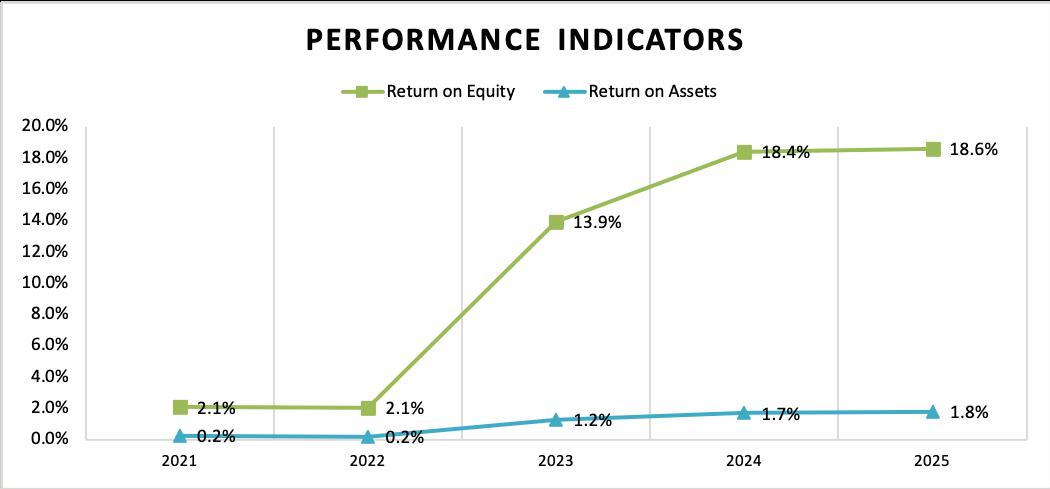
The Bank’s commendable performance for the financial year 2025 is reflected in its key financial metrics: Growth in profits after tax of 14.1% to $39.9 million; strong asset quality with a non-performing loan ratio of 3.8%, remaining below the regulatory threshold; a robust capital adequacy ratio of 20.0%, well above the 10.0% minimum regulatory requirement; a liquidity ratio of 24.0%. These indicators underscore the strength of our balance sheet, our prudent risk management, and our capacity to generate stable and sustainable earnings.
Complementing this financial performance was meaningful progress in the execution of our strategic initiatives. We advanced key priorities under Performance Management, including the implementation of a revised organizational structure, the rollout of a fully digital performance management system, and enhanced employee engagement initiatives. These efforts reinforce our recognition that our people are central to our continued success.

Judith
Veira Chairman
We continue to build an institution that is customer and employee-centric, financially resilient, and well-positioned to thrive in an increasingly dynamic environment.
We also made significant strides across other areas of the 2024-2027 Strategic Plan and are now actively advancing our transition roadmap, particularly in the area of technology and digital transformation. As an institution, we remain measured in our approach, yet resolute in delivering on our strategic priorities. In the year ahead, our focus will remain on operational efficiency, revenue optimization, channel enhancement, business intelligence, and digital transformation - driving sustainable growth through innovation and seamless execution.
These achievements were realized against a challenging external environment, marked by moderated global economic growth, persistent inflationary pressures, geopolitical uncertainty, and the adverse effects of Hurricane Beryl in June 2024.
During the year under review, and into the first quarter of 2026, there were several changes to the Board’s composition. Our transformation process during the past few years, included the undeniable support, guidance and invaluable contributions of Directors who resigned and retired during 2025, namely Directors Maurice Edwards and Timothy Providence. Additionally, Directors Lennox Bowman, Lennox Timm, Saibrina Brewster-Dickson, Terral

Mapp and Keisha Gonsalves resigned in the first quarter of 2026. Their stewardship contributed significantly to the strong foundation upon which we continue to build.
At the 2024 Annual General Meeting, the public shareholders voted to appoint Director Willis Williams to the Board, effective June 2025. The Bank also welcomed the appointment of five new Directors who joined the Board in the first quarter of 2026; Directors Lesley Howard-Bowman, Stephen Joachim, Akin John, Ronette Lewis and Simone Murray.
Notwithstanding the change of Directors, the Board welcomes the diversity of thought, varied professional skill sets and fresh perspectives that will collectively and collaboratively build on the high standards we set for governance structure. This provides prudent monitoring and oversight of the Bank’s operations, safeguarding the integrity of our financial reporting and systems, protecting the Bank’s assets and supporting informed and effective decision-making.
We extend our sincere appreciation to our loyal customer base, the shareholders for their continued confidence, and our regulators for their prudential guidance. I also wish to commend the Bank’s very capable and professional staff and Management, who are greatly valued and without whom service excellence and our continued success would not be possible. In particular, we thank our Executive Management team, led by the Managing Director Mr. Derry Williams and the Deputy Managing Director Mr. Bennie Stapleton, for their steady leadership and collaborative partnership with the Board, past and present, in delivering another year of strong performance.
At BOSVG, we remain confident in our direction and committed to building on our successes as we continue to grow from strength to strength.


MRS. JUDITH VEIRA
Consulting Actuary/ BA Hons. Actuarial Science, Fellow of the Society of Actuaries, Chartered Director (C. Dir.), RCC
Membership: Director Veira is the Chairman of the Board of Directors, member of the Credit Committee, member of the Risk and Compliance Committee and member of the Human Resources Committee. She also serves as an alternate member on the Audit Committee.
Appointment: She was first appointed to the Board on August 15, 2008 and last appointed on June 04, 2025 by the Government of St. Vincent and the Grenadines.




MR. MEDFORD FRANCIS
Economist/ BSc. Economics, MSc. Financial Management, Acc. Dir
Membership: Director Francis is the chairman of the Investment Committee and member of the Human Resources Committee.
Appointment: He was first appointed to the Board on August 01, 2018 and last appointed on June 04, 2025 by the East Caribbean Financial Holding Company Ltd.

MR. ROLF PHILLIPS
Managing Director/ ACIB, Acc. Dir.
Membership: Director Phillips is a member of the Audit Committee and a member of the Credit Committee.
Appointment: He was appointed to the Board on June 01, 2022 and last appointed on June 04, 2025 by the East Caribbean Financial Holding Company Ltd.




MR. WILLIS WILLIAMS
ICT Consultant / Diploma in Electronic Technology, Diploma in Micro Computer Business Application, CISSP, MCSE, ETA-FOI, Chartered Director (C. Dir.)
Membership: Director Williams is the Chairman of the Human Resources Committee and member of the Risk and Compliance Committee.
Appointment: He was elected to the Board on June 04, 2025 by the Public.


MR. AKIN JOHN
Barrister-At-Law & Solicitor/ LLB Law (Hons.), BVC
Membership: Director John is the Deputy Chairman of the Board of Directors, Chairman of the Risk and Compliance Committee, member of the Investment Committee and a director of Property Holdings SVG Ltd.
Appointment: He was appointed to the Board on February 06, 2026 by the Government of St. Vincent and the Grenadines

MRS. SIMONE MURRAY
Chartered Professional Accountant/ Business Development Specialist
Certified Forensic Accountant/ Certified Business Assessor/ Certified Business Valuator/ CGA BSc Economics and Accounting, Post Graduate Cert. Project Planning, Appraisal & Management, Cert. Business Administration
Membership: Director Murray is the Chairman of the Credit Committee and member of the Investment Committee
Appointment: She was appointed to the Board on February 06, 2026 by the Government of St. Vincent and the Grenadines



MRS. LESLEY HOWARD-BOWMAN
Financial Services Professional/ Executive Diploma in Management
Membership: Director Howard-Bowman is a member of the Risk and Compliance Committee and a member of the Credit Committee.
Appointment: She was appointed to the Board on February 06, 2026 by the Government of St. Vincent and the Grenadines


MRS. RONETTE LEWIS
General Manager/ B.B.A. Advertising & Marketing Communication Masters, Small & Medium Business Enterprise Management (Entrepreneurship)
Membership: Director Lewis is a member of the Human Resources Committee and a member of the Audit Committee.
Appointment: She was appointed to the Board on March 13, 2026 by the St. Vincent and the Grenadines National Insurance Services.

MR. STEPHEN JOACHIM
Chief Financial Officer/ Company Secretary
Certified Public Accountant, Chartered Accountant LLB, MBA, BCom., B.A.
Membership: Director Joachim is the Chairman of the Audit Committee, Chairman of Property Holdings SVG Ltd. and member of the Investment Committee.
Appointment: He was appointed to the Board on March 13, 2026 by the St. Vincent and the Grenadines National Insurance Services.

The Bank of St. Vincent and the Grenadines Ltd. (BOSVG) Corporate Governance policy outlines the Board’s relationship with its shareholders. The policy ensures among other things that shareholders have access to pertinent information.
The report of the auditor is presented with the report of the Board and the financial statements of licenced financial institutions at the annual meeting of shareholders of licensed financial institutions in accordance with the Banking Act 2015. Similarly, in compliance with the Companies Act, companies are required to send a copy of its comparative financial statements, the report of the auditor and any further information in relation to the company’s financial position and; the results of its operations required by its by-laws, articles or unanimous shareholder agreement to its shareholders. Notwithstanding this, for publicly listed companies, the Companies Act makes provision for the submission of summary financial statements which are derived from the annual accounts and the directors’ report.
In compliance with the various legislative requirements and as part of the role of the Directors of BOSVG to provide strategic guidance, to monitor the Management of BOSVG and to provide accountability to its stakeholders, we present the Directors’ Report for the financial year ended December 31, 2025.
BOSVG is licensed by the ECCB to conduct Banking Business pursuant to Section 14 of the Banking Act 2015. BOSVG, formerly the National Commercial Bank (SVG) Ltd., was incorporated on June 1, 1977. The company amalgamated with the St. Vincent and the Grenadines Development Bank Inc. on June 19, 2009 and changed its name from National Commercial Bank (SVG) Ltd. to Bank of St. Vincent and the Grenadines Ltd. on November 26, 2010.
Property Holdings SVG Ltd. is wholly owned by BOSVG and was set up primarily to facilitate the temporary acquisition of distressed properties for future investments. The company was incorporated on December 13, 2010.
The diagram below is an illustration of BOSVG’s Group structure.
BANK OF ST. VINCENT AND THE GRENADINES LTD. PARENT COMPANY
PROPERTY HOLDINGS SVG LTD.
100% OWNED BY BOSVG
BOSVG BOARD MEMBERSHIP AND TENURE
As at December 31, 2025, there were nine elected/appointed members to the Board of Directors of BOSVG by the shareholders. The Managing Director is an ex-officio member appointed by the Board of Directors:
• Mrs. Judith Veira – Chairman - Government appointee
• Mrs. Saibrina Brewster-Dickson – Government appointee
• Mr. Terral Mapp – Government appointee
• Ms. Keisha Gonsalves – Government appointee
• Mr. Rolf Phillips – East Caribbean Financial Holding Company Ltd. (ECFH) appointee
• Mr. Medford Francis – East Caribbean Financial Holding Company Ltd. (ECFH) appointee
• Mr. Lennox Bowman – National Insurance Services (NIS) appointee
• Mr. Lennox Timm – National Insurance Services (NIS) appointee
• Mr. Willis Williams – Elected by the Public
• Mr. Derry Williams – Managing Director

The members of the Board were elected, appointed and re-appointed for a three-year term at the Meeting of the Shareholders (AGM) held on June 04, 2025. Directors Maurice Edwards and Timothy Providence retired on June 04, 2025. New to the Board were Directors Keisha Gonsalves and Willis Williams who were appointed and elected respectively to the Board on June 04, 2025.
On February 06, 2026, the newly elected Government of St. Vincent and the Grenadines (SVG) appointed Directors Akin John, Lesley Howard-Bowman and Simone Murray to the Board of Directors. They replaced previous appointees Directors Saibrina Brewster-Dickson, Terral Mapp and Keisha Gonsalves.
Similarly, as a result of changes on the NIS Board of Directors, Directors Timm and Bowman vacated office on March 10, 2026 and March 12, 2026 respectively. They were replaced by Directors Stephen Joachim and Ronette Lewis on March 13, 2026.
The term of the new Directors will run from their dates of appointment until the remainder of the unexpired term of their predecessors, being the close of the Annual Meeting of the Shareholders in 2028.
The Board is required to meet at least quarterly but will meet as needed for the directors to properly discharge their responsibilities. The Board of Directors met ten (10) times for the 2025 financial year. The table below shows the attendance record of the members of the Board for 2025:
As at December 31, 2025, the Board of Directors of Property Holdings SVG Ltd. were:
• Mr. Lennox Timm - Chairman
• Mrs. Saibrina Brewster-Dickson
• Mr. Bennie Stapleton
There were no changes to the membership of Property Holdings SVG Ltd. Board of Directors for the financial year ended December 31, 2025.
Directors Stephen Joachim and Akin John replaced Directors Saibrina Brewster-Dickson and Lennox Timm on March 17, 2026. The Chairman of Property Holding SVG Ltd is Director Stephen Joachim.
Our theme – Transforming Today, Inspiring Tomorrow is consistent with our Strategic Plan 2024 – 2027. Our Strategic drivers: Performance Management, Operational Efficiency, Revenue Optimization, Channel Optimization, Business Intelligence and Digital Transformation seek to transform what and how we conduct business for a brighter tomorrow.
Over the 2025 financial year, the Board through its oversight responsibilities saw the ongoing execution of six Strategic Plan initiatives. There are five strategic drivers whose initiatives are on track: Performance Management, Operational Efficiency, Channel Optimization, Digital Transformation and Business Intelligence. Whereas, Revenue Optimization initiatives had not commenced and have been re-scheduled to begin during 2026.
Performance Management
Operational Efficiency
Channel Optimization
Digital Transformation
Business Intelligence
Revenue Optimization
NUMBER
Four (4)
One (1)
Two (2)
Three (3)
Three (3)
Two (2)
Our Business Intelligence driver is recognized as a foundational pillar essential for propelling the Bank’s digital transformation. This strategic driver focuses on core initiatives critical to evolving into a data-driven institution, providing the analytical infrastructure required to support our "Digital North Star". Our goal in this regard is grounded in the belief that in order to inspire tomorrow, we must be able to transform digitally. Our Digital Transformation Roadmap is designed to position the Bank as a more customer-centric, data driven organisation.
Our Revenue Optimization initiatives focuses on enhancing the Bank’s competitive position, pricing effectiveness, market expansion and product penetration. Whereas, the Performance Management initiatives are geared towards ensuring that BOSVG maintains and acquires competent and skilled staff, bolstering staff morale, fostering a culture of high performance, maintaining business continuity, succession and accountability.
BOSVG has a robust policy framework consisting of just over seventy (70) policies relating to various aspects of banking. These policies address Information Technology, Cybersecurity Management, Human Resources, Operations, Governance, Compliance and Anti-money Laundering to name a few. Over the 2025 financial year, the Board approved forty (40) policies which included new and revised policies and, Board and Management Committees Charters.
Credit Committee Membership and Attendance Record for the Financial Year ended December 31, 2025
MEMBERSHIP
As at December 31, 2025, the members of the Credit Committee were: Directors Lennox Bowman - Chairman, Judith Veira, Rolf Phillips and Saibrina Brewster-Dickson. The Committee previously comprised five members, however, with the retirement of Director Providence, the Committee was reduced to four members. In accordance with the Committee’s Terms of Reference, the Credit Committee shall have a minimum of three and a maximum of five members.
ATTENDANCE RECORD
The Credit Committee met five (5) times for the 2025 financial year. The table below shows the attendance record of the Committee members for 2025:
Audit Committee Membership and Attendance Record for the Financial Year ended December 31, 2025
MEMBERSHIP
The members of the Audit Committee as at December 31, 2025 were: Directors Saibrina Brewster-Dickson - Chairman, Lennox Timm, Keisha Gonsalves, Rolf Phillips and Judith Veira as an alternate. Director Keisha Gonsalves replaced Director Maurice Edwards on the Committee. The maximum and minimum number of members on the Committee is three (3) and six (6) respectively.
ATTENDANCE RECORD
The Audit Committee met five (5) times in 2025.The Committee’s attendance record is presented below:
Human Resources (HR) Committee Membership and Attendance Record for the Financial Year ended December 31, 2025
MEMBERSHIP
As at December 2025, there were four (4) Human Resource Committee members: Directors Lennox Bowman – Chairman, Medford Francis, Judith Veira and Willis Williams. Director Williams succeeded Director Providence on this Committee as at June 06, 2025.
ATTENDANCE RECORD
The HR Committee met five (5) times for the year. The Committee’s attendance record is presented below:
Risk and Compliance Committee Membership and Attendance Record for the Financial Year ended December 31, 2025
MEMBERSHIP
The Risk and Compliance Committee comprised of four (4) members as at December 31, 2025. The Committee members as at December 31, 2025 were Directors Lennox Timm – Chairman, Terral Mapp, Judith Veira and Willis Williams. On January 01, 2025, Director Judith Veira was appointed an alternate on that Committee until June 6, 2025 when she became a full member. Director Willis Williams was also appointed to the Committee on June 06, 2025 when he replaced Director Medford Francis.
ATTENDANCE RECORD
The Risk and Compliance Committee met four (4) times for the year. The Committee’s attendance record is presented below:
Investment Committee Membership and Attendance Record for the Financial Year ended December 31, 2025
The Investment Committee comprised four (4) Directors and an alternate member as at December 31, 2025. The members were Directors Medford Francis - Chairman, Lennox Timm, Terral Mapp and Keisha Gonsalves. Director Francis became a member of the Committee in January 2025 and replaced Director Maurice Edwards as the Chairman on June 06, 2025. Director Gonsalves was appointed on June 06, 2025 and Director Judith Veira appointed an alternate member.
The Committee is required to meet at least quarterly per year but met six (6) times for the year under review.
The Committee’s attendance record is presented below:
In 2024, the Bank conducted an Independent Governance Assessment for the period January to December 2023 which was reported last year to the shareholders. Regarding the Governance Improvement Action Plan which was put in place to address success factors flagged for the Board’s attention, we report that as at December 31, 2025, 88% of the action items were completed. The remaining items are scheduled to be completed during the 2026 financial year.
Internal governance assessments of the Board and its Committees recommenced in 2025. In March 2025, the Board conducted its annual self-assessment and a governance review for the prior financial year - January to December 2024. The Directors’ assessment of the Board’s performance was mainly rated as greatly exceeding expectations.
Directors also completed their individual assessments which were led by the Chairman of the Board who conducted interviews with the other eight (8) directors.
Directors’ and Committees assessment for 2025 are scheduled to be completed in 2026.
NAME OF COMMITTEE
Credit Committee
Audit Committee
SUMMARY OF RESPONSIBILITIES/ ROLE
Investment Committee
Human Resources Committee
Credit Committee is to review and approve all policies with regards to loans and credit facilities, set lending limits and to approve loans above Management's limit and make appropriate recommendations to the Board.
The Audit Committee is mandated through its charter to provide oversight responsibilities for:
• The quality and integrity of the financial statements of the Company and the Bank.
• The effectiveness of the systems of internal control over financial reporting.
• The internal and external audit processes. The Bank’s processes for monitoring compliance with applicable laws and regulations, risk management processes and the Code of Conduct.
The Investment Committee of the Bank is charged with providing advice and assistance to the Board of Directors on developing the strategic investment policy and ensuring that the investment policy and guidelines are executed on a consistent, effective and efficient basis.
The primary purpose of the Human Resources Committee is to:
• provide guidance and recommend to the Board, Human Resource policies which support the goals and strategies of the Bank;
• establish the Bank’s overall compensation strategy in support of its Human Resource strategy;
• establish the compensation of the Managing Director, Deputy Managing Director and other senior officers and key management employees and to review and approve compensation packages for unionized staff;
• make recommendations regarding and approve amendments to and terminations of the Company’s employee benefit plans; and
• ensure that a succession plan is in place for key positions within the Bank and that the plan is updated annually.
DATE OF ASSESSMENT COMPLETED IN 2025 FOR THE FINANCIAL YEAR 2024
March 18, 2025
February 05, 2025
FORMS COMPLETED
Credit Committee Self Evaluation & Listing of Credit Committee Charter of Responsibilities
Audit Committee Self-Assessment
Risk and Compliance Committee
The Committee monitors and provides recommendations to the Board on BOSVG’s risk strategy, ensures that the Bank maintains an appropriate level and quality of capital and liquidity in line with the risks inherent in its activities and oversees the identification, management and reporting of risks inherent in the operations.
January 27, 2025
February 18, 2025
Investment Committee Self Evaluation & Listing of Investment Committee Charter of Responsibilities
HR Committee Self Evaluation and Listing of HR Committee Charter of Responsibilities
February 14, 2025
All Committees performed their duties to the satisfaction of the Board of Directors.
Risk and Compliance Committee Self Evaluation and Listing of Risk and Compliance Committee Charter of Responsibilities.
DIRECTORS’ DUE DILIGENCE
Directors are required to complete annual due diligence forms in compliance with the various governance policies. Forms required for completion includes Code of Conduct Acknowledgment, Directors Declaration, Disclosure of Potential Conflict of Interest, Secrecy of Information, Social Media and Networking Acknowledgement, Fit and Proper Declaration, Email Acceptable Policy and Anti-bribery and Corruption Policy.
The compliance rate for forms completed by directors during the 2025 financial year ranged between 73% to 100%.
The directors listed below declared affiliation with the following entities for service furnished during the period under review.
STRATEGIC DRIVER
Judith Veira
Willis Williams
Rolf Phillips
Bank of St. Lucia Limited
Owner, Director and Employee of Trinity Consulting Director Officer
Directors’, Managing Director’s & Deputy Managing Director’s interests in the common shares of BOSVG as at December 31, 2025 are listed below. During the year under review, there was no trading in BOSVG shares by the directors or Senior officers.
Director
Judith Veira
Lennox Timm
Lennox Bowman
Medford Francis
Saibrina BrewsterDickson
Rolf Phillips
Terral Mapp
Willis Williams
Keisha Gonsalves
Derry Williams
Bennie
There was no contract of significance subsisting during or at the end of the financial year in which a director was materially interested, directly or indirectly.
DIRECTORS’ REMUNERATION
As previously reported last year to the shareholders, directors’ fees were revised and approved by the Board on January 31, 2025 with effect from January 2025. There were no other changes under the reporting period.
Total fees paid to directors for the 2025 financial year was $421,400.
DIRECTORS’ CONTINUING EDUCATION PROGRAMME
The following table shows training attended by directors for the 2025 financial year.
Directors Duties, New Technology & Data Governance Webinar
Facilitator:
Caribbean Governance Training Institute
Developing the Asset Management Programme
Facilitator:
Investment Consultant – Stewart Haynes
Institute of Internal Auditors (IIA) GAM Conference
Cyber Security Governance Webinar
Facilitator:
Caribbean Governance Training Institute
Risk Committee Certification
Facilitator:
Caribbean Governance Training Institute
HR Compensation Committee Program
Facilitator:
Caribbean Governance Training Institute
Corporate Governance – Directors’ Legal Responsibilities
Facilitator:
Anique & Jadric Cummings
Cardinal Law Firm
Risk Committee Virtual Caribbean Risk Management Academy (CRMA) Conference
Annual AML Training
Facilitator:
Glenna Smith – Smith Compliance
Judith Veira
Saibrina Brewster-Dickson
Maurice Edwards
Judith Veira
Saibrina Brewster-Dickson
Timothy Providence
Lennox Bowman
Lennox Timm
Terral Mapp
Maurice Edwards
Derry Williams
Saibrina Brewster-Dickson
Judith Veira
Judith Veira
Lennox Bowman
Judith Veira
Lennox Bowman
Terral Mapp
Willis Williams
Medford Francis
Keisha Gonsalves
Rolf Phillips
Lennox Timm
Saibrina Brewster-Dickson
Lennox Timm
Keisha Gonsalves
Judith Veira
Saibrina Brewster-Dickson
Willis Williams
Lennox Bowman
Lennox Timm
Terral Mapp
Keisha Gonsalves
SUBSTANTIAL INTEREST IN SHARE CAPITAL AS AT DECEMBER 31, 2025
The BOSVG shareholding as at December 31, 2025, was as follows:
Government of St. Vincent and the Grenadines
East Caribbean Financial Holding Company Ltd.
The National Insurance Services
The Public inclusive of employess of the Bank (no one shareholder owns more than 5% of the shares in this block)
There were no significant transactions for the reporting period.
Information relating to Related Parties can be found under note 31 of the audited Consolidated Financial Statements for the Year Ended December 31, 2025. Related Party Transactions are reported to the Risk and Compliance Committee quarterly.
Under the Banking Act, the Eastern Caribbean Central Bank (ECCB) has the authority to examine or cause an examination to be made of Licensed Financial Institutions (LFI), from time to time, or whenever in its judgement an examination is necessary or expedient in order to determine that the LFI is in a sound financial condition.
As such, the ECCB conducted a Hybrid Risk-Based Supervision Examination of BOSVG between the 5th to 16th May 2025. Emanating from this Examination, the ECCB issued a Supervisory Letter and a Letter of Commitment (LOC) to BOSVG. The Board of Directors and Management have acknowledged the LOC and have agreed to implement suggested recommendations relating to the improvement of operational matters. BOSVG provides quarterly updates to the ECCB.
Notice of Meeting of the Shareholders (AGM) and Special Meeting of the Shareholders - Record Dates
The date fixed for determining shareholders of the Company who are entitled to receive notice of the Company’s Annual Meeting and Special Meeting of the Shareholders is Thursday, May 07, 2026.
Notice of Record Date is published in the local newspapers.
In alignment with our strategic driver – Digital Transformation, the Board of Directors will table an amendment to the Bank’s by-law 18.1 in relation to the method of giving notice to shareholders at a Special Shareholders Meeting scheduled for June 04, 2026. The Bank has primarily sent notices and other circulars to its shareholders through the post. However, in an effort to create greater efficiencies and to assist in the Bank’s transformation journey, the Board is formally creating an avenue through its by-laws for electronic mail to be delivered to its shareholders. As such, the Board is seeking the passage of resolution of the shareholders to amend by-law 18.1. This resolution is detailed in Notice of the Special Shareholders Meeting.
Votes at meetings of shareholders may be given either personally or by proxy or, in the case of a shareholder who is a body corporate or association, by an individual authorized by a resolution of the directors or governing body of that body corporate or association, to represent it at meetings of shareholders of the Company. A person appointed by proxy need not be a shareholder. Proxies are circulated in shareholders packages and can be requested through the Corporate Secretary.
Sections 12.6, 12.6.1 and 12.6.5 of the BOSVG’s By-Laws provide guidance for voting at the Annual Meeting:
12.6 Votes: Every question submitted to any meeting of shareholders shall be decided in the first instance by a show of hands unless a person entitled to vote at the meeting has demanded a ballot and, if the Articles so provide, in the case of an equality of votes the chairman of the meeting on a ballot have a casting vote in addition to any votes to which he may be otherwise entitled.
12.6.1 At every meeting at which he is entitled to vote, every shareholder, proxy holder or individual authorized to represent a shareholder who is present in person shall have one vote on a show of hands. Upon a ballot at which he is entitled to vote, every shareholder, proxy holder or individual authorized to represent a shareholder shall subject to the articles, have one vote for every share held by the shareholder.
12.6.5 If two or more persons hold shares jointly, one of those present at a meeting of shareholder may, in the absence of the other, vote the shares; but if two or more of those persons are present, in person or by proxy vote, they shall vote as one on the shares jointly held by them.
BOSVG has a dividend distribution policy with a ratio of 50% retention and 50% distribution to shareholders. For the financial year ended December 31, 2025, BOSVG made a profit after tax in the amount of $39,947,599. As such, the Board declared a dividend payment of $19,973,800 ($1.33 per share) in accordance with the Dividend Policy on March 24, 2026 to all shareholders of BOSVG common shares on record as at May 28, 2026. This dividend payment will be issued on June 11, 2026. Notice of Record Date is published in the local newspapers.
The Board of Directors confirms that Grant Thornton Limited successfully fulfilled its responsibilities in accordance with International Standards on Auditing for the financial year ended December 31, 2025.
In alignment with the Bank’s External Audit Policy which requires a competitive tender process every three years, the Audit Committee recently invited proposals from six audit firms within the OECS region for the 2026 financial year. This follows the previous tender conducted in 2021, after which Grant Thornton was appointed and subsequently re-appointed annually by the shareholders.
Having completed their 2025 term and being eligible for re-appointment, Grant Thornton has offered themselves for consideration. Consequently, the Board of Directors will present a formal recommendation to shareholders for the appointment of External Auditors for the 2026 financial year at the Annual Meeting of the Shareholders.


DERRY WILLIAMS
Managing Director
MBA - Finance




BENNIE STAPLETON
Deputy Managing Director
BSc. Accounting, FCCA, CIA, CISA
CELESTINE JACKSON
Chief Financial Officer
BSc. Applied Accounting, FCCA, MSc. / MA Finance and Investment, Diploma in Forensic Accounting, Certified Accounting Technician




CERLIAN RUSSELL
Executive Manager Operations
MBA – General Management, Certified Mortgage Residential Underwriter, Anti-Money Laundering

Certified Associate (AMLCA)

NANDI WILLIAMS-MORGAN
Executive Manager
Legal & Corporate Services/
Corporate Secretary
BSc. Economics with Law, LLM International Trade Law, GDL, CCSec.
MONIFA LATHAM
Executive Manager Lending
BSc. Economics, Principal Licence – ECSRC
Cert. International Risk

ALICIA BAZIL
Executive Manager
Human Resources
SHRM-SCP Certified
LLM Employment Law
MSc. HR Management & Development
BSc. Management
Cert-Public Administration

NICOLE FERNANDEZ
Executive Manager
Information Technology
Executive Diploma in Information Technology





TEMELIA














SANDIKA






CHEZ











KURTLAN

PATRICIA


BERNADINE NANTON-COOKE
GILLIAN DA SILVA
LEROY



The 2025 financial year was an inflection point in the evolution of the Bank of St. Vincent and the Grenadines Ltd (BOSVG), as the institution delivered strong financial performance while advancing a deliberate and far-reaching transformative agenda. Guided by the theme Transforming Today, Inspiring Tomorrow, the Group focused on strengthening its financial foundations, modernizing its operating model, and building the institutional capabilities required to deliver sustainable long-term value.
During the year, the Group recorded growth in both its balance sheet and profitability, underscoring the resilience of its business model and the confidence of its customers. Total assets increased from $2.1 billion to $2.3 billion, while profit before tax rose from $41.1 million to $48.9 million. Importantly, these results were achieved alongside continued strategic investment in technology, people, governance, and risk management—each aligned to the Group’s multi-year strategic agenda.
Guided by the theme Transforming Today, Inspiring Tomorrow, the Group focused on strengthening its financial foundations, modernizing its operating model, and building the institutional capabilities required to deliver sustainable long-term value.
Beyond the financial performance, 2025 represented a decisive transition in the execution of the Group’s 2024–2027 Strategic Plan, as management moved from strategy design to structured implementation across clearly defined strategic themes. Meaningful progress was made in strengthening digital capabilities and cybersecurity resilience, leveraging data analytics, refining the organizational structure, and developing execution discipline. Underpinning this progress were the investments in organizational redesign, performance management, training, and employee engagement which strengthened institutional capacity and ensured that transformation initiatives were supported by the skills, leadership, and culture - required to deliver results. These achievements have repositioned the Group to operate in a more customer-centric, data-driven, and digitally enabled manner. Equally important, the Group remained deeply committed to its role as a responsible corporate citizen, continuing to support community, educational, cultural, and sporting initiatives that contribute to national development.
The operating environment remained complex. Global economic growth moderated amid persistent inflationary pressures, geopolitical uncertainty, and financial market volatility. Regionally, economic recovery continued, supported by tourism and construction, while climate-related risks remained a defining feature for small island economies such as St. Vincent and the Grenadines.
As the Group looks ahead, it does so from a position of strength; financially sound, strategically aligned, and institutionally prepared to navigate existing and emerging risks while capturing new opportunities.The progress achieved in 2025 represents a decisive step in transforming today and inspiring confidence, resilience, and shared prosperity for tomorrow.
Derry Williams Managing Director


For the financial year ended December 31, 2025, the Group delivered improved performance, with total assets surpassing $2.2 billion and net income after tax increasing to $39.9 million.
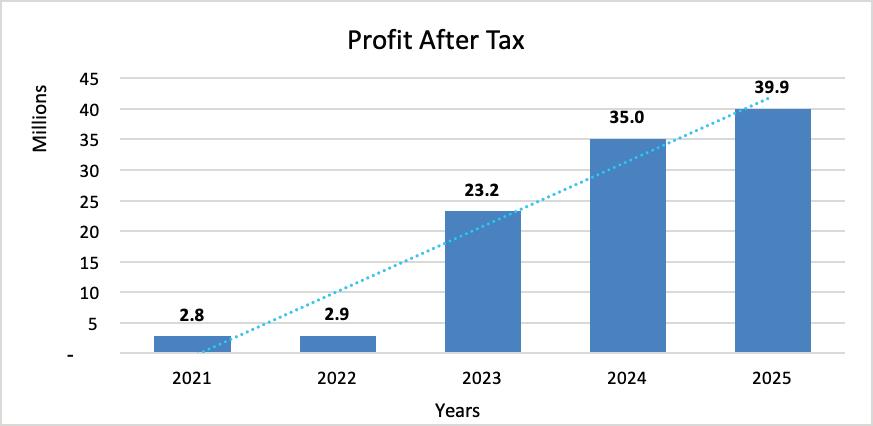
The Group has not only achieved record performance but also reinforced its foundation of stability and trust. Key to this success was our prudent lending and investments. Credit activities focused on credit growth in areas such as small business, and consumer finance, while investment activities were specifically geared to optimizing market opportunities and diversifying the Group’s income stream. By balancing portfolios’ expansion with strong risk management and regulatory compliance, the Group has reinforced its position as a leader in the market, while maintaining resilience against the external challenges. Additionally, and key to the Group’s improved financial performance was the overall improvement in asset quality. As such, the Group’s non-performing loan ratio improved from 4.3% to 3.8%. This translated into a reduction in loan loss provisions of approximately $9.5 million when compared to the previous financial year. These improvements were driven by a deliberate and aggressive approach in working with customers to restore regular payments post Hurricane Beryl, thereby reducing the associated provisions from the previous financial year.
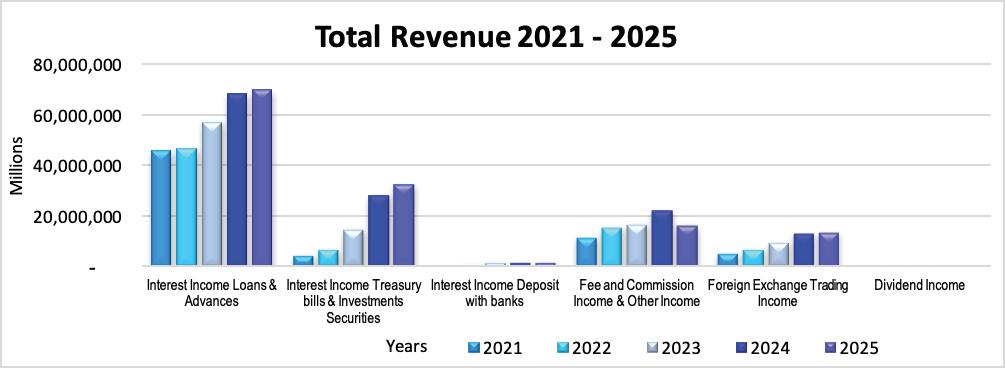
The Group recorded a total revenue growth of 0.5%, increasing from $133.9 million in the previous financial year to $134.6 million in 2025 financial year. This growth in revenue was mainly attributed to a $6.0 million increase in interest income, which reflects the strong performance of the Group’s investment and loan portfolios.
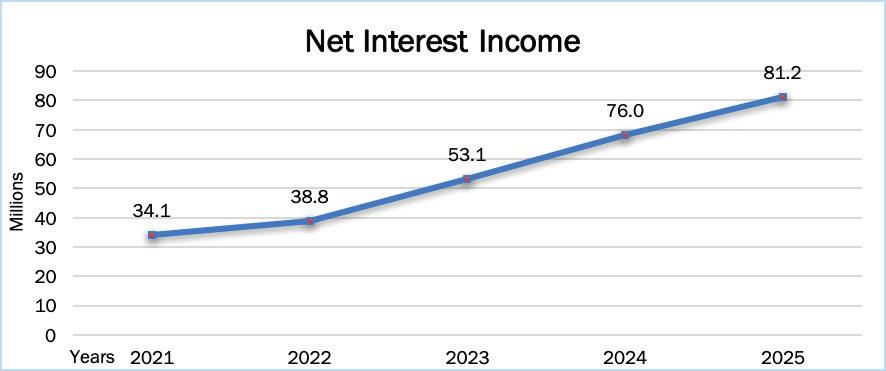
In comparison with the previous year, interest expense increased by approximately $0.893 million or 4.1%. This change was fueled by growth in corporate deposits of $80.1 million and characterized by a rise in US dollar demand deposits.
Although there was growth in deposits, the cost of funds remains largely unchanged. Further, we implemented strategic measures to optimize costs while ensuring the Group’s liquidity remains robust. These efforts contributed to the overall increase in net interest income.
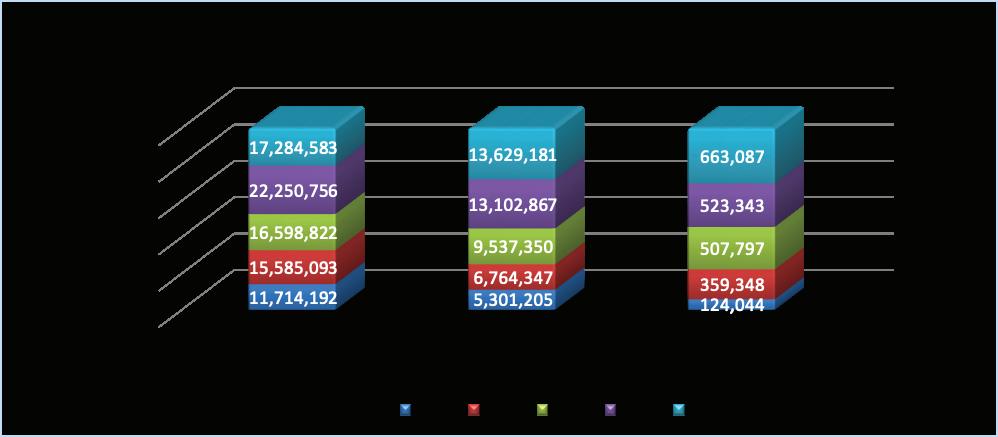
The Group’s non-interest income decreased by $5.4 million or 15.0%. This reduction primarily stemmed from an adjustment of approximately $6.8 million which was attributed to a correction to our credit card billings which came to our attention during the 2025 financial year. Despite this, there were some improvements in some subcategories, such as commissions on card products, merchant services, foreign exchange services, deposits and loans services.
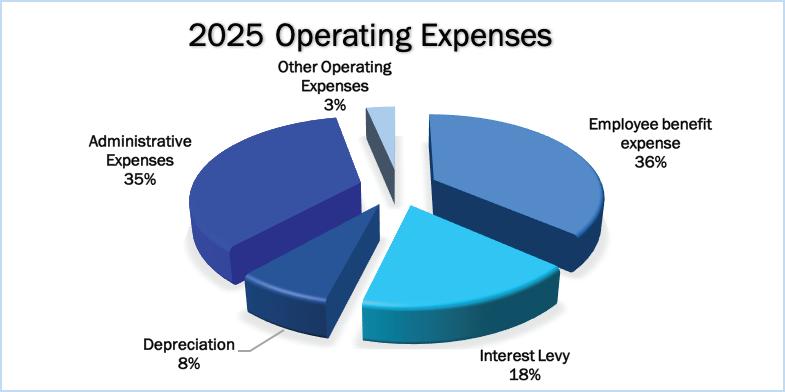
TOTAL OPERATING EXPENSE
Total operating expenses for the year increased by 3.6%, or $2.2 million. This increase was driven primarily by growth in employee benefits, which rose by 5.3%, or $1.2 million. This increase was largely attributed to union wage increases. Notable increases were also reflected in interest levy, bank and other licenses, depreciation and advertisement and sponsorship, all of which are consistent with an increase in the Group’s balance sheet. Overall, the Group continues to manage costs in a manner that aligns with its strategic intent, which focuses on investing in its people, technology, and infrastructure to support long-term growth and deliver excellent customer service.
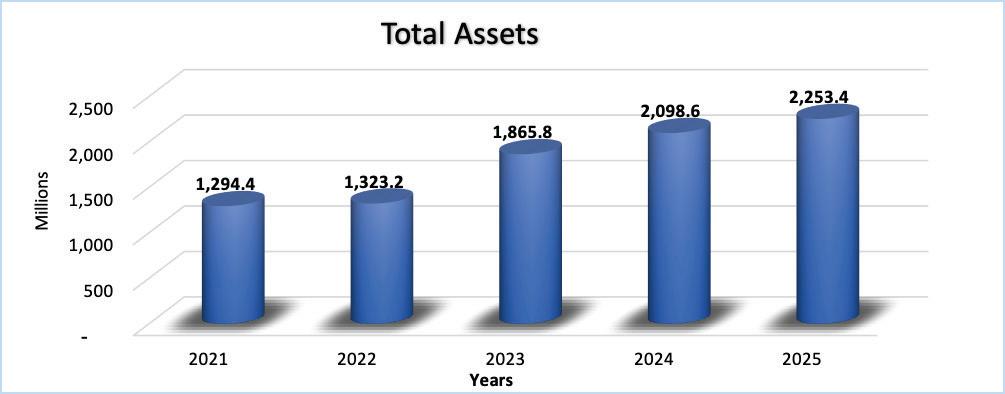
The Group achieved growth in total assets of 7.4%, or $154.8 million, during the financial year. This growth highlights the effectiveness of our strategic initiatives aimed at expanding the Group’s footprint and strengthening our financial position. The increase in total assets was primarily driven by the growth in loans and advances, and investments, and was funded by growth in deposits.
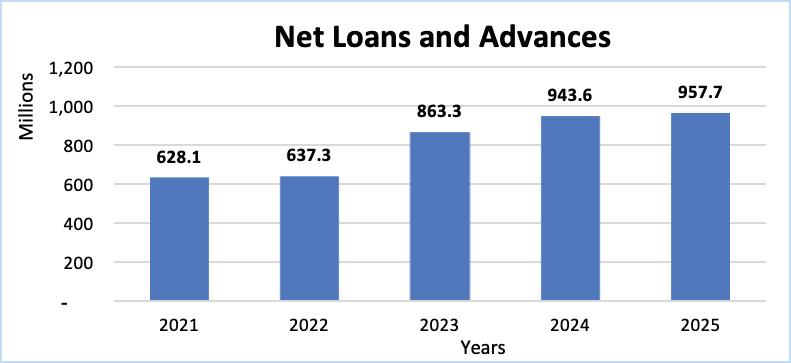
Loans and advances to customers grew by 1.5%, or $14.1 million, driven by the success of targeted loan campaigns, and stronger delinquency management, while also being supported by the growth in overdraft balances.
Net impairment losses on loans and advances of $1.9 million were recorded, compared to $11.4 million in the previous year. This result reflects the Group’s sustained emphasis on prudent credit risk management, enhanced collection strategies, and targeted recovery initiatives, all of which continue to support asset quality and financial stability.
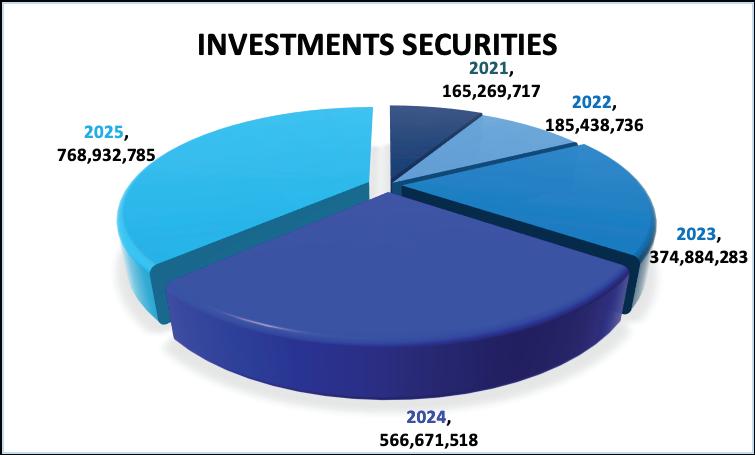
Investment Securities recorded substantial growth of 35.7%, equivalent to $202.3 million. This growth underscores the Group’s active approach to managing funds in secure instruments, aimed at supporting both liquidity and profitability objectives.
The expansion of the portfolio aligns with the Group’s strategy to diversify its incomeearning base, while effectively utilizing excess liquidity within the parameters of its established risk appetite. This approach reinforces the Group’s commitment to sustainable growth and financial resilience.
The Group’s non-performing loan (NPL) portfolio experienced a significant reduction of 9.5% or $4.0 million during the year. As a result, the NPL ratio improved from 4.3% at the end of the previous financial year to 3.8% as of December 31, 2025. This ratio is well within regulatory guidelines of 5%, reflecting the Group's commitment to maintaining a sound credit portfolio.
This improvement was driven by several factors, including the overall growth in the credit portfolio and a deliberate management focus on enhancing asset quality through several initiatives.
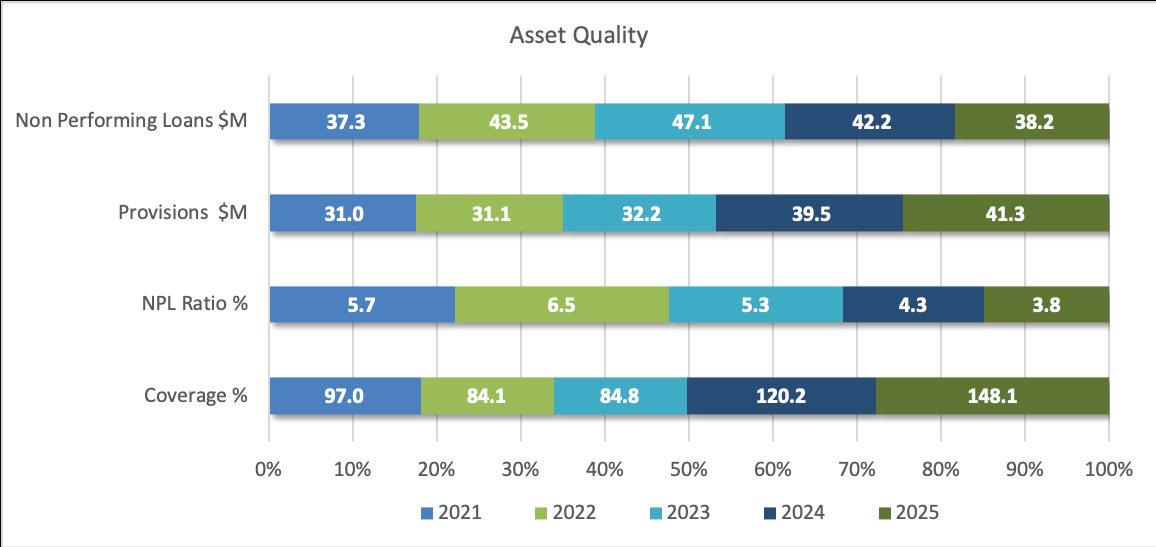
Total provisions increased to $41.3 million, while the provision-to-loans-and-advances ratio was 4.1%. This increases to 148.1% when the contingency reserve fund is included, ensuring strong coverage and resilience against potential credit risks.
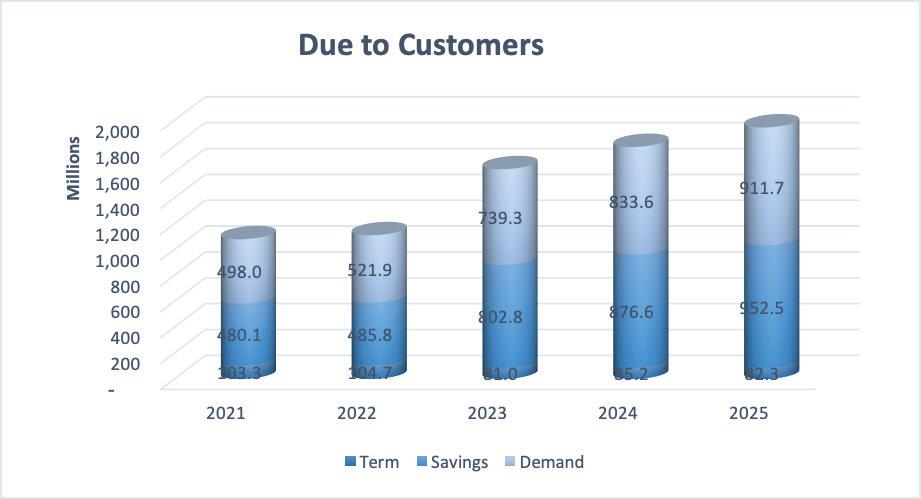
Total liabilities stood at $2.0 billion, representing an increase of $123.0 million, or 6.8% compared to the prior year’s $1.9 billion. Deposits from customers which comprise 95.5% of total liabilities, grew by 8.4% or $151.1 million year over year. The Group recorded notable growth in savings and demand deposit balances.
Shareholders’ equity increased by 13.0%, or $24.8 million, compared to the previous financial year, primarily driven by growth in net profit of $39.9 million. Notably, this is the highest profit ever reported.
In line with its dividend policy, the Group paid a dividend of $17.5 million. Additionally, the Group’s share price traded at $10.50 as at December 31,2025. The Group’s book value per share rose from $12.68 at the end of 2024 to $14.33 as of December 31, 2025. In line with the Group’s overall performance, earnings per share (EPS) increased significantly to $2.66, up from $2.33 in the previous financial year.
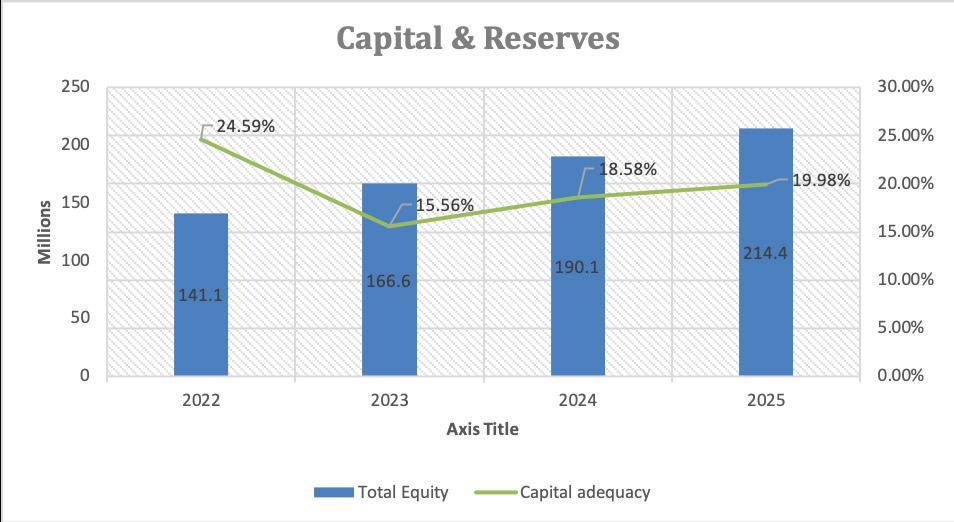
Additionally, dividend per share (DPS) increased from $1.17 in the prior financial year to $1.33. This upward trend underscores the Group’s commitment to rewarding shareholders while maintaining a strong capital base to support future growth. The Group’s key capital ratios surpassed the regulatory requirements, with the total capital of 20.0%, well above the Central Bank’s minimum requirement of 10.0%.
These robust financial outcomes not only highlight the Group’s ongoing transformation and resilience, but also reflect the confidence of all stakeholders in its performance.
Maintaining strong liquidity remained a key priority for the Group during the 2025 financial year, particularly given an operating environment characterized by strong deposit flows and credit demand. The Group continued to apply disciplined liquidity management practices to ensure adequate funding, support lending activities, and meet all regulatory and operational obligations.
Throughout the year, the Group successfully operated within its internal liquidity benchmark range of 20% to 25%, reflecting prudent balance sheet management and effective monitoring of cash flows and funding positions.
At year end, the liquidity ratio stood at 24%, comfortably within the established benchmark range and indicative of a strong liquidity position. This outcome reflects the stability of the Group’s deposit base, proactive treasury management, and the continued confidence of customers.
Looking ahead, Management will continue to closely monitor liquidity conditions, particularly in the context of potential external shocks and evolving market dynamics. The Group remains committed to maintaining adequate liquidity buffers, optimizing funding sources, and ensuring resilience in support of its strategic objectives.
EXECUTING THE 2024–2027 STRATEGIC PLAN THROUGH KEY STRATEGIC THEMES
During 2025, the Group made measurable progress in executing its 2024–2027 Strategic Plan, marking a clear transition from strategy formulation to structured implementation. The strategic agenda is anchored around a set of interrelated strategic themes, each designed to strengthen competitiveness, enhance customer experience, and reinforce institutional resilience, while remaining aligned with the Group’s risk appetite and governance framework.
PERFORMANCE MANAGEMENT AND ORGANIZATIONAL EFFECTIVENESS
Strengthening organizational effectiveness and accountability remained a core strategic priority. The Group secured Board approval for a revised organizational structure designed to enhance clarity in reporting lines, improve decision-making efficiency, and create a more resilient and scalable operating framework. This redesign better aligns operational responsibilities with regulatory requirements and strategic priorities.
Enhancements to the performance management framework included digitizing performance assessments. This allowed the Group to embed individual and departmental Key Performance Indicators (KPI) into the process to drive strategy, execution and accountability.
Recognising the increasing scale and complexity of transformation initiatives, the Group advanced the establishment of a formal Project Management framework. This initiative strengthens execution discipline through introduction of a Project Management Office (PMO) that provides centralised oversight, standardised methodologies, and enhanced governance via structured workstreams and reporting.
Human capital development remained a critical enabler of the Group’s strategic ambitions. A formal Employee Engagement Strategy was designed and partially implemented, introducing structured mechanisms for communication and feedback. A key priority is the expansion of succession planning beyond management roles to support leadership continuity and institutional knowledge retention.
Improving operational efficiency remained a central strategic focus. The Group continued to streamline workflows, automate processes, and improve turnaround times, particularly within deposit and lending operations. These initiatives support the transition toward a “phygital” banking model that integrates digital capability with branch-based service delivery.
To support sustainable earnings growth, the Group advanced preparatory work on revenue optimization initiatives, including the development of data-driven frameworks for product pricing. Channel optimization emerged as a strategic imperative, with a focus on delivering a unified, digital-first omni-channel experience.
Digital transformation remained a cornerstone of the Group’s strategy. A significant milestone was the successful completion of the IFC DigiLab Finance – Digital Transformation Programme, through which a cross-functional cohort of management and professional staff was equipped to lead the Group’s digital roadmap through 2030. Cybersecurity governance remained strong, with the Group maintaining ISO 27001 certification and PCI-DSS attestation, reinforcing trust, data protection, and regulatory compliance.
Building on the successful completion of the IFC DigiLab Digital Transformation Programme, the Group articulated its Digital North Star—a five-year roadmap anchored on customer experience, operational efficiency, technology and data integration, innovation and culture. Business intelligence initiatives, including preparatory work on a centralised data warehouse and data governance framework, were recognised as foundational to enabling data-driven decision-making.
Information technology and cybersecurity continued to serve as critical enablers of the Group’s transformation agenda during 2025. In an environment characterized by accelerating digital adoption, heightened cyber threats, rising regulatory expectations, and increasing technology costs, the Group remained focused on strengthening the resilience, security, and scalability of its technology platforms while ensuring prudent risk management and long-term sustainability.
Investments in modernizing the technology environment delivered measurable improvements in processing speed, system efficiency, and platform reliability. Enhancements to disaster recovery and business continuity capabilities resulted in reduced recovery time objectives (RTO) and recovery point objectives (RPO), strengthening the Group’s ability to minimize disruptions to critical services and protect customer confidence.
Recognising rising technology costs and evolving cyber risks, management initiated a comprehensive review of core systems to ensure an appropriate balance between innovation, resilience, cost efficiency, and risk discipline. Looking ahead, technology initiatives will focus on deeper integration of digital solutions within branch operations, expansion of online and mobile offerings, and responsible exploration of emerging technologies such as artificial intelligence and advanced data analytics.
Human capital remained a central pillar of the Group’s transformation agenda during 2025. Management continued to invest in organizational capability, workforce engagement, and performance alignment, recognising that sustainable performance is fundamentally dependent on people, leadership, and culture.
A formal Employee Engagement Strategy was developed and partially implemented, introducing structured mechanisms for communication and feedback. The Group also completed a comprehensive organisational review, resulting in clearer reporting lines, enhanced accountability, and improved alignment between operational functions, regulatory responsibilities, and strategic priorities.
Significant progress was made in strengthening the performance management framework through standardized tools across departments, reinforcing consistency in performance assessment and alignment with institutional goals. Investment in training and development remained a priority, with programmes focused on technical competencies, compliance, risk awareness, digital capability, and leadership development.
Throughout 2025, BOSVG delivered a robust and impactful Corporate Social Responsibility (CSR) programme spanning Financial Education and Empowerment, Youth and Education, Sports, Culture, Health and Wellness, and Environmental Stewardship. In the area of sports development, the Group expanded its regional sponsorship portfolio to include the OECS Swimming Regional Championship and the newly established All Windward Sports, while maintaining its Platinum sponsorship of All Leeward Sports. These initiatives underscore the Group’s continued commitment to fostering athletic excellence, regional integration, and community engagement across the Eastern Caribbean.
Financial Education and Empowerment remained a cornerstone of the Group’s CSR agenda. During the year, BOSVG reached 26 schools nationwide, equipping both students and teachers with practical knowledge of financial tools, responsible money management, and available financial options. This programme was complemented by targeted diaspora outreach initiatives in England, Canada, and the United States.
Staff engagement and volunteerism also remained strong, with employees contributing their time and resources to repaint the interior of the Society of and for the Blind, reinforcing the Group’s culture of service and social responsibility.
BOSVG’s commitment to social, humanitarian, and environmental causes remained unwavering throughout the year. The Group continued its support for the Zero Hunger – Adopt a classroom initiative and established a new collaboration with the SVG Conservation Fund to promote conservation awareness and environmental stewardship among primary and secondary school students.
A standout achievement for the Group during the 2025 financial year was its recognition as the ECCU Bank of the Year for Financial Education and Empowerment. This prestigious award emphasizes the Group’s unwavering commitment to advancing financial literacy and inclusion across St. Vincent and the Grenadines. Through targeted initiatives such as, school-based financial literacy programmes, community outreach sessions, and the expansion of accessible digital banking tools, the Group continued to empower individuals and communities to make informed financial decisions. This recognition not only validates the impact of these efforts but also reinforces the Group’s role as a responsible corporate citizen.
Sound risk management and strong regulatory compliance remain integral to the Group’s ability to execute its strategic objectives, safeguard financial stability, and operate sustainably in an increasingly complex risk environment. During FY 2025, Management continued to enhance the enterprise risk management framework, with a clear focus on governance, resilience, and proactive risk identification.
A comprehensive enterprise-wide risk assessment, Business Impact Analysis (BIA) and Business Risk Assessment were completed during the year, strengthening Management’s understanding of the Group’s principal operational, financial, strategic, and emerging risks. The results of these assessments informed business planning, capital management, operational resilience initiatives, and supported improved prioritisation of risk mitigation actions.
Operational resilience was further reinforced through enhancements to the Business Continuity Management (BCM) framework. An updated BCM Policy was approved, and continuity and recovery plans across critical business functions were refined to reflect evolving regulatory expectations and best practices. These measures improved the Group’s preparedness to respond effectively to operational disruptions and external shocks.
In support of the Group’s digital transformation agenda, a Governance, Risk and Compliance (GRC) system was implemented during the year. The system enhanced the automation, consistency, timeliness of risk reporting, and strengthened documentation and monitoring processes, and improved Management’s enterprise-wide oversight of risk exposures.
From a compliance perspective, the Group met all regulatory submission requirements. Key policies were reviewed and updated to reflect evolving supervisory expectations, with particular emphasis on strengthening the conduct and ethics framework.
Looking ahead, Management will continue to focus on strengthening oversight of material and emerging risks, expanding automation within risk and compliance reporting, and enhancing environmental scanning capabilities to anticipate new and evolving risk drivers. Continued emphasis will be placed on regulatory compliance, ethical conduct, and enterprise-wide risk awareness to support sustainable growth, financial soundness, and the Group’s long-term strategic objectives.
During the 2025 financial period, the Group advanced critical strategic initiatives, including digital transformation, organizational alignment, and enhanced enterprise risk management. These initiatives are geared towards strengthening institutional resilience, improving efficiency, and positioning the Group to operate effectively in an increasingly dynamic and competitive environment. The progress achieved during the year reinforces the Group’s ability to navigate uncertainty, capitalize on opportunities, and deliver sustained value to its stakeholders, as it continues transforming today to inspire tomorrow.
I extend sincere appreciation to the management team and the entire staff for their professionalism, commitment and strong performance. Our collective efforts have been central to the success achieved during the year. Thank you for the hard and productive work.
On behalf of the management and staff I extend sincere appreciation to Chairman Judith Veira and the other members of the Board of Directors for the focused leadership and guidance provided during the year.
I also to extend our gratitude to our customers for their trust, our shareholders for their continued confidence, and our regulators and strategic partners for their guidance and collaboration.
These enduring relationships remain fundamental to the Group’s success. The Group remains committed to supporting the economic and social development of St. Vincent and the Grenadines, while delivering sustainable value to all stakeholders. As we look ahead, we do so with confidence, clear purpose, and a continued focus on excellence, resilience, and long-term growth.


In 2025, the Bank of St. Vincent and the Grenadines Ltd. (BOSVG) proudly received the ECCB Financial Education and Empowerment Award, a distinction that reinforces our leadership position in the financial services sector. This recognition validates our strategic investments in education and outreach, which not only strengthens communities but also enhances BOSVG’s brand equity, customer trust, and long-term growth prospects.
Our initiatives in 2024–2025 delivered tangible results. Through the nationwide Financial Literacy Programme, we reached over 970 secondary school students and extended training to educators, businesses, and professionals across diverse industries. We paired these efforts with innovative public engagement—interactive exhibitions, social media campaigns, and staff empowerment sessions—ensuring BOSVG remained visible and relevant to customers across multiple touchpoints. At the same time, our leadership in MSME financing under the ECPCGC programme facilitated over EC$1.7 million in loans, positioning BOSVG as the #1 lender in St. Vincent and the Grenadines and #2 across the Eastern Caribbean region.
Internationally, BOSVG distinguished itself as the sole financial institution and Platinum Sponsor of the Invest SVG Diaspora Outreach Programme, engaging 576 Vincentians abroad in the UK, Canada, Washington D.C., and New York. This initiative opened new channels for diaspora-driven investment and remittances, strengthening our global footprint and reinforcing BOSVG’s role as the trusted bridge between nationals abroad and their homeland. Winning this award demonstrates that our commitment to financial empowerment is not only socially impactful but also strategically aligned with shareholder value—driving customer acquisition, deepening loyalty, and expanding opportunities for sustainable growth.

The following are directors who served on the BOSVG Board but retired or vacated office during the 2025 financial year.



MR. MAURICE EDWARDS TENURE: 8 YEARS


DR. TIMOTHY PROVIDENCE (Late) TENURE: 12 YEARS



MRS. SAIBRINA BREWSTER-DICKSON TENURE: 8 YEARS

MR. LENNOX BOWMAN

MR. LENNOX TIMM TENURE: 8 YEARS




MR. TERRAL MAPP TENURE: 3 YEARS

We sincerely thank the former directors for their dedication, hard work and steadfast commitment to the development and transformation of BOSVG. Your contributions have unquestionably assisted in shaping not only the financial sector in St. Vincent & the Grenadines but the region as a whole.
Dr. Timothy Providence was appointed Chairman of the Board of Directors of the Bank on 28th November 2008 and served in this capacity until 10 May 2010. Under his leadership, the Bank successfully navigated the early challenges of the global financial crisis at the time.
Dr. Providence subsequently rejoined the Board of Directors on 25 July 2013, having been elected to represent the public block of shareholders. He served in this capacity continuously until he retired from the Board on 4th June 2025.
During Dr. Providence’s tenure as Director, he was appointed Chairman of the Credit Committee of the Board of Directors and was also a member of the Human Resources Committee of the Board of Directors.

Dr. Providence led with diligence, integrity, curiosity and passion, all of which contributed significantly to the effective governance of the Bank. He touched the lives of our staff and customers in meaningful ways, and we are truly grateful for his contributions to the Bank and by extension, to the financial sector locally and regionally.
Forever etched in our memory. May his soul rest in peace.
Consolidated Financial Statements For the Year Ended December 31, 2025 (in Eastern Caribbean Dollars)


To the Shareholders Bank of St. Vincent and the Grenadines Ltd.
Opinion
Grant Thornton Limited
Sergeant Jack Drive, Arnos Vale P.O. Box 345, Kingstown St. Vincent, W.I.
T +1 784 456 2300
F +1 784 456 2184
We have audited the consolidated financial statements of Bank of St. Vincent and the Grenadines Ltd. and its subsidiary (collectively, “the Group”), which comprise the consolidated statement of financial position as at December 31, 2025, and the consolidated statements of income, comprehensive income, changes in equity and cash flows for the year then ended, and notes to the consolidated financial statements, including a summary of material accounting policies.
In our opinion, the accompanying consolidated financial statements present fairly, in all material respects, the consolidated financial position of the Group as at December 31, 2025, and its consolidated financial performance and its consolidated cash flows for the year then ended in accordance with IFRS Accounting Standards as issued by the International Accounting Standards Board (IASB).
We conducted our audit in accordance with International Standards on Auditing (ISAs). Our responsibilities under those standards are further described in the Auditor’s Responsibilities for the Audit of the Consolidated Financial Statements section of our report. We are independent of the Group in accordance with the ethical requirements that are relevant to audits of the financial statements of public interest entities in the Eastern Caribbean, and we have fulfilled our other ethical responsibilities in accordance with these requirements. We believe that the audit evidence we have obtained is sufficient and appropriate to provide a basis for our opinion.
Key audit matters are those matters that, in our professional judgement, were of most significance in our audit of the consolidated financial statements of the current period. These matters were addressed in the context of our audit of the consolidated financial statements as a whole, and in forming our opinion thereon, and we do not provide a separate opinion on these matters.

Key Audit Matters ……Cont’d
Key Audit Matter 1: IFRS 9 Expected Credit Losses – Loans and Advances
Refer to Notes 2, 3, 4 and 8 to the Consolidated Financial Statements
The estimation of expected credit losses (ECL) on loans and advances is highly subjective and involves the application of significant management judgement and use of subjective estimates. The key areas where we applied increased levels of audit focus are:
Model estimations – inherently judgmental modeling and assumptions are used to estimate ECL, which involves determining Probability of Default (“PD”), Loss Given Default (“LGD”) and Exposure at Default (“EAD”). ECL may be inappropriate if certain models or assumptions do not accurately predict default or recoveries over time, become out of line with experience, or fail to reflect the related credit risk. As a result, the IFRS 9 ECL models for loans and advances and the related model assumptions are the drivers of complexity and uncertainty in the Group’s calculation of the ECL estimate.
Economic scenarios – IFRS 9 requires ECL to be computed on an unbiased forward-looking basis reflecting a range of future economic conditions. Significant management judgement is applied in determining the forward-looking economic scenarios used as inputs to calculate ECL, probability weightings associated with each scenario, and the complexity of models used to drive the probability weightings.
Qualitative adjustments – Adjustments, referred to as management overlays, to model driven ECL results are raised by management to address known model limitations or emerging trends as well as risks not captured by models. These adjustments are inherently uncertain and significant management judgement is involved in estimating management overlays.
How the matter was addressed in our audit
Our procedures to address the risks included:
Critically assessed the Group’s accounting policies relating to the classification, measurement and ECL assessment of loans and advances;
Tested the relevant general IT and application controls over key systems used in the ECL process;
Assessed and evaluated the effectiveness of controls over the approval, recording and monitoring of loans and advances, determining significant increase in credit risk and subsequent classification into credit risk stages, and calculation of ECL allowance.
We specifically considered the following and performed independent testing as relevant:
- completeness and accuracy of the key inputs in the IFRS 9 model
- model validation, implementation and monitoring
- selection and implementation of economic scenarios and probability weightings applied
- calculation of management overlays
Assessed the appropriateness of design of the ECL impairment model and evaluated the formulae used in determining the ECL;
Evaluated the classification of credit-impaired loans and advances for completeness of the population of loans and advances included in the stage 3 ECL calculation;
Examined the collateral values recorded by management by comparing them to valuation reports of independent professional valuators;
Assessed assumptions around the estimated costs and time to sell, and realisation on sale of pledged collaterals used in the ECL calculation for reasonableness; and
Assessed the disclosures for completeness and adequacy.
Key Audit Matter 2: Fair Value of Unlisted Investments measured at FVOCI
Refer to Notes 2, 3, 4 and 7 to the Consolidated Financial Statements
The Group invests in various investment securities for which no published prices in active markets are available, and these have subsequently been classified as Level 3 assets within the IFRS 13 fair value hierarchy.
Valuation techniques for these investments can be subjective in nature and involve various assumptions regarding pricing factors. Associated risk management disclosure is complex and dependent on high quality data. A specific area of audit focus includes the valuation of fair value Level 3 assets where valuation techniques are applied in which unobservable inputs are used.
These techniques include the use of dividend discount models, comparable company multiples, namely enterprise value to earnings before interest, taxes, depreciation and amortization, price-to-earnings and price-to-tangible book value multiples and adjusted net book value.
This is a key audit matter due to the complexity and use of different valuation techniques and assumptions, which could result in significantly different estimates of fair value.
How the matter was addressed in our audit
Our procedures to address the risks included:
We tested the Group’s methodology over the classification and subsequent valuation of investment securities, ensuring accounting criteria were met.
We tested the underlying data within the fair value models for completeness and accuracy.
We involved our internal valuation specialists to consider and challenge management’s assumptions, and to assess the reasonableness of the fair values determined for these assets.
We independently recalculated the fair values based on management’s documented methodology and all identified factors.
We assessed the adequacy of the disclosures in the consolidated financial statements.
Management is responsible for the other information. The other information comprises the information included in the Group’s 2025 Annual Report, but does not include the consolidated financial statements and our auditor’s report thereon. The 2025 Annual Report is expected to be made available to us after the date of this auditor’s report.
Our opinion on the consolidated financial statements does not cover the other information and we will not express any form of assurance conclusion thereon.
In connection with our audit of the consolidated financial statements, our responsibility is to read the other information when it becomes available and, in doing so, consider whether the other information is materially inconsistent with the consolidated financial statements or our knowledge obtained in the audit, or otherwise appears to be materially misstated.
When we read the Group’s 2025 Annual Report, if we conclude that there is a material misstatement therein, we are required to communicate the matter to those charged with governance.
Responsibilities of Management and Those Charged with Governance for the Consolidated Financial Statements
Management is responsible for the preparation and fair presentation of the consolidated financial statements in accordance with IFRS Accounting Standards as issued by the IASB, and for such internal control as management determines is necessary to enable the preparation of consolidated financial statements that are free from material misstatement, whether due to fraud or error.
In preparing the consolidated financial statements, management is responsible for assessing the Group’s ability to continue as a going concern, disclosing, as applicable, matters related to going concern and using the going concern basis of accounting unless management either intends to liquidate the Group or to cease operations, or has no realistic alternative but to do so.
Those charged with governance are responsible for overseeing the Group’s financial reporting process.
Auditor’s Responsibilities for the Audit of the Consolidated Financial Statements
Our objectives are to obtain reasonable assurance about whether the consolidated financial statements as a whole are free from material misstatement, whether due to fraud or error, and to issue an auditor’s report that includes our opinion. Reasonable assurance is a high level of assurance, but is not a guarantee that an audit conducted in accordance with ISAs will always detect a material misstatement when it exists. Misstatements can arise from fraud or error and are considered material if, individually or in the aggregate, they could reasonably be expected to influence the economic decisions of users taken on the basis of these consolidated financial statements.
As part of an audit in accordance with ISAs, we exercise professional judgment and maintain professional skepticism throughout the audit. We also:
Identify and assess the risks of material misstatement of the consolidated financial statements, whether due to fraud or error, design and perform audit procedures responsive to those risks, and obtain audit evidence that is sufficient and appropriate to provide a basis for our opinion. The risk of not detecting a material misstatement resulting from fraud is higher than for one resulting from error, as fraud may involve collusion, forgery, intentional omissions, misrepresentations, or the override of internal control.
Obtain an understanding of internal control relevant to the audit in order to design audit procedures that are appropriate in the circumstances, but not for the purpose of expressing an opinion on the effectiveness of the Group’s internal control.
Evaluate the appropriateness of accounting policies used and the reasonableness of accounting estimates and related disclosures made by management.
Conclude on the appropriateness of management’s use of the going concern basis of accounting and, based on the audit evidence obtained, whether a material uncertainty exists related to events or conditions that may cast significant doubt on the Group's ability to continue as a going concern. If we conclude that a material uncertainty exists, we are required to draw attention in our auditor’s report to the related disclosures in the consolidated financial statements or, if such disclosures are inadequate, to modify our opinion. Our conclusions are based on the audit evidence obtained up to the date of our auditor’s report. However, future events or conditions may cause the Group to cease to continue as a going concern.
Evaluate the overall presentation, structure and content of the consolidated financial statements, including the disclosures, and whether the consolidated financial statements represent the underlying transactions and events in a manner that achieves fair presentation.
Plan and perform the group audit to obtain sufficient appropriate audit evidence regarding the financial information of the entities or business units within the Group as a basis for forming an opinion on the group financial statements. We are responsible for the direction, supervision and review of the audit work performed for purposes of the group audit. We remain solely responsible for our audit opinion.
We communicate with those charged with governance regarding, among other matters, the planned scope and timing of the audit and significant audit findings, including any significant deficiencies in internal control that we identify during our audit.
We also provide those charged with governance with a statement that we have complied with relevant ethical requirements regarding independence, and to communicate with them all relationships and other matters that may reasonably be thought to bear on our independence, and where applicable, actions taken to eliminate threats or safeguards applied.
From the matters communicated with those charged with governance, we determine those matters that were of most significance in the audit of the consolidated financial statements of the current period and are therefore the key audit matters. We describe these matters in our auditor’s report unless law or regulation precludes public disclosure about the matter or when, in extremely rare circumstances, we determine that a matter should not be communicated in our report because the adverse consequences of doing so would reasonably be expected to outweigh the public interest benefits of such communication.
The engagement partner on the audit resulting in this independent auditor’s report is Lisa Brathwaite.

Chartered Accountants
St. Vincent March 27, 2026
Consolidated Statement of Financial Position As of December 31, 2025
(in Eastern Caribbean dollars)
These consolidated financial statements were approved by the
The accompanying notes form an integral part of these
St. Vincent
Consolidated Statement of Changes in Equity For the Year Ended December 31, 2025 (in Eastern Caribbean dollars)
The accompanying notes form an integral part of these cons olidated financial statements.
Consolidated Statement of Income For the Year Ended December 31, 2025 (in Eastern Caribbean dollars)
The
Consolidated Statement of Comprehensive Income For the Year Ended December 31, 2025 (in Eastern Caribbean dollars)
Other
The accompanying notes form an integral part of these consolidated financial statements.
Consolidated Statement of Cash Flows For the Year Ended December 31, 2025
*Refer to Note 34
The accompanying notes form an integral part of these consolidated financial statements.
Notes to the Consolidated Financial Statements
For the Year Ended December 31, 2025
(in Eastern Caribbean dollars)
The Bank of St. Vincent and the Grenadines Ltd. (“the Bank”) and its wholly owned subsidiary, Property Holdings SVG Ltd., (together “the Group”) are incorporated under the laws of St. Vincent and the Grenadines and carry the registration numbers 17 of 2009 and 135 of 2010 respectively. The Bank is licensed with the Eastern Caribbean Central Bank to engage in commercial banking activities in St. Vincent and the Grenadines and is subject to the provisions of the Banking Act No. 4 of 2015. The Bank is listed on the Eastern Caribbean Securities Exchange (ECSE) and carries the ticker symbol BOSV.
Its subsidiary’s principal activities are the development and management of real estate.
The Group’s principal place of business and registered office is located at Reigate, Granby Street, Kingstown, St. Vincent.
The principal accounting policies applied in the preparation of these consolidated financial statements are set out below. These policies have been consistently applied to all the years presented, unless otherwise stated.
These consolidated financial statements have been prepared in accordance with IFRS Accounting Standards as issued by the International Accounting Standard Board (IASB), effective for reporting periods commencing on or after January 1, 2025.
2.2
The consolidated financial statements have been prepared under the historical cost convention except for the following material items that are measured at fair value.
Financial assets measured at fair value through profit or loss (FVTPL)
Financial assets designated at fair value through profit or loss (FVTPL)
Equity instruments designated at fair value through other comprehensive income (FVOCI)
Debt instruments measured at fair value through other comprehensive income (FVOCI)
Investment properties
The preparation of financial statements in conformity with IFRS Accounting Standards as issued by the IASB requires the use of certain critical accounting estimates. It also requires management to exercise its judgement in the process of applying the Group’s accounting policies. The areas involving either a higher degree of judgement or complexity or areas where assumptions and estimates are significant to the consolidated financial statements are disclosed in Note 4.
The Board (including its sub-committees) has assessed the Group’s budgets and cash flow forecasts in considering the Group’s going concern assumption in respect to the existing trends and expected future economic events. This included the impact that projected cashflows will have on the Group’s liquidity risk, credit risk, interest rate risk, regulatory capital and market risks, as well as other related risks; all of which have remained within the risk parameters of the Group’s risk appetite framework.
The assessment entailed the consideration of the adequacy of the Group’s capital and liquidity to meet its operations and strategies during economic downturns. This was done by analyzing the impact of the macro economic outlook on the Group’s forecast growth in earnings and assets and liabilities management to determine the impact to the Group’s financial outlook and operations. Multiple scenarios were completed and tested for sensitivity. The assessment undertaken by the Group demonstrated a positive future outlook for the Group. The going concern assumption continues to apply and is applicable.
Notes to the Consolidated Financial Statements
For the Year Ended December 31, 2025
(in Eastern Caribbean dollars)
2. Summary of Material Accounting Policies ...Cont’d
2.3 New and Amended Standards and Interpretations
Certain new standards, interpretations and amendments to existing standards have been published that became effective during the current financial year. The Group has assessed the relevance of IAS 21 The Effects of Changes in Foreign Exchange Rates – Amendments to IAS 21
These amendments did not have any significant impact on these consolidated financial statements and therefore the disclosures have not been made. Accordingly, the Group has made no changes to its material accounting policies in 2025.
2.4 New and Amended Standards and Interpretations Issued but not yet Effective
The following is a list of standards and interpretations that are not yet effective up to the date of issuance of the Group’s consolidated financial statements. These standards and interpretations will be applicable to the Group at a future date and will be adopted when they become effective. The Group is currently assessing the impact of adopting these standards and interpretations.
IFRS 9 Financial Instruments and IFRS 7 Financial Instruments: Disclosures – Amendments to IFRS 9 and IFRS 7 (effective January 1, 2026)
The amendments:
Clarifies that a financial liability is derecognised on the ‘settlement date’, i.e. when the related obligation is discharged, cancelled, expires or the liability otherwise qualifies for derecognition. It also introduces an accounting policy option to derecognise financial liabilities that are settled through an electronic payment system before settlement date if certain conditions are met
Clarifies how to assess the contractual cash flow characteristics of financial assets that include Environmental, Social and Governance (ESG)-linked features and other similar contingent features
Clarifies the treatment of non-recourse assets and contractually linked instruments
Requires additional disclosures in IFRS 7 for financial assets and liabilities with contractual terms that reference a contingent event (including those that are ESG-linked), and equity instruments classified at Fair value through other comprehensive income.
IFRS 18 Presentation and Disclosure in Financial Statements (effective January 1, 2027)
IFRS 18 introduces new categories and subtotals in the Statement of income. It also requires disclosure of management defined performance measures (as defined) and includes new requirements for the location, aggregation and disaggregation of financial information.
An entity will be required to classify all income and expenses within its Statement of income into one of five categories: operating; investing; financing; income taxes; and discontinued operations. In addition, IFRS 18 requires an entity to present subtotals and totals for ‘operating profit or loss’, ‘profit or loss before financing and income taxes’ and ‘profit or loss’.
For the purposes of classifying its income and expenses into the categories required by IFRS 18, an entity will need to assess whether it has a ‘main business activity’ of investing in assets or providing financing to customers, as specific classification requirements will apply to such entities. Determining whether an entity has such a specified main business activity is a matter of fact and circumstances which requires judgement. An entity may have more than one main business activity.
Notes to the Consolidated Financial Statements
For the Year Ended December 31, 2025
(in Eastern Caribbean dollars)
2. Summary of Material Accounting Policies ...Cont’d
2.4 New and Amended Standards and Interpretations Issued but not yet Effective …Cont’d
Management-defined performance measures
IFRS 18 introduces the concept of a Management-defined Performance Measure (MPM) which it defines as a subtotal of income and expenses that an entity uses in public communications outside financial statements, to communicate management’s view of an aspect of the financial performance of the entity as a whole to users. IFRS 18 requires disclosure of information about all of an entity’s MPMs within a single note to the financial statements and requires several disclosures to be made about each MPM, including how the measure is calculated and a reconciliation to the most comparable subtotal specified by IFRS 18 or another IFRS Accounting Standards.
Location of information, aggregation and disaggregation
IFRS 18 differentiates between ‘presenting’ information in the primary financial statements and ‘disclosing’ it in the notes, and introduces a principle for determining the location of information based on identified ‘roles’ of the primary financial statements and the notes. IFRS 18 requires aggregation and disaggregation of information to be performed with reference to similar and dissimilar characteristics. Guidance is also provided for determining meaningful descriptions, or labels, for items that are aggregated in the financial statements.
Consequential amendments to other accounting standards
Narrow-scope amendments have been made to IAS 7 Statement of cash flows, which include changing the starting point for determining cash flows from operations under the indirect method from ‘profit or loss’ to ‘operating profit or loss’. The optionality around classification of cash flows from dividends and interest in the Statement of cash flows has also largely been removed.
IAS 33 Earnings per Share is amended to include additional requirements that permit entities to disclose additional amounts per share, only if the numerator used in the calculation meets specified criteria. The numerator must be:
• An amount attributable to ordinary equity holders of the parent entity; and
• A total or subtotal identified by IFRS 18 or an MPM as defined by IFRS 18.
Some requirements previously included within IAS 1 Presentation of Financial Statements have been moved to IAS 8 Accounting Policies, Changes in Accounting Estimates and Errors, which has been renamed IAS 8 Basis of Preparation of Financial Statements. IAS 34 Interim Financial Reporting has been amended to require disclosure of MPMs.
IFRS 19 Subsidiaries without Public Accountability: Disclosures (effective January 1, 2027)
IFRS 19 Subsidiaries without Public Accountability: Disclosures, allows eligible entities to elect to apply reduced disclosure requirements while still applying the recognition, measurement and presentation requirements in other IFRS Accounting Standards. Unless otherwise specified, eligible entities that elect to apply IFRS 19 will not need to apply the disclosure requirements in other IFRS Accounting Standards.
An entity applying IFRS 19 is required to disclose that fact as part of its general IFRS Accounting Standards compliance statement. IFRS 19 requires an entity whose financial statements comply with IFRS Accounting Standards including IFRS 19 to make an explicit and unreserved statement of such compliance.
Notes to the Consolidated Financial Statements
For the Year Ended December 31, 2025
(in Eastern Caribbean dollars)
2. Summary of Material Accounting Policies ...Cont’d
2.4 New and Amended Standards and Interpretations Issued but not yet Effective …Cont’d Improvements to IFRS Accounting Standards
The annual improvements process of the International Accounting Standards Board deals with non-urgent but necessary clarifications and amendments to IFRS Accounting Standards. The following amendments are applicable to annual periods beginning on or after January 1, 2026, and may be applicable to the Group.
IFRS 7 Financial Instruments: Disclosures – Gain or loss on derecognition
IFRS 7 Financial Instruments: Disclosures – Disclosure of deferred difference between fair value and transaction price
IFRS 7 Financial Instruments: Disclosures – Introduction and credit risk disclosures
IFRS 9 Financial Instruments – Lessee derecognition of lease liabilities
IFRS 9 Financial Instruments – Transaction price I
IFRS 10 Consolidated financial statements – Determination of a “de facto agent”
IAS 7 Statement of Cashflows – Cost Method
2.5 Consolidation
The consolidated financial statements of the Group comprise the financial statements of the parent entity and its Subsidiary (collectively referred to as the “Group”) for the year ended December 31, 2025.
A subsidiary is an entity controlled by the Group. Control is achieved when the Group is exposed to, or has rights, to variable returns from its involvement with the investee and has the ability to affect those returns through its power over the investee.
Specifically, the Group controls an investee if, and only if, the Group has:
Power over the investee (i.e. existing rights that give it the current ability to direct the relevant activities of the investee);
Exposure to, or rights, to variable returns from its involvement with the investee; and
The ability to use its power over the investee to affect its returns.
When the Group has less than a majority of the voting or similar rights of an investee, the Group considers all relevant facts and circumstances in assessing whether it has power over an investee, including:
- The contractual arrangement with the other vote holders of the investee;
- Rights arising from other contractual arrangements; and
- The Group’s voting rights and potential voting rights.
The Group re-assesses whether or not it controls an investee if facts and circumstances indicate that there are changes to one or more of the three elements of control. Consolidation of a subsidiary begins when the Group obtains control over the subsidiary and ceases when the Group loses control of the subsidiary. Assets, liabilities, income and expenses of a subsidiary acquired during the year are included in the consolidated statement of comprehensive income from the date the Group gains control until the date the Group ceases to control the subsidiary.
Profit or loss and each component of other comprehensive income (OCI) are attributed to the equity holders of the parent of the Group and to the non-controlling interests, even if this results in the non-controlling interests having a deficit balance. When necessary, adjustments are made to the financial statements of subsidiaries to bring their accounting policies in line with the Group’s accounting policies. All intra-group assets and liabilities, equity, income, expenses and cash flows relating to transactions between members of the Group are eliminated in full on consolidation.
Notes to the Consolidated Financial Statements For the Year Ended December 31, 2025
(in Eastern Caribbean dollars)
2. Summary of Material Accounting Policies ...Cont’d
2.5 Consolidation ...Cont’d
A change in the ownership interest of a subsidiary, without a loss of control, is accounted for as an equity transaction. If the Group loses control over a subsidiary, it:
Derecognises the assets and liabilities of the subsidiary
Derecognises the carrying amount of any non-controlling interest
Derecognises the cumulative translation differences recorded in equity
Recognises the fair value of the consideration received
Recognises the fair value of any investment retained
Recognises any surplus or deficit in profit or loss
Reclassifies the parent’s share of components previously recognised in other comprehensive income to profit or loss or retained earnings, as appropriate.
Business Combination
The Bank applies the acquisition method in accounting for business combination.
On acquisition, the assets, including intangibles, and any liabilities assessed are measured at their fair value.
The determination of fair values, including intangible assets, is based on management estimates and includes assumptions on the timing and amount of future cash flows. The Bank recognizes as goodwill the excess of the purchase price of an acquired business over the fair value of the underlying net assets, including intangible assets, at acquisition date. Transaction costs associated with a business combination are recognized as expenses when incurred. Acquisition date is the date when the Bank obtains control over the acquired business.
Goodwill
i. Recognition and Measurement
The Bank recognizes goodwill at the excess amount of the purchase price of an acquired business over the fair value of the underlying net assets, including intangibles, at the date of acquisition. Goodwill is not amortised but is tested annually or more frequently, if there are indicators that goodwill may be impaired.
ii. Subsequent Measurement
Goodwill is measured at cost less any impairment losses.
Intangible assets which are acquired in a business combination that are separable, and identifiable and their values are reliably determined using a generally accepted valuation method as recognize cost at the date of acquisition. If the intangible asset is assessed to have a finite life, the cost of the intangible is amortised to the statement of income on a systematic basis.
Subsequent to initial recognition of an intangible asset, it is reassessed for impairment in value. To the extent that a previous assessment of impairment is reversed, the reversal is recognized in the statement of income.
Other intangibles acquired by the Bank which have a finite useful life are measured at cost less accumulated amortization and impairment.
Notes to the Consolidated Financial Statements
For the Year Ended December 31, 2025
(in Eastern Caribbean dollars)
2. Summary of Material Accounting Policies ...Cont’d
2.6 Fair Value Measurement
The Group measures investment securities and investment properties at fair value at each reporting date. Fair value related disclosures for financial instruments and non-financial assets that are measured at fair value or where fair values are disclosed are summarised in the following notes:
Disclosures of valuation methods, significant estimates and assumptions
Quantitative disclosures of fair value measurement hierarchy
Investment properties
Financial instruments (including those carried at amortised cost)
Notes 2 and 4
Note 3
Note 10
Note 3
Fair value is the price that would be received to sell an asset or paid to transfer a liability in an orderly transaction between market participants at the measurement date. The fair value measurement is based on the presumption that the transaction to sell the asset or transfer the liability takes place either in the principal market for the asset or liability or in the absence of a principal market, in the most advantageous market for the asset or liability.
The fair value of an asset or a liability is measured using the assumptions that market participants would use when pricing the asset or liability, assuming that market participants act in their economic best interest.
The fair value of a non-financial asset takes into account a market participants ability to generate economic benefits by using the assets in its highest and the best use or by selling to another participant that would use the asset in its highest and best use.
The Group determines the policies and procedures for both recurring and non-recurring fair value measurement.
The Group uses valuation techniques that are appropriate in the circumstances and for which sufficient data are available to measure fair value, maximising the use of relevant observable inputs and minimising the use of unobservable inputs.
The Group initially recognises financial assets on the date they originate. Financial assets, except in cases of a financial asset recorded at FVTPL, are measured initially at fair value plus transaction costs are added to or subtracted from this amount.
The Group classifies all of its financial assets into one of the following categories as explained in Note 2.7(b):
Amortised cost,
FVTPL, or
FVOCI.
IFRS 9 classification is generally based on the business model in which a financial asset is managed and the contractual terms.
Notes to the Consolidated Financial Statements For the Year Ended December 31, 2025
(in Eastern Caribbean dollars)
2. Summary of Material Accounting Policies ...Cont’d
2.7 Financial Assets and Liabilities …Cont’d
b) Classification of Financial Instruments
Financial instruments are classified into various categories and are accounted for as shown in the table below.
Classification Category Instruments
Amortised cost Assets
Cash and cash equivalents
Loans and advances to customers
Debt securities held to collect
Deposits with other banks
Liabilities
Deposits due to banks
Due to customers
Borrowings
Other liabilities
Fair value through other comprehensive income
Fair value through profit or loss
Measurement Category Recognition in profit or loss
Amortised cost
Interest income
Interest expense
ECLs and reversals
Equity instruments
Debt instruments Fair value
Equity instruments Fair value
Dividend income
ECLs and reversals
Gains or losses from fair value changes
Dividend income
Recognition in OCI
Unrealised gains/losses from fair value changes
Business model assessment involves determining how financial assets are managed in order to generate cash flows. The Group’s business model assessment is based on the following categories:
Held to collect: The objective of the business model is to hold assets and collect contractual cash flows. Any sales of assets are incidental to the objective of the model.
Held to collect and for sale: Both collecting contractual cash flows and sales are integral to achieving the objectives of the business model.
Other business model: The business model is neither held to collect nor held to collect and for sale.
The Bank assesses business model at a portfolio level reflective of how groups of assets are managed to achieve a particular business objective. For the assessment of a business model, the Bank takes into consideration the following factors:
How the performance of assets in a portfolio is evaluated and reported to key decision makers within the Bank’s business lines;
How compensation is determined for the Bank’s business lines’ management that manages the assets;
Whether the assets are held for trading purposes i.e., assets that the Bank acquires or originate principally for the purpose of selling or repurchasing in the near term, or holds as part of a portfolio that is managed together for short-term profit or position taking;
The risks that affect the performance of assets held within a business model and how those risks are managed; and
The frequency and volume of sales in prior periods and expectations about future sales activity.
Notes to the Consolidated Financial Statements
For the Year Ended December 31, 2025
(in Eastern Caribbean dollars)
2. Summary of Material Accounting Policies ...Cont’d
2.7 Financial Assets and Liabilities …Cont’d
b) Classification of Financial Instruments …Cont’d
Contractual Cash Flow Characteristics Assessment (SPPI Test)
The contractual cash flow characteristics assessment involves assessing the contractual features of an instrument to determine if they give rise to cash flows that are consistent with a basic lending arrangement. Contractual cash flows are consistent with a basic lending arrangement if they represent cash flows that are solely payments of principal and interest on the principal amount outstanding (SPPI)
Principal is defined as the fair value of the instrument at initial recognition. Principal may change over the life of the instrument due to repayments or amortization of premium/discount.
Interest is defined as the consideration for the time value of money and the credit risk associated with the principal amount outstanding and for other basic lending risks and costs (liquidity risk and administrative costs), and a profit margin.
If the Group identifies any contractual features that could significantly modify the cash flows of the instrument such that they are no longer consistent with a basic lending arrangement, the related financial asset is classified and measured at FVTPL.
In contrast, the contractual terms that introduce a more than de minimis exposure to risk or volatility in the contractual cash flows that are unrelated to a basic lending arrangement do not give rise to contractual cash flows that are SPPI on the amount outstanding. In such cases the financial asset is required to be measured at either FVTPL or FVOCI without recycling.
Debt Instruments Measured at Amortised
Financial assets are classified as measured at amortised cost if the following criteria are met:
The financial assets are held within a business model with the objective of holding the assets to collect the contractual cash flows and;
The contractual terms for the financial assets give rise to cash flows that are solely payment of principal or interest.
Financial assets are measured amortised cost using the effective interest rate method, with the carrying value adjusted by the expected credit loss (ECL) for each asset. Interest is included in the consolidated statement of income under interest revenue or interest expense on an accrual basis. The movement in ECL for these assets is recognised in the consolidated statement of income.
Debt instruments are classified as FVOCI if the following criteria are met:
The financial assets are held within a business model with the objective of collecting the contractual cash flows or potentially selling the assets, and;
The contractual terms for the financial assets give rise to cash flows that are solely payment of principal or interest.
Subsequent to initial recognition, unrealized gains and losses on debt instruments measured at FVOCI are recorded in other comprehensive income (OCI), unless the instrument is designated in a fair value hedge relationship. Upon derecognition, realized gains and losses are reclassified from OCI and recorded in non-interest income in the consolidated statement of income on an average cost basis. Foreign exchange gains and losses that relate to the amortised cost of the debt instrument are recognised in the consolidated statement of income.
Notes to the Consolidated Financial Statements For the Year Ended December 31, 2025
(in Eastern Caribbean dollars)
2. Summary of Material Accounting Policies ...Cont’d
2.7 Financial Assets and Liabilities ...Cont’d
b) Classification of Financial Instruments ...Cont’d
Debt Instruments Measured at Fair Value through Other Comprehensive Income (FVOCI) …Cont’d
Premiums, discounts and related transaction costs are amortised over the expected life of the instrument to interest income in the consolidated statement of income using the effective interest rate method.
Impairment on debt instruments measured at FVOCI is calculated using the expected credit loss approach. The ECL on debt instruments measured at FVOCI does not reduce the carrying amount of the asset in the consolidated statement of financial position, which remains at its fair value. Instead, an amount equal to the allowance that would arise if the assets were measured at amortised cost is recognised in OCI with a corresponding charge to an allowance for credit losses in the consolidated statement of income. The accumulated allowance recognised in OCI is recycled to the consolidated statement of income upon derecognition of the debt instrument.
Debt instruments are measured at FVTPL for assets:
held for trading purposes;
held as part of a portfolio managed on a fair value basis; or
whose cash flows do not represent payments that are SPPI.
These instruments are measured at fair value in the consolidated statement of financial position, with transaction cost recognised immediately in the consolidated statement of income as part of non-interest income. Realised and unrealized gains and losses are recognised as part of non-interest income in the consolidated statement of income.
Equity Instruments
Equity instruments are classified into one of the following measurement categories:
Fair value through profit or loss (FVTPL); or
Designated at fair value through other comprehensive income (FVOCI).
Equity Instruments Designated at FVTPL
Equity instruments are measured at FVTPL, unless an election is made to designate them at FVOCI upon purchase, with transaction costs recognised immediately in the consolidated statement of income as part of non-interest income. Subsequent to initial recognition the changes in fair value are recognised as part of non-interest income in the consolidated statement of income.
Equity Instruments Designated at FVOCI
At initial recognition, there is an irrevocable option for the Group to classify non-trading equity instruments at FVOCI. This election is used for certain equity investments held for strategic or longer-term investment purposes. This election is made on an instrument-by-instrument basis and is not available for equity instruments that are held for trading purposes.
Gains and losses on these instruments including when derecognised/sold are recorded in OCI and are not subsequently reclassified to the consolidated statement of income. As such, there is no specific impairment requirement. Any transaction costs incurred upon purchase of the security are added to the cost basis of the security and are not reclassified to the consolidated statement of income on sale of the security.
Notes to the Consolidated Financial Statements
For the Year Ended December 31, 2025
(in Eastern Caribbean dollars)
2. Summary of Material Accounting Policies ...Cont’d
2.7 Financial Assets and Liabilities ...Cont’d
b) Classification of Financial Instruments ...Cont’d
Financial Liabilities
The Group classifies financial liabilities other than guarantees and loan commitments as measured at amortised cost.
Reclassification of Financial Assets and Liabilities
The Group classifies its financial assets and liabilities in accordance with its existing business models. If the business model under which the Group holds financial assets changes, the financial assets affected are reclassified. The classification and measurement requirements related to the new category apply prospectively from the first day of the first reporting period following the change in business model that results in reclassifying the Group’s financial assets. Changes in contractual cash flows are considered under the accounting policy on modification and de-recognition of financial assets described below.
c) Derecognition of Financial Assets and Liabilities
Derecognition of Financial Assets
The derecognition criteria are applied to the transfer of part of an asset, rather than the asset as a whole, only if such part comprises specifically identified cash flows from the asset, a fully proportionate share of the cash flows from the asset or a fully proportionate share of specifically identified cash flows from the asset.
A financial asset is derecognised when the contractual rights to the cash flows from the asset has expired; or the Group transfers the contractual rights to receive the cash flows from the financial asset; or has assumed an obligation to pay those cash flows to an independent third-party; or the Group has transferred substantially all the risks and rewards of ownership of that asset to an independent third-party. Management determines whether substantially all the risk and rewards of ownership have been transferred by quantitatively comparing the variability in cash flows before and after the transfer. If the variability in cash flows remains significantly similar subsequent to the transfer, the Group has retained substantially all of the risks and rewards of ownership.
Where substantially all the risks and rewards of ownership of the financial asset are neither retained nor transferred, the Group derecognizes the transferred asset only if it has lost control over that asset. Control over the asset is represented by the practical ability to sell the transferred asset. If the Group retains control over the asset, it will continue to recognize the asset to the extent of its continuing involvement. At times such continuing involvement may be in the form of investment in senior or subordinated tranches of notes issued by non-consolidated structured entities.
On derecognition of a financial asset, the difference between the carrying amount and the sum of (i) the consideration received (including any new asset obtained less any new liability assumed) and (ii) any cumulative gain or loss that had been recognised in other comprehensive income is recognised in the consolidated statement of income. Transfers of financial assets that do not qualify for derecognition are reported as secured financing in the consolidated statement of financial position.
A financial liability is derecognised when the obligation under the liability is discharged, cancelled, or expires. If an existing financial liability is replaced by another from the same counterparty on substantially different terms, or the terms of the existing liability are substantially modified, such an exchange or modification is treated as a derecognition of the original liability and the recognition of a new liability at fair value. The difference in the respective carrying amount of the existing liability and the new liability is recognised as a gain/loss in the consolidated statement of income.
Notes to the Consolidated Financial Statements
For the Year Ended December 31, 2025
(in Eastern Caribbean dollars)
2. Summary of Material Accounting Policies ...Cont’d
2.7 Financial Assets and Liabilities ...Cont’d
d) Impairment of Financial Assets
The Group recognizes loss allowances for expected credit losses (ECLs) on the following financial assets that are not measured at FVTPL:
debt instruments measured at amortised cost;
fair value through other comprehensive income;
loans and advances to customers;
loan commitments; and
financial guarantee contracts.
The measurement of expected credit loss involves complex judgement that includes:
Determining a Significant Increase in Credit Risk since Initial Recognition
The assessment of significant deterioration in credit risks since initial recognition is key in establishing the point of switching between the requirement to measure an allowance based on 12 months ECL and one that is based on lifetime ECL. The quantitative and qualitative assessments to estimate a significant increase in credit risk by comparing the risk of a default occurring on the financial assets as at reporting date with the risk of default occurring on the financial assets as at the date of initial recognition. The Group applies a three-stage approach based on the change in credit quality since initial recognition.
Expected Credit Loss Impairment Model
The Group’s allowance for credit losses calculations are outputs of models with a number of underlying assumptions regarding the choice of variable inputs and their interdependencies. The expected credit loss impairment model reflects the present value of all cash shortfalls related to default events either:
(i) over the following twelve months; or
(ii) over the expected life of a financial instrument depending on credit deterioration since origination.
This impairment model measures credit loss allowances using a three-stage approach based on the extent of credit deterioration since origination:
Stage 1 – 12-month
The Group collectively assesses ECL on exposures where there has not been a significant increase in credit risk (SICR) since initial recognition of a financial instrument. An amount equal to 12 months expected credit loss is recorded. The expected credit loss is computed using a probability of default occurring over the next 12 months. For those instruments with a remaining maturity of less than 12 months, a probability of default corresponding to the remaining term to maturity is used.
Stage
The Group collectively assesses ECLs on exposures where there has been a significant increase in credit risk since initial recognition but are not credit impaired. For these exposures, the Group recognises a lifetime ECL (i.e. reflecting the remaining lifetime of the financial asset).
Notes to the Consolidated Financial Statements For the Year Ended December 31, 2025
(in Eastern Caribbean dollars)
2. Summary of Material Accounting Policies ...Cont’d
2.7 Financial Assets and Liabilities ...Cont’d
d) Impairment of Financial Assets ...Cont’d
Expected Credit Loss Impairment Model …Cont’d
Stage 3 – Credit Impaired
The Group identifies, both collectively and individually, ECLs on those exposures that are assessed as credit impaired based on whether one or more events that have a detrimental impact on the estimated future cash flows of that asset have occurred. For exposures that have become credit impaired, a lifetime ECL is recognised and interest revenue is calculated by applying the effective interest rate to the amortised cost (net of allowance) rather than the gross carrying amount. If the asset is no longer credit impaired, then the calculation of the interest income reverts to the gross basis.
Measurement of Expected Credit Loss
Expected credit losses are computed as unbiased, probability weighted amounts which are determined by evaluating a range of reasonably possible outcomes, the time value of money, and considering all reasonable and supportable information, including that which is forward looking.
ECLs are measured as follows:
Financial assets that are not credit-impaired at the reporting date: as the present value of all cash shortfalls over the expected life of the financial asset discounted by the effective interest rate. The cash shortfall is the difference between the cash flows due to the Group in accordance with the contract and the cash flows that the Group expects to receive.
Financial assets that are credit-impaired at the reporting date: as the difference between the gross carrying amount and the present value of estimated future cash flows discounted by the effective interest rate.
For undrawn loan commitments the Group estimates the expected portion of the loan commitment that will be drawn down over its expected life and calculates the ECL as the present value of the difference between the contractual cash flows that are due to the Group if the commitment is drawn down and the cash flows that the Group expects to receive.
Financial guarantee contracts as the expected payments to reimburse the holder less any amounts the Group expects to recover.
The mechanics of the ECL calculations are outlined below and the key elements are as follows:
PD The Probability of Default is an estimate of the likelihood of default over a given period of time. A default may only happen at a certain time over the assessed period, if the facility has not been previously derecognized and is still in the portfolio.
EAD The Exposure at Default is an estimate of the exposure arising at a future default date, taking into account expected changes in the exposure after the reporting date, including repayments of principal and interest, whether scheduled by contract or otherwise, expected drawdowns on committed facilities, and accrued interest from missed payments
LGD The Loss Given Default is an estimate of the loss arising in the case where a default occurs at a given time. It is based on the difference between the contractual cash flows due and those that the lender would expect to receive, including from the realization of any collateral. It is usually expressed as a percentage of the EAD.
Notes to the Consolidated Financial Statements For the Year Ended December 31, 2025
(in Eastern Caribbean dollars)
2. Summary of Material Accounting Policies ...Cont’d
2.7 Financial Assets and Liabilities ...Cont’d
d) Impairment of Financial Assets ...Cont’d
Incorporation of Forward–Looking
The Group uses forward-looking information that is available without undue cost or effort in its assessment of significant increase of credit risk as well as in its measurement of ECL. The Group employs experts who utilize external and internal information to determine a ‘base case’ scenario of future forecast of relevant economic variables along with considerations of alternate forecast scenarios. The external information used includes economic data and forecasts published by governmental bodies and monetary authorities.
The Group applies probabilities to the base case and an alternate case. The base case scenario is the single most-likely outcome and consists of information used by the Group for strategic planning and budgeting. The Group has identified and documented key drivers of credit risk and credit losses for each portfolio of financial instruments and, using a statistical analysis of historical data, has estimated relationships between macro-economic variables and credit risk and credit losses. The Group has not made changes in the estimation techniques or significant assumptions made during the reporting period.
The table below summarizes the principal macroeconomic indicators included in the economic scenarios used at December 31, 2025 for the years 2025 to 2029 for St. Vincent and the Grenadines where the Group operates and therefore has a material impact on ECLs.
Predicted relationships, between the key indicators and default and loss rates on various portfolios of financial assets, have been developed based on analysing historical data over the past 14 - 22 years.
In assessing whether the credit risk on a financial instrument has increased significantly since initial recognition, the Group compares the risk of a default occurring on the financial instrument at the reporting date based on the remaining maturity of the instrument. In making this assessment, the Group considers both quantitative and qualitative information that is reasonable and supportable, including historical experience and forward‐looking information that was available.
The assessment of an increase in credit risk included macroeconomic outlook, management judgement, and delinquency and monitoring. The importance and relevance of each specific factor depends on the type of product, characteristics of the financial instruments and the borrower and the industry. With regards to delinquency and monitoring, there was a rebuttable presumption that the credit risk of the financial instrument has increased since initial recognition when contractual payments are more than 30 days overdue.
Some of the indicators which were incorporated included:
actual or expected significant adverse changes in business, financial or economic conditions that are expected to cause a significant change to the borrower’s ability to meet its obligations;
actual or expected significant changes in the operating results of the borrower;
significant increases in credit risk on other financial instruments of the same borrower;
Notes to the Consolidated Financial Statements For the Year Ended December 31, 2025
(in Eastern Caribbean dollars)
2. Summary of Material Accounting Policies ...Cont’d
2.7 Financial Assets and Liabilities ...Cont’d
d) Impairment of Financial Assets ...Cont’d
Assessment of Significant Increase in Credit Risk (SICR) …Cont’d
significant changes in the value of the collateral supporting the obligation or in the quality of third‐party guarantees or credit enhancements; and
significant changes in the actual or expected performance and behaviour of the borrower, including changes in the payment status of borrowers in the group and changes in the operating results of the borrower.
Quantitative information is a primary indicator of significant increase in credit risk and is based on the change in lifetime determined PD by comparing the remaining lifetime PD at reporting date with the remaining lifetime PD at the point in time that was estimated based on facts and circumstances at the time of initial recognition of the exposure.
The qualitative factors that indicate significant increase in credit risk are reflected in PD models on a timely basis. However, the Group still considers separately some qualitative factors to assess if credit risk has increased significantly. For loans and advances there is particular focus on assets that are included on a ‘watch list’ once there is a concern that the creditworthiness of the specific counterparty has deteriorated Events such as unemployment, bankruptcy or death are also considered.
Given that a significant increase in credit risk since initial recognition is a relative measure, a given change, in absolute terms, in the PD will be more significant for a financial instrument with a lower initial PD than compared to a financial instrument with a higher PD. Financial assets that are 30 or more days past due and are not credit impaired will always be considered to have experienced a significant increase in credit risk. For less material portfolios where a loss rate or churn rate approach is applied to compute expected credit losses, significant increase in credit risk is primarily based on 30 days past due on the contractual payment.
Financial assets that are credit impaired (or in default) are referred to as Stage 3 assets and represent those that are at least 90 days past due in respect of principal and/or interest. The contractual terms that introduce a more than de minimis exposure to risk or volatility in the contractual cash flows that are unrelated to a basic lending arrangement do not give rise to contractual cash flows that are SPPI on the amount outstanding. In such cases the financial asset is required to be measured at FVTPL or FVOCI without recycling. Lifetime ECL is recognised for loans where there is objective evidence of impairment.
Expected credit losses are determined based on an assessment of the recoverable cash flows using a probability weighted range of possible future economic scenarios and applying this to the estimated exposure of the Group at the point of default (exposure at default) after taking into account the value of any collateral held or other mitigants of loss (loss given default), while allowing for the impact of discounting for the time value of money and assumptions about past and future events discounted at the asset’s effective interest rate (EIR).
Evidence that a financial asset is credit impaired includes observable data about the following events:
significant financial difficulty of the issuer or obligor; a breach of contract, such as a default or delinquency in interest or principal payments
the Group granting to the borrower, for economic or legal reasons relating to the borrower’s financial difficulty, a concession that the lender would not otherwise consider;
the likelihood that the borrower will enter bankruptcy or other financial reorganisation;
the disappearance of an active market for that financial asset because of financial difficulties or;
Notes to the Consolidated Financial Statements For the Year Ended December 31, 2025
(in Eastern Caribbean dollars)
2. Summary of Material Accounting Policies ...Cont’d
2.7 Financial Assets and Liabilities ...Cont’d
d) Impairment of Financial Assets ...Cont’d
Credit Impaired (or Defaulted) Exposures (Stage 3) …Cont’d
observable data indicating that there is a measurable decrease in the estimated future cash flows from a group of financial assets since the initial recognition of those assets, although the decrease cannot yet be identified with the individual financial assets in the group, including:
- adverse changes in the payment status of borrowers in the group; or - national or local economic conditions that correlate with defaults on the assets in the group.
It may not be possible to identify a single discrete event instead, the combined effect of several events may have caused financial assets to become credit-impaired. The Group assesses whether debt instruments that are financial assets measured at amortised cost or FVOCI are credit-impaired at each reporting date. To assess if sovereign and corporate debt instruments are credit impaired, the Group considers factors such as bond yields, credit ratings and the ability of the borrower to raise funding.
Critical to the determination of ECL is the definition of default. The definition of default is used in measuring the amount of ECL and in the determination of whether the loss allowance is based on 12 month or lifetime ECL, as default is a component of the probability of default (PD) which affects both the measurement of ECLs and the identification of a significant increase in credit risk.
The definition of default is appropriately tailored to reflect different characteristics of different assets. Overdrafts are considered as being past due once the customer has breached an advised limit or has been advised of a limit smaller than the current amount outstanding.
A period may elapse from the point at which financial instruments enter lifetime expected credit losses (stage 2 and stage 3) and are reclassified back to 12 month expected credit losses (stage 1). For financial assets that are credit impaired (stage 3), a transfer to stage 2 or stage 1 is only permitted where the instrument is no longer considered to be credit impaired. An instrument will no longer be considered credit impaired when there is no shortfall of cash flows compared to the original contractual terms.
For financial assets within stage 2, these can only be transferred to stage 1 when they are no longer considered to have experienced a significant increase in credit risk.
Where a significant increase in credit risk was determined using quantitative measures, the instruments will automatically transfer back to stage 1 when the original transfer criteria are no longer valid. Where instruments were transferred to stage 2 due to an assessment of qualitative factors, the issues that led to the reclassification must be cured before the instruments can be reclassified to stage 1.
A forborne loan can only be removed from the category (cured) if the loan is performing (stage 1 or 2) and a further one-year probation is met.
Notes to the Consolidated Financial Statements For the Year Ended December 31, 2025
(in Eastern Caribbean dollars)
2. Summary of Material Accounting Policies ...Cont’d
2.7 Financial Assets and Liabilities ...Cont’d
d) Impairment of Financial Assets ...Cont’d
Improvement in Credit Risk/Curing …Cont’d
In order for a forbearance loan to become performing, the following criteria have to be satisfied:
At least a year has passed with no default upon the forborne contract terms
The customer is likely to repay its obligations in full without realising security
The customer has no accumulated impairment against amount outstanding
Subsequent to the criteria above being met, probation continues to assess if regular payments are made by the customer and none of the exposures to the customer are more than 30 days past due.
When measuring expected credit loss, the Group considers the maximum contractual period over which the Group is exposed to credit risk. All contractual terms are considered when determining the expected life, including prepayment, extension and rollover options. For certain revolving credit facilities, such as credit cards, the expected life is estimated based on the period over which the Group is exposed to credit risk and how the credit losses are mitigated by Management's actions.
Presentation of Allowance for Credit Losses in the Consolidated Statement of Financial Position
Financial assets measured at amortised cost: as a deduction from the gross carrying amount of the financial assets;
Debt instruments measured at fair value through other comprehensive income: no allowance is recognised in the consolidated statement of financial position because the carrying values of these assets is their fair values. However, the allowance determined is presented in accumulated other comprehensive income;
Off-balance sheet credit risks include undrawn lending commitments, letters of credit and letters of guarantee: as a provision in other liabilities.
When a financial asset is modified or an existing financial asset is replaced with a new one, the Group conducts an assessment to determine if the existing financial asset should be derecognised. To determine if the modified terms are substantially different from the original contractual terms the Group considers the following:
Qualitative factors such as contractual cash flows after modification are no longer SPPI, change in currency or change in counterparty, the extent of change in interest rates, maturity, covenants. If these do not clearly indicate a substantial modification, then;
A quantitative assessment is performed to compare the present value of the remaining contractual cash flows under the original terms with the contractual cash flows under the revised terms, both amounts discounted at the original effective interest rate.
If the modification does not result in cash flows that are substantially different, it does not result in derecognition. Based on the change in cash flows discounted at the original rate, the Group records a modification gain or loss to the extent that an impairment loss has not already been recorded. For all loans, performing and credit-impaired, where the modification of terms did not result in the derecognition of the loan, the gross carrying amount of the modified loan is recalculated based on the present value of the modified cash flows discounted at the original effective interest rate and any gain or loss from the modification is recorded in the provision for credit losses line in the consolidated statement of income.
Notes to the Consolidated Financial Statements For the Year Ended December 31, 2025
(in Eastern Caribbean dollars)
2. Summary of Material Accounting Policies ...Cont’d
2.7 Financial Assets and Liabilities ...Cont’d
f)
Loans and debt securities are written off when the Group has no reasonable expectations of recovering the financial asset (either in its entirety or a portion of it). This is the case when the Group determines that the borrower does not have assets or source of income that could generate sufficient cash flows to repay the amounts subject to the write off. A write off constitutes a derecognition event. The Group may apply enforcement activities to financial assets written off. Subsequent recoveries of amounts previously written off decrease the amount of the provision for impairment in the consolidated statement of income. If, in a subsequent period, the amount of the credit impairment losses decreases and the decrease can be related objectively to an event occurring after the credit impairment was recognised (such as improvement in the debtor’s credit rating), the previously recognised credit impairment loss is reversed by adjusting the provision account. The amount of reversals is recognised in the consolidated statement of income.
The Group assesses at each reporting date whether there is any objective evidence that a financial asset or group of financial assets is impaired. A financial asset or group of financial assets is impaired when the carrying value is greater than the recoverable amount and there is objective evidence of impairment. The recoverable amount is the present value of the future cash flows.
(i)
All non-performing and performing loans and advances are individually reviewed and specific provisions made for impaired portion based on the realisable value of the loan collateral and discounted by the original effective rate of the loan. The provision made is the difference between the loan balance and the discounted value of the collateral. Previously accrued income is reversed, and further interest income not accrued. Loans and advances with similar characteristics are assessed for impairment on a group basis. Where possible the Group seeks to restructure loans instead of taking possession of collateral. This may involve extending the payment arrangements and the agreement of new loan conditions. Once the terms are renegotiated, any impairment is measured using the original effective interest rate and the loan is no longer considered past due. Management continually reviews renegotiated loans to ensure that all criteria are met and the future payments likely to occur. The loans continue to be subject to an impairment assessment.
When all efforts have been exhausted to recover a non-performing loan, that loan is deemed uncollectible and written off against the related provision for loan losses.
(ii)
The Group individually assesses each investment security for objective evidence of impairment. If an impaired instrument has been renegotiated, interest continues to accrue at the effective interest rate on the reduced carrying amount of the asset and is recorded as part of “interest income”. If the fair value of the instrument increases in a subsequent year, the impairment loss is reversed through the consolidated statement of income.
If there is objective evidence that the cost of an equity instrument may not be recovered, the instrument is considered to be impaired. Objective evidence that the cost may not be recovered includes qualitative impairment criteria as well as a significant or prolonged decline in the fair value below cost.
If an equity instrument is impaired based upon the Group’s qualitative and quantitative impairment criteria, any further declines in the fair value at subsequent reporting dates are recognised as impairment losses. Therefore, at each reporting period, for an equity security that is determined to be impaired based on the Group’s impairment criteria, an impairment loss is recognised for the difference between the fair value and the original cost, less any previously recognised impairment losses.
Any subsequent increases in value of previously impaired securities are recognised in the consolidated statement of income.
Notes to the Consolidated Financial Statements
For the Year Ended December 31, 2025
(in Eastern Caribbean dollars)
2. Summary of Material Accounting Policies ...Cont’d
2.7 Financial Assets and Liabilities ...Cont’d
g) Offsetting Financial Instruments
Financial assets and liabilities are offset and the net amount reported in the consolidated statement of financial position when there is a legally enforceable right to offset the recognised amounts and there is an intention to settle on a net basis or realise the asset and settle the liability simultaneously.
2.8 Impairment of Non-Financial Assets
Assets that have an indefinite useful life are not subject to amortisation and are assessed annually for impairment. Assets that are subject to amortisation are reviewed for impairment whenever events or assessed in circumstances indicate that the carrying amount exceeds its recoverable amount. The recoverable amount is the higher of an asset’s fair value less costs to sell and value in use. For the purposes of assessing impairment, assets are grouped at the lowest levels for which there are separately identifiable cash flows (cash generating units).
2.9 Property and Equipment
(a) Recognition and Measurement
Property and equipment are stated at historical cost less accumulated depreciation and accumulated impairment losses, if any. Work in progress is stated at historical cost, less accumulated impairment losses, if any. Historical cost includes expenditure that is directly attributable to the acquisition of the items.
Gains and losses on disposal are determined by comparing proceeds with carrying amount and are included in the consolidated statement of income.
Subsequent expenditures are included in the asset’s carrying amount or are recognised as a separate asset, as appropriate, only when it is probable that future economic benefits associated with the item will flow to the Group and the cost of the item can be measured reliably. All repairs and maintenance costs are charged to the consolidated statement of income during the financial year in which they are incurred.
(c)
Land is not depreciated. Depreciation on other assets is calculated on a straight-line basis to write down their cost to their residual values over their estimated useful lives as follows:
The assets’ residual values and useful lives are reviewed and adjusted if appropriate at each reporting date. An asset’s carrying amount is written down immediately to its recoverable amount if the asset’s carry amount is greater than its estimated recoverable amount. The recoverable amount is the higher of the asset’s fair value less cost to sell and value in use.
Notes to the Consolidated Financial Statements
For the Year Ended December 31, 2025
(in Eastern Caribbean dollars)
2. Summary of Material Accounting Policies ...Cont’d
2.10 Intangible Assets
Customer List Intangible
The customer list intangible is an intangible asset that represents the intrinsic value that is contained in the customer deposit base acquired in a business combination. It is recognized because it is separable, and the fair value can be reliably measured. The value of the customer list acquired in the business combination is generally determined using income approach methodologies such as the discounted cash flow method. The customer list intangible is recognized at fair value at the acquisition date, which is the deemed cost of the asset. It has a finite useful life and is carried at cost less amortization and allowance for impairment, if any, plus reversals of impairment, if any. The asset is amortised over its estimated useful life based on the expected life of the customer relationship.
Any intangible assets that are not acquired through a business combination are accounted for using the cost model whereby capitalized costs are amortised on a straight-line basis over their estimated useful lives, generally not exceeding 20 years, as these assets are considered finite. Residual values and useful lives are reviewed at each reporting date. In addition, they are subject to impairment testing as described in Note 12. The following useful lives are applied:
Customer list
8 – 10 years
Amortization of intangible assets has been reported separately within the expenses in the statement of comprehensive income. Subsequent expenditures on the maintenance of computer software are expensed as incurred.
When an intangible asset is disposed of, the gain or loss on disposal is determined as the difference between the proceeds and the carrying amount of the asset and is recognized in the statement of comprehensive income within ‘other income’ or ‘other expenses’.
During the year ended December 31, 2023, the Bank acquired the FirstCaribbean International Bank Limited – St. Vincent Branch customer deposit base. The benefits of an acquired core customer deposit base, which is separable and identifiable, has been independently assessed using a discounted expected cash flows methodology. The assessed fair value of the expected benefits, which has been recognized, at acquisition date, is the deemed cost of the core customer based arising from acquisition of the FirstCaribbean International Bank Limited - St. Vincent Branch operations. The deemed cost of the core customer base is assessed to have a finite useful life, which will be amortised on a straight-line basis. The carrying value of core customer base will be subsequently assessed for impairment. Any assessed impairment in the carrying value of the core customer base will be recognized in the statement of income. Reversals, if any, of previous impairments of the carrying value of the core customer deposits, will be recognized in the statement of income.
Properties that are held for long term rental or for capital appreciation or both, and that are not occupied by the Group, are classified as investment properties. Investment property comprises of land held for capital appreciation.
Recognition of investment property takes place only when it is probable that the future economic benefits that are associated with the investment property will flow to the entity and the cost can be measured reliably. Investment properties are measured initially at cost including transaction costs. The carrying amount includes the cost of replacing parts of an existing investment property at the time the cost has incurred if the recognition criteria are met; and excludes the cost of day-to-day servicing of an investment property.
Notes to the Consolidated Financial Statements For the Year Ended December 31, 2025
(in Eastern Caribbean dollars)
2. Summary of Material Accounting Policies ...Cont’d
2.11 Investment Properties ...Cont’d
Subsequent expenditure is included in the assets carrying amount only when it is probable that future economic benefits associated with the item will flow to the Group and the cost of the item can be measured reliably. All other repairs and maintenance costs are charged to the consolidated statement of income during the financial year in which they are incurred.
Investment property is carried at fair value, representing open market value determined annually by external professionally qualified valuers. Fair value is based on active market prices, adjusted, if necessary, for any difference in the nature, location or condition of the specific asset. If the information is not available, the Group uses alternative valuation methods such as recent prices on less active markets or discounted cash flow projections. Investment property is reviewed annually by independent external evaluators.
Investment property is measured at cost until the earlier of the date construction is completed and the date at which fair value becomes reliably measurable.
Any gain or loss on disposal of investment property (calculated as the difference between the net proceeds from disposal and the carrying amount of the item) is recognised in profit or loss.
When the use of a property changes such that it is reclassified as property and equipment, its fair value at the date of reclassification becomes its cost for subsequent accounting.
(a)
Income tax expense is calculated on the basis of the applicable tax law in the respective jurisdiction and is recognised as an expense (income) for the year except to the extent that current tax related to items that are charged or credited in other comprehensive income or directly to equity. In these circumstances, current tax is charged or credited to the consolidated statement of income.
Where the Group has tax losses that can be relieved against a tax liability for a previous year, it recognises those losses as an asset, because the tax relief is recoverable by refund of tax previously paid. Where tax losses can be relieved only by carry-forward against taxable profits of future years, a deductible temporary difference arises. Those losses carried forward are set off against deferred tax liabilities carried in the consolidated statement of financial position.
The Group does not offset income tax liabilities and income tax assets.
(b)
Deferred income tax is provided in full on temporary differences arising between the tax base of assets and liabilities and their carrying amounts in the consolidated financial statements. Deferred income tax is determined using tax rates (and laws) that have been enacted or substantially enacted by the reporting date and are expected to apply when the related deferred tax asset is realized, or the deferred income tax liability is settled.
The rates enacted or substantively enacted at the reporting date are used to determine deferred income tax. However, the deferred tax is not accounted for if it arises from initial recognition of an asset or liability in a transaction other than a business combination that at the time of the transaction affects neither the accounting, nor taxable profit or loss.
Deferred tax assets are recognised to the extent that it is probable that future taxable profit will be available against which the temporary differences can be utilised.
Deferred tax assets and liabilities are only offset if certain criteria are met.
Notes to the Consolidated Financial Statements
For the Year Ended December 31, 2025
(in Eastern Caribbean dollars)
2. Summary of Material Accounting Policies ..Cont’d
2.13 Borrowings
Borrowings are recognised initially at fair value, being their issue proceeds (fair value of consideration received) net of transaction costs incurred. Borrowings are subsequently stated at amortised cost; any difference between proceeds net of transaction costs and the redemption value is recognised in the consolidated statement of income using the effective interest method.
2.14 Provisions
Provisions are recognised when the Group has a present legal or constructive obligation as a result of a past event, it is more likely that an outflow of resources embodying economic benefits will be required to settle the obligation, and a reliable estimate of the amount of the obligation can be made.
2.15
The Group operates a defined contribution pension plan. The plan is generally funded through payments to a trusteeadministered fund, as determined by the provisions of the plan. The Group has no legal or constructive obligations to pay further contributions if the fund does not hold sufficient assets to pay all employees the benefits relating to employee service in the current and prior years.
The contributions are recognised as employee benefit expense when they are due. Prepaid contributions are recognised as an asset to the extent that a cash refund or a reduction in the future payments is available.
Short-term employee benefits, including holiday entitlement, are current liabilities included in other liabilities and accrued expenses, measured at the undiscounted amount that the Bank expects to pay as a result of the unused entitlement.
Guarantees and letters of credit comprise undertakings by the Group to pay bills of exchange. The Group expects most guarantees and letters of credit to be settled simultaneously by reimbursement from customers. Such financial guarantees are given to banks, financial institutions, and other bodies on behalf of customers.
Financial guarantee contracts issued by the Group are initially measured at their fair values and, if not designated as FVTPL and not arising from a transfer of a financial asset, are subsequently measured at the higher of:
the amount of the loss allowance determined in accordance with IFRS 9; and
the amount initially recognised as premium less cumulative amount of income recognised in accordance with the Group’s revenue recognition policies.
Notes to the Consolidated Financial Statements
For the Year Ended December 31, 2025
(in Eastern Caribbean dollars)
2. Summary of Material Accounting Policies ...Cont’d
2.17
(a) Share Issue Costs
Incremental costs directly attributable to the issue of new shares or options or to the acquisition of a business are shown in equity as a deduction, from the proceeds.
(b)
Dividends on ordinary shares are recognised in equity in the period in which they are declared. Dividends for the year that are declared after the reporting date are disclosed in the subsequent events note.
The Effective Interest Rate Method
Interest income and expense is recorded using the Effective Interest Rate (EIR) method for all financial instruments measured at amortised cost. The EIR is the rate that exactly discounts estimated future cash receipts through the expected life of the financial instrument or, when appropriate, a shorter period, to the net carrying amount of the financial asset.
The EIR (and therefore, the amortised cost of the asset) is calculated by taking into account any discount or premium on acquisition, fees and costs that are an integral part of the EIR. The Group recognises interest income using a rate of return that represents the best estimate of a constant rate of return over the expected life of the loan. Hence, it recognises the effect of potentially different interest rates charged at various stages, and other characteristics of the product life cycle (including prepayments, penalty interest and charges).
The Group calculates interest income and expense by applying the EIR to the gross carrying amount of financial assets and liabilities other than credit-impaired assets. For purchased or originated credit impaired financial assets a credit, adjusted effective interest rate is applied to the amortised cost of the financial asset.
Interest income on all trading assets and financial assets mandatorily required to be measured at FTVPL is recognised using the contractual interest rate in net trading income and net gains/(losses) on financial assets at fair value through profit or loss, respectively.
Fees and commissions are recognised on an accruals basis when the service has been provided. Loan commitment fees for loans that are likely to be drawn down are deferred (together with related direct costs) and recognised as an adjustment to the effective interest rate on the loan. Commissions and fees arising from negotiating, or participating in the negotiation of, a transaction for a third party, such as the arrangement of the acquisition of shares or other securities or the purchase or sale of a business, are recognised on completion of the underlying transaction. Portfolio and other management advisory and service fees are recognised based on the applicable service contracts, usually on a time apportioned basis.
Asset management fees related to investment funds are recognised rateably over the period the service is provided. The same principle is applied for financial planning and custody services that are continuously provided over an extended period of time.
Dividend income is recognised when the right to receive payment is established.
Notes to the Consolidated Financial Statements
For the Year Ended December 31, 2025
(in Eastern Caribbean dollars)
2. Summary of Material Accounting Policies ...Cont’d
2.19 Foreign Currency Translation
(a) Functional and Presentation Currency
Items in the consolidated financial statements of each of the Group’s entities are measured using the currency of the primary economic environment in which the entity operates (“the functional currency”). The consolidated financial statements are presented in Eastern Caribbean dollars, which is the Group’s functional and presentation currency.
(b) Transactions and Balances
Foreign currency transactions that are transactions denominated, or that require settlement in a foreign currency are translated into the functional currency using the exchange rates prevailing at the dates of the transactions.
Monetary items denominated in foreign currency are translated at the closing rates as at the reporting date. Nonmonetary items measured at historical cost denominated in a foreign currency are translated at the exchange rate as at the date of initial recognition.
Foreign exchange gains and losses resulting from the settlement of such transactions and from translation at year-end exchange rates of monetary assets and liabilities denominated in foreign currencies are recognized in the consolidated statement of other comprehensive income.
In the case of changes in the fair value of monetary assets denominated in foreign currency classified as hold to collect and sell a distinction is made between translation differences resulting from changes in the amortised cost of the security and other changes in the carrying amount of the monetary assets. Translation differences related to changes in the amortised cost are recognized in profit and loss, and other changes in the carrying amount, except impairment, are recognized in other comprehensive income.
Translation differences on non-monetary financial instruments, such as equities held at fair value through profit or loss, are reported as part of the fair value gain or loss. Translation differences on non-monetary financial instruments, such as equities classified as fair value through other comprehensive income, are included in the other comprehensive income.
At inception of a contract, the Bank assesses whether a contract is, or contains, a lease. A contract is, or contains, a lease if the contract conveys the right to control the use of an identified asset for a period of time in exchange for consideration. To assess whether a contract conveys the right to control the use of an identified asset, the Bank uses the definition of a lease in IFRS 16.
At commencement or on modification of a contract that contains a lease component, the Bank allocates the consideration in the contract to each lease component on the basis of its relative stand‑alone prices. However, for the leases of property the Bank has elected not to separate non‑lease components and account for the lease and non‑lease components as a single lease component.
The Bank recognises a right‑of‑use asset and a lease liability at the lease commencement date. The right‑of‑use asset is initially measured at cost, which comprises the initial amount of the lease liability adjusted for any lease payments made at or before the commencement date, plus any initial direct costs incurred and an estimate of costs to dismantle and remove the underlying asset or to restore the underlying asset or the site on which it is located, less any lease incentives received.
Notes to the Consolidated Financial Statements
For the Year Ended December 31, 2025
(in Eastern Caribbean dollars)
2. Summary of Material Accounting Policies ...Cont’d
2.20 Leases ...Cont’d
As a Lessee ...Cont’d
The right‑of‑use asset is subsequently depreciated using the straight‑line method from the commencement date to the end of the lease term, unless the lease transfers ownership of the underlying asset to the Bank by the end of the lease term.
In that case the right‑of‑use asset will be depreciated over the useful life of the underlying asset, which is determined on the same basis as those of property and equipment. In addition, the right‑of‑use asset is periodically reduced by impairment losses, if any, and adjusted for certain remeasurements of the lease liability.
The lease liability is initially measured at the present value of the lease payments that are not paid at the commencement date, discounted using the interest rate implicit in the lease or, if that rate cannot be readily determined, the Bank’s incremental borrowing rate. Generally, the Bank uses its incremental borrowing rate as the discount rate.
The Bank determines its incremental borrowing rate by obtaining interest rates from various external financing sources and makes certain adjustments to reflect the terms of the lease and type of the asset leased.
Lease payments included in the measurement of the lease liability comprise the following:
– fixed payments, including in‑substance fixed payments;
– variable lease payments that depend on an index or a rate, initially measured using the index or rate as at the commencement date;
– amounts expected to be payable under a residual value guarantee; and – the exercise price under a purchase option that the Bank is reasonably certain to exercise, lease payments in an optional renewal period if the Bank is reasonably certain to exercise an extension option, and penalties for early termination of a lease unless the Bank is reasonably certain not to terminate early.
The lease liability is measured at amortised cost using the effective interest method. It is remeasured when there is a change in future lease payments arising from a change in an index or rate, if there is a change in the Bank’s estimate of the amount expected to be payable under a residual value guarantee, if the Bank changes its assessment of whether it will exercise a purchase, extension or termination option.
When the lease liability is remeasured in this way, a corresponding adjustment is made to the carrying amount of the right‑of‑use asset or is recorded in profit or loss if the carrying amount of the right‑of‑use asset has been reduced to zero.
The Bank has elected not to recognise right‑of‑use assets and lease liabilities for short‑term leases that have a lease term of 12 months or less and low‑value assets. The Bank recognises the lease payments associated with these leases as an expense on a straight‑line basis over the lease term.
Notes to the Consolidated Financial Statements
For the Year Ended December 31, 2025
(in Eastern Caribbean dollars)
Financial Instruments
Financial instruments carried on the consolidated statement of financial position include cash resources, investment securities, loans and advances to customers, deposits with other banks, other assets, deposits from banks, due to customers and borrowings. The particular recognition methods adopted are disclosed in the individual policy statement associated with each item.
The Group’s activities expose it to a variety of financial risks and those activities involve the analysis, evaluation, acceptance and management of some degree of risk or combination of risks. Taking risk is core to the financial business, and the operational risks are an inevitable consequence of being in business. The Group’s aim is therefore to achieve an appropriate balance between risk and return and minimise potential adverse effects on the Group’s financial performance.
The Group’s risk management policies are designed to identify and analyse these risks, to set appropriate risk limits and controls, and to monitor the risks and adherence to limits by means of reliable and up-to-date information systems. The Group regularly reviews its risk management policies and systems to reflect changes in markets, products and emerging best practice.
Risk management is carried out by the Management Committee under policies approved by the Board of Directors. The Group’s Management Committee identifies, evaluates and hedges financial risks in close co-operation with the Group’s operating units.
The Board provides written principles for overall risk management, as well as written policies covering specific areas, such as foreign exchange risk, interest rate risk, credit risk, and non-derivative financial instruments. In addition, the Internal Audit Department is responsible for the independent review of risk management and the control environment.
The most important types of risk are credit risk, liquidity risk, market risk and other operational risk. Market risk includes currency risk and interest rate risk.
Credit risk is the risk of suffering financial loss, should any of the Group’s customers, clients or market counterparties fail to fulfill their contractual obligations to the Group. Credit risk arises mainly from commercial and consumer loans and advances to customers, credit cards, and loan commitments arising from such lending activities, but can also arise from credit enhancement provided, such as credit financial guarantees, letters of credit, endorsements and acceptances.
The Group is also exposed to other credit risks arising from balances with central bank, deposits with other banks and non-bank financial institutions, loans and advances to customers, investments in debt securities, treasury bills and other exposures arising from its trading activities (‘trading exposures’), including non-equity trading portfolio and other assets.
The Group's credit risk management process operates on the basis of a hierarchy delegated authorities. The Credit Committee is a sub-committee of the Board of Directors with the authority to exercise the powers of the Board on all risk management decisions.
The debt securities within the Group’s investment security portfolio are exposed to credit risk and are managed by investment grading or country exposure with pre-set exposure limits as approved the Board of Directors. The credit quality of each individual security is assessed based on the financial strength, reputation and market position of the issuing entity and the ability of that entity to service the debt.
Notes to the Consolidated Financial Statements
For the Year Ended December 31, 2025
(in Eastern Caribbean dollars)
(b) Credit Risk …Cont’d
...Cont’d
The Group avoids exposure to undue concentrations of risk by placing limits on the amount of risk accepted from a number of borrowers engaged in similar business activities, or activities in the same geographic region or with similar economic features that would cause their ability to meet contractual obligations to be similarly affected by changes in economic, political or other conditions. Such risks are controlled and monitored on a revolving basis and are subject to an annual or more frequent review.
Limits on the level of credit risk by product, industry sector or geography are approved by the Board of Directors.
The Group takes on exposure to credit risk which, is the risk that a counterparty will be unable to pay amounts in full when due. Impairment provisions are provided for losses based on an expected credit loss model using counter party probabilities of default across the various loan categories. Significant changes in the economy, or in the health of a particular industry segment that represents a concentration in the Group’s portfolio, could result in losses that are different from those provided for at the reporting date. Management therefore carefully manages its exposure to credit risk.
For debt securities and treasury bills, external ratings such as Standard & Poor’s or CariCRIS or their equivalents are used by the Asset and Liability Committee for managing of the credit risk exposures. The investments in those securities and bills are viewed as a way to gain a better credit quality mapping and maintain a readily available source to meet the funding requirement at the same time.
Credit risk from balances with banks and financial institutions is managed by the Group in accordance with the Group’s policy. Counterparty credit limits are reviewed by the Group’s Risk Department on an annual basis and may be updated throughout the year subject to approval of the Group’s Investment Committee and where necessary the Board of Directors. The limits are set to minimize the concentration of risks and therefore mitigate financial loss through the potential counterparty’s failure to make payments.
The Group manages, limits and controls concentrations of credit risk wherever they are identified − in particular, to individual counterparties and groups, and to industries and countries.
The Group structures the levels of credit risk it undertakes by placing limits on the amount of risk accepted in relation to one borrower, or groups of borrowers, and to the industry segments. Such risks are monitored on a revolving basis and subject to an annual or more frequent review, when considered necessary by the Board of Directors.
Exposure to credit risk is also managed through regular analysis of the ability of borrowers and potential borrowers to meet interest and capital repayment obligations and by changing these lending limits where appropriate
Some other specific control and mitigation measures are outlined below.
Notes to the Consolidated Financial Statements
For the Year Ended December 31, 2025
(in Eastern Caribbean dollars)
3. Financial Risk Management ...Cont’d
(b) Credit Risk ...Cont’d
Collateral
The Group employs a range of policies and practices to mitigate credit risk. The most traditional of these is the taking of security for funds advanced, which is common practice. The Group implements guidelines on the acceptability of specific classes of collateral or credit risk mitigation. The principal collateral types for loans and advances are:
Mortgages over residential properties;
Charges over business assets such as properties, inventory and accounts receivable; and
Charges over financial instruments such as debt securities and equities.
The Group’s credit risk management policies include requirements relating to collateral valuation and management, including verification requirements and legal certainty. Valuations are updated periodically depending upon the nature of the collateral. Management monitors the market value of collateral and requests additional collateral in accordance with the underlying agreement during its periodic review of loan accounts in arrears. Policies are in place to monitor the existence of undesirable concentration in the collateral supporting the Group’s credit exposure.
Longer-term finance and lending to corporate customers and individuals are generally secured. In addition, in order to minimise the credit loss, the Group will seek additional collateral from the counterparty as soon as impairment indicators are noticed for the relevant individual loans and advances.
Collateral held as security for financial assets other than loans and advances is determined by the nature of the instrument. Debt securities, treasury and other eligible bills are generally unsecured.
The primary purpose of these instruments is to ensure that funds are available to a customer as required. Guarantees and standby letters of credit carry the same credit risk as loans. Documentary and commercial letters of credit – which are written undertakings by the Group on behalf of a customer authorising a third party to draw drafts on the Group up to a stipulated amount under specific terms and conditions – are authorisations by the underlying shipments of goods to which they relate and therefore carry less risk than a direct loan.
Commitments to extend credit represent unused portions of authorisations to extend credit in the form of loans, guarantees or letters of credit. With respect to credit risk on commitments to extend credit, the Group is potentially exposed to loss in an amount equal to the total unused commitments. However, the likely amount of loss is less than the total unused commitments, as most commitments to extend credit are contingent upon customers maintaining specific credit standards.
The Group monitors the term to maturity of credit commitments because longer-term commitments generally have a greater degree of credit risk than shorter-term commitments.
Notes to the Consolidated Financial Statements
For the Year Ended December 31, 2025
(in Eastern Caribbean dollars)
3. Financial Risk Management ...Cont’d
(b) Credit Risk ...Cont’d
Impairment and Allowance Policies
The internal rating systems focus more on credit-quality mapping from the inception of the lending and investment activities. In contrast, impairment allowance are recognised for financial reporting purposes an expected loss model using a three-stage approach.
Management determines whether objective evidence of impairment exists based on the following criteria set out by the Group:
Delinquency in contractual payments of principal or interest;
Cash flow difficulties experienced by the borrower (e.g. equity ratio, net income percentage of sales);
Breach of loan covenants or conditions;
Initiation of bankruptcy proceedings;
Deterioration of the borrower’s competitive position; and
Deterioration in the value of collateral.
The Group’s policy requires the review of individual financial assets that are above materiality threshold at least annually or more regularly when individual circumstances require. Impairment allowances on individually assessed accounts are determined by an evaluation of the incurred loss at the reporting date on a case-by-case basis and are applied to all individually significant accounts. The assessment normally encompasses collateral held (including reconfirmation of its enforceability) and the anticipated receipts for that individual account.
Financial instruments that are not already credit impaired are originated into stage 1 and a 12-month expected credit loss provision is recognised.
Instruments will remain in stage 1 until they are repaid, unless they experience significant credit deterioration (Stage 2) or they become credit impaired (Stage 3).
Instruments will transfer to stage 2 and a lifetime expected credit loss provision recognised when there has been a significant increase in credit risk compared with what was expected at origination.
The framework used to determine a significant increase in credit risk is disclosed in note 2.7(d).
Stage 1
Stage 2
12 month expected credit lossperforming Lifetime expected credit loss -performing but significant increase in credit risk (SICR)
Stage 3
Credit impaired - nonperforming
Notes to the Consolidated Financial Statements For the Year Ended December 31, 2025
(in Eastern Caribbean dollars)
3. Financial Risk Management ...Cont’d (b) Credit Risk ...Cont’d
Maximum Exposure to Credit Risk
Credit risk exposures relating to the financial assets in the statement of financial position:
The above table represents a worst-case scenario of credit risk exposure to the Group at December 31, 2025 and December 31, 2024, without taking account of any collateral held or other credit enhancements attached thereto. For assets included in the statement of financial position, the exposures set out above are based on net amounts.
As shown above 47.9% (2024: 49.3%) of the total maximum exposure is derived from loans and advances and commitments to customers; 31.2% (2024: 24.1%) represents investments in debt securities.
Collateral
The value of identifiable collateral for credit impaired loans and advances was $89,723,069 (2024: $92,339,657). Over
Notes to the Consolidated Financial Statements For the Year Ended December 31, 2025
(in Eastern Caribbean dollars)
3. Financial Risk Management ...Cont’d (b) Credit Risk ...Cont’d Analysis of Credit Quality Loans and Advances to Customers
Less allowance for impairment on loans and advances
The total credit impairment for loans and advances to customers is $41,336,256 (2024: $39,462,280) of which $23,209,829 (2024: $16,889,959) represents the individually impaired loans (stage 3) and the remaining amount of $18,126,427 (2024: $22,572,321) represents the credit impairment for stage 1 and stage 2 loans. Further information on the staging and allowance for impairment losses on loans and advances to customers is disclosed in Note 8.
According to the ECCB loan provisioning guidelines, the calculated provision for expected credit losses amounts to $48,229,289 (2024: $46,098,702). The difference between this and the IFRS 9 provisioning is set aside in a reserve account with a balance of $15,293,204 (2024: $11,298,444). Further information on this general reserve is disclosed in Note 20.
The table below presents an analysis of debt securities and treasury bills by rating agency designation at December 31, 2025 and 2024, based on Standard & Poor’s and Caricris ratings:
At December 31, 2025
December 31, 2024
the Consolidated Financial Statement
the Year Ended December 31, 2025
dollars)
The Group operates primarily in St. Vincent and the Grenadines. The following summarized the geograph ical distribution of the Group’s financial assets
Notes to the Consolidated Financial Statement s For the Year Ended December 31, 2025 (in Eastern Caribbean dollars) 3. Financial Risk Management ...Cont’d (b) Credit Risk . ..Cont’d Concentrations of Risks of Financial Assets with Cr edit Exposure . ..Cont’d Industry Sectors The following table breaks down the Group’s credit exposure at carrying amounts, without considering e ither collateral held or other credit support, by t he industry sectors of the Group’s counterparties.
Industry and Economic Concentrations of
Cash and balances with ECCB
Deposits with other banks
Investment securities:At amortised cost
Loans and advances to customers:Business and sovereign
Term loans
Mortgages loans
Overdrafts
Other assets
At December 31, 2025 503,867,199 15,836,905 5,092,2 25 577,216,127 26,491,329 168,231,508 677,353,538 1 ,974,088,831
Guarantees, Letters of Credit and Loan Commitments
Notes to the Consolidated Financial Statements
For the Year Ended December 31, 2025
(in Eastern Caribbean dollars)
3. Financial Risk Management ...Cont’d
(c) Market Risk
The Group takes on exposure to market risks, which is the risk that the fair value or future cash flows of a financial instrument will fluctuate, because of changes in market prices. Market risks arise from open positions in interest rates and equity products, all of which are exposed to general and specific market movements and changes in the level of volatility of market rates or prices such as interest rates, credit spreads, foreign exchange rates and equity prices. The Group exposure to market risks arises from its non-trading and trading portfolios. Senior management of the Group monitors and manages market through the Asset Liability Committee which advises on financial risks and assigns risk limits for the Group.
Non-trading portfolios market risk primarily arises from the interest rate management of the Group’s retail and commercial banking assets and liabilities.
(d) Currency
The Group takes on exposure to effects of fluctuations in the prevailing foreign currency exchange rates on its financial position and cash flows. The Board of Directors sets limits on the level of exposure by currency and in total for both overnight and intra-day positions, which are monitored daily. The Group’s exposure to currency risk is minimal since most of its assets and liabilities in foreign currencies are held in United States dollars. The exchange rate of the Eastern Caribbean dollar (EC$) to the United States dollar (US$) has been formally pegged at EC$2.70 = US$1.00 since 1974.
The following table summarizes the Group exposure to foreign currency exchange risk as at December 31, 2025.
Notes to the Consolidated Financial Statement s For the Year Ended December 31, 2025 (in Eastern Caribbean dollars) 3.
Letters of Credit and Loan Commitments
Notes to the Consolidated Financial Statement s For the Year Ended December 31, 2025 (in Eastern Caribbean dollars) 3. Financial
Financial L iabilities Deposits due to banks
Net (Liabilities) Assets ( 217, 1 06,417) 325,251,105 1,064,101
Guarantees, Letters of Credit and Loan Commitments
Notes to the Consolidated Financial Statement s For the Year Ended December 31, 2025 (in Eastern Caribbean dollars)
3. Financial Risk Management . ..Cont’d (e) Interest Rate Risk
The table below summarizes the Group’s exposure to interest rate risks. Included in the table are the Group’s assets and liabilities at carrying amounts, categorized by the earlier of contractual re-pricin g or maturity dates.
As at December 31, 2025 Financial Assets
and balances with ECCB
Deposits with other banks
securities:
54,671,157 65,820,625 Borrowings 520,6581,319,931 5,279,725
7,120,314 Total Financial Liabilities 1,260,278,090 23,976,31 0 55,755,456 5,279,725692,090,558 2,037,380,139 Net Interest Re-Pricing Gap (987,166,486) 11,526,152 48,117,437 379,620,677 783,389,365 (97,3 75,075) 138,112,070
Notes to the Consolidated Financial Statement s For the Year Ended December 31, 2025 (in Eastern Caribbean dollars) 3. Financial Risk Management . ..Cont’d
5 22,169
669,713 Borrowings 600,311 98,005 1,367,812 7,039,634
9,105,762 Total Financial Liabilities 1,159,769,134 26,558,379 56,363,104 7,039,634654,009,340 1,903,739,591 Net Interest Re-Pricing Gap (1,072,709,212) 12,490,256 31,612,455 545,352,703 763,008,459 (162, 123,677 ) 117, 6 30,984
Notes to the Consolidated Financial Statements For the Year Ended December 31, 2025
(in Eastern Caribbean dollars)
3. Financial Risk Management ...Cont’d
(e) Interest Rate Risk ...Cont’d
Cash flow interest rate risk is the risk that the future cash flows of a financial instrument will fluctuate because of changes in market interest rates. Fair value interest rate risk is the risk that the value of a financial instrument will fluctuate because of changes in market interest rates. The Group takes on exposure to the effects of fluctuations in the prevailing levels of market interest rates on both its fair value and cash flow risks. Interest margins may increase as a result of such changes but may reduce or create losses in the event that unexpected movements arise. The Board of Directors sets limits on the level of mismatch of interest rate re-pricing that may be undertaken.
Interest rate risk arises from loans and advances to customers and borrowings at variable rates. During the year, had variable interest rates been 50 basis points higher/lower with all other variables held constant, post-tax profit for the year would have been $4,788,410 (2024: $3,801,289) higher/lower on variable rate loans.
Liquidity risk is the risk that the Group is unable to meet its obligations when they fall due as a result of customer deposits being withdrawn, payment of cash requirements from contractual commitments, or other cash out flows.
Notes to the Consolidated Financial Statements
For the Year Ended December 31, 2025
(in Eastern Caribbean dollars)
...Cont’d
(f) Liquidity
...Cont’d
The Group is exposed to daily cash calls on its available cash resources from overnight deposits, current accounts, maturing deposits, loan draw-downs and guarantees. The Group does not maintain cash resources to meet all these needs, as experience shows that a minimum level of reinvestments of maturing funds can be predicted with a high level of certainty. The Board of Directors sets limits on the minimum proportion of maturing funds available to meet such calls and on the minimum level of interbank and other borrowings facilities that should be in place to cover withdrawals at unexpected levels of demand.
The matching and controlled mismatching of the contractual maturities and interest rates of assets and liabilities is fundamental to the management of the Group. It is unusual for banks to be completely matched as transacted business is often of uncertain term and of different types. An unmatched position potentially enhances profitability, but also increases the risk of losses.
The contractual maturities of assets and liabilities and the ability to replace, at an acceptable cost, interest-bearing liabilities as they mature, are important factors in assessing the liquidity of the Group and its exposure to changes in interest rates and exchange rates.
Liquidity requirements to support calls under guarantees and standby letters of credit are considerably less than the amount of the commitment because the Group does not generally expect the third party to draw funds under the agreement. The total outstanding contractual amount of commitments to extend credit does not necessarily represent future cash requirements, since many of these commitments will expire or terminate without being funded.
Funding approach: Sources of liquidity are regularly reviewed to maintain a wide diversification by currency, geography, provider, product and term.
Non-derivative cash flows: The table below presents the cash flows payable by the Group under non-derivative financial liabilities by remaining contractual maturities at the reporting date. The amounts disclosed in the table are the contractual undiscounted cash flows, whereas the Group manages the inherent liquidity risk based on expected undiscounted cash inflows.
Notes to the Consolidated Financial Statement s For the Year Ended December 31, 2025 (in Eastern Caribbean dollars) 3. Financial
Notes to the Consolidated Financial Statement s For the Year Ended December 31, 2025 (in Eastern Caribbean dollars) 3. Financial Risk Management . ..Cont’d
Letters of Credit and Loan
Notes to the Consolidated Financial Statements For the Year Ended December 31, 2025
(in Eastern Caribbean dollars)
3. Financial Risk Management ...Cont’d
(f) Liquidity Risk ...Cont’d
Assets held-for-managing Liquidity Risk
The Group holds a diversified portfolio of cash and investment securities to support payment obligations.
The Group’s assets held for managing liquidity risk comprise cash and balances with central banks, certificates of deposits, government bonds that are readily acceptable in repurchase agreements, treasury and other eligible bills, loans and advances to financial institutions, loans and advances to customers and other items in the course of collection.
The Group would also be able to meet unexpected net cash outflows by selling investment securities and accessing additional funding sources.
(g) Off-Balance Sheet Items
(i) Loan Commitments
The dates of the contractual amounts of the Group’s off-balance sheet financial instruments that commit it to extend credit to customers and other facilities as disclosed in (Note 21), are summarised in the table below.
(ii) Financial Guarantees and Other Financial Facilities
Financial guarantees (Note 21) are also included below based on the earliest contractual maturity date. 1 Year $ Total $
(h) Fair Values of Financial Assets and Liabilities
Fair value amounts represent estimates of the consideration that would currently be agreed upon between knowledgeable willing parties who are under no compulsion to act and is best evidenced by a quoted market value, if one exists. The following methods and assumptions used to estimate the fair value of financial instruments are described below:
Notes to the Consolidated Financial Statements For the Year Ended December 31, 2025
(in Eastern Caribbean dollars)
3. Financial Risk Management ...Cont’d
(h) Fair Values of Financial Assets and Liabilities ...Cont’d
The fair values of cash, other assets and liabilities, deposits with other banks and due from other banks are assumed to approximate their carrying values due to their short-term nature.
Due to Customers
The estimated fair value of deposits with no stated maturity, which includes non-interest-bearing deposits, is the amount repayable on demand. Deposits payable on a fixed date are at rates, which reflect market conditions and are assumed to have fair values which approximate their carrying values.
Investment Securities
Investment securities include interest bearing debt and equity securities, classified either at amortised cost or at fair value through other comprehensive income. Assets held for sale are measured at fair value based on market prices or broker/dealer price quotations. Where such pricing is not available, fair value is estimated using quoted market prices of securities with comparable credit quality, maturity and yield characteristics.
Loans and Advances
Loans and advances are carried net of allowance for impairment. The estimated fair value of loans and advances represents the discounted amount of estimated future cash flow expected to be received. Expected cash flows are discounted at current market rate to determine fair value.
The table below summarises the carrying amounts and fair values of those financial assets and financial liabilities not presented on the Group’s consolidated statement of financial position at their fair value.
Notes to the Consolidated Financial Statements
For the Year Ended December 31, 2025
(in Eastern Caribbean dollars)
3. Financial Risk Management ...Cont’d
(h) Fair Values of Financial Assets and Liabilities ...Cont’d
Management assessed that cash and short-term deposits with other banks, treasury bills, loans and advances, provisions and other current liabilities approximate their carrying amounts largely due to the short-term maturities of these instruments.
The following methods and assumptions were used to estimate the fair values of assets and liabilities:
• The Group’s interest-bearing borrowings and loans and advance are determined by using DCF method using the discount rate that reflects the market rate at the end of the period; and
• The value of regional bonds classified as amortised cost with evidence of open market trades at par plus accrued interest is deemed to approximate fair value.
Fair Value Hierarchy
IFRS 7 specifies a hierarchy of valuation techniques based on whether the inputs to those valuation techniques are observable or unobservable. Observable inputs reflect market data obtained from independent sources; unobservable inputs reflect the Group’s market assumptions. These two types of inputs have created the following fair value hierarchy:
- Level 1 – Quoted prices (unadjusted) in active markets for identical assets or liabilities. This level includes listed equity securities and debt instruments on actively traded exchanges.
- Level 2 – Inputs other than quoted prices included within Level 1 that are observable for the asset or liability, either directly (that is, as prices) or indirectly (that is, derived from prices).
- Level 3 – Inputs for the asset or liability that are not based on observable market data (unobservable inputs). This level includes equity investments and debt instruments with significant unobservable components.
Hierarchy requires the use of observable market data when available. The Group considers relevant and observable market prices in its valuations where possible.
Notes to the Consolidated Financial Statement s For the Year Ended December 31, 2025 (in Eastern Caribbean dollars) 3. Financial Risk Management . ..Cont’d (h) Fair Values of Financial Assets and Liabilities . ..Cont’d The following table sets out information about sign ificant unobservable inputs used in measuring fair value at December 2025 and 2024 in measuring financ
Valuation T echniques Significant U nobservable I nput
instruments at level 3 in the fair value hierarchy. Type of Financial I nstrument Fair
Range of Estimates (weighted-average) for U nobservable I nput Fair Value Measurement S ensitivity to U nobservable I nput Equity securities measured at FVOCI 23,936,300 21,576,500 Discounted cash flows
Expected cash flows derived from the entity historical performance. Investment based A significant increase in expected cash flows would result in a higher fair value Debt Securities at FVOCI 64,230,994 69,036,250 Discounted cash flows Market approach and expected cash flows derived from the entity trade reports of listed equity and debt securities on various securities. Analyzing historical performance. Investment based A significant increase in expected cash flows would result in a higher fair value. Loans and advances to customers 968,107,938 960,095,084 Discounted cash flows Discounted at the market rate 5.6% –8.0%
A significant increase in the discount rate would result in a lower fair value
to the Consolidated Financial Statement s For the Year Ended December 31, 2025 (in Eastern Caribbean dollars)
Financial Liabilities for which Fair Values are disclosed Deposits due to banks
Provisions and other liabilities
Liabilities
Notes to the Consolidated Financial Statements For the Year Ended December 31, 2025
(in Eastern Caribbean dollars)
Financial Risk Management ...Cont’d
(h) Fair Values of Financial Assets and Liabilities … Cont’d
The fair value of financial instruments that are traded in an active market is based on quoted market prices at the reporting date. A market is regarded as active if quoted prices are readily and regularly available from an exchange, deal, broker, industry group, pricing service, or regulatory agency, and those prices represent actual and regularly occurring market transactions on an arm’s length basis. The quoted market price used for financial assets held by the group is the current bid price. These instruments are included in Level 1. Instruments included in Level 1 comprise primarily DAX, FTSE 100 and Dow Jones debt securities classified as trading securities at FVTPL.
The fair value of financial instruments that are not traded in an active market (for example, over-the-counter fixed income securities) is determined by using valuation techniques. These valuation techniques maximize the use of observable market data where it is available and rely as possible on entity specific estimates. If all significant inputs required to fair value an instrument are observable, the instrument is included in Level 2.
If one or more of the significant inputs is not based on observable market data, the instrument is included in Level 3.
Specific valuation techniques used to value financial instruments include:
Quoted market prices or dealer quotes for similar instruments.
The fair value of interest rate swaps is calculated as the present value of the estimated future cash flows based on observable yield curves.
The fair value of forward foreign exchange contracts is determined using forward exchange rates at the reporting date, with the resulting value discounted back to present value.
Other techniques, such as discounted cash flow analysis, dividend discount model, comparable company multiples, namely enterprise value to earnings before interest, taxes, depreciation and amortization, price-toearnings and price-to-tangible book value multiples and adjusted net book value, are used to determine fair value for the remaining financial instruments.
There were no transfers between levels in the fair value hierarchy during the year. Level 3
Notes to the Consolidated Financial Statements For the Year Ended December 31, 2025
(in Eastern Caribbean dollars)
(i) Capital
...Cont’d
The Group’s objectives when managing capital, which is a broader concept than the ‘equity’ on the face of statement of financial position, are:
To comply with the capital requirements of the Banking Act No. 4 of 2015.
To comply with the capital requirements set by the regulators of the banking markets where the Group operates;
To safeguard the Group’s ability to continue as a going concern so that it can continue to provide returns for shareholders and benefits for other stakeholders; and
To maintain a strong capital base to support the development of its business.
Capital adequacy and the use of regulatory capital are monitored daily by the Group’s management, employing techniques based on the guidelines developed by the Eastern Caribbean Central Bank the “Authority” for supervisory purposes. The required information is filed with the Authority on a quarterly basis.
The Regulator requires each bank or banking group to hold the minimum level of regulatory capital to risk-weighted asset (the ‘Basel capital adequacy ratio’) at or above the internationally agreed minimum of 8% of Tier 1 capital.
The Group’s regulatory capital as managed by its Treasury department is divided into two tiers:
Tier 1 capital: share capital (net of any book value of the treasury shares), minority interests arising on consolidation from interests in permanent shareholders’ equity, retained earnings and reserves created by appropriations of retained earnings. The book value of goodwill is deducted in arriving at Tier 1 capital; and
Tier 2 capital: qualifying subordinated loan capital, collective impairment allowances and unrealized gains arising on the fair valuation of equity instruments held at FVOCI and fixed asset revaluation reserves (limited to 50% of Tier 1 capital).
Investments in “associated companies”, if any, are deducted from Tier 1 and Tier 2 capital to arrive at the regulatory capital.
The risk-weighted assets are measured by means of a hierarchy of five risk weights classified according to the nature of – and reflecting an estimate of credit, market and other risks associated with – each asset and counterparty, taking into account any eligible collateral or guarantees. A similar treatment is adopted for off-balance sheet exposure, with some adjustments to reflect the more contingent nature of the potential losses.
There were no changes in the Group’s capital management process during the period.
The table below summarises the composition of regulatory capital and the ratios of the Group for the years ended December 31, 2025 and 2024. During those two years, the Group complied with all of the externally imposed capital requirements to which it is subject.
Notes to the Consolidated Financial Statements For the Year Ended December 31, 2025
(in Eastern Caribbean dollars)
3. Financial Risk Management ...Cont’d
The Group makes estimates and assumptions that affect the reported amounts of assets and liabilities within the next financial year. Estimates and judgements are continually evaluated and are based on historical experience and other factors, including expectations of future events that are believed to be reasonable under the circumstances.
The Group’s expected credit loss (ECL) calculations are outputs of complex models with a number of underlying assumptions. The significant judgements and estimates in determining expected credit loss include:
The Group’s criteria for assessing if there has been a significant increase in credit risk; and
Development of expected credit loss models, including the choice of inputs relating to macroeconomic variables.
The calculation of credit impairment provisions also involves expert credit judgement to be applied by the credit risk management team based upon counterparty information they receive including relationship managers and on external market information.
To the extent that the net present value of estimated cash flows differs by +/-5%, the allowance would be estimated $272,309/$295,168 (2023: $743,718/$2,281,271) lower/higher respectively.
Notes to the Consolidated Financial Statements
For the Year Ended December 31, 2025
(in Eastern Caribbean dollars)
4. Critical Accounting Estimates, and Judgements in Applying Accounting Policies ...Cont’d Impairment of Non-Financial Assets
Impairment exists when the carrying value of an asset or cash generating unit exceeds its recoverable amount, which is the higher of its fair value less costs of disposal and its value in use. The fair value less cost of disposal is based on available data from binding sales transactions, conducted at arm’s length for similar assets or observable market prices less incremental cost of disposing of the asset. The value in use calculation is based on a DCF model. The recoverable amount is sensitive to the discount rate used for DCF model as well as the future cash inflows.
Financial instruments for which recorded current market transactions or observable market data are not available at fair value using valuation techniques. Fair value is determined using a valuation model that has been tested against prices or inputs to actual market transactions and using the Group’s best estimates of the most appropriate model assumptions.
In calculating the provision for deferred taxation, management uses judgment to determine the possibility that future taxable profits will be available to facilitate utilization of temporary tax differences which may arise. The deferred tax assets recognised at December 31, 2024 have been based on future profitability assumptions over a five-year horizon. In the event of changes to these profitability assumptions, the tax assets recognised may be adjusted.
The Group initially measures its investment properties at cost, including transaction costs. Subsequent to initial recognition, investment properties are stated at fair value, which reflects market conditions at the reporting date. Gains or losses arising from changes in the fair values of investment properties are included in statement of income in the period in which they arise, including the corresponding tax effect.
The Group engages independent valuation specialists to determine fair value of its investment properties. The valuer uses judgment in the application of valuation techniques such as replacement cost, capitalization of potential rentals and the market price of comparable properties, as applicable in each case.
Significant estimates are required in determining the provision for income taxes. The Group recognises liabilities for anticipated tax audit issues based on estimates of whether additional taxes will be due. Where the final tax outcome of these matters is different from the amounts that were initially recorded, such differences will impact the income tax and deferred tax provisions.
Notes to the Consolidated Financial Statements For the Year Ended December 31, 2025
(in Eastern Caribbean dollars)
5. Cash and Balances with Eastern Caribbean Central Bank
The Group is required to maintain an Automated Clearing House (ACH) collateral amount with the Central Bank. This amount can be in the form of cash and/or ECCU member Government securities issued on the Regional Government Securities Market. The Group’s collateral amount held with the Central Bank at December 31, 2025 amounted to $24,310,861 (2024: $24,310,861).
The Group is required to maintain mandatory reserve deposits that are unavailable for use in its day-to-day banking operations. Balances held with the ECCB are non-interest bearing. Pursuant to the Saint Vincent and the Grenadines Banking Act 2015, the Group is required to maintain specified assets as a reserve against its deposit liabilities. The minimum requirement is 6% of average deposit liabilities calculated over a four-week period. The balance held with the ECCB at December 31, 2025 amounted to $116,786,770 (2024: $107,718,570).
6. Deposits with Other Banks
The weighted average effective interest rate in respect of interest-bearing deposits at December 31, 2025 was 0% (2024: 5.14%)
Notes to the Consolidated Financial Statements For the Year Ended December 31, 2025
(in Eastern Caribbean dollars)
7. Investment Securities
Securities Measured at Amortised Cost Debt securities at amortised cost
562,724,229 395,849,491
allowance for impairment losses (3,860,540) (3,555,178) 558,863,689 392,294,313 Securities Measured at FVOCI
Securities Measured at FVTPL
As at December 31, 2025, the total investment securities included as part of cash and cash equivalents amounted to $76,483,679 (2024: $54,898,202) (Note 29). These amounts are included within the unlisted portfolio measured at FVTPL. The weighted average effective interest rate on securities stated at amortised cost as at December 31, 2025 was 5.2% (2024: 5.3%).
4,570,901
Notes to the Consolidated Financial Statement s For the Year Ended December 31, 2025 (in Eastern Caribbean dollars) 7. Investment Securities . ..Cont’d Movements of the Group’s investments are summarised as
December 31, 2024
To improve the Group’s ECL assessment, during 2025, the third-party source data was expanded and inclu des Bloomberg and Standard & Poor among others in a ssessing the PD inherent in its investment portfolio.1,031,4 46
Notes to the Consolidated Financial Statements For the Year Ended December 31, 2025
(in Eastern Caribbean dollars)
8. Loans and Advances to Customers
Notes to the Consolidated Financial Statement s For the Year Ended December 31, 2025 (in Eastern Caribbean dollars) 8. Loans and Advances to Customers ... Cont’d Analysis
919,390
6,048,956
(142,361)-Transfer to stage 2 (12,888) 12,888(20,577) 20,577-Transfer to stage 3 (4,047) (22,332) 26,379(1,913) (74,399) 76,312Increases due to change in credit risk 93,572
1,855,252Decreases due to change in credit risk (1,852,984) (317,035) (1,286,034) (3,456,053) (199,779) (120,912) (916,232) (1,236,923)Writeoffs(1,442,834) (1,442,834)(1,138,113) (1,138,113) Loss Allowance as at December 31 591,355 438,459 11 ,402,127 12,431,941 543,328 2,343,8 18 8,055,66 0 10,942,80 6
Notes to the Consolidated Financial Statement s For the Year Ended December 31, 2025 (in Eastern Caribbean dollars) 8. Loans and Advances to Customers ... Cont’d Analysis of
Notes to the Consolidated Financial Statement s For the Year Ended December 31, 2025 (in Eastern Caribbean dollars) 8. Loans and Advances to Customers ... Cont’d
Credit Provisioning Loss Allowance as at January 1 6,700,053 15,872,268 16,889,959
Changes in the loss allowanceTransfer to stage 1 5,165,065 (4,737,491) (427,574)
849,218 (522,588) (326,630)Transfer to stage 2 (425,472) 1,037,918 (612,446)(574,762) 580,601 (5,839)Transfer to stage 3 (38,807) (327,124) 365,931(23,340) (168,652) 191,992Increases due to change in credit risk 3,275,002 2,436,418 10,712,552 16,423,972 2,887,712 8,477,849 2,923,551 14,289,112Decreases due to change in credit risk (7,006,592) (3,692,913) (1,552,194) (12,251,699) (1,789,033) (808,825) (1,806,396) (4,404,254)Writeoffs (60,543) (71,355) (2,166,399) (2,298,297) (38,174) (9,568) (2,555,614) (2,603,356) Loss Allowance as at December 31 7,608,706 10,517,721 23,209,829 41,336,256 6,700,053 15,872,268 16,889,959 39,462,280
Notes to the Consolidated Financial Statements For the Year Ended December 31, 2025 (in Eastern Caribbean dollars)
9. Other Assets
Other receivables comprise cheques held for settlement with other banks and other funds received through the processing of card transactions which are then credited to the respective merchant accounts.
10. Investment Properties
Investment properties which comprise land, were last valued on December 10, 2025, on an open market basis, by an independent valuator who holds a recognized and professional qualification. The appraisal was carried out primarily using a market-based approach that reflects the selling prices for similar properties and incorporates adjustments for factors specific to the properties in question, including square footage, location and current condition.
The investment properties are held for appreciation. If material, the changes in the fair value of the investment properties are recognized in the statement of income under fees, commissions and other income.
Notes to the Consolidated Financial Statement s For the Year Ended December 31, 2025 (in Eastern Caribbean dollars) 11. Property and Equipment
charge (Note 25) (613,288) (257,863) (1,715,482) (111,854) (1,625,236)(4,323,723)
depreciation (7,467,634) (729,502) (21,423,164) (920,759) (16,638,591)(47,179,650)
As at December 31, 2025 property with a carrying am ount of $23,242,725 (2024: $23,572,791) was pledged as security for related party borrowings ( Note 17 ).
Notes to the Consolidated Financial Statements For the Year Ended December 31, 2025
(in Eastern Caribbean dollars)
12. Intangible Assets
Intangible assets comprise as follows:
(I) Goodwill
On 24 March 2023, the Bank acquired the FirstCaribbean International Bank Limited – St. Vincent Branch operations and recognized the excess of $1,224,223 of the purchase price over the fair value of the net identifiable assets as goodwill.
The goodwill is attributable to the combined years of banking experience, technical knowledge in credit risk assessment and evaluation processes and other synergies expected to be achieved from the acquisition. None of the goodwill recognised is expected to be tax deductible.
Following the acquisition, the assets and operations of the acquired branch were amalgamated into the net assets and operations of the Bank. For management reporting purposes, the Bank does not monitor the levels of assets and liabilities at the branch-level for decision-making purposes. For the purposes of impairment testing, goodwill is allocated to the relevant cash-generating unit (CGU) identified – in this case the Bank; therefore, the goodwill assessment is performed based on the projected performance of the Group.
In accordance with IAS 36 – Impairment of Assets, goodwill was reviewed for impairment as at 31 December 2025 using the ‘value in use’ method. This requires the use of estimates for determination of future cash flows expected to arise from each CGU and an appropriate perpetuity discount rate to calculate the present value of the future cash flows. In each case, the cash flow projections are based on financial budgets approved by senior management and the values assigned to key assumptions reflects past performance.
The impact of Hurricane Beryl in 2024, La Soufrière eruption in 2021, and the Ukraine/Russia war created uncertainty in the estimation of cash flow projections, terminal growth rates and discount rates. The goodwill impairment test was conducted using sensitivity analysis, including a range of growth rates, interest rates, discount rates, regulatory capital requirements and macro-economic outlooks in arriving at a probability-weighted expected cash flow projection.
The key assumptions used in the estimation of the recoverable amount are as set out below:
The pre-tax discount factor was 21.4% which was derived from an after-tax factor of 18.0% using an iterative method.
The cash flow projections included some specific estimates for three years and a terminal growth rate thereafter. The terminal growth rate was determined based on management’s estimate of the long-term compound annual growth rate for profits, consistent with the assumptions that a market participant would make.
The estimated recoverable amount of the CGU exceeded its carrying value.
No impairment losses on goodwill were recognized during the year ended December 31, 2025 (2024: nil).
Notes to the Consolidated Financial Statements For the Year Ended December 31, 2025
(in Eastern Caribbean dollars)
13. Deferred Tax Asset
The movement on the deferred tax asset is as follows:
(charge)
(Note 27)
As of reporting date, the Group’s deferred tax asset comprises, as follows:
Deferred income taxes and liabilities are offset when there are legally enforceable rights to offset current tax assets against current tax liabilities and when the deferred income taxes relate to the same fiscal authority.
14. Deposits Due to Banks
from 0% to 1.50% (2024: 0% to 1.50%).
15. Due to Customers
1,946,446,173 1,795,309,495 The weighted average effective interest rate of customers’ deposits at December 31, 2025 1.2% (2024: 1.2%).
16. Provisions and Other Liabilities
(i) Manager’s cheques and bankers’ payments are financial instruments issued by the Group on behalf of its account holders. The Group is obligated to settle those instruments once presented by the customers.
Notes to the Consolidated Financial Statements For the Year Ended December 31, 2025
(in Eastern Caribbean dollars)
16. Provisions and Other Liabilities …Cont’d
(ii) Other accounts payable include accrued liabilities, stamp duties, internal accounts, staff pension, propriety cards and credit card settlements.
(iii) This represents the expected credit losses required under IFRS 9 on the undrawn commitments as disclosed in Note 21(i)
(iv) Customers’ security deposits consist of brokerage accounts held by the Group on behalf of customers for investment purposes. These funds are not available for the Group’s use in its normal operations until processed.
17. Borrowings
Caribbean Development Bank loan repayable in quarterly instalments of US$27,094 plus interest at 2.5% per annum, maturing on October 1, 2029
Caribbean Development Bank loan repayable in quarterly instalments of US$135,860 plus interest at 4.5% per annum, maturing on October 1, 2029
Caribbean Development Bank loan repayable in quarterly instalment of US$17,733, plus interest at 2.5% per annum, matured on April 1, 2025
National Insurance Services loan repayable in quarterly instalments of EC$99,229 at 4.5% per annum, matured on March 31, 2025 - 98,005 - 98,005 7,120,314 9,105,762
9,105,762
Security
The Caribbean Development Bank borrowings are secured by a guarantee from the Government of St. Vincent and the Grenadines.
As at December 31, 2025, the Group had no undrawn facilities with the above-mentioned institutions.
Authorised share capital – an unlimited number of shares without par or nominal value. 2025 $ 2024 $ Issued and fully paid – 14,999,844 (2024: 14,999,844) 20,753,306 20,753,306
Under Section 44(1)(a) of the Banking Act No. 4 of 2015, the Bank is required to have a minimum share capital of $20,000,000. This requirement was satisfied at the end of the current and prior period.
Notes to the Consolidated Financial Statements For the Year Ended December 31, 2025
(in Eastern Caribbean dollars)
19. Statutory Reserves
Pursuant to Section 45 (1) of the Banking Act of 2015, the Group shall, maintain a general reserve fund and shall, out of its net profits of each year transfer to that fund a sum equal to not less than twenty per cent of profits whenever the amount of the reserve fund is less than a hundred per cent of the issued share capital. There was no transfer required during the current or prior periods as the statutory reserves are equal to the share capital. The reserve is not available for distribution as dividends or any form of appropriation.
20. General Reserves
The Board has approved an annual appropriation of 10% of net profit to the general reserve. This reserve is non-distributable and is maintained in contemplation of requirements related to regulatory loan provisioning, and to handle extraordinary shocks that could impact the loan allowance requirements under IFRS 9’s expected credit loss model.
In cases where the loan loss provision required by the Eastern Caribbean Central Bank’s (ECCB) prudential guidelines is in excess of the allowance for credit losses in accordance with IFRS Accounting Standards, the Bank is required to maintain the excess in a separate reserve account. As disclosed in Note 3, as of December 31, 2025, the ECCB’s loan loss provision exceeds the IFRS 9 loan loss allowance by $6,893,033 (2024: $6,636,422), which is within the general reserve balance of $15,293,204 (2024: $11,298,444). The excess amount of $8,400,171 (2024: $4,662,023) has therefore been maintained by the Group voluntarily.
(i) Commitments
The following table summarises the contractual amounts of the Group's financial instruments that commit it to extend credit to customers.
(ii)
The expected credit losses on these commitments is disclosed in Note 16
In the ordinary course of business, the Group is routinely a defendant in or party to a number of pending and threatened legal actions and proceedings.
In view of the inherent difficulty of predicting the outcome of such matters, the Group cannot state what the eventual outcome of such matters will be. However, based on current knowledge, management does not believe that liabilities, if any, arising from pending litigation will have a material adverse effect on the financial position or results of operations of the Group.
Notes to the Consolidated Financial Statements For the Year Ended December 31, 2025
(in Eastern Caribbean dollars)
22. Net Interest Income
23. Fees, Commissions and Other Income
Fees and commission income for the year ended December 31, 2025, is presented net of an amount of $6,777,941 related to Mastercard related fees due to the Caribbean Credit Card Corporation. This liability was not recognized in prior periods, as it was pending the receipt of supporting information to enable the Bank to identify, measure, and record the obligation. The charges were formally communicated and substantiated during the 2025 financial year and as a result, have been reflected in the current reporting period.
24. Credit Losses on Financial Assets, Net
Notes to the Consolidated Financial Statements For the Year Ended December 31, 2025 (in Eastern Caribbean dollars)
25. Operating Expenses
(i) In accordance with the Interest Levy Act of 1976, financial institutions are subject to a levy charge of 1% on the average month end balance of customers’ interest-bearing deposits, less qualifying mortgages and other eligible loan advances made during an assessment year. The interest levy is payable on the 1st July in each financial year.
The Group operates a defined contribution pension plan for its employees. The plan provides for: contributions at the rates of 5% basic remunerations, by the Group and 3% employees, respectively; and normal retirement on attainment of employees’ 65th birthday. The Group’s contributions become fully vested in employees after 5 years membership.
27. Taxation
(credit) (Note 13)
Notes to the Consolidated Financial Statements For the Year Ended December 31, 2025
(in Eastern Caribbean dollars)
27. Taxation …Cont’d
Tax on the Group’s profit before taxation differs from the theoretical amount that would arise using the statutory tax rate of 28% (2024: 28%) as follows:
Corporation tax payable
The movement in corporation tax payable is as follows:
28. Earnings per Share
Earnings per share (EPS) is calculated by dividing the profit for the year attributable to shareholders by the
number of ordinary shares in issue during the year.
29. Cash and Cash Equivalents
For the purposes of the statement of cash flows, cash and cash equivalents comprise the following:
(Note 5)
For the purposes of presentation in the statement of cash flows, cash and cash equivalents comprise highly liquid investments with less than three months maturity from the date of acquisition, cash and non-restricted balances with the Eastern Caribbean Central Bank (ECCB), treasury bills, deposits with other banks, deposits with non-bank financial institutions and other shortterm securities.
Notes to the Consolidated Financial Statements For the Year Ended December 31, 2025
(in Eastern Caribbean dollars)
30. Leases
The Group leases mainly storage and ATM spaces used in its operations. Rental contracts for these leases are typically made for fixed periods but may have extension options. Extension options are exercisable only by the Bank and not by the lessors. The Bank assesses its lease commencement date whether it is reasonably certain to exercise the extension options. The Bank reassesses whether it is reasonably certain to exercise the options if there is a significant event or significant changes in circumstances within its control.
Lease terms are negotiated on an individual basis and contain different terms and conditions. The lease agreements do not impose any covenants, and the leased assets may not be used as security for borrowing purposes.
These leases are short-term in nature. The Bank has elected not to recognise right-of-use assets and lease liabilities for these leases.
Commitments for minimum lease payment in relation to operating leases are payable as follows:
31. Related Party Balances and Transactions
A related party transaction is a transfer of resources, services or obligations between related parties, regardless of whether a price is charged.
The following accounts maintained by related parties are included under investment securities, deposits with other banks and deposits from banks:
Other Related Parties
A number of banking transactions are entered into with other related parties in the normal course of business. These include loans, deposits and borrowings. These transactions were carried out on commercial terms and at market rates.
Notes to the Consolidated Financial Statements For the Year Ended December 31, 2025
(in Eastern Caribbean dollars)
31. Related Party Balances and Transactions … Cont’d
Other Related Parties …Cont’d
Other related party balances with the Group:
The loans issued to directors and other key management personnel are repayable monthly over an average of 11.3 years and have a weighted average effective interest rate of 5.4% (2024: 5.5%).
income and interest expense with other related parties:
Key Management Compensation and Director Fees and expenses
Key management includes the Executive and Senior Management team. The compensation paid or payable to key management for employee services is shown below:
As at the reporting date, the Group’s single largest shareholder was the Government of St. Vincent and the Grenadines holding directly 42.4% (2024: 42.4%) of the issued share capital, and 62.4% (2024: 62.4%) when considered in concert with other shareholding entities owned and controlled by the Government.
As at December 31, 2025, directors held total shares in the Group of 47,981 (2024: 257,465) and key management held total shares in the Group of 222,333 (2024: 222,333).
Notes to the Consolidated Financial Statements
For the Year Ended December 31, 2025
(in Eastern Caribbean dollars)
32. Dividend
On March 26, 2025 (2024: March 26, 2024), the Board approved a cash dividend of $1.17 (2024: $0.77) per share to shareholders of record as of May 29, 2025 (2024: May 9, 2024) being $17,549,817 (2024: $11,549,885) which has been appropriated from retained earnings in the current period.
On March 24, 2026, the Board proposed a cash dividend of $1.33 per share to shareholders of record as of May 28, 2026.
33. Comparative Figures
Certain of the comparative figures were restated to accord with the current year’s presentation.
34. Restatement in Consolidated Statement of Cash Flows
The Group’s cash and cash equivalents included within the investment securities portfolio measured at FVPTL as disclosed in Note 7, was not previously included in the composition of cash and cash equivalents in accordance with IAS 7 Statement of Cash Flows. As a result, the cash and cash equivalents amounts presented as at December 31, 2024 and January 1, 2024 were understated. The correction of the amounts of cash and cash equivalents has been accounted for retrospectively, and the comparative financial information has been restated. Cash and cash equivalents as at December 31, 2024 and January 1, 2024 have subsequently been increased by $54,898,202 and $21,833,120, respectively, and the net cash used in investing activities for the year ended December 31, 2024 has been decreased by $33,065,082.
There was no effect on the consolidated statement of financial position, consolidated statement of income, consolidated statement of comprehensive income and consolidated statement of changes in equity.
The effect of this prior period adjustment on the Group’s consolidated statement of cash flows for the year ended December 31, 2024 is outlined below.
Effect on Consolidated Statement of Cash Flows
Reigate, Granby Street, P.O. Box 880, Kingstown VC0 100 St. Vincent and the Grenadines West Indies

Concept | Design | Layout