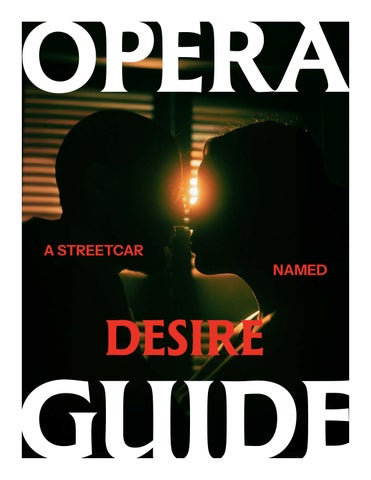
OPERA A STREETCAR NAMED
DESIRE
GUIDE
October 19, 2026 Dear Opera Curious and Opera Lovers alike, Boston Lyric Opera is thrilled to welcome you to the Emerson Colonial Theatre for our new production of A Streetcar Named Desire, which reimagines this epic, rarely performed opera for contemporary audiences. Opera has a way of tapping into big emotions in a way that’s hard to describe. There’s something incredibly powerful about experiencing the human voice live in the theater, and I believe that whether you’re new to opera or have loved it for years, there’s always something new to discover. To help make your experience even richer, we’ve put together this Guide. It’s designed to give you a little background on A Streetcar Named Desire, its themes, and how these themes resonate today and throughout this production. By providing historical and contemporary context, along with tools to thoughtfully reflect on the performance before or after you attend, we hope to make your experience a memorable one. Boston Lyric Opera inspires, entertains, and connects communities through compelling performances, programs, and gatherings. Our vision is to create operatic moments that enrich everyday life. As we develop additional Guides, we’re always eager to hear how we can improve your experience. Please tell us about how you use this Guide and how it can best serve your future learning and engagement needs by emailing education@blo.org. If you’re interested in engaging with us further and learning about additional opera education opportunities with Boston Lyric Opera, please visit blo.org/youth-and-schools to discover our programs and initiatives. We can’t wait to share this experience with you. Warmly,
Nina Yoshida Nelsen Artistic Director Boston Lyric Opera
2
TABLE OF CONTENTS
Synopsis
4
Characters
7
A Streetcar Named Desire: Acclaim and Adaptation through the 20th Century
8
Her Name Means 'White'
14
Audience Resources for A Streetcar Named Desire
20
Listen Up!
22
Guide To Listening
24
The History of Opera
26
The Science and Art of Opera
34
Notes to Prepare for the Opera
42
3
Set rendering by designer Andrew Boyce. Image credit: Andrew Boyce
A STREETCAR NAMED DESIRE
SYNOPSIS
This production contains scenes related to and depicting domestic violence, abuse, and sexual assault. We encourage patrons to engage with care.
ACT 1 Upon the loss of both her job and family home in Laurel, Mississippi, Blanche DuBois arrives in New Orleans with the intention of staying with her sister and brother-inlaw, Stella and Stanley Kowalski. Blanche finds herself surprised by Stella's tight living conditions and bothered by her sister's lack of involvement in maintaining affairs at their ancestral home. Stanley returns to the apartment, where he meets Blanche for the first time without having had any notice of her plans to stay at their home. After learning from Stella that her ancestral estate has been lost, Stanley becomes angry over the loss of what he deems his rightful inheritance. He fosters a steady mistrust of Blanche, especially upon discovering the expensive dresses and jewelry in her trunk. Blanche and Stanley quarrel as he tries to unearth lies regarding her past. Costume rendering for William Tell with crossbow, designed by Vita Tzykun. Image courtesy of Vita Tzykun.
4
In the heat of the argument, Stanley reveals to Blanche that Stella is pregnant. To be out of the apartment during Stanley's poker game, Blanche and Stella go out for the night. Blanche and Stella return from their night out, where the poker game at the apartment continues. Blanche sets her sights on Stanley's friend, Harold Mitchell (“Mitch”). Mitch tells the poker group that he worries he will be lonely if his sick mother passes. As a result of losing a round of poker, Stanley berates and physically attacks Stella, breaking up the game for the night. As his friends pin him down, Blanche and Stella escape to the upstairs apartment, which belongs to Eunice. Stanley shouts for Stella to return home, and she comes down into his arms, against Blanche's advice. In defense of Stella, Blanche urges her to leave Stanley, but Stella refuses to listen to criticism of her husband.
ACT 2 Stanley has picked up some unfavorable gossip and interrogates Blanche about her past, trying to expose lies and deceit. Blanche simultaneously reveals to Stella her desire for Mitch, then pursues a newspaper collector who reminds her of her deceased husband, as she waits for Mitch to pick her up for their outing. Following their night out, Blanche and Mitch return to the apartment. They exchange personal stories about their pasts, deepening the emotional aspect of their relationship.
Top: Costume sketch of Stella by designer Amanda Gladu. Image credit: Amanda Gladu Bottom: Costume sketch of Blanche by designer Amanda Gladu. Image credit: Amanda Gladu
5
ACT 3 Stella sets up the apartment for Blanche's birthday celebration, while Stanley shares with Stella the details he learned about Blanche's past. He believes Blanche has led Mitch on so she could avoid her unsavory history in Laurel. Stella refuses to believe Stanley's stories of Blanche's seductions in Mississippi. Stanley takes it upon himself to tell Mitch about his findings and is confident that Mitch will skip the birthday party and lose his respect for Blanche. Stanley verbally lashes out during the birthday celebration, at which Mitch is noticeably absent, and gifts Blanche a one-way ticket to return to Laurel. Upset, Blanche runs off into the bathroom. Stanley encourages Stella to remember how happy they were together before the arrival of her sister. During their intense conversation, Stella goes into labor and is rushed to the hospital. With Blanche home alone, Mitch pounds at the front door and accuses her of deceiving him. Mitch wants more from Blanche but decides that she is not good enough to live in the same house as his mother. Blanche pushes him out the door and descends into a drunken madness. Steadily drinking, Blanche dresses up and enters an imagined reality. With Stella's baby due the following morning, Stanley returns home from the hospital to “rest.” Stanley and Blanche are left alone in the apartment for the night, and he forcibly takes advantage of her. Top: Costume sketch of Stanley by designer Amanda Gladu. Image credit: Amanda Gladu Bottom: Costume sketch of Eunice by designer Amanda Gladu. Image credit: Amanda Gladu
6
Days later, as Stanley and his friends play cards, Stella cries while packing Blanche's suitcase. Stella cannot bring herself to believe her sister's tale of the prior night and chooses to go along with Stanley's plan to have Blanche institutionalized. Blanche, trapped in her delusions, believes she is leaving on a cruise. No longer in touch with reality, Blanche leaves with the doctor, quietly grateful for “the kindness of strangers.”
Characters Blanche DuBois – soprano Stella Kowalski, Blanche’s sister – soprano Stanley Kowalski, Stella’s husband – baritone Harold Mitchell (“Mitch”), Stanley’s friend – tenor Eunice Hubbell, a neighbor – mezzo-soprano Steve Hubbell, Eunice’s husband – tenor Flower Seller – mezzo-soprano Young Collector – tenor Nurse – actor Doctor – actor Pablo, Stanley’s friend – actor
Top: Costume sketch of the Doctor and Nurse by designer Amanda Gladu. Image credit: Amanda Gladu Bottom: Costume sketch of Mitch by designer Amanda Gladu. Image credit: Amanda Gladu
7
Photo of American playwright Tennessee Williams, 1965. Public Domain
Original movie poster for A Streetcar Named Desire, 1951. Public Domain
8
A STREETCAR NAMED DESIRE: ACCLAIM AND ADAPTATION THROUGH THE 20TH CENTURY
I
n the late fall of 1947, the gossip among New York theatregoers was that the new Tennessee Williams play was going to be an “extraordinary event.” [1] This premonition certainly came true. A Streetcar Named Desire opened at the Ethel Barrymore Theatre on December 3, 1947, marking a pivotal point in the history of American theatre. Not only did Streetcar ensure Tennessee Williams’ legacy as a playwright – as well as launching the career of then-unknown Marlon Brando – but it also cemented its place in twentieth century American culture. New York Times critic Brooks Atkinson wrote in this original review of the play: “…the new play is a quietly woven study of intangibles. But to this observer it shows deeper insight and represents a great step forward toward clarity. And it reveals Mr. Williams as a genuinely poetic playwright whose knowledge of people is honest and thorough and whose sympathy is profoundly human… [Tennessee Williams] has not forgotten that human beings are the basic subject of art. Out of poetic imagination and ordinary compassion he has spun a poignant and luminous story.” [2] Emerging from World War II, American theatre was responding to a changed nation. Responding to a public that was increasingly anxious over the state of the human soul,[3] American theatre became more pessimistic and introspective. In 1941, Tennessee Williams wrote: “Undoubtedly our artistic climate is going to change through the world situation… I think there is going to be a vast hunger for life after all this death— and for light after all this eclipse… People will want to read, see, feel the living truth and they will revolt against the sing-song Mother Goose book of lies that are being fed to them.” [4] 9
Williams, through his nuanced exploration of character as well as heightened, poetic language, captured this shifting cultural outlook in his plays. In 1947, he wrote to A Streetcar Named Desire’s director, Elia Kazan: "There are no ‘good’ or ‘bad’ people. Some are a little better or a little worse, but all are activated more by misunderstanding than malice. A blindness to what is going on in each other’s hearts.” [5] This complex exploration of morality and the human condition moved audiences, and on its opening night, the performance was applauded for 30 minutes, seven of which received a standing ovation.
Marlon Brando, the Stanley that almost never was
10
once said of his acting, “It was a mysterious process… There was always an element of surprise in what he did.” [6] Deciding to take the risk on the then 23-yearold Brando, Kazan knew he needed Tennessee
Before Marlon Brando’s iconic roles in On the
Williams’ approval. As the story goes, Kazan
Waterfront, The Godfather, and Apocalypse
gave Brando $20 and sent him to catch a
Now, he was an emerging actor on the
bus to Provincetown, Massachusetts. Kazan
Broadway scene. During the late summer of
recalled, “After three days I called Tennessee
1947, Brando auditioned for Streetcar director
and asked him what he’d thought of the actor
Elia Kazan after contract negotiations with
I’d sent him. ‘What actor?’ he asked. No one
John Garfield, the original Stanley, fell through.
had showed up, so I figured I’d lost 20 bucks
Though Brando was a “shot in the dark,” Kazan
and began to look elsewhere.” [6]
Photo of Marlon Brando, 1950. Public Domain
But Brando did make it to Provincetown – he
by estimated theatre practitioner Stella
just hitchhiked with his friend Ellen Adler.
Adler. Brando is considered one of the
[3]
When Brando arrived, Williams’ Provincetown
earliest “method actors” as defined by the
home was in disrepair, with a flooded kitchen,
Actors Studio’s teaching and adaptation
blocked bathrooms, and a blown fuse. Brando
of the Stanislavski system. [3] This style was
spent an hour making repairs to Williams’
exceptionally highlighted by playwrights like
home, fixing the lights and unclogging the
Tennessee Williams. In the original New York
bathrooms, before finally auditioning for the
Times review of Streetcar, Atkins writes, “This
playwright.
must be one of the most perfect marriages
[3]
Williams wrote of Brando’s
audition: “A new value came out of Brando’s
of acting and playwriting. For the acting and
reading. He seemed to have already created a
playwriting are perfectly blended in a limpid
dimensional character, of the sort that the war
performance.” [4]
has produced among young veterans… Please use all your influence to oppose any move… to reconsider or delay signing the boy.” Within four days, Brando was officially signed on as Stanley Kowalski. [6]
As Issac Butler, author of The Method: How the Twentieth Century Learned to Act writes, “Streetcar need a sense of truth from its performers to balance out the characters’ lies and delusions. It demands from actors an
Brando would go on to star in the film
ability to deliver Williams’ heightened, highly
adaptation of A Streetcar Named Desire,
poetic dialogue like everyday speech, and to
beginning his longstanding career in Hollywood
portray his astounding, complex characters
as well as influencing contemporary acting
as though they were people – not types, or
methods. His acting style was honed at
heroes, or victims, or monsters, but people.” [3]
the Actors Studio and deeply influenced
A Streetcar Named Desire went on to win the Pulitzer Prize for Drama, the New York Drama Critics’ Circle for Best Play, and Jessica Tandy won the Tony Award for Best Actress in a Play for her portrayal of Blanche. In 1951, the critically acclaimed movie adaptation was released, garnering four Academy Awards and earning over $4 million at the box office. But before Streetcar could claim to be a such a widespread box office success, the script came up against Hollywood censorship. Bound by the Motion Picture Production Code, also known as the Hays Code, the Motion Picture Association of America enforced strict guidelines on the content of films from 1934 to 1968. [2] In order to be produced as a film, A Streetcar Named Desire needed to be adjusted. Explicit language was toned down, and plot
Publicity photo of Jessica Tandy (left), Kim Hunter (center), and Marlon Brando (right) in the original A Streetcar Named Desire production, 1948. Public Domain
11
points were changed. For example, instead of Blanche’s former husband committing suicide after he is outed as gay, the film changed the reasoning to be because of Blanche’s scorn for him. [7] The most notable change, however, was the ending. In the film, to serve as a punishment for Stanley, Stella leaves and escapes to her neighbor’s home, insisting that she will never go back to him. [8] Kazan filmed some scenes that had to be cut to meet standard guidelines, and, after rediscovery in 1989, the scenes were released by Warner Bros. in a 1993 director’s cut edition of A Streetcar Named Desire. [8] In 1995, A Streetcar Named Desire began its next life via adaptation, this time as an opera. Lotfi Mansouri, then General Director of San Francisco Opera, brought together composer André Previn and librettist Philip Littell to create what Mansouri said was a 20-year dream of his – to adapt A Streetcar Named Desire into an opera. [9] “When Lotfi called and asked if I would consider writing an opera based on Streetcar, I leaped at him over the phone,” said André Previn. “It occurred to me much later when I started picking up a pencil that I might do this quite badly because I haven’t yet written an opera. But the only result of that was I wanted to do it even more.” [10] While Streetcar was Previn’s first opera, he was widely known for his work as a jazz, contemporary classical, and film score composer. Littell had been previously commissioned by San Franciso Opera for their 1994 production of The Dangerous Liaisons. Though the team did not have the rigorous Hays Code informing the shape of their adaptation, they did need the approval of the Williams estate. They also had the pressure of
Top: Publicity photo of Marlon Brando in the original A Streetcar Named Desire production, 1948. Public Domain Center: Photo of director Elia Kazan, 1967. Public Domain Bottom: Photo of André Previn, 1973. Public Domain
12
public adoration for the source material. Of the creation process, Littell said, “It ain’t been easy. Maybe the hardest thing about this was adding material that wasn’t in the play (for example, a chilling aria for the Mexican flower seller). It’s like doing a skin graft on a movie star. But the trick is to make them (the audience) think, ‘Why’d they hire a librettist? Look, the play is perfect.’ People want to meet Williams, not Philip. Ego notwithstanding, I don’t want to be visible on this.” [10] The opera A Streetcar Named Desire first premiered with San Francisco Opera on Saturday, September 19, 1998. Commenting on whether Tennessee Williams would like their adaption, Previn said, “Whether he would like this particular one or not, I don’t know. I think he probably would have liked an opera version because the play is in many ways very operatic, and it’s got all the kinds of madness and excess that opera can stand. I admired him so boundlessly – long, long, long before all this – and I’d like to delude myself that he would like it, yes. It would have meant a lot to me.” [10]
1. Miller, Kerri. 2012. “How Did ‘A Streetcar Named Desire’ Shape America?” Radio broadcast. MPR News. 2. Atkinson, Brooks. 1947. “First Night at the Theatre.” The New York Times, December 3, 1947. 3. Butler, Isaac. 2022. The Method: How the Twentieth Century Learned to Act. Bloomsbury Publishing. 4. Cave, Mark. 2022. “The Global Impact of ‘A Streetcar Named Desire.’” The Historic New Orleans Collection. March 17, 2022. 5. Mark, Cave. 2020. “Ten Historic Objects That Tell the Story behind ‘A Streetcar Named Desire.’” The Historic New Orleans Collection. August 21, 2020. 6. Lahr, John. 2014. “How Marlon Brando Nearly Missed His Defining Role.” BBC. October 21, 2014. 7. Royle, Lewis. 2021. “Revisiting ‘A Streetcar Named Desire’ 70 Years Later.” The Indiependent. September 19, 2021. 8. Turan, Kenneth. 1993. “COMMENTARY : A ‘Streetcar’ Named Entire: With Censored Footage Newly Restored, Elia Kazan’s Film of the Tennessee Williams Play Can Now Be Seen for the Landmark It Is.” Los Angeles Times, September 26, 1993. 9. Mansouri, Lotfi. 1998. “A Message from the General Director.” San Francisco Opera Playbill: A Streetcar Named Desire, 1998. 10. Salter, Stephanie. 1998. “Constructing Streetcar.” San Francisco Opera Playbill: A Streetcar Named Desire, 1998.
13
Her Name Means ‘White’ Hearing Blanche DuBois differently when a Black woman sings the role By Kira Troilo Blanche DuBois explains her name to Mitch in Tennessee Williams’ play: Blanche means “white.” DuBois means “of the woods.” White woods is the full picture. When a Black woman plays Blanche, that explanation gives me pause. Whiteness is there in the name, spoken by a woman whose presence complicates it. What does she want Mitch to understand about her? What will he see, regardless of what she tells him? Boston Lyric Opera’s casting of Brittany Renee as Blanche invites us to return to a familiar story with different questions. Blanche cares deeply about being recognized as a particular kind of woman: educated, respectable, deserving of tenderness. In the segregated South of 1947, who could claim that recognition, and who could count on receiving it? André Previn’s opera, with a libretto by Philip Littell, brings Williams’ characters into another form. We hear their desires and their conflicts through music. The play remains an important place to begin when considering the histories those characters carry, including histories that become more apparent when a Black
14
woman takes the central role. “Colorblind casting” generally asks audiences to accept a performer in a role without treating race as part of the character’s story. That approach, while flawed, has indeed opened important opportunities for artists. However, my preferred “color-conscious casting” allows race to inform how we understand the relationships and the world onstage. It also leaves us with questions a casting choice alone can’t answer. A Black Blanche does not arrive with a fully explained family history, and an artist’s identity does not settle every detail of a character’s biography. What interests me is what becomes possible to notice: in her attachment to the past, her efforts to control how others see her, and the decisions people make about what she deserves.
The home she has lost Williams’ New Orleans is multiracial from the opening stage directions. A white neighbor and a Black neighbor share a stoop. Black musicians help give the neighborhood its sound. Blanche arrives in a city where Black life is already present, even though the central family in the original play is white. Race is part of the world Williams wrote. Casting a Black Blanche brings it into the central relationships in additional ways. Consider Belle Reve, the family plantation in Mississippi. Blanche has lost it. She describes generations of men spending away the family’s resources, followed by the expense and exhaustion of caring for dying relatives. She arrives at Stella’s home carrying grief, resentment, and very little money. A white Blanche’s attachment to Belle Reve can evoke the white South’s romantic account of itself, with the violence of slavery kept (conveniently) out of the picture. We can feel for her loss while questioning what she is mourning. A Black Blanche complicates that inheritance. How did her family come to own this land? What did ownership mean to them? Williams’ account does not supply a Black family’s history, and there is no single history we can simply substitute. There is, however, a history worth holding alongside her grief. After Emancipation, Black families acquired land that offered independence and something to pass on to their children. USDA research places Black farmland ownership at an estimated 16 to 19 million acres in 1910. The subsequent loss of much of that land makes ownership,
15
debt, and inheritance especially charged subjects. That context does not prove that racial dispossession caused the loss of Belle Reve. It changes what an audience may bring to the story of a Black woman losing her family home. The loss can carry the weight of security, achievement, and a place to belong, alongside the status Blanche so clearly misses. Her grief need not become morally uncomplicated for us to take it seriously. A Black Blanche can still be a snob. She can still cling to a version of the past that leaves things out. Her relationship to class deserves attention, too.
Being seen as a lady Blanche works hard at how she appears. She corrects manners, quotes literature, and manages the light. The paper lantern over the bare bulb lets her soften what others can see. She wants admiration and intimacy, but she fears exposure. It’s easy to dismiss these efforts as vanity. Sure, sometimes they are vain. But for a Black woman, being seen as refined or respectable can carry consequences beyond whether someone finds her attractive. In The Souls of Black Folk, W. E. B. Du Bois described double consciousness as “this sense of always looking at one’s self through the eyes of others.” His account concerns the particular pressure of living as a Black person in a society that measures you through racial contempt. That pressure offers one way to consider Blanche’s constant attention to how she is being read. Historian Evelyn Brooks Higginbotham’s work on Black Baptist women identifies another relevant history: the politics of respectability. Careful public conduct became part of a collective effort to challenge racist assumptions and claim dignity and rights. Blanche’s individual efforts to be treated as a lady aren’t the same political project, but that history helps us hear the stakes in her insistence on respectability. What protection does she expect her education to provide? What does she believe the right dress, the right words, or the right manners will secure? Her manners can be both vanity and protection at once. Wanting to be admired does not make her need for safety less real, nor does understanding that need make all her behavior harmless. Blanche can be cruel. She conceals things, judges people, and reaches for relationships in ways that can hurt others. 16
1907 gelatin print of W.E.B. Du Bois by James E. Purdy, restored by Adam Cuerden. Public Domain
Cropped photo of Evelyn Brooks Higginbotham from February 2023. Creative Commons Creative Commons
I’d argue to carve out – and make space for – all of that. Black women should be able to inhabit complicated characters without having to become exemplary people before an audience will care about them. Opera gives us a particular opportunity here. We can listen to the woman expressing herself, even while questioning the account she gives. Her longing deserves our attention without requiring our agreement with everything she says.
Belonging, marriage, and protection Blanche’s conflict with Stanley is partly about who has the authority to judge whom. In Williams’ play, she treats his Polish ancestry and his manners as evidence of inferiority. He insists on his American identity and rejects her claim to stand above him. If we read Blanche as Black and Stanley as white within this world, her class contempt operates alongside a racial hierarchy that actually favors him. Her education and family name may matter enormously to her, but they do not – and cannot – guarantee that anyone else will honor the standing she believes they confer. That makes their struggle more unequal in a specific way. She can insult him, but the society around them does not offer them equal protection or credibility. His violence remains his choice. Racial hierarchy gives us more to consider about the conditions in which he makes it, and about how others might respond. Mitch initially appears to offer a different possibility. He is lonely, just like Blanche. Their hope for companionship is real, even as she withholds parts of her past. When he rejects her as unfit to enter his mother’s home, respectability becomes a condition of belonging. He has imagined a woman he can marry, but once that image breaks, he treats her differently. Reading this as a relationship between a Black woman and a white man adds a heavier legal history to the encounter. In 1947, Louisiana and Mississippi prohibited 17
marriage between Black and white people. The Supreme Court would invalidate remaining state bans on interracial marriage in Loving v. Virginia in 1967. That history raises a difficult question about the future Blanche hopes for with Mitch. It doesn’t tell us how either character understands that future. It does mean that, under this reading, marriage faces a barrier beyond the judgments of Mitch and his mother. His distinction between a woman he might desire and a woman he would bring home becomes especially painful. What does he believe he is entitled to ask of her once he has decided she’s no longer worthy of marriage?
Who gets believed In easily the most difficult moment of the opera, Stanley rapes Blanche. But what happens afterward is difficult as well. Stella cannot accept her sister’s account and continue living with Stanley, so she chooses not to believe Blanche. Blanche is then taken away while the household finds a way to go on. The question of belief is already devastating. A Black Blanche brings a further history into view: the denial of justice to Black women subjected to sexual violence. In 1944, three years before Streetcar premiered, Recy Taylor was raped by 6 white men after being abducted on her way home from church in Alabama. Rosa Parks investigated her case for the NAACP and helped organize a campaign for justice. The men were, unsurprisingly, not indicted. Taylor’s history belongs here because it shows both the refusal to hold white men accountable and the determined work of Black women to challenge that refusal. She spoke. Others organized. The failure was in the response to her, not in an absence of courage or resistance. That distinction matters when watching Blanche in our opera. Her past becomes material other people use to discredit her. Whatever truths or harms that past contains, it doesn’t make her responsible for Stanley’s assault. Nor should a history of deception make her account of violence impossible to believe.
18
1944 photograph of Recy Taylor. Public Domain
Stella’s decision also deserves more than a quick judgment. There is a marriage, a baby, and a home bound up in what she can bear to accept. Those pressures help us understand her choice. However, they do not erase its consequences for Blanche. We can watch for the moment when protecting the household becomes more important than protecting the person who has been harmed. We can ask how easily our own sympathy shifts when someone becomes “difficult,” unreliable, or inconvenient. Blanche’s final appeal to the kindness of strangers leaves that responsibility with us. She is in psychological distress, and she still needs tenderness. Those things can both be true. We do not have to turn her distress into wisdom or make her innocent of every harm in order to recognize what is owed to her. A Black Blanche gives these questions another history, but she is also a woman we are meeting through a particular artist’s voice. There should be room to hear her humor, desire, pride, and longing alongside her fear. She deserves more than our anticipation of what will happen to her. She tells Mitch that her name means "white.” As we listen, we can ask what she hopes that name will establish, what the people around her choose to see, and whether their recognition ever gives her the care she needs.
Sources Tennessee Williams, A Streetcar Named Desire (1947). Wise Music Classical / G. Schirmer. André Previn, A Streetcar Named Desire: credits and synopsis. USDA Economic Research Service. Rural America, vol. 17, issue 4: historical Black farmland ownership. W. E. B. Du Bois. The Souls of Black Folk (1903), chapter 1, “Of Our Spiritual Strivings.” American Historical Association. Evelyn Brooks Higginbotham: account of Righteous Discontent and the politics of respectability. Loving v. Virginia, 388 U.S. 1 (1967), including footnote 5 identifying remaining state marriage bans. Mia L. Carey, National Park Service. “Mrs. Recy Taylor (1919–2017)”: the assault, Rosa Parks’s investigation, and the campaign for justice.
19
AUDIENCE RESOURCES FOR A STREETCAR NAMED DESIRE: DOMESTIC & INTIMATE PARTNER VIOLENCE, AND SUICIDE PREVENTION AND RESPONSE RESOURCES: A Streetcar Named Desire contains scenes related to and depicting domestic violence, abuse, and sexual assault. We encourage patrons to engage with care. We have also provided a list of local, state, and national resources for audiences of Streetcar to learn more about domestic and intimate partner violence, as well as suicide and other mental health counselling recourses available for yourself or a loved one.
Casa Myrna
Casa Myrna is Boston’s largest provider of domestic violence awareness efforts and of shelter and supportive services for survivors. Services in English and Spanish. Web: https://casamyrna.org/ Email: info@casamyrna.org Phone: (617) 521-0100
Victim Rights Law Center Victim Rights Law Center provides free, comprehensive legal services for sexual assault victims with civil legal issues in Massachusetts. Web: https://victimrights.org/ Phone: (617) 399-6720 Intake Line for Legal Help: (617) 399-6720 x19
Boston Medical Center BMC’s Domestic Violence Program is a resource for patients, employees, community members, and anyone who is seeking information or help with domestic violence. Services are available in English, Spanish, Haitian Creole, and Arabic. Web: https://www.bmc.org/domestic-violence-program Phone: (617) 414-5457
20
SafeLink SafeLink is Massachusetts’ statewide 24/7 toll-free domestic violence hotline and a resource for anyone affected by domestic or dating violence. Advocates are bilingual in English and Spanish and have access to a service that can provide translation in more than 130 languages. Web: https://www.mass.gov/domestic-violence-services Phone: 877-785-2020
National Domestic Violence Hotline National Domestic Violence Hotline provides essential tools and support to help survivors of domestic violence so they can live their lives free of abuse. Available 24 hours a day, seven days a week. Services available in over 200 languages. Web: https://www.thehotline.org/ Phone: 1-800-799-SAFE (7233) Text: Text “START” to 88788
RAINN (Rape, Abuse & Incest National Network) RAINN is the nation’s largest anti-sexual violence organization and operator of the National Sexual Assault Hotline. Hotline open 24 hours a day, seven days a week, and available in English and Spanish. Web: https://rainn.org/ Phone: 800-656-HOPE (4673) Text: Text “HOPE” to 64673 Chat online at: https://rainn.org/hotline
988 Lifeline National mental health hotline for mental health struggles, emotional distress, alcohol or drug use concerns, and more. Open 24 hours a day, seven days a week. Web: https://988lifeline.org/ Phone: 988
21
LISTEN UP! with Daniela Candillari
For a long time, I have been fascinated by André Previn and the many disciplines in which he excelled throughout his career. I first encountered his work as a composer and arranger, and only later came to know him as a pianist and conductor. That gradual discovery sparked a deeper curiosity about what shaped his musical world and how he forged such a singular and unmistakable voice. Previn’s A Streetcar Named Desire is, for me, a particularly fascinating example of that voice. Its musical language draws on an extraordinary range of influences: jazz, blues, Americana, European classical traditions, and even the sound world of Hollywood. While Puccini is often mentioned in connection with the opera, I hear equally strong affinities with Britten in the textures and with the Second Viennese School in the harmonic language. Rather than belonging exclusively to one tradition, the opera seems to absorb and transform many different musical worlds into something distinctly American. From the opening measures, we are immediately transported into the atmosphere of New Orleans. The opening chords strike me as an almost unmistakable nod to Alex North’s historical soundtrack for the film, although Previn seems to augment and stretch the gesture in time. The reference is not merely nostalgic: it establishes the sonic environment in which the drama unfolds. The clarinet and trumpet, both strongly associated with New Orleans jazz and the city’s tradition of live street music, further reinforce this sense of place. •
Opera: A Streetcar Named Desire (Previn) - Act I, Scene 1
•
Film: A Streetcar Named Desire (North) - Main Title
This is one of the most compelling aspects of Previn’s use of motives. They are often more atmosphere-driven than character-driven. Rather than functioning simply as leitmotifs attached to individual characters, the motives seem to emerge from the world surrounding them. They establish the temperature, color, and psychological landscape of a scene. 22
At the same time, the music becomes increasingly connected to the characters’ inner lives. The more fragile Blanche’s psyche becomes, the more fragile, distant, and elusive the musical language seems to become. One of my favorite examples occurs at the beginning of Act III, Scene 3, when Blanche imagines going for a swim with another suitor. The harmony becomes bitonal, while the woodwinds play an undulating figure in eighth notes. The motion immediately evokes water, almost as if we were watching moonlight reflecting and shifting on its surface. It is an extraordinarily delicate musical image, but there is also something unsettling about it: the beauty of Blanche’s fantasy exists alongside the instability of her mental state. ( A Streetcar Named Desire (Previn) - Act III, Scene 3ous test. This contrast between illusion and reality runs throughout the opera. More languid and lyrical passages can suggest memory, fantasy, and escapism, while highly rhythmic motives often communicate the harshness of lived reality. The interlude in Act III is a striking example. Its relentless rhythmic energy almost makes me think of Shostakovich, particularly the atmosphere of his Tenth Symphony or the violent scene from Lady Macbeth of Mtsensk. Previn is certainly not imitating Shostakovich, but the physical tension built by the music certainly reminds us of similar human struggles. A Streetcar Named Desire (Previn) - Act III, Interludeou A Streetcar Named Desire is an opera that reveals something new with every hearing. Its deeply human emotions and subtle musical shifts become increasingly powerful with each encounter, making it a work that continually draws us back and rewards repeated listening.
23
GENERAL QUESTIONS TO GUIDE YOUR LISTENING • What instruments do you hear? • How fast is the music? Are there sudden changes in speed? Is the rhythm steady or unsteady? • Key/Mode: Is it major or minor? (Does it sound bright, happy, sad, urgent, dangerous?) • Dynamics/Volume: Is the music loud or soft? Are there sudden changes in volume (either in the voice or orchestra)? • What is the shape of the melodic line? Does the voice move smoothly, or does it make frequent or erratic jumps? Do the vocal lines move noticeably downward or upward? • Does the type of voice singing (baritone, soprano, tenor, mezzo, etc.) have an effect on you as a listener? • Do the melodies end as you would expect, or do they surprise you? • How does the music make you feel? What effect do the factors above have on you as a listener? • What is the orchestra doing in contrast to the voice? How do the two interact? • What kinds of images, settings, or emotions come to mind? Does it remind you of anything you have experienced in your own life? • Do particularly emphatic notes (low, high, held, etc.) correspond to dramatic moments? • What type of character (romantic, comic, serious, etc.) fits this music?
24
Photo of the set model by designer Andrew Boyce. Image credit: Andrew Boyce
25
THE HISTORY OF OPERA People have been telling stories through music for millennia throughout the world. Opera is an art form that is over 400 years old, with roots in Western Europe. Here is a brief timeline of its lineage.
RENAISSANCE 1500-1620
BAROQUE 1600-1750
CLASSICAL 1730-1820
Please note that all date ranges for these time periods are approximate, and notice that some even overlap. 26
ROMANTIC 1790-1910
20th CENTURY 1900-2000
27
RENAISSANCE (1500-1620)
1573 The Florentine
Camerata was founded in Italy, devoted to reviving ancient Greek musical traditions, including sung drama.
1607 Claudio Monteverdi
(1567-1643) wrote L’Orfeo, the first opera to become popular, marking him as the premier opera composer of his day and bridging the gap between Renaissance and Baroque music. His works are still performed today.
1598 Jacopo Peri (1561-
1633), a member of the Camerata, composed the world’s first opera – Dafne – reviving the classic myth.
Toccata from L’Orfeo. Claudio Monteverdi Favola in musica. Reprint of the First Edition of the Score, Venice 1609 [Public domain], via Wikimedia Commons
28
1637 The first public opera house, Teatro
San Cassiano, was built in Venice, Italy.
BAROQUE (1600-1750)
1673 Jean-Baptiste Lully (1632-1687), an Italian-born
composer, brought opera to the French court, creating a unique style, tragédie en musique, that better suited the French language. Blurring the lines between recitative and aria, he created fast-paced dramas to suit the tastes of French aristocrats.
1689 Henry Purcell’s (1659-1695)
simple and elegant chamber opera, Dido and Aeneas, premiered at Josias Priest’s boarding school for girls in London.
1712 George Frederic Handel
(1685-1759), a German-born composer, moved to London, where he found immense success writing intricate and highly ornamented Italian opera seria (serious opera). Ornamentation refers to stylized, fast-moving notes, usually improvised by the singer to make a musical line more interesting and to showcase their vocal talent.
Dido and Aeneas, 1747, Pompeo Batoni [Public domain], via Wikimedia Commons
29
1805 Ludwig van Beethoven
CLASSICAL (1730-1820)
(1770-1827), although a prolific composer, wrote only one opera, Fidelio. The extremes of musical expression in Beethoven’s music pushed the boundaries in the late Classical period and inspired generations of Romantic composers.
1816
1750s A reform movement, led by
Christoph Willibald Gluck (1714-1787), rejected the flashy ornamented style of the Baroque in favor of simple, refined music to enhance the drama.
The Magic Flute playbill for the premiere, 30 September 1791 [Public domain], via
1767
Wolfgang Amadeus Mozart. Posthumous painting by Barbara Krafft in 1819 [Public domain], via Wikimedia Commons
30
Wolfgang Amadeus Mozart (1756-1791) wrote his first opera at age 11, beginning his 25-year opera career. Mozart mastered and then innovated in several operatic forms. He wrote opera serias (serious operas), including La Clemenza di Tito; and opera buffas (comedic operas) like Le Nozze di Figaro (The Marriage of Figaro). He then combined the two genres in Don Giovanni, calling it dramma giocoso (comedic drama). Mozart also innovated the Singspiel, a German sung play featuring spoken dialogue, as in Die Zauberflöte (The Magic Flute).
Gioachino Rossini (1792-1868) composed Il barbiere di Siviglia (The Barber of Seville), becoming the most prodigious opera composer in Italy by age 24. He wrote 39 operas in 20 years. A new compositional style created by Rossini and his contemporaries, including Gaetano Donizetti and Vincenzo Bellini, would, a century later, be referred to as bel canto (beautiful singing). Bel canto compositions were inspired by the nuanced vocal capabilities of the human voice and its expressive potential. Composers employed strategic use of register, the push and pull of tempo (rubato), extremely smooth and connected phrases (legato), and vocal glides (portamento).
1853 Giuseppe Verdi (1813-1901)
completed La Traviata, a story of love, loss, and the struggle of average people, in the increasingly popular realistic style of verismo. Verdi enjoyed immense acclaim during his lifetime, while expanding opera to include larger orchestras, extravagant sets and costumes, and more highly trained voices.
ROMANTIC (1790-1910)
Giuseppe Verdi, by Giovanni Boldini, 1886 [Public domain], via Wikimedia Commons
The Golden Age of Opera 1842 Inspired by the risqué popular entertainment
of French vaudeville, Hervé (1825-1892) created the first operetta, a short comedic musical drama with spoken dialogue. Responding to popular trends, this new form stood in contrast to the increasingly serious and dramatic works at the grand Parisian opera house. Opéra comique as a genre was often not comic, tending to be more realistic or humanistic instead. Grand opera, on the contrary, was exaggerated and melodramatic.
1865 Richard Wagner’s
1871 Influenced by French
operetta, English librettist W.S. Gilbert (1836-1911) and composer Arthur Sullivan (1842-1900) began their 25-year partnership, which produced 14 comic operettas, including The Pirates of Penzance and The Mikado. Their works inspired the genre of American musical theatre.
(1813-1883) Tristan und Isolde was the beginning of musical modernism, pushing the use of traditional harmony to its extreme. His massively ambitious, lengthy operas, often based in German folklore, sought to synthesize music, theatre, poetry, and visuals in what he called a Gesamtkunstwerk (total work of art). The most famous of these was an epic four-opera drama, Der Ring des Nibelungen, which took him 26 years to write and was completed in 1874.
Richard Wagner. Photo taken 1871 in Munich via Wikimedia Commons
31
1927 American musical Mikado theatre poster, Edinburgh, 1885 [Public domain], via Wikimedia Commons
ROMANTIC (1790-1910)
theatre, commonly referred to as Broadway, was taken more seriously after Jerome Kern’s (1885-1945) Show Boat, with words by Oscar Hammerstein II (1895-1960), tackled issues of racial segregation and the ban on interracial marriage in Mississippi.
1874
Johann Strauss II, (1825-1899) influenced largely by his father, with whom he shared a name and talent, composed Die Fledermaus, popularizing Viennese musical traditions, namely the waltz, and further shaping operetta.
1922 1896
Giacomo Puccini’s (1858-1924) La bohème captivated audiences with its intensely beautiful music, realism, and raw emotion. Puccini enjoyed huge acclaim during his lifetime for his works.
A scene from a 19th-century version of the play The Barber of Seville by Pierre Beaumarchais. Its origins in the commedia dell’arte are shown in this picture, which portrays Figaro dressed in the costume and mask of Harlequin. 1884 [Public domain], via Wikimedia Commons
32
Scott Joplin. Public Domain.
1911 Scott Joplin,
(1868-1917) “The King of Ragtime,” wrote his only opera, Treemonisha, which was not performed until 1972. The work combined the European lateRomantic operatic style with African American folk songs, spirituals, and dances. The libretto, also by Joplin, was written at a time when when African Americans in the southern United States rarely had access to literacy resources and education.
Alban Berg (1885-1935) composed the first completely atonal opera, Wozzeck, dealing with uncomfortable themes of militarism and social exploitation. Wozzeck is in the style of 12-tone music, or serialism. This new compositional style, developed in Vienna by composer Arnold Schoenberg (1874-1951), placed equal importance on each of the 12 pitches in a chromatic scale (all half steps), removing the sense of the music being in a particular key.
Porgy and Bess by the New York Harlem Theatre 2009. Courtesy of New York Harlem Theatre
1987 1945 British composer Benjamin
Britten (1913-1976) gained international recognition with his opera Peter Grimes. Britten, along with Ralph Vaughan Williams (1872-1958), was one of the first British opera composers to gain fame in nearly 300 years.
20TH CENTURY (1900-2000)
John Adams (b. 1947) composed one of the great minimalist operas, Nixon in China, the story of Nixon’s 1972 meeting with Chinese leader Mao Zedong. Musical minimalism strips music down to its essential elements, usually featuring a great deal of repetition with slight variations. Pulitzer Prize-winning contemporary composer Ellen Reid. Photo courtesy of Ellen Reid
1935 American
composer George Gershwin (1898-1937), who was influenced by African American music and culture, debuted his opera, Porgy and Bess, in Boston, MA with an all-African American cast of classically trained singers. His contemporary, William Grant Still (1895-1978), a master of European grand opera, fused that with the African American experience and mythology. His first opera, Blue Steel, premiered in 1934, one year before Porgy and Bess.
1986
Leonard Bernstein via Creative Commons
1957
Leonard Bernstein (1918-1990), known for synthesizing musical genres, brought together the best of American musical theatre, opera, and ballet in West Side Story, a reimagining of Romeo and Juliet in a contemporary setting.
Anthony Davis (b. 1951) premiered his first of many operas, X: The Life and Time of Malcom X, which reclaims stories of Black historical figures within the theatre space. He incorporated both the orchestral and vocal techniques of jazz and classical European opera in his score for a distinctly American sound, and a fully realized vision of how jazz and opera are in conversation within a work.
Today
Still a vibrant, evolving art form, opera attracts contemporary composers such as Philip Glass (b. 1937), Jake Heggie (b. 1961), Terence Blanchard (b. 1962), Ellen Reid (b. 1983), and many others. Composers continue to be influenced by present and historical musical forms in creating new operas that explore current issues or reimagine ancient tales.
Six-time GRAMMY® Award-winning jazz musician and composer Terence Blanchard. Creativity Commons
Photograph of William Grant Still taken by Carl Van Vechten. Creativity Commons
33
THE SCIENCE AND ART OF OPERA
34
So Young Park as the Queen of the Night in Mozart’s The Magic Flute. Photo: Eric Antoniou
WHY DO OPERA SINGERS SOUND LIKE THAT? Opera is unique among forms of singing in that singers are trained to be able to sing without amplification, in large theaters, over an entire orchestra, and still be heard and understood! This is what sets the art form of opera apart from similar forms such as musical theatre. To become a professional opera singer, it takes years of intense physical training and constant practice — not unlike that of a ballet dancer — to stay in shape. Poor health, especially respiratory issues and even allergies, can be severely debilitating for a professional opera singer. Let’s peek into some of the science of this art form.
35
HOW THE VOICE WORKS Singing requires different parts of the body to work together: the lungs, the vocal cords, the vocal tract, and the articulators (lips, teeth, and tongue). The lungs create a flow of air over the vocal cords, which vibrate. That vibration is amplified by the vocal tract and broken up into words by consonants, which are shaped by the articulators.
BREATH:
VIBRATION:
36
Any good singer will tell you that good breath support is essential to produce quality sound. Breath is like the gas that goes into your car. Without it, nothing runs. In order to sing long phrases of music with clarity and volume, opera singers access their full lung capacity by keeping their torso elongated and releasing the lower abdomen and diaphragm muscles, which allows air to enter into the lower lobes of the lungs. This is why we associate a certain posture with opera singers. In the past, many operas were staged with singers standing in one place to deliver an entire aria or scene, with minimal activity. Modern productions, however, often demand a much greater range of movement and agility onstage, requiring performers to be physically versatile, and bringing more visual interest, authenticity of expression, and nuanced acting into the storytelling.
If you run your fingers along your throat, you will feel a little lump just underneath your chin. That is your “Adam’s Apple,” and right behind it, housed in the larynx (voice-box), are your vocal cords. When air from the lungs crosses over the vocal cords it creates an area of low pressure (Google The Bernoulli Effect), which brings the cords together and makes them vibrate. This vibration produces a buzz. The vocal chords can be lengthened or shortened by muscles in the larynx, or by changing the speed of air flow. This change in the length and thickness of the vocal cords is what allows singers to create different pitches. Higher pitches require long, thin cords, while low pitches require short, thick ones. Professional singers take great pains to protect the delicate anatomy of their vocal cords with hydration and rest, as the tiniest scarring or inflammation can have noticeable effects on the quality of sound produced.
RESONANCE:
Without the resonating chambers in the head, the buzzing of the vocal cords would sound very unpleasant. The vocal tract, a term encompassing the mouth cavity, and the back of the throat, down to the larynx, shapes the buzzing of the vocal cords like a sculptor shapes clay. Shape your mouth in an ee vowel (as in eat), then sharply inhale a few times. The cool sensation you feel at the top and back of your mouth is your soft palate. The soft palate can raise or lower to change the shape of the vocal tract. Opera singers often sing with a raised soft palate, which allows for the greatest amplification of the sound produced by the vocal cords. Different vowel sounds are produced by raising or lowering the tongue, and changing the shape of the lips. Say the vowels: ee, eh, ah, oh, oo and notice how each vowel requires a slightly lower tongue placement and slightly rounder lips. This area of vocal training is particularly difficult because none of the anatomy is visible from the outside!
ARTICULATION:
The lips, teeth, and tongue are all used to create consonant sounds, which separate words into syllables and make language intelligible. Consonants must be clear and audible for the singer to be understood. Because opera singers do not sing with amplification, their articulation must be particularly good. The challenge lies in producing crisp, rapid consonants without interrupting the connection of the vowels (through the controlled exhalation of breath) within the musical phrase.
Perfecting every element of this complex singing system requires years of training and is essential for the demands of the art form. An opera singer must be capable of singing for hours at a time, over the powerful volume of an orchestra, in large opera houses, while acting and delivering an artistic interpretation of the music. It is complete and total engagement of mental, physical, and emotional control and expression. Therefore, think of opera singers as the Olympic athletes of the stage, sit back, and marvel at what the human body is capable of! 37
DIFFERENT VOICE TYPES
Opera singers are cast into roles based on their tessitura (the range of notes they can sing most comfortably and effectively). There are many descriptors that accompany the basic voice types, but here are some of the most common ones:
Tenor:
Soprano
Baritone:
Bass
Baritone
Tenor
Contralto
Mezzo-Soprano
Bass:
38
The lowest voice, basses often fall into two main categories: basso buffo, which is a comic character who often sings in lower laughing-like tones, and basso profundo, which is as low as the human voice can sing! Doctor Bartolo is an example of a bass role in The Barber of Seville by Rossini.
A middle-range lower voice, baritones can range from sweet and mild in tone, to darker dramatic and full tones. A famous baritone role is Rigoletto in Verdi’s Rigoletto. Baritones who are most comfortable in a slightly lower range are known as BassBaritones, a hybrid of the two lowest voice types.
The highest of the lower-range voices, tenors often sing the role of the hero. One of the most famous tenor roles is Roméo in Gounod’s Roméo et Juliette. Sometimes, singers with lower-range voices also cultivate much higher ranges, singing in a range similar to a mezzo-soprano or soprano by using their falsetto register. Called the Countertenor, this voice type is often found in Baroque music. Countertenors replaced castrati in the heroic lead roles of Baroque opera after the practice of castration was deemed unethical.
Each of the voice types (soprano, mezzo-soprano, tenor, baritone, bass) also tends to be sub-characterized by tone descriptors such as “lyric” or “dramatic.” Lyric singers tend toward smooth lines in their music, sensitively expressed interpretation, and flexible agility. Dramatic singers have qualities that are attributed to darker, fuller, richer note qualities expressed powerfully and robustly with strong emotion. While it’s easiest to understand operatic voice types through these designations and descriptions, one of the most exciting things about listening to a singer perform is that each individual’s voice is essentially unique, so each singer will interpret a role in an opera in a slightly different way.
Soprano: Mezzo-Soprano: Contralto:
The lowest of the higher treble voices has a low range that overlaps with the highest tenor’s range. This voice type is less common.
Somewhat equivalent to an alto
role in a chorus, mezzo-sopranos (mezzo meaning “middle”) are known for their full and expressive qualities. While they don’t sing frequencies quite as high as sopranos, their ranges do overlap, and it is a “darker” tone that sets them apart. One of the most famous mezzo-soprano lead roles is Carmen in Bizet’s Carmen.
The highest voice. Some subtypes of the soprano voice include coloratura, lyric, and dramatic sopranos. Coloratura sopranos specialize in being able to sing fastmoving notes that are very high in frequency, often referred to as “color notes.” One of the most famous coloratura roles is the Queen of the Night in Mozart’s The Magic Flute.
39
THE PHYSICS OF OPERA SINGERS What is it about opera singers that allows them to be heard above the orchestra? It’s not that they simply singing louder. The qualities of sound have to do with the relationship between the frequency (pitch) of a sound, represented in a unit of measurement called hertz, and its amplitude, measured in decibels, which the ear perceives as loudness. Only artificially produced sounds, however, create a pure frequency and amplitude (these are the only kind that can break glass). The sound produced by a violin, a drum, a voice, or even smacking your hand on a table, produces a fundamental frequency as well as secondary, tertiary, etc. frequencies known as overtones, or as musicians call them, harmonics. The orchestra tunes to a concert “A” pitch before a performance. Concert “A” has a frequency of about 440 hertz, but that is not the only pitch you will hear. Progressively softer pitches above that fundamental pitch are produced in multiples of 440 at 880hz, 1320hz, 1760hz, etc. Each different instrument in the orchestra, because of its shape, construction, and mode in which it produces sound, produces different harmonics. This is what makes a violin, for example, have a different color (or timbre) from a trumpet. Generally, the harmonics of the instruments in the orchestra fade around 2500hz. Overtones produced by a human voice—whether speaking, yelling, or singing— are referred to as formants. As the demands of opera stars increased, vocal teachers discovered that by manipulating the empty space within the vocal tract, they could emphasize higher frequencies within the overtone series—frequencies above 2500hz. This technique allowed singers to perform without hurting their vocal cords, as they are not actually singing at a higher fundamental decibel level than the orchestra. Swedish voice scientist Johan Sundberg observed this phenomenon when he recorded the world-famous tenor Jussi Bjoerling in 1970. His research showed multiple peaks in decibel level, with the strongest frequency (overtone) falling between 2500 and 3000 hertz. This frequency, known as the singer’s formant, is the “sweet spot” for singers so that we hear their voices soaring over the orchestra into the opera house night after night. 40
Prof. Tecumseh Fitch, evolutionary biologist and cognitive scientist at the University of Vienna, explains the difference between a fundamental frequency and formant frequency in the human voice. For an opera singer, the lower two formants (peaks on a graph) determine the specific vowel sound. The third formant and above add overtones that are specific to each particular singer’s voice, like a fingerprint. When two people sing the same note simultaneously, the high overtones allow your ear to distinguish two voices.
A RESONANT PLACE The final piece of the puzzle in creating the perfect operatic sound is the opera house or theater itself. Designing the perfect acoustical space can be an almost impossible task, one which requires tremendous knowledge of science, engineering, and architecture, as well as an artistic sensibility. The goal of the acoustician is to make sure that everyone in the audience can clearly understand the music being produced onstage, no matter where they are sitting. A perfectly designed opera house or concert hall (for non-amplified sound) functions almost like gigantic musical instrument.
Boston Opera House, Photo by John Wolf
Boston Symphony Hall, opened in 1900, with acoustical design by Harvard physicist Wallace Clement Sabine, was the first concert hall to be designed with acoustic principles in mind. Each seat was mathematically designed and placed for acoustical perfection.
Reverberation is one key aspect in making a singer’s words intelligible or an orchestra’s melodies clear. Imagine the sound your voice would make in the shower or a cave. The echo you hear is reverberation caused by the large, hard, smooth surfaces. Too much reverberation (bouncing sound waves) can make words difficult to understand. Resonant vowel sounds overlap as they bounce off hard surfaces and cover up quieter consonant sounds. In these environments, sound carries a long way but becomes unclear or — as it is sometimes called — wet, as if the sound were underwater. Acousticians can mitigate these effects by covering smooth surfaces with textured materials like fabric, perforated metal, or diffusers, which absorb and disperse sound. These tools, however, must be used carefully, as too much absorption can make a space dry — meaning the sound
onstage will not carry at all and the performers may have trouble even hearing themselves as they perform. Imagine singing into a pillow or under a blanket. The shape of the room itself also contributes to the way the audience perceives the music. Most large performance spaces are shaped like a bell – small where the stage is and growing larger and more spread out in every dimension as one moves farther away. This shape helps to create a clear path for the sound to every seat. In designing concert halls or opera houses, big decisions must be made about the construction of the building based on acoustical needs. Even with the best planning, the perfect acoustic is not guaranteed, but professionals are constantly learning and adapting new scientific knowledge to enhance the audience’s experience.
41
NOTES TO PREPARE FO You will see a full dress rehearsal – an insider’s look into the final moments of preparation before an opera premieres. The singers will be in full costume and makeup, the opera will be fully staged, and an orchestra will accompany the singers, who may choose to “mark,” or not sing in full voice, to save their voices for the performances. A final dress rehearsal is often a complete run-through, but there is a chance the director or conductor will ask to repeat a scene or section of music. This is the last opportunity the performers have to rehearse with the orchestra before opening night, and they therefore need this valuable time to work. The following will help you better enjoy your experience of a night at the opera:
THE PERFORMANCE:
42
•
Arrive on time! Latecomers will be seated only at suitable breaks in the performance and often not until intermission.
•
Dress in what you are comfortable in so you can enjoy the performance. For some, that may mean dressing up in a suit or gown; for others, jeans and a t-shirt is fine. Generally, “dressy-casual” is what people wear. Live theatre is usually a little more formal than a movie theater.
•
At the very beginning of the opera, the concertmaster of the orchestra will ask the oboist to play the note “A.” You will hear all the other musicians in the orchestra tune their instruments to match the oboe’s “A.”
•
After all the instruments are tuned, the conductor will arrive. You can applaud to welcome them!
•
Feel free to applaud or shout "Bravo!" at the end of an aria or chorus piece if you really liked it. The end of a piece can usually be identified by a pause in the music. Singers love an appreciative audience!
•
It’s OK to laugh when something is funny or gasp at something shocking!
•
When translating songs, and poetry in particular, much can be lost due to a change in rhythm, inflection, and rhyme of words. For this reason, opera is usually performed in its original language. In order to help audiences enjoy the music and follow every twist and turn of the plot, English supertitles are projected. Even when the opera is in English, there are still supertitles.
•
Listen for subtleties in the music. The tempo, volume, and complexity of the music and singing depict the feelings or actions of the characters. Also, pay attention to repeated words or phrases; they are usually significant.
OR THE OPERA THE PERFORMERS: The singers, orchestra, dancers, and stage crew are all hard at work to create an amazing performance for you! Here’s how you can help them. • Lit screens are very distracting to the singers, so please keep your phone off and out of sight until the house lights come up. • Due to how distracting electronics can be for performers, taking photos or making audio or video recordings is strictly forbidden.
EACH OTHER: The theater is a shared space, so please be courteous to your neighbors! •
Please do not take off your shoes or put your feet on the seat in front of you.
•
Respect your fellow opera lovers by not leaning forward in your seat so as to block the person’s view behind you.
•
Do not chew gum, eat, or drink while the rehearsal is in session. Not only can it pull focus from the performance, but the ushers are not there to clean up after you.
•
If you must visit the restroom during the performance, please exit quickly and quietly.
Otherwise, sit back, relax, and let the action onstage pull you in. As an audience member, you are essential to the art form of opera — without you, there is no show!
Have Fun and Enjoy the Opera!
43