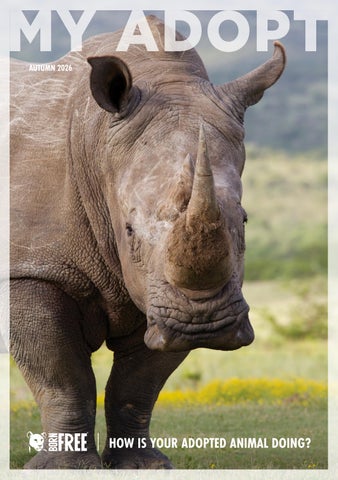
AUTUMN 2026
HOW IS YOUR ADOPTED ANIMAL DOING?
© Reggie Kam Hathaway
Help save the planet! Change to a digital My Adopt:
Gopal the Tiger
Timtom the Orangutan
The Giraffe Family
The Elephant Family
The Gorilla Family
The Cheetah Family
King the Lion
Kyriakos the Brown Bear
The Pangolin Family
Elsa’s Pride
Springer the Orca
The Rhino Family
The Leopard Family
Easy ways to join in
1. Easily carried on your devices, for on-the-go use. 2. With clickable links, including videos of your animal. 3. Eco-friendly, so you’ll reduce your carbon footprint. 4. No print, no post, so more money goes to wild animals. Email info@bornfree.org.uk or call 01403 240170.
THE POWER OF HOPE This little magazine is a celebration of your incredible support. Turn the pages to discover the latest on your adopted animal, including a beautiful picture. Then find out how else you help wildlife, with our new ‘Wider World’ section. By adopting, you help look after your animal – whether cared for in a sanctuary, or protected in the wild. But, that’s just for starters. You also support the wider work of our wildlife charity – together we’re creating a kinder, more compassionate world. Knowing you care about wild animals as we do brings us such hope. Your support gives me, and everyone at Born Free, a boost!
Will Travers OBE Executive President
PS Don’t forget to sign up to our FREE monthly enews at bornfree.org.uk/subscribe, and to our monthly kids’ email at bornfree.org.uk/kids-club
@bornfreefoundation WELCOME TO BORN FREE bornfreefoundation
Like you, we’re wild about animals. We’ve been a voice for wildlife for over 40 years. You play a vital role in wild animal care and conservation. But, why not get even more involved? Visit bornfree.org.uk and join us on social media:
bornfreefoundation bornfreefoundation bornfreefdn bornfreefoundation bornfreefoundation
@bornfreefdn
None of our rescued animals in permanent care are allowed to breed; we vasectomise males or spay/give hormone implants to females. We do not want to add to captive populations, plus sanctuary space is in short supply, so we keep these precious spaces for animals most needing rescue.
© Lyndon Brandt
© Ranald Mackechnie
Thank you for all you do,
© Wildlife S0S
Be inspired by some wonderful new footage of Gopal at: bit.ly/ GopalForest
4
GOPAL THE TIGER
BANNERGHATTA TIGER SANCTUARY INDIA
GOPAL’S STORY Home today: Lifetime care in a spacious forest enclosure Background: Born in the wild but captured when he came into conflict with people by preying on cattle and goats Arrived at sanctuary: 2014 Age today: 18
WIDER WORLD OF TIGERS Your adoption also supports tiger conservation in Central India, and tech now plays an important part! To help secure a safe future for the world’s biggest cat in this vast landscape, our partners use AI, three new drones, and 104 cutting-edge new camera traps.
LATEST NEWS Now a mature 18 years old, Gopal enjoys a peaceful life. He spends his days relaxing in his pond on warm summer days, or taking refreshing showers from sprinklers set up in his field. This new addition helps him stay cool through the hot season. As he grows older, Gopal receives specialised care to monitor his welfare, such as supplements to help keep him healthy and fit from within. We’re pleased to report his recent health checks showed ‘normal blood parameters’. Blood tests are a great way to monitor health, so these results brought smiles and thumbs up from every member of the medical team! Gopal is a majestic tiger who places great value on his privacy. His spacious environment, filled with trees and bushes, allows him to observe the world from spots where he can’t be seen easily, only choosing to reveal himself when his awaited meal arrives. Staying true to his regal persona, Gopal prefers to eat in peace, and sometimes waits until late in the evening, to savour his dinner without any interruption. To keep him active and stimulated, with the help of your adoption, caregivers provide regular ‘enrichment’. Hanging meat encourages him to leap and stretch, while hidden treats trigger his strong sense of smell. After enjoying the activities, Gopal makes his way to his wooden platform, cooling pond, or one of the shaded spaces to take the rest he well deserves. Thanks to your support, Gopal continues to live a safe, comfortable, and dignified life.
Rishabh Mehta Communications Manager Wildlife SOS bornfree.org.uk | Autumn 2026
A wild tiger caught on camera in India
5
THE GIRAFFE FAMILY
© B Jaschinski/BFF
6
LATEST NEWS
MERU NATIONAL PARK KENYA
In 2024, our team encountered a remarkable adult bull giraffe with a deformed left ‘ossicone’ (the horn-like bony growths on a giraffe’s head). This unusual feature made him instantly recognisable, as you can see in this photo, but the sighting was brief and the photos we quickly snapped weren’t clear enough for formal identification. So we weren’t able to add him to our growing giraffe ID database.
THEIR STORY Home: Kenya is a vital home for rare, reticulated giraffes and Born Free has taken action to save them in Meru, since 2021 Family: So far, Born Free has identified 657 individual giraffes in Meru
So, we were delighted to encounter the special male again, this year. Conditions were ideal, allowing the team to capture high-quality photos that clearly documented his unique ossicone, coat pattern, and overall health. These will enable us to follow him in future surveys. We will soon be giving him an official name, and will report back!
© Peter Ndung’u
Background: Meru is an important home for reticulated giraffe. With your support, their population is increasing in Kenya.
To keep giraffes safe, we remove snares set by poachers
WIDER WORLD OF GIRAFFES With your help, Born Free also campaigns to end the exploitation of giraffes in captivity. They clearly suffer in zoos and often develop unnatural behaviour, such as repeatedly arching their neck or licking the bars.
This is a wonderful reminder of the importance of sustained monitoring. Every re-sighting helps build a clearer picture of how giraffes move across the landscape, survive environmental challenges, and use available habitats over time. Such encounters show how patient fieldwork can fill important gaps in our knowledge. The bull will also be assigned a formal identification number, and we look forward to getting to know him better in the years ahead. With your support, our team has now identified and catalogued 657 individual giraffes, each contributing to a better understanding of the population, and supporting conservation action across the landscape.
Irene Kanga Dzuwamwenga Project Officer – Species Monitoring & Protection bornfree.org.uk | Autumn 2026
7
Images © Reggie Kam Hathaway
Enjoy some wonderful film of Barbie at: bit.ly/Gorilla BarbieCarrot
8
THE GORILLA FAMILY
LATEST NEWS
THEIR STORY Home today: Cared for in a spacious rainforest enclosure, at Ape Action Africa’s sanctuary Family: A large rescued group of Critically Endangered western lowland gorillas, led by the mighty silverback Bobo Background: Since July 2024, Born Free has supported the care of our new family of adopted gorillas, at this renowned sanctuary
UPDATE ON BARBIE Rescued after being shot by poachers, young Barbie continues to go from strength to strength – transforming from a timid baby to a boisterous girl! Surrounded by adopted family members who are fiercely protective of her, her confidence grows every day. She spends more time independently playing with others, including youngster Nouji, though surrogate mum Luci is never far away. Barbie has also discovered a passion for bananas, as well as climbing trees.
As one of our oldest established gorilla families, Bobo’s group is also one of our most stable, and right now is going from strength to strength. The successful integration of the two rescued guenon monkeys, Kit and Buddy, is well and truly complete – the whole family have settled into this new dynamic with ease. The gorillas and guenons, two species which coexist together in the wild, are frequently spotted in close proximity, a wonderful sign of how comfortable they have all become together. At the heart of the group, as always, is Bobo himself. After nearly 30 years, he remains the undisputed leader and commands enormous respect from every member of his family. The three females, Geri, Avishag, and Jasmine, are rarely far from his side, and it is easy to see why. His ability to navigate complex family dynamics with patience and diplomacy, all while peacefully living alongside three other adult males, is a true testament to his remarkable character. The group has seen a few changes in caregivers recently, but adapted with ease to our new team members in a remarkably short time. A reflection, perhaps, of the trust and security that Bobo has built within his family over so many years.
Reggie Hathaway Social Media & Communications Manager Ape Action Africa
bornfree.org.uk | Autumn 2026
9
© Lyndon Brandt
Enjoy a new film of King at: bit.ly/ KingSunshine
10
KING THE LION
BORN FREE’S SANCTUARY SHAMWARI PRIVATE GAME RESERVE SOUTH AFRICA
LATEST NEWS It’s been winter here in the southern hemisphere, which brings cool, refreshing weather, crisp mornings and longer nights. We recently had a lot of rain, so the rivers are flowing fast, and King made the most of basking in the morning sun whenever possible!
KING’S STORY Background: Rescued from the illegal pet trade in France, 2017
With temperatures more comfortable, King is far more active during daylight hours – his expansive enclosure allowing lots of opportunity to explore. We’re happy to report he’s taking his food very well. With your support, we supplement his diet with vitamins and minerals, to help maintain good health.
Home today: Lifetime care in a spacious enclosure with companion Thea, also rescued from the illegal pet trade Arrived at Shamwari: July 2018 Age today: Nine years
© Claire Radloff
Regular checks are also important and a few days ago, the visiting vet, Dr Le Roux Pepler, visited to assess King’s wellbeing. I’m pleased to report he passed with flying colours – he’s strong, healthy and in excellent condition (as you can see!).
Just a cub when he arrived at Shamwari
WIDER WORLD OF LIONS Your adoption also supports lion conservation in the wild. We help lions and local people to safely coexist in our heartland of Meru National Park in Kenya. This is where Elsa the lioness, featured on our logo, was successfully returned to the wild. See page 26 to find out more.
I’ve had the privilege of looking after King since he arrived at our sanctuary in 2018 – a large nervous cub, who leapt out from his travel crate. I’ve come to know him so well and would like to say a huge thank you to you, his adopters. Because of your support, King is flourishing. Despite such a tough start, he now seems to consistently enjoy life – a testament to his resilient nature and the dedicated care he receives.
Martin Miritiawo Senior Animal Care Assistant Born Free
bornfree.org.uk | Autumn 2026
11
© Lilongwe Wildlife Trust Jonas Straahberger
You can see some fascinating footage of Nthambi at: bit.ly/ PangolinForage 12
LILONGWE WILDLIFE CENTRE LILONGWE WILDLIFE TRUST MALAWI
THEIR STORY Home today: Malawi’s only wildlife sanctuary gives expert one-on-one treatment to rescued Temminck’s pangolins, returning them to the wild if possible. Lilongwe Wildlife Trust also fights wildlife crime and supports conservation Background: In 2007, Born Free helped Lilongwe Wildlife Centre to develop from a former zoo. Today their pangolin work includes two regional hubs which act as ‘first response units’ Action: Injured and orphaned pangolins, especially victims of illegal wildlife trade, are rescued, rehabilitated, then released and monitored in safe places
WIDER WORLD OF PANGOLINS Your adoption now also protects pangolins in Cameroon’s vast rainforests. Two of Africa’s four species live there – giant ground and white-bellied pangolins. But does the elusive, tree-living, blackbellied pangolin also call these forests home? We’ll report back if we get news!
LATEST NEWS Last time we told you about rescued pangolins, Thope and Dzuwa, and we are now happy to report that they have been successfully released back into the wild. They were both fitted with tracking tags so our research team can monitor their movements and make sure they adapt well to their new homes. Not long after Dzuwa’s release, she crossed the border into neighbouring Zambia, close to a village. We travelled quickly to the site and, thankfully, were able to locate her, confirm she was fit and well, and move her safely back within our monitoring range. But apart from this adventure, we’re so pleased these two pangolins are now free to enjoy life in the wild again. We recently rescued another pangolin, Nthambi, after she was confiscated from poachers by police, during an attempted sale. Sadly she had suffered a severe leg injury – likely the result of being caught in a snare. Unfortunately we had to amputate the leg under anaesthetic, followed by intensive care. But resilient Nthambi is now making remarkable progress – gaining weight and adapting well to her missing limb, using her tail for extra support. Once she has completely healed, we will prepare a release plan for her. Thank you for supporting all this important work.
Maria Thundu Copywriter Lilongwe Wildlife Trust bornfree.org.uk | Autumn 2026
13
HANSON ISLAND JOHNSTONE STRAIT CANADA
SPRINGER’S STORY Home: Living wild as part of British Columbia’s Northern Resident population, monitored by OrcaLab, which has studied orca since 1970 and has been supported by Born Free since 1994 Family: 26-year-old Springer gave birth to Spirit in 2013, Storm in 2017 and a new calf in 2025
Images © Hermann Meuter, CetaceaLab
Background: In 2002, Springer’s mother Sutlej died and she became lost near Seattle, USA. Identified by her unique calls, with our help she was taken 250 miles by boat back to her wild family, the A4 pod, in the waters near OrcaLab
14
SPRINGER THE ORCA
© Jared Towers
LATEST NEWS
Enjoy film of Springer’s community at: bit.ly/ OrcaHighlights
WHAT WOULD YOU LIKE TO CALL SPRINGER’S BABY? Officially known as A137, we don’t know yet if the new calf is male or female. Their siblings are A104, named ‘Spirit’ and A116, called ‘Storm’. Any suggestions?! Email your ideas to info@bornfree.org.uk, or message us on Instagram at bornfreefoundation
As you can see from the wonderful photo below, Springer and her young family are clearly thriving. Incredibly, Springer was successfully reintegrated with her community and, despite losing her own mother at an early age, has gone on to become an incredible mother of three. In honour of next year’s 25th anniversary of Springer being reunited with her family, there will be a celebration at nearby Telegraph Cove. Many people will come together again to celebrate the only successful return of an orca to family – in which Born Free played a pivotal role. Springer is arguably the most famous of all Northern Resident orcas. To date each of her babies, except her youngest, have been named. We thought it might be fitting if the amazing Born Free adopters were to give this youngster a nickname, which we will use in future reports. See the blue box to find out more and get involved! The summer is the best time of the year to see Northern Resident orcas, who follow salmon runs along the coast. Our team has been busy, using hydrophones (underwater microphones) to listen for the orcas, and identify them thanks to their unique calls. Although our primary focus is the Northern Residents, we’re also interested in the Bigg’s orcas who, interestingly, are ‘transients’, mainly eating marine mammals rather than fish. Thank you for supporting this fascinating work.
Helena Symonds Co-Director OrcaLab
bornfree.org.uk | Autumn 2026
15
Enjoy a new film of Zeiss and Mowgli at: bit.ly/Leopards CameraTrap
Zeiss
16
THE LEOPARD FAMILY
Mowgli
BORN FREE’S SANCTUARY SHAMWARI PRIVATE GAME RESERVE SOUTH AFRICA
THEIR STORY Home today: Lifetime care in their own spacious bush enclosures Background: Rescued from a failed zoo in South Africa in 2020 Age today: Mowgli seven, Zeiss twelve
LATEST NEWS Mowgli is gradually becoming more comfortable out in the open. Shamwari’s rangers have spotted him on his climbing platform, looking out across the hills. I was fortunate to watch as he admired a passing herd of elephants, and gently spoke to him to help him feel more comfortable around our team. Mowgli remains shy, so it’s a thrill to catch a glimpse, such as a whisk of his tail disappearing within his large enclosure. He has a remarkable ability to blend in with the bushes and shadows! Privacy is important for all our rescued animals, and they make the most of shrubs and trees. Zeiss is mostly active in the mornings and evening, patrolling his territory and scentmarking important areas. It’s been winter here, so he often basks in the warmth of the sun. His viewing platform is a favourite place – he can securely observe his surroundings, while meticulously grooming his coat.
Mowgli was clearly unhappy at the zoo
WIDER WORLD OF LEOPARDS Did you know you also help local people in Kenya safely coexist with wild leopards? We reinforce ‘boma’ enclosures with wire mesh to protect livestock, use flashing lights to deter leopards and other predators, and ‘camera traps’ can monitor our impact (see pic).
We’re happy to see Zeiss more confident out in the open as well. But, he always has access to more private areas if he chooses. His appetite remains good, and he passed a recent health check with visiting vet Dr Le Roux Pepler with flying colours. We’re so grateful for your support – you play a crucial role caring for our Leopard Family.
Glen Vena Animal Care Manager, Born Free Martin Miritiawo Senior Animal Care Assistant, Born Free
bornfree.org.uk | Autumn 2026
17
Images © Orangutan Foundation
Watch Timtom playing in the treetops, and hanging out with her friend Sinta, at: bit.ly/TimtomFriend
18
TIMTOM THE ORANGUTAN
CAMP BULUH RELEASE CAMP LAMANDAU WILDLIFE RESERVE BORNEO, INDONESIA
TIMTOM’S STORY Home today: Gradually preparing for life in the wild at Camp Buluh Background: Taken from her wild mother as a baby and kept illegally as a pet Rescued: January 2016, aged nine months Age today: 11 years
Timtom hanging out with her friend Sinta
WIDER WORLD OF ORANGUTANS Did you know your adoption also helps fight orangutan exploitation? They belong in the wild, not kept in a zoo cage. Our recent Captive Cousins report showed how apes suffer in captivity, and called to phase out apes in UK zoos (then Europe, then the world!).
LATEST NEWS It usually takes a young orangutan around seven to eight years to learn all the skills required to survive independently from their mother. This is true for infants in the wild, as well as the orphans in our softrelease programme. As it has now been ten years since Timtom entered our care, we’re delighted to see her learning take an exciting turn. Orangutans are a tree-dwelling species who naturally spend most of their lives in the rainforest canopy. But, Timtom is a one-ofa-kind orangutan, who has always preferred playing in the forest swamps to spending time in trees. She never seemed to get bored of water, constantly finding new ways to entertain herself. But just recently, Timtom has begun spending most of her time practicing her forest skills. Already adept at foraging and climbing, she now regularly builds nests, the last skill orangutans must learn before release. She spends multiple nights in the forest, sleeping in these carefully constructed nests, under the watchful eye of her carers. One day we hope soon, Timtom will graduate from the soft-release programme, finally ready for an independent life. With patience and support, even the most unlikely of orangutans can return to the wild – some just need longer than others! Thank you for supporting Timtom on this incredible journey.
Zoe Bizicki Communications & Operations Officer Orangutan Foundation
bornfree.org.uk | Autumn 2026
19
20
THE ELEPHANT FAMILY
© Wade Million
© ATE
Enjoy a fascinating short film about Amboseli’s elephant baby boom: bit.ly/ElephantSuperHerd
LATEST NEWS
AMBOSELI NATIONAL PARK KENYA
The EBS are our ‘camp elephants’, and the Ol Tukai Orok palm woodlands, where we have our research camp, is their favourite place. So they are very comfortable around us. But early rains in February transformed the landscape into a lush, green expanse, and the elephants made the most of the abundance, spreading out into the greater ecosystem outside of the park.
THEIR STORY Home: Wild in Amboseli, a 150-squaremile park at the foot of Mount Kilimanjaro The EB Family: Dozens of members including sub-group led by Edwina (born in 1982), granddaughter to Echo, the matriarch star of BBC’s Echo of the Elephants, who died in 2009
The rains eased by June, and the landscape shifted to the golden tones of the dry season. The permanent springs that feed Amboseli’s swamps became increasingly vital, drawing elephants back in – a pattern they have followed for generations. The EB family found good feeding grounds beyond the park, but we hope to see them soon.
© M Colbeck
Background: Amboseli is renowned for its 1,800-strong elephant population, studied by Amboseli Trust for Elephants since 1972, supported by Born Free since 1992
We’ve helped ATE monitor the EBs, seen here with Echo (left), for 34 years!
WIDER WORLD OF ELEPHANTS Your adoption also helps rescue elephants in need! In an exciting new project, Born Free is a founding member* of Pangea, a wonderful 1,000-acre sanctuary in Portugal, and Julie – the country’s last ever circus elephant – is the first elephant rehomed there. *Together with Fondation Brigette Bardot, Olsen Animal Trust, and World Animal Protection
We recently made an exciting recent sighting when we spotted an unfamiliar male in musth*. Something about him gave our senior researcher Norah Njiraini pause. She has studied the elephants for more than 40 years! Back at camp, comparing ear notches and vein patterns in archive photos confirmed the identification. It was Brinton, son of Bonnie from the BB family, not seen for 19 years. This is why our long-term research matters. Male elephants regularly disperse from their birth area, before returning as mature adults. We’re so glad Brinton’s homecoming didn’t pass unnoticed. With your support, the elephants here are better known than any other population in the world!
Tal Manor Communications & Outreach Manager Amboseli Trust for Elephants *A sharp rise in testosterone, for two-three months
bornfree.org.uk | Autumn 2026
21
22
THE CHEETAH FAMILY
© Peter Ndung’u
Enjoy endearing new footage of the cheetahs at: bit.ly/PeacefulPlay
LATEST NEWS
ENSESSA KOTTEH RESCUE CENTRE ETHIOPIA
THEIR STORY Home today: Spacious natural enclosures with undergrowth to explore and room to run Background: Mostly victims of the illegal pet trade, stolen from the wild as cubs Arrived at Ensessa Kotteh: 2015 to 2024 Age today: From two to eleven years Your cheetahs: Girls
Rescued
Blue Fasika Sisay (aka Jijiga) Konjo (aka Tamu) Choa (aka Nura)
Aug 24 Apr 23 Dec 21 Apr 15 Apr 15
Boys
Rescued
Ramadan Dima Dehar
Apr 23 June 22 Jan 22
WIDER WORLD OF CHEETAHS Cheetahs are born to run, and belong safe in the wild – not kept as a pet or in a zoo. As an adopter, you don’t just help rescue and care for cheetahs in need. With your support, we also take action to end exploitation, and support conservation – thank you!
It’s been rainy season here in Ethiopia, bringing mild but wet weather – perfect to give vegetation a boost. The cheetahs’ spacious enclosures are now carpeted in thick grass, ideal for rolling in, while the cooler temperatures have given them a fresh burst of energy. Beautiful Dehar recently needed vet treatment, but thankfully is now doing well. He has a spinal abnormality, affecting his digestion and can get a little constipated. Our dedicated team carefully manages this with a specialised diet, and gentle treatment, such as castor oil mixed into food. But a recent more serious episode required vet attention, plus fluids, pain relief, and medication to help recovery. This was funded with the help of your adoption – thank you! Dehar made a strong recovery, but we’re monitoring him closely to ensure he stays comfortable and healthy. Young Blue recently moved into a much larger grassy enclosure with a night house, and clearly enjoys the extra space, and the chance to interact with new neighbours. We keep an extra close eye on her as well – we support her bone development with supplements and expert care. The injuries she suffered when hit by a car still affect how she walks. But, as Blue grows stronger, with your help our team is ready to provide any treatment she may need to ensure the best possible future.
Bereket Girma Country Director, Ethiopia, Born Free bornfree.org.uk | Autumn 2026
23
© A.Giannoukos ARCTUROS
Enjoy some wonderful film of Kyriakos at: bit.ly/KyriakosForage
24
KYRIAKOS THE BROWN BEAR
ARCTUROS BEAR SANCTUARY GREECE
LATEST NEWS Kyriakos enjoyed a proper winter sleep this year, resting peacefully through the colder months before returning to his usual routine in spring.
KYRIAKOS’ STORY
Since waking up, he has been in very good spirits, with his familiar appetite fully restored. His caretakers suspect he may have gained a little extra weight, so they are keeping a close eye on his diet to make sure he stays healthy and active. This spring and summer, he has shown a particular love for fish and fresh greens, especially lettuce, rocket, and other leafy treats.
Home today: Lifetime care in a spacious beech forest enclosure Background: Rescued from Kastoria in northern Greece as a four-month-old, wild-born cub, with his twin brother Manolis, when their mother was killed Arrived at sanctuary: 2004 Age today: 22
Of course, Kyriakos remains a champion diver. He loves spending time in his pool, splashing and cooling off. But the moment he smells food, the swim is over! He climbs out immediately, dripping wet, and starts searching eagerly. His caretakers also scatter food around the enclosure as enrichment, encouraging natural foraging and keeping him mentally and physically stimulated. Once Kyriakos realises food has been hidden, he becomes completely focused, sniffing and searching until not a single bite is left behind.
Tiny when rescued, today Kyriakos is the biggest bear at Arcturos
WIDER WORLD OF BEARS Bears are intelligent, inquisitive and opportunistic mammals, who like to climb, dig and forage. They can suffer badly when kept in a cage and, with the help of your adoption, Born Free campaigns to end their exploitation in zoos and circuses.
© Jo-Anne McArthur
Big, curious, and always hungry, with your support Kyriakos continues to be one of the sanctuary’s most unforgettable characters. Thank you!
Panos Stefanou Director of Communications Arcturos bornfree.org.uk | Autumn 2026
25
MERU NATIONAL PARK KENYA
THEIR STORY Home: Living wild in Meru, 220 miles northeast of Nairobi Family: Several adult females, plus sub-adults and cubs, but has the mighty male Kimeu replaced King and General? Background: One of Meru’s oldest lion families, named after the lioness star of Born Free, returned to the wild by George and Joy Adamson in 1958
26
ELSA’S PRIDE
LATEST NEWS How you heard the news? We’ve put a lightweight satellite tracking collar on ResQ, one of Elsa’s Pride lionesses. ResQ was rescued from a snare when just eight months old, and given a second chance of life in the wild. She has grown into a strong, dominant female – an ideal candidate for collaring. As a key member of the pride, her movements help us understand how they use the Meru landscape, where they range, and where risks of conflict with people or livestock may arise. Interestingly, ResQ’s collar data shows that Elsa Pride moves in and out of the Rhino Sanctuary, a highly protected area of Meru National Park (page 28), with low fences which lions can cross but not rhinos.
This has challenged our assumption that only the Virginia Pride used the sanctuary. ResQ is often seen with just one adult lioness and three sub-adults. This is normal behaviour, to reduce competition for food, prides often split into smaller groups to hunt, before reuniting. Regular updates from ‘citizen scientists’, including rangers and tourists, also help us track who ResQ is with, as well as other pride members. More than just a tracking device, ResQ’s collar is a symbol of hope and resilience. And a reminder that a lioness, once rescued from a snare, now helps protect her pride and landscape.
Jeremiah Kimathi Kinyoni Community & Wildlife Coexistence Project Officer, Born Free
ELSA’S PRIDE FAMILY TREE
Enjoy a short film about the new satellite collar: bit.ly/ LionCollar
Adult
Sub-adult
Cub
Deceased
bornfree.org.uk | Autumn 2026
27
© Peter Ndung’u
28
THE RHINO FAMILY
MERU NATIONAL PARK KENYA
THEIR STORY Home: Rhino Sanctuary within Meru National Park Family: An important population of 104 white and 45 black rhinos, protected by rangers with our help Background: After a poaching epidemic in the 1980s, Born Free has been helping Kenya Wildlife Service (KWS) since 2014 to restore Meru’s wildlife, including rhino, to its former abundance
LATEST NEWS Following our regular long rainy season earlier this year, the long dry season arrived in Meru in June, which usually runs until September. The lush grasses are eaten down, and wildlife begin congregating more regularly around water sources. With your support, the rhinos of Meru remain in the safety of the Rhino Sanctuary, protected by Kenya Wildlife Service rangers. We both regularly see the rhinos as we travel through the sanctuary for work and, like you, have become big rhino fans! Rhinos are powerful and resilient, yet also have a calm and gentle side many people don’t expect. Their communication is also fascinating – southern white rhinos defecate in communal ‘middens’ (dung heaps) to relay information to each other across vast landscapes. This method of communicating can easily go unnoticed, but is of vital importance. Males use these dung piles to investigate which individuals are using an area – whether it’s their own territory or a challenger male, hoping to move in. They also use dung odours to identify if any potential mates are around.
WIDER WORLD OF RHINOS Very sadly, rhinos have long been targeted for their horn. Despite being mostly made of keratin (like our fingernails) rhino horn is sought after for traditional Asian medicines. But, supported by you, our incredible Policy team fights to protect rhinos from exploitation, and end all trade.
While they have poor eyesight, their hearing is excellent and they have a keen sense of smell. Despite their size, they can also run surprisingly fast! Often described as their armour, their thick skin is specially adapted to withstand the thick thorns of the African bush. As endangered animals, rhinos remind us of the importance of wildlife conservation and protecting their habitats. Thanks for supporting this work!
Irene Kanga Dzuwamwenga & Rita Kulamo Project Officers Species Monitoring & Protection Born Free bornfree.org.uk | Autumn 2026
29
1. Sign up to Wild Voice Our FREE monthly email is full of wild news, animal stories and Born Free action for wild animals in need. Sign up today at bornfree.org.uk/subscribe
2. Sign up to Hear the Roar Extra Loud Full of fun facts and wild stories about animals, Born Free’s monthly kids’ email is available FREE. Sign up the wild kid in your life at bornfree.org.uk/kids-club
3. Don’t go to zoos or dolphinaria Wild animals belong in the wild, not exploited in captivity! Pledge never to visit places which exploit captive wild animals and encourage others to do the same.
4. Take action and sign our petitions Our team works so hard to stop wild animals being exploited. Like to help? Get involved in our campaigns for a kinder world at bornfree.org.uk/take-action
5. Visit bornfree.org.uk and join us on social © Will Burrard- Lucas
The easy way to find out the latest and get more involved. bornfreefoundation
bornfreefoundation
bornfreefoundation
bornfreefoundation
bornfreefdn
Thanks for being part of our Born Free family!
Choose a wild gift
Coming soon! THE OFFI BORN FRCIAL CALENDAREE 2027
This is shopping with a real heart! Be inspired by our unique and beautiful gifts – from hoodies to homeware, plush toys and pencil cases.
2027 Calendar Homeware gift set
Born Free sweatshirt
Includes our 2027 wildlife calendar and Christmas cards, so have a browse. Show your support AND show how much you care. Every item you buy helps wild animals in need.
Sustainable, printed to order.
Fridge magnet
Scan me to shop!
Explore our range: shop.bornfree.org.uk Christmas cards
Tea towel set
You can Raise funds for your favourite animal Fundraise with your school friends or work colleagues! How about a raffle for rhinos, a pub quiz for pangolins, or a talent show for tigers? From a fancy dress day to a dance-a-thon, a cake stall or car wash, you can have fun and fundraise for Born Free!
Download your FREE fundraising pack for all the ideas and materials you need at bornfree.org.uk/fundraising Or email us at: gowild@bornfree.org.uk
Or scan me!
Love your adoption? Why not give one as a gift! Choose your favourite – one animal in need or an entire rare species! You’ll help fund their care and protection.
From £5 per month Your adoption includes: COMING SOON • Personalised certificate Brand new • Beautiful gift box gift pack with • Animal’s full story gorgeous • Fascinating facts • Regular updates redesign • Optional cuddly toy or NEW tote bag (coming soon)
Perfect for Christmas, birthdays, anniversaries and more. For animallovers of every age!
CONGRATULATIONS! Name Surname You have adopted
KYRIAKOS THE BEAR for one year starting from:
Date
expert, help, but you support his will always rely on our in Greece. Kyriakos the rescued bear Arcturos Bear Sanctuary, loving care at the world-class Thank you!
Dame Virginia McKenna Co-Founder
Will Travers OBE Co-Founder
Kyriakos
the bear
01403 240170 | info@bornfree.org.uk
Arcturos Bear Sanctuary Greece
| bornfree.org.uk | Charity
No: 1070906
Scan me to adopt!
© ARCTUROS
© Konstantinos_Tsakalidis/ARCTUROS
Executive President &
To adopt: visit bornfree.org.uk/adopt or call 01403 240170 Born Free Foundation, 2nd Floor, Frazer House, 14 Carfax, Horsham, West Sussex, RH12 1ER, UK bornfree.org.uk | +44 (0) 1403 240170 | info@bornfree.org.uk Printed on sustainably sourced paper | Registered Charity No: 1070906
© ARCTUROS
Or go green with our digital pack.