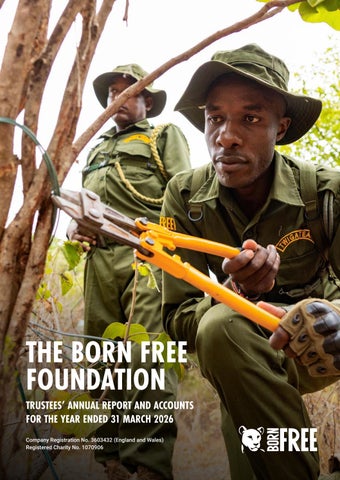
THE BORN FREE FOUNDATION TRUSTEES’ ANNUAL REPORT AND ACCOUNTS FOR THE YEAR ENDED 31 MARCH 2026 Company Registration No. 3603432 (England and Wales) Registered Charity No. 1070906
Chair’s introduction
4
Our strategy
6
Message from Will Travers OBE
8
Objective 1
10
Objective 2
14
Objective 3
18
Objective 4
20
Fundraising
27
Communications
29
Plans for the future
30
Structure, Governance & Management
32
Reference & Administrative Information
34
Financial review
35
Statement of Trustees’ responsibilities
38
Independent Auditor’s Report to Members
39
Consolidated Financial Statements
42
Gifts and donations
60
The Trustees present their report and accounts for the year ended 31 March 2026, including the Strategic Report for the company. These accounts comply with the charity’s governing document, the Companies Act 2006, the Financial Reporting Standard applicable in the UK and Republic of Ireland (FRS 102) and with the Charities SORP (FRS 102). Born Free Foundation 2nd Floor, Frazer House 14 Carfax, Horsham, West Sussex, RH12 1ER, UK www.bornfree.org.uk Company Registration No. 03603432 (England and Wales) Registered Charity No. 1070906 Cover image © Peter Ndung’u
FOR THE YEAR ENDED 31 MARCH 2026 4
© tigersintheforest.com
CHAIR’S INTRODUCTION
It is my pleasure to welcome you to the Born Free Foundation’s Annual Report for 2025-26. Our charity puts wild animals in need at the heart of everything we do, and in this report, you will read about the difference we have made during the year. In 2025, Born Free began implementing our new Pathways to Freedom five-year-strategy, building on all we had already achieved for wildlife, and looking to ensure we will have the greatest impact for wildlife in the years ahead. This report explains the work we have undertaken to deliver our strategy, much of which is long-term and will continue into future years. After years of work, investment, and planning, our vision for Europe’s first large-scale sanctuary for elephants originating from zoos and circuses, Pangea, a collaborative project with three other member charities*, made significant progress and is preparing to welcome its first elephants in 2026-27. Financially, 2025-26 was another strong year for legacy income and we continued to see growth in high value giving streams. Total income for the year was £7.8m. We spent a total of £7.4m, of which 73% went towards our charitable activities and the remainder towards fundraising. We receive no government funding and invest in raising funds to ensure our work can continue well into the future. We ended the year with a surplus of £0.4m and have set aside funds to support further actions to secure our long-term work. Further details are provided in the Financial Review from page 35. After 42 years of service as a Trustee, including many as Chair, our remarkable Co-Founder Dame Virginia McKenna formally stood down as a member of our Board. We are so
grateful for all her support, and she will continue to be our champion and inspiration. As her son Will Travers, our Executive President and Co-Founder, explains, “Virginia’s wisdom and insights will continue to inform and inspire her beloved Born Free, into the future. She is still the beating heart of the Born Free Family.” I’d like to also extend our thanks to Dr Amal-Lee Amin and Kate Stephenson, who also stood down as Trustees in the year. We were pleased to welcome three new Trustees to the Board – marketing and business expert Tracey Greaves, chartered accountant and charity finance specialist Nicky Whitehead, and solicitor and wildlife advocate Andrew Mura, based in Nairobi. My thanks go to all my fellow Trustees, our loyal and generous supporters, our partners both in the field and across the corporate and media world, our friends and colleagues at Born Free USA, and, of course, our own teams and associates across Born Free UK, Kenya, Ethiopia, South Africa, Cameroon, India, and many other countries. In unsettled times of global pressures, conflict, economic fragility and political uncertainty, punctuated by extreme climate events and a connected biodiversity crisis, it is clear that Born Free’s message of hope, and mission of compassionate action, are more important than ever. By working together, we can ensure our life-changing work to Keep Wildlife in the Wild can continue to flourish, despite these global challenges.
Michael Reyner Chair of Trustees *Fondation Brigitte Bardot, Olsen Animal Trust and World Animal Protection
© Peter Ndung’u
Dear Friends of Wildlife
The Born Free Foundation Trustees’ Annual Report and Accounts for the year ended 31 March 2026
5
OUR STRATEGY Born Free is an international wildlife charity and our vision is a world where individual wild animals are treated with respect and compassion. We strive to secure mutually beneficial coexistence between people and wildlife, enabling wild animals to live their lives free from harmful exploitation, as part of functional, viable ecosystems. In May 2025, Born Free launched our five year strategy, Pathways to Freedom. The strategy reflects more than 40 years of experience and reaffirms our commitment to protecting individual animals while strengthening habitats, policies and communities. We have two strategic aims: To end the exploitation, suffering and killing of wild animals To protect wild animals and their habitats, so people and wildlife can coexist How we will achieve these aims is embodied in our Theory of Change.
WHAT NEEDS TO CHANGE?
1
2
The exploitation, suffering, and killing of wild animals needs to end.
Wild animals, habitats, and ecosystems need to be protected.
HOW WILL CHANGE HAPPEN?
1
2
3
4
Engaging and empowering communities and people through education and support.
Directly contributing to the delivery of wild animal rescue, care, protection, and conservation.
Improving wildlife law and policy development, enhancement, and enforcement.
Working in partnership with organisations that enhance our shared impact.
WHAT DIFFERENCE WILL IT MAKE?
1
2
3
4
Supporting local people to coexist harmoniously alongside thriving wildlife populations.
Safeguarding the welfare and reducing the presence of wild animals in captivity.
Returning individual healthy animals to the wild, where possible.
Encouraging communities, organisations, and governments to make choices that protect the welfare of wildlife and their natural habitats.
Underpinning our Theory of Change are four, highly connected Cross-Organisational Objectives (COOs) that set out what we believe needs to happen, in pursuit of our longer-term vision of a world where wild animals live their lives free from harmful exploitation, as part of functional, viable ecosystems: End the exploitation, suffering, and killing of wild animals for entertainment and trade by engaging, educating, and empowering society. Rescue and care for individual wild animals, either taken from the wild or born in captivity, working towards their release, where possible. Advocate for new or improved policies and legislation to end the exploitation, suffering, and killing of wild animals, strengthen measures aimed at delivering the long-term, sustainable protection of wildlife habitats, and secure greater resourcing for the enforcement of all relevant laws. Work with communities living with wildlife to reduce conflict with wild animals, protect wildlife habitats, and promote sustainable human-wildlife coexistence.
Our values guide everything we do: • • • • • •
Integrity: Honesty, based on strong moral principles Team spirit: A group of people collaborating to achieve common goals Kindness: Friendly, compassionate, generous, and considerate Courage: Undeterred by difficult challenges, determined to succeed against the odds Ambition: A shared ambition to keep wild animals in the wild Impact: Driven by a unified culture, and common goals and plans to deliver change.
The Born Free Foundation Trustees’ Annual Report and Accounts for the year ended 31 March 2026
7
WILL TRAVERS OBE 8
© georgelogan.co.uk
A MESSAGE WORDS FROM OUR EXECUTIVE PRESIDENT AND CO-FOUNDER
Dear Friends and Supporters These are deeply challenging times. I’m sure many of us share a sense of anxiety. What is happening to our world? The norms and standards that we have subscribed to over many decades seem under threat. That’s why, despite all the noise, confusion and doubt, I am so proud of the work of the Born Free Foundation over the last 12 months. Our amazing teams, friends, and associates in the UK, Kenya, Ethiopia, South Africa, Cameroon, India, and around the world, have delivered. At the heart of that work has been the introduction of Pathways to Freedom, our new five-year strategic plan, referred to by Michael in his words of introduction, and launched in May 2025. Our strategy builds on our unique history and special legacy of taking effective frontline action for wild animals over more than 40 years. We remain equally devoted to individual wild animal welfare and wildlife conservation as we are to transforming animals’ lives, and exposing and challenging those who want to hunt, kill, and exploit them. Born Free is a global force for wildlife and a crucial voice for wild animals in need. The next five years are critical for wild animals and the natural world, and our strategy will continue to advance us to a world where wildlife and people live in harmony. Consistency is key to Born Free’s efforts. While, clearly, we must respond to events as they unfold, Born Free has a steadfast eye on the road ahead, and our conviction remains unwavering. Indeed, some of our programmatic work has been part of our portfolio for decades. It is only by taking the long view that the value of the choices we have made becomes clearer - our tiger work in India; our efforts to ban the international ivory trade; the ending of the exploitation of wild animals in UK circuses and dolphinariums. This is the first full year of a more integrated approach to our work. This means we increasingly focus on how, to varying degrees, we can apply our four main disciplines – Compassionate Conservation; Community Engagement; Rescue and Care; and nature-friendly Policy Development – in a more holistic manner. This not only makes a lot of sense, it gets results, and creates a richer and more compelling narrative – the stories we tell about the work we do are multi-dimensional, as is our impact. This sense of continuity will be further amplified in the years ahead, supported by a new Country Director Kenya, Alice Kamau, who joined us in November 2025 to lead the development of our team.
In June 2026, following the year’s end, Helen Bushell became our Director of Programmes, a new role that seeks to extract every ounce of value from our work of our highly experienced programmatic teams. I believe this will make our impact and our ambition even more appealing to those who share our values – whether private individuals, corporate partners, or grant-making trusts and foundations. Underpinning all our efforts is the generous support of those who remember us in their Wills and Estates; people who so generously help fund the work; corporate partners, large and small; those who participate at our events; adopt animals; and donate to our appeals. It is a mosaic of giving that delivers and is deeply appreciated. I have no doubt at all that the year ahead will be turbulent. There will be matters outside of our control we will need to adapt to. While Born Free cannot self-immunise against their consequences, we can take steps to mitigate their impact on our operational activities and work to ride out the situation until, hopefully, it resolves itself. There are also matters where we can directly influence the direction of travel, and the strong financial end to 2025-26, as recorded in this report, allows us to take sensible steps to maintain operational effectiveness through 2026-27, when revenue may fluctuate more than usual. In conclusion, I want to thank the Board for its engagement, guidance and wisdom; my fellow members of the Executive Management Team who guide and direct us at the highest level; our expanded Senior Management Team for their attention to detail and their leadership; and all the members of our global team, wherever they are, for their hard work and for staying true to the mission. Born Free is a complex organisation operating, as it does, in multiple countries, in multiple jurisdictions and cultures, delivering multi-disciplinary projects to the benefit of wildlife, nature, and people. Our Annual Report 2025-26 shines a light on our efforts and sets us up for further achievements in 2026-27. This year we are 42 years young. Long may it continue.
Will Travers OBE Co-Founder & Executive President
The Born Free Foundation Trustees’ Annual Report and Accounts for the year ended 31 March 2026
9
OBJECTIVE 1: Alongside One Kind and the Scottish SPCA, we launched the joint ‘Don’t Pet Me’ campaign, highlighting the suffering of wild animals kept as pets. The ongoing campaign calls on the Scottish Government to introduce tighter regulations. We also participated in a European Commission feasibility study on ‘positive lists’ which, if adopted, would significantly reduce the number of wild species that could be kept as pets.
We published issue 12 of our Hear the Roar!! children’s magazine, reaching 900 schools across the UK. Reviewed by a panel of young readers, their feedback was taken on board to be incorporated into future issues, to ensure our content for young people is as clear and engaging as possible.
10
Born Free Youth Ambassador, Nikita Dhawan, took part in a panel discussion with global youth and experts, hosted by the Global Initiative to End Wildlife Crime, to mark the 50th Anniversary of the UN’s Convention on International Trade in Endangered Species of Wild Flora and Fauna (CITES) and explore its future.
© georgelogan.co.uk
Too many wild animals are still exploited to entertain people and for commercial gain. Throughout 2025-26, our mission continued to change attitudes, advocate for strengthened legal protections for wild animals affected by trade, tackle wildlife crime, and work with people of all ages to raise awareness, challenge the ethics of exploitation, and empower communities.
© Jo-Anne McArthur
End the exploitation, suffering, and killing of wild animals for entertainment and trade by engaging, educating and empowering society.
We published our hard-hitting report Our Captive Cousins – The Plight of Great Apes in Zoos, which outlines the issues and ethics of keeping great apes captive for entertainment. The high-profile, science-based report clearly shows how a life in captivity harms great apes’ health and well-being and calls for an immediate end to the breeding and importation of great apes into zoos.
© Aaron Gekoski
Together with the League Against Cruel Sports, Four Paws UK, Humane World for Animals UK, Animal Aid, and NatureWatch Foundation, we organised a reception at the Labour Party Conference in Liverpool, focussing on the impact of wildlife crime on people and animals, and what role education could and should play in helping to address this issue.
© AJ Loveridge
To mark ten years since Cecil the lion was infamously killed by a trophy hunter, Born Free co-sponsored a parliamentary event with Humane World for Animals and Four Paws UK, urging the UK government to fulfil its promise to prohibit the import of hunting trophies. The event was well attended by around 80 Parliamentarians, campaigners, and supporters.
We co-sponsored the Oxford Centre for Animal Ethics Summer School, ‘The Ethics of Captivity’, at Merton College, University of Oxford, which welcomed 150 academics from 20 countries. We delivered presentations that challenged the keeping of elephants in zoos and critiqued the concept of ‘sustainable use’, subsequently submitted as papers for inclusion in the symposium’s official Proceedings.
We continued to campaign alongside Freedom for Animals and The Express newspaper for the rehousing of 15 gentoo penguins held in a basement pool in Sea Life London Aquarium. A peaceful protest outside the aquarium was widely reported in the press and attended by hundreds of supporters, Chris Packham CBE, and other celebrities.
Following significant input from Born Free and our partners over the preceding months, the European Parliament published its Resolution on the EU strategic objectives for the UN’s CITES CoP20 meeting which, among other things, underlined the need for a precautionary, sciencebased approach when implementing CITES, and deplored the use of negative economic impact as a reason to lift trade suspensions. The Resolution assisted Born Free in our efforts to secure positive outcomes from the meeting through the influence we were able to exert on EU Member States and wider Parties.
The Born Free Foundation Trustees’ Annual Report and Accounts for the year ended 31 March 2026
11
Our ongoing annual collaboration between Animal Aid, Freedom for Animals, and OneKind to end reindeer exploitation at UK Christmas events, had impact. Over 300 event organisers were urged not to use reindeer, with only 180 events proceeding. Encouragingly, almost 60% of the events that we approached in 2024 did not host events with live animals in 2025.
We launched an extensive, new, online Educator Hub for teachers and home educators looking for resources to support wildlife and the environment. The Hub includes curriculum-linked lesson plans for primary, secondary, and SEN students, together with extra-curricular activities.
© Southeastern Star (Flickr cc) / © H Bateman
We rolled out a new empathy-focussed centre programme in South Africa, welcoming students from local schools in the Eastern Cape to our education centres within Shamwari Private Game Reserve, to take part in a newly developed session which covers the needs and individuality of wild animals, with early signs of success.
© georgelogan.co.uk
We advocated for the better protection of threatened species from global trade at CITES CoP20 in Uzbekistan. In addition to helping achieve greater protections for 77 species, including mammals, sharks and rays, fish, and birds, we strongly opposed regressive proposals from Namibia to allow trade in elephant ivory and rhino horn. These were, thankfully, heavily voted down.
12
Also in December, the Government published its Animal Welfare Strategy for England, following months of intensive lobbying by Born Free and our partner organisations. The strategy contains important commitments to protect foxes and hares from hunting and shooting, an intention to ban cruel snares, and to review and strengthen penalties for cruelty against wildlife.
Having campaigned for decades to end the cruel captive lion breeding and ‘canned hunting’ industry, Born Free responded, with partners, to reports that South Africa was revisiting the planned closure process. We urged the government to phase out the industry without delay. We also submitted our opposition to South Africa’s planned new hunting export quotas, including elephants and rhinos, and encouraged thousands of supporters to contact the South Africa government. We co-hosted a parliamentary event calling on UK MPs to support the Animals (Low Welfare Activities Abroad) Act, which would ban the selling or advertising of cruel activities such as elephant riding and dolphin shows. Following hundreds of Raise the Red Flag reports about barbary macaques used as photo props in Marrakesh, we continued to urge Moroccan authorities and UK government representatives to take action to end this practice.
Born Free Policy Advisor Ian Redmond in Brazil
We joined 2,000 people from 105 governments to advocate for wildlife at the UN’s Convention on Migratory Species of Wild Animals (CMS) meeting in Brazil. Our well-attended side event on the need to protect old, wise animals received considerable press coverage. In partnership with Empathy Week, our free webinar asking if schools should visit zoos and aquariums, helped 129 teachers and educators, across 25 countries, to think about the impact on animals, giving them tools to share with students.
© Aaron Gekoski
Kirsty Gallacher, Born Free Head of Policy Dr Mark Jones, Lord Sandy Trees and Peter Eagan in London
The Born Free Foundation Trustees’ Annual Report and Accounts for the year ended 31 March 2026
13
OBJECTIVE 2:
© Peter Ndung’u
Rescue and care of individual wild animals, either taken from the wild or born in captivity, and working towards their release, where possible.
During 2025-26 we continued to rescue vulnerable wild animals from appalling conditions and advocate for an end to their exploitation, not least in zoos and circuses, or for the exotic pet trade. Through our rescue centres in Ethiopia and South Africa, and by supporting partner organisations, we continued to rehabilitate rescued animals and offer expert lifetime sanctuary care, wherever possible supporting release back to the wild.
Thanks to further investment in 2025-26, including through generous donations, we were finally able to install mains power from the main road to the centre of the site, including an electricity meter and a transformer, and run underground cables to priority areas, including the vet clinic, garage and store. We also installed transformational walk-in cold storage and meat preparation areas, which will be connected to the mains in 2026-27.
PROVIDING SANCTUARY ETHIOPIA
Since its inception, Ensessa Kotteh had operated without mains electricity. Located away from the main road, and with the existing national mains power source approximately 650m away, in recent years, we had been able to invest in solar for many of the onsite buildings, enclosures and electric fences. Whilst solar power had been adequate for some buildings, like the Centre office and Education Centre, mains electricity was needed in order to reliably power the vet clinic and potentially support long-term food storage. 14
© Peter Ndung’u
Based 30 miles outside capital city Addis Ababa, during 2025-26 we continued to focus on strengthening the infrastructure of our Ensessa Kotteh Wildlife Centre to provide the highest standard of care and make the greatest impact for wild animals in Ethiopia.
In January, our Ensessa Kotteh Wildlife Centre team undertook a three-day journey to eastern Ethiopia to collect four cheetah cubs – confiscated from the illegal pet trade – working with the Ethiopian Wildlife Conservation Authority. Aged between two and three months at the time of rescue, sadly, and despite the best possible care, the cubs did not survive.
Blue, a cheetah cub rescued after receiving life-threatening injuries in a car accident in 2024, continued to make steady progress, the team checking her bone density with the help of our new x-ray machine, kindly funded by a generous supporter. Other rescues at Ensessa Kotteh included a serval, a leopard tortoise, a gelada and a bushbuck calf. Extensive staff training included first aid, animal welfare and behaviour, Ethiopian wildlife, communications, conflict management, and security training.
SOUTH AFRICA
After 11 years of fundraising, planning and hard work, the Pangea Trust officially opened Europe’s first large-scale elephant sanctuary, set within 1,000 acres of natural habitat in Portugal. This is a momentous project and a long-term dream of our charity, especially our Co-Founder, Dame Virginia McKenna.
The sanctuary will provide a lifelong haven for elephants from zoos and circuses in Europe. At Pangea, elephants will receive expert care and be free to roam, forage, and socialise amidst rolling hills, streams, meadows and woodland. Born Free is a founder member of Pangea, with our colleagues at Fondation Brigitte Bardot, Olsen Animal Trust and World Animal Protection.
© Pangea
PORTUGAL
© Panthera Africa
Our work to provide expert lifetime care in spacious bush enclosures for four leopards and 12 lions – all rescued from captive exploitation – continued at our big cat sanctuary at Shamwari Private Game Reserve. The team carried out an emergency evacuation of two servals and Lancelot the lion from our partners at Panthera Africa Big Cat Sanctuary, after wildfires broke out in the Western Cape destroying parts of the Panthera Sanctuary. Panthera Africa was caring for these cats on our behalf, after the servals were rescued from illegal pet trade in Belgium in 2022, and Lancelot from captive exploitation in 2019. In April 2026 the servals were returned to Panthera Africa, while Lancelot will remain at Shamwari.
The Born Free Foundation Trustees’ Annual Report and Accounts for the year ended 31 March 2026
15
PROVIDING SUPPORT During the year, we continued to provide support through grants and expert advice to our numerous international partner organisations:
CAMEROON
© Ape Action Africa
Ape Africa Primate Sanctuary is dedicated to the protection of endangered primates in Cameroon, and has been supported by Born Free since 2024. They currently house 296 animals, including 26 gorillas and 122 chimpanzees, five of which were given a home in 2025-26. Last year’s new arrival, infant gorilla, Barbie, brought to the sanctuary with bullet fragments in her skull after her family was killed, has settled well into her new group. Two adult guenon monkeys, Kit and Buddy, who faced challenges integrating with other monkeys, have been successfully introduced to a forested enclosure, sharing with a rescued gorilla family.
© Limbe Wildlife Centre
Supported by Born Free since 2004, Limbe Wildlife Centre works to combat the illegal wild pet trade and, with our help, specifically provide lifetime care for rescued chimpanzees and improve primate enclosures, to increase space and reduce stress behaviours in rescued monkeys. They play a crucial role rescuing wildlife affected by the illegal bushmeat and pet trades, alongside an extensive local outreach programme. Over the year, they successfully relocated three drills to the new ‘Drill Island’, providing a safer, more suitable enclosure for these individuals, aided by Born Free funding.
MALAWI
UGANDA
The Chimpanzee Sanctuary and Wildlife Conservation Trust’s Ngamba Island Chimpanzee Sanctuary, founded with our key support in 1998, is now home to 53 chimpanzees, mostly rescued from illegal trade. We helped procure veterinary supplies, provide routine veterinary care, and process laboratory samples for these chimpanzees.
16
© Lilongwe Wildlife Trust Tom Beddis
In partnership with Olsen Animal Trust, Born Free’s support for Lilongwe Wildlife Trust’s Wildlife Emergency Response Unit (WERU) provides field-based emergency support and vet care, with longer-term rehabilitation at Lilongwe Wildlife Centre in the capital city – the sanctuary created with our help from a former city zoo in 2007. In 2025-26, they took 123 animals into their care, including 16 pangolins, and returned 73 individual animals to the wild.
ZAMBIA
We provide long-term support for Game Rangers International’s Zambia Primate Project (ZPP) – developed with our help in 2004 – which rescues and rehabilitates vervet monkeys and baboons. During the year, they rescued 19 primates, and returned a total of 28 to the wild. The number of primates coming into ZPP’s care has reduced considerably over the last 25 years, suggesting successful long-term human behaviour change.
ITALY
Timtom, Born Free’s adopted orangutan, made excellent progress at the Orangutan Foundation, our official partner since 2018. She is in the soft-release programme where she is learning the skills that will one day enable her to be returned to the wild.
© Animanatura Wild Sanctuary
© Orangutan Foundation
After considerable planning and much paperwork, Simba, the young lion rehomed by Born Free after rescue from illegal trade in Russia in 2022, moved into a beautiful new 5,000m2 enclosure at our partner Animanatura Wild Sanctuary in Tuscany, Italy. At last, Simba has company and is now happily sharing his life with a new companion, Elsa, whom we rehomed from a circus in Italy in 2014, working alongside our colleagues at Lega Anti Vivisezione (LAV).
INDONESIA
UK
GREECE
The Arcturos Bear Sanctuary, supported by Born Free since 2004*, continued to care for 20 rescued bears in natural beech forest. Born Free’s adopted bear, Kyriakos, underwent a comprehensive health check this year, and results showed he is in excellent health, with no identified concerns. He weighs an impressive 240kg and is the largest bear at the sanctuary.
Konstantinos Tsakalidis SOOC Arcturos
*Originally supported by Care for the Wild International, who merged with Born Free in 2015
We continued to help wildlife hospitals in the UK to rescue and rehabilitate injured, sick, and orphaned wild animals. Small but significant grants were awarded to Sompting Wildlife Rescue in West Sussex for a pre-release aviary to support recovering gulls and other British wildlife, not least hedgehogs, as well as Prickles and Paws Hedgehog Rescue in Cornwall, and Prickles in a Pickle hedgehog rescue in Devon, to support the care and eventual release of rescued hedgehogs. Classified as ‘Near Threatened’ on the International Union for the Conservation of Nature Red List in 2024, the European hedgehog is in serious decline across the country, so the well-being of every individual really does matter.
The Born Free Foundation Trustees’ Annual Report and Accounts for the year ended 31 March 2026
17
OBJECTIVE 3: Advocate for new or improved policies and legislation to end the exploitation, suffering, and killing of wild animals, strengthen measures aimed at delivering the long-term, sustainable protection of wildlife habitats, and securing greater resourcing for the enforcement of all relevant laws.
Policy is the driver of change, from the international wildlife trade to conservation, welfare regulation, and society’s attitudes to captivity, biodiversity loss, and climate change. By working in a multi-disciplinary way with diverse stakeholders, in collaboration with policymakers in government bodies, non-government organisations, and businesses, we advocated for and influenced laws and policies to help overcome the challenges wild animals face, both in captivity and in the wild.
INFLUENCING GLOBAL POLICIES
We attended the UN’s Convention on Biological Diversity’s technical committee meeting in Panama where, working alongside colleagues, we pressed governments to ramp up protections for wildlife and habitats, and tackle exploitation. We co-hosted a side-event emphasising the importance of addressing animal welfare in efforts to halt and reverse the global decline in biodiversity. We attended the IUCN World Conservation Congress in Abu Dhabi. IUCN’s members (of which Born Free is one) adopted over 140 motions on a wide variety of issues, 12 of which were co-sponsored by Born Free including: longevity age-structured conservation approaches; guidelines to control the trade in wild animals as pets; and addressing the direct exploitation of wild species. Born Free also co-organised a number of events, including on the use of technology to combat wildlife crime. 18
We continued to work, as a co-founder and steering group member of the Global Initiative to End Wildlife Crime – launched in 2020, towards the establishment of an international agreement on tackling wildlife trafficking and environmental crime. In June, we helped coordinate the relaunch of MEPs for Wildlife, an informal European parliamentary group focussed on wildlife protection and wild animal welfare with which we have had a long and productive association. We continue to work with the group to promote wildlifefriendly EU policies. We continue working with colleagues to promote the adoption and implementation of greater regulation of the trade in and keeping of wild animals as pets across the EU, with our preference for a positive list. In November we participated in a workshop in Brussels entitled ‘Reframing the Exotic Pet Trade in Europe – Developing Effective Science-Based Demand Reduction Interventions’.
INFLUENCING UK POLICY
Hares are the only ‘game’ species in England and Wales without a statutory close season. They can still be shot all year round, including when they are pregnant or raising young – typically from February to September. Our promotion of the UK government e-petition calling for a close season for hare shooting during the breeding season helped the petition grow to over 56,000, which helped ensure government included consideration of a close season in its Animal Welfare Strategy for England. In June we met with Department for Environment, Food & Rural Affairs (DEFRA) officials to protest the government’s continued issuing of licences to cull badgers. In July, as a result of our efforts, the Council of Europe’s Bern Convention urged to UK government to ‘greater urgency on the ending of the badger culling policy’, questioning its compliance with the Convention. We welcomed the end of new badger culling licences in January but continue to lobby government to bring all badger culling to a permanent end.
In December, the UK government’s report on the implementation of the Ivory Act referenced Born Free’s extensive research analysing online ivory sales. In January, we participated in a further meeting with government and provided further evidence regarding online sales. The government confirmed our information resulted in action taken at prominent antiques fairs to address noncompliance issues. Ahead of the Scottish Parliamentary and Welsh Senedd elections, we distributed our detailed manifestos for wildlife protection and animal welfare to Party managers, and we encouraged thousands of supporters in Scotland and Wales to write to their candidates urging them to promote Born Free’s priorities.
Shocking Born Free data, released in January, highlighted a lack of effort by UK Local Authorities to raise awareness of new legislation requiring owners of pet primates to apply for licenses, which comes into force in April 2026. As of that date. the keeping of as many as 5,000 monkeys and other primates as pets, would be illegal in the UK without a licence. Born Free continues to call for a complete ban on the keeping of primates as pets in Britain.
© Richard Hurrell
DIRECT ACTION
In July, we coordinated panel discussions on UK wildlife crime at Bird Fair – the largest wildlife and conservation festival in Europe – in Oakham, East Midlands, and at the Partnership for Action Against Wildlife Crime’s annual meeting in London.
In partnership with the Ethiopian Wildlife Conservation Authority, a Born Free team visited a military training college 25 miles from the capital, Addis Ababa, to train 167 army students about the importance of protecting natural resources and preventing illegal trade.
© georgelogan.co.uk
In November, with our expert key support, Wildlife and Countryside Link’s annual UK wildlife crime report summarised incidents during 2024 and highlighted the lack of prioritisation of crimes against wildlife, the links between wildlife crime and other forms of criminality, and the need for greater government action, including training for police, prosecutorial services, and judiciary. The Born Free Foundation Trustees’ Annual Report and Accounts for the year ended 31 March 2026
19
OBJECTIVE 4:
© Peter Ndung’u
Work with communities living with wildlife to reduce conflict with wild animals, protect wildlife habitats, and promote sustainable human-wildlife coexistence.
People, and how they behave, are key to the future of wild animals. We must work with and support communities to achieve successful and sustainable coexistence – local people living harmoniously alongside thriving wildlife populations. Working with the communities who live with wildlife, Born Free aims to reduce conflict with wild animals, protect wildlife habitats and populations, support sustainable livelihoods, and encourage ongoing human-wildlife coexistence.
WILDLIFE MONITORING AND PROTECTION IN KENYA LION MONITORING, MERU CONSERVATION AREA In our charity’s heartland of Meru, where Elsa the lioness was returned to the wild, Born Free helps the Kenya Wildlife Service (KWS) restore and protect wildlife, helping local communities find practical solutions to conflict. Devoting an average six days every month to lion monitoring, this year the team covered 3,270 miles and sighted 72 lions, with 124 adults now on our database. Plans are underway to utilise a new more advanced monitoring technique known as Spatially Explicit Capture Re-capture from 2027. 20
The long-planned lion collaring, using an advanced collar with a timer and radio-controlled drop-off mechanism, was implemented by our team, together with KWS and staff from Wildlife Research and Training Institute, in March 2026. With plans underway for further collaring, data will improve our understanding of pride movement patterns and help identify livestock predation hotspots, allowing targeted mitigation interventions.
ELEPHANT AND GIRAFFE MONITORING, MERU
REMOVING WILDLIFE SNARES, MERU
A total of 269 wire snares, set illegally to trap wildlife, were collected – meaning 1,953 snares have been removed since 2021. The Twiga* Team carried out 280 foot patrols, covering more than 780 miles. Of recovered snares, 92% were ‘active’ and 8% inactive. Of all snares recovered, 98% were made of steel wire, with an average wire thickness of 3.88 mm. Spatial analysis showed snares were typically placed within one to five miles from the park boundary.
Protecting elephants and giraffes is also a priority, and the team devoted more than 60 days to monitoring both species, covering over 1,700 miles. A total of 58 newly identified individual elephants (40 males and 18 females), mostly young adults, were added to the database, bringing the total of catalogued elephants to 484. The team also recorded 109 newly identified giraffes (59 males and 50 females), increasing the total of known giraffes to 657. By understanding the population, we can implement more impactful conservation strategies.
© Peter Ndung’u
© Peter Ndung’u
*Swahili for giraffe
PROTECTING ELEPHANTS, AMBOSELI ECOSYSTEM
© Peter Ndung’u
Our work continued to help our long-term partners Amboseli Trust for Elephants (ATE) – supported since 1992 – as they monitor Amboseli’s elephant population, which experienced a ‘baby boom’ in 2025. After 2022’s prolonged drought followed by good rainfall, ATE recorded over 220 new calves, increasing the population by 12% to 2,065 individuals.
The Born Free Foundation Trustees’ Annual Report and Accounts for the year ended 31 March 2026
21
CONFLICT REDUCTION AND MITIGATION
PREDATOR-DETERRENT LIGHTS, AMBOSELI AND MERU
Flashing lights can deter predators from attacking wildlife at night, and this year 880 ‘PDLs’ were installed in Meru (in 170 bomas) and 482 in Amboseli, benefiting 1,039 and 981 people, respectively. Since 2022, we have distributed 2,189 PDLs (653 in Amboseli and 1,536 in Meru). Comparing data before and after light installation, initial indications show that 69% of livestock keepers reported a reduction in number of carnivore attacks and 78% a decrease in the number of livestock killed.
CONFLICT REDUCTION AND MITIGATION HUMAN-WILDLIFE CONFLICT PATTERNS, MERU, KENYA
Human-carnivore conflict reported by our locally-employed Community Conservation Assistants revealed hyena – spotted and striped – accounted for 212 out of 282 reported conflict events caused by carnivores (75%), followed by leopard with 39 events (14%). Plans are underway to especially step up efforts to protect hyenas and help them safely coexist with local people. In the same period, 268 human-elephant conflict events were recorded, and 95% of these related to crop foraging. Since our records began in 2021, we have recorded a total of 697 conflict events.
© George Leakey
PREDATOR-PROOF BOMAS, AMBOSELI AND MERU
A total of 24 new predator-proof livestock enclosures were constructed, with ten in the Meru Conservation Area and 14 in the Amboseli-West Kilimanjaro Ecosystem. Since 2010, Born Free has helped build 450 of these bomas, with 431 in Amboseli (benefitting 7540 people and 12,489 livestock) and 19 in Meru, helping protect livestock from predators, and strengthening coexistence between communities and wildlife.
BEEHIVE FENCE FARMS, MERU
© Peter Ndung’u
We also repaired 21 old predator-proof bomas, helping 367 people and protecting 3,654 head of livestock, and distributed 626 energy-saving stoves, 28 solar lighting units and 35 water gathering structures to new and repaired boma owners, bringing the total distributed to 8,014 stoves, 555 solar units and 326 water storage tanks. Ten community members were trained in boma maintenance in Amboseli, with the aim of building a pool of 35 technicians to oversee and manage the long-term sustainability of the project.
22
© Peter Ndung’u
The team monitored 25 beehive fence farms, with a total of 332 hives, each farm having 12 to 15 live and dummy hives, alongside 50 control farms (25 near neighbours and 25 remote neighbours). Eight new beehive farms were constructed. Average hive occupancy by bees is 23% (lowest 2%, highest 60%), which is below our target of 60%. During the coming year, our team will help farmers attract bees, including providing water during dry seasons, lemon grass oil, sugar syrup, and encouraging bee-friendly crops such as sunflowers. In this reporting period a total of eight honey harvests yielded 154kg of honey, which was sold by farmers, to augment income, for KES 77,000 (£444, with 1kg of honey sold at KES 500/£3), thus helping create more sustainable livelihoods.
© tigersintheforest.co.uk
TIGER CONSERVATION, INDIA. To protect wild tigers, since 2004 Born Free has financially supported and coordinated the Satpuda Landscape Tiger Partnership – nine local conservation organisations who deliver a range of benefits to tigers across seven Tiger Reserves in central India, as well as benefitting the environment and local communities.
TIGER AMBASSADORS PROGRAMME Delivered by Tiger Research and Conservation Trust across 25 villages surrounding Nawegaon–Nagzira Tiger Reserve, the programme supports peaceful coexistence between local communities and large carnivores through conflict mitigation, wildlife monitoring, and awareness raising. This is supported by 175 locally-trained Tiger Ambassadors, through awareness meetings, workshops, school programmes reaching more than 700 students, and the monitoring of wildlife movement and conflict incidents. The project directly engaged 2,500+ people, with indirect benefits reaching over 13,000 more.
CATTLE FODDER FEEDING The Corbett Foundation continued its stall feeding and conflict mitigation project in the buffer zone of Kanha Tiger Reserve, to reduce cattle depredation by tigers and leopards by decreasing dependence on forest grazing and supporting alternative livelihoods. Some 20 acres of plots produced over 150,000 kg of fodder, supporting stall feeding for 60% of the cattle in the zone. The project also provided veterinary support for conflict cases, attending 39 cattle attack incidents.
LANDSCAPE MONITORING UNIT Delivered by our partner, Satpuda Foundation, together with the Forest Department, and focusing on maintaining habitat connectivity for tigers while reducing human– wildlife conflict across key corridors of the Satpuda Landscape, efforts included the deployment of 104 camera traps and three drones, joint foot patrols totalling over 3,200 miles, drone surveillance covering a further 350 miles, supported community livelihoods through village micro planning, sustainable agriculture initiatives, and eco tourism guide training, while also delivering health camps and conservation education activities.
Camera trap images help monitor tigers
The Born Free Foundation Trustees’ Annual Report and Accounts for the year ended 31 March 2026
23
WESTERN LOWLAND GORILLA CONSERVATION, CAMEROON To protect critically endangered gorillas and other rare wildlife, our Guardians of Dja programme in Cameroon has, since 2021, worked with local communities to address illegal bushmeat hunting and unsustainable forest clearing.
WILDLIFE LAW ENFORCEMENT
© davecurrey.com
In this, our fourth year of operating, we supported 13 anti-poaching patrols totalling 107 days, destroyed 18 poacher camps and confiscated 209 kg of bushmeat. Since the programme began, this now totals 49 patrols, 200 destroyed poacher camps and almost 1,350 kg of bushmeat confiscated. Our 24 Great Ape Guardians continue to operate across six villages, helping sensitise the community to conservation and environmental practices.
FOREST PROTECTION AND REGENERATION Over the year, we provided 4,200 seedlings to 44 farmers to restore forests. In total, 16,920 agroforestry trees will have been planted on 167 hectares (over 410 acres) by over 411 households from nine villages since the programme began.
SKILLS TRAINING AND SCHOOL-BASED EDUCATION
By the close of the year, we were supporting 64 pupils, from 28 villages, at the local agroforestry school. We also provided 12 new graduates with materials for cash crops, having trained a total of 29 graduates since the programme began. During the year, 71 primary school children received regular conservation lessons, adding up to a total of 189 students taught since the programme began.
COMMUNITY OUTREACH
Agroforestry students with a pepper harvest
Regular sensitisation events included handball and football tournaments, training 150 women on how to make eco-friendly stoves which use less firewood - and taking villagers to learn about apes at our partners Ape Action Africa and Limbe Wildlife Centre, which rescue primates. Almost 13,000 people have been reached via our outreach events in the last four years.
Our ongoing support continued for chimpanzee monitoring, habitat conservation, and education outreach in the Budongo-Bugoma Corridor – vital for protecting around 300 chimpanzees severely threatened by intensifying human pressures. They now follow eight groups, six of which are tracked daily by ‘Chimpanzee Monitors’, to protect both the chimpanzees and local communities who live alongside them. Six primary schools participate in their school outreach programme. 24
© Bulindi Chimpanzee Community Project
BULINDI CHIMPANZEE & COMMUNITY PROJECT, UGANDA
COMMUNITY ENGAGEMENT AND EMPOWERMENT COMMUNITY WORKSHOP, ETHIOPIA In March, the Community Engagement team in Ethiopia conducted a workshop for local community members to create awareness and discuss ways to minimise humanwildlife conflict. This is the first step towards a more detailed and focused engagement with these communities to reduce human-wildlife conflict.
SPORTS FOR CONSERVATION, SOUTH AFRICA Two community soccer events were hosted, with the final matches held in March to help celebrate World Wildlife Day. During the event, 162 spectating community members were encouraged to recycle and protect the environment, with 56 children also taking part in activities.
WASTE MANAGEMENT, ETHIOPIA Animals can ingest rubbish, including plastic, become trapped or injured, or their habitats damaged as a result of human waste. To protect wildlife, our Ensessa Kotteh team organised a community clear up, with volunteers, including 250 soldiers from the local base, and picked up an incredible 3,500kg of litter.
MOBILE HEALTH UNIT, INDIA Nature Conservation Society, Amravati, worked with 64 villages surrounding four tiger reserves in the Satpuda landscape. The Mobile Health Unit provides basic medical services to local communities and forest staff as a means of building trust and support for tiger conservation. A total of 360 health camps were conducted, treating over 11,000 community members and providing health check‑ups to around 600 forest staff working in remote areas.
CONSERVATION EDUCATION, INDIA Bombay Natural History Society delivered a conservation education programme in villages around the Tadoba– Andhari Tiger Reserve, working with 67 schools across primary and secondary levels. Activities included classroom sessions, films, games, festivals, Wildlife and Bird Week celebrations, and supervised reserve visits, reaching over 1,700 students directly and a further 2,800 through broader awareness efforts.
The Born Free Foundation Trustees’ Annual Report and Accounts for the year ended 31 March 2026
25
SPORTS FOR CONSERVATION, KENYA Born Free held a Kick to Conserve tournament at Ura Gate Primary school, with the participation of 10 local football teams and engaging more than 400 spectators. The tournament served as an opportunity to deliver key conservation messages, particularly the need to discourage bushmeat hunting and the use of snares. This was in addition to 12 Serve to Conserve volleyball activities held across the year.
WATER CATCHMENT PROTECTION, MERU CONSERVATION AREA, KENYA
VILLAGE SAVINGS AND LOANS ASSOCIATION, AMBOSELI AND MERU, KENYA We help local people (largely women) leverage their savings to start small businesses and improve livelihoods. The new VSLA protocol has been signed off and is in operation. To strengthen their capacity, a four-day refresher course trained our ten VSLA village agents in Amboseli, who manage 34 groups. An additional 28 groups are being supported by the Born Free team around the Meru Conservation Area. A total of 67 visits by members of the team across both landscapes, supported accurate data collection and increased awareness about wildlife related issues amongst our VSLA members, including the negative effects of bushmeat and the importance of wildlife and tourism.
Working with the Water Resource Authority we facilitated the drafting and ratification of the last of three subcatchment water management plans which, once implemented, will positively impact human and wildlife communities around Meru National Park’s western boundary.
26
© Peter Ndung’u
To engage learners and strengthen commitment to conservation, together with our seven partner schools we commemorated World Day to Combat Drought and Desertification in June, at Kanjoo Primary School. A total of 380 participants joined the day, including 271 Conservation Club members, 16 teachers and partners from the Kenya Wildlife Service, Kenya Forestry Service, and Wildlife Clubs of Kenya.
Fundraising accounted for 97% of Born Free’s overall income and was £7.5m in 2025-26, which is the same as in 2024-25. Gifts in Wills were again the largest source of income, contributing £3.5m and 45% of total income. We are enormously grateful to everyone who has included the Born Free Foundation in their Wills, and we expect legacies will continue to be a very important source of funding. Born Free supporters and partners enable our charity to undertake all its work, including through a range of public fundraising activities, such as our Animal Adoptions and fundraising appeals. Regular monthly and annual gifts, made by direct debit, provide vital sustainable income, which helps us to plan ahead, and are particularly important given the long-term commitments we make to animals in our care, and the multi-year projects we run to keep wild animals in the wild. Growing regular annual income is an important part of our fundraising strategy and, following a review of our Animal Adoption product in the year, we made adjustments that have resulted in a growing proportion of supporters adopting via direct debit. An audit was completed to help us understand our donors better and is informing our public fundraising plans for 2026-27 and beyond, designed to grow lifetime support alongside attracting more people to become donors. Philanthropic giving continued to grow and supported a wide range of Born Free field projects, including in Kenya, Ethiopia, and South Africa, as well as our vital policy work. This included the completion of the electricity project at Ensessa Kotteh and purchase of cold storage units that
will transform how the centre operates. Our Born Free Circle of Champions grew, and options to give jointly and as a Life Champion were introduced alongside annual giving options. Our annual Footsteps to Freedom Ball raised important funds and brought together many supporters and their guests to celebrate Born Free’s strategy and achievements.
© Doug Peters/PA Media Assignment
All our work is only possible thanks to the incredible generosity of our thousands of individual supporters who donate, adopt, play our lottery, attend fundraising events, and leave us gifts in their Wills, in addition to the funding we receive from grant givers and our corporate partners. Thank you all.
© Orangutan Foundation
FUNDRAISING
Will Travers with Patron Kirsty Gallacher
High value giving overall is of increased significance to Born Free’s annual income, and we welcomed new corporate partners, including Animal Friends Insurance, who have committed to a three-year partnership. We are also grateful to everyone who has funded our work in 2025-26 and who fundraised for us, including supporters who ran the London Marathon. More details on ways to support Born Free can be found on our website or by contacting the fundraising team via info@bornfree.org.uk.
The Born Free Foundation Trustees’ Annual Report and Accounts for the year ended 31 March 2026
27
During 2025-2026, the first full year of Born Free’s new five-year strategy, Pathways to Freedom, communications, public relations, and digital engagement helped bring the charity’s vision and priorities to life for supporters, partners, and wider audiences. Across media, publications, film, social media, and supporter communications, our work sought to show the connected nature of Born Free’s activities, revealing how policy, conservation, rescue and care, community engagement, and fundraising all contribute to our shared mission to keep wildlife in the wild. In doing so, communications helped strengthen Born Free’s public voice and ensure that this new strategic direction was communicated with greater clarity, confidence, and consistency. Born Free’s profile continued to grow throughout the year. We secured sustained national and international coverage across outlets including the BBC, ITV, Sky News, The Times, The Guardian, The Independent and National Geographic, with audience reach running into the billions. In our winter quarter alone, Born Free secured 1,237 media items, while the following reporting period delivered a further 802 items and an estimated cumulative audience reach of 6.8 billion. This visibility helped ensure that Born Free’s voice was heard on some of the most important and challenging issues facing wild animals, including captivity, trophy hunting, dangerous wild animals kept as pets, wildlife tourism, and pet primate legislation.. 28
Several major moments shaped the year. Our report Our Captive Cousins generated 274 individual items of coverage, helping to renew debate about the keeping of great apes in zoos. The ongoing campaign to free the ‘Gentoo 15’ penguins from a basement pool in a London aquarium became a major national story, generating 333 distinct media mentions and later drawing support from more than 70 MPs.
On digital billboards across London, Birmingham, Glasgow, and Manchester, our hard-hitting animated advertising campaign, created with critically-acclaimed photographer, concept artist, and long-term Born Free supporter, George Logan, raised awareness of trophy hunting and captive exploitation issues, encouraging the public to take action to support our campaigns. The digital advertising space was provided thanks to Drops in the Ocean’s generous in-kind support.
© georgelogan.co.uk
COMMUNICATIONS AND PR
Alongside wider media moments, including the tenth anniversary of Cecil the lion’s death and continued attention focused on pet primate legislation, these stories helped keep Born Free at the centre of public conversation about the treatment of wild animals. Our digital channels also continued to grow in reach and impact. Social audiences rose to more than 754,000, impressions exceeded seven million in one quarter, and the final quarter delivered the highest engagement rate of the year at 7.91 per cent. Campaign and advocacy content performed strongly across the website, while more targeted email communications helped create deeper supporter engagement and more meaningful journeys.
Creative storytelling was another highlight of the year. Wildlife Heroes: Bereket Girma, A Story of Rescue won Silver at the Smiley Charity Film Awards, while the powerful film What Will You Tell Your Children? became an emotional centrepiece of the Footsteps to Freedom Ball. Taken together, the year marked a significant step forward in how Born Free shared its work with the world, helping more people to understand, support and speak up for wild animals.
Supporter communications remained a particular strength. Wild Life magazine continued to reach around 8,000 print supporters and more than 100,000 digital readers, while My Adopt magazine reached around 15,000 adopters with rich updates, photography, and video content.
© georgelogan.co.uk
© Peter Ndung’u
Across the year, communications also helped shape the storytelling around key appeals, including Comfort & Joy, the February Pangea appeal, and Vanishing Futures, ensuring supporters were given thoughtful, emotionally engaging narratives that connected them directly to individual animals and the impact of their support. In February, Born Free’s communications helped introduce supporters to Kariba, one of the first elephants destined for Pangea, making her story a powerful way of building connection with this landmark sanctuary and the hope it represents.
The Born Free Foundation Trustees’ Annual Report and Accounts for the year ended 31 March 2026
29
© georgelogan.co.uk
PLANS FOR THE FUTURE
30
Within Kenya, where Born Free has a significant team and activities, we are restructuring our work and reporting lines to better align with our strategic objectives, and to support more effective inter-departmental collaboration, while remaining focussed on our two priority landscapes, Meru Conservation Area, and the Amboseli-West Kilimanjaro Ecosystem. We will continue to support partners with rescues and relocations. We are particularly excited to support the expected arrival of the first elephants, Kariba and Julie, to the Pangea elephant sanctuary in 2026-27. As a Founding member of Pangea, we have made a long-term commitment to support its establishment, development, and sustainability, and will continue to work closely with it, alongside the other Pangea members, to ensure more captive elephants in Europe can be given the life and companionship they deserve.
We continue to work closely with Natuurhulpcentrum in Belgium to relocate rescued captive big cats, and in 2026-27 expect to welcome two lions - Alakay, who was surrendered from a zoo, and Massaï, who came from a circus - to our Shamwari big cat sanctuary in South Africa. Cold storage units will be connected to the newly installed mains power at our Ensessa Kotteh wildlife rescue centre, which is the only facility of its kind in Ethiopia. This will significantly help with food security and operational stability, avoiding the need for meat being delivered to Ensessa Kotteh every other day. We will soon be able to buy meat in bulk and freeze it prior to feeding, which will be vastly more convenient and, additionally, improve animal health by killing the majority of any parasites that might be present. Embracing new technology will allow us to increasingly work in more integrated, flexible, and efficient ways. Across our teams, we will be working with consultants to understand how and where we can use AI safely and effectively, as well as continuing to innovate in terms of how to use technology, for example, monitor lions and reduce conflict with local communities around the Meru Conservation Area, Kenya. All of our work is funded by generous supporters, large and small. In 2026-27, we will continue to seek to diversify our sources of funding, and to deepen supporters’ knowledge and understanding of our work. This will include relaunching our twice-yearly supporter magazine, Wild Life, to ensure it remains a source of knowledge and inspiration, and encourages as many people as possible to to take action for wild animals in need and keep wildlife in the wild.
© Pangea
As we look forward to 2026-27, the need for Born Free to continue to strive to keep wildlife in the wild is greater than ever. To ensure we continue to have the greatest impact, we will welcome Helen Bushell to our Executive Management Team in June 2026 as our new Director of Programmes. Helen comes with a wealth of skills and experience from her long career in the NGO sector, both in the UK and internationally, including in Kenya. Helen will lead the development of a new Global Performance Framework within Born Free, as part of leading our programmatic work. This will help the charity to demonstrate its impact against Key Performance Indicators and to focus our activities where they will provide the greatest benefit to wildlife.
The Born Free Foundation Trustees’ Annual Report and Accounts for the year ended 31 March 2026
31
© georgelogan.co.uk
STRUCTURE, GOVERNANCE & MANAGEMENT Status and Objects The charity is a company limited by guarantee. Our governing document is a Memorandum & Articles of Association, dated 1998. Our charitable objects as set out in the Memorandum & Articles of Association are: • To preserve and conserve animal species in their natural habitat on an international basis and to undertake all relevant research activities in connection therewith or ancillary thereto, and to publish the useful results of such research, and to provide relevant educational materials and equipment and other support to communities in areas where preservation and conservation are undertaken; • To prevent all types of cruelty and abuse of animals and wildlife particularly in zoos and other places where animals are kept in captivity; • To educate the public and to advance the education of natural history, environmental studies, ecology and resource conservation in an industrial, urban, rural, natural and marine environments; and 32
• To relieve the suffering of animals of any species which are in need of care and attention and (where appropriate) assist in the provision of improved facilities for the care of animals in captivity. Governing Body and Structure Our governing body is a Board of Directors. The Directors are the Trustees of the charity. As at 31 March 2026, there were 11 Trustees. The Board meets quarterly and has two sub-committees, the Finance & General Purposes Committee that also meets quarterly, and the Remuneration Committee that meets annually. There is a separate Trading Board for the Directors of Born Free Trading Ltd that meets twice a year to approve the budget and financial statements of the Company and to review its performance. In addition, we have established Advisory Panels where Trustees, senior staff and independent experts meet to discuss specific issues in more detail to help evolve our approach and work plans. During the year, the Programmes Advisory Panel met once to discuss performance monitoring mechanisms. The Income
Generation and Communications Advisory Panel met once to review the charity’s approach to high value giving. The Ethical Investments Advisory Panel met once and considered how we should respond to emerging reputational risks related to specific companies, sectors and geographies.
Trustees When we recruit new Trustees, we follow a best-practice process, including a skills audit to identify the qualities sought in potential candidates. We provide new Trustees with a structured induction that includes comprehensive documentation and individual briefings from key staff.
We have overseas branches in Kenya and Ethiopia and a long-established partnership with Shamwari Private Game Reserve in South Africa. The charity has one subsidiary that is a separate legal entity – Born Free Trading Ltd. A second subsidiary, Born Free Films Ltd, was dissolved in February 2026, having been dormant for a number of years. We have a sister organisation in the USA, named Born Free USA, which has a separate Board and is incorporated in the United States as a not-for-profit 501(c)(3).
The Charity Governance Code was published in 2017 and updated in 2020 and 2025. The latest version of the code sets out eight principles of good governance and encourages charities to review their governance structures and processes against the code to ensure they are fit for purpose and operate efficiently. It also sets out model behaviours to ensure Boards are inclusive and operate effectively. The Trustees have received training on the content of the code, and they have due regard to its principles when conducting their business.
We have a well-established annual planning and budgeting process that covers the charity, its branches and the subsidiary.
Public benefit The Trustees have given due consideration to the Charity Commission’s published guidance on the Public Benefit requirement under the Charities Act 2011.
Decision-making The Trustees’ prime function is to ensure the good governance of the charity and to this end the Board focuses on matters of policy and general strategy, the approval of plans, the monitoring of progress with regard to our charitable objects, fiduciary responsibility, financial controls and investments. Operational responsibility is delegated to the Executive Management Team (EMT), consisting of the Executive President, Managing Director, Chief Financial Officer and the Director of Fundraising. From June 2026, the EMT will joined by a new role, the Director of Programmes. The Board receives formal reports in advance of its quarterly meetings. These reports contain details of our programmatic activity, organisational and support function activities, the current position of our finances and other related governance matters. The Finance and General Purposes Committee makes recommendations to the Board on financial matters, including the approval of finance-related policies, the annual budget and the management of investments. The Remuneration Committee approves the salaries for staff, including the salaries of the Executive Management Team. Use is made of relevant sector benchmarks for comparable roles to help establish the salary bands. Cost of living increases are guided by the prevailing level of inflation. Due regard is also given to affordability in the context of the total annual budget.
The protection of the natural world and its myriad biodiversity is a shared responsibility. The role of, and benefit to, the public cannot be under-estimated. Born Free leads by example, demonstrating through its charitable activities how we can all play a part in securing a vibrant and thriving natural environment. Setting out our values and vision allows people from all walks of life to make informed choices about how they live their lives. At the same time, by exposing bad practices, those that harm, demean, marginalise and cause suffering to wild animals and wild environments, we allow the widest possible number of people, through the decisions they make in their everyday lives, to singly and cumulatively, bring about positive, lasting, sustainable change. Grant-making To help achieve our objectives, Born Free makes grants to other not-for-profit organisations. This includes making grants to organisations that provide sanctuary to rescued animals, organisations undertaking conservation work and organisations that deliver wildlife-related educational activities. Many of the organisations to whom we give grants are long-term partners of the charity. Our Grants Policy sets out the process for selecting partners, awarding grants and reviewing how funds have been applied.
The Born Free Foundation Trustees’ Annual Report and Accounts for the year ended 31 March 2026
33
REFERENCE AND ADMINISTRATIVE INFORMATION Board of Trustees Michael Reyner (Chair) Michael Drake (Deputy Chair) Dr Amal-Lee Amin (to June 2025) Sean Cassidy Tracey Greaves (from March 2026) Navindu Katugampola Arabella Lack Virginia McKenna DBE (to March 2026) Andrew Mura (from March 2026) Sharon Peake Jessica Ruben Jenny Seagrove Kate Stephenson (to June 2025) Nicky Whitehead (from April 2025) Finance and General Purposes Committee Michael Reyner Navindu Katugampola Nicky Whitehead (from May 2025) Remuneration Committee Michael Reyner Sharon Peake Will Travers Karen Botha Sharon Martin
EXECUTIVE MANAGEMENT TEAM Executive President Will Travers OBE Managing Director Karen Botha Chief Financial Officer Sharon Martin CPFA Director of Fundraising Katie Arber Director of Programmes Helen Bushell (from June 2026)
34
REGISTERED INFORMATION Registered charity name The Born Free Foundation Charity number 1070906 (In Ethiopia: 0686) Company registration number 03603432 (In Kenya: F.76/2003) Registered office 2nd Floor, Frazer House 14 Carfax Horsham West Sussex RH12 1ER
PROFESSIONAL ADVISORS Auditors Saffery LLP 71 Queen Victoria Street London EC4V 4BE Bankers HSBC Bank Plc Insurance broker Gallagher Metro House, Northgate Chichester West Sussex PO19 1BE Investment managers James Hambro & Partners 45 Pall Mall London SW1Y 5JG Quilter Cheviot Investment Management Three Temple Quay Temple Way Bristol BS1 6DZ
FINANCIAL REVIEW Overall, 2025-26 was a successful year. Total income was £7,795k, which is slightly higher than in the previous year (2025: £7,652k). We maintained tight control of expenditure, which totalled £7,377k (2025: £7,142k). Our operating surplus was £418k, and after accounting for unrealised gains on investments of £148k and foreign exchange losses of £126k, we are reporting an outturn surplus of £440k (2025: £402k). The surplus will enable increased investment in our Kenya projects and fundraising activities, helping to secure a sustainable future for Born Free. Further details of our financial performance for the year are set out below.
Income: Legacies continue to be the single largest income stream for Born Free, representing 45% of total income (2025: 48%). We budgeted for legacy income of £3,000k in 2025-26, a decrease compared to the £3,709k recognised in 2024-25 in which year we received increased income due to the reduction in the backlog at the Probate Courts. We are recognising legacy income of £3,517k for the year, which includes a £246k accrual. Legacy cash receipts for the year were £3,475k compared to £3,699k in 2024-25. The performance of legacy income is heavily influenced by high value (over £100k) receipts. In 2025-26, we received nine high value gifts, totalling £1.6m and representing 46% of the cash receipts (2025: nine gifts totalling £1.7m, representing 47%).
Income excluding legacies totalled £4,278k (2025: £3,943k). Corporate income performed well at £907k, an increase of 58% compared to 2024-25. This was driven by a significant in-kind corporate gift. We received a very generous contribution from Ocean Outdoors, who donated media space with an equivalent value of £360k. This support enabled us to deliver a digital outdoor campaign over Summer 2025, projecting our anti-trophy hunting and anti-captivity messages across public screens throughout the UK. The campaign significantly expanded our reach, taking Born Free’s messaging directly to audiences in high-footfall locations and amplifying awareness of the issues faced by wildlife. We also secured a major, multi-year corporate partnership with Animal Friends Insurance. We sustained our performance in Donations (£1,643k) and Adoptions (£954k) income, despite the more challenging economic environment. The Grants and Trusts income stream declined compared to 2024-25 to £135k, however, the previous year had benefited from a significant gift of £100k. Grant and trust funding has become increasingly competitive as many national governments have reduced their international aid budgets and funders are experiencing a greater volume of applications. Expenditure: Expenditure on Raising funds was £1,960k, which is consistent with the previous year (£2,078k).
Total expenditure on Charitable activities was £5,417k (2025: £5,064k). Expenditure on Conservation increased by £196k to £1,953k. This was primarily driven by our work in Kenya, which grew from £1,058k in 2024-25 to £1,259k in 2025-26. This reflects investment in the projects, and a write-down of fixed assets at £140k in respect of infrastructure on land where a new lease is yet to be secured. Expenditure on Rescue and Care activities reduced from £2,023k in 2024-25 to £1,696k in 2025-26. In the prior year, payments totalling £752k were made to the Pangea Trust in respect of funding commitments under the initial fiveyear member agreement. In 2025-26, we made payments totalling £600k in respect of our annual contribution to this valued project. Our expenditure in Ethiopia decreased from £513k to £439k when expressed in GBP, despite an increase in expenditure when expressed in the local currency. This is due to the on-going depreciation of the Ethiopian Birr. The in-kind donation from Ocean Outdoors is matched by in-kind expenditure of £360k included against Behavioural Change as the digital displays were intended to change attitudes towards activities that exploit wildlife. This is the main driver for the £411k year on year increase. We maintained tight control of our Support costs (Note 8), which increased by 2% year-on-year. Net assets: The surplus for the year of £440k has meant our net assets have increased from £6,193k at 31 March 2025 to £6,633k at 31 March 2026. Of this total, a balance of £49k relates to restricted funds which are expected to be fully utilised in 2026-27.
Going concern: The Trustees regularly review the latest financial performance of the charity, including the cash flow forecast, and cash and investment balances. The Trustees also consider the risks and uncertainties facing Born Free that could impact, both negatively and positively, on the financial position. Based on this review, Trustees consider it appropriate that the charity is accounted for as a going concern.
Reserves policy Our Trustees require the charity to set aside reserves to manage financial risk and short-term income volatility. Reserves allow Born Free to continue performing our charitable activities in the event of a fall in our income or an unexpected increase in our costs. They ensure that our immediate and medium-term financial commitments can be met. They help support the charity’s long-term financial viability and offer protection against adverse external factors while also allowing us to take advantage of opportunities as and when they arise. The Trustees have determined that we should not retain funds for longer than required by our Reserves Policy or hold excess The Born Free Foundation Trustees’ Annual Report and Accounts for the year ended 31 March 2026
35
unrestricted or designated reserves beyond our identified needs.
The current Reserves Policy was approved by Trustees in June 2026. Under the Policy, there are three designated funds:
• the Fixed Asset Reserve: £1,086k as at 31 March 2026 (2025: £1,138k) – the balance on this fund is equal to the net book value of tangible fixed assets disclosed on the balance sheet. It recognises that these funds are not liquid and therefore not available to meet any immediate cash needs of the charity. In addition, the funds may not be realised in cash at the value stated on the balance sheet; • the Meru Development Fund: £500k as at 31 March 2026 (£2025: £nil). This fund was created during the year for infrastructure developments aligned to the sustained delivery of our activities in the Meru Conservation Area; and
• the Fundraising Investment Fund: £200k as at 31 March 2026 (2025: £nil) – this new fund was created to support one-off investments in donor reactivation, recruitment and retention activity.
The Ethiopia Infrastructure Reserve, created in the previous financial year to support the connection of electricity mains across our Ensessa Kotteh sanctuary and to purchase a walk-in refrigeration unit, was released back to free reserves at 31 March 2026. We were very fortunate to receive generous donations to specifically fund these two projects, which meant we did not need to draw on the designated reserve. We are very grateful to the donor for funding these projects, which will be transformational for the sanctuary. After accounting for the three extant designated funds, the balance of unrestricted reserves represents the free reserves of the charity. The charity aims to hold free reserves that are sufficient to allow it to: • Continue with planned activities even if we fail to achieve planned income, in particular, recognising the extremely volatile and unpredictable nature of our legacy income;
• Continue with planned activities in the short term in the event of unexpected and unavoidable cost increases; • Continue to support the animals in our care and manage an orderly transition to alternative arrangements in the extreme event that the Foundation ceases to exist or is unable to operate; • Retain cash balances sufficient to meet our immediate liabilities, enabling the charity to manage its working capital; and • Fund a small, planned budget deficit for 2026-27.
36
Having performed a risk-assessment of our income streams, calculated the cost of our lifetime care commitments and assessed our need for working capital, we have concluded that we need to maintain free reserves within the range of £4,500k to £4,700k. The target level of reserves has reduced slightly since last year (£4,600k to £4,800k) due to the reduced cost in GBP of running the Ensessa Kotteh sanctuary following the devaluation of the Ethiopian Birr.
As at 31 March 2026, our free reserves stood at £4,798k (2025: £4,881k). This is slightly above the maximum range specified in our reserves policy of £4,700k. Given global environmental and geo-political uncertainties, we have not yet designated excess balances to new projects or unbudgeted activity. However, this position will be kept under continual review. As at 31 March 2026, the balance on our restricted funds was £49k (2025: £24k).
Investment performance, policy and objectives At 31 March 2026, the charity held investments totalling £3,425k (2025: £3,184k). This balance represents the entirety of the charity’s investment portfolio, which is managed by two investment managers – James Hambro and Quilter Cheviot. The total value of the portfolio as at 31 March 2026 was split broadly equally between the two investment managers. Funds are invested across a range of equities, fixed income and cash. During the year, we transferred £50k into the investment portfolio.
Included within the charity’s Investment Management Strategy is the investment objective of funds providing a total return of CPI +2.0%, measured after fees and annualised over five years. During the past year, this objective was achieved. We review the performance of the investment managers against their peer group for similarly structured charity portfolios on a quarterly basis. In the year, Quilter Cheviot consistently outperformed its peer group while James Hambro’s performance dipped below that of its peer group in Quarters 3 and 4. Despite turbulent times on the stock markets in Quarter 4, resulting in an unrealised loss for the quarter of £140k, across the financial year we are recognising unrealised gains of £148k.
The charity has an ethical investment policy. The policy sets out which activities are to be excluded from our investment portfolio altogether and activities to which our exposure will be severely limited, for example, by a company in which we are investing not deriving more than a specified percentage of its income from those activities. Amongst other defined restrictions, Born Free does not invest in companies that are involved in extracting or processing fossil fuels. Further details of the transactions on the portfolio are set out in Note 12. In October 2025, the charity opened an account with Flagstone to proactively manage our cash balances, ensuring they generate a reasonable income stream from interest payments. As at 31 March 2026, we had £1.36m
cash deposited across various banks and building societies via the Flagstone platform. In the year, these balances earned interest of £19k.
Risk management Our approach to risk management is well-established and our risk register is regularly analysed, reviewed and updated. The risk register was last reviewed by Trustees in June 2026. From the 13 charity-wide risks recorded on our register, the following were identified as being the principal risks facing Born Free: External threats and to overseas operations: the majority of Born Free’s charitable activities are delivered overseas, in particular, through our branches in Kenya and Ethiopia, and with our partner Shamwari Private Game Reserve in South Africa. Born Free relies on the cooperation and support of in-country governments, at both a local and national level, and partner agencies to deliver its services. The current geo-political environment is highly dynamic and changes in laws, regulations and attitudes can have a significant impact on our work. To manage the risks this causes, we liaise regularly with relevant agencies and partners to maintain the spirit of co-operation, formalising collaborative engagements in multi-year agreements. We work closely with other NGOs to ensure we are aware of potential legal changes and are represented by a strong and united voice. We accept that many events are outside of our control, but we build resilience in our work to ensure that we can respond accordingly while still delivering our strategic objectives.
Business continuity: our ability for office-based staff to work from home serves us well in terms of business continuity. However, the work of our teams based in the field can be severely impacted by various events, including severe weather, power outages and, more recently, the restricted availability, and increased cost, of fuel. We have contingency plans in place to restrict the use of fuel at our Enesssa Kotteh sanctuary and our work plans in Kenya can be flexed to reduce the amount of driving. However, we are mindful that we do not want a fuel price increase to inhibit the delivery of our charitable activities and have therefore included additional provision in our free reserves to fund unavoidable cost increases. Recent infrastructure developments at Ensessa Kotteh will also support the resilience of the sanctuary. Delivering our strategy: we recognise that a performance monitoring framework is essential to assessing progress in achieving the objectives set out in our 2025-2030 Strategy. While we have detailed annual activity plans that are aligned to our four cross-organisational objectives, we do not have a defined Monitoring, Evaluation, Accountability and Learning (MEAL) process. During the year, with support from external experts, we laid the groundwork for developing such a process, but further work is needed. This will be taken forward by our newly appointed Director of Programmes, who has extensive knowledge and experience in this area. The MEAL framework will enable us to report on Key Performance
Indicators, allocate our finite resources to where they will achieve the maximum benefit, and to demonstrate our impact.
Ensuring we fundraise responsibly Born Free is committed to the highest standards of supporter care and fundraising. Our Fundraising Promise clearly outlines our guarantee to those who choose to support Born Free. Through our promise we are committed to transparency about how we use donations, sharing stories that demonstrate impact, respecting privacy and generosity, offering an approach that’s right for the individual and ensuring a friendly and open response when we’re contacted by supporters. Born Free ensures that our values are reflected in all our fundraising activities and that we comply with the provisions of The Charities (Protection and Social Investment) Act 2016. We are registered with the Fundraising Regulator. We adhere to the Code of Fundraising Practice (the Code), which was updated in the year, coming into effect on 1 November 2025. To ensure compliance, training was undertaken with staff and trustees, and minor changes made in how we operate our fundraising to ensure adherence to the new Code, in common with many charities. We also have an Ethical Fundraising Policy. We raise funds in a variety of ways including recruiting regular givers, through our adoption scheme, donations to appeals, philanthropic gifts, holding events, supporting sponsored challenges, running a weekly lottery, receiving gifts in wills, applying for grants from trusts and foundations, and corporate fundraising with local, national and international companies.
The majority of our fundraising activity is performed directly by our own staff. We rarely contract with professional fundraisers, which are fundraising agencies or third-party service providers who act as agents in raising funds on behalf of Born Free. Where we do, we perform due diligence to ensure they too operate to the highest standards and comply with the Code and train and support them to work on our behalf and conduct regular meetings with them to look at performance, supporter feedback and to ensure compliance with the Code and our Fundraising Promise. In 2025-26 a telephone fundraising agency, Ethicall, was contracted to undertake fundraising projects for Born Free and our lottery was run by CFP.
We also work with carefully selected commercial participators which are usually businesses who encourage the sale of their goods or services on the basis that Born Free will receive funding as a result. In all cases, we have contractual arrangements with these fundraising partners that set the standards and obligations that our fundraising activities must meet. Due to the varied nature of our fundraising activities, we are aware of the potential for a breach of compliance to occur, and we engage the services of a specialist Data The Born Free Foundation Trustees’ Annual Report and Accounts for the year ended 31 March 2026
37
Protection advisor. In 2025 data protection law changed with amendments brought about by the Data Use and Access Act 2025. One of those changes came into force in February 2026. The new Soft Opt-in for charities can now be used instead of an individual's Consent. The guidance has now been published, and we are considering the best way to proceed. While we believe this represents a way to talk to more people about our work in the future, consent requires regular management to ensure it remains valid. During the year, policies were updated and staff awareness training is scheduled for 2026-27. No breaches of data protection were identified in the financial year (2025: none). Whilst Born Free seeks to reduce the need for supporters or the public to make complaints by delivering the highest standards in everything we do, there may be times when we do not meet these standards. When this happens, Born Free has a clear and easy procedure in order to deal with the situation as quickly possible and put measures in place to stop it happening again. We listen to feedback and respond appropriately to compliments and criticism we receive. During the year, the charity received five complaints in relation to its fundraising activities (2025: two), the majority of which related to telephone fundraising and these were all followed up with Ethicall, and the callers involved, to ensure the high standards of fundraising we set are achieved.
We take our duty to protect vulnerable people and personal privacy seriously. We have signed up to the Fundraising Preference Service and in conjunction with the Code, adhere to our own Vulnerable Persons Policy that seeks to help us identify a vulnerable person and provides guidance as to how we should conduct any communication. We have age limits on who can be approached with a fundraising ask to protect minors. In respect of the weekly lottery, we are registered with the Gambling Commission and ensure we adhere to the law and offer self-exclusion for individuals who may have issues with gambling. Statement of Trustees’ responsibilities The Trustees, who are also Directors of the charity for the purposes of company law, are responsible for preparing the Trustees’ Report and the financial statements in accordance with applicable law and United Kingdom Accounting Standards (United Kingdom Generally Accepted Accounting Practice). Company law requires the Trustees to prepare financial statements for each financial year which give a true and fair view of the state of affairs of the charitable company and the group and of the incoming resources and application of resources, including the income and expenditure, of the charitable group for that period. In preparing these financial statements, the Trustees are required to:
• select suitable accounting policies and then apply them consistently;
38
• observe the methods and principles in the Charities SORP (FRS 102);
• make judgements and estimates that are reasonable and prudent;
• state whether applicable accounting standards have been followed, subject to any material departures disclosed and explained in the financial statements; and • prepare the financial statements on the going concern basis unless it is inappropriate to presume that the charity will continue in business. The Trustees are responsible for keeping proper accounting records that disclose with reasonable accuracy at any time the financial position of the charitable company and enable them to ensure that the financial statements comply with the Companies Act 2006. They are also responsible for safeguarding the assets of the charitable company and the group and hence for taking reasonable steps for the prevention and detection of fraud and other irregularities. In so far as the Trustees are aware:
• there is no relevant audit information of which the charitable company’s auditor is unaware; and
• the Trustees have taken all steps that they ought to have taken to make themselves aware of any relevant audit information and to establish that the auditor is aware of that information. The Trustees are responsible for the maintenance and integrity of the charity and the financial information included on the charity’s website. Legislation in the United Kingdom governing the preparation and dissemination of financial statements may differ from legislation in other jurisdictions. Auditors Saffery LLP were auditors during the period and their reappointment will be considered at the annual general meeting. The Trustees have taken advantage of the small companies’ regime in preparing the Trustees’ Annual Report. On behalf of the board:
Michael Reyner Chair of Trustees
9 September 2026
© www.richardhurrell.com
INDEPENDENT AUDITOR’S REPORT TO THE MEMBERS OF THE BORN FREE FOUNDATION FOR THE YEAR ENDED 31 MARCH 2026 Opinion We have audited the financial statements of the Born Free Foundation (the ‘parent charitable company’) and its subsidiaries (the ‘group’) for the year ended 31 March 2026 which comprise the consolidated Statement of Financial Activities, the Group and Charity balance sheets, the consolidated cash flow statement and the notes to the financial statements, including significant accounting policies. The financial reporting framework that has been applied in their preparation is applicable law and United Kingdom Accounting Standards, including Financial Reporting Standard 102, the Financial Reporting Standard applicable in the UK and Republic of Ireland (United Kingdom Generally Accepted Accounting Practice). In our opinion the financial statements:
• give a true and fair view of the state of the affairs of the group and the parent charitable company as at 31 March 2026 and of the group’s incoming resources and application of resources, including its income and expenditure, for the year then ended;
• have been properly prepared in accordance with United Kingdom Generally Accepted Accounting Practice; and • have been prepared in accordance with the requirements of the Companies Act 2006.
Basis for opinion We conducted our audit in accordance with International Standards on Auditing (UK) (ISAs (UK)) and applicable law. Our responsibilities under those standards are further described in the Auditor’s responsibilities for the audit of the financial statements section of our report. We are independent of the group and parent charitable company in accordance with the ethical requirements that are relevant to our audit of the financial statements in the UK, including the FRC’s Ethical Standard, and we have fulfilled our other ethical responsibilities in accordance with these requirements. We believe that the audit evidence we have obtained is sufficient and appropriate to provide a basis for our opinion.
The Born Free Foundation Trustees’ Annual Report and Accounts for the year ended 31 March 2026
39
Conclusions relating to going concern In auditing the financial statements, we have concluded that the trustees’ use of the going concern basis of accounting in the preparation of the financial statements is appropriate. Based on the work we have performed, we have not identified any material uncertainties relating to events or conditions that, individually or collectively, may cast significant doubt on the group or the parent charitable company's ability to continue as a going concern for a period of at least twelve months from when the financial statements are authorised for issue.
Our responsibilities and the responsibilities of the trustees with respect to going concern are described in the relevant sections of this report.
Other information The other information comprises the information included in the annual report, other than the financial statements and our auditor’s report thereon. The trustees are responsible for the other information. Our opinion on the financial statements does not cover the other information and, except to the extent otherwise explicitly stated in our report, we do not express any form of assurance conclusion thereon. Our responsibility is to read the other information and, in doing so, consider whether the other information is materially inconsistent with the financial statements or our knowledge obtained in the course of the audit or otherwise appears to be materially misstated. If we identify such material inconsistencies or apparent material misstatements, we are required to determine whether this gives rise to a material misstatement in the financial statements themselves. If, based on the work we have performed, we conclude that there is a material misstatement of this other information; we are required to report that fact. We have nothing to report in this regard.
Other matters prescribed by the Companies Act 2006 In our opinion, based on the work undertaken in the course of the audit: • the information given in the Trustees’ Annual Report which includes the Directors’ Report and the Strategic Report for the financial year for which the financial statements are prepared is consistent with the financial statements; and • the Trustees’ Annual Report which includes the Directors’ Report and the Strategic Report has been prepared in accordance with applicable legal requirements.
Matters on which we are required to report by exception In the light of the knowledge and understanding of the group and the parent charitable company and their environment obtained in the course of the audit, we have not identified material misstatements in the Trustees’ Annual Report and Strategic Report.
40
We have nothing to report in respect of the following matters where the Companies Act 2006 require us to report to you if, in our opinion:
• adequate accounting records have not been kept by the parent charitable company, or returns adequate for our audit have not been received from branches not visited by us; or • the parent charitable company financial statements are not in agreement with the accounting records and returns; or • certain disclosures of trustees’ remuneration specified by law are not made; or • we have not received all the information and explanations we require for our audit.
Responsibilities of trustees As explained more fully in the Statement of Trustees’ Responsibilities set out on page 38, the trustees (who are also the directors of the parent charitable company for the purposes of company law) are responsible for the preparation of the financial statements and for being satisfied that they give a true and fair view, and for such internal control as the trustees determine is necessary to enable the preparation of the financial statements that are free from material misstatement, whether due to fraud or error. In preparing the financial statements, the trustees are responsible for assessing the group and the parent charitable company’s ability to continue as a going concern, disclosing, as applicable, matters related to going concern and using the going concern basis of accounting unless the trustees either intend to liquidate the group or the parent charitable company or to cease operations, or have no realistic alternative but to do so.
Auditor’s responsibilities for the audit of the financial statements We have been appointed as auditors under the Companies Act 2006 and report in accordance with regulations made under that Act.
Our objectives are to obtain reasonable assurance about whether the group and parent financial statements as a whole are free from material misstatement, whether due to fraud or error, and to issue an auditor’s report that includes our opinion. Reasonable assurance is a high level of assurance, but is not a guarantee that an audit conducted in accordance with ISAs (UK) will always detect a material misstatement when it exists. Misstatements can arise from fraud or error and are considered material if, individually or in the aggregate, they could reasonably be expected to influence the economic decisions of users taken on the basis of these financial statements. Irregularities, including fraud, are instances of noncompliance with laws and regulations. We design
procedures in line with our responsibilities, outlined above, to detect material misstatements in respect of irregularities, including fraud. The specific procedures for this engagement and the extent to which these are capable of detecting irregularities, including fraud are detailed below.
Identifying and assessing risks related to irregularities: We assessed the susceptibility of the group and parent charitable company’s financial statements to material misstatement and how fraud might occur, including through discussions with the trustees, discussions within our audit team planning meeting, updating our record of internal controls and ensuring these controls operated as intended. We evaluated possible incentives and opportunities for fraudulent manipulation of the financial statements. We identified laws and regulations that are of significance in the context of the group and parent charitable company by discussions with trustees, communication with component auditors and updating our understanding of the sector in which the group and parent charitable company operate. Laws and regulations of direct significance in the context of the group and parent charitable company include The Companies Act 2006 and guidance issued by the Charity Commission for England and Wales.
Audit response to risks identified: We considered the extent of compliance with these laws and regulations as part of our audit procedures on the related financial statement items including a review of financial statement disclosures. We reviewed the parent charitable company’s records of breaches of laws and regulations, minutes of meetings and correspondence with relevant authorities to identify potential material misstatements arising. We discussed the parent charitable company’s policies and procedures for compliance with laws and regulations with members of management responsible for compliance.
During the planning meeting with the audit team, the engagement partner drew attention to the key areas which might involve non-compliance with laws and regulations or fraud. We enquired of management whether they were aware of any instances of non-compliance with laws and regulations or knowledge of any actual, suspected or alleged fraud. We addressed the risk of fraud through management override of controls by testing the appropriateness of journal entries and identifying any significant transactions that were unusual or outside the normal course of business. We assessed whether judgements made in making accounting estimates gave rise to a possible indication of management bias. At the completion stage of the audit, the engagement partner’s review included ensuring that the team had approached their work with appropriate professional scepticism and thus the capacity to identify non-compliance with laws and regulations and fraud.
differed at group and component level according to their particular circumstances. Our communications with component auditors included a request to identify instances of non-compliance with laws and regulations and fraud that could give rise to a material misstatement of the group financial statements in addition to our risk assessment.
There are inherent limitations in the audit procedures described above and the further removed non-compliance with laws and regulations is from the events and transactions reflected in the financial statements, the less likely we would become aware of it. Also, the risk of not detecting a material misstatement due to fraud is higher than the risk of not detecting one resulting from error, as fraud may involve deliberate concealment by, for example, forgery or intentional misrepresentations, or through collusion. A further description of our responsibilities is available on the Financial Reporting Council’s website at: www.frc.org.uk/auditorsresponsibilities. This description forms part of our auditor’s report.
Use of our report This report is made solely to the parent charitable company’s members, as a body, in accordance with Chapter 3 of Part 16 of the Companies Act 2006. Our audit work has been undertaken so that we might state to the parent charitable company’s members those matters we are required to state to them in an auditor’s report and for no other purpose. To the fullest extent permitted by law, we do not accept or assume responsibility to anyone other than the parent charitable company and the parent charitable company’s members as a body, for our audit work, for this report, or for the opinions we have formed.
Cara Turtington (Senior Statutory Auditor) for and on behalf of Saffery LLP 23 September 2026 71 Queen Victoria Street London EC4V 4BE
Saffery LLP is eligible to act as an auditor in terms of section 1212 of the Companies Act 2006
As group auditors, our assessment of matters relating to non-compliance with laws or regulations and fraud
The Born Free Foundation Trustees’ Annual Report and Accounts for the year ended 31 March 2026
41
CONSOLIDATED STATEMENT OF FINANCIAL ACTIVITIES (INCORPORATING AN INCOME AND EXPENDITURE ACCOUNT) FOR THE YEAR ENDED 31 MARCH 2026 Full prior year comparatives are set out in Note 22 Unrestricted funds £’000s
Restricted funds £’000s
2026 Total funds £’000s
2025 Total funds £’000s
3,069 3,384 385 102 152
7,092
570 133 -
703
3,639 3,517 385 102 152
3,284 3,709 538 85 36
6
1,960
-
1,960
2,078
7 7 7 7 7
1,650 1,388 618 392 691
303 308 32 35 -
1,953 1,696 650 427 691
1,757 2,023 591 413 280
25
418
510
Notes Income from: Donations Legacies Other trading activities Investment income Other income Total
Expenditure on: Raising funds
Charitable activities: Conservation Rescue and Care Policy Community Engagement Behavioural Change Total
2 3 4 5
6,699
678
148
-
393
Net results before gains/(losses) Investment gains
Net income/(expenditure)
541
25
572
415
25
6,169
24
6,193
5,791
6,584
Continuing operations All incoming resources and resources expended arise from continuing activities. The notes on pages 45 to 59 form part of these financial statements.
42
566
62
(170)
Reconciliation of funds: Total funds brought forward
19-20
148
7,142
(126)
(126)
Total funds carried forward
7,377
7,652
-
Foreign exchange losses Net movement in funds
7,795
49
440
6,633
402
6,193
CONSOLIDATED AND CHARITY BALANCE SHEETS AS AT 31 MARCH 2026
Fixed assets Tangible assets Investments Current assets Stocks Debtors Cash at bank and in hand Current liabilities Creditors: amounts falling due within one year Provisions for liabilities Net current assets Net assets
Funds Unrestricted funds Restricted funds Total funds
Notes
Group 2026 £’000s
Charity 2026 £’000s
Group 2025 £’000s
Charity 2025 £’000s
11 12
1,086 3,425
1,086 3,425
1,138 3,184
1,138 3,184
13 14
33 496 2,181
28 516 2,136
57 434 1,953
51 480 1,882
(563) (21)
(553) (20)
(550) (20)
15 16
19-20
4,511
2,710
(567) (21)
4,511
2,680
4,322
2,444
4,322
2,413
2,122
2,096
1,871
1,843
6,633
6,607
6,193
6,165
6,584 49
6,558 49
6,169 24
6,141 24
6,633
6,607
6,193
6,165
The total income of the Charity as an individual entity for the year was £7,790k (2025: £7,642k) and its net surplus for the year was £441k (2025: surplus of £405k). A Statement of Financial Activities for the Foundation as an individual entity is not included using the exemption given in section 408 of the Companies Act 2006. The financial statements were approved by the Board of Trustees on 9 September 2026 and were signed on its behalf by:
Michael Reyner Chair of Trustees
The notes on pages 45 to 59 form part of these financial statements. Company number 0360343
The Born Free Foundation Trustees’ Annual Report and Accounts for the year ended 31 March 2026
43
CONSOLIDATED CASH FLOW STATEMENT FOR THE YEAR ENDED 31 MARCH 2026
Cash flows from operating activities Net cash generated from/(used in) operating activities Cash flows from investing activities Purchase of tangible fixed assets Investment income Reinvestment of investment returns Investment management fees Proceeds from the sale of tangible fixed assets Proceeds from sale of investment property New funds invested
Net cash (used in)/generated by investing activities
2026 £’000s
2025 £’000s
a
477
685
(277) 102 (68) 25 19 (50)
(138) 85 (63) 25 17 206 (200)
228
617
Change in cash and cash equivalents in the reporting period
b
Cash and cash equivalents at the end of the reporting period
b
Cash and cash equivalents at the beginning of the reporting period a) Reconciliation of net income to net cash flow from operating activities
(249)
(68)
1,953
1,336
566
572
2,181
1,953
Net income/expenditure for the reporting period (as per the SOFA) Adjustments for: Depreciation charges Gains on investments Investment income Loss on the sale and net FX revaluation of fixed assets Decrease/(increase) in stocks (Increase)/decrease in debtors Increase/(decrease) in creditors Increase in provisions Non-cash movements in foreign exchange
143 (148) (102) 167 24 (62) 14 1 (126)
81 (62) (85) 53 17 2 257 20 (170)
b) Analysis of cash and cash equivalents Cash at bank and in hand Notice deposits (less than three months)
1,971 210
1,353 600
Net cash inflow from operating activities
Total cash and cash equivalents
The notes on pages 45 to 59 form part of these financial statements.
44
Notes
477
2,181
685
1,953
1.
1.1
Accounting policies
Accounting convention The financial statements of the Charitable Company and Group have been prepared in accordance with the second edition of the Charities SORP (FRS 102) “Accounting and Reporting by Charities: Statement of Recommended Practice applicable to charities preparing their accounts in accordance with the Financial Reporting Standard applicable in the UK and Republic of Ireland (FRS 102)”, Financial Reporting Standard 102 “The Financial Reporting Standard applicable in the UK and Republic of Ireland” and the Companies Act 2006. The Charity constitutes a public benefit entity as defined by FRS102.
The financial statements are prepared in GBP sterling, which is the functional currency of the charity. Monetary amounts in these financial statements are rounded to the nearest £1,000.
1.2
1.3
1.4
1.5
1.5.1
1.5.2 1.5.3
1.5.4
The financial statements have been prepared under the historical cost convention, with the exception of investments which are included at market value.
Basis of aggregation The overseas branches of the Charity produce audited branch financial statements to 31 March each year. The financial statements are aggregated into the charity financial statements at the end of the year to produce the Charity only figures, prior to the consolidation of the subsidiary companies.
Basis of consolidation The Group financial statements consolidate the financial statements of the Charity and its subsidiaries for the year ended 31 March 2026. The statement of financial activities (SOFA) and the balance sheet consolidate the financial statements on a line-by-line basis where appropriate.
Details concerning the subsidiary companies, along with their results and financial positions are set out in Note 17.
Going concern At the time of approving the financial statements, the Trustees have a reasonable expectation that the Group has adequate resources to continue in operational existence for the foreseeable future. In forming their conclusion, the Trustees have considered the 2026-27 Budget, the level of free reserves, projections for legacy income, and the cash flow forecast. The Trustees continue to adopt the going concern basis of accounting in preparing the financial statements. Incoming resources All incoming resources are included on the Statement of Financial Activities when the Charity is legally entitled to the income, it is probable that the income will be received, and the amount can be quantified with reasonable accuracy. The following specific policies apply to categories of income:
Legacy income is recognised when the Charity has entitlement to the income, the receipt is considered probable, and the amounts receivable can be measured with sufficient reliability: • Income from pecuniary interests is recognised when probate has been granted within or before the year of account and we have been advised of the amount stipulated in the Will • Income from residuary interests is recognised when probate has been granted within or before the year of account and we have received the approved accounts of the estate, or if we have been notified of an approved distribution prior to 31 March • Life interest property, where the Charity is a residuary beneficiary of property without current vacant possession, is not recorded in the SOFA. Donations and gifts are included in the accounts when the amount due can be quantified with reasonable probability and the timing of the receipt is known. Income from investments and Gift Aid have been accounted for when receivable.
Other trading activities comprise income generated in the year by the trading subsidiaries and income from fundraising events and the lottery.
The Born Free Foundation Trustees’ Annual Report and Accounts for the year ended 31 March 2026
45
1.6
1.6.1 1.7
Resources expended Liabilities are recognised as expenditure as soon as there is a legal obligation or constructive obligation committing the Group to that expenditure, it is probable that a transfer of economic benefits will be required in settlement and the amount of the obligation can be measured reliably. Expenditure is accounted for on an accruals basis and has been classified under headings that aggregate all costs related to the category. Support costs that cannot be directly attributed to a particular heading have been allocated to activities on the basis of the direct costs associated with that activity. Expenditure on raising funds represents the costs of fundraising and the associated promotion of fundraising activities for the Charity.
Tangible fixed assets The cost of tangible fixed assets is their purchase cost together with any incidental costs of acquisition. Depreciation is provided at the following annual rates in order to write off each asset over its estimated useful life. Freehold property Leasehold property Plant and office equipment Vehicles Fixtures, fittings and equipment Computer equipment and website
1.8 1.9 1.10 1.11 1.12
1.13
1.13.1
1.13.2
46
2% per annum Over life of the lease agreement to first break point 25% per annum 25% per annum 25% per annum 25% per annum
No depreciation is provided on freehold land.
Investments Investments are stated at market value in the balance sheet. The SOFA includes the net gains or losses arising on revaluations throughout the year.
Stocks Stocks are valued at the lower of cost and net realisable value, after making due allowance for obsolete and slowmoving items. Debtors Debtors are included in the balance sheet at the amount due/invoiced. There is no bad debt provision as a review has concluded that none is necessary.
Creditors Creditors are recognised when goods or services have been delivered or provided prior to the financial year end but the invoice has not yet been received or paid. Creditors are measured on the basis of either the invoice or order value. Provisions A provision is created when the Group has a liability that can be reasonably estimated and for which there is an expectation that payment will be made. However, the timing or the amount of the future expenditure is uncertain. Estimation techniques involve assumptions, which are based on experience. The provision created in 2024-25 relates to legal fees payable for claims submitted against the Charity. Financial instruments The Group has applied the provisions of Section 11 ‘Basic Financial Instruments’ and Section 12 ‘Other Financial Instruments Issues’ of FRS 102 to all of its financial instruments. Other than where specifically stated, all of the Group’s financial instruments are classed as basic financial instruments. Financial assets are recognised in the Group’s balance sheet when the Group becomes party to the contractual provisions of the instrument.
Financial assets are classified into specified categories. The classification depends on the nature and purpose of the financial assets and is determined at the time of recognition.
Basic financial assets Basic financial assets, which include trade and other receivables and cash and bank balances, are initially measured at transaction price including transaction costs and are subsequently carried at amortised cost using the effective interest method, unless the arrangement constitutes a financing transaction, where the transaction is measured at the present value of the future receipts discounted at a market rate of interest. Other financial assets classified as fair value through the statement of financial activities are measured at fair value.
Basic financial liabilities Basic financial liabilities are initially recognised at transaction price, unless the arrangement constitutes a financing transaction, where the debt instrument is measured at the present value of the future receipts discounted at a market rate of interest. Other financial liabilities classified as fair value through the statement of financial activities are measured at fair value.
1.13.3
1.13.4 1.14 1.15
1.16
1.17 1.17.1
1.17.2 1.17.3
1.18 1.19
Financial instruments held by the Group Financial assets The other debtors and prepayments do not constitute financing transactions and are deemed to be basic financial assets and are measured at transaction cost. There has been no impairment of the financial assets in the year. Financial liabilities None of the creditor balances constitute financing transactions and therefore they are recognised at transaction price and deemed to be basic financial liabilities. No financial liabilities were derecognised in the year. Leasing commitments Operating leases and the payments made under them are charged to the SOFA on a straight-line basis over the lease term. The Group does not hold any assets under a finance lease.
Taxation As the majority of the Charity’s activities are classified as exempt or non-business activities for the purposes of value added tax (VAT), the Charity is unable to reclaim all the value added tax which it incurs on purchases. Expenditure in these financial statements is therefore shown inclusive of VAT where it is not recoverable.
The Charity is exempt from Corporation Tax on its charitable activities and therefore no provision has been made for either Corporation Tax or deferred tax.
Foreign currencies Assets and liabilities denominated in foreign currencies are translated into sterling using the exchange rate ruling at the balance sheet date. Transactions in the period are translated using the exchange rate ruling on the date of the transaction. Exchange differences are accounted for in the SOFA. Fund accounting Funds held by the Charity and Group are split into different types:
Unrestricted general funds Unrestricted general funds are donations and other incoming resources receivable or generated for the objects of the Charity without specified purpose. Within unrestricted funds, Trustees can designate amounts to be set aside for a particular purpose. Designated funds These are unrestricted funds that the Trustees have agreed to set aside for a specific, designated purpose. The designation is not legally binding and the Trustees have the discretion to remove the designation.
Restricted funds Restricted funds are those funds donated to the Charity where the donor has stipulated they be used for the benefit of a specific project or for a particular cost, or where the Charity has stipulated they will be used for a specific purpose when undertaking fundraising activities. Pension costs and other post-retirement benefits The Charity operates a defined contribution pension scheme. Contributions payable to the Group private pension scheme, administered by Standard Life, are charged to the SOFA in the period to which they relate.
Donated goods, facilities and services Where an organisation or individual donates goods or services for the Charity’s use, or to facilitate its activities, the value of those goods or services is recognised in the SOFA if a monetary value can be reasonably attributed and that value is considered significant in the context of the Charity’s overall income and expenditure.
Donated assets will be recognised at the list price or recommended retail price. Donated services will be measured at the value of the service or the facility to the charity, or where this cannot be estimated reliably or objectively, we will use the donor’s estimated value of the services gifted, which will often be the amount they would charge other clients for such services. Such amounts will be recognised as donated income with a corresponding expenditure entry recognised against the activity for which the goods or services were donated.
The Born Free Foundation Trustees’ Annual Report and Accounts for the year ended 31 March 2026
47
2. Donations
Donations and gifts Donations - adoptions Grants and Trusts Corporates
2026 Unrestricted £’000s
2026 Restricted £’000s
2026 Total £’000s
2025 Unrestricted £’000s
2025 Restricted £’000s
2025 Total £’000s
3,069
570
3,639
2,842
442
3,284
1,178 954 44 893
465 91 14
1,643 954 135 907
1,419 860 149 414
221 60 161
1,640 860 209 575
Included in the Corporates unrestricted income figure of £893k is £680k support-in-kind (2025: £374k). Corresponding expenditure of £320k is included in the direct costs of Raising Funds (Note 6), and £360k is included in the direct costs of Behaviour Change (Note 7) (2025: 361k Raising Funds, £8k Rescue and Care and £5k Policy). 3. Other trading activities
2026 £’000s
2025 £’000s
385
538
49 222 52 51 11
Income from trading subsidiary (Note 17) Fundraising events Lotteries Trading activities with corporate partners Other All 2026 and 2025 trading activity income is unrestricted.
71 397 47 23
As part of the charity’s Gambling Commission License (Non-Remote License – 004701-N-302463-014) (Remote License – 004701-A-319139-006), during the year the charity operated a weekly lottery. In line with the requirements under social responsibility code provision 4.3.1 of the License Conditions and Codes of Practice of the Gambling Act 2005, the following section details the percentage of lottery proceeds returned to the purposes of the Born Free Foundation from the lotteries promoted.
Lottery name
Born Free Lottery 4. Investment income Dividend income Realised gains on disposals Bank interest received All investment income is unrestricted.
48
Percentage Proceeds returned to charity 2026
Percentage Proceeds returned to charity 2025
2026 £’000s
2025 £’000s
102
85
60%
68 2 32
60%
63 22
5. Other income
No Government grant income was received in 2025-26 (2024-25: none).
6. Expenditure on raising funds
152
36
7. Expenditure on charitable activities
2026
1 17 18
2026 £’000s
2025 £’000s
1,960
2,078
554 21 1,147 18 220
Staff costs Investment management costs (excluding VAT) Direct Costs Cost of Sales Support costs (Note 8)
500 21 1,320 237
Direct Costs £’000s
Grants Awarded £’000s
Support Costs (Note 8) £’000s
Total £’000s
4,278
526
613
5,417
1,342 1,387 577 359 613
224 190 73 48 78
387 119 20 -
2025
Conservation Rescue and Care Policy Community Engagement Behavioural Change
2025 £’000s
19 119 14
Royalties Disposal of fixed assets Pass through funding Other
Conservation Rescue and Care Policy Community Engagement Behavioural Change
2026 £’000s
1,953 1,696 650 427 691
Direct Costs £’000s
Grants Awarded £’000s
Support Costs (Note 8) £’000s
Total £’000s
3,935
550
579
5,064
1,140 1,678 523 346 248
416 114 20 -
201 231 68 47 32
1,757 2,023 591 413 280
All grants were paid to institutions, no grants were paid to individuals. The Born Free Foundation Trustees’ Annual Report and Accounts for the year ended 31 March 2026
49
8. Support costs allocation
Salaries Property IT & office costs Finance Other support Governance costs
2026 Charitable Activities £’000s
2026 Raising Funds £’000s
2026 Total £’000s
2025 Charitable Activities £’000s
2025 Raising Funds £’000s
2025 Total £’000s
613
220
833
579
237
816
301 29 124 44 36 79
Governance costs include: UK Auditors’ statutory audit Non-audit services Branch audit remuneration Legal and professional fees
108 10 45 16 13 28
409 39 169 60 49 107
114 11 41 18 17 36
277 28 100 44 42 88
391 39 141 62 59 124
2026 £’000s
2025 £’000s
107
124
23 4 6 74
24 3 3 94
9. Trustees’ remuneration, benefits and expenses None of the Trustees were paid any remuneration or received any other benefits from the charity during the year in relation to fulfilling their trustee role (2025: none). No expenses were reimbursed to Trustees in the year (2025: none). During the year, a total of £nil was paid to directly Trustees for services provided to the Charity (2025: £3,345 paid to one Trustee to deliver leadership coaching). Payments made to the related parties of Trustees are disclosed in Note 21. Payments to Trustees or their related parties were made with the approval of the Board. Donations totalling £2,378 were received from Trustees during the year (2025: £46). In addition, Trustees paid a total of £6,345 for tickets and bids for auction prizes at Born Free events (2025: £3,824 total tickets and auction bids).
50
10. Staff costs Wages and salaries Social security costs Pension costs
2026 £’000s
2025 £’000s
2,730
2,622
2,255 201 274
2,220 161 241
Staff costs include the costs incurred in respect of staff based in the UK as well as in our branches. In the UK, the charity operates a defined contribution pension plan. Pension costs disclosed above represent both employee and employer contributions into the pension plan as employee pension contributions are paid directly into the plan via a Salary Exchange scheme. From 1 April 2025, all employee pension contributions were made via Salary Exchange. The average number of employees during the year was 142 headcount and 136.5 full time equivalent, inclusive of employees on maternity leave (2025: 141 headcount, 135.4 full time equivalent). The numbers of employees whose emoluments for the year fell within the following bands were:
£60,000 to £69,999 £70,000 to £79,999 £80,000 to £89,999 £90,000 to £99,999
2026 Number
2025 Number
2
1
-
1
1 2
1 1
Emoluments include gross salary (inclusive of any amount paid directly to the pension scheme under Salary Exchange), allowances and benefits in kind (medical insurance), but not employer pension costs. All of the higher paid employees are members of the defined contribution pension scheme and in the year 2025-26, the Charity paid employer contributions totalling £23,911 into the scheme (2025: £26,173). The key management personnel of the charity are the Executive Management Team (EMT), comprising the Executive President, Managing Director, Chief Financial Officer and Director of Fundraising. The EMT is considered to form the key management personnel of the Charity as it is responsible for the day-to-day management of the activities and reports directly to Trustees. During 2025-26, the total amount of employee salary and benefits, including employer’s pension contributions and employer’s National Insurance Contributions was £393,929 (2025: £384,634). During the year to 31 March 2026, the Charity made two termination payments, including one statutory redundancy payment, totalling £16,085 (2025: one termination payment totalling £833).
The Born Free Foundation Trustees’ Annual Report and Accounts for the year ended 31 March 2026
51
11. Tangible fixed assets Group and charity
Cost At 1 April 2025 Additions Disposals and write-outs Foreign exchange gains/(losses) At 31 March 2026
Depreciation At 1 April 2025 Charge for the year Disposals and write-outs Foreign exchange (gains)/losses At 31 March 2026 Net book value At 31 March 2026 At 31 March 2025
Assets under construction £’000
Freehold Property £’000
Leasehold premises £’000
Plant, furniture & equipment £’000
2026 Total £’000
-
968 57 (147) (15)
50 (12)
498 220 (28) (43)
1,516 277 (175) (70)
-
107 12 (11) (1)
6 1 (2)
265 130 (28) (17)
378 143 (39) (20)
756
33
297
1,086
-
-
863
107
861
647
38
350
5
233
44
1,548
462
1,138
Included in freehold property is land of £152,761 (2025: £152,761) which is not depreciated. Foreign exchange losses represent the change in balance sheet value when assets recorded in the accounts of the Ethiopia and Kenya branches are converted into GBP. The loss is recorded within the Foreign exchange gains/(losses) line in the SOFA. Capital commitments The charity had no significant (over £50k) capital commitments as at the year-end (2025: £nil). 12. Fixed asset investments Group and charity
Market value at 1 April New funds introduced Funds withdrawn Reinvested income Management fees including VAT Realised gains on disposal Net gain on revaluation Historic cost of investments
52
2026 £’000s
2025 £’000s
3,425
3,184
3,184 50 68 (25) 148 3,015
3,089 200 (206) 63 (25) 6 57 2,758
Investments are held as follows: Group and charity
Quoted investments: UK Fixed interest Overseas Fixed interest UK Equities Overseas Equities Property Investments Alternatives Cash deposits
13. Stocks 2026 £’000s
Group
5 28 -
998 60 352 1,569 115 137 194
879 61 473 1,409 113 129 120
2026 £’000s
16 20 460 496
2025 £’000s
2026 £’000s
57
28
6 33 18
33
14. Debtors: Amounts falling due within one year
Trade debtors Other debtors Prepayments and accrued income Amounts due from subsidiaries
2025 £’000s
3,425
Total investments
Goods held for resale Toys for adoption packs Lion sculptures
2026 £’000s
Group
Charity
28 -
2025 £’000s
2026 £’000s
434
516
4 13 417 -
3,184
1 20 460 35
2025 £’000s 33 18 51
Charity
2025 £’000s
The Born Free Foundation Trustees’ Annual Report and Accounts for the year ended 31 March 2026
2 13 411 54 480
53
15. Creditors: Amounts falling due within one year
Trade creditors Other tax and social security Other creditors Accruals and deferred income
2026 £’000s 77 66 87 337 567
Group
2025 £’000s
2026 £’000s
553
563
108 53 165 227
Analysis of grant commitments (Group and Charity) Opening commitments New commitments in year Grants paid in year Commitments at year end
76 64 87 336
Charity
2025 £’000s 107 53 164 226 550
2026 £’000s
2025 £’000s
-
-
526 (526)
6 550 (556)
Born Free is committed to funding the lifetime care for a number of animals in our partner sanctuaries. We have not recognised the future financial liability arising from this commitment in the SOFA or Balance Sheet as it is not possible to estimate reasonably. However, our Reserves Policy includes coverage for this future cost.
16. Provision for liabilities As at 1 April Raised during the year Utilised during the year Released unutilised At 31 March
The provision relates to legal fees in respect of cases initiated in 2024-25 and 2025-26.
54
2026 £’000s
2025 £’000s
21
20
20 21 (10) (10)
20 -
17. Subsidiaries
As at 31 March 2026, the charity held 20% or more of the share capital of the following company: Country of incorporation
Company
England & Wales
Born Free Trading Limited
Class
Shares %
Ordinary
£
100%
2
Born Free Trading Limited (registered company 02801162) undertakes the sale of Born Free merchandise and services. The company donates 100% of its profits to the charity under Gift Aid. Born Free Films Limited (registered company 03491691) undertook film development but has been dormant since 2021-22. The company was struck off in February 2026. Born Free held £83 of Ordinary Shares in the company (representing 83%) and these were treated as an investment loss on disposal. Born Free Foundation South Africa NPC (registered company 2012/122790/08) was set up to receive sponsorship and fundraise for projects in South Africa but had limited activity. The company had no share capital and was deregistered in 2024-25. A summary of the result of these undertakings is set out below: Born Free Trading Limited
Turnover Cost of sales Gross profit
2026 £’000s
2025 £’000s
2026 £’000s
2025 £’000s
2026 £’000s
2025 £’000s
46
64
-
-
-
-
49 (3)
72 (8)
Administrative expenses Tax
(12)
(12)
Current assets Current liabilities
34
65 (38)
52
83 (56)
Share capital Retained reserves
27
27
Net profit/(loss)
Born Free Films Limited
Born Free Foundation South Africa
27
27
27
27
-
-
-
(3) -
-
-
-
-
(3)
-
-
-
-
(3)
-
(3)
-
-
(3)
(3)
In the year 2025-26, the following transactions took place between the Charity and its wholly owned subsidiaries: •
Staff and administration costs were recharged by the Charity to Born Free Trading Limited totalling £10,380 (2025: £10,520).
•
Born Free Trading Limited made a donation of £33,725 under Gift Aid to the charity (2025: £56,771).
At 31 March 2026, Born Free Trading Limited owed the charity a net total of £34,566 (2025: £53,750).
The Born Free Foundation Trustees’ Annual Report and Accounts for the year ended 31 March 2026
55
18. Operating lease commitments
As at 31 March, the Group and Charity had commitments under non-cancellable operating leases as follows: 2026 £’000s
2025 £’000s
46
55
27 18 1
Within one year Between one and five years In more than five years
31 24 -
19. Net Assets by fund Group
Tangible Fixed Assets Investments Current Assets Current liabilities Net assets
Charity
Tangible Fixed Assets Investments Current Assets Current liabilities Net assets
56
2026 Unrestricted funds £’000s
2026 Restricted funds £’000s
2026 Total funds £’000s
2025 Unrestricted funds £’000s
2025 Restricted funds £’000s
2025 Total funds £’000s
6,584
49
6,633
6,169
24
6,193
1,086 3,425 2,661 (588)
49 -
1,086 3,425 2,710 (588)
1,138 3,184 2,420 (573)
24 -
1,138 3,184 2,444 (573)
2026 Unrestricted funds £’000s
2026 Restricted funds £’000s
2026 Total funds £’000s
2025 Unrestricted funds £’000s
2025 Restricted funds £’000s
2025 Total funds £’000s
6,558
49
6,607
6,141
24
6,165
1,086 3,425 2,631 (584)
49 -
1,086 3,425 2,680 (584)
1,138 3,184 2,389 (570)
24 -
1,138 3,184 2,413 (570)
20. Movement in funds
Unrestricted funds General fund Fixed asset reserve Ethiopia Infrastructure Fund Meru Development Fund Fundraising Investment Fund Restricted funds Conservation Rescue and Care Policy Community Engagement Total
Unrestricted funds General fund Fixed asset reserve Ethiopia Infrastructure Fund Pangea reserve Restricted funds Conservation Rescue and Care Policy Community Engagement Total
At 1 April 2025 £’000s
Income £’000s
Expenditure £’000s
Gains and Losses £’000s
Transfers £’000s
At 31 March 2026 £’000s
4,881 1,138 150 -
7,092 -
(6,699) -
22 -
(498) (52) (150) 500 200
4,798 1,086 500 200
24 -
303 322 35 44
(303) (308) (32) (35)
-
-
38 3 8
6,193
7,795
(7,377)
22
-
6,633
At 1 April 2024 £’000s
Income £’000s
Expenditure £’000s
Gains and Losses £’000s
Transfers £’000s
At 31 March 2025 £’000s
3,854 1,152 752
7,074 -
(5,803) (752)
(108) -
(136) (14) 150 -
4,881 1,138 150 -
33 -
395 160 5 18
(395) (169) (5) (18)
-
-
24 -
(7,142)
(108)
-
6,193
6,169
24
5,758
33
5,791
7,092
703
7,074
578
7,652
(6,699)
(678)
(6,555)
(587)
22
-
(108)
-
-
-
-
-
6,584
49
6,169
24
General funds represent the funds of the charity which are not designated for particular purposes by the Trustees. These are also referred to as our Free Reserves. The Fixed asset reserve represents the net book value of fixed assets in use by the charity. It is disclosed separately from the general funds as the assets are not readily realisable and are unlikely to be liquidated at the value disclosed. The Ethiopia Infrastructure Fund was designated by the Trustees to support capital projects at the Ensessa Kotteh Sanctuary in 2025-26. We were fortunate to receive a restricted donation to support these projects and the designated fund was therefore transferred back to the General Fund. The Born Free Foundation Trustees’ Annual Report and Accounts for the year ended 31 March 2026
57
The Meru Development Fund is designated for infrastructure developments aligned to the sustained delivery of our activities in the Meru Conservation Area. The Fundraising Investment Fund is designated to support one-off investments in donor reactivation, recruitment and retention activity. The Pangea reserve represented the balance on a funding commitment to support The Pangea Trust (registered charity number 1177137) which is building an elephant sanctuary in Portugal. Restricted funds are for the following purposes: Conservation – Delivering a range of projects in specifically chosen ecosystems in line with our Strategy. Rescue and Care – A broad approach to identify and protect individual animals. This involves the rescue and rehabilitation of the victims of trade, legal and illegal, and cruelty. Policy – Creating an intelligence base across political, economic and social factors from which we can inform our own programmatic activity and campaign or lobby, internationally, to achieve our aims. Community Engagement – Creating innovative approaches and programs for community engagement in furtherance of our strategic objectives. 21. Related party transactions Transactions with the subsidiary companies are detailed in Note 17. Will Travers, the Executive President, is a son of Virginia McKenna, who is a Trustee. He received remuneration of £95,978 during the year (2025 - £94,088), which is included in the key management personnel expenditure in Note 10. Virginia McKenna is not involved in decisions regarding employment or levels of remuneration, which are benchmarked independently. Will Travers paid a total of £632 for tickets to the Born Free Gala, held on 19 March 2026 and made donations in the year totalling £2,940. Born Free USA is a United States 501(c)(3) foundation. Sean Cassidy, a Trustee, is a Director and Chair of Born Free USA. Will Travers, the Executive President, and Michael Reyner, Chair of the charity, are Directors of Born Free USA. During the year, the Charity made one payment totalling £237 to Born Free USA in respect of donations received by the Foundation but due to Born Free USA (2025: £324). There were no payments from Born Free USA to the charity (2025: £398). While The Born Free Foundation has a common interest, and both Will Travers and Michael Reyner are Directors of Born Free USA, it does not control Born Free USA. Michael Reyner, Chair of Born Free Foundation, and Navindu Katugampola, a Born Free Foundation Trustee, are both Trustees of The Pangea Trust. Will Travers is a special advisor to the Trust. During the year, the charity made member contributions of £600,000 to The Pangea Trust (2025: £752,328). At the year end, £300,000 of these contributions were outstanding (2025: £188,082). Will Travers is a Director and Trustee of the Species Survival Network (SSN). During the year, the Charity made a contribution to SSN of £15,000 (2025: £15,000) of which £nil was outstanding at year end. Andrew Mura was appointed as a Trustee on 11 March 2026. Andrew is a Managing Partner at AMM Law, Kenya, a firm of solicitors. Born Free Kenya had previously engaged AMM Law to advise the charity on various legal matters. With the approval of the Board, the charity has continued to engage AMM Law. Since Andrew Mura was appointed as a Trustee and to 31 March 2026, the charity has made payments totalling £8,235 to AMM Law in respect of engagements contracted prior to 11 March 2026.
58
22. Prior year comparatives for the statement of financial activities
Income from Donations Legacies Other trading activities Investment income Other income Total
Expenditure on: Raising funds
Charitable activities: Conservation Rescue and Care Policy Community Engagement Behavioural Change Total
Net results before gains/(losses) Investment gains
Net income/(expenditure)
Unrestricted funds £’000s
Restricted funds £’000s
2025 Total funds £’000s
2024 Total funds £’000s
2,842 3,573 538 85 36
442 136 -
3,284 3,709 538 85 36
3,614 2,076 297 74 45
1,544
7,074
578
7,652
2,078
-
2,078
1,362 1,854 586 395 280
395 169 5 18 -
1,757 2,023 591 413 280
(9)
510
6,555
587
62
-
519
6,066
62
309
-
(170)
(117)
5,791
5,559
581
(9)
(170)
Reconciliation of funds: Total funds brought forward
411
(9)
5,758
33
Total funds carried forward
6,169
1,578 1,666 582 437 259
7,142
Foreign exchange losses Net movement in funds
6,106
24
572 402
6,193
40
349 232
5,791
23. Contingent assets The Born Free Foundation was left an interest in a residential property that is subject to a life tenancy of up to 40 years from 2015. The value of the freehold has not been included in the financial statements as the charity does not control the property and has no entitlement to the underlying value at this time. A valuation will be made when the tenancy expires. In addition to the legacy income recognised in the SOFA, as at 31 March 2026, the Charity had been notified of a further 111 legacies (2025: 115) that have not been included in the accounts as they did not meet the income recognition criteria set out in the Accounting Policies. These legacies have an estimated value of £3,565,000 (2025: £4,185,000).
The Born Free Foundation Trustees’ Annual Report and Accounts for the year ended 31 March 2026
59
GIFTS AND DONATIONS Born Free’s work to keep wild animals in the wild is only possible thanks to the incredible support we receive from all our donors, animal adopters, fundraisers, supporters and partners – thank you for all that you do.
Gifts left to us in supporters’ wills makes a vital contribution to our work every year. We would like to thank every single one of our legators, especially those who are no longer with us and whose foresight and generosity significantly helped to fund our work in 2025-26. Philanthropic supporters We are so grateful for our philanthropic supporters who gave significant gifts in 2025-26, helping us to protect wild animals and their habitats. Mark Atkinson Rosalind Bell John Coleman Jeffrey Colle Robert Cottingham Lucy Croucher Ann de Buys Roessingh Nick Galea Grant Gallagher Nicci Ghotra Cynthia Lyon
Christine McDonald John Peck Graeme Petty Fiona Preston Chris Rhodes Elaine Searle Nicki Stewart Susan Streather Jenny White Michael Wilkinson Jonathan Worsley
Born Free’s Circle of Champions We would like to give a special thank you to our Circle of Champions who have ensured some critical projects go ahead in 2026. Rachel Adelson-Kettle Jackie Akhurst Judy Baker Jan Ball Sarah Bokaie Ali Braithwaite Jo Cammack Teresa Cheema Joanna Collins Jill Cullum Lou Gardey Ingrid Gerlo Valerie Hackett Ian & Heather Hares Romy Hinde Carol Kemm Margie King
Sue Knight Emma Leuw James Lewis James Lindon-Travers Emma Logan Caroline Michel Clive Milam Esther Middleton Pip Middleton Sue Olsen Ed Otter Helen Pepper Anna-Louise Pickering Lucy Poett Rudi Strubbe Geraldine Walker Paul & Liz Winteridge
Charitable trusts and grants Charitable trusts and international funding organisations provide invaluable support, often to some of the most important but hardest to fundraise for work that we do. Donations from Charities Aid Foundation Eden Wildlife Trust
Forestry and Nature Conservation Agency, Ministry of Agriculture, Taiwan (R.O.C.) (FANCA) Olsen Animal Trust Qato Foundation
Schools for Kenya
ShareGift
The Charity Service The Dahan Family Foundation
The Reed Foundation, Champion for the Big Give Green Match Fund 2025 The Volvox Trust
Wildlife Habitat Trust
Scott (Eredine) Charitable Trust
Business supporters Born Free enjoys successful partnerships with business supporters to our mutual benefit. Air Kenya
Animal Friends Insurance Peugeot International
Deerfoot IT Resources Ltd. Vintage Roots Ltd. LIVE.TEAM
Juice Global Ltd.
James Hambro & Partners
Ocean Outdoors – Drops in the Ocean 2025
We would also like to acknowledge supporters who wish to remain anonymous, who have generously contributed towards our work in 2025-26. 60
Born Free Foundation 2nd Floor, Frazer House 14 Carfax, Horsham, West Sussex, RH12 1ER, UK Company Registration No. 3603432 (England and Wales) Registered Charity No. 1070906
Find out more Visit bornfree.org.uk bornfreefoundation bornfreefoundation bornfreefdn bornfreefoundation bornfreefoundation