FALL 2023 | $9.95

FAIR CHASE | FALL 2023 2
DSC is a mission-focused conservation organization, funded by hunters from around the world. Every year, DSC hosts its annual Convention that raises funds for grants in conservation, education, and advocacy. To become a member or learn more about DSC, head to biggame.org. Mark your calendars! DSC 2024 Convention – January 11-14
Conservation Through Hunting
TABLE OF CONTENTS
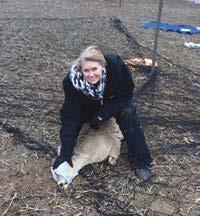
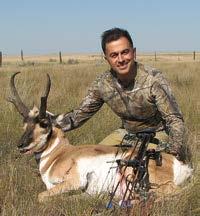
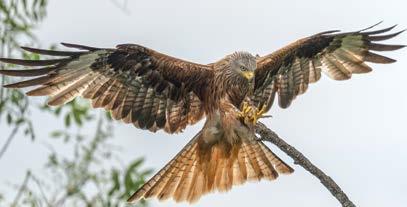
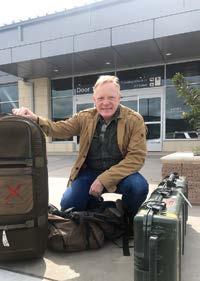





3 FAIR CHASE | FALL 2023 Volume 39 n Number 3 n Fall 2023 THE OFFICIAL PUBLICATION OF THE BOONE AND CROCKETT CLUB ®
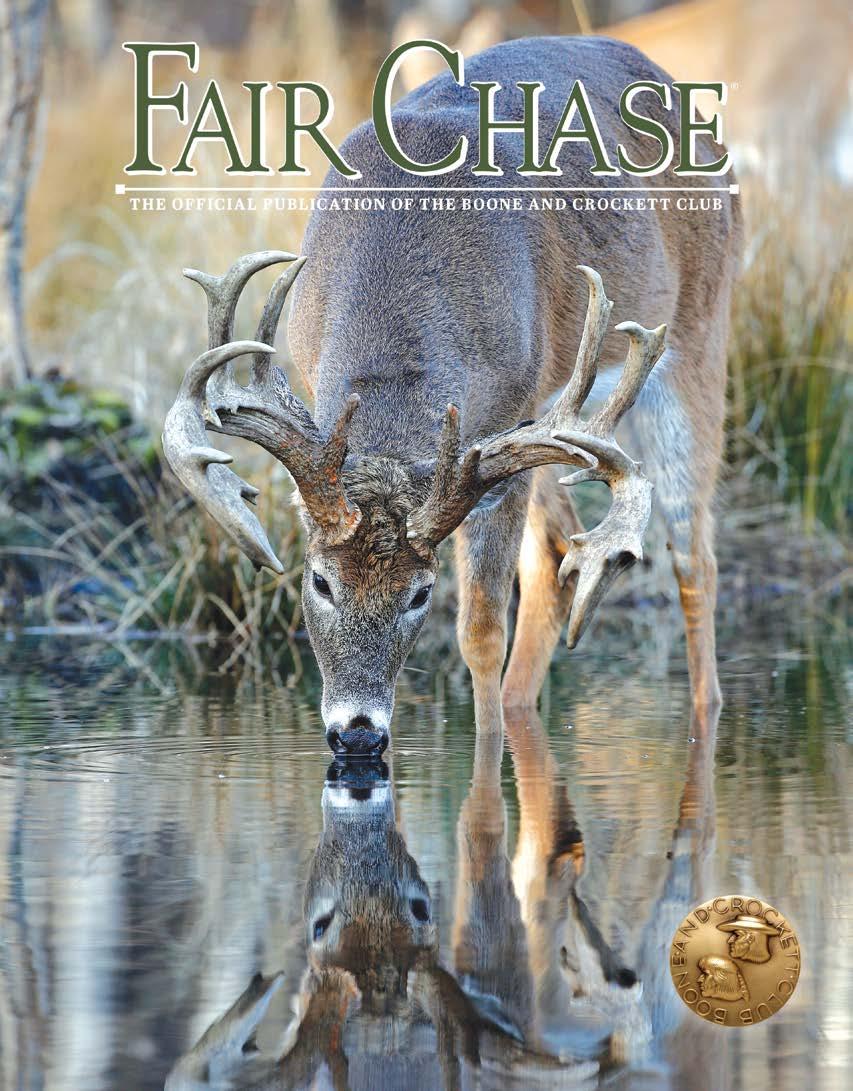
6 FROM THE EDITOR | Looking to the Future Doug Painter 8 FROM THE PRESIDENT Improving Habitat for Endangered Species James L. Cummins 12 CONSERVATION POLICY COLUMN In Sickness and In Health Charlie R. Booher 16 TRAVELING HUNTER | Traveling with Guns Craig Boddington 20 UNEXPECTED Wayne van Zwoll 26 B&C IMPACT SERIES THE FIGHT TO SAVE FLORIDA’S KEY DEER PJ DelHomme 29 B&C MEMBER SPOTLIGHT | Dr. Lee Merriam Talbot PJ DelHomme 32 THE ENDANGERED SPECIES ACT AT 5O Lowell E. Baier 36 POACH & PAY 2.0 | Detection and Reporting of Wildlife Poaching Jonathan Gassett and Kristie R. Blevins 40 THE CHALLENGE OF NORTH AMERICAN CONSERVATION TODAY Simon Roosevelt 46 SCIENCE BLASTS | Science Marches Forward: The Ever-Evolving Science of Chronic Wasting Disease Jonathan R. Mawdsley 48 B&C UNIVERSITY PROGRAMS | Evaluating Management Strategies for Chronic Wasting Disease in Michigan Whitetail Deer Noelle Thompson 52 IN THE FIELD | B&C Newsletter 54 BEYOND THE SCORE | Missing the Mark Shawn Lentz 58 DIY - THE PRAIRIE, THE BOW, AND THE PRONGHORN Alexander Sharif 62 TROPHY TALK | Official Measurer Workshops Justin Spring 66 GENERATION NEXT | 32nd Awards Youth Trophy List 68 GENERATION NEXT | Buck of a Lifetime Riley Green 70 RECENTLY ACCEPTED TROPHIES AND TROPHY PHOTO GALLERY 78 CAUGHT ON CAMERA Photos from the Theodore Roosevelt Memorial Ranch learn more online Scan the QR codes throughout this issue with the camera on your smartphone or a QR reader app to read additional articles found at www.Boone-Crockett.org COVER: A Wisconsin whitetail
for a
@BooneAndCrockettClub #BooneAndCrockettClub
pauses
drink of water. © John Eriksson/ Images On The Wildside
32.
16. TRAVELING WITH GUNS
AMERICAN CONSERVATION TODAY 58. DIY 48. B&C
PROGRAMS
40. THE CHALLENGE OF NORTH
UNIVERSITY
ABOUT THE BOONE AND CROCKETT CLUB
IT IS THE MISSION OF THE BOONE AND CROCKETT CLUB TO PROMOTE THE CONSERVATION AND MANAGEMENT OF WILDLIFE, ESPECIALLY BIG GAME, AND ITS HABITAT, TO PRESERVE AND ENCOURAGE HUNTING AND TO MAINTAIN THE HIGHEST ETHICAL STANDARDS OF FAIR CHASE AND SPORTSMANSHIP IN NORTH AMERICA.
WELCOME TO THE OLDEST WILDLIFE CONSERVATION ORGANIZATION IN NORTH AMERICA.
Established in 1887 by Theodore Roosevelt and George Bird Grinnell, the Boone and Crockett Club was founded by hunters who dedicated their lives to the conservation of wildlife. As the turn of the 20th century approached our nation, these men had to make a choice: stand by and watch our cherished wildlife disappear or work for the protection and propagation of our wildlife resource. Thankfully, they rose to the challenge and chose the latter.
Yielding substantial political influence, members of the Boone and Crockett Club initiated the first laws dedicated solely to wildlife conservation—and established the methods with which to pay for it. This includes legislation such as the Lacey Act, Migratory Bird Treaty Act, Wildlife Restoration Act (known as the Pittman-Robertson Act), and the Federal Duck Stamp Act.
Their work spearheaded efforts to protect Yellowstone, create Glacier, Denali, and Grand Canyon National Parks as well as our National Wildlife Refuge System. Their foresight spawned and supported key wildlife conservation organizations, including the New York Zoological Society (1895), National Audubon Society (1905), Wildlife Management Institute (1911), National Wildlife Federation (1937), Ducks Unlimited (1937), and more recently working with other partners in the hunting-conservation community to form the American Wildlife Conservation Partners (2000).
Today, the Boone and Crockett Club continues to build upon the legacy of wildlife conservation established by Roosevelt and Grinnell. We will continue the fight for conservation so future generations can enjoy the bounty of our wildlife resource.
Learn
FAIR CHASE PRODUCTION STAFF
Editor-in-Chief – Doug Painter
Managing Editor – Karlie Slayer
Conservation and History Editor
Steven Williams
Research and Education Editors
John F. Organ
Jonathan Mawdsley
Hunting and Ethics Editor
Mark Streissguth
Assistant Editors
Jodi Bishop
CJ Buck
PJ DelHomme
Kendall Hoxsey-Onysko
Kyle M. Lehr
Marc Mondavi
Tony A. Schoonen
Justin Spring
Julie L. Tripp
Editorial Contributors
Lowell E. Baier
Kristie R. Blevins
Craig Boddington
Charlie R. Booher
James L. Cummins
PJ DelHomme
Jonathan Gassett
Riley Green
Shawn Lentz
Jonathan R. Mawdsley
Doug Painter
Simon Roosevelt
Alexander Sharif
Justin Spring
Noelle Thompson
Wayne van Zwoll
Photographic Contributors
John Eriksson
Mark Mesenko
Alexander Sharif
Fair Chase is published quarterly by the Boone and Crockett Club and distributed to its Members and Associates. Material in this magazine may be freely quoted and/or reprinted in other publications and media, so long as proper credit is given to Fair Chase The only exception applies to articles that are reprinted in Fair Chase from other magazines, in which case, the Club does not hold the reprint rights. The opinions expressed by the contributors of articles are their own and do not necessarily reflect the opinions of the Boone and Crockett Club.
Fair Chase (ISSN 1077-3274) is published for $35 per year by the Boone and Crockett Club, 250 Station Drive, Missoula, MT 59801. Periodical postage is paid in Missoula, Montana, and additional mailing offices.
POSTMASTER: Send address changes to:
BOONE AND CROCKETT CLUB AND FOUNDATION BOARD OF DIRECTORS 2023
FOUNDED IN 1887 BY THEODORE ROOSEVELT
CLUB
Club President – James L. Cummins
Secretary – John P. Schreiner
Treasurer – Morrison Stevens, Sr.

General Counsel – John P. Schreiner
Executive Vice President – Administration
Anthony J. Caligiuri
Executive Vice President – Conservation
Mary Webster
Vice President of Administration
John P. Evans
Vice President of Big Game Records
Richard T. Hale
Vice President of Conservation
Steven Leath
Vice President of Communications
CJ Buck
Foundation President – R. Terrell McCombs
Class of 2023 Simon C. Roosevelt
Class of 2024
Mary Webster
Class of 2025 Michael L. Evans
FOUNDATION
Foundation President – R. Terrell McCombs
Secretary – Michael J. Opitz
Treasurer – Charles W. Hartford
Vice President – John P. Evans
Vice President – Paul M. Zelisko
Class of 2023 Remo R. Pizzagalli
Charles W. Hartford
Benjamin A. Strickling III
John A. Tomke
Jeffrey A. Watkins
Class of 2024 Gary W. Dietrich
B.B. Hollingsworth, Jr.
Tom L. Lewis
Michael J. Opitz
Paul M. Zelisko
Class of 2025 John P. Evans
Steve J. Hageman
R. Terrell McCombs
T. Garrick Steele
C. Martin Wood III
Fair Chase, Boone and Crockett Club, 250 Station Drive, Missoula, MT 59801 Phone: (406) 542-1888 Fax: (406) 542-0784
NATIONAL ADVERTISING
Phone: (406)542-1888 ext. 215
B&C STAFF
Chief Executive Officer – Tony A. Schoonen
Director of Big Game Records –Justin Spring
Director of Publications – Julie L. Tripp
Director of Conservation Programs –Luke Coccoli
Director of Finance and Administration–
Abra Loran
Assistant Director of Big Game Records–Kyle M. Lehr
Assistant Director of Finance –Debbie Kochel
Accounting Manager – Brooke Van Oort
Creative Services Manager – Karlie Slayer
Development Program Manager –Jodi Bishop
Digital Strategies Manager –Mark Mesenko
Office Manager – Sandy Poston
TRM Ranch Manager – Mike Briggs
Shipping and Administrative Support Specialist – Amy Hutchison
Records Data Support - Jennifer Staten
FAIR CHASE | FALL 2023 4
more about the history of the Club.

5 FAIR CHASE | FALL 2023 5 As the leader in defending your right to hunt worldwide, advocacy is SCI's top priority. Join our team as we stand strong to protect your hunting freedom and support wildlife conservation worldwide. NOW IS THE TIME TO ACT. By becoming a member of SCI, you strengthen the hunter's voice and join the fight for the future of hunting. FIGHT FOR THE FUTURE OF HUNTING ACT NOW & JOIN: SAFARICLUB.ORG/MEMBERSHIP or call (888) 486-8724
LOOKING TO THE FUTURE
For an organization that is 136 years old, founded by one of America’s most popular and influential presidents, and whose membership roster has always been a who’s who of American wildlife conservation, it is not surprising that the Boone and Crockett Club is an organization steeped in tradition. While long-held beliefs with respect to how best to conserve our native wildlife continue to serve as key guidelines, the Club is, however, by no means hide-bound or content to bask in the light of bygone achievements. On the contrary, the Club is more active than ever in assessing and responding to new issues and challenges related to wildlife conservation and
hunting, and we have ramped up efforts to build our outreach and messaging. Equally important, we’ve worked to expand our base of active supporters.
Let me touch on that last point. The completion of our revamped website has made a significant difference in the number of individuals we’ve reached, with over 1.8 million unique visitors and four million website views over the last year. In addition, 136,599 hunters and conservationists have registered with our site. Our new electronic newsletter has also quickly gained traction with a current base of 57,000 engaged subscribers who have opted in to receive In The Field on a monthly basis.
Our magazine, Fair Chase , now includes 6,500 subscribers, over 50 percent of whom are in the 45-64 age bracket and over half of whom earn over $100,000 per year.
Our members are the lifeblood of the Club, so we thought it appropriate to say “thanks” to all our supporters with a members-only prize drawing that will occur on July 10, 2024. Every member on June 30, 2024, will automatically be entered in the drawing with the number of entries based on your membership level, from five entries for $35 members to 25 entries for lifetime members.
So far, prizes include great gear and gifts. More will be added throughout the year. As much as it is a hoot
 EDITOR
 Doug Painter EDITOR-IN-CHIEF
to (hopefully) win a cool prize, it is our collective effort and energy that will determine the welfare of our wildlife, the quality of our hunting experience, and, ultimately, the legacy we leave our kids.
Hope to see you down the trail.
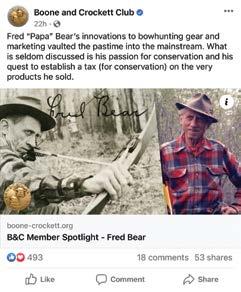
The Club has been digging through the archives to find the best stories to post online and in Fair Chase magazine. And if that wasn't enough, you can now listen to our new series, Boone and Crockett Club's Audio Adventures. These stories take you alongside hunters on their epic adventures around North America. Listen wherever you download podcasts.

FAIR CHASE | FALL 2023 6
FROM THE
Membership
Catch some of the headlines from the latest In The Field newsletters on page 52. Learn more about the Membership Giveback prize drawing on page 57!
IT JUST KEEPS HAPPENING.
CONSISTENTLY TERMINAL













FAIR CHASE | FALL 2023 ©2023 Federal Ammunition 15 Yards 85% Weight Retention 300 Win. Magnum Moose 160 Yards 96% Weight Retention 6.5 PRC Whitetail Deer 400 Yards 91% Weight Retention 7mm Rem. Magnum Elk 997 Yards 99% Weight Retention 300 Win. Magnum Oryx DOWNLOAD THE FREE BALLISTIC APP BUY NOW AT FEDERALPREMIUM.COM
NO MATTER THE HUNTER, DISTANCE, CARTRIDGE OR ANIMAL, THE TERMINAL ASCENT™ STORY ALWAYS ENDS THE SAME.
IMPROVING HABITAT FOR ENDANGERED SPECIES
This year marks the 50th Anniversary of the Endangered Species Act (ESA). We as a nation are grateful for the individuals who uncovered harmful environmental practices, such as Rachael Carson, who, in her 1962 book, Silent Spring, brought to light the harmful effects of DDT, for example. And that does not stand for ducks, deer, and turkey. DDT is a highly efficient pesticide. Our family used it and toxaphene extensively to control the dreaded boll weevil and other pests in cotton. Thankfully, DDT was banned in 1972 as it had tremendous negative environmental effects. While our nation has made great gains in producing chemicals with fewer side effects, we still have more work to do, such as reducing habitat destruction and increasing habitat restoration that benefits a diversity of species. When the Boone and Crockett Club was founded in 1887, preventing extinction was the major topic at the inaugural meeting. In fact, the Club has a huge amount of experience in preventing species from going extinct and increasing populations. In 1906, the Club established the National Collection of Heads and Horns as a repository for the vanishing big game of the world and to enlist public support for their protection. While we have had great success, the real trophy is conservation success for all species, as Theodore Roosevelt’s great, great grandson said in his extremely thoughtful article in this issue of Fair Chase titled “The Challenge of North American Conservation Today.”
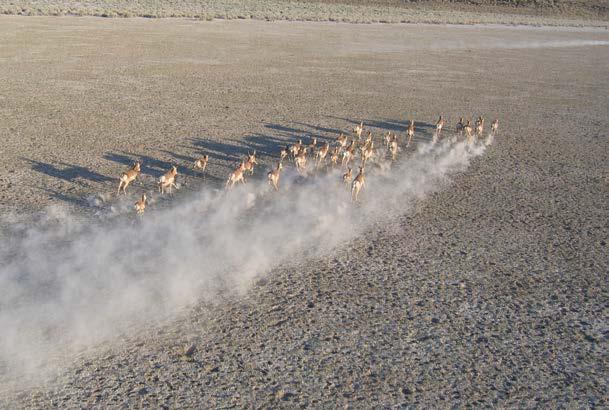
The pronghorn is a great example of a species that was on the brink of extinction in the early 1900s and recovered with the help of the Club.
In a letter from George Bird Grinnell, the chairman of the Club’s Game Preservation Committee, to Interior Secretary Walter Fisher, Grinnell said, “The Club is much concerned about the fate of the pronghorn which appears to be everywhere rapidly diminishing.” By the early 1920s, the population had been reduced to about 13,000 animals. Club member Charles Sheldon, in a letter to Grinnell, said, “Personally, I think that the antelope are doomed, yet every attempt should be made to save them.” The Club began its efforts to save the pronghorn in 1910 by purchasing and restocking lands. In 1927, Grinnell spearheaded efforts with the help of Club member T. Gilbert Pearson of the National Audubon Society to create the Sheldon Antelope Refuge in Nevada. The two organizations purchased approximately 34,000 acres of the Last Chance Ranch. They transferred the land to the U.S. Biological Survey—now the U.S. Fish and Wildlife Service—in 1929 when President Herbert Hoover learned the
Club and Audubon were underwriting the private land purchase. In 1936, President Franklin Roosevelt added 540,000 acres, collectively marking the beginning of pronghorn recovery.
The efforts of the Club and its members to help species did not end there. Club member Lee Talbot, the grandson of Dr. C. Hart Merriam, also a Club member, the first chief of the U.S. Biological Survey, and the person the Merriam subspecies of wild turkey is named, played a major role in the ESA. In the late 1960s, Talbot served as science advisor to the Joint Senate-House Committee on Environment. In 1969, Congress passed the Endangered Species Conservation Act, but Talbot said it was “inadequate to address the needs at the time, so early in 1970, when President Nixon asked me to help start the President’s Council on Environmental Quality (CEQ), I saw an opportunity to place endangered species high on the nation’s agenda.”
With the support of Club member Russell Train, the first chairman of the CEQ, Talbot worked with Congressman John Dingell, Jr., Chairman of the Merchant Marine
James L. Cummins PRESIDENT
and Fisheries Committee of the U.S. House of Representatives, on the ESA, which President Richard Nixon signed into law on December 28, 1973.
Former Club president, Lowell Baier, has spent the past 10 years of his life conducting extensive research on the ESA. I commend my friend for his hard and brilliant work on the ESA. His goal was to write the definitive 50-year history of the ESA, and it will be released this year in two volumes: The Codex of the Endangered Species Act, Volume I: The First Fifty Years and The Codex of the Endangered Species Act, Volume II: The Next Fifty Years. Volume I reviews the Congressional intent, how the courts have interpreted it, and how the U.S. Fish and Wildlife Service applied it; Volume II is a guide for applying the ESA over the next 50 years.

FAIR CHASE | FALL 2023 8
Pronghorn race across Sheldon National Wildlife Refuge. IMAGE COURTESY OF GAIL COLLINS, U.S. FISH AND WILDLIFE SERVICE.
Read B&C's "Three Steps to Pronghorn Restoration"
Read Simon Roosevelt's article on page 40.
Read Lee Talbot's Member Spotlight on page 29.
Many people in our nation want the ESA to go away. Others say not to change one single word. That is like owning an International Scout with two plans: take it to the junkyard or use it but never change the oil. Neither option is helpful at the hunting club unless walking is your goal. We need to keep and use the Scout but fix it when it needs fixing. The ESA should be treated no differently. The ESA has been effective in preventing some species from becoming extinct; however, it can be significantly improved by creating new recovery efforts. The recovery and delisting of many species will not happen as long as the status quo of not increasing habitat, therefore not increasing populations, is maintained.
In 2006, Senator Mike Crapo of Idaho spoke on the floor of the U.S. Senate and said, “I rise today with my colleagues—Senator Blanche Lincoln from Arkansas, Senator Chuck Grassley from Iowa, and Senator Max Baucus of Montana—to introduce the Endangered Species Recovery Act or ESRA. This new bill does not amend the current ESA. It creates new policies that finance the recovery of endangered species by private landowners. ESRA makes it simpler for landowners to get involved in conservation and reduces the conflict often emanating from the ESA.”


Over 80 percent of endangered species live on private land. We all know that incentive-based conservation programs work. The Clean Water Act, the other major, regulatory-based environmental law, has strong, voluntary, incentive-based programs to support it, especially wetlands. We know them as the North American Wetlands Conservation Act (NAWCA), the Conservation Reserve Program (CRP), and the Wetlands Reserve Easement (WRE), all of which were supported by the Congressional Waterfowl Task Force. NAWCA has played a major role in ensuring we have healthy waterfowl habitat, and CRP and WRE were responsible for de-listing the Louisiana black bear from the ESA.
“Under the current law, however, there are too few incentives and too many obstacles for private

landowners to participate in conservation agreements to help recover species under the ESA,” continued Crapo. “ESRA, like the voluntary Farm Bill conservation programs that inspired its creation, will make it more attractive for private landowners to contribute to the recovery of species under the ESA.”
As Senator Crapo noted, the bill resulted from collaboration among key stakeholders, such as the American Farm Bureau, Defenders of Wildlife, Environmental Defense Fund, National Cattlemen’s Beef Association, National Wildlife Federation, and Society of American Foresters. These organizations understand that landowners must be allies to ensure success. While I had spent many hundreds of hours on this bill, I was shocked when Senator Crapo said my name on the Senate floor and referred to me as a passionate catalyst whose passion for the outdoors provided the inspiration to move these ideas forward.
ESRA provides new tax incentives for private


9 FAIR CHASE | FALL 2023
Read Lowell Baier's article about the ESA on page 32.
Conservation should make both ecological and economic sense. A thriving economy isn’t sustainable if it undermines conservation— just as effective conservation is more likely to last when it works in synergy with economic forces.
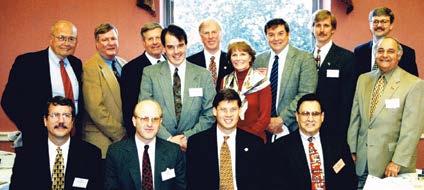
The Congressional Waterfowl Task Force, founders and members, including James Cummins, front row, second from left.
The Boone and Crockett Club asks that you please thank our Trailblazers with your patronage.
landowners who voluntarily help the recovery of species. Tax credits will reimburse landowners for property rights affected by agreements, including conservation easements and costs incurred by species management plans. For landowners who limit their property rights through conservation easements, there will be 100 percent compensation of costs. That percentage declines to 75 percent for 30-year easements and 50 percent for cost-share agreements not encumbered by an easement.
Senator Crapo went on to say that the legislation provides a list of options that give landowners a choice, which is crucial for success. For some landowners, a conservation easement will be the most attractive option. An easement restricts certain activities but is compatible with working lands. For agreements without easements, there is flexibility to do what is necessary for the species without sacrificing property rights into perpetuity.
“The tax credits provide essential funding that is necessary to respect private property rights,” Senator Crapo said. “Wildlife should be an asset rather than a liability, which is how it has sometimes been viewed under the ESA. With wildlife becoming valuable to a landowner, those who may be reluctant to participate in recovery efforts in the past will be more likely to contribute with these incentives. When people want to participate in the process and do not fear it, the

likelihood of conflict and litigation is reduced.”
A key component of the bill is that provisions were made to accommodate landowners whose taxes may be less than the tax credit provides. Any party to an agreement can receive all or part of the tax credit. This bill also expands tax deductions for landowners who take part in recovery plans and allows landowners to exclude from taxable income federal payments from costshare programs without bureaucratic obstacles.
Landowners will receive technical assistance to implement agreements. Liability protection may be provided to protect the landowners from penalties under the ESA, helping to remove legal disincentives to recover species. This removes the fear of trying to help species.
While ESRA sounds very promising, I am sad to say it passed the U.S. Senate, but when it got to the U.S. House of Representatives, the incentive of a strong tax credit was reduced to a weak tax deduction. This bill needs to be strongly reconsidered by
the current Congress as it provides collaborative, creative ways to balance resource conservation with the economic uses of natural resources.
North American conservation is nothing shy of a miracle. The Club has helped conceptualize and develop innovative tools and resources to help farmers and landowners with conservation while producing quality wood for homes and healthy food at affordable prices.
We live in a society where there is a democratic rule of law. There has to be a balance between what society will accept and what is needed. Sir Isaac Newton said that for every action, there is an equal and opposite reaction. While I am 100 percent sure he was not referring to regulations, I think this law of physics also applies to politics. Personally, I believe we went too far as a nation on government adopting egregious wetlands regulations. There was a reaction, and now we have fewer wetland protections in place than we have had in many, many years. Margaret Thatcher once said, “A good compromise is one that
nobody supports and nobody opposes.” Sadly, the current situation for both wetlands and species is one where one side is supportive, and the other side is opposed. That is not a good compromise.
Conservation should make both ecological and economic sense. A thriving economy isn’t sustainable if it undermines conservation—just as effective conservation is more likely to last when it works in synergy with economic forces. Conservation efforts cannot simply seek to preserve our environment but must consider the needs of the people and communities that live and work here. We MUST have conservation solutions that make economic sense to sustain our environment and way of life.
As the Club continues its role as a major architect of America’s conservation system, we must also ensure conservation action has scientific integrity and is politically viable. It is imperative that we develop innovative solutions to solve challenges by focusing on strategic conservation with measurable impacts. We MUST favor constructive solutions over combative tactics. This is all possible because the American people strongly believe that conservation is an essential component of a modern, pro -

“Wildlife should be an asset rather than a liability, which is how it has sometimes been viewed under the ESA. With wildlife becoming valuable to a landowner, those who may be reluctant to participate in recovery efforts in the past will be more likely to contribute with these incentives. When people want to participate in the process and do not fear it, the likelihood of conflict and litigation is reduced.”
©U.S. FISH AND WILDLIFE SERVICE
- Senator Mike Crapo
LEFT TO RIGHT: Senators Max Baucus (D-Montana), Mike Crapo (R-Idaho), and Wayne Allard (R-Colorado) with a bald eagle at the introductory announcement of the ESRA .
The Boone and Crockett Club Strives to be Thoughtful, Pragmatic, and Enduring in Mission and Stability
As many folks do, my family supports broadbased, unifying and educational institutions such as our churches and universities.

We also support the arts and conservation. Specific organizations in these latter areas are comprised of individuals who, although diverse in background, are focused, driven and effective in dealing with complex issues. Importantly, these bedrock organizations understand that sound economics are key to lasting solutions.
We believe in organizations that aim high, are thoughtful, pragmatic, and enduring in mission and stability. Stewards and trustees in the truest sense, and gold standards in their areas of emphasis. In conservation, we feel that these qualities are epitomized by the Boone and Crockett Club.
I personally enjoy hunting, but wild places, creatures, and wildness are the magnet and the balm.
Those with great wealth often have great ideas and broad goals, but our own "habitat" often seems a secondary consideration at best. Understanding mankind's impacts and focusing on scientific reasoning and education in order to conserve and maintain balance is where the Boone and Crockett Club excels.
The Club is a named beneficiary in our wills, but our ongoing mission is to continue to support the organization and its goals throughout our lifetimes as well.
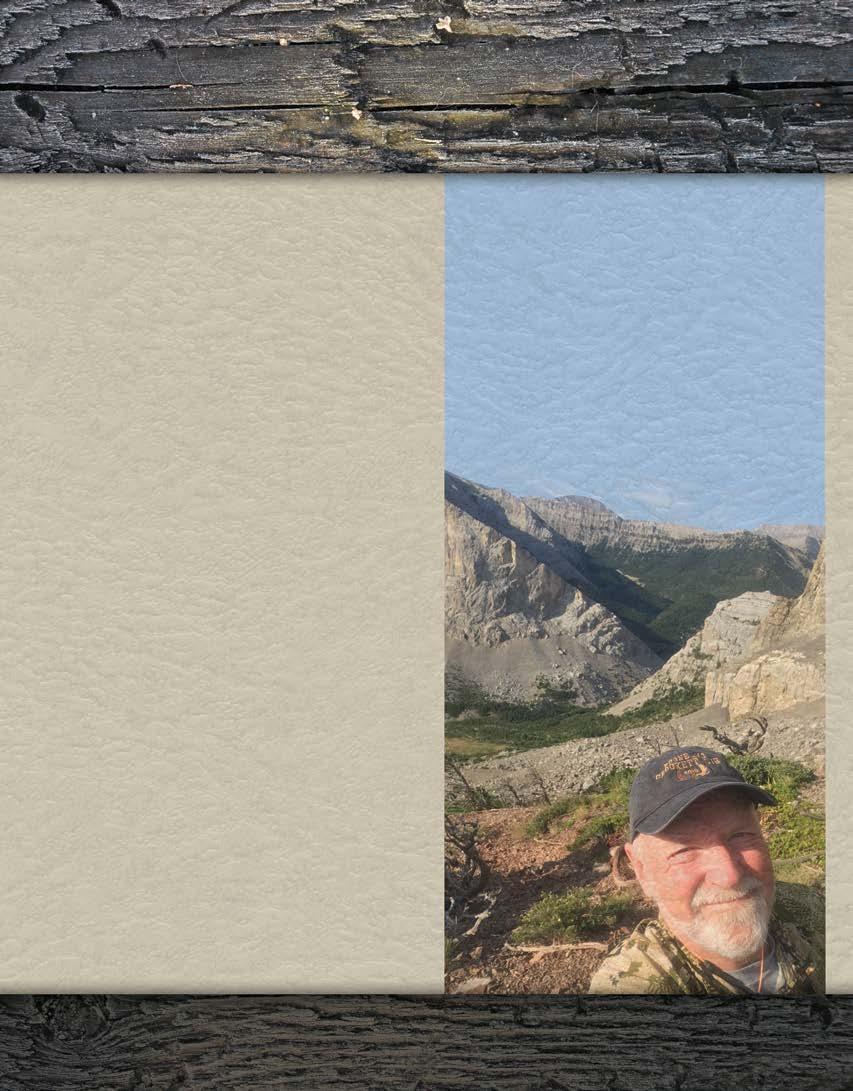
— Hanspeter Giger (Professional Member since 2016)
For more information about the Roughriders Society, or a planned gift to the Boone and Crockett Club Foundation, please contact: Jodi Bishop - (406)542-1888
 Hanspeter with his wife, Kimberly and daughter, Alexis.
IN SICKNESS AND IN HEALTH
Like people, wild animals get sick. Sometimes individual animals recover, and sometimes they do not, but as far as we can tell, wild animals have been getting sick for a long, long time. For much of that time, there has likely been some level of transmission between individuals of the same species, as well as to members of other species, including humans. This is a longstanding problem, but, like many things, it’s exacerbated by the physical connectivity of our modern world. As people, we are moving ourselves and the products we buy or sell around the world more than at any other time in our history. That movement is inherent to what we wear, what we eat, and how we get to work, but flaws in these systems seem to put us at greater risk of rapid disease transmission. Further, human populations are increasing such that more people than ever are living in close contact with both domestic and wild animals, creating more opportunities for transmission to occur.
So, while many wildlife illnesses have likely been on the landscape since time immemorial, several diseases have emerged in the last few decades, all of which are new cause for concern. Sheep get pneumonia. Elk suffer from hoof rot. Rabbits catch their own hemorrhagic disease. Cervids succumb to chronic wasting disease. Turkeys and waterfowl are susceptible to avian flu. And those are just those species of wildlife that many of us like to hunt—there are numerous other species and other pathogens that blight them.
As we look for more wildlife diseases, we find more diseases in more wildlife species. The COVID-19 pandemic revealed the need to monitor, research, and adapt to all manner of diseases better than we had been, and wildlife diseases are no exception.

Diseases can be classified into three general categories that define how they spread and, therefore, how worried about them we might be: intraspecific (those that can pass from individual to individual within the same species), interspecific (those that can be transmitted from one species of wild animal to another), and zoonotic (a type of interspecific disease that may pass from wildlife to humans). Many of these diseases pose significant threats to our food supply and public health, especially if the pathogens can infect livestock or humans. Disease, of course, is a natural part of evolution, as is adaptation to pathogens. However, evolution requires far more time than a single human life, so we must react to these issues as they arise to try and maintain or advance the status quo.
All of this complicates our efforts to manage and conserve wildlife and is overwhelming our existing institutions. For state and tribal wildlife agencies tasked with managing wildlife, this means fewer resources available for habitat improvement, education programs, and the restoration of iconic species. Noting this, the leaders and contractors of the Boone and Crockett Club dedicated significant time and energy to procure resources from the federal government to assist the agencies.
In the final days of the 118th Congress, we completed a 10-year campaign to pass the Chronic Wasting Disease Research and Management Act. Now our focus has turned to ensuring the program is funded and implemented well. For states and tribes, this means ensuring agencies know that eligibility for the federal grant program has been expanded for both research and management. For now, the USDA is putting the money to good use, but the current grant program is clearly not enough for a problem that puts deer, elk, moose, caribou—our most popular game species—at risk. Concern and uncertainty among hunters continue to threaten the future of hunting.
It is the mission of the Boone and Crockett Club to promote the conservation and management of wildlife, especially big game, and its habitat, to preserve and encourage hunting and to maintain the highest ethical standards of fair chase and sportsmanship in North America. Noting this, I believe that while we continue to focus especially on big game, our role as sportsmen must expand beyond just the species that we pursue. This is not a novel concept. It is one
that is foundational to our Club. Charles Hallock, a mentor to George Bird Grinnell and founding editor of Forest and Stream magazine, wrote that a “practical knowledge of natural history must of necessity underlie all attainments which combine to make a thorough sportsman.” Disease, among other elements, must be a part of our collective and personal knowledge of natural history.
This expansion is why the Boone and Crockett Club continues to support the modernization of the National Wildlife Health Center (NWHC) in Madison, Wisconsin, where world-renowned scientists research emergent wildlife diseases. This center is the nation’s only federal facility in its class that is exclusively dedicated to investigating diseases that pose risks to human, animal, and environmental health. The NWHC continues to be a world leader in crafting
FAIR CHASE | FALL 2023 12
CONSERVATION POLICY COLUMN
Charlie R. Booher BOONE AND CROCKETT CLUB POLICY CONSULTANT
Wildlife disease is a matter of both personal and public policy. It requires us, as individuals, to decide our tolerance for disease transmission risk, and collectively as the Boone and Crockett Club, to think about the responsibilities of wildlife agencies and research institutions to work on these problems impacting our wildlife.
Read more about a B&C Fellow's CWD research on page 48.
science-based solutions to the deadliest wildlife diseases, including avian influenza and white-nose syndrome of bats, that have devastated wildlife populations worldwide.

Adaptive management of diseases is key, as our community is constantly learning new information about these pathogens. When we know better, we must do better. Knowing better and doing better are both aided by interdisciplinary collaboration among scientists, public

health officials, and wildlife managers, which is at the core of the One Health concept. One Health is defined by the Centers for Disease Control as “a collaborative, multisectoral, and transdisciplinary approach—working at the local, regional, national, and global levels—with the goal of achieving optimal health outcomes recognizing the interconnection between people, animals, plants, and their shared environment.”
As this concept expands and

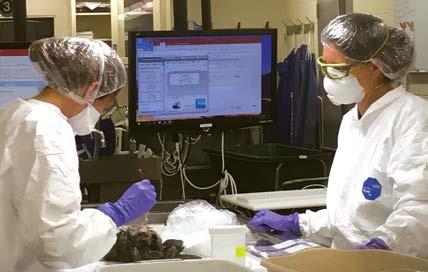
Wildlife disease experts at the USGS National Wildlife Health Center in Madison, Wisconsin, examine a double-crested cormorant while wearing full biosafety gear. The postmortem examination gives the scientists clues to what may have caused the animal to die. Examination of wild birds is important to detect pathogens that could impact wildlife populations or be transmitted to domestic animals or people.
collaboration is enhanced, we expect to see better public and private sector responses to disease outbreaks. Historically, like most wildlife conservation work—at least on game species—wildlife disease research and management has been bankrolled by hunters, anglers, trappers, and recreational shooters. However, the One Health concept calls on governments and non-governmental organizations to reach a broader audience. Additional federal monies help supplement this work, as is the case with chronic wasting disease and avian influenza, among other diseases, but more is needed as our institutions adapt to our needs as modern constituents of the world.
Wildlife disease is a matter of both personal and public policy. It requires us, as individuals, to decide our tolerance for disease transmission risk, and collectively as the Boone and Crockett Club, to think about the responsibilities of wildlife agencies and research institutions to work on these problems impacting our wildlife. As diseases come to play a more substantial role in wildlife management, we must ensure that state, tribal, and federal wildlife agencies are equipped with the resources to address these multifaceted challenges. n
13 FAIR CHASE | FALL 2023
WWW.KENETREK.COM 800-232-6064 Built for unyielding traction, support and comfort in the most rugged terrain and weather. Thick leather uppers wrap around supportive nylon midsoles, on top of high traction outsoles. Bottom line: They make it possible to get anywhere you need to go in total comfort.
FairChase-Fall-23.indd 1 6/13/2023 9:15:32 AM
©KENETREK, LLC 2023
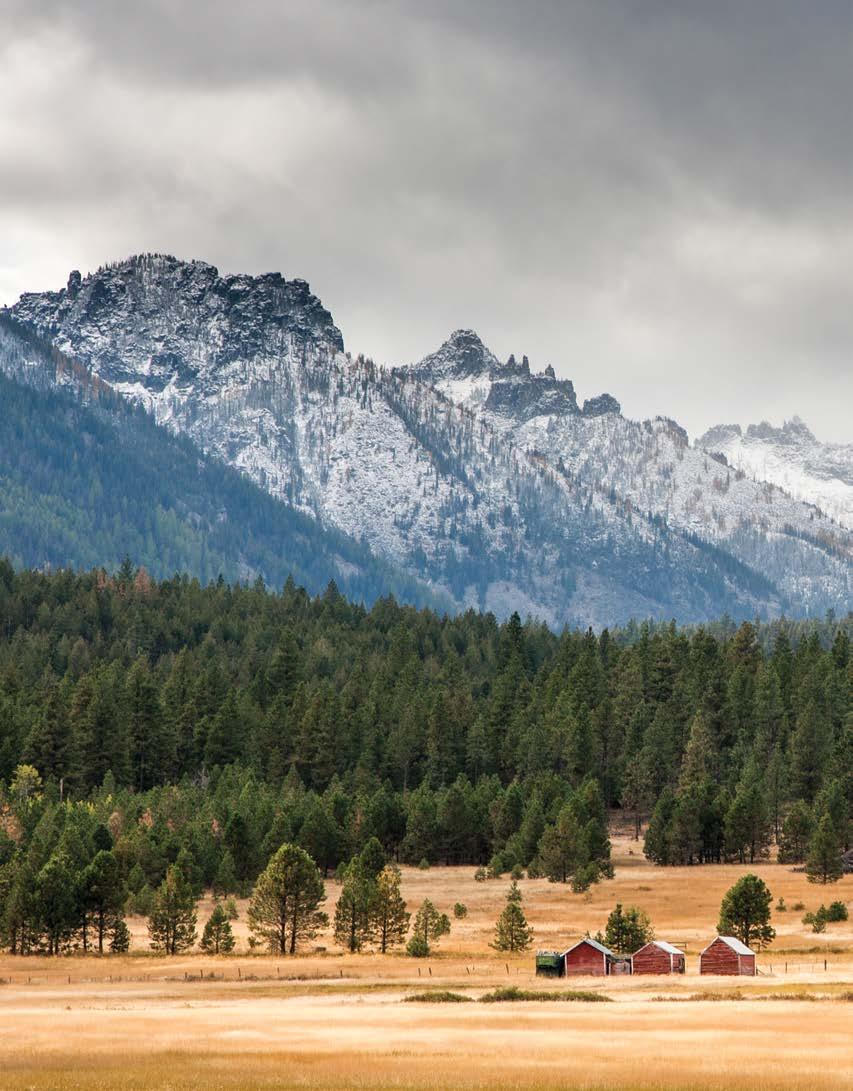
© MARK MESENKO
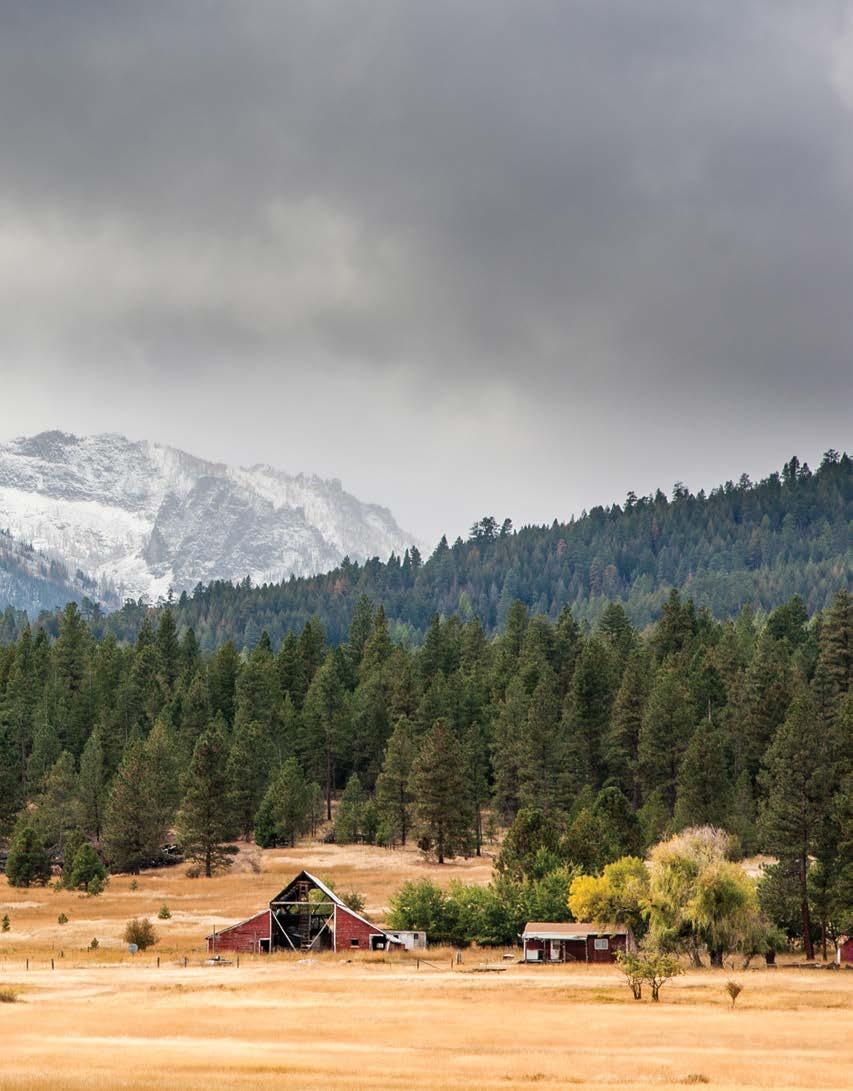


The crux of the problem is that every landowner is the custodian of two interests, not always identical, the public and his own. What we need is a
–ultimately boil down to this.
- ALDO LEOPOLD
Traveling WITH GUNS
Surveys consistently indicate that most American hunters rarely hunt beyond their home states. I am a proud American, but it’s also a fact that we Americans are among the least-traveled Western societies, with one of the lowest percentages of passport holders.
In part, this is because ours is a large country. As the slogan goes, “See America First,” and we have much to see. Thanks to our North American Model of Wildlife Conservation, we (and our Canadian neighbors) also have more hunting opportunities than any other society on Earth, with reasonably unfettered access to millions of acres of public land.
Many American hunters are satisfied with their backyard whitetails, and many Canadians are happy with their annual moose. If I lived in Alaska, Alberta, British Columbia, Montana, or Wyoming, maybe I wouldn’t travel so much. We North Americans are the world’s largest hunting society. Some of us—collectively, many of us—dream of hunting different animals in far places. It doesn’t matter if it’s just across our state line, to the opposite end of our continent, or another country or continent. To make those dreams come true, we must travel. Depending on where and for what, maybe we can make a road trip, but that often means getting on an airplane.
Even the thought is daunting enough for folks who don’t travel much, but now we must contemplate traveling with firearms, which is not hassle-free nor always possible. Bows and crossbows are generally not a problem. Firearms and ammunition are subject to specific Federal Aviation Administration (FAA)
FAIR CHASE | FALL 2023 16
BODDINGTON
CRAIG
PROFESSIONAL MEMBER PHOTOS COURTESY OF AUTHOR
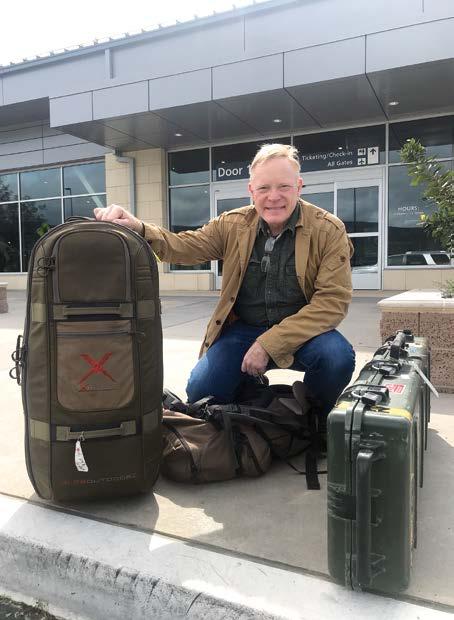
A common scene, Boddington at the San Luis Obispo airport, ready to travel—somewhere— with duffel, gun case, and carry-on.
rules. Within the continental United States, long guns are usually simple. Handguns can be, but there are jurisdictions (such as New Jersey and New York City) where even transit with a handgun is unlawful.
HARD CASES
It all starts with a secure, lockable, properly padded hard case. The baggage smashers are aggressive; I go through a hard case every three years, so I’ve had many. In the last few years, I’ve used Pelican polymer cases, generous enough to nestle two scoped rifles with plenty of foam padding. You can trace and cut out the shape of your rifle. Bow cases can be even larger and may exceed airline dimensions, so they might be checked as oversize baggage.
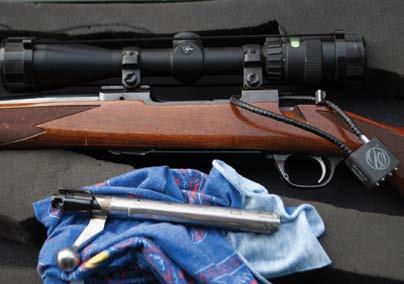
The primary operative word is “secure.” Cases wear out. Hinges and corners can break. Inspect your case carefully; the TSA folks can reject a case that cannot be properly locked. A newer rule: All lock holes need a lock. Mine requires four. I use “TSA” locks so that, theoretically, the agents have a master key if they need to open it. This doesn’t always pan out; I’ve had agents break locks. I pack
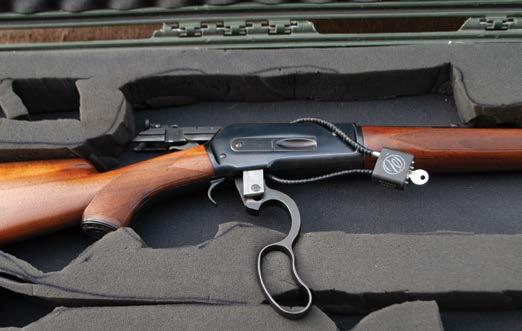
a couple of spare locks with same key or combination. On bolt-action rifles, I remove bolts and wrap them separately in the case because the bolt handle creates a nasty projection that can lead to damage if the case is dropped. With other action types, I pack with the action open for the easiest inspection. I also add a trigger lock or cable lock through the action to make inspectors happy and comfortable.
ROAD TRAVEL
Rules vary widely among jurisdictions; it’s our job to know the rules. Most of us travel freely to ranges and for local hunting with unloaded firearms in soft cases. However, it is best to have unloaded firearms in the secure, locked hard case for longer trips across state lines. In many jurisdictions, this is the law!
On longer road trips, the real problem isn’t starting but stopping. I keep gun cases out of sight. Even for brief stops, always lock the car. If you stop for the night, haul your gun cases into the hotel. I know too many people who have had their cars burglarized in parking lots.
BASIC AIR TRAVEL RULES
Within the United States, there are two sets of rules: FAA and individual airline rules. Generally, they are the same. However, some carriers no longer transport firearms. Some domestic and most international carriers require advance notification when traveling with firearms. Systems vary widely, from simple to complicated. Check the airline website, and if you have any questions, get on the
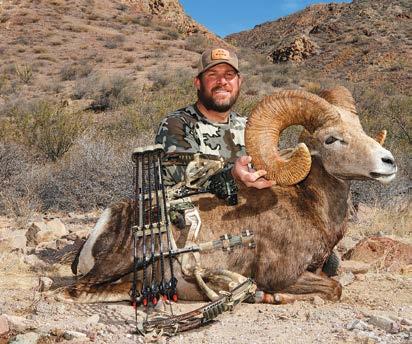
Boddington’s son-in-law, Brad Jannenga, arrowed this fine desert sheep in Mexico. It’s always essential to check but, nearly worldwide, archery equipment is subject to much fewer travel restrictions than firearms.
phone. For travel with firearms, avoid cut-rate internet travel sites. At a minimum, book direct with the airlines. Use a hunting and gun-savvy travel agent, especially if you are inexperienced. Avoid tight connections. Two hours is comfortable within the U.S. Three to four hours is safer for international transfers. The basic FAA allowance for ammunition is a maximum of five kilograms (eleven pounds) in original
17 FAIR CHASE | FALL 2023
LEFT: When possible, bolts should be removed and padded separately in the gun case. When disassembly isn’t possible, Boddington packs with action open, and adds a trigger lock or cable lock…just to keep inspectors very happy. RIGHT: Bolt actions are probably the easiest to disassemble and pack. Boddington wraps the bolt separately and pads it, then adds a cable lock through the action, just to make inspectors extra happy.
ABOVE: US Customs form, 4457 is a critical document for American hunters traveling abroad. Customs keep no record of it, but it serves worldwide as a “US firearms permit,” plus is almost mandatory to re-enter the US with firearms taken out of country.

factory containers. Technically, this means that the handy plastic ammo containers we handloaders all use are unsatisfactory. How ammunition gets carried is ambiguous. In the U.S., some airlines allow it to be in the gun case; others want it in another checked bag. Outside the U.S., requiring ammo to be checked separately in its lockable container is common. If so, there is usually no separate charge for the ammo box. On the other hand, additional handling charges are increasingly common for gun cases. This is now normal all over Europe and for internal flights in Africa.
When traveling with firearms, I double-check when packing to ensure chambers are clear and no cartridges lurk in magazines. With ammo, I hedge my bets. I put it in a lockable plastic box. I’ve used plastic tackle boxes, but now I have a blaze orange box like a G.I. ammo can. I put locks inside with
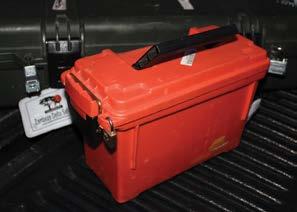
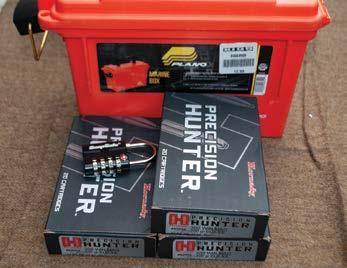
the ammo. I don’t lock it. If TSA needs to inspect it, they’ll cut the lock. Then, I put it in my checked duffel or suitcase.

Airline ticket agents are not gun experts. They usually don’t know their own rules. Be friendly, confident, and know the rules. Understand that you can’t argue with these folks. If you run into a snag, keep smiling, and ask for a supervisor. When traveling with firearms and ammunition, here’s how I do it. I arrive plenty early, march up to the counter with a locked gun case, hand over my ID, and say, “I have firearm(s) in this locked case. I also have ammunition in this (other) bag, less than five kilos in original factory containers.” From there, I generally have no problems. You will sign a small form that certifies the firearms are unloaded. You’ll have to unlock the case to slip it in. Typically, you will then lock it. In the U.S. today, most commonly, it goes straight onto the belt and to TSA somewhere in the bowels of the airport. Alternatively, an airline employee will accompany you to TSA.
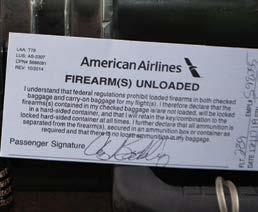
What happens next depends on TSA equipment. Good scanners allow them to see that the firearm is unloaded. If the picture isn’t clear enough, they’ll need to open the gun case. Always, I hang around the ticket counter or the TSA office for 15 minutes or so in case they need my keys or combination. Someone will tell you when you are cleared to go through security if this is required. The ammo usually goes on through with no further comment. Do not have any cartridges or firearms parts in your carry-on! Sanitize your daypack and other carry-on bags as often as needed to be certain.
Once at your destination, it’s a bit of a grab-bag, depending on the airport and airline. In theory, gun cases are hand-carried to the baggage office, with ID required. They may go to oversize baggage or bounce down the carousel with all other bags. Ask an airline employee, and keep an eye out. The good news is that because firearms are hand-carried, losses are exceedingly rare.
LEFT: Boddington puts his ammo in a blaze orange “ammo can” in his duffel with unlocked locks, that way he can lock it and check it separately as international rules often require. Although small, he figures the blaze orange box is hard to lose and easy to describe. BELOW: Quebec’s Anticosti Island probably hosts the world’s largest groups of hunters. Every gun, in every case, went through the Canadian permit process. Obviously not that difficult!
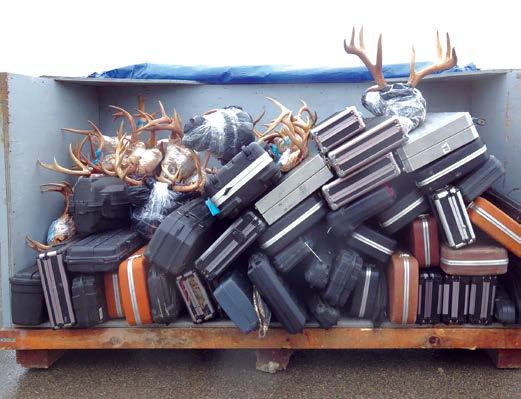
FAIR CHASE | FALL 2023 18
BELOW: A firearms declaration, attesting the firearms are unloaded, is signed at the ticket counter, then inserted into the case.
BORDER CROSSINGS
In almost all countries, some type of temporary firearms permit or police clearance is required. This varies from simple to draconian, and there are some great hunting destinations where it’s either impossible or too complex to bring firearms. You will borrow or rent from your outfitter or local buddy in such cases. Interestingly, although a U.S. state, Hawaii is one of these! “Bring or borrow” will be the subject of a future column. The decision depends on what and where you are hunting, what firearm(s) you can use, and how much it means to you to use your own.
Note that it is easier for U.S. citizens to travel abroad with firearms than vice versa. We make it difficult, complex, and time-consuming. Foreign nationals coming to hunt in the U.S., even our neighbors from Canada and Mexico, usually avoid the paperwork hassle and borrow firearms on-site.
For U.S. citizens, the first step is U.S. Customs Form 4457. It’s obtainable from any U.S. Customs office. It’s simply a “proof of ownership” form for items of value to be taken
abroad, avoiding import duty on return. However, since we don’t have firearms registration per se, the 4457 is universally accepted as a U.S. “gun permit.” Some destinations, most notably South Africa, now require a 4457 dated within the year of travel.
For sporting rifles and shotguns (no handguns), Canada is easy. You’re looking for their Non Resident Firearms Declaration Form (RCMP GRC 5589). It takes ten minutes to fill it out: Action type, make, model, serial number, caliber/ gauge, barrel length. Upon arrival, take your gun case to the customs office, hand them the form, open the case when directed, and pay $25 Canadian. You will then have a 60-day temporary permit, good anywhere in Canada.
Mexico is more complicated and adds a language barrier for non-Spanish speakers. Today, all hunting in Mexico is through an outfitter, who will assist you with the gun permit. The process depends largely on where you are going. Northern Mexico sees the most hunters and has most big game hunting. With your outfitter (or representative) there to assist, Mexican
authorities at most border crossings, and in Hermosillo and Loreto, are accustomed to visitors with guns. Problems are rare; just make sure your serial numbers are correct on the form.
Elsewhere in Mexico, including Yucatan, connecting flights through Mexico City are almost unavoidable. The gun case goes to the police office in the airport for onward clearance. The process is tedious, time-consuming, and nerve-wracking. In Mexico, I’ve always taken my preferred firearms for Coues deer, mule deer, and desert sheep and never had a problem. I have also taken firearms through Mexico City to Yucatan and never had a problem. However, most hunting in the Yucatan jungle is done with shotguns, and Mexican outfitters have suitable firearms. I’ve often hunted in Yucatan for brocket deer, ocellated turkey, and other jungle game. The last three years, I’ve simply borrowed camp shotguns. I always prefer using my own much-loved firearms on any hunt, but one simple fact is unavoidable: Travel is much simpler without firearms! n
19 FAIR CHASE | FALL 2023
To make some hunting dreams come true, we must travel. Depending on where and for what, maybe we can make a road trip, but that often means getting on an airplane. Even the thought is daunting enough for folks who don’t travel much, but now we must contemplate traveling with firearms, which is not hassle-free nor always possible.
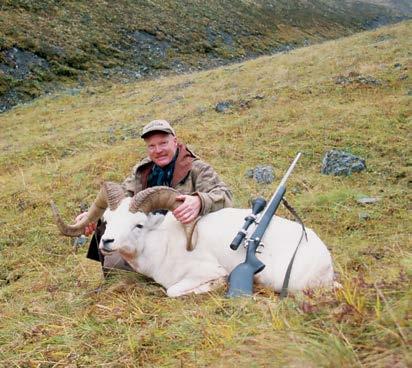
Boddington’s best Dall ram was taken in Yukon with a Lazzeroni .308 Warbird. Despite hassles, Boddington finds it almost unimaginable to do a mountain hunt without a much-trusted rifle. Fortunately, bringing sporting arms into Canada is quick and easy.
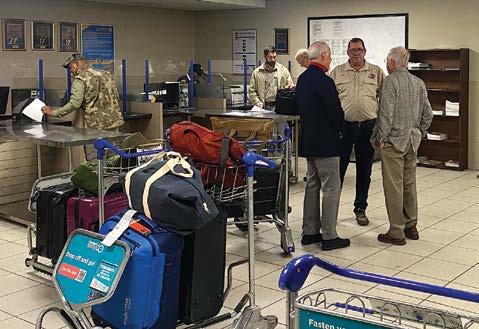
Every country has different rules, some more difficult than others. This is the police firearms office at South Africa’s OR Tambo airport, clearing house for Africa’s greatest number of hunters, and one of the world’s simplest destinations for clearing firearms.
Unexpected

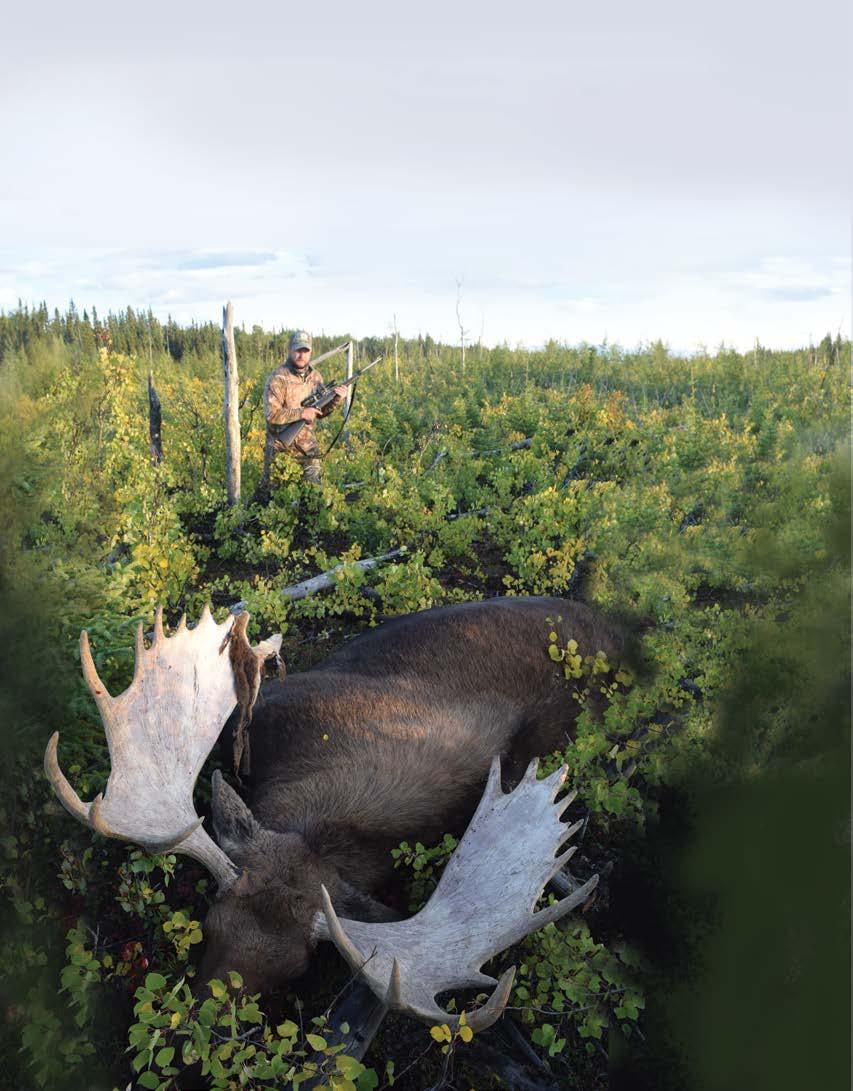
What you get from a hunt may have little to do with what you had in mind.
Lying there, the moose took on the dimensions of a draft horse. The shot had been only a prelude.
Unexpected

We split the hide into two 60-pound pieces. The head weighed almost 100. We were paddling for the truck by mid-afternoon.”
C. VAN ZWOLL
Lying there dead, the moose took on the dimensions of a draft horse. Night was coming. Corb and his partner were two wilderness miles from camp, ten from their truck.
Hurriedly they took photos, then, as darkness settled, left the moose. There was no moon. They kept to the river by starlight. At camp, they wolfed spaghetti, packed up, and got the canoe in the water by midnight. “We were back at the moose in an hour,” said Corb.
As they field-dressed the animal, wet snow started to fall. They freed the hide and two quarters on one side, then repeated on the other. They pared meat from bone, and flesh from hide. “At dawn, we pitched our tent in the snow and crawled into our sleeping bags.”
Four hours later, the men awoke to a wicked wind. “It brought more snow. We ate some sugar and bread, then finished butchering. I ferried 450 pounds of meat to the canoe.
later we had gained a mile at most.
Their first portage came four miles on after they tacked into wind-thrashing whitecaps on a small lake. “Each gust pelted us with sleet. We made five trips each to carry moose, gear, and canoe to the next water. We drank from that lake and flopped in the snow to rest.”
The next portage was half a mile. “We tried to pack 100 pounds each trip. We were very tired. So went the night. We reached the truck at two the next morning.”
He told me this tale matter-of-factly, without whining. “It was the hunt of a lifetime for Jared and me,” he grinned at the finish. Killing had been the prelude.
We awoke in the shadow of a mountain that hadn’t been there at dusk. Hudson’s Bay was gone, replaced by ragged white peaks hard against our camp.
We were hours by freighter canoe east of the nearest Arctic village. During the night, the wind had swung ‘round. Distant ice rimming the horizon had now jammed up on the north shore. Broken threads of water glinted between massive
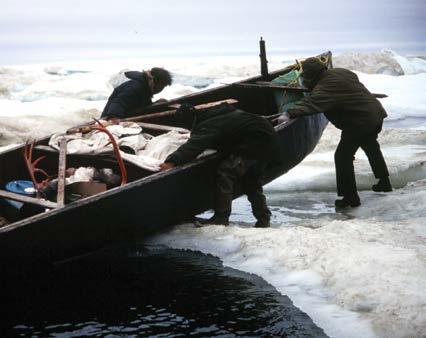
floes. Emerging from his tent, a young Inuit boy scampered up a pinnacle. A glance, and he was back. As far as he could see, there was ice. But the hunt was finished; supplies were limited. Directed by an old man wearing a binocular with one clear barrel, we packed up.
Our knee-booted hosts hauled on ropes, and we pushed, wedging the heavy canoes into channels. But these were short, portages long. Gamely the Inuits tugged the laden freighters over saw-tooth pressure ridges. They leaped onto blocks of ice heavy as rail cars—but that spun when disturbed.
Hours later, we had gained a mile at most. Exhausted, we gathered on flat ice. Bigger water was showing now. Suddenly, a seal’s head popped up in a slot. One of the lads fetched an iron-sighted .30-30 from his craft, fired offhand, and, almost before the seal went limp, pushed off with a paddle to make his way toward it. “If the seal is thin, it will sink fast,” said an elder. “A fat seal will float just long enough.”
Proudly, the boy retrieved his prize. The Inuits fired a Coleman stove and carved up the seal. One emptied the gut and threw a length of intestine into boiling water. Then he plucked it out and offered it to me.
WAYNE
B&C PROFESSIONAL MEMBER PHOTOS COURTESY OF AUTHOR
“They’re full-time deer; we’re parttime hunters.” So Oliver distilled our lot. A kill now seemed unlikely. So, passing time awaiting dawn, we mined what a hunt might bring besides—or after—a shot.
The Inuits tugged the laden freighter canoes. Hours
Pasta-like in texture, it tasted of salt and fish. I ate it all.
The day half spent, the old man climbed a knob to look. He descended and sat. Then he shook his head and pointed to where we’d been. His few words drew no argument. Navigable water might be hours off. Shy of it at dark, we’d be far out on the Bay with no shelter.
We beached late, the sky pale behind a thin skein of cloud. Hastily we erected tents and slid into our bags. Almost instantly, it seemed, brilliant sun lit our nylon shell. Squinting, I parted the flap. Water sparkled under deep blue skies. The mountain range had dissolved into scattered peaks, nudged offshore by a breeze from the north. We scrambled to decamp. Outboards useless the day before were soon cutting frothy wakes in broad alleys between fractured floes.
I had killed a caribou on that spit. But our hunt had become a battle with ice and ocean, in a place that gives no quarter. Our salvation: a gentle pivot of air.
Like a whitetail buck, an elephant bull can test your resolve in thickets or obligingly succumb to a shot in a garden. About when I was
learning to walk, three hunters struck fresh spoor between Mombasa and the Lorain Swamp. “Ndio!” cried a wizened villager. “Tembo was here!” Gulping a slug of powdered tobacco and rancid sheep fat, he jabbed his finger at a tall sapling. “Teeth this long, thick as me!”
Days and miles on, Scott and Pitcairn, with Gholo dogging the spoor, found a print “5 feet and 7 inches around…2 feet and 4 inches across.” Pitcairn said an elephant is twice as tall as the circumference of his track. After a night under fever trees at the Galana River, they crossed, holding rifles high. Then, wrote Scott, “I heard a noise like the rushing of air from a tire.” A great chunk of forest had suddenly become elephant, towering. Ears went flat. The bull coiled his trunk between thick yellow tusks and came. Scott’s rifle flew to shoulder. But the 6x Stith was dark with river silt.
“Bwana! Samburu!” Gholo was at his side. Scott dropped the Weatherby, grabbed the Rigby. But in that instant their quarry vanished. A limb swung slowly to a stop. The beast had halved the distance in a couple of seconds from a standing start. Then turned. Turned!
They pressed on through hard-pan waste, head-high grass, marsh’s mire. They battled thorns and insects, endured cold, wet nights. “By month’s end we’d [walked] 500 miles….” Even Gholo tired as he led them “deeper into the Dida Baganda than hunters ever go” to earn Scott another chance. One evening Gholo smiled. “Ndio.”
Next morning the canopy tightened, black flies boiled, and a dung pile steamed. Then, a low murmur. A branch swayed. “I saw [the trunk] between those ivory posts of mottled brown and white….” Braced on a tree, Scott aimed. Then he nudged the big muzzles up “into the roof of the forest” and pulled the trigger.
At the .475’s blast, the elephant was gone. Robert Scott figured he’d been on its trail 29 years. He had no tusks to weigh or measure. Only the time and miles, and 50 feet of jungle they’d shared at the end.
That was enough.
Remote places and wild beasts are not the only threats afield. One day after scrambling about the steeps for game with big antlers, I descended into green hills on
the rim of a ravine snaking toward camp. Its edge was hidden by wet grass. My foot slipped and folded under. I pitched off the lip onto creek gravel before I could right my ankle. It snapped loudly. The pain drew shameful words. A stick and my good leg brought me to a road. I found the day had proven popular for mishaps at the crowded hospital reception. A threehour wait! Aarghh! But the lass who’d driven me in didn’t complain. She asked if she could fetch me something to eat, though she was missing a hosted banquet that evening. Others among the assembled, one with a bloody arm in a sling, sat stoically or chuckled in quiet conversation. What was I missing?
“A boot. I’m so sorry,” empathized the nurse when at last my turn came. “I’m afraid you’ll wear it until a surgeon sees you.” She wrapped it carefully, came up with painkillers and crutches, blessed me with a smile. The queue was still long at midnight; she’d be tending and cheering the sick, the bruised and the broken until dawn. That boot might better have been applied to my bum for an attitude adjustment. I left humbled, if not healed.
©Zoë Reeve/Unsplash
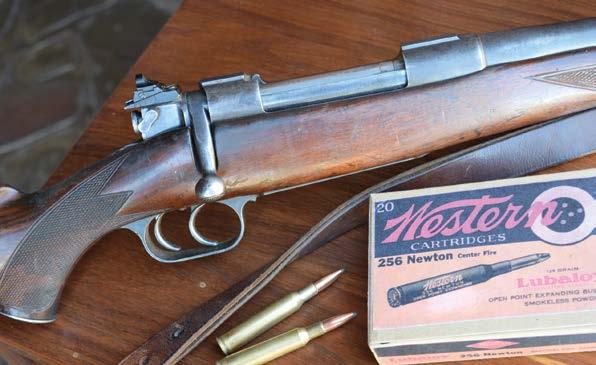
This .256 Newton traveled to Africa. A nimble old rifle ahead of its time, it handily took plains game.
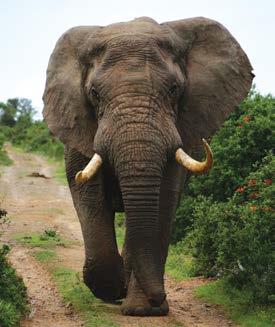
A great chunk of forest suddenly becomes a towering elephant.
The aerodrome at Churchill, Manitoba, was an unimposing Quonset hut when our DC-3 motored to a stop. Polar bears famously congregated here, drawn to its municipal dump. Citizens were not to walk about unarmed. I wanted to see bears. The summer night was a clear metallic, soon to yield to dawn.
“The landfill isn’t safe to visit on foot,” smiled the girl at the ticket counter. “And it’s a couple of kilometers off. Take my car. The red Rambler outside. Just follow the road.”
“But … it’s your car!”
She laughed pleasantly. “You can’t hurt it. And there aren’t any roads away from Churchill.”
Horace and I set off in the twilight. A couple of clicks on, we found a polar bear nosing about the dump’s fringe. She and a cub were facing away. I eased from the Rambler for a closer camera shot. “Not too close,” warned Horace. “Far enough!” he hissed after I’d gained a few yards. Then, still hissing so as not to alert the bears, but loudly now: “Don’t be stupid!” I paused. The math was irrefutable. A bear could sprint at 30 mph; I might hit 12, running for my life. Closer to this bear now than to the car, I snapped two frames and retreated before she or the cub turned. That decision has aged well.
A week later, in a small canoe on the Arctic Ocean far above Churchill, I spied another polar bear, this one swimming. Unlike the grimy yellow landfill bears, it was ivory-hued, a big, powerful beast. My Inuit friend gunned the little Evinrude but eased up at my request so we didn’t frighten the animal. At our slow approach, it angled toward floating ice. Then, as if propelled by a rocket, it launched from the sea up onto the floe. Loping away, the bear turned as if to warn us off pursuit. At mere feet I snapped a photo on Tri-X black-and-white film. The
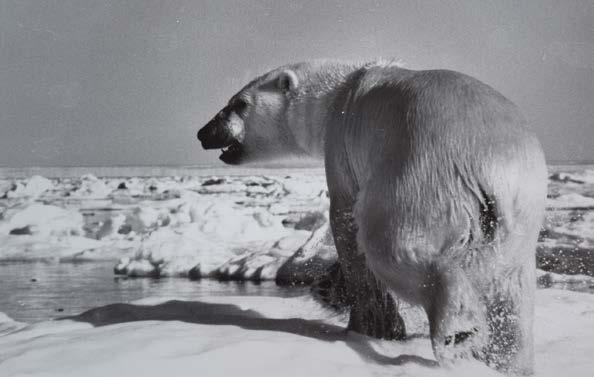
strength and grace of that creature, and its ability to thrive on the ice and in the frigid sea, is sharp in memory. Despite its mediocre technical quality, that photo is much cherished!
Rifles get cradled more than fired on hunts. So one you like to carry—one that’s good company—can trump others more powerful and accurate.
“It’s not about weight,” said my partner. “I like the wood on this carbine. It’s older than me, so on the trail I think about where it’s been, who had it to cheek, what it’s killed. For me, history matters. A rifle without history lacks soul. It’s then a tool, not a companion.”
He had something there. Hal’s favorite rifles weren’t ballistic champs. But they had an easy way about them. Their walnut had scars and scuffs; bluing was silvered by hand and saddle. Warm and agile, they pointed themselves. No need to stretch for a hug or coerce the muzzle to the target.
Such rifles make hunts pleasant even when there’s no shot to be had. I pair mine with iron sights or simple, compact optics so they stay nimble and eager. A big scope, like a rifle with an artillery
snarl, is a tool. Tools are to use. I don’t pack a hammer when I’ve no ready nail. But rifles of modest proportions, designed and crafted as if carrying mattered, needn’t be fired to be admired.
Oh yes, such sentiment has cost me game! A Winchester 71 bored to .450 Alaskan and fitted with an aperture sight joined me in conifer thickets crowning Idaho’s Frank Church Wilderness. Alas, the one big bull we spotted was threading a distant burn. In the same way, an iron-sighted Savage 99 in .250 was no match for a far-off pronghorn. Declining made sense after ragged kills with rifles ill-suited to the task.

Not that retro is sacred. Carbon fiber rifles have seduced many skilled hunters, who revel in their wandlike handling, and the power and precision wrung from so few ounces.
But walnut-stocked rifles of generations past still enchant me. Where chances at tall-antlered deer and elk come less often than meteor strikes, I still buy a hunting
license so I can cradle such rifles up the trail. Good company makes for good times.
“When luck and strategy fail, we persist,” shrugged Oliver as the sky finally blushed. Heavy dew and cold, dead air held promise. “We’ll try once more for that big roebuck.”
We took the same path toward cover. New sun winked on wet leaves. A hare scooted through the
23 FAIR CHASE | FALL 2023
The bear turned, as if to warn us off pursuit. This photo, at mere feet, remains a favorite!
This Depression-era Savage carbine has limited reach but is a delight to cradle, quick to the shoulder.
brambles; a pheasant lifted noisily from a hedge. We bumped two young roebuck, but the old animal with beaded antlers, now a giant in memory, was absent.
This morning would bring a second chance—and, when I muffed it, a third! Unmerited favor. The animal was a far better specimen than I deserved. After field dressing, Oliver said abruptly, “You’ll want to see London.” The hunt was over, but not the trip. He drove me into the city, pulled to a curb, and jabbed his finger at a map. “These are must-sees. We’ll meet here in three hours.” I pocketed the map.
Looking the wrong way at crossings, I survived gauntlets of taxis for peeks into storied Bond Street gun shops. “We have more Purdeys than Purdey,” sniffed a clerk at the upscale purveyor Ray Ward. Under glass, that store did have Denys Finch-Hatton’s Lancaster sidelock, replete with scars from Kenya’s bush, where the dashing hunter-pilot frolicked until his Gypsy Moth crashed in 1931.
Oliver scooped me up in time to cram in a visit to the aging brick sanctum of ammunition maker Kynoch.
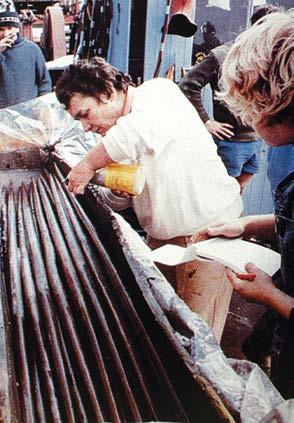
Once paired with Eley, it was swallowed by Imperial Chemical Industries in the 1920s. From around 1925, Kynoch is said to have produced all of England’s centerfire sporting cartridges. A pause in the early ‘60s marked the end of Berdan-primed Kynoch brass. David Little revived the brand in 1994 with Boxer-primed cases. Eight years later, Kynamco moved to Mildenhall and what was a stone storage facility for Suffolk County vintners. A longer roster of Kynoch loads in red and yellow boxes resulted. Next, we hied off to Portsmouth, where rests reconstructed remains of the Mary Rose. On July 19, 1545, this tall-masted battle vessel, named for Henry VIII’s favorite sister, set sail toward an enormous French fleet. The Battle of the Solent barely began when the Mary Rose heeled over and sank, losing all but 35 of her 500 men. A wind gust caught her as she turned after discharging one battery, flooding her through gun ports. Raised after 434 years, she was found to hold dozens of English longbows, beautifully preserved by cold, anaerobic silt. A rare treasure! She’s now a museum centerpiece.
The hill-top Danebury fort took us farther back in history, with its ready pile of 11,000 stones for defenders’ slings. The half-day slated for Duxford’s air museum north of London was hardly time enough to ogle the acres of war planes within or to read of battles that smudged the skies during two world wars.
The cost of two days poking my head into these institutions? Roughly half that of a Montana elk tag. Stateside or abroad, a hunt falls short if it brings only game. n
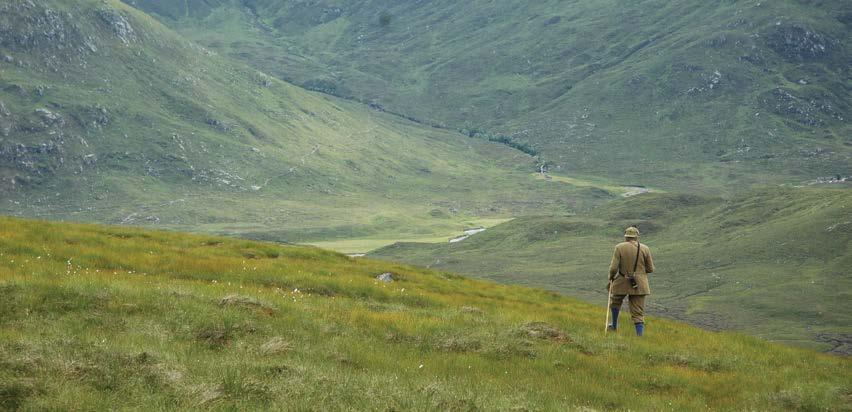
Wild beasts can pose a lesser hazard than do even gentle landscapes. I left humbled if not healed.
BELOW: After 434 years, the Mary Rose was raised. In its hold were dozens of English longbows, beautifully preserved by cold, anaerobic silt.
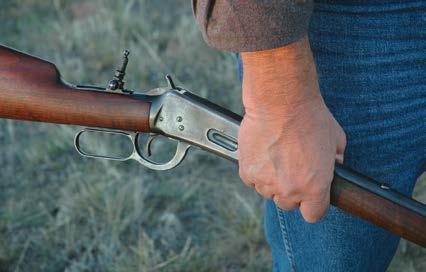
A rifle easy to carry can trump one more lethal. Winchester’s scabbard-friendly 94 is a pal in hand too.
The Wilderness Warrior Society, the Club’s premier major gifts society, was launched in 2011 to celebrate the 125th anniversary of the Boone and Crockett Club.

In 1887 Theodore Roosevelt formed a coalition of hunters to establish the foundation for the world’s greatest wildlife conservation system. Knowing that he could not accomplish this daunting task alone, he invited men of influence to join him in forming the Boone and Crockett Club.
We still cannot do it alone. We need your help. Please join the Wilderness Warrior Society!
With your gift of $125,000 or more, you will be presented with a limitededition bronze of Theodore Roosevelt on horseback by Bob Scriver, a custom Hickey Freeman blazer, and an exclusive event at our annual meeting each year to recognize and honor your special generosity toward wildlife conservation.

The $125,000 donation can be paid with a $25,000 current contribution and the balance payable over a maximum of four years. Please consider pledging to become a member of the Wilderness Warrior Society today!
R. Terrell McCombs President Boone and Crockett Club Foundation
50 MEMBERS OF THE WILDERNESS WARRIOR SOCIETY
Trevor L. Ahlberg
Lee R. Anderson Sr.
James F. Arnold
Rene R. Barrientos
Marc A. Brinkmeyer
Pete R. Brownell
Anthony J. Caligiuri
Richard Childress
Marshall J. Collins Jr.
Samuel J. Cunningham
William A. Demmer
Gary W. Dietrich
John P. Evans
Michael L. Evans
Robert W. Floyd
Steve J. Hageman
Charles W. Hartford
John L. Hendrix
George C. "Tim" Hixon*
B.B. Hollingsworth Jr.
Ned S. Holmes
Andrew L. Hoxsey
N. Eric Johanson*
Anne Brockinton Lee
Tom L. Lewis
Jimmy John Liautaud
T. Nyle Maxwell
R. Terrell McCombs
Marc C. Mondavi
David L. Moore
John L. Morris
Rick C. Oncken
Michael J. Opitz
Jack S. Parker*
Paul V. Phillips
Remo R. Pizzagalli
Thomas D. Price
Edward B. Rasmuson*
Richard D. Reeve*
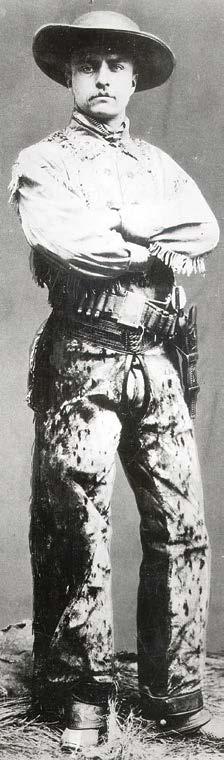
James J. "Jake" Shinners
T. Garrick Steele
Morrison Stevens Sr.
Benjamin A. Strickling III
George C. Thornton
Ben B. Wallace
Mary L. Webster
M. Craig West
C. Martin Wood III

Leonard H. Wurman M.D.
Paul M. Zelisko
* Deceased
at 210/818-8363 for more details.
Contact Terrell McCombs
B&C IMPACT SERIES THE FIGHT TO SAVE FLORIDA’S KEY DEER
You won’t find Key deer in the Boone and Crockett Club’s records. There isn’t even a hunting season for these tiny deer living in the Florida Keys. That doesn’t mean Boone and Crockett Club members turned a blind eye to this whitetail subspecies that was going extinct in the 1940s. B&C members Jay N. “Ding” Darling and C.R. Gutermuth worked to end market hunting of Key deer and protect essential habitat to ensure their survival well into the future. This is how they pulled it off.
WHAT IS THE KEY DEER
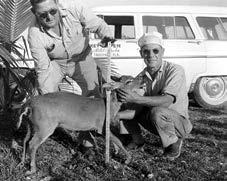
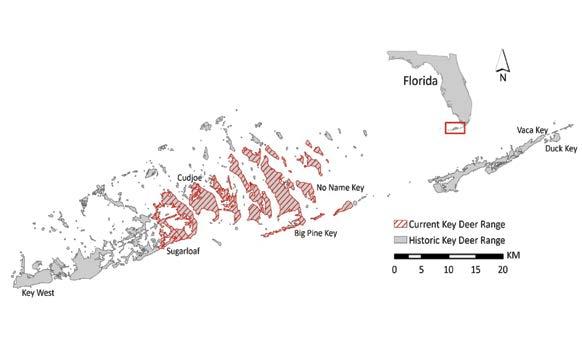
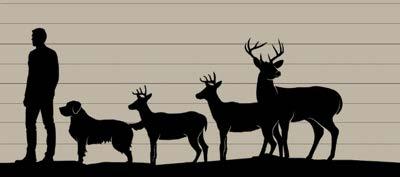
Few people have heard of the Key deer. Even fewer have seen one. To be fair, they’re easy to miss. As the smallest of the whitetail deer subspecies, mature bucks typically weigh 55-75 pounds—about the size of a golden retriever. They live only in the lower Florida Keys on roughy two-dozen islands, mainly Big Pine Key. For perspective, the Florida Keys are made up of roughly 1,700 individual islands. Able to swim between islands, Key deer use a variety of south Florida habitats, including pine rocklands, mangroves, and freshwater wetlands. They dine on 160 species of plants and have been known to help themselves to ornamental shrubberies.
The first European reference to the Key deer is credited to Hernando de Escalante Fontaneda, the survivor of a shipwreck in 1549. He was 13 when he washed ashore and spent the next 17 years
living with Native American tribes. Escalante Fontaneda’s extensive memoir of his time spent living with various tribes includes observations of this tiny deer. A good 400 years later, the Key deer started to make waves again. This time, though, it was in the form of a cartoon.
KEY DEER ON THE DECLINE
In the early 1900s, Florida was ground zero in the fight to save America’s disappearing migratory bird populations. Birds like herons, parakeets, and brown pelicans were all sought by market hunters. Some birds, prized for their feathers, were used to decorate ladies’ hats, while others were served with a side of potatoes. Unyielding efforts to protect them from wholesale slaughter came from Paul Kreogel and Frank Chapman. The former was a mustache-sporting, shotgun-wielding lover of pelicans, and the latter was an
ornithologist and member of the Boone and Crockett Club. He was also a curator at the American Museum of Natural History. These two men and others from the Florida Audubon Society pitched the idea of protecting Pelican Island’s birds from poaching and plunder to President Theodore Roosevelt, a Boone and Crockett founding member. As a result, on March 14, 1903, President Roosevelt signed an Executive Order creating the three-acre Pelican Island Reservation. This was the first installment of what would become the National Wildlife Refuge System. The creation of Pelican Island was a true conservation milestone, but it did not directly help Key deer found farther south. However, it did give others like Boone and Crockett member “Ding” Darling a way to set aside habitat for the two dozen deer that remained in the 1930s and ‘40s. In his book, An American Crusade for Wildlife , author
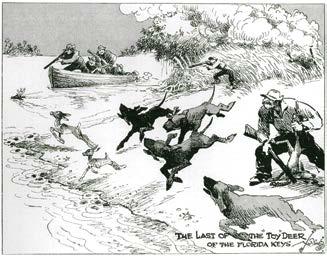
James Trefethen writes that Darling was traveling the mangrove thickets of the Florida Keys in 1934 when he saw white smoke rising from the swamp. Upon investigating, Darling discovered that Cuban fishermen were helping themselves to fresh deer meat. “Their common practice was to set fire to the vegetation to drive the deer to water, where they could be easily shot or clubbed,” writes Trefethen.
Darling was appalled on several levels. Poaching and decimating an American resource was entirely unacceptable. Even worse, they were foreign invaders. He immediately sketched a cartoon to bring public awareness to the plight of the remaining Key deer. It would take more than two decades, but Darling’s cartoon would play a key role in gaining protection for Key deer habitat.
Poaching wasn’t the Key deer’s only problem. Habitat loss from residential and
FAIR CHASE | FALL 2023 26
Ding Darling's depiction of Cuban fishermen slaughtering Key deer brought attention to the few deer remaining in the Keys.
commercial development on Big Pine Key, combined with increasing automobile traffic on Highway 1 that bisects the deer’s range, reduced the population to an estimated 25 deer. In 1939, Florida outlawed deer hunting, but poaching continued. The Key deer clearly needed a little room to stretch its tiny legs before they were all gone.
THE CLUB STEPS IN
James Silver worked for the U.S. Fish and Wildlife Service in the Southeast, and he began to include the demise of Key deer in his reports to Washington D.C. His requests for help got the attention of Bud Jackson at the National Wildlife Federation (NWF), who asked Silver for a brochure outlining what the deer needed to survive. What they needed, Silver explained, was a refuge and protection from poaching. Even though a bill that would have created a refuge failed to pass in 1950, it got the ball rolling.
Jackson’s boss at the NWF was Richard Borden, chairman of the conservation committee at the Boone and Crockett Club. The committee recognized that they needed to protect the deer until a refuge could be established. Otherwise, the Key deer
might not make it. Another member of the Club, C.R. Gutermuth, was vice president of the Wildlife Management Institute and pledged $5,000 toward hiring a warden. The Club pledged an equal amount. The $10,000 for a warden was only a fraction of the $100,000 needed to establish a refuge, but again, it was a start.
Jack C. Watson was a young biologist the Club hired as the area’s first game warden. His effective and spirited interpretation of the law kept poachers of the proposed refuge on notice. According to his son, Jack “Kippy” Watson, his father put a few bullet holes in carburetors as he waited for poachers to return to their vehicle, shot dogs chasing deer, and burned boats of known poachers as they hunted deer on the islands. Warden Watson would sit quietly for hours in the swamp, waiting for the poachers to come along—all the while covered in mosquitoes. “It’s not a means that they recommend today,” Kippy says. “But at the time, it was what it took and did the job.”
Hiring Watson bought time, but any bill proposing a refuge met strong opposition from landowners and developers. A clause in the Interior Appropriations Bills of 1954 authorized the USFWS to lease lands within Key deer habitat as a workaround. It wasn’t ideal, but it was all they could get at the time. Meanwhile, Gutermuth was selecting a spot for the proposed refuge’s headquarters. He befriended Miami Beach local Radford Crane, who liked the idea of a refuge. Eventually, Crane got the land donated to the USFWS for their headquarters. They were moving forward, but it wasn’t enough land for a refuge.
With this momentum, Florida Congressman Charles Bennett introduced a bill authorizing $35,000 for land acquisition and the
The Impact Series is dedicated to showing how sportsmen, members of the Boone and Crockett Club in particular, saved the wildlife and wild places of the United States. Early members of the Boone and Crockett Club comprised the movers, shakers, and initiators of the American conservation movement. They were hunters, anglers, explorers, lawmakers, soldiers, and, above all, conservationists. These members established laws that allowed our wildlife resources to flourish. They also protected landscape-scale geologic marvels and American icons like Yellowstone, Grand Canyon, Denali, and many, many more. These members may no longer be with us, but their legacy remains. This series aims to honor their accomplishments and remind us of the good work still yet to do.
27 FAIR CHASE | FALL 2023
PJ DELHOMME
CRAZY CANYON MEDIA
READ MORE FROM THE IMPACT SERIES
How small are they? This lineup gives you a rough idea of how the Key deer stacks up. Note: the human is 5'9".
Average Male Golden Retreiver Key Deer Coues' Whitetail Whitetail
Key deer are tiny in stature (opposite) and live only in the lower Florida Keys, mainly Big Pine Key.
establishment of a refuge. In the late summer of 1957, President Eisenhower signed the bill, establishing the National Key Deer Refuge—but there was one significant exclusion. The bill gave the refuge no money to acquire land. Enter Crane and Gutermuth again. The men were tasked with raising $40,000 to purchase private inholdings if they wanted to receive $100,000 worth of land from a foundation that owned much of the Key deer habitat around the headquarters. Gutermuth presented his fundraising challenge at a meeting of the Boone and Crockett Club, which then pledged $10,000 to purchase land for the refuge. The Wilderness Society of Philadelphia kicked in another $10,000. When the rest of the funds were raised, the lands were purchased and
transferred to the federal government.
Today, the National Key Deer Refuge is roughly 9,200 acres on Big Pine Key and No Name Key. While it provides critical freshwater wetlands and mangrove forests that Key deer need, the refuge is also home to 23 endangered and threatened plant and animal species. And even among the sea of sun worshippers and retirees, the area includes some federally-designated Wilderness, which is part of the 6,197-acre Florida Keys Wilderness System.
THRIVING OR THREATENED?
After the creation of the National Key Deer Refuge in 1957, deer numbers rebounded, but not enough to keep the Key deer off the endangered
species list. It was listed in 1967, along with the Florida panther and Florida manatee. With secure habitat and proper management, deer populations currently hover around 800 animals, but numerous short- and longterm threats remain.
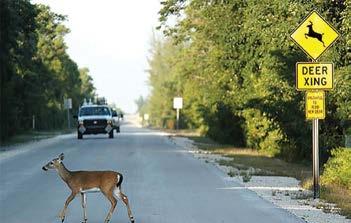
Humans, hurricanes, and the New World screwworm hamper deer recovery for the short term. U.S Highway 1 is the main road that connects the Florida Keys, bisecting the refuge. Automobile mortality accounts for roughly 50 percent of all deaths. And people aren’t moving away. In 1968, Big Pine Key had 500 residents. Today, that figure tops 5,000. Increasingly, deer are treated like pets, get tangled in fences, and dine on non-native vegetation.
In the summer of 2016, the deer experienced a potential extinction event attributed to the New World screwworm. The outbreak threatened deer, people, other wildlife, and U.S. livestock. The USDA released infertile male flies, which caused the flies to breed out, but not before the worm had killed 135 deer. The screwworm has yet to return.
Not making things better for anyone, Hurricane Irma (Category 4) hit the
Florida Keys head-on in 2017. A 14-foot storm surge contaminated the deer’s freshwater supply with seawater, and vegetation overstory was damaged significantly. Between screwworm and Irma, Key deer populations dropped by roughly 40 percent. As sea levels rise, hurricanes will increasingly impact low-lying areas like the Florida Keys, where the highest point is eight feet above sea level. “Their habitat is literally going underwater,” says Roel Lopez, director of the Texas A&M Natural Resources Institute.
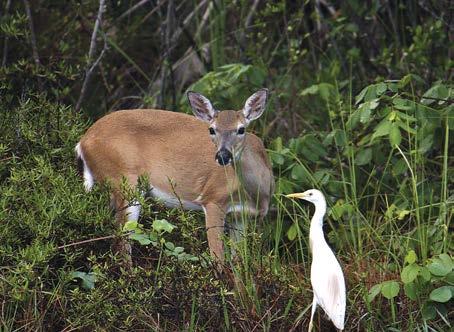
Dr. Lopez, a Boone and Crockett professional member, has spent the better part of his 30-year career researching Key deer, among other species. He’s authored and co-authored hundreds of research articles on every issue affecting them since his dissertation project in the late 1990s. To this day, he continues to work on issues affecting Key deer, and he’s well aware of past efforts to protect them.
“If you want to see Key deer in their natural habitat, you go see the land the Boone and Crockett Club worked so hard to protect,” Dr. Lopez says. “If it weren’t for the Club, the course of the history of Key deer would likely be very different today.” n
Why did the Key deer cross the road? Well, it didn't because it was killed before it got across. Death by automobile accounts for roughly half of all Key deer mortality.
The creation of Pelican Island was a true conservation milestone, but it did not directly help Key deer found farther south. However, it did give others like Boone and Crockett member “Ding” Darling a way to set aside habitat for the two dozen deer that remained in the 1930s and ‘40s.
DR. LEE MERRIAM TALBOT
A Boone and Crockett Club member for 54 years, Lee Merriam Talbot was the primary author of the Endangered Species Act of 1973. That alone is a lifetime achievement, but there is so much more to the man who dedicated his life’s work to conservation—and humbly averted death numerous times.
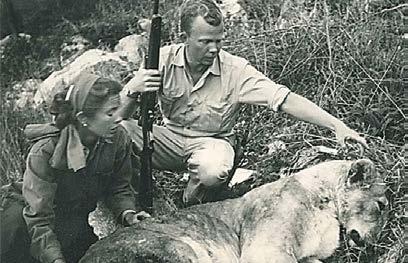
Dr. Lee Merriam Talbot is the most interesting Boone and Crockett Club member you have likely never heard of. Few members have lived a life and left a legacy as grand. A week after he passed away in May 2021, his son described him “...as an amalgamation of the best aspects of John Muir, Ernest Hemingway, and James Bond. But I think he was humbler and, arguably, more influential than any of those characters.” Influential indeed.
Before detailing the near-death experiences involving Talbot, race cars, airplanes, and lions, we should first explain how he left an indelible mark on the conservation movement in the latter half of the 1900s. That started many years ago with his familial roots planted firmly in conservation.
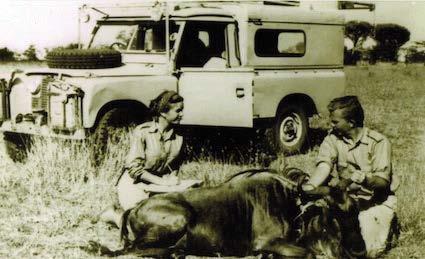
He was the grandson of Dr. C. Hart Merriam, who, in the late 1800s, was a friend of both Theodore Roosevelt and John Muir. Dr. C. Hart Merriam was a naturalist on the Hayden Expedition in 1872 that surveyed Yellowstone National Park, and he was the first Chief of the U.S. Biological Survey, which became the U.S. Fish and Wildlife Service. One of Dr. Merriam’s daughters was his field assistant, an ethnologist, and a biologist. She met Merle Talbot, who worked for the Forest Service alongside Aldo Leopold in the Southwest in the early 1920s. They were married, and in 1930, Lee Merriam Talbot was born. A childhood grounded in the outdoors followed.
“Hiking, camping, and pack trips in the wilderness— with the wonderful conservation and ecological insights and guidance of my parents— were an integral part of my early years,” Talbot wrote. “The result was one of the strongest pieces of legislation ever submitted to Congress.” That legislation refers to the Endangered Species Act of 1973, and we’ll dive into that in just a bit.
A WILD LIFE OF CONSERVATION
The early adventures of Lee Talbot began in the 1950s when he was a field biologist in Alaska. In 1953, he earned a bachelor of arts from U.C. Berkely. As a Marine Corps officer during the Korean War, he taught hand-to-hand combat when he broke his back. Doctors told him he’d never walk again. The injury proved a slight hiccup to his life plans because the National Academy of Sciences hired him to research African and Asian endangered species the same year. He became the first staff ecologist for the International Union for Conservation of Nature and Natural Resources (IUCN), an organization concerned about endangered species. At some point in his overseas research, Talbot was alone on foot when a lioness charged him. A single shot severed its vertebrae just as it pounced. In 1959, he met a young lady named Marty, and they were married six weeks after their first date. Marty was an award-winning biologist and author who co-founded the Student Conservation Association just two years before
Boone and Crockett
Club members have come from a crosssection of famous accomplished people whose lives and careers have written and recorded the history of this country since the late 19th century. They have been naturalists, scientists, explorers and sportsmen, writers and academics, artists, statesmen and politicians, generals, bankers, financiers, philanthropists, and industrialists. Their diversity of ideas and activities during their careers have made the Boone and Crockett Club rich in its fellowship and achievements.
READ MORE MEMBER SPOTLIGHTS
29 FAIR CHASE | FALL 2023
B&C MEMBER SPOTLIGHT PJ DELHOMME
Lee and Marty worked on studies together in the SerengetiMara ecosystem in the late 1950s through the early 1960s.
they married. The couple traveled to East Africa for a honeymoon to conduct scientific research in the Serengeti-Mara ecosystem. The work helped create Serengeti National Park and Masai Mara National Reserve. They were married for 62 years.
Talbot traveled the world researching the status of vanishing species like the Asiatic lion, Arabian ostrich, and Syrian wild ass. At the same time, he developed conservation plans for those species. In 1960, he published his first book, A Look at Threatened Species. By 1963, he had earned a Ph.D. in ecology from U.C. Berkley, where his principal faculty advisor was Dr. A. Starker Leopold, Aldo Leopold’s oldest son.
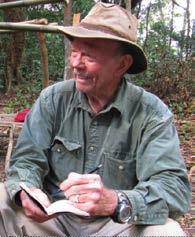
In the early 1960s, Talbot had yet another close call with death. “While conducting an aerial survey for the government of British Hong Kong in the early 1960s, his plane experienced mechanical problems, and crash landed in a harbor, hitting rocks and pinwheeling through the cold, frothing water,” explained his son Russell. “He swam to safety, later describing in vivid detail the difficulty of determining which direction was up, while escaping the still-tumbling wreckage.”
When not surviving dramatic crash landings, Talbot helped organize the Conference on Conservation in Modern African States in Arusha, Tanganyika (now Tanzania). Years later, working with the IUCN, Talbot generated interest in what became the Convention on International Trade in Endangered Species (CITES), an international agreement signed by 184 parties in 1973 that ensures the international trade in animals and plants does not threaten their survival in the wild.
ENDANGERED SPECIES ACT OF 1973
By the latter half of the 1960s, Talbot’s energy and expertise shifted stateside as he joined the Smithsonian Institution and served as science advisor to the Joint Senate-House Committee on Environment. In 1969, Congress passed the Endangered Species Conservation Act of 1969, but Talbot wrote that it was “inadequate to address the needs at the time, so early in 1970, when President Nixon asked me to help start the President’s Council on Environmental Quality (CEQ), I saw an opportunity to place endangered species high on the nation’s agenda.”
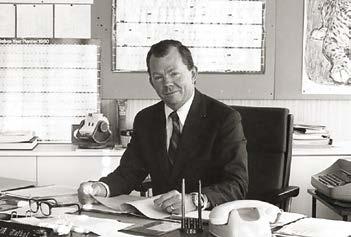
With the support of Russell Train, another Boone and Crockett Club member and the first chairman of the CEQ, Talbot compiled his list of ways to strengthen the ESA of 1969. One hurdle Talbot met was from those who couldn’t understand why the original law needed to be revised. To counter this argument, Talbot didn’t need to look further than the CITES agreement, which required that all participating nations “establish both scientific and management authorities to implement the convention.”
A strengthened ESA was needed if the U.S. was to be a part
of this worldwide agreement.
Working with Congressman John Dingell Jr., Chairman of the Merchant Marine and Fisheries Committee of the House of Representatives, Talbot removed what he called “weasel words” from the statute in an effort to leave little to creative interpretation. He deleted phrases such as “The Secretary may…” and changed them to “The Secretary will…”. Talbot wrote, “The result was one of the strongest pieces of legislation ever submitted to Congress.” President Nixon signed the bill into law on December 28, 1973.
To date, 54 U.S. species have been delisted from the endangered species list because they have recovered to
the point that they are no longer threatened with extinction. These include the American alligator, bald eagle, Louisiana black bear, brown pelican, Oregon chub…the list goes on.
At the same time Talbot was cleaning up the language in the ESA, he was working with Dingell on the Marine Mammal Protection Act (MMPA), which prohibits the “take” of marine mammals—including harassment, hunting, capturing, collecting, or killing—in U.S. waters and by U.S. citizens on the high seas.” This was signed into law by President Nixon in 1972. More than 40 years later, Talbot defended the law when the oil and gas industry pushed to “eviscerate core
FAIR CHASE | FALL 2023 30
Lee Talbot served as Director General of IUCN from 1980 to 1982.
“Hiking, camping, and pack trips in the wilderness—with the wonderful conservation and ecological insights and guidance of my parents—were an integral part of my early years,” Talbot wrote. “The result was one of the strongest pieces of legislation ever submitted to Congress.”
Lee Talbot was a professor of environmental science, international affairs, and public policy at George Mason University in Virginia for nearly 30 years. RIGHT: In 2016 the IUCN awarded Dr. Lee Talbot their Harold Jefferson Coolidge Medal. One of the two highest honors given by the IUCN, the award recognized Lee’s lifelong contribution in the field of international conservation, environmental affairs and his outstanding initiatives in the field of exploration.

provisions” of the MMPA. In an op-ed for The Hill, Talbot wrote, “We cannot stand by and allow the oil and gas industry to gut these protections today like industry gutted whale, dolphin and seal populations decades ago. It is more important now than ever before to defend marine mammals—and to save the Marine Mammal Protection Act.”
From there, Talbot joined the World Wildlife Fund as their Conservation Director and Science Advisor in Switzerland, and from 1980-1982 he served as Director General of IUCN. He was a science advisor to Defenders of Wildlife and served on their board of directors for nine years. Before he passed away in 2021, he was a professor of environmental science, international affairs, and public policy at George Mason University in Virginia for nearly 30 years. Over his lifetime, he wrote or contributed to more than 300 scientific and popular articles and 17 books.
Lee Talbot became a member of the Boone and Crockett Club in 1967. His research took him on 160 expeditions to 134 countries on five continents. On top of all that, he served as his son’s Cub Scout leader. He had a passion for conservation and the motivation to act on it. As a result, he wrote sound, effective policies that we still benefit from today.

TALBOT, THE RACE CAR DRIVER
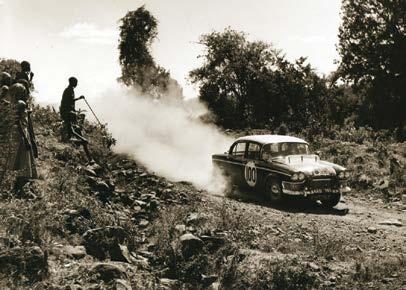
When he wasn’t documenting disappearing species, Talbot was driving race cars. His first professional race was in 1948 (when he was 18 years old). His final race was in the autumn of 2017 when he was 87. He raced Grand Prix, formula cars, and vintage cars like a restored and rare 1967 Ginetta G4. This pastime nearly took his life. His son Russell described the crash. “During an early running of the Malaysian Grand Prix, his car flipped into a ditch. His legs were wedged in the car, his head was pinned between the car and the ground, and his body sagged into the ditch. Helmets and other safety features were not required, and multiple drivers died during the race. Naturally, he had researched the efficacy of quality helmets and chose to wear the best one he could get. His helmet kept the weight of the car off his head and bystanders helped roll the car off him. He walked away.”
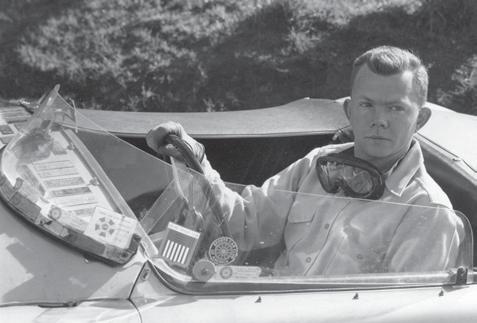

31 FAIR CHASE | FALL 2023
Talbot in his 1967 Ginetta G4.
THE ENDANGERED SPECIES ACT AT 5O
In the late 1950s and early ‘60s, Rachel Carson educated the public on the longterm effects of DDT and related pesticides, and others warned us about the effects of radioactive fallout from nuclear testing. We stood at the gates of Armageddon… and we are there again as our biodiversity shrinks around us due to man’s destructive conduct with the earth and its diverse array of species.
Today, I am but a messenger to you of the dire consequences of species and habitat destruction through man’s unharnessed actions. We all must realize that species loss and the destruction of their habitat is the major component of our diminishing biodiversity that, unchecked, will eventually lead to disruption and suffering of life as we’ve never known before—perhaps with apocalyptic consequences.
Seven years ago, I began to research the history of the Endangered Species Act with the goal of writing the definitive 50-year history of the Act by its 50th anniversary in 2023. A number of people wrote brief histories of the ESA on its 20th, 25th, 30th, and 40th anniversary. However, each was cursory and
Reflecting on the Past, Adapting for the Future
w
covered only one or two sections of the ESA. No one had done a definitive, in-depth, deep dive into the entire history of the ESA, and I soon discovered why. They were smarter than me, had far more foresight, and weren’t as crazy! That’s why it took me seven years of research and writing.
The result was two volumes released this year. They are titled, respectively, The Codex of the Endangered Species Act, Volume I: The First Fifty Years and The Codex of the Endangered Species Act, Volume II: The Next Fifty Years. Between the two, there is a total of 1,140 pages. I hope these become reference guides for serious students of history and policymakers who want to know the congressional intent behind the law, how the courts have interpreted it, and how the U.S. Fish and Wildlife Service (USFWS) applied it. Equally important, Volume II will become a guide for applying the ESA over the next 50 years to the unknowns that our country will face—just as the 1973 law had to address issues never anticipated, such as climate change and its disturbances and destruction of habitat, invasive species,
changing migration patterns, zoonotic challenges, chronic wasting disease, property rights challenges, intrastate species at risk that fall outside of the interstate ESA jurisdiction, distinct population segments, scattered, valueless species without commercial use that get petitioned for listing—the list goes on. Who knows what the next 50 years will bring, and this is what Volume II addresses.
During my research, two conclusions surfaced that are relevant to understanding the ESA yesterday, today, and tomorrow.
First, when the ESA was enacted in 1973 after two years of hearings and redrafting, it was a very top-down law driven with absolute primacy vested in the federal government, notwithstanding the promise Section 6 offered state participation that was never fully realized. There were no loopholes or outs. As the Supreme Court later opined, all species were to be saved, regardless of the cost. To understand the law’s absolute rigidity and federal primacy, one only needs to understand the context of the era within which it was written, and the men who drafted the law.
The 1960s to ‘70s was a continuance of the “command and control” mentality from Washington, D.C., following WWII and the Eisenhower Administration. All eight draftsmen who created the law were hardened WWII veterans, many of whom had seen combat, as were the successive presidents prior to the 1973 law. Presidents Dwight Eisenhower, John Kennedy, Lyndon Johnson, and Richard Nixon, the latter signed the ESA into law, was a naval officer, and President Eisenhower’s vice president for eight years. Their entire mental focus was a product of the federal command and control mentality and discipline of that time. Hence, the absolute rigidity and primacy of the ESA language resulted from the mentality, context, and discipline of that era—all run and controlled from Washington. However, after some 20 years of enforcement of the ESA—and the muscular pushback of the private sector—the federal government began to realize that for the ESA to work, it needed to be more flexible and evolve to meet the demands of changing times and balance economic development with
FAIR CHASE | FALL 2023 32
This year, 2023, marks the 50th Anniversary of the Endangered Species Act (ESA). Having spent the last seven years studying the ESA, I’ve come up with two observations—but first, let me set some context.
Flexibility through regulations and policies is the secret to keeping the ESA viable and relevant. That’s history’s lesson number one.
L oweLL e . Baier
resource and conservation needs. History teaches us that the critical link between the past and future to keep the ESA relevant and responsive to unforeseen circumstances is maintaining flexibility.
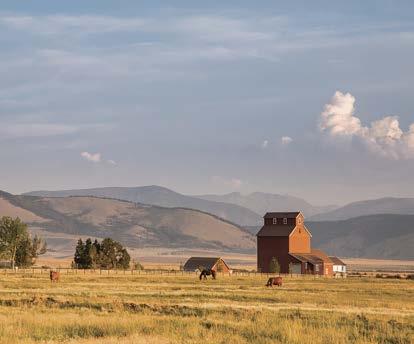
Flexibility! Adapt to survive or die! That was the first major big-picture conclusion I reached during my seven years of research.
The last major ESA amendment by Congress was in 1988. We’ve had congressional gridlock ever since.
Following Secretary Bruce Babbitt’s 10-point plan in 1993, over the last 30 years, a series of regulations have been created, including the “No Surprises” policy for Habitat Conservation Plans in 1994, Safe Harbor Agreements, Candidate Conservation Agreements, Candidate Conservation Agreements with Assurances, the PECE Policy (the Policy for Evaluation of Conservation Efforts when Making Listing
Decisions), Multiple Species Habitat Conservation Plans in 2004, and Compensatory Mitigation. Currently, the USFWS has out for comment a new regulation to simplify securing ESA permits and increasing management flexibility. These policies and regulations were necessitated by the partisan stalemate of trying to get any actual changes to the law through Congress. Remember, the ESA’s last major amendment was in 1988. The fallback to keep the ESA relevant since then was a regulatory solution. Hence, so long as we keep an open mind in solving the unknowns of the future— and look to a flexible agency approach to maintaining relevancy, rather than the Congress—that flexibility will keep the ESA a viable and relevant law going forward.
It’s up to us, the united conservation community and the states, to work collaboratively with the Departments
of Agriculture and Interior, the U.S. Fish and Wildlife Service, and the National Marine Fisheries Service, to find workable solutions to keep up with technology and scientific discoveries, and unbridled industry that keeps pace with our expanding population demands, which leads to more land fragmentation and habitat destruction.
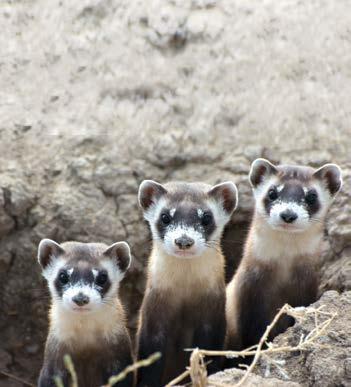
Just look at the numbers. Since 1973, the U.S. population increased by 120 million, or 57 percent. It is projected to grow another 52 million (17 percent) by 2073. That’s 20 million new households in the next 50 years. Those people will need homes, jobs, and shopping facilities. Where will the land come from to build new subdivisions, houses, apartments, factories, office buildings, warehouses, distribution centers, and shopping centers?
Over the last 50 years, 27.5 million acres of farmland were paved over—that’s the size of Virginia! Another 11.9 million acres will be paved over in the next 50 years, which is the size of Vermont and New Hampshire combined. All total, in 100 years, that’s 39.5 million acres—the size of three states—that is
nature’s habitat today!
Our world moves too fast for a partisan-bound Congress to keep current with the tools that agencies need to respond to changing conditions. It’s up to us as a community and the collective states to work collaboratively with the agencies to maintain a flexible ESA to meet the challenges that are forever changing. And it’s up to the agencies to hire the best and brightest to develop new policies and regulations for the ESA to remain relevant and meet tomorrow’s challenges—people like Michael Bean and Robert Bonnie, who came from the Environmental Defense Fund and helped Secretary Babbitt realize his 10-point plan through the series of regulations outlined earlier.
sis. Just
we’re on the same
Seems simple enough, but that’s what history tells us: Flexibility through regulations and policies is the secret to keeping the ESA viable and relevant. That’s history’s lesson number one. The second major recognition that surfaced during seven years of research on the ESA was its link to the impending biodiversity criE. BAIER
so
LOWELL
B&C HONORARY LIFE MEMBER AND PAST B&C PRESIDENT
The Firs T Fi FT y y ears
the Codex of the Endangered Species Act
with C hristopher e . s ega L
VOLUM e i
Foreword B y d oug L as B rink L ey, Presidential Historian and Author of Silent Spring Revolution
Order your copy of Lowell Baier's The Codex of the Endangered Species Act, Volume I: The First Fifty Years at Boone-Crockett.org.
Over the last 50 years, 27.5 million acres of farmland were paved over—that’s the size of Virginia! © MARK MESENKO
wavelength, let me define “biodiversity” to make this link clear. Biodiversity is the natural world around us, and the variety of all the different kinds of organisms—the plants, animals, insects, reptiles, crustaceans, amphibians, fish and aquatic species, and microorganisms—that live on our planet, including man. Every one of these species lives and works together in a diversity of ecosystems to maintain and support life on earth, and all exist in a delicate balance. From biodiversity, man draws food, shelter, medicine, and clothing. That was the stated purpose of the ESA—to protect the species and the habitat they live on.
That is the core of the biodiversity crisis—species at risk of extinction. Those are the very species the ESA is designed to protect. They are one and the same. One could say the ESA is the emergency room of the biodiversity crisis.
Why is it a crisis? In the last 50 years, more species have gone extinct than all the species that have gone extinct since man began recording them. And it intensifies as the population
expands and habitat becomes more fragmented and destroyed. Let me give you just three statistics.
Since 1970, we’ve lost three billion breeding adult birds in the United States and Canada. That’s 25 percent of our bird population from 12 bird families alone. That’s three billion fewer birds than we had in 1970, all from pesticides, habitat loss, and degradation.
The eastern monarch butterfly population has decreased by 90 percent and the western population by 99 percent. In one year, between 2020-21, beekeepers lost 46 percent of the managed honeybee population, and 25 percent of the wild bee population is at risk of extinction.
These are the canaries in the proverbial mine shaft.
Those three species— birds, bees, and butterflies— are the pollinators of our food, and one-half of pollination alone comes from bees. Corn and wheat are pollinated by the wind, but all the rest are at risk. Hence, the security of our food supply is at risk because our pollinators are dying. Moreover, 50 percent of all critical medicines are derived from plants and
animals. With our food supply and critical medicines at risk within this biodiversity crisis, mankind is put in a vulnerable position. That’s why I call it the biodiversity crisis. The World Wildlife Fund reports that between 1970 and 2016, the planet suffered a 68 percent decrease in the population sizes of all mammals, birds, amphibians, reptiles, and fish.
Lastly, climate change is the third component of the triad. The connection between the ESA and the biodiversity crisis that climate change adds is species and habitat loss. What species can live through catastrophic wildfires, 100-plus year floods, extreme droughts, etc? Habitat takes ages to repair, but in the meantime, species at risk go extinct— gone forever.
Consider the climate change statistics. Just in the last 100 years, as the population has increased and industry and greenhouse gas emissions have grown exponentially, the earth’s Fahrenheit has increased by one percent, more than the previous 6,000 years. As the population increases and industrialization expands to keep up
with this growth while emitting carbon dioxide, by 2050, the temperature is projected to increase by another 2.7 degrees Fahrenheit. By 2100, it is expected to rise another 3-12 degrees depending on which model is used for forecasting. By 2050, the sea level will rise 10-12 feet, putting 10 million people in the United States at risk from coastal storms and flooding. Droughts will become more pronounced as water dries up.
Let me emphasize: Climate change, the ESA, and biodiversity are all tied together. We all need to work together to find solutions that work.
Species conservation is just as important, if not more critical, today as it was when the Endangered Species Act first became law 50 years ago. Today, we all must work together to find ways to ensure that the ESA has the flexibility to adapt to the many varying needs of endangered wildlife. Throughout the Boone and Crockett Club’s 136-year history, we have never shied away from the challenges facing North America’s wildlife and wild places, and this case will be no different. n
Between 2020-21, beekeepers lost 46 percent of the managed honeybee population, and 25 percent of the wild bee population is at risk of extinction.
FAIR CHASE | FALL 2023 34
© MARK MESENKO
It’s up to us, the united conservation community and the states, to work collaboratively with the Departments of Agriculture and Interior, the U.S. Fish and Wildlife Service, and the National Marine Fisheries Service, to find workable solutions to keep up with technology and scientific discoveries, and unbridled industry that keeps pace with our expanding population demands, which leads to more land fragmentation and habitat destruction.
STEALTH MADE STRONGER
COVERT GEAR BUILT TO HANDLE THE ROUGHEST APPROACH INTO BOW RANGE
NEW INTERCEPT HOODY
Getting close to elk, mule deer, and other big game requires stealth. We designed the Intercept Hoody to provide the best sound, scent, and sight suppression to help you get into bow range. It’s built with an ultra-quiet merino wool blend that naturally resists odor to minimize smell and regulates temperature as you alternate between stop and go. And since your approach is likely to involve crawling over brush, rocks, and thorns, we reinforced our ArmorSpun merino wool with nylon and added removable elbow pads to make sure it has the rugged durability required for spot-and-stalk bowhunting.
35 FAIR CHASE | FALL 2023
SITKAGEAR.COM
Managing wildlife through the rule of law is one of the seven tenets of the North American Model for Wildlife Conservation. Addressing wildlife crime in the United States, specifically the illegal take of iconic big game species, is one of the most significant and complex conservation problems facing natural resource agencies today. This, coupled with the widening disconnect between the hunters and non-hunters, has resulted in the public increasingly equating legal, recreational hunting with the illegal take, or poaching, of wildlife. In addition to the social concerns brought on by the mistaken confusion of equating hunters and poachers, illegal take of wildlife often can have significant deleterious impacts on wildlife populations, quality of animals, and access to hunting lands.
Currently, there is little empirical data on detection rates for the illegal take of wildlife. The few studies available indicate that only a small portion (<5%) are detected, with actual detection rates reported to range from 0.67% to 3.33%. Likewise, little research has been done on the motivational factors that influence individuals to take wildlife illegally, with existing research
focusing primarily on typologies of poachers and occupational reactions of conservation officers. In 2019, the Boone and Crockett Club and Wildlife Management Institute initiated this study to comprehensively review the issue of illegal take in the U.S. and to accomplish the following:
1) Assess the levels of detection and conservation impacts associated with wildlife crime, 2) Describe the motivational factors and potential deterrents that influence poachers, 3) Reduce judicial and prosecutorial barriers to wildlife crime, and
4) Provide solutions to improving prosecution and conviction rates of poachers, including an objective, defensible, and proportional framework for poaching penalties and restitution. The focus of the study reported here is based on survey responses from approximately
Poach & Pay 2.0: Detection and Reporting of Wildlife Poaching
12,000 hunters, 4,000 landowners, and 1,200 conservation officers in eight states. All three groups surveyed (hunters, landowners, and conservation officers) share a significant degree of avidity for hunting, with 55% of hunters indicating that they hunt on state public land and 46.7% indicating they hunt on private lands. For landowners, 21% indicated they hunt on state public lands, and 19.6% hunt on private lands. Of the conservation officers surveyed, 78.8% indicated that they hunt on state public land, and 80.7% hunt on private lands. Around 39% of hunters, 40.1% of officers, and 13.4% of landowners indicated that they also hunt on federal public lands. Finally, the survey results indicated that 62.7% of hunters, 28.4% of landowners, and 84.8% of officers pursue big game.
PERCEIVED IMPACTS TO CONSERVATION
There is little debate about the biological and social impacts associated with the illegal take of wildlife. Agencies manage populations based on harvest models that are used to establish tag numbers, seasons, and bag limits. Poaching is a direct deficit to these models and, in some cases, may cause agencies to make recommendations that are more liberal than can be sustained. Likewise, access to lands for hunting and public perceptions of hunting are also adversely impacted by poachers and their activities.
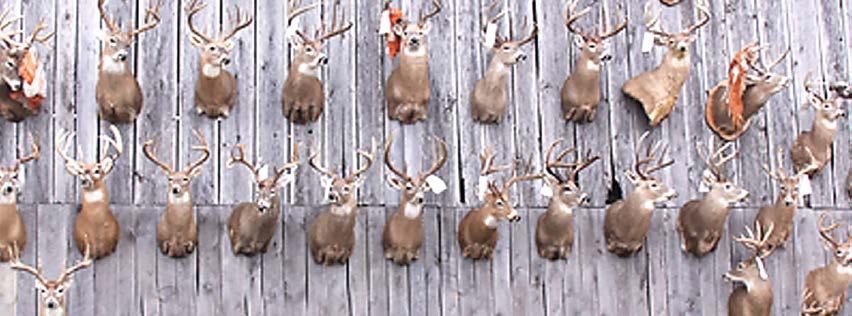
When asked their opinion on the seriousness of illegal take of wildlife within their state of residence, 63.3% of landowners, 65.8% of hunters, and 80.0% of conservation officers indicated that they considered the crime to be “extremely serious” or

FAIR CHASE | FALL 2023 36
JONATHAN GASSETT WILDLIFE MANAGEMENT INSTITUTE B&C PROFESSIONAL MEMBER
KRISTIE R. BLEVINS EASTERN KENTUCKY UNIVERSITY
TABLE
Perception
Biological & Social Factors Hunters Landowners Officers Wildlife Populations 73.7% 68.3% 77.4% Hunt Quality – Size of Animals 77.4% 69.0% 81.5% Hunt Opportunity – Number of Animals 77.5% 69.2% 76.3% Access to Lands 76.4% 68.2% 82.7% Respondent Perceptions 59.8% 62.5% 54.9% Public Perception 83.3% 73.9% 85.4% Overall Average 74.7% 68.5% 76.4%
1
of biological and social impacts that result from the illegal take of big game.
“very serious.” When asked the same question about the U.S. in general, 66.1% of landowners, 68.8% of hunters, and 82.3% of officers rated the illegal take of wildlife as “extremely serious” or “very serious.” When asked about the impacts of big game poaching on legal hunting and the wildlife resource, most hunters (74.7%), landowners (68.5%), and conservation officers (76.4%) indicated that the illegal take of wildlife significantly impacted six major factors spanning biological and social parameters ( TABLE 1).
DETERRENCE THEORY
Wildlife crimes are often cryptic, occurring in remote, inaccessible, and sparsely populated areas that make detection difficult. The relative certainty of being detected in the commission of a crime is one of the three factors associated with deterrence theory, which is a criminological theory that suggests individuals may be discouraged from committing crimes based on the certainty, severity, and swiftness of punishment. Empirical research on this theory has shown that swiftness of punishment is less important, but individuals may be less likely to commit crimes if they believe they are likely to be caught and receive severe
punishment for their actions. For illegal take of wildlife, the severity of punishment might not be judged by potential offenders based on purely legal sanctions; severity might be based on factors such as the loss of hunting privileges (including the Wildlife Violator Compact) or other punishments.
At its core, deterrence theory is based on a decision model where criminals weigh risk vs. reward. If the risks significantly outweigh the reward, then the crime rate should go down, and vice versa if the rewards outweigh the risks. Only by improving the low detection rates of illegal take of wildlife, while also establishing and maintaining punishments that are commensurate with the crime, will we be able to significantly impact the social and biological impacts associated with poaching wildlife.
THE DARK FIGURE: A BOONE AND CROCKETT-
SIZED PROBLEM
One of the greatest challenges to understanding and reducing crime is determining the number of criminal acts that go undetected by law enforcement. This undetected rate is described by criminologists as the “dark figure,” and is influenced by many factors, including personal
injury, financial loss, fear, embarrassment, distrust of law enforcement, and locational or situational factors. These factors make calculating the dark figure a difficult proposition, even for violent person-on-person crimes. Understanding that the dark figure (non-detected) rates for violent crimes against a person are also relatively low (auto theft = 32%; rape = 63%; larceny = 82%) provides a foundation for investigating so-called victimless crimes like poaching.
Detection of wildlife crimes often is not considered a priority by those who witness them. Working under the assumption that those most likely to detect wildlife crimes are people that commonly recreate or work in remote locations (hunters, landowners, and officers) and at times where the crimes occur. When we surveyed hunters and landowners about their awareness of poaching activity over the past five years and where those acts took place, we found that the number of detections was low, ranging from 0.5 to 3.8 incidents over the five-year period. When asked about how they responded to cases for which they became aware, they indicated a reporting rate of roughly 50% of those cases detected ( TABLE 2).
Although the detection and reporting rates by hunters and landowners were quite low, conservation officers still reported being made aware of, and investigating as necessary, an average of around 50 poaching-related incidents per officer per year. Real or perceived impacts to the victim frequently influence the rates of reported crimes. For example, crimes involving significant personal property loss but little personal embarrassment, such as auto theft, have some of the lowest non-reporting rates, whereas crimes that may cause embarrassment or fear (rape, assault) have much higher non-reporting rates. The crime of larceny (theft) is the crime we identified as the most similar to wildlife theft. With a non-detection rate of 82%, larceny is often unwitnessed and may not even be discovered by the victim for a significant period of time, if at all. Similarly, the illegal take of wildlife frequently goes unwitnessed and may not be discovered until much later. Another complication is that the illegal take of wildlife is often perceived by witnesses, judges, and prosecutors as a victimless crime, even though it is clearly theft of public property—meaning that the collective public is the victim.
Addressing wildlife crime in the United States, specifically the illegal take of iconic big game species, is one of the most significant and complex conservation problems facing natural resource agencies today.
37 FAIR CHASE | FALL 2023
TABLE 2
Location Hunters Landowners On your land 0.8 2.3 On other private lands 3.2 3.5 On state public land 2.1 3.0 On federal public land 1.4 2.2 Action Hunters Landowners Reported and detected by you 1.3 1.5 Detected by you but reported by others 0.9 0.7 Detected by others but reported by you 0.7 0.6 Detected by you but not reported 1.5 1.7
How many incidents of illegal take of wildlife in your state of residence are you aware of that occurred within the past 5 years (Detections/5-year period)?
When we asked the three groups about what percentage of wildlife crimes they thought go undetected, unreported, and unresolved, the data across all three groups indicate that all have high levels of uncertainty about poaching rates.
In Figure 1 , the combined responses of the groups indicated a normal distribution centered around the 50% rate, with significant peaks at 25% and 75%. This response is typical of surveys where many respondents have a high degree of uncertainty about their responses.
FIGURE 1: For your state of residence, indicate the level of illegal take of wildlife that you believe goes undetected, unreported, or unresolved.
Figure
When we asked officers their opinions on why hunters, landowners, and the public fail to report wildlife crimes of which they become aware, the officers indicated that revenge by the offender, worried about getting the offender in trouble, and lack of a “victim” (i.e., not important to me) were the most significant factors ( FIGURE 2).
FIGURE
Please select all the reasons that you think cause people to fail to report incidences of illegal take to law enforcement (n=1,107).
Fear of Revenge by Offender
Fear of revenge by offender.
Did not want to get the offender in the trouble.
Did not want to get the offender in the trouble.
Did not want the hassle of dealing with law enforcement.
Did not want the hassle of dealing with law enforcement.
Crime was minor and not worth taking the time to report.
Crime was minor and not worth taking the time to report.
Did not want the hassle of dealing with the court process. No one was harmed/no financial loss.
Did not want the hassle of dealing with the court process.
No one was harmed/no financial loss.
Didn’t want others to know.
Didn’t want others to know.
Unsatisfactory service from law enforcement in the past.
Incident was a private or personal matter and was handled informally.
Unsatisfactory service from law enforcement in the past. Incident was a private or personal matter and was handled informally.
Could have caused victim trouble with the law.
Could have caused victim trouble with the law. Law enforcement would not have found the offender.
Law enforcement would not have found the offender.
Offender would not be convicted or adequately punished.
Offender would not be convicted or adequately punished.
Law enforcement wouldn't have considered the incident important enough.
Law enforcement wouldn't have considered the incident important enough.
There was a lack of evidence.
There was a lack of evidence.
Tried to report but could not get through.
Tried to report but could not get through.
No harm was intended.
No harm was intended.
Law enforcement would not have been effective.
Law enforcement would be biased.
Law enforcement would not have been effective. Law enforcement would be biased.
FAIR CHASE | FALL 2023 38
0 5 10 15 20 25 0 1-10% 11-20% 21-30% 31-40% 41-50% 51-60% 61-70% 71-80% 81-90% 91-99% 1
Undetected Unreported Unresolved 0% 10% 20% 30% 40% 50% 60% 70% 80% 90% 100%
Figure 1. For your state of residence, Indicate the level of illegal take of wildlife that you believe goes undetected, unreported, or unresolved.
25 20 15 10 5 0 0 1-10% 11-20% 21-30% 31-40% 41-50% 51-60% 61-70% 71-80% 81-90% 91-99% 1
2. Please select all the reasons that you think cause people to fail to report incidences of illegal take to Law Enforcement (n=1,107).
Undetected Unreported Unresolved
0 % 10% 20% 30% 40% 50% 60% 70% 80% 90% 100%
2:
POSSIBLE SOLUTIONS


Officers were also asked about what approaches, techniques or unmet needs should be addressed that would increase detection and reporting rates and allow them to improve prosecution rates for persons committing wildlife crimes. Their highest priorities indicated were increasing the complement of officers on the ground, followed by anonymous TIP lines, financial rewards, and public education campaigns ( FIGURE 3). They ranked the Wildlife Violators Compact, internet searches, and surveillance cameras as the lowest priority techniques.
CONCLUSIONS
Landowners, hunters, and officers consider the illegal take of big game to be a serious threat to the future of hunting, both from biological and social perspectives, with all three groups indicating that the illegal take of big
game results in a significant negative impact to wildlife populations, hunt quality, hunt opportunity, access to hunting lands, and public perception.
This study confirms that illegal take of wildlife is cryptic. Even people who spend significant amounts of time in places where these crimes frequently occur, they witness very few illegal take incidents. When they do detect or are made aware of an illegal take, fewer than half report them to law enforcement. Improving detection and reporting rates of illegal take will largely be educational in nature, which may include educating those who witness wildlife crimes about the need to report them to the proper authorities.
The combination of improving our understanding of detectability rates, determining the motivational factors that compel people to poach, and the developing
of objective, consistent, and proportional criminal penalties and criminal restitution costs, along with reducing the prosecutorial barriers to wildlife crimes, is the clearest path forward for our community to take on the problems associated with the illegal take of big game and other wildlife. Furthermore, only by raising awareness of the seriousness of wildlife crimes in this country and developing a societal culture of intolerance for the abuse of our precious natural resources, will we be able to address this issue head-on.


We are currently engaged in the next round of research within the Poach and Pay project to review citation data and conduct interviews with convicted poachers. As we compile all the data, we will develop a more targeted communications and education campaign in the coming year. n


39 FAIR CHASE | FALL 2023 0 1 2 3 4 5 6 7 Law enforcement manpower TIP or anonymous poaching hotlines Rewards or financial incentives Public education campaigns Covert or undercover operations Task Force operations directed at a specific individual, area, or event. Surveillance cameras Searches of Internet/Social Media/Online Marketplaces Wildlife Violator Compact
Detection Reporting Citation Research
Figure 3. Conservation Officers: Based on your experience, please rank the following (from most effective to least effective) that you believe indicates their potential to increase - Detection/Reporting/Citation rates on the illegal take of big game.
Sponsored by: Learn more about Poach & Pay
Detection Reporting Citation 7 6 5 4 3 2 1 0
FIGURE 3: Conservation Officers: Based on your experience, please rank the following (from most effective to least effective) that you believe indicates their potential to increase - Detection/Reporting/Citation rates on the illegal take of big game.
Public
Covert or
Law enforcement manpower Surveillance cameras Searches of Internet/ Social Media/ Online Marketplaces
TIP or anonymous poaching hotlines Wildlife Violator Compact
Rewards
or financial incentives
education campaigns
undercover operations Task Force operations directed at a specific individual, area, or event
The CHALLENGE of NORTH AMERICAN CONSERVATION TODAY
Frights and opportunities in conservation today are well known to Club members, our closest partners, and the entire conservation community. Club members have, are, and should engage headon. As before, it is time again for the Club to review the challenges, their moving parts, and our avenues through them.
Among the biggest challenges: hunters are now a minority in conservation; environmentalism has blurred its meaning; wolves and grizzly bears have changed ecosystems and distorted agency roles; and the horror of gun crimes threatens legitimate gun use.
Club members need some of our old magic and some new. Our founders inspired people to assemble a conservation movement. We must inspire and steer an existing movement. In 2000, a rallying speech by Jack Ward Thomas to our closest allies led to the formation of the American Wildlife Conservation Partnership (AWCP). He said, “We believe in magic!” and the magic worked. Today, forming a larger, more powerful coalition among allies will take bigger magic.
The agenda that we and our AWCP partners call “Wildlife for the 21st Century,” refined and executed over 23 years, is a solid reference for what must be done.
Other guideposts—all inspired and delivered by Club members—also inform us: The White House Conference on Hunting Heritage and Wildlife Conservation in 2008; the 2001 paper, “The North American Model of Wildlife Conservation” (Geist, Mahoney, Organ); the 1973 paper, “Report of the Committee on North American Wildlife Policy” (Allen); and the 1930 paper, “Report to the American Game Conference on an American Game Policy” (Leopold). But we must face forward. We must complete the progression from “game” to “wildlife policy” to “wildlife conservation” and now to all conservation.
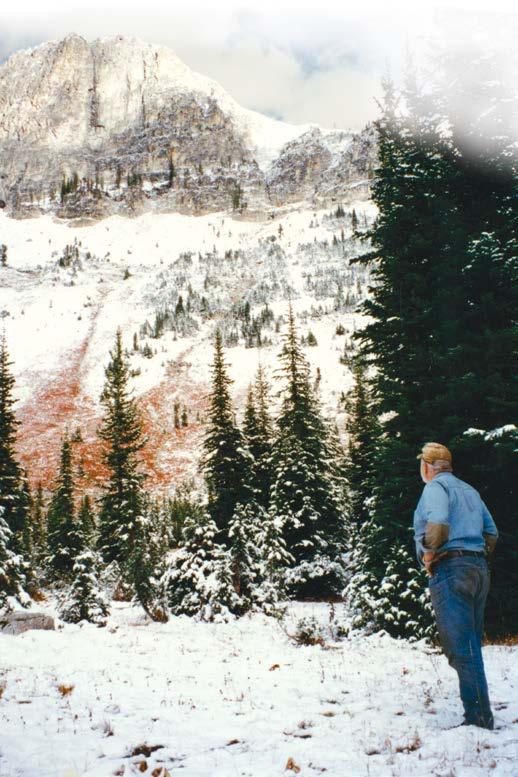 Read more about AWCP
Jack Ward Thomas took on many challenges in his lifetime. Here he is in 1995 at the head of the Minam River in the Wallowa-Whitman National Forest, Oregon.
THE CHALLENGES TODAY
We no longer own conservation, the meaning of the word has blurred, and the part that remains “ours” is struggling to grow and maintain its renown.
Hunting and hunters are no longer the biggest or most effective drivers of conservation. Conservation is confused with environmentalism. Accusers of state wildlife managers and commissions see them as captured by hunters and unwilling or unable to care for non-game species.
The size of conservation could be the success of Theodore Roosevelt’s 1908 speech “Conservation as a National Duty,” but it doesn’t feel that way. The first conservationists defined it with wildlife, forests, grazing, water supply, and mining. Environmentalists later activated the issues of wilderness, air quality, water quality, and chemicals. The broader agenda made sense and improved the country, but the new methods, politics, and philosophies have divided the movement.
Appearing different, environmentalism is only a different part of conservation. What sort of different determines how the divide is resolved. A competitor must be defeated, but dissension must be reconciled.
We face dissension. The present challenge to state wildlife management and its leadership is a difference of means within a consensus that state agencies should do more. Many, including the Club, are expanding state management beyond game species through the Recovering America’s Wildlife Act. Some oppose adding wolves and grizzly bears by releasing them from the Endangered Species Act.
We cannot meet these challenges—gun crime among them—with our history alone. We need new methods, respect for views and culture, and trust.
THE FUNDAMENTALS
Key obstacles to conservation progress are conflict, the rule of law, and funding.
Conflict
Democracy—the most reliable means of resolving conflicts— operates at a far reach from most conservation conflicts. After public comment is considered on a proposal, agencies evaluate options, predict outcomes, and debunk opinions posing as science. Then the agency decides. The only recourses are the details of process or consistency with law. There is no place for direct debate over preferences among legitimate options. For decisions of little or no controversy, this is fine. Agency choices are accountable to the public distantly through the election of a president and the consent of Congress in appointees or their supervisors. State wildlife agencies are governed more directly, but still by reaching through a governor’s appointment of commissioners and sometimes the agency director.
Motivated people often seek direct consideration of collaborative recommendations on more controversial decisions. Agencies see clearer preferences, and courts can better identify litigants with personal, not public, complaints.
Collaboration better informs the agencies and the courts. More people would deliberate and resolve more conflicts if that consideration were required.
Rule of Law
Conservation policy prohibits harmful activities and permits others only after painstaking precautions. These policies emerged after the early decades of restoring game species, which were also the days of eliminating predators without restraint and grazing and timbering without regulation.
Active management and restoration are scrutinized as closely as riskier activities. The law directs more attention to predicting outcomes and minimizing consequences than to learning from actual outcomes and results.
Wind and solar energy have recently shifted these politics. Proponents of wind and solar have encountered the obstacles laid previously to slow forestry, grazing, irrigating, and road building.
We should rebalance the risks of consequences against those of inaction for the benefit of habitat restoration.
Funding
Active care and protection are funded mainly by public spending and philanthropy, while the use of
41 FAIR CHASE | FALL 2023
SIMON ROOSEVELT B&C REGULAR MEMBER
©WARD M. FRENCH III
resources is funded more generously with private capital. We must attract more private capital to active care and protection.
We already know this. We have successfully connected the market for guns and ammunition to the active care and protection of wildlife through the Pittman-Robertson program.
More recently, a market in wetland mitigation began attracting billions in private investment into the restoration of wetlands. Currently, the U.S. Fish and Wildlife Service is establishing a wildlife mitigation market to do likewise. These regulatory markets pay landowners to produce habitat.
We must build on and refine these innovations. Fee access for hunting and fishing helps pay for quality habitat, and carbon trading could make forest and range management pay. Both have flaws and yet each yields more money for conservation.
WHAT IT WILL TAKE
We must join the bigger arena with other conservationists. The ambition of Club members to engage in issues gets us there, but we cannot expect to be there forever because of what we’ve done before.
Leading With Why We Care
The conservation community— and the whole society—needs to know why we care. It’s ultimately the same reason driving other conservationists and what society demands, but that doesn’t matter unless they know.
Our focus on game species obscures our passion for a vast, diverse, and thriving natural world. This passion may be stronger or weaker from one hunter to another, but as organizations, we cover every game species and habitat type, which makes us vital to the entire conservation community.
This is more important than our money. We fund a lot of conservation, and this benefits more than just game. Yet there is a lot more money in conservation than ours. And though our funding proves we care, it does not say enough about what we care about.
We were more visionary in the early years. The National Collection of Heads and Horns inspired Americans with conservation. Fittingly, the Collection now resides at the Wonders of Wildlife Museum in Springfield, Missouri, in the largest single place in the country where visitors can see the same dream.
We can learn from environmentalists, who are generally very good at leading with “why.”
An environmentalist partner of ours—the Pew Charitable Trusts—is more visionary than us on an issue we agree on: big game migration habitat. They say migration “sustains species, ecosystems, and economies,” including the hunting economy. People need to hear about ecosystems from us too. Big game moving through an ecosystem provides the protein that sustains it.
A closer partner of ours, Safari Club International Foundation (SCIF), puts the “why” forward on grizzly bear conflicts in our neighborhood at the Theodore Roosevelt Memorial Ranch. SCIF members say they are preventing the heartbreak of losing grizzlies from wild country. That’s the “why.” Everything else is “how.”
Entering the Arena
We do not agree with even our closest partners on everything. We won’t agree with many other conservationists.
But differences are less of a problem than distance. Face to face, we can negotiate, agree where possible, and contend where necessary. Separately, we miss opportunities.
It was hard even in the small American Wildlife Conservation Partnership community to start working jointly. It will be harder for the far larger community to do it.
But we may not be trying hard enough. More than assembling other groups, we should engage the foundations and big donors whose objectives are better achieved by teamwork than scattered efforts.
Standing By Guns With Honor
Gun crime is a horrific blight on society and a looming risk for our association with guns. But as champions of ethics, we have a way to stand, advance our reputation, and help find solutions.
Our Fair Chase ethic secures hunting by affirming respect for law and “honor.” Honor appears in several tenets of Fair Chase. There is honor in respecting local customs and behavior that reflects favorably on us as hunters, wildlife, and the environment. Honor is not required by law but by credibility.
We need the same benefit of honor in using, supporting, and promoting guns. They are valuable to us for many reasons that pale when guns become the symbols of vengeance and power that movies, video games, and some gun advertising make them.
Guns will remain tools of conservation and fun hobbies if we always use and talk about them that way. On a hunt or range or in a magazine, we model safety, marvel at technology, and promote conservation. But like a high-performance car in traffic, we have something that must be kept within limits to keep our credibility.
CONCLUSION
The challenge of conservation today is the purpose of the Club, the shared responsibility of our closest partners and all conservationists. There is always a way forward if we read the landscape, maneuver accordingly, and bring what it takes to complete the mission. n
Read more about the National Collection of Heads and Horns.
Shop Boone and CroCkett CluB
NOW AVAILABLE TO ALL MEMBERS!
PROTECT YETI MUG
Black YETI 10 oz Rambler mug with magslider and custom design 'Protecting the Heritage of Hunting'.
n Stackable for compact storage
n Insulated for hot beverages
n Leak resistant
n Easy grip handle
n Dishwasher safe
AFYB | $26
NON-MEMBERS PAY $32.50
DEFEND YETI BOTTLE
Red YETI 18 oz Rambler water bottle with chug cap and custom design 'Defend the True Purpose'.

n Cupholder compatible
n 100% leakproof
n Easy to carry
n Double-wall vacuum insulated
AFYR | $30
NON-MEMBERS PAY $37.50
RISE YETI RAMBLER
Alpine Yellow YETI 30 oz Rambler travel mug with stronghold lid and custom design 'Rise to the Challenge of Those that Rose Before Us'.

n Cup holder compatible
n Leak resistant
n Easy grip handle
n Dishwasher safe
LTYR | $42
NON-MEMBERS PAY $52.50
BOONE AND CROCKETT CLUB’S 31ST BIG GAME AWARDS, 2019–2021
In 2022, the Club hosted the 31st Big Game Awards, honoring hunters and their trophies from across the continent. We began compiling those records and stories into a big game awards book to commemorate this triennial event in 1983. The first book included less than 1,000 trophy entries accepted between 1980 and 1982 with 68 trophy stories. This edition contains more than 3,700 trophy big game entries and 70 captivating hunting stories, plus 28 youth hunts!
LESS THAN 300 COPIES NOW AVAILABLE! ONCE THEY ARE SOLD OUT, NO MORE WILL BE PRINTED. We asked hunters accepted into the awards program to submit stories of their record-book hunts, which we include in this 560-page tribute to big game. In this book, you’ll find harrowing encounters with grizzly bears alongside heart-warming tales of youth hunting with their mentors as they strike trophy-book gold. In addition, we provide invaluable tools for hunters who want to research trends and trophy data. This book is a true testament to the success achieved by our state and provincial game departments in managing North American wildlife. Above all else, this book should be a point of pride for any hunter who turns these pages.
n 560 pages
n 3,700+ big game trophy listings
n Nearly 200 trophy field photos
n 70 hunting adventure stories
n 17 score charts
n Hardcover with printed dust jacket
BR31 | $60
NON-MEMBERS PAY $75
43 FAIR CHASE | FALL 2023
Visit www.Boone-Crockett.org to see a complete list of the books, hats, shirts, and gifts available, or call 888/840-4868 to order.
SHOP ONLINE TODAY!
The buck came to exactly 27 yards and stopped. My heart was virtually coming out of my throat from excitement.

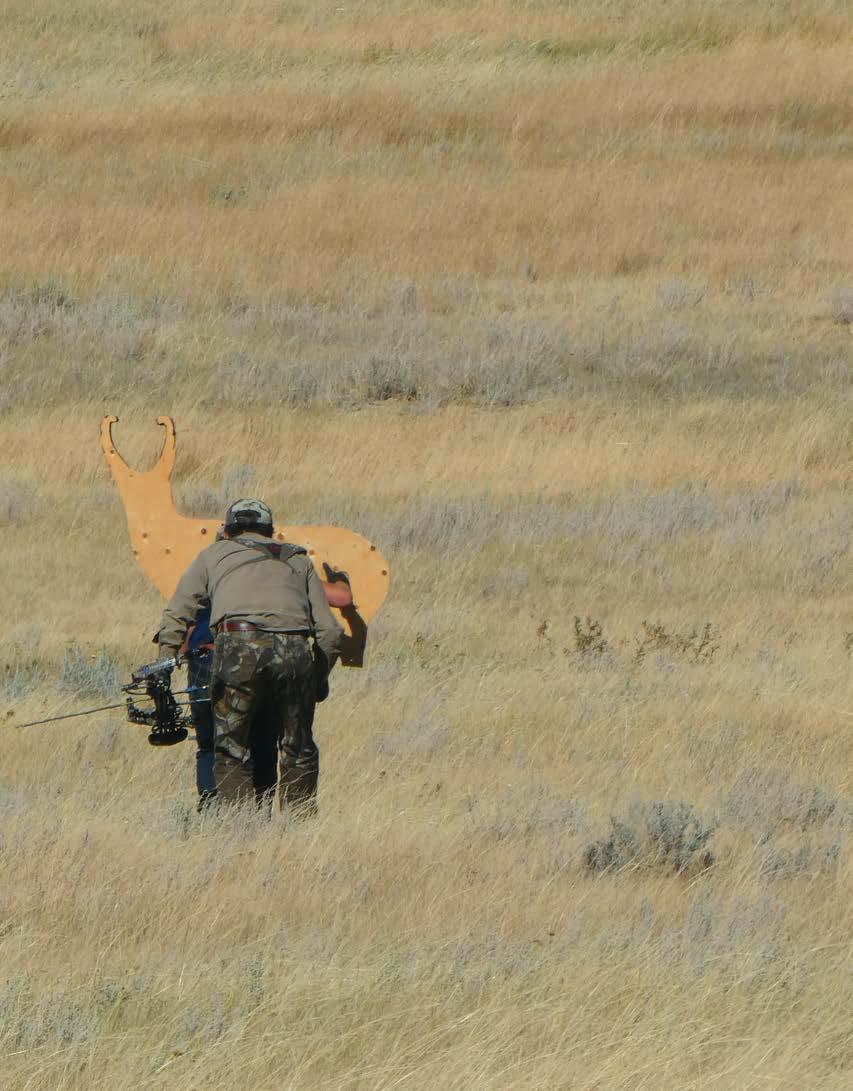
©ALEXANDER SHARIF
DIY - THE PRAIRIE, THE BOW, AND THE PRONGHORN — PAGE 58
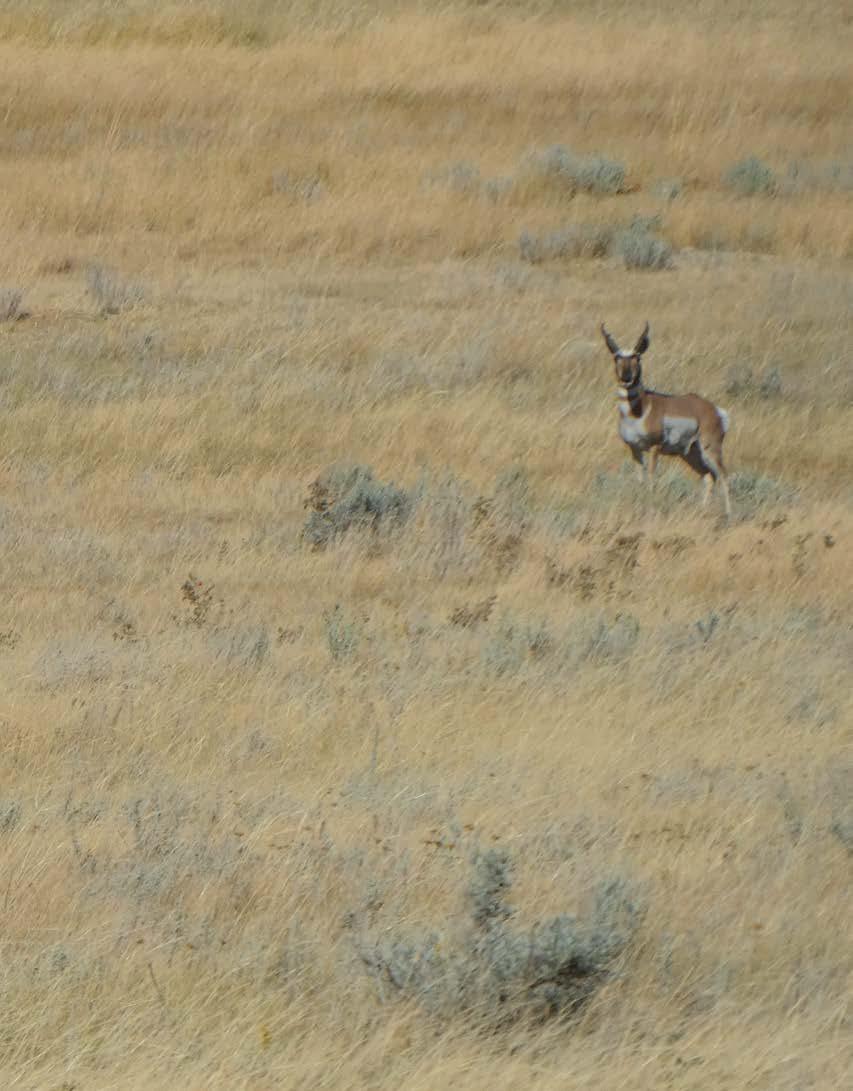
SCIENCE MARCHES FORWARD: THE EVER-EVOLVING SCIENCE OF CHRONIC WASTING DISEASE
Chronic Wasting Disease (CWD) is one of the greatest threats facing North American wildlife species today. This disease, caused by an infectious protein or “prion,” is spreading across the United States and Canada, affecting wild and captive populations of species in the deer family (Cervidae). Species most directly affected by CWD include whitetail deer, mule deer, and elk. However, research suggests that many other species in the family Cervidae are also likely susceptible to this disease.
CWD is similar to other prion diseases, such as scrapie in sheep or “mad cow” (BSE or bovine spongiform encephalopathy) in cattle. The disease is characterized by the progressive degeneration of the central nervous system and is 100 percent fatal. The prions that cause the disease remain infectious outside the animal and spread through environmental contamination, such as infected bedding, soil, or vegetation, as well as animal-to-animal contact. There are no known treatments, cures, or vaccines for this disease nor conclusive evidence regarding the possibility of human infection. In addition, the most reliable tests for CWD require tissue samples, which can only be obtained after the animal dies.
CWD was first discovered by scientists in 1967, and ever since then, the scientific community has been working to help managers understand the many challenges posed by this disease. Scientific studies of CWD’s biology and transmission pathways are highly active research areas.
Last June, researchers from around the world met in Denver, Colorado, to discuss the latest scientific developments regarding CWD. Some of the findings presented at this conference are truly daunting: the disease is actually changing the demographics and age structures of certain cervid populations; CWD prions can indeed contaminate sites such as mineral licks where cervids congregate; and researchers have now confirmed that female whitetail deer can transmit CWD to their offspring before birth. However, there are some hopeful signs: new techniques greatly improve our ability to detect CWD in both animal and environmental samples; preliminary research suggests that dogs may be able to detect CWD-infected animals in much the same way that dogs can also be used to detect certain human diseases; and we are getting ever closer to having tests that can reliably detect the disease in live animals. Despite this recent scientific activity, we still have some significant unknowns in our knowledge and understanding of CWD. How are we going to manage this disease in wild free-ranging cervid populations while at the same time meeting the needs and expectations of the hunting public? Some of the most commonly proposed management approaches involve dramatic reductions in herd size and reductions in activities such as supplemental feeding, nutrient provision, and the elimination of baits or scents that could congregate animals in such a way that the disease can spread. These are not popular ideas among the
hunting public at large! Careful research is needed to examine these recommendations closely and study them in the field to determine which approach works and under what circumstances. And we still do not have conclusive evidence regarding the most important question for hunters and their families: could this disease actually jump the species barrier and begin infecting humans who consume meat from infected animals?
As discussed in an earlier column, members of the scientific community are coming together in unique ways to help address these major problems. One of the most promising efforts is the CWD Research Consortium created by former Boone and Crockett Fellow Dr. Sonja Christensen at Michigan State University, working with partners at other universities in the upper Midwest. This research consortium links major research universities nationwide with federal and state agencies to help tackle some of the thorniest scientific questions regarding
Jonathan R. Mawdsley B&C PROFESSIONAL MEMBER CHIEF OF THE COOPERATIVE FISH AND WILDLIFE RESEARCH UNITS

CWD and its management. The consortium has unparalleled abilities to bring in new lines of evidence (such as a library of tissue samples from infected animals), new techniques (such as detailed geospatial models), and new partners, including scientists from the public health, human dimensions, and social science arenas. One of the most exciting projects being considered by the consortium is an effort to work with the state fish and wildlife agencies across the midwestern states to improve decision-making around CWD at individual agencies and to apply some of the new and most promising scientific findings to actual on-theground cervid management.
Dr. Sonja Christensen is also involved in another exciting effort to assist the state fish and wildlife agencies in improving their
FAIR CHASE | FALL 2023 46
SCIENCE BLASTS
The scientific effort to understand and manage CWD is truly impressive and, if successful, will provide the knowledge and information needed to help our state and federal wildlife managers address this major challenge to our wildlife resources and hunting heritage.
management of wildlife disease issues within their borders. With support from the U. S. Fish and Wildlife Service, the Association of Fish and Wildlife Agencies (AFWA) has hired a dedicated wildlife disease coordinator in each of its four regions to assist the state fish and wildlife agencies in responding to the challenges posed by wildlife diseases, particularly CWD. These coordinators are helping states connect more effectively with scientific researchers, obtain faster and more accurate diagnoses of wildlife disease outbreaks, and improve planning and coordination around wildlife disease issues. Sonja coordinates this entire network through her work as the parttime wildlife health and disease coordinator at AFWA.
Another important scientific effort that is just now gearing up is a major multi-year study by the National Academies of Science and Medicine (NASEM) to examine the causes and methods of transmission of CWD among both captive as well as wild cervid populations. The NASEM includes many of the nation’s top scientists among its members and is well known for producing careful, well-reasoned “gold standard” scientific reports on controversial topics. This study will review our understanding of CWD transmission and make recommendations for management, research, and study.
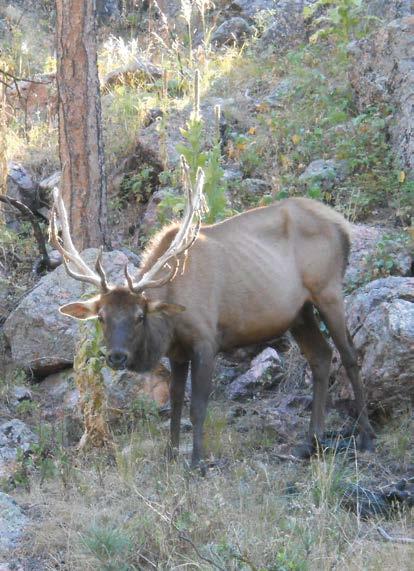
Finally, my program, the USGS Cooperative Fish and Wildlife Research Unit Program, which was founded by Boone and Crockett Club Member Jay “Ding” Darling in 1932, is actively exploring
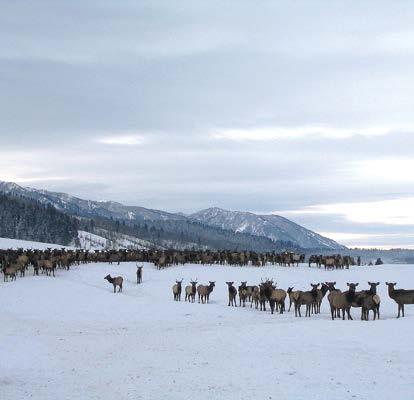

how we might be able to leverage our scientific resources and capacity across our 42 (soon to be 43) research units across the country. The 126 scientists in our program have a tremendous range of expertise in all aspects of wildlife science relevant to disease management—from genetics to genomics, from spatial ecology to structured decision-making, from deer ecology to disease etiology, and from habitat management to hunter education.
Boone and Crockett Professional Member Jen Mock is working with our scientists to explore the notion of creating a wildlife disease “community of practice” within the Cooperative Fish and Wildlife Research Unit Program, which would bring together scientists from diverse backgrounds to tackle some of the most intractable problems associated with the most complicated disease issues, particularly CWD.
The scientific effort to understand and manage CWD is truly impressive and, if successful, will provide the knowledge and information needed to help our state and federal wildlife managers address this major challenge to our wildlife resources and hunting heritage. I have great confidence in our wildlife scientists, and I look forward to continuing to share with the readers of Fair Chase the latest research findings about CWD and other critical wildlife diseases. n
47 FAIR CHASE | FALL 2023
A bull elk with chronic wasting disease. The emaciated appearance and drooping ears are characteristic of latter stages of infection.
©USGS, GLEN SARGEANT
Elk on a feedground in Wyoming.
©USGS, NORTHERN ROCKY MOUNTAIN SCIENCE CENTER
Read more about the Club's involvement with CWD
EVALUATING MANAGEMENT STRATEGIES FOR CHRONIC WASTING DISEASE IN MICHIGAN WHITETAIL
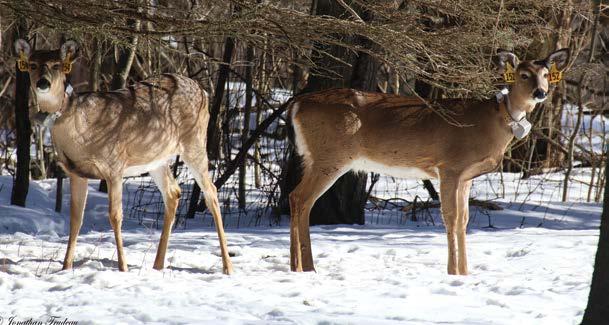
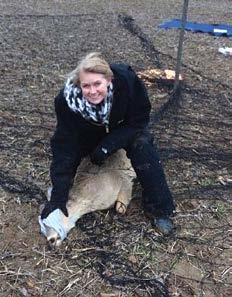
DEER
Managing chronic wasting disease (CWD)—an always-fatal neurologic disease in whitetail deer, mule deer, elk, moose, and other members of the deer family—continues to challenge wildlife managers tasked with sustaining healthy and abundant deer herds. The disease continues to spread and is now found in wild deer in 31 U.S. states and four Canadian provinces. Wildlife agencies in western states, where the disease originated and has been spreading since the 1980s, report population declines in mule deer and elk. Despite best efforts by managers to prevent the introduction and spread of CWD, there are few instances where management was considered effective. One of these examples, however, is a local culling program conducted annually in northern Illinois, which has helped keep CWD at low levels since the early 2000s.
This persistent mystery surrounding the effective management of CWD drives our research at Michigan State University. With funding from the Michigan Department of Natural Resources (DNR), we built a simulation model to create wild deer populations infected with CWD and to assess how various management actions affect population and disease dynamics. Our goal was to produce a tool that can answer common questions state wildlife managers ask when faced with a new outbreak of CWD, such as: How many deer do we need to remove to stop or slow disease spread? Which areas should we target for deer removal to be most effective at reducing CWD? How soon do we need to implement management to make the biggest impact on the disease?
We built this model using data collected in real-time on GPS-collared deer in our study area of mid-Michigan—another study funded by the Michigan DNR and led by Boone and Crockett fellow Jonathan Trudeau. These location data revealed fine-scale movement and habitat use information, such as seasonal home range sizes and habitat preferences and dispersal rates, times, and distances for each age class and sex of Michigan deer, which we then applied to our simulated deer population. Although we simulate deer with behaviors and movements specific to mid-Michigan and model them on real geographic areas located in Michigan, we built our model to make it easy for wildlife managers in other states to add deer and landscape information specific to their state.
Once we had a model deer population that moved and interacted with each other and their environment similar to the real GPS-collared deer in our study area, we infected the virtual deer with CWD using disease data collected by CWD researchers and Midwest state agencies that report prevalence rates of CWD in their wild deer each year. With both the deer population and CWD performing as expected for CWD-infected deer populations in the Midwest, we began to assess various disease management strategies. These strategies were developed in close collaboration with wildlife managers and researchers at the Michigan DNR and wildlife biologists at the United States Department of Agriculture’s Wildlife Services, which state agencies often hire to perform localized
FAIR CHASE | FALL 2023 48
NOELLE THOMPSON PHD CANDIDATE BOONE AND CROCKETT FELLOW DEPARTMENT OF FISHERIES AND WILDLIFE MICHIGAN STATE UNIVERSITY
© JONATHAN TRUDEAU
LEFT: Noelle assisting with the capture and GPS-collaring of whitetail deer in mid-Michigan, a partner project led by Michigan State University and the Michigan Department of Natural Resources. They used a drop net to capture the deer. It is a huge net held up with a pole with bait placed in the center. There is a remote trigger to monitor the net from a distance and drop it once deer go under. They are able to capture multiple deer at once and it is fairly effective in agricultural fields during winter. BELOW: Two of the GPS-collared deer inhabiting the mid-Michigan study area which we collected movement and habitat use information to inform the CWD model.
removal of deer. To make these management scenarios as realistic as possible, we asked our collaborators: How many deer do you remove in a single day? How many total deer do you remove by the end of the season? How do your deer removal efforts and success rates change over time?
One of the primary questions in this study was whether changes to fine-scale deer removal practices could improve managers’ chances of slowing or stopping disease spread. To begin to answer this, we implemented and assessed a suite of local deer removal techniques in the model, including ring culls of various sizes, which involves the removal of deer within a specified distance of a detected case of CWD, and more spatially-targeted removal methods, such as removing deer only located in areas with high-quality deer habitat with the assumption that deer are more likely to come into contact and spread the disease in those areas. Holding the modeled deer population and underlying landscape constant across scenarios, we then tracked CWD over time to identify the deer removal methods that could stamp out the disease or were more effective at slowing its spread.
Other ideas we are currently exploring with the model include how the environment and deer
B&C UNIVERSITY PROGRAMS
The mission of the Boone and Crockett Club University Programs is the development of a diverse community of high-impact wildlife conservation leaders.
MEET NOELLE
Uninfected (green) and infected (orange and red) deer depicted as dots on a study area located in mid-Michigan at Year 5, 10, and 15 of a model simulation. The map on the left details the suitability of habitat for deer, with deer more likely to be located and use areas shaded light blue to yellow. The images on the right visualize where the disease agent, infectious mutated proteins or ‘prions,’ were deposited into the environment and where uninfected deer can then encounter them and become infected. The landscape changes from black to light brown in the model as prions are shed by infected deer and accumulate in each area.
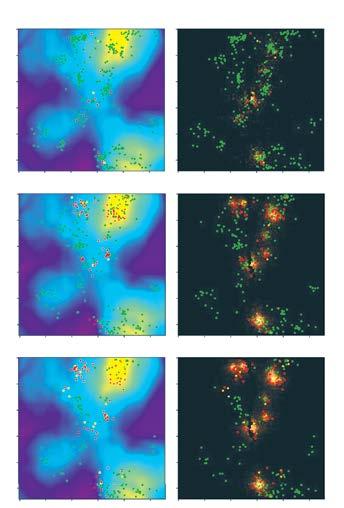
Year 5
Year 10
I was raised on the south side of Chicago. I went to college thinking I wanted to work in a wildlife conservation department within a large zoo—the extent of my knowledge about wildlife careers. During my undergraduate program at the University of Illinois, I joined the chronic wasting disease (CWD) lab and became interested in wildlife diseases and applied research. I stayed with the CWD lab for my master’s degree to assess how a longterm deer management program affected deer habitat use and spatial structure in an important natural area with implications for potential disease spread. After my MS, I began my PhD at Michigan State University where the Boone and Crockett Quantitative Wildlife Center was initiating a multi-year CWD project. For my dissertation, I am evaluating effective management strategies for CWD in Michigan's free-ranging deer herds. My research interests focus on wildlife infectious diseases, wildlife policy, and wildlife management. In the future, I aim to make an impact on wildlife diseases and policy as a wildlife disease ecologist within a federal or state agency.
Year 15
49 FAIR CHASE | FALL 2023
Although much about this disease remains unknown, we do know that CWD is too large of a threat to real, live deer populations to attempt to test management strategies in a trial-and-error fashion. Wildlife agencies must detect the disease early and act fast to have any chance of extinguishing the disease.
population, such as landscape type and deer density, affect management success; identifying the proportion of deer needing to be removed for disease eradication to be likely; and how variability in the implementation of management practices, such as deer removal and land access rates, affect management success. However, the possibilities of this model to answer questions asked by wildlife managers and allow them to make more informed management decisions go far beyond these initial assessments. The model can investigate CWD management strategies beyond localized deer removal, such as altered hunter-harvest rates and regulations on baiting and supplemental feeding.
Although much about this disease remains unknown, we do know that CWD is too large of a threat to real, live deer populations to attempt to test management strategies in a trial-and-error fashion. Wildlife agencies must detect the disease early and act fast to have any chance of extinguishing the disease. Once CWD becomes established in a wild deer herd, the chances of getting rid of the disease appear to be nearly zero. To better understand and predict the usefulness of management strategies for CWD, we provide wildlife agencies and researchers with a modeling tool where they can safely implement and investigate management scenarios for CWD in a virtual yet realistic environment. n
LIFE AND DISEASE EVENTS EXPERIENCED BY SIMULATED WHITETAIL DEER EACH YEAR WITHIN THE MODEL
SEASONAL FUNCTIONS
Hunting mortality è (daily)
Hunting mortality è (daily)
Hunting mortality è (daily)
Fall dispersal and migration (daily)
DECEMBER
NOVEMBER
OCTOBER
SEPTEMBER
AUGUST
JANUARY
ç Hunting mortality (daily)
FEBRUARY
MARCH
APRIL
MAY
JUNE
ç Give birth (daily)
DAILY FUNCTIONS
Move
Increase time since infected (in days)
Shed prions
Become infected indirectly
Become infected directly
Die from CWD
MONTHLY FUNCTIONS
Increase age (in months)
JULY
ç Give birth (daily) Spring dispersal and migration (daily)
Die from natural causes (baseline mortality)
Give birth
Die as young fawn
Die from hunting
Spring dispersal and migration
Fall dispersal and migration
Increase time since given birth (in months)
Environmental prion decay
A herd of whitetail deer feed in an agricultural field within the mid-Michigan study area.
The deer that is farthest back in the photo is GPS-collared with ear tags after having previously been captured and fitted with a GPS collar by Noelle's MSUMDNR field study.
FAIR CHASE | FALL 2023 50
© JONATHAN TRUDEAU
PROUD PARTNER
The American Sportsman is the most powerful force for conservation in history. Bass Pro Shops® and Cabela’s® are proud to serve more sportsmen and women than any other retailer in the world. Here’s to hunting. Here’s to fishing. Here’s to conservation.

Learn more at basspro.com/conservation

51 FAIR CHASE | FALL 2023
BP231127502
IN THE FIELD
MAY 2023 - JUNE 2023 - JULY 2023
B&C IMPACT SERIES
boone-crockett.org/tags/bc-impact-series
FEATURE STORIES

Record-book Shiras’ Moose Found Floating in Idaho
boone-crockett.org/record-book-shiras-moose-found-floating-idaho After a pair of moose lock their antlers and fight to the death in Idaho, a hunter and his daughter attempt to recover the racks and have a day they will never forget. Oh, and one of the bulls is the fourth largest recorded for Idaho and number 16 of All-time.
State Records Held by Youth Hunters
Genesis of a Scoring and Record System
What good is a score? Is it bragging rights? A path to backslaps, free hunts, and a book deal? The answer is none of the above.
B&C AUDIO ADVENTURE
boone-crockett.org/tags/bc-audio-adventures
Listen to legendary hunts from the Boone and Crockett Club archives. Download them to your phone as a podcast or listen from the website. Terrified!

A bowhunt for black bear in 1982 nearly spells the end as the wounded bear tracks down its assailant.

Lady’s Day in the High Country
At 63 years old, a Montana hunter had applied for 18 years to hunt bighorn sheep.
When she finally drew the tag, she had one chance to make her dream come true.
Quest for the Giant Moose
At 12 years old, this hunter hit the Idaho mountains, hoping to fill a moose tag. The only problem was that her dad likes to hunt the steepest, rockiest, and roughest mountains he can find.

boone-crockett.org/generation-next-state-records-held-youth-hunters Young hunters are the future of conservation. Any time that we spend with them afield is a reason to celebrate. And sometimes, they bring home some serious antlers. Check out these record-book racks held by youth 16 and under.
MEMBER SPOTLIGHTS
boone-crockett.org/tags/bc-member-spotlight
Russell Train
As a tax lawyer turned conservation warrior, Russell Train had the ear of numerous U.S. presidents in the 1960s and ‘70s. As a result, his legacy lives on in the legislation he helped drive to the finish line.
Fred Bear
Fred “Papa” Bear’s innovations in bowhunting gear and marketing vaulted the pastime into the mainstream. What is seldom discussed is his passion for conservation and his quest to establish a tax (for conservation) on the very products he sold.
FROM AROUND THE CAMPFIRE
boone-crockett.org/news
$1 Million Donation for Depot Restoration | May 2023 | Regular Member Lee Anderson and his wife Penny have donated $1 million to support the restoration of the Club’s Old Milwaukee Depot headquarters building in Missoula.
Keeping Working Forests Intact | June 2023 | A coalition of conservation, sportsmen, and forest management organizations and companies applauded the introduction of legislation to help keep private forestland intact and sustainably managed for timber.
Big Game Migration Win | July 2023 | The Boone and Crockett Club welcomed U.S. Department of Agriculture Under Secretary Robert Bonnie’s announcement of a new funding commitment to big game migration corridor conservation on private lands in Idaho and Montana.
FAIR CHASE | FALL 2023 52
If you don't receive the Boone and Crockett Club's In the Field e-newsletter, you're missing out on some excellent articles that are published exclusively on our website. You can access an online archive of the most recent In the Field e-newsletters on the Club’s website.
Visit www.boone-crockett.org and click on COMMUNITIES, then look for the card pictured at right to find the archive page. Or, scan this QR code to be taken directly there. If you're not receiving the e-newsletter, access SETTINGS under MY ACCOUNT, and make sure the SUBSCRIBE button in the bottom left is checked.
ADVENTURES FROM THE ARCHIVES
Ben Lilly’s Louisiana Black Bear boone-crockett.org/adventures-archives-ben-lillys-black-bear
For over a century, Ben Lilly’s Louisiana black bear has remained the state record, but it hardly compares to the stories behind the Lilly legend.
Grancel Fitz’s Alaska Brown Bear boone-crockett.org/adventures-archives-grancel-fitzs-alaska-brown-bear
Armed with a .30-06 that he took on every hunt in North America, Grancel Fitz was on a quest to find the biggest Alaska brown bear that Kodiak, Alaska, had to offer. Even though Fitz was never a regular member of the Club, his contributions to refining the Club’s scoring system produced serious hunting karma because this bear was an absolute monster.
STATE RECORD CALL OUTS
boone-crockett.org/tags/boone-and-crockettclubs-state-big-game-records
Arizona

Arizona is home to a number of desert-dwelling, record-book entries—from pronghorn to desert sheep to Coues’ deer and even a century-old jaguar. This is Grand Canyon country in the north and to the south, you find yourself in true organ pipe cactus territory.
Washington
Stalk Roosevelt’s elk in the rainforest or chase Rocky Mountain elk in the east—it’s up to you. Washington State is a sportsman’s paradise with trophy-book bighorns, mule deer, cougars, and plenty more. See what species are breaking records with our online state record database.
MORE TO THE SCORE
A Dozen Spine-tingling Record-book Trophies
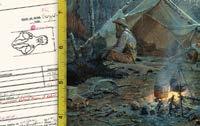
boone-crockett.org/more-score-volume-9
Do you appreciate really big elk? Nasty nontypical mule deer your thing? Maybe you’re more a fan of sheep—Dall’s, desert, Stone’s? Honestly, it doesn’t matter because we have a little bit of everything in this line-up from our most recent recordbook entries.
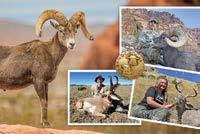
VINTAGE HUNTING ALBUM
The Rifles They Carried
boone-crockett.org/vintage-hunting-gallery-volume-9 The guns that hunters carry tell a story. In these vintage photos, these men and women pose not just with their winter’s meat but also with the tool that helped bring home the bacon. Enjoy this trip down memory lane.
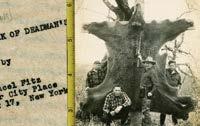
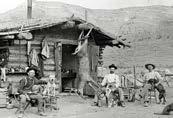
WILDLIFE CAUGHT ON CAMERA
Big Deer and Even Bigger Bears
boone-crockett.org/wildlife-caught-camera-volume-9 Put your boots on because it’s time to head over to Montana’s Rocky Mountain Front. On the Club’s Theodore Roosevelt Memorial Ranch, we’re a tad voyeuristic regarding wildlife there.
From elk to mule deer and badgers to bears, there are plenty of claws, teeth, antlers, and horns to catch on camera.
53 FAIR CHASE | FALL 2023
MISSING THE MARK
As the night sky gave way to first light, familiar silhouettes took shape in the Pacific Northwest woods that had become home over the years. Perched 20 feet above the forest floor in my treestand, I anticipated a chorus of yappy coyotes or a bugling bull ringing through the brushy mixed conifer. Then it happened; the single shrill note of a distant bull sounded off below my location.
Even though this screamer was several hundred yards out, my enthusiasm leveled up immediately. It wasn’t hard to get excited because elk activity had been slow the last couple of seasons. I was slightly on edge with the eerie quiet of opening day and a trail camera full of nothing. However, the 2022 Washington archery elk season was showing some potential.
I have hunted elk in the Cascade rain shadow for years, and this was day two of my 14-year odyssey. I looked forward to filling the freezer with a big-bodied Roosevelt’s elk. I hoped they would cooperate.
BRING THE ACTION
The early morning bull bugled once more, then things went quiet. After stepping up my calling a few hours later, some engaging “herd talk” unexpectedly brought in elk. What sounded like a head of 50 stampeding through the Douglas fir and western hemlock turned out to be a couple of cows and an uber-hyper spike. They were working toward me from below when
the “lady-in-charge” stopped about 20 yards away.
Obscured by dead tree branches to my left, the cow carefully scanned the area. Sensing something was amiss, she started getting uneasy after a few minutes. Finally, she whipped around and bailed deeper into the forest, taking the spike and other cow with her.
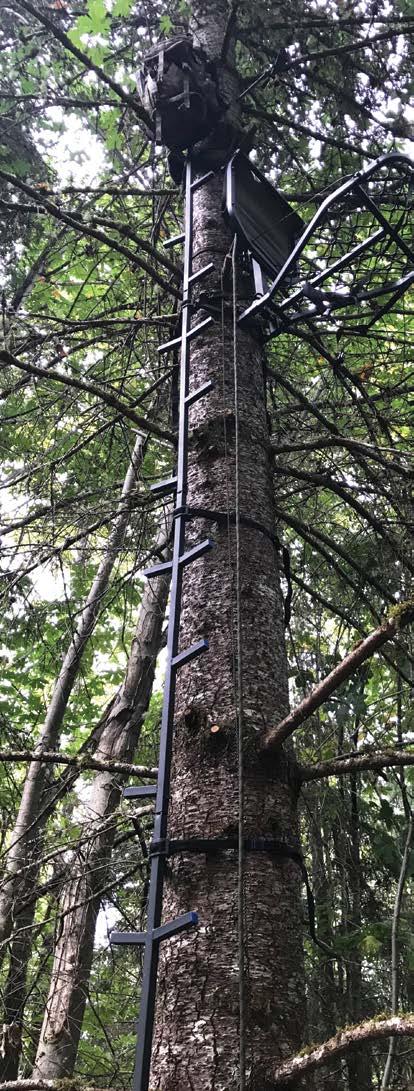
Strike one. I slumped back into my seat, hoping that wouldn’t be the only action for the week. Of course, getting busted was a bummer. But through that encounter, I’d caught a problematic glimpse of my new treestand setup. I had switched out my “lucky tree” for one that concealed better in the edge of this small, partial clearing. Sure, I was better hidden, but the switch brought another problem—too many trees in a major shooting lane.
If an elk came from below as these three did, I’d have a clear shot once it got within ten yards. But an elk could also come from above and move along the trail perpendicular to my location. That would be a perfect
New stand location. A move 20 yards to the right of the “good luck tree” offered better concealment, but at the cost of a good clear shot in a major shooting lane.
This column is dedicated to the system that supports the public hunting of public wildlife for all fair chase sportsmen, and the stories and trophies that are the result. Theodore Roosevelt strongly believed that self-reliance and pursuing the strenuous activities of hunting and wilderness exploration was the best way to keep man connected to nature. We score trophies, but every hunt is to some extent a way of measuring ourselves.
broadside shot with my top pin but with the added complication of snaking a well-timed arrow between small-diameter hardwoods.
It might be a tricky shot, depending on how an encounter unfolded. The potential shot was within my ability, but deep down, I hoped it wouldn’t be the one that presented itself.
ANTLERS AND ADRENALINE
Six days later, while calling from my stand, the snapping of branches about 50 yards to the west startled me. When one crunch was followed by another, I knew an elk was coming. The close proximity and immediacy of the footfalls was jarring. Was it a bull? Was it a cow?
I didn’t know and didn’t care. Either way, it was going in the freezer. I barely had a second to think about it when a young 5x5 bull swiftly emerged out of the tree line.
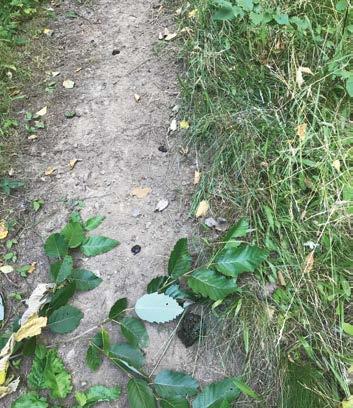
The above-average satellite hopped onto the main trail above me, cut right, and began moving my direction, feeding along the way. He was relaxed and moving with a calm stride—in stark contrast to my racing pulse and short, choppy breaths that verged on hyperventilation. I attempted to draw three times, but the swaggering bull lifted his head when he caught my movement. Freezing in place, I averted detection.
This boy was in no hurry, not even for love. But with an elk’s gait, he was quickly closing the distance, and my shooting window was disappearing. Great, and here’s the shot I didn’t want to take, I lamented to myself. Reduced to a ten-inch space between two alders, any chance of sending an arrow at that bull would soon be gone.
Yanking my bow string back with an uncharacteristic fierceness, everything about this shot setup felt off. With little time to anchor and a hasty line-up, I punched the trigger sending the
arrow zipping from my bow. At the moment of release, I knew it was a lousy shot. This isn’t going to be good, I thought.
It wasn’t.
Watching the impact of my arrow, I stared in horror as it hit the young bull nearly a foot behind his shoulder. My stomach turned, and expletives rang out under my breath as the bull hunched up and tore out. I immediately began cow calling, which brought him to an abrupt stop about 30 yards across the trail from me. Looking unstable, I became confident the bull would drop within minutes. I was already envisioning backstrap steaks on the grill.
But elk are tough, and this bull had other plans. He’d taken up residence in a small area darkened and obscured by overhanging branches and vegetation. My arrow, capped with a lighted nock, was the only sure giveaway he was still there. The 5x5 was only a short distance from me, but a follow-up shot was impossible. I couldn’t shoot. I couldn’t climb out of my stand. I was stuck. Even worse, the lighted nock had become a beacon of despair, making me feel like a bigger idiot the longer this went on.
I could only watch the wounded satellite take a few lethargic steps every ten minutes, amber light beaming from his midsection. As he did, guilt surged through me like a white-hot inferno. Why didn’t I stop him before shooting? Why didn’t I listen to my gut about this new setup? Would he live, or was he mortally wounded?
WHEN IT RAINS, IT POURS
Forty-five agonizing minutes wore on when local thermals started getting shifty. I was now feeling the light breeze blowing into the left side of my face. Because of the change in wind direction, the injured 5x5 got his first whiff of the
After a few days in the stand, hitting the ground with cold call set-ups is great for your mindset. If you’re lucky, it also allows elk to move in and bed down near your stand site while you’re away.
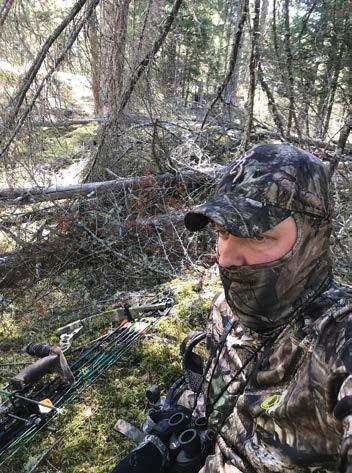
BEYOND THE SCORE
Shawn Lentz
PHOTOS COURTESY OF AUTHOR
Nothing on the trail camera, but elk are obviously around.
jerk sitting in the tree across the trail from him.
Deciding it was time to move along, there was a sudden urgency in the listless bull’s step, and he started up the hill in the opposite direction. Guilt turned to disbelief as I mouthed, “No, no!”
To try and avoid pushing the bull farther, I climbed down from my stand once he was in the thick understory. As I inched up to the trail, I heard the bull start moving again. Making one last note about his location, I turned the opposite way and hightailed it back to camp.
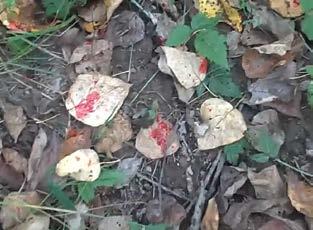
On the way, I crossed paths with a local horse guide who offered to give me a hand, and I took him up on the offer. Two sets of eyes would be better than one for this tracking job. A few drops of blood had leaked to the ground where the elk had taken my arrow, but beyond that, it appeared very minimal. There was no guarantee we’d find an elk to pack out. Still, the guide was all in. Ten hours later, we were back at the location where I shot the bull.
Around midnight I found the initial blood, and
we went to work. To my dismay, it was even worse than I thought. The blood was so sparse we only covered about 40 yards in three hours. At one point, the trail picked up with significant-sized splatters—a brief moment of excitement, only to peter out to a few drops. Then, that was it. The blood trail ended altogether. Suddenly, my headlamp flickered three times, letting me know my batteries would soon die. Fifteen minutes later, the “fourth horseman” arrived with heavy rain. It was the last straw. Incredulous, I called off the search around 3 a.m. I thanked the guide for all his help, and we parted ways.
ONE FINAL PUSH
After two hours of sleep, I returned to make a last-ditch effort to find my bull. Fortunately, the rain had stopped. But the clock was ticking because temps were forecasted to soar into the 80s. Most of the blood had washed away, and only flagging tape remained. Any chance of picking up the blood trail was gone. Walking in the direction I’d last heard
the bull, I looked for fresh tracks, torn-up ground, and other clues. Elk tracks blended into one another in the pulverized soil. Finding a new track wasn’t just the proverbial needle in a haystack— it was a needle among other needles in a pile of haystacks.
For five hours, I searched every nasty, swampy devil’s club-laden hole that made sense. There was no sign of my would-be bull. Finally, I sat in the middle of an old logging road, head in my hands.
A call to my wife provided some much-needed encouragement, and she reminded me of some places to check. But after another hour of searching, the clock had finally run out. I had to break camp, cart out a bunch of gear, and then drive four hours home.
None of this sat well with me. Hiking back to camp one last time, I felt exceedingly heavy. Raw and unrelenting waves of regret pounded me as I reflected on wounding a
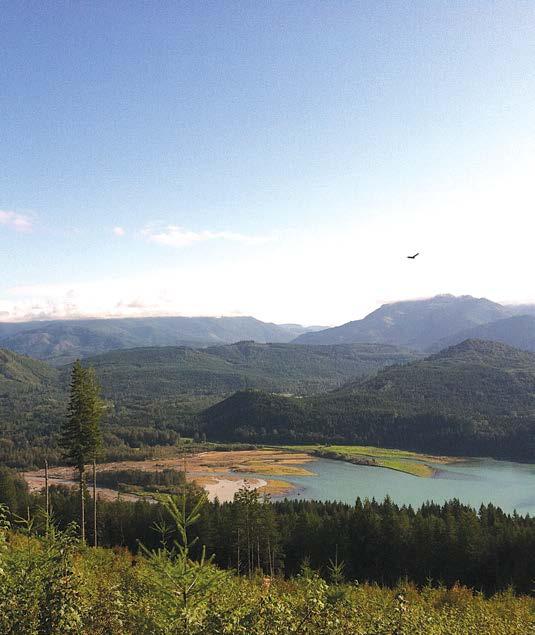
bull and not recovering him. It was my first time losing an elk. I was now a card-carrying life member of a club that no bowhunter wants to be a member of. I spent weeks obsessing about everything I should have done differently.
As someone who often speaks to the importance of ethical hunting and clean kills, I feel like a hypocrite. However, such moments expose an essential truth: preaching values is easy until we miss the mark ourselves. What seem like reasonable choices can lead to bigger consequences than anticipated. The best we can do in these instances is learn and grow from painful mistakes. Hopefully, it will develop us into more mindful hunters when we do. The animals we pursue deserve it. n
Decent blood at the start doesn’t always guarantee a solid path to your quarry. The blood trail quickly diminished after this.
Getting creative while hiking out ten days worth of camp gear. After a long search, with not much sleep, I’m thankful it’s mostly a downhill cruise. The meat cooler doubles as a gear tote when coming in or going out on unsuccessful trips.
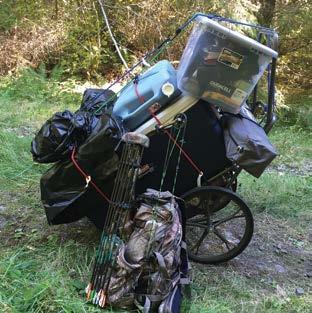
In big elk country, there’s an infinite number of directions a wounded bull could go.

57 FAIR CHASE | FALL 2023 Membership Free prize drawing B&C members only! HOW IT WORKS New upgrade perks! Upgrade your membership to increase your automatic entries—plus get free gifts in appreciation for your added support. Caps, solar-powered flashlight/chargers, subscriptions to Big Game Records LIVE, genuine antler-handle hunting knives and more! Thank you for supporting conservation as a member of the Boone and Crockett Club! $35 MEMBER = 5 ENTRIES $60 MEMBER = 10 ENTRIES $100 MEMBER = 15 ENTRIES $250 MEMBER = 20 ENTRIES $1,500 LIFETIME MEMBER = 25 ENTRIES Every current member will be automatically entered to win on June 30, 2024. The higher your membership level, the more automatic entries you receive! There will be a random prize drawing July 10, 2024. All prizes guaranteed to be awarded! Win B&C gear, books and apparel plus prizes from YETI, Buck Knives, Stone Glacier, Silencer Central, Silver Stag and many more to come. Prizes will be added throughout the year! B&C Membership Giveback promotion void where prohibited by law. Random prize drawing open to Annual and Lifetime members in the $35, $60, $100, $250 or $1,500 levels only. See Official Rules at boone-crockett.org for complete details. Introducing our all-new… UPGRADE TODAY
THE PRAIRIE, THE BOW, AND THE PRONGHORN
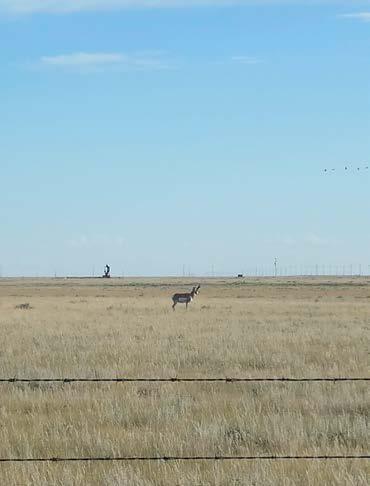
There is one big game animal that is 100 percent unique to the North American continent. He can outrun any critter in terms of endurance and has the eyes of a raptor. You guessed it—it’s the American pronghorn or antelope. Before I tell you my hunting story, let’s start with some science, which is always a good idea.
The pronghorn’s scientific name, Antilocapra americana , means American antelope goat, but the deer-like pronghorn is neither antelope nor goat. It is the sole surviving member of an ancient family dating back 20 million years. The pronghorn is the only animal in the world with branched horns (not antlers), and it’s the only animal to shed its horns—as if they were antlers. About 40 percent of does also grow small horns, but they are much smaller than their male counterparts, who also possess a small prong on each horn, hence their name. The distinction between the sexes is through the visible black hairs on both cheeks of the bucks, known as the sub-auricular gland.
Like sheep and goats, the pronghorn has a gall bladder. Like giraffes, pronghorns lack dewclaws. If that weren’t enough, the pronghorn is the fastest animal in the Western hemisphere, running in 20-foot bounds at up to 60 miles per hour. Unlike the cheetah—speed burner of the African plains—the pronghorn can run for hours at a cruising speed of 35 to 40 mph! They are also called “long-legged cursors” and have evolved to run. They have large eyes with pigmentation, enabling them to cope with the sun’s blazing rays in summer and reflections from snow in winter.
Scientists believe 40-50 million pronghorns once lived from southern Saskatchewan to northern Mexico, west to southeastern Oregon, and southwest to Baja California. Market hunting in the 1800s reduced their numbers to as low as 12,000 by 1915. Since then, through several management programs developed by U.S. Fish & Wildlife Service biologists in Wyoming and Montana, as
FAIR CHASE | FALL 2023 58
ALEXANDER SHARIF PHOTOS COURTESY OF AUTHOR find
yo ur path adventu r e awaits DIY
Read more about the Club's involvement in recovering pronghorn on page 8.
Using a decoy to bowhunt prairie pronghorn is just plain fun. Here’s how I do it.
A familiar sight in southern Alberta’s prairies: oil rigs, native fescue grasses and the pronghorn.
well as the Canadian prairie provinces, pronghorns have made a remarkable comeback. Biologists currently estimate their numbers to be around one million.
Southern Alberta represents the northern range of this wonderful plains dweller, and it takes 10-12 years to draw a tag for a buck. The population of pronghorns in Alberta fluctuates with harsh/mild winters and is around 15,000 animals. Roughly five percent of the population is set aside for draws. The mere fact that someone like myself has the privilege to hunt this wonderful and unique prairie animal is only possible thanks to the vision and relentless conservation efforts of pioneers such as Theodore Roosevelt, Aldo Leopold, and Wilfried Laurier.
HUNTING THE MIGHTY PRONGHORN
Since childhood, my passion for hunting has mostly been centered around a scattergun and a rifle. As I grew older, the silence and stealth of bow hunting started appealing to me. I got my first compound bow in 2009 and practiced at
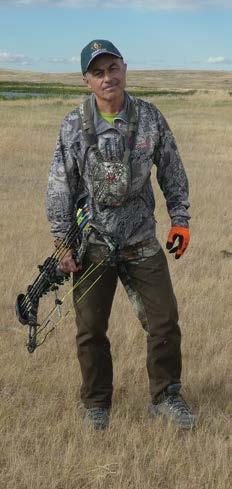
targets. My goal was to get my first kill on a pronghorn. After drawing a tag that only lasted three weeks, I put things in motion for success.
I knew this would not be easy as the game is skittish, the country is open, and the nemesis of the archer (wind) always blows. I also knew I would be shooting from a crouched position off my knees and started shooting my bow that way.
Archery pronghorn hunts are two types. You either set up a blind at a watering hole and wait or use a decoy for a spot-and-stalk approach. I fancy the latter. Looking at what was available for decoys in the retail market convinced me to build my own for several reasons. I wanted a more realistic, three-dimensional look to plant into the ground with a pivoting system in case I had to hunt alone. After all, I am an engineer by trade! This decoy has been responsible for luring and killing at least ten bucks, but that’s a story for a different time.
With a fair bit of shooting practice out to 50 yards and a bona fide spirit, I showed up with my buddy
Hank on the opening day in southern Alberta’s prairies. My tag was for a tri-zone area, which borders a military base to the east and farmlands to the south. However, I would concentrate on the northern areas where bald prairie, undulating hills, and frequent oil rigs decorate the landscape.
Here’s how a pronghorn archery hunt should be orchestrated. You drive around until you spot a herd, which will inevitably have several smaller bucks and one herd buck in early
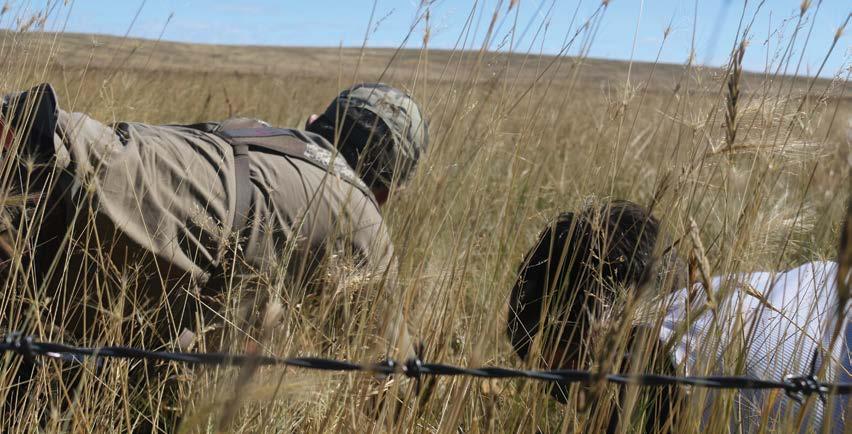
59 FAIR CHASE | FALL 2023
Crawling under barbed wire in the cactus infested prairie takes determination.
ABOVE: Alexander demonstrates why hunting pronghorns with a bow is challenging and requires patience.
LEFT: His homemade decoy made from pine works like a charm to lure bucks in close.
September. Once that happens, you get out of their sight quickly. Park the truck, grab your bow and formulate a stalk to get close to them. If you can gain elevation, more power to you. You then have your buddy pop the decoy while you both hide behind it for the hunt. You must have an arrow nocked and a rangefinder handy, as things can happen quickly. The herd bucks often do not opt for a fight, grab their ladies, and leave. But that is not always the case. The bucks that check out the decoy are typically subordinate satellite bucks. Remember that pronghorns have excellent eyesight and use it to evade predators. Their sense of smell is not as strong, perhaps because they compensate for it with their vision.
OPENING DAY MADNESS
On opening day, we hunted very hard and stalked until dark. For one reason or another, our stalks were busted. My only chance at a shot came when we were just getting set up to pop the decoy. Before I knew it, a buck was inside the 40-yard circle checking us out. By the time I had stopped fidgeting with my bow and
tried to nock an arrow, the buck had had enough. It loudly snorted, raised the hair on that gorgeous white patch on its rump, and trotted to the adjacent county. Not wearing the proper knee and elbow protection didn’t help us, as my body was infested with cactus thorns. On two other stalks where a buck came in, they would stand just outside of my comfortable bow range and stare at the decoy.
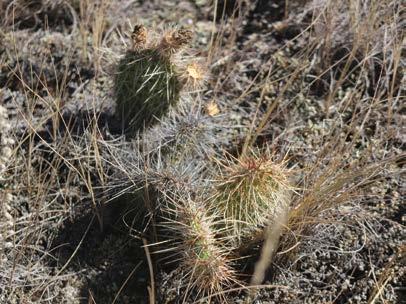
Opening day taught me some grand lessons. I let my wounds heal, practiced more, and returned to the prairie with a more determined spirit. I also poked one more hole in my decoy that would allow me to look at a buck while crouched behind the decoy holder.
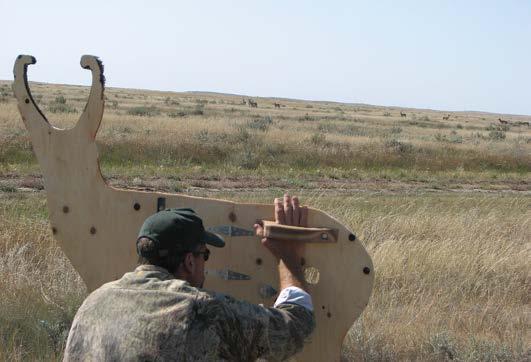
By this time, the rut had reached its peak, and every single herd had a herd buck either running after the does to round them up or trying to chase off an intruding buck. This was a good thing as it would allow us to get closer to the herd while the buck had its mind set on the chase.
Our stalk on at least three separate herds was futile, with either the herd buck leaving the area with his
harem or one of the does getting fixated on our stalk. I started to feel like we were doing something wrong, but I tried to stay positive and soldier on.
DECOY FOR THE WIN
At noon one day, we drove to a side road, parked the truck, and had lunch. As I often do on my warm weather hunts, I took a siesta after a cold beer and sandwich. The prey is sleeping, so why not the predator? Around three in the afternoon, we had a stiff cup of coffee and continued the search. As I turned the corner on a dirt trail going north, something in the distance caught my attention. We quickly drove behind a knoll and set up the spotting scope.
It was a lone, mature buck grazing and minding its own business. Its horns glittered in the bright prairie sun, and it had that gorgeous orange-white pelage that the pronghorns are known for. This would be ideal as there were no does to watch us. Just in case, we made a big circle to get downwind, crawled under a fence, and popped the decoy. At this point, the buck was 400 yards away. Sure enough, the sight of that
decoy aroused its curiosity and started its slow but deliberate march toward us.
The buck came to exactly 27 yards and stopped. My heart was virtually coming out of my throat from excitement. It was a beauty with perfectly symmetrical horns and good mass. After a short prayer, I gathered my nerves and went to full draw from a kneeling position. The arrow found its target, but I saw it hit a little back. It slowly walked away, jumped a fence, and bedded down 100 yards from us. Its body language showed a liver hit, as all animals generally lie down when shot in the liver. We sat there silently and watched.
After about an hour and a half, another buck appeared out of nowhere and wanted to challenge this poor fellow that had no interest in a sparring match. I rose from my sitting position to show myself, and the buck got the message and left. The buck had weakened by then, and I crawled closer for a finishing shot. This was done with no issues, and I finally had my pronghorn buck. It was a stud with a perfect cape and a great set of horns.
FAIR CHASE | FALL 2023 60
Alberta’s prairies are full of cacti and other plants that can poke you. Wear sturdy pants, knee pads and gloves.
Alexander's buddy Gilles behind the driver seat. Notice the addition of a second peep hole on the decoy to spy on the incoming bucks.
After a short prayer of gratitude, we took a handful of photographs and gutted the buck. Just as we dragged him to the road, the challenger buck reappeared. This time, we hid behind the decoy, let it come close, and took many close-up photographs and videos. I could hear its breathing rhythm and feel the sense of urgency in its demeanor. What a cool experience for both of us to get into the comfort zone of one of the American prairie’s most seclusive and nervous animals. Our three-hour drive back home was filled with joy, laughter, and reminiscing of all the failed and successful
stalks we experienced on that warm September day.
After the 60-day mandatory drying period, I had the buck scored by an official Pope & Young Club measurer. The buck scored 68-4/8 points, earning it inclusion in the P&Y record books. This was absolute gravy to a hunt that was already a memorable experience.
In sum, I thank my buddy Gilles who accompanied me on this hunt, and all the conservation pioneers who helped bring the pronghorn back from near extinction. The American West is a prettier sight with the pronghorn. Don’t you agree? n
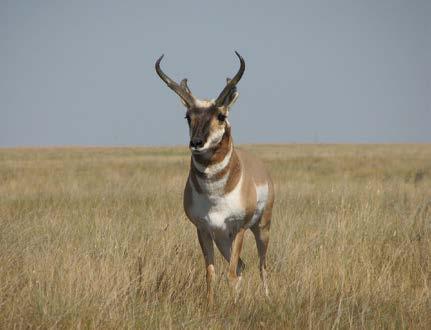
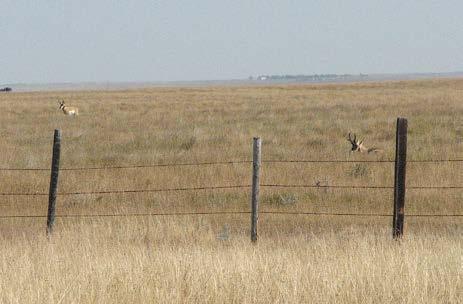
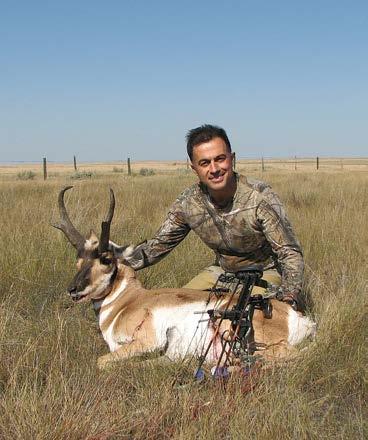
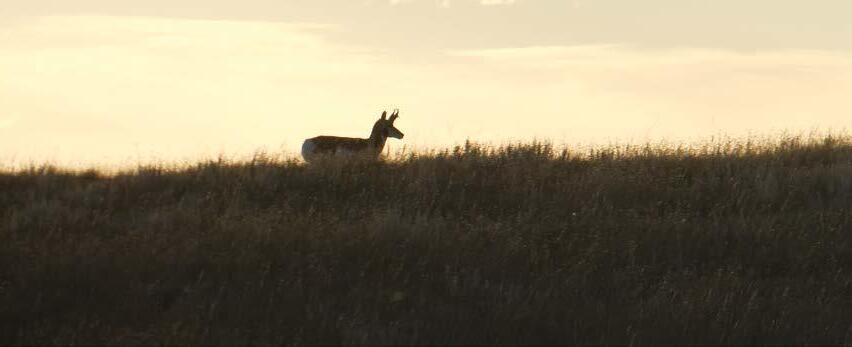
61 FAIR CHASE | FALL 2023
If you have any DIY hunts you would like to see featured in this column, please email Karlie Slayer at Karlie@Boone-Crockett.org.
BELOW: The buck Alexander hit was struck in the liver and was bedded down. A challenger buck showed up for a sparring match. BELOW RIGHT: This was the challenger buck that we lured in to a close 10-yard distance. They could hear him breathing.
Alexander with his buck. He was walking on the clouds after he was able to wrap his hands around his dark horns.
It was a lone, mature buck grazing and minding its own business.
OFFICIAL MEASURER WORKSHOPS
The Boone and Crockett Club’s records exist because of the efforts of our volunteers. The 1,450 Official Measurers (OMs) not only score entries but also serve as the face of the Club to most of the public. Due to the amount of enthusiasm and effort they bring to the Club, we try to train them to serve effectively for the organization while ensuring it is enjoyable and fulfilling for them.
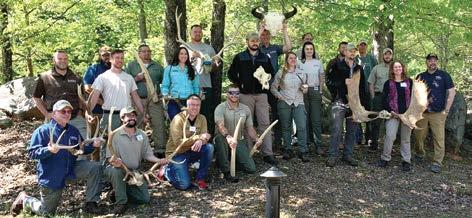
This spring and summer, we conducted seven Official Measurer classes, with the first being in conjunction with the Pope and Young Club’s annual convention in Reno. This relationship continues to blossom thanks to the early efforts of Richard Hale and Kevin Hisey, then continuing with Ed Fanchin and Roy Grace from Pope and Young and Mike Opitz from Boone and Crockett. Both organizations now use a joint measurers manual, and we try to teach courses in conjunction with each club— more on that in a bit.
The system of scoring big game for both organizations is the same. In fact, with the creation of Pope and Young in the 1960s, permission was given to use our system to promote Pope and Young’s mission. For many years, Pope and Young’s measurers were trained well in applying the system for scoring but did not receive the training in Boone and Crockett Club history and mission. As such, at the last two Pope and Young conventions, we offered a one-day course heavy on history and mission for Pope and Young measurers in good standing. We cover a few slight differences in scoring rules, such as quarter locations above or below the prong on antelope
and where to start the length of horn measurement on bison. Eight measurers completed this one-day course at the beginning of the convention.
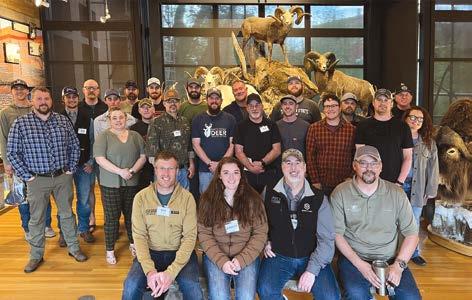
The week following Pope and Young’s convention, we were in Georgia at the Charlie Elliott Wildlife Center outside Mansfield. This workshop was a joint effort, with graduates completing both certification tests and receiving dual appointments for both organizations. All students were employees of Georgia’s Wildlife Resources Division. They have a state-specific records program called the Georgia Deer Registry, which uses Boone and Crockett’s scoring system. These newly appointed OMs will serve in a role for Boone and Crockett, Pope and Young, and their state records program for the citizens of the Peach State. While the majority of trophies these OMs will most likely encounter include black bear and whitetail deer, the Boone and Crockett Club OM course trains these folks to score all 38 categories of big game recognized by the Club. After a lecture/ demonstration on appropriate scoring methodology per category, students must score two of each species. This workshop started Sunday evening and concluded by midday on Thursday. Students’ knowledge is tested throughout the course with pop quizzes, as we also cover Club history and measuring
techniques. Official Measurer and organizer of the workshop, Kevin Lowrey, provided a well needed break from instruction and scheduled an afternoon of clay target shooting at Clybel Shooting Range on site.
In early May, we hosted students from across the U.S. and Canada in Missoula, Montana, for the third workshop of the year. Being back in Missoula was a pleasure, bu f t the changes to Montana tourism from the last few years are evident as a new host location had to be found. This class was at a local hotel, and students were able to visit the Boone and Crockett Club headquarters. In the evening, they could tour around the area and see the sights of western Montana. Missoula is generally one of our least expensive locations
to host a course because we don’t have to ship our crate of trophies and materials to a location ahead of time. That said, students are still making a very significant financial commitment to the Club by just showing up. The course costs around $400 for the full four days of instruction. Students are also responsible for hotel, food, and travel to get here.
On May 13 and 14, the Pope and Young Club hosted its second annual Bowhunter’s Bash in Ogden, Utah. This Friday and Saturday event
FAIR CHASE | FALL 2023 62
TROPHY TALK
Justin Spring B&C PROFESSIONAL MEMBER DIRECTOR OF BIG GAME RECORDS
Mansfield, Georgia Workshop
Missoula, Montana Workshop
was the last couple days of the concurrent workshop held starting Thursday. Attendees completed the joint course and participated in the banquet, which included an auction with hunts from around the world. It also served as a qualifier for the National Field Judging Championships held every other year at their convention. The banquet and workshop were held at the Weber County Archery facility. Mark your calendars to attend these regional events, as it’s all for a good cause and a lot of fun for those who can participate.
Early June had us back in Montana, this time we were at the Club's Theodore Roosevelt Memorial Ranch in Dupuyer. This was our second immersive, all-inclusive conservation course. In these workshops, we teach scoring and discuss conservation issues, which means we have
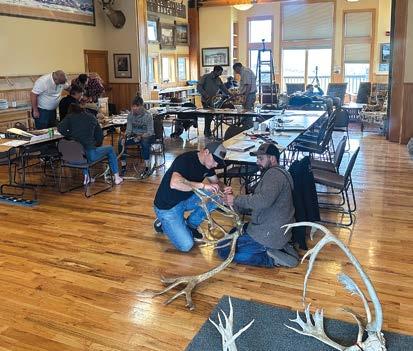
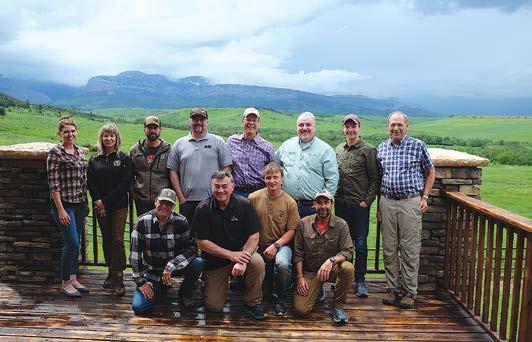
far more presenters than in a general course. The most recent course had a Zoom presentation from Boone and Crockett Club President James Cummins, who covered Club history. Also, Dr. Jon Gassett gave an overview of the Club’s ongoing Poach and Pay Program. In-person presentations included Dr. Jon McRoberts of the University of Montana, covering ranch research and the Club’s University Programs. Tayler LaShaar from the University of Wyoming’s Monteith Shop presented both her graduate work using harvest data to see if records could be used for monitoring herd trends as well as the Wildlife Monograph authored by Kevin Monteith and numerous other Club professional members utilizing the Club’s record data set. Boone and Crockett Club CEO Tony Schoonen presented on the
Club’s involvement in creating the American Wildlife Conservation Partners and our active participation. He also covered a few of the efforts the Club is involved in through our conservation policy group. That evening, Club lobbyist Charlie Booher hosted a round table discussion called “Policy on the Porch.” This impromptu name came about as the Rasmussen Conservation Center front porch had an amazing backdrop of the Rocky Mountain Front with excellent temps for an outdoor discussion after dinner. Records chairman Mike Opitz and ethics chairman Mark Streissguth attended. They addressed the class, and Mark
FAIR CHASE AWARD
On April 14, 2023, at Pope and Young Club's 33rd Biennial Convention the Club presented the firstever Fair Chase Award to a bowhunter from Ohio. The award is a way to help support Pope and Young’s efforts and highlight a noteworthy trophy and hunt in their program that highlights Fair Chase ethics. Nicole Miller has always hunted with her father, and they had been hunting one particular deer since 2018. After a few close calls over the years, in late October of 2021, Nicole finally got a shot at the impressive whitetail. Her arrow flew true, and the buck dropped only 80 yards from the stand. Nicole’s persistence and effort resulted in the largest typical whitetail buck ever taken by a female bowhunter; its final panel-verified score is 191.

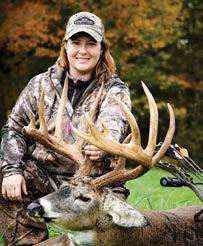
63 FAIR CHASE | FALL 2023
TRMR Immersive Workshop
Nicole Miller was presented her Fair Chase Award by Justin Spring and B&C Regular member Ben Wallace (far right) at Pope and Young Club's 33rd Biennial Convention.
April 12-15, 2023 — Reno, Nevada
P&Y 33rd Biennial Convention
Mike Adkins - Tallassee, AL
Alan Baxter - Bloomington, IN
Sean Carls - Onconta, NY
Henry Coats - Rena Lara, MS
Jerry Combs - Belleview, FL
Joshua Knoebel - Springfield, OR
Bob Tastsides - Crystal Lake, IL
April 16-21, 2023 — Mansfield, Georgia Workshop
Joshua Aldridge - Armuchee, GA
Robert A. Andrews - Cartersville, GA
Emily H. Belser - Warwick, GA
Allison G. Colter - Richmond Hill, GA
Jarrell J. Colter III - Brunswick, GA
Matthew Cooper - Kathleen, GA
Stephen Giles - Gainesville, GA
Matthew J. Goode - Social Circle, GA
David Gregory - Armuchee, GA
Joseph V. Harnage - Brunswick, GA
Matthew J. Hinman - Blue Ridge, GA
Owen T. Jenkins - Preston, GA
Diana J. McGrath - Albany, GA
Allison Melcher - Rome, GA
Kevin R. Rose - Newnan, GA
Evan Shirley - Baldwin, GA
Ryan Watts - Clayton, GA
Seth A. Williams - Gay, GA
Taylor Winchell - Buena Vista, GA
May 3-7, 2023 — Missoula, Montana Workshop
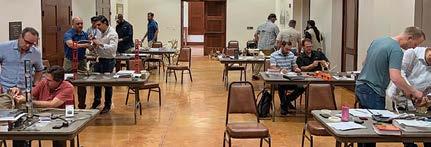
Duncan Q. Crawford - Covehead, PE
Arlis G. Hanson - Val Marie, SK
Jordan R. Hanson - Watford City, ND
D. Adam Keene - Great Falls, MT
Duane R. Kramer - Bellingham, WA
Bransen Krebs - Plains, MT
Randall Kroll - Nacogdoches, TX
Sherry L. LeChasseur - Lloydminster, AB
Quincy J. Locke - Livi, MT
Ethan S. Lula - Trego, MT
Vince E. Massarotti - Weston, CO
C. Cheyne Matzenbacher - Blue Eye, MO
Bobby M. Priest - Phoenix, AZ
John Riebel - Pomeroy, OH
Dustin L. Robben - Dixon, CA
Lance Rochelle - Jonesboro, AR
Dillon J. Tabish - Kalispell, MT
Jim Thomson - Maple Ridge, BC
Elizabeth B Vaught - Clarksville, AR
Darren K. Wallsmith - Pitt Meadows, BC
Want to Become an Official Measurer?
Scan the QR code to Fill out the Official Measurer Application!
May 13-14, 2023 — Ogden, Utah
P&Y Bowhunter’s Bash
Michael Carter - Whitehall, MD
Logan Cote - Garson, MB
Nicholas Frase - New Richmond, WI
David Griffith - E. Rochester, NY
Thomas Karl - Kewaunee, WI
Chris M. Kossmeyer - Marceline, MO
Jacob A. Kremer - Desmet, ID
Wade A. Lisac - Pueblo, CO
William A. Pettett, Jr. - Kremmling, CO
Clinton Reynolds - Royal, AR
John G. Stach - Williston, ND
Brenton Taft - Sandia Park, NM
Brian G. Taylor - Indian Mound, TN
Bradley R. Wahlin - Riverton, UT
June 4- 8, 2023 — Dupuyer, Montana
TRMR Immersive Workshop
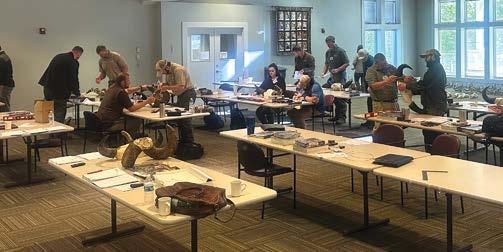
Holly Hammond - Hazel Green, AZ
John Hendrix - Anchorage, AK
Riley Leuenberger - Jaffray, BC
Andrew McKean - Glasgow, MT
Rick Pflanz - Huntingburg, IN
Ricky Planz - Huntingburg, IN
Tim Shinabarger - Billings, MT
Rick Spring - North Bend, OR
Nicole Tatman - Sant Fe, NM
June 27 - July 1, 2023Kingsville, Texas/Mexico Workshop
Jacobo Artee - Hermosillo, Sonora
Jorge Artee - Hermosillo, Sonora
Rogelio Carrera - Monterrey, Nuevo Leon
Emilio Espino - Monterrey, Nuevo Leon
Abraham Garcia III - Laredo, Texas
Rodrigo Guerrero - Saltillo, Coahuila
Alejandro Lozano - Saltillo, Coahuila
Jose Luis Marroquin - Monterrey, Nuevo Leon
Omar Ocañas - Monterrey, Nuevo Leon
Diego Olaguibel - Zaragoza, Coahuila
Luis Horacio Salinas - Saltillo, Coahuila
Jose Vallina - Monterrey, Nuevo Leon
FAIR CHASE | FALL 2023 64
WELCOME NEW OFFICIAL MEASURERS
Mansfield, Georgia Workshop
Kingsville, Texas/Mexico OM Workshop
led a discussion on technology in hunting and the Club’s positions. We have gone two for two on these workshops in spotting grizzly bears on the ranch. This time we had to work a little harder, though, and on the last evening near the watchable wildlife trail, a sow and cub were spotted just above the hay meadow on the ranch.
This workshop is a great opportunity for folks who want to learn about a good portion of what the Club is doing from those in the actual arena, get trained in official scoring, and witness conservation in action. The weeklong event covers food, lodging on the ranch, and transportation to and from the Great Falls Airport. The general cost is $2500/student but current Official Measurers looking to take a refresher and learn more about the Club are given a $500 discount.
At the end of June, the Club hosted a workshop in
B&C Sign-Up Incentive Program Leader Board
As of July 17, 2023
CONGRATS TO OUR TOP 10 PRIZE
WINNERS!
1. Philip A. Herrnberger – 276
2. Stanley Zirbel – 172
3. Bucky Ihlenfeldt – 159
4. Ken Witt* – 113

South Texas at Texas A&M Kingsville. This was a smaller course directed at Official Measurer applicants from Mexico. As a department, we are looking at ways to better include Mexico and bring the Fair Chase message south of the border. We are closing out the summer with joint workshops in Missouri and Kentucky.
If you are interested in attending one of these courses, please go online and submit an online application. If you are interested in the immersive workshop, please contact me directly, as we have one on the calendar for next June. If you are looking for a way to become more involved in the Club’s efforts, I highly recommend becoming an Official Measurer. n
5. Dale Weddle – 88
6. Steven Taylor – 77

7. Jerry E. Lunde – 57
8. John Bogucki* – 46
9. Matt Olson – 37
10. (tie) Eric Stanosheck – 33
10. (tie) Robert Wood – 33
SEE THE COMPLETE LISTING IN THE COMMUNITIES SECTION ON OUR WEBSITE .
Each time an OM gets someone to join B&C we put a credit by their name!

HERE’S THE BREAKDOWN
3 Members – $25 off any item in the B&C store
5 Members – Buck Knife
10 Members – B&C Boyt Sling
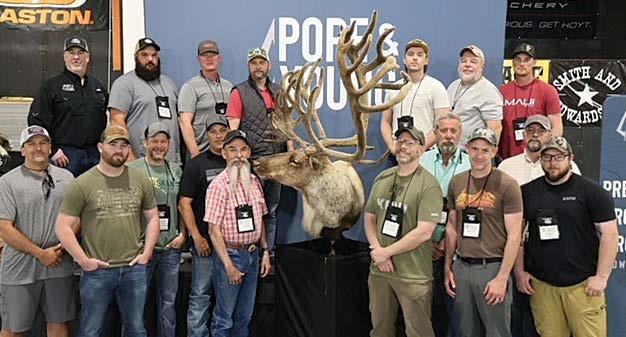
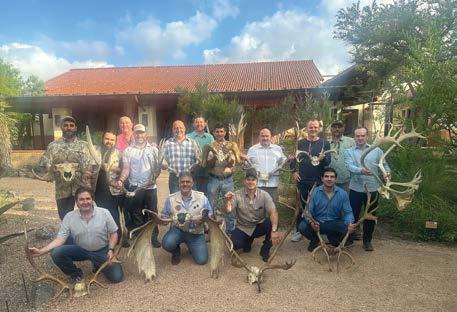
25 Members – OM Wool Vest
50 Members – SITKA Gear (value up to $350)
75 Members – YETI Package (value up to $500)
100 Members – Kimber Rifle
150 Members – $800 Gift Card to Bass Pro Shops/Cabelas!

200 Associates – Vortex Optics Gear! (value up to $1400)
300 Members – Kenetrek Boot Package (value up to $1,500)
400 Members – Kimber Rifle! (value up to $1,500)

500 Members – Hotel & registration plus $500 travel stipend to the next Awards Banquet
Would you like to give an Official Measurer credit for your renewal? Let them know when it is your time to renew and they will provide their OMID number to include with your renewal so they will receive credit.
65 FAIR CHASE | FALL 2023
*deceased
Ogden, Utah P&Y Bowhunter’s Bash
Kingsville, Texas/Mexico OM Workshop
JACK STEELE PARKER GENERATION NEXT
The Boone and Crockett Club celebrates young hunters who have embraced the outdoor way of life and embody the spirit of fair chase hunting. The following is a list of the most recent big game trophies accepted into Boone and Crockett Club’s 32nd Big Game Awards Program (2022-2024), that have been taken by a youth hunter (16 years or younger). All of the field photos in this section are from entries that are listed in this issue and are shown in bold orange text .
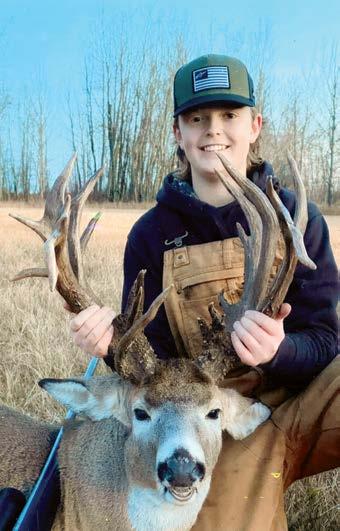
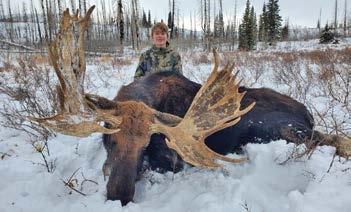
This listing represents only those trophies accepted since the Summer 2023 issue of FairChasewas published.

FAIR CHASE | FALL 2023 66
FINAL GROSS SCORE SCORE LOCATION HUNTER DATE MEASURER BLACK BEAR 21 2/16 Mille Lacs Co., MN Kylee A. Kramber 2022 S. Grabow COUGAR 14 8/16 Washoe Co., NV Chase A. Spencer 2022 L. Clark ROOSEVELT’S ELK 290 1/8 304 Lane Co., OR McKenzie M. 2022 G. Childers Spencer TYPICAL MULE DEER 183 191 5/8 Duchesne Co., UT Ivy S. Neilsen 2022 B. Capes NON-TYPICAL MULE DEER 232 5/8 242 7/8 Franklin Co., ID Dawson H. Beutler 2022 D. Nielsen TYPICAL WHITETAIL DEER 170 3/8 188 5/8 Page Co., IA Michael J. Blane 2022 K. Fredrickson 166 171 Todd Co., MN Brayden S. Rivard 2020 J. Olson 163 2/8 177 7/8 Osage Co., MO Henry A. Storm 2022 L. Lueckenhoff NON-TYPICAL WHITETAIL DEER 219 2/8 228 5/8 Lac St. Anne, AB Norman R. Patrick 2021 C. Andersen 204 4/8 212 5/8 Dixon Co., NE Jacob J. Eisenhauer 2022 R. Stutheit 192 5/8 200 1/8 Tama Co., IA Ava M. Boldt 2022 C. Pierce 187 6/8 202 5/8 Jasper Co., IN Alexander L. 2022 J. Moore Rahmoeller SHIRAS’ MOOSE 156 2/8 164 4/8 Cassia Co., ID Cade J. Ward 2022 T. Peterson PRONGHORN 82 2/8 83 2/8 Crane Lake, SK Jordyn E. Duncan 2021 R. Schaal
Cade J. Ward
Norman R. Patrick
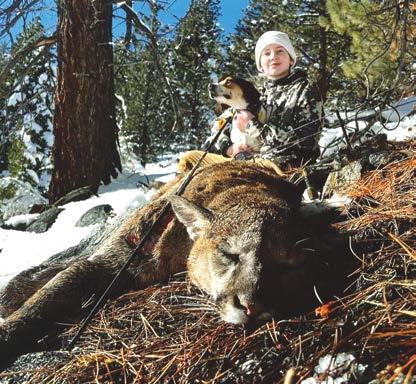
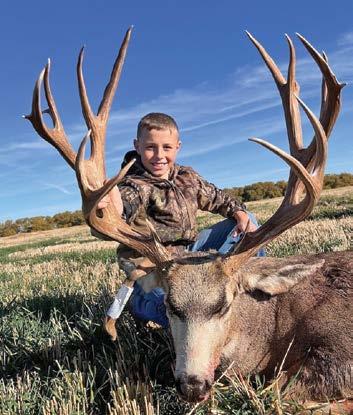
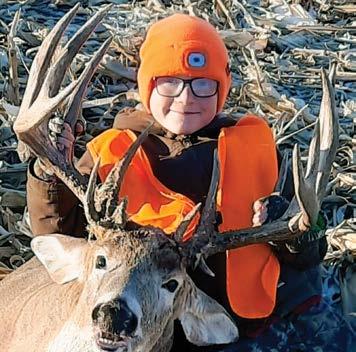
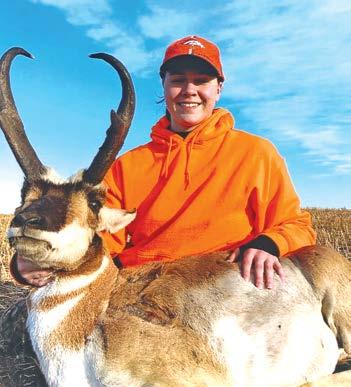
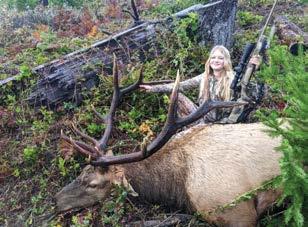
67 FAIR CHASE | FALL 2023
Dawson H. Beutler
Jacob J. Eisenhauer
Michael J. Blane
Chase A. Spencer
Jordyn E. Duncan
McKenzie M. Spencer
NEXT
BUCK OF A LIFETIME
On the morning of November 26, 2022, I awoke with excitement. My younger brother Kody had taken his first Coues’ deer on opening morning the day prior. It was an impressive 93-inch buck, and I was ready for what the day had in store. A close friend of my dad’s had been scouting for Coues’ deer a little over a mile away from us the day Kody harvested his buck. Dad’s friend had glassed up a really big buck. Dad and I knew we had a great chance at taking this buck because my dad and grandfather have been hunting this area on and off for more than 34 years and had also killed some great bucks there.
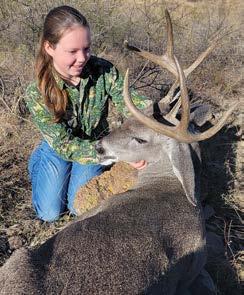
Leading up to our late November deer hunt, we spent a lot of time after my dad’s Arizona bull elk hunt getting ready for our upcoming hunts. Kody and I had junior javelina tags, which we filled in October and November. While hunting javelina, we glassed some good shooter bucks and made a plan for our deer hunt that was quickly approaching.
On the day of the hunt, we arrived at our hunting destination, and thankfully, no one was parked where we normally do. We could see headlights in the distance, but we were not concerned. The game was on to find the
buck we had a photo of. Not too far in the distance were my grandfather and his hunting partner, who both played a huge part in the success of my big game portfolio. We quickly started glassing from the truck before hiking onto a ridge that we wanted to be on. While working our way in, we spooked a couple of does. After about 20 minutes of hiking and getting poked by mesquite trees, cactus, and nasty cat’s claw, we were finally glassing for the buck.
As the sun crept over the horizon, we saw a few does. Suddenly we picked up a 90-inch buck pushing a doe. We continued glassing when I heard my dad say, “I found a good buck, guys.” I did not know if this was the buck we had a photo of, but Dad was excited, so I knew it was a shooter buck. We discussed a game plan and started our stalk. We would stop about every 50 to 75 yards to check and verify he was still around. We found a solid 100inch buck at 630 yards along the way, directly between us and the buck we were after. Dad had taken his eyes off his binoculars and pointed to where the buck was. When he looked back up again to locate him, he was gone. The Coues’ deer was living up to its nickname of “the grey ghost.”
We shifted back to our original plan and were

quickly closing the distance. As we rounded the edge of the ridge, a buck jumped out of its bed to the left of us about 60 yards away. My brother and I softly yelled at Dad. “Dad! Dad! There’s a buck! Dad! Buck!” When he turned around and saw the buck trotting away, he knew it was a good buck. I got into the prone position with my Remington 7mm-08 and located the buck in my scope at 335 yards going up the ridge we had just hiked down. It would not stop long enough for me to take an ethical shot. The buck reached the skyline, and I heard, “Stop! Stop! Stop! It’s getting too close to the top of the ridge. Let him go. Don’t shoot.”
With my heart pumping, we quickly discussed that the 100-inch buck we had seen earlier had moved slightly and bedded in the short time our eyes were off him. We all looked at each other and then turned to find our buck still on the mountain ridge. By now, he was hanging about three feet below the skyline. We maneuvered ourselves to the top of a little knoll to find a perfect spot to shoot prone. I got the bipod and rifle into position while Dad ranged the buck at 485 yards. Since we had nowhere else to go to get a closer shot, it was all or nothing.
Dad watched through his binoculars as the buck
walked just below and parallel to the skyline. We feared he might top over soon and were waiting patiently for the perfect opportunity for him to drop down to get a safe shot. The buck decided to turn away from us, and over the ridge he went. We talked for a few minutes, summing up the scenarios that had just played out over the last hour or so. Dad returned behind his binoculars to search the ridgeline, wondering if he might pop back over our way. Not very long after my dad put his binoculars up to his eyes, my brother and I heard, “I see the tips of his horns walking back the opposite way he went.”
FAIR CHASE | FALL 2023 68
JACK STEELE PARKER GENERATION
Riley Green
PHOTOS COURTESY OF AUTHOR
I got back down on my stomach and behind my rifle, trying to search for the buck in my scope. I kept hearing Dad ask me if I could see him, and I finally found the buck. He was proceeding back over the ridge in full view, and I had the mountain as the perfect backdrop. “Whenever you’re ready, squeeze the trigger,” he said. I positioned my finger on the trigger just like I’d practiced. Then I slowly squeezed the trigger on the spot I picked out on his shoulder. I waited for the surprise, and “BOOM.” I looked up at Dad to find his reaction. I waited a few seconds. “Well, did I get him?” He slowly turned to me, shaking, and said with a big smile, “You damn sure did. You got him. Congratulations!” I received a huge hug, knowing I had just killed my second Coues’ deer, and anxiously wondered how good this buck really was.
After a few minutes of gathering our emotions, we developed a game plan for approaching the buck. We marked the spot from where I shot and pushed our way up the mountain. Time seemed to take forever as the mesquite trees and cat’s claw slowed us down from our destination. We were around 20 yards from where we had seen the buck go down. Dad put me in front of him as we were closing the distance. I saw the buck lying on the ground just beyond some brush. I turned to Dad with my face in awe. It was the biggest buck I had ever seen, dead or alive. “You did it. That’s the big buck we have the photo of. You killed it!” Dad said. Hugs and congratulations were never-ending. My
dad knew this was the big buck the whole time but didn’t want me to get excited or nervous before the job was done. As we returned to the truck, I realized this was my second Coues’ deer and my biggest buck ever. Dad said it would take a lot of work to top it. I was blessed to shoot a buck of this caliber, but more importantly, I harvested a buck bigger than Dad’s biggest buck—and had a wonderful hunt with family and friends, making it even more special. n
MARK YOUR CALENDARS!
All youth hunters 16 years old or younger, who have a trophy accepted in our 32nd Awards (2022-2024) will receive an invitation to our Generation Next banquet, which will be held in the summer of 2025.
WE HOPE TO SEE YOU THERE!
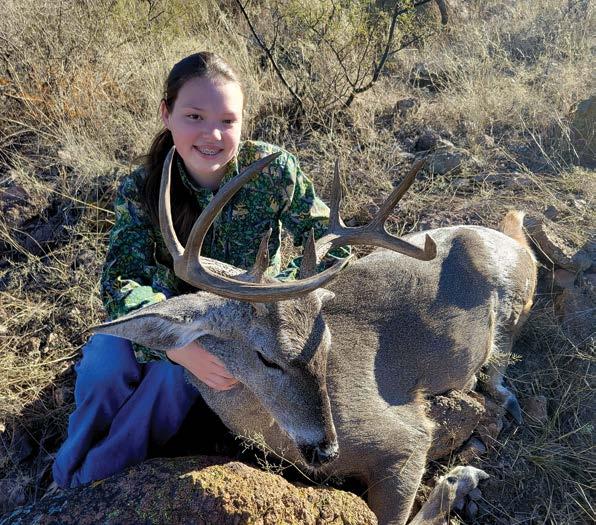
69 FAIR CHASE | FALL 2023
Riley with her "grey ghost."
RECENTLY ACCEPTED TROPHIES 32ND BIG GAME AWARDS LISTING AND PHOTO GALLERY
The following pages list the most recent big game trophies accepted into Boone and Crockett Club’s 32nd Big Game Awards Program, 20222024, which includes entries received between January 1, 2022, and December 31, 2024. All of the field photos in this section are from entries that are listed in this issue and are shown in bold green text .
This listing represents only those trophies accepted since the Summer 2023 issue of Fair Chase was published.
SPONSORED BY
Segille C. Jones was hunting in Penobscot County, Maine, in 2022 when she harvested this black bear scoring 20-6/16 points. She was shooting a .270 Winchester Mag.
FAIR CHASE | FALL 2023 70
BEAR & COUGAR
TOP TO BOTTOM
B&C Member Patrick J. Hagens took this Alaska brown bear, scoring 29-6/16 points, in 2022 while on a hunt near Cold Bay, Alaska. He was shooting a .338 Ultra Mag.
This cougar, scoring 14-9/16 points, was taken by B&C Lifetime Member Steven D. Kellesvig while hunting in Las Animas County, Colorado, in 2021. He was shooting a 6.5 Creedmoor.
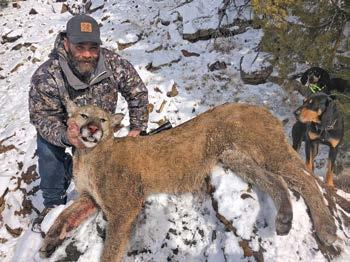
In 2022, B&C Member Michael T. Kinney harvested this 411-2/8-point non-typical American elk while on a hunt in Navajo County, Arizona. He was shooting a .300 Weatherby.
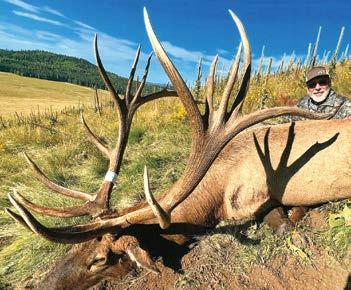
71 FAIR CHASE | FALL 2023 BLACK
22 6/16 Douglas Co., NV Travis G. Hawks 2022 L. Clark 22 3/16 Lehigh Co., PA Michael J. Davis 2021 R. Kingsley 22 Polk Co., WI Delainey F. Gorne 2022 J. Lunde 22 Fourth Creek, AB Blake J. Shmyr 2022 W. Vipond 21 12/16 Burnett Co., WI Zachary R. Schmidt 2022 J. Lunde 21 10/16 Hatzic Prairie, BC Duncan A. Anderson 2020 O. Hampson 21 9/16 Davis Lake, BC Kaitlin N. Carson 2022 A. Berreth 21 8/16 Hyde Co., NC Christian S. Wasielewski 2022 P. Layman 21 7/16 Becker Co., MN Ricky S. Martin 2022 T. Kalsbeck 21 7/16 Washburn Co., WI Craig E. Palmer 2022 J. Brummer 21 7/16 Bladen Co., NC Robert A. Scott, Jr. 2019 D. Boland 21 5/16 Lake Thomas C. Iserloth 2020 S. Zirbel Winnipegosis, MB 21 5/16 Apache Co., AZ Connor Talley 2022 R. Grace 21 4/16 Fergus Co., MT Nolan H. 2022 S. LePage Descheemaeker 21 3/16 Cass Co., MN Leonard B. Haberman 2021 J. Brummer 21 Pine Co., MN Jesse L. Audette 2022 R. Berggren 20 14/16 Lyon Co., NV Todd M. Wheeler, Jr. 2022 T. Humes 20 14/16 Lake Christopher J. 2022 C. Coburn Winnipegosis, MB Rhinehart 20 13/16 White Mountain R. Charles Martin 2022 R. Grace Apache Res., AZ 20 12/16 Juneau Co., WI Joseph F. Moore 2022 J. Ramsey 20 11/16 Garrett Co., MD Picked Up 1997 C. Wilcox 20 10/16 Centre Co., PA Curtis G. Firestone 2022 R. D’Angelo 20 9/16 Lycoming Co., PA Holden M. Long 2022 W. Maxfield 20 9/16 Garrett Co., MD Picked Up 2008 C. Wilcox 20 9/16 Garfield Co., CO Charles W. Rehor 2022 D. Razza 20 9/16 Hubbard Co., MN Ryan A. Wiltscheck 2022 J. Lunde 20 8/16 Wood Co., WI Eric D. Zellner 2014 P. Jensen 20 8/16 Orleans Co., VT Picked Up 2022 C. Smiley 20 7/16 Jackfish Lake, SK Russell L. Scharnatta 2022 M. Halirewich 20 7/16 Cameron Co., PA Tracy L. Mummert 2021 J. Creamer 20 7/16 Coconino Co., AZ Emery L. Huffman 2021 M. Golightly 20 6/16 Burnett Co., WI Charles A. Antill 2021 J. Lunde 20 6/16 Crow Wing Co., MN Logan D. Olson 2022 M. Harrison 20 6/16 Duck Mt., MB Paul R. Cosman 2022 D. McGrew 20 6/16 Delta Co., MI Rhonda S. Gerlach 2022 J. Hammill 20 6/16 Penobscot Co., ME Segille C. Jones 2022 J. Ford 20 5/16 Dawson Bay, MB Randy F. Stonebraker 2022 C. Coburn 20 4/16 Smoky River, AB Andrés Cavezza 2022 A. Moleski 20 4/16 Penobscot Co., ME Richard T. Wilshire, Jr. 2022 T. Montgomery 20 3/16 Union Co., AR David A. Seymore 2022 W. Haynes 20 2/16 Ogemaw Co., MI Dennis P. Brubaker 2022 R. Banaszak 20 2/16 Pasquotank Co., NC Gus A. Congemi 2021 F. Giuliani 20 2/16 Centre Co., PA Daniel J. Bender 2022 K. Zimmerman 20 1/16 Cascade Co., MT Alexander L. Robinson 2022 K. Lehr 20 1/16 Gogebic Co., MI Terry L. Bowerman 2022 W. Hinson III 20 Gogebic Co., MI Cody J. Smith 2022 R. Detloff GRIZZLY BEAR - WORLD’S RECORD SCORE 27-13/16 - MINIMUM ENTRY SCORE 23 25 10/16 Pilgrim River, AK Joshua J. Marble 2020 R. Deis ALASKA BROWN BEAR - WORLD’S RECORD SCORE 30-12/16 - MINIMUM ENTRY SCORE 26 29 6/16 Cold Bay, AK Patrick J. Hagens 2022 C. Brent 28 7/16 Cinder River, AK Brendan V. Burns 2018 G. Bettas 28 4/16 Karluk Lagoon, AK Greg D. Jones 2022 A. Crum 28 1/16 Bear Lake, AK William K. Wolfe 2022 J. Pope 27 7/16 Afognak Island, AK Todd G. Levengood 2022 R. Kingsley COUGAR - WORLD’S RECORD SCORE 16-4/16 - MINIMUM ENTRY SCORE 14-8/16 15 3/16 Fremont Co., WY Austin A. Anderson 2022 R. Pesek 15 Carbon Co., WY Marcus A. Lucero 2022 B. Wilkes 15 Las Animas Co., CO Greg D. Jones 2021 A. Crum 14 13/16 Wahkiakum Co., WA Thomas R. Manthe 2020 R. Stahl 14 13/16 Eagle Co., CO Terry L. Weick 2017 S. Pitsch 14 10/16 Pitkin Co., CO Thomas H. Villareale 2022 M. Titus 14 9/16 Flathead Co., MT Calvin T. Novacek 2022 D. Conrad 14 9/16 Grand Co., CO Barry J. Smith 1993 P. Gilbert 14 9/16 Las Animas Co., CO Steven D. Kellesvig 2021 A. Crum 14 9/16 Saguache Co., CO Tucker S. Livengood 2023 M. Olson FINAL GROSS SCORE SCORE LOCATION HUNTER DATE MEASURER
BEAR - WORLD’S RECORD SCORE 23-10/16 - MINIMUM ENTRY SCORE 20
TOP TO BOTTOM

This tule elk, scoring 299-3/8 points, was taken by B&C Member James R. Ferguson III while hunting Solano County, California, in 2022. He was shooting a 7mm Remington Mag.
Noah Delege took this non-typical mule deer, scoring 221-6/8 points, in 2022 while hunting near the Morice River, British Columbia. He was shooting a 7mm Remington Mag.
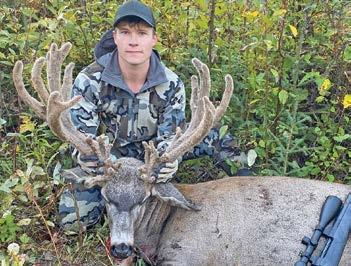
In 2022, Steven V. White harvested this 136-4/8-point typical Columbia blacktail deer while on a hunt in Siskiyou County, California. He was shooting a .270 Winchester Mag.

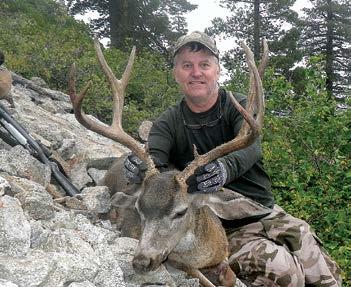
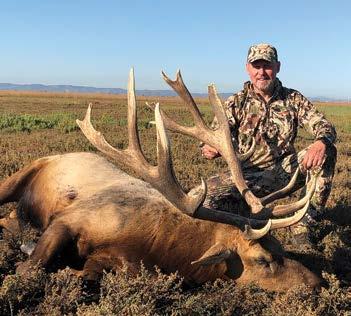
FAIR CHASE | FALL 2023 72 TYPICAL AMERICAN ELK - WORLD’S RECORD SCORE 442-5/8 - MINIMUM ENTRY SCORE 360 410 1/8 418 Park Co., WY Todd A. Saucy 2022 R. Stahl 394 4/8 400 2/8 Yakima Co., WA Blaine T. Wheeler 2022 R. Stahl 392 403 5/8 Union Co., OR Kaden W. Titus 2022 D. Morris 382 1/8 401 2/8 Elko Co., NV Aaron K. Martinez 2022 S. Sanborn 379 1/8 386 7/8 Dolores Co., CO Brett J. Henchar 2021 G. Fujak 375 4/8 389 5/8 White Pine Co., NV Courtney J. Hedgecock 2022 S. Sanborn 374 384 4/8 Box Elder Co., UT Adam J. Waddell 2022 J. Wall 362 4/8 373 6/8 Nye Co., NV Harold J. Humes 2022 L. Clark NON-TYPICAL AMERICAN ELK - WORLD’S RECORD SCORE 478-5/8 - MINIMUM ENTRY SCORE 385 444 5/8 459 3/8 Columbia Co., WA Russell C. Evans 2022 R. Stahl 426 7/8 439 3/8 White Pine Co., NV Tanner Q. Wilkin 2022 S. Sanborn 411 2/8 424 2/8 Navajo Co., AZ Michael T. Kinney 2022 C. Lacey 398 3/8 409 2/8 Elko Co., NV Roberto Gomez 2022 S. Sanborn 397 419 7/8 Catron Co., NM Jeffrey P. Brown 2022 W. Bowles 396 5/8 424 1/8 Elko Co., NV Justin L. Ridgeway 2022 S. Sanborn 389 4/8 406 3/8 White Mountain Bruce A. Bagshaw 2022 R. Grace Apache Res., AZ ROOSEVELT’S ELK - WORLD’S RECORD SCORE 419-6/8 - MINIMUM ENTRY SCORE 275 384 3/8 400 1/8 Jervis Inlet, BC Nolan Osborne 2019 R. Gander 329 1/8 334 1/8 Tillamook Co., OR Mark D. Schoenborn 2022 R. Evans 323 4/8 327 6/8 Siskiyou Co., CA Christopher M. Riske 2022 D. Biggs 320 4/8 326 1/8 Lane Co., OR Ryan E. Alexander 2022 R. Evans 281 286 4/8 Duncan Lake, BC Scott I. Homrich 2021 B. Nash 278 4/8 289 4/8 Afognak Island, AK John T. Tinghino 2021 S. Kleinsmith TULE ELK - WORLD’S RECORD SCORE 379 - MINIMUM ENTRY SCORE 270 299 3/8 311 5/8 Solano Co., CA James R. Ferguson III 2022 T. Humes 272 280 3/8 San Luis Jeffrey L. Kraus 2022 D. Perrien Obispo Co., CA TYPICAL MULE DEER - WORLD’S RECORD SCORE 226-4/8 - MINIMUM ENTRY SCORE 180 205 2/8 212 4/8 Uintah Co., UT Unknown 1980 T. Adams 202 6/8 213 1/8 Sonora, MX Ed Swanson 2022 D. Morris 195 6/8 199 1/8 Saguache Co., CO Unknown 1970 T. Adams 194 2/8 202 3/8 Bull River, BC Willi B. Lutzke 2022 D. Patterson 191 7/8 221 1/8 Rio Arriba Co., NM Jared F. Tindle 2022 L. Wood 191 7/8 195 6/8 Jicarilla Apache Michael M. Engel, Jr. 2022 R. Stahl Res., NM 191 6/8 197 6/8 Bighorn Jerold R. Hoffman 2002 D. Stemler Mountains, WY 182 4/8 197 3/8 Sedgwick Co., CO Jeffrey G. Taylor 2022 D. Boland 182 3/8 202 1/8 Bannock Co., ID Gerald Marlatt 1971 R. Atwood 181 5/8 190 6/8 Slocan River, BC T.A. & M.D. Pitman 2022 M. Conci 181 195 Colorado Greg Farris 1990 M. Lockwood 180 6/8 191 3/8 Grand Co., CO John Schopp 2022 M. Arnold 180 2/8 187 2/8 West Kootenay, BC Derek J. Simm 2022 M. Conci NON-TYPICAL MULE DEER - WORLD’S RECORD SCORE 355-2/8 - MINIMUM ENTRY SCORE 215 229 5/8 234 6/8 Chaplin Lake, SK Lyle Reynolds 2022 P. McKenzie 221 6/8 226 Morice River, BC Noah Delege 2022 R. Berreth 218 7/8 221 1/8 Texas Co., OK Caleb J. Clinesmith 2022 L. Gatlin TYPICAL COLUMBIA BLACKTAIL DEER WORLD'S RECORD SCORE 182-2/8 - MINIMUM ENTRY SCORE 125 150 4/8 152 6/8 Humboldt Co., CA Justin A. Spooner 2022 H. Wilson 146 5/8 160 3/8 Lane Co., OR Lester K. Sundberg 2022 G. Childers 140 5/8 158 5/8 Snohomish Co., WA Jennifer L. Clark 2022 T. Knebel 136 4/8 139 5/8 Siskiyou Co., CA Steven V. White 2022 J. Onysko 135 7/8 142 2/8 Humboldt Co., CA Timothy R. Bollmann 2022 S. Boero 135 138 3/8 Mendocino Co., CA Mathew S. Dermody 2021 J. Onysko 134 4/8 137 Clark Co., WA Riley W. Kerle 2022 J. Wiggs 130 5/8 136 4/8 Vedder River, BC Picked Up 2021 R. Berreth 130 2/8 134 2/8 Josephine Co., OR Eric D. Stanosheck 2022 J. Barrow 126 4/8 131 4/8 Colusa Co., CA Mathew S. Dermody 2021 J. Onysko
FINAL GROSS SCORE SCORE LOCATION HUNTER DATE MEASURER ELK & MULE DEER Share your field photos with us! @BooneAndCrockettClub #BooneAndCrockettClub
TOP TO BOTTOM
This typical mule deer, scoring 181-5/8 points, was havested by Thomas and Mitchell Pitman while hunting near the Slocan River, British Columbia in 2022. The trophy was taken with a .300 Winchester Mag.
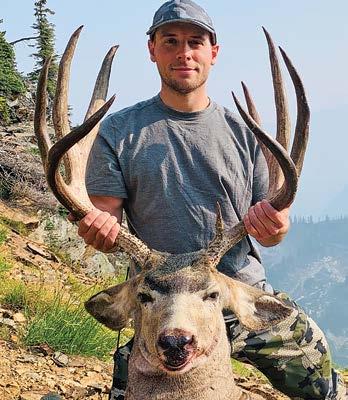
Timothy A. Lindholm took this bison, scoring 122-2/8 points, in 2021 while on a hunt in Custer County, South Dakota. He was shooting a .300 Winchester Mag.
WHITETAIL DEER
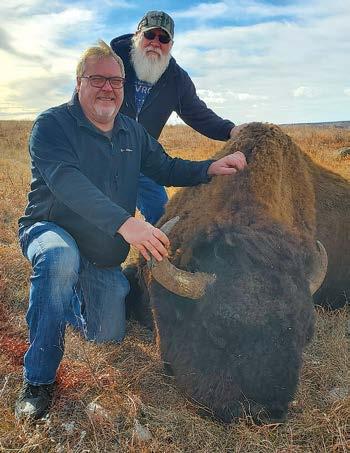
73 FAIR CHASE | FALL 2023 NON-TYPICAL COLUMBIA BLACKTAIL DEER WORLD'S RECORD SCORE 208 1/8 - MINIMUM ENTRY SCORE 155 164 3/8 176 6/8 Douglas Co., OR Douglas J. McKenna 2022 D. Heffner 160 5/8 169 1/8 Trinity Co., CA Alan D. Lewis 2022 G. Hooper TYPICAL SITKA BLACKTAIL DEER WORLD'S RECORD SCORE 133 - MINIMUM ENTRY SCORE 100 113 7/8 117 7/8 Prince of Wales Katrese R. Melville 2022 J. Baichtal Island, AK 113 1/8 119 3/8 Dall Island, AK Guy D. Sanderson 2022 J. Baichtal TYPICAL WHITETAIL DEER - WORLD’S RECORD SCORE 213-5/8 - MINIMUM ENTRY SCORE 160 191 3/8 200 Warren Co., IA Joseph C. Fountain 2023 C. Coble 186 7/8 205 3/8 Scott Co., IA Cory D. Siem 2022 S. Grabow 186 5/8 195 2/8 Randolph Co., IN Edward A. Martin 2022 W. Bellman 185 7/8 195 6/8 Woodbury Co., IA Ryan W. Turnquist 2022 R. Bergloff 185 2/8 197 2/8 Jefferson Co., WI Steven L. Hoelz 2022 P. Barwick 184 2/8 198 2/8 Ida Co., IA Jakob R. Hasbrouck 2022 C. Coble 183 193 4/8 Lawrence Co., OH Jonathan Kamyszek 2022 R. Banaszak 181 2/8 183 6/8 Dearborn Co., IN Mitchell K. Schuman 2022 T. Wright 180 5/8 207 Hubbles Lake, AB John A. Gilchrist 2022 D. Loosemore 180 3/8 195 7/8 Sullivan Co., MO Katie A. Sanford 2022 D. Hollingsworth 180 3/8 188 5/8 Greene Co., IL Nathan R. Brown 2022 T. Walmsley 180 1/8 184 2/8 Ripley Co., IN Ben P. Harmeyer 2022 T. Wright 179 7/8 207 Pickaway Co., OH Justin D. Walls 2022 A. Cramer 177 7/8 183 5/8 Nuevo León, MX Dean C. Strong 2021 J. Newport 177 6/8 182 3/8 Moniteau Co., MO Brock A. Wilson 2022 D. Hollingsworth 177 2/8 217 Talbot Co., MD Unknown 1950 C. Wilcox 177 184 3/8 Fulton Co., GA Trevor C. Ray 2022 S. Ivey 176 7/8 186 2/8 Union Co., NM Logan K. Harlan 2021 S. Mabray 176 5/8 191 1/8 Stearns Co., MN Nicholas A. 2021 S. Grabow Laudenbach 176 5/8 185 Beltrami Co., MN John M. Gertken 2022 S. Grabow 176 5/8 187 1/8 Lapeer Co., MI Dennis R. Colmer 2022 J. Ohmer 176 3/8 193 6/8 Greene Co., IN Emanuel J. Stoll 2022 S. Taylor 175 7/8 178 5/8 Kandiyohi Co., MN Levi D. Anderson 2022 S. Grabow 175 3/8 179 7/8 McLeod River, AB Derrick C.J. Glionna 2022 D. Loosemore 174 5/8 181 7/8 Randolph Co., IL Michael Aycock 2022 M. Umbdenstock 174 4/8 183 7/8 Dubois Co., IN Kevin J. Olinger 2020 R. Pflanz 174 1/8 181 6/8 Lake Lenore, SK Michael H. Foy 2021 D. Atamanchuk 174 176 1/8 Lenore Lake, SK Ashley J. Pfeiffer 2021 D. Atamanchuk 173 6/8 188 7/8 Fillmore Co., MN Dawson M. Wangen 2022 J. Kelly 173 4/8 181 5/8 Niagara Co., NY Peter E. Fitch, Jr. 2022 D. Haseley 173 3/8 190 7/8 Webb Co., TX Charles A. Lamb 2022 J. Webster 173 2/8 179 3/8 Whitley Co., KY David A. Ponder 2022 D. Weddle 172 6/8 175 2/8 Anderson Co., KS Michael E. Sellers 2022 W. Ledbetter 172 5/8 179 3/8 Meigs Co., OH Matthew W. Eichhorn II 2022 R. Huffman 172 1/8 180 6/8 Stearns Co., MN Gregory P. Alberg 2022 S. Grabow 171 7/8 191 7/8 Greene Co., IL Timothy G. Brown 2022 T. Walmsley 171 7/8 188 6/8 Clermont Co., OH Tyler Utter 2022 M. Olson 171 4/8 184 7/8 Adams Co., WI Dustin D. Quinnell 2022 S. Zirbel 170 5/8 183 6/8 Breckinridge Co., KY Aaron N. Jolly 2022 D. Weddle 170 4/8 179 7/8 Long Lake, SK Joshua K. Kirzinger 2020 B. Rehman 170 2/8 179 1/8 Last Mountain Curtis B. Hicks 2022 G. Sellsted Lake, SK 170 1/8 178 2/8 Vernon Co., WI Kyle P. Schultz 2021 J. Lunde 170 1/8 177 1/8 Casey Co., KY Jearmy S. Wilson 2022 D. Weddle 169 182 6/8 Bates Co., MO Steve R. Phillips 2022 L. Lueckenhoff 168 5/8 171 6/8 Barry Co., MI Nathan D. Griswold 2021 S. Pitsch 168 5/8 177 2/8 Alberta Beach, AB Susan Winter 2022 C. Smiley 168 5/8 183 5/8 Mitchell Co., KS Glenn P. Evers 2022 M. Asleson 168 2/8 172 2/8 Cass Co., IA Easton C. O’Brien 2021 J. Brummer 168 2/8 177 3/8 Oakland Co., MI Picked Up 2021 J. Ohmer 167 6/8 175 Tift Co., GA Joseph R. Jones 2022 W. Cooper 167 1/8 186 1/8 Sanborn Co., SD Brett W. Stekl 2022 M. Mauney 167 173 3/8 Pulaski Co., AR Dale W. Perkins 2022 D. Boland 166 7/8 180 5/8 Maverick Co., TX Christopher J. Roswell 2021 D. Draeger 166 6/8 170 Traverse Co., MN Lynn Nelson 2022 T. Rogers 166 5/8 170 Peoria Co., IL Robert P. Pelka 2019 A. Shofner
FINAL GROSS SCORE SCORE LOCATION HUNTER DATE MEASURER
TOP TO BOTTOM
This non-typical whitetail deer, scoring 195-7/8 points, was taken by Marilyn J. Crain while on a hunt in Cherokee County, Kansas, in 2022. She was shooting a .243 Winchester.
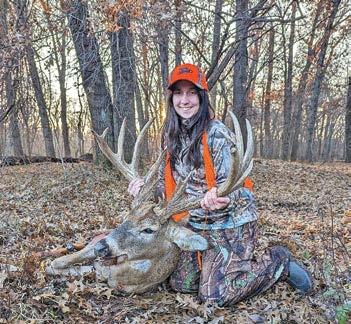
Charles A. Lamb took this typical whitetail deer, scoring 173-3/8 points, in 2022 while on an archery hunt in Webb County, Texas.
Ralph A. Johnson took this typical Coues' whitetail deer, scoring 109-3/8 points, in 2023 while on a hunt in Sonora, Mexico. He was shooting a 6.5 Creedmoor.
DEER
FAIR CHASE | FALL 2023 74
TYPICAL WHITETAIL DEER CONTINUED 166 5/8 179 3/8 Floyd Co., IN Shane H. Patterson 2022 L. Myers 166 4/8 179 7/8 Marshall Co., IL Ross A. Edwards 2022 A. Shofner 166 1/8 176 1/8 Jackson Co., MO Picked Up 2022 D. Hollingsworth 165 7/8 178 5/8 Natchitoches Lee M. Comer 2022 J. Bordelon Parish, LA 165 4/8 170 1/8 Penobscot Co., ME Donald R. Hazelton, Jr. 2022 A. Wentworth 165 3/8 169 2/8 Logan Co., OH Thomas J. Minoske 2022 B. Nash 165 1/8 168 3/8 Sawyer Co., WI Timothy W. Young 2022 J. Senske 165 173 1/8 Isanti Co., MN John A. Procai 2022 J. Lunde 164 5/8 167 2/8 Hancock Co., IN Jarrod D. Bradbury 2022 J. Moore 164 3/8 172 3/8 Hendricks Co., IN Eli H. Coke 2021 G. Howard 164 178 2/8 Mackay Creek, AB Darwyn R. Berndt 2022 R. MacDonald 164 167 7/8 Boone Co., WV James H. Pickett 2022 E. Richmond 163 6/8 168 Marion Co., IA Gerald T. Dowell 2021 L. Grimes 163 6/8 173 Dubuque Co., IA Martin J. Kearney 2022 P. Farni 163 5/8 172 6/8 La Crosse Co., WI William L. Schams 2017 C. Pierce 163 4/8 183 4/8 Adams Co., WI Jared T. Moore 2020 P. Jensen 163 3/8 174 Powder River Co., MT Joseph P. Howard 2022 R. Rauscher 163 1/8 172 4/8 Anoka Co., MN Ryan R. Pett 2022 S. Grabow 163 168 4/8 Madison Co., OH Chad Lynn 2022 R. Miller 163 171 Warrick Co., IN Brock J. Werne 2022 R. Pflanz 162 6/8 194 2/8 Champaign Co., OH Luke M. Myers 2022 R. Miller 162 5/8 174 3/8 Fond du Lac Steven L. Defoe 2007 C. Ferrell Indian Reservation, MN 162 4/8 168 6/8 Madison Co., KY William J. Reid 2022 D. Weddle 162 3/8 171 3/8 Smoky River, AB Raymond J. Melom 2022 D. Watson 162 3/8 192 Dakota Co., MN David J. Durand 2022 J. Lunde 162 1/8 173 7/8 Mercer Co., OH Michael S. Miller 2022 W. Bellman 161 6/8 167 2/8 Jay Co., IN Bradley D. Martin 2022 W. Bellman 161 6/8 176 5/8 Richland Co., WI Jeffrey M. Berry 2022 J. Ramsey 161 5/8 164 4/8 Washington Co., IN Joshua D. Huff 2009 S. Taylor 161 4/8 165 2/8 Coshocton Co., OH Blake S. Russell 2016 W. Hinson III 161 4/8 175 2/8 Uvalde Co., TX James B. Davis 2022 D. Rios 161 4/8 167 4/8 Madison Co., OH Eli D. Mason 2021 M. Olson 161 4/8 167 1/8 Pike Co., MO Steven W. Becker 2022 J. Hindman 161 3/8 178 4/8 Monroe Co., WI Ryan J. Schmitz 2022 S. Zirbel 161 2/8 163 5/8 Keokuk Co., IA Corey C. Montgomery 2022 S. Grabow 161 1/8 191 1/8 Ashland Co., OH Douglas W. Kamenik 2022 A. Cramer 161 178 Delaware Co., IN Billy J. Manor 2021 S. Taylor 161 169 1/8 York Co., PA Adam R. Bisker 2022 J. Creamer 161 163 6/8 Crawford Co., IN Darren T. Ballard 2022 M. Verble 160 7/8 163 4/8 Calling Lake, AB Mathieu Pouliot 2022 A. Beaudry 160 6/8 184 2/8 Dakota Co., MN Jeremy E. Ballard 2022 T. Rogers 160 6/8 167 6/8 Horse Lake, SK Brian C. Aamodt 2022 H. Dreger 160 5/8 164 2/8 Monroe Co., WI Andrew L. Christensen 2022 J. Kelly 160 4/8 163 6/8 Lawrence Co., IN Picked Up 2017 S. Taylor 160 2/8 162 3/8 Fairfield Co., OH Gary D. Kinnison, Jr. 2022 M. Olson 160 2/8 168 2/8 Pulaski Co., KY Craig S. Burrell 2022 D. Weddle 160 1/8 165 4/8 Polk Co., WI Tony J. Meyer 2022 J. Lunde 160 182 7/8 Polk Co., WI Travis E. Beauvais 2022 J. Lunde
WORLD’S RECORD SCORE 333-7/8 - MINIMUM ENTRY SCORE 185 272 2/8 278 1/8 Holt Co., MO Picked Up 1997 R. Huffman 250 7/8 259 2/8 Cass Co., MO Joshua M. Heuser 2022 C. Coble 249 4/8 262 3/8 Richland Co., OH Corey S. Smith 2022 M. Olson 229 4/8 233 1/8 Union Co., KY Bridgett A. Smith 2022 D. Weddle 229 4/8 238 3/8 Pettis Co., MO Russell E. Holsten 2022 J. Workman 229 1/8 236 1/8 Macoupin Co., IL Keith D. Elliott 2022 T. Walmsley 228 2/8 234 7/8 Fayette Co., IL Xen S. McAllister 2022 T. Walmsley 223 3/8 227 1/8 Dane Co., WI Jesse T. Hurley 2021 C. Coble 223 231 5/8 Dodge Co., WI Benjamin M. Feucht 2022 R. Walter 219 2/8 230 Muhlenberg Co., KY Dawnson F. Mashburn 2022 D. Weddle 217 4/8 222 7/8 Creek Co., OK Kenneth B. Simpson 2022 R. Perry 216 4/8 234 7/8 Henderson Co., KY Daniel C. Lappe, Jr. 2022 D. Weddle 214 1/8 221 1/8 Anderson Co., KS John A. Tonione 2022 R. Hale 213 5/8 221 2/8 Osage Co., KS Chase D. Wells 2022 D. Hollingsworth 212 2/8 217 3/8 Perry Co., IL Dane T. Walls 2022 B. Stratton 211 5/8 219 5/8 Poweshiek Co., IA Herbert C. Nelson, Jr. 2022 C. Coble 211 3/8 221 4/8 Dallas Co., IA Jacob A. Snowgren 2022 C. Coble 210 4/8 213 5/8 Morgan Co., OH Ronald L. Stout 2022 E. Feron 210 1/8 216 4/8 Pettis Co., MO BJ Breshears 2022 R. Bergloff 210 213 4/8 Crawford Co., IL Lyman L. Morris 2018 R. Pflanz 209 215 1/8 Geary Co., KS Samuel C. Wilcox 2022 D. Boland 208 5/8 218 4/8 Grant Co., IN David P. Linn 2022 J. Moore
NON-TYPICAL WHITETAIL
TOP TO BOTTOM
In 2022, Raymond J. Melom harvested this 162-3/8-point typical whitetail deer while bowhunting near Smoky River, Alberta.
This barren ground caribou, scoring 403-6/8 points, was taken by B&C Member John E. Kupiec while on a hunt near Mount Dana, Alaska, in 2021. He was shooting a .300 Ultra.
In 2022, B&C Member Daniel S. Lauver harvested this 213-3/8-point Alaska-Yukon moose while hunting near the Innoko River, Alaska. He was shooting a .375 H&H.
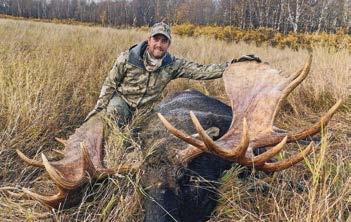
75 FAIR CHASE | FALL 2023 NON-TYPICAL
208 218 1/8 Daviess Co., MO Greg B. Wallace 2022 D. Meger 207 2/8 211 5/8 Todd Co., MN Andrew R. Freyholtz 2022 S. Grabow 207 2/8 211 1/8 Meigs Co., OH Timothy B. Lockhart 2022 R. Huffman 207 225 1/8 Clark Co., IN Jakob B. Lewellen 2022 M. Verble 206 2/8 209 3/8 Hardin Co., KY Jeffery C. Stumbo 2022 D. Weddle 205 4/8 221 Grundy Co., MO Marvin E. Holloway 2022 D. Ream 205 2/8 211 2/8 Ross Co., OH Dustin A. Bothman 2020 M. Olson 204 6/8 211 6/8 Noble Co., OH Joshua R. Varhola 2020 M. Olson 204 4/8 211 2/8 Big Stone Co., MN James W. Jensen 2022 S. Grabow 203 3/8 217 3/8 Centre Co., PA Matthew J. Lingle 2021 D. Garrison 203 1/8 205 7/8 Page Co., IA Haley L. Fundermann 2022 C. Coble 202 4/8 213 1/8 Linn Co., IA Larry W. Peddicord 2010 S. Grabow 202 208 4/8 Mercer Co., MO Scotty Segroves 2022 K. Pugh 201 4/8 207 1/8 Henry Co., IA Craig R. Belknap 2022 C. Belknap 201 4/8 205 2/8 Champaign Co., OH Andrew J. Mitchem 2022 M. Olson 200 6/8 212 4/8 Mclean Co., IL Justin D. Benzschawel 2022 J. Hjort 200 1/8 215 4/8 Marion Co., MO Scott J. Bogener 2021 G. Webber 199 5/8 207 2/8 Woods Co., OK Chase A. Kokojan 2021 R. Kemph 199 2/8 204 2/8 McHenry Co., IL Terry J. Mabe 2019 D. Weddle 198 7/8 203 6/8 Madison Co., IA Andrew G. Tuttle 2022 C. Coble 198 6/8 206 Birch Lake, AB Barry E. Splawn 1985 D. Hayes 198 207 7/8 Buffalo Creek, AB Cameron R. Ovinge 2022 M. Howg 197 3/8 204 1/8 Jasper Co., IA Lee Herr 2021 C. Coble 196 7/8 205 1/8 Monroe Co., IL Mark J. Wilson 2021 M. Umbdenstock 196 6/8 204 7/8 Charles Co., MD Picked Up 2022 C. Wilcox 196 6/8 200 6/8 Wayne Co., OH Josef Crumley 2022 A. Cramer 196 5/8 205 2/8 Trempealeau Co., WI Richard A. Lehman 2022 J. Hjort 196 5/8 204 Clark Co., IL Lee J. Bloemer 2022 R. Bergloff 196 4/8 198 3/8 Harrison Co., TX Zebulon P. McGhee 2022 J. Johnson 196 205 2/8 Delaware Co., OH Ryan M. Huffman 2022 G. Surber 195 7/8 205 2/8 Cherokee Co., KS Marilyn J. Crain 2022 J. Johnson 195 4/8 200 4/8 Indiana Co., PA David C. Putt 2022 K. Zimmerman 194 3/8 200 3/8 Adams Co., IL Harvey L. Wilson 2022 T. Yetter 193 5/8 198 2/8 McLean Co., ND Cody J. Swinkles 2022 A. Sternagel 193 4/8 201 4/8 Benton Co., IA Picked Up 2022 S. Grabow 193 3/8 199 2/8 Red Deer River, AB Alexander J.T. Kirk 2022 P. Erickson 193 2/8 202 3/8 Vinton Co., OH Brent A. Ames 2022 M. Olson 193 1/8 209 1/8 Franklin Co., MO Ronald D. Overschmidt 2020 S. Corley 192 7/8 206 1/8 Van Buren Co., IA Brandon L. Johannes 2022 S. Grabow 192 6/8 198 3/8 Coal Co., OK Dalton H. Howe 2022 T. Cartwright 192 6/8 198 6/8 Davidson Co., TN Charles E. Strickland 2022 D. Grandstaff 192 4/8 204 3/8 Marion Co., IA Joshua Uber 2022 C. Coble 192 2/8 199 6/8 Bartholomew Co., IN Charles J. Schuette 2022 W. Bellman 192 195 6/8 Greene Co., IL Thomas W. Chizmar 2022 T. Walmsley 191 3/8 201 5/8 Ringgold Co., IA Reggie A. Derscheid 2022 S. Grabow 191 3/8 195 6/8 Oklahoma Co., OK Brett A. Ramsey 2022 R. Perry 191 1/8 196 2/8 Clarke Co., IA Jaqueline P. Skinner 2022 C. Coble 190 7/8 196 4/8 Eaton Co., MI George S. 2022 S. Pitsch VandenHeede, Jr. 190 6/8 194 2/8 Wilkin Co., MN Donovan A. Marquardt 2022 T. Kalsbeck 190 4/8 195 1/8 Sumner Co., KS Douglas C. Zeller 2022 W. Sowards 188 5/8 195 5/8 Harrison Co., IN Joshua S. Cantrell 2022 R. Pflanz 188 1/8 193 4/8 Whitley Co., IN Landon M. Rohrer 2022 R. Karczewski 187 7/8 191 7/8 Waupaca Co., WI Joshua J. Heschke 2021 C. Collins 187 5/8 195 2/8 Wabasha Co., MN Lucas L. Yotter 2022 C. Collins 186 6/8 190 3/8 Union Co., OH Chelsea N. Taylor 2019 A. Cramer 186 5/8 197 4/8 Wayne Co., IN Randy L. Miller 2022 D. Belwood 186 4/8 194 7/8 Warren Co., IA Aiden Ruble 2021 R. Bergloff 185 6/8 199 6/8 Crawford Co., IL David G. Brewster 2022 T. Fisk 185 6/8 197 6/8 Story Co., IA Duane T. Erickson 2016 C. Coble 185 5/8 188 7/8 Shelby Co., OH Hayden J. Billing 2021 M. Olson 185 3/8 190 5/8 Belmont Co., OH Scott M. Trigg 2022 R. Huffman 185 2/8 189 Jo Daviess Co., IL Todd D. Chambers 2022 A. Crum 185 1/8 190 3/8 Breathitt Co., KY Charles Watkins 2022 R. Crank 185 190 2/8 Kosciusko Co., IN Timothy J. Nussbaum 2022 S. Werstler TYPICAL COUES' WHITETAIL DEER WORLD'S RECORD SCORE 144-1/8 - MINIMUM ENTRY SCORE 100 120 1/8 121 7/8 San Carlos Shane Burleson 2019 R. Grace Indian Res., AZ 116 120 6/8 Sonora, MX Kevin J. Railsback 2023 E. Stanosheck 110 1/8 113 7/8 San Carlos Shane Burleson 2010 R. Grace Indian Res., AZ 109 3/8 116 2/8 Sonora, MX Ralph A. Johnson 2023 L. Wood
WHITETAIL DEER CONTINUED
TOP TO BOTTOM
Christopher W. Leish took this pronghorn, scoring 86 points, in 2022 while hunting in Sweetwater County, Wyoming. He was shooting a 28 Nosler.
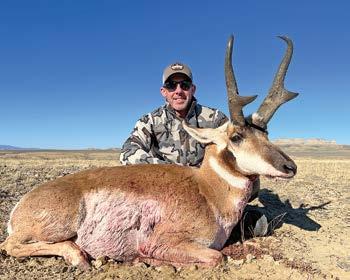
In 2022, B&C Member Mark T. Wells harvested this 111-2/8-point musk ox while on an archery hunt near Baker Lake, Nunavut.
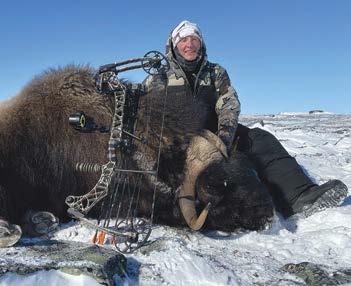
B&C Lifetime Member Paul B. Cooke was hunting near Watson Lake, Yukon Territory, in 2022, when he harvested this Dall's sheep scoring 173-6/8 points. He was shooting a .300 Winchester Mag.
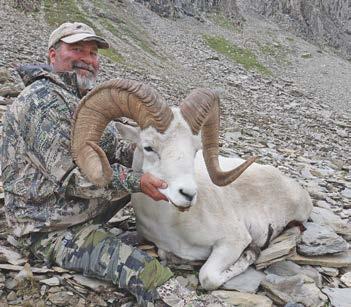
MOOSE AND CARIBOU
HORNED GAME
WANT TO SEE MORE?
Log in to the Communities Section to see our Searchable Field Photos. You will have access to our database of thousands of field photographs of B&C record-book big game animals in the field—both current images and vintage photos. Use the search filters to view results by year, species, location, or name.
FAIR CHASE | FALL 2023 76 NON-TYPICAL COUES' WHITETAIL DEER WORLD’S RECORD SCORE 196-2/8 - MINIMUM ENTRY SCORE 105 137 1/8 141 3/8 Sonora, MX Flavio Rene Ybarra, Jr. 2022 J. Newport 129 135 7/8 Pinal Co., AZ Jacob M. Young 2022 P. Dalrymple 126 128 7/8 Sonora, MX Daniel D. Evenson 2023 S. Godfrey 113 2/8 119 7/8 Santa Cruz Co., AZ Karmella C. Best 2022 M. Sipe CANADA MOOSE - WORLD’S RECORD SCORE 242 - MINIMUM ENTRY SCORE 185 204 208 2/8 Sheslay River, BC Michael G. Miller 2022 B. Capes 186 5/8 189 6/8 St. Lawrence Frederic Savard 2022 A. Beaudry River, QC ALASKA-YUKON MOOSE - WORLD’S RECORD SCORE 266-4/8 - MINIMUM ENTRY SCORE 210 248 6/8 253 3/8 Yukon River, YT Jeremy K. August 2022 C. Walker 226 3/8 230 1/8 Snake River, AK Dawson B. Evans 2022 C. Van Arsdale 213 3/8 217 3/8 Innoko River, AK Daniel S. Lauver 2022 B. Zundel 213 1/8 217 Kashunuk River, AK Andrew A. Wagner 2022 E. Nelson SHIRAS’ MOOSE - WORLD’S RECORD SCORE 205-4/8 - MINIMUM ENTRY SCORE 140 188 1/8 193 6/8 Elmore Co., ID Picked Up 2022 R. Addison 181 4/8 192 5/8 Stevens Co., WA Joe Rotter 2022 E. Johnson 160 4/8 161 4/8 Twin Falls Co., ID Jeanne L. Lappin 2022 T. Boudreau 150 6/8 158 5/8 Lewis and Jay P. Kromarek 2022 R. Rauscher Clark Co., MT 146 5/8 149 1/8 Routt Co., CO Jason D. 2022 L. Gatlin Vander Meulen 143 5/8 149 5/8 Elmore Co., ID Picked Up 2022 R. Addison WOODLAND CARIBOU - WORLD’S RECORD SCORE 419-5/8 - MINIMUM ENTRY SCORE 265 316 6/8 346 3/8 Hungry Grove Gust B. Geralis 2022 J. Mancuso Pond, NL 296 2/8 305 7/8 Great Gull Lake, NL Joseph A. Sarll 2021 R. Karczewski BARREN GROUND CARIBOU - WORLD’S RECORD SCORE 477 - MINIMUM ENTRY SCORE 375 440 2/8 449 1/8 Cold Bay, AK Picked Up 2022 T. Spraker 418 3/8 422 1/8 Cold Bay, AK Picked Up 2013 T. Spraker 403 6/8 423 4/8 Mount Dana, AK John E. Kupiec 2021 K. Farmer 397 7/8 414 2/8 Alaska Range, AK Kenneth P. Boyd 1989 J. Olson
- WORLD’S RECORD SCORE 96-4/8 - MINIMUM ENTRY SCORE 80 87 87 7/8 Lake Newell, AB Kyle G. Southgate 2022 W. Oakley 86 87 Sweetwater Co., WY Christopher W. Leish 2022 R. Stayner 85 86 1/8 Hot Springs Co., WY Jim D. Crandall 2022 L. Gorchesky 83 83 5/8 Elko Co., NV Vincent E. Bloom 2022 T. Humes 82 6/8 83 1/8 Crane Lake, SK Terry W. Young 2022 P. McKenzie 82 82 4/8 Mora Co., NM Greg B. Buck 2022 O. Carpenter 81 2/8 81 5/8 Coconino Co., AZ Timothy C. Haught 2020 F. King 80 81 2/8 Elko Co., NV Victoria A. Bell 2022 J. Capurro BISON - WORLD’S RECORD SCORE 136-4/8 - MINIMUM ENTRY SCORE 115 122 2/8 123 5/8 Custer Co., SD Timothy A. Lindholm 2021 G. English ROCKY MOUNTAIN GOAT - WORLD’S RECORD SCORE 60-4/8 - MINIMUM ENTRY SCORE 47 51 2/8 51 7/8 Revillagigedo Shane M. 2022 J. Reneau Island, AK VanderGiessen 48 4/8 48 4/8 Slocan Valley, BC Clayton G. Alderson 2022 M. Conci 47 2/8 47 3/8 Butte Co., ID Brian S. Harrell 2022 R. Atwood
PRONGHORN
FINAL GROSS SCORE SCORE LOCATION HUNTER DATE MEASURER
FINAL GROSS SCORE SCORE LOCATION HUNTER DATE MEASURER
BIGHORN
TOP TO BOTTOM
This bighorn sheep, scoring 183-3/8 points, was taken by Gregory P. Cilfford while hunting in Carbon County, Wyoming, in 2022. He was shooting a 7mm Weatherby.
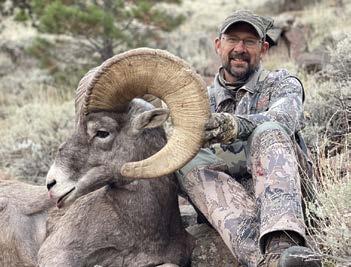
Louis W. Breland harvested this desert sheep, scoring 191-1/8 points, in 2022 while hunting in Coahuila, Mexico.
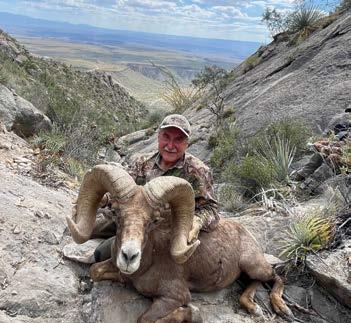
MORE TO THE SCORE
ALASKA-YUKON MOOSE
HUNTER: Bradley G. White
B&C SCORE: 249 points
LOCATION: Golsovia River, Alaska
YEAR TAKEN: 2022
Mid-September is a beautiful time to be in Alaska. If you’re hunting moose, then all the better. Brad White got that memo and took his 300 PRC on a moose hunt there. After a few days in the bush, he killed this great Alaska-Yukon bull that just broke into the top 20 of All-time, according to Big Game Records LIVE.
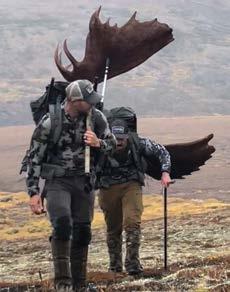
See all MORE TO THE SCORE online
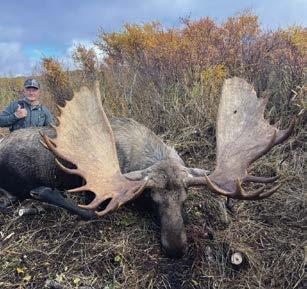
77 FAIR CHASE | FALL 2023
OX
RECORD
MINIMUM ENTRY SCORE 105 115 2/8 117 4/8 Baker Lake, NU Daniel D. Evenson 2022 S. Godfrey 111 2/8 112 6/8 Baker Lake, NU Mark T. Wells 2022 E. Boley 106 6/8 108 4/8 Nelson Island, AK Brendan V. Burns 2017 G. Bettas
MUSK
- WORLD’S
SCORE 130-4/8 -
SHEEP - WORLD’S RECORD SCORE 216-3/8 - MINIMUM ENTRY SCORE 175 186 7/8 187 4/8 Apache Co., AZ Sue A. Kinney 2022 C. Lacey 186 4/8 186 6/8 Duchesne Co., UT Corey M. Navanick 2022 B. Capes 185 6/8 186 4/8 Blaine Co., MT Cody S. Phillips 2022 L. Buhmann 183 4/8 183 7/8 Phillips Co., MT Michael T. Kinney 2022 C. Lacey 183 3/8 184 1/8 Carbon Co., WY Gregory P. Clifford 2022 R. Bonander 181 4/8 182 2/8 Custer Co., SD William J. Brannan 2022 L. Gunner 178 6/8 179 5/8 Fergus Co., MT Christopher K. McCabe 2022 J. Staten 177 5/8 178 6/8 Chelan Co., WA Alexandria J. Whitefoot 2021 R. Spaulding 175 6/8 176 Blaine Co., MT Thomas R. Chard II 2022 K. Balfourd 175 4/8 175 5/8 Taos Pueblo Brendan V. Burns 2013 K. Wiebe Tribal Lands, NM 175 1/8 176 2/8 Wallowa Co., OR Todd L. Saylor 2009 T. Rozewski DESERT SHEEP - WORLD’S RECORD SCORE 205-1/8 - MINIMUM ENTRY SCORE 165 191 1/8 191 4/8 Coahuila, MX Louis W. Breland 2022 J. Millspaugh 183 5/8 184 1/8 Pinal Co., AZ Bruce P. Noble, Jr. 2022 P. Dalrymple 181 3/8 181 5/8 Yuma Co., AZ Brian E. Serna 2022 P. Dalrymple 174 1/8 175 6/8 Socorro Co., NM Billy J. Traxler 2022 R. Smith 174 1/8 174 3/8 Yuma Co., AZ Jon McQuillan 2022 M. Zieser 174 1/8 174 6/8 Clark Co., NV Brenin R. Anderson 2022 T. Humes 173 2/8 173 7/8 Coahuila, MX Jon M. Keller 2018 J. Booey 172 6/8 174 2/8 Clark Co., NV Jack J. Byrne 2022 P. Dalrymple 172 2/8 172 6/8 Sierra Co., NM Spencer Y. Okada 2022 L. Gorchesky 171 5/8 172 3/8 Nye Co., NV James F. Crowley 2022 T. Humes 170 3/8 170 5/8 Kane Co., UT Rex E. Smith 2022 D. Nielsen 170 2/8 170 4/8 Nye Co., NV Joseph E. Pintar 2022 S. Sanborn 169 3/8 170 1/8 Graham Co., AZ Robert L. Donnelly 2022 C. Sheley 169 3/8 169 7/8 Sonora, MX James E. Schmid 2022 D. Birdsall 169 2/8 170 6/8 Mineral Co., NV Thomas P. Gallegos III 2022 V. Trujillo 169 1/8 169 3/8 Coconino Co., AZ Terry R. Chapman 2022 J. Gardner 167 167 2/8 Churchill Co., NV Steven R. Carpenter 2022 H. Grounds 165 2/8 165 5/8 Lincoln Co., NV Nicolai J. Caviglia 2022 S. Sanborn DALL’S SHEEP - WORLD’S RECORD SCORE 189-6/8 - MINIMUM ENTRY SCORE 160 173 6/8 174 7/8 Watson Lake, YT Paul B. Cooke 2022 C. Walker 170 170 4/8 Chugach Mts., AK Jared M. McCulley 2022 D. Larsen 166 4/8 167 2/8 Wrangell Mts., AK Brendan V. Burns 2019 G. Bettas 165 2/8 165 3/8 West Fork Michael P. Press 2022 V. Trujillo Yentna River, AK 162 1/8 162 5/8 Copper River, AK Ryan R. Ciolkosz 2020 C. Brent 160 2/8 160 7/8 Flood Creek, YT Brendan V. Burns 2016 G. Bettas STONE’S SHEEP - WORLD’S RECORD SCORE 196-6/8 - MINIMUM ENTRY SCORE 160 170 170 1/8 West Toad River, BC John D. Leedom 2021 M. Schlegel 164 7/8 164 7/8 Kluachesi Lake, BC Adam J. Sarich 2022 A. Berreth
CAUGHT ON CAMERA
TRAIL CAMERA PHOTOS FROM BOONE AND CROCKETT CLUB’S THEODORE ROOSEVELT MEMORIAL RANCH
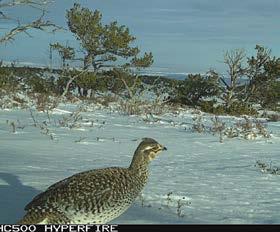
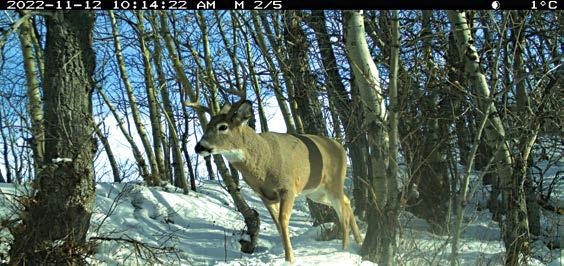
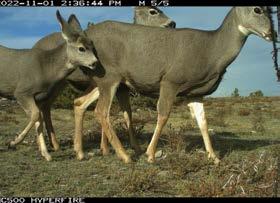
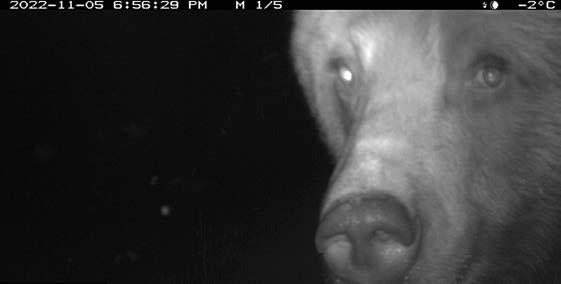
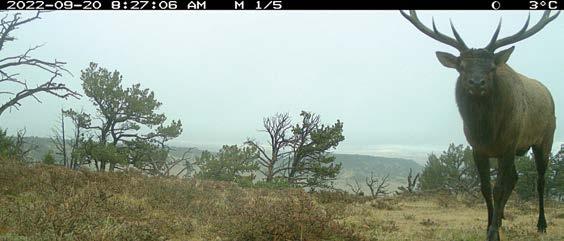
Dupuyer, Montana
SPONSORED BY
watCh the videoS online
FAIR CHASE | FALL 2023 78
TRAIL CAM PHOTOS ©2023 THE UNIVERSITY OF MONTANA
KNOCKDOWN™
Developed for the hunter looking to gain deeper penetration and flatter trajectory from their favorite rifle, this all-copper hollow-point bullet offers pass-through penetration, devastating energy transfer and controlled expansion. Reduced barrel fouling, improved accuracy and increased velocity provides flatter shooting for better down-range performance. Our proprietary powders burn clean and hot to maximize efficiency for even greater consistency, round after round. All it will take is one shot to convince even the most discerning hunter there is a new cartridge for their hunt.

FIOCCHIUSA.COM