The Evolution of eBooks: From Print to Digital
In the ever-evolving landscape of literature consumption, the transition from print to digital has been nothing short of transformative. The emergence of eBooks has not only revolutionized how we read but has also reshaped the entire publishing industry. Let's embark on a journey through the evolution of eBooks, tracing their origins, growth, and impact on readers and authors alike.
Origins of eBooks: A Digital Revolution
The concept of eBooks dates back to the early 1970s when Michael S. Hart launched Project Gutenberg, aiming to digitize and archive cultural works. Initially, these eBooks were basic ASCII text files distributed freely. However, it wasn't until the 1990s that advancements in technology, particularly the rise of personal computers and the internet, laid the groundwork for the widespread adoption of digital reading.
The Rise of eBook Formats
With the advent of dedicated eBook formats like Organizational Behavior 18th Edition EPUB and MOBI, the digital reading experience became more versatile and user-friendly. EPUB, developed by the International Digital Publishing Forum (IDPF), quickly emerged as the standard format for eBooks, offering features like reflowable text and support for images and styling.

The Kindle Effect: Amazon's Game-Changer
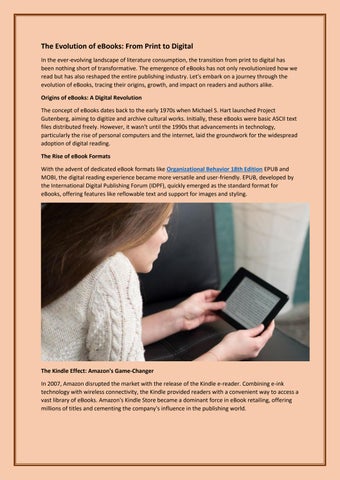
In 2007, Amazon disrupted the market with the release of the Kindle e-reader. Combining e-ink technology with wireless connectivity, the Kindle provided readers with a convenient way to access a vast library of eBooks. Amazon's Kindle Store became a dominant force in eBook retailing, offering millions of titles and cementing the company's influence in the publishing world.
The Proliferation of eBook Readers and Apps
Following the success of the Kindle, numerous companies entered the eBook market with their own dedicated e-readers, such as the Barnes & Noble Nook and the Kobo eReader. Simultaneously, smartphones and tablets began to emerge as popular platforms for reading eBooks, thanks to the development of feature-rich eBook apps like Apple Books, Google Play Books, and Adobe Digital Editions.
Enhancing
the Reading Experience
One of the key advantages of eBooks is their ability to enhance the reading experience through interactive features and multimedia content. Enhanced eBooks may include embedded audio and video, interactive elements, and hyperlinks, offering readers a more immersive and engaging way to consume content. This innovation has opened up new possibilities for storytelling and education, particularly in fields like children's literature and non-fiction.
The Accessibility Revolution
EBooks have also played a crucial role in promoting accessibility and inclusivity in literature. Digital formats allow for the integration of accessibility features such as text-to-speech, adjustable font sizes, and screen readers, making reading more accessible to individuals with disabilities. Furthermore, eBooks enable publishers to produce specialized formats for diverse audiences, including braille and large print editions.
Challenges and Opportunities
While the transition to eBooks has brought about numerous benefits, it has also posed challenges for traditional publishing models and bookstores. Independent bookstores have faced stiff competition from online retailers, and publishers have had to adapt their strategies to navigate the digital landscape. Additionally, issues such as eBook piracy and digital rights management continue to pose challenges for authors and publishers alike.
Looking Ahead
As technology continues to evolve, so too will the landscape of digital publishing. Emerging technologies such as virtual reality (VR) and augmented reality (AR) hold the potential to further transform the eBook experience, offering readers new ways to engage with stories and content. However, amidst these advancements, the core appeal of eBooks remains unchanged: the ability to access a world of knowledge and imagination at the touch of a screen.