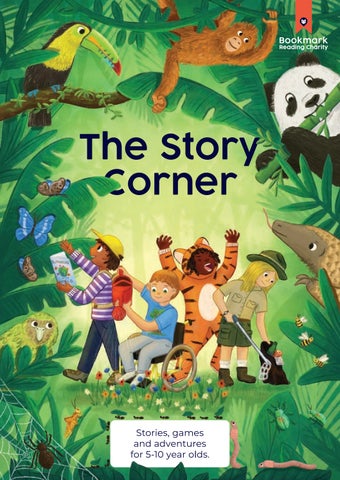
The Story Corner
Stories, games and adventures for 5-10 year olds.
Hi, my name is Cat (confusing sometimes as I work with animals!) I have always loved animals, seeing and hearing them but also learning more about them, where they live and how they survive. Growing up I read stories about girls exploring the world and animal fact books (like DK’s Animal Encyclopaedias) finding out about animal’s weird and wonderful bodies and behaviours. Like the Mary River Turtle who breathes through its bum!! I am very lucky that I now get to fact check and write some of those very books! I am a very nosy person, so I love ZSL’s Behind the Scenes book, which shows all the different jobs people do when caring for animals both in our zoos and in the wild. I love reading with my daughter, and we love the Rabbit and Bear books, as stories told from animals’ point of view and how they live together. My favourite part of working for ZSL is helping people care about nature and get excited about the animals living on this planet. I love it when people stop and notice the nature around them. What animals can you see right now? What is the coolest animal fact you know? Don’t forget to notice nature!
Cat x
Chi Chi the Panda
..................................................................................... p.3
Conservation
..................................................................................... p.7
Training and building relationships with animals
.................................................................................... p.8
I Saw a Bee activities
.................................................................................. p.10
Mighty Recyclers
................................................................................... p.15
The Island Vet
................................................................................... p.16
Who's the rarest in the rainforest?
................................................................................... p.18
Amazon animal riddles
................................................................................... p.19
Goodnight Silver
.................................................................................... p.11
................................................................................. p.20
London Zoo Map activities
Drawing competition
................................................................................... p.12
Meet a Keeper
.................................................................................. p.14
2
Zoo puzzles
.................................................................................. p.22
Jokes
.................................................................................. p.23
All content curated & adapted by Bookmark Reading Charity for The Story Corner magazine. Special thanks to all our contributors | Front cover artwork by Sasha Stowe (c) 2026.
After being taken from Baoxing, in China, Chi Chi lived in lots of different zoos around the world, loved by everyone who came to visit her... Then an amazing thing happened. I was invited to London Zoo in England. At first it was going to be for a few weeks. But because I was adorable, they wanted to keep me longer.
3
We don't want to encourage more pandas being taken from the wild, though. She's been raised in captivity, anyway, and maybe we can help panda conservation if we have her!
My enclosure was homely with trees for...
...me to climb and a stone path to
4
stroll along.
And so, I was bought by London Zoo. London was going to be my forever home! One of my new keepers was a zoologist called Dr Desmond Morris. He looked after me well.
played games with me,
Dr Morris gave me bubble baths,
and scratched my belly!
An An bit me when we first met because he was probably scared. The zookeepers wanted us to have panda cubs, but instead I liked playing with An An.
I’m as strong as you! 5
I think we're aving supposed to be h ll babies. Wanna ro about instead? Chi Chi the Panda is published by Hodder Children's Books and is available now, RRP £12.99
Yes!
An An was a nice friend but we didn’t make any panda cubs, even when he later was brought to London Zoo to try again.
Panda experts said I liked humans too much.
6
It was true. I had been brought up by humans and liked being around them more than other pandas.
Conservation is to look after nature. It means protecting wild species and not destroying the natural world. Conservation can help to repair some of the damage that humans have done, and are still doing, to wildlife and natural habitats.
We need to protect endangered plants, animals and other living things, even if we think they're ugly or dangerous. This is because biodiversity is important, as all species play a part in keeping their ecosystems healthy.
In Britain, beavers were hunted to extinction because people wanted their fur for clothing and oil for medicine. Conservationists recently brought beavers back to Britain's rivers, where they build dams that slow the water and help prevent flash flooding.
Human responsibility
The Encyclopedia of Wildlife Words by Jenny Jacoby, illustrated by Vicky Barker and published by b small, is out now.
We are responsible for nature because we have the power to help it or to destroy it, and the industrialised world has been causing damage for too long. The good news is that we can take inspiration from the way indigenous peoples live as custodians of the natural world, respecting nature and fighting to protect it. 7
Zookeepers must understand the creatures in their care. Every species is different and each animal is unique, just like people, and animals have their own personalities, likes and dislikes. Although they can't tell us what they need with words, they do communicate through their behaviour. Keepers must watch them closely to make sure they are happy and healthy.
Often, unusual behaviour is the first sign an animal is feeling unwell.
Training animals to complete an action, like showing their paw, allows for regular check ups to be carried out without the need for anaesthetic. This helps the animal stay calm and the zookeepers stay safe.
Target Training
Tigers are trained to present their paws and limbs so they can easily be checked.
Hippos are trained to open their mouths so that zookeepers can easily check their teeth.
8
Zookeepers train all kinds of behaviours. They even taught a Chinese giant salamander to swim into a transport crate to move between habitats.
'Target training' teaches animals to touch or follow an object – like a ball or stick. This helps them learn useful behaviours, such as stepping into a crate for a vet visit.
Training is made fun with healthy treats. Gorillas love nutritious nuts, while hornbills enjoy crunchy crickets and mealworms.
A Helping Hand Sometimes zoo animals need injections to keep them healthy, so they are trained to take part voluntarily. Keepers teach them to show a part of their body – like their arm or rump – and gently press with a pretend needle. Each time, the animal gets a yummy treat, making the whole process fun and easy!
SNOT ALERT! Elephants are trained to blow into a bag so vets can check for viruses. This is called a trunkwash.
Meerkats are trained to stand on scales so their weight can be measured.
Keepers work closely with Komodo dragons. The dragons at London Zoo have been trained to let them take blood samples by hand.
Giraffes and okapi are taught to present their hooves to be checked and trimmed.
To Train or Not to Train? Animals don't have to join training if they don't want to – but learning a new skill can be fun! If they don't feel like stepping on scales or having their hooves trimmed, keepers will just try another day.
Artwork from Behind The Scenes Illustration copyright © 2026 by Äsa Gilland. © ZSL (Zoological Society of London), a sciencedriven conservation charity, no. 208728
9
An activity inspired by the book I saw a BEE by Rob Ramsden. Copyright © Scallywag Press.
Activity: Find and colour the ladybirds and bees. How many of each can you find? Ladybirds
Bees
Activity: Help the bees to reach the flowers, so they can drink nectar and collect pollen. Which bee will visit which flower? Dandelion Sunflower
Scan the QR code to double check your answers!
10
Bluebell Daisy
Mighty recyclers
We were busy recycling long before humans worked out that waste can be turned into treasure. In the natural world, nothing goes to waste. We take only what we need and recycle everything, over and over again. Meet some of our top recyclers who are doing their bit to keep the planet clean.
Hermit crab
second-hand homes We don't grow our own shells so, to protect ourselves, we borrow old ones abandoned by sea snails and other creatures. When we outgrow a shell, we move into a bigger one. So we constantly reuse other creatures' old dwellings.
Perhaps humans could follow our lead by taking only what they need from nature and making things in a way that means materials can be used again and again, forever. We all have to make sure that we keep our planet clean.
Bird
local materials We build our nests with whatever we can get our claws on to make them warm, safe and cosy for our chicks. We use twigs, dead leaves, sticky cobwebs, fur or feathers. Sometimes, we even add bits of string, paper or plastic bags left behind by humans.
Dung Beetle
a big ball of poo We take recycling to another level. Poo is our world! We roll it into a ball so we can wheel it easily to a good spot. We then bury it in the ground to munch on later and lay our eggs in it. And we don't make a stink about it!
Artwork © 2026 Gosia Herba from Invented by Animals by Christiane Dorion
11
Activity Cove
Name two neighbours of the Tigers
Activity: Circle the areas you would like to visit at the zoo.
Mo an
Which type of bird lives at the Three Island Pond?
• Where would you go first? • Which animal would you be most excited to see?
• Is there anywhere you wouldn't want to go?
Content © ZSL
Which area do the Giraffes and Zebras live in?
Which animal will you see next to the zoo shop and exit?
Capybaras
ongooses nd Otters
ZooTown
DID YOU KNOW?
Invertebrates have taken camouflage to the next level, evolving to look like inanimate objects, such as leaves, sticks and even bird poop (in the case of several spider species)
Zookeeper Shannon Quinn, Team Leader of Penguins and Flying Birds, reveals the secret to working with animals
MEET A KEEPER: ZOO LIFE MY FAVOURITE THING ABOUT BEING A ZOOKEEPER IS… Learning to speak ‘animal’. They can’t speak English (or any other human language) but they do speak body language, and it’s my job to understand them. For example, when a pair of penguins start preening each other’s feathers, tap their beaks together and make loud, braying calls, it usually means that pair have bonded and will try to have chicks together.
MY TEAM CARE FOR SOME OF THE CLEVEREST ANIMALS AT THE ZOO…
Our parrots! Not many people realise it, but parrots are about as intelligent as most primate species (apart from the great apes, like gorillas). Inde and Ana are my favourites – they’re a brother and sister pair of greenwinged macaws and, just like any brother and sister, they love each other but don’t always like sharing their food with each other.
ONE OF THE MOST UNUSUAL THINGS WE FEED OUR ANIMALS IS… Fish milkshakes! We make them for our penguin chicks, using a smoothie maker like one you might have at home. You wouldn’t want to use that for your blueberry smoothie afterwards though – it creates quite a unique smell!
do, see if there’s a local farm where you can help out with the animals, or spend time with a pet cat or dog at home. As zookeepers, it’s our job to share our love of animals with visitors, so you can also practise talking to people about what you’ve seen and why you love animals.
WORKING WITH ANIMALS MEANS…
Being out in all weathers – rain, sun, and everything in between – so you have to be willing to get a bit mucky. About a quarter of my day is also spent dealing with poo in some way or another, but I consider myself lucky. The zookeepers who work with bigger animals have to deal with much more poo!
IF YOU THINK YOU’VE GOT WHAT IT TAKES TO BE A ZOOKEEPER… Try to spend as much time with animals as you can. Watch garden birds and insects to see what they
14 Content © ZSL / Image © Amber Rainsford
HEAVYWEIGHT HIDE-AND-SEEKER Tigers use their stripes to blend in with jungle foliage, their night vision is six times better than ours, and their super sense of smell helps them sniff out wellhidden prey. Can you reveal London Zoo’s Asim, hiding in the long grass?
Flamingos are so bright they’d have a job hiding (unless it’s inside a marshmallow factory). Can you think of any other animals that might not be good at hide and seek?
C
H
I
M
P
A
N
Z
E
E
A
F
Z
G
V
P
N
T
B
A
T
L
I
M
A
A
N
P
R
S
C
P
L
R
T
A
R
T
O
U
U
R
R
I
H
P
H
N
W
R
I
O
N
P
R
H
E
O
N
I
T
P
E
Z
E
O
O
B
B
B
A
L
N
T
J
K
G
B
E
A
E
R
T
B
W
I
M
I
A
B
W
I
L
D
D
O
G
G
R
P
Content © ZSL
CLEVER CLAWS Humans might be the smartest animals on the planet, but don’t be fooled into thinking other creatures can’t teach you a thing or two – they’ve come up with some ingenious ways to survive in the wild. Some have incredible memories, others make tools to help them, while others are excellent communicators. Put your own big brain to the test by finding them all in this puzzle!
Gibbon Wild dog Brown bear Pig Parrot Elephant Rat Chimpanzee Babirusa Gorilla
The sea monster was here. “Go away!” screamed Tia, pulling the duvet over her head. But a big wet nose pushed its way under the covers and licked her cheek. “Norman!” said Tia. “You’re not a sea monster!” Norman jumped onto the bed and curled up next to her. Tia put her arm around him. “Thank you for looking after me,” she said. “Goodnight, Norman.” Norman began to snore softly beside her and soon Tia was falling asleep at last.
Chapter 5: Sea Monster Tia couldn’t get to sleep. She had checked on Mr Squawk, Lily the lamb and Princess Fluffy and made sure they were safe and comfy for the night. Then Peggy had made her a mug of hot chocolate and now she was tucked up in a big bed. But Tia was still wide awake. She was in a new place, with new people, and Mum wasn’t here with her. It was so dark too. There were no street lights outside, like in the city. The wind roared over the roof like a giant sea monster. It wailed and whistled and screamed down the chimney. Maybe there really was a giant sea monster up there, clawing its way into her bedroom. Maybe it was there right now. Just then Tia heard something in her room, walking towards her. Claws tapped on the wooden floor. She peeked over the covers but couldn’t see anything in the dark. But something was coming closer and closer.
16
Chapter 6: After the Storm Tia woke when Peggy knocked on her bedroom door. “Morning,” said Peggy. “I’ve got some toast and jam for you.” Tia sat up and rubbed her eyes. Was Peggy cross that Norman was on the bed? But Peggy just smiled. “I see Norman has found a friend,” said Peggy. “He gets a bit bored when I’m working in the post office all day. Maybe you could take him for a walk and explore the island?”
“Yes, please,” said Tia. “But first I must see Lily, Mr Squawk and Princess Fluffy.” Peggy handed her the plate of toast and jam and she took a bite. It was delicious – warm salty butter and sweet fruity jam. Today was going to be a good day. The worst of the storm was over but the waves were still big and choppy. Mum rang to say she had to stay a bit longer on Seal Haven – they had to wait until the sea was calmer before heading back. Tia said she would look after the animals in the hospital again. With Norman beside her, Tia went downstairs and let herself into the vet hospital. The moment she opened the door, she could hear the animals calling her. Lily the lamb was bleating loudly from the stable, wanting her milk. Mr Squawk was squawking at the top of his voice. But there were other sounds too. A quiet squeaking, snuffling sound. Mice? thought Tia. But when she looked into Princess Fluffy’s kennel, there were little brown shapes wiggling about next to Princess Fluffy. Tia counted them. “One … two … three … four … five … six …” she said. “Six puppies! Cool!” Princess Fluffy looked up at her. “You clever girl,” said Tia. She remembered what Mum had once said: young animals need to be extra warm. So she found more blankets for Princess Fluffy and went to ask Peggy for two hot water bottles to keep the puppies warm. Then she fed Princess Fluffy, Lily and Mr Squawk. “Phew!” said Tia. “That was hard work. And now I’ve got nine animals to look after, not just three.” “Woof!” said Norman. Tia smiled. “And I’ve got you to look after too. But maybe you are actually looking after me.” “Woof!” said Norman again, and headed to the door. “I agree,” said Tia, pulling on her hat and coat. “I think it’s time we went for a walk.” Tia walked with Norman past the harbour where the boats bobbed about, tied up safely.
Out at sea, the waves were still big and white with foam. Norman led the way down some steps to a long beach of white sand. There were rockpools at the far end of the beach. Tia loved rockpools. She loved looking for crabs and shrimps and sea anemones. She felt silly thinking that there had been a sea monster in her bedroom last night. The dark made you imagine scary things. “No sea monsters!” she said to Norman. But Norman had stopped and was looking at something at the water’s edge. He growled and then began barking loudly. Tia took a step closer. At first she thought the “thing” was a lump of seaweed but then she noticed it was moving. It was a strange creature, smaller than Norman, but it looked wild and angry. It had big green eyes and long skinny legs with sharp claws that raked the sand. Tia could see a row of sharp yellow teeth inside its mouth. “WOOF! WOOF! WOOF!” warned Norman. The creature was slowly pulling itself towards Tia. “A real sea monster?” said Tia, stepping back. The creature’s glittering green eyes The Island Vet: Pirates and stared at Tia. It opened Sea Monsters © Gill Lewis 2024 Illustrations © Irina its mouth wide and a Avgustinovich 2024 horrible wailing yowl Published by Barrington Stoke rose up into the air.
17
Colourful body to warn off would-be predators. The bright colours of this frog act as a Long, sticky tongue for catching bugs. warning to predators. Poison dart frogs contain a natural toxin that can kill. Some species, such as the golden poison dart frog contain enough poison to kill up to 10 humans! All species are facing a decline in numbers due to their rainforest homes being destroyed. Max length: 2.5 centimetres Max weight: 28 grams Lifespan: 3-15 years Lives: Central and South America
Their toes are not webbed, so these frogs aren't usually found in water.
Named after the thick mane of hair that encircles their An arched back is a sign of aggression. heads, resembling that of a lion, these small monkeys are about the same size as a squirrel! They are the smallest monkeys in the world! Golden lion tamarin monkeys are endangered because the areas of forest where they live are being cleared for human development. Max length: 35 centimetres Max weight: 500 grams Lifespan: 15 years Lives: Brazil, Argentina and Paraguay
Long tail of up to 40 cm.
The most endangered animal in the rainforest is the orangutan. There are three different types of orangutan – Bornean, Sumatran and Tapanuli – and all are under threat. Their numbers have declined by more than half over the last 60 years!
Orangutans spend their lives in the trees, and their bodies are well adapted to this, with arms much longer than their legs! They are much better at swinging swiftly through the trees than walking on all fours on the ground. They eat mostly fruit, shoots, leaves and insects. Baby orangutans are fed milk by their mothers, just like humans! They also live with them for up to eight years – the longest childhood in the animal kingdom!
Awesome Endangered Animals is out now, published in hardback by Gemini Books Group.
These highly intelligent creatures are in danger of going extinct (dying out) through illegal hunting and the loss of their forest homes. It's important that we protect rainforests so they can survive. Max length: 1.7 metres Max weight: 100 kilograms Lifespan: 30-40 years Lives: Sumatra and Borneo islands
activity : Amazon Animal Riddles What am I?
What am I?
What am I?
I have scaly, green skin and webbed feet with claws; I've a wide toothy grin with daggerfilled jaws.
I have soft and padded feet with claws as sharp as knives. Up trees I climb to snooze; luckily, I have nine lives.
I have razor-sharp teeth and I swim all day; I lurk underneath in search of prey. I'm a very small fish with a nasty bite.
19
CHAPTER ONE
Emmy was the sort of girl who trusted only in what was right in front of her nose – and that, at this precise moment in time, happened to be a chicken. It was sitting next to her in the tiny, rickety aeroplane taking Emmy and her parents from the small city of Ölgii, in western Mongolia, to a remote camping spot in the Altai Mountains. One that couldn’t be accessed by regular- sized planes because proper runways didn’t exist there. The chicken, and indeed the turboprop plane, belonged to their guide and pilot, Chono, a middle- aged man with a bushy black beard and an even bushier black moustache. He had assured Emmy and her parents that even though the turboprop only had six seats – two up front by the cockpit for Chono and luggage, two behind for Emmy and the chicken and two at the back for Emmy’s parents – it was a powerhouse of an aircraft. But to Emmy, it looked more like a yoghurt pot on wings with a propeller stuck to the front. Still, they’d survived take-off and so long as the chicken didn’t start flapping in Emmy’s face, she reckoned it might turn out okay. ‘The chicken is lucky,’ Chono said through his headset as the plane careered out of the city. ‘She was the only one in my flock who didn’t blow away in the storm last week so I’ve kept her close ever since.’ The chicken stared straight ahead on the seat next to Emmy. It was impossible to know what the bird was thinking. Emmy found herself picturing the rest of the flock hurtling into the clouds. Then she stopped. Because that was ridiculous and she needed to keep a lid on believing in things she couldn’t see. Especially if she wanted to avoid a repeat of what had happened four years ago when she’d thrown her hope behind a magic of sorts – something she couldn’t see – and it had proved such a disaster she’d vowed never to do it again. She gazed out of the window at what she could see instead: layer upon layer of snow- capped hills spreading out before them. And, on top of the one directly below them, a mound of stones with a wooden post in the centre, from which hundreds of blue prayer flags fluttered. Chono’s voice crackled through everyone’s headsets again. ‘That’s a Mongolian ovoo. Built to honour the river spirits, tree spirits and mountain spirits dwelling in the wild. Pay them enough respect and they’ll grant you safe passage on. Annoy them and they’ll whip up whirlpools and set off deadly avalanches.’ He chuckled as the plane hurtled on. ‘Welcome to the Altai Mountains, where reality and myth collide – where the wild pulses with magic.’ Emmy glanced over her shoulder to see her parents listening in eagerly. And, years ago, she too would’ve been enthralled by Chono’s words.
20
She had always been a dreamer, the kind of child who looked for magic everywhere. Like the face she’d felt sure she’d seen moving inside the bark of the gnarled tree in the playground at school. Or the shooting star she’d glimpsed and wished upon, fully believing that one day her wish would come true. But at the mention of magic now, Emmy bristled. And she was equally unimpressed by talk of lucky chickens. ‘I don’t believe in luck,’ she said to Chono. ‘And why’s that?’ the guide asked, as he steered the plane over a river. Emmy raised her chin. ‘Because I’m a pessimist and that means I believe the worst will, probably, go ahead and happen anyway so no lucky chicken’s going to stop it.’ Emmy’s parents whispered something to each other. The chicken carried on staring straight ahead. Emmy tried her best to ignore everyone. But Chono only smiled. ‘Pessimists should be careful with words like probably. They leave a bit too much room for hope.’ Emmy shifted. Being a pessimist could be hard work and it was incredibly annoying when people didn’t take you seriously. She changed the subject. ‘Is your moustache attached to your beard, Chono? Or are they two separate things?’ ‘Emmy!’ Her mum groaned. ‘They are attached,’ Chono laughed. ‘One big ball of fuzz. Like inviting a badger to live on your face. You should try it, Emmy – I think you’d look excellent with a beard.’ Emmy stifled a giggle then shoved her hat on over her headset. Her hair was a problem. The caramel-coloured curls burst out at all angles, jiggled when she talked and bounced when she walked. It was happy hair, and as far as Emmy was concerned, it was not in keeping with the vibe she was going for. ‘What’s happening down there?’ her mum asked, pointing at a van pulled up in front of a cave in the hillside. Emmy watched as two figures, dressed in long sheepskin coats, emerged from the cave. Each one carrying a bulging sack. And Emmy could tell, from the fact that Chono had gone completely quiet, that this wasn’t something he’d factored into their tour. ‘Hunters,’ he said, after a while, and Emmy noticed his voice was laced with fear. ‘They raid the wild for animals like lynx, wolves and bears, then they sell their furs on the black market. But it’s nothing for you to worry about,’ he added hastily. ‘I’ll alert the authorities when we land and you can forget you ever saw them.’ He swung the plane away, on towards the mountains. But Emmy couldn’t stop thinking about the poor creatures the hunters had stolen. She loved animals and hoped that one day her parents might let her get a puppy. The idea of someone killing something as precious as a lynx or a wolf or a mighty bear was unthinkable. Her thoughts were interrupted by Chono, who was clearly keen to move the conversation on. ‘Might I know why you are, probably, a pessimist, Emmy?’ She shook her head. Because how did you go about explaining everything that had happened four years ago? She glanced at the chicken, who had stopped staring ahead and was now staring at her. Which didn’t make Emmy feel any better. Her mum started to say something then seemed to decide against it and got out her notebook instead. She was an aspiring author and it had been a story of hers, which she’d entered into
a competition in a travel magazine, that had won them this trip to Mongolia. Two weeks of Emmy’s Christmas holidays living in a ger, a traditional Mongolian felt tent that Chono had assembled ahead of their arrival up in the Altai Mountains. It would be a world away from the high-rise flat Emmy lived in back in Glasgow. And a few years before, Emmy would’ve been over the moon about exploring one of the world’s most spectacular mountain ranges. She had loved hiking and biking with her parents and friends in the hills around Glasgow. But since becoming a pessimist, Emmy spent more and more of her time shut away in her bedroom. Reading, sketching, thinking. Doing things that were less likely to wind up in tragedy. This trip, though, had tragedy written all over it. Indeed, Emmy felt there were so many ways it could go wrong, she’d started making a list. She pulled it out of her rucksack now, careful to shield it from the chicken who had just eaten her body weight in seat fluff and was eyeing up Chono’s map. ALL THE THINGS THAT COULD GO WRONG: 1. Dad wakes a hibernating bear by mistake and it eats him. 2. Mum tries to cook on the campfire and poisons us all. 3. The chicken pecks all the passports to bits so nobody can ever go home. She added two more points: 4. We meet a bunch of hunters in a bad mood and they end up bundling the lot of us into sacks. 5. Chono is so busy telling silly stories about magical spirits, he accidentally crashes the plane into a tree. Chono steered the turboprop further and further away from civilization. There were no villages now. Just the odd collection of gers huddled in the snow. ‘Out here, the winters are fierce,’ Chono explained. ‘Blizzards pounce without warning, the worst of which are said to be conjured by angry sky spirits. Winds can rage for months on end. And sometimes the cold is so sharp it stings your throat.’ Emmy reached for her pen. ‘I should add freezing to death to my list.’ ‘Come on, sweetheart,’ her mum teased. ‘It’s going to be fun. You’ll see.’ Her dad reached inside his rucksack. ‘Here, have a chocolate bar; it’s been ages since lunch and chocolate is good for the nerves.’ It had, in reality, only been forty-five minutes since they’d eaten their sandwiches but Emmy’s dad prescribed chocolate the same way doctors prescribe medicine. Emmy wasn’t so sure about the science of this but she had to admit: chocolate never made things worse. The plane whizzed on through a valley, beside a river that looked green one minute and blue the next. As if it was flowing with the same sort of ink that runs through kingfisher feathers. Snow glinted on the banks and the surrounding trees were cast in frost. But even more magnificent than all this was what lay beyond the forest: a sprawl of glittering peaks cloaked in white that went on and on as far as the eye could see. ‘Wow,’ Emmy’s dad breathed. ‘That’s quite a view . . .’ And Emmy might have agreed had she not remembered, just in time, that she was a pessimist and feeling anything more than mild dread was bound to end in disappointment.
‘We’re now flying above the last of the low-lying valleys before the mountains take over,’ Chono explained. ‘You can’t see it because we’re on our descent and the forest is in the way, but a little further on the land dips down into a bowl several miles wide that’s empty but for a few trees and the river. We call it The Shivering Pocket because, even in the summer, there are icicles lining the river that crosses it.’ He turned to wink at Emmy. ‘Some say the icicles are the frozen tears of a river spirit. In fact, there’s an old song that recalls that legend. I believe it takes a week to sing but if I started now, I suppose—’ ‘We’re okay,’ Emmy said quickly. ‘Maybe just focus on landing instead.’ Her mum reached a hand over the seat so that it came to rest on Emmy’s shoulder. And Emmy didn’t move it because the plane was now hurtling down towards the trees. She winced as the turboprop juddered onto the makeshift runway, launching the chicken into her face. She spat out the feathers and carried on staring ahead, rigid with fear, her mum’s hand still resting on her shoulder. The plane screeched to a halt on the outskirts of the forest. Then Chono jumped out into the snow and yanked the passenger door open. ‘Here we are,’ he said, as much to the chicken as anybody else. ‘We’re the only people for miles around so we’ve got the forest to ourselves.’ ‘No hunters?’ Emmy asked nervously. Chono shook his head. ‘They keep their distance from other people. And once I’ve called the authorities, the ones you saw will be dealt with.’ He smiled but Emmy wondered whether it was as simple as that; there was something in Chono’s voice that made her feel like he was more worried than he was letting on. ‘You might glimpse a squirrel or a fox here,’ Chono said, gesturing to the forest behind him, ‘but in my experience you often see nothing at all. When we’re hiking in the mountains beyond The Shivering Pocket tomorrow, though, I’m hoping we’ll catch sight of some of the wildest creatures on our planet: lynx, wolves, ibex and golden eagles.’ Emmy made a mental note to add savaged by a lynx to her list. But her dad was grinning. ‘Any chance we might see a snow leopard, Chono?’ ‘The ghost of the mountain?’ The guide raised an eyebrow. ‘Now, that really would be lucky.’ ‘Dad,’ Emmy said bluntly, ‘you are more likely to find the city of Atlantis than stumble across a snow leopard.’ She passed the chicken to Chono and climbed out of the plane, wondering, as she often did, why her parents were so full of Goodnight Silver by Abi Elphinstone (Simon & Schuster hope still. Children’s) is available from all Surely they, of all good bookshops from 27/10/26. people, knew the dangers Perfect for ages 8+ of hoping for things?
21
Activity: Design a marvellous home for your favourite animal.
You could design a home for: Your pet or a pet you'd like. Your favourite animal you see on the land, sea or in the air.
HOW TO ENTER
An animal you don't know much about! Think about where they will sleep, eat and play! Ask a grown-up to take a photo of your picture and email it to thestorycorner@bookmarkreading.org
Name ............................................................................... Age ....................................................................................... Animal ..........................................................................
WIN a set of our books all with a magic lens to help you look inside the world!
Grown-ups
Terms and conditions plus the closing date are available on our website bookmarkreading.org/the-story-corner
www.whatonearthbooks.com
ISSUE 17
PLUS... A set of books all with a magic lens from What on Earth!
A signed copy & a snow leopard adoption pack!
PRIZES!
Just 1 hour a week can change a child’s story Help a child with their reading for 30 minutes twice a week. Online or in person at flexible times that suit you.
Become a Bookmark reading volunteer at bookmarkreading.org/volunteer Registered Charity No. 117768
Drawing Competition Winner! Eshaan, age 9 Issue 16 – Can you design your own robot who can help you live your life to the max?
What is black and white, black and white, black and white? A penguin rolling down a hill! What do you call a horse that lives next door? A neigh-bour! What time is it when a lion walks into a room? Time to leave!
23
Issue 17
@bookmarkreading
@bookmarkcharity
@bookmarkreading
@bookmarkreadingcharity
@bookmarkreading
bookmarkreading.org adventure today! Scan the QR code to explore our online Kahoot! page – packed with exciting quizzes and games that spark imagination and bring stories to life.
Registered Charity No. 1177681 | Registered Company No. 11104438 Bookmark is committed to safeguarding and promoting the wellbeing and welfare of children. This magazine is designed to last. Please read me, share me, keep me.