Bolton College has a long standing reputation for commitment to and the successful implementation of strategies to widen access and participation of all students within the community we serve. The College recognises the value of education in transforming people’s lives and we actively embrace our role in the promotion of educational opportunities for all through our key values:
INCLUSIVE
We create environments where everyone feels welcomed, respected, safe and empowered to achieve.
ASPIRATIONAL
We inspire our people to reimagine what is possible, fostering a culture of bold thinking and limitless potential.
E
COLLABORATIVE
We work together as one team, building strong external partnerships to deliver our promises.
EXCELLENCE
We always put our learners first, striving for excellence in all that we do.
The College highly values the breadth of experience and diversity of all its applicants and students across the full range of courses on offer including Higher Education students.
Vision
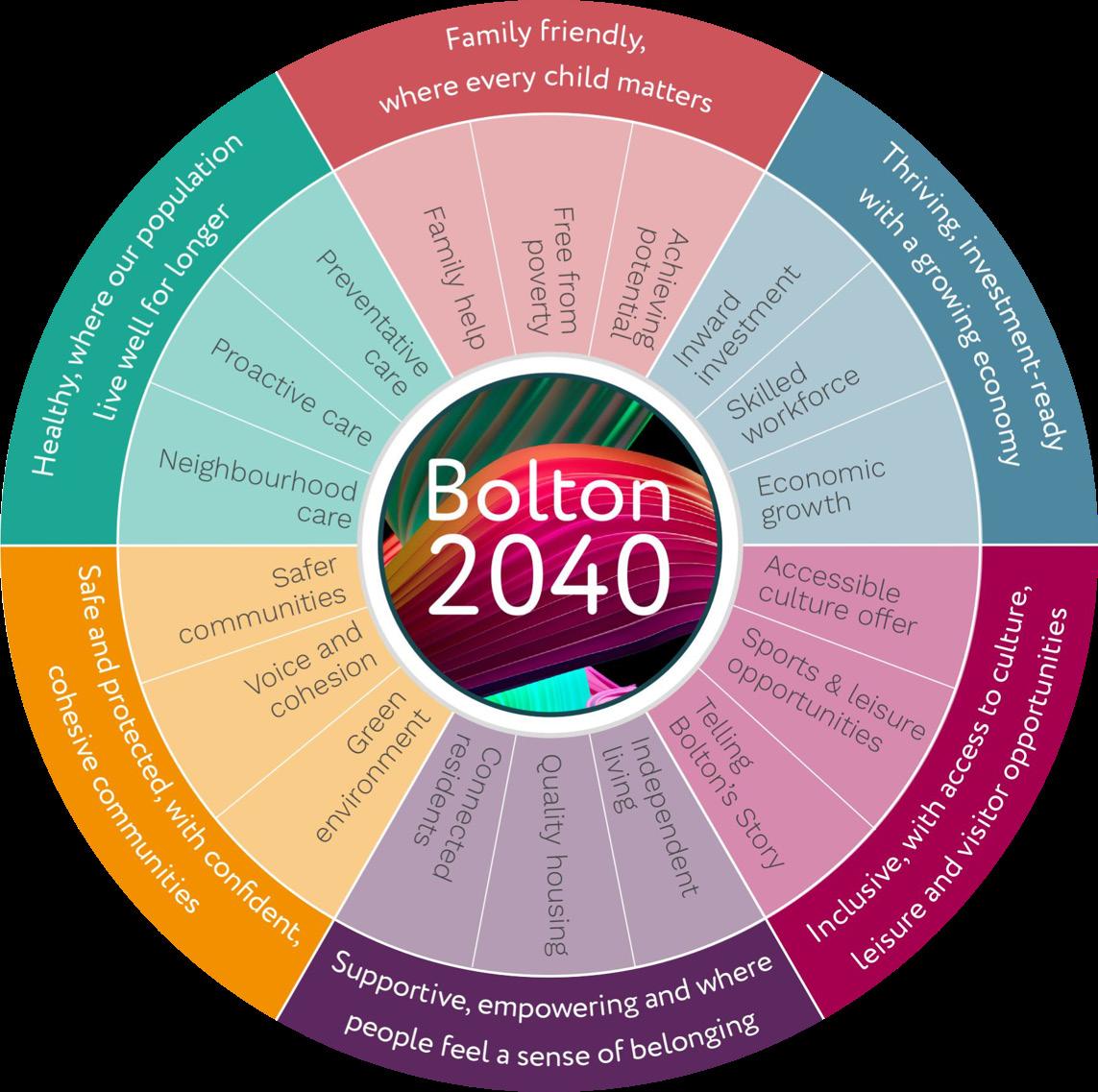
Bolton Vision 2040 (the Borough Plan) sets out a shared, long term ambition to make Bolton a place where all residents can thrive by addressing structural inequalities and improving outcomes across education, employment, and health. Developed through partnership between local authorities, education providers, employers, and community organisations, the Vision provides a strategic framework for coordinated action across the borough.
The Vision is underpinned by three core principles: prevention, investment, and inclusive growth, which collectively seek to tackle entrenched disadvantage, including child poverty, health inequalities, and low skill levels. These challenges are recognised as key barriers to educational access, participation, and progression for underrepresented groups in Bolton.
Bolton Vision 2040 reinforces the need for Bolton College to adopt a whole-system, place-based approach to access and participation. In particular, it supports the College’s strategic focus on:
• Targeting learners from areas of high deprivation and low participation, in line with local inequality profiles
• Supporting progression from further education into higher education and skilled employment, particularly in key local growth sectors
• Delivering inclusive, flexible learning pathways that address barriers related to cost, transport, digital access, and caring responsibilities
• Embedding early intervention and outreach, working with schools and community partners to raise aspirations and attainment
• Contributing to borough wide efforts to reduce gaps in outcomes (continuation, achievement, progression) for underrepresented groups
We create a high-quality learning experience, driven by a culture of continuous improvement, by providing inspirational, cutting edge teaching and
learning which is responsive to the needs, interests and experience of all students and leads to success. We widen participation and increase access to lifelong learning opportunities in education and training at a variety of locations and assist all our students to reach and maximise their full potential and progress in their learning and employment.
Bolton Vision 2040 identifies several priorities that are directly aligned with the Office for Students’ focus on equality of opportunity and Bolton College’s strategic and operational priorities.
Bolton 2040 Priorities
Reducing educational disadvantage at an early stage
Alignment to OfS and Bolton College priorities
A preventative approach to closing attainment gaps that impact progression into further and higher education.
Improving access to skills and progression pathways
Addressing structural barriers to participation
Developing a skilled local workforce through improved access to education and training and supporting progression into sustained employment and highquality destinations.
Breaking down the practical and place-based barriers that can restrict access to education for disadvantaged learners. This work is supported through Bolton Skills Executive Board.
Reducing health and wellbeing inequalities
Strengthening inclusive and cohesive communities
Pastoral support focussed on prevention and improved health outcomes acknowledges the link between wellbeing, attendance, retention, and student outcomes.
Belonging, community safety and cultural inclusion focus supports engagement and participation for underrepresented and marginalised groups
4. Bolton College
Background
The move to ‘Designated Institution’ status, as part of the University of Greater Manchester* group, was a significant achievement. The Department for Education approved the model with Bolton College as a designated subsidiary company limited by guarantee (called Bolton College) which is eligible to receive public funding which is a necessary step to operate a publicly funded further education college.
The College became a designated institute (being a company limited by guarantee) under the company name ‘Bolton College’, as set out in the consultation, and transferred its property, rights and liabilities to the new company all with effect from 1st August 2018. The company continues to operate the College from its current sites. The first merger of its type in England provides a high level of security and opens new opportunities for the community we serve.
The long-term goal for a genuine ‘cradle to PhD’ seamless education route is now a step closer. An example is that adult students can start off on short, non-accredited courses within the community to build up entry level skills and confidence before moving
over to qualification-based provision in the College. Our younger students can access our foundation curriculum to build their skillset and confidence before progressing to higher level courses.
All courses are carefully mapped to enhance employment and progression opportunities with seamless routes to College and University of Greater Manchester provision, including higher and degree apprenticeships. Students have clear progression routes along with regular information, advice and guidance to enable them to make informed choices about the direction of their futures.
Facilities for our Higher Education students ensure their needs are met. Our unique location within Bolton’s Education Zone and close locality to the University of Greater Manchester means that our Prescribed HE students can benefit from, enjoy and utilise both the College’s and University’s range and wealth of facilities. Bolton College provides high quality vocational training to enhance qualifications, skills and employability. With over 800 full- and parttime courses to choose from delivered at three main localities around Bolton, we’re confident that we have
localities around Bolton, we’re confident that we have something to suit everyone.
We continually strive to improve and strengthen what we do best, so that we can help more students to achieve their ambitions in the future.
The College is a member of Greater Manchester Higher, a collaborative network of higher education providers, offering impartial information, advice and guidance to help young people make informed choices about their future. It aims to support the government’s social mobility goals by rapidly increasing the number of young people from underrepresented groups entering higher education.
Bolton College recognises and values the cultural, social and ethnic diversity reflected in our students and staff. As a result, we treat all with respect and dignity, and seek to create a positive learning and working environment. We provide a safe and supportive environment which values individuals equally, regardless of protected characteristics and socioeconomic status.
The College is home to people from a wide range of cultures and backgrounds with diverse beliefs, values and abilities. We aim to meet the needs of all individuals and encourage them to share their experiences and beliefs.
We welcome students with learning difficulties and disabilities and support them according to their needs. We work collaboratively with a range of community organisations and other partners to tackle social exclusion, address discrimination and promote community cohesion. The college has achieved the NNECL quality status in recognition of the work we do in supporting ‘care experienced young people.’
The NNECL Quality Mark (QM) is an evidence based and impact driven change management process which demonstrates support for the inclusion and success of students with care experience and who are estranged. The QM framework covers:
The QM framework covers:
• the student lifecycle from outreach through to graduation (and beyond);
• institutional culture and leadership; and continuous improvement and future plans
Bolton College is committed to creating a safe, inclusive and respectful environment where all students feel confident to be themselves. We have a zero-tolerance approach to harassment, bullying, victimisation and discrimination. This commitment is reflected in our achievement of the nationally recognised Rainbow Flag Award, which supports a whole-college approach to LGBTQ+ inclusion, visibility and the prevention of bullying.
We also actively promote equality and student voice through our involvement in the national Student Commission on Racial Justice, delivered in partnership with Leaders Unlocked. This initiative empowers students aged 16–24 to engage in meaningful dialogue about racial justice, share their experiences across key aspects of college life, and contribute to the development of institutional action plans.
Through collaboration with peers, staff and external professionals, students help shape national and local recommendations, ensuring that diverse perspectives inform practice. The project also includes the co-creation of educational resources to raise awareness and encourage ongoing conversation around racial equality within the college community.
The College’s commitment to wellbeing and embedded trauma informed approach continues with the implementation of the staff and student wellbeing strategy. The College has continued to increase the work and training for all staff and widening services for learners through wellbeing mentors and co-ordinators.
We have formed and established links with charitable organisations, providing guest speakers to cover aspects of wellbeing and mental health. We proactively seek inspirational guest speakers to visit the College and share their lived experience stories and deliver key messages on mental health, wellbeing and resilience.
As well as guest speakers, charitable organisations also hold information stalls in our Atrium during Fresher’s Fair and at different points throughout the academic year. There are well designed transition arrangements for all courses and students that ensure all support needs are identified with appropriate arrangements in place before the course starts.
When students arrive in College there is a robust induction programme to ensure all students are equipped with the knowledge, support and guidance needed to make them successful and enjoy their time at College.
When students arrive in College there is a robust induction programme to ensure all students are equipped with the knowledge, support and guidance needed to make them successful and enjoy their time at College.
Widening Participation Priorities
Bolton College is committed to improving equality of opportunity in higher education for underrepresented groups, in line with Office for Students (OfS) expectations. Our approach spans the full student lifecycle: access, success, progression and continuous improvement, and is underpinned by robust evaluation and student voice.
Key widening participation priorities include:
• Targeted Access and Outreach: Increasing awareness, aspiration and informed choice among underrepresented groups through engagement with schools, communities and adult learners.
• Fair Access and Admissions: Ensuring transparent, inclusive and equitable admissions processes that recognise potential and minimise barriers.
• Financial Support and Affordability: Providing a clear, accessible fee structure alongside targeted financial support to reduce economic barriers to participation and continuation rates, particularly for priority groups.
• Student Success and Continuation: Delivering high-quality teaching, inclusive curricula, personalised tutorial support and additional interventions to improve attainment, continuation and completion rates, particularly for priority groups.
Progression and Positive Outcomes: Supporting students to progress successfully into skilled employment or further study, including careers education, employability support and partnerships with employers.
• Evaluation and Continuous Improvement: Embedding evidence-based approaches, using data to identify gaps in access, experience and outcomes, and evaluating the impact of interventions to drive continuous improvement.
Targeted Access and Marketing
The College delivers a coordinated and inclusive approach to marketing and outreach to ensure that prospective students—particularly those from underrepresented backgrounds—are aware of and able to access our higher education provision.
• We provide a strong higher education presence at College open events, supported by tailored information, advice and guidance.
• We work collaboratively with the University of Greater Manchester and the Greater Manchester Higher Network to extend our reach and engage potential learners across the region.
• We actively promote clear internal progression pathways from further education, including Access to HE programmes, to support smooth transition into higher education.
• Our marketing strategy uses digital channels, social media and targeted campaigns to reach local communities, mature learners and those less likely to engage with traditional higher education routes.
• Course information is also promoted through partner platforms, including the University of Greater Manchester website, ensuring broader visibility and accessibility.
This approach is designed to support informed decision-making, raise aspirations and ensure that higher education opportunities at Bolton College are inclusive, visible and accessible to all.
Commitment to OfS Expectations
In line with OfS priorities, the College will continue to:
• Identify and address access, continuation, attainment and progression gaps for underrepresented groups.
• Strengthen the use of data, evaluation and student insight to inform practice.
• Ensure that all activity contributes to measurable improvements in student outcomes.
• Embed equality, diversity and inclusion across all aspects of the student experience.
10. Bolton College
Employability
Bolton College is committed to delivering high-quality higher education that equips students with the skills, knowledge and behaviours required by local, regional and national labour markets, in line with priorities identified within the Greater Manchester Local Skills Improvement Plan (LSIP). Our provision is designed to support key growth sectors and address local skills needs, ensuring that graduates are well prepared for sustained employment, career progression or further study.
We maintain strong partnerships with employers to co-design and deliver industry-relevant curricula through engagement with employers such as Bethell, MBDA, Scan Computers, Amazon, BAE, Watson Homes, Invisu, Asda, Galloway (Girls in Construction) and Bolton Council. Students benefit from guest lectures, live briefs, masterclasses and industry insight, ensuring learning remains current and applied. This is enhanced through collaboration with the University of Greater Manchester, including access to research-informed teaching, specialist facilities and employer-led events.
Our Higher Technical Qualifications (HTQs), are aligned to employer-defined occupational standards and developed in close partnership with industry. These programmes provide practical, technical and career-focused pathways, enabling students to progress directly into skilled employment or higher-level study.
In line with LSIP priorities, we provide opportunities for students to engage with emerging technologies and industry developments, including access to specialist centres such as the National Centre for Motorsport Engineering. Work-based learning, placements and real-world projects are embedded across programmes to ensure students can apply their learning in professional contexts.
Higher apprenticeships further strengthen employability through close employer collaboration, with regular engagement between employers and College staff ensuring that training remains relevant and responsive to workforce needs.
Staff maintain industry currency through professional updating and engagement with employers, supporting the delivery of innovative, inclusive and research-informed teaching. This aligns with our commitment to delivering a high-quality student experience that leads to strong progression outcomes.
Fair and effective admissions policy and process
The College is committed to fair, transparent and inclusive admissions practices that widen access to higher education for underrepresented groups. Admissions processes are designed to recognise potential as well as prior attainment, ensuring that applicants from diverse educational and professional backgrounds are considered equitably.
Applicants to prescribed higher education programmes are considered in accordance with the University of Greater Manchester’s admissions policy, while non-prescribed provision follows the College’s own admissions processes. All applicants are assessed holistically, taking into account qualifications, prior learning, personal statements, references and relevant work or life experience.
Flexible approaches, including interviews and assessments, are used where appropriate to support applicants who may not meet standard entry criteria. The College also recognises accreditation of prior experiential learning, enabling individuals with vocational or professional experience to access higher education.
We provide clear information, advice and guidance throughout the application process and actively support applicants to make informed choices. Where higher education is not yet appropriate, applicants are supported to access alternative pathways, including Access to HE and pre-HE provision, enabling progression at a later stage.
The College is committed to ensuring that admissions processes are free from discrimination and promote equality of opportunity.
Financial Support and Affordability
Bolton College is committed to ensuring that cost is not a barrier to participation or success in higher education. We aim to maintain a clear and affordable fee structure, representing strong value for money, particularly for students from underrepresented and disadvantaged backgrounds.
Targeted financial support is available through mechanisms such as the HE Hardship Fund, which assists students facing financial difficulties, including support for course-related costs, living expenses or unexpected financial hardship. This helps to improve retention and continuation rates, in line with OfS priorities.
The College also offers progression incentives, such as internal awards for students progressing from further education to higher education, supporting increased participation from local learners and those entering HE via non-traditional routes
Student Support, Success and Continuation
Supporting student success is central to our mission to improve outcomes for all learners. We provide a comprehensive and inclusive support framework designed to improve continuation, attainment and completion, particularly for students from underrepresented groups.
Personalised tutorial support is available through flexible delivery methods, including face-to-face, online and asynchronous support, recognising the needs of part-time students and those balancing study with work or caring responsibilities.
Students have access to a wide range of services, including:
• Academic and learning support
• Careers education, information, advice and guidance
• Counselling and wellbeing services
• Additional learning support for students with disabilities or specific learning needs
• Well-resourced Learning Resource Centres and study spaces
We operate a robust ‘student at risk’ monitoring process, using attendance and performance data to identify and support students who may be at risk of withdrawal or underachievement, ensuring timely and targeted intervention.
Students studying prescribed HE programmes also benefit from access to University of Greater Manchester facilities and services, further enhancing their academic and personal support.
Progression and Growth
The College provides clear and flexible progression pathways that support learners to advance within higher education and into employment. This includes progression from Level 3 and Access to HE programmes into higher education, as well as progression from HNC/HND/HTQ qualifications to full honours degrees through established partnerships with the University of Greater Manchester.
Delivery models include full-time, part-time and apprenticeship pathways, supporting widening participation and improved access for learners with diverse needs and circumstances.
Students are supported to make informed progression decisions through events, careers guidance and targeted communications. Opportunities to engage with university staff, employers and alumni further enhance progression awareness and aspiration.
Our non-prescribed provision remains highly responsive to employer needs, supporting continuous professional development (CPD) and upskilling within the local workforce, which aligns with regional economic priorities.
Evaluation and Continuous Improvement
Bolton College adopts a robust, data-informed approach to evaluating access, participation and outcomes, in line with OfS expectations. We monitor performance across the student lifecycle, including access, continuation, attainment and progression, with a particular focus on identifying and addressing gaps for underrepresented groups.
Data is analysed across key characteristics, including:
Programme-level planning incorporates detailed analysis of performance data to identify areas for improvement and inform targeted interventions.
An annual Higher Education report provides oversight of performance and impact, with governance through College Board structures and the University of Greater Manchester. This ensures accountability and supports evidence-based enhancements to policy and practice.
We are committed to strengthening our evaluation capability, embedding the use of evidence to assess the effectiveness of interventions and ensure that resources are directed towards activity that delivers measurable improvements in equality of opportunity and student outcomes.