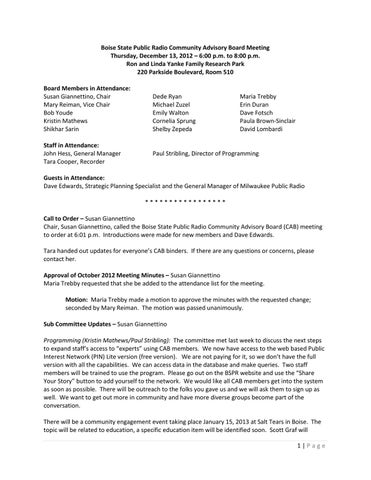
Boise State Public Radio Community Advisory Board Meeting Thursday, December 13, 2012 – 6:00 p.m. to 8:00 p.m. Ron and Linda Yanke Family Research Park 220 Parkside Boulevard, Room 510 Board Members in Attendance: Susan Giannettino, Chair Mary Reiman, Vice Chair Bob Youde Kristin Mathews Shikhar Sarin Staff in Attendance: John Hess, General Manager Tara Cooper, Recorder
Dede Ryan Michael Zuzel Emily Walton Cornelia Sprung Shelby Zepeda
Maria Trebby Erin Duran Dave Fotsch Paula Brown-Sinclair David Lombardi
Paul Stribling, Director of Programming
Guests in Attendance: Dave Edwards, Strategic Planning Specialist and the General Manager of Milwaukee Public Radio ***************** Call to Order – Susan Giannettino Chair, Susan Giannettino, called the Boise State Public Radio Community Advisory Board (CAB) meeting to order at 6:01 p.m. Introductions were made for new members and Dave Edwards. Tara handed out updates for everyone’s CAB binders. If there are any questions or concerns, please contact her. Approval of October 2012 Meeting Minutes – Susan Giannettino Maria Trebby requested that she be added to the attendance list for the meeting. Motion: Maria Trebby made a motion to approve the minutes with the requested change; seconded by Mary Reiman. The motion was passed unanimously. Sub Committee Updates – Susan Giannettino Programming (Kristin Mathews/Paul Stribling): The committee met last week to discuss the next steps to expand staff’s access to “experts” using CAB members. We now have access to the web based Public Interest Network (PIN) Lite version (free version). We are not paying for it, so we don’t have the full version with all the capabilities. We can access data in the database and make queries. Two staff members will be trained to use the program. Please go out on the BSPR website and use the “Share Your Story” button to add yourself to the network. We would like all CAB members get into the system as soon as possible. There will be outreach to the folks you gave us and we will ask them to sign up as well. We want to get out more in community and have more diverse groups become part of the conversation. There will be a community engagement event taking place January 15, 2013 at Salt Tears in Boise. The topic will be related to education, a specific education item will be identified soon. Scott Graf will 1|Page
moderate a panel of a few guests. Adam Cotterell will be on the panel. This will be an informal gathering to talk about an important topic. We want to have a conversation with the audience. The event will not cost us very much. This will be promoted heavily on air (starting after the holidays) and will be part of a series. We would like to build this up and eventually have one a month. Adrienne is helping to organize these events. The Programming Committee will be helping out at this event. We are looking for people to have as part of the conversation, if you know of anyone to include, please contact one of the committee members (Maria, Micah, Camille, Paul, or Kristin). All CAB members are encouraged to attend. Kristin will send out further information regarding the event as it gets finalized. Advocacy (Emily Walton): We had an opinion editorial printed in the Valley Times regarding public broadcasting. It was published December 5. We now have a template draft for editorials. Emily is working with Bob and Paula and others to get it into other areas with the general topic of public broadcasting. If anyone has further newspaper ideas or connections please get ahold of Emily. Sustainability (John Hess): Kelly is working with Mary on recording some videos with staff for the tours of the current broadcasting facilities. We are working with Leadership Boise on an event as they are including BSPR in their “Day of Media” on January 17. We will be their last stop. We will stage the upstairs area with the on air personalities and producers in their respective areas and give them a sense of what we do. Sadie will be part of a panel discussion regarding local media. Micah Austin is on the docket to present our roadshow presentation to folks in the Wood River Valley which will help increase our visibility there. There are packets of notes for several members of the Board. If your list contains folks who donated, please write a thank you note. If your list contains folks who have yet to donate, please write them a note asking them to consider donating. Send the notes back within two weeks to Kelly or Tara’s attention. CAB Bylaws – Paula Brown-Sinclair A ten day notice must be given to all CAB members of any change in the actual language of the bylaws. Paula recommends clarifying the whole process of recruitment as well as the status/role of the student representative and she will send out a couple of options before the next meeting in February. General Manager’s Report – John Hess During the fund drive on Tuesday (12/12) we raised a total of $110K. We started with $31K in pledges before the drive and raised about $80K on the air. We had 840 pledges for the day. This is pretty good and comparable to last year, we met our goals and didn’t fall behind. Right now we are on track to meet the $1.4 million goal in fundraising. We will work on straighten out the operators for the spring drive. Byron Johnson passed away this week; Tara is passing around a card. Byron was part of John’s search committee and integral in John being hired. Byron was instrumental in politics and was a steward of this Board. He always wore a lucky scarf during pledge drives and then donated the scarf to the member who pledged the most. He was an amazing man and a credit to public radio.
2|Page
Our event at the Botanical Gardens went well and everyone was happy. We had approximately 50 attendees. We received great feedback from the event and we will continue to do these types of events. Bob and Susan compliment John and the staff for all the hard work to get the outlying stations back on air. It may be beneficial to find a way to push notices to donors and members in the outage areas (McCall/Wood River Valley) letting them know what we know about the outage. It was noted that the button on website says “pledge” and not necessarily give money right then, which confused some donors who were looking to be invoiced for their pledge. BSPR Strategic Planning Session – Dave Edwards The purpose of this discussion is to look at the future of Public Broadcasting and BSPR and how we provide services to our audience. We will take all the ideas and input we receive and look for trends. Everyone’s comments are valuable and important. Dave is the General Manager of Milwaukee Public Radio at the University of Wisconsin. He has been the General Manager there since 1985. He also used to work with Dave Fotsch. He is on the Board of Directors for NPR and has been the chair for the last two years. He has been able to look at trends at the national level and every organization is facing challenges. The media industry is evolving very quickly and public radio has always been threatened, but radio is resilient. Technology is changing the way we consume media. Public radio saw big growth through the 80s and 90s, which was very different from commercial radio, and only recently has public radio seen a declined in the amount of time spent listening, but not total cume. Listeners aren’t listening because they don’t like it, there are just more choices for them to turn to now. For example there is an NPR app and podcasts of specific shows. Listeners are now demanding more control. So we have to look at what people will support and pay for. Listeners want unique reporting, voices, and convenient delivery. Public radio has pretty much owned the territory of intelligent programming in the past, but now we have new competitors that we didn’t have before. For example, the Huffington Post is dabbling into video, with the potential for podcasts in the future. What does that mean for our future and the future of federal funding? The loss of federal funding would send shock wave through the system because it is critical for operations for so many stations. Through it all though, Dave is optimistic because radio is resilient. BSPR does have its own challenges. They include trying to bridge the capacity gap in getting local donors/funders to help fund more local news and other things we want to do. We have technology challenges. Our network is very expensive to maintain, we have increased difficulties here in Idaho because of the terrain and the weather. The network does not pay for itself; it costs us approximately $250K annually to maintain. That money takes resources from the rest of the organization. We are also facing increased competition with more online sites offering local news and cars equipped with Wi-Fi. Our listeners have a lot more choices. We have to figure out how to make our station indispensable. With our new facility we want to develop a culture of cooperation, learning, reaching out to community, and engagement. We want to imbed ourselves into community and find ways to use our facility to do that. 3|Page
If you put on your consumer hat in regards to the BSPR experience, what is the perception of how others view BSPR? Many would say, “BSU has radio station?” There is a pretty big awareness issue. If our greatest predictor of listening is education, why would that typical set of folks not listen? For a lot of people there is a perception of it being far left liberal media, when it actually isn’t. For those people it isn’t about content, it’s about money. Because we are funded by government, they are opposed to us. People have an old image of public radio and that impression colors their view. For those who do listen, the station is conversational and personal. BSPR is associated with NPR; a listener doesn’t necessarily use it to connect locally. The national brand is the identity. In regards to awareness, we have a broad reach in comparison to other local media. Some are not always truly listening; it is just used as background noise. Some use it as a “geeky badge”; “we listen because we are smart”. Listening is a selfidentifying feature. Lack of time is huge issue, especially because of competing media outlets. Some people think of themselves as public radio listeners, but life pressures crowd it out. It is also seen as “sophisticated” radio, a certain amount of Idahoans do not want to be sophisticated. Our reach has to be broader to include younger populations. The reliability of service also colors peoples view of station. A significant amount of time and money has gone toward creating substantial local programming recently, does the local programming have value? In many ways it blends seamlessly with the national news. The level of workmanship is equivalent to the national quality. Members are looking forward to legislature coverage. We need to go forward with a co-branding strategy rather than local branding only. There is also a civil war issue; some residents will not listen simply because we are associated with Boise State. We also need to have an NPR co-branding strategy. Is there advantage/disadvantage in aligning with BSU? Bob Kustra’s connection is valuable. This is a disadvantage if you want to get outside of Boise. Being unique is important. We need to focus on being Idahoan vs. Boisean. Is the local/national mix about right? We might be scrounging if we look for more local news. Not many people listen/watch local news TV stations or read the local paper because of the poor reporting. We could fill void of lack of good reporting and become a vital local source. Do we do spot/hot news vs. StateImpact/environmental reporting? We need to do both. It is important to get more than just a snippet; with BSPR we get analysis and commentary with the reporting. It is important to have a conversation versus telling you what to think. Emphasis on local news should be defined as a priority. The difficulty is that we cover so much ground and “local” news is different in each area. BSPR can’t just focus on Boise. Can we do justice to that? We have been trying to do better by reporting on more items with national/regional significance. Local can’t mean provincial. So far we’ve been successful in regards to fund drives and underwriting. What are the obstacles/strategies to be more effective fundraisers? Do people want name recognition? Some do want to be recognized by name for their gifts. We do have some options for that. We have a Broadcast Society that people can be part of. Can we ask for more from contributors? We should focus on the folks that give $500 to $3,000 annually and work on moving them up. Possibly bump up the minimum to be a member of the Broadcast Society. We need to give folks incentives to give more and get them 4|Page
giving it every year. More horsepower needs to be put to fundraising. We need to educate listeners more and let them know where our money comes from so they know we aren’t getting it from other sources. We need to continue to build relationships and get people to donate in their will. We need to affect the community in positive ways and educate people. When it looks like we are doing a rote thing, we have to step out of the typical programming. When listeners donate they need to see additional perceived value. To get that extra push there has to be something different. Originally the idea was that public radio should be in every corner of America and funding was provided to create that infrastructure. Which is a big problem now because these transmitters/transformers need to get replaced/updated and federal money is no longer available. They take a lot of money to maintain and upgrade and don’t put back in what they are costing. Are these outlying locations important? We need to have a conversation with residents of those areas and let them know that if we don’t have money, the service will go away. These stations have a lot of value to those people. We could have public engagement events in the smaller communities (i.e. Wood River Valley, McCall) and talk to them. We also need to look at alternative fundraising venues/methods. Money could be raised at the public engagement events by selling tickets or having an entry prize or auction. The group felt that we have not begun to exhaust the possibilities to get money for those communities. They are the definition of what public radio is. If we don’t have that commitment and we pull back, we cease to be public radio. Right now we have a stronger argument with Congress for the need for money, if we pull back, we lose that leverage. Our programming needs to be more relevant, maybe there should be a broadcast from Coeur d’Alene for example. We will not be getting more money from the federal government, it will continue to decrease. What do we do if we suddenly lost that money? If that happened, could we raise an additional $150K or more in new dollars? Could we possibly cut programming? It would take a lot of shows to save the amount of money we would lose. We need to take the issue to the communities, identify folks who have donated from those areas and champion them as community leaders. We could target donations for reliable transmission. We need to seriously look for new dollars before making a cut list. We need to do a costbenefit analysis of each of the transmitters. What are the listeners really listening to? A lot of the remote locations are listening to the classical station. We need to educate the listeners and let them know the transmitter is aging and we will need increased funding to replace it. Let them know that the money is going straight to their community, make that link very clear. This would be an ideal capital campaign for targeted gifts. Additional items/thoughts (went around the table): Consolidation of stations (music/news); look at possible technical solutions; more comprehensive survey of membership/listenership; greater awareness of what each department is doing (culture); continue to be prominent in the community, being seen and out and about as a leader of carrying on community conversations, entertainment, etc.; community ownership/sponsorship; community involvement has grown, we’ve come a long ways from where we were; push out website more; separate radio stations in rural environments; development of local public news; reach out and engage communities more; value adding, what do we provide that no other radio service does - forum, town hall conversations, local talk show; younger populations, grow
5|Page
relationships; explore fundraising more broadly, get more creative; more research into listenership, create more donor levels, displays, put people’s names in print. Dave told the Board how phenomenal the group is and that the organization is lucky to have them helping to find resolution to the issues we are facing. This is going to be an ongoing discussion and may require the group to gather together to sort out issues as they come up. Information from all the focus groups will be distilled and Dave and John will look for common themes. The Board will have an update in February. By the April meeting there should be a draft plan to present. This is the widest circle of stakeholders that we’ve talked to when creating a plan. We’ve definitely been offered other insights and the knowledge that it doesn’t have to be either/or choice. All the feedback is greatly appreciated. Adjourn – Susan Giannettino The next Community Advisory Board meeting will take place on February 7, 2013. Meeting adjourned at 8:00 p.m.
6|Page