vol.34 n o.1 1 • N ovem b e r 2 02 6
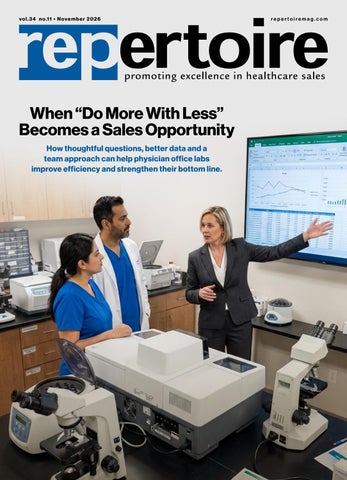
When “Do More With Less” Becomes a Sales Opportunity How thoughtful questions, better data and a team approach can help physician office labs improve efficiency and strengthen their bottom line.
repertoiremag.com
AFINION™ 2 ANALYZER
MAKE THE DECISION IN THE MOMENT THAT MATTERS. WITH THE AFINION™ 2 ANALYZER, HBA1C RESULTS HELP GUIDE PATIENT CARE IN REAL TIME.
By providing real-time HbA1c results at the point of care, the AfinionTM 2 Analyzer saves clinicians time3 and turns diabetes visits into immediate, actionable treatment plans.4
*
Results in minutes†
Highly accurate†
Easy to use†
Maintenance not required†
Contact your Abbott CM Account Executive today! Scan here to learn more
* Afinion™ HbA1c Dx and ACR tests are moderately complex. † Consult the Afinion™ 2 Analyzer User Instructions for complete information. References: 1. Data includes Afinion HbA1c and NycoCard HbA1c sales. 2. Data on file. Based on POC Test Worldwide sales. 3. Crocker JB, et al. Am J Clin Pathol. 2014;142(5):640-6. 4. Lee MS, et al. J Gen Intern Med. 2025;40:2789–2791. © 2026 Abbott. RDx-26002330 09/26 LITHO IN USA
CONTENTS NOVEMBER 2026 • VOLUME 34 • ISSUE 11
` FINANCES
38 Helping Practices Make Smarter Purchases
Reps can become valuable partners by helping physician practices think through utilization, infrastructure, financing and the business case for new equipment.
44 Make the Investment Make Sense
Tax breaks are great. But before making an equipment purchase, one financial expert says physician practices should weigh utilization, cash flow, total costs and long-term financial return.
18 When “Do More With Less”
` ASCs
Becomes a Sales Opportunity How thoughtful questions, better data and a team approach can help physician office labs improve efficiency and strengthen their bottom line. 23 Filling the Lab Workforce Pipeline
52 From Transaction to Strategy
28 Selling Into a Changing Lab Market
As technology advances and supply chain gains influence, Fisher Healthcare’s Amy Malik says sales reps must understand the unique needs of each laboratory.
Henry Schein’s Gary Dennis explains how understanding clinical value, reimbursement shifts, and compliance challenges allows medical distribution reps to become indispensable partners.
Countless Blessings
` COMMUNICATION
4
From Conflict to Collaboration
Mediation and Conflict Resolution Officer Martin Stillman, MD, JD, explains why conflict is an opportunity – not a threat – and shares communication techniques every healthcare sales professional can use to resolve challenges with confidence.
As financial and supply chain pressures mount, healthcare organizations are taking a more collaborative approach to capital procurement and supplier partnerships.
` TECH TALK
32 Helping Physician Office Labs Navigate Evolving Pressures
2
Why a modest payment update by CMS may mask deeper reimbursement cuts and mounting financial pressures for independent surgery centers.
` TRENDS
The demand for laboratory professionals continues to outpace the supply. Kathy Nucifora of COLA explains the shortage and offers strategies for physician office labs facing staffing challenges.
` PUBLISHER’S LETTER
48 The Math Behind ASC Reimbursement
` SALES
56 Building a Better Patient Experience
Connected technology, thoughtful room design and streamlined workflows are helping providers create exam rooms that work better for patients and caregivers alike.
` HIDA
10 Beyond Confidence: Building the Skills to Succeed at Work
How to be more productive, prepared and secure in today’s shifting healthcare environment.
60 Managing Tariff Uncertainty with HIDA’s Interactive Tariff Dashboard ` MED/SURG BEDTIME STORIES
62 Max and Scout and the Emergency Backorder
14 The Full Demo Is Killing Your Sale
Showing a buyer everything feels thorough. Most of the time it just hands them homework. The best reps find the problem first and show only what solves it.
Problem-solving under pressure is critical in distribution.
` NEWS
64 Industry News
Subscribe/renew @ www.repertoiremag.com : click subscribe Repertoire magazine (ISSN 1520-7587) is published monthly by Share Moving Media, 350 Town Center Ave, Ste 201, Suwanee, GA 30024-6914. Copyright 2026 by Share Moving Media. All rights reserved. Subscriptions: $59.00 USA/$69.00 Canada per year for individuals; issues are sent free of charge to dealer representatives. If you would like to subscribe or notify us of address changes, please contact us at the above numbers or address. POSTMASTER: Send address changes to Repertoire, 350 Town Center Ave, Ste 201, Suwanee, GA 30024-6914. Please note: The acceptance of advertising or products mentioned by contributing authors does not constitute endorsement by the publisher. Publisher cannot accept responsibility for the correctness of an opinion expressed by contributing authors. Periodicals Postage Paid at Suwanee, GA and at additional mailing offices.
Repertoire
www.repertoiremag.com | November 2026
1
publisher’s letter
Countless Blessings
E
very November, I sit down to write my Thanksgiving publisher’s letter and reflect on how fortunate I am. This year feels different. I’m celebrating my 30th anniversary in the medical supply industry and wondering where the time has gone. In 1996, I started as a young sales rep for Healthlink, covering the Northeast. I had a territory, a sales goal and absolutely no idea what I was doing or how much this industry would shape my life. Thirty years later, including 18 years as publisher of Repertoire Magazine, I realize what started as a career became something much more meaningful. It became a family. Over the years, I’ve met remarkable people who took a chance on me, mentored me, challenged me and helped me grow. We’ve celebrated victories, endured difficult times, traveled nearly 2.5 million miles and shared more laughs than I can count. Some friends are no longer with us, and I miss them dearly. Others are just a phone call away, even if we haven’t spoken in months. That’s what makes this industry special. These relationships last a lifetime. One of my greatest blessings has been watching my son, Scottie Adams, build his own career in this industry over the past eight years. I’m especially grateful to everyone who has mentored him, shared knowledge and helped him along the way. Your generosity reminds me that our industry’s greatest strength is its people and their willingness to help the next generation succeed. I’m also thankful to work in an industry that makes a meaningful difference. Every product we manufacture, distribute or sell ultimately serves a caregiver and a patient. We may not wear scrubs or carry stethoscopes, but we play an important role in keeping America healthy. As we celebrate Thanksgiving, let’s appreciate the freedoms and opportunities we enjoy in this great country and never take them for granted. Most importantly, let’s cherish the family and friends who make this journey worthwhile. After 30 years, I’ve learned that sales numbers fade, awards collect dust and business challenges pass. But friendships, memories and the people we love remain. To everyone who has been part of my journey, and now Scottie’s, thank you. From my family to yours, Happy Thanksgiving. God bless you, your families and this great country we call home. Dedicated to the Industry, R. Scott Adams, Publisher
2
Repertoire
www.repertoiremag.com | November 2026
editorial staff editor
Graham Garrison ggarrison@sharemovingmedia.com editor-in-chief, Dail-eNews
Jenna Hughes
jhughes@sharemovingmedia.com content creator
Pete Mercer
pmercer@sharemovingmedia.com art director
Brent Cashman bcashman@sharemovingmedia.com circulation
Laura Gantert lgantert@sharemovingmedia.com
sales executive
Aili Casey
acasey@sharemovingmedia.com (404) 625-9156 publisher
Scott Adams sadams@sharemovingmedia.com (800) 536.5312 x5256 founder
Brian Taylor btaylor@sharemovingmedia.com
Subscriptions
www.repertoiremag.com/subscribe or (800) 536-5312 x5259
Repertoire is published monthly by Share Moving Media 350 Town Center Ave, Ste 201 Suwanee, GA 30024-6914 Phone: (800) 536-5312, FAX: (770) 709-5432; e-mail: info@sharemovingmedia.com; www.sharemovingmedia.com
Your Complete Wound Care Portfolio Trusted for quality, consistency,
Adhesive Bandages
Gauze Dressings
and versatility – supporting every
Adhesive Dressings
Impregnated Dressings
Advanced Wound Care
Medical Tapes and Adhesives
Antiseptics and Wound Cleansing
Non-Woven Dressings
Applicators and Swabs
Small Procedure Kits
Bandages
Specialty Dressings
Burn Care
Surgical Drapes and Towels
Casting
Surgical Sponges
step of patient care. dukal.com
Explore Dukal’s entire portfolio of wound care solutions
communication
From Conflict to Collaboration Mediation and Conflict Resolution Officer Martin Stillman, MD, JD, explains why conflict is an opportunity – not a threat – and shares communication techniques every healthcare sales professional can use to resolve challenges with confidence. Listen to this article, scan the QR Code.
C
onflict is inevitable in healthcare. Whether it’s a disagreement between colleagues, tension with a patient or competing priorities within an organization, difficult conversations are part of doing business. Yet many professionals receive little formal training on how to navigate conflict effectively. Dr. Martin Stillman believes that’s a missed opportunity – not only for solving problems, but for strengthening relationships and creating healthier organizations. As Mediation and Conflict Resolution Officer for Hennepin Health System, Dr. Stillman is called
4
Repertoire
www.repertoiremag.com | November 2026
Martin Stillman, MD, JD
upon to resolve conflicts across departments and leadership teams. After seeing early success, he realized there were additional approaches that could be effective besides simply stepping in to mediate. “We could have more widespread impact if leaders were given tools to address conflict more efficiently and confidently themselves,” he said. With support from hospital leadership, he developed the Conflict Resolution and Facilitation Training (CRAFT) program, which was first taught within his health system before expanding to healthcare organizations nationwide. Dr. Stillman credits his organization’s chief medical officer with championing the work through a simple philosophy: “Let’s build capacity, not dependency.” Today, Dr. Stillman is nationally recognized for helping healthcare professionals approach conflict with confidence rather than avoidance. A practicing internist, attorney and mediator, he believes conflict resolution is a learnable skill that can improve communication, teamwork and leadership. In the following interview with Repertoire Magazine, he shares practical strategies for turning difficult conversations into productive ones – and why the ability to navigate conflict may be one of the most valuable professional skills anyone can develop.
Shiley™ adult flexible tracheostomy tube XLT ™ Shiley adult flexible tracheostomy tube XLT Shiley™ ™ adult flexible tracheostomy tube XLT Shiley adult flexible tracheostomy tube XLT Shiley™ adult flexible tracheostomy tube XLT
For patients who need For patients who need For patients who need additional length For patients who need additional length additional length additional length
The new Shiley™ adult flexible tracheostomy tube XLT is designed for patients requiring extra length, letting you balance the needs ™ The The new new Shiley Shiley™ adult adult flexible flexible tracheostomy tracheostomy tube tube XLT XLT is is designed designed of anatomical fit™ with performance. The new Shiley adultclinical flexible tracheostomy tube XLT isthe designed for patients requiring extra length, letting you balance for patients requiring extra length, letting you balance the needs needs ™ for patients requiring extra length, letting you balance the needs The new Shiley adult flexible tracheostomy tube XLT is designed of anatomical fit with clinical performance. Designed for patient inclusivity of anatomical fit with clinical performance. of anatomical fit with clinical performance. for patients requiring extra length, letting you balance the needs The Shiley™ adult flexible tracheostomy Designed for inclusivity Designed for patient patient inclusivity tube XLT features a 90-degree angle of anatomical fitflexibility with clinical Designed for patient inclusivity and gives you the to careperformance. for patients through a variety of options: ™ The The Shiley Shiley™ adult adult flexible flexible tracheostomy tracheostomy tube tube XLT XLT features features a a 90-degree 90-degree angle angle ™ for patient inclusivity † Designed The ISO Shiley adult flexible tracheostomy tube XLT features a 90-degree angle •and sizes 5.0, 6.0, 7.0, and 8.0 and gives you the flexibility to care for patients through a variety of options: gives you the flexibility to care for patients through a variety of options: and gives you theflexible flexibility to care for patients through a variety of options: ™ Shiley adult tracheostomy tube XLT features 90-degree angle † Extended distal and8.0 extended proximal length aconfigurations ••The ISO sizes 6.0, 7.0, † ISO sizes 5.0, 5.0, 6.0,length 7.0, and and 8.0 † for patients through a variety of options: and gives you5.0, the flexibility to care • ISO sizes ™ 6.0, 7.0, and 8.0 •• TaperGuard cuff and cuffless designsproximal Extended distal length and extended Extended distal length and extended proximal length length configurations configurations † • ISO sizes 5.0, 6.0,length 7.0, and 8.0 Extended distal and extended proximal length configurations ™ •• TaperGuard TaperGuard™ cuff cuff and and cuffless cuffless designs designs ™ • Extended distal length and extended TaperGuard cuff and cuffless designsproximal length configurations
•
TaperGuard™ cuff and cuffless designs
State-of-the-art compliance This product is made with a State-of-the-art State-of-the-art compliance compliance non-DEHP PVC material. State-of-the-art compliance This product is made This product is made with with a a This product is made with a non-DEHP PVC material. State-of-the-art compliance non-DEHP PVC material. non-DEHP PVC material. This product is made with a
LATEX
PHT
Not made LATEX LATEX with natural rubber latex
dehp PHT PHT Not made withPHT DEHP dehp dehp Not made PHT Not made with DEHP dehp with DEHP
LATEX
Not made Not natural made with with natural rubber latex LATEX Not made rubber latex with natural rubber latex Not made with DEHP Not madeor I.D.dehp † ISO size refers to the inner cannula inner diameter with natural rubber latex Not made with DEHP
non-DEHP PVC material.
† ISO size refers to the inner cannula inner diameter or I.D. † ISO size refers to the inner cannula inner diameter or I.D. † ISO size refers to the inner cannula inner diameter or I.D. † ISO size refers to the inner cannula inner diameter or I.D.
17253623-Shiley-Flex-Trach-Tube-XLT-AD-v4.indd 1
Scan the QR code to explore the Shiley™ adult Scan QR flexible tracheostomy Scan the the QR code code to to ™ explore the Shiley Scan the code to ™ adult tube XLT. explore theQR Shiley adult flexible tracheostomy explore the Shiley™ adult flexible tracheostomy Scan the QR code to tube XLT. flexible tracheostomy XLT. ™ adult explore tube the Shiley tube XLT. flexible tracheostomy tube XLT.
©2025 Medtronic. Medtronic, Medtronic logo, and Engineering the extraordinary are trademarks of Medtronic. All other brands are ©2025 Medtronic. Medtronic, Medtronic trademarks of a Medtronic company. ©2025 Medtronic. Medtronic, Medtronic logo, and– Engineering the –extraordinary are 05/2025 US-RE-2500075 [WF#17253623] logo, and Engineering the extraordinary are ©2025 Medtronic. Medtronic, Medtronic trademarks of Medtronic. All other brands are trademarks of Medtronic. All other brands are logo, and Engineering the extraordinary are trademarks of a Medtronic company. medtronic.com trademarks of MedtronicAll company. trademarks of a Medtronic. other brands are 05/2025 – US-RE-2500075 – [WF#17253623] ©2025 Medtronic. Medtronic, Medtronic 05/2025 – US-RE-2500075 –company. [WF#17253623] trademarks of a Medtronic logo, and Engineering the extraordinary are 05/2025 – US-RE-2500075 – [WF#17253623] medtronic.com trademarks of Medtronic. All other brands are
medtronic.com trademarks of a Medtronic company. medtronic.com 05/2025 – US-RE-2500075 – [WF#17253623] medtronic.com
6/24/2025 8:29:52 PM
17253623-Shiley-Flex-Trach-Tube-XLT-AD-v4.indd 1 17253623-Shiley-Flex-Trach-Tube-XLT-AD-v4.indd 1
6/24/2025 8:29:52 PM 6/24/2025 8:29:52 PM
17253623-Shiley-Flex-Trach-Tube-XLT-AD-v4.indd 1
6/24/2025 8:29:52 PM
communication
How has the unique combination of being a
What are the most common
physician, attorney and mediator shaped the
causes of conflict you see in
way you view conflict in healthcare?
healthcare organizations today?
Dr. Martin Stillman: I find that each aspect of train-
Dr. Stillman: I’ve learned that causes of conflict in the workplace vary greatly and much has been written about categories of workplace conflict in general (such as differences in resource allocation, disagreements on structure and control, lack of goals and values alignment, and not feeling appreciated or heard). While the causes can vary, I find the effects of unresolved conflict on individuals and institutions to be fairly consistent and common. For individuals, these effects include increased stress and anxiety, along with difficulty concentrating both in and outside of work. At the institutional level, they show up as reduced teamwork, productivity, and retention.
ing plays a role. My legal training gave me skills for appreciating different positions and perspectives along with their respective strengths and weaknesses. My ongoing medical practice keeps me in touch with myriad issues that engender conflict in healthcare and promotes my passion for patient care. Finally, my mediation training, experience, and coaching have allowed me to bring it all together by approaching conflict in healthcare more skillfully, both in practice and in teaching conflict resolution. What is it about conflict that you think people most often misunderstand? Dr. Stillman: Without conflict, there is the risk that nothing changes. This includes changes that are necessary to move people and/or organizations forward. When people begin to shift their framework and see conflict as an opportunity, good things can come from that. I’ve been involved with many cases where individuals or groups have had substantial, challenging conflict. When they learn techniques to approach conflict resolution differently and work to see themselves through difficult challenges together, a positive and strong foundation begins to develop. This foundation then makes the next conflict they face more manageable.
6
Repertoire
www.repertoiremag.com | November 2026
Many conflicts rarely go from 0 to 60 without prior fragments of conflict going unaddressed.
How can conflict resolution skills be a differentiator for Repertoire readers? Dr. Stillman: Becoming efficient,
or at the least more self-aware and comfortable, with conflict resolution, could make representatives both feel better in their work and be more effective in resolving challenges they face. Even taking steps to learn how to discuss differences in healthy ways can make a difference. One study from the international journal Social Science & Medicine found that those whose differences of opinion were resolved through discussion were
Your JJMT Surgery Resource Hub Contacts • Inside Sales • Portfolio Info
Quick access to Inside Sales, JJMT sales contacts, and portfolio information designed for distributor reps. Explore JJMT resources. EthiconInsideSales@its.jnj.com 888-534-9413
communication
less likely to report stress, poor general health, or absences from work due to exhaustion or sickness compared to those who reported that no attempts were made to resolve the conflict. What are some of the more valuable lessons you’ve learned as a Mediation and Conflict Resolution Officer? Dr. Stillman: I continue to expand my knowledge as this work continues, but here are a few lessons I’ve learned: Many conflicts rarely go from 0 to 60 without prior fragments of conflict going unaddressed. Spend time putting out small fires, or better yet, help the participants of the conflict learn how to put out small fires themselves. This greatly reduces the risk of debilitating blazes. It’s rarely “about the money”. More commonly, people want to be heard, valued and relevant to achieving common goals. Keep asking “Why” when trying to understand what’s behind someone’s stance or position until
To learn more about Dr. Stillman’s work, scan the QR code.
Key Takeaways ` Conflict is an opportunity, not just a problem:
If you could teach every healthcare sales rep one
When approached with the right mindset and skills, con-
communication skill tomorrow,
flict can strengthen relationships, improve teamwork and
what would it be?
drive meaningful organizational change.
Dr. Stillman: Being an effective communicator involves being an effective listener. And being an effective listener involves seeking to understand. When there is a conflict, our instinct is to immediately and passionately try to prove our point and why we are right. Effective communicators start with trying to understand why the other person feels the way they do in order to help arrive at resolutions that might work for both of them.
` Conflict resolution is a learnable leadership skill: Healthcare professionals and sales reps can become more confident and effective by developing practical communication and mediation techniques rather than avoiding difficult conversations.
` Listening to understand is the foundation of resolution: Asking thoughtful questions, uncovering the interests behind positions and making people feel heard are often more important than proving who is right.
` Addressing small conflicts early prevents bigger problems later: Resolving minor disagreements before they escalate improves employee well-being, teamwork, productivity, and retention while creating a healthier workplace culture.
8
you arrive at an answer you can do something with to address their concern. For example, if you ask someone why they feel this way about something, and they respond: “Because it’s important to me,” you’re not done. Your next question should be “Why is it important to you?” When nobody will move, and breaking impasse feels unobtainable, encourage commitment by those involved to try something different for an agreed upon specified trial period. When making a change feels like it will be forever, people are afraid to be wrong and find it difficult to change. When people feel there is commitment to reexamine the issue after a defined period of time, there can be movement.
Repertoire
www.repertoiremag.com | November 2026
SPONSORED: Baxter
The Case for Earlier Diabetic Retinopathy Detection The Welch Allyn RetinaVue care delivery model aims to make retinal exams more accessible by bringing it into primary care and other points of care.
provider. “That’s why bringing this technology into the primary care setting is so important,” Prior says. Exams during a routine visit can make it easier for patients with multiple appointments and competing health priorities to receive needed eye care.
3 The model is more than a camera
Listen to the full conversation, scan the QR Code.
F
or the nearly 40 million Americans living with diabetes, an annual eye exam can play a critical role in protecting vision. Yet fewer than half of patients may be following that recommendation due to geographic barriers, access limitations or competing priorities. “It’s a huge problem,” says John Prior, senior manager of commercial marketing, RetinaVue at Baxter, who spoke with Repertoire Publisher Scott Adams about detecting diabetic retinopathy. The stakes are high because diabetic retinopathy can progress without noticeable symptoms until significant, potentially irreversible damage has occurred. Prior discusses how making retinal exams more accessible in the practice setting can support early detection, timely intervention and better patient outcomes.
1 Early detection can prevent devastating outcomes Diabetic retinopathy can progress significantly before a patient experiences symptoms, making regular screening critical. Prior notes that the condition is the leading cause of adult blindness, with about 25,000 Americans going blind from diabetic retinopathy each year. “The data says it’s 95% preventable with early detection and treatment,” Prior says. Retinal exams can identify patients who need referral to an ophthalmologist or retinal specialist before the disease progresses to more serious stages requiring injections, laser therapy or surgery. 2 Bringing exams into primary care can improve access While other diabetes-related care measures, such as A1C testing and foot exams, typically have high compliance rates, retinal exams may have less than 60% compliance because patients traditionally must visit another Repertoire
The RetinaVue solution is designed as a complete care delivery model rather than simply a diagnostic device. The handheld camera is paired with secure network software and a nationwide network of statelicensed, board-certified eye specialists who interpret the images. Results are typically returned within four to six hours and integrated into the patient’s EMR. The portable model can also move between exam rooms and into mobile, home and community settings. “It’s more than that,” Prior says, emphasizing the broader resources available for implementation, training, technical support and ongoing customer success. By bringing retinal exams into primary care and other points of care, the goal is to remove barriers and detect disease before it can cause irreversible damage. As Prior puts it, “How do we bring this technology from the specialty of ophthalmology to where the patient is? That’s really what these solutions are all about.” www.repertoiremag.com | November 2026
9
sales
Beyond Confidence: Building the Skills to Succeed at Work How to be more productive, prepared and secure in today’s shifting healthcare environment. By Jenna Hughes
Listen to the full interview, scan the QR Code.
A
great salesperson leaves their customers feeling not only heard but genuinely understood. They know their product inside and out, represent their brand with conviction, and that preparation shows. Their confidence feels earned rather than performative. By the end of the meeting, we are as confident in them and their product’s ability to meet our needs as they are.
10
Repertoire
www.repertoiremag.com | November 2026
This type of self-trust is often thought of as an innate trait, one that we are – or are not – naturally talented in. But lasting confidence is rarely built on personality alone. The most successful professionals understand that it grows from developing the right skills, building expertise and gaining experience over time. As professionals become more prepared and capable, they are able to communicate more effectively, make better decisions and collaborate with greater clarity. Repertoire Magazine recently spoke with Therese Gopaul-Robinson, a leadership consultant, keynote speaker and former healthcare professional with more than 20 years of
experience navigating complex healthcare systems, about how professionals build the skills, systems and expertise that create authority and how they can do less while achieving more. After years of watching talented professionals hold themselves back because they didn’t feel fully prepared or secure in their role, Therese developed Security Stacking®, a framework that helps leaders build the skills, experiences and evidence that create lasting effectiveness and stronger decision-making.
Doing less, achieving more In today’s competitive and fast-paced work environment, it can often feel as though to be successful at work, you must attend every meeting, answer every client’s request immediately and take on several additional responsibilities. “In my experience, this overcommitment can happen because there’s an organizational breakdown in systems and operations,” said Therese. “In this case, sales reps may not have the playbooks or protocols in place that clearly dictate who should be doing what.” When professionals feel unprepared, unclear or unsupported at work, it can often be a real challenge for them to feel secure and capable in their role. “When you’re in a sales role and you’re focused on acquiring
Therese GopaulRobinson
When professionals feel unprepared, unclear or unsupported at work, it can often be a real challenge for them to feel secure and capable in their role.
or onboarding new clients, if those protocols aren’t in place, you’re naturally going to feel responsible for making sure your client has the best possible experience,” said Therese. When a clear framework outlining responsibilities is missing, professionals may fill in the blanks and assume that they personally need to own every task and be involved in everything. Often, when they take on more responsibility than they can handle at work, their effectiveness suffers and eventually, so does their self-trust. “If you’re working in an environment that constantly reinforces the idea that you have to prove yourself, do more and continually demonstrate your value, then it’s natural for professionals to feel like they have to say yes to everything,” said Therese. “The advice I would give is this: before you say no to more responsibility, ask yourself why. Why am I getting this request? Does it align with my role? Does it make the best use of my skills? If the answer is no, then that’s an opportunity to discuss reallocating responsibilities.” When beginning to prioritize more strategically in the workplace, reps must think beyond today’s to-do list. “To truly prioritize, we have to pull back the lens and look at the bigger picture,” said Therese. “What is the salesperson’s goal? What market are they responsible for? Do they have the tools they need to find the right prospects?” Having the right tools is essential to setting clear goals and making sound decisions about where to focus. Equipped with the right resources, sales professionals can then direct their efforts on where they will have the greatest impact. Therese has worked with numerous organizations where sales professionals are organized and divided by region, specialty or another area of focus. “Whatever the structure is, it’s important they have a clearly defined market that each person is responsible for,” said Therese. “Once they have that focus, they also need the tools to identify and find the right prospects.” Repertoire
www.repertoiremag.com | November 2026
11
sales
Clear policies, protocols and training give professionals the tools and information they need to make good decisions about what responsibilities they should be taking ownership of, and just as importantly, what they shouldn’t. “From there, sales reps can lean on their resources,” said Therese. “They can follow the sales process and understand what their sales funnel should look like, so they are able to consistently prioritize their core responsibilities.”
Building expertise that creates credibility Feeling assured of your responsibilities is an important first step toward making better decisions and performing at a higher level. Achieving genuine security goes further – beyond feeling good about yourself or overcoming imposter syndrome – it’s built through preparation, experience and repeatedly demonstrating to yourself that you can do the work. “If you don’t understand what you’re selling or believe in the value it provides, people are able to sense that immediately,” said Therese. Therese says that building capability and sound judgement starts with ensuring that you are part of an organization that “values the need for tools, resources, development and training.” From there, conviction grows as professionals develop the expertise to bring value to customer interactions and effectively address their needs. “Credibility is earned from building your expertise in a particular space – from learning the task and truly understanding the roots of the sales process, the market and the clients,” said Therese. “From there, you naturally become more confident in your ability to create value.” Leaders, too, play a role in building their team members’ capability by setting clear expectations, granting autonomy and acknowledging successes. “As leaders managing team members, we can instill ownership in our teams by recognizing folks who want to build certain skillsets and giving them 12
Repertoire
www.repertoiremag.com | November 2026
“Credibility is earned from building your expertise in a particular space – from learning the task and truly understanding the roots of the sales process, the market and the clients.”
stretch assignments – ones that feel challenging and uncomfortable, but that help them develop new skills and build competence through experience,” said Therese. Capability comes with continued efforts outside your comfort zone and grows with experience and repetition. Tackling an unfamiliar challenge helps build comfort with uncertainty – encouraging professionals to prove to themselves that they can handle more responsibility. “Confidence is getting to a place where this skill set is high enough that you trust yourself to consistently deliver,” said Therese. “As you gain a better understanding of your role, your responsibilities and how your work fits into the bigger picture, your alignment naturally grows. Confidence becomes less about how you feel and more about what you know you’re capable of.”
Key Takeaways ` Organizations play a key role in empowering professionals to grow, succeed and build their capabilities.
` True self-trust and credibility come from developing expertise and consistently demonstrating your knowledge.
` Workplace confidence grows through experience and repetition, helping you prove to yourself that you are prepared and capable.
SPONSORED: Midmark
Collecting Vital Signs and Improving Workflows Listen to the full podcast, scan the QR Code.
O
ne of the first things that happens during a doctor’s visit is checking the patient’s vital signs to establish a baseline and provide the care team with the information they need for the rest of the patient encounter.
In a recent Repertoire podcast episode, Tracy Timmerman, marketing director of the medical division at Midmark, said because vitals are collected so frequently, it can be easy to think of them as a routine task – but the quality of that process is so important. “The care team needs to consider whether the patient is positioned appropriately, whether the measurement technique is consistent and whether the results are then documented accurately in the patient record,” she said. Any variation in positioning for vitals collections can really add up when you’re looking at the number of patients that a physician’s office can see throughout any given day or week. Acquiring vitals is a clinical workflow that includes the patient, caregiver, equipment, exam room and connection to the EMR all working together to ensure accurate collection and improved patient outcomes.
and connectivity. The Midmark® 800 needed to work as a part of the exam room, as opposed to an isolated piece of equipment, which helps to further create a standardized workflow.
The Midmark 800
The exam room ecosystem
The Midmark® 800 Digital Vital Signs device is designed to support accurate, efficient, and connected vital signs acquisition in the ambulatory care environment. It captures blood pressure, temperature, pulse, optional SpO2 and automated respiration rate, as well as height and weight. “With this device, we really wanted to create more than just a replacement for an existing vital signs device. We wanted to help customers rethink the full process surrounding vital signs acquisition,” Timmerman said. During development, the team at Midmark focused on three priorities for vital signs acquisition: usability, flexibility,
Midmark looks at the exam room as an ecosystem, or interconnected clinical environment, Timmerman said. “The exam chair affects how the patient is positioned, while the location of the vital signs device affects how easily the caregiver can access it, and the workstation affects whether staff can remain near the patient while documenting the encounter.” It’s all about designing the room so that all of the individual components work together, creating more consistency for the customers, a more coordinated care encounter wherein the environment supports the care being delivered, and reducing unnecessary movement for providers.
Repertoire
www.repertoiremag.com | November 2026
13
sales
They were polite. They asked two questions, both about price, and the administrator said they’d talk internally and get back to him. In the car, Nate let out a breath and said, “I thought that went great.” “You showed them everything,” I said, “except why they should buy.”
More isn’t value. It’s homework.
The Full Demo Is Killing Your Sale Showing a buyer everything feels thorough. Most of the time it just hands them homework. The best reps find the problem first and show only what solves it. By Brian Sullivan, CSP
Listen to this article, scan the QR Code.
I
rode along with a rep named Nate on a Tuesday afternoon to a four-location orthopedic group evaluating a point-of-use inventory system for its surgery center. The practice administrator was there, along with the OR manager and a materials coordinator who clearly had somewhere else to be. Nate set up his laptop. The administrator leaned back and said five dangerous words: “OK, show me what you’ve got.” And Nate did. All of it. Receiving. Par levels. Barcode scanning. Charge capture. Vendor reports. User permissions. Forty-five minutes, nine modules, not one technical hiccup.
14
Repertoire
www.repertoiremag.com | November 2026
Most reps believe a longer demo builds more value. It sounds logical, and it’s almost always wrong. Every screen that doesn’t connect to the buyer’s problem forces them to do the translation work themselves. Most won’t bother. They’ll nod, thank you for your time and keep doing what they’ve always done. Here’s the part of Nate’s call that bothered me. In the first five minutes, while he was plugging in his laptop, the OR manager mentioned they’d had two cases delayed that month because an implant showed in stock and wasn’t on the shelf. That was the whole sale. Nate’s system fixes exactly that problem. He got to it around minute 31, for maybe 90 seconds, sandwiched between the reporting dashboard and the permissions settings. By then the OR manager was checking her phone. He heard it. He just didn’t use it.
Why reps show everything Nobody gives the full demo because they’re lazy. They give it because it’s safe. Product training teaches the full tour, and the full tour is the one part of the job where you’re guaranteed to know every answer. If you show everything, you never have to decide what matters and you never risk guessing wrong. So reps become museum guides. They walk the buyer from exhibit to exhibit, deliver the memorized facts at each one, and keep moving even when
nobody is following. That’s not thoroughness. That’s asking the buyer to do your job.
A focused demo is harder than a full one, and that’s why most reps avoid it.
Earn the demo before you give it Before you open the laptop, you should be able to answer four things: 1. What problem are they trying to solve? 2. What are they doing about it now? 3. What matters most to the people who will use it every day? 4. And what would have to happen for them to change? If you can’t answer those, you’re not ready to demo. You’re ready to ask. Once you can answer them, the demo mostly builds itself. For Nate, that meant opening with
YOU,
Without there’s no us.
For 45+ years, you’ve entrusted us to deliver USA Made medical scales with leading industry quality. Thank you, Befour Team
View our standardized medical scale lineup
Befour, Inc. | 102 Progress Drive, Saukville, WI 53080 +1 800-367-7901 | befour.com | sales@befour.com
sales
the implant that wasn’t on the shelf and showing exactly how the system would have caught it. The materials coordinator cares about receiving, so show her receiving. Here’s a simple test. For every screen, you should be able to finish this sentence out loud: “I’m showing you this because you told me…” If you can’t finish it, the screen stays closed. Yes, even if marketing gave it its own slide. Yes, even if you practiced a clever transition into it on the drive over. Somebody is thinking about the committee evaluation where a missing feature gets you scored down. Fair. Those exist, and there you cover everything. But that’s a scoring exercise, not a sales call, and you know which one you’re walking into. Most reps use the rare exception to justify the everyday habit.
Brian Sullivan, CSP, is the founder of PRECISE Selling and author of PRECISE Selling: 20 Days to the Top. With 35 years of experience in healthcare and medical distri-
Leave something out
bution sales,
This is the hardest part for a well-trained rep. You should finish some demos without showing the whole product. That doesn’t mean you were unprepared. It means you were selective. Nate got a second meeting with the same group two weeks later. He showed them three things in 14 minutes and spent the rest of the hour talking about their delayed cases. The administrator
keynotes,
he delivers bootcamps, and outsourced sales development for companies nationwide. Contact him at
preciseselling. com.
asked for a proposal before he’d packed up his bag. A focused demo is harder than a full one, and that’s why most reps avoid it. It requires a point of view. You’re betting you understood the problem, and you’re saying so out loud in front of the people who live with it every day. A lot of reps would rather walk a buyer through nine modules than risk being wrong about one. The rep who shows everything sounds like a vendor reading a brochure. The rep who shows three things and ties each one to something the buyer said sounds like the only person in the room who was listening. Your product has dozens of features. Your buyer probably cares about two of them. The full demo proves you know your product. They assumed that before you walked in. What they’re still waiting to find out is whether you understand their problem.
Key Takeaways A longer demo doesn’t create more value: showing features that don’t address the buyer’s
buyer has told you, using the simple test:
priorities forces them to do the work of con-
“I’m showing you this because you told me…”
necting the product to their problems. Earn the demo by asking questions first so
16
Tie every feature to something the
Don’t be afraid to leave features out: a focused demo that addresses the buyer’s
you understand the customer’s problem, current
biggest needs can be more persuasive than a
approach, daily priorities and reasons for changing.
complete tour of the product.
Repertoire
www.repertoiremag.com | November 2026
Welch Allyn RetinaVue Care Delivery Model
Whether you’re performing diabetic retinal exams in the primary care office
References 1. Diabetic Retinopathy Preferred Practice Pattern from the American Academy of Ophthalmology, http://dx.doi.org/10.1016/j.ophtha.2019.09.025, ISSN 0161-6420/19. Accessed July 29, 2020. 2. Newman, M. (2009) Fiscal Impact of AB 175: Analysis of the Cost Effectiveness of Store and Forward Teleophthalmology, Blue Sky Consulting Group for California Health Care Foundation, www.chcf.org/wp-content/uploads/2017/12/PDF-FiscalImpactAB175AnalysisTeleophthalmology.pdf.
Rx Only. For safe and proper use of the products mentioned herein, please refer to the appropriate Operator’s Manual or Instructions for Use. Baxter.com Baxter, RetinaVue and Welch Allyn are trademarks of Baxter International Inc. or its subsidiaries. HEDIS is a registered trademark of the National Committee for Quality Assurance (NCQA). US-FLC147-260049 (v1.0) 09/2026
When “Do More With Less” Becomes a Sales Opportunity How thoughtful questions, better data and a team approach can help physician office labs improve efficiency and strengthen their bottom line.
By Jim Poggi
Listen to this article, scan the QR Code.
18
Repertoire
www.repertoiremag.com | November 2026
Y
ou hold a scheduled meeting with one of your best lab customers and ask them what they think of some new technology. Maybe it’s an exciting new waived chlamydia/gonorrhea system or a new waived fentanyl test. Would they like more information? Would a demonstration from the lab manufacturer make sense? Their response: “We have been told to ‘do more with less.’ So, I guess that means new technology is out of the question for us.”
The experienced distribution account manager knows this sort of response should lead to more thoughtful probing to better understand the objection. In selling lab products, “no is the gateway to yes” is often true even when the objection is a softer “no” such as this one. Some probes that make sense here include: ` “Can you help me understand what ‘do more with less’ means in your laboratory?’”
to develop a well-detailed and thoughtful plan. Depending on how serious the practice is about their adherence to a comprehensive “do more with less” program, you will need some or all of the data and resources I will provide in this column. I have deliberately developed the elements of the plan to counter a worst-case scenario.
` “How does your lab plan to implement a ‘do more with less’ program?” ` “Can you give me examples of how you are planning to ‘do more with less?’” ` “Who in your practice is the sponsor of this program?” ` “Who should I talk to in order to know more about it?” The probes following the first, simplest and most open one will follow depending upon what you hear. It is likely that the direction to “do more with less” is direction dictated by the practice owner and/or the financial buyer who may be a member of the practice, or located at the IDN if the practice is owned. “Do more with less “is likely a response to a financial decision maker believing the practice or even just the lab needs to provide more profit to the practice. This objection is not a threat if you remain confident, engage in thoughtful and nonthreatening questioning, and are prepared as their lab consultant to show them how the lab can be more productive and produce more profit with the same level of staffing.
Develop a tailored plan to address the objection To successfully counter this objection and secure your current business and set the stage for the possibilities of selling new solutions, you need
Things you need to know include: 1 Who is behind the “do more with less” strategy? And, how can you gain access to that individual?
2 How firmly developed is this strategy? Is it a core value or a slogan? 3 Do you have coaches at a high level in the practice or IDN?
These are people who can help you understand the landscape and get you the data you need.
To be a highquality consultant, you cannot work without the right set of data.
4 Do you understand how efficient the lab is now? For example: ` Are they automating the frequently performed tests? Do they have a high waste level of reagents? ` Are they sending out tests they could do in house? ` Are they performing tests they should be sending out? ` Are the personnel frequently idle? ` Do their personnel need re-training? ` Do they have systems that are obsolete and should be replaced? ` What does the lab staff think will improve efficiency? ` Are they using your company’s electronic ordering system effectively? To understand whether any of these things are true, you need to set up a meeting with your trusted lab manufacturer’s technical resources to evaluate the lab and make suggestions for improvement. You need to be prepared to document them in a business review meeting as your work to develop a better “base case” of efficiency for the lab. Repertoire
www.repertoiremag.com | November 2026
19
8 What is your discussion forum?
Do you have quarterly business reviews with this customer? Can you call for a special business review to specifically address and understand what they mean by “do more with less”?
What are the elements of cost to a practice?
5 Do you have the ability to obtain the send out and monthly in-house testing data?
You will need it. Your lab manufacturer should be able to provide the in-house testing data and be able to answer the question about whether they should add new tests or send out more tests. You will need a coach in-house to help you get access to the send-out data.
6 You need the CPT code data on the tests they are performing and those they are sending out.
See the sidebar to scan the QR code to view the latest data.
7 Who are your team members? You, your manager, your corporate accounts manager and your key lab manufacturer are typically those needed to develop a compelling argument and alternative program. Customer service may be helpful if your customer needs help learning your company’s electronic ordering system. 20
Repertoire
www.repertoiremag.com | November 2026
Scan the QR code to the latest CPT code data.
If you go into a meeting with financial decision makers, you need to be prepared to discuss how to become more profitable. The Medical Group Management Association (MGMA) and other practice management authorities have modeled the costs of primary care and specialty practices. The following information is based on MGMA’s data. Before you engage with your client’s financial management, I strongly advise you to work with your manager and trusted lab manufacturer to be confident in the modeling you plan to present and be able to confidently provide objective, well respected sources. Here is a typical cost summary I have found in my research. Personnel, including support staff and physicians, historically comprise about 65% of the cost to the practice. Reagents make up about 5%. Physical plant (rent and utilities) make up 5% to 10%. Administration, billing, legal and other costs make up the remaining 15% to 20%. Remember and point out that a properly managed lab is
1 CBC/Day or 10,000 CBC/Day XN-330™ Automated Hematology Analyzer
XN-9100™ Automated Hematology System
Sysmex has the most reliable hematology solution for any lab.
3,000+ 26 XN-L placements in the U.S.
years Sysmex has rated highest for System Reliability.*
1
hematology solution for all your customers.
*2025 IMV ServiceTrak™ Annual Survey for Hematology ©2026 Sysmex America, Inc.
a profit center, not a cost center. Sharing this data is not intended to create a debate about the specific costs of an element of this data, but to point out that a modest percentage of costs leads to potentially significant profitability.
When you meet what should you be proposing? You should begin by thoughtfully listening and asking questions to gain clarity on their objectives. Share an empathetic viewpoint: “We understand the importance of profitability and efficiency in your practice and, as your lab consultant, we are prepared to offer some suggestions that we believe will make a meaningful difference in productivity and profitability. May we share our thoughts with you now?” To be credible, think about developing two alternative scenarios. Strategically this is better since it gives the account two choices rather than one option, and it makes it easier to say “yes” and harder to say “no.” If you have learned new information in the meeting, or if you still need to collect more information, you must request a follow-up meeting. One way to position it: “We have learned a great deal from you today and desire to provide you with our best, most comprehensive thinking on solutions we wish to offer for your consideration. In order to do so, we need a little time to gather information from the lab as well as our lab manufacturer. Can we agree to meet in another month?”
Key Takeaways ` “Do more with less” should prompt thoughtful probing to uncover the practice’s goals, decision-makers and definition of efficiency rather than ending the sales conversation.
` Account managers need solid data on lab utilization, staffing, testing volumes, send-outs, costs and workflow to identify opportunities for greater productivity and profitability.
` A coordinated team of the distributor, manager, corporate accounts and lab manufacturer can turn efficiency concerns into tailored solutions supported by credible business and laboratory data.
` When proposing solutions, listen first, present two realistic options and follow up with the information needed to position the lab as a profit center rather than a cost center.
22
Repertoire
www.repertoiremag.com | November 2026
Pick a time that makes sense and stick with it. If they ask what data you need, be specific and go back to my list or one you have developed locally. Ask for access to their internal data if you have been denied this information. Be confident. To be a high-quality consultant, you cannot work without the right set of data. If they refuse, ask why and politely disengage. Sometimes patience is a better strategy than persistence, and strategies such as “do more with less” typically do not move forward in thoughtful, comprehensive, consistent and long-lasting ways. Stay in touch and wait for the right time to re-engage to offer your solution. So, is “do more with less” a threat? It can be, but it is also an opportunity to work thoughtfully with a team who can help you gather data, consider options to make the lab more efficient and present realistic options to improve the efficiency and profitability of the lab. Remember, they say: “do more with less.” We say: “work smarter, not harder.” You have the products, team and tools to develop the right solutions and present yourself as the lab consultant they can count on for solutions that benefit them. “Do more with less” can mean counting on you and your trusted lab manufacturers more than ever. It’s up to you to make it happen.
Filling the Lab Workforce Pipeline The demand for laboratory professionals continues to outpace the supply. Kathy Nucifora of COLA explains the shortage and offers strategies for physician office labs facing staffing challenges.
T
he laboratory workforce shortage is no longer simply a recruiting challenge. It is affecting how laboratories operate, who performs testing and, ultimately, how practices maintain quality and compliance. While hospitals and health systems can draw from academic partnerships and larger talent pools, physician office laboratories face their own set of challenges, particularly when it comes to finding qualified personnel and technical consultants. Kathy Nucifora, MPH, MLS (ASCP), COO of COLA Inc., says the pipeline is falling well short of the need. With academic programs graduating roughly 5,000 laboratory professionals annually compared with an estimated need for 10,000 to 12,000, the gap could widen without sustained action. In the following interview with Repertoire Magazine, she
Listen to this article, scan the QR Code.
discusses where the shortages are most acute, why high-complexity testing presents particular staffing challenges, and what physician offices can do to prepare for a laboratory workforce that may be smaller and more specialized in the years ahead.
How would you characterize the laboratory workforce shortage today? Kathy Nucifora: The laboratory workforce short-
age overall is critical, although vacancy rates vary across regions and laboratory departments. The Repertoire
www.repertoiremag.com | November 2026
23
Kathy Nucifora, MPH, MLS (ASCP)
24
Repertoire
shortage has been developing over many years and was accelerated during the public health emergency (PHE). Vacancy rates have decreased somewhat since the public health emergency (PHE), but have not returned to pre-PHE levels, according to the most recent American Society for Clinical Pathology (ASCP) survey. The Bureau of Labor Statistics has indicated a need for 10,000-12,000 new laboratory scientists annually, while academic programs are only graduating approximately 5,000 annually. If significant action is not taken soon, the problem is likely to get worse. There are many contributing factors, including an aging workforce, burnout, pay disparities and a lack of awareness of the profession. In recognition of the shortage, the Medical Laboratory Personnel Shortage Relief Act was introduced in the House in September 2025 but has not progressed. This legislation, if passed, would expand the National Health Services Corp to include medical laboratory personnel, which would allow for loan repayment assistance for those who work in areas of severe shortage. The legislation also establishes federal grants for colleges and universities with laboratory science programs. The lack of a sense of urgency surrounding this legislation reflects that lack of awareness of the critical need for and critical role of laboratory scientists.
www.repertoiremag.com | November 2026
The gaps are most acute on the West Coast and the Southern Atlantic regions, according to the latest ASCP survey. Across the country, vacancy rates range from 7% to over 20%. Hiring challenges are also acute in rural areas, as we do see rural hospitals that are forced to rely on staffing agencies, which is usually a shortterm and very expensive solution. As far as laboratory departments, anatomic pathology is experiencing the highest vacancy rate, with Chemistry/Toxicology and point of care testing (POCT) not far behind.
When we talk about a shortage of laboratory professionals, which roles are hardest to recruit and retain, and why? Nucifora: We see the most chal-
lenges in hiring and retaining high complexity testing personnel. This is because the education and experience requirements are more stringent for high complexity testing personnel than for less complicated, moderate complexity testing personnel. Laboratories performing only moderate and waived testing can often find and train high school graduates to perform the testing. This issue has been somewhat controversial but is allowed by CLIA and can be successful when training and competency requirements are met and well-documented. Some states do have more stringent personnel requirements.
When things get out of hand... You need answers. Help healthcare providers move from uncertainty to action. Accurately diagnosing can be a challenge—which is why Point-of-Care rapid tests are so important. These types of tests are designed to empower healthcare professionals with the confidence necessary to facilitate immediate treatment at the first patient visit. Your customers also save money with our unique QC Inside® feature; two extra tests for external QC at no charge. Make sure your customers are prepared to rapidly diagnose Flu A&B, COVID-19, RSV and Strep.
Speed, Accuracy and Value. Awesome........yes, OSOM. To learn more about all of our OSOM products scan the QR code or go to osomtests.com
© 2026 SEKISUI Diagnostics, LLC. All rights reserved. OSOM® and QC Inside® are registered trademark of SEKISUI Diagnostics, LLC. Because every result matters™ is a trademark of SEKISUI Diagnostics, LLC. QC Inside® feature is not available on all products.
How does the workforce challenge look different in physician offices and ambulatory settings compared with hospitals and large health systems? Nucifora: Hospitals and health systems are more likely to benefit
from relationships with regional academic programs, by serving as a clinical site for students. While this helps with the pipeline, hospitals and health systems typically require a larger number of high complexity personnel. So, they are certainly not exempt from the crisis. Many, but not all physician office laboratories (POL) perform mostly moderate and waived complexity testing. And, while they may have nurses or other members of the care team trained to perform the testing, it can be difficult to keep up with compliance and documentation requirements, considering all of their other priorities. In such cases, having a qualified and dedicated Technical Consultant (TC) is key. We hear from many POLs that it is difficult to not only find a TC, but to afford them.
Are you seeing practices ask laboratory personnel or medical assistants to take on more responsibilities because they don’t have enough staff? What are the implications for training and quality?
Key Takeaways ` The laboratory workforce shortage remains critical, with demand for laboratory professionals outpacing the number of graduates entering the field.
` High-complexity testing is particularly difficult to staff, while rural and physician office laboratories face additional challenges finding and affording qualified personnel and technical consultants.
` Staffing shortages can affect quality and compliance, especially when non-laboratory personnel take on testing responsibilities without sufficient training in quality control and assessment.
` Physician office labs will need to adapt, including considering moderate-complexity testing, partnering with academic programs to build their talent pipeline, and creating supportive career pathways to attract and retain laboratory professionals.
26
Repertoire
www.repertoiremag.com | November 2026
Nucifora: Certainly. A common finding when we survey (inspect) laboratories is that staffing is insufficient for the workload, leading to noncompliances. When non-laboratory trained personnel are responsible for day-to-day laboratory testing, one implication is the lack of basic understanding of quality control and quality assessment. This sometimes causes a laboratory to miss an opportunity to address quality failures before patient results are adversely affected.
What are the biggest factors driving laboratory professionals to leave the field, and what are successful employers doing to keep them? Nucifora: Burnout is a problem throughout most healthcare professions. Long hours, relatively low pay and a perceived lack of professional growth contribute to laboratory professionals leaving the field. Successful laboratories encourage career pathways that lead to advanced supervisory positions or becoming a specialist in a particular laboratory department. Others have implemented programs whereby an employee can start as a laboratory assistant, then move into an academic program, with tuition assistance. Programs of this type promote loyalty and a culture of recognition.
How are automation, point-of-care testing, connectivity and other technologies changing the laboratory workforce? Are they helping alleviate staffing shortages, or are they creating a need for new skills? Nucifora: I believe both cases
are true. Automation significantly increases throughput but requires laboratory staff who are specially trained to maintain the automation. An increase in available POC technologies may alleviate some staffing shortages in the laboratory but do require well-trained POC supervisors to oversee all the scattered testing.
What does the laboratory workforce pipeline look like? Are enough people entering these professions to replace those who are retiring or leaving the field? Nucifora: Again, the pipeline is
not sufficient. Academic laboratory science programs graduate approximately 5,000 laboratory professionals, while the need is for 10,000 to 12,000 annually. Graduates with degrees in chemistry and biology can qualify to hold positions in high complexity laboratories with training, and many successful laboratories have developed programs to recruit and train these graduates. This can potentially significantly add to the pipeline. But we
need to do a better job of advocating for laboratory science to these graduates when they look for a career. We also need to promote the profession to middle and high schoolers. Many have not heard of careers in laboratory science. Many laboratory professional organizations have joined forces, through the Workforce Action Alliance and the Medical and Public Health Laboratory Workforce Coalition to get out there and talk to science teachers, school counselors and students about laboratory science careers. These efforts need to be sustained over the coming years.
Looking five years ahead, what do you think the role of the laboratory professional in the physician office will look like? What should practices be doing now to prepare? Nucifora: Unfortunately, we have seen many POLs close due to
decreases in reimbursements, acquisitions by large health systems and difficulty in finding qualified laboratory staff. I think this trend will continue, at least for the foreseeable future. There are POLs that perform a large test menu of all levels of testing that are able to operate successfully. One of the keys to this success is a strong relationship with an experienced and qualified Technical Consultant. Without such a relationship, it is difficult to maintain compliance, decrease waste and provide accurate and reliable results for the patients. In five years, I expect to see even fewer POLs. To ease the burden of finding high complexity testing personnel, POLs should consider moderate complexity options for the tests that they need to offer to their patients. If high complexity testing is needed for the practice, POLs should partner with regional academic institutions to become clinical sites for training laboratory scientists. This allows them to bond with the trainees and to hire work-ready qualified graduates. Laboratory scientists are often underutilized. They can provide population data to detect trends and monitor progress of solutions designed to increase patient compliance and improve population health. We are all aware of the physician shortage, and while laboratory scientists of course cannot do the work of a physician, as a profession we can step up and contribute more actively to the healthcare team. This is a movement that has already begun, and will be important to POLs, where illnesses can be detected early, when treatment can be more effective. Additionally, workplace culture is incredibly important to young professionals. If possible, laboratories should offer flexible scheduling, advancement options and a culture of support in order to attract young professionals. Repertoire
www.repertoiremag.com | November 2026
27
Selling Into a Changing Lab Market As technology advances and supply chain gains influence, Fisher Healthcare’s Amy Malik says sales reps must understand the unique needs of each laboratory.
Listen to this article, scan the QR Code.
T
he laboratory market is changing on multiple fronts at once. Artificial intelligence and automation are reshaping workflows, molecular testing is becoming more accessible, and consolidation is giving health system supply chains a larger voice in purchasing decisions. At the same time, reimbursement pressures and staffing, space and capital constraints are forcing laboratories and physician offices to rethink how testing is delivered. For sales representatives, those changes create both challenges and opportunities. Fisher Healthcare’s Amy Malik said success increasingly depends on understanding not just the technology, but also the financial, operational and supply chain forces influencing each customer. The result is a laboratory market where the definition of efficiency can vary widely, and where a one-size-fits-all sales approach is unlikely to work.
28
Repertoire
www.repertoiremag.com | November 2026
Market forces Laboratories are undergoing significant change as technology, testing capabilities and the business of healthcare reshape how diagnostic services are delivered. According to Malik, Sr. District
GRATEFUL TO HAVE A SEAT AT YOUR TABLE.
For 33 years, Repertoire has had the privilege of connecting the people, products and ideas that move healthcare distribution forward. We’re grateful for every reader who turns our pages, every advertiser who supports us and every industry partner who shares their story. Most of all, we’re grateful to be part of this community.
Happy Thanksgiving from the team at Repertoire. Contact Aili Casey: 404-625-9156 acasey@sharemovingmedia.com
Amy Malik
“AI is allowing everything to speed up. Tests turn into results faster, and the laboratorian is there to keep things running smoothly.”
30
Repertoire
Sales Manager, Gulf Coast, Fisher Healthcare, three developments stand out: artificial intelligence, the growing availability of molecular testing and the increasing influence of supply chain. “First, the implementation of AI. Every major market is finding a way to implement AI. Laboratories are no different. The implementation of AI is allowing them to reduce manual work, improve consistency and make better decisions with complex data.” The second major change is the availability of molecular testing. “These days, molecular testing platforms are everywhere and even the smallest of laboratories either have already implemented or are in the process of implementing molecular testing as much as possible.” But perhaps the most significant change for suppliers and sales representatives is the growing role of supply chain in laboratory purchasing decisions. As healthcare organizations consolidate, clinical considerations increasingly intersect with standardization and financial objectives. “We are seeing more and more facilities purchased by larger IDNs consolidating a market, and this leads to a more involved supply chain. It is becoming more difficult to use clinical data to sell and maintain business.” Malik said the shift reflects a broader recognition of supply chain as a strategic resource. “Bottom line is that Supply Chain was an underutilized resource for many years, and now larger systems have embraced the utility and financial benefits of a robust supply chain. Healthcare is a business and supply chain is here to cut costs and drive standardization.”
The economics of a changing laboratory For laboratory customers, technological advances are unfolding alongside significant financial pressures. Malik said one of the most immediate challenges is related to reimbursement for molecular testing. “Laboratory customers are struggling with molecular testing payment changes. Recently, we have seen many laboratories struggle due to being audited for their molecular payment billing submissions,” Malik said. “The problem is that during the audit,
www.repertoiremag.com | November 2026
their CMS payments are held until the investigation is completed.” For laboratories that depend heavily on molecular testing, those payment disruptions can have serious consequences. “Some of these labs only do this type of testing and therefore this is causing them to default on their contracts, close their businesses, or go bankrupt.” Against that backdrop, Malik said sales professionals should keep an eye on three trends: AI, automation and laboratory economics. “AI is allowing everything to speed up. Tests turn into results faster, and the laboratorian is there to keep things running smoothly.” Automation is also becoming increasingly accessible, regardless of laboratory size. “Automation is everywhere and is available to everyone, no matter how large the laboratory,” Malik said. “Automation can prep a sample, aliquot the sample, automatically run QC, move plates through the incubation process, read those plates, and even update software. We have come a very long way in just the last 10 years.” The third trend, economics, may be the most fluid. “Laboratory economics change in the blink of an eye,” Malik said. “We have all had a project approved in a laboratory budget to only have the funding pulled when an emergency arises elsewhere.”
She added that three forces in particular are shaping those economics: “the consolidation of IDNs, the strengthening of the supply chain, and the federal government.”
Bringing testing closer to the patient For physician offices, the opportunity to bring more testing closer to the patient is real, but so are the barriers. As IDNs consolidate more physician practices into their networks, standardization and system-level purchasing decisions may make it harder to place testing capabilities in every individual office. “The IDN consolidations will include more physician offices being added to the portfolio. This is going to make it harder to bring testing into every office,” Malik said. “However, CLIA-waived analyzers with a small footprint (countertop) will always be valuable to the POL market. Otherwise, a multi-specialty clinic will be the best option for offering more testing in the POL setting.” The practical challenges facing physician offices are considerable. Staffing, reimbursement, capital, space, regulatory requirements and other factors are holding practices back. “Generally, the physician office does not have a license above CLIA-waived, and staffing is minimal and usually not
Staffing, reimbursement, capital, space, regulatory requirements and other factors are holding practices back.
an MT/MLS with a BS degree. Capital equipment is expensive and most physician offices utilize every square foot to see more patients. I have never been in a physician office that has a room ready for expansion.” For sales professionals, understanding those limitations is important when discussing laboratory opportunities. And even the definition of efficiency can vary significantly from one customer to another. “The meaning of efficiency is fluid. It changes from laboratory to laboratory,” Malik said. “In most of the larger laboratories (acute laboratories, independent reference laboratories, and regional reference laboratories), efficiency means all of the above.” But sales professionals should resist the temptation to assume that the same metrics apply everywhere. “However, depending on the KPIs of the facility, that can change from year to year,” she said. “Never assume you know what efficiency metrics look like from laboratory to laboratory. Every laboratory has its challenges and their individual measure and meaning of efficiency is all that matters.”
Key Takeaways ` AI, molecular testing and supply chain are three major forces reshaping how laboratories operate and make purchasing decisions.
` As health systems consolidate, supply chain is playing a larger role in laboratory purchasing, making clinical value only one part of the sales conversation.
` Reimbursement challenges, particularly for molecular testing, are creating significant financial pressures for some laboratories.
` Sales reps should avoid a one-size-fits-all approach and understand each laboratory’s unique technology, staffing, space, financial and efficiency needs.
Repertoire
www.repertoiremag.com | November 2026
31
Helping Physician Office Labs Navigate Evolving Pressures Henry Schein’s Gary Dennis explains how understanding clinical value, reimbursement shifts and compliance challenges allows medical distribution reps to become indispensable partners. Listen to this article, scan the QR Code.
T
he physician office lab is evolving as practices face tighter margins, changing reimbursement, staffing challenges and increasing pressure to deliver care efficiently. At the same time, advances in point-of-care technology are making more diagnostic testing possible closer to the patient, creating new opportunities for practices to diagnose and treat without relying heavily on reference labs. For medical distribution sales reps, that changing landscape creates an opportunity to do more than take orders.
32
Repertoire
www.repertoiremag.com | November 2026
Gary Dennis
In the following Repertoire Magazine story, Gary Dennis, Senior Director, Laboratory Services at Henry Schein Medical, discusses the trends reshaping the physician office lab, the growing role of point-of-care testing and why reps who understand the clinical and business value of diagnostic products can become trusted advisers to their customers.
Economics and compliance reshape the lab market Dennis pointed to economics and regulatory compliance as two of the biggest pressure points for physician office laboratories. Reimbursement for many routine tests has remained flat or declined, while the cost of consumables, reagents, testing and labor continues to rise. At the same time, the potential return of PAMA in January 2027 could create additional reimbursement pressure. For practices deciding whether to perform testing inhouse or send it to an independent or reference laboratory, the economics can be complicated. A successful physician office lab requires more than simply having the equipment available. “The practices that do well are the ones that know their cost per reportable result, understand their payer mix and match their test menu to the patients they actually see,” said Dennis. Respiratory testing illustrates how practices can
QuickVue full page ad for Repertoire PRINT.pdf
1
10/12/26
1:21 PM
No instrument, no Noproblem instrument, no problem Every customer approaches respiratory testing differently. When simple, streamlined testing is the right fit, QUICKVUE™ Rapid Lateral-Flow Every customer approaches respiratory testing Tests provide fastsimple, answers without thetesting need for differently. When streamlined instrumentation, offering aRapid simple testing option is the right fit, QUICKVUE™ Lateral-Flow for a variety offast point-of-care settings. Tests provide answers without the need for instrumentation, offering a simple testing option for a variety of point-of-care settings. Simple to implement Test kits do not require an instrument, which reduces implementation set-up and Simple to implement counter-top space and removes recurring Test kits do not require an instrument, maintenance and software updates. which reduces implementation set-up and counter-top space and removes recurring maintenance and software updates. Simple to interpret Visual-read test that incorporates internal procedural controls and a two-color result Simple to interpret to help ensure accuracy. Everything you Visual-read test that incorporates internal need is included in the kit. procedural controls and a two-color result to help ensure accuracy. Everything you need is included in the kit.
Learn more about QUICKVUE Tests Learn more about QUICKVUE Tests *Additional assays available. Visit quidelortho.com for more information. New QuidelOrtho branding may not be available in all markets, subject to country-specific regulatory approval. Please confirm with your local commercial team. *Additional available.are Visittrademarks quidelortho.com for moreCorporation information.or its affiliates. QuidelOrthoassays and QUICKVUE of QuidelOrtho New QuidelOrtho may not be available in all markets, subject to All rights reserved.branding Patents: quidelortho.com/us/en/patents country-specific regulatory approval. Please confirm with your local commercial team. QuidelOrtho and QUICKVUE are trademarks of QuidelOrtho Corporation or its affiliates. © Corporation PR-111440-NA-EN-US-v1 All2026 rightsQuidelOrtho reserved. Patents: quidelortho.com/us/en/patents
© 2026 QuidelOrtho Corporation PR-111440-NA-EN-US-v1
Rapid Lateral-Flow Tests* Simple, visual-read testing without the need forLateral-Flow instrumentation, supporting Rapid Tests* flexible, on-demand testing across Simple, testing without the a varietyvisual-read of care settings. need for instrumentation, supporting flexible, on-demand testing across Influenza A+B | Influenza + SARS | RSV a variety of care settings. COVID-19 | Strep A (multiple formats) Influenza A+B | Influenza + SARS | RSV COVID-19 | Strep A (multiple formats)
respond to those pressures. Depending on their payer mix, some primary care practices may emphasize molecular or antigen testing where reimbursement is more favorable. That kind of analysis can help offset some of the broader reimbursement challenges facing physician office labs. Compliance presents another challenge. Even practices operating under a certificate of waiver have responsibilities, including following package inserts, running controls, documenting staff competency and tracking lot numbers and expiration dates. Practices performing moderately complex testing face additional requirements, including inspections, proficiency testing and personnel qualifications. For many smaller practices, the challenge is not a lack of commitment to compliance, but a lack of time and resources. Staff turnover can make the problem even more difficult, particularly when medical assistants move between primary care and urgent care settings. “Compliance gaps usually aren’t about intent, but about bandwidth,” Dennis said. For practices offering point-of-care testing, maintaining quality and compliance requires ongoing attention alongside the financial considerations of running the lab. “This is why we have teamed up with Colaborate, a full-service management consulting firm dedicated to serving independent and hospital-based medical laboratories. Together our goal is to help clinical laboratories across the U.S. maintain compliance, enhance operational efficiency and increase financial sustainability.” Staffing is another pressure point for physician office labs, and the challenge extends beyond traditional laboratory personnel. Dennis said fewer young people are entering laboratory technician and medical laboratory technician programs, while turnover among primary care staff can disrupt testing programs. That turnover can have a direct impact on whether practices continue performing tests in-house. If a staff member trained to operate a point-of-care analyzer leaves and the replacement does not receive adequate training, the practice may simply stop using the technology and return to sending specimens to a reference lab. “When you lose that staff member and they don’t get retrained the right way … they stop using the products and revert back to sending tests out.” Dennis said. The result can be longer turnaround times and additional patient visits, while practices lose some of the ability to diagnose and treat during the same encounter. For Dennis, maintaining a point-of-care testing program requires more than purchasing the right equipment. Ongoing training and staff competency are essential to making sure the technology continues to deliver value. 34
Repertoire
www.repertoiremag.com | November 2026
Chronic disease and infectious disease testing gain momentum As physician practices look for ways to improve chronic disease management and meet value-based care requirements, diagnostic testing is becoming an increasingly important part of the equation. Dennis points to diabetes and cardiovascular testing as areas of opportunity, particularly as HEDIS measures and Star Ratings increasingly influence how practices are rewarded or penalized for managing patients. A1C testing is one example. Dennis estimates that roughly 65% of A1C tests are still sent to outside laboratories rather than performed in the physician office, potentially limiting the ability to make immediate treatment decisions. “How are you going to manage that chronic disease patient if you’re not able to run the test or you’re not running the test?” Dennis said. Infectious disease testing is another area seeing significant growth. Dennis said Henry Schein’s medical business has seen infectious disease testing increase roughly 26% to 28% over the prior year, citing growing interest in tests for conditions including CT/NG, syphilis, HIV and hepatitis C. The appeal is not simply convenience. Point-of-care testing can give providers results
during the patient encounter, allowing them to diagnose and, when appropriate, begin treatment without relying on patients to return for results.
innovation and helped challenge the traditional “send it to the reference lab” model. New point-of-care platforms are increasingly capable of delivering performance comparable to more traditional laboratory testing.
Testing at the point of care
The changing lab market gives sales reps an opportunity to move beyond products and become true advisers to their physician-office customers. That starts with understanding the clinical, financial and operational issues practices are facing, then using manufacturer partners and product knowledge to help connect those issues to potential solutions. Dennis cautions against waiting for customers to identify a product on their own. By the time a physician calls asking for a specific test or analyzer, he says, the research has likely already been done. A consultative approach means getting ahead of that conversation by understanding the practice, its patient population and its clinical priorities. That approach can also be tailored to individual specialties. An OB/GYN practice may have very different diagnostic needs from an oncology practice, for example. For reps, the opportunity is to develop enough expertise to recognize those differences and bring relevant solutions to the conversation. “It’s about building that craft and investing your time in those areas,” Dennis said.
Despite economic pressures, advances in diagnostic technology are making it possible for physician offices to perform more testing at the point of care. Dennis noted infectious disease testing has been a particularly active area, with CLIA-waived options for conditions such as CT/NG, syphilis and trichomoniasis becoming increasingly available. “There’s still an education component from the provider’s standpoint,” Dennis said. Providers need to understand not only that these technologies exist, but how they can fit into their practices and improve patient care. The expansion goes beyond infectious diseases. Dennis points to advances in complete blood count testing as another example of how technology is bringing sophisticated diagnostics closer to the patient. He said Henry Schein is excited about its exclusive agreement with CytoChip, which offers a cartridgebased, five-part CBC designed for the CLIA-waived setting. More broadly, Dennis said the post-COVID environment has accelerated diagnostic
True advisors
Key Takeaways ` Financial & Regulatory Strain: Tighter margins, reimbursement shifts, and strict compliance demand that practices carefully align test menus with costs.
` Staffing Vulnerabilities: High turnover and inadequate retraining often cause practices to abandon point-of-care equipment for reference labs.
` Expanding POC Capabilities: Advances in CLIA-waived technology enable immediate, same-encounter diagnosis and treatment for infectious and chronic diseases.
` Consultative Rep Opportunity: Sales reps can move beyond order-taking by guiding practices through the financial and clinical realities of diagnostics.
Repertoire
www.repertoiremag.com | November 2026
35
SPONSORED: Health o meter® Professional Scales
Turning ADA Compliance Into a Bigger Conversation Listen to this podcast, scan the QR Code. New ADA requirements for accessible exam equipment are prompting healthcare organizations to take a closer look at their scales and other equipment. But according to Jason Fillipp, Sr. Director of Global Sales at Pelstar LLC (maker of Health o meter ® Professional Scales), the conversation doesn’t have to stop with compliance.
In a recent Repertoire podcast episode, he explained how the requirements can open the door to a broader discussion about equipment standardization, workflow and long-term strategy. “The challenge wasn’t simply, ‘How quickly can we get an ADA solution to the market?’” Fillipp says. “It was really, ‘How do we meet this need quickly while still delivering the kind of product and experience Health o meter® Professional Scales customers expect?’” That approach starts with understanding the customer’s environment. A large hospital, outpatient clinic and physician 36
Repertoire
office can have very different equipment, workflows, space limitations and budgets. Rather than recommending a single solution, Fillipp says reps should take a consultative approach by first asking customers what they already have. “We’re going to review their existing inventory, compare it against those MDE specifications, identify the gaps, and then work with them on the available options,” he says. That assessment can uncover opportunities that extend well beyond ADA compliance. Health systems may have equipment
www.repertoiremag.com | November 2026
from numerous manufacturers, hundreds of SKUs and different calibration and service requirements across facilities. In those situations, an accessibility assessment can become the starting point for a larger standardization conversation. “When we talk about standardization, we’re really talking about reducing complexity across the entire lifecycle of a piece of equipment,” Fillipp says, “from purchasing and using it all the way to maintaining it on the back end.” Fillipp points to one large Midwestern health system that had scales from 18 different manufacturers and more than 200 SKUs. Through a standardization strategy, the system reduced that to one manufacturer and 11 SKUs that covered about 99% of its scale use. The result was not only financial savings, but greater consistency in purchasing, training, calibration and maintenance. For reps, Fillipp says the first step is simple: understand what the customer has. “What equipment do you have? Where is it located? What type of patients does the location serve? How does that equipment compare to the current accessibility requirements? Where are the gaps?” With that information in hand, customers can develop a strategy rather than simply reacting to compliance requirements and potentially over-purchasing equipment.
LET’S SIMPLIFY SCALES.
ADA may start the conversation. Standardization can take it further. From certified ADA compliant scales to physician, acute care, wheelchair, platform, pediatric and specialty scales, Health o meter ® Professional offers solutions across the continuum of care.
By standardizing with one trusted scale partner, healthcare organizations can simplify:
PURCHASING
TRAINING
CALIBRATION
YOU KNOW YOUR CUSTOMER.
WE KNOW SCALES. Together, we can help them build a smarter scale strategy.
MAINTENANCE
FREE SCALE CONSULTATION Our team will review your customer’s current scale inventory, identify potential gaps and help determine the right solutions for their facilities. No obligation. Just a conversation about what they have, what they need and where we can help.
SUPPORT
SCAN TO START THE CONVERSATION.
www.homscales.com/ contact-us
One portfolio. One partner. Less complexity. Health o meter® Professional products are manufactured, designed and owned by Pelstar LLC. Health o meter® is a registered trademark of Sunbeam, Inc. used under license. ©2026 Pelstar®, LLC
finances
Helping Practices Make Smarter Purchases Reps can become valuable partners by helping physician practices think through utilization, infrastructure, financing and the business case for new equipment.
Listen to this article, scan the QR Code.
P
hysician practices are facing a financial balancing act: rising costs are colliding with pressure on reimbursement, making it harder for practices to invest in their businesses while maintaining day-to-day operations.
38
Repertoire
www.repertoiremag.com | November 2026
Deuce Lukemeyer, a principal with PYA, an accounting and advisory firm that works with clients in the healthcare space, says capital purchases are increasingly competing for attention in an environment “marked by declining reimbursement and higher operating expenses.” Labor is one of the biggest contributors to that pressure. Physician shortages are well documented, but practices are also struggling to recruit and retain the broader teams needed to keep offices running. Medical assistants, in particular, can be difficult to hire as practices compete with other industries for workers. At the same time, the cost of borrowing has increased. Higher loan rates add another layer of expense for practices looking to purchase equipment, expand facilities or make other capital investments. Malpractice and office insurance costs are rising as well. The result is a challenging operating environment in which practices are being asked to do more with less. “There’s just a whole host of environmental influences today that make practicing medicine more expensive,” Lukemeyer says. And reimbursement pressure isn’t going away. Medicare and other government payers continue to look for ways to reduce healthcare costs, putting additional pressure on physician
practices even as the cost of delivering care continues to rise. For Repertoire readers, these financial pressures have an important implication: physician practices are likely to scrutinize every purchase more closely. Reps calling on practices need to consistently remember that customers may be balancing the need for new products, equipment and technology against rising labor, insurance and borrowing costs in an atmosphere of declining reimbursement. That doesn’t necessarily mean practices will stop
investing. Instead, the conversation may shift toward value, efficiency and return on investment. Products that can help practices save staff time, improve workflow, reduce waste or support better patient care may have a stronger business case than products viewed simply as replacements or upgrades.
For a startup practice operating at a loss, for example, an accelerated Look beyond the tax break deduction When physician practices are considering a major may pro- equipment purchase, the tax benefits can be attracvide little tive, but they shouldn’t be the reason for making immediate the purchase in the first place. PJ Birmingham, a manager with PYA, caubenefit. tions practices against buying equipment simply to generate a tax deduction. “There needs to be a real business purpose for the equipment,”
finances
Helping a customer evaluate the total investment – not just the purchase price – can make the rep a more valuable resource in the decisionmaking process.
he says. “Don’t let the tax deduction drive the decision-making process.” Instead, practices should consider the purchase from several angles, starting with cash flow. Paying cash may avoid interest charges, but practices need to make sure they have sufficient funds left for everyday operating expenses and, where applicable, distributions to owners or partners. Financing can preserve cash, but higher interest rates create additional monthly expenses that need to be factored into the decision. Birmingham also recommends looking beyond the initial price tag to consider utilization and longevity. Questions to consider include: ` Will the equipment be used enough to justify the investment? ` Could it become obsolete in a few years? ` Does the practice have the space and infrastructure to accommodate it, or will the purchase require construction, structural modifications or a new suite?
For med/surg reps, those considerations can provide an opening for a broader conversation with customers. Rather than focusing exclusively on the equipment itself, reps can ask about expected utilization, workflow, space requirements and the practice’s longer-term plans. Helping a customer evaluate the total investment – not just the purchase price – can make the rep a more valuable resource in the decision-making process. Finally, Birmingham emphasizes that purchasing equipment doesn’t automatically make a practice eligible for every available tax benefit. “There’s a laundry list of things to consider,” he says. The business purpose,
A Good Purchase Starts With a Good Plan
40
The practices that make sound
experience may benefit from
discipline that can lead to a
equipment decisions tend to
consulting its CPA more
more successful investment,
have something in common:
frequently, while larger orga-
Birmingham says.
They understand when to
nizations may have enough
bring their financial advisers
internal expertise to evaluate
For reps: When a customer is
into the conversation, and
routine purchases on their own.
considering a major purchase,
when they don’t need to.
The bigger warning sign
ask whether the practice has
PJ Birmingham, a man-
is when a practice allows a tax
considered utilization, timing,
ager with PYA, says the right
benefit to drive a purchase that
cash flow, implementation and
level of outside guidance
doesn’t make business sense.
the tax implications. Those ques-
depends on the size and
A practice that can step
tions can help uncover issues
sophistication of the practice.
back and say, “Maybe we could
before they become problems
A small or startup practice
use it in a few years, but let’s
– and position the rep as a
with limited cash and little
plan this out a little longer,”
strategic resource rather than
financial and operational
is demonstrating the kind of
simply a product salesperson.
Repertoire
www.repertoiremag.com | November 2026
cash position, financing, utilization, longevity, installation requirements and tax implications all need to be considered before a practice signs on the dotted line.
Section 179 For physician practices considering equipment purchases, Section 179 can provide a valuable tax benefit, but it should be viewed as a planning tool, not a reason to buy equipment. “Section 179 is an election, not a requirement,” Birmingham says. Practices need to first determine whether accelerating depreciation makes sense for their financial situation. For a startup practice operating at a loss, for example, an accelerated deduction may provide little immediate benefit. Section 179 is also subject to limitations. The deduction is tied to the amount of qualifying property placed in service and deductions are phased out as the amount of assets placed in service surpasses set IRS thresholds. A practice cannot use Section 179 to create a tax loss, although unused deductions can be carried forward. Practices also need to consider whether state tax rules conform to federal accelerated depreciation provisions. Another consideration is the timing of the tax benefit. Accelerating 100% of an eligible equipment purchase into the first
“There needs to be more planning and more discussion on the front end rather than on the back end.”
year can reduce taxable income today, but it also means there may be less depreciation available to offset taxable income in future years. That makes the decision a matter of tax planning, not simply tax savings. The distinction can become especially important with major equipment purchases. An MRI, for example, may qualify for accelerated depreciation, but the construction required to house it may be subject to different depreciation rules. A new room, structural modifications or other improvements could have much longer depreciation periods. For med/surg reps, the takeaway is that Section 179 can be part of the conversation when customers are evaluating capital purchases, but it shouldn’t be the centerpiece. Reps can help customers think through the clinical and operational business case while encouraging them to involve their tax and financial advisers early. Repertoire
www.repertoiremag.com | November 2026
41
finances
“There’s a lot more considerations that need to take place,” Birmingham says. “There needs to be more planning and more discussion on the front end rather than on the back end.”
Help practices do their homework Whether a practice ultimately leases or purchases equipment, the best decisions start with the same foundation: due diligence. For med/surg reps, that creates an opportunity to help practice administrators ask the right questions without stepping into the role of their financial or tax advisers. Lukemeyer suggests starting with the clinical need and expected utilization. How much referral volume does the practice currently send elsewhere? How much volume could the new equipment capture? And how would bringing that service inhouse affect the practice’s daily schedule, revenue and operating expenses? There are also practical questions that can be easy to overlook. Will the equipment require a specialized technician, ongoing licensing, additional insurance or maintenance? Does the practice have
Ultimately, the role of the med/ surg rep is not to make the financial decision for the practice. It’s to help customers gather the information they need to make an informed one.
Key Takeaways ` Look beyond the tax break: Section 179 and other tax benefits should support a sound business decision, not drive the purchase of equipment.
` Consider the total investment: Practices should evaluate cash flow, financing, utilization, longevity, space, infrastructure, maintenance and staffing before making a purchase.
` Do the homework: Tracking patient volume, referrals, reimbursement, payer requirements and potential revenue can help practices determine whether an investment makes clinical and financial sense.
` Help customers ask the right questions: Med/surg reps can add value by helping practices evaluate their needs and identify when they should bring in CPAs or other financial advisers.
42
Repertoire
www.repertoiremag.com | November 2026
the necessary space, electrical connections or other infrastructure? And could the equipment improve patient experience or quality of care? For reps, helping customers work through those foundational questions can be more valuable than simply presenting a product. It can also help identify when other experts need to be brought into the discussion. The same applies to payer considerations. Practices should understand how a new piece of equipment could affect pre-certifications, prior authorizations and payer contracts, Lukemeyer says. Reps may be able to help administrators identify the procedures and volumes they should track as they evaluate the investment. And leasing shouldn’t be dismissed as simply an alternative to buying. As Birmingham points out, leasing still represents an expense. When entering into a lease, both parties need to be mindful of who bears responsibility for maintenance, insurance and repairs. Ultimately, the role of the med/surg rep is not to make the financial decision for the practice. It’s to help customers gather the information they need to make an informed one. As Lukemeyer puts it, “Those are good things that will shortcut the time and energy investment required of the practice administrator.”
PRODUCT SPOTLIGHT: QuidelOrtho
QUICKVUE™ Influenza + SARS Test: Fast answers at the point of care When patients present with respiratory symptoms, healthcare providers need answers quickly. The QUICKVUE™ Influenza + SARS Test from QuidelOrtho is designed to help healthcare providers obtain results in 10 minutes and make timely testing decisions. The CLIA-waived, instrument-free test delivers results in 10 minutes, allowing providers to obtain information during the patient visit rather than waiting for results from a laboratory. The test uses a single nasal swab to detect Influenza A, Influenza B and SARS-CoV-2, helping providers differentiate among three common respiratory infections with one test. For healthcare organizations focused on value-based care, rapid diagnostic information available during the patient visit can support treatment and patient management decisions. The ability to detect and differentiate Influenza A, Influenza B and SARS-CoV-2 from a single nasal swab may help providers more quickly evaluate patients presenting with respiratory symptoms. For medical-surgical sales representatives, the product offers an opportunity to start a conversation around a familiar challenge: How quickly can a practice determine whether a
patient’s respiratory symptoms are caused by flu or COVID-19? Reps can also ask whether customers are currently running separate tests for influenza and COVID-19, and whether combining those capabilities into a single test could streamline their workflow. Another useful question: How important is it for providers to have results while the patient Repertoire
is still in the office so treatment decisions can be made right away? By combining dual detection, a 10-minute turnaround time and instrument-free, CLIAwaived testing, the QUICKVUE Influenza + SARS Test gives providers a practical point-of-care option for respiratory testing, and gives reps a straightforward way to discuss speed, workflow and patient care with customers. www.repertoiremag.com | November 2026
43
finances
Make the Investment Make Sense Tax breaks are great. But before making an equipment purchase, one financial expert says physician practices should weigh utilization, cash flow, total costs and long-term financial return. By Graham Garrison
Listen to this article, scan the QR Code.
I
n today’s market, physician practices are operating with less room for error. Payroll, supplies, technology and other operating costs continue to put pressure on margins, while reimbursement does not always increase at the same pace, said Jonathan Raj principal and managing director of Hollins & Hur, a financial firm providing accounting, tax and financial advisory services specifically tailored to physician-owned medical practices and other healthcare businesses. “That makes working capital more important,” he said. “Even a financially healthy practice has to think carefully about whether cash should go toward equipment, additional staff, expansion or simply maintaining flexibility in the business.” Based on its experience working with solo physicians, group practices and specialty clinics, the firm sees firsthand how difficult it can be for practice owners to understand where revenue is going, which providers or services are truly profitable, and how rising staffing and operating costs affect the bottom line.
Look beyond the tax deduction That broader financial perspective 44
Repertoire
becomes especially important when practices are considering major capital investments, such as new equipment. While tax incentives can help offset the cost, Raj said practice owners should first determine whether the investment makes financial sense for the business. Indeed, one of the biggest mistakes practices can make is “allowing the tax deduction to
www.repertoiremag.com | November 2026
drive the purchase,” he said. A deduction reduces taxable income, Raj said, but “it does not reimburse the practice for what it spent.” Practices also need to look beyond the equipment’s purchase price and consider the total cost of ownership, including installation, maintenance, software, supplies and potentially additional staffing. Raj says utilization is another critical consideration. “Equipment that makes sense at full capacity may look very different if patient volume comes in below expectations,” he said. In other words, practices should evaluate whether the equipment will generate enough clinical and financial value to justify the investment – not simply whether they can claim a tax benefit. That same principle applies to Section 179, which allows qualifying businesses to accelerate the tax deduction for certain equipment rather than taking the deduction gradually through depreciation. Raj said a common misconception is that Section 179 “somehow makes the equipment free.” It does not. There are limitations, and the tax treatment can vary based on the practice and the purchase. “We generally look at the economics of the purchase first,” Raj said, “and then determine the most tax-efficient way to structure it.”
Start with the business case Before focusing on the tax treatment of an equipment purchase,
When Budgets Shift, Accessibility Cannot The Exam Chair helps facilities deliver ADA-compliant care while keeping long-term costs under control: ` 17-inch low seat height for safe, independent transfers ` TruComfort™ Support Rails that help patients independently transfer onto the exam chairs and reduce fall risks ` Durable, American-made construction that helps reduce lifetime replacement costs
Built for ADA access. Built for the realities of today’s budgets. See more at umfmedical.com/freedom or scan the QR Code ➦
finances
physician practices should determine whether the investment makes sense for the practice itself. Raj recommends physician practices evaluate purchases in a specific order: “operational need, expected financial return, cash-flow impact and then tax treatment.” That means asking how much additional revenue the equipment can realistically generate, what additional costs will come with that revenue and, if the equipment replaces an existing process, how much cost or staff time it could save. Practices should also “pressure-test utilization,” Raj said. If patient volume or equipment utilization comes in 20% or 25% below expectations, does the investment still make financial sense? “Tax savings should improve the economics of a good investment,” he said, “not be the reason for making it.”
Timing matters For practices considering an equipment purchase as part of year-end tax planning, understanding what qualifies – and when – is critical. Raj said most tangible equipment used in a medical practice can potentially qualify, including medical equipment, computers, office equipment and certain software, provided applicable IRS requirements are met. One of the most important considerations is when the equipment is placed in service. “Ordering equipment, signing a contract or even paying for it before December 31 is not necessarily enough,” Raj said. Generally, the equipment must be ready and available for its intended business use during the tax year. As a result, practices considering an
Key Takeaways ` Look beyond the tax benefit and evaluate an equipment purchase based on operational need, expected return, cash flow and total cost of ownership.
` Pressure-test utilization and financial assumptions to ensure an investment still makes sense if patient volume or equipment use falls below expectations.
` Plan ahead for year-end tax benefits, because equipment generally must be placed in service — not simply purchased or paid for — during the tax year to qualify.
` Compare leasing and purchasing based on long-term economics, including expected usage, technology changes, utilization certainty and the practice’s need to preserve cash.
46
Repertoire
www.repertoiremag.com | November 2026
equipment purchase for tax purposes should plan ahead rather than assume a late-December purchase will qualify. “It is better to address it earlier in the fourth quarter,” Raj said.
Lease or purchase? Look at the long-term economics The same focus on economics should guide practices when deciding whether to lease or purchase equipment. Raj recommends considering three factors: “how long you expect to use it, how certain you are about utilization and how important it is to preserve cash.” For equipment a practice expects to use heavily for many years, purchasing may offer better long-term economics. Leasing, meanwhile, may provide greater flexibility when technology is changing quickly, utilization is uncertain or preserving cash is a priority. But practices shouldn’t make the decision based solely on the size of a monthly lease payment or the equipment’s purchase price. Instead, Raj recommends comparing the total economic cost of each option over the period the practice realistically expects to use the equipment. Ultimately, the tax treatment should be part of the decision – not the decision itself. “The tax code can make a good equipment investment better,” Raj said, “but it generally cannot turn a bad investment into a good one.”
SPONSORED: Clorox Purell ProCare
Hand Sanitizers: What the Label Doesn’t Tell You
if dispensers do not consistently deliver an adequate volume, HCWs may not receive the dose needed to achieve the germ kill expected.3
Instructions for Use (IFUs) are currently a hot topic in infection prevention circles. While IFUs serve a critical function by ensuring products are used safely and effectively, healthcare decision makers are increasingly scrutinizing whether manufacturer recommendations align with real-world clinical practice and evolving evidence-based guidance. This conversation is particularly relevant for alcohol-based hand sanitizers (ABHS), where a key question is emerging: does the amount of sanitizer healthcare workers (HCWs) actually receive match the amount required to achieve the efficacy demonstrated in testing? Compounding the issue, the dose needed to effectively sanitize HCW hands is rarely included on a product label. Did you know that different brands of hand sanitizer, even those with the same level of alcohol, can reduce different amounts of bacteria on hands?
What Really Drives Hand Sanitizer Efficacy
Look Beyond the Label When evaluating hand sanitizers, healthcare decision makers should ask three important questions, which can be easily framed with “the 3D’s”: 1. Data: Has the FDA required efficacy been demonstrated on skin? 2. D ose: What volume of product was used to achieve those results? 3. D elivery: Can the dispenser consistently deliver that dose?
Answers to the first two questions should come from the manufacturer and be based on one of two required Food and Drug Administration (FDA) efficacy tests for hand sanitizers. The Healthcare Personnel Hand Wash Test is the on-hands (in vivo) test that measures how effectively sanitizers reduce bacteria on human skin, not in a test tube.1,2 Once you have this data, the second question to ask is how much product was used to achieve those results. Like under-dosing a medication will not deliver the intended clinical effect, using too little sanitizer may not achieve the bacterial reduction demonstrated in testing. Studies consistently show that application volume is a primary driver of ABHS efficacy. Lower application volumes can leave more germs on hands.1, 2 The most overlooked question may also be the most important: can the dispenser reliably deliver the dose required to achieve those efficacy results? A recent study of five leading U.S. foam sanitizer dispensing systems found substantial differences in both average output and dosing consistency. This is important because
A common misconception is that higher alcohol concentrations automatically mean better performance. Research has repeatedly shown that this is not the case and that hand sanitizer performance depends heavily on formulation. In fact, studies comparing products with 60% to 90% alcohol found no meaningful relationship between concentration alone and antimicrobial efficacy.1 Likewise, product format alone, whether foam or gel, does not determine efficacy. Rather, formulation quality and the amount applied to the hands have a much greater influence on performance. Well-formulated products can meet FDA efficacy standards at realistic in-use volumes, while others fail despite higher alcohol concentrations or simply lower applied doses.1,2 The key takeaway is that IFUs provide an important framework for evaluating hand sanitizers against. Infection control, supply chain and value analysis stakeholders should understand the formulation, the dose required to achieve the stated efficacy, and whether the sanitizer dispenser can consistently deliver that dose in practice. Looking at all three factors helps provide a more complete understanding of both clinical performance and overall value of their hand hygiene program.3,1
1. F ormulation Matters, AJIC: Edmonds SL, Macinga DR, Mays-Suko P, et al. Comparative efficacy of commercially available alcohol-based hand rubs and World Health Organization-recommended hand rubs: formulation matters. Am J Infect Control. 2012;40(6):521-525 2. R eal World Dose, ICHE: Macinga et al. Efficacy of novel alcohol-based hand rub products at typical in-use volumes. Infect Control Hosp Epidemiol. 2013;34:299-301. 3. D osing Consistency, ID Week Poster: Arbogast JW, Smith NM, Bansaghi S, et al. Dosing matters: consistency analysis of touch-free automatic hand hygiene dispensers. Poster presented at: IDWeek 2023; October 12, 2023; Boston, MA. Repertoire
www.repertoiremag.com | November 2026
47
ASCs
What the proposed rule means
The Math Behind ASC Reimbursement Why a modest payment update by CMS may mask deeper reimbursement cuts and mounting financial pressures for independent surgery centers. By Pete Mercer
Listen to this article, scan the QR Code.
E
arlier this year, the Centers for Medicare and Medicaid Services (CMS) released a proposed payment rule for the Calendar Year 2027 Hospital Outpatient Prospective Payment System and Ambulatory Surgical Center Payment System, suggesting a 2.4% average payment increase for ambulatory surgery centers and hospital outpatient departments. Repertoire spoke to Mandy Hawkins, senior advisor for Avanza + MedHQ and CEO of Three Hawks Advisors, about the recent proposed payment rule from CMS, what it means, and how it could impact ASCs across the country.
48
Repertoire
www.repertoiremag.com | November 2026
According to Hawkins, CMS is moving in the right direction regarding policy, but the payment side of the proposal is not as encouraging. She said, “The proposal removes 637 codes from the inpatient-only list, a list that will be eliminated by Jan. 1, 2029, and adds 618 codes to the ASC covered procedure list and extends the use of the hospital market basket for another year. The industry is hoping that CMS extends it longer than one year. The proposed rule also signals that CMS believes the physician, the anesthesia provider, and the patient should decide the site of service.” On the payment side of things, CMS proposed a 2.4% update, but the results vary by CPT code and specialty. Out of the top 100 codes that are used for reimbursement, only 15 of them are proposed to see an increase over the rates from 2026. While a 2.4% update sounds positive, Hawkins said the math tells a different story because the ASC weight scalar drops from 0.872 to a proposed 0.809. CMS applies the ASCspecific scalar on top of that. Because the scalar excludes device costs, which have grown from 5.4% of ASC spend in 2016 to 32.4% in 2026, nondevice procedures bear the full burden of cuts. “This is why 85 of our top 100 codes face a cut,” she said.
Hawkins added, “In 2026, ASCs received roughly 50% of the hospital outpatient rate for those codes. In 2027, that falls to roughly 44%. We would be paid less than half of what a hospital receives for identical work while meeting comparable federal and state requirements and reporting under the same Medicare quality program.”
Reimbursement in today’s environment Looking at this reimbursement through the lens of today’s financial environment reveals some interesting limitations to the proposed rule. Costs are continuing to climb across the healthcare spectrum, so it’s more important than ever for healthcare entities to find ways to reduce spending. “As noted,” Hawkins said, “of our top 100 codes by volume, 85 are proposed for a decrease. For most facilities, this is not a positive update at all. It also comes at a time when costs are moving in the opposite direction.” Ambulatory essentials like anesthesia, implants, and devices are seeing cost increases, while provider shortages are still a significant obstacle for outpatient and inpatient facilities alike. Because ASCs are operating on tighter budgets than most hospitals, the 2.4% increase doesn’t really meet the needs of most ambulatory facilities. “Most ASCs are small businesses,” Hawkins said. “More
“At 44% of the hospital reimbursement rate, with no evidence of a growing difference in capital or operating costs between the two settings to justify the gap, the payment differential clearly strengthens the hospital’s position.”
than half have two or fewer operating rooms, buying the same implants as a health system without any of its purchasing power, and hiring from the same labor pool with a smaller budget.” Hawkins did point out an improvement in reimbursement for device-intensive codes, where certain procedure reimbursements are proposed to increase by several thousand dollars per procedure. These are not among the highest-volume procedures, which are moving in the opposite direction. “What concerns me most, and should concern policymakers, is not clinical care; it’s the reimbursement model. Single-specialty independent centers in ophthalmology, GI, and pain are absorbing real reductions in 2027 for reasons that have nothing to do with the cost or quality of the care they deliver. If enough of those facilities can no longer remain viable, a payment system problem will become a patient access problem.”
Shifting from hospitals to ASCs As more procedures become available at outpatient facilities, will this shifting dynamic and the proposed reimbursement rule push more patients towards ASCs over hospitals? Hospitals have viewed ASCs as competitors in the past, but that relationship has changed. As Medicare and commercial payers are leaning towards lower-cost settings, cases are leaving hospitals anyway. The hospitals that can partner with an ASC can recapture some of that revenue instead of losing it altogether to outpatient facilities. “At 44% of the hospital reimbursement rate, with no evidence of a growing difference in capital or operating costs between the two settings to justify the gap, the payment differential clearly strengthens the hospital’s position,” Hawkins said. She argues that this is why we are seeing more joint ventures where health systems offer physicians equity in the ASC, giving them skin in the game that they would not have at a traditional hospital. Independent surgeons can also take their cases to physician-owned or corporate ASCs Repertoire
www.repertoiremag.com | November 2026
49
ASCs
instead of a hospital. This doesn’t mean that independent ASCs are going anywhere, though. “Surgeons who choose independence do so because it works. They retain control over clinical protocols, supply purchasing, and staffing. Longterm equity in a well-run center delivers autonomy and meaningful distributions without administrative bureaucracy. The real question for the next few years is not whether independent ASCs survive, but whether Medicare’s payment math leaves them enough margin to keep reinvesting in their facilities.”
Before the final ruling As of this writing, CMS has not published a final rule for the Calendar Year 2027 Hospital Outpatient Prospective Payment System and Ambulatory Surgical Center Payment System. Before issuing its final rule, Hawkins suggests that CMS calculate a single outpatient weight scalar based on combined ASC and hospital outpatient department volume and apply one budget neutrality calculation across both payment systems.
ASCs operate in a heavily regulated environment where dedicated advocacy directly influences reimbursement levels, administrative burden, and patient access.
Key Takeaways ` CMS’s proposed 2.4% payment update for 2027 masks potential reimbursement cuts, with 85 of the 100 highestvolume ASC procedure codes facing proposed decreases.
` Rising costs for anesthesia, implants, devices and labor are putting additional financial pressure on independent ASCs, many of which lack the purchasing power of larger health systems.
` Expanding the list of procedures eligible for ASCs creates growth opportunities, but reimbursement disparities could threaten the financial viability of independent centers and ultimately affect patient access.
` ASC leaders should analyze proposed rates for their highest-volume procedures, review payer contracts and supply agreements, and support industry advocacy efforts before CMS finalizes the rule.
50
Repertoire
www.repertoiremag.com | November 2026
In the next three to five years, the scope of ASCs will continue to expand as the IPO is eliminated and procedure selection shifts towards clinical discretion. For Hawkins, payment alignment is the big question. “If CMS resolves the scaling problem, these will be very good years for surgery centers. If it does not, we will keep receiving the expanding list of procedures we cannot afford to perform and the savings that CMS is continuing to count on will not translate to reality.” For ASC leaders, Hawkins advises them to pull the highestvolume codes and compare current rates against the proposed rates so they plan around their real number rather than the 2.4% rate update. Any device-intensive cases should be evaluated, and any payer contracts and implant and supply agreements should be revisited. Building data collection workflows for quality reporting now will put them in a better position moving forward. She said, “I encourage everyone in the ASC community to get involved. ASCs operate in a heavily regulated environment where dedicated advocacy directly influences reimbursement levels, administrative burden and patient access. Supporting the Ambulatory Surgery Center Association and its advocacy efforts is essential to the financial viability, regulatory flexibility, and continued growth of surgery centers nationwide.”
Introducing the 2027 Keynote Speakers How to Spark Greater Connection, Influence, and Momentum Alyson Van Hooser CEO of Van Hooser Leadership Every meaningful success journey begins with a spark. Discover how intentional leadership and meaningful human connection can strengthen relationships, expand influence, and create momentum. Learn a practical approach to understanding what people need most and turning those insights into stronger teams, greater opportunities, and lasting impact. Alyson Van Hooser is on a sold-out mission to help leaders succeed in the complex, modern workforce! She knows the pressure and responsibility of breaking through big obstacles, both individually and collectively, to achieve incredible results. Author of infinite influence, level up & more! Inspirational speaker on human connection, Leadership & influence in the future of work.
Braving Change: Resilient Through Disruption Therese Gopaul-Robinson Performance Strategist & Professional Speaker, TGR Some of the most meaningful work we do happens quietly and often without recognition. In this heartfelt closing keynote, Therese Gopaul-Robinson celebrates the everyday moments of leadership, advocacy, encouragement, and support that shape the people around us. Attendees will leave feeling reconnected to the significance of their contributions, and reminded that meaningful impact isn’t measured by visibility. Therese Gopaul-Robinson works with organizations ready to move from stalled strategy to strong execution-by building confident leaders who take ownership and lead forward. With 20+ years in healthcare, Therese recognized a critical challenge facing leaders; a pervasive lack of selfconfidence that led to hesitation in decision making, avoidance of difficult conversations, and reluctance to share ideas.
Register today to attend the industry’s only conference completely dedicated to inclusive leadership development.
Registration at mypwh.org/summit
Member
Non-Member
Early Bird
$845
$945
Regular
$945
$1,145
SAVE UP TO $200
Early bird rates valid until 1/31/27
trends
From Transaction to Strategy As financial and supply chain pressures mount, healthcare organizations are taking a more collaborative approach to capital procurement and supplier partnerships. Listen to this article, scan the QR Code.
In the following interview with Repertoire, Bill Muich, Senior Director, Equipment Sales & Service, Concordance Healthcare Solutions, discusses how these trends are reshaping capital equipment procurement. He also shares his perspective on evaluating technology based on measurable outcomes, balancing innovation with practical business needs, and building supplier relationships that extend beyond the transaction.
Rising costs, inflation and tariffs continue to pressure healthcare organizations. How are these forces changing the way health systems think about procurement decisions? Bill Muich: Healthcare organiza-
A
s healthcare organizations navigate rising costs, inflation and continued tariff uncertainty, capital equipment decisions are facing greater scrutiny. The traditional focus on upfront price is giving way to a broader evaluation of total cost of ownership, utilization, interoperability, service requirements and long-term value. At the same time, lessons from the pandemic have reinforced the importance of supply chain resilience, while sustainability and cross-functional collaboration are becoming increasingly important considerations.
52
Repertoire
www.repertoiremag.com | November 2026
tions are under more pressure than ever to maximize every dollar they spend. Rising costs, inflation and tariffs have made it clear that procurement can no longer be viewed as a transactional function, it must be a strategic one. At Concordance, we are seeing health systems place greater emphasis on total cost of ownership, standardization and utilization data rather than focusing solely on purchase price. Leaders are looking for partners who can provide market intelligence, identify cost-saving opportunities and help them make decisions that
balance financial stewardship with high-quality patient care.
How has the capital equipment procurement process changed compared with 5 or 10 years ago? Muich: Capital procurement
has become much more collaborative and data driven. Five or 10 years ago, purchasing decisions were often led by individual departments or clinicians. Today, organizations are bringing together clinical, financial, operational and supply chain stakeholders much earlier in the process. They are asking tougher questions about utilization, long-term maintenance costs, interoperability and return on investment. IT is often actively involved with medical diagnostic equipment decisions to make sure the new equipment interfaces with their EMR. Concordance supports this evolution by helping customers evaluate capital purchases through a comprehensive lens that aligns equipment decisions with broader organizational goals.
How should organizations evaluate whether a capital investment is truly creating value versus simply adding another technology or piece of equipment? Muich: Value should be mea-
sured by outcomes, not by the
technology itself. Before making an investment, organizations should define the clinical, operational and financial objectives they expect the equipment to achieve. That includes improvements in patient outcomes, workflow efficiency, staff productivity, service line growth and overall cost of care. At Concordance, we encourage customers to establish measurable success criteria before making a purchase and use data to evaluate performance after implementation. Technology should solve a clearly identified problem – not simply represent the latest innovation.
How do organizations avoid adopting technology simply because it is new, rather than because it solves a meaningful business problem? Muich: Innovation should always begin with
identifying a need. Organizations that are most successful start by asking what challenge they are trying to solve rather than what new technology is available. A disciplined evaluation process includes input from clinicians, supply chain leaders, finance and operations, along with an assessment of workflow impact, implementation requirements and measurable outcomes. Concordance helps customers focus on solutions that deliver meaningful value and support their strategic priorities instead of chasing technology for technology’s sake.
Bill Muich is a healthcare sales and business development executive with more than three decades of experience in medical equipment, supply chain solutions and healthcare distribution. As Senior Director
The pandemic changed how organizations think about supply chain risk. What lessons from that period are still shaping decisions today?
of Equipment
Muich: The pandemic reinforced that supply
he leads national
chain resilience is essential to patient care. Organizations recognize the importance of supplier diversification, inventory visibility and proactive planning rather than reacting to disruptions after they occur. Health systems are also placing greater value on trusted distribution partners Repertoire
Sales and Service at Concordance Healthcare Solutions, growth initiatives and strategic partnerships that support healthcare providers across the United States.
www.repertoiremag.com | November 2026
53
trends
that can provide transparency, communication and strategic guidance during periods of uncertainty. They are looking at where the piece of equipment is manufactured and if the parts are readily available. At Concordance, those lessons continue to shape how we help customers strengthen supply continuity while maintaining operational efficiency.
Sustainability is increasingly part of procurement conversations. How are environmental considerations influencing healthcare purchasing decisions? Muich: Sustainability has become an important
factor alongside cost, quality and clinical performance. Healthcare organizations are evaluating suppliers based on packaging reduction, waste management, product lifecycle, transportation efficiency and broader environmental initiatives. They are also looking for opportunities where sustainability and financial performance align, such as reducing unnecessary inventory, mini-
Sustainability has become an important factor alongside cost, quality and clinical performance.
Key Takeaways ` Rising costs, inflation and tariffs are pushing health systems to evaluate capital purchases based on total cost of ownership, utilization and long-term value rather than purchase price alone.
` Capital equipment decisions are becoming more collaborative and data driven, bringing clinical, financial, operational, supply chain and IT stakeholders into the process earlier.
` Organizations should define measurable clinical, operational and financial objectives before investing in technology and evaluate whether the equipment actually delivers those outcomes.
` Supply chain resilience, sustainability and trusted supplier partnerships are increasingly important considerations in equipment procurement and long-term value creation.
54
Repertoire
www.repertoiremag.com | November 2026
mizing product waste and improving operational efficiency. Concordance works with manufacturers and providers to identify practical sustainability opportunities that support both environmental goals and responsible resource management.
What separates a transactional supplier relationship from a true supply chain partnership? Muich: A transactional sup-
plier delivers products. A true supply chain partner delivers expertise, insight and longterm value. At Concordance, partnership means understanding each organization’s unique challenges, collaborating on strategic goals and bringing data-driven recommendations that improve performance over time. It involves transparency, accountability, proactive communication and a shared commitment to better patient care. We collaborate with all parties in a healthcare setting from clinicians, finance, IT and many more departments to ensure critical input is garnered and that the equipment purchased satisfies the need not only today but for the future. The strongest partnerships are built on trust and a mutual focus on helping healthcare organizations achieve measurable clinical, operational and financial outcomes.
Industry Insights To Guide Your Planning HIDA’s market report series covers the major healthcare markets including hospitals, physician offices, ambulatory surgery centers, labs, and post-acute care. HIDA members use these reports to track trends, benchmark performance, and inform their planning. The entire series is free with membership.
Not a member? Join HIDA Now
tech talk
Building a Better Patient Experience Connected technology, thoughtful room design and streamlined workflows are helping providers create exam rooms that work better for patients and caregivers alike. By Pete Mercer
Listen to this article, scan the QR Code.
M
aking a trip to the doctor can be challenging, even for mundane visits. Indeed, many patients have already made up their mind about how their experience at the doctor is going to go before they walk in. That’s why understanding the patient experience matters – knowing how each touchpoint impacts the patient will give providers a better understanding of where they can improve.
56
Repertoire
www.repertoiremag.com | November 2026
Repertoire recently spoke to Tracy Timmerman, Director of Medical Marketing for Midmark, about how the patient experience has changed in the last 10 years and how it’s become a strategic priority for providers.
How has the patient experience changed in the last 10 years? There’s been a lot of change in the world of healthcare over the last 10 years. We’ve weathered a pandemic and seen advances in technology surge, creating seismic shifts in the delivery and accessibility of care. The patient experience has shifted as well, from a provider-centric model
to what is now a consumerdriven, digital-first model. During the pandemic, we needed new avenues for patients to see their providers without the risk of sitting in a waiting room. Telehealth became a popular alternative to in-person doctor visits, allowing patients to connect with their doctors via video calls. To this day, telehealth is still a viable avenue for doctor’s appointments, despite the limitations of not being seen face-to-face. The patient experience is even bigger than the visit to the doctor, which is something healthcare has had to embrace over the last few years. “I think we’ve broadened our definition of patient experience quite a bit over the last decade,” Timmerman said. “It used to be largely measured by satisfaction scores or how patients felt about their interactions with a provider. Today, healthcare leaders recognize that patient experience starts long before the caregiver enters the exam room and continues long after the visit is over.” That shift is visible at every touchpoint, from scheduling and check-in to the physical environment. Timmerman said that the patient experience isn’t separate from the quality of care that they receive. “When patients feel comfortable, informed and engaged, it creates better conversations, greater trust and
often better outcomes. That’s why it has become such an important part of how healthcare organization think about delivering care.”
Making a good first impression A significant part of the challenge that healthcare organizations are facing today is that they are asked to do more with fewer resources, across the board. Whether it’s staffing shortages or financial pressures, providers are trying to improve the quality of care and patient outcomes with limited resources to do so. “Patient experience sits right in the middle of those challenges – when organizations improve the experience, they’re often improving efficiency, caregiver satisfaction, and clinical outcomes at the same time.” Timmerman argues that these limited resources are the reason why health systems are taking a more holistic view of the care environment. She said, “They’re asking, ‘How do we remove friction from the care experience?’ because every minute a caregiver spends looking for equipment or working around an inefficient room is a minute they’re not focused on the patient.”
Leveraging the environment The physical environment plays a huge role in the patient experience, much bigger than people may realize. As soon as the patient walks into the facility, they begin forming opinions about how welcoming, organized, and comfortable the facility feels. Those first impressions carry a lot of weight, especially when it comes to the actual appointment. The flow of the exam room also affects providers themselves. “The environment also has a tremendous impact on caregivers. If the room supports their workflow, keeps equipment within reach and allows technology to work seamlessly, providers can spend more time engaging with patients instead of managing the environment around them,” she said. Repertoire
Tracy Timmerman
Good room design solves problems that patients and providers shouldn’t even see, making everything easy to use for provider and accessible for patients.
www.repertoiremag.com | November 2026
57
tech talk
She argues that the exam room is where the most important conversations in healthcare happen. “Patients receive diagnoses, ask vulnerable questions, and make decisions about their health in those spaces. When the room is thoughtfully designed, it helps reduce the anxiety and creates a more comfortable experience.” Room design is one of the areas Midmark specializes in, offering things like cabinetry, seating, and examination chairs – all products that make a difference in creating a welcoming and organized environment to improve workflows and ease any patient anxiety. Good room design solves problems that patients and providers shouldn’t even see, making everything easy to use for provider and accessible for patients. “Patients may not notice every design detail, but they absolutely notice how the experience makes them feel,” she said. “Every design decision should make it easier for caregivers to focus on caring for people. That’s our philosophy at Midmark.”
Improving efficiency with room design Efficiency happens by reducing friction throughout the day. The less time that providers can spend orienting the room to the needs of the patient, the more time that they’ll be able to spend conversing with the patient about their health. “If the layout supports the natural flow of an exam, staff don’t have to work around the room, they can work with it,” Timmerman said. “A great example is the evolution of vital signs collection at the point-of-care. Traditionally, capturing a patient’s height, weight, and other vitals could require multiple steps, additional equipment and interruptions to the workflow. Today, solutions such as an integrated scale in the Midmark 626 Barrier-Free Examination Chair allows caregivers to capture weight as part of the patient assessment without requiring patients to move to another device or adding unnecessary steps to the visit.” By capturing vital signs at the point-of-care and incorporated into the overall workflow, 58
Repertoire
www.repertoiremag.com | November 2026
“The future exam room will be connected, adaptable, and designed around the needs of both patients and caregivers.
caregivers spend less time managing the processes and more time engaging with patients. Small steps like these ultimately create a smoother experience for both the patient and provider, “That’s where thoughtful design creates real value, not by adding more complexity, but by removing barriers that keep caregivers from focusing on what matters most: delivering better care.”
The exam room of the future As technology continues to evolve, greater possibilities will continue to emerge. The future of healthcare will be more connected than ever before. Timmerman said that the future of exam rooms will be defined by having technology that works together and works quietly in the background. “The future exam room will be connected, adaptable, and designed around the needs of both patients and caregivers. Information will flow seamlessly, equipment will support efficient clinical workflows and the space itself will be flexible enough to meet changing models of care.” The rise of artificial intelligence will also play a role, helping to automate documentation and administrative tasks, support clinical decision-making, and identify other opportunities to improve the workflow. While it might be seen as a way to add yet another layer of technology to the space, any foray into implementing AI should be looked at to eliminate any further steps that contribute to caregiver burden. “When space, workflow and technology are intentionally designed to work together, caregivers can spend less time managing the visit and more time being present with their patients. At the end of the day, that’s what better care experiences are all about.”
Key Takeaways ` Patient experi-
` Thoughtful exam-
` Small workflow
` The exam room
ence has expanded
room design can
improvements can
of the future will
beyond the exam
improve both
make a meaningful
be connected and
room, encompass-
patient comfort and
difference, allowing
adaptable, with
ing every touch-
caregiver efficiency
caregivers to spend
technology and AI
point from schedul-
by reducing friction,
less time managing
working quietly in
ing and check-in
keeping equipment
equipment and pro-
the background to
to follow-up and
accessible and
cesses and more
streamline care
the physical care
supporting natural
time engaging
while reducing
environment.
clinical workflows.
with patients.
caregiver burden.
Repertoire
www.repertoiremag.com | November 2026
59
HIDA
Managing Tariff Uncertainty with HIDA’s Interactive Tariff Dashboard
H
IDA has developed a new interactive, online tool to help members calculate and understand tariff costs. The Interactive Tariff Dashboard, a free, member-only resource, allows the user to estimate tariff costs by product category based on country of origin. Data is drawn from public sources using Harmonized Tariff Schedule (HTS) codes that apply to commonly-used medical products. The data pulls from the U.S. International Trade Commission, which records all products imported to the U.S., and is updated monthly.
60
Repertoire
www.repertoiremag.com | November 2026
By Wyeth Ruthven, Director, Congressional & Public Relations
The new tool allows companies to: ` Calculate both import values and duty payments ` Assess how trade policies affect specific segments of their product portfolios ` Understand how the tariff burden differs for products manufactured in different countries ` Model future tariff scenarios and estimate their potential financial impact before policy changes take effect. Users can enter assumptions such as import volume and tariff rates to project future duty costs. For example, a distributor importing 35,000 units of a product can compare the actual tariff costs paid in
prior years with the estimated costs that would result from a proposed tariff increase. These projections help companies evaluate potential risks, prepare budgets, assess pricing implications, and make more informed sourcing decisions. “With tariff policies changing so quickly, we wanted to give members another tool to help manage the uncertainty,” explained HIDA VP of Research and Analytics Alysse Henkel, who built the dashboard. For healthcare distributors, tariffs are no longer an abstract trade policy issue. They have become a
For healthcare distributors, tariffs are no longer an abstract trade policy issue.
significant business consideration that can affect product costs, sourcing decisions and customer contracts. Yet understanding exactly how tariff changes affect medical products can be difficult, particularly when policy shifts occur rapidly and involve thousands of product classifications. Looking ahead, HIDA will continue to refine the dashboard as tariff policy changes, helping members turn uncertainty into clearer planning and stronger advocacy. By pairing reliable data with practical tools, distributors can better anticipate what is coming next and make decisions that protect the healthcare supply chain. The Tariff Dashboard is available to HIDA members on the association’s website. It is part of a full suite of tools our association has developed to manage the ever-changing world of tariffs and trade policy. Repertoire
www.repertoiremag.com | November 2026
61
Med/Surg Bedtime Stories
Max Carter was not your average 12-year-old. He was a medical distribution sales rep, and today was going to be a big day. He had a full schedule of clinic visits, and everything was running smoothly — until his phone buzzed. “This is it,” Max said as he read the message. “One of our key items is on backorder. And the clinic needs it today.” Scout, his shiny blue pen, popped up from Max’s shirt pocket. “Whoa! That’s a big deal,” Scout said. “What are we going to do?” Max took a deep breath. “We’ll figure it out. That’s what we do.”
62
Repertoire
www.repertoiremag.com | November 2026
Time to problem-solve Max called the clinic right away. “I know this is a tough one,” he said. “But we’re working on it, and I’ll keep you updated every step of the way.” Then Max got to work.
He checked with other distribution centers, looked at available inventory and reached out to a trusted supplier. “Still no luck,” Max said, rubbing his chin. “But I think I have a solution.” Scout grinned. “Go get ’em!”
A little extra effort goes a long way After a few more calls, Max found another distribution center with the item in stock. It wasn’t the easiest option, but it could get the clinic what they needed in time. Max coordinated the transfer, confirmed the order and stayed in touch with the clinic’s materials coordinator. By late afternoon, the supplies were on the way.
“It’s coming,” Max said with a smile. “Just a few more hours.” Scout beamed. “You turned a problem into a plan. That’s what real problem-solving looks like!” And when the clinic received the order, the staff gave Max a big thank you. He smiled, clipped Scout back onto his shirt, and thought, “Every challenge is a chance to make a difference.”
Repertoire
www.repertoiremag.com | November 2026
63
news
Industry News HHS launches first ever department-wide PPE demand forecast The U.S. Department of Health and Human Services (HHS), through the Office of the Assistant Secretary for Financial Resources (ASFR), announced a new Department-wide policy establishing the HHS Personal Protective Equipment (PPE) Forecast. This is the first official, recurring process to identify, consolidate, and publish anticipated HHS purchases of personal protective equipment covered by the Make PPE in America Act.
The new forecast will give American PPE manufacturers a clearer and more predictable signal of future HHS demand. By turning the Department’s acquisition plans into actionable market visibility, the initiative will help domestic companies make better-informed decisions about hiring, production, capital investment, and manufacturing capacity while strengthening the supply chains HHS relies on during routine operations and public health emergencies.
Statement of Ownership, Management, and Circulation PS Form 3526-R
1. Publication Title: Repertoire 2. Publication Number: 1520-7587 3. Filing Date: 10/1/2026 4. Issue Frequency: Monthly 5. Number of Issues Published Annually: 12 6. Annual Subscription Price: $59.00 US, $69.00 Canada 7. O ffice of Publication: 350 Town Center Ave Ste. 201 |Suwanee, GA 30024-6914 Contact Person: Laura Gantert 770-416-0071 8. General Business Office: 350 Town Center Ave Ste. 201 |Suwanee, GA 30024-6914 9. P ublisher: Scott Adams / 350 Town Center Ave Ste. 201 |Suwanee, GA 30024-6914 Editor: Graham Garrison / 350 Town Center Ave Ste. 201 |Suwanee, GA 30024-6914 Editor-In-Chief: Jenna Hughes / 350 Town Center Ave Ste. 201 |Suwanee, GA 30024-6914 10. O wner: John Pritchard / 350 Town Center Ave Ste 201 | Suwanee, GA 30024-6914 11. Known Bondholders, Mortgagees, and Other Security Holders Owning or Holding 1Percent or More of Total Amount of Bonds, Mortgages, or Other Securities: None 12. n/a 13. Publication Title: Repertoire 14. Extent and Nature of Circulation: Average No. Copies Each Issue During Preceding 12 Months 5054 2964
No. Copies of Single Issue Published Nearest to Filing Date Sept 2020 4963 2905
Total Number of Copies (Net Press Run) Outside County Paid/Requested Mail Subscriptions In-County Paid/Requested Mail Subscriptions Legitimate Paid and/or Sales Through Dealers and Carriers, Street Vendors, Counter Sales, and Other Paid or Requested Distribution 93 36 Requested Distribution Outside USPS. Requested Copies Distributed by Other Mail Classes The USPS 22 21 Total Paid and/or Requested Circulation 3079 2962 Outside County Nonrequested Copies 1814 1886 In-County Nonrequested Copies Nonrequested Distribution Nonrequested Copies Distributed Through the USPS by Other Classes of Mail 13 13 Nonrequested Copies Distributed outside the Mail 57 24 Total Nonrequested Distribution 1884 1924 Total Distribution 4963 4886 Copies not Distributed 92 77 Total 5055 4963 Percent Paid and/or Requested Circulation 62.04 60.64 Publication of Statement of Ownership will be printed in the November ‘26 issue of this publication. Laura Gantert. Dir. Circulation & Admin. 10/9/2026 I certify that all information furnished on this form is true and complete. I understand that anyone who furnishes false or misleading information on this form or who omits material or information requested on the form may be subject to criminal sanctions (including fines and imprisonment) and/or civil sanctions (including civil penalties)
64
Repertoire
www.repertoiremag.com | November 2026
We See It Barriers get in the way of care. We design to help remove them.
We created the first Barrier-Free® exam chair nearly 25 years ago. Every lesson we’ve learned and insight we’ve gained along the way advances our work toward one goal—easier access to care. Introducing the new Ritter 228 and 229 Barrier-Free® Examination Chairs. Better care begins with every detail. midmark.com/barrier-free
Midmark 626 Barrier-Free® Examination Chair
© 2026 Midmark Corporation, Versailles, Ohio USA
Ritter 228 Barrier-Free® Examination Chair
Ritter 229 Barrier-Free® Examination Chair
Check-up on Device Health During Your Next Office Visit Connect with us and review the latest Baxter and Welch Allyn technology empowering patient exams. ON SPOTLIGHT THIS MONTH:
Welch Allyn Diagnostic Cardiology Suite
Welch Allyn Integrated Wall Systems
Welch Allyn RetinaVue 700
Welch Allyn Spot 4400 Vital Signs Device
< Scan To View Our Current Promotions Rx Only. For safe and proper use of the product mentioned here, please refer to the appropriate Operator’s Manual or Instructions for Use. Baxter, Hillrom and Welch Allyn are trademarks of Baxter International Inc. or its subsidiaries. US-FLC45-260004 (v1.0) 02/2026