September 2026 • Vol.17 • No.5
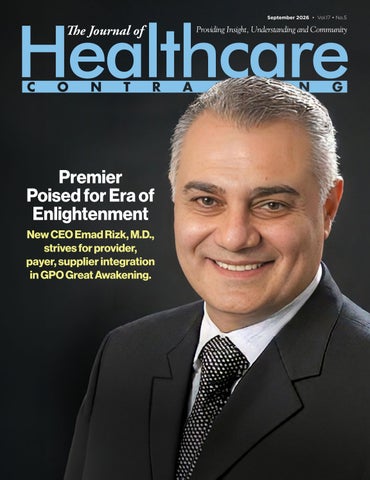
Premier Poised for Era of Enlightenment New CEO Emad Rizk, M.D., strives for provider, payer, supplier integration in GPO Great Awakening.
Connected Care Starts with Connected Devices Securely connect vital signs devices to your EMR with a cloud-based solution designed to help streamline workflows, save valuable clinician time, and support interoperability. • Secure, end-to-end data transfer • Vendor hosted cloud infrastructure • Accurate, automated vitals documentation
See how connectivity works. THE SIMPLICITY OF A CONNECTED WORKFLOW
Tap or scan clinician ID
Scan patient ID
Take patient’s vital signs
Tap “Save” to automatically send vitals data to the EMR
Click here to learn the benefits of a secure, connected workflow. Rx Only. For safe and proper use of the products mentioned herein, please refer to the Operators Manual or Instructions for Use. Baxter is a trademarks of Baxter International Inc. US-FLC215-260048 (v1.0) 08/2026
C O N T E N TS | S E P T E M B E R 2 0 2 6
2 How Can GPOs Be Futureproofed Amid Market Changes?
38 The System Healthcare Forgot to Build
12 The Bridge Between Supply Chain and Healthcare Professionals Starts with Capstone Health Alliance
42 Hand Hygiene Procurement Can’t Stop at Price Per Unit
Navigating from starting line to checkered flag using the serpentine maneuver.
20 Premier Poised for Era of Enlightenment
New CEO Emad Rizk, M.D., strives for provider, payer, supplier integration in GPO Great Awakening.
The Journal of Healthcare Contracting is published bi-monthly by Share Moving Media 350 Town Center Ave, Ste. 201 Suwanee, GA 30024 Phone: 770/263-5262 FAX: 770/236-8023 e-mail: info@jhconline.com www.jhconline.com
Healthcare has invested heavily in visibility and analytics. What’s missing is the structure to turn insight into sustained action.
Hospitals measure hand hygiene compliance closely, but compliance alone doesn’t guarantee effective protection. Procurement leaders can help close the gap by evaluating what products actually deliver at the point of care.
46 Looking Backward at GPOs Going Forward
PUBLISHER John Pritchard
EDITOR Graham Garrison
DIRECTOR OF BUSINESS DEVELOPMENT Anna McCormick
ART DIRECTOR Brent Cashman
jpritchard@sharemovingmedia.com
amccormick@sharemovingmedia.com
ggarrison@sharemovingmedia.com
CIRCULATION Laura Gantert
lgantert@sharemovingmedia.com
bcashman@sharemovingmedia.com
The Journal of Healthcare Contracting (ISSN 1548-4165) is published bi-monthly by Share Moving Media, 350 Town Center Ave, Ste 201, Suwanee, GA 30024. Copyright 2026 by Share Moving Media All rights reserved. Please note: The acceptance of advertising or products mentioned by contributing authors does not constitute endorsement by the publisher. Publisher cannot accept responsibility for the correctness of an opinion expressed by contributing authors.
www.jhconline.com
1
TRENDS
How Can GPOs Be Futureproofed Amid Market Changes? Navigating from starting line to checkered flag using the serpentine maneuver. BY R. DANA BARLOW
Editor’s note: First in a multipart series. What started in 1910 as “cooperative buying,” an outgrowth of the railroad industry, by New York-based Hospital Bureau of Standards & Supplies Inc., remains functionally familiar and somewhat similar even if the business modeling and financial and operational processes changed a bit after more than a century.
2
Back then, Hospital Bureau recruited hospitals to pool their collective buying power, access lower pricing for selected products under bulk/volume-oriented contracts and implement its purchasing standards. This foundational approach influenced the creation and development of scores of local, state, multistate, regional and ultimately national group purchasing organizations (GPOs) to provide contracting and other services for hospitals and other healthcare facilities. Initially, healthcare providers paid a membership fee to participate, not unlike Costco or Amazon Prime today, or those services were covered by association dues. Decades later, some GPOs not only collected membership fees from providers but also administrative fees from suppliers to promote contracts to the membership. Later incarnations added rebates, share backs and other financial mechanisms to reward participation that raised eyebrows, invited scrutiny and piqued emotions. By and large, GPOs promote what hospitals and other healthcare provider organizations expect them to deliver – namely cost savings on volume-based purchasing contracts that they have negotiated with vetted suppliers that meet their clinical, financial and regulatory requirements. This enables provider supply chain teams to focus on other functions and tasks to satisfy clinical and administrative customers in delivering patient care. So far this century, providers and suppliers have weathered through numerous healthcare reform initiatives, an explosion of digital technology, waves of mergers
September 2026 | The Journal of Healthcare Contracting
and acquisitions, economic turbulence and a global pandemic. As a result, The Journal of Healthcare Contracting wanted to concentrate on GPOs as one of the established and fixed conduits between buyers and sellers and pinpoint what has worked and what may need improvement or elimination to better position the current slate of parent and offspring GPOs (e.g., smaller affiliates and shareholders), their functions and models for the future. JHC used the analogy of a “houseshopping” television show where prospective buyers debate and discuss fixer-upper vs. move-in ready attributes, alongside character and charm vs. upscale and urban accoutrements and asked notable supply chain executives who possess both hospital and GPO experience for their insights. When shopping for a house, prospective buyers evaluate what they see and save the information in three ways that increase in drama and intensity – what can be retained as relevant and useful, what needs to be updated because it’s outdated and what needs to be completely gutted. Four seasoned supply chain executives assessed current GPO functionality and modeling along similar lines.
Retaining what’s inherently useful Regardless of business model, GPOs are rooted in volume-buying contracts so that function and role obviously must remain. “The core value of the GPO model remains as relevant today as it was when it was first created,” said Bruce Radcliff, President, Supply Chain Services,
www.jhconline.com
As consolidation of hospitals and health systems continue, one must wonder whether more will opt to do their ‘own’ GPO in the future.”
Premier Inc. “Healthcare organizations continue to benefit from the purchasing power, contract efficiencies and supply assurance that come from working together at scale, especially as financial and operational pressures continue to mount. “At Premier, we also believe the future of the GPO model extends beyond purchasing alone,” he continued. “By combining the scale of our membership with data, technology and supply chain expertise, we can help providers gain insights into spending patterns, utilization trends and potential supply risks. As healthcare becomes more complex, that combination of scale and intelligence will continue to be a valuable part of the model.” Prior to Premier, Radcliff spent more than a decade at Advocate Aurora Health leading supply chain operations. Steve Downey, Chief Supply Chain and Patient Services Officer, Cleveland Clinic highlights how GPOs reflect the diversity of the marketplace they serve. “GPOs have such variety, with all the offshoots and services, because of the variety of the U.S. healthcare system,” Downey noted. “Member size, clinical alignment, executive support and geographic diversity all contribute to the needs they have in sourcing, and therefore what the requirements are of their GPO partners. For example, Excelerate [Strategic Health Sourcing] works where there’s executive commitment to consolidating spend and standardizing supplier relationships, with support for systems that need help getting there. Other
3
TRENDS
Simrit Sandhu, President, Spend Management, Vizient
Increasingly, providers are looking to connect supply chain decisions with clinical and financial outcomes rather than evaluating each independently. 4
groups work well in a particular geography because of local relationships. All of those dynamics are necessary and serve particular needs.” Excelerate is Vizient’s “provider-led, physician-engaged sourcing model that uses evidencebased clinical outcomes to facilitate product decisions.” Prior to Cleveland Clinic, Downey spent nearly a decade at Vizient and Excelerate in leading supply chain operations and consulting. The traditional GPO foundation still matters, according to Simrit Sandhu, President, Spend Management, Vizient. She points to a “supply chain lifecycle performance gap between the value negotiated and the value realized. “The gap is not a rounding error,” she continued. “Across the industry, it represents billions of dollars in waste and value leakage caused by fragmented workflows across contracting, operations and utilization.” Every health system experiences leakage in some form, Sandhu observes, spotlighting four key examples: “Spend that is not contracted, spend that never reaches the right contract, pricing that breaks down between purchase order and invoice, overspending and overutilization including clinical variation that increases cost without improving outcomes. When health systems recover more of that value, the impact can help offset reimbursement pressure, improve operating margin or expand the capacity to invest in care access, infrastructure and communities,” she said.
Sandhu previously led supply chain operations at Cleveland Clinic for nearly 15 years. “Volume aggregation is still a useful concept, even in a consolidating market,” said John Strong, a veteran healthcare supply chain executive with experience in the hospital, logistics services, GPO and consulting segments. “It is still most useful for smaller hospitals, clinics, [ambulatory surgery centers] and other organizations along the care continuum. As consolidation of hospitals and health systems continue, one must wonder whether more will opt to do their ‘own’ GPO in the future.” He recently retired as Co-Founder and Chief Consulting Officer, Access Strategy Partners Inc., and his career included serving as president and CEO at Consorta for nearly 11 years before it became part of HealthTrust, leading the original Premier Health Alliance GPO for seven years and prior to that serving as Chairman, Division of Materials Management at Lutheran General Hospital and President of Healthcare Materials Corp. Strong questions whether hospitals and hospital systems that launch and operate self-contracting and distribution centers fully realize the value they seek in allegedly controlling their own destinies. “While contract administrative fees are lucrative, I still believe for these captive organizations pricing, partnership, meaningful value-added services and other benefits can come from direct business partner relationships,” he told JHC. Hospitals and other healthcare facilities work with GPOs, by and large, for two primary reasons, according to Strong.
September 2026 | The Journal of Healthcare Contracting
“They feel they are getting greater expertise, and they believe it saves money because outside operators can do it more efficiently,” he said. Further, he recognizes that some of that expertise comes from former hospital and supplier supply chain and sales professionals, respectively. “You have to ask yourself, if there are no layoffs when an outside organization provides the service, and things marginally improve, is it worth what you are paying?” He cautions hospitals and other healthcare organizations to thoroughly examine and evaluate the terms of their contracts to look for verbiage that extends well beyond the simple discounted price
www.jhconline.com
“One of the principles from a supplier’s perspective of national accounts contracting is to maintain or raise pricing over time.”
for satisfying a specified volume commitment of purchases. “Centralizing contracting and using one contract among, say, 2,000 hospitals should save suppliers money, which theoretically should reduce supply prices for providers,” he said. Strong references that in the pre- and early internet days, GPOs sent staff out to introduce new contracts and oversee compliance with contracts as a service covered by manufacturerpaid contract administration fees, as a team with suppliers.
Updating old-fashioned out-datedness Beyond the fundamentals, GPOs may need to update a few elements to meet the demands of a changing market in the future. Some argue that by adding data management and information technology services, labor management and workflow consulting, clinical and demand management consulting and capital asset management, among other additional services, the GPOs strive to stay ahead of the curve, while critics contend that those services merely detract and dilute from the core competencies. “The biggest opportunity for modernization lies in moving beyond retrospective reporting and static contracting models,” indicated Premier’s Radcliff. “Healthcare organizations increasingly need real-time visibility into spending, utilization patterns, contract performance and supply chain risk. “At Premier, we believe the future of the GPO model includes greater use of
5
TRENDS
data, advanced analytics and AI-powered decision support that helps providers make faster, more informed decisions,” he continued. “The goal is not simply to negotiate contracts, but to help healthcare organizations fully realize the value of those contracts while improving operational performance and resilience. Increasingly, providers are looking to connect supply chain decisions with clinical and financial outcomes rather than evaluating each independently. That requires a more integrated view of data across the organization and a move away from siloed decision-making.” Cleveland Clinic’s Downey argues that GPOs need to steer clear of the generic, off-the-rack mentality. “Anything built on a ‘one-size fits all’ assumption, and anything that still relies on manual and lagging data,” he specified. “Delayed reporting, siloed systems and spreadsheet-dependent workflows are the most visible symptoms. The infrastructure behind most GPO operations was designed long ago and hasn’t kept pace. They need to evolve to allow for faster processing, stronger data quality check, and information that moves at the speed members need.” Vizient’s Sandhu urges GPOs to go beyond what has been tried before. “Scale, contracting expertise and supplier relationships create the aggregation platform providers rely on. But contract access should be treated as the starting line, not the finish line,” she insisted. “Closing the performance gap requires supply chain orchestration: Connecting
6
The most successful organizations will be those that break down traditional silos and bring together supply chain, clinical and financial insights to support better decisionmaking.”
workflows across the full supply chain lifecycle of contracts, pricing, supplier performance, purchasing, payment, utilization, implementation and measurement. The future is not going back to the basics. It is being brilliant at the basics while building intelligent orchestration of supply chain workflows to ensure negotiated value becomes realized financial performance.” Vizient is building capabilities to close the supply chain workflow gaps where value is most often lost, Sandhu shares. “For example, in the contracting gap, agentic contracting solutions like tail spend automation can help convert fragmented, unmanaged spend into prioritized contract opportunities. In the operations gap, procure-to-pay and price assurance capabilities can connect contract and invoice intelligence to identify, resolve and ultimately prevent pricing and contract exceptions. In the utilization gap, solutions like clinically integrated supply chain capabilities can connect product cost, utilization, procedural, outcomes and contract intelligence so teams can reduce unwarranted variation while protecting quality and outcomes. These are just a few of the solutions Vizient is building to address waste and variation we see in supply chain across non-labor spend categories,” she noted. Sandhu adds that Vizient strives to “help providers maximize the impact of every dollar spent by addressing the industry performance gap across contracting, operations and utilization – connecting people, data, contracts, workflows, expertise and accountability so
September 2026 | The Journal of Healthcare Contracting
open or closed open or closed open or closed patients are covered. patients are covered. patients patients are are covered. covered.
patients are covered. Whichever they choose, our masks go with their flow. patients are covered. Whichever they choose, Whichever they choose, our our masks masks go go with with their their fl flow. ow. Whichever they choose, our masks go with their flow. Whichever they choose, our masks go with their flow. Whichever they choose, our masks go with their flow.
Monitoring patient’s EtCO2 can help physicians reduce adverse events from sedation. Monitoring patient’sit EtCO can help adverse events from Now we’re making even easier withphysicians open and reduce closed mask options that gosedation. with the flow — Monitoring patient’s EtCO22 can help physicians reduce adverse events from sedation. Now we’re making it even easier with open and closed mask options that go with the flowow. — helping physicians measure patient’s airflreduce ow andadverse better manage their sedation. team’s workfl Monitoring patient’sbetter can help events from Now we’re making it EtCO even 2easier withphysicians open and closed mask options that go with the flow — helping physicians patient’s airflreduce ow andmask betteroptions manage their team’s workfl Monitoring patient’sbetter can help physicians events from Now we’re making it EtCO evenmeasure with open and closed that gosedation. with the flowow. — 2easier helping physicians better measure patient’s airflow andadverse better manage their team’s workfl ow. Monitoring patient’s EtCO can help physicians reduce adverse events from sedation. 2easier with Now we’re making better it evenmeasure open and closed that goteam’s with the flowow. — helping physicians patient’s airflow andmask betteroptions manage their workfl Now we’re making better it evenmeasure easier2with open ™* and closed that goteam’s with the flowow. —2 helping physicians patient’s airflow andmask betteroptions manage their workfl ™* helping physicians better measure airflow and better manage their team’s workflow. 2 patient’s™* 2 ™* 22 2 22 2 ™* ™ 22 2 ™* ™ ™ 22 2 ™ 2 2 ™ ™
Oxy Mask Oxy Mask Oxy Mask EtCO with Oxy Mask EtCO with EtCO with Oxy Mask Microstream EtCOMask with Oxy Microstream Microstream EtCO with connector Microstream EtCO with connector connector Microstream connector Microstream connector connector
An all-new open design with an improved An all-new openmonitor design and withbetter an improved diffuser to help manage An all-new open design with an improved diffuser to help monitor and better manage oxygenation and ventilation for patients before, An all-new open design with an improved diffuser to help monitor and better manage oxygenation and ventilation for patients before, during, and after sedation procedures. An all-new open design withfor anpatients improved diffuser to help monitor and better manage oxygenation and ventilation before, and after sedation procedures. An all-new open design with an improved •during, Ideal for medical-surgical suites, the ER, and diffuser to help monitor and better manage oxygenation and ventilation for patients before, during, and after sedation procedures. •diffuser Ideal for medical-surgical suites, the ER, and to help monitor and better manage other patient care areas where procedural oxygenation and ventilation for patients during, and after sedation procedures. • Ideal for medical-surgical suites, the ER,before, and other for patient care areas where procedural oxygenation and ventilation for patients sedation isafter performed and sedation procedures. •during, Ideal medical-surgical suites, the ER,before, and other patient care areas where procedural sedation is performed during, and after sedation procedures. • Flexible oxygen titration from 1 LPM to 15+ Ideal for medical-surgical suites, the ER, and LPM other patient care areas where procedural sedation is performed Flexible oxygen titration from 1 LPM to 15+ • Ideal for medical-surgical suites, the ER, and LPM delivery from 24% to 83% FiO FiO 2 patient other care areas where sedation is performed • Flexible oxygen titration from 1procedural LPM2 to 15+ LPM •• FiO delivery from 24% to 83% FiO other care areas where 2 patient sedation is performed oxygen titration from 1procedural LPM2 to 15+ LPM • Flexible FiO 2 delivery from 24% to 83% FiO2 sedation is performed Flexible oxygen titration from 1 LPM delivery from 24% to 83% FiO2 to 15+ LPM • FiO 2 • Flexible oxygen titration from 1 LPM FiO2 delivery from 24% to 83% FiO2 to 15+ LPM • FiO2 delivery from 24% to 83% FiO2
Oxy Pro™* ™* Oxy Pro ™* Oxy Pro with Oxy Pro™* with ™ with Oxy Pro™* Microstream ™* ™ with Oxy Pro Microstream ™ Microstream with connector ™ Microstream with connector connector Microstream™ connector Microstream™ connector connector
An all-new closed design with an improved An all-new closed design with an improved diffuser to help better manage oxygenation An all-new closed design with an improved diffuser to help better manage oxygenation and ventilation during sedation procedures An all-new closed design with an improved diffuser to help better manage oxygenation and ventilation during sedation procedures needs. with higher O 2 better An closed design with an improved diffuser to help manage oxygenation andall-new ventilation during sedation procedures with higher O2 needs. An all-new closed design an improved • Ideal for patients withmanage in with upper endoscopy, diffuser to help better oxygenation and ventilation during sedation procedures with higher O2 needs. • Ideal for patients with in upper endoscopy, diffuser to help better manage oxygenation bronchoscopy, and other sedation procedures and ventilation during with higher O2 needs. • Ideal for patients withsedation in upperprocedures endoscopy, bronchoscopy, and other sedation procedures and ventilation during sedation procedures • Flexible oxygen titration from a closed mask needs. with higher O Ideal for patients with in upper endoscopy, 2 bronchoscopy, and other sedation procedures †,1 •• minimum Flexible oxygen titration from a closed mask needs. with higher O of 5 LPM to 15+ LPM 2 Ideal for oxygen patients with in upper and other sedation procedures • bronchoscopy, Flexible titration from a endoscopy, closed mask †,1 minimum of 5 LPM to 15+ LPM Ideal for patients with in upper endoscopy, • Best-in-class FiO delivery from 48% to 95% FiO22 2titration bronchoscopy, and other sedation Flexible from a closed mask †,1 procedures minimumoxygen of 5 LPM to 15+ LPM †,1 procedures •• Best-in-class delivery from to mask 95% FiO222 bronchoscopy, and other sedation 2titration Flexible oxygen from a48% closed minimum of FiO 5 LPM to 15+ LPM • Best-in-class FiO delivery from 48% to 95% FiO22 2 †,1 Flexible titration from a48% closed minimumoxygen of FiO 5 LPM to 15+ LPM • Best-in-class from to mask 95% FiO2 2 delivery †,1 minimum of 5 LPM to 15+ LPM • Best-in-class FiO2 delivery from 48% to 95% FiO22 • Best-in-class FiO2 delivery from 48% to 95% FiO22
Helping physicians better measure their patient’s airflow. Helping physicians better measure their patient’s airfl ow. Helping physicians better measure their patient’s airfl Helping physicians better measure their patient’s airflow. ow. Helping physicians better measure their patient’s airflow. Helping physicians better measure their patient’s airflow. References: † Closed masks require minimum 5 LPM O2 flow. References: 1. Kallstrom TJ; American Association for Respiratory Care (AARC). AARC Clinical Practice Guideline: oxygen therapy for adults in the acute References: † Closed masks require minimum 5 LPM O2 flow. care facility--2002 revision & update. Respirflow. Care. 2002;47(6):717-720. † Closed masks require minimum 5 LPM References: 1. Kallstrom TJ; American Association for O2 Respiratory Care (AARC). AARC Clinical Practice Guideline: oxygen therapy for adults in the acute 2. Burke R,masks Puddicombe C. SMI First infor Human analysis of Oxy2Pro™* FiO2 performance 2324-01; 2022. 1. Kallstrom TJ; American Association Respiratory Care (AARC). AARC Clinical Practicereport. Guideline: oxygen therapy for adults in the acute † Closed require minimum 5 LPM O2 flow. care facility--2002 revision & update. Respir Care. 2002;47(6):717-720. References: care facility--2002 revision & update. Respir Care. 2002;47(6):717-720. 1. Burke Kallstrom TJ; American Association Respiratory Care (AARC). AARC Clinical Practicereport. Guideline: oxygen therapy for adults in the acute 2. R, Puddicombe C. SMI First infor Human analysis of Oxy2Pro™* FiO2 performance 2324-01; 2022. † Closed masks require minimum 5 LPM O2 fl ow. ©2026 Medtronic. Medtronic, logo,Care. and Engineering the extraordinary References: 2. Burke R, Puddicombe C. SMI First in Human analysis of Oxy2Pro™* FiO2 performance report. 2324-01; 2022. care facility--2002 revision &Medtronic update. Respir 2002;47(6):717-720. 1.Closed Kallstrom TJ; of American Association for O2 Respiratory Care (AARC). AARC Clinical Practice Guideline: oxygen therapy for adults in the acute are trademarks Medtronic. All First other are trademarks of a Medtronic † require minimum 5 LPM flow. 2. Burke R,masks Puddicombe C. SMI inbrands Human analysis of Oxy2Pro™* FiO2company. performance report. 2324-01; 2022. ©2026 Medtronic. Medtronic, Medtronic logo, and Engineering the extraordinary care facility--2002 revision & update.for Respir Care.Engineering 2002;47(6):717-720. 1. TJ; of American Association Respiratory Care (AARC). Clinical Practice Guideline: oxygen therapy for adults in the acute ©2026 Medtronic. Medtronic, logo, theAARC extraordinary areKallstrom trademarks Medtronic. AllMedtronic other brands areand trademarks of a Medtronic company. 2. care Burke R, Puddicombe C. SMI First Human analysis of Oxy2Pro™* FiO2company. performance report. 2324-01; 2022. facility--2002 revision &Medtronic update. Respir Care. 2002;47(6):717-720. are trademarks of Medtronic. All otherinbrands are trademarks of a Medtronic ©2026 Medtronic. Medtronic, logo, and Engineering the extraordinary 2. R, Puddicombe C. SMI Human analysis of Oxy2Pro™* FiO2company. performance report. 2324-01; 2022. areBurke trademarks of Medtronic. All First otherinbrands are trademarks of a Medtronic ©2026 Medtronic. Medtronic, Medtronic logo, and Engineering the extraordinary
medtronic.com/oxymask medtronic.com/oxymask medtronic.com/oxymask medtronic.com/oxymask
TRENDS
spend management becomes a measurable enterprise performance lever.” Strong points to the admin fees, rebates and share backs compensation mechanisms that need to be updated because they have become somewhat outdated. Much of that is linked to automation and data systems that may not be calculating accurate information. “Over-reliance on rebates by GPOs creates issues for some customers because they may lack the resources to effectively ensure they are receiving the rebate and applying it to the correct purchases,” he indicated. “If rebates are not applied correctly by the provider, there is a risk that questions could be raised during a CMS audit. You also must remember that rebates have some significant disadvantages: The time to process them in view of the time-value of money; obfuscation of real price for hospital cost accounting; difficulty managing them and other factors that fall to providers.” He further mentions that hospitals and GPOs have to employ people to manage the rebate process, which taken together, the time to process may reduce the real value of the rebate by as much as 50%. “Many suppliers feel they do not get any real value from paying contract administrative fees, and in some cases they are being asked for far more than the old ‘standard’ of 3%.,” Strong continued. “Suppliers view the contract and payment of [admin fees] simply as a ‘hunting license.’ I’ve always believed that both parties – both the supplier and the customer of the GPO need to find meaningful value.”
8
Strong expresses concern about an “over-reliance on ‘share backs and dividends’” by some providers. “They wrongly believe that receiving these offsets the costs of operating their supply chain,” he said. “Dividends are great, but are they really revenue? Ideally, both should be applied to the cost of the goods purchased, not revenue.” He acknowledges that this is more of a provider behavioral problem but that the GPOs can be seen as feeding that behavior. He further notes that providers may not receive these benefits until the end of the year, which can reduce the value of the discount. “At Consorta, we estimated what share backs were going to be, paid them quarterly and then did a fifth payment each year to reconcile the amount due,” he recalled.
“If rebates are not applied correctly by the provider, there is a risk that questions could be raised during a CMS audit.
Gutting the familiar and vintage Occasionally, even the original vintage look or well-meaning renovation of a house on the market needs to be gutted to please the interests and tastes of a prospective modern buyer. The same can be said of GPOs facing a turbulent economic future that cannot be assuaged by pulling market share from competitors or infusing their financial coffers with private venture capital funding or even going public. Premier’s Radcliff cautions against holding a fire sale. “Rather than eliminating core services, the industry should focus on replacing outdated processes that no longer meet the needs of modern healthcare,” he
September 2026 | The Journal of Healthcare Contracting
urged. “Many healthcare organizations still struggle with fragmented data, manual workflows and limited visibility into what’s happening across their supply chain. “Healthcare is moving too quickly for organizations to rely on disconnected systems and retrospective reporting,” he continued. “The future belongs to more connected, transparent and intelligencedriven approaches that help providers anticipate challenges instead of simply reacting to them. The most successful organizations will be those that break down traditional silos and bring together supply chain, clinical and financial insights to support better decision-making.” Cleveland Clinic’s Downey pokes at the granular. “Watch for anything that’s a conflict of interest, like accepting a tariff and then making more administrative fee on that agreement,” he advised. “The fix isn’t just transparency. It’s replacing the metrics entirely. Contract coverage and admin fee generated measure GPO activity. Savings and supply expense impact measure GPO value. Those are not the same thing, and pretending they are is how conflict persists.” Strong cites the method of determining potential contractual interests among members requires wholescale process renovation. “I’m guilty of this when I ran GPOs, and the process continues today,” he lamented. “I believe that the process of asking members what their ‘preferred’ brands of product are, and what they would recommend a contract for has led to
www.jhconline.com
a lack of competition in the market. These ‘preferred’ brands are generally market-share leaders who squeeze out lower-cost products and more innovative suppliers. This process may have worked when there were several dozen national GPOs, but with today’s consolidated GPO market, it has led to stagnation of choice and price creep over several decades. One of the principles from a supplier’s perspective of national accounts contracting is to maintain or raise pricing over time.” Contracts then become more like market share popularity contests, according to Strong. “I think the way you improve it is by doing meaningful value analysis on some of those products,” he recommended. He acknowledges that executives on both sides of the transaction can look at some of these commodity products as “beneath where they need to focus their attention,” which can be a mistake. He advocates for a market leader and at least one alternative. “You may be getting the best market price from that market leader, but that doesn’t mean someone else can’t do it cheaper,” he added. He quips that some of the products might be private-labeled and come from the same overseas factory anyway.
9
TRENDS
“Over the decades, and especially during times of inflation, many CEOs have questioned the value they are getting from ‘their’ GPO because of the growing costs of supplies and drugs,” Strong said, citing statistics from 2025 research that show expense growth for drugs and supplies far outpacing that of labor and workforce expenses. “If these statistics are correct, one must ask themselves, ‘What are we missing?’ There are a lot of non-price factors that can drive these costs, despite having consulting services and including using more costly products than necessary on a patient (think orthopedic implants as an example), product waste, lack of proper standardization and others. Standardizing on large sizes of product and costly solutions that are intended only for certain patients can drive this number,” he indicated. “What would it look like if GPOs did meaningful value analysis before they contracted for certain products?” Strong asked. “They could offer the winning participants a contract, even if the ‘preferred’ products were still in demand. I know some GPOs do offer the preferred product and a ‘value’ option, but this would go beyond that.” Strong acknowledges that these efforts can be cost-prohibitive in terms of hard and soft dollars stemming from labor and supplier relationships.
Still, he refers to one GPO that embraces volume, compliance and 3% admin fees that emphasize “price at the pump” over rebates and share backs. Their philosophy? “If you don’t comply with the small portfolio of products we ask you to, we will kick you out, no matter who you are, think you are, or how valuable your business is to [us],” he said. “I respect all of that.” Strong believes, however, that GPOs may have no choice but to make improvements based on what a small, but influential number of medical technology manufacturers are looking to do directly with provider organizations, by aligning their products with the patient journey, which could result in suppliers having more control over large accounts than their GPO. Editor’s Note: Next edition, the expert GPO quartet explores the emerging landscape, full of challenges and opportunities.
Key Takeaways ` GPOs’ core value still matters. Volume aggregation, contracting expertise, supplier relationships and purchasing efficiencies remain important, particularly as healthcare organizations face financial and operational pressures.
10
` The GPO model needs to become more data-driven and integrated. Experts say GPOs must move beyond static contracts and retrospective reporting toward real-time data, analytics, AI and better coordination across contracting, purchasing, utilization and payment.
` Some longstanding practices need a fundamental rethink. Administrative fees, rebates, share-backs, preferredproduct arrangements and other traditional practices can create inefficiencies or conflicts; future GPO value should be measured by actual savings, supply expense impact and improved outcomes, not simply activity or revenue.
September 2026 | The Journal of Healthcare Contracting
More Than Automation — Itʼs Intelligence with Purpose Healthcare supply chains donʼt need more platforms. They need intelligence at the point of execution — where decisions are made, risks emerge and outcomes take shape. When data, technology, and artificial intelligence (AI) work together in the flow of operations, healthcare organizations can move faster, reduce uncertainty and make decisions with greater confidence — at scale. This is how insight becomes action. And action transforms into results.
Learn More
Explore how Premier helps organizations drive impact across supply chain, technology, AI, performance improvement and innovation.
EVENTS
The Bridge Between Supply Chain and Healthcare Professionals Starts with Capstone Health Alliance COURTESY OF CAPSTONE HEALTH ALLIANCE
The Capstone Forum brings together Capstone Members and Suppliers, business partners, and industry experts to discuss emerging trends, share best practices, and foster collaborative partnerships within the healthcare supply chain sector. Over the course of three days, attendees participated in engaging sessions, interactive panel discussions, educational presentations, a Supplier showcase, and numerous networking opportunities. This event focuses on topics such as cost optimization strategies, supply chain management advancements, value-
12
based care initiatives, and trending solutions to address the evolving challenges the healthcare industry faces. Capstone Health Alliance is dedicated to fostering leadership development and promoting innovation within the healthcare sector. By crafting a space for cultivation exclusively between our Members and Suppliers, Capstone reinforces its commit-
September 2026 | The Journal of Healthcare Contracting
ment to continually drive excellence and positive impact in healthcare delivery, all the while hosting a truly enjoyable event for all attendees. This year’s Forum ran August 3-6, 2026, in Myrtle Beach, S.C., opening Day 1 with a full slate of Pharmacy, Member, and Supplier education sessions before the general sessions and evening events took center stage. Following Tuesday’s morning’s sessions, Dave Edwards, National Healthcare Executive, offered the attendees a lunchtime glimpse into “The Liminal State of Healthcare: The Promise & Peril of AI,” examining how artificial intelligence is reshaping care delivery and the supply chain that supports it. Tim Bugg, Owner & CEO, and Yolandi Myers, President & CAO of Capstone, welcomed attendees to open the general session with remarks on partnerships, collaboration, and innovations that will foster the path forward for Capstone. “As Capstone enters an exciting new chapter, our focus remains exactly where it has been for the past 26 years: serving our Members with integrity, trust, collaboration, and an unwavering commitment to reducing healthcare costs” offered CEO & Owner, Tim Bugg. “While partnerships may evolve over time, our commitment to our Members and Supplier partners remains constant. Capstone will continue delivering the services, value, and support our Members rely on today, while pursuing new opportunities that strengthen our organization for the future. This year’s Forum was a powerful reminder
www.jhconline.com
“While partnerships may evolve over time, our commitment to our Members and Supplier partners remains constant.”
of the relationships we have built over more than two decades. Seeing and hearing the tremendous support from both our Members and Supplier partners reinforced the strength of the Capstone community and the confidence they have in our path forward. We are energized by what lies ahead, grateful for the trust placed in us, and confident that good things are on the horizon for Capstone and those we serve.” Paul Epstein, former NFL and NBA Chief Sales Officer and two-time bestselling author, took the stage with his keynote “WIN MONDAY,” bringing his high-performance sports background to bear on lessons in resilience, culture, and winning habits that translate directly into the healthcare supply chain.
13
EVENTS
2026 ELEVATE Award Winners Julianna Lopez- Echavarria Anthony Carpenter Aaron Davis Trina Epperly Ayoni Roberts-Bradshaw Mercy Urgent Care Team Katherine Tucker Jodie Butler Jan Elder Trina Epperly
Adventist HealthCare Bayhealth Cape Fear Valley Health Carilion Clinic Mercy Health Services Mercy Urgent Care Monroe County Hospital Mount Nittany Health WellLink Group Purchasing Carilion Clinic
2026 Innovative Supplier Partner Award Winners ` Capstone Diverse Supplier Award: Palm Harbor Medical ` Capstone Loyal Partner Award: Professional Disposables International, Inc. ` Capstone Collaborative Partner Award: Cato Supply ` Capstone Innovative PPI Partner Award: Corza Medical ` Capstone Innovative Pharmacy Partner Award: OurPharma
14
The energy carried into a robust State of Supply Chain Town Hall, moderated by Tim Bugg, featuring Angie Boliver, President & CEO of HSCA; Teresa Dail, President of the Vanderbilt Health Purchasing Collaborative; Kathryn DiBitetto, Vice President of Government Affairs at HIDA; and Lisa Hohman, CEO of Concordance Healthcare Solutions. The panel offered attendees a candid look at policy shifts, market pressures, and the road ahead for supply chain leaders and their partners. Attendees closed out Tuesday with the Member Connection Social Event, followed by the Welcome & Awards Dinner. The evening recognized the Capstone Leadership Institute Class of 2026 graduates for completing a rigorous leadership curriculum, and celebrated the ELEVATE and Innovative Supplier Partner Award winners for their outstanding contributions to the Capstone community. Wednesday morning Members dug into practical, high-value education, including Tabitha Calloway’s session “Price is Wrong: Tackling Pricing Accuracy,” while Suppliers gathered for “Market Essentials – Selling into Today’s Hospitals” with Dave Edwards and Tim Bugg. Wednesday’s general sessions were a highlight of the Forum. Ken Schmidt, former Communications Director for Harley-Davidson and author of Make Some Noise: The Unconventional Road to Dominance, delivered “Building Tattoo-Worthy Loyalty in a Fiercely Competitive Market,” sharing hard-won lessons on brand loyalty and culture that had the room rethinking what it means to earn trust in a crowded market.
September 2026 | The Journal of Healthcare Contracting
FULLY ADACOMPLIANT PRECISION SCALES MX910
MX908
MX310
Designed and built in the USA, every model reflects our commitment to simplicity, durability, and long-term value. ADA-COMPLIANT SOUTIONS ACCURATE MEASUREMENTS CONSISTENT OPERATION DURABLE CONSTRUCTION STANDARDIZED DISPLAYS COMPETITIVE TOTAL COST Every Befour scale is engineered to perform with consistent reliability in demanding healthcare environments while making training, operation, and long-term ownership simple and straightforward. Meet ADA compliance deadlines with a proven and cost-effective option.
MX480D-ADA ADA-COMPLIANT
MEASUREMENT STATIONS FEATURING:
To learn more about the Befour Advantage, scan the QR code below, visit befour.com/products/adacompliant-scales, or give us a call. MAKE YOUR NEXT SCALE A BETTER MEDICAL SCALE
Befour, Inc. | 102 Progress Drive, Saukville, WI 53080 | +1 800.367.7109 | befour.com | sales@befour.com
EVENTS
Immediately after, Jocelyn Herrington, Vice President of Strategic Partnerships and National Spokesperson for Advisory Board, took the stage for “2026 State of the Industry: Unraveling Assumptions About the Control of Care Delivery,” challenging attendees to question long-held assumptions about who really controls the future of care delivery and what that means for supply chain strategy going forward. The afternoon belonged to the Circus de Carnivale Supplier Showcase, filling the Myrtle Beach Convention
Center with Supplier exhibits, demonstrations, and plenty of showmanship to match the theme Laura Flesher took home the $2,000 grand prize for completing the Capstone Challenge by visiting and supporting Supplier booths. GoPath Diagnostics was voted Best Booth by the Membership for their fully immersive medieval showcase, complete with costumes, crowns, and swords. The night rounded out with The Capstone Masquerade: Dinner & Dance Party, where attendees traded name badges for masks and costumes for an evening of dinner, live music, and dancing courtesy of SC’s No. 1 party band, Julio & the Saltines. Thursday morning closed the Forum with a Member & Supplier combined session, “The Continued Path of the Price Activation Process: From Manufacturer to Market,” with representatives from Medline and Henry Schein, and moderated by Tabitha Calloway, Capstone’s VP of Contracting.
Join us next year for the 2027 Capstone Forum The Capstone Forum is uniquely crafted to connect supply chain expertise and healthcare delivery through meaningful interactions between Members and Suppliers. It remains a platform for
16
sharing best practices, exploring emerging trends, introducing innovations, and celebrating leadership. Mark your calendar for the 2027 Capstone Forum, once again held at the Sheraton Myrtle Beach, with check-in
beginning August 2 and the Forum running August 3-5, 2027. We look forward to seeing everyone back together on the beach next August. Learn more at capstonehealthalliance.com.
September 2026 | The Journal of Healthcare Contracting
New ClearPetra 2.0 – Now 25% Thinner* – Enhanced Steering – Intuitive Suction Control
Scan the QR code to learn more
Copyright © 2026 KARL STORZ. All Rights Reserved. All trademarks are the property of KARL STORZ SE & Co. KG unless otherwise noted. For US use only. It is recommended to check the suitability of the product for the intended procedure prior to use. Caution: Federal (USA) law restricts this device to sale by or on the order of physician. The ClearPetra trademark is owned by Well Lead Medical Co., Ltd.
97137055 URO 1 1.0 us 07/2026/A-E-US
*Compared to ClearPetra 1.0
We see it.
Strained Reaching
Incorrect Positioning
Inaccessible Equipment
Manual Entry
The job is already hard. The environment shouldn’t make it harder.
© 2026 Midmark Corporation, Versailles, Ohio USA
At Midmark, we start from that truth. And our mission is simple and serious: design every detail to remove friction where it shouldn’t exist. To give time, focus and energy back to the people doing the work.
Better care begins with every detail. Scan to Learn More.
Premier Poised for Era of Enlightenment New CEO Emad Rizk, M.D., strives for provider, payer, supplier integration in GPO Great Awakening. BY R. DANA BARLOW
The business world may be replete with futurist-minded leaders who think they have their fingers pressed squarely on the pulse of the industry – healthcare being no exception. Emad Rizk, M.D., Premier Inc.’s new multifaceted CEO, President and Chairman of the Board, however, thinks that’s too limiting. Instead, he chooses to hold the pulse of the industry in the palm of his hand. In an exclusive wide-ranging interview with The Journal of Healthcare Contracting, Rizk [pronounced E-MAHD RIZIK] links the future of Premier’s success as well as the success of healthcare operations overall to integration that extends well beyond the alphabet soup of mergers,
20
acquisitions, information technology and blurred lines between providers, suppliers and payers, as well as clinicians and supply chain. It’s more than symbiosis. Think commonality; sharing a common playbook; administrative, clinical, financial and operational fusion. Dr. Rizk shares his observations of and outlook for Premier, as well as how he fits into the ongoing development and growth of one of the leading group purchasing organizations (GPOs) in the nation.
PREMIER POISED FOR ERA OF ENLIGHTENMENT
JHC: Dr. Rizk, looking at your background and your extensive, varied career success to date, it looks like group purchasing is perhaps one of the few things you haven’t tried in your experience. So let me ask the overarching question. What was it that allured you to group purchasing, the group purchasing industry and a group purchasing organization (GPO)? Dr. Rizk: Everybody in the industry makes group purchases, particularly large organizations. Any type of supply chain management requires very sophisticated data. And I have a lot of experience with data. Perhaps the more important question, is, “Why Premier?” Well, Premier is preeminent and significantly known in the market. It has a great reputation. As with many companies, when you’re growing, you must innovate but also integrate. It is not enough to innovate in silos. And one thing about purchasing and procurement and any type of supply chain management is this: You cannot make your decisions in a silo. These areas require a great deal of integration, especially in healthcare. I’ve been on the payer side, the provider side and the research side, and in all cases, when you do a lot of supply chain activities, those activities are tied to critical drivers. That’s the demand side of the equation. Then, you have the outcome side of the equation. I’m very familiar with that. And to answer your original question, the reason I came to
22
Premier is because I believe that with all three of those critical drivers, we can help our members from end to end. They don’t have to buy everything through the GPO, but we can give them a 360-degree view of how they make decisions around supply chain.
Going forward, payers will have to begin to look at outcomes much more than just reimbursement. And providers will have to focus on quality outcomes as well as cost that is tied to reimbursement.
JHC: You’ve joined a significant legacy of leaders at Premier during the last quarter century, from the late former hospital association and system leader Robert O’Leary to consultant Susan DeVore to operations and technology leader Mike Alkire. With your medical background, what do you hope to contribute to this august group? Dr. Rizk: I do follow a legacy of great leaders. We need to understand that right now, healthcare is moving toward a much more integrated approach, especially regarding data. And physicians are the main drivers of the clinical process and patient care and outcomes. They’re the ones who are ordering the supplies, such as catheters and gloves – and which gloves. They drive the ordering of medications as well as the need for nurses, other labor, surgical supplies and overall supplies at the hospital. At Premier, we will analyze the demand-side analysis, that demand variability drives up supply cost. By combining clinical, supply chain and reimbursement analytics, we will have a comprehensive look at supply and total cost. That intersection analysis is where I believe we can take the healthcare industry and providers to the next level, by bringing three silos together.
September 2026 | The Journal of Healthcare Contracting
Traditionally, supply chain leaders have been focused on getting good contracts, good supply pricing, leveraging size, etc. But now, is increased focus on the clinical side? It creates a lot of variations and demand, all of which need to be integrated. Leveraging analytics presented to clinicians can help partner to a desired outcome. I bring that clinical perspective in terms of what true leaders will need. In the provider world right now, our members and integrated delivery systems recognize they’re facing a significant challenge. Their costs are a decade high. Pharmacy is going up over 13%. Supply chain is going up 9.9% to 10%. Labor is going up by 7%. Meanwhile, reimbursement is coming down, and not just where the commercial payers are concerned but also the government, whether it’s managed care, Medicare or Medicaid. Medicare went up about 2.4% this year, but that’s not going to continue. At some point, it’s going to dial down. And we have a population that’s becoming increasingly more chronic with higher acuity. We’ve seen significant healthcare utilization from about two years after COVID-19 to now, increasing every year. The cost structure is high for the United States – with about 20% of every dollar going to healthcare – totaling over $4.5 trillion, which is roughly equivalent to the GDP of some countries. And that’s just healthcare. We must begin to find efficiency, bend the cost curve, and improve quality, and there are a lot of recent technologies coming to help.
www.jhconline.com
Successful health systems will be the systems that integrate their decision-making process, data analytics and the interdependencies of clinical demand, quality, and cost efficiency. It is all tied together. You cannot do one without the other two. JHC: So, in going with your earlier statement where you’ve got to break down the silos and integrate all these decisions, are you saying that supply chain now has to think like a payer and think like a clinician? Clinical folks have to think like payers and supply chain, and payers have to think like clinicians and supply chain. How much sense does that make? Dr. Rizk: That’s a good question. Government and commercial payers sit on a wealth of data. With longitudinal data, that’s how they put their policies together, edit claims and reimburse. So, they have an advantage because they have integrated data. Payers have a longitudinal view of a patient over the years they’ve covered them. On the other hand, providers still have fragmentation. The [electronic medical records] in every hospital within an integrated delivery system may not be talking to each
23
PREMIER POISED FOR ERA OF ENLIGHTENMENT
other. And if you go outside the health system, it becomes even harder to access that data, which may be stored in silos. That said, procurement officers and supply chain officers are becoming smarter and working more closely with clinicians, statisticians and analytics teams. They’re realizing that they cannot make these decisions in a vacuum. You asked an insightful question about the role of a payer and a provider in the future. Will providers begin to take on risk? You already have providers that own payers, with mixed results. Some have discontinued, while others have continued to thrive. Thirty to 40 million lives in this country are covered by provider-owned payers, and some of those contracts are very large. Going forward, payers will have to begin to look at outcomes much more than just reimbursement. And providers will have to focus on quality outcomes as well as cost that is tied to reimbursement. For example, your cost-per-case can’t be $100,000 when you’re getting reimbursed at $40,000. That has a lot to do with clinical variability, and 10% of that is tied to contracting and supply chain. From pharmaceuticals to imaging, drugs to gene therapy, everything is becoming more expensive. At the core of that is supply chain management, because they’re purchasing all of it. I think you’re going to find that the healthcare industry must integrate all its segments to succeed, extending beyond pay-for-performance and embrace more value-based care.
24
A perfect storm is forming with these large institutions and large health systems with salaried and affiliated physician groups that cover multiple sites.
JHC: How painful do you think that transition is going to be? Because that calls for a change in mindset amongst these three groups, something they may not be comfortable with. Dr. Rizk: There is a trust factor that is missing today, and that is a significant piece they must overcome. Besides that, it would be great if they could at least share data. For example, a health system has its cost structure and cost accounting and all its systems to understand that cost structure. They collect clinical information, and that clinical information drives patient care across their hospital or ambulatory center. Then, they submit a claim. On the payer side, they have some access to clinical information but need more from health systems and providers. They’re looking at that claim, which includes some clinical information, but if some clinical documentation is missing, they might not pay for the total claim or parts. They want to pay for quality. They might say, “We need you to start managing hemoglobin A1Cs more,” or “We need you to start managing post-myocardial infarctions a little bit more.” There’s a significant correlation between quality and cost, as these two factors need to be more integrated. JHC: In addition to your clinical background, you have considerable experience in dealing with payer issues that include payment accuracy, cost management and value-based care. How will these elements influence, if not direct, your leadership of
September 2026 | The Journal of Healthcare Contracting
Premier as well as its group purchasing and supply chain pedigree? Dr. Rizk: The payers have experienced years of consolidation and a great deal of system integration along with analytical integration. They’re very sophisticated in the level of data that they have and how they use it. They’re also very sophisticated in execution as well as standardization and integration. These are new muscles that many providers are beginning to build. Providers have merged and consolidated quite a bit over the last five to 10 years. But what happens when one system merges with another that has different [electronic medical records] systems that don’t speak to each other, different [enterprise resource planning] systems, different supply chain data and different physician groups that practice differently? All of that must come together. Premier’s data analytics is collecting data not just in the acute care setting, but also in pharmacy and the continuum of care. We also leverage our data at a cost line level and at the physician’s variation level also. Our goal is to be the preeminent partner for all health systems as they navigate what I believe will be, over the next five to 10 years, a level of crisis that we’ve not seen – especially for academic medical centers facing declining government funding. A perfect storm is forming with these large institutions and large health systems with salaried and affiliated physician groups that cover multiple sites. There’s a variability in all of that, so we want to be
www.jhconline.com
As costs continue to rise while reimbursements decline, strong GPOs savings will be critical.
that partner to help them integrate those elements. I know Premier can bring that execution on a large scale. We have moved our data into a single data lake house, and we are bringing in innovative technologies to give our customers a level of granularity that truly provides significant insight. The supply chain intelligence is at the core and the center of it. We’re going to be comprehensive and sophisticated around contracting and purchasing and being able to get best pricing. We’re going to look at the drivers and the output on an end-to-end basis. I know we’ll be able to bring an execution rigor that we probably have never had before. You’ll see a lot of focus, a lot of integration and an ability to truly partner with our members in a unique way. We also have an advisory group that can help guide them and implement some of the standardizations. But right now, they have too much variability, and we need to begin to standardize and execute and have a common view of data. We can’t have different systems looking at data and extrapolating different outcomes and different insights. JHC: Those are ambitious goals. What if something threw a wrench in that mindset, such as a new future presidential administration changing NIH funding and it starts to flow back again? Do you anticipate people saying, “well, it’s all fine now. We don’t have to continue doing what you want to do anymore.” How do you convince them
25
PREMIER POISED FOR ERA OF ENLIGHTENMENT
to stay the course because it needs to be done this way? Dr. Rizk: We have an aging population that continues to grow. They’re the largest consumers of healthcare. We also have an increase in chronicity – more diabetes, more COPD, higher rates of childhood obesity and continued prevalence of cardiovascular diseases. We are also seeing some introductions that are relatively scary, such as cancer in younger people. We also have healthcare access issues across geographic areas and differences in life expectancy by ZIP code. I don’t see any of this letting up. And that will increase costs for the hospital systems and supplies that support increased utilization. Keep in mind, every time utilization goes up, supply chain becomes even more important. As costs continue to rise while reimbursements decline, strong GPOs savings will be critical. I’m starting to think GPO stands for “group purchasing optimizer,” a performer that drives supply chain improvement with best-in-class flexible contracting. This can include leveraging AI, especially agentic AI, to leverage data and insights within these dynamic changes in pricing and tiering structures. That could have a significant impact on variability in service lines such as cardiology or orthopedics, where you’re able to negotiate implant costs more efficiently and work with physicians on outcomes that would generate improved reimbursement. With AI, you now have information to address issues at their root cause.
26
We will bring comprehensive data that CFOs and clinicians find valuable to achieve the organizational goals.
JHC: Do you think that clinicians – doctors and surgeons – your colleagues and peers, would listen more to AI-generated data such as this versus supply chain leaders coming in and saying, “these five docs have higher costs using the same product than these five docs so we need to figure out how to work through this.” If it comes from AI versus humans, do you think that’s going to resonate more with the clinical community or not? Dr. Rizk: It still will come from a human. The AI works in the background, getting the data to the human. You have to leverage leadership more than ever now. You have the CEO, the CFO and the supply chain officer. But you also have a Chief Medical Officer. You have staff, VPs. You have the chair of the department. All these individuals need to be involved in bringing the cost of delivery down. The Chief Medical Officer needs to talk to the chairs, each of whom talks to his or her physicians, and then they show them data with consistent and trusted analytics. JHC: So, the idea of consistency from AI may add more value and more trust to the data perhaps? Dr. Rizk: Correct, and flexibility, too. Because what physicians are going to say is, “okay, I like that data, but is it acuityadjusted? My patients are sicker.” We will show data that is risk adjusted with SDOH, when we show physicians credible data, they will adapt.
September 2026 | The Journal of Healthcare Contracting
See what’s possible Distributors and self-distributing health systems now have complete transparency of their Dukal products’ from purchase order to delivery. Product Assigned at the Factory Level Product Tracking at the Item Level Compatible Excel Reporting Automated Communication Worldwide Tracking
Scan here to learn more or visit dukal.info/insight
Dukal is working with healthcare professionals around the world in manufacturing and supply chain solutions, to mitigate disruptions that impact business and patient health. Helping you manage everything from product to patient.
> Learn more at dukal.info/insight
PREMIER POISED FOR ERA OF ENLIGHTENMENT
JHC: And this could almost be done instantly? Dr. Rizk: You can do it right on the screen in front of them and add those variables in real time. Let’s put them in and see what happens. It’s conversational right now. We’re at a point where the technology is conversational – you can ask a question, and it will give you an answer. Another thing that these agents can do now is go into multiple databases, gather data and facilitate analysis using a semantic layer that helps feed a machine-learning platform – doing in moments what might otherwise take a data scientist a week. JHC: This seems to resemble a lot of clinical decision support software that clinicians have been using for decades to help with diagnoses, does it not? Dr. Rizk: And that’s the beauty of Premier. We have all those tools and solutions. They work well together, but they’re not completely or seamlessly integrated in these areas. We’ve already started this, even before I came in. There has been a great deal of AI development and platform integration, and much of the data is already in a single environment as I stated before. Now, we must focus and execute on how to help our members during these difficult headwinds. It’s not a one-sizefits-all model, but there is some modularity in how we integrate seamlessly with our members. We must analyze the demand, the priorities of the GPO and the outcome of all these activities. We can create that for members and show
28
It’s not just about bringing down the cost of a product. We must also factor in demand, usage, variability and other supply chain data and intelligence to make decisions in a continuous, integrated process.
them the driving factors to provide the answers they need. This is something that’s going to differentiate us in the market. You can’t look at a patient based on symptoms alone. You must consider age group, history, and multiple other factors. There are many distinct aspects to diagnosing a patient. The cost structures for our hospital members and integrated delivery systems are complex. They’re interconnected and interdependent. It’s like a balloon – when you press one part, another expands. Costs behave the same way. We want to integrate all this information back to our roots and enable members to use these tools to drill down as much as they want. JHC: Supply chain leaders have weathered a reputation of being more tactical and technical rather than strategic. How can Premier help its member supply chain executives become more strategically focused once they’ve mastered the technical aspects of their roles? Dr. Rizk: Premier works closely with supply chain leaders and truly partners with them to achieve their strategic and operational goals. I have to admit that supply chain leaders are very sophisticated now and are leveraging data more than ever. When Premier meets with members, it usually with not just supply chain leaders; we include other C suite leaders to help achieve savings in a team approach. We will bring comprehensive data that CFOs and clinicians find valuable to achieve the organizational goals.
September 2026 | The Journal of Healthcare Contracting
Navigating the Unknown with Known Reliability The global landscape is shifting. From geopolitical changes to tightening raw material supplies, the path to procuring essential PPE has become increasingly complex. While others react to these pressures by scaling back or pausing operations, Tronex is leaning into the flux with a singular intention: to be the steady hand in the storm. We understand the stakes. Patient care and operational continuity depend on a supply chain that bends but does not break. Comprehensive Range of Head-to-Toe Protective Solutions
Uncompromising Sourcing and Strategic Global Manufacturing Diversification
Recognized Multiple Award-Winning Partner
37-Years of Proven Exceptional Supply Performance
Partnered for Decades with Each of the Major GPOs and National Med-Surg Distributors Learn more at tronexcompany.com
PREMIER POISED FOR ERA OF ENLIGHTENMENT
The supply chain leaders are sitting at the leadership table because it’s critical that they do, and they’re working with their colleagues to address these challenges. For example, I recently met with the CEO of one of the largest health systems in the country, someone I’ve known for a very long time. He told me, “you know, the supply chain leader has now moved beyond the contract negotiator. They’re much more than that. They’re no longer just getting us the best price – they know how to leverage data and are strategic in their approach.” It’s not just about bringing down the cost of a product. We must also factor in demand, usage, variability and other supply chain data and intelligence to make decisions in a continuous, integrated process. If you decide in a silo, you’re going to generate siloed results rather than impact the entire health system, which is huge. JHC: Do you see these developing relationships as executives pulling supply chain in or supply chain pushing its way in to integrate with these other directions or a little bit of both? Dr. Rizk: Both. JHC: Does it depend on the facility? Dr. Rizk: Yes. I don’t know many CEOs now who are not intimately in communication with their supply chain officer. I’m also not sure that any supply chain officer or leader is approaching decisions or solving anything alone. No one does
30
this. Maybe this was done a decade or so ago, but we’re in a more dynamic and expensive world now.
“When you show them, they’re getting reimbursed the same whether they use this product or that product, they’ll see how they’re contributing to a higher out-of-pocket price for their patients.”
JHC: As a doctor leading one of the largest GPOs in the country, how do you motivate your colleagues, your fellow clinicians, to work together with supply chain management so that revenue generation, expense reduction and high-quality patient outcomes continue with minimal disruption? We always know there’s going to be disruption. We worked through the COVID-19 global pandemic. So how do you get these silos working together? Dr. Rizk: Physicians respond the most to data. We’re scientists and data driven. We respond to data – data we can believe because it is credible. We also respond to patient outcomes, not just cost. We must present credible and trusted data to physicians in a way that engages them. You don’t come to them and say, “This titanium screw costs too much,” or “This catheter costs too much and you have to change.” You could come to them in a transparent way and say, “You’re using catheter A, others are using catheter B, and your outcomes are the same from a quality perspective. Yet your cost is twice as high. Now, do you believe that this is something that you should continue to do?” Many physicians have become creatures of habit. They are comfortable and were trained a certain way. You have to show them their data, so that they can
September 2026 | The Journal of Healthcare Contracting
work with you and align with their colleagues and peers. JHC: We’ve heard the phrase, “show me the data” for years and yet there’s still this great gulf between the two. What I hear you saying is that it’s so logical for clinicians and supply chain to work together, looking at quality outcomes, looking at costs and that they actually can work together. Why hasn’t this happened already? Dr. Rizk: Because we’ve never given them integrated data. We’ve given them very separate data. We’ve just said to them that when you use this supply, it costs $1,500 more. They might respond that “my patient outcomes are way better. My patients are sicker.” Then you come back and say, “We risk- adjusted the data, and now we’re comparing you to the same population, same sickness. And we’re also looking at readmission after discharge. And while your data is the same as others that are using X, you’re using Y.” Physicians want to give their patients the best care and want the best outcome for both the patient and the institution. But you cannot give them one piece of data versus the whole picture. You have to show them credible data that can be risk-adjusted and acuity-adjusted along with quality outcomes. That will be the differentiator. Adding the reimbursement data will bring a lot of value to the discussion. When you show them, they’re getting reimbursed the same whether they use this product or that product, they’ll see how they’re contributing to a higher out-of-pocket price for their patients.
www.jhconline.com
JHC: How can you as a clinician executive emphasize the importance and value of the effective, efficient and responsible use of information technology, ranging from artificial intelligence to blockchain to robotic process automation to the adoption and implementation of universal supply data standards akin to the pharmaceutical data standards in play since the 1970s? Dr. Rizk: That’s something that AI could help with in bringing that movement to supply data. I recently met with our entire technology department. I brought them all together to figure out exactly what we need to do. The first thing we realized is that we can’t use technology on fragmented data. We just can’t. We must figure out a way to collect and share data with all our members. Common data under a common approach. A common intake process and a unified data structure within a common database. Secondly, we need to create workflows on top of that, whether
31
PREMIER POISED FOR ERA OF ENLIGHTENMENT
the models are semantic or on a machine-learning platform. This gives them the ability to understand all the data we have in the database. Next, we must determine how to automate manual processes by using AI, which is only as good as the person using it with prompts, so large language modeling is key to training it to prevent hallucinations where the AI gives different answers. At the core, our supply chain is what we do. I cannot emphasize that enough. But we need to be completely integrated, from end to end, across all our products. We need common interoperability and common standardization and a common AI layer that will help us connect and automate as much of the manual processes as
32
possible. This will allow our real experts to innovate, look at the data, and reach real insights for our members to use. One of the issues that exists in healthcare right now is that no one trusts anyone’s data. That is why we need to add quality checks every step of the way. JHC: What do you believe Premier’s toughest administrative, financial and operational challenges are to tackle right now and why? And what are some solutions for each that you hope to implement? Dr. Rizk: We must get everybody to collaborate and to have a common playbook, common operational metrics, common execution, and transparent and accountable structures. We might need some reorganization. We do not want data and technology in separate places. We need to align the company on our vision, our mission, and our strategy, breaking down as many silos as possible. Financially, we have to prioritize a lot of our investments and focus, frankly, on everything. We can’t be a mile wide and an inch deep. So, we are going to think about the GPO as the center. How do we give it all the intelligence that it needs? Then, all the investments are going to go into three to four areas that support it. We’re going to pick those areas. Data is going to be one. Technology standardization is going to be one. Instead of showing five or six different tools that tell me how a specialty is performing, and another that shows how each physician within that specialty
September 2026 | The Journal of Healthcare Contracting
is performing, and then another that shows the cost of each supply in that specialty, I want to be able to query all of that with one tool. We want to make sure that we automate as much as possible to reap cost and efficiency benefits. We also want to streamline our investments to four or five things, down from 10 to 15. We need to develop discipline. It is really too early to talk about any particulars right now, but this gives a high-level perspective. We are going to focus
on integrated data that provides our members with actionable insights, and measure outcomes and results. We have a national database that captures about 45% of all discharges in the country. We have a great deal of data around the clinical and cost structure of our members, so we need to be able to help them right away. From an operational perspective, I am all about execution, whether that involves implementing operational playbooks within big companies or executing turnarounds and improving process outcomes through key performance indicators. I look at processes within processes more than the 30,000-foot perspective. There’s rigor to execution. But the key here is integration. You cannot solve big problems in a silo.
About Emad Rizk, M.D., brings more than three decades of experience leading transformation across the healthcare ecosystem. As a physician and operator, he has built and scaled organizations that translate actionable data into measurable performance improvement. Most recently, he served as Chairman, CEO and President of Cotiviti, where he led the company’s transformation into a multibillion-dollar platform supporting payment accuracy, cost management and value-based care. His work has consistently centered on helping healthcare organizations operate more efficiently while improving outcomes for patients. Prior to Cotiviti, Dr. Rizk served as President and CEO
www.jhconline.com
of R1 RCM, where he led a full operational and financial transformation of the business, significantly improving performance and positioning the company for sustained growth. Earlier, he led McKesson Health Solutions, building one of the healthcare industry’s leading analytics and technology businesses. He also served as Senior Partner and Global Director at Deloitte Consulting, where he led medical cost and quality management strategy across the healthcare sector. Dr. Rizk has worked extensively across providers, payers, government and life sciences organizations, bringing a unique ability to align stakeholders and execute at scale. His leadership is
grounded in a commitment to advancing healthcare affordability and performance through the effective use of data, technology and operational discipline. Rizk has been recognized multiple times by a variety of media outlets and serves on the Board of Trustees of the University of Chicago Medicine. He also has held numerous advisory and board roles across the healthcare industry. Rizk is the author of The New Era of Healthcare: Practical Strategies for Providers and Payers and has lectured at leading academic institutions including Harvard, Wharton, MIT, Columbia and Kellogg. He earned his medical degree from Temple University School of Medicine.
33
Sponsored
Henry Schein
Partnership in Practice: TriHealth’s Blueprint for Supply Chain Success By aligning internal teams, leveraging data and working closely with Henry Schein, TriHealth has transformed a traditional distributor relationship into a strategic partnership.
TriHealth serves Southwest Ohio and operates one of the largest ambulatory networks in the region. The health system’s care model is centered on bringing services closer to where patients live, reducing the need for patients to travel to its flagship locations — Good Samaritan Hospital in downtown Cincinnati and Bethesda North in Montgomery. Over the past decade, TriHealth has accomplished that by expanding its ambulatory footprint to include 14 large ambulatory centers, along with numerous physician clinics. Through acquisitions and expanded service lines, the organization has also developed leading programs in areas such as cardiovascular care and oncology.
Harold Dillow, Vice President of Supply Chain Management, TriHealth
34
Todd Krehmeyer, Strategic Account Manager, Henry Schein Medical
From a supply chain perspective, that growth has created significant complexity, including logistics challenges and a wide range of ordering points, said Harold Dillow, Vice President of Supply Chain Management at TriHealth. “Short of having an army of people visiting every clinic, which is not our model, we needed a partner who could help us get the right products to the right locations,” Dillow said. “That’s where the expanded partnership with Henry Schein became so valuable.” As part of The Journal of Healthcare Contracting podcast series, sponsored by Henry Schein, Dillow and Todd Krehmeyer, Strategic Account Manager with Henry Schein Medical, discussed how their partnership is helping TriHealth streamline supply chain operations and support its growing ambulatory network. The following were several insights.
September 2026 | The Journal of Healthcare Contracting
Navigating Supply Chain Disruptions In today’s healthcare environment, supply chain resilience depends on strong, collaborative partnerships. For Dillow, having a consistent distribution partner has been critical in helping TriHealth navigate disruptions ranging from COVID-era shortages to cybersecurity challenges and the IV fluid crisis. “Having a partner like Henry Schein during COVID was extremely valuable because they were able to help us secure products that other vendors simply could not provide,” he said. Moving Beyond a Transactional Relationship A true partnership goes beyond transactions — it requires communication, trust and a deep understanding of a customer’s needs. “You have to build a relationship with the customer and have open discussions to truly understand what their needs are,” Krehmeyer said. “Without that relationship, the listening component often disappears.” By maintaining open conversations, TriHealth can share its challenges and priorities, allowing Henry Schein to respond quickly, identify opportunities and provide support that extends beyond simply supplying products.
www.jhconline.com
“You have to build a relationship with the customer and have open discussions to truly understand what their needs are.”
Breaking Down Internal Silos Building a partnership across multiple supply chain categories required TriHealth to first create internal alignment. Dillow said gaining trust from teams responsible for areas such as med-surg, pharmacy and lab was a critical step in demonstrating how supply chain could support their goals while allowing clinical teams to focus on patient care. “We had to demonstrate that supply chain at TriHealth was capable of supporting these areas effectively,” he said. To strengthen the partnership, TriHealth dedicated key team members to manage these categories and serve as a central connection with Henry Schein. Together, they developed an approach in which Henry Schein became an extension of TriHealth’s supply chain team, supporting clinic visits, staff communication and training during a new ordering system implementation. Krehmeyer said Henry Schein has continued to invest resources to support TriHealth’s evolving needs, including specialists in areas such as lab, equipment and surgery, along with field supply consultants who work directly with clinics. “With hundreds of clinics, there is no way TriHealth’s internal procurement team could capture every need, every day,” he said. These resources help extend TriHealth’s reach while ensuring teams across the organization have the support they need. Creating Efficiency Through Standardization TriHealth’s approach to standardization began with understanding the unique needs of its ambulatory network. Dillow said the organization focused first on low-unit-measure ordering, using Henry Schein’s platform to create templates for different clinical areas. “Those templates allow staff to order approved products from our contracted formulary, helping ensure they receive the right items while reducing
35
Sponsored
Henry Schein
He said the strongest partners are those who understand challenges, provide solutions and hold each other accountable. He pointed to TriHealth’s recent ambulatory distribution RFP process as an example of how transparency and healthy competition can strengthen a relationship. “Don’t just show up every time trying to sell something new. The best partners show up asking, ‘How can we help?’” Dillow said.
unnecessary variation,” he said. Data insights also help TriHealth evaluate utilization and identify opportunities for greater efficiency. Advice for Building True Partnerships For healthcare organizations looking to move beyond transactional vendor relationships, Dillow said the foundation is built on trust, communication and a shared vision. He emphasized the importance of developing personal connections, sharing organizational goals and helping partners understand the broader objectives they are working to achieve. Krehmeyer agreed that strong partnerships require ongoing dialogue, including face-to-face meetings and customer business reviews that go beyond reviewing metrics. These conversations provide opportunities to ask questions, listen and identify ways to support each other’s goals. Dillow added that vendors should approach relationships with a service mindset rather than simply focusing on selling products.
Ready to Strengthen Your Supply Chain Strategy? Henry Schein ALIGN helps health systems turn supply chain complexity into greater efficiency, visibility, and value. Through a collaborative approach that brings together strategic support, data-driven insights and solutions tailored to your organization, Henry Schein Medical can help you identify opportunities to standardize, optimize, operations and support care across your network. Learn how Henry Schein ALIGN can help your organization build a more connected, resilient supply chain at henryschein.com/Align.
36
September 2026 | The Journal of Healthcare Contracting
Winning Together. The strongest supply chains are built on alignment, insight, and partnership.
Henry Schein Medical helps health systems simplify complexity, strengthen operations, and support care across the continuum: Through Henry Schein ALIGN, health systems gain strategic guidance and data-driven insights to assess, optimize, and create greater value across the non-acute network. Tap into Henry Schein Medical’s full-service offering and experience the breadth of products, expertise, and solutions to support your evolving needs.
One partner. A more connected strategy. A stronger supply chain.
Let’s start winning together. Scan the QR Code to learn more or visit henryschein.com/align
SYSTEMS
The System Healthcare Forgot to Build Healthcare has invested heavily in visibility and analytics. What’s missing is the structure to turn insight into sustained action. BY JEFF HASTINGS, VICE PRESIDENT OF HEALTHCARE SALES AT SIB
After nearly 30 years in healthcare, one thing has become clear: the industry hasn’t failed to control cost, because the industry never built the system required to do it. Healthcare has never had the luxury of excess. Margin pressure, rising costs, and the demand to do more with less have always defined the landscape. What is different now is the precision with which those pressures can be understood. Visibility into spend has improved. Reporting is more sophisticated. Data is more accessible than at any point in the industry’s history.
38
Most health systems can identify where money is going and where variation exists. And yet, the financial reality remains largely unchanged. Nonprofit hospital margins continue to hover in the low single digits. Many organizations are still operating on structurally thin footing. This is not a data problem. The tools have advanced. The outcomes have not.
September 2026 | The Journal of Healthcare Contracting
Clear imaging, weak vitals Healthcare is now exceptionally good at seeing its problems. Patterns in spend behavior, contract performance, and cost variation are easier to identify than ever before. The industry has invested heavily in visibility, and it shows but clarity has not translated into control. The same patterns continue to surface, quarter after quarter, year after year. The industry has become more precise in its diagnosis, but not more consistent in its outcomes. The focus now is durability, and the ability to turn insight into action that can be sustained over time. Stretched teams, structural limits The conversation around staffing often centers on capacity. In reality, the constraint is structural. Spend has grown in both scale and complexity, while the models used to manage it have remained largely unchanged. A small number of individuals are often responsible for broad, highly variable categories, many of which require distinct expertise to manage effectively. Longtail spend and purchased services are a clear example. They represent significant financial impact yet rarely operate as a central part of financial strategy. Investment continues to follow clinical priorities and immediate operational demands, while other areas are expected to function with less coordination and less continuity. This is not a question of effort. It is a question of design.
www.jhconline.com
Fragmentation is not always visible in reporting, but it is consistently felt in execution, where ownership is diffused and decisions lack consistency.
Diagnosis without ownership The industry’s investment in analytics was grounded in a logical assumption: better information would lead to better decisions. In many ways, that assumption held. Dashboards are more advanced. Reporting cycles are faster. Anomalies can be identified in near real time. But information does not create accountability. Across organizations, the central challenge is not seeing the issue. It is establishing clear ownership and a consistent mechanism for addressing it. From silos to systems What this reveals is not a tooling gap or a talent gap, but a structural one. In most industries, spend is anchored by a defined center of excellence, a coordinated function responsible for how cost is understood, governed, and sustained across the enterprise. Healthcare, despite its scale and complexity, is one of the only industries operating without this foundation. Instead, spend management exists across functions, distributed, often capable, but rarely unified. Insight can be generated, but not consistently operationalized. Accountability exists, but not in a way that carries through the system. Without a center of excellence, cost management defaults to activity instead of discipline. Where that connective layer does exist, decision-making changes. It becomes less dependent on individual intervention and more reflective of how the system itself operates. That is the difference between managing costs and managing a system. When AI becomes infrastructure AI is beginning to enter this conversation, with growing attention on the role it should play in making action more consistent, timely, and sustainable. In many organizations, AI is layered onto existing
39
SYSTEMS
workflows, improving speed, refining forecasts, and enhancing reporting. Those gains are meaningful, but they remain constrained by the structures around them. What’s emerging in more advanced environments is different. When intelligence connects across categories, systems, and timeframes, it stops behaving like a tool and starts functioning as infrastructure.
The six-month relapse Healthcare has never struggled to generate savings. Sourcing initiatives, contract renegotiations, and advisory engagements routinely deliver measurable results but those results rarely hold. The pattern is familiar: short-term improvement followed by long-term variability. A six-month gain that slowly erodes back into baseline. This is not a reflection of the initiatives themselves. It is a reflection of the system they operate within. When cost management is treated as a series of projects, it behaves like one, episodic, time-bound, and difficult to sustain. Stable, not strong There are signs of stabilization across the industry. But stability is not strength. Rising expenses, increasing bad debt, and continued variability across organizations remain persistent realities. What is becoming more apparent is the widening gap between systems that can sustain performance and those that cannot. That difference is not driven by size alone. It is driven by structure.
40
What is becoming more apparent is the widening gap between systems that can sustain performance and those that cannot.
The missing layer Healthcare is not lacking awareness, investment, or intent. It has demonstrated all three repeatedly. What is missing is the system beneath those efforts. More specifically, what is absent in many organizations is a true center of excellence for spend, an anchor that connects insight to action in a way that is continuous, consistent, and not dependent on individual intervention. Without that layer, even strong initiatives struggle to maintain continuity. Gains are achieved but not sustained. Where that layer begins to take shape, cost management starts to feel fundamentally different. It becomes less reactive and more embedded. Less episodic and more continuous.
Jeff Hastings is a healthcare executive with nearly 30 years of experience driving growth and operational transformation across the industry. Before joining SIB, he held senior leadership roles at Cardinal Health, Roche Diagnostics, Baxter (Hill-Rom), Owens & Minor, Vizient, and Parallon, leading national accounts and multi-billiondollar portfolios.
From projects to practice This shift is not defined by a single framework, nor is it unfolding uniformly. It is emerging out of necessity, and out of the recognition that incremental improvement is no longer enough. What takes shape in these environments is not always labeled, but it is recognizable. It looks like a center of excellence, not as a function, but as a capability. One that integrates visibility, accountability, and execution into a single operating rhythm. And once that exists, the conversation changes. Cost is no longer something that needs to be revisited. It becomes something that is maintained through the system itself.
September 2026 | The Journal of Healthcare Contracting
Women in Sourcing for Health Systems
Connects, develops, and elevates women leaders shaping the future of healthcare procurement and supply chains. To register for our next webinar, visit our website
WISHCouncil.org
Scan to connect
INFECTION PREVENTION
Hand Hygiene Procurement Can’t Stop at Price Per Unit Hospitals measure hand hygiene compliance closely, but compliance alone doesn’t guarantee effective protection. Procurement leaders can help close the gap by evaluating what products actually deliver at the point of care.
Hospital-acquired infections are one of the clearest examples of how operational decisions become financial outcomes in healthcare. When infection rates rise, the consequences are measurable across the organization: patient harm, longer lengths of stay, increased labor burden, reimbursement pressure, public reporting scrutiny and, for some hospitals, direct Medicare penalties tied to safety performance. Health systems invest enormous resources trying to reduce these risks because the cost of failure is well understood.
42
BY JAMES W. ARBOGAST, PhD
What is less understood is how often hospitals measure the activity of infection prevention more rigorously than the effectiveness of it. Hand hygiene is a clear example. Hospitals track whether hand hygiene happens, but they often lack a standardized way to confirm whether each event achieves what it is intended to do: reduce microbial risk. For procurement teams, that distinction matters. The products they select do not simply support compliance; they help determine whether compliance translates into significant infection risk reduction and reduced payments due to hospital acquired conditions (HACs). For years, hand hygiene procurement has largely centered on familiar questions: What is the cost per bottle? Is the dispenser compatible with our facilities? Can the product be delivered reliably? Will staff tolerate the formulation? These are important considerations. But they do not answer the most important question: does the product, as dispensed and used in real-world conditions, deliver effective hand hygiene antimicrobial efficacy?
September 2026 | The Journal of Healthcare Contracting
That question should matter deeply to procurement leaders. Hand hygiene is one of the most visible and frequently measured patient safety practices in healthcare. Hospitals invest significant time and resources into monitoring whether healthcare workers clean their hands at the right moments. Compliance rates are tracked, reported and used as indicators of quality performance. Yet compliance alone does not confirm that hand hygiene was effective. It only confirms that an event occurred. It does not necessarily confirm whether that event delivered the antimicrobial protection clinicians and patients assume — including whether enough product was dispensed, whether hands stayed wet long enough, or whether the efficacy demonstrated in testing is being supported at the point of use. That distinction has major procurement implications.
Measuring effective hand hygiene When a health system purchases an alcohol-based hand rub, it is not simply buying a consumable. It is buying a critical component of an infection prevention system. The product, dispenser, dose volume, dry time, formulation and user experience all interact. If any one of those elements is misaligned, a hospital may be measuring adherence more precisely than it is validating protection. That is the measurement illusion: a hospital can count hand hygiene events without knowing whether each
www.jhconline.com
counted event is consistently capable of delivering the intended microbial reduction. Procurement professionals are uniquely positioned to help close that gap. The traditional purchasing lens often rewards low cost per milliliter or low cost per case. But in hand hygiene, the better measure may be cost per effective use. A product that appears economical on paper may deliver too little volume per actuation, dry too quickly, require multiple pumps to achieve adequate coverage, or fail to align with the wet-time expectations embedded in clinical guidance. In those cases, the lowest unit price does not translate to the best value and could actually cause avoidable cost to the healthcare system due to HAC penalties. This is not a call for procurement teams to become microbiologists. It is a call for procurement to ask more rigorous questions of suppliers and to partner with infection prevention colleagues to ensure the supplier evidence is appropriate and sufficient. What dose volume of hand sanitizer is delivered per actuation? How does that dose support coverage across a range of hand sizes plus skin conditions? What wet time does the product typically provide under real-use conditions? How does the system help healthcare workers meet recommended technique expectations? Does the product’s efficacy data use the proper in vivo test methods and reflect the amount actually dispensed in practice? Can the supplier connect product design to measurable performance, not just convenience, preference or price? These questions are not academic. They determine whether a hand hygiene program is built on a strong operational foundation that delivers significant infection risk reduction, not built on a series of assumptions focused on cost per use only.
Make hand hygiene a system decision In many hospitals, infection prevention, nursing, environmental services, facilities and procurement teams all touch hand hygiene decisions, but they may not be evaluating the same definition of value. Infection prevention may be focused on compliance and efficacy. Facilities may be focused on dispenser placement and maintenance. Nursing may be focused on skin feel and usability. Procurement may be focused on pricing, contracts and supply continuity.
43
INFECTION PREVENTION
All of those priorities are valid. The challenge is that they must be integrated. A hand hygiene product that clinicians dislike will not support compliance. A product that cannot be supplied reliably creates operational risk. A dispenser that is difficult to maintain burdens facilities teams. But a product that is inexpensive, available and well-liked still falls short if it does not support effective use at the point of care. That is why procurement decisions should be made through a system-value lens. The goal should not be to purchase the least expensive hand hygiene product. The goal should be to purchase a hand hygiene system that supports consistent, measurable and clinically meaningful use. This shift is especially important as healthcare organizations face rising cost pressures. It can be tempting to view hand hygiene as a mature category where most products are essentially interchangeable. But interchangeability is a dangerous assumption. Small differences in formulation, dispensing volume and user experience can have meaningful consequences for how products perform in practice and compliance. Procurement teams already understand this logic in other categories. They know that the cheapest device, instrument or technology is not always the lowest-risk or highest-value choice. They evaluate total cost of ownership, service burden, reliability, training needs and performance outcomes. Hand hygiene deserves the same discipline and rigor.
44
The opportunity is not simply to buy better products. It is to strengthen the bridge between purchasing decisions, infection prevention teams and patient safety outcomes. Procurement professionals should have a seat at the table not only when contracts are negotiated, but when performance expectations and evidence requirements are defined. They should be empowered to challenge suppliers to provide scientifically sound test data, clarify assumptions and demonstrate how their systems support the clinical intent behind hand hygiene protocols. Infection prevention cannot rest on compliance metrics alone. And procurement cannot rest on unit cost alone. If healthcare leaders want hand hygiene programs that are both operationally efficient and clinically meaningful, they need purchasing standards that reflect how products actually work in the hands of healthcare workers. That means evaluating value by performance, not just price. It means treating dose, dispensing and wet time as procurement considerations, not technical afterthoughts. And it means recognizing that the right hand hygiene system can help turn a routine purchasing decision into a stronger patient safety strategy. The goal is not to make hand hygiene procurement more complicated. It is to make sure the products deliver performance for hard working healthcare personnel at the point of care. If healthcare systems are going to count hand hygiene as protection, they should be confident each counted event is capable of protecting. For procurement leaders, the mandate is clear: do not just ask what hand hygiene costs. Ask what it delivers.
September 2026 | The Journal of Healthcare Contracting
NEVER CHANGE BATTERIES * SERIOUSLY.
PURELL® ES10 touch-free dispensers come with a fresh battery on every refill, making maintenance oh-so-simple. Spend less time managing dispensers and less money maintaining them.
Learn More at GOJO.com/ES10
*Under normal usage conditions. ©2026 Clorox Purell. | 55664 (08/2026)
SHELF CONFIDENCE
Looking Backward at GPOs Going Forward By R. Dana Barlow
When William V.S. Thorne created the Hospital Bureau of Standards & Supplies Inc. in New York in 1910 to serve a small group of local hospitals, he likely didn’t envision that his concept of “cooperative buying,” would blossom into the multibilliondollar group purchasing industry it is today.
46
It’s much like President George Washington in the late 1790s could not have predicted how the grand experiment of launching and running a representative democracy or democratic republic form of government in the New World that emerged from the rejection of a monarchy and aristocracy in the Old World would last and arguably progress 250 years later. [Granted, that Old World government is a constitutional monarchy and parliamentary democracy today.] But group purchasing (116!) as well as the United States of America (250!) are here and here to stay. God bless them both. Thorne was a small railroad executive at a time when the railroad barons who dominated transportation during the Industrial Revolution in the late 19th century were already starting to fade and see their fiscal and societal influence diminish in the early 20th by President Theodore Roosevelt’s progressive policies and trustbusting antics, coupled with newly emerging forms of transportation turning heads, including cars, trucks and airplanes. Thorne owned several small railroad companies with regional, state and local routes, but he cut his teeth serving as director of purchases at Union Pacific Railroad Co. Recognizing the dimming and mature future of the railroad industry, Thorne diversified his occupational reach and joined New York’s Presbyterian Hospital as Treasurer and Board Member. With his accounting and purchasing skills and experience in both the railroad and coal
September 2026 | The Journal of Healthcare Contracting
industries, Thorne wisely surmised that those concepts could be applied to hospital operations to manage expenses and impact revenues. Thorne chronicled his ideas in a booklet he titled, “A Central Purchasing Agency for the Hospitals of New York,” which he presented as a lecture at the Hospital Conference of the City of New York at the Academy of Medicine in 1909. He described how the purchasing practices and pricing agreements he established and managed for the railway and steamship systems could make sense for New York City hospitals. That booklet and presentation served as the blueprint for launching Hospital Bureau the following year. Hospital Bureau generated such interest and reputation that others replicated and adapted its model and principles in other cities and states either as independent companies or divisions within local and state hospital associations. Hospital Bureau initially attracted 14 of the largest hospitals in New York to use its contracts and implement its purchasing standards. Five years later, Thorne’s cooperative buying organization (CBO?) recruited 33 hospital and charitable institution members to use its 68 agreements for commodity purchasing. Back then, the concept of cooperative buying was much simpler and covered a limited, but growing number of necessary commodities before expanding into clinical, medical and surgical supplies. Hospitals paid a fee to belong to Hospital Bureau and to use its carefully negotiated
www.jhconline.com
Group purchasing does great things. GPOs, on the other hand, can do great things, but things for curious reasons and in questionable ways.
volume-driven contracts that enabled them to buy products at lower prices. The manufacturers benefited from the captive audience of buyers and were able to promote their brands, corporate images and quality reputation – akin to, say, Price Club, FedMart, Costco and other retail buying/warehouse club models over the decades. In those early years, cooperative buying, the forefather of group purchasing, became quite the rage among hospitals that relished saving money, a philosophy that resonated soundly during the 1930s, for example.
From cooperative buying to modern GPOs Just as clever and enterprising minds made scores of changes and modifications (legislatively and judicially) to the original USA government model, so did similar minds to the original cooperative buying model that is group purchasing today. While some view the developments within both examples as progress, critics argue otherwise. However, both remain, albeit different, if not better, contemporized and modern from foundational and consistently a polarized powder keg of debate and discourse. Whereas much of the national rancor is riled by politics, the rancor around today’s GPOs is riled by economics, namely, who’s making vs. saving the most money, how and why. Cooperative buying and its group purchasing descendant formula remain solid, fundamental functions. Logically, it’s hard
47
SHELF CONFIDENCE
to argue against it because it works. But when you change the business formulas, management and operating models and revenue-producing service offerings and then modularly affix them to the original concept you ignite emotional fuses to the point that many don’t want to explore how to assess and improve the model for everyone. They’d rather put their covered heads down, grasp the top of their fedoras and scurry away, going about their business rather than rocking the boat by exploring meaningful change in a reasonable manner. If Thorne or even Washington were somehow brought forward in time to see the fruits of their respective creations in a similar way as the character Julian West in Edward Bellamy’s 1888 blockbuster utopian novel “Looking Backward: 20001887,” how would they react? What would they see? And would we care enough about their reactions and how we affected them or just write them off as old fogies who don’t understand business and capitalistic free-market economics here in the 21st century? Let’s be honest. Group purchasing does great things. GPOs, on the other hand, can do great things, but things for curious reasons and in questionable ways. Roughly a quarter century ago, Congressional leaders tried to poke the GPO engine on alleged antitrust practices after the legislative branch ceded control of the healthcare industry to insurance companies and payers via managed care back in the early 1980s. Has payer-controlled managed care decreased costs (or the rate
48
R. Dana Barlow serves as a senior writer and columnist for The Journal of Healthcare Contracting. Barlow has nearly four decades of journalistic experience and has covered healthcare supply chain issues for more than 30 years. He can be reached at rickdanabarlow@ wingfootmedia.biz.
of increase) since then? Better shake your Magic 8 Ball for a reply. Exploring the history, current operations and future success of GPOs doesn’t necessarily have to match the “dark past” of Bellamy’s fictional society that progressed into a “hopeful and utopian future.” In a postscript to a review of his book in the local newspaper, Bellamy wrote the following as part of his concluding paragraph that can and should be applied to GPOs today: “Looking Backward was written in the belief that the Golden Age lies before us and not behind us, and is not far away. Our children will surely see it, and we, too, who are already men and women, if we deserve it by our faith and by our works.” Let’s get to work, shall we?
September 2026 | The Journal of Healthcare Contracting
We See It Barriers get in the way of care. We design to help remove them.
We created the first Barrier-Free® exam chair nearly 25 years ago. Every lesson we’ve learned and insight we’ve gained along the way advances our work toward one goal—easier access to care. Introducing the new Ritter 228 and 229 Barrier-Free® Examination Chairs. Better care begins with every detail. midmark.com/barrier-free
Midmark 626 Barrier-Free® Examination Chair
© 2026 Midmark Corporation, Versailles, Ohio USA
Ritter 228 Barrier-Free® Examination Chair
Ritter 229 Barrier-Free® Examination Chair
June 2025 Vol. 21 • No. 3
HonorHealth’s Local Roots How the Arizona IDN has grown its local spend, onboarded three hospitals and focused on utilization. Mark Dozier, Associate Vice President Strategic Sourcing & Engagement, HonorHealth
The only publication dedicated solely to the healthcare supply chain.
REACHING 4,400 IDN EXECUTIVES, 2,500 HOSPITAL EXECUTIVES, 600 GPO DECISION MAKERS AND 3,500 SUPPLIERS/MANUFACTURERS
CALL US FOR MORE INFORMATION: ANNA MILLER 770-263-5280
e-mail: amiller@sharemovingmedia.com
I read The Journal of Healthcare Contracting because the articles are short and condensed, saving time but still giving me all the relative insight. The print vs online issue is preferred since most of the content I keep up with is online. It is nice not having to stare at monitor to get information. Reading what peers are doing is insightful and on most occasions the insight confirms what I believe is critical now and what longer term strategies may need developed. — Mark Welch, Senior Vice President, Novant Health
JHC PUBLISHES YEAR-ROUND • 6 PRINT EDITIONS • 6 DIGITAL EDITIONS VISIT US ONLINE AT JHCONLINE.COM TO READ MORE EDITIONS OR FOR MORE INFORMATION