November 2026 • Vol.17 • No.6
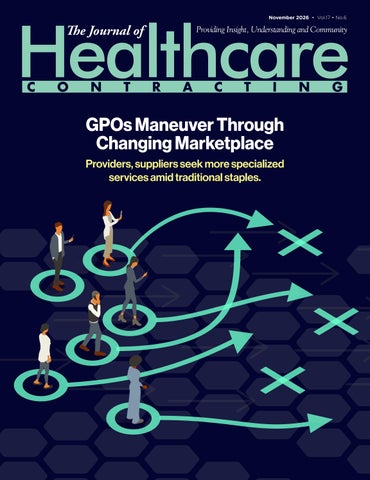
GPOs Maneuver Through Changing Marketplace Providers, suppliers seek more specialized services amid traditional staples.
Connected Care Starts with Connected Devices Securely connect vital signs devices to your EMR with a cloud-based solution designed to help streamline workflows, save valuable clinician time, and support interoperability. • Secure, end-to-end data transfer • Vendor hosted cloud infrastructure • Accurate, automated vitals documentation
See how connectivity works. THE SIMPLICITY OF A CONNECTED WORKFLOW
Tap or scan clinician ID
Scan patient ID
Take patient’s vital signs
Tap “Save” to automatically send vitals data to the EMR
Click here to learn the benefits of a secure, connected workflow. Rx Only. For safe and proper use of the products mentioned herein, please refer to the Operators Manual or Instructions for Use. Baxter is a trademarks of Baxter International Inc. US-FLC215-260048 (v1.0) 08/2026
C O N T E N TS | N OV E M B E R 2 0 2 6
2 The New Rules of Supply Chain Resiliency
34 Measuring What Matters in GPO Performance
12 GPOs Maneuver Through Changing Marketplace
48 Be Thankful for Supply Chain
Florida AHRMM leaders say preparation, communication and collaboration are essential as healthcare organizations face increasingly complex disruptions.
Providers, suppliers seek more specialized services amid traditional staples.
The Journal of Healthcare Contracting is published bi-monthly by Share Moving Media 350 Town Center Ave, Ste. 201 Suwanee, GA 30024 Phone: 770/263-5262 FAX: 770/236-8023 e-mail: info@jhconline.com www.jhconline.com
PUBLISHER John Pritchard
jpritchard@sharemovingmedia.com
DIRECTOR OF BUSINESS DEVELOPMENT Anna McCormick
Without uniform reporting requirements or consistent evaluation criteria, comparing GPOs remains a challenge. John Strong discusses the metrics, transparency and independent oversight needed to make rankings more credible. Imagine the inefficiency and void resulting from its absence.
EDITOR Graham Garrison
ART DIRECTOR Brent Cashman
SENIOR WRITER R. Dana Barlow
CIRCULATION Laura Gantert
ggarrison@sharemovingmedia.com
bcashman@sharemovingmedia.com
lgantert@sharemovingmedia.com
amccormick@sharemovingmedia.com
The Journal of Healthcare Contracting (ISSN 1548-4165) is published bi-monthly by Share Moving Media, 350 Town Center Ave, Ste 201, Suwanee, GA 30024. Copyright 2026 by Share Moving Media All rights reserved. Please note: The acceptance of advertising or products mentioned by contributing authors does not constitute endorsement by the publisher. Publisher cannot accept responsibility for the correctness of an opinion expressed by contributing authors.
www.jhconline.com
1
RESILIENCE
The New Rules of Supply Chain Resiliency Florida AHRMM leaders say preparation, communication and collaboration are essential as healthcare organizations face increasingly complex disruptions.
For Florida’s healthcare supply chain leaders, disruption is no longer an occasional event to prepare for. Natural disasters, cyberattacks, product shortages and other challenges have made resiliency a day-to-day priority. At the same time, leaders are taking a closer look at the data behind their decisions, the relationships that help them respond to problems and the vulnerabilities buried deep within their supply chains.
2
In an interview with The Journal of Healthcare Contracting, Florida AHRMM chapter officers discussed what is keeping supply chain professionals up at night, how provider-supplier relationships are evolving and what organizations can do now to prepare for the next disruption.
November 2026 | The Journal of Healthcare Contracting
Providing responses for the Florida AHRMM 2026 were the following chapter officers: ` President: Rodger Landers, MBA, CMRP, FAHRMM, BayCare Health System, Procurement Manager ` President-Elect: Diana Carvajal, Sierra-Cedar, Vice President, Healthcare & Commercial Solutions ` Vice President Elect: Sara Reschke, Staritas, Senior Account Executive ` Treasurer: Scott Wilcox, CMRP, FAHRMM, Sarasota Memorial Health Care, Director, Supply Chain Operations The Journal of Healthcare Contracting:
And finally, resiliency has moved from being something we talked about after a disruption to something leaders need to build into their everyday strategy. The question is becoming less “How do we respond when something happens?” and more “How prepared are we before it happens?” JHC: What are FLAHRMM’s key initiatives and areas of focus right now, and where is the greatest opportunity to help members?
A big part of FLAHRMM’s role is education, connection and sharing what we’re learning across the industry.
What issues are keeping Florida supply chain leaders up at night, and how have priorities changed?
We think three things are really keeping supply chain leaders up at night right now: data, cybersecurity and resiliency. Data integrity and the ability to quickly retrieve and trust your data have become much more important. It’s not just about having data. It’s about knowing where it came from, validating the inputs and being confident we’re making decisions based on accurate information. We’re also seeing more focus on utilization and conservation, particularly when products are at risk or distribution is limited, such as we’ve seen with contrast media. Cybersecurity continues to be a very real threat to healthcare. A cyberattack can quickly become a supply chain issue when systems, ordering, distribution or communication are disrupted.
www.jhconline.com
Rodger Landers, Procurement Manager, BayCare Health System
Diana Carvajal, Vice President, Healthcare & Commercial Solutions Sierra-Cedar
Sara Reschke, Senior Account Executive, Staritas
Scott Wilcox, Director, Supply Chain Operations, Sarasota Memorial Health Care
A strong provider-supplier relationship means both sides are comfortable having transparent conversations even when the news isn’t good.
3
RESILIENCE
One area we want to continue emphasizing is data – helping supply chain professionals understand where their data is coming from, whether they can trust it and how to turn that information into better decisions. Cybersecurity is another important area. The threat is very real, and recent incidents involving organizations such as Boston Scientific, Stryker, OneBlood and Tallahassee Memorial show how quickly a cyber event can affect healthcare operations. There’s an opportunity to help supply chain teams understand both the risks and the everyday actions employees can take to help prevent a breach.
The best practice we see is consistent communication – not just when there is a problem.
We also want to continue promoting resiliency as a discipline, not simply a response to an emergency. That means learning how to identify potential disruptions earlier, understanding the warning signs, and having a plan to recover quickly when something does happen. The recent contrast shortage and Solventum software issues are good examples of why that preparation matters. JHC: What does a truly strong providersupplier partnership look like today?
For us, it really comes down to trust and communication. A strong provider-supplier relationship means both sides are comfortable having transparent conversations even when the news isn’t good. For example, if a supplier knows an item is at risk of going on back order, communicating that early gives the provider options. They can look at substitutes, adjust utilization or change their purchasing strategy rather than panic-buying when the back order happens. And when the product becomes available again, they can adjust back. That kind of partnership helps everyone. When there is trust and communication, the supply chain has options. Without it, the supply chain can break down very quickly. JHC: How important are established relationships and communication channels before a crisis?
They’re critical. We don’t want to exchange business cards for the first time in the middle of a crisis.
4
November 2026 | The Journal of Healthcare Contracting
New ClearPetra 2.0 – Now 25% Thinner* – Enhanced Steering – Intuitive Suction Control
Scan the QR code to learn more
Copyright © 2026 KARL STORZ. All Rights Reserved. All trademarks are the property of KARL STORZ SE & Co. KG unless otherwise noted. For US use only. It is recommended to check the suitability of the product for the intended procedure prior to use. Caution: Federal (USA) law restricts this device to sale by or on the order of physician. The ClearPetra trademark is owned by Well Lead Medical Co., Ltd.
97137055 URO 1 1.0 us 07/2026/A-E-US
*Compared to ClearPetra 1.0
RESILIENCE
The relationships and communication channels need to be established before the disruption happens. When a provider and supplier already know each other, there is a level of trust and understanding that allows them to move much faster. The best practice we see is consistent communication – not just when there is a problem. Providers and suppliers should be talking about potential risks, alternatives, inventory levels, lead times, and emerging issues before they become emergencies. That way, when something does happen, the conversation starts with “How do we solve this together?” rather than “Who is responsible for this?”
6
JHC: What lessons from Florida’s hurricane experience should other supply chain leaders pay attention to?
The bigger lesson is that we must prepare before the disruption – not while the disruption is happening.
Florida has learned a lot about preparing for disruption because hurricanes give us a regular reminder that whatever is inbound may not arrive when you need it. IDNs that self-distribute can have an advantage because they have more control over inventory and can position critical products ahead of the storm. But it’s not simply about stocking up. It’s also about understanding what we already have on hand, what we need, and optimizing inventory before the storm arrives. For organizations that don’t distribute, having multiple inbound sources
November 2026 | The Journal of Healthcare Contracting
Medtronic Microstream™ Advance filter lines | Clinical performance
A capnography sampling line is more than a cannula Bench testing shows the sampling line plays a critical role in the accuracy and reliability of the capnography system.
†, 1
Supply-chain decisions must balance cost, standardization, product performance, and patient care. Capnography sampling lines should be evaluated with that same rigor. In bench top testing, sampling lines that claim compatibility with the Microstream™ Advance connector exhibited inconsistent performance, suggesting cross-paired lines may fail to deliver reliable, consistent, or accurate measurements.†, 1
Only the Microstream™ Advance filter line consistently provides accurate readings, expected filter performance and mechanical integrity when paired with a Microstream™ technology-enabled monitor.†, 1 Scan the QR code to see the evidence behind the reading before your next contracting cycle.
Before standardizing on an alternative, look beyond claimed compatibility and evaluate the evidence behind its performance.
† Testing funded and conducted by Medtronic; bench results may not be indicative of clinical performance. Bench tests compared performance of sampling lines commonly used with spontaneous breathing patients under various breathing conditions. Three categories of sampling line products were evaluated: oral-nasal cannulas (n=9), EtCO2 masks (n=2), and procedural bite blocks (n=2). 1. Jones T, Glozman D, Oglesby H, Mulier JP. Comparative analysis of accuracy, filter performance, and durability among capnography sampling lines: A bench study. Medtronic Manuscript. 2024
RESILIENCE
and contingency plans becomes even more important. The bigger lesson is that we must prepare before the disruption – not while the disruption is happening. JHC: How can providers and suppliers balance efficiency and cost savings with resiliency?
We think communication is one of the biggest levers we have. There are plenty of opportunities to improve efficiency. For example, providers purchasing by the full pallet, pallet layer, or truckload can create significant efficiencies when the demand and storage strategy support it. But efficiency can’t come at the expense of visibility. If a supplier knows an item is becoming an “at-risk” item, communicating that before it becomes a back order gives the provider the opportunity to make a different decision. The best back order is the one we avoid. Too often, providers react to a back order because they weren’t aware there was a problem until it was already too late. Early communication gives everyone more options and allows providers to balance cost, inventory, and resiliency much more effectively. JHC: Where should healthcare organizations think differently about resilience?
One area we think deserves more attention is understanding the true source of critical products. It’s not enough to know who the supplier is. Providers need to understand
8
Sometimes the most valuable information is simply knowing that someone else is seeing the same issue, has found a workaround, or has learned something the hard way.
where critical products are manufactured, the country of origin and where those products are distributed from. That visibility becomes especially important when there is a disruption in a particular region or manufacturing location. The contrast media shortage is a good example. When a significant portion of a critical product category is dependent on a limited number of manufacturing sources, a disruption in one location can have a much broader impact. For critical products, we should be asking: Where is it made? Where does it come from? How many sources do we have? And what happens if that source goes down? JHC: If you could give supply chain leaders one piece of advice about preparing for the next major disruption, what would it be?
Be part of the community – and keep talking. No one organization has all the answers, and disruptions rarely affect just one organization. Whether it’s AHRMM, an affiliated chapter like FLAHRMM, HIRC, or other industry networks, sharing information helps everyone see what’s happening beyond their own four walls. Sometimes the most valuable information is simply knowing that someone else is seeing the same issue, has found a workaround, or has learned something the hard way. The more we share, the better prepared we all are. Resiliency isn’t something we build by ourselves. It’s something we build together.
November 2026 | The Journal of Healthcare Contracting
See what’s possible Distributors and self-distributing health systems now have complete transparency of their Dukal products’ from purchase order to delivery. Product Assigned at the Factory Level Product Tracking at the Item Level Compatible Excel Reporting Automated Communication Worldwide Tracking
Scan here to learn more or visit dukal.info/insight
Dukal is working with healthcare professionals around the world in manufacturing and supply chain solutions, to mitigate disruptions that impact business and patient health. Helping you manage everything from product to patient.
> Learn more at dukal.info/insight
End-to-end flu solutions for your non-acute facility Explore Cardinal Health’s comprehensive offering to help protect patients and staff from the spread of flu.
Vaccines Wide-ranging selection of flu vaccine brands with competitive pricing, pre-book benefits* and fast delivery
• Fluzone® High-Dose Trivalent
• Fluzone® Trivalent • Flublok® Trivalent • Fluad® Trivalent
• Afluria® Trivalent • Flucelvax® Trivalent • Fluad® Trivalent • Fluarix® Trivalent • Flulaval® Trivalent
Scan the QR code to learn more
Rapid test kit Lateral flow flu rapid test supporting the reliable detection of influenza A & B
• CLIA-waived: No need for an instrument
• Meets the influenza reclassification requirements for rapid antigen tests
Scan the QR code to learn more
• Pre-filled vials, minimal hands-on time
• Results in 10 minutes • Sample type: Nasal/NP swab
Flu essentials
Scan the QR code to learn more
Cardinal Health offers an extensive selection of essential flu products. From prevention to treatment, we help keep patients and clinicians safe at every step.
Procedure masks
Face shields
Isolation gowns
Exam gloves
Disposable stethoscopes
Tissues
Safety needles and syringes
Sharps disposal
Performance Plus™† Products For comprehensive respiratory season protection, Cardinal Health™ Performance Plus Featured Supplier Products are a cornerstone of our offering. These essential solutions from AirLife®, GOJO®, Bowman®, PDI® and others empower your team to implement an effective, end-to-end flu hygiene strategy, ultimately enhancing patient safety and care.
Respiratory care oxygen delivery
Hand hygiene soaps and sanitizers
Scan the QR code to learn more
Dispensers and organizers
Surface disinfectants — nasal decolonization
For more information or to order, contact your Cardinal Health sales representative, call 800.964.5227 or visit cardinalhealth.com/physicianofficesolutions *Pre-book benefits include secure supply, pricing protection, priority shipping and end-of-season returns. †
Performance Plus™ Portfolio featured suppliers in this flyer are AirLife® GOJO, Bowman® and PDI®
© 2025 Cardinal Health. All Rights Reserved. CARDINAL HEALTH and the Cardinal Health LOGO are trademarks of Cardinal Health and may be registered in the US and/or in other countries. All other trademarks are the property of their respective owners. Lit. No. 2LAB26-4978509 (10/2026)
GPOs Maneuver Through Changing Marketplace Providers, suppliers seek more specialized services amid traditional staples. BY R. DANA BARLOW
L
ooking at today’s group purchasing organizations (GPOs) yields one overarching observation adapted from the television commercial of a discontinued automobile brand: Today’s GPO is not your father’s GPO.
While the fundamentals remain consistent, the mechanisms for delivering them and the scope and span of services required extend far beyond what went before. Three prime examples of this involve achieving and assuring data transparency, expanding out to nonacute or remote care facilities and adopting and implementing technology, the latter of which consistently updates and upgrades at least each year.
12
Crystal clarity Calls for “data transparency” hearken back to at least 50 years, long before the industry elevated that phrase to buzzworthy level. During the 1980s, intense debate over the ill-fated Common Category Database (CCD) centered on its ability to give providers and suppliers access to reams of information about product attributes, enabling them to compare components, pricing and other elements.
GPOS MANEUVER THROUGH CHANGING MARKETPLACE
Not surprisingly, providers favored it, but suppliers did not because that capability would reveal too many trade secrets. By and large, these days the calls for data transparency revolve around costs – or rather, pricing – for clinical procedures so that patients – but more accurately, payers – can compare provider service charges for payment and reimbursement. But calls for data transparency also center on the ability of providers, suppliers and payers to share product, service and patient data to streamline the delivery of clinical care, which includes demand and supply chain management, and more accurate. Yet critics contend the line likely needs to be drawn somewhere to protect research and development, sourcing and production parameters to a degree. GPO executives acknowledge the ongoing discussion continues as a work-in-progress.
14
“GPOs shouldn’t have a place in the real-time transactional flow, like demand and supply projections. There are technical network solutions that solve that and belong as direct relationships between providers and suppliers.”
“Healthcare organizations are asking for more transparency and visibility because they need better information to make decisions in a rapidly changing environment,” said Bruce Radcliff, president, Supply Chain Services, Premier Inc. “While achieving complete real-time visibility across the entire supply chain may not always be realistic, significant progress is possible and already underway. “At Premier, we’re seeing growing demand for insights into product availability, utilization trends and contract performance,” Radcliff continued. “Advances in technology are making it easier to provide that information and help organizations respond more quickly to changing conditions. At the same time, strategies such as supplier diversification and fixed-price contracting need to be balanced with factors such as cost, availability and long-term sustainability. The goal is not simply to add more suppliers or more data, but to help providers build a more resilient and informed supply chain.” Prior to Premier, Radcliff spent more than a decade at Advocate Aurora Health leading supply chain operations. Yet how reasonable is it for providers to request or even mandate data transparency and real-time visibility into demand (consumption) and supply (production) activities, fixed-price contracting and supplier/vendor relationships with GPOs? Steve Downey, Chief Supply Chain and Patient Services Officer, Cleveland Clinic, argues that it’s unreasonable, if not unrealistic.
November 2026 | The Journal of Healthcare Contracting
More Than Automation — Itʼs Intelligence with Purpose Healthcare supply chains donʼt need more platforms. They need intelligence at the point of execution — where decisions are made, risks emerge and outcomes take shape. When data, technology, and artificial intelligence (AI) work together in the flow of operations, healthcare organizations can move faster, reduce uncertainty and make decisions with greater confidence — at scale. This is how insight becomes action. And action transforms into results.
Learn More
Explore how Premier helps organizations drive impact across supply chain, technology, AI, performance improvement and innovation.
GPOS MANEUVER THROUGH CHANGING MARKETPLACE
The real opportunity is connecting provider, supplier, clinical, financial, operational and consumption data into the workflows where products are selected, purchased, used, paid for and evaluated.
16
“These are two distinct issues that shouldn’t be combined,” Downey insisted. “GPOs shouldn’t have a place in the real-time transactional flow, like demand and supply projections. There are technical network solutions that solve that and belong as direct relationships between providers and suppliers. Data transparency, like costs, incentives and profits, is a question behind the design construct of the GPO. Member-owned GPOs typically have transparency requirements built into their governance. For others, it’s a design choice that needs addressing at the model level.” Before joining Cleveland Clinic, Downey spent nearly a decade at Vizient and Excelerate in leading supply chain operations and consulting. Transparency, in fact, may not be enough anyway, according to Simrit
Sandhu, President, Spend Management, Vizient. “Transparency is not a standalone strategy,” Sandhu noted, “it is a requirement for the overall strategy of intelligent supply chain orchestration. The real opportunity is connecting provider, supplier, clinical, financial, operational and consumption data into the workflows where products are selected, purchased, used, paid for and evaluated. “We see this when supplier data and Vizient analytics come together to identify gaps in areas like facilities and biomedical services, set KPIs and create providerspecific action plans,” she continued. “We also see it in clinically complex categories, where supplier insight, provider feedback and data can help clarify which products, technologies or care models are delivering value and where adoption needs to be tailored. That requires providers and suppliers to operate differently, with stronger data sharing, clearer accountability and a shared focus on closing the performance gap between negotiated value and realized financial impact.” Sandhu previously led supply chain operations at Cleveland Clinic for nearly 15 years. John Strong, a veteran healthcare supply chain executive with experience in the hospital, distribution services, GPO and consulting segments, questions the achievability of data transparency demands, too. “It is tough,” Strong told The Journal of Healthcare Contracting, “as some of the systems and processes are trade secrets. Sharing too much data may bring about
November 2026 | The Journal of Healthcare Contracting
The reason our IV bags aren’t made with DEHP is clear. Over 40 years ago, B. Braun recognized the environmental and patient risks of toxic chemicals like DEHP and PVC and was the first medical device manufacturer to remove them from many products. DEHP, which is used to soften PVC, can leach into IV fluids, potentially putting patients at risk. Protect your patients and the planet with a full line of IV bags not made with DEHP or PVC.
Learn more at bbraunusa.com/clearlysafe Rx only. © 2025 B. Braun Medical Inc., Bethlehem, PA. All rights reserved. 25-0287_07/25
GPOS MANEUVER THROUGH CHANGING MARKETPLACE
antitrust concerns and still today pricing lacks the context in which it was given, such as volume, compliance, corporate agreements, etc. Historically, some hospitals have been reticent to share all their purchasing information with their GPO, and some not.” Still, Strong foresees data transparency growing with the emergence of AI-based supply chain technology that can link systems from the electronic medical record (EMR) to the materials management information system (MMIS) or enterprise resource planning (ERP) system to the GPO, distributor and manufacturer. In fact, he believes suppliers may be more open and amenable to working with providers in different ways. “As healthcare systems continue to consolidate, suppliers are looking at ways to really partner with them,” he observed. “There is growing universal agreement that leading suppliers are working on ways to make their products AI-friendly. This is only part of the equation. At the same time, they are developing or acquiring companies that can assist hospitals with their care path from prior to a procedure, through the procedure to post-procedure. Companies – and perhaps GPOs – that develop the ability to do this will be the long-term winners in the next five years.” Strong recently retired as Co-Founder and Chief Consulting Officer, Access Strategy Partners Inc., and his career included serving as president and CEO at Consorta for nearly 11 years before it became part of HealthTrust, leading the original Premier Health Alliance GPO for
18
90s Through mergers and acquisitions that reached a frenzy during the 1990s, the healthcare marketplace started consolidating to fewer independent organizations and more healthcare systems that required contracting, logistics and services to be updated to reflect the diverse delivery options.
seven years and prior to that serving as Chairman, Division of Materials Management at Lutheran General Hospital and President of Healthcare Materials Corp.
Reaching remotely Early in the history of cooperative buying, the forerunner of group purchasing, the cooperative buying organizations (CBOs) primarily worked with acute care hospital facilities. Since that time, the healthcare industry has expanded to include remote care facilities that reference both geography and specialty, including ambulatory surgery centers (ASCs), clinics, diagnostic
November 2026 | The Journal of Healthcare Contracting
imaging centers, laboratories, long-term care facilities, physician offices and more. This development marked a shift in healthcare dynamics from the facility pulling the patient in for care to the facility pushing patient care services closer to the population. Through mergers and acquisitions that reached a frenzy during the 1990s, the healthcare marketplace started consolidating to fewer independent organizations and more healthcare systems that required contracting, logistics and services to be updated to reflect the diverse delivery options. GPOs started addressing this organizational migration as far back as the 1960s with the changes
www.jhconline.com
“As part of the healthcare provider spectrum, it’s absolutely necessary to think of all these sites as part of the equation.”
reaching a fever pitch with the enactment of managed care in the early 1980s as payers were granted more influence and power by Congress in 1983. For today’s GPO and supply chain executives, this is business as usual. “As part of the healthcare provider spectrum, it’s absolutely necessary to think of all these sites as part of the equation,” indicated Cleveland Clinic’s Downey. “How a GPO supports them depends on what service is needed. If it’s contracting, ensure the contracts cover them in scope. If it’s analytics or benchmarking, ensure the data is segmented appropriately. GPOs can also support supplier communication, onboarding and implementation as systems bring new or affiliated facilities into the fold. And because they have broad visibility across their membership, GPOs are wellpositioned to surface best practices and practical insights that help organizations navigate an increasingly complex care delivery landscape.” If anything, GPOs should reflect the nature of their clients and customers, according to Premier’s Radcliff. “As care continues to move beyond the four walls of the hospital, healthcare organizations need a more coordinated approach to supply chain management across the entire continuum of care,” he said. “GPOs can help create that alignment by providing common contracting strategies, data insights and benchmarking across different care settings. Hospitals, ASCs, clinics and physician practices often face similar challenges, but they may
19
Cardinal Health™ Lab Distribution: Products and Services
Analyzers, reagents, quality controls and beyond
Helping you maximize your capital equipment potential Cardinal Health offers end-to-end capital equipment products and services that help you streamline your processes and maximize efficiency.
Service Our team of over 200 laboratory sales professionals, diagnostic specialists and leasing consultants is here to support smarter equipment decisions through:
A single point of contact
Ongoing support
Simplified decisions
Customized solutions
Supported by a team of experts, including diagnostic specialists, customer service representatives and leasing specialists
Choose the right reagents and quality controls, with dedicated teams focused on sequestered lots and your Quality Assurance Program
A team trained to advise you on choosing the right instrumentation
Tailored to improve your results without complicating your current processes
© 2026 Cardinal Health. All Rights Reserved. CARDINAL HEALTH and the Cardinal Health LOGO are trademarks of Cardinal Health and may be registered in the U.S. and/or in other countries. All other trademarks are the property of their respective owners. Patent cardinalhealth.com/patents. Lit. No. 2LAB26-4969844 (10/2026)
Specialized handling Rely on our temperature-controlled distribution network for your reagents and quality controls.
Financing Get more from your investment with financing options such as creative and flexible leasing services, no down payments, GPO rebate opportunities and the ability to purchase multiple instruments on a single purchase order.
Choice Gain access to analyzers from your preferred manufacturers across disciplines, including histology, blood bank, clinical chemistry, hematology and microbiology.
Whether you’re expanding, upgrading or optimizing your lab, Cardinal Health delivers the products, expertise and support to help you make confident, cost-effective decisions. To explore your options, connect with your lab sales representative or visit cardinalhealth.com/labcapitalequipment
GPOS MANEUVER THROUGH CHANGING MARKETPLACE
solve them in different ways. By helping healthcare organizations identify opportunities for standardization and operational improvement, GPOs can support greater efficiency while still allowing flexibility to meet the needs of individual sites.” But Vizient’s Sandhu emphasizes that monolithic contracting for larger systems does not and should not apply to everyone. “The opportunity is not simply to extend hospital contracts into ambulatory sites,” she emphasized. “That is where organizations can get stuck. ASCs, clinics, physician offices and imaging centers do not all buy, operate or adopt technology the same way, especially when some sites are owned, some are affiliated and others are independent. “Supply chain needs to support providers across the entire continuum of care,” Sandhu continued. “That starts with visibility: Where spend is happening, where purchasing behavior varies and where contract coverage is inconsistent. From there, the answer may be simple contract access, guided buying, price assurance, supplier partnerships or workflow support, depending on how the site actually operates. The larger value is pattern recognition. A single ASC or clinic sees its own experience. Vizient can see across many providers and care settings, helping organizations understand what works, what can scale and where a different approach is needed. The goal is to help providers manage performance across the full care continuum, not force every site into the same model.”
22
“While GPOs do a good job on price and working with suppliers to enforce compliance through pricing tiers, there is still a lot of friction in the healthcare supply chain.”
GPOs have been making inroads with some progress, according to Strong. “I think the three national GPOs bring together these providers on a regular basis with committees, national and regional meetings and other forums,” he said. “The big question for me is how the national GPOs can make ordering, especially by non-acute care providers, more efficient than an electronic catalog alone. The brass ring here links the GPO price with the electronic order, inventory, payment, etc. While a great deal of work has been done on this, I’m not sure that all of it has been brought together yet.” Suppliers also are getting into the game from another direction. “Suppliers are working with hospitals to push services closer to the patient and the population,” Strong noted. “Many leading suppliers are working on combining their products and services to create a more seamless patient experience. This is the future, and I’m not certain that these efforts involve the GPOs or not. As suppliers work toward ‘partnerships’ with consolidating health systems, you have to wonder how that fits with their GPO. “While GPOs do a good job on price and working with suppliers to enforce compliance through pricing tiers, there is still a lot of friction in the healthcare supply chain. This is not necessarily the GPOs fault, but the amount of administrative burden continues to grow,” he acknowledged. Strong also argues that hospitals, if not GPOs, may have to change vendors from time to time to obtain lower prices.
November 2026 | The Journal of Healthcare Contracting
The long-term, sole-source contract likely has outlived its usefulness. “There can be partnerships, but it has to be a two-way street,” he said. “And that will require visionary C-suite support. When I worked at Lutheran, the CEO believed that supply chain and human resources were two things that would make or break the financial year.”
Tackling the toolbox Healthcare organizations – acute care hospitals in particular – simply cannot sidestep investing in technology in any way, whether it involves, clinical, diagnostic, surgical, administrative, financial or operational. Such technology contributes to the effectiveness and efficiency of providing care to patients. GPOs historically have worked to help provider organizations evaluate the need
www.jhconline.com
GPO performance ratings in the tech space, however, draw mixed reviews, depending on the function, intent and perspective.
for and type of technology for front-facing clinical, diagnostic and surgical services as well as for back-office operations, including supply chain, sterile processing, accounts payable and information systems, among other functions. Much of the technology buzz during recent years has centered on IT-related areas, including artificial intelligence (AI), blockchain, robotic process automation (RPA) and robotics in general for logistical and surgical applications. GPO performance ratings in the tech space, however, draw mixed reviews, depending on the function, intent and perspective. Vizient’s Sandhu encourages providers to think realistically and with maturity about technology. “Providers do not need more technology for its own sake,” she said. “They need tools that help them make better decisions, reduce unwarranted variation and improve performance. That starts with a disciplined question: What problem are we solving, where does it fit in the workflow and how will we know whether it improved cost, quality or operations? “In clinical and procedural categories, product and technology decisions cannot be evaluated on purchase price alone,” Sandhu noted. “A device, implant, supply or workflow tool may affect utilization, physician practice patterns, throughput, labor, outcomes and total cost of care. The question is not only what something costs, but whether the right product is being used in the right place for the right patient, and whether variation is clinically justified.”
23
GPOS MANEUVER THROUGH CHANGING MARKETPLACE
Sandhu emphasizes that technology must be used to fit into a larger aim. “Clinically integrated supply chain gives providers a shared fact base for those decisions. By connecting product cost, utilization, procedural, outcomes and contract intelligence, health systems can bring supply chain, finance, value analysis and clinical leaders into the same decision model, align on the right actions and monitor whether decisions are delivering the intended financial and clinical results,” she said. “Vizient’s role is to support that work through healthcare expertise, categoryspecific strategies, benchmarking, procedural analytics, implementation support and governance models. The goal is not to add another dashboard. It is to help providers make confident decisions that reduce unwarranted variation, protect quality and turn clinical supply chain performance into a measurable enterprise value lever,” she added.
24
Providers need more than product information but help in understanding which technologies will deliver measurable value and fit within their broader operational and clinical goals, according to Premier’s Radcliff.
Cleveland Clinic’s Downey feels that GPOs are well-equipped to satisfy technology demands based on the social networks of their members. “By knowing the members and serving as a many-to-one evaluation, GPOs can do tech briefs on all sorts of offerings,” he indicated. “Equally important is creating forums and mechanisms for members to share what’s actually working in practice. That peer-level intelligence cuts through vendor marketing and helps systems identify real innovations worth a closer look.” Providers need more than product information but help in understanding which technologies will deliver measurable value and fit within their broader operational and clinical goals, according to Premier’s Radcliff. “Providers are increasingly looking for technologies that connect data across the enterprise rather than create additional silos,” he said. “GPOs can help by evaluating solutions through the lens of performance, interoperability, scalability and long-term return on investment.” Radcliff echoes the application of social interaction as key. “Perhaps most importantly, GPOs can bring lessons learned from across their membership. Organizations often benefit from understanding what has worked, what hasn’t and how their peers have approached similar technology decisions. The goal isn’t simply to help providers buy technology. It’s to help them successfully implement and use it to improve outcomes,” he insisted. Strong expresses a critical eye about GPOs and their mastering of technologyrelated issues – and with a logical reason.
November 2026 | The Journal of Healthcare Contracting
“Not to bang on the GPOs, but there are several things that GPOs still do not do terribly well: Capital equipment procurement, services contracts, value analysis and meaningful new product evaluation from small and start-up companies.” These four areas share a common thread, according to Strong. “They require a high degree of personalization, by health system or facility,” he observed. “This limits the scalability of them, and with three national GPOs in about 99% of American hospitals, it is understandable that they struggle. They have done a good job on evaluating limited amounts of new technology. The limits are understandable because they would be inundated with new ideas.” Strong acknowledges that GPOs can offer more personalized services through consulting divisions, which can be costly
www.jhconline.com
additions to members’ budgets if they aren’t able to apply their share-back funds to these services. As something of a workaround to the CCD, several GPOs work with smaller groups of members to transact business through their corporate purchasing systems so they can collect and analyze data in the areas of pricing and usage, which ties into rebates, according to Strong. “Doing things that are group purchasingcentric for your members is always a win,” Strong said. “But you’ve got to do it efficiently, you’ve got to do it effectively and it’s got to be credible. And your members have to agree – or a portion of your members have to agree. When you get to 2,000 or 3,000 hospitals, it gets very complicated. Not everybody wants to share their data either. But GPOs can still grow and succeed.”
“Doing things that are group purchasingcentric for your members is always a win. But you’ve got to do it efficiently, you’ve got to do it effectively and it’s got to be credible.”
25
Sponsored Executive Spotlight
Henry Schein
Making the Non-Acute Supply Chain a Strategic Asset As care shifts to ambulatory and specialty settings, supply chain leaders must connect strategy with site-level execution to control costs, improve visibility and support growth, says Henry Schein Medical’s Brian Heyndrickx.
As health systems expand care beyond the hospital, supply chain leaders face growing challenges in standardization, cost control and operational visibility. For Brian Heyndrickx, Vice President of Health Systems and Enterprise Accounts at Henry Schein Medical U.S., addressing those challenges requires a broader view of the non-acute care network. Heyndrickx began his career in hospital materials management before spending 18 years in supply chain leadership at Owens & Minor. He later helped launch a dental group purchasing organization before joining Henry Schein in 2023.
In the following Q&A, Heyndrickx discusses building strategic partnerships, mitigating risk and uncovering savings beyond unit price. What are the biggest leadership challenges involved in driving standardization across a large, complex health system?
Brian Heyndrickx
26
Brian Heyndrickx: Looking across a large non-acute network, there may be different purchasing practices, different suppliers, different processes, and different ways of managing inventory from one location to another. Without that visibility, it’s difficult to know where standardization is going to have the greatest impact. Leaders can start by understanding what’s happening site by site. For example, where are the inefficiencies? Where is there waste? Where is there unnecessary variation? Then, leaders can prioritize the opportunities and create a roadmap for what should be addressed.
November 2026 | The Journal of Healthcare Contracting
foundation of building stronger relationships. Supply chain leaders should view the clinical and financial teams as customers, just like the hospital views its patients. Leaders should build relationships with the lens that everyone they serve is a customer, it will change their view and approach of how to build internal relationships.
Data visibility, project planning, and execution of the plan are the biggest challenges leaders face today. The good news is that there are solutions to these challenges. Leaders simply need to find the right technology, internal team, and external partners to take the “right” journey to succeed. It’s that simple. The hard part is pulling it all together and executing it.
How can leaders create a culture that anticipates risk rather than simply reacts to it? Heyndrickx: Having a clear picture of what’s hap-
How can supply chain leaders build stronger relationships with clinical teams, finance executives and distribution partners to achieve shared goals? Heyndrickx: It starts with creating
visibility around what the shared goals should be and ensuring everyone is aligned with those shared goals. The supply chain touches clinical, financial, and operational priorities, so those conversations should not really happen in isolation. For instance, when talking about standardization, leaders want to understand not only the purchasing opportunity, but also what it means operationally and how it affects the individuals delivering care. Data can help bring some objectivity to those conversations. If everyone can see where the opportunities are, more informed decisions can be made together. Developing bold, collaborative partnerships built on trust is the
www.jhconline.com
17
%
According to Tecsys, 17% of a clinician’s work week can be spent on supply chain tasks. The value of that time expands the conversation well beyond the price of an individual product.
pening across the network can absolutely help. That means understanding purchasing patterns, inventory practices, performance, and where there may be variation from one site to another. That data can help to identify areas that need attention, and inform decisions based on what is uncovered. I would also note that this should be ongoing. Continue looking at performance, reviewing progress, and keeping opportunities in focus. This is how to manage a network more intentionally. The BIGGEST opportunity that can mitigate risk is not putting all your eggs in one basket. Have a primary distributor for acute, and a different primary distributor for non-acute. Ask those organizations to work together on the health system’s behalf to create the best resiliency and risk mitigation plan together. Supply chain leaders should drive co-opetition to benefit their supply operations. Where do you see the biggest opportunities to help health systems solve problems that go beyond product availability and pricing? Heyndrickx: We’ve seen that there’s an opportunity to help health systems better understand what’s happening across their entire non-acute network. As that non-acute footprint grows, the supply chain supporting it can become fragmented. There may be inconsistent processes, different purchasing
27
Sponsored Executive Spotlight
Henry Schein
behaviors, different inventory practices, or limited visibility across locations. So, before even getting to product price, there are other questions worth asking. Where are we seeing waste? Where do we have unnecessary variation? What does inventory look like? Are there opportunities to standardize? And how much time are clinical teams spending on supply-related activities? That last question is especially interesting. According to Tecsys, 17% of a clinician’s work week can be spent on supply chain tasks. The value of that time expands the conversation well beyond the price of an individual product. As more care moves beyond the hospital, why should health systems view the non-acute network as a strategic growth engine — not simply an extension of acute care? Heyndrickx: The care model has continued to evolve rapidly, and the supply chain needs to change with it.
28
Product availability and reliable distribution are still incredibly important, but we’ve seen firsthand that health systems are increasingly looking for more than that.
It is essential that health systems have partners that can connect strategy to execution across the non-acute network, because the non-acute footprint has become even more important to health systems than ever before. I think we’ve all seen the growth of specialty sites, ambulatory surgery centers, outpatient centers, and in general the migration of care. And with that, the non-acute has different operational realities, which is why health systems need a partner they can rely on to understand what those realities are. Product availability and reliable distribution are still incredibly important, but we’ve seen firsthand that health systems are increasingly looking for more than that. As health systems expand their ambulatory and specialty footprints, non-acute is not just a support function — it is an increasingly important part of how they grow access, manage costs, and deliver care. Treating it strategically means giving the network the same intentional focus on visibility, performance, and execution that leaders bring to other parts of the system. Now the conversation is much more about, “Can you help us standardize where it makes sense? Can you give us better data? And when we identify an opportunity, can you help us execute it?”
November 2026 | The Journal of Healthcare Contracting
Winning Together. The strongest supply chains are built on alignment, insight, and partnership.
Henry Schein Medical helps health systems simplify complexity, strengthen operations, and support care across the continuum: Through Henry Schein ALIGN, health systems gain strategic guidance and data-driven insights to assess, optimize, and create greater value across the non-acute network. Tap into Henry Schein Medical’s full-service offering and experience the breadth of products, expertise, and solutions to support your evolving needs.
Turn non-acute complexity into opportunity. A more strategic path forward.
Let’s build what’s next together. Scan the QR Code to learn more or visit henryschein.com/align
Sponsored Executive Spotlight
Henry Schein
To me, I would say that a truly strategic nonacute partnership spans visibility, strategy, standardization, activation, and accountability. It’s having someone that can be a trusted advisor throughout the entire process and become an extension of the team. Health systems are under tremendous pressure to control costs. Where can they find meaningful supply chain savings beyond negotiating lower unit prices? Heyndrickx: Of course, price matters and is im-
portant. But we also need to look at the bigger picture. Look at variation. Look at inventory. Look at freight. Look at how many suppliers and SKUs are being managed. Look at products that are expiring on shelves. And look at how much time clinical teams are spending ordering supplies, tracking things down, or dealing with issues that really shouldn’t require their attention. That’s especially important in non-acute because those costs can be spread across hundreds of locations. A little inefficiency at one site may not look like much. Multiply it across the network, and it’s meaningful. So, I think the question is not only, “Did I get the lowest unit price?” It’s also, “What does it actually cost me to operate this supply chain, and where is complexity creating expense that I may not be seeing?” What is your vision for the role Henry Schein can play as health systems navigate this evolution? Heyndrickx: Our role is to be a trusted part-
ner that health systems can rely on to connect its larger strategy with what’s happening across the non-acute network. Henry Schein has served healthcare professionals for more than 94 years. We bring together a breadth of products, services, and technologies with strategic guidance,
30
When GPO alignment, distribution, and site-level practices are disconnected, health systems can miss opportunities for contract compliance, standardization, visibility, and savings.
analytics, and people who understand the non-acute supply chain. We want to help a health system assess where it is today, use the data to identify opportunities, help activate those opportunities across the network, and then stay engaged to measure the results. That’s really what we’re trying to accomplish with what we call ALIGN, our approach to serving the non-acute supply chain. It’s not a product or a software solution. It’s a strategic process to help health systems see, understand, and optimize their non-acute network. How important is it for health systems to align their GPO strategy, distribution model, and site-level execution — particularly across non-acute care? Heyndrickx: GPO strategy can
create significant value, but that value is only realized when contracts translate into purchasing behavior and consistent execution across the network. When GPO alignment, distribution, and sitelevel practices are disconnected, health systems can miss opportunities for contract compliance, standardization, visibility, and savings. The goal is to connect the strategy to what actually happens at each site — while ensuring the distribution model supports the needs of both acute and non-acute environments.
November 2026 | The Journal of Healthcare Contracting
Women in Sourcing for Health Systems
Connects, develops, and elevates women leaders shaping the future of healthcare procurement and supply chains. To register for our next webinar, visit our website
WISHCouncil.org
Scan to connect
We see it.
Strained Reaching
Incorrect Positioning
Inaccessible Equipment
Manual Entry
The job is already hard. The environment shouldn’t make it harder.
© 2026 Midmark Corporation, Versailles, Ohio USA
At Midmark, we start from that truth. And our mission is simple and serious: design every detail to remove friction where it shouldn’t exist. To give time, focus and energy back to the people doing the work.
Better care begins with every detail. Scan to Learn More.
TRENDS
John Strong, a healthcare industry veteran with more than 50 years in executive supply chain leadership among provider organizations, suppliers, service companies and group purchasing organizations (GPOs) has participated on both sides of the discussion throughout his varied career – as a source contributing data and information to such lists and also as an assessor and validator of such lists. Strong spoke with JHC Senior Writer and Columnist R. Dana Barlow, who, for more than three decades, has tracked GPO history back to the concept’s debut in 1910 with the Hospital Bureau of Standards and Supplies Inc., about the value, variance and verity of these lists, particularly around GPO performance.
Measuring What Matters JHC in GPO Performance
: What are some of the inherent dan-
gers in producing lists like these beyond
Without uniform reporting requirements or consistent evaluation criteria, comparing GPOs remains a challenge. John Strong discusses the metrics, transparency and independent oversight needed to make rankings more credible.
John Strong Healthcare Industry Veteran
34
Humans love lists, particularly those “listicles” that media outlets post, print and publish to promote something, causing readers to brag, criticize, dissect and wave off, too, whether it involves consumer enthusiasts and fans or professionals in the various trades. What tickles our fancy are topics like “best hospitals,” “best suppliers,” “best GPOs” and “top GPOs,” among myriad others.
their obvious entertainment and marketing value, but also in reading, interpreting and extrapolating from them? Why? Strong: There are several problems. Perhaps the most important is any internal bias when a buyer of any kind offers a supplier a “best” recognition. Why did they create the list? Is there a quid-proquo? Because most lists don’t post how the awards were calculated, it is impossible to really know why an individual or company landed on any list. Another big problem is there are hundreds of them, all using different metrics for determining how a hospital became a “Top 100” for example. Why? Some of the metrics are arguably right (low HAIs, for example). Others are arguably
November 2026 | The Journal of Healthcare Contracting
wrong. Does patient care admissions make a difference? Usually, when we know how an award was made it is for qualified vs. quantified reasons. All of this is much like restaurant reviews and star ratings. Everyone has different expectations so they may not align with your worldview. JHC: Focusing on GPOs, what do you feel are some useful metrics to consider when ranking GPOs and why? Strong: There are probably a few useful metrics that could be developed. Part of the challenge, however, is whether every national and regional GPO was willing to participate. Members probably would have to participate, too. Some useful metrics include: ` Contracted dollar volume spend going through the GPO by product category, unbundled. ` Measured commitment levels by contract, expressed in dollars, rolled up to a product category. Estimating or validating commitment in either dollars or percentages is arguably tough to do, and it requires transparency by customers. For many customers there is real fear in providing too much of this type of information, especially if they are a “cherry picker” and play different suppliers against one another. Greater transparency may lead some suppliers to actually offer better deals. ` Meaningful (not member preference) bid and pricing analysis of large spend products, compared to quality using real value analysis.
www.jhconline.com
Estimating or validating commitment in either dollars or percentages is arguably tough to do, and it requires transparency by customers.
I’ve suggested that for commoditized products it might be interesting for GPOs to conduct meaningful value analysis and not act like some of their members who treat VA as a form of the old “New Products Committee.” For young folks, those have been around for more than 50 years. GPOs find themselves in an interesting position when they do this, however. For multiple-category suppliers, there is always the risk of Contract Administration Fees (CAF) getting in to play as well – something that doesn’t always assist with member returns for those who care about the cash they receive back from the GPO. Life is sometimes filled with doubleedged swords and ambiguity, isn’t it? ` Meaningful “partnerships” with suppliers to offer value beyond price and demonstrate it for both the member and the supplier. We can’t go on looking at just price – although some prominent health systems have done GPO shootouts in the past few years focusing only on that. Today, too many people forget that good negotiations allow both parties to come away with a win. ` Real cash returned from the GPO to the member that can be applied to the cost of products. The former Consorta GPO was at 80% cash returns to members when it merged with HealthTrust. GPO bucks that are earned and can be applied to GPO services are largely meaningless unless a member finds true value in those GPO services.
35
TRENDS
As a buyer, I always question being rewarded for buying more of something in the first place.
While these are all great thought-provoking suggestions, there is little incentive for more transparency across most parts of the supply chain. In some cases, the practicality of even obtaining, then cleansing information is highly questionable beyond food for thought. Even with the federal government setting standards unwinding the types of GPOs, their participating members (because some hospitals/providers belong to more than one GPO) and providers may see it like an impossible task.
supplies is second only to labor in most healthcare facilities. JHC: What measures should be avoided or excluded and why?
Medicaid reimbursement?
Strong: Because of continuing GPO consolidation, the risk of violating antitrust laws also grows. It is not just about the GPOs, however. Some suppliers who look at their market share within the national GPOs could become alarmed if they take a serious look at who they have contracts with, and what percentage of market share they control within the three. As a buyer, I always question being rewarded for buying more of something in the first place.
Strong: Private payers might be willing to get involved, because the cost of all
JHC: What are some of the complications
JHC: Could participation be motivated by linking it to Medicare and
(beyond advertising/sponsorship or bias) that can arise that might call the data and interpretations into question? Strong: There are many. To your point about lists, examine just the number of hospitals that each of the national GPOs claim as members far exceeds the number of hospitals in the U. S. Because no one has ever established “uniform reporting requirements” for the GPOs there is always the risk of double counting purchase volume (Regional GPO volume being double counted with national, for example). Some experts believe that while there are modest aggregate savings with one national GPO versus another, it is highly dependent on what products within the product category a member hospital is using. That can tip the balance in favor of one GPO or another. High compliance
36
November 2026 | The Journal of Healthcare Contracting
Not All Sanitizers are Created Equal The PURELL® Brand Stands Out PURELL® Advanced Hand Sanitizer exceeds the FDA efficacy requirements with a single 1.1 mL dispensed dose –
the lowest efficacious dose on the market.*
PURELL® Hand Sanitizer gives you the perfect amount. Kills of most common germs
Meets and exceeds FDA requirements*
THE D IFFERENCE IS CL EAR! Discover the PURELL® Difference at GOJO.com
*At a mean volume of 1.1 mL. ©2026 GOJO Industries, Inc. All rights reserved. | 406150 (04/2026)
Cardinal Health™ Lab Distribution: Products and Services
Moving your lab forward
Choosing Cardinal Health for your lab Cardinal Health is a strategic advisor that helps labs translate supply chain success into diagnostic excellence. With expert collaboration, adaptable solutions and a flexible product portfolio, we deliver what labs need every step of the way.
53,000+ products
400+ suppliers
Continuous portfolio expansion
Dedicated expertise We provide a dedicated clinical lab point of contact as well as support from capital equipment experts and supplier liaisons.
Results-driven solutions Our programs help drive financial savings, strengthen quality and inventory assurance, improve operational efficiency and provide datadriven insights and planning visibility — all while supporting supply continuity.
Reliable products We offer competitively priced, quality national brand products along with Cardinal Health™ Brand Products with clinical equivalency.
Transparent service We deliver transparency without hidden costs or fees, foster deep supplier relationships and provide always-on service from order through delivery and beyond.
Distribution tailored to your success Protected investments: An extensive network of specialty storage solutions and dedicated support teams to help ensure compliance and minimize disruption.
Lab and supply chain alignment: Collaboration on standard assessments, optimization opportunities and resiliency-driving insights.
No surprise fees: Transparent pricing with direct ship fees disclosed upfront.
Comprehensive solutions: Dedicated diagnostic specialists, flexible leasing options, group purchasing organization (GPO) rebate opportunities and multi-instrument purchasing on a single PO.
Seasonal assurance: Peace of mind for respiratory season with the Reserved Inventory Program, guaranteeing local inventory and continuous monitoring while preventing backorders.
Expanded options: Exclusive supplier product offerings, strategic supplier relationships and wide access to national brand products.
Deep savings: 10% aggregate savings on nearly 2,300 Cardinal Health™ Brand Products compared to national brands.*
Services and programs that support: Adaptable services that allow you to customize your distribution program from ordering through delivery.
Serving all clinical laboratories: Anatomic pathology | Blood bank | Clinical chemistry | Hematology | Histology | Microbiology | Molecular Point of care | Research | Specimen collection | Specimen collection kitting | Virology | Toxicology
Your partner every step of the way Start driving results by connecting with a distribution expert or visiting cardinalhealth.com/labdistribution *Contract savings recognized through GPO contracts based on historical data to date. Savings are not guaranteed. © 2026 Cardinal Health. All Rights Reserved. CARDINAL HEALTH and the Cardinal Health LOGO are trademarks of Cardinal Health and may be registered in the U.S. and/or in other countries. All other trademarks are the property of their respective owners. Patent cardinalhealth.com/patents. Lit. No. 2LAB26-4978558 (10/2026)
TRENDS
How Healthcare Consolidation Might Impact GPO Market Share Data Making sense of data shared can hit speedbumps. BY JOHN STRONG
It has always been difficult to determine who is contracting for what volume across the healthcare supply chain. After all, some contracts are written outside a traditional, national group purchasing organization by a health system or integrated delivery network (IDN). In other cases, a regional GPO may be used by a hospital, or an affiliated ambulatory surgery center or other site of care. Hospital mergers, acquisitions and consolidation have continued over the past decade, pausing only for the global pandemic, and now rebounding again. This coincides with the consolidation
of hospitals usually around a large “anchor” facility, and more recently academic medical centers. Examining the number of hospitals within a health system and their GPO affiliation only tells part of the story, because it overlooks the purchasing volume they bring to a GPO. A recent “Research Letter” in the JAMA Health Forum indicates that when measured by number of hospitals, Vizient has the largest “share” of hospitals at 2,066 hospitals (43.4%)1. While true, this doesn’t really indicate the total impact and contract value that Vizient, Premier or HealthTrust have on the healthcare supply chain. It’s just one measure.
Reported Hospital Mergers and Transaction 140 120 100 80 60 40 20 0 2014
2015
2016
2017
2018
2019
2020
2021
2022
2023
Source: Kaufman-Hall Merger and Acquisition Reports 2014-2024
40
2024
In 2024, my consulting partner Joanna Almeida and I examined the purchase volume going through each of the three largest national GPOs, using supply and pharmaceutical expense data, and aligning it with GPO membership at that time, which showed considerably more volume and “share” going through each of those national GPOs. There are specific reasons for this. Vizient counts as members almost all the academic medical centers in the U. S. [because it includes the former University HealthSystem Consortium] and has an agreement with the Children’s Hospital Association (CHA) with their 200 plus members for GPO and other services. Both are voracious users of supplies, far greater than community hospitals, and more likely to represent significant volume for their national GPO. Indeed, our research indicated that in 2024 [the most recent year available] when measured by volume, the results show a considerable skewing toward Vizient market share at 54% versus 43.4%. Once again, this data focuses on the largest three GPOs in terms of reported facility numbers and annual purchasing volume.
November 2026 | The Journal of Healthcare Contracting
Why is this distinction important? Let’s count the ways. ` As consolidation of hospitals and small health systems into larger ones has continued, it also has fueled continuing consolidation within the largest national GPOs, with Vizient as the most likely “winner” when a hospital merger occurs. For example, after years of quiet, academic medical centers are now acquiring more hospitals around them, and in other states.2 ` As the federal government continues to examine the role of “middlemen” in the healthcare supply chain, something that reached a fever pitch during the healthcare reform years of the mid-to-late 1990s through the early 2000s, it is important that they have the best actual picture of the market. That must include contract volume — not just hospitals participating within a GPO; ` Small and rural hospitals are seeing more financial distress, but as contracting has “evolved” over the years, have they really benefited by being part of a large GPO because 1
2
National GPOs Total Med/Surg Supply Costs
HPG
18%
Premier
28%
Vizient
54% Source: John Strong, LLC Research and Calculations, © 2024
of the use of pricing tiers and compliance requirements based on volume? Contracting has moved (in many cases) to volume-based price tiers. This generally relegates smaller hospitals, including rural ones, to the worst pricing tier, or worst discount, because they simply do not have the volume to get a better price. ` Market share can certainly be defined in a number of ways, including number of hospitals and volume of purchases. The number of hospitals a group counts among its members is less valuable than the impact of the dollar volume of purchases being made through a particu-
lar group, and the results they get for both their members and the suppliers with which they write contracts. I call this “Actual Controlled Volume” (ACV) and is something members should be examining as they evaluate the performance of their GPO. ACV represents one factor of the so-called “leverage” a GPO has with suppliers. Whether using a GPO (national, RPG or your own) are we obtaining the very best value for healthcare in general? As financial pressures continue to grow, perhaps it is time to look at what we’ve been doing over the past three decades and try something a bit different.
T seng, Wei-Hseng, MS, Bond, Amelia, PhD, and Dean, Emma B., PhD, “Consolidation of Hospital Affiliations with Group Purchasing Organizations, September 11, 2026, JAMA Health Forum, Vol. 7., No. 9. Condon, Alan, “Becker’s Hospital Review”, Wednesday, December 17, 2025.
Editor’s Note: John Strong is a 50-year veteran of the healthcare industry with executive leadership experience in healthcare providers, suppliers and service companies and group purchasing organizations. Strong was inducted into Bellwether League Foundation’s Healthcare Supply Chain Leadership Hall of Fame in 2011.
www.jhconline.com
41
TRENDS
interjected their own opinions vs. what the public might think. They are probably best used for entertainment purposes unless they have solid quantification of how the results were achieved.
or sole source contracting may also skew results. When you see one “shootout” you have seen one shootout. Period. JHC: In your opinion, who might be “qualified” or even accepted as establishing any kind of “uniform reporting
JHC: How might AI assist or detract
requirements?” If the federal government
from sharing accurate (or as accurate
declined to do it, does it make sense for
as possible) data?
the group purchasing industry “police
Strong: It probably can’t because the technology “scrapes” information from various sources and then puts it together to reach a conclusion. Garbage in will result in AI garbage out, or hallucinations about what is happening.
themselves,” so to speak? Perhaps the Healthcare Supply Chain Association (HSCA) or the Healthcare Group Purchasing Industry Initiative (HGPII) could spearhead efforts? Strong: Either AHRMM, HSCA or HIGPII could all possibly seek to sort this out. However, there is little or no motivation for HSCA or HIGPII to do so. Plus, participation in any of these groups is voluntary, and usually involves fees. AHRMM used to survey members for certain metrics, but they abandoned that long ago. The bottom line here may be that no single organization has enough financial or other incentive to do this work, and the industry continues to use what is available.
JHC: How does one scrutinize lists like these with a scrupulous eye? Strong: Common sense. If you believe everything you read on the internet, there are politicians who want to meet you. While all the “best” lists are interesting, and provide room for conversation, you probably cannot put much stock in any of them. In some cases, in the past, publishers have taken artistic liberty with lists and
42
The bottom line here may be that no single organization has enough financial or other incentive to do this work, and the industry continues to use what is available.
JHC: If you’re reading a listicle, how do you determine whether the research conducted, methods used and conclusions reached are valid and reliable? Do all three have to be accurate to achieve reliability? If not, which one or two of the three could be sacrificed? Why? Strong: [Ask] yourself who conducted the survey or research and why. It becomes obvious very quickly why a list got created, and why. Although we have moved beyond the “Everyone is a winner.” stage of life in the U. S. (perhaps), folks cannot deny that they love to see these things in print, with their name, as evidence they are doing something right. It is also useful performance review as time rolls around. Everybody loves a winner, Jimmy!
[Editor’s Note: Strong concludes with a reference to the 1967 song written by William Bell and Booker T. Jones, recorded by Jimmy James & The Vagabonds a year later.]
November 2026 | The Journal of Healthcare Contracting
ENGINEERED ENGINEERED ENGINEERED FOR BETTER FOR FORBETTER BETTER
CARE CARE CARE R E C IS IO NN PP RP ER CE IS C IIO S INO O S IT ITO N IN GG PP OP SO I TS IIO INO IN IGN
E R F O R M A N C EE PP EP RE FR OF RO MR AM NA CN EC
BETTER CARE STARTS WITH BETTER ACCESS BETTER BETTER CARE CARE STARTS STARTS WITH WITH BETTER BETTER ACCESS ACCESS
Oakworks Medical tables are engineered around the needs professionals Oakworks Oakworks Medical Medical tables tables are are engineered engineered around around the the needs needs ofofhealthcare ofhealthcare healthcare professionals professionals and their patients. From positioning and imaging access and everyday and and their their patients. patients. From From positioning positioning and and imaging imaging access access totostability tostability stability and and everyday everyday durability, each product for the demands clinical environment. durability, durability, each each product product isisbuilt isbuilt built for for the the demands demands ofofits ofitsits clinical clinical environment. environment.
ULTRASOUND TABLES ULTRASOUND ULTRASOUND TABLES TABLES Table configurations support Table Table Table Table configurations configurations configurations configurations support support support support ergonomics and patient access, ergonomics ergonomics ergonomics ergonomics and and and and patient patient patient patient access, access, access, access, enabling more comfortable enabling enabling enabling enabling more more more more comfortable comfortable comfortable comfortable scanning positions. scanning scanning scanning scanning positions. positions. positions. positions.
www.oakworksmed.com www.oakworksmed.com www.oakworksmed.com www.oakworksmed.com www.oakworksmed.com
DISCOVER THE DISCOVER DISCOVER THE THE OAKWORKS OAKWORKS OAKWORKS DIFFERENCE DIFFERENCE DIFFERENCE
717-759-3146 717-759-3146 717-759-3146 717-759-3146 717-759-3146
C-ARM TABLES C-ARM C-ARM TABLES TABLES Radiolucent table designs Radiolucent Radiolucent Radiolucent Radiolucent table table table table designs designs designs designs provide the access and provide provide provide provide the the the the access access access access and and and and flexibility needed for pain flexibility flexibility flexibility flexibility needed needed needed needed for for for for pain pain pain pain management procedures. management management management management procedures. procedures. procedures. procedures.
medsales@oakworks.com medsales@oakworks.com medsales@oakworks.com medsales@oakworks.com medsales@oakworks.com
MADE THE USA MADE MADE MADE MADE IN ININ IN THE THE IN THE THE USA USA USA USA
*With imported parts. *With *With *With *With imported imported imported imported parts. parts. parts. parts.
Sponsored
Henry Schein
Bringing the Lab into the Conversation Supply chain’s role in decentralized diagnostics.
For healthcare supply chain executives, the complete blood count, or CBC, may seem like a laboratory issue best left to clinical and laboratory leadership. But the test’s importance extends well beyond the lab.
A CBC is one of the most commonly ordered blood tests in healthcare, providing clinicians with information about a patient’s red blood cells, white blood cells and platelets. Those measurements can help identify or evaluate conditions ranging from anemia and infection to inflammation, bleeding disorders and other serious diseases. In other words, a relatively simple blood test can have a significant influence on what happens next for the patient. That makes the CBC an important example of a larger question facing healthcare organizations: How can health systems make critical diagnostic information available to clinicians as quickly and efficiently as possible — and what role can supply chain play in identifying opportunities to bring appropriate testing closer to the patient? “For supply chain leaders, the opportunity is not to become
44
Gary Dennis Senior Director of Laboratory Services, Henry Schein Medical
laboratory experts or make clinical decisions about where testing should occur,” said Gary Dennis, Senior Director of Laboratory Services at Henry Schein Medical. “It is to recognize when advances in diagnostic technology may create an opportunity for the health system and ensure that laboratory leadership and other appropriate stakeholders are brought into the conversation early.”
More than a laboratory test A CBC measures several components of blood. Red blood cell measurements can provide clues about anemia and oxygen-carrying capacity. White blood cell counts can help clinicians assess possible infection or other immune-system activity. Platelets provide information related to blood clotting. The five-part differential adds another layer of information by breaking down the major types of white blood cells, including neutrophils, lymphocytes, monocytes, eosinophils and basophils. For clinicians, those results can help inform diagnosis, determine whether additional testing is needed and guide treatment decisions. But the clinical value of a test is tied not only to what it tells the clinician, but also to when that information becomes available. When a specimen must leave the point of care for testing, turnaround time can become part of the equation. A patient may need to wait for a result before a physician can make a decision. In some cases, that can mean another appointment, a delayed treatment decision or a referral elsewhere.
November 2026 | The Journal of Healthcare Contracting
Because CBC results can influence what happens next in the patient’s care pathway, the location and speed of testing can have implications beyond the laboratory. In the right setting, faster access to results may affect clinician workflow, follow-up testing, referrals and whether a care decision can be made during the patient’s visit. That is where the conversation becomes relevant to supply chain. The cost of waiting Send-out testing can create friction in the patient journey. The longer a patient waits for information, the more opportunities there are for delays to affect the overall experience. But evaluating whether testing should move closer to the patient requires looking beyond either the unit price of the test or reimbursement alone. Health systems should consider the cost of bringing testing closer to the patient alongside its potential effects on turnaround time, clinician productivity, patient flow, downstream testing, and the ability to make clinical decisions during the visit. The question becomes: What is the overall clinical and operational value of having that information available sooner? For supply chain executives, answering that question requires
www.jhconline.com
collaboration. Supply chain can help identify where an opportunity may exist, and together with laboratory leadership, clinicians, finance and operations, they all bring important perspectives to determining whether decentralized testing is appropriate for a particular setting. That is why laboratory strategy increasingly deserves a place in broader conversations about access, efficiency, and patient experience. Moving the CBC closer to the patient Point-of-care testing has helped healthcare organizations rethink where certain diagnostic tests need to be performed. Instead of automatically sending every specimen to a centralized laboratory, organizations can evaluate whether some tests can safely and effectively be performed closer to the patient. CBC testing is one example. The FDA granted the CytoChip Cito CBC System CLIAwaived status in February 2025. The cartridge-based hematology analyzer performs a complete blood count with a five-part differential in approximately eight minutes, opening the possibility of performing CBC testing in settings outside the central laboratory. That can include physician offices and urgent care settings
where rapid access to CBC results could help clinicians make decisions during the patient’s visit. The potential benefit is straightforward: bring the diagnostic capability to the patient rather than moving the patient — or the specimen — around the healthcare system. Supply chain can start the conversation For supply chain leaders, the CitoCBC illustrates why laboratory technology deserves attention during strategic discussions about equipment, testing and care delivery. Henry Schein entered into an exclusive U.S. distribution agreement with CytoChip in January 2026 for the CitoCBC system. That gives healthcare organizations working with Henry Schein access to a CLIA-waived CBC platform designed for decentralized testing. The significance, however, goes beyond acquiring an analyzer. “Supply chain leaders are often positioned to see across an organization and identify where new technologies or approaches may create opportunities. They do not need to determine whether decentralized CBC testing is clinically appropriate on their own. Instead, they can recognize the possibility and bring laboratory
45
Sponsored
Henry Schein
leadership into the conversation,” Dennis said. That conversation might begin with several questions: ` Where are CBCs currently being performed across our network? ` Which outpatient sites, physician offices or urgentcare locations currently rely on send-out testing? ` What is the typical turnaround time in those locations? ` Where does turnaround time affect clinical decision-making or patient flow? ` Are there settings where having CBC results available during the patient encounter could change workflow or support faster decision-making? ` What would the clinical, operational and economic considerations be for moving testing closer to the patient? ` And, what does laboratory leadership think? Those questions move the discussion from a product purchasing decision to a broader conversation about how diagnostics fit into the health system’s caredelivery strategy. Connecting supply chain and laboratory leadership For organizations such as Henry Schein that work closely with
46
health system supply chain teams, emerging diagnostic technologies create an opportunity to broaden awareness of capabilities and innovations beyond supply chain’s traditional scope. A supply chain executive may understand the organization’s purchasing strategy, contracting relationships, and non-acute network extremely well, while the laboratory director has knowledge about hematology or laboratory workflows. That makes connection and collaboration particularly important. “When new laboratory capabilities become available, part of the value a supply chain partner can provide is helping identify the opportunity, educating stakeholders on what the technology makes possible, and encouraging the health system to engage its laboratory experts in evaluating where — or whether — it fits,” Dennis added. The goal is to make sure the right laboratory stakeholders are part of the decision-making process. From product to strategy The CitoCBC also illustrates a broader shift taking place across healthcare: diagnostics are becoming more decentralized. As technology makes sophisticated testing possible outside the traditional central laboratory,
health systems have more choices about where and how testing is performed. Those choices can affect turnaround time, workflow, patient access, utilization and potentially revenue. For supply chain executives, that makes laboratory technology more than a purchasing decision. It becomes part of the organization’s broader strategy for delivering efficient, patient-centered care. The CBC is a particularly useful example because of its clinical importance and widespread use. When a test can provide meaningful information about a patient’s condition in minutes rather than requiring a specimen to travel through a send-out process, the conversation naturally expands beyond the laboratory. It becomes a conversation about how quickly healthcare organizations can turn information into action. Supply chain has an important role in starting that conversation. And one of the most important steps may be knowing when laboratory expertise can help shape the plan. Scan the QR code for more information.
November 2026 | The Journal of Healthcare Contracting
STANDARDIZE SAME-VISIT CBC Across Your Ambulatory Network Help providers make informed decisions before referral with a CLIA-waived CBC that delivers results in approximately 8 minutes.
CLIA-WAIVED
Connected Laboratory Workflows
~8-Minute Results
Simple Cartridge-Based Testing
Learn How CitoCBC™ Fits Across Your Network Scan to explore same-visit CBC testing for health systems. © 2026 Henry Schein, Inc. No copying without permission. Not responsible for typographical errors. 26MS6807
SHELF CONFIDENCE
Be Thankful for Supply Chain Imagine the inefficiency and void resulting from its absence. BY R. DANA BARLOW
Supply Chain never has – nor likely ever will – shed the specter of being considered part of the expense stream. Not that it should. But that’s a cliché. Hollywood might call it typecasting. Somehow the expense cloak seems to smother the concept that supply chain indeed can and does generate revenue. Certainly, it drives revenue-generating opportunities. We see examples daily.
48
Of course, maybe that’s more of a mindset than standard operational thinking. How disappointing and droll. Perhaps the hangup lingers around the idea of product creation, development, marketing and sales. For example, Benjamin Franklin didn’t invent electricity, nor did Thomas Edison nearly a century later. Henry Ford didn’t invent the automobile or the assembly line. Cornelius Vanderbilt didn’t invent the train or the railroad. Andrew Carnegie didn’t invent steel as a building material. John Rockefeller didn’t discover oil as a power source. Franklin identified and experimented with electricity. Edison created ways to transmit electricity through filaments and wires for light as well as ways to transmit audio and visual entertainment and information. Ford figured out how to use the assembly line to manufacture automobiles quickly and efficiently. Vanderbilt recognized that the railroad infrastructure could drive the transportation of goods all around the United States and harbor control over economic, geographic and population growth. Rockefeller drilled for oil to refine it for kerosene that fueled lamps before electricity until he recognized that the so-called sludge he discarded in the refinement process could be converted to gasoline to fuel combustion engines. Still, there are plenty of examples of innovators and entrepreneurs making products: Alexander Graham Bell, Marie Curie, Elisha Gray, Nikola Tesla and George Westinghouse, among countless others in the past, present and surely
November 2026 | The Journal of Healthcare Contracting
the future. For all of them, however, just inventing the product wasn’t enough. What does it take to develop a product and to sell it? A process. Wendy’s sells products you eat and drink, but uses a process that involves people, machinery and a pathway to satisfy buyers. The latter includes cooking, frying, ringing up lines of customers at the counter register or using the dual-mode drive-through experience that most other fast-food franchises have implemented since Dave Thomas innovated the concept decades ago. Dual Nobel Prize-winning Curie explored radioactivity, discovering two elements and developing mobile radiography machines to perform X-ray procedures on soldiers in field hospitals during World War I.
A process is required When it comes to moving people and products, you can trace transportation options from walking to horseback to wagons, boats, trains, cars and airplanes. When it comes to selling products, you can trace commerce from door-to-door and wagon-driving salesmen to apothecaries and general stores to department stores, specialty stores and warehouse clubs to internet-based online exchanges. All these activities require a process. One of the foundational processes needed to enable and drive production, followed by marketing, sales, revenues and profits, is supply chain. Now supply chain may not create products to be sold, but it enables products to be created, manufactured,
www.jhconline.com
Without supply chain, products undoubtedly will be more challenging to make, market and move to consumers.
marketed and sold through a variety of processes. However, in healthcare, supply chain has created products and processes that generate revenue – not just by reducing costs as has been and will continue to be reported in The Journal of Healthcare Contracting. From software products to mobile apps to technologies that streamline logistics, shipping, storage, tracing and tracking, supply chain can support its own weight as it straddles the budget and balance sheet. Thanks to purchased services, supply chain may have overtaken traditional labor as the No. 1 expense category, but as deficit financiers and entrepreneurial business minds embrace, it takes money
49
SHELF CONFIDENCE
to make money, and it requires spending money to make money. Supply chain improves and perfects its process of navigating raw materials through the refinement, manufacturing and production processes, then through the transportation, logistics and distribution processes to bring those finished products to retail shelves for consumer purchasing, healthcare organization shelves or shipping to mailboxes and doorsteps. In short, supply chain enables revenues and profits to be generated as well as satisfying the wants, needs and desires of clinicians, patients, society, life and culture as we know it.
50
R. Dana Barlow serves as a senior writer and columnist for The Journal of Healthcare Contracting. Barlow has nearly four decades of journalistic experience and has covered healthcare supply chain issues for more than 30 years. He can be reached at rickdanabarlow@ wingfootmedia.biz.
Research any battle, skirmish or war from the current experiences in the Middle East and Eastern Europe to those that go back decades, centuries and even millennia. Strategically and tactically, what’s one of the first areas to be attacked, if not the first? Supply routes. What better way to depower the enemy than to stop its ability to replenish goods and services needed to operate and survive. Supply chain isn’t just important – it’s essential. Without supply chain, products undoubtedly will be more challenging to make, market and move to consumers. Without supply chain, manufacturers, distributors and retailers likely will experience difficulties in producing anything and generating revenues and profits from it. While supply chain may not make the world spin, the lack of it can make the world boil – in frustration for lack of access to products as well as the production process in an effective and efficient way. Supply chain means money. Confine it to the expense column of the balance sheet all you want but recognize this: The revenue column of the balance sheet simply would not be the same without supply chain. It’s business. It’s culture. It’s economy. It’s healthcare. It’s momentum. It’s success. Appreciate it. Be thankful for it. And don’t forget to thank supply chain beyond National Healthcare Supply Chain Week in early October. Do it all year around, just as frequently as supply chain works for you.
November 2026 | The Journal of Healthcare Contracting
We See It Barriers get in the way of care. We design to help remove them.
We created the first Barrier-Free® exam chair nearly 25 years ago. Every lesson we’ve learned and insight we’ve gained along the way advances our work toward one goal—easier access to care. Introducing the new Ritter 228 and 229 Barrier-Free® Examination Chairs. Better care begins with every detail. midmark.com/barrier-free
Midmark 626 Barrier-Free® Examination Chair
© 2026 Midmark Corporation, Versailles, Ohio USA
Ritter 228 Barrier-Free® Examination Chair
Ritter 229 Barrier-Free® Examination Chair
June 2025 Vol. 21 • No. 3
HonorHealth’s Local Roots How the Arizona IDN has grown its local spend, onboarded three hospitals and focused on utilization. Mark Dozier, Associate Vice President Strategic Sourcing & Engagement, HonorHealth
The only publication dedicated solely to the healthcare supply chain.
REACHING 4,400 IDN EXECUTIVES, 2,500 HOSPITAL EXECUTIVES, 600 GPO DECISION MAKERS AND 3,500 SUPPLIERS/MANUFACTURERS
CALL US FOR MORE INFORMATION: ANNA MILLER 770-263-5280
e-mail: amiller@sharemovingmedia.com
I read The Journal of Healthcare Contracting because the articles are short and condensed, saving time but still giving me all the relative insight. The print vs online issue is preferred since most of the content I keep up with is online. It is nice not having to stare at monitor to get information. Reading what peers are doing is insightful and on most occasions the insight confirms what I believe is critical now and what longer term strategies may need developed. — Mark Welch, Senior Vice President, Novant Health
JHC PUBLISHES YEAR-ROUND • 6 PRINT EDITIONS • 6 DIGITAL EDITIONS VISIT US ONLINE AT JHCONLINE.COM TO READ MORE EDITIONS OR FOR MORE INFORMATION