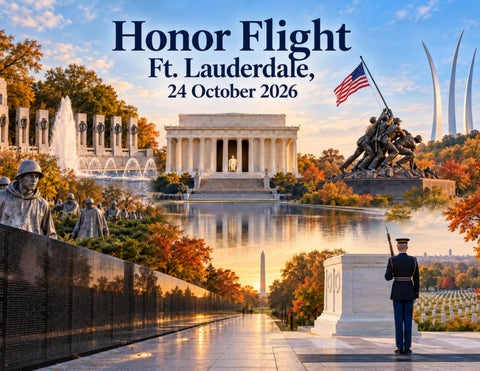
We are still editing photos from this trip. This is a work in progress. Please check back in a few days. We should have the images in place and ready for you to see. Best viewed on a deskstop/laptop/tablet for best results. Iphones won’t work. Dick Booth LT, USN Retired 954-295-2154 bocapublishing@bellsouth.net
The World War II Memorial
T
he National World War II Memorial honors the 16 million Americans who served in uniform, the millions who supported them at home, and more than 400,000 who died. Congress authorized the memorial in 1993. Construction began September 4, 2001; it opened April 29, 2004, and was formally dedicated May 29, 2004. Located on the National Mall between the Washington Monument and Lincoln Memorial, its granite architecture surrounds the Rainbow Pool and its fountains. Fifty-six pillars represent the wartime states, District of Columbia, and territories. Bronze oak and wheat wreaths symbolize industry and agriculture, while connecting ropes express national unity.
Two towering victory pavilions, marked Atlantic and Pacific, commemorate the war's principal theaters. Inside, bronze eagles support laurel wreaths celebrating victory. Twenty-four bronze relief panels portray military service and the contributions of the home front.
The most solemn feature is the Freedom Wall: 4,048 gold stars, each representing 100 American military deaths. Beneath them, an inscription marks the price of freedom. Together, these elements create a place of remembrance, gratitude, and reflection, honoring both individual sacrifice and the shared national effort that secured victory. For visiting veterans and their families, the memorial offers a lasting tribute to service across generations. Historical sources: National Park Service; American Battle Monuments Commission.
The Korean War Veterans Memorial
T
he Korean War Veterans Memorial honors Americans who served during the Korean War, fought from 1950 to 1953. Congress authorized the memorial in 1986, and ground was broken in November 1993. Presidents Bill Clinton and Kim Young Sam of South Korea dedicated it on July 27, 1995, the armistice's forty-second anniversary. Located southeast of the Lincoln Memorial, its triangular Field of Service contains 19 stainless-steel figures sculpted by Frank Gaylord. Wearing windblown ponchos, the servicemen advance through juniper plantings and granite strips suggesting Korea's rugged terrain. The patrol represents the Army, Marine Corps, Navy, and Air Force. A polished black granite mural wall, designed by Louis Nelson, carries etched images drawn from wartime photographs. Reflections of the statues suggest 38 figures, recalling the 38th parallel. Nearby, the United Nations Wall recognizes countries that contributed military forces or medical support.
The Pool of Remembrance offers a quiet place to reflect on those killed, wounded, captured, or missing. The inscription "Freedom Is Not Free" expresses the memorial's central message. Dedicated July 27, 2022, the added Wall of Remembrance records the names of fallen American servicemen and Korean soldiers who served alongside them, ensuring that their sacrifice remains visible to future generations of visitors. Photograph and historical sources: National Park Service.
The Vietnam Veterans Memorial
T
he Vietnam Veterans Memorial honors the Americans who served in the Vietnam War and remembers more than 58,000 who died or remain missing. Congress authorized the memorial in 1980. Built in 1982, it was dedicated on November 13 that year, creating a national place of remembrance and healing near the Lincoln Memorial. Maya Lin, a 21-year-old Yale student, won the design competition. Her two polished black granite walls form a broad V, descending into the earth and rising toward their ends. One arm points toward the Lincoln Memorial; the other toward the Washington Monument. Names appear chronologically by date of casualty rather than alphabetically. The earliest and latest losses meet at the center, symbolically bringing the war's history full circle. Visitors see their reflections among the names, connecting the living with those remembered. Directories help families locate individual names by panel and line.
Frederick Hart's Three Servicemen statue was added in 1984. Glenna Goodacre's Vietnam Women's Memorial followed in 1993, honoring women's wartime service. Flowers, letters, photographs, and other keepsakes left at the Wall express enduring personal bonds. Together, the memorial's elements offer veterans, families, and visitors a setting for grief, gratitude, reflection, and reconciliation, preserving the human cost of war across generations. Photograph and historical sources: National Park Service.
Major Robert Harry Schuler, USAF He was a friend, a fraternity brother and a war hero. On October 15, 1965, Schuler was flying as part of a four plane F105 Thunderchief flight north of Hanoi. Another F105 was hit and its pilot, Captain Thomas W. Sima, went down, Schuler remained behind to provide cover and support for the other aircraft. He went after the missile site that took down his wingman and was shot down. For many years he was officiallly MIA. Eventually, US-Vietnamese investigations located the crash site and excavations recovered human remains. DNA testing identified them as Schuler. He was returned to his family in 2004/2005, nearly 40 years after his disappearance.
Captain Charles H. Blankenship, USAF A childhood friend and neighbor since the 6th grade. He joined the Civil Air Patrol as a teenager and always wanted to serve in the Air Force. He was a radar navigator aboard a B-52D. On July 7, 1967, his aircraft , call sign “Kilo Red 1,” was involved in a mid-air collision over the South China Sea while on a bombing mission. He was returned to his family in 1997, nearly 30 years later.
The Marine Corps Iwo Jima Memorial
T
he United States Marine Corps War Memorial, commonly called the Iwo Jima Memorial, honors Marines who have died in service since the Corps' founding in 1775, together with comrades of other services who fell beside them. President Dwight D. Eisenhower dedicated it on November 10, 1954, the Marine Corps' 179th anniversary. Sculptor Felix de Weldon based the monument on Joe Rosenthal's Pulitzer Prize-winning photograph of six Marines raising the second American flag on Mount Suribachi, Iwo Jima, on February 23, 1945. The image became an enduring symbol of teamwork, courage, and sacrifice during World War II.
De Weldon developed models before the monumental sculpture was cast in bronze in Brooklyn, a process lasting nearly three years. Its figures stand 32 feet high and raise a 60-foot bronze flagpole. The American flag flies continuously under a presidential proclamation.
The sculpture rests on a rocky slope above a granite base inscribed with principal Marine Corps engagements. Admiral Chester Nimitz's tribute, "Uncommon valor was a common virtue," captures its spirit. Located near Arlington National Cemetery, the memorial's landscaped grounds overlook Washington. Funded by Marines, naval personnel, and supporters, it remains a place to honor the Corps' history and reflect on service across generations. Source photograph: National Park Service; panorama expanded with AI. History: National Park Service.
The Arlington National Cemetery
T
he Arlington National Cemetery began during the Civil War, when mounting casualties overwhelmed nearby burial grounds. The Army occupied the Arlington estate in 1861 because its heights protected Washington. Private William Christman received the first military burial on May 13, 1864. Secretary of War Edwin Stanton established the national cemetery on June 15, 1864.
Originally the home of George Washington Parke Custis and later his daughter, Mary Custis Lee, the property became a resting place for service members and eligible family members. Its orderly rows of white headstones make individual sacrifice visible across a landscape of rolling lawns and mature trees. Arlington hosted the first national Decoration Day observance in 1868, helping establish the tradition now known as Memorial Day. The Memorial Amphitheater, dedicated in 1920, provides a setting for major commemorations. The Tomb of the Unknown Soldier was dedicated November 11, 1921, honoring an unidentified American from World War I.
Other significant sites include President John F. Kennedy's grave and eternal flame, historic Arlington House, and memorials to military service and sacrifice. Arlington remains an active military cemetery, where solemn ceremonies, military honors, and personal remembrance connect the nation's history with the lives of those who served their country. AI-created illustration. Historical sources: Arlington National Cemetery, U.S. Army.
The Lincoln Memorial
T
he Lincoln Memorial honors Abraham Lincoln, the sixteenth president, whose leadership preserved the Union during the Civil War and advanced emancipation. Construction began February 12, 1914. The memorial was dedicated May 30, 1922, with President Warren G. Harding and Lincoln's surviving son, Robert Todd Lincoln, among those attending. Architect Henry Bacon modeled the building on an ancient Greek temple, linking Lincoln's defense of democracy with classical ideals. Its 36 Doric columns represent the states in the Union when Lincoln died in 1865. The upper frieze records the 48 states present when the memorial was completed.
Inside, Daniel Chester French's seated statue rises 19 feet. Carved by the Piccirilli Brothers from Georgia marble, it conveys both determination and compassion. The Gettysburg Address and Second Inaugural Address are inscribed on opposing walls, beneath Jules Guerin's murals exploring emancipation and national unity.
At the western end of the National Mall, the memorial overlooks the Reflecting Pool toward the Washington Monument. Its steps became a stage for the nation's continuing struggle for equality, including Marian Anderson's 1939 concert and Martin Luther King Jr.'s 1963 address. Today, this monument invites visitors to reflect on liberty, reconciliation, and the unfinished work of American democracy across generations. AI-created illustration. Historical sources: National Park Service.
USAA National Military Monument
T
he National Military Monument, presented by USAA, opened at Lincoln Memorial Plaza on July 28, 2026, during America's 250th anniversary commemoration. Created as a tribute to military service across generations, it honors more than 41 million Americans who answered the nation's call from the Revolutionary War onward.
The installation combines patriotic imagery with digital technology. Towering, double-sided displays resemble American flags gently moving in the wind. Their illuminated surfaces present service members' names, connecting the familiar national symbol with the individuals and families behind two and a half centuries of military history.
Interactive kiosks allow visitors to search for relatives, friends, and fellow veterans. An online search extends that experience beyond Washington. The names were assembled from multiple historical records, public databases, veterans' organizations, and consenting USAA members. Because no complete public record exists, some veterans and currently serving personnel may be absent. Originally planned for a shorter exhibition, the monument's stay was extended through November 12, 2026, following public interest and with National Park Service support. Admission is free. This temporary installation broadens remembrance to include those who returned home as well as those who died, inviting visitors to recognize service, sacrifice, and connections within America's shared military story. Image and historical sources: USAA.
The U.S. Air Force Memorial
T
he United States Air Force Memorial honors the service and sacrifice of Air Force personnel and the aviation organizations that preceded them. Congress authorized the memorial in 1993. Construction took place from 2004 to 2006, and the monument was dedicated on October 14, 2006, in Arlington, Virginia.
Architect James Ingo Freed designed its three stainless-steel spires to evoke flight and the contrails of the Thunderbirds' bomb-burst maneuver. The tallest reaches 270 feet. Their rising, outward curves suggest the freedom of the skies while expressing the courage and ambition of America's airmen. A bronze Honor Guard sculpture by Zenos Frudakis depicts four airmen standing watch. Granite inscription walls preserve words about valor, sacrifice, and the service's guiding values. A glass contemplation wall portrays the missing-man formation, a tribute to fallen aviators. The landscaped plaza and parade ground provide space for ceremonies and remembrance.
Set on high ground overlooking the Pentagon, Potomac River, and Washington skyline, the memorial connects aviation's past with its legacy. Its tribute reaches from early military balloon reconnaissance through the Army Air Corps and Army Air Forces to the modern Air Force. For veterans, families, and visitors, this soaring landmark offers a place of gratitude, reflection, and remembrance. AI-created illustration. Historical sources: U.S. Air Force, Air Force District of Washington.
The Jefferson Memorial
T
he Thomas Jefferson Memorial honors the nation's third president, principal author of the Declaration of Independence, and an advocate of religious liberty. Congress established the memorial commission in 1934. Work began at the site in 1938, and President Franklin D. Roosevelt dedicated the memorial on April 13, 1943, Jefferson's two-hundredth birthday. Architect John Russell Pope designed the circular, domed building in the classical tradition Jefferson admired. Its colonnade and portico echo ancient architecture, Monticello, and the University of Virginia Rotunda. After Pope's death in 1937, associates Otto Eggers and Daniel Higgins completed the design.
Inside, Rudulph Evans's bronze statue rises 19 feet above its pedestal. Wartime metal restrictions required a painted plaster version for the dedication; the bronze replacement arrived in 1947. Inscriptions drawn from Jefferson's writings address independence, freedom of conscience, education, and the evolution of laws and institutions. Situated on the southern shore of the Tidal Basin, the memorial aligns with the White House along Washington's monumental axis. Its waterfront setting and surrounding cherry trees create one of the capital's best-known landscapes. Today, visitors encounter both Jefferson's lasting ideals and the contradictions of his life, reflecting on liberty, slavery, and the nation's continuing effort to fulfill its promises. AI-created illustration. Historical sources: National Park Service.
VAW 12 Home base NAS Norfolk Cuban Missile Crisis - USS Independence Mediterranean Deployment - USS Saratoga North Atlantic Deployment - USS Essex Coastal Patrol - USS Forrestal
The Military Women's Memorial
T
he Military Women's Memorial honors the women who have served in and with America's Armed Forces from the American Revolution to the present. Located at the ceremonial entrance to Arlington National Cemetery, it recognizes contributions long overlooked in the nation's public memorials. Dedicated on October 18, 1997, it gives women's military service a permanent place in our national memory.
Architects Marion Weiss and Michael Manfredi transformed Arlington's historic Hemicycle, a curved granite structure dedicated in 1932, into a memorial and education center. Their design preserves the classical facade while adding exhibition space behind it. Above, glass tablets carry quotations by and about military women and admit daylight into the galleries. The Court of Valor includes a reflecting pool and fountain, creating a peaceful setting for remembrance. Inside, exhibits trace women's service across generations. The Memorial's Register preserves individual experiences, photographs, achievements, and personal histories. The Hall of Honor pays tribute to extraordinary service and sacrifice. At Arlington's gateway, the memorial invites visitors to consider the courage, commitment, and leadership of women in uniform. For veterans and their families, it offers a fitting reminder: the nation's military story belongs to all who answered the call. AI-created illustration. Historical source: Military Women’s Memorial Foundation.
A Generation That Answered the Call
From the quiet optimism of the 1950s to the Cuban Missile Crisis and the Vietnam War
W
e belonged to a generation that came of age in the relatively peaceful years between the Korean War and the long, divisive conflict in Vietnam. Looking back, those years seem almost idyllic. America was enjoying unprecedented prosperity. Families were buying homes, automobiles filled new suburban neighborhoods; television brought the wider world into our living rooms. We attended school, played sports, fell in love and imagined futures filled with opportunity. Yet beneath that optimism lay the ever-present shadow of the Cold War. We practiced civil defense drills, watched the Soviet Union challenge American leadership, and understood that nuclear war was a frightening possibility. Our parents had endured the Great Depression and World War II. From them, we inherited a belief in duty, sacrifice, and service to something greater than ourselves.
Then came the Cuban Missile Crisis in October 1962. For 13 extraordinary days, the world stood at the edge of nuclear confrontation. American warships took their stations around Cuba, military aircraft flew dangerous reconnaissance missions, and thousands of young servicemen prepared for the possibility of war. We were no longer simply the children of the Greatest Generation. We had become the generation responsible for defending the nation. Vietnam would test us even more profoundly. As American involvement expanded, so did the divisions at home. College campuses erupted in demonstrations. Young people marched through Washington carrying signs demanding peace. Protest songs filled the air, from folk music to the powerful voices of a changing culture. Some questioned the government’s decisions, others rejected the war entirely, and still others believed military service remained a solemn obligation.
The images of those years were unforgettable: enormous peace rallies, American flags carried alongside protest banners, and young Americans challenging the policies of their own government. Half a world away, another generation of young Americans walked through the steaming jungles of Vietnam, flew combat missions over hostile territory, served aboard aircraft carriers and tended the wounded in field hospitals. They endured monsoon rains, unbearable heat, separation from families, and the constant possibility of death. Many had barely reached their 20’s. Not everyone agreed with the war. Not everyone served in Vietnam. Some wore uniforms in other theaters, guarding the nation’s interests during an uncertain and dangerous period. Others served their country through peaceful protest, exercising the very freedoms American servicemen had sworn to defend.
We witnessed the assassination of a president, the struggle for civil rights, the threat of nuclear destruction, and a war that divided families and communities. Yet we continued to build careers, raise families, serve our communities, and contribute to the country. Today, as our generation grows older, we remember those who never returned and those whose lives were forever changed. We were the generation that grew up in peaceful times, confronted a turbulent world, and, in countless different ways, rose to meet the challenges of our time.
T
hank you to the many men and women who volunteer their time and efforts to plan and bring our veterans to Washington, DC for a trip that we all will never forget. Thank you to the flight crews, the airlines and the guardians who help us enjoy this privilege. Thank you to the donors and staff, without whom none of this would be possible. The opportunity to place our hands over the names of the fallen on the Vietnam Wall and the powerful symbolism of every Memorial will remain with us forever.