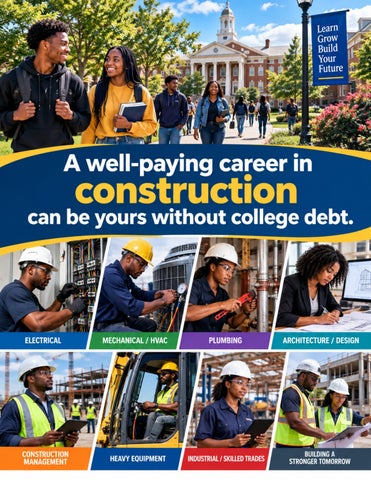
Y
es. I remember the HIREducation concept and the emphasis on connecting people who do not necessarily need a four-year degree with employers, apprenticeships, and skilled-trade careers.
workforce analysis rather than from a general employment website.
I found some particularly useful current national numbers that could make a strong case for the joint venture.
I would not describe the situation simply as “X% of Black college graduates can’t find good-paying jobs.” The federal statistics don’t support one clean number for that statement.
1. The construction labor shortage is substantial The Associated Builders & Contractors (ABC) estimates that the construction industry will need to attract 349,000 net new workers in 2026 just to keep labor supply and demand in balance. ABC projects that requirement will rise to 456,000 new workers in 2027. Even more immediately relevant, ABC reported that construction employers had approximately 326,000 job openings at the end of July 2026, the highest level in nearly two years. ABC also reported that construction employment increased by 120,000 jobs over the preceding year, with particularly strong growth among nonresidential specialty contractors.
2. The Black college graduate issue needs to be framed carefully
But the data do establish a significant employment and earnings disparity. For Americans age 25 and older, BLS’s 2024 data show that among Black workers with a bachelor’s degree or higher, approximately 3.0% were unemployed. For those with a bachelor’s degree alone, the unemployment rate was 3.3%. The more interesting statistic for your project may actually be underemployment/ earnings, rather than unemployment. Someone can have a college degree, be technically employed, and nevertheless be working in a position that doesn’t provide the income or career path expected from that degree.
So for an HIREducation proposal, I would use: • 349,000 additional construction workers needed in 2026 • 456,000 needed in 2027 • 326,000 construction job openings as of July 2026
BLS’s broader race-and-education analysis found that Black workers with bachelor’s degrees and higher represented 36% of the Black labor force age 25+ in 2023, compared with 44% for White workers. BLS also reports substantial earnings differences across racial groups, although those figures are not adjusted for occupation, experience, specialization, etc.
Those are unusually compelling numbers because they come directly from ABC’s
For context, the 2025 national median weekly earnings for full-time workers with
a bachelor’s degree were $1,578, compared with $966 for high-school graduates without college. 3. There is an even more interesting HIREducation connection I think the strongest argument for your friend’s organization may not be: “Black college graduates can’t find jobs.” It could instead be:
• Data-center construction • Healthcare technology • Advanced manufacturing • Information technology And importantly, many of these careers can be reached through apprenticeships, certifications, employer training and other nontraditional pathways, rather than requiring another four-year degree.
One statistic I particularly like for your “There is a significant disconnect between presentation the educational pipeline and the occupations where America has an immediate and ABC says its 2026 shortage calculation growing demand for workers.” incorporates industry retirements as well as increased demand, meaning this isn’t That is much easier to substantiate. simply a temporary shortage caused by a You have one side of the equation: construction boom. ABC specifically says a majority of the 2026 worker demand is Hundreds of thousands of construction po- attributable to retirement, under its current sitions need to be filled. assumptions. And on the other: That makes the HIREducation proposition Large numbers of educated young Amerconsiderably broader than simply “find icans—including graduates of historically people jobs.” Black colleges and universities—are enIt becomes: tering a labor market where a bachelor’s degree doesn’t automatically translate into America needs hundreds of thousands of a high-paying career. new skilled workers at the same time that many Americans with college educations HIREducation can potentially become the are struggling to translate education into bridge between those two populations— economically rewarding careers. HIREdparticularly by exposing college students ucation creates a direct connection beand graduates to careers in: tween those two problems. • Construction management • Electrical If you’re preparing this for your friend and • HVAC the organization of predominantly Black • Plumbing colleges, I can next put together a 2–3 • Heavy equipment page statistical briefing specifically for an • Industrial maintenance HBCU audience, with Black graduate em• Transportation ployment/earnings data, HBCU graduate • Infrastructure numbers, ABC’s construction shortage fig-
ures, and a proposed HIREducation/HBCU (Historically Black Colleges and Universities). partnership model. That would give you something you could actually put in front of the organization.