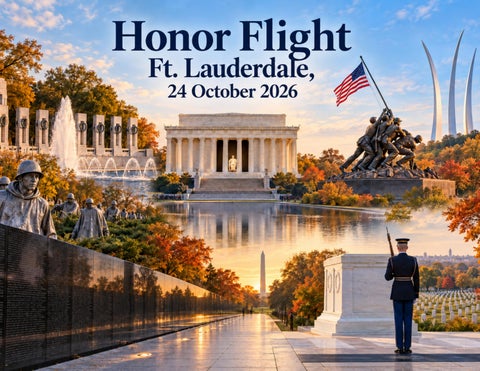
We are still editing photos from this trip. This is a work in progress. Please check back in a few days. We should have the images in place and ready for you to see. Best viewed on a deskstop/laptop/tablet for best results. Iphones won’t work. Dick Booth LT, USN Retired 954-295-2154 bocapublishing@bellsouth.net
The World War II Memorial
T
he National World War II Memorial honors the 16 million Americans who served in uniform, the millions who supported them at home, and more than 400,000 who died. Congress authorized the memorial in 1993. Construction began September 4, 2001; it opened April 29, 2004, and was formally dedicated May 29, 2004. Located on the National Mall between the Washington Monument and Lincoln Memorial, its granite architecture surrounds the Rainbow Pool and its fountains. Fifty-six pillars represent the wartime states, District of Columbia, and territories. Bronze oak and wheat wreaths symbolize industry and agriculture, while connecting ropes express national unity.
Two towering victory pavilions, marked Atlantic and Pacific, commemorate the war's principal theaters. Inside, bronze eagles support laurel wreaths celebrating victory. Twenty-four bronze relief panels portray military service and the contributions of the home front.
The most solemn feature is the Freedom Wall: 4,048 gold stars, each representing 100 American military deaths. Beneath them, an inscription marks the price of freedom. Together, these elements create a place of remembrance, gratitude, and reflection, honoring both individual sacrifice and the shared national effort that secured victory. For visiting veterans and their families, the memorial offers a lasting tribute to service across generations. Historical sources: National Park Service; American Battle Monuments Commission.
The Korean War Veterans Memorial
T
he Korean War Veterans Memorial honors Americans who served during the Korean War, fought from 1950 to 1953. Congress authorized the memorial in 1986, and ground was broken in November 1993. Presidents Bill Clinton and Kim Young Sam of South Korea dedicated it on July 27, 1995, the armistice's forty-second anniversary. Located southeast of the Lincoln Memorial, its triangular Field of Service contains 19 stainless-steel figures sculpted by Frank Gaylord. Wearing windblown ponchos, the servicemen advance through juniper plantings and granite strips suggesting Korea's rugged terrain. The patrol represents the Army, Marine Corps, Navy, and Air Force. A polished black granite mural wall, designed by Louis Nelson, carries etched images drawn from wartime photographs. Reflections of the statues suggest 38 figures, recalling the 38th parallel. Nearby, the United Nations Wall recognizes countries that contributed military forces or medical support.
The Pool of Remembrance offers a quiet place to reflect on those killed, wounded, captured, or missing. The inscription "Freedom Is Not Free" expresses the memorial's central message. Dedicated July 27, 2022, the added Wall of Remembrance records the names of fallen American servicemen and Korean soldiers who served alongside them, ensuring that their sacrifice remains visible to future generations of visitors. Photograph and historical sources: National Park Service.
The Vietnam Veterans Memorial
T
he Vietnam Veterans Memorial honors the Americans who served in the Vietnam War and remembers more than 58,000 who died or remain missing. Congress authorized the memorial in 1980. Built in 1982, it was dedicated on November 13 that year, creating a national place of remembrance and healing near the Lincoln Memorial. Maya Lin, a 21-year-old Yale student, won the design competition. Her two polished black granite walls form a broad V, descending into the earth and rising toward their ends. One arm points toward the Lincoln Memorial; the other toward the Washington Monument. Names appear chronologically by date of casualty rather than alphabetically. The earliest and latest losses meet at the center, symbolically bringing the war's history full circle. Visitors see their reflections among the names, connecting the living with those remembered. Directories help families locate individual names by panel and line.
Frederick Hart's Three Servicemen statue was added in 1984. Glenna Goodacre's Vietnam Women's Memorial followed in 1993, honoring women's wartime service. Flowers, letters, photographs, and other keepsakes left at the Wall express enduring personal bonds. Together, the memorial's elements offer veterans, families, and visitors a setting for grief, gratitude, reflection, and reconciliation, preserving the human cost of war across generations. Photograph and historical sources: National Park Service.
The Marine Corps Iwo Jima Memorial
T
he United States Marine Corps War Memorial, commonly called the Iwo Jima Memorial, honors Marines who have died in service since the Corps' founding in 1775, together with comrades of other services who fell beside them. President Dwight D. Eisenhower dedicated it on November 10, 1954, the Marine Corps' 179th anniversary. Sculptor Felix de Weldon based the monument on Joe Rosenthal's Pulitzer Prize-winning photograph of six Marines raising the second American flag on Mount Suribachi, Iwo Jima, on February 23, 1945. The image became an enduring symbol of teamwork, courage, and sacrifice during World War II.
De Weldon developed models before the monumental sculpture was cast in bronze in Brooklyn, a process lasting nearly three years. Its figures stand 32 feet high and raise a 60-foot bronze flagpole. The American flag flies continuously under a presidential proclamation.
The sculpture rests on a rocky slope above a granite base inscribed with principal Marine Corps engagements. Admiral Chester Nimitz's tribute, "Uncommon valor was a common virtue," captures its spirit. Located near Arlington National Cemetery, the memorial's landscaped grounds overlook Washington. Funded by Marines, naval personnel, and supporters, it remains a place to honor the Corps' history and reflect on service across generations. Source photograph: National Park Service; panorama expanded with AI. History: National Park Service.
The Arlington National Cemetery
T
he Arlington National Cemetery began during the Civil War, when mounting casualties overwhelmed nearby burial grounds. The Army occupied the Arlington estate in 1861 because its heights protected Washington. Private William Christman received the first military burial on May 13, 1864. Secretary of War Edwin Stanton established the national cemetery on June 15, 1864.
Originally the home of George Washington Parke Custis and later his daughter, Mary Custis Lee, the property became a resting place for service members and eligible family members. Its orderly rows of white headstones make individual sacrifice visible across a landscape of rolling lawns and mature trees. Arlington hosted the first national Decoration Day observance in 1868, helping establish the tradition now known as Memorial Day. The Memorial Amphitheater, dedicated in 1920, provides a setting for major commemorations. The Tomb of the Unknown Soldier was dedicated November 11, 1921, honoring an unidentified American from World War I.
Other significant sites include President John F. Kennedy's grave and eternal flame, historic Arlington House, and memorials to military service and sacrifice. Arlington remains an active military cemetery, where solemn ceremonies, military honors, and personal remembrance connect the nation's history with the lives of those who served their country. AI-created illustration. Historical sources: Arlington National Cemetery, U.S. Army.
The Lincoln Memorial
T
he Lincoln Memorial honors Abraham Lincoln, the sixteenth president, whose leadership preserved the Union during the Civil War and advanced emancipation. Construction began February 12, 1914. The memorial was dedicated May 30, 1922, with President Warren G. Harding and Lincoln's surviving son, Robert Todd Lincoln, among those attending. Architect Henry Bacon modeled the building on an ancient Greek temple, linking Lincoln's defense of democracy with classical ideals. Its 36 Doric columns represent the states in the Union when Lincoln died in 1865. The upper frieze records the 48 states present when the memorial was completed.
Inside, Daniel Chester French's seated statue rises 19 feet. Carved by the Piccirilli Brothers from Georgia marble, it conveys both determination and compassion. The Gettysburg Address and Second Inaugural Address are inscribed on opposing walls, beneath Jules Guerin's murals exploring emancipation and national unity.
At the western end of the National Mall, the memorial overlooks the Reflecting Pool toward the Washington Monument. Its steps became a stage for the nation's continuing struggle for equality, including Marian Anderson's 1939 concert and Martin Luther King Jr.'s 1963 address. Today, this monument invites visitors to reflect on liberty, reconciliation, and the unfinished work of American democracy across generations. AI-created illustration. Historical sources: National Park Service.
USAA National Military Monument
T
he National Military Monument, presented by USAA, opened at Lincoln Memorial Plaza on July 28, 2026, during America's 250th anniversary commemoration. Created as a tribute to military service across generations, it honors more than 41 million Americans who answered the nation's call from the Revolutionary War onward.
The installation combines patriotic imagery with digital technology. Towering, double-sided displays resemble American flags gently moving in the wind. Their illuminated surfaces present service members' names, connecting the familiar national symbol with the individuals and families behind two and a half centuries of military history.
Interactive kiosks allow visitors to search for relatives, friends, and fellow veterans. An online search extends that experience beyond Washington. The names were assembled from multiple historical records, public databases, veterans' organizations, and consenting USAA members. Because no complete public record exists, some veterans and currently serving personnel may be absent. Originally planned for a shorter exhibition, the monument's stay was extended through November 12, 2026, following public interest and with National Park Service support. Admission is free. This temporary installation broadens remembrance to include those who returned home as well as those who died, inviting visitors to recognize service, sacrifice, and connections within America's shared military story. Image and historical sources: USAA.
The U.S. Air Force Memorial
T
he United States Air Force Memorial honors the service and sacrifice of Air Force personnel and the aviation organizations that preceded them. Congress authorized the memorial in 1993. Construction took place from 2004 to 2006, and the monument was dedicated on October 14, 2006, in Arlington, Virginia.
Architect James Ingo Freed designed its three stainless-steel spires to evoke flight and the contrails of the Thunderbirds' bomb-burst maneuver. The tallest reaches 270 feet. Their rising, outward curves suggest the freedom of the skies while expressing the courage and ambition of America's airmen. A bronze Honor Guard sculpture by Zenos Frudakis depicts four airmen standing watch. Granite inscription walls preserve words about valor, sacrifice, and the service's guiding values. A glass contemplation wall portrays the missing-man formation, a tribute to fallen aviators. The landscaped plaza and parade ground provide space for ceremonies and remembrance.
Set on high ground overlooking the Pentagon, Potomac River, and Washington skyline, the memorial connects aviation's past with its legacy. Its tribute reaches from early military balloon reconnaissance through the Army Air Corps and Army Air Forces to the modern Air Force. For veterans, families, and visitors, this soaring landmark offers a place of gratitude, reflection, and remembrance. AI-created illustration. Historical sources: U.S. Air Force, Air Force District of Washington.
The Jefferson Memorial
T
he Thomas Jefferson Memorial honors the nation's third president, principal author of the Declaration of Independence, and an advocate of religious liberty. Congress established the memorial commission in 1934. Work began at the site in 1938, and President Franklin D. Roosevelt dedicated the memorial on April 13, 1943, Jefferson's two-hundredth birthday. Architect John Russell Pope designed the circular, domed building in the classical tradition Jefferson admired. Its colonnade and portico echo ancient architecture, Monticello, and the University of Virginia Rotunda. After Pope's death in 1937, associates Otto Eggers and Daniel Higgins completed the design.
Inside, Rudulph Evans's bronze statue rises 19 feet above its pedestal. Wartime metal restrictions required a painted plaster version for the dedication; the bronze replacement arrived in 1947. Inscriptions drawn from Jefferson's writings address independence, freedom of conscience, education, and the evolution of laws and institutions. Situated on the southern shore of the Tidal Basin, the memorial aligns with the White House along Washington's monumental axis. Its waterfront setting and surrounding cherry trees create one of the capital's best-known landscapes. Today, visitors encounter both Jefferson's lasting ideals and the contradictions of his life, reflecting on liberty, slavery, and the nation's continuing effort to fulfill its promises. AI-created illustration. Historical sources: National Park Service.