TEST BANK
Environmental Science: A Global Concern 16th Edition by
William Cunningham, Mary Cunningham
TABLE OF CONTENTS
Chapter 1 Understanding Our Environment
Chapter 2 Principles of Science and Systems
Chapter 3 Matter, Energy, and Life
Chapter 4 Evolution, Biological Communities, and Species Interactions
Chapter 5 Biomes: Global Patterns of Life
Chapter 6 Population Biology
Chapter 7 Human Populations
Chapter 8 Environmental Health and Toxicology
Chapter 9 Food and Hunger
Chapter 10 Farming: Conventional and Sustainable Practices
Chapter 11 Biodiversity: Preserving Species
Chapter 12 Biodiversity: Preserving Landscapes
Chapter 13 Restoration Ecology
Chapter 14 Geology and Earth Resources
Chapter 15 Climate Systems and Climate Change
Chapter 16 Air Pollution
Chapter 17 Water Use and Management
Chapter 18 Water Pollution
Chapter 19 Conventional Energy
Chapter 20 Sustainable Energy
Chapter 21 Solid, Toxic, and Hazardous Waste
Chapter 22 Urbanization and Sustainable Cities
Chapter 23 Ecological Economics
Chapter 24 Environmental Policy, Law, and Planning
Chapter 25 What Then Shall We Do?
Environmental Science A Global Concern 16th Edition
By William Cunningham, MaryCunningham
Chapter 1
Student name:
1) To say that environmental science is mission oriented means it is
A) a highly organized endeavor.
B) essentially an information gathering endeavor.
C) oriented toward solving problems.
D) designed to understand relationships.
2) If everyone in the world lived a lifestyle similar to the average U.S. citizen we would need more planets to support everyone.
A) two
B) four
C) six
D) eight
3) About of the world's people currently lack access to clean water, adequate diet, basic sanitation, and other essential needs.
A) 100 million
B) 300 million
C) 700 million
D) 1.4 billion
4) Sustainable development means
A) improving people's lives in the present in a way that can continue far into the future.
B) providing ever-increasing amounts of adequate housing.
C) continued growth indefinitely as long as it can be paid off.
D) utilizing an ever-increasing quantity of natural resources.
5) The earliest documented recognition that misuse of the natural environment can have nasty consequences was
A) George Perkins Marsh's 1864 publication of Man and Nature.
B) Rachel Carson's Silent Spring, alerting the public to the dangers of pollution in 1962.
C) Roosevelt's warnings about overuse a century ago.
D) Plato's writings 2500 years ago.
6) Which of the following presently provides 80 percent of the energy used in industrialized countries?
A) fossil fuels
B) wind
C) hydroelectric power
D) solar
7) The position that nature deserves to be protected in its own right is called
A) biocentric preservation.
B) utilitarian conservation.
C) environmentalism.
D) global environmentalism.
8) constitutes 4.6 percent of the world's people yet produces about 50 percent of all toxic waste.
A) China
B) Germany
C) Russia
D) The United States
9) The text suggests there is not a strong connection between poverty and environmental degradation.
⊚ true
⊚ false
10) Most people agree that global climate change is not a real environmental threat.
⊚ true
⊚ false
11) By 2050, the earth is projected to have a population between
A) 8 and 10 billion.
B) 7 and 8 billion.
C) 8 and 9 billion.
D) 10 and 12 billion.
12) Loss of indigenous cultures is accompanied by loss of unique understanding of nature.
⊚ true
⊚ false
13) An important reason for determining the size of a society's ecological footprint is to determine the sustainability of its lifestyle.
⊚ true
⊚ false
14) One of the earliest models for conservation in the United States was based on utilitarian conservation, for which nature was conserved not to protect biodiversity, but to provide jobs and resources.
⊚ true
⊚ false
15) The first Nobel Prize for environmental action was awarded
A) in 1912 to John Muir.
B) in 1973 to David Brower.
C) in 2004 to Wangari Maathai.
D) in 1935 to Aldo Leopold.
16) There is concern over the continued ability to provide adequate food for our growing population because
A) 2/3 of all agricultural lands show signs of degradation.
B) there is little corporate interest in food production.
C) agriculture has not benefited from modern technological advancements.
D) there is little knowledge about how to farm.
17) The word "environment" comes from a French word that means
A) life
B) nature
C) wildlife
D) home
E) to surround
18) Environmental science is a .
A) narrowly defined set of physical, life, and social sciences
B) theoretical approach in interpreting the environment
C) way to see the world in scientific terms
D) systematic approach in learning about the environment
E) special set of problem-solving skills
19) Most environmental problems result from
A) political differences
B) complex, interrelated problems
C) technological development problems
D) global warming
E) urban degradation
20) Which of the following is not true of the term environment?
A) Environment includes our culture.
B) The environment includes the biosphere.
C) The environment includes political and social systems.
D) The environment has issues for which there are no remedies.
E) The environment includes the relationships between organisms.
21) The fundamental basis of environmental science as a discipline is the
A) history of the use of natural resources
B) diversity of life on the Earth
C) human impact on the Earth
D) pollution on the Earth
E) future use of natural resources
22) Which of the following is not true of the term environment?
A) Environment includes our culture.
B) The environment includes the biosphere.
C) The environment includes political and social systems.
D) The environment has issues for which there are no remedies.
E) The environment includes the relationships between organisms.
23) One major difference affecting the scope of environmental issues of the past and present is the
A) current ability to alter the natural world through technology
B) relatively new emergence of environmentalists
C) historical ignorance of the interconnected nature of environmental issues
D) development of new fields such as environmental science
E) extremely fast transmission of information through the Internet
24) In the fourth century B.C., the philosopher Plato wrote of the erosion and deforestation that Greece.
A) would one day plague
B) were caused by the excessive population in
C) were prevalent in countries outside of
D) had been a problem that was now resolved in
E) had stripped the fine soils and forests of
25) Which of the following is NOT a problem being addressed by environmental scientists?
A) finding resources for a human population growing at almost 80 million people a year.
B) providing clean drinking water.
C) assessing and finding solutions to climate change.
D) creating processes that promote sustainability in everyday life.
E) creating a better transportation system for food distribution to the populace.
26) A(n) is a tabulation of the demands placed on nature by individuals or nations.
A) ecological footprint
B) quantitative analysis value
C) world biocapacity
D) land area resource ratio
27) Most of the early scientific studies of environmental damage were done by
A) colonial administrators who were often trained scientists
B) native people of North America
C) european peasant farmers who understood the connection between deforestation and local climate change
D) industrial leaders of the nineteenth century who were worried about the degradation caused by factories
E) scientists in Europe who were worried about deforestation and erosion in their countries
28) The history of conservation and environmentalism is
A) based in the Industrial Revolution
B) largely unrecorded
C) a relatively new movement
D) based in the 1970s environmental movement
E) traceable well back into human history
29) Mauritius, an island in the Indian Ocean, is a model for balancing nature and human needs because in the eighteenth century a French governor
A) declared the island a nature sanctuary
B) ordered sensitive areas such as steep slopes to be preserved in forests
C) bought the island as a private sanctuary for the government of France
D) supported an extensive environmental education campaign
E) enforced strict punishment for people who damaged any natural resources
30) Pragmatic conservationists, including Gifford Pinchot and Theodore Roosevelt, supported forest conservation in order to protect
A) wildlife habitats in forested areas
B) untouched, unvisited wilderness areas
C) jobs and homes for people
D) the scenic beauty found in natural areas
E) resources such as natural habitats for future generations
31) Utilitarian conservationists tend to believe that resources should be saved because they are important
A) as a home for wildlife
B) in the conservation of aesthetic values
C) to our understanding of the biosphere
D) for a strong economic system
E) and used by all living things
32) The approach that reflects the philosophy that there is waste in neglecting the development and use of certain natural resources (such as dead trees in old growth forests) would best be described as
A) moral and aesthetic preservation
B) global environmental citizenship
C) pragmatic utilitarian conservation
D) a cornucopian worldview
33) Biocentric preservationists, first led by John Muir, advocate saving natural areas for their
A) aesthetic and spiritual values and wildlife habitat
B) hunting and fishing value
C) wood and mineral resources for the future
D) tourism and recreation potential
E) economic value in cleaning the air and preventing soil erosion
34) Biocentric preservation is a philosophy that supports the belief that
A) the biosphere is a central resource for humans
B) humans must manage resources for maximum productivity
C) preservation of wildlife is needed for human survival
D) all living things have a fundamental right to exist and pursue their own interests
E) all living things have value for humans
35) The National Park Service reflects a approach while the Forest Service reflects a approach.
A) biocentric preservationist; pragmatic utilitarian conservationist
B) global environmentalist; cornucopian
C) pragmatic resource conservationist; moral and aesthetic preservationist
D) cornucopian; global environmentalist
E) pragmatic utilitarian conservation; biocentric preservation
36) Pollution problems
A) are relatively new concerns
B) identify the era of global environmentalism
C) were recognized at least as early as the eleventh century
D) are the main issues for technological optimists
37) Environmentalism stemming from the publication of Rachel Carson's Silent Spring differed from earlier North American conservation perspectives by
A) focusing on human population growth
B) placing more emphasis on pollution problems
C) emphasizing international problems
D) encouraging energy efficiency
E) emphasizing the value of natural resources
38) Modern environmentalism is becoming well established in the United States. One of the main reasons for this is probably the in the modern movement.
A) emphasis on technological remedies
B) interconnected nature of our global village
C) combination of activism and research
D) emphasis on impending doom
E) greatly expanded international communications
39) At the end of the twentieth century, has/have been added to environmental thinking.
A) global concerns
B) urban problems
C) water supply and pollution problems
D) human population growth
E) air pollution problems
40) Some of today's leading environmental thinkers, such as Dr. Wangari Maathai of Kenya
A) have denounced the use of technology
B) have shown that a slight decrease in human welfare must accompany environmental protection
C) have focused only on local environmental issues
D) are linking improved environmental quality with social progress
E) treat humans as an entity separate from the environment in which they live
41) The world's population is now more than
A) 70 million.
B) 70 billion.
C) 7 billion.
D) 700 million.
E) 20 million.
42) Supplies of fossil fuels are
A) continually expanding in nature
B) being renewed as fast as we use them
C) being steadily depleted
D) almost entirely depleted
E) easily found through better technology
43) According to the U.N. Environment Programme how many species have gone extinct in the past century?
A) almost 100
B) over 250
C) 563
D) more than 800
E) nearly 1,700
44) The United Nations estimates that at least 3 million people die each year from diseases triggered by
A) water pollution.
B) air pollution.
C) exposure to radiation.
D) cigarette smoking.
E) mosquito-borne illnesses.
45) Evidence of progress in reducing overpopulation and the increased strain on the environment it causes is best illustrated by
A) the current evidence of a stable population in the developing and developed world
B) a decrease in the average number of children born to each woman
C) the current evidence of a globally stable population growth
D) the decreasing population growth rate in the United States
E) the current evidence of a stable population in the developing world
46) If everybody in the world used resources at the rate that people in the United States do,
A) people would be healthier and happier worldwide.
B) our current resources would run out quickly.
C) violent conflicts would decrease because basic needs would be met.
D) economies would prosper.
E) more people would experience health problems because people in more prosperous countries experience more stress.
47) One way to decrease the size of our ecological footprint is to
A) decrease consumption rates
B) increase consumption rates
C) increase the development in the region
D) reduce the size of a biologically productive area in the region
E) None of these; it is not possible to change the size of an ecological footprint
48) The world's poorest people typically environmental degradation.
A) cause the most
B) are victims and causes of
C) are unaffected by
D) don't really care about
E) are ignorant of
49) Poverty is usually passed on from one generation to the next through
A) the lack of available opportunities
B) genetic conditions
C) improper care of natural resources
D) illnesses spread by viruses
50) In general, as per capita GDP (gross domestic product) rises both and increase.
A) infant mortality; life expectancy
B) percentage of safe drinking water; rate of infectious diseases
C) infant mortality; adult literacy
D) percentage of safe drinking water; adult literacy
E) total fertility rate; percentage of safe drinking water
51) Proponents of sustainable development argue that
A) all development has environmental costs.
B) development is less important than the environment.
C) development can proceed with minimal costs to the environment.
D) the environment is less important than development.
E) development does not cause environmental damage.
52) Sustainable development, ideally, improves living conditions
A) for a few decades into the future.
B) for the entire current political administration.
C) as long as resources last.
D) for generations in the future.
E) for the present generation.
53) Sustainable development differs from traditional economic development in that it emphasizes economic development in the
A) short term.
B) long term.
C) present.
D) past.
E) present and past.
54) Which of the following is NOT an ecosystem service?
A) providing fuel to burn
B) high biodiversity
C) water purification
D) production of food
E) decomposition of waste
55) The branch of philosophy concerned with the distinction between right and wrong and the ultimate worth of actions of things is
A) values.
B) ethics.
C) morals.
D) attitudes.
E) characters.
56) Ethics should guide decisions made regarding
A) environmental issues.
B) economic issues.
C) development issues.
D) social justice issues.
E) All of the issues listed.
57) The Mineral King Valley court case is important in environmental history because it was a case that argued for the
A) inherent value of trees, rocks, and wildlife.
B) instrumental value of trees, rocks, and wildlife.
C) status of moral agents for trees, rocks, and wildlife.
D) sustainable development of the area.
E) moral consideration of sentient things.
58) Another word for "steward" is
A) organizer.
B) caretaker.
C) participant.
D) consumer.
E) leader.
59) The idea of stewardship is that humans have a/the the environment.
A) privilege of using
B) technology to shape
C) duty to care for
D) opportunity to degrade
E) responsibility to use resources in
60) Environmental justice can be seen as
A) the power to make laws for a just society.
B) an issue that is of special interest to the global community.
C) teaching the values of the environment to improve living standards for people.
D) a local issue central to the middle-class citizens in the United States.
E) both a local and an international issue.
61) The issue that racial and ethnic minorities face unusually high exposure to environmental hazards is a central argument to
A) sustainable development.
B) environmental justice.
C) economic development.
D) urban renewal.
E) interpretive science.
62) Lead poisoning in children is an example that exemplifies the problem of for minority children in the United States.
A) environmental racism.
B) inadequate nutrition.
C) poverty.
D) sanitary conditions.
E) inadequate healthcare.
63) The term "toxic colonialism" has been used in describing
A) lax environmental regulations for toxic wastes.
B) the exportation of toxic wastes to poor communities.
C) rulings that toxins must not be exported to wealthy nations.
D) the high level of toxic waste production by wealthy nations.
E) the high level of toxic pesticide use by wealthy nations.
64) The human development index (HDI)
A) uses multiple factors including health, education, and poverty to compare the development of countries.
B) considers GDP per person as a measure of wealth of the country and its development.
C) is a measurement of environmental degradation of a country.
D) only considers resource use and income from trade to describe development.
E) with a score of zero means no problems in health, education, or other quality of life indicators.
65) Protecting fisheries and regulating fishing to protect fish stocks would be a component of which sustainable development goal?
A) life below water
B) affordable and clean energy
C) industry, innovation, and infrastructure
D) clean water and sanitation
E) climate action
66) Which of the following is the best short description of the sustainable development goals?
A) a set of international goals to protect the environment and also promote a good and productive life for people
B) a set of international goals to protect the environment
C) a plan to increase the wealth of all people by increasing industry
D) a set of international goals focused on reversing climate change
E) a set of international goals to combat poverty, but not address the environment
67) Salt marshes along the coast serve as a nursery site for juvenile fish including those that are important to the fishing industry. It is a natural habitat where these fish can develop before they move out to the ocean habitats. The salt marsh in this example is
A) an ecosystem service.
B) the tragedy of the commons.
C) sustainable development.
D) biodiversity.
E) throughput.
68) Your friend explains that she believes water in rivers should be protected from pollution because that is where many people get their drinking water. In this case, your friend assigns to the rivers.
A) instrumental value
B) intrinsic value
C) moral value
D) ethical value
E) moral extensionism
69) Which of the following is incorrect regarding quality of life indicators for the mostdeveloped countries?
A) lower carbon dioxide emissions per capita
B) lower infant mortality
C) lower total fertility
D) higher life expectancy
E) higher female secondary education
70) Which of the following is a correct pattern for environmental indicators?
A) As wealth increases, greenhouse gas emissions increase.
B) As wealth increases, water contamination increases.
C) As wealth increases air pollution decreases.
D) As wealth increases air pollution is not a factor.
E) As wealth increases, the environment is less affected.
71) Sustainable development is most similar to
A) utilitarian conservation.
B) biocentric preservation.
C) industrialization.
D) environmentalism.
E) economic development.
72) John Muir believed that nature had intrinsic value because it was part of God’s creation not because it could be useful to man. This is an example of
A) biocentric preservation.
B) utilitarian conservation.
C) industrialization.
D) environmentalism.
E) economic development.
73) The United Nations estimates that 800 million people suffer from chronic hunger. Which of the following are leading causes for this? (Check all that apply.)
A) violent conflict
B) unequal access to resources
C) climate change
D) not enough food produced to feed everyone
74) After calculating an ecological footprint, you realize that some aspects of your impact are not under your control. In a few sentences explain how some environmental impacts cannot be controlled individually.
75) Which of the following would be a correct description of sustainability? (Select all that apply.)
A) Sustainability requires using renewable resources at a rate that isn’t faster than its ability to regenerate.
B) Sustainability requires understanding how much pollution or waste the environment can safely absorb and to not exceed that.
C) To be sustainable, renewable substitutes for nonrenewable resources should be developed.
D) Sustainability requires never using nonrenewable resources as they will run out
E) Sustainable use of resources means using equal amounts of renewable and nonrenewable resources.
Answer Key
Test name: chapter 1
1) C 2) B 3) C 4) A 5) D 6) A 7) A 8) D 9) FALSE 10) FALSE 11) A 12) TRUE 13) TRUE 14) TRUE 15) C 16) A 17) E 18) D 19) B 20) D 21) C 22) D
23) A 24) E 25) E
26) A 27) A 28) E 29) B 30) C 31) D
32) C 33) A 34) D
35) A 36) C 37) B 38) C 39) A 40) D 41) C 42) C 43) D 44) B 45) B
46) B 47) A 48) B 49) A 50) D 51) C 52) D 53) B 54) B 55) B 56) E
57) A 58) B 59) C
60) E
61) B
62) A
63) B
64) A
65) A
66) A
67) A
68) A
69) A
70) A
71) A
72) A
73) [A, B, C]
74) Essay
Many consumption practices must be modified at a higher level. For example, the sources of energy may not be in a person's direct control. Additionally, a community may not be set up for public transportation, bicycles, or walking.
75) [A, B, C]
Student name:
76) Which of the following is not a basic principle of science?
A) We can learn through observation.
B) Simpler explanations are preferable.
C) Nothing can be absolutely proven.
D) All of these choices are correct.
77) Which of the following does not apply to manipulative experiments?
A) Extraneous variables are held constant.
B) Most experiments are done in the laboratory.
C) They are useful for studying large scale geologic forces.
D) They can be affected by experimenter bias.
78) In science, a theory is
A) speculative and unsupported by facts.
B) a tentative explanation, comparable to a hypothesis.
C) an explanation supported by a substantial body of evidence.
D) something that can never be proven wrong.
79) The process of science is characterized by all of the following except
A) that science attempts to keep explanations as simple as possible.
B) that science normally provides absolute proof.
C) that science attempts to be objective.
D) that science is inherently skeptical.
80) Scientific paradigms can be characterized by all of the following except
A) once agreed upon remain unchanged forever.
B) are broad patterns of thought that guide thinking.
C) influence how we interpret evidence.
D) determine which questions we understand to be relevant to issues at hand.
81) The process by which science works is useful to the general public as well as to scientists.
⊚ true
⊚ false
82) A person carefully gathering pieces of information to uncover a larger pattern is engaged in
A) inductive reasoning.
B) deductive reasoning.
83) Creating a generalization based on several observations is an example of
A) deductive reasoning.
B) inductive reasoning.
84) Which of the following is not an example of science?
A) gut instinct
B) testable hypotheses
C) manipulative experiments
D) observational studies
E) natural experiments
85) Statistical tests
A) provide us with raw numbers such as the number of people in a given city.
B) focus on determining the probability that observed phenomena occurred by chance.
C) are only used in science to influence political decision-making.
D) provide only fake numbers.
86) Manipulative experiments
A) are not useful to ecologists because they depend on the natural environment.
B) are most often conducted in a laboratory.
C) do not allow the scientist to control variables.
D) are not possible.
87) Ecological systems often undergo periodic disturbances
A) such as floods and fires.
B) and show resilience when they recover quickly.
C) only in arid environments.
D) such as floods, fires, and show resilience when they recover quickly.
88) Positive feedback is a process
A) that is self-perpetuating.
B) where increases in a state variable lead to further increases.
C) that suppresses change.
D) that is self-perpetuating and where increases in a state variable lead to further increases.
89) In an ecosystem, throughput can refer to
A) matter that flows into the system but not out.
B) energy that originates in the system and flows out.
C) something that can expand the size of state variables.
D) the equilibrium state.
90) Homeostasis refers to
A) a tendency to change.
B) equilibrium.
C) spatial homogeneity.
D) the environment.
91) Which of the following is not an example of a disturbance in an ecosystem?
A) fire
B) drought
C) flash flood
D) shade
92) Sometimes severe disturbances can lead to a , in which conditions do not return to normal.
A) paradigm shift
B) state shift
C) feedback loop
D) system
93) is a process for producing knowledge methodically and logically.
A) Universalism
B) Science
C) Relativism
D) Morality
E) Parsimony
94) Ideally, science
A) always has the right answers.
B) tells us what we expected to find.
C) uses new technology.
D) is orderly and methodical.
E) proves that our hypotheses are correct.
95) Which of the following is not an important feature of science?
A) reproducibility
B) parsimony
C) empiricism
D) positive proof
96) Generally, distinguished scientists
A) always agree if they really are expert scientists.
B) may have different interpretations of the same evidence.
C) never disagree once a theory is established.
D) believe each other and support each other in their work.
E) always disagree so they can prove theories.
97) Proof in science is always
A) firmly established.
B) beyond question.
C) an impossible goal.
D) constantly changing with little continuity between disciplines.
E) open to question or new evidence.
98) The statement, "Since every insect I have examined so far has six legs, I conclude that all insects must have six legs" is an example of
A) inductive reasoning.
B) deductive reasoning.
C) hypothesis testing.
D) reductive reasoning.
E) parsimony.
99) From the following statements and questions, which is the best example of deductive reasoning?
A) If all insects have six legs, then butterflies have six legs.
B) In repeated tosses of a coin, there is a 50/50 chance of each toss resulting in a "head".
C) How many times will the toss of coins turn "heads-up" if 100 times toss a coin?
D) Since every insect I have examined so far has six legs, I conclude that all insects must have six legs.
E) All of these are examples of deductive reasoning.
100) Although your sister is not a scientist, she says that she uses scientific techniques in her everyday life. You do not believe her but she insists it is true. Which of the following examples could she use to best persuade you?
A) When she cooks, she measures ingredients and puts them together to form something else (e.g., a cake).
B) When she drives in her car, she hypothesizes about things (e.g., when the red light will turn green).
C) She put some tomatoes in the sun and some in the shade to see if the sun causes them to ripen faster.
D) She buys a brand of toothpaste based on statistical data (four out of five dentists recommend it).
E) All of these are examples of using scientific techniques in her everyday life.
101) Experiments in which conditions are deliberately altered and all other variables are held constant are known as experiments.
A) manipulative
B) natural
C) hypothetical
D) probability
E) double-blind
102) Double-blind studies are especially useful in
A) genetic experiments.
B) health studies.
C) statistical analysis.
D) opinion surveys.
E) double-blind studies are not useful in any situation.
103) Which of the following scenarios are free from bias?
A) A scientist is conducting an experiment on liver disease that is funded by a university and has set up the experiment as a double-blind study testing of a new medication.
B) A scientist is conducting an experiment on liver disease that is funded by a pharmaceutical company and has set up the experiment as a double-blind study testing of a new medication.
C) A scientist is conducting an experiment on liver disease that is funded by a university and has set up the experiment study testing of a new medication and only gives the medicine to the healthiest patients.
D) A scientist is conducting an experiment on liver disease that is funded by a pharmaceutical company and has set up the experiment as a double-blind study testing of a new medication on people without liver disease as well as those with liver disease.
104) In experimentation, dependent variables are also known as variables.
A) conventional
B) blind
C) response
D) model
E) distribution
105) allow scientists to gather information about complicated and interrelated environmental systems.
A) Charts
B) Graphs
C) Models
D) Figures
E) Paradigm shifts
106) Susan is conducting an experiment to see if plants will grow better with application of fertilizer. She separates 50 plants into two groups of 25. One group receives a liquid fertilizer when watered every other day, and the other group receives only water on the same days. The plants are kept in a greenhouse with constant and equal amounts of sunlight, and a constant temperature. She measures the plants once a week for 12 weeks. At the end of 12 weeks, the plants with the fertilizer grew an average of 9 inches, and the ones that were not given the fertilizer grew an average of 5 inches.
106.1) In the scenario described above, the plants that received fertilizer are the group, and the plants that did not receive fertilizer are the group.
A) treatment; control
B) control; treatment
C) treatment; exposed
D) controlled; non-treatment
106.2) In the above scenario, why did Susan place the plants in a greenhouse and control the amount of sunlight and temperature?
A) Keeping any factor that can influence a plant's growth, other than fertilizer, equal to all plants ensures that if there is a difference at the end, it will most likely be due to the fertilizer.
B) It was an easy place to keep the plants.
C) It did not make a difference. The fertilizer would have influenced growth even if the plants were part in sunlight and part in shade.
D) The plants would have adapted to the situation regardless if the temperature is different.
106.3) When referencing the above scenario, why did Susan average the resulting heights of the plants?
A) She wanted to account for the genetic variation in the plants.
B) Because two numbers are easier to compare than fifty numbers.
C) She liked showing off her knowledge of simple statistical analysis.
D) She wanted to account for differences in temperature and sunlight between the groups.
107) Networks of interactions among interdependent factors are known as
A) science.
B) ecology.
C) systems.
D) processes.
E) negative feedback loops.
108) The damage to an ecosystem caused by a hurricane or flood can be referred to as
A) an open system.
B) an emergent property.
C) equilibrium in nature.
D) a disturbance.
E) negative feedback loop.
109) In a food chain, grass absorbs sunlight to make sugar, the grass is eaten by a rabbit, and the rabbit is eaten by a fox. What is a throughput that connects this system?
A) energy
B) sugar
C) the will to survive
D) ATP
110) Which of the following is a closed system?
A) a cave with abundant life that was sealed off from the outside world during a landslide 100 years ago.
B) an underwater ocean cave.
C) an aquarium.
D) a forest habitat.
111) Which of the following is an example of a negative feedback loop?
A) A small island is home to both wolves and deer. When the deer have high numbers, the wolves have plenty of prey to feed pups and their numbers increase. When the deer are heavily predated upon, the deer numbers decrease causing some of the wolves to starve.
B) Grass begins to grow on a recently plowed field.
C) Locusts begin to swarm, and when they encounter other non-swarming locusts, they too being to swarm.
D) A person is driving and is cut off by another driver, this causes the person to become angry and they begin to drive more aggressively, cutting off other drivers.
112) The ability of an ecosystem to recover from a disturbance is known as
A) resilience.
B) stability.
C) fitness.
D) emergence.
113) A scientific consensus
A) is typically broad in its statements.
B) uses feedback from many scientists.
C) can lead to paradigm shifts.
D) All of these answers are correct.
114) Science as a method relies on
A) a process of evaluating evidence to understand the natural world.
B) proving something to be true based on instinct.
C) asking any kind of question for which you want an answer.
D) paradigm shifts–likely the knowledge we have today is incorrect.
E) proving a hypothesis in order to understand the natural world.
115) The progress of science is mainly happens when a scientist working in isolation and discovers something very important.
⊚ true
⊚ false
116) In the late 1800s, more and more scientists began to accept the germ theory of disease in which germs, or small organisms, were the cause of disease. Prior to this, scientists assumed that bad air, or miasma, caused diseases such as cholera. This change in the generally accepted theory is termed
A) a paradigm shift.
B) the principle of repeatability.
C) science.
D) a scientific theory.
E) deductive reasoning.
117) Albedo is a measurement of reflectivity of a surface. Ice has high reflectivity so light from the sun will reflect off of it. Water has a lower reflectivity so more light and heat are absorbed. As ice melts reflectivity decreases and more heat is absorbed by the ice leading to even more melt. This is an example of
A) positive feedback.
B) negative feedback.
C) a closed system.
D) homeostasis.
E) a natural experiment.
118) You are working on a research project growing plants in a greenhouse. You have two sets of plants: one exposed to a treatment while the other is not exposed to the same treatment. You are measuring the effect of the treatment on leaf production (number of leaves produced by the plant). Which of the following would be an incorrect way to describe your experiment?
A) The experiment is conducted in closed system because the plants are inside a building.
B) This is a manipulative experiment because you are changing the growing conditions of one of the groups of plants.
C) This is a controlled study because you have a set of plants without treatment for comparison.
D) The dependent variable is leaf production because it is expected to change based on the treatment.
E) The treatment is the independent or explanatory variable because it is expected to explain the differences in leaf production.
119) A longleaf pine woodland is adapted to periodic fires. During a burn, the trees are not killed, and shortly after a controlled burn, the native grasses and other herbaceous plants grow back. Which of the following statements is incorrect regarding this ecosystem?
A) The ecosystem underwent a state shift to a new ecosystem.
B) The fire was a disturbance to the ecosystem.
C) The ecosystem showed resilience because it recovered from the fire.
D) The ecosystem has a dynamic equilibrium where it can be disturbed but return back to normal.
120) Which of the following is an example of an emergent property?
A) The grasses in a salt marsh grow close together, which provides a protected place for juvenile fish to live.
B) A plant is made of cells, which carry out the metabolic activities for its survival.
C) The parts of a plant include the stem and roots.
D) The chloroplasts in a plant cell do photosynthesis to build sugar.
E) A plant needs sunlight to grow.
121) It is known that certain macroinvertebrates (small aquatic organisms) are sensitive to polluted waters. Stonefly larvae, for example, are very sensitive to polluted water and low dissolved oxygen. You collect a lot of stonefly larvae in your study of a local stream and conclude that this stream has high levels of dissolved oxygen and is minimally polluted. Your conclusion is an example of
A) deductive reasoning.
B) inductive reasoning.
122) In the Arctic, warm summers melt ice. Water absorbs even more heat, which leads to further melting of ice. This leads to more water, which absorbs more heat to melt more ice. This is an example of
A) positive feedback.
B) negative feedback.
C) stabilizing feedback.
123) Which of the following questions could be answered using the scientific method? (Select all that apply.)
A) Has atmospheric carbon dioxide increased since 1950?
B) Should we try to prevent species from going extinct?
C) Are there more chemicals in tap water compared to bottled water?
D) Do you need to take steps to reduce your ecological footprint?
E) Has the amount of electronic waste increased since the invention of cellphones?
Answer Key
Test name: chapter 2 1) D 2) C 3) C 4) B 5) A 6) TRUE 7) A 8) B 9) A 10) B 11) B 12) D 13) D 14) C 15) B 16) D 17) B 18) B 19) D 20) D 21) B 22) E 23) A 24) A 25) C 26) A 27) B 28) A 29) C 30) C
31) Section Break 31.1) A 31.2) A 31.3) A 32) C 33) D 34) A
35) A
36) A
37) A
38) D
39) A
40) FALSE
41) A
42) A
43) A
44) A
45) A
46) A
47) A
48) [A, C, E]
Student name:
124) The smallest particle exhibiting the characteristics of an element is a/an A) atom. B) molecule. C) isotope. D) ion.
125) Atoms of the same element but with different atomic mass are called A) radioactive. B) molecules. C) isotopes. D) ions.
126) Organic compounds are those substances
A) found only in living organisms.
B) containing chains and rings of carbon atoms.
C) composed of atoms of a single element.
D) exhibiting radioactive decay.
127) The conservation of matter principle is that matter A) is composed of atoms and molecules.
B) cannot be created, destroyed, nor changed in form.
C) must be used carefully or Earth will eventually run out.
D) can neither be created nor destroyed.
128) The second law of thermodynamics states that
A) whenever energy is used, some becomes converted to a form difficult to use to do work.
B) energy cannot be shifted from one form to another.
C) life forms cannot survive without energy.
D) energy exists in both potential and kinetic form.
129) Cellular respiration is the process by which organisms
A) release energy from sugar for metabolic use.
B) create complex organic molecules from simple molecules.
C) convert heat to chemical bond energy for metabolic work.
D) more than one of these choices are correct.
130) A group of individuals of a particular type that are able to successfully interbreed is called a/an
A) community.
B) ecosystem.
C) species.
D) population.
131) The productivity of an ecosystem refers to the
A) amount of food consumed by the organisms per unit space.
B) average number of offspring produced per adult female per unit time.
C) amount of biological material produced during a certain period of time.
D) reproductive output.
132) Which have the most diverse diet?
A) photosynthetic plants.
B) herbivores.
C) omnivores.
D) carnivores.
133) Which two kinds of organisms introduce energy to an ecosystem?
A) plants and primary consumers
B) plants and animals at the very top of the food chain
C) animals in trophic levels III and IV
D) plants and algae
134) Photosynthesis and respiration are most significant in the cycle.
A) nitrogen
B) carbon
C) sulfur
D) phosphorus
135) The cycle is most dependent on a variety of types of bacteria that shift the element among several different chemical forms.
A) nitrogen
B) carbon
C) sulfur
D) phosphorus
136) The final breakdown and recycling of organic material is accomplished by
A) top level consumers.
B) decomposers.
C) scavengers.
D) detritivores.
137) A carbon sink is a place where carbon
A) atoms wash up for supper.
B) is stored after removal from the atmosphere.
C) is released after cellular respiration.
D) is the carbon released by combustion.
138) Molecules which regulate chemical processes without being used up are called
A) acids.
B) bases.
C) catalysts.
D) nucleotides.
139) Substances that readily give up hydrogen atoms are called
A) bases.
B) acids.
C) water.
D) neutral substances.
140) DNA molecules
A) are unique to every individual.
B) are single stranded.
C) are protein.
D) are only found in humans.
141) A population
A) consists of all the plants and animals in a given region.
B) consists of all individuals of a given species living in the same area.
C) consists of all species on Earth.
D) consists of a given species and all of the other species it consumes.
142) Which of the following is NOT an important carbon sink?
A) a smokestack at a coal-fired power plant
B) the shells and skeletons of marine organisms
C) soil
D) vegetation
E) forests
143) Ecology is the study of
A) living things and their genetic makeup.
B) genetic patterns and the chemistry in them.
C) the physical world and its processes.
D) the Earth and its processes.
E) relationships between organisms and their environment.
144) How are matter and mass related?
A) Mass is a component of matter.
B) Neither matter nor mass take up space.
C) Matter is a component of mass.
D) Both matter and mass take up space.
E) Mass takes up space, while matter does not take up space.
145) Water vapor, water, and ice are examples of:
A) Types of matter
B) Phases of matter
C) Transfers of energy into matter
D) Forms of energy
E) Types of mass
146) What implication(s) does the law of conservation of matter have for humans?
A) We cannot create energy because it is neither created nor destroyed.
B) As matter is recycled, it loses some of its integrity, so we need to be careful when we dispose of goods.
C) Natural resources are unlimited because they are used and reused by living organisms.
D) Disposable goods are not going "away" when we throw them out.
E) All of these are implications of the law of conservation of matter.
147) The law of conservation of matter tells us that matter
A) can never be reused.
B) needs to be conserved or it will not be available for future generations.
C) can be destroyed.
D) can be conserved by some adaptive strategies.
E) is used repeatedly.
148) The smallest particle that exhibits the characteristics of a chemical element is known as a(n)
A) molecule.
B) microorganism.
C) atom.
D) phase of matter.
E) isotope.
149) A compound is composed of
A) elements
B) isotopes
C) atoms
D) molecules
150) In chemical terms, water (H2O) would best be described as a(n)
A) element.
B) atom.
C) ion.
D) compound.
E) isotope.
151) Which of the following is NOT a molecule?
A) O3
B) O2
C) H2O
D) C6H12O6
E) Na+
152) The distinction between an organic compound and an inorganic compound is that organic compounds contain
A) carbon-Oxygen bonds.
B) water.
C) carbon-Carbon bonds.
D) nitrogen-Carbon bonds.
153) Which of the following isNOT a type of organic molecule?
A) salts
B) proteins
C) lipids
D) nucleic Acids
E) carbohydrates
154) A fat or oil is to a , as an enzyme is to a .
A) nucleic acid; lipid
B) protein; nucleic acid
C) nucleic acid; carbohydrate
D) carbohydrate; protein
E) lipid; protein
155) Nucleic acid is to , as lipid is to
A) cellular membrane structure; energy storage
B) cellulose structure; genetic storage
C) energy storage; cellulose structure
D) genetic storage; cellular membrane structure
E) energy storage; genetic storage
156) Deoxyribonucleic acid (DNA) contains billions of atoms and is very large. It would be considered a(n)
A) element.
B) enzyme.
C) compound.
D) mega-atom.
E) isotope.
157) A cell is
A) the smallest molecule exhibiting organic characteristics.
B) a building block for DNA.
C) a small organic compound made of carbon, water, and nitrogen.
D) made up of DNA.
E) the smallest unit in which life processes go on.
158) An enzyme a chemical reaction and so it is ready to perform the reaction again.
A) catalyzes; is not consumed as it is used
B) speeds up; organizes pieces together to form something different
C) slows; is not consumed as it is used
D) initiates; provides the energy to put something together
159) Metabolism is a collective term for thousands of
A) organic compounds in a cell.
B) enzymatic reactions necessary for life.
C) cells in an organism.
D) molecular reactions in a cell.
160) Which of the following is a form of energy?
A) electricity
B) food
C) heat
D) light
E) All of these are forms of energy
161) Potential energy is energy.
A) electrical
B) motion
C) stored
D) heat
E) latent
162) The motion of a rock rolling downhill is known as energy.
A) kinetic
B) latent
C) potential
D) electrical
E) mechanical
163) Which of the following has the highest quality energy?
A) a warm brick
B) an intense fire
C) a flowing stream
D) a rock rolling downhill
E) hot air
164) The first law of thermodynamics and the law of conservation of matter are similar in that
A) under normal circumstances neither energy nor matter is created nor destroyed.
B) both energy and matter flow in a one-way path through biological systems.
C) under normal circumstances energy and matter are created as they pass through biological systems.
D) the first law of thermodynamics and the law of conservation of matter are not similar.
165) The second law of thermodynamics states that as energy moves through different forms and systems, it gradually
A) becomes more concentrated.
B) dissipates and becomes unavailable.
C) disappears and is lost.
D) accumulates in the form of electricity.
E) changes from kinetic to potential energy.
166) As energy is used and transformed, it gradually becomes quality and concentrated.
A) higher; more
B) lower; more
C) higher; less
D) lower; less
E) as energy is used, it does not become transformed; there is no change in quality, and it stays the same concentration
167) What implication(s) does the second law of thermodynamics have for biological systems regarding entropy?
A) Systems cannot create energy because it is neither created nor destroyed.
B) With each transformation, less energy is available to do work, so older systems have less energy.
C) A constant supply of energy is necessary for maintenance of biological systems.
D) Energy is unlimited because it is used and reused by living organisms.
E) None of these is an implication of the second law of thermodynamics.
168) Photosynthesis is the process of converting into energy.
A) chemical bond energy; kinetic
B) sunlight; chemical bond
C) solar energy; kinetic
D) solar electrical energy; heat
E) chemical bond energy; potential
169) On the electromagnetic spectrum of energy wavelengths, visible light falls nearest to
A) gamma radiation
B) radio waves
C) infrared radiation
D) x-rays
E) microwaves
170) About percent of the solar energy that falls on plants is captured for photosynthesis.
A) 100
B) 60–70
C) 40–50
D) 10–20
E) 1–2
171) Photosynthesis produces sugars from
A) water, carbon dioxide, and solar energy.
B) water, other sugars, and oxygen.
C) oxygen, carbon dioxide, and water.
D) carbon dioxide, enzymes, and solar energy.
E) oxygen, water, and solar energy.
172) The process of photosynthesis and cellular respiration are similar as that they both
A) capture energy in the form of sugar.
B) occur in all living organisms.
C) store energy in the form of ATP.
D) capture energy from the sun.
E) photosynthesis and cellular respiration are not similar, they are opposite processes.
173) The process of cellular respiration
A) helps primary producers store energy accumulated by chloroplasts.
B) utilizes energy from chemical bonds of molecules, such as glucose.
C) eliminates the need for enzymes in metabolism.
D) does not occur in primary producers.
E) does not occur in detritivores.
174) The process of allows organisms to use inorganic molecules as an energy source.
A) chemosynthesis
B) photosynthesis
C) cellular respiration
D) phosphorylation
175) Producers and consumers rely on to release chemical energy stored as ATP.
A) cellular respiration
B) chemosynthesis
C) photosynthesis
D) metabolism
E) the sun
176) Although there are exceptions, in general, a species includes all organisms that are similar enough to
A) produce fertile offspring in nature.
B) look alike.
C) fill the same niche.
D) occupy the same community.
E) live together.
177) All members of a species that live in the same area, at the same time, make up a(n)
A) species.
B) ecosystem.
C) community.
D) population.
E) biome.
178) A biological community consists of all
A) populations living and interacting in an area.
B) members of a species living in the same area.
C) living things on Earth.
D) populations of a given species.
E) members of a species living in the same biome.
179) An ecosystem consists of
A) a physical environment within which a biological community lives.
B) the species with which a biological community interacts.
C) a biological community and its physical environment.
D) the primary producers within a biological community.
E) All the species in a biological community.
180) If an ecosystem exchanges both matter and energy with its surroundings, it would be referred to as a(n) system.
A) closed
B) open
C) dynamic
D) isolated
E) interactive
181) Many ecologists think of ecosystems and even the Earth as a superorganism because its systems appear to be
A) unregulated.
B) self-regulating and self-stabilizing.
C) completely unpredictable.
D) unchangeable.
E) hierarchical.
182) Productivity in an ecosystem has to do with
A) the efficiency of its primary producers.
B) the number of different species living in the ecosystem.
C) its longevity.
D) the combined metabolic rate of the biological communities.
E) its rate of producing biomass.
183) Biomass includes all
A) material in an ecosystem.
B) things that are living at a given time.
C) living and nonliving things.
D) matter produced by primary producers.
E) biological material.
184) A simple linked feeding series such as grass-rabbit-wolf is known as a(n)
A) energy cycle.
B) food web.
C) carbon cycle.
D) food chain.
E) food cycle.
185) Primary consumers are also known as
A) carnivores.
B) scavengers.
C) decomposers.
D) herbivores.
E) top carnivores.
186) Omnivores eat mainly
A) detritivores.
B) plants.
C) animals.
D) dead plants and animals.
E) plants and animals.
187) Detritivores, scavengers, and decomposers are all similar as they
A) consume nonliving organic matter.
B) are primarily microorganisms.
C) are primary producers.
D) are among the Earth's least useful organisms.
E) consume abiotic material.
188) Energy enters a system as sunlight and a producer is able to produce 10 kilograms of tissue. If eaten, the producer would produce about kilogram(s) of consumer tissue that would provide about kilogram(s) of tissue for a secondary consumer.
A) 100; 10
B) 10; 1
C) 100; 1
D) 1; 0.1
E) 10; 0.1
189) Which of the following does not cycle repeatedly through the Earth's ecosystems?
A) water
B) nitrogen
C) matter
D) carbon
E) energy
190) Living vegetation and the ocean are known as "carbon sinks" because:
A) they are made of carbon.
B) they create carbon.
C) they destroy carbon.
D) they store carbon.
E) due to gravity, carbon is found closer to the ground.
191) Nitrogen is an essential component of
A) amino acids and proteins.
B) organic molecules.
C) sugars, the product of photosynthesis.
D) the hydrologic cycle.
E) carbohydrates.
192) Which of the following is not a step in the global nitrogen cycle?
A) nitrogen fixation
B) nitrification
C) photosynthesis
D) ammonification
E) denitrification
193) Phosphorus cycles through the Earth's ecosystems
A) extremely quickly.
B) very slowly.
C) only when activated by human activity.
D) very rarely.
E) quickly when humans burn large amounts of fossil fuels.
194) Which of the following biogeochemical cycles does not have an atmospheric phase?
A) hydrologic cycle.
B) nitrogen cycle.
C) sulfur cycle.
D) carbon cycle.
E) phosphorous cycle.
195) The amount of energy in the universe is believed to be the same as it was billions of years ago.
⊚ true
⊚ false
196) Water molecules readily dissolve ionic substances such as sugar because of the covalent bonds between the hydrogen and oxygen atoms.
⊚ true
⊚ false
197) Acids and bases are highly reactive; therefore, they can cause important environmental problems.
⊚ true
⊚ false
198) Approximately one-half of the energy available in an organism is transferred to the consumer that eats it.
⊚ true
⊚ false
199) Which of the following statements is false?
1. Nutrients are cycled in the ecosphere in biogeochemical cycles.
2. Elements in the rock cycle are generally cycled slower than elements in gaseous cycles.
3. Biogeochemical cycles are driven by the sun and by gravity.
4. There are three types of biogeochemical cycles: air, water, and land.
5. The hydrologic cycle involves the ocean, air, land, and living organisms. Change the false answer above to a true statement.
200) Using examples, compare and contrast the cycling of energy through biological systems and biogeochemical cycles.
201) Outline the path of a carbon atom as it moves through the carbon cycle. Do not include human influences.
202) Which process of the natural nitrogen cycle is not controlled by the activity of bacteria?
A) assimilation
B) nitrogen fixation
C) nitrification
D) denitrification
203) Which of the following forms of nitrogen is directly usable by plants?
A) Ammonium
B) nitrogen dioxide
C) nitrite
D) nitrogen gas
E) nitric oxide
204) The three major reactions of the carbon cycle are respiration, photosynthesis, and combustion. Which sentence best describes the relationship among these reactions?
A) Respiration and combustion both release carbon as carbon dioxide while photosynthesis absorbs carbon dioxide.
B) Respiration and photosynthesis both release carbon as carbon dioxide while combustion absorbs carbon dioxide.
C) Calcium carbonate is stored by photosynthesis, while respiration breaks down calcium carbonate into carbon dioxide.
D) Combustion releases carbon as carbon dioxide while photosynthesis and respiration both absorb carbon dioxide.
E) Respiration, photosynthesis, and combustion are all the same chemical reactions occurring in different places.
205) In the Midwest and Southeast, it is common to rotate soybean crops and corn crops in the same fields in different years. What chemical cycle is this related to and what is the benefit?
A) The nitrogen cycle; soybeans have nodules of nitrogen-fixing bacteria on their roots to promote soil nitrogen levels and support the growth of corn.
B) The water cycle; soybeans help put more water in the soil to support the growth of corn.
C) The nitrogen cycle; nitrogen-fixing bacteria nodules on the roots of corn enriches the soil with nitrogen for the soybean plants.
D) The carbon cycle; soybeans and corn are important carbon sinks.
E) The carbon cycle; soybeans have nodules of carbon-fixing bacteria on their roots to promote the levels of organic carbon in the soils.
206) What is the source of all energy in an ecosystem?
A) the sun
B) the producers
C) the primary consumers
D) the secondary consumers
E) the decomposers
207) Which of the following clean up dead carcasses of larger animals in an ecosystem?
A) scavengers
B) detritivores
C) decomposers
D) primary consumers
E) tertiary consumers
208) Which of the following terms refers to all of the living organisms interacting in a particular area?
A) community
B) population
C) ecosystem
D) species
E) productivity
209) Which of the following is a description of an example of the second law of thermodynamics?
A) Some chemical energy in gasoline is transformed to heat while driving a car.
B) Some chemical energy in glucose transforms to chemical energy in ATP.
C) The mechanical energy of flowing water turns a turbine.
D) The chemical energy in gasoline is transformed to kinetic energy to drive a car.
E) The kinetic energy of wind turns the blades of a wind turbine.
210) Even in cold temperatures, humans and other animals are warmer than their surroundings because some energy is transferred to heat during metabolic reactions and energy transfer in muscles. This is an example of the
A) second law of thermodynamics.
B) first law of thermodynamics
211) ATP energy is produced by cellular respiration to provide energy for the metabolic processes in an organism. Ultimately some of this energy is not used for work, but is released from the body as heat. How does this affect the food web?
A) There is overall less energy for the next trophic level than was consumed by the organism.
B) There is overall more energy for the next trophic level.
C) Other organisms absorb the heat and do not need to acquire energy through food.
D) There is no effect on the food web.
212) Which of the following are organic compounds?
A) water
B) carbohydrates
C) hydrocarbons
D) carbon dioxide
E) DNA
Answer Key
Test name: chapter 3
1) A 2) C 3) B 4) D 5) A 6) A 7) C 8) C 9) C 10) D 11) B 12) A 13) B 14) B 15) C 16) B 17) A 18) B 19) A 20) E 21) A 22) B 23) D 24) E 25) C 26) C 27) D
28) E
29) C 30) A
31) E 32) D
33) C 34) E 35) A 36) B 37) E
38) C 39) A 40) B
41) A 42) B 43) D 44) C 45) B 46) C
47) E 48) A 49) C 50) B 51) A 52) A 53) A 54) D 55) A 56) C 57) B 58) B 59) E 60) E
61) D 62) D 63) E 64) A 65) D 66) E 67) D 68) A 69) C 70) B 71) E 72) TRUE 73) TRUE 74) TRUE
75) FALSE
76) Essay
4. is false. There are many types of biogeochemical cycles, including carbon, nitrogen,phosphorus, and sulfur.
77) Essay
Points awarded on depth and accuracy of answer. Answer should mention sunlight as the starting point for all energy and transfer of energy through living things in the food chain/web (including energy lost as heat along each step of the pathway).
78) Essay
Should include the following: carbon dioxide in the atmosphere, taken up by photosynthesis and released by cellular respiration (same in the oceans); carbon stored in the oceans; carbon deposits (dead organisms) forming calcium carbonate (limestone) on the ocean floor; carbon deposition from dead plants and animals millions of years ago formed today's fossil fuels.
79) A
80) A
81) A
82) A
83) A
84) A
85) A
86) A
87) A
88) A
89) [B, C, E]
Student name:
213) An organism's includes its .
A) ecological niche, habitat
B) habitat, ecological niche
214) Attributes of a broad niche could include an organism having
A) a wide range of foods eaten.
B) specific feeding times.
C) a narrow range of foods eaten.
D) living in one species of tree.
215) Which of the following would not be an act of predation?
A) a moose nibbling on aspen shoots
B) a crow feeding on a road-kill rabbit
C) a black bear eating blueberries
D) disease-causing bacteria invading human lung tissue
216) Red winged blackbirds chase away other red wings from the area around their nests. This behavior is called and is an example of competition.
A) commensalism, intraspecific
B) territoriality, intraspecific
C) commensalism, interspecific
D) territoriality, interspecific
217) An example of primary productivity would be
A) a wild raspberry plant growing 30 grams of new leaf mass during a day of photosynthesis.
B) a young oriole growing 10 more grams of muscle during a feeding trip to a raspberry bush.
C) a young hawk growing 10 more grams of body mass by killing and eating a young oriole.
218) Primary productivity is the direct result of
A) photosynthesis.
B) respiration.
C) grazers feeding on plants.
D) net primary productivity.
219) In ecology, tolerance limits refer to the maximum amount of hassling an individual organism will take before it strikes back.
⊚ true
⊚ false
220) Organisms commonly develop new traits because they desire them.
⊚ true
⊚ false
221) Succession can produce changes in soil, degree of shade, available moisture, and species membership of a community.
⊚ true
⊚ false
222) Development of an ecological community on a site previously devoid of life is called secondary succession.
⊚ true
⊚ false
223) Some communities are prevented from reaching a true climax stage by periodic disruption by events such as fire.
⊚ true
⊚ false
224) Indicator species are important because
A) they suggest that a barren ecosystem will soon recover.
B) they suggest the level of resilience an ecosystem will have.
C) their presence indicates something about the ecosystem as a whole.
D) they suggest the health of the population.
225) Species which are specialists
A) have narrowly specific habitat requirements.
B) tend to have higher reproductive rates than generalists.
C) are tolerant of environmental change.
D) do not have narrowly specific habitat requirements.
226) Taxonomy is a branch of science which
A) describes relationships among species.
B) allocates public funds for conservation efforts.
C) attempts to create new species in laboratories.
D) labels the types of ecosystems.
227) Diversity refers to
A) the number of populations.
B) the spatial distribution of organisms.
C) the amount of genetic diversity.
D) the number of individuals in a given area.
228) Evolution occurs as a result of
A) the discovery of a desirable characteristic in a population.
B) an individual's physiological modification.
C) an environmental change that forces modification in a resident species.
D) better survival or reproduction rates by individuals with a particular characteristic.
E) a population's physiological modification.
229) Natural selection will ultimately make a species
A) more intelligent.
B) physically bigger.
C) better adapted to its environment.
D) more aggressive.
E) less vulnerable to its predators.
230) Regular lawn mowing selects for short-headed rather than tall-headed dandelions because
A) tall flowers spread their seeds farther.
B) tall flowers are cut before they can produce seeds.
C) short flowers can reproduce.
D) short flowers spread their seeds farther.
E) short flowers have less competition when the lawn is mowed often.
231) Cheetahs can run extremely fast because
A) they need to outrun lions.
B) their ancestors who were able to run fast had an advantage and passed those genes on to their offspring.
C) over time, they gradually built up speed as they adapted to faster and faster prey species.
D) they are competing with stronger lions and hyenas for their food, so they need to be fast.
E) All of the options are correct.
232) Tolerance limits are that limit a species' survival.
A) temperature ranges
B) any environmental conditions
C) population sizes
D) narrow salinity levels
E) undesirable toxin concentrations
233) There are usually many tolerance limits responsible for limiting the number and location of a species. However, some organisms have that limit/limits their distribution.
A) a specific critical factor
B) other environmental conditions
C) many factors
D) nothing
234) A species can withstand a wide range of pH as an adult, but the juveniles can only withstand a narrow range of pH. The abiotic factor, pH, would best be described as a
A) stress factor.
B) intolerance factor.
C) tolerance limit.
D) critical factor.
E) physical factor.
235) Which of the following fish species would be the best indicator of clean, well-oxygenated water?
A) Carp
B) Largemouth bass
C) Catfish
D) Rainbow trout
E) Sunfish
236) Populations can be critically limited by
A) Available food
B) Suitable shelter from the elements
C) Available water
D) Suitable shelter from predators
E) Any of these, depending on the system
237) Indicator species, such as lichens, generally have a(n) tolerance range for a .
A) narrow; critical factor
B) narrow; number of physical factors
C) average; number of physical factors
D) broad; number of critical factors
E) broad; critical factor
238) Use the following example:
A species can withstand a narrow range of temperature. Above 100°F there are no species present. In the range from 97°F to 100°F and 90°F to 94°F there are a few species present. Below 90°F there are no species present.
238.1) What would you label the range of temperature from 90°F to 94°F for this particular species?
A) zone of intolerance
B) zone of physiological stress
C) tolerance limit range
D) optimal range
E) range of tolerance
238.2) What would you label the range of temperature from 95°F to 96°F for this particular species in the scenario?
A) zone of intolerance
B) tolerance limit range
C) zone of physiological stress
D) optimal range
E) range of tolerance
239) The most common reason that introduced species negatively impact an environment is because they
A) are larger than native species.
B) disrupt preexisting niches.
C) are unusually efficient predators.
D) None of these is correct.
240) Some communities, such as grasslands, may never really reach F.E. Clements's concept of a climax stage because
A) ecological succession works too slowly.
B) there is no optimum community for these environments.
C) they are adapted to periodic disturbance.
D) their environmental conditions are too unstable.
E) primary succession is a slow process.
241) As ecological development proceeds, a biological community
A) gradually stagnates.
B) becomes more diverse.
C) goes through repeated secondary succession stages.
D) goes through repeated primary succession stages.
E) becomes less complex.
242) Which of the following are pioneer species?
A) wood warblers
B) dandelions
C) starlings
D) lichens
E) humans
243) Primary succession occurs when a community develops while secondary succession occurs when one .
A) into a climax community; species replaces another B) and replaces another; ecosystem becomes stable
C) on bare rock; biological community replaces another D) and then fails; niche changes
E) intraspecific competition; experiences interspecific competition
244) A climax community is one that
A) is relatively stable and long lasting.
B) lasts forever.
C) contains oaks or white spruce.
D) is impervious to disruption.
E) is adapted to periodic disruption.
245) A community that changes very little over time is said to have great
A) renewal ability.
B) complexity.
C) diversity.
D) constancy.
E) connectedness.
246) A community with hundreds of different types of primary producers, a few herbivores and only one carnivore, has
A) little complexity.
B) little diversity.
C) a great deal of complexity.
D) low productivity.
E) a great deal of productivity.
247) Complexity in an ecological community has to do with the number of
A) species in the population.
B) species at each trophic level.
C) genetic variations within a species.
D) primary producers available.
E) primary producers relative to the number of consumers.
248) As a rule, near the Earth's north and south poles,
A) diversity is high, and abundance is low.
B) abundance is high, and diversity is high.
C) neither abundance nor diversity is high.
D) abundance is high, and diversity is low.
E) abundance and diversity are about the same.
249) In a biological community where diversity is great, such as a tropical rainforest, the abundance of any one species is likely to be
A) great
B) small
C) widely variable from year to year
D) the same from year to year
E) None of these, abundance does not depend on diversity
250) "Abundance" describes the total number of while "diversity" describes the number of .
A) species in a community; individual organisms in a community
B) organisms in a community; species in a community
C) individuals in a niche; niches available to a given species
D) species in a bioregion; trophic levels in a community
E) biomes; habitats available for different species
251) A biological community's productivity is a measure of
A) its number of species
B) the number of individuals in the community
C) available solar energy that can be converted to biomass
D) the amount of biomass produced in the community
E) All of these are combined in measuring a community's productivity
252) Epiphytes growing on tropical trees exemplify
A) mutualism
B) predation
C) parasitism
D) commensalism
E) intraspecific competition
253) In a commensal relationship,
A) one species benefits while the other neither suffers nor benefits.
B) one species benefits while the other suffers.
C) two species live together and both suffer.
D) two species live together and neither benefits nor suffers.
E) two species live together and both benefit.
254) A keystone species is a species whose presence
A) is the main reason a community exists.
B) provides food for all other species in a community.
C) is an indicator of environmental health.
D) influences the population size of many other species in its community.
E) is always at the top of the trophic levels as a top predator.
255) is the term used to describe two species that look alike and are both danergous or unpalatable.
A) Mullerian mimicry
B) Batesian mimicry
C) Symbiosis
D) Commensalism
256) A viceroy butterfly that closely resembles the bad tasting monarch is an example of , and the example of beetles that look like stinging wasps is an example of
A) Batesian mimicry; Batesian mimicry
B) Batesian mimicry; Muellerian mimicry
C) Muellerian mimicry; Muellerian mimicry
D) Muellerian mimicry; Batesian mimicry
E) Commensalism; symbiosis
257) Which of the following statements is true?
A) In a mutualistic relationship one partner benefits and the other is neither harmed nor helped.
B) In a mutualistic relationship both partners benefit from the relationship.
C) In a commensalistic relationship one partner benefits and the other is adversely affected.
D) In a commensalistic relationship both partners benefit equally.
E) In a parasitic relationship both partners are adversely affected.
258) In the partnership of a lichen, the fungus provides and the relationship is best described as
A) most of the photosynthesis; symbiosis
B) poisons that deter predation; commensalism
C) structure and moisture-holding ability; mutualism
D) very little to the algal partner; parasitism
E) some of the photosynthesis; commensalism
259) Symbiosis means
A) a relationship in which both species benefit.
B) a parasitic relationship.
C) commensalism.
D) living together.
E) a relationship in which one species benefits and the other does not benefit.
260) Predation influences evolution when
A) prey species develop defensive characteristics over generations.
B) an individual predator adapts and becomes more efficient in catching its prey.
C) predators kill off all of their prey.
D) a population of predators develop defensive characteristics.
E) prey species change their reproductive rate to match predation in the local ecosystem.
261) In some species, young individuals float freely as plankton while mature members are fixed on the seafloor. This is an effective strategy because
A) the different life phases of these species do not compete for food.
B) fixed adults are more likely to survive.
C) predators cannot catch plankton.
D) the adults can find mates more readily.
262) Territoriality is an important form of for many animal species.
A) symbiotic behavior
B) interspecific competition
C) intraspecific competition
D) commensalism
E) resource partitioning
263) An especially effective strategy for reducing intraspecific competition is
A) assigning different ecological niches for juveniles and adults of the same species.
B) rapid reproduction.
C) eating fruit before it is ripe for other species.
D) resource partitioning.
264) Which of the following is NOT a strategy for successfully avoiding interspecific competition?
A) eating fruit before it is ripe for other species
B) trees spreading seeds or offspring far and fast
C) producing substances that are toxic to competitors
D) All of these are strategies for successfully avoiding interspecific competition
265) Intraspecific competition is competition among for resources.
A) predators and prey
B) plants and animals
C) producers, consumers and detritivores
D) members of different species
E) members of a single species
266) Two birds, a titmouse and a chickadee are living in the same territory and are using some of the same resources. This interaction can be best classified as
A) mutualism.
B) intraspecific competition.
C) interspecific competition.
D) symbiosis.
E) commensalism.
267) Resource partitioning tends to lead to a high degree of in species.
A) specialization
B) evolution
C) convergent evolution
D) generalization
E) divergent evolution
268) Resource partitioning leads species to
A) feed at different times.
B) utilize slightly different prey.
C) develop different physiological adaptations.
D) live in slightly different regions.
E) All of these would be a result of resource partitioning.
269) Most organisms' niches are controlled by
A) genetic trait for adaptive characteristics.
B) lessons learned from parents.
C) behavior learned from others in their social groups.
D) luck.
E) the predators and competitors they encounter.
270) Humans can best be described as
A) occupying a narrow niche.
B) an example of convergent evolution.
C) outside the rules of natural selection.
D) specialists.
E) generalists.
271) Certain night-active moths and day-active birds are specialized nectar feeders. How do these species coexist if they are using the same resource for food?
A) Because they both use the nectar, eventually one of the two species will need to move to a new area.
B) They do not compete for the nectar because they feed at different times of the day.
C) There is enough nectar to supply both the birds and the moths with their feeding needs.
D) Eventually the niche breadth will increase and there will be less competition.
E) None of the choices is correct.
272) A generalist is a species that
A) occupies a large habitat range.
B) occupies a wide range of ecological niches.
C) can reproduce under highly variable conditions.
D) can reproduce only under specific conditions.
E) None of these are characteristics of a generalist species.
273) Which of the following terms refers to the capacity of a system to absorb disturbance and keep its fundamental structure or identity?
A) resilience
B) ecosystem
C) ecology
D) adaptive cycle
E) disturbance-adapted species
274) Longleaf pine savannas are maintained by regular fire disturbances. These fires burn excess fuel and control competitive species. After a fire, many native plants including wildflowers and other grasses will quickly start to grow back in the cleared forest floor. Of what phase of the adaptive cycle model would this be an example?
A) release phase
B) rapid growth phase
C) conservation phase
D) reorganization phase
275) Which of the following parts of the adaptive cycle model is the phase that most closely resembles primary succession?
A) rapid growth phase
B) release phase
C) reorganization phase
D) conservation phase
276) Old growth forests are forests that have grown without major disturbance for at least 100 years. In what stage of the adaptive cycle model would these forests be?
A) conservation phase
B) release phase
C) rapid growth phase
D) reorganization phase
277) A flowing stream was dammed by beavers. Now, behind the dam water has pooled into a large pond much deeper than the stream. This pond is good habitat for different kinds of organisms than the flowing stream. What term describes what has happened to this ecosystem?
A) It has undergone a regime shift.
B) It is in the conservation phase of the adaptive cycle model.
C) It is disturbed by invasive species.
D) It has shown resilience by maintaining its original characteristics despite the beaver dam.
E) It has changed because of habitat degradation.
278) On the island of Hawai’i, lava flows covered land then hardened into rock or created new land as it flowed into the ocean. Ecosystems develop on this new land via what process?
A) primary succession
B) secondary succession
C) disturbance
D) regeneration
E) disturbance-adapted species
279) Your microbiome living in your gut is important in the digestion of food and absorption of nutrients. This is an example of what type of relationship?
A) symbiosis
B) interspecific competition
C) intraspecific competition
D) predator-prey
E) mimicry
280) Normal gut flora, a part of your microbiome, is important for digestion and crowding out pathogens. The bacteria, in turn, get a habitat in which to live as well as access to nutrient molecules for their own metabolism. This is an example of what type of relationship?
A) mutualism
B) commensalism
C) predator-prey
D) interspecific competition
E) parasitism
281) Where is the largest portion of a human’s microbiome?
A) the gut
B) the brain
C) the skin
D) the glands
E) the hair
282) Oysters attach their shells to hard surfaces under the water. More and more oyster shells will attach in the same area to form a reef. This reef serves as a habitat for other organisms like small fish. Which term best describes the oyster’s role in the ecosystem?
A) ecosystem engineer
B) predator
C) habitat
D) primary producer
E) microbiome
283) In some very large trees, there are spaces that are large enough to allow soil to form where a branch meets the trunk of the tree. There are small animals that live in this soil. The soil doesn't impact the tree, but it's a good home for the small animals. This is an example of
A) commensalism.
B) mutualism.
C) predation.
D) parasitism.
284) Which of the following is a species interaction in which both species benefit?
A) mutualism
B) commensalism
C) predation
D) competition
285) Primary succession occurs when a community develops , while secondary succession occurs when one .
A) on bare rock; biological community replaces another B) into a climax community; species replaces another C) and replaces another; ecosystem becomes stable
D) and then fails; niche changes
E) intraspecific competition; experiences interspecific competition
Answer Key
Test name: chapter 4
1) A 2) A 3) B 4) B 5) A 6) A 7) FALSE 8) FALSE 9) TRUE 10) FALSE 11) TRUE 12) C 13) A 14) A 15) C 16) D 17) C 18) B 19) B 20) B 21) A 22) D 23) D 24) E 25) A
26) Section Break
26.1) B
26.2) D
27) B 28) C
29) B 30) D
31) C
32) A
33) D 34) A 35) B
36) D 37) B 38) B 39) D 40) D 41) A 42) D 43) A 44) A 45) B 46) C 47) D 48) A 49) A 50) C 51) A 52) D 53) E 54) C 55) A 56) E 57) A 58) E 59) B 60) B 61) A 62) A 63) A 64) A 65) A 66) A 67) A 68) A 69) A 70) A 71) A 72) A 73) A
Student name:
286) Biomes exhibit patterns in habitat characteristics.
A) latitudinal
B) longitudinal
C) seasonal
287) The most important factor in determining the type of biome to develop in a given area of those listed is
A) soil type.
B) amount of sunlight.
C) precipitation.
D) glaciation patterns.
288) Grasslands typically lack trees because seedlings have difficulty surviving the
A) frequent occurrence of fire.
B) high temperatures.
C) changing soils.
D) temperate environment.
289) The boreal forest is
A) dominated by coniferous trees.
B) located where soils are typically dry.
C) found in warm but not hot areas.
D) characterized by tolerating a wide variety of temperatures and precipitation.
290) Conifers are associated with all but
A) boreal forest.
B) temperate rain forest.
C) taiga.
D) tundra.
291) Estuaries are characterized as being
A) low in productivity.
B) completely freshwater.
C) important nurseries for many fish and other animal species.
D) no longer important for fisheries.
292) The category of wetland that always contains trees is the
A) marsh.
B) bog.
C) swamp.
D) fen.
293) Unlike terrestrial communities, aquatic communities are rarely determined by the physical characteristics of the environment (other than the water itself).
⊚ true
⊚ false
294) The sharp boundary between a lake's warmer epilimnion and cooler hypolimnion is called the benthos.
⊚ true
⊚ false
295) The temperate broad-leaved forest has become the most supportive of human occupation of any major biome.
⊚ true
⊚ false
296) Ecologically, barrier islands are not good places for development.
⊚ true
⊚ false
297) Vertical zonation refers to
A) the height of the forest canopy.
B) the longitude of a given biome.
C) vegetation zones defined by elevation.
D) the latitude of a given biome.
298) The deciduous forest with the highest present-day deforestation rate is located in
A) eastern Siberia.
B) the northern United States.
C) western Europe.
D) southern China.
299) Soils in tropical rainforests are
A) thin.
B) nutrient poor.
C) nutrient rich.
D) thin and nutrient poor.
E) thin and nutrient rich.
300) Temperate grasslands are
A) characterized by very rich soils.
B) often converted to farmland.
C) generally a mixture of grasses and forbs.
D) characterized by very rich soils and often converted to farmland.
E) characterized by very rich soils, often converted to farmland, and generally a mixture of grasses and forbs.
301) Chaparral is
A) a type of drought-adapted shrub-land.
B) found only in the tropics.
C) characterized by moderate rain and snow.
D) characterized by a dry season that corresponds with cool temperatures.
302) Rainforests
A) are only found in the tropical latitudes.
B) can be either temperate or tropical.
303) Wetlands are important to conservation efforts because
A) they support rich biodiversity.
B) they retain storm water.
C) they are essential to bird diversity.
D) they support rich biodiversity and retain storm water.
E) they support rich biodiversity, retain storm water, and are essential to bird diversity.
304) A biome is described by
A) a specified bioregion.
B) broadly similar environmental conditions.
C) a watershed divide, generally.
D) geographic location.
E) large landforms in the area.
305) Location of specific biomes can be predicted based on
A) the coriolis effect.
B) the second law of thermodynamics.
C) precipitation and temperature.
D) seasonal variations in sunspots.
E) large landforms in the area.
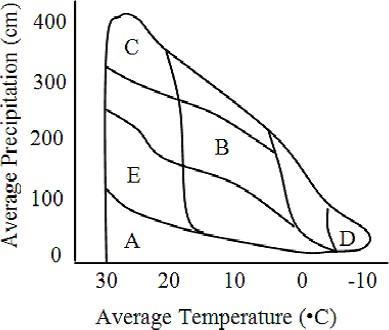
306)306)
306.1) In the graph of precipitation and temperature, desert biomes would fall in the area marked by the letter:
A) A
B) B
C) C
D) D E) E
306.2) In the graph of precipitation and temperature, temperate forest biomes would fall in the area marked by the letter:
A) A
B) B
C) C
D) D E) E
306.3) Neo and Trinity are in a biome that has relatively stable temperatures and abundant rainfall. They have a graph of precipitation and temperature similar to the one shown. Which letter marks the biome they are located in?
A) A
B) B
C) C
D) D
E) E
307) In the graph of precipitation and temperature, the area marked A has a
A) wide precipitation range and narrow temperature range.
B) narrow precipitation and temperature range.
C) wide precipitation and temperature range.
D) wide temperature range and narrow precipitation range.
E) varying temperature and narrow precipitation range.
308) In the graph of precipitation and temperature, the area marked D has a
A) wide precipitation range and narrow temperature range.
B) narrow precipitation and temperature range.
C) wide precipitation and temperature range.
D) wide temperature range and narrow precipitation range.
E) none of the choices is correct.
309) Cloud forests are found in the areas in tropical regions.
A) hot coastal
B) cool mountainous
C) cool plains
D) low elevation
E) valley
310) Neo finds himself sweating in a moist forest but there aren't many streams or wetlands. He is amazed by the tremendous amount of biodiversity including an abundance of biting mosquitoes. Has he inadvertently gotten closer to his goal of finding a boreal forest?
A) yes
B) no, the description is that of a tropical seasonal forest
C) no, the description is that of a temperate deciduous forest
D) no, the description is that of a tropical rainforest
E) no, the description is that of a temperate rainforest
311) A biome absent from Europe is the
A) temperate deciduous forest
B) alpine tundra
C) desert
D) tropical rainforest
E) temperate rainforest
312) Which of the following is an example of a specialization that plants in the desert may have?
A) storing water in stems or roots
B) reducing water loss with thick epidermal layers
C) salt tolerance
D) All of these are adaptations of plants living in desert conditions
313) Deserts are characterized by
A) an absence of vegetation
B) sand dunes, which cause plants to grow only with difficulty
C) low levels of measurable precipitation
D) their location at 30° latitude
E) sand or gravel
314) Humid tropical forests have extraordinary biological diversity
A) because of the very fertile tropical soils.
B) because rainfall dissolves soil nutrients and makes them available to plants.
C) despite a complete absence of nutrients in the environment.
D) despite the poor, weathered soils.
315) Tropical seasonal forests are specially adapted to tolerate
A) annual cycles of extreme heat and extreme cold.
B) years of drought followed by years of rain.
C) annual cycles of severe drought and heavy rain.
D) extreme drought and cold at the same time.
E) extreme heat.
316) In contrast with the , the soil of the _ is more nutrient-rich and this type of biome has fewer insects, parasites, and fungal diseases. Therefore, in many places, these areas are highly endangered.
A) temperate grasslands; tropical seasonal forest
B) tropical rainforest; tropical seasonal forest
C) grasslands; boreal forests
D) tropical seasonal forest; tropical rainforest
E) boreal forests; tundra
317) You are in an area that is relatively hot. You bend down and notice that there are tracks in the soil that are very old. Since you know that this area is easily destroyed by human activity and the harsh climate slows recovery from human damage, you conclude that this biome is
A) a tropical dry forest.
B) a desert.
C) tundra.
D) a grassland.
E) a wetland.
318) What is unique about the Mediterranean climate area biome?
A) It is a highly desirable place to live.
B) It is only found in the Mediterranean area.
C) It has very poor soil but supports an extremely diverse array of species.
D) It has a large total area.
E) It contains a high number of unique species.
319) The word "conifer" distinguishes plants that are
A) needle-bearing.
B) cone-bearing.
C) evergreen.
D) cone-shaped.
E) found in northern latitudes.
320) Morpheus, Trinity, and Neo are on the wet western coast of North America and as they look around, they see lots of mosses, lichens, and ferns covering the tree branches. Condensation from fog on the leaves is a major form of precipitation. Where are they?
A) temperate rainforest
B) boreal forest
C) tropical rainforest
D) southern pine forest
E) tropical savannah
321) Deciduous forests
A) are adapted to extremely cold climates.
B) have trees that bear seeds in cones.
C) have trees that shed their leaves seasonally.
D) are not useful commercially.
322) Many people in the United States take trips in the spring to see annual flowers that grow and flower before they are shaded by canopy. Where are these people going?
A) deserts after winter rain showers
B) prairies or grasslands
C) tropical rainforests
D) temperate deciduous forests
E) boreal forests
323) Having needle-shaped leaves benefits plants because needles
A) reduce water loss and endure cold winters.
B) are more efficient at photosynthesis because they are dark green.
C) help evaporate water more efficiently.
D) do not rot in the excessive rainfall that characterizes coniferous forests.
E) are less resistant to strong winds.
324) Trinity and Neo are in an area that has many lakes and bogs. The majority of the trees are coniferous. As they look around, they also see deciduous trees, including birches, aspens, and maples. What type of forest are they in?
A) temperate rainforest
B) boreal forest
C) tropical rainforest
D) southern pine forest
E) coastal forest
325) Boreal forests are generally
A) cold and dry, with extensive barren areas.
B) warm and humid, with large rivers.
C) dry because water is frozen most of the year.
D) slow-growing because of the cold temperatures.
E) soggy in the summer because of permafrost.
326) In what continent would you find a polar desert?
A) Antarctica
B) Africa
C) Australia
D) South America
327) Vertical zonation shows that not only do different biomes occur at different latitudes, but also at different _.
A) altitudes
B) longitudes
C) seasons
D) right ascensions and declinations
328) Tree growth in the taiga is limited by
A) the increased soil salt content from ocean tides.
B) intense heat and dryness.
C) competition from fast-growing grasses.
D) the lack of large predators.
E) extreme cold and short summers.
329) Tundra biomes occur
A) at high latitudes, where temperatures are low.
B) where rainfall is too great for tree growth.
C) only at high latitudes.
D) almost exclusively on Antarctica.
E) at high latitudes and altitudes, where the growing season is short.
330) Morpheus has been led into a wilderness environment and left to fend for himself for the summer. Luckily, he has a good coat because it looks like there may be a frost during the night and the mosquitoes are everywhere. As he looks around, he is relieved because he recognizes some of the plants. There are some mosses, lichens, small shrubs, sedges, and grasses. Which biome is he in?
A) tropical rainforest
B) wetland
C) temperate rainforest
D) tundra
E) coastal area
331) The biome type that has a short growing season and is summer feeding and breeding grounds for caribou and musk-ox is the
A) Temperate grassland.
B) Bog or fen.
C) Boreal forest.
D) Arctic tundra.
E) Arctic desert.
332) Coral reefs form in
A) deep, warm tropical seas.
B) cold polar seas.
C) warm, clear tropical seas.
D) deep, cold oceans off continental shelves.
E) nutrient-rich coastal areas.
333) Mangrove trees are found along shorelines.
A) tropical freshwater
B) tropical saltwater
C) temperate freshwater
D) temperate saltwater
E) tropical and temperate saltwater
334) Why are the North Atlantic, North Pacific, and Antarctic waters the most productive?
A) Cold water holds the most dissolved oxygen and can therefore support greater numbers of phytoplankton.
B) The melt waters of the nearby ice have nutrients that are released in high quantities, fertilizing the phytoplankton.
C) Those waters are the most violently mixed, bringing up nutrients from the depths of the ocean.
D) Phytoplankton grow there because they do not like direct sunlight.
335) is the basis of marine food webs.
A) Phytoplankton
B) Minnows
C) Sea grass
D) Coral
336) is where fresh water mixes with ocean water.
A) An estuary
B) A mangrove forest
C) A swamp
D) A delta
337) Which of the following protects mainland shores from the force of waves?
A) wetlands
B) barrier islands
C) coral islands
D) estuaries
E) volcanic islands
338) If an organism is described as 'benthic," where does it reside?
A) at the bottom of the ocean or a lake
B) at the bottom of the ocean only
C) at the bottom of a lake only
D) in a cave
339) Coral bleaching occurs when .
A) ocean temperatures are too warm
B) when ocean temperatures are too cool
C) when too much sunlight is shining on the coral
D) during low tide when coral is exposed to the air
340) What marine ecosystem is most similar to a tropical rainforest in terms of diversity?
A) coral reef
B) estuary
C) littoral zone
D) pelagic zone
341) Barrier islands are formed of
A) wind- and wave-deposited sand.
B) volcanic debris.
C) silt and mud left by estuaries.
D) coral deposits.
E) coral reef formations.
342) Freshwater ecosystems
A) lack oxygen.
B) lack carbon dioxide.
C) include lakes, marshes, bogs, and fens.
D) do not contain thermoclines.
E) are not affected by nutrient availability.
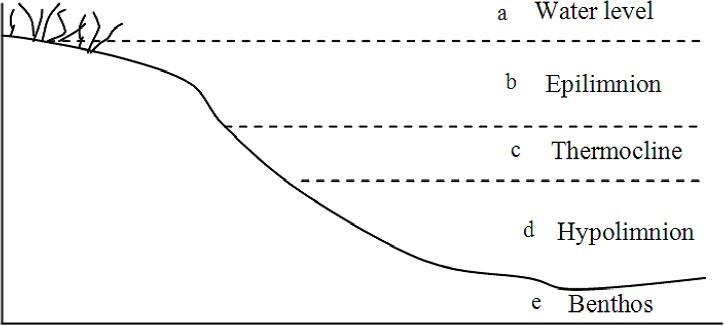
343)343)
343.1) What environmental factor does not change between "b" and "e" in the diagram?
A) light penetration.
B) temperature.
C) nutrient availability.
D) oxygen content.
E) All of these change between "b" and "e".
343.2) Oxygen levels are lowest in what section in the diagram?
A) A
B) B
C) C
D) D
E) E
343.3) What aquatic ecosystem phenomenon is illustrated in the diagram?
A) nutrient inputs from upstream and uphill
B) vertical stratification
C) nutrient cycling
D) internal convective currents
E) horizontal stratification
344) The thermocline is the layer in a lake at which
A) pollutants are trapped and held.
B) seasonal lake mixing occurs.
C) the warm upper zone meets the cold lower zone.
D) nutrient levels are the lowest.
E) light no longer penetrates enough for photosynthesis to occur.
345) Which of the following is NOT a region in a lake ecosystem?
A) pelagic zone
B) epilimnion
C) hypolimnion zone
D) littoral zone
346) Wetlands are biomes that
A) are wet all year round.
B) are wet at least some of the year.
C) have fresh, not salty, water.
D) receive more rainfall than other ecosystems.
E) have salty, not fresh, water.
347) Which type of wetland is noted for producing peat?
A) swamps
B) marshes
C) bogs and fens
D) estuaries
E) coastal areas
348) The difference between a wetland and a swamp is that
A) a swamp has trees and a wetland does not
B) swamps are always covered in water and wetlands have seasonally high water levels
C) wetlands are covered in water according to the tide
D) wetlands only occur at coastal areas
349) The biome type that has lost the greatest percentage of its original area due to human activities is the
A) temperate conifer forest.
B) tropical rainforest.
C) temperate deciduous forest.
D) temperate grassland.
E) tropical grassland.
350) The deepest layers of the ocean are relatively devoid of life.
⊚ true
⊚ false
351) The coral reef is among the most endangered biological communities.
⊚ true
⊚ false
352) Estuaries are noted by biologists because they have few, but highly specialized biological niches.
⊚ true
⊚ false
353) Wetlands perform a major ecosystem service of trapping and filtering water as it passes through the wetland area.
⊚ true
⊚ false
354) Arctic deserts and tundras are the least disturbed by humans since they are usually unattractive places for humans to live.
⊚ true
⊚ false
355) An ecologist from your school who specializes in temperate forest ecology is touring the rainforests of Peru. You are giving her the first tour of the primary forest and she comments on the differences she notices between this ecosystem and the temperate ecosystem she is familiar with. Relate three of the differences she noted and explain what factors in each ecosystem lead to the differences.
356) Beginning in an equatorial tropical rainforest, you travel north to the arctic tundra. Name and describe all of the terrestrial biomes you pass through on your journey.
357) Oysters and oyster reefs are often found in shallow shoreline areas where they are exposed during some parts of the day, but underwater during other parts of the day. This area is called the
A) intertidal zone.
B) continental shelf.
C) pelagic zone.
D) mangrove forest.
E) primary production area.
358) Organisms in this habitat are adapted to very hot temperatures, high pressure, and are supported by a food chain based on metabolizing sulfur compounds rather than oxygen. This description best fits
A) hydrothermal vent communities.
B) benthic communities.
C) pelagic communities.
D) continental shelf communities.
E) littoral communities.
359) Which marine stratification listed would have the least primary productivity?
A) abyssal zone
B) epipelagic zone
C) littoral zone
D) hydrothermal vent
E) coral reef
360) This ecosystem is based on a symbiosis between a small animal and photosynthetic algae. Name the ecosystem described.
A) coral reef
B) mangrove
C) estuary
D) hydrothermal vent
E) salt marsh
361) Which of the following is a common characteristic of shoreline communities such as mangroves, estuaries, and salt marshes?
A) They are all nursery habitats for marine animals including commercially important species.
B) They are all characterized by a special variety of trees that grow in salt water.
C) They are either created or conserved worldwide for aquaculture and other ecosystem services.
D) They are all found mostly in tropical waters.
E) They have very low primary productivity.
362) Sophia is an environmental educator who regularly teaches outdoor classes for schoolchildren along the seashore. She takes them to shallow, rocky areas where even at low tide there is enough water to find species such as sea stars, urchins, crustaceans, and seaweed. Where are Sophia and the schoolchildren?
A) in a tide pool
B) at a coral reef
C) in a mangrove forest
D) in a salt marsh
E) in a pelagic zone
363) Which layer of a deep lake has the most light and oxygen?
A) epilimnion
B) thermocline
C) hypolimnion
D) benthos
364) Which of the following is NOT an ecosystem service of wetlands?
A) large amounts of land available for development of farms or neighborhoods
B) floodwater storage to prevent flooding of areas not adapted to high water including cities
C) breeding areas for waterfowl and shorebirds
D) filtering water of excess nutrients or other contaminants
365) What is the leading cause of land conversion from natural ecosystems to human-driven land use?
A) agriculture
B) building cities
C) transportation
D) mining
E) energy production
366) What is the greatest threat to wetland ecosystems?
A) conversion to terrestrial communities through sediment loads or draining for development
B) pollution from urban or farm runoff
C) low primary productivity, which limits plant growth and, thus, the rest of the food chain
D) loss of groundwater
E) soil depletion from human uses
367) Using the information in this climograph, determine the characteristics and the type of ecosystem. Check all descriptors that apply.
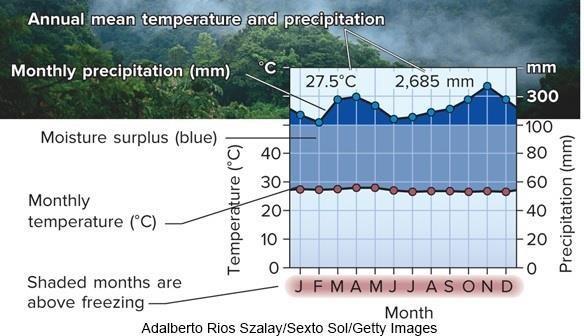
</span></p>
A) Monthly precipitation is high year round.
B) Average monthly temperature is warm and constant all year.
C) This graph depicts a tropical rainforest biome.
D) Average monthly temperature is variable year round.
E) Average monthly precipitation is seasonal with wet and dry months.
F) This graph depicts a tropical savanna.
368) Using the information in this climograph, determine the characteristics and the type of ecosystem. Check all descriptors that apply.
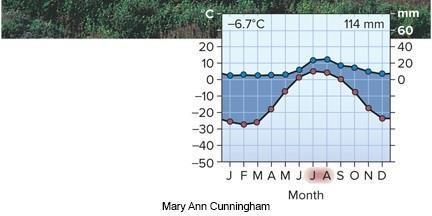
A) Average monthly precipitation is generally constant most of the year.
B) Average monthly temperature is very cold with only a few months of the year above freezing.
C) This graph depicts a tundra biome.
D) Average monthly temperature is seasonal with warm summers and cold winters.
E) Average monthly precipitation is seasonal with wet and dry months.
F) This graph depicts a temperate deciduous forest.
Answer Key
Test name: chapter 5
1) A 2) C 3) A 4) A 5) D 6) C 7) C 8) FALSE 9) FALSE 10) TRUE 11) TRUE 12) C 13) A 14) D 15) E 16) A 17) B 18) E 19) B
20) C 21) Section Break 21.1) A
21.2) B 21.3) C
22) D 23) B 24) B 25) D
26) D 27) D
28) C 29) D
30) C
31) B
32) B
33) E
34) B
35) A 36) C 37) D
38) A 39) B 40) D 41) A 42) A 43) E 44) E 45) D 46) D 47) C 48) B 49) A 50) A 51) A 52) B 53) A 54) A 55) A 56) A 57) C
58) Section Break 58.1) E
58.2) E
58.3) B 59) C 60) A 61) B 62) C 63) A 64) C 65) FALSE 66) TRUE 67) FALSE 68) TRUE 69) TRUE
70) Essay
Tropical rainforests: 1) nutrient-poor soil 2) extreme biodiversity especially plants, amphibians, reptiles, and insects 3) temperature is warm year-round 4) almost daily precipitation occurs Temperate rainforests: 1) nutrient-rich soil 2) not quite as many organisms fewer species of plants, insects, amphibians, and reptiles 3) temperature is mild year-round 4) condensation from fog makes up majority of the precipitation
71) Essay
Starting in the southeastern U.S., answer should mention temperate deciduous forest (covering entire eastern part of U.S.). Moving into Canada, it becomes colder and is now boreal forest. Eventually should end up in the arctic tundra. If starting in south-central U.S., temperate grasslands are the major biome; moving into boreal forest in Canada and finally into arctic tundra. Finally, if student begins in southwestern U.S., biomes mentioned may include desert, chaparral, temperate rainforest, and/or temperate grassland. Canada, once again, is boreal forest and finally arctic tundra.
72) A
73) A
74) A
75) A
76) A
77) A
78) A
79) A
80) A
81) A
82) [A, B, C]
83) [A, B, C]
Student name:
369) Exponential growth in a population
A) refers to an increase by a constant amount, such as a net gain of 100 individuals per year.
B) refers to an increase by a constant percentage each year. C) is also called arithmetic growth.
D) includes any pattern of increase in numbers.
370) Population growth patterns over time typically
A) follow a smooth J curve form.
B) follow a smooth S curve form.
C) exhibit erratic fluctuations caused by readily discernable factors.
D) exhibit complex patterns produced by complex causes.
371) Logistic strategies are better adapted to
A) environments experiencing erratic, unpredictable swings in chemical or physical factors.
B) situations where resource utilization can be maximized through a rapid increase in population size.
C) organisms present in early successional stages.
D) fairly stable environments.
372) A survivorship curve with the shape of a straight line descending over time indicates an organism whose chance of death
A) is unrelated to its age.
B) decreases as it gets older.
C) increases as it gets older.
373) In the context of population growth regulation, intrinsic factors are those that
A) operate within or between organisms.
B) lower reproductive success by a variety of means.
C) are imposed on the population from outside.
D) increase reproductive success by a variety of means.
374) Density-independent factors tend to be
A) more associated with abiotic factors.
B) more associated with intrinsic factors.
C) unable to lower reproductive gains in a population.
D) more influential with natality rates than mortality rates.
375) A graph of a population growing at a positive constant rate would most resemble a
A) straight horizontal line.
B) rising straight line.
C) J-shaped curve.
D) straight vertical line.
376) Exponential growth refers to any pattern of increase of the size of a plant or animal population.
⊚ true
⊚ false
377) Explosive growth better characterizes logistic growth than exponential growth.
⊚ true
⊚ false
378) A metapopulation is one in which genetic diversity is much reduced.
⊚ true
⊚ false
379) The carrying capacity of a habitat refers to
A) the strength or resilience of the population.
B) the number of animals that the habitat can support.
C) the amount of rainfall that the habitat receives annually.
D) None of these choices are correct
380) When a population overshoots its carrying capacity, resources become limited and death rates rise.
⊚ true
⊚ false
381) Many species exhibit both exponential ( ) and logistic ( ) population growth characteristics.
A) r selected; K selected
B) K selected; r selected
382) Weeds most commonly exhibit which population growth characteristic?
A) r selected
B) K selected
C) A pattern that appears as a J-curve on a graph
D) r selected and a pattern that appears as a J-curve on a graph
E) K selected and a pattern that appears as a J-curve on a graph
383) Conservation biologists refer to the number of individuals needed for long-term survival as
A) the bottleneck.
B) the carrying capacity.
C) the minimum viable population size.
D) K selected.
384) An organism's biotic potential is the maximum number of offspring that
A) survive to adulthood
B) its habitat can support
C) it produces at one time
D) it actually produces over its lifetime
385) growth rate describes a predictable rate of change at discrete points in time.
A) Feedback
B) Logistic
C) Exponential
D) Geometric
E) Overshoot
386) In the real world, many factors determine the numbers of organisms in any one population. Yet, a "superfly" with unlimited food and no mortality would show what type of growth?
A) geometric increase
B) irruptive growth
C) exponential growth
D) logistic growth
E) malthusian growth
387) In cases of exponential growth rates, a population each year.
A) increases at the same rate
B) is multiplied by a constant number
C) doubles
D) triples
E) increases by a constant number (one, ten, one hundred, etc.), depending on the system
388) Exponential growth would be represented by a curve?
A) J-shaped
B) S-shaped
C) straight
D) bimodal
E) linear
389) Carrying capacity is the population or biomass
A) that an environment can support in an optimal year.
B) of a species that an environment can support on a long-term basis.
C) that remains after a catastrophic dieback has occurred.
D) of a species without limiting factors.
E) of a species without predators.
390) In the real world, population explosion is usually followed by
A) a continuation of high population levels indefinitely.
B) a gradual decrease in population as food supplies dwindle.
C) a tremendous increase in genetic diversity.
D) a gradual increase in population due to the availability of mates.
E) a population crash.
391) A dieback or population crash, often occurs after a species its environmental carrying capacity.
A) meets
B) undershoots
C) overshoots
D) oscillates around
E) decreases
392) An island has formed off the coast of the Pacific Northwest. The Department of Natural Resources (DNR) has determined that there is enough land area for a herd of 100 elk, yet they say the carrying capacity is only 60 elk. This inequality can best be explained by the fact that the
A) DNR is probably being careful not to overestimate.
B) DNR must have added up the environmental resistance incorrectly.
C) Elk population will probably fluctuate between 60 and 100 animals.
D) Physical factor of space is only one of the determiners for population size in a community.
E) Law of limiting factors determines the maximum growth rate for a given population.
393) Logistic growth rates are those in which a population
A) grows very slowly when conditions are good and when conditions are not optimal.
B) grows rapidly when conditions are good, then slows as it approaches carrying capacity.
C) overshoots and dies back repeatedly.
D) remains significantly below carrying capacity.
E) grows at a constant rate of increase per unit time.
394) The ability to produce rapid population overshoots can be a useful strategy for a species that tends to
A) colonize new territory.
B) maintain a firm position in its current habitat.
C) be part of a climax community.
D) develop intricate niche relationships.
E) be part of a complex ecosystem.
395) Which of the following types of population growth patterns would best represent a group of elephants that enter a new, open habitat and become a stable part of that ecosystem?
A) exponential growth
B) irruptive growth
C) malthusian growth
D) chaotic or catastrophic growth
E) logistic growth
396) Which of the following types of population curves would best represent a group of elephants that enter a new, open habitat and become a stable part of that ecosystem?
A) Norm-shaped curve
B) S-shaped curve
C) J-shaped curve
D) Cyclic oscillation-shaped curve
E) Survivorship curve
397) Widespread starvation is an example of population control.
A) predator-caused
B) biotic
C) density-dependent
D) density-independent
E) abiotic
398) You are studying an organism that is an opportunistic pioneer species and does not care for its offspring. This organism probably has a(n) population growth strategy.
A) K-adapted
B) R-adapted
C) Irregular
D) Catastrophic
E) R-adapted and irregular
399) You are studying an organism that is fairly large, matures slowly, lives fairly long, and cares for its offspring. This organism probably has a(n) population growth strategy.
A) K-adapted
B) R-adapted
C) Irregular
D) Catastrophic
E) R-adapted and irregular
400) Density-independent population control factors cause mortality
A) when the population becomes too large.
B) when the density becomes too high.
C) when the population becomes too small.
D) when the density becomes too low.
E) regardless of population size.
401) An organism with "strategies" would be considered to have natality.
A) K-adapted; high
B) R-adapted; high
C) K-adapted; low
D) R-adapted; low
E) R-adapted; high AND K-adapted
402) When the similarities in population increases and decreases in prey and predators, it lead us to the conclusion that
A) the abundance of only the prey species can affect another species.
B) the abundance of only the predator species can affect another species.
C) the abundance of both the prey and predator can affect the other species.
D) there is no relationship between the abundances of predator and prey species.
403) Natality is usually
A) constant in a population.
B) constant for a species.
C) constant in an ecosystem.
D) variable, depending on the number of recent deaths.
E) variable, depending on environmental conditions.
404) An organism’s fertility is
A) the actual number of offspring produced
B) the physical ability to reproduce
C) the average life span
D) replacement level of reproduction
E) the number of offspring that grow to adulthood
405) Life expectancy is the
A) maximum life span that an individual of a given species could reach.
B) number of individuals in a population that survive in a given year.
C) number of years an individual of a certain age will probably live.
D) probability that an individual will survive infancy.
E) All of these are descriptions of life expectancy.
406) Survivorship is determined by
A) the percentage of a cohort that survives to a certain age.
B) the number of individuals in a population that survive in a given year.
C) the number of years an individual of a certain age will probably live.
D) the probability that an individual will survive infancy.
E) the maximum life span that an individual of a given species could reach.
407) The longest period of life that a given type of organism can reach is known as
A) survivorship.
B) life span.
C) life expectancy.
D) mortality.
E) fecundity.
408) The most common factor that affects birth and death rates within a population independently of density is
A) fire.
B) competition.
C) weather.
D) stress.
E) None of these is correct.
409) If there is no migration, the size of a population is limited solely by interaction between
A) natality and fertility.
B) mortality and fecundity.
C) mortality and survivorship.
D) natality and mortality.
E) life expectancy and survivorship.
410) Predation is considered to be a(n) factor.
A) extrinsic
B) intrinsic
C) abiotic
D) biotic
E) extrinsic and biotic
411) Which of the following is an abiotic population control mechanism?
A) predation
B) disease
C) water shortages
D) prey shortages
E) competition
412) Which of the following is a biotic population control mechanism?
A) nutrients
B) precipitation
C) day length
D) climate
E) pathogens
413) In general, abiotic regulatory factors tend to be while biotic factors tend to be .
A) interspecific; intraspecific
B) intraspecific; interspecific
C) density-dependent; density-independent
D) density-independent; density-dependent
E) interspecific; density-independent
414) Which of the following is not a density-dependent population control factor?
A) stress
B) overcrowding
C) predation
D) drought
E) competition
415) Which of the following is an intraspecific interaction?
A) mutualism
B) territoriality
C) parasitism
D) predation
E) All of these are examples of intraspecific interactions
416) Island biogeography explains the phenomenon of terrestrial species on islands small and far from the mainland when compared to larger islands that are closer to the mainland and have terrestrial species.
A) fewer; more
B) more; fewer
C) larger; smaller
D) smaller; larger
E) larger; about the same number of
417) How does island biogeography apply to ecosystems other than islands?
A) Relatively rare ecosystems such as coastal areas are more stable if they have high species diversity.
B) Habitats that are large and close to development are more adversely affected than smaller fragmented habitats.
C) Habitat fragmentation has formed islands of habitat in "oceans" of development.
D) Along with islands in oceans and lakes, the principles of island biogeography apply only to wetland areas.
E) Island biogeography is only concerned with islands in oceans and lakes.
418) Genetic diversity is lost in a small population when
A) the ecological diversity is high.
B) genetic mutations cause some individuals in a population to be different in coloration or size.
C) individuals from other populations are introduced into the population and the genes are diluted.
D) only a few individuals survive a catastrophe.
E) genetic mutations cause most individuals in a population to have similar genetic makeup.
419) Use the following information. DNA studies suggest that all existing cheetahs share a single male ancestor that survived in the not-too-distant past. Generally, all male cheetahs are now nearly genetically identical and have abnormal sperm with decreased reproductive success. The population is extremely vulnerable and genetically, may be headed for extinction.
419.1) The first part of this scenario describes
A) the founder effect or a demographic bottleneck.
B) inbreeding.
C) malthusian strategies.
D) inbreeding or a genetic drift.
420) The highest number of game or commercial species that can be harvested in a single season without limiting growth for future seasons is the maximal sustainable yield.
⊚ true
⊚ false
421) White-tailed deer populations are at about the same levels as they were a century ago.
⊚ true
⊚ false
422) The world's most destructive insect is the cockroach.
⊚ true
⊚ false
423) A collection of separate populations that interact with each other is called a metapopulation.
⊚ true
⊚ false
424) Oysters spawn hundreds of thousands of eggs and sperm into the water column. Some of these eggs will be fertilized and grow to be larvae. In order for larvae to grow to adult oysters, they must land on a hard surface. There are many opportunities for an oyster larva to not reach adulthood. Oysters are represented by a
A) Type 3 survivorship curve.
B) Type 1 survivorship curve.
C) Type 2 survivorship curve.
425) Field mice are prey for a number of species including birds and snakes. These predators do not choose their prey based on age, which means that mortality rates can be similar for any age mouse. Field mice are represented by a
A) Type 2 survivorship curve.
B) Type 3 survivorship curve.
C) Type 1 survivorship curve.
426) Oysters spawn hundreds of thousands of eggs and sperm into the water column. Some of these eggs will be fertilized and grow to be larvae. Oysters do not participate in rearing or protecting their offspring. Which life history strategy best describes the oyster?
A) R-selected species
B) K-selected species
427) A dandelion produces approximately 150 seeds per flower. These seeds are carried by the wind, and if they land in an appropriate location, can germinate to produce more plants. Which life history strategy best describes the dandelion?
A) R-selected species
B) K-selected species
428) Penguins produce one or two eggs depending on the species. At any given time one of the parents is incubating the egg. Once the egg hatches, the parents rear the chick. Which life history strategy best describes the penguin?
A) K-selected species
B) R-selected species
429) When comparing the equations for exponential growth and logistic growth, the variable , which means , is only found in the formula for growth.
A) K; carrying capacity; logistic
B) N; population size; exponential
C) T; time; logistic
D) N; population size; logistic
E) K; carrying capacity; exponential
430) Population growth can be affected by the number of resources in the area. In the formula for population growth, this is represented by the variable .
A) K
B) N
C) t
D) dN/dt
E) rN
431) Which of the following organisms would have the highest biotic potential?
A) mosquitoes
B) humans
C) elephants
D) penguins
E) whales
432) In the 19th century, the American bison faced extinction because of overhunting. Very few individuals remained, but because small herds were protected within national parks, the remaining individuals have been able to reproduce to grow the number of individuals. Because the genetic diversity of the current bison population originated from a very small population of bison, this is an example of
A) a demographic bottleneck.
B) genetic drift.
C) the founder effect.
D) survivorship.
E) K-selection.
433) When resources are limited, there is a limit to the size of a population. Ecologists call this limit the .
434) A sea turtle lives a long life and takes years to reach sexual maturity. Female turtles produce many eggs, but do not raise their young. Many of the hatchling sea turtles will not live to adulthood. Which part of the sea turtle life history is more like that of an r strategist than a k strategist? Select all that apply.
A) They do not raise their young.
B) They lay many eggs, but many hatchlings won't reach adulthood.
C) They can live long lives.
D) They can take years to reach sexual maturity.
Answer Key
Test name: chapter 6 1) B 2) D 3) D 4) A 5) A 6) A 7) C 8) FALSE 9) FALSE 10) FALSE 11) B 12) TRUE 13) A 14) D 15) C 16) A 17) D 18) C 19) B 20) A 21) B 22) E 23) C 24) D 25) B 26) A 27) E 28) B 29) C 30) B
31) A 32) E 33) B 34) C
35) E 36) A 37) C
38) A
39) B
40) C
41) D 42) E
43) C
44) E 45) D
46) D
47) B
48) A 49) C
50) D
51) Section Break
51.1) A
52) TRUE 53) FALSE 54) FALSE
55) TRUE
56) A 57) A
58) A 59) A
60) A 61) A
62) A 63) A 64) A
65) carrying capacity 66) [A, B]
Student name:
435) The world's population increases by about people per year.
A) 800,000
B) 8 million
C) 80 million
D) 800 million
436) Malthus contended that
A) by providing additional workers, human population growth enhanced economic development.
B) humans can produce babies faster than they can produce commensurate amounts of food.
C) poverty causes resource depletion rather than the reverse.
437) The greatest future growth in human numbers is expected to occur in the
A) rich countries of Europe and North America.
B) rich Asian countries including Japan.
C) developing nations.
438) Age structure graphs express
A) whether a population is declining, growing, or stable.
B) the proportion of a population at various ages.
C) the proportion of people approaching reproductive age as well as those of reproductive age.
439) In general, countries with the highest fertility rates are those
A) with the greatest untapped natural resources.
B) among the poorest on earth.
C) with the highest life expectancies.
D) with low infant mortality rates.
440) In general, life expectancy
A) rises with increased annual income.
B) rises with increased annual income, but only up to about $10,000.
C) bears no consistent relationship to annual income.
D) is greatest among country peasants.
441) Julian Simon was convinced that without fundamental social and economic changes, environmental damage will accelerate.
⊚ true
⊚ false
442) Reductions in death rates in recent centuries are due more to better food and sanitation than modern medicine.
⊚ true
⊚ false
443) The demographic transition generally accompanies economic development.
⊚ true
⊚ false
444) After the year 1600, the human population began to grow more rapidly, owing to which of the following factors?
A) increases in commerce and communication on a global scale
B) new agricultural developments
C) better health care and improved hygiene
D) increases in commerce and communication on a global scale, new agricultural developments, and better health care and improved hygiene
E) increases in commerce and communication on a global scale and new agricultural developments
445) The economist Karl Marx believed that
A) human population growth is a consequence of poverty and other social ills.
B) improving social conditions will only make people consume resources faster, lowering the carrying capacity of the earth.
C) new technologies are the cause of explosive population growth.
D) None of these choices is correct.
446) Replacement fertility occurs when
A) women in a given society are opting not to have children.
B) the birth rate equals the death rate plus the emigration rate.
C) birth rate plus immigration is equal to the death rate plus emigration.
447) Population momentum
A) leads to many years of continued population growth.
B) occurs when most of the population is young.
C) is commonly associated with abstinence.
D) leads to many years of continued population growth and occurs when most of the population is young.
E) leads to many years of continued population growth and is commonly associated with abstinence.
448) Historically, up until the Middle Ages, populations were mostly limited by
A) low fertility rates.
B) culturally imposed family planning practices.
C) disease and poor nutrition.
D) religious restrictions on marriage.
E) infanticide.
449) are the most widely distributed vertebrate organisms on Earth.
A) Fishes
B) Insects
C) Rodents
D) Birds
E) Humans
450) Historical evidence shows that plagues and diseases
A) are highly effective at slowing population growth.
B) affect population growth for at least a century.
C) affect relatively few people in a population.
D) are devastating to human population growth.
E) cause only minor or temporary setbacks in population growth trends.
451) Human population growth most closely resembles
A) Carrying capacity geometric increase.
B) Irruptive growth.
C) Malthusian growth.
D) S-shaped growth curve.
E) J-shaped growth curve.
452) The world human population reached about 1 billion in and passed in 2022.
A) 1400; 78 billion
B) 1500; 1 trillion
C) 1600; 78 million
D) 1700; 7 million
E) 1800; 8 billion
453) The population theory held by Thomas Malthus was that the human population would
A) never reach its environment's carrying capacity.
B) develop a modern utopia.
C) reach its environment's carrying capacity and then maintain equilibrium.
D) maintain equilibrium with its carrying capacity.
E) outstrip its resources, then suffer starvation and misery.
454) Malthus argued that is the ultimate cause of social and environmental problems, and Marx argued that population growth social and environmental problems.
A) excess population growth; results from B) poverty; results from C) war; results from
D) excess population growth; is also the ultimate cause of E) poverty; is the ultimate cause of
455) Technological optimists argue that technological advances have
A) led to the increase in human population, but whether we can continue is of great concern.
B) proved Marx wrong in his predictions of famine and disaster.
C) proved Malthus wrong in his predictions of famine and disaster.
D) been developed because there are more people, supporting the view that more people are the "ultimate resource."
E) been a neutral factor in the issue of population growth.
456) Malthus and Marx
A) worked together to form their theories.
B) agreed about the root causes of overpopulation, poverty, and social upheaval.
C) disagreed about the root causes of overpopulation, poverty, and social upheaval.
D) held the same beliefs but worked on different issues.
E) disagreed about the severity of overpopulation, poverty, and social upheaval.
457) Human ingenuity and intelligence as the "ultimate resource" is the central theme in the argument of
A) Julian Simon.
B) John Muir.
C) Thomas Malthus.
D) Neo-Malthusians.
E) Marxism.
458) Demography is the science that describes
A) the earth's carrying capacity.
B) population changes and characteristics.
C) energy resources.
D) food production.
E) environmental factors that affect population sizes.
459) The I = PAT formula says that our environmental impacts (I) are the product of
A) the population size times affluence and the amount of time it took for the population to reach its current size.
B) the population size times affluence and the technology used to produce goods and services consumed.
C) the population size times the amount of technology used.
D) the percentage of affluence times the percentage of technology produced.
E) None of the answers is correct.
460) Why is Russia's population declining?
A) There is a one-child policy similar to the one in China and Thailand.
B) There has been a massive education campaign to reduce births.
C) The standard of living has decreased leading to lower infant mortality and lower birth rates.
D) Russia's population is not declining.
E) Fertility rates are below replacement levels.
461) Crude birth rates are measured in terms of the number of children born
A) in a single year.
B) per family.
C) per family per year.
D) per 1,000 people each year.
E) per 1,000 people in the general population.
462) The replacement fertility rate is slightly over two children per couple because
A) we always need slightly more young people.
B) the older generation is dying.
C) some children die and some couples do not have children.
D) that is as low as birth rates can reasonably be expected to get.
E) the zero population growth rate is not slightly over two children per couple.
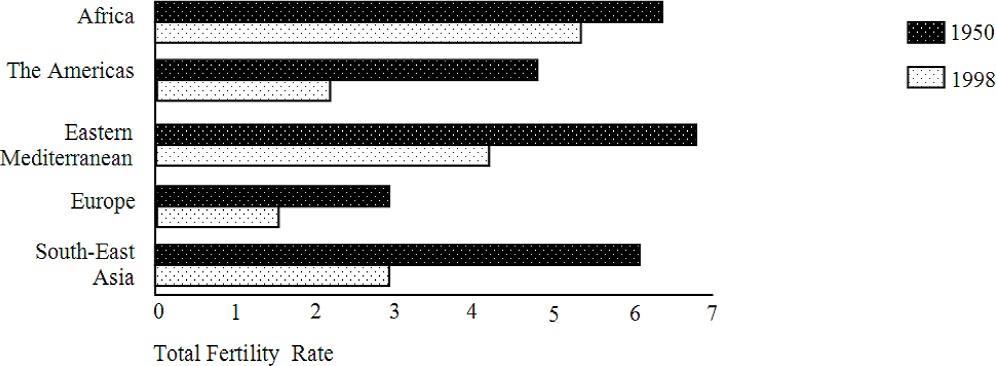
463)463)
463.1) According to the graph, which region had the highest total fertility rate in 1998?
A) Africa
B) The Americas
C) Eastern Mediterranean
D) Europe
E) South-East Asia
463.2) According to the graph, which region had the highest total fertility rate in 1950?
A) Africa
B) The Americas
C) Eastern Mediterranean
D) Europe
E) South-East Asia
463.3) According to the graph, which region had the greatest fertility reduction?
A) Africa
B) The Americas
C) Eastern Mediterranean
D) Europe
E) South-East Asia
464) The total fertility rate is the number of children born
A) to the average woman per year.
B) to the average woman during her lifetime.
C) in the world during a single year.
D) in a population during a single year.
E) in a population during an entire generation.
465) There is some evidence that population growth today is rather than
A) slowing slightly; continuing to accelerate
B) continuing to accelerate; slowing slightly
C) increasing; leveling off
D) leveling off; decreasing
E) leveling off; slowing slightly
466) Demographers usually measure mortality in terms of
A) deaths per 1,000 persons per year.
B) deaths per person per year.
C) the number of children who die per year.
D) the total number of deaths per generation.
E) total deaths in a population per year.
467) Which of the following factors does not usually affect the crude death rates of a population?
A) health care
B) sanitation
C) age structure of the population
D) nutrition
E) All of these affect crude death rates
468) The main cause of world population growth in the past 300 years has been
A) increasing fecundity.
B) rising fertility.
C) higher birthrates in developing countries.
D) increasing immigration.
E) falling mortality due to longer life expectancy.
469) A population growing at 1% per year should double in about years.
A) 30
B) 70
C) 10
D) 2
E) 0.2
470) The doubling time for a population with an annual percentage growth rate of 7% is
A) 1 year.
B) 5 years.
C) 10 years.
D) 50 years.
E) 100 years.
471) The average age that a newborn can expect to attain in a given society is referred to as
A) life expectancy.
B) infant mortality.
C) life span.
D) survivorship.
E) life age.
472) Which of the following is NOT a factor contributing to decreased life expectancy?
A) disease
B) improved sanitation
C) poverty
D) famine
E) warfare
473) The best title for the vertical axis on the graph is
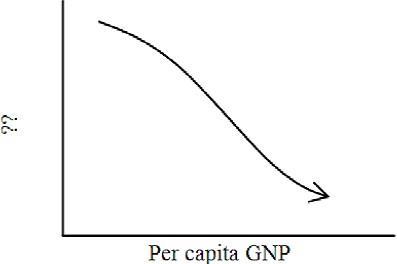
A) life expectancy
B) average dietary protein intake per day
C) female literacy
D) infant mortality
E) rate of infectious diseases
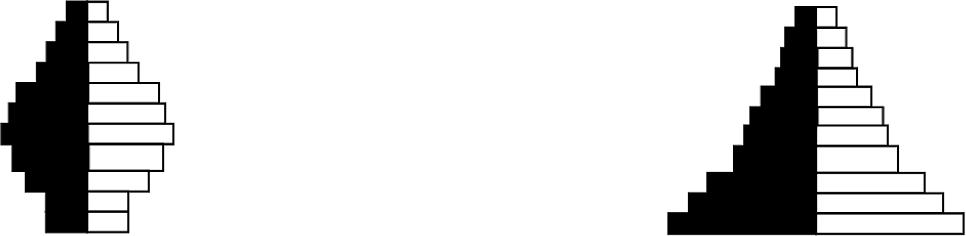
474.1) The histogram on the left represents a population whose birth rates
A) have not changed for many years
B) have recently decreased
C) are gradually increasing
D) are sharply increasing
E) None of these. Birth rates cannot be determined by the age class histogram
474)474)
474.2) The population represented by the age class histogram on the right will
A) have a large population of old people soon.
B) not grow much in the coming years.
C) soon begin to decline.
D) grow substantially in the future.
E) grow slowly in the future.
474.3) The age-class histogram on the right could represent the population of A) The United States.
B) Western Europe.
C) Uganda.
D) Japan.
E) Sweden.
474.4) The age-class histogram on the left could represent the population of
A) China.
B) Mexico.
C) Uganda.
D) India.
E) Sweden.
474.5) A pyramid-shaped age structure histogram is characteristic of a(n) population.
A) stable
B) expanding
C) declining
D) unpredictable
E) diminishing
475) A dependency ratio is a comparison between the numbers of
A) working and nonworking people.
B) parents and children.
C) old people and young people.
D) young infants and older adults.
E) middle aged people and infants.
476) Pronatalist pressures are influences that lead people to A) increase fecundity.
B) have more children.
C) have fewer children.
D) prevent infant mortality.
E) wait until later in life to have children.
477) Which of the following is considered aTRUE pronatalist pressure?
A) legitimate needs for support in old age
B) the need for hands to help in farm work and to watch younger siblings
C) macho pride in men who have many children
D) woman's status determined by the number of children she has
E) All of these are correct
478) Women who areLEAST likely to have many children.
A) cannot afford children
B) live where many children die young
C) are subordinate to their husbands
D) are able to earn an income for themselves
E) All of these are correct
479) Birth rate would tend to decrease with a decrease in
A) education.
B) affluence.
C) infant mortality rate.
D) average marrying age.
E) sanitation.
480) "Birth dearths" can be a problem because they cause
A) labor shortages
B) military weakness
C) a decrease in workers
D) a decrease in taxpayers
E) All of these are correct
481) The demographic transition refers to a country's change from
A) high birth and death rates to low birth and death rates.
B) high to low birth rates and low to high death rates.
C) low to high birth rates and high to low death rates.
D) a majority of young people to a majority of elderly people.
E) a majority of elderly people to a majority of young people.
482) A demographic transition is expected to accompany
A) colonization, as in Africa and Asia.
B) economic development and stabilization.
C) the development of capitalism.
D) the introduction of modern medicine.
E) All of the answers are correct.
483) Use the following demographic data on three hypothetical countries.
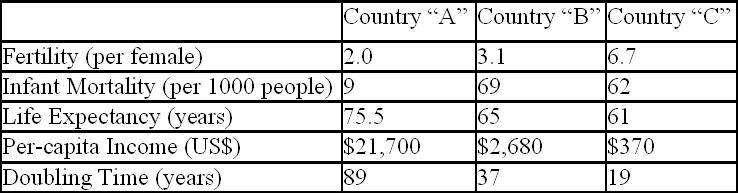
483.1) Which of the following demographic categories best identifies Country "A"?
A) developed
B) moderately developed
C) less developed
D) developing
E) third World
483.2) The most industrialized country listed is
A) Country "A".
B) Country "B".
C) Country "C".
D) None of the countries listed are likely to be industrialized.
E) It is impossible to use the data in the table to identify an industrialized country.
483.3) Country "C" probably has rate of female literacy when compared to the other two countries.
A) the highest
B) an intermediate
C) the lowest
D) an equal
E) It is impossible to use the data in the table to identify the rate of female literacy.
484) Which of the following is not required for a demographic transition to occur?
A) increased confidence that children will survive to maturity
B) improved standard of living
C) improved social status of women
D) increased military strength
E) increased availability and use of birth control
485) The message from author Garret Hardin's "lifeboat ethics" is that
A) helping poor people will, in time, reduce their rate of reproduction.
B) the poorer countries of the world are caught in a demographic trap.
C) economic growth will reduce the birth rate of poor nations.
D) the world has enough resources for everybody.
E) helping poor people will simply increase their rate of reproduction.
486) Proponents of social justice believe that environmental and social problems will decrease if
A) we can educate poor people about family planning.
B) resources are distributed fairly.
C) better ethics are taught to poor, uneducated populations.
D) we just reduce the number of people on Earth.
E) we concentrate on population control.
487) Less developed countries can best argue that developed countries are primarily responsible for overpopulation problems because
A) developed countries grow most of the global food resources.
B) less developed countries have no population-based environmental problems.
C) less developed countries have recently drastically reduced their fertility rates.
D) developed countries do not understand a global society.
E) less developed countries were many times impoverished by colonialism.
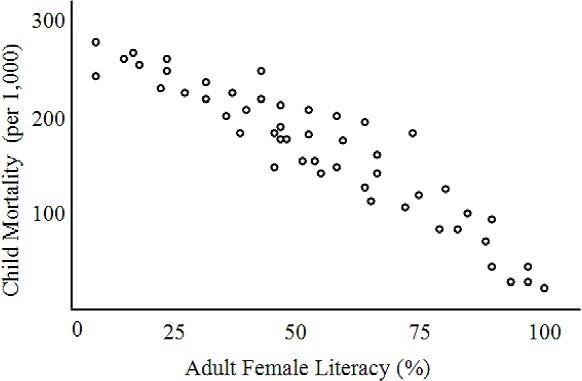
488)488)
488.1) The graph indicates that more children die
A) in the last stage of demographic transition.
B) in the first stage of demographic transition.
C) when their mothers are illiterate.
D) when their mothers are literate.
E) when their mothers are poor.
488.2) The graph indicates that there is
A) a strong relationship between infant mortality and education of women.
B) little relationship between infant mortality and education for women.
C) a relationship between infant mortality and education in general.
D) more importance for female rather than male education.
E) a relationship between birth rate and education for women.
489) One of the effective ways to stabilize populations is to .
A) most; provide free contraceptives
B) least; provide free contraceptives
C) least; decrease child mortality
D) most; decrease child mortality
E) most; expect mandatory sterilization
490) Family planning means enabling people to
A) have fewer children so that the population growth rate can reach ZPG.
B) have no children.
C) have many children.
D) decide in advance how many children they should have.
E) have more children if they live in a country with a birth dearth.
491) Breast-feeding children for long periods
A) is a luxury that mainly wealthy women enjoy.
B) increases fertility when caloric intake is low.
C) can be a successful population control strategy.
D) is a luxury that mainly wealthy women enjoy and it also limits fertility when caloric intake is low.
E) limits fertility when caloric intake is low and can be a successful population control strategy.
492) The world population began growing rapidly during the Middle Ages.
⊚ true
⊚ false
493) The most pessimistic projection of population growth projects the human population to reach 13 billion by 2100.
⊚ true
⊚ false
494) Use birth rates, death rates, emigration rates, and fertility rates to explain a current example of the population dynamics in a nation's human population. Choose the nation you want to describe.
495) Draw a graph that shows the relationship of education for females and infant mortality rates. Appropriately label the x and y axes.
496) Predict the shape of an age-structure diagram for a country with a shrinking population size.
A) It will be wider at the top than the bottom.
B) It will be narrow in the middle and wide at the bottom.
C) It will have a narrow top, but will be wide at the bottom, like a pyramid
D) It will look like a column where the bars of the graph are generally all the same size.
497) The IPAT formula means that population size, affluence, and technology all affect environmental impact. Consider the meaning of this formula and answer the following question.
If population size and affluence stay the same, but technology becomes more efficient, reducing its environmental impact, what will be the overall change in environmental impact?
A) Decrease
B) Increase
C) Stay the same
Answer Key
Test name: chapter 7
1) C 2) B 3) C 4) C 5) B 6) B 7) FALSE 8) TRUE 9) TRUE 10) D 11) A 12) C 13) D 14) C 15) E 16) E 17) E
18) E 19) E
20) A 21) C
22) C 23) A 24) B 25) B 26) E
27) D
28) C
29) Section Break
29.1) A
29.2) C
29.3) E
30) B
31) A
32) A
33) E
34) E
35) B
36) C
37) A
38) B
39) D
40) Section Break
40.1) B
40.2) D
40.3) C
40.4) A
40.5) B
41) A
42) B 43) E
44) D
45) C
46) E
47) A
48) B
49) Section Break 49.1) A
49.2) A
49.3) C
50) D
51) E
52) B 53) E
54) Section Break 54.1) C
54.2) A
55) D
56) D
57) E
58) FALSE
59) TRUE
60) Essay
General trends, not numbers, should be included. There are three basic trends:
2. Rapidly growing countries characterized by high birth and death rates, high fertility rates, and typically, high emigration rates
3. Stable populations characterized by low birth and death rates, low fertility rates, and low emigration rates
4. Negative growth countries characterized by death rates higher than birth rates, (however, both are low), extremely low fertility rates, (typically less than the 2.1 replacement rate) and low emigration rates
61) Essay
x-axis should be labeled with increasing years of education, y-axis should be labeled with increasing rates of infant mortality. Graph should show a decline in infant mortality rates as years of education increase. Please include x and y axes labels, appropriate scales on the axes, and a legend.
62) A
63) A Student name:
498) Pathogens
A) include all disease-causing organisms.
B) include only bacteria and viruses.
C) are anything causing death and disease including toxic chemicals.
D) are those disease causing agents for which medicines do not exist.
499) The chemical responsible for more problems in embryonic development than any other is A) benzene.
B) thalidomide.
C) alcohol.
D) DDT.
500) In humans and other mammals, ingested poisons are primarily detoxified by the A) kidneys.
B) liver.
C) pancreas. D) stomach.
501) Evidence suggests that children and adults typically have
A) the sensitivity to environmental toxins.
B) different sensitivities, with children's higher.
C) different sensitivities, with adult's higher.
D) sensitivities that show no particular trends.
502) Health is defined as the absence of disease or disability.
⊚ true
⊚ false
503) One issue with antibiotics is that
A) many prescriptions are written for conditions that cannot be treated by antibiotics.
B) most people are allergic to antibiotics.
C) doctors prescribe the wrong antibiotics to patients.
D) there aren’t enough doses of antibiotics to prescribe to everyone who needs antibiotic treatment.
504) Emergence of ecological diseases is typically associated with human-made changes that upset normal ecological relationships.
⊚ true
⊚ false
505) All hazardous materials are toxic.
⊚ true
⊚ false
506) Toxins that are water soluble move around the environment much more easily than those not soluble in water.
⊚ true
⊚ false
507) Substances that interrupt normal hormone action can impact human health in many ways beyond sexual function.
⊚ true
⊚ false
508) During the twentieth century, world life expectancies
A) more than tripled.
B) more than doubled.
C) not increased dramatically.
D) None of these choices are correct
509) Toxins are problematic because by definition they are
A) flammable.
B) irritants.
C) poisonous.
D) harmful at low doses.
E) poisonous and harmful at low doses.
510) An example of a neurotoxin is
A) lead.
B) alcohol.
C) mold spores.
D) carbon monoxide.
511) An interaction between substances which exacerbates their effects is known as
A) complex amalgamation.
B) synergism.
C) sympatric interconnectivity.
D) None of these choices are correct.
512) The World Health Organization regards health as primarily a matter of wellbeing.
A) physical
B) mental and physical
C) social and mental
D) physical, mental, and social
E) physical and social
513) Diseases usually develop in response to factors.
A) nutritional and diet
B) infectious or toxic
C) physical
D) psychological stress
E) All of these choices are correct
514) Morbidity is another word for
A) death.
B) health.
C) unhappiness.
D) illness.
E) emergent diseases.
515) Health organizations now use the , a tool to
A) DALY; judge the total impact of the disease rather than only measuring how many people die
B) DALY; judge the total impact of how many people die
C) Morbidity Measure; judge the total impact of the disease rather than only measuring how many people die
D) Morbidity Measure; judge the total impact of how many people die
E) Mortality and Morbidity Measure (3M); judge the total impact of the disease rather than only measuring how many people die
516) Historically, the greatest threats to human health came from
A) carcinogenic or toxic chemicals.
B) psychological stress factors due to crowding.
C) pathogenic organisms.
D) teratogenic chemicals.
E) injuries (intentional and unintentional).
517) , rather than , are becoming the leading causes of disability and premature death worldwide.
A) Chronic conditions such as cardiovascular disease; infectious diseases such as malaria
B) Infectious diseases such as malaria; chronic conditions such as cardiovascular disease
C) Traffic deaths; infectious diseases such as malaria
D) Chronic conditions such as cardiovascular disease; traffic deaths
E) Infectious diseases such as malaria; traffic deaths
518) Infectious diseases such as diarrhea are closely linked to
A) emotional stress.
B) malnutrition.
C) toxicity effects.
D) the overconsumption of fats.
E) All of these exacerbate infectious diseases such as diarrhea
519) Diseases such as cholera and Ebola are
A) caused by pathogenic organisms.
B) called communicable diseases.
C) called emergent diseases.
D) All of these are characteristics of diseases such as cholera and Ebola.
520) MRSA is an example of
A) antibiotic resistant bacteria.
B) one of the many regulations that the EPA enforces.
C) a highly toxic and bioaccumulating substance.
D) Marine Response and Safety Association.
521) Hazardous substances while toxins are
A) react with specific cell components to kill cells; poisonous substances
B) are dangerous substances; poisonous substances
C) are usually of concern at all concentrations; dangerous substances
D) are poisonous substances; also poisonous substances
E) None of the above is correct
522) Toxic substances are dangerous because they
A) react or interfere with specific cell functions.
B) can physically remove or tear tissues.
C) are usually synthetic.
D) cause debilitating parasitic diseases.
E) cause excessive water accumulation in tissues.
523) How many substances is the EPA responsible for monitoring?
A) 275
B) 1,000
C) 500
D) 657
524) Allergens are substances that
A) repress the immune system.
B) stimulate the nervous system.
C) prevent oxygen uptake.
D) activate the immune system.
E) interfere with oxygen uptake.
525) Some particles or cells cause immune responses when your body's white blood cells recognize them as foreign objects. These are known as
A) desensitizers.
B) antigens.
C) active asphyxiants.
D) irritants.
E) pollutants.
526) Which of the following practices contributes the least to antibiotic or pesticide resistance?
A) Domestic farm animals are fed low doses of antibiotics to increase weight gain.
B) A person takes the full course of the appropriate antibiotic when she has a viral infection.
C) A person takes the full course of the appropriate antibiotic when she has a bacterial infection.
D) A person takes an anti-malarial drug when he does not have malaria.
E) Mosquito populations in the tropics have been sprayed with DDT for about 50 years.
527) Tumors can grow because of exposure to
A) neurotoxins.
B) mutagens.
C) antigens.
D) parasitic organisms.
E) allergens.
528) Sick-building syndrome is a result of exposure to
A) formaldehyde
B) asbestos
C) arsenic
D) radon
529) Neurotoxins act by
A) disrupting nerve cells.
B) altering genetic material.
C) repressing the immune system.
D) disrupting normal hormone functions.
E) causing abnormalities in nervous tissue during embryonic growth and development.
530) Endocrine disruptors
A) disrupt nerve cells.
B) alter genetic material.
C) repress the immune system.
D) disrupt normal hormone functions.
E) cause abnormalities in nervous tissue during embryonic growth and development.
531) Radiation can act as a mutagen because it
A) deactivates the immune system.
B) interferes with the activity of nerve cells.
C) causes muscles to grow at unusual rates.
D) damages genetic material in cells.
E) represses oxygen uptake.
532) Cardiovascular disease is strongly related to which of these dietary factors?
A) vitamin deficiencies
B) a lack of cruciferous vegetables
C) excessive calorie consumption
D) protein imbalances
E) high salt and fat intake
533) Teratogens cause abnormal growth specifically in
A) nerve cells.
B) muscle cells.
C) embryos.
D) the liver.
E) skin cells.
534) Fetal alcohol syndrome is caused by exposure to a(n)
A) neurotoxin.
B) mutagen.
C) antigen.
D) teratogen.
E) allergen.
535) Carcinogens are substances that cause
A) a sensitized reaction.
B) out-of-control cell growth and tumors.
C) birth defects.
D) immune responses.
E) carcinogens can cause all of these reactions.
536) A group of cells that grow extremely fast and begin to obstruct other cells' functions is known as
A) a malignant tumor.
B) a parasite.
C) teratogenesis.
D) a pathogen.
E) a benign tumor.
537) Which of the following statements is true?
A) If a substance is toxic, its toxicity is highly dependent on its form and where it is present in the environment.
B) If a substance is toxic, it is equally toxic regardless of its form or where it is present in the environment.
C) The most important factor in the toxicity of a substance is the route it enters our bodies.
D) The most important factor in the toxicity of a substance is its persistence in the environment.
E) None of these statements is true.
538) Among the most important characteristics of chemicals in determining their environmental risks is/are
A) solubility.
B) reactivity.
C) persistence.
D) toxicity.
E) All of these.
539) If solubility is an important characteristic in toxic material movement in the environment and body, which of the following statements is true?
A) Water-soluble compounds require carriers to enter cells.
B) Oil-soluble compounds readily damage kidneys.
C) Water-soluble compounds move slowly in the environment.
D) Oil-soluble compounds accumulate in the body.
E) Solubility is not an important characteristic in toxic material movement.
540) Highly persistent toxic chemicals
A) retain their toxicity as they cycle through the food chain and environment.
B) lose their toxicity once released in the environment.
C) accumulate within one organism but break down at higher trophic levels.
D) are highly unusual among artificial chemicals.
E) are usually not that toxic in their life span.
541) Fat-soluble contaminants
A) tend to accumulate in the surface water of aquatic habitats.
B) are easily excreted by organisms.
C) tend to accumulate in soil, sediments, and organisms.
D) commonly biomagnify from lower to higher trophic levels.
E) have very low bioconcentration factors.
542) The biomagnification of DDT demonstrates that
A) higher trophic level organisms can concentrate toxins in a type of "inverse biological pyramid."
B) birds should not depend on fish for food.
C) DDT is easily metabolized and excreted by most organisms.
D) DDT is an extremely water-soluble material.
E) water-soluble toxins are widespread.
543) Bioaccumulation is a term that describes the way cells
A) grow as they absorb all types of molecules.
B) selectively absorb and store molecules.
C) accumulate food stores as fat.
D) metabolize compounds that are absorbed.
E) allow water-soluble compounds to pass through membranes.
544) Bioaccumulation is important because it allows cells to
A) accumulate essential nutrients and minerals.
B) rid themselves of waste material.
C) protect themselves against toxins.
D) reproduce more quickly.
E) have a ready source of energy if it is needed.
545) Biomagnification is a concentration of toxins
A) within certain cells of the body.
B) within cells of predators as they consume and store the toxins that were in the bodies of their prey.
C) within the liver as an organism gets older.
D) within the bodies of organisms at low trophic levels.
E) None of these is true regarding biomagnification.
546) A chemical interaction in which one substance exacerbates the effects of another is termed
A) a persistent reaction.
B) a bioaccumulation.
C) an antagonistic reaction.
D) synergism.
E) metabolic degradation.
547) An advantage of testing for toxicity by exposing animals to chemicals is that using animals is
A) cheaper than other methods.
B) faster than other methods.
C) usually quite humane.
D) easier than using computer models.
E) a trusted and usually reliable way to get results.
548) If 100 cups of strong coffee contain a lethal dose of caffeine, why don't coffee drinkers eventually die from caffeine overdose?
A) Coffee drinkers who drink more than 100 cups of coffee a week will eventually die from the bioaccumulation.
B) Because of its molecular form, all of the caffeine is not actually absorbed into the body.
C) Once the coffee cools, the caffeine is not as strong as it was when the coffee was fresh.
D) Coffee drinkers who drink more than 100 cups of coffee a month will eventually die from the bioaccumulation.
E) Our bodies metabolize the caffeine before lethal concentrations are reached.
549) Our bodies minimize the effects of toxic compounds by all of the following except
A) metabolic degradation.
B) excretion.
C) antagonistic reactions.
D) repair mechanisms.
E) All of these are ways that our bodies minimize the effects of toxic compounds.
550) Which of the following tissues is more likely to develop cancers?
A) Skin, because there is a high cellular reproduction rate to replace injured cells.
B) Eyes, because they are always exposed to light.
C) Fat, because of bioaccumulation.
D) Bones, because of the increased radiation in our environment.
E) No one tissue is more likely to develop cancer when compared to another type of tissue.
551) The saying "the dose makes the poison" means that
A) almost nothing is toxic at low levels.
B) nearly anything can be toxic at some level.
C) some things are more poisonous than other things.
D) toxic materials are measured in doses of lethal amounts.
E) All things are equally poisonous at equal doses.
552) Individuals represented by the middle of the dose/response curve (responding to doses of 20 ppm) are for that population.
A) very sensitive
B) very insensitive
C) about average in sensitivity
D) relatively insensitive
E) relatively sensitive
553) The dose/response curve shows that
A) some exposure is necessary before most individuals respond.
B) any exposure causes immediate response.
C) response levels off as dosage increases.
D) the dose decreases as response increases.
E) All of these are represented by the dose/response curve.
554) Individuals represented by the right end of the dose/response curve (responding to doses between 30 and 40 ppm) are to the chemical.
A) very sensitive
B) very insensitive
C) about average in sensitivity
D) relatively insensitive
E) relatively sensitive
555) Individuals represented by the left end of the dose/response curve (responding to doses between 0 and 10 ppm) are for that population.
A) very sensitive
B) very insensitive
C) about average in sensitivity
D) relatively insensitive
E) relatively sensitive
556) An LD50 is a dose of a toxic chemical that
A) is an acceptable level of risk for most individuals.
B) all individuals react to.
C) kills individuals 50 years old and above.
D) is 50 times less than the minimal dose.
E) kills half of the population.
557) Which of the following is not a problem with generalizing the results of LD50 to humans?
A) Closely related species can have different reactions.
B) Different individuals of the same species can have different reactions.
C) Differences in physiology and metabolism can lead to different reactions.
D) Smaller species generally have reactions that are more sensitive.
E) Differences in metabolism can lead to different reactions.
558) Acute effects of a toxin appear
A) only after repeated exposure.
B) long after exposure.
C) immediately after exposure.
D) when there is sustained contact.
E) to cause permanent damage if the individual survives the initial exposure.
559) Chronic effects of a toxic response
A) are less harmful than acute effects.
B) can last a long time or be permanent.
C) rarely show up in time to be diagnosed.
D) are unlikely to be lethal.
E) are likely to kill the individual during the initial exposure.
560) Two problems encountered in human health risk assessment are and
A) use of chemical mixtures; lack of knowledge about synergistic effects
B) lack of funding for federal mandates; lack of public support
C) extrapolation of data to low doses; extrapolation of data from nonhuman species to humans
D) lack of planning; the involvement of politics
E) there are no inherent problems in human health risk assessment
561) Detection of toxic chemicals depends upon
A) how many chemicals are present.
B) how many individuals respond to them at a certain dosage.
C) the sensitivity of measuring techniques and how many chemicals are present.
D) whether or not individuals or groups of individuals are sensitive to them.
E) whether or not groups of individuals are sensitive to them.
562) Most people do their own personal risk assessments based upon A) scientific data.
B) whimsical preference devoid of logic.
C) logical reasoning about relative risks.
D) personal biases and preferences as well as logic.
E) statistical probabilities.
563) Which of the following factors would explain the seemingly irrational behavior of a father who smokes (high-risk factor for baby) but throws away his baby's teething rings that may contain phthalates (seemingly low-risk factor for baby)?
A) People tend to downplay risks that are associated with activities they are committed to or enjoy.
B) Most people do not understand the concepts of probability.
C) News media can give a biased view of hazards.
D) People tend to have an irrational fear of certain technologies that are not as well understood.
E) All of these factors can lead to the relatively irrational behavior demonstrated by the father.
564) As a society, we usually focus attention on health risks that are
A) most serious.
B) easiest to clean up.
C) most well publicized and frightening.
D) statistically more likely to occur.
E) All of these receive equal money and attention.
565) Historically, which of the following considerations in setting standards for toxic exposure has been emphasized the least?
A) including information about how toxins affect natural ecological systems
B) different members of the population have different sensitivities to toxins
C) including information about both chronic and acute exposures to a toxin
D) individuals in the human population have been exposed to many different kinds of toxins that may have additive or synergistic effects
E) All of these considerations have been used and are important in setting policy
566) The DALY combines premature deaths and loss of healthy lives resulting from illness or injury.
⊚ true
⊚ false
567) Pathogenic organisms are those that cause diseases.
⊚ true
⊚ false
568) Malaria is caused by a parasite that is transmitted by mosquitoes.
⊚ true
⊚ false
569) One positive aspect of the current state of world diseases is that domestic animals and wildlife are not experiencing epidemics.
⊚ true
⊚ false
570) Toxins can be dangerous in very small concentrations.
⊚ true
⊚ false
571) Compare three possible dose/response curves resulting from low doses of a toxin. Use a drawing of all three curves in your discussion with appropriate labels. Explain the differences between these responses.
572) Evaluate at least five major environmental risks you have faced in the past year. List the risks you have encountered and rank them from most harmful to least harmful (in terms of increasing the chances of dying in any given year). Support your ranking with explanations.
573) Which of the following is true about the leading causes of global disease burden rankings for 1990 and 2015?
A) Diabetes was not on the list in 1990, but in 2015 it was the number 8 cause of global disease burden.
B) HIV/AIDS ranked high in 1990 but dropped to 11th in 2015.
C) Malnutrition is a leading cause of disease burden in 2015.
D) Malaria and tuberculosis are equally part of the disease burden in 2015 as in 1990.
E) The top five leading causes of global disease burden are the same in 1990 and 2015.
574) An abnormal change in a body’s condition that impairs function is A) disease.
B) morbidity.
C) mortality.
D) health.
E) disability.
575) Since 1960, child mortality has
A) decreased in all parts of the world.
B) increased in sub-Saharan Africa.
C) decreased the fastest in North America.
D) decreased very slowly in sub-Saharan Africa.
E) stayed the same in Europe and Central Asia.
576) When combinations of compounds make the overall effect on the body worse than either compound individually, it is called
A) synergistic effects.
B) toxicology.
C) emergent toxicology.
D) carcinogenic.
E) persistent pollutants.
577) Which of the following is a persistent organic pollutant not used as a pesticide?
A) Bisphenol A
B) Chlorpyrifos
C) Dicamba
D) Glyphosate
578) An organic form of mercury called methylmercury is lipid-soluble, which means that it is stored in fatty tissues. As long as a person is exposed to the mercury, the amount stored will increase in the tissue. This is an example of
A) bioaccumulation.
B) biomagnification.
C) synergistic effect.
D) carcinogens.
E) persistent organic pollutants.
579) In 2015, the leading cause of global disease burden was
A) heart disease.
B) respiratory infections.
C) diarrheal disease.
D) diabetes.
E) HIV/AIDS.
580) Which of the following is an emergent disease?
A) measles in the United States
B) the common cold
C) sexually transmitted disease
D) tuberculosis
E) malaria in tropical countries
581) Which of the following examples has the highest cost of illness or disease based on disability-adjusted life years?
A) A newborn dies of an infectious disease
B) A child has a limb amputated due to infection.
C) A woman dies in childbirth.
D) An elderly man is diagnosed with diabetes.
E) A young man is diagnosed with HIV.
582) COVID-19 is an example of a/an
A) emergent disease.
B) bacterial disease.
C) DALY.
D) antibiotic resistance.
Answer Key
Test name: chapter 8
1) A 2) C 3) B 4) B 5) FALSE 6) A 7) TRUE 8) FALSE 9) TRUE 10) TRUE 11) B 12) E 13) A 14) B 15) D 16) E 17) D 18) A 19) C 20) A 21) B 22) D 23) A 24) B 25) A 26) A 27) D 28) B 29) C 30) B 31) A 32) A 33) D 34) D 35) E 36) C 37) D
38) B 39) A 40) A
41) E 42) D 43) A
44) D 45) A 46) B
47) A 48) B 49) D
50) E 51) E 52) C 53) A 54) B 55) C 56) A 57) B 58) A 59) E 60) D
61) C 62) B 63) C 64) C 65) D 66) E 67) C 68) A 69) TRUE 70) TRUE 71) TRUE
72) FALSE 73) TRUE
74) Essay
75) Essay
Refer to Table 8.4 on p. 174 in textbook. Answers should include items listed here in the correct order (ranked from most to least harmful) based on risk.
76) A
77) A
78) A
79) A
80) A
81) A
82) A
83) A
84) A
85) A
Student name:
583) A diet inadequate in iron produces a condition called
A) scurvy.
B) kwashiorkor.
C) marasmus.
D) anemia.
584) New revisions in the food pyramid recommend
A) increasing consumption of red meat.
B) increasing consumption of dairy products like milk, ice cream, and cheese.
C) increasing consumption of carbohydrates like rice, pasta, and potatoes.
D) increasing consumption of nuts, legumes, fruits, vegetables, and whole grains.
585) Genetic modification refers to the process of
A) moving genes from one type of organism to another.
B) carefully selecting pollinators for crop plants.
C) creating synthetic genes for favorable traits.
D) breeding organisms for favorable traits.
586) Genes for natural pesticides that are toxic to potato bugs have recently been transferred into potato plants making the plants lethal to these bugs. A main concern is that
A) these genes will escape from potatoes and disrupt other natural ecosystem functions.
B) these genes will mutate to become lethal to the potato plants that contain them.
C) natural selection will rapidly produce strains of potato bugs that are immune to the toxin in the plant.
D) the cost to farmers will exceed the benefits.
587) World food production is losing ground, unable to keep up with our growing population.
⊚ true
⊚ false
588) People inadequately fed are especially vulnerable to death from disease.
⊚ true
⊚ false
589) Genetically modified crops are created by inserting genetic material from one species into another.
⊚ true
⊚ false
590) Transgenic plants are those that have had genes from other organisms incorporated into their cells.
⊚ true
⊚ false
591) Food security refers to
A) the efforts a nation expends to protect its food resources from invasions by other countries.
B) the ability to obtain sufficient food on a day-to-day basis.
C) the individuals who distribute food in underdeveloped nations.
D) the fact that there is not enough food for the global population.
592) It is difficult for a society to recover from a famine because people often deplete their means of food production in an effort to stay alive.
⊚ true
⊚ false
593) The locavore movement
A) entails the consumption of local foods.
B) tends to be less energy consumptive.
C) is based on the consumption of raw foods.
D) entails the consumption of local foods and tends to be less energy consumptive.
E) entails the consumption of local foods, tends to be less energy consumptive, and is based on the consumption of raw foods.
594) Below a caloric intake of kcal per day, on average, a person is considered chronically undernourished.
A) 2,200
B) 3,200
C) 4,200
D) 1,200
595) Globally, women control only a tiny fraction of land, primarily because they play such a minimal role in food production.
⊚ true
⊚ false
596) Malnourishment
A) refers to the condition of being chronically undernourished.
B) means lacking in certain specific dietary components.
C) is a condition suffered by nearly 20% of the world's population.
D) All of these choices are correct.
597) Vitamin A deficiencies
A) can cause blindness.
B) are rarely detected, as they have no immediate effects.
C) are no longer common.
598) Two widespread protein deficiency diseases are
A) kwashiorkor and anemia.
B) kwashiorkor and marasmus.
599) The three crops that provide the majority of humanity's nutrients and calories are
A) cassava, corn, and rice.
B) corn, beans, and potatoes.
C) wheat, rice, and corn.
D) corn, soybeans, and barley.
600) The amount of antibiotics used in feedlot meat production raises the concern of creating antibiotic-resistant diseases.
⊚ true
⊚ false
601) Undernourished parents often raise children who are undernourished because the parents
A) transfer genetic deficiencies to their children.
B) do not know any better.
C) cannot afford to feed their children properly.
D) do not have access to the information about nutrition.
E) All of these are reasons for the vicious cycle.
602) Food security has to do with
A) a country's dependence on cash crop exports.
B) preventing wars over diminishing food supplies.
C) the ability of a population to obtain food on a day-to-day basis.
D) the total volume of food a country imports.
E) the total volume of aid a country receives.
603) percent of adult Americans are overweight.
A) 23
B) 40
C) 80
D) 70
E) 90
604) Food aid policies of rich nations can exacerbate famine and hunger problems in poor nations because
A) the local farmers of the poor nation are forced out of business by the free or cheap food and the economy cannot stabilize properly.
B) it creates more fighting over food.
C) it robs the government of the poor country of valuable tax revenue.
D) it causes no problems.
605) Famines are most often serious when there is
A) a very serious drought.
B) no room to expand agriculture.
C) steady population growth.
D) armed conflict and political oppression.
E) an attempt by indigenous people to return to old traditions and lands.
606) Which of the following can drive up food costs?
A) futures markets
B) non-food end use of commodity crops, such as ethanol production from maize
C) exporting food for higher profits
D) floods, droughts, and storms
E) All of these can cause increases in the price of food.
607) People can suffer malnourishment if they consume large amounts of instead of .
A) fat and sugar; vitamins and protein
B) proteins; carbohydrates
C) vitamins; protein
D) proteins and minerals; vitamins
E) fiber; processed foods
608) Anemia is a common disease resulting from a shortage of dietary
A) protein
B) iodine
C) iron
D) vitamin A
E) folic acid
609) People who subsist on starchy foods, such as cassava, potatoes, and white rice
A) often receive insufficient protein.
B) are usually severely overweight.
C) have the healthiest possible diet.
D) are sure to meet all their nutritional needs.
E) are usually suffering from goiter.
610) Vitamin A deficiencies are associated with
A) anemia
B) weak bones
C) a lack of energy, or listlessness
D) poorly developed neural systems in embryos
E) blindness
611) What are two common diseases that result from protein deficiencies?
A) dysentery and diarrhea
B) dysentery and scurvy
C) scurvy and pellagra
D) goiter and cretinism
E) marasmus and kwashiorkor
612) The three crops that humans rely on for the majority of nutrients and calories are
A) potatoes, wheat, and oats.
B) wheat, rice, and maize.
C) barley, oats, and rye.
D) maize, oats, and rice.
E) oats, beans, and barley.
613) Most humans rely on just a few of the world's animal and plant species for food because only a few
A) are edible.
B) are available.
C) have been discovered.
D) food types are what we are accustomed to eating.
E) All of these are true.
614) Most of the livestock grown in North America are
A) confined in CAFOs.
B) held in pasture year-round.
C) kept in pastures during the day and barns at night.
D) kept in pastures during the summer and barns during the winter.
E) exported to Europe after slaughter.
615) Which of the following does NOT describe the status of the world's wild fisheries?
A) Overharvesting threatens the fisheries.
B) Subsidies are necessary to make the fisheries profitable.
C) Fish farming has allowed some wild fish to recover worldwide.
D) Habitat destruction threatens the fisheries.
E) All of these describe the status of wild fisheries.
616) If fishing demands continue at the current rate, by which year will the world's major fisheries collapse?
A) 2050
B) 2100
C) 2075
D) 2125
617) A drawback of aquaculture in net pens is _.
A) increased feces and waste in localized shoreline area
B) increased disease transmission between the farmed fish and the native fish in the area
C) escape of exotic species into new ecosystems
D) All of the choices are correct
618) Increases in maize and soy production have led to_ .
A) an increased consumption of meat
B) an increase in healthy grain products at a reduced cost
C) cheap ethanol fuel
D) the removal of government farm subsidy programs
619) Globally, how much of the produced cereals (grains) are fed to livestock?
A) 1/3
B) 1/2
C) 1/4
D) 1/10
620) An important role of the CRP is to
A) pay for research and development of irrigation systems for farmlands.
B) bring new land into production for agriculture.
C) regulate rotation of croplands.
D) pay farmers to take highly erodible land out of production.
E) All of these are correct.
621) High responder crops of the green revolution produce tremendous yields
A) even in severe drought conditions.
B) with primitive farming techniques and no chemical use.
C) in response to fertilizers, pesticides and irrigation.
D) in all conditions where standard crops fail.
E) even in severe drought conditions and with primitive farming techniques and no chemical use.
622) Worldwide, traditional, and native varieties of food crops have since the introduction of green revolution varieties.
A) become more widespread
B) stayed about the same in terms of use
C) been slightly influenced by new varieties
D) been widely replaced by new varieties
E) spread from region to region, leading to increased diversity
623) Fifty years ago, there were several hundred varieties of wheat grown in the Middle East. Now a few of the more modern high responder varieties have replaced the indigenous species. What are the implications of this change?
A) The productivity of wheat should continue to rise and increase the availability of food per person.
B) Genetic resources are diminished and an epidemic of wheat disease is more likely due to the reliance on few species.
C) The high responder varieties will need specialized harvesting methods because they are so productive.
D) The biodiversity of wheat species has increased because of the introduction of few hybrid species.
E) All of these are correct.
624) What percentage of processed food in the U.S. contains a GMO ingredient?
A) 60%
B) 50%
C) 80%
D) 0%, GMO's are outlawed in food.
625) The first genetically modified animal for human consumption is a salmon with extra growth hormones. Which of the following isNOT a concern about this animal?
A) They will probably outcompete wild salmon for mates.
B) Eating this fish will add extra hormones into our diet.
C) They will probably outcompete wild salmon for food.
D) They will probably outcompete wild salmon for habitat.
E) These are all worries about the GM salmon.
626) Which of the following isNOT a benefit of GMO crops?
A) pollen containing the engineered gene spreading to other crops that do not contain the engineered gene, making them stronger.
B) pest resistance
C) drought resistance
D) herbicide resistance
E) disease resistance
627) U.S. farm subsidies allow crops to be sold at an average of
A) 20% below the cost of production
B) 35% below the cost of production
C) 10% below the cost of production
D) only 5% above the cost of production
628) Chronically undernourished people's diets do not provide 2,200 kcal per day on a longterm basis.
⊚ true
⊚ false
629) The Harvard food pyramid recommends 6–11 servings of bread, rice, cereal, and pasta.
⊚ true
⊚ false
630) One of the ecological benefits associated with aquaculture is the organic material generated from the aquaculture tanks. The nutrients increase the health and productivity of the surrounding natural ecosystem.
⊚ true
⊚ false
631) Agricultural cropland is shrinking worldwide.
⊚ true
⊚ false
632) Agricultural (farm) subsidies are especially effective in helping preserve small "family farms."
⊚ true
⊚ false
633) Consider the following statement: Geneticists working in genetic recombination are technological optimists. In your explanation, discuss why this statement is true. Describe genetic recombination and technological optimists, and provide supporting evidence.
634) On average, of the world consume more calories and protein than daily requirements.
A) all regions
B) only the developed regions
C) only the less-developed regions
D) only the rich countries
635) According the Harvard food pyramid, which of the following should have the smallest serving amount?
A) cooked white rice
B) tomatoes marinated in olive oil and spices
C) grilled chicken thighs
D) strawberries
E) cheese
636) Which of the following is the most likely cause of food insecurity?
A) Food prices increase out of the reach of impoverished people.
B) There isn’t enough food available to equally distribute food.
C) There isn’t enough agriculture to grow enough food for all people.
D) If there is a drought, there is no ability to get food.
637) As an environmentally minded consumer, you want to think about the best options for a diet healthy for you and the environment. Which of the following would you NOT have to consider in your plan?
A) Is there enough healthy food grown or made for me to eat?
B) Am I consuming more servings of meat that require the most energy and water input?
C) Do I have vegetable, fruit, and meat options that are produced near me and don’t require as much energy for transportation?
D) Am I choosing enough nutrient-rich foods such as fruits and vegetables?
E) Am I eating fish that come from unsustainable fisheries?
638) Which of the following examples of genetically modified crops illustrates the use of GMOs to address undernourishment or malnourishment?
A) Golden rice
B) Bt corn
C) HT soybeans
D) Round-up ready soybeans
639) Which of the following statements is FALSE?
A) Availability of calories is the most important measure of food and health.
B) A significant portion of the corn grown in the world is not used for food, but rather for animal feed and biofuels.
C) Along with having food to eat, people must have food with the appropriate vitamins and minerals.
D) The animal that requires the most kilograms of grain per 1 kg meat is listed at the top of the Harvard Food Pyramid to be used sparingly.
640) What causes antibiotic resistance?
A) evolution by natural selection
B) using antibiotics in animals
C) GMOs
D) hybridization
641) Which food systems are most vulnerable to climate change?
A) small-scale farms, such as subsistence farming
B) large farms growing genetically modified crops
C) any farm growing food from commercial or GMO seed
D) farms growing a diverse variety of food crops
642) Globally, over of cereals are used to feed animals.
A) 30%
B) 50%
C) 60%
D) 70%
643) In examining your diet, you’ve seen that you are eating too many servings of food that are at the top of the Harvard Food Pyramid. What should you add more of to your diet?
A) fruits and vegetables of different colors
B) more steak
C) yogurt or cheese at every meal
D) baked potatoes
Answer Key
Test name: chapter 9 1) D 2) D 3) A 4) C 5) FALSE 6) TRUE 7) TRUE 8) TRUE 9) B 10) TRUE 11) D 12) A 13) FALSE 14) B 15) A 16) B 17) C 18) TRUE 19) C 20) C 21) D 22) A 23) D 24) E 25) A 26) C 27) A 28) E 29) E 30) B 31) D 32) A 33) C 34) A 35) D 36) A 37) A
38) D
39) C
40) D
41) B
42) A
43) E
44) A
45) A
46) TRUE
47) FALSE
48) FALSE
49) TRUE
50) FALSE
51) Essay
Genetic recombination involves removing specific genes from one organisms and inserting them into another. This type of technology allows for many advantages. Someone who sees the positive benefits of this technology would be a technological optimist. Scientists working in this field would obviously see the benefits; opponents would most likely not be those in the field of genetic engineering. There are many benefits including: improved crops (yield, pest and disease resistance, salt tolerance, etc.), vaccines could be placed in foods like bananas and potatoes, insulin and other hormones can be mass-produced relatively cheaply.
52) A
53) A
54) A
55) A
56) A
57) A
58) A
59) A
60) A
61) A
Student name:
644) Chemicals were first used to kill or ward off pests
A) thousands of years ago.
B) since the beginning of modern chemistry several hundred years ago.
C) about 70 years ago.
D) during World War II.
645) Chlorinated hydrocarbons are characterized by all of the following except
A) they disrupt nervous system function.
B) they are fast acting.
C) they accumulate in fat tissue.
D) they degrade quickly in the environment.
646) Pesticide resistance
A) has emerged in a few species but more cases are expected.
B) used to be a problem but modern pesticides are typically not susceptible to this problem.
C) has arisen in hundreds of species.
D) has arisen only among insects.
647) Integrated pest management utilizes
A) zero pesticide applications.
B) a more expensive but equally effective alternative to pesticides.
C) an ecologically-based approach to pest management.
D) All of these choices are correct
648) Over pest species have so far evolved resistance to pesticides.
A) 1500
B) 300
C) 100
D) 50
649) Herbicides are pesticides that kill plants.
⊚ true
⊚ false
650) A substantial portion of pesticides used do not reach their intended target pests.
⊚ true
⊚ false
651) Crop rotation can be an effective alternative to pesticides to control pests.
⊚ true
⊚ false
652) Relying on natural predators to control pests is but one of many nonpesticide options farmers can use in an approach known as biological control.
⊚ true
⊚ false
653) Which of the following is the most important factor influencing soil drainage?
A) soil color
B) soil faunal content
C) soil organic content
D) soil texture
654) Natural organic pesticides are
A) extracted from plants.
B) toxic to insects.
C) all non-toxic to humans.
D) extracted from plants and toxic to insects.
E) All of these choices are correct
655) Humans use pesticides
A) because, like other organisms, they are competing with other species for food and survival.
B) to maintain yields and protect crops from insect outbreaks.
C) to add nutrients to the soil, guaranteeing larger fruit.
D) because, like other organisms, they are competing with other species for food and survival and to maintain yields and protect crops from insect outbreaks.
656) Persistent pollutants tend to accumulate in polar regions because
A) they are more stable at lower temperatures.
B) there are no crops to absorb them there.
C) they evaporate in warm areas and condense in cold areas.
D) ionic effects move them toward the poles.
657) Examples of ways that pesticide use can be reduced include
A) monoculture.
B) crop rotation.
C) biological control.
D) monoculture, crop rotation, and biological control.
E) crop rotation and biological control.
658) Which of the following statements is false?
A) Organic agriculture depletes the soil of nutrients more rapidly than conventional agriculture, because there are no fertilizer applications to replenish the soil.
B) Organic agriculture leads to healthier soils than conventional methods.
C) Organic agriculture currently accounts for less than 1 percent of the farmland in America.
659) The problem of soil erosion has been largely eliminated in the United States
⊚ true
⊚ false
660) Mycorrhizal symbiosis reveals fungi to be more damaging to plant growth than originally believed.
⊚ true
⊚ false
661) Reduced tillage agricultural systems
A) consume less energy than conventional systems.
B) lead to less soil degradation.
C) require more energy than conventional systems.
D) consume less energy than conventional systems and lead to less soil degradation.
E) lead to less soil degradation and require more energy than conventional systems.
662) Which of the following is NOT true of the Brazilian Cerrado?
A) It is a fertile rainforest.
B) It has more than 100,000 species of plants and animals.
C) Its soil is acidic and nutrient poor.
D) It is a major source of soybeans.
E) It is one of the fastest growing agricultural areas in the world.
663) Which of the following is the most correct definition of soil?
A) a complex of minerals that provide energy for the growth of plants
B) a complex mixture of organic matter, minerals, and living organisms
C) a mass of dead organic matter and detritus: dirt
D) an elaborate mixture of organic matter and minerals
E) all of these adequately describe soil
664) Which of the following is NOT a component of soil texture?
A) organics
B) sand
C) silt
D) clay
665) Mineral particles in the soil are derived from
A) underlying bedrock
B) materials transported and deposited by glaciers
C) materials transported and deposited by rivers
D) materials transported and deposited by wind
E) all of these are correct
666) When compared to sand and gravel, small soil particles (clay and silt) have pore space.
A) more
B) about the same
C) less
D) significantly more
E) it depends on the other minerals that are present
667) What type of soil is sticky, elastic, and impermeable?
A) sands
B) organic matter
C) living organisms
D) clay
E) a large particle size
668) Spaces between sand particles give sandy soil
A) the ability to hold water
B) low permeability to air
C) good drainage
D) the ability to store minerals
E) low permeability to water
669) Which of the following CANNOT be found in soil?
A) fungus and algae
B) algae and bacteria
C) insects and bacteria
D) insects and fungus
E) All of these are found in soil
670) Topsoil contains predominantly
A) organic material
B) mineral material
C) plant roots
D) insoluble minerals and sand
E) mixed organic material and mineral particles
671) What is the correct order of the soil horizons from top down?
A) O, A, E, B
B) A, B, E, O
C) O, E, A, B
D) A, E, O, B
672) Which of the following is NOT a correct match?
A) B Horizon: Parent Material
B) A Horizon: Topsoil
C) O Horizon: Humus
D) E Horizon: Eluviation
673) Which of the following would have nearly zero topsoil?
A) virgin prairies
B) deserts
C) tropical rainforests
D) tundra
E) none of these is correct
674) The parent material layer of a soil is composed of weathered
A) humus
B) organic detritus and roots
C) residual aluminum and iron
D) soil
E) rock fragments
675) The richest farming soils that form under the grasslands of central North America and under moist deciduous forests are the .
A) latisols and aridisols
B) ultisols and mollisols
C) mollisols and alfisols
D) entisols and ultisols
E) alfisols and ultisols
676) Soil organisms usually stay the soil.
A) deep below the surface of
B) near the middle of
C) close to the surface of
D) spread uniformly throughout
E) about half stay close to the surface and the other half stay deep below the surface of the soil
677) The stratified horizontal layers of soils are called soil
A) profiles
B) horizons
C) textures
D) types
E) classifications
678) In developed countries, the most recent increases in agricultural productivity have come from
A) irrigation in arid areas
B) increased fertilization
C) new crop varieties
D) an increase in the land being used for agriculture
E) irrigation, increased fertilization, and new crop varieties
679) Which of the following are NOT forms of chemical deterioration of soil?
A) salinization
B) waterlogging
C) nutrient depletion
D) pollution
E) acidification
680) Rill erosion can lead to
A) sheet erosion
B) wind erosion
C) gully erosion
D) soil compaction
E) salinization and waterlogging
681) Wind erosion is most likely to cause problems in
A) forested grazing lands on high mountains
B) open, arid regions
C) fertile river bottoms with annual floods
D) agricultural regions in the far north
E) protected, arid regions
682) An effective way to measure soil erosion in a region is to measure the
A) amount of dust in the air
B) sediment load of rivers
C) amount lost on crop fields
D) distance the dust travels
E) All of these are effective ways to measure the loss
683) The efficiency of irrigation water use is in most countries. One of the reasons for this is .
A) high; the abundance of water
B) high; the careful use of water because it is so expensive
C) high; the technology to distribute the water where it is needed
D) low; the lack of availability of technology to distribute the water where it is needed
E) low; evaporative losses from unprotected water channeling
684) Contour plowing and strip farming are methods designed to
A) prevent weed spreading.
B) improve plowing efficiency.
C) improve harvesting efficiency.
D) prevent water and soil loss.
E) make farms more attractive.
685) The benefits of leaving crop residues on a field after harvest include
A) protecting soil organisms.
B) reducing evaporation.
C) breaking the erosive effects of wind and water.
D) All of these are correct.
686) One of the drawbacks of leaving crop residues on a field after harvest is increased
A) cost due to the high cost of fertilizers.
B) pest and disease problems.
C) salinization.
D) energy use of machinery.
E) wind erosion.
687) Another word for cover crops is
A) mulch.
B) strip farming.
C) green manure.
D) shade planting.
E) All of these are correct.
688) Annual row crops such as cause the highest erosion rates because .
A) corn and coffee; they use so many nutrients
B) wheat and coffee; they need so much water
C) tea and beans; plowing in the fall is required for planting of these annual spring crops
D) beans and coffee; trees are usually cut down for the fields
E) corn and beans; soil is left bare for the majority of the year
689) Which of the following is the BESTway to ensure soil health?
A) maintaining clean, open ground between rows
B) strip farming and leaving residues on fields after harvest
C) clearing fields immediately after harvesting
D) establishing ridges running up and down hills
E) All of these are good practices in ensuring soil health
690) Which of these is NOT a benefit found with reduced tillage farming?
A) water conservation
B) soil preservation
C) increased crop yields
D) soil aeration
E) decreased insects and weeds
691) About what portion of world freshwater withdrawals is used for agriculture?
A) 1/10
B) 2/3
C) 3/4
D) 9/10
E) 1/2
692) Which is the BEST cropping method for reducing erosion?
A) rotating corn, wheat and clover
B) growing corn continuously
C) growing wheat continuously
D) growing clover continuously
E) None of these is more effective in reducing erosion
693) Which of the following uses the LEAST amount of energy in industrialized farming practices?
A) fuel for tractors and other machines
B) production of chemical fertilizer
C) use of pesticides
D) drying the crops in the field
E) transporting the crops to market
694) Salinization is a common agricultural problem in what type of region?
A) arid
B) cold
C) tropical
D) humid
E) windy
695) Pest organisms tend to be
A) specialist species
B) generalist species
C) migratory species
D) endemic species
696) Significant agricultural monetary losses are due to the destruction of through pesticide spray drift and residues on flowers.
A) Ladybird beetles
B) Honeybees
C) Praying mantises
D) Monarch butterflies
E) Bacillus thuringiensis
697) DDT accumulation disrupted calcium metabolism in the North American eagle, as well as other birds, causing
A) infertility.
B) thin eggshells.
C) severe nerve damage.
D) adult deformities.
E) All of these are correct.
698) DDT is
A) equally toxic to mammals and insects.
B) soluble only in water.
C) cheap to produce and easy to apply.
D) highly biodegradable.
E) All of these are correct.
699) A broad-spectrum biocide is designed to kill
A) a wide range of plants.
B) microbes that are neither plant nor animal.
C) a wide range of living organisms.
D) specifically multicellular organisms.
E) specifically unicellular organisms.
700) Alcohol and pickling solutions were probably widely developed because they
A) neutralize toxins in foods.
B) preserve food due to their pesticidal properties.
C) have more interesting flavors than other solutions for seasoning.
D) are effective insecticides in the home.
E) All of these are good reasons why alcohol and pickling solutions were used.
701) Which of the following has been used historically to reduce agricultural pests?
A) planting insect repelling plant and flowers.
B) salt.
C) lime.
D) sulfur ointments.
E) All of these methods have been used as pest control.
702) Which of the following usually has the MOST intensive use of pesticides?
A) a soybean field
B) a golf course
C) an average U.S. kitchen
D) a corn field
E) All of these are comparable
703) Which of the following pesticide types is extremely toxic to workers who apply them?
A) chlorinated hydrocarbons
B) carbamates
C) inorganic pesticides
D) fumigants
E) natural organic pesticides
704) Most of the pesticides applied in the United States are used in
A) landscaping for private homes
B) agriculture
C) controlling pests in private homes
D) landscaping for both private homes and businesses
E) controlling pests in businesses (e.g., restaurants)
705) Why is it useful to classify pesticides by their chemical structure?
A) It is easier to keep them organized by type.
B) Scientists have done this for years and it would be inefficient to change it now.
C) Similar chemical structures often relate to similar toxicological characteristics.
D) This is how they are named and looking them up for reference is easier.
E) This is how they are named, and the regulations use these names.
706) Which of the following are inorganic pesticides?
A) rotenone and nicotine
B) arsenic, copper, and mercury
C) carbon tetrachloride and ethylene dibromide
D) DDT and mothballs
E) a complex of chemicals from the chrysanthemum
707) Inorganic pesticides are generally
A) highly toxic and remain in the soil for a long time.
B) highly toxic and break down soon in the environment.
C) moderately toxic and remain in the soil for a long time.
D) moderately toxic and break down soon in the environment.
E) toxic to insects but safe for humans.
708) Natural organic pesticides are NOT
A) extracted from plants.
B) toxic to humans.
C) safe for all animals.
D) stable in their natural form.
E) All of these are characteristics of natural organic pesticides.
709) In general, microbial agents are
A) wide spectrum agents.
B) used in place of chemical pesticides.
C) small molecules that gasify easily.
D) small molecules that penetrate rapidly into a variety of materials.
E) persistent in the soil for a long time.
710) Chlorinated hydrocarbons have toxicity for sensitive organisms and remain in the soil for a time.
A) high; long
B) high; short
C) low; short
D) low; long
E) medium; long
711) DDT is a
A) chlorinated hydrocarbon (organochloride).
B) natural organic pesticide.
C) chlorinated inorganic pesticide.
D) organophosphate.
E) carbamate.
712) Organophosphates operate by attacking an organism's system.
A) muscular
B) blood
C) immune
D) nervous
E) skeletal
713) Organophosphates and are similar in that they lack environmental persistence and have low bioaccumulation.
A) chlorinated hydrocarbons
B) carbamates
C) inorganic pesticides
D) fumigants
E) natural organic pesticides
714) Which of the following diseases CANNOT be decreased with the use of insecticides in the environment?
A) malaria
B) sleeping sickness
C) bronchitis
D) yellow fever
E) West Nile virus
715) In terms of agriculture, pesticides have led to for consumers.
A) lower monetary costs
B) more attractive produce
C) better produce quality
D) more availability of produce
E) All of the choices are correct
716) Approximately percent of the pesticides applied with machine sprayers never reach the intended target.
A) 15
B) 20
C) 75
D) 50
E) 90
717) Pest resurgence is part of the problem of pesticide resistance and happens when a pest organism
A) that was dormant during pesticide application becomes active and produces offspring
B) adapts to the pesticide and produces tolerant offspring
C) adapts to the pesticide and produces even more pesticide-tolerant offspring
D) that is tolerant to the pesticide survives and produces tolerant offspring
E) receives a gene for pesticide tolerance through a virus infection
718) Pesticide resistance occurs when a population of pests
A) becomes too numerous for chemicals to control.
B) genetically changes (through natural selection) and is no longer affected by the chemicals.
C) grows extremely large because of chemical misapplications.
D) is not affected by chemicals because the pesticide chemicals do not break down in the environment.
E) is completely wiped out by the pesticide chemicals.
719) Can an organism be resistant to a chemical that it has never been exposed to?
A) Yes, genes for pesticide resistance can be transferred through vectors such as viruses.
B) Yes, pesticide resistance does not require chemical exposure and eventually all organisms become resistant.
C) Yes, the pesticide treadmill causes pesticide resistance.
D) No, there is probably some exposure that we are not aware of.
E) No, it is not possible for an organism be resistant to a chemical that it has never been exposed to.
720) The pesticide treadmill occurs when
A) a virus transfers pesticide resistance to a new species.
B) constantly decreasing doses of pesticides are needed to control pests.
C) nontarget agricultural species are destroyed by insecticides.
D) predators of the pest species are killed by broadcast spraying.
E) constantly increasing doses of pesticides are needed to control pests.
721)721)
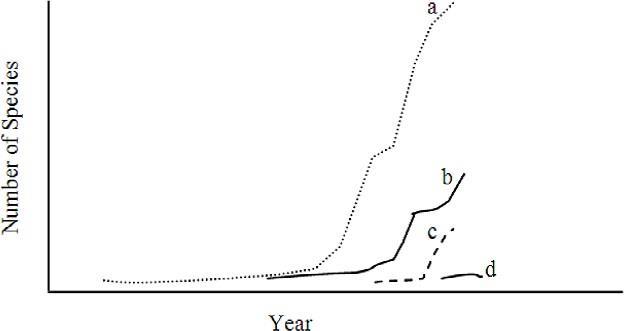
721.1) In the graph, which of the populations first began to show pesticide resistance?
A) A
B) B
C) C
D) D
E) It is impossible to answer the question with the provided data.
721.2) Looking at the graph and given what you know about pesticide resistance, what do you think will probably happen to curve "b" in the future?
A) It will level off.
B) It will continue to increase.
C) It will decrease.
D) It will increase a small amount, and then level off.
E) It is impossible to answer the question with the provided data.
722) When a new pesticide is developed the best thing to do is to use it
A) sparingly, so pests will not develop a resistance.
B) widely and liberally to knock out pests.
C) widely and liberally, so pests will not develop a resistance.
D) liberally then sparingly to prevent resistance and knock out pests.
E) sparingly then liberally to prevent resistance and knock out pests.
723) Why are pest predator populations so adversely affected by broad-spectrum pesticides?
A) In general, predators are more susceptible to the pesticides.
B) There is less food for the predators when the pest species is destroyed.
C) Predators in higher trophic levels are more likely to be wiped out than lower trophic levels.
D) Broad-spectrum pesticides leave more residues than other pesticides and kill the predators.
E) Predator populations are not more likely to be adversely affected.
724) When pesticide residues are found in such remote areas as the St. Lawrence estuary, which of the following is probably NOT responsible?
A) bioaccumulation
B) pesticide persistence
C) the grasshopper effect
D) bioaccumulation and pesticide persistence
E) All of these could be responsible.
725) The process that happens when pesticide residues evaporate from soil and water in warm areas, and then condense in and precipitate in colder regions is called
A) bioaccumulation.
B) pesticide rain.
C) the grasshopper effect.
D) pesticide persistence and mobility.
E) the pesticide treadmill.
726) Organic pollutants called are showing up in many different places worldwide, far from their original source. This has led to a widespread movement to .
A) persistent organic pollutants; ban twelve of them in developed countries
B) mobile organic pollutants; ban twelve of them worldwide
C) persistent organic pollutants; reduce the use of twelve of them
D) mobile organic pollutants; reduce the use of twelve of them
E) persistent organic pollutants; make them less persistent
727) Which of the following can be a chronic effect of pesticides on humans?
A) cancer
B) fetal deformities
C) immune system problems
D) parkinson's disease
E) All of these are correct.
728) In developing countries, the farm workers who account for the majority of illness and death from the most toxic agricultural chemicals are usually the workers who
A) use machines to harvest grains.
B) transport the chemicals.
C) handpick fruits and vegetables.
D) plow the fields because the pesticide residues are in the dust that can be inhaled.
729) Behavioral changes as an alternative to current pesticide use would NOT include
A) switching from monoculture fields to mixed polyculture fields.
B) rotating crops.
C) flooding fields before planting.
D) habitat diversification.
E) switch to a herbicide tolerant GMO crop.
730) Knowledge of the life cycle of an insect population enables biological controls to be used in place of current pesticide use. An example includes the use of Bacillus thuringiensis (Bt) which effects of moths and butterflies.
A) all stages
B) the larval stage
C) the pupa stage
D) the eggs
E) the larval and pupa stages
731) Which of the following alternative methods is NOT helpful in reducing your exposure to pesticides?
A) Accept slightly blemished fruits and vegetables.
B) Purchase praying mantises and ladybugs to protect garden plants.
C) Use only natural chemicals as pesticides.
D) Wash aphid-infested vegetation with pure water.
E) Keep wood piles away from the outside of the house.
732) With respect to chemical pest controls, integrated pest management (IPM) uses
A) none
B) the maximum amount as determined by economic thresholds
C) broad-spectrum products
D) the minimum amount necessary as a last resort
E) the maximum amount as determined by organic standards
733) In order to institute an integrated pest management program, it is necessary to
A) have large amount of money.
B) use large amount of space.
C) have many different kinds of crops.
D) burn all fields to eliminate biological elements.
E) understand local plants and animals.
734) Which of the following things that you can do to reduce pesticide residues in your diet is related to bioaccumulation?
A) Peel fruits and vegetables when possible.
B) Trim the fat from meat, chicken, and fish.
C) Cook foods that you think have been exposed to chemicals.
D) Ask for organically grown produce at a farmer's market.
E) All of these are related to bioaccumulation.
735) Pesticides based on a naturally occurring microbial toxin rupture the digestive tract lining of beetles and caterpillars.
⊚ true
⊚ false
736) Children are more susceptible to pesticides because they spend more time in direct contact with places that pesticides may accumulate (e.g., carpet, grass, etc.).
⊚ true
⊚ false
737) Some plants make natural pesticides and insect repellants.
⊚ true
⊚ false
738) Economic thresholds are not considered in integrated pest management.
⊚ true
⊚ false
739) Pesticides used in food production are regulated in the U.S. entirely by the Food and Drug Administration.
⊚ true
⊚ false
740) Terracing is more sustainable than conventional farming, but is also more expensive.
⊚ true
⊚ false
741) Compare and contrast industrial farming with organic farming in terms of food production and pesticide use.
742) You have decided that you want to reduce the amount of pesticides you encounter. List and describe at least ten actions that you can take to reduce your exposure to pesticides.
743) What’s the term used to describe soil that has clay, silt, and sand?
A) loam
B) dirt
C) silty clay loam
D) sandy clay loam
E) topsoil
744) This component of soil is important for making nutrients available to plants.
A) bacteria, algae, and fungi
B) subsoil
C) water
D) air
E) organic matter
745) Soil color and texture are important for recognizing soils good for farming. Which of the following would be a soil richer in organic material and nutrients?
A) deep black soils
B) reddish soils
C) hard clay soil
D) soft, sandy soil
E) red clay
746) Good farming soils have a thick
A) A horizon.
B) O horizon.
C) E horizon.
D) subsoil.
E) eluviated layer.
747) How much of the earth’s land is currently in crop production?
A) 11%
B) 30%
C) 1%
D) 50%
E) 80%
748) To reduce carbon losses in soil, which of the following management practices could be used?
A) no tillage
B) improved grazing land management
C) cover crops
D) addition of compost
749) To increase carbon inputs AND reduce carbon losses in soil, which of the following management practices could be used?
A) no tillage or conservation tillage
B) adding manure or compost
C) rewetting organic soils
D) cover crops
E) increased residue retention
750) You walk into a field and see rows of soybean plants. Upon closer inspection, you see the remains of the corn stalks from a previous crop. What techniques are practiced on this farm?
A) no-till and crop rotation
B) crop rotation
C) cover cropping
D) terracing
E) contour plowing
751) Glyphosate is
A) a herbicide.
B) an insecticide.
C) a fungicide.
D) an antibiotic.
752) Pesticide resistance varieties in weeds and other pests have increased from near 0 in 1950 to
A) over 350 in 2010.
B) over 100 in 2010.
C) over 100 in 1970.
D) over 200 in 1990.
753) It is possible to simulate in a flower pot. If a plant is overwatered, the salts in the water can build up in the flower pot. The roots of some plants are very sensitive to build up of salts, which can impact their growth or kill the plant.
A) salinization
B) leaching
C) runoff
D) dust bowls
Answer Key
Test name: chapter 10
1) A 2) D 3) C 4) C 5) A 6) TRUE 7) TRUE 8) TRUE 9) TRUE 10) D 11) D 12) D 13) C 14) E 15) A 16) FALSE 17) FALSE 18) D 19) A 20) B 21) A 22) E 23) C 24) D 25) C 26) E 27) E 28) A 29) A 30) B
31) E 32) C 33) C 34) B
35) E 36) B 37) C
38) B
39) B
40) E
41) D 42) D 43) B
44) C 45) E 46) B
47) E
48) B 49) A
50) D 51) A
52) B 53) B 54) B 55) C 56) C
57) B 58) E 59) B 60) D
61) B 62) C 63) B 64) A 65) C 66) B 67) A
68) A 69) D
70) B
71) C
72) E
73) E
74) D
75) B
76) A
77) E
78) Section Break
78.1) A
78.2) B
79) A
80) C
81) E
82) C
83) A
84) E
85) C
86) E
87) B
88) C
89) D
90) E
91) B
92) TRUE 93) TRUE 94) TRUE 95) FALSE 96) FALSE 97) TRUE
98) Essay
Industrial farming produces very large amount of foods—in fact more than enough to feed the world's population (if distributed evenly).
However, a large amount of this food goes to waste. The use of pesticides in industrial farming is very high and this results in many environmental problems—Poisoning nontarget species, including beneficial predators, pesticide resistance, reproductive problems in nontarget species, persistence and mobility all can affect humans and animals thousands of miles away. Pesticides are also responsible for a myriad of human health problems. Organic farming does not result in as great a yield as industrial.
However, it is much more eco-friendly. It leaves the soil in much better condition and since prices paid for organic products are higher than conventional, net returns are typically higher with organic crops. Since no pesticides are used, there are no negative health effects or other negative impacts associated with this type of farming.
99) Essay
Should include at least some of the following but may include others.
2. buy organic should contain no pesticides
3. wash and scrub all fresh fruits and vegetables to remove residues
4. peel fruits and vegetables when possible to remove all traces of pesticides
5. throw away the outer leaves of leafy vegetables to remove highest concentration of pesticides
6. store food carefully to avoid mold or bacterial growth these organisms can produce their own toxins
7. cook foods that you suspect have pesticides to break down residues
8. trim the fat from meat, chicken, and fish fat contains the highest concentrations of pesticides
9. reduce the amount of meat in your diet to reduce your pesticide intake
10. don't pick and eat wild berries that may have been sprayed it's better to be safe wash them first
11. grow your own fruits and vegetables then you know exactly where the food came from!
100) A 101) A 102) A 103) A 104) A 105) A 106) A 107) A 108) A 109) A 110) A Student name:
754) The phylogenetic species concept holds that the definition of a species should be
A) based on reproductive compatibility.
B) based on branching relationships among species.
C) based on evolutionary relationships.
D) variable depending on the type of organism.
755) The greatest number of known living species are
A) insects.
B) bacteria.
C) algae.
D) mites, ticks, and spiders.
756) What do bacteria, fox glove, Mexican yam, and the rauwolfia plant have in common?
A) They all grow in the same tropical ecosystem.
B) They all have been discovered by biologists in the last 25 years.
C) They all are wild species providing us with important medicines.
D) They all have exciting possibilities for use as human food.
757) Species extinction
A) is a relatively recent phenomenon.
B) is linked exclusively to expanding human activities.
C) has been the fate of the vast majority of species that have inhabited the earth.
D) only happens with large animals.
758) Species at imminent risk of extinction are classified as species.
A) vulnerable
B) endangered
C) threatened
759) The goal of the Endangered Species Act is to protect
A) broad categories of ecosystems.
B) key species which are particularly important for normal ecosystem function.
C) all species, regardless of their direct usefulness to humans.
D) species providing commodities important to humans.
760) What do Eurasian milfoil, kudzu vine and the emerald ash borer have in common?
A) They are all in danger of extinction in their native habitats.
B) They offer exciting prospects as potential sources of new drugs.
C) They are exotic species wreaking havoc in the ecosystems into which they have been introduced.
D) They offer promise as agents of biological control for pest species.
761) Because prairie dogs have a major effect on the ecological functioning of their habitat and the health of other members of their community, they are considered to be
A) an indicator species.
B) an umbrella species.
C) a keystone species.
D) a flagship species.
762) DNA sequencing technology has improved biologists ability to understand ancestral relationships among different kinds of life.
⊚ true
⊚ false
763) Humans have domesticated nearly all the plant species that could contribute to human food production.
⊚ true
⊚ false
764) A wide diversity of living things provide a range of intrinsic benefits to humans.
⊚ true
⊚ false
765) Exotic species introductions have had a significant impact on biodiversity.
⊚ true
⊚ false
766) Ecological diversity
A) refers to the richness and complexity of a biological community.
B) is more important to conservation than genetic diversity.
C) refers to the various types of ecosystems on earth.
D) refers to the different kinds of species present in an ecosystem.
767) Biodiversity Hot Spots
A) are not impacted by habitat loss because they are so important.
B) account for less than 2 percent of the world’s land mass, yet comprise 75 percent of the world's threatened animals.
C) are found only in tropical ecosystems.
768) The most important extinction threats for most species are anthropogenic environmental pollutants and over-harvesting via hunting and fishing.
⊚ true
⊚ false
769) Invasive species
A) flourish in a new environment due to a lack of predators, diseases, or resource limitations.
B) are easily controlled.
C) rarely invade islands because of their comparative isolation.
D) are only plants and animals.
770) Flagship species
A) are especially interesting and attractive and are used by conservation organizations to motivate people.
B) is a term that refers to the largest species of a community.
C) are species whose presence is tied to specific environmental conditions.
771) When Aldo Leopold said, "The first rule to intelligent tinkering is to save all the pieces." In terms of biodiversity he meant that we should
A) save records of all species that have disappeared.
B) not interfere with the disappearance of species.
C) not cause species to disappear.
D) not interfere with nature.
E) Aldo Leopold did not intend to have this statement applied to biodiversity.
772) We are usually referring to species diversity when we talk about biodiversity. However, genetic diversity is also important to ecological systems because diverse genes
A) increase the efficiency and productivity of a system because all niches are filled.
B) allow an individual organism to adapt to its changing environment.
C) are necessary for a population to evolve in a changing environment.
D) lead to diverse ecological processes in a biological community.
E) are important for a balanced ecosystem.
773) Ecological diversity is a measure of the number of
A) different kinds of organisms within a community or ecosystem.
B) different versions of the same gene in an ecological community.
C) sizes, colors, and shapes of organisms within an ecological community.
D) niches, trophic levels, and ecological processes of a biological community.
E) different species in an ecosystem.
774) Use the following scenario:
There are three ecological communities, each with differing species, but all of them have 100 individual plants and animals.
Community A has 21 species. Of the 110 individuals, there are 50 individuals of one species and 3 each of the other 20 species.
Community B has 11 species. Of the 110 individuals, there are 90 individuals of one species and 2 each of the other 10 species.
Community C has 11 species. Of the 110 individuals, there are 10 individuals of each species.
774.1) In this scenario, which community has the highest species richness?
A) Community A
B) Community B
C) Community C
D) Community A and C are the same.
E) Community A and B are the same.
774.2) In this scenario, which communities have the same species evenness?
A) Community A and C
B) Community B and A
C) Community C and B
D) All three communities have the same species evenness.
E) None of the communities has the same species evenness.
774.3) In this scenario, which communities have the same species richness?
A) Community A and B
B) Community A and C
C) Community B and C
D) All three communities have the same species richness.
E) None of the communities has the same species richness.
775) Use the following scenario:
Your friend is upset because his conception of what a species has been challenged. His professor told him that there are some problems associated with the common way that a species is identified. Your friend learned what a species was while in high school and it was reinforced during his first year in college. He also refers to the third chapter in your environmental science book for this definition. Your friend wonders if this professor knows what she is talking about. You explain to him that there really are some problems associated with the common way that a species is defined and you think that this professor is correct.
775.1) The common way that a species is defined in biology (the way it is defined in Chapter 3) is in terms of reproductive isolation. This means that all organisms that are similar enough to
A) produce fertile offspring in nature.
B) look alike.
C) fill the same niche.
D) occupy the same community.
E) live together.
775.2) You also mentioned to your friend that a new tool, DNA sequencing technology, is radically changing the way species are identified. In fact, some groups that were originally thought to be far apart now seem to be closely related. Which of the following statements does not reflect the implications of using this new tool?
A) This tool will end the debate of what is or is not a species.
B) This tool allows us to see how closely related species are in terms of their genetics.
C) This tool helps us better understand molecular evolution.
D) This tool helps us better understand how species actually originate.
E) This tool helps us judge genetic diversity.
776) Approximately how many species have been identified on Earth?
A) about 500,000
B) a little less than 1 million
C) a little more than 1.7 million
D) a little more than 3 million
E) about 30 million
777) Where will you find the greatest concentration of different species?
A) the tropics
B) the poles
C) Siberia
D) Europe
778) What percentage of known species are invertebrates?
A) 25%
B) 40%
C) 70%
D) 90%
779) The total number of living species is probably
A) about 450,000
B) between 500,000 and 1 million
C) between 3 million and 50 million
D) between 75 and 95 million
E) at least 300 million
780) Most of the species that are yet undiscovered are probably
A) mammals and reptiles
B) birds and fish
C) vertebrates
D) invertebrates
E) multicellular plants
781) One of the reasons humans rely heavily on only a few food crops is because
A) we have not explored the cultivation of thousands of edible wild species.
B) there are few edible wild species.
C) we have already focused on the best tasting species for domestication and cultivation.
D) it would be difficult for small farmers to cultivate the fragile wild species.
E) All of these factors contribute to a heavy reliance on only a few species.
782) Which of the following drugs is NOT derived from a naturally occurring organism?
A) penicillin
B) aspirin
C) cortisone
D) morphine
E) tetracycline
783) An important drug for treating Hodgkin's disease was discovered in a periwinkle native to and is valued at approximately per year.
A) Madagascar; $150–300 million
B) New Guinea; $1–15 million
C) Costa Rica; $15 million
D) Greenland; $200 million
E) Sri Lanka; $150 million
784) Which of the following is NOT a benefit of biodiversity for humans?
A) aesthetics
B) ecological services
C) food
D) drugs and medicines
E) reducing air pollution
785) The pharmaceutical industry has an interest in preventing species extinction because
A) people are healthier in a healthy environment.
B) undiscovered species may provide lucrative new drugs.
C) most taxonomists are drug makers.
D) it wants to increase diversity in North America.
E) they see the benefits of eco-design.
786) Soil formation and water purification are examples of based on the biodiversity that benefit humans.
A) aesthetic benefits
B) geological cycles
C) availability of food
D) health benefits
E) ecological services
787) Extinction is the term used when all members of a species
A) disappear in a locality.
B) die.
C) live in zoos.
D) are threatened with imminent habitat loss.
E) are in danger of disappearing in a locality.
788) Which of the following statements is true?
A) Humans may have been causing extinctions for thousands of years, but our impact has recently increased.
B) Humans are responsible for many of the mass extinctions in the geologic record.
C) Humans only began causing extinctions in the past 150 years.
D) Humans have never had significant impact on species extinctions until the past four decades.
789) The largest contributing factor for the current high rate of animal extinctions is
A) uncontrolled sport hunting in the developed world.
B) commercial harvesting of wildlife in Africa.
C) drought conditions caused by the greenhouse effect.
D) habitat destruction worldwide.
E) None of these by themselves cause high rates of animal extinctions, but together they combine to cause high rates.
790) The acronym that stands for habitat destruction, invasive species, pollution, human population, and overharvesting is
A) HIPHO.
B) HDIAPHPO.
C) HIPPO.
D) DIPPS.
E) None of these.
791) Barred owls have become a threat to spotted owls because they
A) are smaller.
B) have fewer predators.
C) are more versatile in terms of habitat and diet.
D) eat spotted owls.
E) feed during the day.
792) "Exotic" is another word for
A) tropical.
B) foreign.
C) rare.
D) beautiful.
E) desirable.
793) Which of the following would be a characteristic of an exotic plant species?
A) produces a few seeds after many years to reach maturity.
B) is a specialist, for example, has a low range of tolerance for soil acidity.
C) is an opportunist that is desired by humans for food or ornamental value.
D) has many predators and diseases.
E) is a secondary consumer (trophic levels).
794) Habitat fragmentation usually leads to a(n)
A) decrease in biodiversity.
B) reduction in the number of introduced species.
C) increase in biodiversity due to the isolated populations.
D) more stable environment.
795) What makes an exotic species become an invasive species?
A) when individuals begin to colonize new areas and out-compete native species.
B) when they become annoying to people.
C) all exotic species are also invasive.
D) when individuals stop being only ornamental but are used for other purposes also.
796) Invasive (exotic) species tend to the balance of ecosystems and biodiversity.
A) increase; decrease
B) increase; enhance
C) maintain; enhance
D) upset; decrease
E) upset; increase
797) Carp species were introduced to the United States
A) as a food source.
B) to control aquatic vegetation and algae.
C) to increase angling opportunities.
D) from Africa.
E) for increased food production.
798) Introduced disease-causing organisms are especially dangerous to new environments because they can destroy the non-native host. This happens because the disease-causing organisms
A) have not evolved with this host to achieve the normal balance for long-term survival.
B) are opportunists and in order to survive must out-compete all other species.
C) are specialists and destroy the individual organisms that have not developed resistance.
D) do not have natural predators.
E) are generalists and highly competitive.
799) Which of the following is an example of a natural cause of extinction?
A) freshwater Great Lakes mussels that compete with the Zebra Mussel
B) genetic assimilation as in the case of the hybridization of gray wolves or black ducks with mallards
C) the passenger pigeon that went extinct at the beginning of this century
D) an insect species in the tropical forest that cannot escape predation by native bird species in the forest
E) All of these are examples of a natural cause of extinction
800) It is clear that a heavy dose of pesticides or other toxic pollutants can kill species. However, chronic exposure to pollutants seems to cause recent high mortality in marine mammals by
A) decreasing the plants that are normally in their environment, such as kelp, that they use for shelter.
B) killing off the prey species that they depend on for food.
C) direct bioaccumulation of the chemicals, such as lead, in their tissues.
D) causing weakened immune systems and increased vulnerability to infection.
E) eventually killing them.
801) The U.S. Army participated in extermination of the American bison during the mid-1800s because
A) the Army desperately needed meat.
B) the United States wanted the Great Plains free for agriculture.
C) the Army needed leather for shoes.
D) native people depended on the bison for food and shelter.
E) None of these, the U.S. Army did not participate in extermination of the American bison.
802) The high rate of poaching of rhinoceros is due mostly to
A) the belief in medicinal value of their horns for 'traditional' medicines.
B) overharvesting for their meat and hide.
C) introduction of exotic species that compete for their food.
D) habitat destruction.
E) All of these have contributed equally to the decrease in the rhinoceros population.
803) The main reason for continued trade in endangered species is
A) a surplus of these species in their home countries.
B) ruthless traders and collectors in tropical countries.
C) the need for international capital exchange in developing countries.
D) pet lovers and collectors who like exotic species.
E) the presence of poachers in tropical countries.
804) Which of the following statements about trade in endangered species is FALSE?
A) The principal importers of endangered species are developed countries.
B) Coral reefs are not affected by the endangered species trade.
C) People who say they are animal lovers are the main contributors to the trade.
D) The principal exporters of endangered species are developing countries.
E) Up to 60 percent of birds die before reaching market.
805) Which of the following fish is safe and environmentally friendly to eat?
A) swordfish
B) wild salmon
C) albacore tuna
D) yellowfin tuna
E) haddock
806) If you have an aquarium with saltwater fish, 75 percent of your fish probably came from
A) captive breeding programs in the United States.
B) captive breeding programs in Indonesia or the Philippines.
C) wild fish populations caught with cyanide or nets.
D) aquaculture programs in South Pacific countries.
E) hybrid crosses of native U.S. fish.
807) A species in imminent danger of extinction is classified by the U.S. Endangered Species Act as
A) vulnerable.
B) threatened.
C) valuable.
D) endangered.
E) at risk.
808) A species that is naturally rare or that has been depleted to dangerous levels is known, according to the Endangered Species Act, as a(n) species.
A) endangered
B) threatened
C) unusual
D) vulnerable
E) at risk
809) A threatened species may be extinct or near extinction
A) already.
B) in the near future.
C) in certain localities.
D) only in the distant future.
E) in most of their natural range.
810) The main reason that there are relatively few invertebrates categorized as endangered species is because
A) we consider other groups, such as mammals, to be more interesting and desirable.
B) worldwide, there are relatively few invertebrates when compared to plants.
C) it is extremely difficult to identify and count invertebrates.
D) since there are 532 invertebrates considered endangered, none of these is true.
E) invertebrates are more numerous and the relative percentages are similar.
811) The objective of a species recovery plan is to
A) interbreed threatened species with common species.
B) increase an endangered species population until it is no longer endangered.
C) invest corporate capital in species maintenance.
D) study the species for a better understanding of its role in the biological community.
E) protect the species to aid other organisms and resources in the ecosystem.
812) In general, funding for recovery programs is given to species that are A) in most danger.
B) most important.
C) most well-known.
D) most numerous.
E) keystone species.
813) The U.S. Endangered Species Act officially expired in A) 1973.
B) 1950.
C) 1988.
D) 1905.
E) 1992.
814) Conservationists and wildlife managers use gap analysis to
A) predict the next evolutionary change an organism will undergo.
B) find unprotected landscapes that are rich in species.
C) bring different managing agencies into closer accord.
D) isolate and contain populations.
E) establish connecting corridors.
815) Which of the following isFALSE regarding CITES?
A) When implemented properly it has provided foolproof protections of endangered species.
B) It is an international organization.
C) It lists more than 700 species as threatened with extinction.
D) It was formed in 1975.
E) All of these are true.
816) Species diversity in a community is an important factor in ecological resilience after a drought.
⊚ true
⊚ false
817) Most of the tallgrass prairies in the United States remain untouched.
⊚ true ⊚ false
818) Kudzu vine was originally brought to the United States to control soil erosion.
true
⊚ false
819) Island ecosystems are extremely susceptible to invasive species. ⊚ true ⊚ false
820) Zoo animals in the United States today come mainly from the wild. ⊚ true ⊚ false
821) Using specific examples, discuss four ways that humans benefit from biodiversity.
822) Name at least three invasive species that live in your area. What are some of the problems they are causing? Is anything being done to control these species?
823) Kudzu was introduced to the southeastern United States to control erosion. However, it quickly spread away from where it was planted. It takes over very large areas of land and native habitats. This represents what part of HIPPO?
A) invasive species
B) habitat destruction
C) pollution
D) human population growth
E) overharvesting
824) In urban development, wetlands have been drained to create land for development. This represents what part of HIPPO?
A) invasive species
B) habitat destruction
C) pollution
D) human population growth
E) overharvesting
825) The oyster population in the Chesapeake Bay is about 1% of its historical levels. This represents what part of HIPPO?
A) invasive species
B) habitat destruction
C) pollution
D) human population growth
E) overharvesting
826) Some macroinvertebrates like mayflies are sensitive to pollution or low dissolved oxygen. If these organisms are present, then the stream can be considered a healthy stream. Mayflies would be considered a/an
A) indicator species.
B) keystone species.
C) umbrella species.
D) flagship species.
827) Bald eagles invoke a feeling of patriotism as the national bird of the United States. This caused people to want to preserve this species. The bald eagle would be considered a/an
A) flagship species.
B) keystone species.
C) indicator species.
D) umbrella species.
828) The existence value of a species is most similar to the ideas of
A) biocentric preservation.
B) utilitarian conservation.
C) modern environmentalism.
D) social justice.
E) sustainable development.
829) A scientist uncovered that the gene pool within a population of animals is much smaller after a near-extinction event. This scientist is studying
A) genetic diversity.
B) species diversity.
C) ecological diversity.
D) phylogenetic species concept.
E) reproductive isolation.
830) There have been _ major extinction events before now. The most recent before the possible present-day extinction event was years ago.
A) five, 63 million
B) two, 63 million
C) five, 250 million
D) four, 500 million
E) five, 20 million
831) Which is the most common of the HIPPO factors?
A) habitat loss
B) pollution
C) human population growth
D) invasive species
E) overharvesting
832) Your friend is a scientist studying a small endangered fish that plays a critical role in the stream ecosystem. She says to you, “If this fish was pretty, well-known, or a national symbol we might actually get people to care about it.” Your friend means that this fish is not a/an
A) flagship species.
B) umbrella species.
C) indicator species.
D) keystone species.
833) The Red wolf has a large home range requirement. To support a population of red wolves requires protecting a large amount of habitat, which also benefits many other species. The red wolf is an example of a/an
A) umbrella species
B) indicator species
C) flagship species
D) keystone species
834) A group of citizen scientists are trained to measure the health of the local streams. One of the components of their job is to determine the presence or absence of some indicator species. Why is this an important dataset?
A) These species will be in low numbers or absent if the stream is polluted.
B) These species control the food chain so it will determine if the fish are healthy.
C) These are charismatic species, which will receive more support from the public.
D) These are species that if present will mean that more stream will be conserved, thus protecting even more species.
Answer Key
Test name: chapter 11
1) B 2) A 3) C 4) C 5) B 6) C 7) C 8) C 9) TRUE 10) FALSE 11) TRUE 12) TRUE 13) A 14) B 15) FALSE 16) A 17) A 18) C 19) C
20) D
21) Section Break
21.1) A
21.2) E
21.3) C
22) Section Break
22.1) A
22.2) A
23) C
24) A 25) C
26) C
27) D
28) A 29) B
30) A
31) E
32) B
33) E 34) B 35) A
36) D 37) C 38) C 39) B 40) C 41) A 42) A 43) D 44) B 45) A 46) D 47) D 48) D 49) A 50) D 51) B
52) B 53) C 54) D 55) D
56) B 57) A 58) B 59) C 60) E 61) B 62) A 63) TRUE 64) FALSE 65) TRUE 66) TRUE 67) FALSE 68) Essay
Should include some of the following, but may include others as well.
2. We have a large variety of food sources to choose from all types of grains, starches, fruits, vegetables, seafood, and meat.
3. Pollinators provide us with many of our food sources, so they are also extremely important. They include birds, insects, and bats.
4. Bacteria and fungi provide us with many antibiotics.
5. Bacteria and fungi are also very beneficial as decomposers cycling of nutrients.
6. Many plants have provided us with numerous drugs used to treat all types of diseases and illnesses. There are many discovered and undiscovered plants that may have medicinal potential.
7. Organisms provide us with ecological services that are invaluable to us things like soil formation, water purification, production of oxygen, etc.
8. Organisms provide us with the opportunity for recreation camping in a forest, fishing, horseback riding, etc.
9. Biodiversity can be economically beneficial. Many countries are now turning to ecotourism making income by maintaining the natural environment for visitors to enjoy.
69) Essay Will vary depending upon the region you live in. 70) A
B
E
A
A
A
A
A
A
A
A
A
Student name:
835) The term refers to the practice of eliminating a country's national debt if it agrees to protect or restore areas of biological significance.
A) mitigation
B) sloss
C) debt-for-nature swap
D) ecosystem services
836) Road building in forests can lead to fragmentation as well as erosion.
⊚ true
⊚ false
837) The chief cause of desertification is clear-cutting of old growth forests.
⊚ true
⊚ false
838) Fuelwood accounts for nearly half of global wood consumption.
⊚ true
⊚ false
839) Which of the following is the branch of science that focuses on relationships between large scale spatial patterns and ecological processes?
A) population ecology
B) landscape ecology
C) restorative ecology
D) forest ecology
840) Preserve managers use natural habitat corridors to allow movement of species from one area to another.
⊚ true
⊚ false
841) The encourages the division of protected areas into zones with different purposes and levels of human impact.
A) Man and Biosphere Program
B) Biosphere Reserve
C) Chipko Andolan Movement
D) IUCN World Conservation Strategy
842) Developed countries like the United States produce less than half of the world's industrial wood but consume about percent.
A) 36
B) 49
C) 65
D) 80
E) 95
843) The disadvantages of monoculture forestry include all of the following except
A) it is slow growing.
B) it supports little biodiversity.
C) it doesn't prevent soil erosion very well.
D) it provides limited production of clean water.
844) What percentage of the world's forests is under some level of protection?
A) 8
B) 12
C) 26
D) 37
E) 42
845) A promising approach to encourage conservation and preservation in developing countries is
A) utilitarian conservation.
B) biocentric preservation.
C) ecosystem management.
D) debt-for-nature swaps.
E) pastoralism.
846) Infestation by beetles in the United States and Canada has led to millions of dead trees which represent a substantial fire danger.
⊚ true
⊚ false
847) Fire prevention efforts have actually increased the chances of very big fires by allowing fuel to accumulate.
⊚ true
⊚ false
848) The cost of maintaining public rangelands for grazing in the US is about $47 million. The sale of grazing permits on public lands amounts to
A) $11 million.
B) $36 million.
C) $48 million.
D) $58 million.
E) $83 million.
849) Scientists have found that the number of organisms in marine refuges that do not allow fishing is not appreciably different from surrounding areas where fishing is allowed.
⊚ true
⊚ false
850) "Paper parks" are frequently found in the developing world. Which of the following are characteristic of these?
A) They are managed to extract wood for pulp and paper production.
B) There is little in the way of infrastructure or enforcement of rules.
C) They are designed for ecotourism, rather than conservation or sustainability.
D) They are managed for hunting and collection of resources.
851) Habitat corridors
A) effectively create a large reserve out of small ones.
B) do not help maintain genetic diversity.
C) only work when there are large populations.
852) The term "old-growth forest" refers to any tract of land in which a majority of the trees are over 100 years old.
⊚ true
⊚ false
853) The world's largest tropical forest is in
A) Southeast Asia.
B) South America.
C) Africa.
D) India.
854) "Closed canopy" forests are those in which tree crowns
A) include all sizes of trees.
B) crowd out smaller vegetation.
C) cover about 20 percent of the ground surface.
D) cover most of the ground.
E) cover less than 10 percent of the ground surface.
855) The world land use pie graph shown here lets you know
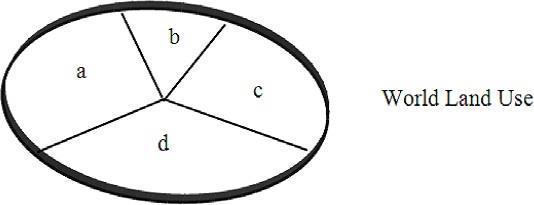
A) how many hectares are devoted to each type of land use.
B) approximately what proportion of earth's land surface is used in each of the four ways.
C) the relative amounts of land use for different parts of the world.
D) precisely what percentage of land uses exist.
E) approximately what proportion of the earth's biomes are used in each of the four ways.
856) The main difference in wood products produced in the United States compared to those in China, is that .
A) China's wood comes from deforestation, whereas U.S. products come from managed tree farms.
B) The U.S.' wood comes from deforestation, whereas Chinese products come from managed tree farms.
C) China only produces pulp wood products, whereas the United States produces wood for building supplies.
D) The United States only produces pulp wood products, whereas China produces wood for building supplies.
857) , , and are the largest producers of both paper pulp and industrial wood.
A) Costa Rica; Ecuador; Mexico
B) Canada; Europe; the United Kingdom
C) Brazil; Africa; Southeast Asia
D) Russia; Canada; the United States
E) Europe; Russia; Central Africa
858) Which of the following statements about old-growth forests is true?
A) Humans do not reside in old-growth forests.
B) Old-growth forests have been without disturbance of any kind for at least 100 years.
C) The largest remaining areas of old-growth forests are in North America.
D) They include temperate rainforests, tropical rainforests, boreal forests, and deciduous forests.
E) None of the above is true.
859) Developed countries produce of all industrial wood and account for of its consumption.
A) more than half; less than half
B) less than half; about 80%
C) more than half; about 80%
D) less than half; about half
E) less than half; about 20%
860) On a global scale, fuelwood harvests
A) make up about half of all wood harvests.
B) make up only 1% of industrial timber harvests.
C) are far greater than industrial timber harvests.
D) make up about 10% of all wood harvests.
E) are mainly in developed countries.
861) Although most of the world's forests are shrinking, biologists are especially concerned about tropical forest loss because
A) they contain such high biodiversity.
B) tropical trees are the biggest trees in the world.
C) they contain irreplaceable wood resources.
D) there are fewer remaining tropical forests than any other forest type.
E) All of these are reasons that biologists are especially concerned about tropical forest loss.
862) What does REDD stand for?
A) Reducing Emissions from Deforestation and forest Degradation
B) Reducing Emissions from Deforestation and Dust
C) Reducing Exploitation from Deforestation and forest Degredation
D) Removing Emissions from Deforestation and Degradation
863) Economically, monoculture forestry is advantageous because
A) it produces large quantities of a single type of tree for a particular use, such as building timber or paper pulp.
B) it is labor-intensive and thus increases job opportunities for local people.
C) high levels of pesticides and herbicides may be needed; therefore, more money is spent and is in the system.
D) the increase in wildlife diversity is beneficial to the tourism industry.
E) a mix of the different trees leads to a good resource base if the market for one type of timber falls.
864) When fuelwood demand exceeds supplies,
A) forest regeneration becomes more difficult.
B) fewer people rely on fuelwood.
C) closed canopy forests are greatly threatened.
D) agricultural land usually improves and expands.
E) technology for alternative ways of cooking improves dramatically.
865) "Forest management" means planning for
A) gaining maximum, quick profit from trees.
B) sustainable harvests and forest regeneration.
C) a continual increase in forest complexity.
D) building the maximum biodiversity in a forest.
E) old-growth status in the managed forests.
866) After losing nearly all its trees in World War II, South Korea is now
A) beginning to plan replanting.
B) nearly 10% reforested.
C) about 70% reforested.
D) an eroded wasteland.
E) under tremendous pressure for fuelwood harvests.
867) A disadvantage of monoculture forestry is that it is
A) difficult to harvest with clear-cut methods.
B) deficient in providing ecological services.
C) difficult to replant.
D) economically inefficient.
E) more time-consuming to replant.
868) Monoculture forestry involves
A) harvesting a single type of tree in the forest and then using the land for agriculture.
B) multiple-species plantations whose trees are highly resistant to disease.
C) single-species tree plantations that are efficient but offer little biodiversity.
D) harvesting only a single type of tree in the forest that is especially useful.
E) harvesting a single type of tree in the forest and then using the land for agriculture, and harvesting only a single type of tree in the forest that is especially useful.
869) A promising approach to encourage conservation and preservation in developing countries is
A) utilitarian conservation.
B) biocentric preservation.
C) debt-for-nature swaps.
D) ecosystem management.
E) pastoralism.
870) Satyagraha movements in India work to achieve social and environmental goals
A) by controlling national politics.
B) by force.
C) using large amounts of money.
D) through passive, peaceful methods.
E) any way that they can, depending on the context of the situation.
871) India's Chipko Andolan movement
A) saved a large portion of forests in watersheds.
B) failed to actually save any forests.
C) used children to plant trees in a reforestation project.
D) is now no longer active.
E) emphasized force to save forests in watersheds.
872) International lending institutions are willing to cooperate in debt-for-nature swaps because
A) they want to encourage indigenous lifestyles.
B) they do not really expect to recover much of their loans.
C) they are concerned about the greenhouse effect.
D) the size of the loans is negligible.
E) they are attempting to support green business.
873) Debt-for-nature swaps are beneficial mainly to
A) lending institutions.
B) governments of developing countries.
C) environmental groups.
D) All of the choices are correct.
E) None of the choices are correct.
874) Of all the old-growth forests that stood in the United States before the European settlement, how much remains today?
A) about 50%
B) about 35%
C) slightly over 25%
D) about 15%
E) less than 10%
875) Spotted owls became the subjects of national controversy in 1989 because the Forest Service was forced to
A) plant thousands of acres of new habitat.
B) limit logging to save habitat.
C) halt all mineral exploration.
D) cease issuing hunting permits.
E) build roads into forests.
876) Most commercial loggers prefer "clear-cut" harvesting because it
A) is the most environmentally sustainable type of harvest.
B) is the most efficient way to get valuable small timber without disturbing the larger early successional trees.
C) is the most efficient, cheapest harvest method using large, fast machinery instead of costly labor.
D) is the most effective way to refresh soil with sun and rain.
E) does not waste any trees.
877) Why is there a need to reeducate people about the role of fire in natural systems?
A) People are still throwing away cigarette butts that can start forest fires.
B) People who camp are not putting their campfires out causing fires in inaccessible areas.
C) People do not understand that fire is a natural part of many biological ecosystems.
D) People are well educated about fire and do not need to be reeducated.
E) People are starting fires in wilderness areas to make the area available for logging.
878) Which of the following perspectives is NOT a principle of ecosystem management?
A) managing across a region over ecological time
B) maintaining biodiversity
C) using scientific knowledge as the basis for management since science is free from bias
D) utilizing cooperative institutional arrangements
E) adapting management over time, as needed
879) What conclusions can you make from examining the graph?
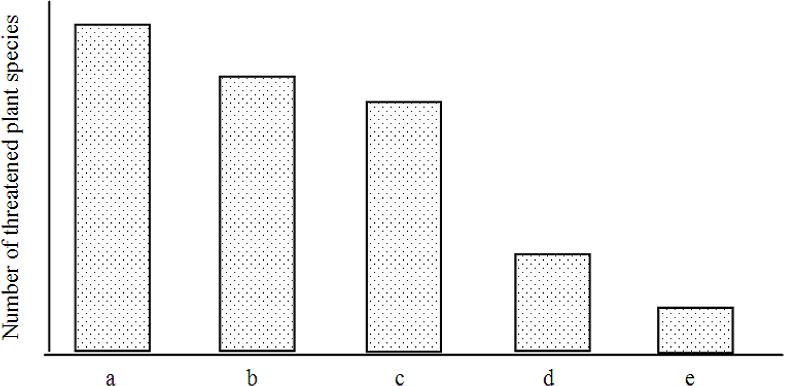
A) Ecosystem "a" has the most biodiversity.
B) Ecosystem "a" has the most threatened plant species.
C) Humans use ecosystem "a" much more than ecosystem "b".
D) Ecosystem "c" is used by humans about twice as much as ecosystem "d".
E) None of these conclusions is supported by the data.
880) Nomadic pastoralists live by
A) foraging and hunting.
B) raising seasonal crops.
C) herding grazing animals.
D) raising chickens, ducks, and pigs.
E) All of these are correct.
881) World deserts are
A) decreasing as world climate becomes wetter.
B) increasing because of the increase in global carbon dioxide.
C) increasing because of logging and grazing.
D) decreasing because of massive reforestation.
E) about the same in area but have many threatened species of plants.
882) Places MOST susceptible to desertification are
A) jungle clearings.
B) desert margins.
C) temperate deciduous forests.
D) boreal landscapes.
E) open woodlands.
883) Most public rangelands are in poor condition due to
A) excessive populations of wild ungulates.
B) overcrowding of private livestock.
C) too many publicly-owned animals on public lands.
D) excessive urban settlement in the west.
E) the lack of water.
884) Grazing fees on public lands have changed little because
A) political pressures ensure they remain low.
B) they remain at market value, so there is no reason to change them.
C) the public feels that the price is right.
D) livestock owners cannot afford higher fees.
E) political pressures ensure they remain high.
885) The first symptom of range overgrazing is usually
A) gullying.
B) the absence of trees.
C) the compaction of soils.
D) desertification.
E) the disappearance of palatable plant species.
886) Rotational grazing allows grazing livestock to
A) use the most fertile pastures continuously.
B) use a small area for a short time.
C) produce more young animals with less range.
D) depend more on domestic pastures.
E) use only the most nutritious plants in a pasture.
887) Poor people in developing countries often threaten wildlife preserves because
A) they dislike unsettled territory.
B) they need the resources to survive.
C) they enjoy sport hunting.
D) vandalism is a popular use of spare time.
E) their religion often emphasizes the action of dominating wildlife.
888) If managed carefully, ecotourism benefits natural areas by giving economic value to land and water resources
A) that have no other value.
B) that no one is interested in.
C) that never existed before.
D) without destroying them.
E) All of these are economic benefits of carefully managed ecotourism.
889) One possible solution to the problem of insufficient land area for preserves is to use to link smaller habitat areas.
A) highways
B) eco-bridges
C) edge effects
D) corridors
E) None of these is correct
890) Corridors have the potential to effectively enlarge which of the following?
A) preserve areas.
B) genetic pools.
C) feeding ranges.
D) areas of refuge against natural disasters (e.g., fire).
E) All of the above are correct.
891)891)

891.1) Which of the preserve shapes shown has the greatest interior area relative to perimeter area?
A) A
B) B
C) C
D) D
E) All of the shapes have about the same interior/perimeter measurements.
891.2) Which of the preserve shapes shown is the worst shape for a species that requires a core area?
A) A
B) B
C) C
D) D
E) All of the shapes have about the same measurements.
891.3) Which of the preserve shapes shown would support the most species that require a core area?
A) A
B) B
C) C
D) D
E) All of the shapes have about the same measurements.
892) The amount of interior area in a preserve is important because
A) humans and other hardy species encroach on preserve margins.
B) it is more economical to buy large land areas.
C) many threatened species cannot survive environmental conditions on preserve margins.
D) humans and other hardy species encroach on preserve margins and many threatened species cannot survive environmental conditions on preserve margins.
E) humans and other hardy species encroach on preserve margins, it is more economical to buy large land areas, and many threatened species cannot survive environmental conditions on preserve margins.
893) What are the most endangered aquatic areas?
A) coral reefs
B) tide pools
C) mangrove forests
D) sea mounts
894) What is the science that examines the relationship between the spatial patterns and ecological processes?
A) landscape ecology
B) conservation biology
C) systems ecology
D) biology
895) A "woodland" is an open canopy forest where tree crowns cover less than 20% of the ground.
⊚ true
⊚ false
896) A large portion of industrial timber comes from managed, replanted forests in North America and Europe.
⊚ true
⊚ false
897) The loss of forests can affect rainfall patterns.
⊚ true
⊚ false
898) Compare and contrast an old-growth (primary) forest with a tree farm.
899) Compare and contrast the preservation of the Amazon Basin and the Pantanal, both in Brazil.
900) A forest is
A) an area where trees cover more than 10% of land.
B) an area where tall trees are the most important aspect of the landscape.
C) where a closed canopy is formed by trees.
D) any land that is not grassland or desert.
E) land where native species of trees dominate the landscape.
901) Which area had a net increase of forested area between 1992 and 2015?
A) North America
B) Central America
C) South America
D) Europe
E) South-East Asia
902) Which area had the greatest percent loss of forested area between 1992 and 2015?
A) South America
B) Central America
C) South-East Asia
D) Africa
E) Asia
903) Which of the following is NOT an element of ecosystem management?
A) Do research to understand all parts of the ecosystem then make decisions to manage it.
B) Maintain biological diversity and essential ecosystem processes.
C) Adapt management over time as new information about the ecosystem comes available.
D) Manage across whole landscapes, watersheds, or regions over ecological time scales.
E) Consider human needs and promoting sustainable economic development.
904) Which of the following ranks the IUCN Categories of Protected areas in order from least to most human impact/intervention allowed?
A) wilderness area, wildlife management area, managed resource area
B) natural monument, wilderness area, recreation area
C) managed resource area, wildlife management area, wilderness area
D) recreation area, national park, wildlife management area
E) national park, recreation area, ecological reserve
905) Which of the following ranks forest type from most abundant to least abundant?
A) tropical moist forest, boreal forest, temperate forest, subtropical forest, tropical dry forest
B) tropical dry forest, subtropical forest, temperate forest, boreal forest, tropical moist forest
C) tropical moist forest, temperate forest, boreal forest, subtropical forest, tropical dry forest
D) temperate forest, tropical moist forest, boreal forest, tropical dry forest, subtropical forest
906) The SLOSS debate among conservation biologists refers to
A) determining whether reserves should be one large area of land or multiple smaller areas of land.
B) whether a reserve should have corridors to other reserves.
C) whether the core habitat should be the dominant habitat type in a reserve.
D) whether reserves should be used for human activities.
907) The Joyce Kilmer Memorial Forest in Western North Carolina is a forest that was never harvested. There are trees that are over 400 years old. This is an example of a/an
A) primary forest.
B) old forest.
C) closed-canopy forest.
D) savanna.
908) Heavy rains caused a mudslide down a hillside that had recently been harvested for lumber. The soil was exposed following the harvest making it susceptible to erosion. The type of harvest used in this area was likely
A) clearcutting.
B) shelterwood.
C) group selection.
D) single tree selective harvesting.
909) Palm oil production, which relies on cleaning native forest to plant palm, has increased the most in
A) Indonesia.
B) Thailand.
C) Malaysia.
D) Nigeria.
910) Two forests in your county have a high diversity of amphibians, and a conservation group wishes to create a reserve to protect these forest patches. Surrounding both forests is some development so they can’t be preserved in one large park. How would you recommend the conservation group think about preserving these patches?
A) Protect both patches and try to create a corridor between them for wildlife to safely move between forest patches.
B) Pick the best forest and only focus on saving that one.
C) Make each forest separate parks with no connection between them.
D) Preserve small portions of both forests and allow the rest to be developed
Answer Key
Test name: chapter 12 1) C 2) TRUE 3) FALSE 4) TRUE 5) B 6) TRUE 7) A 8) D 9) A 10) B 11) D 12) TRUE 13) TRUE 14) A 15) FALSE 16) B 17) A 18) FALSE 19) B 20) D 21) B 22) A 23) D 24) D 25) B 26) A 27) A 28) A 29) A 30) A 31) B 32) C 33) B 34) C 35) C 36) D 37) A
38) B
39) D
40) E
41) B 42) C 43) C
44) C 45) B 46) C
47) C
48) B 49) B
50) A 51) E
52) B 53) B
54) D 55) D 56) E
57) Section Break 57.1) C
57.2) B
57.3) C
58) D 59) A 60) A 61) TRUE 62) TRUE 63) TRUE 64) Essay
Old growth forests have the following characteristics: very high levels of biodiversity, many unique species live only in old-growth forests, they accumulate more total biomass in standing vegetation per unit area than any other ecosystem, little or no erosion, nutrient-rich soil, only a small percentage remains and large percentages of that are scheduled to be harvested, the most valuable of these forests are protected (at least for now).
Tree farms have the following characteristics: the types and sizes of trees can vary depending upon the cutting technique that is used; however, most are made up of one type of tree, most of which are about the same age and size (clear-cutting), typically soil erosion is prevalent due to lack of undergrowth, rotting logs, and other vegetation, soil is also typically nutrient-poor (no vegetation to be recycled everything is removed), very little biodiversity due to little variation in habitat, alternative methods of cutting such as selective cutting are much better environmentally decreases erosion, improves soil quality, increases biodiversity among other benefits.
65) Essay
Brazil has the largest amount of land in protected status as of now. The majority of this protected land is in the Amazon basin. Nine new protected areas in the northern Amazon basin were established in 2006 (along the borders of Suriname and Guyana). About half of this newly protected land will be strictly protected and will create the largest tropical forest reserve in the world.
In contrast to this is the Pantanal. This is the world's largest wetland/savanna complex (somewhat similar to the Florida everglades). Some of the regions of the Pantanal have even greater amounts of biodiversity than the Amazon basin. However, most of this region is privately owned and so far, very little of it has any protected status.
66) A 67) A 68) A 69) A 70) A 71) A 72) A 73) A 74) A 75) A 76) A
Student name:
911) The attempt to rebuild a community into a functioning system which may differ from the original condition is known as
A) restoration.
B) rehabilitation.
C) reclamation.
D) repair.
912) The first step in most restoration efforts is to remove the cause of degradation or habitat loss.
⊚ true
⊚ false
913) The first step in ecological restoration is to
A) reintroduce rare species.
B) relocate human populations.
C) stop whatever is causing the damage.
D) fix water quality.
914) It often takes constant surveillance to remove exotic species.
⊚ true
⊚ false
915) In China, reforestation projects have been undertaken to
A) halt encroachment of the Gobi and Taklamakan Deserts.
B) replant the rainforest in southern China.
C) return the buffalo to the North China Plain.
D) diminish water pollution in the Yangze River.
916) Maintaining healthy savannahs is largely dependent upon A) frequency of fires.
B) tornadoes.
C) frequency of hurricanes.
D) thinning of dense stands of oak trees.
917) Much of the Great Plains has a declining human population, due largely to
A) the scarcity of open space.
B) economic factors.
C) free ranging buffalo.
D) conversion of grasslands to agriculture.
918) Important tools in prairie restoration include
A) fire.
B) volcanic eruptions.
C) bison.
D) fire and bison.
919) A significant dilemma facing restoration ecologists is deciding the earlier condition to which a site should be restored.
⊚ true
⊚ false
920) Which of the following is often all that is needed for wetland restoration?
A) to dredge new canals
B) to restore the water supply
C) to establish a fire program
D) to stop harvesting organisms
921) The hydrology of the Florida Everglades has been severely altered in order to
A) control flood waters.
B) drain land for agriculture.
C) reduce shorebird populations.
D) control flood waters and drain land for agriculture.
922) Radioactive materials can be eliminated from the environment using certain types of plants, such as sunflowers.
⊚ true
⊚ false
923) Bioremediation refers to
A) attempts to increase the number of species in a polluted area.
B) use of organisms to treat or clean up the environment.
C) changes in vegetation brought about by invasive species.
924) Reclamation refers to the cleansing and repair of degraded sites via physical or chemical means.
⊚ true
⊚ false
925) Efforts to repair or reconstruct ecosystems are known as
A) land stewardship.
B) conservation reserve programs.
C) landscape ecology.
D) restoration ecology.
E) mitigation.
926) The word "mitigation" has come to mean to
A) let nature heal itself.
B) partially restore an ecosystem.
C) restore or create an ecosystem in exchange for a similar, damaged one.
D) move to a new environment when one has been damaged.
E) use natural processes to treat sewage water.
927) uses chemical, physical, or biological methods to remove pollution.
A) Remediation
B) Reclamation
C) Mitigation
D) Restoration
E) Rehabilitation
928) Restoration draws on which of the following fields of science the most?
A) ecology
B) hydrology
C) soil science
D) ecology and hydrology
E) All of these are correct
929) Which of the following would NOT be included in wetland restoration?
A) salinity control
B) reestablishing plant and animal diversity
C) weed removal
D) reestablishing hydrologic connections
E) selective cutting
930) The restoration of an ecosystem that involves allowing invasive species to thrive in order to contribute to the ecological series in a damaged environment is called .
A) a novel ecosystem
B) a mixed ecosystem
C) an incomplete ecosystem
D) a non-native ecosystem
931) Which of the following is NOT a main component of restoration of any ecosystem?
A) replanting
B) monitoring
C) controlling invasive species
D) removing physical stressors
E) removal of indigenous peoples
932) A pioneer in restoration ecology who planted as many as 6,000 trees every year was
A) Gifford Pinchot.
B) Theodore Roosevelt.
C) Eli Whitney.
D) Aldo Leopold.
E) John Wesley Powell.
933) The first wildlife refuge established in the United States was
A) Pelican Island.
B) Arctic National.
C) Yellowstone.
D) Rocky Flats.
E) Baskett Slough.
934) The restoration of Nonsuch Island in Bermuda has been very successful, particularly in preserving the
A) Pine martin.
B) Bermuda cahow.
C) Bermuda cedar.
D) Forest lynx.
E) Long-tailed tropic bird.
935) In the United States, most reforestation projects result in
A) huge amounts of biomass, which is then burned to produce energy.
B) large old-growth forests.
C) monoculture forests.
D) small deciduous forests with a large variety of tree types.
E) None of these is correct.
936) The first nationwide restoration project in Africa is now taking place in
A) Rwanda.
B) Uganda.
C) Kenya.
D) South Africa.
E) Nairobi.
937) Some of the advantages of planting trees in cities are that they A) act as noise barriers.
B) provide shade.
C) improve air quality.
D) improve the aesthetics.
E) All of these are correct.
938) All of the following are things that can be done toward ecological restoration except A) pick up litter.
B) replant native species.
C) remove invasive species.
D) grow a garden.
E) burn unwanted vegetation.
939) The predominant tree species in an oak savanna is the
A) live oak.
B) bur oak.
C) white oak.
D) red oak.
E) All of these are equally common in an oak savanna.
940) One of the reasons that it is difficult to restore an oak savanna is that
A) too many weedy species take over the oak saplings.
B) there are no natural fires to control vegetation due to human development of the areas.
C) too many trees are cut down illegally for their timber value.
D) too many wild animals destroy the bark of the trees.
E) there is not enough suitable land remaining.
941) Protection of our forests depends on all of the following, except
A) allowing natural fires to burn.
B) removal of dense undergrowth.
C) using prescribed fires where necessary.
D) cutting down the largest trees in fire-prone areas.
E) None of these is correct.
942) The majority of the mixed grass section of the Great Plains has been converted to
A) oak savanna.
B) tallgrass prairie.
C) crop lands.
D) grazing lands.
E) wetlands.
943) A buffalo commons is an area where
A) bison and other native wildlife can roam freely.
B) bison are raised and sold for slaughter.
C) cattle and bison can graze together.
D) bison currently graze, but their habitat is shrinking due to development.
E) bison move from one wildlife preserve to another through a narrow strip of preserved land.
944) Wetlands are critical for wildlife survival because they
A) are highly productive and are sources of food.
B) allow animals to cool off.
C) contain few, but rare, species.
D) provide vast amounts of habitat.
E) All of these are correct.
945) Wetlands control flooding by
A) temporarily storing water.
B) diverting water to other drainage basins.
C) evaporating most of the water.
D) helping rain flow faster into rivers.
E) All of these methods.
946) Creating a new wetland where one has been destroyed is referred to as
A) wetland rehabilitation.
B) wetland restoration.
C) wetland mitigation.
D) wetland reclamation.
E) bioremediation.
947) Problems encountered in the Florida Everglades due to modification of the natural flow of water include
A) loss of 90 percent of wading bird populations in Everglades National Park.
B) water shortages in many cities during the dry season.
C) increased number of hurricanes.
D) loss of 90 percent of wading bird populations in Everglades National Park and water shortages in many cities during the dry season.
E) All of these are correct.
948) Artificial wetlands can be used for
A) filtering and treating sewage effluent.
B) cooling of industrial water.
C) recreation.
D) collecting storm runoff.
E) All of these are correct.
949) Brandon noticed that next to a construction site of a new shopping mall there was a new man-made pond. This artificial wetland/pond was constructed to .
A) collect polluted storm water run-off from the parking lot in order to prevent it from getting into the natural streams and rivers
B) flood control and nothing else
C) to make a habitat for Canadian geese
D) to make the shopping area look more visually appealing
950) Stream restoration techniques include all of the following except
A) using small amounts of dynamite to unclog waterways.
B) creating fish habitat.
C) planting ground cover on uplands to reduce erosion.
D) placing dams in streams to deflect current away from the banks.
E) narrowing a stream to increase its speed.
951) Bioremediation is a restoration strategy that
A) uses living organisms such as plants and bacteria to eliminate toxins from the ecosystem.
B) brings in different species to see which ones will thrive best in a polluted area.
C) is a labor-intensive process where contaminated soil must be removed and replaced before plants and animals can grow.
D) determines that a contaminated site is healthy because one species can thrive on it.
952) Stabilizing banks is an important component of stream restoration. Which of the following is NOT a method of bank stabilization?
A) using mulch
B) using rocks
C) supporting with rock walls
D) supporting with tree trunks
E) adding soil so that the slope is at least 45 degrees
953) Radioactive materials have been successfully removed from the soil near the Chernobyl nuclear power plant using
A) sunflowers.
B) poplar trees.
C) expensive soil removal and extraction methods.
D) mustard greens.
E) None of these as there is no way to remove radioactive materials safely from soil.
954) Using intense physical or chemical methods to clear and repair severely degraded or barren sites is called
A) reclamation
B) restoration
C) resurgence
D) system reparation
955) "Brown fields" is another name for
A) tallgrass prairies.
B) degraded wetlands.
C) prairies converted into croplands.
D) abandoned, contaminated industrial sites.
E) abandoned, contaminated surface mines.
956) Restoring coastal marshes has become a priority in protecting coastal cities from A) hurricanes.
B) flooding.
C) invasive species.
D) both hurricanes and flooding.
E) All of these are correct.
957) The majority of coastal wetland loss in the United States is due to
A) loss of estuaries in the northeast.
B) levees that guide the Mississippi River out into the Gulf of Mexico.
C) evaporation due to global warming.
D) development.
E) draining and filling to provide storm barricades.
958) The former Berkeley mine pit in Butte, Montana, is now a 300-m-deep lake with a pH of .
A) 2.5
B) 4.0
C) 5.5
D) 7.0
E) 9.7
959) To use a site to create a new and different kind of biological community rather than the existing one is known as reallocation.
⊚ true
⊚ false
960) The most influential American forester was Aldo Leopold.
⊚ true
⊚ false
961) In Vermont, most of the land is currently being used for sheep farming. ⊚ true
⊚ false
962) The American Forestry Association suggests that each person plant one tree per year in order to compensate for tree loss in urban areas.
⊚ true
⊚ false
963) From the 1950s to the 1970s, approximately 500,000 acres of wetlands were lost per year.
⊚ true
⊚ false
964) Compare and contrast the two methods that are currently being used to preserve shortgrass prairies in Montana.
965) Describe at least three methods that may be used in restoring streams. What is the main purpose of each method? List the benefits associated with each of these techniques.
966) The pioneer of restoration ecology who restored a farm to test his theories is
A) Aldo Leopold.
B) Gifford Pinchot.
967) An American forester who developed a system for sustainable forest management and harvest is
A) Gifford Pinchot.
B) Aldo Leopold.
968) Which of the following is not a common component of restoration projects?
A) restoring the ecosystem back to its original form
B) removing and controlling invasive species
C) removing the cause of habitat loss or degradation
D) replanting native species
969) A fern was used to remove arsenic from the soil of a contaminated backyard. The arsenic accumulated in the plant tissue, which was then dug up and removed from the site. This is an example of
A) bioremediation.
B) reclamation.
C) mitigation.
D) prescribed restoration.
E) conservation.
970) Restoring a surface mine to its original contour and revegetating the land is an example of
A) reclamation.
B) remediation.
C) re-creation.
D) mitigation.
E) rehabilitation.
971) A city park brings in tools and people to remove an invasive plant growing in the park and try to replace it with native plants. This is an example of a/an
A) intervention.
B) rehabilitation.
C) reclamation.
D) mitigation.
E) re-creation.
972) The Nature Conservancy was gifted land that was a farm for many years. Records show that this area was once a longleaf pine savanna, but secondary succession resulted in a much different ecosystem. The Conservancy plans to harvest the trees that are not native to longleaf pine savannas, do a series of prescribed burns, then plant longleaf pine seedlings and native grasses. This is an example of
A) restoration in a strict sense.
B) restoration in a broad sense.
C) mitigation.
D) re-creation.
E) intervention.
973) A large area of wetland and salt marsh was drained many years ago to be used for agriculture. A nonprofit organization has a grant to return parts of this large agricultural property back to salt marsh. A more natural hydrologic pattern was restored by restoring a tidal creek, and groups of volunteers are planting native marsh grasses in the area. This is an example of
A) restoration in a strict sense.
B) remediation.
C) reclamation.
D) mitigation.
E) rehabilitation.
974) An area of a shallow sound was chosen as a site for a new oyster reef. Along the Atlantic coast, oyster reefs were historically very large, but through over-harvesting there are a fraction of what there used to be. There is no evidence that this area of the sound was previously a site of a natural oyster reef, but it is a good place to create one that can be used to restore oyster populations along the coast. This is an example of
A) reallocation.
B) remediation.
C) reclamation.
D) re-creation.
E) mitigation.
975) Arsenic contamination in a family’s backyard in a city was high enough that it required action to clean up. The family was reluctant to have anyone come in and remove the soil from their backyard because they heard of a different method to achieve the desired results. They read that there was a fern that could be planted in the contaminated soil. The fern would take up the arsenic into its tissues. Then, the plants could be pulled out of the ground and hauled away leaving less polluted soil. This is an example of
A) remediation.
B) reclamation.
C) mitigation.
D) intervention.
E) reallocation.
976) Which of the following exemplifies restoration ecology?
A) The National Park Service is working to recreate some of the historical hydrology patterns in the Everglades to improve the health of the ecosystem.
B) An agricultural field that no longer grows crops is left to alone and trees and plants grow creating a forest through secondary succession.
C) When lava from Kilauea cools it forms new land. Over time, soil collects and plants begin to grow in the crevices.
D) After a forest fire clears the understory, wildflowers and grasses grow back and bloom.
Answer Key
Test name: chapter 13 1) B 2) TRUE 3) C 4) TRUE 5) A 6) A 7) B 8) D 9) TRUE 10) B 11) D 12) TRUE 13) B 14) TRUE 15) D 16) C 17) A 18) E 19) E 20) A 21) E 22) D 23) A 24) B 25) C 26) A 27) E 28) E 29) B 30) B 31) D 32) C 33) A 34) A 35) A 36) C 37) D
38) E
39) A
40) A
41) A
42) E
43) A
44) A
45) D
46) D
47) B
48) A
49) TRUE
50) FALSE
51) FALSE
52) TRUE
53) TRUE
54) Essay
The intent of both is obviously to preserve the prairie. However, it is being approached in two completely different ways. The Nature Conservancy (TNC) is cooperating with local ranchers and allowing them to continue grazing cattle on most of the land (which TNC owns) in exchange for specific conservation measures including protection of prairie dog colonies and sage grouse nests. They must also control weed growth. TNC's approach is that by keeping ranch families working on the land, it preserves their lifestyle and at the same time, preserves the biodiversity of the Great Plains. Close by, the American Prairie Foundation (APF) is going about preservation by a completely different route. They have purchased approximately the same amount of land as TNC (close to 60,000 acres). Instead of continuing to allow cattle ranching, they will remove all fences and buildings and return the area to wilderness. They also plan to return wildlife including elk, bison, wolves and grizzly bears to the land. Nearby ranchers are not thrilled with the prospect of the predators being returned, as they feel their livestock will be threatened. Many also are not happy that the funding is coming mainly from Wall Street or Silicon Valley in California. They are upset that people with money from the outside are forcing changes upon them. They worry about restrictions that may be placed on the land. The APF defends its side by saying that tourism, bird-watching, and hunting will be allowed on nearly all of its lands and that this will bring in more income than raising cattle.
55) Essay
Should include some of the following:
2. To reduce sediment influx (erosion from stream banks or other areas), several different methods may be employed including planting ground cover on banks or uplands; gullies that empty into the stream may be filled with rocks or brush; barriers can be used to deflect the current away from the stream banks or to trap sediment (these may include weirs, vanes, dams, logs, bundled brush, root wads, etc.) these can actually be beneficial in carving out deep pools in the stream bottom, which provide excellent habitat for fish and other organisms; stabilizing stream banks should be no more than 45 degrees to minimize erosion; soil can be held in place by plants, rocks, or other ground cover; if there is not enough space to recontour, steep banks will need to be supported by rock walls, riprap, or embedded tree trunks.
3. To create/restore habitat for fish and other organisms, there are also several methods available. Some of the items mentioned in the previous answer can provide inexpensive shelter (as mentioned previously); a more inexpensive method is using a "lunker," which is basically a wooden box that rests on the bottom of the stream and that is attached securely to the shore. The top of the box is covered with rock, soil, and/or vegetation. It has openings that provide hiding places for fish and other aquatic organisms.
4. To increase the speed of flow, there are methods to narrow the stream that will increase its speed. These methods include using large stone blocks along the sides (good for anglers to stand on; poor productivity and diversity); another method involves placing straw bales anchored in placed in the deepest part of the stream. It narrows the stream, increases the current, and cuts into the sediment, thereby deepening the stream over time. This provides a much more diverse and healthier ecosystem than the first method.
56) A 57) A
58) A 59) A 60) A 61) A 62) A 63) A 64) A 65) A 66) A
Student name:
977) Earth's largest mountains are found
A) under the sea.
B) in the Indian subcontinent.
C) forming the mountainous backbone of western South America.
D) in the western U.S. and Canada.
978) The most common element in the earth's crust is
A) iron.
B) oxygen.
C) nickel.
D) aluminum.
979) Rocks formed from solidified magma are known as rocks.
A) sedimentary
B) igneous
C) metamorphic
980) Forces of weathering are most directly responsible for rocks.
A) sedimentary
B) igneous
C) metamorphic
981) A lesson from the Ducktown, Tennessee mining experience is that mineral exploitation can
A) produce great wealth but at great social and environmental cost.
B) be done in an environmentally sound way.
C) significantly improve the health of local people.
D) actually enhance the biotic resources of a region.
982) Converting raw ore into products such as aluminum, steel, and copper requires energy than/as producing these materials from scrap.
A) much more
B) somewhat more
C) about the same amount of
D) less
983) The continents are the lightest part of Earth's crust.
⊚ true
⊚ false
984) Mechanical weathering changes both the physical and chemical composition of rocks.
⊚ true
⊚ false
985) Existing U.S. mining law is based on legislation passed in 1872.
⊚ true
⊚ false
986) Using recycled materials utilizes about as much energy as required to process virgin ore.
⊚ true
⊚ false
987) Volcanoes move material from earth's mantle to Earth's crust.
⊚ true
⊚ false
988) Iron and aluminum are examples of minerals based on their unique crystal structure.
⊚ true
⊚ false
989) Underground coal mines have a high risk of fires, which can burn for many years.
⊚ true
⊚ false
990) Smelting is a major source of air pollution which involves
A) washing ores at high pressure to release metals.
B) heating ores to release metals.
C) mechanically removing metals from ores.
D) chemically dissolving the metal out of ore.
991) Recycling aluminum beverage cans
A) consumes more energy than making new aluminum.
B) consumes 1/20 of the energy required to make new aluminum.
C) is not effective because only 1/10 of all beverage cans are recycled.
D) None of these choices are correct
992) Which of the following statements is false?
A) Earthquakes occur along faults
B) Tsunamis are generally caused by volcanic eruptions
C) The largest North American earthquake in recorded history occurred in Missouri
D) Human activities can trigger earthquakes
993) Landslides and mudslides are examples of
A) mass wasting.
B) geologic processes in which materials are moved downslope by force of gravity.
C) geologic processes that only occur after volcanic eruptions.
D) mass wasting and geologic processes in which materials are moved downslope by force of gravity.
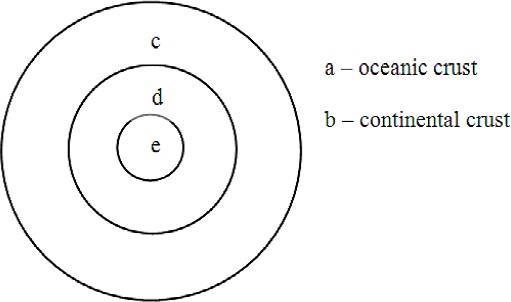
994)994)
994.1) In the diagram, the mantle is labeled as
A) A.
B) B.
C) C.
D) D.
E) E.
994.2) In the diagram, the semisolid part of the Earth is labeled as A) A.
B) B.
C) C.
D) D.
E) E.
994.3) In the diagram, the densest part of the Earth is labeled as
A) A.
B) B.
C) C.
D) D.
E) E.
995) in the mantle and core make tectonic plates move.
A) Conduction movements
B) Earthquakes
C) Radioactive decay
D) Convection currents
E) Concurrent currents
996) Coal is derived from compressed and hardened over millennia.
A) plant material from swamps
B) vast forests
C) phytoplankton
D) lava
997) Crude oil is derived from .
A) phytoplankton and algae
B) all plant matter
C) vast forests
D) lava
998) Which of the following bodies of water is growing due to tectonic movement?
A) Pacific Ocean
B) Atlantic Ocean
C) Black Sea
D) Indian Ocean
E) None of these are growing.
999) Which of the following isNOT a major type of rock?
A) sedimentary
B) bituminious
C) igneous
D) metamorphic
1000) A break or weakness in the continuity of the crust of the Earth is called a .
A) fault
B) tectonic plate
C) volcano
D) subduction zone
1001) The fundamental characteristic(s) that distinguish(es) a mineral is/are its .
A) chemical composition and its crystal structure
B) grain size
C) crystal structure only
D) chemical composition only
E) organic materials
1002) Which of the following statements regarding tectonics is true?
A) Because of tectonic movements, Europe and Africa are drifting slowly toward the Americas.
B) When continental plates collide with continental plates, both plates usually subside.
C) When oceanic plates collide with continental plates, the continent usually rides up over the seafloor.
D) Because of tectonic movements, California is slowly increasing in size.
E) When oceanic plates collide with continental plates, the oceanic plate usually rides up over the continental plate.
1003) Subduction is the process of a tectonic plate
A) falling freely into the mantle.
B) being forced below another plate.
C) melting without moving.
D) sliding alongside another plate.
E) being sucked into the outer core.
1004) The "ring of fire" is the source of more earthquakes and volcanic activity than any other place on earth.
What causes the ring of fire?
A) the subduction of Pacific plates under continental plates
B) the drift of Europe and Africa away from the Americas
C) the collision of two continental plates
D) mid-oceanic ridges
E) the conduction currents in the hot magma
1005) A mineral is composed of
A) other minerals.
B) noncrystalline elements.
C) inorganic elements.
D) a metal and a crystal.
E) organic material.
1006) The basic material of rocks is a cohesive group of
A) one or more minerals.
B) any noncrystalline elements.
C) one or more inorganic elements.
D) a metal and a crystal.
E) one or more organic elements.
1007) The fundamental characteristic(s) that distinguish(es) a mineral is/are its
A) chemical composition.
B) crystal structure.
C) organic materials.
D) grain size.
E) chemical composition and its crystal structure.
1008) Rock formed from magma extruded to the surface through volcanic vents is classified as
A) sedimentary.
B) igneous.
C) metamorphic.
D) weathered rock.
E) lava.
1009) is an example of an igneous rock.
A) Basalt
B) Shale
C) Marble
D) Sandstone
E) Limestone
1010) The word "igneous" comes from a Latin word meaning
A) water
B) fossil
C) sediment
D) fire
E) compressed
1011) Water, wind, and glaciers are examples of forces that cause
A) chemical weathering.
B) mechanical weathering.
C) abrasion.
D) sedimentation.
E) metamorphosis in rocks.
1012) Rocks are classified according to their
A) chemical composition.
B) physical properties.
C) internal structure.
D) mode of formation.
E) All of these are correct.
1013) The selective removal or alteration of specific components of a rock that leads to its weakening is called
A) the rock cycle.
B) sedimentation.
C) chemical weathering.
D) mechanical weathering.
E) abrasion.
1014) The physical breakdown of a rock into smaller pieces is called
A) the rock cycle.
B) sedimentation.
C) chemical weathering.
D) mechanical weathering.
E) abrasion.
1015) Rocks are in the process called the rock cycle.
A) moved from place to place
B) incorporated into living organisms
C) broken down and re-formed
D) cycled through the core and mantle
E) cycled through the crust and core
1016) Metamorphic rocks are produced when rocks are
A) chemically weathered.
B) recrystallized by heat and pressure.
C) physically broken down.
D) melted in the mantle and recrystallized.
E) recrystallized through chemical processes.
1017) is an example of metamorphic rock.
A) Basalt
B) Shale
C) Marble
D) Sandstone
E) Granite
1018) Sinkholes and caverns can be produced by
A) chemical weathering.
B) mechanical weathering.
C) abrasion.
D) plant growth and soil acidity.
E) the loss of plant roots in the soil.
1019) Salts such as halite are often produced as deposits.
A) sedimentary
B) igneous
C) metamorphic
D) mechanical weathering
E) glacial
1020) The metal(s) that is/are most important in global economies is/are
A) marble
B) cadmium
C) halite
D) iron
E) All are important metals in the global economy
1021) Where do the toxic gases and leachates come from that are the result of mining for gold?
A) sulfur compounds in the ore
B) chlorine compounds in the ore
C) carbon compounds in the ore
D) cyanide used in the operation of mining for the gold
E) heavy metals used in the operation of mining for the gold
1022) Reclamation of strip-mined land is difficult chiefly because
A) nobody can afford the minimum reclamation costs of about $1000 per acre.
B) topsoil is mixed up and buried so topsoil must take time to develop again for plants to grow.
C) there is no legal enforcement.
D) no plants will grow in the spoil banks formed by the heavy load of dangerous chemicals.
E) there are no subsidies that exist for mining, unlike other resource-based industries.
1023) Smelting ore, as in Ducktown, Tennessee, releases toxic chemicals in the form of
A) gases, from baked ore.
B) liquids, from leaching processes.
C) dust, from grinding ore gravel.
D) solids, in the form of toxic waste.
E) All of these are correct.
1024) Heap-leach extraction removes gold from ore by
A) pouring gravel into holding tanks.
B) spraying cyanide on a pile of ore gravel.
C) roasting ore to release the gold.
D) high-pressure spraying of ore.
E) digging the gold out of the mountains.
1025) A major environmental implication of the quest for more gold at lower concentrations in the ore compared to higher concentrations is that
A) about the same amount of toxic gas is released from digging out the gold.
B) less waste rock is produced.
C) less material has to be moved to get to the gold.
D) more carbon dioxide is released as the gold is mined.
E) more material has to be moved to get to the gold.
1026) The biggest risk to communities surrounding mountain top removal is
A) infiltrating water flows through the rock debris and picks up toxic metals and chemicals, taking them to drinking water supplies.
B) landslides
C) plants are difficult to regrow on the tops of reclaimed mountains
D) the pure ugliness of a reclaimed mountain
1027) What gas is released in the process of smelting?
A) carbon monoxide
B) chlorine
C) sulfur dioxide
D) ammonia
E) carbon dioxide
1028) It takes energy to recycle waste aluminum (e.g., beverage cans) compared to the energy of extracting new aluminum from bauxite.
A) about half as much
B) about twice as much
C) about one-twentieth as much
D) about the same
E) slightly more
1029) On average, it takes energy to produce steel from scrap metal compared to the energy of producing steel from raw ore.
A) about half as much
B) about twice as much
C) about one-twentieth as much
D) about the same
E) slightly more
1030) In terms of mineral resources, recycling is as raw materials become more and are more plentiful.
A) slowly increasing; scarce; wastes
B) slowly decreasing; scarce; environmental laws
C) quickly increasing; expensive; environmental laws
D) quickly decreasing; scarce; wastes
E) staying about the same; expensive; environmental laws
1031) A giant sea swell known as a tsunami is caused by
A) typhoons.
B) earthquakes.
C) lunar gravity.
D) unusual tides combined with seasonal storms.
E) a strong wave during an exceptionally high tide.
1032) can lead to mass wasting.
A) Clearcutting on steep slopes
B) Building on the flood plain
C) Building flood walls for flood control
D) The overuse of our natural resources
E) All of these are practices that can lead to mass wasting
1033) The continental crust of the earth is thicker and lighter than the oceanic crust.
⊚ true
⊚ false
1034) Placer mining involves washing metals, minerals, and the gemstones from streambeds with a water cannon.
⊚ true
⊚ false
1035) Fires are a major environmental risk of underground coal mines.
⊚ true
⊚ false
1036) The substitution of new materials (plastics, etc.) leads to reduced consumption of the mineral and metal resources.
⊚ true
⊚ false
1037) Earthquakes do not occur in the center of continents, only along the edges of tectonic plates.
⊚ true
⊚ false
1038) Draw a diagram of the rock cycle. Be sure to include the following terms: igneous rocks, magma, metamorphic rocks, sedimentary rocks, sedimentation, weathering, heat, and pressure.
1039) The country with the largest production of rare earth metals is
A) China.
B) United States.
C) India.
D) Australia.
E) Brazil.
1040) Which of the following is classified as a non-metal mineral?
A) sand
B) aluminum
C) copper
D) hematite
E) coal
1041) Which of the following is derived from time, pressure, and heat acting on peat deposits from ancient swamps?
A) coal
B) oil
C) natural gas
D) rare earths
1042) Which of the following saves the most amount of energy when derived from scrap rather than producing new from ore or raw source materials?
A) aluminum
B) glass
C) paper
D) plastic
E) steel
1043) Which of the following metals is not generally used for electronics?
A) iron
B) aluminum
C) copper
D) silver
E) gold
1044) Which of the following cannot be classified as a non-metal mineral or a metal?
A) coal
B) chromium
C) sand
D) gravel
E) copper
1045) In many places, it is possible to collect your aluminum drink cans and sell them to a scrap metal recycling business. Why will these businesses buy your collected drink cans?
A) They can sell the scrap to companies who manufacture aluminum cans.
B) It’s good for the environment.
C) It’s the law to pay for scrap metal.
D) People want to recycle so this is an incentive to support recycling.
1046) Why are distant communities interested in the mining activities of other regions? For example, why was Georgia interested in Tennessee’s emission standards related to the Ducktown smelters?
A) Air and water pollution don’t stay in one place.
B) Georgia had competing smelting interests and was trying to cut competition.
C) Distant communities are worried that the waste will be put in their landfills.
D) Pollution is bad for the environment.
1047) Halite
A) consists of sodium chloride found deposited in sedimentary rocks.
B) is a crystal found in igneous rock.
C) is a fine-grained crystallized metamorphic rock.
D) comes from magma.
E) is similar to marble and slate.
1048) What era is marked by the presence of the first humans?
A) cenozoic
B) mesozoic
C) paleozoic
D) precambrian
1049) Which term means the study of the earth and the physical processes that shape it?
A) geology
B) rocks
C) minerals
D) plate tectonics
1050) Which term means a solid aggregation of minerals?
A) rock
B) metal
C) battery
D) plastic
1051) Which step in the rock cycle is responsible for the formation of sedimentary rocks?
A) Sedimentary rocks form as convection currents bringing tectonic plates together.
B) Soil and rock particles get compressed and glued together as additional soil accumulates above forming sedimentary rocks.
C) Rocks melt forming magma and as this hot substance moves towards the surface and cools sedimentary rocks form.
D) Higher temperatures and pressures deep underground transform igneous and metamorphic rocks into sedimentary rocks.
Answer Key
Test name: chapter 14
1) A 2) B 3) B 4) A 5) A 6) A 7) TRUE 8) FALSE 9) TRUE 10) FALSE 11) TRUE 12) FALSE 13) TRUE 14) B 15) B 16) B 17) D
18) Section Break 18.1) C
18.2) D 18.3) E
19) D 20) A 21) A 22) B 23) B 24) A 25) A 26) C 27) B 28) A 29) C 30) A 31) E 32) B 33) A 34) D
35) B 36) E 37) C
38) D 39) C 40) B 41) C 42) A 43) A 44) D 45) A 46) B
47) A 48) B 49) E 50) A 51) C 52) C 53) A 54) A 55) B 56) A 57) TRUE 58) TRUE 59) TRUE 60) TRUE 61) FALSE 62) Essay 63) A 64) A 65) A 66) A 67) A 68) A 69) A 70) A
71) A
72) A 73) A
74) A
75) B
Student name:
1052) The pattern of absorbance of solar energy by the atmosphere includes
A) heavy absorbance of visible light by carbon dioxide.
B) absorbance of infrared radiation by carbon dioxide and water vapor.
C) a remarkable uniformity in the proportion of different kinds of wavelengths absorbed by ozone.
1053) The layer of atmosphere immediately above the earth where weather events occur is called the
A) troposphere.
B) ionosphere.
C) stratosphere.
D) mesosphere.
1054) Convection currents
A) move energy within the atmosphere.
B) are the main cause of evaporation of water.
C) are particularly strong ocean currents having substantial effects on coastal weather.
1055) The movement of energy from the tropics toward the pole is accomplished principally by all of the following except
A) the movement of water vapor toward the poles.
B) ocean currents.
C) the movement of air masses toward the poles.
D) seasonal changes.
1056) A monsoon is characterized by all of the following except
A) oceans heat up at different rates than continents.
B) oceans cool at the same rates as continents.
C) prevailing wind directions seasonally reverse.
D) large bodies of water are a central ingredient.
1057) Historical evidence suggests that substantive climate change
A) nearly always has occurred over several million years.
B) is very new, limited in appearance to the last few centuries.
C) can happen in as short a period as a few decades.
D) nearly always occurs only during pronounced movement of tectonic plates.
1058) The Intergovernmental Panel on Climate Change (IPCC) is
A) a group of U.S. government scientists.
B) an ad hoc group of government environmentalists.
C) a United Nations working group of 2500 scientists around the world.
D) a group of European meteorologists and Earth scientists.
1059) The most recent major international study of anthropogenic influence on global climate concluded
A) temperature changes of less than 5 degrees Celsius would not produce discernable changes in climate.
B) the current warm-up is most likely within the normal range of natural climatic fluctuations.
C) a human influence on global climate is discernable.
D) that weather patterns are changing, but not climate.
1060) Of the 20 hottest years ever recorded, of them occurred since 1980.
A) 19
B) 17
C) 15
D) 13
1061) Carbon dioxide is a major factor in the global warming story since it
A) creates its own heat through a poorly understood reaction.
B) releases energy as a result of molecular decay.
C) absorbs more infrared radiation than it emits.
D) is present in the atmosphere in incredibly large quantity.
1062) The idea of breaking down the solution to the larger problem of climate change into smaller more manageable pieces or goals is known as
A) the Coriolis effect.
B) wedge analysis.
C) regression analysis.
D) adaptation.
1063) Hurricanes and typhoons are similar phenomena that occur in different parts of the world.
⊚ true
⊚ false
1064) Increased atmospheric concentrations of carbon dioxide resulting from human activities appear to be producing climatic warming.
⊚ true
⊚ false
1065) Surfaces that reflect energy have a high albedo.
⊚ true
⊚ false
1066) Which developed nation has not signed the Kyoto Protocol?
A) France
B) Japan
C) USA
D) Germany
1067) Nitrogen is the most abundant component of the air we breathe.
⊚ true
⊚ false
1068) The greenhouse effect refers to
A) the gradual warming of the earth due to anthropogenic causes.
B) a natural phenomenon that keeps the earth's atmosphere warm.
C) environmental change.
D) albedo.
1069) Organisms are currently responding to climate change by extending their range into new territories.
⊚ true
⊚ false
1070) Climate is a description of weather conditions.
A) long-term regional
B) stable and unchanging
C) temporary
D) temporary local
E) annual
1071) The earth's earliest atmosphere was probably composed mainly of _, which has/have since largely dissipated into space.
A) hydrogen and helium
B) carbon dioxide and methane
C) oxygen
D) water
E) nitrogen and sulfur
1072) Elements such as carbon, nitrogen, oxygen, and sulfur were added to the Earth's early atmosphere through .
A) the mechanical weathering of rocks
B) photosynthesis
C) contact with space
D) volcanic emissions
E) the chemical weathering of rocks
1073) The atmospheric zone where most weather events occur is the
A) stratosphere
B) thermosphere
C) troposphere
D) mesosphere
E) stratopause
1074) The two main gases making up the lower atmosphere are
A) helium and hydrogen.
B) carbon dioxide and nitrous oxide.
C) oxygen and methane.
D) nitrogen and oxygen.
E) oxygen and carbon dioxide.
1075) Aerosols are
A) gases produced by industry.
B) tiny particles and droplets suspended in the air.
C) the principal gas involved in the greenhouse effect.
D) tiny droplets of a very specific chemical composition.
E) the principal gas involved in global warming.
1076) The correct sequence of atmospheric zones upward from the earth's surface is
A) stratosphere, troposphere, mesosphere, and thermosphere.
B) troposphere, stratosphere, mesosphere, and thermosphere.
C) mesosphere, stratosphere, troposphere, and thermosphere.
D) thermosphere, stratosphere, troposphere, and mesosphere.
E) troposphere, mesosphere, stratosphere, and thermosphere.
1077) The different layers of the atmosphere are kept from mixing by
A) sharp temperature boundaries.
B) contrasting gas compositions.
C) the extreme stillness within each layer.
D) physical barriers composed of thick layers of atmospheric dust.
E) sharp density boundaries.
1078) The "ozone hole" that causes concern among scientists and the public is an ozone depletion in the
A) troposphere.
B) stratosphere.
C) thermosphere.
D) mesosphere.
E) tropopause.
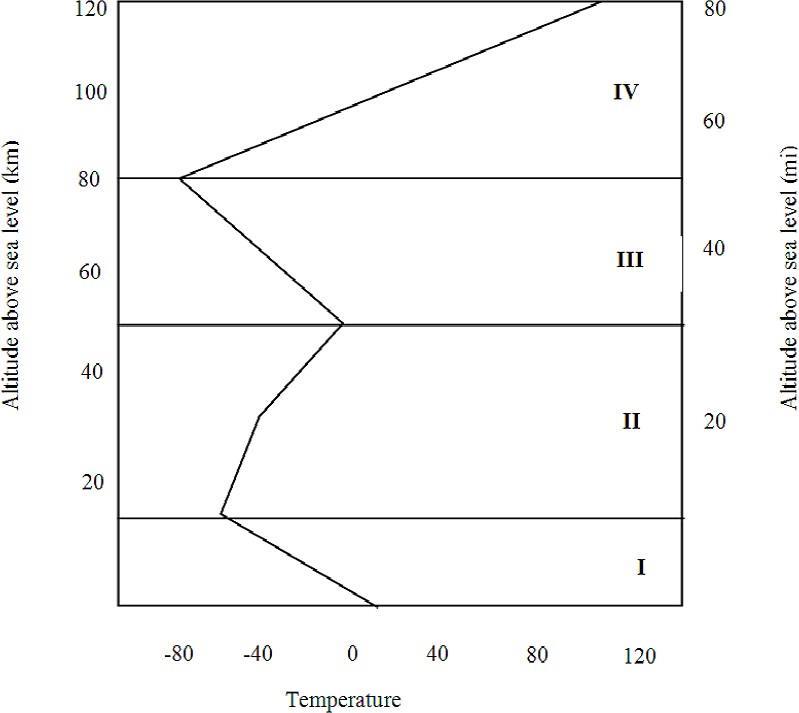
1079)
1079.1) In the diagram, which layer(s) has/have a rapid drop in temperature with increasing altitude?
A) 1
B) 3
C) 4
D) Both 1 and 3
E) Both 1 and 4
1079.2) In the diagram, which layer has the highest concentration of ozone?
A) 1
B) 2
C) 3
D) 4
E) The highest concentration of ozone is found in the border between 3 and 4
1080) In the diagram, which layer has the most mixing of air?
A) 1
B) 2
C) 3
D) 4
E) The most mixing of air is found in the border between 2 and 3.
1081) Much of the ultraviolet light from the sun is absorbed by , as it passes through the atmosphere.
A) carbon dioxide
B) water vapor
C) nitrogen gas
D) ozone
E) green house gases
1082) Insolation is a term that means
A) the heat reflectivity of clouds.
B) the energy retentive ability of gases.
C) the incoming solar radiation.
D) the total amount of energy released by the sun.
E) the outgoing infrared energy.
1083) Albedo is a term describing the Earth's
A) reflection of solar radiation.
B) refraction of energy.
C) production of radiant heat.
D) use of energy in biomass production.
E) outgoing infrared energy.
1084) Which of the following would have the highest albedo?
A) a field of black soil
B) a snowfield
C) a dark forest
D) an asphalt parking lot
E) a grass field
1085) Eventually, all of the energy that reaches the Earth's surface is
A) absorbed into the Earth.
B) turned into biomass.
C) used in heating.
D) reflected or radiated back to space.
E) dissipated within the Earth's atmosphere.
1086) Energy absorbed at the Earth's surface is radiated back to space in the form of
A) visible light.
B) ultraviolet radiation.
C) infrared radiation (heat).
D) microwaves.
E) insolation.
1087) Intense sunlight causes a band of hot, rising air laden with evaporated water near the equator. This moisture then falls because
A) its potential energy increases with height.
B) warm air cannot hold much moisture.
C) the rising air cools and loses its ability to hold water vapor.
D) moisture is condensed as convection currents carry air over hotter, drier regions.
E) the moisture evaporates as convection currents carry air over hotter, drier regions.
1088) The greenhouse effect in the atmosphere occurs because
A) clouds reflect sunlight back into space.
B) oceans absorb heat, and then release it slowly at night.
C) stratospheric ozone absorbs UV radiation.
D) CO2, water vapor, methane, and other gases absorb infrared radiation.
E) All of these are correct.
1089) The phenomenon causing the greenhouse effect is that in the lower atmosphere selectively absorb(s) reradiated radiation.
A) ozone; visible light
B) carbon dioxide, methane, and other gases; infrared (heat)
C) hydrocarbons; very short wavelength
D) carbon dioxide; ultraviolet
E) carbon dioxide, methane, and other gases; insolation
1090) Convection currents in the atmosphere are driven by
A) the different temperatures and densities of warm and cold air masses.
B) the jet stream dipping down into the troposphere.
C) forces that scientists cannot yet explain.
D) bursts of energy emitted by the ionosphere.
E) the surface winds, which in turn are influenced by the Coriolis effect.
1091) When an area of the Earth's surface becomes very hot, the air above it
A) condenses and cools.
B) warms, expands, and rises.
C) warms, condenses, and releases rain.
D) expands and sinks.
E) condenses and sinks.
1092) When cool, dry air sinks from the upper atmosphere toward the Earth's surface, it is
A) compressed and cooled further.
B) allowed to expand and become warmer.
C) compressed and becomes warmer.
D) forced to release any remaining moisture.
E) going to hold more water because there is more water vapor closer to the Earth's surface.
1093) Rising, expanding air masses create a region of
A) low pressure.
B) warming air.
C) high pressure.
D) dry air.
E) cooling air.
1094) A band of deserts rings the Earth at about 30° north and 30° south latitude because these are regions of
A) ascending, cooling air.
B) rising hot air.
C) the earth's most intense solar energy.
D) air that cools as it descends.
E) descending, warming air.
1095) Which convection cell has warm, moist air rising at 0° latitude and cooler, dry air that sinks at around 30° latitude?
A) Hadley Cell
B) Jet Stream
C) Polar Cell
D) Ferrell Cell
1096) The Coriolis effect is caused by the
A) jet stream.
B) rotation of the Earth.
C) heating and cooling of air masses.
D) seasonal changes in air temperature and humidity.
E) movement of tectonic plates.
1097) A cold front is a situation in which cold air
A) remains stationary for weeks at a time.
B) displaces a mass of warmer air.
C) recedes in the face of warmer air.
D) is heated by seasonal changes in solar energy.
E) slips over a mass of warmer air.
1098) As a cold front advances, the warm air is forced to
A) rise, become warmer, and absorb more moisture.
B) go under the mass of cold air.
C) retreat laterally and become more dense.
D) fall, condense, and lose its moisture.
E) rise, cool, and release its moisture.
1099) Monsoons occur over India when air heated over the Indian subcontinent and the Indian Ocean
A) is forced to rise because of convection.
B) is forced to rise when it meets the Himalayas.
C) begins to sink as summer approaches.
D) cools in the winter and therefore sinks.
E) is forced out over the Indian Ocean.
1100) The boundary between two air masses of different temperature and density is known as a
A) front.
B) cold front.
C) warm front.
D) hadley cell.
E) jet stream.
1101) Narrow, violent bands of rain and storms are characteristic of
A) advancing cold fronts.
B) advancing warm fronts.
C) both advancing warm and cold fronts.
D) stationary bends in the jet stream.
E) a stationary warm front.
1102) If you see high wispy cirrus clouds with layers of other clouds in a wedge shape, you can expect due to a/an
A) heavy rain and thunderstorms; advancing cold front.
B) heavy rain and thunderstorms; advancing warm front.
C) drizzle and cloudy skies; advancing warm front.
D) drizzle and cloudy skies; advancing cold front.
E) heavy rain and thunderstorms; stationary warm front.
1103) Hurricanes are powered by
A) the hydrologic cycle.
B) rising air masses.
C) sinking air masses.
D) the heat released from condensing water vapor.
E) subtropical jet streams coupled with convection currents.
1104) Why don't storms over land have as much energy as storms over oceans?
A) Convection currents are intensified by the latent energy of condensation.
B) Convection currents are intensified by the latent energy of warm dry air.
C) High pressure cells are more common over oceans.
D) There aren't as many low-pressure systems over land.
E) None of these, storms over land have as much energy as those over oceans.
1105) Which of the following events is NOT part of the explanation of how tornadoes form?
A) Strong, dry air cold fronts collide with warm humid air moving north.
B) Convection currents are formed when warm air rises.
C) Latent heat (energy) is released from the condensation of water vapor.
D) The air mass is set spinning by the Coriolis effect.
E) None of these is correct.
1106) Milankovitch cycles involve the periodic and could be responsible for weather changes.
A) convection currents in the lower atmosphere; drastic
B) summer/winter seasonality on the Earth; gradual
C) wobbling of the earth's axis and orbital shifts; cyclic
D) tidal cycles from month to month; seasonal
E) seasons; daily
1107) When El Niño occurs, a mass of warm Pacific surface water that is usually pushed westward by winds,
A) surges eastward toward South America.
B) sinks and cools substantially.
C) surges northward, toward Japan.
D) becomes much warmer than usual, strengthening winds.
1108) The purpose of ice core drilling is to analyze trapped ancient bubbles of atmosphere for and
A) CO2 and Oxygen isotopes
B) CO2 and Hydrogen isotopes
C) Helium and Hydrogen
D) CO and Hydrogen isotopes
1109) When El Niño occurs every three to five years, a mass of warm Pacific water that is usually pushed westward by trade winds
A) surges back eastward toward South America.
B) becomes much warmer than usual, strengthening trade winds.
C) cools dramatically.
D) sinks and therefore cools substantially.
E) surges northward toward Japan.
1110) The Vostok ice core was collected to 3,100 feet below the surface, and has revealed years of climate data.
A) 420,000
B) 42,000
C) 100,000
D) 500,000
1111) As far as we are currently aware, who were the first people to notice the El Niño Southern Oscillation cycle?
A) scientists studying atmospheric changes.
B) meteorologists.
C) indigenous people in South America.
D) peruvian fishermen.
E) colonial governors in South America from Spain.
1112) The Keeling graph of Carbon Dioxide concentrations form a pattern that goes up and down each year. What is the cause of this oscillating pattern?
A) During the northern hemisphere summer, there are so many trees, that they reduce the amount of CO2 substantially, but when northern winter occurs, there are not enough trees in the southern hemisphere to use all of the inputs of CO2 in the atmosphere.
B) During the southern hemisphere summer, there are so many trees, that they reduce the amount of CO2 substantially, but when southern winter occurs, there are not enough trees in the northern hemisphere to use all of the inputs of CO2 in the atmosphere.
C) In the summer of Hawaii, much of the snow melt on Mauna Loa and CO2 is released.
D) More combustion of wood and fossil fuels occur in the winter than the summer contributing to the increased CO2
1113) The Keeling graph, although it has yearly oscillations, shows that the concentration of CO2 in the atmosphere .
A) is steadily rising
B) is remaining constant
C) has sharp increases about every five years
D) is slowly decreasing
1114) Which of the following isNOT an important greenhouse gas?
A) sulfur dioxide
B) methane
C) carbon dioxide
D) nitrous oxide
1115) Models of climate change are most in agreement with observed data .
A) when both natural and anthropogenic causes of warming are included.
B) when only anthropogenic causes of climate change are used.
C) when only natural causes of climate change are used.
D) none of the models agree with observations.
1116) Which of the following is NOT a consequence that we are seeing now?
A) Nineteen of the 20 hottest years on record have occurred since 1980.
B) Arctic sea ice has approximately 50% of its thickness compared to 30 years ago.
C) During the last century, global average temperature has increased by 0.6°C.
D) Coral reefs are bleaching due to increased ocean temperatures.
E) All of these statements are true.
1117) Current concentration of CO2 in the atmosphere is according to the Keeling graph.
A) over 400ppm
B) 300ppm
C) 350ppm
D) 375 ppm
1118) The main activity of the IPCC is to .
A) make general assessments of all climate change research at regular intervals of time
B) make policies to combat climate change
C) refute any evidence that climate change exists
D) make recommendations to UN member nations on climate change
1119) Those who study climate change say that given what we know about the greenhouse effect, the best thing to do is
A) immediately cease all industrial activity.
B) wait and see how much temperatures change before we change our habits.
C) severely cut back on production of greenhouse gases.
D) not worry about greenhouse gas production.
E) focus on the development of technological advances to help decrease the effects of climate change.
1120) The most effective and practical way of reducing CO2 emissions is to .
A) make many small changes over all of the human population that act like 'wedges' reducing emissions
B) switch to all renewable energy as soon as possible
C) stop all industry that emits CO2 regardless of the economic problems it may cause
D) there is no problem with climate change, so we do not need to do anything
1121) Because of global warming, sea levels are expected to rise by 2100.
A) 1–2 feet
B) 3–6 feet
C) 6–8 feet
D) Approximately 20 feet
E) None of these are correct; sea levels are not expected to rise.
1122) Carbon capture
A) traps carbon emissions from power plants and forces it underground.
B) is very expensive.
C) is where carbon emissions can be forced into underground oil wells increasing recovery amounts of the oil.
D) All of these are true.
1123) Glacier National Park has lost glaciers since 1910 when the park was created.
A) over 120
B) about 30
C) all of its
D) between 50–60
E) no
1124) Weather is a term for atmospheric moisture and temperature on a short-term basis.
⊚ true
⊚ false
1125) Convection currents are the driving force(s) of the hydrologic cycle.
⊚ true
⊚ false
1126) Where air is sinking (high pressure), rainfall is likely as the air sinks.
⊚ true
⊚ false
1127) Ocean circulation patterns have no effect on climate conditions on land.
⊚ true
⊚ false
1128) Most of the excessive carbon dioxide that is expected to cause global warming is generated by green plants.
⊚ true
⊚ false
1129) Since biodiversity is usually higher in warmer, milder climates, biodiversity will probably be increased with global warming.
⊚ true
⊚ false
1130) What does the acronym ENSO stand for? Describe the weather patterns in the United States as a result of ENSO.
1131) What is the Kyoto Protocol? Discuss the role of the United States government, the role of big business in the United States, and the role of individual citizens in meeting the standards set by the Kyoto Protocol.
1132) A large factory that holds permits for a certain level of emissions has found a technology that cuts their carbon emissions by a third. They can then sell their permit to someone else and potentially profit from the sale. This is called
A) emissions trading.
B) environmental harmful subsidy.
C) negative emissions.
D) climate change adaptation.
E) climate change mitigation.
1133) Which of the following is NOT considered a carbon capture or negative emissions technology?
A) switching to alternative energy that produces fewer emissions
B) capturing emissions from a powerplant smokestack
C) conserving forests
D) methane capture from landfills
E) directly capturing carbon dioxide from the air
1134) Which of the following was agreed upon at the 2015 Paris Climate Agreement?
A) a target that the global average temperature will not increase more than 1.5°C
B) an affirmation that the reduction plans submitted to the Paris meeting were appropriate for keeping global warming below 2°C
C) agreement that only low-cost drawdown ideas should be used to keep costs low
D) countries to be required to follow emissions reductions goals
E) emissions be capped at current levels
1135) Which of the following is incorrect regarding Greenland’s ice mass?
A) Greenland gains back more ice in the winter to balance loss in the summer.
B) Greenland has had a net loss of ice through melting since 2002.
C) The greatest ice loss is on the southern end of Greenland and along the edges.
D) In 2016, Greenland was losing 286 gigatons of ice per year.
1136) Why does the Keeling curve show a decline in atmospheric carbon dioxide in the summer before rising again in the winter?
A) Photosynthesis in the Northern Hemisphere uses carbon dioxide.
B) Cell respiration uses carbon dioxide.
C) Less fossil fuel is combusted in the summer.
D) It is easier to capture carbon in the summer.
1137) The circulation of cyclonic storms is determined by
A) the Coriolis effect.
B) cold fronts.
C) warm fronts.
D) Milankovitch cycles.
E) the southern oscillation.
1138) In a , cold, dense air stays near the ground, and warm air is forced upward. These fronts can generate strong convective currents as they push warmer air up quickly resulting in thunderstorms.
A) cold front
B) warm front
C) convective front
D) monsoon front
1139) Water vapor is generally always present in the atmosphere in the same amount because if the amount of vapor increases, it
A) is released from the atmosphere as precipitation.
B) converts to other compounds in the atmosphere.
C) is released into space.
D) forms clouds.
1140) The has the most vigorous circulation because it is caused by more intense heating from the sun.
A) Hadley cell
B) Ferrell cell
C) polar jet stream
D) subtropical jet stream
E) westerlies
1141) High pressure air , while low pressure air .
A) sinks, rises
B) rises, sinks
C) redistributes, stays in place
D) circulates counterclockwise, circulates clockwise
1142) What are the roles of photosynthesis and cellular respiration in the carbon cycle? (Select all that apply.)
A) Photosynthesis acts as a carbon source as plants release carbon to the atmosphere.
B) Cellular respiration acts as an atmospheric carbon source as carbon dioxide is a byproduct of the chemical reaction.
C) Photosynthesis acts as a carbon sink as plants remove carbon dioxide from the atmosphere and transform it into carbohydrates.
D) Cellular respiration acts as a carbon sink as organisms remove carbon dioxide from the atmosphere and transform it into carbohydrates.
Answer Key
Test name: chapter 15 1) B 2) A 3) A 4) D 5) B 6) C 7) C 8) C 9) A 10) C 11) B 12) TRUE 13) TRUE 14) TRUE 15) C 16) TRUE 17) B 18) TRUE 19) A 20) A 21) D 22) C 23) D 24) B 25) B 26) A 27) B
28) Section Break
28.1) D
28.2) B
29) A 30) D 31) C 32) A 33) B 34) D 35) C
36) C 37) D 38) B
39) A 40) B 41) C 42) A 43) E 44) A 45) B 46) B 47) E 48) B 49) A 50) A 51) C 52) D 53) A 54) D 55) C 56) A 57) A 58) A
59) A 60) D 61) A 62) A 63) A 64) A 65) E 66) A 67) A 68) C 69) A 70) B 71) D 72) A
73) TRUE 74) TRUE 75) FALSE
76) FALSE
77) FALSE
78) FALSE
79) Essay
ENSO = El Nino Southern Oscillation.
El Nino years typically bring intense storms and heavy rain from California across the Midwestern states.
In general, the United States sees an increased amount of rainfall during El Nino years. La Nina years normally bring hot, dry weather to most of the United States. The Pacific northwest (Washington, Oregon) usually has the reverse weather patterns. (Drier during El Nino and wetter during La Nina).
80) Essay
The Kyoto Protocol is a treaty that was established in Kyoto, Japan in 1997. About 160 nations agreed to cut back on emissions of the main greenhouse gases to help with the problems associated with worldwide climate change. Even though the United States played an important role in leading the negotiations at Kyoto, it has never been ratified by the United States government. President Bush claims that it would be detrimental to our economy to do so.
Several big businesses in the United States have joined with four of the largest environmental groups to call for strong national legislation to ultimately achieve significant reductions of greenhouse gases. These are huge companies that can make a major impact (GE, Alcoa, BP Gas, etc.) if they are successful.
On an individual level, there are many things that can be done including: driving less, driving a fuel-efficient vehicle, planting trees, producing less waste (recycle or compost when possible), adjusting thermostats-especially when not at home, insulating your home, purchasing energyefficient appliances, turning off lights, computers and other energy-consuming items when not in use, etc.
81) A 82) A 83) A 84) A 85) A 86) A 87) A 88) A 89) A 90) A 91) [C]
Student name:
TRUE/FALSE - Write 'T' if the statement is true and 'F' if the statement is false.
1143) Life expectancy for people in U.S. cities with the dirtiest air is significantly lower than for those with cleaner air.
⊚ true
⊚ false
1144) Nitrogen oxides interact with water vapor in the atmosphere to produce acid rain.
⊚ true
⊚ false
1145) Some hazardous air pollutants are known carcinogens.
⊚ true
⊚ false
1146) Over the past 40 years, air quality has gotten substantially worse in many of the major cities of North America.
⊚ true
⊚ false
1147) Human-produced pollutants are different from natural particulates and gases because they are almost always chemically more dangerous.
⊚ true
⊚ false
1148) Although coal burning contributes a very small amount, the high mercury levels in fish result from spills of mercury directly into the water.
⊚ true
⊚ false
1149) The discharge of mercury and dioxins (both HAPs) is decreasing.
⊚ true
⊚ false
1150) Grasshopper transport causes contaminants to accumulate in the low latitudes, close to the equator.
⊚ true
⊚ false
1151) Synergistic effects occur when there is more damage of exposure when two factors are together.
⊚ true
⊚ false
1152) Acid precipitation often occurs downwind from dust-producing industries.
⊚ true
⊚ false
1153) Hydrocarbon emissions are produced mainly by cement manufacturing industries.
⊚ true
⊚ false
1154) Old power plant facilities have been kept operating, expanding their capacity rather than building new ones because the older facilities have minimal contributions to smog and acid rain.
⊚ true
⊚ false
CHECK ALL THE APPLY. Choose all options that best completes the statement or answers the question.
1155) Which of the following would be considered examples of particulate matter? (select all that apply)
A) dust
B) plant spores
C) soot
D) water vapor
E) ozone
MULTIPLE CHOICE - Choose the one alternative that best completes the statement or answers the question.
1156) Anthropogenic means
A) safe.
B) dangerous.
C) produced by humans.
D) produced by natural causes.
1157) Which of the following is colorless, odorless, and highly toxic?
A) carbon dioxide
B) carbon monoxide
C) nitrogen oxides
D) ozone
1158) Substance(s) that qualify to be called particulate air pollutants include
A) nitrogen oxides.
B) carbon dioxide.
C) ozone.
D) smoke.
1159) Unconventional (noncriteria) pollutants are characterized by all of the following except
A) they have anthropogenic sources.
B) they are considered particularly toxic or dangerous.
C) they are not yet regulated by the EPA.
D) they include mercury and organic compounds.
1160) Emissions of all of the following have gone down in the last 40 years except for
A) carbon monoxide.
B) lead.
C) particulate matter.
D) sulfur dioxide.
1161) The result of reduced concentrations of ozone in the stratosphere includes
A) a substantial increased concentration of greenhouse gases.
B) a notable increase in ground temperatures in the tropics.
C) an increase in the amount of UV radiation reaching the ground.
D) a decrease in the absorbance of energy by greenhouse gases.
1162) Since the 1986 ban on leaded gasoline in the United States,
A) there have been no appreciable improvements as a result of this legislation.
B) children's average blood lead levels have dropped and average IQ's have risen.
C) children's blood lead levels have continued to rise, calling into question the effectiveness of the legislation.
1163) Most air pollution in the world is associated with
A) agriculture.
B) transportation and energy production.
C) nuclear power plants.
D) forest fires.
1164) The U.S. governmental agency responsible for regulating air pollutants is the
A) National Park Service.
B) Fish and Wildlife Service.
C) Bureau of Reclamation.
D) Bureau of Remediation.
E) Environmental Protection Agency.
1165) Primary pollutants are those that are
A) released directly in dangerous forms.
B) produced in the greatest quantities.
C) the most dangerous.
D) the most threatening to people.
E) classified by the EPA as the most dangerous and abundant.
1166) Secondary pollutants
A) harm only vulnerable members of a population.
B) become dangerous after reacting in the atmosphere.
C) are produced in lesser quantities than primary pollutants.
D) are less dangerous than other pollutants.
E) are classified by the EPA as the second-most dangerous and abundant.
1167) are examples of secondary pollutants.
A) Aerosols
B) Volatile organic compounds
C) Photochemical oxidants
D) Combustion gases
E) Fugitive emissions
1168) Fugitive emissions are produced by
A) smokestacks.
B) power plants and other heating equipment.
C) reactions between pollutants and atmospheric gases.
D) strip mining, rock crushing, and other dust-producing activities.
E) industry and must go through a smokestack for filtration.
1169) Criteria pollutants are those that
A) contribute the most to air quality degradation.
B) are most highly toxic even in small quantities.
C) are easiest to get rid of.
D) cause the most damage to buildings.
E) set the standards for other pollutants.
1170) Which of the following criteria pollutants result mainly from burning coal?
A) Photochemical oxidants
B) Sulfur dioxide
C) Suspended particulate materials
D) Methane
E) Carbon monoxide
1171) The term NOx is often used because
A) there are many different oxides of nitrogen.
B) it is usually unclear how oxidized nitrogen is.
C) NO2 and NO easily convert into each other.
D) many different molecules often attach to NO.
E) the pollutant is a nitrous oxide and the "Ox" identifies the oxygen.
1172) The brown haze in smog is caused by
A) sulfuric acid.
B) NO2.
C) carbon monoxide.
D) chlorofluorocarbons.
E) particulates.
1173) A common example of a photochemical oxidant is
A) NO2.
B) H2S.
C) CO2.
D) methane.
E) All of these choices are correct.
1174) Sulfur trioxide
A) is a secondary pollutant.
B) is formed by the oxidation of sulfur dioxide.
C) reacts with water to form sulfuric acid.
D) is a major component of acid rain.
E) All of these choices are correct.
1175) Carbon monoxide is produced by
A) normal respiration by animals.
B) normal respiration by plants.
C) incomplete burning of fuels.
D) photochemical oxidation of carbon.
E) the burning of sulfur-laden coal.
1176) An aerosol is
A) a chemical propellant.
B) a rigidly defined chemical composition.
C) any liquid droplet or solid particle suspended in air.
D) not considered as hazardous to human health as other air pollutants.
E) not as apparent in the air as other air pollutants.
1177) The most dangerous airborne particulates are those that are
A) large enough to damage the skin and eyes.
B) small enough to be drawn into the lungs.
C) anthropogenic.
D) liquid.
E) produced in industrial settings.
1178) Anthropogenic sources of carbon dioxide levels in the atmosphere are
A) Increasing at the rate of about 0.5 percent per year.
B) Easily determined with recent technological advances.
C) Measured with a great deal of precision.
D) All offset by carbon storage in northern forests.
E) All of these choices are correct.
1179) The most common metallic air pollutant is
A) iron.
B) cadmium.
C) nickel.
D) mercury.
E) lead.
1180) Lead is dangerous because it acts as a(n)
A) neurotoxin.
B) asphyxiant.
C) irritant.
D) respiratory fibrotic agent.
E) carcinogenic agent.
1181) Many fish contain high levels of and should either not be eaten or their consumption should be limited.
A) lead
B) mercury
C) chloroform
D) ozone
E) chlorophyll
1182) Which of the following is NOT a volatile organic compound?
A) benzene
B) methane
C) formaldehyde
D) chlorofluorocarbons
E) terpene
1183) Photochemical oxidation reactions are driven by
A) the great instability of the reactants.
B) the heat of industrial activity.
C) solar energy.
D) entropy.
E) light, regardless of whether it is the sun or indoor light.
1184) A major source of VOCs is
A) incomplete burning of hydrocarbons.
B) combustion of sulfur-containing fuel.
C) photochemical oxidation.
D) CO in the atmosphere.
E) CO2 in the atmosphere.
1185) Which of the following statements is true?
A) Most carbon monoxide produced in the United States comes from internal combustion engines (cars).
B) Nearly all emissions of sulfur compounds are anthropogenic.
C) Overall, in the past twenty years, air pollution conditions have steadily decreased in most North American and Western European cities.
D) Volatile organic compounds are produced exclusively by human activity.
E) None of these choices is correct.
1186) Ozone is produced by
A) incomplete burning of fuels.
B) combustion of sulfur-containing fuel.
C) decaying organic matter.
D) photochemical oxidation.
E) the burning of coal.
1187) Aesthetic degradation is a term that describes
A) health risks associated with pollution.
B) primarily the brown color of smoggy air.
C) noises, odors, and light pollution.
D) the discomfort of knowing that the air is dirty.
E) the apparent form of air pollution because they leave dirty residues.
1188) A temperature inversion occurs when
A) two warm air layers surround a cold air layer.
B) two cold air layers overlay a warm air layer.
C) stable cold air overlays warm air.
D) stable warm air overlays cold air.
E) air turbulence causes mixing between air layers.
1189) Which of the following statements is false?
A) The likelihood of having radon gas in your home depends largely upon the geology and soil types in your region.
B) According to the EPA, toxic air pollutants are generally much more concentrated indoors than outdoors.
C) One of the reasons indoor air pollutants are so dangerous is the high amount of time people are indoors.
D) In the less-developed countries of Africa, Asia, and Latin America, there is less indoor air pollution than in developed countries.
E) All of these statements are true.
1190) Formaldehyde is an especially problematic indoor pollutant because it is
A) far more toxic than most other substances.
B) produced naturally by the earth below buildings.
C) so difficult to detect.
D) highly carcinogenic.
E) used in so many household materials.
1191) Los Angeles has especially bad inversion problems because it
A) lies on a flat space by the ocean.
B) is in a warm climate and is partly ringed by mountains.
C) occupies such a large geographical area.
D) generally has cloudy skies at night.
E) All of these choices are correct.
1192) Stable air masses over cities and warm updrafts between tall buildings often create in and near cities.
A) dust domes of suspended pollutants
B) cyclonic dust storms
C) convective rain storms
D) low pressure zones that dissipate pollution
E) high pressure zones that dissipate pollution
1193) Native peoples living in the Canadian Arctic have some of the highest recorded PCB concentrations in their bodies because of
A) unusually high susceptibility to contamination.
B) concentrated natural occurrence of PCBs in that region.
C) local production of PCBs.
D) long-range transport of airborne pollutants.
E) an industrial accident that left the persistent PCBs in the environment.
1194) ozone is harmful, damaging plants and human health while ozone at the level screens out mutagenic ultraviolet radiation.
A) Stratospheric; troposphere
B) Thermospheric; mesosphere
C) Tropospheric; stratosphere
D) Mesospheric; thermosphere
E) Stratospheric; mesosphere
1195) The "ozone hole" is a depletion currently most serious
A) at the most populated latitudes.
B) over North America.
C) in tropical latitudes.
D) near the equator.
E) in Antarctica.
1196) There are serious signs that ozone depletion may lead to
A) increased incidence of skin cancers.
B) increased incidence of blindness.
C) depletion of plankton populations.
D) reduced agricultural production.
E) All of these choices are correct.
1197) Pollutants such as chlorofluorocarbons deplete atmospheric ozone
A) when nitrogen combines with O3 to form NOx.
B) when chlorine-containing molecules are oxidized at the expense of O3.
C) because chlorine is most stable as ClO3.
D) when carbon reacts with O3 to form CO3.
E) None of these choices is correct.
1198) The most common human health response to air pollution is
A) inflammatory responses in sensitive tissues.
B) lung cancer.
C) blindness caused by deteriorating eye tissues.
D) skin cancer.
E) heart disease.
1199) Persistent inflammation of bronchi in the lungs is known as
A) asthma.
B) fibrosis.
C) pulmonary toxicosis.
D) bronchitis.
E) an upper respiratory infection.
1200) An irreversible obstructive lung disease is called
A) asthma.
B) bronchitis.
C) emphysema.
D) fibrosis.
E) upper respiratory infection.
1201) If stagnant air is trapped in the lung alveoli, the air sac swells and
A) blood circulation is blocked.
B) cells die from lack of O2.
C) cells die from lack of nutrients.
D) the walls of the alveoli break down and are no longer able to exchange gases.
E) All of these choices are correct.
1202) Sudbury, Ontario's copper-nickel smelter is notorious for having
A) destroyed the local ecosystem with sulfur-laden smoke.
B) caused brown lung disease in miners.
C) spread cyanide in nearby rivers.
D) caused childhood leukemia in nearby neighborhoods.
E) All of these choices are correct.
1203) Pollutants such as sulfur dioxide and ozone cause
A) relatively little damage to plants.
B) mortality in most plants.
C) reduced yields in crop plants as well as visible damage.
D) damage only to highly sensitive plant species.
E) immediate chlorosis and then death to most plants.
1204) Which of the following is the best example of synergistic effects?
A) the disappearance of plant life around Sudbury, Ontario
B) the prevalence of cancer among smokers exposed to asbestos fibers
C) the appearance of PCBs in residents of remote Arctic villages
D) cancer caused by fibrosis in the lungs
E) chlorosis in plant leaves
1205) One of the principal ways lakes suffer from acid deposition is that
A) rocks on the bottom begin to dissolve.
B) fish eggs die and fish populations fall.
C) aquatic vegetation turns yellow.
D) plants grow excessively and choke other life.
E) all of these can happen in a lake from acid deposition.
1206) What type(s) of building(s) and monument(s) is(are) most susceptible to acid damage?
A) granite and basalt
B) wood
C) limestone and marble
D) concrete and brick
E) brick and bronze
1207) Tall smokestacks were effective ways of
A) decreasing pollution.
B) displacing and dispersing pollution.
C) cleaning up air pollution.
D) eliminating the effects of pollution.
E) concentrating pollutants for easier cleanup.
1208) Large filter bags can be used by industries to airborne pollutants.
A) electrostatically precipitate
B) displace
C) disperse
D) trap
E) prevent
1209) Electrostatic precipitators prevent fly ash from escaping by
A) filtering them.
B) using electrodes to give particles an electrostatic charge.
C) preventing their production in the first place.
D) gravity.
E) burning the fly ash completely with electrodes.
1210) Cars use to reduce nitrogen oxide emissions.
A) afterburners
B) electrostatic precipitators
C) fluidized bed combustion
D) catalytic converters
E) bag filters
1211) Worldwide, air pollution control efforts are least advanced or least successful in
A) major cities of leading industrialized countries.
B) major cities of developing countries.
C) small towns of developing countries.
D) rural areas of industrialized countries.
E) small towns of leading industrialized countries.
1212) Norilsk, Russia has been notable in recent years for its
A) widespread and terrible pollution conditions.
B) severe acid deposition.
C) complete lack of industrial pollution.
D) steady and successful cleanup accomplishments.
E) None of these choices is correct.
1213) Which of the following is the leading source of particulate matter?
A) dust
B) fuel combustion
C) industry
D) transportation
1214) Which of the following is the major source of sulfur dioxide?
A) fuel combustion
B) industry
C) fires
D) transportation
E) solvents
1215) Transportation is NOT the major source of which of the following criteria pollutants?
A) particulate matter
B) lead
C) nitrogen oxides
D) carbon monoxide
E) volatile organic compounds
1216) Dusts from erosion, construction, and strip mining don’t go through a smokestack so are considered .
A) fugitive emissions
B) unconventional pollutants
C) secondary pollutants
D) criteria pollutants
E) less hazardous
1217) Compounds such as PCBs (polychlorinated biphenyls) have no natural source. The best term for this is
A) unconventional pollutant.
B) secondary pollutant.
C) fugitive emission.
D) criteria pollutant.
E) primary pollutant.
1218) Nitric oxide from combustion further oxidizes to , which in the presence of sunlight can break down to and oxygen. The oxygen can combine with oxygen gas to make .
A) nitrogen dioxide, nitrous oxide, ozone
B) ozone, oxygen gas, water
C) nitrous oxide, nitrogen dioxide, ozone
D) nitrogen dioxide, nitrous oxide, nitric acid
E) nitric acid, nitrous oxide, ozone
1219) Which of the following criteria pollutants is toxic to the human nervous system?
A) lead
B) ozone
C) carbon monoxide
D) nitrogen oxides
E) particulate matter
1220) As aggregate emissions of the six criteria pollutants since 1970, gross domestic product has
A) decreased, increased
B) increased, decreased
C) decreased, stayed the same
D) decreased, decreased
1221) Which of the following is not a component of acid precipitation?
A) ozone
B) sulfuric acid
C) nitric acid
D) combining water with sulfur dioxide
E) combining water with nitrogen oxides
1222) When examining satellite images of Earth, it is possible to see aerosols and dust moving from the west coast of Africa across the Atlantic Ocean. The pollutant described is
A) particulate matter.
B) methyl mercury.
C) lead.
D) sulfur dioxide.
E) nitrogen oxides.
ESSAY. Write your answer in the space provided or on a separate sheet of paper.
1223) Describe the main anthropogenic source(s) and associated human health problem(s) for the following pollutants: lead, mercury, sulfur dioxide, carbon monoxide, carbon dioxide, particulates, and photochemical oxidants.
1224) Compare and contrast the effects of ozone in the stratosphere and troposphere.
Answer Key
Test name: chapter 16
TRUE
TRUE
TRUE 4) FALSE 5) FALSE 6) FALSE 7) FALSE 8) FALSE 9) TRUE 10) FALSE 11) FALSE 12) FALSE 13) [A, B, C] 14) C 15) B 16) D 17) C 18) C 19) C 20) B 21) B 22) E 23) A 24) B 25) C 26) D 27) A 28) B 29) C 30) B 31) A 32) E 33) C 34) C 35) B 36) A 37) E
38) A
39) B
40) D
41) C 42) A
43) A
44) D 45) C
46) D
47) D
48) E 49) B
50) A 51) D 52) C 53) E
54) E 55) B 56) A
57) D 58) C 59) E 60) A
61) C 62) B 63) B 64) C 65) B 66) D 67) B
68) D 69) B 70) A
71) A
72) A 73) A
74) A
75) A
76) A
77) A
78) A
79) A
80) A
81) Essay <p>
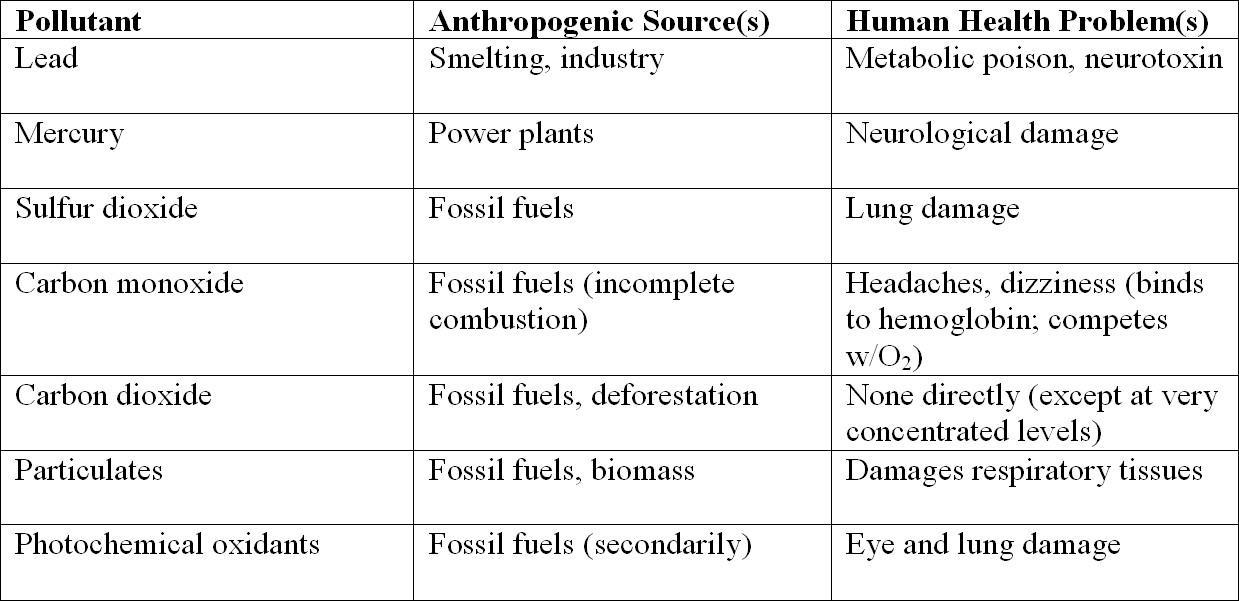
82) Essay
Both are formed by atmospheric oxygen (O2) combining with an atom of singlet oxygen (O). In the troposphere, ozone is a major component of smog. It is formed as a photochemical oxidant, resulting mainly from too many hydrocarbons in the air. It is a strong oxidizing agent and damages vegetation and buildings. It is also an irritant to the lungs and eyes. It can be very harmful to persons with underlying respiratory conditions, so it is considered a pollutant. Its role in the stratosphere is completely different. It acts as a UV filter, providing earth with a "natural" shield from incoming solar radiation. When it becomes depleted, due mainly to CFCs, excess UV makes it through the ozone layer. This results in increased incidence of skin cancer and eye damage in humans. It is also harmful to crops, which may show decreased productivity.
Student name:
1225) The temperature at which gaseous water condenses to form liquid water is called
A) the sublimation point.
B) the saturation point.
C) the relative humidity point.
D) the precipitation point
1226) Evaporation is greatest at
A) near the equator (0 to 20 degrees).
B) mid-latitudes (20 to 40 degrees).
C) higher latitudes (40 to 60 degrees).
D) polar regions.
1227) Approximately percent of Earth's water is freshwater.
A) two
B) ten
C) thirty
D) fifty
1228) According to the United Nations, by 2025, two-thirds of the world's population will be living in drought-stressed conditions.
⊚ true
⊚ false
1229) The dip in the water table below wells is called the
A) recharge area.
B) discharge area.
C) cone of depression.
D) aquifer.
1230) Worldwide per capita use of water has
A) remained remarkably constant over the centuries.
B) increased slightly.
C) increased substantially.
D) actually dropped because of technological advances.
1231) The largest single use of water for industrial purposes is for
A) canning and food processing.
B) cooling.
C) power production.
D) washing produce in food processing industries.
1232) Obtaining usable freshwater by processing seawater is
A) not cost-effective in most places.
B) not technically possible on a large scale.
C) widely expected to resolve the water crisis in most developing countries that front on oceans.
D) not practical because the technology doesn't exist.
1233) Aquifers are porous underground geological formations from which water can be extracted.
⊚ true
⊚ false
1234) Groundwater recharge in most areas of the United States is just barely keeping up with the rate of water withdrawal.
⊚ true
⊚ false
1235) Rain shadows
A) are areas of particularly high precipitation.
B) are areas known for receiving little precipitation.
C) generally do not occur near mountains.
D) are areas of particularly high precipitation and generally do not occur near mountains.
1236) Wetlands are important for the infiltration of water into aquifers.
⊚ true
⊚ false
1237) Clearing forests can
A) alter rainfall patterns.
B) increase runoff.
C) enhance transpiration.
D) alter rainfall patterns and increase runoff.
E) alter rainfall patterns and enhance transpiration.
1238) Of all the world's fresh water, nearly percent is tied up in glaciers, ice caps, and snowfields.
A) 25
B) 50
C) 75
D) 90
1239) Water tables rise and fall seasonally.
⊚ true
⊚ false
1240) The total amount of water taken from a lake, river, or aquifer for any purpose is known as
A) consumption.
B) withdrawal.
C) discharge.
D) depletion.
1241) Which of the following irrigation techniques is least wasteful of water?
A) flood irrigation
B) sprinkler irrigation
C) furrow irrigation
D) drip irrigation
1242) Which of the following is NOT a factor in determining how much or how little precipitation a region receives?
A) topography
B) global atmospheric circulation patterns
C) vegetation
D) proximity to water
E) All of these are important factors.
1243) What two things does the hydrologic cycle do?
A) distributes and purifies water
B) distributes and warms water
C) distributes and contaminates water
D) distributes and increases the salinity of water
1244) Which of the following is NOT a part of the hydrologic cycle?
A) photosynthesis
B) evaporation
C) condensation
D) precipitation
1245) Transpiration is the way plants
A) return large amounts of water to the atmosphere.
B) absorb water from the atmosphere.
C) absorb water from the ground.
D) return large amounts of water from the atmosphere to the ground.
E) respire using water.
1246) Evaporation is
A) the way plants absorb water.
B) liquid water turning to vapor well below boiling temperature.
C) liquid water boiling to produce water vapor.
D) the way water seeps into the ground.
E) the process of water becoming a liquid at a lower temperature.
1247) Natural evaporation processes are mainly driven by
A) living plants.
B) radiative heat from the ground.
C) solar energy.
D) the natural instability of liquid water.
E) radiative heat from the Earth's core.
1248)
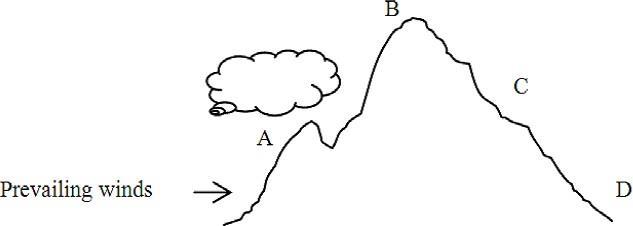
1248.1) The rainiest or snowiest zone on the mountain in the diagram would be in the area marked
A) from A to B.
B) from B to C.
C) from C to D.
D) at A and at D. E) at C and at D.
1248.2) The rain shadow on the mountain in the diagram would be in the area marked
A) from A to B.
B) from B to C. C) from C to D. D) at A and at D. E) at A and at B.
1248.3) Air moving in the direction indicated in the diagram will become warmer as it moves from
A) B to D.
B) A to B.
C) C to A.
D) D to A.
E) None of these choices is correct.
1248.4) Air moving in the direction indicated in the diagram will become dryer as it moves from
A) B to D.
B) A to B.
C) C to A.
D) D to A.
E) None of these choices is correct.
1249) The hydrologic compartment that contains the greatest amount of fresh water is A) groundwater.
B) the Great Lakes.
C) living organisms and biomass.
D) ice and snow.
E) clouds in the atmosphere.
1250) The residence time of one molecule of water in the ocean is .
A) 3000 years
B) 300 years
C) 30 years
D) 3 years
1251) Water enters groundwater by A) infiltration.
B) entering the runoff stream.
C) transpiration.
D) interception.
E) sublimation.
1252) The zone of saturation is the portion of groundwater where
A) water vapor turns to liquid.
B) an aquifer is the deepest.
C) all soil or rock pore spaces are filled with water.
D) all soil or rock pore spaces are filled with air.
E) the water table ends.
1253) The place where aquifers are most likely to be contaminated is at
A) artesian springs.
B) seeps and other outlets.
C) recharge zones.
D) all discharge and recharge areas.
E) the zone of aeration.
1254) The amount of water in aquifers in the United States is
A) nearly as great as the amount of surface water in the United States.
B) higher than all the Great Lakes together.
C) only a small portion of surface water in the United States.
D) over thirty times greater than all surface water in the United States.
E) about the same amount as all surface water in the United States.
1255) The largest river in the world is the
A) Orinoco.
B) Amazon.
C) Mississippi.
D) Nile.
E) Congo.
1256) A country's renewable water supplies are generally made up of
A) surface runoff and infiltration into accessible aquifers.
B) seasonal flooding and infiltration into accessible aquifers.
C) seasonal flooding.
D) rivers running through the country.
E) water used from an aquifer.
1257) Which of the following factors is the MOST important factor in determining whether a country is "water rich" or "water poor"?
A) population density
B) country size
C) humid climate
D) rivers running through the country
E) renewable water supplies
1258) Desalinization could be a method used by which country?
A) The United States
B) The Congo
C) Bahrain
D) Mexico
E) Desalination could be used by any country on the ocean.
1259) The atmosphere has the greatest of the earth's hydrologic compartments.
A) Water volume
B) Turnover rate and smallest water volume
C) Discharge rate and water content
D) Residence time for water
E) All of these choices are correct.
1260) Water scarcity occurs when
A) renewable water supplies are slow to recover.
B) populations are evenly dispersed.
C) renewable water supplies are slow to diminish.
D) the demand for water exceeds the available amount or when poor quality restricts its use.
1261) Cause and effects of water stress may include
A) per capita renewable water supply is low.
B) renewable water supplies are inadequate to satisfy essential human or ecosystem needs.
C) competition increases among increasing demands for water.
D) All of the above are potential causes or effects of water stress.
1262) Technically speaking, when water is consumed, it
A) has been used.
B) is no longer suitable for any other purpose.
C) is no longer available for other purposes.
D) is lost to evaporation or leakage.
E) is available for other uses.
1263) Human water withdrawals have been increasing at about rate as worldwide population growth.
A) the same
B) half the
C) one-third the
D) three times the
E) twice the
1264) Withdrawal is the total amount of water
A) lost in transmission, due to evaporation or leakage.
B) taken from rivers, lakes, or aquifers.
C) used in manufacturing or agriculture.
D) altered or polluted in human activities.
E) lost due to chemical transformation because of human use.
1265) In general, water use worldwide is dominated by
A) agricultural use.
B) domestic needs.
C) industrial activities.
D) use as drinking water.
E) All of these are sectors that use water about equally.
1266) The activity that uses the greatest share of U.S. household water is
A) bathing.
B) drinking and cooking.
C) flushing the toilet.
D) washing clothes and dishes.
E) watering lawns.
1267)
1267.1) On the graph of domestic water use per person, each letter represents a country. Which of the following is most likely?
A) A is the United States; B is China.
B) B is the United States; A is China.
C) A is the United States; B is Canada.
D) B is India; A is China.
E) A is India; B is China.
1268) In the twentieth century, half of the new dams that were built are in
A) China.
B) Pakistan.
C) Russia.
D) The United States.
E) Canada.
1269) One of the major reasons for the removal of dams in the United States is
A) buildup of silt behind the dams.
B) danger of earthquakes beneath the reservoir.
C) to satisfy conservation groups.
D) to restore fish populations.
E) to make the region look more natural.
1270) The Ogallala Aquifer supplies water to and once held more water than all of the surface water
A) California's Central Valley; in the world
B) The Rocky Mountain states; in the United States
C) The Great Plains states; in the world
D) Most of New England; in the United States
E) Arizona and Las Vegas; in the United States
1271) Withdrawal of groundwater often causes subsidence, a situation where
A) aquifer volume decreases sharply.
B) withdrawals exceed recharge rates.
C) water quality and water tables fall.
D) porous rocks settle and ground level falls.
E) wells dry up.
1272) The Klamath River agreement
A) is an agreement to remove dams to save migrating salmon populations.
B) provides for the increase in value of water rights for fish and aquatic organisms.
C) is a less-used strategy to help regulate water diversion for local farmers.
D) provides a water diversion project for the city of Los Angeles.
E) forces conservation measures on domestic use of water by local residents.
1273) Subsidence and sinkholes
A) can, with difficulty, be reversed and the ground surface raised again.
B) are probably a permanent loss of an aquifer.
C) are a consequence of saltwater intrusion.
D) leave gaps in the bedrock that then fill up with salt water.
E) increase the total area of recharge zones.
1274) A method of increasing water supplies that has been successful, but expensive is
A) desalination.
B) cloud seeding.
C) towing icebergs by ship from polar regions.
D) altering the climate's convection currents.
E) None of these choices is correct.
1275) Human activity such as deforestation can affect rainfall.
⊚ true
⊚ false
1276) Many experts think that in the future, water conflicts will be a major cause of international conflict. Currently, however, there are no international conflicts over water.
⊚ true
⊚ false
1277) Principal problems that have resulted from the construction of large dams include the relocation of people.
⊚ true
⊚ false
1278) Charging a higher proportion of real costs rather than subsidies has led to water conservation.
⊚ true
⊚ false
1279) Compare and contrast the water diversion projects in China and California.
1280) After graduation, you are moving to southern California for a great job. You will need to change your water consumption habits because you have been living in an area with plenty of water and it has not been an issue. (Note: Use your own region if it is applicable.) Describe five things you can do to conserve water.
1281) The regions of the world with the most precipitation annually are
A) the tropical region near the equator.
B) the southeastern United States.
C) the polar regions.
D) Europe and the Middle East.
1282) Rainfall is higher on the
A) windward side of a mountain range.
B) leeward side of the mountain range.
C) the rain shadow.
D) the top of the mountain.
1283) Which of the following is the largest compartment of fresh water on Earth?
A) ice and snow
B) oceans
C) fresh groundwater
D) rivers and streams
1284) Which of the following withdraws the highest amount of water yearly?
A) agriculture
B) industry
C) cities
D) drinking water
1285) Which of the following is water consumption?
A) bottling groundwater and shipping it to other states
B) withdrawing drinking water from a local reservoir
C) releasing treated wastewater in a local river
D) watering your garden every day in summer
1286) In the process of hydraulic fracturing (fracking), water mixed with chemicals is used to break rock to access natural gas. Because of the added chemicals, this water cannot be returned to surface waters. This wastewater is injected deep underground to be stored away from groundwater resources that could be contaminated. This is an example of
A) water consumption.
B) water withdrawal.
C) water use.
D) water stress.
E) water scarcity.
1287) With deforestation, what process of the hydrologic cycle is diminished?
A) transpiration moving water into the atmosphere
B) runoff from precipitation
C) evaporation of surface water
D) movement of moist air from ocean to land
E) evaporation from oceans
1288) The San Joaquin Valley in California has sunk because groundwater is withdrawn faster than it is replaced causing collapse of pore spaces underground. This is called
A) subsidence.
B) diversion.
C) consumption.
D) intrusion.
E) aquifer depletion.
1289) Which of the following is NOT an effect that urbanization has on water?
A) Urbanization increases transpiration.
B) Urbanization decreases infiltration of water into groundwater.
C) Urbanization increases pollution of surface water.
D) Urbanization requires renewable water supplies for drinking water and domestic uses.
1290) As population has increased since 1900, all of the following uses have increased. Which of the following water withdrawals cannot be directly reduced by conservation efforts?
A) agricultural water
B) water use in industry
C) urban use of water
D) evaporation from reservoirs
1291) How does the process of desalination generate fresh water?
A) Saltwater is either heated or filtered to separate the salt from the water.
B) Small volumes of saltwater are combined with larger volumes of freshwater to dilute the salt concentration.
C) Chlorine is added to saltwater, which causes the salt to come out of solution making it easier to remove.
D) Oil is mixed with the salt water and the salt is transferred to the oil leaving freshwater behind.
1292) Why is there so little easily accessible fresh water on Earth? (Select all that apply.)
A) There isn't that much water on Earth because the majority of space is covered by land.
B) The vast majority of water on Earth is salty, so not fit for human consumption.
C) The majority of water stored in the atmosphere adan is only accessible when we get precipitation.
D) Most fresh water on Earth is frozen in glaciers or stored underground so it is difficult to access.
Answer Key
Test name: chapter 17 1) B 2) B 3) A 4) TRUE 5) C 6) C 7) C 8) A 9) TRUE 10) FALSE 11) B 12) TRUE 13) D 14) D 15) TRUE 16) B 17) D 18) C 19) A
20) A 21) A
22) B 23) C
24) Section Break
24.1) A
24.2) C
24.3) A
24.4) A
25) D 26) A 27) A 28) C 29) C 30) D 31) B 32) A 33) E
34) E 35) B
36) D
37) D 38) C 39) E 40) B 41) A 42) C
43) Section Break
43.1) A 44) A 45) D 46) C 47) D 48) C 49) B 50) A 51) TRUE 52) FALSE 53) TRUE 54) FALSE 55) Essay
By comparison, both projects have the same purpose. That is to divert or transfer water from one region to another. In California, there is plentiful rainfall in the north, so excess water is pumped to the south. In China, it is the reverse. Southern China has plentiful water and will be pumping it to the north where it is scarcer.
In California, much of the original project was done rather underhandedly. In the early 1900s, land in northern California was quietly purchased by persons in power in Los Angeles. Eventually, they controlled over 90% of the water rights in the Owens Valley area of northern California. They built a huge aqueduct and transported the water to the south. So much water was transferred that the Owens River became dry for much of its course and Owens Lake, which was fed by the river, completely disappeared. In the 1940s, even more water was needed, so sources even further north were tapped to increase the supply. Another lake in this area lost half of its volume. This had serious environmental effects by decimating the population of brine shrimp that lived in the lake. This in turn decreased the number of waterbirds that relied on the shrimp as a food source. After many years of legal issues, the California Water Resources Board ruled in 1994 that LA must allow some water to replenish Lake Mono (the second lake affected). By 2014, the lake must be returned to its 1964 level. Some increase has been seen so far. The ecology also seems to be recovering slowly in this area.
In China, a huge multi-year, multi-billion dollar project is now underway to transfer water from southern to northern China. This will involve not one, but three separate routes to transfer the water to the needed regions. There are many problems and issues that will need to be dealt with. One issue is that water polluted by sewage and industrial waste is being transferred. Even though some areas are extremely dry, they are reluctant to accept this water. One of the routes will be extremely expensive and probably will not reach completion until at least 2050. This route will tunnel through mountains and over deep canyons. In addition, if global warming melts all of Tibet's glaciers, it may not be feasible in the long run. Environmental scientists worry that drawing from the Yangtze River will only worsen its pollution problems. Drawing water away from rivers on which millions rely only makes pollution problems worse. Downstream wetlands may also dry up, and ocean circulation may even be affected.
56) Essay
Should include at least some of the following, but may include others as well.
2. don't flush every time you use the toilet
3. don't let the faucet run when washing hands, dishes, or brushing teeth
4. take shorter showers
5. use water-efficient plumbing fixtures
6. check for leaky plumbing
7. xeriscaping
8. use recycled (gray) water for outside uses (if possible) watering lawn, washing car, etc.
9. run dishwasher only when full
57) A
58) A
59) A
60) A
61) A
62) A
63) A
64) A
65) A
66) D
67) A
68) [B, D]
Student name:
1293) The principal source of infectious waste material in water is
A) industrial waste.
B) surface runoff.
C) human feces.
D) agricultural pesticides.
1294) Examples of point sources of water pollution include
A) runoff from farm fields.
B) a sewage outfall from a city sewer plant.
C) runoff from parking lots.
1295) Since the Clean Water Act of 1972, the quantities of nitrate and phosphate entering surface waters have
A) decreased significantly for both point and nonpoint sources.
B) have decreased for nonpoint sources but not point sources.
C) have decreased for point sources but not nonpoint sources.
D) essentially remained the same.
1296) About 1.5 million Americans get sick annually from fecal contamination producing large health costs. Preventive measures would cost
A) much more.
B) slightly more.
C) about the same.
D) less.
1297) The Clean Water Act has turned out to be in achieving its point source goals.
A) very effective
B) marginally effective
C) ineffective
D) a disaster
1298) The central goal of the U.S. Clean Water Act was to
A) make all surface waters swimmable and fishable.
B) categorize water into types of use and then establish an array of different cleanup goals.
C) end all water pollution in the United States by 2050.
D) eliminate all nonpoint source pollution where economically feasible.
1299) Atmospheric deposition of pollutants is an example of point source pollution.
⊚ true
⊚ false
1300) Eutrophication is a natural process that has been greatly stimulated by human activities.
⊚ true
⊚ false
1301) Runoff of pesticides from lawns, fields, golf courses, and other areas is considered to be one of the most important sources of toxic organic pollution of water.
⊚ true
⊚ false
1302) The greatest remaining need in rectifying remaining water pollution problems in the United States and Canada is solving the point source discharge problem.
⊚ true
⊚ false
1303) Pollution of water in large aquifers is essentially irreversible in the short term (decades).
⊚ true
⊚ false
1304) A 2006 U.S. Supreme Court ruling that resulted in the EPA dropping enforcement actions on at least 1,500 water pollution cases and the exclusion of the drinking water sources of over 117 million Americans was based on the court's interpretation of the word
A) aquifer.
B) navigable.
C) organic.
D) toxic.
1305) Air pollution can lead to water contamination via a process called atmospheric deposition.
⊚ true
⊚ false
1306) The use of water to cool industrial facilities
A) can result in a thermal plume.
B) can attract certain fish, birds, and marine mammals.
C) was banned as a result of the Clean Water Act.
D) can result in a thermal plume and attract certain fish, birds, and marine mammals.
1307) MTBE is a gasoline additive
A) intended to reduce carbon monoxide in vehicle exhaust.
B) which evaporates before entering groundwater.
C) that is a very serious source of groundwater pollution in the United States.
D) intended to reduce carbon monoxide in vehicle exhaust and evaporates before entering groundwater.
E) intended to reduce carbon monoxide in vehicle exhaust and is a very serious source of groundwater pollution in the United States.
1308) The Cuyahoga river is notable because
A) it is polluted with selenium which led to the death of millions of birds.
B) it is routinely flooded with untreated sewage from the city of Cleveland.
C) it caught fire.
D) it is an Endangered Species Act success story.
E) it is a living machine cleaning pollution from the local area.
1309) sources of water pollution are relatively easy to monitor and regulate, while sources of water pollution are difficult to monitor and clean up.
A) Domestic; industrial
B) Primary; tertiary pollutant
C) Nonpoint; point
D) Tertiary pollutant; primary
E) Point; nonpoint
1310) The discharge from a nonpoint source of pollution is
A) usually constant throughout the year.
B) generally easier to regulate than a point source.
C) usually less polluting than a point source.
D) highly seasonal in quantity.
E) less damaging than other sources of pollution.
1311) is to a point source of water pollution as is to a nonpoint source of water pollution.
A) Golf course runoff; atmospheric deposition
B) Golf course runoff; power plant effluent
C) Power plant effluent; golf course runoff
D) Atmospheric deposition; golf course runoff
E) Power plant effluent; an underground coal mine drain
1312) Factories, sewage treatment plants, and oil wells are sources of water pollution.
A) point
B) primary
C) nonpoint
D) tertiary pollutant
E) secondary
1313) Atmospheric deposition of contaminants is an excellent example of
A) the properties of water that allow it to disperse contaminants.
B) nonpoint pollution.
C) a point source of pollution.
D) the relative ease in determining sources of contaminants.
E) a primary source of pollution.
1314) The type of water pollutant that most commonly threatens human health is/are .
A) pathogenic organisms
B) dissolved plant matter
C) toxic and hazardous chemicals
D) thermal pollution
E) oxygen-demanding wastes
1315) High oxygen content in water is an indication that
A) water is clean enough to support game fish.
B) there are no contaminants present at all.
C) there is a large population of coliform bacteria.
D) water is only able to support algae and bacteria.
E) sewage, paper pulp, or food processing wastes have been added to the water.
1316) Coliform bacteria populations are routinely monitored in drinking water supplies, swimming pools, and at beaches because these bacteria
A) are especially toxic to animals.
B) may mutate into severely pathogenic strains.
C) indicate the presence of feces in water.
D) usually live in pesticide-contaminated water.
E) are more difficult to find in water.
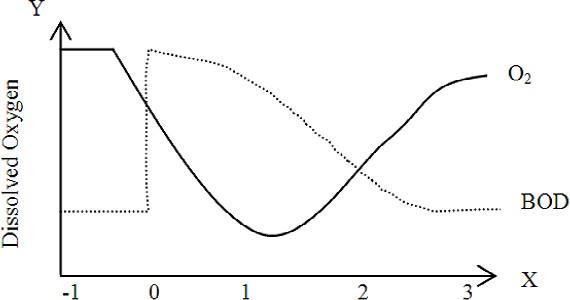
1317)
1317.1) In the diagram, the horizontal (X) axis should be labeled
A) temperature.
B) time.
C) distance from outfall pipe.
D) depth.
E) oxygen content.
1317.2) In the diagram, which of the following units would probably be used to label the numbers on the horizontal (X) axis?
A) degrees Centigrade.
B) hours.
C) meters.
D) days.
1317.3) The most active decomposition occurs in the area marked on the horizontal axis of the diagram.
A) -1 to 0
B) 0 to 1
C) 1 to 2
D) 2 to 3
E) 1 to 3
1317.4) In the diagram, which of the following organisms would probably be found in the area marked 3 and higher?
A) mayfly and stonefly larvae
B) mosquito larvae
C) bullhead catfish and gar
D) gar, blackfly, and midge larvae
E) leeches and isopods
1317.5) In the diagram, which of the following organisms would probably be found in the area between 1 and 2?
A) mayfly and stonefly larvae
B) mosquito larvae
C) bullhead catfish and gar
D) gar, blackfly, and midge larvae
E) trout, sludge worms, and mosquito larvae
1318) When natural waters are overloaded with plant nutrients such as nitrate and phosphate ions, they become
A) oligotrophic
B) dystrophic
C) eutrophic
D) metatrophic
E) megatrophic
1319) Cultural eutrophication results from
A) natural sediment and nutrient levels.
B) a change in animal life as well as plants.
C) the disappearance of tributary streams.
D) human activity.
E) natural topography.
1320) An oxygen sag occurs most often
A) in estuaries closest to a pollution source.
B) immediately downstream from a pollution source.
C) immediately upstream from a pollution source.
D) after the water recovers from the pollution source.
E) at any of these places.
1321) Toxic metals such as lead, cadmium, and mercury
A) rarely threaten water supplies.
B) can be toxic if high concentrations are reached.
C) can be toxic in extremely small quantities.
D) are the most common health threat in water.
E) usually don't accumulate in food chains.
1322) Which of the following are inorganic toxic substances sometimes found in local water supplies?
A) salts and lead
B) red tides
C) fecal coliform bacteria
D) algal blooms
E) All of these choices are correct.
1323) Algal blooms are a common problem in the Mediterranean sea because of
A) the particular species of algae there.
B) heavy tourism and untreated sewage.
C) nutrients from extremely active agriculture.
D) the heavy storms and waves that occur there.
E) huge manure waste lagoons.
1324) The sediments that make up the Ganges river delta in India are often toxic because they
A) run through toxic soils.
B) originate in coastal industrial areas.
C) are highly acidic due to acid rain.
D) have concentrations of naturally occurring arsenic.
E) dissolve naturally occurring sulfur dioxide
1325) Acid precipitation is especially disruptive when it occurs in areas with because of the lack of
A) limestone in the soil; buffering capacity
B) alkaline soils; acid-resistant mosses
C) crystalline bedrock; buffering capacity
D) crystalline bedrock; acid-resistant mosses
E) alkaline soils; buffering capacity
1326) Dioxins, pesticides, and polychlorinated biphenyls are all types of
A) inorganic toxic substances.
B) heavy metals.
C) suspended solids and BODs.
D) acidifying agents.
E) toxic organic compounds.
1327) is an example of a natural process that is accelerated by human activities.
A) Eutrophication
B) The weathering and release of toxic inorganic minerals from rocks
C) The mobilization and concentration of soluble salts from groundwater
D) Sediment loading of rivers
E) All of these choices are correct.
1328) In order to avoid producing thermal plumes, power plants often
A) increase the efficiency of their energy use.
B) warm entire rivers to ease temperature gradients.
C) chemically alter their effluent.
D) build cooling towers or ponds.
E) All of these choices are correct.
1329) The main reason that surface water pollution has largely decreased in the United States since 1950 is
A) the Clean Water Act.
B) a series of epidemics that inspired action.
C) the discovery of newer technology that makes it cheaper not to pollute.
D) the decrease in water withdrawal for industrial uses.
E) the emphasis, in 1950, on watershed management.
1330) In 1998, a change in the approach to water quality was initiated by with an emphasis on .
A) the EPA; cost-benefit analysis
B) a series of epidemics that inspired action; watershed management
C) industry; cost-benefit analysis
D) the decrease in water withdrawal for industrial uses; cost-benefit analysis
E) the EPA; watershed management
1331) Feedlots are a major cause of in water.
A) viruses
B) coliform bacteria
C) nitrates
D) phosphates
E) All of these choices are correct.
1332) Aquifers are especially susceptible to contamination
A) around wells.
B) near their recharge zones.
C) when they are shallow.
D) around injection wells.
E) All of these choices are correct.
1333) The following statements explain why contamination of aquifers is dangerous. Which of the statements is false?
A) The contaminants are concentrated by the different densities of water in the aquifers.
B) Pollutants are extremely stable once they contaminate an aquifer.
C) Minuscule amounts of a pollutant can contaminate an entire aquifer.
D) Aquifers can take an extremely long time to turn over their water content.
E) All of these statements are true.
1334) The potential problem with natural decay for human waste is that
A) it never really works.
B) it only works where population density is low.
C) it is an expensive process to maintain.
D) unlike sewage treatment, it produces toxic by-products.
E) natural processes take a long time.
1335) should never be allowed down a drain when a septic tank and drain field system is being used for sewage disposal.
A) Kitchen waste from cooking
B) Dog or cat urinary or fecal matter
C) Chlorine and antimicrobial cleansers
D) Oils and greases
E) Solid materials
1336) Primary sewage treatment involves
A) removing solids from water.
B) removing all organic matter from water.
C) making water transparent again.
D) removing all bacteria.
E) making water usable for agriculture.
1337) Tertiary treatment of sewage produces water that is typically used for
A) agriculture.
B) drinking.
C) industrial activities.
D) watering livestock.
E) dumping into freshwater systems.
1338) Tertiary sewage treatment is designed to remove
A) large solids.
B) suspended solids.
C) sludge.
D) nitrates and phosphates.
E) dissolved organic compounds.
1339) The advantage of effluent sewerage is that
A) since solids are removed, pipes and pumps to the central treatment plant can be small and cheap.
B) since solids remain in the liquid, disposal is easy and cheap.
C) families can do all their processing at home.
D) large, expensive municipal systems are no longer needed.
E) since solids are digested like a septic system, the effluent can be used as fertilizer.
1340) Using Bentonite slurries to stabilize liquids in porous substances is an example of
A) a containment method of remediation.
B) tertiary sewage treatment.
C) bioremediation.
D) extraction techniques of remediation.
E) in vitro extraction techniques.
1341) Using duckweed in a lagoon as low-tech sewage treatment plant is an example of
A) a containment method of remediation.
B) tertiary sewage treatment.
C) bioremediation.
D) extraction techniques of remediation.
E) in vitro extraction techniques.
1342) Best practical technology (BPT) is legally required for all
A) point source polluters.
B) priority toxic pollutants.
C) pollution and polluters.
D) common toxic pollutants.
E) municipal planning officers to control urban runoff.
1343) Best available economically achievable technology (BAT) standards are standards set for
A) nonpoint pollution.
B) toxic substances.
C) radioactive waste, specifically.
D) organic compounds.
E) all point sources.
1344) Which of the following would NOT help to improve water quality?
A) composting yard waste
B) stop using fertilizers
C) not using jet skis
D) watering plants with water from rain barrels rather than municipal water
E) keeping your car well maintained
1345) Wetland protection is one of the most controversial provisions of the because opponents believe that the legislation is .
A) Endangered Species Act; an infringement on their use of private property
B) Clean Water Act; ineffective because it does not prevent pollutants
C) Land Use Act; an infringement on their use of private property
D) Clean Air Act; ineffective because it does not prevent pollutants
E) Clean Water Act; an infringement on their use of private property
1346) The cheapest and most effective way to reduce water pollution is to use technology to separate wastes for nonpoint sources.
⊚ true
⊚ false
1347) Sediments in rivers are especially harmful to Louisiana's coastal wetlands. ⊚ true ⊚ false
1348) Open sea bilge pumping and tank cleaning are legal ways to clean ships, once the ship is at least 300 miles offshore.
⊚ true ⊚ false
1349) The first estuary in the United States to be targeted for protection and restoration was Chesapeake Bay.
⊚ true ⊚ false
1350) Compare and contrast the cleanup and control of nonpoint and point sources of water pollution.
1351) Identify four categories of human health problems associated with water pollution and provide an example for each one.
1352) Explain the connections between oxygen sag and biological oxygen demand (BOD). Use a drawing in your explanation and use appropriate labels.
1353) During rainstorms, water runs off of a parking lot into a local urban stream. This would be categorized and managed as a
A) nonpoint source of pollution.
B) point source of pollution.
C) TMDL.
D) deposition of pollution.
E) BOD.
1354) Which of the following is NOT a correctly matched category of water pollution and an example of that category?
A) organic chemicals: acids
B) inorganic chemicals: metals
C) infectious agents: parasites
D) plant nutrients: phosphates
E) oxygen-demanding wastes: plant residues
1355) Animal operations such as hog farms create a significant amount of sewage waste that cannot be released into surface waters. One farm constructed a wetland to treat hog waste serving as a wastewater treatment system just as cities have wastewater treatment. The following descriptions of the constructed wetland compare each step to the steps of conventional wastewater treatment in cities. Which description is NOT correctly matched?
A) Solids are composted or landfilled: tertiary treatment
B) Solids are screened from the waste stream before liquids are treated: primary treatment
C) After treatment, the water goes to an irrigation pond to be used on the farm: discharge of treated water into surface waters
D) Bacteria on the roots of the wetland plants removes nitrates from the water and breaks down dissolved organic compounds: secondary and tertiary treatment
1356) The state Division of Water Quality found that chemical waste was leaking into a nearby stream from an old industrial site no longer in use. It was designated a Superfund site and scientists are currently developing a plan to manage and remediate the toxic site. Which legislation provided the Superfund program?
A) Comprehensive Environmental Response, Compensation, and Liability Act
B) Clean Water Act
C) Clean Water Act amendments
D) Toxic Substances Control Act
E) Safe Drinking Water Act
1357) Modern wastewater treatment can be referred to as a biological process. Which treatment level would be referred to as a biological process?
A) secondary treatment
B) primary treatment
C) tertiary treatment
D) discharge
1358) Which of the following has been significantly decreased due to regulations from the Clean Water Act?
A) Water pollution from point sources
B) Water pollution from nonpoint sources
C) Eutrophication
D) Fertilizer runoff
E) Pollution from stormwater runoff
1359) A state Division of Water Quality department set up a long-term monitoring station and proposed a remediation plan for a stream because of high levels of copper and fecal coliform bacteria found in the water. These pollutants were targeted likely because they
A) exceeded the Total Maximum Daily Loads.
B) exceeded the water pollution threshold.
C) were causing human illness.
D) were killing nearby animals.
E) were being discharged from a pipe.
1360) Air pollution can contribute to water pollution through a process called
A) atmospheric deposition.
B) precipitation.
C) point source pollution.
D) oxygen sag.
E) eutrophication.
1361) Stone fly larvae are macroinvertebrates that are very sensitive to the ecosystem impacts of water pollution. In which of the following are you least likely to find these larvae?
A) septic zone
B) clean zone
C) recovery zone
D) an area with dissolved oxygen higher than 5 ppm
1362) Research on practical applications of duckweed suggests that the system would be useful for removing pollutants that cause eutrophication. Which of the following would NOT be a pollutant managed by this wastewater treatment system?
A) heavy metals
B) nitrates
C) phosphates
D) ammonium
1363) What was the central goal of the Clean Water Act?
A) to ensure the quality of drinking water in the United States by establishing water quality standards
B) to decrease the amount of non-point source pollution making its way into bodies of water in the United States
C) to improve water quality in the United States and make all bodies of water in tech U.S. swimmable and fishable.
D) to promote the safety of bottled water by monitoring the amount of microplastics and chemical pollutants
1364) Which of the following statements correctly describes the purpose of the Safe Drinking Water Act?
A) A set of regulations administered by the Food and Drug Administration that governs the safety of bottled water
B) Legislation administered by the Department of Interior that sets guidelines for the extraction of U.S. drinking water
C) Policy administered by the EPA that establishes standards and ensures monitoring of U.S. drinking water supplies
D) Regulations administered by the Department of Commerce to make all bodies of water in the U.S. swimmable and fishable
Answer Key
Test name: chapter 18
1) C 2) B 3) C 4) D 5) A 6) A 7) FALSE 8) TRUE 9) TRUE 10) FALSE 11) TRUE 12) B 13) TRUE 14) D 15) E 16) C 17) E 18) D 19) C
20) A 21) B
22) A 23) A
24) C
25) Section Break
25.1) C
25.2) C
25.3) B
25.4) A
25.5) B
26) C
27) D
28) B 29) C
30) A
31) B
32) D
33) C 34) E 35) E
36) D 37) A 38) E 39) E 40) E 41) A 42) B 43) C 44) A 45) E 46) D 47) A 48) A 49) C 50) A 51) B 52) D 53) E 54) FALSE 55) FALSE
56) FALSE 57) TRUE 58) Essay
Point

Examples include factories, power plants, sewage treatment plants, underground coal mines, and oil wells
Pollution is discharged from specific locations (e.g., drain pipes, smoke stacks, ditches, sewer outfalls)
Discrete and identifiable, so are relatively easy to monitor and regulate
Generally feasible to divert effluent from the waste stream and treat it before it is released into the environment
Examples include runoff from farm fields and feedlots, golf courses, lawns and gardens, construction sites, logging areas, roads, streets, and parking lots
There is no specific location where they discharge, so it can end up in water anywhere
Typically are scattered or diffuse
Amount of runoff is seasonal (varies with times and amounts of precipitation); heavy rainfalls may flush or carry a lot of pollutants into lakes, rivers, and other bodies of water at one time
Much more difficult to monitor, regulate, and treat
59) Essay
60) Essay
BOD is one way to measure the amount of bacteria in a water sample. Organic wastes, including sewage, paper pulp, or food, are very rich in certain nutrients especially nitrogen and phosphorus. Once in aquatic ecosystems, these nutrients stem the growth of decomposing bacteria. These bacteria consume large amounts of oxygen. The BOD can give us an approximation of the amount of organic waste in the water based on the oxygen content. The effects of oxygen-demanding wastes on bodies of water depend on the volume, flow, and temperature of the water. In general, a characteristic decline in oxygen is seen downstream from a point source (e.g., discharge pipe). This is called the oxygen sag. Farther downstream, levels of oxygen will eventually return to normal. A diagram similar to Fig. 18.7 on p. 402 in the text (showing the relationship between BOD and oxygen sag) should be drawn with appropriate labels. Zones, oxygen levels, and types of organisms may be included in this diagram.
61) A 62) A 63) A 64) A 65) A
66) A
67) A
68) A
69) A
70) A
71) C
72) C
Student name:
1365) Energy is defined as
A) the capacity to do work.
B) calorie consumption per hour.
C) any kind of molecule that has the ability to cause objects to move.
D) force exerted per unit of time.
1366) Each year the United States spends over billion dollars on imported oil.
A) 100
B) 200
C) 400
D) 800
1367) A number of European countries have similar or even higher standards of living than the United States and consume less energy than Americans do.
⊚ true
⊚ false
1368) By far the greatest amount of proven natural gas reserves are found in
A) Alaska.
B) Canada.
C) the Middle East.
D) Africa.
1369) The greatest amount of energy in the United States is used for
A) industrial uses.
B) transportation.
C) heating and cooling buildings.
D) commercial uses.
1370) There is a positive correlation between standard of living and per capita energy consumption.
⊚ true
⊚ false
1371) Proven reserves of fossil fuels are those demonstrable to be economically recoverable.
⊚ true
⊚ false
1372) The main concern over nuclear power plant safety is that if safety equipment malfunctions, such plants would explode like small nuclear bombs.
⊚ true
⊚ false
1373) Breeder reactors, because they produce more nuclear fuel than they consume, are regarded as the ultimate solution to our energy problems.
⊚ true
⊚ false
1374) The Marcellus and Devonian Shales
A) are a potential vast source of oil in the eastern United States.
B) can be drilled without any pollution risk to the environment.
C) could result in the drilling of thousands of wells in populated places.
1375) The largest source of oil for the United States is currently
A) the Middle East.
B) Venezuela.
C) Canada.
D) Alaska.
1376) Coal and petroleum are derived from organic molecules created by living organisms millions of years ago.
⊚ true
⊚ false
1377) Natural gas is
A) currently the world's third largest commercial fuel.
B) the most rapidly growing fossil fuel energy source.
C) hazardous to the environment because it is not clean burning.
D) currently the world's third largest commercial fuel and the most rapidly growing fossil fuel energy source.
E) the most rapidly growing fossil fuel energy source and hazardous to the environment because it is not clean burning.
1378) The proper functioning of nuclear reactors depends on a self-sustaining chain reaction from which vast amounts of energy are released.
⊚ true
⊚ false
1379) Power is the
A) rate of energy delivery (work done per second).
B) amount of energy available.
C) capacity to do work (force over distance).
D) combination of the rate of energy delivery, amount of energy available, and the capacity to do work.
E) amount of work done when a force of one newton is exerted over one meter.
1380) One megawatt is equal to watts.
A) 100
B) 1000
C) 1 million
D) 1 billion
E) 1 trillion
1381) The application of force over distance is known as
A) power.
B) work.
C) fuels.
D) energy.
E) None of these choices is correct.
1382) Which of the following is NOT considered a fossil fuel?
A) coal
B) natural gas
C) oil
D) charcoal
E) All of these are considered to be fossil fuels.
1383) Norway, Denmark, and Japan have higher standards of living by most measures than America.
A) because their energy consumption is much greater
B) because they are closer to energy supplies
C) even though their energy use is about equal to ours
D) even though their energy use is about half as much as ours
E) because they don't use any fossil fuels
1384) In the process of getting energy to power your television, which of the following stages is the most energy efficient?
A) mining the coal to run the power plant
B) burning the coal to run the power plant
C) thermal conversion of the energy from coal in the power plant
D) transmission to your house
E) actually powering your television set
1385) The chemical industry is the second-largest industrial consumer of fossil fuels with used for energy generation and used for raw materials in manufacturing.
A) half; half
B) three quarters; one quarter
C) one quarter; three quarters
D) one third; two thirds
E) two thirds; one third
1386) Worldwide, coal deposits are
A) widespread but rarely in economic quantities.
B) relatively difficult to find.
C) highly unusual formations.
D) widespread and extensive.
E) decreasing at alarming rates.
1387) Black lung disease results from
A) the radioactivity in coal.
B) the radioactivity around coal-fired power plants.
C) careless strip-mining methods.
D) coal dust literally filling lungs like dust in a vacuum cleaner bag.
E) coal dust causing inflammation and fibrosis in lungs.
1388) Which of the following is NOT a drawback of burning coal for electricity?
A) Coal reserves in the United States are plentiful.
B) Much of the coal mined is through mountain top removal and valley fill, which leads to major environmental problems near the mine sites.
C) When burned, coal gives off a high amount of sulfur compounds and mercury.
D) Toxic coal ash much be stored indefinitely.
1389) Under normal operating conditions, power plants release radioactivity as well as toxic metals.
A) coal-fired
B) hydroelectric
C) nuclear
D) wind-generated
E) All of these choices are correct
1390) The main pollutant released by coal burning is
A) mercury vapor.
B) methane.
C) sulfur oxides.
D) volatile organic compounds.
E) nox.
1391) Most useful oil deposits are usually found
A) in a liquid pool under a layer of impermeable shale.
B) saturating porous rocks, like water in a sponge.
C) locked in the mineral structure of a rock formation.
D) in pools on the earth's surface, where geologic pressures have forced them to collect.
E) in small pools directly above the bedrock.
1392) Oil wells are usually able to extract of the petroleum present in an oil reservoir.
A) all
B) about 90 percent
C) about 75 percent
D) 30 to 40 percent
E) less than 10 percent
1393) Secondary recovery techniques are ways to
A) force more oil out of a drying well.
B) extract new types of fuels from an empty well.
C) recover nonfuel materials from an oil well.
D) distill usable fuels from raw petroleum.
E) recover the oil that spills when an oil well gushes.
1394) Oil shale and tar sands are examples of oil.
A) unrecoverable
B) unproven
C) unknown
D) unconventional
E) recoverable
1395) In order to extract kerogen, it must be
A) heated to 480°C
B) removed by a salt/brine solution
C) kept at a temperature of 25°C or below, or it will evaporate
D) converted to a gas before it can be transported
1396) is the most rapidly growing energy source.
A) Methane
B) Natural gas
C) Nuclear power
D) Coal
E) Oil
1397) Currently the most common way to extract natural gas is by .
A) hydraulic fracturing
B) collecting it from abandoned deep mines
C) separating it from crude oil pockets
D) collecting it from deep ocean thermal vents
1398) What is the biggest drawback for developing oil shales, tar sands, and coal gasoline?
A) cost
B) availability of these resources
C) imports of these are extremely cheap
D) there are no drawbacks
1399) What is the name of the shale basin that is located under much of the northern Appalachian Mountains?
A) Marcellus Shale Basin
B) Devonian Shale Basin
C) Barnett Shale Basin
D) Delaware Shale Basin
1400) Hydraulic fracturing breaks what kind of rock layer to release methane?
A) shale
B) slate
C) granite
D) limestone
1401) Pressurized fluid and chemicals injected into a well are used in a mining process called .
A) hydraulic fracturing
B) placer mining
C) heap-leach extraction
D) high pressure welling
1402) One of natural gas is that it is than either coal or oil.
A) disadvantage; harder to ship and store
B) advantage; easier to build infrastructure for transporting it
C) disadvantage; harder to sell
D) advantage; easier to find
E) disadvantage; less abundant
1403) Methane produced from animal waste or by digesting garbage is an example of a(n)
A) conventional gas source.
B) unconventional gas resource.
C) by-product of human activities.
D) nonrenewable energy source.
E) unconventional gas resource and a by-product of human activities.
1404) Interest in nuclear power as a major world energy source
A) was strong in the 1950s but has since faded.
B) gradually built to a peak in the 1980s and 1990s.
C) reached a peak of interest due to the Gulf War.
D) has been consistently low since it was invented.
E) is increasing because of its low cost.
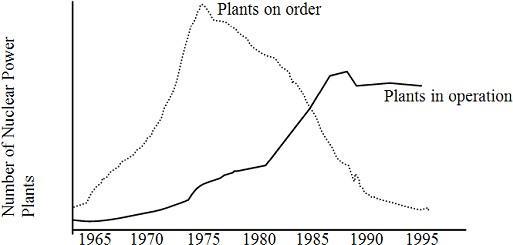
1405)
1405.1) According to the diagram, the number of plants in operation in the early 1990s.
A) increased sharply
B) increased
C) decreased sharply
D) decreased
E) leveled off
1405.2) Why didn't the "plants in operation" curve in the diagram increase to the same level that the "plants on order" curve peaked?
A) because of the increased concerns about reactor safety and waste disposal
B) because some people were still supportive of nuclear power
C) because nuclear power does not contribute to the greenhouse effect
D) because there is a lag time between ordering and operating a nuclear plant
E) because many utilities canceled their orders
1406) The fuel used in a conventional PWR or BWR nuclear power plant is
A) plutonium.
B) uranium.
C) thorium.
D) cadmium.
E) any one of these.
1407) Workers in uranium mines have experienced extremely high incidence of
A) strokes.
B) emphysema.
C) lung cancer.
D) black lung disease.
E) skin cancer.
1408) Uranium fuel is _ before it can be put into a reactor.
A) extensively processed to clean and purify it
B) found in concentrated form in the Earth and then washed
C) produced by bombarding it with electrons from radioactive plutonium
D) extensively processed in order to change it to a safer form
E) None of these choices is correct
1409) A fuel assembly in a nuclear power plant consists of
A) fuel pellets packed into a hollow rod.
B) about one hundred pellet-filled rods bundled together.
C) fuel pellets arranged in a cube and encased in plastic.
D) about a thousand fuel rods.
E) neutron-absorbing material such as cadmium.
1410) Nuclear fission occurs when a high-energy subatomic particle, a neutron, strikes a uranium atom, releases energy, and
A) breaks in half, causing another atom to break.
B) releases an electron in a gamma wave.
C) releases protons.
D) releases neutrons.
E) combines with another neutron to release even more energy.
1411) Control rods in a nuclear reactor are used to
A) absorb neutrons.
B) move fuel rods around in the chamber.
C) provide neutrons to initiate reactions.
D) provide cooling by decreasing the temperature of the water.
E) increase the temperature of the water.
1412) The MOST likely disaster in a nuclear power plant is that
A) the plant would explode like a nuclear bomb.
B) cooling systems could fail, causing rapid overheating.
C) fuel rods could fail to maintain chain reactions.
D) nuclear fusion would get out of control and cause explosions.
E) All of these choices are correct.
1413) Most nuclear plants in the United States use to cool fuel rods and run turbines.
A) pressurized air and water
B) forced air
C) freon, as in a refrigerator,
D) pressurized water and steam
E) liquid sodium
1414) A breeder reactor is designed to
A) burn on multiple types of fuels, such as plutonium, uranium, and thorium.
B) create fissionable plutonium from spent fission reactor fuel.
C) operate on a very small scale.
D) be safer than any other type of reactor.
E) be cooled with cadmium cooling rods.
1415) The liquid sodium that must be used to cool a breeder reactor
A) is explosive in contact with water.
B) burns intensely when exposed to oxygen.
C) is highly corrosive.
D) All of these choices are correct.
E) None of these choices is correct.
1416) Radioactive waste dumping in oceans has been
A) considered by many governments but not carried out.
B) common worldwide until last year.
C) continued by the Soviet government until very recently.
D) banned worldwide since 1957.
E) proved to be safe because the wastes are sinking to very deep oceanic trenches.
1417) Nuclear waste storage in the United States is currently handled
A) in temporary storage at individual plants.
B) in a permanent storage depot managed by the federal government.
C) by dumping at sea.
D) by shipping overseas to Surinam and Venezuela.
E) by dumping at sea and by shipping overseas to Surinam and Venezuela.
1418) Yucca Mountain, Nevada is the site of
A) a proposed breeder reactor project.
B) a proposed national nuclear waste repository.
C) the most notorious radioactive leak in history.
D) a leading nuclear-free zone.
E) a permanent nuclear storage depot managed by the federal government.
1419) Which of the following statements regarding nuclear energy is true?
A) In a nuclear power plant, electricity is collected directly from electrons splitting off from fuel atoms.
B) Nearly all nuclear power plants worldwide are built far from water sources to prevent contamination.
C) Decommissioning a nuclear power plant costs up to ten times as much as building it.
D) The Pressurized Water Reactor and the Boiling Water Reactor are essentially the two main designs for a nuclear power plant.
E) In a nuclear power plant, electricity is collected directly from the combination of electrons.
1420) Nuclear fusion is a(n) technology.
A) proven and common
B) ideal but so far unachievable
C) technologically easy but publicly objectionable
D) long-time standard
E) clean, efficient, and relatively inexpensive
1421) Fossil fuels currently supply about 50 percent of the world's commercial energy supplies.
⊚ true
⊚ false
1422) World coal reserves are substantially smaller than petroleum reserves.
⊚ true
⊚ false
1423) During a meltdown, nuclear power plants explode like a bomb, releasing huge amounts of radioactive material into the environment.
⊚ true
⊚ false
1424) Under normal operating conditions, you are likely to get a higher dose of radiation, living next to a nuclear plant than a coal-burning plant. ⊚ true
false
1425) Evaluate the costs and benefits (more than economic) of using coal, oil, and natural gas. In your evaluation, provide the pros and cons and the context in which each energy source would work best.
1426) A caller who wondered why no one was discussing nuclear power berated panelists discussing the problems of global warming on a radio show. How would you react to this caller? Make sure you provide at least three arguments that support your position.
1427) An Energy Flow Diagram shows the sources of energy as well as which sectors use the energy produced. The diagram also tracks inefficiency, energy that is produced, but not used to do useful work. Which term refers to that energy sector?
A) rejected energy
B) energy services
C) lost energy
D) wasted energy
E) net energy
1428) Approximately of all energy produced is not used for an energy service.
A) two-thirds
B) one-half
C) one-third
D) three-quarters
E) one-quarter
1429) The greatest percentage of rejected energy comes from
A) electricity generation and transportation uses.
B) transportation and residential uses.
C) electricity generation and industrial uses.
D) residential and commercial uses.
E) commercial and industrial uses.
1430) In 2017, the largest source of energy for electricity generation was
A) coal.
B) natural gas.
C) nuclear.
D) wind.
E) petroleum.
1431) In 2017, the largest source of energy for transportation was
A) petroleum.
B) coal.
C) natural gas.
D) biomass.
E) electricity.
1432) Rank the following from the sector that has the most Rejected Energy to the least.
A) Electricity Generation, Transportation, Industrial, Residential, Commercial
B) Electricity Generation, Industrial, Transportation, Residential, Commercial
C) Electricity Generation, Residential, Transportation, Commercial, Industrial
D) Transportation, Electricity Generation, Industrial, Residential, Commercial
E) Transportation, Industrial, Electricity Generation, Residential, Industrial, Commercial
1433) Where are the largest proven natural gas reserves?
A) Middle East
B) Russia and Eastern Europe
C) North America
D) South America
E) Africa
1434) A group of lawmakers wants to write a bill to support energy conservation and reduce rejected energy. Which of the following would have the greatest impact?
A) increase fuel efficiency in vehicles
B) increase efficiency of household appliances
C) incentivize commercial buildings to use less electricity
D) incentivize industrial factories to use less electricity
1435) Why is electricity conservation in homes not going to increase overall efficiency of electricity?
A) Most rejected energy from electricity generation occurs before it reaches a residential home.
B) Residential and commercial sectors use about the same amount of electricity.
C) Electricity is already very efficient.
D) There is no incentive for a homeowner to use less electricity.
1436) What is an advantage of using nuclear energy compared to fossil fuels?
A) Nuclear energy is currently less expensive than fossil fuels to generate electricity.
B) Nuclear energy produces less waste than fossil fuel combustion.
C) Nuclear energy can be used in more areas than fossil fuels.
D) Nuclear energy produces less greenhouse gas emissions than fossil fuels.
1437) Which of the following are fossil fuels? (Select all that apply.)
A) coal
B) uranium
C) oil
D) natural gas
Answer Key
Test name: chapter 19 1) A 2) C 3) TRUE 4) C 5) B 6) FALSE 7) TRUE 8) FALSE 9) FALSE 10) C 11) C 12) TRUE 13) D 14) TRUE 15) A 16) C 17) B 18) D 19) D 20) E 21) A 22) D 23) E 24) A 25) A 26) C 27) B 28) D 29) A 30) D 31) A 32) B 33) A 34) A 35) A 36) A 37) A
38) A
39) E
40) A
41) Section Break
41.1) E
41.2) E
42) B
43) C
44) A
45) B
46) D 47) A
48) B 49) D
50) B 51) D 52) C 53) A 54) B 55) C 56) B 57) FALSE 58) FALSE 59) FALSE 60) FALSE 61) Essay
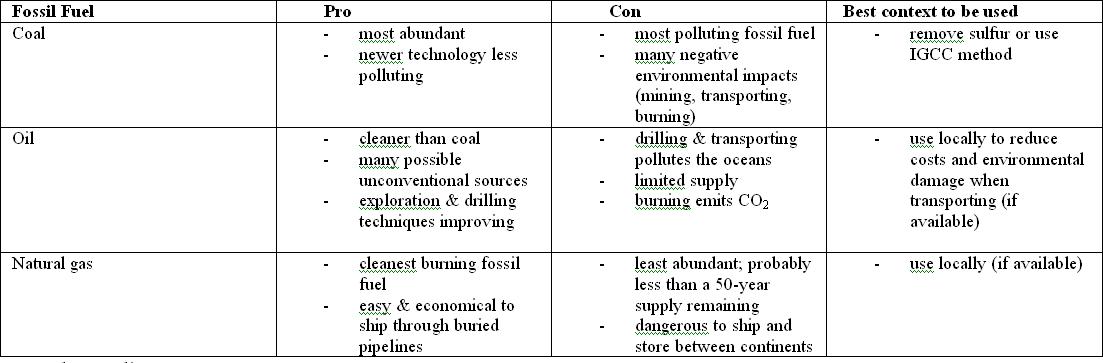
62) Essay
Answers should contain at least some of the following but may contain others.
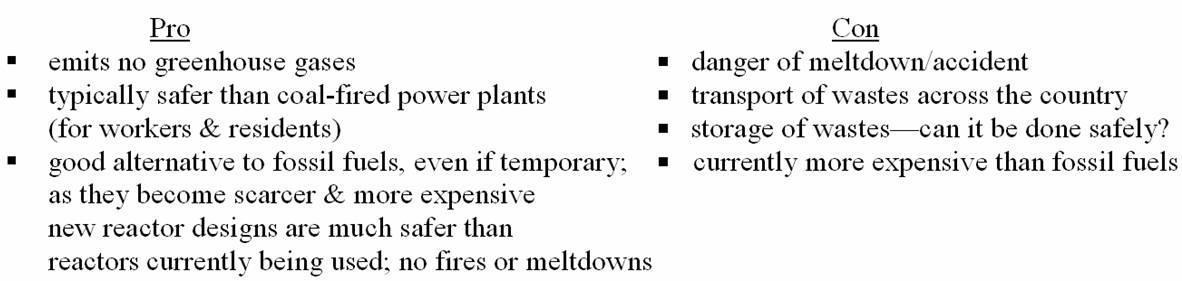
63) A
64) A
65) A
66) A
67) A
68) A
69) A
70) A
71) A
72) D
73) [A, C, D]
Student name:
1438) Improved insulation, energy-efficient windows and curtains, and caulking and sealing cracks could reduce commercial building and household energy loss by up to percent.
A) 10
B) 20
C) 30
D) 50
1439) Photovoltaic systems are characterized by all of the following except
A) they convert sunlight into electricity.
B) they are difficult to use where conventional electricity is unavailable.
C) they have become more efficient over the past 25 years.
D) they are economically competitive with fossil fuels in many places.
1440) Many of the places with the greatest potential for solar and wind development are far from the urban centers where the power is needed.
⊚ true
⊚ false
1441) Cogeneration refers to
A) production of both electricity and usable steam or hot water by the same facility.
B) cooperative efforts between power producers and consumers aimed at sharing profits from energy sales.
C) sale of electrical power by consumers back to the electrical grid.
D) the production of electricity using several different fuel sources at a single facility.
1442) Home appliances in standby mode can account for up to 25 percent of a monthly electric bill.
⊚ true
⊚ false
1443) Wood and charcoal burning is still the main energy source for about 30 percent of the world's population.
⊚ true
⊚ false
1444) In favorable locations, wind power is cheaper than other new energy sources.
⊚ true
⊚ false
1445) Biomass is a relatively recently discovered energy source.
⊚ true
⊚ false
1446) Automobiles and light trucks account for of U.S. oil consumption.
A) 10 percent
B) 20 percent
C) 40 percent
D) 60 percent
1447) Passive heat absorption refers to
A) the cooling of solar panels used to generate electricity.
B) using natural materials to gather and hold heat.
C) using water to cool nuclear power plants.
1448) Most of our energy waste in North America results from
A) a failure to turn off lights.
B) technological inefficiency.
C) the fact that more efficient energy conversion is not possible.
D) overwhelming public ignorance of conservation issues.
E) the fact that energy conservation techniques are quite expensive.
1449) The quickest and easiest way to save money on energy bills is to
A) install a new water heater.
B) modify your energy-using behavior.
C) put new insulation in your home.
D) buy a more efficient automobile.
E) install a new furnace.
1450) Energy efficiency is a measure of
A) heat produced by a barrel of fuel.
B) energy stored in a unit of fuel.
C) energy produced compared to energy consumed.
D) total energy consumed over a year divided by time spent.
E) energy used per unit of time.
1451) How does eating locally grown food in season save energy?
A) Locally grown food does not need to be transported far distances.
B) Locally grown food does not use petroleum-based fertilizers.
C) Locally grown food does not use petroleum-based pesticides.
D) Locally grown food supports local farmers.
E) All of these are ways that eating locally grown food in season saves energy.
1452) The idea of cogeneration is to actively use electricity-generating plants.
A) solar as well as coal energy to produce electricity at
B) warm water as well as steam to produce electricity at
C) two kinds of fuel (e.g., coal and oil) at
D) both electricity and waste steam heat from
E) two different types of thermal conversion machines for increased efficiency at
1453) A glass greenhouse on the south side of a building is an example of
A) parabolic collection.
B) an active solar heating system.
C) passive heat absorption.
D) cogeneration.
E) charging fuel cells to increase efficiency in energy use.
1454) Which of the following solar energy uses has been used by people for thousands of years?
A) parabolic solar collection
B) active solar heating system
C) passive heat absorption
D) cogeneration
E) All of these choices are correct.
1455) A system of pipes painted black that have water circulating on the wall in a glass greenhouse on the south side of a building is an example of
A) parabolic collection.
B) an active solar heating system.
C) passive heat absorption.
D) cogeneration.
E) charging fuel cells to increase efficiency in energy use.
1456) The most effective technology developed so far to produce solar energy concentrated enough to run an industrial furnace or turbine is to use
A) parabolic mirrors.
B) cogeneration.
C) passive heat absorption.
D) photovoltaic cells.
E) smart meters.
1457) Active solar energy systems involve
A) large volumes of massive heat absorbers.
B) pumps and moving fluids.
C) photovoltaic cells.
D) cogeneration.
E) stationary materials to gather and hold heat.
1458) Parabolic mirrors sunlight on a collecting medium.
A) selectively focus the brightest
B) selectively reflect the brightest
C) deflect the most
D) diffuse intense
E) focus intense
1459) Photovoltaic cells work because solar energy striking their surface
A) causes the cells to liquefy as they heat.
B) releases electrons, causing an electric potential in attached wires.
C) is collected in the form of photons and sent through attached wires.
D) causes an uneven magnetic charge to develop.
E) changes to chemical energy.
1460) Photovoltaic electricity costs are coal- or nuclear-powered electricity.
A) substantially less than
B) unlikely to become as cheap as
C) incomparably more expensive than
D) likely to be cheaper in the near future than
E) the same as
1461) Amorphous silicon collectors are currently being used in
A) lighthouses.
B) watches.
C) toys.
D) roof tiles.
E) All of these choices are correct.
1462) In the United States, windmills played a critical role in the settlement of
A) Appalachia.
B) The Sierra Nevadas.
C) The Great Plains.
D) The Rocky Mountains.
E) The Northeast.
1463) Where does wind energy have the greatest potential to create electricity?
A) the great plains, shore lines, and mountain tops
B) mountain tops and valleys
C) the great plains and southeastern U.S.
D) shorelines and valleys
1464) Which of the following is NOT a drawback of using windmills for energy?
A) Windmills are not always visually appealing.
B) Windmills cannot be placed on shorelines.
C) Windmills kill birds.
D) Wind is not always constant.
1465) A drawback of lead-acid batteries being used to store large amounts of energy is
A) they can store only moderate amounts of energy per unit mass.
B) the acid is corrosive.
C) they require an operating temperature of almost 600o F.
D) they can store only moderate amounts of energy per unit mass and the acid is corrosive.
E) they can store only moderate amounts of energy per unit mass, the acid is corrosive, and they require an operating temperature of almost 600o F.
1466) Which of the following is true regarding fuel cell technology?
A) They were first designed by NASA.
B) They must be recharged with an electrical current.
C) They are only about 40–45% efficient.
D) They must receive a constant supply of water and oxygen.
E) A fuel cell stack providing all of the electricity for a typical home is not feasible because it would be too large.
1467) Which of the following is NOT normally considered a biomass fuel?
A) wood
B) bark
C) waste wood chips
D) branches
E) All of these are biomass fuels.
1468) In the United States and Canada, the MOST common problem with using wood as a major heat source is
A) the cost.
B) wood shortages.
C) that it separates people from the utility grid.
D) the production of pollutants.
E) None of these choices are correct.
1469) Very few living trees are cut down for fuel in because twigs, branches, and crop residues are used for fuel. However, in the forests are nearly gone and even fruit trees are cut for fuel.
A) Pakistan; India
B) Pakistan; Haiti
C) Haiti; Pakistan
D) India; Haiti
E) Haiti; China
1470) is being used to produce ethanol and lessen the dependence on oil.
A) Palm oil
B) Corn
C) Miscanthus grass
D) Soybeans
E) All of these are being grown for ethanol production.
1471) Manure or dung makes a good fuel except that it is
A) scarce.
B) not clean.
C) needed to rebuild the soil.
D) difficult to burn.
E) commonly full of pathogens.
1472) Burning methane from dung
A) is more efficient than burning the dung directly.
B) provides more heat than burning the dung directly.
C) allows the dung to also be used as a fertilizer.
D) is more efficient than burning the dung directly and it allows the dung to also be used as a fertilizer.
E) All of these choices are correct.
1473) Since the 1920s, hydropower production has
A) risen, but not as fast as fossil fuel use.
B) fallen due to disinterest.
C) fallen due to a lack of available sites.
D) become our most important energy source.
E) stayed at about the same level.
1474) Siltation and decreased water quality are especially significant problems with
A) micro-hydro dams.
B) mini-hydro dams.
C) huge dams on major rivers.
D) low-head hydropower technology.
E) All of these choices are correct.
1475) Low-head hydropower involves dams on rivers.
A) large; major
B) small; minor
C) large; minor
D) small; major
E) medium-sized; minor
1476) Some highly efficient turbines can be submerged directly in a river and require only to operate.
A) run-of-the-river flow
B) low-head dams
C) a low, natural waterfall
D) a slow trickle of water
E) a high, natural waterfall
1477) Geothermal energy uses to produce usable heat or electricity.
A) naturally occurring hot groundwater
B) artificially heated water injected below ground
C) molten rock from below ground
D) underground radioactive decay
E) waste heat water from power plants that is stored underground
1478) Tidal power stations operate by using
A) the differential heat of inshore and offshore waters.
B) electrolytic decomposition of saltwater.
C) turbines that spin in the flow of tide water.
D) the energy from waves as they crash on the shore.
E) All of these choices are correct.
1479) Improving standards of living have been repeatedly demonstrated to require increased energy consumption.
⊚ true
⊚ false
1480) Capturing waste heat in a thermal-electric plant can increase efficiency from 30 percent to 80 or 90 percent.
⊚ true
⊚ false
1481) Mixing ethanol with gasoline makes the gasoline burn cleaner and is now required by most states.
⊚ true
⊚ false
1482) United States companies currently dominate the $1 billion (US) per year market of wind technology.
⊚ true
⊚ false
1483) Wind energy is an option that has few global supporters. ⊚ true ⊚ false
1484) Most of North America's wind potential is located offshore. ⊚ true
⊚ false
1485) Describe the best energy source option(s) for a rural area in a tropical developing country with no coastal access. Be sure you support why this is the best energy source for the area.
1486) Evaluate the use of biomass, hydropower, wind, and geothermal energy as potential large-scale energy sources. In your evaluation, provide the pros and cons and the context for which each energy source would best work.
1487) In most fuel cell systems, hydrogen is passed over the
A) anode
B) cathode
C) oxygen
D) electrolyte
1488) Which of the following is true about the national electricity grid?
A) The eastern grid is not connected to the western grid.
B) The national electricity grid is fully connected by high-voltage power lines.
C) The grid is designed to increase flexibility with using renewables.
D) The grid is updated to take on additional load as transportation is increasingly electrified.
1489) In order to increase renewable energy
A) the sources of energy for an area will need to be more diverse.
B) every community will have to invest in wind energy.
C) every community will have to invest in solar energy.
D) most communities will have to be redesigned to be off the grid.
1490) What do coal-fired power plants, wind turbines, nuclear power plants, hydropower, and concentrated solar thermal electricity production have in common?
A) They all provide the energy to turn a turbine to produce electricity.
B) They are all renewable sources of electricity.
C) They all use fossil fuels as a source of power.
D) They have nothing in common.
E) They are only useful in small regions of the country.
1491) The highest wind potential in the United States is
A) in the High Plains along the Rocky Mountains and offshore.
B) in the southeastern United States.
C) in the deserts.
D) in the Pacific Northwest.
E) along the Mississippi River.
1492) The amount of energy input to a system that is converted to useful work is called
A) conversion efficiency.
B) capacity factor.
C) theoretical energy.
D) the second law.
E) the first law.
1493) To reduce the amount of rejected energy in the Energy Flow Diagram, energy production would have to switch to those types with a higher
A) conversion efficiency.
B) thermodynamic.
C) renewability.
D) cogeneration.
1494) Which of the following does not provide energy to turn a turbine to produce electricity?
A) solar photovoltaic panel
B) concentrating solar plant
C) hydroelectric dam
D) coal-fired power plant
E) wind turbine
1495) What would be the simplest way to decrease energy impacts?
A) increase energy efficiency
B) switch to solar energy
C) switch to wind energy
D) use more renewable energy
1496) Given current technology, which of the following has the highest potential energy available?
A) solar energy
B) wind energy
C) geothermal energy
D) biomass energy
E) hydropower
Answer Key
Test name: chapter 20 1) D 2) B 3) TRUE 4) A 5) TRUE 6) TRUE 7) TRUE 8) FALSE 9) C 10) B 11) B 12) B 13) C 14) A 15) D 16) C 17) C 18) B 19) A 20) B 21) E 22) B 23) D 24) E 25) C 26) A 27) B 28) D 29) C 30) E 31) E 32) B 33) E 34) C 35) E 36) A 37) C
38) B
39) A 40) A
41) C 42) FALSE 43) TRUE
44) TRUE 45) FALSE
46) FALSE
47) FALSE
48) Essay
Even though the start-up cost may be more currently, in the long run, the solar power will more than pay for itself.
49) Essay
Should contain some of the items listed in the table below.
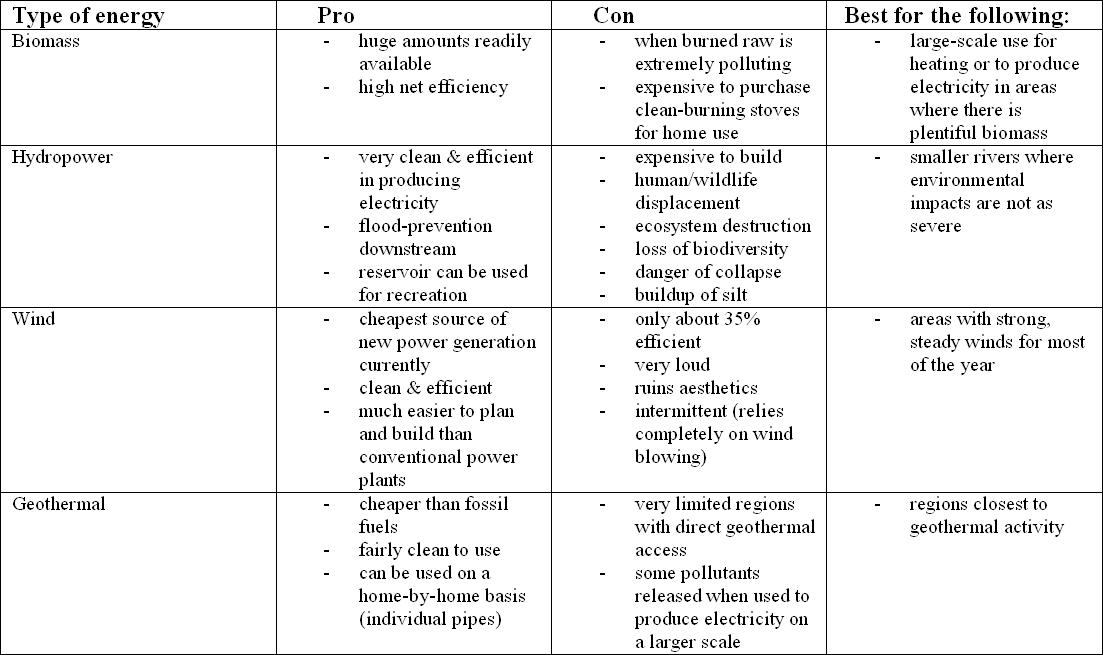
50) A 51) A 52) A 53) A 54) A
55) A
56) A
57) A
58) A
59) A
Student name:
1497) For each pound of waste produced by a person in Europe or Japan, on average, is produced in the United States
A) half a pound
B) one pound
C) two pounds
D) six pounds
1498) is/are readily recyclable.
A) Styrofoam
B) All types of plastic
C) Glass
D) Rubber
1499) The largest share of U.S. waste is
A) agriculture.
B) industrial.
C) mining.
D) municipal.
1500) Ocean dumping
A) has been self-regulated by industry and is no longer a problem.
B) is a minor problem because the beaches are regularly cleaned.
C) is still a problem with cruise ships but not with the fishing industry.
D) kills tens of thousands of fur seals each year.
1501) Demanufacturing refers to a process by which
A) consumer appliances and computers are dismantled, and valuable materials are recovered.
B) consumers are simplifying their lives and purchasing less stuff.
C) products are reused over and over rather than being remanufactured from recycled materials.
1502) The most preferable approach to municipal waste management, by far, is
A) recycling.
B) reduction of production.
C) reuse.
1503) Household wastes that properly can be flushed down the drain or toilet include all of the following except
A) ammonia.
B) disinfectants.
C) window cleaner.
D) herbicides.
1504) Brownfields are
A) properties contaminated with hazardous materials that are abandoned or not being fully used.
B) areas in which herbicides have accumulated in the soil such that normal plant growth is inhibited.
C) urban lands slated to become waste processing facilities.
D) lands that, because of geologic features, are best suited to host industries associated with handling hazardous materials.
1505) Use of microbes and other life forms to remove toxic contaminants from soil and ground water
A) does not seem able to fulfill its early promise.
B) works but is less cost-effective than other approaches.
C) offers considerable promise for cleaning up contaminated material.
D) is the only fully risk-free method of decontamination devised so far.
1506) The per-ton cost of waste disposal is projected to continue to rise as fewer acceptable sites for waste disposal become available.
⊚ true
⊚ false
1507) Ash produced by solid waste incinerators typically contains a higher concentration of toxic material than unburned garbage.
⊚ true
⊚ false
1508) Production of new products from recycled materials instead of virgin materials requires significantly less energy.
⊚ true
⊚ false
1509) Unfortunately, much of excess packaging does not serve to protect the product but is a marketing tool instead.
⊚ true
⊚ false
1510) Recycling is a growing industry, which shows that business growth can be an integral component of the solutions to environmental problems.
⊚ true
⊚ false
1511) Open dumping is a waste disposal method that is
A) predominant in most developing countries.
B) common in most developed countries.
C) never implemented because of associated risks of groundwater pollution.
1512) About 80 percent of E-waste is shipped overseas
A) primarily to China.
B) where unprotected workers break it apart to retrieve valuable materials.
C) as a result of a treaty that allows countries to send such waste to other countries that might benefit from the source of materials.
D) primarily to China where unprotected workers break it apart to retrieve valuable materials.
1513) Organic debris such as yard waste
A) can be composted to produce nutrient-rich soil amendments.
B) can be recycled, but only in the home.
C) is usually incinerated.
1514) In the United States, about two-thirds of a ton of waste are generated for each person (including children). Compared to the United States, Japan and Europe generate about half that amount. One of the factors that probably does NOT contribute to this difference is
A) the U.S. collection and dumping processes mix and crush everything together so separation is not possible.
B) the fact that Japan is an island with limited space.
C) the high rate of recycling in Japan.
D) that people in the United States have a higher standard of living than Japan and Europe.
E) All of these probably contribute to the difference in the waste stream.
1515) In recent decades, unregulated open dumps have in developing countries.
A) nearly disappeared
B) mostly become regulated
C) remained the primary disposal method
D) been replaced by incineration and methane generation
E) been replaced by sanitary landfills
1516) Motor oil can be toxic at concentrations of only 1 part per million, which means that of fresh water.
A) 1 quart of oil can pollute 1 million gallons
B) 1 liter of oil can pollute 4 million liters
C) 1 barrel of oil can pollute 1 million gallons
D) 1 quart of oil can pollute 1 million quarts
E) 1 liter of oil can pollute 1 billion liters
1517) "Waste stream" is a term describing the
A) steady production of all waste products that humans produce.
B) process of eliminating domestic and commercial waste.
C) production of solid waste, specifically.
D) intermittent production of particular wastes.
E) production of liquid waste, specifically.
1518) The "Great Pacific Garbage Patch"
A) contains 90% Chinese waste.
B) is an area of floating garbage roughly twice the size of Texas.
C) is an area where ships dump their waste.
D) has impacted shipping routes.
E) is slowly decreasing in size.
1519) If less-developed countries can make money while more-developed countries can rid themselves of waste, why would opponents be against exporting wastes to developing countries?
A) Local people in the developing country probably do not know what is in the waste.
B) People in the developing country may not have the resources to test for toxic materials in the waste.
C) The practice can involve corrupt government officials who allow the wastes to be dumped illegally.
D) The waste that is being exported contains unwanted materials or it would not be exported.
E) All of these are reasons why opponents are against exporting wastes to developing countries.
1520) Many states, countries, and corporations dispose of their waste overseas because it is
A) more convenient.
B) the safest method.
C) extremely cheap.
D) the only possible method.
E) the best way environmentally.
1521) Landfills differ from open dumps in that
A) landfills are smaller.
B) dumps are cleaner and smell less.
C) landfilled waste is compacted and covered.
D) landfills are cheaper to operate.
E) landfills and dumps are the same thing.
1522) Choosing the site of a landfill depends on
A) local topography and drainage patterns.
B) proximity to aquifer recharge zones.
C) neighborhood and community attitudes.
D) permeability of underlying rock formations.
E) All of these choices are correct.
1523) The main method for disposing of municipal wastes in the United States is , while is the main method in Japan.
A) incineration; recycling
B) recycling; landfilling
C) landfilling; recycling
D) landfilling; incineration
E) recycling; incineration
1524) Energy recovery is another term for waste.
A) recycling
B) burning
C) preventing the production of
D) cogeneration of the
E) a combination of recycling, burning, and preventing the production of
1525) Refuse-derived fuel differs from normal garbage in that it
A) has agricultural wastes.
B) has coal added.
C) is unsorted.
D) is selectively collected.
E) is sorted.
1526) Refuse-derived fuel has energy content than raw refuse, but requires energy before burning.
A) a higher; enrichment
B) a lower; enrichment
C) about the same; enrichment
D) a higher; to sort
E) a lower; to sort
1527) A mass burn is the incineration of
A) agricultural waste.
B) unsorted garbage.
C) hazardous substances.
D) large household pieces like furniture.
E) sorted garbage.
1528) In the case of sanitary landfills, the cost of disposing of wastes is as technology provides safer alternatives.
A) slowly increasing
B) slowly decreasing
C) staying relatively stable
D) sharply increasing
E) sharply decreasing
1529) Which of the following is NOT a major toxic pollutant produced by incinerators?
A) dioxins.
B) lead.
C) cadmium.
D) aromatic hydrocarbons.
E) All of these are produced by incinerators.
1530) One of the sources of dangerous heavy metal emissions is from incinerating
A) plastics.
B) bleached paper containing chlorine.
C) residue from household cleaning products.
D) aluminum foil.
E) batteries.
1531) Recycling, in terms of solid waste management, means
A) reusing materials.
B) melting or shredding to make new products.
C) keeping intact but putting to a new use.
D) using less of the material in production of a product.
E) All of these choices are correct.
1532) Toxic landfills are frequently located in areas.
A) wilderness
B) urban
C) rural
D) nonpopulated
E) suburban
1533) Recycling aluminum is most important for
A) saving raw materials (the ore).
B) saving energy.
C) saving landfill space.
D) reducing pollutants in the air and water.
E) All of these choices are correct.
1534) Individual efforts to reduce the volume of the waste stream
A) have enormous cumulative effects.
B) are fairly useful because it demonstrates to corporations that we care.
C) have some effects, but we need to target industries to reduce their waste stream instead.
D) have little effect, but make people feel better.
E) matter very little.
1535) Composting is a waste disposal method that
A) is useful only for single households.
B) is technologically complex.
C) vastly reduces total waste volumes.
D) is more environmentally costly than landfilling.
E) is not realistic for college students.
1536) Using a refillable beverage container (returnable bottles) would be an example of materials.
A) reusing
B) recycling
C) reducing
D) redefining
E) None of these choices is correct.
1537) Which of the following represents the "three Rs" of waste disposal in the descending order of energy expenditure?
A) reuse, reduce, recycle
B) reduce, recycle, reuse
C) recycle, reuse, reduce
D) reuse, recycle, reduce
E) recycle, reduce, reuse
1538) Photodegradable plastics break down
A) when exposed to heat.
B) by releasing photons.
C) as they age.
D) when exposed to pressure.
E) when exposed to sunlight.
1539) Biodegradable plastics may incorporate to speed breakdown processes.
A) special types of hydrocarbons
B) weak structural components
C) cornstarch
D) water
E) microscopic tears in the plastic
1540) The cheapest option of the "three Rs" is most often
A) recycle.
B) reuse.
C) release.
D) redefine.
E) reduce.
1541) Hazardous waste is anything that
A) causes human health threats.
B) severely contaminates the environment.
C) is toxic, carcinogenic, mutagenic, corrosive, or explosive.
D) has the potential of causing health problems.
E) All of these choices are correct.
1542) In order to find specific information about toxic materials in your neighborhood, you would consult the
A) National Priority List.
B) Comprehensive Environmental Response, Compensation, and Liability Act (CERCLA).
C) Maximum Contamination Levels (MCLs).
D) Resource Conservation and Recovery Act (RCRA).
E) Toxic Release Inventory.
1543) The National Priority List is a list of sites that
A) we currently have money to deal with.
B) deserve research for possible cleanup.
C) will probably never be cleaned up.
D) seriously require cleanup to prevent further environmental and health damage.
E) are especially vulnerable to hazardous wastes (e.g., aquifer recharge zones) and are not available for future building permits.
1544) A brownfield is
A) the area and property extending 200 meters around a landfill.
B) a contaminated property that is not used to its full potential because of real or suspected contamination.
C) a property contaminated by a sewage treatment plant.
D) a property that was formerly contaminated and is now safe enough to be used for housing developments.
E) a property within city limits that is used heavily but may be contaminated.
1545) The questions of and are among the biggest problems in cleaning up hazardous waste sites.
A) liability; degree of purity required
B) appropriate technology; location
C) appropriate technology; liability
D) degree of purity required; appropriate technology
E) location; cost
1546) Contamination in the Love Canal was from a(n)
A) active petrochemical plant.
B) major toxic waste disposal firm.
C) long-abandoned city and chemical factory dump.
D) neighboring county whose groundwater seeped into the canal.
E) sanitary landfill.
1547) According to the Household Disposal Guide, what is the best way to dispose of your aerosol cans (hairspray, bug spray, furniture polish, etc.)?
A) dispose of empty cans in the trash
B) save and bring to a hazardous waste collection site
C) flush with plenty of water in the drain
D) flush with plenty of water in the toilet
E) recycle
1548) According to the Household Disposal Guide, what is the best way to dispose of antifreeze?
A) dispose of empty in the trash
B) save and bring to a hazardous waste collection site
C) flush with plenty of water in the drain
D) flush with plenty of water in the toilet
E) recycle
1549) According to the Household Disposal Guide, which of the following materials should never be disposed of in a drain or toilet?
A) permanent wave lotion.
B) hair relaxer.
C) solvent-containing products.
D) bleach.
E) None of these should be disposed of in the drain or toilet.
1550) Chemical processing is a way of hazardous waste for safe disposal.
A) reducing the volume of
B) neutralizing
C) incinerating
D) filtering and precipitating
E) acidifying
1551) Secure landfills are usually sealed with A) clay.
B) sand.
C) dirt.
D) gravel.
E) stones.
1552) Biological treatment of hazardous waste may involve hazardous substances.
A) using bacteria and plants to absorb and detoxify
B) the genetic alteration of species suffering from
C) using microorganisms to disperse
D) special organic chemical processing of
E) None of these choices are correct.
1553) Secure landfills are those that
A) have no groundwater below them.
B) accept no toxic substances.
C) are built like a bathtub with a lid.
D) are sealed entirely with durable plastic.
E) are sealed entirely with concrete.
1554) Incinerator ash is commonly contaminated with highly concentrated toxic substances.
⊚ true
⊚ false
1555) Demanufacturing is the disassembly of manufactured homes and is key to reducing the waste stream.
⊚ true
⊚ false
1556) The Comprehensive Environmental Response, Compensation, and Liability Act (CERCLA) regulates cleanup of Superfund designated hazardous waste sites and the siting, construction, and operation of hazardous waste sites.
⊚ true
⊚ false
1557) The original pool of money available for Superfund cleanup projects was financed by taxes on the producers of toxic and hazardous wastes. Now, public taxes are the major sources.
⊚ true
⊚ false
1558) A site for a children's playground and an industrial site have different criteria for cleanup. ⊚ true
⊚ false
1559) Explain how incinerator ash can become toxic when the initial material that is incinerated is not toxic.
1560) Evaluate the use of dumps, sanitary landfills, and modern secure landfills in disposing of waste. In your evaluation, provide the pros and cons and the context for which each disposal method would best work.
1561) The largest share of the waste stream goes to a
A) landfill.
B) recycling facility.
C) composting facility.
D) combustion facility.
E) landfill and recycling facilities in equal amounts.
1562) By weight, the largest share of solid waste generated is
A) paper and paperboard.
B) plastics.
C) food.
D) metals.
E) yard trimmings.
1563) Which of the following describes the trend in per capita solid waste generation?
A) Since 1960, waste generation per capita has increased until about 2000 when it began to decline.
B) Waste generation per capita has increased every year since 1960.
C) Per capita waste generation has increased exponentially since 1960.
D) Since the addition of recycling to municipal waste, per capita waste generation has fallen dramatically.
E) Per capita waste generation has fallen significantly since 1990.
1564) Which of the following describes the trend in percent of waste recycled?
A) The largest increase in the rate of recycling was between 1985 and 1995.
B) Recycling rates continue to rise at the same rate as the 1990s.
C) Recycling rates have fallen since 2000.
D) Recycling rates increased until 2010 but show signs of falling.
E) Recycling rates exceed 50% of waste generated.
1565) What is the largest source of nonpoint air and water pollution?
A) the runoff from uncontrolled agricultural waste
B) mine tailings
C) hazardous waste from industry
D) household waste
E) the recycling industry
1566) What is the name of the category that describes trash from households?
A) municipal solid waste
B) hazardous waste
C) sanitary landfill
D) nonpoint trash
E) waste stream
1567) Which issue does NOT need to be managed at a sanitary landfill?
A) the amount of trash picked up from households
B) the methane produced by the decomposition of the waste
C) runoff into surface water
D) leakage into groundwater
E) windblown litter and vermin
1568) Which of the following is NOT a way that energy can be produced from trash?
A) Waste dumped in a landfill turns a turbine to produce electricity.
B) Methane is captured from a landfill and used to produce electricity.
C) Incineration produces steam used to generate electricity.
D) Heat from incineration is used to heat nearby buildings.
1569) Which of the following options for handling segments of the waste stream is not correctly matched?
A) incineration for wet organic material
B) recycling for car batteries
C) composting for yard trimmings and food waste
D) recycling for plastic
E) secure landfills for hazardous waste
Answer Key
Test name: chapter 21
1) C 2) C 3) A 4) D 5) A 6) B 7) D 8) A 9) C 10) TRUE 11) TRUE 12) TRUE 13) TRUE 14) TRUE 15) A 16) D 17) A 18) D 19) C 20) D 21) A 22) B 23) E 24) C 25) C 26) E 27) C 28) B 29) E 30) D
31) B
32) D
33) D 34) E
35) B
36) B
37) E
38) A
39) C
40) A
41) C
42) E
43) C
44) E
45) C
46) E
47) D
48) B
49) A
50) C 51) B
52) B 53) C
54) B 55) A 56) A
57) C
58) TRUE 59) FALSE 60) TRUE
61) TRUE 62) TRUE
63) Essay
Batteries contain heavy metals (cadmium, lead), which are released into the atmosphere upon burning. Most plastics contain chlorine, which forms dioxins upon combustion.
64) Essay
Pros cheap, no planning involved, easy to use; Cons non-regulated, unstable (may collapse), groundwater contamination, smells terrible. These types of dumps are mainly found in developing countries where technology and/or money is not available for other means of waste disposal.
Sanitary landfills: Pros—waste regulated and controlled, covered w/dirt to decrease smell, convenient, relatively inexpensive, can be used to capture methane and generate electricity; Cons sometimes located on permeable or faulted rock formations, possible groundwater contamination, suitable sites becoming scarce. Works best in areas with sufficient land area away from large populations, built in impermeable and stable geologic regions with little or no threat to groundwater contamination.
Secure landfills: Pros—allow disposal of toxic waste, liner prevents groundwater contamination.
Cons transportation of hazardous waste to disposal sites is the greatest concern because of the chance of accidental chemical spill (especially in urban areas), financial responsibility of abandoned waste sites (must be maintained for many years after being filled). Works best in areas with large amounts of hazardous wastes that need to be disposed of, would be best located away from urban areas.
65) A
66) A
67) A
68) A
69) A
70) A
71) A
72) A
73) A
Student name:
1570) The proportion of people living in urban areas in the last 30 years has increased in
A) North America, South America, and Asia.
B) all continents.
C) all continents but Africa.
D) all continents but Europe and Africa.
1571) Migration is the primary cause of urban growth in
A) Africa.
B) South America.
C) East Asia.
D) all the world's urban areas.
1572) The vast majority of the growth in human population in this century is expected to take place in
A) rural Africa and Asia.
B) rural Asia and South America.
C) current large urban areas of the developing nations.
1573) Most residents of the German city of Vauban do not own a car for all of the following reasons except
A) automobile ownership is prohibited by local restrictions.
B) shopping, schools, and work places are within walking distance.
C) trolley service provides transportation to the nearest large city.
D) narrow row houses put everything close together.
1574) The experience of Los Angeles suggests that in large growing cities additional freeway construction
A) has worsened traffic congestion.
B) has reduced time drivers spend in traffic jams.
C) has increased average freeway speed.
D) More than one of these choices are correct.
1575) Urban planners suggest that it takes a population of about to obtain the advantages of a city but still retain the sense of community.
A) 500 to 1000
B) 2500 to 5000
C) 30,000 to 50,000
D) 90,000 to 100,000
1576) Urbanization is a process of increased concentration of people in cities.
⊚ true
⊚ false
1577) Cities in many developing nations have a disproportionately high share of their nation's wealth.
⊚ true
⊚ false
1578) Examples of smart growth, such as garden cities, have only been tried during the past 30 years.
⊚ true
⊚ false
1579) Many American cities are rebuilding public transportation systems that were abandoned in the latter half of the twentieth century.
⊚ true
⊚ false
1580) Over a third of the surface area of many large downtown areas like Los Angeles' are utilized for automobiles.
⊚ true
⊚ false
1581) The American idea of a dream home in the suburbs and a car in the garage is a result of
A) advertising.
B) government policies.
C) concerns for the environment.
D) advertising and government policies.
1582) Cities with populations greater than 10 million people
A) do not exist in the developed world.
B) are referred to as megacities.
C) do not exist in the developed world and are referred to as megacities.
1583) of urban residents in developing countries have satisfactory sanitation services.
A) Nearly all
B) 70-80 percent
C) Less than half
D) Less than 10 percent
1584) It is estimated that 3 billion people live in informal settlements of the developing world's cities.
⊚ true
⊚ false
1585) Smart growth is a term that is applied to
A) growth that generates the most tax revenue for new infrastructure.
B) development strategies that make efficient use of resources.
C) efforts to stop development and urban growth.
1586) Urbanization began to grow especially quickly after the
A) development of agriculture.
B) beginning of the twentieth century.
C) invention of commerce and religion.
D) industrial revolution.
E) invention of record keeping.
1587) Historically, of the world's population has always lived in , at least since the beginning of written history.
A) at least half; urban areas
B) at least half; rural communities
C) the vast majority; urban areas
D) the vast majority; rural communities
E) a small percentage; rural communities
1588) In rural areas, the majority of people
A) are involved in harvesting natural resources.
B) work in trade and manufacturing.
C) are economically dependent on cities.
D) work in goods exchange.
E) work in information exchange.
1589) When you first met your roommate, she said she missed the connectedness of the people in the area where she lived. Your roommate probably lived in a(n)
A) city.
B) urban area.
C) suburb.
D) urban farm.
E) rural village.
1590) A collection of rural households linked by custom, culture, or family is known as a(n)
A) city.
B) urban area.
C) megacity.
D) urban farm.
E) rural village.
1591) Cities are distinguished by their
A) sheer size.
B) differentiated, specialized jobs and functions.
C) large groups of interdependent households.
D) strong traditions and cultural character.
E) dependence on natural resource-based occupations.
1592) A city with a population greater than is considered a megacity.
A) 1 million
B) 200 thousand
C) 10 million
D) 30 million
E) 1 billion
1593) The most useful definition of a city, rural area, or village is based on
A) the land uses involved.
B) functions.
C) the geographical area.
D) the size of the land used.
E) the size of the population.
1594) An example of a megacity is
A) Mexico City, Mexico.
B) Los Angeles, USA.
C) Tokyo, Japan.
D) Delhi, India.
E) All of the choices are correct.
1595) Natural increase is an especially important factor in urban areas of
A) Latin America and Asia.
B) the United States.
C) Europe.
D) the former Soviet region.
E) Africa.
1596) Natural increase factors in urban growth result from while immigration results from
A) improved medical care; better sanitation
B) better sanitation; improved medical care
C) improved medical care; push and pull factors
D) push and pull factors; improved medical care
E) push and pull factors; better sanitation
1597) Which of the following is a push factor for urban growth?
A) Jobs in rural manufacturing.
B) Unemployment in farming communities.
C) Better access to education at big universities.
D) High unemployment in cities.
E) Opportunities for specialization in an occupation.
1598) Which of the following is a pull factor for urban growth?
A) Jobs in rural manufacturing.
B) Unemployment in farming communities.
C) Better access to education at big universities.
D) High unemployment in cities.
E) None of these is a pull factor for urban growth.
1599) Televisions and other mass media contribute to urban growth because
A) people must move close to town to get TV reception.
B) there are so many jobs in media.
C) TV is used to advertise about labor shortages.
D) TV makes urban life appear luxurious and accessible.
E) TV educates people about the drawbacks of living in rural areas.
1600) Which of the following statements is FALSE?
A) Even crowded, squalid living conditions in expanding cities in developing countries are sometimes better than what people have in the countryside.
B) When governments set commodity prices to make urban life easier, rural populations often suffer, leading to further migration to cities.
C) Agricultural mechanization is a major pull factor in urbanization of developing countries.
D) Political instability can play a major role in urban growth.
E) All of these are true.
1601) Curitiba, Brazil, is famous for its
A) successful mass transit program.
B) zero population growth program.
C) particularly disastrous rainforest destruction.
D) complete environmental breakdown due to uncontrolled industry.
E) revitalized city nightlife.
1602) Air pollution in major cities of developing countries is
A) usually negligible.
B) responsible for extremely high rates of respiratory diseases.
C) rapidly becoming less of a problem.
D) not well understood.
E) decreasing because of the use of scrubbers and other technologies.
1603) The diseases that are caused by water pollution in the major cities of developing countries are mainly due to the
A) lack of waste treatment systems to accommodate the population.
B) high amount of runoff that includes pesticides, fertilizers, and animal waste.
C) high number of industries that dump their wastes into surface water.
D) practice of swimming in water contaminated by toxic chemicals.
E) high use of pesticides and fertilizers by urban residents.
1604) Informal settlements are usually dwelling places that are
A) illegal and built by squatters.
B) legal but have inadequate living conditions.
C) small but up to city code.
D) condemned by the city but illegally occupied.
E) on undeveloped lands in the outskirts of a city.
1605) The current urbanization experience of many developing countries is similar to the United States' that occurred in the nineteenth and early twentieth centuries.
A) demographic rural shift
B) demographic transformation
C) rural-to-urban shift
D) urban-to-rural shift
E) demographic transition
1606) Informal settlements are often dangerous places to live because the land they are on is commonly
A) unstable, polluted, or near industrial sites.
B) owned by powerful political figures.
C) in the densest parts of the city.
D) close to new building construction zones.
E) close to major highways.
1607) When compared to less-developed countries, shantytowns are found in more developed countries due to the .
A) not; lack of poverty
B) also; same conditions of poverty and lack of infrastructure
C) not; high levels of public support for a nation's poor
D) also; lack of initiative among poorer people
E) not; strict land use codes
1608) In many U.S. cities, poor, undereducated, minority and other less powerful groups are often concentrated
A) in urban centers.
B) at city margins.
C) outside of the city entirely.
D) in a ring of satellite settlements around a city.
E) none of these; usually the poor, undereducated, minority, and other less powerful groups are distributed throughout the area.
1609) Suburbs are known for
A) uniform, single family detached houses.
B) affordable housing for minorities.
C) presence of artistic and cultural opportunities.
D) creating a sense of community and identity.
E) independence from an automobile.
1610) Traditional suburban development does not
A) consist of only house lots and streets.
B) typically consist of identical parcels of land without open space.
C) facilitate social interactions among neighbors.
D) consume agricultural land and wildlife habitat.
E) All of these are characteristics of traditional suburban development.
1611) What is the fastest growing metropolitan region in the United States?
A) Atlanta, Georgia
B) Houston, Texas
C) Seattle, Washington
D) Albuquerque, New Mexico
E) Las Vegas, Nevada
1612) One of the most important things influencing land use is the
A) building of mass transit systems.
B) original zoning in a city.
C) siting of cities.
D) siting of industry.
E) building of freeways.
1613) The best solution to ease traffic congestion and reduce air pollution is
A) build more freeways.
B) produce more fuel-efficient vehicles.
C) develop a successful mass transit system.
D) build more airports.
E) All of the choices are correct.
1614) Which of the following is NOT a goal for smart growth?
A) Create a positive self-image for the community
B) Make the downtown area vital and livable
C) Each resident is responsible for growing his/her own food
D) Improve communications
E) Improve community access to the arts
1615) "New towns" are designed to
A) accommodate the reliance most people have on the automobile.
B) improve the efficiency of industrial areas in urban centers.
C) separate income classes to prevent crime.
D) incorporate open space with the convenience of living in an urban area.
E) urbanize rural communities.
1616) Nearly half of the world's population currently lives in cities. ⊚ true ⊚ false
1617) China represents the largest demographic shift in human history.
⊚ true
⊚ false
1618) Approximately two thirds of the population in developing world cities don't have access to safe drinking water.
⊚ true
⊚ false
1619) Urban sprawl can be loosely defined as the multiple large high rises that make up the core of a city.
⊚ true
⊚ false
1620) Conservation development involves preserving at least one half of a subdivision as open space.
⊚ true
⊚ false
1621) Describe three push and three pull factors that have influenced the demographic shift from rural areas to urban areas (2 points for each accurately identified factor).
1622) Consider the following statement: A city is like an ecosystem. Discuss why you agree or disagree with this statement and provide supporting evidence in your explanation (use the relationships discussed in chapters 2 and 3 to compare and/or contrast cities and ecosystems).
1623) The urban share of the population has
A) increased in all regions of the world.
B) only increased in Africa and Asia.
C) decreased overall worldwide.
D) only increased in North America and Europe.
1624) In 1900, most of the world’s largest urban areas were in , but in 2000, only of the world’s largest urban areas were in this region.
A) Europe and the United States; one
B) Europe and the United States; half
C) Asia; one
D) India; half
E) the United States; three
1625) In 2100, it is estimated that of the world’s largest urban areas will be in the United States and Europe.
A) none
B) one
C) two
D) half
E) three
1626) Which of the following would be considered a pull factor for immigration to cities?
A) Opportunities for work and social opportunity
B) Loss of jobs in rural areas
C) Political conflicts
D) Economic factors making agriculture unprofitable
E) Environmental factors such as drought affecting rural economies
1627) Considering the principles of “sustainable urbanists,” which of the following would NOT be a likely argument for small-scale commercial development near residential areas?
A) It would promote diverse housing styles.
B) It would encourage walking or alternate transport from home to the store.
C) It would reduce travel time and dependency on automobiles.
D) It would promote healthful physical activity by allowing people to walk to their everyday shopping.
E) It would provide opportunity for socializing as people would be walking rather than riding in an automobile.
1628) Which of the following is NOT a strong focus of smart growth or sustainable urbanism?
A) Eliminating cars
B) Encouraging high-density development
C) Providing infrastructure for recycling and composting
D) Promoting public participation in design
E) Promoting green building techniques
1629) Which of the following is NOT a description of urban sprawl?
A) Urban sprawl can accommodate the housing needs of most people.
B) Urban sprawl requires lots of time in automobiles for commuting and shopping.
C) Urban sprawl requires expensive expansion of municipal utilities.
D) Urban sprawl results in decaying city centers.
E) Urban sprawl consumes farmland and natural areas.
1630) Which of the following would NOT be an example of sustainable urban design?
A) The School Board decided to locate a school out in a rural area on the edge of the city because they thought this would be where people would want to move in the future. A few neighborhoods are planned already.
B) A developer plans to replace a decrepit building with a condo building. The first floor of this building will have a convenience store, a gym, a restaurant, and a salon.
C) The City Council just released a map of the planned greenway system. The trails will have branches to neighborhoods and commercial areas including grocery stores. Neighborhood schools will also be connected to the system.
D) The Downtown Alliance has raised money to put green roofs on some of the municipal buildings.
E) A grocery store chain has agreed to design a store with two floors rather than sprawled out in order to fit in a space at the bottom floor of a condo building to serve the residents of nearby buildings.
1631) Designers that promote sustainable urbanism believe that sustainable cities will help more than the environment. Which of the following would NOT be considered an additional direct benefit of sustainable cities?
A) Decreasing urban density and revitalizing small towns
B) Increasing healthful exercise and activity
C) Promoting good mental health
D) Promoting more socializing
1632) Where has population increased the fastest?
A) Urban areas in less developed countries
B) Urban areas in more developed countries
C) Rural areas in less developed countries
D) Rural areas in more developed countries
Answer Key
Test name: chapter 22
1) B 2) A 3) C 4) A 5) A 6) C 7) TRUE 8) TRUE 9) FALSE 10) TRUE 11) TRUE 12) D 13) B 14) C 15) FALSE 16) B 17) D 18) D 19) A 20) E 21) E 22) B 23) C 24) B 25) E 26) A 27) C 28) B 29) C 30) D
31) C
32) A
33) B 34) A
35) B 36) C 37) A
38) B
39) A
40) A
41) C
42) E
43) E
44) C
45) C
46) D
47) TRUE
48) TRUE 49) FALSE
50) FALSE
51) TRUE
52) Essay
Push factors: no jobs, lack of food, inadequate housing, political conflicts, racial conflicts, religious conflicts
Pull factors: opportunity for education, variety of jobs, entertainment, freedom, social mobility, prestige, power
53) Essay
Should contain some of the following information and may include others as well.
Compare: Both are communities of living things along with the physical environment; both are affected by the abiotic conditions; both have a constant flow of matter and energy cycling through both living and non-living; both involve niches; both have fairly distinct boundaries.
Contrast: Cities involve only humans other species may live there, but are not an integral part of the functioning city; people not affected so much by abiotic factors (e.g., temp. is regulated by A/C and heating, go to work whether it is raining or snowing); many human activities and inputs are part of a city, but not an ecosystem (city foundation, drainage, sewage, pollution, garbage, etc.); infrastructure completely different man-made in cities, natural in ecosystems.
54) A
55) A
56) A
57) A
58) A
59) A
60) A
61) A
62) A
63) A Student name:
1633) Neoclassical economics views
A) natural resources as the indispensable factor determining economic success.
B) constant economic growth as necessary and desirable.
C) a steady state as the ultimate economic goal.
D) the relationship between supply and demand as having minor importance.
1634) An example of an intangible resource is
A) beauty.
B) iron.
C) sunlight.
D) a biogeochemical cycle.
1635) Resources that are obtainable from Earth but are present in fixed amounts are called
A) proven reserves.
B) renewable resources.
C) nonrenewable resources.
D) intangible resources.
1636) Using natural resources so as to be sustainable indefinitely requires
A) harvesting natural products at rates not faster than the materials can be naturally replaced.
B) recycling household waste.
C) only using manufactured materials instead of natural resources.
1637) An object's external costs are the
A) price the consumer pays for a product less sales tax.
B) price the consumer pays plus sales tax.
C) costs borne by groups or individuals other than those using the product.
D) actual costs incurred in producing a product.
1638) Goals for an efficient economy from an ecological perspective include all of the following except
A) maximizing growth.
B) measuring progress by the percent of industries releasing no nasty pollutants.
C) measuring productivity by the number of people meaningfully employed.
D) valuing biological and cultural diversity.
1639) In general as supply increases so too does demand.
⊚ true
⊚ false
1640) Renewable resources are those that can be continuously replenished.
⊚ true
⊚ false
1641) The updated model of the limits to growth suggests that changed public policies actually could produce a sustainable future.
⊚ true
⊚ false
1642) One criticism of cost/benefit analysis is the subjectivity in deciding who should judge the value of a project's costs and benefits.
⊚ true
⊚ false
1643) Externalized costs include social costs as well as environmental costs.
⊚ true
⊚ false
1644) It is thought by many economists that market forces will be less effective at minimizing pollution than rigid rules and regulations.
⊚ true
⊚ false
1645) Ecology and economy are both derived from the Greek word "Oikos" meaning
A) The study of something
B) How things work
C) Relationships
D) Environment
E) Household
1646) Natural capital is that which is created by
A) industrial processes.
B) human labor.
C) natural Earth processes.
D) animal labor.
E) All of these are ways natural capital is created.
1647) Which of the following is considered human capital?
A) Timber
B) Solar energy
C) Technology such as hydroelectric power
D) Buildings in a community
E) Knowledge of history
1648) Which of the following is considered social capital?
A) Community organization
B) Human experiences within a community
C) Technology such as a water treatment plant in a community
D) Buildings in a community
E) Knowledge of a community's history
1649) is a nonrenewable resource.
A) Scientific technology
B) Hydroelectric power
C) Coal
D) Biomass
E) Solar energy
1650) Renewable resources are those that
A) will not be exhausted.
B) will always renew themselves unless we destroy them.
C) can be renewed through intensive investments of capital and labor.
D) are intangible and renewable.
E) are intangible and nonrenewable.
1651) An example of an intangible resource is
A) solar energy.
B) satisfaction.
C) human labor.
D) capital.
E) extinct species.
1652) The economic theory that was originally focused on how the interests and values of individuals relate to larger societal goals is the economic theory.
A) political
B) neoclassical
C) classical
D) social
E) ecological
1653) In economic terms, "demand" is how much of something
A) people want.
B) people need.
C) people will buy at current prices.
D) is available on the market.
E) people will buy regardless of price.
1654) In economic terms, "supply" is how much of something
A) people want.
B) people need.
C) people will buy at current prices.
D) is available on the market.
E) people will buy regardless of price.
1655) A(n) is high, demand is relationship exists between supply and demand. Therefore, when supply
A) correlational; high
B) inverse; high
C) inverse; low
D) correlational; low
E) strong; high
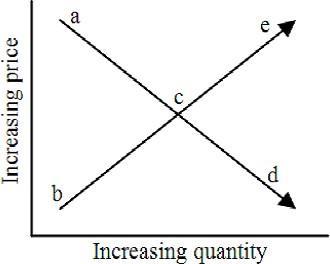
1656)
1656.1) On the classical supply–demand graph, is highest when prices are low.
A) demand
B) supply
C) market equilibrium
D) cost
E) quantity
1656.2) On the supply–demand graph, market equilibrium is marked
A) a
B) b
C) c
D) d
E) e
1656.3) Using the supply–demand graph, what happens as the price of goods or services increases?
A) The quantity of the goods or services decreases.
B) The quantity of the goods or services increases.
C) Demand increases and supply falls.
D) Demand falls and supply increases.
E) Market equilibrium is finally reached and the demand increases.
1657) Price inelasticity is when while price elasticity is when _.
A) prices cannot be negotiated; consumers can negotiate a price
B) consumers can negotiate a price; prices cannot be negotiated
C) the supply–demand curve is followed; consumers buy a product regardless of cost
D) consumers buy a product regardless of cost; the supply–demand curve is followed
E) prices change frequently; prices are relatively stable
1658) Political economy theory incorporates while neoclassical economic theory incorporates .
A) The issues of social structures and value systems; objectivity and scientific analysis
B) Objectivity and scientific analysis; the issues of social structures and value systems
C) The value of social systems; the value of natural resources
D) Birth and death rates; natural resources and social structures
E) Objectivity and scientific analysis; supply and demand
1659) Which of the following is NOT true with respect to natural resource economics?
A) Natural resource economics views ecological processes as factors outside the economic system.
B) The principles of thermodynamics and coevolution are incorporated into natural resource economics.
C) Natural resources are seen as abundant in natural resource economics.
D) Neoclassical economic theory is similar to natural resource economics.
E) Natural resource economics assigns a monetary value to some natural resources.
1660) When we purchase a product, the price we pay directly reflects the cost of producing it. If the manufacture of the product degrades the quality of air or water, then the costs of this pollution are termed costs.
A) incidental; external
B) incidental; indirect
C) indirect; incidental
D) external; internal
E) internal; external
1661) When a factory pollutes a river, the costs and losses that affect people downstream would be called costs.
A) Indirect
B) External
C) Incidental
D) Internal
E) Social
1662) Ecological economics is different from the other economic theories because it recognizes the
A) scarcity of natural capital.
B) recycling of ecological processes and the scarcity of manufactured capital.
C) abundance of natural capital.
D) fragility of the human economy and the power of ecological systems.
E) human economy as one part of a dynamic world system.
1663) A steady-state economy would be marked by resource consumption, volume, and output.
A) high; low; low
B) high; high; high-quality
C) low; high; high-quality
D) low; low; high-quality
E) low; low; low-quality
1664) Which author criticized the idea of commonly held resources in "The Tragedy of the Commons"?
A) Garret Hardin
B) Paul Ehrlich
C) Karl Marx
D) Gifford Pinchot
E) Thomas Malthus
1665) The management of a wild area by a group of indigenous people, such as the management of wild rice beds, is an example of
A) tragedy of the commons.
B) a communal open access system.
C) the "free-rider" system.
D) a communal resource management system.
E) privatization.
1666) "The Tragedy of the Commons" is based on the view that
A) communal systems can be sustained and promoted.
B) community members will attempt, without success, to sustain a resource for future generations.
C) only privatization or strict laws can overcome people's selfish and greedy nature.
D) individuals will try to maximize gain for the group at a loss for the individual.
E) open access systems can be sustained and promoted.
1667) Which of the following is an example of an open access system?
A) Cattle grazing on common woodlands and pastures in colonial New England.
B) Maine lobster fisheries.
C) Nearshore fisheries in many parts of the world.
D) Native American management of wild rice beds and hunting grounds.
E) None of these are examples of an open access system.
1668) Which of the following is an example of a communal property system?
A) Cattle grazing on common woodlands and pastures in colonial New England.
B) Maine lobster fishing.
C) Privatization of Native American reservations in the United States.
D) Offshore fisheries in many parts of the world.
E) None of these are examples of a communal property system.
1669) The price of natural gas doubles. What would happen to the quantity of the natural gas in a market system?
A) The quantity decreases because it is too expensive to produce.
B) The quantity increases because it is worthwhile to drill into lower quality fields.
C) The quantity increases because new natural gas is being created.
D) The quantity decreases because it is too expensive and people do not buy it.
E) The quantity stays the same because the price of a resource does not change the availability of that resource.
1670) In a frontier economy, there is usually a relative abundance of because of the inefficiency .
A) social resources; of transportation
B) labor; and lack of experience of workers
C) capital (money); of the market economy at this first stage
D) technology; of the processes to research and develop new technology
E) natural resources; of the procedures for gaining access to resources
1671)
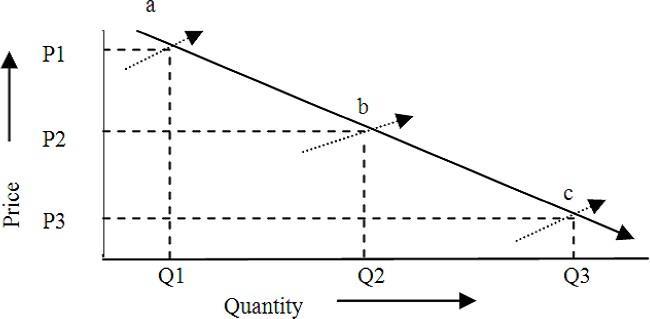
1671.1) The graph shows how when economies develop.
A) quantity increases as prices rise
B) prices fall as quantities increase
C) prices and quantities fall simultaneously
D) quantities and prices increase simultaneously
E) quantities and prices naturally change through time
1671.2) The price/quantity intersection marked "a" in the graph represents a(an) economy.
A) developing
B) modern
C) elastic
D) frontier
E) developed
1672) Which of the following is not an effective response to resource scarcity?
A) Substituting different materials for scarce ones
B) Increasing efficiency
C) Diverting capital (money) to conventional industries
D) Increasing trade with other regions
E) Recycling
1673) In Limits to Growth, the Club of Rome predicted that
A) steady-state economic systems were not viable.
B) sustained economic growth of most countries was likely for the near future.
C) predicting the future was impossible.
D) technology would help mitigate the effects of increased populations.
E) economic collapse is likely if we do not reduce population growth.
1674) The computer models published in the 1972 Limits to Growth predicted in the next century.
A) population stability
B) population and resource crashes
C) growth in both population and resources
D) an immediate decrease in pollution levels
E) an increase in industrial output
1675) In response to criticisms of Limits to Growth, a computer model was published in Beyond the Limits that
A) predicted growth in both population and resources in the next century.
B) predicted an increase in resources in the next century.
C) includes technological progress and pollution abatement.
D) includes a lower rate of world population growth.
E) predicted a decrease in both population and resources in the next century.
1676) Things like open space or clean air can be considered a resource because they are
A) valued by people
B) essential for efficient production
C) exhaustible
D) expensive
E) hard to find
1677) The use of Gross National Product as an indicator of economic well-being
A) is criticized as an inaccurate measure of the quality of life.
B) reflects social welfare.
C) predicts ecological bankruptcy through recognition of decreased natural capital.
D) takes into account life expectancy.
E) does not take into account economic activity overseas.
1678) Which of the following would not be counted as part of the gross national product?
A) A new car purchase by a corporation
B) Installation of cable television by a company
C) Home health care by a family member
D) Government purchases
E) Dental services for an individual
1679) Which of the following indicators is incorrectly matched with the factors it takes into account?
A) Gross National Product goods and services purchased.
B) Genuine Progress Indicator the value of unpaid labor and natural resource depletion.
C) Human Development Index life expectancy and educational attainment.
D) Gross Domestic Product economic activities within a nation's borders.
E) Gender Development Index gender and natural resource depletion.
1680) In 1997, ecological economists put a price on the goods and services provided by natural systems. This estimated annual value ranged from
A) $16 to 54 trillion.
B) $16 to 54 billion.
C) $16 to 54 million.
D) $16 to 54 thousand.
E) $1600 to $5400.
1681) Use the following scenario to answer the next three questions.
A large lending institution is evaluating the long-term pros and cons of building a hydroelectric dam in the Amazon rainforest. First, the lending institution is identifying the appropriate factors and then quantifying them. The factors include but are not limited to the direct expenses of building the dam, the lost opportunities from placing a dam on the river, and the profit from the dam. Also included is an analysis of who will be affected by the dam.
1681.1) What is the name of the process the lending institution is going through in this scenario?
A) Long-term analysis
B) Supply–demand analysis
C) Tangible–intangible cost analysis
D) Benefit–need ratio analysis
E) Cost–benefit analysis
1681.2) The analysis
A) Includes many subjective judgments
B) Is strictly an objective economic activity
C) Is straightforward because the factors are easily quantified
D) Is an excellent process to use when dealing with uncertainties like the effects on indigenous people
E) Ensures fairness to all people who are involved in the projects
1681.3) Which of the following is not a major criticism of the type of analysis in the scenario?
A) People are willing to answer questions about how much they would spend to save the Amazon rain forest.
B) The quantification process compares the value of the lives of indigenous people's lives with the lives of people in the city who would be receiving the electricity.
C) The focus of this type of analysis would be mainly on the hydroelectric project rather than alternatives.
D) Monetary values are placed on intangible things like the river running freely.
E) These are all criticisms of this type of analysis.
1682) An example of a market-based incentive for environmental protection would be
A) rigid laws outlawing pollution production.
B) fees placed on certain types or volumes of a pollutant.
C) fees charged to inventors of new control technologies.
D) setting prices for pollution according to consumer demand.
E) All of these are examples of market-based incentives for environmental protection.
1683) The function of the World Bank is to administer
A) small local development grants.
B) small international grants.
C) savings for major global corporations.
D) small local aid.
E) major international development aid.
1684) Businesses are now willing to become "green" because
A) it improves their public image.
B) it immediately saves them money.
C) doing so is expensive but makes good advertising.
D) doing so improves their image and saves money in the end.
E) they need to obey laws and comply with government regulations.
1685) Many businesses are exploring and adopting the "design for the environment." Which of the following is not associated with this approach?
A) Improving public relations about the business's environmental policies.
B) The products of a process are resources for other processes.
C) Work within the limits of the current incoming amounts of solar energy.
D) Including an emphasis on the maintenance of cultural and biological diversity.
E) All of these are associated with adopting the "design for the environment."
1686) Environmental protection has been proven to the number of available jobs because .
A) decrease; it limits the use of nonrenewable resources (as in the case of the logging industry)
B) increase; labor is usually substituted for natural resources (as in the case of recycling)
C) stabilize; the use of nonrenewable resources is stabilized, and jobs are scarce anyway
D) decrease; it negatively affects economic growth
E) stabilize; it limits the use of nonrenewable resources (as in the case of the logging industry)
1687) Most job layoffs occur as a result of
A) seasonal work.
B) material shortages.
C) contract cancellation.
D) bankruptcy.
E) import competition.
1688) Pollution charges and emissions trading are examples of market-based mechanisms for environmental protection.
⊚ true
⊚ false
1689) The General Agreement on Tariffs and Trade (GATT) and the World Trade Organization (WTO) agreements are primarily negotiated among the largest industrial nations. This tends to keep less-developed countries in the role of resource supplier to more developed countries.
⊚ true
⊚ false
1690) The Grameen Bank is a microlender whose business loans assist mainly low-status women.
⊚ true ⊚ false
1691) In response to criticisms of World Bank policies, the U.S. Congress now insists that all loans for international development be allocated to large projects rather than small ones. ⊚ true
false
1692) What you choose to buy as a consumer does not really influence businesses to produce eco-friendly goods and services. ⊚ true ⊚ false
1693) Draw a classic supply/demand curve. Label the x axis, y axis, and market equilibrium.
1694) Contrast the views and philosophies of the economist who believes that substitutes can be found for resources with the ecologist who warns of limits to the amount of resources available.
1695) Which of the following is least likely to be a renewable use of a resource?
A) Water consumption
B) Water withdrawal
C) Replanting trees after harvest
D) Electricity generation through wind energy
E) Electricity generation through tidal energy
1696) Which of the following is NOT taken into account through classical economics?
A) externalized costs
B) capitalism
C) demand
D) supply
1697) Which of the following would be an externalized cost?
A) the cost of educating a workforce
B) the cost of fuel for a power plant
C) the cost of raw materials
D) the cost of shipping raw materials
E) the salaries of employees
1698) Economic expansion can be based on growth from education, entertainment, and nonconsumptive activities. This fits within which of the following philosophies?
A) Neoclassical economics
B) Classical economics
C) Supply and demand
D) Ecological economics
E) Political economy
1699) Which of the following would be an externalized cost of gasoline not reflected in the price at the pump?
A) The health costs of smog due to the combustion of gasoline.
B) The shipping costs for gasoline.
C) The productions costs of making gasoline from crude oil.
D) The costs associated with the gas station.
E) The sales taxes associated with purchasing gasoline.
1700) Which of the following is TRUE regarding the full costs of coal?
A) The average price paid for coal in all estimates does not cover the externalized costs of coal power.
B) Federal subsidies are the largest share of the externalized costs of coal.
C) In the best estimate of the externalized costs of coal, the climate impacts are the lowest share of externalized costs.
D) Environment and health costs from coal mining and transport were the smallest share of the externalized costs.
E) The average price paid for coal nearly covers the measured externalized costs.
1701) On her trip to Alaska, Jane stood at the edge of a beautiful lake and saw the snow-capped peaks beyond it. Her vacation to Alaska was amazing. Into which category of ecosystem services would this aspect of the land be included?
A) Aesthetic or cultural services
B) Regulation services
C) Provision services
D) Supporting services
E) Preserving services
1702) Over the past few decades, the pollinator populations have been declining. Consumers are realizing that without the bees, it would be nearly impossible to afford to grow some foods. Pollinators fit into which category of ecosystem services?
A) Supporting or preserving services
B) Aesthetic or cultural services
C) Regulation services
D) Provision services
1703) Which of the following is not included in a nation’s gross national product?
A) A subtraction for environmental degradation.
B) A subtraction for capital depreciation.
C) Adding the flow of money from the goods and services purchased.
D) Adding the costs of wages, rent, interest, taxes, and profits.
1704) Loss of soil through erosion would result in decreased
A) natural capital
B) financial capital
C) manufactured capital
D) social capital
E) human capital
1705) A company wanting to increase their sustainability has hired an employee who is an expert in more sustainable supply chains. This is an example of increasing
A) human capital
B) financial capital
C) natural capital
D) social capital
E) manufactured capital
Answer Key
Test name: chapter 23 1) B 2) A 3) C 4) A 5) C 6) A 7) FALSE 8) TRUE 9) TRUE 10) TRUE 11) TRUE 12) FALSE 13) E 14) C 15) E 16) A 17) C 18) B 19) B 20) C 21) C 22) D 23) C
24) Section Break
24.1) A 24.2) C
24.3) D 25) D
26) A 27) B
28) E 29) B 30) E 31) D 32) A 33) D 34) C
35) A
36) B
37) B
38) E
39) Section Break
39.1) B
39.2) D
40) C
41) E
42) B
43) C
44) A
45) A 46) D
47) E
48) A
49) Section Break
49.1) E
49.2) A
49.3) A
50) B
51) E
52) D
53) A 54) B 55) A 56) TRUE 57) TRUE 58) TRUE 59) FALSE
60) FALSE
61) Essay
62) Essay
Should include some of the following answers:
Economist: focus on human resources (buildings, roads, labor); natural systems essential but externalized; manufactured capital is regarded as scarce and valuable; natural capital is regarded as plentiful and cheap; as one natural resource becomes scarce, a substitute will easily be found; based on supply and demand.
Ecologist: focus on value of natural services; natural services are internalized; manufactured capital is very large (not really valuable) and puts stresses on natural resources; recycling is important; limited supplies of natural capital, which is valuable and often fragile.
63) A
64) A
65) A
66) A
67) A
68) A
69) A
70) A
71) A
72) A
73) A Student name:
1706) In 2010, the U.S. Supreme Court decided that corporations can
A) spend unlimited amounts of money to sway public policy to best serve their own goals.
B) encourage compromise to balance the competing interests between shareholders and the environment.
C) use rules to assure the civility of their shareholder meetings.
D) lose their corporate charter because corporate power needs to be removed from politics.
1707) Criticisms of the rational cost–benefit analysis model of determining policy include concerns that
A) it is difficult for scientific data to be brought into play.
B) costs of implementing policies determined in this manner would typically be higher than produced by other models.
C) many conflicting needs cannot be validly compared.
1708) After problem identification, the chronology of events in the policy development cycle is to
A) develop proposals, then build support, then enact law, and then implement policy.
B) develop proposals, then enact law, then implement policy, and then build support.
C) build support, then develop proposals, then enact law and then implement policy.
D) develop proposals, then enact law, then build support and then implement policy.
1709) NEPA requires an Environmental Impact Statement (EIS) for every
A) state and local action potentially affecting the environment.
B) federal project having possible environmental side effects.
C) proposal that would increase pollution of the nation's air or water.
D) federal project having significant consequences for environmental quality.
1710) A president's decision to require sport utility vehicles to meet the same emission standards as passenger cars would illustrate
A) administrative law.
B) statute law.
C) case law.
1711) A legislative rider is
A) a device whereby legislators attach to unrelated bill's amendments that lacked enough public support to become law on their own.
B) a special amendment that can be added to a bill only with unanimous consent of the legislative body.
C) a means by which the judicial branch of government can modify a law passed by Congress.
D) a congressional staff method of moving bill's between subcommittees.
1712) The Superfund Act
A) funds the remediation of abandoned toxic sites.
B) avoids establishing liability.
C) was not established until 2006.
D) None of these choices are correct.
1713) SLAPP suits are designed to
A) get to the factual basis of a prior court case to overturn a more recent court decision.
B) intimidate citizens to keep them from taking businesses to court.
C) obtain significant court-ordered punitive damages.
D) embarrass polluting corporations.
1714) K-Street Lobbyists typically try to influence policy development by maximizing objective public evaluation of their ideas.
⊚ true
⊚ false
1715) One of NEPA's major failures is that it does not require federal agencies to evaluate environmental consequences in their decision-making process.
⊚ true
⊚ false
1716) An effective way to influence a legislator is through personal contact.
⊚ true
⊚ false
1717) The right of a person or group to participate in a court trial is known as standing.
⊚ true
⊚ false
1718) In a landmark case, the U.S. Supreme Court ruled that the Sierra Club could not represent the environment in a lawsuit because it failed to show how the club's members (not the environment) would be materially affected.
⊚ true
⊚ false
1719) Much of the U.S. federal regulatory structure set up in the 1970s to protect the environment has been enforced by subsequent presidents.
⊚ true
⊚ false
1720) Groups and individuals can attempt to persuade legislators to vote in a certain way via lobbying.
⊚ true
⊚ false
1721) The first judge to hear a case on a certain issue interprets the law, makes a decision, and sets a(n) , which will be used as an example in subsequent trials.
A) antecedent
B) precedent
C) exemplar
D) paradigm
1722) A 1990 ban by the United States on the import of tuna and shrimp that were caught in nets that also killed dolphins and sea turtles was
A) adopted by all of the industrialized nations in Europe and North America.
B) influential in getting many nations to better regulate their fishing practices.
C) expanded to prevent the killing of whales for research.
D) overruled by the World Trade Organization resulting in the continued slaughter of dolphins and sea turtles.
1723) Conservationists regard which of the following as their most powerful tool in protecting environmental quality?
A) NEPA
B) ESA
C) Clean Air Act
D) National Forest Management Act
E) Safe Drinking Water Act
1724) Your instructor has an open door policy for office hours. This is an example of a(n) type of policy.
A) informal
B) formal
C) tangible
D) intangible
E) transitory
1725) You bought insurance and your agent hands you a policy. This is an example of a(n) type of policy.
A) informal
B) formal
C) tangible
D) intangible
E) transitory
1726) After a problem is identified, the next step in the policy cycle is to
A) build support for the problem
B) develop proposals
C) set an agenda
D) suggest changes
E) implement policy
1727) Who normally identifies the problem in the policy cycle?
A) The government normally identifies issues for groups who do not recognize problems themselves.
B) The government normally identifies issues for groups who do not have a voice (such as children) in the issue.
C) The public identifies a problem and insists on help in correcting the problem.
D) Either the public or the government identifies the issue, depending on the problem.
E) None of the choices are correct.
1728) The step before enacting a law or rule in the policy cycle is to
A) build support for the problem
B) develop proposals
C) set an agenda
D) suggest changes
E) implement policy
1729) After a policy is implemented, the next step in the policy cycle is to
A) build support for the problem
B) develop proposals
C) set an agenda
D) suggest changes
E) evaluate results
1730) After the results are evaluated, the next step in the policy cycle is to
A) build support for the problem
B) develop proposals
C) set an agenda
D) suggest changes
E) implement policy
1731) Which of the following steps in the policy cycle is characterized by media campaigns, public education, and lobbying?
A) Build support for the problem
B) Develop proposals
C) Set an agenda
D) Suggest changes
E) Implement policy
1732) In carrying out the policy cycle, which of the following groups would probably use intensive media campaigns or even stage a protest?
A) Industry associations.
B) Labor unions.
C) Wealthy or powerful individuals.
D) Public interest groups.
E) All of these would want as much publicity as possible.
1733) Which of the following originates from court decisions in both criminal and civil cases?
A) Statute law
B) Case law
C) Administrative law
D) Common law
E) Tort law
1734) Which of the following represents the formal intentions of the legislature?
A) Statute law
B) Case law
C) Administrative law
D) Common law
E) Tort law
1735) Which of the following events did NOT have an influence on the rise of the modern environmental movement?
A) Rachel Carson's Silent Spring.
B) Improved technology (live satellite feeds) that enabled television stations to get visual footage on the news on a daily basis.
C) Public activism in the civil rights and anti-war movements.
D) The blowout of an oil well in the Santa Barbara Channel.
E) All of these had an influence on the rise of the modern environmental movement.
1736) Which environmental law created a giant fund to remediate abandoned toxic waste sites?
A) Toxic Substances Control Act of 1976
B) Resource Conservation and Recovery Act of 1976
C) Comprehensive Environmental Response, Compensation, and Liability Act of 1980 (CERCLA)
D) Alaska National Interest Lands Act of 1980
E) National Forest Management Act of 1976
1737) The National Environmental Policy Act (NEPA)
A) was the first congressional recognition of the need for a national policy for a clean environment
B) was passed in 1899 as a national policy to dump so much garbage that navigation was blocked in rivers
C) provided for the distribution of authority for environmental policy among 15 different federal agencies
D) regulates the way in which pesticides are developed and used
E) was the first congressional recognition of the need for a national policy for a clean environment and it provided for the distribution of authority for environmental policy among 15 different federal agencies
1738) After an original idea is turned into a bill, it
A) is introduced in the House and Senate
B) needs to be sponsored by a legislator
C) is referred to a committee
D) undergoes subcommittee hearings
E) needs to be marked up
1739) After a bill is introduced in the House and Senate, it
A) needs to be debated by the House and Senate
B) needs to be sponsored by a legislator
C) is referred to a committee
D) undergoes subcommittee hearings
E) needs to be marked up
1740) In which of the following steps of a bill proceeding to becoming law does the public have an opportunity to give testimony?
A) Full committee markup
B) Introduction in the House and Senate
C) Confirmation in the House and Senate
D) Field hearings
E) All of these events allow the public to give testimony on a bill
1741) Which of the following is probably NOT a way that public hearings and testimony affect policy?
A) They frequently change the opinions of legislators.
B) They build a record of legislative intent that may be used later by courts and administrative agencies.
C) They are a good place to educate the public about a topic.
D) They are a good place to gain attention about a topic.
E) All of these are ways that public hearings and testimony affect policy.
1742) Right before a bill can be debated on the floor in the House and Senate, it must have been
A) confirmed by the House and Senate
B) introduced in the House and Senate
C) to the subcommittee and marked up
D) to the full committee and marked up
E) to field hearings with public testimony
1743) An Environmental Impact Statement (EIS) is required for any federal project that has
A) major new pollution emissions
B) major building projects
C) possible health threats to people
D) potentially harmful effects on areas of cultural, scientific, or historical importance
E) All of the choices are correct.
1744) The most powerful component of the National Environmental Policy Act (NEPA) has been the
A) fact that it is a constitutional amendment guaranteeing the right to a clean environment to everyone.
B) authorization of the Council on Environmental Quality board.
C) fact that federal agencies must take into account environmental consequences when making decision.
D) requirement of an Environmental Impact Statement for every major federal project.
E) distribution of authority for environmental policy among different federal agencies.
1745) If the president vetoes a bill, what happens to the bill?
A) It is referred back to the full committee for a markup.
B) It can still become law if two-thirds of the House and Senate vote to override the veto.
C) It does not become law.
D) It goes back to field hearings for more discussion and markups.
E) It is referred back to the House and Senate for a floor debate.
1746) In theory, appropriation bills are meant to
A) determine policy.
B) avoid and curtail lobbying.
C) fund current programs and projects.
D) change laws through constitutional amendments.
E) be authorized to become law.
1747) Authorizing amendments that have no relation to the appropriation bills they are attached to are called
A) lobbyists
B) standings
C) precedents
D) tort laws
E) riders
1748) Why is lobbying so important?
A) Adding the amendments to appropriations bills changes policy.
B) Since it is the first case to be heard, it will be used as an example in subsequent trials.
C) Whether or not a participant has the right to be heard determines if the case will progress.
D) Personal contacts are the most effective way to persuade a legislator.
E) Compensations for damages can be costly to a company, and the company wants to avoid this action.
1749) Why is case law so important in setting environmental policy?
A) Fear of being criminally prosecuted will keep potential violators of environmental laws from violating the laws.
B) The formal documents and laws enacted by the legislature are the laws that determine the details of environmental policy.
C) Federal agency rule-making and standard-setting is not influenced by politics and therefore has a strong influence on environmental policy.
D) The courts are expected to hammer out the details of environmental laws that pass.
E) Case law is no more important than any other type of law in setting environmental policy.
1750) A precedent is important in law because .
A) statute; it determines whether participants have a right to be heard in court
B) case; it will be used as an example in subsequent trials
C) administrative; it determines whether participants have a right to be heard in court
D) statute; it will be used as an example in subsequent trials
E) statute, case, and administrative; it determines whether participants have a right to be heard in court
1751) Civil law is to as criminal law is to crimes against the state or society.
A) legislation rulings
B) administrative actions
C) standings
D) interactions between individuals
E) precedents
1752) In a criminal case, being found guilty can result in , and in a civil case, being found guilty can result in
A) fines and jail sentences; only financial penalties
B) only financial penalties; fines and jail sentences
C) fines and jail sentences; fines and jail sentences
D) only financial penalties; only financial penalties
E) only jail sentences; only financial penalties
1753) Civil cases are to "a preponderance of evidence" as criminal cases are to
A) A "good faith effort".
B) "guilty until proven innocent".
C) "innocent until proven guilty".
D) "willful intent".
E) "cease and desist" from harmful activities.
1754) Rather than directly suing a company for damages, it can be more effective to sue
A) the individuals who are employed by the company.
B) the government for not enforcing laws that would have prevented the damage.
C) the government for making the laws so stringent.
D) the owners of the company.
E) none of these; it is most effective to directly sue the company.
1755) You wrote an article in the school newspaper that criticized the school for planning to build on an area that was originally zoned for open space. The school responded by threatening to sue you for defamation. This is an example of the threat of a(n) law suit.
A) SLAPP
B) Criminal
C) Administrative
D) Tort
E) Statute
1756) Which federal agency is responsible for Public Lands and National Parks?
A) Agriculture Department
B) U.S. Forest Service
C) Environmental Protection Agency
D) Department of the Interior
E) Department of State
1757) The EPA is responsible for while the Department of Agriculture administers .
A) regulating air and water pollution; the national forests and soil conservation service
B) the national forests and soil conservation service; regulations of air and water pollution
C) national parks and wildlife refuges; public health service and occupational safety and health
D) nuclear energy and fossil fuel; public health service
E) regulating solid waste; regulations of pesticides
1758) The Environmental Protection Agency is to pollution as the Departments of the Interior and Agriculture are to
A) urban parks.
B) oceanic monitoring and research.
C) energy policy.
D) environmental litigation.
E) natural resources.
1759) Challenges to agency (such as EPA) rules and regulations are heard in courts.
A) statute
B) case law
C) administrative
D) common law
E) tort law
1760) Criminal case is to jury as administrative case is to
A) jury.
B) judge.
C) financial penalties.
D) settlements.
E) standings.
1761) Historically, international treaties and conventions were while more recently, they are characterized by .
A) negotiated by a panel of experts with no nations participating; broad participation and increased speed in the agreements taking force
B) characterized by broad participation; a panel of experts with no participating nations
C) characterized by broad participation and increased speed in enforcement; a panel of experts with no participating nations and slow enforcement
D) characterized by increased speed in enforcement; a panel of experts with no participating nations and slow enforcement
E) negotiated by a panel of experts from nations that are participating; narrow participation and relatively slow action in the agreement taking force
1762) A major drawback of international treaties and conventions is that
A) there is too much time spent with government-to-government networking.
B) there is too much time spent with person-to-person networking.
C) they generally lack enforcement powers.
D) there is too much time spent with government-to-government networking and personto-person networking and they generally lack enforcement powers.
E) there is too much time spent with government-to-government networking, there is too much time spent with person-to-person networking and they generally lack enforcement powers.
1763) Which of the following is not a problem associated with international agreements?
A) There is no body that can legislate international environmental protection.
B) There is no body that can enforce international environmental protection.
C) The agreements must be made by unanimous consent.
D) The international court affects the sovereignty of noncompliant nations.
E) All of these are problems associated with international agreements.
1764) Environmental groups have used as an effective tool in making nations more compliant with environmental regulations.
A) trade sanctions
B) exposure to embarrass the country
C) reporting of violators to the international court
D) world trade organization trade practices
E) None of these are effective in making nations more compliant with environmental regulations
1765) Which of the following is NOT a focus of environmental governance?
A) How we value ecosystems?
B) How we negotiate trade-offs between conflicting uses or values?
C) How we form environmental policies?
D) How we charge those responsible for violating environmental laws?
E) How we make sure the costs and benefits of our decisions are equitably shared?
1766) The requirement that cars must be designed so they can be repaired or recycled, rather than thrown away, is a component of the
A) Green Party's political agenda.
B) Dutch Green Plan.
C) Japan's energy efficiency laws.
D) U.S. auto manufacturers' goals.
E) World Trade Union Plan for global manufacturing.
1767) A green plan that can serve as a model for the rest of the world because of its comprehensive and long-term nature is that of
A) the United States.
B) Germany.
C) Japan.
D) the Netherlands.
E) England.
1768) Civil cases can be easier to win than criminal cases because the burden of proof does not only lie with the prosecution.
⊚ true
⊚ false
1769) Adaptive management assumes that what seemed the best initial policy option will always remain so.
⊚ true
⊚ false
1770) Resilience is the ability of an ecosystem to recover from a disturbance.
⊚ true
⊚ false
1771) When an activity raises threats of harm to human health or the environment, the precautionary principle would advocate more scientific research to determine if there is actual harm.
⊚ true
⊚ false
1772) Mediation is a type of dispute resolution that is very similar to a trial.
⊚ true
⊚ false
1773) There were quite a few environmental laws that were passed in the 1970s. Why is it important for people living in the twenty-first century to be familiar with these and other more recent environmental laws? In your discussion, discuss at least four specific examples.
1774) Compare and contrast the effectiveness of Statutory Law (the Legislative Branch), Case Law (The Judicial Branch), and Administrative Law (The Executive Branch) in determining environmental policy.
1775) Which branch of government is responsible for determining the process for designating a Superfund site and allocating funds for it?
A) Executive branch
B) Judicial branch
C) Legislative branch
1776) An environmental impact statement required by NEPA would be submitted to and evaluated by which branch of government?
A) Executive branch
B) Judicial branch
C) Legislative branch
1777) Which of the following is the responsibility of the judicial branch?
A) Determine if laws and policies are constitutionally sound
B) Draft bills and argue them
C) Sign legislation into law
D) Develop policies to execute the law
E) Determine the problem to be addressed by a future law
1778) Which of the following is the responsibility of the executive branch?
A) Develop policies to execute the law
B) Draft bills and argue them
C) Determine if laws and policies are constitutionally sound
D) Hear arguments for and against the bill
E) Determine the problem to be addressed by a future law
1779) Which of the following is the responsibility of the legislative branch?
A) Argue bills and vote on them
B) Develop policies to execute the law
C) Determine if laws and policies are constitutionally sound
D) Sign a passed bill into law
E) Determine the scientific standards for environmental policy
1780) A company is found dumping waste into a local stream through a pipe. Which major environmental law would this company be violating?
A) Clean Water Act
B) Marine Protection Act
C) Safe Drinking Water Act
D) Toxic Substances Control Act
E) Comprehensive Environmental Response, Compensation and Liability Act
1781) The Department of Transportation wants to build a new highway. Before doing so, they must submit an Environmental Impact Statement because of which law?
A) National Environmental Policy Act
B) Coastal Zone Management Act
C) Endangered Species Act
D) Resource Conservation and Recovery Act
E) Federal Land Policy and Management Act
1782) The soil of a former industrial site is polluted with PCBs and when it rains, the pollution runs off into local streams. Funds could be allocated to restore this site through which law?
A) Comprehensive Environmental Response, Compensation and Liability Act
B) Federal Pesticides Control Act
C) Clean Water Act
D) Toxic Substances Control Act
E) Surface Mining Control and Reclamation Act
1783) Rangelands in the West where ranchers can get permits to graze cattle are managed by the Bureau of Land Management. They were given this responsibility by the
A) Federal Land Policy and Management Act.
B) National Forest Management Act.
C) Alaska National Interest Lands Act.
D) Resource Conservation and Recovery Act.
E) Wilderness Act.
1784) A company must properly transport and dispose of hazardous material because of which law?
A) Resource Conservation and Recovery Act
B) Toxic Substances Control Act
C) Safe Drinking Water Act
D) Clean Water Act
E) Federal Pesticides Control Act
Answer Key
Test name: chapter 24
1) A 2) C 3) A 4) D 5) A 6) A 7) A 8) B 9) FALSE 10) FALSE 11) TRUE 12) TRUE 13) TRUE 14) FALSE 15) TRUE 16) B 17) D 18) B 19) A 20) B 21) C 22) D 23) A 24) E 25) D 26) A 27) D 28) B 29) A 30) E
31) C 32) A 33) B 34) C
35) D 36) A
37) D
38) E 39) D 40) B
41) C 42) E 43) D
44) D 45) B
46) D
47) A
48) C 49) B
50) A 51) D
52) A 53) E
54) C 55) B 56) A
57) C 58) D 59) B 60) D
61) B 62) D 63) TRUE 64) FALSE 65) TRUE 66) FALSE 67) FALSE
68) Essay
Laws are listed in Table 24.1, p. 547 of textbook. People living today should be familiar with these laws because the planet is becoming increasingly populated and polluted. All of these topics are of even greater concern to us today.
69) Essay
All of these branches of the government can be helpful in the protection of our environment. However, the way in which decisions are reached is very different. In the legislative branch, there are two types of legislation authorizing bills and appropriation bills. Establishing new laws is one of the most important ways of protecting our environment; however, it can be a very time-consuming process that involves many steps. Lobbying can change minds regarding pending legislation. Getting media attention can also sway the opinions of those who make decisions. In the judicial branch, appeals have often been the most effective way for environmental groups to force changes in how things are done. Many environmental groups spend a lot of time bringing lawsuits that will change environmental policy. This branch of government establishes environmental law by ruling on the constitutionality of statutes and interpreting their meaning. A trial judge presides over trials and decides what is admissible and which laws apply. Finally, in the executive branch, the power is in the hands of thousands of federal, state, and local officials. In informal cases, environmentally concerned citizens and public interest groups are allowed to comment and therefore have a direct impact on environmental policy.
70) A
71) A
72) A
73) A
74) A
75) A
76) A
77) A
78) A
79) A
Student name:
1785) Ways to reduce your impact include
A) green washing.
B) avoiding disposable items.
C) conspicuous consumption.
1786) An international survey identified as the most influential environmental book.
A) A Sand County Almanac, by Aldo Leopold
B) The Population Bomb, by Paul Ehrich
C) Walden, by Henry David Thoreau
D) Men and Nature, by George Perkins Marsh
1787) Lifecycle analyses
A) have led to an increase in the amount of material going into landfills.
B) provide for unlimited access to resources.
C) evaluate material and energy inputs and outputs at each stage of manufacture, use, and disposal of a product.
1788) Careers focused on protecting the environment are available for students majoring in business, education, engineering, liberal arts, and science.
⊚ true
⊚ false
1789) Public opinion polls show that most people are willing to make personal sacrifices to protect the environment.
⊚ true
⊚ false
1790) Job opportunities for environmental professionals are predicted to be among the fastest growing areas of employment during the next few years.
⊚ true
⊚ false
1791) Mainline environmental organizations have been criticized for being too quick to compromise.
⊚ true
⊚ false
1792) Activities endorsed by the Student Environmental Action Coalition include confrontational protests.
⊚ true
⊚ false
1793) Recent opinion polls in the United States indicate waning public support for strict protection of environmental quality.
⊚ true
⊚ false
1794) Environmental literacy does not refer to
A) an understanding of the principles of ecology.
B) an attempt to establish a stewardship ethic.
C) an initiative to promote journalists to write more about environmental issues.
D) an understanding of the principles of ecology and an attempt to establish a stewardship ethic.
1795) Conspicuous consumption is a term that was coined
A) to refer to the concept of purchasing things to impress others.
B) a century ago.
C) in the 1950s when consumption began to increase and family size began to decrease.
D) a century ago to refer to the concept of purchasing things to impress others.
E) in the 1950s when family size began to decrease to refer to the concept of purchasing things to impress others.
1796) Which of the following is NOT important in influencing public policy?
A) Gathering information and understanding the science that informs your issue.
B) Recognizing how and by whom the policy is made.
C) Evaluating which techniques for educating the public and shaping opinion can be effective.
D) Learning how to work with other groups.
E) These are all important steps in influencing public policy.
1797) Which of the following is NOT an emphasis of the 1990 National Environmental Education Act?
A) The encouragement of college students to seek careers related to the environment.
B) Understanding among the general public about the relationships between humans and their environment.
C) Education to ensure that citizens are familiar with the environmental issues that they may read about in the newspaper.
D) Education to make sure that there are specialists who are able to make appropriate decisions regarding environmental issues and who will guide us into the 21st century.
E) All of these are emphasized in the 1990 National Environmental Education Act.
1798) Environmental literacy partly consists of being able to
A) read environmental science journals.
B) understand the basic principles of ecology.
C) write and publish in environmental journals.
D) carry out ecological models and experiments.
E) interpret environmental data from a citizen science project.
1799) The local high school in your hometown has a project where students are collecting water samples in collaboration with the local university. This project is an example of a(n)
A) attempt to get high school students involved in environmental careers.
B) attempt to recruit students to the university.
C) early careers project.
D) environmental literacy project.
E) citizen science project.
1800) On a national level, environmental job opportunities are
A) changing very little.
B) shrinking.
C) being exported overseas.
D) expanding.
E) good now, but are expected to decrease in the next ten years.
1801) Which of the following events is probably the most significant in increasing the job market for environmentally related careers?
A) The public's emphasis on recycling.
B) The high rate of extinction.
C) The Goals 2000 Education Act.
D) The shift of businesses to decrease their environmental impact.
E) The rate of population growth in developing countries.
1802) The cost of litigation for past environmental oversights encourages many corporations to
A) prevent future pollution.
B) hire better lawyers.
C) dissolve their environmental departments.
D) decrease spending on environmental problems.
E) hire lobbyists to change the laws.
1803) In "The Theory of the Leisure Class," Thorsten Veblen used the term "conspicuous consumption" to describe
A) producing more food than we need to prove our superiority to other nations.
B) choosing to throw away food instead of feeding poor and malnourished people.
C) buying things we don't need in order to impress others.
D) buying things we don't want in order to keep others from having them.
E) inefficient use of heating fuel.
1804) Making intelligent environmental decisions as a consumer
A) is impossible because there are so many green products and advertisements on the market.
B) is futile because it does not have an impact.
C) requires attention and is important in determining future actions by companies.
D) is something few people are interested in.
E) is relatively easy because of the information provided on labels.
1805) The best way for us to be more efficient and to decrease our impact on natural resources is to
A) consume less energy and materials in the first place.
B) sort all recyclable materials before disposal.
C) reuse manufactured items such as shopping bags or clothing.
D) export more materials than we import.
E) make sure we don't litter and to recycle our paper and plastics.
1806) Which of the following would use the most energy and natural resources?
A) Taking the bus to work instead of driving.
B) Refusing to buy disposable items.
C) Buying a new car every five years to ensure high fuel efficiency.
D) Buying fewer clothes and shoes.
E) All of these examples use about the same amount of energy.
1807) Which of the following is a true statement?
A) If a product advertises that it will not hurt the environment, it is better to spend the extra money to buy it.
B) Organic shampoos are better for the environment and for you.
C) Any business that goes to the considerable trouble of advertising itself as "green" can usually be counted on to be environmentally conscious.
D) Buying fewer things is an important means of protecting the environment.
E) All of these are true statements.
1808) The terms nontoxic, biodegradable, recyclable, natural organic, and environmentally friendly are used
A) as standards for merchandising environmental products.
B) as excellent indicators of products that do not harm the environment.
C) by advertising to sell products.
D) by the Blue Angels to endorse a product.
E) by the Green Party to endorse a product.
1809) If you buy a product that is "natural," you can be assured that the product
A) is nontoxic to humans.
B) is better for the environment.
C) contains no harmful ingredients.
D) contains no pesticides.
E) None of these is correct.
1810) The German Blue Angel and U.S. Green Seal are
A) a set of new environmental quality goals.
B) environmental endorsements of products.
C) measures of corporate responsibility.
D) newly established political parties.
E) public relation icons for the two federal governments.
1811) Life cycle analysis is useful because energy and environmental hazards are associated with of products.
A) use as well as production
B) production, but not use
C) both transport and production
D) production and use, but not disposal
E) production, transport, use, and disposal
1812) In which of the following situations would it probably be less environmentally damaging for you to use paper bags at the grocery store?
A) When paper bags are reused by the grocery store.
B) When I use plastic grocery bags for my trash instead of buying separate plastic trash bags.
C) When paper and plastic bags are both recycled.
D) When paper bags are reused by the grocery store and when paper and plastic bags are both recycled.
E) All of the choices are correct.
1813) The "group of 10" environmental organizations are most useful in
A) spearheading truly radical environmental change.
B) inspiring individual direct actions by all members.
C) having strong, respected, and organized influence on national environmental policy setting.
D) initiating student environmental activism on local environmental issues.
E) inspiring individual direct actions by at least half of all members.
1814) Why would the "group of 10" environmental organizations be criticized?
A) They are militant and extremist groups that lead to environmental revolutions.
B) They oppose most environmental protection.
C) They tend to compromise and cooperate with the establishment.
D) Their membership is small and they have focused and limited influence.
E) They support radical approaches in addressing environmental problems.
1815) The Sierra Club would probably have the philosophy that environmental problems and Sea Shepherd would probably view problems as
A) are environmental crises requiring immediate attention; situations that can be overcome by working with the established system
B) can be overcome by working with the established system; environmental crises requiring immediate attention
C) in urban areas are of the most concern; equal whether they are in urban, suburban, or wilderness areas
D) both the Sierra Club and Sea Shepherd would probably view problems as environmental crises requiring immediate attention
E) both the Sierra Club and Sea Shepherd would probably view problems as situations that can be overcome by working with the established system
1816) Which of the following would probably NOT be a focus of an NGO?
A) Creating and enforcing national environmental laws.
B) Initiating radical or innovative development strategies.
C) Greening major international corporations.
D) Applying large funds to steering international policies.
E) All of these are examples of what an NGO would emphasize and take part in.
1817) Environmental groups for secondary and postsecondary (college) students help participants
A) come together to multiply the efforts of people with the same goals and ideals.
B) develop their organizational skills.
C) become ecologists.
D) learn how to become effective radical environmentalists.
E) come together to multiply the efforts of people with the same goals and ideals, and also help them develop their organizational skills.
1818) One of the essential factors in a sustainable future based on improving human well-being and protecting our common environment is
A) technology transfer from developed to developing countries.
B) environmental and resource protection.
C) increased aid for developing countries.
D) a demographic transition to stabilized population growth for developing countries.
E) All of the choices are correct.
1819) Which of the following is NOT an essential component of sustainable development?
A) Low birth and death rates.
B) Increasing reliance on renewable resources.
C) A marked decrease in military spending.
D) A broader sharing of the benefits of development.
E) All of these are components of sustainable development.
1820) If a national leader, in her speech to the nation, is talking about meeting the needs of our present populations without risking the ability of future generations to meet their needs, she is describing
A) a free market-based philosophy of economic development.
B) an economic-based approach to development.
C) sustainable development.
D) ecodevelopment.
E) green design.
1821) The values of respect for all life, ecosystem protection and restoration, human rights, equitable sharing of resources, and democratic decision-making are all components of the
A) 1979 Convention on Long-Range Transboundary Air Pollution.
B) 2000 Millennium Assessment.
C) 1989 Accord on Chlorofluorocarbon Emissions.
D) 1945 Establishment of the United Nations.
E) 2001 World Trade Organization Millennium Agenda.
1822) Which of the following statements is true?
A) The best thing about sustainable development is that it is carried out without significant investments of technology.
B) Nongovernmental organizations have become significant players in international environmentalism and development.
C) No important international agreement has ever been violated once the international community passed it.
D) Public concern about environmental protection is always higher where pollution is most severe.
E) The best thing about sustainable development is that it is carried out without significant investments of money.
1823) Environmental literacy calls for each citizen to be fluent in the principles of ecology.
⊚ true
⊚ false
1824) Affluenza is a term coined by some social critics for the current drive to possess more and more stuff.
⊚ true
⊚ false
1825) A vegetarian diet has a lower climate change impact than a beef-based diet.
⊚ true
⊚ false
1826) A label of "biodegradable" ensures that a product will naturally break down in the environment within a few years.
⊚ true
⊚ false
1827) Conservation International is an NGO that carries out well-publicized confrontations.
⊚ true
⊚ false
1828) Describe ten things you can do to reduce consumption.
1829) Compare and contrast national environmental organizations, radical groups, and NGOs.
1830) A local nature center has educational activities geared toward children. In one activity, they learn why pollinators are valuable to plants. This is an example of which outcome of environmental education?
A) The nature context
B) The social context
C) The valuing context
D) The action context
1831) A local nature center has education activities geared toward children. At the end of the activity, children plant seeds for plants that will draw pollinators to the natural area. They are allowed to take seeds home to plant them in their own yards. This is an example of which outcome of environmental education?
A) The action context
B) The nature context
C) The social context
D) The valuing context
1832) Which of the following is not a part of the life cycle inventory of a product?
A) The product purchased at a store.
B) Raw materials acquired to make the product.
C) The energy input for transporting the product.
D) The energy and materials needed to manufacture the product.
E) How the product is managed at the end of its life.
1833) The packaging on a product in the grocery store says that the snack is all natural. This is an example of
A) greenwashing.
B) life cycle analysis.
C) environmental literacy.
D) green technology.
E) energy efficiency.
1834) Which of the following would not be a component of the life cycle analysis of a strawberry?
A) The taste of the strawberry.
B) The energy costs to transport the strawberry.
C) The pesticides or herbicides used when growing the strawberry.
D) The water use when growing the plants.
E) How the waste of unsold strawberries is handled.
1835) Your professor invites you to calculate your Ecological Footprint. You realize that the transportation aspect of your footprint is very high and decide to walk or ride a bike or bus to school at least two days per week. This change in behavior is categorized in which outcome for environmental education?
A) The action context
B) The valuing context
C) The social context
D) The natural context
1836) A group of interested citizens joins a walk along a local urban stream. After walking along the stream, they realize that local streams provide significant services including stormwater management and decide that it is important to take them into account when making local infrastructure decisions. This is an example of which outcome of environmental education?
A) The valuing context
B) The natural context
C) The social context
D) The action context
1837) While on a field trip to a local stream, students learn that the pipes leading to the stream from a local parking lot carry stormwater runoff to the stream, but that it is considered nonpoint source pollution. Because of this, there are few regulations on what material can enter the stream from the parking lot runoff. This is an example of which outcome of environmental education?
A) The social context
B) The valuing context
C) The natural context
D) The action context
1838) The USA National Phenology Network has a program where people can sign up to provide observations from local plants to a large database. For example, you could register your yard and provide the dates when the flowers bloomed on your trees. This is an example of
A) citizen science.
B) greenwashing.
C) life cycle analysis.
D) environmental literacy.
E) environmental education.
1839) Thoreau writes in Walden, “Our life is frittered away by detail .simplify, simplify.” This would be in opposition to
A) conspicuous consumerism.
B) greenwashing.
C) life cycle analysis.
D) environmental literacy.
E) environmental education.
Answer Key
Test name: chapter 25 1) B 2) A 3) C 4) TRUE 5) TRUE 6) TRUE 7) TRUE 8) TRUE 9) FALSE 10) C 11) D 12) E 13) D 14) B 15) E 16) D 17) D 18) A 19) C 20) C 21) A 22) C 23) D 24) C 25) E 26) B 27) E 28) A 29) C 30) C 31) B 32) A 33) E 34) E 35) C 36) C 37) B
38) B
39) TRUE
40) TRUE
41) TRUE 42) FALSE
43) FALSE
44) Essay
Will vary but should include some of the things listed under "What Can You Do?" on p. 572 in the textbook.
45) Essay
To compare, all of these are groups, which means that instead of individuals, many people are working together for a common cause. It is generally more effective and productive to work with others, multiplying the efforts. Organizations can bring about major changes in the environmental policy. There is power in organization and persistence. In contrast, the way these groups go about their efforts is very different. Most national organizations are old and very influential. Their members are generally passive and know little of the inner workings of the organization. Some of the larger groups have many lobbyists in Washington, who are extremely powerful in influencing environmental legislation. Radical groups tend to work under the premise of "direct action." They tend to be involved in attentiongrabbing actions such as picketing, protesting, road blocks, etc. Their efforts may sometimes even be controversial. However, their actions many times result in crucial environmental changes. Finally, NGOs, because they tend to be international, can be extremely important in protecting environmental hotspots. Public education and consciousness-raising tactics including demonstrations, civil disobedience, media events, etc., are important means of communication for these groups. Not all NGOs remain highly visible, some work quietly behind the scenes. They are very important in bringing attention to areas that local groups would never be able to attain.
46) A 47) A 48) A 49) A 50) A 51) A 52) A 53) A 54) A 55) A