TEST BANK
Dosage Calculations, 9th edition 9th Edition by Gloria D. Pickar, Amy Pickar-Abernethy
TABLE OF CONTENTS
Ch 1: Fractions and Decimals
Ch 2: Ratios, Percents, Simple Equations, and Ratio-Proportion
Ch 3: Systems of Measurement
Ch 4: Conversions: Metric and Household Systems
Ch 5: Conversions for Other Clinical Applications: Time and Temperature
Ch 6: Equipment Used in Dosage Measurement
Ch 7: Interpreting Drug Orders
Ch 8: Understanding Drug Labels
Ch 9: Preventing Medication Errors
Ch 10: Oral Dosage of Drugs
Ch 11: Parenteral Dosage of Drugs
Ch 12: Reconstitution of Solutions
Ch 13: Pediatric andAdult Dosages Based on Body Weight
Ch 14:Alternative Dosage Calculation Methods: Ratio-Proportion and DimensionalAnalysis
Ch 15: Intravenous Solutions, Equipment, and Calculations
Ch 16: Body SurfaceArea andAdvanced Pediatric Calculations
Ch 17:AdvancedAdult Intravenous Calculations
Dosage Calculations 9th Edition Pickar Test Bank
Chapter 1 Fractions and Decimals PROBLEM
Complete the following.
1. Arrange the following decimals from largest to smallest: 1.5, 0.25, 1.025.
ANS: 1.5, 1.025, 0.25
PTS: 1 DIF: Knowledge REF: Decimals
2. Arrange the following decimals from largest to smallest: 0.33, 0.045, 0.7.
ANS: 0.7, 0.33, 0.045
PTS: 1 DIF: Knowledge REF: Decimals
3. Arrange the following fractions from smallest to largest: , , . ANS: , , PTS: 1 DIF: Knowledge REF: Fractions
4. Arrange the following fractions from smallest to largest: , , ANS: , , PTS: 1 DIF: Knowledge REF: Fractions
Perform the indicated operations. Reduce fractions in answers to lowest terms.

5. ANS: PTS: 1

DIF: Comprehension REF: Adding Fractions

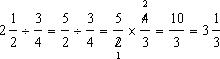
ANS:
PTS: 7.

ANS: 1 DIF: Comprehension
REF: Division of Fractions
8.
PTS: 1 DIF: Comprehension
REF: Subtracting Fractions
9.
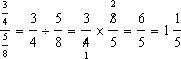
ANS:
PTS: 1 DIF: Comprehension
REF: Division of Fractions
Perform the following computations. If the questions do not have a whole number as the answer, compute to the third decimal place, and round to the second decimal place.

ANS: or 75.58 (rounded)
PTS: 1 DIF: Comprehension
REF: Addition and Subtraction of Decimals
11.

ANS: or 0.05 (rounded)
PTS: 1 DIF: Comprehension
REF: Multiplying Decimals
ANS:

PTS: 1 DIF: Comprehension
REF: Addition and Subtraction of Decimals
12.
ANS:

PTS: 1 DIF: Comprehension
REF: Dividing Decimals
13. Convert the following decimal to a fraction and reduce to lowest terms.
0.09
ANS:
0.09 =

PTS: 1 DIF: Comprehension
REF: Conversion between Fractions and Decimals
14. Convert the following decimal to a fraction and reduce to lowest terms.
0.175
ANS: 0.175 =

PTS: 1 DIF: Application REF: Conversion between Fractions and Decimals
15. Convert the following fraction to a decimal and round to the nearest hundredth.
ANS:

PTS: 1 DIF: Application REF: Conversion between Fractions and Decimals
16. Convert the following fraction to a decimal and round to the nearest tenth.
ANS:

PTS: 1 DIF: Application REF: Conversion between Fractions and Decimals
17. Perform the indicated operation.

ANS:
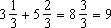
PTS: 1 DIF: Comprehension REF: Addition and Subtraction of Fractions
18. Perform the indicated operation. 6.3 100
ANS: 6.3 100 = 630
PTS: 1 DIF: Comprehension REF: Multiplying Decimals
19. Perform the indicated operation and round the answer to the tenths place.
ANS:
PTS: 1 DIF: Application REF: Multiplying Decimals
20. Perform the indicated operation and round the answer to the nearest tenths place. 123.56 78
ANS:
123.56 78 = 9,637.68 = 9,637.7
PTS: 1 DIF: Application REF: Multiplying Decimals
21. Perform the indicated operation.
350 0.07
ANS:
350 0.07 = 5,000
PTS: 1 DIF: Comprehension
22. Perform the indicated operation.
25 0.4
ANS:
25 0.4 = 62.5
PTS: 1 DIF: Comprehension
23. Perform the indicated operation and reduce to the lowest terms.

ANS:

REF: Dividing Decimals
REF: Dividing Decimals
PTS: 1 DIF: Application REF: Multiplying Fractions
24. Perform the indicated operation and reduce to the lowest term.

ANS:

PTS: 1 DIF: Application REF: Addition and Subtraction of Fractions
25. Perform the indicated operation and reduce to lowest term.

ANS:
PTS: 1 DIF: Application REF: Division of Fractions
26. Convert 0.45 to a fraction in the lowest terms.
ANS:

PTS: 1 DIF: Application REF: Conversion between Fractions and Decimals
27. Convert 0.125 to a fraction in the lowest terms.
ANS:

PTS: 1 DIF: Application REF: Conversion between Fractions and Decimals
28. Convert to a decimal.
ANS: 4 8 = 0.5
PTS: 1 DIF: Comprehension REF: Conversion between Fractions and Decimals
29. Convert to a decimal and round to the nearest hundredths place.
ANS: 5 8 = 0.625 = 0.63
PTS: 1 DIF: Application REF: Conversion between Fractions and Decimals
30. Find the least common denominator for the following pair of fractions. , ANS: LCD = 33
PTS: 1 DIF: Comprehension REF: Reducing Fractions to Lowest Terms
31. Find the least common denominator for the following pair of fractions. ,
PTS: 1 DIF: Comprehension REF: Reducing Fractions to Lowest Terms
32. Perform the indicated operation and reduce to the lowest terms.

ANS:

PTS: 1 DIF: Application REF: Addition and Subtraction of Fractions
33. Perform the indicated operation and reduce to lowest terms. 4 2 ANS: 4 2 1


PTS: 1 DIF: Application REF: Addition and Subtraction of Fractions
34. After surgery, a patient drinks 2 ounces of clear liquids every 2 hours. How many ounces will the patient drink in 8 hours?
ANS: 2 4 = = = 10 ounces
PTS: 1 DIF: Application REF: Multiplying Fractions
Chapter 2
PROBLEM
1. Complete row 1 in the table above.
ANS: , 5% , 1:20
PTS: 1 DIF: Application REF: Ratios and Percents
2. Complete row 2 in the table above.
ANS: 0.125, 12.5%, 1:8
PTS: 1 DIF: Application REF: Ratios and Percents
3. Complete row 3 in the table above.
ANS: 0.45, , 9:20
PTS: 1 DIF: Application REF: Ratios and Percents
4. Complete row 4 in the table above.
ANS: 0.3, , 30%
PTS: 1 DIF: Application REF: Ratios and Percents
Solve for X. Round answers to two decimal places.

ANS:
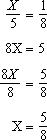
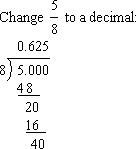
Rounded to two decimal places, X = 0.63
PTS: 1 DIF: Application REF: Solving Simple Equations for X

6. ANS:
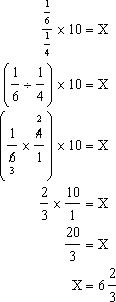
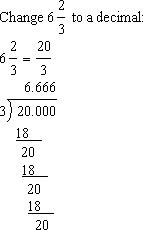
Rounded to two decimal places, X = 6.67
PTS: 1 DIF: Application REF: Solving Simple Equations for X
Compute the answers for the following word problems.
7. Aclass of students consists of 9 men and 51 women. Write a proper fraction to represent the part of the total class that is women. Reduce the fraction. Change the fraction to a percent.
Reduced fraction: Percent:
ANS:
There are 51 women in the class of 60 students.

PTS: 1 DIF: Application REF: Ratios and Percents
8. A student received a score of 48 points on a test that was worth 60 points. Write a fraction to represent the portion of the test the student had answered correctly. Reduce the fraction. Change the fraction to a percent.
Reduced fraction: Percent:
ANS:
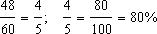
PTS: 1 DIF: Application REF: Ratios and Percents
9. In order to pass a chapter test, a student must answer 80% or more of the questions correctly. If a chapter test has 25 questions, what is the smallest number of questions that the student must answer correctly in order to pass the test?
ANS:
At least 80% of 25 questions must be answered correctly.
The student must answer at least 20 questions correctly.
PTS: 1 DIF: Application REF: Ratios and Percents
10. In order to pass a unit test, a student must answer 80% or more of the questions correctly. If a unit test has 75 questions, what is the largest number of questions that the student could answer incorrectly, but still pass the unit test?
ANS:
At least 80% of 75 questions must be answered correctly.
At least 60 questions must be answered correctly.
The largest number of questions that the student could answer incorrectly, but still pass the test, is 15 questions.
PTS: 1 DIF: Application REF: Ratios and Percents
11. Change the following ratio to a fraction. Reduce to lowest terms.
3 : 6
ANS: 3 : 6 = =
PTS: 1 DIF: Comprehension
REF: Converting among Ratios, Percents, Fractions, and Decimals
12. Change the following ratio to a fraction. Reduce to the lowest term.
5 : 35
ANS: 5 : 35 = =
PTS: 1 DIF: Comprehension
REF: Converting among Ratios, Percents, Fractions, and Decimals
13. Change the following ratio to a decimal. Round to the hundredths place.
3 : 7
ANS:
3 : 7 = = 0.428 = 0.43
PTS: 1 DIF: Analysis
REF: Converting among Ratios, Percents, Fractions, and Decimals
14. Change the following ratio to a decimal. Reduce to the hundredths place.
0.26 : 0.92
ANS:
0.26 : 0.92 = = 0.282 = 0.28
PTS: 1 DIF: Application
REF: Converting among Ratios, Percents, Fractions, and Decimals
15. Change the following ratio to a decimal. Round to the hundredths place.
1.4 : 2.8
ANS: 1.4 : 2.8 = = 0.5
PTS: 1 DIF: Application REF: Converting among Ratios, Percents, Fractions, and Decimals
16. Change the following ratio to a percent. Round to the hundredths place.
3 : 6
ANS:
3 : 6 = = 0.5 = 0.50 = 50%
PTS: 1 DIF: Application REF: Converting among Ratios, Percents, Fractions, and Decimals
17. Change the following ratio to a percent. Round to the hundredths place.
0.7 : 2.8
ANS:
0.7 : 2.8 = = 0.25 = 25 %
PTS: 1 DIF: Application REF: Converting among Ratios, Percents, Fractions, and Decimals
18. Solve the following problem for X.

ANS:
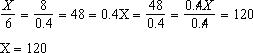
PTS: 1 DIF: Application REF: Solving Simple Equations for X

19. Upon admission to the hospital, a child weighed 62 lb. One week later, upon discharge, the child weighed lb. How much weight did the child lose?
ANS:
X = 4.5 lb
PTS: 1 DIF: Application REF: Solving Simple Equations for X
20. Aclient is to receive 1,800 mLof fluid during a 24-hour period. The client is to receive of the fluid between 7 AM and 10 PM Calculate how many mLthe client will drink during that time.
ANS:

PTS: 1 DIF: Application REF: Solving Simple Equations for X
Determine what % one number is of another number.
21. 30 is what % of 100?
ANS:
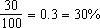
PTS: 1 DIF: Comprehension REF: Finding the Percentage of a Quantity
22. 5 is what % of 1,500?
ANS:

PTS: 1 DIF: Comprehension
REF: Finding the Percentage of a Quantity
23. 1 is what % of 100?
ANS: 0.01 = 1%

PTS: 1 DIF: Comprehension
REF: Finding the Percentage of a Quantity
24. Convert as indicated.
written as a ratio.
ANS: 3 : 4
PTS: 1 DIF: Comprehension REF: Ratios
25. Convert as indicated.
written as a ratio.
ANS:
7 : 8
PTS: 1 DIF: Comprehension REF: Ratios
26. Find the value of X in the following equation.

ANS: 750 = 500X

PTS: 1 DIF: Application REF: Solving Simple Equations for X
27. Convert the following % to a decimal.
66%
ANS: 66% =

PTS: 1 DIF: Comprehension
REF: Converting among Ratios, Percents, Fractions, and Decimals
28. Convert the following % to a decimal.
5.25%
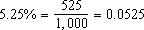
ANS: PTS: 1 DIF: Comprehension
REF: Converting among Ratios, Percents, Fractions, and Decimals
29. Convert the following decimal to a percent.
0.04
ANS: 0.04 100 = 4%
PTS: 1 DIF: Comprehension
REF: Converting among Ratios, Percents, Fractions, and Decimals
30. Convert the following decimal to a percent.
0.0016
ANS: 0.0016 100 = 0.16%
PTS: 1 DIF: Comprehension
REF: Converting among Ratios, Percents, Fractions, and Decimals
31. Convert the following decimal to a percent.
0.99
ANS: 0.99 100 = 99%
PTS: 1 DIF: Comprehension
REF: Converting among Ratios, Percents, Fractions, and Decimals
32. Determine the percentage of a given number.
25% of 40
ANS: 0.25 40 = 10
PTS: 1 DIF: Comprehension
REF: Converting among Ratios, Percents, Fractions, and Decimals
33. Determine the percentage of a given number.
75% of 50
ANS: 0.75 50 = 37.5
PTS: 1 DIF: Comprehension
REF: Converting among Ratios, Percents, Fractions, and Decimals
34. Find the value of X in the following equation.

ANS: 24X = 12 X = -0.5
PTS: 1 DIF: Application REF: Solving Simple Equations for X
Chapter 3 Systems of Measurement
SHORTANSWER
Express in proper metric, apothecary, or household notation.
1. one-half teaspoon
ANS:
PTS: 1 DIF: Comprehension
2. two and one-half liters
ANS: 2.5 L
PTS: 1 DIF: Comprehension
3. three-tenths of a gram
ANS: 0.3 g
PTS: 1 DIF: Comprehension
4. 25 milliequivalents
ANS: 25 mEq
PTS: 1 DIF: Comprehension
REF: The Household System
REF: Metric System
REF: Metric System
REF: Other Common Drug Measurements: Units and Milliequivalents
5. two quarts
ANS: qt ii
PTS: 1 DIF: Comprehension
6. 15 drops
ANS: 15 gtt
PTS: 1 DIF: Comprehension
7. five-tenths of a milligram
ANS: 0.5 mg
REF: The Household System
REF: The Household System
PTS: 1 DIF: Comprehension REF: Metric System
8. two hundred milliliters
ANS: 200 mL
PTS: 1 DIF: Comprehension
9. one teaspoon
ANS: 1 t
PTS: 1 DIF: Comprehension
10. three tablespoons
ANS: 3 T
PTS: 1 DIF: Comprehension
11. five pounds
ANS: 5 lb
PTS: 1 DIF: Comprehension
12. two ounces
ANS: 2 oz
PTS: 1 DIF: Comprehension
13. ten drops
ANS: 10 gtt
PTS: 1 DIF: Comprehension
Interpret the given notations.
14. 35 units
ANS: 35 units
REF: Metric System
REF: The Household System
REF: The Household System
REF: The Household System
REF: The Household System
REF: The Household System
PTS: 1 DIF: Comprehension REF: Other Common Drug Measurements: Units and Milliequivalents
15. 3.5 mg
ANS: three and one-half milligrams
PTS: 1 DIF: Comprehension
16.
ANS: one-half teaspoon
PTS: 1 DIF: Comprehension
17. 12.5 mL
ANS: twelve and one-half milliliters
PTS: 1 DIF: Comprehension
18. 12 gtt
ANS: twelve drops
PTS: 1
19. 22 oz
ANS: twenty-two ounces
DIF: Comprehension
REF: Metric System
REF: The Household System
REF: Metric System
REF: The Household System
PTS: 1 DIF: Comprehension
20. 0.25 mg
ANS: twenty-five hundredths of a milligram
PTS: 1 DIF: Comprehension
21. 30 mEq
ANS: thirty milliequivalents
REF: The Household System
REF: Metric System
PTS: 1 DIF: Comprehension REF: Other Common Drug Measurements: Units and Milliequivalents
22. 50 mcg
ANS: fifty micrograms
PTS: 1 DIF: Comprehension
23. 0.04 g
ANS: four-hundredths of a gram
PTS: 1 DIF: Comprehension
24. 700 mL
ANS: seven hundred milliliters
PTS: 1 DIF: Comprehension
25. 2 T
ANS: two tablespoons
PTS: 1 DIF: Comprehension
REF: Metric System
REF: Metric System
REF: Metric System
REF: The Household System
Chapter 4 Conversions: Metric and Household Systems
PROBLEM
Convert each of the given quantities to the equivalent unit indicated. Your answers must be in the proper form for the metric, household, or apothecary system measurement requested in the question.
Convert each of the given quantities to the equivalent unit indicated.
1. 1.5 g = mg
ANS: 1,500 1g = 1,000 mg
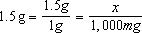
x = 1,500 mg
PTS: 1 DIF: Application REF: Converting within the Metric System
2. 1.5 mg = mcg
ANS: 1,500 1 mg = 1,000 mcg

x = 1,500 mcg
PTS: 1 DIF: Application REF: Converting within the Metric System
3. 3,500 g = kg
ANS: 3.5 1 kg = 1,000 g
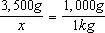

x = 3.5 kg
PTS: 1 DIF: Application REF: Converting within the Metric System
4. 125 mg = g
ANS: 0.125 1,000 mg = 1 g

x = 0.125 mg
PTS: 1 DIF: Application REF: Converting within the Metric System
5. 250 mcg = mg
ANS: 0.25 1 mg = 1,000 mcg
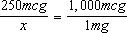

x = 0.25 mg
PTS: 1 DIF: Application REF: Converting within the Metric System
6. 0.4 mg = gr
ANS:

gr i = 60 gr
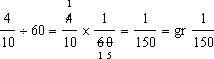
0.4 mg = 0.4 ÷ 60 =
PTS: 1 DIF: Application REF: Converting between Systems of Measurement

7. gr mg
ANS: 15 1 gr = 60 mg
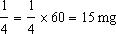
gr
PTS: 1 DIF: Application REF: Converting between Systems of Measurement
8. 15 cm = in
ANS: 6 1 in = 2.5 cm


x = 6 in
PTS: 1 DIF: Application REF: Converting between Systems of Measurement
9. 50 inches = cm
ANS: 125
1 in = 2.5 cm

x = 125 cm
PTS: 1 DIF: Application REF: Converting between Systems of Measurement
10. 30 kg = lb
ANS: 66
30 kg = 30 2.2 = 66 lb
1 kg = 2.2 lb

x = 66 lb
PTS: 1 DIF: Application REF: Converting between Systems of Measurement
11. 15 t = mL
ANS:
15 t = 15 5 = 75 mL
PTS: 1 DIF: Application REF: Converting between Systems of Measurement
12. 10 in = cm
ANS: 25 cm 25 x = 25 cm

PTS: 1 DIF: Application REF: Converting between Systems of Measurement
13. 0.4 g = mg
ANS: 400 mg 400 1 g = 1,000 mg x = 1,000 0.4 x = 400 mg
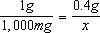
PTS: 1 DIF: Application REF: Converting within the Metric System
14. 220 lb = kg
ANS:
kg
1 kg = 2.2 lb x = x = 100 mg


PTS: 1 DIF: Application REF: Converting between Systems of Measurement
15. 5.27 kg = g
ANS: 5,270 g
5,270
1 kg = 1,000 g
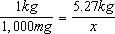
x = 5,270 g
PTS: 1 DIF: Application REF: Converting within the Metric System
16. 5 kg = g
ANS: 5,000 g 5,000
1 kg = 1,000 g

x = 5,000 g
PTS: 1 DIF: Application REF: Converting within the Metric System
17. 2 L = mL
ANS: 2,000 mL 2,000
1 L = 1,000 mL

x = 2,000 mL
PTS: 1 DIF: Application REF: Converting within the Metric System
18. 32 mcg = mg
ANS: 0.032 mg 0.032
1 mg = 1,000 mcg
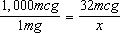
x = 0.032 mg
PTS: 1 DIF: Application REF: Converting within the Metric System
19. 24 in = cm
ANS: 60 60 cm
1 in = 2.5 cm
24 2.5 = 60 cm
PTS: 1 DIF: Application REF: Converting between Systems of Measurement
20. 0.56 mcg = mg
ANS: 0.00056 0.00056 mg
1 mg = 1,000 mcg
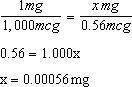
PTS: 1 DIF: Application REF: Converting within the Metric System
Solve the following problems using conversions as needed.
21. Apatient’s lunch consisted of the following fluids:
6 ounces of soup
8 ounces of milk
6 ounces of gelatin
4 ounces of pudding
Calculate the patient’s total fluid intake in ounces. Convert to mL and to L. oz mL, L
ANS: 24, 720, 0.72 1 oz = 30 mL
24 oz, 720 mL, 0.72 L
24 oz = 24 30 = 720 mL
24 oz = 720 ÷ 1,000 = 0.72 L
PTS: 1 DIF: Analysis REF: Converting between Systems of Measurement
22. The total fluid intake of the below is mL.
1 ounce = 30 mL
= 120 mL Intake = 690 mL
PTS: 1 DIF: Application REF: Converting between Systems of Measurement
23. The patient is to receive 5 mLof a drug, which is the equivalent of teaspoons.
ANS: 1 1 t
1 teaspoon (t) = 5 mL
PTS: 1 DIF: Application REF: Converting between Systems of Measurement
24. At an annual physical, a patient weighs 198 pounds, which is the equivalent of kilograms.
ANS: 90
kg 1 kg = 2.2 lb 198 2.2 = 90 kg
PTS: 1 DIF: Application REF: Converting between Systems of Measurement
25. Anewborn infant is 22 inches long. His length is cm.
PTS: 1 DIF: Application REF: Converting between Systems of Measurement
26. Anewborn infant is 50 cm long. Her length is inches.
ANS: 20
in
1 in = 2.5 cm
50 2.5 = 20 in
PTS: 1 DIF: Application REF: Converting between Systems of Measurement
Chapter 5 Conversions for Other ClinicalApplications: Time and Temperature
SHORTANSWER
Complete the following questions by converting between traditional time and international time.
1. Convert 10:45 AM to international time.
ANS: 1045
PTS: 1 DIF: Comprehension
REF: Converting between Traditional and International Time
2. Convert 2:30 PM to international time.
ANS: 1430
PTS: 1 DIF: Comprehension
REF: Converting between Traditional and International Time
3. Convert 8:00 AM to international time.
ANS: 0800
PTS: 1 DIF: Comprehension
REF: Converting between Traditional and International Time
4. Convert 4:50 PM to international time.
ANS: 1650
PTS: 1 DIF: Comprehension
REF: Converting between Traditional and International Time
5. Convert 12:15 PM to international time.
ANS: 1215
PTS: 1 DIF: Comprehension
REF: Converting between Traditional and International Time
6. Convert 12:25 AM to international time.
ANS: 0025
PTS: 1 DIF: Comprehension
REF: Converting between Traditional and International Time
7. Convert 1825 to traditional time.
ANS: 6:25 PM
PTS: 1 DIF: Comprehension
REF: Converting between Traditional and International Time
8. Convert 0450 to traditional time.
ANS: 4:50 AM
PTS: 1 DIF: Comprehension
REF: Converting between Traditional and International Time
9. Convert 1525 to traditional time.
ANS: 3:25 PM
PTS: 1 DIF: Comprehension
REF: Converting between Traditional and International Time
10. Convert 1215 to traditional time.
ANS: 12:15 PM
PTS: 1 DIF: Comprehension
REF: Converting between Traditional and International Time
11. Convert 2220 to traditional time.
ANS: 10:20 PM
PTS: 1 DIF: Comprehension
REF: Converting between Traditional and International Time
12. Convert 1000 to traditional time.
ANS: 10:00 AM
PTS: 1 DIF: Comprehension
REF: Converting between Traditional and International Time
Convert between international and traditional time or between Fahrenheit and Celsius temperatures as requested.
13. A patient’s outpatient surgery is scheduled to begin at 1500. The patient is to be instructed to register at the outpatient surgery desk 2 hours before the scheduled time for the surgery. Using traditional time, state the time at which the patient should arrive for registration.
ANS: 1500 = 3:00 PM
Two hours before 3:00 PM is 1:00 PM
PTS: 1 DIF: Application
REF: Converting between Traditional and International Time
14. A patient’s outpatient surgery is scheduled to begin at 1500. The physician estimates that the patient will be in the surgery room for an hour and a half, and then in the recovery room for an hour. After that, the family may visit with the patient. At what time would the family members expect to be able to visit with the patient?Answer using traditional time.
ANS:
1 hr 30 min in surgery + 1 hr in recovery room = 2 hours, 30 minutes. 3:00 PM + 2 hours, 30 minutes = 5:30 PM
PTS: 1 DIF: Application
REF: Converting between Traditional and International Time
15. Anurse who was assisting with the delivery of a baby noticed that the child was delivered at 12:10 PM. How should she note that time in the medical records if she is supposed to report the time using international time?
ANS: 12:10 PM = 1210
PTS: 1 DIF: Application
REF: Converting between Traditional and International Time
16. The emergency room nurse administered a medication to a patient at 3:25 AM He is supposed to record the time using international time. What should he record as the time of administration?
ANS: 3:25 AM = 0325
PTS: 1 DIF: Application
REF: Converting between Traditional and International Time
17. Apatient arrived in the emergency room with a fever of 38.5 C, which was reduced to 37.8 C by the time she was admitted to a hospital room. Change those temperatures to Fahrenheit temperatures.
ANS:
PTS: 1 DIF: Application REF: Converting between Celsius and Fahrenheit
18. A mother called the pediatrician’s office, reporting that her infant son had a temperature of 102.6 F. The nurse is to record the information as a Celsius temperature. What should the nurse write down as the temperature reported by the mother?

ANS: PTS: 1 DIF: Application REF: Converting between Celsius and Fahrenheit
19. Convert 8:25 PM to international time.
ANS: 2025
PTS: 1 DIF: Comprehension
REF: Converting between Traditional and International Time
20. Convert 7:45 AM to international time.
ANS: 0745
PTS: 1 DIF: Comprehension
REF: Converting between Traditional and International Time
21. Convert 1:16 PM to international time.
ANS: 1316
PTS: 1 DIF: Comprehension
REF: Converting between Traditional and International Time
22. Convert 11:20 AM to international time.
ANS: 1120
PTS: 1 DIF: Comprehension
REF: Converting between Traditional and International Time
23. Convert 1945 to traditional time.
ANS: 7:45 PM
PTS: 1 DIF: Comprehension
REF: Converting between Traditional and International Time
24. Convert 2320 to traditional time.
ANS:
11:20 PM
PTS: 1 DIF: Comprehension
REF: Converting between Traditional and International Time
25. Convert 0915 to traditional time.
ANS: 9:15 AM
PTS: 1 DIF: Comprehension
REF: Converting between Traditional and International Time
26. Convert 1152 to traditional time.
ANS: 11:52 AM
PTS: 1 DIF: Comprehension
REF: Converting between Traditional and International Time
27. Convert between Fahrenheit and Celsius temperatures as requested. 100 F
ANS: 100 F = = 37.8 C

PTS: 1 DIF: Application REF: Converting between Celsius and Fahrenheit
28. Convert between Fahrenheit and Celsius temperatures as requested.

ANS: PTS: 1 DIF: Application REF: Converting between Celsius and Fahrenheit
29. Convert between Fahrenheit and Celsius temperatures as requested.
ANS:
PTS: 1 DIF: Application REF: Converting between Celsius and Fahrenheit
30. Convert between Fahrenheit and Celsius as requested.
PTS: 1 DIF: Application REF: Converting between Celsius and Fahrenheit
Chapter 6 Equipment Used in Dosage Measurement
COMPLETION
1. The medicine cup calibrations indicate that 1 teaspoon is approximately mL.
ANS: 5 mL 5
PTS: 1 DIF: Knowledge REF: Oral Administration
2. The medicine cup calibrations indicate that 1 tablespoon (1 T) is approximately mL.
ANS: 15 mL 15
PTS: 1 DIF: Knowledge REF: Oral Administration
SHORTANSWER
Draw an arrow to point to the volume that corresponds to the dose to be administered with the given equipment.
1. Administer 0.75 mL.

© Cengage Learning 2013
ANS:

© Cengage Learning 2013
PTS: 1 DIF: Knowledge REF: ParenteralAdministration
2. Administer 1.2 mL.

© Cengage Learning 2013
ANS:

© Cengage Learning 2013
PTS: 1 DIF: Knowledge REF: ParenteralAdministration
3. Administer 0.08 mL.
© Cengage Learning 2013
ANS:

© Cengage Learning 2013
PTS: 1 DIF: Knowledge REF: ParenteralAdministration
4. Administer 15 units.
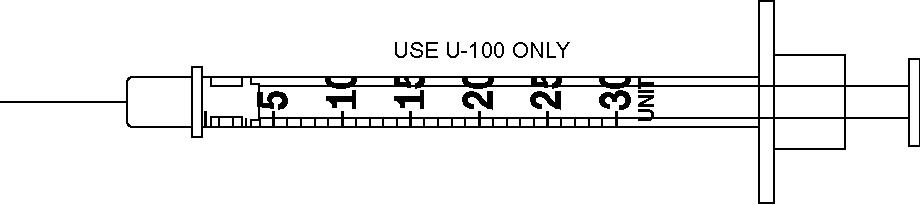
© Cengage Learning 2013
ANS:
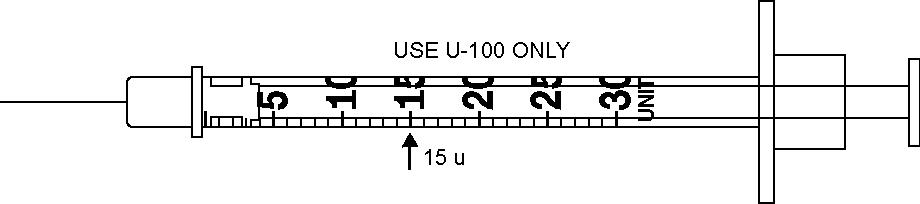
© Cengage Learning 2013
PTS: 1 DIF: Knowledge REF: ParenteralAdministration
5. Administer 68 units.

© Cengage Learning 2013
ANS:
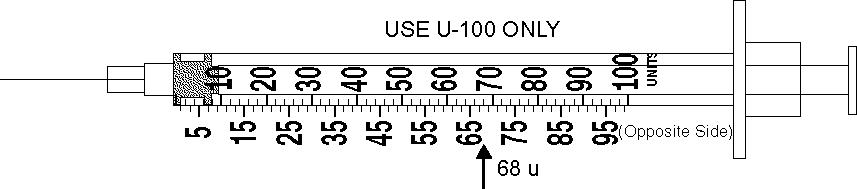
© Cengage Learning 2013
PTS: 1 DIF: Knowledge REF: ParenteralAdministration
6. Administer 36 units.

© Cengage Learning 2013
ANS:

© Cengage Learning 2013
PTS: 1 DIF: Knowledge REF: ParenteralAdministration
7. Administer 4.6 mL.

© Cengage Learning 2013
ANS:

© Cengage Learning 2013
PTS: 1 DIF: Knowledge REF: ParenteralAdministration
8. Administer 17 mL.
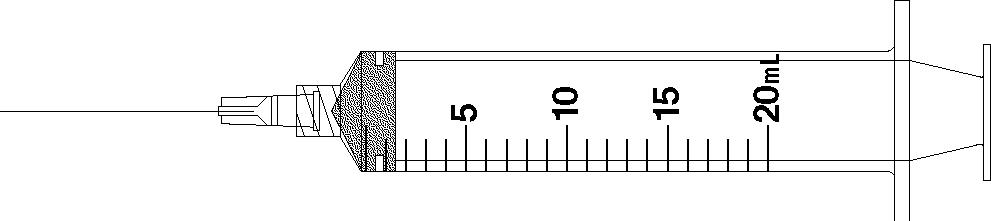
© Cengage Learning 2013
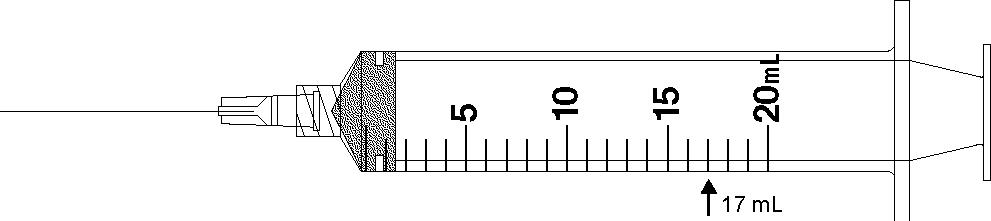
© Cengage Learning 2013
PTS: 1 DIF: Knowledge REF: ParenteralAdministration
9. Administer 2 t.
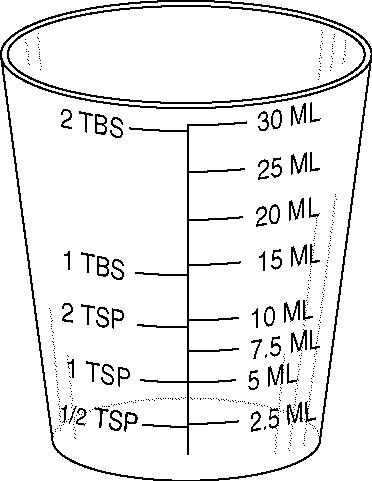
© Cengage Learning 2013
ANS:
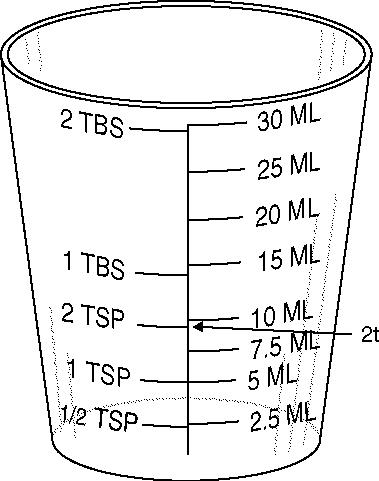
© Cengage Learning 2013
PTS: 1 DIF: Knowledge REF: Oral Administration
10. Administer 0.36 mL.

© Cengage Learning 2013
ANS:

© Cengage Learning 2013
PTS: 1 DIF: Knowledge REF: ParenteralAdministration
11. Administer 0.75 mL.

© Cengage Learning 2013
ANS:

© Cengage Learning 2013
PTS: 1 DIF: Knowledge REF: ParenteralAdministration
12. Administer 1.6 mL.

© Cengage Learning 2013
ANS:

© Cengage Learning 2013
PTS: 1 DIF: Knowledge REF: ParenteralAdministration
13. Administer 2.9 mL.

© Cengage Learning 2013
ANS:

© Cengage Learning 2013
PTS: 1 DIF: Knowledge REF: ParenteralAdministration
14. Administer 4.2 mL.

© Cengage Learning 2013
ANS:

© Cengage Learning 2013
PTS: 1 DIF: Knowledge REF: ParenteralAdministration
15. Administer 3.8 mL.

© Cengage Learning 2013
ANS:

© Cengage Learning 2013
PTS: 1 DIF: Knowledge REF: ParenteralAdministration
16. Administer 5.6 mL.

© Cengage Learning 2013
ANS:

© Cengage Learning 2013
PTS: 1 DIF: Knowledge REF: ParenteralAdministration
17. Administer 15 mL.
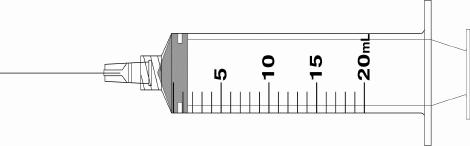
© Cengage Learning 2013
ANS:
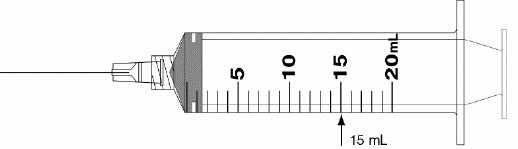
© Cengage Learning 2013
PTS: 1 DIF: Knowledge REF: ParenteralAdministration
18. Administer 12 units of insulin.

© Cengage Learning 2013

© Cengage Learning 2013
PTS: 1 DIF: Knowledge REF: ParenteralAdministration
19. Administer 80 units of insulin.

© Cengage Learning 2013
ANS:
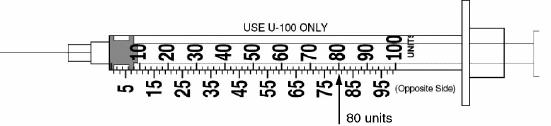
© Cengage Learning 2013
PTS: 1 DIF: Knowledge REF: ParenteralAdministration
20. Can you measure 1.45 mL in a single tuberculin syringe? Explain.
ANS: No.Asingle, tuberculin syringe has a maximum capacity of only 1 mL.
PTS: 1 DIF: Application REF: ParenteralAdministration
21. How would you measure 2.44 mL in a 3 mLsyringe?
ANS: Round to 2.4 mLand measure 2.4 mL on the syringe.
PTS: 1 DIF: Application REF: ParenteralAdministration
22. In which syringe should 0.32 mLof a medication solution be measured?
ANS: The medication can be measured and administered with a 1 mL(tuberculin) syringe.
PTS: 1 DIF: Application REF: ParenteralAdministration
23. Is it considered safe practice to exchange packaged droppers?
ANS: No, it is not considered safe practice because drop size varies from one dropper to another.
PTS: 1 DIF: Application REF: OralAdministration
24. Will using a medicine cup to measure a liquid medication always give you an accurate amount of medication?
ANS: No, medicine cups only provide approximate measures.
PTS: 1 DIF: Application REF: Oral Administration
25. Can insulin syringes be used to measure any medication for parenteral use?
ANS: No, insulin syringes can only be used for the measurement and administration of insulin.
PTS: 1 DIF: Application REF: Parenteral Administration
26. What are some examples for use of a 1 mL(tuberculin) syringe?
ANS: The 1 mLsyringe can be used to measure and administer allergen extract, vaccines, and medication for children.
PTS: 1 DIF: Application REF: ParenteralAdministration
27. Can the single-dose, prefilled syringe cartridge be used more than once?
ANS: No, a single-dose, prefilled syringe cartridge can be used only once and then must be discarded.
PTS: 1 DIF: Application REF: Parenteral Administration
Chapter 7 Interpreting Drug Orders
SHORTANSWER
Answer the following questions by supplying either the medical abbreviation or the interpretation of the medical abbreviation.
1. q.i.d.
ANS: four times per day
PTS: 1 DIF: Knowledge REF: MedicalAbbreviations
2. p.c.
ANS: after meals
PTS: 1 DIF: Knowledge REF: MedicalAbbreviations
3. t.i.d.
ANS: three times a day
PTS: 1 DIF: Knowledge REF: MedicalAbbreviations
4.
ANS: with
PTS: 1 DIF: Knowledge REF: MedicalAbbreviations
5. p.o.
ANS: orally
PTS: 1 DIF: Knowledge REF: MedicalAbbreviations
6. q.4h
ANS: every four hours
PTS: 1 DIF: Knowledge REF: MedicalAbbreviations
7. before
ANS:
PTS: 1
8. nothing by mouth
ANS: NPO
DIF: Knowledge REF: MedicalAbbreviations
PTS: 1 DIF: Knowledge REF: MedicalAbbreviations
9. gtt
ANS: drops
PTS: 1 DIF: Knowledge REF: MedicalAbbreviations
10. lytes
ANS: electrolytes
PTS: 1 DIF: Knowledge REF: MedicalAbbreviations
11. when necessary
ANS: p.r.n.
PTS: 1 DIF: Knowledge REF: MedicalAbbreviations
12. immediately
ANS: stat
PTS: 1 DIF: Knowledge REF: MedicalAbbreviations
13. b.i.d.
ANS: two times a day
PTS: 1 DIF: Knowledge REF: MedicalAbbreviations
14. min.
ANS: minute
PTS: 1 DIF: Knowledge REF: MedicalAbbreviations
15. h
ANS: hour
PTS: 1 DIF: Knowledge REF: MedicalAbbreviations
16. q.h
ANS: every hour
PTS: 1 DIF: Knowledge REF: MedicalAbbreviations
17. q.12 h
ANS: every twelve hours
PTS: 1 DIF: Knowledge REF: MedicalAbbreviations
18. capsule
ANS: cap
PTS: 1 DIF: Knowledge REF: MedicalAbbreviations
19. intramuscular
ANS: IM
PTS: 1 DIF: Knowledge REF: MedicalAbbreviations
20. intradermal
ANS: ID
PTS: 1 DIF: Knowledge REF: MedicalAbbreviations
21. per rectum
ANS: pr
PTS: 1 DIF: Knowledge REF: MedicalAbbreviations
22. tablet
ANS: tab
PTS: 1 DIF: Knowledge REF: MedicalAbbreviations
23. q
ANS: every
PTS: 1 DIF: Knowledge REF: MedicalAbbreviations
24. qs
ANS: quantity sufficient
PTS: 1 DIF: Knowledge REF: MedicalAbbreviations
25. aq
ANS: water
PTS: 1 DIF: Knowledge REF: MedicalAbbreviations
26. GT
ANS: gastrostomy tube
PTS: 1 DIF: Knowledge REF: MedicalAbbreviations
27. NG
ANS: nasogastric tube
PTS: 1 DIF: Knowledge REF: MedicalAbbreviations
28. noct
ANS: night
PTS: 1 DIF: Knowledge REF: MedicalAbbreviations
29. et
ANS: and
PTS: 1 DIF: Knowledge REF: MedicalAbbreviations
30. IV PB
ANS: intravenous piggyback
PTS: 1 DIF: Knowledge REF: MedicalAbbreviations
Interpret the following drug orders or write drug orders using correct medical abbreviations based on the supplied information.
The drug orders are presented for practice only, and actual prescribed dosages will vary according to a patient’s age, condition, reaction, additional medications, and other factors.
31. Phenergan 25 mg IM q. 6h p.r.n., nausea.
ANS:
Give Phenergan 25 mg intramuscularly every 6 hours as necessary for nausea.
PTS: 1 DIF: Comprehension
32. codeine gr p.o. q.4h p.r.n., pain.
ANS:
Give grain of codeine orally every four hours as needed for pain.
PTS: 1 DIF: Comprehension
33. potassium chloride 40 mEq p.o. b.i.d. in 4 oz juice.
ANS:
REF: The Drug Order
REF: The Drug Order
Give 40 milliequivalents of potassium chloride orally, twice per day, in four ounces of juice.
PTS: 1 DIF: Comprehension
34. Demerol 25 mg IM q.6h p.r.n., pain.
ANS:
REF: The Drug Order
Give 25 mg of Demerol intramuscularly every 6 hours as needed for pain.
PTS: 1 DIF: Comprehension
35. Amoxicillin 500 mg p.o. t.i.d.
ANS:
Give 500 mgAmoxicillin orally three times per day.
PTS: 1 DIF: Comprehension
36. Morphine Sulphate 2 mg IV q.2h p.r.n., pain.
ANS:
REF: The Drug Order
REF: The Drug Order
Give Morphine Sulphate 2 mg intravenously every 2 hours as needed for pain.
PTS: 1 DIF: Comprehension
REF: The Drug Order
37. Give Lasix 20 mg orally twice a day.
ANS: Lasix 20 mg p.o. b.i.d.
PTS: 1 DIF: Comprehension
38. Give Prednisone 25 milligrams orally once daily.
ANS: Prednisone 25 mg p.o. daily.
PTS: 1 DIF: Comprehension
REF: The Drug Order
REF: The Drug Order
39. Tylenol suppository 325 mg p.r q. 6h p.r.n, for temperature of 101F or higher.
ANS:
Give Tylenol 325 milligram suppository per rectum every 6 hours as needed for a temperature of 101F or higher.
PTS: 1 DIF: Comprehension
REF: The Drug Order
Chapter 8 Understanding Drug Labels
SHORTANSWER
Identify the following, using the given label.
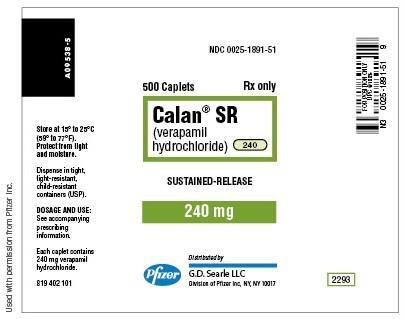
Used with permission from Pfizer Inc.
1. The name of the manufacturer is
ANS: Pfizer Inc.
PTS: 1 DIF: Comprehension
2. The form of the drug is
ANS: Caplets caplets
PTS: 1 DIF: Comprehension
Identify the following, using the given label.
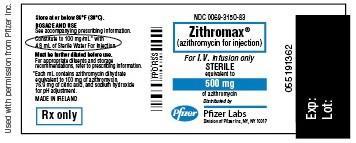
Used with permission from Pfizer Inc.
REF: Name of the Manufacturer
REF: Form
3. The route of administration is
ANS: I.V.
PTS: 1 DIF: Comprehension
4. The brand name of the drug is .
ANS: Zithromax
PTS: 1 DIF: Comprehension
5. What are the label alerts?
ANS: Must be further diluted before use.
PTS: 1 DIF: Comprehension
Identify the following, using the given label.
REF: Administration Route
REF: Brand and Generic Name
REF: LabelAlerts
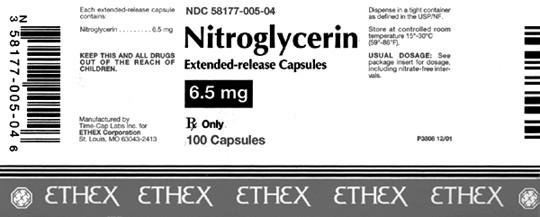
Manufacturer:
ANS: Ethex
PTS: 1 DIF: Comprehension
7. Brand name:
ANS: none, generic drug
PTS: 1 DIF: Comprehension
8. Generic name:
REF: Name of the Manufacturer
REF: Brand and Generic Name
Label courtesy of KV Pharmaceutical Co., St., Louis, Missouri.
6.
ANS: nitroglycerin
PTS: 1 DIF: Comprehension
9. Dosage strength:
ANS: 6.5 mg per capsule
PTS: 1 DIF: Comprehension
10. Form:
ANS: capsules
PTS: 1 DIF: Comprehension
11. Administration route:
ANS: oral administration
PTS: 1 DIF: Comprehension
12. National Drug Code number:
ANS: NDC 58177-005-04
PTS: 1 DIF: Comprehension
13. UPC code bars:
ANS: 3-58177-005-04-6
PTS: 1 DIF: Comprehension
14. Total number of capsules:
ANS: 100 capsules
PTS: 1 DIF: Comprehension
Identify the following, using the given label.
REF: Brand and Generic Name
REF: Dosage Strength
REF: Form
REF: Administration Route
REF: National Drug Code (NDC)
REF: Bar Code Symbols
REF: TotalVolume
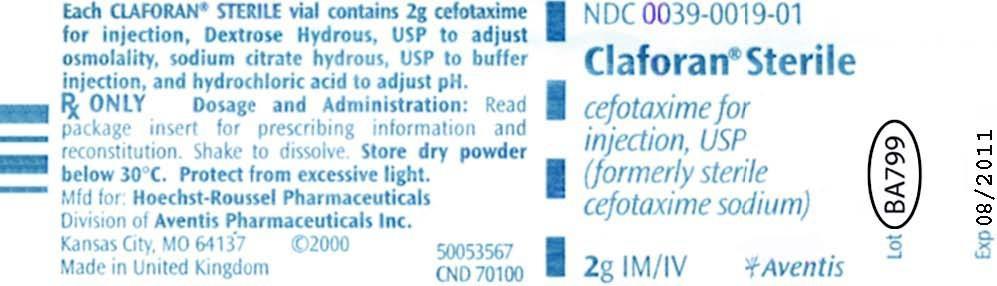
Used with permission from Aventis Pharmaceuticals.
15. Lot number:
ANS: Lot BA799
PTS: 1 DIF: Comprehension
16. Expiration date:
ANS: 08/xx (Aug 20xx)
PTS: 1 DIF: Comprehension
Identify the following, using the given label.
REF: Lot or Control Number
REF: Expiration Date
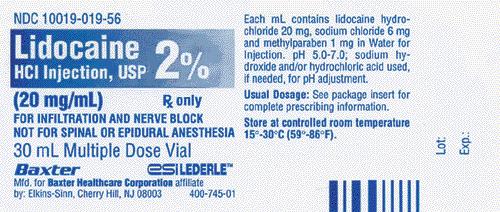
Copyright Baxter International Inc.
17. The supply dosage is g per mL.
ANS: 2% = 2 g per 100 mL
PTS: 1 DIF: Application REF: Supply Dosage
18. The supply dosage is mg per mL.
ANS:
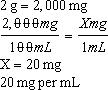
PTS: 1 DIF: Application REF: Supply Dosage
Chapter 9 Preventing Medication Errors
SHORTANSWER
Complete the following based upon the directions. The problems and drug orders are presented for practice only, and actual prescribed dosages will vary according to a patient’s age, condition, reaction, additional medications, and other factors.
1. Correct the medical notation of the following order.
Heparin 1,400 u/h.
ANS: Heparin 1,400 units/h.
PTS: 1 DIF: Knowledge REF: Transcription
2. Correct the medical notation of the following order.
MS4mgIV.
ANS: Morphine sulfate 4 mg IV.
PTS: 1 DIF: Comprehension
3. Correct the medical notation of the following order.
Lanoxin .125 mg q.o.d.
ANS: Lanoxin 0.125 mg every other day.
PTS: 1 DIF: Comprehension
4. Correct the medical notation of the following order.
Regular insulin 7.0 u every AM.
ANS: Regular insulin 7 units every AM.
PTS: 1 DIF: Comprehension
5. Correct the medical notation of the following order.
Demerol 75.00 mg IM as needed for pain.
ANS: Demerol 75 mg IM p.r.n., pain.
PTS: 1 DIF: Comprehension
REF: Transcription
REF: Transcription
REF: Transcription
REF: Transcription
6. When receiving verbal orders, the nurse should and the order to ensure its accuracy.
ANS:
When receiving verbal orders, the nurse should repeat and verify the order to ensure its accuracy.
PTS: 1 DIF: Comprehension REF: Verbal Orders
7. Who is legally responsible for patient safety and any medications errors that may occur?
ANS:
The person administering the medication is legally responsible for patient safety and any medication errors that may occur.
PTS: 1 DIF: Comprehension REF: Safe MedicationAdministration
8. Identify the six rights of medication administration.
ANS: Right patient Right drug Right dose Right time Right route Right documentation
PTS: 1 DIF: Knowledge REF: Safe MedicationAdministration
9. The nurse should check the medication label how many times before administering the drug?
ANS: 3 three
PTS: 1 DIF: Knowledge REF: Right Drug
10. Identify the error in the following medical order.
Dilacor XR 240 mg q.d. per nasogastric tube.
ANS:
This is an extended release medication and should not be crushed or dissolved.
PTS: 1 DIF: Comprehension REF: Right Route
11. Correct the medical notation of the following order.
Lasix 40.0 mg IV q.d.
ANS: Lasix 40 mg IV daily.
PTS: 1 DIF: Comprehension
12. Identify how the “right drug” is maintained by the nurse.
ANS:
The “right drug” is maintained by checking the medication label: 1. on first contact with the drug 2. prior to measuring the drug 3. after obtaining the drug, just prior to administration
PTS: 1 DIF: Application REF: Right Drug
13. Documentation of medication administration should occur when?
ANS: Documentation should occur after the medication administration.
REF: Transcription
PTS: 1 DIF: Knowledge REF: Right Documentation
14. What is one of the “main causes” of medication errors?
ANS: Incorrect transcription of the original prescriber’s order.
PTS: 1 DIF: Knowledge REF: Transcription
15. What list was written in an attempt to avoid transcription errors?
ANS:
The Joint Commission Official “Do Not Use” list of MedicalAbbreviations
PTS: 1 DIF: Knowledge REF: Transcription
16. According to The Joint Commission Official “Do Not Use” List of Medical Abbreviations, how should the commonly used abbreviation, Q.D. now be written?
ANS: Write“daily.”
PTS: 1 DIF: Comprehension REF: Transcription
17. According to The Joint Commission Official “Do Not Use” List of Medical Abbreviations, how should the abbreviation IU, now be written?
ANS: Write “International Unit.”
PTS: 1 DIF: Comprehension REF: Transcription
18. According to The Joint Commission Official “Do Not Use” List of MedicalAbbreviations, why should the RN not write a trailing zero on a medication dose?
ANS:
The decimal point may be missed.
PTS: 1 DIF: Comprehension
19. Correct the medical notation of the following order.
Fosamax 70 mg q.d.
ANS:
Fosamax 70 mg daily.
PTS: 1 DIF: Comprehension
20. Correct the medical notation of the following order.
NPH Insulin 45.0 u SC every AM.
ANS: NPH Insulin 45 units SC every AM.
PTS: 1 DIF: Comprehension
21. Correct the medical notation of the following order.
Heparin 1,000 u SC q.d.
ANS: Heparin 1,000 units SC daily.
PTS: 1 DIF: Comprehension
22. Correct the medical notation of the following order.
Valium 2.0mgp.o.,daily,p.r.n.,anxiety.
ANS: Valium 2mgp.o.,p.r.n, anxiety.
PTS: 1 DIF: Comprehension
REF: Transcription
REF: Transcription
REF: Transcription
REF: Transcription
REF: Transcription
23. Do registered nurses have the legal authority to write patient orders and prescriptions?
ANS: No, only those licensed health care providers who have the authority by their states to write prescriptions and orders are permitted to do so. Examples include a medical doctor (MD), nurse practitioners (NP), physician’s assistants (PA), a dentist (DDS), an osteopathic doctor (DO), and a podiatrist (DPM).
PTS: 1 DIF: Comprehension
REF: Prescription
24. What reference should a nurse use when validating the safety of the medication as ordered and transcribed?
ANS:
The nurse should refer to a reputable drug reference resource to validate the safety of ordered and transcribed medications.
PTS: 1 DIF: Comprehension
REF: Prescription
25. How many ways does The Joint Commission require a patient to be uniquely identified to ensure the safe administration of medications.
ANS:
The Joint Commission requires that patients be identified with at least two unique identifiers such as name and date of birth, or name and patient ID number. It may not be the room number.
PTS: 1 DIF: Comprehension
REF: Right Patient
26. Which step in the administration of medications often leads to overmedication of the patient?
ANS:
The last step in the procedure for medication administration is documentation. Often fatigue and time constraints are factors that may contribute to failure to document that a medication has been given.
PTS: 1 DIF: Comprehension
REF: Right Documentation
Chapter 10 Oral Dosage of Drugs
PROBLEM
Compute the amount of medication you will give to administer one dose of the following medication orders. Assume all tablets are scored, when necessary. The problems and drug orders are presented for practice only, and actual prescribed dosages will vary according to a patient’s age, condition, reaction, additional medications, and other factors.
1.
Order: furosemide 80 mg p.o. b.i.d.
Supply: Bottle containing 50 tablets of Lasix (furosemide), 80 mg per tablet
Give: tablet(s)
ANS:

PTS: 1 DIF: Comprehension REF: Tablets and Capsules
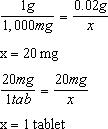
2.
Order: tamoxifen 0.02 g p.o. b.i.d., morning and evening
Supply: Nolvadex (tamoxifen) 20 mg per tablet
Give: tablet(s)
ANS: 1 g = 1,000 mg
PTS: 1 DIF: Application REF: Three-StepApproach to Dosage Calculations
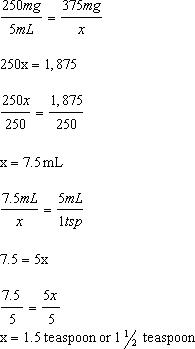
3.
Order: Depakene 375 mg p.o. b.i.d.
Supply: Depakene 250 mg/5 mL
Give: mL or teaspoons
ANS:
4.
PTS: 1 DIF: Application REF: Three-StepApproach to Dosage Calculations
Order: Amoxil 0.375 g p.o. q.8h
Supply: 80 mL bottle of reconstitutedAmoxil oral suspension, 125 mg/5 mL
Give: mL or tablespoon
ANS: 1,000 mg = 1 g
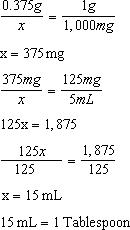
PTS: 1 DIF: Application REF: Three-StepApproach to Dosage Calculations
5.
Order: cefalcor 0.3 g p.o. q.8h
Supply: Celcor (cefalcor) reconstituted oral suspension, 375 mg per 5 mL
Give: mL
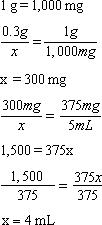
6.
Order: erythromycin ethylsuccinate 800 mg p.o. q.12h
Supply: E.E.S. 400 (erythromycin ethylsuccinate) 400 mg per tablet
Give: tablet(s)
ANS:
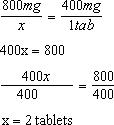
PTS: 1 DIF: Application REF: Three-StepApproach to Dosage Calculations
7.
Order: Augmentin 0.5 g p.o. q.8h
Supply: 75 mL bottle or reconstitutedAugmentin, 250 mg/5 mL
Give: mL or teaspoons
ANS: 1 g = 1,000 mg
8.
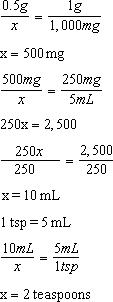
PTS: 1 DIF: Application REF: Three-StepApproach to Dosage Calculations
Order: Klonopin 500 mcg p.o. t.i.d.
Supply: Bottle of 100 tablets of Klonopin, 0.5 mg per tablet
Give: tablet(s)
ANS:
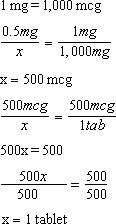
PTS: 1 DIF: Application REF: Three-StepApproach to Dosage Calculations
9.
Order: pediatric dose: Biaxin 100 mg p.o. q.12h
Supply: 100 mL of reconstituted Biaxin, 125 mg per 5 mL
Give: mL
ANS:
10.
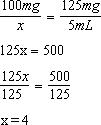
PTS: 1 DIF: Application REF: Three-StepApproach to Dosage Calculations
Order: Axid 0.15 g p.o. b.i.d.
Supply: Bottle containing 60 capsules ofAxid, 150 mg per capsule
Give: capsule(s)
ANS:
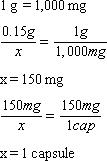
PTS: 1 DIF: Application REF: Three-StepApproach to Dosage Calculations
11.
Order: Prozac 40 mg p.o. b.i.d., morning and noon
Supply: Prozac 20 mg per tablet
Give: tablet(s)
ANS:
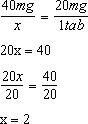
PTS: 1 DIF: Application REF: Three-StepApproach to Dosage Calculations
12.
Order: hydrochlorothiazide 50 mg p.o. b.i.d.
Supply: hydrochlorothiazide 100 mg tablets
Give: tab(s)
ANS:
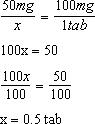
PTS: 1 DIF: Application REF: Three-StepApproach to Dosage Calculations
13. Decide which supply you would select and enter the number of tablets you would give.
Order: codeine gr p.o. q.4h p.r.n., pain
Supply: 15 mg, 30 mg, and 60 mg tablets
Give: Select mg tablets, and give tablet(s).
14.
15.
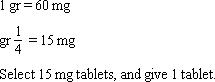
ANS: .
PTS: 1 DIF: Application REF: Three-StepApproach to Dosage Calculations
Order: Amoxil suspension 375 mg p.o. q.6h
Supply: Amoxil suspension 250 mg/5mL
Give: mL
ANS:
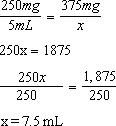
PTS: 1 DIF: Application REF: Three-StepApproach to Dosage Calculations
Order: Keflex 0.375 g p.o. b.i.d.
Supply: Reconstituted Keflex oral suspension, 250 mg/5mL
Give: teaspoons
ANS:
16.
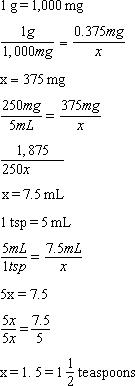
PTS: 1 DIF: Application REF: Three-StepApproach to Dosage Calculations
Order: Allopurinol 0.2 g p.o. daily
Supply: Bottle containing 200 tablets Zyloprim (Allopurinol) 100 mg per tablet
Give: tablet(s)
ANS:
1 g = 1,000 mg
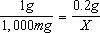
X = 200
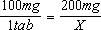
X = 2 tablets
PTS: 1 DIF: Application REF: Three-StepApproach to Dosage Calculations
17.
Order: Mycostatin 400,000 units p.o. swish and swallow q.6h t.i.d.
Supply: Bottle containing 473 mLMycostatin oral suspension, 100,000 units per mL
Give: mL
ANS:
18.

X = 4 mL
PTS: 1 DIF: Application REF: Oral Liquids
Order: Keflex 0.5 g p.o. b.i.d for 7 days
Supply: Bottle containing Keflex 500 mg per capsule, 14 capsules
Give: capsule(s)
ANS: 1 g = 1,000 mg
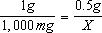
X = 500 mg
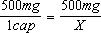
X = 1 capsule
PTS: 1 DIF: Application REF: Three-StepApproach to Dosage Calculations
19.
Order: Tylenol 325 mg p.o. q.6h p.r.n.for temperature of 101°F or above
Supply: Bottle containing 50 tablets of Tylenol 325 mg per tablet
Give: tablet(s)
20.
21.
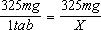
ANS: X = 1 tablet
PTS: 1 DIF: Comprehension REF: Tablets and Capsules
Order: Synthroid 12.5 mcg p.o. daily
Supply: Bottle containing 100 scored tablets of Synthroid, 25 mcg per tablet
Give: tablet(s)
ANS: X = 0.5 tablet
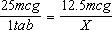
PTS: 1 DIF: Comprehension REF: Tablets and Comprehension
22.
Order: Potassium Chloride 30 mEq p.o. b.i.d
Supply: Package containing 15 mLof Potassium Chloride Oral Solution 10%, 20 mEq per 15 mL.
Give: mL
ANS:
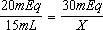

X = 20 mL
PTS: 1 DIF: Application REF: Oral Liquids
Order: Demerol syrup 100 mg p.o. q.6h p.r.n. pain
Label: Demerol syrup 50 mg per 5 mL
Give: mL
ANS:


X = 10 mL
PTS: 1 DIF: Application REF: Oral Liquids
23.
Order: Lasix 80 mg p.o. daily
Supply: Lasix 40 mg tablets
Give: tablet(s)
ANS: X = 2

PTS: 1 DIF: Comprehension REF: Tablets and Capsules
24. Is there enough medication in a 15 mLpackage of Potassium Chloride Oral Solution 10%, 20 mEq per 15 mL, to fulfill an order of 20 mL? Explain.
ANS: No, there is not enough medication in one package. The nurse would need to use some medication from another package too.
Chapter 11 Parenteral Dosage of Drugs
PROBLEM
Compute the amount of medication that will be given to administer one dose of the following medication orders. Round all parenteral administration orders that are over 1 mL to one decimal place. Round all parenteral administration orders under 1 mLto two decimal places. Do not include zeros at the end of decimal numbers. The problems and drug orders are presented for practice only, and actual prescribed dosages will vary according to a patient’s age, condition, reaction, additional medications, and other factors.
1.
Order: penicillin G procaine 1,200,000 units IM q.o.d.
Supply: penicillin G procaine 600,000 units per mL
Give: mL
ANS:
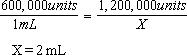
PTS: 1 DIF: Comprehension REF: Injectable Solutions
2.
Order: Prostigmin 250 mcg subcut C q.6h
Supply: Prostigmin 0.25 mg/mL
Give: mL
ANS:
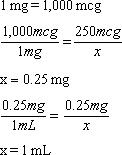
PTS: 1 DIF: Application REF: Injectable Solutions
3.
Order: Demerol 75 mg IM q.4h p.r.n., pain
Supply: Demerol 50 mg/mL
Give: mL
ANS:

PTS: 1 DIF: Comprehension
4.
Order: diazepam 5 mg IM q.4h p.r.n., anxiety
Supply: Valium (diazepam) 10 mg per 2 mL
Give: mL
ANS:

Injectable Solutions
PTS: 1 DIF: Comprehension REF: Injectable Solutions
5.
Order: diphenhydramine 15 mg IM stat
Supply: Benadryl (diphenhydramine) 10 mg/mL
Give: mL
ANS:

PTS: 1 DIF: Comprehension
6.
Order: Valium 3 mg IM q.6h p.r.n., pain
Supply: Valium 10 mg/2 mL
Give: mL
ANS:

PTS: 1 DIF: Comprehension
7.
Order: penicillin G potassium 400,000 units IM q.i.d.
Supply: penicillin G potassium 500,000 units per 2 mL
Give: mL
ANS:
Injectable Solutions
REF: Injectable Solutions
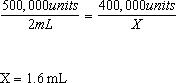
PTS: 1 DIF: Comprehension
REF: Injectable Solutions
8.
Order: heparin 3,000 units subcut b.i.d.
Supply: heparin 20,000 units/mL
Give: mL
ANS:
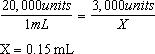
PTS: 1 DIF: Comprehension REF: Heparin
9.
Order: Librium 30 mg IM q.6h p.r.n., anxiety
Supply: Librium 100 mg/2 mL
Give: mL
ANS:

PTS: 1 DIF: Comprehension
REF: Injectable Solutions
10.
Order: Cleocin 0.3 g IM q.i.d.
Supply: Cleocin 300 mg per 2 mL
Give: mL
ANS:
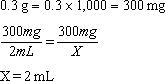
PTS: 1 DIF: Comprehension REF: Injectable Solutions
11.
Order: morphine sulfate 6 mg IM q.4h p.r.n., pain
Supply: morphine sulfate 10 mg/mL
Give: mL

PTS: 1 DIF: Comprehension
12.
Order: Terramycin 0.1 g IM q.d.
Supply: Terramycin 100 mg/mL Give: mL
ANS:
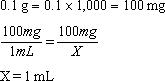
PTS: 1 DIF: Comprehension
REF: Injectable Solutions
REF: Injectable Solutions
13.
Order: meperidine hydrochloride 25 mg IM q.4h p.r.n., pain
Supply: Demerol (meperidine HCl) 50 mg/mL
Give: mL
ANS:

PTS: 1 DIF: Comprehension
14.
Order: Tigan 0.1 g IM q.6h p.r.n., nausea
Supply: Tigan 100 mg/2 mL Give: mL
ANS:
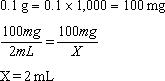
PTS: 1 DIF: Comprehension
15.
Order: Vistaril 50 mg IM stat
REF: Injectable Solutions
REF: Injectable Solutions
16.
Supply: Multidose vial labeled Vistaril 50 mg per mL
Give: mL
17.
18.
19.

ANS: X = 1 mL
PTS: 1 DIF: Comprehension
Ordered: Demerol 75 mg IM q.6h p.r.n, pain
Supply: Meperidine HCl Injection 100 mg per mL
Give: mL
REF: Injectable Solutions

ANS: X = 0.75 mL
PTS: 1 DIF: Comprehension
Ordered: Heparin 5,000 units subcut b.i.d
REF: Injectable Solutions
Supply: Multidose vial of 4 mL of heparin sodium injection 10,000 units/mL
Give: mL
ANS: X = 0.5 mL

PTS: 1 DIF: Comprehension
Ordered: Dexamethasone 2 mg IM q.12h
Supply: Dexamethasone sodium phosphate 4 mg/ml
Give: mL
REF: Heparin

ANS: X = 0.5 mL
PTS: 1 DIF: Comprehension
Ordered: Morphine 30 mg IM q.6h p.r.n., pain
REF: Injectable Solutions
20.
Supply: Morphine 15 mg per mL
Give: mL
ANS:

X = 2 mL
PTS: 1 DIF: Comprehension
Ordered: Dilantin 500 mg IM stat
Supply: Dilantin 250 mg/5 mL
Give: mL
REF: Injectable Solutions
21.
22.
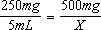
ANS: X = 10 mL
PTS: 1 DIF: Comprehension
Ordered: Depo-Provera 400 mg IM every 3 months
Supply: Depo-Provera injection 400 mg per mL
Give: mL
REF: Injectable Solutions
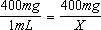
ANS: X = 1 mL
PTS: 1 DIF: Comprehension
Ordered: Vistaril 25 mg IM q. 4h p.r.n, nausea
Supply: Vistaril 50 mg/mL, multidose vial of 10 mL
Give: mL
REF: Injectable Solutions

ANS: X = 0.5 mL
PTS: 1 DIF: Comprehension
REF: Injectable Solutions
23. How many doses of Heparin 5,000 units are available in a multidose vial of 4 mLheparin sodium injection 10,000 units/mL?
ANS: 8 doses
PTS: 1 DIF: Application REF: Heparin
24. How many doses of Vistaril 25 mg IM are available in a 10 mLmultidose vial of Vistaril 50 mg/mL?
ANS: 20 doses are available
PTS: 1
DIF: Application REF: Injectable Solutions
Chapter 12 Reconstitution of Solutions
PROBLEM
Compute the amount of medication that will be given to administer one dose of the following medication orders by using a proportion to obtain your answers.
Round all parenteral administration orders that are over 1 mL to one decimal place. Round all parenteral administration orders under 1 mL to two decimal places. Do not include zeros at the end of decimal numbers.
The problems and drug orders are presented for practice only, and actual prescribed dosages will vary according to a patient’s age, condition, reaction, additional medications, and other factors.
1. The physician orders 150,000 units of penicillin IM x one dose. You have a 10 mL vial of powder labeled penicillin 500,000 units. Instructions indicate to add 4.8 mLsterile saline or sterile water to give 100,000 units per mL. How many mL will be administered?
ANS:
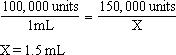
PTS: 1 DIF: Application REF: Single-Strength Solution
2.
Order: Methotrexate 15 mg IM daily
Supply: Methotrexate 1 gram vial
Directions: Reconstitute with 2 mLof normal saline to yield 2.5 mg/mL
Give: mL
ANS:

PTS: 1 DIF: Application REF: Single-Strength Solution
3.
Order: Protamine sulfate 25 mg IV x one dose
Supply: Protamine sulfate 50 mg, reconstitute with 5 mLto obtain 10 mg/mL
Give: mL.
ANS:

PTS: 1 DIF: Application REF: Single-Strength Solution
4.
Order: Rifampin 600 mg daily IV
Supply: Rifampin 600 mg, dilute with 10 mL of sterile water to yield 60 mg/mL
Give: mL
ANS:

PTS: 1 DIF: Application REF: Single-Strength Solution
5.
Order: Mandol 500 mg IM
Supply: Mandol 1 gram, reconstitute with 3 mLsterile water to yield 285 mg/mL Give: mL
ANS:
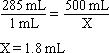
PTS: 1 DIF: Application REF: Single-Strength Solution
6.
Order: Cefazolin 1,000 mg IV x one dose
Supply: Cefazolin 1gram, reconstitute with 3.7 mLto yield 250 mg/mL
Give: mL
ANS:
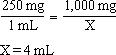
PTS: 1 DIF: Application REF: Single-Strength Solution
7.
Order: Claforan 2,000 mg IV every 8 hours
Supply: Claforan 2 gram, dilute with 10 mLto yield 180 mg/m Give: mL
ANS:
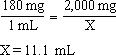
PTS: 1 DIF: Application REF: Single-Strength Solution
8. Order:
Piperacillin 2 g IV hour prior to surgery
Supply: Piperacillin 4 g vial
Directions: Reconstitute with 2 mLof normal saline to yield 2 g per mL.
Give: mL
9.
10.
11.

ANS: X = 1 mL
PTS: 1 DIF: Application REF: Single-Strength Solution
Order: Solu-Medrol 75 mg IM b.i.d.
Supply: Multi-dose vial of Solu-Medrol 500 mg.
Directions: Reconstitute with 8 mLof bacteriostatic water to yield 125 mg/2 mL
Give: mL
ANS: 125X = 150

X = 1.2 mL
PTS: 1 DIF: Application REF: Single-Strength Solution
Order: Ceftazadine 1.5 g IV q.12 h for 5 days
Supply: Ceftazadine 2 g vial
Directions: Reconstitute with 2 mLNS to yield 1g/mL
Give: mL
ANS: X = 1.5 mL

PTS: 1 DIF: Application REF: Single-Strength Solution
Order: Ancef 250 mg IV q.8h
Supply: Ancef 1 g
Directions: Reconstitute with 5 mLNS to yield 125 mg/mL
Give: mL
ANS:
12.

125X = 625
X = 5 mL
PTS: 1 DIF: Application REF: Single-Strength Solution
Order: Librium 50 mg IM 3 hours prior to surgery
Supply: Ampule Librium 100 mg
Directions: Reconstitute with 1 mLNS to yield 100 mg/2mL Give: mL
13. a.

ANS: X = 1 mL
PTS: 1 DIF: Application REF: Single-Strength Solution
Order: Oxacillin 500 mg IV q. 6h
Supply: Oxacillin 2 g, multi-dose vial
Directions: Reconstitute with 10 mL diluent to yield 250 mg/mL, total volume 120 mL
Give: mL
b. How many total doses are available for patient use?
c. There will be sufficient Oxacillin for how many days?
ANS: a.

250X = 2,500
X = 10 mL
b. 12 doses
c. 3 days
PTS: 1 DIF: Analysis REF: Single-Strength Solution
Chapter 13 Pediatric andAdult Dosages Based on Body Weight
PROBLEM
Compute the amount of medication that will be given to administer one dose of the following medication orders using the ratio-proportion method to obtain your answers.
Assume all tablets are scored, when necessary. Round all parenteral administration orders that are over 1 mL to one decimal place. Round all parenteral administration orders under 1 mL to two decimal places. Do not include zeros at the end of decimal numbers.
The problems and drug orders are presented for practice only, and actual prescribed dosages will vary according to a patient’s age, condition, reaction, additional medications, and other factors.
1.
Order: Axid 0.3 g p.o. at h.s.
Supply: Axid 150 mg capsules
Give: capsules
ANS:
Equivalent 1g = 1,000 mg
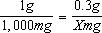
X = 1,000 0.3
X = 300 mg
X capsules =
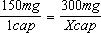
150X = 300
X = 2 capsules
PTS: 1 DIF: Application REF: Using Ratio-Proportion To Calculate Dosages
2.
Order: Dilantin 25 mg p.o. t.i.d.
Supply: Dilantin chewable 50 mg tablets
Give: tablet(s)
ANS: X tablets = 50X = 25 X = tablet

PTS: 1 DIF: Comprehension
Using Ratio-Proportion To Calculate Dosages
3.
Order: Amoxil 125 mg p.o. q.8h
Supply: Bottle ofAmoxil (powdered medication) with the instructions to add 12 mLof water to obtain a pediatric oral suspension of 50 mg/mL
Give: mL
ANS: X mL= 50X = 125

X = 2.5 mL
PTS: 1 DIF: Application REF: Using Ratio-Proportion To Calculate Dosages
4.
Order: Amoxil 0.25 g p.o. q.8h
Supply: 80 mLbottle of reconstitutedAmoxil oral suspension, 125 mg/5 mL
Give: mL or teaspoons
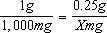
ANS: Equivalent 1 g = 1,000 mg X = 1,000 0.25 X = 250 mg X mL=
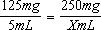
125X = 5 250
125X = 1,250
X = 10 mL
10 mL = 10 5 = 2 teaspoons
PTS: 1 DIF: Application REF: Using Ratio-Proportion To Calculate Dosages
5.
Order: Augmentin 375 mg p.o. q.8h
Supply: 75 mL bottle of reconstitutedAugmentin, 250 mg/5 mL
Give: mL
ANS: X mL=
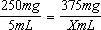
250X = 375 5
250X = 1,875
X = 7.5 mL
PTS: 1 DIF: Comprehension
REF: Using Ratio-Proportion To Calculate Dosages
6.
Order: Biaxin 500 mg p.o. q.12h
Supply: Biaxin oral suspension, reconstituted to 250 mg per 5 mL
Give: mL or teaspoons
ANS: X mL=
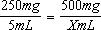
250X = 5 500
250X = 2,500
X = 10 mL
10 mL = 10 5 = 2
2 teaspoons
PTS: 1 DIF: Comprehension
REF: Using Ratio-Proportion To Calculate Dosages
7.
Order: Ceclor 300 mg p.o. q.8h
Supply: Ceclor reconstituted oral suspension, 375 mg/5 mL
Give: mL
ANS: X mL=
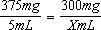
375X = 300 5
375X = 1,500 X = 4 mL
PTS: 1 DIF: Comprehension
REF: Using Ratio-Proportion To Calculate Dosages
8.
Order: Klonopin 500 mcg p.o. t.i.d.
Supply: Bottle of 100 tablets of Klonopin, 0.5 mg per tablet
Give: tablet(s)
ANS: Equivalent = 1 mg = 1,000 mcg
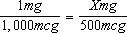
1,000X = 500

X = 0.5 mg 0.5X = 0.5
X = 1 tablet
PTS: 1 DIF: Application REF: Using Ratio-Proportion To Calculate Dosages
9.
Order: vitamin B12 100,000 units IM q.d. for 3 days
Supply: 2 mLvial of vitamin B12 with 50,000 units/mL
Give: mL
ANS: X mL=

50,000X = 100,000
X = 2 mL
PTS: 1 DIF: Application REF: Using Ratio-Proportion To Calculate Dosages
10.
Order: thiamine HCl 20 mg IM t.i.d.
Supply: 10 mLmultiple dose vial of vitamin B1 (thiamine HCl) 100 mg/mL
Give: mL
ANS: X mL=

100X = 20 X = 0.2 mL
PTS: 1 DIF: Comprehension
REF: Using Ratio-Proportion To Calculate Dosages
11.
Order: ascorbic acid 150 mg IM q.d.
Supply: 2 mL ampule of vitamin C (ascorbic acid) 250 mg/mL
Give: mL
ANS: X mL= 250X = 150
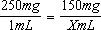
X = 0.6 mL
PTS: 1 DIF: Comprehension
REF: Using Ratio-Proportion To Calculate Dosages
12.
Order: heparin 7,500 units SC q.8h
Supply: heparin 10,000 units/mL
Give: mL
ANS: X mL= 10,000X = 7,500

X = 0.75 mL
PTS: 1 DIF: Comprehension
REF: Using Ratio-Proportion To Calculate Dosages
13.
Order: prednisolone acetate 35 mg IM q.d.
Supply: 10 mLmultiple dose vial of prednisolone acetate with a supply dosage of 50 mg/mL
Give: mL
ANS: X mL=

50X = 35
X = 0.7 mL
PTS: 1 DIF: Comprehension
REF: Using Ratio-Proportion To Calculate Dosages
14.
Order: methylprednisolone acetate 100 mg IM once per week
Supply: methylprednisolone acetate suspension, 80 mg/mL
Give: mL
ANS: X mL=

80X = 100
X = 1.25 = 1.3 mL
PTS: 1 DIF: Comprehension
REF: Using Ratio-Proportion To Calculate Dosages
Compute the amount of medication that will be given to administer one dose of the following medication orders using the Dimensional Analysis method to obtain your answers.
15.
Assume all tablets are scored, when necessary. Round all parenteral administration orders that are over 1 mL to one decimal place. Round all parenteral administration orders under 1 mL to two decimal places. Do not include zeros at the end of decimal numbers.
The problems and drug orders are presented for practice only, and actual prescribed dosages will vary according to a patient’s age, condition, reaction, additional medications, and other factors.
Order: Ceclor 0.375 g po. q.8h
Supply: Ceclor oral suspension 125 mg/5mL
Give: mL
ANS: X mL= 15 mLCeclor

PTS: 1 DIF: Application REF: Using DimensionalAnalysis To Calculate Dosages
16.
Order: Vistaril 0.1 g p.o. t.i.d
Supply: Vistaril oral suspension 25mg/5mL
Give: mL
ANS:
17.
18.

X mL= 20 mL
PTS: 1 DIF: Application REF: Using DimensionalAnalysis To Calculate Dosages
Order: Haldol 3 mg IM q. 8h
Supply: Haldol 5 mg/mLinjectable; 20 mLmultidose vial
Give: mL
ANS: X mL= 0.6 mL

PTS: 1 DIF: Comprehension
REF: Using DimensionalAnalysis To Calculate Dosages
Order: Pepcid 20 mg p.o. q.hs
Supply: Famotidine 10 mg chewable tablets
Give: tablets
ANS: X chewable tablets = 2 tablets
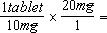
PTS: 1 DIF: Comprehension
REF: Using DimensionalAnalysis To Calculate Dosages
19.
Order: Synthroid 50 mcg p.o. daily
Supply: levothyroxine 0.025 mg tablets
Give: tablets
ANS: X tablets = = 2 tablets

PTS: 1 DIF: Comprehension
REF: Using DimensionalAnalysis To Calculate Dosages
20.
Order: Augmentin 875 mg p.o. q.12
Supply: Augmentin oral suspension 400 mg/5mL, 20 mLbottle
Give: mL
ANS: X mL= 8.75 or 8.8 mL
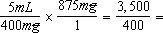
PTS: 1 DIF: Application REF: Using DimensionalAnalysis To Calculate Dosages
21.
Order: acyclovir 0.8 g p.o. q.4h
Supply: acyclovir 400 mg tablets
Give: tablets
ANS: X tablets = = 2 tablets


PTS: 1 DIF: Application REF: Using DimensionalAnalysis To Calculate Dosages
Chapter
PROBLEM
Compute the requested information. Round all parenteral administration orders that are over 1 mL to one decimal place. Round all parenteral administration orders under 1 mL to two decimal places. Do not include zeros at the end of decimal numbers.
The problems and drug orders are presented for practice only, and actual prescribed dosages will vary according to a patient’s age, condition, reaction, additional medications, and other factors.
Use the following information about a child and his order to compute answers.
Apediatrician has ordered ampicillin 50 mg/kg/day p.o. divided q.6h for a child who weighs 44 lb.
1. How many kilograms does the child weigh? kg
ANS:

PTS: 1 DIF: Comprehension
REF: Converting Pounds to Kilograms
2. How many milligrams should the child receive per day? mg
ANS: per day, 20 kg
PTS: 1 DIF: Comprehension
REF: Total Daily Dosage Range per Kilogram
3. How many milligrams should the child receive per dose? mg
ANS: q.6h every 6 hours, which is given 4 times per day.

PTS: 1 DIF: Comprehension
REF: Routine or Round-the-Clock Drugs
4. The pharmacy has supplied reconstituted ampicillin, with a supply dosage of 500 mg/5 mL. How many milliliters should be given per q.6h dose? mL
ANS:
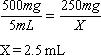
PTS: 1 DIF: Comprehension
REF: Routine or Round-the-Clock Drugs
5. How many teaspoons should the child’s parent administer per dose? t
ANS:

PTS: 1 DIF: Comprehension
REF: Routine or Round-the-Clock Drugs
Use the following information about a child and her order to compute answers.
Mandy, a child who weighs 15 kilograms, is to be given amoxicillin. The recommended dosage of amoxicillin for children is 20 to 40 mg/kg/day p.o. in equally divided doses administered q.8h.
6. What is the recommended range of milligrams of medication for this child per day?
minimum: mg maximum: mg
ANS: per day,minimum per day, maximum
PTS: 1 DIF: Application REF: Drugs with Maximum DailyAllowance
7. What is the recommended range of milligrams of medication for this child per q.8h dose? minimum: mg maximum: mg

ANS: q.8h every 8 hours, which is given 3 times per day. per day minimum per day maximum

PTS: 1 DIF: Application REF: Daily-Dosage-Range Drugs
8. The pediatrician has ordered amoxicillin 125 mg p.o. q.8h for Mandy. The available supply of amoxicillin is 125 mg/5 mL.
Is her order within the recommended range for this medication? (yes/no)
If so, how many mL of amoxicillin should be given per q.8h mL administration?
ANS:
Yes, 125 mg per dose is within 100 mg to 200 mg per dose.
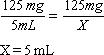
PTS: 1 DIF: Application REF: Daily-Dosage-Range Drugs
9. How many teaspoonfuls of amoxicillin should be given per q.8h administration? t
ANS: 5 mL 1 t
PTS: 1 DIF: Comprehension REF: Routine or Round-the-Clock Drugs
Use the following information about a child and his order to compute answers.
The recommended dosage of Rocephin is 50 to 100 mg/kg/day divided into two equal doses. The physician has ordered Rocephin 200 mg IM b.i.d. for a child who weighs 5000 g. The Rocephin vial contains 1 g of medication that must be reconstituted with 3.6 mLof diluent to yield 1 g/4 mL.
10. Compute the recommended minimum and maximum amount of milligrams that the child should receive per day. minimum: mg maximum: mg
ANS: per day,minimum per day, maximum
PTS: 1 DIF: Application REF: Daily-Dosage-Range Drugs
11. Compute the recommended minimum and maximum amount of milligrams that the child should receive per dose. minimum: mg maximum: mg
ANS: per dose, minimum per dose, maximum


PTS: 1 DIF: Application REF: Daily-Dosage-Range Drugs
12. Is the order within the recommended range? (yes/no) If so, compute the number of milliliters of Rocephin that should be administered per dose. mL.
ANS:
Yes, the ordered amount of 200 mg per dose, b.i.d. is within the recommended range of 125 mg to 250 mg per dose, given twice per day.
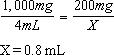
PTS: 1 DIF: Application REF: Daily-Dosage-Range Drugs
Apediatrician ordered Demerol 1 mg/kg/day p.o., divided q.4h p.r.n. for a child who weighs 33 lb.
13. How many kilograms does this child weigh?
ANS: X = 15 kg

PTS: 1 DIF: Comprehension REF: Converting Pounds to Kilograms
14. How many milligrams of Demerol should this child receive per day?
ANS: per day, 15 kg 1 mg/kg = 15 mg
PTS: 1 DIF: Comprehension REF: Routine or Round-the-Clock Drugs
15. How many milligrams of Demerol should the child receive per dose?
ANS: per dose, q. 4h p.r.n. = every 4 hours, which is given 6 times per day.

2.5 mg per dose
PTS: 1 DIF: Comprehension REF: Single-Dosage Drugs
Apediatrician orderedAugmentin 30 mg/kg/day divided into q. 8h doses for a child who weighs 66 lbs.
16. How many kilograms does the child weigh?
ANS: X = 30 kg

PTS: 1 DIF: Comprehension
REF: Converting Pounds to Kilograms
17. How many milligrams should the child receive per day?
ANS: per day, 30 kg 30 mg/kg = 900 mg
PTS: 1 DIF: Comprehension
REF: Routine or Round-the-Clock Drugs
18. How many milligrams should the child receive per dose?
ANS: q. 8h = every 8 hours, which is given 3 times per day

300 mg per dose
PTS: 1 DIF: Comprehension REF: Routine or Round-the-Clock Drugs
19. Using the following information about a child and her medication order to complete answers.
A6-year-old child weighing 25 kg has a staph infection and the provider has ordered penicillin. The recommended dose of penicillin for children is 25 to 50 mg/kg/day p.o. in equally divided doses administered q.6h.
What is the recommended range of milligrams of medication for this child per day? Minimum mg Maximum mg
ANS: per day,minimum
25 kg 25 mg/kg = 625 mg per day, maximum
25 kg 50 mg/kg = 1,250 mg
PTS: 1 DIF: Application REF: Daily-Dosage-Range Drugs
The following order was written for a child weighing 66 lb.
Order: Morphine 0.2 mg/kg p.o. q. 6h p.r.n, pain.
20. How many kilograms does this child weigh?
ANS: X = 30 kg
PTS: 1 DIF: Comprehension REF: Converting Pounds to Kilograms
21. How many milligrams should the child receive per day?
ANS:
0.2 mg/kg 30 kg = 6 mg
PTS: 1 DIF: Comprehension REF: Drugs with Maximum DailyAllowance
22. How many milligrams should the child receive per dose?
ANS: per dose, q. 6h p.r.n. = every six hours, which is given 4 times per day.

1.5 mg
PTS: 1 DIF: Comprehension REF: Single-Dosage Drugs
23. The recommended dose of this medication for this child is 0.2 mg-5 mg/kg per q. 4-6 h. Is the dose mentioned above in the recommended range and therefore safe to administer?
ANS:
Yes, the ordered amount of 1.5 mg per dose q.6h is within the recommended range and is therefore safe to administer.
PTS: 1 DIF: Application REF: Daily-Dosage-Range Drugs
The pediatrician orders Dicloxacillin 62.5 mg p.o. q. 6h for a child with a staph infection. The child weighs 77 lb. The drug reference recommends a dose of 12.5-50 mg/kg in divided doses of q. 6h for a child 40 kg, with a maximum of 4 g per day.
24. How many kilograms does this child weigh?
ANS:

X = 35 lbs
PTS: 1 DIF: Comprehension REF: Converting Pounds to Kilograms
25. Calculate the minimum recommended dosage.
ANS:
minimum = 12.5 mg/kg/day 35 kg = 437.5 mg/day
minimum mg/dose = 437.5 4 doses = 109.4 mg
PTS: 1 DIF: Application REF: Daily-Dosage-Range Drugs
26. Calculate the maximum recommended dose.
ANS:
maximum mg/kg/day = 50 mg/kg/day 35 kg = 1,750 mg/day
maximum mg/dose = 1750 4 doses = 437.5 mg
PTS: 1 DIF: Application REF: Daily-Dosage-Range Drugs
27. Is this order within the recommended range for this child?
ANS: No, the order of 62.5 mg q.6h is not within the recommended range of 109.4 mg to 437.5 mg.
PTS: 1 DIF: Application REF: Underdosage
28. What action should be taken by the nurse if a drug order is unsafe?
ANS:
The nurse should contact the prescriber to discuss the order.
PTS: 1 DIF: Comprehension REF: Underdosage
Chapter 15 Intravenous Solutions, Equipment, and Calculations
MULTIPLECHOICE
1. Apatient’s order for IV fluid states that NS is to be infused. Which of the following IV fluids should be given?
A. 0.9% Sodium Chloride
B. 0.45% Sodium Chloride
ANS: A PTS: 1
C. 0.225% Sodium Chloride
D. 5% Dextrose
DIF: Knowledge REF: Solution Strength
2. A patient’s order for IV fluid states the D5W is to be infused. Which of the following IV fluids should be given?
A. 5% Dextrose with Normal Saline
B. 5% Dextrose with Lactated Ringer’s Solution
C. 5% Dextrose with 0.45% Sodium Chloride
D. 5% Dextrose
ANS: D PTS: 1
REF: Solution Strength
DIF: Comprehension
3. Apatient’s order for IV fluid states that D5NS is to be infused. Which of the following IV fluids should be given?
A. 5% Dextrose
B. 0.9% Sodium Chloride
C. 5% Dextrose with 0.9% Sodium Chloride
D. Lactated Ringer’s Solution
ANS: C PTS: 1 DIF: Comprehension
REF: Solution Strength
4. Apatient’s order for IV fluid states that D5LR is to be infused. Which of the following IV fluids should be given?
A. 5% Dextrose with Lactated Ringer’s Solution
B. 5% Dextrose and 0.45% Sodium Chloride with 20 mEq KCl/L
C. 5% Dextrose with 0.225% Sodium Chloride
D. 0.45% Sodium Chloride
ANS: A PTS: 1 DIF: Comprehension
REF: Solution Strength
5. What is the ratio of the weight of dextrose to the volume of IV fluid in D5W?
A. 5 grams of dextrose to 1 liter of IV fluid
B. 5 milligrams of dextrose to 1 milliliter of IV fluid
C. 5 milligrams of dextrose to 1 liter of IV fluid
D. 5 grams of dextrose to 100 mL of IV fluid
ANS: D PTS: 1 DIF: Comprehension
REF: Solution Strength
6. What is the ratio of the weight of sodium chloride to the volume of IV fluid in NS?
A. 0.9 grams of sodium chloride to 100 mLof IV fluid
B. 0.009 grams of sodium chloride to 1 milliliter of IV fluid
C. 0.9 grams of sodium chloride to 1 liter of IV fluid
D. 0.9 milligrams of sodium chloride to 100 mLof IV fluid
ANS: A PTS: 1 DIF: Comprehension
REF: Solution Strength
7. Apatient’s order for IV fluid states that LR is to be infused. Which of the following IV fluids should be given?
A. Lactated Ringer’s Solution
B. 5% Dextrose with Lactated Ringer’s Solution
C. 0.9% Sodium Chloride
D. 5% Dextrose
ANS: A PTS: 1 DIF: Comprehension
REF: Solution Strength
8. Apatient’s order for IV fluid states that D5 NS with 20 KCL is to be infused. Which of the following IV fluids should be given to the patient?
A. 0.9% Sodium Chloride
B. 5% Dextrose and 0.45% Sodium Chloride with 20 mEq of KCL/L
C. 5% Dextrose with 0.225% Sodium Chloride with 20 mEq KCL/L
D. 5% Dextrose
ANS: B PTS: 1 DIF: Comprehension
REF: Solution Strength
PROBLEM
Calculate the weight of solutes in the following IV solutions, and identify the solutes.
1.
1 liter of D5W contains of . (weight) (solute)
ANS:
D5W = 5% dextrose = 5 g dextrose per 100 mLof solution
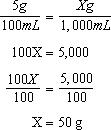
1 liter of D5W contains 50 g of dextrose.
PTS: 1 DIF: Application
REF: Calculating Components of IV Solutions When Expressed as a Percent
2.
1 liter of NS contains of . (weight) (solute)
ANS:
NS = 0.9% sodium chloride = 0.9 g sodium chloride per 100 mLof solution
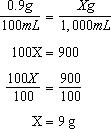
1 liter of NS contains 9 g of sodium chloride.
PTS: 1 DIF: Application
REF: Calculating Components of IV Solutions When Expressed as a Percent
3. 500 mL of D5 NS contains of (weight) (solute)
ANS:
D5 = Dextrose 5% = 5 g Dextrose per 100 mL

100X = 2,500

X = 25 g Dextrose
PTS: 1 DIF: Application
REF: Calculating Components of IV Solutions When Expressed as a Percent
The following IV orders will be regulated by electronic infusion devices. Calculate the flow rates of the IV fluids in mL/h. The problems and drug orders are presented for practice only, and actual prescribed dosages will vary according to a patient’s age, condition, reaction, additional medications, and other factors.
4. 1200 mL D10W IV to infuse in 10 hours by infusion pump Flow rate: mL/h
ANS:

PTS: 1 DIF: Application
REF: Calculating Flow Rates for Infusion Pumps in mL/h
5. 2 L D5W IV to infuse in 24 hours by infusion pump Flow rate: mL/h
ANS: 2 L = 2,000 mL

PTS: 1 DIF: Application
REF: Calculating Flow Rates for Infusion Pumps in mL/h
6. 1 LD5 NS IV to infusion 20 hours by controller Flow rate: mL/h
ANS:
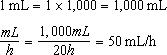
PTS: 1 DIF: Application
REF: Calculating Flow Rates for Infusion Pumps in mL/h
7. 30 mL D5W with antibiotic IV to infuse in 20 minutes by infusion pump Flow rate: mL/h
ANS:
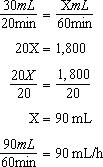
PTS: 1 DIF: Application
REF: Calculating Flow Rates for Infusion Pumps in mL/h
8. Calculate the IV flow rate for 50 mL NS to infuse by infusion pump over 20 minutes Flow rate: mL/h
ANS:


20X = 3,000 X = 150 mL/h
PTS: 1 DIF: Application
REF: Calculating Flow Rates for Infusion Pumps in mL/h
9. Calculate the IV flow rate for 250 mLto infuse by infusion pump over two hours Flow rate: mL/h
ANS:

PTS: 1 DIF: Application
REF: Calculating Flow Rates for Infusion Pumps in mL/h
The following IV orders will be regulated manually. Calculate the flow rate of the IV fluid in gtt/min.
10. 1 L NS IV to infuse in 10 hours
The drop factor is 10 gtt/mL. Flow rate: gtt/min
ANS:
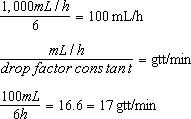
PTS: 1 DIF: Application
REF: Calculating Flow Rates for Manually Regulated IVs in gtt/min - Shortcut Method
11. 1000 mL D5W IV to infuse in 8 hours
The drop factor is 20 gtt/mL. Flow rate: gtt/min
ANS:
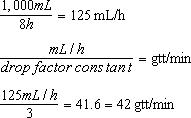
PTS: 1 DIF: Application
REF: Calculating Flow Rates for Manually Regulated IVs in gtt/min - Shortcut Method
12. 1 L NS IV to infuse in 10 hours
The drop factor is 10 gtt/mL. Flow rate: gtt/min
ANS:
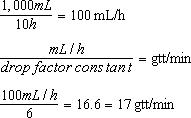
PTS: 1 DIF: Application
REF: Calculating Flow Rates for Manually Regulated IVs in gtt/min - Shortcut Method
13. 50 mL NS with antibiotic IV to infuse in 20 minutes The drop factor is 20 gtt/mL. Flow rate: gtt/min
ANS:
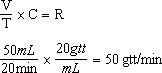
PTS: 1 DIF: Application
REF: Calculating Flow Rates for Manually Regulated IVs in gtt/min - Formula Method
14. Calculate the IV flow rate for 1,000 mLD5NS Flow rate: gtt/min to infuse over 10 hours. The IV is to be manually regulated. The drop factor is 10 gtt/min.
ANS: C = R


16.6 = 17 gtt/min
PTS: 1 DIF: Application
REF: Calculating Flow Rates for Manually Regulated IVs in gtt/min - Formula Method
15. Calculate the IV flow rate for 500 mL D5 NS Flow rate: gtt/min to infuse over 4 hours. The IV is to be manually regulated. The drop factor is 15 gtt/min.

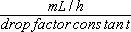
ANS: 125 mL/h = gtt/min

31.25 = 31 gtt/min
PTS: 1 DIF: Application
REF: Calculating Flow Rates for Manually Regulated IVs in gtt/min - Shortcut Method
16. Calculate the IV flow rate for 100 mL NS with an Flow rate: gtt/min antibiotic added to infuse in 30 minutes. The IV will be manually regulated. The drop factor is 20 gtt/min.
ANS:

PTS: 1 DIF: Application
REF: Calculating Flow Rates for Manually Regulated IVs in gtt/min - Formula Method
17. Calculate the IV flow rate for 1 LLR to infuse Flow rate: gtt/min over 8 hours. The IV is to be manually regulated. The drop factor is 10 gtt/min.
ANS:
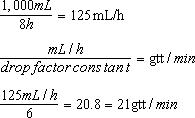
PTS: 1 DIF: Application
REF: Calculating Flow Rates for Manually Regulated IVs in gtt/min - Formula Method
A patient’s IV flow needs to be checked frequently so that any adjustments in rate will be small. The allowable percent of change varies according to the institution’s policy, patient’s condition, and other factors. For this problem set only, assume that the patient’s flow rate may be reset if the maximum variation from the physician’s order is not more than 25%. Compute the percent of variation before resetting IV flow rates, and indicate either the new flow rate you will set or the appropriate action you will take.
The following IV order will be regulated manually. 1,000 mL D5W IV to infuse in 8 hours The drop factor is 15 gtt/mL.
18. Calculate the flow rate of the IV fluid in gtt/min. Flow rate: gtt/min
ANS:
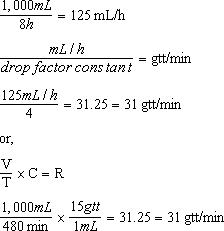
PTS: 1 DIF: Application
REF: Calculating Flow Rates for Manually Regulated IVs in gtt/min
19. After 6 hours, 200 mL of IV fluid remains. If necessary and if allowable, reset the IV so that it is completed on time.
What would the adjusted rate have to be? Adjusted rate, is allowable: gtt/min
ANS:
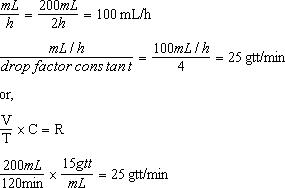
PTS: 1 DIF: Analysis REF: Adjusting IV Flow Rate
20.20.
Compute the percent of change in the flow rate. % According to guidelines given, is the new rate allowable? (yes/no)
ANS:
The flow rate would be decreased by 19.6% or about 20%.Yes, if guidelines may be followed for this patient.
PTS: 1 DIF: Application REF: Adjusting IV Flow Rate
21. 1,000 mLD5W IV to infuse at 25 gtt/min
The drop factor is 15 gtt/mL.
Flow rate: mL/h

ANS: T is the unknown quantity
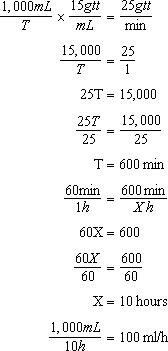
PTS: 1 DIF: Analysis
Total infusion time: hours
REF: Calculating InfusionTime andVolume
Chapter 16 Body SurfaceArea andAdvanced Pediatric Calculations
PROBLEM
The following problems and drug orders are presented for practice only, and actual prescribed dosages will vary according to a patient’s age, condition, reaction, additional medication, and other factors.
Determine the BSAfor each of the following children using the BSAnomogram. Include two decimal places with your answers.
1. Miguel, who is a normally proportioned child, weighing 7.5 lb. BSA= m2
ANS: 0.23 m2
PTS: 1 DIF: Comprehension
REF: BSANomogram
2. Heidi, who is a normally proportioned child, weighing 20 kg. BSA= m2
ANS:
20 kg = 44 lb BSA= 0.80 m2
PTS: 1 DIF: Comprehension
REF: BSANomogram
3. Marcus, who weighs 9 kg and is 50 inches tall. BSA= m2
ANS: 0.54 m2
PTS: 1 DIF: Comprehension
REF: BSANomogram
4. Tonya, who is 80 cm tall and weighs 20 kg. BSA= m2
ANS: 0.70 m2
PTS: 1 DIF: Comprehension
REF: BSANomogram
Determine the BSAfor each of the following children using the BSAcomputation formulas given in the textbook. Include two decimal places with your answers.
5. Alicia, who weighs 15 kg and is 90 cm tall. BSA= m2
ANS:
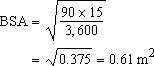
PTS: 1 DIF: Application REF: BSAFormula
6. Tommy, who is 35 inches tall and weighs 40 lb. BSA= m2
ANS:
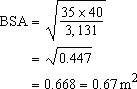
PTS: 1 DIF: Application REF: BSANomogram
7. Allison, who measures 56 inches tall and weighs 68 lb. BSA= m2
ANS:
Household BSA(m ) =

PTS: 1 DIF: Application REF: BSANomogram
8. Kevin, who measures 61 inches tall and weighs 84 lb. BSA= m2
ANS:
Household BSA(m ) = m

PTS: 1 DIF: Application REF: BSANomogram
Compute the answers to the following questions, which are based on the child’s BSA, using the following information about the child and her order.
The usual adult dose of Rocephin is 0.5 g IM per dose, administered b.i.d. The child is to be given the medication based on her BSAand the usual adult dose. Her BSAis 0.51 m2 .
9. How many milligrams of Rocephin should she receive per dose? mg
ANS:
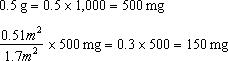
PTS: 1 DIF: Application REF: BSADosage Calculation
10. The supply of Rocephin is reconstituted to 250 mg/mL.
How many milliliters of Rocephin should she receive per administration? mL
ANS:
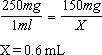
PTS: 1 DIF: Application REF: BSADosage Calculation
Compute the answers to the following questions, which are based on the child’s BSA, using the following information about the child and his order.
Jimmy, whose BSAis 0.45 m2 , is to receive Oncovin 2 mg/m2 IV once per week. The supply dosage available is 5 mg/mL.
11. How many milligrams of Oncovin should he receive per administration? mg
ANS:
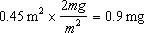
PTS: 1 DIF: Application REF: BSADosage Calculation
12. How many milliliters should be administered per dose? mL
ANS:

PTS: 1 DIF: Application REF: BSADosage Calculation
Compute the daily rate of pediatric maintenance fluids for the following children, using the following guidelines:
100 mL/kg/day for the first 10 kg of body weight
50 mL/kg/day for the next 10 kg of body weight
20 mL/kg/day for each kg above 20 kg of body weight
13. Maggie, who weighs 13 kg. mL/day
ANS:
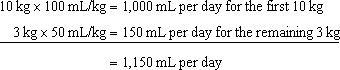
PTS: 1 DIF: Application REF: Calculation of DailyVolume for Maintenance Fluid
14. Reggie who weighs 24 kg. mL/day
ANS:
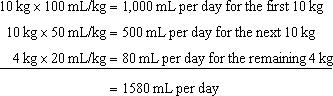
PTS: 1 DIF: Application
REF: Calculation of DailyVolume for Maintenance Fluid
15. Jessie, who weighs 40 lb. mL/day
ANS:

Note: If 18 kg is used instead of 18.2 kg, the answer is 1400 mLper day.
PTS: 1 DIF: Application
REF: Calculation of DailyVolume for Maintenance Fluid
16. Lisa, who weighs 11 kg. mL/day
ANS:

PTS: 1 DIF: Application
REF: Calculation of DailyVolume for Maintenance Fluid
17. What is the hourly rate for an IV of 1050 mL to be run over 24 hours?
ANS: or 44 mL/h
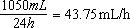
PTS: 1 DIF: Application
REF: Calculation of DailyVolume for Maintenance Fluid
18. Matt, who measures 177.5 cm tall and weighs 81.8 kg. BSA= m2
ANS: Metric BSA(m ) =

PTS: 1 DIF: Application REF: BSAFormula
Compute the answers to the following questions, which are based on the child’s BSA, using the following information about the child and her order.
Sally, whose BSA is 1.25 m , is to receive acyclovir 600 mg p.o. q.i.d. The drug reference guide recommends 500 mg/m q. 8h. The supply dosage available is 800mg/2mL.
19. How many milligrams of acyclovir should she receive per administration? mg
ANS:
mg/m m = 500 mg/m 1.25 m = 625 mg
PTS: 1 DIF: Application REF: BSADosage Calculation
20. How many milliliters should be administered per dose?
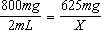
ANS: X = 1.56 mL = 1.6 mL
PTS: 1 DIF: Application REF: BSADosage Calculation
21. Is this considered a safe dose? If not, what should the nurse do?
ANS:
No. The ordered dosage of 600 mg q.i.d is too low. The nurse should contact and confer with the prescriber.
PTS: 1 DIF: Application REF: BSADosage Calculation
The recommended oral dosage for succimer is 350 mg/m q. 8h. This has been ordered for a child measuring 54 inches tall and weighing 73 lb.
22. What is the child’s BSAm ?
ANS: Household BSA(m ) =

PTS: 1 DIF: Application REF: BSADosage Calculation
23. Calculate the safe dosage for this child.
ANS:
mg/m m = 350 mg/m 1.12 m = 392 mg
PTS: 1 DIF: Application REF: BSADosage Calculation
24. Is this considered a safe dose? If not, what should the nurse do?
ANS:
No, this is not a safe dose. It is more than the recommended dose and the nurse should confer with the prescriber.
PTS: 1 DIF: Application REF: BSADosage Calculation
Kevin, a 5-year-old with herpes simplex, is measured at 42 inches tall and weighs 43 lb. The pediatrician prescribes ritonavir 200 mg p.o. b.i.d. The drug reference recommends the dose of 250 mg/m b.i.d for a child.
25. What is Kevin’s BSA?
ANS: Household BSA(m ) =

PTS: 1 DIF: Application REF: BSADosage Calculation
26. Calculate the recommended dose. mg
ANS:
mg/m m = 250 mg/m 0.76 m = 190 mg
PTS: 1 DIF: Application REF: BSADosage Calculation
27. Is this a safe dose? If not, what should the nurse do?
ANS:
No, this is not a safe dose. The ordered dose of 200 mg is slightly high. The nurse should call the prescriber and confer about the order.
PTS: 1 DIF: Application REF: BSADosage Calculation
An adult with Promyelocytic Leukemia is measured at 165 cm tall and weighs 56.8 kg. The physician ordered tretinoin 50 mg po b.i.d. The drug reference recommends 45 mg/m b.i.d.
28. Calculate the BSAfor this adult.
ANS: Metric BSA(m ) =

PTS: 1 DIF: Application REF: BSADosage Calculation
29. Calculate the dose.
ANS:
mg/m m = 45mg/m 1.6 mg = 72 mg
PTS: 1 DIF: Application REF: BSADosage Calculation
30. Is this a safe dose? If not, what should the nurse do?
ANS:
No, this is not a safe dose. The ordered dose of 50 mg is too low. The nurse should call the prescriber and confer about the medication.
PTS: 1 DIF: Application REF: BSADosage Calculation
Chapter 17 AdvancedAdult Intravenous Calculations
PROBLEM
Complete the following advanced IV calculations. The problems and drug orders are presented for practice only, and actual prescribed dosages will vary according to a patient’s age, condition, reaction, additional medications, and other factors.
1. 1 LD5W with 10,000 units heparin to infuse at 1000 units/h
The drop factor is 20 gtt/mL. Flow rate: gtt/min
ANS:
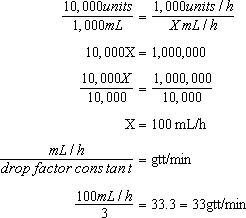
PTS: 1 DIF: Application REF: IV Medication Ordered per Minute
2. 1,000 mL NS with 10,000 units heparin to infuse at 750 units/h
The drop factor is 12 gtt/mL. Flow rate: gtt/min
ANS:
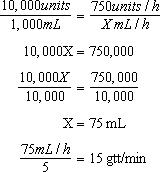
PTS: 1 DIF: Application REF: IV Medication Ordered per Minute
3. One of your patients has an IV that is flowing at a rate of 10 gtt/min. The IV bag contains a solution of 500 mL NS with 20,000 units of heparin. The drop factor is 15 gtt/mL.
How many units is the patient receiving per 24 hours? units/24h
4.
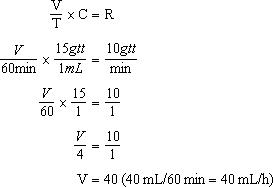
Patient is receiving 40 mL/hour.
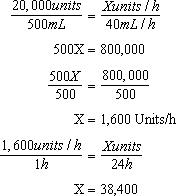
The patient is receiving 38,400 units/24 h.
PTS: 1 DIF: Analysis REF: Limiting InfusionVolumes
Compute the answers to the following questions based on this information.
Order: Pepcid 20 mg added to 100 mLD5W IV in 30 min q.12h An infusion pump will be used.
Supply: Pepcid 10 mg/mL
Compute the volume of Pepcid to be added to the 100 mL D5W.
Compute the flow rate.
Pepcid: mL
ANS:
Flow rate: mL/h
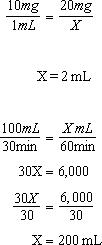
200 mL/60 min 200 mL/h
PTS: 1 DIF: Application REF: Limiting InfusionVolumes
Compute the answers to the following questions based on this information.
A critical care patient who weighs 80 kg has an order for 10 mcg/kg/min of dobutamine to be administered IV and regulated by an electronic pump. The supply of dobutamine is 500 mg in 250 mL of D5W.
5. Compute the number of micrograms and the number of milligrams per minute that the patient will receive.
micrograms per minute: milligrams per minute:
ANS:

Per minute, The patient will receive 800 mcg/min or 0.8 mg/min.
PTS: 1 DIF: Application REF: IV Medication Ordered per Minute
6. Compute the volume of milliliters infused per minute. mL/min
ANS:
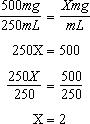
There are 2 mg/mLor 2,000 mcg/mLof medication supply.
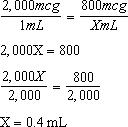
800 mcg of dobutamine are in 0.4 mL of IV solution. 800 mcg/min is delivered by a rate of 0.4 mL/min.
PTS: 1 DIF: Application REF: IV Medication Ordered per Minute
7. Compute the flow rate in mL/h. mL/h
ANS:
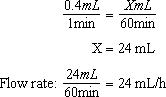
PTS: 1 DIF: Application REF: IV Medication Ordered per Minute
Compute the answers to the following questions based on this information.
Apatient’s IV fluids are to be limited. His continuous IV order is for 2,000 mLof NS every 24 hours. He is to receive an IV PB of 150 mg of netromycin in 100 mL NS infused in 2 hours, every 8 hours. His IV flow rate is controlled by an infusion pump.
Answer the following questions about his IV PB.
8. What is the flow rate of his IV PB? mL/h
ANS:
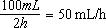
PTS: 1 DIF: Application REF: Limiting InfusionVolumes
9. How many milliliters per day flow for his IV PB? mL/day
ANS: 100 mL every 8 hours is 100 mLthree times per day.
PTS: 1 DIF: Application REF: Limiting InfusionVolumes
10. How many hours per day does his IV PB flow?
ANS:
PTS: 1 DIF: Application REF: Limiting InfusionVolumes
11. Answer the following questions about his continuous IV.
How many milliliters per day will he receive with his regular IV? mL/day
How many hours will his continuous IV flow per 24 hours? hours/day
What will his regular IV flow rate be, in mL/hour? mL/h
ANS:
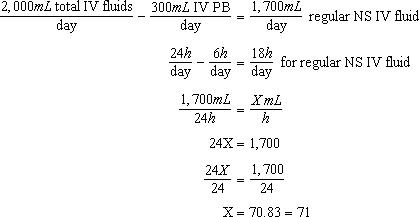
Flow rate: 71 mL/h
PTS: 1 DIF: Analysis REF: Limiting InfusionVolumes
The following questions refer to your patient who is on IV heparin therapy according to the “Standard Weight Based Heparin Protocol” noted below. The patient weighs 144 pounds. On admission, the patient’s APTT is 30 seconds. You initiate IV heparin therapy at 1130 on 06/06/XX. Record your answers in the spaces below unless provided with the “Standard Weight Based Heparin Protocol Worksheet” by your instructor.
StandardWeight Based Heparin Protocol
For all patients on heparin drips:
1. Weight in kilograms. Required for order to be processed: kg
2. Heparin 25,000 units in 250 mL of 1/2 NS. Boluses to be given as 1000 units/mL.
3. APTT q.6h or 6 hours after rate change; q.d. after two consecutive therapeuticAPTTs.
4. CBC initially and repeat every day(s).
5. ObtainAPTT and PT/INR on day one prior to initiation of therapy.
6. Guaiac stool initially, then every day(s) until heparin discontinued. Notify if positive.
7. Neuro checks every hours while on heparin. Notify physician of any changes.
8. D/CAPTT and CBC once heparin drip is discontinued unless otherwise ordered.
9. Notify physician of any bleeding problems.
10. Bolus with 80 U/kg. Start drip at 18 units/kg/h.
11. IfAPTT is 35 secs: Rebolus with 80 units/kg and increase rate by 4 units/kg/h
12. If APTT is 36–44 secs: Rebolus with 40 units/kg and increase rate by 2 units/kg/h
13. IfAPTT is 45–75 secs: Continue current rate
14. IfAPTT is 76–90 secs: Decrease rate by 2 units/kg/h
15. IfAPTT is 90 secs: Hold heparin for 1 hour and decrease rate by 3 units/kg/h
12. What is the patient’s weight as measured in kilograms? (Round to the nearest 10 kg.) kg
What does the protocol/sample order indicate for the standard bolus dosage of heparin for this patient? units/kg
ANS:
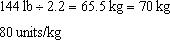
PTS: 1 DIF: Application
REF: Calculating IV Dosages and Flow Rates Using Clinical Protocols
13. Calculate the dosage of heparin that should be administered for the bolus for this patient. units
What does the protocol indicate as the required solution concentration (supply dosage) of heparin to use for the bolus? units/mL
Calculate the dose volume of heparin that should be administered for the bolus for this patient. mL
ANS:
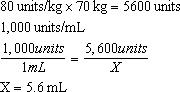
PTS: 1 DIF: Application
REF: Calculating IV Dosages and Flow Rates Using Clinical Protocols
14. What does the protocol/sample order indicate for the initial infusion rate for this patient? units/kg/h
Calculate the dosage of heparin this patient should receive each hour. units/h
What does the protocol/sample orders indicate as the required solution concentration (supply dosage) of heparin to use for the initial infusion? units/mL
Calculate the heparin solution volume this patient should receive each hour to provide correct infusion for the patient’s weight.
mL/h
ANS:
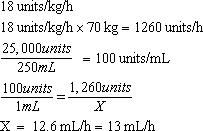
PTS: 1 DIF: Application
REF: Calculating IV Dosages and Flow Rates Using Clinical Protocols
15. According to the protocol/sample order, how often should the patient’sAPPT be checked?
q. h
At 1730, the patient’sAPPT is 38 seconds. Rebolus with heparin units ( mL).
How much should you change the infusion rate?
increase or decrease heparin units/h and ml/h.
The new infusion rate will be heparin mL/h.
ANS: 6 h
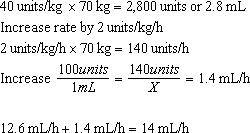
PTS: 1 DIF: Application
REF: Calculating IV Dosages and Flow Rates Using Clinical Protocols
16. At 2345, the patient’sAPPT is 46 seconds. What should you do now?
ANS: Maintain rate at 14 mL/h.
PTS: 1 DIF: Application REF: IV Heparin Protocol
17. At 0600 0n 06/07/XX, the patient’sAPPT is 50 seconds. What should you do now?
When should theAPPT be checked again? (hours) on (date)
ANS:
Maintain rate at 14 mL/h
RecheckAPPT at 0600 on 06/08/XX
PTS: 1 DIF: Application REF: IV Heparin Protocol
18. Order: 500 mL D5W with heparin 5000 units IV to infuse at 1000 units/h. The drop factor is 10 gtt/mL.
Calculate the flow rate. Flow rate: gtt/min
ANS: 5,000X = 500,000 X = 100 mL/h



16.6 = 17 gtt/min
PTS: 1 DIF: Application
REF: Calculating IV Dosages and Flow Rates Using Clinical Protocols
19. Order: 1,000 mLD5W with heparin 20,000 units IV is to infuse at a rate of 750 units/h. The drop factor is 12 gtt/mL
Calculate the flow rate. Flow rate: gtt/min
ANS: 20,000X = 750,000
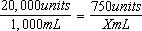
X = 37.5 mL

7.5 = 8 gtt/min
PTS: 1 DIF: Application
REF: Calculating IV Dosages and Flow Rates Using Clinical Protocols
20. Order: Lidocaine 2 g IV in 1,000 mLD5W to infuse at a rate of 3 mg/min by infusion pump. Calculate the flow rate. Flow rate: gtt/min
ANS:
Dose on hand = 2g = 2,000 mg
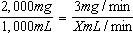

X = 1.5 mL/min
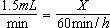
X = 90 mL/h
PTS: 1 DIF: Application REF: IV Medication Ordered per Minute
21. Order: Nitroglycerin 100 mg IV in 500 mLD5W to infuse at a rate of 30 mcg/min.
Calculate the flow rate. Flow rate: gtt/min
ANS:
1 mg = 1,000 mcg
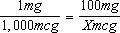
X = 100,000 mcg

100,000 X=15,000
X = 0.15 mL/min
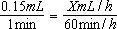
X = 9 mL/h
PTS: 1 DIF: Application REF: Titrating IV Drugs
An ICU patient weighing 70 kg has an order for dobutamine 5 mcg/kg/min to be administered IV and regulated by infusion pump. The supply of dobutamine is 500 mg in 500 mLD5W.
22. Compute the number of micrograms and the number of milligrams that the patient will receive.
mcg/min
mg/min

X = 350 mcg/min or 0.35 mg/min
PTS: 1 DIF: Application REF: Titrating IV Drugs
23. Based on an order for 350 mcg/min or 0.35 mg/min, compute the volume of mLinfused per minute.

ANS: 500X = 500
X = 1 mg/mL or 1,000 mcg/mL of medication supply
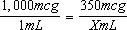
1,000X = 350
X = 0.35 mL
350 mcg of dobutamine are in 0.35 mL of IV solution and 350 mcg/min are delivered by a rate of 0.35 mL/min
PTS: 1 DIF: Application REF: IV Medication Ordered per Minute
24. Compute the flow rate in ml/h. Flow rate mL/h
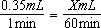
ANS: X = 21 mL

Flow rate = 21 mL/h
PTS: 1 DIF: Application REF: Titrating IV Drugs
This Page is Intentionally Left Blank
This Page is Intentionally Left Blank