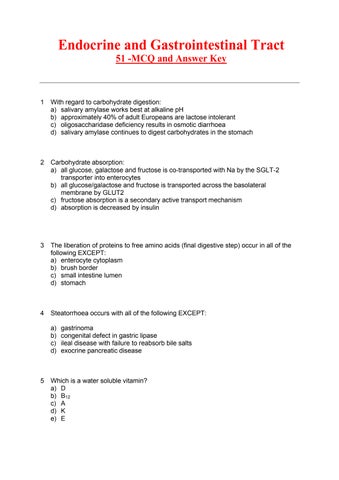
Endocrine and Gastrointestinal Tract
51 -MCQ and Answer Key
1 With regard to carbohydrate digestion:
a) salivary amylase works best at alkaline pH
b) approximately 40% of adult Europeans are lactose intolerant
c) oligosaccharidase deficiency results in osmotic diarrhoea
d) salivary amylase continues to digest carbohydrates in the stomach
2 Carbohydrate absorption:
a) all glucose, galactose and fructose is co-transported with Na by the SGLT-2 transporter into enterocytes
b) all glucose/galactose and fructose is transported across the basolateral membrane by GLUT2
c) fructose absorption is a secondary active transport mechanism
d) absorption is decreased by insulin
3 The liberation of proteins to free amino acids (final digestive step) occur in all of the following EXCEPT:
a) enterocyte cytoplasm
b) brush border
c) small intestine lumen
d) stomach
4 Steatorrhoea occurs with all of the following EXCEPT:
a) gastrinoma
b) congenital defect in gastric lipase
c) ileal disease with failure to reabsorb bile salts
d) exocrine pancreatic disease
5 Which is a water soluble vitamin?
a) D
b) B12
c) A
d) K
e) E
6 Which is not Na dependent for absorption?
a) thiamin
b) riboflavin
c) niacin
d) folate
e) biotin
7 Which is absorbed mainly in the colon?
a) short chain fatty acids
b) calcium
c) vitamin K
d) oligosaccharides
8 Which is INCORRECT regarding nerve supply to the gut?
a) the blood vessels are known to have enteric, parasympathetic and sympathetic innervation
b) the myenteric plexus lies between the longitudinal and circular muscle layers
c) parasympathetic supply is via vagal and sacral nerve
d) sympathetic supply is often inhibitory on cholinergic postganglionic fibres
9 Gastrin secretion is stimulated by all but:
a) luminal peptides
b) vagal discharge
c) luminal acid
d) phenylalanine
10 The actions of gastrin include all but:
a) insulin secretion in response to a carbohydrate meal
b) a trophic effect on colonic mucosa
c) a trophic effect on gastric mucosa
d) pepsin secretion
e) contraction of muscle at the gastro-oesophageal junction
11 Which is NOT an action of CCK?
a) gallbladder contraction
b) increased gastric motility and emptying
c) glucagon secretion
d) secretion of pancreatic juice
12
Which hormone is most important in insulin secretion?
a) gastrin
b) CCK
c) GIP
d) secretin
13 Which produces the majority of salivary volume?
a) lingual glands
b) sublingual
c) parotid
d) submandibular
14 Which nerve is NOT involved in the efferent (motor) swallow reflex?
a) trigeminal
b) vagus
c) facial
d) hypoglossal
15 Which is NOT part of the normal content of gastric juice? 2-
a) HPO4
b) mucus
c) lipase
d) amylase
16 Chief cells secrete:
a) HCl
b) pepsinogen
c) intrinsic factor -
d) HCO3
17 Which stimulates parietal cell secretion?
a) prostaglandins
b) aspirin
c) vinegar
d) acetylcholine
18 Regarding bilirubin:
a) unconjugated bilirubin is more soluble than conjugated
b) all conjugated bilirubin is excreted via the intestine
c) bile duct obstruction causes jaundice secondary to unconjugated hyperbilirubinaemia
d) haemolytic anaemia may cause ?????? hyperbilirubinaemia
19 Which form of intestinal smooth muscle contraction does NOT occur in normal health?
a) peristalsis
b) weak antiperistalsis
c) peristaltic rushes
d) tonic contractions
e) segmental contractions
20 In the adrenal medulla:
a) epinephrine is formed by the hydroxylation and decarboxylation of tyrosine
b) 10% of the cells are the epinephrine-secreting type
c) plasma norepinephrine levels are generally unchanged after adrenalectomy
d) catecholamine t1/2 is 10 minutes in the circulation
e) norepinephrine and epinephrine are stored in granules with APT and chromagranin C
21 In the adrenal cortex:
a) the zona glomerulosa has 17 alpha-hydroxylase and no aldosterone synthase
b) all the cholesterol is synthesised from acetate
c) zona fasciculata makes up 10% of the mass of the adrenal gland
d) angiotensin II binds to receptors in the zona reticularis
e) ATCH increases the synthesis of all 5 P450 cytochromes involved in the formation of adrenocortical hormones
22 Regarding the islets of Langerhans:
a) D cells secrete pancreatic polypeptide
b) A cells are the most common
c) they are most plentiful in the body of the pancreas
d) blood from the islets drain into the hepatic portal vein
e) B cell secretion of glucagon occurs by exocytosis
23 Which factor stimulates insulin secretion?
a) thiazide diuretics
b) phenytoin
c) theophylline
d) β blockers
e) epinephrine
24 Thyroid hormones increase the oxygen consumption of:
a) lymph nodes
b) spleen
c) brain
d) anterior pituitary gland
e) liver
25 The action of gastrin includes all EXCEPT:
a) stimulation of insulin secretion after a carbohydrate meal
b) stimulation of gastric acid secretion
c) stimulation of gastric motility
d) contraction of gastro-oesophageal junction musculature
e) stimulation of growth of large intestine mucosa
26 Regarding protein metabolism, which statement is CORRECT?
a) increases the respiratory quotient to values > 1.0
b) has a specific dynamic action (SDA) of approximately 10%
c) endogenous protein breakdown is inhibited by glucagon
d) creatinine excretion is not depressed in starvation +
e) NH4 formed during transamination of amino acids is excreted in the urine as urea
27 Regarding fat metabolism, which statement is CORRECT?
a) ketone bodies accumulate in DKA due to a lack of acetyl-CoA substrate
b) fatty acids are transported in the plasma bound to lipoprotein complexes
c) cholesterol is transported from extra-hepatic cells to the liver by high-density lipoproteins (HDLs) in the endogenous pathway
d) eicosanoids are synthesised from cholesterol
e) simvastatin reduces plasma cholesterol levels by increasing hepatic biliary excretion
28 Thyroxine:
a) is mostly bound to albumin in the plasma, since this has the largest capacity
b) is 2-5 times more potent that triiodothyronine (T3)
c) stimulates TSH release
d) ∼33% is deiodinated in the liver to T3
e) does not cross the placenta
Insulin:
a) binds to GLUT 1-5 receptors in the peripheral tissues
b) deficiency results in increased gluconeogenesis
c) has a plasma half-life of 2-3 hours
d) is secreted by the pancreatic A cells
e) average secretion is around 40U/day
30 With respect to calcium metabolism / bone formation:
a) osteoclasts secrete alkaline phosphatase
b) osteoblasts are haemopoietic derivatives of monocyte lineage
c) 1,25(OH)2 ???D3 and PTH stimulate both osteoblasts and osteoclasts
d) oestrogens are thought to be protective of osteoporosis as their main effect is osteoblasts stimulation
e) the plasmic calcium may be markedly elevated in “disuse” osteoporosis
31 All of the following, except one, inhibit insulin secretion. Which is it?
a) somatostatin
b) thiazide diuretics
c) propranolol
d) insulin
e) glucagon
32 All but one of the following compounds releases large amounts of energy on breakdown:
a) cAMP
b) ATP
c) creatine phosphate
d) ADP
e) coenzyme A
33 Which is TRUE?
a) adenosine triphosphate is a low energy phosphate
b) reduction involves loss of hydrogen or electrons
c) oxidative phosphorylation occurs in the endoplasmic reticulum
d) ATP is precursor of cyclic AMP
e) ADP has no feedback on oxidative phosphorylation
34 Small intestine:
a) the ligament of Treitz the jejunum becomes the ileum
b) the distance pylorus to ileocecal valve in living humans is 700cm
c) malabsorption syndrome may develop if 25% of the small intestine is removed
d) colonic peristalsis is the first smooth muscle action of the GIT to return after abdominal operation
e) deficiency of gluten hydrolase causes coeliac disease
35 Regarding thyroid hormones:
a) little T3 is produced peripherally by deiodination T4
b) albumin has more capacity to bind thyroid hormones than TBG
c) TBG has less affinity for thyroid hormone than albumin
d) thyroid hormones stimulate lipogenesis
e) RT3 is slightly less active than T4
36 A calorie is:
a) standard unit of heat energy necessary to raise the temperature of 1L of water 1° from 15-16°C
b) standard unit of heat energy necessary to raise the temperature of 1gm of mercury 1° from 17-18°C
c) the standard unit of heat energy necessary to raise the temperature of 1gm of water 1° from 17-18°C
d) the standard unit of heat energy necessary to raise the temperature of 1gm of water 1° from 15-16°C
e) the standard unit of heat energy necessary to raise the temperature of 1gm of water 1° from 15-16°F
37 Regarding the respiratory quotient:
a) it is the ratio of CO2 to O2 at any time
b) RQ of fat is 0.8
c) increases with hyperventilation
d) increases in metabolic alkalosis
e) RQ of carbohydrate is 1.0
38 Regarding basal metabolic rate:
a) it is higher in women
b) it is determined at rest within 12 hours after the last meal
c) increases by 18% for each 1°C of fever 2
d) is about 40Kcal/m /h in an average man
e) is about 4,000Kcal/d in an average man
39 Which is NOT a high energy compound?
a) CoA
b) GGP
c) ITP
d) creatine phosphate
e) GTP
40 Regarding the flavoprotein – cytochrome system:
a) cytochrome oxidase is the first step in the chain
b) occurs within the endoplasmic reticulum
c) substrates are pyruvate, water and oxygen and ATP
41 Regarding carbohydrate metabolism:
a) glucokinase is increased in starvation
b) the breakdown of glycogen is called glycolysis
c) the direct oxidative pathway involves the breakdown of glucose through triose
d) the conversion of pyruvate to acetyl-CoA is irreversible
e) conversion of fructose 6-phosphate to fructose 1,6-diphosphate produces 1 ATP
42 Which is NOT produced by the citric acid cycle? +
a) NAD
b) CO2
c) GTP
d) FADH2 +
e) H
43 Regarding phosphorylase:
a) it clea???? 1:6α linkages in glycogen
b) it is activated by norepinephrine
c) phosphorylase kinase is directly activated by cyclic AMP
d) activation of protein kinase A inhibits glycogen synthesis
e) α1 adrenergic receptors in the liver have no part in glycogen breakdown
44 Which amino acid is not found in protein?
a) ornithine
b) arginine
c) valine
d) aspartic acid
e) glycine
45 Which is a nutritionally essential amino acid?
a) taunine
b) leucine
c) glutamate
d) alanine
e) tyrosine
46 Which amino acid is not ketogenic?
a) leucine
b) isoleucine
c) phenylalanine
d) tyrosine
e) alanine
47 Regarding starvation:
a) glycogen provides enough fuel for 48 hours
b) ketoacids derived from fats, are used by the brain and other tissues
c) hypoglycaemia has a protein sparing effect
d) average time until death is 40 days
e) urine creatine levels are unchanged
48 Regarding lipid transport:
a) chylomicrons enter the blood directly from the enterocyte
b) the major aproproteins are apoB, apoD and apo???
c) chylomicrons are broken down to FfA, glycerol and chylomicron remnants by lipoprotein lipase in the liver
d) VLDL provides cholesterol to the tissue
e) LDL is taken up by receptor mediated endocytosis ????
49 Regarding electrolyte absorption:
a) cholera toxin binds to adenosine diphosphate ribose to the subunit of Gs, stimulative ATPase activity +
b) active transport of Na into the small intestine enterocytes is coupled with the absorption of glucose + +
c) magnesium sulphate absorption is coupled with Na -K -ATPase pump + +
d) the Na -K ATPase pumps are located at the luminal membrane of the enterocyte
e) osmolality in the jejunal lumen is close to that of plasma
50 Regarding calcium:
a) 20% of calcium is absorbed 2+
b) active transport of Ca out of the lumen occurs primarily in the lower small intestine
c) 1,25-dihydroxycholecalciferol induces calcium binding protein synthesis in mucosal cell
d) absorption is facilitated by phosphate
e) 1,25-dihydroxycholecalciferol is produced in the skin
51 Regarding iron:
a) it is more readily absorbed in the ferric form
b) men lose about 0.6mg/d
c) average daily iron intake is 40mg
d) ascorbic acid reduces iron absorption