BMCT NEWS NUMBER 64
The 2026 Graham Walker Run
Two of your trustees – Martin Heckscher (left) and Dennis Frost – rode their Velocette KTTs in the Sunbeam Motor Cycle Club’s Graham Walker Memorial Run held on 7 August. The 62nd running of this annual event, which celebrates the motorcycling achievements of Graham Walker – the pre-WWII Sunbeam, Norton and Rudge TT rider and subsequent editor of Motor Cycling magazine – is based at Beaulieu’s National Motor Museum, where in the late 1950s Walker was instrumental in establishing its motorcycle display. Graham’s son Murray Walker was well known as a race commentator and in his time a strong supporter of this event which remembers t his father. Riders were able to choose long or short routes through the New Forest with directions provided by the local Southampton & District Motor Club. Lord Montagu presented the post-run awards, with Martin collecting a trophy for his 1933 Mk.IV KTT, being the Most Technically Interesting Machine.
2026 John Haynes Classic BMCT trustee Mike Penn braved the blustery weather to promote the Trust at the second running of the prestigious John Haynes Classic Show at the Haynes Motor Museum. Although it’s predominantly a car event, Mike flew the flag for the motorcycle community by showing a Harley Davidson on our stand. “Why a Harley?” you might ask, “it’s not British!”. But there’s a twist. Mike was asking show-goers if they knew what connected Harley Davidson with Britain? You’ll find the answer below. Answer: The fathers of founders William S. Harley and Arthur Davidson were both born in Britain.
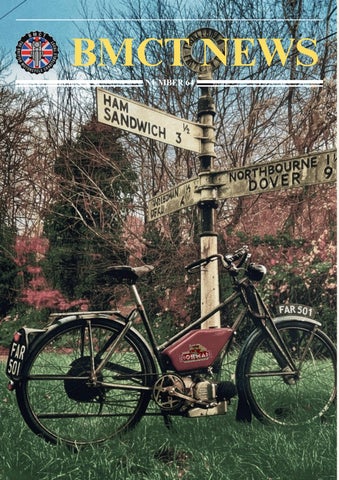
Cover photo: This artfully posed Norman Autocycle can be seen in the newly opened Norman gallery at Dover Transport Museum, funded by grant aid from BMCT.
National Motor Museum to Leave Beaulieu: What BMCT Members Need to Know
The National Motor Museum Trust has announced that it has begun the process of finding a new home for the National Motor Museum, bringing to an end one of the best-known associations in British motoring heritage: the museum’s long-standing presence at Beaulieu. For BMCT members, this is significant news. Beaulieu has been closely linked with motoring history for more than 70 years, and the National Motor Museum itself has occupied its purpose-built building on the Beaulieu estate since 1972. Many members will know the site not only for its collection of cars, motorcycles and motoring memorabilia, but also for its events, club visits and wider place in the classic vehicle community. What has been announced? The National Motor Museum Trust says its current lease at Beaulieu is approaching the end of its 60-year term and that it is now looking for a “transformational new home”. The Trust has described the move as part of a longer-term strategy to secure the museum’s future, widen access to the collection, expand learning and community engagement, and develop ideas such as heritage engineering apprenticeships. The museum’s collection is internationally important. The Trust cares for more than 250 vehicles and around 1.9 million related items, including photographs, film, books, documents, technical material and other artefacts connected with the social and industrial history of motoring. Why is the museum leaving? The decision follows discussions between the Trust and the Montagu family over the museum’s future at Beaulieu. Both sides have acknowledged the historic importance of the relationship, but the Trust has concluded that its charitable aims and future ambitions can best be achieved from a new location. In public statements, the Trust has emphasised opportunity as well as regret: a chance to reimagine the museum, make the collection more accessible, and ensure that Britain’s motoring story remains relevant to future generations. Lord Montagu has also indicated continued support for the Trust while making clear that Beaulieu’s own motoring heritage will remain an important part of the visitor attraction. BMCT member entry concessions remain unaffected for the time being.
British Bike Day at Sammy Miller’s The hot sun made no difference to the crowds that joined us for British Bike Day. The distinctive roar of British engineering soon drew a lively crowd who gathered to soak up the sights, sounds and atmosphere, especially when Sammy fired up some of the museum’s iconic bikes. Photos courtesy of Chris Mabey.
The BMCT trustees chose Chris Mabey’s Triumph Mountain Cub as their favourite bike of the day.
A really nice Ariel Arrow in the museum courtyard
(Above) Dennis Frost (left) and Sammy Miller present Chris Mabey with the spoils of victory! (Right) Sammy shows off one of the museum’s latest acquisitions. a replica of the 1931 AJS Land Speed Record attempt V twin created by gifted engineer Richard Johns.
The Baughan at Stroud Museum Dear Andy Ten years ago on 11th September 2016 BMCT trustee John Kidson blew the cobwebs out of the BMCT’s Baughan 2WD trials sidecar outfit. The resident motorcycle at the Stroud Museum in the Park. 1st pic - My Cotton next to the Baughan, both bikes manufactured in Gloucestershire. 2nd pic - A member of Museum staff preparing to be thrilled. 3rd pic - Another member of staff also preparing to be thrilled. 4th pic - Tom Barker aged 90 reliving his youth, delighted that he was allowed to ride around the grounds. He travelled from his retirement home on the east coast especially to be there. Ken Chandler (author of the Baughan book) in the chair. Ken, Tom and John Kidson are no longer with us. Regards, Paul Sheppard Secretary, Cotton Owners and Enthusiasts Club
2026 VMCC Founders Day
Marking the 80th anniversary of the Vintage Motor Cycle Club, the Taverners Section’s Founders Day 2026 at Stanford Hall was another hugely successful event, helped no doubt by the continued long hot summer. This is recognised as one of the best vintage and classic motorcycle events in the UK calendar, with over 300 auto jumble stalls and dozens of club stands. The BMCT was represented too, and we were delighted to be visited by Richard Woodcock (right), whose 1903 Royal Sovereign featured on the front cover of BMCT News 63.
Have your say.....
Whitewebbs Museum
Dear Andy, My BMCT News came today and I discovered the Whitewebbs Transport Museum. Today is Tuesday and the museum opens every Tuesday. So I went to it. (Free travel for us London-living oldies!) It's such an interesting place! Many bikes I had only seen maybe once before and some never before. (There were even two Triumph T10s - and the last one I saw of those was mine 45 years ago.) I would very much recommend the museum. Volunteers who know their stuff and are enthusiastic everywhere. And material to get up close too from memorabilia to bicycles and even an AC blue (of course) invalid car. A really good day out - and I'll return soon with other enthusiasts. Thank you BMCT for making the museum part of the scheme. Regards, Charles Esdale Dear Andy I was very interested to read of the BMCT’s affiliation with the Whitewebbs Museum of Transport and particularly the picture of Whitewebbs trustee Robert Haydock with the 1929 saddle-tank OHC 350cc Humber (inset). As vintage Humbers are quite rare and somewhat under-rated machines, I thought that you might like to see the attached image of my 1928 OHV version of the Coventry-built machine that I owned and rode for over 20 years. Humber were taken over by the Rootes Group in about 1930 when motorcycle production finished - the luxury cars continued until about 1963, with Raleigh taking the Humber name for their cycles. All excellent, well-made machines. Regards, Jonathan Hill
Internal Fire Museum Hi Andy, Despite living in Mid Wales for five years, its taken me till August Bank Holiday (yesterday) to visit The Internal Fire Museum of Power near Ceredigion. I went with mixed expectations of what it would be like, but was blown away by the vast array of working displays in the main building and several other "sheds". The diesel engines were noisy and smelly (lovely!) whilst the steam shed was a surreal contrast. The working telephone exchanges were a fun reminder of times past. My father was a Post Office employee for over 20 years albeit he was on "cold war" duties. The motorcycles (several on loan from the BMCT) have a dedicated section upstairs. The day was made especially memorable by chats with the friendly and knowledgeable volunteers. I will revisit as it’s only an hour away. Great gift shop too with wide selection of books including old Haynes workshop manuals. Heaven! I settled for a Triumph Streamliner Gyronaut X-1 at Bonneville. That's eight BMCT affiliates visited so far. Still a way to go with Beaulieu and Coventry top of the list to visit next. I've attached a few pics, feel free to use if you wish. My favourite is the pic with a donated bright orange Mirach 100/5 drone behind a police rotary Norton. Regards, Nigel Ellis We’re always pleased to receive contributions like these to the newsletter. Please email them to: editor@bmct.org
Riding a Veteran Triumph - by Bryan Marsh After several years of watching the veteran bikes (pre-1915) heading down from Epsom Downs to Brighton (as it was at that time) on the Sunbeam Club’s Pioneer Run, I fancied a go at it myself. The chances of me being able to borrow a suitable bike were zero, so I had little choice but to buy one of my own. After scouring the ‘for sale’ ads and visiting some dodgy dealers, I took myself down to Verralls in Handcross which, incidentally, lies on the Pioneer Run route itself. Announcing my intentions and my preference for either a Triumph, as a long-time devotee of the marque, or something obscure like, for example, a Royal Ruby. Unanimously, the proprietor Ian and the few others gathered in the shop pointed me at 8586 PE, a 1913 Free Engine Model 3½ hp 500cc Triumph and said ‘that’s the one you want’. One of the great things about Ian is that he is entirely trustworthy and he was suggesting a bike that were renowned for reliably and being (relatively) easy to ride (for a veteran machine). On enquiring what they are like to ride, I will always remember his answer: ‘Well’, he said ‘if you’re riding along enjoying the scenery, you’re probably not doing something you should be!’. The build up to my first Pioneer Run was a steep learning curve, discovering how to master a bike on which absolutely nothing is automatic. You have to juggle two levers (air and petrol) to get the right fuel mixture for the conditions, another lever to set the ignition timing, and a plunger on the petrol tank to give the engine a shot of oil every five miles or so. The ‘free engine’ designation was the term used at the time for a clutch – in this case contained in the rear wheel hub and operated by a rocking foot lever. No gear lever to worry about as it was a single-speeder with a gear ratio chosen to be a compromise between being able to pull away smoothly, reach a reasonable cruising speed, in the region of 30mph, and climb all but the steepest of hills. The engine drives the rear wheel by a v-belt, and the gear ratio could be altered by means of a variable pulley but that involved getting a spanner out, and possibly shortening or lengthening the belt, so not really a practical proposition whilst on a ride. Triumph did offer a version with a threespeed gearbox in the rear hub, but I was advised that was a bit too complicated for a novice like me. They also did a direct drive model, with no clutch or other means of disengaging the engine from the rear wheel – strictly for the brave/foolhardy. The bike was started by putting it on the rear stand, disengaging the clutch, unscrewing the petrol tap (a needle valve), pumping a couple of shots of oil into the engine, retarding the ignition a little using the lever on the left handlebar, setting the dual levers on the right-hand handlebar to provide some petrol but not much air at first (similar to a choke, but not quite), raising the nib on the carburettor float chamber to flood it, pull in the valve lifter lever (decompressor) on the left handlebar, then pedal like fury, drop the valve lifter and keep pedalling until it fires into life. Once running, the ignition can be advanced, and the air lever gradually opened as it warms up. Hop off the bike, click the rear stand firmly into its clip on the rear mudguard, hop back on the bike and try to gradually engage the clutch by pushing the rocking foot lever down with heel of your boot whilst gradually opening the petrol lever to raise the engine speed and, hopefully you’re away. The smoothness of the getaway depends highly on the grade of oil in the multiplate clutch - too thick and it would grab, too thin and it would slip badly; I found three-in-one cycle oil to give the best compromise.
Once underway, the ignition could be left fully advanced and the air fully open most of the time until, that is, you saw a steep hill ahead. Keep your approach speed as high as possible to get a good run at it – remember, there are no lower gears to change down into – give it a good shot of oil to help the compression and go for it! As it slows down, increase the petrol and reduce the air to enrich the mixture and, if necessary, retard the ignition. It’s no good thinking you can resort to pedalling if you get down to a really low speed, they’re only there for starting and are almost impossible to use for propulsion. On really steep hills you may have to hop off and walk alongside with the engine still running if you managed to dismount before it stalls. Once the ground levels off, you put your left foot on the pedal, sling your leg over the seat and start putting the levers back to their cruising positions – until the next hill. Going down a steep hill can be somewhat frightening as a block of rubber pressed into a dummy belt pully on the rear wheel might have been state-of-the-art in 1913, but its effect is generally that of ‘slight retardation’ rather than what we would recognise today as ‘braking’. And don’t let anyone fool you into thinking the caliper brake on the front wheel rim is there for the purpose of slowing down. It is handy for holding the bike on a hill when stationary but, when the bike is moving, its main effect is strip the paint or plating off the wheel rim whilst setting the front forks into a disturbing forward and back pulsing motion because of the way Triumph decided to pivot the forks about an axis level with the base of the petrol tank. The steepest down gradient on the Pioneer Run route is Reigate Hill and I have vivid memories (nightmares) of going down there with the rear brake fully on, the forks oscillating wildly back and fro, but still doing about 10mph and praying that nothing stopped dead in front of me before the road levelled off. I did nine Pioneer Runs on that bike and every time it safely crossed the finish line on Madeira Drive in Brighton, albeit being pushed on my first attempt after the magneto drive sprocket came adrift a mile or so from the finish. It was great fun but always a great relief to see the seafront after negotiating several miles of unsympathetic Brighton traffic. This article was first published in “Nacelle”, the excellent monthly magazine of the Triumph Owners Motor Cycle Club, and is reproduced with their kind permission and that of the author.
THE BRITISH MOTORCYCLE CHARITABLE TRUST A Charitable Incorporated Organisation - Registered Charity No. 509420
Trustees Peter Wellings (Chairman) Dennis Frost (Hon. Treasurer) John Handley Mike Jackson Mike Penn Lewis Onions Martin Heckscher
The British Motorcycle Charitable Trust (BMCT) was originally formed in 1979 to facilitate the building of what is now the National Motorcycle Museum at Bickenhill, near Solihull. The Trust and Museum went their separate ways in 1995, since when the BMCT has been an entirely independent grant-making educational charity dedicated to promoting British motorcycle engineering heritage through a nationwide network of transport and local interest museums.
Honorary Life Member Ian Walden OBE Secretary and BMCT News Editor Andy Bufton Holly Cottage Main Street Bishampton Pershore WR10 2NH Mob: 07754 880116 Email: editor@bmct.org
We operate an associate membership scheme which is open to anyone and allows our members privileged entry concessions to each of our affiliated museums (listed right). Our funding comes from membership subscriptions, legacy bequests and donations.
Our Affiliated Museums are: Black Country Living Museum, Dudley Brooklands Museum, Weybridge County Classics Museum, Taunton Coventry Transport Museum Dover Transport Museum Gloucester Life Museum Grampian Transport Museum, Aberdeen Haynes Motor Museum, Yeovil Internal Fire Museum, Ceredigion Isle of Man Motor Museum, Jurby Jet Age Museum, Gloucester Manx Museum, Douglas Museum in the Park, Stroud National Motor Museum, Beaulieu Royal Engineers Museum, Gillingham Sammy Miller Motorcycle Museum, New Milton Silk Mill Museum of Making, Derby Tank Museum, Bovington The Norton Collection, Bromsgrove Whitewebbs Museum of Transport, Enfield
Please direct any enquiries to the secretary, contact details on the left.
Remember Aunt Gladys? In previous issues of BMCT News we’ve followed Steve Rose’s efforts to identify the make of motorcycle his Aunt Gladys was riding in an old family photo taken in Herne Bay in 1929. Having finally identified the bike as a New Henley, Steve has been searching for more photos of the make, so if any member can help with the quest please contact the Editor. Greetings Andy, I hope all is good for you and the BMCT. If you remember Gladys, I am still chipping away. Here is the latest addition to the story. With Thanks to Mr eBay I has just received this photo; probably the second of only two surviving original photos of a New Henley motorcycle from the late 1920's. I now have both of them, both in great condition for being around 97years old. Although no where as great as my pic, at least it shows the 'hidden' LHS of the bike, that has never been seen in any of the material I have collected, after all the chain-case side is the less exciting side but you can see the nice shiny exhausts and it clearly shows the NH Tank badge, especially with a magnifier. Imagine the amount of time I would of saved if I'd been afforded such luxury! Again ANYTHING of interest on this subject that passes your desk, then please share. All the Best Steve Rose
t
BMCT News is published by Matchless Management Services on behalf of The British Motorcycle Charitable Trust.Any views expressed herein are not necessarily those of the publisher or of the BMCT.