DECARBONIZING MUNICIPAL BUILDINGS ON EMPLOYMENT
IN LOS ANGELES CITY


The City of Los Angeles has initiated a comprehensive plan to decarbonize its municipal buildings, embracing an approach that encompasses retrofitting existing structures with energy-efficient technologies, integrating renewable energy systems, and applying green building practices in construction of new municipal facilities. This initiative is a component of the city's broader strategy to combat climate change and promote sustainable development. By focusing on reducing greenhouse gas emissions through these measures, Los Angeles aims not only to mitigate its environmental impact but also to stimulate economic growth and job creation. The implementation of this decarbonization strategy is expected to lead to significant direct, indirect, and induced employment opportunities, fostering advancements in the local economy while contributing positively to environmental sustainability.
The employment impact studies discussed below, considered the two equipment replacement scenarios that have been proposed to the City. The first assumed an end-of-life replacement of infrastructure and equipment over an investment time horizon of 25 years (2025 – 2049), while the second assumed the early retirement of significant portions of City building infrastructure that would accelerate decarbonization actions over a time horizon of 12 years (2025 – 2036). To allow direct comparison between the two scenarios, an annualized impact was derived as if both investment scenarios lasted 12 years. This was calculated by taking the present value of all annual investments (25 years’ worth for the end-of-life replacement, and 12 years for the early retirement), and then dividing that figure by 12 years for both scenarios.
Our analysis, using the IMPLAN model, provides a detailed estimation of the economic and employment impacts of the decarbonization efforts within Los Angeles. The model incorporates county data, offering a broader perspective on the economic implications, and quantifies anticipated job creation and financial benefits from these initiatives. Results indicate annual employment gains across both early retirement and end-of-life replacement scenarios, with the former scenario showing a higher rate of annual job creation due to the accelerated investment timeline. Additionally, the decarbonization efforts are projected to increase the City’s and overall output and generate additional tax revenue. Based on these findings, our recommendations include continuing investment in decarbonization, focusing on workforce development to prepare for green jobs, and enhancing stakeholder engagement to align these efforts with wider economic and workforce development objectives. This initiative not only supports Los Angeles's commitment to environmental stewardship but also underscores the potential for green infrastructure projects to drive job creation and economic resilience.
The City of Los Angeles has embarked on an ambitious plan to decarbonize its municipal buildings as part of a broader strategy to address climate change and promote sustainable development. Decarbonization efforts include retrofitting existing structures with energy-efficient technologies, installing renewable energy systems, and adopting green building practices in new constructions. These initiatives not only aim to reduce greenhouse gas emissions but also to foster economic growth and job creation.
Our analysis employed the IMPLAN model to estimate the direct, indirect, and induced effects of decarbonizing municipal buildings on employment in Los Angeles. The model's comprehensive economic databases and advanced modeling capabilities allowed for an assessment of both the economic interactions and ripple effects generated by the investments. Key inputs into the model included projected expenditures on decarbonization projects, expected savings on electricity and gas for the City, the specific industries involved in providing goods and services for these projects, and the current economic structure of Los Angeles.
IMPLAN produces results for one year, so all forecasted expenditures were adjusted to a present value annual average in the following way:
1. Anticipated annual spending on capital improvement, solar + storage, and equipment replacement, were taken from forecasted investment totals.
2. The present values (PV) of these investment values were calculated by discounting the annual forecasts with a 5% discount rate.
3. The PVs for these expenditures were then annualized by dividing by 12 years, spreading the benefits of both scenarios over a 12-year horizon. This allows for a direct comparison of annual impact even though the two scenarios represent two different time horizons.
PV investments ⁄ 12 years
4. Since energy savings would be realized gradually over time, the savings from Table 1 were modeled as gradually increasing to the total amount.
5. Anticipated annual electricity and natural gas cost savings were calculated by multiplying the energy reductions (reduced kWh and therms) by an electricity and gas rate plus an escalator. This yielded an annual cost savings for both electricity and gas for the City.
6. Since the energy savings of the early retirement savings would continue after 12 years, the benefits were extended to 25 years, to match savings from the end-of-life retirement plan.
7. An annualized PV for these savings were also calculated using the same process as described above.
PV energy savings ⁄ 12 years
8. Finally, since the model produces County numbers, the results scaled to reflect the City of Los Angeles by multiplying county results by 39%, which is the ratio of LA City to LA County.
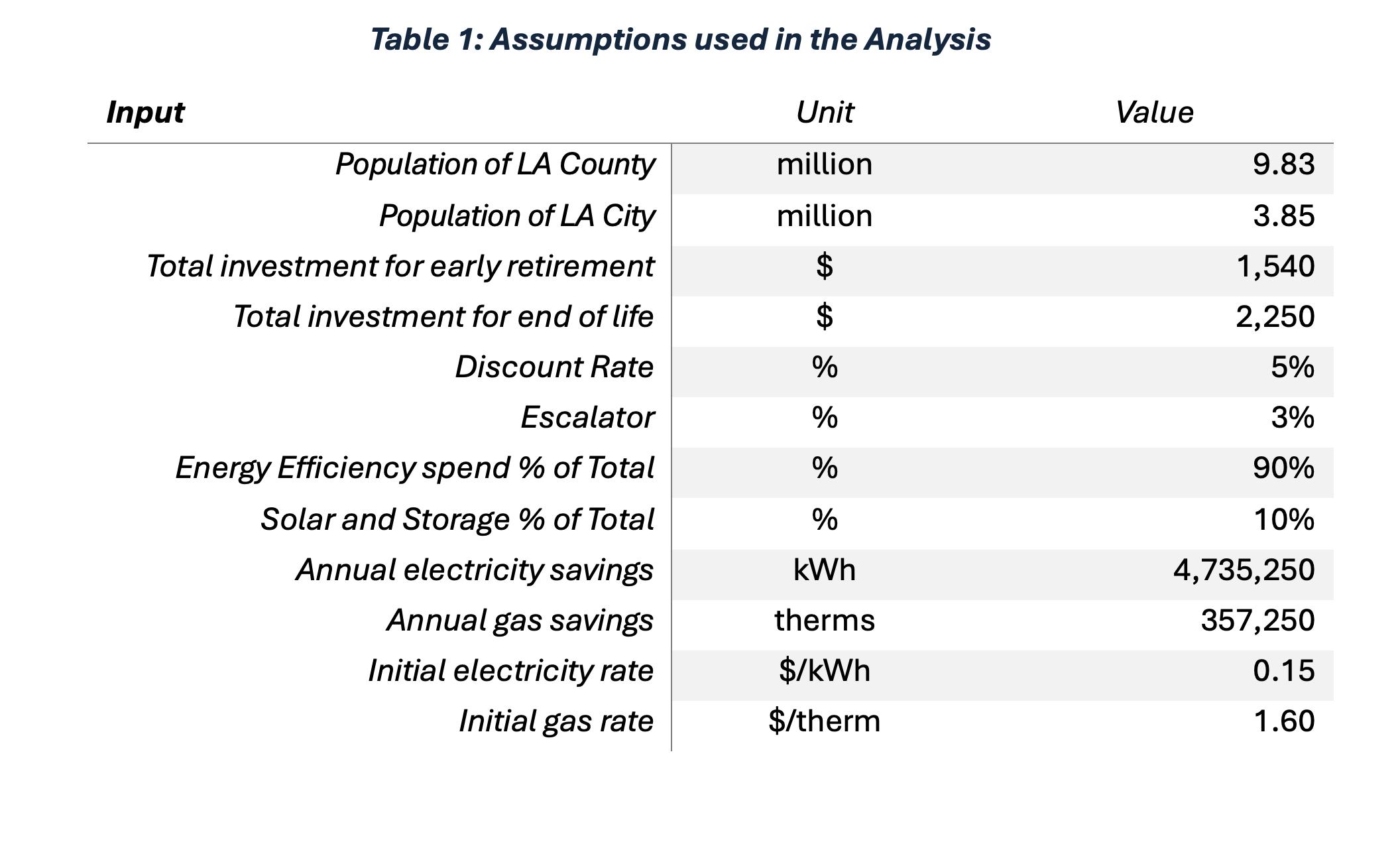
The assumptions used are found in the Table below:
Findings from the analysis include an anticipated number of jobs created directly, indirectly and induced. Directly created jobs are those result directly from the investments. Indirect jobs are those that are created from the economic activity stimulated by the initial spending or investment. This includes employment in the supply chain that provides goods and services to the primary project or industry and jobs created when employees in the direct and indirect sectors spend their incomes on goods and services in the broader economy. An indirectly created job is a position generated to support direct jobs, such as manufacturing goods and services needed by direct workers. Finally, induced jobs are those created by the additional personal spending of both direct and indirect workers, such as eating at a restaurant or buying goods and services with their incremental income.
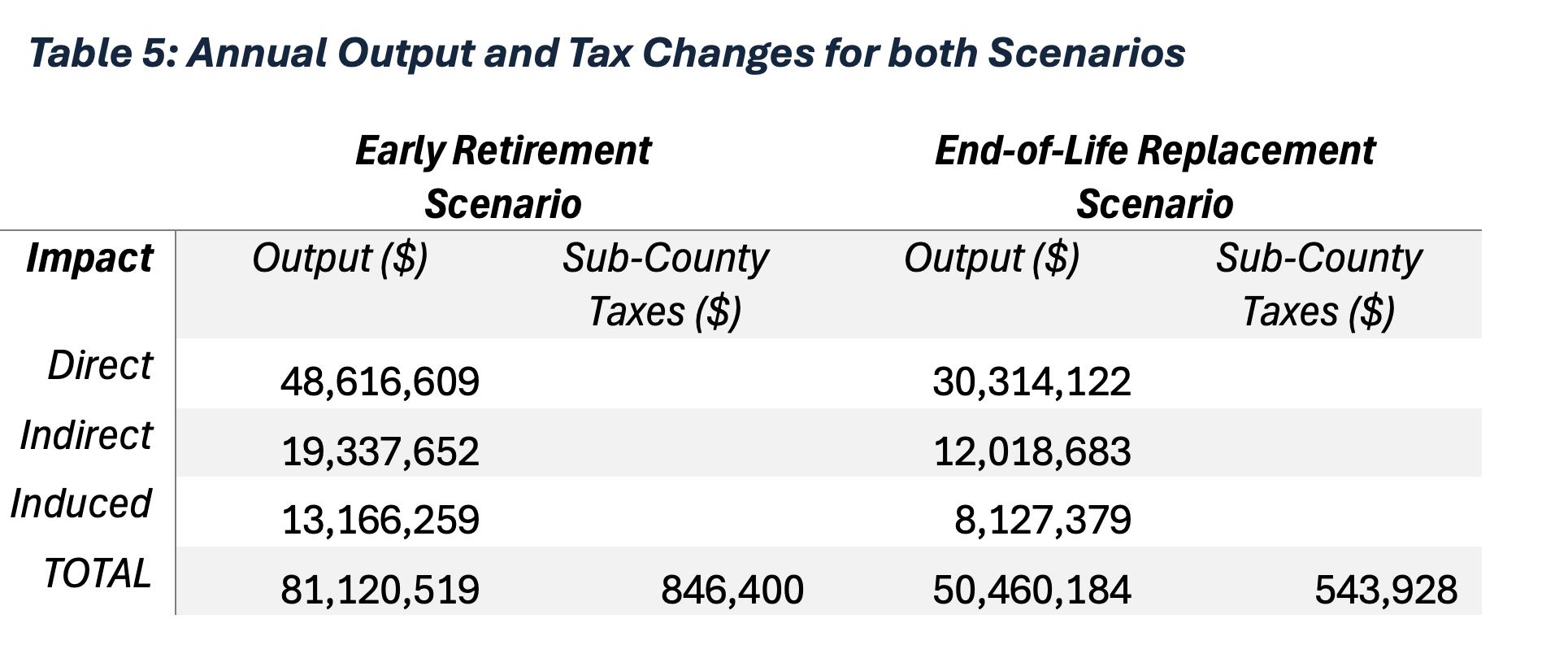
Two additional impacts of the investments are also calculated. The first is the impact on production output that the investments will create, and the second is the tax implications. In both cases the impact is positive: investments in decarbonization are expected to increase City output and increase tax revenues.
The impact of the decarbonization strategies outlined in this report is summarized in the following Tables. Results from both the Early Retirement and End-of-Life Replacement scenarios are presented. In the left column the category of job creation is given, followed by the number of jobs, and the income expected to be generated from those jobs. The job creation results are the average annual jobs created, based on an annualized investment schedule. Annual job creation is higher in the Early Retirement scenario because total investment is spread over a shorter time horizon, producing greater impacts per year.
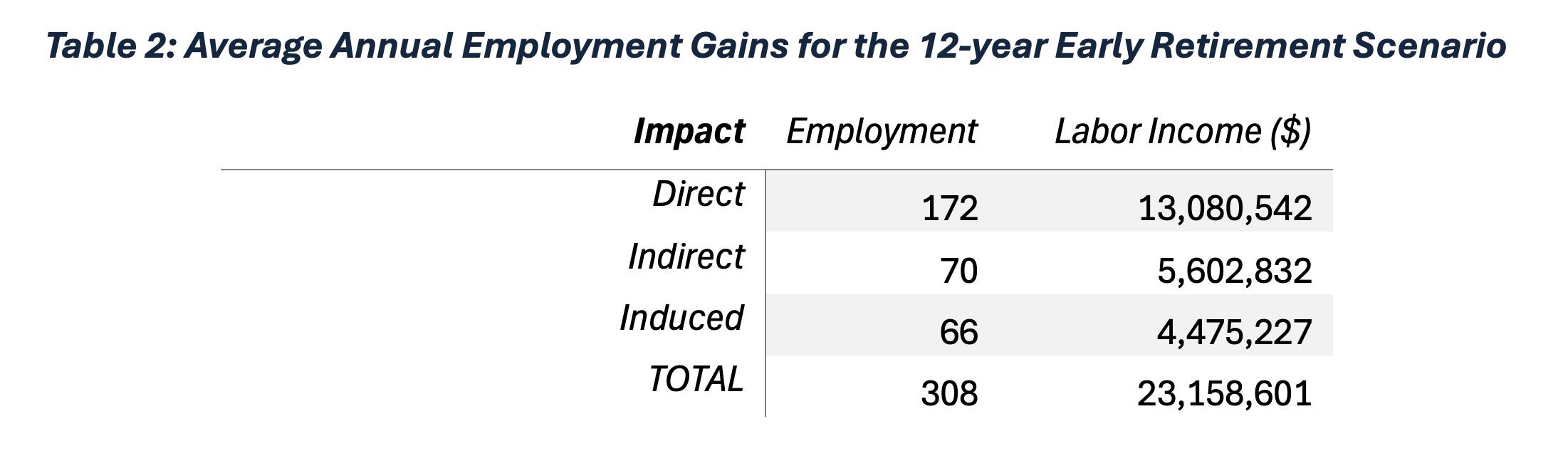
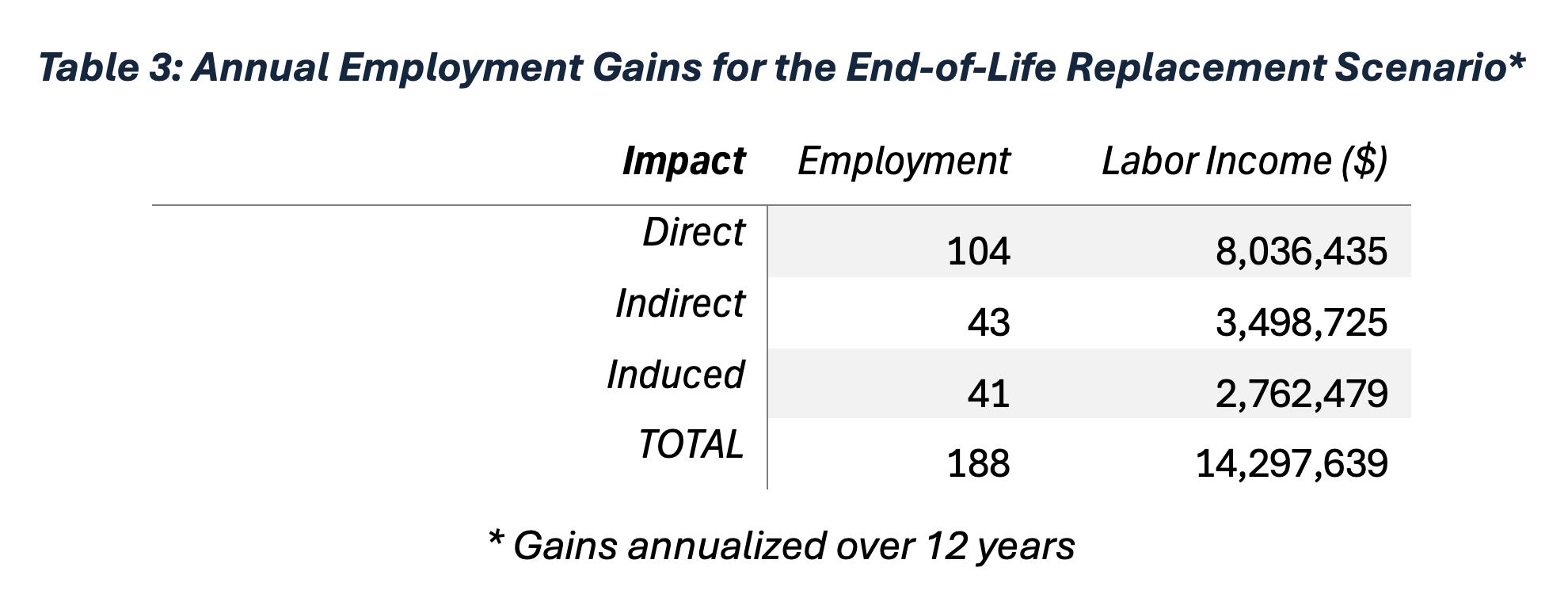
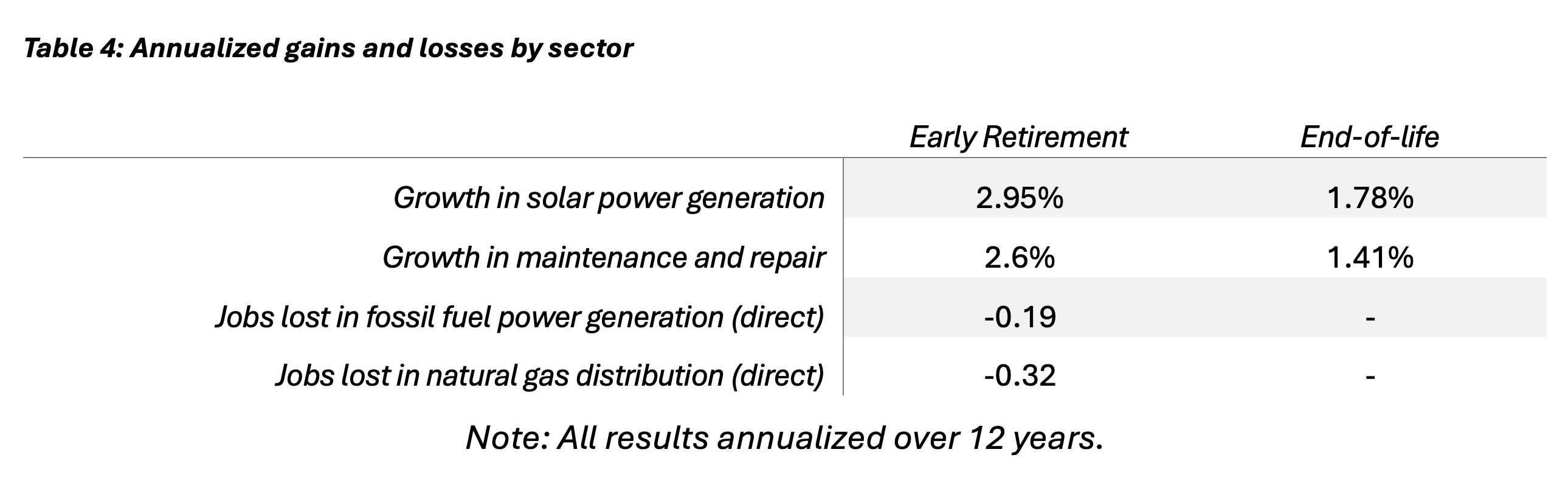
Two sectors would see the biggest gains, solar electric power generation, and maintenance and repair construction of non-residential structures. Under the early retirement scenario, these would be expected to grow by 2.95% and 2.6% respectively. Under the end-of-life scenario, these sectors would be expected to grow by 1.78% and 1.57%.
Some job losses would also be expected. These would come in the fossil fuel electric power generation and natural gas distribution sectors but are expected to be less than one full-time equivalent per year.
Investments in decarbonization is also expected to increase the overall output of the City and County, plus provide additional tax revenue, as shown in Table 3 for both scenarios. The output column for each scenario describes the expected incremental output that results from the decarbonization investments. Similarly, the Sub-County Taxes column indicates the expected tax revenues that will accrue to cites (including LA City) within the County.
Input-Output (I-O) Analysis is designed to show the ripple effects of a given economic activity in other Industries and geographies through input purchases, labor payments, and trade. Production in a given Industry supports demand for production in other Industries throughout the economy, both due to supply chain spending and spending by workers.1
Based on the findings, we recommend the following actions for policymakers and stakeholders:
1. Continue Investment: Allocate further resources to accelerate the decarbonization of municipal buildings, maximizing the employment and environmental benefits.
2. Workforce Development: Invest in training programs to equip the local workforce with the skills needed for green jobs, ensuring that employment benefits are fully realized.
3. Stakeholder Engagement: Collaborate with industry partners, community organizations, and educational institutions to align decarbonization efforts with broader economic and workforce development goals.
Decarbonizing municipal buildings in Los Angeles City presents a promising pathway to combat climate change while simultaneously boosting local employment and economic development. The findings from our IMPLAN analysis underscore the potential of green infrastructure projects to serve as a catalyst for job creation across a wide range of sectors. As Los Angeles continues to invest in sustainable and energy-efficient technologies, the economic and environmental benefits of these initiatives will play a crucial role in shaping a more resilient and prosperous future for the city.
1 IMPLAN. Economic Effects. https://support.implan.com/hc/en-us/articles/360038285254-How-IMPLAN-Works.
IMPLAN is a tool that provides economic impact data and analysis. It caters to a wide audience, including researchers, policymakers, business professionals, and government entities, addressing their economic data requirements. Originally developed in the 1970s, IMPLAN has evolved to become a versatile tool for economic analysis across various regions, offering insights into the economic impacts and contributions of activities within specific geographic areas through its software and data applications. Its data production and impact estimation methods are well-documented in both academic and professional circles, reflecting widely accepted practices in applied economics.
The tool employs Input-Output analysis and a Social Accounting Matrix to understand the economic interdependencies within an economy. This approach tracks the flow of goods and services between industries and households, analyzing the economic consequences of different demands and the resources needed to fulfill them.
Foundational assumptions embedded in IMPLAN's models include constant returns to scale, a fixed input structure, industry homogeneity, absence of supply constraints, and specific technological and production assumptions. Further, The reliability of analyses depends on the user's input definitions and awareness of the model's assumptions.
IMPLAN's model is static, focusing on backward linkages without accounting for price changes, forward linkages, or general equilibrium effects. It assumes a steady state of consumer preferences, government policies, technology, and prices, providing a snapshot of economic relationships within a specified period.
IMPLAN supports users with economic language and analysis tools, offering templates for presenting results. It encourages collaboration between the tool's users and its economists to ensure the accuracy and relevance of the economic analyses conducted.
2 Taken from IMPLAN. For more information on the IMPLAN modeling process, visit IMPLAN.com.