BLUE MOUNTAIN LAND TRUST
2 025-2 026
IMPACT REPORT
PROTECT THE LAND YOU LOVE. FOREVER.
Blue Mountain Land Trust is a nationally-accredited
nonprofit land trust working in southeast Washington
and Eastern Oregon. Our mission is to protect the lands and waters of the Blue Mountain region for people, agriculture, and wildlife.
CONT EN T S
3
We Are in This Together
4
BMLT in Review
5
Conservation Spotlight
6
Perspectives
8
Conservation Wins: 26 Welcome Table Farm
Stewardship & Phipps Meadow
10
Conservation Wins: 34 Túuši Wána 38 Conservation Wins: Hayshaker Farm
Community Engagement
20
Trail Stewardship & Horseshoe Prairie
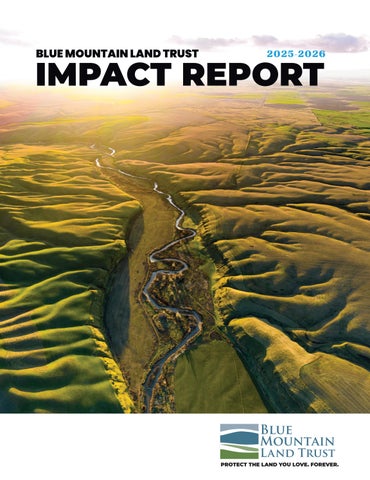
COVER IMAGE Golden hour at the Túuši Wána restoration site outside of Walla Walla, WA.
EDITORIAL & DESIGN A LYS S A MA RTINEZ NEUMA NN
PHOTOGRAPH BY WILLIAM FROHNE
Board of Directors
Staff EXECUTIVE D I RECTOR
STEWARD S HIP &
PRES IDENT
Amanda Martino
RESTORATION DIRECTOR
Robin Fitch
COMMU N ICATI ONS & MAR K E T ING D I RECTOR
Alyssa Martinez Neumann DEVE LO PM ENT D I RECTOR
Marcus Frey
Andrew Addessi
VICE PRES IDENT AD M I NI STRATIVE A S S ISTA NT
Carlee Allen
Emily Slusser TREA S URER
Rory McClellan S ECRETA RY
Susan Plunkett
Tim Barry Greg Brown Blair Burroughs Dave Evans Mike McArthur Jim Ruzycki Steve Setchell A DVIS ORS
Amy Molitor Jack Percival
The accreditation seal is awarded to land trusts meeting the highest national standards for excellence and conservation permanence.
BMLT | 2
We are in this together. Where do you feel most connected to the Blue Mountains? Maybe it’s a familiar ridgeline, a fishing spot, a local farm stand, or a quiet trail. For me, these places are what make this region home. They ground us, bring us together, and remind us what’s worth protecting. At Blue Mountain Land Trust, that sense of place has guided our work for 27 years. Together with our community, we have protected nearly 25,000 acres of this remarkable landscape. These places include working farms and ranches that sustain rural communities, wildlife habitat and corridors that allow animals to move across the landscape, rivers and streams that provide clean water and support critical fish populations, and special places where the natural systems we depend on can thrive. Our work matters most when the world feels uncertain and beyond our control. Wildfires have changed familiar trails and landscapes across our region, including places our volunteers steward in the Umatilla National Forest. These changes remind us that the places we love are not guaranteed to stay the same. We cannot prevent every loss or control every challenge facing our world. But we can choose how we respond. Protecting a working farm, restoring a stretch of river, improving a trail, or bringing people together outdoors may seem like small actions. When combined, small actions grow into impactful, lasting results that reach far beyond any single property or project. This year, our conservation team advanced complex projects to protect important lands and waters. At Phipps Meadow, we began hands-on forest restoration. Dedicated volunteers stewarded public trails before summer fires changed the landscape and began post-fire work this fall. Through community programs, we gave people of all ages new ways to spend time outdoors, learn about the natural world, and experience the landscapes that make this region special. Each effort represents another step toward a healthier, more connected landscape while enduring changing seasons and circumstances. Our collective love for these places is our greatest strength. We may not always agree on everything, but we all share an interest in the future of this region. Local conservation gives us a practical way to work toward common goals, from healthy rivers and productive farmland to accessible trails and thriving wildlife habitat. Blue Mountain Land Trust will continue building partnerships, taking on ambitious projects, and finding new ways to meet the challenges ahead. Your support makes this work possible. It helps us protect important properties, steward the lands already in our care, restore critical habitat, provide opportunities and outdoor experiences for our communities to learn outside, and build relationships that will carry this work into the future. You can help shape the future of this region right here at home. Volunteer, share your love of the land, join an event, or support conservation. There is a place for you in this work. Together, we can keep the Blue Mountains a place where farms, rivers, wildlife, and communities are a source of connection, resilience, and hope for generations to come.
- A m an da Mar tin o / Exe c uti ve Di re c to r
I MPACT R E PO RT | 3
BM LT I N R EVI EW
24,756
Since our start in 1999:
SERVING 11 COUNTIES IN
ACRES OF LAND
Washington & Oregon
protected across the Blue Mountain region
CONSERVATION FOCUS: Habitat & river restoration projects
23
2
Blue Mountain Land Trust
Working lands: farms & ranches
conservation easements
Mixed-use properties: habitat & agriculture
purchased properties
Washington: Walla Walla, Columbia, Garfield, Asotin Oregon: Baker, Grant, Wheeler, Gilliam, Morrow, Umatilla, Union
Conservation & Community Wins (2025-2026)
3 19%
Upland, Riparian & Wildlife Habitat
NEW CONSERVATION EASEMENTS
24,756 ACRES
81%
Farm & Ranch Land
51.1
MILES OF PROTECTED RIVERS & STREAMS
UmaBirch Pendleton, OR
942 ACRES OF 3.72 MILES RIVER
Túuši Wána Walla Walla, WA
Walla Walla, WA
438 ACRES 3 MILES OF
25 ACRES OF 5.2 ACRES RIPARIAN
RIVER
HABITAT
1
NEW PURCHASED PROPERTY
Hayshaker Farm
College Place, WA
Phipps Meadow Grant County, OR
Fall 2026: Forest restoration project begins
39 COMMUNITY ENGAGEMENT EVENTS 7,477+
Welcome Table Farm
VOLUNTEER HOURS
11.53 ACRES
Ensures land access for first-generation farmers
100+
51+
native plants identified
bird species observed
26,487+
total volunteer hours for trails on public lands
@Horseshoe Prairie Nordic Ski Area
BMLT | 4
B L U E MO U NTA I N S WALLA W A L L A C O U N TY , W A
CO N S E R VATI O N S POTL I GH T
CONNECTED LANDS Wildlife don’t recognize property lines. Protecting connected parcels and properties adjacent to public lands gives wildlife room to move, find food, and access the habitat they need to thrive. Working farms and ranches are an important part of this landscape, supporting both rural economies and healthy wildlife habitat. By keeping these landscapes intact, we create a greater impact than any one property can achieve alone. PH O TO GR APHS BY WILLIAM FROHNE
WHE E L E R CO UNTY , O R
B O X T R A NC H G R A NT C O U N TY , O R
P HIP P S M E A D O W GR A N T CO UNTY , O R
P H I P P S ME A D O W
R A NT RT C O U N|TY I MPACT RGEPO 5, O R
PE R S PECT IVE S
Change starts here. “What have you learned from the land and the people working to protect it, and what can we accomplish together that we couldn’t achieve alone?”
“Nearly f ifteen years of living and working in the Blue Mountain region have taught me how much we share: a desire for clean air and water, healthy wildlife populations, and a resilient region that is productive, diverse, and wild. The wisdom shared and put into practice by Tribal communities and the conservation and restoration projects supported by our many partners have shown me what we can accomplish when we care for the land together. When we look beyond our disagreements, dream together, embrace uncertainty, and share our many ways of caring for our land, we can f ind solutions none of us could imagine or accomplish alone.” — ANDREW ADDESSI Stewardship & Restoration Director, Blue Mountain Land Trust
BMLT | 6
“ ‘Every Farm Needs a Team’ reads a sign in the barn at Hayshaker Farm. Whether that means a team of horses or humans, we know we’re all in this together. Stewarding the land as a team means sustaining our ecosystem of people, wildlife, plants and micro-organisms while feeding the community with nutrient-dense, delicious food, and leaving the soil better than we found it. With the hard work and dedication of the Blue Mountain Land Trust team, our farm was saved f rom development, protected to remain viable and productive irrigated farm land for us now, and generations to come. It’s not a feat we can achieve alone, but when we work together, anything feels possible.” — CHANDLER BRIGGS Founder & Farmer, Hayshaker Farm & Walla Walla Food Hub
“I have learned that the land has a way of doing what is best for the land. Understanding the rhythm of the land is what I am looking to achieve, however, this takes time. Through partnership, institutional knowledge and lived experience foster the depth of understanding needed to better serve these places. Education and outreach are valuable tools in that effort. Partnerships extend our reach into the community and strengthen the message of stewardship for the land.” — ALLISON CROWLEY Project Manager & Outreach Educator, Walla Walla County Conservation District
“The resilience of our forests, rivers, streams, and wildlife gives me hope for the future of our region and the world. Good people are demonstrating that by working together, we can make landscape-scale impact so that communities, wildlife, and agriculture thrive for generations to come.” — STEVE SETCHELL Vice President for Development and Alumni Relations, Whitman College; Blue Mountain Land Trust Board Member
I MPACT R EPO RT | 7
CO N S ER VATI O N WI N S
Welcome Table Farm Protecting the land and livelihoods that feed us
BMLT| |8 8 BMLT
P HO T O GR A P H S B Y VICTO RIA WRIGH T
LOCATION: Walla Walla, WA
On the south side of Walla
HABITAT: 5 acres of riparian
Walla, Welcome Table Farm
PROJECT SIZE: 25 acres
is helping shape the future of farming through community, education, and hands-on experience. This small diversified farm has become an important part of the Walla Walla Valley’s local food system, growing fresh produce while supporting healthy soil, wildlife habitat, and the natural systems that sustain it. Blue Mountain Land Trust has permanently protected Welcome Table Farm with a conservation easement, keeping this productive farmland in agriculture for future generations.
I MPACT R EPO RT | 9
A
s farmland disappears across the Pacific Northwest, protecting agricultural land has never been more urgent. Blue Mountain Land Trust (BMLT) permanently protected Welcome Table Farm, a 24.62-acre diversified vegetable farm located on the south side of Walla Walla. Through a conservation easement, this protection ensures that the land will remain in agricultural production while safeguarding critical fish and wildlife habitat along Yellowhawk Creek. This type of farm project is the first of its kind for BMLT, marking a significant milestone in the effort to protect local food systems and natural resources in the Walla Walla Valley. The Welcome Table Farm conservation easement is the result of a multi-year collaboration between BMLT, owners Emily and Andy Asmus, the Natural Resources Conservation Service (NRCS), and the Washington State Recreation and Conservation Office (RCO). The conservation easement permanently removes the rights to subdivide and develop the property, and includes additional provisions designed to sustain farming and agriculture on the land. The project ensures the long-term viability of a community food system while conserving a biologically rich stretch of Yellowhawk Creek. Owned and operated by Emily and Andy Asmus, Welcome Table Farm is a leader in the region’s community food system, providing locally grown produce to Walla Walla-area residents and modeling regenerative land stewardship. It is also an educational hub, providing farming opportunities for the next generation. “Emily and I were both raised to value open spaces, wild and agricultural, both for what they are in themselves, and for all they offer to the people who care for them,” said Andy Asmus. “We have invested so much of our energy, resources, and ourselves in this place, and what we receive from it in return is immeasurable. It seems only fair for us to protect this land in any way we can.”
“Welcome Table Farm is a cornerstone of our community, providing fresh, local food while stewarding the land for future generations. Small farms are key to strengthening local food and climate resilience, ensuring the livelihood and viability of the region,” said Fraser Moore, BMLT’s former conservation manager.
A focus on farm viability
Located on the south side of Walla Walla, Welcome Table Farm plays a critical role in the region, producing food for the local community in a region where most agricultural output is exported. The farm distributes its produce, flowers, and meat through the downtown Walla Walla farmers market, an on-site farmstand, and a customizable community-supported agriculture (CSA) program offering diverse selections throughout the growing season. Emily and Andy farm using regenerative practices, integrating livestock, fruit trees, and annual vegetable production into a holistic system. Pigs are used as part of the farm’s ecological management, turning food scraps into fertility, browsing invasive species, and cycling nutrients through the orchard. The property includes 16.9 acres zoned for agricultural production, and more than 96% of the soil is classified as prime, making it some of the most productive farmland in the valley. “The soils, creeks, and fields in our valley are remarkable. They have provided for people and critters here for millennia,” said Andy. “As I tell the kids who attend camps and field trips at the farm, our little spot on the Yellowhawk has been one of the best campsites in the valley for as long as there have been people here. And our family is beyond blessed to call it home.” This project protects land that supports not only local food security but also economic viability for diversified farms and future generations of farmers.
BMLT | 1 0
“Emily and I were both raised to value open spaces, wild and agricultural, both for what they are in themselves, and for all they offer to the people who care for them. We have invested so much of our energy, resources, and ourselves in this place, and what we receive f rom it in return is immeasurable. It seems only fair for us to protect this land in any way we can.” - Andy Asmus. I MPACT R EPO RT | 1 1
“This little farm gets to keep being a little farm forever! Nothing fills me with a greater sense of pride and pleasure than knowing I’ve played a role in protecting these 25 acres, both the cultivated and wild space, from further development,” said Emily Asmus. “These prime agricultural soils get to keep feeding people. This lively, lovely riparian area gets to keep fostering the lives of wild flora and fauna. In perpetuity. Amen.”
It represents a powerful example of how farmland conservation, ecological protection, and community food systems can come together in conservation action that directly impacts the future. “I plan to keep on growing food, flowers, and livestock here for decades to come. I plan to keep on training new farmers and teaching young people about growing food, about being outside,” said Emily. “As Welcome Table Farm, it will keep being a hub of community, education, and productivity. And when I’m ready to transition away from farming, the BMLT conservation easement and stewardship plan will be in place to support the next generation of farmers. This is legacy planning.”
Farming and wildlife, together
The conservation easement protects 5.20 acres of riparian habitat along Yellowhawk Creek and Lassiter Spring Branch, areas that provide critical migration habitat for Mid-Columbia River spring Chinook and summer steelhead, as well as resident habitat for rainbow trout.
“Small farms provide nourishing food while also strengthening the climate resilience of rural communities. We need to protect small producers to ensure future generations have the privilege we’re afforded today,” said Fraser.
These riparian zones contain native communities of willow and cottonwood trees and support a diverse array of wildlife, including mule deer, beaver, otters, bald eagles, wild turkeys, and native amphibians and reptiles. Protecting this habitat also provides essential ecosystem functions like stream bank stabilization, water purification, and flood control.
This project is made possible through the collaboration of Emily and Andy Asmus, Blue Mountain Land Trust, the Natural Resources Conservation Service (NRCS), and the Washington State Recreation and Conservation Office (RCO).
Prior to the project, Welcome Table Farm temporarily enrolled 0.2 cubic feet per second (cfs) of their water rights in the Washington State Department of Ecology’s Water Trust Program. This temporary transfer ensures additional instream flow for aquatic habitat while protecting the beneficial uses of water on the property through 2035. The conservation easement protects the long-term integrity of these water rights, allowing current and future landowners to utilize them for agricultural use or temporarily donate them instream, consistent with wildlife and agricultural conservation goals.
>> Learn more about the
Welcome Table Farm project: www.bmlt.org/conservation
Legacy planning for the future
Welcome Table Farm joins a growing network of protected lands that sustain the region’s agricultural heritage and ecological health. This project was more than three years in the making, from early conversations with the landowners to securing full funding and completing due diligence.
BMLT | 1 2
7
“ Th is little farm gets to keep being a little farm forever! Nothing fills m e w ith a greater sense of pride and p lea su r e t han knowing I’ve play ed a r ole in p r otecting these 25 acres, both th e c u ltivated and wild space, from f u r th er d evelopment.” - Emily Asmus.
Mud C re e k D ix ie R a n c h - Dix ie, WA
CO N S E R VATI O N WI N S
Túuši Wána A healthier Touchet River for fish, farms, and future generations.
BMLT || 114 4 BMLT 7
P H O T O G R A P H S B Y WILLIAM F RO H N E
Along the Touchet River, where water, floodplain, and upland habitat come together, Túuši LOCATION: Walla Walla, WA PROJECT SIZE: 438.79 acres HABITAT: 3 miles of river
Wána is part of a larger effort to restore the natural functions of the river and reconnect it to the surrounding landscape. In partnership with the Confederated Tribes of the Umatilla Indian Reservation (CTUIR), this 438.79-acre property supports the Tribe’s vision for restoring healthy rivers, renewing habitat for native fish and wildlife, and caring for First Foods that have sustained indigenous people and local Tribes since time immemorial. Blue Mountain Land Trust has permanently protected Túuši Wána through a conservation easement, ensuring CTUIR’s restoration work can continue to benefit the river, wildlife, and future generations. I MPACT R EPO RT | 1 5
B
lue Mountain Land Trust completed the Túuši Wána Conservation & Restoration Easement, permanently protecting 438.79 acres along the mainstem of the Touchet River in partnership with the Confederated Tribes of the Umatilla Indian Reservation (CTUIR) and the Gailey family. This property, which includes 340 acres of floodplain, nearly 100 acres of uplands, and three miles of river, is central to CTUIR’s large-scale restoration efforts. Guided by their First Foods mission and River Vision, the project reconnects the river to its floodplain, reversing decades of channelization and revitalizing habitat for native fish and wildlife.
Restoring the Touchet River
The Touchet River is central to the culture and sustenance of the CTUIR. Túuši Wána, meaning “baking salmon over coals by the river,” highlights the connection to place and the efforts to bring salmon back to the area. Yet the river’s history has not been without challenges. This stretch of the Touchet used to be a dynamic, braided system, with waters flowing through a maze of side channels across a broad floodplain. Over time, upstream erosion filled the valley with sediment, raising the floodplain surface by up to 15 feet and forcing the river into a single, fast-moving channel. As the water quickened, it no longer spilled into side channels and wetlands. Habitat for fish and wildlife shrank. Spring Chinook disappeared from the Walla Walla Basin by the 1950s, prompting decades of restoration work by CTUIR to bring them back. Middle Columbia River steelhead have been listed as threatened since 1999. Today, restoration efforts are creating new opportunities for both species to recover. “The Túuši Wána Conservation & Restoration Easement is a vital piece for restoring salmonid habitat in the Walla Walla subbasin,” said Jerry Middel, Project Leader for CTUIR Department of Natural Resources. “This 450-acre floodplain conservation easement along a 3-mile-long stretch of the mainstem Touchet River
will allow the CTUIR the opportunity to reconnect the floodplain to the river and add much needed instream diversity which will benefit winter rearing habitat for juvenile salmonids.” Crews are lowering parts of the floodplain, giving the river room to breathe and spread out, much as it once did. New side channels are carved, large logs are placed to add structure, and bends are reshaped to slow the water’s pace. As the river reclaims its floodplain, water will seep into the earth, downstream flooding will be reduced, and new habitats will be created for fish and wildlife. These restored floodplain habitats are especially critical for young salmon and steelhead. While adults spawn upstream, juveniles rely on slow, sheltered waters during winter’s high flows. Side channels and pools provide vital refuge and abundant food, like aquatic insects that thrive in clean gravel and around woody debris. Fish that can grow larger here are more likely to survive their journey to the ocean and, one day, return as adults, helping to rebuild populations for the future. “This project provides a place on the Touchet River for steelhead and salmon fry to grow big and strong before their journey out to the Pacific Ocean,” said Fraser Moore, former BMLT Conservation Manager. “The bigger they grow in our waters, the better the chance they have of returning. By permanently protecting the Tribes’ investment in river restoration, we’re giving fish a chance.”
Keeping water instream
In addition to the ongoing efforts to restore and secure a permanent conservation easement for the river corridor, CTUIR was instrumental in facilitating a water transaction with the Washington Water Trust. This helps maintain a steady flow of water in the river, especially during the warm, low-flow months of the year. As part of this initiative, 3.21 to 4.174 cubic feet per second (cfs), a measure representing the volume of water passing a specific point each second, will be consistently left instream in the Touchet River. In the summer months, 3.21 cfs will be left instream for fish and wildlife, and during the winter, 4.174 cfs.
BMLT | 1 6
Restoration work begins on th e T o uchet River outside ofW alla W a l l a , WA .
I MPACT R E PO RT | 1 7
This approach significantly benefits salmon and steelhead during their demanding migratory journey to the headwaters for spawning. Ensuring a continuous flow of water sustains favorable conditions for fish during a critical point in their life cycle.
Native plants, healthy habitat
Restoring native plant communities is essential to the broader recovery of the floodplain. Years of channelization and the spread of invasive species, such as Russian olive, have altered the landscape. Aging cottonwoods no longer regenerate as they once did. To address these changes, the project will reestablish a diverse mix of native trees and shrubs across the property. More than 40,000 native trees and shrubs, plus 17,000 pounds of native seeds, will be planted, starting with willows to stabilize the riverbanks. Later plantings will introduce culturally important and wildlife-supporting species, including snowberry, chokecherry, golden currant, and elderberry, sourced from CTUIR’s native plant nursery. As these young forests and meadows take root, the floodplain will once again support a wide variety of wildlife. Bald eagles and yellow warblers may nest in the trees, while frogs and salamanders return to the water’s edge. Reconnected corridors will welcome migratory birds and mammals back to the river, creating a diverse ecosystem for the future. “The Umatilla Tribes are pleased to be partnering on the Túuši Wána project with the landowners, Blue Mountain Land Trust, and Bonneville Power Administration. This effort exemplifies the Walla Walla Basin’s commitment to working together to collaboratively restore salmon, stream flows, and wildlife habitat throughout the region,” said Anton Chiono, Habitat Conservation Project Leader for CTUIR Department of Natural Resources. “We look forward to welcoming salmon back to the restoration site and are excited to learn that a moose has already decided to move in!”
Protected forever
Completing the easement took more than two years and builds on more than a decade of CTUIR’s collaboration
and restoration planning with landowners for this stretch of the Touchet River. “Our restoration work reflects the CTUIR’s River Vision and takes a step in supporting the goals of the Walla Walla 2050 Initiative,” said Jerry Middel. “Thank you to the Blue Mountain Land Trust for helping to make this project a reality.” Landowners John and Susan Gailey chose to permanently conserve their property to support the ongoing restoration work. “We chose to work with CTUIR and Blue Mountain Land Trust in placing a conservation easement on our land along the Touchet River because we believe and wanted to be a part of their River Vision philosophy,” said John and Susan Gailey. “Their expertise in restoration work ensures that our property supports native fish species for generations to come. A conservation easement is a voluntary legal agreement that ensures the land’s environmental values, such as habitat, water quality, and open space, are protected for the long term. Blue Mountain Land Trust monitors the property annually to ensure these protections endure, enabling restoration efforts to have a lasting impact. “We originally planned to only place a conservation easement on a smaller area but ultimately decided to conserve the majority of our land to make a bigger impact. We are excited to see the completed restoration work and appreciate all the work Jerry and Anton with CTUIR and Fraser with Blue Mountain Land Trust have done to make this easement and restoration a reality,” said John and Susan. Now, with the easement in place, this stretch of the Touchet River is protected for good. The land and water will continue to provide for salmon, wildlife, and Tribal First Foods far into the future. This project is made possible through the collaboration of the Confederated Tribes of the Umatilla Indian Reservation (CTUIR), John and Susan Gailey, Blue Mountain Land Trust, Washington Water Trust, Washington Department of Ecology, and Bonneville Power Administration.
>> Learn more about the Túuši Wána project:
www.bmlt.org/conservation BMLT | 1 8
Restoring native plant communi t i es is essential to the broader reco v ery o f the floodplain. More than 40 , 000 na t i v e trees and shrubs, plus 17, 00 0 p o und s o f native seeds, will b e p l a nt ed .
I MPACT R E PO RT | 1 9
CO N S E R VATI O N WI N S
Hayshaker Farm Ensuring farmland access for a new generation of farmers
BMLT BMLT || 2200
P HO T O G R A P H B Y W I LLIAM F RO H N E
Blue Mountain Land Trust is taking bold action to secure the future of Hayshaker LOCATION: College Place, WA PROJECT SIZE: 11.53 acres
Farm, an 11.53-acre farm and regional food hub on the edge of College Place, WA. With development rapidly encroaching and the current landowner prepared to sell, this property, farmed since the early 1900s, was at risk of being lost to residential development. BMLT stepped up to purchase the property, keeping the land in agriculture and accessible to the farming community. Hayshaker Farm is the second property BMLT owns, the first located in Washington, and a major step to protect local food systems.
I MPACT R E PO RT | 21 23
A
t the edge of College Place, on 11.53 acres of prime farmland, a small draft-horse-powered farm has been feeding the Walla Walla Valley and beyond for the last decade. Hayshaker Farm grows vegetables through craft and intention: by hand, by hoof, and with deep respect for the land and the people who care for it. It’s managed holistically, with soil health, ecological systems, biodiversity, and a commitment to core values at the heart of every decision.
Securing the future of farming
Farmers face significant hurdles: soaring land prices, rising equipment costs, reliance on short-term leases, and unpredictable markets. For first-generation farmers like Chandler Briggs and Theo Ciszewski, owning farmland outright is nearly impossible. With approximately 40% of America’s farmland owned by those over 65, the urgency for succession planning is growing, yet fewer than 10% of producers are under 35. In just one generation, the U.S. has lost 11 million acres of farmland to urban and suburban development, highlighting a troubling decline in farmland access and ownership. Without accessible pathways to transition land, many farms risk being sold for development or absorbed by large investors, threatening both farm succession and long-term food security for local communities. “Prime irrigated farmland in this country, and especially in our community, is increasingly expensive and hard to secure. Top it off with development pressure, increased housing costs, and the cost of living, and we have a recipe for a lack of farmers and a loss of our best farmland,” said Chandler Briggs. “But with BMLT’s new acquisition, we can breathe a sigh of relief. Together, we are building a bright and abundant future for our growing community.” To address the growing challenges first-generation farmers face in securing land, BMLT is working to reduce barriers by making farmland and infrastructure more accessible and sustainable.
BMLT stepped up to purchase the property using a low-interest loan, allowing the organization to offer a long-term, affordable lease to Hayshaker Farm and provide lasting security for their operation. This approach creates a new path forward, one that keeps farmland available and productive, even as the region grows. “This acquisition was very complicated, and the timeline was tight, but whenever we met a hurdle, I asked myself: what is the value of feeding our community?” said Fraser Moore, former BMLT Conservation Manager. “The answer is that we cannot put a price tag on it because food brings us all together. Food heals. Food nurtures. With this to motivate me, I knew we had to do everything to purchase the property and protect Hayshaker Farm.”
The value of feeding a community
Hayshaker Farm sits on land with a deep legacy. Located within the ceded lands of the Confederated Tribes of the Umatilla Indian Reservation, this land has been stewarded for thousands of years. In the early 1900s, Italian immigrants settled on the property and cultivated produce, grain, and livestock for a century. In 2014, Chandler Briggs launched Hayshaker Farm with a garlic crop and a vision to feed the local community. Starting with eight leased acres, the farm supplied produce to farmers’ markets and a handful of restaurants, quickly earning a reputation for quality and unique crop varieties. Since then, the farm has steadily expanded its team, production, and impact, growing into a key player in the region’s local food system. Each year, Hayshaker grows thousands of pounds of produce, with 70% staying in the Walla Walla Valley and benefiting over 380 families, restaurants, schools, grocery stores, and food hubs. The remaining produce is sold to regional marketplaces in Seattle and Spokane, with a significant portion supplying eastern WA hunger relief programs.
BMLT | 2 2
>> Hayshaker Farm grows fresh food for the community, with its harvest distributed through a regional food hub supporting farmers and families.
PH OTOGRA PH S B Y B EN LI NBLOOM, COUR T ES Y OF HAYS HAKER FAR M
The farm also owns and operates the Walla Walla Food Hub, a year-round online marketplace offering locally and regionally grown food and farm goods from over 65 producers. It functions as a central hub where food from many local farms is collected, then advertised, sold, and distributed to households, restaurants, grocery stores, schools, and food banks across eastern Washington. The goal is to help small farms reach more people, strengthen the local food system, and make seasonal food more widely available to the community. “Having recently celebrated 10 years farming on this beautiful property, we are beyond thrilled to solidify a lasting bountiful future on this productive piece of land, and secure an affordable, viable place for ourselves, and other stewards after us, to grow food for our community,” said Chandler.
Next generation farmland access
The land itself is something special: deep, fertile silt loam, irrigated, and shaped by decades of stewards. With infrastructure already in place, including high tunnels, walk-in coolers, a farmhouse, and a barn, the land is well-positioned to continue growing food and support Hayshaker Farm’s vision for years to come. BMLT is not only securing a viable piece of agricultural land, but also supporting the farmers who steward it, the people who eat from it, and the future of the region’s local food system. By protecting Hayshaker Farm, BMLT is investing in a resilient and equitable food system for the Walla Walla Valley and beyond. This project was made possible through two Washington state-backed programs designed to address the urgent challenges facing working lands. The Washington State Housing and Finance Commission’s low-interest loan made it possible for BMLT to quickly purchase the property, while the Washington State Conservation Commission is helping ensure long-term land protection and affordability of the farm for future generations. What usually takes years to complete, BMLT acted fast and completed the acquisition in six months.
In addition to state-funded programs, the Washington Association of Land Trusts’ legal assistance program was instrumental in navigating the legal complexities of this project. Hillis Clark Martin & Peterson P.S. and FutureWise provided BMLT pro bono legal support, along with guidance from BMLT’s in-house attorney and Executive Director, Amanda Martino. Together, these critical programs make it possible to pair farmland acquisition with a future permanent conservation easement to ensure the land remains in agriculture, protected from development, and accessible to first-generation farmers far into the future. “Though Hayshaker Farm is just over 11 acres, its impact on our local food system is immense,” said Amanda Martino, BMLT Executive Director. “Protecting this land proves what’s possible when a community comes together to support the next generation of farmers. At BMLT, we rely on individual donations and community support to fuel the time, expertise, and persistence these high-value, high-impact projects require. BMLT is incredibly proud that we can leverage these resources to complete the community-driven conservation projects we believe in. Keeping farmland in production and local food systems strong will have benefits for generations to come.” This project is made possible through the collaboration of Hayshaker Farm, Blue Mountain Land Trust, the Washington State Housing and Finance Commission, the Washington State Conservation Commission, Washington Assocaition of Land Trusts, Hillis Clark Martin & Peterson P.S., and FutureWise.
BMLT | 2 4
>> Learn more about the Hayshaker project:
www.bmlt.org/conservation PHOT OGR APHS COUR T E SY OF HAYS HAKER FAR M
L A N D & WATE R STEWA RD SHIP
A commitment to the land.
BMLT BMLT || 2266
J O H N D A Y RIVER W H E E L E R C O UN TY, O R
The Blue Mountain region is like
no other. From rolling farm fields to flowing rivers and sagebrush seas, these landscapes hold what we value most: clean
water, wide-open spaces, vital wildlife habitat, healthy soils,
and livelihoods for agricultural communities.
Protecting a property isn’t where the work ends, it’s when our
perpetual responsibility begins. When BMLT completes a
conservation easement, we
are responsible for regularly
monitoring and collecting data to ensure responsible stewardship, leading to greater conservation
benefits for the environment and communities.
This ongoing land stewardship is what we mean when we say, “We protect the land you love. Forever.”
P H OT OG R A PH B Y WI LLI AM FRO H NE
I MPACT R EPO RT | 27
>> BMLT’s stewardship team visits protected properties to monitor changes and successes over time.
Pictured above: Collecting baseline data at Box T Ranch, a conservation project outside of Mt. Vernon, OR. PH OTOGRA PHS BY WI LLI AM FR OHNE
BMLT | 2 8
WHY IS STEWARDSHIP IMPORTANT ?
A CLOSER LOOK AT A CHANGING LANDSCAPE
When Blue Mountain Land Trust completes a conservation easement, we take on a responsibility that lasts forever. That means making sure the land, water, and wildlife habitat we protect today remains that way for generations to come.
This summer, BMLT created a series of interactive satellite-imagery maps to help our volunteers and community members better understand the effects of the Hagen and Paradise Fires across the northern Blue Mountains.
In it for the long haul
Stewardship is how we keep that promise. It is the ongoing work of caring for more than 24,756 acres of protected land and over 51 miles of rivers and streams across the Blue Mountain region. Our stewardship team visits each property every year to monitor its condition, document changes, and ensure the terms of each conservation easement are being upheld. We collect data, address concerns, and work directly with landowners to care for the land over time. No two properties are alike. Some protect working farmland and healthy soils. Others support fish and wildlife habitat, clean water, or important river corridors. Our approach is grounded in understanding each place, learning from the people who know it best, and working with partners to address the needs of the land. This work doesn’t have an end date. It takes commitment, strong relationships, and a willingness to keep showing up. That’s what it means to protect the land you love. Forever.
2026 Blue Mountain Fires
Using publicly available Sentinel satellite imagery through the Lens platform, the maps allow viewers to compare pre- and post-fire conditions, explore burn patterns in three dimensions, and see how familiar places such as the North Fork Umatilla Wilderness, Mill Creek watershed, and Horseshoe Prairie were affected by the 2026 fires. Although the fires themselves are now fading from the daily news, these images may become even more useful with time. Combined with field observations, remote imagery can help our community and land managers track vegetation recovery and forest change, identify areas of concern, and prioritize future trail work and other rehabilitation efforts on our public lands Visit our website to explore the imagery and interactive maps. The viewers compare conditions immediately before the fires ignited in early July 2026 with conditions following the active fire period in early September 2026.
>> Check out ‘Tracking the 2026 Fires Across the Blue Mountains’ at:
https://bmlt.org/news/tracking-wildfire-26
I MPACT R EP O RT | 29
RESTORATION IN ACTION
Phipps Meadow LOCATION: Grant County, OR PROJECT SIZE: 278 acres
RIVERS: Middle Fork John Day
STATS: Home to 200+ Species
Five years after acquiring Phipps Meadow, Blue Mountain Land Trust (BMLT) and the Confederated Tribes of Warm Springs are moving into a new phase of restoration. Working with partners in the John Day Basin Partnership, the team is taking a landscapewide approach to improve forest health, reconnect the meadow, and restore cold-water habitat for native fish. BMLT acquired the 279-acre property in 2021 with support from an Oregon Watershed Enhancement Board (OWEB) Land Acquisition Grant. Surrounded by the Malheur National Forest, Phipps Meadow includes 1.6 miles of the Middle Fork John Day River headwaters, along with cold-water springs that emerge within the meadow. The property was permanently protected through an OWEB conservation easement in 2023. Phipps Meadow supports a rich mix of native plants, culturally important First Foods, and wildlife. Its cold-water streams provide important spawning and rearing habitat for threatened spring Chinook salmon and Mid-Columbia steelhead. The John Day River watershed is one of the Columbia River basin’s last strongholds for native salmon and steelhead runs. More than a century of grazing, logging, road development, and fire suppression has changed parts of the landscape. Those impacts, along with a warming and drying climate, have made restoration work increasingly important. The Confederated Tribes of the Warm Springs of Oregon have led the development of a meadow restoration plan with biologists, engineers, and other project partners. The work will reconnect the river with its floodplain, improve wetland habitat, and bring more cold water through the meadow. PHOTOGRAPHS BY MATT FRANKLIN BMLT | 3 0
I MPACT R EPO RT | 3 1
BMLT | 32
> PHOTOGRAPH BY MATT FRANKLIN
Plans include replacing a restrictive culvert with a bridge, reconnecting old river channels, adding large wood and beaver-dam analogues, and planting native willows, alder, and cottonwood along the stream. Together, these changes will create better conditions for fish, wildlife, and the plants that sustain the meadow. Final design is underway, with construction planned for summer 2027. Restoration is also underway in the surrounding forest. With support from an OWEB Restoration Grant, BMLT is addressing dense lodgepole pine growth that developed after past logging and decades of fire suppression. In fall 2026, local contractor Double J Contracting LLC is leading nearly 50 acres of mechanical thinning. Additional hand thinning and invasive annual grass treatments are planned for the coming years. The forest work and river restoration are designed to support each other. Rather than hauling away or discarding the trees and woody material removed during thinning, the team is preparing much of it for use in the meadow restoration. Larger logs and whole trees will help slow water, reconnect the floodplain, and create fish habitat. Smaller poles and branches will be used in beaver-dam analogs and other structures. Some material will also become fencing to protect new streamside plantings from deer and elk. It is a practical way to put the whole landscape to work. Forest thinning creates material needed to restore the river below, reducing waste and project costs along the way. Together, the projects will help Phipps Meadow better withstand drought, wildfire, and changing climate conditions while improving habitat for native fish, wildlife, and culturally important First Foods. The work at Phipps Meadow is a long-term commitment, built through partnership and a shared responsibility to the land. > PHOTOGRAPH BY W ILLIAM FROHNE
I MPACT R EP O RT | 33
CO M M UN I TY E N GAGE ME NT
The land brings us together.
BMLT BMLT || 334 4
At Blue Mountain Land Trust, we
believe caring for the land starts with a connection to place. A
trail, meadow, or favorite stretch of river can give us a sense of belonging and purpose. Through environmental
education opportunities and outdoor experiences, we
bring people together to build community, deepen their
understanding of the natural
world, and encourage a lasting appreciation for the land.
Our community engagement programs turn curiosity into
action, giving participants the
knowledge and tools to make a
difference. By creating pathways for hands-on learning, we help build a stronger foundation for the future of conservation.
P hipps M eadow - Gra n t Cou n t y, OR P HOT OGR APH BY MA TT FRA N K L IN
I MPACT R EP O RT | 35
BIRDING & RESTORATION (WASHINGTON)
A community at work
Some of the most meaningful conservation work happens when people come together to learn, connect, and care for the land. In spring 2025, BMLT partnered with the Blue Mountain Audubon Society and Walla Walla High school Green Club for a day of learning and hands-on restoration at Brewer Wetland in Walla Walla, WA. BMLT permanently protected Brewer Wetland through a voluntary conservation easement in 2009. The morning began with a birdwatch, observing and documenting the many species that rely on the wetland habitat for food and shelter. Then, alongside high school students, volunteers tackled a large patch of invasive Himalayan blackberries, removing hundreds of pounds and clearing the way for native species. Thank you to the Blue Mountain Audubon Society and WAHI Green Club for bringing their knowledge, energy, and helping hands. Together, we’re building connections between people and places.
BMLT | 3 6
BUILDING MEANINGFUL RELATIONSHIPS
IMTWAHA FISH HATCHERY TOUR (OREGON)
Conservation is for everyone
Rivers and First Foods
Blue Mountain Land Trust is expanding opportunities for Latino families to experience the outdoors and learn about conservation in the Blue Mountain region. Building relationships is at the heart of this work. With the help of a trusted member of the Latino community, we reached families through personal, face-to-face invitations and welcomed new participants to BMLT events.
Tribal nations have long led the way in caring for the rivers, fish, and landscapes in the region. BMLT joined the Confederated Tribes of the Umatilla Indian Reservation (CTUIR) for a tour of the ˀImtwaha Fish Hatchery on the South Fork Walla Walla River.
Families joined our Executive Director, Amanda “Marti” Martino, for a guided hike at Horseshoe Prairie. Along the trail, Marti shared about BMLT’s conservation work in Spanish and the importance of caring for the places we call home. A second gathering brought children and teens together for hands-on Earth Day activities, with nature-inspired crafts and time to learn through creativity. We’re building on these first events with more ways to get outside together. This winter, we plan to offer introductory cross-country skiing and snowshoeing at Horseshoe Prairie Nordic Ski Area. Conservation is stronger when more people have the opportunity to take part. We’re grateful to the Sherwood Trust for helping make that possible. FAMILY HIKE DAY (OREGON)
The joy of hiking together Getting outside should feel welcoming, not intimidating. BMLT Blues Crew volunteer Linda Herbert led a family-friendly hike along the Lake Creek Trail in the Umatilla National Forest, offering an easygoing introduction to the outdoors and a chance for people of all ages to experience a trail close to home. The group made its way to a World War II B-17 crash site, taking time along the way to learn about native plants, leave-no-trace principles, and the importance of caring for the places we enjoy. Lake Creek is one of the trails BMLT’s Blues Crew volunteers return to year after year, working to clear and improve access for everyone. It was a chance to experience that work firsthand and build a connection with the forest, one step at a time.
Led by CTUIR natural resource staff, the visit offered a closer look at how salmon, steelhead, and lamprey are raised and the ongoing work to restore native fish populations. The group also learned about the cultural significance of salmon and other First Foods, and the Tribes’ longstanding commitment to caring for the rivers and watersheds that sustain them. Partnerships with Tribal nations are essential to this work, bringing generations of knowledge, stewardship, and a shared commitment to healthy rivers and thriving fish populations. SUPPORTING TRIBAL PARTNERS
Oregon Land Justice Project We honor and acknowledge the importance of Indigenous peoples on the landscape, and their stewardship today and since time immemorial. In our partnerships with local Tribes, tribal leaders and natural resources teams are the experts on how to restore the land. The Oregon Land Justice Project is a cohort of land trusts, including BMLT, working to change land conservation practices to enhance collaboration, support land access projects, and recognize the important role of Tribally-led initiatives. As part of the project, the Indigenous Land Relationship Fund (ILRF) supports Indigenousled community projects to reconnect with culture, traditional landscapes, and First Foods. Created to demonstrate solidarity, it provides financial resources and logistical and technical assistance. BMLT is proud to be an annual contributor to the ILRF.
I MPACT R EP O RT | 37
T R A I L STEWARDS H I P
There’s more outside.
BMLT BMLT || 338 8
H O R S E S H OE PR A IRI E NOR D IC S K I A R E A (O RE GO N) P H OT OG R A PH B Y WI LLI AM FR O H NE
The Blue Mountains are home
to countless miles of trails, filled with scenic vistas, beautiful
wildflowers, and a surplus of
solitude. We understand that a day spent on the trail provides growth, perspective, and a whole lot of grit.
The trails of the Blue Mountains need attention and care. From the jagged Elkhorns in Eastern
Oregon to the river trails outside of Dayton, Washington, the
BMLT Blues Crew volunteers are
dedicated to improving trails on public lands. Whether you’re a
hiker, skier, biker, or birdwatcher, our volunteers work hard to
ensure the trails are primed for every level of outdoor pursuits. We welcome anyone with a
passion for these mountains to lend a hand for a fun and LOCATION: Horseshoe Prairie (OR) PROJECT SIZE: 19.9 miles of trail
rewarding way to give back to the places you love.
STAT: Trails, maps, grooming
by BMLT Blues Crew since 2019 I MPACT R EP O RT | 3 9
PHOTOGRAPH BY SARAH TO DO V O RIC H
BMLT | 4 0 BMLT | 40
RESTORING ACCESS TO TRAILS
Clearing the way Trail work often means adapting to what the seasons leave behind. Last winter, unusually high winds and warm temperatures brought down large, healthy trees across the Blue Mountains, creating a bigger challenge for BMLT Blues Crew sawyers. “The big green trees were more complicated and time-consuming to clear,” said volunteer sawyer Lee Zollman. The crew took on the work throughout the summer, clearing 89 logs in 226 volunteer hours across regional trails, including the North Fork Umatilla, Grouse Mountain, Buck Creek, Umatilla Rim, and Lick Creek trails. Their hands-on work keeps trails accessible and creates more opportunities for people to get outside and connect with the Blue Mountains. ADAPTING TO A CHANGING LANDSCAPE
Wildfire recovery Wildfire recovery takes time, patience, and plenty of hands-on work. Since 2018, BMLT Blues Crew volunteers have cleared, maintained, and improved trails in the North Fork Umatilla Wilderness. The North Fork Umatilla Trail winds through a remote stretch of the Blue Mountains in northeastern Oregon, about 50 miles southeast of Walla Walla. Following the 2026 Hagen Fire, the crew returned to the North Fork Umatilla Trail to begin clearing the damage left behind. This fall, volunteers cleared brush and fallen saplings along the first 1.5 miles of trail. The following day, eight sawyers worked with four crosscut saws to remove large fallen trees, reaching the two-mile mark. As volunteer Larry Wachtel reflected, “While there is still a lot of work to do, this was a great start and will make next spring’s follow-up work considerably easier.” Their work is an important first step toward reopening the trail and welcoming people back to this area in the Blue Mountains.
3,536+ volunteer hours (2025-2026)
7,477+ total HSP hours (since 2019)
26,487+ Volunteer trail stewardship hours on public lands since 2018
BMLT & WWCCD COLLABORATION
Native plant restoration BMLT strengthened its partnership with Walla Walla County Conservation District (WWCCD) through native planting projects across the valley. In October, BMLT, WWCCD, and the U.S. Army Corps of Engineers hosted a volunteer planting day at Bennington Lake. Twenty volunteers installed 110 native plants, including bluebunch wheatgrass, yarrow, winterfat, and rabbitbrush. Each species was selected for its ability to thrive in local conditions while requiring less water. Volunteers also learned about the site’s history and best practices for native planting. “Selecting locally adapted plant species will ensure survivability, and educating the public on these practices will help the valley become more resilient and less reliant on our precious water resources,” said Allison Crowley of WWCCD. WWCCD hopes to continue this work with community partners through hands-on learning and volunteer events. Together, these efforts are helping bring more native plants back to the valley.
I MPACT R E PO RT | 41
ADVENTURES FOR ALL
Winter at Horseshoe Prairie Since 2019, the volunteer-led BMLT Blues Crew has partnered with the Umatilla National Forest to provide access to the Horseshoe Prairie Nordic Ski Area. Nestled adjacent to the North Fork Umatilla Wilderness, this area offers a variety of Nordic skiing and snowshoeing opportunities across both groomed and ungroomed trails. With approximately 19.9 miles (32 kilometers) of trails, Horseshoe Prairie is the unique destination for winter outdoor adventures. Thanks to the dedication and hard work of the BMLT Blues Crew, this once-overlooked winter recreation area has undergone significant improvements, including enhanced trails, maps, signage, and a warming hut. With over 7,500+ total volunteer hours invested, they have transformed Horseshoe Prairie into a favorite cross-country skiing and snowshoeing spot in the Blue Mountain region.
Access maps, grooming conditions & more:
BMLT.ORG/HORSESHOEPRAIRIE
When the snow falls, BMLT Blues Crew plays a vital role in the ongoing care of Horseshoe Prairie. Due to shifting snow levels and conditions, volunteers consistently clear trails, install signs and maps, and mark routes with blue diamonds to aid navigation throughout the trail network. They also assess and groom the trails each week to ensure they remain in top condition for outdoor enthusiasts. Each winter, BMLT also brings the community together for the annual Horseshoe Prairie Winter Snow Party. The gathering welcomed visitors for guided snowshoe outings, warm drinks, and a day on the trails. With snowshoes available for first-time visitors, the event offered an easy way to experience winter recreation while celebrating the volunteers who make it all possible.
‘BL UES CREW WARM IN G HUT’ IL L USTRATION BY SHAN DIIN YIISIL ; @y iisil. a r t
>> Free winter ski access, thanks to BMLT’s Blues Crew! Help keep the trails going. Donate today: bmlt.org/give PHOTOGRAPHS BY WIL L IAM F ROHN E
BMLT | 4 2
POWER O F PARTN E RS H I P S
Community is everything. When you support the Blue Mountain Land Trust, you help protect the lands and waters of this region from Dayton, WA, to John Day, OR. Thank you for being part of this effort. None of this happens without partners like you.
>> DONORS More than 400 individuals, families, and businesses donated to BMLT during the 2025 calendar year. Your gifts fund critical work that grant funding doesn’t typically cover. Every contribution, at every level, makes a direct difference. Your legacy is written into every acre we protect.
>> VOLUNTEERS Our volunteers are ambassadors for the land. Through trail stewardship, environmental education, and community outreach, they give something no grant can give, namely time, presence, and a genuine connection to the Blue Mountains. We’re grateful for every hour our volunteers invest in this work. Want to get involved? Sign up at www.bmlt.org/volunteer.
>> INSTITUTIONAL SUPPORT We are grateful for the ongoing support of state and federal agencies, Tribal governments, and private foundations. Their partnerships provide the backbone of our conservation mission and help us tackle our region’s most complex challenges.
>> BUSINESS SPONSORS When your business supports BMLT, local dollars stay local. You’re investing in the longterm health of the region where your customers and employees live, work, and play. To explore a business sponsorship, contact Marcus at marcus@bmlt.org.
>> Give back to the Blue Mountain region. Learn how to get involved: wwww.bmlt.org/give
IL L USTRATION BY CARL EE AL L EN
BMLT | 4 4
TH AN K YO U Partner Organizations
Government & Tribal
Blue Mountain Audubon Society
Bureau of Reclamation
Blue Mountain Backcountry Horsemen
Bonneville Power Administration
Coalition of Oregon Land Trusts (COLT) Ft. Walla Walla Museum Grant County Birders Greater Hells Canyon Council Intermountain Alpine Club John Day Basin Partnership
Confederated Tribes of the Umatilla Indian Reservation Confederated Tribes of the Warm Springs Reservation of Oregon Oregon Department of Fish & Wildlife
Land Trust Alliance
Oregon Parks & Recreation Department
North Fork John Day Watershed Council
Oregon Watershed Enhancement Board
Oregon State University Extension Service South Fork John Day Watershed Council Sustainable Living Center
U.S. Army Corps of Engineers, Walla Walla Project Office - Mill Creek
Salmon-Safe
U.S. Forest Service Malheur National Forest
Tri-State Steelheaders
U.S. Forest Service - Umatilla National Forest
Trout Unlimited Walla Walla Conservation District
USDA Natural Resources Conservation Service
Walla Walla High School Green Club
Washington State Conservation Commission
Walla Walla Water 2050 (WWW2050) Walla Walla Community College Water & Environmental Center Walla Walla Watershed Council Washington Association of Land Trusts Washington Water Trust
Washington State Finance and Housing Commission Washington Recreation and Conservation Office Washington State Parks - Camp Wooten
Western Rivers Conservancy Whitman College Career & Community Engagement Center Whitman College Outdoor Program
Private Foundations Art and Clara Bald Trust Bella Vista Foundation Benjamin and Margaret Hall Foundation Bernstein Philanthropic Impact Fund Blue Mountain Community Foundation The Cabana Fund Charities Aid Foundation of America Eric and Candace Ball Charitable Fund Hollis Foundation Mary Garner Esary Trust Oregon Community Foundation Pacific Power Foundation Roundhouse Foundation Sally and Keith Riggs Foundation Sherwood Trust Sunny Day Foundation Warren Community Action Fund Wildhorse Foundation
Businesses, Sponsors, & Collaborators Abeja Winery Alaska Airlines A&R Solar Amavi Cellars Anthony Lakes Mountain Resort APEX Athletic Brewing Company Balboa Winery Banner Bank Brasserie Four Bright’s Candy Brook & Bull Burwood Brewing Co. Carte Coffee Caprio Cellars Castillo De Feliciana Clarette’s Columbia REA Colville Street Patisserie Counterside Burgers & Fries Deux Soldats Estate Vineyard Dillon Cellars
Dunham Cellars Edward Jones Walla Walla Echolands Winery Eternal Wines Five Dollar Ranch Gifford Hirlinger Gramercy Cellars Greenies Richland Grosgrain Vineyard Hayshaker Farm Helix Wines Hop Thief Taphouse & Kitchen Inter-Fluve Isenhower Cellars Kaleidoscope Studios Yoga & Ride L’Ecole No. 41 Maple Counter Cafe McKinney Farms Mongata Winery Muro Landscaping Mainstem Malt Matt Franklin Photography Pane Dulce Artisan Bakery Passatempo Taverna Patterson Cellars Pepper Bridge Winery Petersen Hastings Pigeon River Rod Company Pine Cone Creamery Puget Sound Energy Quirk Brewing The Refinery The Royal Block Sagemore Estates Salted Mill Saviah Cellars Seattle Mariners Sleight of Hand Cellars Smokey Rose Cellars Tetra Tech Inc. The Walls Vineyard Title One Twist & Crust Walla Walla Symphony Walla Walla Organics Watermill Winery William Frohne Photography Wingman Birdz + Brewz, LLC Yellowhawk Resort Zerba Cellars
FI N A N C I A LS
Unrestricted
Grants 30%
Donations 32%
2025
Revenue $976 , 27 7
Restricted
Investments
Grants and
& Interest 9%
Donations 6% Net Assests
Other Income 2%
Released from Restriction 21%
*The financial summary comes
Fundraising 9%
from BMLT’s 2025 audited financial statements.
Management & Operations 15%
2025
Expenses $1,013 , 83 9
Program services 76%
BMLT | 4 6
G I VE TO DAY
ST
otect th Pr e
ever For e.
nd you lov la
Help us protect the farms, wildlife, & water of the Blue Mountain region. U
TR
U
B
L
E
MO
UNTAIN LAN
D
For 27 years, Blue Mountain Land Trust has worked alongside our community to protect the places we love. Together, we have protected nearly 25,000 acres, including working farms and ranches, wildlife habitat, and rivers and streams that support clean water and fish. Every acre reflects your generosity, and every gift carries this work forward Our collective love for this land is our greatest strength. There is a place for you in this work. Join us in protecting more of this remarkable landscape, so the Blues remain a source of connection, resilience, and hope for generations to come.
Ways to give PLANNED GIVING
MONTHLY GIVING
ONE TIME DONATION
By planning a legacy gift to the Blue Mountain Land Trust, you are playing a significant role in the protection of land, water, and habitat for generations to come.
Sign up to make a monthly donation to BMLT on our website. Small, regular donations add up and make it easier for you to support in a way that increases our long term sustainability.
Make a one-time gift in the month of December through the Valley Giving Guide and your impact will be increased by a match.
LASTING LEGACY
Please contact us if you are interested in learning more about planned giving or including Blue Mountain Land Trust in your estate plans: marcus@bmlt.org Help us build a legacy: BMLT.ORG/PLANNEDGIVING
EASY TO SET UP
If you normally give $100 at the end of year, please consider signing up for a $10 gift monthly — easier to budget for and ultimately increases your gift by 20%.
MAKE AN IMPACT
Together, we can make a lasting impact for future generations.
GIVE ONLINE SCAN BELOW
Learn more: BMLT.ORG/GIVE
Blue Mountain Land Trust is a nonprofit 501(c)(3) organization, tax identification number 91-1989279.
NON-PROFIT ORG PRSRT STD U.S. POSTAGE PAID ALBANY, OR PERMIT NO. 188
PO BOX 1473, WALLA WALLA, WA 99362
PROTECT THE LAND YOU LOVE. FOREVER. www.bmlt.org b mlt @b mlt . org ( 50 9) 5 2 5 -3 13 6
@ bl uemo un t ai n l an d tr u s t