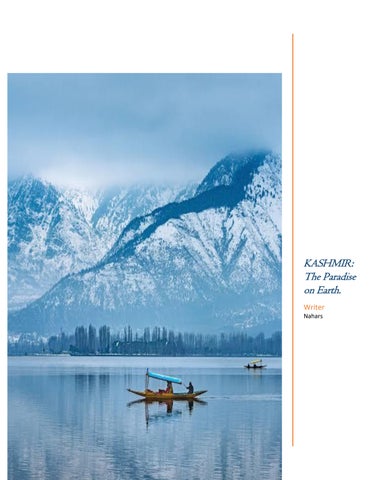
Kashmir: The Heaven on Earth Kashmir is an alpine valley known as “Paradise on Earth” due to its snow-capped Himalayan peaks, mirrored lakes, and rich heritage.Kashmir is a region situated between India and Pakistan in South Asia. It is believed that the name Kashmir originated from the word ‘Ka’ which means water, and ‘shimera’ to desiccate. Kashmir is a region that has a rich history and ancient roots. The place has witnessed the rise and fall of many dynasties, such as the Mauryas, Kushnas, and Guptas. On top of that, these dynasties contributed to the cultural and geographic location of Kashmir, which includes the influence of the Silk Road and the blend of Hindu, Buddhist, and later Islamic influences.Kashmir is famous for Dal Lake, Pashmina Shawls, beautiful Mughal gardens and pilgrimage sites of Amarnath and Vaishno Devi.
KASHMIR: The Paradise on Earth. Writer Nahars
Article 370 Scrapped
Geographically, Kashmir lies in the northwestern region of the Indian continent. Its total area is around 225,000 square kilometers, which is comparatively larger than the member countries of the United States. Out of the total area, 85,800 square kilometers have been subject to dispute between India and Pakistan since 1947. It is important to note that the areas with conflict consist of major portions called the Northern, Southern, and Southeastern portions. The 30 percent of the northern part comprises Azad Kashmir and Gilgit-Baltistan and is administered by Pakistan. India controls the portion which is more than 55 percent of the area of the land. The area consists of Jammu and Kashmir, Ladakh, Kashmir Valley, and Siachen Glacier which is located in the southern and southeastern portions of India. The area is divided by a line of control and has been under conflict since 1972.
Early History of Kashmir Neolithic remains dating to 3000 B.C. have been found north of Srinagar. Kashmir was an important early Buddhist territory. Some ruins of temples are a reminder of this era. The first recognized historical narrative of India, the “Rajatarangini” (“River of Kings”), composed in the mid 12th century, suggests that caste-based Hindu society existed before the arrival of Buddhism and survived under Buddhism and was revived by Hindu dynasties that ruled until the 14th century. Islam was brought to Kashmir by kings and Sufi missionaries from central Asia, Afghanistan and Persia and Turkic incursions in the 11th and 12th century. The Hindus, although not very numerous, were very influential, especially as landowners. The liberal policies of the Mughals gave these Hindus a place in society. Many however migrated out. The valleys of Kashmir have long served as invasion routes for armies that have invaded India. But until the advent of the airplane in the 20th century Kashmir could largely only be reached by foot, horse, camel and elephant. It was connected with the Silk Road. Products like Pashmina shawls made their way to the Middle East, where they made their way to Europe. Sultan Zain-ul-Abidin (1421-1474) is fondly remembered as the great king, the ‘Budshah’ or simply the ‘Badshah’. He ruled over Kashmir for over 50 years and that period is counted as one of the most peaceful times that the region has ever seen.
Sultan Zain-ul-Abidin was the son of Shah Mir, who started the rule of the Mughal dynasty in India in the mid-14th century, when he migrated to India from Central Asia. The sultan was loved and hailed by his people throughout his reign and after the death of his beloved mother, he had the Badshah Tomb built in her fond memory.
Jammu and Kashmir Jammu and Kashmir is a northern Indian state sandwiched between China and Pakistan in the western part of Himalayas. This part of India is known for it lovely streams, gardens, mosques, Sufi shrines, high grazing valleys,cedar forest, golden saffron fields, apple orchards, glacier-cloaked 20,000-foot-high mountains, and violence. The hills contain shrines honoring Shiva and Skakti — the anthropomorphic representations of Hindu Cosmic energy — and each year hundreds of thousands of pilgrims follow some of India’s most sacred pilgrimage routes to reach these shrines.Jammu and Kashmir union territory covers 101,338 square kilometers (39,127 square miles), is home to about 13 million people and has a population density of 56 people per square kilometer. About 27 percent of the population live in urban areas. Srinagar is the capital and largest city, with about 1.2 million people. The area is dominated by a large, central agricultural valley called the Vale of Kashmir, where Srinagar is located.About 57 percent of the population lives in the Kashmir Valley and 43 percent lives in Jammu. About 68 percent of the population is Muslim and 28 percent is Hindu. In the Kashmir Valley, Muslims make up 98 percent of the population. In Jammu, Hindus make up 56 percent of the population. The people in Jammu do not speak Kashmiri and for the most part they are happy under Indian rule. The people of Ladakh, which was part of Jammu and Kashmir but no longer is, are of Tibetan origin. They have traditionally been more worried about being dominated by Srinagar than by New Delhi.
Kashmiris Kashmiris are the Hindu and Muslim inhabitants of Jammu and Kashmir and the Pakistan-controlled areas called Azad Kashmir (Gilgit, Baltistan, and four other districts, all thinly populated). Although the Kashmiri population is divided by religion they are united by a common language and history and until recently had a reputation for being easy-going, tolerant and business minded. The term “Kashmiri” is applied particularly to those who inhabit the Vale of Kashmir, which is the most populous area, and includes over two dozen Muslim and Hindu castes.Kashmiris have traditionally been an independent people separated from the rest of India. Originating from Persia and Central Asia, they have light eyes, fair skin, and hair. They also have their own culture, arts, poetry, architecture, food and style of dressing. The Kashmiri language is an IndoAryan tongue, written with a form of the Perso-Arabic script. It is the major language of
the Dardic Subgroup, and it has a Literature reaching back to the fourteenth-century poetess Lal Ded.According to the “Encyclopedia of World Cultures”: “Although the culture is predominantly Muslim today, prior to the Turkic incursions of the eleventh and twelfth centuries Kashmir was an important Buddhist territory, as some of its temple ruins testify. Later, under the Mughals, music, poetry, architecture, and garden design flourished there. The Hindus, though not very numerous, have been quite influential in the state, especially as landowners.” [Source: “Encyclopedia of World Cultures Volume 3: South Asia,” edited by Paul Hockings, 1992] The vast majority of Kashmiris are Muslims (the remainder are mostly Hindus in the south and Buddhists in the east). In 1990, Muslims made up about 75 percent of the population. Today they make up more due to the fact many Hindus have been driven out of the state. Kashmiris consider themselves to be neither Indian or Pakistani. Although the majority of them are Muslims, they practice Sufism, a mystical and tolerant form of Islam, that is frowned upon in many parts of Pakistan, or are Shia (Shiite) Muslims. The vast majority of Pakistanis are Sunnis.Kashmiri Hindus, known as Pandits, have traditionally lived in relative harmony with the Muslims. Before the troubles there were about 150,000 to 300,000 of them. They were generally better educated and more successful than Muslim Kashmiri. Since they troubles began they have brutally attacked and forced to leave their homes. Many are now refugees.
Kashmiri Food and Cuisine A part of traditional Kashmiri cuisine, wazwan is a 36-course dinner spread that has all meat-based dishes. Its preparation is considered as a point of pride in the Kashmiri culture. Usually served during weddings, wazwan is more than a meal. Feasting on it is almost like a ceremony, in which a group of four people sit on a white sheet and share the meal. Some of the popular dishes served in wazwan are tabak-maaz, which is meat of lamb ribs; daeni phoul, which is mutton meat; waza chicken, which are two cooked halves of whole chicken; Kashmiri methi, which is a stew made of lamb stomach and fenugreek; rista, which are Kashmiri meatballs made in red gravy; doodh ras, which is meat cooked in sweet milk gravy, etc. Mutton Rogan Josh is a popular winter dish. Prepared on a low flame and cooked with a blend of spices, this Kashmiri delicacy tastes best when served with sheermala (sweet bread), naan (leavened bread), roti (Indian flatbread), rice, biryani (layered rice dish) and raita (watered down yoghurt). Rogan josh was introduced in Kashmir by the Mughals in 15th century, therefore, it has some Persian influences as well. Conventionally eaten with rice, the signature non-vegetarian dish of Rogan Josh is a red lamb-based curry dish mixed with ginger, bay leaves, Kashmiri chillies and yoghurt.
Yakhni is a yoghurt-based mutton delicacy with has a creamy texture and is best savoured with rice, along with a cup of kahwah. It is seasoned with cloves and cardamoms. A part of traditional Kashmiri cuisine, Dum aloo is cooked under pressure and garnished with dry fruits. Kashmiri dum aloo is a very popular Kashmiri dish that is made using baby potatoes dipped in a yoghurt-based gravy. It is flavored with dry ginger powder and fennel. Usually served with flatbreads (like naan, roti and tandoori roti), this Kashmiri dish tastes amazing. Tujj, also known as seek-e-tujj, is a barbecue dish, which is prepared by baking or smoking chopped meat pieces over slow burning wood or charcoal. Tujj is simply found in the form of minced mutton, held through steel rods called ‘seekh’ over an iron grill and roasted over red heated bath-e-czini. It is best served with chutney and special Kashmiri bread called lawasa. Yakhni is a traditional Kashmiri non-vegetarian dish that is made using mutton, curd, cardamom, cloves and cinnamon. Yakhni is of many types like its roasted variant, which is a grilled spiced leg of a lamb. Mostly consumed during celebrations, it has a wonderful aroma of spices. A delicacy from Kashmiri cuisine, gushtaba is also known as Kashmiri meat-ball curry. It is the main dish of the multi-course Kashmiri cuisine, wazwan, and is traditionally offered at the end of the meal. It involves minced mutton balls cooked in curd and spices.
Kashmiri Sweets and Snacks Nander monjje is a snack from Kashmir that is made using lotus stems and spices. A fried delicacy, it is traditionally served with Kashmiri onion chutney and tomato sauce. Sewai is a sweet dish served mainly during the festival of Eid. Also known as sweet vermicelli and meethi sewai, this dish is a quick dessert that is symbolic with festivities. It is a preparation of vermicelli in milk and almonds and pistachio mixed in desi ghee (clarified butter). Sheermala is a traditional flatbread that is slightly sweet and flavored with kewra (an extract from the flower of the Pandanus plant) water and topped with sesame seeds. Sheermala is a common delicacy of Awadhi cuisine that has a Mughlai influence. It looks and tastes a lot like Persian saffron bread. Gadde monje is a fish-based dish of Kashmir valley. Deep-fried and coated with spicy flour batter, it is a tasty treat for fish lovers. Its vegetarian counterpart is a dish called Nader monjee, which uses lotus stem instead of fish. Served during festivals and special
occasions, Kashmiri muji gaad is a fish-based dish that is garnished with radish. Gaad is a combination of vegetarian and non-vegetarian items.
Kashmiri Drinks The two must-have tea varieties in Kashmir are Noon chai and kahwah. While the former is made of milk, soda and salt, and is uniquely pink, the latter is a type of green tea made with spices like almonds and walnuts. Kahwa (also spelled kehwa) is perfumed Kashmiri tea. It is often sweetened with a little milk and steeped with cardamom seeds. Sometimes it is a little salty. Sometimes it has saffron, with almonds and cardamom floating in it. Kahwa is a type of traditional green tea consumed in Afghanistan, Pakistan and India. A drink discovered in India and grown in the Western Ghats, Malabar and Kashmir Valley, it has now spread across central Asia. This drink is very popular among Kashmiris and is usually consumed at breakfast with baked Kashmiri girda (bread).Kashmiri noon tea, also known as the sheer cha, gulabi chai, Kashmir tea, or pink tea, is a traditional tea beverage in the valley. Originating from the Indian subcontinent, this tea is world famous for its aroma and taste. Noon tea is usually made up of special type of green tea leaves, milk and baking soda. It is prepared in a special cooking pot known as samavar.