50
68
OUR CHOICE
36
20 CONTENT
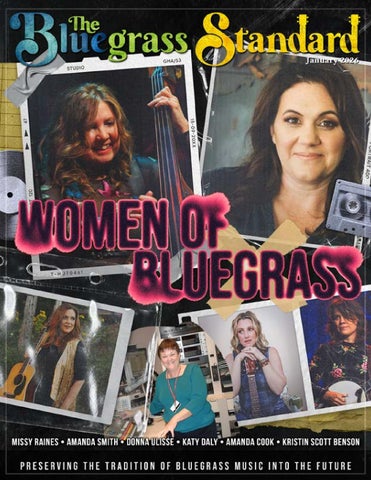
08 AMANDA COOK 14 KATY DALEY 20 LACY MACK 24 KRISTIN SCOTT BENSON 28 MISSY RAINES 36 AMANDA SMITH 44 CLAIRE LYNCH 50 MOLLY BRANDT 56 THE WRITER’S ROOM 60 NORA BROWN 64 WHITMORE SISTERS 68 PEI WINTER BLUEGRASS FESTIVAL 72 APPALACHIAN BREWERIES 74 FAN PHOTOS 80 DONNA ULISSE
Keith Barnacastle • Publisher The Bluegrass Standard is a life-long dream of Keith Barnacastle, who grew up in Meridian, Mississippi. For three years, Keith brought the Suits, Boots and Bluegrass Festival to Meridian. Now, with the Bluegrass Standard, Keith’s enthusiasm for the music, and his vision of its future, reaches a nationwide audience every month! Keith@TheBluegrassStandard.com
Our Staff Richelle Putnam • Executive Editor/Writer
Richelle Putnam holds a BS in Marketing Management and an MA in Creative Writing. She is a Mississippi Arts Commission (MAC) Teaching Artist, two-time MAC Literary Arts Fellow, and Mississippi Humanities Speaker. Her fiction, poetry, essays, and articles have been published in many print and online literary journals and magazines. Among her six published books are a 2014 Moonbeam Children’s Book Awards Silver Medalist and a 2017 Foreword Indies Book Awards Bronze Medal winner. Visit her website at www.richelleputnam.com.
Rebekah Speer • Creative Director
Rebekah Speer has nearly twenty years in the music industry in Nashville, TN. She creates a unique “look” for every issue of The Bluegrass Standard, and enjoys learning about each artist. In addition to her creative work with The Bluegrass Standard, Rebekah also provides graphic design and technical support to a variety of clients. www.rebekahspeer.com
Susan Woelkers • Marketing
Susan traveled with a mixed ensemble at Trevecca Nazarene college as PR for the college. From there she moved on to working at Sony Music Nashville for 17 years in several compacities then transitioning on to the Nashville Songwritrers Association International (NSAI) where she was Sponsorship Director. The next step of her musical journey was to open her own business where she secured sponsorships for various events or companies in which the IBMA/World of Bluegrass was one of her clients.
Susan Marquez • Journalist
Susan Marquez is a freelance writer based in Madison, Mississippi and a Mississippi Arts Commission Roster Artist. After a 20+ year career in advertising and marketing, she began a professional writing career in 2001. Since that time she has written over 2000 articles which have been published in magazines, newspapers, business journals, trade publications.
Mississippi Chris Sharp • Reviewer
Singer/Songwriter/Blogger and SilverWolf recording artist, Mississippi Chris Sharp hails from remote Kemper County, near his hometown of Meridian. An original/founding cast member of the award-winning, long running radio show, The Sucarnochee Revue, as featured on Alabama and Mississippi Public Broadcasting, Chris performs with his daughter, Piper. Chris’s songs have been covered by The Del McCoury Band, The Henhouse Prowlers, and others. mississippichrissharp.blog
Brent Davis • Contributor
Brent Davis produced documentaries, interview shows, and many other projects during a 40 year career in public media. He’s also the author of the bluegrass novel Raising Kane. Davis lives in Columbus, Ohio.
Kara Martinez Bachman • Journalist
Kara Martinez Bachman is a nonfiction author, book and magazine editor, and freelance writer. A former staff entertainment reporter, columnist and community news editor for the New Orleans Times-Picayune, her music and culture reporting has also appeared on a freelance basis in dozens of regional, national and international publications.
Candace Nelson • Journalist
Candace Nelson is a marketing professional living in Charleston, West Virginia. She is the author of the book “The West Virginia Pepperoni Roll.” In her free time, Nelson travels and blogs about Appalachian food culture at CandaceLately.com. Find her on Twitter at @Candace07 or email CandaceRNelson@gmail.com.
Jason Young • Journalist
A Philadelphia native and seasoned musician, has dedicated over forty years to music. Starting as a guitar prodigy at eight, he expanded his talents to audio engineering and mastering various instruments, including drums, piano, mandolin, banjo, dobro, and bass. Alongside his brother, he formed The Young Brothers band, and his career highlights include co-writing a song with Kid Rock for Rebel Soul.
Stephen Pitalo • Journalist
Stephen Pitalo has written entertainment journalism for more than 35 years and is the world’s leading music video historian. He writes, edits and publishes Music Video Time Machine magazine, the only magazine that takes you behind the scenes of music videos during their heyday, known as the Golden Age of Music Video (1976-1994). He has interviewed talents ranging from Ray Davies to Joey Ramone to Billy Strings to Joan Jett to John Landis to Bill Plympton.
by Susan Marquez
Donna Ulis 8
January 2026 • www.thebluegrassstandard.com
sse
She’s an award-winning singer, songwriter, teacher, and bluegrass ambassador. The multi-talented Donna Ulisse has had a career in music that has spanned decades, and her talent, perseverance, and passion have earned her respect in the world of bluegrass and country music. Born and raised in Hampton, Virginia, Donna grew up surrounded by music. “My dad loved the Osborne Brothers, and I have vivid memories of him flying down country roads when I was very young, singing at the top of his lungs.” Another childhood memory goes back to when Donna was just three years old. “I grew up in a large Italian family that celebrated everything. I remember my dad hired a band for a party they had, and when the band took a break, I climbed up on the stage and began singing ‘Take This Hammer’ into the microphone. The band returned and started playing backup for me.” By the time she was ten or 11, Donna says her dad bought a steakhouse. “He said he did it so I’d have a place to sing.” She sang on weekends with a house band. When she was 15, Donna began performing with Jimmy Caldwell. “I cut my teeth with that band.” Donna credits her high school choir teacher, the late Barbara Davis, for teaching her to sing correctly. “She recognized my talent, and because of her, I learned so much that I still use when I perform today.” Donna recalls when Davis surprised her at a performance in Hampton. “When I realized she was in the audience, I broke down in tears on stage. I was finally able to tell her how much I appreciated what she taught me.” Songwriting is Donna’s passion, and in 2014, she published a book, The Songwriter in Me: Snapshots of My Creative Process. “It took me 45 years to learn songwriting, and it felt great to pass that knowledge on.” The book still sells well, and now Donna is working on a follow-up. “It’s about 95% finished. This book is a little more intense – it gets into the nuts and bolts of writing.” When she was a child, Donna wanted to be a teacher. “I used to play school with my three younger brothers. I always thought I’d love to be a teacher, but I loved music more.” Today, she combines those skills with the songwriting workshops she holds at her “Wee Farm” in Lebanon, Tennessee, inspiring a new generation of songwriters and musicians. Donna is married to Rick Stanley, whom she met when she was 15. “Because I was my dad’s only daughter, he went with me everywhere. I was playing at a talent show, and Rick was 9
the bass player in the band. I was watching him, and my dad asked why I was staring at that boy. I told him that I was going to marry him and iron his pants.” While their paths crossed fairly often, Donna was not on Rick’s radar until she was about 20. Today, the couple writes songs together, and Rick plays in Donna’s band. The couple moved to Nashville shortly after marrying, and Donna got a deal with Atlantic Records. Her debut album, Trouble at the Door, was released in 1991. She has since released many more albums that showcase her love of narrative and tradition. “I’ll do a cover from time to time, but it has to be a song that has special meaning to me.” Donna says she writes many of her songs when visiting her mother-in-law’s cabin in the Clinch Mountains. “Sitting in that cabin on Honey Camp Road, there isn’t much else to do. There is no cable TV, no cell service, and I am not a big hiker. So, when everyone is gone, I write about what I see. I write a lot about mountains. It’s a great place to work and I’m always inspired there.” Her peers have recognized Donna’s work, and she has received many awards over the years. She received her first International Bluegrass Music Association award for Songwriter of the Year in 2016, followed by the 2017 IBMA Song of the Year with “I Am a Drifter,” co-written with Marc Rossi and recorded by Volume Five. Donna is as busy as ever. She signed with Turnberry Records last fall. “I’m working on a new project now,” she says. “It’s my first project for Turnberry and the first project I’ve self-produced. That experience has made me realize what a luxury it is to have a producer sitting behind the glass.” The project will be released in Spring 2026. In the meantime, Donna is busy starting a new publishing company with Doyle Lawson. They are co-COO’s of Tall Oaks Publishing, under the Turnberry umbrella. (Look for more information in the February issue of The Bluegrass Standard.) “We are super excited about it,” she says.
10 January 2026 • www.thebluegrassstandard.com
11
12 January 2026 • www.thebluegrassstandard.com
13
by Susan Marquez
AMANDA 14 January 2026 • www.thebluegrassstandard.com
DA COOK 15
16 January 2026 • www.thebluegrassstandard.com
Amanda Cook works all sides of the music industry, stepping in and out of various roles with ease. She is a talented musician, engineer, and label executive. But in the end, it’s all about the music. Growing up in Pensacola, Fla., Amanda was surrounded by music. “My mom was always playing music – in the car, in the house, and she loved to sing. I listened to strong female singers like Stevie Nicks and Christine McVie of Fleetwood Mac, and Linda Ronstadt.” On the other hand, her dad was a lover of traditional bluegrass. “He always had bluegrass playing in his vehicle. And he always loved to sing – he was in bands throughout my lifetime and performed all over the Southeast.” Amanda’s formal music training came from playing flute in the marching band at school. In her early twenties, Amanda decided to participate in a karaoke contest. “My husband begged me not to do it,” she laughs. “I did it anyway, and I made it through the rounds. My dad came, and afterwards, he said we needed to start a bluegrass band.” Her dad, Mike Blanton, bought Amanda a mandolin and told me to learn how to play it. “I did, and I did the same thing with the bass. It was trial by fire, but I knew all the songs, because I had listened to them in the car with my dad my whole life.”
Mark Hodges offered me the role of sound engineer-in-training in 2018, and we moved to Virginia in 2019. I began engineering and producing full-time after the move.” Her first project as an engineer was for Sweet Potato Pie, an all-female band from North Carolina. “Then COVID happened. But I came in every day and worked. I learned that I enjoy the production side. I had already produced my own vocals.” Today, she is Mountain Fever’s Chief Operating Officer and her band’s fifth album, Restless Soul, was released in October 2024. All the singles from the album achieved top ranking play on SiriusXM and made the Bluegrass Today charts. “I think we all have a maturity now, and we like to try things that are out of our comfort zone.” Putting an album together is an art, and Amanda says she thinks about a lot of things when she works on the song list for her albums. “I try to group songs so that there aren’t too many slow songs, or too many fast ones. We also look for songs we can make our own – we try not to put things in boxes. I look at the flow from the perspective of the listener.”
While she loves to be behind the scenes, Amanda says the 45 minutes she and her band spend on stage are the best. “All the The band was called High Cotton, and it work we have done goes into getting that became a learning ground for Amanda. “I 45-minute high. The audience’s feedback is learned to sing harmony and about stage everything.” presence.” The standards, like Flatt and Amanda was selected to participate in the Scruggs, influenced the band. “I remember 2024 IBMA Leadership Bluegrass program, my dad gave me a copy of the Bluegrass and she says that being in a room with Album Band, and said, ‘Here, learn this.’” people from all aspects of the business was Amanda formed The Amanda Cook Band, a great experience. “They were all highly eleven years ago. She signed a five-album professional and very motivated to carry on contract with Mountain Fever Records. “My our genre of music. It was humbling. In the first project with Mountain Fever was On end, I’m a label executive and an artist. I’m Deep Water. My interest in sound engineering nerdy and geeky, and those were my people.” began after recording our second project at Mountain Fever – Point of No Return. 17
18 January 2026 • www.thebluegrassstandard.com
19
by Susan Marquez
Katy Daley
If you’ve attended the IBMA awards over the past several years, you’ve heard Katy Daley’s voice. She announces the nominees for the annual awards show. But last year, she stepped from behind the microphone to the spotlight when she was inducted into the IBMA Bluegrass Music Hall of Fame. When she started working on the radio, Katy had never dreamed of such accolades. The Washington, DC native went to college in Brevard, North Carolina. “Everyone there was born with an instrument in their hand, and they were all dancers and cloggers. On the weekends, students without dates spent time in the dorm lobby for hootenannies. They didn’t call them that, but it’s essentially what they were.” She returned to Washington to earn a BA in communications. Katy says she had never heard of the term “bluegrass” before returning to Washington. Looking back, she says her natural progression towards bluegrass began when her dad sang songs to Katy and her brother before bed. “He sang gruesome songs like ‘Wreck of the Old ‘97’ and ‘The Prisoner Song,’ yet we never had bad dreams. By the way, ‘The Prisoner Song’ was the first million-selling country music song.” When her father was stationed in Okinawa while in the military, Katy listened to “The Rice Patty Roundup” on Armed Forces Radio. “A song came on one day – ‘Pike County Breakdown.’ It was like a bolt of lightning,” says Katy. “I had never heard anything like it.” After college, Katy listened to Gary Henderson’s Saturday morning bluegrass show on WAMU. Washington had a thriving bluegrass scene, and Katy volunteered to compile and announce the area’s concerts, club dates, and festivals on Gary’s show. That volunteer gig launched her career in broadcasting. Each thing Katy did led her to the next thing, and over the years, her storied broadcasting career has taken her to extraordinary heights. She took over the 10 p.m. to midnight spot at WAMU and then alternated the afternoon drive-time show with Jerry Gray. In addition to getting to know the community of bluegrass musicians and fans through her work at the radio station and volunteering at events, she began a lifelong practice of teaching others. She encouraged fans to share their personal record collections and taught those interested how to run a control board and host a show on-air. “I have taught a lot of people how to do radio over the years.” Katy left public broadcasting in 1979, moving to WMZQ-AM/FM, Washington’s commercial country station. In her nearly two decades there, she worked as an overnight DJ, program director of the AM station, public affairs director, and member of the on-air morning team. In 1991, she produced a documentary on Arlington National Cemetery that received an honorable mention at the International Radio Festival in New York. In 1994, she won the Achievement in Radio (AIR) award for best mid-length interview of the year. In 2006, Katy returned to WAMU’s 24-hour streaming station, bluegrasscountry.org. The following year, she took over the weekday morning show and remained there for a decade. She followed that with a writing gig for Bluegrass Today and launched the Bluegrass Stories 20 January 2026 • www.thebluegrassstandard.com
21
Join us for the 11th annual St. Simons Island Storytelling Festival February 13 - 15, 2026
Relive past times and celebrate the best of humanity in the joy-filled space of story. You will laugh, you will cry and you will discover how very alive you can feel!
Storyteller Line-up: • Andy Offutt Irwin - Our beloved Emcee for our festival and Storyteller,
humorist, musician, public speaker, educator, whistler, show-off. • Donald Davis - His long career as a storyteller and his promotion of the cultural importance of storytelling through seminars and master classes has led him to be dubbed the “dean of storytelling”. • Milbre Burch - GRAMMY-nominated spoken word recording artist, an internationally known Oracle-Award-winning storyteller, and a sought-after teaching artist. • Bil Lepp - Award-winning storyteller, author, and recording artist. He’s the host of the History Channel’s Man Vs History series.
• Sheila Arnold - Master Storyteller, Historic Character Interpreter, Teaching Artist. She has a talent for storytelling, a passion for history, and compassion for people.
Registration and Schedule: www.StSimonsIslandStorytellingFestival.com 22 January 2026 • www.thebluegrassstandard.com
podcast with Howard Parker. A Lifetime Member of the IBMA, Katy is a 2008 Leadership Bluegrass class graduate. She was named the IBMA Broadcast Personality of the Year in 2009 and 2011. In 2019, she picked up the IBMA Distinguished Achievement Award. She was also awarded the 2019 and 2020 IBMA Liner Notes of the Year honor for her contribution to Epilogue: A Tribute to John Duffy for Smithsonian Folkways, and as the sole writer for Rebel Records’ re-release of Seldom Scene Recorded Live at the Cellar Door. She recently joined the Board of the IBMA’s Bluegrass Foundation. With a mission to build a brighter future for bluegrass music, the Foundation “helps create a bluegrass legacy by supporting programs and projects that focus on bluegrass music-related arts and culture, education, literary work, and historic preservation,” according to their website. It’s an organization Katy is passionate about. “We award numerous scholarships and grants. I can see that it genuinely makes a difference. I encourage everyone to visit bluegrassfoundation. org to learn more about the organization. While she may be retired from radio, Katy is as busy as ever. She has learned to play the banjo and is now taking guitar lessons. In addition to her work on the Bluegrass Foundation Board, she started the Katy Daley Broadcast Media/Sound Engineering Scholarship with her husband, Bill Brown. “When our son finished his academic career, we found ourselves with a little extra money, so we started the scholarship. We want to help those interested in learning more about broadcasting or sound engineering. There are plenty of schools for musicians, but the sound engineers are a real partner with the musicians. And the broadcasters play their music for the world to hear. For bluegrass to be successful, it takes three things: music, business, and community. You can’t have one without the others.”
23
by Susan Marquez
LACI MACK Some photographers frame shots. Laci Mack frames moments — and in bluegrass, that’s the difference between a picture and a piece of history. You can spot her in the shadows at the Grand Ole Opry, in the corner at the Ryman, or tucked against a wall at the Station Inn, silent as a prayer until the shutter cracks like a snare hit. Then she’s gone again, already hunting the next frame. “Patience is everything,” she says, and you believe it, because in her photos you can see the patience baked into every angle — the waiting, the watching, the exact millisecond when the bow arcs across the strings and the crowd leans in, breath held. She didn’t learn this from a book or from a classroom. Laci grew up around music, the daughter of East Tennessee’s bluegrass and old-time scene. She didn’t just listen, she played. She was on stage with her band, feeling the lights, the nerves, and the energy rising in waves. “Playing bluegrass growing up and getting to be on stage with my own band definitely set the tone for how I see my shots,” she says. “Being in that moment, feeling the energy, plus watching us just lose ourselves in the music, stuck with me. So, when I started shooting full-time, I wanted to bring that same feeling into my photos. I want you to feel like you’re right there on stage with the band, plus I enjoy focusing on each member separately for what they bring to each group. I go for a lot of tight shots, weird angles, and little moments that make it feel real, because that’s how it feels when you’re actually living it.” That’s the root of her work: not the perfection of the pose, but the imperfection of reality, the kind that breathes. It’s the sideways glance between bandmates, the bead of sweat that clings to a fiddle player’s temple, the instant when the bass player’s foot stamps just as the crowd claps. Laci has learned that to catch these, patience is the key. And that philosophy doesn’t change whether she’s at a dusty festival in July or inside the sacred wood of the Opry stage. “Especially in legendary venues like the Opry, the Ryman, or the Station Inn, where the history is so powerful,” she explains. “When working with bands, I do a lot of prep. I learn the set list and the breakdown of each song, I walk the venues and really try to feel out the vibe of the area. It’s about knowing when to step in and when to let the moment breathe. Not just at iconic venues, but anywhere a band plays, patience for the band, for the crowd, and for the shot is key. I like to quietly observe and be ready. My goal is to add to the comfort of the situation. Be patient, be discreet, and let the moments happen naturally. Sometimes I’m right up front in full view of hundreds of people, other times you’ll never even spot me, but either way I’m doing my best to capture the real energy without disrupting it.” 24 January 2026 • www.thebluegrassstandard.com
25
26 January 2026 • www.thebluegrassstandard.com
Last year (2024), her work got a nod from the highest level when she was nominated for the IBMA’s first Photographer of the Year award, validating that her work is not just decoration, but documentation. “First off, I was super stoked to hear that a Photographer of the Year category was even coming out, along with the other new categories through IBMA,” she says. “To be nominated alongside my fellow nominees in the very first running was incredibly humbling. Overall, I was happiest to see photography being officially recognized as part of bluegrass history. It’s more than just pictures; it’s the archive of our music. Growing up and traveling to festivals, I was obsessed with old photos I’d see. One-off artists collaborating, backstage moments, people just shooting the breeze and doing what they loved. That’s why that first nomination means so much to me. I feel blessed to be nominated again this year (2025). If I ever needed recognition, it would be enough to know that in 50 or 60 years, people will look back at my photos and remember the good times the same way I did with the ones that inspired me.” Today, her camera lens is also pointed toward something new: Little Sugar Creek Farm (LSCF) in Thorntown, Indiana. Forty acres of Boone County earth, first worked in the 19th century, now getting a second life as a hub for bluegrass music, events, and even a new record label. Laci is their official photographer. “It’s exciting and nerve-racking—but in the best way,” she says. “I still get to do things as I’ve always done as Laci Mack, Photographer, but now I’ve got an incredible company supporting me. LSCF has many phases in place to grow over the next few years. I’ve been tasked with their Hopeless Holler Trading Company. This is their new merch company that just launched in August of this year (2025), providing bluegrass merch to bands, festivals, music lovers, and everyone in between. They are currently sponsoring with the Grascals and the Po Ramblin’ Boys, so I’m sure you’ll see a lot more about Hopeless Holler on their social media.” She isn’t walking away from her bread-and-butter work — the live music, the stills for albums, the posters that show up taped to light poles before a show. She still loves it all. “I honestly love every project I’m part of, but there’s something about wrapping up a job that just feels good,” she says. “Part of it is being proud of what we pulled off, and part is being fired up to jump into the next one. I started with a focus on festivals and live music, and that’s still where I feel most at home. I find it to be the perfect mix of bluegrass life, good people, and catching those little moments you can’t plan for.” And maybe that’s what makes her photos feel different — they’re not just about what the audience saw but about what being there felt like. And if you’re in the audience and you catch her in your peripheral vision, quiet and steady, you might want to hold still. You’re about to become part of the archive.
27
by Stephen Pitalo
KRISTIN SCOTT BENSON Grace, Gratitude, and Lessons for All: We Should All Be Living Life Like Kristin Scott Benson
“I grew up in Union, South Carolina,” she recalled, “and the first banjo I got, I was about nine. We’d only had it a month or two, and our house burned down.” It’s the kind of memory that could have ended a childhood dream, but for Kristin Scott Benson, it simply began another story. “The first thing that I remember well — you know, small towns can be so special. I remember how sweet the town was to us when it happened. I remember going back to school, and all these kids were bringing clothes and shoes and coats and everything, so it was that immediate, we had nothing except what we had on when we left, which was in the middle of the night.” When you talk with Benson, she sounds exactly like the kind of person you hope a worldclass musician would be: humble, thoughtful, and quietly grateful for the life she’s built around the banjo. She’s a seven-time IBMA Banjo Player of the Year, a recipient of the Steve Martin Prize for Excellence in Banjo and Bluegrass, and a 2024 inductee into the American Banjo Hall of Fame. But none of that has changed how she speaks — with honesty and warmth, grounded in her work and her faith. She’s a lightning-quick picker who’s a teacher at heart; Benson holds herself with the calm and grace of a legend who shrugs at high praise while also embracing gratitude. It’s also that sense of kindness she experienced after the fire — people showing up when you need them most — that may reveal the reason she’s spent so much of her life giving back through teaching, passing on what she’s learned with the same generosity she once received. “I probably played the first song on the banjo maybe two or three months after I started. And by six months, I was ready to play in jam sessions and that sort of thing. I was about 13 when I got a full-size real banjo and started playing. Once I started playing the banjo, I just became obsessed.” Her obsession became a lifelong career. In an industry that has historically underrepresented 28 January 2026 • www.thebluegrassstandard.com
29
women in instrumental roles, Benson has more than earned her place alongside today’s most outstanding performers of bluegrass. Her technical mastery rivals anyone holding a five-string today — male or female — and her command of tone and timing has become a benchmark for aspiring players. She has shattered stereotypes not by talking about them, but by playing circles around them. Additionally, she’s one of the most respected teachers in bluegrass, known for her patience, her encouragement, and her ability to meet each student where they are. “If I’m home for the full length, I teach Monday through Thursday, anywhere 15 to 20 hours a week,” said Benson of her typical teaching time. “However, with the scheduling and the follow up work, if you teach 20 hours a week, you’re probably spending 25 hours a week on it. But that has become special to me because like any other job, you get better at it. And most people burn out teaching. They can’t sustain that for years and years. The way I’ve sustained it is by caring about these people. You want them to progress and do well, so you care about the person and then suddenly it’s a labor of love instead of just a labor.” It’s a simple philosophy, but one that explains her endurance. She doesn’t see teaching as routine or transactional; it’s relational. Every student becomes a story, every lesson a small act of faith in someone’s potential. Conversely, everyone has a challenge to overcome, and the love of the craft has to emerge for the talent to surface. “For my adult students, it tends to be memory,” said Benson of the common issues that arise in instruction. “That’s the toughest part. For the kids, it really just depends on them. If they’re really motivated, they can just soar right away. And I’ve had some who have done that. They’re phenomenal musicians and they’re gonna set the world on fire as they continue to age and get better. But I just say to mom and dad, can you make yourself love something? Even if the kid would like to love it, that would make their parents happy, but maybe they don’t love it. You have to trust that we can’t make ourselves love something, or dislike something we love, so you just trust that instinct. What is the desire of their heart? Just put the energy behind that.” As the longtime banjo player for The Grascals — one of the most awarded and beloved bands in modern bluegrass — Benson has been a cornerstone of the group’s sound since 2008. Her crisp rolls, impeccable timing, and emotional restraint define much of the band’s signature style, anchoring the music with a sense of purpose and joy. In a band filled with powerhouse players, she’s never simply “the female banjo player.” She’s the banjo player — and many of her peers would say, one of the finest working today. As for band fatigue, she said that one can start to play on autopilot if you’re not the type that improvises every night and changes the set list daily, so on those few occasions, she can reset with good old band shenanigans. “Our set list is relatively the same with a few changes over time, but I think the elements that I respond to, the camaraderie with the guys in the band personally, that can be fun every night, because it’s different every night. Somebody messed up, and you can get a rise out of that, and take great enjoyment in their failure (laughs). That kind of fun stuff that goes on in bands where we give each other a hard time, that stuff helps it stay fresh.” 30 January 2026 • www.thebluegrassstandard.com
31
32 January 2026 • www.thebluegrassstandard.com
Her humor is as sharp as her timing, keeping her grounded through the endless repetition of touring life. Even in routine, she finds community. “I’m incredibly grateful for those awards. They’re a mystery to me. They truly are a mystery to me. But I’m grateful and will very humbly give the credit to, I’m a Christian. I just really thank the Lord for those kinds of blessings in my life. But ultimately, it’s just about playing the banjo, and I am so blessed that Wayne is my husband, and we’re professional musicians. We have steady work. There’s always a steady stream of what’s next.” That partnership has extended far beyond marriage — it’s a musical collaboration of equals. Kristin and Wayne’s acclaimed duo album Pick Your Poison showcased their intricate interplay and shared musical intuition. Their chemistry on that record, as well as on stage, reflects both their technical precision and their deep personal connection. “I taught lessons today,” Benson revealed. “As soon as you and I hang up I’m proofreading tabs for a book that I co-wrote with Bill Evans called 25 Great Bluegrass Banjo Solos. It’s amazing, and I think that each player gets 25 players, 25 solos, and they get about 2,500 words a piece. So this was a big endeavor that’s finally about to come out.” Even when she’s home, she’s creating, writing and editing, but gratitude keeps her from feeling jaded, as does the look in a student’s eye when they really just want to play. She knows that look better than anyone, but more as a player than a teacher. “Honestly, I can say this, and I’ve said it before, that I’ve never picked up the banjo and not wanted to play it. I’ve certainly not wanted to get in the car and drive all night to meet the band at four in the morning. I’ve certainly wanted to be home more or wanted to be gone more, in some stages of life. All of those things ebb and flow, but I’ve never in my life picked up the banjo and not wanted to play it.” Her voice softens when she talks about her older students — people learning music for the joy of it, not the spotlight. For Kristin, that’s where the meaning lives: not trophies or accolades, but in the connection between players, and between player and instrument. “The kids are special to me even at the camps I teach. I think after you become a mom, that’s just how the world works for you. You see kids with a totally different lens. But I just think they’re so precious, and when you get a kid who’s interested in banjo, there’s automatically a kinship there because it’s not a popular thing to be interested in. Also, I have a heart for the very young and the very old. I’ve had students who started playing banjo in their sixties and seventies. And I love that too, because first of all, neurologically, it’s incredibly healthy. It’s like learning a language. So rather than deciding that you’re gonna start learning German to stay sharp or doing the New York Times crossword puzzle, you can play an instrument.” As for her legacy in this bluegrass world, Benson is, as expected, much more modest than a player as talented as she should be. “I know where I stand musically, and I’m not the kind of generational player that’s gonna 33
stamp the instrument indelibly, like Bela Fleck or Earl Scruggs,” she said. “I think the most important legacy I guess you would say that I might have is how I’ve been able to pour that into students, because if they can play the banjo and enjoy it, and I have a part in it that’s pretty special: just affecting people’s lives by enabling them to play this instrument that I love so much.”
34 January 2026 • www.thebluegrassstandard.com
35
by Susan Marquez
36 January 2026 • www.thebluegrassstandard.com
Missy Raines 37
38 January 2026 • www.thebluegrassstandard.com
When Missy Raines plays on stage, she doesn’t just want people to hear her songs; she wants them to feel them. Each song she plays has special meaning; from the songs she has written to the ones she has carefully chosen. Love and Trouble, her most recent album with her band, Allegheny, is described on her website as “views from the highest peaks of her native West Virginia and from the deepest hollers of heartbreak.” The ten songs come to life with people, places, and stories that have caught her heart during her five-decade journey with bluegrass and beyond.” Growing up in Short Gap, West Virginia, Missy Raines’ parents were avid bluegrass fans and supporters. “They listened to early country music and bluegrass before I was born,’ she says. My dad bought a bass for himself – he wanted to learn to play.” He wasn’t the only one. Missy played other instruments, but she learned to play the
39
40January 2026 • www.thebluegrassstandard.com
bass when she was ten years old. She learned to play from neighbors and friends and participated in jam sessions at bluegrass festivals. “I have always been attracted to the bass,” she says. “When I played guitar, I didn’t feel like I was a contributor,” Missy said. She still plays her daddy’s bass. By the time she was 12 or 13, Missy began playing with bands in the area. “I played in bars where I wasn’t old enough to go to on my own, but we always had folks looking out for us.” She continued to play throughout junior high and high school. “I played just about any gig that opened up,” she laughs. “Sometimes I was thrown into a situation where I had to learn on the fly, and that helped me craft my ear for music.” She also had some strong mentors along the way. When she graduated from high school, Missy knew that music was what she wanted to do. “I naively thought it would be more of the same as what I had been doing throughout high school.” She left West Virginia and moved to Charlottesville, Virginia, where she spent ten years. She played for four years with Bill Evans’ band, Cloud Valley. “I learned so much while I
41
was there, and I gained so much experience.” Wanting to further her music career, Missy moved to Nashville on May 12, 1990. She recorded her first album, My Place in the Sun, in 1998, the same year she first won the IBMA Bass Player of the Year award. Since then, Missy has received the award nine more times—she is the most awarded bass player in the industry. She has recorded five more albums under her own name and many more for other artists, including duo albums with Jim Hurst. She is a GRAMMY nominee for her 2018 album, Royal Traveller. “I started writing more seriously around 2011 or 2012. On my album, Inside Out, I wrote the title track and another instrumental for my dad called ‘Ides of March.’ Words took longer for me, but now I try to write all the time.” Missy says she is inspired by anything and everything. “It can be something I see, so I’ll make a note. Or it may be a phrase, a sentence, or even a word. I love to listen to people talk. I think that’s what’s resonating with me most at this time. Often, I write about what is on my heart and mind that I’d like to pursue.” Missy is inspired by people who creatively tell their stories. “I enjoy Tim O’Brien and Sierra Hull – both are doing great writing. I’m also listening to an artist from Kentucky, S.G. Goodman. She is not a bluegrass artist but has strong Appalachian roots.” Goodman received the 2023 Emerging Artist of the Year award from the Americana Music Association. “I’m so inspired by her writing. It resonates strongly about what she believes in, and it’s a very real look at life.” Teaching others her craft has been important to Missy. “I taught for the first time around 1998 and love it. I have taught at various camps and workshops for years. In 2010, I was asked to start an online bass school for ArtistWorks.” Missy created the curriculum and likes that those classes have a much larger reach. “I have students worldwide, and I love to help them and see them so happy.” She is currently an artist-in-residence at East Tennessee State University. It’s a 250-mile drive from her home to the campus in Johnson City. “I’ll be doing that for the next year,” she says. It’s been a wonderful opportunity for me to stretch myself, which is always a good thing.” Seeing musicians she taught as a child grow into artists who keep growing and learning is rewarding for Missy. “It always surprises me.” Currently, Missy is getting ready to “try to be creative for what’s next.” She is actively touring and teaching. “I’m also writing, sometimes at home, but I always like to go to other places to write.” A member of the first class of IBMA’s Leadership Bluegrass, Missy says that experience allowed her to understand what other people at her level are doing. “I think it creates a mindset of excellence. It’s something I highly recommend.”
42 January 2026 • www.thebluegrassstandard.com
43
by Susan Marquez
Amanda Smith While she’s half of the award-winning duo Kenny and Amanda Smith, Amanda is a powerhouse on her own. A native of Davisville, W. Va., she has been singing since she was eight. “I sang in church. My mama always sang, so I sang with her. My daddy got me an autoharp that I played and sang to, and my mama encouraged me to sing in church, so I did.”
called me the next morning.”
Kenny was in the studio cutting his first album with Lonesome River Band, so the couple didn’t start dating until a month later. “I remember our first date. We went to the movies, then to my parents’ house. We sat on the couch and neither of us knew what to talk about. I finally asked if he wanted to pick, and he said yes.” They married By the time she was in junior high, Amanda on November 16, 1996, and they’ve been had won talent competitions and was singing picking together ever since. at local events. “I learned to play guitar in high school,” she says. “I’m fortunate because my parents listened to all kinds of Kenny and Amanda sang in churches, music, so I was exposed to a lot early on.” and when they made a CD for family and friends, WDVX radio station and soon other DJs began to play it. Without trying, they Amanda’s first taste of bluegrass was were on the charts at #26. “We decided that playing guitar and singing at an auction barn maybe that was our sign to get serious about where folks picked in the parking lot. But a band,” laughs Amanda. the person who really got her attention was Alison Krauss. “I was driving home from work and heard her sing ‘New Fool’ on the Now they are “nine or ten” albums in and radio. I went straight to the mall and bought still going. “We are working on a new one now. We have half the album cut and the CD. I was mesmerized.” we’re hoping to get the rest done early this year.” Kenny and Amanda have their own She started attending bluegrass festivals record label. “We record at Gat3 Studio in with her dad in Ohio, Kentucky, and West Charlotte, North Carolina. We’ve cut most Virginia. She met her husband, Kenny, in of our albums there.” 1995 at a Lonesome River Band concert. ”I looked up and said, ‘That’s not Tim Austin.’” It was Kenny, and he got Amanda’s attention. Choosing the material for an album is one of “My mom encouraged me to give him my Amanda’s favorite things to do. “I try to pick cassette.” The cassette was a demo tape that songs that match our sound. We can listen had her phone number on it. “I gave it to to a song and tell if it’s right for us. Lyrics him and told him I’d like his feedback. He are a strong driver, and for me, the melody 44 January 2026 • www.thebluegrassstandard.com
45
46 January 2026 • www.thebluegrassstandard.com
is important because I’m a singer. We are Amanda’s career highlight was when she was so grateful that we’ve had songwriters write nominated for IBMA Best Female Vocalist songs for us. That is something special.” for the first time. “Kenny and I found out we were pregnant with our daughter, Annabelle, after thinking it may not be possible. I kind Amanda says Whitney Houston inspires her. of forgot about the nomination because I “I can’t listen to her albums without crying. was excited about the pregnancy. On awards She is my all-time favorite vocalist. She night, we sat with Barry Bales and his wife, sang with such emotion.” Other artists who Aliceson. Barry leaned over and wished inspire Amanda are Alison Krauss, Rhonda me good luck. I laughed and said I hadn’t Vincent (“she has a great work ethic”), and even written a speech. I was just thrilled to Dale Ann Bradley (“she is always so kind be considered.” When she won, Amanda and encouraging”). “And I can’t forget accidentally let the secret out on stage when Donna Ulisse, who is so talented. She is also she said she was excited for their baby to a good friend.” come. Other artists have been supportive over the years, including Del McCoury (“he is so kind to us”) and Russell Moore (“what a singer”). Andrea Roberts has also been a great supporter. “One of my first albums was with her band, Petticoat Junction. I was fortunate that I got to play a show with them.”
Amanda Smith, known for her powerful and expressive voice, brought her unique style to the partnership with Kenny. Together, their work pushes boundaries in the best ways while continuing to honor classic bluegrass traditions.
47
48 January 2026 • www.thebluegrassstandard.com
BRONWYN KEITH-HYNES ft. Jason Carter
Saturday, Feb. 7
LONESOME RIVER BAND
1 - 7 p.m. | Ocala, FL
Join us for the third annual Brick City Bluegrass Festival in historic Ocala, Florida!
AUTHENTIC UNLIMITED
National & regional bluegrass bands Food trucks Beer & wine for purchase Friendly community atmosphere Bring your own chairs & blankets This event is perfect for both bluegrass fans and newcomers in Central Florida!
Tickets: $30 Advance | $40 Gate
BECKY BULLER & Ned Luberecki
Veterans: $10 | Kids 8 & under: Free! *Taxes and fees are not included in ticket prices.
To learn more and purchase tickets, scan the QR code or visit: ocalafl.gov/brickcitybluegrass
THE FLATTLANDERS
49
by Jason Young
Newgrass Trailblazer Claire Lynch’s Album Reunites Old Bandmates Almost nine years after recording her Grammy-nominated album North by South, Claire Lynch, a three-time IBMA Female Vocalist of the Year Award winner, is back with new songs. “This project is all original. I have either written solo or co-written every song on the album, which is something I have never done,” shares the singer during a recent interview. “I started co-writing when I signed with Polygram Music Publishing on Music Row, and later on with Universal Music Publishing,” recalls Lynch, who was hired as a staff writer by both companies. “When I entered the Nashville world of writing, co-writing was just a thing we all did.” Traveling between the U.S. and Canada left the singer little time for anything else, especially recording, says Lynch, who has been out of the spotlight. “I was touring, and I had two bands. I had a U.S. band and a Canadian band because I had moved to Toronto. It was incredibly difficult to tour in two bands. It was wonderful but tiring.” Like most artists, she was affected by the pandemic. “As for COVID, we had longer restrictions than in the U.S. We were out of commission for three years,” remembers Lynch, who relocated to Ontario with her husband. Lynch hopes to release the album by the end of 2025. “Fans have been asking for more music, plus I have been working with wonderful songwriters. I felt that I had an obligation,” explains Lynch. “I also recorded it as a treat for myself.” [laughs] Lynch feels that touring to promote the album is unnecessary. “I honestly don’t see the point, because I’m not pushing a big career or trying to get tour dates. I’m like, here is my record! “I will warn you that several songs on the album are swing,” shares the former Tennessean. “It’s something I feel, after all these years, I have the privilege of doing. I had people ask me to do a whole swing album for years, but I wasn’t able to because the record company didn’t want me to. “It’s still a Claire Lynch record,” reveals the veteran singer-songwriter. “It’s a mixture—I would call it mostly Americana. There’s gospel, but there are a lot of original songs.” Lynch, who traveled to Ben Surratt’s studio in Nashville to record, enjoyed reconnecting with friends. “It was great! I got to work with Missy Raines, who played with me for many years. It was a wonderful reunion being with her again. And my old bandmates, Jim Hurst and Matt Wingate, were there too. It was like a party! I think listeners are going to be able to feel that on the tracks.” 50 January 2026 • www.thebluegrassstandard.com
51
52 January 2026 • www.thebluegrassstandard.com
53
Not all of the record was recorded in Nashville, explains Lynch, who joined members of her Canadian band—Shane Cook, Joe Phillips, and Darrin Schott—at Casa Wroxton Studios in Toronto. “I also have Andrew Collins, who is a very renowned mandolin player up here [Canada], and Don Rooke,” adding, “He is a lap steel/dobro player but plays alternative music.” Although she misses the people in Nashville, Lynch admits she is happy to be in Canada. “In Ontario, we don’t have as many bugs! I’m in the city, so I have never seen a snake up here [laughs]. I do like the big city. There are also millions of people here with different ethnicities, plus the policemen are friendly. It’s a relaxed society, which is refreshing!” She feels welcomed in Canada. “I found that Canadians appreciate and accept Southerners with a sweet kind of respect.” Passing the torch to a new generation, Lynch likes the direction in which younger musicians are taking the music. “I’m behind them one hundred percent! They are doing cutting-edge stuff, like we [The Front Porch String Band] were in our time. The older people wanted us to keep it their way, without innovation.” Lynch wants to continue writing music. “I would like to stay in touch with friends and fans. I would be happy to pitch songs to other people. As far as money is concerned, there isn’t a whole lot left for songwriters, but as far as the pleasure of sharing, I would like to keep doing it.”
54 January 2026 • www.thebluegrassstandard.com
55
by Jason Young
56 January 2026 • www.thebluegrassstandard.com
Molly Brandt: “All our past experiences are collections of knowledge and artifacts.” Along with a recent engagement to her guitarist and producer Eric Julio Carranza, St. Paul, Minn., singer-songwriter Molly Brandt shares that she and Carranza—who work famously together—have a few treats in store for their fans. For those just getting familiar with Brandt’s music, she has come a long way from writing her first songs during the COVID-19 lockdown. Since then, she has released thirteen singles and two albums, including the critically acclaimed American Saga. Taking home the American Artist of the Year Award twice at the Midwest Country Music Awards (2023– 2024), Brandt swears that she never had lofty goals of “making it”—but making it she is—and that includes new music. “I think not putting pressure on myself helped when I started writing songs. Knowing that your first few songs are gonna be [rough] was helpful,” recalls Brandt. As it turned out, her first few songs not only led to her debut release, 2023’s Surrender to the Night, but also spurred a music career. “I’m working on recording another album right now, which will be called Museum of Being,” shares the Twin City artist. “I’m taking a break in December and January to finish this record and hopefully release it in early to mid-2026.” 57
58 January 2026 • www.thebluegrassstandard.com
The new album will be recorded in the and getting interested in the Library of Alexandria. So, I was utilizing what I have couple’s home studio. read for [‘Museum of Being’].” “It’s not like one of the fancy studios,” explains Brandt, who is psyched about “What the song means to me is a widerecording from the comfort of their home. encompassing term,” shares the songwriter. “It’s working out really well so far. We are “We are all libraries of existence—all our past experiences are collections of knowledge getting really good sounds out of it.” and artifacts.” Now that the couple plans to tie the knot, Brandt says it won’t change how she and She relies more on observation as a Carranza work together. “We already feel songwriter and says the new album will like we are married [laughs]. We work really differ from her previous records. well together. It’s been really great having a “I’m using a lot of inspiration from collaborator like Eric.” current events, my own neighborhood and Carranza is helping to push musical environment, as well as the books I read.” boundaries. Besides building her solo career, she and “He comes from a background of many Carranza plan to launch a new band. different genres and styles, which include jazz, R&B, and rock ‘n’ roll. With our last “We’re starting a new band with a songwriter, album, American Saga, we brought in a lot Jacob Mullis, and his wife, Amy Hager. more synthy sounds and gritty guitar tones.” We are naming it Brandt, Hager, Mullis & Carranza—which is kind of like Crosby, She adds, “We’re working on having Stills, Nash & Young.” some different grooves and maybe some more electronic elements coupled with my The award-winning singer-songwriter shares that they have already begun working Americana/country style.” together. Some music ideas don’t always work, shares “We’ve been writing and recording songs Brandt. together. We have some songs mastered and “If he shows me something that I’m not just did some photos together.” vibing with,” explains Brandt about the rare disagreement, “that’s okay—there’s lots of “Songwriting is new to me, and I feel like it’s other avenues we can go down. I really trust sort of a vulnerable process,” shares Brandt about her insecurity as a songwriter. “So his artistic instincts.” doing it with others requires a bit of bravery. The album and title song, “Museum of I feel like working with Hager and Mullis has been helpful.” Being,” came out of nowhere. “We were trying to come up with a name Brandt is looking forward to staying creative for our studio. I think the name “Museum of as an artist. Being” just popped into my head, which is “I’m really into pop music lately, especially not usually how things work with me.” girl pop music like Chappell Roan, Charli An ardent reader, Brandt might have found XCX. There are no rules—I want to write a pop song next—let’s go!” the inspiration in a book. “I got a library card about a year ago. I’ve been reading about the history of libraries 59
Looking Ahead... A New Year of Opportunities Happy 2026! This year marked the latest in an unbroken string of midnight countdowns that I wasn’t invited to perform on “Dick Clark’s New Year’s Rockin’ New Year’s Eve With Ryan Seacrest.”
But maybe that’s because a good number of pickers and fans were just hours away from kicking off the first festivals of 2026. Before most of us had finished our first helping of black-eyed peas, the Jekyll Island New Year’s Bluegrass Festival was set to open at noon. Georgia’s Sea Isles hosted three days of top performers “where the ancient tones of the mountains meet the gentle roar of the emerald sea.”
I was in good company, though, since not many Bluegrass entertainers were featured A highlight on that schedule was a salute to on TV specials welcoming the New Year. the Stanley Brothers, with Ralph Stanley II 60 January 2026 • www.thebluegrassstandard.com
and the Clinch Mountain Boys and a slew of storied Fan Fair and part concert venue and awards stage. There may be more January special guests. jamming per square foot than any place else Clear across the continent, more music on earth. echoed from the Wig Wam Resort in Phoenix, Arizona. Del McCoury and Jerry Douglas The event’s Songwriter Workshop will be hosted their “Picking Party” from Jan. 2-5, held from noon to 2 p.m. on Friday, Jan. 23. featuring more all-star performances, master Returning workshop leaders are Johnny and Jeanette Williams, award-winning writers classes, and workshops. and performers who, with Jay Shelton, If you’re hosting a festival that includes a perform as “Shelton and Williams.” songwriting workshop, we’d like to help promote it in this column of The Bluegrass Joining this year’s workshop panel are Standard. Please send the information— Kristen Bearfield, hit writer, solo artist and including dates and writing workshop member of the band “High Road”; and leaders—two months in advance of the event Thomm Jutz, IBMA’s 2021 Songwriter of the Year producer, and past Grammy to DavidHaleyLauver@gmail.com. nominee for Best Bluegrass Album. For more information, go to spbgma.com. SPBGMA Writers Workshop Scheduled Jan. 23
Big Times at the “Little House”
Looking ahead, the Society for the Preservation of Bluegrass Music in America (SPBGMA) will hold its 51st national convention and awards show Jan. 22-25 at the Sheraton Music City Hotel in Nashville, Tennessee.
The “Little House” Songwriting Workshop in Lebanon, Tennessee, has earned a reputation for helping aspiring writers reach the “next level” of success. For 2026, organizers have scheduled the initial sessions and made plans to take the workshop on SPBGMA is an extended family reunion, the road. You can find more information, part Bluegrass equivalent of Nashville’s including tuition and registration, at littlehousesongwritingworkshop.com. The Little House Workshop is led by Jerry Salley, Donna Ulisse, and Rick Stanley— award-winning writers, recording artists and producers. Their intensive two-day sessions help newer writers expand their creativity and understanding of how to be a better songwriter. These workshops are limited to four aspiring writers each month. Each day, two-person teams are paired with a pro writer to co-write a song or two. Then there’s an opportunity to perform at a pickin’ party that includes other artists, publishers, label execs and broadcasters. And there’s great home cooking from Donna and Rick’s 61
farm kitchen, along with delicious desserts brought by Erin Salley. While cuts aren’t guaranteed, several Little House songs have been recorded by Bluegrass and Gospel artists. These include “Bacon In My Beans” by Joe Mullins & The Radio Ramblers; “Lie To Me” by Jaelee Roberts; “Dancing With The Stars” by Valerie Smith; “Yesterday’s Heartache” and “Front Porch of Paradise” by Kristy Cox, “Flowers and Lace” by The Grascals; and “Heart of Rosine” by Donna Ulisse. I’ve been fortunate to be a co-writer on several songs that have gone from the Little House to the radio. Those include “Jezebel,” my first co-write (with Donna and writer/artist Ali Shumate) to reach #1 on the charts. And the songs that aren’t cut? For Little House alumni, they’ll be on our own recordings and on our set lists for the rest of our lives. Songwriting workshops are back at the Little House on March 25-26, April15-16, and May 12-13. But if you can’t travel to the farm in Lebanon, there will be three larger group workshops outside Middle Tennessee. Workshop leaders will critique one song that each participant brings and give feedback on songs co-written at the events by small teams of aspiring writers. The first “Little House on the Road” session is set for Feb. 27-March 1 in the Historic Gatlinburg (Tennessee) Inn, where Felice and Boudleaux Bryant wrote “Rocky Top.” The next workshop, July 23-25 at Strawberry Point, Iowa, is an extension of the Strawberry Jam Camp (strawberryjamcamp.com.) The Palmetto State is the site of an August 28-30 group workshop, hosted by the South Carolina Bluegrass and Traditional Music Association at Bills Pickin’ Parlor in Columbia (scbtma.com).
62 January 2026 • www.thebluegrassstandard.com
63
by Brent Davis
Nora Brown:
Student of the Banjo
For a 20-year-old, old-time banjoist, Nora Brown already has quite the resume.
She’s toured the United States, Japan, and Europe. She’s recorded four albums. She’s appeared at the Newport Folk Festival, on NPR’s All Songs Considered, and has performed on NPR’s Tiny Desk Concert. Twice. Oh, and she’s a full-time college student, where, among other things, she’s an American Studies major and leads a Slavic choir.
“I also met a lot of great friends through the music, and I think that that helped maintain my interest in it because lots of people around me were playing, and it was a real community, and that really encouraged my continued participation. “Shlomo’s house was full of instruments, and we would sit encircled by them. He had them all on stands, and there were two chairs in the middle, so I was always seeing all of these different instruments. Sometimes, at the end of the lesson, I would pick different ones up and then try them. I ended up playing the banjo ukulele for a while, which is like a hybrid instrument, and I got really used to the sound in the projection of the instrument, and I think I just kind of liked the tone.”
“It’s a little bit difficult to coordinate, but I mostly play shows when I have breaks,” Brown explains. “I’m not a working musician at this point in my life. Over the summer and on my break is when I’m really working and doing music stuff. There are conflicts that can be tricky to figure Brown attended the Frank Sinatra School of out.” the Arts, a high school in Queens. The Brooklyn neighborhood of Crown Heights isn’t particularly known as an incubator for clawhammer banjo players, but that’s where Brown, as a six-year-old ukulele student, was introduced to oldtime music by her teacher, the late Shlomo Pestco. “A whole new world kind of opened up for me in terms of music. Not that I had a lot of worlds going already at six, but that was how I was exposed to old-time music and traditional music from different parts of the world. 64 January 2026 • www.thebluegrassstandard.com
“I was singing a lot of classical songs and that really helped me understand my own voice, but still, I wasn’t as intrigued by the theory behind it, which is a big part of music education.” What intrigued her was the music of Eastern Kentucky. “When I was a kid, I learned a lot of music in Whitesburg, Ky., at the Cowan Creek Mountain Music School,” Brown explains. “I also visited a few real old masters of the music when I was younger, and that was
65
66 January 2026 • www.thebluegrassstandard.com
an influential period of time where I was very focused specifically on Eastern Kentucky banjo music. “I also learned a lot when I was about 12 from John Haywood. He’s a very legit Eastern Kentucky player, and he really plays in that specific regional style.” Brown’s banjo playing incorporates many sounds and textures. Her clawhammer playing can be both brash and subtle. It can evoke the rawness of old-time music and the sophistication of a thoughtful, introspective artist. “I’m generally drawn towards the more mellow, warmer-sounding tones that the banjo can produce,” Brown says. “Usually, there’s a lot of brightness with the banjo. But the banjo can also make really nice, warm, mellow sounds, and I’m really attracted to that.” Brown’s playing is often punctuated with harmonics, a chime-like sound created by barely touching the string above the fret. This technique is often used in the Eastern Kentucky style of playing. “I also do a lot of two-finger playing. People play two-finger banjo style in a lot of places, but it is especially prevalent in Eastern Kentucky, and that’s where I was introduced to it.” In addition to performing and recording on her own, Brown is an enthusiastic musical collaborator. In 2023, Brown recorded Lady of the Lake with fiddler Stephanie Coleman, a frequent colleague in the studio and at shows. “Stephanie and I have just always gotten along really well. We’ve been great friends for a really long time. We have similar values in what we think is good and what we think is important. It’s great playing with Stephanie.” Brown and Coleman have recently completed a tour of the United Kingdom. She says the audience is interested in her music. “It’s not too different from America in a lot of ways. There’s a heavy connection between the British Isles folk music and American folk. People often put them in the same bucket.” The new year will bring a new semester for Brown. And she’s got plenty going on in addition to her studies. “I’ll be touring in California at the beginning of the year, and I will also be doing some recording in January. I’ll have some projects coming out in the following months, so January is going to be a big time for me.”
67
by Jason Young
The Whitmore Sisters Continue to Fly Together Despite Challenges 68 January 2026 • www.thebluegrassstandard.com
If you happen to pick up a copy of the album going to clubs because COVID is still going Ghost Stories by the indie-country group around.” The Whitmore Sisters, brace yourself for Bonnie adds that records are not making some soul-stirring sibling harmony! money for performers. “I don’t know the Three years after their debut together, exact number, but I know it’s over four Eleanor and Bonnie Whitmore say they are thousand spins [plays] on Spotify that still recording, writing, and playing venues equates to fifteen dollars—not for one song together—despite having no plans for a but for an entire album.” follow-up album. Prices have gone up for manufacturing and “We have this bi-monthly residency at Gold distribution. Diggers here in Los Angeles [venue] called Mastersons & Friends,” explains Eleanor. “We have to buy our records from the record The sisters enjoy performing with some of company,” shares Eleanor. “The last time their favorite artists, including Eleanor’s we checked, the prices have gone up for husband and music partner, Chris Masterson ordering our own music. There is usually a price per unit in your contract—that’s pretty [The Mastersons]. standard across the board.” “We have various guests join us each time. Some of the big highlights have been Jackson “You hope that you sell it all and didn’t order Browne, Dave Alvin, Shooter Jennings, and too much; otherwise, you’re sitting on it,” says Eleanor about printing CDs. “We have many others.” to figure out how to make creating music “We both have a lot of other projects outside more affordable, or people aren’t going to of [The Whitmore Sisters],” shares the duo’s be able to do it for a living.” vocalist, keyboardist, and fiddle player. “I have been doing some session work in and Born and raised in Denton, Texas, the around Los Angeles. I recently did a taping Whitmore Sisters, both licensed pilots, share with Elvis Costello for Words and Music.” an upbringing filled with aviation and music. Younger sister Bonnie says she is also busy “In our family, you have to sing, play an with session work. “I have been playing a instrument, and fly an airplane,” jokes lot of bass, which is nice! I work on solo Eleanor. “Dad is a pilot and still teaches. stuff when not playing with Kelly Willis and Mom is also a pilot.” Scrappy Jud Newcomb.” The Austin singer- “I flew solo when I was sixteen and got my songwriter has added an all-star tribute license when I was seventeen,” Eleanor celebrating the anniversary of Wilco’s AM recalls. “I was soloing when I was sixteen,” to her list. “My ADHD has been triggered shares Bonnie, “but I didn’t get my license lately from bouncing around from so many until I was in my thirties.” different projects,” she laughs. “It’s kind of fascinating because our parents The sisters agree that today’s music business have drastically different styles and always is a challenge. tried to find songs they could do together,” “I don’t think that live music has fully Eleanor shares about their musical parents. recovered after COVID,” observes Eleanor. “Joan Baez seemed to be a good meeting “I think many of our fans, especially the point for them.” Bonnie joins in, “Gordon older ones, have gone on to different habits. Lightfoot was another favorite! I always They are watching TV shows instead of found it interesting that when we were 69
young, we didn’t know the songs our dad sang were by other artists like Bob Dylan.” Eleanor and Bonnie both credit their mom for their singing. “I wouldn’t have my classical training if it wasn’t for my mom,” explains Eleanor, sharing that her mom is an opera singer. “I don’t think we would sing like we do without our mom’s influence.” Bonnie had no desire to play the same instrument. “I could tell at a very young age how talented my older sister was at violin. I didn’t want to be in direct competition with my sister.” The youngest of the two recalls turning the violin upside down. “I would play it more like a cello. My dad eventually put me on bass guitar in his band.” Eleanor and Bonnie agree that they won’t repeat their debut album when the time comes. “We don’t want to recreate the same record,” explains Bonnie. “We don’t know what the next record is going to be, but we want the creative efforts that we have together to continue.”
70 January 2026 • www.thebluegrassstandard.com
71
by David Lauver
72 January 2026 • www.thebluegrassstandard.com
Canada’s Prince Edward Island To Host Winter Bluegrass Festival March 19-22 See the world’s longest bridge over icy waters and follow the sound of amazing music. That may sound like a promo for the latest sequel in Disney’s “Frozen” franchise, but it’s a real-life preview of Prince Edward Island’s Winter Bluegrass Festival, scheduled March 19-22, 2026.While PEI is Canada’s smallest province, organizers say its capital city of Charlottetown will be the scene for big-time performances at the “Bluegrass, Old Time, and Traditional East Coast Music Meltdown.”Tim O’Brien and his band will headline the festival that features a wide range of musicians from Canada and the U.S. Performances, workshops, and exhibits of crafts by local artisans will be indoors at the downtown Delta Prince Edward Hotel by Marriott.Karen DeCoste, who co-chairs the festival with Serge Bernard, said this year’s event will help celebrate the 80th anniversary of Bluegrass, “telling its origins and how it made its way to the Maritimes” (Prince Edward Island, Nova Scotia, and New Brunswick). DeCoste said the festival also will highlight the influence on Bluegrass from other musical traditions, such as the rich culture of Irish and Scottish music in eastern Canada. Old Man Luedecke, Bluegrass Tradition, the Janet McGarry Band and many more local and regional artists will perform more than 18 hours of live music at the festival. Designated areas also will be open 24/7 for jamming throughout the weekend. A “fireside chat” workshop on the main stage will salute pioneering women in Bluegrass. Barbara Martin Stephens and Betty Hartford will take part in that session, hosted by The Sunny Mountain Gals (Kristin Cavoukian, Karen DeCoste, and Janet McGarry). DeCoste said the festival is “one hundred percent run by volunteers, including students from the School of Performing Arts at Charlottetown’s Holland College.” Students will gain experience in sound engineering and helping to put on a festival, she said, while committee members bring the story of Bluegrass music to college classrooms. The event is presented by the PEI Bluegrass and Old Time Music Society. Shirley Smedley Jay, president of the group, said the society also will host its 39th annual summer festival July 3-5 at PEI’s Dundas Fairgrounds. See peibluegrass.com for more information about both festivals.
by Candace Nelson
Brewing in the Mountains: 7 Appalachian Breweries Worth The Trip From the Blue Ridge ridgelines to the Ohio Valley and the eastern Kentucky hollers, Appalachia’s brewing scene pours history, place, and personality into every pint. The region’s mix of deep-rooted tradition and creative independence shows up in its beer, its breweries, and its people. These eight breweries illustrate how craft beer in Appalachia is rooted in land, labor, and local storytelling — each one offering a glimpse into how communities across these mountains celebrate where they’re from. Blue Mountain Brewery — Afton, Virginia Perched in the shadow of the Blue Ridge, Blue Mountain is a true farm brewery — a place where beer is grown as much as it’s brewed. The brewery cultivates its own hops on-site, creating a rare full-circle experience that few operations can match. Its barrelaging program, centered on flagship stouts like Dark Hollow, reinforces the sense that patience and place are central to what they do. The tasting room looks out over rows of hop trellises and working farmland, giving visitors a literal window into the source of their pint. The beer list balances easy sippers, 74 January 2026 • www.thebluegrassstandard.com
like a crisp Kölsch-style lager, with more complex barrel-aged statements that show off the brewery’s farm-to-glass philosophy. If you want mountain views with your pint — and a brewery that lives its values in every pour — this is the stop. Appalachian Mountain Boone, North Carolina
Brewery
—
In Boone’s High Country, Appalachian Mountain Brewery has grown into a true community anchor. Known affectionately as AMB, it serves as both a local hangout and a showcase for regional flavor. Core beers like Boone Creek Blonde and Long Leaf IPA lean into a sense of place, highlighting the natural character of the area and the pride locals feel for their mountain home. But beyond what’s in the glass, the brewery is active in community partnerships and conservation work, reflecting the civic spirit that runs through so many Appalachian towns. For travelers, the taproom feels like a post-adventure refuge — the kind of place where hikers, students, and families gather after a day on the trail to swap stories over a pint.
75
Bad Shepherd Beer Company Charleston, West Virginia
—
Bad Shepherd brings an experimental energy to Charleston’s downtown that blends traditional craftsmanship with playful curiosity. Its lineup ranges from clean, crisp German-style lagers to the bold barrel-aged and sour beers in its “Sour Holler” series — a fitting nod to both the region’s landscape and the brewery’s fearless creativity. The taproom, filled with reclaimed wood and industrial accents, mirrors that balance of refinement and rough edges. The result is a space — and a set of beers — that feel approachable but still adventurous. For visitors to West Virginia’s capital city, Bad Shepherd offers a taste of what happens when heritage and innovation meet. Weathered Ground Brewery — Cool Ridge, West Virginia Built on southern West Virginia farmland, Weathered Ground Brewery feels like the heart of its community. Every part of its operation leans into local sourcing, familyscale hospitality, and a steady commitment
to craft. Beers like Cool Ridge Lager and a rotating lineup of small-batch ales showcase a sense of honesty and place — nothing flashy, just quality and care. The barn-like taproom, often alive with live old-time or bluegrass music, completes the experience. It’s one of those rare spots where you can sip a pint, listen to a fiddle tune, and feel entirely at home. Parkersburg Brewing Company Parkersburg, West Virginia
—
Parkersburg Brewing connects the dots between Appalachia’s brewing past and present. The company traces its roots to the Hebrank & Rapp Brewery, established in 1864, and has proudly revived that heritage while thriving in the modern craft scene. The brewery’s Cell Block 304 earned gold at the 2018 World Beer Cup, cementing its reputation for quality on an international stage. Inside its restored downtown taproom, historic character meets contemporary craft, and visitors get a sense of how Parkersburg’s identity — once industrial, now entrepreneurial — continues to evolve through beer.
77
AleWerks — Williamsburg, Virginia Alewerks bridges history and innovation with ease. Operating a traditional Peter Austin brew house, the brewery leans on older English systems that lend a timeless quality to its process. Core beers like Tavern Brown Ale and Chesapeake Pale Ale reflect that same balance of heritage and drinkability. Though technically located in the lower Appalachian foothills and Tidewater transition area, Alewerks’ approach makes it a meaningful inclusion here. Its use of classic equipment and its emphasis on honoring brewing’s historical roots show how Appalachian influence extends beyond steep slopes into foothill and lowland communities — where craftsmanship and respect for tradition still guide the work. Dueling Barrels Brewery & Distillery — Pikeville, Kentucky Dueling Barrels stands out as both brewery and distillery, giving visitors a fuller picture of Appalachian spirits — literally and figuratively. Located in downtown Pikeville, it tells the story of eastern Kentucky through its dual craft operations, offering beer and housedistilled spirits under the same roof. The venue embraces local heritage, from its nods to moonshine history to live music and community gatherings. Its beers, such as Pikeville Ale and Hopfield and McCoy IPA, are approachable, flavorful, and deeply tied to their place of origin. Together with its distilled offerings, Dueling Barrels presents a well-rounded taste of Appalachian craft culture in one stop. A last pour: why these stops matter These breweries weren’t chosen for trendiness or size alone; they stand out because each connects production to place — through local ingredients, historical revival, community investment, or an enduring link to mountain culture. Across Appalachia’s 423 counties, breweries like these function as small but mighty economic engines, gathering spaces, and cultural ambassadors. They create jobs, host events, and foster pride, but they also do something quieter and more meaningful: they tell the story of a region through flavor. Drink a pint at any of these stops, and you don’t just taste great beer — you taste the land, the labor, and the lineage of Appalachia itself.
78 January 2026 • www.thebluegrassstandard.com
79
FAN PHOTOS
81
82 January 2026 • www.thebluegrassstandard.com