Year 3 Evaluation Summary Report

Research conducted by tialt // there is an alternative April 2026
Research conducted by tialt // there is an alternative April 2026
Creative Aid is a creative programme rooted in care, relationship, and the potential of artmaking inside a prison system. In its third year of delivery at HMP Deerbolt, Creative Aid delivered:
36

4
in-cell creative activity packs (delivered during July and October holiday periods as well as moments of lockdown/cancellation)
1
1
4 in-person creative sessions music performance (and workshop)
Christmas celebration and Arts Award presentation
Across a wide range of artistic disciplines, including:
Visual art: drawing in perspective, painting, collage, origami, and design
Creative writing: monologues, lyric writing, zines, poetry, storytelling, and collaborative group texts
Music: co-created tracks and spoken word
Live theatre: viewing and responding to a professional performance
Comics and narrative art: using illustration and structure to explore stories and metaphors
“Thoughtful Thursday” reflective sessions, bringing together lads across Year 1, Year 2 and Year 3
The evaluation shows how participants achieved the following outcomes:
• Developed confidence and a sense of pride
• Improved wellbeing and emotional literacy
• Explored life stories and relationships with others
• Developed skills, knowledge and understanding of the arts
• Achieved Arts Award accreditation
• Are recognised as artists and feel a sense of belonging
• Made pro-social choices and engaged in positive activities
• Increased confidence to access the arts in the community
• Used Arts Award to access education or employment
• Improved relationships with family and significant others
• Set up the room as beautifully as the space allows
• Lay out high-quality materials in advance
• Check in with Nepacs staff on how lads have been that week
• Greet each person by name
• Ask about their day, genuinely, with time to hear the answer
• Allow unhurried chat before anything creative begins
• Tea and toast as ritual, leveller, and moment of care
• Read the room before proceeding; if something has happened, respond to it

• Group count or shared ritual (e.g. Ruth’s counting game)
• Name the project countdown - how many sessions remain?
• Warm-up games that build group energy and permission to be silly
• Shared group agreements referenced and held together
• Artists work alongside lads, not above them
• Sit next to lads and listen while they work
• Express genuine pride in what’s being made
• Respond to mood, pivot the plan if the room needs something different
• Reference things lads said in previous sessions
• When things go wrong, lean in, don’t smooth over
• Honest and explicit countdown to the programme’s end
• Celebrate what has been made, collectively and individually
• Be clear about what comes next and what doesn’t
• Name that the relationships and the work continue to matter after sessions end
• Artist check-out and debrief with Nepacs staff after each session
• Access to therapeutic supervision and paid self-care
• In-cell creative packs when sessions can’t runmaintaining connection
• Buddying with other artists across the programme year
• Lads continuing to write, make, and bring work to the next session

Love and care as practice
Trust is earned through consistency and honesty
Appropriate shared vulnerability between lads and artists
Relational Foundations
Artist Identity and Agency
Everyone involved is an artist
Expression enables voice and becomes power
Peer community and care develop over time
Process over productmaking together
Failure as discoverythe artists’ way
Playfulness and humour at the centre
Creative Conditions
Structural and Ethical Commitments
Sustainibility of care for artists Honesty and authenticity over ‘performance’
Designing for precarity
““It feels so important and such a privilege to be doing it… it’s all-consuming of your mind, body and heart.”
– Artist
“We need to equip these young men to go into the world and be kind, considerate team players who want to make a contribution to the world... if we don’t nurture it, then it’s just that negative cycle.”
- Artist
“This will be one of the best things you can do in your life, you’ll learn so much more new things about yourself and your confidence will be built up.”
- From a Lad’s lyrical poem reflecting on the ending of Creative Aid
Creative Aid is a creative programme rooted in care, relationships, and the potential of artmaking inside a prison system. In its third year of delivery at HMP Deerbolt (January - December 2025), the project continued to offer young care-experienced men access to high-quality, trauma-informed creative experiences - centred around a variety of methods including but not limited to, visual art, poetry, music, comics, theatre, and zine-making.
Since 2023 Creative Aid has been led by Blue Cabin in partnership with Nepacs and a team of exceptional associate artists. Creative Aid invites lads1 to engage not only as learners or service users, but as artists and collaborators. Each creative block of activity builds on a carefully paced model that emphasises curiosity, experimentation, trust, and growth. Sessions are flexible, responsive, and built on mutual respect - providing a rare space for the lads to make, reflect, and connect, often in ways not otherwise available to them in custody.
1 ‘Lads’ is the term chosen by the group to describe how they would like to be referenced when discussing the programme publicly.
“This is life changing.”
- Lad
This summary report explores Year 3 of Creative Aid delivery (Jan-Dec 2025), capturing the stories, relationships, outcomes, and questions that have emerged through the work. It is rooted in detailed case notes, lads’ feedback, artworks, lyrical essays, poems, session observations, and ongoing dialogue between the Creative Aid team and the evaluation team2
2 This report is an edited version of tialt’s full evaluation. We have removed information which relates to security and procedures in the prison environment.
Building from the first two years of delivery (2023-2024), a core group of 10 lads engaged regularly throughout Year 3 (2025). Relationships continued to deepen, with experienced participants supporting newer lads to find their feet. Trust, consistency, and mutual encouragement were evident across the group.
Between January and December 2025, Creative Aid delivered:
• 36 in-person creative sessions
• 4 in-cell creative activity packs (delivered during July and October holiday periods as well as moments of lockdown/cancellation)
• 2 “Thoughtful Thursday” reflective sessions, bringing together lads across Year 1, Year 2 and Year 3
• 1 music performance (and workshop)
• 1 Christmas celebration and Arts Award presentation
3.
Lads engaged in a wide range of artistic disciplines, including:
• Visual art: drawing in perspective, painting, collage, origami, and design
• Creative writing: monologues, lyric writing, zines, poetry, storytelling, and collaborative group texts
• Comics and narrative art: using illustration and structure to explore stories and metaphors
• Music: co-created tracks and spoken word
• Live theatre: viewing and responding to a professional performance
Importantly, the inclusion of music-making in Year 3 was introduced in direct response to the lads’ requests, allowing for further emotional and personal connection with the sessions.
Five key artists supported this delivery period:
• Ruth: Third year working on Creative Aid using multi-artform, theatre, narrative, and storytelling.
• Kay: Supported initial sessions with a focus on creative writing and song writing
• Nick: Delivered a consistent block focused on visual art, metaphor and memory
• Kema: Brought a music and lyricism focus, building on participants’ own interests
• Lisette: Returned for her third year, using zine-making, text, poetry and reflection to explore voice, identity, and life stories
This multi-artist approach ensured a diversity of styles and stimuli, while trauma-informed practice and relational consistency remained central throughout.
All lads continued developing portfolios toward their Arts Award level 1 qualification and all 9 lads who submitted their portfolios passed the Arts Award. Work produced during this period
demonstrated both creative progression and increased personal reflection. As one lad noted:
“This is going in my folder - I’m proud of this one.”
Over the course of the entire Creative Aid project, 100% of the lads who submitted their portfolios for accreditation have been successful.
Four lots of in-cell creative activity packs were delivered during this reporting period, offering continued access for lads unable to attend group sessions, or during half terms.
As with previous years, a limited edition book of the lads’ work was compiled and launched in early December 2025, offering a tangible record of their achievements and a way to share their voices beyond prison.
A new online exhibition of work went live in January 2026, building on the digital legacy of Creative Aid and supporting visibility and recognition for the lads’ creativity.
Evidence & Participant Testimony
Develop participants’ confidence and sense of pride
Lads who were previously hesitant or disengaged began to participate with increasing confidence. Artists and Nepacs staff noted a shift in body language and tone. Moments of creative pride - especially finishing longform poems, large drawings, or rehearsals - were openly celebrated.
Case notes highlighted this across all the lads, for example:
“[Lad] has shown that his confidence has grown this week. He wrote some lyrics of his own for the first time.”
Develop skills, knowledge and understanding of the arts
Creative Aid continued to serve as a space where trauma, grief, anxiety, and hope could be explored safely. Through writing, music, collage, and discussion, lads reflected on themes like loss, mental health, isolation, and rage. Lads supported each other emotionally, with one group collectively deciding to send messages to a peer who was struggling. Emotional growth was seen in increased self-awareness and expressive vocabulary:
“It gets stuff out your head.”
Case notes further evidence this:
“He was in a positive frame of mind and remained cheerful throughout the session... despite [negative experience outside of Creative Aid sessions]. His mood helped to give the room a positive energy.”
“He said that he enjoys the sessions and liked how they helped him understand the creative process and challenge him to think about emotional things on a creative level.”
Storytelling remained central. Lads used metaphor, collage, comics, and poetry to make sense of their past and consider their futures. Projects about memory and time, such as “Mr Jell and the Lonely House”, helped participants map grief, childhood, and estrangement. Some participants created work specifically to send to their children, siblings, or partners. The act of dedicating or gifting work became a gesture of repair, sometimes accompanied by new conversations about fatherhood, regret, or hope.
One lad noted: “It’s helped me think about stuff with my dad.”
Case notes reinforced this:
“[Lad] was fully engaged with the creative workshop today. He was enthusiastic, creative and supportive of others... The artist was very impressed by the way in which he expressed his feelings about rehabilitation and how he foresaw it.”
New creative disciplines were introduced this term, including music-making, which had been a repeated request from the lads. Artists and Nepacs staff noted growth in technical confidence: lads who once feared “getting it wrong” were trying perspective drawing, leading comic creation, and learning lyric writing and rhythm. Artistic risk-taking increased, with some lads returning to revise and improve their work. Informal peer learning was commonplace. As case notes highlighted:
“He was enthusiastic, creative and supportive of others. The artist was very impressed by the way in which he expressed his feelings about rehabilitation and how he foresaw it.”
“He has had a consistently positive attitude and always brings a smile and humour to the group. His writing and visual work have both improved.”
Be recognised as artists and feel a sense of belonging
Make prosocial choices and engage in positive activities
The Arts Award portfolios continued to be a point of pride, helping structure the sessions and validate achievements. Lads selected their own pieces for inclusion, often articulating their reasoning with clarity and care. They reflected on their journeys: from struggling to start to feeling proud of finishing. This recognition, especially when supported by Nepacs staff, added a sense of purpose and progression.
One lad noted: “It’s class seeing it all together like that.”
Case notes consistently highlight the pride lads feel in developing and completing their portfolios for Arts Award:
“[Lad] has completed all of the sections of the Arts Award and is proud of what he has achieved.”
“[Lad] completed his Arts Award portfolio and shared it confidently with the group.”
By the end of the year, some of the lads joked about starting a band and showing works in exhibitions. The room increasingly resembles an artist’s studio: full of in-progress pieces, shared tips, and creative energy. One lad began writing outside of the group, inspired by his experience inside, another expressed an interest in working in theatre. Creative Aid became a source of identity and camaraderie.
Audiences who engaged with the lads’ artworks during a recent conference described the works as:
“Insightful” “Inspiring” “Hopeful” “Thoughtful”
The shared group agreements, developed by the lads themselves, were consistently referenced and upheld. Lads held each other accountable with humour and respect. Discussions following activities frequently engaged moral and relational questions. When one lad took a writing exercise to reflect on grief and anger, he later reflected:
“It’s like no one teaches you what to do with feelings, so you lash out.”
While direct post-release access remains uncertain, some lads were excited about the possibility of recording music, while others asked about theatre workshops or community spaces. This forward-looking aspiration reflects a shift in confidence and self-belief. Several previously released participants took part in public sharing events about Creative Aid.
Artworks were consistently made with others in mind. From poems written to mothers, to collage letters to children, to visual pieces shared with friendscreative expression became a language of reconnection. In one session, a lad asked to photograph his piece “so my mam can see I’m still trying.”
Case notes further evidence this:
“He spoke about how he had written to his mum about the art sessions and how she was happy to hear that he was doing something creative.”
Explore life stories and relationships with others
Arts Award planning helped scaffold skills transferable to learning and work: reflection, perseverance, critical feedback, and goal-setting. One lad said, “I’ve never stuck with anything like this before - it’s helped me think about what I might do.”
Case notes also recognise this:
“He said he is proud of what he has achieved and hopes that the award will help him in the future when applying for courses.”
“He was pleased to hear that his Arts Award is a nationally recognised qualification that he can add to his CV.”
While the programme aimed to support wellbeing, the final phase saw a deepening of emotional vulnerability and reflection. Lads used metaphors (houses, birds, mazes, oceans) to symbolise grief, confusion, healing, and memory - always without being directly prompted. This suggests a growing trust in the process itself, and in each other.
As one lad noted: “We’ve all had crap happen. This place you can just be.”
During the field visit, the lads wrote about beginnings and endings which was brought together in a lyrical poem, which concluded:
My legacy?
A better future.
Being known for changing poverty.
Changing things around for people.
The person that changed his life around.
The lads increasingly took on informal care roles - helping each other with techniques, reminding each other about sessions, and offering emotional support. This peer support wasn’t simply about getting along, but about building a community based on trust and mutual encouragement. Dozens of case notes support this also:
“[Lad] was helpful towards someone in the group who was struggling to write. He showed him how it worked and made suggestions as to how to use simple words effectively.”
“He arrived to the session early and with a good attitude. He worked well independently as well as a team supporting others with their work. He adapted to the change of environment well.”
One lad offered to braid another’s hair, bringing in his own combs to do so. This gesture reflects a deep care and commitment to one another, care that is nurtured within Creative Aid and now extends beyond the sessions themselves.
Several of the lads expressed ideas for the future direction of the programme - from wanting to lead music workshops, have more opportunities to engage with theatre, to designing comics about their lives. All of the lads expressed a desire to keep being creative. This growing sense of agency demonstrates how Creative Aid is shifting from participation in a programme to co-ownership of the creative process and a legacy for the lads beyond Creative Aid. Case notes highlight this further:
“[Lad] said that he had enjoyed the writing part of the project and would carry on doing that independently.”
Humour has continued to emerge as a meaningful emotional tool, disarming tension, building trust, and offering moments of levity. Even in the most reflective sessions, laughter became a kind of glue holding the group together. As case notes highlight:
“He was welcoming to the new artist and made her feel comfortable. He has had a consistently positive attitude and always brings a smile and humour to the group.”
During the field work, the humour was evident within the room when the lads demanded Nepacs staff perform a rap they had written – the willingness for staff to engage in these ways levels the hierarchy between lads and staff and allows for deep, meaningful moments of connection (which are also incredibly joyous and fun).
Some lads began to reflect critically on their lived experiences of incarceration, social stigma, and mental health services. They weren’t just reflecting inward - they were articulating injustice and a desire for change, often through artwork or writing. As one lad noted:
“... this [Creative Aid] proves we’re more than that [people’s negative perspectives].”
As one lad commented during the field visit:
“my dad was in prison... I was homeless... I was always going to end up somewhere like this [prison].”
Further to this, many of the lads openly discussed the role of race and poverty within incarceration, with one lad stating:
“to change people [referring to themselves]... poverty and homelessness need to be wiped out and we [the lads] can’t do that”.
Creative Aid continues to demonstrate that change does not come from a single intervention or product. Instead, it emerges from the interplay of many interdependent conditions - carefully held by the Blue Cabin team, associate artists, and Nepacs staff, and deeply shaped by the lads themselves. There are a range of complex conditions that affect the efficacy of Creative Aid, both within specific sessions, and at a programme level. These are handled sensitively and thoughtfully by the teams at Blue Cabin and Nepacs, and through the care and support that is offered to the artists (i.e., through paid supervision, self-care sessions, check-ins and check-outs, balancing structure and flexibility and supporting the delivery of Arts Award).
This section explores the broader conditions that have made successful outcomes possible in this final phase.
Many lads entered Creative Aid with low expectations - of themselves, of others, and of the system. It took weeks (and in some cases, months) before trust was visible. Artists and the Nepacs team didn’t push disclosure or productivity, but instead built a rhythm of consistent presence and relational safety. This consistency allowed the lads to begin experimenting, and eventually, reflecting:
“It takes a while for us to believe you actually care.”
And as one artist reflected:
“They choose to do this - something probably far less cool than the gym - but they come earlier and earlier each week. They want to take as much of it as they can.”
Another artist reflected:
“If we say we’re going to do something, we do it. Or if for some reason the session can’t go ahead, which is devastating, we go and visit the lads on the wings, or we get a message to them... we tried today, we are here.”
Nepacs staff also reflected on the time and nature of relationships required to build trust with the lads, especially those that are resistant to trusting people within the prison:
“We had to have a difficult conversation about respect [with a lad]... and the next week, because we did that and not [punish or push away]... he came back a new man... kind, generous, helpful... but it just goes to show what these boys need, is that kindness and over a long period.”
The lads began to name the group itself as a place of safety. Laughter, shared activities, and group rituals (like games or check-ins) became tools for co-regulation. Group agreements weren’t rules imposed by artists and Nepacs staff, but a shared culture shaped by the lads. This horizontal model of respect was essential for participants to take emotional and creative risks. As was noted by a lad, reflecting on their artwork: “It’s about how... The whole world feels dark.” This kind of response can only happen in a space that feels safe.
The artists also build transparency and trust with the lads through their position as visitors rather than key holders, sharing a similar lack of control over movement within the prison and fostering a sense of camaraderie and mutual understanding.
One artist described how she had constructed a poem from the lads’ work in the week between sessions and read it out at the beginning of the next session:
“I’d taken little snippets of each of them. And when I read it out... they were like, ‘Did you write it?’ I was like, ‘No, no - you did.’ And they were like, ‘No.’ And I was like, ‘Look in your books’... and they were just so blown away - ‘That’s my life, that’s my words’, you know.”
Facilitation Is an Emotional Practice
Change didn’t happen in spite of the institutional environment - it happened because the team approached facilitation as an act of care. Traumainformed practice, mutual respect, and permission to experiment created the conditions for transformation.
“Lots of these lads feel like they’ve been set up to fail... Art is about failing. You make those big leaps of discovery about your practice through failing. So to make a safe environment where people can learn that failure is a positive and is part of a processit’s a really different thing.”
Blue Cabin and Nepacs have received traumainformed accreditation from One Small Thing and ensure that all artists receive trauma-informed training, and this is evident in the delivery of
sessions. Importantly, artists were responsive, not prescriptive: they adjusted the pace, activity, or atmosphere based on how lads were feeling that day. As one artist noted:
“We are taught to care. I could pick a Blue Cabin person out a mile off because we care and we love and it matters.”
However, this form of emotional work is incredibly complex to hold. Artists described leaving sessions “carrying the weight of the room,” and spoke of the need for space to “switch off” and process what had unfolded. The depth of care required in this context means that recovery and reflection are not optional extras, but integral parts of delivery. Blue Cabin has learned that artists need downtime between sessions to rest, decompress, and make sense of the emotional labour involved. As one artist put it, “You can’t do the work if you haven’t processed thingsotherwise you’re going to burn out.”
Recognising this, Blue Cabin will build on the support structures in place (immediate checkins prior and post sessions in the prison with artists, artist supervision, reflective digital spaces, paid therapeutic sessions and paid self-care sessions),and future delivery will continue to embed time and care structures that support the sustainability of those holding this work.
As lads grew more confident in their creative voice, they also began to use that voice in service of meaning-making and social critique. Participants wrote about complex experiences such as grief, injustice, and change. This final phase saw an increase in work that directly reflected on systems and identity, as one lad noted:
“This one’s about what prison does to your head.”
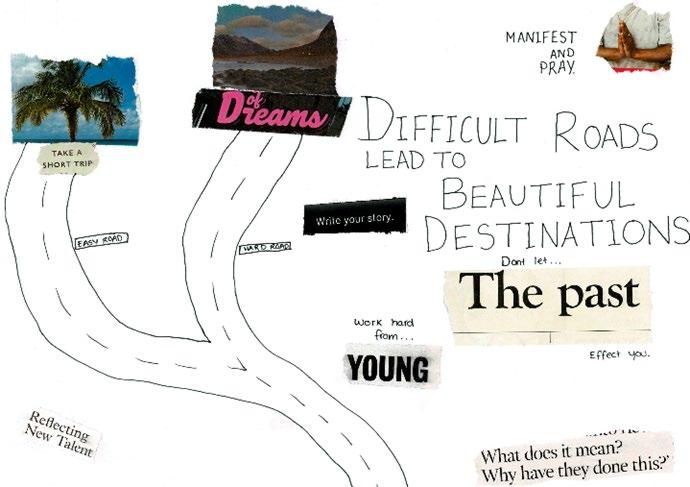
The lads’ artwork reflects this also:

From this final phase (and those before it), several key lessons emerge for the future of Creative Aid and for any organisation working at the intersection of creativity, justice, and care.
Consistency matters more than frequency
Even when sessions are interrupted, maintaining communication and continuity (through Nepacs visits, creative packs, or written feedback) preserves the trust that underpins all change. The lads notice when Creative Aid keeps showing up, even in small ways, and this reliability continues to be the foundation of the programme’s impact. Artist reflections indicate that future in-cell creative packs could move away from activity booklets and instead become bespoke, personalised resources tailored to each lad’s interests, abilities, and
aspirations. Rather than everyone receiving the same set of activities, packs could support different creative pathways. For example, one lad with a strong interest in theatre could receive a book on writing a first play, while another who is passionate about visual design might be given comics and drawing materials to help develop those skills. This shift could acknowledge that the lads engage with creativity at different levels and in different ways, and that personalised creative offers can deepen motivation and connection, especially during periods when group sessions cannot take place.
Learning may also involve co-developing the annual book and gallery with the artists and lads, so that the lads’ artworks and writing are presented in ways that reflect how they want to be seen. While recognising this would require additional resource, there is value in ensuring that the external presentation of their work is something that the lads can input on. This might include gathering their reflections on how the work should be described, what context they feel is important, and what aspects of their creative identity they want highlighted. This collaborative approach may give external audiences a more authentic understanding of the lads’ intentions in their work.
There is also potential to restructure delivery into two-block cycles (e.g., two shorter blocks each term), which may allow artists to rotate more frequently, deepen relationships with the lads, and build continuity over time. With the lads’ varying creative styles, regular but varying artist presence becomes essential (i.e., there is consistency in provision, but a change in artistic expertise). This means that lads who may feel less connected to one artistic form won’t have to wait as long for another to come around, while also building the consistency and continuity that have been vital to Creative Aid’s impact. This change would have to be made in line with additional considerations around the practicalities of scheduling in a complex setting.
Future creative work will continue designing for precarity, not around it - embedding flexibility and contingency planning as standard. Creative Aid’s trauma-informed, adaptable facilitation model has already proven that creativity can continue under shifting conditions; future work should continue to consider this adaptability as a core design principle.
The emotional nature of this work requires built-in space for artists to rest and decompress. Holding space for lads in complex emotional states, while navigating unpredictable conditions, demands significant relational labour. Blue Cabin should continue to provide structured time for recovery (such as the check-ins and check-outs, paid therapeutic supervision, paid self-care sessions, access to the Blue Cabin team, and monthly meetings) to protect artist wellbeing and support sustainable long-term delivery. If Creative Aid continues, artists will be invited to spend their ‘planning time’ as they need; this could be in conversation with other artists, Blue Cabin staff or alone, allowing artists the autonomy needed to process complex emotional experiences.
Creative Aid has played a vital role in ensuring the lads can continue their creative journeys both inside and after custody. The annual limited edition artists book and online gallery continue to offer crucial visibility beyond prison walls; however, the deeper legacy lies in the lads’ own sense of authorship. Future legacy work could consider ways to codesign the limited edition artists books and gallery with the artists and lads.
““In
what
can be a
chaotic space, there can be this moment where we create a studio and there’s a big table and we sit around it and we have cups of tea and we make sense of the world and we make art about it.”
- Artist
As the third year concludes, Creative Aid stands as a model for what can happen when creative relationships are held with care, persistence, and imagination. The work has never been easy - it has been interrupted, postponed, and reconfigured countless times - yet each disruption has clarified what matters most: trust and the refusal to disappear when conditions are hard. The lads’ voices and artworks now live beyond the session room; in Arts Award portfolios, limited edition artists books, and online galleries.
Work continues to share this practice with the wider sector across a range of activities. Creative Aid were asked to present at Culture Cares in July, a conference hosted by Derby Theatre, around how arts and culture are making a positive impact and creating pathways in the lives of careexperienced young people. This was delivered by the partnership - Blue Cabin, Nepacs, one of the artists in residence, and one of the lads who had participated in Creative Aid and had been released.
The team, including two of the lads who had been released, also presented at an online conference as part of the Esmée Fairbairn care experienced participation summit in September. In October, Creative Aid held the Pages of My Life: Art, care and conversation online event. This was with author and prison educator Andy West, and philosopher Grace Lockrobin (Co-Director of Thoughtful), to explore the philosophical approaches used to engage the young men in conversations about their artwork. September also saw Blue Cabin Director, Jenny Young, being invited to New York, as part of the United Nations General Assembly and the launch of the Global Charter for Children’s Care Reform. Artwork and creative writing from Creative Aid was displayed prominently throughout the event.
The next stage could further support and consider sharing this learning with other organisations, perhaps developing resources for trauma-informed creative facilitation in prisons, alongside embedding the practices identified above within future iterations of Creative Aid.