Published 2013 by A&C Black An imprint of Bloomsbury Publishing Plc 50 Bedford Square, London, WC1B 3DP www.bloomsbury.com ISBN HB 978-1-4081-8183-6 ISBN PB 978-1-4081-9481-2 Copyright © 2013 Bloomsbury Publishing Plc Text copyright © 2013 Anna Claybourne Design: Nick Avery Design The right of Anna Claybourne to be identified as the author of this work has been asserted by her in accordance with the Copyrights, Designs and Patents Act 1988. A CIP catalogue for this book is available from the British Library. All photographs © Shutterstock, except: p23 (inset) John Sparks/naturepl.com; p31 (inset) © Gerard Soury/Oxford Scientific/Getty Images; p37 (inset) © Brandon Cole/naturepl.com; p38 (inset) © Citron; p38 © Christian Darkin/Science Photo Library; p39 (inset) Y23; p40 © Doug Perrine/naturepl.com; p41 (inset) © Jeff Rotman/naturepl.com; p44 © Scubazoo/Science Photo Library; p44 (inset) © Jany Sauvenet/ Science Photo Library; p46 © Doug Allan/naturepl.com; p48 © Nick Upton/naturepl.com; p55 (inset) © Damian Herde / Shutterstock.com; p60 (inset) © J. Patrick Fischer; p61 © Tom McHugh/Science Photo Library; p62 © Daniel Heuclin/naturepl.com; p63 (inset) © ANDREW MURRAY/naturepl.com; p72 © PETER REESE/naturepl; p73 © Mark Carwardine/naturepl.com; p74 (inset) and p74 © Jabruson/naturepl. com; p76 © François Gilson / Biosphoto / stevebloom.com; p77 (inset) © Bristol City Museum/naturepl. com; p78 © Nature Production/naturepl.com; p79 (inset) Scott Camazine/Science Photo Library; p80 © Pete Oxford/naturepl.com; p81 (inset) © Julio.ospinao; p82 (inset) © Snakecollector; p83 © Morkelsker; p84 (inset) © Tony Heald/naturepl.com; p85 © Jabruson/naturepl; p88 © Natural History Museum, London/Science Photo Library; p89 © Fir0002; p91 (inset) © Charlie Summers/naturepl.com.
Copyright in the photographs remains with the individuals and organisations credited above. Every effort has been made to trace copyright holders and obtain their permission for use of copyright material. The publishers would be pleased to rectify any error or omission in future editions. All rights reserved. No part of this publication may be reproduced in any form or by any means – graphic, electronic or mechanical, including photocopying, recording, taping or information storage and retrieval systems – without the prior permission in writing of the publishers. This book is produced using paper that is made from wood grown in managed, sustainable forests. It is natural, renewable and recyclable. The logging and manufacturing processes conform to the environmental regulations of the country of origin. Printed in China by Toppan Leefung. HB 10 9 8 7 6 5 4 3 2 1 PB 10 9 8 7 6 5 4 3 2 1
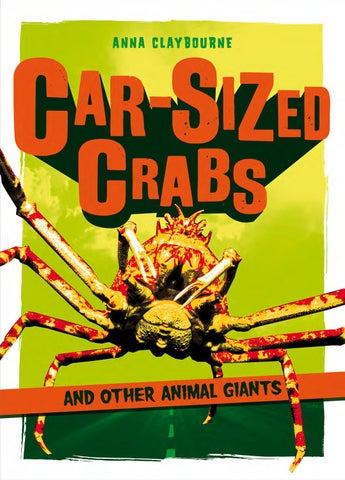
And Other Animal Giants
Written by Anna Claybourne
Contents A world of giants
6
Massive mammals African elephant Rhinoceros Hippopotamus Flying fox Polar bear Tiger Giraffe Gorilla
8 10 12 14 16 18 20 22
Sea monsters Blue whale Sperm whale Elephant seal Whale shark Great white shark Ocean sunfish Giant octopus Colossal and giant squid Japanese spider crab Lion’s mane jellyfish Leatherback turtle Giant isopod Bootlace worm
24 26 28 30 32 34 36 38 40 42 44 46 48
Slithery and slimy giants Green anaconda King cobra Saltwater crocodile Giant tortoise Komodo dragon Chinese giant salamander Goliath frog
50 52 54 56 58 60 62
Big birds Andean condor Wandering albatross Ostrich Emperor penguin
64 66 68 70
Giant creepy-crawlies Giant weta Goliath beetle Queen Alexandra’s birdwing Asian giant hornet Tarantula hawk wasp Goliath bird-eating spider Giant earthworm Giant African land snail Chan’s megastick Robber crab
72 74 76 78 80 82 84 86 88 90
Where in the world? Glossary Index
92 94 96
14
Flying fox
Spread out your arms as wide as you can. Your armspan is similar to the wingspan of the large flying fox – which is not actually a fox at all, but the world’s biggest bat. Maybe you thought bats like that only existed as Halloween decorations, or in vampire films! But bats this big really are out there. Furry faces
Flying foxes get their name because their pointy, furry faces resemble a fox. They are also known as megabats. There are many flying fox species, and they vary in size – but the large flying fox, Livingstone’s flying fox, black flying fox and Indian flying fox are all enormous. Most of their size comes from their wide wings, made of skin stretched between long, spindly finger bones. Their furry bodies are closer to the size of a cat or a small monkey. To stay in the air, flying foxes must also be very light, so they only weigh around a kilo – as much as a small bunch of bananas.
Monster moment According to folklore, an even bigger bat, the mysterious Ahool, roams the forests of Java in southeast Asia. It’s said to cry ‘a-HOO-oool!’ as it flies through the night, and has a reported wingspan of over 3m – twice as big as the biggest flying foxes. Yikes! However, there’s no evidence so far that it really exists.
Maximum size: 1.5m wingspan Maximum weight: 1.2kg Found in: India, Asia, Australia and islands around Africa.Creature feature: Huge, spreading, leathery wings, attached to the bat’s arms and fingers.
15
Fruit fan
Some bats eat insects, some eat fish or frogs, and some, the vampire bats, really do sneak up and suck people’s blood. Luckily for us, flying foxes don’t do that. They feed on fruit and nectar from flowers, giving them another of their names, ‘giant fruit bat’.
Hanging around When it stops for a rest, a flying fox hangs upside down by its feet, like other bats, and wraps its wings around itself.
36
Giant octopus
If you were aboard a sailing ship hundreds of years ago, one thing you were sure to fear was the kraken. According to legends and sailors’ tales, this mighty, many-tentacled sea monster could clamber up out of the sea, wrap itself around a ship and drag it under the waves. Yikes! But of course, there isn’t really a creature like that. Is there?
Maximum size: 9.6m armspan across Maximum weight: 250kg Found in: The northern Pacific ocean, mostly near coasts. Creature feature: Strangely wrinkled, baggy skin that can change colour and texture.
37
Monster octopus
Some old illustrations of the kraken suggest the tales were actually based on a real-life sea creature, the red, wrinkly, and incredibly stretchy giant Pacific octopus. This is the biggest octopus in the world (or at least, the biggest discovered so far – it’s always hard to tell what might be lurking in the deep oceans!). A giant octopus is not big enough to sink a ship – sailors and fishermen probably exaggerated its size after finding dead ones, or catching them in their nets. However, the biggest specimens are thought to have had an armspan of almost 10m. 10m is a lot! An octopus 10m across could easily wrap itself around an elephant, a truck or a small house, if not a full-sized ship. Giant grabber A giant Pacific octopus can spread its arms out wide, then bring them together to help it swim, or to grab prey.
ow? n k u o y Did ighly
h es are s u p o t Oc ptive a C . t n e uses i n te l l i g p o t c o acific o w to h giant P t u o orked reats, t have w d n fi rs to open ja d their way and fin mazes. h throug
Shark-eaters
Usually, giant Pacific octopuses are closer to 5m across, but that’s still pretty big. They mainly hunt lobsters, shellfish and smaller octopuses, but have also been seen catching seabirds and even eating sharks.
40
Japanese spider crab If you’ve ever seen a crab, it was probably quite small – small enough to fit in your hand, or at least on a plate! But did you know that there are crabs the size of cars? Yikes! The Japanese spider crab, the world’s biggest crab, has a body as big as a dustbin, and legs up to nearly 4m across. Water giants
Crabs belong to the arthropods, the same animal family as insects. They don’t have bones to hold them up, just a strong shell, or “exoskeleton” (meaning a skeleton that’s on the outside). On land, it’s hard for animals like this to grow really big, because they couldn’t hold their own bodies up. But in the sea, the water supports them, making it easier to move around. This crab stays in the water and never comes onto land, and that’s one reason it can grow so enormous.
Don’t catch me! Like other crabs, Japanese spider crabs have strong, sharp pincers, and they can hurt people by giving them a nasty nip. This usually only happens to fishermen who are trying to catch them.
Did you k
now? Japane s crabs c e spider an liv 100 yea e to be rs old!
Maximum size: Legspan 3.8m Maximum weight: 19kg Found in: The Pacific Ocean around Japan Creature feature: Super-spindly front legs, each almost 2m long.
41
Will it eat me?
Spider crabs look scary, like monsters in a sci-fi movie – but they don’t chase or eat humans. They live in deep, dark, cold water, feeding on shellfish, or nibbling at dead sea creatures. However, we do eat them. In Japan, people catch spider crabs (usually smallish ones) to use as food.
Crabs in captivity You can sometimes get a good, close-up look at a giant spider crab in an aquarium or sea life centre. They need to be kept in very cold water to stay healthy.
50
Green anaconda
If you ever go exploring in the Amazon rainforest, take care as you splash through the streams and steamy swamps. This is where the world’s biggest snake can be found, lurking in the shallows, perfectly disguised and ready to pounce. Biggest snake
The green anaconda often stars in jungle adventure films, where it wraps itself around unwary explorers. It’s often shown as bigger than its true size. However, even in real life, this is still a massive monster snake. It can reach nearly 9m in length – as long as two large 4x4 cars. But the thing that makes it really monstrous is its thickness. Its body can be 30cm in diameter, or almost a metre around, making it incredibly chunky, powerful and heavy.
Mighty coils Imagine this wrapping around you and squeezing tight! Anacondas are so strong, there’s no way you could escape.
Maximum size: 8.8m long Maximum weight: 230kg Found in: Rivers, ponds and swampy areas in northern South America. Creature feature: Eyes and nostrils on top of the head, like a hippo’s, let the anaconda hide underwater to wait for passing prey.
51
Open wide!
Snakes this big aren’t poisonous. Instead, they are ‘constrictors’. They coil around their prey and squeeze it so that it can’t breathe, then swallow it whole. A green anaconda is big enough to eat a human, and it has been known to happen. Normally, though, they eat fish, lizards and birds, and sometimes larger animals like deer, caimans and capybaras.
Water snake Anacondas love water, and are often seen like this, lurking in a shallow pool or pond with their eyes above the surface.
Hey! I’m the biggest!
The green anaconda is normally awarded the title of biggest snake species, but there’s one snake that can grow even longer – the reticulated python. Another constrictor, its world record length is just under 10m.
? w o n k u o Did y y are so big,
the Though s are at risk, da d for e t n u anacon h e they ar lso to be e s u a bec , and a s n i k s pets. c their i t o x e sold as nt one a w d l ou Who w ese as of th a pet!?
72
Giant weta
The Little Barrier Island giant weta is the heaviest insect on earth. This monster insect is so big, it thinks nothing of gobbling up a whole carrot, and fills the palm of a man’s hand. A weta is a grasshopper-like insect, and the largest ones, like this, cannot fly. They just crawl around slowly, feeding mostly on fruit and seeds. If danger threatens, they can bite to defend themselves, or scratch their enemies with their prickly legs. However, wetas are usually quite mild-mannered and not dangerous to humans. Many people in New Zealand, where they are found, are happy to pose for a photo with an enormous weta crawling across their arm or even their face!
Forest dweller A giant weta at home in its natural habitat, on tree bark in a New Zealand forest.
Mind those claws! Wetas are friendly and quite happy to sit in your hand, though their sharp claws can be a bit scratchy.
Maximum size: 10cm body length Maximum weight: 70g Found in: Islands off New Zealand Creature feature: Females seem to have a nasty-looking sting, but it’s actually an ovipositor, a tube for laying eggs.
73
Island giants
The biggest giant wetas can have a body 10cm long, a legspan of 20cm, and weigh as much as 70g – three times as much as a mouse. In fact, on the islands where they live, there aren’t any small mammals like rats, and wetas take their place, eating similar foods. Without these animals to hunt them, and with plenty of food around, they can become enormous. For similar reasons, many islands around the world have animal giants living on them.
ow? n k u o y Did c name
ientifi c s e h T t w e ta s n a i g r fo acrida, n i e D s i rrible e t ‘ g n i mean per’! p o h s s gra